Cellar recorder that went quiet, a facade camera knocked loose by work next door, or a workshop below Fourth Avenue that needs last night's clip? Greenwood Heights camera repair line, booked within 2 hours: (347) 934-8335
Frame Houses Under Siding · Cellar Recorders · Fifth Avenue Store Buildings Facing Green-Wood · Workshops and Foundries Between Third and Fourth Avenues
Security Camera Repair in Greenwood Heights
Any Brand, Any Installer · Footage Saved Before Anything Is Touched · Written Price First · Brooklyn Rate
Security camera repair in Greenwood Heights starts with our $150 Brooklyn service call, which pays for the on-site diagnosis and is credited to the repair if you go ahead. Most single faults on our published Brooklyn list cost $150 to $700, and a new recorder or the rewiring of several cameras runs $700 to $1,500. We fix systems other companies put in: the stoop and yard cameras on a wood-framed two-family in the 20s, the recorder on a cellar shelf beside the boiler, the cameras over a Fifth Avenue shop across from Green-Wood, and the cameras inside a workshop between Third and Fourth Avenues. Requests are booked within 2 hours, visits come in two-hour arrival windows, and you hear what failed and get a written price before any part is replaced.
Every price on this page comes from our published Brooklyn camera repair list, and your own price is written down before work starts
Rated 4.7★ across 201 Google Reviews
Reviewed and updated November 12, 2026, against the Brooklyn Eagle's August 25, 2026 report on the shooting in front of a bronze foundry at 218 31st Street and the surveillance images police released afterward (also reported by 1010 WINS and the New York Daily News); ABC7 New York's September 2025 report on the basement fire in a 27th Street apartment building; Con Edison's June 24, 2025 southwest Brooklyn voltage-reduction notice; the Brooklyn Paper's report on the 2012 Green-Wood vandalism caught on camera near the main gate; Brownstoner's 2014 Building of the Day on the wood-framed rows of 18th Street; the Department of City Planning's 2005 South Park Slope rezoning summary; New York YIMBY's September 2026 report on the permits for 156 21st Street; the Landmarks Preservation Commission's Permit Guidebook chapter on health and safety equipment; Brick Underground on landlords and building footage; HomeAdvisor's Brooklyn cost page; an r/SecurityCamera thread on failing recorder drives; New York Labor Law §203-c; and the New York Department of State on security and CCTV installer licensing. · Abstract Enterprises Security Systems, NYS license #12000287431 · crews dispatched from our Troy Avenue office in Brooklyn
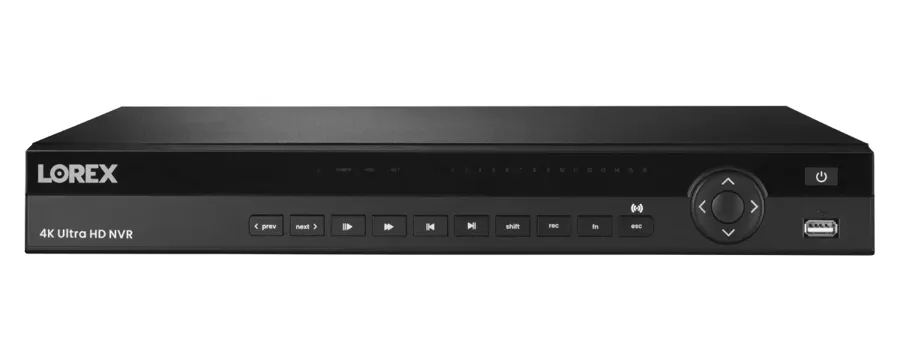
A product photo from the AESS job library, not taken in Greenwood Heights: a 16-channel network video recorder. In a wood-framed two-family on 20th or 23rd Street this box usually sits on a cellar shelf near the boiler, the gas meter and the internet modem; in a Fifth Avenue store building it lives in the back office or under the counter; in a workshop below Fourth Avenue it is often on a desk in a dusty mezzanine office. Nearly every repair starts here, because the recorder holds the footage, logs which cameras dropped and when, and is the one part that has to keep running through a power dip.
Greenwood Heights Camera Repair Request
House, two-family, condo, store, workshop or building: send the address and what the screen shows, and a technician calls back with the next step
✅
Request Sent!
Thank you. A technician will contact you about the Greenwood Heights address shortly.
25+
Years Experience
✓
Same-Day Estimates
100%
Licensed & Insured
4.7★
201 Google Reviews
Owner-operated since 2002 · Thousands of jobs completed · Booked within 2 hours
Security camera repair in Greenwood Heights usually means getting a system that is already on the house, the shop or the workshop to see and save again, then making it tell you the next time it stops. The call tends to follow something specific. A neighbor asks whether your camera caught the street the night something happened on 31st Street. A demolition crew next door pulls down the cable to your side camera with the old fence. Smoke from a cellar fire on the block drifts into your cellar, and a week later the recorder starts freezing. Or a shop owner on Fifth Avenue finds, the morning after a break-in, that the camera over the side door has shown nothing but a grey smear for months. On a wood-framed Greenwood Heights house the common causes are a plug-in power supply or PoE switch that failed in the cellar, a connector at the camera that took in water through the siding, a worn drive in a damp or dusty spot, and cable cut during restoration, siding or roofing work. In workshops and light industry below Fourth Avenue, add metal dust and heat. Send a photo of the recorder screen to (347) 934-8335 or on WhatsApp, and we will tell you the likely fault and what that kind of repair costs on our Brooklyn list before you book.
Looking at your photos costs nothing. The $150 service call covers the on-site diagnosis and is credited to the repair if you go ahead.
All work is done under New York State license #12000287431, the license the state requires of companies that install or service security and CCTV systems for other people.
We repair any brand and any installer's work, and we say plainly when an old camera or recorder is not worth paying to fix.
The Neighborhood
Why Greenwood Heights Properties Need Security Camera Repair
Greenwood Heights is the slope between the Prospect Expressway and Green-Wood Cemetery, taking its name partly from the cemetery, in the 11232 ZIP code and Brooklyn Community District 7. Its borders are argued over, but most people put it from the expressway south to the cemetery's southern edge, and from the waterfront side of Third Avenue up toward Eighth Avenue. The housing is what makes camera repair here its own job. Brownstoner's architecture writer put it plainly in 2014: the neighborhood "is better known for its wood framed houses, both restored and covered with aluminum siding," with brick and brownstone rows among them. Those houses were built as worker housing in the late 1800s and early 1900s, two to four stories tall, and many are now two- and three-family houses with one cellar, one electric service and one camera system shared by several households. Along Fifth Avenue the buildings are three- and four-story store buildings with apartments above, and toward Fourth Avenue and below it the blocks open into one-story warehouses, workshops, garages and new apartment buildings that went up after the 2005 rezoning.
Each of those building types breaks a camera system in its own way, and that is the reason a camera repair here is rarely a matter of swapping one camera. On a house under siding, the cable to a stoop or yard camera usually comes through a hole drilled through the vinyl or aluminum skin and the old clapboard beneath, and water that gets behind the siding follows the cable to the connector. In a restored frame house, the owners do not want new holes in wood they have just stripped and repainted, so every repair has to reuse the old penetration or find a quiet path along a downspout or a cornice. In the cellar, the recorder, the PoE switch and the power supplies tend to sit on a shelf near the boiler and the gas meter, where heat, dust and the occasional leak work on them for years. In the workshops between Third and Fourth Avenues, grinding dust and welding flash do things to cameras that a house never sees.
The neighborhood has also seen, recently, why a working camera matters. On the evening of August 19, 2026, a man fired a gun in front of a bronze foundry at 218 31st Street and struck a dog being walked nearby; police released surveillance images of the man they were looking for, and the Brooklyn Eagle reported an arrest within the week. On the last night of August 2025, a second-alarm fire started in the basement of an apartment building on 27th Street and injured twelve people, ABC7 New York reported. Neither story is about cameras, and we do not claim either was solved or caused by one. They are the kind of nights after which people on the surrounding blocks open their camera app and find out whether it was actually recording, whether the cellar recorder survived the smoke, and whether anyone can still log in.
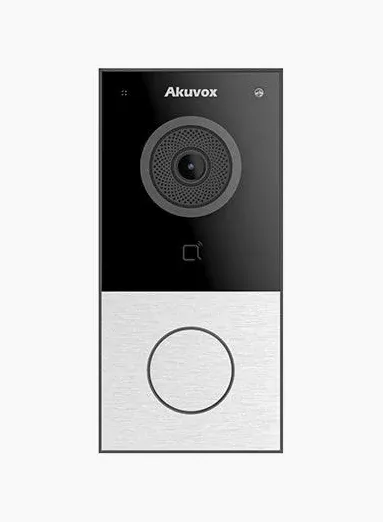
A product photo from the AESS job library, not taken in Greenwood Heights: a slim video door station with its camera lens at the top and a large round call button. On a Greenwood Heights two-family the shared street door is often the only entrance both households use, so a door station like this, or a small camera above it, is the camera people check most. When its picture dies, the usual suspects are the power supply in the cellar and the cable where it passes through the door frame or the siding.
Power is the other local thread. On June 24, 2025, Con Edison cut voltage by 8 percent across a large part of southwest Brooklyn, naming Sunset Park and Park Slope among the neighborhoods affected "in parts, or all," and describing a second area as "bounded by Prospect Park and Greenwood Cemetery on the north." The company said it had reduced voltage "to protect equipment and maintain service as crews make repairs," and asked 105,800 customers to hold off on energy-hungry appliances. A voltage reduction is not a blackout, which is exactly why it causes camera trouble: lights stay on, so nobody thinks to check the cellar, while a tired power supply or a PoE switch near its limit starts dropping cameras one at a time. We see the same pattern after summer heat and after the kind of brief flickers that never make the news. For the citywide version of this repair work, see our Brooklyn security camera repair page.
Six Greenwood Heights facts that change how a camera gets repaired
Wood frames under siding. On 1888 maps, wood-framed row houses "dominated both sides of the block" on 18th Street between Fourth and Fifth Avenues, Brownstoner found; many of those houses are still wood under aluminum or vinyl today, so a facade camera is screwed into a skin with a hollow gap behind it, not into masonry.
A 2005 rezoning that added new buildings. The City Planning Commission approved the South Park Slope rezoning on October 19, 2005 and the Council on November 16, 2005, covering 50 blocks from 15th Street to 24th Street and Green-Wood; it allowed larger buildings on Fourth Avenue, which is why there are concrete condo and rental buildings with managed networks a block from frame houses.
A cemetery on one side of Fifth Avenue. Green-Wood covers 478 acres and was founded in 1838; from 24th Street to 34th Street, Fifth Avenue has the cemetery's fence on one side and houses and shops on the other, so cameras on those buildings look at a dark, empty view after closing.
Industrial blocks still changing. In September 2026, New York YIMBY reported permits for a new three-story building with manufacturing space and four enclosed parking spaces at 156 21st Street between Third and Fourth Avenues, after demolition permits were filed for the house on the site; demolition beside an occupied house is one of the most common causes of cut camera cable.
Landmarks are the exception, not the rule. The 1895 Weir Greenhouse at Fifth Avenue and 25th Street is a city landmark, and Green-Wood was named a National Historic Landmark in 2006, but the frame and brick rows around them are mostly ordinary residential blocks. We still check the city's landmark map for the address before facade work, and where a building is designated, the Landmarks Preservation Commission's guidebook says ordinary maintenance and repair of safety equipment needs no permit.
One precinct. The neighborhood is covered by the NYPD's 72nd Precinct, headquartered at 830 Fourth Avenue, which is where a detective asking for your footage will usually be calling from.
Same-Day Repair in Greenwood Heights
Need Repair in Greenwood Heights? A Cellar Recorder That Went Quiet, a Facade Camera Torn Down Next Door, or a Clip You Need Before It Is Overwritten
Urgent calls from Greenwood Heights come in three kinds. The first is the after-incident call: something happened on the block or at the shop, a detective or a neighbor wants to know what the camera saw, and the owner needs the clip now. The second is the after-damage call: a fire, a leak, a roofer, a siding crew or a demolition next door, and since then some cameras are dark or the recorder will not stay up. The third is the slow fade, where a camera went grey or dark months ago and nobody noticed until the day it mattered. All three start the same way: we protect whatever video still exists, then find the fault.
If you need footage of a particular night, leave the recorder running. Do not restart it, unplug it or let anyone reset it. Most recorders overwrite their oldest video once the drive fills, so the clock is already running on the clip you need, and a restart can also wipe the log that shows when a camera dropped. Call (347) 934-8335, give us the date and the time window, and we book the visit with saving that video as the first task. If the 72nd Precinct has asked for a copy, tell us when you book; the export goes to USB with the recorder's original timestamps, and we note the difference between the recorder's clock and the real time so nobody argues later about when something happened.
If smoke, water or dust has reached the recorder, tell us that too, because it changes the order of work: we may pull and copy the drive before powering the recorder again. For everything else the path is simple. The $150 service call books a two-hour arrival window, the technician finds the cause, and you get a written price before any part is replaced. Requests are booked within 2 hours. We do not promise the repair itself the same day, because some parts are ordered, but most single-camera, power-supply and drive faults are fixed on the first visit when the part is on the truck.
What We Install
Security Camera Repair Services in Greenwood Heights
Every repair below is priced from our Brooklyn camera repair list. The service call pays for finding the fault; the repair is priced by what failed, how many cameras it touches and how hard the run is to reach, whether that is a stoop camera on a sided two-family or a camera on a long arm over a Fifth Avenue store.
Dark camera diagnosis
A camera with no picture, tested at the camera, along the cable and at the recorder, so only the failed part is replaced. On frame houses here the fault is often a connector soaked where the cable comes through the siding, or a plug-in power supply in the cellar, both far cheaper than a new camera.
Smoke, soot and water recovery
After a fire on the block, a leak from upstairs or water in the cellar: footage is copied first, then the recorder, switch, supplies and drive are tested and cleaned or replaced, and you get a written list of what was damaged.
Cellar recorders and switches
DVRs, NVRs, PoE switches and power supplies on cellar shelves near boilers, gas meters and laundry machines, moved up off the floor, given air and put on a battery backup where it makes sense.
Siding and clapboard remounts
Cameras that pulled loose from vinyl or aluminum siding, or have to come off and go back while the siding is stripped and the clapboard restored, remounted into solid wood and sealed.
Cable cut by work next door
Runs taken out by demolition, a new fence, roofers, siding crews or a gas or sewer dig, traced, replaced or spliced properly, with photos and a written note you can send to the contractor responsible.
Workshop and foundry cameras
Cameras and recorders in shops that grind, weld, cast or cut, cleaned, re-housed and re-set for flash and dust, and moved where the work cannot blind or coat them.
Storefront and side-door cameras
Fifth Avenue and Fourth Avenue shop cameras over doors, registers, cross-street side doors and back yards, re-aimed and re-set so they record faces at the door instead of glare.
Phone viewing and logins
Apps that stopped connecting after a router or provider change, logins held by a former tenant, relative or installer, and recorders nobody can open, recovered and handed to the right people.
Footage export for incidents
Clips saved to USB with original timestamps for the 72nd Precinct, an insurer, a landlord or a lawyer, with a short note of what the recorder's clock said against the real time.
A product photo from the AESS job library, not taken in Greenwood Heights: a black varifocal dome camera. Its lens can be zoomed and focused after it is mounted, which is why it is common inside Fifth Avenue shops and over workshop doors. When a dome like this goes soft or blurry, the cause is often a dirty or scratched bubble, dust inside the housing, or a focus that drifted, and those are cheaper fixes than a new camera.
Building Specialists
Security Camera Repair for Greenwood Heights' Architecture
The same dead camera means a different repair depending on what it is fastened to and where its cable goes. These are the buildings we work on in Greenwood Heights and what each one does to a camera system over the years.
Sided frame row houses
Wood-framed houses under aluminum or vinyl, mostly two and three stories, on the side streets in the teens and 20s. Cameras are screwed through the siding, cables enter through the skin, and water and loose panels are the usual enemies.
Restored clapboard houses
Frame houses whose owners stripped the siding and restored the wood. The cameras have to live on painted trim and clapboard without new holes, and old paint near the work has to be treated with care.
Two- and three-family houses
One cellar, one recorder, several households. Cameras cover a shared street door, a shared yard and sometimes a driveway, and the logins are spread across owners, tenants and relatives.
Brick and brownstone rows
Masonry rows scattered among the frame houses, with cameras anchored in mortar joints, cables run down the back wall, and cellars that stay cooler but damper.
Fifth Avenue store buildings
Three- and four-story buildings with a shop below and apartments above, often two separate camera systems, a shop recorder in the back office and the landlord's in the cellar.
Post-2005 condos, rentals and workshops
Newer concrete buildings near Fourth Avenue with managed networks and garages, and one-story warehouses and workshops below Fourth with long open spans, dust and heavy doors.
Sided frame houses: the camera is only as tight as the panel behind it
Aluminum and vinyl siding is a skin over the original clapboard, with a gap behind it. A camera screwed only into the siding is held by a thin panel that moves with heat and cold, and over a few winters the screws loosen, the camera tilts, and the seal around the cable hole opens. Water that runs down the face of the siding finds that hole, follows the cable inside and sits in the connector. The result, usually in spring or after a wet autumn, is a camera that drops out in rain and comes back when it dries, then one day does not come back. The repair is to take the camera off, cut the corroded connector back to clean copper, put on a new weatherproof connector, and remount the camera on a mounting block that bears on the wood behind the siding rather than on the panel. The cable gets a drip loop below the entry, so water falls off before it reaches the hole, and the hole is sealed with a sealant that stays flexible. On aluminum siding we also check that nothing metallic is rubbing through the cable jacket at the edge of the hole.
Siding hides the route, too. Many of these houses were wired by whoever put the siding up or by a relative, and the cable from the cellar to the stoop camera might run up inside a wall bay, along the outside behind a downspout, or across the cellar ceiling and out through the rim joist. Before we open anything we trace it with a tone tester from the cellar end, so a repair does not mean taking off siding that does not need to come off.
Restored clapboard houses: reuse the old hole
Owners who have taken a Greenwood Heights house back to its clapboard do not want a technician drilling the trim they have just restored. Our rule on those houses is to reuse existing penetrations wherever we can, run any new cable along a line that already exists, such as a downspout, a corner board or the underside of a cornice, and mount cameras on painted mounting blocks that can be removed later without splitting the boards. Many of these houses were built around 1900 and some trim still carries old lead paint, so if any paint has to be disturbed we keep the work small, mist and wipe instead of sanding, and clean up with a HEPA vacuum rather than a broom. If a repair truly needs a new hole, we tell you where and why before we make it.
Two- and three-family houses: one cellar, many hands
In a two-family the camera system is often the owner's, but the tenants use the street door camera every day, and the recorder sits in a cellar the garden tenant may have in their lease. Repairs go smoother when we know, before the visit, who owns the equipment, who holds the recorder password, and who can let us into the cellar. Over the years these systems collect extra phones: a former tenant whose app still has a login, a relative who set things up and moved away, a handyman who changed the password. On a repair visit we list every account on the recorder and the app, remove the ones that should not be there, and give each household access only to the cameras it should see. That last part matters in a house where the yard is the owner's and the hallway is shared.
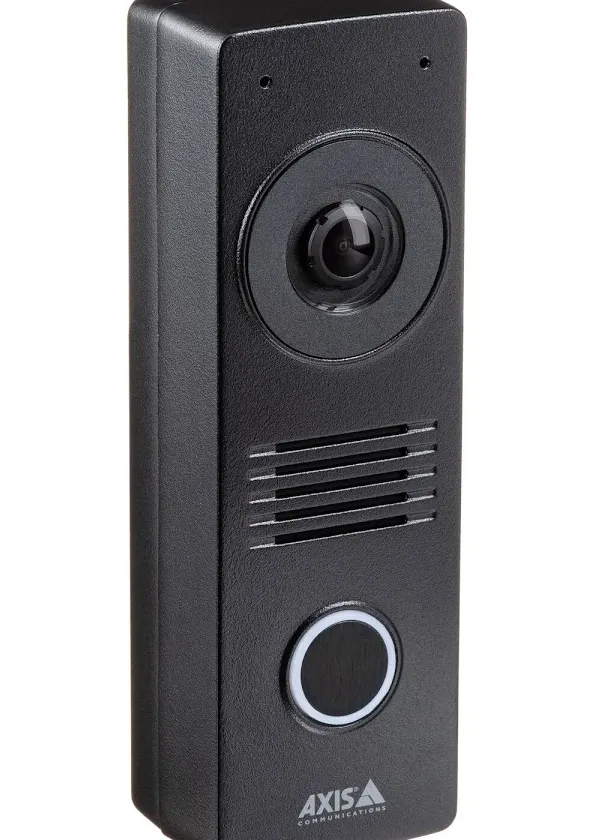
A product photo from the AESS job library, not taken in Greenwood Heights: a black video intercom door station with a camera, speaker grille and lit call button. On a Greenwood Heights three-family or a small building on Fourth Avenue, a door station like this is often the only camera on the street door. If its picture is gone but the call button still rings, the camera module or its power is the likely fault; if nothing works, we start with the supply in the cellar.
Brick and brownstone rows: dry walls, damp cellars
The masonry rows here behave more like the rest of Brooklyn. Cameras are anchored in mortar joints, which is the right place for them, and the usual faults are anchors that have worked loose as the mortar weathered, cables stapled along the face of the brick that cracked in the sun, and connectors sitting in damp cellars. Brick cellars stay cooler than frame ones, which is good for a recorder, but they hold moisture, so we look for rust on the recorder's case and the switch's ports and get the equipment up off any surface that sweats.
Fifth Avenue store buildings: two systems under one roof
On the store buildings along Fifth Avenue the shop's cameras and the landlord's cameras are often separate systems with separate recorders, and sometimes their cables share a riser or a back-yard wall. A shop owner who calls about a dead camera over the side door may find the camera belongs to the landlord, and a landlord may find the shop's contractor cut through the building's cable during a fit-out. We identify which system each camera belongs to before quoting, and if a repair would touch the other party's equipment, we say so and get the right person's approval first.
Post-2005 buildings and workshops: networks, garages and long spans
The condo and rental buildings that went up after the rezoning have concrete walls and ceilings, enclosed garages, and cameras that often run on a building network managed by an outside IT company. A repair there is as much about the network as the camera: a changed switch setting, an expired certificate or a firmware update can drop a whole floor. Below Fourth Avenue, the one-story warehouses and workshops have long open spans where cameras hang from roof steel or ceiling grids, runs of a hundred feet or more back to an office, and roll-up doors that swing the light inside from dim to full daylight in seconds. Those buildings need cameras set up for the work done inside them, which is the subject of more than one question further down this page.
Field Notes
Field Notes: Opening the Cellar Before Looking at the Camera
On a Greenwood Heights repair the technician almost always goes to the cellar first, even when the dead camera is on the roof line. The cellar tells the story. Is the recorder on the floor or on a shelf? Is there a water line on the wall? Is the PoE switch plugged into a power strip daisy-chained to the washing machine's outlet? Is the case warm, the fan clogged with lint from the dryer, the drive clicking? Is there a battery backup, and does it still hold a charge? Those answers explain most dark cameras before anyone climbs a ladder.
Then the recorder's own log. Most recorders keep a record of when each camera lost video, when the drive reported an error, and when the power went off and came back. Reading that log before changing anything tells us whether four cameras dropped at the same moment (power or switch), one camera drops in every rain (connector or cable entry), or everything stopped saving on one date weeks ago (drive or settings). That is also the moment we export any footage you need, because once we start replacing parts the log and the timeline can change.
Only then the outside. On a frame house we look at where each cable enters the siding, whether the camera is still square to its mount, and whether a drip loop exists. On a Fifth Avenue store we look at the side door and the back yard, where the cameras that matter most are often the ones nobody checks. In a workshop we look up at the domes for a coat of grey dust and down at the floor for where the grinder and the welding bench sit. The repair price is written after all three. That order, cellar, log, outside, is AESS practice rather than a rule from a manual, and it is the main reason we can usually tell you what failed in the first half hour.
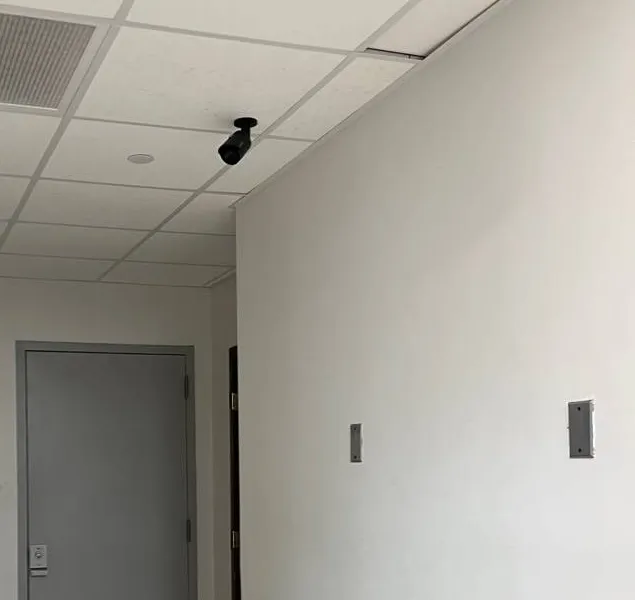
A photo from the AESS job library, not taken in Greenwood Heights: a small black bullet camera hanging from a white ceiling-tile grid and aimed down a short corridor at a grey steel service door. Workshops and small manufacturers between Third and Fourth Avenues often have a corridor like this between the shop floor and a back or side door, and it is the camera that records who came and went after hours. When one of these goes dark, check its cable where it passes through the grid before blaming the camera.
Why Systems Fail Here
Smoke, Siding, Dust, Low Voltage and the Lot Next Door: Why Greenwood Heights Camera Systems Fail
Every neighborhood has its own short list of things that kill camera systems. These are the five we see most often on Greenwood Heights jobs, and what each one does.
Smoke and soot: the damage that shows up a week later
Smoke from a fire nearby does not have to reach flame to hurt a recorder. A recorder pulls room air through its case to cool itself, and when that air is full of soot, the fine carbon settles on the circuit board, the fan and the drive's vents. Soot holds moisture and conducts a little, and over the following days and weeks it can cause freezes, restarts and failed drives in a recorder that seemed fine the morning after. Cellar fires are the worst case for neighbors, because cellars in attached frame houses can share paths for smoke along old pipes and wiring. If smoke has reached your recorder, the safe order is to copy any footage you need, have the drive's health read, and have the recorder and switch cleaned or replaced before they fail on their own schedule. Insurers usually want that in writing, so we list what we found and what we replaced.
Siding and clapboard: water that follows the cable
As described above, the hole where a cable passes through siding is the single most common failure point on Greenwood Heights houses. The sign is a camera that misbehaves in wet weather. A related one: siding crews and roofers working on the house or next door often unscrew a camera to get it out of the way, hang it by its cable, and put it back loosely or not at all. If your cameras went strange after exterior work, tell us what was done and when.
Dust and grit: the workshop problem
Shops that grind metal, cut stone or wood, sand or cast put fine dust into the air that settles on everything. On a camera it coats the dome or the lens and blurs the picture slowly, so slowly that nobody notices until a clip is needed. In a recorder it clogs the fan and the vents, the case runs hot, and drives fail early. Fine metal dust is worse than wood dust because it conducts. The fixes are simple but have to be repeated: clean the domes, blow out the recorder, put the recorder in a closed cabinet or a separate office with filtered air, and set the cleaning on a schedule.
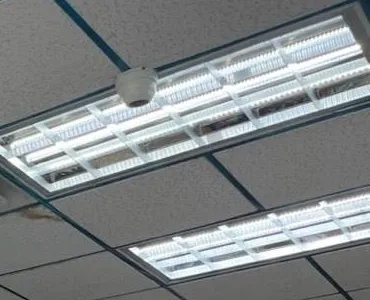
A photo from the AESS job library, not taken in Greenwood Heights: a small white dome camera on grey acoustic ceiling tiles beside a long louvered fluorescent light panel. In a Greenwood Heights office, studio or back room, a dome placed this close to a bright fixture can turn faces dark against the glare, and in a dusty workshop the dome's bubble can coat over within weeks. Moving a camera a tile or two away from the light, or cleaning the bubble on a schedule, often fixes a picture that looked like a failed camera.
Low voltage and power dips: cameras that drop one at a time
When the supply voltage sags, as it did across southwest Brooklyn during the June 2025 voltage reduction, or during heat waves and brief dips, the parts of a camera system that run closest to their limits fail first. A PoE switch that was already near its power budget starts rebooting cameras at the far end of the house. An old plug-in power box feeding four cameras through a splitter cannot hold their infrared lights at night and drops one or two after dark. A recorder on a cheap power strip restarts and comes back with a corrupted setting. We test each supply under load, check the switch's power budget against what the cameras actually draw, and put the recorder, switch and internet equipment on a battery backup sized to ride through a short dip.
Demolition and building next door: cut cable and moved views
Greenwood Heights still has houses coming down and buildings going up, especially between Third and Fourth Avenues. The damage to a neighbor's cameras is usually simple: a cable pulled off with an old fence or a shared wall's ivy, a camera knocked by a scaffold pole, or a yard camera now staring at a plywood fence. Construction vibration can also loosen camera mounts and shift focus. We repair what was damaged, take photos before and after, and write a short note of the damage and the cost that you can send to the builder or their insurer. We do not decide who is liable; we give you the record.
Commercial Security Camera Repair
Business Security Camera Repair in Greenwood Heights
Businesses in Greenwood Heights sit on a few distinct strips, and each one asks something different of its cameras. These are the corridors we work on and the repairs that come up most on each.
Fifth Avenue north of 25th Street
Cafes, bars, delis and small shops in store buildings with apartments above. Repairs center on the front door, the register and the back yard or cellar hatch, and on untangling the shop's system from the landlord's.
Fifth Avenue along the cemetery
From 25th Street to 34th Street the shops face Green-Wood's fence. After closing there is little light or foot traffic across the street, so cameras need to cope with a dark background and the occasional bright headlight.
Fourth Avenue
A wide avenue with newer buildings, auto and trade businesses, and stores whose side doors open on the cross streets. Side-door and curb cameras are the ones that fail unnoticed.
Third to Fourth Avenue side streets
Workshops, foundries, fabricators, garages and small manufacturers, including the block of 31st Street with a bronze foundry. Dust, heat, flash and heavy doors shape every repair.
Prospect Avenue and the north end
Shops and offices near the Prospect Avenue station and the expressway, many in mixed buildings, where cameras often share a network with card readers and office computers.
Toward Industry City
South of the cemetery's western edge the blocks run toward Industry City's warehouses between 32nd and 41st Streets. Tenants there usually have their own cameras inside a larger complex with its own security.
Fifth Avenue shops: the side door and the back yard
The front of a Fifth Avenue shop is usually well covered, because the owner sees that camera every day on the counter screen. The cameras that fail quietly are the ones nobody looks at: the side door on the cross street, the back yard where deliveries come in, the cellar hatch on the sidewalk, and the hallway to the apartments upstairs. Our repair visit for a shop includes a walk around every camera on the recorder, not just the one that brought us there, with a short list of which views are dark, blurry, aimed wrong or not recording on schedule. Pricing for each is from the Brooklyn list, and you choose what to fix.
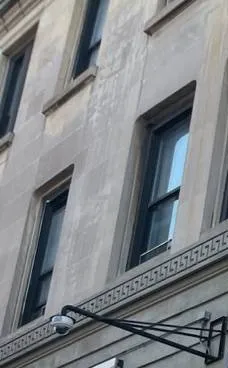
A photo from the AESS job library, not taken in Greenwood Heights: a bullet camera on a long black steel wall arm below a carved Greek-key band on a pale stone facade with tall sash windows. On the older store buildings along Fifth Avenue, a long arm like this lets a camera clear a cornice or a sign and look down the sidewalk. Arms that long work loose over time, and a camera that slowly droops toward the ground on playback usually needs its anchors reset in sound masonry, not a new camera.
Workshops and foundries: setting cameras for the work inside
A workshop on 30th or 31st Street is not a store, and a camera setup copied from a store will fail there. Welding and torch cutting produce flashes that push a camera's automatic exposure into a dark picture of everything else in the room; grinding puts metal dust on lenses; forklifts and hand trucks knock low cameras; roll-up doors swing the light from dim to bright. Repairs in these buildings usually involve moving cameras so the work is not in their direct view, setting exposure and wide-dynamic-range features for the brightest moments, putting domes where a pallet cannot reach, and moving the recorder into a closed office. Owners who keep finished pieces, tools or metal stock on site overnight usually want one camera that watches the storage area and one that watches the door, with alerts after hours.
Newer buildings on Fourth Avenue: who owns which camera
In a condo or rental building built in the last twenty years, the garage, lobby, package room and roof cameras usually belong to the building, are serviced under a management contract, and run on a network the building's IT vendor manages. A ground-floor store in the same building may have its own system. We repair both, but we confirm first who owns the camera in question, who has to approve the work, and whether the network vendor needs to be on the phone. Boards and managing agents can have the repair invoiced to the corporation or the management company.
Rules that touch a commercial camera repair
New York State requires a license to install or service security and CCTV systems for others; the state rule, 19 NYCRR 195.2, covers closed-circuit television used to detect or monitor intrusion, theft or movement. An owner who installs cameras on their own property, or has an employee do it, does not need that license, but anyone you hire does. AESS works under NYS license #12000287431. New York Labor Law §203-c requires employers who monitor employees electronically to give notice; for a business with cameras on staff areas, we can point out where a posted notice belongs, though the legal notice itself is the employer's job. Repairs on a city landmark, such as a building on the Green-Wood grounds or the Weir Greenhouse, follow the Landmarks Preservation Commission's guidebook, which says ordinary maintenance and repair of safety equipment needs no permit but asks that equipment be attached at mortar joints, plain masonry, wood or metalwork and not on decorative surfaces. Lighting, fire alarms and electrical work are separate trades; if a camera fault turns out to be a building electrical problem, we tell you and stop at the outlet.
Your Questions Answered
Security Camera Repair in Greenwood Heights: Questions Answered
These are the questions Greenwood Heights owners, tenants and shopkeepers bring to us, grouped by the situation behind them. Each answer is the short version of what we would tell you on the phone.
Fire, smoke and work next door
There was a fire in the cellar of a building on our block, and smoke got into our cellar too. Our recorder still runs, but now it freezes every day or two. Is it the smoke, and should we clean it or replace it?
Very likely the smoke. A recorder pulls air through its case, and soot that settles on the board, the fan and the drive causes exactly this kind of slow failure, often days after the fire. Before anything else, if you need any footage from before or during the fire, we copy it, because a recorder that is freezing can corrupt the drive on its next crash. Then we read the drive's health, open the case and look. Light soot on a recorder that is otherwise healthy can be cleaned and the fan replaced; heavy soot, a drive reporting errors, or a recorder more than a few years old usually makes a replacement the better spend. A drive swap is $200 to $450 on our Brooklyn list and a recorder replacement with drive and setup is $700 to $1,500. Ask your insurer whether they want a written damage note; we provide one with what we found and replaced.
The crew taking down the house next door pulled our side camera's cable off with the old fence. Can you repair it and write up the damage so we can send it to their contractor?
Yes. We take photos of the damage before touching it, trace the cable back to the recorder to see how much was torn or crushed, replace the damaged run and the connector, remount the camera, and test it by day and after dark. You get a short written note with the date, what was damaged, what we replaced and the price, plus the photos. That note is what a contractor or their insurer usually asks for. We do not take sides on who is responsible, and we cannot promise they will pay, but you will have a clean record. If the demolition is still going on, it is often worth waiting to reroute the cable until the heavy work next door is finished, and putting a temporary camera in place meanwhile.
Frame houses and restoration
We are stripping the vinyl siding off our house to restore the clapboard, and three of our cameras are screwed through the vinyl. What happens to the cameras during the work, and how do they go back without damaging the wood?
The cleanest way is to have us take the cameras down before the siding comes off, label each one and its cable, and coil and protect the cables at the wall. If you want coverage during the work, one camera can stay up on a temporary bracket. Once the clapboard is repaired and painted, we remount each camera on a painted mounting block that bears on solid wood, reusing the old cable holes where they land in sound boards, and seal every penetration. Trim on houses built around 1900 can carry old lead paint, so if any paint has to be disturbed we mist and wipe rather than sand and clean up with a HEPA vacuum. Plan this with your painter: the cameras should go back after the final coat, not before.
Our cameras were wired years ago with thin cable that looks like old telephone wire. Two of them have gone dark. Can that wire be repaired, or does it all have to be replaced?
It depends on what is on the other end. Some older analog systems were wired with thin multi-pair cable and small adapters called baluns, and those can work for years and then fail at the adapter or a splice. If the cable is sound, replacing a balun or a splice is a small repair. If the wire is brittle, spliced in several places inside walls, or run outside where the sun has cracked it, replacing the run with proper camera cable is the longer-lasting fix. We test each run before recommending anything, and if a frame house has a hollow wall bay or a downspout line to follow, a new run may be easier than it sounds. A connector or adapter repair is $150 to $350 on our Brooklyn list; a run replacement is priced by length and access.
Snow sliding off our roof has knocked down the camera over our back door twice. Is there a fix besides moving it?
Usually, yes. On many Greenwood Heights frame houses the back roof is a shallow slope that sheds snow and ice straight onto the camera under the eave. The options are to move the camera a foot or two sideways out of the slide path, lower it under a short hood so the snow passes over it, or mount it on the wall below the eave instead of on the soffit. If the camera has been knocked down twice, we also check the cable for a kink at the mount and the connector for water. Moving and remounting a camera usually falls within a single-issue repair, which runs $150 to $700 on our Brooklyn list depending on whether the camera itself survived.
Workshops and industrial blocks
Our shop grinds and polishes metal all day. The camera domes coat over with fine grey dust, and the recorder fan is choked with it. What do we do?
Clean what is there, then stop the dust reaching the parts that matter. The domes come off and are cleaned, and any that are scratched or etched get new covers. The recorder is opened, blown out and its fan replaced if needed, and its drive health checked, because dust-choked recorders run hot and wear out drives early. Then the lasting part: the recorder moves into a closed office, a sealed cabinet or a room away from the floor, and the cameras over the grinding area are swapped to models with smooth, easy-to-clean housings and mounted where they do not sit in the dust plume. A clean and check for a blurry picture is $80 on our Brooklyn list, and an annual maintenance visit for a commercial property starts at $400, which is usually right for a shop that makes dust every day.
When we raise our roll-up loading door in the morning, the camera inside goes pure white for half a minute and anyone walking in is invisible. Is the camera failing?
No, it is reacting to light the way most standard cameras do. When a big door opens, the room goes from dim to full daylight in a second, and the camera's exposure takes time to catch up; anything walking in from the bright opening is lost in the glare. The repair is to set the camera's wide-dynamic-range or backlight features properly, move the camera so it does not look straight out of the door, or replace it with a camera built for strong backlight. Often a second camera outside, looking at the door from the street side, gives you the face you need while the inside camera covers the floor.
Our Wi-Fi camera inside the steel storage cage in our shop keeps dropping off, even though the router is close. Is the camera bad?
Probably not. A steel mesh cage, a shipping container or a room lined with metal shelving blocks and reflects Wi-Fi, so a camera inside one can lose its connection every time a door closes or a rack is loaded. The fix is to stop relying on Wi-Fi there: run a cable to the camera, or put a small access point inside the cage on a cable. If running cable is hard, a camera that records to its own memory card and uploads when it can is a fallback, but a wired camera is the one that will have the clip after a break-in. An IP camera repair or swap runs $250 to $600 on our Brooklyn list.
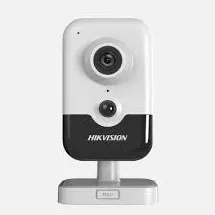
A product photo from the AESS job library, not taken in Greenwood Heights: a white indoor cube camera. Cameras like this end up on shelves in two-family hallways, shop back rooms and workshop offices, usually on Wi-Fi. When one drops off, the cause is more often the wall, cage or shelving between it and the router than the camera itself, and a short cable or a closer access point fixes it for good.
Equipment
Types of Security Cameras and Recorders We Repair
We repair what is already on Greenwood Heights buildings, whoever made it and whoever put it up. These are the types we see most, with the faults each tends to develop here.
Analog and HD-over-coax cameras
Older systems on frame houses and Fifth Avenue shops, on coax or thin twisted-pair cable with adapters. Faults are usually connectors, adapters and splices rather than the cameras.
Network (IP) cameras
Newer systems on PoE cable, common in post-2005 buildings and renovated houses. Faults cluster at the switch, the cable end and network settings.
DVRs, NVRs and hybrid recorders
The box on the cellar shelf or in the back office. Drives, fans, power and clocks wear out; soot, dust and damp speed it up.
Varifocal domes and bullets
Zoomable cameras over shop doors and workshop floors. Focus drift, dirty bubbles and loose arms are the usual complaints.
Pan-tilt and mini PTZ cameras
Moving cameras in shops and yards. Motors stick, presets drift and housings take in water.
Wi-Fi, battery and cube cameras
Consumer cameras on two-family hallways and in back yards. Signal through siding, metal and brick, batteries and app accounts cause most calls.
Video door stations and doorbells
Street-door cameras on two- and three-families and small buildings. Power supplies in the cellar and cable through the door frame fail first.
PoE switches and extenders
The small box that powers network cameras. When it nears its power budget or loses a port, cameras at the far end drop.
Power supplies and battery backups
Plug-in boxes and multi-channel supplies for analog cameras, and the batteries that ride through dips. Both wear out quietly.
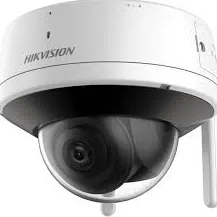
A product photo from the AESS job library, not taken in Greenwood Heights: a Wi-Fi dome camera with an external antenna. The antenna helps, but on a sided frame house the aluminum skin and the gap behind it can still swallow the signal between the camera and a router in the cellar. If a camera like this drops in and out, we test the signal where it hangs before replacing anything.
A national company, a consumer brand or a local licensed repair
Some Greenwood Heights households and shops have cameras from national alarm companies or consumer brands, and ask who should fix them. This is how the choices usually compare for a repair.
Question
ADT or similar alarm company
Ring or SimpliSafe camera
AESS local repair
Who owns the equipment
Depends on the contract; some is leased
You own it
You own it, and we repair it
Recorder in the cellar
Usually their own equipment only
Usually none; clips go to the cloud
Any brand of DVR or NVR
Repairs other installers' work
Rarely
Sealed devices are replaced, not repaired
Yes
Monthly fee required
Usually
Optional plan for recorded clips
No
Works on siding, cellars and workshop floors
Varies by technician
Owner does it
Yes, licensed technicians
Price before work
Varies
Replacement retail price
Written, from the Brooklyn list
If you have a Ring or similar consumer camera that has failed, it is usually replaced rather than repaired, and we will say so. If you want to move from consumer cameras to a recorder-based system, our installation team quotes that separately.
AI Overview Reality Check
What AI Gets Wrong About Security Camera Repair in Greenwood Heights
Search engines and AI assistants answer camera repair questions with general advice drawn from national sites such as Angi, HomeAdvisor and Fixr. Some of it is right. Some of it does not fit a wood-framed house with a recorder in the cellar, or a workshop full of metal dust. These are the common claims, paraphrased, and what we see on Greenwood Heights jobs.
"Camera repair costs about $100 to $300"
That range appears in national cost guides and describes a simple fix on one consumer camera. It is not what a whole repair costs on a Brooklyn system with a recorder, a switch and cables through siding and cellar walls. HomeAdvisor's own Brooklyn page for surveillance camera install or repair puts the average at $1,416 and the typical range at $680 to $2,145, which mixes installs and repairs.
Our Brooklyn repair list sits between those. The service call is $150 and is credited to the repair; most single faults, such as a connector, a power supply, a switch port or one camera, run $150 to $700; a recorder replacement or the rewiring of several runs runs $700 to $1,500.
The honest answer to "what will mine cost" is that it depends on what failed, and that is why we diagnose first and write the price before replacing anything. A photo of the recorder screen often narrows it down before you book.
"If you can see your cameras live, they are recording"
Live view and recording are separate. A recorder can show every camera live while its drive is failed, full and set not to overwrite, or set to record only on motion that never triggers. Many owners discover this only after an incident, when they open playback and find nothing for the night that mattered.
The recorder usually tells you something is wrong. As one Reddit user in r/SecurityCamera put it, an NVR "beeps when the HDD is failing," and turning the beep off "doesn't stop the need to replace the HDD." In a cellar, nobody hears the beep.
The check is to open playback once a month and look for yesterday's footage on every camera. On a repair visit we set up drive and camera-loss alerts to your phone so you do not have to rely on hearing a beep in the cellar.
"Wireless cameras fix wiring problems"
A wireless camera removes the video cable, not the power cable, and its signal has to get through whatever is between it and the router. On a Greenwood Heights frame house that is often aluminum siding, a hollow wall, and a cellar floor; in a workshop it is steel racking and machinery.
Wi-Fi cameras work well in some spots, and we install and repair them. They are the usual culprit, though, when a yard or back-door camera "keeps dropping off," and swapping a failed wired camera for a wireless one often trades one problem for another.
Where a wired run has failed, repairing or replacing the run is usually the more reliable fix. Where running cable is truly hard, we test the signal at the exact mounting spot before recommending wireless.
"Just factory-reset the recorder if you forgot the password"
A factory reset on many recorders wipes the settings, the camera assignments, the recording schedule and sometimes the network setup, and on some models it requires the manufacturer's help anyway. In a two-family where several people use the system, a reset can lock out everyone.
More important, if anything on that drive might be needed, such as footage of the night something happened on the block, a reset at the wrong moment can make it harder to retrieve, and a detective will want it exported with its original timestamps.
Many recorders have recovery routes that keep settings and footage. We try those first, export what matters, and only reset when there is no other way, after telling you what will be lost.
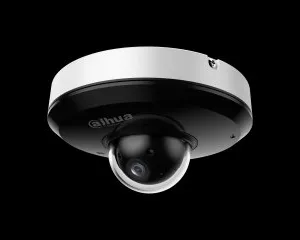
A product photo from the AESS job library, not taken in Greenwood Heights: a mini pan-tilt dome camera with a white housing over a black lens dome. Cameras like this turn and zoom on command, which makes them popular in shops and yards, and also means they have motors and presets that can fail or drift. If a pan-tilt camera now stares at one spot, the motor, its power or a lost preset are the first things we check.
"Any battery backup will keep cameras running through an outage"
A small battery backup sized for a computer may keep a recorder alive for a few minutes, but it often cannot carry a PoE switch powering several cameras with their night lights on, and plug-in camera supplies on a separate outlet will drop as soon as the power goes. People find this out when the clip ends the moment the lights went out.
During the June 2025 voltage reduction across southwest Brooklyn, the problem was not a blackout but sagging voltage, which some cheap backups do not even treat as an outage. They pass the low voltage straight through.
We size a backup to what the recorder, switch and cameras actually draw, confirm it switches to battery on low voltage as well as on loss of power, and test it by pulling the plug while you watch.
"Your landlord has to show you the footage"
This comes up often in two-families and rental buildings here. Brick Underground, which asked New York housing lawyers, reported that landlords are not obligated to show tenants footage outside a legal process, and that buildings are not generally required to have working cameras at all.
One lawyer in that piece, Catherine Grad, said she did not think it "such an arduous duty to impose on the landlord" to review footage when thefts are ongoing, which is a fair point, but it is an opinion, not a rule.
For repairs this matters in a practical way: we take instructions on a building's system from its owner or manager. A tenant can book a repair on their own cameras, or ask the owner to book one on the building's, and we are glad to talk to both.
"Greenwood Heights is just part of Park Slope or Sunset Park"
Many sources fold Greenwood Heights into its neighbors, and for some purposes that is fine. For camera repair it is not. The brownstone blocks of Park Slope to the north include landmark districts with their own facade rules, and the big industrial buildings of Sunset Park's waterfront are a different kind of job again.
Greenwood Heights is mostly wood-framed and sided row houses, two- and three-families with shared cellars, Fifth Avenue store buildings facing a cemetery, and light industry between Third and Fourth Avenues. Those are the conditions this page is written for.
What it shares with its neighbors is the price: Greenwood Heights, Park Slope and Sunset Park are all billed at our Brooklyn rate, with no separate charge for the neighborhood.
Talk to a Technician Before You Reset the Recorder or Buy a New Camera
Tell us the address, the type of property, how many cameras there are, which ones are out, and where the recorder sits. If you need footage from a particular date, say so and we will plan the visit around saving it. Photos of the recorder screen, the dark cameras, the power supplies and the cellar shelf help us bring the right parts. For anything urgent, call (347) 934-8335 now.
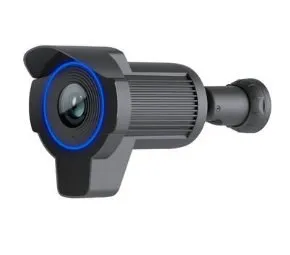
A product photo from the AESS job library, not taken in Greenwood Heights: a black bullet camera with a long hood and a blue-lit ring around the lens. The hood shades the lens from sun, rain and the snow that slides off shallow back roofs on frame houses here. If you send us a photo of the camera that failed, even a blurry one from the yard, we can usually tell its type before the visit and bring the right parts.
✅
Request Sent!
Thank you. A technician will contact you about the Greenwood Heights address shortly.
How It Works
Our Repair Process
1. Send the screen, the address and any date you need
A photo of the recorder or phone app showing the dark cameras, the Greenwood Heights address and the type of property, by text, WhatsApp or the request form. Tell us if footage from a particular day has to be saved, and whether smoke, water or dust reached the recorder.
2. Confirm who owns the system and who approves the work
Owner, landlord, tenant, board, shop or estate. We confirm who can say yes, who holds the recorder login, and who can let us into the cellar or the back office before we book.
3. Book and pay the service call
The $150 Brooklyn service call books a two-hour arrival window and is credited to the repair if you go ahead. Requests are booked within 2 hours.
4. Copy the footage first
If any video matters, it goes to USB with the recorder's original timestamps before a cable, drive or setting is touched. If smoke or water reached the recorder, the drive may be copied before the recorder is powered again.
5. Trace the fault from the outlet to the phone
Cellar first: outlet, backup, supply or switch, recorder and drive, then the log, then each cable, connector and camera on the facade and in the yard, then the network and the app.
6. Name the cause and write the price
You hear what failed and why, and get a written price from the Brooklyn list before any part is replaced. If we find more than one fault, each is priced separately so you can choose.
7. Repair, seal and test by day and after dark
Parts are replaced, every hole in siding, clapboard or brick is sealed with a drip loop below it, and each camera is checked in daylight and in low light, with the recording confirmed in playback.
8. Label, set health alerts and hand over
Cables and channels are labeled, drive and camera-loss alerts go to the right phones, old logins are removed, and you are shown how to find and export a clip yourself.
Coverage Area
Security Camera Repair Near Greenwood Heights' Landmarks
Green-Wood's main entrance
The gate at Fifth Avenue and 25th Street near the cemetery's northwest corner, where in 2012 a surveillance camera recorded a vandal climbing the inside of the fence an hour before opening.
The Green-House at Green-Wood
The restored 1895 Weir Greenhouse across Fifth Avenue from the main gate, reopened as a free visitor center on April 18, 2026 with a new building beside it.
Battle Hill and Minerva
Brooklyn's highest point inside the cemetery, where the 1919 statue of Minerva faces the Statue of Liberty across the harbor, a view the cemetery asked the city to protect during the 2005 rezoning.
25th Street station
The R train stop on Fourth Avenue near the cemetery's corner, with shops, workshops and new buildings on the blocks around it.
72nd Precinct
The station house at 830 Fourth Avenue that covers Greenwood Heights, where detectives asking residents and shops for footage usually work.
Jackie Gleason Bus Depot
The 919,000-square-foot depot at Fifth Avenue and 36th Street, dedicated in 1988 on the site of the old Union Depot at the cemetery's southwest edge.
We also serve the neighborhoods around Greenwood Heights, including Park Slope, Windsor Terrace, Sunset Park and Gowanus, at the same Brooklyn rate. Our Gowanus security camera repair page covers the canal blocks just north of the expressway, and the whole borough is on our Brooklyn security camera repair page.
Pricing
Security Camera Repair Cost in Greenwood Heights
Greenwood Heights is billed at our Brooklyn rate. Every repair starts with the $150 service call, which covers the on-site diagnosis and is credited to the repair if you go ahead. The figures below come from our published list of Brooklyn security camera repair prices; your exact price is written down on the visit, once we know what failed.
Repair
Brooklyn price
Service call, on-site diagnosis and written repair price
$150, credited to the repair
Motion, alert, app or login settings with no parts
Usually within the $150 service call
Clean and check for a blurry or dusty picture
$80
Connector reterminate or PoE port swap
$150–$350
Power supply repair
$150–$400
Dome or front cover replacement
$30–$80 part, plus labor
Hard drive swap
$200–$450
Indoor camera repair
$200–$450
Single camera replacement on a working system
$250–$600
Outdoor camera body replacement with weatherproofing
$250–$600
Night picture repair
$250–$650
DVR not working, including drive and labor
$300–$700
NVR not recording
$400–$900
Vandalized camera, per camera, plus cable repair
$400–$900
Pan-tilt (PTZ) camera repair
$450–$1,200
Hybrid recorder swap, analog and IP
$700–$1,200
DVR or NVR replacement with drive and setup
$700–$1,500
Lightning or surge damage, depending on system size
$700–$3,500
Annual maintenance visit
$250–$800
Three things move a Greenwood Heights price within those ranges. The first is reach and surface: a camera under the eave of a three-story frame house, on a long arm over a Fifth Avenue store or high on a workshop's roof steel takes more ladder time than one beside a front door, and a camera on restored clapboard takes more care than one on brick. The second is how many runs failed: one cable torn down by a demolition crew is a small job, while several runs damaged in a fire or by siding work are priced run by run. The third is the recorder: a recorder that has to be replaced after smoke or dust, moved off a cellar floor, or untangled from a second system in the same building adds time for setup and tracing. If the price changes on site, you hear the new number before the work goes on. Bundling the camera repair with intercom, alarm or cabling work on the same visit saves $200 to $400 in labor on our Brooklyn list.
Full terms — including 50% deposit, one-year parts-only warranty on AESS-supplied products, and the late-fee schedule — are set out in the service agreement.
Shop Our Systems
Security Camera Repair Packages & Pricing
Three ways Greenwood Heights repairs usually come together, priced from our Brooklyn list.
Single-issue repair: $150–$700
One fault, one visit: a connector soaked behind the siding replaced, a cellar power supply or switch port replaced, a worn drive swapped, a camera remounted after snow or a siding crew, or a login recovered. Typical for a sided two-family, a brick row house or a small shop on Fifth Avenue.
Major system repair: $700–$1,500
The recorder or the wiring: a DVR or NVR replaced after smoke, dust or age, several runs replaced after demolition next door, or two systems in one building sorted onto one recorder. Typical for a three-family, a store building or a workshop.
Annual maintenance: $250–$800
Every camera checked by day and in low light, domes and lenses cleaned, connectors and supplies tested, drive health read, backup batteries checked, alerts confirmed and footage export tested. Homes start at $250, commercial properties at $400, and owners with several buildings run $500 to $800.
Bring your own equipment. If you have already bought a replacement camera or recorder, we can fit it at labor-only rates. Tell us the exact model and we quote the labor by phone or text, and the visit is booked once it is paid. Your own equipment is installed as supplied: we cannot vouch for parts we did not supply, and if a model will not work with your recorder, will struggle on Wi-Fi through siding or steel, or cannot handle the light where it is going, we tell you before the visit.
Complete Services
Every Security Camera Repair Service in Greenwood Heights
Camera, connector and cable repair
Dark cameras, soaked connectors behind siding, runs cut by demolition or roofers, and cameras knocked down by snow. Request a repair
Recorder, drive and power repair
DVRs, NVRs, switches and supplies on cellar shelves and in back offices, including smoke- and dust-damaged recorders. Brooklyn security camera repair
If you find the camera or recorder cannot be repaired, or I decide not to go ahead with your price, what do I owe?
+
Only the $150 service call. It pays for the visit and the diagnosis, and you leave with a clear answer about what failed and what it would take to fix or replace it. If you later go ahead with the repair or a replacement, the service call is credited to it. We do not charge for writing the quote, and we do not start any work you have not agreed to.
We are switching internet providers. Will our cameras stop showing on our phones, and is getting them back a repair visit?
+
The cameras keep recording to the recorder, because that link does not depend on the internet. What usually breaks is phone viewing, because the recorder was set up for the old router. Often the fix is a setting change that we can talk you through or handle within the service call. Keep the old router's name and password if you can, plug the recorder into the new router with a cable rather than Wi-Fi, and send us a photo of the app's error if it does not come back.
Our camera is mounted on the front where our house meets the house next door. Do we need the neighbor's permission to repair it?
+
If the camera and its screws are on your side of the line between the two facades, a repair in the same spot is normally yours to arrange. If the mount or the cable crosses onto the neighbor's siding or brick, or the ladder has to stand in their front yard, we ask that you speak to them first, and we will not drill into their side without their agreement. On attached frame houses the boundary is not always obvious, so we look before we touch anything and tell you if anything is on their side.
How can we show an insurer or a court that the clip we hand over has not been edited?
+
Export it straight from the recorder in its original format with the recorder's own timestamps, keep the original file unchanged, and make copies for anyone who needs one. Many recorders can also export a small player and a check value that shows whether a file was altered. When we export footage on a visit, we write down who exported it, when, from which recorder and what the recorder's clock showed against the real time. That record is often what lawyers and insurers ask about. Whether a clip is accepted is up to them, not us.
Should we try turning the recorder off and on before we call you?
+
If you need footage from a recent incident, no: leave it running and call first, because a restart can hide the cause of a gap and some recorders come back with settings lost. If you do not need any footage, one restart is reasonable, and it sometimes brings back a camera after a brief power dip. If the recorder smells of smoke, has been wet or is beeping, do not restart it at all. Tell us what you did and what changed, because that helps the diagnosis.
Do we need the recorder's original box, manual or the installer's paperwork for a repair?
+
No, though anything you have helps. A photo of the label on the bottom or back of the recorder usually tells us the make and model, and the same goes for a camera if you can reach it. Installer paperwork with a cable map or passwords saves tracing time. If you have nothing at all, we identify the equipment on the visit and leave you with a labeled list of cameras, channels and logins, so the next repair starts with paperwork.
Some of our cameras record onto memory cards inside them instead of a recorder. One card stopped saving. Can that be fixed?
+
Usually, yes. Memory cards in cameras wear out from constant recording, especially cheap ones and especially in cameras outdoors through hot summers and cold winters. The fix is often a new card rated for continuous video, formatted in the camera, with the recording schedule checked. If the card slot itself has failed or water has reached it, the camera needs replacing. For cameras that matter, we also suggest pairing card recording with a recorder or cloud copy, so one card failing does not mean losing the clip.
Our house has a home warranty plan. Can we use it for the camera repair?
+
Check your plan's terms first, because many home warranty plans exclude security cameras or require you to use their own contractors. We bill you directly at our Brooklyn list price and give you an itemized invoice describing what failed and what was replaced. If your plan reimburses work done by an outside licensed company, that invoice is what you would send them. We cannot promise any plan will pay, so the decision on cover is between you and the plan.
Can we fix the two cameras that matter most now and leave the rest of the system for later?
+
Yes. After the diagnosis we price each fault separately, so you can choose the street door and the back yard now and the side alley or the hallway later. We will tell you if one repair depends on another, for example when a failing recorder or power supply will take the newly fixed cameras down with it. The second visit needs its own service call unless it is booked as part of the same job, so it is worth grouping what you can.
Will you need to shut off the power to our house or shop during the repair?
+
Almost never. Cameras, switches and recorders run on plug-in power or low-voltage cable, so we unplug only the piece we are working on. If a camera is fed from a hardwired supply or a circuit we cannot isolate at a plug, we stop and tell you, because that is electrical work for an electrician. For a shop, we plan any restart of the recorder for a quiet moment and tell you how long the cameras will be down, usually a few minutes.
More Security Camera Repair near Greenwood Heights
Ready to Get Every Greenwood Heights Camera Saving Video Again?
Send a photo of the recorder screen or the dark camera, the address, and the date of any footage you need. We book within 2 hours, give you a two-hour arrival window, copy your footage first, and write down the repair price before any part is replaced.