Cellar recorder dead after the water came up, a co-op camera that has been dark since the last storm, or an Old Fulton Street shop that lost its feed? Fulton Ferry camera repair line, booked within 2 hours: (347) 934-8335
Landmarked Loft Co-ops · Flood-Prone Cellars by the River · Waterfront Condos on Furman Street · Old Fulton Street Restaurants and Shops
Security Camera Repair in Fulton Ferry
Any Brand, Any Installer · Water Damage Checked First · Footage Saved Before Anything Is Reset · Brooklyn Rate
Security camera repair in Fulton Ferry starts with our $150 Brooklyn service call, which pays for the on-site diagnosis and is credited to the repair if you go ahead. On our published Brooklyn list most single faults cost $150 to $700, and a new recorder or the rewiring of several cameras runs $700 to $1,500. The work here is shaped by the river: recorders and power boxes in cellars that have taken seawater, connectors that see salt and wind, and small landmarked co-ops where nobody is in charge of the system. Requests are booked within 2 hours, visits come in two-hour arrival windows, and you get the cause and a written price before any part is replaced.
Every price on this page is taken from our published Brooklyn camera repair list, and your own price is put in writing before the work starts
Rated 4.7★ across 201 Google Reviews
Reviewed and updated November 12, 2026, against the Brooklyn Eagle's November 2012 report on Hurricane Sandy flooding on lower Old Fulton Street, Main Street and Jane's Carousel; Con Edison's June 23, 2025 notice on the northwest Brooklyn voltage reduction; amNY's report on the rebuilt NYC Ferry landing at Fulton Ferry; CityRealty on the new projects at 20 Old Fulton Street, 1 Water Street and 50 Old Fulton Street; Untapped New York on post-Sandy building rules in Brooklyn Bridge Park; DNAinfo on thefts in Brooklyn Bridge Park; the Brooklyn Bridge Park Conservancy's 2023 season report; Brick Underground on landlords and building cameras; the Landmarks Preservation Commission's Fulton Ferry designation report and permit guidebook; HomeAdvisor's Brooklyn cost page; NYC Administrative Code §28-105.4.7; and the New York Department of State on security and CCTV installer licensing. · Abstract Enterprises Security Systems, NYS license #12000287431 · crews dispatched from our Troy Avenue office in Brooklyn
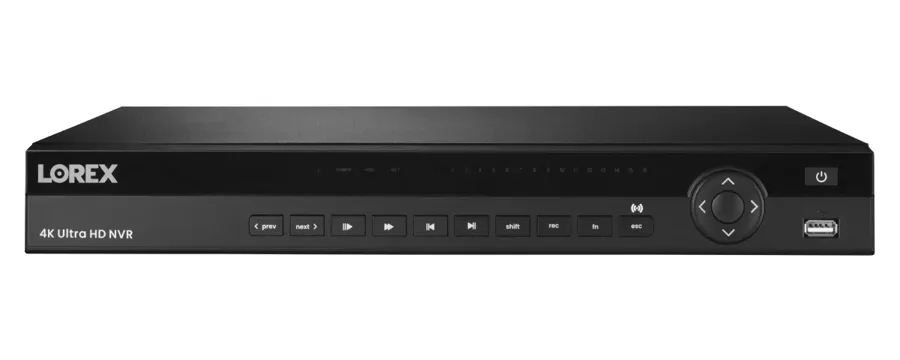
A product photo from the AESS job library, not taken in Fulton Ferry: a 16-channel desktop network video recorder, the box that holds every hour of footage. In a Fulton Ferry loft co-op or waterfront condo, a recorder like this usually sits on a shelf in the cellar, a meter room or a closet off the lobby. Where it sits, and how high off the floor, decides whether the next storm surge is an inconvenience or the end of the system.
Fulton Ferry Camera Repair Request
Loft co-op, condo, restaurant or shop: give us the address and what the screen shows, and a technician calls back with the next step
✅
Request Sent!
Thank you. A technician will contact you about the Fulton Ferry address shortly.
25+
Years Experience
✓
Same-Day Estimates
100%
Licensed & Insured
4.7★
201 Google Reviews
Owner-operated since 2002 · Thousands of jobs completed · Booked within 2 hours
In Fulton Ferry, the first question on a camera repair is whether water has been anywhere near the system. This is a few blocks of nineteenth-century buildings and newer condos at the foot of the Brooklyn Bridge, right on the East River, and its cellars are where most recorders, power boxes and network switches were put. After a surge tide or a burst pipe, a recorder can boot, show live pictures and still be failing, because salt water does its damage slowly, in connectors, circuit boards and drives. So the visit starts by saving whatever footage is still on the recorder, then checking every part that sat low for water and corrosion, and only then fixing what failed. For buildings that have stayed dry, the usual faults are the ones we see across the borough: a dead power supply, a worn drive, a connector that let in rain, or a login that belonged to a board member who moved away. Send a photo of the recorder screen to (347) 934-8335 or on WhatsApp, and we will tell you the likely fault and what that kind of repair costs on our Brooklyn list before you book.
Looking at your photos is free. The $150 service call pays for the on-site diagnosis and is credited to the repair if you go ahead.
We work under New York State license #12000287431, the license the state requires of anyone who installs or services security and CCTV systems for someone else.
We repair any brand and any installer's work, and if a water-damaged part is not worth saving, we say so before you pay for it.
The Neighborhood
Why Fulton Ferry Properties Need Security Camera Repair
Fulton Ferry is one of the smallest named neighborhoods in Brooklyn: the old ferry district at the foot of Old Fulton Street, between DUMBO and Brooklyn Heights, cut in two by the approach to the Brooklyn Bridge. The Landmarks Preservation Commission made it a historic district in 1977, and most of its buildings date from the 1830s to the 1890s: warehouses, stores, a bank, an insurance office and a railroad company building, two to four stories high, with the eight-story Eagle Warehouse as the tall exception. Since the 1970s many of them have been turned into apartments, usually as small cooperatives. Around them sit newer condominiums on Furman Street, restaurants at the landing, and the entrance to Brooklyn Bridge Park at Pier 1. Almost every one of these buildings has cameras now. The repairs they need are shaped less by crime than by water, by age and by the way small buildings are run.
Water comes first because the river is right there. When Hurricane Sandy pushed the East River over its banks in October 2012, the Brooklyn Eagle found a building owner on lower Old Fulton Street pumping out a basement that had been "flooded from floor to ceiling with murky seawater," and a restaurateur at 7 Old Fulton Street who said, "I've been pumping the basement all night." A block away at Main and Water Streets, a bakery owner stood in a shop that had taken at least four feet of water and said, "We don't have power, so I can't check to see if the equipment is working." In the park, the basement that held the electronics for Jane's Carousel filled with about five feet of water. Those are the same rooms where camera recorders, power boxes, internet modems and network switches are usually kept, and a flood does not have to reach the ceiling to finish them.
What happened next is just as important for repair work. After the storm, the city changed its building code, and new buildings in the park were designed, as Untapped New York put it, "with all mechanicals and electricity housed above the new flood plain line." The Empire Stores warehouse had its ground floor dug out and replaced with a concrete slab. Older buildings in Fulton Ferry were not rebuilt that way. Many put their equipment back where it had been, or moved some of it up while leaving cables running down through the cellar and back out. When a camera system here fails in a strange way years later, the cause is often a part that was soaked once, dried out, and kept working until it could not.
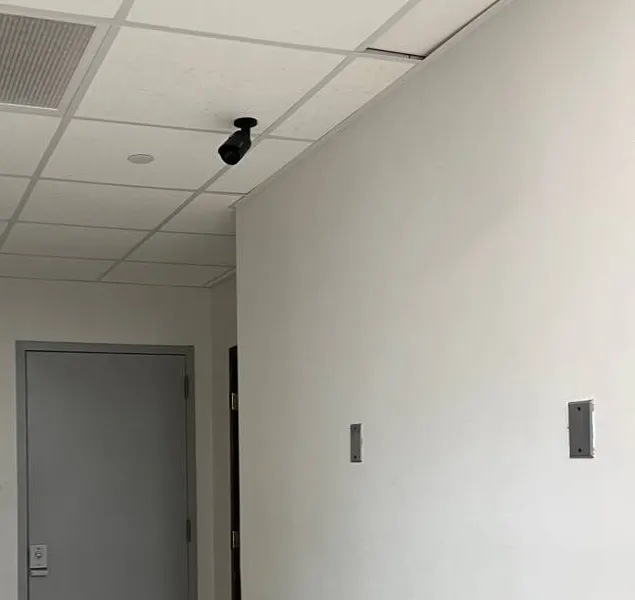
A photo from the AESS job library, not taken in Fulton Ferry: a small black bullet camera hanging from a ceiling-tile grid, aimed down a short corridor at a grey steel service door. In a Fulton Ferry loft co-op or condo, the corridor to the cellar, the meter room or the service door on a side street is where a camera like this earns its keep, because that is the way in for deliveries, contractors and anyone who should not be there. It is also the camera most likely to sit in the damp when the cellar takes water.
Power is the second pressure. On June 23, 2025, Con Edison asked about 68,000 customers in DUMBO, Vinegar Hill, Brooklyn Heights, Downtown Brooklyn and the neighborhoods to the south to cut back on air conditioning and heavy appliances while it made repairs, and it lowered the voltage in the area by eight percent to protect its equipment. The zone it described ran from the East River inland, which takes in Fulton Ferry. A voltage cut like that does not usually black out a building, but recorders, cheap plug-in adapters and older power boxes do not like running low for hours, and some of them do not recover cleanly when the voltage comes back up.
The third pressure is who is in charge. A converted nineteenth-century building with ten or twenty apartments is often a self-managed co-op, with no super on site and a board of volunteers that changes every year or two. The Eagle Warehouse, at 28 Old Fulton Street, became an 84-unit co-op in 1980; the former Brooklyn City Railroad Company building at 8 Old Fulton Street was turned into about ten loft apartments in the 1970s. In buildings like these the camera system was usually chosen by one shareholder, installed by one company, and remembered by nobody once that person sold. Brick Underground has pointed out that "there's no city law requiring rental buildings to have functioning security cameras," so a broken camera in a small building gets fixed only when someone decides it is their job.
The fourth pressure is the crowd outside. Brooklyn Bridge Park reported nearly 5 million visitors in its 2023 season, and Old Fulton Street is one of only four ways into it. On a summer weekend the line for the pizzerias runs up the block, the ferry lands people every few minutes, and the sidewalk in front of a residential door can be full from late morning until well after dark. That traffic changes what a door camera has to do, and how its recording and alerts should be set.
So a camera repair in Fulton Ferry is more than swapping a dead camera. It is getting the system recording again, taking the parts that matter out of the water's way, making sure the board or the owner is told the next time something stops, and leaving behind logins and labels that will outlast the next change of officers. Many co-ops that call us about cameras also ask about the street door, because a camera at the entrance and a working intercom or entry system protect the same doorway; we can look at both on the same visit.
Six Fulton Ferry facts that shape a camera repair
Cellars here have taken seawater. In Sandy, a basement on lower Old Fulton Street filled "from floor to ceiling," and the electronics basement under Jane's Carousel took about five feet. Any recorder, switch or power box below street level should be treated as at risk.
New park buildings put their equipment up high; old buildings mostly did not. Post-Sandy code changes had park buildings keep "all mechanicals and electricity" above the new flood line. In the older converted buildings, camera equipment often went back on the same cellar shelf.
Power runs low on hot days. Con Edison's eight percent voltage reduction on June 23, 2025 covered about 68,000 customers from the East River inland across northwest Brooklyn. Long low-voltage periods stress recorders and adapters as much as short outages do.
The district is landmarked. Fulton Ferry has been an LPC historic district since 1977. The commission's permit guidebook says no permit is needed for ordinary maintenance and repair of existing safety equipment, but moving a camera or adding conduit on a facade follows its rules.
Many buildings are small co-ops with volunteer boards. The Eagle Warehouse became an 84-unit co-op in 1980 and the Brooklyn City Railroad Company building holds about ten lofts. Passwords and alerts tend to leave with whoever set the system up.
The sidewalk is one of the busiest in Brooklyn. Nearly 5 million people visited Brooklyn Bridge Park in 2023, and Old Fulton Street is one of its four entrances. Cameras on these blocks need recording and alert settings built for a crowd.
Where this page applies. It covers the Fulton Ferry Historic District and the blocks around it: Old Fulton Street, Front Street, Water Street, Doughty Street, the foot of Cadman Plaza West, Furman Street up to the park entrance, and Fulton Ferry Landing itself. For the rest of the borough, see our main Brooklyn security camera repair page. The price follows the fault, not the address.
Same-Day Repair in Fulton Ferry
Need Repair in Fulton Ferry? A Recorder That Sat in Water, or a Camera That Went Dark Before the Night It Was Needed
Urgent camera calls from Fulton Ferry usually come in one of three ways. The first follows water: a storm tide, a heavy rain that backed up a drain, or a pipe that burst over the weekend, and now the recorder in the cellar is dead, beeping or stuck on a startup screen. The second follows an incident: a bag or a delivery taken from a lobby, a door forced overnight, a dispute on the sidewalk outside a restaurant, and someone needs the video now. The third is the slow discovery: a board member or a shop owner opens the app for the first time in months and finds half the cameras gray.
If water reached the recorder, do not switch it back on to see whether it still works. Leave it unplugged, keep it level, and take photos of where it sat and how high the water came. A drive that was wet can sometimes still be read if it is not powered up dirty, and a powered-up board with salt on it can short and take the footage with it. If water did not reach it but you need footage from an incident, the opposite applies: leave it running and do not restart it, because most recorders write over their oldest video once the drive is full. Either way, call (347) 934-8335, tell us the date and time window you need, and we book the visit with saving that footage as the first job. If a detective from the 84th Precinct has asked for a copy, say so when you book; the export goes to USB with the recorder's original timestamps, and we note how far the recorder's clock was off.
For everything else the path is simple: the $150 service call books a two-hour arrival window, the technician finds the cause, and you get a written price before any part is replaced. Requests are booked within 2 hours. We do not promise the repair itself on the same day, because some parts and many flood replacements have to be ordered, but most single-camera, power and drive faults are fixed on the first visit when the part is on the truck.
What We Install
Security Camera Repair Services in Fulton Ferry
Each repair below is priced from our Brooklyn camera repair list. The service call pays for finding the fault; the repair is priced by what failed, how many cameras it touches, whether water was involved, and how hard the run is to reach, from a lobby dome in a loft co-op to a camera high on an eight-story warehouse front.
Flood and water-damage repair
Recorders, switches, power boxes and connectors that sat in water or damp air after a surge, a backed-up drain or a leak. Each part is checked for salt and corrosion, footage is recovered where the drive allows, and anything kept is moved above where the water reached.
Dark camera repair
One camera with no picture: tested at the camera, along the cable and at the recorder, so only the failed part is replaced. On the old brick and stone fronts here, the fault is often a connector that took in wind-driven rain rather than the camera itself.
Recorders and hard drives
DVRs and NVRs in cellars, meter rooms, lobby closets and restaurant offices that beep, restart, run hot or keep only a few days of video. Drives are read for health and replaced with surveillance-grade drives sized for the days you need.
Power and low-voltage recovery
Power boxes, plug-in adapters and network switch ports that failed after an outage, a voltage reduction or a surge. We test each power source, replace what failed and put the recorder and switch on a battery backup that suits them.
Night and glare correction
Cameras that go white from the river's reflected light, black when a lamp is off, or smeared when headlights and streetlights flare in the lens. Fixed with exposure settings, re-aiming, a camera with its own light, or a new spot out of the glare.
Cable and connector repair
Runs cut by facade crews or construction next door, cables that loop down through a damp cellar, connectors swollen with salt, and splices hidden behind old plaster. Repaired, re-terminated or replaced, then tested end to end.
Logins and phone access
Apps tied to a former board member's phone, recorders whose admin password left with an installer, and accounts nobody can reset. We get the recorder back for the owner or the board, set new passwords and write down who holds them.
Footage export for incidents and claims
Clips saved to USB with their original timestamps for the 84th Precinct, an insurer, the board or a lawyer, with a note of the recorder's clock against the real time, and photos of damaged parts kept for a flood claim.
Whole-building checkups
Every camera on a co-op, condo, restaurant or shop checked in one visit, by day and after dark, with a written list of what works, what is failing, what sits below the flood line and what each fix costs, so a board can vote on it.
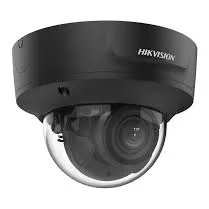
A product photo from the AESS job library, not taken in Fulton Ferry: a black varifocal dome camera of the kind used over lobbies and vestibules. In a Fulton Ferry loft co-op, the lobby is often a narrow entry hall inside a cast-iron or brick front, and a varifocal lens lets the camera be zoomed in on the street door without moving the mount on a landmarked ceiling.
Building Specialists
Security Camera Repair for Fulton Ferry's Architecture
Fulton Ferry has few buildings and a lot of history in each one. Six types make up almost every camera repair call here, and each one decides where the recorder ended up, how the cables travel and who has to approve the work.
Converted commercial rows
Two- to four-story brick stores and warehouses from the 1830s onward, such as the Commercial Row along Cadman Plaza West, now lofts above shops. Recorders sit in shared cellars, and cables cross between apartments that were once one open floor.
Cast-iron and stone fronts
Buildings like the 1860s Brooklyn City Railroad Company building and the 1868 Long Island Safe Deposit Company building, where the facade itself sets strict limits on where a camera or its cable can be fixed.
Large warehouse co-ops
The Eagle Warehouse, built in 1893 and converted to an 84-unit co-op in 1980, is the type: many apartments, heavy masonry, deep cellars with old vaults, and a lobby, mailroom and stair cameras that all report to one recorder.
Waterfront condominiums
Newer buildings along Furman Street and at the park edge, such as Pierhouse, with network cameras, a managing agent, garages and amenity spaces, and sometimes equipment shared with a hotel next door.
Restaurants at the landing
The River Café, the old fireboat house and the pavilion approved for 1 Water Street sit on or beside the water. Their cameras face salt spray, wind and night glare off the river, and their recorders sit in back offices that have flooded before.
Shops and offices on Old Fulton Street
Pizzerias, ice cream counters, galleries and small offices in old ground floors, with four to sixteen cameras on a recorder under a counter or in a back room, and a sidewalk outside that is busy from lunch to late night.
Converted commercial rows: one cellar, many owners
The low brick buildings along Old Fulton Street, Front Street and Cadman Plaza West were built as stores, counting houses and warehouses, then split into lofts and apartments over the last fifty years. The cellar usually stayed one shared space, and that is where the camera recorder went, often beside the electric meters, the water main and the internet company's box. The cameras themselves are spread across a street door, a rear yard or areaway, a stair hall and sometimes a roof hatch. When we arrive for a dark camera, we start in that cellar, because a damp power strip or an adapter on the floor explains more failures in these buildings than any camera does.
The second thing these buildings share is cable that goes where it should not. When an open loft floor was divided into apartments, camera runs that once crossed an empty room ended up inside a closet, behind a kitchen or above one shareholder's ceiling. A repair that needs to replace a run may mean asking a neighbor for access, and we plan for that rather than discovering it on the day. Where a run can be moved into a common hallway or the stair as it is repaired, we suggest it, so the next repair does not depend on one apartment being home.
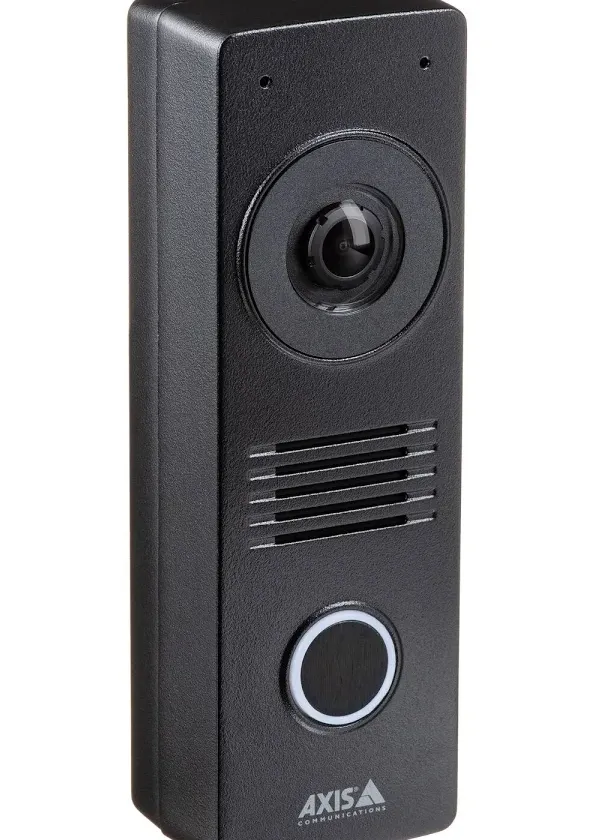
A product photo from the AESS job library, not taken in Fulton Ferry: a black video intercom door station with a camera, a speaker grille and a lit call button. On a small Fulton Ferry co-op, the camera in the door station is often the only camera watching the street door, and its picture may feed both the apartment monitors and the building's recorder. When that picture goes dark, we check whether the fault is in the station, the intercom wiring or the recorder before anyone replaces the panel.
Cast-iron and stone fronts: the facade decides where things go
The commission's designation report describes the Brooklyn City Railroad Company building at the corner of Furman Street with cast-iron piers, and the Long Island Safe Deposit Company building on Front Street is a cast-iron front from 1868. The LPC's permit guidebook says security equipment "must be attached at mortar joints, plain masonry, wood, or metalwork" and "must not be attached through cast iron or on any decorative surfaces," and that exposed conduit is held to about ten inches. On buildings like these, a repair that keeps an existing camera in place is routine. A repair that needs the camera moved, or a new cable run down the front, has to follow those rules, so we work out the route before quoting it.
In practice that means using what is already there wherever we can: reusing an existing mounting point in a mortar joint, running a replacement cable back through the same hole into the building, and choosing a replacement camera small and dark enough to sit quietly against the stone or brick. If a camera on a decorative surface has to come off, we tell you whether it can go back in the same spot or needs a new one inside the door opening, and what the board may need to file.
Large warehouse co-ops: heavy walls, long runs and old vaults
The commission's report notes that the Eagle Warehouse was built for storing furniture and silverware, with vaults in the cellar. Big masonry storage buildings like it make excellent apartments and difficult camera systems. Wi-Fi does not travel through their walls and floors, so cameras are wired, and the runs from the cellar to the upper floors and the roof are long. The recorder often lives in a room where the walls are thick enough to block any phone signal and the nearest internet connection is a floor away.
The repairs that come out of that are predictable. Phone viewing fails because the recorder lost its link to the building's network, not because the cameras failed. Upper-floor cameras show interference or drop out because a long cable has a damaged section somewhere inside a wall. And lobby and mailroom cameras are the ones everyone relies on, so a whole board notices when they stop. We test each run from the recorder to its camera, fix the network link first so the board can see what is working, and leave a map of which channel is which floor.
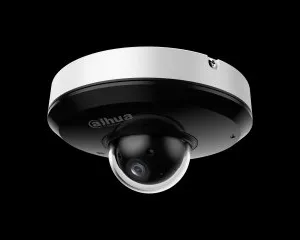
A product photo from the AESS job library, not taken in Fulton Ferry: a mini pan-tilt dome camera with a white housing over a black lens dome. In a large Fulton Ferry warehouse co-op, a camera like this can cover a long mailroom or a corridor that bends around an old vault wall, turning between saved positions. When the motor sticks or the saved positions are lost, the repair is usually the camera's settings or its power, not the whole unit.
Waterfront condominiums: newer systems, different owners
The condominiums along Furman Street and the park edge have newer network cameras, a managing agent and usually an outside IT or building-systems company. Their camera faults are less about rain in connectors and more about networks: a switch that failed, a firmware update that broke the app, a recorder that keeps only a week because nobody changed the default settings, or cameras that were never added to the recorder after a renovation. Pierhouse, on Furman Street at Pier 1, shares amenities with the 1 Hotel Brooklyn Bridge next door, and that kind of arrangement raises a practical question on any repair: which cameras belong to the condo, which to the hotel, and who signs off on each.
Restaurants at the landing: salt, wind and a flooded past
The restaurants at Fulton Ferry Landing sit as close to the East River as anything in Brooklyn. The River Café was so badly damaged by Sandy that it did not reopen until February 2014. The old fireboat house at the landing has held an ice cream counter for years, and the commission has approved a new pavilion at 1 Water Street to replace the seasonal tent there. For cameras, that location means salt in the air, wind that drives rain sideways into housings, and a river that reflects the Manhattan skyline straight into any lens pointed west after dark.
Repairs here are mostly about the outdoor end of the system: connectors and boxes that corrode faster than they would inland, cameras that lose their seals, and night pictures washed out by reflected light. Inside, the recorder in a back office or a storeroom near the water should sit as high as the room allows, with its battery backup above it rather than on the floor. We service the outdoor cameras with marine-minded hardware and check every one after dark with the restaurant's real lighting on.
Shops and offices on Old Fulton Street: small systems, big crowds
The ground floors on Old Fulton Street and Front Street hold pizzerias, ice cream counters, galleries and small offices. Their systems are usually one recorder with four to sixteen cameras, set up for a shop and then left alone. The problems we find are the ones that come from a crowd: a drive that fills in a few days because every camera records constantly, motion alerts that were switched off because they never stopped, and a door camera that shows the line outside but not the face of anyone coming in.
Field Notes
Field Notes: How We Work a Fulton Ferry System That Has Seen Water
These notes describe how our technicians approach a typical Fulton Ferry co-op, condo or restaurant system when cameras are out and the cellar has taken water at some point, recently or years ago.
Ask about the water before touching the power. The first question is when water last reached the cellar or ground floor and how high it came. A recorder that is off after a flood stays off until it has been opened up and inspected; a recorder that is running and dry gets its footage exported before anything else.
Look for the waterline. Stains on the walls, rust on shelf legs and salt crust on boxes tell us how high the water came, and therefore which power boxes, switches, connectors and cable junctions need to be opened and checked, even if they still seem to work.
Trace every cable that goes low. In older buildings many runs drop down into the cellar on their way between floors. Each one is toned out, labeled and tested, because a splice that sat in water years ago is the most common hidden fault here.
Check the outdoor end. At each camera facing the river or the street, the technician opens the connector box, checks the seal and looks for salt or green corrosion on the contacts before deciding whether it is the camera or its cable that failed.
Price, raise and hand over. You hear the cause and get a written price before any part is replaced. When the repair is done, anything we can lift above the waterline is lifted, every camera is checked by day and after dark, alerts for lost video and drive errors are turned on and sent to the right person, and the board gets the logins and a list of what is connected where.
Fault by Fault
Water, Salt, Low Power, Crowds and Construction: Why Fulton Ferry Camera Systems Fail
Five causes account for most of the camera failures we find in Fulton Ferry. Knowing which one you are dealing with is the difference between a $150 visit and a new system.
Water: the damage you cannot see on the screen
Seawater is worse for electronics than rain, because the salt it leaves behind keeps conducting and corroding after the water has drained. A recorder that sat in a few inches of surge water can dry out, start up and show every camera, then fail weeks or months later as corrosion spreads across its board or its drive heads stick. The same is true of power boxes, network switches and the connectors on cables that pass through a cellar. After a flood we open and inspect what sat low, clean and keep what is sound, and replace what is not. Then we put what remains above the level the water reached, because the next storm will find the same shelf.
Salt and wind: the riverfront end of the cable
Cameras facing the East River or the landing live in salt air and wind that drives rain into every gap. The camera bodies usually last; the weak points are the connectors behind them, the seals on the junction boxes and the screws that hold the bracket. When a picture starts to flicker, roll or turn soft in wet weather, the fault is usually water creeping into a connector, not a dying camera. Re-terminating the connector inside a sealed box, with the cable looped so water runs off rather than in, is a small repair on our Brooklyn list. A new camera is only needed when the camera itself has taken water.
Low power: what a hot afternoon does to a recorder
The eight percent voltage reduction Con Edison put on northwest Brooklyn in June 2025 is the kind of event that shows up in a camera system days later. Recorders, switches and plug-in adapters running on low voltage in a hot closed cellar work harder and run hotter; some restart themselves, some corrupt the file they were writing, and some cheap adapters simply die. Outages and surges do the rest. A battery backup that holds the recorder and switch steady through dips and short outages, sized for the equipment it carries and with a fresh battery, prevents most of these faults. A recorder that was never on one is often the reason a system keeps failing after every heat wave.
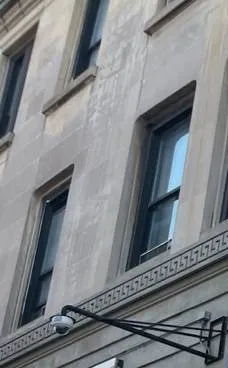
A photo from the AESS job library, not taken in Fulton Ferry: a bullet camera on a long black steel arm below a carved Greek-key band on a pale stone facade with tall sash windows. On Fulton Ferry's landmarked fronts, a long arm like this lets a camera clear a cornice or a carved band without being fixed to the decoration itself, which the commission's guidebook does not allow. When a camera on an arm fails, we keep the arm and its mounting point wherever they are sound, so the repair does not become a new hole in historic stone.
Crowds: when the camera is working but useless
A surprising share of Fulton Ferry repair calls involve cameras that never stopped working. A camera over a co-op door on Old Fulton Street can record every minute of a summer Saturday on a drive that only holds four days, so the night that mattered is gone by the time anyone looks. Motion alerts that fire every few seconds get muted. A camera aimed to take in the bridge and the street makes the person at the door a few pixels tall. None of this needs new hardware: it needs recording schedules, motion zones around the door, a lens zoomed in on the entry, and a drive sized to the days the board wants.
Construction: the neighborhood is still being built
Fulton Ferry looks finished, but it rarely is. CityRealty has reported foundation work on a new brick commercial building at 20 Old Fulton Street, a waterfront pavilion approved for 1 Water Street, and a rezoning that would allow a five-story building at 50 Old Fulton Street. Even the ferry landing was rebuilt in 2021. Construction next door brings vibration, dust, scaffolding and crews who work along party walls and sidewalks where camera cables run. When a camera dies the same month a neighbor's job starts, the cable or the connector nearest the work is the first thing we check, and we write down what we find so you can raise it with the contractor.
Commercial Security Camera Repair
Business Security Camera Repair in Fulton Ferry
Businesses in Fulton Ferry are few, busy and close to the water: pizzerias with lines up the block, ice cream counters, waterfront restaurants, a floating concert hall, galleries, small offices and a hotel next to the park. Their systems range from four cameras on a counter recorder to dozens on a managed network, and nearly all of them have to be repaired while the business stays open.
Old Fulton Street
The main street down to the river, with Juliana's at 19 Old Fulton Street, the ice cream counter at 14 and small shops and offices in the old ground floors. Door cameras here face one of the busiest sidewalks in Brooklyn from late morning to night.
Front Street
Grimaldi's in the cast-iron Long Island Safe Deposit Company building at 1 Front Street, and the older stores and offices along the block toward DUMBO. Cast-iron and brick fronts limit where cameras and cables can be fixed.
Water Street and the landing
The River Café, the old fireboat house, the 1 Water Street pavilion and Bargemusic beside the ferry dock. Outdoor cameras here face salt, wind and river glare, and back offices sit close to the waterline.
Furman Street
The hotel and condominium buildings at Pier 1, with garages, lobbies and amenity spaces watched by network cameras managed by building staff or an outside company.
Cadman Plaza West and Doughty Street
The Commercial Row stores from the 1830s, the railroad company building at the corner, and offices and studios in converted upper floors, where one cellar often serves several tenants.
Brooklyn Bridge Park edge
Concessions, event spaces and businesses that serve park visitors at the Pier 1 entrance, where crowds peak on summer weekends and event nights and closures can change who can reach the block.
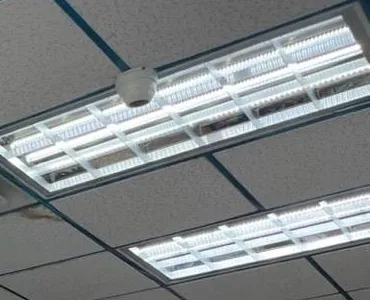
A photo from the AESS job library, not taken in Fulton Ferry: a small white dome camera on grey acoustic ceiling tiles right beside a long louvered fluorescent light panel. In a Fulton Ferry restaurant dining room or a small office on Old Fulton Street, a dome placed this close to a light fixture can flare or flicker on the recording. Moving it a tile or two away from the light, or changing its exposure setting, is often the whole repair.
What a restaurant or counter on Old Fulton Street needs from a repair
The restaurants and counters on Old Fulton Street and Front Street run long hours with lines outside and constant traffic through the door. Their cameras need to do three things: show the face of each person at the register or the host stand, cover the cash, stock and back door after closing, and keep enough video that a problem found days later can still be checked. A recorder set to record every camera at full quality around the clock fills up fast in a busy room. We set the cameras that matter to the highest quality, use motion recording where the room is empty at night, and size the drive to the days the owner wants.
Many of these businesses have had their cameras put in by whoever built out the space, and the recorder is under the counter or on a shelf above the walk-in, where heat and staff traffic shorten its life. A repair often includes moving the recorder to a cooler, locked spot, putting it and the switch on battery backup, and setting it to alert the owner when a camera drops. For crowds and events, the door camera is the one we check hardest: it should show people coming in under the store's own light, not just the line outside.
Rules that touch a commercial camera repair
State licensing. The New York Department of State licenses companies that install or service security systems, and its rules cover closed-circuit television used to watch for intrusion, theft or movement. An owner can work on their own system, or have an employee do it, without a license; a company working for someone else needs one. AESS works under NYS license #12000287431.
City low-voltage rules. Under NYC Administrative Code §28-105.4.7, which took effect with the 2025 Electrical Code on December 21, 2025, low-voltage signaling, communication and alarm wiring under 50 volts does not need an electrical permit when it is done by a licensed master electrician, special electrician or qualified person. Repairs on existing camera wiring fall in that category; work on the building's line-voltage outlets or circuits belongs to a licensed electrician.
Cameras that watch staff. New York Labor Law §203-c requires employers who monitor employees electronically, including by video, to give written notice and get acknowledgment. If a repair moves a camera onto a kitchen, a stockroom or a work area, the notice should be updated.
The historic district. Every building in the Fulton Ferry Historic District falls under the Landmarks Preservation Commission. Its guidebook allows ordinary maintenance and repair of existing safety equipment without a permit. Moving a camera, adding one, or running new conduit on a facade follows the commission's rules on mounting points, spacing and visible conduit, and in-kind replacements are documented with the maker's cut sheets.
Your Questions Answered
Security Camera Repair in Fulton Ferry: Questions Answered
These are the situations Fulton Ferry co-op boards, condo managers, owners and shopkeepers describe when they call. Each answer is written for the buildings and the waterfront here.
Water, the cellar and where the recorder lives
After the last flood our board moved the recorder from the cellar to a closet on an upper floor. Since then the two cameras at the street door freeze and drop out. Could the longer cable be the cause?
Very possibly. Moving a recorder up several floors often means the cameras that were closest to it are now the farthest away, and the cables were extended to reach. Network camera cable has a working limit of about 100 meters per run, older coax cameras lose picture quality over long runs, and a quick splice made to add length is a common weak point. We test each extended run, replace the splice or the run where it fails, and where the distance is too long, put a small switch or extender part of the way, kept above the flood line, rather than moving the recorder back down.
Our recorder and power boxes were raised off the cellar floor after Sandy, but the camera cables still drop down into the old cellar and come back up. Should those runs be rerouted?
If the cables only pass through the cellar inside their jacket, with no splice or junction box down there, they are usually fine; good camera cable tolerates getting wet better than any connector does. The risk is the joints: a splice box, a coupler or a power tap that sits low will corrode the first time it is flooded. On a repair we find every joint below the waterline, move it up or replace the run through that section with one continuous piece, and note on the cable map where each run passes low so the next flood check is quick.
Water got into our cellar during a storm. Before we throw anything out, what should we photograph or keep for the flood insurance claim?
Before anything is removed, photograph the waterline on the walls, the shelf or floor where the recorder, switch and power boxes sat, the label on each device with its model and serial number, and any visible corrosion. Keep the damaged recorder and drive until the adjuster has seen them or said they can go, because the drive may still hold footage and the adjuster may want to see the hardware. We write up which parts were damaged by water, which were already failing, and the replacement price for each, which is the document most insurers ask for.
Our recorder sits in one of the old brick storage vaults in the cellar. The thick walls keep it cool, but the phone app keeps losing it. Why?
The vault walls that keep the recorder cool also block any wireless signal, so if the recorder reaches the building's internet over Wi-Fi or a powerline adapter, the link will be weak and drop under load. The cameras keep recording; only the remote connection fails. The fix is a proper network cable from the recorder to the building's router or switch, or a small switch inside the vault fed by one cable. We also check that the vault stays dry after storms.
Is there a camera that can survive being underwater, so the ones on our ground floor stop dying every time the street floods?
Not in a practical sense. Outdoor cameras are rated to keep out rain and spray, and some ratings allow brief immersion in fresh water, but a camera's cable connection, its power source and the box behind it are not built to sit in salt water. A surge that covers the camera will usually also cover the connector, and that is where it fails. The better repair is to mount ground-level cameras as high as the view allows, keep their connectors and power above the water mark, and accept that a camera low on a riverfront wall is the one most likely to need replacing after a storm.
A product photo from the AESS job library, not taken in Fulton Ferry: a slim video door station with a camera lens at the top and a large round call button. Narrow stations like this fit the slim door frames and pilasters of Fulton Ferry's old fronts without touching decorative stone. Its camera sits at face height, so it often catches the clearest picture of a visitor when the building's own door camera is aimed too wide.
The landmark district, the street and construction
Our co-op wants the replacement for a dead facade camera to be smaller and darker than the old one. Is that still a repair, or does a change in look need Landmarks approval?
The commission's guidebook treats ordinary maintenance and repair of existing safety equipment as work that needs no permit, and it handles like-for-like replacements with a simple filing that includes the maker's cut sheet rather than drawings. A smaller, darker camera on the same mounting point usually moves the building closer to what the guidebook asks for, which is equipment that is small and painted or finished to blend in. If the new camera needs a new mounting point, a longer arm or new conduit on the facade, that part follows the commission's mounting and conduit rules, and we tell the board before we quote it so it can check with the LPC first.
Foundation work has started on the lot next to our building. What should we check on our cameras while it goes on, and after it ends?
During the work, watch the cameras on the side facing the site and any cable that runs along the party wall, the sidewalk or the roof edge next to it. Vibration can loosen mounts and connectors, dust can coat lenses, and crews can cut or unplug cables they do not know are there. Photograph your cameras and cables before the job starts. When the work ends, have the cameras on that side checked for focus, aim and recording; if a cable was damaged, our notes on what failed and where are what you need to take the cost back to the contractor.
A former board member aimed our street camera to take in the bridge and the skyline. After a theft on the block it showed a lovely view and nothing about who came to our door. Is re-aiming part of a repair?
Yes, and it is one of the cheapest repairs we do. We re-aim the camera at the door and the steps, zoom the lens in so a face fills enough of the picture to recognize, and set the recording and motion zone around the entry instead of the street. If residents want a view of the bridge, a second inexpensive camera can be pointed at it, so the security camera does not have to do two jobs badly.
Our building is on the corner by the park entrance, and the park has its own cameras watching the same sidewalk. Can we rely on their video instead of repairing ours?
No. The park's cameras belong to the park, are placed for the park's needs and are not set up to show your door, your lobby or the stretch of sidewalk where a delivery was left. You also cannot pull their footage yourself; it goes through the police or the park's own process. The Brooklyn Eagle reported in 2018 that the park's president wanted more cameras and police for crowd control, which shows what those cameras are for. Your own camera is the only one that answers the question of who came to your building and when.
Crowds, closures and small co-ops
If our cameras fail the week before the Fourth of July, when the police close the blocks near the park, can a technician still get to our building?
Book as early in the week as you can. For the 2026 fireworks the NYPD set checkpoints in Brooklyn Heights from 1 p.m. on the day, residents needed ID or other documents to reach their own blocks, towing started the night before, and the local Assembly member's office said Brooklyn Bridge Park would be closed except to ticket holders, entering at Atlantic Avenue and Old Fulton Street. On a day like that a service van may not reach your door at all. We schedule repairs on Fulton Ferry buildings well before a known closure, and if the visit has to fall near one, we arrange it around the closure hours and tell you what the board needs to do to let the technician in.
Our co-op still pays a monthly bill to the company that installed the cameras, but nobody has seen a technician from them in years. Can you check what the system actually has before we cancel?
Yes. A whole-building checkup lists every camera, the recorder model and drive, how many days it keeps, whether remote viewing works, who holds the admin login, and whether anything in the system depends on the old company, such as a cloud account, a monitoring link or a recorder registered to them. That tells the board whether the monthly bill is buying anything. Before you cancel, make sure the board has the recorder password and the app account in its own name, because some installers hold both and the system is harder to recover once the account is closed.
A shareholder has been renting an apartment to visitors by the night. The board wants to use the hallway cameras to enforce its rule against short-term rentals. What should be in place first?
Start with a written camera policy the board adopts: what the cameras cover, who may view footage, for what purposes, and how long video is kept. Then make sure the system can support it: working lobby and hallway cameras, a recorder that keeps enough days to show a pattern, and logins that record who viewed and exported what. Under the city's Local Law 18, hosts of short-term rentals must register with the Office of Special Enforcement, and buildings that bar them by lease or occupancy agreement can be placed on a prohibited buildings list, so footage is supporting evidence rather than the whole case. For the legal side, the board should talk to its own lawyer.
Equipment
Types of Security Cameras and Recorders We Repair
Fulton Ferry systems mix decades of equipment: coax cameras put in when the lofts were converted, network cameras added in the newer condos, and Wi-Fi cameras bought by shareholders for their own doors. We repair all of it, whoever installed it.
Analog and HD-over-coax cameras
Cameras with round BNC connectors, common in the older converted buildings. Typical faults here: salt in outdoor connectors, failed power boxes in the cellar, and long runs that lost quality after the recorder was moved upstairs.
Network (IP) cameras
Cameras powered and connected through one data cable, common in the waterfront condos and newer shop fit-outs. Typical faults: dead switch ports after a power dip, address conflicts, lost passwords and broken firmware updates.
DVRs, NVRs and hybrid recorders
The box that holds the footage, in cellars, vaults, meter rooms, lobby closets and back offices. Typical faults: water and salt on the board, desktop drives worn out by round-the-clock recording, heat, and settings lost after an outage.
Wi-Fi and battery cameras
Plug-in and battery cameras on apartment doors, roof decks and inside windows. Typical faults: no signal through masonry walls, router changes, batteries drained by cold wind off the river, and accounts tied to one person's phone.
Dome, turret and bullet housings
Lobby domes, vestibule turrets and bullets on facade arms. Covers fogged from inside after a seal failed, brackets loosened by wind, and cameras knocked out of line by crews. Covers and brackets are replaced separately where possible.
Pan-tilt and 360-degree cameras
Turning cameras on large co-op corridors and courtyards, and fisheye cameras over shop floors. Typical faults: lost presets, stuck motors after damp gets in, and fisheye views that need the right flattening settings.
Door station and intercom cameras
The camera built into a video door station or intercom panel, often the only camera on a small co-op's street door. We trace whether the fault is the station, the intercom wiring or the link to the recorder.
PoE switches and extenders
The switches and extenders that power network cameras, often on a low cellar shelf. Typical faults: ports or whole units killed by water or power dips, and overloaded power budgets after cameras were added.
Power supplies and battery backups
Central power boxes, plug-in adapters and UPS units. Typical faults: corrosion on terminals, blown channel fuses, adapters that died on a hot low-voltage day, and backups with batteries years past their life.
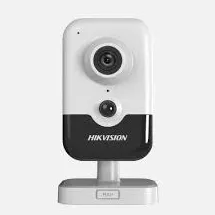
A product photo from the AESS job library, not taken in Fulton Ferry: a white indoor cube camera. In a Fulton Ferry co-op, a small camera like this often watches the package shelf in the entry hall or the board's storage room, plugged into an outlet and connected over Wi-Fi. When it drops off, the cause is usually the masonry between it and the router, or an account that belonged to the shareholder who set it up.
National brands versus a local licensed repair
Some Fulton Ferry apartments and shops have cameras from national alarm companies or consumer brands alongside a building system, and owners ask who should fix what. This is how the choices usually compare for a repair.
Question
ADT or a similar alarm company
Ring or SimpliSafe camera
AESS local repair
After a flood
Depends on the contract and dealer
Replace the device
Inspect, recover footage, repair or replace part by part, and raise what remains
Through thick masonry walls
Depends on how it was wired
Wi-Fi often weak or blocked
Wired cameras on existing cable where possible
Other brands in the same building
Usually only its own
Support covers its own devices
Any brand, any installer
Recorder and drive repair
Its own systems
Cloud storage, no local recorder
DVR, NVR and hybrid recorders, drives and footage export
Landmark facade work
Varies by dealer
Left to the owner
Reuses existing mounts and follows the LPC guidebook
Licensed technician on site
Varies by dealer
Remote support
Yes, NYS license #12000287431
Price before work
Varies
Replacement device price
$150 service call, then a written repair price
AI Overview Reality Check
What AI Gets Wrong About Security Camera Repair in Fulton Ferry
These claims show up in AI-generated answers, forums and national repair guides. Each holds true somewhere, and each one sends Fulton Ferry owners and boards toward the wrong repair or a lost clip.
"Outdoor cameras are waterproof, so a flood won't hurt them"
Quick answers point to a camera's weather rating as proof that water is no concern. The rating describes rain and spray in clean water.
A storm surge on the East River is something else: salt water that rises over the camera's connector, its power box and the junction behind it, then drains and leaves salt behind. In Sandy a basement on lower Old Fulton Street filled from floor to ceiling, and the electronics basement under Jane's Carousel took about five feet. Weather ratings do not cover any of that, and the parts of a camera system that sat in it are the ones that fail later.
Treat anything that has been under seawater as suspect even if it still works. We open and inspect it, keep what is sound and replace what is not, and move connectors and power up where the next surge is less likely to reach them.
"If the recorder turns back on after it dries out, the footage and the hardware are fine"
Many troubleshooting guides suggest letting wet electronics dry for a few days and then powering them up to check.
With a recorder, that test can destroy the thing you most want to keep. Powering up a board with salt or silt on it can short it, and a drive whose heads or platters were contaminated can be scraped as it spins, taking footage with it. A recorder that starts cleanly may still fail weeks later on corroded contacts.
If water reached it, leave it unplugged and call. If you need footage from the drive, we pull it before the recorder is tested, and we tell you plainly whether the recorder is worth cleaning and keeping or should be replaced.
"Any camera work in a landmark district needs a permit first"
AI answers about historic districts tend to warn that nothing can be touched without approval, which leaves some co-op boards living with dead cameras rather than starting paperwork.
The Landmarks Preservation Commission's own permit guidebook says no permit is needed for ordinary maintenance, repair and retrofitting of existing health, safety and utility equipment, and it handles like-for-like replacements with a simple filing and the maker's cut sheet. What it controls is new equipment and changes on the facade: where cameras are fixed, how many there are per stretch of frontage, and how much conduit shows.
Repairing a camera where it already is, replacing it with a similar one, fixing its cable inside the building or replacing the recorder needs no special permission. If a repair calls for moving a camera or adding conduit outside, we tell you before we quote it so the board can check with the commission.
"Busy public areas are already covered by city and park cameras"
Some answers suggest that a building beside a big park or a tourist area does not need its own cameras working, because the public spaces are already watched.
Public cameras watch public spaces for public reasons. When the Brooklyn Bridge Park Conservancy and 84th Precinct dealt with repeated thefts at the athletic piers in 2016, the answer was lockers and police warning signs, and a thief who took a bag from Pier 5 was identified from a selfie, not from a camera covering a residential doorway. Your lobby, your mailroom, your back door and your cellar are not on anyone else's system, and you cannot pull a park camera's footage yourself.
If something happens at your door, your recorder is the only one that will show it, so the entrance, lobby and service door cameras are the ones we check hardest.
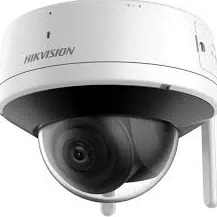
A product photo from the AESS job library, not taken in Fulton Ferry: a Wi-Fi dome camera with an external antenna. In Fulton Ferry's masonry warehouses, a Wi-Fi camera is the answer only for the rare spot where no cable can reach, such as a roof deck far from the risers. The antenna helps, but the old brick and stone walls still decide how far its signal can travel.
"Wi-Fi and cloud cameras avoid the flood problem because nothing is stored in the cellar"
Some answers suggest that the way to stop worrying about a flooded recorder is to switch to Wi-Fi cameras that save to the cloud.
In a flood, the building's internet equipment is usually in the same cellar as the recorder, so the cloud upload stops at the moment the water arrives. Wi-Fi does not travel well through the masonry of the old warehouses here, battery cameras drain faster in cold river wind, and each camera depends on an app account that someone has to own and pay for.
The steadier repair is usually to keep the wired system, move its recorder, switch and modem up out of the water's way, and add a battery backup so they keep running through short outages. A cloud copy can be added for the most important cameras, but it should be a second copy, not the only one.
"Small buildings don't need anyone in charge of the cameras"
General answers tend to assume a camera system takes care of itself once installed, or that a super or a managing agent will notice when something stops.
Many Fulton Ferry buildings are self-managed co-ops with volunteer boards and no super on site. The person who set up the cameras often sold years ago, the app is on their old phone, and the recorder has been dark for months by the time anyone needs it. Brick Underground has noted there is no city law requiring rental buildings to keep cameras working, and in a co-op nobody else will do it either.
A repair should leave someone in charge: alerts for lost video and drive errors sent to at least two board members, the admin login in the co-op's name, a one-page list of cameras and what they cover, and a reminder to check the system once a year and after every big storm.
"Camera repairs cost $100 to $300"
National averages often put a camera repair at a couple of hundred dollars, which sets expectations that do not survive a cellar that has taken water.
HomeAdvisor's Brooklyn page puts the average surveillance camera install or repair at $1,416, with a typical range of $680 to $2,145 and a full range of $160 to $3,500, but that figure mixes new systems with repairs. On our Brooklyn list most single repairs land between $150 and $700, and a recorder replacement or the rewiring of several cameras runs $700 to $1,500. After a flood, the price depends on how many parts sat in the water.
The $150 service call tells you exactly what failed and what it costs to fix, and the written price lets the board compare repair against replacement before spending anything more.
Talk to a Technician Before You Power Up a Wet Recorder or Buy a New Camera
Tell us the address, the type of building, how many cameras there are, which ones are out, where the recorder sits and whether water has reached it. If you need footage from a particular date, say so and we will plan the visit around saving it. Photos of the recorder screen, the dark cameras, the power supply and any waterline in the cellar help us bring the right parts. For anything urgent, call (347) 934-8335 now.
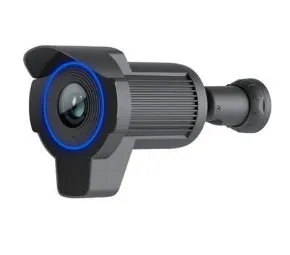
A product photo from the AESS job library, not taken in Fulton Ferry: a black bullet camera with a long hood and a blue-lit ring around the lens. On a Fulton Ferry front facing the river, a long hood keeps wind-driven rain and spray off the lens and cuts some of the glare that the water throws back at night. When a camera like this is replaced, the hood and the seal behind it matter as much as the picture.
✅
Request Sent!
Thank you. A technician will contact you about the Fulton Ferry address shortly.
How It Works
Our Repair Process
1. Send the screen, the address and the storm history
A photo of the recorder or app with the dark cameras, the address, and whether the cellar or ground floor has taken water, by text, WhatsApp or the form.
2. Confirm who approves and who holds the login
Owner, co-op board, condo manager or shop owner: we confirm who approves, who pays and who has the recorder password, so nothing stalls on the day.
3. Book the $150 service call
The $150 Brooklyn service call books a two-hour arrival window and is credited to the repair if you go ahead.
4. Save footage before touching anything
Clips that matter go to USB with original timestamps, and the recorder clock is checked against the real time, before anything is restarted or replaced.
5. Check for water, then test the chain
Connectors, boxes and the recorder are checked for water and salt first, then power, cable, switch, recorder, drive and app, camera by camera.
6. Give the cause and a written price
You hear what failed and why, and get a written, itemized price before any part is replaced. If it changes on site, you hear it first.
7. Repair, raise and retest by day and night
Failed parts are fixed or replaced, equipment in harm's way is moved above likely water, and every camera is checked in daylight and after dark.
8. Label, alert and hand over
Cables are labeled, alerts go to the right people, logins are put in the owner's or board's name, and you are shown how to export a clip.
Coverage Area
Security Camera Repair Near Fulton Ferry's Landmarks
Fulton Ferry Landing
The pier at the foot of Old Fulton Street, where ferries have run since 1642 and the NYC Ferry stop moved after its 2021 rebuild.
Eagle Warehouse
The eight-story 1893 storage warehouse at 28 Old Fulton Street, converted to an 84-unit co-op in 1980.
Brooklyn City Railroad Company Building
The 1860s building with cast-iron piers at 8 Old Fulton Street and Furman Street, turned into loft apartments in the 1970s.
Long Island Safe Deposit Company
The 1868 cast-iron building at 1 Front Street, now home to Grimaldi's pizzeria.
The River Café
The restaurant on the water at 1 Water Street since 1977, badly damaged by Sandy and reopened in February 2014.
Jane's Carousel
The restored carousel in Brooklyn Bridge Park whose electronics basement took about five feet of water in Sandy.
Fulton Ferry is billed at our Brooklyn rate. Every repair starts with the $150 service call, which covers the on-site diagnosis and is credited to the repair if you go ahead. The figures below come from our published list of Brooklyn security camera repair prices; your exact price is written down on the visit, once we know what failed.
Repair
Brooklyn price
Service call, on-site diagnosis and written price
$150, credited to the repair
Motion zones, recording schedule, app or clock settings, no parts
Usually within the $150 service call
Clean and check for a blurry or salt-filmed picture
$80
Connector reterminate or PoE port swap
$150–$350
Power supply repair
$150–$400
Dome or front cover replacement
$30–$80 part plus labor
Hard drive swap, by capacity
$200–$450
Single camera replacement on a working system
$250–$600
Outdoor camera body replacement with weatherproofing rebuild
$250–$600
Night vision camera repair
$250–$650
DVR not working, including drive and labor
$300–$700
NVR not recording, by model
$400–$900
PTZ camera repair
$450–$1,200
Hybrid recorder swap, channels reconfigured
$700–$1,200
DVR/NVR replacement with drive, or multi-camera wiring repair
$700–$1,500
Full rewire or whole-building overhaul
From $1,500
Three things move a Fulton Ferry repair within those ranges. The first is water: a part that sat in a flood has to be opened and inspected, and a system with several soaked parts is priced part by part. The second is reach and the facade: a camera high on an eight-story warehouse front or on an arm over a cornice takes more time than one in a lobby, and work that must avoid decorative stone or cast iron is planned before it is priced. The third is the recorder: a recorder that has to be replaced, moved above the flood line or untangled from years of unlabeled cables adds setup and tracing time. If the price changes on site, you hear the new number before work goes on. Bundling the camera repair with intercom, alarm or cabling work on the same visit saves $200 to $400 in labor on our Brooklyn list.
Full terms — including 50% deposit, one-year parts-only warranty on AESS-supplied products, and the late-fee schedule — are set out in the service agreement.
Shop Our Systems
Security Camera Repair Packages & Pricing
Three ways Fulton Ferry repairs usually come together, priced from our Brooklyn list.
Single-issue repair: $150–$700
One fault, one visit: a salt-swollen connector redone, a power supply replaced after a hot low-voltage spell, a drive swapped, a door camera re-aimed and zoomed, or a lost login recovered. Typical for a small co-op, a shop or one camera at a restaurant.
Major system repair: $700–$1,500
The recorder or the wiring: a flood-damaged DVR or NVR replaced and moved up out of the water's way, or several runs that pass through a damp cellar replaced. Typical after a storm or a neighbor's construction job.
Annual maintenance: $250–$800
Every camera checked by day and night, lenses cleaned of salt film, connectors and power tested, the drive's health read, alerts confirmed and export tested. Residences start at $250, commercial properties at $400, and multi-property owners run $500 to $800.
Bring your own equipment. If you have already bought a replacement camera or recorder, we can fit it at labor-only rates. Tell us the exact model and we quote the labor by phone or text, and the visit is booked once it is paid. Your own equipment goes in as supplied: we cannot vouch for parts we did not supply, and if a model will not work with your recorder, will not reach the router through masonry, or will not hold up facing the river, we tell you before the visit.
Complete Services
Every Security Camera Repair Service in Fulton Ferry
Camera, connector and flood repair
Dark cameras, salt-damaged connectors, soaked power boxes and cables that pass through wet cellars. Request a repair
Recorder, drive and network repair
DVRs, NVRs and switches in cellars, vaults, closets and back offices, including systems that failed after a storm or a power dip. Brooklyn security camera repair
After a flood, who should we call first, the electrician or the camera company?
+
The electrician, if water reached outlets, panels or wiring at line voltage, because the building has to be safe to power up before anything else. Tell them the camera recorder, switch and power boxes are on those circuits and ask them to leave them unplugged. Then call us to inspect the camera equipment, recover footage from the drive and replace what the water ruined.
Is salt air off the East River as hard on cameras as an ocean beach?
+
Usually less, but it still matters. The East River is a tidal strait of salt and brackish water, and wind carries spray onto the fronts and decks that face it. Camera bodies tend to cope; the weak points are outdoor connectors, junction box seals and bracket screws. A yearly check of the cameras facing the water catches corrosion before it takes a picture down.
Can camera cables that sat underwater be reused, or do they all have to be pulled out?
+
A continuous run of good camera cable with no joint in the water can often stay, once it is dry and tests clean from end to end. The connectors on its ends, any splices and anything powered that was submerged should be replaced. We test each run after a flood and only replace the ones that fail or have a joint that sat in the water.
Is flood damage to a camera system covered by a warranty?
+
Generally no. Equipment warranties, ours included, cover parts that fail in normal use and exclude acts of nature such as floods, as well as power surges. Flood damage is a matter for the building's or business's insurance. That is why the photos and the written list of damaged parts we prepare after a flood are worth keeping with the claim.
How can we tell whether a camera was killed by the flood or was simply old?
+
The evidence is usually inside. A water-damaged camera or connector shows salt crust, green or white corrosion and rust on contacts that were clean before, while an old camera that failed on its own shows worn infrared lights, a cloudy cover or a dead board with no sign of water. We open what failed, photograph what we find and say which it was in the written report.
A contractor's crew cut our camera cable. Can your repair notes help us get them to pay?
+
They can help. We photograph the damaged section, note where it was, what the cut looks like and when the camera stopped recording, and price the repair in writing. That gives the board or owner a clear record to send to the contractor or their insurer. Whether they pay is between you and them, but a dated, itemized record makes the request hard to ignore.
How do we show that a clip we hand over has not been edited?
+
Export it straight from the recorder in the recorder's own format along with its player, keep the original export untouched, and write down who exported it, when and from which camera. Many recorders also add a checksum or watermark to their exports. If a detective or a lawyer needs the original, we can do the export with you and note the recorder's clock against the real time.
Can a camera in the cellar warn us when water starts coming in?
+
Not reliably. A camera can show water once it is there, but it will not send an alert for it. A water sensor on the cellar floor, connected to an alarm panel or a smart-home hub, is the right tool, and it can warn you while there is still time to unplug equipment. The camera is useful for checking how high the water is from your phone.
After a storm passes, is it worth having the cameras checked even if they all look fine?
+
If water reached the cellar or the ground floor, yes, because corrosion works slowly and a system that looks fine can fail weeks later. If the building stayed dry, a quick look at the app and a check that every camera is still recording is usually enough. Many boards fold a post-storm look into the annual maintenance visit.
Our phones buzz all weekend afternoon from people walking past on Old Fulton Street. Can alerts be limited to the hours we actually care about?
+
Yes. Most recorders let you set an alert schedule and a detection zone separately from recording. We keep the cameras recording around the clock, draw the alert zone tight around your door and steps, and turn alerts on only for the hours the building wants them, such as overnight, so a crowded Saturday stops sending notices while the camera keeps recording everything.
Our board changes every year. How do we keep the camera logins from leaving with the outgoing officers?
+
Put the admin login and the app account in the co-op's name, using a building email address rather than a personal one, and give each board member their own user account with only the access they need. Keep the admin password in the board's records. When officers change, their user accounts are removed and the building keeps control of the system.
Ready to Get Every Fulton Ferry Camera Recording Again?
Send a photo of the recorder screen or the dark camera, the address, whether water has reached the system, and the date of any footage you need. We book within 2 hours, give you a two-hour arrival window, save your footage first, and write down the repair price before any part is replaced.