Hallway camera covered or dead, recorder blank after the block lost power, or a store on Flatbush or Church Avenue that needs last night's video? Flatbush camera repair line, booked within 2 hours: (347) 934-8335
Six-Story Apartment Houses · Walk-Ups Over Stores · Flatbush, Church, Nostrand and Rogers Storefronts · Houses of Worship and Schools
Security Camera Repair in Flatbush
Any Brand · Any Installer · Video Copied Before Anything Is Reset · Written Price Before Parts · Brooklyn Rate
Security camera repair in Flatbush costs $150 to start: that Brooklyn service call pays for a licensed technician to find the fault on site, and it is credited to the repair when you go ahead. On our published Brooklyn list, most fixes land between $150 and $1,500. A new connector or a switch port is $150 to $350, one replacement camera on a working system is $250 to $600, and a new recorder with its drive is $700 to $1,500. We repair systems we did not install, from the hallway and lobby cameras of a six-story apartment house on Ocean Avenue to the four-camera kit over a shop on Church Avenue. Requests are booked within 2 hours, technicians arrive inside a two-hour window, and you get the cause and a written price before any part is swapped.
Prices on this page are taken from our published Brooklyn repair list; yours is written down before work begins
Rated 4.7★ across 201 Google Reviews
Reviewed and updated November 12, 2026. Sources: News 12 Brooklyn on the July 2025 hallway camera covering inside a Flatbush apartment building, the July 2025 gunpoint robbery recorded at Z & H Five Star Salon, the May 2024 robbery at 866 Flatbush Avenue, the February 2024 back-door robbery at 26 Rugby Road, the June 20, 2025 Beverly Road manhole fire and the July 13, 2026 manhole fire near 650 Ocean Avenue; Fox 5 New York on the 2025 roof break-ins that reached 302 Church Avenue and 1188 Flatbush Avenue; Patch on Amnesty International's Decode Surveillance NYC camera map; Brick Underground on broken lobby cameras and landlord duties; the NYU Furman Center profile of Flatbush and Midwood; the NYC Department of Small Business Services Avenue NYC study of the Flatbush commercial corridors; the Mayor's Office on the 2024 business camera pilot with the NYPD; Swann and CCTV Camera World support guides on recorders that stop saving; HomeAdvisor's Brooklyn cost page; the Landmarks Preservation Commission permit guidebook; and the New York Department of State on security and CCTV installer licensing. · Abstract Enterprises Security Systems, NYS license #12000287431 · crews dispatched from our Troy Avenue office in Brooklyn
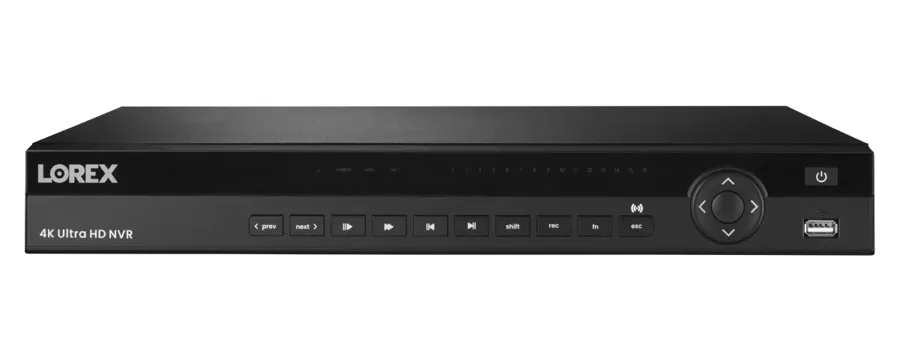
This is a product photo from our equipment library rather than a picture taken in Flatbush: a desktop network video recorder with sixteen camera channels. A recorder of this size is what we usually find on a shelf in the cellar, in the super's office or in a locked hall closet of a Flatbush six-story apartment house, with every hallway, lobby, courtyard and roof camera running back to it. When that one box stops saving video, the whole building goes blind at once, which is why most building repairs here start at the recorder, not at the cameras.
Flatbush Camera Repair Request
Apartment house, walk-up, store, office or house of worship: give us the address and what the screen shows, and a technician calls back with the next step
✅
Request Sent!
Thank you. A technician will be in touch about your Flatbush address shortly.
25+
Years Experience
✓
Same-Day Estimates
100%
Licensed & Insured
4.7★
201 Google Reviews
Owner-operated since 2002 · Thousands of jobs completed · Booked within 2 hours
In Flatbush the camera that fails is usually not the one the person calling us owns. About three out of four households in the Flatbush and Midwood district rent, so the hallway, lobby, courtyard and roof cameras belong to a landlord, a managing agent or a co-op board, while the tenant who needs the video often has nothing but a doorbell camera on an apartment door. On the shopping streets it runs the other way: the store owner owns a small system, the landlord owns the building it is bolted to, and the recorder sits under a counter or in a back room where it gets kicked, unplugged or forgotten. A repair here therefore starts with two questions before any tool comes out: who can approve the work, and what footage has to be saved first. Send a photo of the recorder screen to (347) 934-8335 or on WhatsApp and we will tell you what the fault probably is and what that repair costs on our Brooklyn list before anyone books anything.
Reading your photos is free. The $150 service call pays for the on-site diagnosis and comes off the repair if you go ahead.
All work is done under New York State license #12000287431, the license the state requires of any company that installs or services security and CCTV systems for someone else.
We fix any brand and any installer's work, and if an old recorder or camera is not worth the money, we say so.
The Neighborhood
Why Flatbush Properties Need Security Camera Repair
Flatbush has never had official borders, but the blocks most people mean run from Parkside Avenue south toward Brooklyn College and the Junction, and from around Coney Island Avenue east toward Nostrand. What makes this part of Brooklyn different for camera work is the building stock. After the First World War a city tax exemption that ran until 1932 brought a wave of six-story elevator apartment houses, many of them Art Deco or Colonial Revival, along Ocean Avenue and the edges of the old village. Between them sit three-story walk-ups with a store on the ground floor, smaller brick apartment buildings, houses of worship of every size, and four long commercial corridors: Flatbush Avenue, Church Avenue, Nostrand Avenue and Rogers Avenue. Almost every one of those buildings already has cameras. The repair problem is that the people who rely on them are rarely the people who maintain them.
The numbers show why. The NYU Furman Center counts 147,911 people in the Flatbush and Midwood community district in 2024, with a homeownership rate of 24.4 percent and a rental vacancy rate of just 3.1 percent. An older Furman profile of the same district found that more than four out of five rental apartments were rent-regulated. In practice that means long-term tenants in big buildings run by owners and managing agents who may be in another borough. When a hallway camera dies in one of those buildings, the tenants notice first, the super may or may not pass it on, and the recorder in the cellar keeps quietly recording nothing. Brick Underground put the legal side plainly in its column on stolen packages and a broken lobby camera: no city law makes a rental building keep its cameras working. But attorney Jeffrey Reich told the column that a landlord on notice of crime may have to take reasonable precautions, and that "fixing the security camera would certainly be a reasonable action for the landlord to take in this instance."
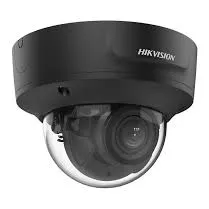
A catalog image from the AESS parts library, not a photo from a Flatbush lobby: a black dome camera with a varifocal lens, the kind whose view can be widened or tightened on site. In the vestibules and mailbox lobbies of Flatbush apartment houses, a dome like this is often the only camera that sees faces at the street door. When it is replaced, the adjustable lens lets the technician frame the door and the mailboxes together instead of the ceiling or the floor.
A Flatbush building showed what happens next in July 2025. News 12 reported that tenants of a Flatbush apartment building shared video of a shirtless man walking up to a hallway camera on July 11 and deliberately covering its lens, then coming back the next day and doing it again. The clip the station aired came from a tenant's own Ring camera. Residents blamed broken entrance locks and said management answered with temporary fixes; one told News 12, "I don't feel safe in my apartment. I don't feel safe in this building." For camera repair, that story holds the whole Flatbush problem in one hallway: a building camera that could be reached and blinded, no sign that anyone was alerted when it went dark, and the useful video coming from a tenant's device instead of the system the building paid for.
The storefront side of Flatbush has its own pattern. The city's Avenue NYC study of the area, built from fieldwork in 2021 and 2022 with the local business improvement districts and merchant groups, counted 1,662 storefronts along Church, Flatbush, Nostrand and Rogers Avenues. Fifty-three percent of the merchants it surveyed wanted changes that would make the corridors safer, shoplifting came up as a steady worry, and so did poor street lighting at night. Late in 2025 Fox 5 New York reported a string of Brooklyn break-ins through store roofs, including one at 302 Church Avenue where about $7,500 was taken and a failed roof attempt at 1188 Flatbush Avenue on October 11; police released still images from the store cameras that recorded the successful ones. In May 2024 a masked man robbed a smoke shop at 866 Flatbush Avenue, just off Church Avenue, at gunpoint shortly before 11 p.m. In July 2025 News 12 aired camera video of a gunpoint robbery inside Z & H Five Star Salon in Flatbush at about 11 in the morning. Some of those stores had cameras that did their job. The repair calls we get come from the ones that did not: the camera aimed at the wrong door, the recorder that stopped saving weeks before, the night picture that turned into grey noise under a broken streetlight.
Then there is the power. On June 20, 2025, a manhole fire on Beverly Road left at least 1,700 Con Edison customers in Flatbush without power, with crews still working to restore it that night, and on the night of July 13, 2026, another manhole fire near 650 Ocean Avenue cut about 343 customers until early the next morning. A camera system does not mind the dark. It is hurt when the power drops while the recorder is writing to its drive, when the surge on the way back kills an adapter or a switch port, and when the recorder's clock and settings reset. After an outage on a Flatbush block we hear the same sentence over and over: the lights came back, the elevator came back, the cameras did not.
Flatbush is not short of cameras. A 2022 Patch report on Amnesty International's Decode Surveillance NYC map noted that the volunteers' count "documents a high number of them in Flatbush," far more than in neighboring Ditmas Park. Plenty of cameras is not the same as plenty of usable video. A repair here has three jobs: get the system saving again, make sure someone is told the next time it stops, and leave the owner, agent or congregation with the logins, labels and backup power to keep it running. Buildings that call about lobby cameras often ask us to look at the street door at the same time, because a working camera is worth far more beside an entrance that locks and an intercom that works.
Flatbush figures that change how a camera repair is planned
Most people here rent. Homeownership in the Flatbush and Midwood district was 24.4 percent in 2024 (NYU Furman Center), so the person who notices a dead hallway camera usually cannot authorize its repair. We confirm the decision-maker before the visit so the work does not stall at the cellar door.
There are 1,662 storefronts on four corridors. The Avenue NYC study counted them along Church, Flatbush, Nostrand and Rogers Avenues, and it found 53 percent of merchants wanted the corridors made safer. Each of those shops is a small camera system with its own recorder, its own power and its own blind spots.
Foot traffic is heavy into the evening. The same study recorded 3,135 pedestrians in a weekday evening count on Church Avenue between Nostrand Avenue and East 31st Street, and 2,680 on Flatbush Avenue between Martense Street and Church Avenue. Cameras on those blocks see a constant crowd, so motion settings and drive space matter as much as the hardware.
Serious crime has fallen, but footage still decides cases. Furman lists 8.1 serious crimes per 1,000 residents in the district in 2024, down from 15.6 in 2006. When something does happen, detectives from the 70th Precinct on Lawrence Avenue, or the 67th on Snyder Avenue at the eastern edge, ask the block for video, and only working recorders can answer.
Outages arrive from under the street. The 2025 Beverly Road fire and the 2026 fire near 650 Ocean Avenue both started in manholes, cut hundreds to thousands of customers and ran into the night. Recorders and switches without battery backup feel every one of them.
Some thieves skip the front door. The 2025 roof break-ins at 302 Church Avenue and the attempt at 1188 Flatbush Avenue show why a store camera aimed only at the street entrance is half a system.
Where this page applies. It covers the apartment blocks, walk-ups and shopping streets of Flatbush from Parkside Avenue down to the Junction, including Ocean Avenue, Flatbush Avenue, Church Avenue, Nostrand Avenue, Rogers Avenue and the side streets between them. The freestanding-house blocks just west have their own pages, and the rest of the borough is on our Brooklyn security camera repair page. The price follows the fault, not the address.
Same-Day Repair in Flatbush
Need Repair in Flatbush? A Hallway Gone Black, a Store Recorder That Stopped Saving, or Cameras That Never Came Back After the Outage
The urgent calls we take from Flatbush tend to come in three shapes. A building call: tenants or a super report that the lobby or hallway pictures are black, covered or frozen, often after something has already happened on a floor. A store call: a robbery, a shoplifting pattern or a night-time break-in, and the owner opens the recorder to find the one camera that mattered is dark or aimed at the ceiling. And an outage call: Con Edison has restored the block after a manhole fire, and the recorder has come back on a setup screen or with half its cameras missing.
If footage from a recent incident matters, the first rule is simple. Leave the recorder running, and do not let anyone restart it, unplug it, format it or "reset it to see if that helps." Most recorders write over their oldest video once the drive is full, so every hour of waiting costs some of the past. A restart can also hide the very error that explains the gap. Call (347) 934-8335 with the date and the time window you need, and we book the visit with exporting that video as the first task. If a detective from the 70th or 67th Precinct has already asked for a copy, mention it when you book; the export is made to USB in the recorder's own format with its original timestamps, and we note the difference between the recorder's clock and the real time so nobody argues about when it happened.
For everything else the route is the same. The $150 service call reserves a two-hour arrival window, the technician finds the cause, and you see a written price before any part is replaced. Requests are booked within 2 hours. We do not promise every repair on the same day, because some recorders, drives and cameras have to be ordered to match what you have, but most single-camera, power-supply and hard-drive faults are fixed on the first visit when the part is on the truck.
What We Install
Security Camera Repair Services in Flatbush
Each repair below is priced from our Brooklyn camera repair list. The service call pays for finding the fault. The repair itself depends on what failed, how many cameras it touches and how hard the run is to reach, whether that means a vestibule dome inside the front door of an Ocean Avenue building or a camera on the parapet of a store roof on Church Avenue.
Hallway, lobby and stairwell cameras
Dead, covered, knocked or blurred cameras in the common areas of apartment houses and walk-ups. We test each one at the lens, at the cable and at the recorder, so the bill covers only the part that actually failed.
Recorders that stopped saving
DVRs and NVRs that show live pictures but have no recent playback, that beep, restart or keep only a few days. The drive is read for health, needed video is copied off, and the drive or recorder is replaced to match the cameras you have.
Recovery after an outage
Systems that came back wrong after a power cut: recorders asking to be set up or to format the drive, cameras missing from the grid, dead switch ports and clocks reset to a date years ago. Settings are rebuilt and power is tested, and battery backup is added where it belongs.
Store and salon systems
Four- to sixteen-camera systems on Flatbush, Church, Nostrand and Rogers Avenues: register views that miss faces, back doors and roofs nobody watches, recorders under counters and cameras fogged by kitchens or washed out by shop lighting.
Power supplies, adapters and switches
Central power boxes, plug-in adapters, PoE switches and the outlets they hang from. In Flatbush buildings these often share a strip with a boiler control, a laundry machine or a freezer, and they are the first casualties of a surge.
Cable and connector repair
Runs cut by roofers, elevator crews or internet installers, cables that cross a roof or a light court and crack in the cold, connectors that took on water, and splices hidden in ceilings. Repaired or replaced, then tested end to end.
Logins, apps and handovers
Recorders whose password left with a former super, a former manager or an installer who closed; apps tied to one person's phone; buildings that changed hands. Access is restored for the right person, default passwords are changed and old users are removed.
Footage export for incidents
Clips copied to USB with original timestamps for detectives, insurers, landlords, lawyers and housing court, with a note of any gap between the recorder's clock and the real time.
Building-wide checkups
Every camera on an apartment house, store, school or house of worship checked in one visit, with a written list of what works, what is failing and what each fix costs, so an owner, an agent or a board can decide what to do first.
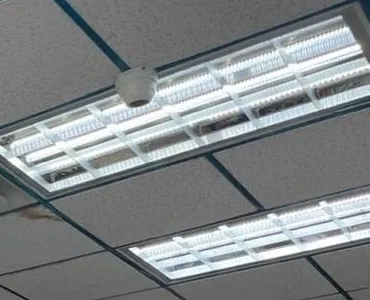
Taken on an earlier AESS job elsewhere and kept in our photo library, this picture shows a small white dome on grey ceiling tiles right next to a long louvered fluorescent fixture. Stores along Flatbush and Church Avenues are full of ceilings like this. A dome that close to a bright fixture can lose detail in faces below it, and if the fixture flickers the picture can pulse. Part of a store repair is checking every ceiling camera under the shop's real lighting and moving one a tile or two when the light is the real problem.
Building Specialists
Security Camera Repair for Flatbush's Architecture
Nearly every camera repair call in Flatbush comes from one of six kinds of property. Each breaks in its own way, and each one decides where the recorder lives, how the cables run and whose signature the work needs.
Six-story elevator apartment houses
The prewar buildings along Ocean Avenue and the edges of the old village, often built around light courts, with a recorder in the cellar or the super's office and long runs to the roof, the halls and the courtyard.
Three-story walk-ups over a store
A shop on the ground floor and apartments above, along Flatbush, Church, Nostrand and Rogers Avenues. Two camera systems often share one facade, one cellar and one electrical service.
Smaller brick apartment buildings
Four- to twenty-unit walk-ups on the side streets with no super living on site, where cameras cover the stoop, the vestibule, the stairs and the back yard, and nobody checks them between incidents.
Co-ops and condominiums
Apartment houses that converted to co-op ownership in the waves of the late 1980s, and newer condos, where a board or a managing agent controls the system and every shareholder has an opinion about where the cameras point.
Houses of worship and schools
Churches, temples, mosques and synagogues of every size, the small schools on the Erasmus Hall campus and programs in former storefronts, often run by volunteers who change from year to year.
New and converted mixed-use buildings
Recent construction and conversions such as the planned housing at the former Sears building at Beverley Road and Bedford Avenue, where cameras are newer, network-based and often still tied to the contractor who installed them.
Six-story apartment houses: one recorder, many hands
The classic Flatbush apartment house has six floors, an elevator, a lobby with mailboxes, one or two stairs, a cellar with the boiler and the laundry, and a roof with a bulkhead and often a light court cut into the middle of the building. A typical camera system has a dome in the vestibule, one in the lobby, one or two per hallway, a camera on the courtyard or rear yard, one on the roof door and sometimes one in the elevator, all wired back to a single recorder. When that recorder lives in the super's office or a locked cellar room, the system is only as healthy as the last person who looked at it.
Two things go wrong over and over in these buildings. First, the recorder stops saving and nobody notices, because the monitor in the super's office still shows live pictures; we cover how to spot that later on this page. Second, cameras drop out one at a time as contractors work in the building. Roofers, elevator mechanics, plumbers opening a chase and internet installers pulling new lines up the stairwell all work where camera cables run. When cameras on the upper floors fail in the same month as a roof job, we start by tracing those runs from the recorder up, not by replacing cameras.
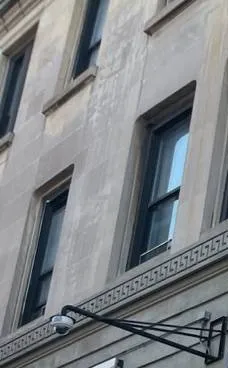
From the AESS job photo library and not taken in Flatbush, this shows a bullet camera held off a pale stone facade on a long black steel arm, just below a carved Greek-key band and beside tall sash windows. Flatbush's prewar apartment houses carry the same kind of decorative stone and brick trim around their entrances and upper floors. A long arm lets a camera clear a cornice or a projecting band so it sees the sidewalk, and when one of these arms is replaced we fasten it into plain masonry or mortar joints rather than the carved work.
Light courts deserve their own mention. Many Flatbush buildings from the 1920s were laid out with wings around courts so every apartment had light and air, which means a courtyard camera is often mounted on the far wing with its cable crossing the roof or running along a parapet. Those runs face sun, ice, foot traffic from roofers and the occasional satellite installer, and they are the first to fail. When we repair one, we look at whether the run can drop inside the building sooner, or travel in a protected path, so the courtyard view stops being the camera that goes first every winter.
Walk-ups over a store: two systems, one building
Along the shopping streets, a typical building is three stories of brick with a store below and apartments above, reached by a narrow street door beside the shop window. The store usually has its own camera system with a recorder in the back room. The landlord may have a separate camera on the apartment door and stairs, or none at all. Both depend on the same electrical service and often the same cellar, and they get confused for each other on the day of a repair. Before we start, we sort out which cameras belong to whom, which recorder each one feeds, and who is paying for which part of the work, so the store owner is not billed for the landlord's stairway or the reverse.
These buildings also share roofs. Many blocks of Flatbush Avenue and Church Avenue are rows of buildings whose roofs meet at low parapets, which is exactly what made the 2025 roof break-ins possible. A store camera system that watches only the front door and the register leaves the roof hatch, the skylight and the back of the store to chance. On a repair visit we can show you what each camera actually covers and where the gaps are, and price the change as part of the repair rather than as a new system.
Smaller walk-ups: the building that gets checked only after something happens
The four- to twenty-family brick walk-ups on the side streets usually have a few cameras at the stoop, the vestibule, the stairs and the back yard, wired to a recorder in the cellar or a locked closet under the stairs. With no super living on site, the system gets looked at when the owner visits or a tenant complains. That is why the most common walk-up call is not "a camera broke" but "we needed the video and found the camera had been dark for months."
So a walk-up repair has two halves: the fix, and alerts for lost video and drive errors sent to the owner or agent, so the next failure arrives as a message rather than a surprise in front of a detective.
Co-ops and condominiums: a board, a managing agent and a lot of opinions
Flatbush saw waves of co-op conversions in the late 1980s, and many of those buildings still run camera systems installed during or after conversion. In a co-op or condo, the board or the managing agent approves the repair, and the camera plan often becomes a building discussion: which hallways need coverage, whether a camera can see into apartment doors, who may view footage and who may export it. We work through the agent or the board's designated contact, put the condition of each camera in writing, and set up viewing permissions so a doorman or super can watch live without being able to delete or copy video.
Houses of worship and schools: volunteers and big doors
Flatbush's houses of worship range from the Flatbush Reformed Church on Flatbush Avenue, built in the 1790s, to small congregations in former storefronts and houses. In February 2024 three people forced their way through the back door of a house of worship at 26 Rugby Road at about 2:30 on a Sunday afternoon and took phones, belongings and cash while four monks were inside, according to News 12. That afternoon timing is a reminder that a camera system set to care only about the night is missing half the risk. Church and temple systems are often set up by a volunteer, held on one person's phone and forgotten when that person moves on. A repair usually means bringing the login under the institution's own name, checking every door camera in daylight and darkness, and making sure the back and side doors are recorded as carefully as the front.
New and converted buildings: newer cameras, different faults
Flatbush's newest buildings, and conversions such as the planned housing at the former Sears, Roebuck store at Beverley Road and Bedford Avenue, use network cameras that rarely fail the way older coax systems do. Their first problems are paperwork more than hardware: a contractor who still holds the passwords, firmware that was never updated, recorders set to keep only a few days, and cameras that were mounted but never added to the recorder. A repair in a new building often starts with an inventory of what is installed and who controls it.
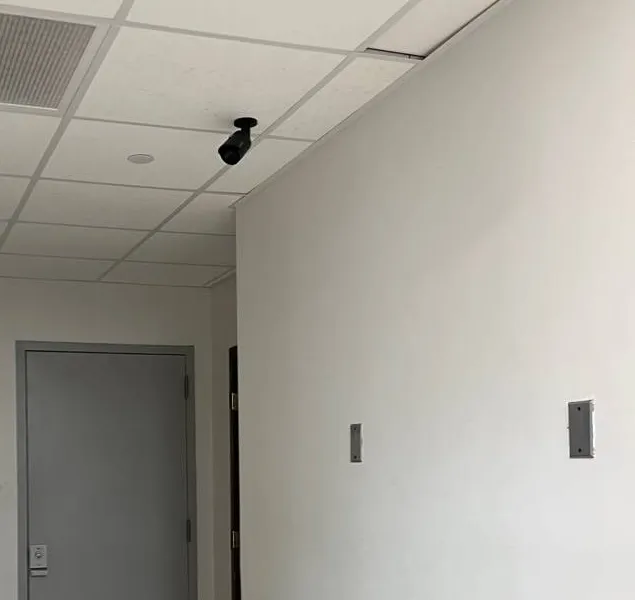
An archive photo from a past AESS job outside Flatbush: a small black bullet camera hanging from a white ceiling grid and aimed down a short corridor at a grey steel service door. The service corridors in the cellars of Flatbush apartment houses, where the boiler room, the laundry, storage cages and the door to the trash area meet, look much like this. A camera aimed straight down the corridor at the steel door records everyone who comes and goes from the back of the building, and it is one of the cameras most often found dark on a building checkup.
Field Notes
Field Notes: Finding the Recorder Before Finding the Fault in a Flatbush Apartment House
These notes describe how our technicians work through a Flatbush apartment house or walk-up when several cameras are out and nobody in the building is sure why. They are our standard practice, not a story about one building.
Find the box first. In a six-story building the recorder can be in the super's office, a locked cellar room, a closet off the lobby, a cabinet in the managing agent's storage space, or even inside the super's own apartment. Before the visit we ask who has the key, because a technician who cannot reach the recorder cannot save footage or test anything.
Copy before touching. If anyone needs video from a recent night, the technician exports it before restarting, unplugging or opening anything, and writes down the recorder's clock against the real time.
Read the recorder, not just the monitor. A monitor full of live pictures says nothing about recording. The technician checks the drive's status, the recording schedule and the playback timeline for each channel, and notes the last day each camera actually saved video. That date often explains more than any camera does.
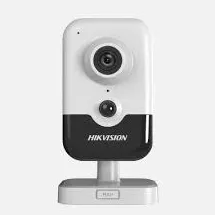
A stock product image from the AESS catalog, not a Flatbush installation: a small white indoor cube camera. In Flatbush apartment houses without a doorman, a camera this size often sits on a shelf above the package area or inside the super's office. Because it plugs into a wall outlet and usually connects over Wi-Fi, it is also the camera most often unplugged by someone who needed the outlet, so a building checkup includes confirming every small indoor camera is powered and actually reaching the recorder or the app.
Follow the power. In the cellar the technician checks the outlet, the power strip, the power box or adapters, the PoE switch and any battery backup, because an outage on the block shows up there first. A surge-damaged adapter or a dead switch port explains many after-outage calls.
Trace, then label. Unlabeled cables are toned out and labeled as each one is identified, and the recorder's channel names are corrected to match the cameras on the walls. Buildings that have had three installers over twenty years almost always need this.
Walk the building. At each dead camera the technician tests power and signal at the lens, then checks the connector, bracket and run for water, building work and tampering.
Price first, then repair, then leave a record. You hear the cause and see a written price before any part is replaced. After the repair, every camera is checked in daylight and after dark, alerts for lost video and drive errors are turned on, and the owner or agent gets the logins and a list of what is connected where.
Where Footage Gets Lost
The Hallway, the Roof and the Recorder Shelf: Where Flatbush Camera Systems Break Down
When a Flatbush building or store needs video and does not have it, the cause almost always sits in one of three places. Knowing which one is the difference between a $150 visit and a new system.
The hallway camera within arm's reach
Hallway cameras in Flatbush apartment houses are usually mounted where the original installer could reach them from a stepladder, which also means anyone tall enough can reach them from the floor. The July 2025 case News 12 reported, where a man covered a hallway lens two days running, is the extreme version. The everyday version is a camera knocked sideways by a move-in, smeared by a cleaning crew, or turned toward the ceiling. Repairs here mean a higher mount where the ceiling allows it, a vandal-resistant dome in place of an exposed bullet, cameras placed so each one is in view of another, and a tamper or video-loss alert so the building knows within minutes, not weeks.
The roof and the cables that cross it
Roof cameras, courtyard cameras on the far wing of a light court, and any camera whose cable crosses the roof are exposed to sun, ice and every contractor who walks up there. On stores, the roof is also where some burglars start, as the 2025 break-ins through store roofs on Church Avenue and Fulton Street showed. Repairs include replacing roof runs in protected paths, re-sealing roof-level connectors, and in stores, checking whether a camera sees the hatch, the skylight or the ceiling under it.
The recorder shelf
Recorders in Flatbush cellars share space with boilers, laundry machines and dripping pipes; recorders in stores sit under counters, on top of coolers or in back rooms with stock piled against their vents. Heat and dust shorten drives, water ends them, and a recorder anyone can reach can be unplugged by someone who needed the outlet. Swann's support guide lists disabled recording settings, wrong motion settings, missing storage and faulty drives among the main reasons a recorder stops saving, and CCTV Camera World notes that drives built for desktop computers are not designed for round-the-clock recording. Moving the recorder, putting it on battery backup and fitting a surveillance-rated drive fixes more Flatbush systems than new cameras do.
Commercial Security Camera Repair
Business Security Camera Repair in Flatbush
Flatbush's businesses are mostly small, owner-run and busy into the evening: Caribbean bakeries and restaurants, groceries and delis, phone and beauty supply stores, barbershops, salons and nail shops, pharmacies, tax and travel offices, medical and dental practices, and storefront churches. The Avenue NYC study found that 79 percent of the merchants it surveyed rent their space, so the camera system is usually the tenant's while the walls, roof and wiring are the landlord's. A typical system is a recorder in the back or under the counter with four to sixteen cameras. When something happens, the owner needs the video that night, and the repair has to fit around opening hours.
Flatbush Avenue
The main spine from Parkside Avenue down to the Junction at Nostrand Avenue, lined with clothing, phone, shoe and discount stores, restaurants and services, and anchored at the south end by the large Target near the Junction and the Flatbush Avenue–Brooklyn College subway terminal. Long shared-roof rows make roof and rear coverage part of every store repair.
Church Avenue
The east-west shopping street through the heart of Little Caribbean, designated in 2017 and co-named Bob Marley Boulevard along part of its length. Bakeries, roti shops, groceries, salons and late-night counters, with some of the heaviest evening foot traffic the Avenue NYC study counted.
Nostrand Avenue
Stores, offices and churches from Parkside Avenue south past the Junction, with bus stops, apartment entrances and the Clarendon library branch on the same stretches. Busy sidewalks mean cameras see constant motion, so recording settings matter as much as lenses.
Rogers Avenue
A shorter run of shops, services and churches between Clarkson Avenue and Church Avenue, near the firehouse at 1367 Rogers Avenue, where many businesses sit under apartments and share a cellar with the building.
Cortelyou Road and the side-street shops
Cafes, groceries and services where Flatbush meets its western blocks, near the firehouse at 1210 Cortelyou Road, with smaller systems and owners who often watch their cameras only on a phone.
The Junction and Brooklyn College edge
Larger stores, offices and student-facing businesses around where Flatbush and Nostrand Avenues meet, near the college's campus, where staff turnover makes camera logins and viewing permissions a frequent repair.
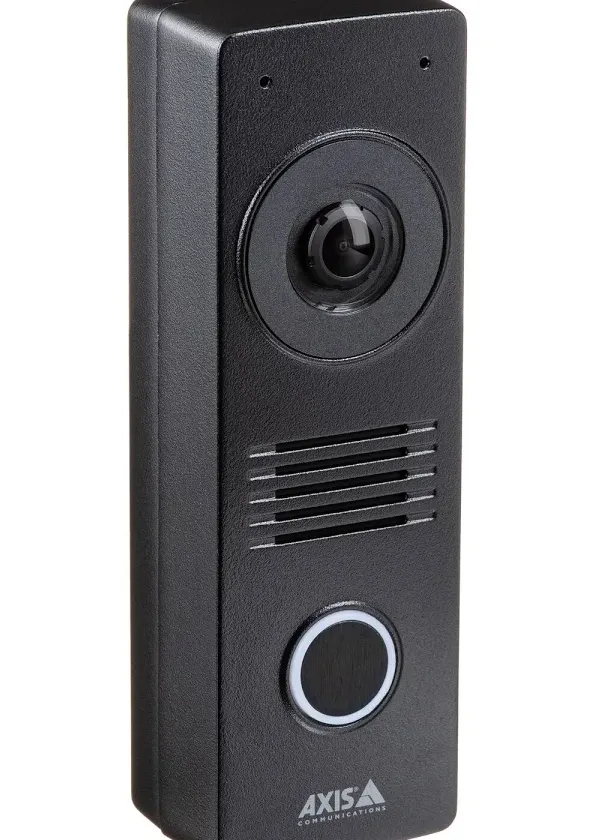
A manufacturer-style product shot kept in the AESS library, not taken on a Flatbush block: a black video intercom door station with a camera, a speaker grille and a lit call button. Many walk-ups over stores on Flatbush and Church Avenues have a station like this at the narrow apartment door beside the shop window, and its camera is often the only one watching who goes up to the apartments. When tenants say the intercom picture is black, the fault can be in the door station's camera, its wiring or the recorder it feeds, and we test each before quoting.
What a Flatbush Avenue or Church Avenue store needs from a camera repair
Store owners usually call after something has already happened. The first job is the footage: saved, exported correctly and handed to whoever needs it. The second is to find out why a camera was dark, blurry or pointed at the wrong thing on the night. The third is to make sure the cameras that matter most work every day: the register, the front door, the stock room, the back door and, on a shared-roof block, the roof hatch or skylight. A recorder under the counter where a customer's foot or a mop can unplug it, or in a back room where steam and grease reach it, is often part of the failure. We move it somewhere protected, put it on battery backup and set it to alert the owner when a camera drops.
Late-night counters deserve extra care. The 2024 robbery at 866 Flatbush Avenue happened shortly before 11 p.m.; the man was masked. A camera at the counter cannot defeat a mask, but it can show height, build, clothing, the direction someone came from and the car they left in, which is often what detectives use. On repair visits we check the counter and door cameras at the hours the store is actually busiest and darkest, set them to record at full quality around the clock rather than only on motion, and make sure a second camera outside the door catches the approach and the exit.
Salons, barbershops and nail shops
When News 12 aired video from inside Z & H Five Star Salon in July 2025, the clip showed the man trying to grab the owner's watch and chain and then going for his pockets. Salons and nail shops are bright, mirrored rooms, and the cameras in them are easily confused by ring lights, mirrors and a bright window behind the front door. A salon repair often comes down to re-aiming, adjusting exposure and backlight settings, and adding a small camera at the door so the person entering is recorded facing the lens rather than as a dark outline against the street.
Rules that touch a commercial camera repair in Flatbush
State licensing. The New York Department of State licenses companies that install, service or maintain security systems, and its rules extend to closed-circuit television used to watch for intrusion, theft or movement. An owner can work on their own system, or have an employee do it on their own premises, without a license; a company working for a customer needs one. AESS works under NYS license #12000287431.
Cameras that watch employees. New York Labor Law §203-c requires employers who monitor employees electronically, including by video, to give written notice and get acknowledgment. If a repair moves a camera onto a stock room, office or kitchen where staff work, update the notice.
Landmarked buildings. Several Flatbush buildings are individual city landmarks, among them the Erasmus Hall academy building, the Flatbush Reformed Church, Flatbush Town Hall and the former Sears, Roebuck store, and some blocks nearby sit in historic districts. The Landmarks Preservation Commission's permit guidebook says ordinary maintenance and repair of existing safety equipment needs no permit, while new mounting positions on a landmarked facade must use mortar joints, plain masonry, wood or metalwork rather than decorative surfaces, and visible conduit is limited.
Entrance doors and intercoms in apartment buildings. Cameras are not legally required in New York City apartment buildings, but under the Multiple Dwelling Law many larger buildings must have self-closing, self-locking street doors and a working intercom. When a lobby camera repair turns up a door that does not latch or an intercom that does not work, we tell the owner, because those are the things a city inspector checks.
The NYPD's business camera program. In 2024 the city launched a free program in which businesses can register their cameras with the NYPD, so detectives know where cameras are, or go further and give police live access to feeds on terms the business controls. It began in the 109th Precinct in Flushing and was set to expand to nine more precincts. Registration does not repair anything; a registered camera that is not recording helps nobody. If you want your repaired system ready for either option, tell us when you book.
Your Questions Answered
Security Camera Repair in Flatbush: Questions Answered
These are situations Flatbush tenants' groups, owners, managing agents, boards, store owners and congregations describe when they call. Each answer is written for the buildings and blocks here.
Apartment houses and their shared halls
A man covered our hallway camera two nights in a row, and the only clear video came from a neighbor's doorbell camera. When the building camera is fixed, can it be placed so whoever reaches for it gets recorded first?
Yes, and that is the most useful change a hallway repair can make. A camera that can be reached and covered should be in the view of another camera, so the person reaching for it is recorded face-on before the lens goes dark. In a Flatbush hallway that usually means pairing the camera at the elevator with the one at the stair door so each sees the other, raising the mount as high as the ceiling allows, and swapping an exposed bullet for a vandal-resistant dome that is harder to grip or turn. We also switch on the recorder's video-loss or tamper alert and send it to the super's or the agent's phone, so a covered lens is reported in minutes. A tenant's doorbell camera is a fine second witness, but it only sees one door, and the building should not have to depend on it.
Our building's wings wrap around a light court, and the camera that watches the court hangs on the far wing with its cable laid across the roof. Why does that one camera fail more often than the rest?
Because its cable has the hardest life in the building. A run laid across a roof or along a parapet bakes in summer, stiffens and cracks in winter, gets stepped on by roofers and pinched under new flashing, and often ends at a connector that was taped rather than sealed. Water works into the crack and the connector, and the picture fades, flickers and then disappears, usually after a freeze or a roof job. The repair is to replace that run, ideally dropping it into the building near the camera and carrying it down an interior path, or protecting it in a sleeve where it must cross the roof, with the connector in a sealed box. Once the run is sound, the courtyard camera usually lasts as long as the hallway ones.
Every time a roofer or the elevator company works up top, the cameras on our top two floors drop out. Is that a coincidence?
Almost certainly not. In many six-story Flatbush buildings the camera cables for the upper halls and the roof run up through the stairwell or a chase and meet near the bulkhead or the elevator machine room. Contractors working there move cables, unplug a power strip to run their own tools, pull a staple or set equipment on a run. If the cameras come back after the job, power was interrupted; if they stay dead, a cable or connector was damaged. On the repair we trace the upper-floor runs from the recorder up, fix the damage, label every cable where contractors work, and move any camera power supply off an outlet that a work crew is likely to borrow. A short note to the building's roofer and elevator company about which cables to leave alone helps too.
Stores, salons and offices on the shopping streets
Our store is in a row of one-story shops along Flatbush Avenue where every roof meets at a low wall. Should our cameras watch the shared roof even though only part of it is ours?
Your cameras should watch the parts of the roof that lead into your store: your hatch, your skylight and the stretch of roof right around them. The 2025 break-ins that reached 302 Church Avenue and 1188 Flatbush Avenue came through roofs, so a roof-level view of your own entry points is worth having. What you should avoid is aiming a camera across the neighbors' roofs or into windows of apartments above the row. In practice we mount the camera at your hatch or on your parapet, aimed back across your own roof, and if a neighbor wants their section covered too, they can add a camera on their side. Inside the store, a camera on the ceiling under the hatch or skylight records anyone who gets that far, even if the roof view is defeated.
We have an office above a store on Church Avenue, reached by a stair door at the street, and the camera at the bottom of the stairs also records everyone going up to the apartments. Is that a problem?
It is a reason to settle who controls that camera, not a reason to switch it off. A shared stair is a common area, and a camera there protects every tenant in the building, including you. The questions are whose system it belongs to, who may watch it, and who may copy footage of residents coming and going. If the landlord owns it, you can ask for live view of the stair from your office without export rights. If it is yours, it is fair to let the landlord and the residents know it is there and to keep its view to the stair and the street door rather than any apartment door. We can set up separate viewing accounts on the recorder so each party sees only what they should, and log who exports video.
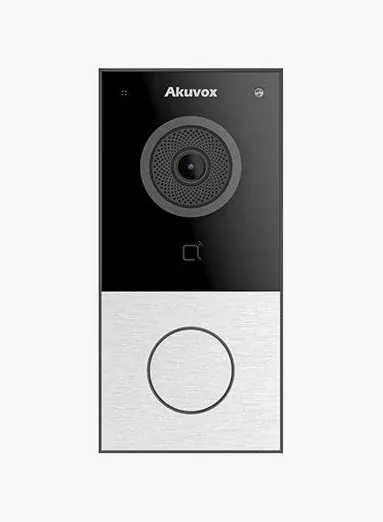
Shown here is a catalog photo held in the AESS library, not equipment on a Flatbush door: a slim video door station with its camera lens at the top and one large round call button. Narrow stations like this fit the slim frames beside the street doors of walk-ups over stores. Its camera sees whoever presses the button, which makes it a second witness at a shared stair door, and when its picture fails the repair starts by testing the lens, the night light and the cable back to the recorder or the apartment monitors.
Houses of worship, schools and community rooms
Thieves forced the back door of a temple on Rugby Road at 2:30 on a Sunday afternoon in 2024. Our congregation set its cameras to record only at night to save drive space. Should that change?
Yes. A night-only schedule assumes trouble waits for dark, and the Rugby Road robbery News 12 reported happened in broad daylight with people inside. Most recorders made in the last several years can hold weeks of round-the-clock video from a handful of cameras on a properly sized drive, especially if the cameras use efficient compression and record at full quality only when there is motion. On the repair we set every door camera to record around the clock, check how many days the drive actually keeps, and replace the drive with a larger surveillance-rated one if needed. We also make sure the back and side door cameras are aimed so someone forcing the door is recorded, not just the empty doorway after they are inside.
Four trustees at our church watch the cameras on their phones, and whenever one of them changes phones the app stops working for everyone. Why would one person's phone affect the others?
Because all four are probably signed in to one shared account. When that account is moved to a new phone, the app may log out the other devices, change the password or trigger a security reset, and everyone is locked out at once. It also means nobody knows who looked at or exported video. The fix is to make one administrator account in the church's own name and email, held by the office or the senior trustee, and to give each trustee a separate viewing account with only the permissions they need. Then a new phone affects only its owner, a departing trustee can be removed without disturbing anyone, and the recorder keeps a record of each person's activity.
Our congregation streams services from a camera in the sanctuary, and since a volunteer put that camera on the same recorder as the security cameras, everything freezes on Sunday mornings. Should they be separated again?
Usually yes. A streaming camera sends a large, constant video stream, and when it shares a recorder, a switch or an internet connection with the security cameras, the busiest hour of the week is exactly when they all compete. The recorder can run short of bandwidth or processing, the app stutters, and the streaming software can drag the network down with it. We separate the stream so it goes straight to the computer or encoder that broadcasts it, keep the security cameras on the recorder alone, and give each its own network segment if they share a switch. If the congregation wants the sanctuary camera recorded for security as well, it can be added as a lower-resolution second stream that does not crowd the others.
Footage and the block
Flatbush already has a lot of cameras, including public ones. If a street camera covers our corner, is it still worth repairing our own?
Yes. Amnesty International's volunteers mapped a high number of cameras in Flatbush, but a camera on a pole sees the street from far away and at an angle chosen for someone else. Your camera sees your door, your lobby, your counter and your back yard up close, and it records on a system you control. When something happens at your building, detectives ask you for that video, and you can hand it over the same day. A public camera may help reconstruct where someone went afterward, but it rarely shows a face at your entrance. Repairing your own system is also much cheaper than replacing it, and on our Brooklyn list most single faults cost far less than a new install.
Detectives asked several buildings on our block for video the same night. The neighbors' clips all showed the man on the sidewalk, but ours showed only our own door. Should a repair turn one camera toward the street?
If you have a camera that can cover your stoop or storefront and part of the sidewalk in front of it, angling it to include that stretch makes your system far more useful to the block without watching anyone's home. A camera aimed only at the door records who comes in; a camera that also sees the sidewalk records who walked past, which direction they went and when. On the repair we look at each outward-facing camera and widen or re-aim it to cover your frontage and the sidewalk, avoiding windows across the street. It is usually a re-aim or a lens adjustment within the service call, not a new camera. Keep the recorder's clock correct as well, because a block's clips are only useful together if their times line up.
Equipment
Types of Security Cameras and Recorders We Repair
We repair whatever is on the building, whoever put it there. These are the kinds of equipment we find in Flatbush apartment houses, walk-ups, stores and houses of worship, and the faults each one tends to develop.
Coax and HD-over-coax cameras
Cameras with round BNC connectors, from old analog to HD models, still common in prewar apartment houses wired a decade or more ago. Typical faults: water in connectors, failed power boxes, worn infrared and long runs that lose picture quality.
Network (IP) cameras
Cameras powered and connected through one data cable, common in newer buildings, offices and recently upgraded stores. Typical faults: dead switch ports after a surge, address conflicts, firmware problems and lost passwords.
DVRs, NVRs and hybrid recorders
The box that holds the video, in a cellar room, a super's office, a closet or a back room. Typical faults: worn or desktop-grade drives, corrupted settings after an outage, overheating near a boiler or a cooler, and clocks that drift.
Vestibule and hallway domes
Domes in lobbies, vestibules and halls that get cracked, smeared, painted or turned. Covers and brackets can often be replaced separately from the camera, and varifocal models can be re-framed on site.
Pan-tilt and 360-degree cameras
Small pan-tilt domes in courtyards and corridors and fisheye cameras over store floors. Typical faults: motors that stick, presets that are lost, and fisheye views that need the right display settings after an update.
Video intercom door stations
Entrance stations with built-in cameras at apartment and walk-up doors. Typical faults: fogged or scratched lenses, failed night illumination and wiring to the recorder or apartment monitors that was never finished.
Wi-Fi and plug-in cameras
Indoor cubes and outdoor Wi-Fi cameras in package areas, offices and spots cable never reached. Typical faults: weak signal through brick and plaster, crowded Wi-Fi in big buildings, unplugged power and accounts tied to someone who has left.
PoE switches and power supplies
Switches, injectors, power boxes and adapters, often on a cellar shelf with no backup. Typical faults: dead ports or units after a surge, blown channel fuses and overloaded power budgets after cameras were added.
Battery backups, monitors and apps
UPS units, super's-office monitors and phone apps. Typical faults: backup batteries that died years ago, monitors showing live view while recording has stopped, and apps that lost the recorder after an internet change.
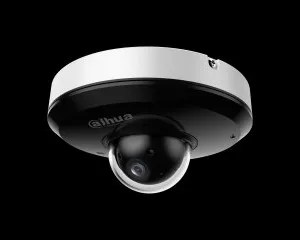
This product photo comes from the AESS catalog, not from a Flatbush courtyard: a small pan-tilt dome with a white housing over a black lens bubble. In apartment houses built around a light court or a rear yard, a camera like this can sweep the court and the back doors from one corner. When the motor sticks or the presets are lost after an outage, it ends up staring at one wall, and restoring its tour and presets is a typical repair.
National brands compared with a local licensed repair
Some Flatbush households, tenants and shops have cameras from national alarm companies or consumer brands and are not sure who should repair them. The table shows how the options usually compare when something breaks.
When something breaks
ADT or a similar alarm company
Ring or SimpliSafe camera
AESS repair visit
Building hallway, lobby and roof cameras
Only if it installed them
Not designed for a whole building
Yes, any installer's system
A local recorder in a cellar or back room
Its own equipment
No local recorder; cloud plan
DVRs, NVRs, hybrids and drives
Mixed brands on one property
Usually its own brand only
Support covers its own devices
Any brand
Signal through prewar brick and plaster
Depends on its wiring
Wi-Fi often weak between floors
Wired cameras on existing cable where possible
Someone on site with a license
Varies by dealer
Phone or chat support
NYS license #12000287431
What you pay to find the fault
Varies by contract
Often the price of a new device
$150 service call, credited to the repair
AI Overview Reality Check
What AI Gets Wrong About Security Camera Repair in Flatbush
These claims show up in AI-written answers, repair-lead sites such as Angi and HomeAdvisor, and national how-to guides. Each is partly true somewhere, and each sends Flatbush owners, tenants and store owners toward the wrong repair or a lost clip.
"Apartment buildings in New York have to keep their security cameras working"
Quick answers often assume a city rule obliges landlords to maintain building cameras, so a tenant only has to report a dead one.
Brick Underground's experts said the opposite: no city law requires a rental building to keep cameras working. What can create a duty is notice of crime, and attorney Jeffrey Reich said a landlord on notice may need to take reasonable precautions, with fixing a broken camera an obvious one. What the Multiple Dwelling Law does require in many buildings is a self-locking street door and a working intercom.
For Flatbush tenants, that means written complaints that tie the dead camera to specific incidents carry more weight than a general request. For owners, it means a working, documented camera system is a sensible answer once incidents are on record.
"A camera in every hallway means the building is covered"
Answers about building security tend to count cameras: one per floor, one in the lobby, one at the door, and the job is done.
The July 2025 Flatbush case News 12 covered shows the gap. A man walked up to a hallway camera and covered it on two separate days, and the clear video came from a tenant's own device. Coverage is not the number of cameras; it is whether the cameras watch each other, whether they are out of easy reach, and whether anyone is told when one goes dark.
A repair that re-aims cameras to cover one another and turns on video-loss alerts adds more protection than a new camera mounted where the old one was.
"Most camera repairs cost $100 to $300"
Many cost answers quote a low national range built on suburban homes with one or two consumer cameras.
HomeAdvisor's Brooklyn page shows how wide local work runs: an average of $1,416 for surveillance camera installation or repair, a typical range of $680 to $2,145 and a full spread from $160 to $3,500. That figure mixes new systems with repairs. On our Brooklyn list the $150 service call finds the fault, and most single repairs in a Flatbush building or store fall between $150 and $700.
The honest way to budget is to find the fault first. A cracked connector on a roof run is a small repair; a dead recorder for a forty-camera apartment house is not, and no online average will tell you which one you have.
"Point your cameras at the front door, because that's how burglars get in"
Placement advice usually starts and ends with the entrance.
Flatbush shows other routes. Fox 5 reported 2025 break-ins that came through store roofs, including 302 Church Avenue and an attempt at 1188 Flatbush Avenue, and News 12 reported the 2024 Rugby Road robbery through a back door in the afternoon. On blocks where store roofs meet and buildings have rear yards and cellar doors, the front door is only one of several ways in.
A repair should include a walk-through of what each camera actually sees, including the roof hatch, the skylight, the back door and the cellar entrance, and a plain list of what is not covered.
"If the monitor shows live video, the system is recording"
Troubleshooting answers often stop once the picture is on the screen.
Live view and recording are separate. Swann's support guide lists recording switched off, wrong motion settings, no storage installed and failed drives among the causes of a recorder that shows pictures but saves nothing, and CCTV Camera World tells owners to check the drive's status and scroll back through playback channel by channel. In Flatbush apartment houses the monitor in the super's office is often the only thing anyone looks at, so a recorder can stop saving for weeks before an incident reveals it.
The real test is playback. On every repair we check the last date each camera saved video, the drive's health and the recording schedule, and we turn on alerts so a drive error reaches a phone.
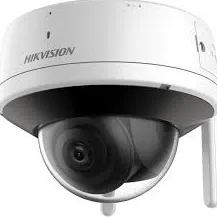
A product image from the AESS parts catalog, not a camera on a Flatbush wall: a Wi-Fi dome with an external antenna. It belongs in the rare spot where cable truly cannot reach, such as a detached shed at the back of a yard. In a six-story Flatbush apartment house with dozens of home networks on every floor, a camera like this has to fight crowded airwaves and thick prewar walls, which is why we repair the wired run first whenever one exists.
"Swap the broken wired cameras for Wi-Fi ones and the problems go away"
Some answers suggest replacing a failing wired system with wireless cameras to end cable trouble for good.
Flatbush apartment houses are the hardest case for that advice. Prewar brick and plaster block signal between floors, a single hallway may sit among dozens of tenants' home networks, and every wireless camera still needs power from an outlet someone can unplug. Battery models need charging, and each camera depends on an app account somebody has to own.
Repairing the existing wired runs is usually cheaper and steadier. Wi-Fi cameras make sense for the odd spot cable cannot reach, set up on the owner's network with the account in the owner's name.
"Registering your cameras with the NYPD means police watch your store"
Answers about police camera programs often blur two different things.
The city's 2024 program described two levels: registration, which only tells the NYPD where a business's cameras are, and integration, which gives police live access to feeds, with the business controlling when that access applies. Both are free. The program began in the 109th Precinct in Flushing and was to expand to nine more precincts; whether a given Flatbush precinct is included is something to ask the precinct directly.
Either way, a registered camera that is not recording helps nobody. Fix the system first, then decide how much access you want to give.
Speak to a Technician Before Anyone Resets the Recorder
Give us the address, the kind of building, how many cameras there are, which ones are out and where the recorder lives. If you need video from a particular date, say so and we will plan the visit around saving it. Photos of the recorder screen, the dark cameras and the power supply help us bring the right parts. For anything urgent, call (347) 934-8335 now.
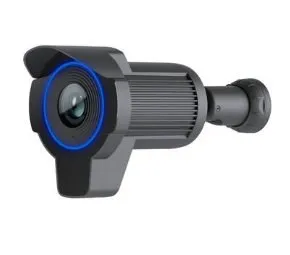
An equipment photo from the AESS library rather than a Flatbush job: a black bullet camera with a long hood and a blue-lit ring around the lens. A deep hood keeps rain and glare off the glass, which matters on a store front facing a bright avenue or a rear yard under a street light. Lit rings like this one make a camera obvious, which some store owners want; others prefer the ring switched off, and that is a setting we can change during a repair.
✅
Request Sent!
Thank you. A technician will be in touch about your Flatbush address shortly.
How It Works
Our Repair Process
1. Tell us the building, the screen and the date
The address, the kind of building and a photo of the recorder or app showing the dark cameras, by text, WhatsApp or the form, plus the date and time of any video you need.
2. Settle who approves and who holds the keys
Owner, managing agent, board, store owner or congregation: we confirm who signs off and who can open the room where the recorder lives, so the visit does not stall at a locked door.
3. Book the $150 service call
The Brooklyn service call reserves a two-hour arrival window and comes off the repair if you go ahead.
4. Copy the footage that matters
Any clip needed for police, an insurer, a landlord or a court is exported with its original timestamps before anything is restarted or replaced.
5. Walk every run from recorder to lens
Outlet, power supply, switch, recorder and drive first, then each cable and camera from the cellar or closet out to the halls, the roof and the street.
6. Write down the cause and the price
You hear what failed and why, and get an itemized written price before any part is replaced. If anything changes on site, you hear the new number first.
7. Repair, then test in daylight and darkness
The failed parts are fixed or replaced, and every camera is checked for live picture and saved recording, including at night under the building's real lighting.
8. Label, protect and hand over
Cables get labels, passwords go to the right person, alerts for lost video and drive errors are switched on, and you are shown how to pull a clip yourself.
Coverage Area
Security Camera Repair Near Flatbush's Landmarks
Kings Theatre
The 1929 movie palace at 1027 Flatbush Avenue, designed by Rapp and Rapp, closed in 1977 and reopened in 2015, with stores and apartment houses on the blocks around it.
Erasmus Hall High School
The campus at 899–925 Flatbush Avenue between Church and Snyder Avenues, founded as an academy in 1786 and now home to several small schools.
Flatbush Reformed Church
The church at 890 Flatbush Avenue, built between 1793 and 1798, with a churchyard whose earliest legible stone dates to 1754.
Former Sears, Roebuck store
The 1932 landmark at Beverley Road and Bedford Avenue, closed in 2021 and planned for redevelopment with about 650 homes.
Flatbush Town Hall
The 1874–75 building at 35 Snyder Avenue that later held a magistrate's court and the 67th Precinct and now serves as a school.
Flatbush Library
The Brooklyn Public Library branch at 22 Linden Boulevard, a Carnegie library opened in 1905, a block from Flatbush Avenue.
We also serve the neighborhoods around Flatbush, including Prospect Lefferts Gardens, Midwood, Kensington and Crown Heights, at the same Brooklyn rate. Our Ditmas Park security camera repair page covers the freestanding houses and Cortelyou Road shops just west, East Flatbush camera repair covers the row houses and Church Avenue stores to the east, and Beverley Square camera repair covers the house blocks off Beverley Road. Everything else in the borough is on our Brooklyn security camera repair page.
Pricing
Security Camera Repair Cost in Flatbush
Flatbush is billed at our Brooklyn rate. Every repair starts with the $150 service call, which covers the on-site diagnosis and is credited to the repair if you go ahead. The figures below come from our published list of Brooklyn security camera repair prices; your exact price is written down on the visit, once we know what failed. NYC sales tax of 8.875 percent applies.
Repair
Brooklyn price
Service call with on-site diagnosis and written price
$150, credited to the repair
Motion detection settings, no parts
Usually the $150 service call
Clean and check for a blurry picture
$80
Connector re-termination or PoE port swap
$150–$350
Power supply repair
$150–$400
Painted or damaged dome or front cover
$30–$80 part plus labor
Indoor camera repair
$200–$450
Recorder hard drive swap, by capacity
$200–$450
One camera replaced on a working system
$250–$600
Night vision repair
$250–$650
DVR not working, drive and labor included
$300–$700
NVR not recording, by model
$400–$900
Vandalized camera, per camera plus cable repair
$400–$900
Pan-tilt-zoom camera repair
$450–$1,200
Hybrid recorder swap with channels reconfigured
$700–$1,200
DVR or NVR replaced with a new drive
$700–$1,500
Full rewire or whole-building overhaul
From $1,500
Three things move a Flatbush repair within those ranges. Reach is the first: a camera on a six-story parapet or over a light court takes more time and ladder or roof work than a vestibule dome. The number of failed runs is the second: one wet connector is a small job, while several runs damaged by a roof job or a winter on the roof are priced run by run. The recorder is the third: replacing one that serves dozens of cameras, or untangling a closet of unlabeled cables from three different installers, adds setup and tracing time. Prewar plaster and awkward cable paths can add $100 to $200 on our list. If the price changes on site, you hear the new number before the work goes on, and booking a camera repair together with intercom, door buzzer or access control work on the same visit saves $200 to $400 in labor.
Full terms — including 50% deposit, one-year parts-only warranty on AESS-supplied products, and the late-fee schedule — are set out in the service agreement.
Shop Our Systems
Security Camera Repair Packages & Pricing
Most Flatbush repairs fall into one of three shapes, each priced from our Brooklyn list.
Single-fault repair: $150–$700
One problem fixed on one visit: a hallway dome replaced, a wet connector redone, a power supply or switch port swapped after an outage, a drive replaced, a night picture fixed or a login recovered. Typical for a walk-up, a store or one floor of an apartment house.
Recorder or wiring repair: $700–$1,500
The heart of the system: a DVR or NVR replaced with a new drive and every camera reconfigured, or several damaged runs replaced after a roof or elevator job. Typical for a six-story building whose recorder died in an outage.
Annual maintenance: $250–$800
Every camera checked by day and night, lenses cleaned, connectors and power tested, the drive's health read, alerts confirmed and a test clip exported. Residential properties start at $250, commercial ones at $400, and owners with several buildings run $500 to $800.
Bring your own equipment. If you have already bought a replacement camera or recorder, we can fit it at labor-only rates. Tell us the exact model and we quote the labor by phone or text, and the visit is booked once it is paid. Your own equipment goes in as supplied, and our warranty covers only what we supply. If a model will not work with your recorder, will struggle on Wi-Fi through prewar walls, or cannot cope with the light where it is going, we tell you before the visit.
Complete Services
Every Security Camera Repair Service in Flatbush
Common-area camera repair
Hallway, lobby, vestibule, courtyard, roof-door and cellar cameras in apartment houses and walk-ups. Request a repair
Recorder, drive and outage repair
DVRs, NVRs and hybrids in cellars, offices, closets and back rooms, including systems that came back wrong after a power cut. Brooklyn security camera repair
Which parts of Flatbush does this page cover, and is the price the same near Brooklyn College as near Parkside Avenue?
+
It covers the apartment blocks, walk-ups and shopping streets from Parkside Avenue down to the Junction near Brooklyn College, including Ocean, Flatbush, Church, Nostrand and Rogers Avenues and the side streets between them. The price is the same everywhere in Flatbush because it follows the Brooklyn list and the fault, not the block. The $150 service call applies across the whole area.
Can you pull a clear still picture out of a clip so we can show it to neighbors or to the precinct?
+
Yes. Once the clip is exported, we can save the sharpest frames as still images with the recorder's date and time, alongside the original video. A still is useful for a precinct detective or a building notice, but the original clip should always be kept as well, because it shows movement and timing a single frame cannot. Think carefully before posting a stranger's picture publicly, and when in doubt, give it to the police instead.
Is sales tax added to a camera repair bill in Flatbush?
+
Yes. New York City sales tax of 8.875 percent applies to the repair, and it is shown on the written price and the invoice so there are no surprises. The prices on this page are before tax.
The camera on top of our roll-down gate housing shakes every time the gate goes up or down. Is that hurting it?
+
Over time, yes. Twice-daily shaking loosens the bracket, works the connector loose and can knock the camera out of aim, and the gate motor's vibration travels straight through the housing. We move the camera onto the wall or the sign frame beside the gate box, or fit a bracket that does not touch the housing, then re-seal the connection and re-aim it so it still covers the storefront and the sidewalk.
Our package room has a fob reader on the door. After a theft, can the camera video be matched to the fob log?
+
Usually, as long as both clocks agree. Some access systems link each door event to a camera automatically; most smaller ones keep a separate log, so the match is made by time. We set the recorder and the access system to the same network time, aim the package room camera so it sees the person at the reader and inside the room, and show the super or agent how to look up a fob event and jump to the same minute of video.
We already have a repair quote from another company. Will you look at it and tell us whether it makes sense?
+
Yes. Send it with photos of the recorder and the cameras, and we will tell you whether the work described matches the symptoms and how it compares with our Brooklyn list. Sometimes a quote for a new system covers a fault that a connector or a drive would fix. We will not know for certain without testing, but a second look costs nothing.
Can footage from our building's cameras be prepared for a housing court case?
+
We can export the clips in the recorder's original format with its timestamps, add a copy in a common format that plays on any computer, and write down how and when the export was made and how far the recorder's clock was off. Whether the video is accepted, and how it should be presented, is a question for your lawyer or the court, so ask them what they need before we export.
Can two-step login be turned on for our camera app once the repair is done?
+
If your recorder or camera brand offers it, yes. Many current apps support a code sent to a phone or an authenticator app when someone signs in from a new device. We turn it on for the administrator account, set strong new passwords, update the recorder's firmware and remove old users. If your equipment does not support two-step login, we tell you and close off the other ways in.
What should a building tell its tenants while the cameras are down for repair?
+
A short notice in the lobby and elevator is enough: which cameras are out, the date of the repair and a reminder not to prop doors or buzz in strangers in the meantime. Most repairs keep the rest of the system recording, and we can tell you in advance which cameras will be off and for how long, so the notice is accurate.
Can our recorder copy each day's video to a second drive automatically?
+
Many recorders can. Some take a second internal drive set to mirror or back up the first, some can copy scheduled clips to a network storage box elsewhere in the building, and some can send motion clips to a cloud account. Which option works depends on your recorder. We check its features and suggest the one that keeps a copy out of reach of anyone who would take or damage the main recorder.
Get Every Flatbush Hallway, Lobby and Storefront Camera Saving Video Again
Send a photo of the recorder screen or the dark camera, the address, and the date of any video you need. We book within 2 hours, give you a two-hour arrival window, copy your footage before anything is touched, and write down the repair price before any part is replaced.