What are you looking for?
About Us Contact Us Careers Get a Free Quote (800) 486-0943
Pick a service
✅ Got Your Own System?
🎬 Home TheatreQuote 🎶 AV SoundQuote 🔑 Access ControlQuote
Now pick your area
Pick your area
Long Island
Hudson Valley
Services available
Pricing & Tools
Pick a service for pricing
🚪 Intercom Pricing 🔔 Buzzer Repair Pricing
Calculators
📹 Camera System Calculator 🚨 Alarm Calculator ⚡ Cabling Quote Builder ✅ Got Your Own System?
Select your area
Garage camera gone dark, eave cameras lost after the storm, or a recorder that stopped saving in the cellar? Fiske Terrace camera repair line, booked within 2 hours: (347) 934-8335
Home › Security Camera Repair Brooklyn › Fiske Terrace
Freestanding 1905–1914 Houses · Detached Garages at the End of the Driveway · Oak-Shaded Eaves and Porches · Ocean Avenue and Foster Avenue Buildings

Security Camera
Repair in
Fiske Terrace

Any Brand, Any Installer · Footage Copied First · Written Price Before Parts · Landmark-Aware Mounting · Brooklyn Rate

Security camera repair in Fiske Terrace starts with our $150 Brooklyn service call, which covers the on-site diagnosis and is credited to the repair if you go ahead. On our published Brooklyn list, most single faults on a house in this district cost $150 to $700, and replacing a recorder or rewiring several cameras runs $700 to $1,500. We work on systems other companies installed: the four-sided camera layout on a freestanding house between Foster Avenue and Avenue H, the camera on a detached garage at the back of the lot, the lobby cameras of an Ocean Avenue apartment building, and the recorder under the counter of a shop by the Avenue H station. Requests are booked within 2 hours, visits come in two-hour arrival windows, and you get the cause and a written price before any part is replaced.

Reviewed and updated November 12, 2026, against the Landmarks Preservation Commission's 2008 designation report for the Fiske Terrace–Midwood Park Historic District and chapter 11 of its permit guidebook; News 12 Brooklyn reporting on the August 13, 2025 storm outage that cut power to more than 5,600 Midwood-area customers, the transformer and wire fire near Avenue J the same night, the June 2025 Beverly Road manhole fire and the July 2025 hallway camera covering in a Flatbush apartment building; Patch's November 2012 report on the Fiske Terrace Association's meeting with the 70th Precinct; CBS New York's October 2017 report on Midwood house burglaries; the Brooklyn Paper on Verizon's poles in the district; the NYPD's 70th Precinct page; Brick Underground on landlords and building cameras; HomeAdvisor's Brooklyn cost page; and the New York Department of State on security and CCTV installer licensing. · Abstract Enterprises Security Systems, NYS license #12000287431 · crews dispatched from our Troy Avenue office in Brooklyn

Fiske Terrace, Brooklyn security camera repair: 16-channel desktop network video recorder, product photo
A product photo from the AESS job library, not taken in Fiske Terrace: a 16-channel desktop network video recorder. On a freestanding Fiske Terrace house with cameras on all four sides and one on the garage, a recorder like this usually sits on a cellar shelf or in a hall closet, and every camera cable in the house ends at its back panel. Most repairs start here, with a copy of the footage and a look at what the recorder thinks is wrong.
Fiske Terrace Camera Repair Request
House, garage camera, apartment building or shop: send the address and what the screen shows, and a technician calls back with the next step

✅
Request Sent!
Thank you. A technician will be in touch about the Fiske Terrace address shortly.
25+
Years Experience
✓
Same-Day Estimates
100%
Licensed & Insured
4.7★
201 Google Reviews

Owner-operated since 2002 · Thousands of jobs completed · Booked within 2 hours

A Fiske Terrace camera system is spread out in a way most Brooklyn systems are not, and that is usually why it fails one piece at a time. The houses here stand alone on their lots, so cameras sit on four separate walls, under deep eaves, on porch ceilings and often out on a garage at the end of a long concrete driveway, with cables running through attics, porch ceilings, cellars and sometimes across the back yard. When one of those cameras goes dark, the fault can be anywhere along a run that may be longer than the whole width of a row house. We start every visit by copying any footage you need, then test that one run from the camera back to the recorder so only the failed piece gets replaced. Text a photo of the recorder screen to (347) 934-8335 or send it on WhatsApp, and we will tell you which part of the system the symptom points to and what that kind of repair costs on our Brooklyn list.

  • Looking at photos costs nothing. The $150 service call pays for the diagnosis on site and comes off the repair if you go ahead.
  • Every repair is done under New York State license #12000287431, the license the state requires of anyone who installs or services security and CCTV systems for other people.
  • We fix any brand and any installer's work, and we say so plainly when an old camera or recorder is not worth the money to repair.
The Neighborhood

Why Fiske Terrace Properties Need Security Camera Repair

Fiske Terrace is the small planned enclave on the southern edge of Flatbush, between Foster Avenue to the north and the Bay Ridge freight line to the south, with the Brighton subway cut on its west side and Ocean Avenue on its east. Most of it lies inside the Fiske Terrace–Midwood Park Historic District, which the Landmarks Preservation Commission designated in March 2008 and which takes in about 250 houses. Nearly all of them went up between 1905 and about 1914, sold by the T.B. Ackerson Company in the Fiske Terrace section and by the John R. Corbin Company in Midwood Park, the part generally north of Glenwood Road. They are freestanding foursquares, temple-front houses, bungalows, Colonial Revival and Dutch Colonial houses and a few stucco and half-timbered ones, set back from the street on lots with driveways, gardens and, from about 1910 on, their own garages at the back.

That shape decides how camera systems here age. A row house gets two cameras, front and back, and both cables reach the cellar in a few feet. A Fiske Terrace house needs more of them to see the whole lot: one or two on the porch, one on each side wall, one or two on the back, and often one on the garage. The side and back cameras are commonly fed through the attic and down from the eaves, and the garage camera may be on a cable buried along the driveway, strung overhead from the house, or running on Wi-Fi across the yard. Each of those paths has its own way of failing. Attic runs cook in summer and get chewed. Overhead spans sag and fray. Buried cable gets cut when someone digs. Wi-Fi to the garage weakens every spring when the trees fill in. The camera itself is often the last thing wrong.

The trees are a second pressure. The streets curve under what one neighborhood guide calls "a dense canopy of century-old oaks and maples." That canopy is the reason many people moved here, and it is also hard on cameras. Branches move across the frame in the wind and set off alerts all night. Leaves and acorns collect on the tops of eave cameras and on porch roofs. Squirrels travel the gutters and the cables. And when a storm brings branches down on the wires, the camera system feels it. On the evening of August 13, 2025, News 12 reported that "over 5,600 customers in the Midwood area" lost power after "last night's weather downed power lines," and the same night FDNY was called to a transformer and wires on fire near Avenue J. Power was back by 10:37 that night for most customers, but a three-and-a-half-hour cut is long enough to drain a small battery backup, and the moment power returns is when recorders and power supplies are most likely to be damaged.

Fiske Terrace, Brooklyn Wi-Fi camera repair: Wi-Fi dome camera with an external antenna, product photo
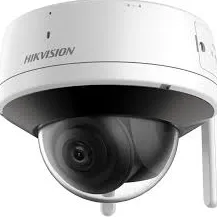
A product photo from the AESS job library, not taken in Fiske Terrace: a Wi-Fi dome camera with an external antenna. On a freestanding Fiske Terrace house, this is the kind of camera that ends up on a detached garage when nobody wanted to run a cable across the yard. It works until the leaves come in, the router moves or the signal has to pass through the back of the house, and that is when it starts dropping out.

The third pressure is that cameras in this neighborhood tend to matter after something has already happened on the block. In November 2012, after a string of summer break-ins, the Fiske Terrace Association met with the 70th Precinct, and Patch reported the commanding officer's advice in plain words: "Do you want to put bars on your homes? No. But to really, really secure your houses is something we recommend you do." In nearby Midwood in October 2017, CBS New York reported that a burglar had climbed in through back windows reachable from the yards, and that investigators "checked home surveillance systems along East 31st and East 32nd streets." That is how home cameras get used here. Detectives walk the block and ask each house what its cameras saw, and the houses with a working recorder and a correct clock are the ones that can answer.

The edges of the neighborhood bring different problems. Ocean Avenue's frontages were left out of the historic district, and its larger apartment buildings have lobby, hallway and package-area cameras on long cable runs back to a cellar or a super's office. The one apartment house inside the district, the six-story building of 1936 at East 17th Street and Wellington Court, has the same kind of system on a smaller scale. Foster Avenue has stores with apartments above, and Avenue H has shops beside the old station house. In July 2025 News 12 showed Ring footage from tenants of a Flatbush apartment building in which a man walked up to a hallway camera and deliberately covered the lens, two nights running. Brick Underground, quoting a housing attorney, has noted that city apartment buildings are not required to have working security cameras at all, so in a building a repair happens when a board, an owner or a managing agent decides it should, and it helps to know exactly what is broken before that conversation starts.

So a repair in Fiske Terrace means more than replacing a dead camera. It means finding where along a long, branching system the fault is, getting every side of the house and the garage recording again, putting the recorder and the network on power that rides through the next storm, and leaving the owner with logins, labels and alerts that will tell them the next time something stops. Many owners who call about a porch camera also ask about the front door, since the porch is where visitors stand; a working camera there pairs naturally with a video doorbell or a door station, and we can look at both on one visit.

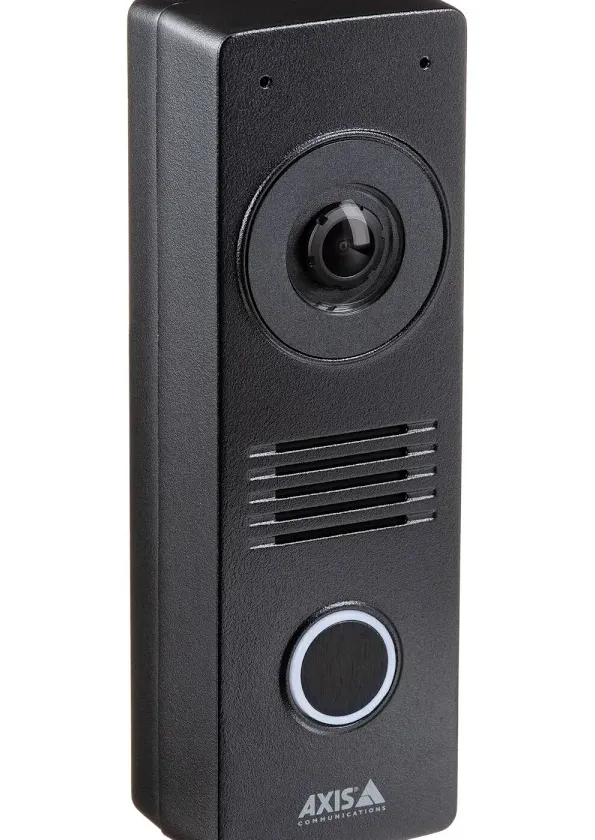
Fiske Terrace, Brooklyn porch camera and door station repair: black video intercom door station with camera, speaker grille and lit call button, product photo
A product photo from the AESS job library, not taken in Fiske Terrace: a black video intercom door station with a camera, speaker grille and lit call button. On a Fiske Terrace porch the front door is often under a deep porch roof, where a door station like this sees the visitor's face better than an eave camera looking down from above. When owners ask us to repair the porch camera, we often suggest checking whether a door station would do that one job better.

Six Fiske Terrace facts that shape a camera repair

  • Almost every house stands alone. The district's roughly 250 houses are freestanding, so a full camera system covers four walls, a porch and often a garage. Long runs and several entry points into the house mean more places for a fault to hide than on an attached house.
  • Garages sit at the back of the lot. Freestanding garages were built here from about 1910, many from catalog designs, at the end of concrete driveways with a grass strip down the middle. A camera on one of them is the most remote point on the system and usually the first to drop out.
  • The canopy is old and heavy. Oaks and maples shade most streets. They cause false alerts, block views as they grow, carry squirrels onto cables, and bring down wires in storms, as the August 2025 Midwood outage showed.
  • Some service still reaches houses across the back yards. A former Fiske Terrace Association president told the Brooklyn Paper, "We have phone lines in the backyards of our homes," when Verizon put up 20-foot poles in the district to protect access to its underground fiber. Internet that comes in from the back affects where the router, and so the camera network, ends up.
  • The district is landmarked. The Landmarks Preservation Commission says ordinary maintenance and repair of existing safety equipment needs no permit. Moving a camera, adding one or running new visible conduit on a house in the district follows the commission's rules on where small equipment can go.
  • One precinct covers the area. The NYPD's 70th Precinct, at 154 Lawrence Avenue, lists Midwood, Fiske Terrace, Ditmas Park and Prospect Park South as its area. When it canvasses after a burglary, it canvasses all four, house by house.

Where this page applies. It covers the Fiske Terrace and Midwood Park blocks from Foster Avenue down to Avenue H and the freight line, from the Brighton line east to Ocean Avenue, including the courts and the apartment buildings on the edges. Neighbors in Ditmas Park and Beverley Square have their own pages, and the whole borough is on our main Brooklyn security camera repair page. The price follows the fault, not the street.

Same-Day Repair in Fiske Terrace

Need Repair in Fiske Terrace? A Garage Camera That Went Quiet, a Side of the House That Stopped Recording, or a Recorder Hit by the Last Storm

The urgent calls from this neighborhood come in three kinds. The first follows something on the block: a car opened in a driveway, a package taken from a porch, a garage tried, a shop window broken, and the owner needs to know what the cameras caught before the video is recorded over. The second follows the weather: a storm, a downed line or a long outage, after which some cameras came back and some did not, or the recorder came back with a blank screen. The third is the quiet failure, usually the garage camera or one on the far side of the house, which went dark weeks ago and nobody noticed because nobody looks at that tile.

If you need footage from a particular night, do not restart the recorder, unplug it, or let a relative "reset it to see if it helps." Most recorders overwrite the oldest video once the drive is full, so the clock is already running, and a restart can wipe the clue to why a camera stopped. Call (347) 934-8335 with the date and the window of time you need, and we book the visit with copying that footage as the first job. If the 70th Precinct has asked the block for video, tell us when you book. The clip goes onto a USB drive with the recorder's own timestamps, and we write down the difference between the recorder's clock and the real time so the time on the clip can be explained.

Everything else follows one path: the $150 service call books a two-hour arrival window, the technician finds the cause, and you get a written price before any part is replaced. Requests are booked within 2 hours. We do not promise that the repair itself will be finished on the first day, because some cameras and recorders have to be ordered, but most single-camera, power-supply and hard-drive faults are fixed on the first visit when the part is on the truck.

What We Install

Security Camera Repair Services in Fiske Terrace

Each repair below is priced from our Brooklyn camera repair list. The service call pays for finding the fault. The repair is priced by what failed, how many cameras it affects, and how hard the run is to reach, which on a freestanding house can mean an attic crawl, a porch roof or a span out to the garage.

Single dark camera

One camera with no picture, tested at the camera, along its run and at the recorder before anything is replaced. On houses here the cause is often a connector at the eave or a splice in the attic, not the camera.

Garage and outbuilding cameras

Cameras on detached garages and sheds at the back of the lot, whether they are wired through a buried cable, an overhead span from the house or a Wi-Fi link. We find which link failed and suggest the sturdier fix.

Storm and outage recovery

Systems that came back wrong after a storm or a power cut: recorders on a setup screen, cameras missing from the grid, network switch ports that no longer power anything, and clocks reset to an old date.

Recorders and drives

DVRs and NVRs on cellar shelves, in hall closets, in attics and in garages that beep, restart or keep only a few days. Footage you need is copied first, then the drive is tested and replaced by capacity.

Attic and eave runs

Cables run through the attic and down to cameras under the eaves, which suffer from summer heat, chewing and splices made years ago in the dark. Repaired at the fault or replaced along the same path.

Porch cameras

Cameras on porch ceilings, columns and lintels: loose mounts in old wood, cables pinched in porch-ceiling boards, and cameras that only worked when the porch light was on.

False alerts and views

Cameras that alert all night on moving branches, or whose view has been swallowed by a growing tree. Motion areas, sensitivity and aim are reset, and the camera is moved only if it has to be.

Phone viewing and logins

Apps that lost the recorder after an internet change, accounts tied to a former owner or a grown child's email, and recorders with an unknown admin password. Access is restored for the right person.

Building and shop systems

Lobby, hallway, package-area and storefront cameras in the Ocean Avenue and Foster Avenue buildings and the shops on Avenue H, with clips exported for boards, managing agents, insurers and police.

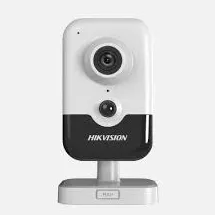
Fiske Terrace, Brooklyn indoor camera repair: white indoor cube camera, product photo
A product photo from the AESS job library, not taken in Fiske Terrace: a white indoor cube camera. In Fiske Terrace houses we find small cameras like this on a hall table watching the side door off the driveway, in a home office or practice on the ground floor, or on a shelf facing the back stairs. Most run on Wi-Fi and their own app, separate from the outdoor recorder, so a repair visit has to cover both systems.
Building Specialists

Security Camera Repair for Fiske Terrace's Architecture

The houses in this district were sold more than a century ago as variations on a handful of forms, and the forms still decide where camera cables run and where they fail. Six kinds of property account for nearly every call we get from the neighborhood.

Hipped-roof foursquares

Boxy two-and-a-half-story houses with deep eaves on all sides. Side and rear cameras usually hang under those eaves and are wired through the attic, three floors above a recorder in the cellar.

Gable-front houses and bungalows

Houses with the gable to the street or a long, low roof over a deep porch. The porch roof blocks the view from above, so the front camera is often on the porch ceiling or a column.

Stucco, half-timber and Tudor houses

A smaller group with stucco walls, timber framing or brick and stone trim. Mounting into stucco or old masonry is the delicate part, and many earlier installers avoided it by hiding cameras under the eaves.

Houses shared with a tenant

Single-family houses that now have a rented top floor or a separate apartment. One camera system often serves both households, on one owner's internet, with questions about who sees which camera.

Catalog garages and back-lot sheds

Freestanding garages at the end of the driveway, some with pyramidal or gambrel roofs and the original swing-out doors. A camera here is the system's longest and most exposed link.

Apartment buildings on the edges

The six-story apartment house of 1936 on East 17th Street, the larger buildings along Ocean Avenue and the stores-with-apartments on Foster Avenue, with lobby and hallway cameras on cellar recorders.

Foursquares: the distance between the eave and the cellar

A foursquare is the simplest house in the district to picture and one of the more involved to wire. The camera over the back door or under the rear eave is perhaps thirty feet up and the recorder is in the cellar, so the cable climbs the inside of a wall, crosses the attic and drops through the soffit, or it runs outside, down a corner of the house, behind a downspout and into a cellar window. Either path has joints: a splice in the attic where an installer ran short, a connector at the eave, a hole through the foundation. When one eave camera goes dark on a foursquare, we test it at the camera first, then at the attic joint, then at the recorder, so the repair stops at the first bad piece instead of replacing a run that is mostly fine.

Gable-front houses and bungalows: the porch roof gets in the way

On a house with a deep porch, the porch roof hides the front door from any camera under the main eave. The usual answer was to put a camera on the porch ceiling or high on a porch column, which means the camera, its cable and often its power supply live inside or on old wood. Porch ceilings here are commonly tongue-and-groove boards, and the cable runs either above them, through a small hole, or along the edge of a beam. When those porch cameras fail, the fault is often a cable pinched where it passes between boards, a mount that has worked loose as the wood dried and swelled, or a power supply plugged into a porch outlet that someone switches off with the porch light.

The repair respects the porch. A camera that has to come down is photographed in place first, its screw holes are reused where the wood is sound, and a loose mount is moved a short way to solid framing rather than packed with filler. If a bungalow's porch camera has been fighting the light all along, because it looks out from deep shade at a bright street, we tell you whether a camera made for that contrast, or a door station at the door itself, would do better before we replace like with like.

Stucco, half-timber and Tudor houses: delicate walls

Stucco and old masonry do not forgive a careless bracket. A camera screwed into stucco without the right anchor works loose; water gets in around the screws, the stucco cracks around the hole, and the camera tilts until it shows the lawn. On these houses we look at the mount as carefully as the camera. If the old anchors have failed, the replacement goes on a mounting block or junction box fixed into solid backing, with the holes sealed. On the half-timbered houses we keep fixings in the timber or the plain field of the wall, not across decorative work, which also matches what the Landmarks Preservation Commission asks of small equipment in a historic district.

Houses shared with a tenant: whose system is it

Many single-family houses in the district now have a rented floor. The camera system is usually the owner's, but it may run on the tenant's outlet in the attic apartment, or the cameras that watch the side entrance may be the only ones the tenant cares about. On a repair, we confirm who owns the system and who pays before we start, and we look at where each camera gets its power and internet. A camera system that depends on a tenant's router or outlet goes down when the tenant leaves, unplugs something, or changes providers, and moving it onto the owner's own circuit and network is often the real fix.

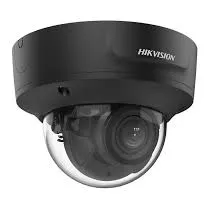
Fiske Terrace, Brooklyn lobby camera repair: black varifocal dome camera, product photo
A product photo from the AESS job library, not taken in Fiske Terrace: a black varifocal dome camera. In the apartment buildings at the edge of Fiske Terrace, on Ocean Avenue and on East 17th Street, domes like this cover vestibules and lobbies. A varifocal lens can be zoomed and refocused on site, so when a lobby picture has gone soft or shows too much ceiling, we can often correct it without replacing the camera.

Catalog garages: the far end of the system

The garages are a defining part of the district. The designation report notes freestanding garages from about 1910, many built to catalog designs, with pyramidal and gambrel roofs and doors that swing out on hinges. Most have no heat and some have no power at all. A camera on one is connected to the house in one of four ways: a cable buried beside the driveway, a cable strung overhead from the back of the house, a Wi-Fi camera or wireless bridge, or a recorder inside the garage itself. Each fails in a known way. Buried cable that was not rated for burial breaks down; overhead spans sag and fray at the clamps; Wi-Fi fades when the leaves come in; and a recorder or power supply in an unheated garage struggles on the coldest mornings. The repair starts by finding which of those you have.

Where the garage link keeps failing, we give you the options in writing: repairing the existing path, replacing it with outdoor-rated cable along the same route, or replacing a weak Wi-Fi link with a point-to-point wireless bridge aimed between the two buildings. In a historic district, work in the back yard can also fall under the Landmarks Preservation Commission, which regulates work in front, side and rear yards as well as on facades, so we keep any change to the path out of sight and tell you before anything would show.

Apartment buildings on the edges: long runs and many hands

The district has one apartment house of its own, the six-story building completed in 1936 at the corner of East 17th Street and Wellington Court. Ocean Avenue, which the commission left out of the district, has larger elevator buildings, and Foster Avenue has walk-ups and stores with apartments above. Their systems follow the pattern of Brooklyn apartment buildings: a recorder in the cellar or the super's office, cameras in the vestibule, lobby, mailroom, elevator and halls, and cables that rise through the building alongside other services. Faults come from building work, leaks, a super who has moved on with the password, and drives that have been recording around the clock for years. Before we touch a building system we confirm who approves the work, whether that is the board, the managing agent or the owner, and whether anyone needs footage preserved.

Field Notes

Field Notes: Walking a Freestanding Fiske Terrace House Before Opening the Recorder

These notes describe how our technicians work through a typical freestanding house in this neighborhood when several cameras are out and nobody is sure why. They describe our practice, not a particular job.

Copy first, then look. If anyone needs video from a recent night, it is exported before the recorder is restarted, opened or unplugged, with a note of the recorder's clock against the real time.

Walk the outside clockwise. The technician walks all four sides of the house and out to the garage with the live view on a phone or tester, matching each camera on the wall to its tile on the screen. On freestanding houses the tiles are often mislabeled, and a camera that seems dead on the recorder is sometimes fine and simply plugged into the wrong channel, or a camera that seems fine is a different one recording the same view.

Test the power where the outage hits. The outlet, power strip, adapters, power box, network switch and any battery backup are checked under load. After a storm on a tree-lined block, a cheap adapter or a switch port that took the surge is often the whole fault.

Check the garage link separately. The garage camera is tested at the garage and at the house, so the technician can tell a failed camera from a failed link. Wi-Fi signal is read at the camera, not guessed from the router.

Price it before fixing it. Once the cause is known, the owner gets a written price. Anything that would need a new hole, a new cable path or a change on the facade is shown in a photo and approved before it is done.

Leave it so the next repair is short. Cables are labeled at both ends, the recorder's tiles are renamed to match the walls, alerts for lost video and drive trouble go to the owner's phone, and the owner is shown how to save a clip.

Why Systems Fail Here

Canopy, Storms, Distance and Old Wood: Why Camera Systems on Fiske Terrace Houses Break Down

Most camera faults we find in this neighborhood trace back to five conditions that are particular to a district of freestanding houses under old trees. Knowing which one you are dealing with usually tells you what the repair will cost.

The canopy: shade, motion and animals

A camera under an oak sees a scene that is never still. Branches moving in the wind cross the motion area all night, and the shadows they throw in the morning and evening do the same. The usual result is not a broken camera but a camera nobody trusts: so many alerts that the owner turns them off, and then misses the one that mattered. The fix is in the settings, not the hardware. We redraw the motion area to the ground and the doors, switch the camera to detect people and vehicles where it can, and lower the sensitivity where branches cross the frame. Where a camera's whole view has been swallowed by a tree that has grown over the years, we may move it a short way to see under or past the branches.

The canopy also carries animals. Squirrels run the gutters and the cables between the trees and the houses, and an exposed camera cable along a fascia or across an eave is within easy reach. Chewed cable shows up as a camera that flickers, then fails, often at a spot just out of view from the ground. We replace the chewed section and, where the cable has to stay exposed, run it in a protective sleeve or move it inside the soffit.

Storms and power: the moment the lights come back

The August 2025 storm that cut power to more than 5,600 Midwood-area customers is a fair picture of what happens here. Wind brings down branches and wires, power goes out for a few hours, and when it comes back, it can come back unevenly. A recorder writing to its drive at the moment of the cut can corrupt the drive or lose its settings. A network switch or power box can lose a port or a fuse. Plug-in adapters take the surge. In June 2025, a manhole fire on Beverly Road left at least 1,700 Flatbush customers without power at one point, and underground faults like that one test the same weak points as a storm does.

The repair after an outage is to find which of those parts failed, replace them, and then protect the system from the next one. That usually means a battery backup sized for the recorder, the network switch and the modem or fiber terminal together, so the cameras keep recording and you can still see them on your phone while the block is dark.

Distance: long runs, more joints

A camera cable on a freestanding house can run from a cellar on one side of the house to an eave on the other, then out to a garage. Every extra length adds joints, and every joint is a place for water or corrosion to get in. Network cameras also have a practical limit on how far a single cable can carry both power and data before the picture becomes unreliable. When a far camera keeps dropping out while the near ones are fine, the run itself may be the problem, and the fix can be a small network extender or a switch closer to the cameras rather than a new camera.

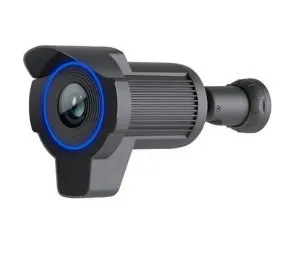
Fiske Terrace, Brooklyn night picture repair: black bullet camera with a long hood and blue-lit ring around the lens, product photo
A product photo from the AESS job library, not taken in Fiske Terrace: a black bullet camera with a long hood and a lit ring around the lens. Under the dense shade of a Fiske Terrace street, a long hood keeps rain and dripping leaves off the lens, and a camera with its own lighting does not depend on a porch lamp someone can switch off. Those two details decide whether a replacement camera on a tree-lined lot actually sees anything at night.

Old wood and old walls: mounts that move

The houses here are mostly wood frame with clapboard or shingle siding, stucco on some, and old wood porches on many. Wood shrinks and swells with the seasons, which loosens screws over the years. A camera that slowly drifts until it points at the ground is usually not broken; its mount has worked loose or the trim it is fixed to has softened. We reset or move the mount to solid framing, seal the holes, and aim the camera again, which often costs less than replacing it.

Historic District

Fixing a Camera Inside the Fiske Terrace–Midwood Park Historic District Without a Landmarks Problem

Because almost every house between Foster Avenue and Avenue H, from the Brighton line to East 19th Street, is inside a designated historic district, owners often ask whether a camera repair needs permission. For an ordinary repair, the answer in the Landmarks Preservation Commission's own permit guidebook is no: its list of work that needs no permit includes "Ordinary maintenance, repair, and retrofitting of health, safety, and utility equipment." Replacing a failed camera with a similar one in the same place, fixing a connector, or replacing a cable along its existing path falls in that category.

Things change when the camera moves, multiplies or gets new visible cable. The commission's guidebook says security cameras "must be well spaced to avoid a cluttered, haphazard appearance," and its rules for small buildings allow no more than two cameras per 25 feet of street frontage. Equipment should be attached at mortar joints, plain masonry, wood or metalwork, not through decorative surfaces, and staff may approve "a maximum of approximately ten inches of visible conduit." The commission also regulates work in front, side and rear yards, not just on facades, which matters for a camera on a fence or a garage. Its guidebook notes that an application to replace equipment in kind needs the manufacturer's cut sheets but no elevation drawings.

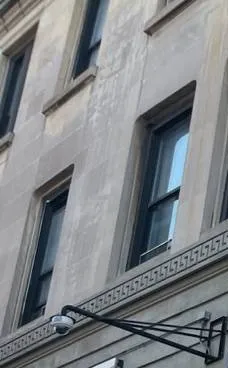
Fiske Terrace, Brooklyn landmark-district camera repair: bullet camera on a long black steel wall arm below a carved Greek-key band on a pale stone facade
A photo from the AESS job library, not taken in Fiske Terrace: a bullet camera on a long black steel arm below a carved Greek-key band on a pale stone facade. On a landmarked building, a long arm like this can keep the camera's fixings off the carved work while still letting it see the street. In the Fiske Terrace–Midwood Park district, where most houses are wood with plain trim, the same rule applies: fixings go into plain material, and decorative work is left alone.

How we keep a repair on the right side of that line

On every repair in the district we photograph each camera and its mount before anything comes down, so the replacement can go back exactly where it was. We reuse existing fixings and cable holes where the material is sound, choose a replacement of similar size and color, and keep cable on its old path. If the camera cannot go back in the same place, for example because the trim it sat on has rotted, we show you the alternatives and which ones would need a permit before we do anything. We do not apply for permits on your behalf without being asked, and we do not move a camera to a new spot on the front of a house without your approval.

Commercial Security Camera Repair

Business Security Camera Repair in Fiske Terrace

Fiske Terrace is mostly houses, but its edges carry real business: the shops along Avenue H around the station, the stores under apartments on Foster Avenue, the ground floors of the Ocean Avenue buildings, and offices and practices run from houses. Their camera systems are usually one recorder in a back room, a closet or under a counter, with four to sixteen cameras. When something happens, the owner needs the video that day, and the repair has to work around opening hours.

Avenue H near the station

Small shops on both sides of the Q train's Avenue H stop. Cameras face doors, registers and back rooms, and the station crowd moving past the window is part of every daytime picture.

Foster Avenue storefronts

Stores with apartments above along the district's northern edge. The shop's cameras often share a cellar, a wall or even a power circuit with the residential floors.

Ocean Avenue ground floors

Shops and offices in the bases of the larger apartment buildings, where the building's own cameras and the tenant's cameras may cover the same doorway with different recorders.

Building managers

Managing agents and boards of the Ocean Avenue and East 17th Street buildings, who need lobby, mailroom, elevator and hallway cameras recording and clips exported when residents report trouble.

Practices in houses

Doctors, therapists, tutors and other professionals who work from the ground floor of a house, with a waiting room or side door that needs its own camera and its own access rules.

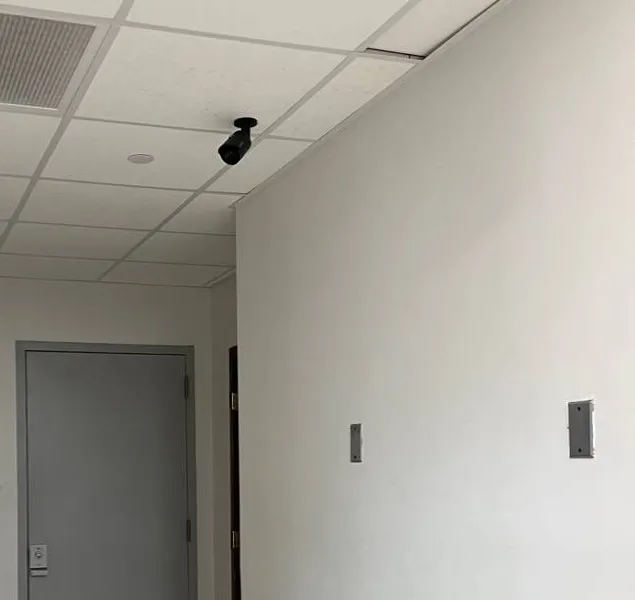
Fiske Terrace, Brooklyn shop camera repair: small black bullet camera on a white ceiling-tile grid aimed down a corridor at a grey steel service door
A photo from the AESS job library, not taken in Fiske Terrace: a small black bullet camera hanging from a ceiling-tile grid, aimed down a short corridor at a grey steel service door. In a shop on Avenue H or Foster Avenue, the back corridor to the delivery or cellar door is where a camera like this earns its keep, and it is also where cables get disturbed whenever someone works above the ceiling.

What a shop by the station needs from a repair

News 12 reported in September 2026 that the NYPD was looking for two suspects in 19 commercial burglaries across Brooklyn between August 3 and September 10, with neighborhoods including Midwood, Flatbush and Ditmas Park, and entry made by throwing an object through a window. For a shop near the Avenue H station, that pattern makes three things about the camera system matter. The camera facing the front window has to see the glass and the sidewalk clearly at night, when the street lights and the shop's own lights are doing battle. The recorder has to be somewhere a person who just came through the window cannot pick it up and carry it off. And the system has to keep enough days of video that a burglary found on Monday morning is still on the drive. A repair visit for a shop covers all three, not just the dark camera.

Stores with apartments above

The stores-with-apartments buildings on Foster Avenue have a long history here; the designation report notes that the Midwood Park entrance posts went up around 1910 partly in response to a block of stores with apartments on Foster Avenue. Today the practical issue is shared infrastructure. A shop's cameras may be powered from a circuit on the landlord's meter, the recorder may sit in a shared cellar, and the building's own entrance camera may cover the shop door. On a repair we confirm which equipment belongs to the shop and which to the building, who approves and pays for each part, and whether the shop's system should be separated so a landlord's breaker or a tenant's renovation cannot take it down.

Offices and practices run from houses

A practice on the ground floor of a house has two sets of needs on one system: the family's privacy and the practice's security. The waiting room or side entrance camera should record the people coming and going without recording sessions, and staff who can see that camera should not see the family's yard. When we repair a mixed system like this, we separate the logins so each person sees only what they should, turn off audio where it is not needed, and set the recorder to keep the practice cameras for the period the practice wants.

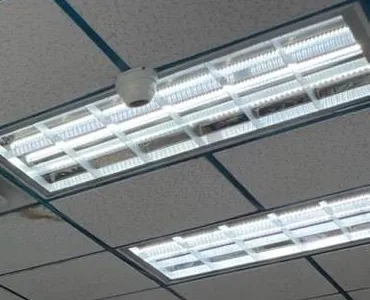
Fiske Terrace, Brooklyn office camera repair: small white dome camera on grey acoustic ceiling tiles beside a long louvered fluorescent light panel
A photo from the AESS job library, not taken in Fiske Terrace: a small white dome camera on grey acoustic ceiling tiles right beside a long louvered fluorescent light. In an office in the base of an Ocean Avenue building, a dome placed this close to a light fixture can lose its picture to glare or flicker, and moving it a tile or two away is sometimes the entire repair.

Rules that touch a business camera repair

State licensing. The New York Department of State licenses companies that install or maintain security systems, and its rules extend to closed-circuit television used to watch for intrusion, theft or movement. An owner, or an owner's employee, can work on the owner's own system without a license; a company working for someone else needs one. AESS works under NYS license #12000287431.

Cameras that watch employees. New York Labor Law §203-c requires employers who monitor employees electronically, including by video, to give written notice and get acknowledgment. If a repair moves or adds a camera that watches staff, the notice should be updated.

Landmarked frontages. The shops on Avenue H and Foster Avenue sit on the edges of the district rather than inside it, but the Avenue H station house itself is an individual landmark. Work on any landmarked building follows the commission's rules for small equipment and visible conduit.

Buildings and tenants. Housing law requires intercoms in many larger apartment buildings, but there is no general city requirement that apartment buildings keep working cameras. In a building, a camera repair is therefore a decision for the owner or board, and a written condition report of what works and what does not is often the first step.

Your Questions Answered

Security Camera Repair in Fiske Terrace: Questions Answered

These are the situations owners, tenants, boards and shopkeepers in and around the district describe when they call. Each answer is written for the houses and buildings here.

The garage and the back of the lot

Our recorder sits on a shelf in the detached garage, which has no heat. On the coldest mornings it shows no cameras until around midday. Is the cold the problem?

Very likely. Recorders and their hard drives are built for indoor temperatures, and a drive started from cold in an unheated garage in January can fail to spin up properly, or the recorder can restart over and over until it warms. Condensation forms inside when the garage warms up again. We check the drive's health and the recorder's logs to confirm it, and the lasting fix is to move the recorder into the house, usually the cellar, and bring the garage camera's signal to it, rather than heating the garage for a box.

The cable to our garage camera was strung overhead from the back porch roof to the garage eave, and it sags lower every winter. Can it be replaced the same way?

It can, if it is done properly. A camera cable on its own is not built to hang across a yard; over the years its own weight, ice and wind stretch it and the jacket cracks at the clamps. The right overhead replacement is outdoor-rated cable lashed to a steel support wire, anchored solidly at both buildings with a drip loop where it enters each one. If the span crosses a lot of tree cover, a wireless bridge between the house and the garage may be the better choice, and we price both so you can pick.

The garage camera gets its power from an orange extension cord the previous owner ran from an outlet on the back porch. Can the camera stay but the cord go?

Usually, yes. Many garage cameras can take their power through the same network cable that carries their picture, so a single proper cable from the house can replace both the signal path and the cord. If the camera is an older type that needs its own power, a low-voltage supply in the house with an outdoor-rated cable to the garage does the same job. Any change to the garage's own electrical outlets or circuits is a job for a licensed electrician, and we will tell you if you need one.

Trees, squirrels and the canopy

When the wind moves the oak branches over our driveway, the camera sends alerts all night. Can you stop the alerts without missing a real person?

In most cases. Many recorders and cameras can tell people and vehicles from other movement, and the motion area can be drawn to cover only the driveway, the doors and the walk rather than the sky and the branches. Where a camera cannot classify people, lowering sensitivity in the band where branches cross the frame and keeping full sensitivity at ground level cuts most of the noise. We set it up, then watch the alert history for a while with you to make sure a person walking up the drive still gets through.

Squirrels from the oak run along our gutter, and the cable to our eave camera has been chewed twice. Is there cable they leave alone?

No cable is perfectly squirrel-proof, but some routes are far better than others. The best fix is to take the cable off the gutter line entirely and run it inside the soffit or attic to the camera, so nothing is exposed but the camera itself. Where it has to stay outside, it can go in a metal sleeve or rigid conduit painted to match the trim, which also keeps it neat on a landmarked house. We replace the chewed section and re-route or protect the run in the same visit.

Porches, eaves and long runs

The camera on our beadboard porch ceiling shakes whenever someone walks across the porch or the front door slams, and the clips are hard to watch. Is the camera loose?

Often the camera is tight and the ceiling is moving. Old porch ceilings are thin boards on light framing, and footsteps and a heavy door make them flex. The fix is to mount the camera to a framing member or a solid block fixed between the joists above the boards, rather than to a board alone. Where the porch roof has no solid framing near the spot you want, a short move to the beam over the steps usually gives a steadier picture and a better angle on visitors.

The camera under the far gable of our house is wired from the cellar through the attic, and the old installer told us the cable "is too long now." Can a cable be too long?

Yes. A network camera powered through its cable works reliably only up to a certain length of run, and older analog cameras lose picture quality and power over long lengths too. On a big freestanding house, a run from a cellar on one side to a gable on the other, with a loop through the attic, can come close to that limit, especially if it was spliced. We measure the run, and the fix is either a shorter path, a small network switch or extender placed partway along it, or a new run of better cable.

Storms, power and the internet

Our recorder has a battery backup, but during the August storm outage we still could not see any camera from our phones. Why?

Because the phone app depends on more than the recorder. To see the cameras away from home, the recorder needs the router, and the router needs the modem or fiber terminal, and all three need power. If only the recorder is on the battery, it keeps recording through an outage but cannot reach you. On a repair we put the recorder, the network switch, the router and the internet terminal on backup together and size the battery for a realistic outage, so the system both records and stays viewable while the block is dark.

Apartment buildings and shops at the edges

After a man was filmed covering a hallway camera in a Flatbush apartment building, our board asked whether ours would show who did it. Can hallway cameras be placed so one watches the other?

Yes, and in a corridor or vestibule it is good practice. If each camera is placed so another camera sees it and the space in front of it, anyone who reaches up to cover or turn one is recorded doing it by the next. In an older building that often means re-aiming existing cameras or moving one to the opposite end of a hall, not adding many new ones. We review the layout with the board or managing agent and give a written price for the changes.

Our store on Foster Avenue has its cameras on a circuit that belongs to the apartments upstairs, so when the landlord's breaker trips our shop goes dark. Can that be separated?

The camera side can be. We can move the recorder, switch and camera power onto an outlet on the shop's own meter and put them on a battery backup, so the shop's system does not depend on the building's circuits. Changing which meter an outlet is on, or adding a new outlet, is electrical work for a licensed electrician, and it needs the landlord's agreement. We will tell you exactly what the electrician needs to provide, and finish the camera part once the outlet is in.

Footage, households and ownership

Our driveway camera recorded someone trying the car doors, but the date and time stamp sits right over his face in the clip. Can that be fixed for next time?

Yes. The position, size and background of the on-screen time stamp are settings on most recorders and cameras, and they can be moved to a corner of the picture where nothing important happens, usually the top edge over the sky or the house. The time stamp also sits in the recording's own data, so it does not need to cover the picture to be valid. We move it, check the clock against an internet time source, and export a test clip so you can see the result.

My father owned the house and has passed away. The estate is not settled, and the cameras stopped working months ago. Who can authorize the repair and the recorder password reset?

Whoever is legally handling the house, usually the executor or administrator of the estate, can approve the work. For a password reset, the recorder's maker may ask for proof of ownership, and estate papers along with a photo of the label on the recorder usually do. We start by checking whether we can get in without resetting at all, because a reset can erase settings, and we copy any footage the family wants to keep before anything is changed.

Equipment

Types of Security Cameras and Recorders We Repair

We repair whatever is on the house, the garage or the building, whoever installed it. These are the kinds of equipment we find in Fiske Terrace and the faults each one tends to develop under the trees and on old wood.

Analog and HD-over-coax cameras

Older systems with round coaxial connectors, common on houses wired more than a decade ago. Typical faults: corroded connectors at the eave, worn infrared and failing plug-in power.

Network (IP) cameras

Cameras that take power and data on one cable. Typical faults: long runs near their limit, switch ports lost to surges, address conflicts and lost passwords.

DVRs, NVRs and hybrids

Recorders in cellars, closets, attics and garages. Typical faults: worn drives, settings lost after an outage, overheating in attics and cold starts in garages.

Wi-Fi and battery cameras

Cameras on garages, fences and the backs of houses where nobody wanted to run cable. Typical faults: signal lost to leaves and walls, batteries that fade in winter, app and account trouble.

Pan-tilt and zoom cameras

Moving cameras on corners and driveways. Typical faults: motors that stop turning, presets lost after an outage, and housings that let water in at the seams.

Video doorbells and door stations

Porch doorbells and door stations on their own apps or tied to a recorder. Typical faults: weak Wi-Fi under porch roofs, failing transformers and lost pairing.

Wireless bridges

Point-to-point radios linking the house to a garage. Typical faults: aim knocked off by storms, trees growing into the path, and power supplies that took a surge.

PoE switches and extenders

Small boxes that power network cameras. Typical faults: dead ports after a storm, overheating in attics and closets, and extenders added on long runs that fail quietly.

Power supplies and battery backups

Central power boxes, adapters and battery units. Typical faults: blown fuses, swollen batteries, and backups too small to carry the network through an outage.

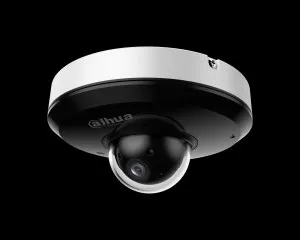
Fiske Terrace, Brooklyn pan-tilt camera repair: mini pan-tilt dome camera with white housing over a black lens dome, product photo
A product photo from the AESS job library, not taken in Fiske Terrace: a mini pan-tilt dome camera with a white housing over a black lens dome. On a corner of a freestanding house, or in the courtyard of an edge apartment building, one pan-tilt camera like this sometimes stands in for two fixed ones. When its motor stalls or it forgets its positions after an outage, it stares at one spot until someone notices, which is why we set it to return to a home position on its own.

National brands versus a local licensed repair

Some houses here have cameras from a national alarm company or a consumer brand alongside a wired system, and owners ask who should fix what. This is how the choices usually compare for a repair.

QuestionADT or a similar alarm companyRing or SimpliSafe camerasAESS local repair
Who owns the equipmentDepends on the contract; some is leasedYou doYou do, and we fix it
Reaching a detached garageDepends on how it was installedWi-Fi range across the yardCable, overhead span or wireless bridge, whichever holds up
Other brands on the same houseUsually only its ownSupport covers its own devicesAny brand, any installer
Recorder and drive repairIts own systemsCloud storage, no local recorderDVRs, NVRs, hybrids, drives and footage export
Landmark-aware mountingVaries by dealerOwner mounts itMounts photographed, old fixings reused, changes approved first
Licensed technician on siteVaries by dealerRemote supportYes, NYS license #12000287431
Price before workVariesPrice of a replacement device$150 service call, then a written repair price
AI Overview Reality Check

What AI Gets Wrong About Security Camera Repair in Fiske Terrace

These claims show up in AI-generated answers, forum threads and national repair guides. Each is true somewhere. Each sends Fiske Terrace owners toward the wrong repair, the wrong budget or a lost clip.

"A security camera repair costs $100 to $300"

National averages like this assume a small house with one or two cameras next to the router. HomeAdvisor's own Brooklyn page puts the average surveillance camera install or repair at $1,416, with a typical range of $680 to $2,145, though that figure mixes new systems with repairs.

Neither number describes a Fiske Terrace repair well. A single fault here, such as a connector at an eave or a failed power supply, usually falls between $150 and $700 on our Brooklyn list, and the service call is credited toward it. What pushes a repair higher in this district is reach and distance: an attic run, a camera over a porch roof, or a garage link that has to be replaced.

The useful budget is the one written after the diagnosis. That is why the service call comes first, and why the repair price is put in writing before parts are replaced.

"Wi-Fi cameras solve the problem of running cable"

The common advice is that wireless cameras are the easy answer wherever cable is hard. For a camera a few feet from the router, that can be true.

On a freestanding house, the camera that is hardest to wire is usually the one on the garage or the far side of the house, and that is exactly where Wi-Fi is weakest. The signal has to pass through the house's walls, across a yard and, from spring to fall, through leaves. Battery cameras also lose capacity in cold weather. The result is a camera that works on the day it goes up and drops out later.

For the far points of a lot, a proper cable, an overhead span done right or a point-to-point wireless bridge is the repair that lasts. Wi-Fi cameras still have a place, near the house and the router.

"In a landmark district you need a permit to touch a camera"

Owners in historic districts are often told any exterior work needs the Landmarks Preservation Commission's permission, so some leave a broken camera alone rather than risk it.

The commission's guidebook lists "ordinary maintenance, repair, and retrofitting of health, safety, and utility equipment" as work that needs no permit. Replacing a failed camera in the same place with a similar one, or fixing its cable on the same path, is repair. What does fall under the commission is moving equipment, adding it, or adding visible conduit, and for small buildings the rules limit cameras to two per 25 feet of street frontage.

So the practical rule is: repair in place freely, and ask before you move or add. We photograph every mount first so the replacement goes back where the old camera was.

"After a power cut, just wait and the cameras come back"

Many quick answers say camera systems restart on their own when the power returns, so there is nothing to do.

Most of the time they do. But the outages that hit this part of Brooklyn, such as the August 2025 storm that brought down lines across Midwood, are exactly the events that damage drives writing at the moment of the cut, blow power-supply fuses, kill network switch ports and reset recorder clocks. The system can look normal on the live screen while one camera is missing from the recording or the time on every clip is years off.

After any long outage, check that every camera is recording, not just showing live, and that the clock is right. If not, that is the moment to call, before the video you need is the one that was never saved.

"Cameras on a quiet residential street rarely matter"

A common assumption is that cameras on a leafy street of single-family houses are a comfort more than a tool.

The record says otherwise. After a summer of break-ins in 2012, the Fiske Terrace Association brought the 70th Precinct in to talk about it. In Midwood in 2017, investigators went house to house checking home surveillance systems after a burglar used back windows reachable from the yards. Quiet streets are where a home camera is often the only witness, and where detectives ask every house on the block what it recorded.

That makes the back and side cameras, which nobody looks at day to day, as important as the porch camera. A repair should cover every side of the house, not just the one that failed first.

"If the live view works, the system is recording"

Many people check their cameras by opening the app and seeing a picture, and assume the recorder is saving the same thing.

Live view and recording are separate. A drive can fail or fill while live view carries on; a recording schedule can be set wrong after an outage; one camera can be shown but not recorded. On systems with a camera on a garage or far wall, we often find one channel that has not saved anything for weeks.

The real test is playback: pick a time yesterday and play back every camera. On a repair we also turn on the recorder's alerts for drive errors and lost video, so the next failure reaches your phone.

"Buy the replacement camera online and swap it yourself"

Online advice often says the cheapest repair is to order a matching camera and plug it in.

Sometimes the camera is not the fault at all. On houses here the failure is often in a connector at the eave, a splice in the attic, a power supply in the cellar or the garage link, and a new camera on a bad run fails the same way. A replacement also has to be compatible with the recorder, and on a landmarked house it should match the old one's size and position.

If you already have a replacement, we can fit it at labor-only rates once we know the model. If you have not bought one yet, let the diagnosis tell you whether you need one.

Not Sure Whether It Is the Camera, the Attic Run or the Garage Link? Speak to a Tech

A short call or a photo of the recorder screen can save you a wasted part and a lost clip. Call now at (347) 934-8335, send a fast quote request, or send a photo to a tech on WhatsApp. Same-day estimates are available on most days, and requests are booked within 2 hours.

Get In Touch

Request a Free Quote

Tell us the address, the kind of property, how many cameras there are, which ones are out and where the recorder sits. Mention a garage camera, a rented floor or a building board if there is one. If you need footage from a certain date, say so, and the visit is planned around saving it. For anything urgent, call (347) 934-8335.

Fiske Terrace, Brooklyn entrance camera repair: slim video door station with a camera lens at the top and a large round call button, product photo
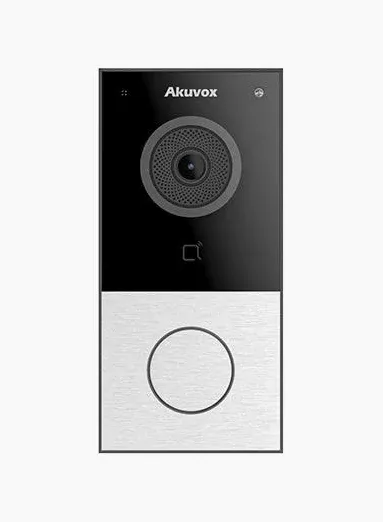
A product photo from the AESS job library, not taken in Fiske Terrace: a slim video door station with a camera lens at the top and a large round call button. At the entrance of an apartment building on Ocean Avenue or East 17th Street, a station like this is often the only camera that sees visitors face to face, so when its picture fails, residents lose the view they use most. We repair the door station and the lobby cameras on the same visit.

✅
Request Sent!
Thank you. A technician will be in touch about the Fiske Terrace address shortly.
How It Works

Our Repair Process

1. Send photos and the address

A photo of the recorder screen or app showing the dark cameras, the address, and whether there is a garage camera or a building system. Tell us if you need footage from a particular night.

2. Agree who approves the work

Homeowner, estate, co-op board, managing agent or store owner: we confirm who approves the repair and who holds the recorder login before the day.

3. Book the service call

The $150 Brooklyn service call puts the visit on the schedule in a two-hour arrival window and is credited to the repair if you go ahead.

4. Copy footage before touching anything

Any clip that matters is exported to USB with its original timestamp before the recorder is restarted or opened, and its clock is checked against the real time.

5. Walk all four sides and the garage

Every camera is checked from outside, out to the garage, and each mount is photographed before anything comes down.

6. Trace power and signal back to the recorder

Each dark camera is tested at the camera, along its run through the attic, porch ceiling or garage link, and at the recorder, switch or power box.

7. Give the cause and a written price

You hear what failed and why, and get an itemized price before any part is replaced. Anything needing new holes or a new cable path is shown and approved first.

8. Repair, retest in the dark and hand over

Every camera is checked for picture and recording, including in low light. Alerts are turned on, cables labeled, and logins handed to the right person.

Coverage Area

Security Camera Repair Near Fiske Terrace's Landmarks

Avenue H station house

The wood-framed 1905–06 sales office of the Fiske Terrace developers, later the northbound station building on the Q line, designated a landmark in 2004.

Fiske Terrace–Midwood Park Historic District

About 250 freestanding houses from Foster Avenue to Avenue H, designated by the Landmarks Preservation Commission in March 2008.

Glenwood Road and East 17th Street malls

The planted center strips laid out by the developers, which give the district's main streets their divided, park-like look.

Midwood Park entrance posts

The posts at Foster Avenue that have marked the entrances to Midwood Park since about 1910, still standing at East 17th, 18th and 19th Streets.

The Brighton line cut

The open subway cut carrying the B and Q trains along the district's western edge, where several streets end at the tracks.

70th Precinct

The station house at 154 Lawrence Avenue serving Midwood, Fiske Terrace, Ditmas Park and Prospect Park South.

We also serve the neighborhoods around Fiske Terrace, including Midwood, Flatbush, Kensington and Flatlands, at the same Brooklyn rate. Our Ditmas Park camera repair page covers the freestanding houses to the north, our Beverley Square camera repair page covers the blocks beyond, and our East Flatbush camera repair page covers the row houses and apartment buildings to the east.

Pricing

Security Camera Repair Cost in Fiske Terrace

Fiske Terrace is billed at our Brooklyn rate. Every repair starts with the $150 service call, which covers the diagnosis on site and is credited to the repair if you go ahead. These figures come from our published list of Brooklyn security camera repair prices; your exact price is written down on the visit once the fault is known.

RepairBrooklyn price
Service call with on-site diagnosis and written price$150, credited to the repair
Motion areas, alerts, app or clock fixed with no partsUsually inside the $150 service call
Lens clean and check for a soft picture$80
Connector redone or switch port replaced$150–$350
Power supply repair$150–$400
Recorder hard drive replaced, by size$200–$450
Indoor camera repair$200–$450
One camera replaced on a working system$250–$600
Night vision repair$250–$650
DVR not working, with drive and labor$300–$700
NVR not recording, depending on model$400–$900
Pan-tilt-zoom camera repair$450–$1,200
Recorder replaced with drive, or several runs rewired$700–$1,500
Full rewire or whole-system overhaulFrom $1,500

Three things move a Fiske Terrace repair within those ranges. Reach: a camera under a third-floor eave, above a porch roof or on a garage takes more ladder work than one by the front door. Distance: an attic run or a garage link costs more to replace than a short cable into the cellar. And the recorder: one that has to be replaced, or a system whose cables were never labeled, adds setup and tracing time. If the price changes on site, you hear the new figure before the work continues. Combining the camera repair with intercom, alarm or cabling work on the same visit saves $200 to $400 in labor on our Brooklyn list.

Full terms — including 50% deposit, one-year parts-only warranty on AESS-supplied products, and the late-fee schedule — are set out in the service agreement.
Shop Our Systems

Security Camera Repair Packages & Pricing

Three ways a Fiske Terrace repair usually comes together, priced from our Brooklyn list.

Single-issue repair: $150–$700

One fault, one visit: an eave connector redone, a power supply replaced after a storm, a drive swapped, alerts reset for the trees, or a login recovered. Typical for a house with one camera or one recorder problem.

Major system repair: $700–$1,500

The recorder or the wiring: a DVR or NVR replaced with a new drive and every camera set up again, or several runs replaced, such as an attic run plus the garage link.

Annual maintenance: $250–$800

Every camera checked by day and in low light, lenses and eave cameras cleaned of leaf debris, power and connectors tested, drive health read and exports tested. Houses from $250, commercial from $400, several properties $500 to $800.

Bring your own equipment. If you have already bought a replacement camera or recorder, we can fit it at labor-only rates. Tell us the exact model and we quote the labor by phone or text, and the visit is booked once it is paid. Your equipment is fitted as supplied; we cannot vouch for parts we did not supply, and if a model will not work with your recorder, will not reach the garage on Wi-Fi, or cannot cope with the shade where it is going, we tell you before the visit.

Complete Services

Every Security Camera Repair Service in Fiske Terrace

House, porch and garage cameras

Dark cameras, attic and eave runs, porch mounts and garage links on freestanding houses. Request a repair

Recorders, drives and storm damage

DVRs and NVRs in cellars, closets, attics and garages, including systems hurt by outages. Security camera repair in Brooklyn

Brooklyn repair prices

The full list behind every figure on this page. Brooklyn camera repair price list

Repairs across the city

Owners and managing agents with buildings in more than one borough. AESS camera repair across NYC

FAQ

Fiske Terrace Security Camera Repair FAQ

Our eave cameras are wired through the attic, and the only way up is a hatch in a bedroom closet. Will the technician need to go up there?
+

Often, yes. On many houses here the attic is where camera cables cross from one side of the house to the other, and splices and chewed sections are found there. The technician will ask before going up, clear a path through the closet with you, and protect the floor and the hatch opening. If the attic has no safe floor near the cable, we tell you and look for another way to test or replace the run.

Do you photograph the camera mounts before taking anything down, so it all goes back the same way on our landmarked house?
+

Yes. Every camera, bracket and cable entry is photographed before it is removed, and the replacement goes back in the same spot on the same fixings wherever the material is sound. That keeps the repair within ordinary maintenance in the historic district and gives you a record of how the house looked before and after the visit.

If the repair turns out to need new holes in our siding or trim, will you ask first?
+

Always. Any change that would add a hole, move a camera or put new cable on the outside of the house is shown to you in a photo with the reason and the price, and nothing is done until you approve it. If the change could need Landmarks approval, we tell you that too, before the work rather than after.

Can the recorder keep the garage camera's video longer than the video from the other cameras?
+

On many recorders it can. Retention and recording quality can often be set camera by camera, so a camera watching the garage or the driveway can be kept for longer at good quality while a camera on a quiet side wall records at a lower rate. Where the recorder cannot do that, a larger drive is the simpler answer. We set it to the number of days you want and confirm it on the visit.

Our garage is in the back yard. Does replacing the camera on it fall under Landmarks rules too?
+

The commission regulates work in front, side and rear yards, not only on the house, but its guidebook treats ordinary repair of existing safety equipment as needing no permit. Replacing a failed garage camera with a similar one in the same place is repair. Moving it, adding cameras or running new visible conduit to the garage is the kind of change to check first, and we tell you which side of that line a job falls on.

Will your ladders and equipment damage our garden beds and lawn?
+

We plan for them. Ladders go on boards or pads over soft ground and beds, plantings are tied back rather than stepped on, and tools stay on a drop cloth. If the only place to set a ladder for a camera is in the middle of a flower bed, we will tell you before we start and agree where it goes.

The camera we need fixed sits above our porch roof, and the roof is old. How do you reach it without walking on the roofing?
+

Usually from a ladder set beside the porch rather than on it, with a stand-off that keeps the ladder off the gutter and the roof edge. If the camera can only be reached by stepping onto the porch roof, we look at its condition first and use roof pads to spread the load, and we tell you if we think the roof is too fragile to walk on. In that case the better repair may be moving the camera to a spot that can be reached safely.

Could one of our cameras have been turned off in the recorder's settings rather than broken?
+

It happens more often than people expect. A channel can be disabled, its recording schedule cleared, or its picture hidden from the screen layout, by a relative, a previous owner or a reset after an outage, while the camera itself is fine. That is one of the first things we check, because if it is the cause, the fix is a settings change inside the service call rather than a new camera.

Can the camera on the garage turn on the garage's outside light when it sees someone at night?
+

Some cameras and recorders have a small output that can switch a light through a relay, and some cameras have their own built-in light that comes on with motion. Which is possible depends on your equipment and on whether the garage has power. Wiring a relay into the garage's light circuit is electrical work, so if that is the route, we arrange it with a licensed electrician and set up the camera side ourselves.

Can a replacement camera be mounted on our brick chimney to see over the porch roof?
+

Sometimes, but it is rarely our first choice. A chimney gives height, but its brick and mortar are often old, the cable has to be run neatly down the outside or through the roof, and in the historic district a new mount on a visible chimney is the kind of change that may need approval. We usually look first for a spot under the eave or on the porch framing that gives a similar view.

Our camera system was put in by the contractor who renovated our kitchen, and some of the cameras are on Wi-Fi and some are wired. Will one visit cover both?
+

Yes. One technician checks the wired cameras at the recorder and the Wi-Fi cameras at the router and in their own app, on the same visit. We tell you which devices are on which system, which logins control them, and which ones are worth keeping, then put the repairs for both in one written price.

More Security Camera Repair near Fiske Terrace

Security Camera Repair Brooklyn | Same-Day | Brownstone Pros · Security Camera Repair NYC | Same-Day | Abstract Enterprises · Security Camera Repair Manhattan | Same-Day | Co-op COI · Security Camera Repair Queens | Same-Day | Driveway Pros · Security Camera Repair Bronx | Same-Day | Home Base · Security Camera Repair Staten Island | Same-Day | Sandy Zone · Security Camera Repair Long Island | Nassau & Suffolk · Security Camera Repair Hudson Valley | Westchester to Ulster · Security Camera Repair Nassau County | Same-Day · Security Camera Repair Suffolk County | Hamptons + East End · Security Camera Repair Westchester County | Same-Day · Security Camera Repair Rockland County NY | Nyack, Suffern · Security Camera Repair Orange County | Newburgh, Goshen · Security Camera Repair Putnam County NY | Carmel, Mahopac · Security Camera Repair Dutchess County | Poughkeepsie · Security Camera Repair Ulster County | Kingston Woodstock

Security Camera Repair Bath Beach Brooklyn NY · Security Camera Repair Bay Ridge Brooklyn NY | AESS · Security Camera Repair Bedford-Stuyvesant Brooklyn NY · Security Camera Repair Bensonhurst Brooklyn NY | AESS · Security Camera Repair Bergen Beach Brooklyn NY · Security Camera Repair Beverley Square Brooklyn NY · Security Camera Repair Boerum Hill Brooklyn NY · Security Camera Repair Borough Park Brooklyn NY · Security Camera Repair Brighton Beach Brooklyn NY · Security Camera Repair Brooklyn Chinatown Brooklyn NY · Security Camera Repair Brooklyn Heights, Brooklyn NY · Security Camera Repair Brooklyn Navy Yard, Brooklyn NY · Security Camera Repair Brownsville Brooklyn NY | AESS · Security Camera Repair Bushwick Brooklyn NY | AESS · Security Camera Repair Cadman Plaza Brooklyn NY · Security Camera Repair Coney Island Brooklyn NY · Security Camera Repair Crown Heights Brooklyn NY | AESS · Security Camera Repair Cypress Hills Brooklyn NY | AESS · Security Camera Repair Ditmas Park Brooklyn NY | AESS · Security Camera Repair Downtown Brooklyn NY | AESS · Security Camera Repair DUMBO Brooklyn NY | AESS · Security Camera Repair Dyker Heights Brooklyn NY | AESS · Security Camera Repair East Flatbush Brooklyn NY · Security Camera Repair East Williamsburg Brooklyn NY

Other services in Fiske Terrace

Security Camera Installation Fiske Terrace Brooklyn NY · Door Buzzer Installation Fiske Terrace Brooklyn NY · Door Buzzer Repair Fiske Terrace Brooklyn NY · Fire Alarm Installation Fiske Terrace Brooklyn NY · Access Control Installation Fiske Terrace Brooklyn NY · Structured Cabling Installation Fiske Terrace Brooklyn NY · TV Installation Fiske Terrace Brooklyn · Intercom Installation Fiske Terrace Brooklyn NY · Alarm Installation Fiske Terrace Brooklyn NY | Porch Houses

Ready to See Every Side of Your Fiske Terrace House, and the Garage, on Camera Again?

Send a photo of the recorder screen or the dark camera, the address, and the date of any footage you need. We book within 2 hours, give you a two-hour arrival window, copy your footage first, and put the repair price in writing before any part is replaced.

Prefer to send photos? Message a technician on WhatsApp.