Prewar Walk-Ups on Bainbridge · Co-ops by Williamsbridge Oval · Corner Lots off Mosholu Parkway · Licensed Low-Voltage
Door Buzzer Repair in Norwood
Street Door to Apartment, Tested End to End · Written Price Before Parts · Bronx Price List
Most of Norwood was built before 1940, and most of it is apartments: five- and six-story walk-ups on Bainbridge and Decatur Avenues, elevator buildings along Mosholu Parkway, co-ops facing Williamsbridge Oval, and a newer run of mid-rises on Webster Avenue. In almost all of them the buzzer is the oldest working system in the building, sharing walls with plaster, risers and splices that several owners have patched over the decades. We repair it in a fixed order. We start at the street door, prove the latch and the strike, then follow the wire up through the cellar, the risers and the floor boxes until we reach the apartment that is silent, and we write the price down before a single part goes in.
Reviewed and updated October 25, 2026 by Abstract Enterprises Security Systems, licensed low-voltage installer (NYS #12000287431). Sources include NYC Department of Buildings rule 1 RCNY §42-01, the New York Attorney General’s Tenants’ Rights Guide, HPD’s self-closing doors page, Augrented building records drawn from HPD and 311 data, Norwood News, News 12 Bronx, CBS New York, NeighborhoodScout, Forgotten NY and Wikipedia. Norwood jobs dispatched from 460 E Fordham Rd.
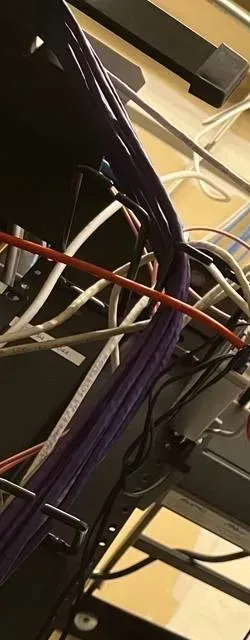
A photo from our job library, not taken in Norwood: bundles of purple, white and red cable falling down the side of a black rack. The cellar of a large Norwood elevator building rarely looks this tidy, but it holds the same idea, a single point where every apartment’s wire comes together, and that is where a buzzer search usually turns from guesswork into measurement.
Norwood Buzzer Repair Request
Tell us the building, the door and what happens when someone presses a button — we call back the same business day
✅
Request Sent!
We'll call about your Norwood building the same business day.
25+
Years Experience
✓
Same-Day Estimates
100%
Licensed & Insured
4.7★
390+ Google Reviews
Two photos usually tell us more than a long phone call: the street panel with its cover on, and the label or terminal strip inside the box in the cellar where the buzzer wires meet. With those, we arrive with the right strike, the right handset or the right power supply instead of a guess. Call (646) 490-0629 or use the form; it takes about a minute.
Norwood is priced on the Bronx list, with no neighbourhood surcharge for the drive north of Mosholu Parkway
Every repair is tested from the street door inward, so the apartment that was reported and the ones that were not are both checked before we leave
We work on the low-voltage side under licence #12000287431; if a transformer needs a new 120-volt feed, the written quote names it as an electrician’s job before anyone books
Norwood was laid out to be lived in at close quarters, and almost all of it still is. The streets in their present form were drawn in 1889 by Josiah Briggs across land between what is now Mosholu Parkway and Woodlawn Cemetery, much of it once the Varian family’s dairy farm, sixteen years after the West Bronx was annexed to New York City. The farm gave way to houses and then, between roughly the 1910s and the 1930s, to the five- and six-story apartment houses that define the neighbourhood today: Art Deco and Art Moderne buildings on East 204th Street near the parkway, Tudor Revival and neo-Renaissance facades on the side streets, long walk-ups on Bainbridge Avenue. NeighborhoodScout classifies 94.8 percent of Norwood’s residential real estate as apartment complexes or high-rise apartments, and puts 60.2 percent of it as built in 1939 or earlier. In plain terms, nearly every household here reaches its front door through a shared entrance, and most of those entrances are controlled by a buzzer system that is decades old.
The shape of the place adds a twist that most of the Bronx does not have. Mosholu Parkway cuts across the street grid at an angle, and Forgotten NY points out that this forces some streets to bend and meet in irregular intersections, which in turn pushed architects toward triangle-shaped buildings with rounded corners. A wedge-shaped building often puts its entrance on the curve, or gives the building two entrances on two streets, or tucks the panel on a flat stretch of wall some steps away from the door it is meant to open. Each of those layouts changes how a buzzer fails and how it should be repaired. A door on a corner catches wind from two directions and can drift short of its strike; a panel on a curved wall lets rain in behind a flat back plate; a second entrance on a side street often runs on a separate branch of wire that nobody has traced since it was added.
Who owns the building matters as much as how it is built. Montefiore has anchored the neighbourhood since 1913, and in 1981 the hospital founded the Mosholu Preservation Corporation, which started by renovating and stabilising five apartment buildings the health system had acquired and, by HUD’s account, owned 112 housing units by the summer of 2019. Its first rehab, The Lenru at 3388–3400 Wayne Avenue facing Williamsbridge Oval, was built in 1928 in the Jacobethan Revival style and became a co-op in 1991. Around those buildings sit rent-stabilised walk-ups such as 3265 Bainbridge Avenue, with 51 units on five floors, and 3225 Bainbridge Avenue, built in 1924 with 54 units on five stories. On Webster Avenue, newer buildings such as Norwood Terrace, with its supportive and low-income apartments and a senior building at 3600 Webster, and Norwood Garden Apartments at 3084 Webster, planned at about 116 units, use modern entry hardware on a very different wiring plan. A buzzer repair in Norwood can mean answering to a co-op board, a nonprofit housing company, a small family landlord or a property manager with a dozen buildings, often within a few blocks of each other.
The public record shows the demand. Augrented, a site that republishes HPD and 311 data building by building, lists open complaints in the category “General – Bell/Buzzer/Intercom” in 2026 at a 42-unit, six-story 1930 building on East 212th Street (two complaints opened June 5), at a building on Knox Place (opened April 12), at one on Hull Avenue (opened August 5) and at one on Parkside Place (opened August 12). Each entry names a single apartment, but in our experience a complaint from one door in a building of this age is often the first sign of a fault that sits in a riser shared by a whole line. In the high-rises on Webster Avenue the stakes are sharper still: News 12 has reported tenants at 3560 Webster, a 13-floor building where many older New Yorkers and residents with disabilities live, and at 3160 Webster, where a tenant who uses a wheelchair lives, left without elevators. When the elevator is out and the buzzer is dead, a visit from a relative or an aide becomes a problem nobody in the building can solve from upstairs.
Security pressure on doors here is real and recent. News 12 reported ten cars broken into overnight in a gated underground garage at 91 Van Cortlandt Avenue, where the intruder got in by breaking a window, and Norwood News has carried residents’ complaints that anyone can pull into the parking lot of a Webster Avenue building and use it as they please. In August the explosion and five-alarm fire at 374 East 209th Street, between Decatur Avenue and Parkside Place, took three lives and injured fourteen people by Norwood News’s count; Councilman Eric Dinowitz told CBS New York that “a lot of the buildings in the Bronx are older,” and the managing agent described padlocking apartments and the building’s front door after tenants reported belongings missing. None of that is a buzzer story on its own. Together it explains why, in a neighbourhood of older shared entrances, a street door that buzzes but does not latch is a worse fault than one that does not buzz at all.
That is the order we work in. We prove first that the door closes and locks on its own, then that the release lets it go when an apartment presses the button, then that voice reaches every apartment and returns to the street. Only then do we look at upgrades. Retrofit kits from Comelit, Aiphone and Akuvox can reuse a building’s existing two-wire and six-wire cable, which in a prewar walk-up with plaster halls is often the difference between a one-day job and opening every hallway wall. But a new panel on a door that drifts short of its strike is still an unlocked door, so the hardware comes first.
Norwood facts that shape a buzzer repair
94.8%: share of Norwood’s residential real estate classed as apartment complexes or high-rise apartments; 60.2% built in 1939 or earlier (NeighborhoodScout).
1889: the year Josiah Briggs laid out the present street grid between Mosholu Parkway and Woodlawn Cemetery, the grid whose angles produced Norwood’s triangle-shaped, round-cornered buildings (Wikipedia; Forgotten NY).
Four streets, four open complaints: Augrented lists 2026 “Bell/Buzzer/Intercom” complaints still open at buildings on Knox Place, East 212th Street, Hull Avenue and Parkside Place, each tied to one apartment.
1981: the year Montefiore founded the Mosholu Preservation Corporation, now headquartered with Norwood News in the 1889–90 Williamsbridge Reservoir Keeper’s House (MPC; LPC designation report).
13 floors: 3560 Webster Avenue, where News 12 found many older and disabled residents stranded when the elevators failed, one of several Webster Avenue buildings where a working buzzer decides whether a visitor can get in at all.
15.4% to 47.6%: the rise in broken entry door locks at NYCHA buildings in the Bronx between 2018 and 2022, according to the City Comptroller’s audit; it covers NYCHA, not Norwood’s private stock, but it shows how quickly Bronx entrance hardware wears when it is not maintained.
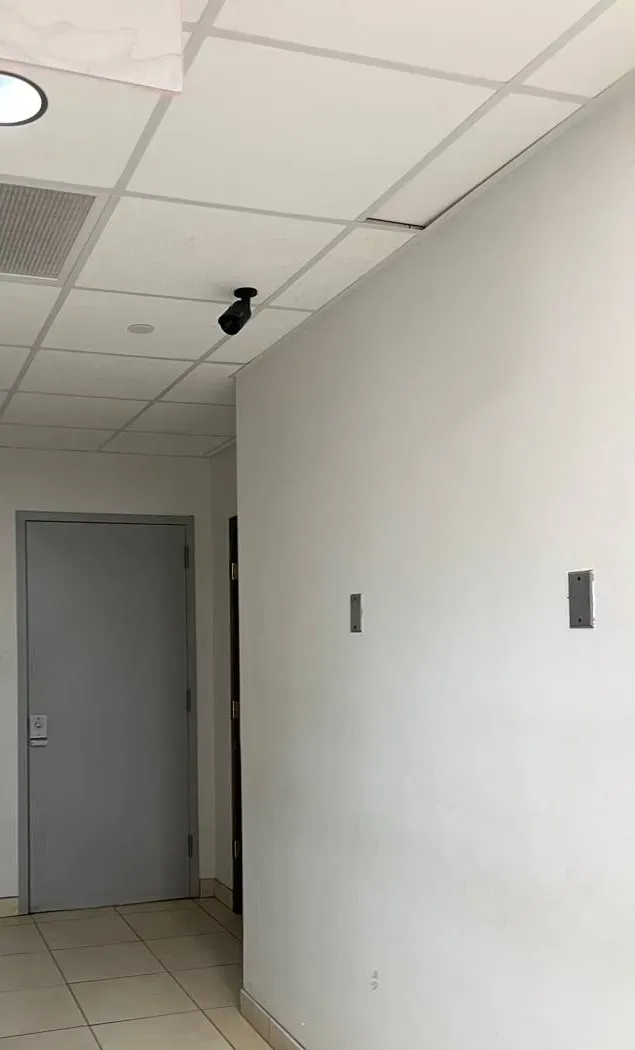
A photo from our job library, not taken in Norwood: a tiled corridor with small plates on white walls, ending at a grey steel door with a lever handle. Many Norwood walk-ups have a rear or cellar door like this one, and its strike is often wired on a separate branch from the front entrance, which is why we test every door a building actually uses, not just the one on the street.
Most Norwood entrance jobs grow by one item. Buildings that have just fixed a buzzer often go on to add fob readers at the side door or a camera over the vestibule, and owners who manage several buildings usually want the same release hardware in all of them so spares fit everywhere. We price each piece separately on the door buzzer repair price list so a board or an owner can approve the urgent part now and plan the rest.
Need Repair in Norwood? Same-Day Help for a Dead Street Door
The calls that cannot wait are the ones where the street door will not lock, or where nobody upstairs can let anyone in. Ring (646) 490-0629 for the next open arrival window. Most release faults in a Norwood walk-up, a stuck strike, a dead supply or a keeper that has slipped out of line, are found and fixed in one to two hours on site, and the door is left locking and closing before the technician leaves even when a part has to be ordered.
These are the nine repairs Norwood buildings ask us for most. Each card names where in the neighbourhood we tend to meet the problem and how we approach it, because a fault in a 1924 walk-up and a fault in a building that opened on Webster Avenue last decade are found in very different places.
🔑
Strike and Keeper Repair
The part that lets the door go when an apartment presses the button. On old wood and steel doors on Bainbridge and Decatur Avenues the keeper often sits a fraction too high after decades of frame movement; we realign, shim or replace it and check the latch engages every time the door swings shut.
🔌
Power Supply and Transformer
The box in the cellar that powers bells, voice and release. In prewar buildings it is often an old transformer on a board near the meters; we measure it under load, replace it with a correctly rated unit, and flag any new 120-volt feed as an electrician’s job.
📞
Apartment Station Replacement
Handsets that no longer ring, talk or release. We match the replacement to the system’s wire count and make, so one dead station in a 50-apartment walk-up does not turn into a whole-building replacement.
📉
Riser and Floor-Box Repair
Lines of apartments stacked one above another fail together when a splice in a hallway box corrodes or a riser is cut during plumbing work. We trace the line with a tone generator, repair the break and label the box with the apartments it serves.
🏢
Lobby Panel Repair
Stuck buttons, dead speakers and cracked directory windows on the street panel. On Art Deco and Art Moderne lobbies we work to keep the existing opening and finishes rather than cutting a new hole in original stone or metal.
🚪
Closer and Latch Adjustment
A buzzer is worthless if the door drifts shut without latching. We set closing and latching speed so the door closes on its own and locks behind each visitor, on doors facing the wind off Mosholu Parkway as well as sheltered vestibules.
📱
App and Keypad Panel Faults
Newer buildings on Webster Avenue and Van Cortlandt Avenue East use panels that call phones or take codes. We diagnose dead keypads, failed network links and locked admin accounts, and tell the manager what belongs to the panel maker’s support line.
🚗
Garage, Side and Rear Doors
Pedestrian doors into underground garages, side doors on wedge-shaped corner buildings and rear doors to parking lots. We repair their releases and help the building decide which of them should open from apartments at all.
📋
Complaint and Violation Repairs
Repairs aimed at an open HPD or 311 buzzer complaint, tested from the street door to the named apartment and written up on a findings sheet the owner can keep with the building’s records.
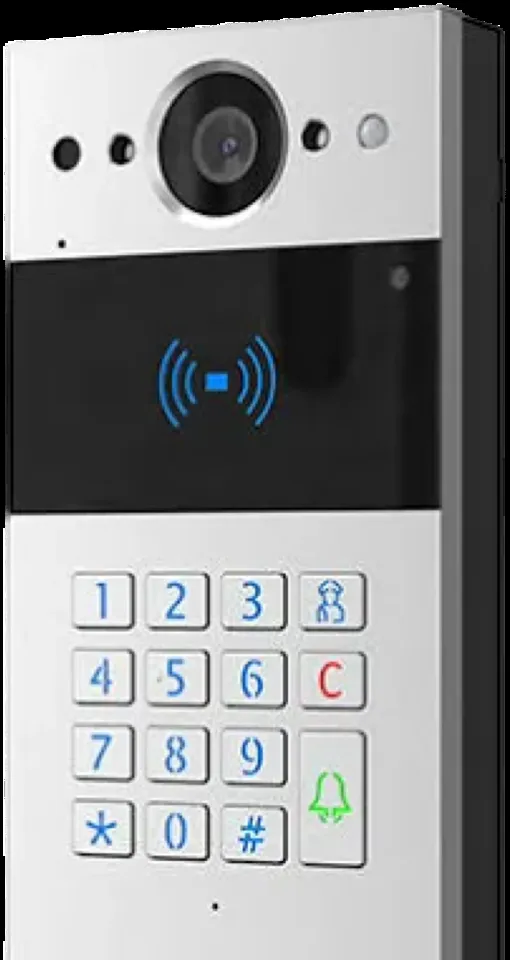
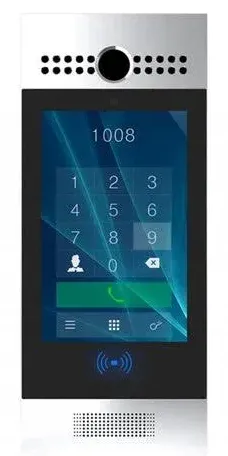
A photo from our job library, not taken in Norwood: a silver and black keypad door station with a camera lens, a card-reader symbol, a number pad and a green bell key. Stations of this kind are what Norwood’s newer Webster Avenue buildings tend to have at the street door, while most prewar walk-ups nearby still use a row of push buttons beside a speaker grille.
The Public Record
What the City’s Rules and Records Say About Norwood Entrances
Before we touch a Norwood panel, we read two kinds of document: what the city says an entrance must do, and what the city’s records already say about this particular building. Both shape the repair. The first tells us what a finished job has to achieve. The second tells us where the last person stopped.
What the minimum system has to do
The Department of Buildings rule at 1 RCNY §42-01 describes the minimum entry system for an apartment house in plain words: a bell or buzzer system, or a speaking and listening device, that lets the occupant of each apartment communicate by voice with a person outside the required main entrance door, and “a return buzzer mechanism to release or open the lock.” It also says where the system belongs. The bell and intercommunication system “shall be located at the required main entrance door so that a person may readily reach the door when the unlocking buzzer is activated.” That last phrase matters more in Norwood than in most neighbourhoods, because a wedge-shaped corner building sometimes has its panel on a flat wall some distance from the door it opens. A release that works perfectly is no use to a visitor who cannot reach the handle before the strike locks again.
The same rule text, in the excerpt we could read, says that buildings put up before January 1, 1968 and containing eight or more apartments shall be equipped with self-closing and self-locking doors and an intercommunication system. The excerpt was cut off, so we do not rely on it for the exact conditions. The New York Attorney General’s Tenants’ Rights Guide states the rule this way: multiple dwellings built after January 1, 1968 must have automatic self-closing and self-locking doors at every entrance, and those with eight or more apartments also need a two-way voice intercom with buzz-open; older multiple dwellings must have self-locking doors and a two-way intercom if a majority of the apartments request it, and the landlord may recover the cost. With six in ten Norwood homes built before 1940, the older half of that rule is the one most buildings here live under.
Why the door itself is the first test
HPD treats a defective self-closing door as a class C, immediately hazardous violation that must be corrected within 14 days of the owner receiving the notice, and it reinspects within 20 days of the correction date. A buzzer complaint and a self-closing door complaint often describe the same entrance from two sides: the visitor cannot get in, and residents cannot keep strangers out. One Bronx door hardware company describes the pattern it finds on site with unusual frankness: the closer has been dialled back until the door drifts shut without ever latching, or removed because tenants complained about the slam, or the strike gap has opened as the frame moved. We see all three in Norwood, especially on heavy original doors in Art Deco lobbies, and none of them is fixed by a new handset upstairs.
How to read a Norwood complaint entry
The Augrented entries for East 212th Street, Knox Place, Hull Avenue and Parkside Place all follow the same pattern: the category “General – Bell/Buzzer/Intercom,” a priority of “Non Emergency,” a status of “Open,” and an apartment number such as 1A, 66, 6A or 5L. The apartment number tells us whose door the caller stood behind, not where the fault lives. In a five-story walk-up with the risers running up through the hallway walls, apartment 6A might be the top of a line in which 2A through 5A have stopped noticing, or the only apartment on a branch that a contractor cut while working in that unit. The same pages show building-level context too: the Knox Place building lists 373 HPD violations against a Norwood average of 87.3, and the East 212th Street building 87 311 calls against an average of 116.9. Those numbers are not about the buzzer, but they tell a technician whether this is a building where repairs have been piling up or one where a single fault has slipped through.
One caution we give every owner and tenant: an aggregator copies the city’s data on its own schedule. Before an owner certifies a repair or a tenant files a follow-up, check the building’s own record on HPDONLINE, which is the version the city works from.
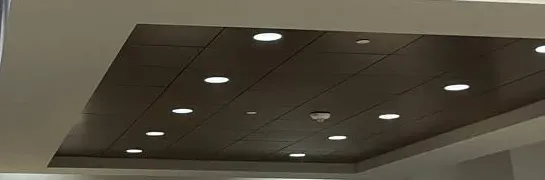
A photo from our job library, not taken in Norwood: a dark recessed ceiling panel with round downlights and a small round device, framed by a lighter ceiling. Lobbies in Norwood’s 1920s and 1930s buildings often have decorative ceilings of a different kind, and the cable from the street panel to the cellar has to find a route that leaves those finishes alone.
Document
What it says
What it means for a Norwood repair
1 RCNY §42-01 (DOB)
Bell or voice system between each apartment and the main entrance, return buzzer to release the lock, located so a person can readily reach the door
The repair is finished only when voice and release both work from every apartment and the visitor can reach the door in time
AG Tenants’ Rights Guide
Post-1968 buildings: self-closing, self-locking doors; 8+ apartments also need a two-way intercom with buzz-open. Older buildings: self-locking doors, and an intercom if a majority request it
Most Norwood buildings fall under the older rule; many have intercoms already and must keep them working
HPD self-closing doors page
Defective self-closing door is class C, correct within 14 days, reinspection within 20 days of correction
We test closing and latching on every visit, not just the electronics
Augrented (HPD and 311 data)
Open 2026 “Bell/Buzzer/Intercom” complaints on four Norwood streets, each tied to one apartment
The named apartment is the starting clue; the whole line gets tested
Building Specialists
Door Buzzer Repair for Norwood’s Architecture
City Neighborhoods describes Norwood as five- and six-story prewar apartment houses, brick rowhomes and tree-lined side streets, much of it dating from the 1910s to the 1930s. Add the newer Webster Avenue buildings and a small number of houses, and you have six kinds of entrance. Each one routes buzzer wire differently, fails differently and needs a different first question from the technician.
Five-Story Walk-Ups
The long walk-ups of Bainbridge and Decatur Avenues, many with more than fifty apartments. Wire usually runs from a cellar terminal board up several risers to junction boxes in the public halls. When one floor or one line goes quiet, the fault is most often in one of those boxes, at a splice that has been opened and re-twisted more than once.
Six-Story Elevator Buildings
Prewar elevator buildings near Mosholu Parkway and on the side streets toward Gun Hill Road. Risers are longer, the voice has further to travel to the top floors, and the cellar power supply often sits far from the lobby. We measure voltage at the panel, at the supply and at the top floor before deciding what to replace.
Wedge and Corner Buildings
The triangle-shaped, round-cornered buildings that the Mosholu Parkway grid produced. Entrances on curves, panels mounted on angled or curved walls, and sometimes two entrances on two streets. We check that the panel is within easy reach of the door it opens and that every entrance in use is on the system.
Co-op Buildings
Prewar co-ops such as The Lenru on Wayne Avenue, where a board or a managing agent approves the work. Apartment stations may be partly the shareholder’s and partly the corporation’s, so we write findings apartment by apartment and leave the board a sheet it can file.
Newer Webster Avenue Buildings
Mid-rise and supportive-housing buildings on Webster Avenue and the planned 152-unit Mosholu Grand on Van Cortlandt Avenue East. These use networked panels, electric strikes or magnetic locks, and often a staffed desk. Faults are as likely to be in the network or the admin account as in the wire.
Houses and Small Multifamilies
Norwood has a few single-family houses and some multifamily homes near Montefiore. Here the buzzer is usually a doorbell transformer, a button and a strike on the front door, sometimes with a video doorbell added. We repair them on the same list and the same standard as the apartment houses.
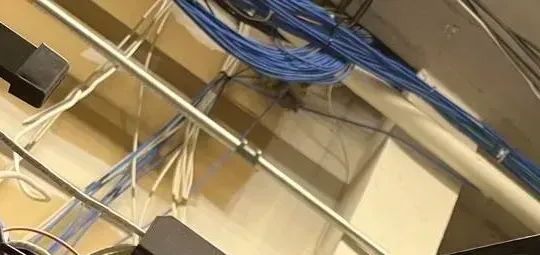
A photo from our job library, not taken in Norwood: bundles of blue low-voltage cable laid over a ceiling beam and a metal pipe in an open ceiling. In a Norwood walk-up cellar the buzzer cable crosses joists and pipes in much the same way, and every place it rests on a pipe is a place where a plumber’s repair can nick or crush it.
What each building type means for the search
Building
Where the fault usually hides
How we approach it
Five-story walk-up
Hallway junction boxes and riser splices; shorted handsets on a shared talk line
Tone-trace each riser from the cellar board, open boxes floor by floor, replace twisted splices with proper connectors, label each box
Prewar elevator building
Voltage drop over long risers; tired cellar supply; strike on a heavy original door
Measure at supply, panel and top floor under load; size the supply and strike for the run
Wedge or corner building
Second entrance on its own branch; panel too far from the door; water behind a panel on a curved wall
Map every entrance in use, check reach from panel to handle, seal or re-plate the mounting
Co-op
Mixed generations of handsets; shareholder-installed stations
Apartment-by-apartment findings, written for the board’s file
Newer Webster Avenue building
Network link, admin account, maglock power or desk release
Test panel, network and lock separately; coordinate with the panel maker where their support is required
Measure the transformer, test the button and strike, repair without opening finished walls where possible
Plaster, terrazzo and original doors
Norwood’s prewar halls are mostly plaster over masonry or lath, and many lobbies still have their original terrazzo floors, decorative plaster and heavy wood or metal entrance doors. That rules out the quick fixes some contractors reach for. We do not surface-staple new cable across a hall and call it done; where an existing route can be reused, we pull new wire through it, and where it cannot, we look for a closet, a pipe chase or a disused shaft before proposing raceway. Where raceway is the only sensible route, it is the paintable kind that follows a corner or a baseboard. On original doors, a worn strike is replaced in the existing pocket whenever its size allows, so the frame is not cut twice in one century.
Old cellars and newer basements
The cellar is where most Norwood buzzer searches end. Prewar buildings often have the transformer on a wooden board near the meters, a terminal strip that has been relabelled in pencil by three different supers, and a bundle of abandoned cable from a system nobody remembers. Newer buildings on Webster Avenue usually keep their entry equipment in a locked room with the network switch and the camera recorder. Either way, we ask the super or manager to meet us with the keys to the room, the meter area and any hallway closets, because half an hour spent waiting for a key is half an hour not spent finding the fault.
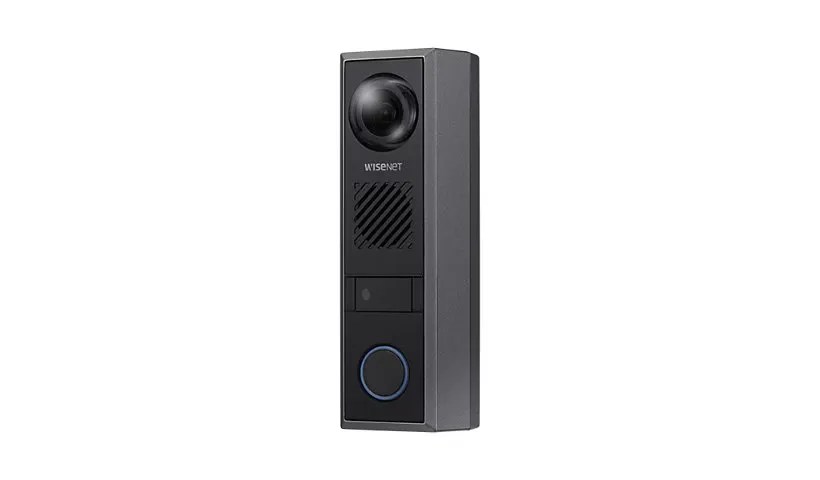
A photo from our job library, not taken in Norwood: a slim dark grey wired doorbell with a camera lens, speaker slots and a round button. On Norwood’s few houses and small multifamily homes, a unit like this often replaces an old push button, and it only works as long as the doorbell transformer in the cellar is sized to run it.
Commercial Door Buzzer Repair
Business Door Buzzer Repair in Norwood
Wikipedia names Gun Hill Road, Jerome Avenue, Webster Avenue and Bainbridge Avenue as Norwood’s main commercial arteries. The city’s Small Business Services needs assessment describes a 1.5-mile corridor running from the Williamsbridge Oval down Bainbridge Avenue, through East 204th Street and west along Webster Avenue toward Fordham Road. Most of the businesses on those streets sit on the ground floor of a building with apartments above, which means the shop door and the residents’ door share a facade, sometimes a cellar and occasionally a wire.
Bainbridge Avenue and East 204th Street
The heart of the corridor, where Norwood News has chronicled long-running businesses such as the 36-year-old Hillside Meat Market and the closing of McDwyer’s Pub at 331 East 204th Street after 50 years, and where a five-alarm fire in October 2009 destroyed a bakery, a fish store, a butcher, a dental clinic and other shops. Rebuilt and older storefronts sit side by side under apartments, and residents’ doors here often share a cellar with the shops.
Jerome Avenue and Gun Hill Road
The Jerome-Gun Hill Business Improvement District runs along Jerome Avenue between Mosholu Parkway and East Gun Hill Road and along Gun Hill Road between Jerome and Webster. Shops with offices and apartments above need a residents’ door that locks no matter what the store’s hours are, and a rear or side door that only staff can release.
Webster Avenue
The corridor the Webster Avenue Vision Plan rezoned, with newer mixed-use and supportive-housing buildings rising beside older garages and storefronts. Commercial and community spaces on the ground floor of new buildings need their own entry rules, separate from the residential panel.
Medical and Professional Offices near Montefiore
Offices in the blocks around the Moses campus of Montefiore Medical Center use buzzers to admit patients and visitors while keeping back corridors locked. The release button at reception and the strike on the street door take heavy daily use and wear accordingly.
Community, Cultural and Nonprofit Spaces
Nonprofit offices, community rooms and cultural sites such as the Museum of Bronx History in the Valentine-Varian House. Entrances with staff on duty during set hours often need a release that staff can trigger from inside and a door that relocks the moment they stop.
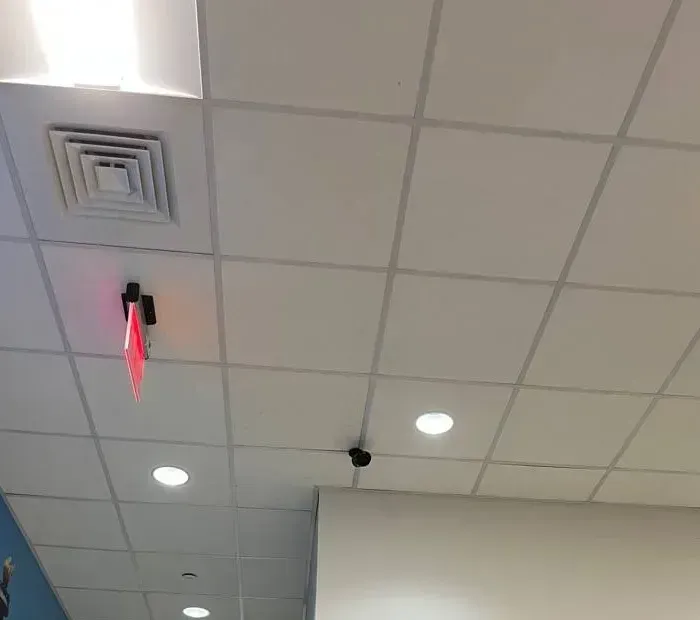
A photo from our job library, not taken in Norwood: a drop ceiling with a lit red exit sign, an air diffuser, recessed lights and a small black camera. Offices and shops along Jerome Avenue and Webster Avenue have exit signs over doors like this, and any electric lock on an exit path has to let people out without a buzz, a key or a code.
Compliance notes for business entrances
Residents’ door rules still apply in mixed-use buildings. The apartments above a shop are covered by the same entrance requirements as any other multiple dwelling: a door that closes and locks on its own, and the entry system described in 1 RCNY §42-01 where the building is required to have one.
Magnetic locks need sensor release and egress conditions. Building codes allow electrically locked egress doors only under conditions that include a sensor that unlocks the door as someone approaches from inside and a manual release; a maglock fitted to a shop or office door without them is a code problem, not just a buzzer problem.
Fail-safe and fail-secure behave differently in a power cut. Allegion explains that a fail-safe lock unlocks when power is lost and a fail-secure lock stays locked; with a typical electric strike, people can still exit with the lever. Which one belongs on a door depends on whether it is an exit path, a residents’ door or a stockroom.
Reach range for the call panel. The 2010 ADA Standards set a maximum high forward reach of 48 inches; we keep public call buttons at businesses within that range when a panel is replaced or remounted.
Line-voltage work is an electrician’s job. The Department of Buildings requires a licensed electrician and a permit for electrical work; we work on the low-voltage side and write any 120-volt feed for a new transformer or power supply into the quote as a separate item for an electrician.
Doors in the egress path are never chained or blocked. A door that cannot be secured properly tonight is made to close and lock with its existing hardware or a temporary fix, not padlocked or chained across an exit while people are inside.
Store hours and residents’ hours
The most common commercial fault we meet on Norwood’s streets is not electrical. A shop keeps the shared street door propped or on a hold-open during business hours so deliveries can come and go, the latch is left retracted overnight by mistake, and the apartments above go unsecured until somebody notices. The repair is usually a combination: a separate release for the shop’s own door, a residents’ door that cannot be held open by the shop’s staff, and a closer set so the door latches without help. Where the shop and the apartments genuinely share one door, we set it up so the store can admit its deliveries without leaving the building open, and we write down who controls what.
Your Questions Answered
Door Buzzer Repair in Norwood: Questions Answered
These are the questions that come out of Norwood’s particular streets, buildings and owners. Each is answered in full here; the shorter practical questions are in the FAQ further down.
Corner lots and Mosholu Parkway angles
On our corner building the call panel sits around the curve from the door it unlocks, and visitors miss the buzz while they walk over. Is the panel in the wrong place?
Very possibly, and the city’s own rule supports moving it. 1 RCNY §42-01 says the bell and intercom system must be located at the main entrance door so a person can readily reach the door when the unlocking buzzer sounds. On a wedge-shaped Norwood building, the panel was often mounted on the nearest flat stretch of wall rather than beside the door, because a flat panel does not sit well on a curve. The usual fixes are to remount the panel on a short flat section closer to the handle, to fit an angled or curved mounting plate so it can sit right beside the door, or, where neither works, to lengthen the time the strike stays released so the walk fits inside it. Lengthening the release is the least good of the three, because it leaves the door open longer for anyone else nearby, so we look at moving the panel first.
Our entrance is on a rounded corner, so any panel has to sit on a curved wall. Can a flat panel be mounted there and stay watertight?
Yes, but not by screwing a flat back box straight onto a curve, which leaves gaps at both edges where rain runs in and the panel rocks every time someone presses a button. The sound method is a mounting plate shaped to the curve on its back and flat on its face, sealed to the masonry around its edge, with the panel mounted to the plate. On stone or brick we drill into mortar joints wherever the plate allows, and the cable enters from behind through a sealed hole rather than along the surface. If the corner is curved glass or decorative metal, we look for a flat pier or a door frame instead. We also check that the new position still meets the readily-reach test, since moving a panel to the only flat spot on a corner can push it away from the door.
Our wedge-shaped building has entrances on two streets, and the board wants to close one. What happens to that entrance’s panel and wiring?
First, the board should find out whether that door is a required exit. Closing an entrance to visitors is one thing; blocking an exit residents may need in a fire is another, and the second is not a buzzer decision. If the door stays as an exit, it keeps its exit hardware and its closer, the outside handle or panel comes off, and the door becomes exit-only and locked from the street. We then disconnect its panel at the cellar board, remove or cap the branch of wire that fed it so a short there cannot affect the main entrance, patch the opening, and update the directory and the findings sheet so the next technician knows that entrance is retired. If the door is not a required exit and the board wants it sealed, that is building work that needs an architect or the Department of Buildings, and we hand it over with a note of what we disconnected.
The wire already in prewar walls
The label in our cellar junction box says the system is six-wire. What does the wire count tell you about which replacement handsets will work?
A great deal. Older apartment intercoms come in families that use a fixed number of conductors between the panel, the supply and each apartment: a two-wire system carries power, voice and call signals on one pair, while three-, four-, five- and six-wire systems split them across more conductors. A replacement handset has to belong to the same family, or to a retrofit line built to run on that family’s wiring. That is why the photo of the label or terminal strip matters so much. With it, we can bring a station that will work the first time instead of a universal one that might not. It also tells us which retrofit kits are realistic if the building later wants a new panel, since the Comelit, Aiphone and Akuvox retrofit lines we use are designed to reuse legacy two-wire and six-wire cable without opening walls.
Our 1920s building still has a sealed dumbwaiter shaft. Can new intercom cable use it instead of the hallway walls?
Often it can, and in a prewar Norwood building it is one of the best routes available, because it runs straight up through every floor without touching plaster. But a sealed shaft has to stay sealed. Many of these shafts were closed off precisely so they would not carry smoke between floors, and any hole we make into or out of one is firestopped afterwards. In older buildings that are not fireproof construction, the point Councilman Dinowitz made after the East 209th Street fire, we take extra care with every penetration through wood framing and use cable rated for running between floors. Before using a shaft we confirm what else is in it, since some carry gas or water lines, and we keep the intercom cable clear of anything hot or wet. If the shaft is part of a renovation the owner has planned, it may be better to wait and run the cable while it is open.
Our Art Deco lobby has decorative plaster and terrazzo. Where can a new cable from the panel to the cellar go without cutting the original finishes?
Usually through the route the original installer used, which is almost always still there. In Norwood’s 1920s and 1930s lobbies the first buzzer cable typically dropped from the panel through the wall to the cellar directly below the entrance, or ran inside the door frame or a pilaster. If that route is intact we pull the new cable through it using the old one as a guide. If the old cable is stuck in plaster or corroded in place, we look for a nearby closet, a mail-room wall, a radiator riser chase or the cellar ceiling directly below, and only then consider a short run of paintable raceway along a baseboard or a corner. We do not chase new grooves into decorative plaster or core through terrazzo for a buzzer cable. If no route avoids the finishes, the written quote says so before anyone decides.
A replacement strike our super put in gets hot after a few buzzes and then sticks. Did he buy the wrong part?
Probably, or he bought the right strike and set it wrong. Electric strikes are made for a particular voltage, for AC or DC power, and for either intermittent or continuous duty. A strike rated for 12 volts on a 24-volt supply runs hot and wears out quickly, and a strike made for short pulses will overheat if the building’s release holds it energised for several seconds or longer. Some strikes have a selector for voltage or for fail-safe and fail-secure operation that has to be set during installation. We read the label on the strike, measure what the supply actually delivers and how long the release holds, and either reset the strike, replace it with one that matches, or change the supply. Until it is sorted out, a hot strike should not be left in service, because it can fail with the door locked or unlocked.
Reading the complaint record
HPD’s complaint list for our building calls the buzzer problem “non-emergency.” Does that mean the owner can take their time?
No. The Augrented entries for Norwood buildings show buzzer complaints logged as “General – Bell/Buzzer/Intercom” with a priority of “Non Emergency,” and that label describes how HPD sorts the complaint for inspection, not whether the owner has a duty to repair. A complaint is a tenant’s report; an inspector who confirms the fault can issue a violation, and an owner who has had a violation written then has a deadline to correct and certify it. Separately, a street door that does not close and lock on its own is treated by HPD as an immediately hazardous class C condition with a 14-day correction period, so a buzzer complaint that comes with a door that will not latch is not a slow matter at all. For an owner, the practical reading is simple: a complaint on the record is the cheapest moment to repair, before an inspection adds paperwork.
Co-ops, hospitals and garages
We are buying shares in a prewar Norwood co-op. What should we ask the board about the front-door system before closing?
With basic two-bedrooms in prewar Norwood co-ops listed under $200,000, buyers here are often first-time owners, and the entrance is a cost you share from the day you move in. Ask the board or managing agent four things: when the entry system was last repaired or replaced and by whom; whether there are open HPD or 311 complaints about the intercom or the self-closing door, which you can also look up yourself; whether the corporation or the shareholder is responsible for the station inside your apartment; and whether the board has budgeted for the entrance or plans an assessment for it. If the answers are vague, ask to see the most recent repair sheet. A system that works but has never been documented is not a crisis, but it is worth knowing before closing, and it is the kind of thing a board can fix cheaply with one tested, written-up visit.
Paramedics called to my upstairs neighbour waited at the locked street door because the buzzer was dead. What should a building do about emergency access while the release is broken?
Treat it as the reason the repair is urgent, not just inconvenient. In a building with older residents, as so many near Montefiore and on Webster Avenue are, a dead release means a 911 call depends on somebody being able to get downstairs. Until the repair is done, the building should post a clear notice telling residents that the buzzer is out and asking them to arrange for someone to meet emergency responders and visitors at the door, and the super or manager should be reachable by phone. What the building should not do is wedge or tape the street door open, which trades one danger for another. When we arrive for this kind of call, the first job is to get the release working or, if a part is needed, to leave the door locking properly with a working key and a clear plan for the return visit.
After cars were broken into in a gated garage nearby, our board asked whether the door from our garage into the lobby should open from apartments at all. What do you recommend?
In most buildings, no. The News 12 report from 91 Van Cortlandt Avenue described an intruder who got into a gated underground garage by breaking a window, which is a reminder that a garage is the part of a building where people least expect strangers. A garage-to-lobby door that any apartment can buzz open lets anyone who gets into the garage, by a broken window or a car tailgating through the gate, ask a random apartment to let them into the building. We usually recommend that the garage door open only with a resident’s key or fob and never from the apartment release, that the door close and latch on its own, and that the vehicle gate and the pedestrian door be on separate controls. Visitors should use the main entrance where the panel is. If the board wants the garage door on the intercom for deliveries or aides, it can be limited, but that is a decision to make on paper with the board, not by default.
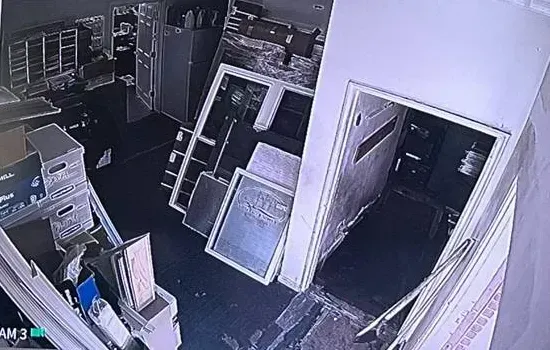
A photo from our job library, not taken in Norwood: a black-and-white night camera view of a cluttered room with an open doorway into a dark back room. Garages, cellars and rear passages in Norwood buildings look much like this after dark, and a door from one of those spaces into the lobby needs to lock on its own whatever the buzzer is doing.
Equipment
Types of Door Buzzer Systems We Repair
One Bronx intercom company sums up the borough’s older buildings well: they may have older hardwired buzzer systems, newer telephone entry panels, video intercoms, electric strikes, magnetic locks, or a mix of older and newer hardware. Norwood is a textbook case. These are the categories of equipment we repair here, with the Norwood situations where each tends to turn up.
Push-Button Audio Panels
A row of buttons, a speaker grille and a directory window, wired back to a cellar supply. Still the most common street panel on Bainbridge, Decatur, Hull and Parkside. Buttons, speakers and directory windows can often be serviced without replacing the panel.
Apartment Handsets and Stations
Wall handsets with a call buzzer, a talk path and a door button. Norwood buildings often have three generations on one system; replacements are matched to the wire family so they work alongside the old ones.
Electric Strikes
Fail-secure strikes on most residents’ doors, so the door stays locked in a power cut but people can still leave by the lever. Matched by voltage, duty cycle and the door’s latch.
Magnetic Locks
Found on some newer buildings and office doors. They need sensor release, a manual release and correct power to be lawful and reliable; we repair them only within those conditions.
Transformers and Power Supplies
Old bell transformers on cellar boards and newer regulated supplies with battery backup. Under-sized or tired supplies are behind many faint voices and weak releases in Norwood’s long walk-ups.
Keypad and Telephone Entry Panels
Panels where visitors dial a code that calls an apartment or a phone. Common in buildings renovated in the 1990s and 2000s; keypads, directories and phone links each fail in their own ways.
App and Video Panels
Networked panels in Norwood’s newer buildings that call residents’ phones and record visitors. Faults split between hardware, the building network and the cloud account.
Door Closers
Not electronics, but half of every buzzer job. Closing and latching speed are set so the door closes on its own and locks behind each visitor.
Recorders Behind Video Panels
Some video panels record to a recorder in the cellar or a closet. When the picture or the recording fails, we check whether the fault is the panel, the cable or the recorder.
A photo from our job library, not taken in Norwood: a touchscreen entry panel showing a dial pad with a four-digit apartment code, a camera above and a card-reader symbol below. Panels like this suit Norwood’s newer Webster Avenue buildings, where each apartment is reached by code rather than by a button with its own wire.
The lobby directory in our prewar building on Bainbridge Avenue still shows names of tenants who moved out years ago, and newer residents want only apartment numbers listed. Can the directory be updated during a repair visit, and does that differ between a printed card panel and a programmed keypad?
People sometimes ask whether a national security brand could solve a building’s buzzer problem instead. The honest answer is that the big names do different jobs. Ring’s best-known products are video doorbells for a single front door; they do not replace the stations in fifty apartments or the strike on a shared street door. ADT and SimpliSafe are known for monitored alarm systems sold to individual homes and businesses. None of that is a criticism; it is simply not the same work as tracing a dead riser in a 1924 walk-up.
Need in a Norwood building
Consumer video doorbell (e.g. Ring)
Monitored alarm brand (e.g. ADT, SimpliSafe)
Abstract Enterprises Security Systems buzzer repair
Voice from street to every apartment
One door, one household
Not the product’s purpose
Repaired and tested apartment by apartment
Release the shared street door
Not on its own
Not the product’s purpose
Strike, supply and wiring repaired together
Door closes and latches
No
No
Closer and latch checked on every visit
Works on existing 2-wire or 6-wire cable
Needs its own power and Wi-Fi
Usually its own devices
Matched to the building’s wire family
Findings for a board, owner or HPD file
No
No
One-page sheet left with the building
AI Overview Reality Check
What AI Gets Wrong About Door Buzzer Repair in Norwood
Google’s AI Overview could not be viewed from the system this page was built on, so nothing below is presented as its wording. Instead we took seven claims that appear in cost guides and vendor pages, the kind of material an AI summary tends to repeat, and checked each one against Norwood’s buildings and the sources listed at the bottom of this page.
Claim one: “Minor intercom repairs typically run $150 to $400”
The figure comes from Swiftlane, an entry-system company, in a guide to apartment intercom costs. As a national range for a simple, quickly found fault, it is a reasonable sketch, and some Norwood jobs are exactly that: a stuck button, a loose keeper, one dead handset.
The trouble is the word “minor.” Whether a repair is minor is only known after the fault is found. In a five-story walk-up with more than fifty apartments, a single silent apartment can turn out to be a handset, a splice in a hallway box, a cut riser or a failing supply, and those are very different jobs. A national range cannot tell which one your building has.
So we price the test, then the repair. The written figure follows the search, names the failed part and is approved before anything is installed. That is slower to quote over the phone and much cheaper to live with.
Claim two: “NYC’s intercom rule only applies to buildings built after 1968”
ButterflyMX’s summary says the rule “generally applies to Class A multiple dwellings with eight or more units built or converted after January 1, 1968,” and adds that older buildings “require closer review.” Shortened by a summary, the second half often disappears.
The Attorney General’s Tenants’ Rights Guide says older multiple dwellings must have self-locking doors and must have a two-way intercom if a majority of the apartments request one, with the landlord able to recover the cost. The DOB rule text we could read also addresses pre-1968 buildings with eight or more apartments, though the excerpt was cut off before its conditions.
In a neighbourhood where 60.2 percent of homes were built in 1939 or earlier, that missing half is most of the housing. And a building that already has an intercom does not get to let it rot because of when the bricks went up.
Claim three: “The national average to install an intercom is about $2,500”
HomeAdvisor publishes that average for installing an intercom system. It is a figure for new installation, often in houses, and it turns up in answers to repair questions because the words overlap.
A Norwood repair usually starts from a system that already exists: cable in the risers, stations in the apartments, a panel in the lobby. Most of the money in an installation goes into putting those in place. A repair spends money on finding the one section that failed and replacing it.
Using an installation average to judge a repair quote makes a fair repair look cheap and an unnecessary replacement look normal. Ask what failed and why replacing more than that part is needed.
Claim four: “A modern call box requires no building wiring”
ButterflyMX describes its intercom as one that “requires no building wiring,” meaning no cable to each apartment, because residents answer on their phones. For a new building, that can be a genuine advantage.
The panel still needs power, and the door still needs a strike or a lock wired to a release. In Norwood repairs, the wire to the strike and the supply behind it are exactly the parts that fail most often. A wireless-to-the-apartments panel removes the risers from the picture, not the door.
It also removes the apartment stations, which matters to residents without smartphones or with phones that change often. In a building with many older residents, that is a choice the owner should make deliberately.
Claim five: “Software for a modern intercom costs only $5 to $15 per unit per month”
Swiftlane gives that range for intercom software. Per apartment it sounds small, and for a newer building with a management company already paying for software, it may be.
Multiply it across a 54-unit walk-up on Bainbridge Avenue, every month, indefinitely, and it is a real line in the building’s budget. For a prewar co-op where shares sell for under $200,000, a recurring cost like that can outweigh the price of repairing the existing wired system.
We repair both kinds of system. When a board or owner is choosing between them, we lay out the one-time and recurring costs side by side so the choice is made on numbers, not on a sales page.
Claim six: “If the buzzer works, the entrance is secure”
Many troubleshooting guides end when the door buzzes. If the strike releases, the job is called done.
A Bronx door hardware company describes what it finds on site: closers dialled back until the door drifts shut without latching, closers removed because of the slam, strike gaps opened as frames moved. HPD treats a defective self-closing door as an immediately hazardous class C violation with a 14-day correction period. A buzzer that works on a door that does not latch secures nothing.
On every Norwood visit we let the door close by itself several times and watch it latch, before and after the repair. It takes two minutes and it is the test that actually matters to the people inside.
Claim seven: “Swapping a worn strike for a magnetic lock is a simple upgrade”
Magnetic locks are sold as tougher and simpler than strikes, and online answers often suggest them as a drop-in replacement for a strike that keeps failing.
They are not drop-in. Codes allow electrically locked egress doors only with conditions such as a sensor that releases the door as someone approaches from inside and a manual release. A maglock is also fail-safe by nature, unlocking when power is lost, while Allegion notes that a fail-secure strike stays locked yet still lets people leave by the lever. The two behave in opposite ways in a power cut.
On most Norwood residents’ doors, a correctly rated fail-secure strike is the right part. Where a maglock is already installed, we repair it within its required conditions rather than adding more of them.
Door Locking Behind Every Visitor, Every Apartment Answering
Send a photo of the street panel and one of the cellar box label, with the address and the apartments that are affected. We will tell you where the fault is likely to be and what the visit will involve before anyone comes out.
Webster Avenue Towers, New Mid-Rises and the Tenants Who Rely on the Buzzer Most
Most of Norwood is a prewar neighborhood. 60.2% of the residential real estate here was built in 1939 or earlier, and the five- and six-story apartment houses on Bainbridge, Hull, Decatur and the side streets near Mosholu Parkway set the tone for most buzzer work in the 10467 ZIP code. Webster Avenue is the exception. It has taller elevator buildings, newer mid-rises with modern entry hardware, and blocks of supportive and senior housing. On Webster, a working buzzer is more than a convenience. For many tenants it is how they get their groceries, their medication, their home aide and their family through the door.
The difference between Webster and the walk-up blocks is less about the equipment than about who is upstairs pressing the button. A broken buzzer in a five-story walk-up is a nuisance. A tenant goes down, opens the door, and climbs back up. In a 13-story building where many residents are older New Yorkers or people with disabilities, that trip may not be possible. Our repair priorities on Webster Avenue are built around that fact.
When the elevator is out, the buzzer is the only door
Norwood residents have seen this happen. 3560 Webster Avenue has 13 floors, and local news coverage has noted that many of the people living on those floors are older New Yorkers and residents with disabilities. Tenants there have been stuck without elevators. Further south, 3160 Webster Avenue has multiple elderly and disabled tenants, including a woman who uses a wheelchair, and it has also gone without elevator service. For a tenant on a high floor during an outage, the stairs are not an option. The apartment handset and the release button become the only way to let anyone into the building.
That is why we treat a dead buzzer in these buildings differently from a cosmetic fault. When we diagnose a Webster Avenue system, we test it from the apartments that depend on it most: the upper floors, the units farthest from the riser, and the apartments we know house tenants with limited mobility. A system that works from the second floor but not the twelfth is not fixed. We check that the call reaches the handset, that the voice path is clear in both directions, and that pressing release actually frees the lock at the street door.
The city’s own rule for older multiple dwellings explains why that last check matters. 1 RCNY 42-01 describes the minimum system as a bell or buzzer system, or a speaking and listening device, that lets the occupant of each apartment communicate by voice with a person outside the required main entrance door, together with a return buzzer mechanism to release or open the lock. The same rule says the bell and intercommunication system must be located at the main entrance door so that a person can readily reach the door when the unlocking buzzer is activated. The rule cares about the visitor as well as the tenant. A panel mounted too far from the door, or a release that fires for only a moment, can leave an aide fumbling at a locked door while the tenant upstairs has no way to try again quickly. For a tenant who cannot come down, a properly placed panel and a lock release that lasts long enough to get through are essential parts of the repair.
Supportive and senior housing on Webster
Webster Avenue also has a concentration of affordable and supportive buildings. Norwood Terrace is a completed development with 58 supportive housing units and 57 units for low-income individuals and families. One of its buildings, 3600 Webster Avenue, offers apartments for low-income seniors. In buildings like these, the entry system does two jobs. It has to keep the street door secure, and it has to let a steady flow of caseworkers, home attendants, medical visitors and deliveries reach residents without anyone having to make the trip downstairs.
When an entry system fails in a building like this, staff and residents often fall back on propping the door so visitors can get in. That defeats the whole point of the system. The fastest way to stop the propping is to restore the call-and-release function quickly, so we focus first on getting every apartment able to admit a visitor again. Longer-term upgrades can be scheduled after that.
New construction brings different equipment
Some of the newest buildings in the neighborhood are rising along the same stretch. Norwood Garden Apartments at 3084 Webster Avenue is planned at approximately 116 residential units and sits in the R7-D zone created as part of the Webster Avenue Vision Plan. A few blocks away, Mosholu Grand at 150 Van Cortlandt Avenue East was planned as a 152-unit apartment building on the site of a former auto repair shop and gas station. These newer mid-rises are going up with modern entry systems, not the hardwired apartment-by-apartment buzzers found in a 1924 walk-up.
That changes the repair. In an older Bainbridge Avenue building, the problem is usually decades-old riser wire, a worn door strike or a tired transformer. In a newer Webster building, the fault is more likely in a telephone entry panel, a video intercom, an electric strike or a magnetic lock, or in the way those pieces were tied together during construction. Older Bronx buildings can carry a mix of all of these: older hardwired buzzer systems alongside newer telephone entry panels, video intercoms, electric strikes and magnetic locks. Norwood’s housing stock spans nearly a century, from the 1910s apartment houses to buildings still under construction, so a technician who only knows one generation of equipment will struggle here. We come prepared for both.
The newer buildings also show why a single fix rarely fits every case. A magnetic lock and an electric strike fail in different ways, and they behave differently when power drops. A video panel can fail at the camera, the display, the network or the door release. A good diagnosis starts by finding which link in that chain has broken before replacing anything.
Houses and small multifamily buildings
Norwood is mostly apartments and condos, and 94.8% of the real estate here is classified as apartment complexes or high-rise apartments. There are also a few single-family houses and some multifamily homes, and prices vary widely. Basic two-bedroom units in prewar co-ops have listed for under $200,000, while a multifamily home near Montefiore can reach $800,000. For a single-family house, the job is usually a doorbell or video doorbell rather than an intercom. For a small multifamily owner near the hospital, it may be a modest buzzer setup serving a handful of units. We handle both, and we will tell you plainly when a house needs a simple doorbell repair rather than an intercom system.
What this means when you call us about a Webster building
If you manage or live in one of the taller or newer Webster Avenue buildings, tell us when you call whether the elevator is working, and whether any tenants cannot use the stairs. That changes what we fix first. With the elevator out, getting the release working for the upper floors comes before anything cosmetic. If the building is new and still has installer documentation, have it ready, because it speeds up tracing how the panel, the lock and the power supply were connected. If it is an older elevator building with original wiring, we will check whether the existing cable can carry a repair or a retrofit before recommending anything that requires opening walls in occupied apartments.
A photo from our job library, not taken in Norwood. In Webster Avenue’s taller and newer buildings, the entry system is tested from the upper floors and the farthest apartments first, because those are the tenants who depend on it most.
Closers, Strikes and Emergency Lockdowns: Keeping Norwood’s Street Doors Working After Something Goes Wrong
A buzzer can be working perfectly and the building can still be wide open. The tenant presses release, the strike clicks, the visitor walks in, and then the door drifts back without ever latching. On paper the intercom works. In practice anyone can push the door open. A large share of the “buzzer” problems we see in Norwood are really door problems: the closer, the strike and the frame. They are also the problems most likely to appear after a fire, a break-in or an emergency lockdown, when a building gets secured in a hurry and then never properly restored.
The door that never quite latches
Technicians who work in the Bronx see the same failure again and again. The closer has been dialed back until the door drifts shut without latching. Or the closer was removed entirely because tenants complained about the slam. Or the strike gap has opened up as the frame moved over the years. Each of these leaves an entry system that sounds like it works but does not secure anything.
Norwood’s buildings make all three likely. Many of them date from the 1910s through the 1930s, and the main entrance doors have been opened and closed many thousands of times. In a prewar frame, a small shift in the masonry or the door’s own sag is enough to move the latch away from the strike. A worn closer that once pulled the door firmly home may now leave it resting against the frame with the latch sitting just outside the keeper. The buzzer releases the strike, the visitor enters, and the building is unsecured until someone pulls the door shut by hand.
A tenant complaint about the slam is real, and it is easy to see why someone would loosen the closer to quiet a heavy lobby door. But a closer adjusted too weak to latch has solved the noise by giving up the lock. The right fix is to tune the closer so the door closes under control and still latches every time, then line up the strike so the latch lands where it should. When the frame has moved, that may mean adjusting or repositioning the strike, not just turning a valve on the closer.
The city rule for older buildings makes this more than a matter of preference. 1 RCNY 42-01 states that buildings erected prior to January 1, 1968 and containing eight or more apartments shall be equipped with automatic self-closing doors and self-locking doors, as well as an intercommunication system. The text we reviewed was incomplete, so we don’t want to overstate the exact conditions. But the requirement for a door that closes and locks by itself sits right alongside the requirement for the intercom. In a Norwood walk-up, an intercom that works on a door that does not latch only does half the job.
One thing that is never a fix
When a door won’t secure properly, the temptation is to chain it, wedge it, bolt it or block it. That is never an acceptable fix. Chaining or blocking a door in the egress path creates a new and dangerous problem. The main entrance is the way people get in, but it is also the way they get out, and in an emergency it may be the only way. A door that buzzes visitors in but cannot be opened from inside in a hurry is worse than no lock at all.
This matters more in Norwood than in most places, because the neighborhood has recently seen what happens when an older building goes up in flames.
After the East 209th Street explosion
On the afternoon of Wednesday, August 5, 2026, an explosion and five-alarm fire tore through 374 East 209th Street, a five-story multiple dwelling between Decatur Avenue and Parkside Place. Three people died and 14 were injured. Councilman Eric Dinowitz put the building’s age in context: “A lot of the buildings in the Bronx are older. This building that was on fire was not fireproof.” The same description fits much of Norwood, where most of the housing is prewar apartment buildings.
Security quickly became a problem in the aftermath. Tenants reported belongings missing, and the managing agent said, “We had put on padlocks into every apartment and we are padlocking the front door to the building, and all the fire escape windows, we’re going to be shutting down.” Padlocking a vacated, damaged building is an emergency measure, and it addresses a real theft risk. But it shows the gap between locking a building down and making it secure in a way people can live with. A padlocked front door has no buzzer, no intercom and no free exit. It works only while nobody lives there.
When a Norwood building comes back from a fire, flood or other emergency, the entry system needs to be brought back as a whole, not left in whatever state the emergency response left it. That means removing temporary padlocks and chains from the egress path, checking whether the strike, the wiring and the power supply survived, testing that every reoccupied apartment can call and release, and confirming that the door closes and locks on its own again. Fire and water damage to old riser wire may not be visible from the lobby. A system that comes back partly working can leave some apartments silently cut off, which is why we test unit by unit and don’t stop at the front panel.
The complaint record shows how close together these problems can be. On August 12, 2026, one week after the explosion, an open HPD complaint was logged under General – Bell/Buzzer/Intercom at 3211 Parkside Place, the street that bounds the fire block. The record does not say what caused it, and we don’t draw a connection the data doesn’t support. It is still a reminder that buzzer problems in this part of Norwood are current, recorded and close by. This building data comes from an aggregator, so owners should confirm any specific complaint through HPD’s own records.
Norwood’s commercial strip has its own fire history. In October 2009, a five-alarm fire at Bainbridge Avenue and East 204th Street destroyed a bakery, a fish store, a butcher shop, a dental clinic and several other stores. Mixed-use corners like that one, with storefronts below and apartments above, are where entry doors, residential buzzers and commercial hardware meet, and where a rebuild has to get all of them working together again.
A door is only as strong as the building around it
Recent Norwood incidents show that a perfectly working buzzer is only part of building security. Ten cars were broken into overnight in a gated underground private garage at 91 Van Cortlandt Avenue, and the intruder got in by breaking a window, not by defeating the gate. On Webster Avenue, residents of one building have complained that anyone can pull into their parking lot to steal vehicles and auto parts, park, or even use the space as a motel. A home at 3267 Decatur Avenue, sealed after an ATF raid, was broken into again and again.
None of these was a buzzer failure, and we won’t pretend an intercom repair would have prevented them. They show that intruders look for the weakest opening, whether it is a window, an open lot or a sealed building with no one watching. For an owner, the lesson is to make sure the main entrance is not that weakest point. A front door that latches every time, a strike that holds, and an intercom that lets tenants screen visitors take away the easiest way in. When we are on site, we will point out an obviously compromised secondary entrance or a lobby door that a gentle push opens. We will also be clear about which problems are ours to fix and which belong to a locksmith, a glazier or the building’s own security plan.
The broader Bronx numbers show how widespread failing locks have become. In the Comptroller’s audit of NYCHA, the share of broken entry door locks in the Bronx rose from 15.4% to 47.6% between 2018 and 2022. Those figures cover NYCHA buildings, not Norwood’s privately owned walk-ups and co-ops, and we don’t apply them to any particular block here. They do show how often entry locks fail across the borough once maintenance falls behind.
How we approach a door-and-buzzer call in Norwood
When we arrive at a Norwood building, we look at the whole entrance as one system. We watch the door close on its own to see whether it latches. We check the strike against the latch and look for a gap opened by a shifting frame. We check whether the closer has been loosened, disconnected or removed. We confirm nothing is chained, wedged or blocked in the egress path. Then we test the intercom from the apartments, especially the farthest and highest units, and confirm that the release actually frees the lock and that the panel sits where a visitor can reach the door in time.
Many buildings here are prewar walk-ups whose owners are co-op boards or rent-stabilized landlords, so we know repairs often have to fit a budget and a board’s approval process. Sometimes the fix is a closer adjustment and a realigned strike. Sometimes it is a failed component in the release circuit. When the original wiring is still sound, retrofit kits such as Comelit Ultra, Aiphone GT and Akuvox can reuse legacy 2-wire and 6-wire cable with no wall work, which matters in occupied buildings full of plaster walls. Whatever we find, we explain it plainly, separate what has to be fixed now from what can wait, and leave the street door closing, latching and buzzing visitors in the way it should.
A photo from our job library, not taken in Norwood. On every Norwood visit, the door, the closer, the strike and the release are tested together, because a buzzer only secures a building when the door behind it latches.
Norwood Door Buzzer Repair FAQ
How quickly can you come out to a Norwood building?
Same-day arrival windows are often available for street doors that will not lock or buildings where nobody can buzz a visitor in. Call (646) 490-0629 for the next open slot.
Do you charge extra for Norwood?
No. Norwood is priced on the Bronx list, and you get a written price before any part is installed.
What should I send before the visit?
Send a photo of the street panel and one of the label or terminal strip in the cellar box, along with the address and the apartments affected.
Can you repair the system without opening plaster walls?
Usually, yes. We reuse existing cable routes wherever possible. Retrofit kits can also run on legacy two-wire and six-wire cable, so the walls stay closed.
Do you handle the 120-volt side?
No. We work on the low-voltage side. If a new 120-volt feed is needed, the written quote lists it as a separate item for a licensed electrician.
Full terms — including 50% deposit, the 30-day warranty and optional paid extended warranty, and the late-fee schedule — are set out in the service agreement.
Get In Touch
Request a Free Quote
A Norwood buzzer repair can usually be scoped from five details: the address or cross streets, the number of apartments and floors, which doors the system controls, what happens when a button is pressed, and whether there is an open HPD or 311 complaint. We reply the same business day, or call (646) 490-0629 to talk it through.