East 174th Street · Bronx River Avenue · Harrod and Manor Avenues · Noble and Croes Avenues · Starlight Park Edge
Door Buzzer Repair in Bronx River
First: Whose Door Is It · Then: Which Part Failed · Two- to Four-Family Houses, Small Buildings and Shops
Bronx River is a small, crowded piece of the southeast Bronx: nine fourteen-story NYCHA towers on a superblock bounded by East 174th Street, Harrod Avenue and Bronx River Avenue, a senior addition beside them, and blocks of two-, three- and four-family houses running toward Soundview, with garages, storage yards and repair shops along the river edge. A dead buzzer means something different in each of those buildings. In a NYCHA tower it is NYCHA's door, and the fastest fix is a properly logged work ticket. In a two-family house it is the owner's door, usually wired forty or a hundred years ago through the walls of a home. In a three- or four-family house the city counts the building as a multiple dwelling, with duties that come with that. This page starts every repair with the same question, whose door is it, and then explains how we find the fault.
A $250 service call that includes the diagnosis, priced from the Bronx list on our buzzer repair pricing page
4.7★ from 201 Google reviews
Reviewed and updated October 22, 2026, against Wikipedia, Bronx Community Board 9's 2026 needs statement, City Limits, the NYC Comptroller, NYC Parks, Forgotten New York, the Housing Maintenance Code, the Multiple Dwelling Law and public house listings (sources listed below) · Anwar Timothy, NYS license #12000287431 · crews sent from our East Fordham Road office in the Bronx
AESS job photo, not taken in Bronx River: the front of an older masonry apartment building, fire escapes and cornice. Buildings like this usually have one street door and one buzzer system serving every floor.
Bronx River Buzzer Repair Request
A house, a small apartment building, a shop or a warehouse door
✅
Request Sent!
A technician will call about the Bronx River address before the end of the working day.
25+
Years Experience
✓
Same-Day Estimates
100%
Licensed & Insured
4.7★
201 Google Reviews
Three answers before anyone comes out. The fastest buzzer repairs we do start with a short message, not a visit. Tell us, first, who owns the building: you, a private landlord, a managing agent, or the New York City Housing Authority. Second, how many apartments share the front door, because one, two, three and eight are different cases in the city's rules and different jobs in the wall. Third, what actually happens when a visitor presses your bell: nothing at all, a bell with no release, a release that clicks but does not open, or a buzz that will not stop. Send those three answers, with a photo of the outdoor button panel and one of the lock side of the door frame, to (646) 490-0629. Most people hear back the same day with the likely failed part, the line from our Bronx price list that probably applies, and whether the job needs the owner's permission before we can touch it.
Looking at your photos costs nothing; the $250 service call includes the on-site diagnosis
Our New York State license number, #12000287431, is printed on every written quote
If the door belongs to NYCHA, we say so on the first call and tell you how to log the repair so it is counted
The Neighborhood
Why Bronx River Properties Need Door Buzzer Repair
Bronx River is not on most maps as its own neighborhood, but people here use the name every day. Wikipedia's Soundview article records that before Sound View became the name for the broader area in 1967, the peninsula held several distinct communities, Bronx River among them, and that Bronx Community Board 9 still recognizes Bronx River as a separate community within its district. The board's own Fiscal Year 2026 statement lists Bronx River first among the communities it serves, in a district that runs south of East Tremont Avenue from the Bronx River on the west to Westchester Creek on the east, covers 4.1 square miles and holds nearly 200,000 people. Real-estate listings use the label too: a Compass search of multi-family houses in ZIP code 10472 tags homes on Manor Avenue and Noble Avenue as being in Bronx River. In practice the name covers the blocks on the east bank of the river around East 172nd, 173rd and 174th Streets, from Bronx River Avenue across Harrod, Manor, Noble and Croes Avenues toward the rest of Soundview.
The anchor is the Bronx River Houses. Wikipedia describes the development as nine fourteen-story buildings completed on February 28, 1951, on a 13.94-acre site bordered by East 174th Street, Harrod Avenue and Bronx River Avenue, home to about 3,025 residents; it was designed by William I. Hohauser with landscape architect Leo A. Novick as a park-like high-rise campus of the kind that spread after the Second World War. Next to it, the Bronx River Addition adds two senior-only buildings, one of six stories and one of fourteen, completed in 1966 on the blocks between East 172nd and East 174th Streets and Manor and Harrod Avenues. A short walk south and east is the much larger Sotomayor Houses campus, formerly the Bronxdale Houses, with twenty-eight seven-story buildings. Those three developments put thousands of apartments behind NYCHA-owned front doors within a few blocks.
Around the towers, the private housing is small. Listings and city property records for the side streets show brick and frame houses built for two, three or four families: StreetEasy lists a three-family house on Bronx River Avenue built in 1915 with two stories and three units, PropertyShark lists a two-to-four-family house on Manor Avenue built in 1930, and recent listings describe a four-family house on Bronx River Avenue and a four-unit building on Croes Avenue. Wikipedia notes that the strip of the neighborhood closest to the river is used mainly for storage, warehousing and automotive repair, and anyone who has walked Bronx River Avenue south of the Cross Bronx knows the garages, tire shops and yards with roll-down gates. To the north, Starlight Park, rebuilt as a thirteen-acre waterfront park with a stretch of the Bronx River Greenway, runs along the river at East 174th Street.
That mix is the reason a buzzer page for Bronx River has to start somewhere other than the wiring. A tenant in a NYCHA tower whose lobby door will not release has a real problem, but it is not one a private contractor can fix on a phone call; the door belongs to the Housing Authority, and the useful work is getting the repair logged and followed up. A family on the ground floor of a two-family house is the landlord as well as the neighbor, and their upstairs tenant's buzzer is their responsibility. An owner with three or four apartments in one house owns what the city calls a class A multiple dwelling, with self-closing door and repair duties that a two-family house does not carry in the same form. A repair shop on Bronx River Avenue has customers ringing at an office door and staff working fifty feet away in the bays. Each of those is a different repair, and the rest of this page treats them that way.
AESS job photo, not taken in Bronx River: a recorder screen showing the sidewalk outside an entrance. The street side of a front door is where visitors stand, ring and wait.
Bronx River at a glance: the facts that shape a buzzer repair here
Bronx River Houses: nine fourteen-story buildings completed February 28, 1951, on 13.94 acres bounded by East 174th Street, Harrod Avenue and Bronx River Avenue, about 3,025 residents (Wikipedia, citing NYCHA and a 2026 National Park Service report). Apartment counts differ by source (1,260 or 1,245).
Bronx River Addition: two senior-only buildings of six and fourteen stories, 225 apartments, completed February 28, 1966, between East 172nd and East 174th Streets and Manor and Harrod Avenues (Wikipedia). City Limits reported $66 million in outstanding repair needs there in April 2024.
Community Board 9: 4.1 square miles, nearly 200,000 residents, Bronx River listed first among its communities. Its Fiscal Year 2026 capital requests include, for NYCHA developments in the district, "New intercoms/front door (hard to see address & easy to pull open)," "Intercom system renovation needed" and "Entrance/Exit Door renovations needed," and a request for an NYPD camera on Bronx River Avenue between East 174th and East 177th Streets to deter illegal dumping.
Policing: the 43rd Precinct at 900 Fteley Avenue covers the streets; NYCHA developments are served by Police Service Area 8 at 2794 Randall Avenue (Wikipedia, Soundview and Bronx River Houses articles).
Transit and roads: the elevated IRT Pelham Line, the 6 train, runs along Westchester Avenue, with Elder Avenue the nearest station to the south; the Cross Bronx Expressway forms the northern edge of Soundview, and the old Sheridan Expressway west of the river has been turned into Sheridan Boulevard (Wikipedia; Forgotten New York, October 18, 2026).
Starlight Park: named for an amusement park that ran beside the river from 1919 to 1942, renamed from Sheridan Fields in 1998, and now a thirteen-acre park reached from East 174th Street (Forgotten New York; NYC Parks).
Most Bronx River owners who call about a buzzer also ask about the door itself, a closer that no longer pulls it shut or a lock that sticks. We handle those on the same visit where we can, and when a building wants cameras over the entry or fobs instead of keys, the matching Bronx River intercom installation and Bronx River access control pages explain those projects.
Whose Door Is It
Three Rulebooks Within a Few Blocks of East 174th Street
Before a technician opens a single panel, we sort every Bronx River call into one of four groups. The sort decides who may authorize the repair, who pays, which records matter afterward, and sometimes whether we should be the ones doing it at all. It takes a minute on the phone, and it saves the most common wasted trip in this neighborhood: a contractor arriving at a door nobody at the address is allowed to let him work on.
Group one: NYCHA buildings. The Bronx River Houses, the Bronx River Addition and the Sotomayor Houses are owned and maintained by the New York City Housing Authority. The front doors, the lobby intercoms, the strikes and the wiring are NYCHA property, and residents report problems through NYCHA's Customer Contact Center or the MyNYCHA app, not through a private repair company. We do not work on NYCHA entry systems at a resident's request, and we tell residents so on the first call. What we can do is explain what the symptom probably means, so the work ticket describes it accurately, and point to the records that help a stalled repair move. The section on NYCHA questions below goes through that.
Group two: one- and two-family houses. New York City's Housing Maintenance Code calls a rented apartment in a one- or two-family home a private dwelling. Most of the two-family houses on Bronx River's side streets were built with a doorbell or buzzer for each floor and a release for the front door, and when the upstairs tenant's button stops working, the owner downstairs is the person who has to deal with it. These jobs are small and personal: one transformer, a few hundred feet of thin wire inside plaster walls, an outdoor button that has taken decades of weather, and a door that may be a century old.
Group three: houses and buildings with three or more apartments. Under the Housing Maintenance Code a building with three or more families living independently is a multiple dwelling, and an ordinary apartment building is a class A multiple dwelling. That line runs straight through Bronx River, where a three-family house and a two-family house can stand side by side. Where a building is required to have self-closing doors, the owner must keep them in good repair, and a failure is a class C immediately hazardous violation with fourteen days to correct and a civil penalty of $250 to $500 plus $250 a day. Buildings with eight or more apartments that were built or converted after January 1, 1968 must also have an intercom between each apartment and the self-locking lobby door, under section 50-a of the state Multiple Dwelling Law, which also lets tenants in older buildings require one by a written request from a majority of apartments.
Group four: shops, garages, offices and warehouse units. Along Bronx River Avenue the buzzer is a business tool. A tire shop or auto repair garage keeps a customer door on a release, a storage tenant has a gate or an inner door, an office over a garage rings visitors up a stair. Nobody here is a tenant in the housing-code sense, and what matters is that the door works for customers in the day and holds at night, and that the release and the exit work if the power goes out.
Drawn for this page from the Housing Maintenance Code definitions and the building types described in the text. Schematic, not a legal opinion.
None of this is legal advice, and where the answer turns on a lease, a co-op agreement or a court case, the person to ask is a lawyer or the city's housing agency. What it gives a Bronx River owner or tenant is a quick way to know whose door it is, and therefore who has to say yes before anyone starts unscrewing the panel.
Simplified from the code sections cited in the sources list.
Buzzer or Door Release Down in Bronx River Today: What to Do First
If the front door of a house or small building will not lock, treat it as the urgent part: a door that cannot be secured is a bigger problem than a bell that will not ring. If the door locks and closes but visitors cannot be let in, the fix can usually wait a few hours without risk, and a note on the door with a phone number keeps deliveries moving. Call (646) 490-0629 with the street, the number of apartments and what the bell does. Most single-fault repairs we see, a loose terminal, a burnt transformer, a stuck button or a strike out of line, are finished in one visit, often within an hour or two of arrival once the fault is found.
If you live in a NYCHA building, call NYCHA's Customer Contact Center or use the MyNYCHA app and write down the ticket number; if the door will not lock at night and you feel unsafe, call 911 or the precinct. We can talk you through what the symptom means, but we cannot repair NYCHA property.
A blank log; the first row shows how to fill it in.
What We Repair
Door Buzzer Repair Services in Bronx River
These are the repairs we do most often in Bronx River's houses, small buildings and riverside businesses. Every one starts with the same short test sequence: power at the transformer, signal at the button, voltage at the lock while the release is held, and a look at the door itself.
🔔
Bell rings, door stays shut
The most common Bronx River call. We measure the voltage at the strike while someone holds the release, check the release button or relay, and look at how hard the latch is pressing on the strike. On old wooden house doors the answer is often alignment, not electricity.
🔌
Transformer and power faults
Small houses run on one doorbell or buzzer transformer, often in the basement near the electric panel. A humming, hot or dead transformer weakens every apartment at once. Replacing it is low-voltage work; if its 120-volt side needs new wiring, a licensed electrician does that part.
🏠
One floor dead in a house
When the parlor floor works and the top floor does not, the fault is somewhere on that floor's own pair of wires: at the outdoor button, a splice in the cellar, or the station or bell in the apartment. We test each end before opening walls.
🌧
Stoop and gate buttons
Outdoor button plates on stoops and iron gates take rain, salt and the occasional kick. Corroded contacts make a button work after a dry week and fail after a wet one. We clean or replace the plate and seal the box behind it.
🚪
Strikes and gate releases
Replacement and alignment of electric strikes in wooden house doors, steel gate frames and aluminum shop fronts, including choosing between a strike that stays locked in a power cut and one that releases, depending on what the door protects.
📟
Apartment stations and bells
Replacing a cracked or silent apartment buzzer, handset or chime, matched to the system already in the house where parts are still made, so one broken unit does not turn into a whole-house replacement.
🧲
Magnetic locks on shop doors
Glass and aluminum doors on Bronx River Avenue businesses often use a header-mounted magnetic lock. We check its power supply, the exit device and the release that drops it when the power or fire alarm says so.
🗒
Written diagnosis
Every visit ends with a short written note of what failed, what we replaced and what we tested, which the owner can keep and, where the owner agrees, a tenant can have too.
🔁
Closer and latch checks
A buzzer is only as good as the door it unlocks. We check whether the closer pulls the door all the way shut and the latch catches, because a door that drifts open defeats the whole system.
AESS job photo, not taken in Bronx River: a lobby ceiling with recessed lights and a small camera. In larger buildings the entry system's wiring often runs above ceilings like this one.
Two things are deliberately missing from that list. The first is anything inside a NYCHA building, for the reasons explained above. The second is a sales pitch for a new system when the old one has one broken part. Many of the houses here were wired with simple bells, buzzers and door releases that are still repairable for a fraction of what a replacement costs, and a system that has worked since the 1950s with one transformer change is not a candidate for replacement just because it is old.
When a repair does not make sense, we say why in writing: a door too damaged to hold a strike, a station model nobody makes parts for, or wiring so broken up by past renovations that new cable is cheaper than chasing faults. Those are the cases where the Bronx door buzzer installation page, or for a building with eight or more apartments the Bronx intercom repair page, is the better next read.
Building Specialists
Door Buzzer Repair for Bronx River's Architecture
Bronx River's buildings fall into a few clear types, and each one fails in its own way. The house listings and property records we read for this page describe brick and frame houses from the first decades of the twentieth century, built for two, three or four families, many with a front stoop and an iron gate at the sidewalk.
🏚
Pre-war two-family houses
Brick or frame, two floors over a cellar, one bell button per floor beside the door. The wire usually runs from the button through the cellar ceiling and up inside a wall. Alterations over the decades, new kitchens, dropped ceilings, aluminum siding, are where wires get cut.
🏘
Three- and four-family houses
The same construction as a two-family, with more buttons and the legal step up to a multiple dwelling. Many have an outer gate, a front door and an inner vestibule door, and owners have sometimes added a release to one but not the others.
🏢
Small apartment buildings
A handful of buildings of five apartments or more sit among the houses. These are more likely to have a lobby panel, an amplifier or power supply in the cellar and a riser to each floor, the layout described on our Bronx hub page.
🏗
NYCHA towers and the senior addition
Fourteen-story high-rises from 1951 and 1966 with lobby entry systems run by NYCHA. We describe them here only so residents know what they are dealing with; repairs go through NYCHA.
🔩
Garages, yards and storage units
Block and steel buildings along Bronx River Avenue with roll-down gates, steel personnel doors and small offices. Buzzers here run on surface conduit more often than in walls, which makes them easier to trace and easier to damage.
🏬
Shopfronts with apartments above
Where a store has a separate street door to the apartments upstairs, the store and the apartments often share a cellar and sometimes a transformer, so a repair on one can affect the other.
How we work in each type
Two-family houses. We start in the cellar, because that is where the transformer, the splices and the evidence of past work usually are. A transformer that reads correctly on its low-voltage side with the bell pressed tells us the power is fine and the fault is further along. Then the outdoor button: with the plate off we can see whether the contacts are corroded, whether the wires are tight, and whether water has been sitting in the box. Only after both ends test good do we look inside the apartment. We avoid opening plaster unless every other test points to a break inside a wall, and when it does, we look for an existing path, a closet, a pipe chase or the side of a door frame, before cutting anything.
Three- and four-family houses. These take longer only because there are more circuits to test, and because the door matters more. We check that the front door closes on its own and latches, because in a multiple dwelling that is the owner's legal duty as well as the point of having a buzzer, and we note on the written diagnosis whether the closer needs work. Where there is a gate and a door, we test each release separately; it is common to find that one was added years after the other and wired to a different button or a different transformer.
Small apartment buildings. Where there is a lobby panel and a cellar power supply, the work follows the layout on our Bronx door buzzer repair hub: power supply or amplifier first, then the riser to the dead line of apartments, then the individual station. Most faults are one component, and we prove which one before quoting anything larger.
Garages and storage buildings. Surface conduit on block walls makes the cable easy to follow but exposed to forklifts and ladders, so we trace it fitting by fitting from the release button to the lock.
AESS job photo, not taken in Bronx River: a long corridor ceiling ending at an exit sign. A buzzer wire that runs this far has many places to be cut during later work.Typical house layout, drawn for this page; real houses vary.Quick checks anyone can do before calling.
Commercial Buzzer Repair
Business Door Buzzer Repair in Bronx River
Commercial buzzers in Bronx River are concentrated in a few places, and each one asks something different of a door release.
Bronx River Avenue, the river side. Wikipedia describes the neighborhood's western edge along the river as primarily storage, warehousing and automotive repair. Customer doors at garages and parts counters are typically kept locked with a buzzer release at a desk, while staff work in open bays. The repair questions here are about where the release buttons are, how loud the bell is over compressors and impact guns, and whether the door holds overnight.
East 174th Street near the bridge. The approach to the 174th Street bridge over the river carries traffic between Soundview and West Farms, and small businesses near it see a steady flow of walk-in customers. Doors here are often aluminum and glass, which suits a header magnetic lock better than a strike in the frame.
Westchester Avenue under the 6 train. A few blocks south, the elevated Pelham Line runs over Westchester Avenue past Elder Avenue, and the storefronts below include businesses with apartments over them and separate street doors for the tenants. We cover those shopfront-and-apartment combinations on this page and the longer corridor on the Soundview door buzzer repair page.
Offices and community spaces in converted buildings. Ground-floor offices, clinics and church or community rooms in converted houses use a buzzer to control who walks in. These tend to need a second release button at a back desk, or a door that can be left on free entry during open hours and returned to locked at closing.
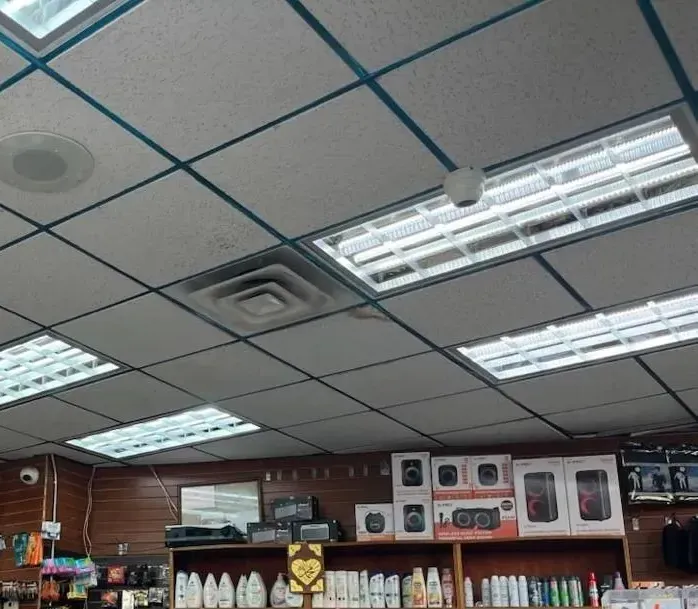
AESS job photo, not taken in Bronx River: the ceiling of a small shop above its shelves. Shop doors on a buzzer are usually released from behind a counter like the one below this ceiling.
For each of these we ask the same three questions before choosing parts: what should the door do when the power fails, who needs to be able to release it and from where, and what does someone inside do to get out. The answers decide between a fail-secure strike, which stays locked without power, and a fail-safe strike or magnetic lock, which releases, and whether the exit side needs a push button, a motion sensor or simply a mechanical handle that always opens.
Rules that apply to entry doors in Bronx River
Self-closing doors (Housing Maintenance Code § 27-2041.1). An owner of a multiple dwelling required to have self-closing doors must keep them in good repair; a failure is a class C immediately hazardous violation, with 14 days to correct and a civil penalty of $250 to $500 plus $250 a day until it is fixed. A buzzer repair in a three- or four-family house includes a look at the closer for that reason.
Intercoms in larger buildings (Multiple Dwelling Law § 50-a). Class A multiple dwellings with eight or more apartments erected or converted after January 1, 1968 must have a self-locking main door and an intercom that lets each apartment talk to the door and release it. Older buildings must install one if tenants of a majority of the apartments ask in writing. This rule does not reach two-, three- or four-family houses.
Apartment door locks (§ 27-2043). Every apartment entrance door needs a key lock; in a class A multiple dwelling, a heavy-duty latch set, a heavy-duty deadbolt with a thumb-turn inside, and a chain door guard. That is separate from the street door and its buzzer, but owners often ask about both together.
House numbers (§ 27-2049). Owners must post street numbers plainly visible from the sidewalk. Community Board 9's tenant requests list "hard to see address" next to new intercoms and front doors, and a missing number causes as many missed deliveries as a broken bell.
Electrical work. The buzzer side is low voltage. New 120-volt wiring to feed a transformer or power supply is electrical work for a licensed master electrician under a Department of Buildings permit; we arrange that separately when a job needs it.
Exit and fire safety. A locked door must still open from the inside without a key, tool or special knowledge where it is an exit. A magnetic lock on an exit door needs a way to release it from inside and, where a building has a fire alarm, to drop when the alarm sounds.
General behavior of each lock type; models vary.
Your Questions Answered
Door Buzzer Repair in Bronx River: Questions Answered
These are the questions Bronx River owners, tenants and business owners actually face, grouped by who is asking. Each answer starts with the direct answer and then the reasoning. Shorter questions about prices and visits are in the FAQ further down.
If You Live in a NYCHA Building
I live in one of the nine towers at Bronx River Houses and the lobby door release is dead. Can I hire AESS to fix it myself?
No, and we would advise against hiring anyone for it. The lobby door, its strike, the entry panel and the wiring in the building are NYCHA property, and repairs to them are NYCHA's job and NYCHA's decision. A private contractor who opens a NYCHA panel at a resident's request has no authority to be there, and the work can be undone and charged back.
What helps is a precise ticket. Report the problem through NYCHA's Customer Contact Center or the MyNYCHA app and describe exactly what happens: whether the panel lights up, whether your apartment rings when a visitor dials, and whether the door clicks when you press release. Write down the ticket number and the date. If the door will not lock and the building is open to anyone, say so plainly, because a door that will not secure is treated differently from one that only fails to ring. Keep a short, dated log of each follow-up call.
A relative in the Bronx River Addition senior building cannot get down to the lobby while its intercom is out. What can the family do while NYCHA schedules the repair?
Report the outage through NYCHA, then plan around it rather than waiting. Agree on a call-ahead routine: anyone visiting, including home attendants and pharmacy deliveries, phones before arriving so a neighbor or family member can meet them, or so the building's staff know someone is expected. Keep the visitors' names and numbers on a list by the phone.
Ask the development's management office whether staff or a tenant patrol can let expected visitors in during the outage, and note on the ticket that the resident has limited mobility, which can change how urgently a repair is handled. Wikipedia records that the Addition's two buildings, completed in 1966, are for seniors only, and City Limits reported in 2024 that residents there voted on how future repair money should be raised, so the management office is used to hearing about repair needs. What the family should not do is pay an outside company to work on the building's system. If the outage lasts, a written complaint to the management office with the ticket numbers attached is the next step.
Owners and Tenants in Houses
Our house on Bronx River Avenue has three apartments, one bell button for each floor. Does the city treat it differently from a two-family house?
Yes. In the Housing Maintenance Code a dwelling occupied by three or more families living independently is a multiple dwelling, and an ordinary apartment house is a class A multiple dwelling. A two-family house is not, and an apartment rented in a one- or two-family home is called a private dwelling. The step from two to three changes several of the owner's duties at once, including keeping self-closing doors in repair where they are required, the locks on each apartment door, and the floor and street number signs.
For the buzzer itself, the intercom requirement in section 50-a of the Multiple Dwelling Law starts at eight apartments, so a three-family house is not required to have an intercom. But if the house has bells and a door release, the owner has to keep the building's equipment in good repair like any other part of the building, and a front door that no longer closes and latches is a problem in its own right. When we work on a three-family house we note on the written diagnosis whether the door closes, latches and locks, so the owner knows where things stand.
We live on the first floor of our own two-family house and rent the top floor. Is the tenant's buzzer legally ours to keep working?
In practice, yes. The upstairs apartment is part of a building you own, and the bell and door release that serve it are building equipment, so a working buzzer is something your tenant can reasonably expect you to maintain, the same as the lights in the hall or the lock on the front door. New York's warranty of habitability in every residential lease covers areas used in common with other tenants, and a front door the tenant cannot open for visitors is the kind of thing that tends to end up in a complaint.
The good news is that two-family systems are simple and cheap to fix compared with an apartment building. A typical repair here is one transformer, one outdoor button or one splice in the cellar. If your own downstairs bell works and the tenant's does not, tell us that on the phone: it means the power is fine and the fault is on the upstairs circuit, which narrows the job before we arrive.
A tenant called you with the owner's agreement. Will the tenant get a copy of what you found, or only the owner?
Both can, if the owner agrees. The written diagnosis goes first to whoever authorized and paid for the visit, which in a rented house is normally the owner. When a tenant arranged the visit with the owner's go-ahead, we ask the owner on the same call whether the tenant should receive a copy, and most say yes, because it saves them relaying the details.
The note itself is short: what the buzzer was doing, what we measured, the part that failed, what we replaced and what we tested, including whether the front door closes and latches. We do not take sides between owners and tenants; it records what we found, which is useful to both.
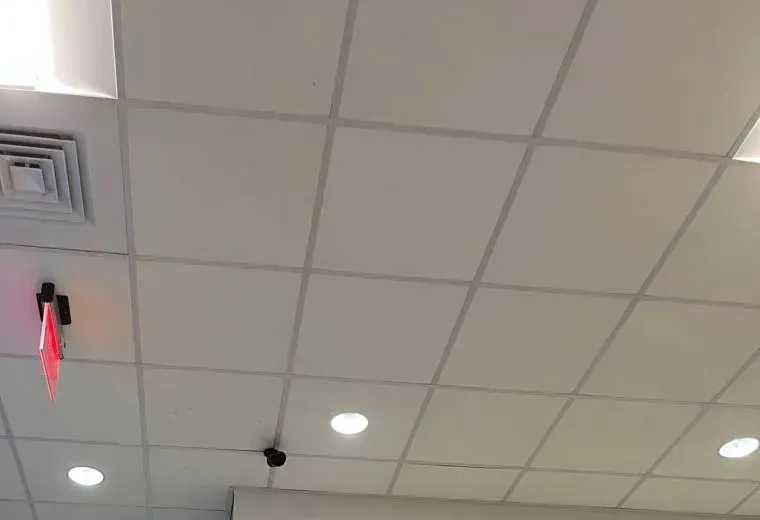
AESS job photo, not taken in Bronx River: an exit sign and a small camera in a drop ceiling. Any locked door on a way out still has to open from the inside without a key.
What the Buzzer Is Doing
The button upstairs releases our inner vestibule door but not the iron gate at the sidewalk. Why would one work and not the other?
Because they are almost always two separate locks, and often two separate jobs done years apart. Many Bronx River houses have an iron gate at the sidewalk, a front door at the top of the stoop and sometimes an inner vestibule door. When an owner added a release to the gate, it may have been wired to its own transformer, to a separate button in one apartment, or in series with the door so that both share one feed. Each arrangement fails differently.
The gate release also lives outdoors, in a steel frame that moves, rusts and gets slammed. We test the voltage at the gate lock while the button is held; if it is there, the lock is worn, frozen or out of line with the keeper, and a steel gate's frame may have sagged enough that the latch drags. If there is no voltage, the wire run to the gate, usually through the front yard or along the fence, is the suspect. Fixing the gate does not require touching the door circuit, and the quote treats them as separate lines.
After heavy rain the bell button on our stoop works for a day and then quits. Is water getting into the outdoor button?
Very likely. An outdoor button plate that has lost its gasket, or a box behind it whose seal has cracked, lets water reach the contacts and the screw terminals. When the box is wet, the contacts short or corrode; as it dries, the button starts working again, until the next storm. Over time the corrosion builds and the button stops working even on dry days.
The repair is usually to clean or replace the contacts, re-terminate the wires on fresh copper, and reseal the box, or to replace the plate with one rated for outdoor use. We also look at where water is coming from: a cracked step, a gutter emptying over the stoop or a plate mounted where rain runs straight down the wall. Sealing a button under a running gutter only buys a season.
In our four-family house a visitor's ring never reaches the top floor, though the other apartments ring fine. Where does a single floor's wire usually fail in a house that size?
In a house, each apartment usually has its own pair of wires from the outdoor button, through the cellar, and up through a wall or a closet to the bell or buzzer in that apartment. When one floor goes dead and the rest work, the power supply is almost certainly fine and the break is on that floor's pair. The common points are the outdoor button contact for that apartment, a splice in the cellar ceiling, a place where a renovation crossed the wire, and the bell or station itself.
We test from both ends: the button with the plate open, and the apartment unit with its cover off. If both are good, a meter tells us whether the wire between them is broken, and roughly whether the break is low or high in the house. Only then do we decide whether to repair the existing wire or run a new one along an easier path, such as a closet or a pipe chase, rather than opening plaster.
Every bell in our three-apartment house went faint at about the same time. Is that one failing part or several?
Usually one. When every apartment fades together, the shared part is the suspect: the doorbell or buzzer transformer in the cellar. One that runs hot, hums more than it used to or gives a weak output affects every apartment at once, because they all draw from it. If all the bells are faint and the door release clicks without pulling, a failing or undersized transformer is the first suspect, and replacing it often brings everything back together.
We confirm it before buying anything: a reading on the low-voltage side with no bell pressed, and again while the release is held, shows whether the transformer holds its voltage under load. If it does, the problem is elsewhere, often a shorted button or a damaged wire pulling the voltage down. If the transformer's 120-volt connection is in poor shape or the transformer has to move, that part of the work is for a licensed electrician, and we say so on the quote.
Businesses Along the River
Our repair shop on Bronx River Avenue keeps the office door on a buzzer. Can staff out in the bays release it without walking to the desk?
Yes. The release on a buzzer door is just a switch, and a second or third switch can be wired in parallel so that the desk, the bay and the back office can each open the same door. For a shop floor we use a heavy-duty, clearly labelled button mounted where hands that are greasy or gloved can press it, away from where a lift or a creeper will hit it.
The more useful question in a noisy garage is how staff know someone is at the door. A louder bell or a second sounder in the bays, or a strobe light that flashes when the door bell is pressed, often matters more than the release button. If staff also need to see who is at the door, a small camera on the door with a monitor at the bay end is a common addition. We price each piece separately so the shop can choose.
We rent warehouse space near East 174th Street. If a buzzer and a magnetic lock share one power supply, what happens to the door in a power cut?
A magnetic lock holds the door only while it has power, so when the power supply loses its input, the lock lets go and the door can be opened. That is by design: magnetic locks are fail-safe, which is why they are used where people must always be able to get out. A buzzer on the same supply also goes silent. So in a power cut a mag-locked warehouse door is unlocked and nobody is told.
If that is not acceptable, there are two common answers. One is a power supply with a battery backup sized to hold the lock and the buzzer for a set number of hours. The other, where code allows, is a fail-secure strike, which stays locked without power and is opened mechanically from inside. Which is right depends on whether the door is an exit for people inside, so we look at the layout before recommending either.
AESS job photo, not taken in Bronx River: a back storage room with stock leaning on the wall. Storage spaces like this are where a door that unlocks in a power cut matters most.
Before, During and After the Repair
Delivery drivers cannot find our house number to ring the right bell. Is fixing that part of a buzzer job?
It can be, and it is worth doing at the same visit. Section 27-2049 of the Housing Maintenance Code requires owners to post street numbers plainly visible from the sidewalk, and Community Board 9's list of tenant requests for this district puts a hard-to-see address right next to new intercoms and front doors. A bell that works is no help if the driver is ringing next door.
On a house we can replace a worn button plate with one that has clear apartment labels, add a lit button where the stoop is dark, and recommend where large house numbers should go so they are visible from the curb at night. Numbers themselves are an inexpensive item any owner can install; we simply note on the written diagnosis if they are missing or hidden by a gate or a tree.
We are about to buy a two-family house in the Bronx River section. Can you check the front door and buzzer before we close?
Yes. A pre-purchase check is a normal service call: we test each bell, the door release, any gate release and the transformer, look at the outdoor button box for water and corrosion, and check that the door closes and latches. The written diagnosis gives you a list of what works, what does not, and the likely repair line from our Bronx price list for anything that needs attention.
It is not a home inspection, and it does not replace one. A home inspector looks at the whole house; we look closely at one system. Buyers who are taking over a rented floor find it useful because a working buzzer and front door are among the first things a new tenant will ask about.
If the strike on our front door has to be replaced, how long is the door out of service in a three-family house?
For a standard replacement in a wooden or steel door frame, the door is usually out of service for an hour or two, and the door still locks with its key while we work. The longer jobs are those where the frame has to be cut to fit a different size of strike, or where an old frame has split or rotted and needs repair before a new strike will hold.
We bring the most common strike sizes on the truck, so in many cases the replacement happens on the first visit. If the right part has to be ordered, we leave the door locking and closing on its key and mechanical latch, so the building is secure, and return to fit the new strike. Tenants should be told in advance that visitors will need to be let in by hand for that short period.
Drawn from our standard test order; each house differs.
Equipment
Types of Door Buzzer Equipment We Repair
A Bronx River house might have equipment from four different decades on the same door: an original button plate, a transformer replaced in the 1990s, a strike added later and a modern handset in one apartment. We work on all of it, and the cards below describe the pieces we meet most.
🔔
Bells, buzzers and chimes
The simplest systems in Bronx River houses: a button outside, a bell or buzzer in each apartment, a transformer in the cellar. Repairs are usually a button, a splice or the transformer.
📞
Audio intercom handsets
Wall handsets or speaker stations that let the apartment talk to the door and release it. Many older brands are still serviceable; we match replacements to the system where we can.
🔒
Electric strikes
The part in the door frame that lets the latch out when powered. Fail-secure strikes stay locked without power; fail-safe strikes release. Most house doors use fail-secure.
🧲
Magnetic locks
A magnet along the door header and an armature on the door, common on glass and aluminum business doors. Always fail-safe, so they need a reliable exit and power plan.
⚡
Transformers and power supplies
From a small doorbell transformer in a two-family house to a boxed power supply with battery backup for a shop door. The most common single cause of a weak or dead system.
🖐
Exit buttons and sensors
Push-to-exit buttons and motion request-to-exit sensors that release a locked door from inside, used on shop and office doors with magnetic locks.
🎛
Button plates and panels
Outdoor plates with one button per apartment, and keypad or directory panels on larger buildings. Weather and wear make them the most replaced part outdoors.
🚪
Closers and latches
Not electronic, but essential: the closer that pulls the door shut and the latch that catches. Without them, no buzzer system keeps a door secure.
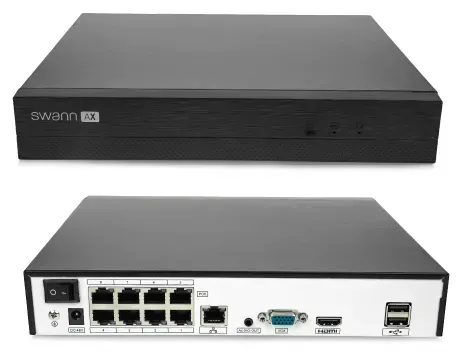
AESS product photo: front and back of a network recorder. When a building adds a camera at the front door, equipment like this sits in the cellar or office beside the buzzer's power supply.
Repair or replace. For houses the honest default is repair. The parts are simple, many are still made, and a working system that needs one part should keep running. Replacement makes sense when the outdoor panel is too damaged to seal, when apartment units are a discontinued model and more than one has failed, or when the owner wants something the old system cannot do, like ringing a phone. In those cases we quote the replacement as a separate option next to the repair, so the owner can compare them.
AI Overview Reality Check
What AI Gets Wrong About Door Buzzer Repair in Bronx River
We could not open Google's AI Overview or People Also Ask results from our research environment for this page, so we have not quoted them. What follows are claims that appear in articles and guides we did read, the kind that AI answers tend to repeat, checked against Bronx River's buildings.
“Every New York apartment building has to have an intercom”
Summaries of the intercom rule often shrink it to that sentence. ButterflyMX's guide to New York's intercom law is more careful: the rule generally applies to class A multiple dwellings with eight or more units built or converted after January 1, 1968, and older buildings need a closer look. That matches section 50-a of the Multiple Dwelling Law, which also lets tenants of a majority of apartments in an older building require an intercom in writing.
In Bronx River the shorthand is usually wrong, because most private buildings here are houses with two, three or four apartments. None is covered by the eight-apartment rule. A three-family house is a multiple dwelling for other purposes, such as self-closing doors and apartment locks, but it does not have to have an intercom.
What does apply to a house with bells and a door release is the ordinary duty to keep a building's equipment in repair and the warranty of habitability. The useful question is not whether an intercom is required, but whether the system the house has works and whether the door closes and locks.
“It is all in the wire connections”
Brick Underground's 2019 intercom guide quoted a New York locksmith on exactly that point: faults are usually at the connections at the lobby base, the apartment station, the door strike or the power supply, not in the wiring inside the walls. For buildings with a central panel that is good advice.
In a Bronx River house it needs two additions. The first is water: the outdoor button box on a stoop or gate is the most exposed connection, and corrosion there causes many on-again, off-again faults. The second is the door. A strike can have perfect connections and correct voltage and still not release, because the latch presses on it from a door that has sagged.
So we test connections first, as the guide says, and then we test the door. Replacing a strike without asking why the old one stopped releasing often ends with the new one failing the same way.
“Expect $195 to $250 an hour plus parts”
That range comes from the same 2019 article, which reported two New York service-call estimates, $195 an hour and $250 an hour plus parts. It is a fair snapshot of how companies bill, but an hourly rate says little about what a given repair costs.
Our Bronx pricing works differently. The $250 service call includes the diagnosis and simple repairs. Larger repairs are fixed lines from the Bronx list, quoted before work starts: a release relay or button at $250 to $475, a transformer at $325 to $650, a strike replaced and aligned at $450 to $950. Extended troubleshooting or a return visit is billed at our service rate of $195/hr, 3-hr minimum ($585), and we say in advance when that applies.
National cost guides such as Angi, HomeAdvisor and Fixr publish national averages. We did not use their figures, because a national average cannot tell a $250 button repair in a two-family house from a $2,400 riser repair in an apartment building.
“A lot of the time it is user error”
Another locksmith in the same piece said many complaints come from people not pressing the button firmly or not waiting long enough. On multi-step panels that is true, and the obvious is worth trying first.
In Bronx River houses we see a different version. The user is fine; the door is not. The visitor rings, the tenant presses release, the strike buzzes, and nothing opens because the door has dropped on its hinges and the latch is pinned against the strike. The tell is that the door opens if someone pushes it while the release is held.
Try that before calling: one person holds the release while another pushes and then pulls the door. If it opens with pressure, tell us. It points to alignment or a worn strike, not an electrical fault.
“Call your landlord, then file a complaint with 311”
That is the standard advice for New York renters, and the city's 311 apartment maintenance complaint does cover broken or missing doorbells, buzzers and intercoms. For a tenant in a privately owned apartment building it is the right order.
In Bronx River it fits only some households. Residents of the Bronx River Houses, the Addition and the Sotomayor Houses report repairs to NYCHA through its Customer Contact Center at (718) 707-7771 or the MyNYCHA app, and keep the ticket number. In an owner-occupied two-family house the landlord is the family downstairs, and a conversation usually works better than a complaint.
For a tenant in a three- or four-family house with an absentee owner, 311 applies. A dated note from the tenant to the owner describing what the buzzer does helps in every case.
“Old intercoms should be replaced with a video system”
Industry articles and the Brick Underground guide both note that many New York buildings replace older intercoms to add cameras and remote entry, and that it can be quick: the guide's sources estimated a day for a five-apartment building.
For a Bronx River house with a working bell system and one failed part, replacement is usually the expensive answer to a cheap problem. A transformer, a button plate or a strike costs a fraction of a new system, and the rest keeps working.
When an owner does want video, the old wires sometimes help: some two-wire video systems can reuse an existing pair from the door to each apartment. We check that during a repair visit and note it on the diagnosis.
“Magnetic locks are simply the more secure option”
Business owners sometimes arrive having read that a magnetic lock is the stronger choice. A good one holds a door firmly, and on glass and aluminum doors it is often the only practical lock to add.
But a magnetic lock releases when it loses power. On a Bronx River Avenue warehouse or garage door that means a power cut unlocks the door unless the supply has a battery backup. It also needs a reliable release from inside and, where a fire alarm is connected, must drop when the alarm sounds.
For a door that must stay locked in a blackout and is not anyone's only way out, a fail-secure strike may suit better. The right answer depends on the door, which is why we look at it before choosing.
Talk to a Technician About Your Bronx River Door
If one of those situations sounds like yours, a two-minute call usually narrows the fault before anyone visits. Call (646) 490-0629, send photos of the button plate and the lock side of the door frame over WhatsApp, or use the form below.
Tell us whose building it is, how many apartments share the door and what the buzzer does. We reply with the likely fault and price line, and a visit time if one is needed.
Request sent
We will call about the Bronx River address before the end of the working day. Or call (646) 490-0629.
How It Works
Our Door Buzzer Repair Process
Eight steps, the same for a two-family house and a garage door. The order matters: power, then both ends of the wire, then the door, so that the fix addresses the cause and not just the symptom.
1
Sort the door
On the first call we find out who owns the building, how many apartments share the door and what the buzzer does. NYCHA residents are told how to log the repair with NYCHA.
2
Photos before the visit
The owner or tenant sends a photo of the outdoor button plate and the lock side of the door frame, and we reply with the likely part and price line.
3
Test power first
On site, the technician reads the transformer or power supply with nothing pressed and again with the release held, to see whether it holds its voltage.
4
Test both ends
The outdoor button and the apartment unit are opened and checked, then the wire between them is tested, before any wall is opened.
5
Test the door
Voltage is measured at the strike while the release is held, and the door is pushed and pulled to see whether the latch is binding.
6
Written price before work
Anything beyond the service call is quoted as a line from the Bronx list, with the owner's approval recorded before parts are fitted.
7
Repair and retest
After the repair, every bell and release is tested from every apartment and from the street, and the door is checked to close and latch on its own.
8
Written diagnosis
The owner receives a short note of what failed, what was replaced and what was tested, and what, if anything, still needs work.
Our standard test order, drawn for this page.
Coverage Area
Door Buzzer Repair Near Bronx River's Landmarks
We send technicians to every block of Bronx River from our East Fordham Road office. These are the places people use to tell us where they are; the houses and businesses we work on are on the streets between them.
📍
Bronx River Houses
Nine fourteen-story NYCHA buildings from 1951 on the superblock bounded by East 174th Street, Harrod Avenue and Bronx River Avenue, known for the community center where Afrika Bambaataa held early hip-hop gatherings.
📍
Bronx River Addition
Two senior-only NYCHA buildings, six and fourteen stories, completed in 1966 between East 172nd and East 174th Streets and Manor and Harrod Avenues.
📍
Starlight Park
A thirteen-acre park on the river at East 174th Street, named for an amusement park that operated here from 1919 to 1942, with a section of the Bronx River Greenway.
📍
174th Street bridge
The crossing over the Bronx River and the rail line that links these blocks with West Farms, beside the new pedestrian bridges of the Greenway.
📍
Sotomayor Houses
Formerly the Bronxdale Houses: twenty-eight seven-story NYCHA buildings to the south and east, where the 16-story Casa Celina opened in 2024 with 204 apartments for older adults.
📍
Bronx River Avenue
The working edge of the neighborhood, lined with garages, storage yards and repair shops, and the subject of a 2026 community board request for a camera between East 174th and East 177th Streets.
AESS job photo, not taken in Bronx River: a tall open hall with mezzanine windows. Garages and warehouse units have rooms this size, where a door bell has to be heard from far away.
Pricing
Door Buzzer Repair Cost in Bronx River
Bronx River is priced from our Bronx list, which carries the base rate with no area surcharge. These are the same lines shown on our Bronx door buzzer repair page and summarized on our buzzer repair pricing page. The service call includes the diagnosis; if the job turns out to be bigger, the $250 goes toward it, and nothing beyond the service call is done without a written price the owner has approved.
Repair
Bronx price
Notes
Service call with on-site diagnosis
$250
Covers diagnosis and simple repairs such as a loose wire, a corroded terminal or a stuck button
Apartment station or bell replacement
$250 – $525
One apartment's buzzer, handset or chime
Door release relay or button
$250 – $475
The release button in an apartment or the relay behind it
Transformer replacement
$325 – $650
Low-voltage side; new 120-volt wiring, if needed, is quoted separately by a licensed electrician
Electric strike replacement and alignment
$450 – $950
Wooden house doors, steel gates and aluminum shop frames
Lobby or outdoor panel repair or faceplate
$650 – $1,800
Button plates and panels on larger doors
Riser pair repair or re-termination
$850 – $2,400
Small apartment buildings with a riser to each floor
Extended troubleshooting or return visit
$195/hr, 3-hr minimum ($585)
Only where agreed in advance
What moves the price in Bronx River. In houses the main variables are access and age. A transformer in an open cellar next to the electric panel is a short job; one buried behind a finished basement ceiling is not. An outdoor button box that only needs cleaning costs less than one whose back box has rusted through. A strike that fits the existing cut-out in the frame is quicker than one that needs the frame enlarged, and an old wooden frame that has split may need repair before any strike will hold.
In businesses the variables are the door and the power. Aluminum frames take particular strikes; glass doors may need a header magnetic lock; a door that must hold during a power cut needs a supply with a battery. We quote each of those as its own line.
Prices exclude sales tax where it applies, and any 120-volt electrical work, which is quoted by a licensed electrician. NYCHA buildings are not priced here, because we do not repair NYCHA entry systems at a resident's request.
Same figures as the price table above.
Get a Number for Your Door Before Anyone Visits
Send a photo of the button plate and the lock side of the frame, say how many apartments share the door, and we will tell you which line on the table most likely applies. Call (646) 490-0629 or use the quote form.
Most Bronx River jobs fall into one of three shapes. The prices are the same Bronx list lines as the table above, grouped the way owners usually need them.
Single-Fault Visit
$250
For the two-family house with one dead bell, a humming transformer that only needs a connection tightened, or a stuck button.
For the door that buzzes and will not open, or the gate that never did: strike replacement and alignment.
Strike replaced to fit the existing frame where possible
Latch and closer checked so the door shuts and catches
Fail-secure or fail-safe chosen for the door
Door locks on its key throughout the work
Entry Panel and Wiring
$650 – $2,400
For the weather-beaten outdoor panel, or the small building with a dead riser: panel repair from $650 to $1,800, riser repair from $850 to $2,400.
Outdoor panel repaired or refaced and sealed
Riser or floor wiring traced and re-terminated
Apartment labels and button lighting checked
Quoted line by line before work begins
Bought your own parts
If you have already bought a strike, a transformer, a button plate or a handset and want it fitted, we install customer-supplied parts at our service rate of $195/hr, 3-hr minimum ($585). We check before the visit that the part suits the door and the existing system, because a strike of the wrong voltage or size is the most common reason a customer-bought part fails. Our parts-only warranty covers products we supply; customer-supplied parts carry their maker's warranty.
AESS job photo, not taken in Bronx River: a retail drop ceiling with lights and ceiling devices. Above tiles like these is where a second release button's wire is usually run in a shop.
Complete Services
Every Door Buzzer Service in Bronx River
Abstract Enterprises Security Systems handles the whole entry door in Bronx River, from the bell to the lock to the camera over it. Most owners who call about a buzzer end up asking about one of these too.
Field notes: what we check first in a Bronx River house
In a two- or three-family house the first thing I look at is not the buzzer. It is the door. I pull it nearly shut and let it go, and watch whether the closer brings it home and the latch catches. Then I hold it closed and press on it, to feel whether the latch is binding against the strike. If the door has dropped on its hinges, I already know why the release clicks and nothing opens, and no amount of new wiring will fix it.
Then I go downstairs. In these houses the transformer is usually in the cellar, often close to the electric panel, sometimes hidden above a ceiling that was finished long after the bell system went in. I read it with nothing pressed and with the release held. A transformer that drops sharply under load explains weak bells on every floor at once.
Only then do I open the outdoor button plate. On stoops and gates that is where the water gets in, and it is the connection that has had the hardest life. Most of the time the fault is in one of those three places, the door, the cellar or the stoop, and the apartments themselves are fine.
Anwar Timothy, NYS license #12000287431. This describes our standard method, not a particular job at a particular address.
AESS job photo, not taken in Bronx River: a camera in a ceiling corner above a wall screen. Where an owner wants to see who is at the door, a screen like this can show the entrance camera.Same checklist as the FAQ answer below.
FAQ
Bronx River Door Buzzer Repair FAQ
Short answers about visits, prices, permissions and parts. The longer situational questions are answered in the questions section above.
What does the $250 service call cover when the building is a two- or three-family house?
+
It covers the trip, the on-site diagnosis of the whole system, and simple repairs found during it. In a house that means testing the transformer with and without load, opening and checking the outdoor button plate, testing each apartment's bell and release, measuring the voltage at the door strike, and checking that the door closes and latches. If the fault is a loose or broken wire at a terminal, a corroded contact or a stuck button, fixing it is part of the $250. If the repair needs a new part such as a transformer or a strike, you get a written price from the Bronx list first, and the $250 goes toward that job.
When does the $195 an hour rate with a three-hour minimum apply instead of the $250 visit?
+
Our service rate of $195/hr, 3-hr minimum ($585) applies to work that is not a standard repair line: extended fault-tracing through finished walls and ceilings when the cause cannot be found in the normal diagnosis, return visits that the owner requests for additional work, and fitting parts the customer has bought. We tell you before the work starts if a job will be billed that way, and why. A normal buzzer repair in a Bronx River house is priced as the $250 service call plus, where needed, a fixed line from the Bronx price list.
If a part has to be ordered, will you leave the front door locking and closing before you go?
+
Yes. Securing the door comes before finishing the buzzer. If a strike, transformer or panel has to be ordered, we leave the door closing on its closer and locking on its key and mechanical latch, so the building is secure even though visitors have to be let in by hand for a short time. Where a magnetic lock on a business door has failed, we make sure the door can be locked another way before we leave. We tell the owner what was left and when we expect to return.
Whose permission do you need before working on the buzzer in a rented house?
+
The owner's. A tenant may well be the one who meets us at the door, but the owner has to agree to the work. In a rented house or small building the buzzer, the door and the wiring belong to the owner, so we need the owner's go-ahead, by phone, text or email, before we open panels or fit parts, and the owner normally pays. Many owners who do not live on site are happy to have a tenant meet the technician. For NYCHA buildings we do not do the repair at all; residents should log it with NYCHA.
Can you replace only the outdoor button plate and keep the bells inside the apartments?
+
Usually, yes. In most Bronx River houses the outdoor plate is a set of simple switches, one per apartment, and a replacement plate with the same number of buttons can be wired to the existing wires without touching the apartments. We choose a plate rated for outdoor use, fit it on a sealed back box and label each button clearly. If the old system uses an audio intercom rather than plain bells, the door station has to match that system, and we check whether a compatible model is still made before quoting.
Which buzzer jobs in a house also need a licensed electrician?
+
The buzzer, bells, strikes and their wiring are low-voltage work. The part that needs a licensed master electrician is the 120-volt side: running a new line to feed a transformer or power supply, moving a transformer to a new location on the house wiring, or adding an outlet for a powered panel. In New York City that work is done by a licensed electrician under a Department of Buildings permit. When a repair needs it, we say so on the quote and arrange it separately rather than doing it ourselves.
What should I say on the phone so the technician arrives with the right part?
+
Tell us four things. How many apartments share the door. Whether the problem affects every apartment or only one. Exactly what happens when a visitor presses your bell: nothing, a bell with no release, a release that buzzes but the door stays shut, or a buzz that will not stop. And whether there is a gate as well as a door. If you can, send a photo of the outdoor button plate, the lock side of the door frame and anything with a brand name on it inside the apartment. With that, we usually know whether to bring a transformer, a strike or button parts.
Two houses share one driveway gate. Can both houses' buzzers release it?
+
Yes, electrically it is straightforward: release buttons in each house can be wired to the same gate lock, and a bell at the gate can ring both houses or each one separately with two buttons. The harder questions are about the two owners. They need to agree who owns the gate lock and the wiring, where its power comes from and who pays when it breaks. We put that arrangement in writing on the quote, so both owners know what they are agreeing to, and we label the buttons at the gate so visitors ring the right house.
The ground-floor family uses the side door, but their bell button is on the front stoop. Can the button be moved?
+
Usually, yes. The bell button is just a switch on a pair of wires, so it can be moved to the side door, or a second button can be added there so either door rings the same apartment. The work is running a new pair from the side door to the point where that apartment's wire already runs, normally in the cellar, and fitting an outdoor-rated button in a sealed box. If the family also wants to release the side door from inside, that needs a strike in the side door's frame and its own wiring, which is quoted as a separate line. Label the moved button clearly, so visitors at the front stoop know where to go.
Does the warranty cover a buzzer you repaired, or only parts you supplied?
+
Our warranty is parts-only and covers the products we supply, for one year, under the terms in the service agreement. If we replace a strike or a transformer with one we provide, that part is covered. The existing wiring, apartment units we did not replace, and parts the customer bought are outside it, and so is damage from weather, impacts or power surges. If something we fitted fails within the warranty period, call us and we will replace the part.
All Areas Served
Door Buzzer Repair Across New York City, Long Island and the Hudson Valley
Bronx River is one of the neighborhoods served from our Bronx office. The same door buzzer repair service runs across the city and north into the Hudson Valley; each area page carries its own prices and local notes.
Where the Bronx River Facts on This Page Come From
Every local fact on this page comes from one of the sources below, read in October 2026. Where sources disagree, we say so; where we could not reach a source, we say that too.
Wikipedia, “Bronx River Houses” (2026 revision): nine 14-story buildings, completed February 28, 1951, 13.94 acres bounded by East 174th Street, Harrod and Bronx River Avenues, 3,025 residents, PSA 8 at 2794 Randall Avenue; the Addition's two senior buildings of 6 and 14 stories, 225 apartments, completed 1966; architect William I. Hohauser and landscape architect Leo A. Novick; Afrika Bambaataa and the community center. Wikipedia gives 1,260 apartments; older NYCHA-derived listings give 1,245.
Wikipedia, “Soundview, Bronx”: boundaries; Bronx River as a historic community name and one recognized by Community Board 9; land use along the river; the Sotomayor Houses and Casa Celina; the 43rd Precinct; the IRT Pelham Line.
Bronx Community Board 9, Fiscal Year 2026 Statement of Community District Needs (nyc.gov): district extent, 4.1 square miles, nearly 200,000 residents, Bronx River listed among its communities; NYCHA capital requests including “New intercoms/front door (hard to see address & easy to pull open),” “Intercom system renovation needed” and “Entrance/Exit Door renovations needed”; a request for an NYPD camera on Bronx River Avenue between East 174th and East 177th Streets. The text we read does not name the development beside each NYCHA request.
City Limits, April 15, 2024, “Initial Tally Shows NYCHA Bronx River Tenants Favoring ‘Trust’” (Tatyana Turner): 122 ballots at the Bronx River Addition, 84 for the Preservation Trust, 22 for PACT, 16 for traditional funding; $66 million in outstanding repair needs.
Office of the New York City Comptroller, October 12, 2018, “Stringer Releases Investigative Survey of NYCHA Doors”: 299 developments visited, 1,023 building doors broken, tampered with or unlockable; in the Bronx, 24 percent of 767 front doors open and 20 percent of 276 rear or side doors unlocked. Used as citywide and borough context only; the release does not single out the Bronx River developments in the passages we read.
NYC Housing Maintenance Code (nyc.gov PDF): § 27-2041.1 self-closing doors (class C, 14 days, $250 to $500 plus $250 a day); § 27-2043 apartment door locks and chain guards; § 27-2045 definitions including private dwelling; § 27-2049 street numbers.
New York Multiple Dwelling Law § 50-a and § 3, and Real Property Law § 235-b, as recorded in our earlier intercom research from nysenate.gov and the city's MDL PDF: intercom requirement for class A multiple dwellings of eight or more apartments built or converted after January 1, 1968, and the majority-request rule for older buildings; the warranty of habitability.
NYC311, Apartment Maintenance Complaint (article KA-01074) and NYCHA's repair and Customer Contact Center pages, as recorded in our intercom research: doorbells, buzzers and intercoms covered by 311 complaints; NYCHA repairs through the Customer Contact Center or MyNYCHA.
Forgotten New York, October 18, 2026, “Bronx River Starlight” (Kevin Walsh): Starlight Park's history as an amusement park from 1919 to 1942, renamed from Sheridan Fields in 1998; the 174th Street bridge; the Sheridan Expressway turned into a boulevard; the Greenway section opened in 2023.
NYC Parks, Starlight Park: a 13-acre park at East 174th Street and the Bronx River.
Listing and property-record pages for houses in ZIP code 10472 (StreetEasy, PropertyShark, Compass, homes.com): a 1915 two-story three-family house on Bronx River Avenue, a 1930 two-to-four-family house on Manor Avenue, four-family and four-unit houses on Bronx River and Croes Avenues, and Compass's “Bronx River” label for Manor and Noble Avenue listings. Used only to describe building types; no address is named on this page.
Brick Underground, November 7, 2019, “NYC intercoms: Trouble-shooting, fixing, and replacing your link to the outside world” (Mimi O'Connor): quotes on user error and wire connections, service-call estimates of $195 an hour and $250 an hour plus parts, and replacement timing.
SECO-LARM, electric strike troubleshooting notes on its strike product page: check the connector, the 12 or 24 VDC source, voltage and amperage with a meter, heavier wire or a larger supply, and the activation device.
Not available or not used: Google People Also Ask, related searches and AI Overview, Answer the Public, Bing and DuckDuckGo suggestions, and Yelp review text could not be opened from our research environment. Reddit threads were seen as search excerpts only and are not quoted. No Bronx Times, News 12 or Norwood News report on buzzers or entry doors in Bronx River turned up in our searches.
Dates as given in the cited sources.
Front Door Will Not Lock or Release? Call the Bronx Line
If the front door of your house or building will not lock, call (646) 490-0629 and say so first; we treat a door that cannot be secured ahead of a bell that will not ring. If the door locks but visitors cannot get in, tape a note with a phone number to the door and call us with the street and the number of apartments. NYCHA residents: report it to NYCHA at (718) 707-7771 or through MyNYCHA and keep the ticket number.
Bronx River Door Buzzer Repair From a Licensed, Insured Bronx Company
Whether the door belongs to a two-family house on Manor Avenue, a three-family house on Bronx River Avenue, a four-family house on Croes Avenue or a garage near the river, one number reaches the technicians: (646) 490-0629. Photos are easiest to send over WhatsApp. Our legal name, Abstract Enterprises Security Systems, and our Bronx office address, 460 E Fordham Rd, Bronx, NY 10458, appear on every quote and invoice.
Our work carries a 4.7★ rating from 201 Google reviews. Every Bronx River repair is done under New York State license #12000287431, and an owner or managing agent can have our certificate of insurance before the first visit.
Full terms — including 50% deposit, the 30-day warranty and optional paid extended warranty, and the late-fee schedule — are set out in the service agreement. See our warranty page.
Revision log, October 22, 2026: this page was rebuilt from new research around one question, whose door it is. Prices are the published Bronx list.