Rebuilt 1979–1999 · 1920s Walk-Ups on the Ridge · Art Deco Courtyards · Supportive and Senior Towers
Door Buzzer Repair in Highbridge
Date the Rehab, Not the Cornerstone · Ogden to Jerome · One Bronx Price List
Many of the brick apartment houses on Ogden, Nelson, Woodycrest, Shakespeare and University Avenues were put up in the 1920s, emptied in the 1970s and rebuilt from the inside in a single wave between the late 1980s and the late 1990s. City tax-lot records list 71 apartment buildings in Highbridge, outside public housing, whose first major alteration falls between 1979 and 1999, holding 2,655 apartments; 29 of them, with 1,143 apartments, were finished in 1991 alone. In those buildings the intercom, the riser cable and the door release usually date from the renovation, not from the year carved over the door. That makes the renovation year the most useful fact a superintendent can give us, and it is where this page starts.
Call or text the address and, if you know it, the year the building was renovated; the quote form works too
The $250 service call includes the testing, and no part goes in until you approve a written price
4.7★ across 201 Google reviews
Reviewed and updated October 22, 2026, against NYC Department of City Planning PLUTO tax-lot records for the five census tracts that make up Highbridge, HPD housing maintenance code violations and 311 service requests from NYC Open Data, Highbridge Community Development Corporation's published history, Wikipedia's Highbridge article, the Landmarks Preservation Commission's Noonan Plaza designation, Lehman College on the Park Plaza Apartments, Bronx Times and DNAinfo reporting, and the Multiple Dwelling Law · Anwar Timothy, NYS license #12000287431 · dispatched from 460 E Fordham Rd
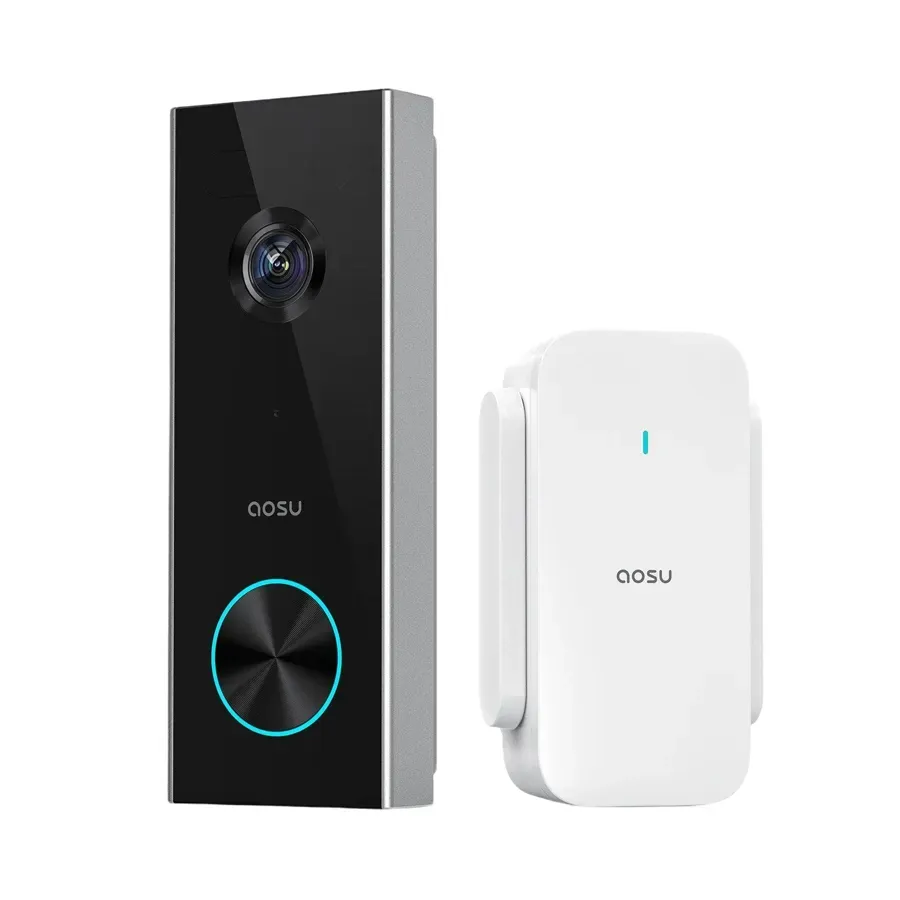
Manufacturer product photo, not taken in Highbridge: a battery video doorbell next to the plug-in chime it rings. In the small three-family houses on Highbridge's side streets, the button at the door and the sounder inside are the whole system, so a repair starts by finding which of the two has gone quiet.
Highbridge Buzzer Repair Request
Rebuilt walk-up, elevator building, courtyard complex, store or house
✅
Request Sent!
A technician will call about the Highbridge address before the end of the working day.
25+
Years Experience
✓
Same-Day Estimates
100%
Licensed & Insured
4.7★
201 Google Reviews
Three facts make the first call from Highbridge short. When was the building last gutted and rebuilt, if ever? Does the buzzer open one door, or a gate or a lower side door as well? And which apartments are silent: one, a vertical line, a block of floors, or everyone? A superintendent who knows the renovation year, or can read it off the plaque in the lobby, has already told us roughly how old the panel, the handsets and the riser are. Add a photo of the panel and one of the lock edge of the door, text them to (646) 490-0629, and a technician can usually say on the phone which part is most likely at fault and which line of the Bronx list it falls under.
Looking at photos costs nothing; on site, the testing is part of the $250 service call
Every quote is written, shows sales tax on its own line and carries license #12000287431
A tenant, the super, a managing agent or a housing company's asset manager can make the first call; whoever pays approves the price
Street Door Left Open or a Whole Line Gone Quiet? Same-Day Buzzer Repair in Highbridge
The calls we get from Highbridge buildings have a few recognizable shapes. A renovated walk-up on Nelson or Merriam Avenue where the panel still lights but every apartment on the D line has stopped answering. A six-story building on Anderson or Woodycrest Avenue where the release clicks upstairs but the lobby door, swollen after rain, has to be shouldered open. A newer building on University Avenue or West 167th Street whose panel calls residents' phones on some days and not on others. A three-family house on a side street where the downstairs bell rings in every apartment at once. Each shape points to a different part of the system, and the first two minutes on the phone are spent working out which shape yours is.
Ring (646) 490-0629 with the address and what the door is doing now. We dispatch from 460 E Fordham Rd, and a call that comes in during the morning is usually answered with a visit the same day. The visit is the $250 service call, testing included. A loose terminal, a worn button or a strike that needs its keeper moved is normally dealt with inside it; for a larger repair the $250 is credited against the written price you approve. Long searches for a cable whose route nobody recorded, which do not fit a listed line, are billed at $195/hr with a 3-hr minimum ($585), and you hear which applies before the search starts.
Until we arrive: if the street door will not latch, close it and use the key cylinder rather than wedging it, because a propped door in a multiple dwelling quickly becomes a self-closing-door problem as well as an intercom one. If the panel or its supply is hot, sparking or buzzing loudly, ask the super to switch off the labelled supply in the cellar and leave the panel alone. If tenants who cannot manage the stairs are waiting on deliveries or aides, tell us; that changes the order of the day.
The Neighborhood
Why Highbridge Properties Need Door Buzzer Repair
Highbridge takes its name from the High Bridge, the 1848 aqueduct bridge that once carried Croton water across the Harlem River and now carries people on foot. The neighborhood behind it was a district of country estates in the nineteenth century, which is why its north–south avenues carry family names: Ogden Avenue and Boscobel Place after William B. Ogden, Merriam Avenue after Francis Merriam, Anderson and Woodycrest Avenues after the Anderson family, and Shakespeare Avenue after a Shakespeare garden on one estate. Around the turn of the twentieth century the estates were cut into building lots, and through the 1920s the ridge filled with five-, six- and seven-story brick apartment houses, some of them, like Noonan Plaza and Park Plaza, among the earliest Art Deco apartment buildings in the Bronx.
Then came the long emptying of the 1970s. A 1976 New York Times headline spoke of fear of crime hastening the decline of Highbridge, and the neighborhood's dozens of community gardens still occupy lots that, as Wikipedia puts it, were left vacant between the 1970s and the 1990s. What happened next is the part that matters to anyone repairing a buzzer today. In 1986 the city's Ten Year Plan committed more than $4 billion to housing, and in the late 1980s a housing development fund company organized through the Archdiocese of New York's Housing Development Institute became the city's first major nonprofit redevelopment partner in Highbridge. It began work in 1989 on the first major project of the city's Vacant Building Cluster Program, and the partnership produced 741 renovated apartments in 23 buildings, completed and occupied by 1992, according to the history published by the Highbridge Community Development Corporation that grew out of it. Other nonprofit housing companies and private sponsors rebuilt more buildings over the same decade.
A building that was rebuilt from a vacant shell got a new entry system at the same time as its new plumbing and wiring: a panel at the door, a handset in every apartment, a riser cable through the building, a supply in the cellar and a release on the door. Those parts are now roughly 27 to 47 years old, most of them about 35, in buildings that have been continuously occupied and, in many cases, sold or refinanced since. They tend to fail in a recognizable order, and the buildings rebuilt in the same year by the same sponsor often fail in step. Most Highbridge buzzer calls, in other words, are not about a 1927 building. They are about a 1991 system in a 1927 building, and that is how we approach them.
The newer layer is different again. Since 2001 the neighborhood has added senior buildings, supportive housing and market-rate and affordable towers, many with networked panels that call phones rather than handsets. Their failures are about power, network and accounts as much as wire. Where a building pairs its entry with cameras or fobs, that work is covered on our Highbridge access control page.
Five census tracts, one hill
Highbridge sits on high, steep ground between the Harlem River and Jerome Avenue, bounded by the Cross Bronx Expressway to the north and the Macombs Dam Bridge to the south, with ZIP code 10452 and stair streets linking blocks at different heights (Wikipedia). Our study area is the five 2010 census tracts, 189, 193, 199, 201 and 211, that HPD's records label Highbridge.
13,607 homes on 842 lots
City tax-lot records (PLUTO) count 842 lots in those tracts holding 13,607 homes. The 433 lots with three or more homes hold 13,272 of them, so nearly every Highbridge buzzer belongs to an apartment building rather than a house.
Built mostly 1920 to 1931
Of the 260 apartment lots built in 1940 or earlier, 149 went up between 1920 and 1931 and hold 6,422 apartments. Another 102, built from 1899 to 1919, are smaller and hold 1,105.
Rebuilt mostly 1988 to 1998
71 pre-war apartment buildings outside public housing list a first major alteration between 1979 and 1999, holding 2,655 apartments. The single biggest year is 1991: 29 buildings, 1,143 apartments.
A new layer since 2001
119 apartment lots were built in 2001 or later, holding 3,654 apartments, and 42 of those, with 2,037 apartments, date from 2015 or later. They include senior buildings and the 422-home Highbridge development on University Avenue.
Intercom violations rising
HPD wrote 427 intercom-related violations in Highbridge buildings from January 2021 to October 20, 2026, at 113 buildings. The yearly count went from 31 in 2021 to 99 in 2024, 87 in 2025 and 85 so far in 2026.
Date the Rehab
The 1991 Wave: Read the Renovation Year Before the Buzzer
PLUTO, the city's tax-lot file, records for each building the year it was built and up to two years in which it was substantially altered. In most neighborhoods the alteration fields are sparse. In Highbridge they tell a story. Among the 433 lots with three or more homes, 72 list a first major alteration between 1979 and 1999. One of those is the Highbridge Gardens public housing development on University Avenue, which is maintained by the housing authority and set aside here. The other 71 are pre-war buildings, almost all of them walk-ups and elevator buildings, built between 1901 and 1936 and holding 2,655 apartments, about a fifth of the neighborhood's apartments outside public housing.
The years cluster hard. Twenty-nine of the 71 buildings show 1991. Nine show 1995. Most of the rest fall between 1983 and 1998. Read the owner names on those lots and the cluster has a cause: 39 of the 71 are still recorded under the name of a housing development fund company or similar nonprofit housing entity, among them companies named for Highbridge itself, for the Mid-Bronx, and for community organizations such as Nosotros and Promesa. Eight more are now held by two limited-liability companies. The buildings are scattered from Summit Avenue and West 164th Street in the south to Merriam Avenue and Edward L. Grant Highway in the north, but many sit in runs on the same block, such as five neighboring addresses from 1372 to 1390 Ogden Avenue, all marked 1991.
For a repair, the renovation year does three things. It dates the parts: a building marked 1991 most likely has its 1991 panel, riser and supply, or a patchwork of later replacements on that 1991 backbone. It tells us how the cable was run: rebuilt buildings usually got new riser cable through new walls and chases, not through the original 1920s routes, which matters when nobody has a drawing. And it points to siblings: when one building in a same-year, same-sponsor group starts losing lines, its neighbors are often a few seasons behind.
Find your building's renovation year
The table lists the 65 rebuilt buildings with ten or more apartments, 2,557 apartments in all, with the year each was built and the first major alteration recorded for it. If your building is here, the alteration year is the best first guess at the age of its intercom, riser and supply; if a later repair replaced any of them, tell us which. The chart below plots the same buildings, and the band of circles across 1991 is the rebuilding wave the rest of this page refers to.
Rebuilt buildings with ten or more apartments, from PLUTO, read October 22, 2026; public housing and one city-run building left out.
Address
Built
First major alteration
Floors
Apartments
1018 Summit Avenue
1926
1990
5
35
101 East 165th Street
1925
1979
6
54
103 East 165th Street
1925
1979
6
54
1045 Anderson Avenue
1931
1983
6
50
1055 Jerome Avenue
1927
1983
7
66
1065 Summit Avenue
1927
1994
5
26
1074 Summit Avenue
1928
1991
5
46
1085 Nelson Avenue
1931
1991
6
48
1087 Summit Avenue
1927
1991
5
25
1090 Ogden Avenue
1925
1995
5
36
1092 Anderson Avenue
1928
1991
5
20
1105 Jerome Avenue
1927
1982
7
79
1139 Nelson Avenue
1931
1995
6
25
1140 Woodycrest Avenue
1923
1981
6
35
1144 Nelson Avenue
1926
1995
5
33
1161 Jerome Avenue
1927
1988
7
96
1172 Anderson Avenue
1925
1996
6
48
1173 Nelson Avenue
1926
1991
5
61
1180 Anderson Avenue
1927
1991
6
41
1187 Anderson Avenue
1929
1991
8
129
1200 Woodycrest Avenue
1936
1997
6
49
1201 Shakespeare Avenue
1930
1991
6
61
1210 Woodycrest Avenue
1924
1991
6
34
1220 Shakespeare Avenue
1927
1991
6
59
1230 Woodycrest Avenue
1925
1991
6
41
1234 Shakespeare Avenue
1925
1997
5
38
1235 Woodycrest Avenue
1927
1984
5
59
1246 Shakespeare Avenue
1926
1995
5
33
130 West 166th Street
1927
1995
5
39
1343 Merriam Avenue
1917
1991
5
61
1344 Nelson Avenue
1925
1991
5
20
1345 Plimpton Avenue
1917
1988
6
23
1350 Ogden Avenue
1914
1994
5
29
1360 Merriam Avenue
1926
1991
5
71
1360 Nelson Avenue
1925
1998
5
27
1360 Ogden Avenue
1918
1988
5
35
1360 University Avenue
1915
1991
5
20
1372 Ogden Avenue
1912
1991
5
26
1375 Nelson Avenue
1924
1991
5
35
1376 Ogden Avenue
1912
1991
5
26
1380 Ogden Avenue
1912
1991
5
26
1385 Nelson Avenue
1924
1998
5
42
1386 Ogden Avenue
1912
1991
5
26
1390 Ogden Avenue
1925
1991
5
24
1391 Edward L. Grant Highway
1925
1991
5
23
1406 Merriam Avenue
1922
1991
5
39
1406 Ogden Avenue
1925
1995
6
31
1414 Merriam Avenue
1922
1991
6
27
1419 University Avenue
1927
1991
6
24
1421 University Avenue
1912
1992
5
20
1435 Ogden Avenue
1917
1991
5
27
1435 University Avenue
1917
1995
5
17
1439 University Avenue
1915
1991
5
17
1441 Edward L. Grant Highway
1927
1999
4
19
145 West 170th Street
1917
1988
5
15
158 West 164th Street
1931
1998
3
41
158 West 168th Street
1928
1992
5.5
65
163 West 170th Street
1916
1994
5
32
180 West 167th Street
1928
1996
6
29
190 West 168th Street
1927
1996
5
36
903 Summit Avenue
1925
1990
5
54
934 Ogden Avenue
1907
1991
5
15
951 Anderson Avenue
1911
1984
5
45
951 Woodycrest Avenue
1929
1983
6
28
953 Anderson Avenue
1917
1983
5
42
None of this makes a 1991 system worthless. Parts from that era are simple, and most failures in it are a single worn component rather than the whole. What it does mean is that a repair in one of these buildings should be paired with a quick check of the parts of the same age that have not failed yet, so the building is not back on the phone in six weeks. That check is part of every service call we make in a rehab-era building, and the findings are written on the repair sheet.
The Records
What Highbridge's HPD and 311 Records Say About Its Entry Systems
HPD writes a violation when an inspector finds a defective intercom, bell or buzzer system in a multiple dwelling, usually after a tenant complaint. Its public dataset tags each violation with a neighborhood, and the Highbridge tag covers the same five census tracts as our tax-lot study area. Searching it for violations whose wording mentions an intercom returns 808 since the records begin, at 169 buildings, with the most recent inspection dated October 20, 2026.
The recent trend is upward. From 2015 through 2021 the yearly count moved between 22 and 47. In 2022 it reached 72, in 2024 it reached 99, and in 2026 inspectors had written 85 by October 20. Since January 2021 the total is 427 violations at 113 buildings, touching 151 different apartment numbers. Of those 427, 305 are class B, 103 class A and 19 class C, and 404 were written against a particular apartment rather than the building as a whole, which is how a dead handset, a silent line or an apartment door button that no longer releases the street door shows up on paper. The share still open climbs with recency: 27 of 2024's 99, 33 of 2025's 87, and 66 of the 85 written so far this year.
Split the 427 by the age of the system, as far as the tax records allow, and the rebuilt buildings stand out a little. The 71 buildings rebuilt between 1979 and 1999 hold 21 percent of the apartments outside public housing but account for 115 of the 427 violations, 27 percent. Per 100 apartments that is 4.3 against 3.1 for everything else, a group that includes the post-2001 buildings with much newer equipment. Across all years, 41 of the 71 rebuilt buildings have been cited at least once, and 51 of their violations were still open on the day we read the data.
Group of buildings
Apartments
Intercom violations since 2021
Per 100 apartments
Pre-war buildings rebuilt 1979–1999 (71)
2,655
115
4.3
All other apartment buildings, public housing excluded
9,917
312
3.1
Whole study area
12,572
427
3.4
311 tells the same story from the tenant's side. From 2020 to October 2026, residents of tax blocks 2504 to 2537, which cover the study area, filed 940 complaints in the city's bell, buzzer and intercom category, peaking at 190 in 2024. The 71 rebuilt buildings account for 166 of them, from 32 different addresses. A complaint is not a diagnosis; it is a tenant saying the door or the handset does not work. But when the same address appears every winter, the pattern is worth a closer look than a one-part fix.
Two cautions apply to all of these numbers. They count paperwork, not parts: one failed riser can produce violations in a dozen apartments on a single inspection, and a building whose tenants rarely complain can have a worse system than one whose tenants complain often. And the alteration years come from tax records, which do not say what was done to the intercom in a given renovation. They are a starting point for the conversation with the super, not a substitute for testing.
What We Repair
Door Buzzer Repair Services in Highbridge
Every repair below starts with the same question: is this a part that failed on its own, or one piece of a system that is wearing out together? In a building rebuilt in 1991, the answer decides whether we fix one thing and leave, or fix one thing and write down the three others that are close behind it.
Riser cable in rebuilt buildings
The renovation-era riser is usually a single multi-pair cable through a new chase or stair-hall closet. When a vertical line goes quiet, we test the pairs at the cellar terminal and at each floor's junction until the open or short is found, then splice or re-terminate it and label the box.
Apartment handsets and stations
One silent apartment is most often the handset, its wall plate or the few feet of cable behind it. We test from the riser side first, so a new handset is fitted only when the old one has really failed, and we match it to the building's system rather than to whatever is on the shelf.
Street and lobby panels
Buttons worn smooth, a speaker that crackles in wet weather, a faceplate pried at the corner. Panel repair covers the face, the buttons, the speaker and microphone, the name strips or directory and the panel's own connection to the supply.
Door releases and strikes
The release has to get power, and the door has to let it work. We check the strike, its keeper and the latch, the closer and the door's hang, because a door that has dropped a quarter inch will hold a perfectly good strike shut.
Supplies, transformers and amplifiers
A 1990s supply in a closed cellar room, or a transformer feeding more than it was sized for, shows up as weak audio everywhere or a release that works only when nobody else is talking. We measure it under load, with several handsets in use.
Lower and side doors
Buildings on the slope often have a second door a floor below the lobby, onto the lower street or a rear yard. Adding it to the release, or repairing a release that was added years ago, is quoted on the strike and release lines of the list.
Networked panels in newer buildings
Panels that call phones depend on power, a network connection and an administrator account. We check all three before touching hardware, and we tell the owner when the fault is a lapsed service plan or a lost password rather than a broken part.
Stores, schools, churches and offices
The residents' door beside a shop on Ogden Avenue, a school's visitor entrance, a church office on the hill. Commercial doors take heavier use and often a different release; repairs are priced on the same Bronx list.
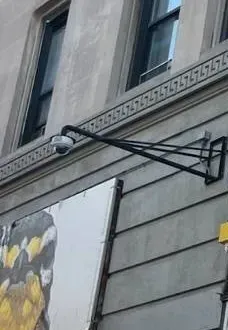
AESS job-library photo, not taken in Highbridge: a white dome camera on a black steel wall arm below a Greek-key stone cornice on a pre-war masonry front. Later additions often share an old facade with the door-station cable, so its route is traced before anything new is drilled.
Building Specialists
Door Buzzer Repair for Highbridge's Architecture
Highbridge's apartment stock divides less by height than by history. A five-story walk-up rebuilt in 1991 and a five-story walk-up that was never emptied can stand side by side on Nelson Avenue and have entirely different entry systems inside. The groups below are how we sort a building before the visit, using the tax-lot record, the owner's name and the super's answer to one question: was the inside of this building ever rebuilt?
Rebuilt pre-war walk-ups (five floors)
The commonest rehab building: five stories, 15 to 45 apartments, a single street door, new interior walls from the renovation. The riser usually runs in a chase the renovation created, so it can be followed floor by floor without opening the old plaster.
Rebuilt pre-war elevator buildings (six to eight floors)
Larger rehabs on Anderson, Woodycrest and Shakespeare Avenues, often 40 to 130 apartments with a vestibule and a lobby door. More apartments per riser and a longer run to the top floor make the supply and amplifier the parts to test first when sound fades everywhere.
Never-renovated 1920s buildings
Many of the 1920s buildings have no alteration on record. Their entry systems were replaced piecemeal over decades, so a single building can have handsets of three ages on one riser. Here the first job is an inventory: what is on each line, and what the panel is actually driving.
Art Deco courtyard complexes
Noonan Plaza wraps a garden court entered through a portico at Nelson Avenue and West 168th Street; the Park Plaza Apartments at 1005 Jerome Avenue hold more than two hundred apartments behind one Art Deco front. Large plans like these have long cable runs between entrances and, where designated, landmark rules for anything fixed to the façade.
Senior, supportive and new buildings
Buildings from 2001 onward, including several senior residences and the large supportive and affordable development on University Avenue, often pair a networked panel with a staffed desk or a camera. Their failures are power, network and account problems as often as wiring.
Three-family houses on the side streets
Tax records show clusters of small three- and four-unit houses built from the mid-1990s to the late 2000s, including rows from 2003 to 2007 on West 161st, West 168th and West 169th Streets. These have a bell plate, three sounders or handsets and a door release, a small system that is quick to test.
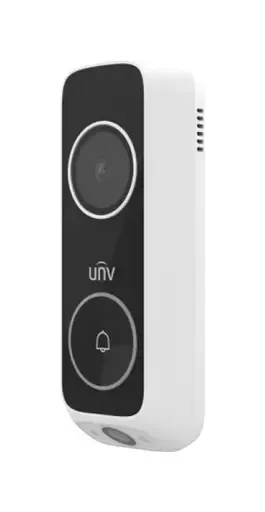
Manufacturer product photo, not taken in Highbridge: a slim two-lens doorbell, one lens facing the visitor and one angled down at the step. On an entrance at the top of an outdoor stair, a downward view shows who is waiting below before anyone is buzzed up.
Method by Building
How We Repair Each Generation of Highbridge Building
Rebuilt between 1979 and 1999: test the siblings of the failed part
In a rehab-era building we expect one backbone of one age. The riser, the supply and most of the handsets were fitted within weeks of each other, so the part that failed is a signal about the rest. After the repair, the technician measures the supply under load, checks two or three handsets on lines that still work, and looks at the strike and closer on the street door, then writes down what he found. If everything else is sound, that is recorded too; owners of rebuilt buildings often need exactly that note when a lender, a new management company or a city agency asks about building systems.
Never-renovated 1920s buildings: inventory before repair
An unrenovated building has usually had its entry system replaced in pieces. The panel may be from one decade, the handsets from three, and the riser may be the original cable with newer cable spliced in at each floor where a tenant renovation cut it. We start by mapping which apartments are on which line and which handsets are fitted where, because fitting a modern handset to a line still driven by an older supply can fail in ways that look like a new fault.
Buildings with a lower door: two levels, one release
On the slope between Ogden Avenue and the streets below it, some buildings have their lobby at the upper street and a service or side door a full floor lower. Where both doors are on the buzzer, the release cable to the lower door often runs down through the cellar, past the boiler room and the trash room, which is where it gets damaged. We trace that run separately from the lobby circuit, so a dead lower door is not mistaken for a dead system.
Art Deco courtyard buildings: long runs, landmark faces
Courtyard plans put several entrances off one court, with cable running between wings through cellars and under the court itself. A fault at one entrance is traced from the shared equipment outward. Where the building is a designated landmark, as Noonan Plaza is, repair of an existing panel in place is ordinary maintenance; a new panel or a new location on the façade needs Landmarks Preservation Commission approval first, and we say so before quoting rather than after.
For a panel that calls phones, the order of checks is fixed. Does the panel have power? Does it have a network connection or a working cellular service? Is the account that manages residents still active, and who holds its login? Only then do we test the hardware. Many calls from buildings opened since 2015 end at the second or third step, and the owner hears that before any part is quoted.
Three-family houses: a small system, tested end to end
A house system is a bell plate, a transformer, three sounders or handsets and usually a release on the front door. Every piece is tested in one visit. When all three bells sound together, the common wire or a shared button contact is usually at fault; when one apartment cannot release the door, the fault is almost always in that apartment's station or its short run.
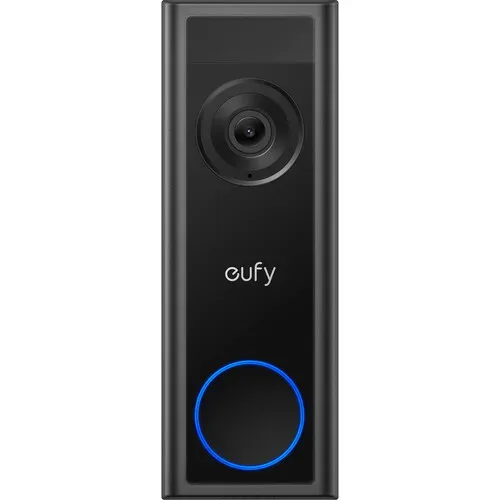
Manufacturer product photo, not taken in Highbridge: a black video doorbell with a lit ring button. Battery units like this are sometimes fitted by tenants beside a dead apartment button; when the building system is repaired, the two are kept apart so neither confuses the other.
Commercial Door Buzzer Repair
Business Door Buzzer Repair in Highbridge
Highbridge is mainly residential, and most of its businesses sit at the foot of apartment buildings or in institutional buildings on the main avenues. For a store, school, clinic, church or office, a buzzer repair has to fit around opening hours and around the people who use the door all day. We aim to arrive in the quietest hour you give us, hold the door while a part is changed, and trace wiring from the back of the premises or the cellar rather than across a sales floor.
Ogden Avenue
The neighborhood's spine and the route of the Bx13 bus. Storefronts at the base of apartment buildings, PS 11 at 1257 Ogden Avenue, and Engine 68 and Ladder 49 at 1160 Ogden Avenue share the avenue with rebuilt walk-ups. A shop door here usually sits a few feet from the residents' door, and the two systems are kept apart.
University Avenue
From the H.W. Wilson Company's 1917 building with its 1929 lighthouse, at Sedgwick Avenue, north past the High Bridge to the new supportive and affordable development at 1387 University Avenue. Offices, a school and large new buildings with staffed lobbies.
Jerome Avenue under the 4 train
The eastern edge of Highbridge, with the 167th Street station and the Park Plaza Apartments at 1005 Jerome Avenue. Street doors under an elevated line take constant vibration, so on calls along the avenue we check strike screws and closer arms as a matter of routine.
West 167th Street
The Bx35 runs along it, past schools including the Highbridge Green School at 200 West 167th Street and a run of newer apartment buildings. Visitor entrances at schools and offices take heavy daytime use and a different kind of release.
West 170th Street and Edward L. Grant Highway
The northern commercial edge, with the Bx11 on West 170th Street and mixed buildings, stores below and apartments above, along the highway. Buildings with stores at street level often route the residents' cable behind a shop ceiling.
Around Yankee Stadium
The south end of Highbridge reaches Macombs Dam Park, built on the footprint of the original Yankee Stadium, and the 161st Street station. The blocks here mix older walk-ups with newer buildings, and the buzzer calls from them span every generation described above.
Where a shop's back-door bell was wired into the residential intercom years ago, or a school's visitor door shares a supply with something else, we separate or document the connection as part of the repair. Businesses that want cameras at the door as well can see camera installation in Highbridge.
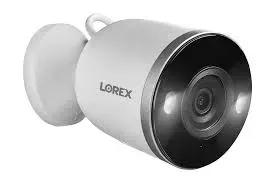
Manufacturer product photo, not taken in Highbridge: a white bullet camera with built-in lights. Light at a side or service door matters to the repair as well, because a video panel cannot show a face on an unlit landing.
Compliance
The Rules That Reach a Highbridge Front Door
This is a summary for owners, managers and tenants, not legal advice. The rules below are the ones that most often come up when we repair an entry system in a Highbridge building, and each is named so you can read it yourself. They are not abstract here: in 2016, tenants at 949 Ogden Avenue listed a broken front door among the conditions in a lawsuit against their landlord, who told DNAinfo that work orders for a broken door lock had been completed.
Multiple Dwelling Law § 50-a
According to the New York Attorney General's tenants' rights guide, multiple dwellings built or converted after January 1, 1968 with eight or more apartments must have a two-way voice intercom with a door release, and older multiple dwellings must provide self-locking doors and a two-way intercom if a majority of the apartments request it. The owner may recover the cost under rules in the law. In practice, nearly every Highbridge apartment building we are called to already has an intercom, so the question is repair, not whether one is required.
HPD and the entrance door
HPD treats a defective self-closing door on a multiple dwelling as a class C, immediately hazardous violation, to be corrected within 14 days of the notice. A buzzer repair that leaves the door unable to close and latch on its own is not finished, so we check the closer and the latch on every street door we work on.
Housing Maintenance Code § 27-2005
The owner of a multiple dwelling is responsible for keeping it, including its intercom and door hardware, in good repair. That is the section under which HPD writes most intercom violations, and the reason a tenant's complaint becomes the owner's repair.
Landmarks
Noonan Plaza is a designated New York City landmark (LPC designation LP-2400), and the Park Plaza Apartments are listed on the National Register of Historic Places. The LPC permit guidebook allows staff-level approval for intercom panels within or beside a door opening and treats ordinary repair as maintenance; anything new on a designated façade is checked with the Commission first.
Electrical permits
Work on the line-voltage side of a supply, such as a new outlet or a new circuit for a panel, is done by a licensed electrician under a Department of Buildings permit. Our work is on the low-voltage side; where a repair needs line-voltage work, we tell the owner before quoting.
Reach at commercial doors
Under the 2010 ADA Standards, the highest forward reach for operable parts is 48 inches. When a panel at a business or a public entrance is replaced or moved, we set its buttons within that range.
Your Questions Answered
Door Buzzer Repair in Highbridge: Questions Answered
These are questions from owners, supers, managers and tenants in Highbridge's buildings, grouped by the kind of building they come from. Shorter questions about booking and prices are in the FAQ further down.
Buildings rebuilt from vacant shells
Our building was rebuilt from a vacant shell around 1991, and the entry system from that renovation is still in use. At what point does repairing it stop making sense?
Later than most owners expect. A system from that period is simple: a panel, a supply, a riser and handsets, with few parts that cannot be repaired or matched. What tips the balance is not age alone but how the faults arrive. If the building needs a handset here and a button there once or twice a year, repairing is the cheaper path for a long time. If whole lines are failing, the supply has been replaced more than once, and the panel's face is worn through, the repair bills start to approach the cost of a new system within two or three years.
We give you the numbers both ways after testing: what the repair costs now on the Bronx list, and what else in the system is close to failing. Replacement is a separate quote, on our intercom installation page, and we do not push it when a repair will do.
Nobody kept the drawings from our building's renovation. How do you work out where the risers run?
By starting where the cable has to be: at the cellar terminal block, where every line leaves the supply, and at the panel. From the terminal we identify each pair with a tone and follow it to the first floor's junction or closet. Renovations of that era usually ran risers in a new chase beside the stair, in a closet stacked floor over floor, or along the public hall above a dropped ceiling, and once one floor's junction is found, the rest usually line up above it.
As we go, each junction and box is labelled with the apartments it feeds, and the route is sketched on the repair sheet. For a building with no drawings, that sketch often becomes the only record of the system, and we leave a copy with the super.
One sponsor renovated four buildings on our block in the same year. If the intercom fails in one, should the other three be inspected before they fail too?
It is worth a short look. Buildings renovated together usually got the same equipment from the same contractor in the same season, so they age together. When the supply fails in one, the supplies next door are the same age and have carried similar loads. A walk-through of the others, measuring each supply and testing a sample of lines, takes far less time than four separate emergency calls.
If the buildings share an owner, we can schedule them back to back on one day and quote each building separately on the Bronx list. Where they have different owners now, we only enter a building with its own owner's or manager's agreement.
Entrances on the hill
Our front door is on the upper avenue, but tenants with strollers and shopping carts use a lower side door that opens only with a key. Can that lower door be added to the buzzer?
Usually, yes. The lower door needs its own release, a strike or a lock that suits its frame, and a cable from the building's release circuit to it, normally run down through the cellar. The apartment door buttons then open both doors, or the lower door only, depending on how the owner wants visitors to arrive. What decides the price is the cable route and the door itself: a steel door in a steel frame takes a strike readily; a worn wood door may need its latch and closer put right first.
Because a second door changes how people enter the building, we confirm the plan with the owner or manager in writing before quoting, and we check that the lower door still closes and locks on its own.
Our panel is at a gate at the bottom of an outdoor stair. The gate releases, but by the time visitors climb to the building door, it has locked again. How should the two doors be timed?
The two releases need different hold times, or a second press from the apartment. On many systems the release time can be set at the relay or the controller: a few seconds for the gate, longer for the building door, or a short delay before the building door releases so it opens when the visitor arrives. Where the equipment cannot be timed, the simplest fix is a separate button in the apartment for the building door, which tenants press when they hear the visitor on the stair.
Any longer hold on the building door still has to end with the door closing and latching by itself. We set the timing, test it with someone climbing the stair, and write the settings on the repair sheet so they are not lost the next time the controller is touched.
Our building sits on the slope, and the cellar room with the intercom supply opens directly onto the lower street. Should that equipment be moved or locked?
Locked, at the least. A supply or controller that anyone can reach from the street can be switched off, unplugged or damaged, and a person who knows what they are looking at can sometimes trigger a door release from it. A locked metal enclosure over the equipment, inside a locked room, solves most of the risk. Moving it is worth considering only if the room also takes water in storms or is used for something that crowds the equipment.
We note an exposed supply on every repair sheet, quote an enclosure on the lines of the Bronx list, and leave the choice to the owner.
Fires, citations and the newest buildings
A fire gutted one apartment, and since then the apartments above it on the same line cannot hear the lobby. Can the line be restored before that apartment is rebuilt?
Fires do happen in these buildings: in August 2025 a two-alarm fire at 1235 Woodycrest Avenue, a 1927 building rebuilt in 1984, left some tenants out of their homes for months, according to the Bronx Times. The intercom line through a burned apartment can usually be restored for everyone else. In many systems the riser passes through or beside each apartment on its line, and fire or the water used to fight it damages the cable where it runs through the burned unit. We find the damaged section, then either bridge around that apartment with new cable in a public-hall route or splice the riser in the wall cavity with the burned unit's own connection left off, capped and labelled. The apartments above get their service back; the burned apartment is reconnected when it is rebuilt.
Before we start, the owner should confirm with the fire marshal, the insurer and any vacate order on the building that the area can be entered and worked in.
Our building opened after 2015, and its entry panel is barely ten years old, yet HPD has already cited it. Is a newer system cheaper to put right?
Often, because the fault is frequently not hardware. Newer panels depend on power, a network connection or cellular plan, and an administrator account, and a lapse in any of those looks to a tenant exactly like a broken intercom. When it is hardware, the parts are current and available, and many repairs are a module rather than a whole panel.
Where newer systems cost more is in the access: a panel that has to be re-enrolled with a cloud account, or residents' phones that have to be re-registered, takes time even when no part is replaced. We tell you which kind of fault it is before quoting.
Tenants in our building are organizing over repairs, and the intercom is on their list. Can the tenant association get its own assessment?
A tenant association can ask us to look at what is visible from the common areas and the apartments of members who let us in: which handsets work, which do not, whether the street door closes and latches, and whether the panel calls each apartment. We put those findings in writing.
Repairs, and anything inside locked equipment rooms, need the owner or managing agent, because they control the building and pay for the work. When an association and an owner both want the same written assessment, we are glad to provide one copy to each.
Our building is one of the three-family houses on a side street, and when the downstairs bell button is pressed, all three apartments ring. Is that a wiring fault or the way it was built?
Almost always a fault. A three-family system is built so that each button rings only its own apartment; when one button rings all three, either that button's wire is touching the common wire, often where all three run together at the door, or a renovation joined two wires that should have stayed apart. Water in the bell plate can do the same thing.
The test takes minutes: each button is pressed with the others disconnected in turn. The repair is usually at the plate or in the first junction behind it, on the push-button line of the Bronx list.
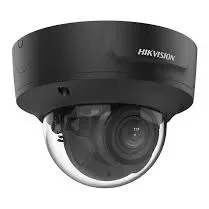
Manufacturer product photo, not taken in Highbridge: a black vandal dome. In a lobby, a camera mounted over the door shows whether a door fault is the release or a door that someone keeps forcing.
Equipment
Types of Door Buzzer Equipment We Repair in Highbridge
Three generations of equipment meet in Highbridge's buildings: whatever survives from before the 1970s, the systems fitted in the 1980s and 1990s renovations, and the networked panels of the buildings put up since 2001. We repair all three, and we keep them straight on the repair sheet so the next technician knows which is which.
Renovation-era audio panels
Flush steel panels with a button per apartment, a speaker grille and a directory, typical of the 1980s and 1990s rehabs. Buttons, speaker and microphone are usually replaceable without changing the panel.
Handsets and wall stations
Wall-mounted handsets with talk and door buttons, the most common part we replace. We match them to the building's system so mixed models on one line do not load the riser unevenly.
Riser cable and junctions
Multi-pair cable from the cellar terminal up through each floor's junction. Faults show as lines of apartments losing service at once.
Supplies and amplifiers
The heart of the system, usually in the cellar. Weak audio everywhere, or a release that fails while someone is talking, points here.
Electric strikes and releases
The part in the door frame that lets the latch go. Fail-secure strikes stay locked when power is lost, while the inside lever still opens the door for anyone leaving.
Magnetic locks and exit devices
Found on some newer and commercial doors. A magnetic lock needs a request-to-exit device and a fire-alarm release, and we test both whenever we touch one.
Networked and cellular panels
Video panels in post-2001 buildings that call residents' phones. They need power, a network or cellular service and an administrator account to work.
Bells, chimes and doorbells
The three-family and house systems on the side streets: a bell plate or doorbell, a transformer and a chime or sounder in each home.
When repair is the wrong answer
Sometimes it is. A panel whose face has rusted through, a riser cut in so many places that no two floors share a route, or a supply that has been replaced three times in two years: in those cases we say plainly that the money is better spent on a new system, and we price that on our Highbridge intercom installation page. The repair sheet from the visit becomes the starting point for that quote, so nothing is tested twice.
Manufacturer product photo, not taken in Highbridge: the front of a network video recorder. Where a building records its lobby, the recorder often shares a shelf, an outlet or a cable path with the intercom supply, and our repair sheet notes both.
AI Overview Reality Check
What AI Gets Wrong About Door Buzzer Repair in Highbridge
We could not open Google's AI Overview from where this page was built. The claims below are the ones that appear in the cost guides, vendor articles and directory pages such answers draw on, quoted or closely paraphrased, and each is checked against Highbridge's own records and our Bronx price list.
“Most apartment intercom problems are user error”
This line traces back to a security firm quoted in a 2019 Brick Underground guide to New York City intercom repair, and it gets repeated because it is sometimes true: a tenant holding the wrong button, a door that was not pulled shut, a handset left off the hook.
It does not describe Highbridge's records. Since 2021 HPD inspectors have written 427 intercom violations in the neighborhood's buildings, 404 of them against a specific apartment, after visiting and seeing the fault for themselves. An inspector does not cite user error.
What the user-error idea gets right is that the first call should rule it out. We ask the tenant to try the door button while someone listens at the lobby, and we ask what changed last. Then we test the system, because by the time a building has violations, it is rarely the button-pusher.
“Minor apartment intercom repairs typically run $150 to $400”
That range comes from a vendor's 2026 guide to apartment intercom costs, and similar figures circulate on contractor sites. As a national rule of thumb it is not unreasonable for a single part on an easy wall.
In a Highbridge building the useful number is the one on the Bronx list after testing. Our service call is $250 and includes the testing; a handset replacement is $250 to $525; a door release relay or push button is $250 to $475. Riser work, which a rebuilt building's age makes more likely, runs $850 to $2,400.
Sales tax of 8.875 percent is added on its own line. A guide's average cannot tell you whether your silent line is one worn handset or a failed riser pair, which is why the price comes after the test, not before.
“The intercom requirement covers only buildings built after 1968”
ButterflyMX and others summarize the Multiple Dwelling Law rule as applying to buildings of eight or more units built or converted after January 1, 1968. That is the core of it, and it is often quoted as if older buildings were exempt.
The Attorney General's tenants' rights guide says older multiple dwellings must also provide a two-way intercom and self-locking doors if a majority of the apartments request it. In Highbridge the question rarely arises in practice: nearly every apartment building we are called to already has an intercom, and HPD's records show intercom defects cited in pre-war, rebuilt and post-2001 buildings alike.
For an owner, the practical reading is simple: if the building has an intercom, HPD expects it to work. Whether the law required it in the first place is a question for counsel, not for the repair.
“A modern intercom needs no building wiring”
Cloud and cellular panels are sold on the promise that they talk to residents' phones without any cable to the apartments, and for the voice path that is true.
The door is another matter. The release still needs power and a cable from the panel or its controller to the strike or lock, and the panel itself needs power at the door. In a Highbridge building with a lobby half a floor above the street, or a second door a floor below, that cable is real work.
There is also the matter of signal and network. A cellular panel in a deep vestibule, or a network panel whose connection runs through a cellar switch, can fail for reasons that have nothing to do with wire. We test the signal or the network before recommending either kind for a hillside entrance.
“Intercom installation costs about $2,500 on average”
HomeAdvisor's national average for installing an intercom is often quoted when owners ask whether to repair or replace. It is an installation figure for a typical home, not a repair figure for a 60-apartment building.
For a Highbridge walk-up rebuilt in 1991, the comparison that matters is between the repair on the Bronx list and a full replacement quoted for that building, with its own count of apartments, doors and floors. A house average says nothing about either.
When a rebuilt building's system has reached the end, we say so and quote replacement separately. Until then, a repair at a few hundred dollars is not made more expensive by an average drawn from somebody else's house.
“A one-hour service call is $195 to $250 plus parts”
The same Brick Underground guide cited service-call estimates of $195 an hour and $250 an hour plus parts from New York City companies, and readers sometimes expect every repair to be billed that way.
Ours is structured differently. The $250 service call is a flat visit that includes the testing; small faults are fixed inside it, and larger repairs are priced on a listed line with the $250 credited. Only work that fits no listed line, such as a long search for an unrecorded cable route, is billed at $195/hr with a 3-hr minimum ($585).
You hear before the search starts which of those applies. In rehab-era buildings without drawings, the labelled route we leave behind is what keeps the next call on a listed line.
“Software for a cloud intercom runs $5 to $15 per unit per month”
Swiftlane's guide to apartment intercom installation costs gives that range for the subscription that comes with many cloud panels, and it is often repeated as if every intercom now carries a monthly fee.
For the 71 buildings rebuilt in Highbridge between 1979 and 1999, it does not apply. Their renovation-era audio systems have no subscription at all; a repair is a part and an hour or two of labor, priced once on the Bronx list. For a 60-apartment building, the quoted range would mean $300 to $900 a month if the owner switched to a subscription panel, which is worth knowing before anyone recommends one.
In the post-2001 buildings that already use networked panels, the fee matters in a different way: when a plan lapses or a card on file expires, the panel stops calling residents and the building looks broken. That is one of the first things we check there, before any hardware is quoted.
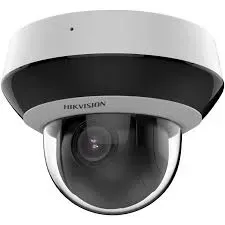
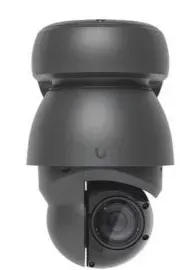
Manufacturer product photo, not taken in Highbridge: a small pan-tilt dome of the kind fitted in a vestibule ceiling. Its cable usually leaves the vestibule by the same sleeve or ceiling path as the panel wiring, which is where we look when both fail together.
Tell Us the Renovation Year, the Doors and the Silent Lines
A line like "rebuilt 1991, five floors on Nelson, every D apartment silent", "six floors on Woodycrest, lower side door won't release" or "newer building on University Avenue, panel stopped calling phones" tells us where to start. Add a photo of the panel and one of the lock edge of the door. Text it to (646) 490-0629 or use the form, and a technician will call back with a first read the same day.
A rebuilt walk-up on Ogden or Merriam Avenue, an elevator building on Anderson or Woodycrest, a courtyard complex on West 168th Street, a store on University Avenue or a three-family house on a side street: tell us which, roughly when the inside was rebuilt, and what the buzzer is doing. Prefer the phone? (646) 490-0629.
✅
Request Received
Thank you. If a street door is stuck unlocked right now, or tenants who cannot manage the stairs are cut off from the door, call directly rather than waiting for the callback: (646) 490-0629.
How It Works
Our Door Buzzer Repair Process
A single handset or strike usually takes an hour or two. A riser in a rebuilt six-story building, or a supply serving a hundred apartments, can take most of a day. The order of work is the same either way.
1. Date the building and name the doors
Tell us the address, whether the inside of the building was ever rebuilt and roughly when, how many floors it has, and which doors the buzzer opens: street door, lobby door, gate or lower side door. A photo of the panel and one of the lock edge of the door help.
2. Map which apartments are silent
Before the visit we ask which apartments or lines have stopped and which still work. A vertical line, a block of floors and a scatter of single apartments each point to a different part of the system.
3. Check the doors before the wiring
On site the technician starts at each door the system releases: does it close and latch on its own, is the strike lined up, and does the release get power when an apartment presses the door button?
4. Find the backbone and test it
At the cellar terminal and the supply, each line is separated and tested. In a rebuilt building we expect one backbone of one age; in an unrenovated building we first record which handsets and cables are on each line.
5. Measure power with the system in use
Supplies, transformers and amplifiers are measured with several handsets talking at once, because many rehab-era supplies pass a test at rest and fail under load.
6. Approve a written price
The quote names the failed part or section, the line of the Bronx list and the price, adds sales tax on its own line and carries license #12000287431. Nothing is fitted until the person paying says yes.
7. Repair, label, retest and check the siblings
The repair is made, every box we opened is labelled with the apartments it feeds, every affected apartment rings the panel and releases each door while we watch, and the same-age parts that have not failed yet are checked and noted.
What the building has when we leave
A working door and working lines, labels on every box we opened, a sketch of any cable route we had to find, a written note of the same-age parts we checked and their condition, and an invoice that names the parts we supplied for the 30-day warranty.
Coverage Area
Door Buzzer Repair Near Highbridge's Landmarks
Landmarks are how people give directions on the hill, and several of them say something about the buildings around them. These six are real places within or at the edge of our study area; none of them is a customer of ours, and we name them only as points of reference.
The High Bridge
Built in 1848 to carry Croton Aqueduct water over the Harlem River, given a walkway in 1864, closed to walkers in the 1960s and later restored and reopened, the bridge gave the neighborhood its name. Its Bronx end meets University Avenue near West 170th Street, among rebuilt walk-ups and newer towers.
Noonan Plaza Apartments
105–149 West 168th Street, completed in 1931 for developer Bernard J. Noonan to designs by Horace Ginsbern and Marvin Fine, and designated a city landmark in 2010. Its entrance is a portico at Nelson Avenue that leads into a garden court about 125 by 110 feet; the restoration won a Lucy Moses Award in 2022.
Park Plaza Apartments
1005 Jerome Avenue, by Horace Ginsbern with Marvin Fine, built 1928 to 1931 and described by Lehman College as one of the first, if not the first, Art Deco apartment houses in the Bronx. It is listed on the National Register of Historic Places.
Woodycrest Children's Home
Designed by William Tuthill, the architect of Carnegie Hall, and opened in 1902 as an orphanage for 120 children, the Beaux Arts building on Woodycrest Avenue now houses the Highbridge-Woodycrest center, run by Bronx-Lebanon Hospital Center for long-term care.
The stair streets
Stair streets connect Highbridge's blocks at different heights. The one between Shakespeare and Anderson Avenues became known as the Joker Stairs after the 2019 film was shot there. For a building beside one, the entrance and the cellar can open onto different levels.
The H.W. Wilson building
At Sedgwick and University Avenues, the publisher's home since 1917, with the lighthouse added to its roof in 1929. It anchors the southern stretch of University Avenue, where offices, schools and apartment buildings share the avenue.
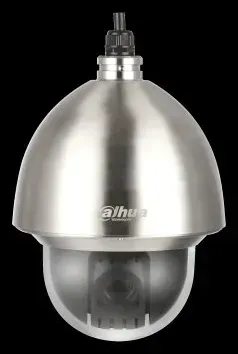
Manufacturer product photo, not taken in Highbridge: a stainless-steel pendant dome built for exposed outdoor positions. On a building whose entrance faces open sky above a slope, hardware at the door takes rain from more than one side.
Pricing
Door Buzzer Repair Cost in Highbridge
Highbridge is priced on our Bronx list. The Bronx multiplier is 1.00, the same as the Brooklyn base, so there is no neighborhood surcharge. Every visit opens with the $250 service call, which includes the testing; small faults are fixed inside it, and for larger repairs the $250 is credited against the price you approve. With New York City sales tax of 8.875 percent, the service call comes to $272.19 on the written quote.
The lines below are the whole Bronx door buzzer repair list. In Highbridge, calls from rebuilt buildings land most often on the handset, amplifier and riser lines, because those are the parts of a 1990s system that wear; calls from the newer buildings land more often on the panel and release lines, or turn out to need no part at all.
Repair
Bronx list
Typical Highbridge symptom
Service call with on-site diagnostic
$250
Every visit; credited toward a larger repair
Apartment station or handset replacement
$250 – $525
One silent apartment, or a scatter of failed handsets of the renovation era
Door release relay or push button
$250 – $475
An apartment door button that no longer opens anything; a three-family bell plate
24V transformer replacement
$325 – $650
Everything weak at once in a small building or house
Intercom amplifier replacement
$450 – $900
Audio gone or faint across a whole rebuilt building
Electric strike replacement and alignment
$450 – $950
A lobby, gate or lower side door that will not release
Lobby panel repair or faceplate
$650 – $1,800
A worn, wet or damaged panel at the street or in the vestibule
Riser pair repair or re-termination
$850 – $2,400
A whole vertical line, or every floor above a junction
Work that does not fit a listed line, such as a long search for a riser whose route nobody recorded during the renovation, is billed at our service rate of $195/hr with a 3-hr minimum ($585). You are told before the search begins whether a job is on a list line or on the hourly rate.
What moves a Highbridge price up or down
Three things. How much of the system the fault touches: one handset is a small line, a whole riser is a bigger one, but one riser repair can bring back six or eight apartments at once. How many doors the system releases: a gate, a lobby door and a lower side door are three releases, each its own line if all three need work. And access: a riser in a stair-hall chase is quicker to repair than one behind a shop ceiling or inside an occupied apartment.
Get the Bronx-List Price in Writing Before Any Part Goes In
The address, the renovation year if you know it, and a photo of the panel are enough for a first estimate: the list line we expect and the one or two things that could change it. (646) 490-0629.
Three repairs we are asked for often in Highbridge, each priced from a line of the Bronx list. The figure you pay is the one on the written quote after testing.
One line back
$850 – $2,400
riser pair repair or re-termination
The silent line traced from the cellar terminal to the break
Splice or re-termination, with each junction labelled
Every apartment on the line rung and released
Route sketched on the repair sheet
A building that can hear again
$450 – $900
intercom amplifier replacement
Supply and amplifier measured under load
Replacement matched to the building's system
Audio checked at the top and bottom floors
Same-age handsets sampled and noted
A second door that releases
$450 – $950
strike replacement and alignment
Strike chosen for the gate or side door's frame
Latch and closer adjusted so the door swings
Release timing set for the stair or slope
Door checked to close and lock on its own
Bring your own equipment. If the building has already bought a handset, a panel or a strike, we can fit customer-supplied equipment. We check first that it will work with the building's system, voltage and door, and tell you before the visit if it will not. Labor is quoted in writing like any other job; if it runs beyond the listed lines it is billed at $195/hr, 3-hr minimum ($585). The 30-day warranty and optional paid extended plans cover products we supply.
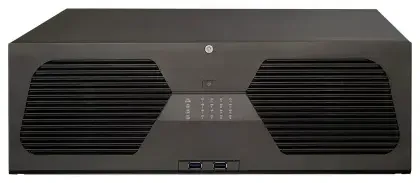
Manufacturer product photo, not taken in Highbridge: a large recorder chassis with vented fronts. Equipment that needs air, like this or like an intercom amplifier, does badly in a closed cellar closet, and that is noted when we find it there.
For a store on Ogden Avenue or a house on a side street, an alarm watches the doors a buzzer does not; see Highbridge alarm installation.
Fire alarm systems
A door held by a magnetic lock has to release when the fire alarm sounds; that connection is covered on fire alarm work in Highbridge.
Structured cabling
If a riser is being replaced anyway, network cable for a newer panel can go up the same chase; see Highbridge structured cabling.
Field Notes
Field Notes: Three Dates on Every Building
This describes how we approach a Highbridge call in general, not the story of one job. Before the technician opens the panel, he wants three dates. The first is the year the building went up, which is usually on the cornerstone or the tax record and tells him which walls are old plaster and masonry. The second is the year it was rebuilt, if it was, which tells him the age of the panel, the riser and most of the handsets. The third is the most recent repair, which tells him which parts are newer than the rest.
Most supers know the second date even when nobody else does, because the renovation is part of the building's story: the year tenants moved back in, the name of the housing company on the old lease, a plaque in the lobby. With those three dates written at the top of the repair sheet, the search for the fault tends to be short, and the note about the same-age parts that have not failed yet writes itself.
Before leaving, he adds a fourth date: today's, beside every box he opened and labelled. In a rebuilt building whose drawings were lost long ago, that sheet and those labels are often the only record of how the system is laid out.
FAQ
Highbridge Door Buzzer Repair FAQ
Will tenants have to learn anything new after a repair, such as different buttons or codes?
+
Not after an ordinary repair. A replaced handset, button, strike or riser section works the way the old one did. Where a part has to be a newer model, we show the tenants on that line how it works before we leave, and if a door's release timing is changed, the super gets the new settings in writing.
Is a panel at the top of an outdoor stair priced differently from one inside a lobby?
+
No. Panels are priced on the same lobby panel line of the Bronx list wherever they are mounted. What can change the total is what the location has done to the panel: one exposed to rain and de-icing salt may need a new faceplate and seals rather than a button, and that shows on the written quote.
Does the 30-day warranty stay with the building if it is sold?
+
The warranty covers the parts we supplied, at the building where we fitted them, for one year under the terms of the service agreement. If the building changes hands within that year, the new owner can call us about those parts with the invoice or our job number.
Does it matter to the price whether the building is rent-stabilized, subsidized or market-rate?
+
No. The Bronx list is the same for every building. What matters to the price is what failed and how much of the system it affects, not how the apartments are rented or financed.
What happens to the street door while the panel is off the wall?
+
The door stays locked and closes normally on its own; tenants use their keys, and the technician lets in anyone who arrives while the panel is open. If the work will take more than a short time, we tell the super first so deliveries and visitors can be planned around it.
How do you keep dust and debris down when cable has to be pulled through a finished lobby?
+
Most riser work in rebuilt buildings is done from chases, closets and junction boxes, so walls are rarely opened. When a hole has to be made, we cover the floor below, use a vacuum at the drill, and leave the opening neat and ready for patching.
Can a store on University Avenue have its buzzer repaired without going through the residential landlord?
+
If the store's door and buzzer are its own, separate from the building's system, the store's owner or tenant can book the repair directly. If the store's bell is wired into the building's intercom or supply, we need the building owner's or manager's agreement, because the repair touches equipment they control.
Can you give a firm price over the phone?
+
We can give the likely list line and its range from a good description and photos. A firm price comes after testing on site, because the same symptom can come from a handset, a junction or a supply, and the written quote you approve is based on what the test finds.
Can a community garden's gate get a buzzer or keypad, and would you repair one?
+
Highbridge has dozens of community gardens on lots that were left vacant decades ago. If the group running a garden has permission from whoever owns or manages the land to fit or repair a gate release, we can repair it or quote a new one; we ask to see that permission before working on the gate.
How far ahead should a housing company or managing agent book a non-urgent repair?
+
A few days is usually enough. If the building needs notice posted for tenants, or the work has to be coordinated with a lender's or agency's inspection, tell us the date you are working toward and we will schedule back from it.
All Areas Served
Door Buzzer Repair Across the Bronx, New York City, Long Island and the Hudson Valley
Manufacturer product photo, not taken in Highbridge: a black network pan-tilt camera. Networked cameras and networked entry panels often hang off the same switch in the cellar, so a network fault can take out both the picture and the panel's calls.
Sources
Where the Highbridge Facts and Figures Come From
Everything local on this page comes from the sources below, each read on October 22, 2026. What is not listed is ours: the Bronx price list and the way we test and repair. Where a figure is our own count or reading of a public dataset, the page says so.
NYC Department of City Planning, PLUTO (NYC Open Data 64uk-42ks): all tax lots in 2010 census tracts 189, 193, 199, 201 and 211 in the Bronx (842 lots, 13,607 homes; 433 lots with three or more homes, 13,272 apartments) — year built, first and second alteration years, residential units, floors, building class and owner name. Our study area is these five tracts, the ones HPD's records label Highbridge; it is not an official boundary. Counts of owners recorded as housing development fund companies or similar nonprofit housing entities are our reading of the owner-name field.
HPD Housing Maintenance Code Violations (NYC Open Data wvxf-dwi5): violations with neighborhood 'Highbridge' whose description contains 'INTERCOM' (808 since records begin, at 169 buildings; 427 since January 1, 2021, at 113 buildings), by year, class, status, apartment and tax lot; latest inspection date October 20, 2026.
311 Service Requests (NYC Open Data erm2-nwe9): descriptor 'BELL/BUZZER/INTERCOM' at tax blocks 2504 to 2537 in the Bronx, 2020 to October 22, 2026 (940), by year and tax lot.
Highbridge Community Development Corporation, About Us — founding in 1984, the 1986 Ten Year Plan, the Highbridge HDFC as the city's first primary nonprofit redevelopment partner in Highbridge, the 1989 Vacant Building Cluster Program, and 741 renovated units in 23 buildings occupied by 1992; HighBridge Voices, History.
The New York Times, search-result excerpts only (the articles could not be opened from where this page was built): 'Fear of Crime is Hastening The Decline of Highbridge' (August 5, 1976); 'Low-Income Renovations; Bronx Neighborhood Effort Revives Apartments' (July 15, 1994); 'High Bridge, the Bronx — Name to Get Its Meaning Back' (March 31, 2013).
Wikipedia, 'Highbridge, Bronx' — boundaries, ZIP code, Community District 4, the 44th Precinct, the High Bridge, estate names of the avenues, terrain and stair streets, landmarks, community gardens, public housing, schools, the library, transit and the FDNY companies on Ogden Avenue.
NYC Landmarks Preservation Commission, Noonan Plaza Apartments designation report LP-2400 (2010), and Marte Jorge, 'Noonan Plaza Apartments: the recovery of an Art Deco landmark' (Entrópico) — address, date, architects, courtyard and entrance, and the 2022 Lucy Moses Award; Lehman College, 'The Park Plaza Apartments'.
Bronx Times, 'Tenants at 1235 Woodycrest Ave., still displaced, living in poor conditions after August fire' (February 11, 2026); DNAinfo, 'Landlord Makes Much-Needed Repairs After Bronx Tenants Take Him To Court' (November 16, 2016), on 949 Ogden Avenue, including a broken front door.
Samaritan Daytop Village, 'Highbridge topping off' — 316 affordable and supportive apartments and 106 transitional units on University Avenue.
Multiple Dwelling Law § 50-a and the NY Attorney General's Tenants' Rights Guide; HPD, Self-Closing Doors; NYC Administrative Code § 27-2005; the LPC Permit Guidebook chapter on health and safety work; Department of Buildings electrical permit requirements; the 2010 ADA Standards.
Cost and vendor claims tested in the reality check: Brick Underground's 2019 NYC intercom repair guide, Swiftlane's apartment intercom cost guides, ButterflyMX on the NYC intercom law and on its call box, and HomeAdvisor's intercom installation cost page.
Not reachable from where this page was built: Google's People Also Ask, related searches and AI Overview, Answer the Public, Bing and DuckDuckGo suggestions, and Yelp reviews. No Highbridge-specific Reddit discussion of buzzers was found.
Street Door Unlocked or a Line Gone Silent? Call the Bronx Line
If the street door will not lock, close it and use the key cylinder rather than wedging it open. If a whole line or the whole building is silent, let the affected tenants know a repair is booked so nobody waits by a dead handset. Then call (646) 490-0629 with the address, the renovation year if you know it, and what the door is doing now. A technician will usually arrive with the parts the description points to.
Highbridge Door Buzzer Repair From a Licensed, Insured Bronx Company
A walk-up on Nelson Avenue rebuilt in 1991, an elevator building on Anderson or Woodycrest Avenue, a courtyard complex on West 168th Street, a new building on University Avenue, a store on Ogden Avenue or a three-family house on a side street: one number reaches the technicians, (646) 490-0629. Photos of the panel and the door are easiest to send over WhatsApp. Our legal name, Abstract Enterprises Security Systems, and our Bronx office address, 460 E Fordham Rd, Bronx, NY 10458, appear on every quote and invoice.
Customers have rated us 4.7★ across 201 Google reviews. Each Highbridge job is done under New York State license #12000287431, and a certificate of insurance goes ahead of the visit to any owner, managing agent, housing company, board or business that needs one on file.
Full terms — including 50% deposit, the 30-day warranty and optional paid extended warranty, and the late-fee schedule — are set out in the service agreement. See our warranty page.
Revision log, October 22, 2026: this page was rebuilt from new research on Highbridge's buildings: city tax-lot records for the five census tracts that make up the neighborhood, showing the wave of renovations between 1979 and 1999 and the newer buildings since 2001; HPD intercom violations and 311 complaints for those buildings; the history of the nonprofit rebuilding; the landmarks on the hill; and the rules that apply. Prices are from the Bronx list.