Own a rental building in Nassau County? Front doors, cellar hatchways, entry panels, fobs, door alarms and cameras planned as one system for the whole property: (516) 346-5778
Apartment building security systems in Nassau County start with a $250 service call at the building, and anything larger is priced in writing after we have tested the existing wiring and walked every door, hatchway and closet. The owners we work for here hold one rental building or a handful of them: a three-story walk-up above the shops on a village main street, a prewar or postwar elevator building a short walk from a Long Island Rail Road station, a garden-apartment complex with a dozen entrances and a parking court, or a new building that went up near a station in the last few years. Everything we install is low-voltage work done under our New York State license.
Quick answer: Secure a Nassau apartment building opening by opening: entrance doors that shut and latch on their own, a panel that reaches every apartment, fobs or codes in place of loose keys on the rear and service doors, alarms on hatchways, the cellar and the roof, and a few cameras where trouble actually happens, all fed from one locked closet. Any visit starts with the $250 service call, credited toward the work if it turns into a bigger job. Published Nassau County prices on our site include $250–$525 for an apartment station, $450–$950 for an electric strike with the door aligned, $1,500–$3,500 per door for a networked card reader, $1,725 per car for an elevator reader and $999 for a four-camera system; a whole building is priced once we have surveyed it.
Last updated November 27, 2026 by Abstract Enterprises Security Systems, NYS license #12000287431 · Sources: NYS Multiple Residence Law §§3 and 107; 2025 Property Maintenance Code of New York State §304.18; 2020 Building Code of New York State §1010.1.9; NY RPAPL §768 (NYS Attorney General guidance); NYS Attorney General Good Cause Eviction guide; NYS Homes and Community Renewal (ETPA localities and Nassau registration count); Village of Freeport Code ch. 128 art. IV; Town of North Hempstead Code ch. 2 art. VI; Village of Great Neck Plaza; U.S. Census Bureau QuickFacts; Village of Hempstead DRI Strategic Investment Plan (2026); Nassau County Fire Marshal annual report; Nassau County Police Department alarm permit section; NY Penal Law art. 250; an intercom maker's published cost guide (Swiftlane); CBS New York (Nov. 2023); Long Island Business News (Aug. 2023)
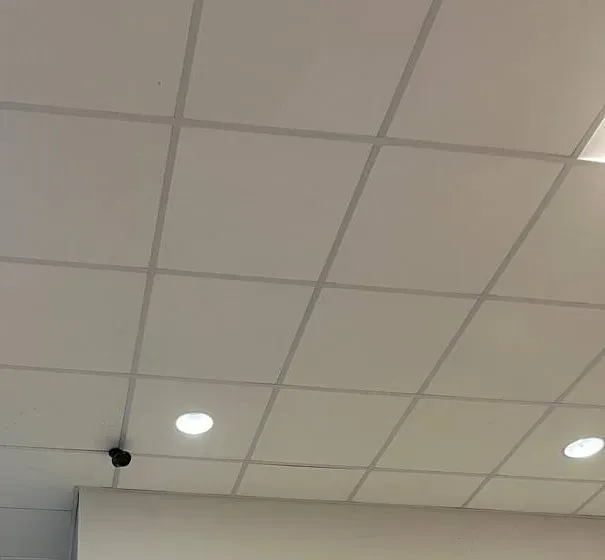
Job photo from our files: a small black camera mounted on a white drop-tile ceiling right where it meets a wall soffit, with two round recessed lights nearby. Placing a camera at the edge of the ceiling keeps it out of reach and aims it down the length of the room.
Nassau Building Owner Request
Walk-up, garden complex or elevator building — tell us the village
✅
Request Sent!
Thank you. We will contact you to set up the visit.
25+
Years Experience
Nassau
Towns, Cities & Villages
100%
Licensed & Insured
4.7★
201 Google Reviews
Owner-operated since 2002 · Thousands of jobs completed · Booked within 2 hours
The County
Why Nassau County Rental Buildings Need an Owner's Security Plan
Nassau County is mostly single-family houses, and that is exactly why its apartment buildings get overlooked. The Census Bureau's QuickFacts table puts the county's owner-occupied housing rate at 81.9 percent for 2020–2024, so the security advice, the products on the shelf and even most installers are pointed at homeowners. The rental buildings sit in pockets: around the train stations, along the main streets of the older villages, in garden complexes built after the war, and in a growing number of new buildings put up near the Long Island Rail Road. An owner of one of those buildings is managing a small multifamily operation inside a county built for houses, and the doorbell-and-camera kit that suits the house next door does not suit thirty apartments with shared halls and a cellar.
The concentration in those pockets is striking. The Village of Great Neck Plaza says that within a third of a square mile it holds 90 multiple-family apartment buildings alongside 148 single-family homes, more than 260 stores and service businesses and a railroad station. In the Village of Hempstead, Census QuickFacts reports an owner-occupied rate of just 47.5 percent, so most households rent, and the village's 2026 Downtown Revitalization Initiative plan notes that between 2013 and 2023 most new housing units there were in properties with more than 20 units, an increase of 1,078 units. The same plan contrasts the village with the Town of Hempstead around it, where 82 percent of occupied units are owner-occupied. Two places a few miles apart can be completely different rental markets, and the security plan has to follow the building, not the county average.
The rules are different from the city, too, and a lot of advice online gets this wrong. New York City's Multiple Dwelling Law, the source of the city's intercom and self-locking-door duties, does not govern a Nassau building. The state's Multiple Residence Law says it applies “to all cities of less than three hundred twenty-five thousand population and to all towns and villages,” which takes in every town, village and city in Nassau. On top of that sits the Property Maintenance Code of New York State, part of the statewide Uniform Code, whose building-security section requires that doors, windows and hatchways for rented dwelling units “be provided with devices designed to provide security for the occupants and property within.” Then come local laws: village and town rental permits, inspections, and in some places the state's rent-stabilization program. We are not lawyers, and nothing here is legal advice, but an owner should know which set of rules their building answers to before buying hardware.
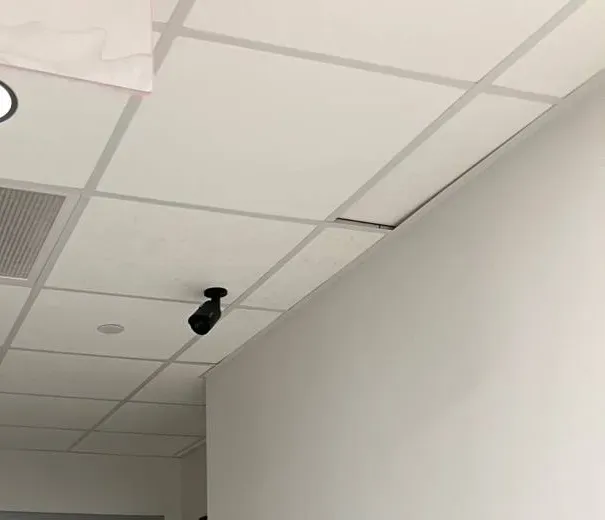
Job photo from our files: a black bullet camera on a short ceiling mount where a white drop-tile ceiling steps down at a pale wall, with a square air vent at the left. In a long hallway this position looks along the corridor toward the doors at the far end.
Nassau numbers and rules that shape an owner's plan
Which state law applies. Multiple Residence Law §3: the chapter applies to all cities under 325,000 people and to all towns and villages. Nassau's two cities, three towns and incorporated villages all fall under it rather than under New York City's Multiple Dwelling Law.
Building security in rented units. 2025 Property Maintenance Code of New York State §304.18: doors, windows and hatchways of rented units must have devices that secure the occupants and property.
Deadbolts. §304.18.1: where a rented unit's door has a deadbolt, it must open from the inside “without the need for keys, special knowledge or effort,” with a throw of at least one inch, and a sliding bolt does not count.
Low windows. §304.18.2: operable windows within six feet of the ground or a walking surface that give access to a rented unit need a sash locking device.
Hatchways. §304.18.3: basement hatchways that lead into a rented unit need devices that secure it from unauthorized entry.
Where the renters are. Great Neck Plaza: 90 multiple-family apartment buildings in a third of a square mile (village website). Village of Hempstead: 47.5 percent owner-occupied (Census QuickFacts), against 81.9 percent for Nassau County as a whole.
Rent stabilization. NYS Homes and Community Renewal lists the Nassau localities that adopted the Emergency Tenant Protection Act, among them the cities of Glen Cove and Long Beach, the Town of North Hempstead and villages including Freeport, Hempstead, Mineola, Lynbrook, Rockville Centre and Great Neck Plaza; HCR counted about 6,650 ETPA apartments in Nassau as of April 1, 2021.
Good Cause Eviction. The NYS Attorney General's guide says the law applies only to New York City and localities that opt in; its April 2025 list of opted-in cities and villages contains no Nassau locality.
Nassau building type
What the owner usually inherits
What usually comes first
Walk-up above stores on a village main street
A narrow residential door between shopfronts, an audio buzzer, a shared cellar
A door that closes and latches, a working panel, separation from the stores' back doors
Prewar or postwar elevator building near a station
An older audio or telephone-entry panel, one elevator, a rear service door
Riser test, strike and closer on every entrance, readers on the service and garage doors
Garden-apartment complex
Many low entrances, a laundry building, a parking court, a key for everything
One credential system for all doors, door-held alerts at the back, cameras on paths and lot
New building near the railroad
A cloud entry panel, app credentials, a developer's integrator holding the logins
Administrator access in the owner's name, every recurring fee in writing
House converted to three or more units
Separate doorbells, a side stair, a basement entrance with a hatchway
Deadbolts that meet the maintenance code, a secured hatchway, one simple entry panel
Shore building in Long Beach
Corroded outdoor hardware, equipment in a basement that has flooded before
Outdoor-rated panel and readers, equipment raised out of the cellar, battery backup
Why one-piece-at-a-time security fails in Nassau buildings
Many Nassau rentals have been owned by the same family for decades, and the security grew the way the building did: a buzzer panel from the 1970s, a keypad someone added on the side door, a camera kit a nephew put up, a padlock on the hatchway, a deadbolt from the hardware store on every apartment door. Each piece made sense on the day it went in. Taken together they leave an owner who cannot say which doors actually lock, who still has keys, whose phone the cameras report to, or whether the apartment deadbolts would pass the maintenance code. Nobody needs to rip it all out. The useful step is to list every opening, decide what each one should do, and then replace pieces in an order the budget can carry.
Package theft shows how small the gap can be. In November 2023 CBS New York reported a run of thefts in Massapequa Park and Wantagh, where Nassau police said mobile devices were stolen six times in 11 days right after FedEx deliveries; one resident said it was “literally four minutes after they delivered.” Those were houses, not apartment buildings, but the lesson carries straight over: anything that sits in an unlocked vestibule or on an outside step is gone within minutes. In a walk-up, the vestibule is often the only place a courier can leave a box, which makes the inner door, not the street door, the one that matters.
The people an owner's system has to work for
The owner wants a single sheet that says what equipment the building has, which logins exist and who holds them, what the building pays each month for any platform, and which part is closest to failing. Because many Nassau owners live in another town and run the building without an agent, everything has to be readable from a phone.
Whoever minds the building, often a part-time handyman or a relative rather than a live-in super in this county, needs to open the closet and understand it: labels on the cable, a short written guide, and the ability to switch off a lost fob or reset a code without waiting for us.
Tenants judge everything by three things: whether the door lets them in and locks behind them, whether they can let a visitor in with or without a smartphone, and whether the lock on their own apartment door is one they can open in the dark without hunting for a key.
Inspectors, insurers and buyers see the building from outside. A village or town code officer looks at locks, doors and detectors during a rental-permit inspection; an insurer asks what is installed; a buyer's engineer wants to know whether the system is documented and in the owner's name.
What We Install
Apartment Building Security System Services in Nassau County, Opening by Opening
Every part below starts with the question a Nassau owner actually asks about one piece of the building, gives the answer we would give at the building, and then points to the Nassau County page on our site that covers that piece in depth. Taken together, they make up what most people mean by apartment building security systems: the hardware on the doors, the entry system, the credentials, the alarms, the cameras and the closet that holds it all.
Entrance doors, vestibules and the hardware that makes them lock
No entry system works on a door that does not close. In Nassau buildings the main entrance is usually in better shape than the back half: the rear stair door onto the parking lot, the side door the tenants use to reach the garbage enclosure, the cellar door at the bottom of an outside stair. Each of those needs a closer that pulls it shut against the wind, a latch or strike that catches every time, and a frame that has not sagged. When we fit an electric strike we set the closer and align the door at the same visit, and our Nassau buzzer repair pages publish $450–$950 for a strike replaced with the door aligned. If the lock body itself is worn out, that is locksmith work, and we will say so before anything electronic goes on the door.
Swing direction matters more than owners expect. The Multiple Residence Law's entrance-door section, §107, says that every door giving access to an entrance hall from outside “shall open outwardly,” and that the door must carry at least five square feet of glazed surface. Which sections reach a particular building depends on its class and when it went up, which is a question for the village or town building department, but the practical point stands: a magnetic lock, a strike and a closer are chosen for the way the door swings, so we never quote hardware for a door we have not looked at.
Vestibules deserve their own decision. A two-door vestibule with the panel at the outer door lets visitors call before entering and gives couriers a sheltered place to leave a box if the outer door is on a timer. The same vestibule with the panel at the inner door keeps the hardware out of the weather but turns the vestibule into an open waiting room. On the windier blocks near the water, and anywhere the street door already takes a beating, we usually put the panel inside and fit a strike on the outer door so it locks overnight.
The intercom: panel, riser and the apartment end
An entry panel is only half of an intercom. The other half is the path from the lobby to each apartment, and in older Nassau buildings that path is a riser of telephone-style pairs run when the building was new. Before we recommend replacing anything, we test the riser: if the pairs are sound, a new panel and new stations can reuse them; if half the pairs are open or shorted, the decision changes completely. Single faults are priced from the list our Nassau County door buzzer repair page publishes: $250–$525 for an apartment station, $250–$475 for a door release relay or button, $325–$650 for a 24-volt transformer, $650–$1,800 for lobby panel work and $850–$2,400 to repair or re-terminate riser pairs. Faults in a panel that is otherwise worth keeping are handled on the intercom repair page for Nassau County, and new systems, with the $1,200–$4,500+ range published for multi-unit buildings, are on our Nassau County intercom installation page.
The apartment end is where long-term tenants judge the job. Some want a handset or a video monitor on the kitchen wall that works whether or not their phone is charged; others want the call to ring their mobile and never think about the wall unit again. Many current panels can do both at once, so a building does not have to choose for every tenant. What we steer owners away from is a panel that only works through a phone app in a building where a large share of tenants are older or do not use smartphones; that is the fastest way to end up with the front door propped open.
Job photo from our files: a small black camera on a round base fixed at the corner where a drop-tile ceiling meets two pale walls, with a lit ceiling panel nearby and the top of a large dark wall-mounted screen below. A corner mount sees the whole room, including the doorway.
Fobs and codes for the doors that are not the lobby
Keys are where most Nassau rentals lose control. A garden complex may have a key for every entrance, the laundry building, the boiler room and the trash enclosure, and after twenty years of turnover nobody knows how many copies exist. A credential system replaces that: each tenant carries one fob, card or phone credential, each door decides who it lets in and when, and a lost fob is cancelled in a minute instead of re-keying a door. Our access control installation page for Nassau County publishes $1,500–$3,500 per door for a networked card reader installed. We set the software up so the owner or the super adds and removes credentials themselves and calls us only for hardware.
One warning that has nothing to do with hardware: a credential system gives an owner the power to switch a tenant off, and New York law treats that seriously. The state Attorney General's guidance on unlawful evictions under RPAPL §768 explains that an owner who changes the locks on an occupied apartment can face separate charges for each unlawful act, and it lists removing, plugging or otherwise disabling the lock on a tenant's entrance door without supplying a key. We do not give legal advice, but we tell every owner the same thing: a fob is a key, and the rules for keys apply to it.
Packages, mail and the vestibule problem
Few Nassau rentals were built with a mailroom. The usual setup is a bank of mailboxes in a small vestibule and packages stacked on the floor beside them, which works until the first theft. The fixes, in order of cost: a strike and closer on the inner vestibule door so only tenants and the carrier can reach the packages, a reader on a small storage room or closet turned into a package room, then lockers or a dedicated package room with a camera over the door. We install the door hardware, readers and cameras; the lockers themselves come from their makers, and we wire their power and network when they need it.
Cellars, hatchways, boiler rooms and roofs
The back of a building is where alarms do more than cameras. The Property Maintenance Code singles out basement hatchways: where one gives access to a rented unit, it must have “devices that secure the units from unauthorized entry.” Beyond the code minimum, a contact on every hatchway, cellar door and roof door, a motion sensor in the boiler room and storage area, and a keypad the super can arm at night will report a forced door the moment it happens instead of on next week's camera review. Monitoring through our central station is $30 a month with a keypad and $45 a month with the phone app, as published on our alarm installation page for Nassau County. The Nassau County Police Department's alarm permit section issues the permit an alarm user needs, and we tell the owner which permit type applies before the system goes live.
Cameras (kept short on purpose)
On a whole-building plan, cameras go where the opening list says they are needed: the entrances, the package area, the rear door, the parking court and the cellar corridor. The details of camera counts, how long footage is kept and recorder versus cloud storage belong on our Nassau County apartment building camera page, and four-camera systems start at $999 on our Nassau County security camera pricing page. In common areas we keep cameras out of anywhere a tenant expects privacy and record video only, never audio.
Elevators
Most Nassau elevator buildings have one or two cars, and a reader in the cab is the simplest way to keep the roof, the cellar or an amenity floor for the people who belong there. Our elevator access control page for Nassau County publishes Level 1 readers from $1,725 per car. The connection inside the elevator controller is made by the licensed elevator company that services the car, and we schedule that visit together so the car is out of service once, not twice.
The equipment closet, the network and power
Everything above ends up in one place: a closet that is dry, locked, ventilated and reachable by the person who looks after the building. In the shore towns that first word is the important one, because a recorder or a power supply on a cellar floor is a recorder that will one day sit in salt water. We raise equipment off the floor or move it upstairs, label every cable at both ends and put the panel, controller and recorder on battery backup so the front door keeps working through a short outage. Cat6 runs, small racks and network switches for the systems we install are covered on our structured cabling page for Nassau County, which lists $150–$300 per network drop. New 120-volt outlets and circuits are the building electrician's work; we do not do electrical work.
Job photo from our files: a small white dome camera at the top of a brown wood-slat wall under a drop ceiling with a fluorescent light panel, two cables running down the wall to a box and outlet, and shelving with goods at the bottom of the frame. Ground-floor stores in mixed-use buildings are wired on their own system.
Where our work meets the fire alarm
A building's fire alarm is designed, approved and tested under its own rules, and in Nassau that means the County Fire Marshal. The Fire Marshal's annual report describes an office that performs plan review, inspects fire protection systems, “licenses certain businesses and contractors installing fire protection systems, and issues permits for both residential and commercial fire alarm systems.” We do not install or service fire alarm systems in Nassau County, and nothing on this page is fire alarm work. Where our door hardware meets the fire alarm, we work with the fire alarm company of record, because the Building Code of New York State requires electrically locked egress doors to release when the alarm activates or the power fails (§1010.1.9.9 for sensor-released doors and §1010.1.9.10 for magnetic locks).
What we do not sell
Our work is equipment: we put it in, we repair it and we keep it running. We do not run a guard service, a remote lobby attendant or a staffed monitoring room that watches a building's cameras, and we do not sell subscription security packages. If a building already pays a virtual-doorman or remote-monitoring company, we install and service the panels, readers and cameras that company works with, and we can connect new equipment to it where its maker supports that.
Building Specialists
Apartment Building Security Systems for Nassau County Building Types
Nassau's rental stock came in layers: apartments over the stores on the old village main streets, elevator buildings near the stations in the 1920s through the 1960s, garden complexes after the war, converted houses on the side streets, and in the last decade new buildings beside the railroad. The hardware is mostly the same across all of them; where it goes, how the cable gets there and what fails first are not.
Walk-ups above stores
Two or three floors of apartments over the shops on a village main street, reached by a slim door between storefronts. The stores often share the cellar and the rear yard, which is the weak spot.
Station-area elevator buildings
Prewar and postwar elevator buildings within walking distance of a station, the pattern Great Neck Plaza is known for. One or two cars, a lobby panel on an old riser and a service door at the back.
Garden-apartment complexes
Two- and three-story buildings around lawns and a parking court, each with several short entrances and a shared laundry. Credentials have to cover many doors spread over a lot of ground.
New buildings by the railroad
Recent mid-rise rentals beside the LIRR with cloud entry panels, app credentials, garages and amenity rooms, and an integrator who may still hold the administrator logins.
Converted houses
Large older houses split into three or more apartments, with separate doorbells, an outside stair and often a basement entrance through a hatchway.
Shore buildings
Apartment buildings in Long Beach and the south-shore villages, where salt air eats outdoor hardware and cellars have flooded before. Equipment placement matters as much as equipment choice.
Walk-ups above village main-street stores
The residential door between two shopfronts is usually the oldest and least loved door on the street. It takes the most traffic, it often has a mail slot or a mailbox bank right behind it, and in many buildings the stair it opens onto also leads to the cellar the stores use. The first job is separation: the tenants' stair should lead only to the apartments, the cellar door should open only for the owner, the super and the store tenants who need it, and each store's back door should not open into the residential hall. A simple audio or video panel with one button per apartment and a strike on the street door covers the entry. A credential on the cellar door, with the store tenants issued their own fobs that work only during business hours, covers the rest without handing out keys.
Wiring in these buildings follows the stair. There is rarely a spare chase, so cable runs inside the stairwell in a painted raceway or up through a closet that stacks floor to floor. We look for the old buzzer riser first; in many walk-ups it is still usable for a new audio system even when the panel at the door is long dead.
Elevator buildings near the stations
Great Neck Plaza is the clearest example in the county: by the village's own count, 90 multiple-family apartment buildings packed around the Great Neck station, many of them prewar or postwar elevator buildings with a lobby, a single car and a back door to the parking or service area. These buildings usually have a working front entrance and a neglected rear one. The plan we write for them puts a reader on the rear and garage doors, a contact that reports when the rear door is held open, a reader in the elevator if the roof or the cellar should stay off-limits, and a lobby panel sized for the building's tenant count rather than the cheapest one with enough buttons.
Lobbies in these buildings were often finished in stone, terrazzo or wood paneling that the owner wants left alone. A new panel goes into the opening the old one left wherever it fits, readers go on the door frame rather than the stone, and cable comes up from the cellar inside the existing conduit or through the lobby closet. Patching a marble wall is slow and expensive, so we plan around it.
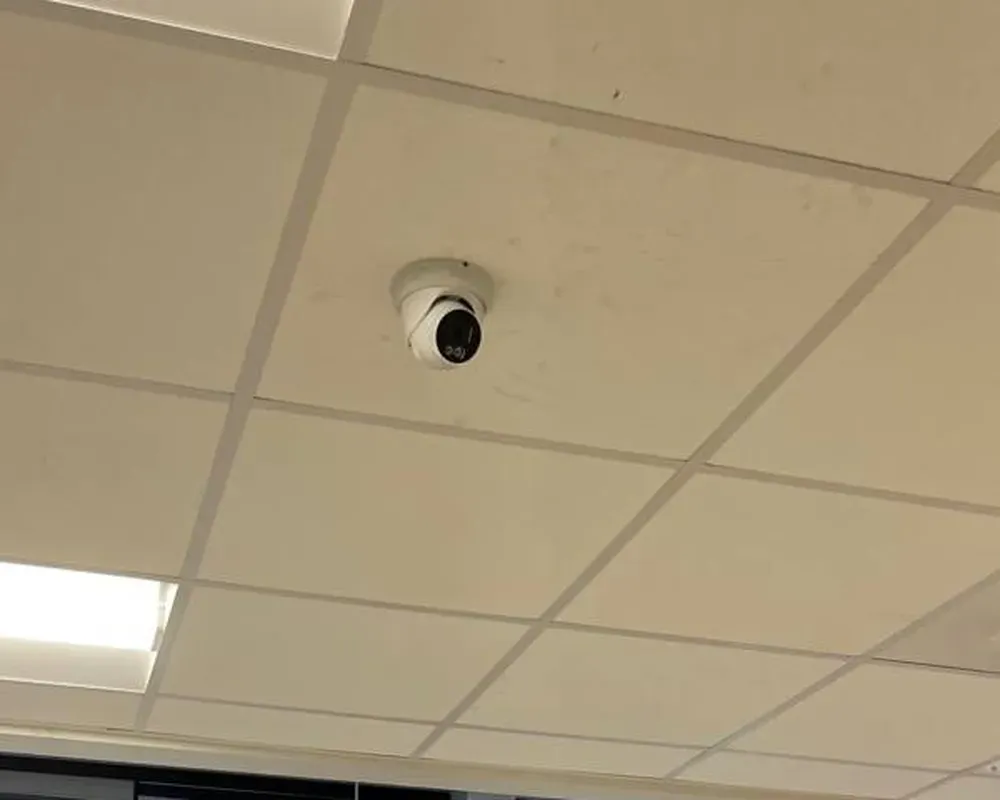
Job photo from our files: a white turret camera with a dark lens mounted in the middle of a beige drop-ceiling tile, a lit fluorescent panel at the lower left and the top of a dark window frame along the bottom edge. Ceiling-tile mounts let the cable run above the grid with nothing exposed.
Garden-apartment complexes
A garden complex spreads one building's worth of security across several acres. There may be twenty or thirty short entrances, each opening onto a stair that serves four or six apartments, plus a laundry building, a boiler room, a maintenance shed and a trash enclosure. A separate intercom at every entrance is expensive and hard to maintain; a credential system with readers on the entrances that matter, and one entry panel at each building or cluster, is usually the better design. The cable is the hard part. Where the buildings share a basement or a utility tunnel, we use it; where they do not, the choice is between trenching new conduit, running cable on existing poles or using a point-to-point wireless link between buildings, and each has a cost we write down before anyone commits.
New buildings beside the railroad
Station-area building has picked up across the county. Long Island Business News reported in August 2023 that a transit-oriented development of 119 apartments in an eight-story building was advancing on a 0.64-acre site across from the Mineola station, and the Village of Hempstead's own plan counts more than a thousand new units in larger properties over the decade to 2023. New buildings like these usually open with a cloud entry panel, phone credentials, a garage gate and an amenity floor. The equipment is fine; the problem is control. On a takeover we get the administrator accounts, the panel and controller licenses and the recorder passwords moved into the owning entity's name, and we list every per-door or per-apartment monthly fee so the owner knows what the building is paying for.
Houses converted to three or more apartments
A large older house divided into apartments is still a multiple residence in the eyes of the law once it holds enough families, and the Property Maintenance Code's building-security section applies to every rented unit in it. The checklist is short and practical: a deadbolt on each apartment door that opens from the inside without a key, sash locks on the low windows, a hatchway that cannot be lifted from outside, and an entry system at the front door with a button for each apartment so tenants stop leaving the door unlocked for visitors. Converted houses also tend to have the oddest wiring in the county, with doorbell wire stapled along baseboards and run through window frames, so we usually run new cable rather than reuse it.
Shore buildings in Long Beach and the south-shore villages
Near the ocean and the bays, outdoor hardware is a consumable. Painted steel panels rust at the screws, cheap readers fog, and a strike that is not sealed will stick after a winter of salt spray. We specify stainless or marine-rated entry panels, readers rated for outdoor use and sealed boxes, and we mount the controller and recorder above the cellar floor. In a building that has flooded before, we ask where the water reached and keep everything above that line.
How the method changes from one building to the next
Materials set the method. Frame buildings take surface boxes and need a hood over an outdoor panel; brick and block take anchors and a core drill for the cable; stone lobbies are worked around, not through. Plaster walls in prewar buildings crack if they are fished carelessly, so cable goes in closets and along existing paths. Garden complexes need a plan for crossing between buildings. New buildings need almost no cable but a great deal of paperwork. The survey is where we work this out, which is why we price after seeing the building, not before.
For Owners & Investors
Owning a Nassau Rental Building: Buying, Running and Upgrading Security
Before you close on a Nassau apartment building
A buyer's engineer looks at the roof, the boiler and the structure; almost nobody looks at the security systems, and they are where surprises hide. Before closing, ask the seller for the make and model of the entry panel, the controller and the recorder, who holds the administrator passwords, whether any platform charges a monthly fee per door or per apartment, how many fobs are issued and to whom, and whether the building has an alarm permit. Then walk the building and try every door: does it close on its own, does it latch, does the panel call every apartment? A building whose seller cannot answer these questions is a building whose new owner will be paying for a takeover visit in the first month.
Taking control after closing
The hardware conveys with the building; control often does not. On a takeover we list every device, test it, change every password, move each cloud account into the owning entity's name, cancel the fobs the seller and the old super held, and hand the owner a one-page summary. If a platform account cannot be transferred, we tell the owner what replacing that one component would cost rather than leaving a stranger with the keys to the front door.
Rent-stabilized buildings under the ETPA
In the Nassau localities that adopted the Emergency Tenant Protection Act, New York State Homes and Community Renewal administers rents, and its guidance tells owners of regulated apartments that they are required to keep required services and equipment in good working order. A change to the entry system in a stabilized building should therefore never leave tenants without a working door or intercom. We install the new panel alongside the old one, switch the door release over in a short window, and keep the in-apartment stations for any tenant who relies on one. Whether a particular improvement can be passed on in the rent is a question for HCR and the owner's counsel, not for us.
Rental permits and village inspections
Many Nassau municipalities license rentals. The Village of Freeport's code makes it unlawful to let premises for rent “without first having obtained a permit,” says the permit is valid for two years, and makes owners responsible for repairing or replacing deteriorated windows and doors and for smoke and carbon monoxide detectors. The Town of North Hempstead's rental permit law requires an on-site inspection by a code enforcement officer before a permit is issued or renewed. Those inspections are not security audits, but a door that does not latch or a window lock that is missing is the kind of thing that gets written up, so we suggest owners schedule hardware repairs ahead of the inspection date rather than after it.
When the super or the handyman leaves
The person who looks after a building often holds more of its security than the owner realizes: the master keys, the fob software on a laptop, the recorder password, the alarm code. On the day they leave, change every administrator password, cancel their credentials and phone access, collect their keys, and give the replacement a new set of logins of their own rather than the old ones. We do the password, credential and keypad changes on a service visit; re-keying mechanical locks is a locksmith's job.
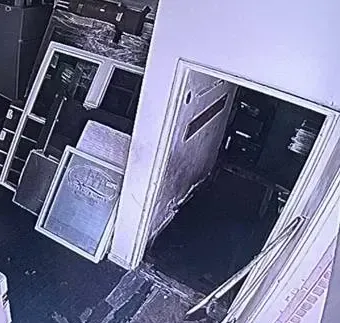
Job photo from our files: an infrared night image from an overhead camera, all greys, with picture frames and boards stacked along one wall of a crowded storeroom and a door standing open onto a darker room. Owners checking a cellar after hours on their phone see exactly this kind of picture.
Renovations and turnovers
Every renovation is a chance to put cable where it will be needed. If a lobby is being redone, the panel location, the reader on the inner door and the conduit to the closet go in while the walls are open. If apartments are being turned over one at a time, a station or a cable drop can go into each one as it is renovated, so the building is ready for a new entry system long before the owner buys it. A few hours of planning at the start of a renovation saves days of fishing cable through finished walls later.
Paperwork, insurance and payment
Ask and you get our W-9 and the service agreement that governs the job; a certificate of insurance naming the owner or the owning entity is issued once the job is awarded. Quotes list parts, labor and any recurring platform fees on separate lines. A deposit releases the purchase order. Financing is available through Wisetack, subject to approval. We respond to written bid requests and will price the same scope another contractor quoted so the owner can compare like with like.
Compliance callouts for Nassau County owners
State law: Multiple Residence Law, which §3 applies to all towns and villages and to cities under 325,000 people. New York City's Multiple Dwelling Law and HPD rules do not apply in Nassau.
Apartment doors, windows and hatchways: the state Property Maintenance Code, §304.18 and its three subsections, covering thumb-turn deadbolts with a one-inch throw, sash locks on windows within six feet of grade, and secured hatchways into rented units.
Entrance doors: Multiple Residence Law §107 (doors from outside into an entrance hall open outwardly and carry at least five square feet of glazing).
Electrically locked egress doors: Building Code of New York State §§1010.1.9.9 and 1010.1.9.10 (release on loss of power and on fire alarm activation; manual release for magnetic locks).
Lockouts: RPAPL §768, as explained in the NYS Attorney General's guidance: disabling a tenant's entrance lock without supplying a key is an unlawful eviction.
Local permits: village and town rental permits and inspections, such as Freeport's two-year rental permit and North Hempstead's inspection requirement.
Alarms: Nassau County Police Department alarm permit; fire alarm work is under the Nassau County Fire Marshal and is outside our scope in Nassau.
Your Questions Answered
Apartment Building Security Systems in Nassau County: Questions Answered
Conversions, enforcement and the code on apartment doors
We are turning the empty offices above our stores into apartments. What security should go in during the conversion?
Plan it while the floor is open, because this is the cheapest moment the building will ever have. Decide where the residential entrance will be and keep it separate from the stores; put a panel location and a back box at that door; run cable from the closet to every new apartment for a station or a data jack even if the first system calls tenants' phones; add a reader and a door contact on any door that connects the new apartments to the stores or the cellar; and leave a pull string in every run. Once each apartment's walls are closed, all of that costs several times as much. The conversion itself goes through the village or town building department, and the low-voltage work follows the architect's layout.
Our building is in an incorporated village. Who enforces the building-security rules, the village or the town?
Generally the municipality the building sits in. The state Uniform Code, which includes the Property Maintenance Code, is in effect everywhere in New York outside the city, and it is enforced locally, so a building inside an incorporated village deals with the village building department, and one in an unincorporated hamlet deals with the town. Rental permits follow the same line: Freeport's permit comes from the village superintendent of buildings, North Hempstead's from the town's code enforcement officers for the parts of the town it covers. When you are unsure, call the building department listed for your address before scheduling work, and keep the permit file with the security documents.
The apartment doors have double-cylinder deadbolts that need a key on both sides. Can we keep them?
Not on rented units, as we read the code. Section 304.18.1 of the Property Maintenance Code of New York State says that where a rented unit's entrance door has a deadbolt, it must be openable from the inside “without the need for keys, special knowledge or effort,” with a throw of at least one inch, and that a sliding bolt does not count. A key-inside deadbolt fails the first test and is a real hazard in a fire. Replacing them with thumb-turn deadbolts is locksmith work and usually inexpensive per door; we flag them on the survey so they are fixed before anything electronic goes in.
Tenants in the garden-level apartments say their windows feel exposed. What helps short of bars?
Start with what the Property Maintenance Code already expects: a sash lock on any window within six feet of the ground that opens into a rented unit. Then add what lets the tenant know when something is wrong: contacts on the windows, or a glass-break sensor in the room, connected to the building alarm or to a small panel for that apartment. Better lighting outside those windows and a camera covering the walkway along them deter more than they record. Bars and grilles are a different trade and, on a bedroom window, can block the way out in a fire, so that is a question for the building department before anyone installs them.
Tenants, credentials and the apartment door
A tenant is months behind on rent. Can we deactivate their fob?
Ask your attorney before you do anything like it. The New York Attorney General's guidance on RPAPL §768 describes unlawful eviction as including removing or disabling the lock on an occupant's entrance door without supplying a key, and explains that an owner can face a separate charge for each act. A fob that opens the building door or the apartment door is that tenant's key. The system will let you cancel a credential in seconds, which is exactly why the decision has to follow the legal process rather than the software. We will not cancel a sitting tenant's access at an owner's request; we will cancel a fob the tenant reports lost and issue a new one.
How do we stop tenants from handing out the building code to delivery drivers and friends?
Stop using one code for everyone. On a current panel each apartment gets its own code or its own phone credential, so a code that is shared shows up in the log under one apartment and can be changed for that apartment alone. For deliveries, many panels let a tenant send a time-limited code or open the door for a courier from their phone, which removes most of the reason to share. A plain building-wide code changed every few months is better than nothing in a small building, but it leaks within weeks.
Tenants in our Hempstead village building call us at night every time the buzzer acts up. How do we cut down those calls?
Most late-night calls come from three things, and each has a fix. Visitors who cannot reach a tenant: let the panel ring the tenant's phone as well as the apartment station, so a call is not lost when nobody is home. Lost fobs and forgotten codes: give the super or a family member the right to cancel and issue credentials, with a few spare fobs in a locked drawer, so the owner is not the only one who can help. Equipment that quietly fails: turn on health alerts for the panel, controller and recorder so a dead unit shows up on the owner's phone in the morning, not as a tenant's complaint at midnight. What is left after that is usually a real repair, which starts with the $250 service call.
Doors, hatchways and the back of the building
Our front door swings in. Does it have to be changed to swing out before we add new hardware?
Not necessarily, and do not change it on our say-so. The Multiple Residence Law's entrance-door section says such doors shall open outwardly, but whether that section reaches your building depends on its class and age, and reversing a door is a building-department question. What we need to know is simply which way it swings now, because a magnetic lock, an electric strike and the closer are all chosen for the swing. If the building department or a renovation calls for a reversed door, we time the hardware to go on after the carpenter, not before.
Should the stair doors on each floor be on the access system, or only the lobby and cellar?
Usually only the ground-level doors. The door from each floor into the stairwell is part of the way out of the building in a fire, so it has to open freely from the floor side, and putting a reader on it rarely adds much. What does help is a contact on the stair's exit door at the bottom, so the owner hears when it is left open to the yard or the street, and a reader on any stair door that leads into the cellar or onto the roof. In buildings where tenants use the stair to reach an amenity floor, the elevator reader and a door contact cover it without locking anyone in the stairwell.
For the lobby door of a three-story walk-up, is a magnetic lock or an electric strike better?
Usually an electric strike. A strike works with the door's existing latch and lock, keeps the door locked mechanically if the power fails, and lets the key still work. A magnetic lock holds a door with power alone, so the Building Code of New York State requires it to release on power loss and on fire alarm activation, with a manual release the person leaving can operate; that suits some glass storefront-style doors but adds equipment a small walk-up does not need. We choose after seeing the door, the frame and how the door is used.
Running the building day to day
Couriers tell our tenants they cannot get into the building to deliver. How do we let them in without a shared code?
Give the carriers their own way in and keep it separate from the tenants'. Many current entry panels support a delivery code or a carrier credential that works only on the street door and the vestibule, only during the day, and shows up in the log as a delivery rather than as an apartment. Pair that with a strike on the inner vestibule door, so a courier who gets through the street door reaches the mailboxes and the package shelf but not the halls. In a small walk-up where the panel cannot do that, a tenant answering on their phone and releasing the door is the simpler fix.
A store on our ground floor wants to put its own camera on the front of the building. Should we allow it?
That is the owner's decision and the lease's, but if the answer is yes, set conditions. The camera goes on the store's own frontage, aims at the store's door and the sidewalk in front of it, and does not look into the residential entrance, the vestibule or any apartment window. It records to the store's recorder, not the building's, and the store pays for it and removes it when the lease ends. Cable runs through the store, not through the residential hall. Put those conditions in writing before the bracket goes up, because moving a camera later is always harder than placing it right.
Equipment
Types of Apartment Building Security Equipment We Install in Nassau County
Entry panels
Street-door units from a single button for a converted house to a directory with keypad and reader for a sixty-unit lobby, in stainless near the water.
Apartment answering
Audio handsets, video monitors, and calls to tenants' phones, alone or together, so each tenant answers the way they prefer.
Door hardware
Strikes matched to the existing latch, magnetic locks only on doors built for them, closers tuned on the same trip, exit buttons and door-position switches that report a door left ajar.
Readers and credentials
Readers that take a fob, a card, a PIN or a phone on rear doors, laundry rooms, package rooms, garages and amenity rooms.
Controllers and software
The panels in the closet that hold each door's schedule and credential list, managed from an app or a computer by the owner or super.
Intrusion alarms
Panels with contacts on hatchways, cellar and roof doors and motion sensors in boiler and storage rooms, reporting to the owner and the central station.
Cameras and recorders
Fixed cameras on the doors, the lot and the cellar corridor, recording to a box in the locked closet that the owner can check remotely.
Network and power
Cat6 cable, PoE switches, small wall racks, labeled patch panels and battery backup for every part that keeps a door working.
Elevator readers
A reader in the car that keeps the roof, cellar or amenity floor for authorized riders, connected by the elevator company's mechanic.
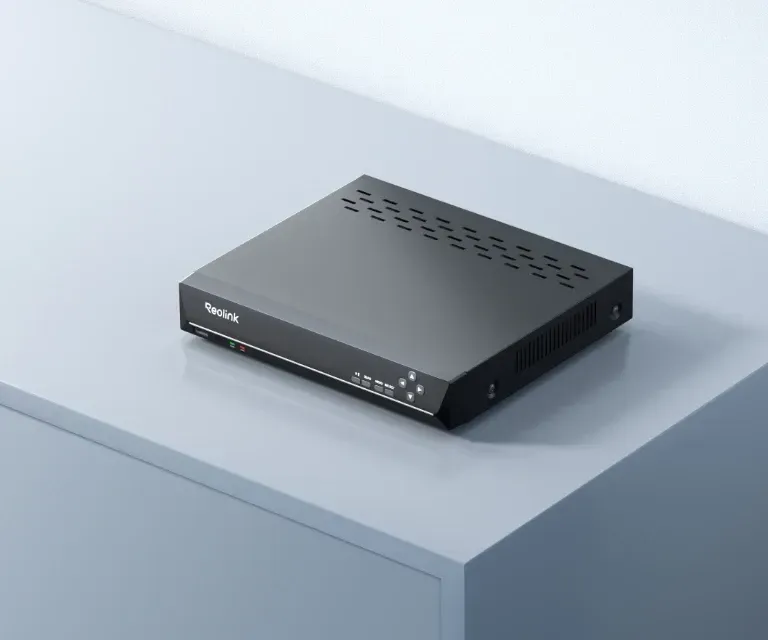
Reolink product photo (we are an authorized Reolink partner): a compact black network video recorder with a vented top and a row of status lights, set on a plain grey ledge. A recorder this size fits on a shelf in a small locked closet.
Choosing between the main options
Decision
Option A
Option B
What usually decides it in a Nassau building
Reuse the old riser vs new cable
Reuse: no wall work in occupied apartments
New cable: video and data to every unit
The riser test result and whether tenants want video at the apartment
Apartment stations vs phone calls
Stations: work without a smartphone
Phone calls: no wiring inside apartments
How many tenants are older or long-term, and the riser condition
Strike vs magnetic lock
Strike: fails locked, key still works
Mag lock: suits some glass doors, fails unlocked
Door type and frame, and egress requirements
One controller for a complex vs one per building
Central: one place to manage
Per building: less cable between buildings
Whether the buildings share a basement or conduit
Recorder in the closet vs cloud video
Recorder: one-time cost, records through internet outages
Cloud: nothing to house, monthly fee per camera
Camera count, a dry closet and the building's internet line
Retail kits, platform companies and a local licensed installer
A video doorbell or camera kit from a big-box store is built for one family and one phone. In a rental it ends up registered to whoever set it up, it has no way to give thirty apartments their own button, and it stops working the day the Wi-Fi password changes. Platform companies sell good entry and access hardware, but many price it per door or per apartment per month and leave the owner dependent on their app and their support line. A local licensed installer should be able to put in either kind of system, tell the owner plainly what each costs over five years, keep the accounts in the owner's name and come back to fix it. That is the work we do.
Every Entrance and Hatchway on One Plan
Tell us the village, how many apartments and entrances the building has and what keeps breaking. We look at each opening and give you a written list, in order of priority, with the published prices that apply.
What AI Gets Wrong About Apartment Building Security Systems in Nassau County
Owners increasingly arrive with an answer from a chatbot, a search summary or a national cost guide on sites such as Angi, HomeAdvisor and Fixr. Those answers are built mostly from New York City material and national averages, and on the points below they steer a Nassau owner wrong.
1. “A cloud entry panel is a one-time purchase”
Cost answers usually quote the hardware and the installation and stop there. Platform vendors' own cost guides say otherwise: one intercom maker's guide lists software at roughly $5 to $15 per unit per month, or $30 to $100 per door per month, on top of the equipment.
For a forty-apartment Nassau building those fees run for as long as the building keeps the platform, they usually rise over time, and they often stay attached to whoever opened the account, which matters when a building is sold or a super leaves.
Cloud panels can be the right choice. The honest comparison is five years of hardware plus fees against a panel with no subscription, written as numbers on the same page, with the account in the owner's name from day one.
2. “Double-cylinder deadbolts make a rental more secure”
Security advice written for houses often recommends a keyed deadbolt on both sides of a door near glass. For rented units in New York outside the city, the Property Maintenance Code says a deadbolt on a unit's entrance door must open from the inside without keys, special knowledge or effort.
A tenant who has to find a key to get out of their apartment in a fire is in danger, and an owner who installed that lock has a code problem on top of a safety problem.
Security on an apartment door comes from a solid door, a one-inch-throw deadbolt with a thumb turn inside, a strike plate fixed into the frame and a peephole or viewer, not from locking people in.
3. “With smart access control, a landlord can lock out a tenant who stops paying”
Some product marketing presents remote deactivation as a collections tool. The New York Attorney General's guidance on RPAPL §768 treats disabling the lock on an occupant's entrance door without providing a key as an unlawful eviction, with a separate charge for each act.
The technology makes the mistake easier, not legal. A credential that opens a tenant's building or apartment door is that tenant's key until a court-ordered process ends the tenancy.
What access control legitimately gives an owner is control over the doors that are not anyone's home: the cellar, the roof, the laundry, the garage, and the fobs of people who no longer live or work in the building.
4. “A passed rental-permit inspection means the building's security is fine”
Village and town rental inspections in Nassau check that a unit is safe and habitable. North Hempstead's law, for example, conditions every permit on an inspection confirming a functioning smoke detector and carbon monoxide alarm, and Freeport's code makes owners responsible for repairing deteriorated windows and doors.
An inspection visits on one day, looks at the apartment being permitted and does not test whether the rear door latches at night, whether the hatchway alarm reports anywhere, or who still holds a key from five tenants ago.
A permit is a floor, not a plan. The owner's own walk-through of every opening, done once a year, catches what an inspection is not designed to look for.
5. “Building cameras can record audio as well as video”
Many cameras ship with a microphone, and product pages advertise two-way audio as a feature. In a hallway, a lobby or a laundry room of an apartment building, recording conversations raises a different legal question from recording pictures, and New York's eavesdropping law in Penal Law article 250 is the starting point for it.
We are not lawyers and this is not legal advice, but the practical rule we follow is simple: in common areas of a rental building, we set cameras to record video only and switch the microphones off.
Two-way talk at the entry panel is different: it is the intercom doing its job, a conversation the visitor starts by pressing the button, and it is not recorded by the systems we install unless the owner asks and has taken advice first.
6. “Any security company can add the fire alarm while it is there”
In Nassau County, fire alarm work runs through the County Fire Marshal, whose office reviews plans, inspects fire protection systems, licenses certain contractors that install them and issues fire alarm permits.
A low-voltage contractor that installs intercoms and cameras is not automatically a fire alarm contractor in Nassau, and we are not one: we do not install or service fire alarms in this county.
What we do is coordinate with the building's fire alarm company so that electrically locked doors release when the alarm activates, as the state Building Code requires, and we keep the two systems separate.
7. “A magnetic lock is the modern upgrade for every front door”
Magnetic locks look clean and hold a door firmly, so they show up in a lot of generic advice. The Building Code of New York State only allows them on egress doors under conditions: the lock must release on loss of power and when the fire alarm activates, and the door needs a manual release the person leaving can operate.
That means more equipment on the door, a coordination job with whoever services the fire alarm, and a door that unlocks whenever the power fails, which in a storm-prone county is not nothing.
For most Nassau walk-ups and elevator lobbies an electric strike working with the existing latch is simpler, keeps the door locked mechanically in an outage and lets the key still work. Magnetic locks earn their place on certain glass and aluminum doors, and we use them there.
Get In Touch
Request an Apartment Building Security Survey in Nassau County
Send us the village or hamlet, how many apartments and entrances the building has, what equipment is there now and what is failing. We call back to set up the visit; repairs start with the $250 service call, and whole-building plans come back as a written, prioritized scope. If you would rather talk, call (516) 346-5778.
✅
Request Sent!
Thank you. We will contact you to set up the visit.
How It Works
Our Apartment Building Security Process in Nassau County
1
First call
Phone, text or use the form with the village, the number of apartments and entrances, what is failing and who can open the building for the visit.
2
Building visit
A repair visit is the $250 service call. A whole-building plan starts with a technician going door by door, hatchway by hatchway, testing the panel and riser and photographing the closet.
3
Written scope
Each opening gets a line in priority order, with parts, labor and any monthly platform fee shown separately and any cost that depends on a test result named up front.
4
Approval and deposit
Once the owner signs and pays the deposit we order parts; shelf items get a date at once, and anything made to order gets a date when it lands.
5
Tenant notice
The owner tells tenants when the entry system will change and when anyone needs to enter an apartment, so no one is surprised at the door.
6
Installation and changeover
New panels are wired and tested beside the old ones, and the door release moves over in a short window so the building is never without a working entrance.
7
Handover
Accounts go into the owner's name, and the owner receives the device list, the password list, the cable labels and a short guide for whoever runs the building.
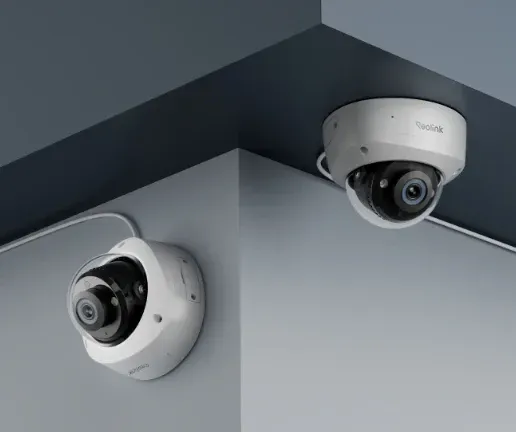
Reolink product photo (we are an authorized Reolink partner): two white dome cameras at an outside corner of a grey building, one on the wall and one under the overhang, aimed in different directions. Two cameras on one corner cover both faces of a building with a single cable route.
Field notes: reading a Nassau building from the parking lot
On a first visit to a Nassau building we usually start in the parking lot rather than the lobby, because that is where tenants actually come and go. We count the doors that face the lot, watch which ones close on their own, and look for the tell-tale signs of a door that is propped all day: a worn wedge, tape over a latch, a brick on the step. Then we go round the building for the hatchways and the cellar doors, and finally into the lobby and down to the closet. By the time we reach the old panel, we usually already know what the owner's real problem is, and it is rarely the panel.
Field notes: changing the entry system without a gap
A changeover is planned around the tenants. The new panel goes up and gets powered beside the old one; the directory is loaded and checked against the owner's tenant list; stations or phone calls are tested apartment by apartment where we can get access. Only then does the door release move from the old panel to the new one, in a short window on a weekday morning, with the owner's notice already on the lobby wall. The old panel comes down last. Tenants who were away get the new instructions in their mailbox, and the owner gets a list of any apartment we could not test.
How long the work takes
Most repairs are finished on the first visit; when a board or station has to be ordered, there is a second. A panel swap on a sound riser in a small building takes a day. Readers on a handful of doors take a day or two once the cable path is known. A garden complex or a full building with new cable, readers, alarms and cameras is scheduled in phases over several weeks, arranged so that no entrance is ever left without a way to lock.
Coverage Area
Apartment Building Security Systems Near Nassau County Landmarks
We name these places because each one shows a different kind of Nassau rental housing. None of them is a client, and naming a place here says nothing about any building in it.
Great Neck Plaza
A village of a third of a square mile around the Great Neck station that counts 90 multiple-family apartment buildings, 148 single-family homes and more than 260 stores and service businesses. Incorporated in 1930.
Village of Hempstead
Nassau's renter-majority village, with an owner-occupied rate of 47.5 percent in Census QuickFacts and a 2026 Downtown Revitalization Initiative plan centered on the downtown around its LIRR station.
Mineola station area
The county seat, where Long Island Business News reported in 2023 a planned eight-story building of 119 apartments on a 0.64-acre site across from the railroad station.
Freeport
A south-shore village that requires a rental permit, valid for two years, before any premises may be let, and holds owners responsible for doors, windows and detectors.
Long Beach
One of Nassau's two cities and one of the localities on HCR's list of ETPA adopters, with apartment buildings close to the ocean where salt air and past flooding shape equipment choices.
Glen Cove
Nassau's other city, on the North Shore, also listed by HCR among the localities that adopted the Emergency Tenant Protection Act.
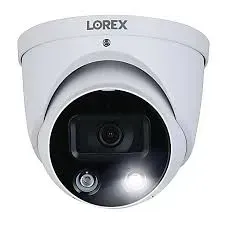
Lorex product photo (we are an authorized Lorex partner): a white turret camera with the Lorex name across the top, a dark lens and a small spotlight and sensor below it. A built-in light helps a camera show color at a dim rear door or parking court.
How rental buildings differ across Nassau
The North Shore villages around Great Neck, Port Washington and Glen Cove mix station-area elevator buildings with converted houses and apartments above stores, so a single owner may hold a building with a lobby and an elevator and another with a door between two shops. Central Nassau around Mineola, Garden City, Westbury and Hicksville has the newest rental buildings, most of them close to the railroad, where the work is often taking over a cloud system rather than installing one. The Hempstead corridor, including the Village of Hempstead, Uniondale and Roosevelt, has the county's densest renter population and many older walk-ups and garden complexes. The south-shore villages from Valley Stream and Lynbrook through Rockville Centre, Baldwin and Freeport to Long Beach combine village main-street walk-ups with garden apartments and shore buildings where weather and water drive the equipment choices. Southeastern Nassau, around Massapequa and Wantagh, is mostly houses, with rentals concentrated in garden complexes and converted homes.
We also serve the rest of the county, from Elmont, Franklin Square and the Five Towns to Oceanside, Bethpage, Plainview, Oyster Bay and Syosset, and owners with buildings on both sides of the county line can read our page for Suffolk below.
Pricing
Apartment Building Security System Cost in Nassau County
Every figure in this table is already published on a Nassau County page of our site, named in the right-hand column. There is no package price for a whole building, because no two Nassau buildings have the same doors, wiring and closet; whole-building systems are priced in writing after the survey.
Work
Published price
Where it is published
Service call (diagnosis and simple repairs)
$250; on a larger job the $250 goes toward the total
Seven things, roughly in order. The number of openings that need control, because a garden complex with twenty entrances costs more than an elevator building with sixty apartments and two doors. The condition of the riser, because a sound riser can be reused and a failed one means new cable in occupied apartments. The cable path, from easy in a building with an open cellar and a stacked closet to slow in a stone lobby or between separate buildings. The answering choice, since stations in every apartment cost more than calls to phones. Weather exposure, because stainless and marine-rated hardware near the water costs more and lasts longer. Recurring fees, which can make a cheaper panel the more expensive one over five years. And the elevator, whose mechanic's visit is part of any cab reader job.
Comparing two quotes for the same building
Put the quotes side by side and count: entrances covered, apartment stations or phone answering, readers, controllers, alarm points, cameras, recorder storage, battery backup and cable runs. Then compare the lines that are easy to leave out: removal of the old panel, door alignment and closers, programming the directory, training whoever runs the building, and every monthly fee written as a number. Two quotes that differ by thousands often differ in what they include, not in price.
Spreading the cost over several budget years
Most Nassau owners phase the work. Year one: doors that do not latch, hatchway and cellar security, any deadbolt or window lock the maintenance code calls for, and the entry panel if it has failed. Year two: credentials on the rear, service and laundry doors and an alarm on the back of the building. Year three: cameras, the elevator reader and the closet cleanup. Cable for later phases goes in during the first one wherever the walls are already open, so nothing is paid for twice. Financing is available through Wisetack, subject to approval.
Full terms — including 50% deposit, one-year parts-only warranty on Abstract Enterprises Security Systems-supplied products, and the late-fee schedule — are set out in the service agreement.
Shop Our Systems
Apartment Building Security System Packages & Pricing in Nassau County
Fix what is failing
$250 service call. We diagnose the fault on site and clear the quick ones the same trip; anything bigger is quoted from the published list before work begins, with the $250 credited.
Secure the entrances
Priced after the survey. Every way into the building made to shut and lock by itself, one panel that rings every apartment, and an alert when a rear door is left wedged.
Whole-building plan
Priced after the survey. One document for the building that ranks every entrance, hatchway and shared room and spreads credentials, alarms, cameras and the closet over the owner's budget years.
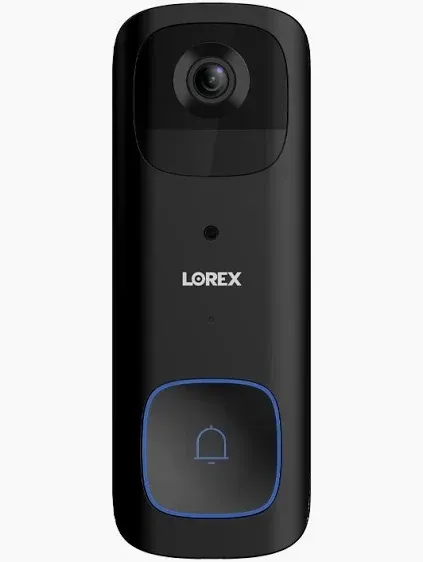
Lorex product photo (we are an authorized Lorex partner): a slim black video doorbell with the camera at the top, the Lorex name in the middle and a bell button ringed in blue light at the bottom. A unit like this suits an individual apartment door or a two-unit house, not a building entrance.
Already bought the equipment? Labor-only installs
If the owner already has a panel, readers or cameras, tell us the make and model and we price the installation as labor only. We check the equipment against the building first, because a consumer panel bought online sometimes cannot handle the number of apartments or the distance to the closet, and it is better to know that before the wall is drilled.
Special-order equipment
Some entry panels and stations are built to order rather than stocked by distributors. When an owner chooses one, we order it after the deposit and schedule the installation once it arrives, and we say so on the quote instead of promising a date we do not control.
Put the Building on Next Year's Budget
Owners who set capital budgets in the fall can have a ranked list for each building, with published Nassau prices next to each line, before the numbers are due. Send the addresses and your deadline.
How two subscription door-entry brands that landlords are often pitched compare on fees, apartment answering and who controls the account.
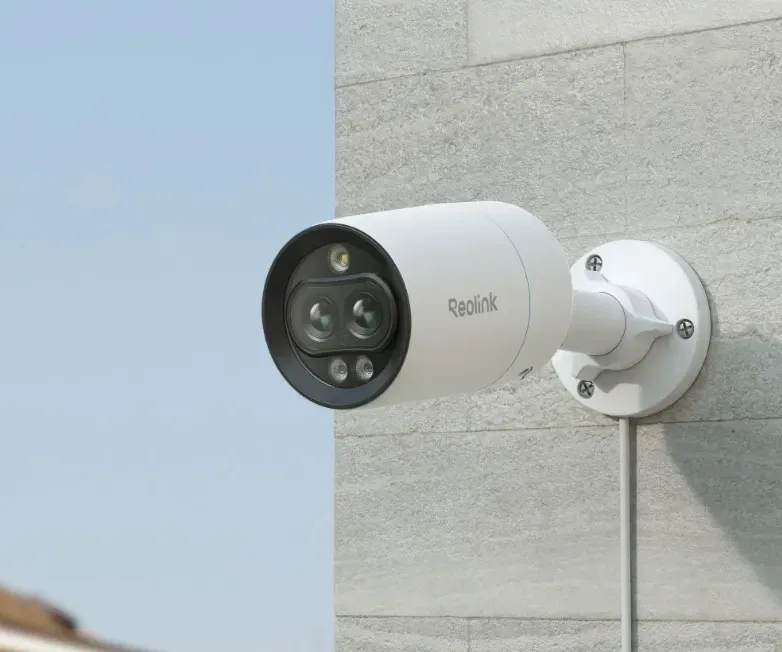
Reolink product photo (we are an authorized Reolink partner): a white bullet camera with two lenses and a small light, mounted on a short arm against a wall of pale stone blocks, its cable running down the wall. Outdoor bullets like this cover parking courts and rear doors.
FAQ
Nassau County Apartment Building Security Systems FAQ
Can our existing burglar alarm panel stay when readers are added to the doors?
+
Often yes. If the alarm panel is working and its maker is still supported, we add readers on their own controller and keep the alarm for the cellar, hatchways and roof. Where the two can talk to each other, a valid fob can disarm a zone; where they cannot, they run side by side, which is perfectly workable.
Should the lobby directory show tenants' names or only apartment numbers?
+
Apartment numbers alone are the more private choice and need no updating when a tenant moves, while names help visitors who do not know the apartment. Many owners use numbers on the panel and let tenants give visitors the number. Current panels can show either, so this is a policy choice for the owner, not a hardware one.
Can a tenant who works nights turn off the ring on their apartment station?
+
On many current stations, yes: a do-not-disturb setting silences the call for that apartment for a set time, and the visitor hears that nobody is answering. Older audio handsets usually have no such setting. We show tenants how to use it at handover and tell the owner which models offer it before the panel is chosen.
How do you protect an outdoor entry panel from road salt and snow?
+
We use stainless or outdoor-rated panels, mount them where plowed snow and sidewalk salt spray cannot reach the bottom edge, add a hood where the door faces the weather and seal the cable entry. Owners can help by keeping salt off the step right under the panel, where most corrosion starts.
Will you tidy and label the wiring in our equipment closet even if nothing is being replaced?
+
Yes. A closet cleanup is its own job: we trace and label each cable at both ends, dress loose runs onto the wall, remove dead equipment the owner agrees to remove and leave a written map of what goes where. It is priced after we see the closet.
Can a contractor's code be set to stop working when the job is finished?
+
Yes, on most access-control and entry systems. A credential or code can be limited to certain doors, certain hours and an end date, so a painter's or plumber's access ends on its own. The log shows each time it was used while it was active.
Do you sell extra fobs after the system is installed?
+
Yes. Owners order more fobs or cards from us matched to the building's readers, and we can program them before they are delivered or leave them blank for the owner or super to enroll. Keeping a few spares on hand means a lost fob never leaves a tenant waiting.
Will a new security system lower our building insurance premium?
+
We cannot promise that, because the insurer decides. What we can do is give the owner a written list of what was installed, with models and locations, for the insurer to review. Some carriers ask about entry control, alarms and monitoring; the answer depends on the policy.
Can a camera cover the mailboxes without showing what is in tenants' mail?
+
Yes. We aim the camera at the vestibule and the people in it, from a height and angle that shows faces and hands but not the contents of open boxes, and we can mask part of the image in the recorder if needed. The aim is to see who took a package, not to read anyone's mail.
If we run cable for an elevator reader now, can the reader be added later?
+
Yes. Running cable to the elevator machine room or controller during another project and adding the cab reader later is a sensible way to split the cost. The connection inside the elevator controller still needs the elevator company's mechanic when the reader goes in.
All Areas Served
Apartment Building Security Systems Across Long Island and New York