Own a rental building in Nassau or Suffolk? Entry, fobs, door alarms, cameras and the equipment closet planned as one system for the whole property: (800) 486-0943
Home › Apartment Building Security Systems Long Island
For Long Island Landlords · Garden Complexes to Downtown Walk-Ups
Apartment Building Security Systems on Long Island
Apartment building security systems on Long Island start with a $250 service call for any repair at your property, and a whole-property system for a garden complex, a converted house or a new building by the train station is quoted in writing after we walk every door, outbuilding and equipment closet. We are a New York State licensed low-voltage contractor working for rental owners across Nassau and Suffolk counties, and we plan the front doors, the entry panels, the credentials, the alarms and the cameras as one system that survives Long Island weather, distances and power cuts.
Quick answer: On Long Island, an apartment building's security system is the hardware that keeps each entrance shut, an entry panel or intercom that tenants can answer, fobs or codes for shared rooms and side doors, alarms on the doors that should stay closed, cameras on entrances, lots and mail areas, and battery backup that carries it all through an outage. Every visit opens with the $250 service call, which goes toward a bigger job. Published Long Island prices on our site include $450–$950 for an electric strike with the door aligned, $1,500–$2,500 for a single-door reader with strike, and four-camera systems from $999 in Nassau and $1,099 in Suffolk. Whole properties are priced after the walk-through.
Last updated November 27, 2026 by Abstract Enterprises Security Systems, NYS license #12000287431 · Sources: NYS Multiple Residence Law §3; NYS Multiple Dwelling Law §§3 and 50-a; Property Maintenance Code of New York State §304.18; NYS Department of State memorandum LG03 on the Uniform Code; NYS HCR Fact Sheet #8 (ETPA); NYS Attorney General, Good Cause Eviction Law (April 2025); NYS Real Property Law §235-b; Town of Islip Code ch. 68; Town of Brookhaven rental registration; Town of Babylon rental permits; Nassau County Police alarm permits; Suffolk County Police Alarm Management Program; Regional Plan Association, Long Island's Rental Housing Crisis; U.S. Census QuickFacts; Newsday, Dec. 16, 2025 and Sept. 23, 2026; News 12 Long Island, Dec. 2025; Long Island Business News, Oct. 2026; PSEG Long Island storm update, July 2026; Village of Great Neck Plaza
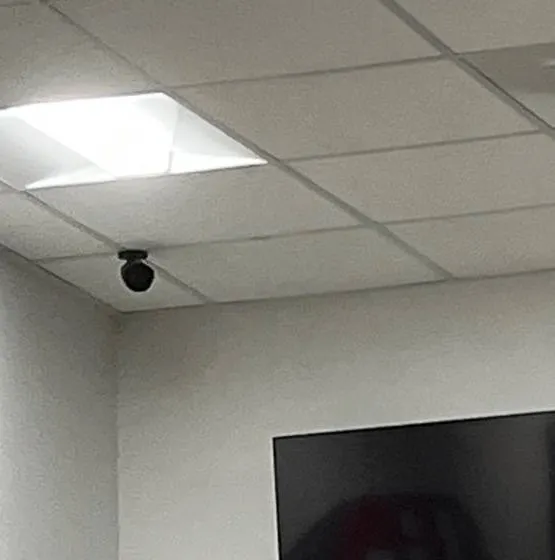
Job photo from our files: a small black dome camera fixed to a white drop-ceiling tile beside a bright light panel, with the top of a dark wall-mounted screen in the corner below. An interior camera placed like this watches a room's door and the people using it, not the street.
Long Island Rental Owner Request
Nassau or Suffolk — tell us the town and what you need
✅
Request Sent!
Thank you. We will contact you to set up the visit.
25+
Years Experience
2
Counties Served
100%
Licensed & Insured
4.7★
201 Google Reviews
Owner-operated since 2002 · Thousands of jobs completed · Booked within 2 hours
The Neighborhood
Why Long Island Rental Buildings Need a Whole-Property Security Plan
Long Island is mostly houses, and that shapes how its apartment buildings get secured. The Regional Plan Association counts rentals as 21 percent of all homes on Long Island, and the Census Bureau puts Nassau County's owner-occupied rate at 81.9 percent for 2020 to 2024. Rental buildings are scattered among single-family streets rather than lined up block after block, and the security companies that dominate the Island sell mostly to homeowners: a keypad by the garage door, a doorbell camera, a monthly monitoring plan. A multifamily apartment building is a different job. It has a front door that dozens of people open every day, mailboxes and packages for every apartment, a laundry room that tenants share, a basement with the boiler and the meters, and often a parking lot or a row of carports. A homeowner package does not cover any of that, and the owner who tries to stretch one across a building usually finds out the night a tenant calls about a stranger in the hall.
The buildings themselves vary more than people expect. Western Nassau has village downtowns with apartments over stores and prewar elevator buildings around train stations, such as Great Neck Plaza, which the village itself describes as a third of a square mile holding 90 multiple-family apartment buildings. Hempstead, Freeport, Long Beach and Glen Cove have mid-century walk-ups and garden complexes. Suffolk has long, low garden communities spread across acres, houses converted into two and three apartments under town rental permits, and a wave of new buildings beside Long Island Rail Road stations. Each type fails in its own way, and the plan for a twelve-building garden complex in Suffolk looks nothing like the plan for six apartments above a pharmacy on a Nassau main street.
The new building is changing the picture fastest. Newsday reported in September 2026 that Mineola alone has opened more than 1,100 rental units since 2010, with roughly 1,000 more planned, and its mayor, Paul Pereira, gave those figures while a developer predicted that “the model of Mineola will eventually grow in other villages and towns.” Station Yards in Ronkonkoma broke ground in October 2026 on a phase of 285 apartments in three five-story buildings across from the train station. Hicksville, Westbury, Farmingdale, Patchogue and Wyandanch have similar projects built or under way. These buildings open with video entry panels, fob readers, package rooms and garage gates already installed, and their owners inherit a stack of logins, software contracts and equipment closets that somebody now has to run.
Two more things make Long Island different from the city, and both catch owners out. The first is the law: the New York City rules that most online articles quote do not apply in Nassau or Suffolk, and the rules that do apply come from the state, the county police, the town and sometimes the village, each with its own paperwork. The second is the weather and the distance. A garden complex can spread its buildings over several acres, which is farther than ordinary network cable can carry a signal, and a South Shore building can lose power for a day after a summer storm or take water in its basement in a hurricane. A security plan for a Long Island rental has to answer all of that before the first panel goes on the wall. This page is written for the owner who has to make those calls. Managing agents running whole portfolios will find their version on our property management security page for Long Island, and owners who only want cameras can go straight to camera installation for Long Island apartment buildings.
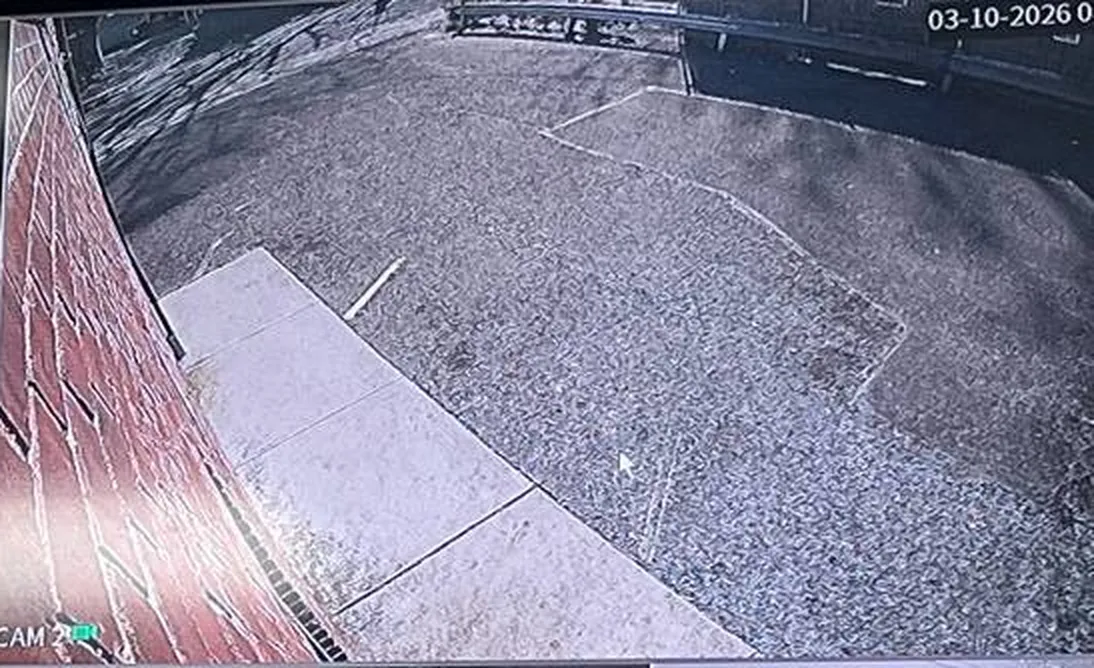
Job photo from our files: the picture from one camera on a recorder screen, looking down a red brick wall, across a strip of concrete walk and out over a paved lot to a fence line, with the date in the corner. On a garden complex, a view like this is how the side of a building and the lot behind it get watched by one device.
Long Island facts a rental building owner should know
Rentals are scarce, and tenants notice what works. The Regional Plan Association puts Long Island's rental vacancy rate at 4.3 percent, fewer available rentals than any other suburban part of the New York region, and says 56 percent of renters pay more than 30 percent of their income for housing.
The city's apartment law does not reach the Island. The Multiple Dwelling Law, home of the New York City intercom rule in §50-a, applies to cities of 325,000 or more. The Multiple Residence Law applies to every smaller city and to all towns and villages, which covers all of Nassau and Suffolk.
The state maintenance code covers locks. Section 304.18 of the Property Maintenance Code of New York State requires security devices on doors, windows and hatchways of dwelling units, deadbolts that open from inside without a key and throw at least one inch, and sash locks on rented ground-level windows.
Local governments enforce the code. The state Department of State notes that the Uniform Code “is automatically in effect in each city, town, and village in the State (except New York City),” and each one enforces it, so the inspector at a Long Island rental works for the town, the village or the city.
Some Nassau buildings are rent-stabilized. According to New York State Homes and Community Renewal, ETPA rent stabilization applies in sixteen Nassau localities, from the Village of Baxter Estates to the Village of Thomaston, to buildings of six or more units built before January 1, 1974, and some localities limit it to larger buildings. No Suffolk locality appears on the list.
Good Cause Eviction has not reached the Island. The Attorney General's list of opt-in localities as of April 2025 includes no Long Island city, town or village, and Newsday reported that the Village of Hempstead board voted 3–2 against the law in November 2025.
Alarms need police permits. Nassau County Police list alarm permits at $100 for a residence and $200 for a business, valid two years, and say they are asked to respond to more than 125,000 false alarms a year. Suffolk County Police register alarms at $50 and $100.
Storms test the backup. PSEG Long Island reported after a July 2026 storm with gusts up to 84 miles an hour that it had restored more than 34,800 customers, with 4,170 of its 1.2 million customers still out the next morning.
Question for the owner
Nassau County
Suffolk County
Who inspects the building for code?
The town, village or city building department (two cities, three towns and 64 villages)
The town or village building department (ten towns and their villages)
Rental permit?
Depends on the town or village
Common: Islip, Brookhaven and Babylon all require one
Rent stabilization?
ETPA in sixteen localities, pre-1974 buildings of six or more units
None listed by the state
Burglar alarm permit
Nassau County Police, $100 residence / $200 business, two years
Suffolk County Police district, $50 / $100; the program does not cover places such as Riverhead, Southampton, East Hampton, Southold and Shelter Island
Fire alarm approvals
Nassau County Fire Marshal
Town or village fire marshal
Typical building types we see
Downtown walk-ups and elevator buildings, apartments over stores, older garden complexes, new buildings at train stations
Large garden communities, converted houses, new station-area buildings, seasonal and waterfront rentals
What goes wrong on a property secured one piece at a time
The Long Island owners who call us after years of piecemeal purchases describe the same property. The front building has a newer video panel, but the rear buildings still have the original buzzers, and half the apartment handsets were unplugged long ago. Someone added a keypad lock to the laundry building, and the code has not changed since the tenant who installed it moved out. A camera company put four Wi-Fi cameras on the lot that work when the router in the office is on and stop when it is not. A home alarm protects the boiler room, monitored on a contract in a former manager's name, and the police bill for false alarms arrives at the wrong address. None of these pieces is bad on its own. Together, they leave the owner without a list of what is installed, who can get in, or what happens when the power goes out. A whole-property plan starts by writing that list.
What We Install
Apartment Building Security System Services on Long Island, Opening by Opening
A rental property on the Island is a set of openings spread over more ground than a city building: front entrances, side and rear doors, a laundry or storage building, a boiler room reached from outside, gates, a lot or carports, and on newer buildings a garage and an elevator. We plan each of those openings in turn and then tie them back to one equipment closet. Every section below answers the owner's question for that part of the property, and where a service has its own page for Long Island we link it once so you can go deeper.
01
Entrances and door hardware
The door itself first: a closer that pulls it shut, a strike or mag lock that holds it, and a sensor that reports when it is left open.
02
Entry panels and intercoms
Video or audio panels at each entrance, answered by apartment stations, tenants' phones or both.
03
Fobs, keypads and side doors
A fob or a code for every door that is not the front one, issued and cancelled by the owner.
04
Mail and package areas
Lockable package rooms or parcel lockers where buildings have no lobby, with a record of who opened them.
05
Door alarms and monitoring
Sensors on the rooms tenants never enter, such as boilers, roof hatches and empty units, reported to a monitoring center under a county police permit.
06
Cameras, briefly
Entrances, lots and mail areas, recorded on site; full details on our apartment camera page for Long Island.
07
Links between buildings
Cable, conduit or point-to-point wireless links that bring far buildings back to one closet.
08
Power and battery backup
Batteries and UPS units sized so doors, panels and recorders ride through an outage.
09
Elevators and garages
Readers in elevator cars and at garage doors on mid-rise and new buildings near the train stations.
Entrances: making every door close and latch
Every security system on a rental property starts at the door, because a panel or a camera cannot help an entrance that does not latch. On Long Island we meet three kinds of entrance doors over and over. Aluminum and glass storefront-style doors on mid-century walk-ups and garden buildings, often with closers that have been leaking oil for years. Steel doors in steel frames on side and rear entrances, where the strike plate has been bent by people pulling on a locked door. And on converted houses, the original wood front door, which now serves two or three households and was never built for that much traffic. We set the closer and the strike together, so the door swings shut, catches the latch and holds. When a door needs an electric strike for the entry panel, the strike is fitted to the existing frame where it can be; when the frame cannot take one, a magnetic lock goes on the header instead, wired so it releases on power loss and on the fire alarm signal and lets anyone leave from inside without a key.
On doors that must stay shut, such as a basement door that opens to the outside or a rear stair door that tenants keep propping for a breeze, we add a door position switch. It tells the panel or the alarm when the door has been left open, which is the single cheapest fix for a building where the doors are fine and the habits are not. Our published Long Island price for an electric strike replaced with the door aligned is $450 to $950, and a new door release relay or button is quoted from the same door buzzer repair page for Long Island.
Entry panels: one per entrance or one for the complex
The entry panel is what tenants and visitors see, and on Long Island the right answer depends on how the property is laid out. A single building with one front door needs one panel and a way for each apartment to answer. A garden complex with eight or twelve buildings either gets a panel at each building's entrance or, where the complex is fenced, one panel at a pedestrian gate with simple fob readers at the building doors. Converted houses with two or three apartments often need nothing more than a small call station with a button per apartment, wired to stations or to tenants' phones. We install audio panels and video intercom systems, keypad and directory panels, and panels that call tenants' cell phones instead of using apartment wiring; our intercom installation page for Long Island covers the models and the multi-unit range we publish, $1,200 to $4,500 and up for a building-wide system.
Owners with an older system that still mostly works should know that we repair before we replace. An entry panel that rings but will not release the door, a few dead apartment stations, a transformer running hot in the basement: those are service calls, not new systems, and they are handled on our intercom repair service on Long Island. Where a building only needs a simple buzzer and door release, for instance a three-apartment house or a single side door, the smaller job is laid out on our door buzzer installation page for Long Island. A whole-property plan tells the owner which of those three paths each building should take.
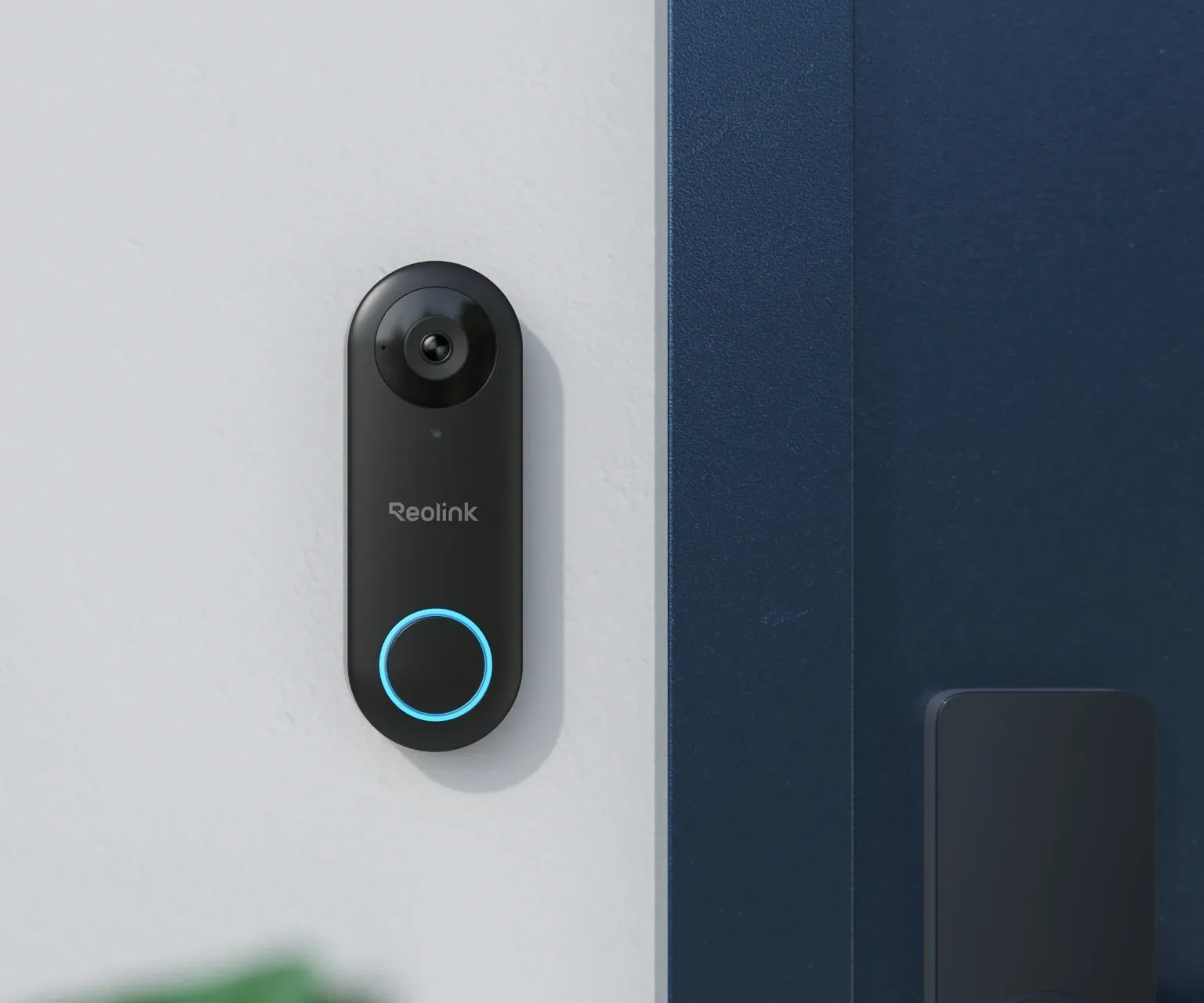
Manufacturer product photo (Reolink, an authorized partner), not an installed job: a black video doorbell with a camera at the top and a blue-lit button, on a white wall beside a navy door. On a converted house where one apartment has its own outside door, a wired video doorbell like this can be that apartment's entry station.
Fobs and keypads for side doors, outbuildings and gates
Keys are the weak point of most Long Island rentals, and key fob entry systems are the usual cure. A garden complex can have dozens of exterior doors on one key, plus a laundry building, a storage building and a boiler room, and every key that walked away with a former tenant still works. Fob readers fix that: each tenant gets a credential that opens only the doors they should use, and the owner cancels it on move-out instead of changing locks. On properties where the owner does not want to manage fobs at all, a keypad with a code per tenant does much of the same job at a lower cost. Our published price for a single-door reader with an electric strike on Long Island is $1,500 to $2,500 installed, and a gate with a vehicle reader and barrier arm runs $3,500 to $12,000, both on our access control installation page for Long Island.
Smart locks are the other tool. On an office, a storage room or a vacant apartment between tenants, a keypad or app lock can be the right answer, and we install them through our smart lock installation service on Long Island. On an apartment's own entrance door, any lock has to meet the state maintenance code's deadbolt rule: it opens from inside without a key or special knowledge, and it throws at least an inch. We will not put a lock on a tenant's door that traps them inside.
Mail and packages where there is no lobby
Many Long Island rentals have no lobby at all. Garden buildings open straight into a stairhall, converted houses have one front step, and newer buildings near the train stations have a lobby but no staff. Deliveries end up on steps, in vestibules and against apartment doors, package theft follows, and the commuter who leaves on the 6:40 is not home to bring them in. The fix is to give packages a place that is locked and recorded: a small package room off the vestibule with its own reader, or a bank of parcel lockers in a covered spot. Couriers get a code that opens only that door or the lockers, and the camera at that door records faces, not the backs of heads. We install the reader, the door hardware, the camera and the cabling; the locker cabinets themselves come from the locker maker.
Door alarms, burglar alarms and monitoring
Boiler rooms with copper, storage buildings, roof hatches on mid-rise buildings, and apartments sitting empty between tenants are the places a building should hear about when they are opened. Contacts on those doors and a motion sensor or two, wired to an alarm panel, will sound locally, text the owner and, with monitoring, call the central station. On Long Island that alarm also needs a police permit: in the Nassau County Police district, and in the Suffolk County Police district except for the towns and villages the Suffolk program does not cover. Our central-station monitoring is $30 a month keypad-only or $45 a month with the phone app, as published on our alarm installation page for Long Island, and we help the owner put the permit in the right name.
Cameras, in short
Cameras belong in the plan, but they come after the doors, because a camera records a problem while a working door prevents one. On a rental property we aim them at the entrances, the package area, the lot and the outside of the boiler room, record on a recorder in a locked closet, and let the owner view them from a phone. Audio stays off in common areas, since recording conversations a person is not part of raises eavesdropping questions under the state's Penal Law. Camera counts, recorders and retention are covered on our apartment camera page for the Island; our published four-camera price is $999 in Nassau and $1,099 in Suffolk on our Long Island security camera pricing page.
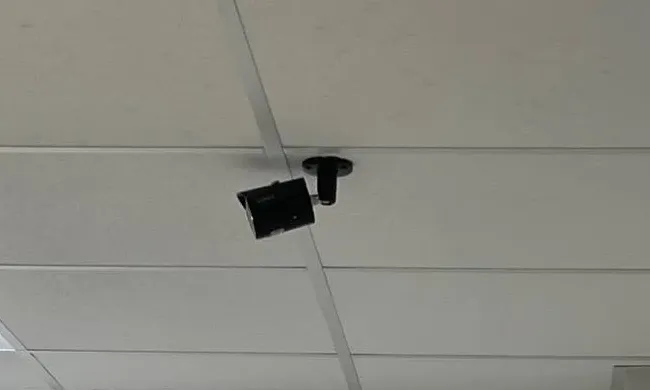
Job photo from our files: a small black bullet camera on a short black pendant mount, hanging from the metal rail of a white drop ceiling. A short drop like this lets the camera look under a soffit or past a light fixture toward a door at the end of a hall.
Getting far buildings back to one closet
This is where Long Island properties differ most from city buildings. Ordinary Cat6 network cable carries a signal about 100 meters, or 328 feet, between active devices, and a garden complex can easily put its farthest building beyond that from the office. There are three ways across. Where there is existing conduit between buildings, we pull new cable or fiber through it. Where the buildings share a basement or an attic run, cable goes inside. And where neither exists, a pair of point-to-point wireless radios mounted building to building carries the signal without trenching the lawn or the lot. Each building then gets a small network switch with battery backup, and the readers, panels and cameras on that building connect locally. Our structured cabling service on Long Island publishes $150 to $300 per network connection point for the cable side of that work.
Power, batteries and storm season
An entry system that dies with the power leaves tenants locked out or the door left open, depending on how the lock was wired. We size battery backup for the door controllers and strikes, the entry panel, the network switches and the recorder, so they keep running through a normal outage, and the equipment list we hand over shows what each battery carries. Magnetic locks on exit doors release when power fails, as the building code requires, so a long outage is also a reason for a door contact and an alarm on battery to keep reporting. Batteries wear out with age, so the list also shows when each one was installed. We do not install generators or new electrical circuits; any new high-voltage power is the building's electrician's work, and we coordinate with them.
Elevators and garages on newer buildings
Station-area buildings in Mineola, Hicksville, Westbury and Ronkonkoma often have an elevator and a parking garage, and both are openings. An elevator reader limits floors to the people who live on them, and a reader or keypad at the garage door keeps the garage from becoming the building's unguarded back entrance. We install the reader in the car and the cable to the equipment room, and the building's licensed elevator company makes the connection inside the elevator controller. Our published Long Island price is from $1,725 per car in Nassau and $1,800 in Suffolk, on our elevator access control page for Long Island.
Fire alarm coordination
Any door with a magnetic lock or an electrified exit device has to release when the building's fire alarm goes off, so security and fire alarm work meet at the door. In Suffolk County we take on commercial fire alarm work for buildings that require it, designed to engineer's drawings and approved by the town or village fire marshal, as described on our fire alarm installation page for Long Island. In Nassau County, fire alarm permits require a company number from the County Fire Marshal that we do not hold, so we do not take Nassau fire alarm jobs; we wire the door release to the existing fire alarm alongside the fire alarm company of record.
What we do not sell
We do not run a virtual doorman, a remote concierge or a managed security service, and we do not sell monthly security subscriptions of our own. We install and maintain the entry panels, readers, cameras and alarms that a building's staff or an outside video service would use, and we can connect them to a provider the owner has already chosen. We do not do electrical work beyond low voltage, we do not install generators, and we do not give legal advice; where a rule matters, we name the source so the owner's attorney can check it.
Building Specialists
Apartment Building Security Systems for Long Island's Building Types
No two Long Island rentals are planned the same way, but most fall into one of seven types. The cards below are a quick map; the sections after them explain what changes in the equipment and the method for each.
Garden apartment complexes
Low brick or frame buildings scattered across a lawn, each stairhall its own door, parking in the open.
Houses converted to apartments
Two or three households behind one front door, under a town rental permit.
Apartments over stores
Village main-street buildings with a street door to the apartments beside the shopfront.
Downtown walk-ups and elevator buildings
Mid-century and prewar buildings near train stations in western Nassau villages.
New buildings by the train station
Four- and five-story buildings with video entry, fobs, package rooms and garages from day one.
Oceanfront and South Shore buildings
Salt air, flood-prone basements and storm outages shape every equipment choice.
Accessory apartments
A single rental unit in an owner's house with its own outside door.
Garden apartment complexes in Nassau and Suffolk
A garden complex is the classic Long Island rental: two- or three-story brick or frame buildings around lawns, each with one or two stairhall entrances, a basement laundry or a separate laundry building, and a parking lot or carports. The security problem is spread, not height. Each stairhall door is an entrance, and on many complexes those doors were never on an intercom at all; tenants simply carry a key. We plan these properties building by building. Each entrance gets a closer and strike set properly and either a small entry panel or a fob reader, depending on whether visitors arrive at the building door or at a central gate. The laundry and storage buildings get readers so only tenants use them. The lot gets cameras on the drive entrances and the dumpster area. Signals from the far buildings come back over conduit, shared basements or wireless links, and each building has its own small battery-backed switch so one building's outage does not take down the rest.
The method matters as much as the equipment. Garden complexes are occupied every day, so we work one building at a time, switch each entrance over in a short window, and leave the old keys working until the owner tells tenants the date they stop. Exterior work is planned around weather and, in winter, around snow: readers and posts at drive entrances go where plows will not clip them.
Houses converted to two and three apartments
A large share of Long Island's rental housing sits in houses: a two-family in Hempstead, a house divided into three apartments in Bay Shore, a legal accessory unit in Huntington. Newsday's database compiled with the Long Island Index found 112 towns, cities and villages on Long Island with their own rules on accessory apartments. These houses usually carry a town rental permit, and in towns such as Islip and Brookhaven the permit comes with an inspection that checks the smoke and carbon monoxide alarms. For security, the shared front door is the key opening: it needs a proper closer and latch, a call button per apartment, and a door release from each unit or from each tenant's phone. Each apartment's own entrance needs a deadbolt that meets the state code. The rest is modest: a camera on the front step and the driveway, a contact on the basement door. A converted house rarely needs a full building system, and we say so.
Apartments over stores on village main streets
Main streets from Lynbrook and Rockville Centre to Patchogue and Huntington have two- and three-story buildings with shops below and apartments above, reached through a narrow street door beside the shopfront. That street door is the whole residential security system in many of these buildings, and it takes a beating: deliveries for the shop, tenants coming and going, and passers-by trying it at night. We give it a heavy closer, an electric strike or a magnetic lock with a release button inside, and a small entry panel with a button for each apartment. The stair and the rear yard get a camera each. The shop keeps its own alarm and its own cameras on its own account, and where the apartments and the shop share a rear door or a basement, that door gets a reader so each side's access stays separate.
Downtown walk-ups and elevator buildings
Western Nassau has older apartment buildings closer in style to Queens than to suburbia: Great Neck Plaza's 90 multiple-family buildings within a third of a square mile, walk-ups and small elevator buildings in Hempstead, Freeport, Lynbrook, Rockville Centre, Mineola and Glen Cove. Many are the six-or-more-unit, pre-1974 buildings that ETPA covers where a locality has adopted it. These buildings have a lobby, a riser of intercom wire from the basement to every apartment, and the problems that come with age: shorted pairs, a transformer installed in the 1980s, half the apartment stations replaced with mismatched models. We test the riser before recommending anything. A riser that tests clean can carry a new panel and new stations; one that does not may be a reason to move apartments to phone answering and retire the riser altogether.
New buildings by the train station
The newest rentals on the Island are four- and five-story buildings beside Long Island Rail Road stations: the Station Yards phases in Ronkonkoma, the buildings around the Mineola station, Hicksville's 189-unit building next to its station that the Governor's office announced in December 2023, and projects in Westbury, Farmingdale, Patchogue and Wyandanch. They open with a video entry panel, fob readers on every common door, a package room, garage access and often an elevator reader, all installed by the developer's contractors. The owner's job is to take it over: get the administrator logins, confirm which platform fees run each month and who pays them, check the battery backup, and make sure the equipment closet is documented. We do that takeover for owners and then maintain the systems, whichever brand the developer chose.
Oceanfront and South Shore buildings
Long Beach is the only place on Long Island with oceanfront high-rises, as a 2021 news report posted by the area's state senator put it, and the buildings there and along the South Shore deal with salt air every day. Salt eats exposed metal: entry panels, strikes, camera housings and the screws holding them. We specify stainless or sealed housings on the ocean side, mount panels under cover where the layout allows, and check gaskets at each service visit. Hurricane Sandy put basements and lobbies under water on this shore in 2012, so we keep recorders, switches and power supplies off basement floors and, where we can, out of the basement altogether.
Accessory apartments in owners' houses
An accessory apartment is the smallest rental there is: one unit, often with its own side or rear door, in the house its owner lives in. The rules vary by town; the Town of Hempstead, for instance, limits them to family members and to owners or spouses aged 62 and over, according to Newsday's Long Island Index database. Security here is the tenant's door and the owner's peace of mind: a deadbolt that meets the state code, a video doorbell or small call station at the tenant's door, a camera on the path to it, and, when the owner wants it, a contact on the door between the two units. It is a short job, often finished in one visit.
Building type
First thing we check
Usual first fix
Garden complex
How many exterior doors share one key
Fob readers on stairhall, laundry and storage doors
Converted house
Shared front door's closer and latch
Call station with a button per apartment, deadbolts to code
Apartments over stores
Street door's closer, strike and frame
Heavy closer, strike and a small entry panel
Downtown walk-up or elevator building
The riser, with a meter
Panel and stations on a clean riser, or phone answering
New station-area building
Who holds the logins and the platform contract
Takeover, documentation and battery check
South Shore or oceanfront
Corrosion on panels and strikes; basement flood line
Sealed or stainless hardware, equipment moved up
Accessory apartment
The tenant's own door and lock
Code-compliant deadbolt and a video doorbell
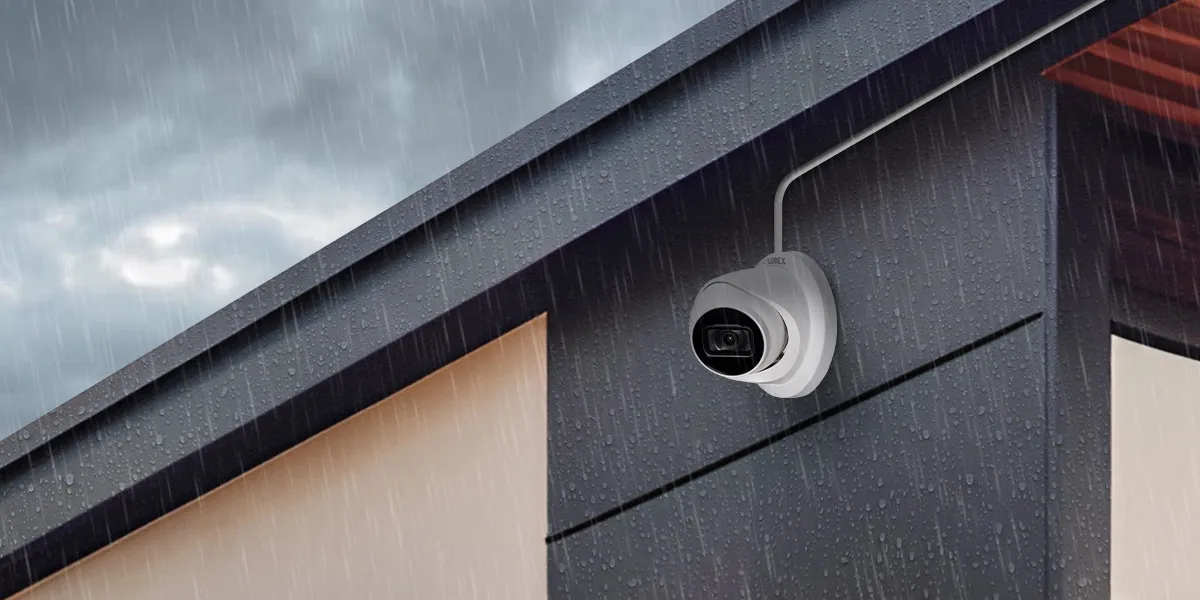
Manufacturer product photo (Lorex, an authorized partner), not an installed job: a white turret camera on a dark wall panel just under the roof edge, with rain streaking past and the cable tucked up into the eave. On a garden building, a mount high under the overhang keeps a camera out of reach and out of the worst of a coastal storm.
Commercial Apartment Building Security
Owning a Long Island Rental: Rules, Permits and Paperwork
The owner of a Long Island rental answers to more offices than a city owner does: the state, the county police, the town or city, and often the village. None of them is in charge of security systems as such, but each touches a piece of one. This section sets out the rules we work to and where they come from. We are not lawyers, this is not legal advice, and an owner's attorney should confirm how any rule applies to a particular building.
Which state law applies: Multiple Residence, not Multiple Dwelling
Much of what is written online about apartment building security in New York is about New York City. Its intercom rule, which requires self-closing, self-locking entrance doors and a two-way intercom with a door release in each apartment in larger buildings, is §50-a of the Multiple Dwelling Law, and §3 of that law limits it to cities of 325,000 people or more. On Long Island the Multiple Residence Law applies instead: its §3 covers “all cities of less than three hundred twenty-five thousand population” and “all towns and villages.” We have not found an intercom requirement like §50-a in the Multiple Residence Law, so we do not tell Long Island owners they are legally required to have one. What we do tell them is that the state maintenance code still requires locks, that tenants still have a warranty of habitability, and that an entry system which exists has to work.
The Property Maintenance Code of New York State
Outside New York City, the state's Uniform Code includes the Property Maintenance Code of New York State, and its §304.18 is the closest thing to a security rule for rentals. Doors, windows and hatchways of dwelling units must have devices designed to secure the occupants and the property. A deadbolt on a rented unit's entrance door must open from the inside without a key, special knowledge or effort, must throw at least one inch, and must be installed to the manufacturer's instructions and kept in working order; a sliding bolt does not count. Operable windows in a rented unit within six feet of the ground or a walking surface need a sash lock. Every lock and every apartment door we touch is set to those terms.
Town and village enforcement and rental permits
The state Department of State's memorandum for local officials says the Uniform Code is automatically in effect in every city, town and village except New York City, and the local government enforces it. That is why the inspector at a Long Island rental comes from the town, the village or the city, and why the rental permit rules differ from one place to the next. The Town of Islip's Code requires a rental occupancy permit with an on-site inspection, valid for two years. The Town of Brookhaven requires rental registration with an inspection by the town or a licensed professional. The Town of Babylon requires a rental permit to legally rent a unit or a whole home. Those inspections focus on life safety, such as smoke and carbon monoxide alarms, exits and occupancy, rather than intercoms or cameras, but a broken entrance lock or a missing deadbolt is the kind of item an inspector can write up.
Rent stabilization under ETPA in Nassau
Rent stabilization is not only a city matter. Under the Emergency Tenant Protection Act, a locality that declares a housing emergency can bring buildings of six or more units built before January 1, 1974 under stabilization. New York State Homes and Community Renewal's Fact Sheet #8 lists sixteen Nassau localities that have done so: the Villages of Baxter Estates, Cedarhurst, Floral Park, Flower Hill, Freeport, Great Neck, Great Neck Plaza, Hempstead, Lynbrook, Mineola, Rockville Centre, Russell Gardens and Thomaston, the City of Glen Cove, the City of Long Beach and the Town of North Hempstead. Some localities limit it to larger buildings. The same fact sheet says stabilized tenants are entitled to receive required services, which is why we schedule entry changeovers in these buildings so the door and the intercom never stop working, and why the owner should check with HCR before treating an upgrade's cost as something that can be added to rents.
Good Cause Eviction and the warranty of habitability
New York's Good Cause Eviction Law covers New York City and any city, town or village outside it that opts in. As of the Attorney General's April 2025 list, no Long Island locality had, and in November 2025 the Village of Hempstead's board voted 3–2 against it, as Newsday reported, before tenants rallied at Village Hall that December. What does apply everywhere is Real Property Law §235-b, the warranty of habitability, which the Attorney General's tenants' rights guide summarizes as the landlord's duty to keep the apartment fit to live in. A front door that will not lock is the kind of problem tenants raise under it.
County alarm permits and false alarms
A burglar alarm on a Long Island building is registered with the police. The Nassau County Police alarm permit section lists permits at $100 for a residence and $200 for a business, valid for two years. Suffolk County's Alarm Management Program registers alarms at $50 for residences and $100 for commercial premises, gives a registered location two false alarms before service fees, and charges unregistered locations from the first; its code states that no alarm owner shall operate an alarm in the Suffolk County Police District without a permit. The towns and villages outside that district, such as Riverhead, Southampton, East Hampton, Southold and Shelter Island, are not covered by the county program. A building's alarm permit should be in the owner's name, or the owner's company, not the name of a contractor or a former manager.
Tenant privacy outside the city
New York City's Tenant Data Privacy Act, which governs fob and app systems in city buildings, does not apply in Nassau or Suffolk. That does not make tenant data unimportant. Fob and app systems record who opened which door and when, video panels capture faces, and a careless owner can end up with years of tenants' movements on a laptop. We set systems up so the owner decides how long logs are kept and who can see them, we keep audio off in common areas because of the state's eavesdropping law, and we suggest that the owner's attorney write a short notice for tenants describing what is recorded.
Compliance callouts for Long Island owners
Multiple Residence Law §3 sets which state housing law applies on Long Island; the city's §50-a intercom rule does not.
Property Maintenance Code of New York State §304.18: security devices on dwelling-unit doors, windows and hatchways; deadbolts openable from inside, one-inch throw; sash locks on rented ground-level windows.
Code inspections at each rental are carried out locally, by whichever town, village or city the property sits in (Department of State memorandum LG03).
Town rental permits where the town requires them (Islip, Brookhaven and Babylon among them).
ETPA in sixteen Nassau localities for pre-1974 buildings of six or more units (HCR Fact Sheet #8).
Real Property Law §235-b: every lease carries an implied promise that the apartment is fit to live in.
Police alarm permits in Nassau and in the Suffolk County Police District.
Magnetic locks and electrified exit hardware release on power loss and fire alarm signal, with free egress from inside.
Fire alarm approvals sit with the Nassau County Fire Marshal or, in Suffolk, the town or village fire marshal; our own fire alarm work is limited to Suffolk.
Your Questions Answered
Apartment Building Security Systems on Long Island: Questions Answered
These are the questions Long Island owners ask us most, grouped by the part of the property they come up in. Each answer is short and specific; the sections above have the background.
Permits, rules and shortcuts through the property
We own buildings in both Nassau and Suffolk. Does each one need its own police alarm permit?
Yes, and in each county the permit goes to a different police department. Nassau County Police issue alarm permits through their alarm permit section, at $100 for a residence and $200 for a business, valid for two years. Suffolk County Police register alarms in their district through the Alarm Management Program, at $50 or $100, and buildings in towns outside that district, such as Riverhead or Southampton, are not covered by it. We list every building’s alarm and the office it registers with on the equipment list, so the owner can file each permit in the owner’s own name.
What does the state property maintenance code ask for on each apartment door and the ground-floor windows?
Section 304.18 asks for devices that secure the occupants on dwelling-unit doors, windows and hatchways. A deadbolt on a rented unit's door must open from inside without a key or special effort and throw at least one inch, and a sliding bolt does not qualify. Operable windows in a rented unit within six feet of the ground or a walkway need a sash lock. A keyed-both-sides deadbolt on an apartment door fails the first test, and it is one of the things we replace.
The garage at our new building opens for tenants’ cars. How do we stop people walking in behind them?
Treat the garage as an entrance, not a parking feature. The overhead door gets a reader or a long-range tag at the drive lane, a closing timer that brings it down as soon as the car clears, and a camera aimed at the opening so anyone ducking in on foot is recorded. The door from the garage into the building gets its own reader and closer, so a person who slips into the garage still cannot reach the halls. On station-area buildings, where the garage is often the busiest entrance at night, that inner door matters more than the overhead one.
Our village is on the ETPA list. Can the cost of a new entry system be passed on to stabilized tenants?
Only through HCR, not by the owner's own decision. HCR's fact sheet says owners of stabilized buildings may pass on certain improvement costs only with the agency's approval, under its rules for apartment and building-wide improvements. We give owners an itemized invoice with equipment and labor separated, which is the paperwork such an application starts from, but whether a particular entry system qualifies is a question for HCR and the owner's attorney.
People cut through our garden complex from the next street to reach the train. Should we fence, gate or just watch the lot?
Watching alone records the problem without stopping it. If the shortcut runs past building doors and parked cars, the owner usually starts with a fence and gate from a fencing contractor, and we add a reader or keypad to the pedestrian gate so tenants pass and others do not, plus a camera on the gate itself. Where a fence is not possible, cameras on the path and lighting from the owner’s electrician at least make the shortcut less inviting.
Garden complexes and spread-out properties
Our garden complex has twelve separate buildings. Does every entrance need its own intercom panel?
Not always. If visitors can reach every stairhall door from the parking lot, each building needs its own panel, or a simple call station, so a visitor can reach the right apartment. If the complex is fenced with one or two pedestrian gates, a single panel at each gate and fob readers on the building doors usually costs less and gives the owner one place to manage. We draw both layouts for the same property so the owner can compare them before choosing.
How do door and camera signals from the far buildings get back to one equipment room without trenching the lawn?
Through whatever path already exists, or through the air. Old conduit between buildings can usually take new cable or fiber, and a shared basement or attic run can carry cable inside. Where neither exists and the distance is beyond Cat6's 100-meter limit, a pair of point-to-point wireless radios mounted with a clear line of sight carries the network from building to building. Trenching is the last resort, not the first.
Packages are left at each building's outside door. Is a parcel locker or a package room better for a complex?
On a complex where every building has its own entrance and no lobby, one covered bank of parcel lockers near the office or the mailboxes is usually easier than a package room in each building, because couriers make one stop. A package room works better in a single larger building with an unused room off the vestibule. Either way, couriers get a code that opens only the lockers or that room, and a camera records the faces of the people who use it.
Our door alarm calls the police when tenants forget their codes. What stops the false alarms?
Usually the alarm is protecting doors that tenants are meant to use. The fix is to take those doors off the burglar alarm and put them on fob readers with a door-held warning, leaving the alarm on the doors nobody should open, such as the boiler room or the roof hatch. Entry delays get set to how long it really takes to reach a keypad. That cuts the false alarms that bring fees from the county police.
Weather, power and smaller rentals
After a storm, our entry panel came back on but the front door would not release. What happened?
Usually one of three things. The battery in the door power supply ran flat during the outage and has not recharged, a fuse or the transformer feeding the strike was damaged by the surge when power returned, or the controller came back up with its door schedule reset. A $250 service call finds which one it is. To keep it from happening again, the door power gets its own battery and a surge protector, and the equipment list shows when each battery was installed.
Our equipment sits in a basement that took water during Sandy. Where should it go now?
Up. We move recorders, switches, power supplies and batteries to a ground-floor or upper-floor closet where the layout allows, or at least onto a wall-mounted rack well above the basement floor. Cable that has to stay in the basement is run high and sealed where it enters boxes. The goal is that a flooded basement means a wet floor, not a dead entry system.
The accessory apartment in our house has its own outside door. Is a video doorbell enough security for it?
For one unit it often is, if the door itself is right. The tenant's door needs a deadbolt that meets the state code, a solid strike and a closer if it is used by more than the tenant. A wired video doorbell lets the tenant see and talk to visitors; a camera on the path to that door covers the approach. If the owner wants to know when the inside door between the two units is opened, a contact on it does that job.
Our garden buildings are on separate electric meters. Where should the shared security equipment get its power?
From one place the owner pays for and controls, normally the house or common meter that already feeds the hall lights and the laundry. The main equipment closet sits on that circuit, and each building’s small switch and door power supply is fed from a common-area outlet in that building, never from a tenant’s apartment. If a building has no common circuit, the owner’s electrician adds one; we then install the battery backup and the low-voltage side.
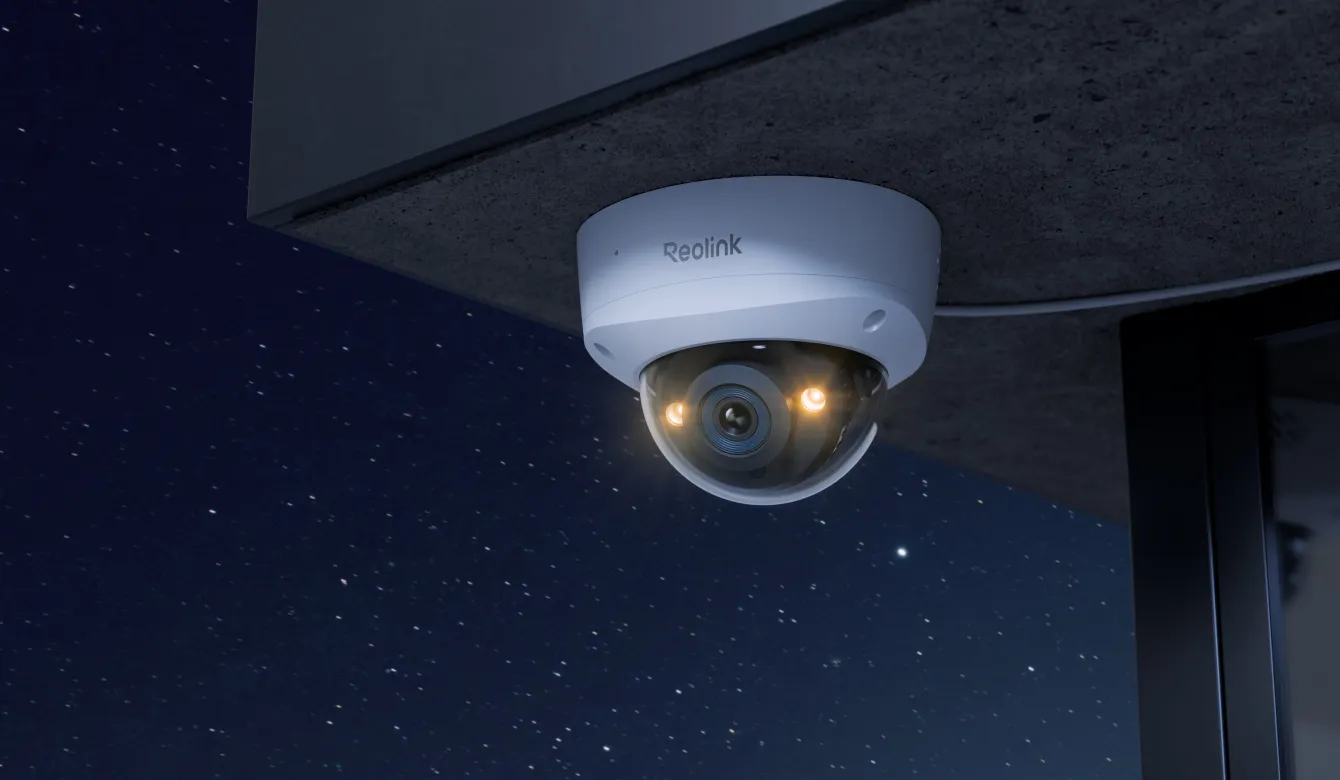
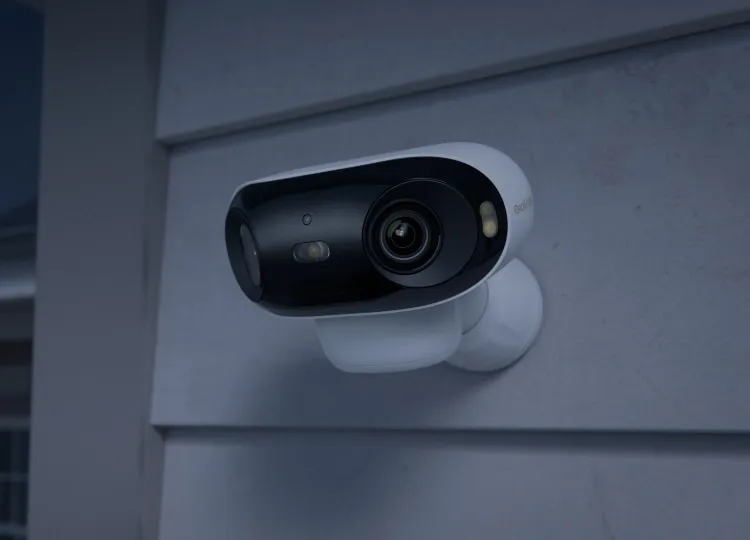
Manufacturer product photo (Reolink, an authorized partner), not an installed job: a white dome camera with two small lights on, tucked under a dark overhang at night. Mounted under the eave, a dome like this stays dry in a nor'easter and still sees the walk to a garden building's door.
Equipment
Types of Apartment Building Security Equipment We Install on Long Island
We install the equipment below at rental properties across Nassau and Suffolk, and service most brands already on site. Our default quote is non-branded equipment chosen for the job; we install named brands when an owner asks or when a building already runs them. For cameras we are an authorized partner for Lorex, Luminys and Reolink.
A
Entry panels
Audio and video panels with buttons, a directory or a keypad; models that call tenants' phones; stainless and sealed panels for the shore.
B
Apartment answering
Wired audio or video stations, or app and phone answering where the riser or the budget rules out stations.
C
Door hardware
Hydraulic closers, strikes and mag locks for the main doors, push-to-exit and motion release inside, open-door sensors, and apartment deadbolts that meet the state code.
D
Readers and credentials
Fob and card readers, keypads, mobile credentials, and readers on gates, garages and elevator cars.
E
Controllers
Door controllers on site or managed in the cloud, with logs the owner can read and export.
F
Alarms
Intrusion panels with door contacts, motion sensors and keypads, connected to central-station monitoring.
G
Cameras and recorders
Domes, turrets and bullets on entrances and lots, recorded on a network video recorder in a locked closet.
H
Links and network
Cat6, fiber, PoE switches and point-to-point wireless links between buildings.
I
Power
Batteries in the door power supplies, a UPS under the recorder and switch, and surge protectors where outdoor runs come inside.
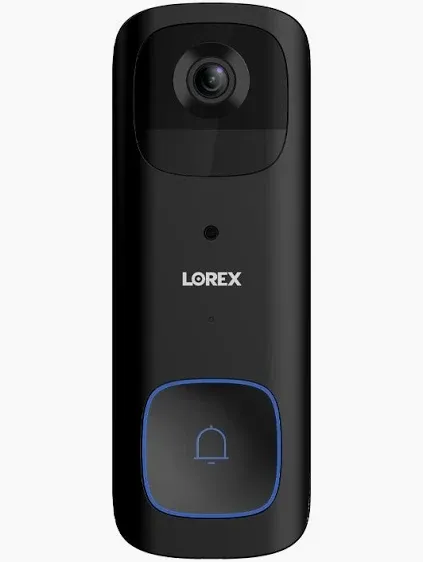
Manufacturer product photo (Lorex, an authorized partner), not an installed job: a black video doorbell with a lens at the top, the Lorex name in the middle and a blue-lit bell button. On an accessory apartment or a two-apartment house, a doorbell like this is often all the entry station the tenant's door needs.
Choosing between the main options
Decision
Option one
Option two
What usually decides it on Long Island
Apartment answering
Wired stations in each unit
Tenants' phones through an app or a phone call
Riser condition, tenants without smartphones, monthly fees
Credentials
Fobs or cards
Keypad codes
How often tenants turn over and who will manage the list
Control
Controller on site, no subscription
Cloud-managed controller
Whether the owner lives nearby or runs the property from away
Recording
Recorder in a locked closet
Cloud recording
Internet line, camera count and outage risk
Links between buildings
Cable or fiber in existing conduit
Point-to-point wireless
Whether a path already exists and line of sight
Outdoor hardware
Standard housings
Stainless or sealed
Distance from salt water and exposure to weather
Home security brands, platform companies and a local licensed installer
Long Island owners usually compare us with three other routes. The national home-security brands, such as ADT, Ring and SimpliSafe, sell kits and plans built for one household; they suit an owner-occupied house with an accessory unit but do not cover shared entrances, tenant credentials or a lot. Intercom and access platform companies sell well-made products through their own installers and usually charge a monthly fee per door or per apartment. A local licensed installer, which is what we are, installs the hardware the building needs, including platform products when the owner wants them, and leaves the owner holding the logins, with no monthly fee from us unless the owner chooses alarm monitoring. The right answer depends on the building; we will tell you when a simple kit is enough.
Owners who prefer to buy cameras or recorders themselves can see the equipment we sell, installed or equipment-only, on our security camera equipment page for Long Island. We also install customer-supplied equipment for a labor price given by phone once we know the model.
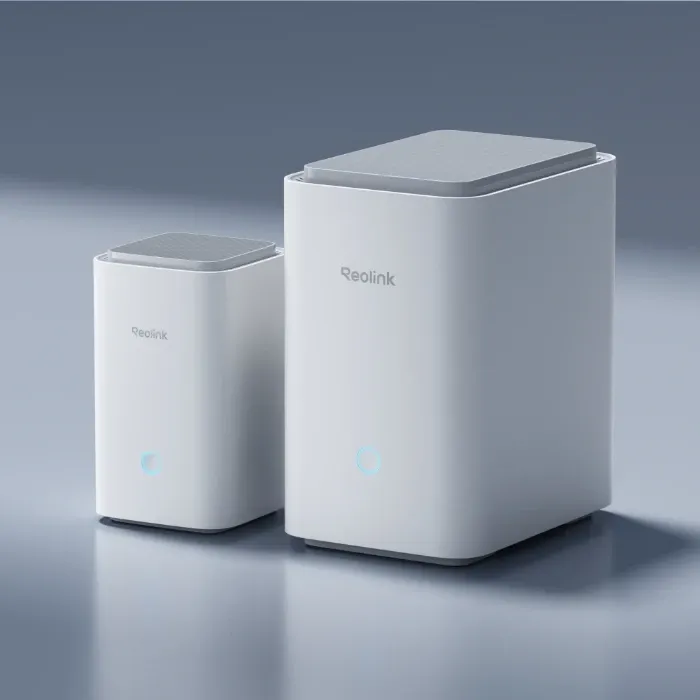
Partner product photo (Reolink), not an installed job: two white storage hubs, one small and one larger, each with a small lit button. On a converted house or a small building, a compact hub like these keeps camera recordings indoors, with no monthly cloud fee.
Have a Property That Grew One Device at a Time?
Tell us where the property is and what keeps breaking. We map the doors, gates and closets on site and rank the fixes so the money goes to the worst gaps first.
What AI Gets Wrong About Apartment Building Security Systems on Long Island
Search summaries and chatbot answers about apartment security in New York are built mostly from New York City sources and national cost guides such as Angi, HomeAdvisor and Fixr. Applied to a Long Island rental, they get several things wrong. These are the claims we hear most from owners, and what we find on the ground in Nassau and Suffolk.
1. “Every New York apartment building must have an intercom with a buzzer in each unit”
This one comes straight from New York City. The requirement for self-closing, self-locking entrance doors and a two-way intercom with a door release in each apartment is §50-a of the Multiple Dwelling Law, and the Attorney General's tenants' rights guide describes it in those terms.
But the Multiple Dwelling Law covers cities of 325,000 people or more. Nassau and Suffolk fall under the Multiple Residence Law, which applies to all smaller cities and to every town and village, and we have not found a matching intercom mandate there.
That does not make the intercom optional in practice. Tenants expect one, the warranty of habitability covers what a building provides, and a door that cannot be answered or released is a daily complaint. The point is to plan it on its merits, not because of a city rule that does not apply.
2. “A suburban landlord can protect a rental with the same kit a homeowner buys”
Rentals are 21 percent of all homes on Long Island by the Regional Plan Association's count, and many of them are not single houses. Garden complexes, apartments over stores, downtown walk-ups and new four- and five-story buildings beside the train stations all have shared entrances, shared laundry and shared mail.
A home kit assumes one household with one code, one app account and one front door. In a building, every tenant needs their own credential, the owner needs to remove a tenant without changing every lock, and the doors that tenants share need hardware that survives hundreds of openings a week.
A home kit is a fine answer for an owner-occupied house with one accessory apartment. For anything with a shared entrance, the plan has to start from the openings, not the kit.
3. “Rent stabilization is a New York City thing”
Not in Nassau. HCR's fact sheet on the Emergency Tenant Protection Act lists sixteen Nassau localities, including the Cities of Glen Cove and Long Beach, the Town of North Hempstead and Villages such as Freeport, Hempstead, Mineola and Rockville Centre, where pre-1974 buildings of six or more units can be stabilized.
Stabilized tenants are entitled to required services. An entry system or a front door lock that stops working during a botched changeover is a service problem, not just an inconvenience, and owners can only pass improvement costs on through the agency's own process.
So in those localities we schedule changeovers so nothing is ever off, keep the paperwork itemized, and suggest the owner confirm the building's status before the project starts. Suffolk has no locality on the list.
4. “Good Cause Eviction now applies to all rentals in New York”
Summaries of the 2024 law often skip the part that matters outside the city: it applies in New York City and only in other localities that opt in. The Attorney General's list as of April 2025 and a 2025 State Senate list of seventeen opt-in municipalities include none on Long Island.
The question has come up locally. Newsday reported that the Village of Hempstead's board voted 3–2 against the law in November 2025, and News 12 covered tenants rallying at Village Hall in December urging the board to adopt it.
For security work, the practical point is that an owner's obligations on doors and locks come from the maintenance code and the warranty of habitability, which apply either way. Status can change, so we cite the date of every list we rely on.
5. “Wireless is simpler for a spread-out complex”
Wi-Fi cameras and battery devices look easy on a property with buildings far apart, and national guides recommend them for exactly that reason. One r/longisland thread about home cameras includes a resident's comment that thieves in the area used jammers and the cameras did not record anything.
Consumer Wi-Fi depends on one router, its range and its signal, and a garden complex has brick walls, distance and dozens of tenants' own networks competing on the same channels. Battery devices need someone to charge them.
Our approach is wired inside each building, with a dedicated point-to-point link between buildings where cable cannot reach: a narrow, aimed radio link that carries the network, not dozens of separate Wi-Fi devices. It keeps working when a tenant's router is off and records locally if the internet drops.
6. “An alarm is just a device you plug in and register online”
On Long Island an alarm that calls the police is a permitted system. Nassau County Police issue alarm permits for residences and businesses, valid for two years, and say they are asked to respond to more than 125,000 false alarms a year. Suffolk's Alarm Management Program registers alarms and charges service fees after a set number of false alarms.
For a rental building the trouble is usually not the permit itself but whose name is on it and which doors are armed. Alarms placed on doors tenants use every day trigger false alarms, and the bills go to whoever registered the system.
We put the alarm on the doors nobody should open, put tenant doors on readers instead, and help the owner register the permit in the owner's own name.
7. “New buildings near the station come with security that runs itself”
The new station-area buildings in Mineola, Hicksville, Westbury and Ronkonkoma do open with modern video entry, fob readers and package rooms. Online descriptions of them make the systems sound finished.
What they rarely mention is everything an owner has to take over: administrator logins held by the developer's installer, platform contracts with a fee per door or per apartment, battery backup nobody has tested, and an equipment closet with no labels. PSEG Long Island's July 2026 storm update, with thousands of customers still without power the next morning, is a reminder of why the batteries matter.
We do the takeover for owners of new buildings: logins moved into the owner's name, fees listed, batteries tested and the closet documented. After that, the system runs as well as it is maintained, like any other.
Get In Touch
Request an Apartment Building Security Walk-Through on Long Island
Tell us the town or village, how many buildings and apartments the property has, what is installed and what is failing. Photos of the entry panel, both sides of the main door and the equipment closet or basement help us plan the visit. For a single repair, the address and the symptom are enough. Prefer to talk? Call (800) 486-0943.
✅
Request Sent!
Thank you. We will contact you to set up the visit.
How It Works
Our Apartment Building Security Process on Long Island
1
First contact
You tell us where the property is, how many buildings it has, what is wrong or what you want, and whose phone to call on the day. Requests are booked within two hours.
2
Service call or walk-through
Single problems get the $250 service call. For a whole property, a technician first walks each building, outbuilding, gate and basement closet.
3
Written plan
A building-by-building list with hardware, labor and monthly platform charges priced apart, and the urgent items marked.
4
Approval and deposit
Your signature and the deposit start the ordering; made-to-order panels and hardware get an install date when the supplier ships them, not before.
5
Notices and permits
The owner notifies tenants; we supply equipment details for any alarm permit or town paperwork in the owner's name.
6
Install, building by building
New gear is mounted and tested next to the old; every entrance changes over in a brief morning slot, and the rest of the devices come after.
7
Handover
Administrator accounts moved to you, every cable tagged, a device and battery list, a short training for your handyman or manager, then the invoice.
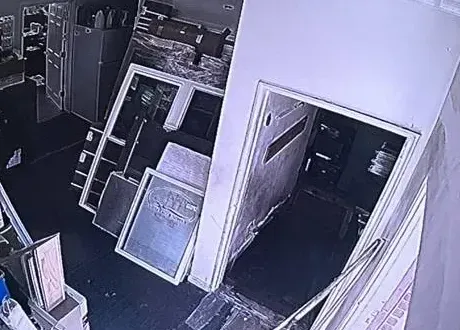
Job photo from our files: a black-and-white night image from a ceiling camera, looking down into a storeroom with framed pieces stacked against the wall and a door standing open to a darker room. A view like this is what an owner checks after a storage-room complaint, which is why the door contact and the camera are planned together.
Field notes: walking a garden complex for the first time
On a first visit to a garden complex we do not start in the office. We start at the far end of the lot and walk every building's entrance in turn, closing each door from a foot open to see whether it latches, and counting how many doors open with the same key. We note which buildings have a call button at the door and which have nothing, where the mailboxes are and where packages end up, and whether the laundry building is locked or propped. In each basement we look for the old intercom power supply, the alarm panel if there is one and the high-water mark if the basement has flooded. Back at the office we look for the router, the recorder if one exists and any conduit leaving the building. By the end, the owner has a sketch of the property with every opening marked, and the plan is written from that sketch.
Field notes: switching a building's entry without a lockout
On Long Island the hardest changeovers are on buildings with no super, because there is nobody on site to let a tenant in if something goes wrong. So we mount and power the new panel or reader beside the old one ahead of time, load every tenant from the owner's rent roll, and test the new door release from the panel and from two or three apartments before touching the old one. The switch itself is done in one short morning window, with the owner's contact reachable. Old keys keep working at the building door until the date the owner gives tenants, then the cylinder is changed or the door goes fob-only. Nobody is left outside on changeover day.
How long the work takes
A repair is usually done on the first visit, or on a second when a part has to be ordered. A new panel on one building with good wiring takes about a day on site once the equipment has arrived. A garden complex is done building by building over several weeks of on-site days, and links between buildings add time if conduit has to be cleared. Special-order equipment can add time we do not control, and we give a date only once it ships.
Coverage Area
Apartment Building Security Systems Near Long Island's Landmarks
Rental housing on the Island clusters around villages, stations and the shore. The six places below are public landmarks that show that spread; none of them is a client, and no building we work in is named on this page.
Great Neck Plaza
A village of a third of a square mile, incorporated in 1930, that lists 90 multiple-family apartment buildings around its Long Island Rail Road station, one of the densest rental districts on the Island.
Mineola
Nassau's county seat. Its mayor told Newsday in September 2026 that over 1,100 apartments for rent have opened in the village since 2010, with roughly another 1,000 in the pipeline.
Hicksville
Site of a 189-unit building beside the station, with underground parking and ground-floor retail, announced by the Governor's office in December 2023 as part of the downtown revitalization plan.
Long Beach
The City of Long Beach, on the ETPA list, with the only oceanfront high-rises on Long Island and blocks of older walk-ups behind the boardwalk.
Station Yards, Ronkonkoma
A transit-oriented development across from the Ronkonkoma station; its phase begun in October 2026 adds 285 apartments in three five-story buildings between Union and Carroll Avenues.
Wyandanch
Where the Wyandanch Rising redevelopment has built two mixed-income buildings with 177 apartments near the station, with a third, 124-unit building under construction, according to the New York Housing Conference.
How rentals differ across Nassau and Suffolk
Nassau County has the older, denser rental stock: walk-ups and elevator buildings in villages along the Port Washington, Hempstead, Babylon and Long Beach branches, apartments over stores in Lynbrook, Rockville Centre and Floral Park, garden complexes in Hempstead, Uniondale and Freeport, and the sixteen ETPA localities. Fire alarm work there goes to the County Fire Marshal and a company that holds a Nassau number; we handle the security side.
Suffolk County spreads its rentals out: large garden communities in Brookhaven and Islip, converted houses under town rental permits in Babylon, Islip and Huntington, new buildings around the Ronkonkoma, Patchogue, Wyandanch and Farmingdale stations, and seasonal and waterfront rentals farther east. Suffolk's distances shape the schedule, and its town rental permits and police alarm district shape the paperwork. We also serve the East End towns, from Riverhead to Southampton and East Hampton.
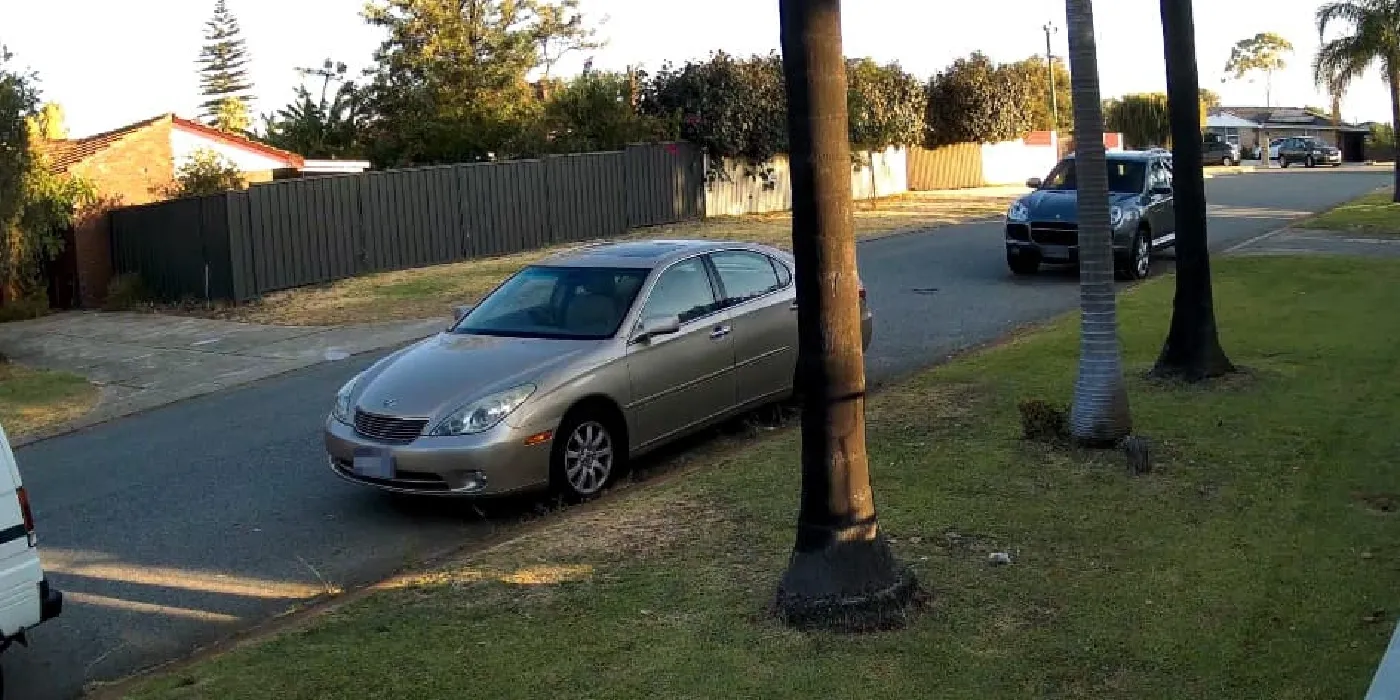
Manufacturer sample view (Reolink, an authorized partner), not taken at a Long Island property: a daytime camera image of a silver sedan at a curb with a grass strip, tree trunks and a fence behind it. On a garden complex, a camera aimed along the parking row records cars arriving and leaving without looking into anyone's windows.
Pricing
Apartment Building Security System Cost on Long Island
Every price below is already published on one of our Long Island service or pricing pages. Whole-property systems are quoted after the walk-through, and we do not publish package prices per building or per apartment, because the number of buildings, the distance between them and the condition of the existing wiring change the answer more than anything else.
Work
Published Long Island price
Where it comes from
Service call (diagnosis and simple repairs)
$250; on a bigger job, the $250 goes toward the total
Seven things move the number on the Island. The number of buildings and entrances, because each entrance is its own set of hardware. The distance between buildings, which decides whether a link is cable in existing conduit, a pair of wireless radios or a trench. The condition of the old wiring in older buildings, tested before any quote is final. The doors and frames, since a strike cannot hold in a frame that has been pried. Exposure to weather and salt, which calls for stainless or sealed hardware on the shore. Platform fees, which can be nothing or a monthly charge per door or apartment for years. And travel within the Island: our published camera prices are higher in Suffolk than in Nassau, and that pattern carries through other work.
Comparing two quotes for the same property
Two Long Island quotes can differ by thousands of dollars and still both be honest, because they are often pricing different things. Check that both count the same entrances, readers and cameras, building by building. Check how each gets signals from the far buildings back to the office: a quote that assumes Wi-Fi from one router is not the same job as one with dedicated links. Check whether batteries and UPS units are included, whether the old equipment comes off the wall, whether monthly platform fees are listed, and whose name the logins end up in. A low total that leaves out the links or the batteries is not a low total.
Spreading the cost over several years
Most Long Island owners phase their apartment building security upgrades: the failing entrances and anything a town inspector or tenants have flagged first, then readers on side doors and outbuildings, then cameras and links, building by building. The written plan from the walk-through is ordered that way so each year's work fits into the next. Financing is available through Wisetack, subject to approval.
Full terms — including 50% deposit, one-year parts-only warranty on Abstract Enterprises Security Systems-supplied products, and the late-fee schedule — are set out in the service agreement.
Shop Our Systems
Apartment Building Security System Packages & Pricing on Long Island
Fix the failing door or panel
$250 service call. Covers the trip, the diagnosis and the quick repairs. Anything bigger gets a written price, built from the Long Island table above, and that price already subtracts the $250.
Secure the entrances
Quoted after the walk-through. Closers and strikes set right on every entrance, entry panels or call stations, apartment answering and door-held alarms.
Whole-property plan
Quoted after the walk-through. One document for the whole site, from the farthest garden building to the laundry shed, with links, batteries, alarms and cameras scheduled across the budget years you pick.
Already bought the equipment? Labor-only installs
Some owners buy entry panels, readers or cameras through their own channels or inherit spares from a previous installer. We install customer-supplied equipment for a labor price given by phone once we know the model and the property, and we book it with a deposit. The performance of equipment we did not supply is the manufacturer's responsibility.
Special-order equipment
Some entry panels, stainless hardware for the shore and replacement stations for older systems are not stocked by distributors in New York and are made to order or shipped from overseas. We tell owners before the deposit when an item is special order, order it only after the deposit, and give an installation date once it has arrived rather than before.
Manufacturer product photo (Reolink, an authorized partner), not an installed job: a white wide-angle camera with two lenses side by side, mounted on dark gray siding. On a frame garden building, one wide camera at a corner can cover both the stairhall door and the walk from the lot.
Setting Next Year's Budget for the Property?
If your fiscal year turns over soon, we can walk the property now and hand you itemized numbers per building in time for the budget meeting.
How two cloud video intercom makers compare for a building with tenants.
FAQ
Long Island Apartment Building Security Systems FAQ
Do you cover rental buildings in both Nassau and Suffolk, including the East End?
+
Yes. We work across Nassau County and Suffolk County, from the city line to the North and South Forks. Our published prices for some services are higher in Suffolk than in Nassau, and the walk-through for an East End property is scheduled with that travel in mind.
If we add fobs at a Nassau or Suffolk building, what tenant data should we be careful with?
+
The door logs and any photos the system stores. New York City's tenant data law does not apply on Long Island, but fob logs still show when each tenant comes and goes. We set the system so the owner chooses how long logs are kept and who can see them, and we suggest the owner's attorney write a short notice for tenants.
Can tenants who do not own smartphones still let visitors in?
+
Yes. An apartment station on the wall, or an entry panel that calls any phone number including a landline, lets those tenants see or hear a visitor and release the door. We often mix the two in one building: app answering for tenants who want it and wired stations or phone calls for those who do not.
Can the pool gate at a garden complex open only for tenants during pool season?
+
Yes. A reader or keypad on the pool gate, tied to the same tenant list as the building doors, unlocks it only for current tenants and only during the hours the owner sets for the season. The gate keeps its own self-closing hinges and latch; the reader only decides when it unlocks.
Do you install keypad locks on individual apartment doors?
+
We can, as long as the lock meets the state maintenance code: it must open from inside without a key or special knowledge, and a deadbolt must throw at least one inch. Many owners use them on vacant units between tenants, so showings and contractors do not need keys.
A tenant installed their own video doorbell at their apartment door. Can it stay?
+
That is the owner's decision under the lease, not ours. What we can tell the owner is whether the doorbell views common areas or other tenants' doors, whether it is wired to anything of the building's, and whether the building's own entry system would make it unnecessary.
Do you run power to light poles in the lot for cameras?
+
No. New high-voltage power is the building's electrician's work. When a pole or a wall in the lot already has power, or the electrician adds it, we mount the camera and run the low-voltage and network side, often powering the camera over its network cable instead.
Can the entry panel at a complex gate ring the leasing office instead of the apartments?
+
Yes, many panels can. A common setup has the panel at the main gate list the leasing office first during office hours and the tenant directory after hours, so prospective tenants and contractors reach staff while visitors still reach the apartment they came to see.
What does monitoring cost for a building's door alarms?
+
Our central-station monitoring is $30 a month for keypad-only systems and $45 a month with the phone app, as published on our Long Island alarm page. The police alarm permit is separate and is paid to the county police by the permit holder.
Who wires the fire alarm release on a Nassau building's magnetic lock?
+
We wire the lock side and the release input, and the building's fire alarm company of record makes the connection at the fire alarm panel, because Nassau fire alarm permits need a County Fire Marshal company number that we do not hold. In Suffolk we can take on the fire alarm work ourselves where it is in scope.
All Areas Served
Apartment Building Security Systems Across Long Island
This is the Long Island hub for rental owners in Nassau and Suffolk. County pages: apartment building security systems in Nassau County. The Suffolk County page is still being written; until then, owners there can use this page and the request form above.