Own a rental in Queens? Street doors, side doors, gates, intercom, fobs, alarms and cameras planned as one system for the whole property: (347) 434-6392
For Queens Landlords, Owners & Investors · Houses, Garden Rentals, Elevator Buildings
Apartment Building Security Systems in Queens
Street & Side Doors · Entry Panels · Fobs & Gates · Door Alarms · Cameras · Equipment Closet
Apartment building security systems in Queens start with a $250 service call at your building, with larger work priced on paper once we have tested the riser and walked the gates, side doors and closets. Our customers here are the people who hold title to Queens rentals: the family with a three-family house in Maspeth, the investor with a run of six-story elevator buildings off Roosevelt Avenue, the owner of a garden-apartment rental with a parking lot behind it, and the developer holding a new tower in Long Island City or Astoria. All of that work is done under our New York State low-voltage license.
Quick answer: For a Queens rental, plan by opening: every door and gate gets a way to close and lock, the panel gets a reliable path to each apartment, side doors and shared rooms get fobs or codes, cellar and roof doors get alarms, and cameras watch only where incidents happen, all wired back to a dry, locked closet. Every visit opens with the $250 service call, which goes toward the job if the work turns out larger. Our Queens pages publish $250–$525 for an apartment station, $450–$950 for a strike with the door aligned, $1,500–$2,500 for a single-door fob reader, $1,575 per car for an elevator reader and $950 for a four-camera system. Whole buildings are priced after the survey.
Last updated November 27, 2026 by Abstract Enterprises Security Systems, NYS license #12000287431 · Sources: NYS Multiple Dwelling Law §§35, 50-a, 51-a, 51-b and 51-c; NYC Housing Maintenance Code §§27-2041.1 and 27-2043; HPD property registration, clear-violations and penalties pages; NYC Local Law 63 of 2021; NYC Independent Budget Office, May 2026; NYC Rent Guidelines Board 2026 Housing Supply Report; U.S. Census Bureau QuickFacts (Queens County); HPD Housing Maintenance Code Violations dataset (NYC Open Data, 2025); NYS Attorney General tenants' rights guide; Patch, March 9, 2021; NYC Emergency Management Ida report; Historic Districts Council; CityLand; Wikipedia (Fresh Meadows, LeFrak City, Forest Hills)
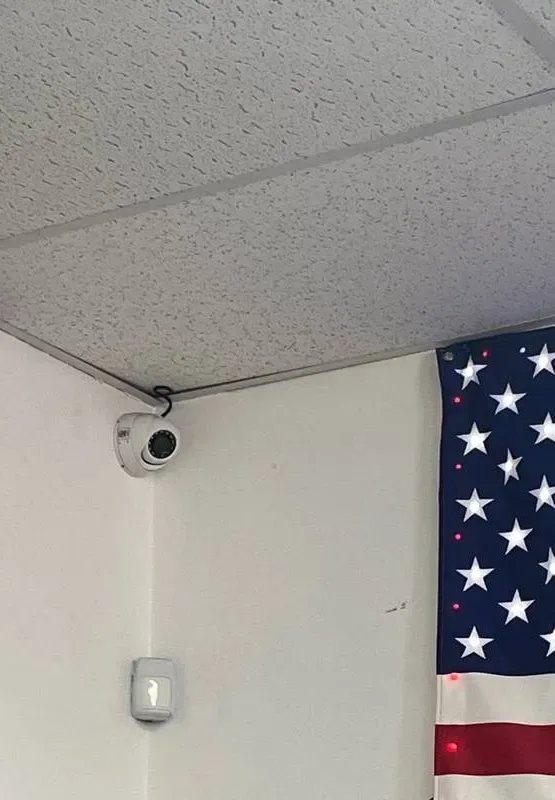
Job photo from our files: a small white turret camera fixed at the corner of a white wall and a drop ceiling, a white motion sensor mounted lower on the same wall, and an American flag hanging to the right. A camera and an alarm sensor covering the same room do two different jobs.
Queens Building Owner Request
House, garden rental or elevator building — tell us the address
✅
Request Sent!
Thank you. We will contact you to set up the visit.
25+
Years Experience
Queens
Every Neighborhood
100%
Licensed & Insured
4.7★
201 Google Reviews
One owner at the helm since 2002 · New York State low-voltage license #12000287431 · Thousands of finished installs and repairs
The Borough
Why Queens Rentals Need an Owner's Security Plan
Queens rentals do not look like the rental stock of any other borough, and that changes what a security system has to do. A walk-up in Bushwick or Harlem usually has one front door and one cellar. A Queens rental might be a three-family frame house in Ozone Park with a side driveway, a six-story 1930s elevator building in Jackson Heights with a courtyard entrance and a service alley, a garden-apartment complex in Bayside with a dozen doors facing a parking court, or a glass tower near Court Square with a garage ramp and an amenity floor. The ways into those buildings are different, so the plan for each one starts by walking the property and listing every opening, not by picking a product.
The rules also land differently. A two-family house with an owner living downstairs is a private dwelling; add a third apartment and it becomes a multiple dwelling, with HPD registration, entrance-door rules, apartment lock requirements and, from eight units up in newer buildings, the intercom duty in the Multiple Dwelling Law. HPD's registration page puts the line plainly: owners must register every year if the property is “a multiple dwelling (3+ residential units) or a private dwelling (1-2 residential units) where neither the owner nor the owner's immediate family resides.” Queens has a great many buildings sitting on either side of that line, and owners are often surprised to learn which side they are on.
Then there is the tenant base. Queens is one of the most linguistically mixed places in the country, and the Census Bureau's QuickFacts table for Queens County shows 55.4 percent of residents speak a language other than English at home, against 47.7 percent for the city as a whole. A lobby directory, a fob sign-up form or a notice about a changeover that only works in English leaves a lot of tenants guessing. Rent regulation is a big part of the picture too: the city's Independent Budget Office counted about 173,000 rent-stabilized apartments in Queens in May 2026, and three quarters of them are in buildings put up before 1974. Long-term tenants in older buildings depend on in-apartment stations and plain door buzzers far more than on phone apps.
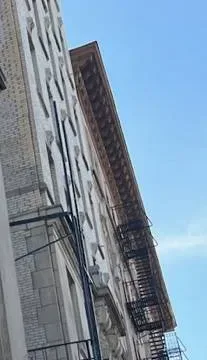
Job photo from our files: the view straight up a prewar apartment house, with carved stone and brick on the left, a run of black fire escapes and a heavy cornice against a clear sky. Every fire escape window is an opening the plan has to account for.
Queens numbers and rules that shape an owner's plan
Where registration starts. HPD requires annual registration for every multiple dwelling of three or more units and for one- and two-family homes where neither the owner nor the owner's immediate family lives there.
Eight apartments and 1968. Under Multiple Dwelling Law §50-a, a class A building with eight or more apartments that was put up or converted after January 1, 1968 must have entrance doors that close and lock on their own and an intercom with a door release in every unit; in older buildings of that size, a written request from a majority of tenants triggers the same duty. The state Attorney General's tenant guide adds that these doors “must be kept locked at all times, except when an attendant is on duty.”
Peepholes are still the law. MDL §51-a: “In every multiple dwelling the owner shall provide and maintain a peephole in the entrance door of each housing unit.”
Tenants may add a lock. MDL §51-c lets a tenant install an extra lock of not more than three inches in circumference, provided a duplicate key is supplied to the landlord on request.
Entrance lighting. MDL §35 calls for a light at or near the outside of the front entrance, with a minimum wattage set by the width of the frontage, kept burning from sunset to sunrise.
Elevator mirrors. MDL §51-b requires a mirror in each self-service passenger elevator so a person can see whether anyone is inside before stepping in.
Rent-stabilized stock. About 173,000 rent-stabilized apartments in Queens, 75 percent of them in pre-1974 buildings (NYC Independent Budget Office, May 2026).
The borough's 2025 intercom tally. NYC Open Data lists 342 Queens violations whose description mentions an intercom; 261 of them were class B, 79 class A and just 2 class C.
New building. The Rent Guidelines Board's 2026 Housing Supply Report counts 9,608 newly completed units in Queens in 2025, up 17.9 percent, and 5,913 newly certified 421-a units in the borough.
Queens property type
What the owner usually inherits
What usually comes first
Three-family frame or brick house
A doorbell per floor, a shared side door, keys copied for years
Self-closing, latching front and side doors; one simple entry panel; a door contact on the basement entrance
Six-story prewar elevator building
Audio panel on an old riser, a courtyard or side entrance, a self-service elevator
Riser test, strike and closer on every street and courtyard door, apartment stations for long-term tenants
Garden-apartment rental
Many short entrances, a laundry building, a parking court, padlocked gates
One credential system for every door and gate, door-held alerts on rear doors, cameras on the lot and paths
Postwar boulevard building
Larger lobby, a garage or side driveway, a mailroom off the lobby
Mailroom reader, garage-door and lot coverage, a directory tenants can read
New rental tower
A cloud panel, app credentials and an integrator's logins
Getting admin access into the owner's name, licenses and fees in writing
Mixed-use on a commercial strip
Stores below, a residential door squeezed between shopfronts
Separate residential entry and recorder, readers on any shared cellar or trash door
Why piecemeal security fails faster in Queens
A lot of Queens rentals grew one apartment at a time. A basement became a unit, an attic became a unit, a side door became a second entrance, and the security grew the same way: a wireless doorbell for the top floor, a padlock on the gate, a camera kit a relative set up, a buzzer panel from a hardware store with names written in marker. Each piece made sense on the day it was added. Together they leave an owner with a property where nobody knows which doors lock, which keys are out there, whose phone the cameras report to, or what happens when the Wi-Fi in the second-floor apartment goes down. The fix is not to rip everything out. It is to decide, opening by opening, what each door, gate and room should do, and then replace pieces in an order that the budget can carry.
Larger properties fail in a different way. A garden complex or a six-story building often has a perfectly good front door and an ignored back half: a courtyard gate that has not locked since the closer broke, a laundry room door to the alley propped with a wedge, a rear stair door that opens onto a lot. When the Patch reporter Maya Kaufman wrote up a string of Astoria break-ins in March 2021, police described a man who got into one building “by prying open the lobby door” and into another apartment after getting in “through the side door.” We name no buildings and the story is only one pattern, but it is the pattern we see: the side and rear openings get less attention than the lobby, and that is where the plan has to be firmest.
The people an owner's system has to work for
The owner needs one list of what is installed, who holds each login, what recurring fees the building pays and what fails next. Many Queens owners manage their own buildings without a managing agent, so the system has to be something they can run from a phone and understand without calling us.
The super, handyman or family member who looks after the property needs a closet that makes sense, a short written guide and a way to cancel a lost fob or reset a door without a service call. In smaller Queens buildings this is often a relative or a part-time handyman rather than a live-in super, which changes how much the system should depend on someone being on site.
Tenants judge the system on three things: does the door let them in and lock behind them, can they buzz up a visitor with or without a smartphone, and are the instructions in a language they read. Regulated tenants also expect no gap in service while anything changes.
Couriers, contractors and the next buyer see the system from the outside. Couriers need a controlled way in; contractors need temporary access that ends; and a buyer's engineer will look at whether the system is documented and in the owner's name.
What We Install
Apartment Building Security System Services in Queens, Door by Door
Each part below answers the question a Queens owner asks about one piece of the building and then points to the Queens service page with the details and published prices. We keep camera and intercom detail short here on purpose: those pages carry it.
Street doors, side doors and the vestibule
Before any electronics, the door has to work. On Queens properties the side and courtyard doors fail more often than the front: they face the weather, they are slammed by delivery carts and they are fixed with whatever was on hand. Our first look at any entrance checks the closer, the hinges, the latch and the strike together, because a strike set to a door that drops or a closer that has lost its pull will not hold. Housing Maintenance Code §27-2041.1 requires hallway and apartment doors to close and latch on their own, and HPD's clear-violations page gives a class C self-closing-door violation 14 days from service to correct. Published prices on our Queens door buzzer repair page include $450–$950 for a strike replaced with the door aligned. Replacing a mortise lock body or lockset itself is locksmith work, and we tell owners when a door needs one before the electronics go on.
Vestibules deserve their own thought. A two-door vestibule, where the outer door is open to the street and the inner door is controlled, keeps packages and visitors out of the weather without giving them the hallway. Where a building has only one door, we look at whether the inner lobby door can become the controlled door so the entry panel sits in a sheltered spot. That one decision often adds years to an entry panel's life on an exposed Queens Boulevard or Northern Boulevard frontage.
The entry panel and how it reaches each apartment
An entry panel is only half an intercom; the other half is how the call reaches the apartment. In an older Queens building the call travels up a riser to an audio station or handset in each unit. In a small house it may be a doorbell button wired to a chime on each floor. In a new tower it is often an app or a phone call. When an owner asks us to fix or replace an intercom, the riser test decides most of the cost: a riser that tests clean can carry a new panel and new stations, while one with shorts and splices points toward panels that call tenants' phones or landlines instead. Repairs start with the $250 service call; the full repair side is on our Queens intercom repair page, and installation, including the $1,200–$4,500+ range published for building-wide intercoms in 5–20 unit Queens apartment buildings, is on our intercom installation page for Queens.
The directory deserves as much care as the hardware. In a building where tenants speak many languages, a scrolling list of surnames may be the least useful thing on the panel. Many owners do better listing apartment numbers only, with a short instruction in the languages the building actually uses, and giving tenants a code to share with their own visitors. Listing apartment numbers rather than names also keeps tenants' names off a public sidewalk, which some tenants appreciate.
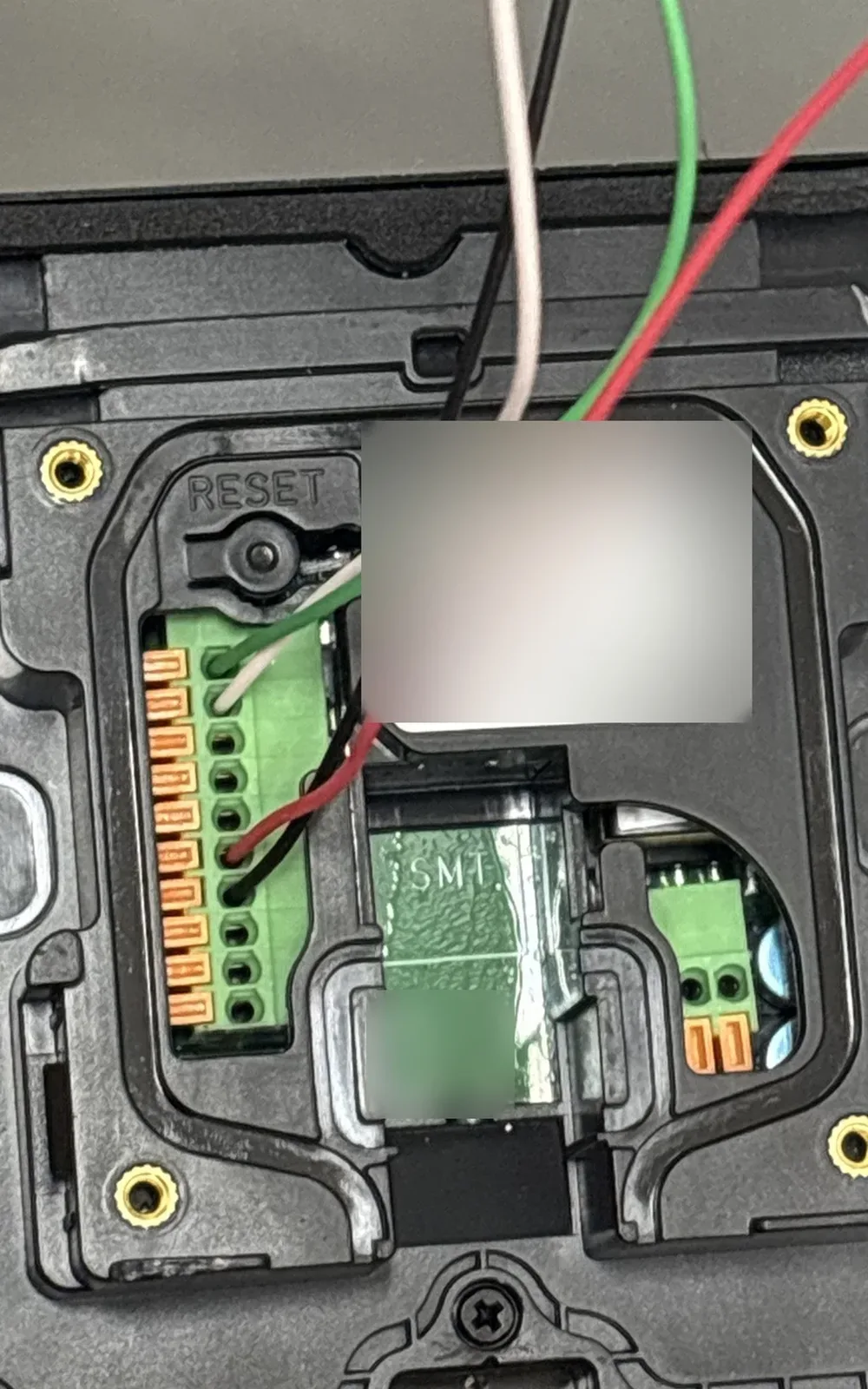
Job photo from our files: the inside of an entry door station's back housing, with a reset button, a row of orange-lever terminal blocks and a green connector, and red, green, white and black conductors coming in from the top. A product label in the middle is blurred.
Fobs and codes for side doors, gates and shared rooms
Keys are the weak point of most Queens rentals, because there are so many doors. A garden complex may have a key for every building, the laundry, the gate and the garbage enclosure; a three-family house may have a key for the front, the side and the basement that every tenant since the 1990s has copied. Fobs and codes let the owner give each door its own rule and cancel a single credential without changing a lock. Published Queens prices for a single-door reader with an electric strike are $1,500–$2,500 on our access control installation page for Queens. We set systems up so the owner or super adds and removes credentials themselves and only calls us for hardware.
New York City's Tenant Data Privacy Act (Local Law 63 of 2021) governs any smart access system in a class A building. It requires express consent before collecting tenants' credential data, a plain-language privacy policy, encryption and timely deletion, and it bars an owner from requiring a tenant to use the smart system to enter their own apartment. In practice that means smart credentials on common doors, and mechanical keys kept for each apartment door. We are not lawyers, and the policy itself should come from the owner's counsel.
Courtyards, gates and parking lots
Open space is the Queens difference. Many buildings have a front courtyard that the public can walk into, a rear court that should be private, a driveway, a gated lot or a path between buildings. Each needs a decision: open, controlled or watched. A pedestrian gate on a reader keeps the court for residents; a door-held alert on a gate that is always being propped tells the owner how often it happens; and a camera on the lot answers questions about cars after the fact. If a vehicle gate has a motor, we connect the reader or keypad to the existing operator; any new power for a motor or for lighting is the building's electrician's job, because we do not do electrical work.
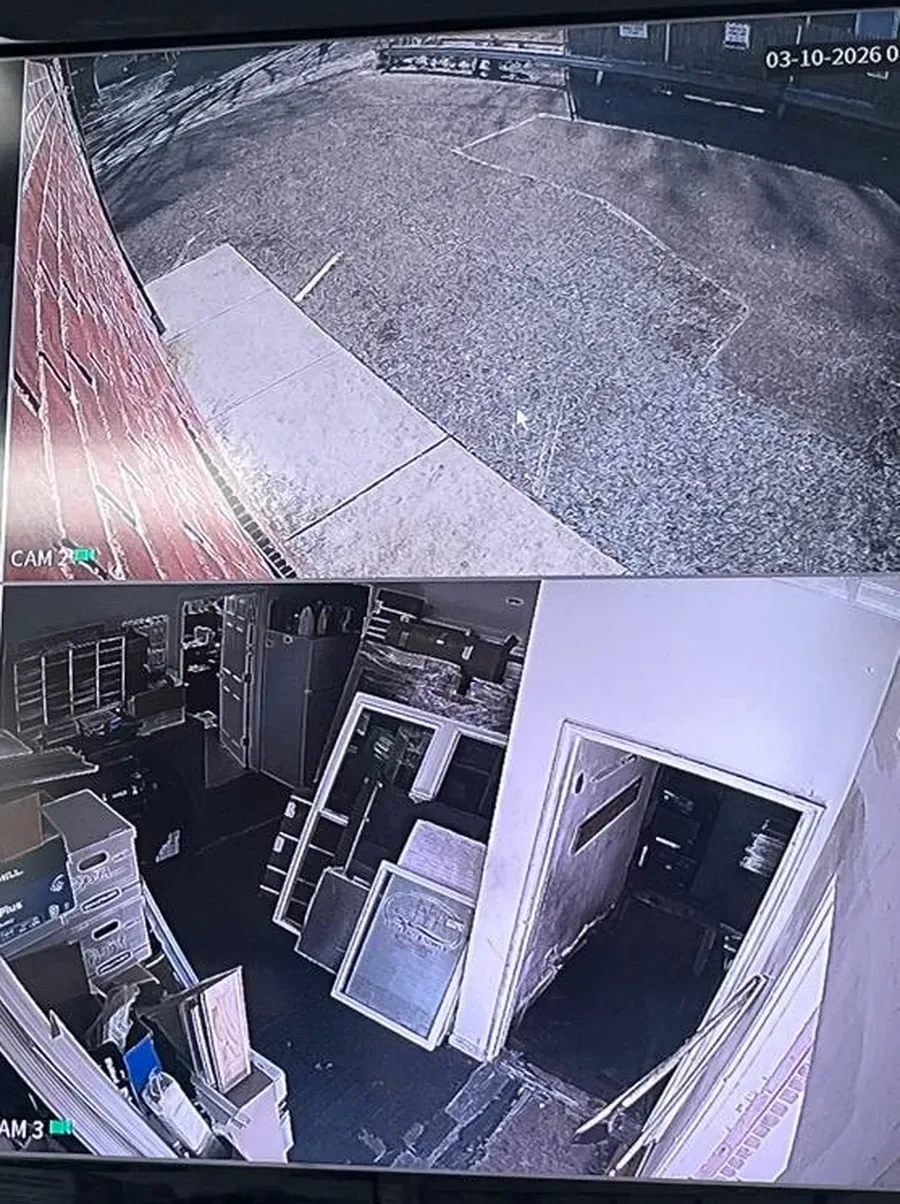
Job photo from our files: a recorder screen showing two camera views dated 03-10-2026, the top one a brick wall, a concrete walkway and a paved open area, the bottom one a storeroom with stacked boxes, leaning frames and an open door.
Mailrooms and packages
The package problem in Queens is the same as in the rest of the city, with one twist: many buildings have no lobby large enough for a package room and no doorman. The practical options are a vestibule couriers can open with an expiring code, a small locked room or closet with its own reader, or lockers placed where a camera can see faces. We build around whatever space the building has and log every opening, so a missing parcel becomes a question with an answer. Camera placement in mailrooms is covered in more detail on our Queens apartment camera page.
Cellars, boiler rooms, roofs and rear stairs
The back of the building is where alarms beat cameras. A contact on every cellar door and sidewalk hatch, a motion sensor in the main corridor and a keypad the super uses on the way in tell the owner that something is happening while it is happening. A roof door that is also a required exit can never be padlocked; it gets exit hardware with a local alarm where the code allows it and a contact that reports to the super. Alarm panels, sensors and central-station monitoring at $30 a month with a keypad or $45 a month with the phone app are on our alarm installation page for Queens.
Cameras (short version)
On a whole-building plan, cameras go where the list of openings says they are needed: the entrances, the mailroom or package area, the laundry, the lot and the rear door. City law does not require a rental building to have working cameras, so coverage is an owner's choice made on the building's own history. Our camera-specific advice for Queens rentals, including retention, recorders and courtyard coverage, is on the Queens apartment building camera page, and four-camera systems start at $950 on our Queens security camera pricing page.
Elevators: readers, and the mirror the law already requires
Most Queens elevator buildings are six stories with one self-service car. The law already asks for one security measure inside it: MDL §51-b requires a mirror in each self-service passenger elevator so a person can see whether anyone is inside before entering. A camera in the cab or a reader that limits floors is an addition, not a replacement. Readers make sense in newer rentals with amenity floors, garages or commercial floors; published Queens pricing starts at $1,575 per car for a card, fob or code reader on our elevator access control page for Queens. The licensed elevator agency makes the connection inside the controller, and we schedule that visit together.
The equipment closet, the network and power
Equipment belongs somewhere dry, locked and ventilated, and in Queens the first word matters. NYC Emergency Management's report on the remnants of Hurricane Ida records that 13 New Yorkers died in the September 2021 flash flooding, 11 of them drowning in basement apartments, with damaged properties concentrated in Queens, Brooklyn and the Bronx. A recorder or intercom power supply sitting on a cellar floor is a common sight in older buildings. We prefer a closet above the flood line, a rack or shelf, a battery backup for the door hardware and a labeled cable map. Cabling prices for Queens, with Cat6 drops listed at $175 and up and wall-mount racks at $250, are on our structured cabling page for Queens. New 120-volt circuits come from the building's electrician.
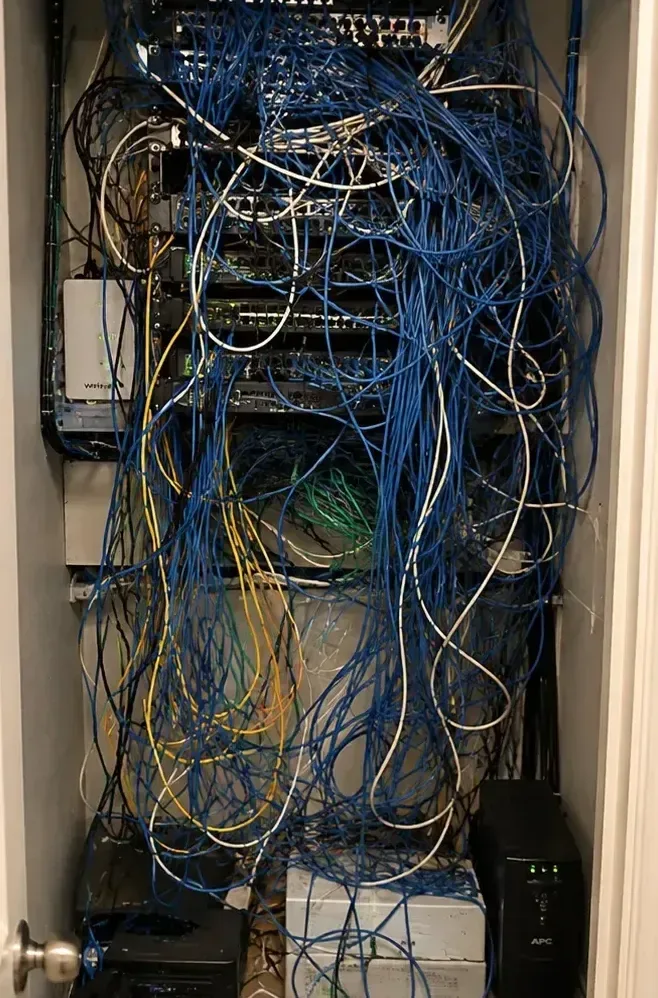
Job photo from our files: a tall, narrow equipment cabinet behind an open door, with dozens of blue, white and yellow network cables hanging in loops over switches and small devices on the lower shelves. A closet like this is what many owners inherit.
Fire alarm coordination
A building's fire alarm is designed, approved and tested under separate rules, and nothing on this page is fire alarm work; for that side of our business, see the Queens fire alarm installation page. Where our door hardware meets the fire alarm, we work with the company that services it, because the NYC Building Code requires magnetic and other electrified locks on an exit route to let go when the alarm goes off.
What we do not sell
Our work is hardware: we put it in and we keep it running. Guard posts, remote lobby attendants and people paid to watch camera feeds are other businesses. Owners who already pay one of those services can still have us install the entry panel, door hardware and cameras it depends on, connected the way that provider specifies. For burglar alarms, central-station monitoring is offered on the two terms shown on our Queens alarm page.
Building Specialists
Apartment Building Security Systems for Queens Building Types
Queens was built in waves: frame houses and rowhouses before the subways, garden apartments and six-story elevator buildings along the new train lines in the 1920s and 1930s, large planned rental communities after the Second World War, boulevard buildings in the 1950s and 1960s, and glass towers on the western waterfront since the 2000s. Each wave left a building type with its own weak points, and we plan for the type before we price the equipment.
Two- and three-family houses
A front door, often a side or rear door to the upper apartment and a basement entrance. A third apartment makes the house a multiple dwelling. Good door hardware and a simple panel with one button per apartment usually beat anything fancier.
Six-story prewar elevator buildings
Built along the Flushing and Queens Boulevard lines, often with a courtyard entrance, a self-service elevator and a riser that has carried several generations of intercom. The riser test decides the plan.
Garden-apartment rentals
Low buildings around a planted court, many short entrances and a laundry or boiler building. Credentials must cover a lot of doors and gates without turning tenants into key collectors.
Planned postwar communities
Large rental developments with their own streets, lots and shopping. Security is spread across many buildings, so the backbone cable and the controller location matter more than any single panel.
Boulevard elevator buildings
1950s and 1960s buildings on Queens Boulevard, Yellowstone Boulevard and similar corridors, with a larger lobby, a mailroom and often a garage or side driveway.
New rental towers
Long Island City, Astoria and downtown Flushing and Jamaica towers with cloud panels, app credentials, garages and amenity floors. The first job is administrative: logins, licenses and fees.
Mixed-use on commercial strips
Two or three floors of apartments above shops, reached by a slim door between storefronts, with a cellar and yard the stores also use. Clear lines between the shops' systems and the residents' come first.
Landmarked districts
Jackson Heights, Sunnyside Gardens and other districts where a panel or camera on the facade follows the Landmarks Preservation Commission's rules on location and count.
Two- and three-family houses: where the rules change
The small house is the most common rental in large parts of Queens, and it sits right on the legal line. With two apartments and the owner living in one, it is a private dwelling and the owner does not register with HPD. With two apartments and the owner living elsewhere, it must be registered. With three apartments it is a multiple dwelling regardless, and HPD's lock, self-closing door and peephole rules apply to it. The security work follows from that. In a two-family house, the owner's main question is usually how to let each tenant answer their own door without sharing a key with the other. In a three-family house, the owner also has to think about the shared hallway door that now has to close and latch on its own, and about the peephole in each apartment entrance door that MDL §51-a requires.
We usually recommend one weatherproof panel with a button per apartment at the street door, a release that each tenant can operate, a strike and closer set together, and a door contact on the basement entrance if the cellar holds anything worth stealing. Doorbell cameras bought separately by each tenant tend to stop working when the tenant moves, so a building-owned panel lasts longer. Where the side driveway leads to a rear door, that door gets the same treatment as the front.
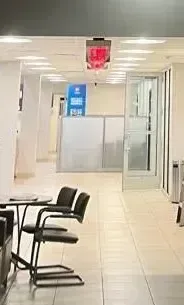
Job photo from our files: a long, bright lobby with a tiled floor, two black chairs at a small table, a glass-and-aluminum vestibule door on the right and a lit red exit sign hanging from the ceiling.
Six-story prewar elevator buildings in Jackson Heights, Elmhurst, Sunnyside and Kew Gardens
These buildings, many from the 1920s and 1930s, often have a main entrance through a courtyard or a set of stoops, a service entrance on a side street or alley, a basement laundry and one self-service elevator. The intercom riser runs up through plaster walls next to the stair. When the riser is sound, a new lobby panel and replacement stations only where they fail is the economical path. When it has been spliced and re-spliced, the choice is between new cable through occupied apartments, which takes access visits, or a panel that calls tenants' phones and landlines. We test before we quote, and the owner sees the test result.
Courtyard entrances need special care. In some buildings the courtyard gate is the real front door and the building door is the second line; in others the courtyard is open to the street and the building doors do all the work. We decide which door is the controlled one and put the panel there, so tenants are not buzzing visitors through two doors with two systems.
Garden-apartment rentals in Fresh Meadows and eastern Queens
Garden complexes spread a building's security over a lot of ground. A single rental complex can have twenty or thirty entrances, each serving a handful of apartments, plus laundry buildings, garbage enclosures, parking courts and gates. Cabling between buildings is the hidden cost: it may run through existing conduit, through a basement passage that links buildings, or, where nothing exists, through new underground or aerial paths that need careful planning. Cloud-managed controllers and panels that use the building's network can reduce the amount of new cable between buildings, but they need a dependable internet connection at each one. We lay out both approaches with their costs, side by side.
Postwar boulevard buildings along Queens Boulevard and Yellowstone Boulevard
The larger postwar buildings have wider lobbies, mailrooms just off the entrance, garages or side lots and sometimes a desk that was staffed when the building opened and is not any more. That history matters: the original intercom may have been designed to ring the desk, and the mailroom may have relied on someone watching it. When the desk goes, the security has to replace what the person did, which usually means a reader on the mailroom door, an alert when the garage door stays open, and a directory that tenants and visitors can follow without help.
New rental towers in Long Island City, Astoria, Flushing and Jamaica
Most of the borough's new rental stock is in buildings with cloud entry panels, app credentials, a garage and an amenity floor. The Rent Guidelines Board counted 9,608 newly completed units in Queens in 2025 alone. The systems in those buildings are modern; the problem is who controls them. Integrators often keep the admin logins, software licenses sit in the developer's name and monthly fees are billed to an account the new owner has never seen. When an owner takes over a newer building, we start by moving every account into the owning entity's name, writing down every recurring fee, and confirming that the owner can add and cancel credentials without the integrator. Then we look at hardware.
Mixed-use buildings on Roosevelt Avenue, Main Street and Jamaica Avenue
Apartments above stores make up a large part of Queens rental housing on the commercial strips. The residential entrance is usually a narrow door between two shopfronts, and the cellar, trash area and rear yard are often shared with the stores. Clear boundaries prevent most problems: the stores keep their own alarm and camera accounts; the residential side has its own panel, credentials and recorder; any shared door gets a reader or contact so each side's access is separate; and the owner decides in writing which cameras each side can see. Flushing's Main Street and Roosevelt Avenue intersection is described on Wikipedia as the third-busiest in the city, and buildings at corners like that need a residential door that stays shut under heavy foot traffic.
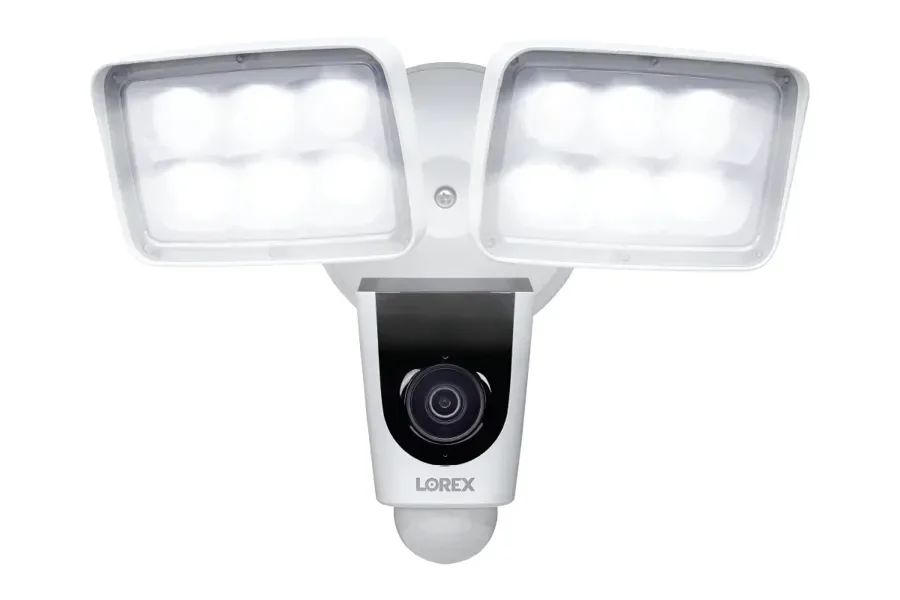
Lorex product photo (we are an authorized Lorex partner): a white floodlight camera with two rectangular LED panels above a camera body and a motion sensor below. A light-and-camera unit like this suits a dark rear yard or parking court where a powered fixture location already exists; new power is the building electrician's work.
Landmarked buildings in Jackson Heights and Sunnyside Gardens
Jackson Heights was where the garden apartment began, and its historic district, protected since 1993, still holds the largest collection of them in the country according to the Historic Districts Council. Sunnyside Gardens, designated in 2007, covers roughly 600 buildings planned in the 1920s around large landscaped courts. In both, anything mounted on a protected facade follows the Landmarks Preservation Commission's permit rules, which allow staff permits for intercom panels within or beside the door opening and limit cameras on a facade. Courtyards and rear elevations sometimes offer better spots than the street front. The owner files the permit application; we supply cut sheets and locations and install after the permit is issued.
How the method changes from one Queens building to the next
Materials change the method. Frame houses take surface boxes and need a hood over an outdoor panel; brick and stone take sleeve anchors and often a recessed back box; aluminum storefront doors on newer buildings need hardware made for thin-wall frames. Cable follows whatever path the building offers: an old dumbwaiter shaft, a pipe chase, a basement passage between garden buildings, or surface raceway where nothing else exists. The owner sees, before anything is ordered, where raceway would be visible. In buildings with tenants who have lived there for decades, we also plan the order of work around the tenants who rely on in-apartment stations, so no one is without a working buzzer while the rest of the building is switched over.
For Owners & Investors
Owning a Queens Rental: Buying, Running and Upgrading Security
Buying a Queens rental: what to check about security before closing
A buyer's inspection rarely covers the security systems, and Queens buildings change hands with a lot of improvised equipment in place. Before closing, a buyer should know four things: which entrances actually close, latch and lock; whether the building has an intercom that reaches every apartment and works; what open HPD violations mention doors, locks or the intercom; and who holds the logins and contracts for any cameras, panels or fob systems. HPD's violation records are public by address, and the seller's own service invoices fill in the rest. A buyer who learns before closing that the courtyard gate has not locked in two years and the cameras report to the seller's cousin can price that in.
Taking control after closing
The hardware stays when a building is sold; control does not always come with it. On a takeover we list every device, find out who owns each account, and move administration into the owning entity's name with the super as a limited user. Where a maker asks for proof of ownership before resetting an account, we tell the owner exactly what it asks for. Until that is done, we advise against buying anything new, because new equipment on a system nobody can log into only adds to the problem.
When the super leaves
Supers in Queens buildings often hold more of the security than anyone realises: the master keys, the fob software on a laptop, the recorder password, the code for the cellar keypad and the knowledge of which door sticks. When a super retires or is let go, the owner should change the recorder and panel passwords, cancel the super's fobs and app access, collect the laptop or move the software, re-code the cellar and roof keypads (re-keying locks is a locksmith's job), and write down what the super knew. We can do the password, credential and keypad side in one visit, starting with the $250 service call, and leave the owner with a list of what changed.
Rent-stabilized buildings: changing equipment without cutting service
New York State Homes and Community Renewal tells owners of regulated apartments that they are required to keep all required services and equipment in good working order, and it lists broken door locks among the examples of a decrease in services. With about 173,000 rent-stabilized apartments in Queens, many owners face this, and the practical rule is simple: no tenant should be without a working way into the building or a working way to let a visitor in, at any point during the change. We mount the new entry panel beside the old one, switch over in a short window, keep in-apartment stations for tenants who rely on them, and schedule apartment visits around the notices the owner sends. Questions about rent adjustments for improvements belong with HCR and the owner's counsel.
Clearing an intercom or door violation
HPD gives owners a set time to correct a violation before civil penalties can apply if sought in Housing Court: 90 days for class A, 30 days for class B, 14 days for a class C self-closing-door violation and 24 hours for most other class C conditions. HPD charges nothing for the owner to certify a correction, and a violation found not corrected after certification is placed in false-certification status, which can require a reinspection with a fee. Most of the 342 Queens intercom violations in 2025 were class B. When we fix an intercom or a door under a violation, the owner gets an invoice that describes the condition, the work and the date, which is the record an owner wants on file when certifying.
New rentals with affordable units
Many of Queens' new rentals mix market-rate and income-restricted apartments; the Rent Guidelines Board counted 5,913 newly certified 421-a units in the borough in its 2026 report. On the systems we install, credentials and directory entries are assigned by apartment, and nothing in the hardware distinguishes one kind of lease from another. How an owner assigns access is an owner's policy decision, and we set the system up to match it.
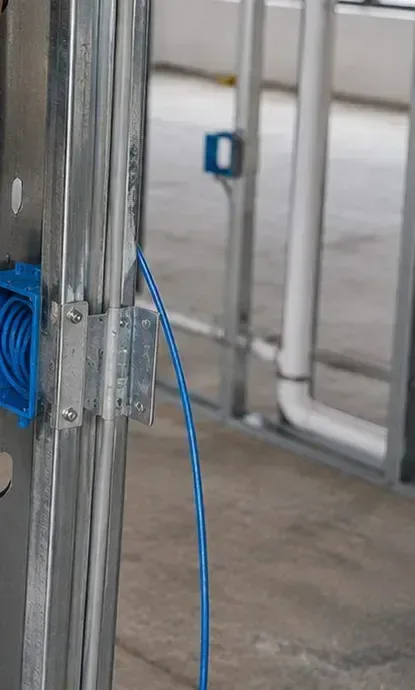
Job photo from our files: a blue box screwed to a metal stud in an open-framed wall, with blue cable looping down from it toward the floor, and more studs and white pipe in the room behind. This is the stage at which security wiring is cheapest to install.
Renovations and conversions
Queens owners renovate constantly: a lobby, a facade, a run of apartment turnovers, or a conversion of a house from two units to three. The cheapest moment for security wiring is when the walls are open. We walk the space with the general contractor, mark where back boxes, conduit and cable should go for the panel, readers, contacts and cameras, and pull cable before the finishes go up. A conversion that turns a two-family house into a multiple dwelling is also the moment to bring the doors, locks and peepholes up to the rules that now apply.
Paperwork, insurance and payment
Whether the deed is in a person's name or an LLC's, ask and you get our W-9 and the service agreement that governs the job. Certificates of insurance with additional insureds for a lender, a carrier or a commercial tenant come from our insurer, worded as requested, after the job is awarded. Each invoice has a pay-online link; a company owner can mail a check instead. Financing is available through Wisetack, subject to approval.
Compliance callouts for Queens owners
Registration: HPD annual registration for multiple dwellings (3+ units) and for one- and two-family homes where neither the owner nor the owner's immediate family lives.
Front door and intercom: MDL §50-a, for class A buildings of eight or more apartments: entrance doors that close and lock by themselves and a two-way intercom with a door release in each unit when erected or converted after 1968; earlier buildings when a majority of tenants ask in writing.
Apartment doors: Housing Maintenance Code §27-2043 (key lock, and in class A buildings a heavy-duty latch set, deadbolt and chain guard); MDL §51-a (peephole in each apartment entrance door); MDL §51-c (tenant may add a lock up to three inches in circumference and must give the landlord a duplicate key on request).
Self-closing doors: HMC §27-2041.1; class C, 14 days to correct from service.
Entrance lighting: MDL §35 (light at or near the outside of the front entrance, sunset to sunrise).
Elevators: MDL §51-b (mirror in each self-service passenger elevator).
Smart entry and tenant data: the Tenant Data Privacy Act, Local Law 63 of 2021, which makes consent, a written privacy policy and secure handling of credential data conditions of any smart access system and keeps a tenant's own apartment door off it.
Landmark facades: the Landmarks Preservation Commission's permit guidebook, which keeps a new entry panel in or right next to the doorway and caps how many cameras a protected front can carry.
Your Questions Answered
Apartment Building Security Systems in Queens: Questions Answered
Which house sizes and occupancies does the law treat as an apartment building?
My Maspeth house has two apartments and I live in one. Do the apartment building intercom and door rules apply to me?
Mostly no. A house with one or two apartments is a private dwelling, and with the owner or the owner's immediate family living there it does not even need HPD registration. The Multiple Dwelling Law's entrance-door and intercom section and the class A lock rules are written for multiple dwellings of three or more apartments. That does not make security optional in practice: your tenant still needs a way to answer the door and a lock you can account for. If you add a third apartment, the house becomes a multiple dwelling and those rules start to apply.
We are converting a two-family house in Corona into a legal three-family. What changes for the doors and locks?
Once the house has three apartments it is a multiple dwelling. It has to be registered with HPD every year, each apartment entrance door needs the lock hardware the Housing Maintenance Code requires and a peephole under MDL §51-a, and doors to the public halls must close and latch on their own. The conversion is the right moment to set the street door, the shared hall door and the basement door properly, because the walls and frames are already being worked on.
Our six-family building was built in 1931. Do we have to install an intercom at all?
MDL §50-a requires an intercom outright in class A buildings of eight or more apartments built or converted after January 1, 1968. A six-family building from 1931 is below that count and older than that date, and the provision that lets a majority of tenants in an older building request an intercom in writing is also written for buildings of eight or more apartments. HPD's rule that hallway and apartment doors close and latch on their own still applies. Most owners of small buildings keep a working intercom anyway, because tenants who cannot let in a delivery or a home health aide will make it the owner's problem.
Tenants, keys and the apartment door
A tenant put an extra lock on their door and will not give us a key. What can the owner ask for?
Under MDL §51-c a tenant may install an additional lock of not more than three inches in circumference as an ordinary part of the tenancy, provided a duplicate key is supplied to the landlord or the landlord's agent on request. The Attorney General's tenant guide adds that a lease clause charging extra rent for an added lock is void. So the owner's tool is a written request for the duplicate key. We install the building's electronic systems and do not change apartment locks; that is locksmith work.
If every apartment gets a video station, is the peephole in each door still required?
Yes. MDL §51-a requires the owner to provide and maintain a peephole in the entrance door of each housing unit, located so a person inside can see whoever is standing immediately outside. A video station shows the street door or the lobby, not the hallway outside the apartment, so it does not replace the peephole. We leave peepholes alone and plan the station on a wall nearby.
Many tenants in our Elmhurst building do not read English. What should the lobby directory show?
Often the clearest directory is the simplest: apartment numbers on the buttons or the screen, an instruction with a picture of the action, and the same short instruction in the two or three languages the building uses most. Names in small type on a scrolling screen are hard for everyone to read and put tenants' names on the sidewalk. Visitors can be given the apartment number by the tenant they are visiting. The owner chooses the wording; we load it and check it on the panel before we leave.
Gates, lights and the outside of the property
Our courtyard is dark at night. Does lighting change what the cameras and door alarms can do?
A great deal. Cameras with infrared see in the dark, but they see in black and white, and faces at a distance are much harder to recognise. Light also changes behaviour at a door. MDL §35 asks for a light at or near the outside of the front entrance, kept on from sunset to sunrise, and many owners light courtyards and rear doors as well. Lighting is electrical work for the building's electrician; we place cameras and contacts to work with the light the building has and tell the owner where more light would help.
People get into our building through the alley between us and the next building. Should the first money go to a gate alarm or a camera?
If the alley ends at a door or a gate you control, start with the opening: a closer and latch that work, a reader or a lock that tenants can use, and a contact that reports when it is forced or held open. That stops the entry or at least tells you it happened while it is happening. A camera on the alley comes next, aimed at the door rather than down the length of the passage, so it records faces at the point of entry instead of figures in the distance.
How do we stop the self-service elevator in our six-story building from becoming the place where problems start?
Start with what the law already asks for: MDL §51-b requires a mirror in each self-service elevator so a person can see whether anyone is inside before entering. Keep the lobby door controlled so strangers are not in the building to begin with, and add a camera in the lobby facing the elevator door. A camera inside the cab is possible but needs the elevator agency's involvement because of the traveling cable. A reader in the car only makes sense if some floors should be off limits.
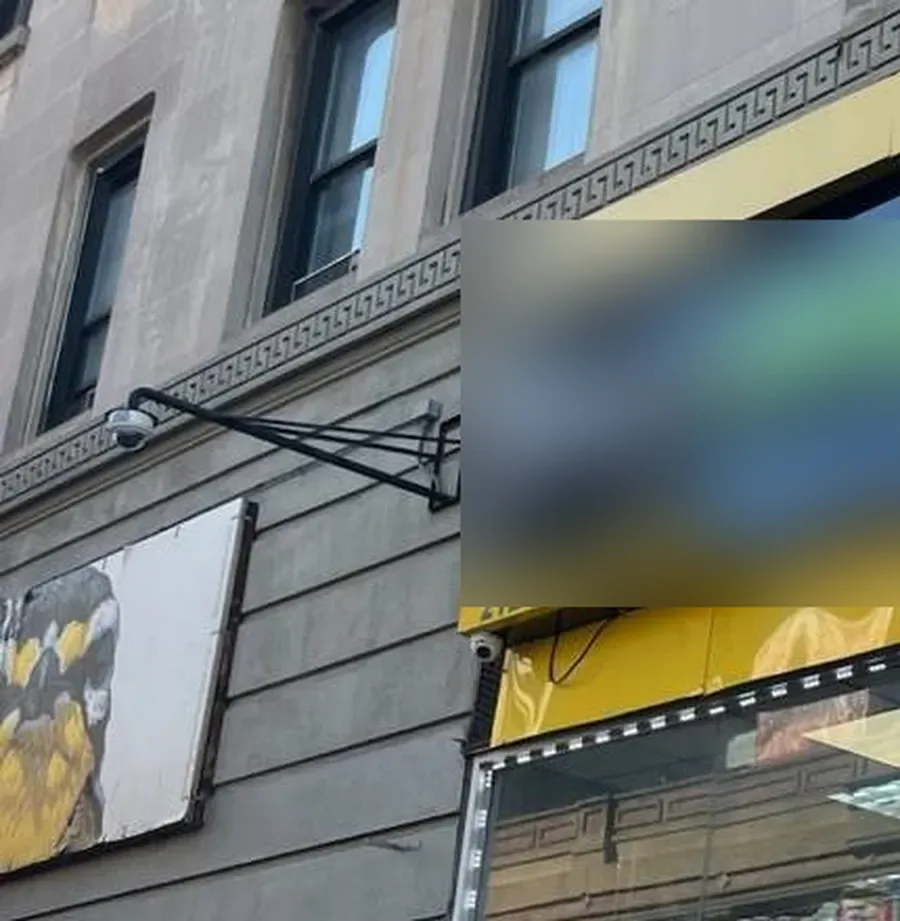
Job photo from our files: a dome camera on a long black steel arm bolted under the cornice of a grey stone facade, with apartment windows above and a store's yellow sign band and display window below (the store's sign is blurred). A second small camera sits at the corner of the sign band.
Running the building day to day
Our live-in super is retiring next month. What should we change on the security systems on his last day?
Change every admin password he knew (recorder, entry panel, fob software, alarm), cancel his fobs and app access, collect any laptop or phone that holds the fob software, re-code the cellar and roof keypads, and have a locksmith re-key any master-keyed doors he held. Then sit down with him before he goes and write down what only he knows: which door sticks in winter, where the power supply is, which tenant has the spare key. The password, credential and keypad changes are ours, done in one visit, and the owner gets a list of what was changed.
We have a part-time handyman instead of a super. How should cellar and roof access work?
Give the handyman a credential that opens the cellar, boiler room and roof door during the hours they work and nothing else after hours, and have the alarm keypad on the cellar use a personal code for them. The owner can then see from the door log when the handyman came and went, cancel or extend the credential from a phone, and add a contractor for a single day without handing out a key.
What should we keep on file to show HPD that an intercom violation was fixed?
Keep the notice of violation, the invoice for the repair with a description of the condition, the work done and the date, and photos of the working panel and station if you have them. HPD's certification of correction carries no fee and is submitted by the owner within the time the law allows for the violation's class. A clear invoice makes that easier and helps if HPD later reinspects.
New and mixed-use buildings
Our new Astoria rental has income-restricted and market-rate apartments. Do they need different entry credentials?
Not on the systems we install. Credentials and directory entries are assigned by apartment, and nothing in the hardware distinguishes one lease type from another. Access rules for shared rooms, the gym or the roof are an owner's policy decision; we configure the system to whatever the owner sets and leave a written record of the rules.
Deliveries for the restaurant on our ground floor come through the residential hallway. How do we allow that without opening the building?
Give the restaurant a credential that opens only the delivery path, only during its delivery hours, and log every use. If the delivery path crosses the residential hall, a reader on the hall door to the stairs keeps restaurant staff and drivers out of the rest of the building. Where possible we move deliveries to a separate door, but when the building only has one route, time-limited access and a log are the next best thing.
Equipment
Types of Apartment Building Security Equipment We Install in Queens
Street-door panels
Weatherproof audio and video door stations, one-button panels for small houses and directory panels with keypads and readers for larger buildings.
Apartment answering
Audio handsets, video monitors, and phone or landline answering for tenants who prefer it.
Door and gate hardware
Electric strikes, magnetic locks where the door suits them, closers set with the strike, exit buttons and gate releases on existing operators.
Readers and credentials
Readers that take a fob, card, PIN or phone at a side door, a courtyard gate, the laundry, the mail area or the bike room.
Controllers and software
The boxes that decide which credential opens which door, and the app or on-site program an owner uses to change those rules.
Alarms
Intrusion panels that arm the boiler room, storage and empty apartments, with sensors that report a forced hatch or rear door the moment it opens.
Cameras and recorders
Turret, dome and bullet cameras with recorders in a dry closet and remote viewing for the owner.
Network and power
Cat6, PoE switches, small racks, battery backup and labeled patch panels.
Elevator readers
A reader inside the cab that limits the gym, garage or office floors, tied into the controller by the elevator company's mechanic.
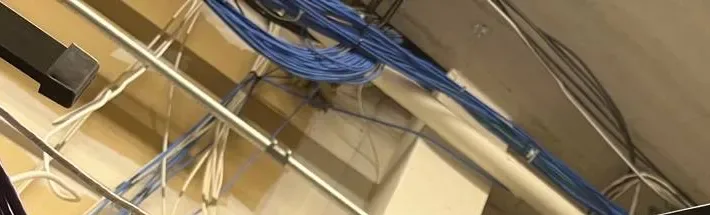
Job photo from our files: bundles of blue and white low-voltage cable tied along a pipe and wood framing in an open ceiling, the kind of path cable takes from a closet to the doors it serves.
Choosing between the main options
Decision
Choice A
Choice B
What usually decides it on a Queens property
Panel at the street door vs at the inner lobby door
Exposure of the frontage and whether the vestibule is lockable
Apartment stations vs phone answering
Stations: work without a phone, familiar to long-term tenants
Phone answering: no apartment wiring needed
Riser condition and how many tenants rely on a handset
One controller for a garden complex vs one per building
Central: one place to manage everything
Per building: less cable between buildings
Existing conduit and basement passages between buildings
Gate on credentials vs gate on a key
Credentials: cancel one without re-keying
Key: no power or network needed
How often tenants change and whether the gate has power
Recorder in a closet vs cloud video
Recorder: one-time cost, keeps recording through internet outages
Cloud: nothing to house on site, monthly fee per camera
Camera count, a dry closet and the building's internet line
App kits, platform companies and a local licensed installer
A doorbell or camera kit from a big-box shelf assumes one family and one phone. In a rental it ends up registered to whoever set it up, it cannot give the super a login of their own, and when the strike stops releasing there is no technician to send. Subscription intercom platforms fix the account problem and charge for it every month, per door or per unit, for the term of the contract. A local licensed installer lets the owner choose the hardware, keeps the accounts in the owner's name and sends a technician to the building. We install systems with and without a monthly platform fee and put both costs in front of the owner. For cameras, we are an authorized partner for Lorex, Luminys and Reolink, and our default quote is our own non-branded system unless the owner asks for a brand.
Every Door, Gate and Room on One Plan
Tell us where the property is, how many apartments and doors it has, and what keeps breaking. We look at each opening and rank the work so it fits your budget year by year.
What AI Gets Wrong About Apartment Building Security Systems in Queens
Owners now arrive with an answer from a search summary or a chatbot, and those answers are built from national averages and suburban houses. Here are claims we hear from Queens owners that do not survive contact with the city's own rules.
1. “A two-family rental has the same intercom and door obligations as an apartment building”
The line in New York City sits at three apartments. HPD's registration rules treat a building of three or more units as a multiple dwelling and a one- or two-family home as a private dwelling, which only has to register when neither the owner nor the owner's immediate family lives there.
The Multiple Dwelling Law's entrance-door and intercom section and the class A lock rules are written for multiple dwellings. A two-family owner still owes tenants a safe, working home, but the specific list is different.
We plan small houses for what they need, not for a rule that does not apply to them, and we flag the moment a conversion changes that.
2. “A video intercom in each apartment replaces the peephole”
MDL §51-a requires the owner to provide and maintain a peephole in the entrance door of each housing unit so a person inside can see anyone immediately outside.
A video station shows the street door or the lobby. It does not show the hallway outside the apartment, which is exactly where the peephole looks.
Peepholes stay; stations go on the wall nearby.
3. “Landlords can forbid tenants from adding their own locks”
MDL §51-c gives tenants the right to install an extra lock of not more than three inches in circumference, provided a duplicate key goes to the landlord on request.
The Attorney General's tenant guide says a lease clause charging extra rent for an added lock is void and unenforceable.
The owner's job is to ask for the duplicate key in writing and keep it secure, not to remove the lock.
4. “Outdoor lighting is part of the security contractor's job”
MDL §35 calls for a light at or near the outside of the front entrance, kept burning from sunset to sunrise, and good lighting matters for every camera.
Fixtures and new circuits are electrical work. We do not do electrical work, and an honest security contractor will say so.
We place cameras and contacts to work with the building's light, point out where more is needed, and coordinate with the building's electrician.
5. “Queens is suburban, so rentals don't need serious entry control”
Queens has about 173,000 rent-stabilized apartments, three quarters of them in buildings from before 1974 (NYC Independent Budget Office, May 2026), and HPD wrote 342 intercom-related violations in the borough in 2025.
Patch's March 2021 report on a string of Astoria break-ins described entry by prying open a lobby door and by coming in through a side door.
Away from the house-lined blocks, Queens rentals are city buildings with city problems, and their side doors and gates need the same attention as a Manhattan lobby.
6. “An English-only directory and notice are fine anywhere”
Census QuickFacts reports that 55.4 percent of Queens residents speak a language other than English at home.
A directory or a fob sign-up notice that tenants cannot read leads to propped doors, shared codes and calls to the owner.
Apartment numbers, pictures of the action and short instructions in the building's main languages work better than long English text.
7. “A camera in the elevator replaces the elevator mirror”
MDL §51-b requires a mirror in each self-service passenger elevator so a person can see whether anyone is inside before entering.
A camera records for later; it does not show the person about to step in who is already in the car.
The mirror stays. A cab camera, if the owner wants one, is an addition that needs the elevator agency's help with the traveling cable.
Get In Touch
Request an Apartment Building Security Survey in Queens
Give us the Queens address and neighborhood, how many apartments and how many doors and gates are in use, and what is broken or missing. A few phone photos of the street door inside and out, the panel and the equipment closet or cellar shelf let us arrive with the right parts. One repair? The address and what the tenants are reporting will do. Prefer to talk? Call (347) 434-6392.
✅
Request Sent!
Thank you. We will contact you to set up the visit.
How It Works
Our Apartment Building Security Process in Queens
1
First contact
Call, text or use the form with the Queens address, the apartment and door count, the problem or goal and the name of whoever has the keys; the visit gets a two-hour arrival window.
2
Visit
Repairs begin with the $250 service call; planning a whole property begins with walking and photographing each door, gate, closet and riser.
3
Written scope
Parts, labor and monthly fees each get their own line, ranked by priority, and any cost that depends on a test result, like an old riser pair, is named up front.
4
Go-ahead
A signed scope and a paid deposit release the purchase order. Stock parts are booked right away; built-to-order panels are scheduled after delivery.
5
Notices and access
Tenants hear about the work from the owner, in their own languages, before anyone needs to enter an apartment or touch the street door.
6
Install and switch over
The replacement panel is wired and powered next to the old one first; the release changes over during a short morning slot, and apartment stations, readers, contacts and cameras follow.
7
Handover
Every account moves into the owning entity's name; the owner gets the device and fee list, the cable labels and a one-page guide for whoever looks after the building, then the final invoice.
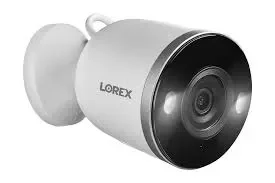
Lorex product photo (we are an authorized Lorex partner): a white bullet camera on a round wall mount, with two small lights on either side of the lens. Aimed at a side or alley door rather than down a passage, a camera like this records the person at the point of entry.
Field notes: reading a Queens property from the sidewalk/h3>
Queens properties tell you a lot before you open a panel. On a first visit we start on the sidewalk and count the ways in: the street door, the side or driveway door, the basement entrance under the stoop, the courtyard gate, the alley door and the fire escapes. Then we close each door from a foot open and watch whether it latches. On a typical small Queens rental, at least one of those doors does not, and that door is usually the one tenants and strangers actually use. Inside, we press a few buttons and listen; a call that rings but will not release points at the strike or the release circuit, silence points at the panel, the power supply or the riser. In the cellar we look for the intercom transformer, for any equipment sitting on the floor where water has been before, and for the dead systems still screwed to the wall beside the live one. We photograph the live wiring, tag what is abandoned and finish at the roof door.
Field notes: changing the entry in a building with long-term tenants
A changeover in a building with long-term tenants is planned around the tenants, not the equipment. The new panel goes up and is powered beside the old one days ahead. The directory is built from the owner's rent roll, checked against apartment numbers, and the wording is loaded in the languages the owner chose. On the day, the door release moves to the new panel in a short morning window, we test from the panel, a reader and a few apartments, and only then does the old panel come down. Apartment stations follow on the dates in the owner's notice. Tenants who rely on a handset keep one, and nobody is left without a way to let a visitor in.
How long the work takes
Most repairs are closed out in one trip; when a board or station has to be ordered, there is a second. Swapping the panel on a small building that keeps its wiring is normally one day of work after the parts arrive. A garden complex or a six-story building with readers, contacts and new stations takes several days of work spread over a few weeks, because apartment visits follow notices and cable between buildings takes planning. Special-order equipment can add time we do not control; we give a date once it arrives.
Coverage Area
Apartment Building Security Systems Near Queens Landmarks
We list these places because they show how varied Queens rental housing is. None of them is a client, naming them here says nothing about our work, and our own job sites stay unnamed.
Fresh Meadows
New York Life built the Fresh Meadows Housing Development on a former golf course; the first twenty families moved in on September 2, 1947. Lewis Mumford called it “perhaps the most positive and exhilarating example of large-scale community planning in this country,” and its last building, a 20-story tower at 67th Avenue and 192nd Street, was ready in 1962.
LeFrak City, Corona and Elmhurst
Twenty 17-story towers with 4,605 apartments on about 40 acres bounded by Junction Boulevard, 57th Avenue, 99th Street and the Long Island Expressway, built between 1962 and 1971.
Jackson Heights Historic District
The Historic Districts Council calls it the country's first garden-apartment community and still its largest; most of it went up from 1914 to 1939, and the city designated the district in 1993.
Sunnyside Gardens
Designated a historic district in 2007, with roughly 600 buildings planned in the 1920s by Clarence Stein and Henry Wright around large landscaped courts.
Forest Hills
Philip Birnbaum and Alfred Kaskel's apartment houses across the neighborhood are known for spacious lobbies and interior courtyards with fountains, and Forest Hills South is a 1939 group of seven Georgian buildings around a private garden.
Main Street and Roosevelt Avenue, Flushing
Described on Wikipedia as the third-busiest intersection in New York City, surrounded by mixed-use buildings with apartments above stores.
How rentals differ across Queens
Western Queens (Long Island City, Astoria, Sunnyside, Woodside) mixes new towers with prewar walk-ups and six-story buildings, so a single owner may need both a cloud-panel takeover and an old-riser repair. North-central Queens (Jackson Heights, Elmhurst, Corona, East Elmhurst) has dense elevator buildings, garden apartments and landmark rules, and a tenant base that makes directory wording matter. Central Queens (Rego Park, Forest Hills, Kew Gardens, Kew Gardens Hills) has courtyard elevator buildings and boulevard buildings with mailrooms and garages. Northeastern Queens (Flushing, Bayside, Fresh Meadows, Whitestone) runs from mixed-use towers downtown to garden rentals with parking courts. Southern and southeastern Queens (Jamaica, Richmond Hill, Ozone Park, Woodhaven, South Ozone Park, the Rockaways) has a deep stock of two- and three-family rentals alongside new construction near the Jamaica transit hub. Ridgewood, Glendale and Maspeth have rows of brick multi-family buildings where the side door and the basement entrance are often the weak spots.
Pricing
Apartment Building Security System Cost in Queens
Nothing in this table is new: each figure is copied from a Queens page on our site, named in the right-hand column. There is no whole-property price, because on a Queens property the count of doors and gates, the state of the riser and the distance between buildings matter more than how many apartments there are.
Work
Published price
Where it is published
Service call (diagnosis and simple repairs)
$250; on a larger job the $250 goes toward the total
Seven things, roughly in order. The number of openings that need control, because Queens properties have more side doors, gates and separate entrances than most. The condition of the riser in older elevator buildings. The doors themselves, since a frame that has to be squared before a strike will hold is labor no product price includes. Distance between buildings on garden and campus properties, where cable between buildings can cost more than the devices at each end. Apartment access, which turns a one-day job into several. Platform and software fees that may be nothing or may run for years per door or apartment. And landmark status in Jackson Heights, Sunnyside Gardens and other districts, which adds design time and a permit before work starts.
Comparing two quotes for the same building
Put the two quotes side by side and count: entrances and gates covered, apartment stations or phone lines, readers, contacts, cameras and closets. Check whether each quote assumes the existing riser and cable will test clean, and what happens if they do not. Look for recurring fees and who holds the license. Check whether removal of old equipment is included and whether raceway will show in the lobby. A lower total that leaves out the courtyard gate or a monthly platform fee is not a lower price.
Spreading the cost over several years
Most owners phase the work: doors and anything under an HPD violation first, then the entry panel and stations, then credentials for side doors and shared rooms, then alarms and cameras. A written plan keeps each year's work compatible with the next. Financing is available through Wisetack, subject to approval.
Full terms — including 50% deposit, one-year parts-only warranty on Abstract Enterprises Security Systems-supplied products, and the late-fee schedule — are set out in the service agreement.
Shop Our Systems
Apartment Building Security System Packages & Pricing in Queens
Fix the failing door or buzzer
$250 service call. A technician finds the fault and fixes the simple ones on the visit. Bigger repairs get a price from the table above before any work, and the $250 is credited to that job.
Secure the entrances
Quoted after the survey. Street, side and courtyard doors set to close and latch, an entry panel that reaches every apartment, and alerts on the doors that get propped.
Whole-property plan
Quoted after the survey. A single document for the property that ranks each door, gate and shared room and spreads the credential, alarm, camera and closet work across as many budget years as you like.
Already bought the equipment? Labor-only installs
If you already own the panel, the readers or the cameras, tell us the make and model and the building, and we price the labor by phone and book the install with a deposit. There is no site walk-through for owner-supplied equipment, and how that equipment performs is a matter between the owner and its manufacturer.
Special-order equipment
A few door stations and panels are built to order abroad rather than kept on a distributor's shelf. When an owner picks one, we say so before any deposit, place the order once the deposit is paid, and set the install date after the equipment is in our hands.
Setting Next Year's Building Budget?
A survey before the budget is set puts a prioritized list for each Queens property in front of you. Tell us the addresses and when you need the numbers.
Two video intercom platforms common in rentals, side by side.
FAQ
Queens Apartment Building Security Systems FAQ
Can you install the light over our front entrance?
+
No. Light fixtures and new circuits are electrical work, which we do not do; the building's licensed electrician handles them. We place cameras and door contacts to work with the building's lighting and can tell the owner where more light would help.
Do you adjust the front door's closer, or do we also need a locksmith?
+
On entry work we adjust the closer and set the strike to the latch so the door closes and latches on its own. Replacing a mortise lock body or a lockset is locksmith work, and we tell the owner when a door needs it before the electronic work goes on.
Can the recorder and intercom power supply live in the super's apartment?
+
We advise against it. Equipment in a private apartment is out of reach when the super is away or moves out, and it ties the building's security to one tenancy. A small locked closet in a common area, above any flood line, with battery backup is the better home.
Who programs fobs for new tenants once the system is in?
+
The owner or the super. We set the system up so adding and cancelling fobs and phone credentials takes a few minutes in the software, show whoever will do it how, and come back on a service call only for hardware.
Can you put a reader on a courtyard or parking gate that already has a motor?
+
Usually yes. We connect a reader or keypad to the existing gate operator's input. If the gate needs a new motor, new power or new lighting, that part is for the building's electrician or the gate company.
Do you sell entry and camera equipment without installing it?
+
Camera equipment is available equipment-only through our Queens security camera equipment page. Entry panels, readers and door hardware are supplied as part of an installed job.
Will you work on a building that already has open HPD violations?
+
Yes. Open violations for doors, locks or the intercom usually go to the top of the plan, and the invoice for the repair describes the condition, the work and the date so the owner has a record when certifying the correction.
Can our insurer or lender get the system documentation?
+
Yes. At handover the owner receives the device list, the account and login details in the owner's name and the cable map, and the owner can share those with an insurer, a lender or a buyer's engineer. We do not promise insurance discounts; that is between the owner and the carrier.
Is a whole-property plan worth it for a building with fewer than eight apartments?
+
Often, because small buildings have the same number of doors as large ones. A three- or six-family building with a side door, a basement entrance and a rear yard benefits from one short plan that sets each door, even if the work is done in small steps.
Can a tenant call you directly when the buzzer stops working?
+
We take service requests from the owner or the owner's agent, because the owner authorizes the work and receives the invoice. Tenants should report the problem to the owner or super, who can book the $250 service call with us by phone or through the form on this page.
All Areas Served
Apartment Building Security Systems Across New York City
This Queens page sits under our citywide hub for apartment building security systems in NYC. Owners in other boroughs can read the pages for Manhattan and Brooklyn; still being written: the Bronx, Staten Island, Long Island, Nassau County, Suffolk County, Hudson Valley, Westchester, Rockland, Orange, Putnam, Dutchess and Ulster.