Own a rental building in Manhattan, from a Lower East Side walk-up to an elevator building in Inwood? Front door, entry panel, fobs, door alarms and cameras planned together: (929) 560-0737
Apartment building security systems in Manhattan start with a $250 service call at your building, and a whole-building system is quoted in writing after we survey every entrance, shared room and riser. We are a New York State licensed low-voltage contractor, and on this page we write for the person who owns the building: the family that has kept a five-story tenement on the Lower East Side for decades, the investor who just closed on a rent-stabilized elevator building in Washington Heights, the owner of a Harlem brownstone split into apartments, and the developer of a new mixed-use rental with stores on the ground floor.
Quick answer: In Manhattan, an apartment building's security system is the street door and vestibule, the entry panel and the apartment stations, the lock and closer on every shared door, credentials for the laundry, package and bike rooms, alarms on the cellar and roof doors, cameras on the entrances, and a locked closet for the recorder and network. A first visit is a $250 service call, credited toward a larger job. Prices already published on our site include $250–$525 for an apartment station, $450–$950 for an electric strike with the door aligned, $1,500–$2,500 for a single-door fob system on a Manhattan lobby entrance, elevator readers from $1,875 per car and Manhattan camera systems from $1,099. Whole buildings are priced after the survey.
Last updated November 27, 2026 by Abstract Enterprises Security Systems, NYS license #12000287431 · Sources: HPD Housing Maintenance Code Violations dataset, NYC Open Data (2025, by Manhattan community district); NYC Independent Budget Office, May 2026; Corcoran Manhattan rental market report, July 2026; NYS Multiple Dwelling Law §50-a; NYC Admin. Code §§27-2041.1, 27-2043 and 28-105.4.7; NYC Local Law 63 of 2021; NYS HCR rent regulation guidance; LPC Permit Guidebook ch. 11 and LPC designation records; Historic Districts Council; amNY, Oct. 11, 2012; Manhattan Borough President e-commerce delivery report, 2022; CBS New York, Dec. 5, 2022; NYC community board listings
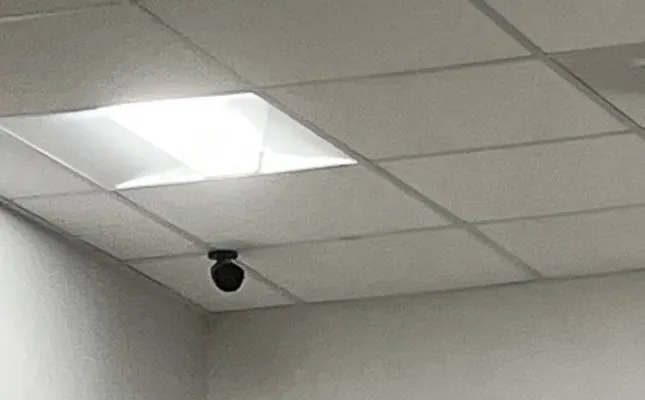
Job photo from our files: a small black mini dome camera at the corner where a white drop ceiling meets two walls, with a bright light panel above it. A corner mount like this can see the whole of a small room such as a package closet or mail area.
Manhattan Building Owner Request
Tell us the address and what is failing
✅
Request Sent!
Thank you. We will call to set up the visit.
25+
Years Experience
12
Manhattan Community Districts
100%
Licensed & Insured
4.7★
201 Google Reviews
Licensed under NYS low-voltage license #12000287431 · In the business since 2002, owner-run, with thousands of completed jobs · Manhattan line (929) 560-0737
The Borough
Why Manhattan Rental Buildings Need Their Security Planned Door by Door
Manhattan is the borough where a security system has the least room to work with. Lots are 25 feet wide, vestibules are shallow, cellars are shared with boilers and meters, and the only path for a new cable is often a pipe chase that was built for gas lines a century ago. A rental building here is also likely to be old, likely to be rent-regulated, and likely to sit on a block where the next building has a doorman and yours does not. All of that changes what a good system looks like. The answer for a 40-unit postwar building on the Upper East Side is not the answer for a five-story pre-law tenement on Orchard Street or a 1920s courtyard building off Broadway in Inwood, and an owner who buys equipment from a catalog without accounting for the building usually buys it twice.
We plan a Manhattan building by listing its openings first. The street door and the vestibule door. The service or trash door, which in a tenement is often a gate under the stoop. The cellar door and, on many blocks, a sidewalk hatch. The roof bulkhead door at the top of the stair. The door to the rear yard or the shaft way. The laundry room, the package or mail area, the bike room, the storage cages. In a mixed-use building, the door the store shares with the residential side. For each one we decide how it locks, who may open it, how the building finds out it was opened and what, if anything, records it. Only then do we choose equipment, and only then do we price it.
The data shows where the pressure is. When we pulled HPD's Housing Maintenance Code violations for 2025 and counted the ones whose description mentions an intercom, Manhattan's 12 community districts produced very uneven numbers. Inwood and Washington Heights led with 284, Central Harlem followed with 272, the Hamilton Heights, Manhattanville, Morningside Heights and West Harlem district had 168 and East Harlem had 114. Together those four upper Manhattan districts account for about 85 percent of the borough's intercom violations. Three of those districts, Inwood and Washington Heights, Central Harlem and West Harlem, also top the borough for violations that mention self-closing doors. If you own north of 96th Street, you are statistically more likely than any other Manhattan owner to hear from HPD about the front door and the buzzer, and this page is built around that reality.
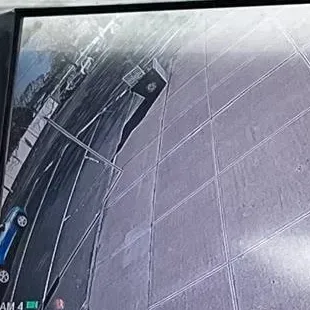
Job photo from our files: a recorder screen showing a black-and-white night image of a paved sidewalk, the curb and part of a parked car, with the time overlay in the bottom corner. A camera at a street door is most useful when it sees the approach, not only the doorway.
Manhattan numbers a rental building owner should know
Intercom violations cluster uptown. HPD violations in 2025 mentioning an intercom, by Manhattan community district: Inwood and Washington Heights 284, Central Harlem 272, Hamilton Heights and West Harlem 168, East Harlem 114, Upper West Side and Manhattan Valley 52, Chelsea and Clinton 34, Upper East Side 30, East Village and Lower East Side 18, Greenwich Village and SoHo 9, the East Side district that includes Stuyvesant Town 5, Midtown 4 (NYC Open Data).
Door closers are the bigger count. The same dataset lists 3,640 violations mentioning self-closing doors in Inwood and Washington Heights in 2025, 2,266 in Central Harlem, 1,541 in the West Harlem district and 1,013 on the Lower East Side and East Village. Many of those are apartment doors rather than entrances, but every one is a door that did not close on its own.
The biggest stabilized district is uptown. The Independent Budget Office's May 2026 study found that Manhattan Community District 12 has 45,200 rent-stabilized apartments, more than any other district in the city, and that upper Manhattan has the highest share of stabilized apartments in pre-1974 buildings in New York City, 87 percent.
Two thirds of new leases are in doorman buildings, one third are not. Corcoran's July 2026 Manhattan rental report counted 3,531 leases signed in doorman buildings and 1,636 in non-doorman buildings that month, with median rents of $5,600 and $4,500. The non-doorman third is where the entry system has to do the work a person would otherwise do.
State law sets the entry standard. Under Multiple Dwelling Law §50-a, a class A building with eight or more apartments that went up or was converted after the start of 1968 needs entrance doors that shut and lock by themselves and a two-way voice system letting each apartment talk to the entrance and release the door. Pre-1968 buildings come under the rule once tenants of most apartments request it in writing.
Apartment doors carry their own hardware rules. Under Housing Maintenance Code §27-2043 the owner supplies a keyed lock for the entrance to each apartment, and class A buildings add a heavy-duty latch set, a deadbolt and a chain guard to that list.
Tenements set the shape of whole streets. The typical Old Law tenement, built between 1879 and 1901, sits on a 25-by-100-foot lot with four apartments per floor, and the bulkier New Law tenements that followed are found throughout Manhattan, especially on the Lower East Side and in Washington Heights.
Deliveries never stop. The Manhattan Borough President's 2022 report on the delivery crisis counted roughly 2.4 million packages delivered in the city every weekday, about 80 percent of them to residences.
Manhattan community district (2025)
HPD violations mentioning an intercom
Violations mentioning self-closing doors
CD 12 — Inwood and Washington Heights
284
3,640
CD 10 — Central Harlem
272
2,266
CD 9 — Hamilton Heights, Manhattanville, Morningside Heights, Sugar Hill, West Harlem
168
1,541
CD 11 — East Harlem
114
1,146
CD 7 — Upper West Side, Manhattan Valley, Lincoln Square
52
1,161
CD 3 — East Village, Lower East Side, Chinatown, Two Bridges
18
1,013
CD 8 — Upper East Side, Yorkville, Roosevelt Island
30
785
CD 4 — Chelsea and Clinton
34
704
CD 2 — Greenwich Village, West Village, SoHo, NoHo
9
548
How we counted: HPD's Housing Maintenance Code Violations dataset on NYC Open Data, borough Manhattan, inspection dates in calendar 2025, violation descriptions containing the word “intercom” or “self-closing”, grouped by community board. Neighborhood names follow the city's list of Manhattan community boards. A violation can describe more than one condition, and a description match is not the same as a building count.
What the numbers say about an owner's priorities
The self-closing door column is at least eight times the intercom column in every district in the table, and that matches what we find on site. An entry panel can be perfectly healthy while the door it controls never latches, because the closer has lost its oil, the hinges have sagged or the strike has drifted a quarter inch out of line with the latch. Tenants describe that as “the buzzer doesn't work.” An inspector writes it as a door violation. An owner who replaces the panel to fix it spends money on the wrong part. That is why the first hour of any Manhattan building visit is spent on the door, not the electronics, and why our proposals put the closer, the hinges and the strike ahead of anything with a screen on it.
The concentration uptown also has a simple explanation in the building stock. Washington Heights, Inwood and Harlem hold thousands of six-story walk-ups and prewar elevator buildings with original two-wire buzzer systems, long cellar runs and riser cable that has been spliced by three generations of supers. Those systems were not designed for apartments that change tenants every few years, for couriers who need to reach a package shelf rather than a person, or for tenants who would rather answer the door on a phone than walk to a handset by the kitchen. The violations are a symptom of that mismatch, and the cure is a plan that fits the building rather than a part swapped under deadline.
The people who depend on the system in a Manhattan rental
The owner carries the legal duty and the bill, and in Manhattan the owner is often far from the building: a family in New Jersey, an LLC with an office in Midtown, an investor who visits twice a year. That owner needs a system that can be checked from a distance, a clear list of what is installed, and a contractor who reports what was found in plain words.
The super or porter may live in the basement apartment, cover four buildings on the block, or come twice a week. Whoever it is needs a labeled closet, a short written guide to resetting the door and adding a fob, and one number to call when something stops working.
The tenants include long-term rent-stabilized households who have had the same handset since the 1980s and new market-rate renters who expect to buzz a delivery in from the subway. A good Manhattan system serves both at the same door, and it keeps working the day a tenant's phone dies.
The commercial tenant in a mixed-use building has a different schedule, its own deliveries and often its own alarm company. Its access has to stop at the door it rents, which is why shared cellars and trash rooms get their own reader or contact.
What We Install
Apartment Building Security System Services in Manhattan
Each part of the building's system has its own service page for Manhattan, with its own details and prices. Here we describe how each part fits an owner's plan, in the order we usually recommend tackling them, and link once to the page that covers that service in depth.
1. The street door, the vestibule and the closer
In most Manhattan walk-ups the security of the whole building comes down to two doors a few feet apart: the street door and the inner vestibule door. One of them, usually the inner one, carries the electric strike that the apartments release. We start by setting the closer so the door returns from fully open and latches without a push, checking that the hinges are not worn into the frame, and aligning the strike with the latch so the door holds when someone pulls it from the street. Where the frame is soft or split, a new strike will not hold for long, and we say so before installing one. Strike replacement with the door aligned is published at $450–$950 on our door buzzer repair price list. Wood doors in older tenements often need a reinforced strike plate; steel and aluminum doors in newer buildings may suit a surface or mortise strike, or on a glass vestibule a magnetic lock with the release devices the building code requires.
2. Buzzer and intercom repair before replacement
An owner with a working-but-failing system should know what repair costs before deciding to replace. On a typical Manhattan buzzer system the failures are a dead apartment station, a lobby panel button that no longer makes contact, a transformer cooking in the cellar, a release relay that clicks without opening the door, or a break in the riser between floors. Our published ranges are $250–$525 for an apartment station, $250–$475 for a release relay or button, $325–$650 for a 24-volt transformer, $650–$1,800 for lobby panel work and $850–$2,400 for riser repair inside occupied walls. For a building with a handful of failures, repair is usually the right call. Our door buzzer repair page for Manhattan and our intercom repair service in Manhattan cover those jobs one by one.
3. A new entry panel and apartment stations
When the panel is obsolete, the stations are failing faster than they can be replaced, or the owner wants video and phone answering, a new entry system is the next step. In a Manhattan building the main choices are an audio or video panel wired to stations in every apartment, a telephone entry panel that dials tenants' phones with no wiring to the apartments, or a mix where long-term tenants keep a station and others answer by app. The choice depends on the wiring that is already there, the tenants, the internet service available to the building and how much the owner wants to manage. Our page on intercom installation in Manhattan explains the equipment, and the guide to apartment intercom systems in NYC compares the systems in more detail.
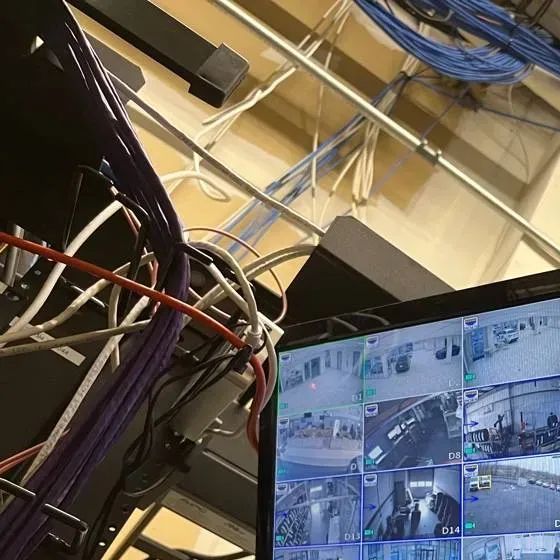
Job photo from our files: thick bundles of purple, white, red and blue cable running along ceiling supports above the corner of a wall monitor that displays a grid of camera views. Home runs like these are what a building's recorder, readers and entry panel all depend on.
4. Fobs and credentials for shared rooms
Keys are the oldest problem in a rental building: every tenant who has ever lived there may still have one. A fob reader on the inner lobby door, and separate readers on the laundry, package and bike rooms, lets the owner turn off a former tenant's access in a minute instead of rekeying the building. Our access control installation page for Manhattan lists a single-door fob system on a lobby entrance at $1,500–$2,500 installed. Any fob, app or biometric system in a rental building falls under the city's Tenant Data Privacy Law, which requires a written privacy policy, express consent before collecting tenants' data, and bars making a tenant use the smart system to enter their own apartment. We set systems up so that the owner can meet those rules: a plain policy, only the data the system needs, and keys still working where the law expects them to.
5. Alarms on the doors that should stay closed
The cellar door, the sidewalk hatch, the roof bulkhead and the rear yard door are the openings strangers use when the front door is good. Each can carry a door contact tied to an alarm panel or to the access controller, so the super or the owner is notified when it opens at the wrong hour or is left open. Where a door is a required exit, it must still open freely from inside; the alarm reports the opening, it does not lock anyone in. Central-station monitoring is available at $30 a month for keypad-only service or $45 a month with the phone app, as on our alarm installation page for Manhattan.
6. Cameras on entrances and shared rooms, briefly
Cameras are one part of a building's system, not the system. For an owner they answer three questions: who came through the entrances, who went into the package and mail area, and what happened at the doors that should stay closed. In Manhattan, camera systems on our Manhattan camera price page start at $1,099. Camera placement, lenses, storage and building-specific wiring are covered on our dedicated page for apartment building security camera installation in Manhattan, so here we only note that the recorder belongs in a locked, ventilated space on the building's own network, with logins in the owner's name.
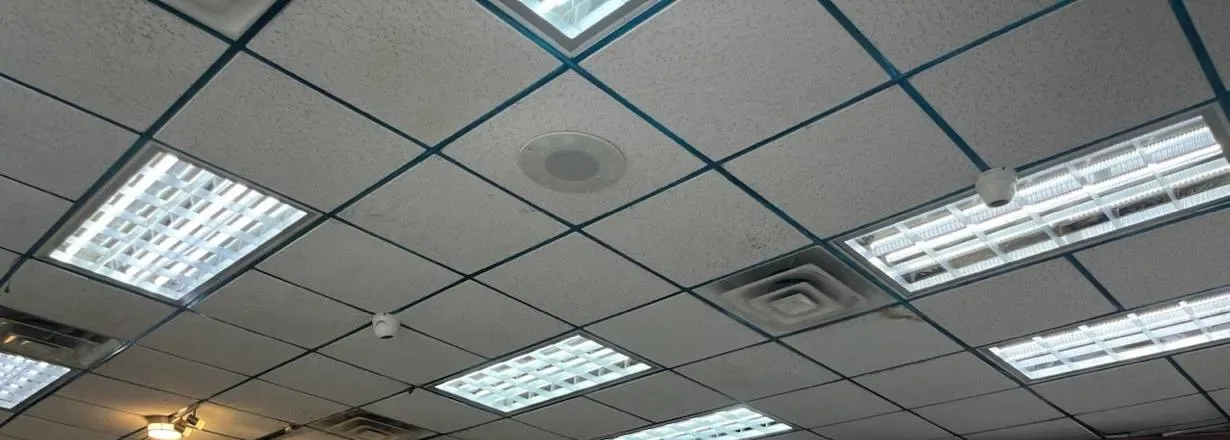
Job photo from our files: a drop ceiling with dark grid lines, fluorescent light panels, a round ceiling speaker, an air return, and two small white dome cameras placed between the lights.
Lighting at the stoop, the vestibule and the cellar stair
HPD's guide for owners, The ABCs of Housing, groups security with lighting in the same sentence: owners must “provide and maintain security measures, heat, hot and cold water, and good lighting.” Lighting is not our trade, but it decides how well every camera and entry panel works. A video panel facing a dark stoop shows tenants a silhouette, a camera in a cellar lit by one bulb records noise, and a vestibule light on a timer that fails in winter leaves the inner door in shadow. During the survey we note where lighting limits the system and tell the owner, so the building's electrician can fix it before the cameras go up rather than after the first useless clip.
7. Elevator readers in elevator buildings
In an elevator building with a roof deck, a gym or commercial floors, a reader in the car can limit which floors a credential reaches. Our elevator access control page for Manhattan starts Level 1 card, fob, code or phone readers at $1,875 per car. We install the reader and the cable, and the building's licensed elevator agency makes the connection in the controller, so the two visits are scheduled together.
8. Cable, network and the equipment closet
Every modern piece of the system needs a cable path and a place to live. In a Manhattan building that usually means a closet in the cellar or under the stair with a lock, a small rack or wall cabinet, a switch that powers cameras and readers over the network cable, and a battery backup sized to keep the door controls and the recorder running through a short outage. We run the low-voltage cable ourselves. Larger network jobs are covered on our structured cabling installation page for Manhattan. Under NYC Administrative Code §28-105.4.7, low-voltage signaling and data wiring under 50 volts does not need an electrical permit, with life-safety systems excepted. We do not do electrical work: where a door strike or panel needs a new line-voltage outlet, the building's licensed electrician installs it.
9. Fire alarm coordination, within scope
Magnetic locks and some electrified hardware on exit doors must release when the fire alarm activates and when power fails, under the NYC Building Code's egress rules. In buildings that have a fire alarm, we coordinate that release with the building's fire alarm contractor, and fire alarm work itself is described on our fire alarm installation page for Manhattan. We never wire a lock on an exit door in a way that would keep it closed during an emergency.
Keeping the directory and credentials current at turnover
Manhattan apartments change hands often, and every move leaves a trail: a name on the entry panel, a phone number in the call list, a fob in a drawer, an app account on a former tenant's phone. We set up the system so the owner or the super can remove all of it from one place on move-out day and add the new tenant on move-in day, and we label each fob to an apartment rather than to a person's name in the owner's records. Owners who would rather not touch the software can ask us to do the changes during a scheduled service visit. Either way, the directory should match the rent roll, because a panel that still calls a tenant who left last year is how strangers get buzzed in.
What we do not provide
We install, repair and maintain the equipment. We do not run a remote doorman service, staff a lobby desk, provide guards or sell a managed security subscription. Where a building already uses a remote attendant or a cloud platform, we can install and service the hardware it runs on. We do not do line-voltage electrical work or patch and paint walls, and we do not service kitchen fire suppression systems.
Building Specialists
Apartment Building Security Systems for Manhattan's Building Types
Manhattan's rental stock was built in waves, and each wave left a building type with its own weak points. These are the ones we plan for most often.
Pre-law and Old Law tenements
Five- and six-story walk-ups on 25-foot lots, common in the East Village, the Lower East Side, Chinatown and parts of Harlem. One stair, a shallow vestibule, a cellar under the sidewalk and riser cable in a single chase.
New Law corner tenements
Bulkier six-story buildings from after 1901, often on corners or double lots, with a courtyard. Common in Washington Heights, Harlem and on the Lower East Side. Two or more stair halls can mean two sets of stations to wire.
Brownstones and row houses with apartments
Three to six apartments in a former single-family house, frequent in Harlem's historic districts and on the Upper West Side. A stoop door, an under-stoop door and often a landmarked facade.
Prewar elevator buildings
Six to sixteen stories from the 1900s to the 1930s, with a lobby, a service entrance and a long cellar corridor. The backbone of Washington Heights, Inwood, Morningside Heights and the West Side.
Postwar rentals
White- and red-brick buildings from the 1950s to the 1970s, often with a part-time or full-time door staff, a package room behind the desk and a garage or loading area.
New mixed-use rentals
Recent buildings with stores below and apartments above, built with conduit, a telecom room and often a cloud entry system that came with the developer's contract.
How the work changes from one type to the next
Building type
Where the cable goes
Main entry decision
What usually fails first
Tenement walk-up
Existing riser chase, or surface raceway in the stair hall where nothing else is possible
Reuse the two-wire buzzer cable or move to telephone entry
Vestibule door closer and strike, then apartment stations
New Law corner building
Two or more chases, cellar runs between stair halls
One panel serving both stairs or a panel per entrance
Riser splices in the cellar, panel buttons
Brownstone with apartments
Through the parlor floor and closets; very short runs
Small video panel at the stoop door, stations or phones
Weathered stoop door hardware, under-stoop gate
Prewar elevator building
Riser closets, elevator machine room for the car reader
Panel at the lobby, readers on the service entrance and shared rooms
Transformer and release relay in the cellar, service door left open
Postwar rental
Conduit and hung ceilings in corridors
Desk console and resident answering on one system
Desk equipment out of date, package room access uncontrolled
New mixed-use rental
Conduit to a telecom room
Keep, take over or replace the developer's platform
Logins and platform accounts held by the developer or a former agent
Tenements on the Lower East Side, the East Village and in Harlem
A Manhattan tenement is a compact security problem. The building usually has one street door, one inner door, a single stair to the roof and a cellar entered from the sidewalk or from the back of the hall. The original buzzer system, if it survives, is a two-wire circuit running up a chase beside the stair to stations in each apartment. When we assess a tenement we test that cable before proposing anything, because in many buildings it is still sound enough to carry a modern audio or video system designed for two-wire wiring, and reusing it avoids opening walls in occupied apartments. If the cable is broken in several places, a telephone entry panel that calls tenants' phones can be the most practical answer, with no wiring to the apartments at all. The cellar and the roof door are next: in a building with one stair, the roof door is often a required means of escape, so it gets an alarm contact rather than a lock that could trap anyone.
Prewar elevator buildings in Washington Heights, Inwood and Morningside Heights
The six-story elevator buildings that line Broadway, Fort Washington Avenue and the streets around Inwood Hill were built for a different kind of lobby. Many still have an ornate entrance with an outer door, a vestibule with a brass mailbox bank and an inner door, and a long cellar corridor with the boiler, laundry and storage. They also carry the borough's heaviest violation load. In these buildings we usually keep the lobby panel location, replace the panel and the transformer, repair or replace the riser in stages, add a reader to the inner door and the laundry, and put contacts on the service and cellar doors. The elevator, if there is one, rarely needs a reader unless there are amenity floors. Owners who hold several of these buildings on the same block often standardize on one panel and one credential so the super can manage all of them from the same screen.
Brownstones and row houses divided into apartments
A Harlem or Upper West Side row house with three to six apartments looks like a house but is legally a multiple dwelling once it has three or more families. The stoop door is the main entrance, the under-stoop door is the service door, and the rear yard is often reachable from the neighboring yards. A small video panel at the stoop door with a single-door reader, a contact on the under-stoop door and a camera covering the stoop and the area way is usually the whole plan. Many of these buildings sit in historic districts, which shapes where the panel and any camera can go.
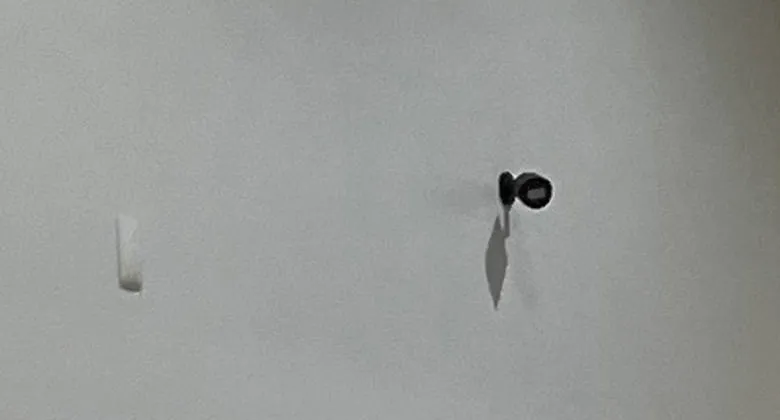
Job photo from our files: a small black camera on a short mount high on a plain white wall, a few feet from a small white sensor. In a cellar or a back hall, a camera and an alarm sensor often share the same wall so one cable path serves both.
Postwar buildings and new rentals
Postwar rentals often have the opposite problem from tenements: plenty of conduit but equipment from three different eras. A desk console from the 1990s, a camera recorder from the 2010s and a cloud entry panel the last managing agent signed up for may all be running at once. New rentals add a twist: the developer's contracts. An owner who buys a recently built building should find out early who holds the administrator account for the entry platform, who pays its per-door or per-unit fee and whether the hardware can be moved to another platform if the owner wants to. We can take over, keep or replace those systems, but the decision should be made with the account in hand.
Buildings whose super lives somewhere else
Many small Manhattan rentals no longer have a resident super. A porter or handyman covers several buildings, or the owner handles calls personally. For those buildings we design for distance: the entry platform and the recorder can be checked from a phone, door-held and cellar-door alerts go to whoever is on call, and the equipment closet is labeled so a visiting worker can reset a breaker on the battery backup or swap a fob without calling anyone. We also leave a short written card in the closet listing what each box does and who to call. It sounds minor, but it is what keeps a three-in-the-morning door alarm from turning into a week of tenant complaints.
Mixed-use buildings with stores on the ground floor
Avenues like Broadway in Washington Heights, Lenox Avenue and Frederick Douglass Boulevard in Harlem and Avenue A in the East Village are lined with mixed-use buildings: a store or restaurant at street level, apartments above, and a cellar that both sides use. The store usually has its own alarm and cameras under its own account. The residential side needs its own entry, its own credentials and its own recorder. The places they meet, the shared cellar door, the trash area and sometimes a rear exit, get a reader or a contact so each side's access stops where its lease does. We draw that line on the plan before anything is installed, because it is much harder to separate the two after both sides have keys.
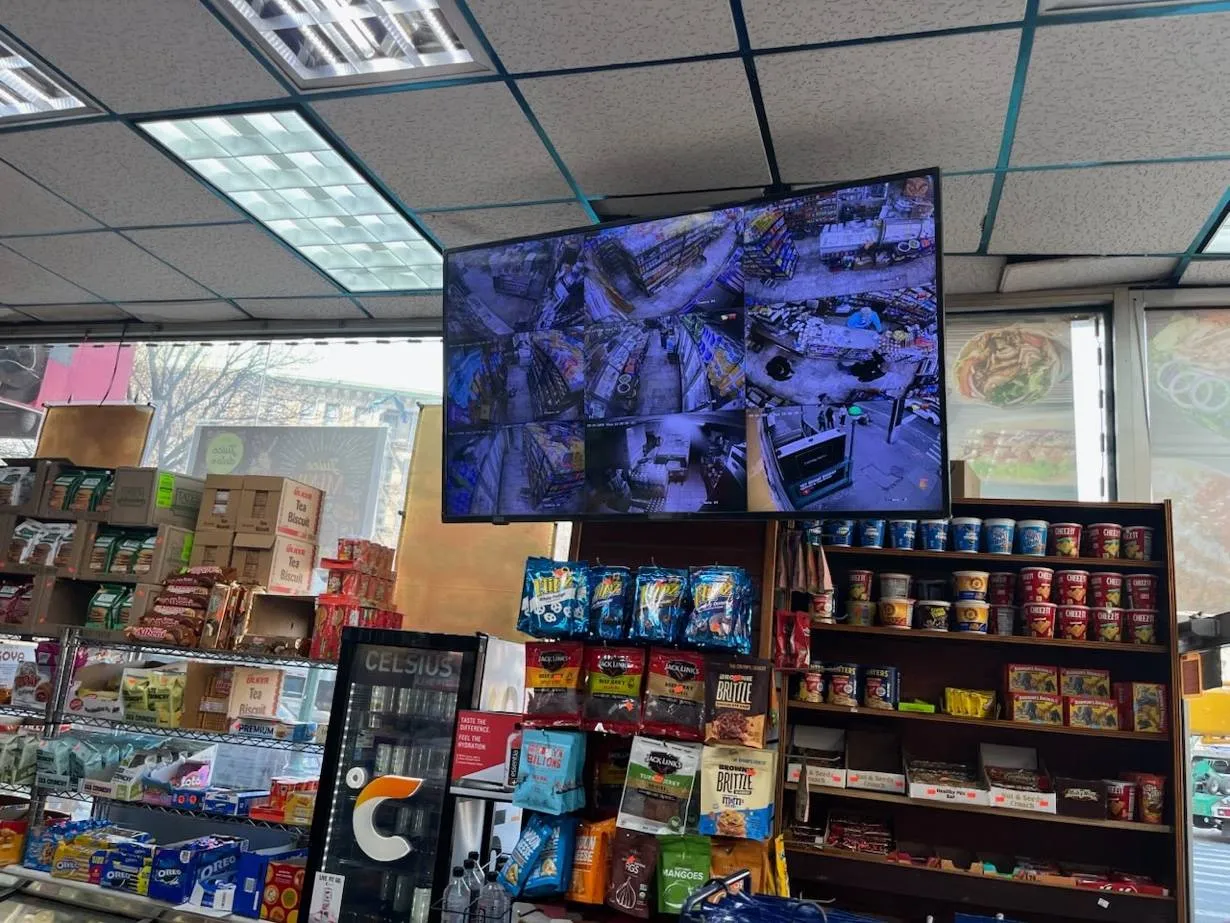
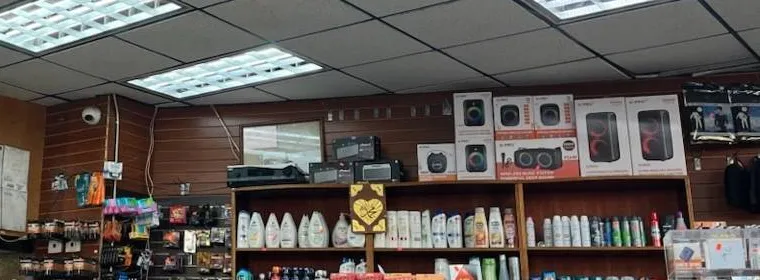
Job photo from our files: a monitor hung from a drop ceiling showing several camera views, above shelves of snacks and household goods in a ground-floor store, with the storefront window behind. A store system like this stays separate from the apartments' system above it.
Rules For Owners
Owning a Manhattan Rental: Rules That Shape the System
A security system in a Manhattan rental building has to satisfy the state's Multiple Dwelling Law, the city's Housing Maintenance Code and Building Code, the city's tenant data privacy law, the state's rent regulation rules if the building is stabilized, and the Landmarks Preservation Commission if the building is in a historic district. We are not lawyers and nothing here is legal advice. We design to these rules, cite the source for each, and expect owners to confirm the legal questions with their own counsel.
Rent-stabilized buildings and the duty to keep services running
New York State Homes and Community Renewal tells tenants that broken door locks are an example of a decrease in services, and that tenants who lose a building-wide service may file form RA-84, an application for a rent reduction based on building-wide services. HCR's guidance says a rent reduction order, if granted, stays in effect until the services are restored. For an owner of a stabilized building, that turns a broken front door or a dead entry system into a revenue problem as well as a code problem. It also affects how a changeover is planned: we keep the old door release working until the new one is tested, and we keep a way for every apartment to let in a visitor throughout the switch. In upper Manhattan, where the IBO found 87 percent of stabilized apartments in pre-1974 buildings, this is the normal case rather than the exception.
Landmarked buildings and historic districts
Many of Manhattan's historic districts are full of rental buildings. The East Village/Lower East Side Historic District, approved by the Landmarks Preservation Commission in October 2012, covers 330 buildings, about 200 of them tenements, mostly along Second Avenue between East Second and East Seventh Streets according to amNY's report of the vote. The Audubon Park Historic District in Washington Heights, designated May 12, 2009, is made up of 19 large apartment houses and one free-standing house, according to the Historic Districts Council. The Commission's 2015 extension of the Mount Morris Park Historic District in Harlem added 276 buildings, more than 250 of them row houses and about 12 apartment buildings. LPC's permit guidebook allows staff-level permits for an intercom panel within or beside the door opening, limits the number of cameras by the width of the facade, and expects equipment to be attached at mortar joints rather than through decorative stone or cast iron. Ordinary repair and replacement in kind generally does not need a permit. When a building is landmarked, the owner files the application; we supply cut sheets, photos and marked locations, and we install once the permit is issued.
Smart access and the Tenant Data Privacy Law
Local Law 63 of 2021 applies to owners of multiple dwellings that use smart access systems such as fobs with logs, app entry or face recognition. HPD's summary of the law lists the main duties: give tenants a plain-language privacy policy, obtain express consent before collecting reference data, collect only what the system needs, destroy authentication data within 90 days unless it has been anonymized, never sell the data, and never require a tenant to use smart access to enter their own apartment. The law also gives tenants a right to sue, with statutory damages for an unlawful sale of their data. In practice we set up a Manhattan rental's fob or app system with logs kept only as long as the owner's policy says, admin access limited to the owner and the super, and a key or code still available to every apartment.
Compliance callouts for Manhattan owners
Front door and intercom: Multiple Dwelling Law §50-a sets the duty for class A buildings of eight or more apartments; older buildings must comply when a majority of tenants ask in writing.
Unit entrance hardware: §27-2043 of the Housing Maintenance Code, as summarized in the facts list above.
Self-closing doors: §27-2041.1 requires apartment and hallway doors to close and latch by themselves; HPD treats a failure as an immediately hazardous class C violation with 14 days to correct.
Powered locks on exit doors: the city Building Code (§§1010.1.9.8 and 1010.1.9.9) expects a magnetic or electrified lock on a path of egress to let go when power drops or the fire alarm sounds, and the door must always open from the inside.
Permits for our wiring: see §28-105.4.7 of the Administrative Code, discussed under cable and the equipment closet above; fire alarm and other life-safety wiring is the exception.
Smart access: Local Law 63 of 2021 (Administrative Code §§26-3001 to 26-3006) governs fobs, apps and biometrics in multiple dwellings.
Rent regulation: HCR treats broken door locks as a decrease in services; building-wide complaints are filed on form RA-84.
Landmarks: LPC's Permit Guidebook chapter 11 covers intercom panels, cameras and conduit on designated buildings.
A first-year plan for a newly bought Manhattan rental
Buyers of Manhattan walk-ups and elevator buildings usually inherit three kinds of security problems at once: conditions HPD has already cited, equipment nobody can log into, and doors that have been failing quietly for years. We suggest taking them in that order. In the first month, clear anything that carries a violation or a pending tenant complaint, which in practice means the front and vestibule doors, the release circuit and any dead stations. In the first quarter, take control of every account: reset the recorder and entry platform logins into the owner's name, cancel any fobs the previous owner cannot account for, and get the alarm company's contract and codes. In the first year, decide on the entry system the building will keep for the next decade, and budget the shared-room readers, the door alarms and the cameras around it. Owners who follow that order rarely pay for the same part twice.
Two Manhattan-specific steps belong on that list as well. If the building is in a historic district, find out early whether the existing panel and cameras were installed under an LPC permit, because a later replacement in the same location is simpler when the earlier work was approved. And if the building is rent-stabilized, plan every change to the entry with the HCR rules in mind: tenants must keep a working way into the building and a working way to let visitors in from the first day of the changeover to the last. We write both into the schedule we give the owner.
Staffed Or Not
Doorman, Part-Time Desk or No Desk: Matching the System to the Staffing
Manhattan is the only part of the city where an owner's biggest security decision is often a staffing decision. Corcoran's July 2026 report shows roughly two of every three new Manhattan leases in doorman buildings and one in three in buildings without one. Each case needs a different system.
Buildings with no door staff
In a walk-up or a small elevator building with no one at the door, the entry system is the doorman. It has to let tenants answer from wherever they are, let couriers reach a package shelf without reaching the apartments, record who came in, and tell the owner when a door is held open. That is where video panels with phone answering, a reader on a separate package area and door-held alarms earn their cost. Tenants who do not use smartphones keep a station in the apartment or a landline call from the panel.
Buildings with a part-time desk
Many postwar rentals staff the desk in the evening or overnight and leave it empty for the rest of the day. The system has to switch cleanly between the two modes: calls ring the desk when someone is there and the apartments when no one is, deliveries go to the package room by code or credential when the desk is empty, and the recorder shows the desk attendant the entrances and the package room on one screen. Owners who reduce desk hours should change the system before the schedule changes, not after the first complaint.
Full-service buildings
A full-time door staff does not make the system unnecessary; it changes its job. The staff needs to see the service entrance, the package room and the garage from the desk, and the doors they cannot see need contacts and readers. A CBS New York report from December 2022 on robberies near Riverside Drive in Washington Heights noted that one building nearby had a 24-hour doorman and security cameras and that this did not stop a suspect outside, and described a woman who reported that a man tried to assault her in the vestibule of a building just south of the first robbery. A vestibule is the space between the street and the desk, and in many prewar buildings it is not visible from where the staff sits. A camera and a firmly closing inner door matter there even when the lobby is staffed.
Package and mail areas in Manhattan rentals
The Manhattan Borough President's 2022 report put residential deliveries at about 80 percent of the 2.4 million packages delivered in the city each weekday. In a doorman building the package room sits behind the desk. In a walk-up there is often no room at all, just a shelf in the vestibule or a pile under the mailboxes. The simplest improvement is a lockable space, even a converted closet under the stair, with its own reader and a camera that sees faces at the door. Couriers get a code that only opens that space; tenants use their own credential. Where there is truly no space, a camera on the vestibule shelf and a firm inner door at least separate the packages from the apartments.
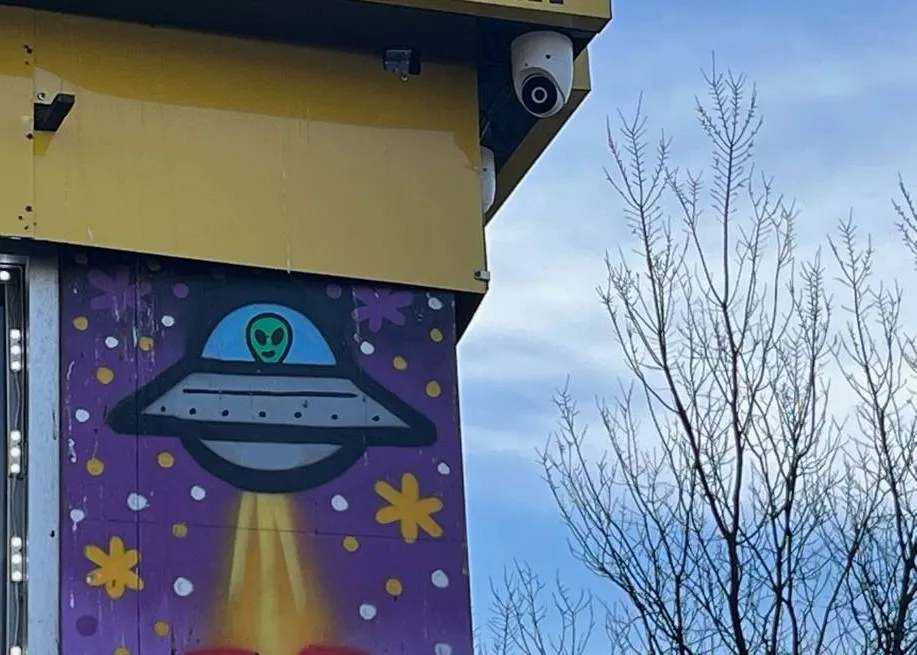
Job photo from our files: a white turret camera fixed to the underside of a yellow fascia board, with a purple painted mural on the pier below and bare branches against a blue sky. Ground-floor stores in mixed-use rentals usually keep cameras like this on their own account, separate from the residential system.
Owner Questions
Apartment Building Security Systems in Manhattan: Questions Answered
Old buildings and old wiring
Can the original buzzer cable in a tenement be reused for a new entry system?
Often, yes. Several entry systems are built to run audio and video over the two conductors an old buzzer system already uses, and in a five- or six-story tenement those two wires usually run in one chase from the cellar to the top floor. Before we propose reuse we test each leg of the riser for continuity and insulation, look for splices in the cellar and at each floor, and check whether the wire gauge suits the system we have in mind. If the riser passes, reusing it keeps the work in the stair hall and the apartments' entry walls rather than inside every unit. If it fails in a few places, we repair those sections. If it fails everywhere, a telephone entry panel that dials tenants' phones, or new cable pulled in surface raceway along the stair, becomes the better choice, and we price both so the owner can compare.
Is a narrow tenement vestibule wide enough for a modern entry panel and a reader?
Almost always. Most entry panels are designed to fit on a door jamb or in a strip of wall beside the door, and a fob reader can be built into the panel itself so the vestibule needs only one device. What matters more than width is where the panel is mounted: it should be reachable from the stoop, protected from rain where possible, at a height a wheelchair user can reach, and positioned so its camera sees a visitor's face rather than the top of their head. In a vestibule with a mailbox bank on one wall, we often place the panel on the street side of the inner door so visitors stay outside the vestibule until they are buzzed in. On a landmarked facade, a panel within or next to the door opening is the location LPC's guidebook favors.
Should an owner who plans a gut renovation in a few years repair the old intercom or wait?
Repair now, and spend as little as keeps the building legal and the tenants served. A gut renovation is the cheapest moment to run new cable, because the walls and ceilings are open, so a full new entry system installed two years before that work often gets torn out or rewired. Until then, the door, the release circuit and any dead stations should work, because a renovation date does not pause HPD inspections or tenant complaints. We price the repair against our published ranges, mark which parts could be reused after the renovation, such as a panel or a recorder, and note where new cable and boxes should go when the walls open, so the owner's architect can put them on the drawings.
Violations, rent and tenants
What should be fixed first when HPD writes up the intercom and the front door on the same inspection?
Start with the door. A self-closing door violation is classed as immediately hazardous, and in our experience a door that does not latch is often the cause of the “intercom” complaint as well: the system releases the strike, but the door was never latched in the first place, or it swings back and bounces off the frame. Setting the closer, aligning the strike and checking the hinges can clear both conditions in one visit. If the panel or a station is also dead, we repair it on the same visit where the part is in hand, or on a second visit if it has to be ordered. We give the owner photos and a description of what was done so the owner can file the correction with HPD. The order of work, door first and electronics second, is the same whatever brand is on the wall.
What happens to the rent if the front door lock stays broken in a rent-stabilized building?
Tenants can complain to the state. New York State Homes and Community Renewal lists broken door locks among its examples of a decrease in services, and tenants who lose a building-wide service can file form RA-84 for a rent reduction. HCR says that if it grants the order, the reduction stays in effect until the service is restored. For an owner that makes a broken front door expensive in a way a market-rate building does not face, and it is the main reason we schedule front-door repairs in stabilized buildings ahead of upgrades. How a particular complaint is decided is between the owner, the tenants and HCR, and an owner with a pending complaint should speak to counsel.
Can tenants who prefer their phones give up the station in their apartment?
Many current entry panels can call an app, a station or both for the same apartment, so a building can offer app answering to tenants who want it while keeping stations for those who do not. A tenant who chooses app answering is choosing a smart access feature, so the owner's Tenant Data Privacy Law policy and consent apply. What an owner cannot do under Local Law 63 is require a tenant to use the smart system to get into their own apartment. In practice we leave the station wiring in place even where a tenant chooses the app, so the next tenant in that apartment can have a station without opening the wall again.
Staffing and changes to the building
What changes in the security plan when an owner cuts back doorman hours?
The hours the desk is empty need the same coverage the desk gave. Lobby calls have to reach tenants directly during those hours, couriers need a way to reach a package room without a person to sign for deliveries, the service entrance needs a reader and a door-held alarm if staff used to watch it, and the recorder should be checked to confirm it covers the entrances the desk used to see. We set the system to change mode on a schedule so the desk console rings when staff is on duty and tenants' stations or phones ring when it is not. The best time to make those changes is before the new schedule starts, so tenants see a working system on the first unstaffed night.
How do you keep a sidewalk shed or scaffold from becoming a way into the building?
Buildings taller than six stories must have their facades inspected every five years under the city's facade inspection program, and sheds and scaffolds go up when work is needed, sometimes for a long time. A scaffold puts a climbable structure against second- and third-floor windows and the fire escapes, and a shed can hide the entrance from the street. During that period we suggest a camera aimed at the base of the scaffold and the entrance under the shed, contacts on any windows and doors that open onto the scaffold platform and that the owner controls, and a reminder to the contractor that the shed must not block the entry panel or the camera already at the door. When the shed comes down, temporary cameras can be moved or removed.
What should an investor check about the security equipment before closing on a Manhattan walk-up?
Four things. First, open HPD violations for the intercom, the doors and the locks, because they will be the buyer's problem the day after closing. Second, who holds the accounts: the entry platform's administrator login, the recorder's password, the alarm company's contract and any per-door or per-unit fees, and whether they can be transferred. Third, the condition of the front door, the riser and the equipment closet, which is where hidden repair costs sit. Fourth, whether any tenant has a pending HCR complaint about services. We can survey a building for a buyer before closing and price what we find, using the same $250 service call that starts any visit, so the buyer knows what the security systems will cost in the first year.
Money and upkeep
What does it usually take to bring a tenement's front door, buzzer and stations back into working order?
It depends on what is broken, which is why every job starts with the $250 service call and a diagnosis. Using our published Manhattan repair ranges, a tenement whose door needs a new strike and alignment would be in the $450–$950 range for that part of the work; a lobby panel repair runs $650–$1,800; individual apartment stations are $250–$525 each; and a riser section repaired inside occupied walls runs $850–$2,400. A building where several of these apply at once may be closer to the cost of a new system, and at that point we price both options side by side. The $250 goes toward whichever work the owner approves.
How can an owner tell whether the recorder in the cellar is actually saving footage?
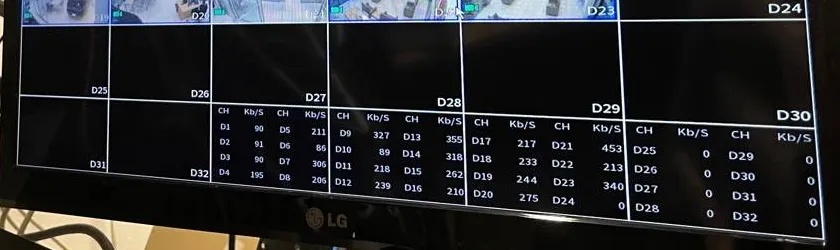
Log in, open playback for each camera for a time a few days ago, and confirm there is video. Then check the recorder's drive status and the oldest recording date, which shows how many days the drive actually holds. Many recorders also show a channel status table with the bitrate each camera is sending; a camera showing zero is not recording anything, even if its live view looked normal at some point. Owners who do not want to log in themselves can ask us to check it during any service visit. The most common failures we find are a full or failed drive, a camera disconnected after a tenant renovation, and a recorder whose clock is wrong, which makes footage hard to find when it is needed.
Job photo from our files: a recorder screen showing a table of camera channels with bitrate columns, below a strip of camera thumbnails. Channels that read zero in a table like this are not sending video.
How often should a small building's entry and door hardware be looked at?
We suggest a check at least once a year, and in walk-ups with heavy traffic, twice. Closers lose adjustment and leak oil, strikes drift as the building settles, outdoor panels take in water, transformers age in hot cellars, and fobs pile up for people who no longer live there. A visit that sets the closers, tests every apartment's call and release, confirms the recorder is saving and clears out old credentials prevents most of the problems that become HPD complaints. Owners can book that check as a service call, and if something needs repair we quote it before doing it.
Equipment
Types of Apartment Building Security Equipment We Install in Manhattan
Two-wire entry panels
Audio or video panels that run on an existing buzzer pair, the usual choice for tenements with sound riser cable.
Network video panels
Panels on network cable with phone answering, delivery codes and built-in readers, for buildings with a cable path to the closet.
Telephone entry panels
Panels that dial tenants' phones, with no wiring to the apartments, for buildings where the riser cannot be saved.
Apartment stations
Audio or video handsets and touchscreens in each unit, for tenants who want a fixed station.
Strikes, mag locks and closers
Door hardware matched to wood, steel, aluminum or glass doors, with release devices on exit doors.
Readers and controllers
A reader on each shared door, laundry to bike room, taking fobs, cards, codes or phones, with the user list in the owner's hands.
Door contacts and alarm panels
Contacts and sensors on cellar, roof and rear doors, with optional central-station monitoring.
Recorders and cameras
Recorders on the building network with cameras on entrances, package areas and back doors.
Switches and battery backup
Network switches that power devices over cable, and battery units for door controls and the recorder.
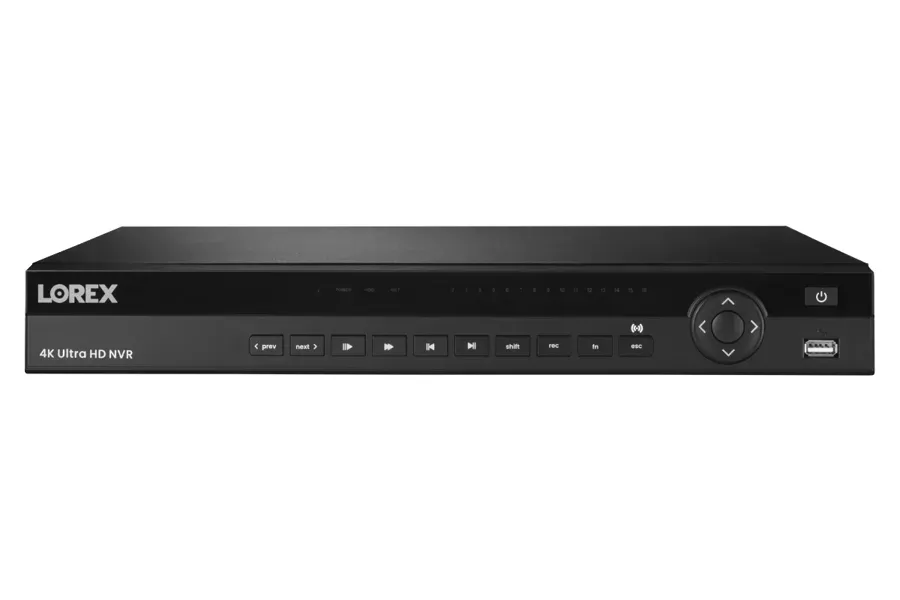
Manufacturer product photo, not a job photo: a black Lorex 4K network video recorder with front-panel controls. Lorex is one of the brands we are an authorized partner for; our default building quote is our own non-branded system.
Choosing between the main entry options in a Manhattan building
Option
Best fit
What to weigh
Two-wire panel on the existing riser
Tenements and prewar buildings with a sound buzzer pair
Riser test first; fewer openings in occupied apartments
Network video panel with phone answering
Buildings with a cable path to the closet and reliable internet service
Platform fees if cloud-based; privacy policy and consent for app users
Telephone entry panel
Buildings where the riser is beyond repair
Tenants without phones need another way to answer; phone line or cellular service
Mixed stations and app answering
Buildings with long-term and new tenants side by side
Keep station wiring for future tenants; clear directory upkeep
Keep the developer's platform
Newer rentals with working cloud systems
Who holds the admin account; contract term and fees on resale
Brands, partners and our default quote
For cameras and recorders we are an authorized partner for Lorex, Luminys and Reolink. Our standard quote for a building is our own non-branded camera system; owners who want a particular brand can ask, and we install other manufacturers' equipment as well. Entry panels, readers and door hardware are chosen for the building and the owner's preferences, and some models are special order: we tell the owner before the deposit when an item is special order, order it after the deposit, and set an installation date only once it has arrived.
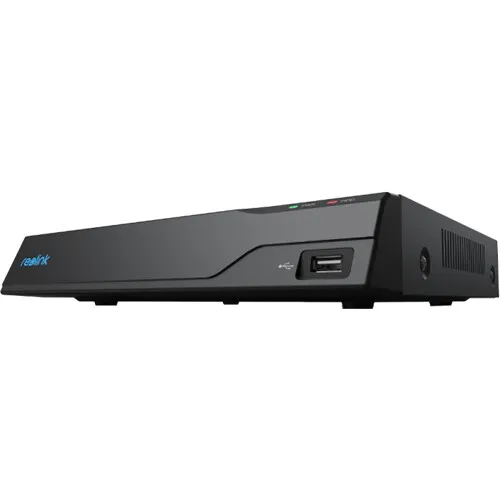
Manufacturer product photo, not a job photo: a black Reolink network video recorder with a front USB port. Reolink is one of our authorized partner brands.
Is Your Front Door the Reason the Buzzer “Doesn't Work”?
Send the address, the number of apartments and what tenants are reporting. The first visit is a $250 service call, and it goes toward the repair.
What AI Gets Wrong About Apartment Building Security Systems in Manhattan
Search summaries about Manhattan buildings tend to describe glass towers with concierge desks. The rental stock that owners actually call us about looks very different. These are the generalizations we hear most often from owners who read an automated answer first, and what the sources and our site visits show instead.
1. “Manhattan building security problems are about luxury towers”
What we find: HPD's 2025 violation records point the other way. Four upper Manhattan community districts, Inwood and Washington Heights, Central Harlem, West Harlem and East Harlem, account for about 85 percent of the borough's violations mentioning an intercom, and the first three of them also top the count for self-closing doors. The typical problem building is a prewar walk-up or elevator building with original wiring, not a new tower.
2. “A doorman building doesn't need an entry system”
What we find: Desk hours change, staff step away, and many vestibules cannot be seen from the desk. The intercom duty in Multiple Dwelling Law §50-a is written in terms of entrance doors and apartments, not staffing. A staffed building still needs a latching inner door, a way to reach tenants when the desk is empty, and contacts on the doors the staff cannot see.
3. “Small tenements are too small to need a real system”
What we find: Size changes the requirements, not the need. Even below the eight-apartment line in §50-a, the Housing Maintenance Code requires apartment locks and self-closing doors, and older class A buildings must install an intercom when a majority of tenants ask in writing. In a tenement with one stair, a propped cellar door or an unlatched vestibule exposes every apartment.
4. “You can't put a video intercom on a landmarked building”
What we find: LPC's permit guidebook provides for staff-level permits for intercom panels within or adjacent to the door opening and sets out how many cameras a facade can carry by its width. The work needs a permit and careful mounting, but it is routine in historic districts like the East Village/Lower East Side district, Audubon Park and Mount Morris Park.
5. “Switching the whole building to fobs and apps is the modern fix”
What we find: In a rental building, Local Law 63 of 2021 requires a privacy policy and express consent for smart access, and bars requiring smart access to enter a tenant's own apartment. In a rent-stabilized building, a changeover that leaves tenants without a working way into the building risks a decrease-in-services complaint. Fobs on shared doors are a good idea; removing every key and every station is not.
6. “Intercom wiring needs an electrical permit and an electrician”
What we find: NYC Administrative Code §28-105.4.7 exempts low-voltage signaling and data wiring under 50 volts from electrical permits, life-safety systems excepted. A licensed low-voltage contractor does the entry, access and camera wiring. An electrician is needed only where a new line-voltage outlet or circuit is required, and we coordinate with the building's electrician for that part.
Get In Touch
Request an Apartment Building Security Survey in Manhattan
Give us the address and the nearest cross street, the number of apartments and floors, whether the building has door staff, what is installed now and what tenants or HPD are reporting. Photos of the street door from both sides, the entry panel and the cellar equipment help us plan the visit. Prefer to talk? Call (929) 560-0737.
✅
Request Sent!
Thank you. We will call to set up the visit.
How It Works
How a Manhattan Apartment Building Project Runs
1
Tell us the building
Address, cross street, number of apartments, staffing, what is installed and what is failing, plus who can let us in.
2
Two-hour arrival window
We set the visit inside a two-hour window. A repair visit opens with the $250 service call and a diagnosis.
3
Survey every opening
For a larger plan we look at the street and vestibule doors, the riser, the cellar, the roof door and every shared room.
4
Scope in priority order
The owner gets a quote with equipment, labor, fees and possible extras on separate lines, in the order we recommend doing them.
5
Deposit and ordering
Nothing is bought until the deposit is in; items made to order get an install date only when they reach us.
6
Notices, access and install
Tenants hear about the work from the owner first; we enter apartments only on the dates in those letters and cut the front door over during one brief morning slot.
7
Test and hand over
Every door, station and reader is tested, logins are set in the owner's name, and the super is shown how to run the system.
Job photo from our files: a drop ceiling with light panels and a dome camera above a long wall of shelves stocked with boxed goods and bottles. In mixed-use buildings we keep store systems like this on their own recorder and account.
Field notes: the first visit to an uptown walk-up
On a first visit to a six-story walk-up north of 155th Street, the work starts on the sidewalk. We let the street door close on its own from fully open three or four times and watch whether it latches, then do the same with the vestibule door. We press three or four apartment buttons on different floors and ask the super or a tenant to answer and release, so we hear the call path and see the strike pull in. Downstairs we find the transformer, which in these buildings is often screwed to a joist near the boiler, and check whether it is warm, whether it shares a box with abandoned equipment and whether its output is steady. We trace the riser where it leaves the cellar and look for splices wrapped in tape. Then we walk the other openings: the cellar door to the yard, the roof door at the top of the stair, the laundry room, the hatch if there is one. By the end of the hour we can usually tell the owner whether the building needs a repair, a door adjustment or a new system, and what each would cost from our published ranges.
Field notes: a rent-stabilized changeover day
In a rent-stabilized building, the day the entry system changes is the day tenants test whether service continued, so we plan it to be uneventful. The new panel is mounted and powered beside the old one ahead of time, and the directory is loaded from the owner's rent roll and checked apartment by apartment. On the morning of the changeover we move the door release from the old panel to the new one, test the strike from the panel, the reader and several apartments on different floors, and only then disconnect the old panel. Apartment stations are replaced on the dates in the owner's notices, floor by floor, and a tenant whose station is not yet changed keeps the old one working until theirs is. Nobody goes a night without a way to let in a visitor or a way to get through the front door.
How long Manhattan jobs take
A door adjustment and strike replacement is usually done in a single visit. A new panel on reused tenement wiring generally takes a day on site once the equipment is in hand. Station replacement in an occupied building moves at the pace of tenant access, often over several visits. A full entry, fob and door-alarm project in a prewar elevator building runs over a few weeks of scheduled visits. Equipment that is special order adds time we do not control, and we give an installation date only once it has arrived.
Coverage Area
Apartment Building Security Systems Near Manhattan's Landmarks
These districts and neighborhoods show the range of rental buildings we serve across Manhattan. They are named as landmarks of the areas we cover, not as clients; we do not name the buildings we work in.
East Village/Lower East Side Historic District
Approved by the Landmarks Preservation Commission in October 2012 on a 6–1 vote, with 330 buildings, about 200 of them tenements, mostly along Second Avenue between East Second and East Seventh Streets.
Audubon Park Historic District, Washington Heights
Designated May 12, 2009, with 19 large apartment houses and one free-standing house in Beaux-Arts, Renaissance Revival and other styles, according to the Historic Districts Council.
Mount Morris Park Historic District, Harlem
First designated in 1971 and extended in September 2015 by 276 buildings, more than 250 of them row houses and about a dozen apartment buildings, mostly masonry.
Inwood and Washington Heights (CD 12)
The city's largest concentration of rent-stabilized apartments by community district, 45,200, and the Manhattan district with the most HPD intercom violations in 2025.
Central Harlem (CD 10)
Row houses, New Law tenements and prewar elevator buildings along Lenox Avenue, Adam Clayton Powell Jr. Boulevard and Frederick Douglass Boulevard, second in the borough for intercom violations.
Upper West Side and Manhattan Valley (CD 7)
Brownstone conversions on the side streets and prewar elevator buildings on the avenues, with more self-closing door violations in 2025 than East Harlem.
Neighborhood by neighborhood
Lower Manhattan and the East Side: tenements in the East Village, the Lower East Side, Chinatown and Two Bridges, where vestibules are narrow, many buildings are landmarked and riser reuse is often the first option. Midtown and the West Side: mixed-use buildings in Chelsea and Clinton with stores below and rentals above, and prewar elevator buildings from the Upper West Side to Manhattan Valley. The Upper East Side and Yorkville: walk-ups on the side streets east of Lexington and postwar doorman rentals on the avenues. Harlem and East Harlem: row-house conversions in the historic districts, New Law tenements and prewar elevator buildings, with a high share of stabilized apartments. Hamilton Heights, Morningside Heights and Sugar Hill: large prewar elevator buildings with long cellar corridors and service entrances. Washington Heights and Inwood: six-story courtyard and corner buildings along Broadway, Fort Washington Avenue and Seaman Avenue, where most of our Manhattan intercom and door work is concentrated.
Pricing
Apartment Building Security System Cost in Manhattan
Each figure in this table already appears on a Manhattan service page or one of our price lists; nothing here is new pricing. A whole building gets its own number after the survey, since the riser, the doors, the apartment count and any landmark permit move the total more than a catalog line can.
Work
Published price
Where it is published
Service call: diagnosis and simple repairs
$250; if the job is bigger, the $250 goes toward it
$30/month keypad-only; $45/month with the phone app
Alarm installation, Manhattan
Whole-building entry, access, alarm and camera plan
Quoted after the survey
—
What moves the price in a Manhattan building
The riser. A reusable buzzer pair keeps the cost down; a riser that has to be replaced inside occupied walls is the single biggest variable.
The door. A sound frame takes a new strike quickly; a split or rotted frame needs carpentry by the owner's contractor first.
The number of entrances. Corner and courtyard buildings with two or more stair halls need more panels or longer cellar runs.
Landmark status. Mounting limits and permit drawings add planning time, not necessarily equipment.
Access to apartments. Station replacement depends on tenant access, which spreads the work over more visits.
Platform fees. Cloud entry systems may carry a monthly fee set by the maker; we list it separately so it is never a surprise.
How our quotes are laid out
Equipment, labor, any platform fee and any possible extra are on separate lines. If a part of the job carries a real chance of added cost, such as an old cable that may not pass its test once opened up, we say so on the quote before the owner approves it, not on installation day. Equipment is ordered after the deposit. Full terms — including 50% deposit, one-year parts-only warranty on Abstract Enterprises Security Systems-supplied products, and the late-fee schedule — are set out in the service agreement. Financing is available through Wisetack, subject to approval.
Ways To Start
Apartment Building Security System Packages & Pricing in Manhattan
Get the door working
$250 service call. Closer, strike, hinges and the release circuit checked and fixed where simple; anything larger quoted first, with the $250 credited.
Clear the violation
Priced from our published repair ranges. Door, panel, stations or riser put back in order, with photos of the work for the owner's records.
Replace the entry
Quoted after the survey. New panel on reused or new wiring, stations or phone answering, reader on the inner door.
Plan the whole building
Quoted after the survey. Every opening from the stoop to the roof bulkhead mapped on one plan, with the entry, credentials, alarms and cameras split into phases that fit the building's budget cycle.
Owner-supplied equipment
Some owners buy panels or cameras themselves. We install owner-supplied equipment for a labor price given by phone once we know the model and the building, and book the work with a deposit. We do not do site walk-throughs for owner-supplied equipment, and the performance of equipment we did not supply is the manufacturer's responsibility.
Bought a Manhattan Building This Year?
Find out what the entry, the doors and the recorder need before the first tenant complaint or HPD inspection. Tell us the address and when you took over.
Published Manhattan prices for network cable runs and equipment closets.
FAQ
Manhattan Apartment Building Security Systems FAQ
Does the $250 service call cover the whole building or only one problem?
+
The $250 service call covers the visit, the diagnosis and simple repairs found on that visit, such as adjusting a closer or replacing a loose button. Anything larger is quoted before we do it, and the $250 is credited toward that work.
Can a tenant who is locked out get in without calling the super?
+
Only with a credential the owner has already given them, such as a fob, a personal code or app entry the tenant has consented to. We do not open doors for tenants remotely; lockouts are handled by the owner or the super under the building's own rules.
Will you install an entry panel or cameras the owner already bought?
+
Yes. We price the labor by phone once we know the model and the building, and book the work with a deposit. We do not do site walk-throughs for owner-supplied equipment, and its performance is the manufacturer's responsibility.
Do you run new electrical outlets for door strikes and panels?
+
No. We do the low-voltage wiring, the door hardware and the programming. Where a device needs a new line-voltage outlet or circuit, the building's licensed electrician installs it, and we coordinate the timing.
Can you provide a certificate of insurance for the building's records?
+
Yes. When a job is awarded, the owner or the managing agent sends the insurance requirements and our broker issues the certificate naming the parties they ask for.
Can a larger project be financed?
+
Financing is available through Wisetack, subject to approval. Smaller jobs are paid through the online payment link on the invoice, and company owners can also pay by check.
Are equipment and labor shown separately on the quote?
+
They are. Each quote breaks out hardware and installation, names any recurring fee a platform maker charges, and flags in advance any item that could add cost once walls or ceilings are opened.
Is there a monthly fee after the system is installed?
+
Not from us for a recorder-based system. Central-station alarm monitoring is $30 a month keypad-only or $45 with the phone app if the owner wants it, and cloud entry platforms may carry a fee set by their maker, which we list on the quote.
Do you load the tenant directory into a new entry panel?
+
Yes. The owner sends the current rent roll or tenant list, we enter names, apartment numbers and answering numbers, and we test a sample of apartments on the day the panel goes live.
Will tenants lose the ability to buzz visitors in during the changeover?
+
No. The new panel is installed beside the old one, the door release is moved over in a short window and tested, and the old system stays connected until the new one works, so every apartment keeps a way to let a visitor in.
Related Pages
Apartment Building Security Systems Across New York
This Manhattan page sits under our apartment building security systems hub for NYC, which covers the five boroughs together. Owners elsewhere can read the pages for Brooklyn and Queens; still being written: the Bronx, Staten Island, Long Island, Nassau, Suffolk, Hudson Valley, Westchester, Rockland, Orange, Putnam, Dutchess and Ulster.