Own a brownstone conversion, a walk-up or a prewar elevator building in Brooklyn? Entry, locks, fobs, door alarms and cameras planned as one system for the whole building: (347) 934-8335
Apartment building security systems in Brooklyn start with a $250 service call for any repair at your building, and a whole-building plan is priced in writing after we have walked it from the stoop to the roof bulkhead. We are a New York State licensed low-voltage contractor with an office on Troy Avenue in East Flatbush, and we work for the people who own Brooklyn's rental buildings: families who have held a four-family in Bushwick or Sunset Park for decades, investors buying prewar elevator buildings off Ocean Parkway and Eastern Parkway, and owners of the newer rentals in Downtown Brooklyn, Williamsburg and Greenpoint.
Quick answer: In Brooklyn, a working security system for an apartment building means an outer door and vestibule door that close and lock by themselves, an intercom that reaches every apartment, credentials the owner can cancel, alarms on the cellar, rear and roof doors, cameras where incidents actually happen, and one locked place where the equipment lives. Any repair visit starts at $250, and if the job turns out bigger, the $250 goes toward it. Brooklyn prices already published on our site include $250–$525 for an apartment station, $450–$950 for an electric strike with the door realigned, $1,500–$2,500 for a single-door fob reader and four-camera systems from $950. Whole buildings are priced after the walk-through survey.
Last updated November 27, 2026 by Abstract Enterprises Security Systems, NYS license #12000287431 · Sources: NYS Multiple Dwelling Law §§4 and 50-a; NYC Housing Maintenance Code §§27-2041.1 and 27-2043; HPD self-closing doors page; NYC Local Law 63 of 2021; HPD Housing Maintenance Code Violations dataset (NYC Open Data, 2025); NYC Independent Budget Office, May 2026; CHPC housing stock analysis, October 2024; NYS HCR; Legal Services NYC, May 2019; LPC press releases of April 12, 2016 and November 25, 2025; Historic Districts Council pages on Ocean Parkway and Eastern Parkway; Brownstoner historic district list; CBS New York, July 30, 2024 and July 18, 2025; News 12 Brooklyn, August 14, 2025
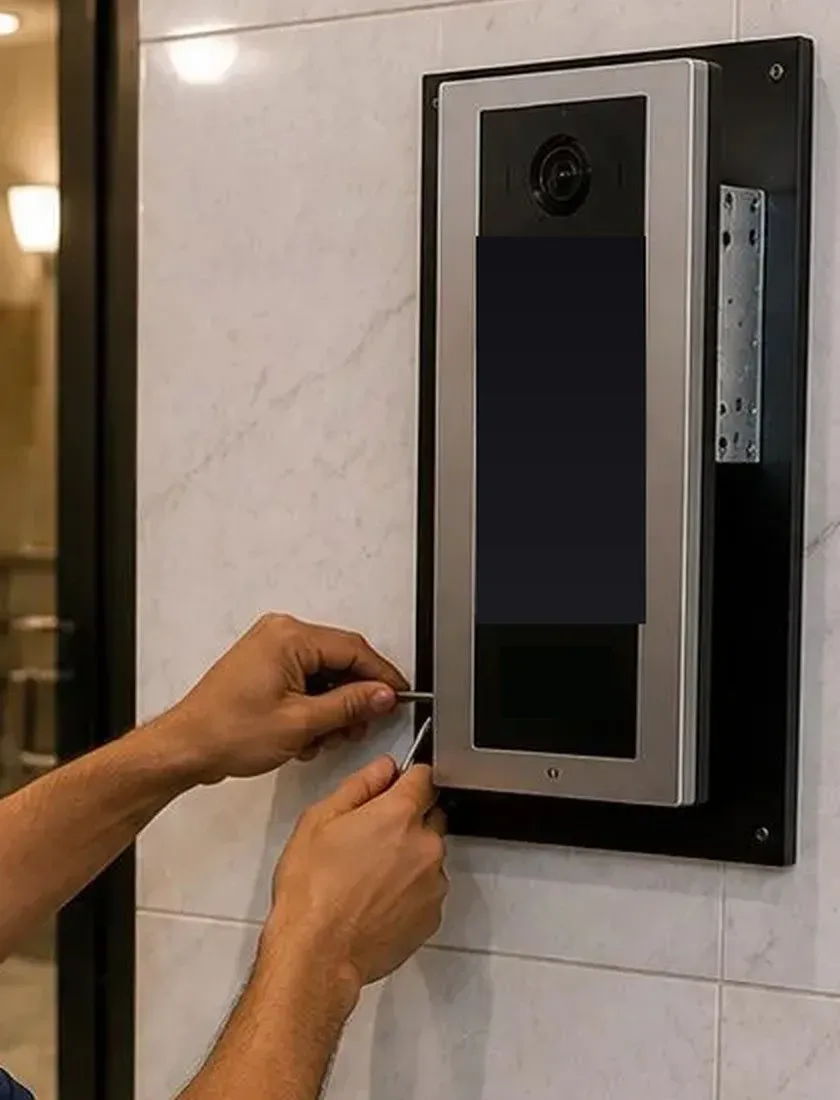
Job photo from our files: two hands seating the stainless faceplate of a video entry panel, camera lens at the top and a dark display area below, onto a black mounting plate fixed to pale marble tile beside a door frame.
Brooklyn Building Owner Request
Tell us the address, the unit count and what you need
✅
Request Sent!
Thank you. We will contact you to set up the visit.
25+
Years Experience
BK
Office on Troy Ave
100%
Licensed & Insured
4.7★
201 Google Reviews
Owner-operated since 2002 · Thousands of jobs completed · NYS low-voltage license #12000287431
The Neighborhood
Why Brooklyn Apartment Buildings Need One Security Plan, Not Five Purchases
Brooklyn's rental stock is unusually mixed, and that is the first thing an owner here has to plan around. The Citizens Housing and Planning Council, in its October 2024 look at the city's housing, notes that Brooklyn “has the most even distribution of building sizes” of the five boroughs, and that Brooklyn and Queens together hold half of all the city's housing. On one block in Bedford-Stuyvesant you can find a brownstone split into three apartments, a four-story frame building with a store underneath and a six-story courtyard building with an elevator. Each of them has a front door, a cellar, a back yard and a roof, but the way a stranger gets in, and the way an owner keeps him out, is different in every one.
What they share is the owner's position. Once three or more families live independently in a building, the state Multiple Dwelling Law treats it as a multiple dwelling (§4), and a lot of what follows for security comes with that label: locks on every apartment door under the city's Housing Maintenance Code, doors that close and latch by themselves, an entrance intercom duty under §50-a for the buildings it covers, and, if the owner adds fobs, phone keys or any other smart access, the tenant data rules of Local Law 63 of 2021. A brownstone that was a one-family house for a century becomes a rental building in that sense the day the third apartment is leased. Plenty of the Brooklyn owners who call us did not realize that the rules had changed under them.
Brooklyn also carries the city's largest regulated stock. The Independent Budget Office's May 2026 report counts about 279,000 rent-stabilized apartments in Brooklyn, more than any other borough. In those buildings, state Homes and Community Renewal treats a broken door lock as a reduction in services that tenants can file over, so any change at the entrance has to be planned so that nobody is left without a way in or a way to buzz a visitor up. And HPD wrote 1,157 Housing Maintenance Code violations mentioning an intercom in Brooklyn in 2025, according to the agency's violation data on NYC Open Data. That is second only to the Bronx, and almost every one of them started as a tenant's complaint that the owner could have heard first.
This page is for the owner of one Brooklyn building, or a handful of them, who wants to stop buying security in pieces. Managing agents who run whole portfolios will find their version on our page for property management security in Brooklyn, and owners who only need cameras should start with apartment building security camera installation in Brooklyn. Here we go through the building from the stoop to the roof, explain how the work changes between a brownstone, a walk-up, a parkway elevator building and a new tower, and show the Brooklyn prices that are already published. The citywide overview sits on our apartment building security systems hub for NYC.
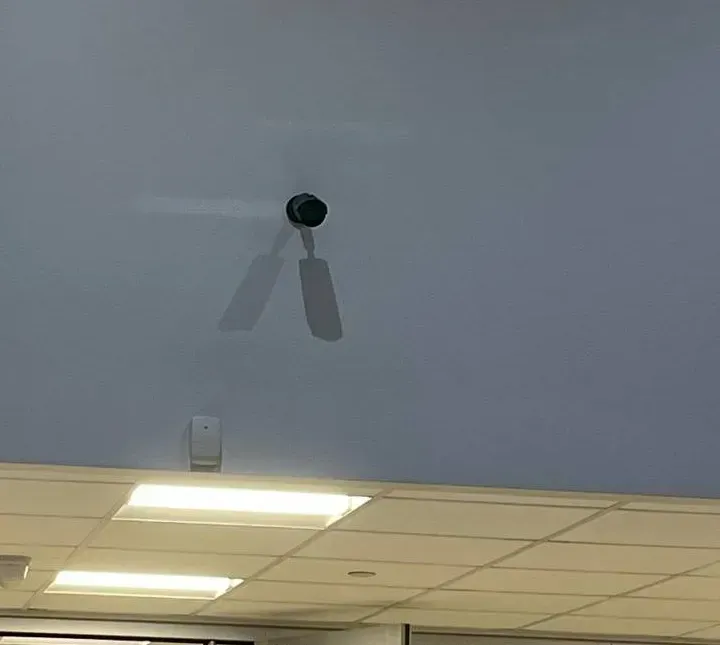
Job photo from our files: a small black camera on a short bracket near the top of a blue-painted wall, throwing two faint shadows, with a small white sensor below it and the edge of a drop ceiling with light panels at the bottom of the frame.
Brooklyn facts that shape an owner's security plan
Three families make a multiple dwelling. Multiple Dwelling Law §4(7) defines a multiple dwelling as a building occupied as the residence of three or more families living independently of each other; a class A multiple dwelling is one occupied for permanent residence.
The intercom rule has two triggers. Under §50-a, class A buildings of eight or more apartments erected or converted after January 1, 1968 need self-closing, self-locking entrance doors and a two-way voice intercom with a door release in each apartment. Older buildings must add them when the tenants of a majority of apartments request it in writing.
Brooklyn has the most rent-stabilized apartments. About 279,000, per the NYC Independent Budget Office's May 2026 report, ahead of the Bronx at 233,000.
Brooklyn ranks second for intercom write-ups. Counting 2025 Housing Maintenance Code violations whose text mentions an intercom, Brooklyn buildings drew 1,157; only the Bronx, at 1,637, had more (HPD data on NYC Open Data).
Doors have to close on their own. HPD's self-closing doors page states that apartment and hallway doors must swing closed and latch by themselves under Housing Maintenance Code §27-2041.1.
Much of the borough is landmarked. Brownstoner's list counted 33 historic districts in Brooklyn as of April 2016; Park Slope alone reached 2,853 protected buildings with that month's extension, and the Landmarks Preservation Commission added two more Flatbush districts on November 25, 2025.
The parkways are scenic landmarks. The Historic Districts Council lists Ocean Parkway, about six miles from Prospect Park toward Coney Island, as designated January 28, 1975, and Eastern Parkway, built 1870–1874, as designated August 22, 1978.
Downtown Brooklyn became a housing district. Twenty years after the 2004 rezoning, Downtown Brooklyn Partnership president Regina Myer told CBS New York in July 2024 that “there's nearly 10,000 housing units” where there had been “very, very little housing.”
North Brooklyn filled up fast. CBS New York reported in July 2025 that the 2005 Greenpoint-Williamsburg rezoning covered 175 blocks and that the 2020 census showed Williamsburg's population up 41% over the decade.
Brooklyn building
Where security usually fails first
What we fix first
Brownstone or rowhouse with 2–4 apartments
Original outer door that no longer latches; bell wiring shared by parlor and garden floors
Closer and strike on both doors, a separate call and release for each apartment
Four- or six-family walk-up
Cellar door to the sidewalk or areaway, roof scuttle or bulkhead used as a shortcut
Cellar door hardware and contact, roof door alarm, a dependable panel
Five- or six-story walk-up, 10–30 apartments
Audio intercom with half the stations dead and a tired riser
Riser test, then panel and stations or phone answering
Prewar elevator building on a parkway or avenue
Courtyard gate and lobby door on different keys; equipment in the boiler room
One credential for gate and lobby, a proper equipment space
Newer rental in Downtown Brooklyn, Williamsburg or Greenpoint
Developer's logins never handed over; monthly platform fees nobody reviews
Account takeover in the owner's name, fee review, documentation
Mixed-use building on an avenue
Store and apartments sharing a cellar or yard door
A reader or contact on the shared door, separate accounts
Start by finding out what the building actually has
A surprising number of Brooklyn owners cannot say, with confidence, what security equipment their building has. A family that has held a building since the 1980s may have three generations of buzzers in the vestibule, two of them dead and taped over. An investor who bought last spring may have inherited a camera recorder in the cellar that nobody can log into and a cloud intercom billed to the previous owner's credit card. The first useful thing we do in any building is make the list: every door that leads in, what locks it, what opens it electrically, what reports when it is opened, which cameras exist and where they record, where the power for each system comes from and who holds each login. That list, written down, is what the rest of the plan is built on, and it is often the first time the owner has seen the building's security as one thing.
Who depends on the system in a Brooklyn building
The owner who lives in the building is common in Brooklyn, especially in two- to four-family brownstones and frame houses where the owner keeps the garden or parlor floor. That owner hears every buzz that fails and every door that slams, and usually wants something simple that does not need a phone app to work.
The owner who lives elsewhere, on Long Island, in New Jersey or in another borough, needs the building to tell them when something goes wrong: a door held open overnight, a camera that stopped recording, a tenant who cannot buzz in a delivery. Remote access matters more to that owner than any single device.
The super or handyman in a Brooklyn walk-up is often part-time and shared between buildings. He needs labeled equipment, a short written guide and the ability to cancel a fob without calling anyone.
The tenants range from rent-stabilized households who have answered the same handset since the 1990s to new renters who expect the door to ring their phone. A system that serves both is usually the right one, and in a stabilized building it is often the only acceptable one.
What We Install
Apartment Building Security System Services in Brooklyn, From Stoop to Roof
The simplest way to understand a Brooklyn building's security is to walk it the way a visitor, a courier or an intruder would: up the stoop or through the gate, into the vestibule, up the stairs or the elevator, down to the cellar, out to the yard and up to the roof. Each stop below says what we look at there, what usually goes wrong in Brooklyn buildings and which of our Brooklyn service pages has the detail and the published prices. Co-op and condominium owners have their own pages for co-op security systems in Brooklyn and condo security systems in Brooklyn; this page is for buildings with one owner and tenants who pay rent.
The stoop, the gate and the outer door
Many Brooklyn buildings have two front doors: a heavy outer door at the top of the stoop or at the sidewalk, and an inner vestibule door with the mailboxes and the bell panel between them. In brownstones the outer door is often the original wood door, beautiful and badly warped, and it stopped latching years ago, so the inner door has been doing all the work. In walk-ups the outer door is usually steel or aluminum with a closer that has lost its pull. We start every building at this door, because a door that does not close and latch on its own makes everything behind it weaker. The fix is mechanical first: hinges, closer, latch and strike set so that the door closes from a foot open every time. Only then does the electric side matter. Iron gates in front of garden-level entrances and areaways get the same treatment, and a gate that closes on a spring hinge but never latches is one of the most common holes we find.
The vestibule: panel, release and mailboxes
The vestibule is where the intercom panel lives, and it is the most crowded few square feet in the building. In older Brooklyn buildings the panel is often an audio unit with a button per apartment, mounted on the wall beside a bank of brass or aluminum mailboxes, with the door release wired through a relay and a transformer in the cellar. When tenants say “the buzzer doesn't work,” the fault is in one of those places: the panel, the power supply, a relay, the riser to the apartment, the station in the apartment or the strike in the door. Our Brooklyn repair visits start with the $250 service call, and the published component prices on our Brooklyn door buzzer repair page include $250–$525 for an apartment station, $250–$475 for a door release relay or button, $325–$650 for a 24-volt transformer and $650–$1,800 for lobby panel repair or a new faceplate. The full diagnosis process is on our intercom repair page for Brooklyn.
When the panel itself is beyond saving, the choices are the same in Brooklyn as elsewhere but the answer often differs. A brownstone with three apartments rarely needs a commercial directory panel; a well-made door station with three buttons and stations or phone answering for each unit is better. A thirty-unit walk-up on Nostrand or Fifth Avenue needs a panel that can hold a directory, take a fob reader and give couriers a code. Our intercom installation page for Brooklyn covers the panels we fit and how they are priced, and the door buzzer installation page for Brooklyn covers simpler buzzer-and-release systems for small buildings.
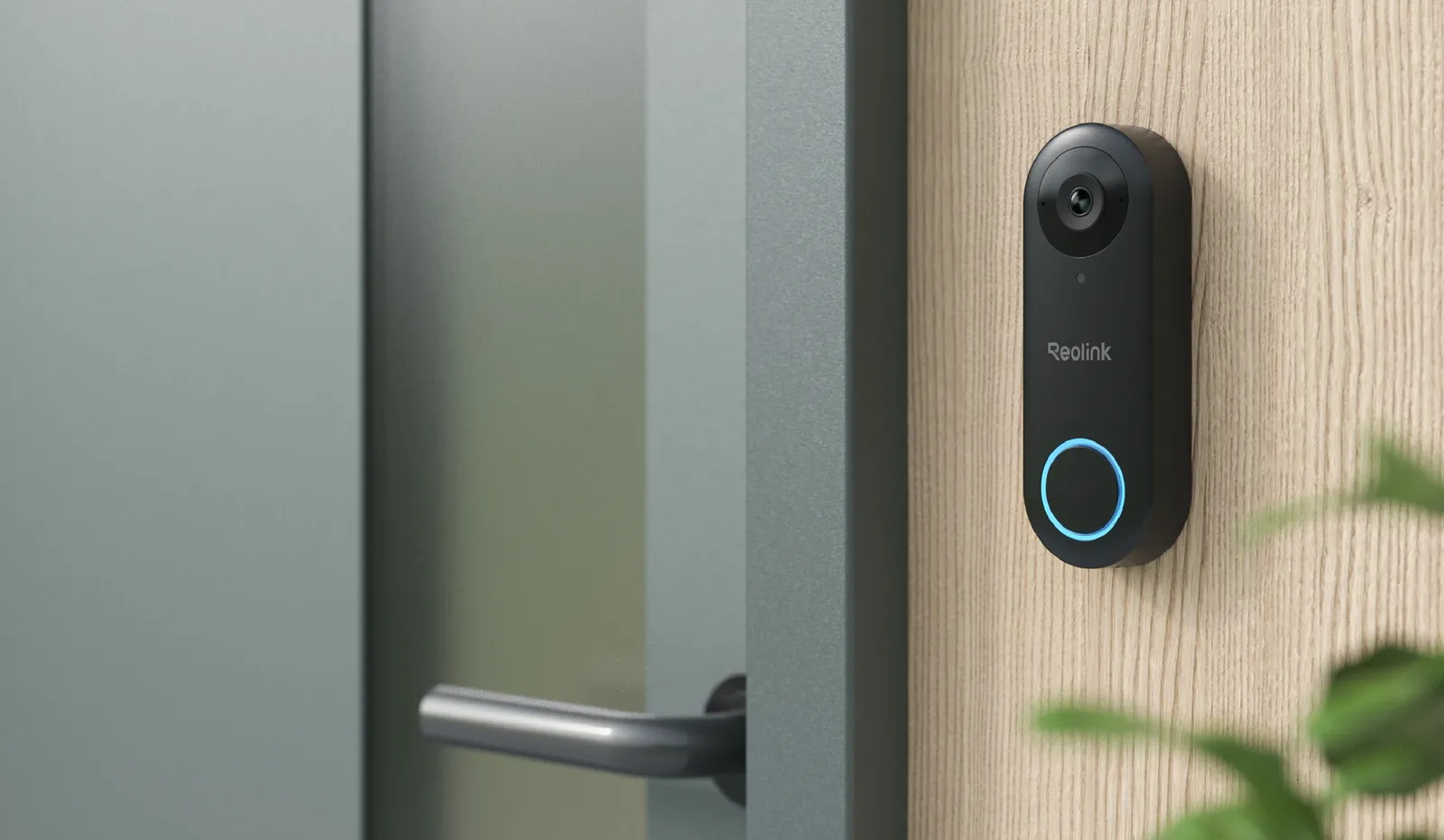
Reolink partner product photo: a black wired video doorbell with a camera at the top and a blue-lit ring button, mounted on a light wood-panelled wall beside a frosted glass door with a steel lever handle. In a two- or three-apartment brownstone, a wired doorbell station per unit can replace a multi-button panel.
The intercom riser and the apartment stations
Behind every Brooklyn intercom is a riser: the cable that runs from the cellar up through the walls to each apartment. In a brownstone it may run up a plaster chase beside the stair; in a walk-up it often follows the old gas or water lines; in a prewar elevator building it climbs a dedicated chase or the dumbwaiter shaft. Risers decide budgets. A riser that tests clean means the owner can keep it and replace only what has failed, while a riser with broken or shorted pairs means opening walls in occupied apartments, which is expensive because of the plaster and the access, not the wire. Our Brooklyn price for riser pair repair or re-termination is $850–$2,400. The alternative, in many walk-ups, is a panel that calls tenants' phones or app, so the apartment wiring no longer matters for anyone who prefers that. We test before we recommend either.
Apartment stations deserve their own decision. In buildings with long-term tenants, many of them older, a handset or video monitor on the wall is the system; asking them to answer the door with an app is not a reasonable substitute. In buildings that turned over recently, the opposite can be true and half the handsets have not been touched in years. We count, with the owner, how many apartments need a station and how many will answer by phone, and price both, so nobody pays for forty stations when twelve are needed.
Hallways and stairs
Inside the building, the security work is mostly about doors again. Apartment doors in class A buildings need a key lock, a heavy-duty latch set, a deadbolt and a chain guard under Housing Maintenance Code §27-2043, and both apartment and hallway doors have to close and latch on their own. Fire-rated stair doors in older buildings are often propped open for air in summer, which defeats them in two ways at once. We do not do locksmith work on apartment doors, but we look at the hallway doors that are part of the security system, such as the door from the lobby to the cellar stair or from the top landing to the roof, and we fit contacts and alarms to the ones that should stay shut.
Mailboxes and packages
Brooklyn vestibules were built for letters, not for a pile of boxes. In August 2025, News 12 Brooklyn reported on security video from a Crown Heights building in which a man appeared to use a child in a stroller to get a resident to let him into the lobby, checked that the area was clear, took two packages from the pile on the floor and left. Nobody broke a lock; a resident held the door for him. That is how most Brooklyn package theft works, and it is why the fix is about access and visibility rather than a doorbell camera. Owners with room for it can turn a closet or part of the cellar into a package room with its own reader; owners without room can give couriers codes that open only the vestibule, and put a camera at face height where the boxes land. In a rent-stabilized building, the change has to leave every tenant's existing way of getting mail and packages in place.
Fobs and codes for the shared doors
Keys are the oldest security problem in Brooklyn rentals. A front door key copied in the 1990s may still be on a former tenant's ring, and re-keying a building every time someone moves out costs more than most small owners will spend. A fob or code system lets the owner cancel one credential instead of changing every lock, and lets the laundry room, the cellar storage and the roof door have different rules from the front door. Our published Brooklyn price for a single-door fob reader on a vestibule door, with the reader, electric strike and wiring, is $1,500–$2,500 installed, as listed on our access control installation page for Brooklyn. Larger systems are quoted after the survey.
Smart credentials bring Local Law 63 of 2021 with them. Before collecting a tenant's credential data, the owner needs the tenant's express consent; the owner has to publish a plain-language policy; the system must be encrypted and kept up to date; authentication data has to be destroyed within 90 days unless it is anonymized; selling the data exposes the owner to statutory damages; and no tenant can be required to use the smart system to get into their own apartment. Brooklyn has a well-known example of how tenants react to biometrics: in May 2019, Legal Services NYC reported that more than 130 tenants of a rent-stabilized complex in Brownsville filed objections with the state after the owner applied to install facial-recognition entry. We recommend fobs, codes and phone keys for rental buildings, and we leave biometric entry to owners whose counsel has approved it.
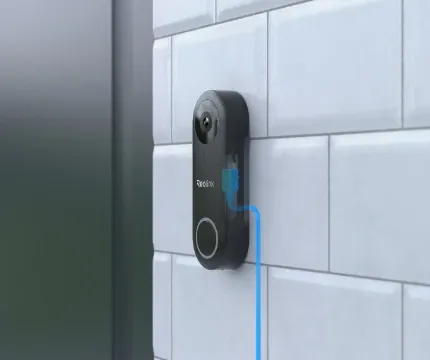
Reolink partner product photo: a black video doorbell on white wall tile beside a door frame, with a blue network cable leaving its side and running down the wall. One cable carries both power and video, which is why doorbell stations can often reuse a single new run up a brownstone stoop.
The cellar, the boiler room and the sidewalk hatch
The cellar is where Brooklyn buildings are softest. Brownstones and rowhouses have an under-stoop door into the cellar from the areaway; walk-ups often have a sidewalk hatch or steel doors that open straight onto the street; and many buildings have a rear cellar door into the yard. Behind those doors are the boiler, the meters, the building's tools and, in older buildings, copper pipe that is worth stealing. We secure the doors first, with proper hardware and a closer where the door is used, then add door contacts and a motion sensor tied to an alarm panel, and a camera on the approach rather than inside the room. Alarm installation and monitoring details are on our alarm installation page for Brooklyn, where central-station monitoring is listed at $30 a month with a keypad and $45 a month with the phone app.
The rear yard, trash and laundry
Back doors are where tenants let themselves be convenient. The rear yard door gets propped with a trash can on collection night; the laundry room door that opens onto a side passage gets wedged so people can carry baskets; the gate from the yard to the next lot has a padlock that nobody has locked since the last super left. A door position switch that warns when a door is held open, a reader on the laundry room so only residents use it, and lighting and a camera on the yard door cover most of it. A reader on the laundry door does not have to interfere with whatever card or coin system the laundry company runs inside the room; the two do different jobs.
The roof bulkhead and the scuttle
Brooklyn roofs are connected. On a row of walk-ups or brownstones, a person can walk from one end of the block to the other, and a roof door left unlocked is an entry to every building on the row. At the same time, a roof door is often a required exit, and the fire code limits how it can be secured. We use exit hardware that sounds a local alarm when the door is opened from inside, fit a contact so the super or owner is notified, put a camera on the top landing, and never padlock a door that people may need to escape through. Roof scuttles in smaller buildings get a contact and a locking hatch where the building's code compliance allows.
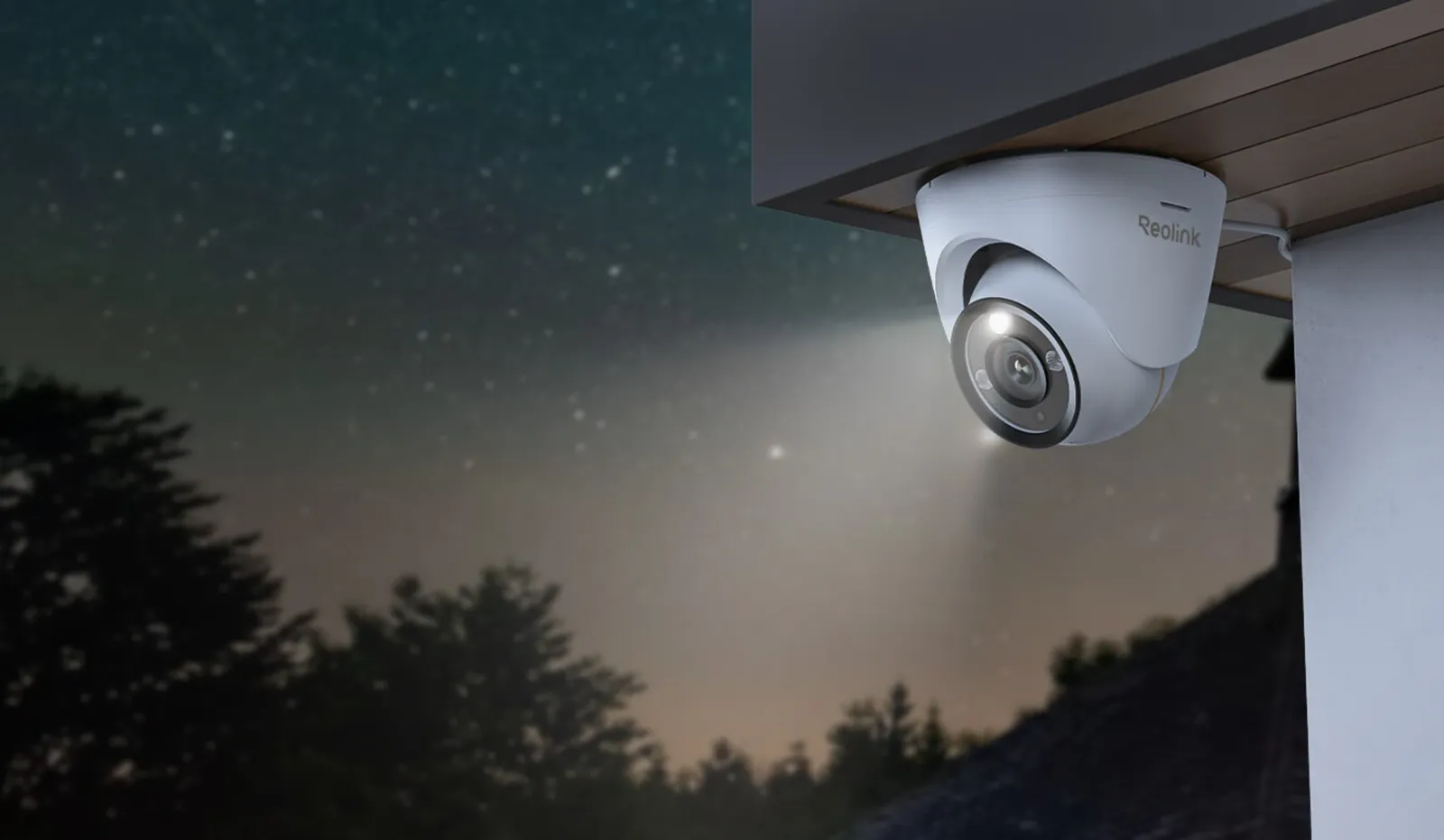
Reolink partner product photo: a white turret camera fixed to the underside of a dark eave, its lens pointed out over a night landscape of tree silhouettes under a starry sky. Rear yards and trash areas behind Brooklyn walk-ups are dark at night, so the camera's low-light performance matters more than its resolution.
Cameras where incidents happen (the short version)
In a whole-building plan, cameras follow the doors. One sees faces at the vestibule; one covers the mailboxes or package area; one watches the cellar approach and one the rear yard door; one sits on the top landing below the roof door; and in larger buildings, one more covers the laundry and the elevator lobby. That is a small system, and it is usually the right size. Four-camera systems start from $950 in Brooklyn on our security camera pricing page for Brooklyn, and the camera-specific decisions, from lenses in narrow vestibules to retention and recorder choice, are on the Brooklyn apartment building camera page.
Elevator readers in parkway buildings and new rentals
Elevator access comes up in two kinds of Brooklyn building: newer rentals with a roof deck, gym or storage floor, and older elevator buildings where an owner wants to keep non-residents from riding up after hours. We install the reader in the car and the cable to the equipment room; the building's licensed elevator agency makes the connection in the controller, and we set that visit with them. Our elevator access control page for Brooklyn lists $1,500 per car for a card, fob or code reader and $2,500 per car for biometric readers where users have agreed to them.
The equipment closet, or the lack of one
Brownstones and small walk-ups almost never have a room meant for equipment. The intercom transformer hangs on a cellar joist beside the boiler, the camera recorder sits on a shelf in the super's storage and the internet modem belongs to the garden-floor tenant. We build a small, locked, ventilated space for the building's systems, away from the boiler's heat and above any water that comes in during storms, with a battery backup, a network switch that powers cameras and readers over the same cable, and a written map of what each cable does. Low-voltage wiring under 50 volts generally needs no electrical permit in New York City under Admin. Code §28-105.4.7, with life-safety systems the exception. If a new 120-volt outlet is needed, the building's licensed electrician runs it and we connect from there. The cabling side is on our structured cabling installation page for Brooklyn.
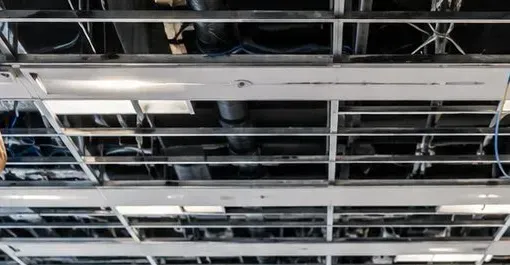
Job photo from our files: a drop-ceiling grid with most of its tiles removed, exposing the metal frame, light fixtures, ductwork and runs of cable in the space above. Cable for readers and cameras is easiest to pull while a ceiling like this is open.
Fire alarm and what stays separate
Fire alarm work follows its own approvals and is not part of the security system on this page; our fire alarm work is described on its own pages. On security jobs, we coordinate with whoever maintains the building's fire alarm so that every magnetic lock or electrified lock on a path of egress releases when the alarm activates and on loss of power, as the Building Code requires. We do not do electrical work, and we do not patch or paint walls; where a wall is opened for a riser, the owner's contractor closes it.
What we do not sell
We install and maintain equipment for the owner. We do not staff lobbies, watch cameras for the owner or sell security as a monthly service. Central-station monitoring of intrusion alarms is available on the terms listed on our alarm page. If a building already pays another company for remote attendance or monitoring, we can install the panel, cameras and door hardware that company's service uses, following that provider's documentation.
Building Specialists
Security Systems for Brooklyn's Apartment Building Types
Before we price anything in Brooklyn, we put the building into one of a handful of types, because the type tells us where cable can run, where equipment can live, how many tenants depend on an in-unit station and which rules weigh most. The descriptions below are general; every building gets its own survey.
Brownstone and rowhouse conversions
Two to four apartments behind a stoop, a garden-level door under it, plaster walls and a cellar. Usually below the eight-unit line in §50-a, but a multiple dwelling once three families live there.
Four- and six-family walk-ups
Brick or frame buildings in Bushwick, Sunset Park, Greenpoint and Bed-Stuy, often with a store below and a cellar door to the sidewalk.
Five- and six-story walk-ups
Ten to thirty apartments, a long stair, a roof bulkhead and an audio intercom that has been patched for decades. The riser test decides the budget.
Prewar elevator buildings
Courtyard and corridor buildings along Ocean Parkway, Eastern Parkway, Flatbush, Crown Heights and Prospect Lefferts Gardens, with gates, lobbies and long service corridors.
Postwar complexes
Larger brick buildings and multi-building sites in south and east Brooklyn, with several entrances, parking and a management office that wants one system across them.
New rental towers
Downtown Brooklyn, the Williamsburg and Greenpoint waterfront and the avenues in between: platform intercoms, fob systems and amenity floors chosen by the developer.
Mixed-use avenue buildings
Apartments over stores on Fifth Avenue, Nostrand, Flatbush Avenue, Knickerbocker and Kings Highway, sharing a cellar or yard with the commercial tenant.
Buildings in historic districts
Park Slope, Fort Greene, Clinton Hill, Brooklyn Heights, Crown Heights North, Bedford-Stuyvesant and more, where facade equipment follows Landmarks Preservation Commission rules.
Brownstone conversions: two doors, two floors, one stoop
A brownstone that has been divided into apartments usually has the parlor floor and the floors above reached from the stoop, and the garden apartment reached from a door under the stoop. The two entrances are often wired to one old bell transformer in the cellar, so a fault in one apartment's bell can take out the others. The work in a brownstone is small in equipment and large in care: a door station or a small panel at the top of the stoop, a separate station at the garden door if that apartment has its own entrance, stations or phone answering in each unit, and a strike and closer on the outer door that work with the original wood rather than against it. Cable goes up the existing chase where there is one; where there is not, we route through closets and the cellar ceiling and tell the owner beforehand if any of it will show.
Four- and six-family walk-ups
The small walk-ups that fill much of north and central Brooklyn are some of the hardest buildings to keep secure because there is so little between the street and the apartments. The front door opens to a narrow hall and the stair; the cellar door often opens straight onto the sidewalk or the areaway; and the roof is shared with the rest of the row. These buildings rarely need a big system. They need a front door that latches, a panel the tenants can rely on, a cellar door with real hardware and a contact, an alarm on the roof door and one or two cameras. Many of them are owner-occupied, and the owner is the one answering the complaints.
Five- and six-story walk-ups
Taller walk-ups, with ten to thirty apartments, are where intercom violations pile up. The audio system is often decades old; a few stations were replaced with whatever was available; the riser has been spliced in the cellar more than once. The plan almost always starts with a test of the riser from the cellar to each floor. If most pairs are good, the owner can keep the riser, replace the panel and the failed stations and be done. If they are not, a panel that calls tenants' phones, plus stations only for the tenants who need them, is often cheaper and less disruptive than opening walls on every floor. Either way, the vestibule door, the roof door and the cellar door get the same attention as in a smaller building.
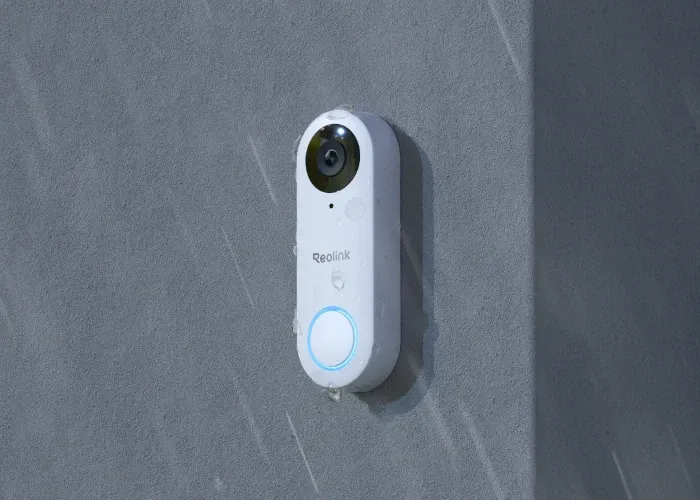
Reolink partner product photo: a white wired video doorbell with a round camera lens and a blue-lit button, mounted on a grey textured wall with rain streaks around it. A separate station like this suits a garden-level apartment door under a Brooklyn stoop.
Prewar elevator buildings off the parkways
The six-story elevator buildings that line Ocean Parkway, the blocks off Eastern Parkway and much of Flatbush and Prospect Lefferts Gardens were built for a doorman era that ended long ago. Many have a courtyard with a street gate, a lobby with an original panel opening, a long service corridor to the rear, a cellar laundry and a boiler room that the super treats as an office. The security work here is about consolidation: one credential that opens the courtyard gate and the lobby door, a reader on the laundry and the cellar corridor, door contacts on the service and roof doors, and an equipment space that is not the boiler room. Cable follows the old dumbwaiter shafts and service chases where they exist. These buildings often have a large share of long-term, rent-stabilized tenants, so in-unit stations stay.
Postwar complexes and large rentals
South and east Brooklyn have larger postwar rental buildings and multi-building sites, from six-story brick buildings in Sheepshead Bay and Bensonhurst to complexes in East New York and Canarsie. They bring more entrances, parking areas, sometimes a management office on site and a need to change fobs across several buildings at once. The plan for them looks more like a small campus: one access platform, one recorder or one video system across the site, consistent hardware on every door and a schedule that changes one building at a time.
New rental towers: inheriting the developer's choices
Downtown Brooklyn went from “very, very little housing” to nearly 10,000 housing units in the twenty years after its 2004 rezoning, in the words of the Downtown Brooklyn Partnership's president, and the Williamsburg and Greenpoint waterfront filled with new rentals after 2005. Owners who buy or refinance these buildings rarely face broken hardware. They face a system they did not choose: a platform intercom with a per-unit monthly fee, a fob system whose administrator was the developer's integrator, cameras recording to a server nobody has the password for. Our work in those buildings starts on paper, by finding out which accounts exist, who controls them, which licenses the owner actually holds and what each one costs a month. Only then do we decide what stays.
Rent-stabilized buildings: changing the entrance without a gap
With roughly 279,000 rent-stabilized apartments in the borough, a lot of Brooklyn security work happens in regulated buildings. New York State Homes and Community Renewal says owners “are required to maintain all required services and equipment in good working order,” and lists broken door locks among the decreases in service tenants can complain about, apartment by apartment or building-wide. In practice that means three things on our jobs. The new entry goes in beside the old one and switches over in a short window, so there is never a night without a door release. Every tenant who answers the door with a handset keeps a handset or gets a station; nobody is moved to an app against their wishes. And if the owner wants to change what the building provides, rather than repair or upgrade it, that is a question for HCR and counsel before it is a question for us.
Historic districts and landmarked facades
Brooklyn has more historic district fabric than most owners realize: Brownstoner's 2016 list counted 33 districts in the borough, including Brooklyn Heights (1965), Fort Greene (1978), Prospect-Lefferts Gardens (1979), Clinton Hill (1981), Greenpoint (1982) and three phases of Crown Heights North, and the commission has designated more since. In those districts, an entry panel, a camera or a new light on the front of a building is facade work. The Landmarks Preservation Commission's permit guidebook allows staff-level permits for intercom panels set within or beside the door opening and limits how many cameras a facade can carry. The owner files; we design to those locations and supply cut sheets for the application, and we install after the permit issues. In a brownstone, the best answer is often to put the panel in the vestibule behind the outer door, where it is protected from weather and out of the commission's view.
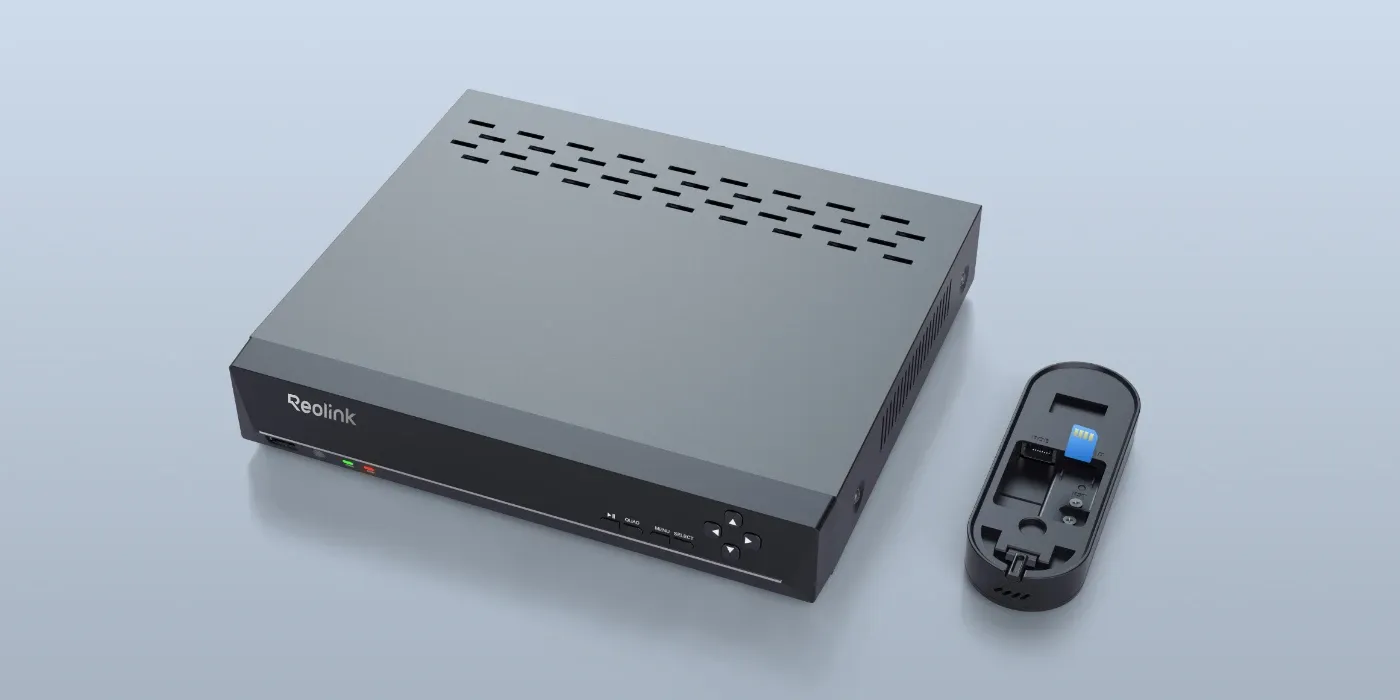
Reolink partner product photo: a grey network video recorder with a vented lid and front status lights, shown on a pale surface beside a black video doorbell lying on its back. Door stations and cameras on one recorder means one place to look when a tenant reports a problem.
Mixed-use buildings on the avenues
Apartments over stores are everywhere in Brooklyn, from Fifth Avenue in Park Slope and Sunset Park to Nostrand, Flatbush and Knickerbocker Avenues. The store tenant usually has its own alarm and cameras, installed by its own vendor, and sometimes a camera pointed at the residential entrance. The residential side needs its own entry, its own fobs and its own recorder, under the owner's account. Where the two share a cellar, a rear yard or a trash area, a reader or a contact on the shared door, and a written agreement about who can see which cameras, keeps the two sides apart.
For Owners & Investors
Buying, Inheriting and Upgrading a Brooklyn Apartment Building
Before you close: the security questions to ask
Brooklyn buildings change hands in a few common ways: a family sells a building it has held for forty years, an investor buys from another investor, or a developer sells a finished rental. Each leaves different surprises. A long-held family building may have systems that work but are undocumented and old enough that parts are hard to find. An investor-held building may have had cheap repairs layered on top of each other. A new building may have excellent equipment and no way for the buyer to log into it. Before closing, a buyer should know what is installed at each entrance, whether it works, who holds the admin logins, which services carry a monthly contract that will pass to the buyer, and whether HPD has open violations at the address that mention the intercom, the entrance door or the locks. HPD's public records answer the last question for any address, and a short walk-through with us answers most of the rest.
The family building passing to the next generation
A common Brooklyn call comes from the adult child of an owner who has died or stepped back: the building is theirs now, the tenants have their number and nobody knows how the buzzer works. We treat that like a takeover. We make the list of equipment and logins, find out which old vendor accounts are still active, move what can be moved into the new owner's name, and write down what we found. Often the equipment is fine and the owner just needs to know how it works and who to call; sometimes the building has been running on borrowed time and the list becomes a plan.
Taking control of accounts after a purchase
In a newer building, the first month after closing is when access is easiest to recover, because the seller and the seller's vendors still answer the phone. We help the new owner request the transfer of each cloud account, the fob system's admin rights and the camera system's credentials, and where a manufacturer requires proof of ownership to reset an account, we tell the owner exactly what that maker asks for. Until the owner controls every account, we advise against buying new equipment for the system.
Converting a house to apartments, or adding units
Brooklyn owners regularly convert one- and two-family houses into three or more apartments, or add a unit in a cellar or attic where the rules allow. The security system should be planned with the conversion, not after it. Once the building houses three families, it is a multiple dwelling under §4 of the Multiple Dwelling Law, with the lock and door rules that come with that. At eight apartments in a building converted after 1968, §50-a requires the self-locking entrance and the two-way intercom with a release in each unit. Running cable while the walls are open costs a fraction of doing it later.
Renovations and the right time to pull cable
Gut renovations, lobby refreshes and apartment turnovers are the best moments to fix a building's security wiring. If the owner tells us early, we mark with the general contractor where the entry panel, readers, door contacts, cameras and equipment space will go, pull cable and leave it coiled and labeled, and install devices after the finishes. A vacant apartment is also the easiest place to run a new riser leg. Owners who do one apartment at a time as leases turn over can pre-wire each unit as it comes up and switch the whole building over once enough are done.
Planning the budget over several years
After the survey, the owner gets a written list of every opening, what is there, what condition it is in and what we recommend, with the cost on each line. That list sorts itself into years. Open HPD violations and doors that do not latch come first. Equipment that can no longer get parts comes next. Systems that work but cost too much to run, such as a per-unit platform fee for a panel tenants barely use, come after that. Each year's work then fits into the same plan, so the building ends up with one system rather than a collection of them. Financing is available through Wisetack, subject to approval.
Paperwork for owners and owning entities
Brooklyn buildings are owned by individuals, family LLCs and investment entities, and we work with all of them the same way: a written scope, our service agreement with the full terms, a W-9 for our contracting entity on request, and an invoice with an online payment link. Company owners can also pay by check. When a lender or an insurer needs a certificate of insurance naming additional insureds, our insurer issues it to the exact wording once the job is awarded.
Tenant notices and apartment access
Any work that needs us inside apartments, such as stations, riser repairs or new cable, depends on the owner's notices to tenants and on the access rules the city sets for repairs and improvements. We give the owner a list of the apartments we need, how long we expect to be in each and what we will be doing there, so the notice can say it plainly. Entrance changeovers are scheduled for short windows and announced in the lobby ahead of time. In buildings where many tenants speak a language other than English, owners often post the notice in more than one language; we keep our part of it short and specific so it translates cleanly.
Your Questions Answered
Apartment Building Security Systems in Brooklyn: Owners' Questions
Brownstones and small walk-ups
Our brownstone's stoop door is the original wood door. Can it take an electric strike without being replaced?
Usually yes, if the door and frame are sound. We check that the door hangs true, that the hinges are tight and that the frame has enough solid wood behind the latch side for a strike body. Old doors that have shrunk or swelled get the hinges and the closer set first, then the strike is mortised into the frame and the latch adjusted to meet it. A door that has rotted at the latch side needs a carpenter before it needs us, and we say so rather than fitting a strike that will pull out.
How do you give the parlor-floor and garden-floor apartments each their own door release?
In many brownstones the garden apartment has its own door under the stoop and the upper apartments share the stoop entrance. We give each entrance its own call point and wire each apartment's release only to the door that apartment actually uses, so the garden tenant cannot buzz people into the main hall and the parlor tenant cannot open the garden door. If the two entrances share an old bell transformer in the cellar, we separate their power so that a fault at one door does not silence the other.
How do you secure a six-family walk-up whose cellar opens straight onto the sidewalk?
Sidewalk cellar doors and hatches are the weak point of many Brooklyn walk-ups, because they are out of sight of every apartment and are opened by oil, utility and trash workers. We fit hardware that locks the doors from inside, a door contact on an alarm panel that reports every opening, and a motion sensor in the cellar for nights and weekends. A camera on the cellar stair or the inside of the hatch shows who came in. Utility and delivery workers who need regular access get a schedule or a code, not a key that walks away.
Parkway and prewar elevator buildings
Can a new entry panel fit the opening left by the original lobby panel in a prewar building?
Often, with an adapter plate or a custom back box. Prewar lobby panels were usually recessed into stone or plaster in a size no current product matches, so we measure the opening, choose a panel that fits within it or slightly over it, and make up the difference with a plate finished to match. That avoids cutting new stone and keeps the lobby looking like itself. If the building is in a historic district and the panel is on the exterior, the same opening matters for the Landmarks Preservation Commission permit.
How do the courtyard gate and the lobby door end up on one credential?
Many courtyard buildings have a street gate on one key and a lobby door on another, and tenants carry both. We put a reader on the gate and one on the lobby door, both on the same controller, so one fob or code opens both; visitors call from a panel at the gate and the tenant releases both doors in sequence. Cable to the gate goes underground or along the courtyard wall in conduit, and the gate's own hardware gets attention first, because a reader on a gate that swings open in the wind does nothing.
Is it worth moving a building full of long-term tenants from keys to fobs?
Usually yes for the shared doors, and the reason is the keys already in circulation. In a building where tenants have lived for decades, nobody knows how many front door keys exist. Fobs on the street door, the laundry and the cellar let the owner cancel lost credentials and see which ones are used. Tenants keep mechanical keys to their apartments, which Local Law 63 protects, and the owner collects written consent and publishes the privacy policy before switching on the system. We hand fobs out with the super present, and we leave the old cylinder in place on the front door for a short overlap so nobody is locked out on the first night.
Newer rental buildings
How do we take control of a newer building when the developer's installer has stopped answering?
Start with what the owner already has: the closing documents, any equipment lists from the construction team and the logins in the building's management software. We inventory the devices on site, read model and serial numbers, and contact each manufacturer or platform with the owner's proof of ownership to transfer or reset the administrator account. Hardware is rarely the problem. Once each system is in the owner's name, we document it and the owner decides what to keep.
Can a building leave a per-unit cloud intercom plan without replacing everything?
Sometimes. It depends on whether the panel can run on another platform or locally, what the contract says about the term and the hardware, and whether the building's readers are tied to the same platform. We read the contract with the owner, check the equipment and price two paths: staying with renegotiated terms, or moving to a system with no per-unit fee. Over ten years the fee is often the largest number in the comparison.
Money, records and running the building
Why can two Brooklyn walk-ups with the same number of apartments get very different quotes?
Because the apartment count is not what drives the cost. The riser's condition, the number of doors that need hardware or readers, whether the walls are plaster or drywall, whether there is a chase or the cable has to be surface-mounted, whether the building is in a historic district, and how many tenants need an in-unit station all move the number more. Two twelve-unit buildings on the same block can differ by thousands of dollars because one riser tests clean and the other does not.
Our yard backs onto the yards of the next block. How do we stop people coming over the rear fence?
Brooklyn rear yards form long interior blocks, and a low fence lets anyone walk from one end to the other. Start with the building side: a rear door with a closer and a lock that latches every time, a contact that reports when it opens and lighting on the door. Then a camera aimed along the fence line and at the door, so the recording shows both the approach and the entry. Raising or replacing the fence is the owner's carpenter's job; we cover the openings into the building.
Our roof connects to the rest of the row. Can we stop people coming down through our bulkhead?
Yes, within what the fire code allows for a roof exit. The bulkhead door gets hardware that locks from the roof side and still opens freely from inside, a contact that sounds a local alarm and notifies the owner or super when it opens, and a camera on the top landing. Where the roof door is not a required exit, a stronger lock is possible; where it is, the alarm and the camera do the work, because a padlock on an exit is never the answer.
We own two small Brooklyn buildings a few blocks apart. Should they share one system?
They should share one platform, not one box. Each building keeps its own panel, controller and recorder on its own power and internet line, so a fault in one does not affect the other. Using the same equipment and the same management app in both means one login for the owner, one set of fobs the super understands and spare parts that fit either building.
Equipment
Types of Security Equipment for Brooklyn Apartment Buildings
Door stations and panels
One- to four-button stations for stoops and garden doors; directory panels with a keypad and reader once a walk-up passes a dozen units.
In-apartment stations
Wall handsets and small screens in the kitchen or hall of each unit, kept in place for long-time tenants even when newer neighbors answer by phone.
Strikes, mag locks and closers
Strikes cut into original oak and steel frames, mag locks on aluminum lobby doors, and closers sized to pull a heavy stoop door shut against the wind.
Readers and fobs
Weatherproof readers for iron gates and stoop doors, indoor readers for laundries and storage, and phone keys for owners who live elsewhere.
Alarm panels and contacts
A keypad by the cellar stair, contacts on sidewalk hatches and bulkhead doors, and motion sensors where copper and tools are stored below grade.
Cameras and recorders
Small domes sized for four-foot vestibules, turrets for dark yards, and one recorder in a locked closet that the owner checks from anywhere.
Elevator readers
A reader in the cab of a parkway building or a new tower, connected inside the controller by the elevator company on a joint visit.
Network and backup power
Labeled Cat6 home runs, a powered switch, a battery that rides through outages and a wall-mounted cabinet off the cellar floor.
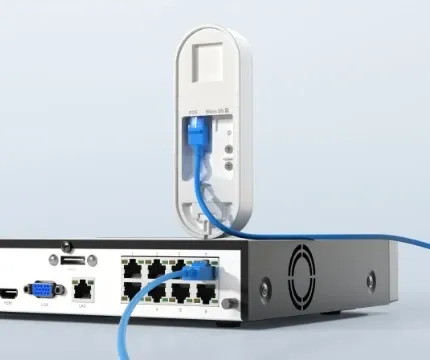
Reolink partner product photo: the back of a white video doorbell with a blue network cable plugged into it, the cable running to one of the network ports on the rear panel of a black recorder, beside its video outputs and fan. Power and video travel on the same cable from the equipment space to the door.
Choosing between the main options in a Brooklyn building
Decision
Option A
Option B
What usually decides it in Brooklyn
Door station per unit vs one panel
Stations: simple, suits 2–4 units and separate garden doors
Panel: directory, reader and courier codes in one place
Number of apartments and entrances; whether the vestibule has room.
Keep the riser vs phone answering
Keep: least disruption when the riser tests well
Phone answering: no apartment wiring needed
Riser test, plaster condition and how many tenants want a handset.
Electric strike vs mag lock
Strike: suits original wood doors and keeps the key working
Mag lock: suits glass and aluminum doors with no strike room
Door construction, egress rules and the fire alarm tie-in.
Local vs cloud access control
Local: no monthly fee, managed on site
Cloud: owner manages from anywhere
Whether the owner lives in the building and the ten-year fee.
Recorder vs cloud video
Recorder: one-time cost, keeps recording if the internet drops
Cloud: no box in the cellar, fee per camera
Camera count, the building's internet line and where the box can live.
Partner brands and our own system
For cameras, we are an authorized partner for Lorex, Luminys and Reolink, and our default quote for a building is our own non-branded camera system. We install other makers' equipment when an owner asks for a specific brand, and we install entry panels, readers and alarm equipment from the manufacturers that suit the building. Consumer doorbells and camera kits built for single houses tie every device to one person's phone and rarely allow separate access for the owner and the super; they can work for a two-unit brownstone, but they are the wrong tool for a walk-up or an elevator building.
Want the Whole Building Planned, Not Just the Buzzer?
Brownstone, six-family or parkway elevator building: tell us which, and where it lets you down. You get every door on paper, ranked by what to fix first.
What AI Gets Wrong About Apartment Building Security Systems in Brooklyn
Brooklyn owners now often arrive with an answer from a chatbot or a search summary. Those answers are stitched together from national buying guides and product marketing, and they miss how Brooklyn's buildings and the city's rules work. These are the claims we hear most from Brooklyn owners, with what we see in their buildings instead.
1. “A brownstone is a house, so house security is enough”
A brownstone looks like a house, and if one family lives in it, it is one. Once three families live in it independently, the Multiple Dwelling Law calls it a multiple dwelling, and the Housing Maintenance Code's rules on apartment locks and self-closing doors apply.
Consumer kits built for houses assume one family, one phone and one account. In a three- or four-unit brownstone, each apartment needs its own call and release, the owner needs to control the system without borrowing a tenant's phone, and the outer door needs to lock itself.
A converted brownstone needs a small building system, even if every part of it is modest.
2. “Every Brooklyn landlord has to install a video intercom”
Read §50-a of the Multiple Dwelling Law and the word “video” never appears. What it asks for is voice: a two-way intercom from each apartment to the entrance, plus a release, in the class A buildings it covers.
Video is often worth having, especially in buildings with package problems, but owners of older walk-ups sometimes replace a working audio system with a video one believing the law requires it, and then discover that half the tenants cannot use the new app.
The legal minimum is a working voice path and release to every covered apartment and a door that locks itself; anything above that is a choice the owner should make on its merits.
3. “A new building's security system is already set up for the owner”
The equipment in a new Downtown Brooklyn or waterfront rental is usually good. The administration often is not in the owner's hands: the platform account is in the developer's or integrator's name, the fob software runs on a laptop that left with the construction team, and the camera server's password was never written down.
Owners discover this the first time they need to cancel a credential or pull footage. Until then, the system appears to work.
The first job in a newer building is administrative: transfer every account to the owner, list every recurring fee and write down what is installed.
4. “Buildings on Ocean Parkway and Eastern Parkway are landmarks, so nothing can go on them”
Ocean Parkway (1975) and Eastern Parkway (1978) are scenic landmarks. As the Historic Districts Council describes them, the designations concern the parkways themselves: the roadways, malls, walks and plantings that Olmsted and Vaux laid out.
Whether a building facing a parkway is regulated depends on whether it is an individual landmark or sits inside a historic district, such as the Crown Heights North districts near Eastern Parkway. Many buildings on the parkways are in neither.
Check the commission's map for the address before ordering facade equipment; where the building is regulated, design to the permit guidebook's limits and file before installing.
5. “Package thieves only get in when a door is left open”
Most Brooklyn package theft we hear about involves no broken door. In the Crown Heights case News 12 Brooklyn reported in August 2025, the man was let into the lobby by a resident and walked out with two packages from the pile.
A door that locks perfectly does not help when the boxes are sitting inside it in plain view and someone holds the door for a friendly stranger.
What helps is moving packages out of the open lobby, giving couriers codes that open only where they need to go, and a camera at face height on the vestibule, so a tenant who is tailgated knows it will be seen.
6. “Fob logs let a landlord keep track of tenants”
A fob system does log which credential opened which door, and that log is useful for a theft from the laundry room or a door held open at night. But in a class A building in New York City, Local Law 63 of 2021 governs the data behind it.
The owner needs the tenant's express consent before collecting credential data, must publish a plain-language policy, must keep the system encrypted and current, must destroy authentication data within 90 days unless it is anonymized, and cannot sell it without exposing the building to statutory damages of $200 to $1,000 per sale.
Use the log to investigate incidents at shared doors, write the privacy policy with counsel before switching the system on, and keep the apartment door on a mechanical key.
7. “A rent-stabilized building can't change anything at the entrance”
Owners of stabilized buildings upgrade entrances regularly. What they cannot do is leave tenants with less than they had: HCR expects required services and equipment to be kept in good working order and treats broken locks as a decrease in services.
Problems start when an upgrade removes something tenants relied on, such as a handset, a key or a way to buzz in a visitor without a smartphone, or when the new system collects data tenants object to, as the Brownsville facial-recognition dispute showed in 2019.
Keep every tenant's way of answering and opening the door, switch over without a gap, and ask HCR and counsel before changing what the building provides.
Get In Touch
Request an Apartment Building Security Survey in Brooklyn
Tell us the address and neighborhood, the number of apartments and entrances, what is at the door now and what keeps failing. Photos of the vestibule panel, both sides of the front door, the cellar door and wherever the equipment lives help us plan the visit. For one repair, the address and the symptom are enough. Prefer to talk? Call (347) 934-8335.
✅
Request Sent!
Thank you. We will contact you to set up the visit.
How It Works
How a Brooklyn Apartment Building Project Runs
1
Call or request
You call or use the form with the building, how many units, what is wrong and who holds the keys; the visit gets a two-hour arrival window.
2
Repair visit or building walk
Fixing one fault is a $250 service call. Planning the building means walking the stoop, cellar, riser, yard and roof, and photographing each.
3
Written plan
Each door gets a line showing parts, labor and monthly costs, with risks like a weak riser pair named up front, not discovered later.
4
Approval and deposit
Once you sign off and the deposit is in, we order. Items made to order get their date when they land in our hands, not before.
5
Notices and permits
The owner sends tenant notices and, in a historic district, files with the Landmarks Preservation Commission using our cut sheets.
6
Install and switchover
The new panel is live next to the old before cutover; the front door moves first, then apartments floor by floor, then the back-of-house devices.
7
Handover
You walk away holding every password, a drawing of where things are and a super who has been shown how to run it day to day.
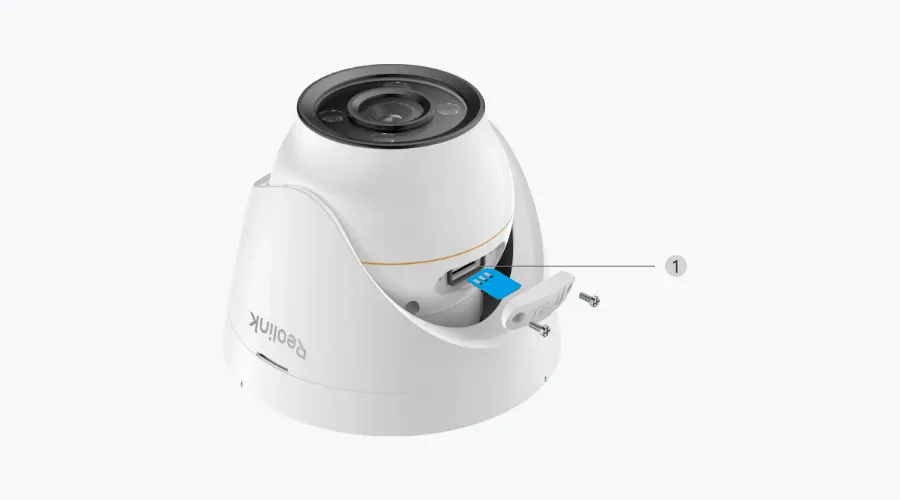
Reolink partner product photo: a white turret camera tilted on its base, with a small blue memory card going into a slot on the side of the housing and a numbered callout pointing to the slot. Local storage in the camera can keep recording if the cable to the recorder is cut.
Field notes: the first hour in a brownstone conversion
In a brownstone, we start on the sidewalk and look at the stoop door before ringing anything. If the outer door has been left unlatched for years, the inner door's strike has usually been worn out by taking every slam. Then we go under the stoop to the garden door and into the cellar, find the bell transformer, and trace which wires go up and which go to the garden apartment. More than once we have found that the garden apartment's bell was wired in parallel with the parlor floor's, so both rang at once and both released the main door. Fixing that takes an hour. Finding it takes knowing to look.
Field notes: a six-story courtyard building off a parkway
In a prewar courtyard building, the useful walk goes from the street gate across the courtyard, through the lobby, down the service corridor to the cellar and the laundry, and up the stair to the roof. Gates in these buildings are often the original iron, on hinges that have dropped, so the latch misses. The lobby panel is recessed in stone. The riser climbs a chase that also holds abandoned telephone and cable TV wiring, and the intercom pairs have been re-labeled by hand by three different supers. We test every floor from the cellar before writing anything down, because the riser decides whether the plan is a panel swap or a building-wide project.
Field notes: the switchover day in an occupied walk-up
The day the old intercom comes out is the day the owner hears from every tenant, so we plan it to be uneventful. The new panel is mounted and powered beside the old one in advance. Names and apartment numbers are loaded and checked against the owner's rent roll. On the day, we move the door release over first, test it from the panel and with a fob, then move the apartments over floor by floor, testing each station or phone as we go. The old panel comes off the wall last. Tenants who were not home get a slip under the door explaining how the new system works.
How long the work takes
Most repairs are finished on the first visit, or on a second visit when a part has to be ordered. A new door station system in a brownstone is usually a day on site once the equipment is in. A panel on an existing riser in a walk-up is typically a day, plus apartment visits for any stations. A whole-building entry, fob and alarm project in a prewar elevator building runs over several days, scheduled around tenant access, and we give the owner a schedule with the written plan rather than a promise before we have seen the building.
Coverage Area
Apartment Building Security Systems Near Brooklyn Landmarks
Use these as reference points for where we work in the borough. None of them is a client, and we keep the addresses of the Brooklyn buildings we serve private.
Ocean Parkway
About six miles of Olmsted and Vaux parkway from Prospect Park toward Coney Island, designated a scenic landmark on January 28, 1975, according to the Historic Districts Council. We work in apartment buildings along its length and on the blocks beside it.
Eastern Parkway
Built from 1870 to 1874 and designated a scenic landmark on August 22, 1978; the Historic Districts Council notes that it drew the Brooklyn Museum, the Botanic Garden and the Brooklyn Public Library to its route.
Park Slope
Park Slope reached 2,853 protected buildings when its second extension was designated in April 2016, according to the Landmarks Preservation Commission; brownstone conversions there need permit-aware facade work.
Crown Heights North
Designated in three phases, in 2007, 2011 and 2015, according to Brownstoner's list of Brooklyn historic districts; it lies just north of Eastern Parkway.
Downtown Brooklyn
Rezoned in 2004 and now home to nearly 10,000 housing units, according to the Downtown Brooklyn Partnership, most of them in new rental towers.
Williamsburg and Greenpoint waterfront
The 2005 rezoning covered 175 blocks, and Williamsburg's population grew 41% in the decade to the 2020 census, as CBS New York reported in 2025; Greenpoint's historic district dates to 1982.
Prospect Lefferts Gardens
Designated a historic district on October 9, 1979, per Brownstoner's list, and surrounded by blocks of rental buildings in Flatbush and Crown Heights.
Spring Creek Towers
East New York's large rental site, which its operator’s website calls “a 5,881 apartment rental complex”; sites of this size need fob changes rolled out tower by tower.
How apartment buildings differ across Brooklyn
North Brooklyn, from Greenpoint and Williamsburg through Bushwick, mixes frame and brick four- and six-family buildings, many with a store or a workshop below, with new rental buildings near the waterfront and along the L train. Sidewalk cellar doors, shared roofs and inherited cloud systems are the usual issues.
The brownstone belt, from Brooklyn Heights, Cobble Hill and Carroll Gardens through Fort Greene, Clinton Hill, Park Slope and Bedford-Stuyvesant, is mostly rowhouses converted to two to four apartments, with landmark rules on many blocks. Work here is small in scale and careful with original doors and stoops.
Central Brooklyn, through Crown Heights, Prospect Lefferts Gardens, Flatbush and East Flatbush around our Troy Avenue office, has the highest concentration of prewar elevator and courtyard buildings and a large rent-stabilized stock. Risers, gates and in-unit stations dominate.
South Brooklyn, along Ocean Parkway and through Midwood, Kensington, Bensonhurst, Bay Ridge, Sheepshead Bay, Brighton Beach and Coney Island, has prewar and postwar elevator buildings, many with long-time tenants, plus two-family houses that have become rentals.
East Brooklyn, through Brownsville, East New York and Canarsie, has larger rental complexes, low-rise multifamily rows and attached houses, where multi-building fob changes and yard and parking coverage come up most.
Pricing
Apartment Building Security System Cost in Brooklyn
Every price below is already published on one of our Brooklyn pages. Whole-building systems are quoted after the walk-through, because the riser, the doors and the number of apartments that need stations move the total more than anything else, and we do not publish a per-apartment price for whole buildings.
Work
Published Brooklyn price
Where it is published
Service call with on-site diagnosis
$250; on a bigger job, the $250 goes toward the total
The riser comes first: if it tests clean, a building keeps it and the project stays small; if it does not, the plan changes. Then the number of controlled doors, because every reader, strike, contact and camera is its own line. Then the doors themselves: an original wood brownstone door, a steel cellar door and an aluminum storefront-style lobby door each need different hardware. Walls matter in Brooklyn more than most places, because plaster and brick slow every cable pull and occupied apartments add access time. Historic district permits add a step before installation. And recurring fees, for a cloud platform, a monitored alarm or an internet line, belong in the comparison over years, not months.
How to read a quote for your building
A useful quote for a Brooklyn apartment building lists equipment, labor and any monthly fee separately, says which existing parts are being reused and what happens if an old cable fails its test, and says it before you order rather than on install day. It names who will own the software licenses and the logins. It tells you where cable will run and whether any of it will be visible. And it separates the work that must be done now from the work that can wait, so you can choose the order.
Spreading the cost
A family-owned six-family rarely does it all in one season. Put the front door and any violation items in year one, readers and alarms in year two, cameras when the rest is solid. Financing is available through Wisetack, subject to approval.
Full terms — including 50% deposit, one-year parts-only warranty on Abstract Enterprises Security Systems-supplied products, and the late-fee schedule — are set out in the service agreement.
Shop Our Systems
Apartment Building Security Packages & Pricing in Brooklyn
Fix what's failing
$250 service call. A dead buzzer, a door that won’t release, a station that hums: we find the cause on site, and a bigger repair is priced first with the $250 credited.
Secure the front
Quoted after the walk-through. Stoop door and inner door that shut and lock on their own, a panel tenants trust, a way for each unit to answer, and a warning when someone props the door.
Whole-building plan
Quoted after the walk-through. Gate, vestibule, hall, cellar, yard and bulkhead mapped once, then built in the order and over the number of years that fits your rent roll.
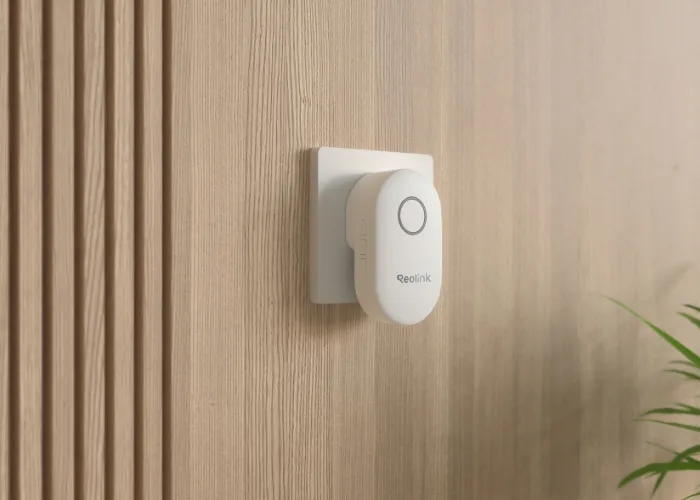
Reolink partner product photo: a small white plug-in chime with a round light on its face, plugged into a wall outlet on a light wood-slat wall, with the edge of a green plant at the right. In a small building, a chime like this can sound inside an apartment when its door station is pressed.
Equipment you already bought: labor-only installs
If you already ordered a panel or a set of cameras online, tell us the model numbers and the building. We price the labor over the phone and hold the date with a deposit. There is no site visit for owner-bought gear, and its performance, including any Wi-Fi it relies on, stays with the owner.
Special-order equipment
Some door stations and entry panels are made to order or ship from overseas, and shipping time is outside our control. We tell owners before the deposit when an item is special order, order it only after the deposit, and set the installation date once it has arrived.
Setting Next Year's Budget for a Brooklyn Building?
If you set rents and repairs for the year in winter, a stoop-to-roof list with costs on each line makes that meeting short. Give us the address and your deadline.
Cat6 runs, small racks and labeled patching for building systems.
FAQ
Brooklyn Apartment Building Security Systems FAQ
Will you service an entry or fob system that another company installed?
+
Yes. We take over intercoms, fob systems, alarms and cameras installed by others in Brooklyn buildings. The first visit is a $250 service call in which we identify the equipment, test it and find out who holds the administrator logins; from there we repair what we can and tell the owner what cannot be kept.
Can the vestibule keep its original mailboxes when the intercom panel is replaced?
+
Yes. A new panel usually goes into the old panel's opening or on a plate beside the mailbox bank. We work around the mailboxes and do not move or alter them, so the mail carrier's routine stays the same.
Does each apartment's station need its own cable back to the cellar?
+
It depends on the system. Many audio and two-wire video systems share one cable pair up the riser, with each station tapped in on its floor, while network-based stations need a cable to a switch on the floor or in the cellar. We test what is in the walls first and choose a system that can use it where possible.
Who needs to be at the building when the technician comes?
+
Someone who can open the cellar, the equipment space and the roof door, usually the super or the owner. For work inside apartments, the owner arranges access with the tenants in advance, and we give a list of the apartments and the time needed in each.
Do you test the riser before recommending a new intercom?
+
Always. We test the existing pairs from the cellar to each floor before writing a plan, because whether the riser can be reused decides whether the job is a panel and a few stations or a building-wide project.
What happens to the front door when the power goes out?
+
A battery backup in the equipment space keeps the panel and the door release working through a short outage. Beyond that, an electric strike stays locked and the door still opens with its mechanical key, while a magnetic lock on an exit door releases on loss of power, as the Building Code requires. We tell the owner which kind each door has.
Can the work be split between this year and next without paying twice for the same cable?
+
Yes. The written plan from the walk-through fixes where the equipment space, the controller and the cable routes will be, so cable pulled this year is sized and placed for the devices added next year.
Is the building's fire alarm part of the security system you install?
+
No. Fire alarm work has its own approvals and is handled separately. On security jobs we coordinate with whoever maintains the fire alarm so every electrified lock on an exit path releases when the alarm activates and when power is lost.
Can the oil delivery or utility company get into the cellar without a key?
+
Yes. A code or a credential that opens only the cellar or sidewalk door, limited to the days and hours deliveries are made, replaces a key that can be copied. The access log then shows when the door was used.
Can the laundry room keep the laundry company's machines and card system while we add a reader to its door?
+
Yes. The reader on the door decides who can enter the room, and the laundry company's equipment inside decides who can use the machines. The two do not connect, and we leave the laundry vendor's wiring untouched.
All Areas Served
Apartment Building Security Systems Across Brooklyn and New York City
This page covers Brooklyn, from Greenpoint to Coney Island and from Brooklyn Heights to Canarsie. The citywide overview, with the rules and prices that apply in every borough, is on our apartment building security systems page for New York City. Owners in other boroughs can read the pages for Manhattan and Queens; still being written: the Bronx, Staten Island, Long Island and Hudson Valley.