Own a rental building in the Bronx? Street doors, the intercom, fobs, cellar and roof alarms, cameras and elevator readers planned for the whole building: (646) 490-0629
Apartment building security systems in the Bronx start with a $250 service call at your building, and anything bigger is priced in writing after we have tested the intercom riser, closed every street, side and cellar door, and looked at the equipment shelf. The owners we work for here hold everything from a three-family house in Williamsbridge to a row of six-story elevator buildings off the Grand Concourse, a walk-up with stores on the ground floor along Fordham Road, or a new building on the Jerome Avenue corridor, and the work is done under our New York State low-voltage license.
Quick answer: Fix the doors first, then the panel, then everything behind them. In a Bronx rental that means a street door and a vestibule door that latch every time, an intercom that reaches each apartment, personal fobs or codes for the rear door and the laundry, an alarm on the roof bulkhead and the cellar door, and a few cameras where incidents really happen, with the equipment on a locked shelf above the flood line. Any visit is a $250 service call, credited if the job grows. Published Bronx prices: apartment station $250–$525, strike plus door alignment $450–$950, single-door fob reader $1,500–$2,500, elevator reader $1,500 per car, four-camera system $950. A whole building gets a written price after the survey.
Last updated November 27, 2026 by Abstract Enterprises Security Systems, NYS license #12000287431 · Sources: NYS Multiple Dwelling Law §50-a; NYC Housing Maintenance Code §§27-2041.1 and 27-2043; HPD self-closing door and penalty pages; NYC Local Law 63 of 2021; HPD Housing Maintenance Code Violations and MapPLUTO datasets (NYC Open Data, queried November 27, 2026); NYC Department of Finance building classes; NYC Independent Budget Office, May 2026; NYC Rent Guidelines Board 2026 Housing Supply Report; NYC Council Jerome Avenue Neighborhood Plan; Bronx Times, February 21, 2025; News 12 Bronx, October 17, 2025 and March 23, 2026; Historic Districts Council; LPC designation report; New York YIMBY, June 9, 2026
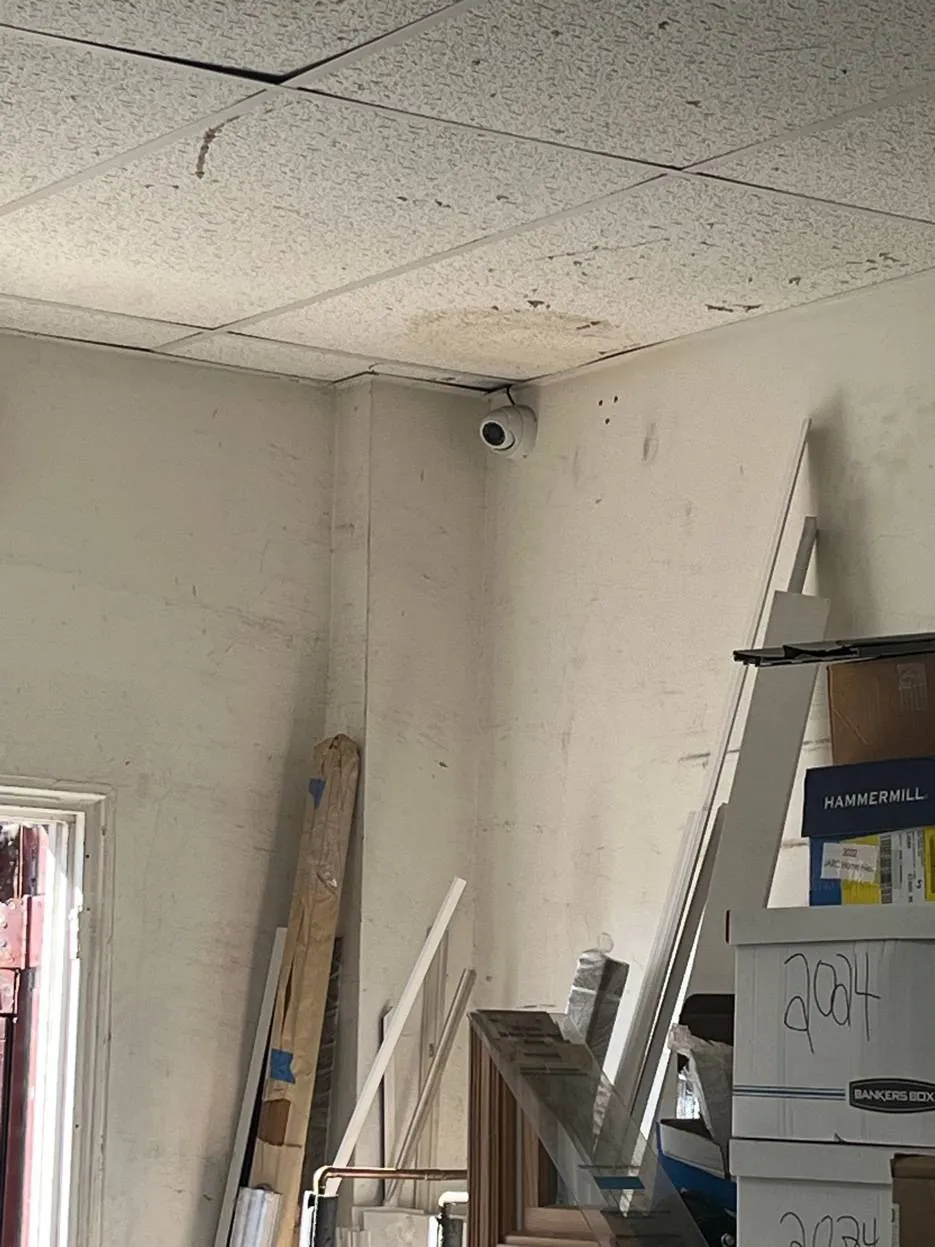
Job photo from our files: a white dome camera mounted where two scuffed walls meet a water-stained drop ceiling, above leaning lumber, white trim boards, an open door frame and stacked file boxes. Cellar storage rooms in Bronx walk-ups look a lot like this, and they are where tools, copper and tenants' belongings go missing.
Bronx Building Owner Request
Walk-up, elevator building or small multi-family — give us the address
✅
Request Sent!
Thank you. We will call you to set up the visit.
25+
Years Experience
Bronx
Office on Fordham Road
100%
Licensed & Insured
4.7★
201 Google Reviews
Owner-operated since 2002 · Thousands of jobs completed · Booked within 2 hours
The Borough
Why Bronx Rental Buildings Need an Owner's Security Plan
People who have never owned in the Bronx picture a borough of big brick towers. The city's own tax-lot file tells a different story. When we pulled the Bronx rows of MapPLUTO on November 27, 2026, it listed 29,478 two-family lots and 11,088 three-family lots, next to 3,667 walk-ups of more than six families without stores (about 85,000 apartments) and 1,721 semi-fireproof elevator apartment buildings without stores (about 108,500 apartments). Add 1,162 walk-ups over stores, 655 semi-fireproof elevator buildings with stores and roughly 1,800 small buildings that pair a shop with one to six families, and you have a borough where the typical rental owner is dealing with a narrow vestibule, a cellar door to the street and a roof hatch long before they are dealing with a security desk.
That stock is old and largely regulated. The NYC Independent Budget Office counted about 233,000 rent-stabilized apartments in the Bronx in its May 2026 report, three quarters of them in buildings put up before 1974, and it named Bronx Community District 7 (38,700 stabilized apartments) and District 4 (36,200) as two of the three districts with the most stabilized housing in the city. Owners of those buildings are expected to keep entrance doors, locks and the intercom working as a required service, and tenants know how to file when they stop working.
They do stop working, and not evenly. We asked NYC Open Data for every 2025 Housing Maintenance Code violation in the Bronx whose description mentions an intercom, and every one that mentions a self-closing door, grouped by community board. Of the 1,619 intercom-related violations, 949 (about 59 percent) were written in just four districts: 4, 5, 6 and 7, which run from Highbridge and the Concourse up through Fordham, University Heights, Belmont, East Tremont, Bedford Park and Norwood. Self-closing-door violations numbered 23,505 across the borough, with Districts 5 and 4 at more than 3,600 each. Those counts include doors inside the building as well as entrances, but they show where an owner should expect inspectors to look hardest.
Bronx community board (main neighborhoods)
2025 violations mentioning an intercom
2025 violations mentioning a self-closing door
4 (Highbridge, Concourse, Mount Eden, Concourse Village)
280
3,624
5 (Fordham, University Heights, Morris Heights, Mount Hope)
256
3,706
6 (Belmont, East Tremont, West Farms, Bathgate)
219
2,534
7 (Bedford Park, Norwood, Kingsbridge Heights, Jerome Park)
194
2,840
3 (Morrisania, Claremont Village, Crotona Park, Woodstock)
171
1,684
1 (Mott Haven, Port Morris, Melrose)
113
1,807
2 (Hunts Point, Longwood)
84
1,116
9 (Parkchester, Soundview, Castle Hill, Unionport)
10 (Throggs Neck, Pelham Bay, City Island, Co-op City)
27
450
Method: we ran two queries against the city's open Housing Maintenance Code Violations file on November 27, 2026, one for the word "INTERCOM" and one for "SELF-CLOSING" in the violation text, limited to Bronx inspections dated in 2025 and totaled by community board. District neighborhoods come from the city's community board directory. One violation can appear in both columns.
Behind each of those numbers is a door that let someone in. In February 2025 the Bronx Times reported on tenants of three buildings on one Mott Haven block who had started organizing; one of their biggest concerns was broken front door locks, and the paper's photo caption said the broken locks "allow anyone to just wander in off the busy street." Their list of demands put the locks and the intercom first, followed by a survey of every apartment and a written timeline. That order is a fair summary of how most Bronx security work should go: the door before the gadget, and a plan the tenants can see.
Packages are the other daily irritant. News 12 Bronx reported in October 2025 that people on a block of Bronxwood Avenue in Allerton had home video of a man walking up the stairs to neighbors' doors and taking their packages, a problem they said had gone on for months; one resident, John Montalvo, said the boxes were for his grandchildren and told the station, "I feel violated." In a March 2026 story from a Co-op City high-rise, residents said the Postal Service had a designated drop box but parcels from other carriers were "often left all over the lobby." Neither of those is solved by a camera alone.
Bronx facts an owner should have in front of them
Small buildings dominate the lot count: 29,478 two-family and 11,088 three-family lots in the Bronx MapPLUTO file, against 3,667 walk-ups of more than six families without stores and 1,721 semi-fireproof elevator buildings without stores. Three families is where the Multiple Dwelling Law begins.
Most apartments sit in mid-size buildings: the semi-fireproof elevator class alone holds about 108,500 apartments, the large walk-up class about 85,000, and walk-ups over stores another 32,500.
Stabilized leases everywhere: the Independent Budget Office's May 2026 count puts the Bronx at roughly 233,000 stabilized apartments, with Districts 7 and 4 alone holding about 75,000 of them.
Violations cluster west of the Bronx River: Community Boards 4 through 7 accounted for 949 of 1,619 intercom-related violations in 2025 (our Open Data query).
The law on entrances is specific: self-closing, self-locking entrance doors, kept locked unless an attendant is on duty; an intercom with a door release from every apartment in buildings with eight or more apartments erected or converted after January 1, 1968; older buildings on a written majority request (Multiple Dwelling Law §50-a).
The Bronx is building again: the Rent Guidelines Board's 2026 Housing Supply Report shows Bronx residential permits up 110.8 percent in 2025, to 7,016 units, with 5,683 units completed.
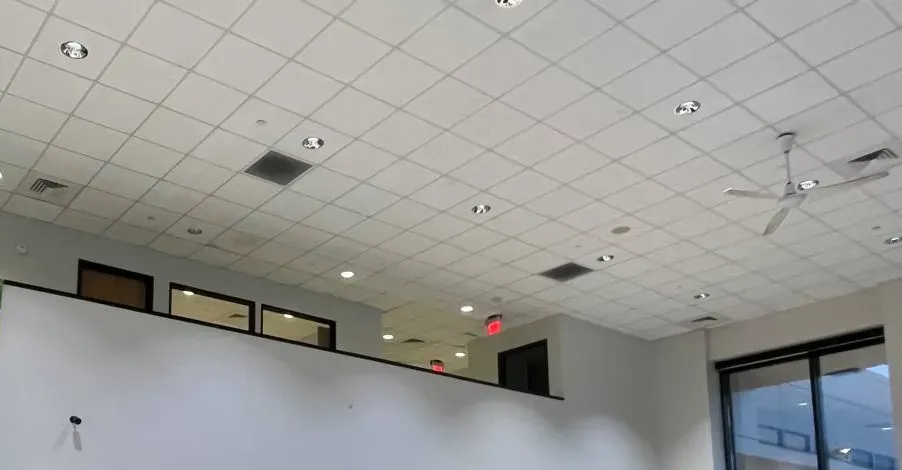
Job photo from our files: a high drop ceiling with recessed lights, air vents and a white ceiling fan over a tall white wall, with a row of small dark windows along the top, two lit exit signs beyond and a small camera mounted on the wall. Large common rooms in Bronx elevator buildings need the same thinking: where people enter, where they leave, and which way the exits face.
What We Install
Apartment Building Security System Services in the Bronx, Opening by Opening
An apartment building security system in the Bronx is not one product. It is a set of decisions about each way into the building and each shared room inside it, made so that the pieces work together and the owner can run them. We install, repair and upgrade every part of that set ourselves, under one company and one license, and when a part has its own detailed page on our site we link to it below so you can go deeper. The order here is the order we walk a building on a first survey: from the sidewalk in, then down to the cellar and up to the roof.
1. The street door and the vestibule
The front door is where most Bronx security problems start and where most of the money should go first. The Multiple Dwelling Law asks for an entrance door that closes and locks by itself and stays locked unless an attendant is on duty, and HPD's self-closing door rule says doors must swing closed and latch on their own. In practice that means three parts working together: a closer adjusted so the door comes home against the wind and the weatherstripping, a strike or lock that catches the latch every time, and a frame that is still square. In older Bronx walk-ups the frame is often the problem. Years of slamming open the hinge side, a settled threshold or a frame that was shimmed instead of repaired will defeat the best strike on the market.
On a repair visit we check the door from a foot open and from fully open, watch the latch, and measure the release voltage at the strike. Our Bronx door buzzer repair page publishes $450 to $950 for a replaced strike with the door aligned, and that alignment is the part that keeps the fix from coming back. The vestibule's inner door gets the same treatment, because a building where only one of two doors locks is a building where people wait in the warm space between them for someone to come out. If the lock hardware itself is worn out, a mortise lock or cylinder may need a locksmith; we say so on the first visit rather than wiring new electronics onto a lock that will fail next month.
2. The entry panel, the riser and the apartment stations
The intercom is the part tenants notice, and the part HPD writes up. A working system needs a lobby panel that can reach every apartment, a riser pair that carries the call up through the building, a power supply in the cellar, and a station in each apartment (or, on many newer systems, a phone app) that can talk and release the door. When a Bronx building calls us about a dead intercom, the cause is usually one of four things: a failed transformer, a stuck or burned release relay, a damaged riser pair after plumbing or plaster work, or a lobby panel that has been vandalized or soaked. Our Bronx intercom repair technicians test in that order so the owner pays for the actual fault and nothing else.
When repair stops making sense, we replace. A new panel can be an audio system with handsets, a video panel with stations, a panel that calls tenants' phones, or a mix where older tenants keep a handset and younger ones use the app. Our page on intercom installation in the Bronx covers the products; for an owner the bigger decisions are whether the existing riser can be reused, whether the new system needs internet at the building, and who will pay any monthly platform fee. We price those three things separately so you can see them. On five-to-twenty-unit buildings our published installed range is $1,200 to $4,500 and up, and a station swap on an existing system is $250 to $525.
3. Fobs and personal codes on side doors and shared rooms
Keys are the oldest weakness in a rental building. Every former tenant, former super, contractor and relative who ever had a copy can still open the door, and nobody knows how many copies exist. A fob reader or keypad with personal codes changes that: each credential belongs to one person, can be cancelled in seconds when they move out, and leaves a record. We usually start with the doors keys handle worst: the rear yard door, the cellar door from the street, the laundry room, the bike room and the door the super uses. Our access control installation page for the Bronx publishes $1,500 to $2,500 for a single door with the reader, strike and wiring.
New York City's Tenant Data Privacy Act (Local Law 63 of 2021) applies when a class A multiple dwelling uses smart access such as fobs, key cards, phone credentials or biometrics. The owner needs tenants' express consent and a plain-language policy, must protect the data, cannot sell it, has to delete authentication data on the schedule the law sets, and cannot make a tenant use smart access to get into their own apartment. We set systems up so the owner can meet those rules: the minimum data, logs kept for a defined period, and a physical key kept available for anyone who opts out. We do not give legal advice; we make sure the equipment can do what the owner's policy says.
4. Cellar, roof and rear doors
Bronx walk-ups and elevator buildings share a weak spot: doors that nobody watches. The cellar door to the sidewalk or yard, the boiler-room door, the rear exit to the alley and the roof bulkhead are opened rarely, propped often and noticed last. Most of them should not get a reader at all. A door contact tied to an alarm panel tells the owner or a central station when one of them opens or is left open, and a local sounder at the door tells whoever propped it that someone knows. Roof doors have their own rule in §50-a: self-closing, not self-locking, and openable from inside without a key, so the answer there is an alarmed exit device, never a padlock. Our alarm installation page for the Bronx covers the panels and sensors, and central-station monitoring runs $30 a month with a keypad or $45 a month with the phone app.
5. Mail, packages and the halls
Package theft in Bronx rentals happens in two places: in lobbies and vestibules where couriers leave boxes, and on the stairs and landings once someone is inside. The Allerton story above is the second kind. The fixes are different. For the lobby, the goal is a place couriers can leave parcels that is not the open floor of the vestibule: a locked package room on a reader, parcel lockers, or a shelf behind the inner door that couriers reach with a delivery code good only during daytime hours. For the halls, the goal is making sure only people with a reason are inside, which comes back to the front door latching, the inner door locking and tenants not buzzing in strangers.
Mailboxes themselves belong to a separate set of rules from the Postal Service, and a building that wants to replace a bank of mailboxes should check with its post office first. We handle the electronic side: the reader and strike on a package room door, the camera that covers the mail area, and the delivery codes on the entry panel.
6. Cameras, kept short and in the right places
Cameras are worth having in a Bronx rental, but they are a record, not a lock. We put them where incidents actually happen and where a recording answers a question: the street door from inside the vestibule so faces are lit and not backlit, the package area, the cellar door, the rear yard and the elevator lobby. Tenants' apartment doors are not filmed head-on. Everything else about cameras, from how many a building needs to how long footage should be kept, has its own page: our apartment building camera installation page for the Bronx. Four-camera systems start at $950 on our Bronx camera price list.
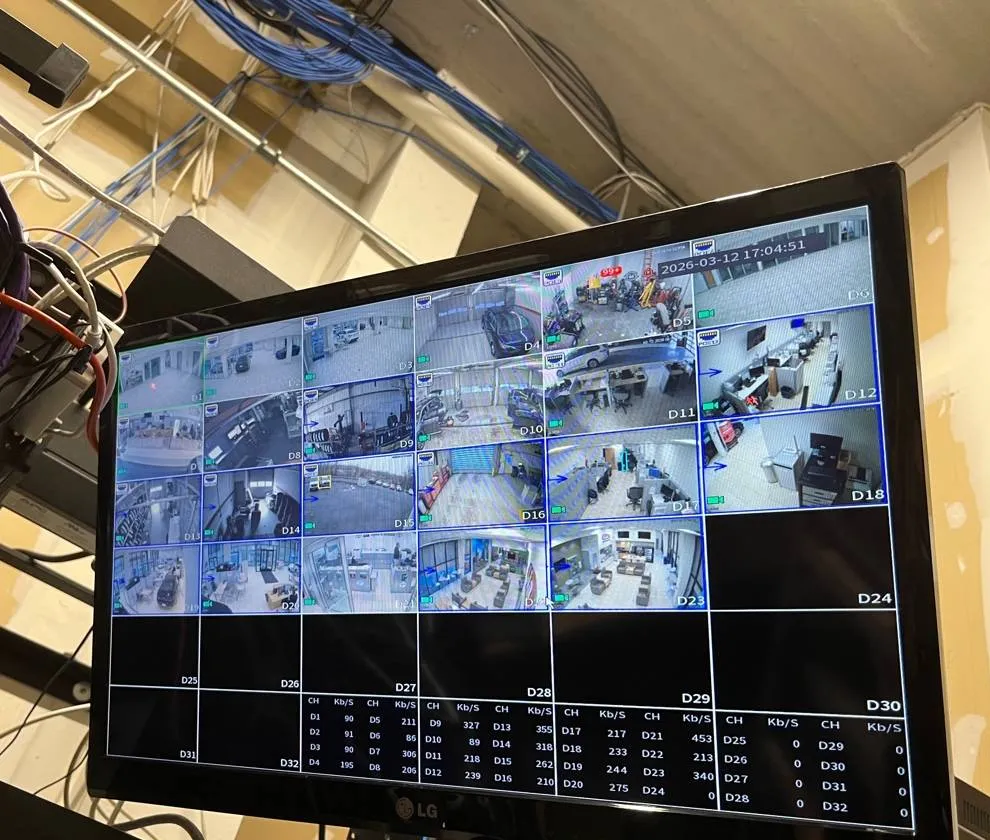
Job photo from our files: a monitor showing about twenty camera tiles of rooms, a garage and a lot, with empty channels and a table of per-channel bitrates along the bottom, hanging under bundles of blue and white network cable crossing an open ceiling. A screen like this tells an owner at a glance which cameras are live and which channels are sitting empty.
7. Elevator readers
In Bronx elevator buildings, a reader in the car stops people who slipped through the lobby from riding to upper floors, and can restrict floors such as the roof landing or a vacant floor during renovation. The reader itself is low-voltage work we do; the connection into the elevator controller and the traveling cable is done by the building's licensed elevator agency, and we coordinate with them. Our elevator access control page for the Bronx publishes Level 1 card, fob or code readers from $1,500 per car and biometric readers from $2,500 per car.
8. The fire alarm, within its own rules
A fire alarm is a separate, code-required life-safety system, and it is not part of a security package. Where an electrified lock, a mag lock or an access-controlled door is in a path of egress, the New York City Building Code requires it to release on loss of power and on fire alarm activation so people can always get out, which is the one place the two systems meet. For buildings that need fire alarm work, see our fire alarm installation page for the Bronx; that work starts with engineered drawings and an FDNY filing and is priced separately, never as part of a security quote.
9. The equipment shelf and the cable between
Every piece above ends up on one shelf or in one cabinet: the intercom power supply, the access control board, the alarm panel, the recorder, a network switch and battery backup. In too many Bronx cellars that shelf is the floor next to the boiler, and the first heavy rain shuts the building's entry down. We move equipment to a locked cabinet above any water line, label every cable, and put the backup batteries where they can be tested. Wiring under 50 volts for signaling and data does not need an electrical permit under the city's Administrative Code, but any new 120-volt outlet does, and that is the building electrician's job, not ours. Where new cable has to be pulled, our Bronx structured cabling page lists Cat6 drops at $175 and up and a wall-mount rack at $250.
Building Specialists
Apartment Building Security Systems for Bronx Building Types
The same five building types make up most of what we see in the borough, and each one fails in its own way. The numbers below are counts of tax lots from the city's MapPLUTO file, using the Department of Finance building classes; a lot is usually but not always one building.
Building type (DOF class)
Bronx lots
Apartments on those lots
Where security usually breaks first
Two-family house (B1, B2, B3, B9)
29,478
58,956
Shared front door with no closer; basement entrance; package left on the stoop
Three-family house (C0)
11,088
33,264
Owner suddenly in multiple-dwelling territory; one doorbell for three apartments
Walk-up, over six families, no stores (C1)
3,667
85,004
Front door latch, vestibule inner door, riser pair, roof bulkhead
Walk-up over six families with stores (C7)
1,162
32,534
Shared cellar with stores, rear door to the alley, deliveries
Elevator building, semi-fireproof, no stores (D1)
1,721
108,523
Lobby panel age, second stairway to the street, elevator riding, cellar storage
Elevator building, semi-fireproof, with stores (D7)
655
49,065
Store tenants' doors into common areas; mixed delivery traffic
Elevator building, fireproof, no stores (D3)
208
58,909
Many entrances on large sites; garages; package volume
Two- and three-family houses
Owners of a two-family house in Wakefield, Throggs Neck or Morris Park are not running an apartment building in the legal sense: the Multiple Dwelling Law starts at three families living independently. They still owe tenants a safe home with working locks, and the practical needs are simple: a front door that latches, a doorbell or small intercom that rings the right apartment, a light and a camera at the door, and a separate lockable path for the basement apartment if there is one. A three-family house is different on paper. Once a third apartment is legal, the house is a multiple dwelling, and the owner should read the entrance and lock rules as applying to the building. We size these jobs to the house: often a two- or three-button audio system or a video doorbell per entrance, a strike on the shared door and one or two cameras, and nothing that needs a monthly platform.
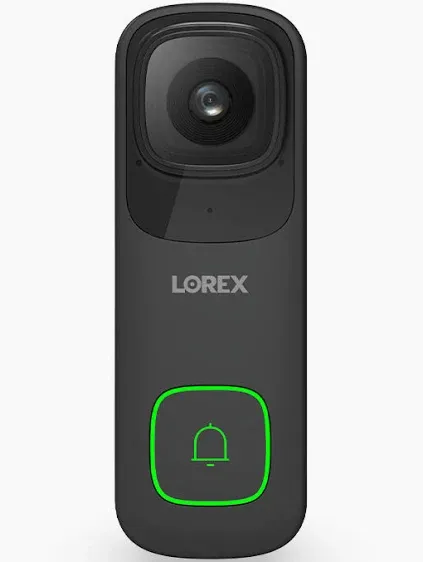
Lorex product photo (we are an authorized Lorex partner): a tall black video doorbell with a lens at the top and a bell-shaped button inside a green illuminated ring. On a Bronx two- or three-family house with separate entrances, one doorbell per entrance often does the job a lobby intercom does in a bigger building.
Walk-ups of more than six apartments
The classic Bronx walk-up, five or six stories of brick on a 1910s or 1920s street in Morrisania, Mott Haven, Belmont or Highbridge, has a stoop or a few steps up to a double door, a narrow vestibule, one stairway that runs to a roof bulkhead, and a cellar with a street hatch or a rear door. Often the intercom is not the first system the building has had, and the dead ones are still on the wall. Here the plan is almost always the same: fix the door and the latch, make the vestibule's inner door lock, test the riser before choosing a panel, alarm the roof and cellar doors, and put a fob on the rear door so the super stops leaving it unlocked. Cameras come after that, at the vestibule, the mailboxes and the cellar.
Walk-ups and elevator buildings with stores below
On Fordham Road, Westchester Avenue, Third Avenue, Tremont Avenue and Burnside Avenue, many rental buildings have stores on the ground floor. The stores bring three security problems the owner has to solve: store employees who need the cellar, store deliveries that come through residential space, and store tenants who want their own cameras on the facade. Our approach is physical separation first. The store's cellar area gets its own door and its own credential, the residential stairs get a door the store cannot open, and the store's alarm and cameras are its own system with its own account. The owner's job is to write those boundaries into the lease; ours is to make the doors match.
Prewar elevator buildings along the Concourse and its side streets
The semi-fireproof elevator building is the largest single source of Bronx apartments, and the Grand Concourse and the streets east and west of it are full of them: six-story buildings from the 1920s and 1930s with wide lobbies, terrazzo floors, a courtyard entrance and two stairways. The lobby panel in many of these is a large flush-mounted unit that has been patched for decades. Because these buildings have two stairs, a second exit usually lets out onto a side street or a yard, and that door is the one strangers use. The elevator is old and the elevator company is cautious about anything new in the car. The plan here focuses on the lobby (panel, two doors that latch, cameras at the mailboxes and the elevator), the second exit (alarmed, never locked against escape), and the cellar (storage rooms on fobs, the boiler room separate).
New buildings from the post-2018 wave
The Jerome Avenue rezoning, approved by the City Council's land use committees in March 2018 for an area of roughly 95 blocks from McClellan Street up to 184th Street, and the steady flow of city-financed housing since then mean that a lot of Bronx rental buildings are less than ten years old. The Rent Guidelines Board counted 5,703 newly certified 421-a apartments in the Bronx in 2025 alone. These buildings arrive with video intercoms, fobs and cameras, and owners assume the work is done. Often it is not: the developer's installer holds the administrator logins, the cloud intercom is on a contract in the developer's name, and nobody has a list of which fobs belong to whom. Our first job in a new building is usually to move every account and login into the owning entity's name and document what is there.
Row houses in the borough's historic districts
Mott Haven was the Bronx's first historic district, designated in 1969, and the borough now has several more built around row houses and small apartment buildings, including Longwood, Morris Avenue, Clay Avenue and Mott Haven East. Many of these houses were converted to two, three or more apartments decades ago. Work on the facade in a designated district needs Landmarks Preservation Commission approval; the Commission's permit guidebook allows staff-level approval for an intercom panel placed within or next to the door opening, and ordinary repair of what is already there does not need a new permit. We design panels and cameras to fit those rules, mounting entry panels in the door surround and cameras under cornices or inside vestibules where they are not seen from the street.
Owning in the Bronx
Owning a Bronx Rental: Rules, Tenants and the Order of Work
Security in a rental building is shaped as much by the rules and the tenants as by the hardware. These are the situations Bronx owners bring to us most, and how we handle the security side of each.
Older buildings and the majority-request rule
Section 50-a of the Multiple Dwelling Law has two tracks. Class A buildings with eight or more apartments erected or converted after January 1, 1968 must have the self-closing, self-locking doors and an intercom from the start. Buildings from before 1968, which is most of the Bronx's walk-ups and prewar elevator buildings, must install them once tenants in a majority of the apartments request or consent in writing on the city's forms. From the owner's receipt of those forms, the law gives ninety days to start the installation and six months to finish it. The same section says that for rent-controlled apartments the city's rent agency sets the terms under which the owner can recover the cost from tenants.
In practice, most pre-1968 Bronx buildings have had an intercom for decades, and the question is not whether to have one but what to do when it fails. The six-month clock matters most to an owner who buys a building where the system was taken out, or where tenants have organized around it. When that happens, the sensible move is to survey early in that window, so the owner has a written scope and a date long before the deadline.
Rent-stabilized buildings and required services
New York State Homes and Community Renewal treats working door locks as part of the required services in a regulated building, and broken locks are one of its examples of a decreased service that tenants can file about. A building-wide complaint can lead to a rent reduction that lasts until the service is restored. For a Bronx owner with a building full of stabilized leases, the security system is not optional equipment; the front door, its lock and the intercom are services the rent already pays for. That is why we recommend that owners with regulated buildings budget door and entry work as maintenance, not as an upgrade, and keep the dated invoices that show when a repair was made.
Clearing an HPD violation on a door or the intercom
A self-closing door violation is class C under HPD's rules, with fourteen days to correct and penalties of $250 to $500 plus $250 a day if it is not corrected, according to HPD's penalties page. Intercom violations are written in other classes with their own correction periods. Whatever the class, the owner needs two things from the contractor: a repair that actually holds, and a written record of what was done, on what door, on what date. Our invoices describe the condition we found and the work we did in plain words, so the owner has something to keep with the certification of correction.
When tenants organize
The Mott Haven tenants in the Bronx Times story asked for three things: fix the locks and the intercom, survey every apartment, and give a timeline. Owners who answer with a dated plan tend to get through these periods better than owners who answer with a single repair. For the security side, we can give an owner a short written scope that lists each door and system, what is wrong with it, what we will do, and in what order. The owner decides what to share with tenants. We do not speak for the owner to the tenant association, but the scope gives the owner something concrete to stand behind.
Buying a Bronx building
A buyer usually gets an engineer's report on the roof, the boiler and the facade, and very little on the entry systems. We can walk a building before closing and tell the buyer which doors latch, whether the intercom reaches every floor, how old the panel and power supply are, who holds the logins on any cloud system, and what open HPD violations relate to doors and the intercom. The visit starts with the $250 service call, and anything that needs a written scope is priced after it. Buyers should also ask the seller for the account details on every system and the list of active fobs; without them, the first month of ownership is spent locking out strangers.
Vacant apartments and buildings under renovation
An empty apartment in a Bronx walk-up is a target for scrappers and squatters, and an entire building under gut renovation even more so. We protect vacant space with door contacts and motion sensors tied to a monitored alarm panel, a camera at the construction entrance, and a temporary code or credential for contractors that is cancelled when the job ends. Copper, appliances and tools are what thieves are after, so sensors go where those are stored. When the renovation is done, the temporary credentials come off and the permanent system takes over.
What changes as the building gets bigger
Size changes the plan more than the price per apartment does. A 4-to-8-unit building usually has one entrance, one stairway and one cellar door, and an audio or small video panel with a strike, a roof alarm and two or three cameras covers it. Somewhere around 10 to 25 units the riser becomes the deciding factor: a long run of old cable through occupied walls is what separates a panel swap from a rewire, so testing it comes before choosing anything. From about 25 to 75 units, buildings tend to have a second stairway, an elevator, a laundry room and a package problem, and that is where fobs on shared rooms, a reader on the rear door and an elevator reader start to make sense. Past 100 units, and in the big Bronx complexes of several hundred, the work becomes a set of systems that have to be managed: many entrances, a staff office, cameras on several floors, and credentials for porters, contractors and deliveries. We do not publish per-unit prices because two buildings with the same apartment count can have very different doors, risers and cellars.
Before winter and the holiday delivery season
The weeks between Thanksgiving and New Year's are when Bronx front doors take the most abuse and lobbies fill with the most boxes. Cold air pushes against the door, closers stiffen, and a door that latched in September stops latching in December, which is when tenants prop it with a mat and file a complaint about the heat leaking out. Packages pile up faster than tenants collect them. If an owner can do one thing before the holidays, it is to have every front, vestibule and rear door checked for latching, the closers adjusted for cold weather, and a delivery location set up behind the inner door. We do not run seasonal discounts; the point is timing, so the doors are right when the traffic is heaviest.
The owner's compliance checklist for entry systems
Entrance doors (MDL §50-a): every entrance from the street, passageway, court, yard or cellar self-closing and self-locking, locked except when an attendant is on duty; roof door self-closing, not self-locking, and openable from inside without a key.
Intercom (MDL §50-a): buildings of eight or more apartments erected or converted after January 1, 1968 must have one with a door release in each apartment; older buildings on a written majority request, started within 90 days and finished within six months.
Doors that shut themselves (HMC §27-2041.1): HPD expects each apartment entrance door and each public hall door to swing shut and catch its latch without help; a door that does not is written up as class C, the most serious class.
What goes on each apartment door (HMC §27-2043): a keyed lock provided by the owner, with the key handed to the tenant, and in class A buildings also a heavy-duty latch set, a deadbolt and a chain guard.
Smart access (Local Law 63 of 2021): consent, a plain-language policy, data security, no sale of data, deletion on schedule, and no requirement to use smart access for a tenant's own apartment.
Exit doors (NYC Building Code §§1010.1.9.8–1010.1.9.9): a strike, mag lock or reader can go on a door people use to leave the building only if the lock lets go when the power drops or the fire alarm sounds, and nobody ever needs a credential to get out.
Historic districts (LPC Permit Guidebook, chapter 11): staff permits for an intercom panel within or next to the door opening; ordinary repair does not need a new permit.
Permits for wiring (Admin Code §28-105.4.7): low-voltage signaling and data wiring under 50 volts does not need an electrical permit; new 120-volt circuits and fire alarm work do.
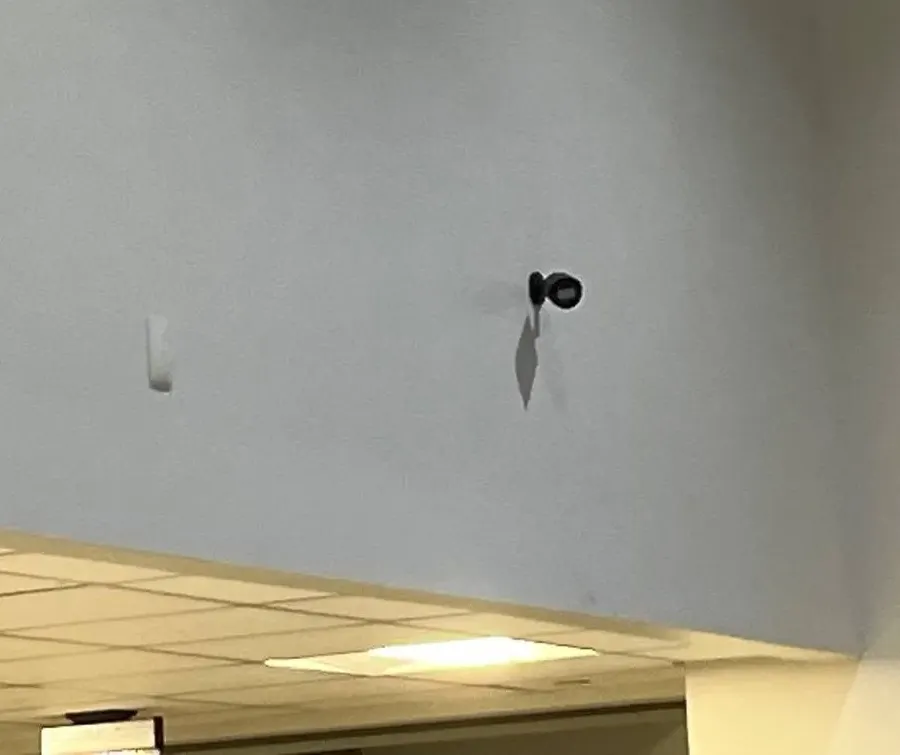
Job photo from our files: a small black camera on a short wall mount high on a pale grey wall, its shadow falling downward, a small white wall device off to the left and the edge of a lit drop ceiling below. Mounted high and angled down, a camera like this sees faces instead of the tops of heads.
Your Questions Answered
Apartment Building Security Systems in the Bronx: Questions Answered
The law, the tenants and the money
If tenants ask in writing for an intercom in our pre-1968 building, what happens next and who pays?
Under Multiple Dwelling Law §50-a, once tenants in a majority of the apartments request or consent on the city's forms, the owner has ninety days from receiving them to start installing self-locking doors and an intercom and six months to finish. The owner pays for the installation. For rent-controlled apartments the city's rent agency prescribes the terms under which the owner may recover the cost from those tenants; for other apartments the owner should get advice on what the rent rules allow before assuming any cost can be passed on. Our part is to survey quickly, give a written scope with dates, and install within the window.
How should an owner answer a tenant association that wants a repair timeline for the doors and the intercom?
With a dated, door-by-door list rather than a promise. We can survey the building and give the owner a scope that names each entrance, each system, the fault and the planned date, with door and lock repairs first because they affect everyone. The owner decides what to send to the association. Dates that depend on ordered parts should say so, so the timeline does not slip without explanation.
Doors and ways in
Our second stairway lets out onto a side street. How do we stop it being used as a back way in without blocking it as an exit?
Keep it free to open from inside and control it from outside. The outside should have no handle or a locked trim, the door should close and latch by itself, and an alarm contact with a local sounder should tell the owner or a monitoring center whenever it is held open. If the owner wants residents to use it as an entrance, a reader can go on the outside, but the inside always has to open freely and any electrified lock has to release on power loss and fire alarm under the Building Code.
Our building's entrance sits at the back of an open courtyard. Should the entry panel go at the gate or at the lobby door?
Usually at the lobby door, because that is the self-locking entrance the law is written around and the panel there sees the visitor's face under the canopy. A gate at the street is worth controlling if the courtyard is where people hang around or packages are left, and then the gate gets its own reader or a second panel that calls the same apartments. A gate that is always open is worse than no gate, because it gives a false sense of control.
Two of our buildings are joined at the cellar. How do we stop people walking from one building into the other?
Put a door with a lock in the connecting passage and give it a reader that only staff credentials open. If the passage is also a fire exit route for either building, the door must still open freely in the direction of egress, so the control goes on the other side. An alarm contact on that door shows when it is propped. Tenants of each building should only be able to reach their own laundry, storage and boiler room.
Should the fob reader be built into the entry panel or mounted as a separate reader at the front door?
Built in, when the panel is being replaced anyway: one device, one cable path, one place for tenants to look, and the panel's camera sees whoever taps in. A separate reader makes sense when the existing panel is staying, when the door needs a reader on a different side from the panel, or when the panel and the access system come from different makers and the owner wants to be able to replace one without the other. Either way, the reader and the panel should release the same strike through one controller so the door has a single record of who opened it.
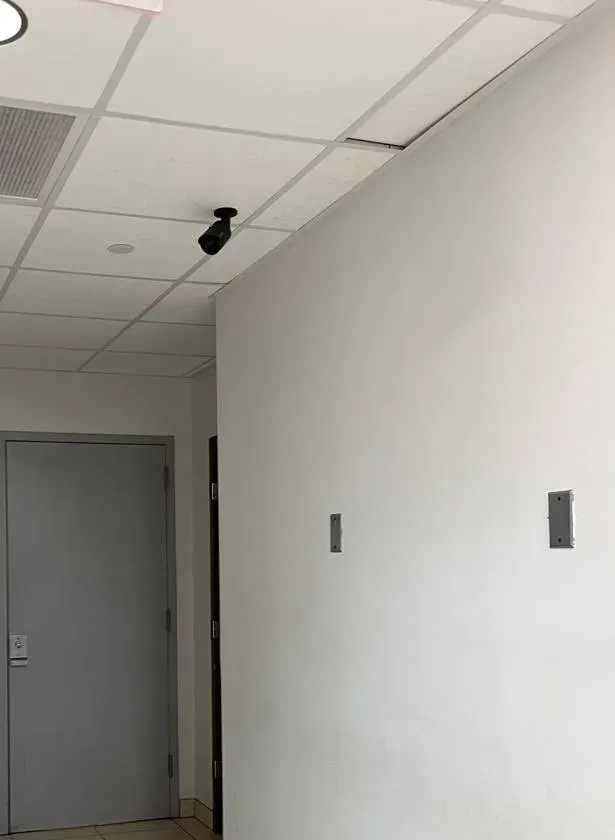
Job photo from our files: a black bullet camera hanging from a drop ceiling, aimed down a short white hall toward a grey steel door with a lever handle, with two blank plates on the wall to the right. A back corridor like this, leading to a rear or cellar exit, is where a camera at the ceiling earns its place.
Packages and the halls
Packages are disappearing from the landings outside apartments, not from the lobby. What helps?
Two things: fewer packages on the landings and fewer strangers on the stairs. Give couriers somewhere to leave parcels downstairs, a package room or a shelf behind the inner door reached with a daytime delivery code, so they stop walking boxes upstairs. Then check that the inner vestibule door actually locks and that tenants are not buzzing in anyone who presses their button. A camera on the stair at the ground floor records who went up, which helps the police, but it does not stop the next theft by itself.
Should the package shelf sit inside the vestibule or past the second door?
Past the second door, if there is room. A shelf in the vestibule is reachable by anyone who catches the outer door, which is most of the day in a busy building. Behind the inner door, couriers need a time-limited code to reach it, tenants pick up on their way in, and the camera covering it also covers the mailboxes. Where the vestibule is the only space, a locked parcel cabinet is better than an open shelf.
Systems, records and empty space
A neighboring building is throwing out the same model of intercom as ours. Should we keep its stations as spares?
It can buy time, if they really are the same model and they work. Ask for the stations, the lobby boards and any power supplies, label them, and store them somewhere dry. Used parts are untested, so treat them as a stopgap: a discontinued lobby panel can still fail in a way no spare station fixes, and that leaves the whole building without a door release. We test salvaged parts before installing them and tell the owner honestly how much life the system has left, so a replacement that reuses the existing riser can be planned instead of rushed.
Does a new entry panel keep a record of which apartment let a visitor in?
Many current panels do. They can log each call, which apartment answered and whether the door was released, and video panels can keep a snapshot of the caller. Older audio systems keep no record at all. If the owner wants this, we choose a panel that logs, set how long the log is kept, and make sure the log and any snapshots are covered by the building's privacy policy.
Our building is being gut-renovated with no tenants in it. How do we keep scrappers and squatters out until it reopens?
With a monitored alarm rather than a padlock and hope. Door contacts on every ground-floor and cellar opening, motion sensors where copper, fixtures and tools are stored, a camera at the construction entrance, and a temporary code for the general contractor that is cancelled when the job ends. Central-station monitoring on our Bronx alarm page is $30 a month with a keypad or $45 with the app. When the building reopens, the temporary devices either become part of the permanent system or come out.
How do we keep the intercom directory accurate when apartments turn over every year?
Pick a panel the owner or super can edit, and make the directory part of the move-in and move-out routine. On most current panels the directory lives in software, so a name or apartment number changes in a minute from a phone or laptop; on older audio panels it is a printed card behind glass that someone has to open and replace. Whichever it is, the change should happen on the day the lease starts or ends, together with cancelling or issuing fobs, so visitors are never routed to the wrong apartment.
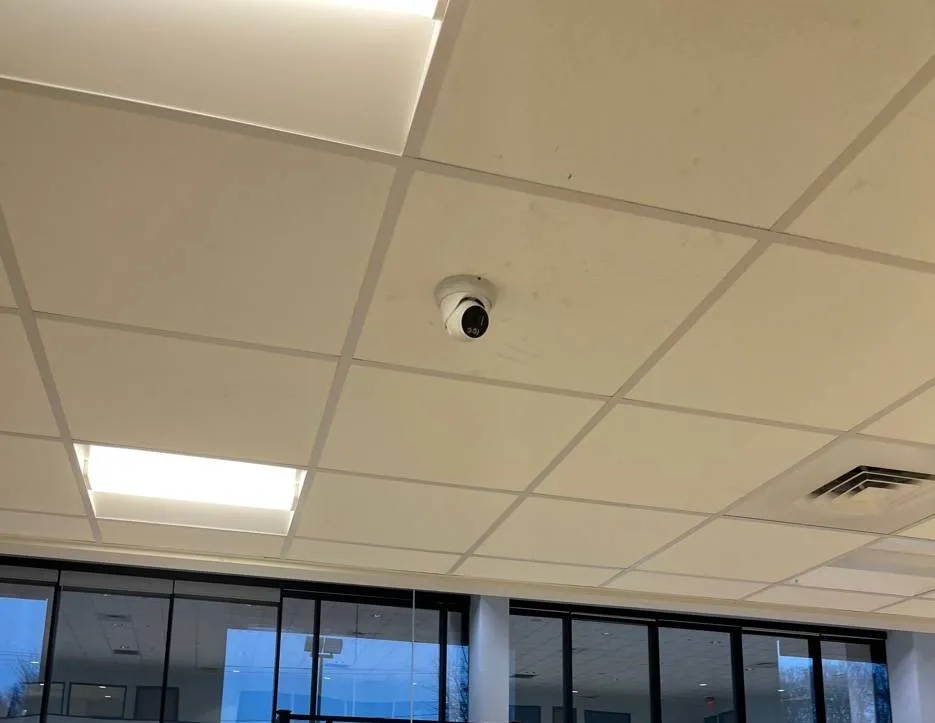
Job photo from our files: a white turret camera set into a beige drop-ceiling tile between a light panel and an air vent, above a long run of tall dark-framed windows. Ground-floor rooms with a lot of glass need the camera inside, facing the windows, so the light outside does not wash out the picture.
How do we stop strangers pressing every button on the panel until someone lets them in?
Make it easy for tenants to see and hard for strangers to get lucky. A video panel or a phone app lets tenants see who is calling before they release the door. A directory panel that calls one apartment at a time slows down the button-masher, and logs show which apartment opened the door. Most of all, owners should tell tenants plainly not to release the door for anyone they did not expect, and the front door has to latch, or none of this matters.
Equipment
Types of Apartment Building Security Equipment We Install in the Bronx
Below is the equipment that goes into a typical Bronx rental, with what each piece is for. We install several brands in each category and choose by the building, not by a catalog; the default quote is our own non-branded equipment unless the owner asks for a brand.
Entry panels
Audio panels with a directory, video panels with a camera and a keypad, and panels that call tenants' phones. For a busy street door we choose stainless or die-cast housings, recessed buttons and a camera behind a protective window.
Apartment stations
Audio handsets, video monitors and hands-free stations, each with a door release button. On many newer systems a phone app replaces or supplements the station.
Strikes, closers and lock hardware
Electric strikes sized for the lock and the frame, closers set to latch the door, and hold-open prevention. The strike is fail-secure on a street door and must allow free exit from inside.
Readers and controllers
Fob, card, keypad and phone-credential readers with a door controller and battery backup. Credentials are added and cancelled in software by the owner or the super.
Door contacts and alarm panels
Contacts on cellar, roof, rear and second-exit doors, motion sensors in vacant space, glass-break sensors on common windows, and a panel that reports to a central station or the owner's phone.
Cameras and recorders
Turret, dome and bullet cameras on a local network video recorder, with remote viewing for the owner. Camera planning for apartment buildings has its own page.
Elevator readers
A reader in the car, connected to the controller by the elevator agency, to restrict riding or particular floors.
Power, network and backup
Power supplies sized for every strike and panel, a network switch with power-over-Ethernet, a lockable cabinet and battery backup so the door release and the recorder ride through short outages.
Package rooms and lockers
A reader and strike on the package room door, daytime delivery codes on the entry panel, and cameras on the shelves or lockers.
Wired, cloud and hybrid entry systems compared
Type
How it works
Monthly fee
Best fit in the Bronx
Wired audio or video intercom
Panel calls stations in each apartment over the building's riser; release from the station
None
Walk-ups and prewar elevator buildings with a riser that tests clean and tenants who want a handset
Cloud video intercom
Panel calls tenants' phones over the internet; directory and credentials managed online
Usually yes, per door or per apartment, set by the platform
Newer buildings with good internet at the panel and owners who want remote management
Hybrid
New panel reuses the riser for apartments that keep stations and calls phones for apartments that prefer them
Depends on the platform chosen
Buildings with a mix of long-term and newer tenants
Doorbell per entrance
Video doorbell on each entrance of a small house, ringing the tenant's phone or a chime
Optional, depending on brand and recording plan
Two- and three-family houses with separate entrances
For camera equipment, we are an authorized partner for Lorex, Luminys and Reolink. We also install and repair intercom brands that are common in Bronx buildings, and our comparison of two video intercom platforms explains the trade-off between a panel with its own app and a subscription platform.
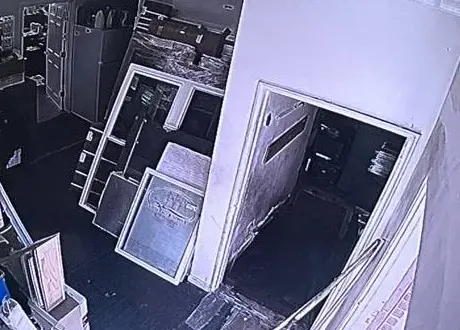
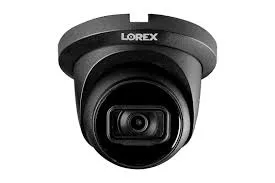
Job photo from our files: a camera's night view, in black and white, looking down into a storeroom with frames and boards leaning against the walls, shelving on the left and an open doorway into a darker room. Infrared is what makes a cellar storage room usable on video after the lights go off.Lorex product photo (we are an authorized Lorex partner): a black turret camera with the Lorex name across the top of the housing. A dark housing blends into a painted vestibule or a dark-trimmed lobby better than a white one.
One Plan for Every Door in the Building
A Bronx building with a dead buzzer usually has two or three other doors that need attention too. One visit finds all of them, and you decide which ones get done this year.
What AI Gets Wrong About Apartment Building Security Systems in the Bronx
Search summaries and chatbots answer questions about apartment security with national averages and a picture of one kind of building. Bronx owners bring us those answers, and these are the ones that do not hold up against the borough's own data and rules.
1. “The Bronx is a borough of big apartment towers”
The towers are real, but they are not the typical Bronx rental. In the city's MapPLUTO file the Bronx has 29,478 two-family lots and 11,088 three-family lots, against 1,721 semi-fireproof elevator buildings without stores and 208 fireproof elevator buildings without stores.
Advice written for a staffed high-rise, with a front desk, a security guard and a package room, does not fit a three-family house in Edenwald or a six-story walk-up in Morrisania. Those buildings need a door that latches, a simple entry panel and a few well-placed sensors.
We size every plan to the building in front of us, and on a small house that can mean a doorbell per entrance and a strike on the shared door, not a cloud platform.
2. “Intercom trouble is spread evenly across the borough”
Our query of HPD's 2025 violations found 949 of 1,619 intercom-related violations in four community districts, 4, 5, 6 and 7, and the IBO counts Districts 4 and 7 among the three districts in the city with the most rent-stabilized apartments.
That concentration follows the building stock: dense blocks of prewar walk-ups and elevator buildings, many with long-term tenants who know their rights. An owner there should expect inspections and plan entry work as routine maintenance.
Owners in Riverdale or Throggs Neck see fewer violations, but the same rules apply to their buildings, and the same doors fail when nobody checks them.
3. “Buildings from before 1968 never have to add an intercom”
Multiple Dwelling Law §50-a requires pre-1968 class A buildings to install self-locking doors and an intercom once tenants in a majority of the apartments request or consent in writing, with ninety days to start and six months to finish.
Many Bronx buildings that fall under that rule are far older than 1968. The Landmarks Preservation Commission's report on the Mott Haven Historic District, designated in 1969, describes a row of four-story apartment houses each built for eight families, the same size at which the post-1968 rule begins.
An owner who treats an old building as exempt can be caught by a single petition. Keeping the existing system working is far cheaper than installing one against a deadline.
4. “An owner can charge tenants whatever they like for an intercom they asked for”
The New York Attorney General's tenant guide says landlords may recover the cost of the required entry equipment from tenants, and it cites §50-a. The statute itself is narrower: for rent-controlled dwellings the city rent agency prescribes the terms of that recovery.
In a building of rent-stabilized and market-rate leases, how any cost reaches the rent depends on the rent rules for each apartment, not on the owner's invoice.
We price the work and document it; owners should take advice on the rent side before telling tenants anything about cost.
5. “A locked mailroom ends package theft”
In News 12 Bronx's March 2026 story from a Co-op City high-rise, residents said the Postal Service had a designated drop box while other carriers left parcels around the lobby. In Allerton, the October 2025 story showed a thief walking up the stairs to apartment doors.
The mailroom only covers mail. Most parcels now come from carriers who have no mailroom key, and if they are not given a better place, they leave boxes in the vestibule or carry them upstairs.
The fix is a parcel location couriers can reach with a time-limited code, behind a second locked door, with a camera on it, and a front door that latches.
6. “The Bronx isn't building new rentals, so new-construction security isn't a Bronx topic”
The Rent Guidelines Board's 2026 Housing Supply Report shows Bronx residential permits up 110.8 percent in 2025, to 7,016 units, and 5,703 newly certified 421-a apartments in the borough. Since 2014, a third of the city-sponsored housing starts it counts have been in the Bronx.
New buildings along the Jerome Avenue corridor and elsewhere come with modern entry systems, but often with the logins, contracts and fob lists still in the developer's or installer's hands.
For a new building, the security question is less about what to buy and more about who controls it after the keys change hands.
7. “A working buzzer means a secure front door”
The Mott Haven tenants in the Bronx Times story were worried about broken front door locks first, and our 2025 count found 23,505 Bronx violations mentioning self-closing doors, many times the number mentioning an intercom.
An intercom that rings and releases perfectly is useless if the door it releases never latched. HPD's self-closing door rule is about the door closing and latching by itself, not about the buzzer.
That is why every one of our Bronx surveys starts by closing each door from a foot open and watching the latch before anyone looks at the panel.
Get In Touch
Request an Apartment Building Security Survey in the Bronx
The more we know before we arrive, the fewer trips it takes. Useful: the street address and cross street, the apartment count, every door that opens to the outside (front, cellar, yard, roof), and what tenants have been complaining about. If you can, snap the front door from the sidewalk and from the vestibule, the lobby panel, and whatever sits on the cellar equipment shelf. One broken buzzer? Just the address and the symptom. Or call (646) 490-0629.
✅
Request Sent!
Thank you. We will call you to set up the visit.
How It Works
Our Apartment Building Security Process in the Bronx
1
Request
Reach us by phone, text or the form. We will want the building's address, a rough apartment count, what is going wrong, and a name and number for whoever can open the cellar.
2
Service call or survey
One fault: the $250 visit, diagnosis included. A full plan: we spend the visit on the sidewalk, in the vestibule, down in the cellar and up on the roof, photographing as we go.
3
Written scope
Each door and system on its own line, parts and labor shown separately, any monthly platform fee named, and the work ranked so the owner can phase it.
4
Approval and deposit
The signed scope and the 50 percent deposit start the job. Repairs with common parts can be scheduled immediately; a specialty panel is scheduled after the supplier confirms it.
5
Tenant notice
Tenants get the dates from the owner in writing: the morning the front door changes over and the day each apartment station is swapped.
6
Install and changeover
Doors and strikes first, then the new panel powered beside the old one, a short changeover of the release, and stations, readers, contacts and cameras after that.
7
Handover
Logins and accounts in the owning entity's name, a device and fee list, labeled cables, and a short guide for the super or whoever adds and removes credentials.
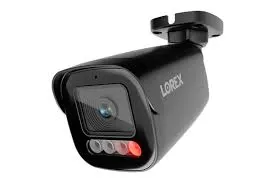
Lorex product photo (we are an authorized Lorex partner): a black bullet camera on a wall bracket, with the lens on top and a strip of red and white warning lights under it. A camera with visible lights suits a rear yard or alley door where the goal is to make someone think twice.
Field notes: the first fifteen minutes in a Bronx walk-up
A survey starts on the sidewalk. We count the ways in: the front door, the cellar hatch or cellar door, a rear yard gate, a passage to the alley and the fire escapes. Then we open the front door a foot, let go and watch. In a building with an intercom complaint, the door that fails to latch is often the real complaint. In the vestibule we press a few buttons and listen: a ring with no release points to the strike or the relay, silence points to the panel, the transformer or the riser. Downstairs we look for the power supply and check whether it sits on the floor where water has been before, and we count the dead panels and power supplies still on the wall from earlier systems. We finish on the roof, checking that the bulkhead door closes on its own and opens from inside without a key.
Field notes: changing the panel without leaving anyone outside
Tenants in a Bronx rental depend on the door release for deliveries, home care visits and family. We never take the old panel down until the new one works. The new panel is mounted and powered first, the directory is loaded from the owner's apartment list and checked against the buttons, and the door release is moved over in a short window. We test from the panel, from a reader and from a few apartments on different floors before the old panel comes off. Apartment stations are changed on the days the owner's notice gives, and where tenants keep a handset, it is tested at the door with them.
How long the work takes
A dead station or a stuck relay is normally a single trip; a lobby board that has to be ordered means a return visit. Swapping the lobby panel on a walk-up whose riser tests clean takes about a day of work after delivery. A six-story elevator building that is getting readers, door contacts, cameras and new stations is spread across several weeks, because apartment visits wait for the owner's notice dates and the elevator agency books its own technician. Made-to-order equipment sets its own pace; the calendar date comes when it ships.
Coverage Area
Apartment Building Security Systems Near Bronx Landmarks
These places are on the list because they show the range of Bronx rental housing, from 1880s row houses to rezoned avenues. None of them is a client, listing them says nothing about our work there, and we do not name the buildings we work in.
Mott Haven Historic District
The Bronx's first historic district, designated July 29, 1969, centered on Alexander Avenue, which the Historic Districts Council notes was once called “The Irish 5th Avenue” and “Politicians' Row.” Its designation report describes four-story apartment houses built for eight families each.
Longwood Historic District
Designated in 1980 and extended in 1983, and given new LPC markers in June 2026. New York YIMBY reports it was developed largely between 1897 and 1900, with paired neo-Renaissance row houses of Roman brick designed by Warren C. Dickerson.
Morris Avenue Historic District
Designated July 15, 1986: two-family row houses and tenements designed by John Hauser and built in five campaigns between 1906 and 1910, according to the Historic Districts Council.
Clay Avenue Historic District
Designated April 5, 1994: a single block of thirty-two semi-detached row houses of brick and rough-cut stone, many now holding more than one apartment.
Mott Haven East Historic District
Also designated April 5, 1994, with two- and three-story town houses from the last quarter of the nineteenth century, some with Dutch and Flemish detailing.
Jerome Avenue corridor
The City Council's land use committees approved the Jerome Avenue rezoning on March 6, 2018, covering roughly 95 blocks from McClellan Street north to 184th Street; SoBRO describes the plan as slated for 4,600 housing units.
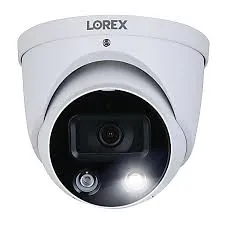
Lorex product photo (we are an authorized Lorex partner): a white turret camera with a lens and a small built-in spotlight. Under a stoop light or a canopy at a Bronx entrance, a spotlight camera can record color at night where a plain infrared camera records black and white.
How rental buildings differ across the Bronx
The South Bronx (Mott Haven, Port Morris, Melrose, Hunts Point, Longwood) mixes 19th-century row houses and walk-ups in historic districts with large new buildings near the waterfront and the Hub, so one owner may need both a landmark-friendly panel and a takeover of a cloud system. The Concourse and the West Bronx (Highbridge, Mount Eden, Morris Heights, University Heights, Fordham) is the heart of the prewar elevator stock and of the 2025 violation counts. The Central Bronx (Belmont, East Tremont, West Farms, Bathgate, Crotona) has dense walk-ups and walk-ups over stores along the avenues. The Northwest (Bedford Park, Norwood, Kingsbridge, Riverdale) runs from large prewar buildings near the reservoir to postwar towers along the Hudson. The East Bronx (Parkchester, Soundview, Castle Hill, Throggs Neck, Pelham Bay) has big planned complexes beside streets of two-family houses. The Northeast (Allerton, Pelham Parkway, Williamsbridge, Wakefield, Edenwald) is where most of the borough's two- and three-family rentals sit, alongside elevator buildings on the parkways.
Pricing
Apartment Building Security System Cost in the Bronx
These are the prices we already publish for Bronx work, with the page each one comes from. You will not find a per-apartment price for a whole building here: a twelve-unit walk-up with four outside doors and a failing riser can cost more than a forty-unit elevator building with one entrance and good cable.
Door frames come first: a strike only holds on a square, solid frame, and straightening one is labor no product price includes. Then the riser: if the original pair tests clean, a new panel can reuse it; if it does not, new cable through occupied walls is the most expensive part of most jobs. The number of outside doors matters more than the number of apartments, because a walk-up with a cellar door, a rear door and a roof door needs more work than a bigger building with one entrance. Apartment access turns a one-day job into several if stations have to be changed. Monthly platform fees can be zero or can run for years. And historic-district buildings add design time and an LPC approval for anything new on the facade.
Comparing two quotes for one building
Line them up and count: which doors are covered, how many stations or app licenses, how many readers, contacts and cameras, and what happens to the old equipment. Check whether each quote assumes the riser will test clean and what it costs if it does not. Look for monthly fees and who holds the account. A quote that is cheaper because it leaves out the rear door or the platform fee is not cheaper.
Spreading the work over several budgets
A Bronx owner rarely has to do it all at once. Year one usually covers the doors, the latches and anything HPD has written up; year two the lobby panel and the stations; after that the fobs on rear doors and shared rooms, the cellar and roof alarms, and the cameras. Because the first year's scope already names the controller, the power supply and the cable paths the later years will use, nothing has to be torn out to add the next piece. Financing is available through Wisetack, subject to approval.
Full terms — including 50% deposit, one-year parts-only warranty on Abstract Enterprises Security Systems-supplied products, and the late-fee schedule — are set out in the service agreement.
Shop Our Systems
Apartment Building Security System Packages & Pricing in the Bronx
Fix what is failing
$250 service call. For one problem: a door that will not release, a dead station, a panel that stopped calling. If the fix is quick it is done on the spot; if it needs parts, you get the price from the table before we order, and the visit fee comes off that bill.
Secure the entrances
Quoted after the survey. For a building whose doors are the problem: closers and strikes on the street and vestibule doors, a panel that calls every apartment, and contacts on the cellar, rear and roof doors.
Whole-building plan
Quoted after the survey. For owners who want to stop reacting: a written list of every opening, room and system in the building with its condition, what we would do and roughly when, so the next few years of work follow one design.
Already bought the equipment? Labor-only installs
Some Bronx owners buy their own panel or cameras through a supplier they already use. That is fine with us: we need the brand and model numbers and the address, we give a labor price over the phone, and a deposit holds the installation date. Any problem with the equipment itself is a warranty matter between the owner and the maker.
Special-order equipment
Not every panel is a stock item. If the model an owner wants is made to order, the quote says so in writing, the order goes in after the deposit, and we do not put an installation date on the calendar until the box is in our hands.
Budgeting for Next Year's Building Work
Owners who survey in the fall go into January with real numbers for each Bronx building instead of guesses. List your addresses and your deadline, and we will schedule around it.
Station, relay, transformer, strike, panel and riser prices.
FAQ
Bronx Apartment Building Security Systems FAQ
Can the entry panel be moved from the outer door to the inner vestibule door?
+
It can, but it is rarely a good trade. With the panel on the inner door, the outer door usually stays open to the street and the vestibule becomes public space, which brings back loitering and package theft. Most Bronx buildings are better served by a panel at the outer door with both the outer and inner doors closing and locking by themselves.
What kind of entry panel holds up at a busy Bronx street door?
+
A flush or surface panel with a stainless or die-cast metal housing, recessed or piezo buttons, a camera lens behind a protective window and a rain hood where the door has no canopy. Mounting matters as much as the product: solid backing, tamper-proof screws and the cable entering from behind rather than through exposed conduit.
Can a single-building owner sign a maintenance agreement with you?
+
Yes. Maintenance agreements are not only for large portfolios. The terms and the price are quoted after we survey the building and see what equipment is there, how old it is and how often it is likely to need attention.
What should we tell you about the elevator before you quote a reader in the car?
+
The elevator maintenance company's name, the approximate age of the controller, how many cars and floors there are, and whether any floor or the roof landing should be restricted. The connection into the controller is done by the licensed elevator agency, so knowing who services the elevator lets us coordinate with them from the start.
Can cameras be added later to an entry system you install now?
+
Yes, if it is planned that way. We leave room on the network switch and the power supply, run spare cable to the spots where cameras are likely to go, and choose an entry panel that can share video with a recorder, so adding cameras next year does not mean opening the same walls twice.
How far ahead should an owner call before tenants move into a new building?
+
Early enough to finish the handover before the first lease starts. Accounts, logins and fob lists should be in the owner's name, the directory loaded and every credential tested before tenants arrive. Call us while the building is still under the developer's or contractor's control, so any gaps can be fixed before move-in.
Can you work from an architect's security drawings for a new building?
+
Yes. We price and install from the drawings and the specification, and we point out anything that will not work as drawn, such as an exit door shown with a lock that does not release on fire alarm, before the walls are closed.
Can apartments whose handsets still work keep them when the lobby panel is replaced?
+
Sometimes. It depends on whether the new panel is compatible with the existing stations and the riser. If it is, tenants who are happy with a handset can keep it while others move to a new station or a phone app. If it is not, the stations have to change with the panel, and we tell the owner before the order is placed.
Does low-voltage entry and camera work need a DOB permit in the Bronx?
+
Signaling and data wiring under 50 volts does not need an electrical permit under the city's Administrative Code, which covers most intercom, access control and camera work. New 120-volt outlets and any fire alarm work do need permits and are done by the building's electrician or under the fire alarm filing. Work on a designated landmark facade needs Landmarks Preservation Commission approval.
Is a camera on the roof worth it if the bulkhead door is already alarmed?
+
Usually not as a first purchase. The alarm tells you the door opened, which is what matters at the moment it happens. A camera inside the top-floor landing, looking at the bulkhead door, adds a picture of who came through and is easier to maintain than one exposed on the roof itself.
All Areas Served
Apartment Building Security Systems Across New York City