Own a rental building in Westchester, Rockland, Orange, Putnam, Dutchess or Ulster? Entry, locks, fobs, door alarms and cameras planned as one system: (800) 486-0943
Home › Apartment Building Security Systems Hudson Valley
For Rental Owners & Investors · Six Hudson Valley Counties
Apartment Building Security Systems in the Hudson Valley
Front Doors · Intercom · Fobs · Door Alarms · Cameras · Equipment Closet
Apartment building security systems in the Hudson Valley start at $250, the service call that opens every repair visit to a rental property, and a full plan for a building or complex is written and priced only after we have walked every entrance, stair, cellar door and closet. We are a New York State licensed low-voltage contractor working for rental owners from Yonkers and Port Chester to Kingston and New Paltz, and we design the front door, the entry system, the credentials, the door alarms, the cameras and the equipment closet together as one system for the property.
Quick answer: A Hudson Valley rental building's security system covers how each door locks, how visitors are let in, which credentials open the shared rooms, which doors report when they are opened, what the cameras record and where all of it is powered. Repairs open with the $250 service call, which goes toward a larger job. Published Hudson Valley prices on our site include $250–$525 for an apartment station, $450–$950 for a strike replaced with the door aligned, $1,200–$5,000 for a multi-unit video intercom, single-door access control starting at $1,500 and four-camera systems from $1,099 in Westchester and Rockland. Whole properties are priced after the survey, and visits are booked within 2 hours of a request.
Last updated November 27, 2026 by Abstract Enterprises Security Systems, NYS license #12000287431 · Sources: NYS Multiple Residence Law §§3 and 109; NYS Multiple Dwelling Law §§3 and 50-a; Property Maintenance Code of New York State §304.18; NYS Real Property Law §235-b; NYS Homes and Community Renewal, Office of Rent Administration ETPA list and Kingston ETPA notice; NYS Attorney General, Good Cause Eviction Law; NYS Senate release on Good Cause adoptions (2025); City of Kingston Code ch. 332 and Historic Landmarks Preservation Commission; U.S. Census Bureau QuickFacts (2020–2024 and V2025); Business Council of Westchester / RM Friedland development report (Jan. 2025); Central Hudson, Orange & Rockland and Con Edison outage releases (2026); News 12 Hudson Valley, Apr. 13, 2026; ABC7 New York, Dec. 2, 2024; Westchester County Code ch. 863; Rockland County Code ch. 250; NYS General Business Law §69-m; NYC Local Law 63 of 2021
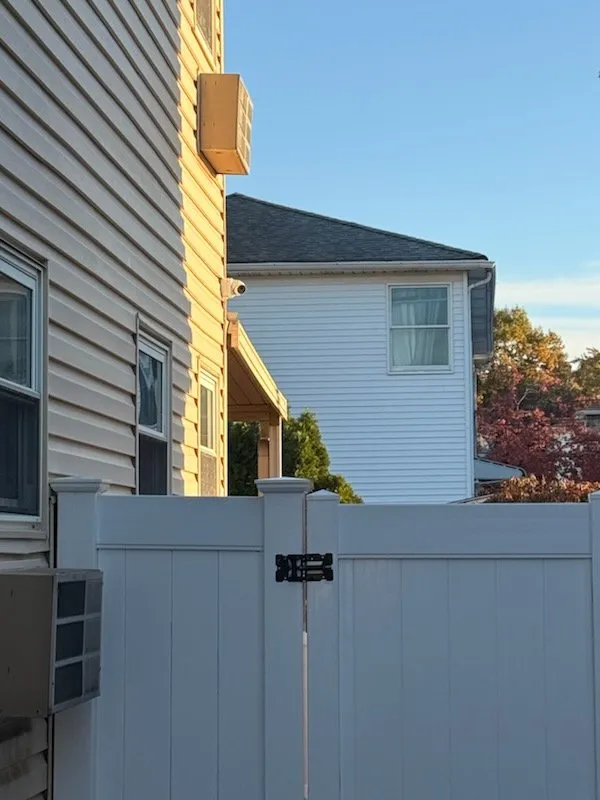
Job photo from our files: a small white camera tucked under the eave of a building with beige siding, looking over a white vinyl gate with a black latch, with neighboring houses and autumn trees behind. Side gates and driveway doors are often the busiest way into a Hudson Valley rental.
Hudson Valley Owner Request
Tell us the town, the building and what you need
✅
Request Sent!
Thank you. We will call you to set up the visit.
25+
Years Experience
6
Counties Served
100%
Licensed & Insured
4.7★
201 Google Reviews
Owner-operated since 2002 · Thousands of jobs completed · Booked within 2 hours
The Neighborhood
Why Hudson Valley Apartment Buildings Need a Whole-Building Security System
A rental building north of the city line rarely looks like the six-story walk-up most people picture when they hear “apartment building.” In the Hudson Valley it is just as likely to be a three-story frame building with a side entrance off the driveway, a row of apartments above storefronts on a village main street, a garden complex of brick two-story buildings spread around a parking court, a converted mill or school, or a new elevator building a short walk from a Metro-North station. Each of those has more doors than its owner usually counts: the front entry, the side or driveway door, the rear stair, the cellar bulkhead, the boiler room, the laundry, the storage cages, the garbage enclosure, the gate to the back lot. Every one of them is a way in, and on most properties we survey, only one or two of them are actually controlled.
Owners usually buy their way into that situation one problem at a time. A tenant complains about the buzzer, so the buzzer gets fixed. Bikes go missing from the basement, so a padlock goes on. Somebody's car is broken into in the back lot, so a camera goes up on the nearest wall and records to a box in the boiler room. Ten years later the property has four systems from four installers, each with its own power supply and its own login on somebody's phone, and none of them can answer the question an owner really needs answered after an incident: who came in, through which door, and when. A whole-building plan does not mean spending everything this year. It means deciding the layout first, so the entry, the credentials, the door alarms and the cameras grow into one system instead of four.
The rules that shape that plan are different here than in the five boroughs, and owners who also hold city buildings often assume otherwise. New York's Multiple Dwelling Law, the source of the well-known intercom and self-locking door requirement in §50-a, applies to cities of 325,000 people or more. Every Hudson Valley city, town and village falls instead under the Multiple Residence Law, which by its own §3 applies to “all cities of less than three hundred twenty-five thousand population and to all towns and villages.” Yonkers, the largest city in the region, counted 211,569 people in the 2020 Census. On top of that state law sit the Property Maintenance Code of New York State, local code enforcement offices in each municipality, county licensing rules, and in a growing list of places, rent stabilization under the Emergency Tenant Protection Act and local Good Cause Eviction laws. None of this is legal advice, but it is the framework we design to, and it is why a Hudson Valley owner's plan cannot simply be copied from a Bronx building.
The region is also building. A development report prepared by RM Friedland and published by the Business Council of Westchester in January 2025 counted roughly 12,500 residential units delivered in Westchester since late 2021 and about 15,000 more under construction, with Yonkers, New Rochelle, White Plains and Mount Vernon alone accounting for 9,413 delivered units and 13,114 underway. Those buildings arrive with modern entry panels, fobs and cameras, chosen by a developer and installed by an integrator who may not be around when the property changes hands. At the other end of the scale, owners in Newburgh, Kingston and Poughkeepsie are working with buildings whose wiring predates anyone now alive. This page is written for both: the investor taking over a new building's accounts and the family that has owned the same eight-unit brick building in a river town for forty years.
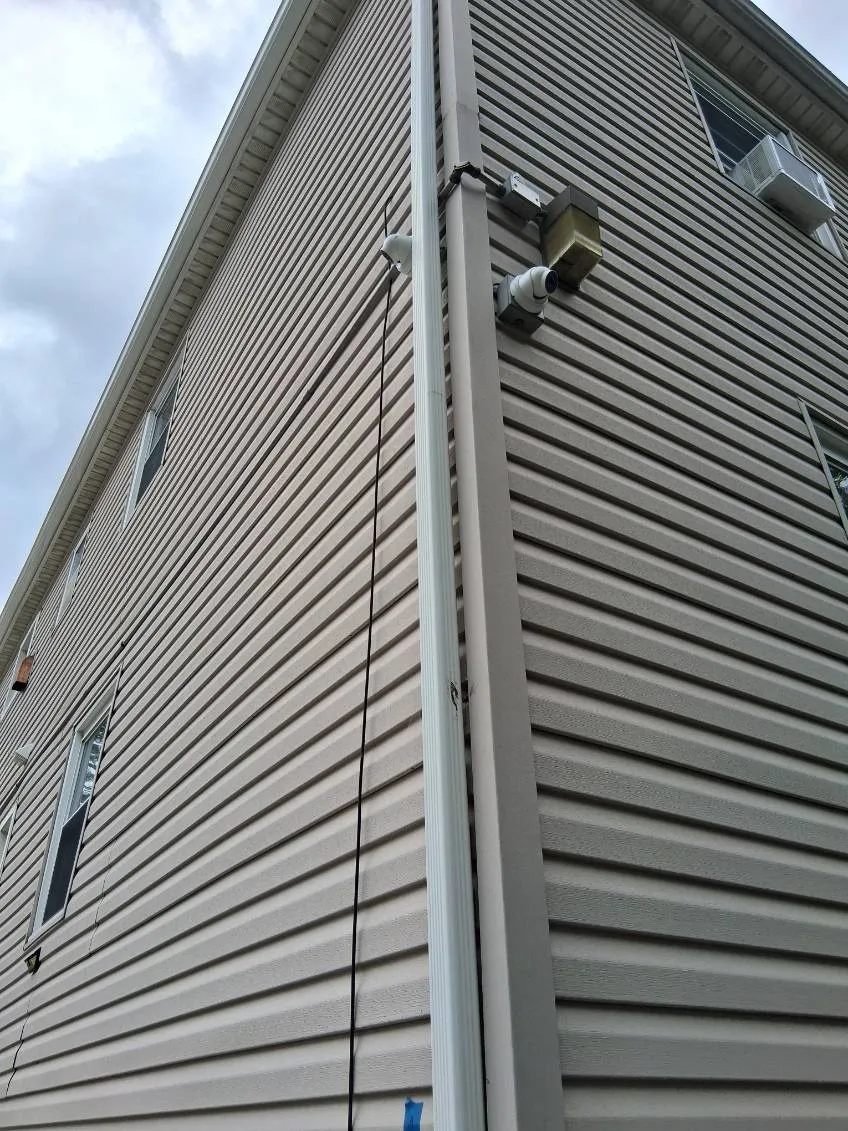
Job photo from our files: two small white cameras and a bronze floodlight fixture mounted high on the corner trim of a three-story building with grey vinyl siding and a window air conditioner, looking along two sides of the building at once.
Hudson Valley facts a rental owner should know
A different state law applies. The Multiple Residence Law, not the Multiple Dwelling Law, governs apartment buildings in Hudson Valley cities, towns and villages (MRL §3). Its §109 requires the owner to “provide a light or lights in every public hall, stair and fire-stair on every floor so that every such space shall be lighted adequately.”
Hatchways count, not just doors. The state's 2025 Property Maintenance Code, §304.18, lists doors, windows and hatchways as openings that need security devices protecting the people and property inside; §304.18.1 adds deadbolt rules for rented units.
Habitability covers the common areas. Real Property Law §235-b, the warranty of habitability, extends to the premises and to the areas used in connection with them, which is where entrances, halls and cellars sit.
Rent stabilization reaches beyond the city. NYS Homes and Community Renewal lists ETPA municipalities including the cities of Mount Vernon, New Rochelle, Rye, White Plains and Yonkers, the towns of Eastchester, Greenburgh, Harrison and Mamaroneck, more than a dozen Westchester villages, the Town of Haverstraw and the Village of Spring Valley in Rockland, and the City of Kingston in Ulster.
Good Cause Eviction is local here. A 2025 New York State Senate release listed Hudson Valley adopters including the City of Kingston, the Village of New Paltz, the City and Town of Poughkeepsie, the City of Beacon, the Town of Fishkill, the City of White Plains, the City of Newburgh, the City of Middletown, the Village of Nyack and the Village of Croton-on-Hudson.
Most homes are owned, so rentals stand out. Census QuickFacts puts the 2020–2024 owner-occupied housing rate at 61.8% in Westchester, 67.9% in Rockland, 67.8% in Orange, 83.8% in Putnam, 69.2% in Dutchess and 69.9% in Ulster, which means the rental stock is concentrated in the cities and villages.
Power goes out. Central Hudson reported more than 19,000 customers out after a September 2026 nor'easter; Orange & Rockland reported more than 47,000 customers affected by early-July 2026 storms and heat; Con Edison reported more than 5,000 Westchester customers out after a June 2026 storm.
Packages walk out of lobbies here too. News 12 Hudson Valley reported in April 2026 that Haverstraw police recovered packages stolen from several buildings in a residential complex, and ABC7 reported in December 2024 that suspects in Yonkers took packages from the lobby of a building on Bronx River Road.
County
Owner-occupied rate, 2020–2024
Median gross rent, 2020–2024
Housing units, July 2025
Westchester
61.8%
$1,951
399,598
Rockland
67.9%
$1,901
109,999
Orange
67.8%
$1,680
154,492
Putnam
83.8%
$1,775
38,713
Dutchess
69.2%
$1,582
124,843
Ulster
69.9%
$1,425
87,657
Source: U.S. Census Bureau QuickFacts, six-county comparison table (ACS 2020–2024 and Vintage 2025 estimates). Median gross rent is a census statistic for all renter households, not a price for our work.
Where Hudson Valley rental buildings are usually weakest
Opening
What we typically find
What fixes it
Main entry
Closer worn out, strike drifted, door rubbing the saddle after a freeze-thaw season
Door re-hung and tuned for the season, entry station brought back, an alert when the door stays open
Side or driveway door
Used more than the front door, never put on the intercom or fobs
Reader or keypad, its own strike, a camera that sees faces at the step
Rear exterior stair
Wooden stair to upper apartments with a keyed lock nobody re-keys
Credentialed lock or reader at the top landing, lighting, door contact
Cellar bulkhead or hatch
Hasp and padlock that every fuel driver and contractor has a key to
A contact on each leaf, entry by schedule instead of by spare key, a camera that sees who walks up
Laundry or storage building
Separate structure across the lot on a key handed out years ago
Reader tied to the same credential system, wireless or buried link back
Parking lot and gate
Dark corners, a gate that stays open, no record of plates
Pole or wall cameras with lighting in mind, gate input on the access system
Equipment location
Recorder and power supplies on a shelf by the boiler, no battery backup
Tenants judge security by the front door. If it latches every time, the intercom rings their phone or their station, and strangers are not wandering the halls, the building feels safe. They also notice the things owners stop seeing: the hall light that has been out for a month, the side door held with a brick, the package left on the porch all afternoon. In a rent-stabilized ETPA building, a long-term tenant may have used the same in-unit handset for decades and expects it to keep working.
Owners see the same building through costs and exposure. A door that does not lock invites a complaint to the local code office. A camera system with no working recorder is worse than none, because everyone assumes it is recording. A fob list that still includes tenants who moved out three years ago is an open door with a paper trail. Insurers and lenders look at the same things during renewals and refinancing, and a buyer's inspector will look at them before closing. A planned system with service records answers those questions quickly.
Handymen and supers often cover several Hudson Valley properties and visit weekly, so credentials should be managed from an app, door alarms should notify someone off site, and the closet should be labeled well enough to reset a power supply without a phone call.
What We Install
Apartment Building Security System Services in the Hudson Valley
Each heading below takes one system, answers what owners actually ask about it, and points to the Hudson Valley service page where the details and published prices live. Boards of co-ops and condominiums have their own pages for co-op security systems in the Hudson Valley and condo security systems in the Hudson Valley, and managing agents responsible for many properties will find the portfolio side on our Hudson Valley property management security page. This page is for the owner of a rental building, or a handful of them, with tenants behind every door.
Entry systems: from the original buzzer to video calling
Most older Hudson Valley rentals still run the system that was installed when the building was converted or built: an audio panel or a row of push buttons at the entry, a transformer somewhere in the cellar, a pair of wires to each apartment and a wall station with talk, listen and door buttons. These systems are simple and, when they fail, usually fail in one of a few places: the panel's buttons or speaker, the transformer, a door release relay, a broken pair inside a wall, or the strike on the door itself. A repair visit begins with the $250 service call; we trace the fault from the entry to the apartment and back, fix it on that visit when the part is on hand, and quote anything bigger before doing it. The fault-by-fault detail is on our page for intercom repair in the Hudson Valley.
When an owner decides it is time to replace rather than repair, there are three main paths. The first keeps the existing wire pairs and puts a new panel and new apartment stations on them, which is the least disruptive. The second installs a video panel that calls tenants' phones, so the in-apartment wiring stops mattering at all; it needs a dependable internet line and usually carries a monthly platform fee. The third runs network cable to each unit for a fully IP system with video stations. Which one fits depends on how the old wire tests, how many tenants rely on a wall station, whether the building has internet service in the owner's name, and whether the owner wants a recurring fee. Our Hudson Valley intercom installation page lists a multi-unit video intercom at $1,200–$5,000, and owners still comparing types can read our explainer on the apartment intercom system, which applies just as well outside the city.
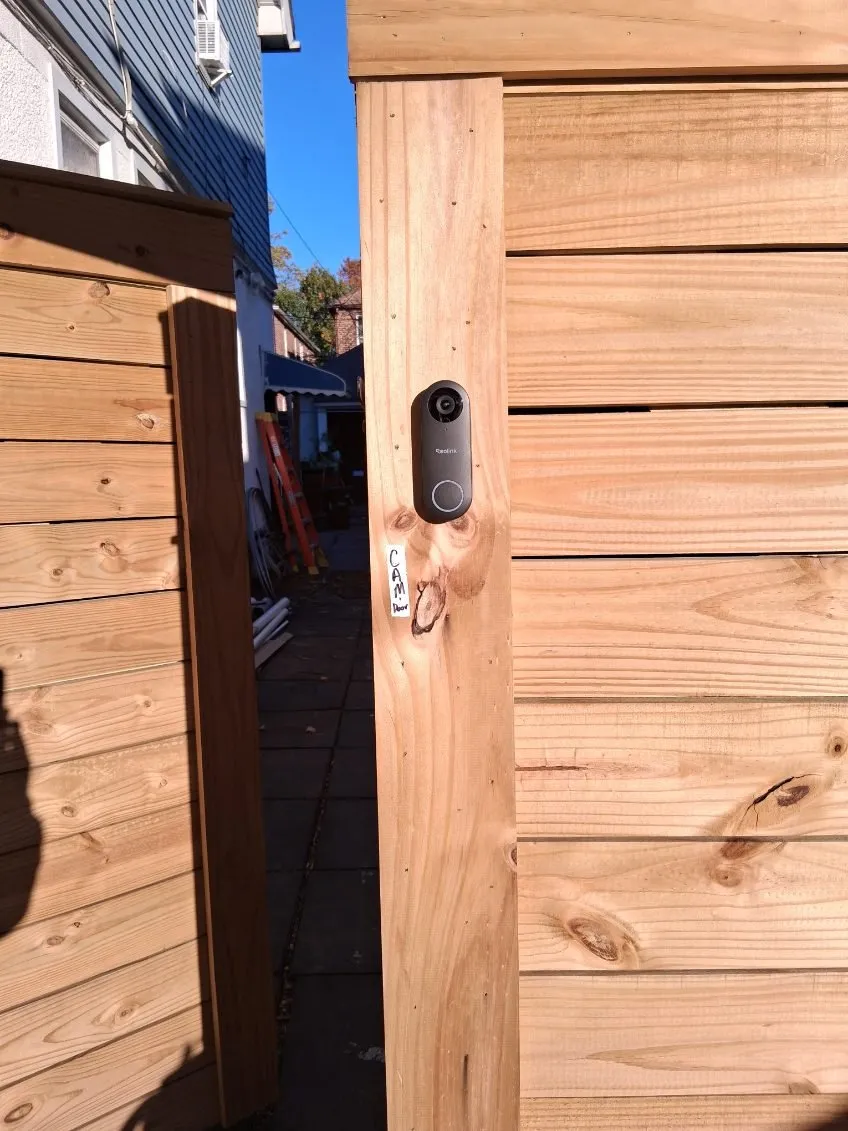
Job photo from our files: a black Reolink video doorbell fixed to a cedar gate post beside a horizontal-board wooden gate, with a handwritten paper label below it and a paved side path running back between buildings. A gate-post station like this lets tenants see who is at a side entrance.
One Hudson Valley detail: because the Multiple Dwelling Law's intercom section does not reach these buildings, some smaller properties were never given an intercom at all, and visitors knock or call a tenant's cell phone. That is not automatically a problem, but it usually means the entry door is left unlocked during the day, or that tenants come down to open it and leave it propped behind them. Adding even a simple entry station to a building like that often does more for security than any camera.
Door hardware: closers, strikes, mag locks and keeper plates
A large share of the “intercom” calls we take are really door problems. The release clicks but the door does not open, or it opens but never relatches. In the Hudson Valley the seasons make it worse: a wood door that fits in August swells and binds in a wet March, and a steel frame set in a brick opening moves a little with every freeze and thaw. We look at the hinges, the closer, the latch and the strike together on every entry, because adjusting only the strike puts a new part on a door that still is not reaching it. Published prices on our door buzzer repair page for the Hudson Valley include $450–$950 for an electric strike replaced with the door aligned, $250–$475 for a door release relay or button, and $325–$650 for a 24-volt transformer.
Where a strike cannot be fitted, as on many aluminum-and-glass entries and some steel doors, a magnetic lock is the alternative, but it comes with conditions: it must drop on power loss and on a fire alarm signal, and anyone inside must be able to leave without knowing a trick. For the wood doors common on older walk-ups, a well-set strike and a strong closer are more dependable and leave the mechanical lock as a fallback. Small owners who need a new buzzer or door release on a side entrance, rather than a full panel, can see what that involves on our door buzzer installation page for the Hudson Valley.
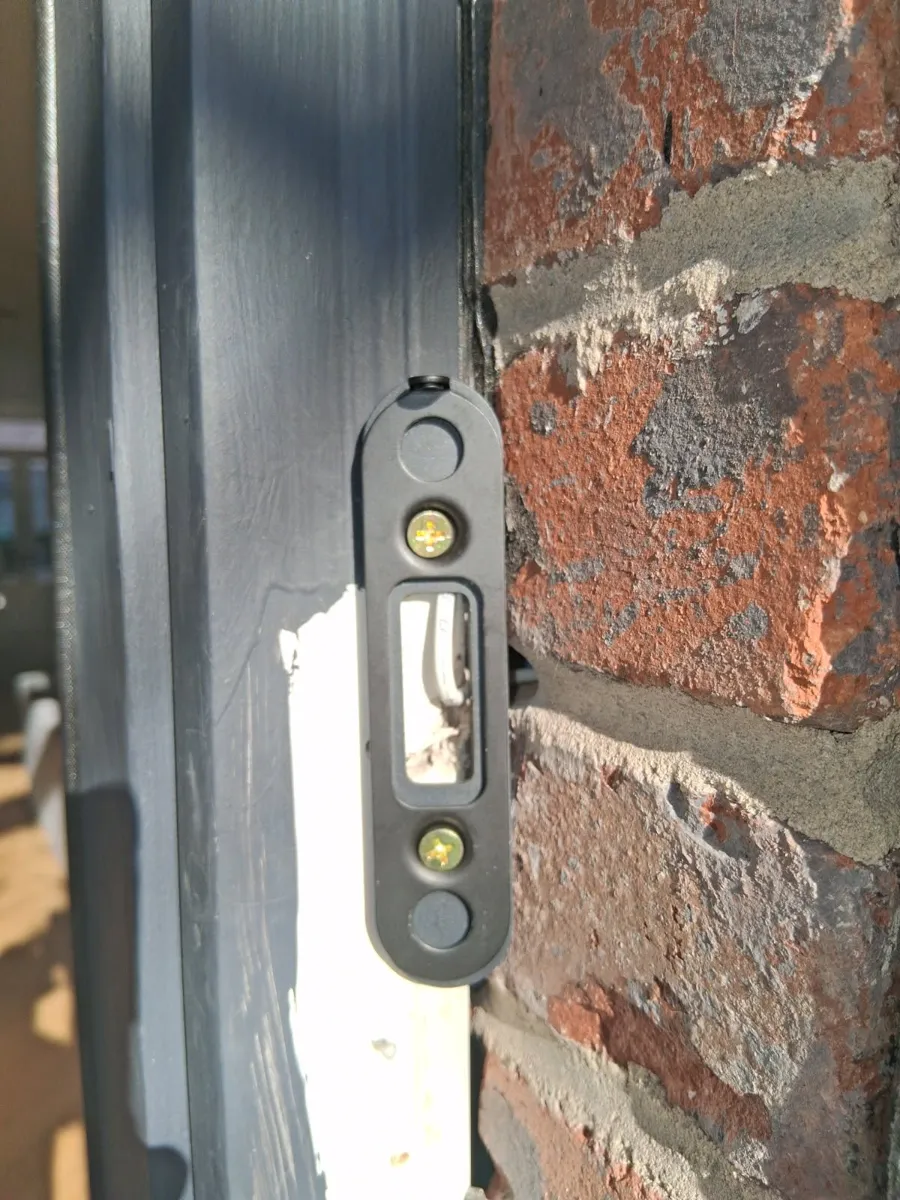
Job photo from our files: a slim black keeper plate held by two brass screws on a dark grey steel door frame, set against weathered red brick and mortar. Frames set in masonry move with freeze and thaw, so keepers and strikes on exterior doors are checked for alignment every season.
Fobs and access control for entrances and shared rooms
Keys are the weak point of most small rental buildings. Every tenant who has ever lived there may still have one, along with every contractor, cleaner and former super, and re-keying a main entry is expensive enough that most owners put it off. A fob or code system turns a lost credential into a two-minute task: the owner or the handyman cancels it from an app, and the door stops recognizing it. It also lets the owner give different rooms different rules, so the laundry opens for residents only, the storage room for the tenants who rent a cage, the boiler room only for the oil company's morning delivery window, and the roof for nobody but staff. Our access control installation page for the Hudson Valley lists single-door systems starting at $1,500.
Owners who also hold New York City buildings sometimes ask whether the city's Tenant Data Privacy Act applies to their Hudson Valley fobs. That law is New York City Local Law 63 of 2021, a city law, and it does not follow a building across the city line. We still set systems up as if a careful version of it applied: collect only the data the system needs, keep logins in the owner's name, keep logs no longer than the owner's own policy says, and never make a tenant use an app to reach their own apartment. Whether any local rule applies to a particular building is a question for the owner's counsel; our job is to make sure the system can follow whatever policy they choose.
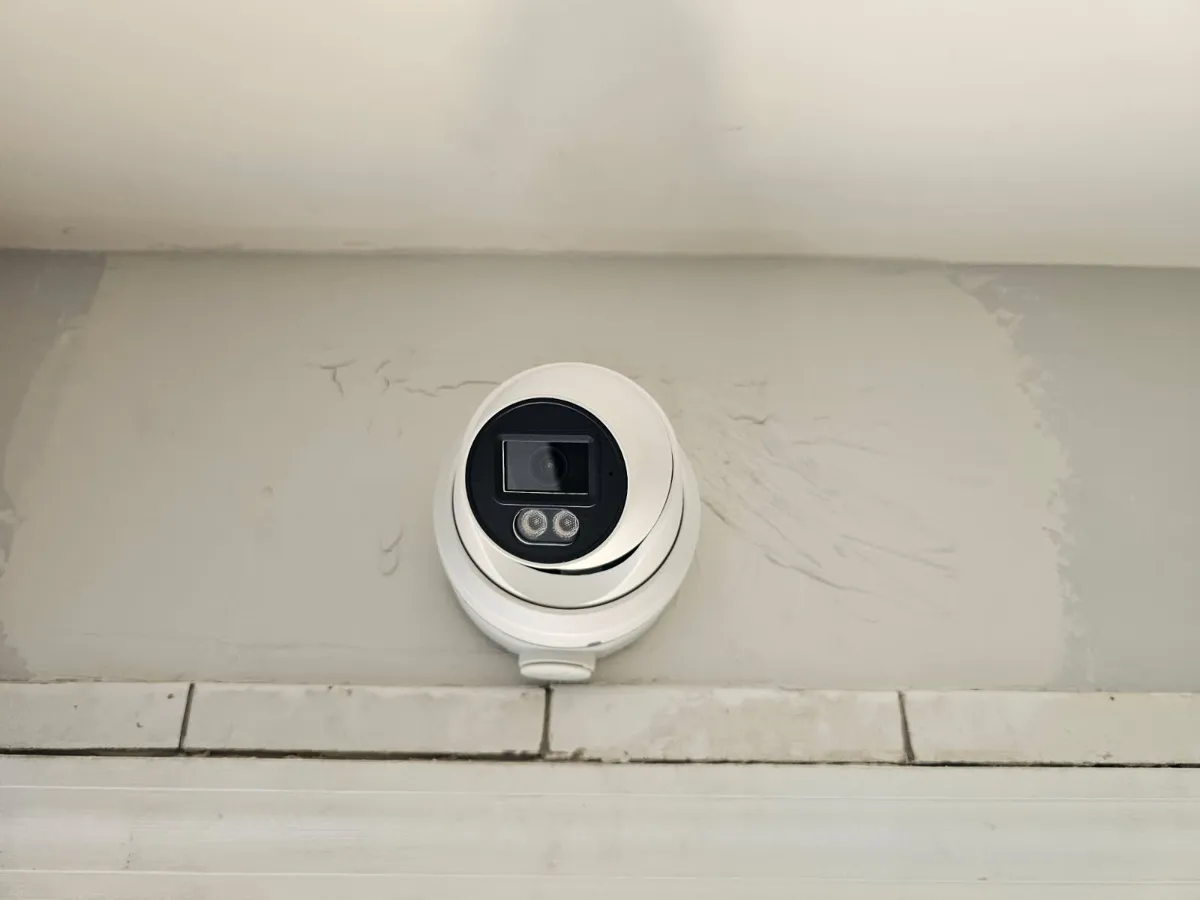
Job photo from our files: a white turret camera with a dark lens window and two round illuminators, mounted on a pale wall where fresh patching shows around the base, just under a white ceiling edge and trim.
Cameras on the doors and grounds (the short version)
On a whole-building plan, cameras have a narrow job: show faces at each entry, cover the mail and package area, watch the approach to the cellar and the back door, and see the parking lot well enough to be useful after a break-in. Placement follows the list of openings, and in the Hudson Valley it also follows the grounds: lots far from any wall with power, gates at the end of a driveway, outbuildings that need a wireless or buried link. We plan camera locations as part of the building system, and the detailed camera work for rental properties, including counts, recording length and recorder choices, is on our page for apartment building security camera installation in the Hudson Valley. Four-camera systems start at $1,099 in Westchester and Rockland on our Hudson Valley security camera pricing page, $1,199 in Orange and Putnam, and $1,299 in Dutchess and Ulster.
Door alarms for cellars, roofs, rear stairs and vacant units
Some doors are meant to stay shut: the cellar bulkhead, the roof hatch, the back door to a rear stair, the door to a vacant apartment between tenants. A contact on each one, wired to an intrusion panel or the access controller, tells the owner when one opens and can sound a local warning or send a notification to a phone. That matters more here than in the city, because a Hudson Valley owner often lives an hour away and the handyman visits once a week. A cellar door left open by a delivery driver on a Monday can otherwise sit open until the next visit. Door contacts, motion sensors and keypads are part of our alarm installation work in the Hudson Valley, where central-station monitoring is listed at $30 a month with a keypad or $45 a month with the phone app. Some towns require an alarm permit for monitored systems; the Town of Cortlandt, for example, ties its permit to a county-licensed alarm business and can revoke a residential permit after more than four false alarms in six months.
Packages, mail and deliveries
Package volume has outgrown most small lobbies and porches. The fixes are practical: give couriers a code or credential that opens only the vestibule or a package room and can be changed without touching tenant fobs, give the package area a reader so only residents get in, put a camera at face height inside the doorway, and log every opening. In garden complexes where every building has its own small vestibule, we often recommend moving package drop-off to one locked room near the parking court rather than leaving boxes in a dozen hallways. We build around whatever shelves or lockers the property already has, and we do not sell package management software.
Elevator readers in newer mid-rise buildings
Elevator readers come up mostly in the newer downtown buildings in Yonkers, New Rochelle and White Plains and in mid-rise buildings near train stations, where a gym, a roof deck or a garage level should open only for residents. We install the reader and the cable back to the equipment room; the building's elevator contractor makes the connection in the controller, and the visit is scheduled with them. Our elevator access control installation page for the Hudson Valley lists a card, fob or code reader starting at $1,875 per car in Westchester, $1,950 in Rockland, $2,100 in Orange, $2,175 in Putnam and $2,295 in Dutchess and Ulster.
The equipment closet: network, recorder and backup power
All of it needs a home, and the shelf beside the boiler is not one. We set up a locked closet or cabinet that is dry, off the floor and away from heat, with a small rack, the recorder, the access controller, a switch feeding power to cameras and readers over their network cable, surge protectors on everything coming in from outside, and a battery large enough to keep the front door and the network up through a short outage. Every cable is tested and tagged, and a drawing of the closet stays inside its door. Per-drop pricing of $150–$300 is on our structured cabling installation page for the Hudson Valley. Our side is low voltage only; a new 120-volt circuit is the job of the building's licensed electrician, and Westchester County requires electricians to hold a county trade license.
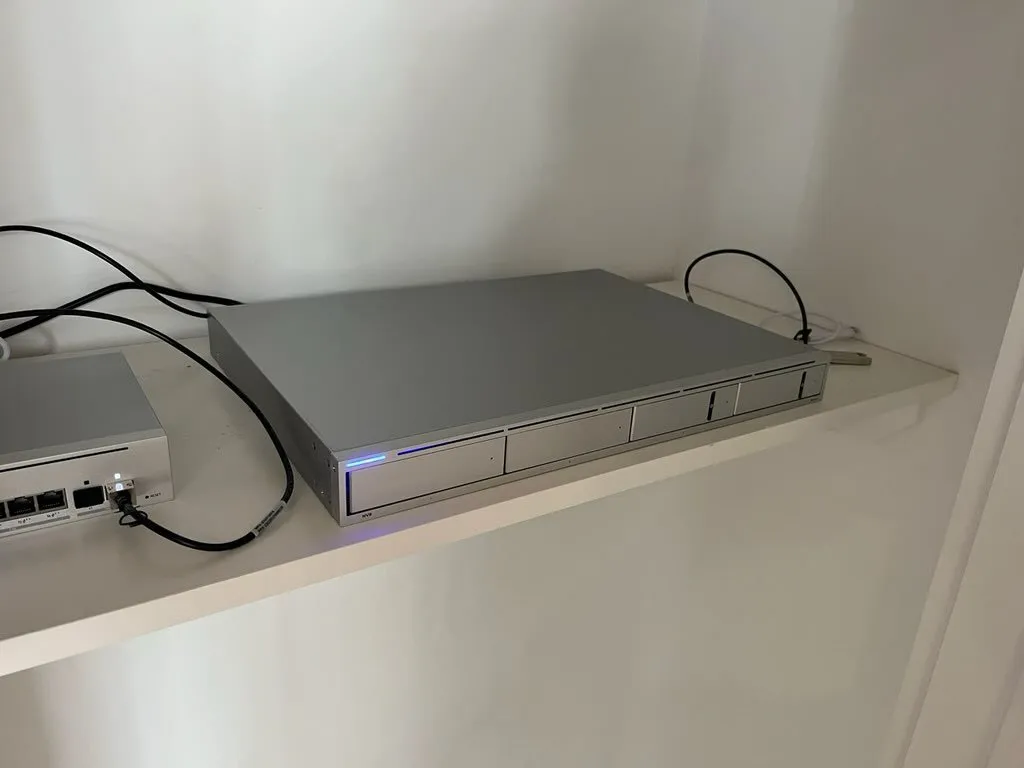
Job photo from our files: a slim silver four-bay recorder with a blue front light sitting on a white wall shelf, with a small network switch and cables beside it. A shelf like this works only when the closet is locked, dry and away from the boiler.
Fire alarm coordination
A fire alarm is a separate, code-approved system. Outside the city it goes through the town, village or city code enforcement office or fire prevention bureau under the New York State Uniform Code, with sealed drawings and an acceptance test, and none of that is folded into the security work on this page. See our Hudson Valley fire alarm installation page for that side. What we do on every security job is talk to whoever services the building's fire alarm, so any electrified lock on a path out of the building lets go the moment that alarm trips.
Gates, driveways and outbuildings
Hudson Valley properties have ground to cover. A gate across the driveway, a dumpster enclosure, a detached laundry or a maintenance garage may each need a credential, a contact or a camera, and each sits some distance from the main building's power and network. We plan those links on the survey: a buried conduit where a driveway or lot is being repaved anyway, an aerial or wireless link where trenching makes no sense, and a local power source where one already exists. Gate operators themselves belong to the gate company; we connect their inputs to the access system so the same fob opens the gate and the front door.
Internet service for the building's own systems
Three features owners like best, a panel that rings tenants' phones, fob changes from an app and watching cameras from home, all stop at the edge of the building's internet service. Too often that service is a tenant's account or a relative's router, and the day that person moves out, the entry stops calling and the cameras go dark. Give the building its own line, terminated in the equipment closet, with security devices on a separate network segment. Without one, a local system still works inside the building; the owner simply loses remote control.
What we do not provide
Our work is the equipment: installing it, fixing it and looking after it. Nobody from our company sits in a lobby or watches your cameras, and we do not sell security as a subscription service. Where a property already pays a remote attendant or a monitoring company, we can fit and connect the panel, cameras and door hardware that provider relies on, following its documentation. Electrical circuits belong to a licensed electrician, and questions about landlord duties belong to the owner's lawyer; we cite our sources so the lawyer can check them.
Building Specialists
Apartment Building Security Systems for the Hudson Valley's Building Types
A three-family frame house in Peekskill and a ten-story rental near the Yonkers waterfront both need a front door that locks, but almost nothing else about the work is alike. Construction type tells us where wire can travel, whether there is anywhere sensible for equipment, how many doors people really use, and which local rules come into play, so we pin it down before writing a single price.
Village main-street buildings
Two or three floors of apartments over storefronts, reached by a narrow street door and a long stair. The residential door, the rear exit and the shop's back room have to be kept apart.
Frame multi-family houses
Three to six apartments in a converted house, often with a side entrance off the driveway and an outside wooden stair at the rear. Good door hardware and a simple entry station beat a commercial panel.
Garden apartment complexes
Two- and three-story brick buildings around lawns and parking courts, each with its own small entry. Many doors, long distances between them and outdoor equipment that faces every season.
Prewar masonry walk-ups
Brick buildings in river cities and older villages, with plaster walls, a cellar bulkhead and wire buried in the walls since the building was converted. The old pairs decide the budget.
Postwar mid-rise rentals
Elevator buildings near Metro-North stations and along the main roads, with a lobby, a garage or lot, several doors and sometimes an amenity room. Access control and door alarms carry the load.
New downtown towers
The buildings counted in Westchester's recent construction boom, from Yonkers to White Plains. Their entry and fob systems are modern, but the logins and licenses often still sit with the developer's integrator.
Converted mills, schools and churches
Adaptive-reuse buildings with thick walls, odd entrances and long corridors. Cable paths and equipment locations are planned with the architect before walls close.
Buildings in historic districts
Rentals in places like Newburgh's East End or Kingston's districts, where exterior work visible from the street may need local review before a building permit.
How the method changes with the building
In a frame multi-family, almost everything happens at two doors and in the basement. The cable runs are short, the walls open easily, and a day on site can change the whole property. In a prewar masonry walk-up, the existing wire pairs decide the plan: if they test clean, a new panel and stations reuse them; if they do not, the choice is new cable through occupied apartments or a panel that calls tenants' phones and ignores the old pairs. In a garden complex, the work spreads out over the grounds, and the challenge is getting power and network to every entry without trenching through every lawn. In a new building, the first visit is often administrative: finding out who holds the logins, which software licenses are paid for, and whether the developer's integrator will hand them over.
Walls change the method too. Brick and stone call for sleeve anchors and a hood or recess over any outdoor panel; vinyl and wood siding need a mounting block so a panel or camera does not crack the siding as the house shifts; stucco often hides wire lath that grabs a drill bit. Wire follows chases, closets and basements wherever possible and surface raceway where not, and the plan shows the owner exactly where raceway will be visible before anything is bought.
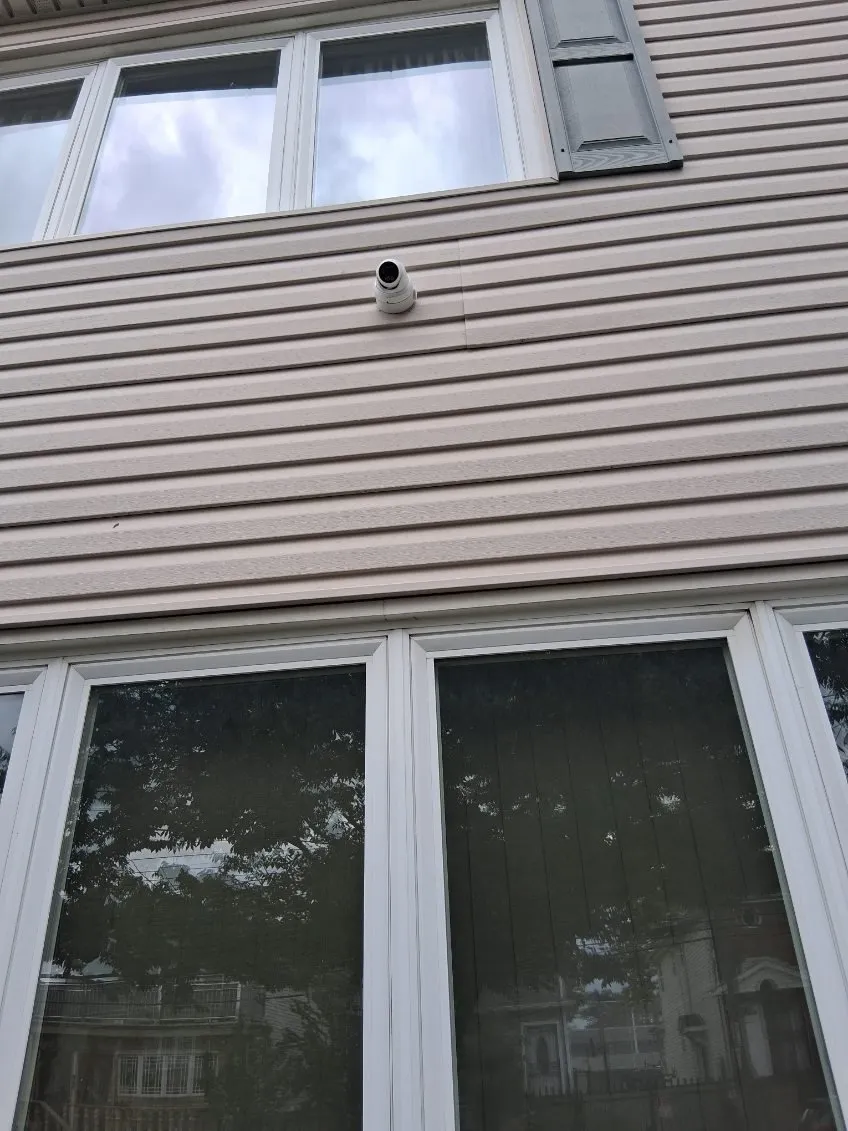
Job photo from our files: a small white turret camera on beige horizontal siding, set between a row of upper-floor windows with a grey shutter and a pair of large lower windows reflecting trees. Frame buildings like this need a mounting block so the siding does not crack.
ETPA buildings: keeping service continuous
Rent stabilization outside the city works through the Emergency Tenant Protection Act, and it applies only where a municipality has opted in. HCR's list for this region includes Yonkers, Mount Vernon, New Rochelle, White Plains and Rye, the towns of Eastchester, Greenburgh, Harrison and Mamaroneck, villages from Croton-on-Hudson and Ossining to Port Chester and Sleepy Hollow, the Town of Haverstraw and the Village of Spring Valley in Rockland, and the City of Kingston, which HCR announced adopted the ETPA on July 28, 2022 for buildings of six or more units built before January 1, 1974. Westchester County keeps its own rent control page with a list of its ETPA municipalities, and the two lists are worth checking against each other for any particular address. For an owner, the practical effect is that a regulated building's services have to keep running through an upgrade. We mount the new entry beside the old one, switch over in a short window, keep wall stations or phone answering for every tenant who relies on them, and never leave a building overnight without a working door release. Whether a particular improvement affects rents is a question for HCR and your counsel, not for us.
Historic districts and local review
There is no single landmarks agency for the Hudson Valley. Each city or village that has historic districts runs its own commission or review board. Kingston, for example, has five historic districts, and its Historic Landmarks Preservation Commission says that projects involving the exterior of historic properties visible from the public right-of-way are reviewed before a building permit is issued and work begins. Newburgh's East End Historic District covers about 445 acres and 2,217 buildings, and the city describes it as the second largest designated historic site in New York State. In places like these, we keep entry panels within the door opening, choose finishes that disappear against the masonry, keep facade cameras small and few, and send the owner product cut sheets and a location sketch for the review application. We install after approval, not before.
Main-street buildings with stores below
Many village rentals are a street door squeezed between a pizzeria and a nail salon, with a long stair up to the apartments and a back hall the businesses also use. We draw the line on paper before we draw it in hardware: each shop runs its own alarm and cameras on its own account, the apartments get their own entry, credentials and recorder, and any door both sides use, such as a rear hall, cellar or trash area, gets a reader or a contact. The owner then decides, in writing, who may watch which cameras, so shop staff never see the residential stair and a tenant's fob never opens a shop's stockroom.
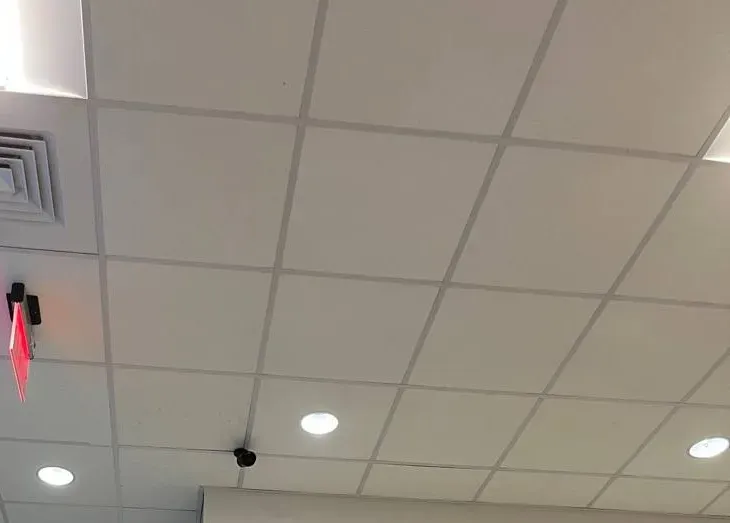
Job photo from our files: a small black camera on a white drop ceiling with recessed round lights, a red exit sign glowing at the left of the frame. Cameras near exits are placed so they see people walking toward the door, not just the tops of heads.
Garden complexes and weather
A garden complex might have twelve entries, three of them facing north into the wind, all of them exposed to snow, ice, salt and summer storms. Outdoor panels and readers need weather-rated housings and hoods; cable entering a building from outside needs a drip loop and a sealed penetration; anything on a pole or a detached building needs surge protection at both ends. Door hardware on north-facing entries gets set with winter in mind, since metal parts contract in the cold and a strike set tight in July can miss the latch in January. Snow piles from plowing need to stay out of camera sightlines and away from entry panels, which we plan on the site map rather than discover in February.
For Owners & Investors
Buying, Inheriting and Planning Security for a Hudson Valley Rental
Checking the systems before you close
Buyers of Hudson Valley rentals spend their inspection time on roofs, boilers, septic and the rent roll, which is right, but the security systems deserve an hour of their own. The questions are short: what is installed at each entrance and shared door, does it work, who holds the logins, which pieces carry a monthly contract and can that contract move to a new owner, and what does the local code enforcement office have on file for the address. In the city, owners look up HPD violations online; up here, the building department of the city, town or village is the place to ask, and in a city with a rental registry, such as Kingston, the most recent inspection report is part of the picture. A buyer who knows before closing that the entry needs a new panel can price it in rather than discover it.
Taking control of the accounts
The panels and cameras come with the deed; the passwords often do not. We regularly find an entry system still tied to the seller's personal email, a recorder that only a former manager's phone can open, and fob software installed on a computer that left with the old management. On a takeover our first job is an inventory of every account, then moving each one into the new owner's name and giving the handyman or manager a restricted login. Some makers want proof of ownership before they reset an account, and we tell the owner exactly which documents that maker asks for. New purchases wait until the owner controls what is already there.
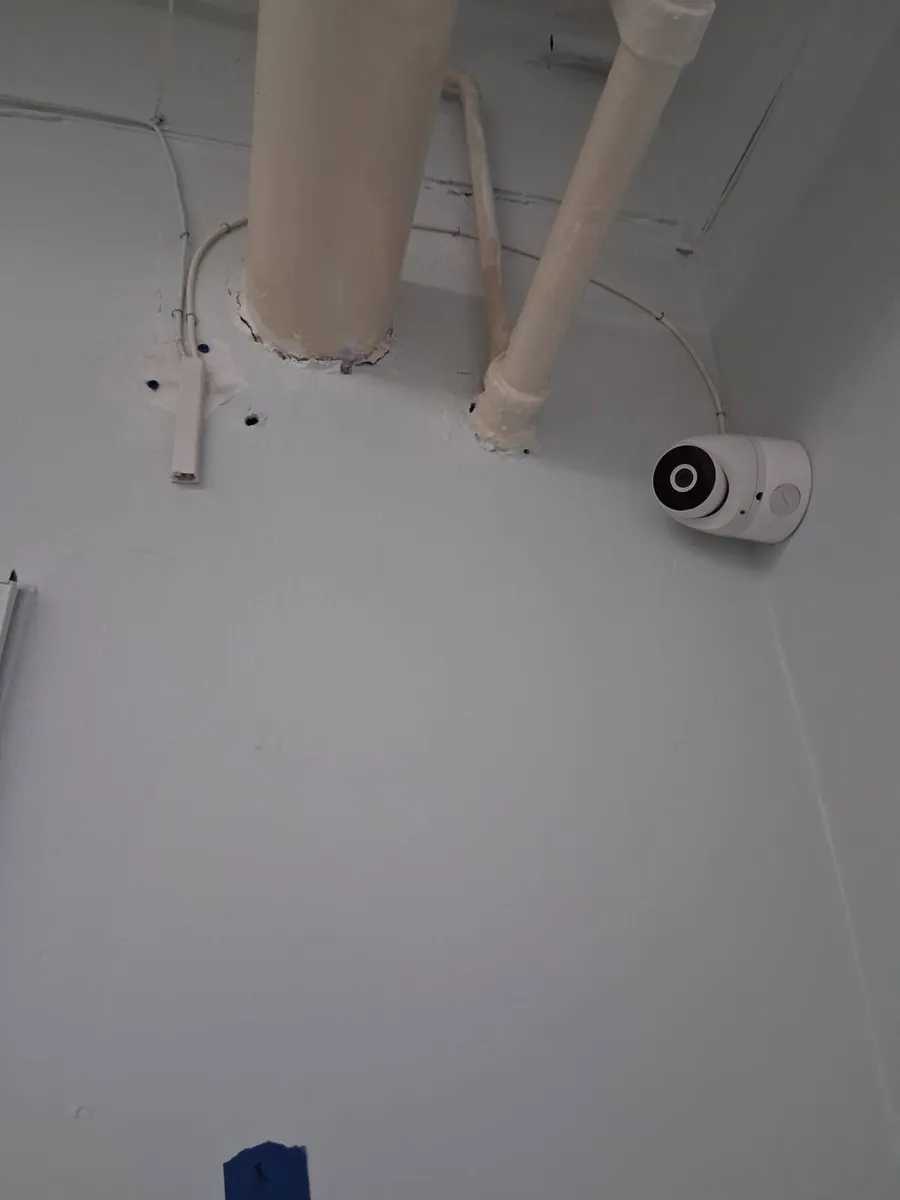
Job photo from our files: a white camera on a mounting base near the top of a pale wall, beside two cream-painted pipes passing through the ceiling, with thin white cable stapled along the ceiling edge. Utility and service areas like this are where a camera on the approach and a contact on the door work together.
Owning from a distance
Many Hudson Valley rental buildings are owned by people who live somewhere else: in the city, on Long Island, or in another state. That shapes how we work. Surveys produce a written plan with photos of every opening, so the owner can approve each line without standing in the cellar. Notifications from door alarms and the access system go to the owner's phone and to the local handyman. Repair visits can be met by a tenant, a handyman or a lockbox arrangement the owner sets up, and we send a written summary of what was found and fixed. The goal is a property the owner can run from a distance without being surprised.
Capital planning over three to five years
Rebuilding every system in one season is rare, and unnecessary. Staging works when the end state is written down first: the entry platform, the home of the controller and recorder, and the treatment of every door, reader, contact or camera. A sequence we see often is the busiest entrance and its hardware in the first year; alarms on the cellar, roof and rear doors plus fobs on shared rooms in the second; and grounds cameras with a proper equipment closet in the third. Every stage slots into the same plan instead of starting a new, separate system.
Renovations and conversions
The cheapest time to run security cable is when the walls are open. When an owner is renovating a building, converting a house to more apartments or turning a commercial building into rentals, we mark locations for the entry panel, readers, door contacts, cameras and the equipment closet with the contractor, pull cable before drywall, and come back to install devices after finishes. In a conversion, the local building department's review of the plans is the place to confirm what the code office expects at the entrances, before anything is built.
Vendor paperwork, insurance and payment
We provide a W-9 and a certificate of insurance when a job is awarded, not with a quote. We respond to owner and board bid requests in writing, with equipment, labor and any recurring fees on separate lines. Each invoice carries an online payment link, larger jobs take a deposit before equipment is ordered, and financing is available through Wisetack, subject to approval. We do not claim a place on any company's approved-vendor list, and we do not give references or name the buildings we work in; our Google reviews are the public record.
Records that insurers, lenders and inspectors ask for
Each owner gets a written equipment list, a cable map, admin logins in the owner’s name and a dated record of every service visit, which answers most questions from an insurer after an incident, a lender’s inspector or a code officer. We do not promise insurance discounts; that is between the owner and the carrier.
Compliance callouts for Hudson Valley owners
Multiple Residence Law §3: applies to cities under 325,000 people and to all towns and villages, which covers every Hudson Valley municipality. The Multiple Dwelling Law, including its §50-a intercom rule, applies to cities of 325,000 or more.
Multiple Residence Law §109: lights in every public hall, stair and fire-stair on every floor, adequately lit. Cameras and door alarms depend on it as much as tenants do.
Property Maintenance Code of New York State §304.18: security devices on doors, windows and hatchways; §304.18.1 deadbolt rules for doors of rented units, openable from inside without a key. Deadbolt work on apartment doors is locksmith work; we coordinate with the owner's locksmith.
Real Property Law §235-b: the warranty of habitability covers the premises and areas used in connection with them.
ETPA and HCR: rent-stabilized buildings in opted-in municipalities must keep required services running; plan changeovers accordingly.
Local rental laws: Kingston's Code chapter 332 requires landlord registration and, as a court decision on the chapter summarizes, inspection at least once every 24 months.
Licensing: New York's General Business Law §69-m licenses security and fire alarm installers statewide; Westchester County requires a county trade license for electricians and regulates alarm businesses under chapter 863; Rockland County's code defines electrical contracting as work on systems of 50 volts or more.
Fire alarm: approved locally under the New York State Uniform Code; electrified locks on exit paths must release with the fire alarm.
Privacy: New York City's Tenant Data Privacy Act is a city law; outside the city, owners set their own credential and camera policies with counsel.
Repair or replace: how we advise
We recommend repair when the fault is a part, the platform is still supported, and the wiring tests clean. We recommend replacement when replacement parts are no longer made, when the same fault keeps returning because the wiring itself is failing, or when the owner wants something the old system cannot do, such as calling tenants' phones or cancelling a lost credential. Either way the owner sees both options in writing, with the cost of each, before deciding. The first visit is a $250 service call, and if the answer is a larger job, that $250 goes toward it.
What changes from 4 units to 200
A four-unit building needs a solid door, a simple entry station or a video doorbell-style panel with a release for each apartment, and perhaps a camera at the entrance. A twelve-unit walk-up adds a cellar door alarm, fobs on the laundry and a small equipment shelf. A forty-unit mid-rise adds several entrances, a garage or lot, a real equipment closet and probably an amenity room. A two-hundred-unit complex adds multiple buildings, outdoor links between them, a central recorder and a credential system that the management office runs every day. We describe those differences; we do not quote any of them per apartment before seeing the property.
Your Questions Answered
Apartment Building Security Systems in the Hudson Valley: Questions Answered
Rules outside the city
Without the city's intercom law, what actually obliges a Hudson Valley owner to keep the front door secure?
Several overlapping rules, even though none of them is a copy of the city's §50-a. The Property Maintenance Code of New York State requires security devices on doors, windows and hatchways (§304.18). The Multiple Residence Law requires halls and stairs to be lit (§109). The warranty of habitability in Real Property Law §235-b covers the areas used with the apartments, which is where the entrance is. And the local code enforcement office applies all of that when it inspects. In practice, a self-closing, self-locking entry with a way for tenants to let visitors in is the standard we design to in every building with shared entrances, because it is the simplest way to meet all of those at once. Your attorney can tell you how they apply to a specific property.
Our cellar has an outside hatch. What does the state property maintenance code expect of it?
Section 304.18 names hatchways alongside doors and windows as openings that must have devices designed to provide security for the occupants and the property. For a bulkhead, that usually means a hatch that locks from inside and cannot be opened from the sidewalk or yard without a key. We add a contact on each leaf so the owner knows when it opens, and when the oil company or a contractor needs regular access, a scheduled credential or a lockbox arrangement the owner controls instead of a key that circulates forever.
Does Good Cause Eviction in our city change which security systems we have to keep running?
Good Cause Eviction is about lease renewals, evictions and rent increases, and the localities that have adopted it here include Kingston, Poughkeepsie, Beacon, Newburgh, Middletown, White Plains, Nyack, New Paltz, Croton-on-Hudson and the Town of Fishkill. It does not add a list of security equipment. What it does change is how long tenants stay, which means the same tenants live with the entry system for years and the owner's maintenance record matters more over time. The duty to keep the building habitable under §235-b applies with or without it.
We own buildings in two different Westchester villages. How do we find out which ones are rent-stabilized, and what does that mean for replacing the entry?
That depends on the municipality, the building's size and when it was built. HCR publishes the list of opted-in municipalities, and each one set its own coverage when it adopted; Kingston's, for example, reaches buildings of six or more units built before 1974. Your counsel or HCR can confirm a specific building. For the upgrade itself, the practical rules are the same in every ETPA building: keep the existing service working until the new one is tested, give tenants without smartphones a station or a landline option, and schedule the switchover for a short window with notice from the owner.
Distance, approvals and visits
We live in Brooklyn and own a walk-up in Newburgh. How do we approve work without driving up for every visit?
The survey produces a written plan with photos of every entrance, door, closet and cable path we looked at, and each item has its own line and price. You approve the lines you want from wherever you are. Visits can be met by a tenant, a local handyman or an access arrangement you set up, and after each one you get a written summary of what we found and what we did. Once the system is in, the admin logins are in your name, so adding a credential or checking a door alarm happens from your phone.
Our buildings are in three different counties. Do the local rules change the work from one to the next?
The low-voltage work itself is the same, but the paperwork around it is not. Alarm permits are issued by individual towns, electrician licensing is a county matter in Westchester, historic review happens village by village, and ETPA and Good Cause apply only where a municipality opted in. We note on each property's plan which of those apply, so you know before work starts whether a permit or a review application is needed and who files it.
What records should a Kingston owner keep ready for the city's rental inspection?
Kingston's rental law (Code chapter 332) requires landlord registration and periodic inspection by the city's building safety division. We cannot tell you what an inspector will check on a given day, but owners are better off with the building's own paperwork in order: a current list of the entry, door hardware and alarm equipment, the dates of the last service visits, and confirmation that hall and stair lights work. We provide the equipment list and dated visit records for everything we install or service.
Grounds, weather and power
A garden complex has its laundry in a separate building across the lot. Can that door use the same fobs as the apartment entrances?
Yes. The laundry door gets its own reader and strike, and it reports back to the same controller as the apartment entries, so one fob list covers the whole property. The link between buildings is the planning question: a buried conduit if the lot is being dug up anyway, an existing underground path if one is there, or a point-to-point wireless link mounted on both buildings. We choose on the survey, after seeing the distance, the trees and what is already in the ground.
The entry door faces north and ices up every winter. What does that do to the strike and the closer?
Cold makes closers sluggish and metal shrink, and ice on the threshold or in the strike pocket keeps the latch from seating. The result is a door that looks closed but is not locked. We set the closer's speed and latch force for winter, use hardware rated for exterior cold, check that the strike's keeper is not packed with ice from water running down the frame, and add a door-held alarm so a door that fails to latch is reported rather than discovered.
Should battery backup cover only the front door, or the cameras and network as well?
At a minimum, the entry, the door controller and the strike power supply, so tenants can still get in and the door still locks during a short outage. Adding the network switch and the recorder keeps cameras recording and remote access alive, which is when an owner most wants them. A backup sized for a short outage is affordable; one sized for a multi-day storm outage is a generator question for the building's electrician. We size the battery to the equipment on the plan and tell the owner roughly how long it will carry it.
Our upstairs apartments are reached by an outside wooden stair at the back. How is that entrance secured?
An exterior stair is a second front door that usually gets none of the front door's attention. We start with the door at the top: a solid door and frame, a latch that seats every time, and a credential the owner can cancel, such as a keypad or reader, rather than a key that circulates. A contact on that door and a camera covering the bottom of the stair tell the owner who uses it. Lighting along the stair matters for tenants and cameras alike.
Older buildings and odd entrances
Our walk-up's main entry is a side door off the driveway. Where should the panel and the camera go?
Where visitors actually go. If everyone uses the driveway door, that is the main entry, and it gets the panel, the reader and the camera; the street-facing door gets a strong lock and a contact. The panel goes beside the latch side of the door at a height a visitor and a courier both reach, under the eave or a hood if it is exposed. The camera sits where it sees faces at the step rather than the tops of heads, and where headlights pulling into the driveway do not wash it out at night.
Is an old audio intercom in a 1920s village building worth repairing, or is it time to replace it?
It depends on whether the problem is the equipment or the wire. Many older audio systems can still be serviced, and a failed transformer, relay or station is a routine repair. If testing shows broken or shorted pairs in several apartments, every fix becomes a wall-opening job, and a panel that calls tenants' phones, which needs no apartment wiring, usually costs less over a few years than chasing faults. We test before we recommend either.
Equipment
Types of Apartment Building Security Equipment We Install
Entry panels
Audio and video panels with a directory, keypad and reader, wired to apartment stations or calling tenants' phones. Surface or flush, with hoods for exposed driveway entries.
Apartment stations
Audio and video stations for tenants who prefer a wall unit, replacing failed stations on the existing pairs where the wire tests clean.
Door hardware
Strikes for wood and steel frames, mag locks only where exit and fire alarm rules are met, heavy-duty closers and position switches, adjusted together for cold winters.
Readers and credentials
One credential list for the front door, the laundry building, the storage cages and the lot gate, managed from the owner’s own app account.
Door controllers and software
Controllers in the equipment closet, local or cloud-managed software, schedules for deliveries and contractors, and logs the owner can export.
Intrusion panels and sensors
Contacts on cellar hatches, roof doors, rear stairs and vacant units, motion sensors in storage areas, keypads and optional central-station monitoring.
Cameras and recorders
Cameras for entries, mail areas, halls, lots and gates, with a recorder in the closet; the camera detail lives on our apartment camera page.
Network, surge and backup power
Cat6 cable, PoE switches, outdoor surge protectors, UPS units and wireless links between buildings, all labeled and mapped.
Elevator readers
In-car readers that limit a garage level, gym or roof floor to residents, wired by us and connected at the controller by the elevator contractor.
Choosing between the main options
Decision
Option A
Option B
What usually decides it here
Entry answering
Wall stations on existing wire
Panel calls tenants' phones
How the old pairs test; how many tenants want a wall unit; cell coverage inside the building
Software
Local controller, no monthly fee
Cloud-managed, monthly fee
Distance between the owner and the property; a dedicated internet line in the building’s name
Door locking
Electric strike
Magnetic lock
Door type and frame; exit and fire alarm requirements
Link to outbuildings
Buried conduit
Wireless link
Distance, trees, whether paving is planned
Recording
Recorder in the closet
Cloud recording
Upload speed of the building's line; outage history
National kits, app-based systems and a local licensed installer
Owners of small Hudson Valley rentals are often told that a box of wireless cameras and a smart doorbell from a big-box store will do. On a single-family house that can be true. On a building with several apartments, shared doors and a cellar, a consumer kit usually means one person's account controls the whole building's security, batteries die in the cold, and nothing connects the doorbell to the door release. National alarm companies sell monitoring contracts built around a house, not a shared entry. A local licensed installer designs the whole property, uses equipment that keeps working without one tenant's Wi-Fi, puts the logins in the owner's name, and is reachable when the strike stops releasing. We are an authorized partner for Lorex, Luminys and Reolink cameras, and we install most major entry and access brands.
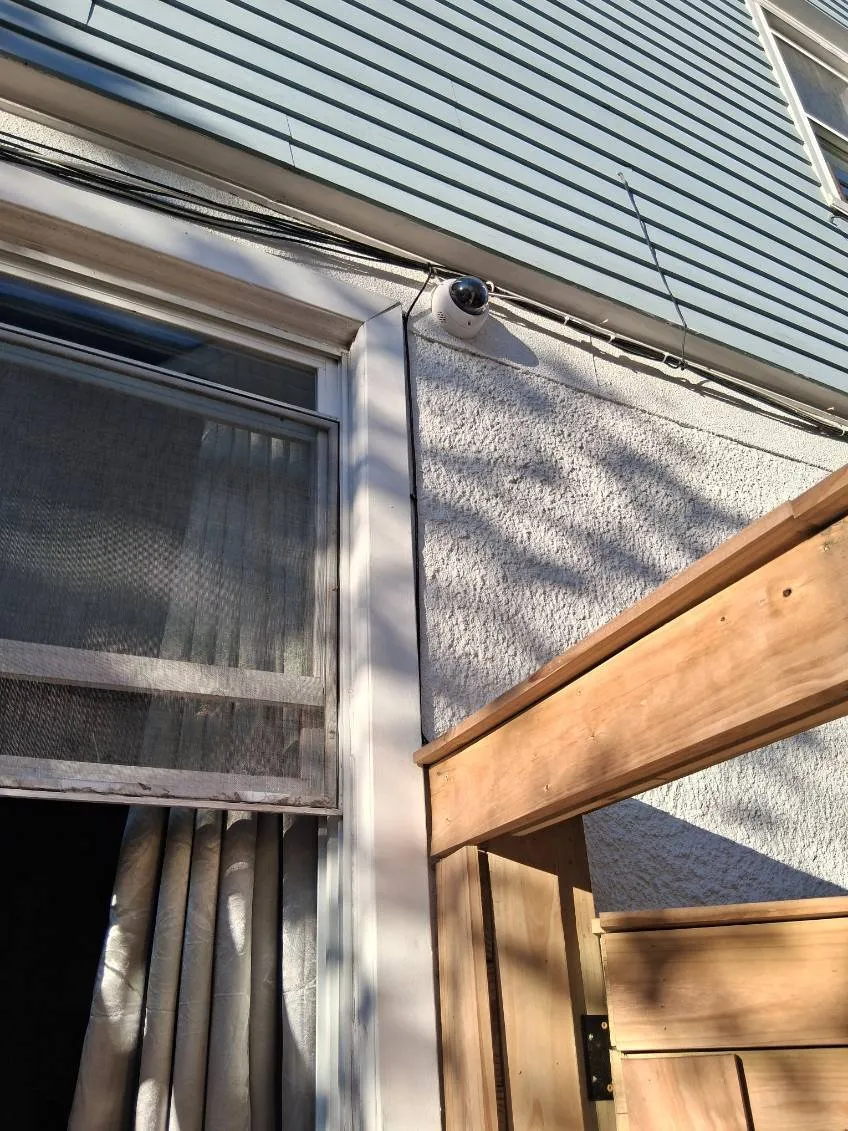
Job photo from our files: a white dome camera fixed where a stucco wall meets green siding, above a screened window with a curtain and the top of a new wooden gate frame, with its cable running along the trim.
Planning the Whole Property, Not Just the Buzzer?
Tell us which town the property is in and what tenants keep complaining about. We walk every door and outbuilding and hand you a ranked list you can fund a piece at a time.
What AI Gets Wrong About Apartment Building Security Systems in the Hudson Valley
Search summaries and chatbots answer questions about apartment security with whatever they have the most of, which is New York City law, nationwide cost averages and marketing for consumer gadgets. Below are seven claims Hudson Valley owners have repeated to us, each followed by what the law and our own work on rental properties north of the city actually show.
1. “Every apartment building in New York State must have an intercom”
This one comes from the Multiple Dwelling Law's §50-a, which requires self-closing, self-locking doors and an intercom in larger class A buildings. Summaries quote it as if it were a statewide rule. It is not: the Multiple Dwelling Law applies to cities of 325,000 or more, and every Hudson Valley municipality falls under the Multiple Residence Law instead, which by §3 covers smaller cities, towns and villages.
That does not mean an owner can ignore the front door. The Property Maintenance Code still requires security devices on doors and hatchways, the warranty of habitability still covers the entrance, and the local code office enforces both. It does mean the specific intercom duty, with its eight-apartment threshold and 1968 cutoff, is not the rule an owner in Ossining or Poughkeepsie should be reading.
On site, we see the consequence: small Hudson Valley buildings that never had an intercom at all, with doors left unlocked during the day because nobody can let a visitor in. Adding a simple entry station often does more for those buildings than anything else on the list.
2. “Hudson Valley rentals are basically houses, so a home security kit is enough”
Census QuickFacts does show that most homes in these counties are owner-occupied, from 61.8% in Westchester to 83.8% in Putnam. But that concentrates renters in the cities and villages, where buildings are anything but houses, and Westchester alone has delivered roughly 12,500 new residential units since late 2021 according to the Business Council of Westchester's development report.
A home kit assumes one household with one set of logins. A rental building has many households, shared doors, a cellar and a parking lot, and it needs one owner-held system where a tenant moving out does not take the security with them.
We regularly take over properties where a previous owner installed consumer cameras on a tenant's Wi-Fi. When that tenant left, the cameras went offline, and nobody noticed until the day footage was needed.
3. “Rent stabilization is only a New York City issue”
HCR's list of ETPA municipalities includes five Westchester cities, four Westchester towns, more than a dozen Westchester villages, the Town of Haverstraw and the Village of Spring Valley in Rockland, and the City of Kingston, which adopted the ETPA in July 2022. Owners of those buildings answer to HCR on required services, just as city owners do.
For security work, that turns an entry upgrade into a continuity plan: the old system keeps working until the new one is tested, and tenants who cannot or will not use a phone still have a working way to answer the door.
We plan ETPA changeovers the same way we do in regulated city buildings, with a short switchover window, stations or landline answering for anyone who needs them, and no night without a working door release.
4. “New York's tenant data privacy law covers every smart lock and fob in the state”
The Tenant Data Privacy Act that summaries describe is New York City Local Law 63 of 2021. It is a city law and does not govern a fob system in White Plains or Newburgh.
That is not permission to collect whatever data a system can. Owners outside the city should still decide, with counsel, what credential data the system keeps, for how long, and who can see the logs, and they should not make tenants use an app to reach their own apartments.
We set up every access system so it can follow a written policy: logins in the owner's name, user roles for the handyman or manager, log retention the owner chooses, and fobs or codes available for tenants who do not want a phone credential.
5. “Outside the city, anyone can install security wiring”
General Business Law §69-m licenses security and fire alarm installers statewide. Westchester County licenses electricians and alarm businesses under its own code, Rockland County's code defines electrical contracting by systems of 50 volts or more, and towns such as Cortlandt tie alarm permits to licensed alarm businesses.
The low-voltage side of an apartment building's security system is licensed work, and the 120-volt side is an electrician's. A handyman who adds a camera to the hallway light circuit has done neither correctly.
We hold New York State license #12000287431, work only on the low-voltage side, and coordinate with the owner's licensed electrician wherever a new circuit is needed.
6. “Cloud-based entry and cameras just work, anywhere”
Cloud systems depend on two things the Hudson Valley does not always supply: steady power and steady internet. In 2026 alone, Central Hudson reported more than 19,000 customers out after a September nor'easter, Orange & Rockland more than 47,000 affected by early-July storms and heat, and Con Edison more than 5,000 Westchester customers out after a June storm.
When the power or the line drops, a cloud-only entry panel may stop calling tenants, and cloud-only cameras stop recording exactly when the owner wants them most.
We plan for it: battery backup on the entry and door controller, local recording with cloud access rather than cloud-only storage where the line is weak, surge protection on outdoor runs, and entry systems that still release the door locally when the internet is down.
7. “A national cost range tells you what your building’s entry will cost”
That range is HomeAdvisor's national “normal range” for intercom installation, and it is often repeated as if it were a local price. It mixes single-family doorbells with commercial systems and says nothing about a building's wiring, doors or number of apartments.
Our own published Hudson Valley figures are narrower and tied to the work: $1,200–$5,000 for a multi-unit video intercom, $250–$525 for an apartment station, $650–$1,800 for lobby panel work and $850–$2,400 for a riser pair repair.
The honest answer for a whole building is that the wiring test and the door count decide the price, which is why every whole-property job is quoted after the survey and every repair starts with the $250 service call.
Get In Touch
Request an Apartment Building Security Survey in the Hudson Valley
Give us the town and county first, since that tells us which local rules apply. Then the count of apartments, buildings and doors, the brand of entry panel or fob system if you know it, and what tenants are complaining about. A phone photo of the panel, the latch side of the main door, the cellar entrance and the shelf or closet where the recorder sits saves time on the visit. For one repair, just the address and the problem will do. Prefer to talk? Call (800) 486-0943.
✅
Request Sent!
Thank you. We will call you to set up the visit.
How It Works
Our Apartment Building Security Process in the Hudson Valley
1
Tell us about the property
A phone call or the form starts it: which town, how big the property is, what is failing and who has a key. We book the visit within 2 hours of hearing from you.
2
Visit or walk-through
A repair starts with the $250 service call. For a whole-property plan we walk the outside first, then every entrance, stair, cellar door, outbuilding and equipment location, photographing each.
3
Plan in writing
The written plan breaks out equipment, labor and any subscription, flags items that hinge on a wire test, and ranks everything from must-fix to nice-to-have.
4
You choose and confirm
Pick the lines for this year and confirm with the deposit. We order after that; anything made to order is scheduled when it arrives.
5
Tenant notice and timing
You notify tenants; we set apartment visits and the entry cutover for short windows, and leave outdoor trenching or links for workable weather.
6
Install and cut over
We hang and prove out the new entry before the old one comes down, move the door release across in one brief cutover, then finish the readers, contacts and cameras.
7
Keys to the system
Logins registered to you, every cable labeled, a drawing of where everything is, a run-through for whoever looks after the building, and the closing invoice.
Job photo from our files: a small black dome camera fixed at the edge of a white drop ceiling where it meets a tall plain wall, under a square light panel. Mounting at the ceiling line keeps a camera out of reach while giving it a view down the length of a room or hall.
Field notes: the side door nobody put on the plan
On a first visit to a Hudson Valley rental, we walk the outside of the building before we look at the entry panel, and we watch where the paths in the grass and the snow go. Very often the worn path does not lead to the front door with the intercom on it. It leads to the side door off the driveway, or the back stair by the parking, because that is where tenants park and carry groceries in. That door usually has a plain keyed lock, no closer worth the name, and no connection to anything. Owners describe their building by its front door; tenants live through the side one. So the first page of our survey notes is a sketch of every door with how it is actually used, and the plan starts from the busiest one, not the one with the nicest facade. More than once, moving the panel and the reader to the driveway door has fixed most of a building's complaints without touching the front.
Field notes: after the storm
After a big outage, the calls we get from Hudson Valley owners sound alike: the power is back, but the door is not releasing, or the cameras show nothing since the night of the storm. Most of the time nothing is broken. A recorder that lost power mid-write is waiting at a prompt, a power supply's fuse opened on the surge when service came back, or a modem came up before the switch and the panel cannot find its server. Those are short fixes, but every one of them is a visit, and the owner usually discovers the problem days later. That experience is why our plans put battery backup on the entry and controller, surge protection on lines that run outside, and a notification to the owner when the recorder or the access controller drops offline, so the problem shows up on a phone the same morning instead of the next time someone needs footage.
How long the work takes
Expect a typical repair to be done the day we arrive, unless a part has to be ordered, in which case it takes one more trip. Swapping the entry panel on a small building, keeping its wiring, is normally one working day once we have the panel. A garden complex or mid-rise getting new entry, fobs and door alarms usually needs several working days, stretched over a few weeks because of tenant notice and, for any trenching or outdoor links, the weather. Made-to-order equipment sets its own pace, so its install date is fixed only after it ships.
Coverage Area
Apartment Building Security Systems Near the Hudson Valley's Landmarks
From the Yonkers line to Kingston, the region's rental stock changes every few miles. The cards below are public landmarks and places, listed for orientation; none of them is a client, and we do not identify any building we have worked in.
Yonkers, Westchester
The region's largest city, with 211,569 people in the 2020 Census, an ETPA municipality, and the place where much of Westchester's recent apartment construction has landed.
Bronxville, Westchester
The village's own illustrated history describes apartment buildings built in the 1910s, some with apartments above shops, an early example of apartment living outside the city.
Haverstraw, Rockland
A Rockland river town on HCR’s ETPA list. In April 2026, News 12 Hudson Valley covered an arrest after officers found stolen packages at a suspect’s home, a reminder that deliveries left in shared entries draw thieves.
East End Historic District, Newburgh
About 445 acres and 2,217 buildings, described by the city as the second largest designated historic site in New York State; Newburgh has also adopted Good Cause Eviction.
Kingston, Ulster
Five local historic districts with exterior review before building permits, a rental registration law in Code chapter 332, and ETPA coverage since July 2022.
Poughkeepsie and Beacon, Dutchess
Two river cities on the Good Cause list, with older masonry walk-ups near their downtowns and newer rental buildings near the train stations.
How rental buildings differ across the six counties
Westchester holds most of the region's ETPA municipalities and most of its recent construction: prewar elevator buildings and walk-ups in Yonkers and Mount Vernon, new towers in New Rochelle and White Plains, and older apartment buildings in villages such as Bronxville, Ossining and Port Chester. Rockland has ETPA coverage in the Town of Haverstraw and the Village of Spring Valley, and Nyack has adopted Good Cause Eviction. Orange centers on Newburgh's East End and on Middletown, both on the Good Cause list. Putnam has the region's highest owner-occupied rate at 83.8%, so its rentals tend to be small buildings in hamlets and villages. Dutchess is anchored by the Good Cause cities of Poughkeepsie and Beacon and the Town of Fishkill. Ulster means Kingston above all, with its historic districts, ETPA buildings and rental inspection law, plus the Village of New Paltz, another Good Cause adopter. Owners with buildings in several of these places get one plan per property and one contractor for all of them.
County pages for this service are being written for Westchester, Rockland, Orange, Putnam, Dutchess and Ulster counties. Until they are live, this page covers all six, and our Bronx office on East Fordham Road handles Hudson Valley scheduling.
Pricing
Apartment Building Security System Cost in the Hudson Valley
Nothing in this table is new: each number appears on a Hudson Valley service or pricing page of ours, named in the right-hand column. There is no per-apartment or package price for a whole property, because the state of the wire, the number of doors and the distance across the grounds matter far more than how many units the building has.
From $1,875 per car (Westchester) to $2,295 (Dutchess, Ulster)
Elevator access control, Hudson Valley
Four-camera system
From $1,099 (Westchester, Rockland); $1,199 (Orange, Putnam); $1,299 (Dutchess, Ulster)
Security camera pricing, Hudson Valley
Structured cabling
$150–$300 per drop
Structured cabling, Hudson Valley
Alarm central-station monitoring
$30/month keypad; $45/month with app
Alarm installation, Hudson Valley
Whole-property system
Quoted after the survey
—
What drives the cost in the Hudson Valley
On Hudson Valley properties, seven variables account for most of the price. One: whether the existing wire still tests good, which can keep a job small. Two: how many doors and shared rooms get a reader, strike, contact or camera, since each is its own line. Three: the doors themselves, because a sagging frame must be fixed before any strike will hold. Four: the size of the grounds, as gates, lots and separate buildings need links and outdoor hardware. Five: work inside occupied apartments, which needs notice and adds days. Six: weatherproofing, meaning hoods, housings and a surge protector on every outdoor run. Seven: ongoing fees, which can be nothing with a local controller or a monthly charge per door or unit with a cloud platform; you should see that number in writing before choosing.
Reading a quote for your property
Line items are the whole point. Hardware, labor and any monthly charge should each stand alone, and the quote should say which old parts stay, what happens if an existing cable fails its test, who ends up owning the software and the passwords, and whether the old equipment is hauled away. When two bids differ, lay them side by side and count: entrances, stations, readers, outbuilding links, battery backup, surge protection. A bid that is cheaper because it skipped half of those is not the cheaper job.
Spreading the cost
The usual pattern up here is a first year spent on the most-used entrance and anything a code officer has cited, with the rest of the written plan following in later years. Financing is available through Wisetack, subject to approval.
Full terms — including 50% deposit, one-year parts-only warranty on Abstract Enterprises Security Systems-supplied products, and the late-fee schedule — are set out in the service agreement.
Shop Our Systems
Apartment Building Security System Packages & Pricing
Fix what's failing
$250 service call. One visit to trace a dead station, a door that will not release or a reader that stopped reading. Small fixes happen then and there; anything larger is priced in writing first, with the $250 counted toward it.
Secure the busiest entrance
Priced once we have seen it. The door people actually use, made to latch in January as well as July, with a working way for every apartment to let visitors in and an alert if it is left open.
Whole-property plan
Priced once we have seen it. One written layout for the grounds and every building on them, split into yearly stages, so each year's work plugs into the same closet, credentials and recorder.
Already bought the equipment? Labor-only installs
If you already own the hardware, for example a panel bought online or cameras left over from another property, tell us the make and model. We give a labor-only price over the phone, the visit is booked with a deposit, and we put it in. We do not schedule walk-throughs for owner-supplied gear, and any defect in equipment we did not sell is a matter for its manufacturer.
Special-order equipment
A few entry panels and stations are built to order or ship from abroad. If something on your plan is one of them, the plan says so; the order goes in after your deposit, and the install date is set once the box is in our hands, not guessed at in advance.
Getting Ready for Winter or Next Year's Budget?
Doors that bind and latches that miss get worse once the frost arrives. Book a walk-through now and have the fix list before the first hard freeze; just tell us the town and your budget deadline.
Our comparison of two cloud video intercom platforms, useful before signing a per-door subscription.
FAQ
Hudson Valley Apartment Building Security Systems FAQ
Which office handles apartment building jobs in the Hudson Valley?
+
Hudson Valley work is scheduled from our Bronx office at 460 East Fordham Road, and the same crews and the same published prices cover Westchester, Rockland, Orange, Putnam, Dutchess and Ulster counties. Call (800) 486-0943 or use the form on this page.
Does the village or town need to approve a new entry panel before it goes in?
+
Usually not for low-voltage work alone, but it depends on the municipality. Buildings in a local historic district may need exterior review before a building permit, monitored alarms may need a town alarm permit, and any new electrical circuit is the electrician's permit. We tell you on the plan which of these apply, and the owner files with the municipality.
Can a call box at the entrance to our parking lot or driveway ring the apartments?
+
Yes. A call box at a driveway or lot gate can call tenants' phones or apartment stations and release the gate, as long as there is power and a network or cellular link at that spot. The gate operator stays the gate company's equipment; we connect its input to the entry system so tenants and visitors use the same directory.
Cell service is weak inside our building. Can a phone-based entry panel still work?
+
A panel that calls tenants' phones over the internet still reaches a tenant on home Wi-Fi, but a tenant relying on a weak cellular signal may miss the call. In buildings like that we keep wall stations for those apartments, or use a panel that can also dial a landline, so nobody depends on a signal that is not there.
Can you add an alarm to a vacant apartment between tenants?
+
Yes. Contacts on the apartment door and windows and a motion sensor inside, on the building's alarm panel, report any entry while the unit is empty. When a new tenant moves in, the sensors are bypassed or removed and the owner's code is changed.
Do you protect outdoor panels and cameras against storm surges?
+
Yes. Every cable that runs outside a building, to a gate, a pole or another building, gets a surge protector where it enters, and the equipment closet gets surge protection on its incoming lines. It does not make equipment storm-proof, but it keeps one strike from taking out the whole closet.
Can an owner who lives in the city get alerts when the cellar or roof door opens?
+
Yes. Contacts on those doors report to the alarm panel or the access controller, and the owner and the local handyman can both receive phone notifications, with schedules so a delivery window does not send alerts every morning.
Most of our tenants are seniors. What changes in the entry setup?
+
We keep it simple and physical: wall stations with large buttons for tenants who do not want a phone app, fobs rather than codes for those who find keypads hard, door closers set so the door is not too heavy to open, and good lighting at the entry. Phone credentials stay optional.
Our telephone entry panel dials out on a landline. What are our options if we drop the landline?
+
The panel can usually move to a cellular or internet connection with an adapter, or be replaced with a panel that calls tenants' phones over the internet. Which one makes sense depends on the panel's age and how the building's internet service is set up; we check both on a service call.
Do you work for owners of one small rental building, or only large complexes?
+
Both. Many of our Hudson Valley customers own a single three- to ten-unit building, and the same $250 service call, the same written plan and the same published prices apply whether the property has four apartments or two hundred.
All Areas Served
Apartment Building Security Systems Across the Hudson Valley and NYC