Lobby panel dead after the last ice storm? Fobs that never got turned off when units sold? Book a co-op survey anywhere from Yonkers to Kingston: (800) 486-0943
Co op security systems in the Hudson Valley start with a $250 service call for any repair, and a building-wide upgrade for a co-op, coop or cooperative apartment complex is priced in writing after a free on-site assessment. We serve boards and managing agents in Westchester, Rockland, Orange, Putnam, Dutchess and Ulster from our Bronx office at 460 E Fordham Road, and we book the visit within 2 hours of your request.
Short version for the board packet: north of the city line, building security for co-ops is usually a campus problem rather than a single front door: several entrances, a parking lot, a clubhouse or laundry building, and equipment that has to survive real winters. Repairs open with the $250 service call. Our Hudson Valley buzzer repair page lists the component ranges we quote here: an apartment station $250–$525, a 24V transformer $325–$650, an electric strike $450–$950, lobby panel work $650–$1,800 and riser re-termination $850–$2,400. A multi-unit intercom on our Hudson Valley intercom page runs $1,200–$5,000, and anything larger gets a written scope. Financing is available through Wisetack, subject to approval.
Last updated November 25, 2026 by Abstract Enterprises Security Systems, NYS license #12000287431 · Sources: OneKey MLS quarterly indicators for Westchester (Q3 2026) and Rockland (September 2026); Westchester County Fair Housing Law §700.21-a; NYS Multiple Residence Law §3 and Multiple Dwelling Law §3; U.S. Census 2020 (Yonkers); Westchester County Code Ch. 863; Rockland County Code Ch. 250; NYS General Business Law §69-m; Con Edison, June 7, 2026; Daily Voice, April 13, 2026; CooperatorNews, Nov. 14, 2025
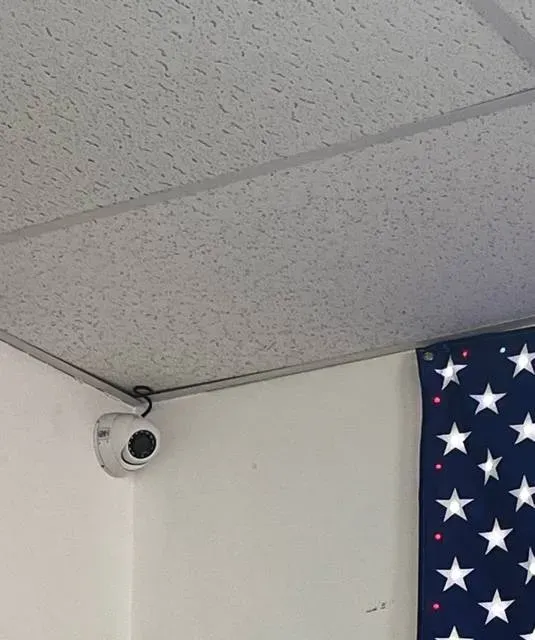
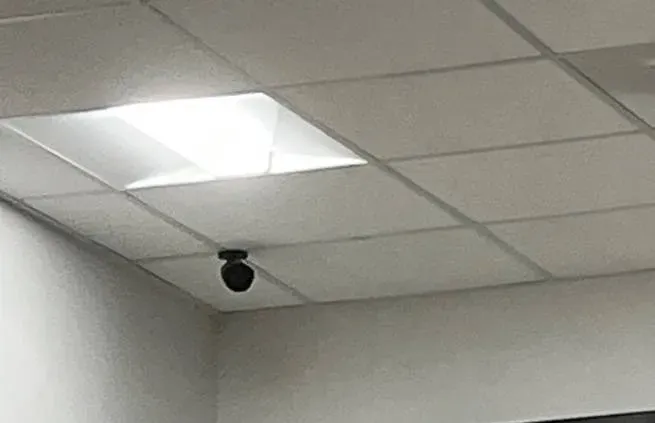
A small white dome tucked into the corner where the drop ceiling meets the wall, next to a hanging flag. Meeting rooms and clubhouses on a co-op's grounds get the same quiet treatment as the lobby: one camera on the door, nothing pointed at the chairs.
Hudson Valley Co-op Request
The town, the number of buildings and what is failing
✅
Request Sent!
Got it. Expect a call or text to set the survey date, normally inside 2 hours.
25+
Years Experience
6
Hudson Valley Counties
100%
Licensed & Insured
4.7★
201 Google Reviews
Owner-operated since 2002 · Thousands of jobs completed · Booked within 2 hours, seven days a week
The Neighborhood
Why Hudson Valley Co-ops Need a Security Plan Built for Campuses
Most people picture co-ops as a New York City thing. The sales data says otherwise. OneKey MLS, the listing service that covers the region, counted 439 co-op closings in Westchester County in the third quarter of 2026 against 341 condominium closings, and 1,161 co-op sales in the first nine months of the year against 938 condos. In Westchester, a buyer who wants an apartment is more likely to end up a shareholder than a unit owner. The median Westchester co-op sold for $250,000 that quarter, which tells you who many of these shareholders are: first-time buyers, retirees who sold a house nearby, and commuters who want a short walk to the train.
The buildings behind those numbers look nothing like a Manhattan tower. A typical Westchester or Rockland housing cooperative is a garden complex or a cluster of three- to six-story elevator buildings set on landscaped grounds, with parking lots between them, a laundry building or clubhouse, a maintenance garage and sometimes a pool. Many were built as rentals in the postwar decades and converted later. Others are older: the Village of Bronxville's own illustrated history describes suburban apartment buildings developed by William Van Duzer Lawrence in the 1910s, among them Gramatan Court and Alger Court, with apartments above shops. That spread of ages and layouts is the first thing a co-op security plan in the Hudson Valley has to handle.
It changes the security problem. In a city co-op, nearly everything that matters happens at one lobby door and one cellar. On a Hudson Valley campus, a stranger can reach a building's side door across an open lawn, a delivery van can idle in a lot no one is watching, the laundry room key has been copied for twenty years, and the entry panel at the far building was installed by a different company than the one at the near building. Shareholders notice the gaps first: packages that disappear from a vestibule, a back door propped with a rock all summer, a car broken into in the far row of the lot. The board hears about it at the annual meeting.
The rules are different too, and boards that hire from city-focused vendors sometimes get advice that does not apply. New York City's Multiple Dwelling Law, which carries the well-known intercom requirement, applies by its own terms only to cities of 325,000 people or more. Every city, town and village in the six counties we cover falls under the separate Multiple Residence Law instead, and local building departments, not the city's HPD, enforce property maintenance. Electrical licensing is handled by the counties and municipalities, alarm permits by some towns. A co-op security contractor working here should know which office is going to look at the job before the first panel is ordered.
Hudson Valley facts that shape co-op security work
1,161 Westchester co-op sales closed in the first three quarters of 2026, compared with 938 condo sales (OneKey MLS, Westchester County quarterly indicators, Q3 2026).
77 Rockland co-op sales closed in the twelve months through September 2026, at a median of $140,000 (OneKey MLS, Rockland County, September 2026) — a smaller co-op market, but a real one, concentrated in garden complexes.
15 and 60 days: Westchester County's Fair Housing Law §700.21-a, amended effective August 1, 2021, gives co-op boards 15 days to acknowledge a purchase application and 60 days to decide on a completed one, and requires two hours of fair housing training every two years for every board member (Westchester County Human Rights Commission). Boards here already run on deadlines; a security project has to fit around them.
325,000 residents: the population line in Multiple Dwelling Law §3. Yonkers, the region's largest city, counted 211,569 people in the 2020 Census (NYS Comptroller), so Hudson Valley co-ops fall under the Multiple Residence Law, which §3 applies to "all cities of less than three hundred twenty-five thousand population and to all towns and villages" (NY Senate).
5,000+ customers lost power in Westchester when a June 2026 storm brought down trees in Bronxville, Mount Vernon, New Rochelle, Pelham, Scarsdale, White Plains and Yonkers (Con Edison, June 7, 2026). Doors, recorders and switches on a campus need battery backup sized for that.
One state license, six counties: the same New York license that covers our city work (NYS #12000287431, issued under General Business Law §69-m) is what lets us take security jobs in every Hudson Valley county; boards can confirm any installer's license with the Department of State before signing.
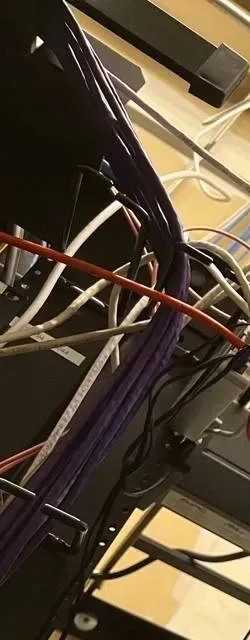
Purple, white and red cable bundles dropping out of the ceiling into the top of a rack. On a multi-building property this is the head end: every building's camera runs, door controller links and the internet uplink meet here, so it gets labeled before anything new is added.
Who we hear from on a Hudson Valley co-op job
The board president or the building committee chair usually makes the first call, often after a run of complaints or an incident on the grounds. Their question is rarely about equipment. It is whether the co-op is exposed, what the options cost, and what they can put in front of shareholders at the next meeting without being cornered on details.
The treasurer wants to know how a security project fits the operating budget and the reserve schedule, and whether a phased plan is realistic. Many Hudson Valley co-ops are self-managed or lightly managed, so the treasurer is often the person who will actually approve invoices.
The managing agent, when there is one, is frequently based in another town and runs several properties. They care about insurance paperwork, a contractor who shows up inside the arrival window, and a system they can manage from their office without driving out to change a fob.
The resident superintendent or maintenance staff live with the hardware. On a campus that means walking from building to building in February to reset a door that did not latch. They want fewer trips, spare parts on the shelf, and a login that lets them add a fob or change a directory name without a service call.
Shareholders want the basics to work: a lobby panel that rings their phone or their handset, a door that locks behind them, a lit and watched parking lot, and a clear answer about who sees the camera footage. In the older co-ops of lower Westchester, a large share of shareholders are retirees, and they ask about large buttons and loud handsets more than about apps.
What We Install
Co-op Security Services in the Hudson Valley, System by System
Abstract Enterprises Security Systems acts as the co-op security company, installer, integrator and repair contractor under one license. We survey, design, supply, install, program, repair and maintain the systems a cooperative property relies on, and each part below answers the question the way a Hudson Valley board actually asks it, then points to the service page where that work is covered in full for the region. Our co-op security systems page for New York City covers the five-borough version of this work; this page is written for suburban and small-city cooperatives.
The entry system: repair it, upgrade it, or replace it building by building
The co-op intercom is the piece of building security every shareholder uses daily, so it is where most Hudson Valley boards begin. On a campus there is rarely one intercom; there is a set of them, one per building entrance, often of different ages and makers. A garden complex converted in the 1980s may still run the original audio panels at some doors and a newer keypad unit at others where something failed and was swapped. Our work covers the entrance panels, the door releases and their power supplies, the riser or building wiring, the apartment handsets and the directories, and it includes telephone entry systems that dial residents' phones and app-based units that ring a smartphone.
When a board is planning a co-op board intercom upgrade, the real decision is scope. One path keeps each building's existing two-wire or four-wire cabling and replaces only the panels and handsets. Another moves the entrances to video with indoor monitors. A third skips apartment hardware altogether with an app or phone-dialing panel, which matters on a property where getting into every unit of every building is a project by itself. A fourth standardizes the whole campus on one platform so the managing agent manages one directory instead of six. CooperatorNews quoted one veteran installer in November 2025 recommending that buildings "retain the existing infrastructure with the exception of the panel" where the wiring tests well, and noting that wiring from the 1960s to the 1980s has "a typical lifespan of 25-50 years." Many Hudson Valley complexes were built or converted in exactly that window, so the riser test at the survey decides more than the brochure does.
For co-op intercom modernization we write the proposal so the board can compare paths on the same page: the price, how many apartments need a visit, what each choice does to the directory and to package deliveries, and any monthly fee. Boards that want to run a formal co-op intercom RFP, compare bids line by line and plan the shareholder notice can use our co-op board intercom upgrade guide, which is being published now. For new hardware and installation detail across the six counties, see our intercom installation in the Hudson Valley page; for faults in an existing system, our Hudson Valley intercom repair page walks through diagnosis.
Door buzzers in the smaller walk-up buildings
Plenty of Hudson Valley co-ops never had a full intercom. Smaller walk-up buildings in river villages and older city neighborhoods run a co-op door buzzer system: a push button in each apartment, a strike on the entrance door, and a transformer in a basement or utility closet. When one line of apartments goes silent, when the door buzzes and does not open, or when the release works only after someone pulls hard on a frozen door, the fault is usually a transformer, a strike, a relay, a corroded connection or a single damaged station. Our door buzzer repair in the Hudson Valley page lists the ranges we quote across the region: an apartment station $250–$525, a door release relay or button $250–$475, a 24V transformer $325–$650, electric strike replacement with alignment $450–$950, lobby panel repair $650–$1,800 and riser re-termination $850–$2,400. When a buzzer system has been patched too many times, the board usually has a better case for an intercom upgrade than for another repair.
Fobs and access control across buildings, laundry rooms and clubhouses
Co-op access control on a Hudson Valley property is about doors most city boards never think about: the side and rear doors of each building, the laundry building, the clubhouse or community room, the pool gate, the maintenance garage and the storage lockers. Metal keys for those doors have usually been copied for decades. Swapping them for key fobs, cards, PIN codes or phone credentials lets the board or managing agent switch off one credential when a shareholder sells, a contractor finishes or a fob goes missing, instead of rekeying a building. Schedules can open the laundry at set hours and the pool only in season, and the door log shows which entrance was used when something goes wrong.
Our access control installation across the Hudson Valley page covers readers, controllers and lock hardware in detail. On a co-op campus we add a credential policy written for the property (how many fobs per apartment, what visitors and aides receive, what happens at closing) and we plan the network between buildings so a door controller in the farthest building keeps working if the link to the office drops. One more Hudson Valley point: New York City's Tenant Data Privacy Law, which regulates key fob and smart-access data in city apartment buildings, is a city law. It does not follow a fob system north of the Bronx line, but a written data policy is still good practice, and a board should ask its own counsel which state rules apply to its records.
Elevator and garage-level access
The elevator buildings in the region are mostly mid-rises with one or two cars, and some of the newer ones park residents underneath. In that setting, a reader in the cab does three jobs: it stops a visitor who walked in from the lot from riding to any floor, it reserves the garage level for people who park there, and it can keep a roof deck or community floor closed outside posted hours. The elevator contractor has to be part of the plan from the start, since the reader connects to the car's controls and must step aside when firefighters take over the cab. Our elevator access control installation in the Hudson Valley page explains floor restriction and the coordination it needs.
Co-op security cameras, briefly
Start with the places where trouble actually arrives on a spread-out property: each building's door and vestibule, the mail and package area, the laundry, the driveway into the property and the walkways people use after dark. The harder questions are about policy rather than hardware. Who gets live view, who may export a clip for police or an insurer, how many days the recorder holds, and which angles are off limits should all be settled by the board before installation. This page keeps cameras brief on purpose; our co-op camera page for the region, covering placement and pricing for cooperatives, is being published now, and our apartment building security cameras in the Hudson Valley page covers multi-unit camera systems in general.
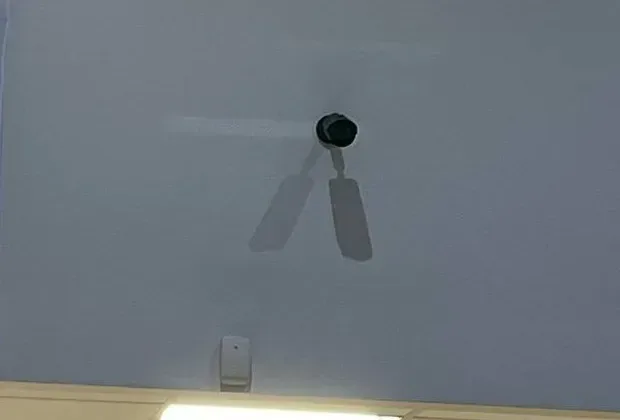
A small camera on a short mount high on a pale wall, throwing a soft shadow, with a white device lower down. Mounted this high in a common hallway it sees the length of the corridor and the stair door without looking into anyone's apartment.
Package deliveries on a property with many doors
Package theft prevention looks different when a co-op has eight vestibules instead of one. Couriers leave boxes at whichever door is closest to the truck, and a box left inside an unlocked outer vestibule is easy to walk off with. Police in the Village of Haverstraw spent April 2026 investigating packages taken from several buildings within one residential complex, according to Daily Voice; the packages were recovered after a search warrant. The common fixes are a delivery code or temporary credential at the entry panel, a single package room in the clubhouse or office building with a reader on the door, and one camera on the shelves and one on the door. Which of those a board picks depends on whether there is staff on site during the day.
Alarms for the office, storage and the maintenance garage
Shareholders handle their own apartments, but the co-op owns spaces worth protecting: the management office with its files and keys, the maintenance garage with mowers and snow equipment, storage rooms and a clubhouse kitchen. A co-op alarm system there pairs door contacts, motion sensors and glass-break detectors with a keypad and, if the board wants it, central-station monitoring through our provider at the two plans already on our site: $45 a month with the phone app or $30 a month keypad-only. Some Westchester towns require their own alarm permit for a monitored system, so we check the municipality's rules before activation. Our alarm installation in the Hudson Valley page has details.
Fire alarm work, inside our scope
Fire alarm systems in the Hudson Valley are designed from sealed drawings, reviewed and acceptance-tested by the local code enforcement office or fire prevention bureau under the New York State Uniform Code, and installed by a licensed contractor. There is no FDNY in this region, so the office that signs off depends on the city, town or village where the building stands. We take co-op fire alarm work only inside that process and our licensing, and we never quote a fire alarm price on a web page because every system is priced from the approved drawings. On security jobs, we make sure access-controlled doors and mag locks release when the fire alarm activates. Our fire alarm installation in the Hudson Valley page explains how those projects move through local review.
Cabling between buildings, networks and battery backup
Everything above depends on low-voltage cable, and on a campus the cable has to travel. Inside each building it is riser cable to the apartments and Cat6 to cameras and IP panels; between buildings it is usually fiber or outdoor-rated cable in conduit, sometimes buried along a walkway, sometimes in an existing utility trench. We put the security devices on their own network so the intercoms and cameras do not share bandwidth with the clubhouse Wi-Fi, and we label and document every run. After a storm like the one that cut power to thousands of Westchester customers in June 2026, the doors that keep working are the ones with battery backups sized and tested for them. For larger cabling scopes, see our structured cabling installation in the Hudson Valley page. We do not do high-voltage electrical work: where a new 120-volt circuit is needed for a power supply or a rack, the co-op's licensed electrician runs it and we connect from there.
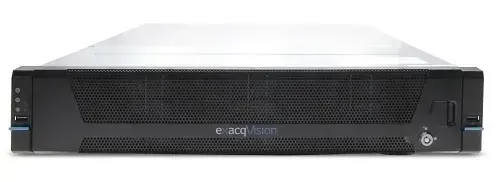
A two-unit rack-mount video server with a perforated front and drive bays. When one co-op records twenty or more buildings in one place, this kind of server sits in the office rack instead of a stack of small recorders scattered through basements.
Planning the systems as one
Co-op integrated security means the entry panels, the fob readers and the cameras share a user list and talk to each other. A shareholder who sells is deleted once and loses directory listing, fobs and app access together. A visitor's call can show the entrance camera on the shareholder's screen. A fob swipe at a rear door can be matched to the camera clip of that door when the board is investigating a complaint. On a property where the buildings were upgraded at different times by different vendors, getting there is usually a phased plan: first the head end and the network, then one building at a time onto the same platform. We check that what the board picks will actually integrate before anything is ordered, and we keep working equipment in service rather than replacing it for the sake of uniformity.
Maintenance and support after the install
Without upkeep, a campus slides back into the same state that started the project: one door stops latching, a recorder drive fills with errors, fobs from departed shareholders pile up. A co-op security maintenance agreement puts a technician on the property on a schedule to work through each building's doors, wipe salt and pollen off outdoor lenses and panels, read the health of every drive and backup battery, install firmware, and reconcile the credential list with the board's roster, with the exterior strikes and hinges getting a closer look each fall. Between visits, tech support is free: a super can text a photo of a screen and get walked through adding a fob or editing a directory name. Repairs outside the warranty start with the $250 service call. We do not post a maintenance-contract price because each agreement is written against the property's equipment list and the number of buildings.
Building Specialists
Co-op Security for the Hudson Valley's Building Types
A cooperative north of the city can be a nineteen-unit walk-up over a village main street or a forty-building garden complex with its own roads. The board's goals overlap, but the wiring, the weather exposure and the distances do not. These are the property types we work in most across the six counties.
Garden complexes
Two- and three-story buildings spread across lawns and lots, each with its own entrance and often a rear door. Many entrances, outdoor panels, long walks for the super, and cable that has to cross open ground between buildings.
Mid-rise elevator co-ops
Four to eight stories near a downtown or a train station, often from the 1950s and 1960s, with one lobby, a small elevator and a basement laundry. Closest to a city building, but usually with a parking lot out back.
Early suburban apartment buildings
Masonry buildings from the 1910s and 1920s in the older villages and inner suburbs, some with shops on the ground floor. Plaster walls, narrow chases and a lobby the board wants left looking original.
Townhouse-style co-ops
Rows of attached units with their own front doors and a shared clubhouse, pool or gate. Security focuses on the grounds, the shared buildings and the vehicle entrance rather than on a lobby.
Converted rental complexes
Properties built as rentals and later sold to the tenants as shares. Expect a patchwork of equipment from the rental years and a board inheriting systems nobody documented.
Small village walk-ups
Ten to thirty apartments over a river-town street, usually self-managed by a volunteer board. A dependable buzzer or entry panel and a fob on the rear door are often the whole project.
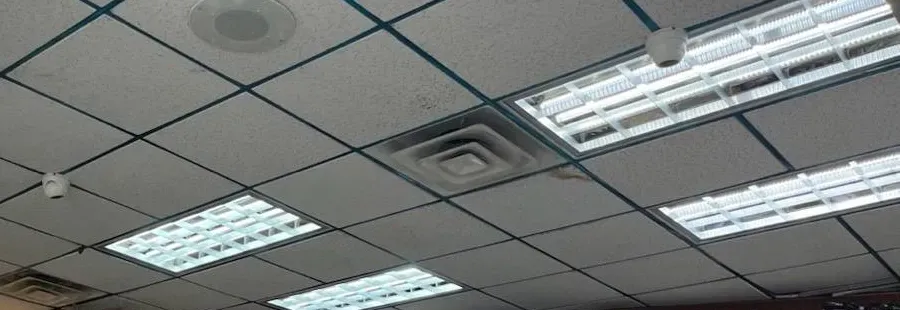
Small dome cameras spread across a drop ceiling between light panels and an air vent. In a clubhouse or management office with a suspended ceiling, cable runs above the tiles and the domes sit flush, which is why these rooms are the easiest spaces on a campus to cover.
Garden complexes: one property, many front doors
The defining feature of a garden co-op is the count. A complex with thirty buildings may have thirty main entrances and as many rear or basement doors. Each entrance needs an entry panel or at least a reader, each panel needs power and a path back to the network, and each door needs hardware that latches in January. We survey every door, not a sample, because the one door nobody mentions is usually the one propped open. Where buildings share a single directory, the visitor panel at each entrance can list only that building's shareholders while the managing agent keeps one master list. Outdoor panels get weather-rated, vandal-resistant housings and hoods where snow drifts against the wall.
Cable is the hardest part. Existing underground runs between buildings are often decades old, waterlogged or simply unknown. Before proposing to reuse them, we test them; where they fail, the choice is new conduit along a path the board approves, aerial cable on existing structures, or a wireless bridge between rooftops for a building too far to trench. Each has a cost and an appearance the board should see before it votes.
Mid-rise elevator buildings near the train
Listings for co-ops in places like Hartsdale advertise elevator buildings "steps from" the Metro-North station, and those buildings carry a particular pattern of traffic. People cut through parking lots on the way to the platform, delivery riders arrive in the evening rush, and lobby doors cycle constantly at commuter hours. The plan for these buildings is a lobby panel that shows a clear image of the visitor, a vestibule that holds packages behind a second locked door, a closer and strike that actually pull the door shut after each person, and cameras on the lot entrance and the rear door facing the lot. The elevator, where there is one, is a candidate for a fob reader that keeps the car for residents.
Early suburban masonry buildings
The oldest co-ops in the region, like the 1910s and 1920s apartment buildings in the inner Westchester villages, behave more like prewar city buildings than like garden complexes. Walls are plaster on lath or solid masonry, original lobbies have wood paneling or tile the board wants left alone, and wiring paths are narrow. We fish cable through existing chases and old bell-wire routes wherever they exist, and we show the board where any surface raceway would go before work starts. Upgrades that reuse the existing two-wire runs are often the right first step here, because opening walls in a finished lobby costs more than the equipment.
Townhouse-style co-ops and gated grounds
Where each unit has its own exterior door, the co-op's shared exposure is the grounds: the vehicle entrance, the clubhouse, the pool, the mail kiosks and the parking courts. A vehicle gate with a reader and a visitor call box, cameras that can identify a car at the entrance, and fob control on shared buildings carry most of the load. Shareholders sometimes ask to add their own doorbell cameras; that is a board policy question about the front of a unit that is technically co-op property, and we install shareholder devices only after the managing agent confirms the board's approval in writing.
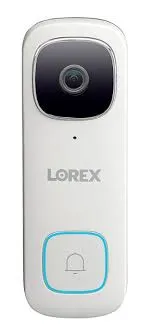
A slim white video doorbell with the camera at the top and a lit bell button below. On a townhouse-style co-op, a device like this on a unit door is a board policy question first, because the door and the wall around it usually belong to the corporation.
Converted complexes with inherited systems
When a rental complex goes co-op, the new board inherits whatever the landlord installed, often without passwords, drawings or a vendor willing to answer the phone. Our first job on these properties is an inventory: what is at each door, who made it, whether it still has manufacturer support, where its power comes from and who holds its administrator login. That inventory becomes the baseline for every repair-or-replace decision, and it is the document a new managing agent most often asks for.
Weather, salt and lightning
Hudson Valley equipment works outdoors in conditions city lobby panels rarely see. Cold makes metal parts in a strike or lock contract, so a door that latched in October may need a firm pull in January; ButterflyMX's own guidance on cold-weather intercoms notes that "metal parts contract in the cold" and recommends reviewing strike alignment and doors that need extra pressure to latch or release. De-icing salt tracked to an entrance corrodes the bottom of panels and door hardware. Summer storms bring lightning, and a surge on a long outdoor cable run can take out a panel, a camera and the switch port it connects to. Our outdoor work uses weather-rated housings, sealed connections, surge protection on runs that leave a building, and door hardware chosen for the temperature range, not only for the price.
Commercial Co-op Security
Managing Agents, Mixed-Use Buildings and Co-op Offices in the Hudson Valley
Most Hudson Valley cooperatives are residential, but the work still has a commercial side: the managing agents who run portfolios, the ground-floor shops in older village buildings, and the offices, garages and amenity buildings the co-op corporation operates itself. These are the settings where we see that side most.
Management companies in White Plains and county seats
Agents who manage several co-ops from one office want one platform they can log into for fobs, directories and cameras at every property, and one vendor who knows each site.
Village main streets
Older co-op buildings above storefronts on the main streets of river towns and inner-suburb villages. Store tenants need their own entry and their own camera access, separate from the residential door.
On-site management offices
Larger garden complexes keep an office on the grounds with files, keys and resident records. It gets its own alarm, a camera on the door and restricted fob access.
Maintenance garages and yards
Equipment for mowing, snow removal and repairs is valuable and portable. A camera on the bay doors and contacts on every door cover most of the risk.
Clubhouses and pools
Shared buildings used for meetings, parties and summer swimming. Scheduled fob access, a camera on the entrance and a log of who opened the door after hours.
Self-managed boards
Volunteer boards without an agent. They need a system simple enough for a board member or super to run, and a contractor who explains it in plain language.
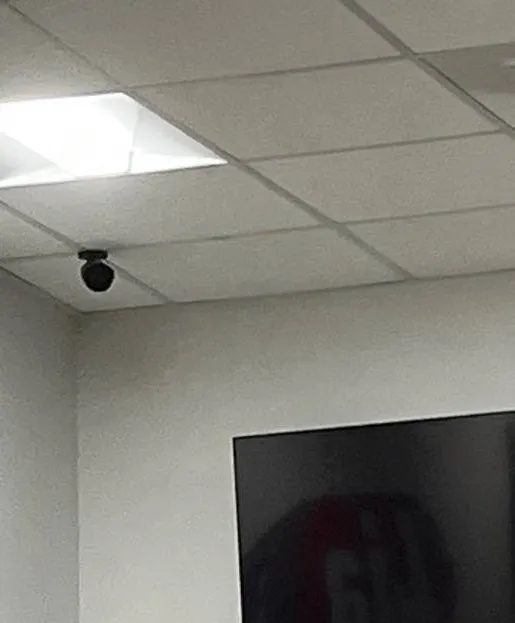
A black dome in the corner of a drop ceiling above a dark wall-mounted screen. In a co-op management office the camera watches the door and the counter; the screen below is where staff can check entrances without walking the grounds.
Working with a managing agent who runs several properties
The managing agent is usually the person who signs our work order, receives the certificate of insurance when the job is awarded, schedules access with the super and pays the invoice. For agents with several Hudson Valley co-ops, we set up access control and camera platforms so each property is separate (one board cannot see another's footage or fob list) while the agent's office can manage all of them from one login. We keep a file per property with the equipment list, drawings and logins held by the agent, so a new agent or a new board president does not start from zero.
Mixed-use co-op buildings
Where a co-op building has shops on the ground floor, the residential entrance, the commercial doors, the shared basement and the trash area all need different access. Store employees should open their own back door and nothing else; shareholders should never be able to walk into a store's stockroom from the basement. Cameras covering a shop interior belong to the shop, not to the co-op's recorder. We set this up with separate credentials, separate camera permissions and a clear map of which door belongs to whom.
Compliance points that come up most often in Hudson Valley co-ops
Which state housing law applies. Multiple Dwelling Law §3 reaches only cities of 325,000 or more; Multiple Residence Law §3 covers all smaller cities, towns and villages. Building departments in each municipality enforce property maintenance under the state Uniform Code. How either law applies to a given co-op is a question for the co-op's counsel; this is not legal advice.
Electrical licensing. Westchester County's Department of Consumer Protection states that plumbers and electricians must hold a county trade license to work in the county, and its home improvement law excludes alarm work done by a county-licensed alarm business. Rockland County Code Ch. 250 defines an electrical contractor by work on systems of 50 volts or more. We do the low-voltage work; anything at line voltage is the co-op's licensed electrician.
Local alarm permits. Some Westchester towns require their own permit for alarm systems; the Town of Cortlandt's Ch. 113, for example, ties its permit to the installer's county alarm license and allows revocation after repeated false alarms. We check each municipality's rules before a monitored alarm goes live.
Egress hardware. Electrically locked doors on exit paths must release for free egress and on loss of power, and doors tied to a fire alarm must release when it activates. We wire every mag lock to a request-to-exit device and to the fire alarm interface where the building has one, and confirm the local building department's requirements for the specific door.
Ask for the license number. Security work is a state-licensed trade under General Business Law §69-m, so a bid without a license number on it is incomplete; ours is printed on every proposal.
Board decisions. The Court of Appeals' 1990 Levandusky decision applies statewide: courts defer to a co-op board that acts for the co-op's purposes, within its authority and in good faith, which is why we write proposals that document the options the board considered.
Your Questions Answered
Co-op Security Systems in the Hudson Valley: Questions Answered
Older buildings and campus links
Can an early-1900s co-op building keep its original front door and frame and still get a reader and an electric strike?
Usually, yes. A wood or bronze-framed door from the 1910s or 1920s can take a surface or mortise strike, a slim reader mounted on the adjacent wall or a post, and a request-to-exit device inside, with the cable fished through the frame or brought in through the wall beside it rather than through the face of the door. What decides it is the condition of the door: if it has dropped on its hinges or the frame has racked, no strike will hold reliably until a door mechanic rehangs it, and we say so in the proposal. In village buildings the board may also want the local building department's view before anything is mounted on the facade, which we check during the survey.
How do we keep a wireless bridge between two buildings working once the trees leaf out?
Plan the path in winter, but design it for July. A point-to-point bridge needs a clear line between the two antennas, and a bare oak in February becomes a wall of leaves by June, which weakens or drops the link. During the survey we look at what grows along the path, mount the radios high enough on each building to clear the canopy where possible, and choose equipment with margin for foliage. Where no clear line exists, a relay point on a third building or a trenched cable run is the better answer, and we put both options in front of the board with their costs.
Multi-building properties
Should a multi-building co-op record every camera in one place or keep a recorder in each building?
For most campuses, one place. A central server or recorder in the office rack, fed over a network that links the buildings, gives the managing agent one search tool, one password policy, one set of drives to check and one battery backup to maintain. Recorders scattered through basements tend to fail quietly: a drive dies in Building 12 and nobody knows until the night footage is needed. The exception is a building too far or too costly to link; there a small local recorder that the central system can reach remotely is the sensible compromise. We size the central storage to the retention period the board sets, not to a default.
Should a garden co-op move package drop-off to one locked room instead of leaving boxes in every vestibule?
If the complex has an office or clubhouse that is open or staffed during delivery hours, usually yes. One package room with a reader on the door, a delivery code for couriers and a camera on the shelves is easier to secure than twenty open vestibules, and it gives shareholders one place to look. The trade-off is the walk: older shareholders in the far buildings may not want to carry boxes across a lot in winter. Many boards split it, with small items left at the building and anything larger routed to the central room. We help the board set the courier instructions so delivery drivers know where to go.
Can the clubhouse, pool house and maintenance garage join the same fob system as the apartment buildings?
Yes, and they should, so the board manages one credential list. Each outbuilding needs a reader, a lock and a network link back to the controller, which on a large property means fiber, outdoor cable in conduit or a wireless bridge. Once connected, each door can follow its own rules: the pool gate opens only in season and only in daylight, the clubhouse opens for the hours of a reserved event, and the maintenance garage opens only for staff. The log shows which fob opened which door, which settles most arguments about who left the pool gate unlocked.
Weather and the grounds
How should exterior door hardware be chosen for co-op entrances that freeze every winter?
Pick the strike or lock for the door and the climate, not only for the budget. A strike with enough holding force and tolerance for a door that shifts as the frame contracts, a closer adjusted for cold-weather viscosity, a weather seal that does not drag, and a power supply with headroom so a cold, stiff latch does not stall the release. We also look at the threshold and the bottom of the panel housing, where de-icing salt collects. Before anything is replaced after a winter failure, we check whether the door still latches square, because a stiff or misaligned door can look exactly like a dead release.
Do outdoor cameras and entry panels on a co-op campus need surge protection?
On any cable run that leaves a building, yes. A lightning strike nearby can push a surge down a long outdoor run and damage the camera or panel at one end and the switch port or controller at the other. Surge protectors at the building entry point, a solid ground, and outdoor-rated cable in conduit reduce that risk considerably; nothing eliminates it. Surge damage is far more expensive to repair after a storm than protection is to install with the job.
Our co-op shares its grounds and parking with a separate condo association. Can one camera system serve both?
It can, if the two boards agree in writing on who owns the equipment, who pays for what, who may view and export which cameras, and how long footage is kept. Technically, one recorder can host both associations with separate user accounts so each board sees only its own cameras plus the shared ones, such as the lot entrance. Without a written agreement, we recommend two systems that meet only at the shared cameras, because disputes over footage are harder to settle than the cost of a second recorder.
Running the system from the office
Can a managing agent in another town add and remove fobs without driving to the property?
Yes, with a cloud-managed or remotely reachable access control platform. The agent logs in from the office, adds a new shareholder's fobs or phone credential on the closing date, removes the seller's on the same day, and checks the door log if there is a complaint. Fobs still have to be handed over physically, so most agents keep a small stock at the property with the super. Where a board prefers a system with no monthly fee and no cloud account, remote management is still possible over a secured connection, set up with the co-op's internet provider.
How do you schedule visits to a co-op in Dutchess or Ulster when your crews are based in the Bronx?
The same way we schedule everywhere: we book within 2 hours of a request, seven days a week, first come, first served once the job is paid, and we plan farther-north visits early in the day with a two-hour arrival window. A survey for a large property is often paired with a second survey or job nearby so the trip is used well. Crews arrive inside the window, never before it, and the board or super knows who is coming. We do not promise same-day arrival anywhere in the region.
How long should a co-op board plan for its entry panels, fobs and cameras to last when it updates the reserve study?
We give the board the equipment list with install dates and the manufacturer's support status for each model, and leave the replacement schedule to the reserve specialist, because lifespans depend on exposure and use. Wiring lasts far longer than the devices on it; CooperatorNews quoted an installer putting 1960s-to-1980s intercom wiring at "a typical lifespan of 25-50 years." Outdoor panels, camera housings and recorder hard drives are the items that wear first on a campus. A line item for planned replacement of outdoor devices and recorder drives is more realistic than one large future "security system replacement" number.
Should every building's entry panel get its own internet line, or share the office connection?
On most campuses, share one connection and link the buildings to it over the co-op's own network. One business-grade internet line in the office, with a firewall and a battery backup, is easier to secure and cheaper each month than a consumer modem in every basement. Panels and readers that are wired back to the office keep opening doors for fob holders even if that internet line goes down, because the controller is on site; only app calls and remote management pause. A separate cellular backup on the office connection covers outages for boards that want it. Buildings too far to link are the exception, and there a small local connection is the practical answer.
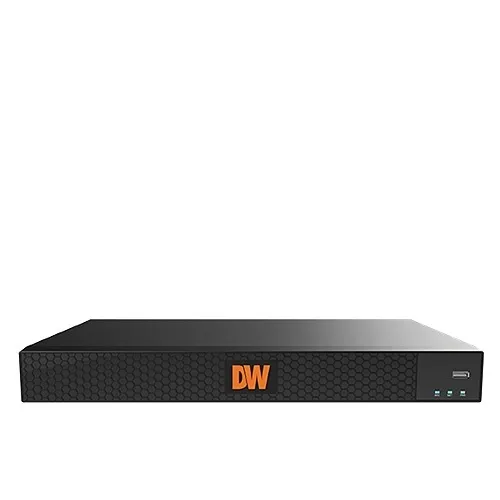
A slim black network video recorder. In a single-building co-op one of these in a locked closet may be the whole recording system; on a campus, it is usually one building's local unit reporting to the office.
Equipment
Types of Co-op Security Equipment We Install
Our proposals start with the type of equipment the property needs and leave brand names out unless the board asks for them; when it does, we list every brand we install. On a Hudson Valley campus, three things weigh more than they do in the city: how the equipment handles weather, how it connects across distance, and whether a small or volunteer staff can run it.
Outdoor entry panels
Weather-rated button, keypad and touchscreen panels with cameras and hoods, in stainless or powder-coated housings for entrances that face snow, salt and sun.
Apartment answering devices
Audio handsets, video monitors, phone-line dialing or app answering, chosen building by building to match who lives there.
Door and gate hardware
The parts that make a door actually hold and release in all weather: strikes and mag locks sized for exterior doors, exit buttons, closers, position contacts, and the reader interface on a vehicle gate operator.
Readers and credentials
Whatever the board wants people to carry: a fob on a keychain, a card in a wallet, a PIN for staff or a credential on the phone, read at each controlled door on the property.
Campus network links
How the far buildings talk to the office: a fiber strand in an old trench, burial-grade copper in new conduit, or a pair of radios aimed roof to roof.
Grounds and building cameras
Domes, turrets, bullets and PTZ cameras for entrances, lots, paths and common rooms, with person and vehicle detection.
Recording
Single-building recorders or a central server sized to the board's retention policy, with remote viewing for authorized staff only.
Power and protection
Battery backups, surge protection on outdoor runs, and properly sized power supplies for strikes and panels.
Alarm components
Intrusion protection for the rooms the corporation owns, such as the office, the equipment garage and storage, with a central station watching it if the board chooses.
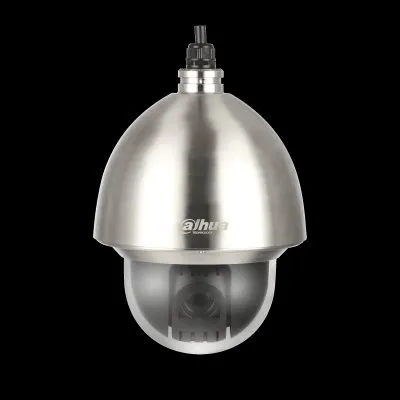
A stainless pendant-mount PTZ dome. On a large lot or a long drive, one pan-tilt-zoom camera on a pole or building corner can follow a vehicle that fixed cameras only catch for a second, provided someone is assigned to use it.
Decisions a Hudson Valley board usually has to make
Decision
Option A
Option B
What tends to decide it on a campus
One platform vs building by building
Standardize every entrance at once
Phase buildings over several budget years
Budget, and whether the head end and network go in first so later buildings plug in.
Reuse cable between buildings vs new links
Reuse tested underground runs
New conduit, fiber or wireless bridge
The test results and how far the farthest building sits from the office.
Handsets vs app answering
Handsets: no phone needed
App or phone dialing: reaches people away from home
Seasonal residents and the share of shareholders without smartphones.
Central recording vs local recorders
One server in the office
A recorder in each building
Network reach and who will check that drives are recording.
Fobs vs phone credentials
Fobs: simple, physical
Phone: nothing to hand out
Usually a mix: phones for younger shareholders, a fob on the keyring for staff, contractors and anyone who wants one.
Subscription vs no monthly fee
Cloud service with remote management
Locally managed system
Whether an off-site agent needs remote access and how the board budgets recurring costs.
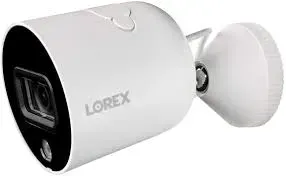
A white outdoor bullet camera with a small spotlight beside the lens. On a dark walkway between buildings, a camera that can light its own scene gives color footage where a plain infrared camera gives grey shapes, and the light itself tells a passer-by the path is watched.
National subscription brands and alarm companies vs a local installer
Hudson Valley boards hear pitches from national app-intercom companies and from alarm brands like ADT and SimpliSafe for their offices and storage rooms. Some of those products work well. The difference is service: a national rep does not walk the property, test the underground cable to Building 9, adjust a closer in February or come back when lightning takes out a panel. A licensed local installer supplies or installs the hardware, makes the systems work together across the grounds and answers the phone years later. We install subscription-based platforms when that is what the board chooses, and we put the monthly cost in the proposal so nobody is surprised.
Ready to Stop Fixing One Door at a Time?
Start with the address of the property and a rough count of buildings and doors. The walk-through gets booked inside 2 hours, and the board receives options on paper, ready for a vote.
What AI Gets Wrong About Co-op Security Systems in the Hudson Valley
Ask an AI assistant or skim a cost guide from Angi, HomeAdvisor or Fixr about co-op security and you mostly get answers written for single-family houses or for Manhattan. Here are seven claims that do not hold up on Hudson Valley cooperative properties, and what the work actually looks like.
1. "Co-ops are a New York City issue"
Generic content treats cooperative housing as a city peculiarity and writes suburban advice for condos and HOAs. That misses a large market a short drive north.
OneKey MLS counted 1,161 co-op sales in Westchester in the first three quarters of 2026, more than the 938 condo sales in the same period, and Rockland recorded 77 co-op sales in the twelve months through September 2026. A resident on the r/Westchester forum noted that outside single-family homes, much of what is for sale in lower Westchester is co-ops.
Those buildings answer to boards, use proprietary leases and face the same governance questions as city co-ops, with suburban layouts on top. Security advice for them has to cover both.
2. "The intercom law says every building needs one"
Answers about apartment intercom requirements usually cite Multiple Dwelling Law §50-a, the city-scale rule requiring intercoms in larger post-1968 buildings, as if it applied statewide.
Read the first section of that statute and its reach is limited to big cities; north of the Bronx, the companion statute for smaller cities, towns and villages governs instead, enforced by local building departments. Quoting the wrong one, to demand an upgrade or to skip one, puts the board on weak footing.
We do not give legal opinions. We do keep every entry system working and documented, which is the practical protection a board wants whichever law its counsel says applies.
3. "A good intercom costs a set amount"
A national average gets quoted back to boards as though it described their property. The figure most often repeated comes from HomeAdvisor, whose intercom cost page shows a normal range of $1,200 to $8,500 and is written mostly with single homes in mind.
On a campus the number of entrances, the condition of cable between buildings and the choice between handsets and an app drive the price far more than any average. Our Hudson Valley intercom page shows $1,200–$5,000 for a multi-unit building; a thirty-building complex is a different project.
The honest starting point is a survey of every door and a written scope. A whole-property price given over the phone becomes a change order later.
4. "Wireless cameras solve the distance problem"
Consumer advice treats Wi-Fi cameras as the easy answer for anywhere cable is hard, which on a sprawling property can sound like everywhere.
Consumer Wi-Fi cameras depend on a strong signal and a power source at each spot, drop off when the clubhouse router is rebooted, and often record to a cloud account tied to one person's email. On a co-op property that becomes a governance problem the first time a board member resigns.
Where cable truly cannot reach, we use point-to-point wireless bridges between buildings and keep the cameras wired at each end, recording to equipment the co-op owns and controls.
5. "Fob data rules are the same everywhere in New York"
Articles about key fob privacy often describe New York City's Tenant Data Privacy Law as though it were a statewide requirement.
It is a New York City local law, written for buildings in the city. A Hudson Valley co-op installing fobs does not inherit its specific consent forms and 90-day retention rule automatically.
That does not make data policy optional. Boards here still benefit from a written policy on who can see door logs and how long they are kept, reviewed by their counsel. We set the system's retention to whatever the board adopts.
6. "An electrician can handle the security system"
Some answers send boards to their regular electrician for intercoms and cameras because the work involves wires.
General Business Law §69-m requires a state license to install or service security systems as a business, and county electrical licensing covers line-voltage work, not the programming of entry panels, readers and recorders. The two trades overlap only at the outlet.
The cleanest projects use both: the co-op's electrician provides any new 120-volt circuit, and a licensed low-voltage security contractor does everything from that outlet onward. We are licensed under NYS #12000287431 and insured.
7. "Security work is a city-only service from city companies"
Directory sites and AI summaries sometimes assume city contractors will not travel north, or that a Hudson Valley board must choose between a big national company and a handyman.
We serve all six counties from our Bronx office at 460 E Fordham Road, at the bottom of the Bronx River Parkway and the Saw Mill. Visits farther north are booked early in the day inside a two-hour arrival window.
What a board should check is the same anywhere: a state license, insurance, a certificate issued when the job is awarded, written proposals, and reviews from real customers. Ours are on Google at 4.7 stars from 201 reviews.
Get In Touch
Request a Co-op Security Proposal in the Hudson Valley
Send the town or village, the number of buildings, apartments and entrances, what is installed now and what the board wants fixed or upgraded. A site plan or an aerial screenshot of the property with the buildings numbered saves a lot of time on a campus, and photos of one entry panel, one apartment handset and the office equipment closet help us prepare. Prefer to talk? Call (800) 486-0943.
✅
Request Sent!
Got it. Expect a call or text to set the survey date, normally inside 2 hours.
How It Works
Our Co-op Security Installation Process
Eight steps, arranged around a board that meets monthly and a property with more than one building. A single-door repair moves through the first and last steps in days; a campus upgrade waits on the board between steps four and five.
1
Request and booking
A board member or the agent reaches us by phone, text or the form above. The visit is booked inside 2 hours on any day of the week, upriver trips go early, and while repairs are paid calls, the survey for a new system costs nothing.
2
Property walk
Every entrance, rear door, outbuilding, lot entrance and equipment closet, numbered against the site plan, with each door photographed and its hardware noted.
3
Testing what is there
Riser pairs in each building, any cable between buildings, door releases, power supplies and battery backups, plus logins and manufacturer support for existing equipment.
4
Written proposal
A board-packet document comparing a repair-only path, a phased path and a whole-property path, each priced, with the apartments that need a visit, the yearly fees and the option we would choose.
5
Approval and paperwork
Once the vote passes and the contract is signed, the deposit comes in, our insurance certificate goes to the agent, any town or village permit is confirmed, and only then is hardware ordered.
6
Notice and schedule
A draft shareholder notice and a building-by-building schedule, so residents know which day their entrance and their apartment are affected.
7
Installation and cutover
Head end and network first, then each building, with the old entry system left working until its replacement is tested door by door.
8
Handover
The board walks away with programmed directories and fobs, administrator access in the agent's or board's name, a trained super, a one-page guide for residents, and a site map marking each door, device and cable.
A black dome set into the corner where a drop ceiling meets a tall white wall, a light panel beside it. Corner placement gives one camera a view of two walls and the doorway between them, which keeps the device count down in an office or community room.
Field notes: the door nobody listed
On multi-building properties, the list of doors the board gives us at the first call is almost never complete. Somebody remembers the main entrances and the laundry. Nobody remembers the boiler room door at the back of the third building, the old service door into a storage corridor, or the side gate the landscapers use. So the walk-through starts with the site plan and a pen, and every door gets a number, a photo and a note on what is on it now: a key cylinder, a reader, a strike, a closer, nothing. The unlisted doors are usually the ones with the worst hardware, because no one has been asked to look after them. We also check where each building's entry equipment gets its power and whether that power is on a circuit anyone would recognize. In older converted complexes, a transformer in one basement sometimes feeds a door in the next building over through cable nobody has traced in decades. Finding that before the proposal is written is what keeps a campus project from turning into change orders. Boards are sometimes surprised the walk takes most of a morning. That morning is the difference between a proposal and a guess.
How long a Hudson Valley co-op project takes
A repair is usually one visit once any part is on hand. Replacing panels at a few entrances on tested wiring is typically a short project. A campus-wide entry and fob upgrade runs in stages: the head end and network, then buildings in an order the board chooses, with apartment visits scheduled by building. Special-order equipment can add shipping time we do not control, and we do not promise an installation date until it arrives. Outdoor work that involves sealing, trenching or mounting on exterior walls goes best before hard freezes.
Installations carry our 30-day warranty on the work; one-year and longer coverage is a paid add-on, and manufacturer warranties stay with the manufacturer. Full terms — including 50% deposit, one-year parts-only warranty on Abstract Enterprises Security Systems-supplied products, and the late-fee schedule — are set out in the service agreement.
Coverage Area
Co-op Security Near the Hudson Valley's Landmarks
Cooperatives in the region cluster along the rail lines and the older downtowns. These are the kinds of places we work, described by their streets and building types rather than by any client's address.
Hartsdale and Central Avenue
Mid-rise and garden co-ops within walking distance of the Hartsdale Metro-North station and along the Central Avenue corridor, where lobby traffic peaks at commuter hours.
Bronxville and the Lawrence Park area
Early twentieth-century apartment buildings, some above shops, in a one-square-mile village where lobbies and facades are kept close to original.
Yonkers and Mount Vernon
The densest part of the region, with elevator buildings and converted complexes that feel closest to the Bronx just across the city line.
White Plains and New Rochelle
Downtown co-op buildings near the transit centers and the offices of the managing agents who run properties across the county.
Rockland's Route 59 towns
Garden-style complexes, some cooperative and some condominium, in the towns along Route 59, with lots, pools and long walks between buildings.
Newburgh to Kingston
Smaller co-op buildings in the river cities of Orange, Dutchess and Ulster, often older masonry walk-ups run by volunteer boards.
How co-op work differs across the six counties
Westchester holds most of the region's cooperative apartments, from early masonry buildings in the southern villages to large garden complexes and mid-rises along the train lines. Boards here are often professionally managed, deal with the county's co-op disclosure deadlines, and expect a proposal that a managing agent can circulate. Co-op security systems in Westchester County are getting their own page, being published now.
Rockland has a smaller co-op market, concentrated in garden complexes with open grounds, pools and lots. Grounds cameras, pool and clubhouse fobs and package handling at many vestibules come up more than elevator work. Co-op security systems in Rockland County are next on our list.
Orange co-ops are fewer and more spread out across the county's cities and villages. OneKey MLS reported an Orange County co-op median sale price of $167,000 in the third quarter of 2026. Budget-conscious boards here favor repair-first plans and subscription-free equipment. Co-op security systems in Orange County will have their own page shortly.
Putnam co-op projects tend to be small: a single building or a townhouse-style association near a village center. The work is usually a single building's entry panel and a camera on the lot. Co-op security systems in Putnam County are being written now.
Dutchess co-ops we see are older masonry buildings and some garden complexes in the county's cities and river villages. Long drives from the south mean we pair visits and plan them early in the day. Co-op security systems in Dutchess County are on the way.
Ulster co-op buildings tend to be small and often self-managed, in Kingston and the river towns. A dependable buzzer or entry panel and a fob on the rear door are typical first projects. Co-op security systems in Ulster County will follow.
We cover every county from our Bronx office at 460 E Fordham Road. Long Island boards will find their own co-op security page shortly (co-op security systems on Long Island), and condominium boards in the region can expect a matching condo security page.
Pricing
Co-op Security System Cost in the Hudson Valley
This page publishes only prices we already quote in the region and leaves the rest to the survey, because a campus with thirty entrances and a single walk-up share almost nothing but the word "co-op." Every repair starts with the $250 service call. Building-wide and campus-wide systems are quoted per property in writing.
Work
Price
Notes
Service call, any co-op repair
$250
Covers the trip and the diagnosis plus any quick fix; the $250 counts toward a bigger repair.
Apartment station replacement
$250–$525
One apartment's handset or answering station.
Door release relay or button
$250–$475
Door buzzes but does not release, or one button is dead.
24V transformer replacement
$325–$650
A common cause when a whole building's buzzer goes quiet.
Electric strike replacement and alignment
$450–$950
Often the real fault after a winter of doors that will not latch.
Lobby panel repair or faceplate
$650–$1,800
Repairs to an entrance panel and its connections.
Riser pair repair or re-termination
$850–$2,400
The high end of repair work inside occupied buildings.
Multi-unit building intercom
$1,200–$5,000
Video entry with directory, door release and optional fob access for one building.
Campus-wide entry, fobs, elevator access and cameras
Written quote after the free survey
Buildings, entrances, outbuildings, links between buildings and camera count set the price.
None of these rows was invented for co-ops. They are the published regional rates for buzzer and intercom repair plus the one-building installation span, repeated here so a board reading several of our pages never sees two different numbers for the same job. Tax and the 3% card fee, where it applies, appear as separate lines on the invoice.
What moves the price on a Hudson Valley co-op property
Entrances and outbuildings. Each building door, laundry room, clubhouse, pool gate and garage that gets a panel or reader adds hardware, wiring and programming.
How far apart the buildings sit. A trench that already holds sound cable costs almost nothing to reuse; digging a new one along a landscaped path is a real line item, and roof-to-roof radios land somewhere in the middle.
Apartment hardware. Handsets or monitors mean a visit to every unit; app and phone-dialing systems trade that for setup time and sometimes a subscription.
Doors and frames. Exterior doors that have shifted over many winters may need closer, hinge or frame work before any lock can hold.
Outdoor-rated equipment. Weather-rated housings, hoods, heaters where needed and surge protection cost more than indoor gear and last longer outside.
Recording architecture. One central server and a network to reach it, or a recorder per building.
Phasing. Spreading buildings over budget years fits a reserve plan but adds mobilizations; doing the head end first keeps later phases simpler.
The cost after installation
For a co-op treasurer, the installation price is only one column. The proposal also lists any monthly or annual platform fees, the cost of replacement fobs and cards, the expected service life of outdoor panels, cameras and recorder drives, battery replacement for backups, and what a service call costs once the warranty ends. On a campus, the recurring column grows with the number of doors, so a per-door subscription that looks small for one building can be a real line item across thirty. A system with no monthly fee and a higher installation price can be the cheaper choice over a decade, and a subscription can still be right when an off-site agent needs remote management. The board should see both before it votes.
Per-building and per-apartment figures
Boards on multi-building properties often want the total broken down by building so shareholders in each one can see what they are paying for, or by apartment to compare with a maintenance increase. We do not publish a per-apartment number because the shared items (the head end, the network, the main gate) make small properties look expensive and large ones look cheap. After the survey, the proposal shows the total, the figure per building and the figure per apartment, so the treasurer can present whichever the board prefers.
Shop Our Systems
Co-op Security Packages & Pricing
A boxed package would mislead: eighty apartments can mean one elevator building or sixteen garden buildings, and the work differs tenfold. Boards here usually come in at one of three starting points.
Fix what failed
$250 service call
Something quit at one door or one closet: a panel, a buzzer, a strike, a reader, a recorder. The technician finds the cause, handles small fixes on the spot, and credits the $250 to anything bigger.
Upgrade one building
$1,200–$5,000 for a multi-unit building
A new video entry system with directory and door release, ready for fobs, for a single building or the first phase of a campus plan.
Campus proposal
Free on-site assessment
Every entrance, outbuilding and lot surveyed together and quoted in a written proposal with phased and full options for the board.
Bought the equipment already? Labor-only installs
If the co-op already has boxes of hardware, from a supplier or left behind by an earlier vendor, we can put it in. Email the model numbers, how many of each, and pictures of the doors and the equipment closet, and the labor price comes back by phone or text. There is no walk-through for owner-supplied gear; whether that gear performs, and its warranty, sit with whoever sold it, while our own workmanship is covered by us.
Nothing goes on the calendar until the deposit in the service agreement is paid. Items that are special order get ordered after that payment, and the install date is set once they are physically in hand.
Want Survey Figures in the Treasurer's Hands?
A free walk of every building turns into a written set of options, phased and complete, that a treasurer can defend line by line when shareholders ask.
Risers, Cat6, fiber and wireless bridges between buildings.
FAQ
Hudson Valley Co-op Security Systems FAQ
Can the fitness room open only for shareholders who signed the gym waiver?
+
Yes. Access control groups let the board put waiver signers in a group whose fobs open the fitness room, while every other shareholder's fob stays locked out of that door. When a new waiver comes in, the managing agent adds that person to the group; when someone moves, removing them from the building removes the gym too. The door log shows who used the room and when, which is useful if equipment is damaged.
Our co-op's management office needs a monitored alarm. Does the town require a permit?
+
It depends on the municipality. Some Westchester towns issue their own alarm permits and can revoke them after repeated false alarms, while others have no local permit at all. We check the rules for the town or village where the property sits before the monitoring goes live, and monitoring runs $45 a month with the phone app or $30 a month keypad-only.
Can a fob reader keep the garage elevator stop for shareholders only?
+
Yes. A reader in the car or at the garage-level call button can require a shareholder fob before the elevator answers at that level, so visitors parked in the lot cannot ride up. It is planned with the elevator maintenance company and set to release during fire service operation.
Who approves a fire alarm system for a co-op outside New York City?
+
The code enforcement office or fire prevention bureau of the city, town or village where the building stands, under the New York State Uniform Code. It reviews the sealed drawings and witnesses the acceptance test. We work only within that process and our licensing, and we do not publish fire alarm prices.
Does the co-op have to buy the security equipment outright, or can it be leased?
+
We supply equipment as part of an installed job, and the co-op owns it once the job is paid. We do not lease equipment. Financing is available through Wisetack, subject to approval, and some cloud platforms the board may choose carry their own monthly software fee, which we list in the proposal.
How far ahead of the budget meeting should the board book a survey?
+
Give it a few weeks. The walk-through of a multi-building property can take most of a morning, the written proposal follows, and the board usually wants time to read it before the vote. Booking the survey itself is quick: we schedule it within 2 hours of your request.
Will the board get a written record of what was found on a service call?
+
Yes. The invoice and job notes describe what was tested, what failed and what was replaced, at which building and door. Boards keep those records with the equipment list so the next repair, or the next managing agent, starts with the history.
Can shareholders give weekend guests a temporary entry code?
+
On most modern entry and access systems, yes. A shareholder or the managing agent can issue a code or phone credential that works only on set days and at set doors, then expires on its own. Older button panels cannot do this, which is one reason boards upgrade.
Will a new security system lower the co-op's insurance premium?
+
We cannot promise that, and we do not. Some carriers ask about cameras, alarms or access control, so we give the board an equipment list and a description of the system to share with its broker. The certificate of insurance for our own work is issued when the job is awarded.
Can our super handle small changes without a service call?
+
Yes. We train the super and give the managing agent an administrator login, so adding a fob, changing a directory name or pulling a camera clip does not need a visit. Tech support is free: text a photo of the screen and we walk you through it.
Can you check our exterior doors and entry panels before winter as a one-time visit?
+
Yes. A pre-winter check is booked like a service call: we test each release, strike and closer, look at panel seals and housings, and check battery backups, then give the board a written list of anything that needs repair before the first freeze.
What happens when an entry panel or reader has to be special-ordered?
+
We tell the board before the deposit that the item is special order and that shipping time is outside our control. The equipment is ordered after the deposit, and we set the installation date only once it has arrived.