Co-op intercom calling nobody? Fobs still working for shareholders who sold last year? Book a building survey anywhere in the five boroughs: (800) 486-0943
For Co-op Boards, Shareholders & Managing Agents · Five Boroughs
Co-op Security Systems in NYC
Intercoms · Door Buzzers · Key Fobs · Elevator Access · Cameras · Cabling
Co-op security systems in NYC — whether your board writes it co-op, coop or co op security systems — start with a $250 service call that covers the diagnosis and simple repairs and counts toward the job if more work is needed, while new building-wide systems are quoted in writing after a free on-site assessment. We book the visit within 2 hours of your request and work with boards, shareholders and managing agents in all five boroughs.
Quick answer: Building security for co-ops in New York City is mostly the front door: the intercom, the door release, the key fobs and the cameras that watch the lobby, the mailroom and the cellar. Repairs start at the $250 service call. Component work we quote citywide runs $250–$525 for an apartment station, $650–$1,800 for lobby panel work and $850–$2,400 for riser repair inside occupied walls. A new multi-unit intercom for a 5–30 unit building runs $1,200–$5,000+, and larger co-ops get a written scope after the survey. Financing is available through Wisetack, subject to approval.
Last updated November 25, 2026 by Abstract Enterprises Security Systems, NYS license #12000287431 · Sources: NYC Comptroller, Spotlight on the Homeowner Housing Market (NYCHVS 2023); NYS Multiple Dwelling Law §§3 and 50-a; NYC Local Law 63 of 2021 and HPD's Tenant Data Privacy Law page; NYC Building Code §§1010.1.9.8–1010.1.9.9; NYC Admin. Code §28-105.4.7; Matter of Levandusky v One Fifth Ave. Apt. Corp., 75 NY2d 530 (1990); Habitat, Feb. 26, 2024; CooperatorNews, Nov. 14, 2025
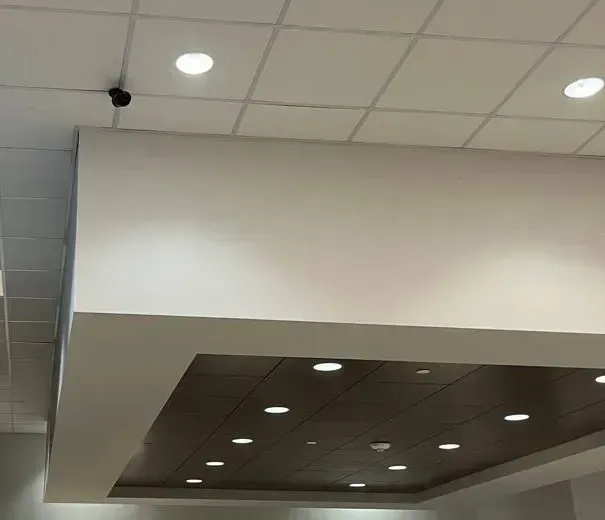
A small camera tucked into the drop ceiling where the lobby soffit steps down — the kind of placement a co-op board usually prefers: it watches the room without hanging in anyone's line of sight.
NYC Co-op Security Request
Tell us the building, the borough and what isn't working
✅
Request Sent!
Thank you. We will be in touch to book the visit, usually within 2 hours of your request.
25+
Years Experience
2 Hr
Booking
100%
Licensed & Insured
4.7★
201 Google Reviews
Owner-operated since 2002 · Thousands of jobs completed · Booked within 2 hours
The Neighborhood
Why New York City Co-ops Need Their Own Building Security Plan
New York is the co-op capital of the country, and that shapes every security decision a building makes. The NYC Comptroller's office, working from the 2023 Housing and Vacancy Survey, counts 450,000 occupied apartments in cooperative buildings, and co-ops and condos together make up 22 percent of the city's occupied housing. Behind each of those apartments is a shareholder who owns stock in a corporation, a board of directors that decides what happens to the lobby, the hallways and the front door, and usually a managing agent who has to turn the board's decision into a purchase order and a work schedule.
That structure is why co-op security is different from security for a rental building or a private house. A landlord decides and pays. A homeowner decides and pays. In a housing cooperative, the people who use the intercom every day are also the people who fund it through their maintenance, and they elect the people who choose it. The board has to justify the project, the treasurer has to fit it into a budget, the managing agent has to collect a certificate of insurance and coordinate the super, and the residents have to live with the work while it happens. A security contractor who only talks about equipment misses most of the job.
The front door carries most of the weight. Packages pile up in vestibules, delivery riders and contractors need a way in, and older shareholders want to see who is ringing before they press the button. In a typical cooperative apartment building we see the same pattern again and again: an audio intercom installed decades ago, a directory nobody has updated since a few shareholders sold, a door release that works from some apartments and not others, a camera recorder in the cellar that stopped saving video months ago, and key fobs that were never deactivated when people moved out. None of those are dramatic failures. Together they mean the building is not as secure as the board thinks it is.
The law adds weight too. In New York City, a working intercom is not a luxury feature. As Nancy Kourland, a real estate litigation partner at Lasser Law Group, told Habitat magazine in February 2024 about a co-op whose shareholder's intercom had stopped working: "As a result, the co-op has a legal obligation to repair or replace the intercom." Smart entry has its own rules: the city's Tenant Data Privacy Law governs what a key fob or app system may collect and how long it may keep it. A board that plans security as one building-wide system, rather than a string of emergency repairs, ends up with fewer surprises in both the budget and the courtroom.
New York City facts that shape every co-op security project
450,000 occupied apartments sit in cooperative buildings citywide (NYC Comptroller, from the 2023 NYC Housing and Vacancy Survey).
22% of occupied homes in the city are in co-ops and condos combined, so a large share of New Yorkers live under a board's security decisions (NYC Comptroller).
About 54% of the city's housing was built before 1947, which is why so many co-op intercoms run on wiring older than the people using them (Citizens Housing & Planning Council, from the 2023 NYCHVS).
Eight or more apartments: class A multiple dwellings erected or converted after January 1, 1968 with eight or more apartments must have a two-way voice intercom between each apartment and the self-locking lobby door, with a release from the apartment (NYS Multiple Dwelling Law §50-a).
90 days: the outer limit for keeping smart-access authentication data in a class A multiple dwelling unless it is anonymized (NYC Local Law 63 of 2021, as summarized by HPD).
Business judgment rule: since Levandusky v One Fifth Ave. Apt. Corp. (1990), courts will not substitute their judgment for a co-op board's that acts for the cooperative's purposes, within its authority and in good faith — which is why boards document how they chose a system.
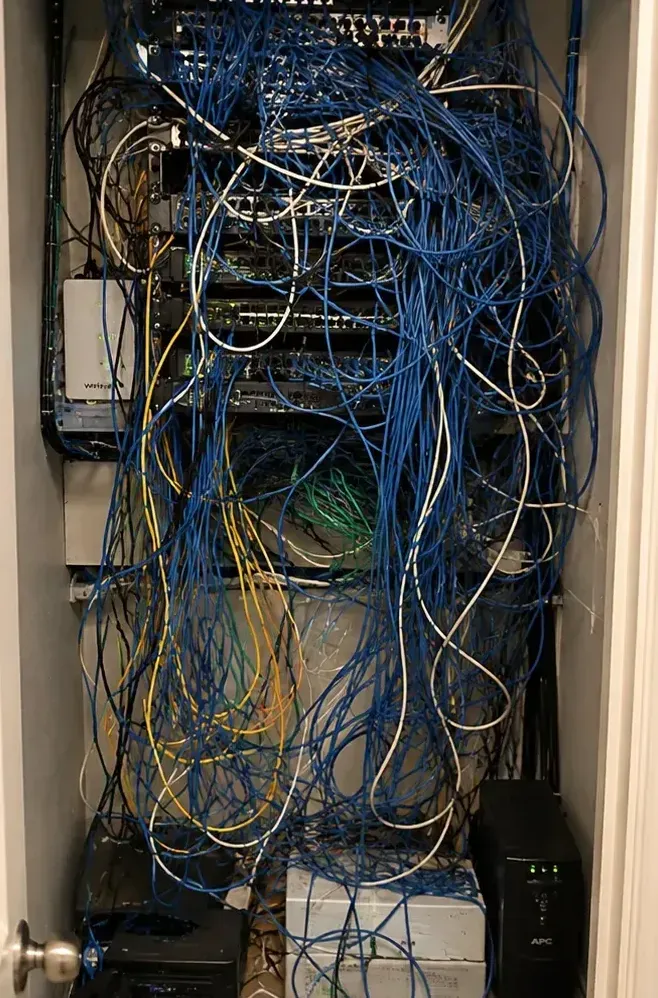
Blue, white and yellow cables knotted over the network switches in a wall cabinet, a battery backup on the floor below. This is what years of add-on work by different vendors looks like, and untangling it is often the first line of a co-op upgrade scope.
What boards, shareholders and managing agents each need from a security contractor
Board members need options they can vote on: what it costs to repair what is there, what it costs to replace it, what each choice does to the next ten years of maintenance, and a written scope they can compare against other bids. The board president and treasurer usually want the numbers broken out so they can present them at a board meeting or an annual meeting without being the ones answering technical questions.
Managing agents and property managers need a contractor who shows up inside the arrival window, carries the right insurance, sends the certificate when the job is awarded, logs the work and does not leave the super holding a broken door at 7 p.m. Many manage dozens of co-ops and want one vendor who can handle the intercom, the fobs and the cameras across the portfolio.
Shareholders want the door to work, the directory to show their name, the app to ring their phone, and the building to feel safe for elderly parents and kids. They also want to know who can see the camera footage and what the fob system records about their comings and goings. A good co-op security plan answers those questions before the residents have to ask them.
Superintendents want hardware they can live with: spare fobs, a programming login, a labeled cabinet, a phone number that gets answered. When a super can add a fob or swap a name in the directory without a service call, the building saves money every month.
What We Install
Co-op Security Services in NYC, System by System
Abstract Enterprises Security Systems is a co-op security company, installer and repair contractor in one: we design, supply, install, program, repair and maintain the systems a cooperative building relies on. Each section below answers the co-op's version of the question and then points to the page where we cover that service in full for New York City. Lead with the intercom; that is where most boards start and where most of the shareholder complaints come from.
Co-op intercom systems: repair, upgrade or replace
The co-op intercom is the system every shareholder touches, so it gets the most attention from the board and the most calls to the managing agent. Our co-op intercom work covers the lobby panel or entrance station, the door release, the power supply, the riser wiring and the apartment stations, plus the directory that ties them together. We repair audio intercoms, video intercoms, digital and analog systems, telephone entry systems that call residents' phones, and smartphone intercoms that ring an app.
For a co-op board intercom upgrade, the question is usually not "which brand" but "how far do we go." A board can keep the existing two-wire or four-wire riser and swap the lobby panel and apartment stations; move from audio to video intercom with new indoor monitors; go analog to IP over new cabling; or install a smartphone intercom that calls residents' phones so apartments need no new wiring at all. Each path has a different price, a different amount of work inside apartments and a different ongoing cost. We lay those options side by side in the board proposal, with what each one does about the directory, package deliveries, visitor management and remote door release. Boards preparing a co-op intercom RFP can use our co-op board intercom upgrade guide for the scope-of-work checklist, the bid comparison steps and the shareholder notice timeline.
When the existing system simply stopped working, the job starts with a $250 service call and a diagnosis: no sound, no video, the intercom not calling apartments, a door release that clicks but does not open, a directory that lost its names. Our full intercom repair NYC page explains how we trace faults in prewar risers; for new systems, our intercom installation in New York City page covers the equipment and installation side.
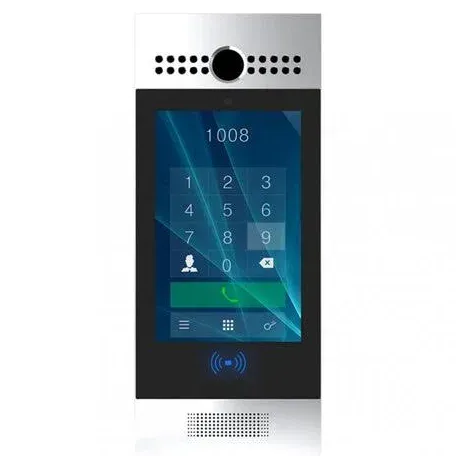
A touchscreen entrance panel with an on-screen dial pad, a camera above the screen and a contactless reader zone below — one of the lobby panel types a board can choose when the old button panel goes.
Co-op door buzzers and door release systems
Many smaller co-ops, especially walk-ups and garden apartment complexes, still run a simple co-op door buzzer system: a button in each apartment, a strike or release on the lobby door, a transformer in the cellar. When the buzzer has no sound, the door buzzes but won't unlock, or one line of apartments goes dead, the fault is usually the transformer, the strike, a relay, a corroded splice or one damaged apartment station. Typical ranges we quote citywide, from our door buzzer pricing page: an apartment station $250–$525, a door release relay or button $250–$475, a 24V transformer $325–$650, lobby panel work $650–$1,800 and electric strike repair $450–$950. Our door buzzer repair in NYC page covers the diagnosis in detail. When a buzzer has been patched too many times, it is often the point where a board moves to a full intercom upgrade instead.
Co-op access control and key fobs
Co-op access control replaces the metal key on the lobby, side, cellar, laundry, package room, gym and roof doors with credentials the building can manage: key fobs, key cards, PIN codes or mobile credentials on a phone. The big gain for a co-op is control: when a shareholder sells, a dog walker leaves or a contractor finishes, the board or managing agent deactivates that one credential instead of rekeying the building. Access logs show which door opened when, which helps the board when a package goes missing or a door is propped open. Our access control installation NYC page covers readers, controllers and lock hardware. For co-ops, we add two things every time: a written credential policy (who gets fobs, how many per apartment, what happens on sale or sublet) and a privacy policy that fits the Tenant Data Privacy Law discussed below.
Co-op elevator access control
In high-rise and luxury co-ops, the elevator is the second front door. Co-op elevator access control restricts each fob or card to the floors that shareholder is allowed to reach, keeps delivery staff on the floors they are delivering to, and can open the amenity floor only during set hours. It has to be planned with the elevator company because the reader ties into the car's controls, and it has to respect fire service operation. Our elevator access control installation in NYC page explains floor restriction, the coordination with the elevator contractor and what happens during a fire alarm.
Co-op security cameras (the short version)
Co-op security cameras cover the common areas the board is responsible for: lobby, vestibule, mailroom, package room, elevators, stairwells, laundry, cellar, trash room, courtyards and parking. In a co-op the camera decision is really a policy decision: who may watch live, who may export footage, how long the recorder keeps it, and whether any camera views a shareholder's door. We keep this page short on cameras on purpose; our dedicated co-op security camera installation in NYC page covers camera placement and pricing for cooperative buildings, and our apartment building security cameras in NYC page covers multi-unit camera systems in general.
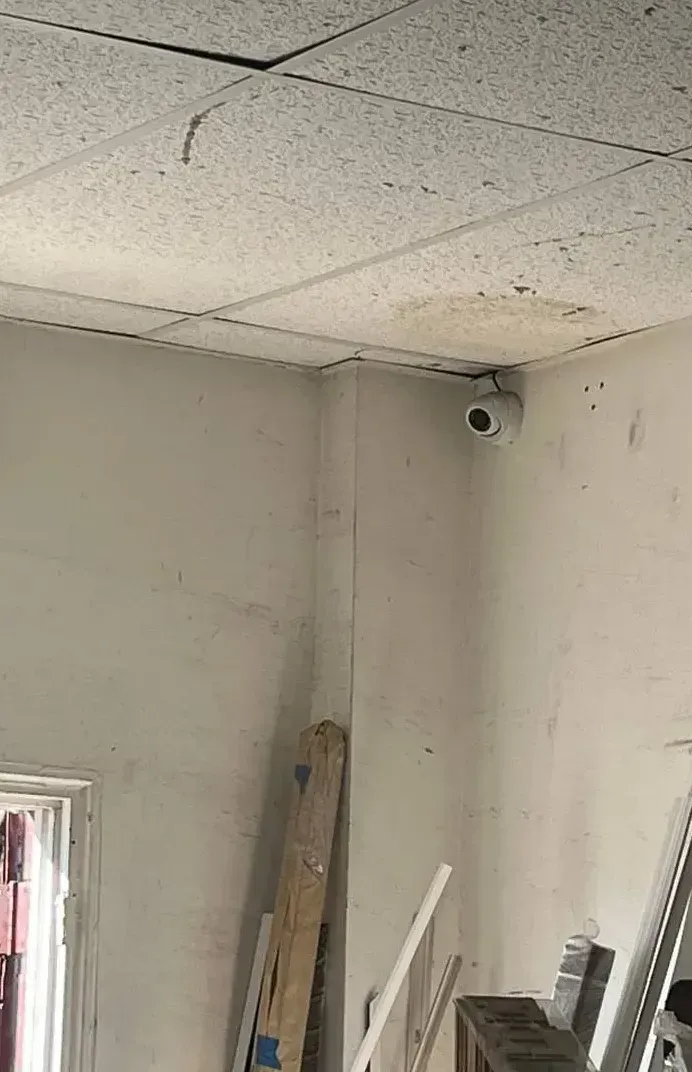
A white turret camera high in the corner of a storage room, under water-stained ceiling tiles, with lumber leaning against the wall — the kind of cellar space shareholders rarely see and boards rarely think about until something goes missing.
Package rooms, mailrooms and delivery access
Package theft prevention is now one of the first things shareholders ask the board about, especially around the holidays. The fix is usually a combination of systems rather than one product: a delivery code or temporary credential at the intercom so couriers can get into the vestibule or package room without being buzzed by a random resident, a reader on the package room door so only shareholders and staff can enter, and a camera on the shelves and the door. We set these up so the co-op's delivery management works the same way whether the building has a doorman, a part-time porter or nobody at the desk.
Co-op alarm systems for staff areas and storage
Most co-ops do not alarm the apartments; shareholders handle their own units. Where a co-op alarm system makes sense is the super's office, the storage rooms, the bike room, a rooftop bulkhead door or a commercial space the co-op controls. We install intrusion alarms with door contacts, motion sensors, glass-break detectors and panic buttons, and we offer central-station monitoring through our monitoring provider at the two plans on our site: $45 a month with the phone app, or $30 a month keypad-only. Our alarm installation NYC page has the details.
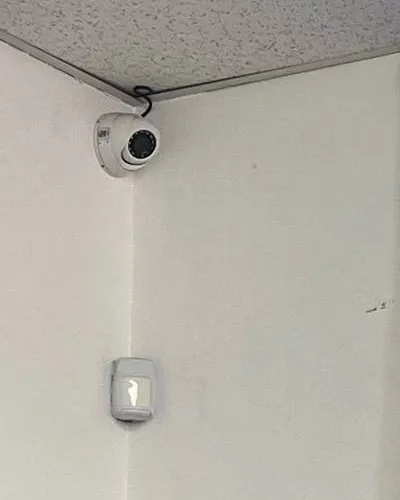
A dome camera in the ceiling corner with a motion sensor below it: the pairing we use for a super's office or storage room, where the alarm tells you something happened and the camera shows what.
Fire alarm work, within our scope
Fire alarm systems in New York City are a separate discipline with their own filings and approvals: engineer-sealed drawings, FDNY plan review and an FDNY acceptance test. We take on co-op fire alarm work only within that process and our licensing, and we never quote a fire alarm price on a web page because every system is priced from the approved drawings. What we do on almost every co-op security job is make sure the access control and mag locks release when the fire alarm activates, which the Building Code requires. Our fire alarm installation NYC page explains how those projects run.
Low-voltage cabling, networks and backup power
Every system above rides on low-voltage wiring: riser cable to each apartment, Cat6 to IP intercoms and cameras, PoE switches, a network rack, and a battery backup so the front door keeps working through a short outage. We run and label that cabling, set up the security network on its own VLAN so the intercom and cameras are not sharing a network with the building's Wi-Fi, and document it so the next contractor is not guessing. New York City does not require an electrical permit for signaling, communication, alarm and data wiring under 50 volts (Admin. Code §28-105.4.7, with life-safety exceptions). For larger cabling projects, see our structured cabling installation NYC page. We do not do high-voltage electrical work: if the building needs a new 120V circuit for a panel or a power supply, the co-op's electrician runs it and we connect from there.
Tying the systems together
The best co-op building security is integrated rather than stacked. When the intercom, the readers and the cameras are planned together, a visitor's call can show the lobby camera on the resident's screen, a fob swipe at the side door can be matched to the camera clip of that door, and the package room reader can log who went in just before a package disappeared. Integration also means one user list: when a shareholder moves out, deleting them once removes their intercom listing, their fob and their app access. We check that the equipment the board picks can actually talk to each other before it is ordered, and where a building already has a system it wants to keep, such as cameras that are only a few years old, we connect the new intercom and access control to it rather than replacing working equipment.
Accessible and senior-friendly entry
Many cooperative buildings have shareholders who have lived there for decades. A good co-op intercom upgrade keeps them in mind: large, clear directory screens or buttons at the entrance, indoor stations with big answer buttons and adjustable volume for residents with hearing loss, a telephone-based option that rings a landline for shareholders without smartphones, and door release timing long enough for someone using a walker. Where the building has an automatic door operator, we connect the intercom release and the readers to it so a visitor or resident does not have to fight a heavy door. Accessibility features are also part of how a board shows the new system serves every shareholder, not only the ones who want an app.
Timing the work around the co-op calendar
Co-op projects follow the board calendar more than the weather. Many boards approve capital work at the annual meeting or in the fall budget cycle, so a survey in late summer or early fall gives the treasurer real numbers in time. Outdoor work on panels, gates and exterior cameras goes best before winter, when sealants cure properly and crews are not working in freezing wind at an exposed entrance. The holiday season is when package theft complaints spike, which is why boards often want delivery access and package room readers in place before November. Shareholder turnover matters too: buildings with many sales each spring benefit from having the fob and directory routine set up before the busy season.
Maintenance agreements and ongoing support
A co-op security maintenance plan keeps the systems from drifting back into the state they were in before the upgrade. We offer scheduled visits to test every door release, clean outdoor stations and lenses, check recorder drives, update firmware, review the directory and the fob list against the shareholder list, and replace batteries in backup units. Between visits, tech support is free: a super or managing agent can text a photo of a screen and get walked through adding a fob or changing a name. Repairs outside the warranty start with the $250 service call. There is no maintenance-contract price on this page because each one is written to the building's equipment list.
Building Specialists
Co-op Security for New York City's Architecture
There is no single "co-op building." A ten-unit walk-up co-op on a side street and a five-hundred-unit postwar complex both answer to a board, but they need very different systems. Here is how the work changes by building type across the five boroughs.
Prewar elevator co-ops
Six to fifteen stories of brick and plaster, a doorman or a vestibule, an intercom riser that may date to the building's conversion. Cable paths run through old dumbwaiter shafts, pipe chases and the backs of closets. Video upgrades here usually reuse the riser.
Walk-up and small co-ops
Four to six stories, eight to thirty apartments, no staff. The buzzer or audio intercom is often the only security. Boards here are usually self-managed and budget-sensitive, so repair-first and phased upgrades make sense.
Garden apartment co-ops
Many low buildings around courtyards, each with its own entrance. Multiple entrances multiply the intercom panels and readers, and outdoor stations need weatherproof, vandal-resistant hardware. Cabling between buildings often runs underground or through basements.
Postwar high-rise co-ops
Twenty floors and up, hundreds of apartments, a staffed lobby, garage, package room and amenity floors. These get the full stack: video intercom with app calling, fobs, elevator floor control, dozens of cameras and a maintenance agreement.
HDFC and limited-equity co-ops
Affordable co-ops with tight reserves and often older systems. The priority is a dependable front door and fob control at the lowest lifetime cost, so subscription-free systems and reuse of existing wiring often win the board vote.
Mixed-use co-ops
Apartments upstairs, stores or offices on the ground floor. The residential entrance, the commercial tenants' doors and the shared cellar need separate credentials and separate camera access so a store tenant cannot open the residential lobby.
How the install method changes by building type
Plaster and brick. Prewar co-ops have solid masonry walls and plaster on wood or metal lath. We fish new cable inside existing chases wherever they exist and avoid opening finished hallway walls. Where we must surface-mount, we use slim raceway painted to the wall and tell the board where every run will be before work starts. Shareholders notice a new strip of molding in a lobby they care about; boards notice it again at the next annual meeting.
Reusing the riser. The single biggest cost decision in an older co-op is whether the existing intercom wiring can carry the new system. Two-wire and four-wire systems from the major intercom makers can often be upgraded to video over the same pairs with the right equipment; other buildings have cable so degraded that a new riser is cheaper in the long run. We test the riser at the survey and write that answer into the proposal. Industry experience matches what we see: Allan Liers of Metro Security Experts told CooperatorNews in November 2025 that wiring from the 1960s to the 1980s has "a typical lifespan of 25-50 years," and his first recommendation for older buildings is to "retain the existing infrastructure with the exception of the panel" where it tests sound.
Doors and frames. Old lobby doors are heavy, often out of square, and sometimes landmarked. A mag lock on a sagging door fails sooner than one on a door that has been rehung; an electric strike in a frame that has been drilled four times needs a new frame piece. We look at the door, the closer and the hinges before we quote any lock hardware, because a perfect reader on a door that does not latch secures nothing.
Outdoor and multi-entrance sites. Garden co-ops and complexes with gates have outdoor stations exposed to snow, salt and summer sun. We specify weatherproof and vandal-resistant panels, mount them with hoods where possible, run surge protection on long outdoor cable, and put the controllers indoors. A complex with six entrances is planned as one system with one directory and one credential list, not six separate intercoms.
Doorman and non-doorman co-ops. A staffed lobby changes what the intercom is for. In a doorman building, the entrance panel is mostly for after-hours visitors and the desk needs a master station or a desk app to call apartments, release side doors and see the cameras. Visitor logs and package management live at the desk. In a non-doorman co-op, the entrance panel is the doorman: it has to identify visitors clearly on video, let residents open the door from their phones, give couriers a controlled way into the vestibule or package room, and keep a record of who entered. Boards of non-doorman buildings often ask about virtual doorman services; we do not run one, but we install the equipment such a provider uses and can connect to a provider the co-op chooses. Buildings with a part-time doorman need both modes and a clean handoff between them each evening.
New construction and recent conversions. Buildings converted to co-op ownership recently, or co-ops in newer construction, usually have structured cabling and a network room. Those projects move quickly: IP intercoms over Cat6, PoE switches, cloud or local management, and integration between the intercom, the readers and the cameras from day one.
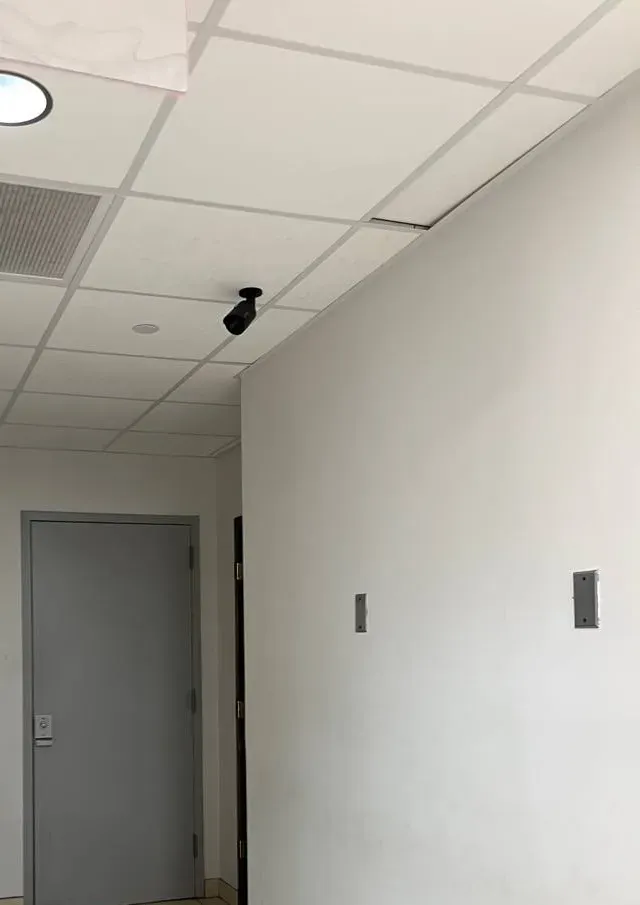
A bullet camera on the drop ceiling looking down a plain back hall to a grey steel door with a lever handle. Service doors like this one are where tailgating and propped-open doors happen, so they get a camera and, usually, a door-position contact that reports when the door is left open.
Commercial Co-op Security
Managing Agents, Mixed-Use and Commercial Co-ops in NYC
A large share of our co-op work comes through managing agents and property management companies rather than directly from boards. A managing agent responsible for twenty or fifty cooperatives has a different set of problems than a single board: consistent equipment across buildings so supers can cover for each other, one vendor who answers for the intercom, the fobs and the cameras, and paperwork that satisfies every board's insurance requirements. We work that way: one point of contact for the portfolio, written scopes per building, and the same programming conventions everywhere so a super moving between buildings knows where everything is.
Commercial co-ops and mixed-use co-ops add another layer. Ground-floor retail, a medical office or a professional suite in a co-op building needs its own access and camera arrangements. The store owner should be able to see the store's cameras without seeing the residential lobby; the residential fob should not open the store's back door; and deliveries for the commercial tenants should not be buzzed in through the residential intercom. We draw those boundaries into the system design and into the co-op's written policies so nobody has to argue about them later.
What a managing agent can expect from us on every job
Arrival windows we keep. Visits are scheduled in two-hour arrival windows; crews arrive inside the window, not before it.
Insurance paperwork when the job is awarded. We carry general liability insurance and issue the certificate naming the co-op and the managing agent as the building requires once the work is awarded.
Booking within 2 hours. Requests are booked within 2 hours, seven days a week, first come, first served once the deposit is in. We do not promise same-day work.
A written scope before anything is ordered. Equipment is ordered after the deposit and cannot be returned, so every possible add-on is in writing before the board approves.
Documentation at handover. Cabinet labels, a door and camera map, admin logins handed to the managing agent, and a short training session for the super.
Co-op security RFPs: how boards compare bids fairly
Larger co-ops and professionally managed buildings usually put security upgrades out to bid. The most common problem we see is an RFP that describes the goal ("new video intercom") without describing the building, so every contractor prices a different job and the board ends up comparing a reused-riser panel swap against a full rewire. A useful co-op security request for proposal pins down the facts first: number of apartments and entrances, the existing system and its age, whether the riser may be reused if it tests sound, whether apartments get indoor monitors, an app or both, which doors get readers, whether elevators are included, what happens to the old equipment, and which work hours the building allows.
It should also ask for the same things from every bidder: an itemized price, the equipment list with model numbers, any monthly or annual subscription fees, the warranty on labor and on equipment, the schedule and the number of days that apartments need access, and how training and documentation are handled at handover. Habitat's account of a Turtle Bay co-op's intercom replacement describes the approach in practice: a board member said, "I took the lead [in developing] the request for proposal, [and] getting our technical specifications together," and the board then reviewed and scored five sealed proposals. When the scope is that clear, the bids become comparable and the board's choice is easy to defend.
We respond to RFPs and board bid requests in whatever format the managing agent sets, after surveying the building. If the building does not have an RFP yet, our survey report can serve as the basis for one; it describes the building in enough detail that other contractors can price the same work. Insurance certificates and vendor packets are provided when the job is awarded.
What changes from a 10-unit co-op to a 500-unit co-op
Under 20 units. Small co-ops are usually self-managed walk-ups or small elevator buildings with one entrance. The whole security budget may be one lobby panel, the apartment stations and a strike. Simple, repairable equipment and a board member who can add a name to the directory matter more than advanced features.
20 to 100 units. The typical professionally managed co-op: one or two entrances, a part-time super, a camera recorder in the cellar and growing interest in fobs. This is where reusing the riser versus rewiring becomes the main cost question and where a video lobby panel plus app calling often fits best.
100 to 300 units. Staffed lobbies, package rooms, gyms and laundry rooms with their own doors, often a garage. Access control becomes as important as the intercom, and the managing agent needs real user management, logs and remote administration.
300 units and up, and multi-building complexes. Several towers or many garden buildings, multiple lobbies, gates and garages, elevator floor control, and dozens of cameras. These projects are phased, often over more than one budget year, and the design priority is one directory, one credential list and one management login across the whole property.
New York rules co-op boards should know about
None of this is legal advice; boards should confirm how each rule applies to their building with the co-op's counsel. These are the rules we design around.
Multiple Dwelling Law §50-a (intercoms and self-locking doors). In cities of 325,000 or more (MDL §3), class A multiple dwellings erected or converted after January 1, 1968 with eight or more apartments need self-closing, self-locking entrance doors and a two-way voice intercom with door release from each apartment; older buildings must provide them when a majority of tenants request them in writing. Text of §50-a.
Tenant Data Privacy Law (Local Law 63 of 2021). Applies to smart access systems in class A multiple dwellings. Owners must give a data retention and privacy policy, get express consent in writing or through an app, may not require anyone to use the smart system to enter their own dwelling unit, and must destroy authentication data within 90 days unless anonymized. The law's text has no co-op exemption. HPD summary.
Electrically locked egress doors (NYC Building Code §§1010.1.9.8–1010.1.9.9). Sensor-released locks need an egress-side sensor, a PUSH TO EXIT device 40–48 inches high within 5 feet of the door that cuts lock power for at least 30 seconds, unlocking on power loss and on fire alarm or sprinkler activation, and UL 294-listed hardware; mag locks may instead be released by door hardware with a built-in switch.
Low-voltage wiring (Admin. Code §28-105.4.7). Signaling, communication, alarm and data wiring under 50 volts does not need an electrical permit, with life-safety exceptions.
Board decisions (Levandusky, 1990). Under the business judgment rule, courts defer to a co-op board that acts for the cooperative's purposes, within its authority and in good faith, which is a good reason to keep the survey, the bids and the minutes that explain the choice. Court of Appeals decision.
Your Questions Answered
Co-op Security Systems in NYC: Questions Answered
Cost, budget and financing
How much do co-op security systems cost in NYC, and why does every job start with a $250 service call?
Every repair begins with a $250 service call because nobody can price an intercom fault honestly without testing it: the same "no sound" complaint can be a $250 apartment station or a riser problem inside occupied walls. The service call covers the diagnosis and simple fixes, and if the job is bigger, the $250 counts toward it. New building-wide systems are different: we survey for free and send a written scope. For scale, a multi-unit intercom for a 5–30 unit building runs $1,200–$5,000+ on our intercom installation page, and larger co-ops, elevator floor control and camera systems are priced after the survey because unit count, entrances and wiring drive the number.
Should a co-op board pay for a building-wide security upgrade from reserves, an assessment or operating funds?
That is the board's decision with its accountant, and we do not give financial advice. What we can do is give the treasurer the numbers in the shape each option needs: a total project cost for a capital project or reserve draw, a phased schedule if the board wants to spread it across budget years, and the ongoing costs (maintenance agreement, any app subscription, replacement fobs) that belong in the operating budget. Many boards fold a security upgrade into a larger capital improvement plan so it is approved once.
Can the board spread the payments instead of paying the whole upgrade up front?
Financing is available through Wisetack, subject to approval. Ask for it when you request the proposal and it will be included with the written scope. Phasing is the other way boards spread cost: the lobby panel and door hardware in one budget year, apartment stations or additional doors in the next, designed so phase one works on its own.
Approvals and shareholders
Who approves a security upgrade in a New York City co-op?
In most cooperatives the board of directors approves common-area work like an intercom, fob system or cameras, and the managing agent executes the contract. The co-op's bylaws and proprietary lease decide whether anything needs a shareholder vote, usually only when spending passes a threshold or the project changes something the lease guarantees. Courts give boards wide latitude under the business judgment rule from Levandusky (1990), provided they act in good faith for the co-op's purposes, so we give boards a proposal that documents the options they considered and why.
What should shareholders be told before work starts, and when?
Give shareholders written notice once dates are set, ideally two weeks ahead for a building-wide upgrade: what is being replaced, which days the front door or intercom will be affected, whether anyone needs to provide apartment access and when, how residents will get in during the work, and how the new system will be explained (written instructions, a lobby session, app onboarding). We provide a plain-language notice the managing agent can adapt, and a shareholder instruction sheet for after the cutover.
The intercom
Is a New York City co-op legally required to keep a working intercom?
For many buildings, yes. Multiple Dwelling Law §50-a requires class A multiple dwellings erected or converted after January 1, 1968 with eight or more apartments to have a two-way voice intercom with a door release from each apartment, and older buildings must provide one when a majority of tenants request it in writing. Habitat's February 2024 Q&A also notes that the city's housing maintenance code requires a functioning intercom. How those rules apply to a particular co-op is a question for its counsel; our job is to keep the system working and document every repair.
Can a co-op intercom be upgraded without entering every apartment?
Sometimes. A smartphone intercom that calls residents' phones, or a telephone entry system that dials their existing numbers, can replace the lobby panel without touching apartment wiring, and shareholders who want an in-unit station can add one later. A video upgrade with new indoor monitors, a riser repair or a directory of apartment stations does need access to each affected unit. We confirm which path fits after testing the riser, and we schedule unit access in blocks so shareholders are not waiting home all day.
When is an old co-op intercom no longer worth repairing?
Three signals: replacement parts are discontinued or only available used; repairs keep recurring in different apartments because the riser itself is failing; and the board is spending more each year on service calls than a phased replacement would cost. A single dead apartment station on an otherwise healthy system is a repair. A lobby panel that cannot be sourced, plus wiring that tests bad on several floors, is usually a replacement. We put the repair cost and the replacement cost side by side so the board can see the crossover.
Fobs, locks, cameras and privacy
Does the Tenant Data Privacy Act cover key fobs in a co-op building?
The law covers smart access systems, including key fobs, apps and biometric readers, in class A multiple dwellings, and its text has no exemption for cooperatives. Under it, owners must give users a data retention and privacy policy, get express consent in writing or through an app, may not require anyone to use the smart system to enter their own unit, and must destroy authentication data within 90 days unless anonymized. Boards should confirm with counsel how it applies to their building; we configure the system's retention settings and supply the technical details the policy needs.
Can a co-op put a magnetic lock on the lobby door?
Yes, if it is installed the way the Building Code allows. A mag lock on an egress door must release on a PUSH TO EXIT device or door hardware with a built-in switch, unlock when power fails, and release when the fire alarm or sprinkler system activates where the building has one. That is why we tie every mag lock to a request-to-exit device and to the fire alarm relay. An electric strike, which keeps the door's normal free exit, is often the simpler choice on a lobby door; we recommend one or the other after looking at the door.
Who in a co-op should be able to see the camera footage?
That is a board policy question, and it is better written down before the cameras go up. A common approach is live view for staff at the desk, playback and export only for the managing agent and one or two board officers, retention long enough to catch problems reported days later, and no camera aimed into or through a shareholder's door. Cameras in common areas are generally a board decision; audio recording raises separate eavesdropping-law questions, so we install with audio off. Get counsel's review of the policy; this is not legal advice.
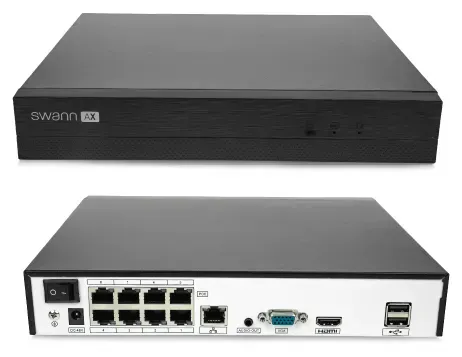
A network video recorder shown front and back: eight PoE camera ports, network, video outputs and USB on the rear. Where this box lives, and who holds its login, is part of the board's camera policy.
Running the project in an occupied building
What happens to fobs and the directory when a shareholder sells?
With a managed system, the outgoing shareholder's fobs and app access are deactivated on the closing date and the new shareholder's are issued at move-in, and the directory name is changed the same day. We set the system up so the managing agent or super can do this without a service call, and we write a short move-in and move-out checklist that matches the co-op's sale and sublet process. Without that routine, old fobs keep working for years.
How do you work in an occupied co-op without shutting the front door?
We keep the old system running until the new one is tested. New cable is pulled and new hardware mounted alongside the old; the cutover is scheduled for a short window early in the day, announced in advance, with a staff member or our tech at the door if the lock is affected. Apartment work is grouped by line or floor. Crews arrive inside the scheduled window and clean up each day, and noisy drilling is kept to the hours the building allows.
Can a shareholder put a video doorbell on their own apartment door?
Usually only with the board's permission. The hallway and the outside face of the apartment door are typically common elements under the proprietary lease, and a camera there views neighbors and their visitors. Many boards handle this through an alteration agreement or a written policy that sets which devices are allowed, where they point and whether they record. We install shareholder door cameras only once the managing agent confirms the board's approval in writing.
What records should the co-op keep after the system is installed?
Keep the proposal and contract, the equipment list with model and serial numbers, the as-built door and cable map, admin logins held by the managing agent (not only the super), the warranty terms, the written credential and camera policies, and the shareholder privacy policy for any smart access system. Those records make the next repair faster, help a new managing agent take over, and show how the board made its decision if it is ever questioned.
What does the managing agent need from a contractor before work begins?
Usually a certificate of insurance naming the co-op and the managing agent as additional insureds, a signed contract or work order, the contractor's license number (ours is NYS #12000287431), the work schedule, and sometimes a signed alteration or access agreement. We issue the certificate when the job is awarded, not with the bid. The managing agent also needs to know which apartments must provide access and on which days, which we include in the schedule.
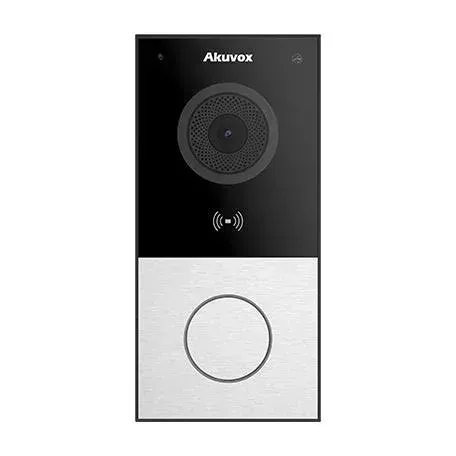
A single-button door station with a speaker grille, a contactless reader symbol and a large round call button — the kind of unit that suits a side entrance or a small co-op with a short directory.
Equipment
Types of Co-op Security Equipment We Install
Our quotes default to the equipment we would put in the building, not a brand; if the board asks for a specific make, we name every brand we install. Brand names stay out of the decision until the board knows which type of system it needs.
Entrance panels
Button panels, keypad panels and touchscreen directories with cameras, for the main lobby, side and rear entrances. Vandal-resistant and weatherproof models for outdoor posts and gates.
Apartment stations
Audio handsets, video indoor monitors and touchscreen answering stations, or no in-unit hardware at all when residents answer on their phones.
Door hardware
Electric strikes, magnetic locks, request-to-exit buttons and sensors, door-position contacts and power supplies, wired to release on fire alarm where required.
Readers and credentials
Key fob and card readers, keypad readers, mobile credential readers, and face-recognition door stations where the board has adopted a privacy policy for them.
Controllers and software
Door controllers, access panels, elevator floor-control interfaces and the cloud or on-premises software that manages users, schedules and logs.
Cameras and recorders
Dome, turret, bullet and fisheye cameras for common areas, network video recorders sized to the retention the board sets, and remote viewing for authorized staff.
Network and power
Cat6 and riser cabling, PoE switches, network racks, surge protection and battery backups so the door and the recorder keep running through short outages.
Alarm components
Panels, door contacts, motion sensors, glass-break detectors and panic buttons for staff and storage areas, with optional central-station monitoring.
Delivery and package access
Delivery codes, temporary credentials and package-room readers that let couriers drop off without being buzzed in by random residents.
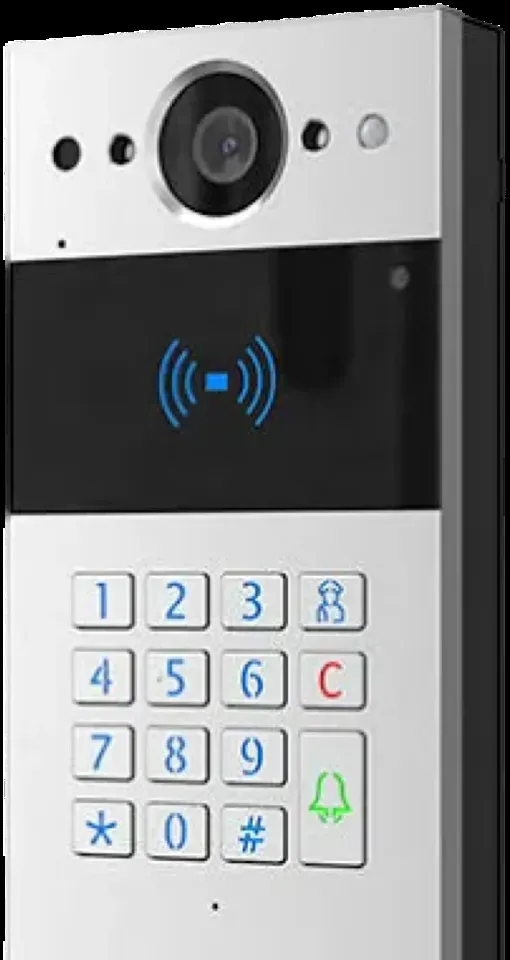
A silver door station combining a camera, a dark contactless card band and a numbered keypad: one unit that handles visitor calls, fob entry and a PIN code for staff.
Choosing between the main options
Decision
Option A
Option B
What usually decides it in a co-op
Audio vs video intercom
Audio: cheapest, often reuses existing handsets and wiring
Video: residents see who is ringing; new monitors or an app
Older shareholders and package traffic push most boards to video at the lobby, even if apartments keep audio.
In-unit monitors vs smartphone app
Monitors: work without a phone or internet in the unit
App: no apartment wiring, calls follow the resident
Many boards choose both: app as standard, a monitor or phone-line option for anyone who wants one.
Reuse wiring vs new riser
Reuse: less disruption and lower cost if the riser tests well
New riser: needed for IP systems or failed cable
The riser test at the survey.
Key fob vs mobile credential
Fob: simple, works for everyone, costs per fob
Mobile: no hardware to hand out, easy to revoke
Most co-ops run both; fobs for staff and residents who prefer them.
Mag lock vs electric strike
Mag lock: strong hold, needs REX and fire-alarm release
Strike: keeps the door's normal free exit
The door, the frame and the egress rules for that door.
Subscription vs subscription-free
Cloud service: remote management, monthly fee
Local system: no monthly fee, managed on site
The board's operating budget and who will manage users.
National brands and app-only systems vs a local installer
Boards often get pitched by national subscription intercom companies, and by alarm brands like ADT or SimpliSafe for staff areas. Those products can work, but the sales rep does not survey your riser, does not repair the strike on your sagging lobby door and does not show up when the power supply in the cellar fails. A local licensed installer supplies or installs the hardware, keeps the building's systems working together, and answers the phone in year three. We install many brands, including subscription-based intercoms when that is what the board chooses, and we tell the board the monthly cost up front.
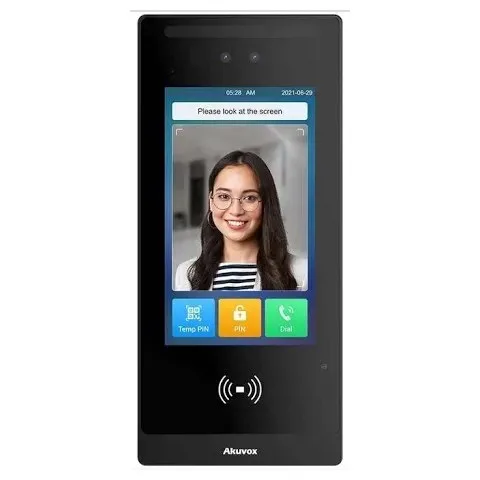
A face-recognition door station with a large touchscreen and a contactless reader below. Biometric entry in a residential building falls under the city's Tenant Data Privacy Law, so the board's privacy policy comes before the installation.
Is Your Co-op Board Ready to Fix the Front Door for Good?
Send the address, the number of apartments and what isn't working. We book within 2 hours and bring a written proposal the board can vote on.
What AI Gets Wrong About Co-op Security Systems in NYC
Search engines and AI assistants answer co-op security questions with national averages and generic advice written for suburban houses. Here are seven claims that come up again and again in cost guides, vendor blogs and directory listings from sites like Angi and HomeAdvisor, and what we see in New York City cooperative buildings.
1. "Intercom replacement costs a few thousand dollars"
National cost guides often quote one number or one range for "an intercom system," and the number gets repeated as if it applied to a building. HomeAdvisor's own intercom page gives a normal range of $1,200 to $8,500 in one place and a different span elsewhere, and it is written mostly with houses in mind.
In a co-op the price is driven by the number of apartments, the number of entrances, the condition of the riser and whether apartments get new stations or an app. Our own intercom page shows $1,200–$5,000+ for a 5–30 unit building; a high-rise with several entrances and elevator floor control is a different project entirely.
The honest answer for a board is a survey and a written scope. Anything quoted over the phone for a whole building, without testing the wiring, is a guess that becomes a change order later.
2. "You'll need to rewire the whole building"
Many generic answers assume an upgrade means new cable to every apartment, which is the part that scares boards most: holes in hallways, access to every unit, weeks of disruption.
It is often not true. Many two-wire and four-wire risers carry modern video intercoms with the right equipment, and app-based systems need no apartment wiring at all. CooperatorNews reported in November 2025 that one industry veteran's first recommendation is to "retain the existing infrastructure with the exception of the panel." In a 2014 co-op replacement Habitat covered, the installer said rewiring "would have added another 25% and doubled the time for the job."
It is also not always avoidable. Riser cable from the 1960s to the 1980s wears out, and IP systems need network cable. We test before we promise either way.
3. "Just put in a smartphone intercom and you're done"
App-based intercoms are often presented as the modern answer to every building. They are excellent in many co-ops: no apartment wiring, calls ring wherever the resident is, and the directory updates instantly.
But co-ops have shareholders in their eighties without smartphones, apartments with poor cell signal, and residents who simply want a button on the wall. A board that adopts an app-only system without an alternative ends up fielding complaints at the annual meeting.
We plan a fallback for every app-based system: a phone-line option that rings a landline, or an indoor station for any shareholder who wants one. The Tenant Data Privacy Law also bars requiring anyone to use a smart access system to enter their own apartment, which is another reason to keep a non-app path.
4. "The managing agent can just pick a vendor"
Some AI answers treat a co-op like any property with one decision-maker. In reality, common-area projects are normally a board decision under the co-op's bylaws, and the managing agent carries them out.
That matters for liability and for shareholder trust. Courts defer to boards under the business judgment rule from Levandusky (1990) when the board acts in good faith and within its authority, and a documented process — survey, competing bids, minutes — is what shows that.
Our proposals are written for that process: options with costs, the reasons for our recommendation, and a scope precise enough that other bidders can price the same work.
5. "Key fob data isn't regulated"
Generic security content rarely mentions New York City's Tenant Data Privacy Law, which has applied to smart access systems in class A multiple dwellings since Local Law 63 of 2021, with existing buildings liable from January 1, 2023.
The law requires a data retention and privacy policy, express consent, limits on what data is collected and used, and destruction of authentication data within 90 days unless anonymized. Its text contains no co-op exemption.
We cannot tell a board how the law applies to it — that is counsel's call — but we configure log retention, user consent flows and data settings to match whatever policy the board adopts.
6. "Install cameras in every hallway for maximum security"
More cameras is the generic answer. In a co-op, every camera is also a privacy question for neighbors who own the building together, and a camera pointed at someone's door can start a dispute the board did not need.
Good co-op coverage focuses on entrances, the lobby, mail and package areas, elevators, cellar doors and service entrances, plus a written policy on who views and exports footage. Audio stays off, because recording conversations raises eavesdropping-law issues a video-only system avoids.
For full camera planning, our co-op camera and apartment-building camera pages go deeper; on this page, the point is that the policy comes first.
7. "Any handyman can fix the buzzer"
DIY and handyman answers are common for door buzzers. A handyman can swap a button, but co-op intercom faults are often in the riser, the transformer, the strike or a junction buried in a cellar, and a wrong splice can take out a whole line of apartments.
Co-ops also need paperwork a handyman rarely carries: a state license, general liability insurance, a certificate for the managing agent, and a written record of the repair in case a shareholder complaint ends up in front of HPD or a judge.
We are a licensed NYS low-voltage contractor (#12000287431), insured, and every repair starts with a $250 service call that diagnoses the fault before any parts are ordered.
Get In Touch
Request a Co-op Security Proposal in NYC
Send the address and borough, how many apartments and entrances the building has, what is installed now and what the board wants to fix or upgrade. Photos of the lobby panel, an apartment station and the cellar cabinet help us prepare for the survey. Prefer to talk? Call (800) 486-0943.
✅
Request Sent!
Thank you. We will be in touch to book the survey, usually within 2 hours of your request.
How It Works
Our Co-op Security Installation Process
Seven steps, built around how a co-op makes decisions. A one-door repair moves through them in days; a building-wide upgrade waits on the board calendar between steps three and four.
1
Request and booking
Call, text or send the form. We book within 2 hours, seven days a week, with a two-hour arrival window. Repairs are paid service calls; surveys for new systems are free.
2
Building survey
We walk every entrance, test the riser and door releases, open the cellar cabinet, count units and doors, photograph the panels and note what can be reused.
3
Written proposal for the board
Repair and replacement options side by side, each with a scope, a price, unit-access needs, ongoing costs and our recommendation, in a format the board can circulate.
4
Board approval and paperwork
The board votes, the managing agent signs, the deposit is paid and we issue the certificate of insurance. Equipment is ordered only after the deposit.
5
Shareholder notice and scheduling
We supply a draft notice and a unit-access schedule grouped by line or floor; the managing agent sends it so residents know the dates.
6
Installation and cutover
Cable, hardware and programming go in while the old system keeps working; the cutover is short, early in the day and tested door by door.
7
Handover and training
Directory and fobs loaded, admin logins to the managing agent, training for the super, resident instructions, and a labeled map of every door and cable.
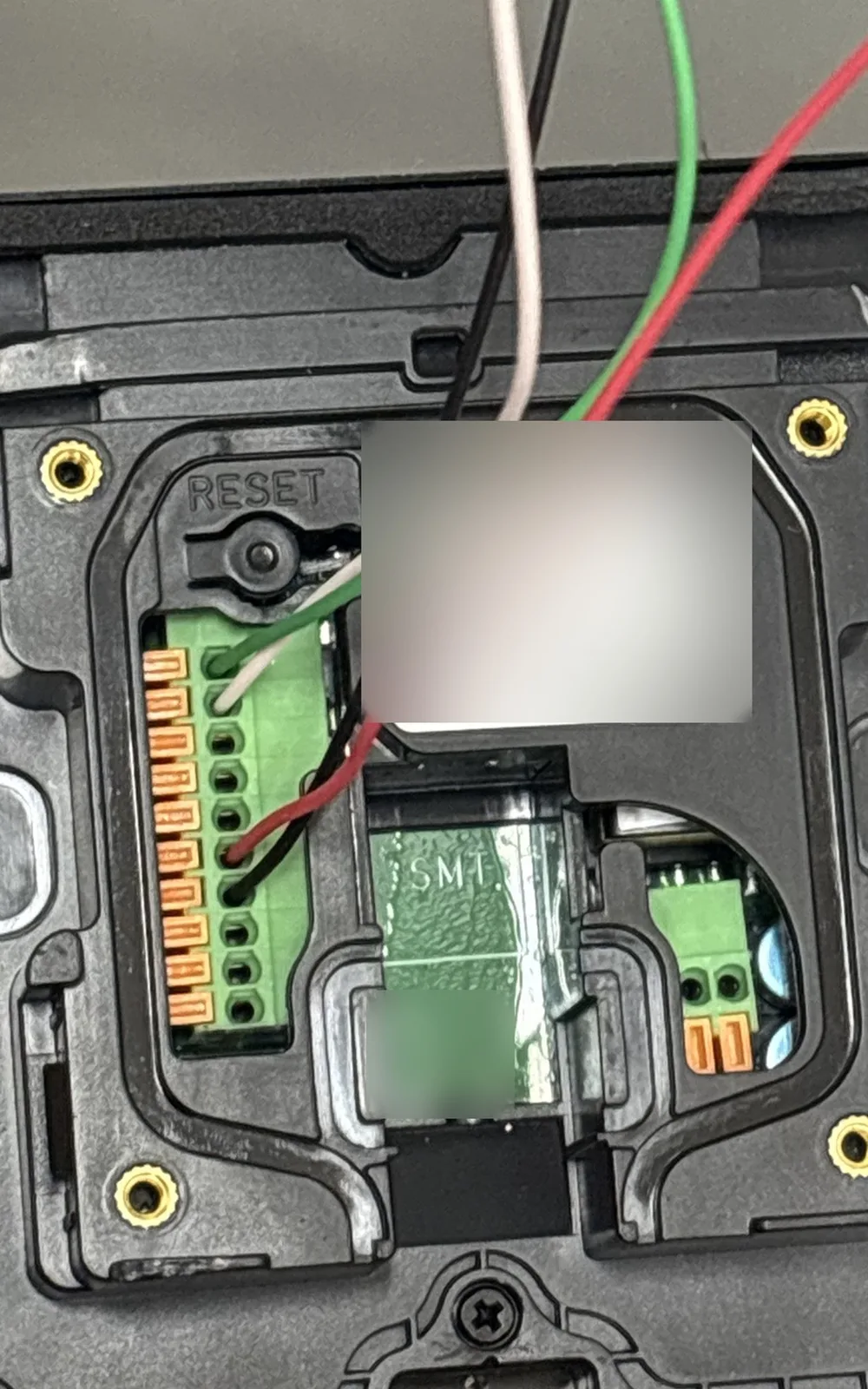
The back of a door station opened during installation: red, black, white and green conductors landed in the green terminal block, a smaller power terminal to the right, a reset button above. Labels on the board are blurred.
Field notes: what we check first in an older co-op cabinet
When a crew opens a cellar cabinet like the tangled one pictured near the top of this page, the first job is not adding anything. It is finding out what each cable does. We trace and label the intercom riser, the door release circuit, the camera runs and the network uplink, and we mark the ones that go nowhere, because abandoned cable from three previous vendors is normal in older buildings. Then we check power: the transformer or power supply for the door release, whether the recorder and switch are on a battery backup, and whether that backup still holds a charge. A surprising number of "intercom failures" in co-ops turn out to be a power supply that has been running hot for years, or a door strike drawing more current than the transformer can deliver. Only after that do we test the riser pair by pair and write the proposal. Boards sometimes ask why the survey takes an hour in the cellar before anyone looks at the lobby panel. This is why: the lobby panel is what residents see, but the cabinet is where the building's next ten years are decided.
How long a co-op security project takes
A repair is usually one visit once the part is in hand. A lobby panel replacement on a reused riser is often a day or two. A building-wide video intercom upgrade with unit visits, or a fob system across several doors, typically runs over several days, scheduled around unit access and the building's work hours. Special-order equipment can add shipping time we do not control, and we never promise an install date before the equipment arrives.
Every installation carries our 30-day warranty on the work; one-year and longer coverage is available as a paid add-on, and manufacturer warranties stay with the manufacturer. Full terms — including 50% deposit, one-year parts-only warranty on Abstract Enterprises Security Systems-supplied products, and the late-fee schedule — are set out in the service agreement.
Coverage Area
Co-op Security Near New York City's Landmarks
Co-ops are everywhere in New York, but they cluster along certain corridors. These are places where cooperative buildings line the streets and where our crews work, described by the kind of buildings around them rather than any client's address.
Riverside Drive and West End Avenue
Upper West Side prewar elevator co-ops with doormen, original lobbies and long intercom risers. Lobby panel upgrades here have to respect the architecture.
Park Avenue and the Upper East Side
Full-service co-ops with staffed desks, where boards focus on visitor management, delivery access, elevator control and discreet camera placement.
The Grand Concourse
Large Bronx Art Deco and prewar buildings, many of them co-ops or former rentals converted to co-op, with big courtyards and several entrances to cover.
Jackson Heights
Queens garden apartment co-ops around private gardens: multiple building entrances, outdoor stations and long cable runs between buildings.
Ocean Parkway
Brooklyn's parkway of postwar and prewar elevator co-ops, where buzzer-to-video upgrades and fob systems are common board projects.
Co-op City
The Bronx's large cooperative development of high-rise towers and townhouses, an example of how multi-building co-ops need one system planned across many entrances.
How co-op security work differs across the five boroughs
Manhattan has the densest concentration of prewar and postwar elevator co-ops, many with doormen and long-serving staff. Projects here are shaped by managing-agent paperwork, restricted work hours, freight elevator bookings and lobbies the board wants to keep looking original, so discreet panels and concealed cable matter as much as features.
Brooklyn mixes prewar elevator co-ops along its parkways with small walk-up co-ops and converted buildings. Buzzer-to-intercom upgrades and fob systems for side and cellar doors are common, and many smaller boards are self-managed, so straightforward systems that a board member or super can run are often the right call.
Queens is home to large garden apartment co-ops and postwar complexes with many separate entrances, courtyards and parking areas. Weatherproof outdoor stations, cable between buildings and one directory across many doors are the recurring design problems.
The Bronx has big prewar co-ops and converted buildings along the major boulevards, limited-equity co-ops and very large cooperative developments. Projects often start with an old system that still partly works, and the board needs a phased plan rather than a single large spend.
Staten Island co-ops are fewer and more often low-rise or garden-style, with parking lots and exterior entrances. Outdoor hardware and camera coverage of lots and walkways come up more than elevator control.
We cover every borough from our offices at 1282 Troy Ave in Brooklyn and 460 E Fordham Rd in the Bronx. For borough-specific detail, see co-op security systems in Manhattan, Brooklyn, Queens, the Bronx and Staten Island. Condo boards will find the matching page for condominiums at condo security systems in NYC.
Pricing
Co-op Security System Cost in NYC
Co-op security system pricing depends on the building, so this page publishes only numbers we already quote across the city and leaves the rest to the survey. The $250 service call is where every repair starts. Building-wide systems are quoted per building in writing.
Work
Price
Notes
Service call (any co-op repair)
$250
Diagnosis and simple fixes; counts toward the job if it is bigger.
Apartment intercom station
$250–$525
Replace or repair one apartment's handset or station.
Door release relay or button
$250–$475
When the door buzzes but does not open, or one button is dead.
24V transformer
$325–$650
Common cause of a whole building's buzzer going quiet.
Electric strike repair
$450–$950
Strike replaced and the door aligned.
Lobby panel work
$650–$1,800
Repairs to the entrance panel and its connections.
Riser repair inside occupied walls
$850–$2,400
The high end of repair work; needs unit access.
New multi-unit intercom, 5–30 units
$1,200–$5,000+
Depends on unit count, wiring and whether access control is added.
Larger co-ops, fobs, elevator control, cameras
Written quote after the free survey
Entrances, doors, floors, cameras and wiring set the price.
Repair ranges are the citywide ranges on our door buzzer repair pricing page; the multi-unit intercom range is from our intercom installation NYC page. Tax and the 3% card fee, where it applies, are shown as separate lines on the invoice.
What drives the cost of a co-op security upgrade
Units and entrances. Each apartment needs a station, an app account or both; each entrance needs a panel or reader.
The riser. Reusing sound wiring is far cheaper than pulling new cable through occupied walls.
Indoor monitors vs app. Monitors are hardware and labor per unit; an app trades that for setup time and sometimes a subscription.
Doors and hardware. Sagging doors, old frames and egress requirements can add strike, closer or REX work.
Elevators. Floor control means coordination with the elevator company and interface hardware per car.
Subscriptions. Some cloud intercoms and access platforms charge monthly per door or per unit; subscription-free systems shift that to a one-time cost.
Phasing. Doing the lobby this year and the apartments next year can fit a budget, at the cost of two mobilizations.
Looking past the installation price
The cheapest bid is not always the cheapest system over ten years. When we prepare a proposal, we show the board the costs that come after installation: any monthly or annual subscription for a cloud intercom or access platform, the price of replacement fobs and cards, the expected life of outdoor stations and recorder hard drives, the maintenance agreement if the board wants one, and what a typical service call would cost once the warranty ends. A subscription-free system with a higher installation price can cost less over a decade than a low-price system with a per-door monthly fee, and the reverse can be true for a small building that values remote management. The treasurer should see both columns before the vote.
Cost per apartment and per door
Boards often want a cost per apartment or per shareholder to present at a meeting. We do not publish one, because it changes so much with building size: a 300-unit tower spreads the lobby panel and controller across many apartments, while a 12-unit walk-up pays for the same lobby equipment with far fewer shareholders. Once we have surveyed the building, the proposal shows the total, the per-unit figure and the per-door figure for access control, so the treasurer can present it either way.
Shop Our Systems
Co-op Security Packages & Pricing
We do not sell one-size co-op packages, because two co-ops with the same number of apartments can need completely different work. Instead there are three ways to start, depending on where the building is today.
Fix what's broken
$250 service call
For a co-op intercom, buzzer, strike, fob reader or recorder that stopped working. Diagnosis plus simple repairs; bigger repairs are quoted on the spot with the $250 applied.
Upgrade the front door
$1,200–$5,000+ for 5–30 units
A new multi-unit intercom for smaller co-ops, with options for video, app calling and a fob reader at the lobby. Larger buildings are quoted after the survey.
Building-wide proposal
Free on-site assessment
For boards planning a capital project: intercom, access control, elevator floor control, cameras and cabling surveyed together and quoted in a written proposal with options.
Already bought the equipment? Labor-only installs
Some boards buy intercom panels, readers or cameras through a manufacturer or another supplier. We install customer-supplied security equipment: send the equipment list, model numbers and photos of the doors and the cellar, and we quote the labor by phone or text. We do not schedule walk-throughs on customer-supplied equipment, and the equipment's own warranty and performance stay with the supplier; our warranty covers our workmanship.
Deposits follow the service agreement: jobs are scheduled once the deposit is paid, and special-order equipment is ordered only after the deposit, with no install date promised until it arrives.
Need a Number for the Next Board Meeting?
We survey for free and send a written proposal with options, so the treasurer has real numbers instead of an estimate from a website.
Send the building details and get a written proposal.
FAQ
NYC Co-op Security Systems FAQ
Do you work with co-ops in every borough of New York City?
+
Yes. We handle co-op security work in Manhattan, Brooklyn, Queens, the Bronx and Staten Island from our offices at 1282 Troy Ave in Brooklyn and 460 E Fordham Rd in the Bronx, and we also cover Long Island and the Hudson Valley.
Is Abstract Enterprises Security Systems licensed and insured for co-op work in New York?
+
Yes. We are a licensed New York State low-voltage contractor, license #12000287431, and carry general liability insurance. The certificate of insurance naming the co-op and the managing agent is issued when the job is awarded.
What warranty comes with a co-op security installation?
+
Our work carries a 30-day warranty, and one-year or longer coverage is available as a paid add-on. Equipment is covered by the manufacturer's warranty, and the service agreement sets out the full terms, including the deposit and the one-year parts-only warranty on equipment we supply.
Do you run a virtual doorman service for co-op buildings?
+
No. We do not operate a virtual doorman, virtual concierge or managed security service. We install the intercom, cameras and access control that a virtual doorman provider or the building's own staff uses, and we can connect new equipment to a provider the co-op already has.
Can you service an intercom or camera system another company installed in our co-op?
+
Yes. We repair and maintain systems we did not install once we identify the equipment. The visit starts with the $250 service call, and we tell the board honestly whether the existing system is worth keeping.
Do you handle fire alarm systems in New York City co-ops?
+
Only within the FDNY process and our licensing scope: fire alarm systems are built from engineer-sealed drawings, reviewed by the FDNY and acceptance-tested, so we never publish fire alarm prices. On security jobs we tie access control and mag locks into the fire alarm so doors release when it activates.
Will the new co-op system need a monthly subscription?
+
It depends on the system the board picks. Some cloud intercoms and access platforms charge a monthly fee per door or per unit; subscription-free systems are managed on site with no monthly fee. Every proposal lists any recurring cost so the board sees it before voting.
Do you respond to co-op RFPs and board bid requests?
+
Yes. Send the RFP or scope of work and we return a priced proposal in the requested format after surveying the building. The certificate of insurance and any vendor paperwork are provided when the job is awarded.
Can you give us references from other co-op buildings?
+
We do not share client names, addresses or contact details, out of respect for the buildings we work in. Our Google reviews show real customers' experiences, at 4.7 stars from 201 reviews.
How quickly can you book a visit for a co-op door buzzer that stopped working?
+
We book within 2 hours of your request and schedule seven days a week with early-day visits, first come, first served once the $250 service call is paid. We do not promise same-day work.
Who does the electrical work for new co-op security equipment?
+
We handle all of the low-voltage side: wiring, door hardware, panels, readers and programming. If a new 120-volt circuit or outlet is needed, the co-op's electrician installs it and we connect our equipment to it.
Can a co-op get central-station alarm monitoring from you?
+
Yes, for alarm systems we install in staff offices, storage rooms or commercial spaces. Monitoring is through our central-station provider at $45 a month with the phone app or $30 a month keypad-only.