Lobby intercom silent or a building door that won't lock? Staten Island co-op boards and managing agents can call or text our Brooklyn office: (347) 934-8335
For Staten Island Co-op Boards, Shareholders & Managing Agents · Served From Our Brooklyn Office
Co-op Security Systems in Staten Island
Garden Complexes · 1960s Elevator Co-ops · Entry Panels · Shared-Room Fobs · Lot Cameras
Staten Island co op security systems are priced two ways: a $250 service call when something on the property has failed, and a written quote, after a free walk-through of every building, when the board wants something new. Abstract Enterprises Security Systems is a New York State licensed low-voltage contractor, and we install, repair and upgrade the entry intercoms, door releases, key fob readers, cameras and elevator access equipment that the borough's housing cooperatives depend on, from small North Shore walk-ups to garden complexes with a dozen separate doors and 1960s elevator buildings near Clove Lakes and the Narrows.
Quick answer: Building security for co-ops on Staten Island is mostly a grounds problem, not a lobby problem, and we cover all of it under one license: each building's entry panel and its lock, credentials for shared rooms such as laundry and storage, outdoor cameras on lots and paths, and the cable that links one building to the next. Repairs start with the $250 service call, credited toward a larger repair. Upgrades are quoted after a free walk-through with the board or the managing agent. We book requests within 2 hours and schedule seven days a week with early-day visits.
Last updated November 25, 2026 by Abstract Enterprises Security Systems, NYS license #12000287431 · Sources: NYC Department of Finance cooperative comparable rental income data (NYC Open Data); NYC HPD Mitchell-Lama listing; NYC HPD Housing Maintenance Code violations (NYC Open Data); NY Multiple Dwelling Law §50-a; NY General Business Law art. 6-D; NYC Admin. Code ch. 30 and HPD Tenant Data Privacy guidance; U.S. Army Corps of Engineers, Oct. 7, 2024; NYC Comptroller
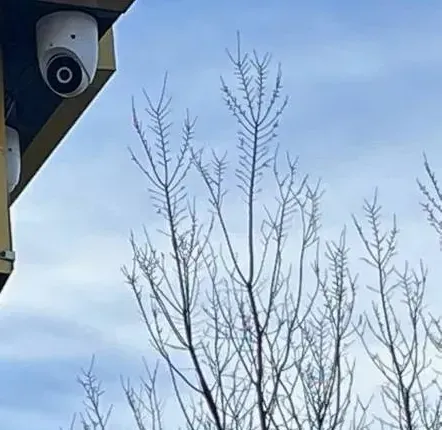
From our job library: an outdoor dome camera tucked under an eave with winter branches behind it. On Staten Island garden co-ops, eaves like this are where most building-entrance cameras end up.
Staten Island Co-op Security Request
Board officers, managing agents, supers and shareholders: tell us about the property
✅
Request Sent!
Thank you. We will call or text to set up the service call or the walk-through of the property.
25+
Years Experience
2 Hr
Booking
$250
Service Call
4.7★
201 Google Reviews
Owner-operated since 2002 · Thousands of jobs completed · Booked within 2 hours · Call or text (347) 934-8335
The Neighborhood
Why Staten Island Co-op Buildings Need Security Systems Planned Around Grounds, Not Lobbies
Cooperative housing is a small part of Staten Island, and that is exactly why co-op boards here have a hard time finding the right help. Across New York City there are about 450,000 occupied apartments in cooperative buildings, according to the NYC Comptroller's homeowner housing spotlight, and most of them sit in Manhattan, the Bronx, Queens and Brooklyn. Much of what is written for co-op boards assumes a prewar elevator building with a doorman and a single lobby. Very few Staten Island cooperatives look like that, and a plan written for one usually misses what actually goes wrong on a Staten Island property.
To see what the borough's co-op stock really is, we went to the city's own numbers. The NYC Department of Finance has to value every cooperative as if it were a rental building, and it publishes the comparison data on NYC Open Data as the DOF Cooperative Comparable Rental Income dataset. For report year 2019, the most complete recent year in that file, the Staten Island list holds 26 co-op tax lots with about 1,928 apartments between them. Seventeen of those lots are classed as walk-ups and nine as elevator buildings. The oldest was built in 1947 and the newest in 2000. Not one is prewar.
That changes the security conversation. A Staten Island co-op is far more likely to be a group of two- and three-story garden buildings around a courtyard and a parking lot than a tower with a lobby desk. The board's problem is rarely one front door; it is eight or twelve entrances spread across a site, a laundry room in one building, a storage room in another, a lot that sits dark after 6 p.m. in winter, and a path between buildings that nobody can see from a window. The elevator co-ops that do exist were mostly built in the 1960s and early 1980s, on the North Shore near the ferry, around Clove Lakes and up toward the Verrazzano-Narrows Bridge, and they bring their own set of riser and elevator questions.
The governance can be different too. A small co-op corporation anywhere in the city is often run by a volunteer board with a part-time managing agent or none at all, and on a Staten Island garden property the person who calls a contractor may well be the board president who also knows where the cellar key is. These corporations need a contractor who will walk the whole property, explain the options in plain terms, and hand over one written number per building so the board can decide what to do first. That is the work this page describes.
What the city's own list shows, neighborhood by neighborhood
The table below groups the 2019 Department of Finance co-op list by the neighborhood name DOF uses. We show it to describe the building stock, not to point at any building; we never name client buildings or addresses, and the list includes properties we have never worked in.
DOF neighborhood
Co-op lots
Type
Years built
New Brighton and New Brighton–St. George
5
Elevator
1960–1985
West New Brighton
5
Walk-up
1950–1968
Livingston
1
Walk-up
1947
Grymes Hill
2
Walk-up
1951
Clove Lakes
2
Elevator
1966–1967
Arrochar–Shore Acres
1
Elevator
1964
Rosebank
1
Walk-up
1974
Concord–Fox Hills
3
Walk-up
1999–2000
Dongan Hills
1
Elevator
1969
Grant City
2
Walk-up
1969
Great Kills and Great Kills–Bay Terrace
3
Walk-up
1974–1977
A few patterns stand out. The North Shore holds the oldest walk-ups and most of the elevator buildings. The East and South Shore co-ops are newer, larger garden complexes; four walk-up lots on the list carry more than a hundred apartments each, which in a walk-up means many separate entrances rather than one big lobby. And the small 1999–2000 walk-ups in Concord–Fox Hills are among the newest co-ops anywhere in the city. DOF's list is a valuation tool, so it may not capture every cooperative on the Island, but it is the clearest public picture of the stock we could find.
No Mitchell-Lama co-ops, and what that means for the budget
In other boroughs, a large share of co-op apartments sit in limited-equity developments supervised by the city or state, with their own approval rules and capital programs. The HPD Mitchell-Lama listing shows only one Staten Island development, and it is a rental, not a cooperative. So a Staten Island co-op board usually has no supervising agency to consult and no outside capital program to wait for: the money for a new intercom or a set of lot cameras comes from the corporation's own reserve, an assessment or the operating budget. That makes the order of work matter. A board that fixes the entrance that fails most often and then adds the next building each year spends its money where shareholders feel it.
Intercom violations: the borough's small number
HPD publishes every Housing Maintenance Code violation it issues on NYC Open Data. When we counted the violations issued in calendar year 2025 whose description mentions an intercom, Staten Island buildings received 24. The Bronx received 1,637, Brooklyn 1,157, Manhattan 1,020 and Queens 342. Those inspections are triggered mainly by tenant complaints in rental buildings, so the figure says little about co-ops directly. It does say something about the borough: Staten Island has far fewer multiple dwellings than the rest of the city, and the people who know how to keep a multi-building intercom running are correspondingly scarcer here.
The 1968 line in the Multiple Dwelling Law
New York's Multiple Dwelling Law §50-a requires class A multiple dwellings erected or converted after January 1, 1968, with eight or more apartments, to have self-closing, self-locking entrance doors and an intercom that lets each apartment talk to a person at the entrance and release the door. Older buildings come under the requirement when the tenants of a majority of apartments request it in writing. On the 2019 DOF list, twelve Staten Island co-op lots were built in 1969 or later, twelve before 1968 and two in 1968 itself, so the borough's co-op stock sits almost exactly on that line. We don't give legal advice and the board's attorney decides how the statute applies to a particular corporation, but every board should know which side of the date its buildings fall on before it decides that a broken intercom can wait.
Weather, water and where equipment should live
The U.S. Army Corps of Engineers reported on October 7, 2024 that Hurricane Sandy caused 24 deaths on Staten Island, more than in any other borough, and affected nearly 7,300 residential and commercial properties. The Corps' planned seawall runs about five miles along the East Shore, from the edge of Fort Wadsworth near the Verrazzano-Narrows Bridge to Oakwood Beach. Several of the co-op neighborhoods on the DOF list, including Arrochar–Shore Acres, Rosebank, Dongan Hills, Grant City and Great Kills, are East or South Shore neighborhoods. For a board there, the practical lesson is simple: power supplies, recorders and network switches belong on a dry wall above the floor, not on a cellar slab, and outdoor equipment should be rated for wind-driven rain and salt air.
Staten Island co-op facts that shape the work
26 co-op tax lots, about 1,928 apartments: the Staten Island entries in the 2019 Department of Finance cooperative comparable data (NYC Open Data).
17 walk-ups, 9 elevator buildings: the building classes on the same list; built between 1947 and 2000, none prewar.
One Mitchell-Lama development, a rental: the only Staten Island entry on HPD's Mitchell-Lama listing, so there are no city-supervised Mitchell-Lama co-ops in the borough.
24 intercom violations in 2025: HPD Housing Maintenance Code violations mentioning an intercom issued to Staten Island buildings, against 1,637 in the Bronx (NYC Open Data).
January 1, 1968: the date in MDL §50-a after which buildings of eight or more apartments must have a self-locking entrance and a working intercom (NY Senate).
About five miles: the length of the planned East Shore seawall from Fort Wadsworth to Oakwood Beach (U.S. Army Corps of Engineers).
Most Staten Island co-op boards that call about one broken building intercom end up asking about the laundry and storage doors too, because once residents can be buzzed in properly, the room nobody locks becomes the next complaint at the annual meeting.
What We Install
Co-op Security Services in Staten Island, Door by Door and Building by Building
Think of us as the co-op building security contractor for the whole property, not one lobby. Below, each system gets the board's question answered first, followed by a link to our full Staten Island page for that service, where the technical detail and the service-specific pricing live. A board can hire us for a single door release or put every building, gate and camera on one licensed vendor.
Co-op intercoms on a multi-building property
The intercom is where nearly every Staten Island co-op project starts, because it is the system shareholders use every day and the one state law speaks to. On a garden complex, though, "the intercom" is usually several systems: one entry panel per building, a set of apartment stations or app accounts behind each panel, and a separate power supply and door release at every entrance. When one building's panel goes quiet, the others keep working, which is why boards often live with a dead entrance for months.
For co-op intercom repair we start at the failing entrance with the $250 service call: panel, power, release and a sample of apartment stations, so the board learns whether it is looking at one failed part or a building that needs a new system. Repair details and what we check are on our Staten Island intercom repair page. When the answer is replacement, the board's real decision is whether to replace one building now or standardize every building on the same platform over two or three budget years. A co-op intercom replacement done building by building with the same equipment line gives shareholders one app, one directory format and one set of spare parts; done piecemeal with whatever is cheapest each year, it leaves the super juggling three brands. New entry systems, video panels and app-based calling are covered on our Staten Island intercom installation page.
Boards that want to run a proper co-op intercom upgrade, with a written scope, an RFP and bids that compare cleanly, can read our board-level guide when it is published; we are writing it for exactly that decision. Until then, the free walk-through gives the board a door-by-door inventory it can attach to any request for bids, and the written quote lists each building and each phase as a separate line so the board can approve the co-op intercom system budget in pieces.
Door buzzers and door releases
The older walk-ups on the North Shore and Grymes Hill still run plenty of simple buzzer systems: a button panel at the door, a handset or buzzer in each apartment, and a transformer feeding a strike. When only the release fails, or the buzzer works on the first floor but not the third, the fix is often a release relay, a transformer or a broken conductor rather than a new system. Our Staten Island door buzzer repair page explains that work, and boards that only need a basic audio buzzer for a small building can see door buzzer installation on Staten Island. A co-op door buzzer repair visit is the same $250 service call as any intercom diagnosis.
Key fobs for entrances, laundry rooms and storage
Co-op access control on Staten Island tends to be about the rooms between the buildings as much as the front doors. A laundry room shared by three buildings, a storage room with shareholder bins, a management office and a boiler room all need different people at different hours, and keys handed out over thirty years no longer tell the board who can get in. A fob system puts every one of those doors on one list. When a shareholder sells, the board removes the fobs; when a contractor finishes, the temporary fob stops working on the date the board chose.
Readers go on the doors that matter most first: usually the building entrances that are propped open, then the laundry room, then storage. Our Staten Island access control installation page covers readers, controllers, mag locks and strikes in detail. On a garden complex the controller can sit in one building and serve the others over network cable, so the board manages a single database rather than one box per building.
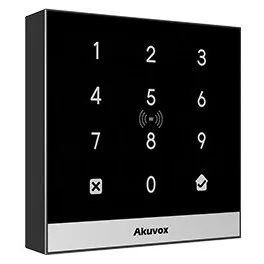
Manufacturer product photo: a standalone keypad with a built-in card reader. A reader like this suits a shared laundry or storage room on a Staten Island co-op property, where a code and a fob both make sense.
Cameras for lots, paths and entrances
On Staten Island, co-op security cameras do different work than in a Manhattan lobby. The views boards ask for most are the parking lot, the paths between buildings, the laundry room door and the dumpster enclosure, along with the entrances. We keep this section short on purpose: our Staten Island apartment building camera page covers multi-unit camera systems in depth, our parking lot camera installation page covers the lot itself, and a dedicated co-op camera page for the borough is on our build list. Camera prices for the borough are on our Staten Island security camera pricing page.
Elevator access in the borough's elevator co-ops
Nine of the co-op lots on the city's 2019 list are elevator buildings, most of them from the 1960s. In those, a reader in the cab or at the lobby call button can limit which floors a fob reaches, which matters when a building has a lobby that opens straight onto a parking area or a side street. Elevator readers are always coordinated with the building's elevator maintenance contractor, who handles the controller side. Our Staten Island elevator access control page explains how that coordination works.
Package and mailroom doors
Garden co-ops rarely have a staffed package room; deliveries end up in vestibules or on stoops, and each building handles them differently. The usual fix is not exotic: a fob reader on the vestibule's inner door so a driver can be buzzed into the vestibule but no further, a camera covering the spot where boxes are left, and, where a building has a spare room, a fob-controlled package room shared by the complex. Shareholders who have had a box walk away from a stoop understand the point immediately; a SILive report from August 2025 described a package taken from an Elm Park porch eight minutes after delivery, in view of a surveillance camera. A camera alone records the loss; a door that keeps the box inside prevents it.
Fire alarm work within our scope
Some Staten Island co-ops call about fire alarm panels in the same breath as intercoms. We handle fire alarm work only within our licensing scope, and in New York City that work begins with engineered drawings and FDNY review and is quoted per building after a survey, never from a price list. Our Staten Island fire alarm installation page explains the approval path. Intercom, access control and camera work is separate, and the board can move ahead on it while any fire alarm question is answered.
Cabling between buildings
The hidden cost on a garden complex is distance. Getting a camera signal or an access control link from one building to the next means cable through existing conduit, an aerial run where one already exists, or a new route the board approves. We run the low-voltage cable and network gear for the systems we install, including Cat6 runs, PoE switches and links between buildings, and our Staten Island structured cabling installation page describes that work. We don't sell managed IT service, and we don't do electrical work: if a new equipment location needs a power circuit, the building's electrician provides it.
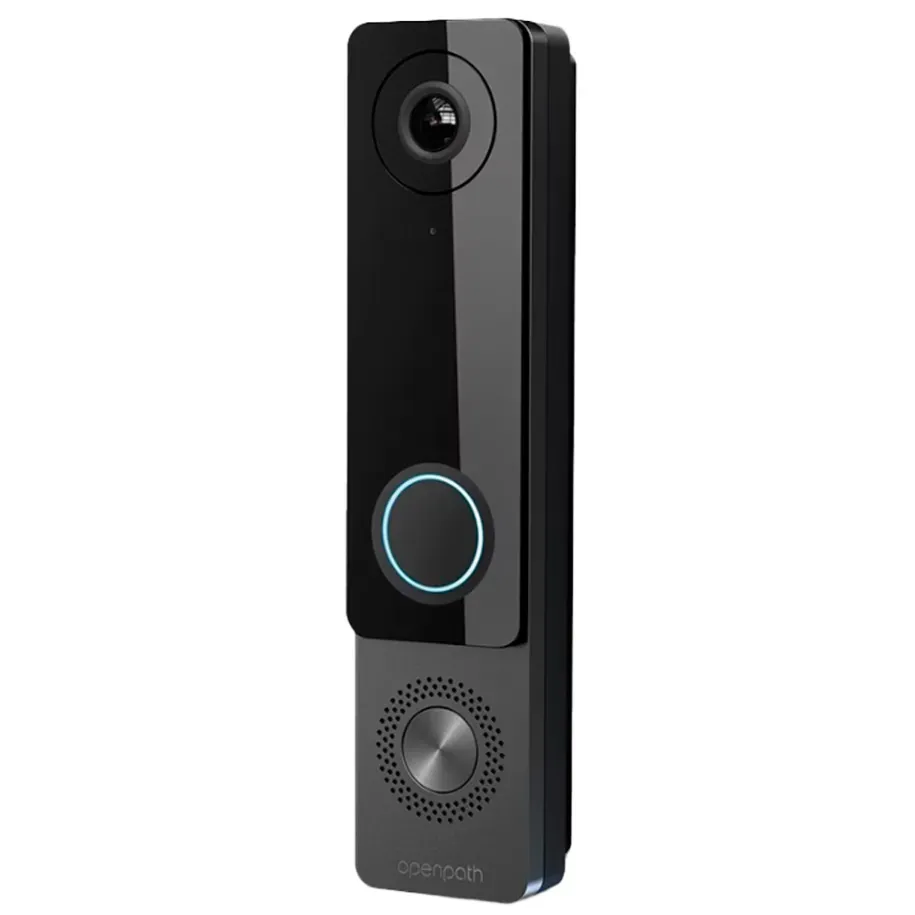
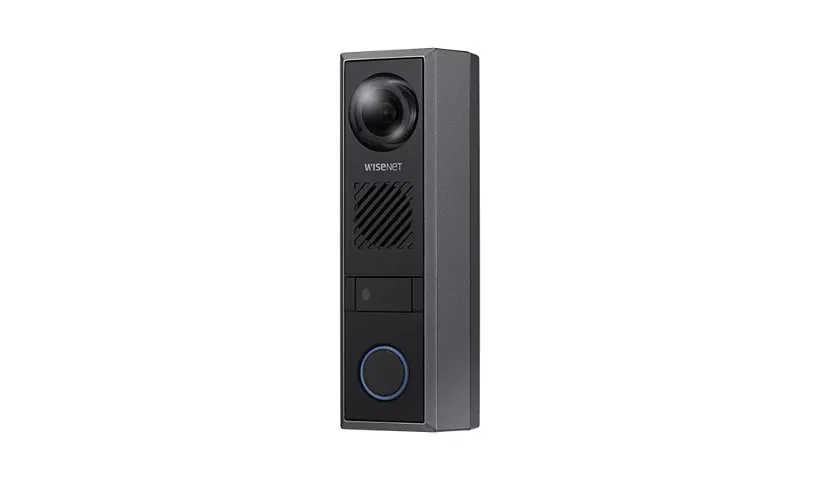
Manufacturer product photo: a slim video reader with a camera and a lit credential ring. It fits a narrow door frame at a garden building entrance where a full lobby panel would not.
Walking the grounds: the free assessment
The free walk-through for an upgrade is, in practice, a co-op security needs assessment. On a Staten Island property it means walking every building and the grounds with the board's contact and writing down, for each door: what is installed, whether it locks and releases, who uses it, and what the camera, if there is one, can actually see. We also note where power and network already exist, where the lot goes dark, which doors are propped and where packages land. The board gets that inventory with the quote, so even if it decides to wait, it knows what it has.
Boards often ask us to rank the findings. Our usual order is: doors that don't lock first, because they defeat everything else; then the entrance that fails most often; then the shared rooms; then cameras on the lot and paths. That order is a starting point for the board's discussion, not a rule.
Winter, nor'easters and year-end budgets
Exterior entry panels and door hardware take the worst of the weather on an open garden site, and cold weather is hard on them: an intercom maker's guide to how cold affects apartment intercoms notes that "metal parts contract in the cold" and advises boards to review strike alignment and look for doors that need extra pressure to latch or release. Boards that schedule a check of every entrance in the fall find those doors before a shareholder does. Year-end is also when many boards set next year's budget, so a written quote obtained in November can be voted on in January. We don't run seasonal discounts or specials; an early booking simply gets the earlier dates.
Service calls, maintenance and support
When something stops working, the $250 service call is the starting point, and the fee is credited if the job turns into a larger repair. Boards that want a co-op security maintenance check can book one without any failure: a crew walks every entrance, tests each reader and release, and reviews each camera view, typically before winter or ahead of the annual meeting. Phone tech support is free for systems we installed. We don't sell a subscription security service or run a virtual doorman; we install and maintain the equipment, and we can work alongside a monitoring or virtual-doorman provider the corporation already uses.
1
Building intercoms
One entry panel per building, apartment stations or app calling, and one directory format across the property.
2
Buzzers and releases
Relays, transformers, strikes and handsets on the older North Shore walk-ups, traced and repaired.
3
Fobs for every shared door
A single credential database for building doors plus the laundry, storage, office and boiler rooms.
4
Lot and path cameras
Parking areas, walkways, entrances and package spots, recorded on site.
5
Elevator access
Readers that restrict floors in the 1960s elevator buildings, installed alongside the elevator maintenance company.
6
Links between buildings
Cat6, PoE and building-to-building links so one system serves the whole complex.
Building Specialists
Co-op Security for Staten Island's Cooperative Building Types
Because Staten Island's co-op stock is all postwar and mostly low-rise, the building types we plan around here are not the ones that dominate a Manhattan or Brooklyn co-op conversation. These six cover nearly every cooperative property on the borough's list, and each one changes the scope, the schedule and the cost.
A
Early postwar garden walk-ups
Built 1947 to 1951 in Livingston, West New Brighton and on Grymes Hill. Brick, two and three stories, several entrances on a shared site, and original buzzer wiring that has been patched for decades.
B
1960s elevator co-ops
New Brighton, Clove Lakes and Arrochar–Shore Acres, built 1960 to 1967, with 100 to 150 apartments each. One or two lobbies, a long riser, a parking area and an elevator contractor to coordinate with.
C
Late-1960s and 1970s garden complexes
Grant City, Great Kills, Bay Terrace and Rosebank, from 1969 to 1977, some with well over a hundred apartments in walk-up buildings. Many doors, open grounds and parking.
D
1980s St. George elevator buildings
Two elevator co-op lots near the ferry on the DOF list, built in 1984 and 1985. Newer wiring, water views and wind off the harbor.
E
Small 1968 walk-ups
Thirteen-unit buildings in West New Brighton from the year the intercom rule took effect; small boards, one entrance, a short riser.
F
1999 and 2000 walk-ups
Concord–Fox Hills buildings of 11 to 19 apartments, among the newest co-ops in the city, often still on the developer's original entry equipment.
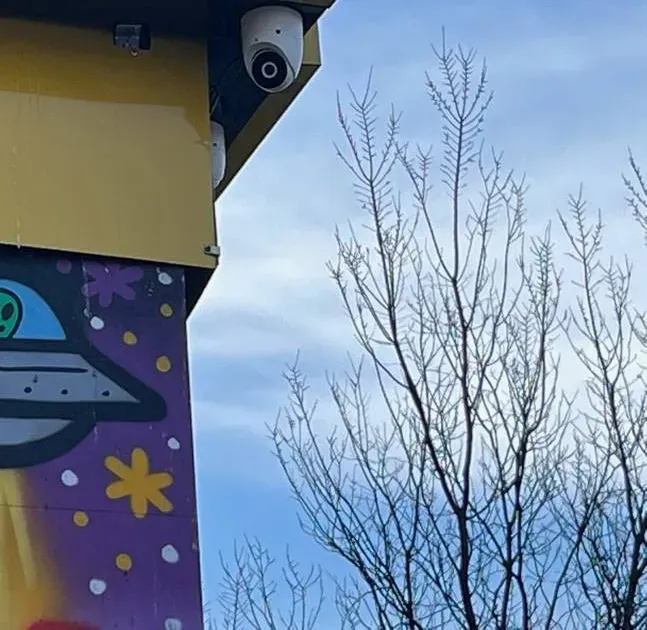
From our job library: a turret camera mounted under a fascia next to a painted column, with bare trees beyond. Fascia and eave mounts keep exterior cameras on a garden co-op out of the rain and out of reach.
Early postwar garden walk-ups: many short risers
The oldest co-ops on Staten Island are garden walk-ups from right after the war. What makes them easier than a prewar tower is that each riser is short: two or three floors, a handful of apartments per entrance. What makes them harder is repetition. A complex with eight entrances has eight panels, eight releases, eight transformers and eight sets of splices in eight cellars or stair halls, and after seventy-odd years no two entrances have been repaired the same way. The first service call on a property like this usually turns into a map: which entrance has which system, which apartments are wired to which panel, and where the power for each release comes from.
Because those buildings predate the 1968 line, upgrades here are often driven by shareholders rather than by the statute. The common pattern is a board that keeps the audio handsets in place but swaps the entrance panels for video units that also accept fobs, so visitors can be seen at the door and the laundry room can go on the same credential list. Where the original wire is sound, two-wire video products can run over it; where it isn't, short risers make rewiring a realistic option rather than a nightmare.
1960s elevator co-ops: one lobby, a long riser, a parking area
The borough's elevator co-ops are the closest thing on Staten Island to a classic Manhattan co-op, with one frequent difference: where the building has parking on its own grounds, the lot becomes a second front door alongside the lobby. A 140-unit building from the mid-1960s typically has a vestibule with an entry panel, a service or side door toward the lot, and a riser that carries the intercom wiring up through the floors. When intercom calls fail to reach the upper floors, the fault is usually somewhere in that riser, and finding it means getting into apartments, which in turn means the board or agent sending a notice in advance.
These buildings are also where elevator access control makes the most sense on Staten Island, and where a lobby video panel with a searchable directory replaces a wall of buttons. A building with that many shareholders usually benefits from app calling as an option alongside apartment stations, because some residents will want to answer the door from their phone and others will want a handset on the kitchen wall.
1970s garden complexes on the East and South Shore
The largest Staten Island co-ops by apartment count are walk-up complexes built between 1969 and 1977 in Grant City, Great Kills, Bay Terrace and Rosebank. A walk-up complex listed at 192 apartments, as the city's 2019 data shows for one Great Kills–Bay Terrace lot, is effectively a small campus. These were built after the 1968 line, so the intercom rule in MDL §50-a applies to buildings of eight or more apartments, and the board has every reason to keep each entrance's panel and release working.
Security here is mostly about the grounds. Cameras covering the lot entrances, walkways and dumpster area do more for shareholders than a camera in each stairwell. Access control is typically planned around the shared rooms first and the building entrances second. And because these properties sit on the East and South Shore, we plan equipment locations with flooding in mind: recorders, controllers and power supplies go high on a dry wall in a central building, with battery backup, and cameras are rated for wind-driven rain.
St. George and the waterfront
The two 1980s elevator co-op lots on the DOF list sit in New Brighton–St. George, close to the ferry. They are the newest elevator co-ops on the Island and usually have more usable wiring than the 1960s buildings, which makes a video intercom upgrade less invasive. The challenges are exposure and traffic: wind and salt air off the harbor are hard on exterior panels and camera housings, and a neighborhood near a ferry terminal sees steady foot traffic past the entrances, so boards tend to ask for clear views of the doors and the approach.
Small walk-ups, old and new
At the other end of the scale are the small co-ops: 12- to 24-unit walk-ups in West New Brighton from 1950 and 1968, and 11- to 19-unit buildings in Concord–Fox Hills from 1999 and 2000. In these, the board and the shareholders are almost the same people, and the budget for a security project is real money for each household. Repair-first plans fit best. A newer small building is often still running the entry panel the developer installed, sometimes with no manual and no admin login, so the first visit is about recovering control of what the corporation already owns before anything new is bought.
What changes with materials and methods
Brick and block exteriors: panels and cameras mount with masonry anchors, and cable enters through sleeved penetrations sealed against water.
Short walk-up risers: new cable can often be pulled through existing stair-hall raceways rather than through apartments.
Long elevator-building risers: reuse of the existing conductors is tested first, because rewiring inside occupied apartments is the most expensive work in any intercom job.
Distances across the site: runs between buildings over 100 meters need fiber or a network extender rather than a single copper Cat6 run.
Exterior exposure: sealed, surface-mount entry panels and outdoor-rated readers on doors that face open courtyards or the water.
Equipment rooms: head-end equipment off the floor and on battery backup, especially on the East and South Shore.
Detached laundry and storage buildings: a small outbuilding on the grounds gets its own reader and camera, fed from the nearest main building through conduit or a wireless link, so the shared room joins the same credential list as the apartment entrances.
Hillside sites on Grymes Hill and around Clove Lakes
Staten Island's hills add a constraint that flat boroughs rarely have. On Grymes Hill and on the slopes around Clove Lakes Park, buildings on the same property can sit at different elevations, with stairs and retaining walls between them and parking on a lower level. Cable routes between buildings follow those grades, and a camera that has to see a stair path from above needs a different lens and mount than one watching a flat lot. These are details the walk-through settles; they are also why we never quote a multi-building Staten Island co-op from photographs alone.
Commercial Co-op Security
Shared Spaces, Parking and Mixed Uses in Staten Island Co-ops
The city's list describes Staten Island's co-ops as walk-up and elevator apartment buildings, mostly garden complexes and freestanding towers, rather than the apartments-over-storefronts buildings that line Brooklyn and Bronx avenues. The "commercial" side of co-op security here is the non-residential space inside the property: the parking lot, the laundry room, storage areas, the management office and the vendors who come and go. Those spaces are where most incidents happen and where boards most often lack a clear rule about who gets in.
Parking lots and drive entrances
Where a Staten Island co-op has its own parking lot, the lot is the part of the property residents worry about most after dark. Good lot coverage starts at the drive entrance, where a camera can record every vehicle coming and going, then covers the rows and the walk from the cars to the building doors. Lighting matters as much as the camera: a camera aimed at an unlit lot records shadows. Some boards add a fixed-lens camera dedicated to the entrance lane for a clearer view of vehicles; others want a pan-tilt-zoom camera that the managing agent can steer, though we usually recommend fixed cameras that record everything over a PTZ that records only where it was pointing.
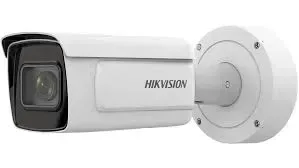
Manufacturer product photo: a varifocal bullet camera on a junction box. The adjustable lens lets the installer frame a lot entrance lane tightly from a mount on the nearest building.
Laundry, storage and boiler rooms
Shared laundry rooms in garden complexes are usually in one building's basement or a separate low structure, used by residents of several buildings at all hours. They are also where non-residents wander in when a door is left unlocked. A fob reader with a door closer, plus a camera inside covering the door and the machines, solves most of it. Storage rooms with shareholder bins get a reader and a short-range camera at the door. Boiler and electrical rooms get a reader that only the super, the agent and named vendors can use, which also creates a record of when contractors came in.
Management offices and on-site staff
Larger complexes often have a small management office on the property. That office may need its own intrusion alarm, a recorder monitor showing the grounds, and a desk unit that can answer calls from the building entrances. Our Staten Island alarm installation page covers intrusion alarms, and central-station monitoring is available through our monitoring provider. Alarm and camera footage for the office should be on the same access rules the board sets for everything else.
Vendors, deliveries and temporary access
Landscapers, snow removal crews, exterminators and contractors all need some access to a garden co-op. A temporary fob that expires on a set date, or a keypad code that the agent changes after each contract, is far better than a key copied by whoever was last on the job. The same approach works for home health aides and caregivers whom a shareholder authorizes, with the shareholder's request recorded by the agent.
Snow crews, salt and the doors they pass through
Winter adds its own wear on a garden property. Plow and shovel crews push snow against entrance doors and reader posts, rock salt collects in thresholds and corrodes strike keepers and door bottoms, and doors propped for a crew carrying equipment are often left that way. Boards can head most of this off: give the snow contractor a temporary credential that opens only the doors its crew needs, ask that snow not be piled against reader posts or gate hardware, and have the super check each entrance once the storm is cleared. A maintenance visit early in the season catches the strikes and closers that will not survive another winter.
The rules that apply
These are the rules we see come up most on Staten Island co-op work. We cite the source for each and leave interpretation for a specific building to the board's attorney.
Intercom and self-locking doors:MDL §50-a applies to class A multiple dwellings erected or converted after January 1, 1968 with eight or more apartments, and to older buildings when a majority of tenants request it in writing. It also makes it a misdemeanor to wilfully destroy, damage or jam the entrance door, lock or intercom.
Key fobs and resident data: fob readers collect entry records, and the city regulates that data. Local Law 63 of 2021, the Tenant Data Privacy Act, defines smart access systems for class A multiple dwellings, and HPD's page on the law names key fobs among them, calls for a written data retention and privacy policy and express consent, and sets a 90-day limit for keeping authentication data that isn't anonymized. A board should ask its attorney how that reaches its own corporation.
Magnetic locks and electric releases: NYC Building Code sections 1010.1.9.8 and 1010.1.9.9 set the egress requirements for sensor-release electric locks and door-hardware-released mag locks, including release on loss of power and on fire alarm activation. Every mag lock we install is designed to those requirements.
Permits for our side of the work: the city's permit exemptions in Admin. Code §28-105.4.7 include wiring that carries less than 50 volts for signals, communications, alarms and data, apart from certain life-safety systems. Intercom, reader and camera cable sits there; a new power circuit is a different matter and belongs to the building's electrician.
Installer licensing: under General Business Law §69-m, no one may engage in the business of installing, servicing or maintaining security or fire alarm systems in New York State without a license. Abstract Enterprises Security Systems holds NYS license #12000287431.
Cameras and audio: co-op governing documents typically bar changes to common elements without board approval, and recording conversations can raise issues under New York Penal Law article 250, as a co-op attorney explained in CooperatorNews. We install common-area cameras with audio recording turned off unless the board's counsel says otherwise.
Garden co-ops that start with the lot cameras nearly always come back for the laundry room reader within the year, because the footage shows how many of the people using the room don't live there.
Your Questions Answered
Co-op Security Systems in Staten Island: Questions Answered
Staten Island boards ask different things than tower boards in other boroughs, because their properties spread out instead of up. Below, the answer to each question comes in the first sentence, with the reasoning after it.
Entry panels and apartment answering
Many of our shareholders are retirees. Should we keep apartment handsets instead of going app-only?
Keep handsets, or at least the option of them. App-only intercoms are cheaper to install because nothing goes inside the apartments, but they assume every shareholder has a smartphone, keeps it charged and wants to answer the door from it. Many systems also let a call ring a landline or a basic cell phone. In buildings with many long-time residents, boards often choose a hybrid: a video station for those who want one, app calling for those who prefer it, and a phone-call fallback for everyone else.
Our entry panel dials shareholders through a phone line the building is about to cancel. Will it stop working?
If the panel depends on that phone line, yes, it will stop calling when the line is disconnected. Older telephone-entry panels need an analog line to dial out. The fix is either a panel that dials over the internet or a cellular connection, or an adapter that gives the old panel a line to use. Tell us the panel's make and model before the line is cancelled and we can tell the board which option fits, so the building is never left with a silent entrance.
Should the back doors that face the parking lot get full intercom panels or just fob readers?
Fob readers are usually enough on doors that only residents use. A panel is for visitors: it lets a guest find a name and call an apartment. A rear door from the lot is used by shareholders coming home from their cars, so a reader, a door closer that actually latches and a camera covering the door do the job for a fraction of a panel's cost. If delivery drivers or caregivers routinely use that door, the board can add a small call station later on the same system.
Our building went co-op in 1999. Why is the developer's entry panel already giving out, and can anyone reprogram it?
It may simply be at the end of its life, and yes, it can often be reprogrammed or replaced even without the original login. More than twenty-five years of weather on an exterior door is a long run for many entry panels, especially ones chosen when the building was being sold. On a service call we identify the model, check whether parts and firmware still exist, and try the manufacturer's reset procedure to recover admin access. If the panel can't be recovered, the board at least knows it is buying a replacement for a reason.
Can a new video panel fit the opening left by our old built-in lobby panel?
Often, yes, with a trim plate or an adapter frame. Older elevator-building vestibules frequently have a recessed panel set into the wall alongside the mailboxes. Some manufacturers make flush-mount housings that fill a similar opening; where none fits, a finished cover plate closes the old cutout and the new panel mounts on it. We measure the opening at the walk-through so the quote names the exact mounting method, and we don't leave a raw hole in the wall for the board to explain.
Doors, gates and access
Our grounds have a pedestrian gate in a perimeter fence. Can it take a fob reader?
Usually, yes. A pedestrian gate with a lockable latch can take an electric strike or a gate-rated mag lock, a reader on the outside and an exit button or handle on the inside, powered and wired back to the access controller. Gate hinges, closers and posts are the gate fabricator's work; we handle the lock, the reader and the wiring, and we coordinate with the board's gate or fence contractor if the gate itself needs work first. Vehicle gate operators are a separate trade.
Cameras on the lot, the paths and the hillsides
What should cameras in a co-op parking lot actually be able to see?
They should show who and what came in through the entrance, which row a person walked to, and the path from the cars to each building door. That usually means one camera framed tightly on the drive entrance, wider cameras covering the rows from building walls or poles, and one camera on each walkway between the lot and the doors. A board that asks for "the whole lot in one shot" gets a picture where every person is a few pixels tall, which is no use when a shareholder reports a damaged car.
How many cameras does a garden co-op of roughly a hundred apartments need?
Count the places, not the apartments. A useful first draft is one camera per building entrance that visitors use, one on each shared room door, one tight view of each drive entrance, enough wide views to cover the parking rows, and one on each path between the lot and the buildings. Two properties with the same number of apartments can need very different counts, depending on how many buildings and entrances they have. We draw that list on the site plan during the walk-through and price each camera as its own line, so the board can cut or add without redoing the quote.
Our buildings sit on a slope with stairs between them. Does that change the cameras?
Yes. On hillside properties such as those on Grymes Hill, a camera often looks down a stair path or across a retaining wall rather than along level ground, which changes the lens, the mounting height and the angle. A camera aimed down a steep path from the top sees mostly heads; one aimed up from the bottom sees faces. Steps and landings also need light at night for the camera to be useful. These choices are made on site, which is one more reason we don't quote hillside properties from photos.
How do we light and cover a long walkway between buildings without glaring into apartments?
Mount cameras on the buildings, looking along the walkway rather than across it, and choose cameras with good low-light performance so the path lighting can stay low. Floodlight cameras are useful at a dark corner or a dumpster enclosure, but their lamps should face away from windows and can be set to switch on only with motion. On longer paths, two cameras looking toward each other show faces in both directions, which one camera at the end of a path cannot do.
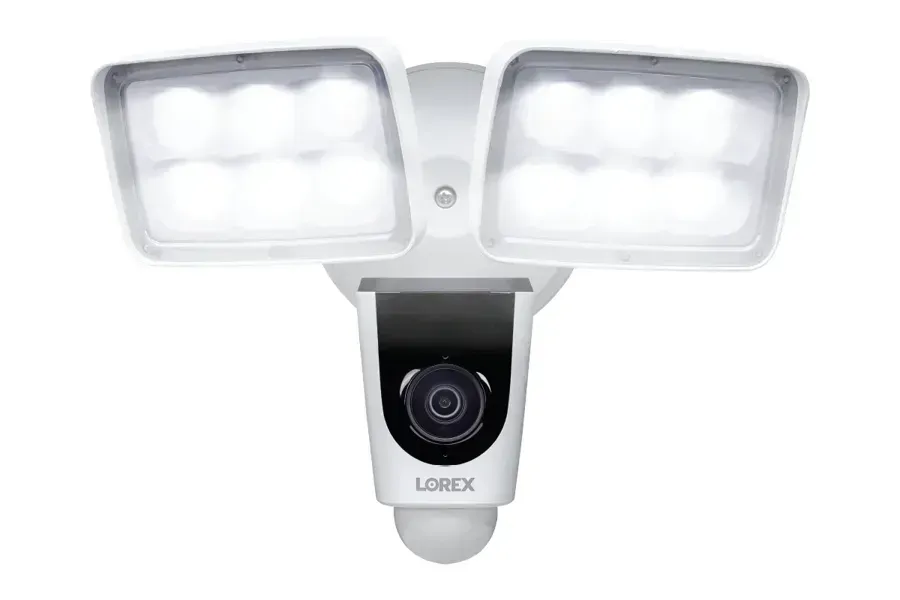
Manufacturer product photo: a floodlight camera with two lamp panels. On a co-op property it belongs at a dark corner or dumpster enclosure, aimed away from apartment windows.
Can wireless cameras cover a building or corner we can't run cable to?
Sometimes, with the right equipment. A point-to-point wireless link between two buildings with a clear line of sight can carry several wired cameras' video, and it is often more reliable than individual Wi-Fi cameras. Battery cameras exist too, but they record in short clips and need regular charging, which makes them a poor fit for a co-op's main coverage. We recommend wireless only where cabling is impractical and the link has been tested on site.
Where should the recorder live in a co-op building near the shore?
In a dry, locked room above the lowest floor if one exists, and never on the floor of a cellar that has taken water before. The recorder, network switch and controller should sit on a wall-mounted shelf or in a small wall rack, on a battery backup that rides through short outages and shuts the recorder down cleanly in long ones. On East and South Shore properties we ask the board where water went during past storms before we pick the spot.
Can the managing agent see every building's cameras in one place?
Yes, if the cameras record to one system. On a multi-building property we either run every camera back to one recorder or put a recorder in each cluster of buildings and add them all to one viewing app. The agent, the super and the board members the board approves each get their own login, with permissions set per person, so the board knows who looked at what.
Planning across budget years
If we upgrade one building a year, how do we avoid ending up with three intercom brands?
Pick the platform in year one and write it into the board's plan. The first building's quote should name the system that every later building will use, and the controller and software should be sized for the whole property from the start. Each later year then adds panels and stations to the same system at the same per-entrance cost structure, adjusted for equipment prices at the time. Boards that skip this step and choose the cheapest option each year end up paying more in the long run for training, spare parts and support.
Equipment
Types of Co-op Security Equipment We Install in Staten Island
We quote our own non-branded system by default, and we install and service the major brands when a board asks for one or already owns one. What matters more than the logo is that each piece suits a garden site or a 1960s elevator building and that every piece talks to the rest.
1
Building entry panels
Surface-mount video panels sized for a garden-building door, and directory panels for elevator-building vestibules.
2
Apartment answering
Handsets, video stations, app calling and phone-call fallback, mixed to suit the shareholders.
3
Locks and releases
Electric strikes, mag locks, exit devices and door closers, matched to each frame and code requirement.
4
Readers and controllers
Fob, card, keypad and phone credentials on one controller serving every building and shared room.
5
Exterior cameras and recorders
Lot, path and entrance cameras rated for weather, recording on site with remote viewing.
6
Power and network
Switches that power cameras over the data cable, links that cross the grounds, and batteries that carry the door system through an outage.
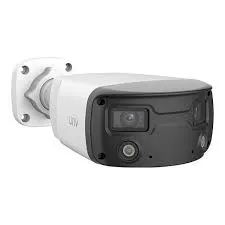
Manufacturer product photo: a dual-lens panoramic bullet camera. Two lenses stitched into one wide view cover a long row of parking or a courtyard from a single mount.
Entry panels for many small doors
The equipment choice that matters most on a garden complex is the entry panel, because the board will buy eight or twelve of them. A compact surface-mount video panel with a few call buttons or a short scrolling directory fits a garden-building door frame better than a big touchscreen meant for a tower lobby, costs less per entrance, and stands up better to weather on an open courtyard. For the elevator co-ops, a directory panel with a keypad and a reader makes sense in the vestibule, where a hundred-plus names need to be searchable.
Exterior cameras for open sites
Garden co-op properties need more outdoor cameras than indoor ones, and different types do different jobs. Fixed bullet cameras with varifocal lenses frame drive entrances and long paths. Panoramic multi-lens cameras cover a wide lot or courtyard from one mount, which saves cable runs. Turret cameras under eaves cover building doors and are hard to knock out of position. Cameras with built-in warning lights and a speaker can deter someone at a dumpster enclosure or a back door after hours, though boards should decide whether that suits their neighbors before turning the lights on.
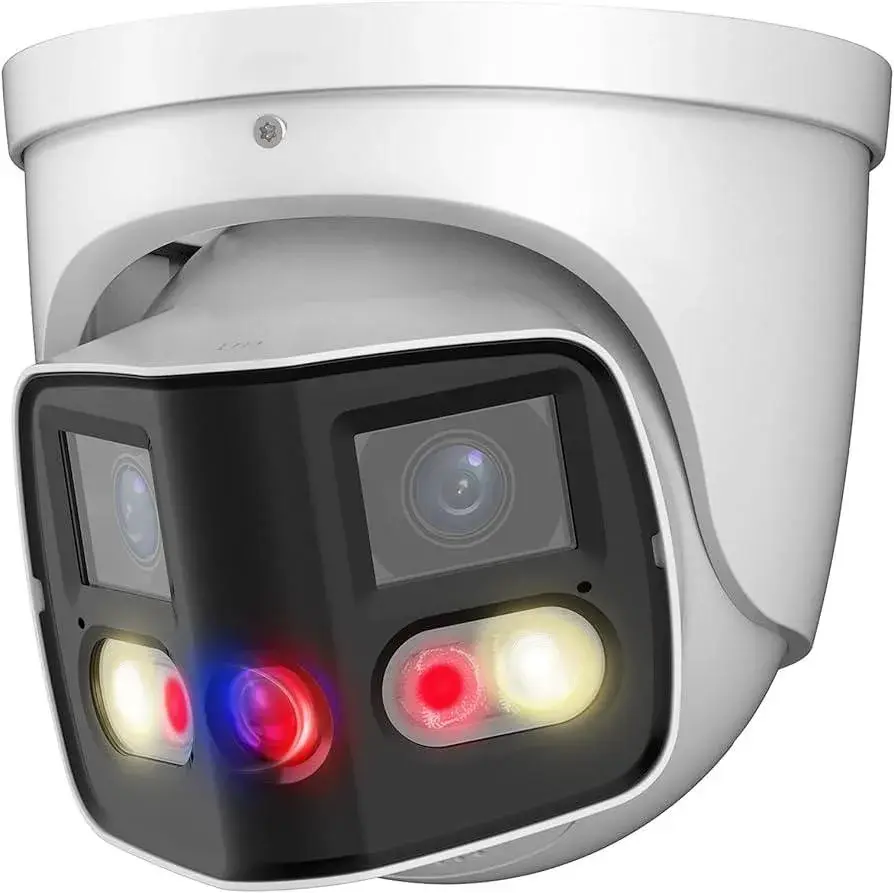
Manufacturer product photo: a dual-lens turret camera with red and blue warning lights. Lights like these can be scheduled for after-hours use at a back door or enclosure on a co-op property.
Recorders, storage and retention
We record on site, on a network video recorder sized for the number of cameras and the number of days the board wants to keep. A garden complex with twenty-plus cameras on several buildings often needs a recorder with room to grow, so later phases can add cameras without replacing it. Retention is the board's policy decision: longer retention needs more drive space, and the board should decide in writing who may export footage and how long it is kept.
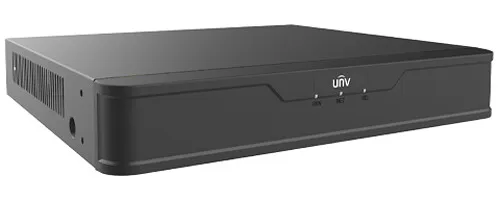
Manufacturer product photo: a desktop network video recorder. A unit like this sits on a wall shelf in a dry, locked room with its switch and battery backup beside it.
Intercom technologies compared for Staten Island co-ops
Approach
Fits best
Watch for
Audio buzzer with handsets
Small early-postwar walk-ups on a tight budget
No video, no remote answering, parts for old handsets getting scarce
Two-wire video on existing wiring
Walk-ups and elevator buildings with sound risers
Wire condition decides it; testing comes first
Networked IP video with stations
1960s elevator co-ops and larger garden complexes
Each apartment station wants a data cable, or an adapter on the old pair
Cloud panel with app and phone calling
Properties where shareholders want to answer from anywhere
Internet dependence and any manufacturer subscription fee
Hybrid: video panel plus phone-call fallback
Buildings with many long-time residents
Directory programming takes more care
Door hardware on garden-building doors
Garden-building entrances are often aluminum storefront doors or hollow-metal doors in steel frames. Aluminum doors usually take an electric strike in the frame or an electrified exit device; steel frames can take a strike or a mag lock depending on the door's use and the egress rules. Doors that slam or bounce need a properly adjusted closer before any electric lock will work reliably, and we flag that in the quote rather than discover it on install day.
Credentials and smart access
Fobs remain the most practical credential for a co-op, because they are cheap to replace and easy to deactivate. Many systems also accept a phone credential, and some accept PIN codes for vendors. Biometric entry is available, but on a residential property it raises data-retention questions under the city's smart access rules described above, and we recommend boards talk to counsel before choosing it. Shareholders' own apartment doors are theirs to manage under the proprietary lease; building systems should never require a smart credential to enter an apartment.
Manufacturer product photo: a wired video doorbell with a round button. On a garden co-op where apartment doors open outdoors, boards often write a house rule on doorbells like this before shareholders start installing them.
Keeping the system's network locked down
Every intercom, reader controller and recorder we install is a small computer on the co-op's network, and on a property with several buildings those devices are spread across cellars and closets that many people can reach. We change every factory default password before handover, give each person who needs access their own login instead of a shared one, and keep the security devices on their own network segment, separate from any Wi-Fi the building offers residents or staff. Remote viewing goes through the manufacturer's secure app or a managed connection rather than ports opened on the building's router.
The board should also decide who receives firmware update notices and who approves them. Updates fix security holes, but an update pushed to a door controller in the middle of a weekday can lock a laundry room until someone resets it, so we schedule them for quiet hours and test each door afterward. When a board member or managing agent leaves, their logins come off the system the same week. These are small habits, and they are what keep a building's door system from becoming the easiest way into its network.
Our systems vs consumer and national-brand options
Consumer kits from national alarm and doorbell brands are designed for a single household: one door, one owner, one account. They can be the right answer for a shareholder's own unit door where the board allows it. They are not built to give a co-op one directory across buildings, one fob list for shared rooms, or recorded common-area footage the board controls. National alarm companies, for their part, generally sell monitoring contracts. We install and maintain building systems the corporation owns outright, quote them in writing, and keep monitoring optional.
AI Overview Reality Check
What AI Gets Wrong About Co-op Security Systems in Staten Island
Boards increasingly start their research with an AI summary or a national cost guide. Those answers are built mostly from material about Manhattan co-ops or single-family homes, and on Staten Island they go wrong in predictable ways. Here are seven claims we see repeated, and what the borough's buildings actually require.
1. "A co-op security system is a lobby intercom and a few cameras"
That description fits a tower with one entrance. It does not fit a property where the city's own data shows most co-op lots are walk-ups, many of them garden complexes with a separate door for every building. On those sites the lobby is replaced by eight or twelve small entrances, plus laundry rooms, storage rooms and a lot.
The difference shows up in the quote. A tower intercom is one panel and a riser. A garden complex is a panel, a release, a power supply and a cable route at every entrance, plus the links between buildings. A budget built on the lobby model will be short by the number of doors.
The better starting point is an inventory: every door, who uses it, what is on it now. With that list, a board can compare quotes honestly and decide what to do first.
2. "Put a video doorbell on each building and you have an intercom"
Consumer video doorbells ring one account. They cannot call twelve different apartments, release a building door from inside each unit, or keep a directory the board controls. Sharing one doorbell login among shareholders defeats the point of a secure entrance.
There is also the legal baseline. For buildings erected after January 1, 1968 with eight or more apartments, MDL §50-a requires an intercom that lets each apartment speak to the entrance and release the door. A doorbell on a shared account doesn't do that.
Video doorbells do have a place on a garden co-op: on individual apartment doors that open outside, where the board's house rules allow them. The building entrance still needs a real multi-apartment system.
3. "Any camera in the parking lot will catch license plates"
This is one of the most common expectations boards bring to us, and the one most likely to disappoint. A wide camera covering a lot records cars as shapes and colors; at night, headlights and infrared glare usually wash out the plate entirely.
Plate capture is a specialized job. It takes a dedicated camera, mounted low and close to a single lane, with shutter and infrared settings tuned for moving plates. It records the entrance lane and nothing else.
So the honest plan is two-part: general cameras that show what happened in the lot, and, if the board wants plates, one dedicated camera on the drive entrance priced as its own line.
4. "National cost guides tell you what a co-op intercom costs"
National guides publish wide ranges built largely on single-family homes. HomeAdvisor's intercom cost page, for example, lists a "Normal Range: $1,200 - $8,500" for intercom installation. That range says nothing about a 192-apartment walk-up complex with a dozen entrances.
Co-op costs are driven by the number of entrances, whether apartment stations go in every unit, the condition of the existing wire, the distance between buildings and the door hardware. On Staten Island the building-to-building distance alone can change a quote substantially.
So our own published numbers stop at repairs: the $250 service call and the repair ranges. A whole-property figure comes after someone has walked the site and counted entrances, because before that it is only a guess.
5. "Smart locks on every apartment door are the modern upgrade"
Apartment doors in a co-op belong to the shareholder's unit under the proprietary lease, not to the building's security system. A board that wants to put every unit door on a building credential is taking on questions it may not want.
The city's Tenant Data Privacy Act, Local Law 63 of 2021, bars requiring a resident to use a smart access system to enter their own dwelling unit, and HPD's guidance treats key fobs as smart access technology with data-retention duties. Whether those rules reach a particular co-op is for its attorney, but the direction is clear.
The building's job is the entrances and shared rooms. Shareholders who want a smart lock on their own door can install one with board approval, and we can do that work for them as a separate job.
6. "Anyone handy can install building security"
In New York, installing, servicing or maintaining security or fire alarm systems as a business requires a state license under General Business Law §69-m. A handyman or a general contractor without that license is not supposed to be doing the work.
The license matters to a co-op for practical reasons too. The managing agent will ask for insurance on award, mag locks on egress doors have to follow the Building Code, and an intercom on a post-1968 building has to meet the Multiple Dwelling Law.
Abstract Enterprises Security Systems holds NYS license #12000287431. We still don't do electrical work: new power circuits come from the building's licensed electrician.
7. "Battery backup is optional for door systems"
On an exposed Staten Island site, power interruptions during storms are part of life, and the Army Corps' account of Hurricane Sandy's damage on the East and South Shore is a reminder of how bad they can get. A door system with no backup becomes a door that either won't lock or won't release.
Battery backup keeps panels, readers and controllers working through short outages, and the egress design of each lock decides what happens in a long one. Both should be decided on paper, not discovered in the dark.
The added cost is small next to the system itself, and it is one of the lines we recommend boards never cut from a Staten Island quote.
Get a Door-by-Door Answer for Your Staten Island Co-op
A failed door gets the $250 service call; a plan for the property starts with a free walk of the grounds. Either one is on the calendar within 2 hours of your request.
Send us the shape of the property: the number of buildings, the doors visitors and residents use, an approximate apartment count, and the problem or the wish list. Any board officer, the agent, the super or a shareholder may fill it in. A photo of each entry panel and of the equipment in the cellar helps us arrive prepared. Rather talk it through? Call or text (347) 934-8335.
✅
Request Sent!
Thanks, that's in. Expect a call or a text from us to set a date and a two-hour window.
How It Works
How a Staten Island Co-op Security Project Runs
A single dead release and a property-wide upgrade follow the same steps. The difference is how many of them need a board vote, and on a multi-building property, how the work is sequenced across buildings.
1
Call, text or send the form
A person from the corporation describes the site: neighborhood, building count, doors, and the failure or the goal.
2
Service call or property walk-through
Anything broken is diagnosed on the $250 service call; anything new starts with a no-cost tour of the grounds and each building alongside the board's contact.
3
Written quote by building and phase
Paperwork the board can vote on line by line: one row per building and per door, grouped into phases it can approve separately.
4
Approval, deposit and insurance
Once the resolution passes, the corporation's deposit, half the contract, holds the schedule and triggers purchasing. Proof of insurance goes to the managing agent at award, not before.
5
Notice to shareholders
Residents of each building in the phase hear from their board or agent about the day, the two-hour window and which units must be reachable.
6
Installation, one building at a time
We finish and test each building before moving to the next, so no entrance is left without a working way in overnight.
7
Programming, testing and handover
Names go into each panel, fobs and app invites go out, cameras are aimed and recording, each door is opened from both sides, and every password goes to the board in writing.
Sequencing work across buildings
On a garden complex we usually start with the building whose entrance fails most, because shareholders there see the benefit first and the board learns how the new system works before it reaches everyone. The controller and the network backbone go in with that first building, sized for the whole property. Each later building is then a panel, a release and its apartments, connected to what is already running. Arrival windows are two hours, we schedule seven days a week with early-day visits, and our crew arrives inside the window.
What the notice to shareholders covers
A single sheet for each building is plenty. It should name the equipment being changed, give the day and the two-hour window, list the units where someone must be home or leave a key with the super, estimate the minutes per apartment, and tell residents what changes for them, for example an app invitation arriving by email or a new fob waiting at the office. We supply the facts; the board or agent sends it, because it comes better from them.
Deposits, payment and financing
Under the service agreement, half of an installed job's price is due as a deposit, and we place no equipment order until it clears. Some panels are special-order items; when a board picks one, we say so before it pays, because the shipper sets that timeline, and we only set an install date after the delivery is in our hands. Financing is available through Wisetack, subject to approval. A co-op corporation may pay by check.
Warranty
Out of the box, a system we install is covered for 30 days, as our warranty page explains. Boards that want a year or more buy that extension when they order. Manufacturers stand behind their own devices separately, and calling us for tech support is free. Full terms — including 50% deposit, one-year parts-only warranty on Abstract Enterprises Security Systems-supplied products, and the late-fee schedule — are set out in the service agreement.
Coverage Area
Co-op Security Near Staten Island's Landmarks
We serve Staten Island from our Brooklyn office at 1282 Troy Avenue, across the Verrazzano-Narrows Bridge. These are the landmarks that sit closest to the borough's co-op neighborhoods, and what the buildings near each one usually need.
1
St. George Ferry Terminal
The 1980s elevator co-ops of New Brighton–St. George sit near the ferry: harbor wind on exterior panels and steady foot traffic past the doors.
2
Snug Harbor and Richmond Terrace
The 83-acre cultural campus anchors Livingston and New Brighton, where early postwar walk-ups and 1960s elevator buildings share the North Shore.
3
Clove Lakes Park
The Clove Lakes neighborhood holds two of the borough's largest elevator co-ops on the city's list, each listed at 143 apartments.
4
Grymes Hill
Hillside walk-up co-ops from 1951, with buildings at different elevations and cable routes that follow the grade.
5
Fort Wadsworth and the Verrazzano
Arrochar–Shore Acres sits at the north end of the planned East Shore seawall: dry, raised equipment rooms and weather-rated cameras.
6
Great Kills Harbor
The South Shore's 1970s garden complexes in Great Kills and Bay Terrace: many entrances, open lots and paths between buildings.
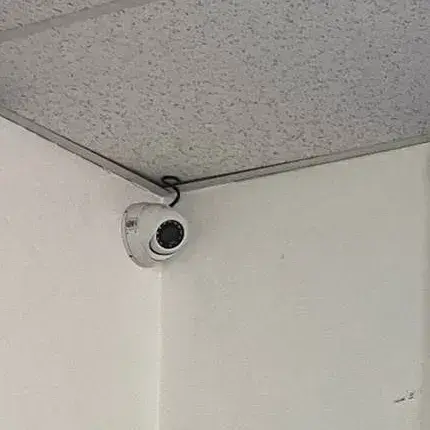
From our job library: a white dome camera mounted high in a wall corner with its service loop showing. A corner mount like this covers a shared laundry or storage room door and the room in one view.
We also serve co-ops and other multifamily buildings in Tompkinsville, Stapleton, Clifton, Park Hill, Silver Lake, Sunnyside, Port Richmond, Westerleigh, Castleton Corners, Todt Hill, Concord, South Beach, Midland Beach, New Dorp, Oakwood, Eltingville, Annadale, Huguenot, Tottenville, Charleston, Bulls Head, New Springville and Mariners Harbor.
Pricing
Co-op Security System Cost in Staten Island
There is one fixed number in Staten Island co-op security pricing: the $250 service call, which covers the visit, the diagnosis and simple fixes, and counts toward the total if the repair turns out bigger. Repairs then follow our published ranges. New systems are quoted in writing after a free walk-through, because on a multi-building property the price depends on how many doors there are and how far apart the buildings sit, and neither can be guessed from a phone call.
Inside the quote a Staten Island board receives
Who it is for: the cooperative corporation, the site, and the person the board named as contact.
A building-by-building list of entrances, with what is installed now and what each door will get.
Inside the units, building by building: fresh stations, kept handsets, phone-app answering, or some combination.
Cable routes between buildings and to each entrance, with what is reused and what is new.
Equipment locations, battery backup and anything the building must provide, such as a power outlet from its electrician.
Setup work: names loaded into each panel, credentials issued, app invites sent, camera accounts created and every password handed over in writing.
Money: a figure for every line, subtotals per building and per phase, the deposit amount, warranty terms, and any maker's monthly software fee broken out on its own.
A board member who missed the meeting should be able to read the quote and understand exactly what the corporation is buying and in what order.
Repair ranges we publish
Our door buzzer and intercom repair pricing page publishes the figures below; they hold on the Island as everywhere we work. Before any part is swapped, the technician states the actual price.
Repair item
Typical range
Service call, credited toward a larger repair
$250
Apartment intercom station
$250 to $525
Door release relay or button
$250 to $475
24V transformer
$325 to $650
Electric strike replaced and door aligned
$450 to $950
Entry panel work
$650 to $1,800
Riser repair inside occupied walls
$850 to $2,400
On a garden complex, these figures apply per entrance. A board with three failing building doors should expect three separate items, not one.
Seven things that set the size of a Staten Island quote
Door count: every controlled door carries its own lock, power and device, and a garden property may have a dozen of them.
Distance between buildings: long links need fiber or extenders, and routes without existing conduit cost more.
In-unit equipment: whether each home gets a wall station or answers on a phone swings the total more than anything else.
Condition of the old cable: conductors that test good can stay; conductors that fail behind finished apartment walls are the costliest thing to fix.
Exterior exposure: weather-rated panels, readers and cameras for open courtyards and waterfront sites.
Door condition: doors that need closers adjusted or frames repaired before a lock can work.
Software fees: cloud-managed platforms may bill monthly through their maker; that cost appears separately so the board sees the yearly total.
For cameras, the borough's published figures are on our Staten Island camera pricing page; for a new intercom, our intercom pricing page explains why the number follows a site visit. Any possible extra, like a cable that may not pass its test, is put in front of the board before the order goes in, since equipment cannot be sent back once ordered.
Shop Our Systems
Co-op Security Packages and How They Are Priced in Staten Island
We don't sell fixed co-op packages, because no two Staten Island properties have the same number of doors. Instead, work falls into three stages that match how boards budget. Each one stands on its own, and a board can stop after any of them.
1
Repair
$250 service call, applied to the bill if more work follows. A technician finds the fault at the door, reader or camera, clears small problems during the visit, and writes up a price for anything bigger.
2
Building upgrade
Quoted after a free walk-through. One building's entrance panel, release and stations, or fobs on the shared rooms, or cameras on the lot, each as its own approvable line.
3
Property-wide plan
Quoted after a free walk-through. All buildings, rooms and grounds brought onto a single platform over time, with each year's slice priced on its own so the board can fund it gradually.
Equipment the co-op already owns or bought
A corporation that bought its own panels, readers or camera kit can still have us mount and connect them. In that case we price only our labor, over the phone or by text, using the model numbers and a photo of each spot, and a deposit reserves the day. There is no site walk for owner-supplied gear, and how that gear performs is up to its maker.
Taking over a system another company installed
If the company behind the current system has gone quiet, the corporation isn't stuck with it. A single service call lets us catalog the equipment at every door, regain administrator control where the hardware permits, and give the board a straight answer about which parts are worth keeping.
Field notes from our crew on Staten Island garden properties
On a multi-building property, the first hour of any visit goes to finding out which entrance feeds which apartments. Over decades, buildings get re-wired one at a time by different people, and it is common to find that one building's panel is powered from the cellar of the building next door, or that two entrances share a transformer nobody knew about. We label every panel, release and power supply as we find it, so the next visit, ours or anyone's, starts with a map instead of a hunt.
The second thing we check is the doors themselves. On open courtyards, wind works on the closers, and a door that doesn't close fully defeats a perfectly good electric strike. A board that pays for a new panel and gets a door that still doesn't latch is understandably unhappy, so a door that won't latch goes on the quote as its own line.
The third is where the equipment lives. We would rather run an extra length of cable to a dry room a floor up than set a recorder on a cellar floor near the shore. It is the cheapest insurance on the job. The same goes for the battery backup beside it: a unit that keeps the recorder, the switch and the door controller running through a short outage costs little next to a lost night of footage or a laundry room that will not open until someone resets it.
FAQ
Staten Island Co-op Security Systems FAQ
Can the board give camera footage to the police after an incident in the lot?
+
Yes, if the board's own policy allows it. We train the people the board authorizes to find and export a clip, and the board decides, with its attorney where needed, who may release footage and to whom. We don't hand footage to anyone on the board's behalf.
Can you work alongside our co-op's gate or fence contractor?
+
Yes. We handle the electric lock, the reader or keypad and the low-voltage wiring on a gate, and the gate or fence contractor handles hinges, posts, closers and any vehicle gate operator. We coordinate the schedule so the gate is ready before the lock goes on.
Do you sell a fixed-price security package for a Staten Island cooperative?
+
No. Properties here range from one-entrance walk-ups to complexes with a dozen doors, so a fixed package would be wrong for almost everyone. Repairs start with the $250 service call, and new systems are quoted per building after a free walk-through.
Will every shareholder have to download an app to get in?
+
No. The board decides how residents enter and answer the door. Fobs, codes and apartment stations all work without an app, and app calling can be offered as an option for the shareholders who want it.
Can a camera cover the co-op's dumpster and recycling area?
+
Yes. Enclosures are a common spot for illegal dumping and late-night visitors. A weather-rated camera on the nearest building wall, sometimes with a motion floodlight, records who uses the area without lighting up apartment windows.
Can you price a job from photos before coming to the property?
+
For equipment the co-op already bought, yes: labor is quoted by phone or text from the model and photos of each location. A broken system needs the $250 service call to diagnose, and a new building-wide system is quoted after the free walk-through.
Can a shareholder hire you to put a smart lock on their own apartment door?
+
Yes, with the board's approval where the house rules require it. That is a separate job paid by the shareholder, and the lock stays the shareholder's to manage; it is not connected to the building's fob system unless the board decides otherwise.
Do you install burglar alarms for a co-op's management office or storage rooms?
+
Yes. Offices, storage rooms and maintenance areas can get an intrusion alarm with sensors and a keypad, and central-station monitoring is available through our monitoring provider if the board wants it.
Can you mount cameras on the light poles in our parking lot?
+
Often, yes, using pole-mount brackets and outdoor-rated cable run underground or along existing routes. If the camera needs power at the pole, the building's electrician provides the outlet or circuit, since we don't do electrical work. We check pole height and sightlines at the walk-through.
Can fob access be limited to certain hours, like the laundry room at night?
+
Yes. Each door can have its own schedule, and each group of residents its own permissions. A common setup lets shareholders' fobs open their building entrances at any hour while the laundry room and community spaces accept fobs only during the hours the board sets.
How fast can the board shut off a lost fob?
+
Right away, by whoever the board authorizes to manage the system. On a local controller it takes a minute at the management computer; on a cloud-managed system it can be done from a phone. The replacement fob is then issued to the shareholder.
Do you install entry panels that hold up to salt air near the water?
+
Yes. For buildings near the harbor or the East Shore we specify sealed, outdoor-rated panels and readers with corrosion-resistant housings, mount them with a drip edge or hood where the door has no overhang, and check them on maintenance visits.