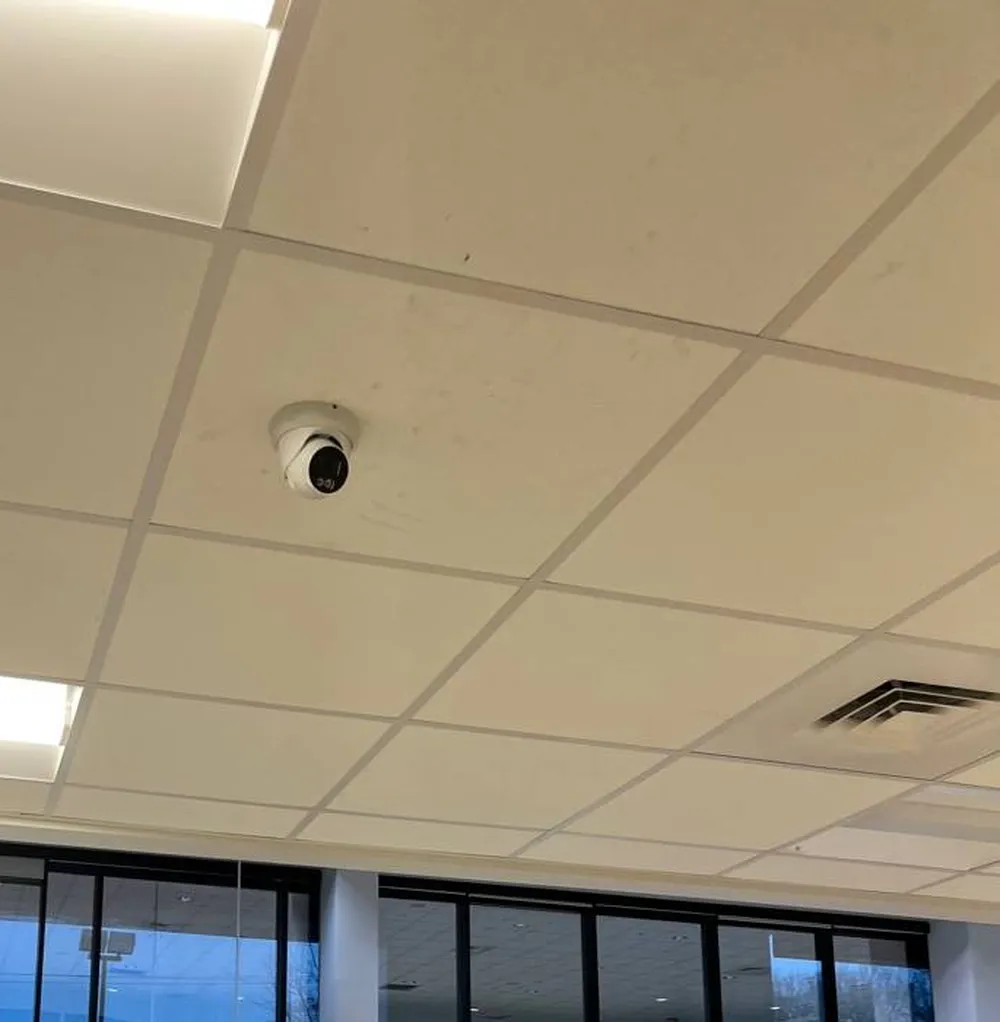
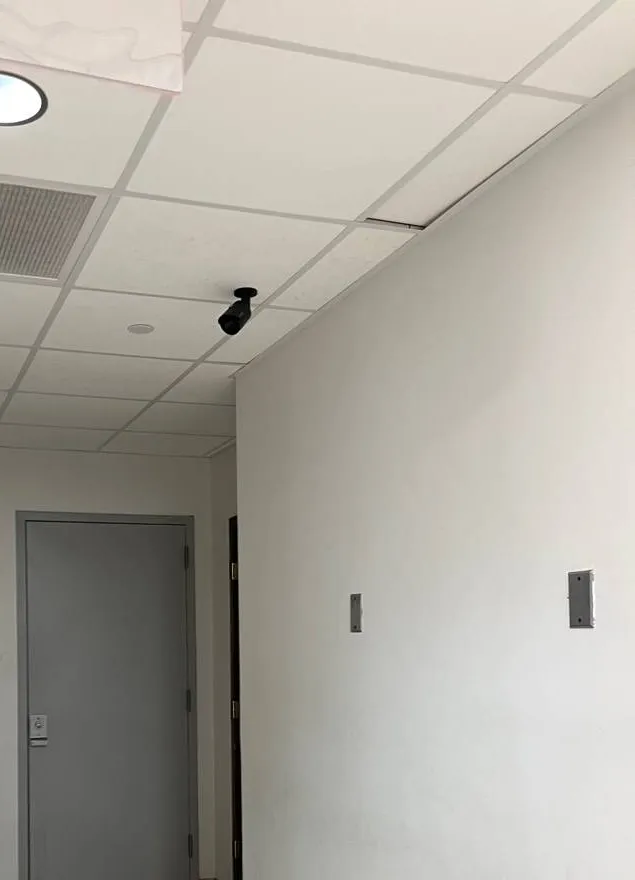
Rental-Policy-Ready Layouts · Stone & Log Construction · 4K IP on NVR · Records Without Internet
CCTV installation in Ulster County, NY is usually a job with a second rulebook attached: a short-term rental platform that bans indoor cameras, a Kingston landmarks commission that reviews what shows on a historic facade, or a town rental permit that expects the host to know what is happening at the house. Abstract Enterprises Security Systems installs wired closed circuit television systems that fit those rules, from four 4K cameras on a Midtown Kingston two-family to a 12-camera layout on a Catskills compound with a guest cottage. A 4-camera 4K system with an NVR runs $2,100 to $2,800 installed in Kingston, New Paltz and Saugerties, and $2,400 to $3,100 deeper in the Catskills, with no monthly fee for recording or the app.
Prepared by the Abstract Enterprises Security Systems install team (NYS license #12000287431); reviewed November 16, 2026. Sources cited on this page: NYS DCJS Index Crimes by County and Agency, 2024 (data.ny.gov); U.S. Census Bureau ACS 2023 5-year estimates (DP04, B25004); Airbnb Newsroom, March 11, 2024; Daily Freeman, September 5, 2026; City of Kingston Code chapter 405; Ulster County Department of Finance; 9 NYCRR 125.3

Ulster calls go to (845) 640-3835 · In business since 2002, with thousands of jobs finished · A callback to book within 2 hours
Quick answer: CCTV installation Ulster County NY pricing on our published list starts at $2,100 to $2,800 for four 4K IP cameras, an 8-channel NVR, a 2TB drive and phone-app setup, installed in Kingston, New Paltz or Saugerties. The same system runs $2,400 to $3,100 in Phoenicia, Shandaken or Denning, and there is no monthly fee. Larger layouts on the same list run from $2,900 for six cameras to $10,500 for a 16-camera commercial system with two plate cameras. We book within 2 hours of your request, schedule 7 days a week with early-day visits, and fill dates first come, first served once the 50% deposit is in.
Ulster County is one county on the map and two places on the ground. Its county seat, Kingston, is an old river city: the Census Bureau counts 11,049 homes there, 54.1% of them built before 1940, and 51.5% of the occupied ones are rented. Drive forty minutes west on Route 28 and the numbers flip. In the Town of Shandaken, 886 of 2,675 homes, about one in three, are held for seasonal or occasional use; in Hardenburgh it is 204 of 292, and in Denning 237 of 432. Kingston's camera problems are shared hallways, back alleys and storefronts. Shandaken's are houses nobody is in for weeks at a time, or houses full of strangers who rented them for the weekend.
That split decides how a CCTV system gets designed here. A Kingston two-family needs a recorder the tenants cannot reach, separate views for each entrance, and cable fished through plaster and lath in a house that may be 120 years old. A Catskills rental needs exterior cameras that satisfy the listing platform, a recorder that keeps writing when the satellite internet drops, and alerts that reach a host who lives two or three hours away. Our CCTV installers plan the two jobs differently, and the rest of this page explains how.
The New York State Division of Criminal Justice Services publishes index crimes for every police agency in the state. For 2024, Ulster County agencies reported 1,469 property crimes. Of those, 1,301 were larcenies, 116 were burglaries and 52 were motor vehicle thefts. In other words, nearly nine in ten property crimes in the county were thefts of things left reachable, from packages and tools to merchandise and the contents of unlocked cars, not break-ins. That is the kind of crime CCTV surveillance documents best, because the thief is in view of a well-placed camera for long enough to be identified.
| Police agency (2024) | Larceny | Burglary | Vehicle theft |
|---|---|---|---|
| Kingston City PD | 345 | 39 | 6 |
| Town of Ulster PD | 240 | 7 | 3 |
| State Police, Ulster County | 233 | 22 | 15 |
| New Paltz Town and Village PD | 100 | 6 | 1 |
| Lloyd Town PD | 96 | 5 | 2 |
| Ulster County Sheriff | 94 | 9 | 6 |
| Saugerties Town PD | 80 | 19 | 13 |
| Woodstock Town PD | 12 | 0 | 0 |
| Ulster County total | 1,301 | 116 | 52 |
Source: NYS DCJS, Index Crimes by County and Agency, 2024 County Total and agency rows (data.ny.gov dataset ca8h-8gjq). Selected agencies shown; the county total includes all reporting agencies.
Two agencies carry the weight. Kingston police and Town of Ulster police together reported 585 of the county's 1,301 larcenies, 45% of the total, which tracks the retail strip along Ulster Avenue and Route 9W and the shops of Uptown Kingston. Saugerties reported 19 burglaries and 13 vehicle thefts, a larger share than its size would suggest. Woodstock police reported 12 property crimes all year and no burglaries at all. For a Woodstock rental host, then, the camera's job is rarely catching a burglar. It is knowing who arrived, how many cars came, when they left, and whether the property was the way it should be.
The 2023 American Community Survey gives the shape of the building stock. Kingston's 54.1% pre-1940 share means balloon-framed houses, brick row buildings Uptown and in the Rondout, and stone houses in the Stockade District that were standing before the Revolution. Only 44.2% of Kingston's homes are detached single-family houses, so shared entrances and shared yards are the norm. Out in the towns the stock turns to postwar ranches, farmhouses, A-frames, log homes and cabins, often on lots where the house sits a few hundred feet back from a gravel road. Across the county, 6,545 homes are vacant for seasonal or occasional use, and most of them are in the mountain towns: Shandaken 886, Woodstock 813, Wawarsing 702, Rochester 676, Marbletown 506, Saugerties 475.
| Place | Homes | Seasonal or occasional use | Share |
|---|---|---|---|
| Hardenburgh (town) | 292 | 204 | 69.9% |
| Denning (town) | 432 | 237 | 54.9% |
| Shandaken (town) | 2,675 | 886 | 33.1% |
| Woodstock (town) | 4,289 | 813 | 19.0% |
| Rochester (town) | 4,240 | 676 | 15.9% |
| Marbletown (town) | 3,231 | 506 | 15.7% |
| Kingston (city) | 11,049 | 133 | 1.2% |
Source: U.S. Census Bureau, American Community Survey 2023 5-year estimates, tables B25001 and B25004 (county subdivisions of Ulster County) and DP04 (Kingston city).

Kingston's government runs a camera network of its own. In September 2026 the Daily Freeman reported Police Chief Egidio Tinti's count: 78 public safety cameras, three on city buildings, three at Dietz Stadium, ten in city parks and 62 on street poles and corners, plus two-way license plate readers at six spots on the city line. The chief said plate-reader data is kept for 14 to 21 days and then written over because of storage limits. The city's communications director, Summer Smith, told the paper that data sharing with the vendor is off by default and that "the data belongs to, and can only be accessed by, Kingston unless we share it."
"The public was screaming that (crime) was getting out of hand. There was a hesitation about sharing info with police. Instead of requiring people to be witnesses, we invested in a system we have access to."
โ Egidio Tinti, Kingston Police Chief, as quoted by the Daily Freeman, September 5, 2026
None of that covers your back door, your stockroom, your rental's driveway or the porch where packages land. A pole camera on Broadway sees the street; it does not see the alley behind a Wall Street shop or the side yard of a Ponckhockie house. The city's system also answers to the city's retention schedule, not to yours. A private CCTV system sees the places on your property that matter, keeps the footage as long as you size the drive for, and puts the decision to share a clip in your hands, the same principle the city applies to its own data.
Ulster County treats short-term rentals as lodging. The county's Department of Finance requires hotel, motel and short-term rental operators to register and collect the occupancy tax, and several towns add their own permits on top. The Town of Saugerties requires an operating permit from its Building Department under chapter 194 of its code, limited to single-family homes and accessory apartments on the same parcel, and asks for a copy of the county registration with the application. The Town of Olive's rental law, chapter 114, says the owner or host "shall be able to respond in person within one hour." Woodstock adopted short-term rental rules in its zoning law in 2019, and Marbletown requires a town registration number on every online listing. None of these local laws, as we read them, tells a host to install cameras. What they do is make the host responsible for what happens at the house, and a camera system is how an absentee host finds out.
The platform rules are the part hosts trip over. On March 11, 2024, Airbnb announced that it would ban indoor security cameras in listings worldwide, effective April 30 of that year, "regardless of their location, purpose or prior disclosure." Outdoor cameras are still allowed, but the host has to disclose their presence and general location before guests book, they may not monitor indoor spaces, and they are not allowed "in certain outdoor areas where there's a greater expectation of privacy, like an enclosed outdoor shower or sauna." Doorbell cameras and noise decibel monitors are still permitted, and the decibel monitors must be disclosed too.
"Our goal was to create new, clear rules that provide our community with greater clarity about what to expect on Airbnb. These changes were made in consultation with our guests, Hosts and privacy experts, and we'll continue to seek feedback to help ensure our policies work for our global community."
โ Juniper Downs, Airbnb Head of Community Policy and Partnerships, Airbnb Newsroom, March 11, 2024
This is general information about published rules and our own practice, not legal advice. Platform policies change, and Vrbo and other sites have their own terms, so read the current policy for every site you list on.
Not every house in the Catskill towns is rented. Many of the 6,545 seasonal homes in the county belong to people who come up for a few weekends a season and leave the house shut the rest of the time. For them, CCTV installation for vacant property is less about catching someone in the act and more about knowing the house is still the way they left it. The questions are practical. Did the plow come, or is the drive still drifted shut? Did the wind bring a limb down on the garage roof? Is that car in the driveway the propane delivery, the caretaker or someone who should not be there?
A system built for an empty house looks a little different from one built for a house with people in it. The first camera goes where a vehicle has to pass to reach the house, usually the narrowest point of the drive, with vehicle detection so a deer or a fox does not set off an alert at 3 a.m. The next cameras cover the doors people would actually use, the garage, and any outbuilding with tools, a generator or a tractor in it. Inside the owner's own home, where no guests stay, an indoor camera on the room with the boiler or the water heater can show a leak or a frozen pipe early; that choice belongs to the owner and only applies when the house is not rented out.
Two settings matter more on an empty house than anywhere else. The first is the camera-offline and drive-failure alert. If the recorder stops seeing a camera, you hear about it the same day rather than finding out in May that nothing has recorded since January. The second is a power-loss signal. A recorder on a UPS keeps running through the short outages that come with ice and wind, and when the battery runs low it can send a last message, which tells you the power is out at the house. With an LTE failover modem, that message still gets through when the cable or DSL line went down in the same storm.
Caretakers are part of most second-home setups in Ulster. We can give a caretaker or a property manager a login that shows live video and alerts but not the full playback archive, and the owner keeps the admin account. When the caretaker changes, the owner deletes that login from the app in a minute, and nothing else about the system changes.
Finally, a second home needs a recorder hidden where a burglar would not think to look and locked where they could not easily take it, because a recorder that walks out the door takes the evidence with it. On a cabin we often use a closet in the owner's locked room, a basement utility space, or a lockbox mounted to the framing. The location goes on your cable map and nowhere else.
A CCTV installation service from us covers the whole system, start to finish: the survey, the camera plan, the cable, the mounts, the recorder and its hard drive, the network settings, the phone app and the handover. That is different from hanging one Wi-Fi camera over a door. If a single doorbell or plug-in camera is all you need, our security camera installation page for Ulster County covers that side of the work; this page is about closed circuit television systems built around a DVR or NVR recorder.
Camera layout, cable routes, mounting, recorder, drive, app and a tested handover, all by one crew. Most Ulster houses start at four cameras; rentals and shops usually need six to eight.
Exterior-only layouts for Airbnb and Vrbo listings in Woodstock, Saugerties, Phoenicia and the Rondout Valley, with privacy masks, a locked recorder and a camera list for your disclosure.
Mounts set in mortar joints, on wood trim or on sign bands rather than through old stone, and cable kept off the facade, for Stockade, Rondout and Chestnut Street buildings.
Entrances, registers, back doors and stockrooms for shops and restaurants in Uptown Kingston, New Paltz, Saugerties and along Route 9W, with export-ready clips for police or insurers.
Recorder setup, surveillance-rated drives sized to how many days you want kept, user accounts by role, and correct clock settings so every clip's time stamp holds up.
Swap a tired DVR and grainy coax cameras for HD-analog or IP. Coax that tests good can stay, which matters in plaster walls you would rather not open.
Battery backup for the recorder, switch and modem, and an optional cellular failover so alerts still reach your phone when the cable or DSL line drops.
Dead channels, full drives, lost passwords, a camera knocked off by a plow or a branch. Service calls on existing systems run $275 to $375 flat, including the first hour.
Your own cameras and recorder, put up by our crew. Text us the models and a few photos; the labor price comes back by text or a call, and the deposit holds the date.
Every job includes surge protection on the recorder and PoE switch, outdoor-rated Cat6 in conduit wherever it runs exposed, a written camera list and cable map, a password sheet, and a walk-through of playback and clip export on your phone and at the recorder. For a business, ask about our commercial security camera installation work in Ulster County, which covers the same systems from a store owner's point of view.

CCTV installation Kingston NY owners ask us about usually falls into one of three parts of the city, and each one changes the install. Uptown is the Stockade, the oldest part of the city, with Wall Street, North Front Street and John Street lined with shops, restaurants and offices above them. Down the hill, the Rondout runs along Rondout Creek with brick commercial buildings, loft conversions and the waterfront on Broadway and the Strand. In between, Midtown is mostly two- and three-family houses and small apartment buildings along and off Broadway, plus the commercial blocks near the hospital and the arts district.
Kingston has been a Certified Local Government for historic preservation since 1986. Its zoning code, chapter 405, sets up the Historic Landmarks Preservation Commission and lists the Stockade District, the Rondout-West Strand Historic District and the Chestnut Street Historic District among the city's landmark districts. The code says no one may make "any material change in the appearance" of a landmark or a property in a landmark district, including "its light fixtures, signs, sidewalks, fences, steps, paving or other exterior elements visible from a public street or alley," without first getting a certificate of appropriateness. The certificate is in addition to any building permit, not a substitute for one, and the commission may decide without a hearing whether a piece of work is ordinary maintenance.
The code does not mention cameras by name, and we do not decide for the commission what counts. In practice we plan a camera on a landmark-district building as if it will be reviewed: small, dark or painted to match, mounted under an eave, a soffit, a sign band or a porch ceiling rather than on the face of the building, with the cable run inside wherever possible. If the camera would show from the street, we tell you to check with the city's planning office before the install date, and we can give you a cut sheet and a photo mock-up of the mount to bring with you. This is general information, not legal advice.
The Stockade's stone houses have walls that can be well over a foot thick, laid in lime mortar, and the code calls out the four pre-Revolutionary stone houses at the corner of Crown and John Streets by name. We do not core through old stone to get a cable outside. Cable leaves the building through a wooden window frame, a soffit, a sill or an existing penetration, and any anchor that has to go into masonry goes into a mortar joint, which can be repointed later, not into the stone face. Brick buildings in the Rondout get the same treatment. Inside, balloon-framed houses in Midtown have open stud bays from the basement to the attic, which helps a CCTV wiring run, but the plaster and lath is brittle, so we fish rather than cut wherever the bay allows.
With more than half of Kingston's occupied homes rented, many of our Kingston jobs are for landlords. The usual layout covers each entrance, the shared hallway or stair where the law allows it, the yard and the parking area, with the recorder locked in the owner's part of the basement. Tenants can be given a live-view login for the front door without access to playback of the rest of the building. New York's unlawful surveillance law, Penal Law section 250.45, applies to anyone who records people in places where they have a reasonable expectation of privacy, so cameras stay out of apartments, bathrooms and bedrooms entirely. Labor Law section 203-c separately bars video in restrooms, locker rooms and changing rooms at a workplace. This is not legal advice; for a specific building, ask your attorney.

Kingston police have publicized a voluntary program that lets residents and businesses register the locations of their outdoor cameras with the department, so detectives know whom to ask for footage after an incident. Call the department for its current details before you sign up. Registering does not connect your recorder to the city's network; you still decide what to export and hand over.
The building decides the cable route, the mount and the camera body more than anything else. These are the building types our CCTV installers see most across the county, and what changes on each.
Uptown Kingston, Hurley, Marbletown and the Huguenot Street area of New Paltz. Thick walls, lime mortar, small windows. Cameras go under eaves and on wood trim; cable exits through frames, never through the stone.
Midtown Kingston and the villages of Saugerties and Ellenville. Open stud bays help cable reach the attic, but old plaster cracks easily, so we fish runs and patch small access holes rather than open walls.
Wall Street, North Front Street, Broadway in the Rondout and Partition Street in Saugerties. Shared basements and upper apartments; recorder in a locked cellar room, cameras on sign bands and under awnings.
Woodstock, Shandaken, Olive and the Rondout Valley. Solid log walls have no cavities, so cable runs along beams, in chases, through the crawl space or inside a painted raceway that matches the wood.
A main house, a bunkhouse, a detached garage or a studio. Each building gets Cat6 in buried conduit where we can trench or a point-to-point wireless bridge where ledge stops the shovel.
Town of Ulster, Esopus, Lloyd and Plattekill. Attic and basement access make concealed CCTV wiring straightforward; most get four to six cameras on a PoE NVR.
Rondout warehouses, old mills along the Esopus and Rondout creeks. Exposed brick and timber; we run cable in conduit painted to match and keep the recorder off the floor in case of water.
Route 28, Route 209 and the Shawangunk foothills. Many outside doors, big parking areas and seasonal crowds; usually 12 to 16 cameras on a 16-channel NVR.
On cedar shingle and clapboard we mount on a junction box or a block cut to fit the siding, so water sheds around the mount instead of behind it, and seal every penetration. On log homes, a camera on the end grain of a log can loosen as the wood checks and shrinks, so we mount on a face or on trim. On stone and brick, anchors go into joints. Under deep eaves, where ice dams and sliding snow are a winter fact in the mountain towns, cameras sit far enough back that falling ice clears them and the infrared does not bounce off a hanging icicle. In crawl spaces and unheated attics, cable goes in conduit or loom so mice and squirrels have less to chew. Every run is labeled at both ends, and the label goes on the cable map you keep.

Commercial CCTV installation in Ulster follows the roads. Most of the county's businesses sit along a handful of corridors, and each one has its own pattern of what goes missing and what a business needs to prove afterward.
The big-box stores and plazas along Ulster Avenue and Route 9W, just north of the city line, are where the Town of Ulster police reported 240 larcenies in 2024. Retail CCTV installation here means cameras at every customer door, aimed so a face fills enough of the frame to identify, a camera over each register, coverage of the fitting room corridor but never inside the rooms, and a view of the rear receiving door. Parking-lot views are framed for vehicles entering and leaving rather than trying to cover the entire asphalt with one camera. The former IBM Kingston campus, now iPark 87 on Enterprise Drive in the Town of Ulster, is a reminder of how much empty commercial space the corridor carries: the campus covers about 200 acres and more than a million square feet of buildings, and in February 2026 the county's economic development alliance voted to foreclose on two parcels of its West Campus. Vacant and partly leased buildings like those need perimeter cameras and door views far more than interior ones.
Wall Street and North Front Street restaurants, bars, galleries and boutiques usually need four to eight cameras: the entry, the register or bar, the back door to the alley, the stockroom and the kitchen door. Our price list puts a four-camera 4K Uptown Kingston retail system at $2,400 to $3,200 installed, with the recorder in a locked office or cellar. Bar CCTV installation adds a camera that covers the door and the ID check from inside, and a view down the bar itself. In the Rondout, waterfront restaurants and shops on Broadway and the Strand add outdoor seating and dock-side views.
The village's Main Street and Route 299 corridor serve SUNY New Paltz students, weekend visitors heading to the Shawangunk Ridge and Minnewaska, and residents. The New Paltz police agency reported 100 larcenies in 2024, and the SUNY campus police another 21. Restaurant CCTV installation here is about the door, the counter, the delivery pickup shelf and the dumpster area behind the building. Landlords with student rentals register with the Village of New Paltz Building Department, which inspects registered rentals; cameras for those houses cover the exterior entries, the parking and the trash area.
Partition Street and Main Street in the village, the Route 32 and Route 9W commercial stretches in the town, and the Route 212 road toward Woodstock. With 19 burglaries and 13 vehicle thefts reported by Saugerties police in 2024, business owners here ask about after-hours coverage more than daytime shoplifting: rear doors, garage bays, equipment yards and the cars parked overnight in a lot.
Route 28 through Boiceville, Phoenicia and Pine Hill, and Route 209 through Stone Ridge, Accord, Kerhonkson and Ellenville, carry the county's inns, motels, outfitters, farm markets, cafes and event venues. Hotel CCTV installation on these roads usually means a camera at the office, cameras that see the outside doors of each room wing, the lot entrance, and the area around the trash and recycling enclosure. Business is seasonal, so the recorder has to keep working through months when nobody checks the screen, and the owner needs an alert if a camera goes dark.
Contractors' yards, self storage, distribution buildings and fuel dealers sit along Route 9W in Esopus and Lloyd, Route 32, Route 209 and the industrial roads in the Town of Ulster. Warehouse CCTV installation covers dock doors, the gate, the yard and the fuel pumps, with plate cameras at the gate where the business wants a log of every vehicle. Our warehouse security camera installation guide for Ulster County goes deeper on dock and yard layouts.
Adult-use cannabis licensees in New York have a camera rule written into state regulations. Under 9 NYCRR section 125.3, video surveillance is required in all areas that may contain cannabis, at every point of entry and exit, in surveillance rooms and in any parking lot. Cameras at entries, exits and each point of sale must allow "clear and certain identification" of anyone there. Recordings must be continuous during operating hours, motion-triggered at other times, time-stamped to a synchronized clock, exportable as stills and as video in a standard format, and kept for at least 60 days. The system must notify someone if it fails and stay running for at least eight hours in a power outage. A dispensary, processor or farm in Ulster County holding or applying for a license needs a recorder sized for 60 days of continuous 4K video, a UPS sized for eight hours, and an export routine the staff can run without the owner. We design to that list; the regulation itself and your compliance plan are for you and the Office of Cannabis Management to settle. This is not legal advice.
These are summaries of state law for general information, not legal advice.

Away from them. Airbnb's policy bars cameras in outdoor areas with a greater expectation of privacy, naming an enclosed outdoor shower and a sauna, and a hot tub on a deck raises the same concern for most guests. We aim the deck or yard camera at the stairs and the approach instead of the tub, and where the tub would still show at the edge of the frame, we set a privacy mask so that part of the picture is blacked out on the recording itself, not just in the app.
Airbnb asks hosts to disclose the presence and general location of every exterior camera before guests book, for example a camera over the driveway or at the front door. At handover we give you a short list in plain words: which buildings have cameras, which areas each one covers and whether any doorbell camera records. You copy that into the listing's safety disclosure. If you later add or move a camera, update the listing the same day.
Yes, and it is the most common reason Catskills hosts call us. A camera framed on the narrowest point of the driveway, set to detect vehicles crossing a line, logs every arrival and departure with a time stamp. You see three cars on a booking for two, or a stream of cars on a Saturday night, without looking inside the house. Pair it with a disclosed noise decibel monitor indoors if you want a warning before a party gets going.
An exterior camera can be set to alert when an object or a person crosses into a zone, and on some models when a scene stays changed for a set time, which catches an open garage door left for an hour. It will not replace a door sensor, which is more reliable for an open-or-closed question. For a gate or a garage, many hosts use both: a contact sensor for the status and the camera to see who opened it.
We frame the entry camera to see the face of the person at the door and the door itself, then mask the keypad or lockbox so the code is never on the recording. Guests and cleaners can be told the camera cannot see the keys, which is true. If you want proof that a code was used, the smart lock's own log does that better than a camera.
Yes. Black bears are a fact of life in the Catskills, and a bag left on the porch overnight becomes a mess and a complaint from the neighbors. A camera on the trash enclosure or the route to it shows when bags went in, whether the latch was closed, and what got into it overnight. That gives you something specific to point to if a cleanup fee is disputed.
We avoid drilling the stone face at all where we can. Cameras go on the wooden soffit, a window or door frame, a porch beam or a mounting block fixed in a mortar joint. If an anchor must go into masonry, it goes into the joint, which can be repointed, using an anchor rated for soft mortar. Cable comes out through wood, not stone. That keeps the mount repairable and leaves the historic fabric alone.
Not at the drip line. Snow that slides off a steep Catskills roof can tear a camera off its bracket, and a row of icicles in front of an infrared camera turns the night picture white. We mount under deeper soffits, on gable ends, on porch ceilings or on a wall below a covered entry, and on metal roofs we keep cameras out of the path of the slide entirely.
The office door and counter, the lot entrance, and long views down each row of room doors, taken from the ends of the building so every door is in at least one frame. Add the ice machine or laundry area if guests use it, and the trash enclosure. Inside a room is off limits. A 12- to 16-camera system on a 16-channel recorder covers most small properties on Route 28 or Route 209.
The lot entrance, the parking field, the doors of the main barn, the path to the restrooms but not the restrooms themselves, the bar's service area and the place where gifts and cards are left. A wide view of the dance floor is fine where guests can see the camera. Many Ulster venues in Gardiner, Rosendale and the Rondout Valley sit on farm land, so the barn-to-house run is often long enough to need fiber or a wireless bridge.
Not if the system is set up properly. We put wired cameras on the recorder's own PoE network, not on the guest Wi-Fi, change every default password, and turn off features that announce the cameras on the local network. The recorder reaches your phone through an outbound connection, so nothing on the guest network needs to see it. Guests get the Wi-Fi password; they never get anything that leads to the cameras.
Along the structure instead of inside it. Cable rides along the top of a beam, through the crawl space or basement, up inside a closet or chase, or in a slim raceway stained or painted to match the logs. Outside, it runs under the eave in a channel. We avoid drilling long holes through stacked logs, which settle over time and can pinch a cable that was tight on install day.
Four to six cameras on most cabins: the driveway entry, the parking area, the front door, the back door or deck stairs, and, if there is one, the outbuilding or hot tub approach aimed to exclude the tub. A compound with a guest cottage or a bunkhouse moves into our 12-camera tier with one NVR in the main house. Every camera is outside, and the recorder sits in a locked owner's closet with a battery backup.

Unless you ask for something else, every quote is written on our own house-brand cameras and recorders: we know how they hold up through Catskill winters, and we keep spares. Lorex, Luminys and Reolink are our authorized partner brands. Owners who already run Hikvision, Dahua, UniFi Protect, Axis, Hanwha or Uniview, or who want one of them, get those brands installed, integrated or serviced too.
The workhorses under soffits and on porch ceilings. Turrets avoid the dome bubble that catches glare and snow melt; vandal-resistant domes suit Uptown storefronts within reach of passers-by.
For long views: a 300-foot gravel drive, a motel row, a parking field. A varifocal lens is zoomed on site so the subject fills the frame at the distance that matters.
Color at night needs some light; a dark Catskills road has none. On unlit drives we choose infrared or pair the camera with a motion floodlight, and set it to color only where a porch light is on.
Built-in light and siren that trigger on a person or a car, useful at a vacant cabin or a closed shop. At a rental, we usually leave the siren off so guests are not startled at night.
Pan-tilt-zoom for a large property, a lot or a venue where someone will actually steer it. On our price list a long-driveway PTZ adds $1,200 to $1,800 with auto-tour programming.
A license plate recognition camera uses a narrow view and a fast shutter to read plates at a gate or drive. On our price list it adds $700 to $1,100 per camera.
8- and 16-channel recorders with surveillance-rated drives, 2TB to 10TB on our standard packages, sized for the days of footage you want to keep.
Power over Ethernet carries power and video on one Cat6 cable. A battery backup on the recorder, switch and modem rides out the short outages that roll through the mountains.
Cat6 for runs up to about 100 meters, outdoor-rated and in conduit outside; fiber or a wireless bridge for a studio, barn or bunkhouse beyond that.
| Situation in Ulster | Recorder | Why |
|---|---|---|
| Kingston two-family with old coax already in the walls | HD-analog DVR | Reuses coax that tests good, so plaster walls stay closed; HD-TVI or HD-CVI cameras give a sharp picture on old cable. |
| New install on a rental cabin or a ranch | PoE NVR | One Cat6 cable per camera, smart detection for people and cars, simple to add cameras later. |
| Mixed: some good coax, some new runs | Hybrid recorder | Runs analog and IP cameras on the same box during a staged upgrade. |
| Compound with outbuildings | 16-channel NVR in the main house | One timeline for every building; remote buildings join over fiber or a wireless bridge. |
| Licensed cannabis business | NVR sized for 60 days | Continuous recording with retention and outage rules set by 9 NYCRR 125.3. |
CCTV camera configuration is where many systems fall short. We set each camera's resolution, frame rate and H.265 compression so the drive holds the days you paid for, draw detection zones that ignore swaying hemlocks and the road, set privacy masks over anything that should never be recorded, sync the recorder's clock to an internet time server so a clip's time stamp matches what police or an insurer expect, create separate logins for owners, managers, caretakers and tenants, and turn on a health alert that tells you when a camera drops off or a drive fails. Then we watch a recorded clip from every channel, by day and after dark, before handover.
CCTV installation with local recording means every camera writes to the hard drive in the recorder on your property. Our packages pair the drive to the camera count: 2TB on the 4-camera starter, 4TB on six cameras, 6TB on eight, 8TB on twelve and 10TB on sixteen. How many days that holds depends on resolution, compression, frame rate and whether a camera records all the time or only when something moves, which is why we set those per camera rather than leaving factory defaults. A driveway camera on a quiet mountain road may record only on motion; a camera over a store register usually records around the clock. Our standard target is at least two weeks of footage, and a business that needs a month, or a cannabis licensee that needs 60 days, gets a larger drive priced once we confirm the layout.
CCTV installation with remote smartphone viewing comes with every system. The recorder connects outward to the app service, so you do not need to open ports on your router, and live view, playback and clip export work from anywhere with a signal. Remote viewing uses your upload bandwidth, which is thin on some satellite and DSL connections, so on those properties we set a lighter substream for the phone and keep the full-resolution stream on the recorder. Alerts for people and vehicles arrive as push notifications with a snapshot. If you want the clip to leave the property automatically, cloud storage can be added on many recorders as a backup copy, never as the only copy.
Security on the network side is part of the job, not an extra. Every default password is replaced, the admin password is yours, firmware is updated at install, and the cameras sit on their own PoE network behind the recorder rather than on the house Wi-Fi. That keeps the cameras off the network that guests, tenants or a smart TV use, and keeps them from being reachable from the internet directly.

Send the town, a few phone photos of the outside of the building, and a sketch of the spots you want covered. Tell us if it is listed on a rental site or sits in a Kingston historic district. We will answer with the package that fits and the extras the layout needs.
Ask a search engine's AI or a national cost site like Angi, HomeAdvisor or Fixr about cameras for an Ulster property and you get answers written for a generic suburb. Here is where those answers break down in this county.
That was Airbnb's old rule. Until 2024 the platform allowed disclosed, visible indoor cameras in common areas such as living rooms and hallways. Older blog posts and some AI summaries still repeat it.
Since April 30, 2024, indoor cameras are banned in Airbnb listings worldwide, no matter where they sit or whether they are disclosed. Reported violations can lead to listing or account removal. Outdoor cameras remain allowed, with disclosure and with privacy limits.
For Ulster hosts, the safe layout is the one we install: everything outside, nothing aimed at a hot tub, outdoor shower, sauna or window, and a disclosure that matches the cameras. If a previous owner left indoor cameras in a house you now list, we remove them as part of the job.
The generic answer assumes strong Wi-Fi and a fast connection. Many cabins in Shandaken, Denning and Hardenburgh rely on satellite, fixed wireless or DSL, and the router sits in the kitchen with stone or log walls between it and the driveway.
Wi-Fi cameras that record to a cloud account stop recording the moment the connection drops, which is exactly when a storm has knocked out power and internet together. Battery cameras also lose charge in a hard cold snap.
A wired system records to the recorder in the house whether or not the internet is up, and uploads nothing to watch video locally. The internet only carries alerts and remote viewing. Where the connection is unreliable, our LTE failover add-on keeps alerts flowing for $450 plus $25 a month to the cellular carrier.
National cost sites average labor across the whole country, and AI answers repeat those averages. The figure fits a small suburban house with short runs from an attic.
In Ulster, a farmhouse with 120-foot cable pulls, trenched conduit under a gravel drive and soffit work on cedar outbuildings runs $200 to $350 per camera in labor on our published list. A cabin two hours from the Bronx also carries travel time that a national average ignores.
We would rather show our own numbers: $2,100 to $2,800 for a 4-camera 4K NVR system in Kingston, New Paltz or Saugerties, and $2,400 to $3,100 in the deep Catskills, with each extra item priced per item once we confirm the layout.
Some answers treat historic districts as camera-free zones. Kingston's code does not say that. It requires a certificate of appropriateness for material changes to exterior elements visible from a public street or alley in its landmark districts.
Plenty of cameras never show from the street at all: on a rear wall, under a porch ceiling, inside a deep soffit, or behind a shop's awning band. Those that would show can often be made small and quiet enough to pass review.
The right move is to plan the cameras with the review in mind and ask the city before the install, not to skip the cameras. We give you the cut sheets and mount photos the planning office will want to see.
A front door camera assumes the house sits near the road and that visitors walk up to the door. A Catskills second home may sit 400 feet up a drive with the garage and a shed between it and the road.
Burglary is rare in the mountain towns; Woodstock police reported none in 2024. What owners of empty houses actually need to know is whether a car came up the drive, whether a tree came down on the garage, whether a pipe burst and whether the plow came. A front door camera answers none of that.
We cover the drive entry, the parking area and every outbuilding door, and add the recorder's camera-offline and power-loss alerts, so silence on your phone means the property is fine rather than that the system is down.
Kingston does run 78 public safety cameras and a set of plate readers at the city line, and AI answers sometimes suggest that makes private systems redundant for downtown businesses.
City cameras watch streets, parks and city property. They do not see inside your shop, your stockroom, your alley door or your parking spaces, and the plate-reader data is overwritten after 14 to 21 days, on the city's schedule.
Your own recorder covers your doors and keeps what you choose to keep. When something happens, you can give police a clean, time-stamped clip of your own door, which is often exactly what fills the gap between two city cameras.
More pixels help only when the lens and the light are right. A 4K camera with a wide lens 150 feet from a gate still shows a car as a handful of pixels, and at night on an unlit road a bigger sensor beats a higher resolution.
4K also fills a drive faster and needs more upload to stream remotely, which matters on satellite internet. Our standard packages are 4K IP because the extra detail pays off at doors and counters, where the distance is short.
For a long drive we choose the lens before the resolution: a varifocal or a dedicated LPR camera at the narrowest point, plus lighting. That is how a plate or a face actually ends up readable.
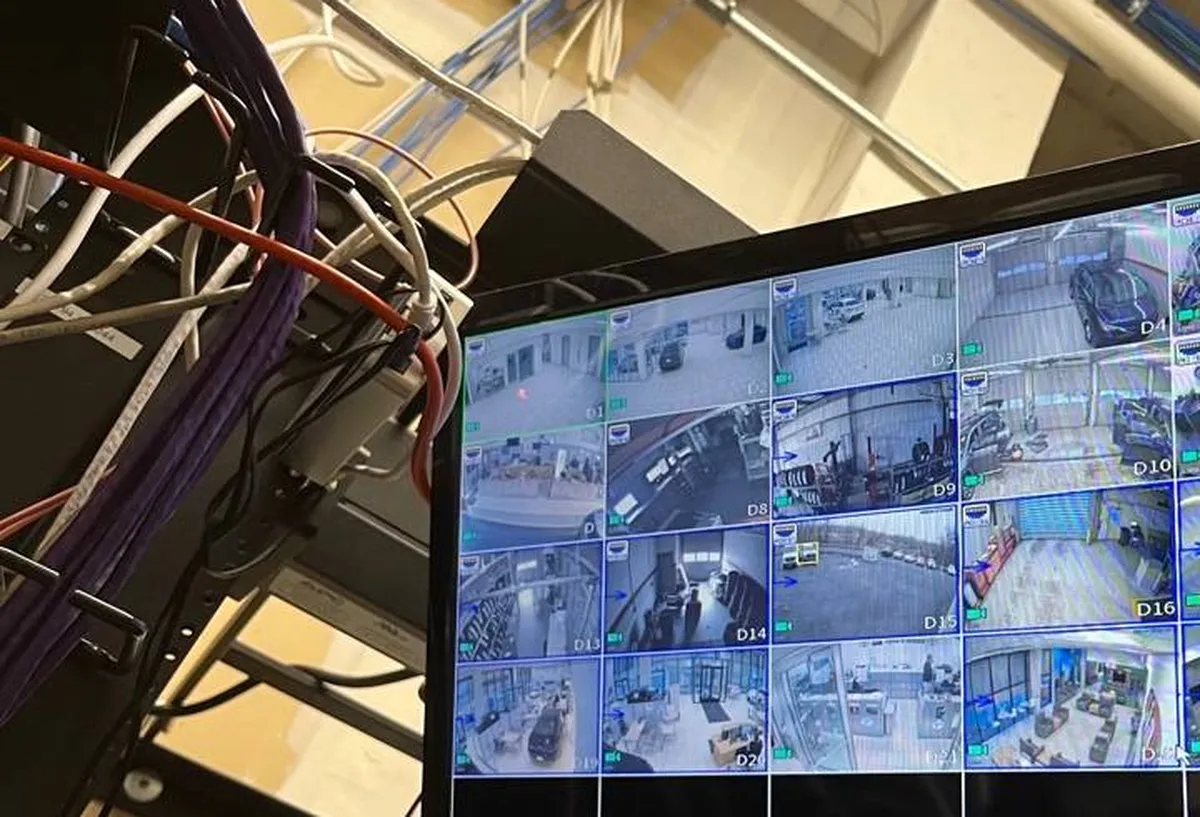
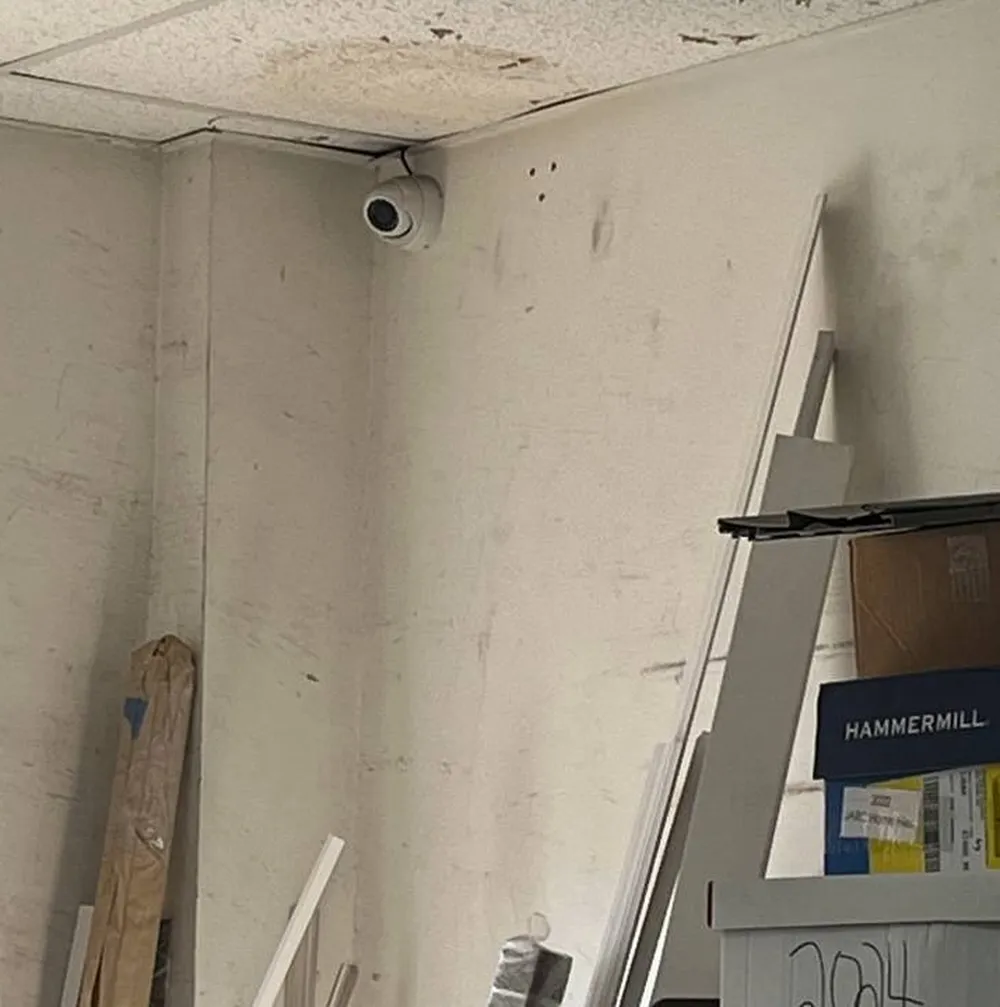
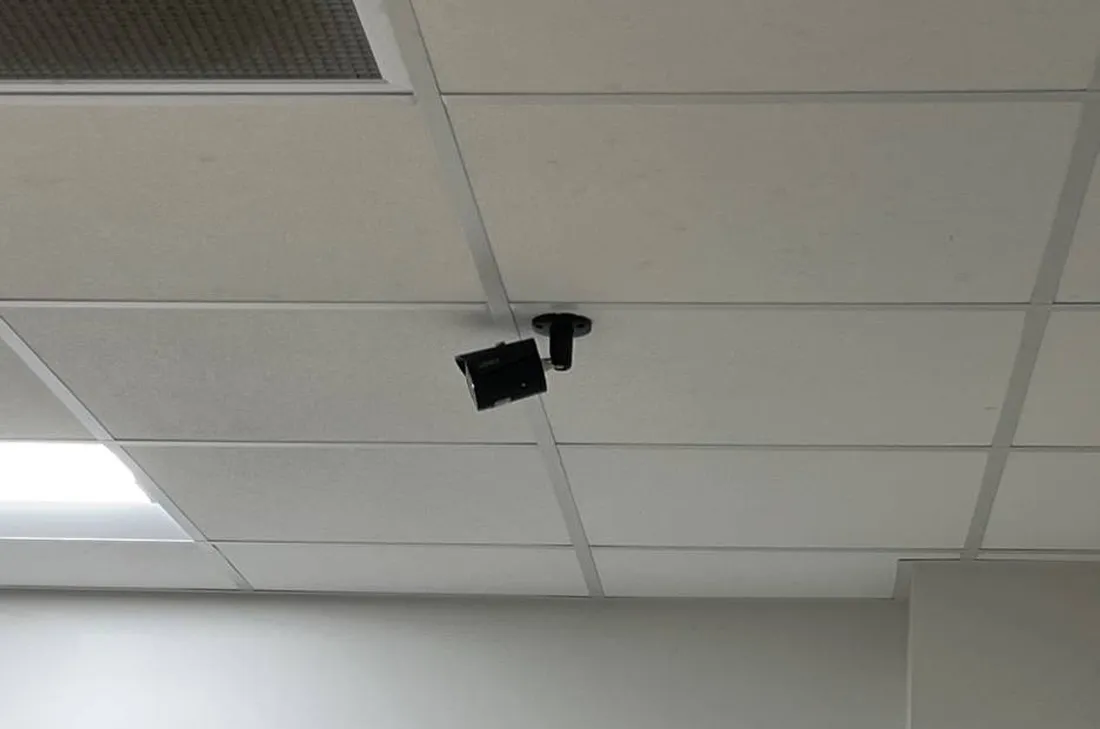
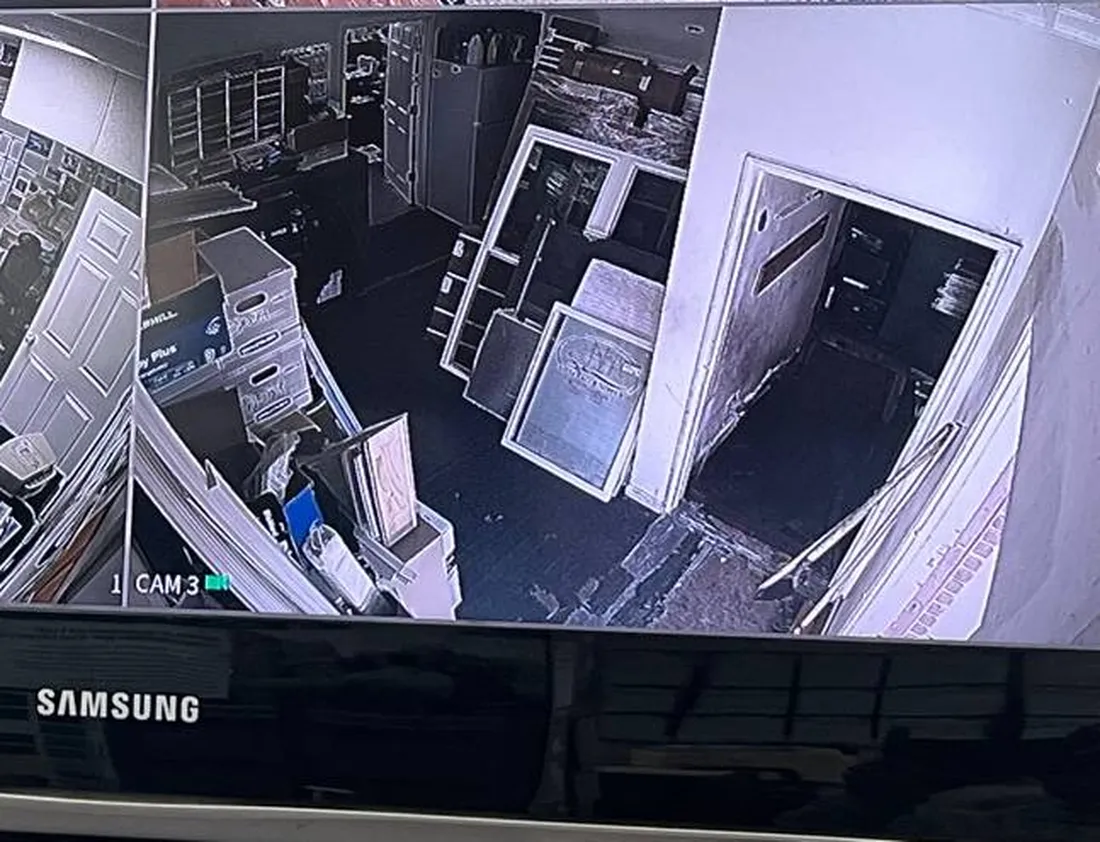
The two photos below come from jobs outside Ulster, a window and door showroom in Nassau County and a car dealership in Rockland County, and we use them here because they show two habits our crew brings to every Ulster job. In the showroom, the owner's monitor shows four tiles, and the one our crew framed most carefully is the back room: stacked windows, frames leaning against the wall, the side door to the lot in the corner of the frame. When something goes missing from a small business, it is usually from a room like that, and the owner looks at that tile first. So we place the back room camera high in a corner, looking at the door and the stock together, and we check on the monitor, not on a phone, that a person in the doorway fills enough of the frame to recognize.


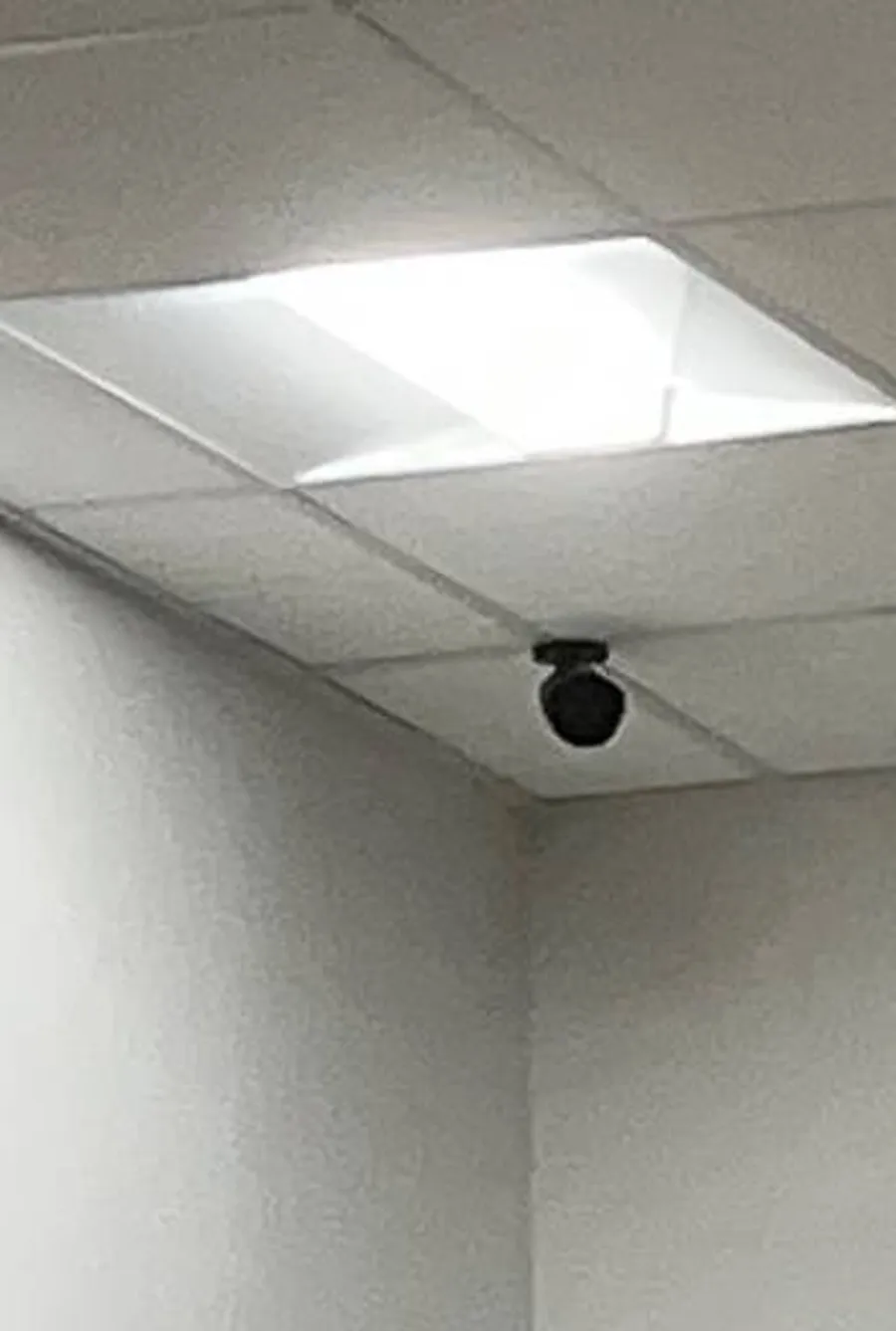
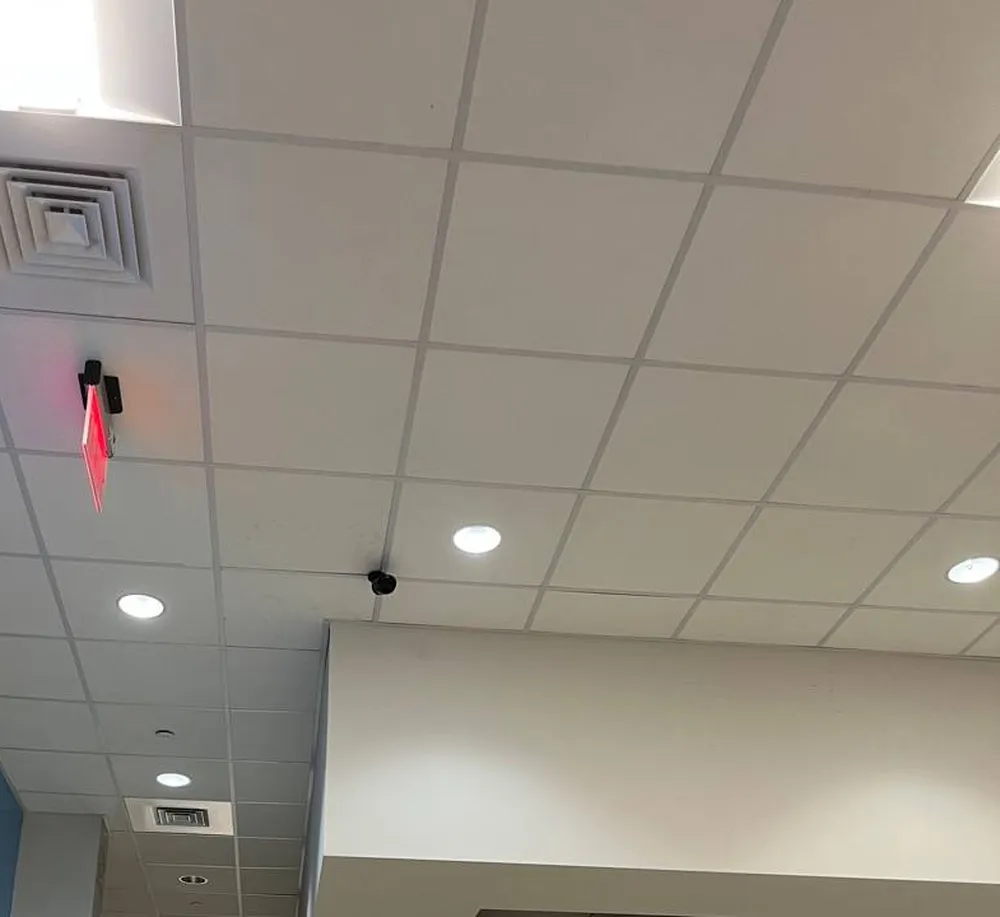
The second habit shows in the dealership photo: the turret over the front counter is set back from the glass so that daylight is behind the people walking in, not in the lens. Uptown Kingston and Rondout storefronts have the same problem with big display windows facing the street, and in winter the low afternoon sun pours straight through any window that faces west or south. A camera aimed out through the glass at that hour records silhouettes. We aim entry cameras from inside, looking across the door rather than out through it, and turn on wide dynamic range so faces stay readable. Those two choices cost nothing extra and decide whether the footage is worth handing to anyone.
Whoever you hire, ask these questions before you pay a deposit. A reliable CCTV installation company will answer each one in writing.
Read reviews for patterns rather than single stars, and look for an installer who shows real photos of its own jobs. Our Google reviews stand at 4.7โ from 201 reviews. We do not post testimonials on this page; the reviews are public.
Before the summer rental season. Hosts in Woodstock, Saugerties and the Route 28 towns want cameras in and the listing disclosure updated before Memorial Day bookings arrive. Spring is also when frost leaves the ground, which makes trenching to an outbuilding easier.
Before leaf season and the holidays. Uptown Kingston and New Paltz shops call in September and October for holiday shopping season coverage: the register, the door and the stockroom, ready before Black Friday rather than after the first loss.
Before winter. Second-home owners want CCTV installation for winter property security, with power-loss alerts and a UPS, before they close the house for the season. Snow on the drive also makes it harder for us to reach a cabin in January, so earlier is easier.
After a break-in or a damage dispute. CCTV installation after a burglary or after vandalism usually starts with the spot where it happened, then widens to the approach so the next incident is seen coming. We book within 2 hours of your call and schedule dates first come, first served once the deposit is paid; we do not promise same-day installation.
When a business opens. A new restaurant or shop in a Kingston or New Paltz storefront is easiest to wire before the fit-out closes the ceilings, so call while the walls are still open.
Tell us the town or hamlet, what kind of property it is, roughly how many cameras you want and where, and where a recorder could be locked away. Phone photos of the outside, of any old recorder and of the spot that worries you most help us price it faster. If the property is rented to guests, say which sites it is listed on; if it is in Kingston, tell us whether it is in the Stockade, Rondout-West Strand or Chestnut Street district. Prefer to talk? Call (845) 640-3835.
How does CCTV installation work from the first call to the last test clip? The same six steps run on a four-camera Kingston porch-and-alley job and on a compound in the hills above Phoenicia.
Phone or text (845) 640-3835, or fill in the form, with the hamlet or town, whether guests rent the place, and photos. Expect a callback to book within 2 hours, any day of the week.
We mark each camera's view, the recorder's locked spot and every cable route, flag any historic-district or rental-policy limits, and decide where fiber or a bridge is needed.
The package plus each extra on its own line. A 50% deposit holds your date; dates go first come, first served once paid, with early-day starts for long drives.
Concealed runs through attics, basements and chases, outdoor Cat6 in conduit, mounts on trim or in mortar joints, every hole sealed and every cable labeled.
Recorder online, clock synced, streams tuned, privacy masks drawn, detection set for people and cars, logins created, and a recorded clip checked from every camera.
App on your phone, a walk-through of playback and export, the camera list for your listing, the cable map and the password sheet. The admin login is yours.
How long does CCTV installation take? Most four- to six-camera houses and shops are one day on site. Rental compounds, inns and anything with trenching or a run to an outbuilding take longer, and we tell you the number of days on the quote.
Our crews drive up from our Bronx office on the Thruway and cover the whole county, from the river towns to the Delaware County line. These are landmarks our crews pass on the way to jobs.
The stone church at the heart of the Stockade District, a National Historic Landmark whose steeple sets the height limit for new buildings around it.
A street of early stone houses beside the Wallkill River, a few blocks from the village's Main Street shops and restaurants.
New York City's reservoir in the Town of Olive, ringed by Route 28 hamlets and the cabins and second homes along the roads above it.
The lighthouse where the Esopus Creek meets the Hudson, on the edge of the village whose Partition Street business district we wire for shops and restaurants.
On the Shawangunk Ridge above Kerhonkson and Gardiner, drawing the hikers and climbers who fill rentals across the Rondout Valley.
The town's main street of shops, galleries and cafes, at the center of one of the county's busiest short-term rental markets.
We also serve Saugerties, Esopus, Port Ewen, Lloyd and Highland, Marlborough and Milton, Plattekill, Rosendale, Stone Ridge, Accord, Ellenville, Wawarsing, Shawangunk and Wallkill, Hurley, Lake Katrine, Phoenicia, Pine Hill and the rest of Shandaken, Denning and Hardenburgh.
Our CCTV and security camera pages for Ulster County use the same price list, so the numbers match. Each package is installed by our crew with the NVR, the drive and phone-app setup, and none of them carries a monthly fee for recording or remote viewing.
| Package | What's included | Typical Ulster price |
|---|---|---|
| 4-Camera Starter | 4ร 4K IP cameras, 8-ch NVR, 2TB drive, mobile app setup | $2,100 โ $2,800 |
| 6-Camera Home | 6ร 4K IP cameras with full-color night vision, 8-ch NVR, 4TB drive | $2,900 โ $3,800 |
| 8-Camera Farmhouse | 8ร 4K IP, 16-ch NVR, 6TB drive, long cable runs, soffit work | $3,900 โ $5,200 |
| 12-Camera Compound | 12ร 4K IP + 1 PTZ, 16-ch NVR, 8TB drive, outbuilding mesh | $5,800 โ $7,500 |
| 16-Camera Commercial | 16ร 4K IP + 2 LPR, 16-ch NVR, 10TB drive, POS integration | $7,800 โ $10,500 |
| Add-on: PTZ (long driveway) | 25xโ32x optical zoom, auto-tour programming | +$1,200 โ $1,800 |
| Add-on: LPR camera | License plate capture, narrow view, fast shutter | +$700 โ $1,100 |
| Add-on: UPS backup | 4-hour runtime on NVR + switch + modem | +$350 โ $500 |
| Add-on: Cellular LTE failover | LTE modem for when cable internet drops | +$450 + $25/mo |
| Service call (existing system) | Flat rate, includes 1 hour of labor | $275 โ $375 |
Location within the county matters: a 4-camera 4K NVR system typically runs $2,100 to $2,800 installed in Kingston, New Paltz and Saugerties, and $2,400 to $3,100 deeper in the Catskills, such as Phoenicia, Shandaken or Denning. A four-camera 4K retail system for an Uptown Kingston store runs $2,400 to $3,200 installed.
The CCTV installation cost per camera is mostly a question of where the cable has to go. On our published list, rural installs with long pulls, trenched conduit and soffit work on outbuildings run $200 to $350 per camera in labor; a camera over a Kingston porch with an open attic above it costs far less to reach than a camera on a barn 300 feet away. Hidden wiring through finished walls, conduit and trenching, extra cameras beyond the package, bigger drives for longer retention, and a fiber run or wireless bridge to an outbuilding are each priced once we confirm the layout. Travel to the far end of the county is built into the Catskills range above rather than added as a surprise.
The deposit is 50% to book, the rest is due on completion, and financing is available; ask when you call. Installation workmanship carries a 30-day warranty on the site, and extended coverage of one year or longer is a paid add-on. Full terms โ including 50% deposit, one-year parts-only warranty on Abstract Enterprises Security Systems-supplied products, and the late-fee schedule โ are set out in the service agreement.
Choose by the property, not by the camera count alone. Here is how each package on our Ulster list maps to the buildings we see most.
For a Kingston two-family, a New Paltz rental house or a small ranch: front and back doors, driveway and one side. Four 4K IP cameras on an 8-channel NVR leave four channels free for later.
For a cabin rental with a deck and a detached garage, or a house on a corner lot. Full-color night vision on the cameras near porch lights and a 4TB drive for longer retention.
For an old farmhouse or a property with a long drive and a barn: long cable runs and soffit work are part of the package, on a 16-channel NVR with a 6TB drive.
For a main house plus a guest cottage, a bunkhouse or a studio, or a small inn. Includes one PTZ and the network link to the outbuildings, on an 8TB drive.
For a busy store, a restaurant with a lot, or a motel. Two plate-reading cameras at the entrance, POS integration at the register, and a 10TB drive.
Yes, we install customer-supplied equipment. Send the brand and model numbers, how many cameras and recorders, and photos of where they go, and we quote the labor by phone or text, priced per camera after we confirm the layout. Jobs are booked with the deposit like any other. We do not do walk-throughs for customer equipment, and if your cameras are wireless, their signal and hardware stay your responsibility. If the recorder you bought cannot do what the property needs, such as keep recording during an outage, we tell you before we start.

Related work for Ulster owners, often priced alongside a new camera system:
Cameras for owners who live in the house.
New recorders for IP camera systems.
Replacing an aging recorder.
Dead channels and broken cameras.
Cleaning, firmware and drive checks.
Lots for shops, inns and venues.
Temporary coverage while you build.
Fobs and readers on doors and gates.
Cat6 and fiber for the whole building.
Our partner brand, installed and serviced.
The full Ulster price list.
Send details for a written price.
Yes. We cover all of Ulster County, including the mountain towns along Route 28 and the far western hamlets near the Delaware County line. Our crews travel from our Bronx office, so on long drives we start early in the day, and the Catskills price range on our list, $2,400 to $3,100 for a 4-camera 4K NVR system, already reflects the extra travel.
We are not aware of any countywide permit for installing cameras on private property. Building and zoning rules come from your city, town or village, so ask its building department if you are unsure. In Kingston's landmark districts, exterior changes visible from a street or alley need a certificate of appropriateness from the Historic Landmarks Preservation Commission. This is general information, not legal advice.
A service call on an existing system is a flat $275 to $375 on our Ulster price list, and that includes the first hour of labor on site. Parts, replacement drives and any additional hours are quoted before we do the work. If the system is one we installed, bring the cable map and password sheet we left you, which shortens the visit.
Yes. Our LTE failover add-on puts a cellular modem next to the recorder so phone alerts and remote viewing continue when the cable, DSL or fixed wireless line goes down. It is $450 installed plus $25 a month to the cellular carrier. Recording itself never depends on the internet, so the recorder keeps writing either way.
No. The city's 78 public safety cameras and its plate readers are a separate system run by the city, and we do not connect private recorders to it. What you can do is export a time-stamped clip from your own recorder and give it to police when they ask, which we show you how to do at handover. If you want police to know a camera covers your block, ask the Kingston Police Department whether it keeps a voluntary list of private camera locations.
Yes. We take down indoor cameras, patch and seal the mounting holes, and either reuse the cable for exterior cameras or abandon it neatly in the wall. If the old recorder still works and is worth keeping, we reset it, change every password and put the admin login in your name. Then the listing disclosure only has to describe the exterior cameras that remain.
It carries the cameras on a guest cottage, a studio, a bunkhouse or a barn back to the one recorder in the main house, so every building is on the same timeline and the same app. Where we can trench, that link is buried cable; where ledge or distance makes trenching impractical, it is a wireless link between the buildings. We confirm which one on the survey.
Yes, with a compatible point-of-sale system. POS integration, included in our 16-camera commercial package, overlays each transaction's text on the register camera's video, so you can search footage by a sale, a refund or a no-sale and see what happened at the counter at that moment. We confirm compatibility with your register before quoting it.
Yes. We design to the video requirements in New York's cannabis regulations: coverage of entries, exits, sales areas and parking, clear identification at entries and points of sale, synchronized time stamps, export in standard formats, 60 days of retention and at least eight hours of operation in a power outage. Your license compliance plan stays your responsibility; this is not legal advice.
Yes. We write one quote with each property as its own section, its own recorder and its own package, and schedule the installs back to back where we can. Both systems can sit in the same phone app under separate site names, so you switch between your home and the rental without separate accounts. Each property's deposit and balance are listed separately.
This page is about Ulster County. For long cable runs, outbuildings, weather and the region-wide picture across all six counties we cover north of the city, see our Hudson Valley CCTV installation hub.
Ulster County jobs are booked through (845) 640-3835 and dispatched from our office at 460 E Fordham Rd, Bronx, NY 10458. We hold New York State low-voltage license #12000287431, carry insurance, and stand at 4.7โ across 201 Google reviews. Last reviewed November 16, 2026.
More CCTV service areas: CCTV installation in NYC (all five boroughs) · CCTV installation in Long Island · CCTV installation in Hudson Valley · CCTV installation in Manhattan · CCTV installation in Brooklyn · CCTV installation in Queens · CCTV installation in the Bronx · CCTV installation in Staten Island · CCTV installation in Nassau County · CCTV installation in Suffolk County · CCTV installation in Westchester County · CCTV installation in Rockland County · CCTV installation in Orange County · CCTV installation in Putnam County · CCTV installation in Dutchess County