One elevator, two floors, and a lobby door that anyone can follow a resident through? Book a Putnam County elevator access survey for a day that suits your manager: (845) 640-3835
Putnam County has few elevators, and most of them are small: a single car in a two- or three-story senior building in Carmel or Mahopac, the two elevator buildings of a 55+ condominium near the Cold Spring train, a medical office on Stoneleigh Avenue, a county or town building in Carmel, a LULA lift in a church or library. Elevator access control installation in Putnam County means adding a reader, keypad, phone credential or face reader so that car carries only the people you approve, to the floors they belong on. Abstract Enterprises Security Systems installs the low-voltage side — readers, floor-enable relays or I/O boards, cable, credentials, programming and the link to your intercom — and plans the controller connection with your building's New York State-licensed elevator contractor, who makes it.
Reviewed and updated November 18, 2026 by Abstract Enterprises Security Systems, NYS license #12000287431 · Sources: U.S. Census Bureau (2020 Census; American Community Survey 2023 5-year); Putnam County Office for Senior Resources; Putnam County Housing Corporation; WBP Development (Stonecrest, Hughson Commons, Hillcrest Commons); Hire Realty listing for Butterfield, Cold Spring; Northwell Health (Putnam Hospital); Putnam County Economic Development Corporation project list; Putnam County Press; Putnam County hazard mitigation plan; NYS Department of Labor elevator licensing; ASME A17.1 section 2.27 as published by UpCodes; National Elevator Industry, Inc.; town and village codes on eCode360
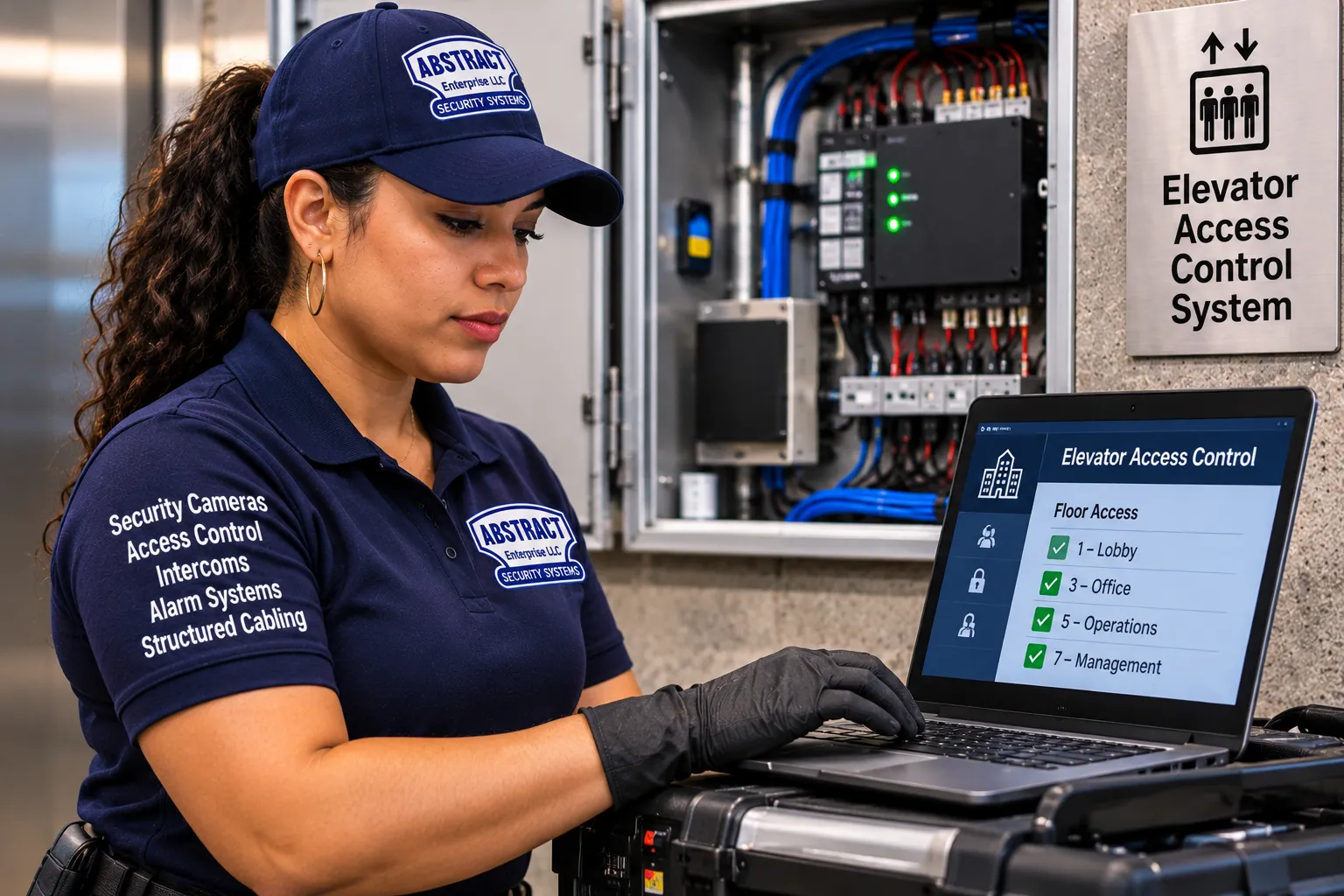
Photo from the Abstract Enterprises Security Systems elevator access control job library (real photos from our own files), not taken in Putnam County: a gloved technician types on a laptop whose screen lists floor permissions next to an open access control panel. For a Putnam condominium or county building, a floor list like this is what the board approves before any floor is restricted.
Putnam County Elevator Access Request
Town or village, building type, floors and cars, and who should be able to ride where
✅
Request Sent!
Thank you. We will call to book your Putnam County elevator access survey, usually within 2 hours of your request.
25+
Years Experience
2 Hr
Arrival Windows
100%
Licensed & Insured
4.7★
201 Google Reviews
Owner-operated since 2002 · Thousands of jobs completed · Booked within 2 hours
Quick answer: in Putnam County, elevator access control starts at $2,175 per elevator car for Level 1 (a fob, card, PIN, phone or intercom-station reader that enables the car) and at $3,625 per car for Level 2 (face, fingerprint or iris). Level 3 — floor-by-floor restriction, readers at hall-call buttons, time schedules and destination dispatch links — is quoted per building after we survey it. Two things are never inside our per-car price: the visit by your elevator contractor to connect our outputs to the controller, which the building arranges and pays directly, and any new network line or cable run the car needs for remote management, which we price as its own line once we have seen the machine room.
Low-voltage work by Abstract Enterprises Security Systems under NYS license #12000287431
Controller, fire service and platform-lift connections made by a contractor licensed by the New York State Department of Labor
Putnam visits booked ahead for a set day with a 2-hour arrival window, never promised for the same day
A County of Two- and Three-Story Elevators: What Putnam's Buildings Mean for Access Control
If you drive from Brewster to Cold Spring you can go a long time without passing a building tall enough to need an elevator. Putnam is a county of houses, reservoirs, state parkland and small hamlets. The elevators that do exist were mostly installed for one reason: so that older residents and people with disabilities could get from the lobby to a second or third floor.
What the record shows
Why it matters for an elevator access control system
Source
97,668 residents at the 2020 Census, in six towns (Carmel, Kent, Patterson, Philipstown, Putnam Valley, Southeast) and three villages (Brewster, Cold Spring, Nelsonville)
A small county with many separate building departments; the people approving and inspecting work change from one municipality to the next.
U.S. Census Bureau via Wikipedia; Putnam County hazard mitigation plan, county profile
38,369 housing units, 77.7% of them detached single-family houses
Elevator buildings are a small minority, so most boards and managers here are buying elevator security for the first time and have no in-house expert.
American Community Survey 2023 5-year estimates (DP04), as recorded in our Putnam research file
Putnam County Housing Corporation senior buildings in Carmel and Mahopac: two two-story buildings on Gleneida Court with an elevator, and a three-story, 48-unit building at 170 Route 6 with an elevator
The typical Putnam elevator serves two or three stops. Level 1 in the car is often the whole answer.
Putnam County Housing Corporation, senior housing page
Stonecrest, 3101 Stonecrest Drive, Brewster: an affordable senior community of 136 apartments with elevators in each residential building
Several buildings each with its own car means several readers that should share one credential list and one administrator.
WBP Development, Stonecrest community page
Hillcrest Commons, Carmel: 76 low-income senior units placed in service in 2012; Hillcrest Commons II adds 74 apartments for heads of household 55 and older
Newer senior buildings with on-site management offices, where a manager can run credentials from a desk in the building.
Butterfield, Cold Spring: 49 condominium residences for buyers 55 and over in two elevator buildings, with one reserved space per unit in a parking deck, less than a mile from the train station
Owner-occupied condos where each owner should reach only their own floor and the deck, and where many owners also travel.
Hire Realty listing for Butterfield Condominiums
Putnam Hospital, 670 Stoneleigh Avenue, Carmel
The county's hospital campus anchors the medical offices nearby, which need public floors by day and staff-only floors at night.
Northwell Health location page
Putnam County Office Building, 40 Gleneida Avenue, Carmel
County and town buildings mix public counters with offices that hold records and staff-only areas.
Putnam County government website
Overlook (Gateway Summit) on Route 6 in Carmel is actively under construction; a 60-unit senior housing building with a grocery store at 1534 Route 22 in Southeast is listed as approved
New buildings are the cheapest place to plan elevator access, because conduit and controller inputs can be specified before the elevator is ordered.
Putnam County Economic Development Corporation, potential large projects list
Roughly three-quarters of the county lies in the New York City watershed
Development is spread out and buildings are far apart, which affects drive times, internet service and how a system should be managed.
Putnam County hazard mitigation plan, county profile
Read that table as a picture of the work. A Putnam elevator access project is rarely a forty-floor tower with destination dispatch. It is far more often one car, a lobby and one or two upper floors, ridden mostly by older residents, their aides and their families, run by a property manager who also looks after buildings in other towns. The right system for that building has to be simple for riders, reliable without constant attention and manageable from somewhere other than the lobby. That is a different brief from a high-rise office tower, and we design for it on purpose.
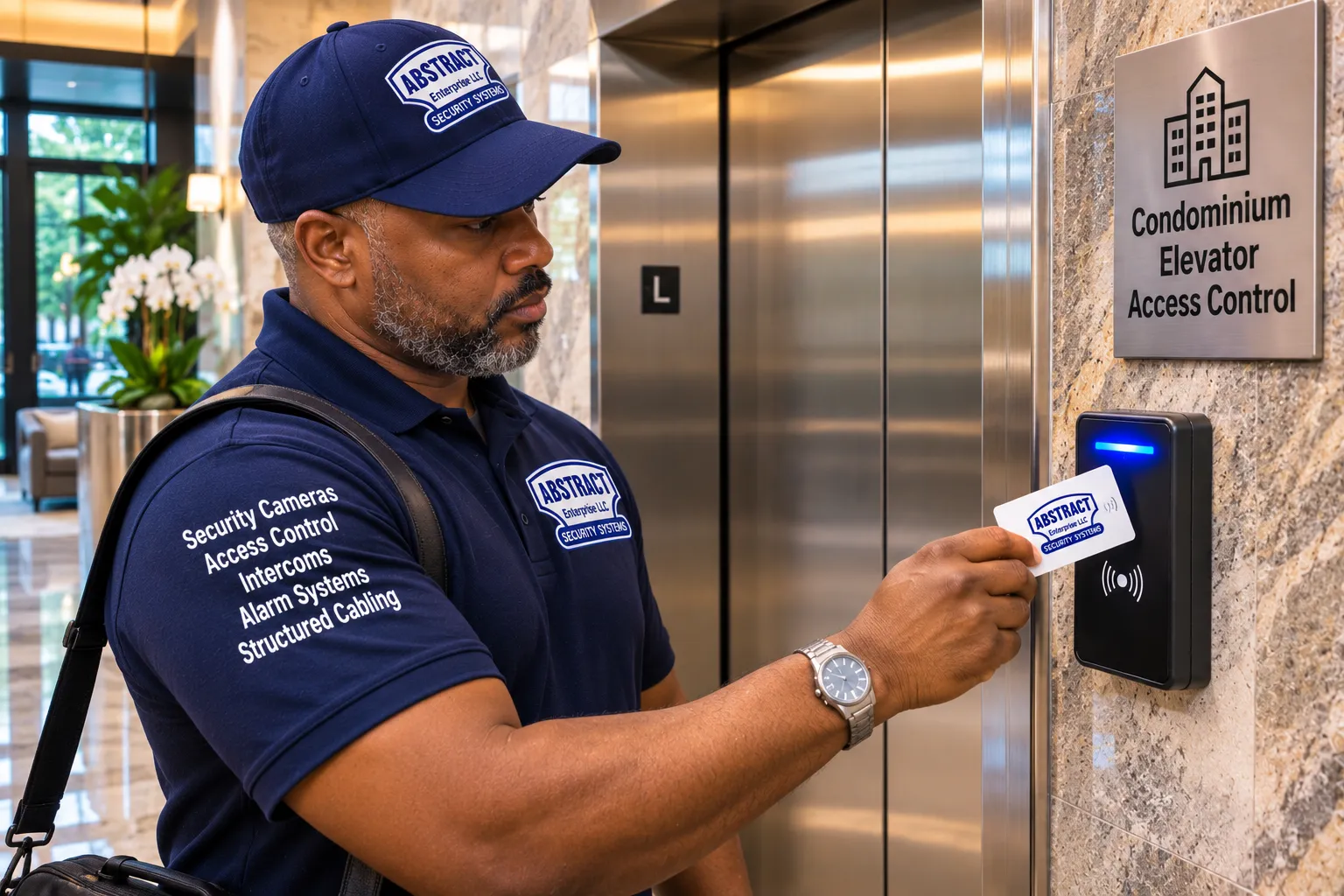
Photo from the Abstract Enterprises Security Systems elevator access control job library (real photos from our own files), not taken in Putnam County: a man in a navy cap and polo shirt holds a white card to a black wall reader with a blue light, next to stainless elevator doors and a sign reading Condominium Elevator Access Control. A 55+ condominium in Putnam would typically use the same kind of reader at the lobby or in the car.
Why Small Elevators Get Secured
Why a Building With One Small Elevator Still Needs a Gatekeeper
The most common reaction we hear from a Putnam board is that elevator security sounds like something for big buildings. The buildings we are asked to secure here are small, but the reasons are concrete, and most of them come from how small buildings are actually used day to day.
Front doors that do not stay shut. Two-story buildings often have a single entry that is propped open for deliveries, for a moving van or simply on a warm afternoon. Once someone is inside, a car that answers every button takes them to the residential floor. A reader in the car is a second line that does not depend on the front door being closed.
Community rooms and shared spaces. Many senior complexes have a community room, game room, library or laundry on the ground floor that outside groups and visitors use. Those visitors have every reason to be in the lobby and no reason to be upstairs. Elevator access control lets the building keep the ground floor welcoming while the residential floor stays private.
Keys and codes that nobody can take back. An elevator key switch for the upper floor, or a keypad code that has been the same for years, cannot be cancelled when a resident moves out or a contractor finishes. Individual credentials can be cancelled from a screen in under a minute.
Medical and office floors after hours. In a two- or three-story professional building, the ground floor may be a pharmacy or a physical therapy practice open into the evening while the upper floor offices close at five. A car that runs freely after hours undoes the locked suite doors upstairs.
Not knowing who rode, or when. After a theft, a fall or a complaint, a manager with no access log has nothing to go on. An elevator access control system with audit trail records every credential use with the time and the credential, so the board can track elevator access activity.
To prevent unauthorized elevator access in most Putnam buildings, one good reader in the car, a well-kept credential list and a clear rule about what happens when something fails are enough. Where a building has a real need to keep particular floors private — a records floor in a municipal building, a staff floor in a medical office, an owner's floor in a condominium — we add floor-by-floor control for those floors only. We would rather sell a Putnam building the smallest system that stops its actual problem than the largest one it can be talked into.
Inside the Car
How an Elevator Reader Talks to a Hydraulic or Traction Controller
Every elevator access control system answers one question many times a day: may the person standing in front of this button make the elevator go there? Our equipment does not move the car, open the doors or touch the safety circuits. It decides whether a floor button in the car, or a call button at a landing, is allowed to register for the rider in front of it. The elevator controller still does everything else exactly as it did before.
Most elevators in Putnam's low-rise buildings are likely to be hydraulic. Elevator manufacturers and designers describe hydraulic elevators as the usual choice for buildings of about five stories or fewer, because they are economical for short rises and run at slower speeds than traction elevators. Taller or newer buildings may have traction or machine-room-less elevators. From our side the principle is the same for both: the elevator controller has inputs for its car and hall buttons, and our system places a contact — a relay output, an I/O module point or a dry contact on an interface board — where the elevator contractor tells us it can safely sit, so that a button only works when our panel says it may.
Three ways to make the decision
Car enable (Level 1 or Level 2). One reader in the car. A valid fob, card, PIN, phone or face wakes the car buttons for a few seconds and the rider chooses any floor the car serves. In a two-stop building this is all the control there is to have, and it is usually all that is needed.
Floor-by-floor restriction (Level 3). Each controlled floor button has its own relay output. A credential unlocks only the floors it is assigned, and the other buttons stay dark. This suits condominiums with private floors, offices with tenant floors, and municipal buildings with staff-only levels. It is how elevator floor restriction, an elevator floor lockout system and tenant floor restriction are actually built.
Hall-call control (Level 3). A reader beside the call button at a particular landing — the parking deck, a lower level, the lobby — so the car cannot even be called there without a credential. This is useful where the weak point is a garage or a side entrance rather than the car itself.
The equipment list on our side is similar whichever design you choose: the reader or readers, an access control panel (sometimes called the elevator access control controller), the elevator interface (a relay board, I/O module or interface board with one point per controlled floor per car), a power supply with a battery, the cable between them, and the software where credentials are added and cancelled. That software can be a cloud-based elevator access control platform or a local one, which matters a great deal in Putnam for reasons we explain in the rural section below.
What our equipment never touches is just as important. The car's two-way emergency communication — the phone button that lets a trapped rider reach help — is required by the elevator code, ASME A17.1, section 2.27.1, and has been part of that code since long before card readers existed, according to the National Elevator Industry, Inc. Firefighters' emergency operation, door circuits and leveling are elevator systems. Our readers are mounted and wired so that none of those depend on our equipment, and our outputs are designed to drop out of the way when the elevator goes into fire service.
Elevator access control relay interface, elevator floor enable relay, elevator access control I/O module and dry contact are all names for that point where our panel's decision reaches the button. Their number — floors times cars times any controlled hall stations — is the biggest driver of a Level 3 price.
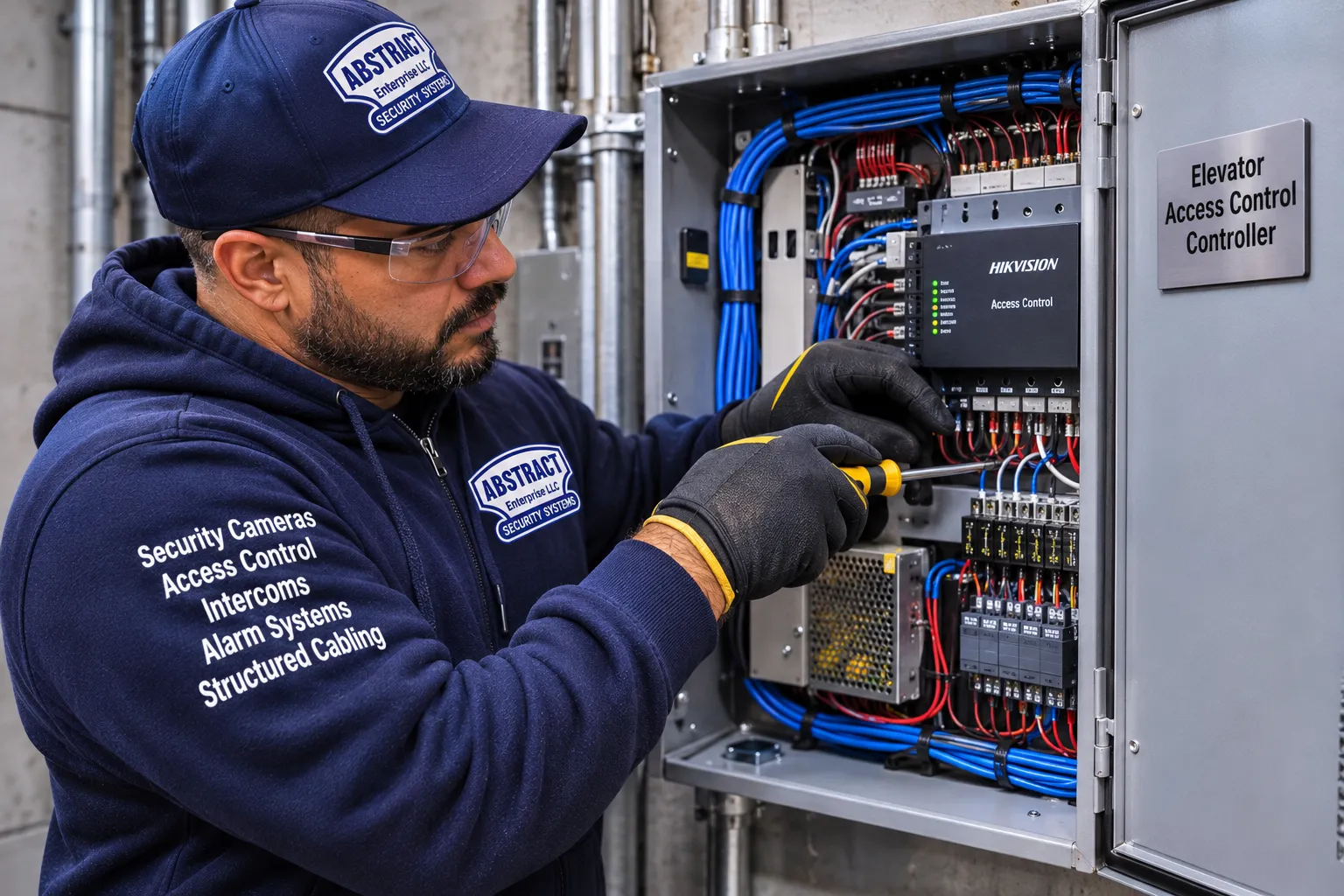
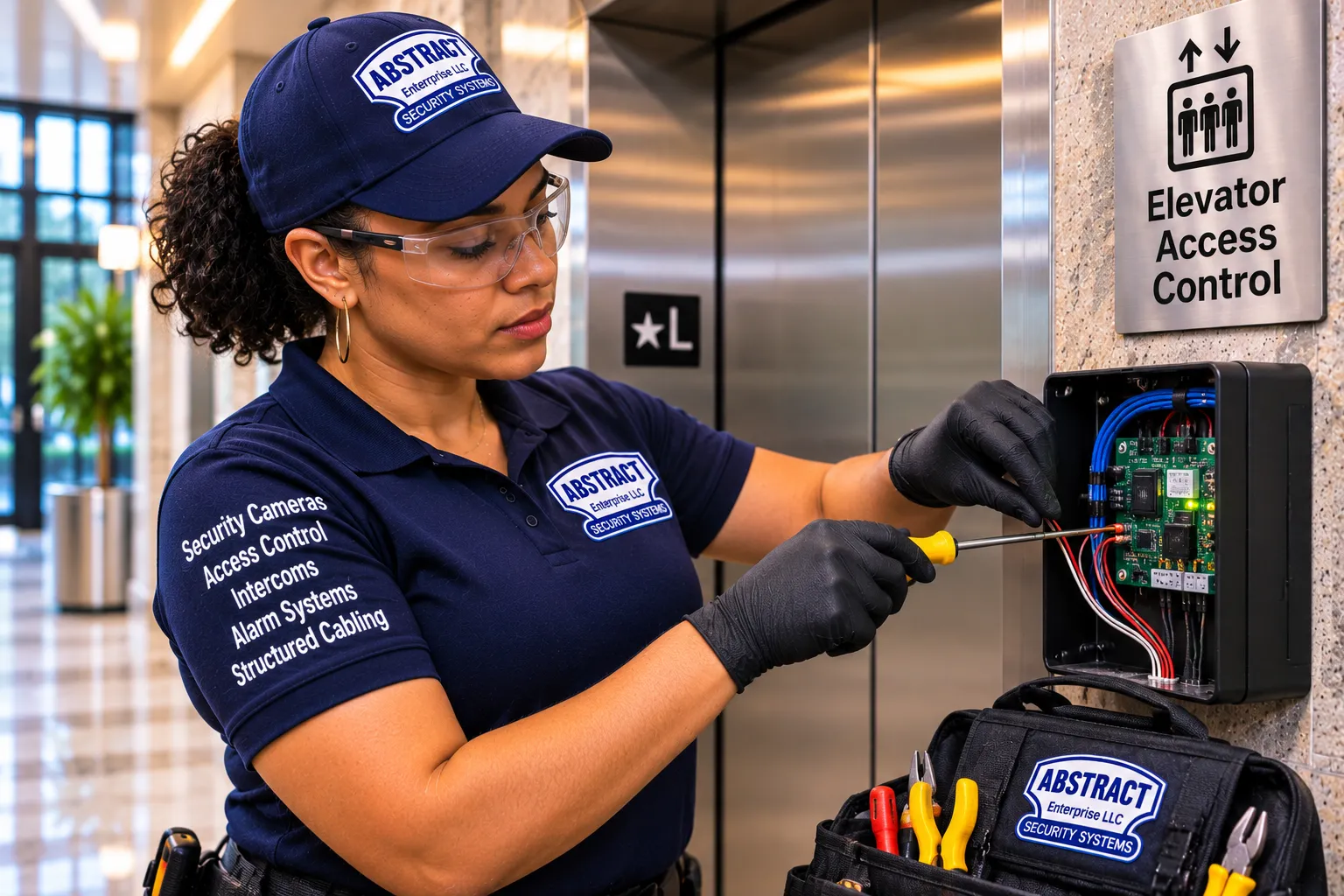
Photo from the Abstract Enterprises Security Systems elevator access control job library (real photos from our own files), not taken in Putnam County: a technician lands conductors inside a metal enclosure labeled Elevator Access Control Controller. This is our side of the job; the connection from this panel to the elevator controller is made by the building's licensed elevator contractor.
Small Conveyances
LULA Cars, Platform Lifts and the Small Conveyances in Putnam Churches, Libraries and Town Buildings
A good share of the elevators in a county like Putnam are not full-size passenger elevators at all. Churches, small office buildings, libraries, clubs and older public buildings often added accessibility with a LULA (limited use/limited application) elevator or a vertical platform lift. Elevator suppliers describe the LULA as a class of elevator for low-rise buildings that sits between a wheelchair lift and a full commercial elevator, commonly used in churches, small offices and public buildings of up to about three levels, with a small car and limited travel.
These units raise their own access question. Many of them are fitted with a key switch so that the public cannot ride them unattended, and the key ends up on a hook in an office or in the pocket of one volunteer. When that person is away, a visitor who uses a wheelchair waits. Lift access control installation — replacing the key with a reader or keypad — with credentials for staff, regular volunteers and the people who rely on the lift — — often makes a LULA both more secure and more accessible at the same time.
The licensing is different too, and it matters. New York State's Department of Labor issues an Accessibility Lift Technician license for work on accessibility lifts, and an Elevator Accessibility Technician license that can be substituted for it where the work is restricted to accessibility platform lifts covered by ASME A18.1, alongside the Elevator Mechanic and Elevator Contractor licenses for elevators and other conveyances. So the person who connects our reader to a LULA or platform lift controller is the licensed technician or mechanic who services that unit, not us. We supply and mount the reader or keypad, run the low-voltage cable, set up the panel and the credentials, and hand the licensed technician a clean dry-contact output to connect.
What usually fits a LULA: a keypad or a fob reader beside the call station on each level, or a single reader in the car, depending on how the unit's controls are arranged and what its servicing technician will accept.
What we ask first: the make of the lift or LULA, the company that services it, and whether the key switch is on the call stations, in the car or both. A photo of each is a great help.
What we never do: open the lift controller, change its wiring or bypass a key switch ourselves. That is conveyance work under Article 33 of the Labor Law.
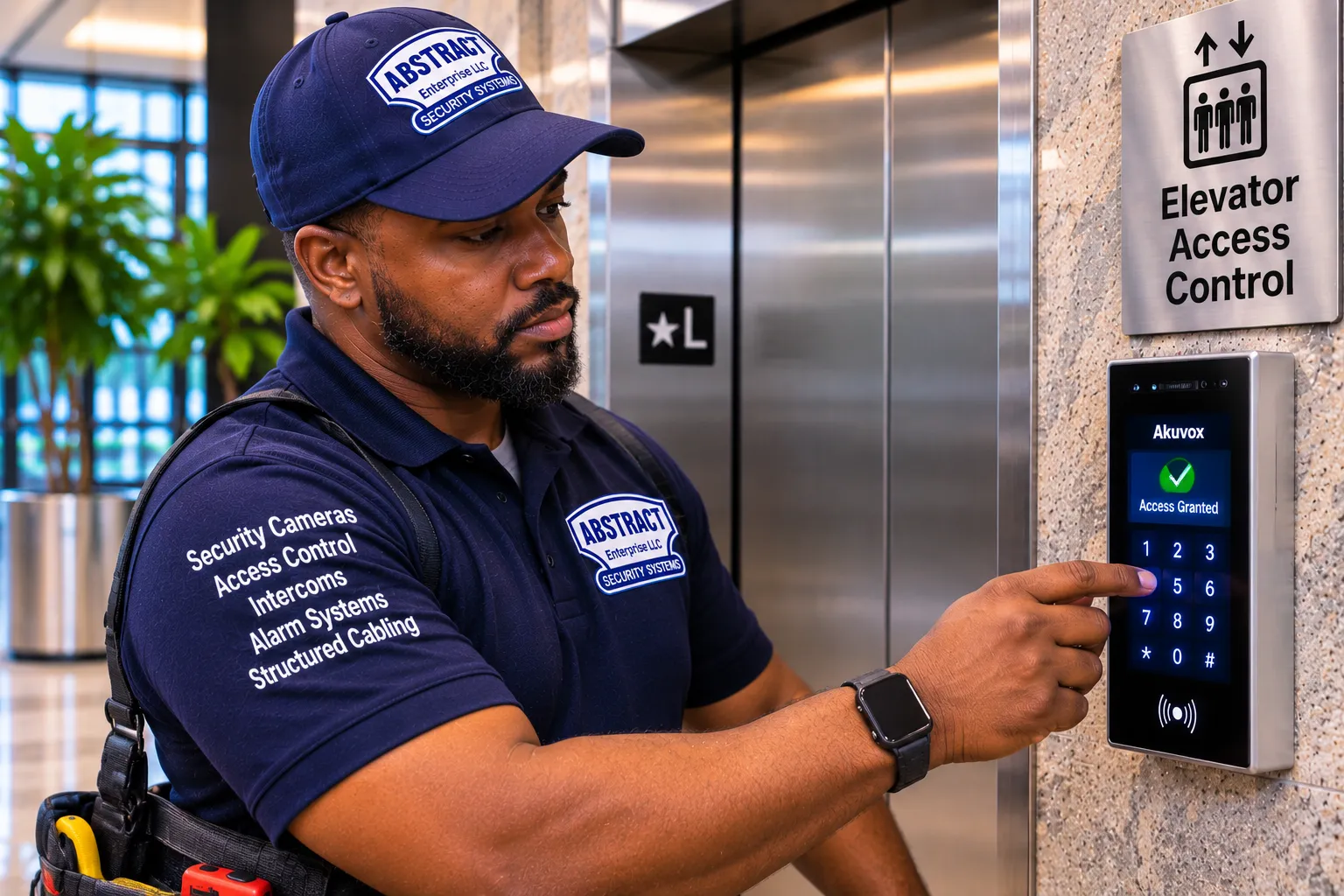
Photo from the Abstract Enterprises Security Systems elevator access control job library (real photos from our own files), not taken in Putnam County: a technician enters a code on an Akuvox keypad whose screen shows Access Granted, mounted next to an elevator. A keypad like this is a common way to replace the key switch on a LULA or small elevator in a church, library or town building.
Rural Realities
Internet Gaps, Cell Dead Zones, Generators and Distance: Designing for Putnam's Conditions
Putnam's geography is the reason most people live here and the reason some security systems disappoint. Hills, reservoirs and forest that make the county beautiful also make internet service, cell coverage and quick service calls harder than they are in a city. An elevator access system that assumes perfect connectivity and an installer ten minutes away will let a Putnam building down. We design around four local conditions.
1. The machine room may have no internet
Most households in Putnam do have a broadband subscription — the 2023 American Community Survey puts it at 94.6% of households, as recorded in our county research file — but an elevator machine room or electrical closet is not a household. A cloud-based elevator access control panel there either needs a network cable run from the building's internet service, a cellular modem, or a design that does not need the internet at all for everyday operation. We check this on the survey and price any new network line or cable run as its own line, because it is outside our per-car price.
2. Phones lose signal inside a steel car
Putnam has a long record of complaints about cell dead zones; in 2015 Senator Schumer called for a federal investigation after independent testing found that carriers' coverage maps overstated reception in parts of the region, Putnam included. Inside an elevator car, the steel walls make things worse. That is why, for mobile credentials, we prefer systems where the phone talks to the reader directly over Bluetooth or NFC, so the credential works whether or not the phone has a signal at that moment, and why we always keep a fob or PIN option available for residents who do not use smartphones.
3. Power goes out, and many buildings have generators
Putnam has had long outages after storms; local reporting recorded about 13,000 Putnam customers out after an October 2017 storm and more than 28,000 after the May 2018 storms. Several senior buildings say they have a generator on the premises; the Putnam County Housing Corporation lists generators at its Gleneida Court buildings. Our panel has its own battery, but the real question is what the elevator does on generator power and what our system should do while the building is switching over. We agree that with the board and the elevator contractor in writing before installation, and we put the access panel on the same emergency circuit as the elevator wherever the electrician and the building allow.
4. Distance changes how a system should be run
Our technicians are not around the corner from every Putnam building, and neither is your manager. So we set up elevator access control with remote management wherever the building has a connection, so managers can manage elevator permissions remotely: add and cancel credentials, change a schedule, look at the event log and get an alert when a reader or panel stops reporting, all from a browser or an app. Where there is no connection, the panel stores the credential list and the schedules locally, so the elevator keeps working exactly as programmed, and changes are made on site or through a scheduled connection.
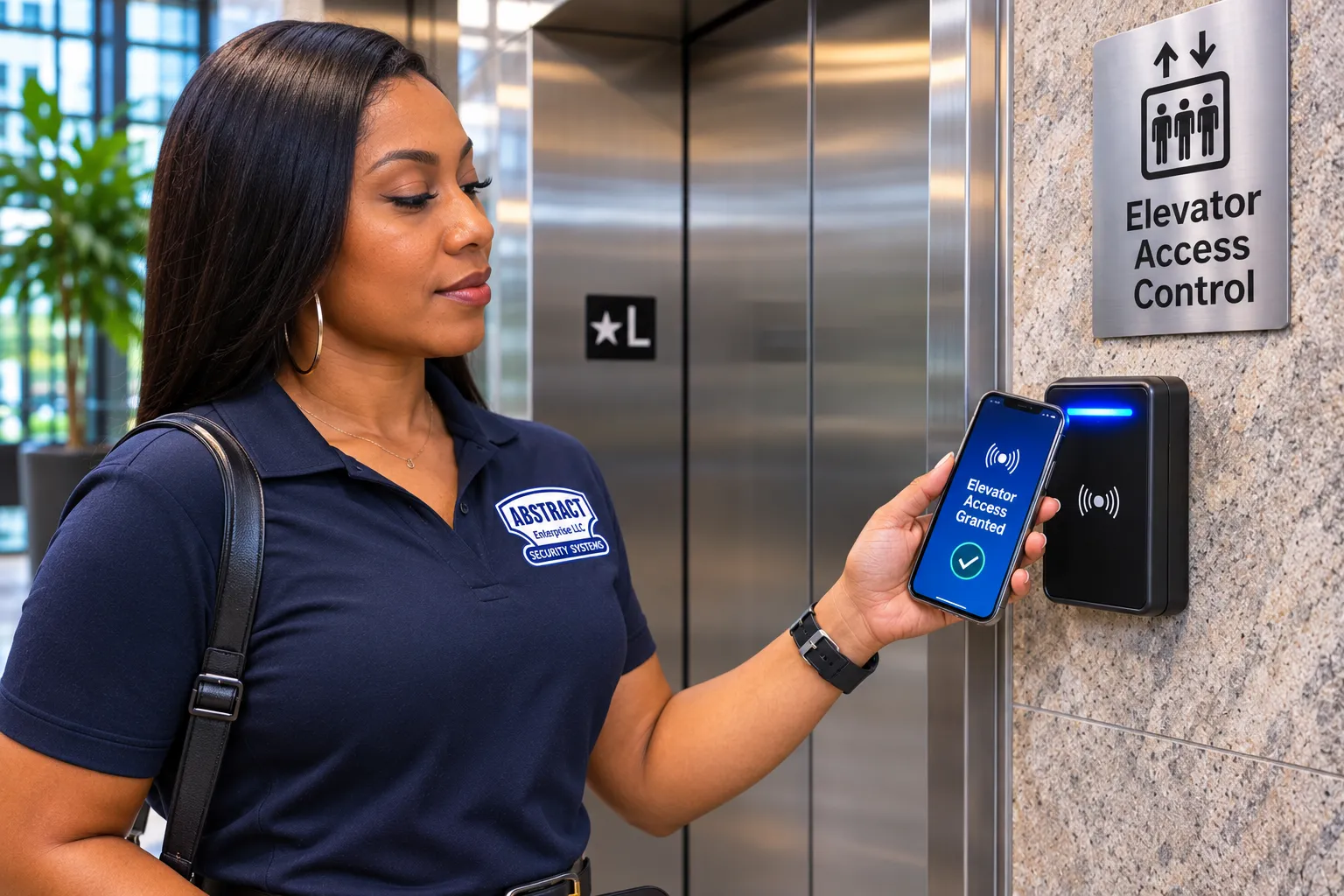
Photo from the Abstract Enterprises Security Systems elevator access control job library (real photos from our own files), not taken in Putnam County: a woman holds up a phone whose screen reads Elevator Access Granted beside a wall-mounted reader. In Putnam we pair phone credentials with a fob or PIN option, because signal and smartphone use both vary.
Building by Building
Putnam's Elevator Buildings, Type by Type, and the Access Design Each One Tends to Get
The buildings named below are examples from public listings of each building type; naming them does not mean they are our customers.
Two- and three-story senior complexes in Carmel and Mahopac
The Putnam County Housing Corporation's buildings are a good picture of the type: two-story buildings on Gleneida Court in Carmel with an elevator, a community room and laundry, and a three-story, 48-unit building at 170 Route 6 in Mahopac with an elevator, a community room and a game room. The Putnam County Office for Senior Resources also lists the 62+ apartments at 50 Main Street in Brewster. In buildings like these, apartment building elevator access control starts with a Level 1 reader in the car that reads the same fob residents use at the front door is usually the right first step. The community room stays easy to reach; the residential floor does not. Staff and approved aides get their own credentials, and we set up visitor access through the entry intercom so family members do not need a fob of their own.
Larger 55+ and senior communities with several buildings
Stonecrest in Brewster, with 136 apartments and elevators in each residential building, and the Hillcrest Commons and Hughson Commons communities in Carmel are examples of a different scale: several buildings, an on-site management office, a clubhouse or community suite. Here the design priority is one system for all of the cars, with one credential per resident that works in their own building and the common areas, an on-site administrator at the management office, and readers that all report to the same event log. An elevator access control system with centralized management keeps the manager from juggling separate lists for every building.
Cold Spring condominiums near the river and the train
Butterfield in Cold Spring is described in its listing as 49 condominium residences for buyers 55 and over in two elevator buildings, with a reserved space for each unit in a parking deck, next to the Philipstown Friendship Center and a short walk from Main Street. A condominium like this tends to want each owner to reach their own floor, the lobby and the deck, but not other owners' floors, which is floor-by-floor restriction at Level 3, plus a hall-call reader at the deck landing so the car cannot be called from the garage without a credential. Owners who are away for weeks at a time are a real consideration; we cover seasonal credentials in the FAQ below.
Medical offices around Putnam Hospital and along Route 6
Putnam Hospital at 670 Stoneleigh Avenue in Carmel anchors a cluster of medical and professional offices, and others line Route 6 through Mahopac and Carmel and Route 22 in Southeast and Patterson. We name the hospital only as a landmark; we do not claim it as a client. Medical building elevator access control usually means elevator access control with time-based floor permissions: patient floors open to anyone while practices are open, staff-only floors locked all the time, and every floor credential-only after hours. A small building with a pharmacy on the ground floor and offices above may need nothing more than car-enable after five o'clock.
County, town and village buildings
The Putnam County Office Building at 40 Gleneida Avenue in Carmel, town halls, highway department offices and libraries all mix public counters with staff-only space. The usual answer is to add the elevator to the badge or fob system staff already carry at the doors, so one credential runs both, and to keep records floors, server rooms and offices restricted while public floors follow public hours. Municipal building elevator security also needs clear audit records, which every system we install keeps.
Brewster's Main Street and the commuter-rail villages
Brewster has Putnam's densest village centre; its mayor said in 2026 that the village already has the highest population density of any community in the county. Main Street has older mixed-use buildings with apartments over shops, a short walk from the Brewster Metro-North station, and ideas for more housing keep returning: the Brewster Crossing transit-oriented plan is listed by the county's economic development corporation as dormant, and a concept for affordable housing at the former Garden Street School was under discussion in 2026 with no formal application, according to the Putnam County Press. Where buildings like these have an elevator, keeping shoppers and commuters off the residential floor is a classic car-enable job.
New construction on Route 6 and Route 22
The county's economic development corporation lists Overlook (Gateway Summit) on Route 6 in Carmel as actively under construction, a 60-unit senior housing building with a grocery store at 1534 Route 22 in Southeast as approved, a concept for two three-story buildings with apartments over retail at 25 and 31 Front Street in Patterson, and an approximately 120-room, four-story hotel on Route 311 in Patterson as pending approval. For any new building with an elevator, the time to plan elevator access is before the elevator is ordered, so the contractor can provide controller inputs and a traveling-cable pair for the reader, and the architect can show a conduit from the access panel location to the machine room.
Office, flex and light-industrial buildings
The office and warehouse projects along Fields Lane and Independent Way in Southeast, and the commercial corridors on Route 6, Route 22 and Route 52, include two-story office and flex buildings, some with a single passenger or freight elevator. Commercial elevator access control here usually means car-enable with the company's existing badges, a schedule that matches business hours, and, where a building is shared, tenant floor restriction so each company's people reach only their own floor.
Photo from the Abstract Enterprises Security Systems elevator access control job library (real photos from our own files), not taken in Putnam County: a technician drills to mount a stainless station that combines a camera, a card reader and a call button near an elevator. A station like this lets a visitor call a resident, who can release only their own floor.
Who Touches What
Elevator Mechanics, Lift Technicians and Low-Voltage Installers: Dividing the Work on a Putnam Job
Every elevator access project in New York State is two jobs done by two trades, and the most useful thing a board can understand before it signs anything is where the line between them falls. New York's Labor Law Article 33 requires businesses and individuals that design, install, inspect, test, maintain, alter, service and repair elevators and other conveyances to be licensed by the Department of Labor. The Department's licensing page states that it is a violation of Article 33 for an unlicensed individual to alter or maintain a conveyance, or to install power lines from the mainline to the conveyance in existing buildings, and that only licensed elevator mechanics working under the direct supervision of a licensed elevator contractor may do that work.
Task
Who does it
Notes for a Putnam building
Survey of the car, landings, machine room and controller
Abstract Enterprises Security Systems, with your elevator contractor's input
We ask for the maintenance company's name before the visit and invite their mechanic or their notes.
Readers in the car or at landings, keypads, intercom stations
Abstract Enterprises Security Systems
Mounting inside the car follows the elevator contractor's guidance on panel and cab surfaces.
Access control panel, power supply, battery, relay or I/O board
Abstract Enterprises Security Systems
Usually in or beside the machine room, in a locked enclosure, above any flood risk.
Low-voltage cable between reader, panel and interface
Abstract Enterprises Security Systems
The run from the car uses spare pairs in the traveling cable where they exist; the elevator contractor confirms which.
Connection of our outputs to the elevator controller or car operating panel
Your NYS-licensed elevator contractor (or accessibility lift technician for a lift)
Arranged and paid by the building directly; outside our per-car price.
Fire service and recall behavior
Your elevator contractor, tested together with us
Our outputs are set so the car ignores our system on firefighters' operation.
Destination dispatch interface
Your elevator contractor and the dispatch manufacturer
Rare in Putnam; where it exists, we integrate through the manufacturer's interface.
Credentials, schedules, permission groups, training
Abstract Enterprises Security Systems
At least two people at the building are trained to run the system.
Electrical circuit for our panel
The building's electrician, unless we confirm otherwise in writing
Usually a dedicated circuit; on the emergency circuit where possible.
Two consequences follow. First, any elevator access control company that offers to "just wire it into the elevator" itself in New York State should be asked for its Department of Labor elevator contractor license. A security contractor without one should not be doing that part, and an insurance adjuster or an elevator inspector who later finds unlicensed work in the controller will not be impressed. Second, the elevator contractor's visit is a real cost and a real scheduling constraint, which is why our proposals always show it as a separate line that the building arranges, and why we try to schedule it alongside a routine maintenance visit where the contractor agrees.
We are a low-voltage contractor licensed by New York State (#12000287431). We do not hold elevator licenses and do not claim to. Who installs elevator access control systems, then? We bring the access control side — elevator card reader installation, elevator key fob reader installation, keypad and biometric reader installation, panel and relay installation, wiring, configuration, commissioning and testing — plus the coordination that keeps the two trades from leaving a gap between them.
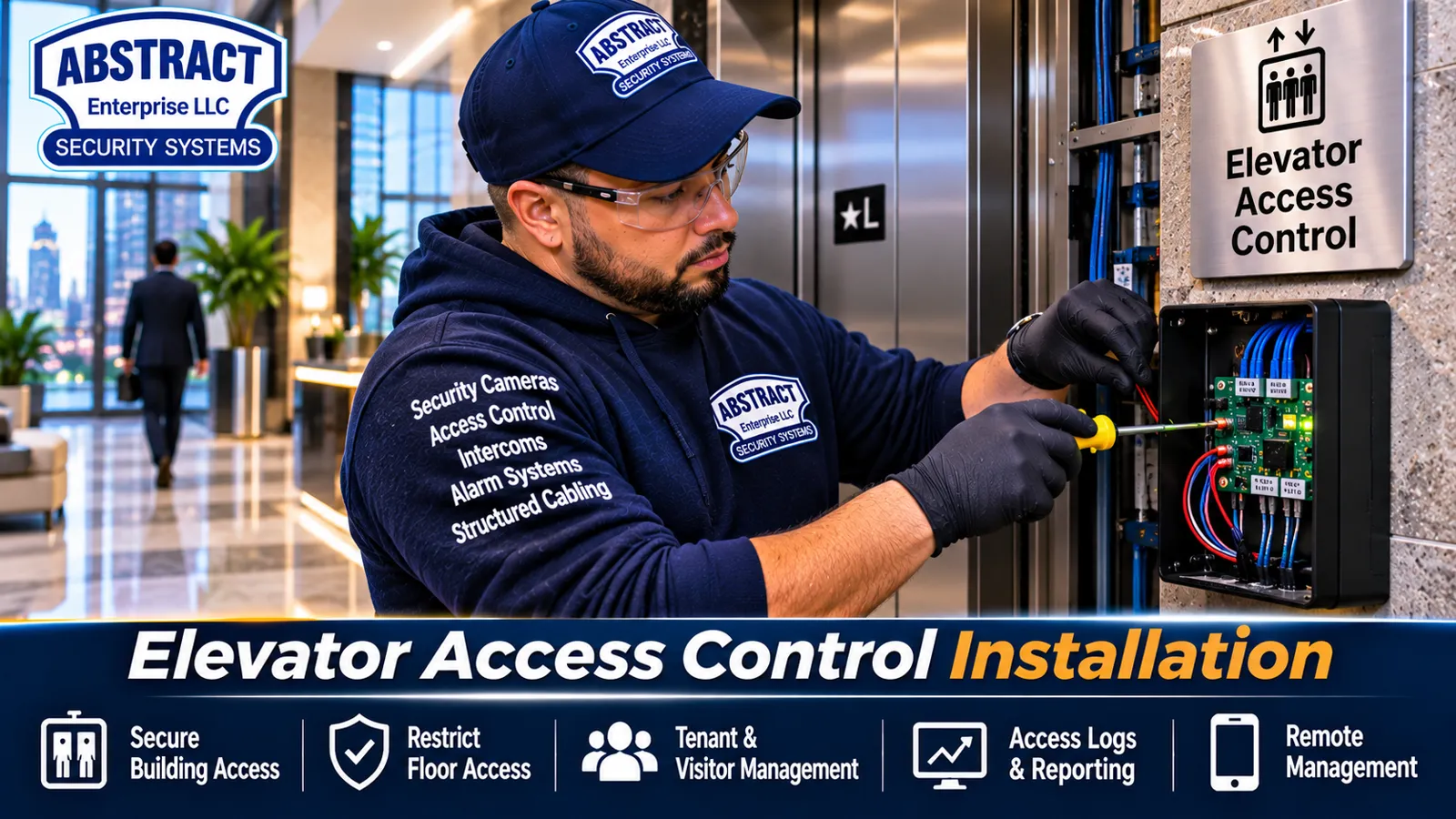
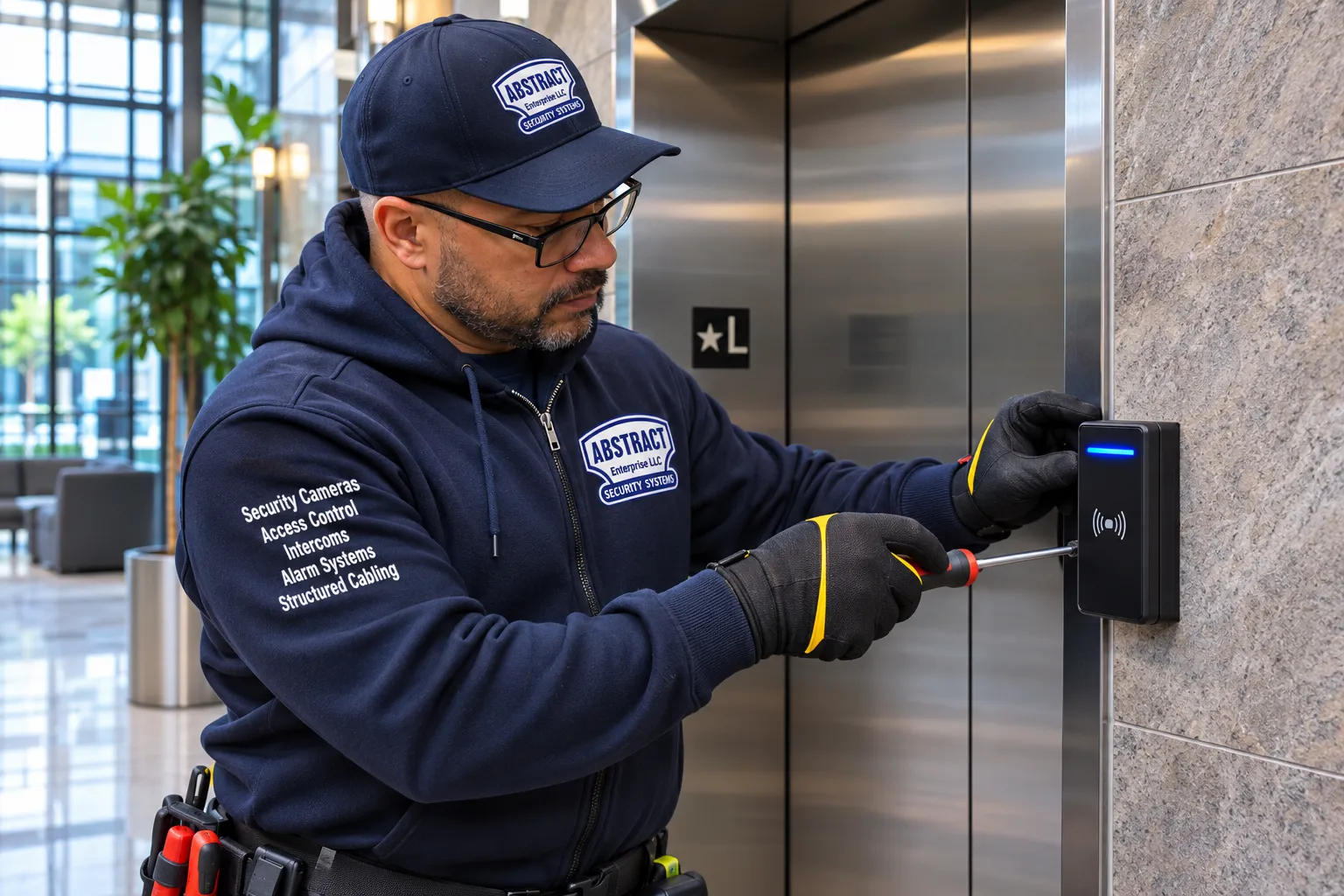
Photo from the Abstract Enterprises Security Systems elevator access control job library (real photos from our own files), not taken in Putnam County: a technician in safety glasses and gloves works with a screwdriver inside an open reader enclosure on a stone wall beside stainless elevator doors, under a banner listing secure building access, floor restriction, visitor management, access logs and remote management. Wiring the reader is low-voltage work; the controller side belongs to the elevator contractor.
Local Code
Code Enforcement Across Putnam's Six Towns and Three Villages
Outside New York City, the State Uniform Fire Prevention and Building Code is administered locally, and Putnam divides that job among its towns and villages. The office that may want to hear about elevator work depends on where the building sits. Our research for other Putnam projects found, for example, that the Town of Carmel's code includes a building construction and fire prevention chapter with fire inspectors; that the Village of Brewster's Code Enforcement Officer administers the Uniform Code and issues certificates of occupancy; that the Village of Cold Spring says projects follow the State code, the Energy Code, the Village Code and its Architectural and Historic District Design Standards; and that Philipstown's code refers to a Code Enforcement Official and a Fire Marshal.
For most elevator access projects the elevator contractor's work is what a local office, or the elevator inspector, is interested in, and it is the elevator contractor who knows what that municipality expects for a change at the controller. Our part is low-voltage work that we carry out under our state license. Where a building is in a village historic district, such as Cold Spring's, anything visible from outside may need review, but readers inside a car or a lobby rarely do. On every Putnam project we confirm with the elevator contractor and, where there is doubt, with the town or village building department before work starts, and we do not guess on your behalf.
Town of Carmel (including Mahopac and the hamlet of Carmel): Building Department and fire inspectors under the town code.
Village of Brewster: Code Enforcement Officer under the Uniform Code; the surrounding Town of Southeast has its own building department.
Village of Cold Spring and Village of Nelsonville: village building departments, with Cold Spring's historic district design standards; the surrounding Town of Philipstown (including Garrison) has its own Code Enforcement Official.
Towns of Kent, Patterson and Putnam Valley: each administers its own code enforcement; Patterson's code, for example, names a Town Fire Inspector and a Code Enforcement Officer.
One more point that city-based companies sometimes get wrong: New York City's Local Law 63 of 2021, the tenant data privacy law that regulates smart access systems in residential buildings in the five boroughs, does not apply in Putnam County. Nor do NYC Department of Buildings bulletins. We still recommend that any Putnam building using fobs, phones or face readers on the elevator adopts a short written policy on what the system records, who can see it and how long it is kept, because residents ask and boards should have an answer.
When Things Fail
Fire Recall, Generator Power and Equipment Faults: Deciding the Failure Mode Before Anything Is Wired
The most important decisions are about what happens when something goes wrong. We write them into every Putnam proposal as plain sentences the board signs off on.
Fire alarm and firefighters' service
When a building's fire alarm recalls the elevator, or a firefighter turns the recall key, the elevator follows its own firefighters' emergency operation. Regulators and the elevator code treat add-on devices in the car and at hall stations the same way: they must not impede normal or emergency operation and must not have any effect while the elevator is on firefighters' service. NYC's Buildings Bulletin 2022-010 says this in so many words; it is New York City guidance, not Putnam law, but it states the principle the elevator code applies everywhere. Our outputs are arranged so the car ignores our system during recall, and we test that with the elevator contractor before the job is closed out.
Fail-safe or fail-secure
If our panel loses power or stops working, the elevator buttons can either all become free to use (fail-safe) or stay locked except for the lobby (fail-secure). In a senior building where residents depend on the elevator, fail-safe is almost always the right choice: a few hours of unrestricted riding is far better than residents unable to get home. In a building where a particular floor holds records or medications, the board might choose fail-secure for that floor only. Either way, it is a written decision, and the building's staff know how to put the car into independent or attendant service if they need to.
Outages and generators
Our panel's battery carries it through a short outage without any change. For longer outages, what matters is what the elevator does: some buildings' elevators run on generator power, some only lower to the lobby and open, and some stop. Where a generator powers the elevator, we ask the building's electrician to place our panel on the same emergency circuit, so access control and the elevator come back together. We test what happens when power returns either way.
Reader faults and communication failures
A reader can be damaged, a cable can be cut during unrelated renovation work, a panel can lose its network connection. An elevator access control communication failure between the reader and the panel should never strand a resident. Part of fail-safe design is an elevator access control emergency override that trusted staff can use, an alert to the manager when a reader or panel stops reporting (where the building has a connection), and a short written procedure that tells staff what to do and whom to call. The most common cause of an elevator card reader not working is mundane: a loose connection, a failed power supply or a battery at the end of its life.
Photo from the Abstract Enterprises Security Systems elevator access control job library (real photos from our own files), not taken in Putnam County: a technician terminates colored conductors on the circuit board of an opened reader. Loose terminations and failed power supplies are among the most common reasons an elevator reader stops responding.
Credentials
Choosing Credentials for Riders Who Are Mostly Over Sixty
In much of Putnam's elevator stock, most riders are older adults. That changes which credential is the right one. A system can support several at once, and in senior buildings we usually recommend at least two, so that nobody is ever left depending on a single thing they might lose, forget or fail to charge.
Credential
Strengths in a Putnam building
Watch out for
Key fob (proximity or encrypted smart fob)
Familiar, sturdy, lives on the key ring, works with one easy motion. The usual choice for senior and 55+ buildings.
Old 125 kHz proximity fobs are unencrypted; for new systems we recommend encrypted smart credentials. Lost fobs must be cancelled promptly.
Card
Good for staff who already carry a badge, and for office and county buildings.
Cards are easier to lose than fobs for residents who do not carry a wallet everywhere.
PIN code on a keypad
Nothing to carry; suits a LULA in a church or library, and works as a backup to a fob.
Shared codes spread. Each person should have their own code, and codes should change when staff leave.
Phone (Bluetooth or NFC mobile credential)
Convenient for younger owners, staff and managers; credentials can be issued and cancelled remotely.
Not every resident has or wants a smartphone; batteries die. Always pair with a fob or PIN option.
Face, fingerprint or iris (Level 2 biometrics)
Nothing to lose or share; useful for staff-only floors and buildings where fobs keep going missing.
Needs a clear written policy on stored biometric data; some residents prefer not to enroll, so keep a fob option.
Intercom floor release
Visitors are let up by the resident they are visiting, to that resident's floor only, without a credential of their own.
Needs an intercom that can trigger the elevator output; we check this on the survey.
Card and fob technology matters more than most boards expect. Many existing buildings still use older 125 kHz proximity fobs at the front door, a technology that carries no encryption. When we install elevator RFID readers in a building with older fobs, we often specify an elevator multi-technology card reader that reads the old fobs during a changeover and the newer encrypted credentials afterward, so residents are not all re-issued on one day.
Whatever the credential, enrollment day matters. We hand out and test credentials in person with residents who want help, in the community room where possible, with large-print instructions. For aides, nurses and regular family visitors, the building issues their own time-limited credentials rather than lending a resident's fob, which keeps the event log honest and lets access end when the visits do.
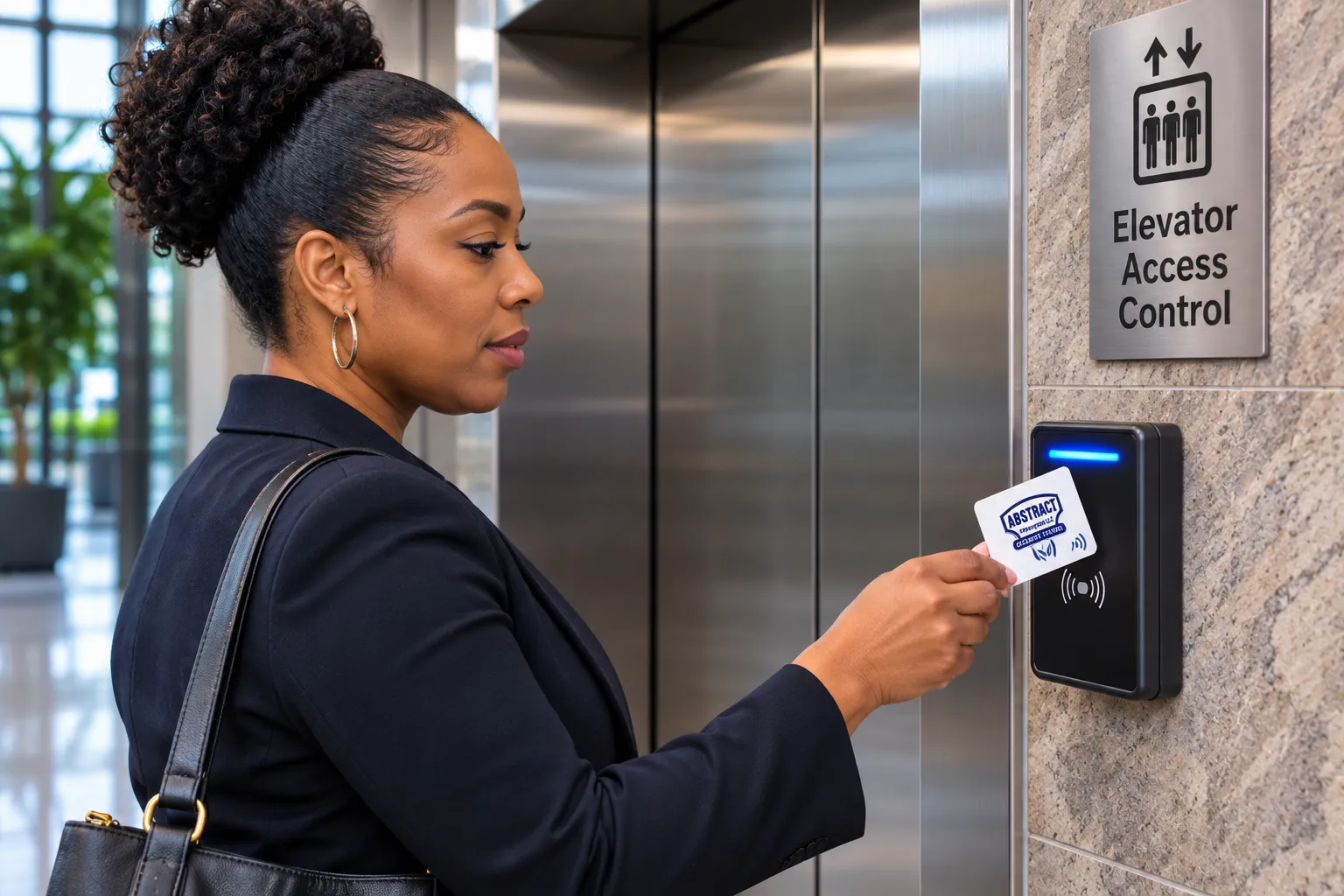
Photo from the Abstract Enterprises Security Systems elevator access control job library (real photos from our own files), not taken in Putnam County: a woman with a shoulder bag holds a card up to a reader mounted beside elevator doors. In a Putnam senior building the same credential residents use at the front door can usually be enrolled to enable the car.
Our Installation Sequence
How We Install Elevator Access Control in a Putnam Building, in Eight Steps
The sequence below is the same whether the building is a two-stop senior complex or a multi-car condominium. What changes is the number of readers, relays and cars, and how much coordination the elevator contractor's visit needs. Knowing the order helps a board plan notices to residents and the manager's time.
Tell us about the building. Call or use the form with the town or village, the address, the number of floors and elevator cars, any garage, deck or lower-level landing, your current fob or intercom system, your elevator maintenance company, and whether the machine room has internet. A photo of the car's button panel helps.
Book the survey for a set day. We book a survey visit for a day that suits your manager, with a 2-hour arrival window. On site we look at the car, the landings, the machine room, power, any generator and the existing door and intercom equipment.
Check the controller with your elevator contractor. Your elevator maintenance company confirms the controller type, spare inputs and traveling-cable pairs, either on the survey or from their records, and tells us where a contact can safely be added.
Receive a proposal with every line priced. Our proposal separates our readers, panel, relays, cable and programming from the elevator contractor's connection visit, any network line and any electrical circuit, and states the failure mode for the board to approve.
Schedule both trades. After approval and the deposit, we order equipment and set dates with the elevator contractor, ideally alongside a routine maintenance visit, and give the building a schedule for residents.
Install our side. We mount readers or stations, install the panel, power supply, battery and relay or I/O board, run and label the low-voltage cable, and set up the software, schedules and permission groups.
Connect and test with the elevator contractor. The licensed elevator contractor or lift technician connects our outputs to the controller. Together we test every reader and floor, the failure mode, the staff override and firefighters' service.
Enroll riders and hand over. We enroll residents, staff and approved visitors, help anyone who wants it on enrollment day, train at least two administrators, and leave a labeled drawing, a fault procedure and spare credentials.
For a typical single-car Putnam building at Level 1, the on-site work on our side is short; most of the calendar is taken up by ordering equipment and lining up the elevator contractor's visit. Multi-car and Level 3 floor restriction jobs take longer on site because every floor output has to be wired, labeled and tested in every car. We give you a written schedule with the proposal so residents can be told in advance when the car may briefly be out of service.
What you have when we leave
Two trained administrators at the building or management company, with their own logins
A credential list matched to current residents, staff and approved visitors, with any old credentials removed
A written failure-mode decision, signed by the board, and a one-page staff procedure for faults
A labeled drawing of the panel, relays, cable and the elevator contractor's connection points
Spare credentials kept at the building, and a record of the panel's battery date
Photo from the Abstract Enterprises Security Systems elevator access control job library (real photos from our own files), not taken in Putnam County: a technician tightens a screw on a black card reader beside elevator doors. Mounting height and position are checked with residents who use wheelchairs or walkers in mind.
The Site Visit
What the Putnam Survey Visit Actually Looks At
An elevator access control consultation in Putnam is a site visit, not a phone estimate, because two buildings that look alike from the parking lot can need very different work once you see the machine room. This is what we check and why.
We check
Because
Number of cars, stops and any garage, lower-level or community-room landing
Sets the number of readers and, for Level 3, the number of relay outputs.
Type of elevator, controller age and maker (with your elevator contractor)
Decides where and how a contact can be added, and whether the controller has spare inputs.
Traveling cable spare pairs
A reader in the car needs a path for power and data from the machine room.
Car operating panel and cab finishes
Shows where a reader can be mounted, at what height, and whether the cab surface allows it.
Machine room or closet: space, temperature, power, internet
Where our panel lives, and whether remote management needs a new network line or cellular link.
Generator and emergency circuits
Whether our panel can share the elevator's emergency power.
Existing door access, fobs and intercom
Whether residents can keep one credential and whether the intercom can release a floor.
Who rides, and who manages
Residents, aides, staff, owners away for the season; who will add and cancel credentials.
Bring us the name of your elevator maintenance company and a photo of the car's button panel before the visit, and if you can, a contact for the person who manages the building's internet. With those, one well-planned visit is usually enough to write a proposal with a price on every line.
Pricing
Elevator Access Control Pricing in Putnam County, Per Car and Per Level
Our elevator access control system pricing is set per elevator car and by level, so that a board can estimate its starting point before the survey. These are the Putnam County starting prices for our side of the work.
Level
What it covers
Putnam County starting price
Level 1: fob, card, PIN, phone or intercom/keypad station
A reader or station that enables the car for valid credentials; once enabled the rider can choose any floor the car serves. Includes our panel, power supply, battery, interface relay, cable, enrollment, programming and usually remote programming where the building has a connection.
From $2,175 per elevator car
Level 2: biometrics
The same car-enable design with a face recognition, fingerprint or iris reader.
From $3,625 per elevator car
Level 3: floor-by-floor and building-wide control
Floor-by-floor restriction, hall-call readers, time schedules, intercom floor release, destination dispatch integration and multi-building permission groups.
Quoted per building after the survey
Worked examples for Putnam buildings
A two-story senior building with one car where residents' fobs should enable the elevator: Level 1, from $2,175 for our side, plus the elevator contractor's connection visit.
A 55+ community with two residential buildings, one car each, with Level 1 in both: from $4,350 for our side (2 cars × $2,175), with one credential list for both buildings.
The same two cars with face readers for staff and fobs for residents: Level 2 from $7,250 (2 cars × $3,625); a building can also mix levels car by car.
A condominium that wants each owner limited to their own floor and a reader at the parking-deck landing: Level 3, quoted after the survey, because the price depends on the number of floors, cars and landings controlled.
What sits outside our price
The elevator contractor's connection visit. The building arranges and pays its NYS-licensed elevator contractor (or lift technician) directly for connecting our outputs at the controller and for testing fire service.
A network connection or new cable run to the car or machine room, if remote management needs one. We price it as its own line after the survey.
Electrical work to provide a circuit for our panel, by the building's electrician unless agreed otherwise.
When comparing quotes, ask each contractor to separate those items the same way. A quote that looks cheaper because it leaves out the elevator contractor's part, or that quietly assumes the security company will work inside the controller, is not comparable. Full terms — including 50% deposit, one-year parts-only warranty on Abstract Enterprises Security Systems-supplied products, and the late-fee schedule — are set out in the service agreement.
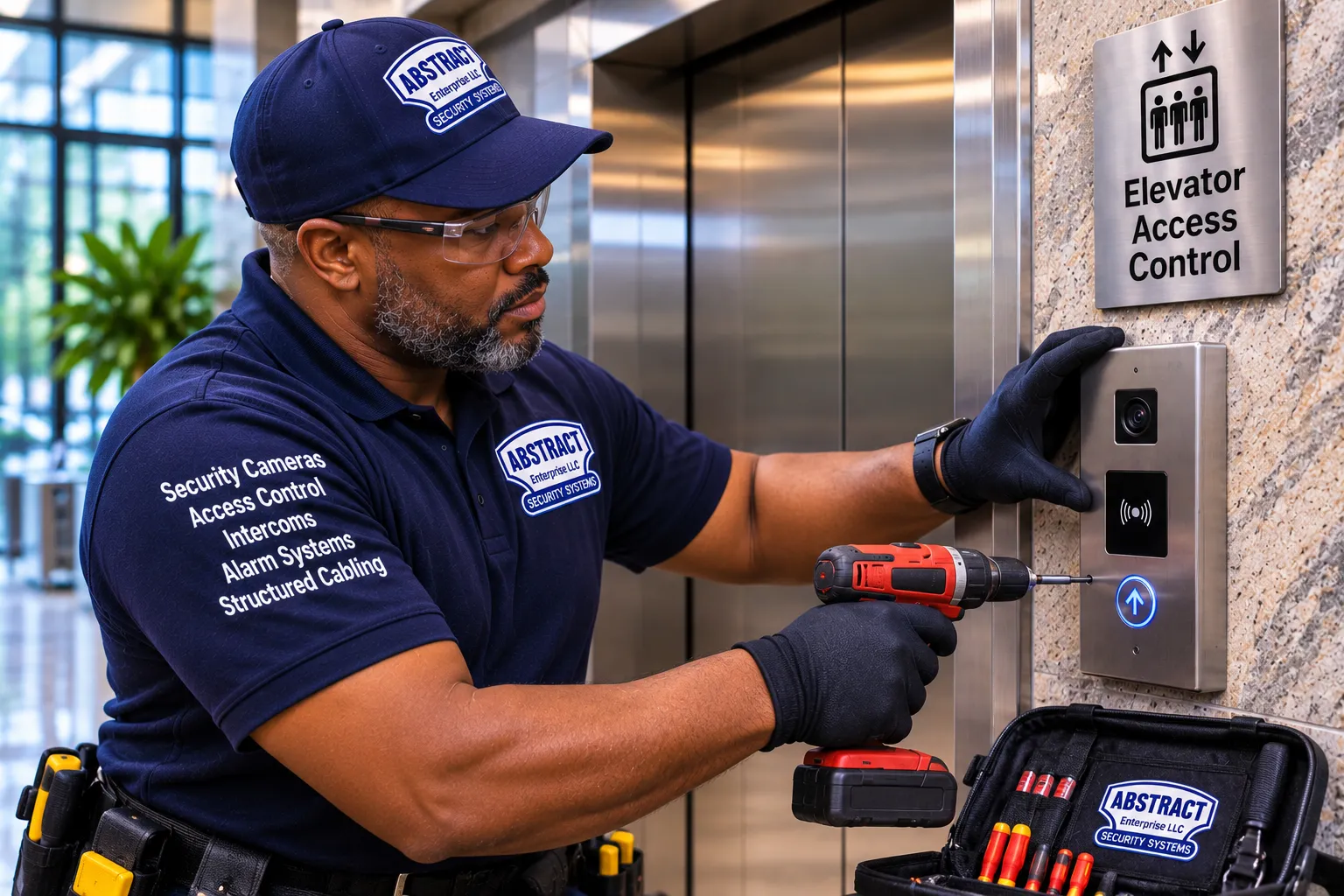
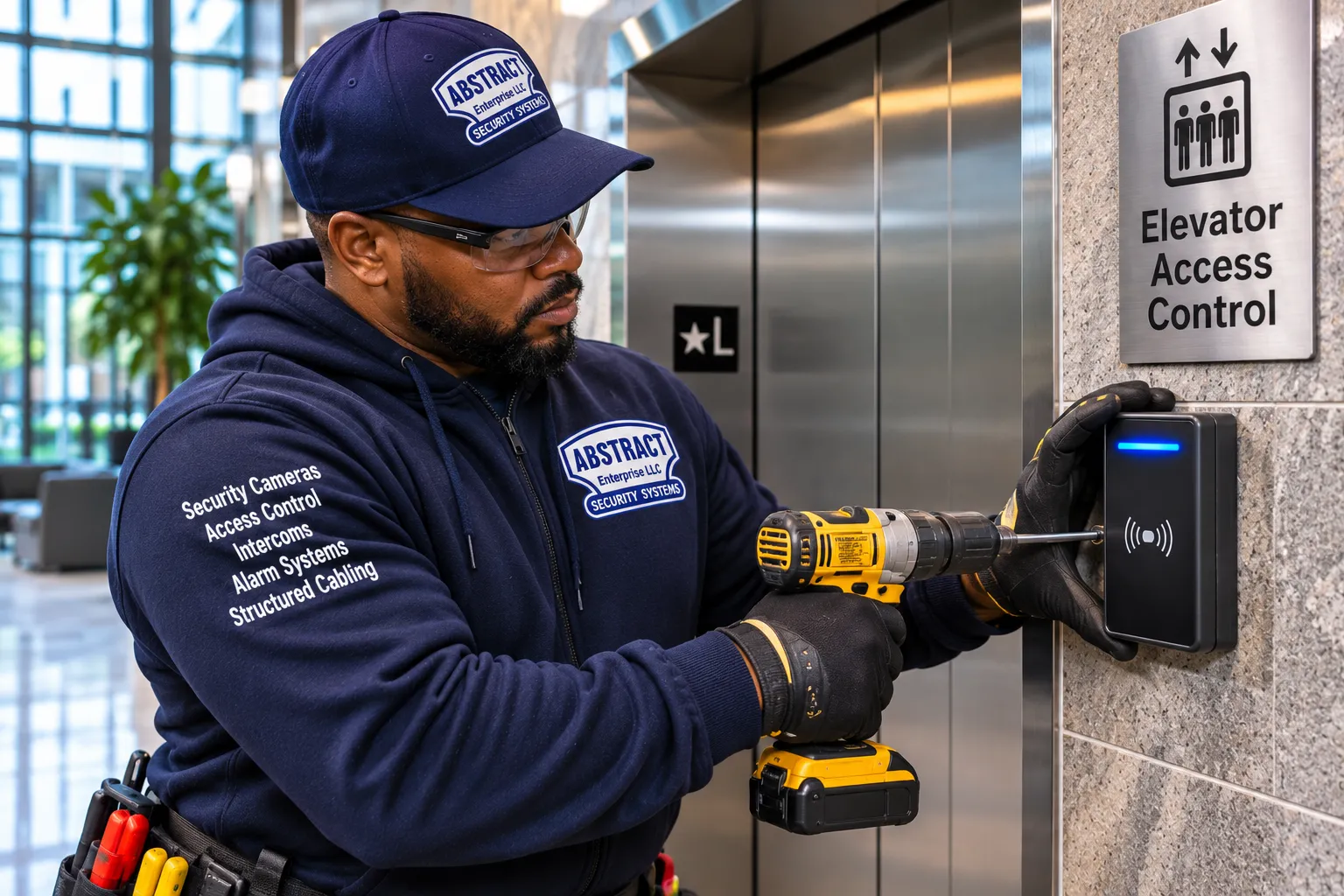
Photo from the Abstract Enterprises Security Systems elevator access control job library (real photos from our own files), not taken in Putnam County: a technician in a navy hoodie, safety glasses and gloves uses a yellow cordless drill to fasten a black reader to a granite wall beside elevator doors and a sign reading Elevator Access Control. A landing reader like this is how a parking-deck or lower-level call button is put on credentials.
Levels Compared
Matching Level 1, Level 2 or Level 3 to a Low-Rise Putnam Building
Level 1
Level 2
Level 3
Decision it makes
Whether the car runs for this rider
Whether the car runs, using a face, finger or iris
Which floors, landings and hours this rider may use
Typical Putnam fit
Two- and three-story senior buildings, small apartment buildings, LULAs
Staff-only cars, buildings where fobs keep disappearing
Condominiums with private floors, medical and municipal buildings, multi-tenant offices
Credentials
Fob, card, PIN, phone, intercom
Face, fingerprint, iris (plus a fob option)
Any of the above, by permission group
Starting price in Putnam
From $2,175 per car
From $3,625 per car
Quoted after survey
Elevator contractor's connection
One car-enable point per car
One car-enable point per car
One point per controlled floor per car, plus landings
Can be upgraded later
Yes, to Level 2 readers or Level 3 floors
Yes, to Level 3 floors
Floors can be added as needs change
Two practical rules come from that table. In a two-stop building, Level 3 adds almost nothing, because there is only one upper floor to restrict; Level 1 or 2 is the whole answer. In a building of three or more stops where different people need different floors, Level 3 is worth the extra relays, but only on the floors that genuinely need it. Restricting every floor because it is possible makes the system harder to live with and more expensive to install and maintain.
Upgrades and Repairs
Retiring a Key Switch, a Shared Code or an Orphaned Reader in a Putnam Elevator
Many Putnam buildings already have some form of elevator control, usually one of three: a key switch in the car or at a landing, a keypad with a code everyone knows, or a card or fob reader put in years ago by a company that no longer answers the phone. Each one can be replaced or rescued, and an elevator access control retrofit is often simpler than a first installation because the elevator contractor has already provided a connection point once.
Key switches
A key switch is, electrically, a simple contact. In many cases our reader's output can take its place at the same point, so the controller sees the same signal it always did, now triggered by a credential instead of a key. The elevator contractor confirms that and makes the change at the controller end. The building keeps an emergency key procedure for its staff, and every resident gets an individual fob that can be cancelled.
Shared keypad codes
A single elevator keypad code works until the day it does not, usually because it has spread far beyond the people it was meant for. Replacing the keypad with one that supports individual codes, or with a fob reader, is a modest elevator keypad installation or replacement. Where the keypad hardware is sound, sometimes the controller behind it can be upgraded instead so the same keypad supports individual codes.
A reader that has stopped working, or a system nobody supports
When an elevator card reader is not working, an elevator key fob is not working or the whole elevator access control system is not working, the cause is usually one of a short list: power supply or battery failure, a cable damaged during other work, a failed reader, a panel that lost its programming or its network connection, or a controller-side change made during elevator maintenance. Elevator access control troubleshooting starts on our side with power, the reader, the panel and the event log. If those are healthy and the car still does not respond, we bring in the elevator contractor to check the connection at the controller. We do not touch the controller ourselves, and we tell you plainly which side the fault is on.
Taking over an orphaned system depends on whether its software and credentials can be recovered. If the panel is a mainstream platform and the building has, or can recover, an administrator login, we can often keep the existing readers and fobs and simply take on the service. If not, we replace the panel and reuse what we safely can — often the cable and sometimes the readers — so the building is not paying twice for things that still work. Elevator access control reader replacement, panel repair, relay troubleshooting and elevator access control wiring repair are all part of this kind of rescue.
Platforms
Platforms and Brands We Install, Integrate and Service in Putnam County
There is no single best elevator access control system for every building. The best elevator access control system for a two-story senior complex in Carmel is the one its manager will actually use and that reads the fobs its residents already carry. For a county building it is the one that matches the badge system staff use at the doors. We install, integrate and service a range of platforms and recommend based on fit rather than allegiance to any brand.
Akuvox elevator access control: keypads and stations, with Akuvox elevator control integration from the entry intercom for buildings with no front desk.
HID elevator card reader hardware, multi-technology readers for a changeover from older fobs, and HID elevator mobile access for phone credentials.
Brivo elevator access control and Kisi elevator access control, cloud platforms for managers who run buildings in several towns; Brivo elevator integration uses its own I/O hardware.
ButterflyMX elevator access control integration and 2N elevator access control integration, where those video intercoms already run the front door.
LenelS2, Genetec, Gallagher and ICT Protege elevator access control, usually in larger institutional, medical and government systems.
Suprema and ZKTeco elevator access control hardware for Level 2 face and fingerprint readers.
Paxton elevator access control for small commercial buildings, and Axis elevator access control integration with cameras.
Elevator access control system compatibility is something we check rather than assume: whether your existing fobs can be read, whether the platform supports elevator floor outputs natively or through an I/O module, whether it can work offline, and whether its software is something your manager is comfortable with. We would rather recommend a platform your building already uses than introduce a second one.
Integrations
Tying the Elevator to the Intercom, Door Access, Cameras and Building Systems
Elevator access control is most useful when it is part of the building's security rather than a separate island. In Putnam buildings, four integrations come up most often.
Intercom floor release. A visitor calls an apartment from the entry intercom, the resident answers and lets them in, and the elevator allows that visitor to ride to that resident's floor only, for a short time. This is elevator access control with video intercom: an intercom can unlock elevator floor access for one visitor, and it is the cleanest way to handle family and deliveries without handing out fobs. If your intercom needs work first, our intercom installation in Putnam County team handles the entry side.
Door access on the same credential. Residents and staff should carry one fob for the front door, the side door and the elevator. When the elevator is added to the door system, cancelling a fob cancels it everywhere. See our access control installation in Putnam County for the door side.
Cameras. Elevator access control can integrate with CCTV, letting a manager look at the video for the moment a credential was used, which turns an event log into evidence. Our CCTV installation in Putnam County covers the lobby, entries and parking areas.
Building management and alarms. Larger buildings sometimes want the access system to talk to a building management system or the security alarm: for example, to change elevator schedules when the building is armed at night. Where the platforms support it, we set up that link through their integration or API.
Myths
Five Mistaken Beliefs About Elevator Security in a Rural County
1. "Crime is low here, so the elevator does not need securing."
Putnam's crime numbers are low: New York State's index crime data record 519 index crimes across the whole county in 2024. But most requests we get are not about crime at all. They are about privacy for residents, control of who reaches upper floors, cancelling credentials that have walked out the door, and knowing who rode when something goes wrong. Those needs exist in a quiet village as much as in a city.
2. "The security installer will wire it into the elevator."
Not legally in New York State, and not by us. The controller connection is conveyance work licensed by the Department of Labor, and it is made by your elevator contractor or lift technician. Our part ends at a clean, labeled output that their licensed mechanic connects.
3. "A cloud system will not work out here."
It will, if it is designed properly. A well-chosen platform stores credentials and schedules on the local panel, so the elevator keeps working with no internet at all. The cloud is used for remote management when the connection is up. The mistake is choosing a system that needs the internet to make every decision.
4. "Residents will be trapped if the reader fails."
Only if nobody decided what should happen. Fail-safe operation, a battery, a staff override, firefighters' service that ignores our system and a written fault procedure mean a reader fault becomes a service call, not an emergency.
5. "Older residents will not cope with fobs."
Most do, with a little help on enrollment day and a credential that suits them. For residents who do not, a personal PIN, a large keypad or intercom release from staff covers the gap. The aim is that nobody's independence depends on one small object.
Around the County
From Patterson to Garrison: Where Putnam's Elevators Are and What Usually Fits
Area
Typical elevator buildings (examples from public listings)
What usually fits
Town of Carmel: Carmel hamlet and Mahopac
County Office Building on Gleneida Avenue; Putnam Hospital and nearby medical offices on Stoneleigh Avenue; senior buildings on Gleneida Court, Hillcrest Commons and Hughson Commons; the 170 Route 6 senior building in Mahopac; Overlook on Route 6 under construction
Level 1 in senior buildings; schedules and staff floors in medical and county buildings; new-build planning for Route 6 projects
Village of Brewster and Town of Southeast
50 Main Street senior apartments; mixed-use buildings on Main Street near the Metro-North station; Stonecrest senior community; approved 60-unit senior building at 1534 Route 22; office and warehouse projects in Southeast
Car-enable for residential floors over shops; one credential across Stonecrest-style multi-building sites; planning for Route 22 new construction
Philipstown: Cold Spring, Nelsonville and Garrison
Butterfield condominiums in two elevator buildings with a parking deck; small public and institutional buildings, some with LULAs or platform lifts
Floor-by-floor control and a parking-deck hall-call reader for condominiums; keypads or readers for lifts; attention to historic-district rules for anything visible outside
Town of Patterson
Commercial buildings on Route 22 and Route 311; a concept for three-story buildings with apartments over retail on Front Street; a proposed four-story hotel
Car-enable for apartments over retail; hotel guest floor access control if the hotel goes ahead
Town of Kent, including Lake Carmel
Mostly houses; small commercial and community buildings along Route 52 and Route 311
Readers or keypads for any LULA or small elevator; strong offline design given the distances
Town of Putnam Valley
Mostly houses; community and recreational buildings such as the YMCA campus on Peekskill Hollow Road listed for renovation
Small-elevator and lift control, scheduled to public hours
The pattern is clear: Putnam's elevators cluster in Carmel, Mahopac, Brewster and Cold Spring, with a scattering elsewhere. Our scheduling reflects that. We group survey visits and installations so that a building in Kent or Putnam Valley gets a proper booked appointment rather than a technician who has to rush back to another job.
Hiring a Contractor
Questions to Put to Any Elevator Access Contractor Before You Sign
Whether you hire us or another elevator access control installation contractor, these are the questions that separate a good one from one who will leave you with a problem. If you are searching for an elevator access control installer near me in Putnam, take this list to every company you speak to.
Who makes the connection at the elevator controller, and do they hold a New York State Department of Labor elevator contractor license? (It should be your elevator contractor, and yes.)
Does your written proposal separate your work, the elevator contractor's work, any network line and any electrical work, with a price on each line?
What is your own license number? (Ours is NYS #12000287431.)
Will the system keep working with no internet connection? What happens to it during a power cut and on generator power?
What is the failure mode, fail-safe or fail-secure, and will you put it in writing for the board?
How will the system behave during firefighters' service, and will you test it with the elevator contractor before handover?
Can our residents keep the fobs they already use at the front door? If not, why not?
What does the warranty cover, and what does a service call cost after it ends?
Why Us
Why Putnam Boards and Managers Bring Their Elevators to Abstract Enterprises Security Systems
Security work since 2002. Abstract Enterprises Security Systems is owner-operated and has completed thousands of jobs across New York City, Long Island and the Hudson Valley, rated 4.7★ from 201 Google Reviews.
Honest about the line between trades. We do the low-voltage access control side and say so. Your elevator contractor does the controller side, and our proposals show it.
Designed for Putnam's conditions. Systems that work offline, survive outages and can be run from a manager's office in another town.
One contractor for the whole entry. Elevator readers, door access, intercom and cameras can all be handled by one company, so they share credentials and nobody blames another vendor.
Published starting prices. From $2,175 per car at Level 1 and $3,625 per car at Level 2 in Putnam, with Level 3 quoted after a survey.
Booked appointments. Survey and installation visits are booked ahead with a 2-hour arrival window. We do not promise same-day visits in Putnam, and we would rather arrive prepared.
We are an elevator access control low voltage contractor and system integrator, and on larger projects an elevator access control subcontractor to a general contractor or the elevator company itself. In every role, our scope is the same: the access control side, done properly, coordinated with the people who look after the elevator.
Plain Words
A Short Glossary for Putnam Boards, Owners and Building Managers
Term
What it means in practice
Car enable
A reader in the car that wakes the floor buttons for a few seconds after a valid credential; the rider then chooses any floor.
Floor-by-floor access control
Each controlled floor button is locked unless the rider's credential includes that floor. Also called floor lockout or restricted floor access.
Hall-call reader
A reader beside the call button at a landing, so the car cannot be called there without a credential.
Floor enable relay / relay output
The switch our panel opens or closes for each controlled floor; the elevator contractor connects it to the controller.
I/O module or interface board
A board that provides many relay or input/output points in one unit; used when a building restricts several floors.
LULA
Limited use/limited application elevator: a small, low-rise elevator common in churches, small offices and public buildings.
Firefighters' emergency operation (Phase I / Phase II)
The elevator's fire service modes: recall to the designated floor and in-car operation by firefighters. Our system has no effect during them.
Fail-safe / fail-secure
Whether elevator buttons become free (fail-safe) or stay locked (fail-secure) if the access system loses power or fails.
Permission group
A named set of floors and hours, such as "Residents, 2nd floor" or "Aides, weekdays", assigned to credentials instead of setting each person up from scratch.
Anti-passback
A rule that stops one credential being used twice in a row at the same reader within a set time, which discourages passing a fob back to a friend.
Audit trail / event log
The record of every credential used, granted or denied, with date and time.
FAQ
Putnam County Elevator Access Control FAQ
Our building has a LULA elevator rather than a full-size passenger car. Can it take a card reader?
+
Usually, yes. A LULA (limited use/limited application) elevator has a controller and call stations just like a larger elevator, and many are fitted with key switches that a reader or keypad can replace. We supply and mount the reader or keypad, run the low-voltage cable and program the credentials; the connection at the LULA controller is made by the licensed elevator mechanic or accessibility lift technician who services it, because that is conveyance work under New York's Labor Law Article 33. Before the survey we ask for the make of the unit, the name of the company that maintains it and photos of the call stations and the car controls. For a LULA in a church, library or town building, a schedule often works well: free to use during public hours and credential-only at other times, with codes or fobs for staff and the people who rely on it.
Our small Putnam building has a hydraulic elevator. Does a hydraulic car change how the reader is connected?
+
Not in principle. Whether the elevator is hydraulic or traction, its controller has inputs for the car and hall buttons, and our system adds a relay or dry-contact output that the elevator contractor connects so a button only registers when our panel allows it. What differs from building to building is the controller's age and design, whether it has spare inputs, and whether the traveling cable to the car has spare pairs for a car-mounted reader. Older relay-logic controllers sometimes need a different connection method from newer microprocessor controllers, and the elevator contractor decides that. Hydraulic machine rooms are often small rooms next to the shaft at the lowest level, so we also check space, temperature and moisture for our panel. None of this changes our Putnam starting price for Level 1 or Level 2; it can change the elevator contractor's part of the work.
The machine room in our Putnam building has no internet. Can the elevator credentials still be managed from the office?
+
Yes, there are two good ways to do it. The first is to give the panel a connection: a network cable run from the building's internet service or a small cellular modem, which we price as its own line after the survey because it sits outside our per-car price. With that in place, your manager can add and cancel credentials, change schedules and read the event log from a browser or app anywhere. The second is a panel that stores credentials and schedules locally and does not need the internet to make decisions, with changes made on site or during a scheduled connection. Many buildings use both, so the elevator keeps working through an internet outage and still gets remote management when the line is up. What we avoid is a system that cannot decide whether to let a resident ride without reaching a server somewhere else.
Will a reader installed in the car interfere with the elevator's emergency phone?
+
No. The car's two-way emergency communication is required by the elevator code, ASME A17.1 section 2.27.1, and it belongs to the elevator and its monitoring service, not to the access control system. We do not wire into it, power our equipment from it or mount anything that blocks it. When we choose where a reader goes in the car operating panel or on the cab wall, we keep clear of the phone button, its speaker and any screen or camera the emergency communication system uses, and we follow the elevator contractor's guidance on what can be fixed to the cab. If your building is planning to upgrade the emergency phone to a system with video or text messaging, tell us during the survey so the two projects do not compete for the same space or the same spare cable pairs to the car.
Who supplies the electrical circuit that powers the elevator access panel?
+
Normally the building's electrician. Our panel needs a reliable 120-volt circuit near where it will be mounted, usually in or beside the machine room. We specify what is needed during the survey, and we prefer a dedicated circuit so that other equipment on the same circuit cannot trip it. Where the building has a generator that powers the elevator, we ask for the panel to be on the same emergency circuit, so access control and the elevator come back together after an outage. Remember that New York's elevator licensing law reserves running power lines from the mainline to the elevator itself to licensed elevator mechanics; our panel's circuit is separate from that and is ordinary building electrical work. If an electrician is not available, tell us and we can discuss options, but we will always put the arrangement in writing in the proposal so nothing is left between trades.
Can one floor in our Putnam County building require a PIN code on top of a fob?
+
Yes. Many readers support two-factor operation, where a fob or card must be followed by a personal PIN, and the requirement can be set for particular floors, readers or times. A common Putnam example is a professional or municipal building where most floors need only a badge but a records floor, a pharmacy store room or a server room needs badge plus PIN. In an elevator, two-factor control is usually set up at Level 3, with the floor's relay output released only after both checks pass, so that a lost or borrowed badge on its own does not open the sensitive floor. Face or fingerprint readers at Level 2 can play the same role without a PIN to remember. We recommend keeping two-factor for the few floors that genuinely need it; asking every resident for a PIN on every ride makes a system harder to live with.
Does a phone credential work inside a steel elevator car where there is no cell signal?
+
With the mobile credential systems we normally recommend, yes. The phone talks to the reader directly over Bluetooth or NFC, using a credential already stored on the phone, so the moment of entry does not depend on cell coverage or Wi-Fi inside the car. The phone needs a connection only when the credential is first issued or changed, and that happens wherever the resident is. That matters in Putnam, where coverage gaps have been documented for years and steel elevator cars weaken any signal further. Some systems do rely on a live connection or on the phone opening an app, so we check this for the specific platform before recommending it. And because batteries run flat and not every resident uses a smartphone, we always keep a fob, card or PIN available alongside phone credentials.
Our condominium has owners who leave for the winter. Can their elevator access be paused and switched back on in spring?
+
Yes. Most platforms let an administrator suspend a credential without deleting it, or give it start and end dates, so an owner's fob simply stops working while they are away and starts working again on the date they return. That is useful in a 55+ condominium where some owners spend months elsewhere, because a fob left in a drawer, lent to a relative or lost while traveling cannot be used to ride to their floor in the meantime. Owners who want a house-sitter, family member or contractor to check on their unit can have that person issued a separate, time-limited credential limited to their floor, which keeps the event log clear about who was in the building. On a cloud-managed system the manager can do all of this from wherever they are; on a locally managed panel, it is set up on site before the owner leaves.
Which costs sit outside the Putnam County per-car price, and who pays them?
+
Three items. First, the elevator contractor's visit to connect our outputs at the controller and to test fire service with us; the building arranges and pays its New York State-licensed elevator contractor or lift technician for that directly. Second, a network connection or new cable run to the car or machine room, if remote management needs one; we price that as its own line after the survey. Third, the electrical circuit for our panel, usually provided by the building's electrician. Everything on our side of a Level 1 or Level 2 car is in the per-car price: reader, panel, power supply, battery, interface relay, low-voltage cable, enrollment and programming, from $2,175 per car at Level 1 and $3,625 per car at Level 2 in Putnam. Level 3 floor restriction is quoted per building after the survey, with the same items separated.
Our lower elevator landing opens to an unheated garage. Will a reader there hold up through a Putnam winter?
+
It can, if the reader is chosen for the location. Readers and keypads carry a rated operating temperature range and an ingress rating for dust and moisture; for an unheated garage, parking deck or open lower lobby we specify outdoor-rated hardware rated for the cold, mount it out of the path of snowmelt and road salt splashed from cars, and seal the cable entry. We keep the access panel itself indoors in a conditioned space, never in the garage. Hall-call readers at garage landings are worth the care, because the garage is often the easiest way into a building without passing the front door. We also check that the reader does not interfere with any garage door controls, and we pick a reader whose light and sound are easy to notice in a dim, noisy space.
What routine upkeep does an elevator access system need after it is installed?
+
Light, regular attention rather than major work. Each month someone should review the credential list and remove people who have moved out or finished working at the building, and glance at the event log for repeated denied attempts at one reader. Each year the panel battery should be checked, readers cleaned, the software updated, and the bypass during firefighters' service confirmed again after any elevator maintenance work. Every few years the battery is replaced and the credential technology reviewed. Most of this can be done by a trained manager, and on a connected system much of it can be done remotely. Buildings that would rather not handle it can book scheduled maintenance visits from us, with on-call service in between. The main thing is that someone owns the job; systems fail through neglect far more often than through equipment faults.
Can the access system warn our manager when a reader or controller goes offline?
+
Yes, on platforms that support health monitoring and where the panel has a network or cellular connection. The panel reports regularly, and if a reader stops responding, the panel loses mains power and runs on its battery, or the panel itself stops reporting, the platform sends an alert by email or app notification to the people you choose. For a Putnam manager who looks after buildings in several towns, that often means a problem is known about before a resident calls. We set up the alerts during commissioning, decide with you who receives them, and include a short staff procedure for each kind of alert. On a panel with no connection, alerts are not possible, so we rely on the battery, the fail-safe setting and staff checks instead, which is one more reason to consider a connection when the survey shows it is practical.
Elevator Access Control Across the Rest of New York
Get a Free Elevator Access Control Installation Quote for Your Putnam County Building
Tell us the town or village and the address, how many floors and elevator cars the building has, whether the car stops at a garage, parking deck or lower level, what fob or intercom system you use at the doors now, the name of your elevator maintenance company, and whether the machine room has an internet connection. A photo of the car's button panel helps us plan one well-prepared survey visit. If you would rather talk it through, call (845) 640-3835.
✅
Request Sent!
Thank you. We will call to book your Putnam County elevator access survey, usually within 2 hours of your request.
Decide Who Rides Your Putnam Elevator, Then Let Us Build It
One survey visit, a written proposal that separates our work from your elevator contractor's, and a system your manager can run from wherever they are. Abstract Enterprises Security Systems, NYS license #12000287431.