Uniview cameras for Nassau houses, two-family homes and strip-center shops — village by village, from Valley Stream to Oyster Bay. Nassau line: (516) 346-5778
Capes · Colonials · High Ranches · Two-Family Homes · Strip-Center Shops
Uniview Camera Installation in Nassau County
UNV PoE Recorders and IP Cameras · Village-Aware Set-Up · Commuter-Day Alerts · Storm-Ready Placement
Nassau is three towns, two cities and sixty-four incorporated villages laid over one dense suburb of mid-century houses. Whether a detective from your village department or the county police comes asking for video, whether the house sits empty eleven hours a day while everyone rides the LIRR, whether the shop is one unit in a landlord’s strip center, whether the basement takes water when the bay comes up — those answers shape a Uniview system here more than the camera model does. We wire the recorder, the PoE cameras and the phone access around them.
Page checked October 18, 2026 by Anwar Timothy (NYS license #12000287431). Facts on it were checked against Census housing tables for Nassau County, the county’s home-improvement law and alarm-permit code, the Garden City police camera registry, News 12 reporting on the September 2026 nor’easter, Uniview’s own datasheets and app announcements, and the federal FCC and Commerce Department lists.
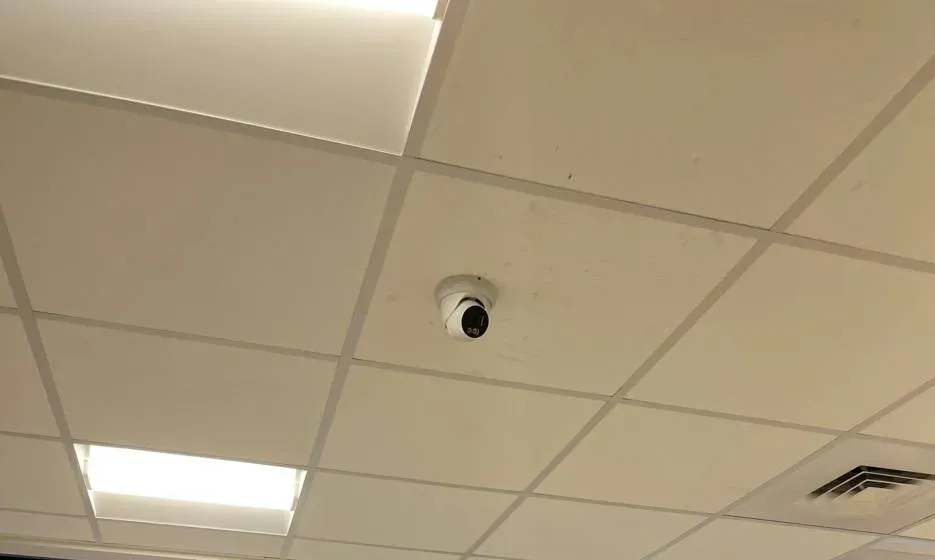
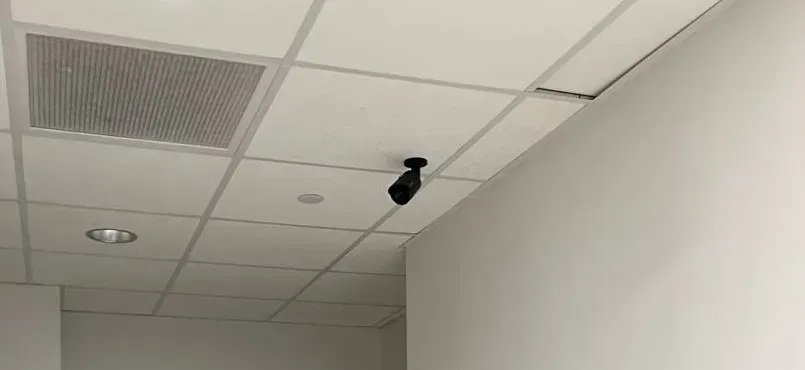
Real AESS job photo from another site, not a Nassau property and not identified as a Uniview model: a white turret camera fixed to a drop-ceiling tile between two lit panels. Inside a Nassau shop or office suite, a turret set in the middle of the ceiling like this sees the room without catching the glare of the lights.
Nassau Uniview Quote
Tell us the village or hamlet, the type of house or shop and how many sides you want covered — we call back the same business day
✅
Request Sent!
A technician will call you back about the Nassau property the same business day.
25+
Years Experience
✓
Same-Day Estimates
100%
Licensed & Insured
4.7★
201 Google Reviews
The fastest Nassau quote starts with four phone photos: the front of the house or storefront from the curb, the back yard or rear door, the spot where your internet modem sits, and the basement or garage wall where a recorder could go. Add the name of your village or hamlet. That is enough for us to tell you how many Uniview cameras the place needs, where the cable will run and what the job costs before anyone visits. Call or text (516) 346-5778.
A price in writing before the visit, using the Nassau figures we publish online
Saturday and early-evening appointments for households that commute into the city
Every job done under NYS low-voltage license #12000287431, insured, with certificates for landlords and property managers
Why Nassau County Properties Need Uniview Camera Installation
Start with the houses. Census figures for Nassau count 477,860 housing units, and 364,529 of them are single-family detached homes — roughly three in four. The median one was built in 1955, and more than 150,000 units date from before 1950. That is the Cape Cod in Levittown and Wantagh, the brick-and-shingle colonial in Garden City and Rockville Centre, the high ranch in Massapequa and Plainview, the Tudor in Great Neck and Manhasset. About 82 percent of occupied homes are owner-occupied, so the person deciding on cameras usually owns the eaves, the attic and the basement where cable has to travel. That makes a properly wired system possible in a way it often is not in a city rental, and it is why a wired Uniview NVR with PoE cameras makes more sense here than a handful of battery cameras stuck to the siding.
Then the map. Nassau is divided among the towns of Hempstead, North Hempstead and Oyster Bay and the cities of Long Beach and Glen Cove, with 64 incorporated villages and more than a hundred unincorporated hamlets inside them. Several villages run their own police departments; the rest of the county is patrolled by the Nassau County Police. That patchwork matters after a break-in. Garden City’s department, for example, runs a voluntary registry where residents and businesses list their address as a place with cameras, so detectives know whom to ask for video — and states plainly that registering gives the police no access to the system itself. A Uniview recorder set up so its clock is right, its channels are named and a clip can be exported in a few minutes is what turns that request into evidence.
Third, the people are away. Nassau is commuter country: one adult is on the Long Island Rail Road before seven and home after dark, the other may be working in Mineola, Lake Success or Manhattan too. In July 2026 the county police announced the arrest of a Pennsylvania man charged with six counts of burglary for entering homes across Nassau between July 2025 and May 2026 and taking jewelry. Daytime and evening break-ins into empty houses are exactly the pattern a camera system has to answer, and the answer is less about recording than about knowing: the right alert on a phone at 2 p.m., and a face recorded clearly enough at the side door to identify someone afterwards.
Finally, the South Shore water and the grid. On the weekend of September 26, 2026 a nor’easter flooded Island Park badly enough that the LIRR suspended the Long Beach Branch from Saturday morning to Sunday night, with crews pumping millions of gallons as the tides kept returning. PSEG Long Island restored nearly 112,000 customers after the same storm and named Oyster Bay among the hardest-hit areas. A recorder on a basement floor in Freeport or a garage slab in Oceanside, with no battery behind it, fails in exactly the hours you most want it working. Where the recorder lives, what it is plugged into and how it recovers afterwards are design choices we make on day one.
Nassau facts that shape a Uniview install
1,388,138 residents, 477,860 homes, 76% single-family detached, median year built 1955 — American Community Survey 2019–2023; attics, crawl spaces and basements are the cable routes, and plaster or wood-panel walls still turn up in pre-war houses.
3 towns, 2 cities, 64 villages — Nassau County; who patrols and who asks for footage changes from one side of a street to the other.
Over 125,000 false alarms a year answered by Nassau County Police, according to the department’s alarm permit section — one reason we set camera alerts to tell people what actually happened before anyone calls 911.
Petit-larceny shoplifting up 27% to 3,819 incidents from 2022 to 2023 in Nassau police data reported by Newsday — storefront cameras need to see the door, the aisle and the register, not just the ceiling.
331 automated plate-reader cameras reported in Nassau as of July 2026, the most of any New York county — public cameras watch the roads, so private ones are most useful right at your door, driveway and stockroom.
September 26–28, 2026 — flooding in Island Park suspended the Long Beach Branch and PSEG reported nearly 112,000 restorations; recorder height and battery backup matter on the South Shore.
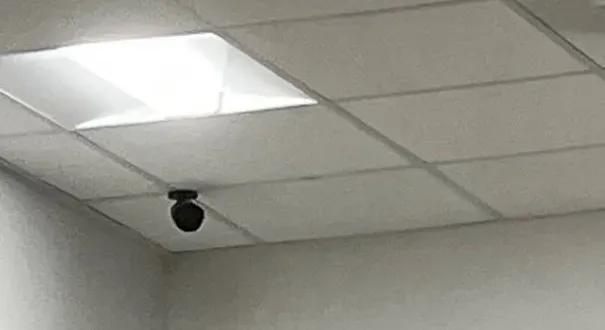
Real AESS job photo from another site: a small black eyeball camera hanging from the drop ceiling near a corner, just below a bright light panel. A corner position looks diagonally across a room, the same trick we use in the back hall of a Nassau high ranch.
Repair
Uniview Cameras Down in Nassau? Same-Day Repair
Some calls can’t wait for a new system: the recorder in the basement is beeping, the app shows every tile black, or the camera over the garage stopped after the last storm. For repairs we book the next open two-hour window, and on most visits the system is recording again within one to two hours of the technician arriving. Call (516) 346-5778 and have the model number from the recorder’s label ready; a photo of the recorder screen saves a trip for the wrong part.
Nassau symptoms and where we look first
What you see
Usual cause on a Nassau house or shop
All cameras black after a storm
Recorder or PoE switch lost power and didn’t restart, a surge took out a PoE port, or water reached equipment on a basement or garage floor.
One outside camera dark, others fine
Wet connector at the camera base, a cable chewed in the attic, or a gutter or ladder that knocked the camera loose.
Cameras fine at home, nothing on the phone at work
New router from the internet provider, a changed Wi-Fi password on the recorder’s network, or an app account that belongs to whoever installed the system.
Recorder alarm beeping in the basement
Hard drive failed or full, or a camera dropping on and off the network.
Night picture washed white
Infrared bouncing off a soffit, storm-door glass or a spider web across the lens.
Didn’t install it yourself, or bought the house with cameras already up? Mixed brands and inherited systems are routine for the camera repair crew in Nassau, and a yearly maintenance check ahead of hurricane season finds the worn drive or the loose bracket while it is still cheap to fix.
What We Install
Uniview Camera Installation Services in Nassau County
Uniview, also sold under the UNV name, makes the recorders, cameras and switches below. Each service is planned as part of one system: a recorder in a dry, powered spot, cameras that see faces and plates where it matters, and phone access that works from the train.
Whole-house PoE systems
A Uniview NVR with built-in PoE ports powering four to eight cameras through single cables, with the front step, driveway, side door and back yard covered on the typical Cape, colonial or high ranch.
Wi-Fi camera replacement
Battery and plug-in Wi-Fi cameras swapped for wired Uniview cameras on the same mounting spots where possible, so nothing needs charging and nothing depends on the household Wi-Fi staying up.
Two-family and accessory-apartment set-ups
One recorder, two households: each entrance assigned to the right people in the app, so the upstairs owner and the downstairs tenant or parent each see what belongs to them.
Strip-center storefronts
Door, register, aisle and stockroom cameras for a single unit on Hempstead Turnpike, Sunrise Highway or a village main street, with the landlord’s permission for anything mounted outside the lease line.
Cameras with an existing alarm
Uniview cameras placed to show what tripped the alarm, so the person getting the alarm call can look before deciding what to tell the central station or police.
South Shore and raised houses
Recorder and switch mounted above the flood line on raised homes in Island Park, Freeport, Oceanside and Long Beach, with stainless hardware and sealed connections on the outside.
Commuter-day alerts
Person and vehicle detection zones drawn on each camera and schedules set so the phone buzzes for a person at the back door at 1 p.m., not for every car on the street.
Old DVR replacement
Coax systems from the 2000s replaced with network cameras, or reused for a while with a Uniview hybrid recorder where the old cable is sound and the budget is tight.
App and account hand-over
Every system ends with the owner holding the admin password and the cloud account, current firmware, and the app set up on each phone. Uniview has said its UNV-Link app replaces EZView, expected to stop service in 2027, so new systems go on UNV-Link.
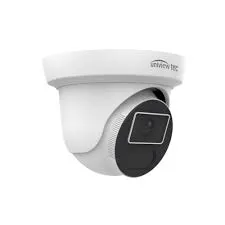
Manufacturer product photo, not an installed unit and not a specific model number: a white turret camera with the uniview tec name on the housing and a black lens face. Turrets of this shape are the everyday camera on Nassau doors and driveways.
Building Specialists
Uniview Camera Installation for Nassau County’s Architecture
Nassau’s houses were built in waves, and each wave hides cable differently. These are the types we see most and how a Uniview system goes into each one.
Post-war Capes and ranches
Levittown, Hicksville, Wantagh, Bethpage and East Meadow. Low eaves, short attics with little headroom, often a finished expansion upstairs. Cameras mount on the gable ends and over the front door; cable goes through the attic eave or the crawl space, never stapled across the siding.
High ranches and split-levels
Massapequa, Plainview, Syosset, Merrick. The garage sits under bedrooms, and the lower level is half below grade. The recorder usually goes in a utility room off the garage at shelf height, and cameras on the upper level are fed through the attic.
Village colonials and Tudors
Garden City, Rockville Centre, Great Neck, Manhasset, Sea Cliff. Older plaster walls, deep attics, detached garages at the end of long driveways. We mount on trim blocks rather than stucco or brick, and route through closets and attic floors to keep every cable out of sight.
Two-family and accessory-apartment houses
Hempstead, Elmont, Valley Stream, Freeport and Inwood, plus converted basements across the county. Separate entrances, shared driveways and a shared recorder that needs per-household permissions.
Raised and waterfront houses
Island Park, Long Beach, Oceanside, Bay Park, Freeport’s canals and Massapequa’s south side. Many houses sit on raised foundations, with the living floor well above the street and parking underneath. Equipment goes up with the living space, not down by the parking slab.
North Shore houses on large lots
Old Westbury, Brookville, Oyster Bay Cove, Muttontown. Long driveways, tree cover and detached outbuildings. Here a camera’s night range and the cable distance to a garage or gate matter more than the camera count.
How cable and mounts go in, house by house
Vinyl and aluminum siding. Cameras sit on a mounting block or junction box screwed into the sheathing behind the siding, with the cable entering through the box, not a separate hole. The block lets the siding move with temperature without cracking around the camera.
Brick and stucco fronts. Where a colonial has a brick or stucco face, we mount on wood trim or a soffit where we can, and drill masonry only into mortar joints so a later owner can patch it invisibly.
Attics with blown-in insulation. We pull cable along the top plates and avoid trampling insulation; the run is planned from the eave so nobody wades across the middle of the attic.
Finished basements. In a finished basement the recorder goes in the utility area beside the panel and water heater, on a shelf, never on the floor, with cables dropped down an interior wall or the chimney chase where the code allows.
Detached garages. Copper network cable reaches about 100 metres, which covers almost every Nassau garage. Underground runs use direct-burial cable in conduit; we price the trench separately so you can compare it with mounting a camera on the house that looks at the garage.
Line voltage stays with electricians. PoE cameras need no outlet at the camera. If a recorder location needs a new receptacle, a licensed electrician installs it; in the Town of Hempstead, for example, professional electrical work requires a town master electrician’s licence.
Owners of two-family houses often pair cameras with a new entry system at the same visit; see Nassau intercom installation for doorbells and audio for both units.
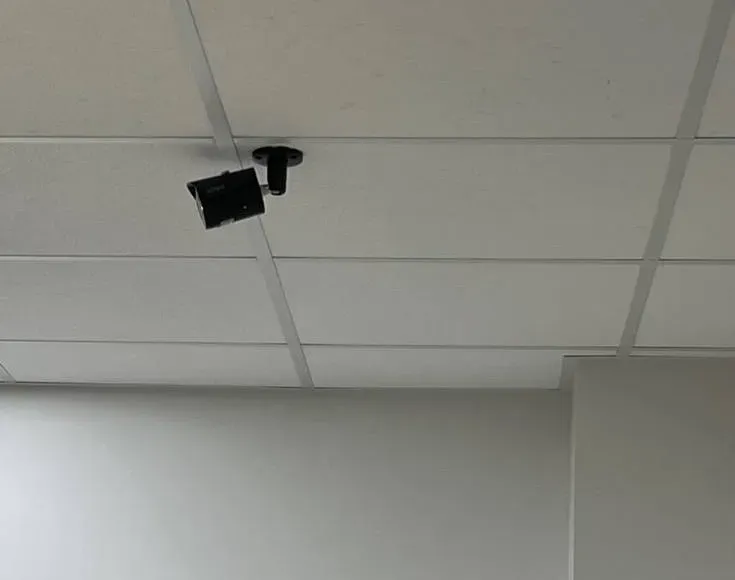
Real AESS job photo from another site: a small black camera fixed to a white drop-ceiling grid at the left edge of the frame, with two round recessed lights glowing further along the ceiling. Kept away from the lights like this, the camera avoids glare across the picture.
Commercial Uniview
Business Uniview Camera Installation in Nassau County
Most Nassau retail is not on a downtown block; it is in strip centers and plazas along the county’s big roads, where one landlord owns the parking field, the sidewalk canopy and the signage, and each tenant controls only the inside of a unit. A Uniview system for a shop here starts with the lease: what the tenant may mount on the facade, who already records the lot, and whose network the recorder can use. Newsday, using Nassau police figures obtained under the Freedom of Information Law, reported petit-larceny shoplifting up 27 percent to 3,819 incidents from 2022 to 2023, so owners are asking for cameras that identify people, not just record that something happened.
Old Country Road
Roosevelt Field in Garden City, Long Island’s largest mall, and the big-box and pad-site strip running toward Westbury and Carle Place. Tenants in pad buildings need exterior door and drive-through coverage within the landlord’s rules.
Hempstead Turnpike
Elmont, Franklin Square, West Hempstead, Uniondale, East Meadow and Levittown: delis, pharmacies, nail salons, auto-parts stores and restaurants in long strip centers with shared rear service lanes.
Sunrise Highway
From Green Acres Mall in Valley Stream through Lynbrook, Baldwin, Freeport, Merrick and Massapequa: car dealers, tire shops and plazas where vehicle theft and after-hours visits to the lot are the worry.
Northern Boulevard and Jericho Turnpike
The Americana Manhasset’s luxury shops at 2060 Northern Boulevard, Great Neck’s offices, and Jericho Turnpike’s plazas from New Hyde Park to Syosset and Woodbury.
Village main streets
Rockville Centre, Mineola, Garden City’s Seventh Street, Great Neck Plaza, Sea Cliff and Long Beach’s shopping streets: storefronts with apartments above and a village that has its own rules for signs and facades.
Offices and medical suites
Lake Success, Mineola near the county courts, and the medical buildings around the hospitals: lobby and suite-door cameras, with the recorder on the tenant’s own network rather than the building’s.
Rules that apply to Nassau camera work
State installer licence. Camera and alarm contractors in New York answer to the Department of State, which issues security and fire alarm installer licences under article 6-D of the General Business Law. Ours, held by Anwar Timothy, is NYS license #12000287431, and it covers shops and offices as well as houses.
The county home-improvement licence has a carve-out. Nassau’s home-improvement law (Administrative Code section 21-11) licenses contractors working on homes of up to three families, but its definition of home improvement expressly leaves out burglar alarm and automatic fire alarm systems. Camera work on a house is low-voltage security work; any carpentry, siding or electrical work around it brings in the other licences.
Alarm permits. The county requires a police alarm permit for alarms that call the Nassau County Police, gives a newly installed alarm a 90-day grace period for up to three false alarms once a permit is issued, and expects residential alarm calls to include call-back attempts. Cameras alone don’t need a permit; they help when an alarm does go off.
Staff areas. New York Labor Law section 203-c bars employers from video-recording employees in restrooms, locker rooms or rooms designated for changing, except by court order.
Hidden recording. Penal Law section 250.45 makes it a crime to use an imaging device to view or record people in places such as bedrooms, changing rooms and restrooms without their knowledge.
City rules don’t follow you over the line. New York City’s biometric sign law and Tenant Data Privacy Act apply in the five boroughs; a shop in Valley Stream or Elmont is under state law, county law and its own village or town code instead.
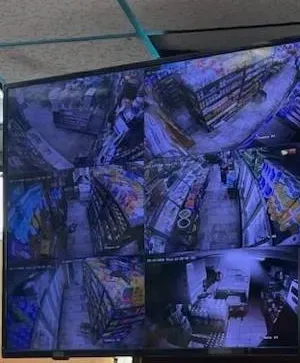
Real AESS job photo from another site: a monitor on a shop wall showing six camera views looking down store aisles lined with shelves of goods. It is the screen a Nassau strip-center owner checks at the counter, and why each aisle needs its own camera.
Your Questions Answered
Uniview Camera Installation in Nassau County: Questions Answered
These are the questions Nassau owners raise at a walkthrough, grouped by the situation behind them: the village and its police, the commute, the street out front and the power behind the recorder, the strip-center shop, and the house with more than one household in it.
Villages, Police and Paperwork
Our village has its own police department — how do detectives find out we have cameras?
Mostly the old-fashioned way: after a burglary or a car theft, officers walk the block and knock on doors looking for video. Some departments add a shortcut. Garden City’s police run a voluntary Private Camera Registration Program where a resident or business lists the address and the number of cameras, so detectives have an instant list of places to ask. The department is explicit that registering gives it no access to the cameras; it only tells them where footage may exist, and they may then ask to see video from a limited period. The Nassau County Police, who patrol most of the county, publicize their own information-sharing program for residents and businesses, called SPIN.
Whichever department covers your street, the request lands on you, usually by phone. What makes the difference is how quickly you can answer it. We name every channel in the recorder by what it sees (“driveway”, “side door”, “back yard”), keep the recorder’s clock synchronized, and show you how to pull a clip from the phone app or onto a USB stick at the recorder. Five minutes, not an afternoon of scrolling.
Registering, or not, is your call. Nothing in the Uniview system sends video to any police agency on its own; footage stays on the drive in your house until you choose to share it.
Which license should a Nassau camera installer hold, given how the county’s home-improvement law is written?
The one that covers security systems: a New York State security and fire alarm installer licence from the Department of State under General Business Law article 6-D. Ours is #12000287431. Homeowners often ask for the Nassau County home-improvement licence instead, because that is the licence the county advertises, and it is worth knowing how that law is drafted. Nassau’s Administrative Code section 21-11 requires a county licence for home-improvement businesses working on houses of up to three families, and then its definition of home improvement specifically excludes burglar alarm systems and automatic fire alarm systems.
So a camera company should be able to show you the state licence and proof of insurance. If the same job also includes building a soffit, replacing siding or adding an outlet, that part brings in the home-improvement licence or a licensed electrician; electrical licensing in Nassau is handled by the towns and cities, and the Town of Hempstead, for one, requires a town master electrician’s licence for professional electrical installation.
Ask for the licence number and look it up before anyone drills. A company that hesitates over that step will probably hesitate when it is time to hand over the admin password too.
Our burglar alarm already has a Nassau police permit — what changes if cameras are added to it?
For the permit, nothing. The county’s alarm permit covers alarm systems that call the police; cameras that record to your own recorder aren’t alarms in that sense, so adding them doesn’t require a new permit. If your alarm company links a camera to the central station for video verification, ask them whether they treat it as a change to the alarm system and whether your permit details need updating.
The practical change is in how you answer an alarm. Nassau police say they are asked to respond to more than 125,000 false alarms a year, and the county code charges permit holders for repeated false alarms on a rising scale. With a camera aimed at each alarmed door and a person-detection alert on your phone, the call from the central station stops being a guess: you can look at the back door before deciding whether to cancel or to ask for a response.
We place cameras to match alarm zones for exactly that reason. A motion detector in the family room and a camera in the far corner of the yard don’t help each other; a camera that sees the door the motion detector covers does.
A camera on our side yard can see into the neighbor’s back yard — where is the line in Nassau’s villages?
The firm line is in state law: Penal Law section 250.45 makes it a crime to use an imaging device to watch or record people in places like bedrooms, bathrooms and changing rooms without their knowledge. A neighbor’s fenced back yard is a softer case, and villages have noticed. In 2017 the Village of Flower Hill considered a local law aimed at imaging devices whose only real purpose is to view a person in a part of their own property where they otherwise couldn’t be seen, after a resident complained about two cameras mounted high in a tree pointing over the fence.
On a narrow suburban lot, a camera covering your own side path will catch some of the house next door. We handle it with aim first and software second: cameras angled down your path rather than across the fence line, and Uniview’s privacy masking blacking out a neighbor’s windows or pool area in the recorded image itself.
If a neighbor asks, it is easy to show them the masked view on your phone. That conversation usually ends better than a complaint to the village does.
The Commute and the Empty House
We are on the LIRR from 6 a.m. to 7 p.m. — which phone alerts are worth keeping, and which will we mute within a week?
Mute-worthy: plain motion on any camera that sees a street, a tree or a road. Nassau streets carry landscapers, school buses, delivery vans and dog walkers all day, and generic motion alerts from a street-facing camera will hit your phone dozens of times before lunch. Within a week most people silence the whole app, and then the alert that mattered goes unseen too.
Keep: person detection drawn as a zone on the back door, the side gate and the basement stairs, set to alert only during the hours nobody should be home; a line-crossing alert on the driveway after dark; and a daily health message if the recorder loses a camera. Uniview’s smart detection on its newer recorders and cameras sorts people and vehicles from leaves and shadows, so a zone drawn on the porch steps, rather than the whole frame, is what keeps the phone quiet until something is worth seeing.
Camera
Alert rule we start with
When it is armed
Back door and side gate
Person enters a zone drawn on the step or gate
Weekdays while the household is out, and overnight
Driveway
Person or vehicle crosses a line at the end of the drive
Overnight only; daytime traffic is recorded without alerts
Front step
No alert; recording only, or a doorbell press
Always recording
Street-facing overview
No alert
Always recording
Recorder itself
Camera disconnected or drive error
Always
We set these with you in the app before we leave and adjust them after the first week, once you have seen what a normal Tuesday looks like on your street.
On a Cape Cod with a low front stoop, where does the camera go to record a face rather than the top of a cap?
Lower and closer than most people expect. A camera tucked under the gable peak of a Cape looks almost straight down at the stoop, and a person in a cap or hood shows up as a brim and a pair of shoulders. Uniview’s fixed 2.8 mm turrets have a wide view, so we usually place one at door-frame height beside the entry, or on the porch ceiling a few feet out, angled so the face of anyone at the door fills a useful share of the frame.
The high camera still has a job: overview of the walk and the driveway. The pair together answers both questions an investigator asks — what happened and who it was. The county police’s July 2026 burglary arrest involved homes entered across Nassau over ten months; cases like that are built from video that shows a face, a gait or a vehicle clearly, and a recording of the top of a hat is little help.
Side and back doors get the same treatment. On many Capes the side door by the driveway is the one people actually use, so it gets its own face-height camera.
Thieves have taken catalytic converters near the Syosset and Hicksville stations — can a home camera protect the car in our own driveway overnight?
A home system can’t watch the station lot: it isn’t your property, and CBS New York has reported that MTA police work with Nassau County police on patrols of lots where converter thefts happened. What a Uniview system can do is cover the car that stays home overnight, or the second car parked in the driveway all day.
Converter theft happens low and fast, under the car. A camera mounted high on the garage sees the roof of the car and little else; one at about eight feet on the house corner, aimed along the driveway, sees under the bumper line and anyone kneeling beside the car. Add a line-crossing rule at the end of the driveway after midnight and an alert reaches you while it is happening, not the next morning.
Colour night imaging matters here. Uniview’s ColorHunter cameras keep colour in low light, so the recording shows the colour of the vehicle that pulled in and the clothes of the person who got out, which plain infrared images reduce to shades of grey.
The Street, the Grid and the Record
A school bus stop is at our corner — is it a problem if a camera records the children waiting there?
Recording a public sidewalk from your own house is generally lawful in New York, and a driveway camera on a corner lot will inevitably catch the bus stop. The question is less legal than neighborly. Parents notice a lens pointed at their children every morning, and a recording of other people’s kids is something you would rather not have to manage.
So we aim for what you need and mask what you don’t. The driveway camera is angled down the driveway and the front walk, and if the stop still falls inside the frame, a Uniview privacy mask blanks that patch of sidewalk in the recording. If the corner itself is the concern — cars cutting across the lawn, or something that happens at the stop — we can leave it unmasked, but that should be a deliberate decision, not an accident of where the bracket went.
Either way, footage that shows other families stays on your recorder unless police ask for it. Posting clips of neighbors’ children on a community page is how a camera turns into a feud.
Can a camera go on the utility pole or the street tree in front of the house for a better angle?
No, and it isn’t a good idea even where nobody would notice. Utility poles belong to the utility, and attaching anything to them is the pole owner’s business, not ours. The planting strip and street trees along the curb are generally public right-of-way, looked after by the village, the town or the county depending on the road, so a camera there is mounted on someone else’s property, powered by a cable crossing the sidewalk.
The better angle almost always exists on your own property: a camera high on the garage corner looking down the driveway toward the street, or one on the porch post at the front walk. On a deep lot, a short post set inside your own front-yard line, with the cable buried in conduit to the house, gets a camera closer to the street without touching public property.
If a car or a person in the street is what you need to capture, Uniview’s 8MP turrets and ColorHunter bullets give enough detail from the house to identify a vehicle at the curb in most Nassau front yards, especially with corridor mode turning the frame upright along a narrow side yard or driveway.
The recorder’s clock was wrong after the last outage — does a bad timestamp matter if police need the clip?
It matters more than most people think. A clip showing a car in your driveway at “3:12 a.m.” when it was really 4:12 sends a detective looking at the wrong hour of every other camera on the street, and a defense lawyer will ask why your clock was an hour off. Recorders that lose power for long enough can come back with a drifted clock, and a daylight-saving setting left at the factory default can put every recording an hour out for half the year.
We set each Uniview recorder to take its time from an internet time server, set the correct US Eastern time zone with daylight saving, and push the recorder’s time to every camera. After an outage the recorder corrects itself once the internet is back.
If you are exporting a clip for police and you know the clock was wrong, say so and say by how much. A known offset is easy to work with; an unknown one undermines the whole recording.
Strip Centers, Shops and Staff
Our shop is one unit in a strip center — can our cameras cover the sidewalk and parking field the landlord controls?
Usually, with the landlord’s written okay. The lease typically gives you the inside of the unit and, sometimes, the storefront glass; the facade, the canopy and the lot belong to the center. Most landlords will approve a tenant camera above the door on the canopy fascia, aimed at the entrance and a slice of the sidewalk, provided it is mounted neatly and doesn’t cross the neighbors’ frontages.
The practical answer is often a camera inside the glass looking out. Uniview’s turrets can sit on the ceiling just inside the door, see the entrance and the first few parking spaces, and avoid the landlord question entirely, though glare and reflections need careful angling. For the lot itself, ask the landlord what they already record before paying to duplicate it.
We send the landlord a one-page drawing showing camera positions and cable routes when approval is needed. It makes yes a quicker answer.
The center’s owner runs his own cameras — can our Uniview recorder and his system share views?
Technically, sometimes. Uniview recorders can add many third-party IP cameras that speak the ONVIF standard, and the landlord’s recorder may be able to add one of yours the same way. In practice it raises questions that have little to do with technology: whose network the video crosses, who can see the inside of your store, and who answers when a camera drops.
The cleaner arrangement is two separate systems and an agreement to share clips. When something happens in the lot, the landlord exports their view and you export yours. If you really want a lot view on your own phone, the landlord can give you a view-only account on their recorder, and nothing of yours has to be exposed.
Either way we keep your Uniview recorder on your own network, with its own internet connection where the lease allows, so a change on the landlord’s side doesn’t take your cameras down.
How do we watch the register without recording customers’ card PINs?
Aim at hands, cash drawer and counter, not at the keypad, and then mask what still shows. A camera behind and above the cashier records the till, the counter and the customer’s face across it; one directly over the card terminal records exactly what you don’t want on your drive. Uniview recorders let us draw privacy masks that black out a region of the image permanently in the recording, so even a slightly misaimed camera can’t capture keypad entries.
This is good for the business as well as the customer. A recording that shows PINs is a liability if the recorder is ever stolen or accessed by someone who shouldn’t see it, and card processors don’t want terminals filmed.
A second camera on the customer side of the counter, at head height, gives you faces at the moment of purchase, which is the shot a shoplifting or fraud investigation needs anyway.
When a shoplifting crew hits several stores, which camera view do detectives actually use?
Three shots, in order of usefulness: a clear face at the door on the way in, a full-length view of the person in the aisle showing what they took, and a vehicle view in the lot showing what they left in. A ceiling camera over the middle of the store shows the event but rarely identifies anyone, which is why a single fisheye in the center of a shop is a supplement, not a plan.
For a typical Nassau unit we put an 8MP turret inside the door at about seven feet, aimed to catch faces as people come in, turrets down the main aisles with Uniview’s 9:16 corridor mode on the long narrow ones so the aisle fills the frame top to bottom, and a fisheye overhead for the whole floor. If the landlord allows, a camera on the canopy covers the curb.
Then the clip has to get out. We show the owner and the manager how to export from the recorder or the app in a format that plays on an ordinary computer, because a detective arriving the next morning to cover several stores won’t wait while someone hunts for a password.
Can a camera cover the back room where staff change before a shift?
Not if it is used for changing. New York Labor Law section 203-c bars employers from video-recording employees in restrooms, locker rooms and rooms designated for changing clothes, except by court order, and Penal Law section 250.45 makes covert recording in such places a crime. A combined stockroom-and-changing-room is common in small Nassau shops, and it is the one place a camera can turn a theft problem into a legal one.
The fix is in the floor plan. Give staff a changing space with no camera, even a curtained corner, and put the stockroom camera on the door to the back room and the shelves, not on the whole room. Uniview’s privacy masking can black out a curtained corner permanently if the camera’s view has to pass near it.
Tell employees where the cameras are and what they cover. It answers the question before anyone asks it, and it deters inventory loss better than a hidden camera would.
Shared, Seasonal and Rented Houses
How do we keep the accessory apartment’s entrance off the main household’s phones?
By giving each household its own login on the recorder with only its own cameras. Uniview recorders have user levels and per-camera permissions: the owner’s admin account sees everything, the apartment’s account sees the apartment door and the shared driveway, and the main household’s everyday account sees the main entrances and the yard. In the phone app each person logs in with their own account and only the allowed cameras appear.
That arrangement matters in Nassau’s many two-family and mother-daughter houses. A parent or tenant downstairs has a reasonable expectation that their comings and goings aren’t on everyone’s phone, and the owner still has the whole picture as administrator if something happens.
The shared driveway is where most disagreements start, so we settle it at the walkthrough. If both households park there, both get the driveway camera; if only one does, the other household’s account can be left without it. The same goes for a shared back yard. Writing that decision down before the cameras go up is easier than renegotiating it later, especially when the downstairs unit changes tenants.
We set the accounts up during installation and write down which camera belongs to which login, so changing a tenant later is a five-minute job, not a visit.
We rent the Long Beach house out for the summer — how do we switch the indoor cameras off for tenants and back on afterwards?
Indoor cameras and short-term tenants don’t mix. The clean way is to take the indoor channels out of the recording schedule and cover or unplug those cameras for the rental period, while the outdoor cameras at the doors and the driveway keep recording. On a Uniview recorder that is a schedule change, done from the admin account in a few minutes, and reversed in September.
Tell the tenants in writing which outdoor cameras record and that indoor cameras are switched off and covered. Rental platforms and local rental rules often have their own requirements about disclosure, so check what applies to you.
Before the season starts, also change the Wi-Fi password the tenants will use if the recorder shares that network, or better, put the recorder on a separate network from the guest Wi-Fi altogether.
Jammers and Wireless Weak Spots
Can a Wi-Fi jammer knock a wired Uniview system offline the way it can a battery camera?
No. A jammer floods the radio frequencies Wi-Fi uses, so a camera that sends its video over Wi-Fi stops reaching the router and records nothing, or only to a card inside the camera that a thief can take. Police in New Jersey have described a burglary suspect they believe used a jammer to knock out a home’s cameras and the homeowner’s phone signal at the same time. A wired Uniview camera sends its video down a network cable to a recorder inside the house, and no radio is involved.
A jammer can still interfere with the last step: the recorder telling your phone. If the home internet is cable or fiber, that path is wired too; only a household relying on a cellular or wireless internet connection is exposed. Either way the recording itself continues on the drive, and you can see it once the signal returns.
This is the strongest argument for replacing battery cameras on a Nassau house with wired ones, and it is why we keep the recorder somewhere a burglar won’t walk past on the way in.
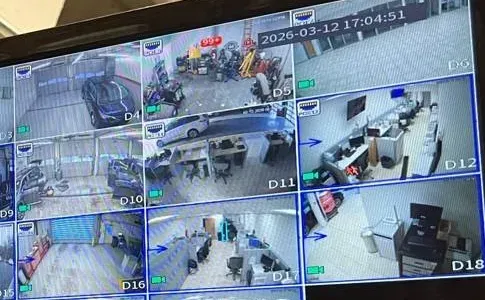
Real AESS job photo from another site: a recorder screen with a grid of labelled camera views of a garage, workshop and offices, and the date and time shown at the top. An accurate clock on that stamp is what makes a clip usable by investigators.
Equipment
Types of Uniview Cameras We Install
These are the Uniview models we use most on Nassau houses and shops, with the installed price from our published Nassau list. Model numbers come straight from Uniview’s catalog.
4MP ColorHunter mini bullet and turret — $449
EC-B4F28DL and EC-T4F28DL: the everyday camera for doors, driveways and side paths on a Cape or colonial, with dual-light night imaging and a built-in microphone on the turret.
8MP turret with corridor mode — $559
IPC3618LB-ADF28K-DL: 8MP, 3840×2160, with a 9:16 corridor mode that turns the frame on its side for store aisles, long driveways and narrow side yards.
8MP ColorHunter bullet — $559
IPC2128LB-ADF28K-DL: for the wide back-yard view or a parking area where colour at night identifies a vehicle.
Tri-Guard 8MP turret — $969
IPC3638SS-ADF28KMC-I1: adds a light and siren warning that can be set to trigger on a person in a zone after hours, useful at a shop’s rear door.
12MP fisheye — $2,119
IPC86CEB-AF18KC-I0: one vandal-resistant camera on a store ceiling showing the whole floor, de-warped into normal views in the app.
Plate-capture camera — $1,759
PKC2640@Z28-IR-P: for a business with a gated lot or a single vehicle entrance where reading plates at a controlled speed is realistic.
PTZ cameras — from $1,049
IPC6324LWH-AX5C-VG2 and IPC6424SR-X25-VF: pan, tilt and zoom for a large North Shore lot or a dealership lot on Sunrise Highway.
Dual-lens video doorbell — $689
ED-525B-WB: Uniview’s doorbell with a main lens and a second downward lens for the package on the step, recording to the same recorder.
Recorders — from $499
NVR301-04LS3-P4 (4 PoE, $499), NVR301-08LS3-P8 (8 PoE, $619), NVR301-16B-LP8-IQ (16 channels, $899) and NVR302-16B-P16-IQ (16 PoE, two drives, $1,219), each with set-up.
Recorder sizing for Nassau properties
Property
Typical cameras
Recorder
Why
Cape, ranch or small colonial
4
NVR301-04LS3-P4
Four PoE ports, 30 W per port and 54 W total per Uniview’s datasheet; drives up to 6 TB each.
High ranch, larger colonial or two-family
6–8
NVR301-08LS3-P8
Eight PoE ports so every camera runs straight to the recorder without a separate switch.
Strip-center unit or office suite
8–12
NVR301-16B-LP8-IQ plus a Uniview switch
Room for a fisheye and aisle turrets; more channels than the first install needs.
North Shore house with outbuildings
12–16
NVR302-16B-P16-IQ
Sixteen PoE ports and two drive bays for longer recording.
Uniview with AESS compared with ADT, Ring and SimpliSafe
Question
Uniview NVR installed by AESS
Typical ADT / Ring / SimpliSafe camera set-up
Where video is kept
On a hard drive in your house or shop; cloud viewing is optional
Mostly in the provider’s cloud under a subscription plan
How cameras connect
Network cable with power over Ethernet
Often Wi-Fi, with batteries or plug-in power
Monthly fees for recording
None for local recording
Recording features usually tied to a paid plan
Jammer and Wi-Fi outage exposure
Recording continues over cable
Wi-Fi cameras can lose connection
Who holds the admin password
You, handed over at the end of the job
The provider’s account system
Plenty of Nassau households keep a Ring doorbell they like and let the Uniview system handle the yard and driveway; the two run side by side without trouble.
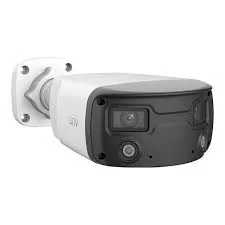
Manufacturer product photo, not an installed unit: a white UNV bullet camera on a wall bracket with two lenses and small lights on a dark front panel. A wide two-lens bullet like this covers a long Nassau driveway or a whole back yard from one corner.
AI Overview Reality Check
What AI Gets Wrong About Uniview Camera Installation in Nassau County
Google’s AI Overview couldn’t be read from the environment this page was built in, so instead we took seven claims that keep appearing in the cost guides, dealer pages and forum threads those summaries are built from, and tested each one against Nassau conditions and the original documents.
1. “Installation costs $100 to $300, or about $1,289 on average”
Security.org says installation costs $100 to $300 depending on complexity, and Angi puts the 2026 national average for security camera installation at $1,289, with most homeowners paying $590 to $2,040. Both are national figures that mix one-doorbell jobs with full systems, and neither tells a Nassau homeowner what a wired four-camera system costs on their own house.
Our published Nassau Uniview list puts a complete four-camera system — four 4MP ColorHunter cameras, a four-port PoE recorder and a 4 TB drive, installed — at $2,524, and individual cameras at $449 installed and up. That is above the national averages because it includes the recorder, the drive, cable through the attic and set-up of the app, which a “$100 to $300” figure doesn’t.
Compare like with like. Ask any quote to separate equipment, labor per camera, recorder set-up and anything for hidden wiring, then put the numbers next to ours.
2. “Uniview is banned in the US like Hikvision and Dahua”
Some comparison pages state that Uniview hardware is banned under NDAA Section 889. The statute’s named list is Huawei, ZTE, Hytera, Hikvision and Dahua; Uniview isn’t on it. The FCC’s Covered List, checked October 2026, names Hikvision and Dahua video surveillance equipment and doesn’t mention Uniview.
What did happen is narrower: in December 2024 the Commerce Department added Zhejiang Uniview Technologies to the Entity List, which restricts exports of US-regulated items to the company. That rule doesn’t prohibit a homeowner or shop in Nassau from buying or using Uniview cameras.
Federal contractors and some companies have their own procurement rules, and those are worth checking if your business sells to government. For a house in Bellmore or a deli in Mineola, the practical issues are buying from an authorized channel and keeping firmware current.
3. “In Nassau, any contractor with a county home-improvement license can install cameras”
Ranking contractor directories often treat the county home-improvement licence as the licence that matters for any work on a house. Nassau’s own law says otherwise for security systems: its definition of home improvement excludes burglar alarm and automatic fire alarm systems.
Security system installation in New York is licensed by the state Department of State under General Business Law article 6-D. A handyman with a county licence may be a fine carpenter, but that licence doesn’t cover the work this page describes.
Ask for the state licence number. Ours is #12000287431, and it appears on every page and every invoice.
4. “Wireless cameras are just as reliable as wired ones”
Retail pages describe Wi-Fi cameras as equivalent to wired systems, with easier installation. For a renter or a single doorbell that can be true. For a Nassau house, two failure modes argue the other way: radio interference, including the jammers New Jersey police have described in burglaries, and power, which is not something a nor’easter respects.
A wired PoE camera draws its power from the recorder or switch, so one battery backup in the utility room keeps every camera running when PSEG is out, instead of a scatter of batteries and plug-in adapters around the house. During the September 2026 storm PSEG reported nearly 112,000 restorations across its territory; a single backup is far easier to plan around than a dozen outlets.
Wireless still has a place, for a pool house or a camera on a fence where a cable can’t reasonably go. It is the exception on our drawings, not the plan.
5. “If you register your cameras, police can watch them”
Forum answers often assume that a camera registry gives police a live feed. Garden City’s registry says the opposite in writing: it is voluntary and doesn’t provide the department access to privately owned systems. It is a list of addresses where detectives may ask to see video.
Live sharing is a different arrangement that some companies sell, and a Uniview recorder doesn’t do it unless you deliberately give someone an account. Public plate readers on Nassau roads are separate systems run by police agencies, not connected to private cameras.
If you want to help investigations without giving away access, registration plus a recorder that exports clean clips quickly is the right combination.
6. “Cloud recording is always safer than a recorder at home”
The argument is that a burglar can steal a recorder but not a cloud. True as far as it goes, but cloud-only cameras stop uploading the moment the internet is down or the Wi-Fi is jammed, and most require a monthly plan for the history you would want after a burglary.
A Uniview recorder keeps recording through an internet outage, and we place it where it isn’t in plain sight: a basement utility area, a closet or a locked cabinet. Phone access comes through Uniview’s app; Uniview has announced that its UNV-Link app replaces EZView, which it expects to stop service in 2027, so we set new systems up on UNV-Link from the start.
If an off-site copy matters to you, the recorder can push alarm clips to an email or a storage account. That gives you a cloud copy of the moments that matter without paying to upload every hour of an empty driveway.
7. “Plug it in and it’s secure out of the box”
Installation videos and how-to pages repeat Uniview’s long-standing default login, admin and 123456. Uniview’s own help document confirms most of its products shipped with that default, and the company publishes security notices for its recorders and cameras, including a 2024 cross-site-scripting notice for some NVRs.
An installer who leaves the default password, old firmware and open ports on a recorder has built a system that strangers can find. We set a strong admin password, update firmware to the current release before hand-over, disable features you don’t use, and avoid exposing the recorder directly to the internet.
Then we give you the password. Not a sticky note on the recorder, and not kept only by us: a sealed card, and a walkthrough of how to change it.
Real AESS job photo from another site: a black bullet camera hanging from a short bracket screwed into a drop-ceiling grid, angled down toward a plain grey wall. A pendant mount like this lets a camera aim down a corridor or a stockroom aisle.
Four Photos and a Village Name Gets You a Price
Send the front, the back, the modem spot and the basement or garage wall. We reply with camera positions, the recorder size and the installed price from the Nassau list.
Five details make the quote accurate: where you are (village or hamlet), what the building is, which doors and spaces matter, whether water has ever come into the basement or garage, and which days suit you. Expect a written number by the end of the business day, or ring (516) 346-5778 to go over it by phone first.
✅
We Got Your Request!
Received. A technician reads through what you sent and phones you before the business day is out. Cameras down right now? Don’t wait for us — call (516) 346-5778.
How It Works
Our Installation Process
Seven steps for every Nassau job, from a Levittown Cape to a unit in a Hempstead Turnpike strip center. Most houses are finished in a single visit; the first two steps are where the quote is decided.
1. Photos and the village name
You send four photos and tell us the village or hamlet. We sketch camera positions, choose the recorder size and send a written price from the Nassau list.
2. Walkthrough and permissions
A technician checks the attic, basement or crawl space routes, the recorder spot above any flood line, and, for a shop, what the landlord allows outside the unit.
3. Cable through the house
Network cable pulled through attics, closets and basement ceilings to each camera, with sealed entries and drip loops, and no cable stapled across siding.
4. Mount and aim for faces
Cameras fixed to mounting blocks or trim, with face-height views at the doors in use and overview cameras up high for the driveway and yard.
5. Recorder, drive and time
The Uniview NVR set up with its drive, named channels, an internet time source with Eastern daylight saving, privacy masks and recording schedules.
6. Alerts tested off-site
Person and vehicle zones drawn per camera, alert hours matched to the household’s schedule, and UNV-Link tested on each phone over cellular data, away from the home Wi-Fi.
7. Hand-over and clip export
Firmware current, a strong admin password handed over sealed, separate accounts for each household or manager, and a practice export of a clip like the one police would ask for.
Before the crew arrives: a short checklist
Clear a path to the attic hatch and the basement utility area. Most of the cable work happens there, and a cleared closet shelf under the hatch saves half an hour.
Know your Wi-Fi name and password, and where the modem is. The recorder connects to your router by cable, and we test phone access before leaving.
Decide who gets an account. Each adult, a parent in the accessory apartment, a store manager: one login each, with only the cameras that person should see.
For a shop, have the landlord’s okay in writing for anything mounted outside the unit, and the name of whoever manages the center’s own cameras.
Tell us about pets, alarm codes and any part of the house that is off limits, so the day goes smoothly and nobody trips the alarm opening the basement door.
Real AESS job photo from another site: a small black bullet camera on a drop ceiling near the edge of a tall white wall, with a return-air grille and a round downlight nearby. Placed at the edge, it looks along the wall rather than into the lights.
Coverage Area
Uniview Camera Installation Near Nassau County’s Landmarks
We work in every town, city and village in Nassau. These landmarks are reference points for the areas we cover, not clients of ours.
Roosevelt Field, Garden City
Long Island’s largest mall at 630 Old Country Road, with the Old Country Road retail strip, Garden City’s village streets and the Mineola county-seat offices around it.
Green Acres Mall, Valley Stream
A 2,069,000-square-foot mall off Sunrise Highway near the Queens line, surrounded by the two-family houses and small shops of Valley Stream, Elmont and the Five Towns.
Americana Manhasset
More than 60 luxury and contemporary shops on Northern Boulevard, amid Manhasset’s colonials and the North Shore villages toward Great Neck and Port Washington.
UBS Arena, Elmont
The Islanders’ home at Belmont Park, opened in November 2021, beside Hempstead Turnpike’s strip centers and Elmont’s dense blocks of capes and two-family houses.
Hofstra University, Hempstead
A 244-acre campus recognized as an arboretum, with the Village of Hempstead, Uniondale and the off-campus rentals and businesses that surround it.
Long Beach boardwalk
Rebuilt after Hurricane Sandy, on the barrier island where salt air, summer rentals and flood-prone streets shape every outdoor camera we install.
We also serve Levittown, Hicksville, Westbury, Freeport, Baldwin, Merrick, Bellmore, Wantagh, Seaford, Massapequa, Oceanside, Island Park, Lynbrook, Rockville Centre, Glen Cove, Sea Cliff, Oyster Bay, Syosset, Jericho, Plainview, Bethpage, Port Washington, Great Neck, New Hyde Park, Franklin Square and every hamlet between, and across the line into Queens and western Suffolk.
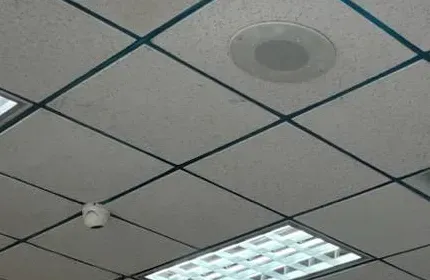
Real AESS job photo from another site: a small white mini dome camera on a ceiling grid, with a round ceiling speaker above it and a louvered light fixture below. Shops in Nassau strip centers often have this kind of grid ceiling, which makes cable runs easy.
Pricing
Uniview Camera Installation Cost in Nassau County
Nothing in this table is a guess. Each number is the Nassau figure from our own Nassau Uniview price list, where equipment costs the same in every county and only the labor rate changes by area. All prices are for the item installed, sales tax extra, with a drive sized for at least fourteen days of recording.
Item
Nassau installed price
What it covers
Labor per camera
$210 + $30 mounting box
Cable run, mount, aim and set-up for one camera
4MP ColorHunter bullet or turret
$449 each
EC-B4F28DL or EC-T4F28DL, installed
8MP turret or 8MP ColorHunter bullet
$559 each
IPC3618LB-ADF28K-DL or IPC2128LB-ADF28K-DL, installed
Tri-Guard 8MP turret
$969 each
IPC3638SS-ADF28KMC-I1 with light and siren warning
Dual-lens doorbell
$689
ED-525B-WB, installed
12MP fisheye
$2,119
IPC86CEB-AF18KC-I0, installed
4-channel PoE NVR
$499
NVR301-04LS3-P4 with set-up
8-channel PoE NVR
$619
NVR301-08LS3-P8 with set-up
4TB surveillance drive
$229
Added where cameras and recording time need it
Hidden in-wall wiring
$200 per camera
Hollow drywall, up to 100 ft
Service and callback rate
$195/hr, 3-hour minimum ($585)
Repairs and changes after the original installation
What moves a Nassau price
Attic access. A Cape with a crawl-height attic or a floored-over one takes longer per camera than a high ranch with an open attic; hidden in-wall runs are priced per camera.
Recorder location. On a raised South Shore house, moving the recorder up to the living floor can add a longer home run, but it is cheaper than replacing a flooded recorder.
Recording time. Two weeks is included. For a month, a four-camera system goes from $2,524 to $2,753 on the published list, because it needs a second drive.
Which cameras. The least expensive IP camera on the Nassau list ($449) and the 12MP fisheye ($2,119) are $1,670 apart, so the mix of models moves a quote more than the number of cameras does.
Small jobs. One- and two-camera jobs carry the small-job minimum shown on the published price list.
A worked Nassau example, line by line
Take a high ranch in Massapequa with a garage under the bedrooms: front step, driveway, side gate, back door, back yard, both garage corners and the basement entry. From the published list, six EC-T4F28DL turrets at $449 are $2,694, two IPC2128LB-ADF28K-DL 8MP ColorHunter bullets for the wide driveway and back-yard views at $559 are $1,118, the NVR301-08LS3-P8 eight-port recorder with set-up is $619, and the two 4 TB drives that eight cameras need for two weeks are $458 — $4,889, which is the High Ranch and Two-Family package below. If two of the cameras must run inside finished walls rather than through the attic and garage ceiling, that adds $400. A battery backup for the recorder and modem is quoted on its own line once we know where they sit. You can price your own mix on the camera calculator.
A second example: one unit in a strip center
Now a 1,500-square-foot convenience store in a Hempstead Turnpike strip center, open late, with one front door, a rear service door onto the shared lane and three aisles. Six IPC3618LB-ADF28K-DL 8MP turrets cover the front door at face height, the register from behind the counter, the customer side of the counter, the rear door and two aisles in corridor mode, at $559 each, or $3,354. One IPC86CEB-AF18KC-I0 12MP fisheye over the middle of the floor is $2,119. The NVR301-08LS3-P8 recorder is $619 and the two 4 TB drives are $458. That is $6,550, the Strip-Center Storefront package. A store that wants a month of history for insurance or for a slow-moving investigation goes to $7,008 with a third drive. What is not in either number: a canopy camera, if the landlord approves one, at the camera’s installed price, and any work on the landlord’s side of the wall.
Two things usually come out of a storefront walkthrough that a parts list can’t show. The first is the rear door: in most strip centers it opens onto a service lane the landlord lights poorly, so the camera there needs good low-light imaging and a person-detection alert after closing. The second is where the recorder lives. Under the counter is the obvious place and the worst one; a locked cabinet in the office or stockroom, with the cable run through the ceiling grid, keeps it out of reach of anyone who comes over the counter.
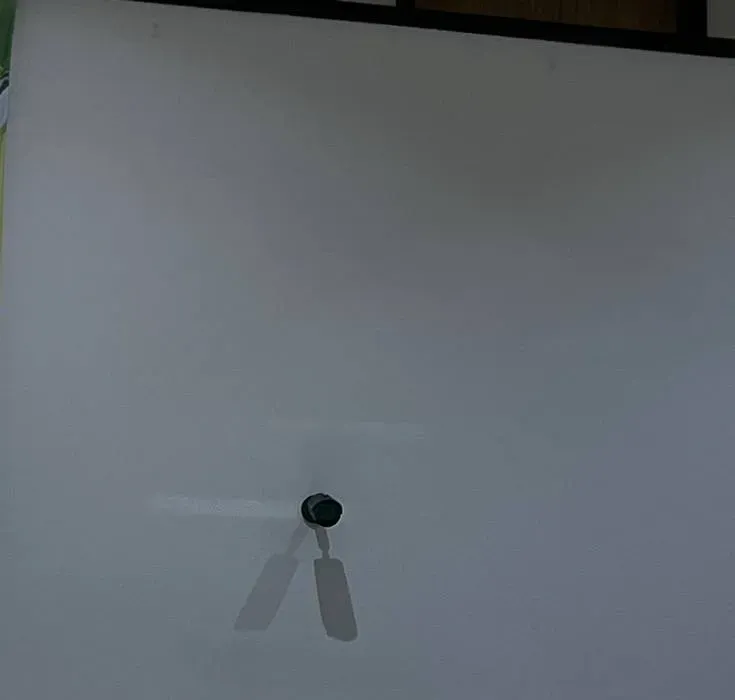
Real AESS job photo from another site: a small black camera on a short arm high on a plain pale wall, throwing two shadows from two light sources, with a dark window frame along the top edge. A high wall position like this suits a double-height entry or a stairwell.
Compare Our Nassau Quote Line by Line
The written quote separates cameras, recorder, drives, hidden wiring and battery backup, so you can set it beside any other installer’s number and see exactly where they differ.
Most Nassau jobs begin from one of these three bundles. Each total is built from the published Nassau list and records for two weeks or more; anything property-specific, such as in-wall runs or a battery for the recorder, is quoted after the walkthrough.
Cape and Colonial — $2,524
For the side door the family really uses, the back door, the front step and the drive: four EC-T4F28DL turrets on an NVR301-04LS3-P4 recorder with its four PoE ports, plus one 4 TB drive. Stretch recording to a month and it is $2,753.
High Ranch and Two-Family — $4,889
Eight cameras on an NVR301-08LS3-P8: six EC-T4F28DL turrets for doors and garage corners, and two IPC2128LB-ADF28K-DL 8MP bullets for the long views over drive and yard, on two 4 TB drives. Each household gets its own login. A month of recording: $5,118.
Strip-Center Storefront — $6,550
Six IPC3618LB-ADF28K-DL 8MP turrets for the door, register and aisles, one IPC86CEB-AF18KC-I0 12MP fisheye over the floor, the NVR301-08LS3-P8 recorder and two 4 TB drives, installed. With a month: $7,008.
Already bought the equipment? Labor-only work
If you bought Uniview cameras and a recorder yourself, we install them at the Nassau labor rate on the published list: $210 per camera plus $30 for a mounting box where one is needed, and $180 to set up the recorder, with the small-job minimum for one- or two-camera visits. Send the model numbers first. Uniview’s US notice says products bought from unauthorized resellers may not get warranty service or software upgrades, so we check where the equipment came from and whether the cameras and recorder work together before we book the day.
Complete Services
Every Uniview Camera Installation Service in Nassau County
Plenty of Nassau customers end up needing more than cameras: cable for a new home office, a lock on the side door, a fix for an old alarm. The links below go to our Nassau pages for that work.
Field Notes: Ask Which Door the Family Actually Uses
On a Nassau house the first question at a walkthrough isn’t about cameras at all. It is which door the family uses. On a surprising number of Capes, colonials and high ranches the front door is ceremonial: guests and packages arrive there, but the household comes and goes through the side door by the driveway, the garage, or a back door off the kitchen. Burglars tend to prefer the doors people don’t watch. If the system puts its best camera on the front step and a distant overview on the side door, it has things backwards for that house.
So we ask, and we look for the evidence: the worn path across the lawn, the doormat that actually gets used, the recycling bins by the side gate. The answer decides where the face-height camera goes, which alert zone is armed during the commute, and which camera the owner opens first when the phone buzzes at work. It takes two minutes, and it matters more to how the system performs than any spec on the datasheet.
FAQ
Nassau County Uniview Camera Installation FAQ
Can the installation be done on a Saturday so nobody has to take a day off?
+
Yes. Saturday appointments are routine for Nassau households where both adults commute, and weekday visits can start late in the afternoon for smaller jobs. We need an adult home for the walkthrough at the start and the app hand-over at the end; in between, the crew works through the attic, basement and outside without needing you at their elbow.
Do you need to get into the attic, and what if it is floored over or packed with blown-in insulation?
+
Usually yes, because the attic is the cleanest way to reach cameras under the eaves. A floored attic means lifting a board or two at the eave or working from a closet ceiling hatch, and we put back what we lift. With blown-in insulation we work along the outer edge from the eave and avoid packing it down. If an attic can't be reached at all, the cable runs inside the wall instead, priced as hidden in-wall wiring.
Can a Uniview doorbell at the front door record onto the same recorder as the other cameras?
+
Yes. Uniview's ED-525B-WB dual-lens doorbell, $689 installed on our Nassau list, records to the same NVR as the other cameras and appears in the same app. It needs a network cable or a doorbell wire run we can adapt, which we check when we see the door. If you would rather keep a doorbell you already like, it can stay in its own app beside the Uniview system.
Will screw holes in vinyl or aluminum siding let water in behind it?
+
Not when the camera goes on a proper mounting block. We fix the block through the siding into the sheathing, seal the screw penetrations, and bring the cable through the block so there is no separate hole exposed to rain. A drip loop on the cable inside keeps water from running along it. Cameras screwed straight to vinyl are the ones that loosen and leak over a couple of winters.
Can the system be finished before we leave for Florida for the winter?
+
Yes, if you book a few weeks ahead of your departure date. We aim to have everything installed and tested at least a few days before you leave, so you can see the cameras on your phone from home, adjust the alerts, and call us while you are still around if anything needs moving. We also set up a daily health notice so you know from Florida that every camera is still recording.
Why does the night picture turn white when a camera sits behind a storm door or under a porch ceiling?
+
Because the camera's infrared lights are bouncing straight back into the lens. Glass in a storm door reflects them, and a low porch ceiling or soffit just above the camera catches them and floods the image. The fix is placement: outside the glass, a few inches below the soffit edge, or tilted so the ceiling isn't in the frame. Uniview's dual-light cameras can also switch to their warm white light, which reflects less.
Do you take away the old DVR and cameras, and what happens to the recordings on that old drive?
+
We take the old equipment away if you want us to, and we leave it with you if you would rather keep it. Before anything leaves the house, we ask whether you need to save any recordings; if so, we export them first. If you want the old drive destroyed, we can remove it and hand it to you so you can dispose of it yourself, which is the only way to be certain where it ends up.
Can a camera watch the pool gate and alert us when it opens?
+
A camera can watch the gate and send a phone alert when a person crosses a line drawn at it, and many Nassau families with a back-yard pool want exactly that. It is a camera alert, not a pool alarm: it depends on the phone, the app and the internet, so it does not replace the gate latch, door alarms or any pool barrier the building code requires. Treat it as an extra pair of eyes.
What do we pay up front, and when is the rest due?
+
Our service agreement sets the terms: a 50% deposit when you book, and the balance when the job is complete. The written quote lists every line before you pay anything, and the agreement also sets out the parts warranty and the late-fee schedule. Repairs and changes after the original installation are billed at the service rate of $195 an hour with a three-hour minimum.
Can cameras go under a slate or tile roof overhang without anyone walking on the roof?
+
Yes. We mount cameras on the soffit or fascia from a ladder below and run cable through the eave from inside the attic, so nobody needs to stand on the slate or tile. Where the overhang is too deep or the fascia too fragile, a camera on the wall just under it does the same job. Nothing about a camera installation requires walking on a roof.
All Areas Served
Uniview Camera Installation Across Long Island, New York City and the Hudson Valley
Nassau and Suffolk share the Long Island Uniview camera installation hub. Outside the county, our other Uniview pages each deal with what their own boroughs and counties need, from co-op boards in the city to barns upstate.
We list our sources so you can check them. Census numbers, county law, police notices, storm reporting and Uniview’s own documents are linked below; a link marked “excerpt” means our research tools could read only the search summary, not the full page. All prices quoted here come from the Nassau Uniview price list we publish ourselves.
Recorder Beeping or Cameras Dark After a Storm? Call the Nassau Line
Basement recorder beeping? A camera blown off line by the last storm, or a phone that went blank when the router changed? Ring (516) 346-5778. The first open two-hour slot is yours, and on most repair visits the cameras are recording and showing on your phone again an hour or two after the technician walks in.
Nassau Uniview Installation From a Licensed, Insured Crew
The Nassau line is (516) 346-5778 for calls and texts, and WhatsApp works too. Crews for Nassau jobs are sent out by Abstract Enterprises Security Systems, 1282 Troy Ave, Brooklyn, NY 11203.
Google reviewers rate us 4.7★ over 201 reviews. Homeowners and strip-center tenants get a written estimate the same day, landlords can have our insurance certificate on request, and all work is performed under NYS low-voltage license #12000287431.
Full terms — including 50% deposit, one-year parts-only warranty on AESS-supplied products, and the late-fee schedule — are set out in the service agreement. See our warranty page.
Page reviewed and updated October 18, 2026. Changelog: Nassau Uniview page rebuilt from new research on Census housing data for Nassau, the county’s home-improvement and alarm-permit law, the Town of Hempstead electrical licence, Garden City police’s camera registry, the September 2026 nor’easter and PSEG restoration, Nassau shoplifting figures, Uniview datasheets and the UNV-Link replacement of EZView, the FCC Covered List and the 2024 Entity List rule, with prices from the published Nassau Uniview price list.