Recorders Above the Flood Line · Driveway Faces, Not Just Cars · Separate Views for Each Household · Neighbors Masked Out
Staten Island is a borough of houses with driveways. Most homes here are detached, semi-attached or two-family, a car usually sits in the drive or at the curb overnight, and on the East and South Shore the basement is the room that flooded in 2012. A Uniview system for that kind of property is planned from the ground up: the recorder goes on a floor that stays dry, one camera is placed to catch a face at the car door rather than a wide shot of the street, each household in a two-family house sees its own entrance, and anything that belongs to the house next door is masked out of the picture. We design, wire and hand over Uniview systems that way, with prices taken straight from our published Staten Island list.
Reviewed and updated October 18, 2026: Census housing tables for Richmond County, NYC flood-resistant construction rules, Build It Back and Army Corps project pages, Staten Island Advance reporting on 2026 car thefts by precinct, Uniview datasheets and app notices, the Commerce Department’s Entity List rule and the FCC Covered List as updated October 16, 2026 · Anwar Timothy, NYS license #12000287431 · Staten Island visits dispatched from our office at 1282 Troy Avenue in Brooklyn
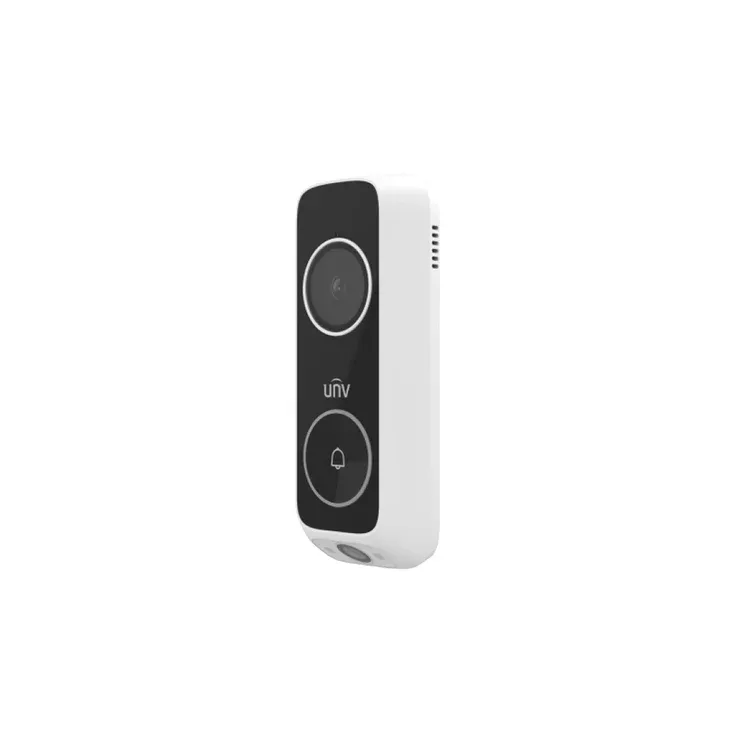
Uniview manufacturer product photo: a slim white UNV video doorbell with a black face, a round camera lens at the top and a round bell button below. On a Staten Island two-family house the front door is often shared by two households, which is why the doorbell view is usually the first camera we plan.
Staten Island Uniview Request
House type, neighborhood and what you want covered — same-business-day callback
✅
Request Sent!
We will phone you about your Staten Island house or shop before the business day is out.
25+
Years Experience
✓
Same-Day Estimates
100%
Licensed & Insured
4.7★
201 Google Reviews
Quote in 60 seconds: stand at the end of your driveway and take one photo of the front of the house, one of the side yard and one of the basement or utility room, then text them to (347) 934-8335 with your cross streets. From three pictures we can usually tell where the recorder should live, how many cameras the house really needs and whether the job is one day or two — and we answer with a price from the Staten Island list, not a range.
Photo estimates cost nothing; a visit is booked only when you want one
Our state security-installer license, #12000287431, is issued by the Department of State; the insurance certificate can be emailed to you or your landlord before anyone drills
Why Staten Island Properties Need Uniview Camera Installation
Start with what the borough is built from. The Census Bureau’s 2019–2023 American Community Survey counts 184,074 homes in Richmond County. Of those, 63,421 are detached one-family houses, 47,106 are attached or semi-attached one-family houses and 41,749 sit in two-unit buildings — together more than four of every five homes on the island. The median home was built in 1974, and 58,325 were built in the 1970s and 1980s alone, when zoning across much of the island allowed one- and two-family houses built detached or as semi-detached pairs. The Borough President’s office recorded the scale of that growth: housing units grew more than 82% between 1970 and 2000, from 89,950 to 163,341, with nearly 27,000 building permits issued in the 1980s. Two-thirds of occupied homes, 115,534 of 170,047, are lived in by their owners. That is a very different buyer from an apartment board or a managing agent. The person paying for the cameras is usually the person who will watch them, on a phone, often from a ferry or a bus on the way to work.
The second thing Staten Island has that the rest of the city mostly does not is cars at the house. Census figures show about 84% of households here have at least one vehicle, and most of them sleep in a driveway or at the curb out front. In 2026 those cars have been a target. The Staten Island Advance reported that vehicle thefts rose 22% in the first months of the year, with the 120th Precinct in St. George up to 25 from 15, the 122nd covering parts of the East and South shores up to 18 from 15, and the 123rd on the South Shore up to 10 from 8; by mid-July the paper put the borough-wide increase at roughly 47%. ABC7 New York showed video of a car taken from a Staten Island driveway in under fifteen seconds. A camera that shows a car leaving is not much use. A camera that shows the face of the person who opened the door is.
Then there is water. Hurricane Sandy killed 24 people on Staten Island and destroyed more than 2,100 homes, according to PBS NewsHour’s reporting on the buyouts that followed; in Oakwood Beach nearly every one of about 180 homeowners sold to the state, and the state ultimately acquired 308 properties there. The city’s Build It Back program served 1,982 Staten Island homeowners with construction, including rebuilt and raised houses; one batch of new modular homes went mostly to Midland Beach, South Beach and New Dorp Beach. The Army Corps of Engineers’ seawall along the South Shore, from Fort Wadsworth to Oakwood Beach, is still being built. For a camera system the lesson is simple and often ignored: cameras are weather-sealed, recorders are not, and the basement is where installers put recorders because that is where the cable comes together.
Owners also ask, sooner or later, whether the brand itself is a problem. Here is the short version, with dates. Zhejiang Uniview Technologies went onto the Commerce Department’s Entity List on December 11, 2024; that rule limits what US companies may export to Uniview, not what a family in Great Kills may buy from it. The five companies named in Section 889 of the 2019 defense law are Huawei, ZTE, Hytera, Hikvision and Dahua, so Uniview is not among them, and a search of the FCC Covered List as updated October 16, 2026 finds no Uniview entry. Buyers spending federal money have extra checks to make; for a house or a corner store the status is a paragraph on our quote, dated, rather than a reason to worry.
Staten Island facts that shape a Uniview job
152,276 of 184,074 homes are detached, semi-attached or in two-unit buildings (ACS 2019–2023) — the island is houses, and houses have driveways, side yards and basements
Median year built 1974; 29,712 homes date from the 1970s and 28,613 from the 1980s, and nearly 27,000 building permits were issued in the 1980s alone
115,534 owner-occupied homes out of 170,047 occupied — the buyer and the viewer are usually the same person
Vehicle thefts up about 47% borough-wide through July 19, 2026, after a 22% rise by April (Staten Island Advance, NYPD CompStat)
1,982 Staten Island homeowners served by Build It Back construction after Sandy; many of those houses now stand on raised foundations
Brand paperwork, checked October 2026: Uniview has been on the Commerce Department’s Entity List since late 2024, is absent from the five companies Section 889 names, and has no entry on the FCC’s Covered List
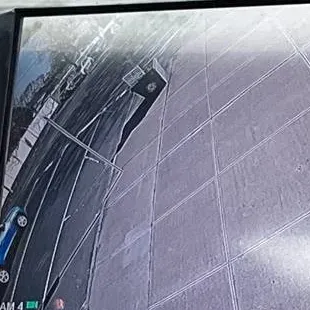
AESS job photo: a recorder monitor shows one wide-angle channel looking down on paved sidewalk squares, the curb and the edge of a parked blue car, with the channel label in the corner. A view like this answers the question Staten Island owners ask most — who walked up to the car at the curb — but only a second, tighter camera shows a face.
Repair & Same-Day Help
Same-Day Uniview Repair on Staten Island
The calls we get about Uniview on Staten Island cluster around three moments: the morning after a storm, the morning after a car was tried in the driveway, and the day someone discovers the recorder has not saved anything for a month. Call (347) 934-8335 and we give a two-hour window; once a technician is at the recorder, most single faults are fixed in one to two hours. Before we arrive, write down which camera tiles are black, check whether the recorder’s front lights are on, and look at where the recorder sits — if it is on a basement floor that took water, tell us on the phone so we bring a replacement.
What failed, where on the house to look, and what usually fixes it
Symptom
Where we look on a Staten Island house
Usual fix
Recorder dead after a storm or a sump failure
Floor of the basement or garage where it sat, the outlet it was plugged into, signs of water in the power supply
Replacement recorder installed upstairs; drive tested separately in case footage can be recovered
One outdoor camera black, the rest fine
The exterior entry hole, the connector behind the camera, the run along the siding or soffit
Re-terminated connector, resealed entry; new cable where a ladder or a gutter crew crushed it
All cameras black at once
Recorder power, a PoE switch on a power strip someone switched off, a tripped circuit in the garage
Dedicated outlet and small battery backup so the next blip does not take the system down
Night picture white and hazy
Camera behind a storm door or window glass, a spider web on the lens, a porch light beside the camera
Camera moved outside the glass, infrared settings changed, lens cleaned and angle corrected
Phone app stopped connecting
New router from the internet provider, cloud binding, the app version on the phone
Recorder re-connected to the new router, account checked, phones moved to the current UNV-Link app
Nothing recorded for weeks
Drive status in the recorder log, the recording schedule, a full or failed disk
Drive replaced, schedule reset to continuous plus events, an alert set for future drive errors
Two ways a repair can be billed: service time at $195 an hour with a three-hour minimum, or, when the recorder itself has died, the replacement recorder at its list price for Staten Island. From your description on the phone we say which one is likelier, so the bill does not surprise you.
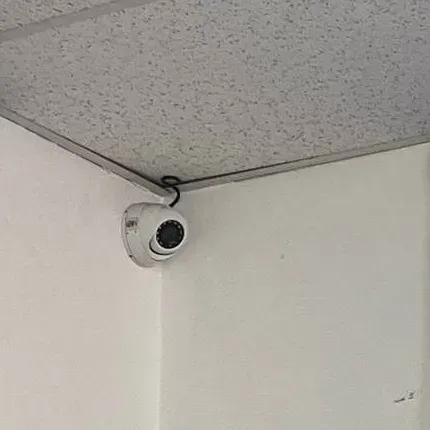
AESS job photo: a white dome camera sits tight in the corner between a painted wall and a speckled ceiling, with its cable looped once above the housing. A loop like that is the slack a technician needs to re-terminate a connector without pulling a new run — one of the first things we check when a single channel goes dark.
What We Install
Uniview Camera Installation Services in Staten Island
These are the jobs Staten Island owners ask for by name. A typical house combines three or four of them; the written quote lists which, and prices each line.
Driveway and curb coverage
One camera under the eave for the whole drive and the curb spot, and one lower camera at the car door or the side door for faces. Usually a 4 MP turret pair.
Separate entrances on two-family houses
A camera or video doorbell at each unit’s door, with each household’s login limited to its own entrance and the owner seeing everything.
Shared side yards and back fences
Cameras aimed along your side of the yard with privacy masks drawn over the neighbor’s windows and doors.
Flood-aware recorder placement
The recorder, its drive and its battery backup moved to a closet on the first living floor, with cables brought up through the attic or a wall cavity.
Raised and Build It Back houses
Coverage of the long front stair, the space under the living floor and the driveway beside the piles, with cable kept inside the floor framing.
Detached garages, boats and trailers
A camera on the garage or the house eave watching the boat, trailer or work van in the side yard, with an alert only when someone crosses the yard at night.
Storefronts and small offices
Entry, register and sidewalk cameras for shops on Hylan Boulevard, Forest Avenue, New Dorp Lane and Bay Street, with the recorder kept away from the counter.
Takeovers of inherited systems
Passwords changed, cloud binding moved to the new owner, firmware brought current and old camera angles checked for a house you just bought.
Phone setup for commuters
UNV-Link on every phone in the house, set to the lighter video stream so live view loads on a mobile connection on the ferry or the express bus.
Upgrades from older analog systems
Old coax cameras replaced with Uniview IP cameras on Cat6, reusing existing mounting spots so the siding gains no new holes.
How a finished Staten Island Uniview job looks
When we leave a house, the recorder is upstairs on a shelf or in a closet with a dedicated outlet and, where you agree, a small battery backup that rides through the short outages summer storms bring. Every camera cable is labeled at both ends with the number shown on the screen. Outdoor connectors sit inside a junction box or under the eave, never hanging in the open. Each camera that could see into a neighbor’s window has a privacy mask drawn over that part of the picture, and you have watched us draw it.
On the phones, every adult in the house has the UNV-Link app — Uniview introduced UNV-Link to replace its older EZView app, which it expects to stop service in 2027 — tied to a cloud account in your name, not ours. Where a tenant or a second household lives in the house, they have their own login limited to their own door. You keep a one-page sheet that lists each camera, what it watches, its model and its firmware version, and you have exported one clip yourself before we leave, so the first time you need to do it is not the night something happens.
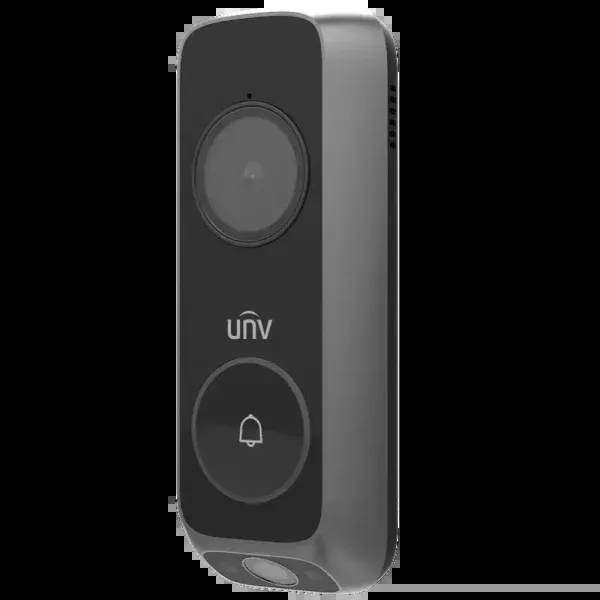
Uniview manufacturer product photo: a dark grey UNV video doorbell, with a large round lens near the top, the UNV logo in the middle and a round bell button below. Whether a doorbell like this suits a particular Staten Island door frame and recorder is settled at the walk-through, not from a catalogue.
Building Specialists
Uniview Camera Installation for Staten Island's Architecture
Two Staten Island houses that look alike from the street can need very different camera plans. The siding, the shared wall, the height of the living floor and where water reached in the last storm decide more than the camera model does.
Semi-attached two-family houses
A house type that R3-1 zoning still allows here: two units, a shared wall with the neighbor, a driveway beside or under the house. Cameras go on your own front and side walls; the recorder goes in the owner’s unit.
Attached row and townhouse blocks
Narrow fronts in a run of identical facades, garages at grade, small rear yards. One eave camera per house covers the drive; the rear needs masking because every yard looks into the next one.
Detached colonials, ranches and high-ranches
More wall to mount on and more ground to cover. Corners of the eave carry the wide views; the side door and the garage need their own camera for faces.
Raised houses on new foundations
Living floor well above grade, long exterior stairs, open or enclosed space underneath. Three views — stair, under-house, driveway — and cable routed inside the framing.
Pre-war frame houses
The island’s oldest housing: 32,820 homes were built before 1940. Plaster walls, balloon framing and old knob-and-tube routes change how cable travels.
Garden apartments and small buildings
The island also has 14,013 homes in buildings of fifty or more units. Lobby, mailroom and parking-lot cameras on one recorder, with a viewing login for the super.
How the method changes from house to house
Vinyl and aluminum siding. On a house clad in vinyl or aluminum siding, a camera screwed straight through siding pulls the panel out of line and gives water a path behind it, so outdoor cameras go on a mounting block or a junction box that sits flat on the siding and is fastened through to the sheathing. Cable enters behind the block, so the hole in the wall is covered by the mount itself.
Brick fronts and shared walls. Brick-front semi-attached houses get their exterior holes in a mortar joint, angled slightly down to the outside and sealed. The party wall shared with the neighbor is never drilled. On attached rows we route cable through the attic to the front and rear eaves rather than along the facade, because a run of surface cable across a shared front is the first thing a neighbor objects to.
Flood elevation. New York City’s flood-resistant construction rules define a design flood elevation for houses in mapped flood zones — the base flood elevation plus one or two feet of extra height, depending on the building’s category, under an emergency rule the Department of Buildings issued on January 31, 2013 — and require a house’s electrical equipment to sit at or above it. We use the same line for the recorder, the PoE switch and any battery backup. If you do not know your elevation, the city’s flood maps and your elevation certificate (if you have one) tell us; if neither exists, we go by where the water reached last time and stay well above it.
Attics and garages. Many Staten Island houses have an unfinished attic over the top floor and a garage ceiling under the bottom one. Those two spaces are where camera cable should travel: out of sight, protected, and easy to reach later. We avoid stapling cable across a basement ceiling in a flood zone when an attic route exists.
Who may be recorded. Inside a two-family house, the cameras watch the shared entrance, stairs and the owner’s own spaces, not the tenant’s unit. Outside, they watch your property. New York’s unlawful-surveillance law (Penal Law §250.45) and General Business Law §395-b cover cameras aimed at places where people expect privacy, and we design well clear of both.
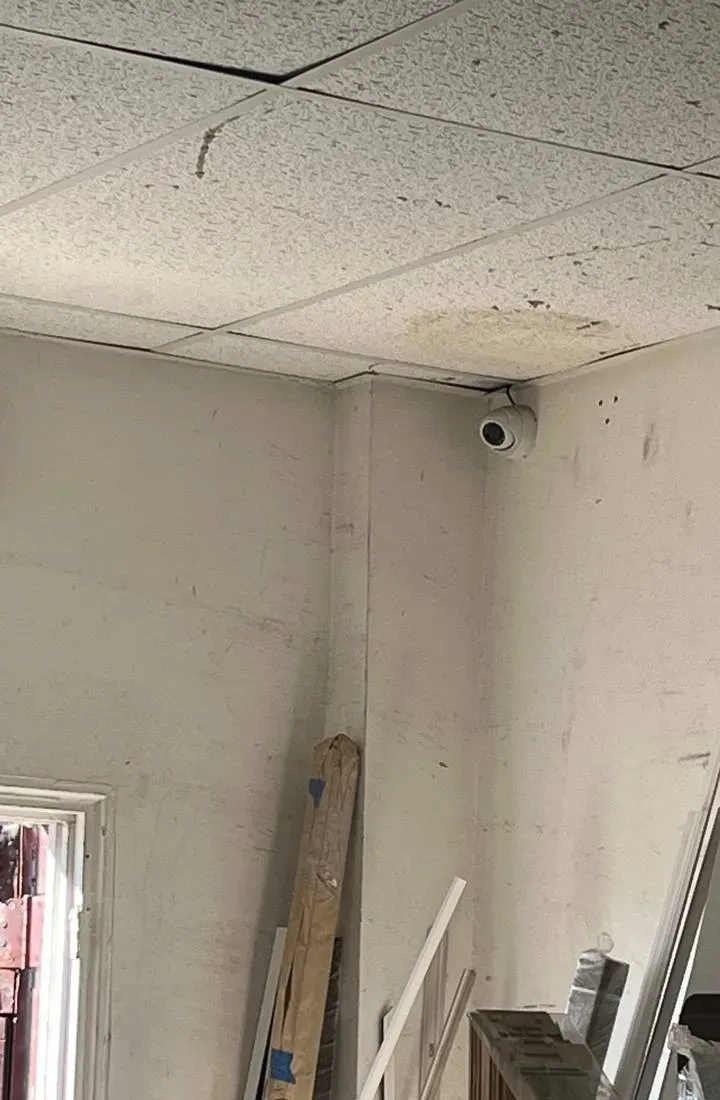
AESS job photo: a small white turret camera is mounted high in the corner of a plain storage room, under ceiling tiles with water marks, while lengths of board and trim lean against the wall beneath it. The camera can live down here; on a flood-prone Staten Island block the recorder should not.
Commercial Uniview Camera Installation
Business Uniview Camera Installation in Staten Island
The commercial break-ins that make the local news happen along the island’s shopping roads. The Staten Island Advance counted at least 30 burglaries at commercial properties across the borough over several months in 2022 and 2023, and the same pattern keeps appearing: a door or window broken at night, straight to the cash, gone in minutes. A Uniview system for a shop here is built to answer three questions afterward — how they got in, who they were, and what they took.
Hylan Boulevard
A long commercial road running through New Dorp and past the entrance to Great Kills Park. Three stores on Hylan were burglarized in the early hours of March 29, 2026, according to the Staten Island Advance — windows broken, registers taken.
Forest Avenue, West Brighton
A bagel shop and a wrap shop here were broken into in one 2020 burglary wave, the Staten Island Advance reported. ABC7 New York reported one serial burglar who hit at least five businesses along a stretch of Forest Avenue, going straight for the register each time.
New Dorp Lane
A half-mile of restaurants, bakeries, hardware stores and small offices between Hylan Boulevard and the Staten Island Railway station, per a local neighborhood guide.
Bay Street and St. George
Shops, bars and offices near the ferry terminal, in the 120th Precinct, which posted the borough’s largest car-theft increase in early 2026 — up to 25 from 15.
Stores with their own parking lot
Where a shop has its own lot, the camera plan has to cover the lot and the delivery door as well as the front, which usually means a switch and a larger recorder.
Barbershops, salons and small offices
Single-room businesses where one owner holds the keys. When a Staten Island barbershop was burglarized in August 2024, the owner’s own security footage showed the intruder walking in and out with a box.
Rules Staten Island shops and landlords should keep in view
Licensing. A contractor who puts in cameras for paying customers needs a state security-installer license under General Business Law §69-m. A shop owner whose own staff wire the owner’s own store does not.
Permits. NYC Administrative Code §28-105.4.7 exempts low-voltage signaling and data wiring under 50 volts from the electrical permit requirement when a licensed master electrician, special electrician or qualified person does the work. New outlets for the recorder are regular electrical work, and certain hazardous locations, including some areas inside commercial garages, are excluded from the exemption.
Back rooms. Under Labor Law §203-c no camera may record employees in a staff toilet, a locker room or a changing room; we stop coverage at those doors.
Face data. NYC Administrative Code §22-1202 requires stores and restaurants that collect customers’ biometric identifier information to post a sign at every customer entrance. Standard Uniview recording does not do that; face-recognition features change the answer, and we leave them off unless you decide otherwise with that rule in mind.
Flood zones. A shop in a mapped flood zone falls under Building Code Appendix G too; the Electrical Code lets non-residential buildings keep service equipment below the flood elevation only where approved dry floodproofing is provided, so in practice the recorder still goes up.
Grants and contracts. If a federal grant or a government contract is paying for the system, read the camera clause in that paperwork with whoever advises you before picking a brand. A store paying with its own money has no such clause to satisfy.
This list is a working checklist, not legal advice; when a lease or a lawyer says otherwise, the lease or the lawyer wins.
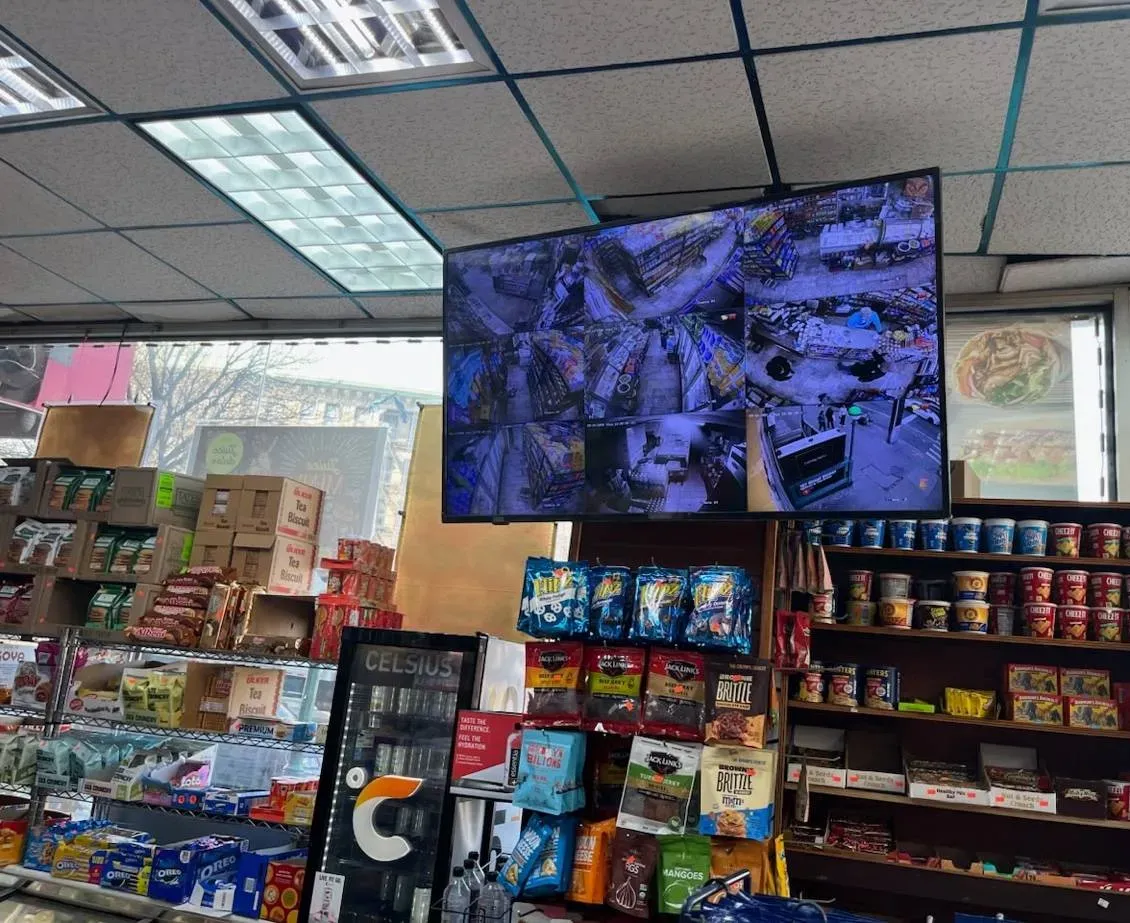
AESS job photo: a wide monitor hangs from a drop ceiling over a deli counter, showing a grid of overhead camera views of the aisles and register, above shelves of snacks, drinks and canned goods. A public-view monitor tells everyone walking in that the store records — useful on a corridor where break-ins come in runs.
Your Questions Answered
Uniview Camera Installation in Staten Island: Questions Answered
Floods, two-family layouts, driveways, break-ins and paperwork: the questions below come up on Staten Island walk-throughs again and again. Each heading gathers the ones that share a worry, and each answer opens with the plain answer before the explanation.
Floods, Raised Houses and Where the Recorder Lives
Does the city’s flood code say anything about where camera equipment can go in a flood-zone house?
Not by name, but the rule for a house’s own electrical gear points the same way. Appendix G of the New York City Building Code requires mechanical, plumbing and electrical systems in a flood hazard area to be elevated to or above the design flood elevation, with narrow exceptions, and the city’s Electrical Code places panelboards, meters and service disconnects at or above that line as well. A camera recorder, its PoE switch and its battery backup are not listed in those sections. They are, however, exactly the kind of equipment those rules are written to keep dry, and we apply the same line to them on every flood-zone job.
In practice that means a hall closet, a high shelf in a spare bedroom, or the top of a utility room on the main floor. Cables from the cameras come up through the attic or a wall cavity instead of all collecting in the basement. When the only workable cable path runs through the cellar, the cable can pass through it — a wet cable can be replaced in an afternoon — but the recorder does not stay there.
If the basement floods anyway, is the footage on the recorder simply gone?
If the recorder itself goes under water, assume the drive is lost. That is the strongest reason to move it, but there are two more layers worth having on a flood-zone block. First, many Uniview cameras accept their own memory card — the EC-T4F28DL turret on our price list takes a microSD card of up to 512 GB according to its datasheet — so each camera can keep a short local copy that does not depend on the recorder. Second, clips you know you will need, such as a car being tried at night, should be exported to a phone or a USB stick as soon as you see them, not weeks later.
What we do not promise is an off-site copy of everything. The EZCloud account behind the Uniview apps is what lets your phone reach the recorder and receive alerts; we do not design a Staten Island system on the assumption that continuous video is stored anywhere but the recorder. If a client needs a full off-site copy, we discuss a second recorder at another address or a separate storage service, and price it as its own line.
Our house was raised under Build It Back — how do the cameras cover the stairs and the open space under the house?
Plan for three views instead of one. A raised house usually has a long exterior stair or ramp to the front door, an open or enclosed area under the living floor, and a driveway beside or beneath it. One camera at the top of the stair, aimed down it, gives a clean face at the door; a second under the house, mounted to the underside of the floor framing, watches the open space and anything stored there; a third covers the driveway from the eave. The city’s Build It Back program served 1,982 Staten Island homeowners with construction, so this layout is common along the East and South Shore.
The details that change on a raised house are the cable path and the mounting surface. Cable to the under-house camera runs inside the floor framing, not draped down a pile where it can be snagged or washed. Anything mounted below the living floor is treated as if it will see water again: the camera is sealed, its connector is above the beam line, and its cable rises to the recorder rather than running along the ground.
Two-Family Houses, Shared Yards and the People Next Door
Each unit of our two-family has its own front door — does every door need its own camera?
Yes, one camera per entrance, and each household is alerted only about its own door. On many two-family houses the ground-floor unit and the upper unit have separate doors, often side by side on the stoop or one at the front and one down the side of the house. A single wide camera covering both doors shows that someone came up the steps but not which bell they rang or who answered. Two small turrets, or a video doorbell at each door, give each door its own record.
Which camera goes at which door depends on the door. Where there is a wired bell button and a frame wide enough, a video doorbell gives a face-height view and lets the visitor be answered; where the doors sit under a shared porch roof, a small turret above each one, angled down at the top step, does the same job without new bell wiring. Both feed the one recorder in the owner’s unit, so a single timeline shows who came to either door and when.
Our tenant upstairs wants a copy of yesterday’s clip after a package went missing — how do we share it without handing over the recorder?
Export the clip yourself and send the file; never share the admin login. On a Uniview recorder the owner finds the time on the playback bar, marks the start and end of the few minutes that matter, and saves them to a USB stick or straight to the phone through the app. That file can be texted, emailed or handed to the precinct, and it contains only those minutes.
Two habits keep this simple in a two-family house. First, decide with the tenant up front which camera views they may ask for — usually the shared front door and the stoop — so a request is routine, not a negotiation. Second, keep a short note of what was exported, when and for whom. If a dispute ever reaches a landlord-tenant court or an insurer, a dated note beside a clean export is worth more than a screenshot of a phone.
Can one recorder serve both halves of a semi-attached pair if the two owners split the cost?
It can, but we usually recommend two small recorders instead of one shared one. A shared recorder has to live in one of the two houses, one owner holds its admin password, and every disagreement about footage becomes a disagreement between neighbors. Two four-channel recorders, one per house, cost little more and leave each owner in charge of their own video.
If the owners still want one system — for a shared driveway between the two halves, for example — we put the agreement in writing first: who holds the admin password, which cameras each owner sees, and how a clip is shared when one of them needs it. The recorder then goes in the house with the drier, more accessible closet, and the other owner gets a viewing account.
Our house sits well above the street with a long flight of outdoor steps — how do cameras cover the steps and the sidewalk below?
Use two cameras at two heights. A camera at the top of the steps, under the porch roof or on the wall beside the door, looks down the flight and catches each person’s face as they climb toward it. A second camera lower down — on the retaining wall, the garage or a post near the street — covers the sidewalk and the parked cars that the top camera sees only as rooftops.
Steep lots also change the cable path. The lower camera usually needs its cable brought up inside the garage or along the retaining wall in outdoor conduit rather than straight up the face of the slope. We plan that route at the walk-through, because it decides whether the lower camera is a one-hour job or a half day.
Driveways, Curbs and Cars Left Outside
Should a driveway camera keep its white light on all night, or stay dark until something moves?
Dark until something moves, in almost every case on Staten Island. Dual-light Uniview cameras such as the EC-T4F28DL can record in infrared, which nobody sees, and switch to their warm white light when they detect a person, so the picture turns to color exactly when it matters. A light that burns all night on a semi-attached block shines into the bedroom of the house ten feet away and gets the camera turned around by an unhappy neighbor.
The switch-on also works as a warning. Someone walking up a driveway at night who is suddenly lit up knows they are being recorded. With car thefts on the island up roughly 47% through July 2026, according to the Staten Island Advance, and ABC7 New York showing a car taken from a driveway here in under fifteen seconds, a light that comes on before the door handle is touched is the most useful few seconds the system provides. We set the trigger zone on the driveway itself, not the street, so passing cars do not set it off.
Where should a driveway camera go on a high-ranch with the garage under the living room?
Under the eave above the garage door, offset to one side and aimed down the driveway toward the street, with a second, narrower view at the front door. On a high-ranch the eave is high enough to put the camera out of reach but low enough that a 4 MP camera still resolves a person at the bottom of the drive. Mounting right above the garage door centre puts the door opener’s light and any headlights straight into the lens, so we move it off-centre.
Inside, the garage is tempting for the recorder because power and the network are often there. On a low-lying lot it is the wrong place for the same reason the basement is: it is the first floor to take water. We run the driveway cable through the garage ceiling and up to the recorder in the living space above.
We park at the curb, not in a driveway — can a camera on the house really cover the car out past the sidewalk?
Yes, if the camera is aimed down at a narrow strip rather than out at the street. Mounted under the front eave, a camera can take in the sidewalk and the one parking spot in front of your house; whatever falls into the top of the frame across the street is blacked out with a privacy mask. You get a close view of your own car and the sidewalk beside it.
Curb parking changes the lens choice. A 2.8 mm lens shows a wide area but makes a car twenty feet away small; for a single curb spot a slightly longer lens, or an 8 MP camera like the IPC3618LB-ADF28K-DL on our price list, keeps more detail. We take a test frame from the actual mounting spot before tightening anything, so you see the curb view before we drill the second hole.
Shops on Hylan Boulevard, Forest Avenue and New Dorp Lane
Burglars on Hylan and Forest went straight for the registers — where should the recorder itself be hidden in a small store?
Anywhere except behind the counter, and ideally somewhere a stranger would not look for it. The Staten Island Advance reported three stores burglarized on Hylan Boulevard in the early hours of March 29, 2026, with windows broken and registers taken; ABC7 New York described a serial burglar who hit at least five businesses along a stretch of Forest Avenue, going straight for the registers each time. A recorder sitting on the shelf under the register goes out the door with the cash drawer, and with it the only record of the night.
The better places in a small shop are a locked office or stock-room cabinet, a ceiling space above a drop tile, or a metal lock box fixed to the wall of a back room, with its own outlet and a small battery backup. The cameras stay where they need to be — inside the front door, over the register and outside on the sidewalk — and only their cables lead to the hidden box. Phone alerts for the hours the store is closed mean the owner often learns about a break-in within minutes, while the cameras are still recording.
Should the register camera look down at the counter or out at the customer?
Both, from two cameras, if the budget allows; if it allows one, look out at the customer from behind and above the cashier’s shoulder. A camera straight above the counter records cash drawers and hands well, which answers till disputes, but it sees only the top of a customer’s head. A camera behind the cashier, slightly above head height, records the face of everyone who comes to the counter, which is what the police ask for.
New York Labor Law §203-c forbids employers from video recording employees in restrooms, locker rooms or rooms set aside for changing, so the back-of-house cameras stop at the stock room and office doors. Inside the selling floor and at the register there is no such limit, but tell your staff where the cameras are; employees who know the register is recorded rarely end up as the subject of a dispute.
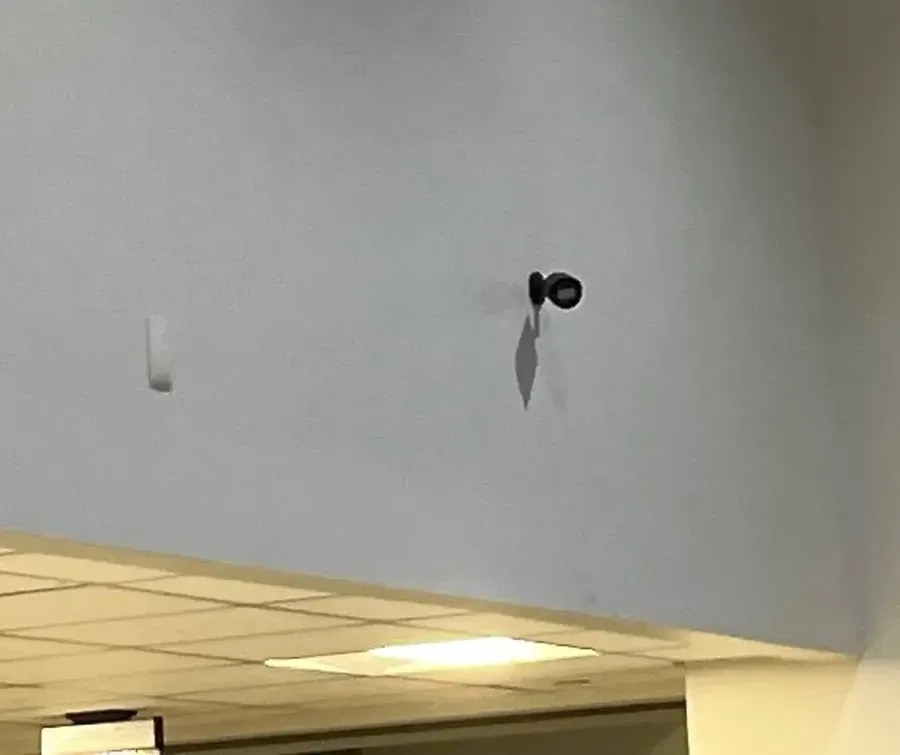
AESS job photo: a small black camera is fixed high on a pale wall above a lowered ceiling with recessed lights, casting a long shadow, with a small white sensor a little to its left. Mounting that high keeps the camera out of reach of anyone who comes through a smashed front door.
Permits, Paperwork and Systems You Inherit
Does New York City require an electrical permit to wire cameras into a Staten Island house?
Not for the camera cabling itself, provided the right person installs it. Section 28-105.4.7 of the city’s Administrative Code exempts electrical wiring that operates at less than 50 volts for signaling, communication, alarm and data circuits from the electrical permit requirement, as long as the work is done by a licensed master electrician, a special electrician or a qualified person as the Electrical Code defines it. Separately, New York State requires anyone in the business of installing security systems to be licensed by the Department of State; our license number is 12000287431.
A new 120-volt outlet is a different matter. If the closet chosen for the recorder has no outlet, adding one is regular electrical work that needs a licensed electrician and, in most cases, a permit. We tell you at the walk-through whether an outlet is needed, and the quote shows it as a separate line so it never appears as a surprise.
We bought a house in Tottenville that came with a Uniview recorder — what should we do on day one?
Change every password, then find out whose cloud account the recorder is tied to. Uniview’s own guide notes that most of its products ship with the user name admin and the password 123456; if the previous owner never changed it, anyone who knows that can log in. If you can log in with the old owner’s password, change it immediately. If you cannot, the recorder needs a documented password reset through Uniview, and we can handle that with proof that you own the house.
Next, check the cloud. A Uniview device can be bound to only one EZCloud account at a time, so if the seller’s phone still shows your cameras, the seller can still watch your house. Unbinding is done from the recorder’s own menu. Then look at what the cameras actually point at — previous owners often aimed one at a neighbor or a view you will not want — and check the drive’s health in the recorder’s log. A one-visit takeover covers all four steps.
Equipment
Types of Uniview Camera Installation We Install
The models below are the ones that fit Staten Island houses and shops most often. Every price is the installed figure from our published Staten Island list, including mounting and up to 100 feet of cable per camera.
EC-T4F28DL 4 MP dual-light turret
The workhorse of most Staten Island houses: 4 MP, infrared and warm light, IP67, and low power draw on PoE. Our list price installed is $449.
EC-B4F28DL 4 MP mini bullet
The same price and resolution in a bullet body, which some owners prefer under a soffit where a visible camera is the point. $449 installed.
IPC3618LB-ADF28K-DL 8 MP turret
Twice the pixels for curb spots and long driveways where the person you need is twenty or thirty feet away. $559 installed.
IPC2128LB-ADF28K-DL 8 MP mini bullet
An 8 MP bullet for the end of a long side yard or the far corner of a store lot. $559 installed.
Pan-tilt-zoom cameras
The IPC6424SR-X25-VF for marinas, lots and large yards, steered from a phone; $1,669 installed, worth it only where one camera must cover a wide space.
Video doorbells
Uniview makes video doorbells, and we fit them where a door has the wiring and the frame for one. They are not on the published Uniview list, so they are priced at the walk-through.
NVR301-04LS3-P4 and NVR301-08LS3-P8 recorders
Four- and eight-port recorders with built-in PoE, so the cameras plug straight in. The 4-channel model allows up to 54 W of PoE in total and takes one drive of up to 6 TB. $499 and $619 installed with setup.
NVR301-16B-LP8-IQ and PoE switches
For sixteen-camera stores and large houses: a 16-channel recorder with eight PoE ports plus a Uniview NSW2020 switch for the rest. $899 for the recorder, from $119 for the switch.
Which recorder for which Staten Island property
Property
Typical cameras
Recorder
Why
One-family house, small lot
3–4
NVR301-04LS3-P4
Four PoE ports cover the front, the drive, the side door and the yard with no extra switch
Two-family or semi-attached house
6–8
NVR301-08LS3-P8
A camera at each unit’s door plus drive, yard and stair; eight PoE ports and 75 W of PoE in total
Raised house with under-house space
6–8
NVR301-08LS3-P8
Stair, under-house, drive and yard views, with the recorder on the living floor
Store with a lot or a stock room
8–16
NVR301-08LS3-P8 or NVR301-16B-LP8-IQ with a switch
Entry, register, aisles, stock room, rear door and lot; drives sized for the recording period you need
ADT, Ring and SimpliSafe compared with an installed Uniview system
Question to ask
National brands
AESS Uniview install
Where is the video stored?
Usually in the maker’s cloud under a paid plan; some models add local storage
On a recorder in your house, on your drive, with no monthly fee
How are the cameras powered?
Often battery or plug-in Wi-Fi cameras that need charging or an outlet nearby
One Cat6 cable per camera carries power and video from the recorder
Who places the cameras?
Usually the owner, or a technician working from a package
A licensed installer, after walking the driveway, yard and flood line with you
What happens in a power cut?
Depends on the model and the router
Recorder and cameras on a battery backup sized at the walk-through
Can the neighbor’s window be blacked out?
Some apps offer privacy zones
Masks drawn on each camera at handover, with you watching
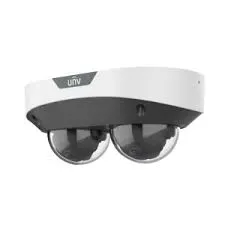
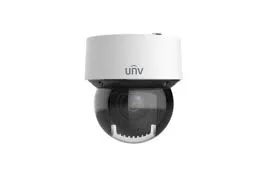
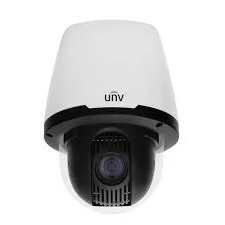
Uniview manufacturer product photo: a white UNV dome housing with two clear lens bubbles side by side underneath. Two lenses in one housing can cover a driveway and a side yard from one corner of a house, which matters when the eave is the only place to mount.Uniview manufacturer product photo: a compact white UNV pan-tilt-zoom dome with a dark tinted lower bubble. A camera like this can be steered and zoomed from a phone, which is how a boat owner or a strip-center landlord checks a far corner without walking out to it.
AI Overview Reality Check
What AI Gets Wrong About Uniview Camera Installation in Staten Island
AI summaries are stitched together from cost guides, dealer pages and forum posts. Our research tools could not record the actual AI Overview Google shows for these searches, so we went to those underlying pages instead, pulled out seven claims they repeat, and set each one against what a Staten Island house or shop actually needs.
Claim: installation costs about the same everywhere
National cost pages state averages with confidence. Angi says the national average for security camera installation in 2026 is $1,289, with most homeowners paying between roughly $590 and $2,040; other pages quote $80 to $200 per camera for labor alone. Those figures are real averages of real jobs, but they describe a mix of single doorbells, DIY kits with a technician’s afternoon, and full systems, all over the country.
On Staten Island the number that matters is what a specific house needs. Our published list puts a complete four-camera Uniview system, with the recorder, a 4 TB drive, mounting and up to 100 feet of cable per camera, at $2,524 installed. A two-family house with a camera at each unit’s door, the driveway, the yard and the stair usually lands on eight cameras at $4,440.
The gap between the national average and a Staten Island price is not markup; it is scope. An average that includes a single doorbell is not a price for a house with two entrances, a long driveway and a basement that cannot hold the recorder.
Claim: any weatherproof camera is fine in a flood zone
Product pages and AI summaries treat the IP67 label as if it answered the flood question. IP67 on a camera like the EC-T4F28DL means the housing is sealed against dust and protected against temporary immersion under test conditions. It says nothing about the recorder, the power supply, the PoE switch or the battery backup, none of which carry that rating.
On a Midland Beach or Oakwood block, the camera on the eave is rarely the part that fails in a flood. The part that fails is the box on the basement floor that all the cables run to. That is why every Staten Island quote we write names the room the recorder will live in.
The fix costs little: a closet on the first living floor, a cable path through the attic, and a dedicated outlet. It is far cheaper than replacing a recorder and losing the footage of the night the water came in.
Claim: Uniview is banned in the US
Some comparison pages state flatly that Uniview hardware is banned under the defense authorization act, alongside Hikvision and Dahua. The statute does not say that. Section 889 names Huawei, ZTE, Hytera, Hikvision and Dahua; Uniview is not among them, and as of the FCC’s October 16, 2026 update Uniview does not appear on the FCC Covered List either.
The real federal action is narrower and points the other way. Since December 11, 2024, American suppliers need a license to ship US-origin items to Zhejiang Uniview Technologies, because Commerce put the company on its Entity List. Nothing in that rule touches a Staten Island household or shop that buys a Uniview camera and screws it to the eave.
Rules can change, and some buyers — anyone spending federal money, for one — should check their own contracts. We put the status on every quote with the date we checked it, and we tell you if a different brand fits your situation better.
Claim: the default password is fine if the camera is on your own network
Many tutorials repeat that Uniview devices ship with the user name admin and the password 123456, and Uniview’s own guide confirms that most of its products do. Some go on to suggest that the default is harmless if the recorder sits behind a home router.
It is not harmless. Uniview has published security notices for its recorders and cameras, and security researchers have documented botnets probing older Uniview hardware for known weaknesses. A default password, old firmware and an open port on the router are the combination those attacks look for.
Every system we install gets a new admin password set by the owner, current firmware, and phone access through Uniview’s cloud service rather than open router ports. When we take over an existing system, those three checks are the first hour of the visit.
Claim: wireless cameras are easier for a house like this
AI answers often steer homeowners toward Wi-Fi cameras because there is no cable to run. For a single doorbell that can be true. For a Staten Island house with a driveway, a side yard and a detached garage, wireless brings its own problems: batteries to charge, Wi-Fi that does not reach the end of the yard through aluminum siding, and cameras that drop offline exactly when a storm knocks the router out.
A Uniview PoE camera takes one Cat6 cable that carries both power and video. In a typical house that cable runs through the attic or the garage ceiling, invisible from outside, and the camera keeps working as long as the recorder has power.
The labor of running cable is real, and it is in the price. It is also the reason the system still works in five years without anyone climbing a ladder to change a battery.
Claim: one camera covering the whole driveway is enough
Summaries tend to recommend a single wide-angle camera for a driveway. A wide view is good at answering whether something happened. It is poor at answering who did it, because a person at the far end of a wide frame is a few dozen pixels tall.
The local car-theft pattern makes the difference concrete. When a car is taken in under fifteen seconds, there is one moment worth having on video: the person standing at the driver’s door. A second camera at about head height, aimed at that spot, captures it.
That is why our Staten Island driveway layouts almost always use two cameras: one overview, one face camera. The second camera adds $449 on our list. It is the one that matters on the morning after.
Claim: the Uniview app you download today will be the app you use for years
Search results still point owners to EZView, Uniview’s long-standing phone app. Uniview announced in March 2024 that its new apps, UNV-Link for end users and UNV-Link Pro for installers, will replace the EZView service, and that EZView is expected to stop its service in 2027.
For someone who checks the cameras on the ferry every morning, that is not trivia. A system set up on EZView today will need its phones moved to UNV-Link before then, and the move goes smoothly only if the cloud account is in the owner’s name and the owner knows its password.
We set new systems up on UNV-Link from the start, with the account registered to you. When we take over an older system, moving the phones to the current app is part of the visit.
Ask a Technician Before You Buy Cameras Online
Five minutes on the phone about your driveway, your basement and who lives upstairs saves a box of cameras that do not fit the house. We tell you plainly whether Uniview suits it, or whether something else would.
A good quote request reads like this: “Eltingville, two-family, two front doors and a driveway, basement took a foot of water in 2012.” A written price from the Staten Island list comes back the same business day; to talk first, call (347) 934-8335.
✅
We Got Your Request!
Thanks — your details are with a technician now, and you will get a call today. For anything urgent, ring (347) 934-8335 directly.
How It Works
Our Installation Process
Six steps, the same on a four-camera ranch in Eltingville and a sixteen-camera store on Hylan Boulevard. Most houses are finished in one working day.
1. Photos and flood check
You text photos of the front, driveway, yard and basement; we look up whether the address sits in a mapped flood zone and ask where water reached in past storms.
2. Walk-through
We walk the house and the property line with you, mark each camera on a sketch, measure every cable run and choose a dry, ventilated spot above the flood line for the recorder.
3. Written price
A line-by-line quote from the published Staten Island Uniview list, with anything unusual — a second floor's worth of hidden wiring, a trench, a new outlet by an electrician — shown as its own line.
4. Cable and mounting
Runs go through the attic, the garage ceiling or a basement joist bay and up to each camera; exterior entries are drilled in your own wall, angled down and sealed.
5. Recorder and accounts
The recorder is set up with current firmware, drives tested, privacy masks drawn over neighbors' windows, separate logins created for each household and alerts tuned to your property line.
6. Handover on your phone
You change the admin password yourself, install UNV-Link, export a test clip and get a one-page sheet listing every camera and what it watches.
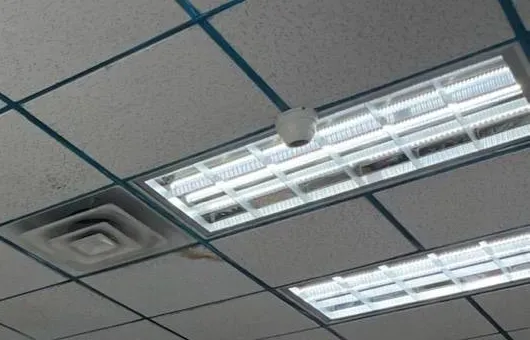
AESS job photo: a small white mini dome camera sits on a dark-grid drop ceiling right beside a long louvered light fixture, with a square air diffuser and a water-stained tile nearby. Hung ceilings like this make cabling fast; the fixture beside the lens is what we check for glare at night.
Coverage Area
Uniview Camera Installation Near Staten Island's Landmarks
From the ferry terminal to the southern tip, here are six places we read about while researching this page, with what each one tells us about camera work nearby.
St. George Ferry Terminal
Start and end of the 5.2-mile ferry run to Whitehall, about 25 minutes each way and running around the clock — a crossing long enough to check the cameras at home.
Snug Harbor, Richmond Terrace
The 83-acre cultural campus at 1000 Richmond Terrace on the North Shore, a short ride from the ferry.
FDR Boardwalk, South Beach and Midland Beach
A 2.5-mile boardwalk from Fort Wadsworth to Miller Field along Father Capodanno Boulevard, near the Midland Beach and South Beach blocks where Build It Back placed new modular homes.
Oakwood Beach
Where nearly every homeowner took the state buyout after Sandy and 308 properties were acquired; the line of the new seawall project ends here.
Great Kills Park, Hylan Boulevard
A 523-acre unit of Gateway National Recreation Area since 1972, with a beach, a marina and a boat launch, entered from Hylan Boulevard.
Conference House Park, Tottenville
The southernmost point of New York State, a 267-acre park in Tottenville at the island’s south-western tip.
We also serve Tompkinsville, Stapleton, Clifton, Rosebank, West Brighton, Port Richmond, Mariners Harbor, Graniteville, Westerleigh, Bulls Head, Willowbrook, New Springville, Todt Hill, Grasmere, Dongan Hills, Grant City, New Dorp, Oakwood, Bay Terrace, Great Kills, Eltingville, Annadale, Huguenot, Prince’s Bay, Rossville, Woodrow and Charleston, and the neighboring Brooklyn Uniview installation area across the Verrazzano.
Pricing
Uniview Camera Installation Cost in Staten Island
The numbers in this table are copied from the Staten Island Uniview price list we publish, where each camera and recorder already carries the island’s labor rate. Each one is an installed price before sales tax: mounting, up to 100 feet of exposed, attic or basement cable per camera, and phone setup are inside it. We confirm the final figure once we have seen the house or shop.
Plaster, brick and exterior walls priced after inspection
Service or repair visit
$195 an hour, 3-hour minimum ($585)
Number of faults, access, whether parts are needed
What raises a Staten Island price. A recorder that has to move out of a basement to a floor with no outlet, which adds an electrician’s line. Hidden wiring on a finished two-family where both units want no visible cable. A long run to a detached garage or the back of a deep lot that needs a switch or a buried conduit. A raised house where the under-house camera needs its cable carried up inside the framing. A takeover where nobody knows the admin password and ownership has to be documented first.
What lowers it. An unfinished attic over the top floor or an open garage ceiling to run cable through. Cameras grouped on one or two sides of the house. A recorder location chosen before we arrive. Reusing the mounting spots of an old system.
Uniview manufacturer product photo: a white UNV pendant-style PTZ dome with a black zoom module inside a clear lower bubble. PTZ cameras are the most expensive line on our Staten Island Uniview list and are worth it only where one camera has to watch a large open area.
Get a Written Staten Island Price
Three facts get you a written number: the neighborhood, how many doors open to the outside, and whether the car sleeps in a driveway or at the curb. Anything special about the house appears on the quote as its own priced line.
Front door, driveway overview, a face camera at the car or side door, and the back yard: four EC-T4F28DL dual-light turrets wired to an NVR301-04LS3-P4, whose 4 TB drive keeps a minimum of two weeks. Cable up to 100 feet per camera and UNV-Link on your phones are included.
Two-Family Standard — $4,440
Eight EC-T4F28DL turrets on the NVR301-08LS3-P8 with a 4 TB drive. A camera at each unit’s door, the shared stair or hall, the driveway overview and face camera, the side yard, the back yard and the curb, with a separate login for each household.
Storefront and Large Lot — $8,700
For a shop with a parking lot and a stock room, a small apartment building or a big corner property: an NVR301-16B-LP8-IQ recorder feeding sixteen EC-T4F28DL turrets, eight of them through an NSW2020-10T-POE-IN switch, with two 4 TB drives. Keeping roughly a month instead of two weeks raises it to $9,387.
Already bought the equipment? Labor-only installation
Bought a Uniview kit yourself? We will put it up, charging only labor per camera and recorder at the rates on our install-your-own pricing page. Check two things before booking. Uniview USA warns that gear sold through unauthorized resellers gets no warranty or software-upgrade support, so keep the receipt. And kits seldom come with enough cable to reach a detached garage or a recorder moved upstairs; send us the box contents and we list what is missing in advance.
Complete Services
Every Uniview Camera Installation Service in Staten Island
A good add-on for a Staten Island house is a smart lock on the side door the family actually uses: the camera shows who came in, and the lock’s log shows when.
Field Notes
Field Notes: Carry the Recorder Upstairs
The easiest place to put a camera recorder in a Staten Island house is almost always the basement. The internet comes in there, the electrical panel is there, the cables from the front and the back of the house meet there, and nobody sees the box. On many East and South Shore blocks it is also the room where water stood in October 2012, and where a failed sump or a summer downpour still leaves a puddle.
So the planning question we ask at every walk-through is not which camera goes where. It is: where did the water reach? If the answer is anywhere near the basement floor, the recorder goes up a floor — into a hall closet, onto a high shelf in a spare room, into a cabinet in the living area — and the cables follow it through the attic or a wall cavity. It costs a little more cable and sometimes an outlet. It means the one box that holds every hour of recorded video is not the first thing to fail when the next storm comes in.
The cameras outside do not mind the weather. The recorder does. Everything else about a Staten Island install follows from keeping those two facts straight.
FAQ
Staten Island Uniview Camera Installation FAQ
Do both the upstairs and the downstairs households need to be home on installation day?
+
Not both, but we need a key or a person for every space a cable passes through. On a two-family house that usually means the basement, the stair hall and whichever unit holds the front-door wiring. We map the route at the walk-through and tell each household which rooms we need, for roughly how long, so the tenant upstairs is not waiting at home all day for a ten-minute visit to a closet.
How much dust and mess does the work leave inside the house?
+
Very little, because most of the drilling happens outside or in the attic. Where we do drill indoors, a vacuum is held at the bit and drop cloths go down under the ladder. Ceiling and wall openings are kept to the size of the cable, and any access hole we make in drywall is patched before we leave; painting a patch is the one thing we ask the owner to finish. At the end of the day the boxes, offcuts and packaging leave with us.
What should we do with the recorder when an evacuation order goes out for our zone?
+
Leave the cameras alone and deal with the recorder. If it already sits above the flood line, keep it running on its battery backup so you can watch the house from wherever you go. If it is still in a basement, unplug it and carry it upstairs with its power supply; the drive holds everything recorded so far. Export any footage you already know you will need to a USB stick before you leave, and take the stick with you.
After installation, can small changes such as a new login or a schedule be made without a visit?
+
Often, yes. If you have agreed to it, a technician can make small changes with you over the phone while you are logged in to the recorder: adding or removing a household member’s login, changing when alerts arrive, or redrawing a privacy mask. Anything that needs a ladder, a cable or a new camera needs a visit. We never keep standing remote access to your recorder; each session starts with you.
Will drilling through brick on our semi-attached house disturb the neighbor's side of the wall?
+
Not if the hole goes where it should. We do not drill into the shared party wall at all; exterior entries go through your own front, rear or side wall, in a mortar joint, angled slightly down toward the outside and sealed. Mounting screws for cameras near the property line go into your side of the facade only. If the only sensible cable route crosses into the neighbor's half, we stop and you talk to them first.
Can a camera keep an eye on a boat or trailer parked in the side yard?
+
Yes, and it is one of the easier views to get right because the boat does not move. A turret under the eave aimed down the side yard records anyone at the hitch or climbing the ladder, and a line-crossing rule drawn across the yard can alert your phone when someone steps past the gate at night. Point it along your yard, not across the fence into the house next door.
Do you need to log in to our home router, and what do you change there?
+
Usually not. The Uniview recorder runs its own camera network on its built-in PoE ports, so the cameras never touch your home Wi-Fi. The recorder needs one cable to your router for phone viewing through Uniview's cloud service, and that works without opening ports. If you want remote viewing without the cloud, we go through the router settings with you and write down exactly what was changed.
Can a camera watch the sump pump or the basement floor for water?
+
A camera can show you the basement floor on your phone, but it is not a flood alarm. Uniview's motion and intrusion rules are built for people and vehicles, not a slowly rising puddle. Pair the camera with a simple water sensor by the sump that sends its own alert, and use the camera to look and decide whether to come home. Keep that camera's cable and power above where the water reached last time.
Do outdoor camera lenses need cleaning, and how often?
+
A few times a year is enough for most houses. Spider webs are the usual problem: they catch the infrared light at night and fill the picture with moving white strands, which also sets off false motion alerts. Dust, pollen and road grime build up more slowly. A soft cloth and plain water are all a lens needs; avoid glass cleaner on the dome cover. If a camera is too high to reach safely, a cleaning visit is billed at the service rate.
Can a camera be mounted on a fence post at the back of the yard instead of on the house?
+
Yes, as long as the post is solid and a cable can reach it. A Uniview PoE camera gets power and video through one Cat6 cable, so no outlet is needed at the fence; the cable runs from the house along the fence line in outdoor-rated conduit or, on a longer run, in a shallow trench. A wobbly fence post makes a wobbly picture, so we fix the camera to a steel post or a set wooden post rather than to a fence panel.
All Areas Served
Uniview Camera Installation Across New York City, Long Island and the Hudson Valley
Staten Island is one of five borough pages beneath our NYC Uniview camera installation hub; Long Island and the Hudson Valley have hubs and county pages of their own, each researched separately.
We read each source below in October 2026, and every figure, date and rule quoted above comes from one of them; the prices are the exception, because they are our own published Staten Island list.
Richmond County housing and household counts — units in structure, year built, median year built, owner and renter occupancy, vehicles available, population — from the Census Bureau’s 2019–2023 five-year American Community Survey (B25024, B25034, B25035, B25003, B25044, B01003)
Office of the Staten Island Borough President, “Staten Island’s New Zoning Map” (housing growth 1970–2000, building permits by decade, R3-1, R3X and R3A district rules)
DeFalco Realty, New Dorp neighborhood guide (New Dorp Lane between Hylan Boulevard and the Staten Island Railway station)
PBS NewsHour, “Sandy-battered homeowners take buyouts rather than rebuild” (2015); Grist reporting on the Oakwood Beach buyouts
NYC Housing Recovery Office, Build It Back program page (homeowners served by borough); DNAinfo, September 21, 2017 (modular homes for Midland Beach, South Beach and New Dorp Beach)
U.S. Army Corps of Engineers, New York District, South Shore of Staten Island Coastal Storm Risk Management project page; office of Rep. Nicole Malliotakis on seawall construction timing
NYC Building Code Appendix G, Section G310.6; NYC Electrical Code Section 110.11(B); NYC Department of City Planning, “Designing for Flood Risk” (design flood elevation and the January 31, 2013 freeboard rule)
NYC Administrative Code §28-105.4.7 (low-voltage electrical work) and §22-1202 (biometric identifier signage); New York General Business Law §69-m and §395-b; Labor Law §203-c; Penal Law §250.45
Staten Island Advance / silive.com: car-theft reports of April 2026 (by precinct, CompStat through April 19) and July 2026; commercial burglary timeline (April 2023); barbershop burglary (August 3, 2024); Forest Avenue bagel and wrap shop break-ins (October 2020); Hylan Boulevard store burglaries (March 29, 2026)
ABC7 New York: video of a car stolen from a Staten Island driveway in under 15 seconds; report on a serial burglar targeting registers along Forest Avenue
NY1, August 5, 2020, on Tropical Storm Isaias outages, including more than 32,000 on Staten Island
NYC DOT Staten Island Ferry facts (5.2-mile run between St. George and Whitehall); siferry.com (24-hour service); Wikipedia summary of 2025 ridership and trip time
NYC Parks pages for the FDR Boardwalk and Beach and Conference House Park; National Park Service page for Great Kills Park; Snug Harbor Cultural Center
Entity List rule adding Zhejiang Uniview Technologies (Federal Register, December 11, 2024) and the FCC’s Covered List as it stood after its October 16, 2026 update
Uniview: EC-T4F28DL and NVR301-04LS3-P4 datasheets (distributor and Uniview copies); news release introducing UNV-Link and UNV-Link Pro (March 2024); password-retrieval and EZCloud guides; security notice page; Uniview USA notice on unauthorized resellers, February 9, 2026
Staten Islanders’ own discussions on r/statenisland about home cameras, privately owned plate readers and nosy neighbors (treated as opinion), plus Angi and similar cost guides whose claims the reality check tests
Some sources we tried returned nothing usable for this edition: Google’s question boxes, related searches and AI Overview, Answer the Public, Bing and DuckDuckGo suggestions, and the text of Yelp reviews. The page does not rely on any of them.
Camera Out After a Storm or a Break-In? Call the Staten Island Line
A dark driveway camera, a recorder that sat on a wet basement floor, a store system that did not save the night that mattered, or a house you just bought with someone else’s cameras on it — phone (347) 934-8335. We book the next open two-hour window, and most single faults are fixed within one to two hours of arrival.
Staten Island Uniview Installation From a Licensed, Insured Team
Staten Island jobs are run from the Abstract Enterprises Security Systems office at 1282 Troy Ave, Brooklyn, NY 11203. Call or text (347) 934-8335, or send pictures of the house and the recorder through WhatsApp.
Google reviewers rate us 4.7★ (201 reviews). New York State license #12000287431. Same-day written estimates, and insurance that covers work in lived-in houses and open shops.
Full terms — including 50% deposit, one-year parts-only warranty on AESS-supplied products, and the late-fee schedule — are set out in the service agreement. See our warranty page.
Edition of October 18, 2026. This version replaces the earlier Staten Island Uniview page entirely and is built on fresh research into the borough’s house types and year built, flood-resistant construction rules and post-Sandy rebuilding, 2026 car-theft figures by precinct, burglaries on the island’s commercial corridors, Uniview’s camera, recorder and app documentation and its Entity List and FCC Covered List status, with prices taken from the published Staten Island Uniview list and the standard service rate.