Uniview cameras for a Dutchess farm, estate, village house or shop — barn links, long drives and outage-ready recorders. Hudson Valley line: (845) 640-3835
Farms · Horse Barns · River Estates · Village Homes · Main Street Shops
Uniview Camera Installation in Dutchess County
UNV NVRs and IP Cameras · Barn and Outbuilding Links · Battery-Backed Recording · UNV-Link Phone Access
Dutchess is 620 farms, two cities, the river estates and a long list of hamlets where the nearest neighbor is a field away. A Uniview system here is less about the camera than about the distance between buildings, the line that carries video off the property and the hours the power is out after a storm. We design the recorder, the links to the barn or garage, the battery backup and the phone access together, so the cameras still record when Central Hudson is working through a long restoration and still show on your phone when you are in the city.
Reviewed and updated October 18, 2026 · checked against Uniview datasheets and app notices, the FCC Covered List, the Commerce Department’s Entity List rule, Dutchess County storm updates, the USDA 2022 farm census and local reporting on the county’s camera network · Anwar Timothy, NYS license #12000287431
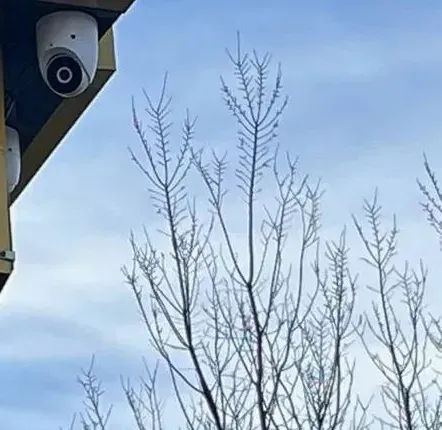
Real AESS job photo from another site, not a Dutchess property and not identified as a Uniview model: a white dome camera fixed under a dark eave at the corner of a yellow wall, with leafless branches against a pale sky. Bare trees like these are what a long winter view looks like; in May the same branches fill in, which is why we aim cameras around next season’s leaves, not this season’s.
Dutchess Uniview Quote
Tell us the town, the buildings you want covered and roughly how far apart they are — we call back the same business day
✅
Request Sent!
A technician will call you back about the Dutchess property the same business day.
25+
Years Experience
✓
Same-Day Estimates
100%
Licensed & Insured
4.7★
201 Google Reviews
Before anyone drives up the Taconic, send us three things: a phone photo of the house and the farthest building you want watched, a rough distance between them (pacing it out is fine), and the name of whoever supplies the property’s internet. Those three answers decide whether the far building gets copper, fiber or a radio link, and whether your phone can reach the recorder directly or needs a different route. Call or text (845) 640-3835.
Written price the same business day, from the published Dutchess figures on our Uniview price page
Recorder, outbuilding link, battery backup and phone set-up designed as one system, not four separate jobs
Visits seven days a week in two-hour windows up to 8 PM, by a crew working under NYS license #12000287431
Why Dutchess County Properties Need Uniview Camera Installation
Dutchess runs from the Beacon waterfront and the Fishkill corridor in the south to Millerton and the Connecticut line in the northeast, and from the Hudson River estates of Hyde Park, Staatsburg and Rhinebeck to the hill farms around Millbrook, Stanfordville and Pine Plains. The 2020 Census counted 295,911 people in the county, and roughly 45,000 of them live in the Town of Poughkeepsie alone. Outside that suburban center the pattern changes fast: houses set well back from the road, a bank barn or a converted carriage house a few hundred feet behind, a detached garage, maybe a run-in shed in a far paddock. A camera system that works on a city lot falls apart at those distances, and that is the first reason a Uniview installation here has to be designed rather than simply hung.
The second reason is farming. The USDA’s 2022 Census of Agriculture lists 620 farms in Dutchess covering 99,652 acres, an average of 161 acres each. Horses are a real part of that economy: sales of horses, ponies and related animals ranked seventh among New York counties. A horse farm or a hay operation has expensive equipment parked in open-sided sheds, animals that need watching at night, and buildings that were never wired for anything beyond a light bulb. The camera has to see in near darkness without startling the stock, ignore deer and coyotes, and send its video back over a link that survives a tractor, a frost heave and a summer of leaves.
The third reason is the grid and the line. On July 4, 2026 a summer storm interrupted service to about 50,000 Central Hudson customers at its height; two days later the county reported more than 19,000 Central Hudson customers in Dutchess still without power, with NYSEG reporting more than 3,400 of its own customers out, and most restorations expected late on July 7. A recorder with no battery behind it simply stops for that whole stretch, which is precisely the window when an empty house or an unlit barn is most exposed. Meanwhile many properties north and east of Route 9 rely on DSL, fixed wireless or satellite internet, and the most popular satellite service blocks the inbound connections a recorder would normally use to reach your phone.
Finally, cameras are a live subject in the county right now. In September 2026 the Dutchess County District Attorney and Sheriff withdrew their support for the county’s Flock license-plate camera network after packed public forums, including one at Pleasant Valley Town Hall, and the District Attorney asked the company to remove its cameras. Residents raised privacy, data-sharing and oversight concerns. A privately owned Uniview recorder answers some of those concerns by design: the footage stays on a hard drive in your house or office, and nobody outside the property sees it unless you give them an account or hand over a clip. We set systems up that way and explain the choices, including whether a plate-reading camera on your own gate makes sense.
Dutchess facts that shape a Uniview install
620 farms, 99,652 acres, 161-acre average — USDA 2022 county profile; long runs between buildings are the norm, not the exception.
Horse sales rank 7th in New York — the same profile; barns, paddocks and tack rooms need night views that don’t flood the stalls with white light.
More than 19,000 Central Hudson customers in Dutchess still out on July 6, 2026 — county storm update; recording needs battery power sized for hours, not minutes.
Central Hudson credits residential customers $25 per day after 72 hours in a widespread outage — a measure of how long the utility itself plans for some outages to last.
Federal BEAD fiber awards to Reasnor Telephone for 795 Dutchess locations and to Archtop Fiber for 1,638 locations across Dutchess and three other counties — some rural roads will change internet provider soon, and the recorder’s remote access should be set up to survive that change.
September 25, 2026 — the District Attorney and Sheriff withdrew support for Flock cameras; residents are paying close attention to where camera footage goes.
Most Dutchess owners who add cameras to a barn also ask about gate and door control at the same visit; our Dutchess access control installation page covers keypads and gate readers that can sit on the same network.
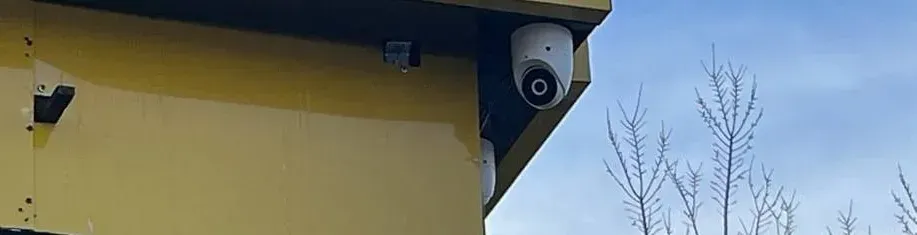
Real AESS job photo from another site, not in Dutchess: a small dark box camera and a white dome under the overhang of a yellow-painted corner, bare branches to the right. Two cameras on one corner means two cables or one switch at that corner, a choice we settle at the walkthrough before any hole is drilled.
Repair
Uniview System Down in Dutchess? Same-Day Help
A recorder that beeps and shows a hard-drive error, a barn camera that went black after the last thunderstorm, a phone that stopped showing video when the internet company swapped the modem — those are repair calls, and in most cases a technician has the system back within one to two hours of arriving. Call (845) 640-3835 with the recorder model from its label and what changed most recently. If the fault is on the far end of a link to an outbuilding, tell us that too; it changes which parts we bring.
What the symptom usually points to
Every camera black at once — recorder, its power supply, or the switch feeding the cameras, often after a surge.
Only the barn or garage cameras black — the link between buildings: a damaged buried cable, a radio knocked out of alignment, or a switch at the far end that lost power.
Live view fine at home, nothing from away — the route from the internet to the recorder changed, usually after a modem swap or a move to satellite.
Recorder alarms every few minutes — a drive failing or full, or a camera dropping in and out because its cable or connector is wet.
Uniview Camera Installation Services in Dutchess County
Every service below is part of one design: the recorder in the house, the cameras where they actually see something, the links that carry video between buildings, the power behind it and the route out to your phone. Here is the work we do on Dutchess properties with Uniview, also sold under the UNV name.
Whole-property NVR systems
A Uniview NVR in the house with PoE cameras on the porch, driveway, garage and yard. The recorder’s own PoE ports power the first cameras; a Uniview switch adds more, and every channel is labelled so the screen and the building agree.
Barn and outbuilding links
Cameras on a barn, carriage house, pool house or shop building, joined to the house recorder by buried Ethernet, outdoor fiber or a point-to-point wireless bridge, chosen by distance and line of sight rather than habit.
Gate and long-driveway cameras
A camera at the road end of a long drive, with line-crossing alerts so your phone knows a vehicle has turned in well before it reaches the house, and where wanted a dedicated plate-capture camera recording to your own recorder only.
Night views for stalls and livestock
Low-light colour cameras and warm-light models that need little illumination, placed so the barn aisle and stall doors are covered without a bright white flood in the animals’ eyes.
Outage-ready recording
A battery backup sized to the recorder, switch and cameras, plus a generator-friendly start-up, so the system keeps recording through a long restoration and comes back on its own afterwards.
Remote viewing on rural internet
Phone access set up through Uniview’s cloud service, a VPN, or a public address, matched to whether the property has cable, fiber, DSL, fixed wireless or satellite, and tested from off the property before we leave.
Village and city houses
Cameras on Victorian and early-twentieth-century houses in Poughkeepsie, Beacon, Rhinebeck and Millbrook, mounted on trim boards and blocks so the clapboard and brick stay intact and the cable route stays out of sight.
Shops, restaurants and offices
Point-of-sale, back-door and cash-room coverage for Main Street storefronts, Route 9 plazas and farm stands, with separate logins for owners and managers.
Replacing old DVR systems
Old analog systems swapped for Uniview IP cameras, or kept on their existing coax with a Uniview hybrid recorder where rewiring an old farmhouse would cost more than it saves.
Building Specialists
Uniview Camera Installation for Dutchess County’s Architecture
The county’s buildings span three centuries, often on one property. These are the types we plan for most, and what each one changes about where a Uniview camera goes and how its cable gets there.
Bank barns and stables
Stone foundations, heavy timber frames and board siding. Cameras go on the timber, never the stone; cables enter through the frame and run in conduit away from where animals chew and where manure and wash water collect.
River estates and gatehouses
Large houses set far back from Route 9G and the river side of Route 9, sometimes with a gatehouse or caretaker’s cottage at the drive. The recorder often lives in the main house while the gate camera is the farthest point on the network.
Village Victorians and row blocks
Clapboard and shingle houses with deep porches and brick commercial blocks on village main streets in Rhinebeck, Millbrook, Pawling and Red Hook. Mounts land on trim and fascia; cable follows downspouts and porch framing.
Post-war ranches and splits
The suburban stock of Wappingers, East Fishkill, LaGrange and the Town of Poughkeepsie: vinyl siding, attics with easy access, basements with a clear path to the router. The quickest and least expensive installs in the county.
Student rentals and two-family houses
Older houses near Marist and Vassar and in the City of Poughkeepsie divided into units. Shared entrances get cameras; private spaces never do, and each tenant’s access is set separately.
Pole barns and equipment sheds
Steel or wood posts with metal skin and no insulation. Cameras mount on posts or purlins, and the network gear inside needs a weatherproof enclosure because these buildings sweat in spring and freeze in January.
Method, building by building
Timber barns: stainless or galvanized fasteners into the frame, a drip loop on every cable entering the building, and conduit wherever the cable passes within reach of horses or a loader.
Stone and brick: drilled only in mortar joints where we drill at all, with sealed entries; on fieldstone foundations we prefer to bring the cable in above the stone through the sill or siding.
Clapboard and shingle: mounting blocks behind every camera so the base sits flat and water sheds around it, painted to match where the owner wants it to disappear.
Vinyl siding: proper siding mounts rather than screws through the vinyl, which lets the siding move with temperature without cracking around the camera.
Metal-skinned buildings: cameras on posts or brackets, not the thin skin; enclosures with breathable vents to stop condensation; switches and radios kept above the dirt floor.
Underground between buildings: outdoor-rated direct-burial cable or fiber in conduit, below frost depth where the route allows, with the route marked on the hand-over map so nobody puts a fence post through it.
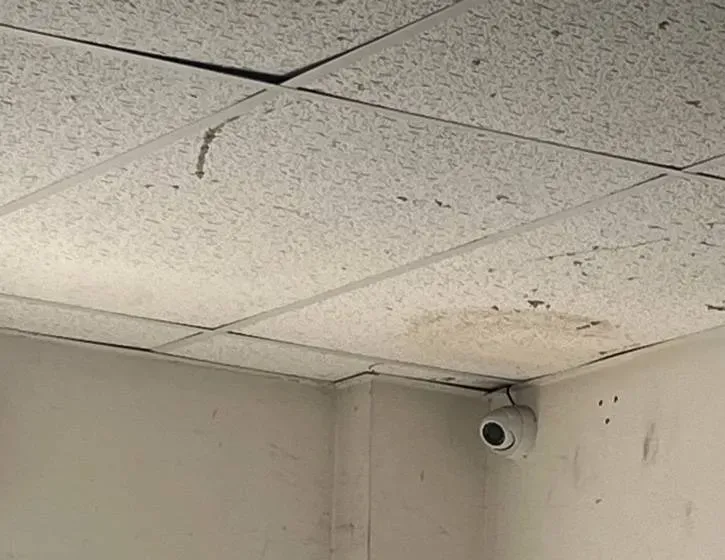
Real AESS job photo from another site: a small white dome camera tucked into the corner of a plain room beneath water-stained drop-ceiling tiles. Tack rooms, feed rooms and equipment stores often look like this, and a corner dome sees the whole room and both doors from one spot.
Commercial Uniview
Business Uniview Camera Installation in Dutchess County
Dutchess businesses tend to be small and spread out: a main-street shop, a restaurant in a converted house, a nursery or farm market on a state road, an office in a Route 9 plaza. These are the corridors we cover most, and what Uniview cameras typically do there.
Route 9 from Fishkill to Hyde Park
Plazas, car dealers and service businesses along the county’s main north-south road. Parking-lot coverage, entrance views and a recorder in a back office with a battery behind it.
Main Street, Beacon
Galleries, cafés and shops between the Metro-North station end and the east end of Main. Narrow storefronts, rear alleys and second-floor apartments above the shop that need their own separate coverage.
Downtown Poughkeepsie and the waterfront
Mixed blocks around Main Street and Market Street and the riverfront near the Walkway. Older masonry, shared rear lots and late-evening foot traffic.
Rhinebeck and Millbrook villages
Boutiques, inns and restaurants in historic buildings where owners want cameras that look like part of the building, not an add-on, and staff logins kept separate from the owner’s.
Route 44 and Route 22 corridors
Farm markets, feed stores, garages and contractors’ yards from Pleasant Valley to Amenia and Millerton. Long frontage, outdoor stock and equipment that sits outside overnight.
Farm stands and agritourism
Seasonal stands, orchards and event barns that are busy for a few months and empty the rest of the year. Cameras that watch the cash box in season and the buildings out of season, viewable from wherever the owner is.
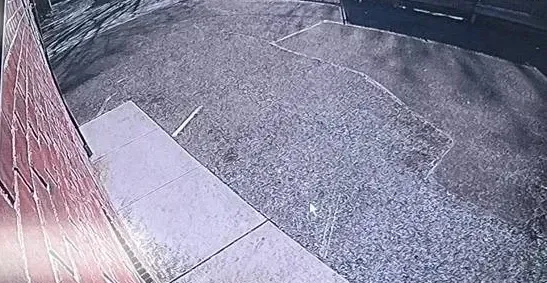
Real AESS job photo from another site: a recorded frame looking down a red brick wall across a sidewalk to a paved lot, in hard winter sun. A wall-hugging angle like this shows anyone walking along the building, which is the same angle we use down the side of a bank barn or a village storefront.
Rules Dutchess businesses should keep in view
Audio: New York’s eavesdropping law, Penal Law article 250, makes it a crime to record a conversation you are not part of without consent. Many Uniview cameras have microphones; on business systems we leave audio off unless the owner has a clear, lawful reason and posts notice.
Private spaces: the same article covers unlawful surveillance in places where people expect privacy — restrooms, changing areas, bedrooms in rentals. Cameras never point into them.
Electrical work: Dutchess has no county-wide electrician licensing board; County Law § 236-a lets the county create one, but municipalities set their own rules and, like the Town of Poughkeepsie, use approved third-party inspection agencies. Our work is low-voltage; any new 120-volt circuit for a barn or gate is done by a licensed electrician.
Footage sharing: with the county moving to end its Flock program, businesses that registered cameras through that system should check what was shared. A Uniview recorder shares nothing unless the owner creates an account for someone.
Uniview Camera Installation in Dutchess County: Questions Answered
These are the questions Dutchess owners actually bring to a walkthrough, grouped by the problem behind them. Each answer is written for properties here: long distances, rural internet, outages and a county paying close attention to cameras.
Distance, Barns and the Buildings Behind the House
Is a wireless bridge or a trench the better way to bring barn cameras 600 feet back to the house?
It depends on three things: distance, what lies between the buildings, and whether the far building already has power. Copper Ethernet is rated for 100 metres, about 328 feet, per run. Uniview’s own small PoE switches have an extend mode that stretches a run to 250 metres at reduced speed, which covers many barns but leaves no margin for a camera that needs full bandwidth. At 600 feet we are past the comfortable copper range, so the real choice is between outdoor fiber in a trench and a point-to-point wireless bridge.
Fiber wins where a trench is easy, where trees or a hill block the view between buildings, and where the run passes somewhere lightning has a habit of finding, because glass carries no surge. A wireless bridge wins where there is a clean line of sight, the ground is ledge or a paved drive, or the owner doesn’t want a trench across a lawn or paddock. Uniview sells an outdoor bridge rated for links of up to three kilometres; most Dutchess barn links are a tiny fraction of that, which leaves plenty of signal margin for rain and snow.
Either way the barn needs a small switch and outlet at its end. If the barn has no power, that becomes the first conversation, and it belongs to a licensed electrician rather than to us.
Will a wireless bridge across the pasture still hold its signal once the trees leaf out in May?
Only if it was aimed with May in mind. A link set up in January across bare branches can look perfect on the meter and then fade when the canopy closes, because wet leaves absorb a lot of the signal. We plan bridge paths by looking at what will be in leaf, not at what is there on the day, and where a tree line sits between the house and barn we either mount the radios high enough to clear it or move the link to a gable, silo or pole that sees over it.
We also leave the radios reporting their signal strength to the network, so a link that is slowly degrading shows up as a number before it shows up as a black camera.
Can lightning that strikes near the barn come down the camera cable and damage the recorder in the house?
It can, and in open farm country it is one of the more common ways an otherwise healthy system dies. A long copper run between two buildings behaves like an antenna for nearby strikes, and the surge travels to whatever is at the other end — usually the recorder or the switch. Fiber or a wireless link between buildings removes that path entirely, which is one reason we prefer them for runs that cross open ground.
Where copper between buildings is the right answer anyway, we fit outdoor-rated surge protection at both ends, bond it to the building’s grounding, and keep the recorder on a battery backup with its own surge protection. None of that makes a system lightning-proof, but it turns a direct hit on the barn into a lost camera rather than a lost recorder and every camera with it.
Does a camera on a detached garage need its own outlet, or can the house recorder power it?
If the garage is within copper range of the house, no outlet is needed: the camera draws power over the same Ethernet cable that carries its video, from the recorder’s PoE ports or a PoE switch. That is the cleanest installation, because there is one cable and nothing to unplug.
Once the garage is far enough away to need fiber or a radio, the far end needs power for a small switch and the radio or fiber converter, so an outlet in the garage becomes necessary. We specify exactly what it needs to power, so the electrician sizes the circuit correctly the first time.
When Central Hudson Is Out for a Day or Two
How long can a Uniview recorder and its cameras keep recording on a battery when the power is out?
It depends on the load, and the load is mostly the cameras. A small four-camera PoE recorder with infrared cameras draws modestly; add a PTZ camera or warm-light models switching their lamps on at night and the draw climbs. We total the real draw of the recorder, switch, radios and cameras and size the battery backup against the number of hours the owner wants, then say plainly what that battery will and won’t cover.
For outages measured in a day or more — and Dutchess has had several in 2026 — a battery alone is rarely enough. A standby generator, or a larger battery system, keeps recording through the long restoration; the battery’s job is then to carry the system across the seconds between the outage and the generator starting, and to keep the recorder from ever seeing a hard power cut.
Our standby generator takes about ten seconds to start — can that gap damage the recorder’s hard drive?
A recorder that loses power while writing to its drive can corrupt the last few minutes of video and, repeated often enough, shorten the drive’s life. Ten seconds of darkness every time the power blinks is exactly that kind of repeated hard stop. A small battery backup between the generator circuit and the recorder fills the gap, so the recorder never notices the switchover.
The battery also smooths the generator’s first moments of output, which can be rough on electronics. We put the modem and router on the same backup, because a recorder that kept recording but lost its internet route is still invisible on your phone.
Will our phones get a warning if the property loses power while we are away?
Not from the cameras themselves, because a camera with no power can’t send anything. What does work is keeping the recorder, modem and router alive on battery long enough to notice: the recorder can push an alarm notification when cameras drop offline, and some battery backups can send their own alerts when they switch to battery. Either gives a second-home owner in the city the news within minutes instead of when the neighbor calls.
We set the alert so it reaches the person who will act on it — often a caretaker or a nearby relative, not only the owner — and test it by pulling the plug before we leave.
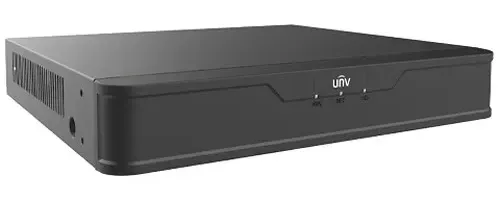
Manufacturer-style product photo, not an installed unit and not a specific model number: a low black desktop recorder with the UNV logo and three small status lights on the front. Recorders of this size sit on a shelf beside the router, ideally on the same battery backup.
Rural Internet: Satellite, DSL and the New Fiber
We are on Starlink in Pine Plains — can the phone app reach the recorder without a public internet address?
Yes, but not the way older guides describe. Starlink’s help center says its default service uses carrier-grade NAT, which blocks all inbound ports, and its own routers don’t support port forwarding. So the usual advice to forward a port to the recorder does nothing. What does work is Uniview’s cloud connection, which has the recorder reach out to Uniview’s servers so the app can find it, or a VPN built so the recorder’s side dials out.
Starlink also offers a public IP option on some plans; it opens the door to direct connections but also exposes the recorder to the whole internet, which we only recommend with firmware kept current and strong passwords. For most rural Dutchess owners the cloud route is the sensible default, and we test it from a phone on cellular data before leaving.
Will a slow rural internet line make the recorded footage itself lower quality?
No. The recorder writes full-quality video from each camera to its own hard drive in the house; the internet line plays no part in that. What a slow upload affects is only what you see remotely: live view and playback from away have to squeeze through the line, so the app uses each camera’s lighter secondary stream for live tiles.
On a slow DSL or fixed-wireless line we tune those secondary streams so live view stays smooth, and we show the owner how to pull a full-quality clip when it matters, either by downloading it patiently through the app or by exporting it to a USB stick at the recorder.
Our road is on the list for new fiber — should we wait for it before putting cameras in?
Usually not. The cameras, cabling, recorder and battery backup are the same whatever internet arrives; only the last step, how the phone reaches the recorder, depends on the line. The state’s BEAD awards include fiber for 795 Dutchess locations through Reasnor Telephone and for 1,638 locations across Dutchess and three other counties through Archtop Fiber, and those builds take time.
Installing now means the property is recorded in the meantime. When the fiber arrives, the change is a new router and a re-check of the recorder’s network settings and cloud registration — a short visit or a phone call, not a new system.
What happens to the EZView app on our phones when Uniview retires it in 2027?
Uniview announced in March 2024 that two new apps, UNV-Link for owners and UNV-Link Pro for installers, would replace EZView, and that EZView is expected to stop service in 2027. Owners can sign in to UNV-Link with the same account. Systems we install now go straight onto UNV-Link, so there is nothing to migrate later.
If you already have a Uniview system on EZView, the move is mostly downloading UNV-Link and signing in, but it is worth checking that you know the account email and password, that the recorder’s firmware is current, and that every family member who views the cameras has their own login rather than sharing the owner’s. If nobody knows the account, we can help recover the recorder and register it again.
Plate Readers, Privacy and the County’s Camera Debate
After the county dropped Flock, can we still put a plate-reading camera at the end of our own driveway?
Yes. The county’s decision was about a public network of cameras on roads, run with an outside company and tied to a real-time crime center. A private owner recording vehicles entering their own property, onto their own recorder, is a different thing; New York has no general ban on it. The usual limits still apply: aim at your driveway, not your neighbor’s, and don’t record audio of conversations you aren’t part of.
Practically, a dedicated Uniview plate-capture camera only earns its cost where vehicles slow down or stop — at a gate, a bend or a narrow entrance. On an open drive where cars pass at speed, a good overview camera plus a line-crossing alert is often the better spend.
Does footage from a private Uniview recorder go to the sheriff or any county system automatically?
No. A Uniview recorder stores video on its own hard drive, and the only people who can see it are those with an account on the recorder or the app. Nothing is shared with police or the county unless the owner chooses to export a clip and hand it over, or deliberately registers the camera with a program.
Flock’s Dutchess ‘Community Connect’ page invited residents and businesses to register their own cameras with the county’s real-time response system. If you registered a camera that way, it is worth checking what that registration covered now that the county is ending its Flock use. We can review the accounts on your recorder and remove any you don’t recognize.
If Washington tightens the rules on Uniview later, could the cameras on our farm simply stop working?
Nothing in force today does that, and the actions taken against other camera makers so far point the other way. Uniview is not on the FCC’s Covered List, which as of its October 16, 2026 update names Hikvision and Dahua video equipment along with Huawei, ZTE and Hytera. For brands that are on it, the FCC’s tools have been refusing new equipment authorizations and, more recently, prohibiting the import and marketing of previously authorized covered equipment — rules aimed at what can be sold, not at switching off cameras already on a barn wall. The December 11, 2024 Commerce Department Entity List rule on Uniview likewise restricts exports to the company, not use by American owners.
The practical risk for an owner is different: if new purchases were ever restricted, replacement cameras of the same brand could become harder to find. That is why we build Dutchess systems on standard Cat6 and fiber, standard PoE, and cameras mounted on ordinary junction boxes. If a brand ever had to change, the cameras and recorder could be swapped while the cable, trenches, radios and battery backup — the expensive part on a farm — stay exactly where they are.
Is it legal to aim a camera at the town road in front of our farm stand?
Recording what anyone can see from a public road is generally lawful in New York, and a farm stand has good reason to capture the pull-off where customers park. What isn’t allowed is recording private spaces — a neighbor’s windows or yard where they expect privacy — or recording conversations with a microphone.
We aim road-facing cameras at your frontage and parking, not across the road into the house opposite, and on business cameras near the stand we leave audio off. A small sign that the area is recorded is good practice and often deters the problem by itself.
Horses, Livestock and Wildlife
Can a camera watch a foaling stall overnight without a white light that bothers the mare?
Yes. Ordinary infrared cameras light the stall with infrared that horses don’t react to the way they do to a white lamp, and show a clear black-and-white picture. Uniview’s farm materials describe its Wise-ISP night technology as needing only a small amount of light for colour images, specifically to avoid light pollution that could disturb animals. In a stall we usually choose infrared or a low warm light set to its dimmest useful level.
Placement matters as much as the model. A camera high in the aisle corner looking down into the stall sees the mare without being in her space, and keeps the lens clear of the dust, cobwebs and moisture that build up lower on the wall.
Will deer and coyotes crossing the field set off phone alerts all night?
Not if alerts are set to people and vehicles only. Uniview’s Smart Intrusion Prevention and human-and-vehicle detection are built to ignore leaves, birds and lights and to trigger only on people or vehicles crossing a line or entering an area. Simple motion detection, by contrast, will wake you for every deer in the hayfield.
We draw detection zones around the parts of the property where a person has no business being at night — the equipment shed, the tack room door, the end of the drive — and leave the open fields to the recorder’s continuous recording rather than to alerts.
Can the cameras at the gate tell us a car has turned in well before it reaches the house?
Yes. A camera aimed at the first stretch of the drive with a line-crossing rule set across it sends a notification the moment a vehicle crosses, which on a quarter-mile drive can be a minute or more of warning. The rule can be limited to vehicles so walkers and animals don’t trigger it.
The weak point is usually the link back to the house, not the camera, because the gate is the farthest point on the property. That is where a radio link or fiber run earns its keep, and where we put a small battery in the gate enclosure so the camera keeps working through brief outages.
Finding, Saving and Handing Over Footage
The Sheriff warned about late-night car thefts in Amenia and Millerton — where should a driveway camera point to actually help?
The Dutchess County Sheriff’s Office reported larcenies from vehicles, three vehicle thefts and an attempted burglary in Amenia and Millerton, all late at night or early in the morning, and in each case the vehicles were unlocked with the key fobs inside or reachable. The Sheriff’s first advice was to lock vehicles and never leave fobs inside; a camera doesn’t replace that.
What a camera adds is evidence and warning. The most useful position is close to where the cars actually park, at a height of roughly eight to ten feet, looking along the vehicles rather than across them, so faces and hands at the door handles are large in the frame. A wide camera on the house corner that shows the whole yard in one view tells you something happened; it rarely shows who. We pair the close view with a line-crossing alert at the drive entrance so a phone wakes up before anyone reaches the cars.
Can the recorder find every time a truck came up the drive last week without scrolling through hours of video?
Yes, on recorders that support it. Uniview describes its SeekFree feature as AI-powered search on its NVRs: you describe the target in words — a person, a vehicle, an animal — and the recorder finds the matching clips. Even on models without it, events recorded by person-and-vehicle detection are tagged, so playback can be filtered to vehicle events on the drive camera for a chosen day instead of scrubbing through every hour.
We set the drive and gate cameras to tag vehicle events specifically and show the owner how to pull a week of them in a few taps. On a farm, that is often how a missing delivery or an unexpected visitor gets sorted out.
If the link to the barn drops for an hour, is that hour of barn video simply lost?
Not if the barn cameras have memory cards and the feature is switched on. Uniview calls it ANR, automatic network replenishment: when a camera loses its connection to the recorder it keeps recording to its own micro SD card, and when the link comes back the recorder pulls the missing stretch across and fills the gap. Uniview’s PKC2640 plate-capture camera, for instance, lists micro SD cards up to 256GB and ANR on its product page.
It is worth having on any camera that sits on the far side of a radio link or a long run between buildings, because those are the links most likely to drop in a storm. We fit cards in the outbuilding cameras that support them, turn ANR on at both the camera and the recorder, and test it by unplugging the link for a few minutes before hand-over.
Will a cold January night or a hot August afternoon in an unheated barn hurt the switch and radio out there?
It can, if the wrong gear goes there. Uniview’s NVR301-04LS3-P4 recorder, for example, is rated to work between −10 °C and +55 °C, about 14 °F to 131 °F, and a Dutchess barn can fall below that in a cold snap and climb toward it under a metal roof in summer. That is one reason the recorder lives in the house, not the barn.
At the barn end we fit equipment rated for the conditions, inside a ventilated enclosure mounted off the floor and away from the roof skin, and we keep the far-end switch small so it draws little power and makes little heat. Outdoor cameras are built for the weather on the outside of the building; it is the indoor gear in an unheated building that needs the thought.
Rentals, Second Homes and Shared Access
We rent rooms to Marist students — which parts of the house can we legally put cameras on?
The outside of the house and the shared approaches: the front and back doors, the porch, the driveway and the parking area. New York’s unlawful-surveillance law, in Penal Law article 250, makes hidden recording in places where people expect privacy a crime, so nothing goes inside a tenant’s room, a bathroom or any space a tenant uses privately. Shared interior hallways in a rooming house are a judgment call we discuss case by case, and the lease should say plainly where cameras are.
Audio stays off on every rental camera. If tenants want to see who is at the front door, Uniview recorders allow a separate account limited to that one camera, which is easy to delete when the tenant moves out at the end of the semester.
Is trenching to a barn or gate included in the package price, or quoted separately?
Quoted separately, always in writing before work starts. Our published Dutchess package prices cover the cameras, recorder, drives, mounting and set-up at the Dutchess labor rate; they assume cable routes inside or along buildings. Trenching, conduit, outdoor fiber, wireless bridges and any electrical work for a far building vary too much by property to price from a web page.
The quote spells out the route, the depth, who restores the lawn or gravel, and what happens if the trench meets ledge. Where a wireless bridge would avoid a trench altogether, we price both so the owner can choose.
Equipment
Types of Uniview Cameras We Install
Uniview’s catalogue is large and its model numbers are long. These are the families that do the work on Dutchess properties, with the published Dutchess installed price for a representative model in each. Every price includes the camera, cable run, mounting box and set-up at the Dutchess rate.
ColorHunter mini bullets and turrets
The everyday 4MP cameras for porches, garage doors and barn ends, with low-light colour imaging. The EC-B4F28DL mini bullet and EC-T4F28DL turret are each $511 installed in Dutchess.
8MP cameras for wide yards
More pixels where one camera has to cover a wide paddock edge or a long parking area. The IPC2128LB-ADF28K-DL ColorHunter 8MP bullet is $621 installed.
Tri-Guard deterrence cameras
Cameras that combine intrusion detection, colour night imaging and a light-and-sound warning for equipment sheds and back doors. The IPC3638SS-ADF28KMC-I1 Tri-Guard 8MP turret is $1,031 installed.
PTZ cameras for fields and drives
Pan-tilt-zoom domes that sweep a field or follow a vehicle up the drive. The IPC6324LWH-AX5C-VG2 4MP 5x Wise-ISP Tri-Guard PTZ is $1,111 installed; larger 25x and 33x models run higher.
Plate-capture cameras
Dedicated cameras for a gate or narrow entrance where vehicles slow down, recording to your own recorder only. The PKC2640@Z28-IR-P is $1,821 installed.
Thermal cameras
For long, dark fence lines where nothing else sees a person at night. Uniview’s TIC-series thermal cameras start at $2,081 installed in Dutchess; most homes never need one, and some large farms do.
NVRs with built-in PoE
The NVR301-04LS3-P4 powers four cameras directly, up to 30 watts on a single port and 54 watts in total, records up to 4K, and takes one drive of up to 6TB. It is $531 with set-up; the 8-port NVR301-08LS3-P8 is $651.
PoE switches with extend mode
Uniview switches such as the NSW2020-10T-POE-IN have an extend mode for runs up to 250 metres at reduced speed, useful for a garage or shed just past normal copper range. Switches run from $119.
Hybrid recorders for old coax
Uniview XVR recorders accept analog cameras on existing coax alongside IP cameras, so an old farmhouse system can be modernised in stages. The XVR301-04G3 is $391 with set-up.
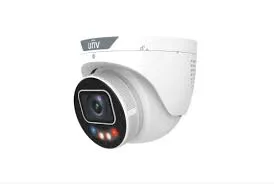
Manufacturer product photo, not an installed unit: a white UNV turret camera with a dark lens face and small red and blue lights below the lens. Uniview sells cameras of this type as Tri-Guard, combining intrusion detection, colour night imaging and a light-and-sound warning.
Ways a Uniview system reaches your phone from a Dutchess property
Internet at the property
Route we usually use
What to know
Cable or fiber with a normal router
Uniview cloud registration in UNV-Link
Simplest; nothing opened on the router. A VPN is available for owners who want no cloud relay.
Satellite with carrier-grade NAT
Uniview cloud registration, or a VPN that dials out
Port forwarding can’t work while the provider blocks inbound ports, so we don’t try it.
DSL or fixed wireless
Cloud registration with tuned secondary streams
Live tiles kept light so they load on a small upload; full-quality clips exported when needed.
Cellular hotspot at a far barn
Separate 4G camera or a 4G router at the barn
Uniview sells 4G cameras and solar kits for sites with no wired internet; data plans cost extra.
Public IP address
Direct connection, only with hardening
Works, but exposes the recorder to the internet; current firmware and strong passwords are mandatory.
ADT, Ring or SimpliSafe instead? How the offers differ
The national brands sell a different product. Ring and SimpliSafe cameras are mostly Wi-Fi or battery units that record to the company’s cloud, which depends on a subscription and on the property’s upload speed; on a slow rural line, every clip has to leave the property before you can see it. ADT sells monitored systems on contracts. A Uniview NVR system records locally on a hard drive in the house, with no monthly fee, and keeps recording when the internet is down.
The trade-off is that a wired system needs cable to each camera and a proper installation, which is the part we do. For a single Wi-Fi doorbell on a village house, a consumer brand is often enough. For a property with a barn, a gate and a long drive, the wired recorder is the one still recording at 3 a.m. during a storm. Owners who already have a doorbell or Wi-Fi camera they like often keep it alongside the Uniview system; it simply stays in its own app.
AI Overview Reality Check
What AI Gets Wrong About Uniview Camera Installation in Dutchess County
Search assistants and cost sites answer camera questions in national averages and city assumptions. These are the claims we hear most often from Dutchess owners, and what a property here actually needs.
“Professional installation costs $80–$200 per camera.”
That range appears in national cost guides, and Angi puts the average security camera installation at $1,289 based on thousands of projects, with most jobs between a few hundred and a few thousand dollars. Those figures describe mounting cameras on one building and plugging in a recorder. They don’t describe a property with a barn 400 feet away, a gate at the road and no internet faster than DSL.
On our published Dutchess price list, a Uniview camera installed — camera, cable run, mounting box and set-up — starts at $511, and the labor in that figure reflects the Dutchess travel and site time. A complete four-camera system with recorder and drive is $2,804. The figure that most often surprises owners isn’t the camera at all; it is the link to the far building, which no national average includes.
The honest comparison is between written quotes for the same scope. Ask every installer to list the outbuilding link, the battery backup and the remote-access method separately. If one of them is missing, the low number is low because it leaves that part out.
“Just use wireless cameras; there is no need to run cable.”
Wi-Fi cameras work where the Wi-Fi is strong, and on a Dutchess property it rarely is at the barn. A home router’s signal fades through stone walls and across open ground, and a battery camera at the far end of a paddock is a camera that needs charging every few weeks and records only short clips when triggered.
What does work over distance is a proper point-to-point bridge: two directional radios aimed at each other, carrying a wired camera network from the house to the barn. That is still “wireless” in the sense of no trench, but it is a fixed link with a known signal margin, not a router trying its best.
The cameras themselves stay wired with PoE, which means continuous recording, no batteries, and a picture that doesn’t freeze when the microwave in the farmhouse kitchen is running.
“Forward a port on your router and the app will connect.”
That advice assumes the property has its own public internet address. Many rural Dutchess properties don’t. Starlink’s help center states that its default service uses carrier-grade NAT that blocks all inbound ports and that its routers don’t support port forwarding; some fixed-wireless providers work the same way.
On those lines the recorder has to reach out rather than wait to be reached. Uniview’s cloud registration does exactly that, and it is what we use on most rural properties. A VPN that dials out from the property is the alternative for owners who prefer no third-party relay.
Even where port forwarding is possible, an open port to a camera recorder is a standing invitation to anyone scanning the internet. We avoid it unless there is a specific reason and the recorder is kept patched.
“Uniview is banned in the United States, like Hikvision and Dahua.”
It isn’t. The FCC’s Covered List names Hikvision and Dahua video equipment, along with Huawei, ZTE and Hytera, and the NDAA’s Section 889 names the same five. Uniview appears in neither. What did happen is that the Commerce Department put Zhejiang Uniview Technologies on the Entity List on December 11, 2024, which restricts exports of US-regulated items to the company.
For a homeowner or a farm in Dutchess, that means Uniview equipment remains legal to buy, install and use. It also means the rules could change, as they have for other brands, and owners who care about that risk should know it before they choose.
We tell clients the current status plainly, keep firmware current, and design systems with standard network cabling so that cameras could be changed later without rewiring the property.
“A security camera system works the same during a power outage.”
Only if someone planned for it. A recorder without a battery stops the moment the power drops, and cameras powered from it go dark with it. In the July 2026 storm, more than 19,000 Central Hudson customers in Dutchess were still without power two days later.
A battery backup on the recorder, switch, modem and router keeps the system recording and reachable for a planned number of hours; a generator carries it beyond that. The battery also protects the hard drive from the repeated hard shutdowns that come with every flicker.
We size the battery from the system’s actual draw and tell the owner, in hours, what it will cover. A number on a box isn’t a plan.
“Motion alerts will tell you when someone is on your property.”
Basic motion alerts tell you when anything moves: deer, branches, headlights on the road, snow. On a Dutchess farm that can mean dozens of alerts a night, and within a week most owners turn them off and stop looking.
Uniview’s person-and-vehicle detection and Smart Intrusion Prevention are built for this problem, triggering only when a person or vehicle crosses a line or enters an area. Set up carefully, they turn alerts back into something worth reading.
The set-up is the work: drawing zones that exclude the road and the open fields, choosing which cameras alert at which hours, and sending alerts to the person who will act, which on a farm may be the manager rather than the owner.
“You can install a Uniview system yourself in an afternoon.”
On a small house with an easy attic, a handy owner can. Uniview’s recorders and apps are designed to be approachable, and the recorder’s PoE ports make a four-camera system close to plug and play.
What turns an afternoon into a project on a Dutchess property is everything between buildings: burial depth and conduit, surge protection on long copper, radio alignment, a battery sized to the load, and remote access on a line that blocks inbound connections. Those are the parts where mistakes are expensive and hard to see until a storm.
Owners who have already bought the equipment can hire us for labor only, at the published Dutchess labor rate, and keep the parts they did themselves.
Map the Barn Link Before Anyone Picks Up a Shovel
Send a photo from the house toward the far building and tell us roughly how far it is. We tell you whether it is a cable, a fiber run or a radio link, and what each costs, before a site visit.
For a Dutchess Uniview quote we need the town, which buildings you want covered and roughly how far apart they are, what internet the property has, and whether there is a generator. A written price comes back the same business day; to talk it through first, call (845) 640-3835.
✅
We Got Your Request!
Thanks — the request is in. We’ll look at the buildings, distances and internet you described and call back the same business day; if a system is down right now, call (845) 640-3835.
How It Works
Our Installation Process
Seven steps, the same for a village house in Beacon as for a horse farm outside Millbrook. On larger properties the first two steps decide most of the price, because they settle how video gets from the far buildings to the recorder.
1. Photos, distances and the line
You send photos of the house and far buildings, rough distances and the internet provider. We sketch the camera positions and the link between buildings and send a written price.
2. Walk the property
A technician walks every route: wall entries, attic and basement paths, the line of sight or trench route to the barn or gate, and where the recorder, switch and battery will live.
3. Run cable and links
Cable pulled inside buildings and along framing; outdoor fiber, direct-burial cable or a wireless bridge between buildings, with surge protection where copper crosses open ground.
4. Mount and aim the cameras
Cameras fixed to framing or mounting blocks, sealed at every entry, and aimed for next season’s leaves as well as today’s view.
5. Recorder, drives and detection
The Uniview NVR set up with drives, labelled channels, recording schedules, and person-and-vehicle detection zones that leave fields and roads out.
6. Battery test and remote access
Recorder, switch, modem and router on battery backup; power pulled while we watch recording continue; UNV-Link access tested from a phone on cellular data.
7. Accounts, map and hand-over
Separate logins for each person who needs one, a map of every cable and link route, and a walkthrough of playback and clip export with the owner.
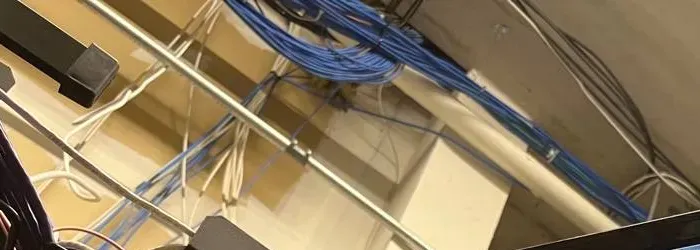
Real AESS job photo from another site: bundles of blue and white network cable looping along a ceiling pipe and beam. Inside a farmhouse basement or a carriage-house loft the runs are fewer, but each one still has to reach the recorder in one piece and inside the copper distance limit.
Coverage Area
Uniview Camera Installation Near Dutchess County’s Landmarks
We work across all of Dutchess, from the river towns to the Connecticut line. These landmarks are reference points, not clients; they show the range of places and property types a Dutchess visit covers.
Walkway Over the Hudson, Poughkeepsie
The pedestrian bridge 212 feet above the river and 1.28 miles long, landing near downtown Poughkeepsie’s older masonry blocks and the riverside neighborhoods around it.
Dia Beacon
The museum in a former Nabisco box-printing factory on the Beacon riverfront, a short walk from the train and from Main Street’s shops and converted industrial buildings.
Dutchess County Fairgrounds, Rhinebeck
Home of the late-summer county fair on Route 9, surrounded by the farms, estates and village streets of Rhinebeck and Red Hook.
Millbrook hunt country
Northeast Dutchess, where the Millbrook Hunt has ridden since 1907 and whose members helped found the Dutchess Land Conservancy in 1985: open land, horse farms and long private drives.
The Culinary Institute of America, Hyde Park
A 170-acre riverside campus on Route 9 among Hyde Park’s houses, river estates and small commercial strips.
Marist and Vassar, Poughkeepsie
Marist University on North Road by the river and Vassar College off Raymond Avenue, with the student rentals, two-family houses and small businesses that ring both campuses.
We also serve Wappingers Falls, Fishkill, East Fishkill, Hopewell Junction, LaGrange, Pleasant Valley, Stanfordville, Pine Plains, Amenia, Millerton, Dover Plains, Pawling, Red Hook, Tivoli, Staatsburg, Clinton Corners, Salt Point and Beekman, and across the river and county lines into Putnam, Ulster and Orange.
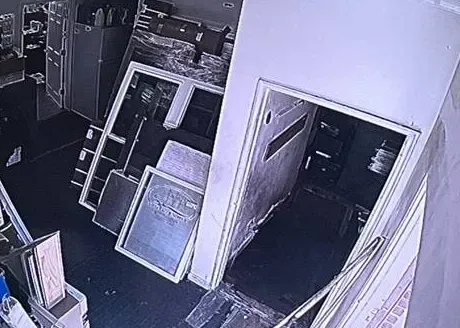
Real AESS job photo from another site: a greyscale camera view of a cluttered storeroom with frames leaning on the wall and an open doorway beyond. When the lights are off, an outbuilding camera switches to infrared and shows exactly this kind of grey picture unless it carries its own warm light.
Pricing
Uniview Camera Installation Cost in Dutchess County
Every figure below comes from our published Uniview installation price list for Dutchess County, which applies the Dutchess and Ulster labor rate to the same equipment prices used everywhere we work. Prices are installed, before tax, and include two weeks of recording on the drive.
Item
Dutchess installed price
What it covers
Per camera, labor component
$267 + $35 mounting box
Cable run, mounting, aiming and set-up for one camera
4MP ColorHunter mini bullet or turret
$511 each
EC-B4F28DL or EC-T4F28DL, installed
8MP ColorHunter bullet
$621 each
IPC2128LB-ADF28K-DL, installed
Tri-Guard 8MP turret
$1,031 each
IPC3638SS-ADF28KMC-I1 with light-and-sound deterrence
4MP 5x PTZ
$1,111 each
IPC6324LWH-AX5C-VG2, installed
Plate-capture camera
$1,821 each
PKC2640@Z28-IR-P, installed
4-channel PoE NVR
$531
NVR301-04LS3-P4 with set-up
8-channel PoE NVR
$651
NVR301-08LS3-P8 with set-up
4TB surveillance drive
$229
Added where recording time needs it
Hidden in-wall wiring
$200 per camera
Hollow drywall, up to 100 ft
Minimum new-install visit
$825
Dutchess minimum for small jobs
Service and callback rate
$195/hr, 3-hour minimum ($585)
Repairs and changes after the original installation
What moves a Dutchess price
The far building. Trenching, outdoor fiber and wireless bridges are quoted per property, because a 150-foot lawn run and a 900-foot run across ledge are different jobs.
Power at the far end. A barn without an outlet needs an electrician before the network gear can go in.
Battery backup. Sized to the system’s draw and the hours the owner wants covered, and priced once that number is known.
Recording time. Two weeks is included; a month or more adds drives, which the price list shows for each system.
Camera type. A turret on a porch and a PTZ on a barn gable differ by several hundred dollars before any cable is pulled.
A worked Dutchess example, line by line
Take a house with a detached barn: four cameras on the house, four on the barn, recording two weeks. From the published list, six EC-T4F28DL turrets at $511 are $3,066, two IPC2128LB-ADF28K-DL 8MP bullets for the wide barn-end views at $621 are $1,242, the NVR301-08LS3-P8 recorder with set-up is $651, and the two 4TB drives that eight cameras need for two weeks are $458 — $5,417, which is the House and Barn package below. Everything the barn adds beyond those cameras is then priced on its own line: the trench or radio link, a small switch and enclosure at the barn end, surge protection if copper crosses the yard, and the battery backup in the house. Owners see the camera system and the property-specific work as separate numbers, which makes it easy to compare a fiber run against a wireless bridge, or to decide that the barn link waits until spring while the house cameras go in now.
There is no separate mileage charge for Amenia, Millerton or Tivoli; the Dutchess rate already includes travel from our Bronx base. You can price your own mix of cameras on the camera calculator.
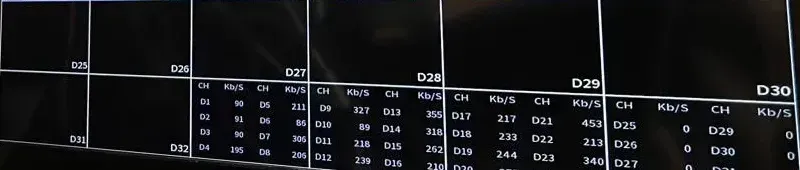
Real AESS job photo from another site: a recorder status screen with channels and the kilobits per second each one is sending. Those figures are what has to fit through a rural DSL, fixed-wireless or satellite upload before a phone in Manhattan shows smooth live video from a Dutchess barn.
Get the Dutchess Number in Writing Before the Visit
Tell us the cameras you have in mind and the buildings involved. The written quote lists equipment, labor, the outbuilding link and the battery separately, so you can compare it line by line with anyone else’s.
Three starting points, each priced from the published Dutchess list with two weeks of recording included. Links between buildings and battery backup are added to any of them once we know the property.
Village House — $2,804
Four EC-B4F28DL 4MP ColorHunter mini bullets, the NVR301-04LS3-P4 four-port PoE recorder and a 4TB drive, installed. Front door, back door, driveway and one side of the house; the usual start for a house in Beacon, Rhinebeck or the Town of Poughkeepsie.
House and Barn — $5,417
Six EC-T4F28DL 4MP turrets, two IPC2128LB-ADF28K-DL 8MP ColorHunter bullets for the wide views, the NVR301-08LS3-P8 eight-port recorder and two 4TB drives, installed. House entrances plus the barn doors and aisle; the link to the barn is quoted on top.
Estate and Gate — $10,227
Six IPC3638SS-ADF28KMC-I1 Tri-Guard 8MP turrets, one IPC6324LWH-AX5C-VG2 5x PTZ for the field or drive, one PKC2640@Z28-IR-P plate-capture camera at the gate, the NVR301-08LS3-P8 recorder and two 4TB drives, installed. Gate and drive links quoted on top.
Already bought the equipment? Labor-only work
If you bought Uniview cameras and a recorder yourself, we install them at the Dutchess labor rate: $267 per camera plus $35 for a mounting box where one is needed, and $212 to set up the recorder, with the $825 minimum for a small job. We check every model before the visit so you aren’t paying for a trip to find a camera that won’t work with your recorder, and we tell you if anything you bought is wrong for the spot you intended.
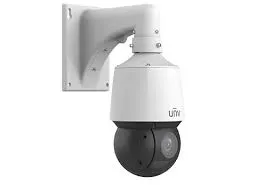
Manufacturer product photo, not an installed unit: a white UNV pan-tilt-zoom dome hanging from a curved wall bracket, with a dark lower bubble. A camera like this can sweep a paddock or follow a car along a long drive, provided the bracket sits high enough to see over fences and hay wagons.
Complete Services
Every Uniview Camera Installation Service in Dutchess County
Uniview cameras are usually one part of a bigger job on a Dutchess property. These pages cover the related work, all in Dutchess.
The single most useful thing on a farm walkthrough takes thirty seconds. Before anyone talks about cameras, we stand at the barn door, or the gate, or wherever the farthest camera will go, and look back at the house. If we can see the eave where the house radio would mount, with nothing but air between, the link is easy. If there is a row of spruce, a hay barn or the crest of a field in the way, the plan changes before it is drawn, and the owner hears that on day one rather than after the radios are bought.
The second thing is to ask what the view looked like last July. Owners know where the leaves come in, where the snow drifts against the shed and where the tractor turns. A camera aimed in October that stares into a sugar maple by June is a camera aimed wrong, and the person who has watched that tree for twenty years is the best surveyor on the property. We write those answers on the site sketch next to every camera position, and they decide more about a Dutchess install than any datasheet.
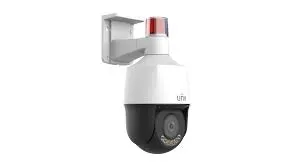
Manufacturer product photo, not an installed unit: a white UNV mini pan-tilt camera under a wall arm topped with a red and blue beacon. The beacon is the visible part of active deterrence; whether a flashing light suits a quiet road or a nervous horse is a judgment we make on site.
FAQ
Dutchess County Uniview Camera Installation FAQ
Is a visit to Amenia or Millerton charged more than one in Poughkeepsie?
+
No. Every Dutchess job is priced at the same published Dutchess rate, whether the property is beside Marist or up against the Connecticut line. There is no separate mileage line; travel from our Bronx base is already part of the Dutchess labor figures. What can differ between two properties is the work itself, such as a long link to a barn, and that is quoted in writing before the visit.
Can the old coax already in a farmhouse carry part of a new Uniview system?
+
Often, yes. Uniview’s XVR hybrid recorders accept analog cameras on existing coax as well as IP cameras on network cable, so sound coax runs can be reused for new analog cameras while new runs go in for IP cameras where better image or detection matters. We test the old coax first; corroded connectors and runs chewed by rodents are common in old outbuildings, and those get replaced rather than trusted.
Can installation be scheduled around haying, foaling season or a show weekend?
+
Yes. Tell us the dates that matter when you book and we plan around them. Barn work can be done when the horses are turned out, and trenching can wait until the field is cut. We also tell you in advance which days the barn or driveway will have ladders, a trencher or open conduit, so the farm’s routine isn’t surprised.
How long does an installation take on a property with a house, a barn and a long drive?
+
A four-camera house system is normally a single day. A house-and-barn system with a link between buildings is usually two days, and a property that also needs a gate camera, a trench or a wireless bridge can take three, especially if an electrician has to add an outlet at the far end first. The written quote states the expected number of days so you can plan access.
Will our power or internet need to be shut off during the work?
+
Only briefly. The internet is interrupted for a few minutes when the recorder and battery backup are connected to the router, and we schedule that with you. We don’t shut off household power; any work on a 120-volt circuit, such as a new outlet in a barn, is done by a licensed electrician, who arranges any shutdown they need with you directly.
What happens if a winter storm knocks a camera out of alignment after the installation?
+
Call us and we come out to re-aim or re-secure it. Adjustments and repairs after the original installation are billed at our service rate of $195 an hour with a three-hour minimum, and we tell you before the visit if the photos you send suggest a bigger repair. Mounting cameras into framing rather than siding, which we do from the start, makes storm damage much less likely.
Will buried cable be marked so a fence post or tractor doesn’t cut it later?
+
Yes. Every buried run is drawn on the hand-over map with its route and approximate depth, and where the owner wants it we lay warning tape above the cable in the trench. We also note where the run enters each building, so a future contractor knows where not to dig. Before we trench, the owner’s private lines are discussed, and public utility locates are requested.
Can we lock in the price and schedule before the ground freezes?
+
Yes. The written quote holds its price for the period stated on it, and once the deposit is paid the trenching work is scheduled ahead of the frost. Equipment and the work inside buildings can follow on a later date if that suits the owner. If a trench can’t be dug in time, a wireless bridge between buildings is a winter option we can price alongside it.
Do you hand over a map of where every camera and cable runs?
+
Yes. Every installation ends with a site sketch showing each camera, the channel it is on in the recorder, the route of every cable and link, where the switch and battery backup sit, and the account logins created for the owner. One copy stays with the owner and, if wanted, one stays by the recorder for whoever services it next.
Can our existing Ring or Arlo cameras stay up alongside the Uniview system?
+
Yes. Consumer cameras like Ring and Arlo use their own apps and cloud services, and they keep working alongside a Uniview recorder; they just stay in their own app rather than appearing in UNV-Link. Many owners keep a doorbell they like and let the Uniview system handle the yard, drive and outbuildings. If you’d rather have everything on one recorder, we can suggest Uniview cameras for those spots instead.
All Areas Served
Uniview Camera Installation Across New York City, Long Island and the Hudson Valley
This page sits under the Hudson Valley Uniview camera installation hub, alongside five other counties. Each of our Uniview pages is written for the buildings and conditions of its own area.
Every product detail, county figure and rule on this page traces to one of the sources below. Where only a search excerpt was available, the link says “excerpt”. Prices are from our own published Dutchess Uniview price list.
Barn Camera Dark or Recorder Beeping? Call the Hudson Valley Line
A recorder showing a drive error, a barn camera dark since the last storm, a phone that lost the cameras when the internet changed — phone (845) 640-3835. We book the next open two-hour window, and most systems are recording and back on the phone within one to two hours of arrival.
Dutchess Uniview Installation From a Licensed, Insured Crew
Call or text our Hudson Valley number, (845) 640-3835, or send a WhatsApp message. Dutchess visits are dispatched by Abstract Enterprises Security Systems from 460 E Fordham Rd, Bronx, NY 10458.
Rated 4.7★ across 201 Google reviews. Written estimates the day you ask, insurance certificates for farm managers, landlords and estate offices, and every job done under NYS low-voltage license #12000287431.
Full terms — including 50% deposit, one-year parts-only warranty on AESS-supplied products, and the late-fee schedule — are set out in the service agreement. See our warranty page.
Page reviewed and updated October 18, 2026. Changelog: Dutchess Uniview page rebuilt from new research on Uniview’s NVR and switch datasheets, the UNV-Link replacement of EZView, the FCC Covered List and the 2024 Entity List rule, Starlink’s carrier-grade NAT, BEAD fiber awards in Dutchess, the July 2026 outages, the county’s Flock decision and the USDA 2022 farm census, with prices from the published Dutchess Uniview price list.