Super Live Plus showing a Putnam County recorder offline, stuck loading or refusing your password? Same-day help on the Hudson Valley line: (845) 640-3835
Lake Houses · Weekend Homes · Short-Term Rentals · Route 6 & Route 22 Shops · Commuter Households
Super Live Plus App Support & Repair in Putnam County
Offline Recorders · NAT, QR & Address Links Rebuilt · Limited Logins for Caretakers & Rental Managers · Recovery After NYSEG and Central Hudson Outages
Super Live Plus is the free phone app that opens a whole family of white-label DVRs and NVRs built on TVT’s recorder platform, and in Putnam County it is mostly used by people who are somewhere else: a commuter on the way back from the city, an owner checking a Putnam Lake cottage from Queens, a rental host whose town expects a local manager nearby. The trouble is that the path from a Putnam recorder to that phone crosses the county’s weakest links — hills that block cell signal, roads still waiting on fiber, and storms that knock out whole towns at once. We rebuild that path, set up the right logins for the people who live close to the house, and make sure the app tells you the truth when something breaks.
Reviewed and updated October 18, 2026 · checked against the SuperLive Plus App Store record and version history, TVT recorder manuals, security advisories for TVT firmware, Putnam coverage, broadband and outage reports, and town short-term-rental rules · Anwar Timothy, NYS license #12000287431
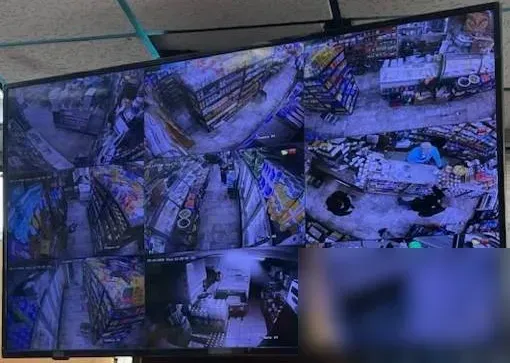
Real AESS job photo from another site, not a Putnam property: a monitor hung from a drop ceiling shows a shop’s recorder grid — overhead views of shelf aisles, a stockroom doorway and the front counter, with the bottom-right tile blurred. The same channels are what Super Live Plus pulls onto a phone when the owner is not in the building.
Putnam County Super Live Plus Help
Tell us the town, where you are when the app fails and what it says — we call back the same business day
✅
Request Sent!
A technician will call you back about the Putnam County system the same business day.
25+
Years Experience
✓
Same-Day Estimates
100%
Licensed & Insured
4.7★
201 Google Reviews
Away from the house and the cameras just went grey? Before anyone drives up the Taconic, send us three things: a screenshot of the Super Live Plus device list, a photo of the label on the recorder if someone nearby can take it, and one sentence on where you were standing when the app failed — at the house on its own Wi-Fi, in the car on cellular, at work in the city. That last detail usually separates a dead recorder from a dead internet line from a phone-side setting, and it is free to sort out. Call or text (845) 640-3835.
Working out where the chain broke from your screenshots costs nothing; time at the property is billed at our standard hourly service rate
We work on the recorder, the router and the phones in one trip, and we can coach a neighbour or caretaker through checks while you stay in the city
Weekends included: arrival is booked to a two-hour slot, with the last slots starting at 8 PM, and our NYS low-voltage license is #12000287431
Why Putnam County Properties Need Super Live Plus App Support & Repair
Putnam is a county people watch from a distance. The Census Bureau puts the average one-way commute for working residents at a little over 39 minutes, close to eighty minutes a day in transit for the average worker, before anyone counts errands, school runs or weekends spent elsewhere. Of the county’s roughly 38,700 homes, the American Community Survey counts 1,757 held for seasonal, recreational or occasional use, in a county whose lake colonies — Putnam Lake, Lake Carmel, Lake Peekskill — were laid out as summer bungalow tracts from 1928 onward. In October 2026 a thread on r/hudsonvalley asked second-home owners who looks after their houses when they are not there; the answers ran from caretakers who stop by once a week to neighbours with cameras, battery backup and a cellular fallback. In every one of those arrangements, a phone app is the first thing that tells the owner something has changed.
For a lot of Putnam houses and shops, that app is Super Live Plus. It is not a camera brand: the App Store lists it as a free program from the seller Peng AnTai with a support link to TVT’s website, first released in February 2016 and still updated — version 1.16.7 arrived on January 5, 2026. TVT builds the recorder software, and dozens of companies sell those recorders under their own names; CCTV Camera Pros, for example, says Super Live Plus is the app for its Viewtron line. So a homeowner in Mahopac may own a box with a brand name nobody recognises, installed by someone who is long gone, and the only clue to how it works is the app the installer left on their phone. That app is also not loved: on the U.S. App Store it averages 3.9 stars from 15,849 ratings, with 2,643 one-star reviews, and Google Play shows 3.3 from more than 53,000. The most recent complaints read like a support log — properties disappearing from the device list, playback that never loads, cameras offline in the app while the monitor at home shows them perfectly well.
Then comes the ground the signal has to cross. Putnam is about two-thirds forest on Hudson Highlands rock, and the hills do to radio what they do to roads. At a 2016 county meeting reported by The Highlands Current, a county official explaining a tower plan put it bluntly: “We do not have 254 square miles of coverage,” and Philipstown’s legislator added that “Cold Spring is notorious for having blackout spots.” Two years later Verizon sued the town in federal court in White Plains for permits to move equipment off its 120-foot tower at McKeels Corners, where the topography obstructs the signal, to a 180-foot pole on Vineyard Road. Wired internet is still filling in, too: in September 2025 the state awarded Comcast $11.5 million to bring fiber to 390 Putnam locations. An app that needs a steady upload from the recorder and a steady download at the phone has to live with all of that.
And then the power goes. On August 5, 2020, after Tropical Storm Isaias, NYSEG had 34,150 of its 38,693 Putnam customers in the dark, including 12,717 in Carmel and 5,815 in Kent; Central Hudson had 3,621 of its 5,160 Putnam customers out at the same time, most of them in Philipstown and Cold Spring. Smaller hits come every year — storms on the evening of July 4, 2026 left thousands without power across Putnam and Westchester, a midday outage on August 3 cut 740 Central Hudson customers in Cold Spring and Garrison, and Putnam Valley declared a flash-flood emergency on July 29. Each time, the recorder, the router and the modem all go down together, and each has to come back on its own before Super Live Plus can find the system again. Much of our Putnam work is making that happen without anyone driving up from the city.
The Putnam numbers behind remote viewing
39.3 minutes — the average one-way commute for working residents (Census QuickFacts / ACS five-year) — time when the house is usually checked by phone.
1,757 seasonal or occasional-use homes out of about 38,700 (ACS 2023); the 1920s lake colonies mapped 11,000 lots at Putnam Lake alone.
“We do not have 254 square miles of coverage” — the county’s own description of its cell gaps in 2016 (The Highlands Current).
390 locations slated for new Comcast fiber under a September 2025 state broadband award of $11,498,589.
34,150 of 38,693 NYSEG customers in Putnam without power the morning after Isaias in 2020 (Daily Voice).
3.9 stars from 15,849 ratings for SuperLive Plus on the U.S. App Store; version 1.16.7 released January 5, 2026.
When the recorder itself is the problem, the same crew can swap or relocate it; see NVR installation in Putnam County for that side of the work.
Real AESS job photo from another site, not a Putnam property: a recorder playback frame looking down a red brick wall across a sidewalk and a stretch of paved lot, with the date stamp in the upper right and the camera label lower left. Finding a frame like this from a phone, quickly, is most of what owners ask Super Live Plus to do.
Cameras Gone From Your Phone at a Putnam Property? Same-Day Repair
If the app lost the house this morning, call (845) 640-3835. We book the next open two-hour window, and most systems are back on the phone within one to two hours of our arrival, because the usual causes — a recorder that came back from an outage with a new address, NAT switched off, a router replaced by the internet provider, a saved password that no longer matches — are fixed with a laptop and a ladder-free walk to the equipment closet.
Five checks worth doing while you wait. None of them need an installer login, and each one shortens the visit.
Ask whoever is at the house to look at the recorder’s own monitor. If live pictures are on it, the cameras and recorder are alive and the fault is on the path to your phone. If the monitor is dark or shows “video loss” tiles, the problem is at the house.
Open the app on the house Wi-Fi, if someone is there with a phone. Working inside but not outside points to the internet line, the router or the NAT service, not to Super Live Plus itself.
Check the power company’s outage page. NYSEG publishes outage lists town by town for Putnam, and Central Hudson customers in Philipstown and Cold Spring can text STAT to 236483. A recent outage is the most common reason a Putnam recorder drops off.
Look at the router lights. A modem that never reconnected after a storm, or a new modem the provider swapped in, cuts the recorder off without touching it.
Write down the last time it worked. An app update, a new phone, a changed Wi-Fi password, a thunderstorm or a family member who tried an old password a few times — the date tells us where to start.
Reading the symptom: which link in the chain to suspect
What you see in Super Live Plus
Where the fault usually is
Who needs to be reachable
Device shows offline, everywhere
No internet at the house, the recorder lost its network settings after an outage, or NAT is switched off on the recorder
Someone at the house, or our technician
Fine at the house, dead from anywhere else
The phone entry points at a local address, or the remote path (NAT service or forwarded port) is broken
Just the phone owner, then whoever controls the router
Online, but live view spins or freezes
The recorder’s upload is too thin for the stream the app asks for, or the phone is on a weak signal
The phone owner; settings changed at the recorder
Playback list empty or stuck loading
Recording schedule set to motion only, a failing hard drive, a clock that drifted, or an app version issue
A person standing at the recorder with its mouse and monitor
“Wrong password” or locked out
A phone or tablet still trying an old saved password, or a reset someone did at the house
Every phone, tablet and laptop that has the login stored
Floods of alerts, or none
Motion areas covering trees and roads, or push notifications never registered for this phone
The phone owner; schedule set at the recorder
Two faults often stack. A Lake Carmel cottage can have a router replaced by the provider and a recorder that took a new address in the same outage; fix one and the app still fails until the other is found. That is why we ask for the screenshot, the label and the where-were-you sentence together, and why that first conversation is free.
Town by Town
Town by Town: Where the Putnam Signal Path Breaks
Every remote-viewing failure is a break somewhere along a chain: camera, cable, recorder, power, router, internet line, the NAT service or a forwarded port, the cellular network, the phone. Putnam’s six towns stress different links in that chain, and what follows is what the public record says about each, and what it means for the app.
Carmel and Mahopac
Carmel is the county’s biggest NYSEG load — 12,717 of its customers were out after Isaias — and in 2021 the utility was drilling through rock on Horsepound and Stebbins roads to upgrade circuits. When a whole town goes dark, every recorder in it reboots at once when the lines come back, and the ones whose routers hand out new addresses are the ones that vanish from Super Live Plus. Carmel is also where the app gets used for evidence. In early August 2026, Carmel police asked residents near Lake Casse, Lake Drive and Ridge Road to check their footage after seven unlocked cars were entered between about 3:37 and 5:05 a.m. A phone that cannot find that hour and a half quickly is a phone that does not help.
Kent
Kent is lakes and ridges — Lake Carmel, the West Branch Reservoir it shares with Carmel, and the high ground where Homeland Towers had put up three towers by 2016. Kent took 5,815 NYSEG outages after Isaias. Houses here are often checked from somewhere else, and the typical Kent call is “it works when I’m home and never when I’m not,” which almost always means the remote path was never set up properly in the first place.
Patterson and Putnam Lake
The Putnam Lake colony was mapped as 11,000 lots of twenty by one hundred feet in 1928, and much of it was built as summer cottages that are now year-round or weekend homes. Small lots mean the recorder, the router and the modem usually share one shelf, which is convenient until a single surge or outage takes them all. Patterson also holds much of the Great Swamp, where the county executive asked the state in 2025 for help reducing spotted lanternfly egg masses. Woods that busy with insects and leaves are exactly what one App Store reviewer described in 2024: a system “constantly going off” on every bug, bush and leaf while sometimes missing a person — until the owner learns to ignore the app.
Southeast and Brewster
Southeast holds the Route 22 and Route 312 commercial strips, the I-84 interchange and Metro-North’s Southeast station, so its Super Live Plus users are as likely to be shop owners as homeowners. The Sheriff told the county legislature in September 2026 that its plate readers had flagged 22 vehicles linked to organised retail-theft rings that travel to Putnam to steal from local stores. For a shop on Route 22, the app is how the owner checks the register camera after closing and how a clip gets to an investigator the next morning.
Putnam Valley
Putnam Valley is hollows and lake communities such as Lake Peekskill, and it is where the July 29, 2026 flash-flood emergency closed roads like Cimarron, Horton Hollow and Canopus Hollow. It is also where short-term renting is most tightly managed: the town’s 2023 law requires a named local manager who lives within 30 miles of Town Hall. That rule makes the question of who gets access to the cameras, and with what rights, a practical one rather than a nicety.
Philipstown, Cold Spring and Garrison
The river towns are on Central Hudson, not NYSEG, and they have the county’s worst reputation for cell signal — the McKeels Corners tower that Verizon said the hills obstruct is here. Optimum ran fiber through Philipstown in 2023, while Verizon was still reviewing a Cold Spring build. Philipstown’s own short-term-rental law, introduced in October 2025, would require an owner or agent to be able to respond to an emergency within 20 minutes. For a Garrison owner who lives in the city, that agent will want to see the cameras too.
Real AESS job photo from another site, not a Putnam property: one wide-angle camera tile, labelled CAM 4, looks down at grey paving slabs, a curb and the front of a parked blue car. Single full-screen tiles like this are what the app requests when you tap one camera — and they need far more upload than the small grid view.
What We Install
Super Live Plus App Support & Repair Services in Putnam County
The app is the last link in a chain, so every service below starts with the whole chain: the recorder, its power, the router and internet line at the house, the way the phone reaches it, and the people who need to see it. This is the work Putnam homes, rentals and shops call us for.
Offline recorders brought back
We find which link broke — recorder network settings, router, modem, the NAT service or a forwarded port — and fix it at the source, then re-add the recorder in Super Live Plus so every phone in the household sees it again, not just the one we tested.
Remote path chosen for the line
TVT recorders can be reached through their NAT service with a QR code, by a public address or domain with forwarded ports, or through a VPN. We pick the one the property’s internet supports and the owner can live with, and we close the ones that are not needed.
Streams sized to Putnam uploads
On a thin upload, the full main stream from a 4K camera will not cross the line smoothly. We set the sub-stream for phones, cap bitrate and frame rate on the channels watched remotely, and leave full quality in the recording so evidence is not degraded.
Logins for the people nearby
A separate recorder account for the caretaker, the rental manager, a family member and the owner, each with only the rights it needs — live view without playback, or playback without settings — so one forgotten password never locks everyone out.
Outage recovery set and tested
Recorder, router and modem set to come back on their own and keep the same addresses after a NYSEG or Central Hudson outage, a small battery backup on all three, and a pulled-plug test while we are there so the app finds the system without a visit.
Alerts that mean something
Motion areas trimmed away from roads, trees and lake water, person or vehicle detection where the cameras support it, and push schedules set on the recorder so the phone is quiet while you are home and awake to the driveway when you are not.
Playback and clips that load
Recording schedules checked so the hours you will need exist on the drive, the recorder’s clock synced so searches land where you expect, and a practice clip saved from the app and from the recorder’s USB port before the day an investigator asks.
Firmware and password clean-up
We read the recorder’s firmware version, compare it with published advisories for TVT’s platform, change default and shared passwords, remove accounts nobody can name, and update each phone last so the saved passwords do not trigger a lockout.
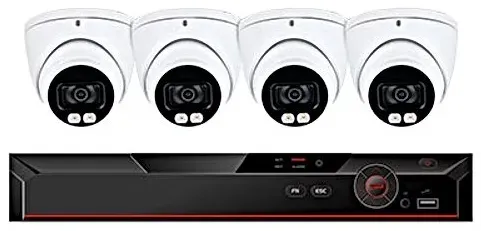
Manufacturer-style product photo, not an installed unit and not a specific brand we are endorsing: four white turret cameras above a black recorder with a red stripe and a USB port on the front. Boxed kits like this, sold under many names, are where a lot of Putnam Super Live Plus systems began.
Building Specialists
Super Live Plus App Support & Repair for Putnam County's Architecture
The app does not care what a house looks like, but where the recorder sits, how the internet arrives and who can reach the equipment all follow from the building. These are the Putnam property types we see most often, and what each means for remote viewing.
Lake-colony bungalows
Putnam Lake, Lake Carmel and Lake Peekskill cottages on narrow lots, many winterised over the decades. The recorder, modem and router usually share one shelf or closet, so one surge or one outage takes all three, and they must all recover on their own for the app to work.
Hillside and ridge houses
Newer homes up long driveways in Kent, Putnam Valley and Philipstown, often where the cell signal is weakest. The house internet is the only reliable way out, so the remote path from the recorder has to be solid — there is no backup bar of signal to lean on.
Village houses in Cold Spring
Homes in a 691-acre historic district listed on the National Register in 1982, where visible exterior changes need the review board’s approval. App work is inside the house, but if a camera has to move, we plan the position before anyone drills.
Farmhouses with outbuildings
Older houses with a barn, a garage or a workshop across the yard, each with a camera or two. The recorder is in the house; the trouble is usually the link to the outbuilding, which shows up in the app as one or two tiles going grey while the rest stay live.
Short-term rentals
Houses let by the night on Airbnb or Vrbo, where the owner, a local manager and sometimes a cleaner all need different views. The recorder must sit where guests cannot reach it, and the app accounts must be separated so a manager never needs the owner’s password.
Commuter colonials and split-levels
Year-round family houses in Mahopac, Carmel and Brewster with a recorder in the basement or a closet. These are the households that check cameras from the train, the office and the kids’ games — usually on cellular, so phone-side settings matter as much as the house.
How the setup changes by building
In a bungalow, the job is mostly about power: the recorder, router and modem go onto one small battery backup, each is set to start when power returns, and the recorder gets a fixed address that the router will not hand to anything else. When the lights come back after a Putnam Lake outage, all three return in the right order and the NAT link re-registers before the owner even notices.
On a ridge, the job is the internet line. We confirm the upload speed the provider actually delivers, set the phone stream to fit it, and test from off the property — a phone on cellular at the end of the driveway, or a laptop on another network — because a test from the house Wi-Fi proves nothing about what happens when you are forty minutes away.
In a rental, the job is people. The recorder goes in a locked closet or utility space, the guest Wi-Fi is kept apart from the network the recorder sits on where the router allows it, and we create separate recorder accounts for the owner and the local manager so the manager can see what is happening without the owner’s administrator password ever leaving the family.
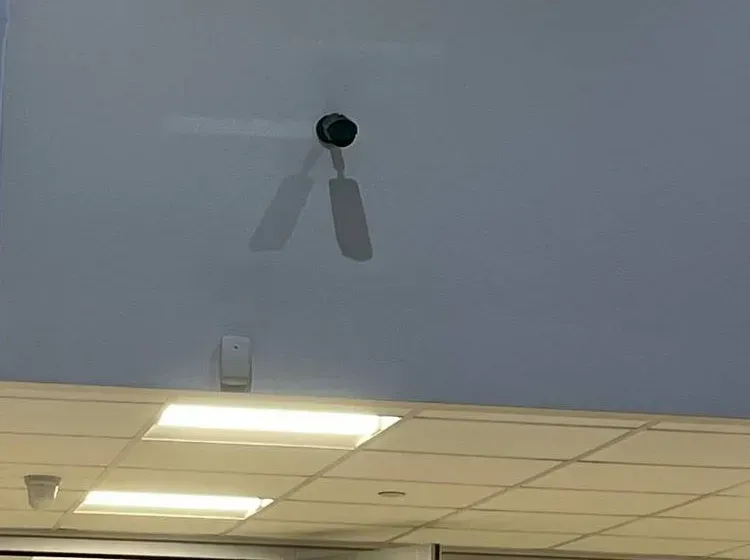
Real AESS job photo from another site, not a Putnam property: a small black bullet camera mounted high on a pale blue wall, its shadow falling below, with a white motion sensor lower down and a small white dome camera set into the drop ceiling at the left. Two cameras covering one room at two heights appear in the app as two separate channels.
Commercial Super Live Plus App Support & Repair
Business Super Live Plus App Support & Repair in Putnam County
Putnam’s commerce runs along a handful of roads — the county’s own hazard-mitigation profile lists Routes 6, 9, 22 and 52 and the I-84 corridor — and most of the businesses on them are small enough that the owner is also the person checking the cameras at night. These are the corridors we serve and what the app has to do on each.
Route 6, Mahopac
Shopping centers and storefronts along the lake. In April 2026 Carmel police ran a four-hour enforcement detail at the Mahopac Village Shopping Center after shoppers complained of speeding and burnouts once stores closed; owners want parking-lot cameras they can check from home at that hour.
Route 52 and Gleneida Avenue, Carmel
The county seat around the 1814 courthouse on Lake Gleneida: law offices, professional suites and shops in older buildings, often with a recorder in a shared basement and an office manager who checks it from a phone.
Route 22 and Main Street, Brewster
Village storefronts and the strip along Route 22, the kind of retail the Sheriff described as targeted by travelling theft rings. Owners need clean clips quickly, and the app has to be reliable after hours.
Route 312 and I-84, Southeast
Offices, contractors’ yards and service businesses near the interchange. Yards with equipment outside rely on a few long camera views and an owner who checks them from home on weekends.
Main Street and Route 9, Philipstown
Cold Spring’s shops and restaurants, and businesses along Route 9 in Garrison and the North Highlands. Central Hudson territory, with the county’s patchiest cell signal — the app often works better for the owner in the city than for staff on site.
Route 6 and Route 301, Kent and Lake Carmel
Small plazas, delis, auto shops and marinas serving the lakes. Many have a single recorder that also covers the owner’s apartment upstairs, so home and business viewing share one app login unless we separate them.
Rules a Putnam business should know about cameras and the app
Putnam County Chapter 145. The county’s electrical licensing law covers low-voltage and limited data communications work, including video surveillance systems powered from an outlet installed by a licensed electrician, and says no one may engage in that trade in the county without a license or registration. The county publishes lists of licensed low-voltage technicians; check any installer, including us, against them.
Audio needs care. Super Live Plus supports two-way talk and listening on cameras that have microphones. New York’s eavesdropping law makes it a felony to record a conversation without the consent of at least one party, so we leave audio recording off at counters and offices unless the owner has a lawful reason and posted notice.
Neighbours’ backyards. Civil Rights Law § 52-a gives a homeowner a right to sue someone who points a video device at their backyard from neighbouring property without written consent. When we adjust camera views remotely through the app, we keep them on your own land.
Short-term rental rules. Putnam Valley requires a local manager within 30 miles of Town Hall, and Philipstown’s draft law would require an owner or agent able to respond within 20 minutes. Neither rule mentions cameras, but both mean a second person who needs access to them.
Cold Spring’s review board. Exterior changes visible from the street in the village’s historic district need the Historic District Review Board’s approval; work that is not visible from the street is not reviewed.
Help paying for upgrades. Shops with no more than 50 employees may qualify for the state’s Commercial Security Tax Credit — as much as $3,000 for each retail location — when they spend on eligible security such as cameras. Apply for the credit certificate before October 31 of the year.
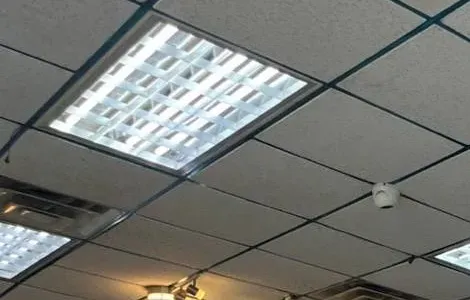
Real AESS job photo from another site, not a Putnam business: a small white dome camera hangs from a drop ceiling with a dark grid, between two square lattice light panels, with a row of track lights at the bottom edge. Shop ceilings like this are where the cameras an owner checks after closing usually sit.
Your Questions Answered
Super Live Plus App Support & Repair in Putnam County: Questions Answered
These are the Super Live Plus questions Putnam callers actually ask — weekend owners, commuters, rental hosts, caretakers and shop owners. They are grouped by the part of the chain they are about, and answered for the lines, buildings and rules found here.
Watching a Putnam Place From Somewhere Else
We check the Putnam Lake cottage from our apartment in the city on weekends — why does Super Live Plus show it offline every few weeks and then come back by itself?
Intermittent offline that heals itself almost always means something at the cottage is restarting and coming back slightly different. The two usual culprits are short power interruptions, which reboot the recorder and router together, and a router that hands the recorder a new local address after a restart. If the recorder’s NAT link has to re-register with TVT’s server, the app shows the device offline until that happens; if a port forward points at the old address, it stays broken until someone notices.
The fix is to give the recorder a fixed address outside the router’s automatic range, put recorder, router and modem on one small battery backup so brief dips never reboot them, and check whether the NAT link or a forwarded port is the path your phone actually uses. Then we look at the recorder’s log for the restart times, which often line up with storms or with the provider pushing updates to the modem overnight.
Our Kent house has almost no cell signal — how can the caretaker check the cameras while standing in the driveway?
By using the house’s own Wi-Fi rather than the cell network. If the caretaker’s phone joins the home network, Super Live Plus can reach the recorder directly across the property, with no internet involved at all. The SuperLive Plus manual describes exactly this local route: phone and recorder on the same network, the recorder added by its local address or QR code.
So we put the caretaker’s phone on the house Wi-Fi, make sure the signal reaches the driveway and the garage where he actually stands, and save the recorder in his app in a way that works both on that Wi-Fi and from outside. In parts of Kent the hills leave little else; the county itself said in 2016 that it did not have coverage across all of its 254 square miles.
When two of us watch the Brewster shop at the same moment the picture freezes, but one viewer alone is fine — why?
Because every viewer gets a separate copy of the video, and all of those copies leave the shop through the same upload. One phone on the main stream of two or three cameras may just fit; a second phone doing the same doubles the load, and the line runs out. The recorder is working normally, and nothing is wrong with either phone.
We set the phones to the lighter sub-stream for live view, trim bitrate and frame rate on the channels people watch from outside, and check what upload the shop’s plan really delivers. The SuperLive Plus manual also describes a speed-up option in live view that favours smooth video. The recording itself stays at full quality; only what crosses the line is trimmed.
Sharing Access With People Who Live Near the House
Putnam Valley says our short-term rental’s local manager must live within 30 miles of Town Hall — how should that manager get into the cameras without our admin password?
Give the manager their own account on the recorder, not yours. TVT recorders let the administrator create additional users and choose what each can do, and Super Live Plus logs in with whichever account it is given. The manager’s account can be limited to live view and playback of outdoor cameras, with no rights to change settings, delete recordings or manage users. If the manager changes, you delete one account and nobody else has to update anything.
The town’s 2023 law requires a named local manager but says nothing about cameras, so how much the manager sees is your decision. We write down which account belongs to whom and keep the administrator password with the owner only. Recent app versions also added a device-sharing feature; we use it where the recorder model supports it, and separate accounts where it does not.
Our caretaker in Mahopac checks the house after storms — can he see the cameras live but not delete anything or change settings?
Yes. A caretaker account limited to live view, and playback if he needs to look back at the hours after a storm, covers what a storm check needs: whether trees are down on the driveway, whether the garage door is shut, whether there is water where there should not be. Settings, deletion and user management stay with the owner’s account.
We also set the caretaker’s phone up ourselves and test it from outside the property, so the first time he opens it is not the morning after a storm when the house internet is also struggling. If he has an older phone, we check it meets the current app’s requirements before relying on it.
Should guests at our Philipstown rental be able to see any of the cameras in the app?
In our view, generally no. Guests do not need access to the recording system, and giving it to them means a stranger holds a login to your recorder. What guests need is to know where the cameras are: rental platforms set their own camera-disclosure rules, and Philipstown’s draft short-term-rental law already expects owners to give guests a written statement covering exits and emergency contacts, which is a natural place to list camera locations too.
Cameras stay on the outside and on entrances, never in bedrooms or bathrooms, and the recorder lives in a locked space. If a guest has a genuine reason to see an outdoor view — say, to check that a delivery arrived at the gate — the owner can show it, or send a clip, rather than handing out an account.
After the Lights Go Out
Our generator picks up the Carmel house within seconds, so why does the app still lose the recorder during every outage?
Because seconds are enough. When the grid drops, everything goes dark until the transfer switch moves the house to the generator, and the recorder, router and modem all reboot. The modem then has to resynchronise with the provider, which can take several minutes, and if the provider’s own equipment up the road is also without power, the house has electricity but no internet at all.
A small battery backup on the recorder, router and modem bridges the gap so they never restart, and a fixed address keeps the recorder findable when they do. If the app still loses the house during long outages, the problem is upstream at the provider, and the app will reconnect on its own when the line returns. Carmel had more than 12,000 NYSEG customers out after Isaias — the kind of event where the line, not the house, is the weak link.
Can the app warn us that the Patterson house has lost power, rather than just showing a camera gone dark?
Not directly — when the recorder loses power it cannot send anything. What you can do is make the silence informative. The SuperLive Plus manual lists alarms on video loss, sensor and motion events; a camera that loses power while the recorder stays up on a battery backup can trigger a video-loss alert, and a recorder that drops off entirely shows as offline in the app.
For a house that sits empty, we pair the recorder’s battery backup with a simple rule: if the app shows offline for more than an hour, check the power company’s outage page for the town. NYSEG publishes Putnam outages by town, so the owner can tell a local fault from a town-wide one in a minute.
After the outage, the recorder’s clock came back an hour off — does that matter for finding footage in the app?
It matters a lot. Playback in Super Live Plus is searched by time, and the recorder stamps every frame with its own clock. If that clock is wrong, a search for 4 a.m. lands on 3 or 5, and a clip handed to police carries the wrong time. Clocks drift after long outages on older recorders, and daylight-saving changes catch out recorders whose time-zone rule was never set; Super Live Plus’s own May 2024 update added time-zone and daylight-saving settings for doorbells.
We set the recorder’s time zone and daylight-saving rule, point it at an internet time server so it corrects itself after every restart, and check the on-screen time against a phone before we leave.
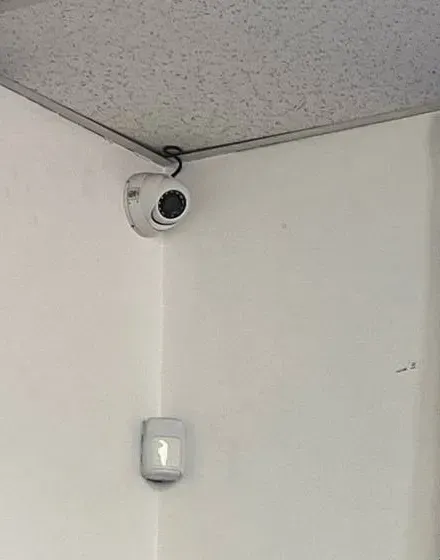
Real AESS job photo from another site, not a Putnam property: a white eyeball-style dome camera fixed high in the corner where a speckled ceiling meets two white walls, its cable looped above it, with a small white sensor on the wall below. An indoor corner camera like this is the one an owner opens first after an alert.
Playback, Clips and Requests From Police
Carmel police asked neighbours near Lake Casse to check footage from about 3:30 to 5 a.m. — how do we find that window quickly on a phone?
Use the recorder’s own search rather than scrubbing. In Super Live Plus, open playback for the driveway camera, set the date, and jump to the start time instead of dragging the timeline; App Store reviewers have complained for years that dragging lands too early or too late. If the system records on motion, the event list for that window is shorter than the full timeline and is the faster place to start.
When you find something, save a short clip on the phone and write down the camera name and time shown on screen. Then tell us; we can pull the original recording from the recorder itself, which is better evidence than a phone clip. The August 2026 Mahopac break-ins happened in about ninety minutes before dawn, and footage from several houses together is what makes a pattern visible.
Our recorder only records on motion and it missed part of what happened in the driveway — can the app show what wasn’t saved?
No. The app can only play back what the recorder wrote to its drive. Motion-only recording saves space, but it misses the seconds before motion is detected and anything that does not trigger the rule. Putnam has a public example: in July 2026 the Sheriff told Mahopac News that the county courthouse cameras captured only portions of the July 4 incident outside the building because the system relies on motion sensors.
For the views that matter most — driveway, front door, cash wrap — we set continuous recording with motion marking, so the timeline is complete and events are still easy to find. We then confirm the drive is large enough to hold the days you want, and show you how far back the app can reach.
How far back can the app reach on our recorder, and can that be stretched before a long stretch away from the house?
The app can only reach as far back as the recorder’s hard drive holds, and on most systems the oldest video is overwritten first once the drive is full. How many days that is depends on the drive size, the number of cameras, their resolution and bitrate, and whether they record continuously or on motion. The quickest way to find out is to open playback in Super Live Plus and see what the earliest date on the timeline is.
To stretch it, we can fit a larger drive, lower the bitrate on cameras where detail matters less, or record some views on motion while keeping the driveway and doors continuous. For a house left empty for weeks, we also make sure the drive is healthy, because a failing drive often shows up first as gaps in the app’s playback list.
Old White-Label Recorders and Security
The camera at the bottom of our Garrison driveway rides a wireless bridge — why is it the only tile that freezes in the app?
Because that one camera has an extra link of its own. The recorder receives the other cameras over cable; the driveway camera reaches it over a pair of radios that need a clear line of sight. Leaves in summer, wet snow on the antennas, a sagging mount or a power blip at the far end will all make that one tile freeze or go grey while the rest stay live — and the app is only showing you what the recorder sees.
We check the bridge’s signal and alignment, put its far-end power on the same battery backup as the camera, and set the recorder to alert you on video loss from that channel. Where trees will always be in the way, a buried cable or a different camera position is often the lasting fix. In the river towns, where Verizon itself said the hills obstruct its signal, radio links need more care than the box suggests.
Our Southeast office forwards ports so staff can reach the recorder from home — should those forwards be closed?
In most cases, yes. A forwarded port lets anyone on the internet reach the recorder’s login, and TVT-platform recorders are actively hunted. In April 2025 the security firm GreyNoise reported a threefold surge in attempts to exploit TVT NVMS9000 recorders, peaking at more than 2,500 unique attacking addresses in a day, which it linked to the Mirai botnet. A flaw published in November 2025, CVE-2024-14007, describes NVMS-9000 firmware before version 1.3.4, used in many white-labeled recorders, giving away administrator usernames and passwords to anyone who can reach its control port.
Staff can reach the recorder through its NAT link with their own accounts, or through a VPN to the office, without any open port. We check the firmware version, update it from the maker where an update exists, close the forwards, change every password and give each employee a separate login. If an old recorder cannot be updated, we say so and price a replacement.
Putnam Rules That Touch the App
Does Putnam County’s Chapter 145 cover someone who only sets up the app and recorder, with no new wiring?
The county’s licensing law is written around the trade: it defines low-voltage and limited data communications work to include video surveillance systems and says nobody may engage in that trade in Putnam without a county license or registration. Whether a phone-only visit counts is a question for the county’s Department of Consumer Affairs, not for us; most app repairs end up touching the recorder, the router or the cabling anyway.
The practical advice is the same either way: ask any installer for their license details and check them against the lists the county publishes. Our work is done under NYS low-voltage license #12000287431, and we will give you whatever details you need to check.
Can we leave the two-way talk on the lakefront camera switched on to speak to people at the dock?
Talking through the camera is fine; recording what people say back is where care is needed. Super Live Plus added full-duplex intercom in late 2024, so on cameras with a speaker and microphone you can hold a conversation from the app. New York’s eavesdropping law makes recording a conversation you are not part of, without either party’s consent, a felony.
So we set lakefront and dock cameras to talk-on-demand, leave continuous audio recording off unless there is a lawful reason and visible notice, and point the microphones at your own dock rather than a neighbour’s.
Equipment
Types of Super Live Plus Equipment We Install
Super Live Plus is only the viewer. These are the pieces of hardware it talks to, which we configure, repair and, when they are past saving, replace — along with the parts of a Putnam house that decide whether the app works at all.
TVT-platform NVRs
Network video recorders for IP cameras, sold under TVT’s name and many others. The app logs in to the recorder, not each camera, and the recorder’s NAT setting is what lets a phone reach it from outside the house without opening ports.
TVT-platform DVRs and hybrids
Recorders for coaxial cameras, still common in older Putnam houses and shops. Super Live Plus lists them just like NVRs; the app’s 2024 updates included a fix for playback of “DVR 3.0” recordings running too fast.
IP cameras on the same platform
Cameras that can be added straight to the app or recorded by the NVR. Recent app versions added light-mode switching, IR and LED control and SD-card settings for these cameras.
Video doorbells
Doorbells from the same platform ring through the app, with intercom and door-open options added in 2023 and time-zone and daylight-saving settings in 2024. A doorbell on a weak Wi-Fi signal often looks, from the phone, exactly like a broken app.
Routers, modems and battery backup
Not glamorous, but in Putnam they are the parts most likely to break the app. We set the router so the recorder keeps a fixed address, and put recorder, router and modem on a small battery backup that rides through short outages.
Viewing tablets and monitors
A tablet on the kitchen wall or a monitor in the shop office, running the app or plugged into the recorder. The App Store lists support for iPad and Apple-silicon Macs, which suits owners who want a bigger screen than a phone.
Ways a phone can reach a Putnam recorder
Method
How it connects
Where it suits Putnam
NAT service (QR code or serial)
The recorder connects outward to TVT’s NAT server; the app meets it there. The manual says a phone on a different network needs a recorder that supports the QR code with NAT enabled.
Most homes and rentals; no open ports. Depends on the recorder reaching the server after every restart.
Public address or domain with forwarded ports
The app connects inward to the house’s public address on the recorder’s ports — TVT’s manual lists server port 6036 and web port 80 as defaults.
Only where the line gives a public address and the router is yours. Exposes the recorder to internet scanning; needs current firmware and strong passwords.
VPN to the house
An encrypted link from your phone into the house network; once it is up, the app treats the recorder as local.
Best privacy, nothing exposed and no outside server — but only on a router that can host it, and only if someone maintains it.
Local only
The app reaches the recorder on the house Wi-Fi by its local address.
Fine at home; fails the moment you leave. A frequent cause of “it only works when I’m here.”
Trading the recorder for ADT, Ring or SimpliSafe: what really changes
Some owners who are tired of a temperamental app ask whether they should just switch to a national brand. Those companies build their service around the cameras, hubs and apps they sell, so what they offer is a replacement, not help with a recorder someone else installed. That can be a reasonable choice. Keeping the cameras and wiring you already own, and making Super Live Plus reliable, takes someone who works on TVT-platform recorders and the network around them.
Question
ADT / Ring / SimpliSafe
AESS
Will service a TVT-based recorder someone else installed
Generally sells and supports its own equipment
Yes — recorder, network and app
Builds the remote path to suit a Putnam line
Their own cloud service
NAT, forwarded ports or VPN, matched to the house
Monthly fee required
Depends on their product and plan
No subscription; the footage lives on the drive in your closet, and the bill is for time on site
Licensed NYS low-voltage contractor on site
Varies by dealer
Yes, license #12000287431
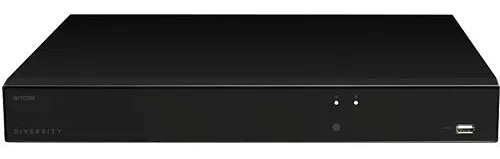
Manufacturer product photo, not an installed unit and not necessarily a TVT-platform model: a slim black recorder with a small maker’s mark, the word “Diversity” printed on the front, two status lights and a USB port. The front USB port is how an original recording is exported for an investigator.
AI Overview Reality Check
What AI Gets Wrong About Super Live Plus App Support & Repair in Putnam County
Search-engine AI summaries change by the hour, and none could be saved for this page, so none is quoted here. Instead, these are seven pieces of advice about Super Live Plus that keep surfacing in tutorials, forum replies and machine-written answers. Every one starts from something true; every one goes wrong somewhere between a TVT recorder in a Putnam closet and a phone forty minutes away.
“Super Live Plus works anywhere you have a phone signal”
The app does need only a data connection on the phone end, and on a good day it works from a train, an office or another country. That is where the generic advice stops.
In Putnam the phone end is not guaranteed. A county official told a 2016 meeting that the county did not have 254 square miles of coverage, Senator Schumer’s office argued in 2015 that northern Westchester and Putnam had more dead zones than carriers’ maps showed, and Verizon itself said the hills around McKeels Corners obstruct its signal. A caretaker checking the cameras from a Philipstown back road may simply have no data.
The other end matters as much. The recorder needs internet and power at the house. We test the app from places the owner and caretaker actually stand, not just from the driveway with full bars.
“Offline in the app means the recorder has died”
Sometimes it is. A dead power supply or a failed board does show up as offline, and on an old recorder that may be the end of it.
But “offline” only means the app cannot reach the recorder, and in Putnam the commonest reasons are upstream of it: a town-wide outage, a router that did not come back, a provider modem swap, or a recorder that took a new address. One App Store reviewer in 2025 described cameras offline in the app while they worked on the home monitor — the classic sign of a network fault, not a recorder fault.
So the first question is what the recorder’s own monitor shows. If it is live, the box is fine and the fix is somewhere between the closet and your phone.
“Port forwarding is the reliable way to view a DVR remotely”
It is reliable, in the sense that it does not depend on anyone else’s server, and many older guides and installers set every recorder up that way.
It also puts the recorder’s ports on the open internet, and TVT-platform recorders are a known target. GreyNoise counted more than 6,600 addresses trying to exploit the NVMS9000 recorder flaw in thirty days in spring 2025, and CVE-2024-14007 describes older NVMS-9000 firmware handing over administrator passwords to anyone who can reach its control port.
For most Putnam homes we prefer the recorder’s NAT link or a VPN, with forwarded ports closed. Where forwarding is the only option, the firmware must be current and the passwords long and unique.
“Super Live Plus is a camera brand you can buy parts for”
The name appears on so many boxes and manuals that people assume it is the maker. The App Store lists the seller as Peng AnTai with a support link to TVT, and the app works with recorders that many companies sell under their own names.
That matters when something fails. There is no single Super Live Plus parts catalogue; the recorder’s actual maker and model decide which firmware, drives and replacement boards fit. White-label brands also come and go — when Q-See closed on January 31, 2021, its customers’ remote viewing through its own service stopped with it.
We identify the platform and model from the recorder’s menu before ordering anything, and we tell you honestly when a replacement recorder is cheaper than chasing parts for an orphaned one.
“Push notifications will tell you everything that happens”
Notifications are useful, and recent versions of the app added thumbnails and better push settings, so an alert can show you what triggered it.
But a phone only hears about what the recorder decides is an event. Wooded Putnam lots trigger endless motion on leaves, insects and headlights, and owners mute the app; one 2024 reviewer described exactly that. Equally, a recorder that only records on motion can miss what matters — the county’s own courthouse cameras caught only part of a July 2026 incident for that reason.
We trim motion areas, use person and vehicle detection where the cameras support it, schedule pushes on the recorder, and keep continuous recording on the views that matter.
“Everyone has fast internet now, so streaming cameras is no problem”
Putnam is well connected on paper. Census figures put household broadband subscription in the county at about 95 percent.
Subscription is not the same as upload capacity, and remote viewing runs on the house’s upload. The state still awarded $11.5 million in 2025 to bring fiber to 390 Putnam locations, and in 2023 Verizon was still reviewing whether to build in Cold Spring. Many lake and ridge houses run on plans whose upload is a small fraction of the download.
We measure what the house actually sends, then size the phone stream to fit, rather than assuming the advertised speed.
“Just update the app and the problem will go away”
Updates do fix things. The version history lists bug fixes every few months, including a 2024 fix for DVR playback running too fast, and keeping the app current is sensible.
Updates can also break things. One 2025 reviewer wrote that after the latest update they could no longer view past recordings. An app update cannot fix a recorder with old firmware, a router that lost its settings, or a password typed wrong on three phones.
When the app changes and something stops working, we check the recorder’s firmware against the app version, test on a second phone, and fix the side that is actually out of step.
Find the Broken Link Before Anyone Drives
Most Putnam Super Live Plus faults can be placed from a distance. Text a screenshot of the device list, a photo of the recorder label and one line about where you were when the app failed, and you will hear back which link is broken and roughly what it costs to fix — before anyone makes the trip.
Tell us the town or hamlet, the internet provider at the house, what Super Live Plus is showing and which other people should end up with access, and a written Putnam price follows the same business day. Prefer to talk first? Call (845) 640-3835.
✅
We Got Your Request!
Thanks — the details are in. Someone who works on Putnam systems will look them over and ring you back the same business day; if the cameras matter right now, phone (845) 640-3835.
How It Works
Our Installation Process
Seven steps, the same for a Putnam Lake cottage as for a shop on Route 22. The first two usually happen before anyone drives, because in Putnam the owner is often an hour away and the fault is often not at the recorder.
1. Screenshots, label and where it fails
You send the app’s device list, the recorder label or model, and where you were when it failed. We place the fault in the chain: recorder, power, router, internet line, remote path or phone.
2. Check the house end first
Someone at the property, or our technician, reads the recorder’s network and NAT status, firmware version and clock, and confirms the router and modem are up, before anything changes on the phones.
3. Fix addresses, power and firmware
Fixed address for the recorder, start-after-outage settings on recorder, router and modem, a small battery backup, current firmware from the maker, and default or shared passwords replaced.
4. Build one remote path
NAT by QR code, a VPN, or a forwarded port where nothing else will do; unused forwards closed; phone streams set to fit the house’s real upload.
5. Accounts for each person
Owner, family, caretaker and rental manager each get their own login with only the rights they need; every phone re-added with the right account.
6. Alerts, recording and a practice clip
Motion areas and schedules set, continuous recording on key views, clock synced, and one clip saved from the app and one exported from the recorder to USB.
7. Test from away and hand over
We open the app on cellular away from the property, pull the plug to test recovery, and leave a one-page sheet of recorder, firmware, remote path, accounts and provider contacts.
Coverage Area
Super Live Plus App Support & Repair Near Putnam County's Landmarks
Six places that frame the county, from the lakes in the east to the river in the west, and the homes and businesses around them that call us about Super Live Plus. Visits are dispatched from our Bronx office.
Lake Mahopac
A lake of roughly 587 acres with three private islands, a nineteenth-century resort that became a year-round community. Around it: lakefront houses checked from the city, and the Route 6 shopping strip where owners watch parking lots after closing.
Putnam County Courthouse, Carmel
Built in 1814 on Gleneida Avenue beside Lake Gleneida, one of the oldest courthouses still in use in New York. Around it: law and professional offices on Route 52 whose recorders sit in shared basements.
West Branch Reservoir
An eight-billion-gallon New York City reservoir in Kent and Carmel, in service since 1895, split into two basins by Route 301. Around it: ridge houses with long driveways and thin cell signal.
Cold Spring Historic District
A 691-acre district of more than 200 buildings, listed on the National Register in 1982. Around it: Main Street shops, village houses and weekend rentals on Central Hudson’s lines.
Tilly Foster Farm, Southeast
A farm of about 199 acres that the county bought in 2002, in the Town of Southeast. Around it: Route 312 and I-84 offices and yards, and Southeast homes on the commuter routes.
Fahnestock State Park
Some 15,000 acres of woods and lakes across Putnam and Dutchess along Route 301. Around it: Kent and Philipstown houses deep in the trees, where the app depends entirely on the house’s own internet.
We also take Super Live Plus calls in Mahopac Falls, Lake Carmel, Lake Peekskill, Putnam Lake, Peach Lake, Ludingtonville, Farmers Mills, Tompkins Corners, Garrison, Continental Village, Nelsonville, the North Highlands, Brewster and Patterson. Neighbouring counties have their own pages: Westchester, Dutchess and the Hudson Valley Super Live Plus hub.
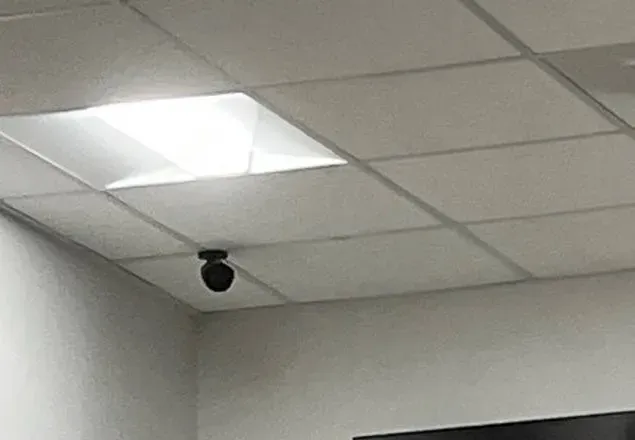
Real AESS job photo from another site, not a Putnam property: a small black dome camera hangs at the edge of a white drop ceiling, next to a bright square light panel, above a plain white wall. Each camera like this is one more channel the recorder has to send to a phone across the house’s upload.
Pricing
Super Live Plus App Support & Repair Cost in Putnam County
Fixing Super Live Plus is labour — hours spent at the equipment closet, the router and each person’s phone — so the bill follows time on site rather than the number of cameras or phones. When a recorder has to be replaced, the price comes from our published recorder figures multiplied by the 1.45 Putnam area rate. There is no subscription and no monthly support plan.
Job
Putnam County price
What moves it
Diagnosis by phone or from screenshots
$0
Free — the device list, the recorder label and where the app fails usually place the fault in the chain
On-site app, recorder and network repair
$195 an hour, 3-hour minimum ($585)
How many phones and people to set up, whether a VPN must be built, whether firmware must be updated carefully first
4-channel recorder replacement
$653–$1,015
Storage to cover your longest absence, and a check that today’s cameras will pair
8-channel recorder replacement
$943–$1,450
Twice the inputs, so room for the barn or dock later, plus a bigger drive
8-channel hybrid recorder
$1,160–$1,740
Runs older coax cameras beside newer network cameras while a house is upgraded in stages
16-channel recorder
$1,740–$3,190
Main house plus dock, garage and sheds, each person seeing only their share
32-channel recorder
$3,190 and up
Large properties and multi-building businesses; we walk the site before pricing
Replacement cameras
Quoted per camera
Model chosen for compatibility with the recorder and the view it must cover
What raises a Putnam price. Nobody at the house to let us in or read the recorder screen, so the visit has to wait or repeat. Recorders on old firmware that must be updated with care. Houses where the router belongs to the provider and cannot be configured, so a different remote path has to be built. Several recorders, or a house and a shop, on one account.
What brings it down. Sending the app screenshots and a label photo before the visit, knowing the recorder’s administrator password, having a neighbour or caretaker free to stand by the recorder while we talk them through checks, and deciding beforehand who should have which account.
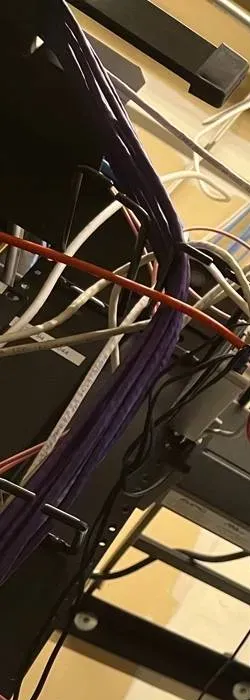
Real AESS job photo from another site, not a Putnam property: a thick bundle of purple network cables, with loose white and red patch cords, running down the side of a black equipment rack. Somewhere in a tangle like this is the one cable between recorder and router that decides whether the app can see anything.
Get a Written Putnam Price Before the Visit
A screenshot of the device list and a photo of the recorder label are normally enough for a firm number. We will tell you whether it is a phone-side fix, a single visit, or a new recorder, and quote it at Putnam rates.
Super Live Plus App Support & Repair Packages & Pricing
Three outcomes cover almost every Putnam call: the phone conversation settles it or tells us exactly what to bring; one trip puts the recorder, network and phones right; or the old box has had it and a new recorder goes in.
Remote Triage
$0
Phone call, screenshots and the recorder label. We tell you which link in the chain failed, who needs to be at the house, and what the visit will cost. Phone-side problems are often fixed on the call.
On-Site Repair Visit
$195/hr · 3-hr min ($585)
Recorder, network and phones in one visit. Addresses fixed, outage recovery set and tested, firmware and passwords cleaned up, one remote path built, logins for each person, alerts trimmed, and a hand-over sheet.
Recorder Replacement
$653–$3,190
4 to 16 channels at the Putnam rate. The cameras and cable stay; a fresh recorder and drive take over, keep the camera names and user accounts people already know in the app, and the old drive is set aside so nothing you need is lost. Bigger systems get a site walk first.
Bought your own equipment? Labor-only work
If you bought a recorder, cameras, a router or a battery backup yourself, we install and configure them at the service rate. Before the visit we check that the recorder actually works with Super Live Plus and that your router can do what the house needs — a fixed address, a VPN, or nothing more than an outbound connection for NAT. That check saves a wasted trip when a recorder bought online turns out to use a different app.
Any recorder, drive or camera you bought keeps whatever warranty its maker offers, and claims go back to that maker. Our own commitments on parts we supply are written into the AESS service agreement, summarised in the contact section at the bottom of the page.
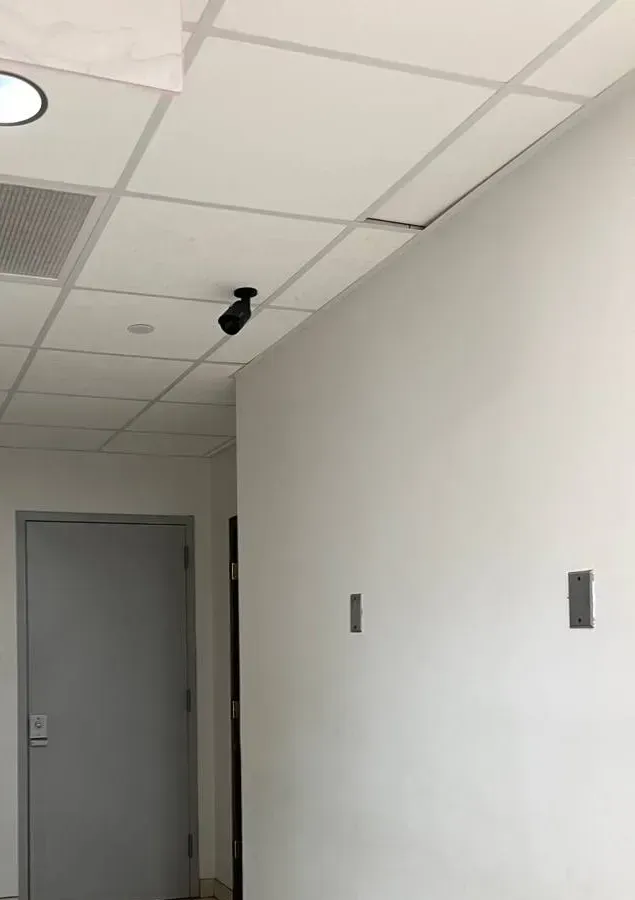
Real AESS job photo from another site, not a Putnam property: a black bullet camera on a short mount hangs from a white drop ceiling beside an air vent, aimed down a corridor toward a closed grey door. A view down one hallway to one door is the kind of channel worth recording continuously, not just on motion.
Complete Services
Every Super Live Plus App Support & Repair Service in Putnam County
When Super Live Plus misbehaves, the cause is often a camera, a cable, the recorder or the network behind it. These Putnam County pages cover those parts, so whatever the app is pointing at can be dealt with on the same trip.
This is a note on method rather than a story about one house. The Super Live Plus visit that goes wrong is the one tested only from inside. The technician fixes the recorder, opens the app on a phone connected to the house Wi-Fi, sees every camera, and leaves. The owner opens it that night from the city and sees nothing, because the phone in the house was talking to the recorder across the living room, not across the internet.
So every Putnam job ends the same way. We switch our phone off the house Wi-Fi and open the app on cellular — and if the signal at the property is poor, which in parts of Kent, Putnam Valley and Philipstown it often is, we drive to where it is not and try again. We also do it on the owner’s phone and the caretaker’s phone, logged in with their own accounts, so we know each person’s rights work as intended. Then we pull the power to the recorder, router and modem together, the way a storm would, and time how long the app takes to find the house again.
The last thing we leave is a single sheet: recorder make and model, firmware version, which remote path it uses and why, who has which account, where clips export to, and the phone numbers for the internet provider and the power company. Owners who keep that sheet with the recorder rarely need us for the app again, and when they do, the first call is much shorter.
FAQ
Putnam County Super Live Plus App Support & Repair FAQ
Does the cloud-storage option added to Super Live Plus in 2023 help when the Putnam house loses its internet?
+
Not during the outage itself. Version 1.12.0 of the app, released in March 2023, added a cloud storage function for DVRs, but anything sent to a cloud has to travel over the house’s internet line; when that line is down, nothing new reaches the cloud. The recorder’s own hard drive keeps recording as long as it has power, which is why we put the recorder on a battery backup first. The app itself is free, with no in-app purchases listed.
Which phones and tablets can still run the current Super Live Plus?
+
The App Store listing says the current version requires iOS or iPadOS 12.1 or later, and it also runs on Macs with Apple M1 chips or later. On Android it is listed on Google Play as a free download. A caretaker’s very old phone may not install the current version, so we check every device that will be relied on before we leave, and suggest an inexpensive replacement if one cannot keep up.
Can one Super Live Plus login show the recorder in our city apartment and the one at the Putnam house?
+
Yes. The app keeps a list of devices, and both recorders can sit in it side by side, each named so nobody confuses them. We give the Putnam recorder a clear name, set its remote path so it works from the apartment, and make sure the two systems use different passwords. One App Store reviewer managing two properties described the app switching between them unexpectedly; clear names and separate groups make that much less confusing.
Do your Putnam visits reach the river side — Garrison, Nelsonville and the North Highlands — as well as the lake towns?
+
Yes, all six towns and the three villages. Philipstown, Cold Spring, Nelsonville and Garrison are as much part of our Putnam work as Carmel, Kent, Patterson, Southeast and Putnam Valley. The river side is on Central Hudson rather than NYSEG and often has weaker cell signal, which we plan for when we test the app before leaving.
Can a Putnam visit be timed for a Friday so the cameras work before we drive up for the weekend?
+
Yes. We book visits seven days a week in two-hour windows until 8 PM, so a Thursday or Friday slot is usually possible. If you will not be there, a neighbour or caretaker can let us in, and we test the app from off the property with a test account, then talk you through opening it on your own phone. Tell us your arrival time and we will plan around it.
Is the Putnam rate on this page a travel charge on top of the hourly rate?
+
No. The 1.45 Putnam multiplier applies only to recorder replacement prices, measured against our Brooklyn base, and it already accounts for the drive up from the Bronx. Hourly service work is $195 an hour with a three-hour minimum wherever the house is, and nothing extra is added for the trip.
Should we tape the recorder password to the recorder so the caretaker can find it?
+
No. Anyone who reaches the closet would then hold the master key to every camera and every recording. Give the caretaker his own recorder account with only the rights he needs, keep the administrator password in the owner’s records, and write the caretaker’s login into his phone during the visit. If he leaves, you delete one account and nothing else changes.
Can the video doorbell at the lake house ring my phone through Super Live Plus while I am in the city?
+
Yes, if the doorbell is one the app supports. Super Live Plus added a doorbell function in October 2022, CallKit ringing for doorbells on iPhone in June 2023, and intercom and door-open options under the doorbell channel. The doorbell still needs a solid connection at the house — a weak Wi-Fi signal at the front door is the usual reason a ring arrives late or not at all — so we check that first.
Will an app update, or reinstalling Super Live Plus, wipe the recorders already saved on my phone?
+
A normal app update should keep your device list, but deleting and reinstalling the app can lose devices saved only on the phone. Before any reinstall, screenshot the device list and make sure you know each recorder’s login. One 2019 reviewer was told to delete the account and start again; with the logins written down, re-adding a recorder by its QR code takes a minute.
We close the lake house for the winter — what keeps Super Live Plus working until spring?
+
Three things: power, internet and heat. Leave the recorder, router and modem on a battery backup and on a circuit that stays live when the house is shut down; keep the internet service active rather than suspending it; and make sure the closet holding the equipment does not freeze or overheat. Then test the app from away before you leave for the season, and check it every week or two so a fault is caught in January, not April.
All Areas Served
Super Live Plus App Support & Repair Across New York City, Long Island and the Hudson Valley
Putnam is one of six counties grouped under our Hudson Valley Super Live Plus support hub. If your recorder is somewhere else — a shop in the Bronx, a house on Long Island, a second place up in Ulster — the page for that area deals with its own lines, buildings and rules.
Nothing on this page about the app, the county, the law or local events is from memory; each item is drawn from a document below. Where we saw only a search snippet, the link says “excerpt”; App Store reviews and forum posts are individual users’ experiences, not statements from TVT. Prices are our hourly service rate and our recorder replacement figures at the 1.45× Putnam rate.
Lost the Cameras Since the Last Storm? Call the Hudson Valley Line
Grey tiles, a spinning wheel where live view should be, a caretaker who cannot log in, or a house that went quiet when the power failed — ring (845) 640-3835. We book the next open two-hour window, and most systems are back on your phone within one to two hours of arrival.
A Licensed, Insured Crew Behind Every Putnam Super Live Plus Repair
Putnam work is booked through the Hudson Valley line at (845) 640-3835 — call or text — or by WhatsApp, and technicians set out from the Abstract Enterprises Security Systems office at 460 E Fordham Rd, Bronx, NY 10458.
Google reviewers give us 4.7★ over 201 reviews. Rental owners and building managers can have a certificate of insurance on request, prices are put in writing the same day, and the work is carried out under NYS low-voltage license #12000287431.
Full terms — including 50% deposit, one-year parts-only warranty on AESS-supplied products, and the late-fee schedule — are set out in the service agreement. See our warranty page.
Page reviewed and updated October 18, 2026. Changelog: Putnam County Super Live Plus support page rebuilt from new research on the app’s App Store record, version history and reviews, TVT recorder manuals and NAT, security advisories for TVT firmware, Putnam cell-coverage, broadband and outage reports, town short-term-rental rules and local news, with prices at the standard service rate and the 1.45× Putnam area rate.