What are you looking for?
About Us Contact Us Careers Get a Free Quote (800) 486-0943
Pick a service
โœ… Got Your Own System?
๐ŸŽฌ Home TheatreQuote ๐ŸŽถ AV SoundQuote ๐Ÿ”‘ Access ControlQuote
Now pick your area
Pick your area
Long Island
Hudson Valley
Services available
Pricing & Tools
Pick a service for pricing
๐Ÿšช Intercom Pricing ๐Ÿ”” Buzzer Repair Pricing
Calculators
๐Ÿ“น Camera System Calculator ๐Ÿšจ Alarm Calculator โšก Cabling Quote Builder โœ… Got Your Own System?
Select your area
Top-floor office in a Tudor gone offline, a camera over an Avenue J storefront dropping out, or a jack that died after the kitchen renovation? Midwood network cable repair line, same-day estimates: (347) 934-8335
Home โ€บ Network Cable Repair Brooklyn โ€บ Midwood
Detached Tudors & Victorians ยท Red-Brick Two-Families ยท Prewar Co-ops on Ocean Parkway ยท Avenue J & Coney Island Avenue Storefronts ยท New Office Floors at Avenue L

Network Cable
Repair in
Midwood

Test First, Cut Second ยท Faults Located to the Foot ยท Repairs Tested End to End ยท Brooklyn Service Rate

Midwood stretches from the Bay Ridge Branch tracks just above Avenue I and the Brooklyn College campus down to Avenue P and Kings Highway, and its housing is about as varied as any part of Brooklyn. The interior blocks hold detached Tudor and Colonial Revival houses from the 1920s and 1930s, freestanding Victorians on East 19th Street and red-brick two-families on East 13th through 16th Streets. Ocean Avenue and Ocean Parkway carry limestone rowhouses and six-story prewar co-ops. Avenue J, Avenue M and Coney Island Avenue hold the bakeries, groceries, restaurants and small shops, and the new building at Coney Island Avenue and Avenue L has added ten stories of retail and Class A office space. When a wired connection fails in any of these, the cure is rarely a new router. It is usually a run crushed behind a baseboard, a jack punched down loose, a patch panel port that has worked free, a cable a contractor cut, or a camera line that cannot carry enough power. This page explains how we find the fault, what the repair looks like in each kind of Midwood building, what a co-op board or landlord may want from you, and what the visit costs at our Brooklyn service rate.

Reviewed and updated November 2, 2026, against Wikipedia's articles on Midwood, Fiske Terrace, Brooklyn's lettered avenues, the Avenue J station and the Avenue M station; cityneighborhoods.nyc's Midwood history; the Midwood Development Corporation's neighborhood profile; Brownstoner's listing for 1216 East 28th Street; New York YIMBY's March 2025 report on 1508 Coney Island Avenue; Bob Guskind, Flatbush Gardener and CityLand on the 2008 Fiske Terrace-Midwood Park Historic District designation; NYC Parks' history of Kolbert Playground; Untapped Cities on Midwood's historic synagogues; CBS New York on the Avenue J burglary and the June 30, 2025 attempted robbery at the Midwood Station Post Office; News 12 Brooklyn on the January burglary spree; Patch on the January 2021 Verizon fiber cut in Brooklyn; Yelp listings for internet providers and network cabling near Midwood; and general condominium and tenant guidance from communityassociations.law and readyourlease.ai. We found no Reddit threads, no Midwood-specific hyperlocal coverage and no HPD, 311 or DOB records about network cabling here, and could not capture Google's People Also Ask, related searches, AnswerThePublic, Bing, DuckDuckGo or the AI Overview in our build environment, so none of those are quoted. ยท Anwar Timothy, NYS license #12000287431 ยท crews dispatched from our Troy Avenue office in Brooklyn

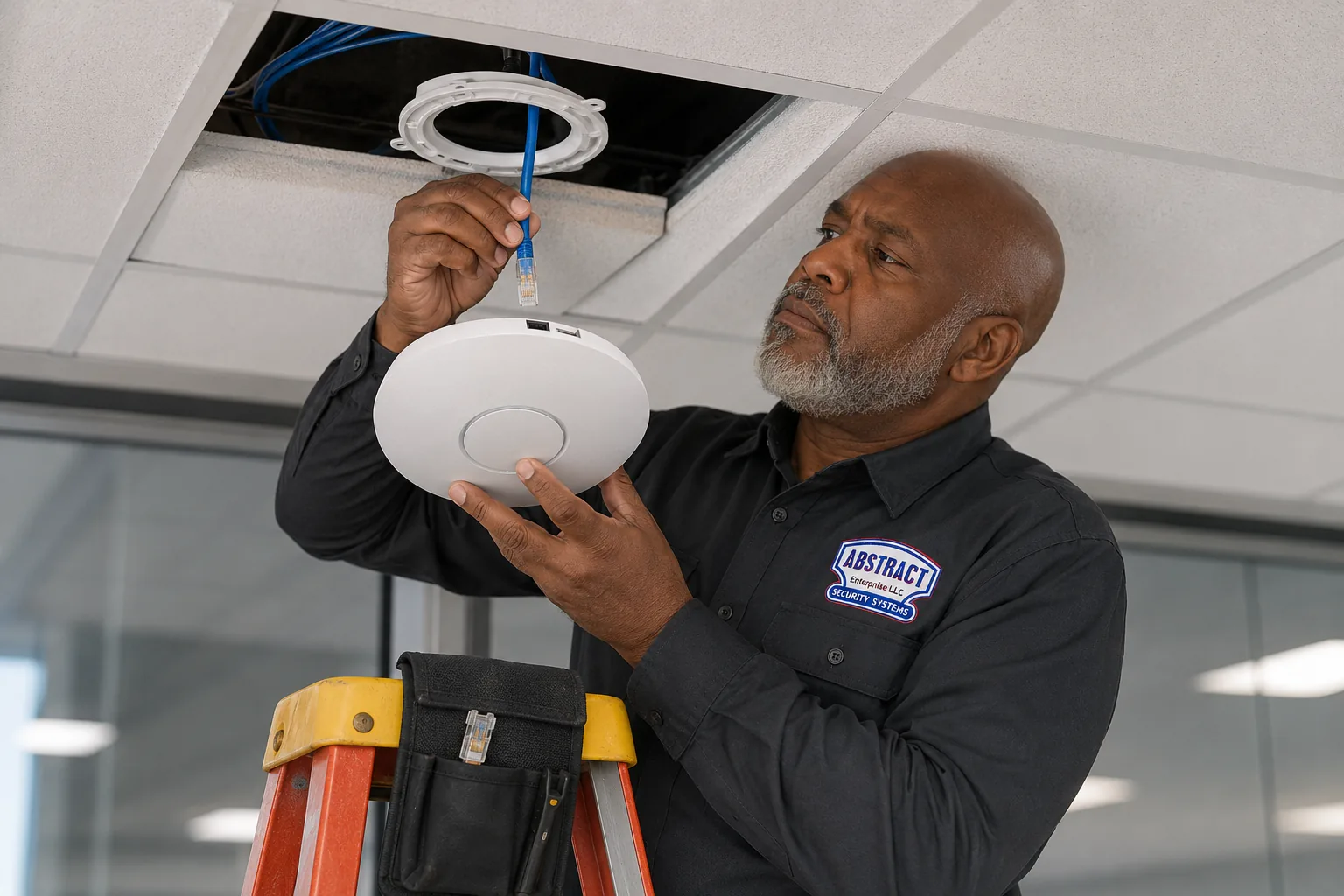
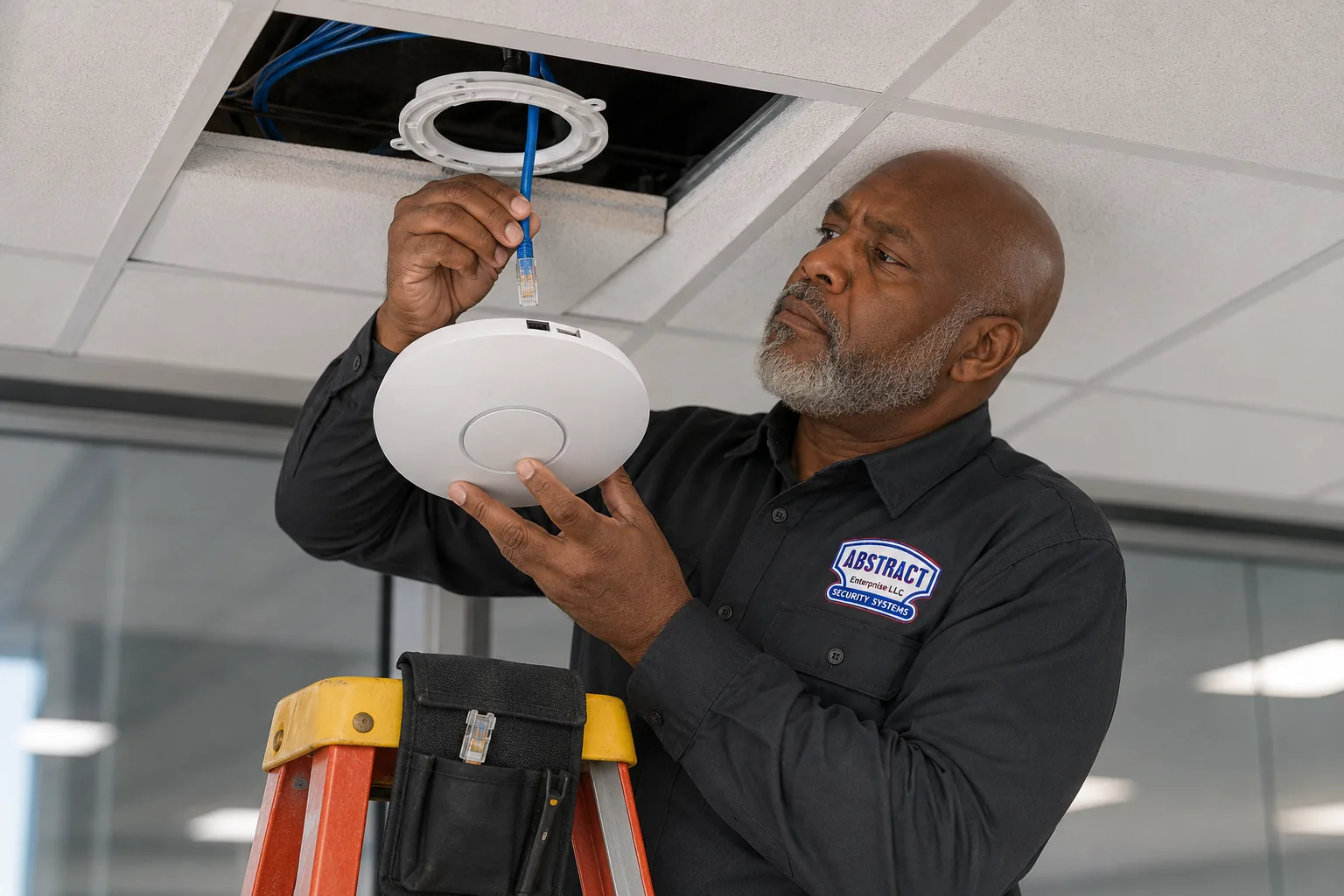
Midwood, Brooklyn network cable repair: access point cable repair under way
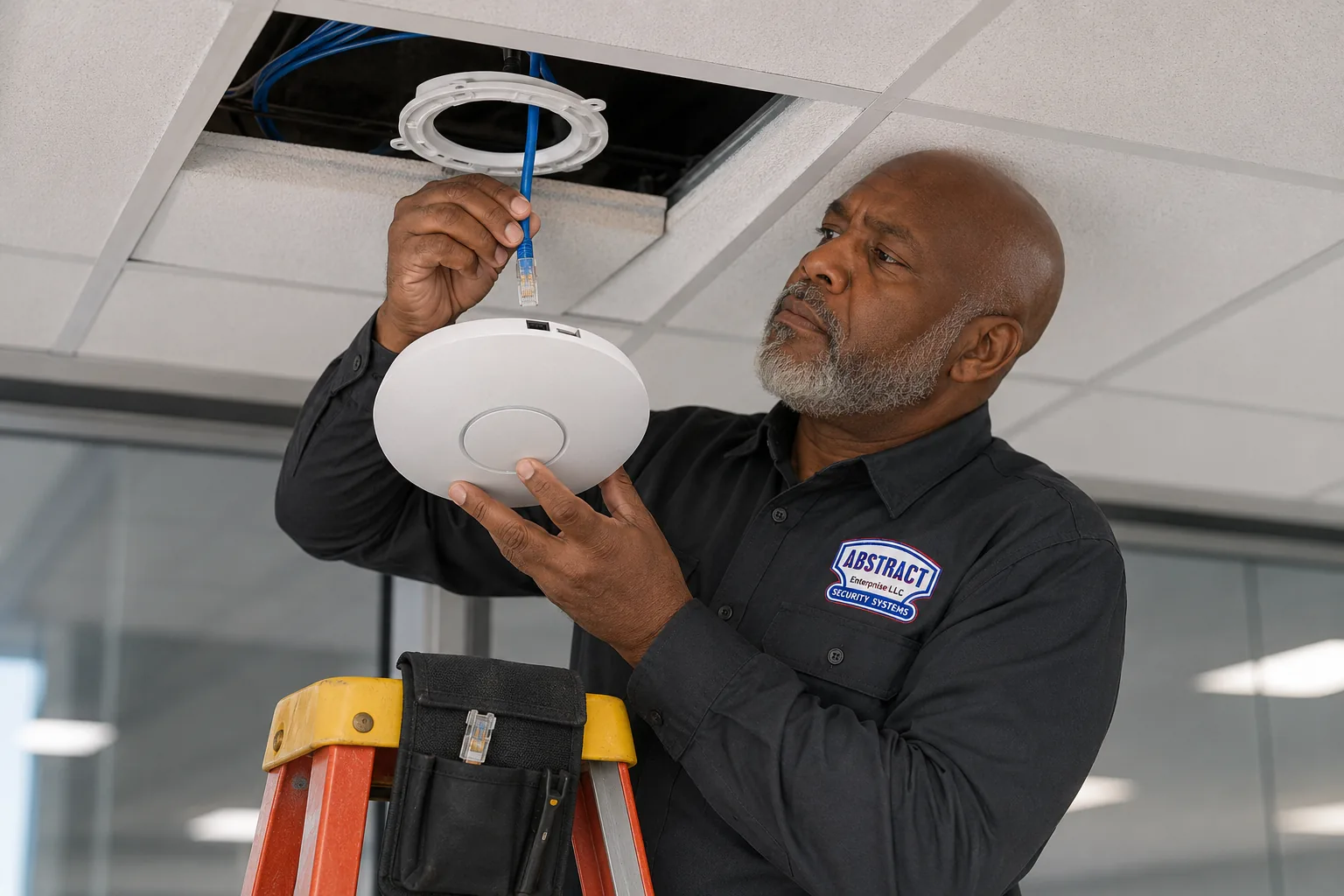
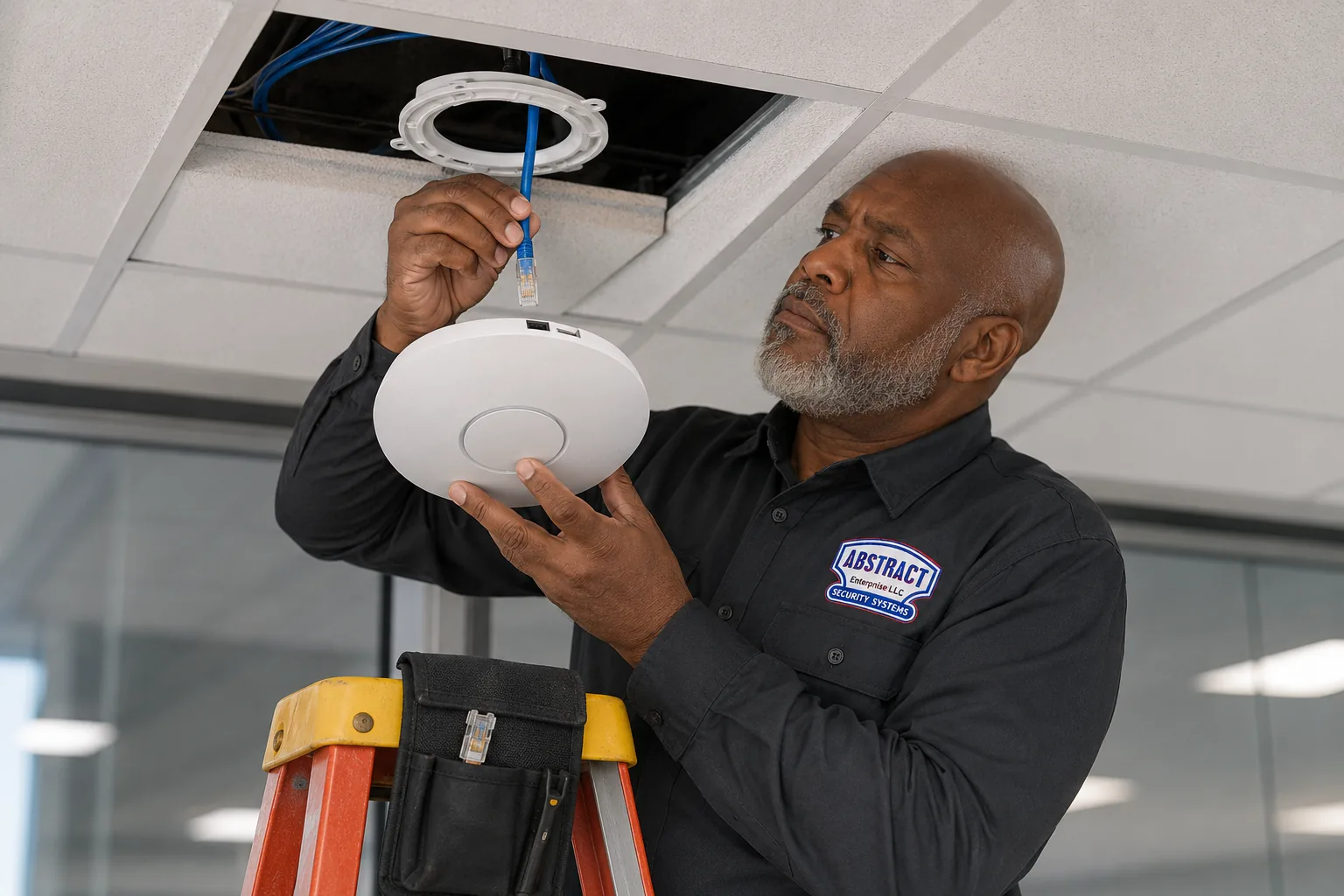
A photo from the AESS job library, not taken in Midwood: a repair on the cable that feeds a wireless access point. In a Midwood house the access point is often the device that goes quiet first, because it sits at the far end of the longest run, on the top floor of a narrow Tudor or at the back of a deep Victorian, and the cable behind it is the one nobody has looked at since it went in.
Midwood Cable Repair Request
House, two-family, co-op, storefront or office: tell us what went dark and where, and a technician calls back with the plan and the time

โœ…
Request Sent!
Thank you. A technician will call you about the Midwood address and book the visit, usually within 2 hours.
25+
Years Experience
โœ“
Same-Day Estimates
100%
Licensed & Insured
4.7โ˜…
201 Google Reviews

Owner-operated since 2002 ยท Thousands of jobs completed ยท Booked within 2 hours

Network cable repair in Midwood is billed at our Brooklyn service rate of $195 an hour with a three-hour minimum ($585), and the expected time is agreed with you before any cable is cut. That covers finding the fault with proper test equipment, the repair itself, whether that means a new end on the cable, a new wall jack, a re-punched patch panel port, a corrected PoE circuit or a replacement section of cable, and a test of the finished link so you know it works at full speed and not just "lights up." We book visits within 2 hours of your request. To get there faster, send three things to (347) 934-8335 or on WhatsApp: a photo of the dead jack or the device that lost its connection, a photo of wherever the cables end up, which might be a basement shelf, a closet, a cabinet behind a store counter or a rack in an office, and a short note about what changed just before it stopped working. A plumber in the basement, a new floor going down, a painter moving furniture or a storm the night before tells us more than any symptom.

  • Reading your photos and talking through the symptom costs nothing. If the problem turns out to be your router, your provider's equipment or a setting on a device, we say so on the phone rather than send a technician to test a cable that is fine.
  • All work is done under New York State license #12000287431, by a licensed and insured contractor, and paperwork for a managing agent or co-op board is sent before the visit.
  • If you live in a co-op or rent, the one thing to check before booking is whether the building allows small openings in interior walls or ceilings. Most repairs never need one, but it is better to know in advance than to stop halfway.
The Neighborhood

Why Midwood Properties Need Network Cable Repair

None of those builders imagined a network cable, and that matters more than it sounds. Every Ethernet run in a Midwood house or prewar building was added later, by someone working around walls, floors and chimneys that were never designed to carry it. In a house from 1910 or 1930, the first data cable usually went in during the 1990s or 2000s, often by the phone or cable company, a handyman or an owner with a drill and a weekend. More runs were added when someone needed a home office, a camera over the driveway, a wired television or an access point upstairs. The result in many houses is a layered network: some runs stapled along basement joists, some fished down inside a closet wall, some laid under carpet or tucked behind baseboards, and a few that disappear into the plaster with no record of where they come out. When one of them fails, the hard part is not the repair. It is finding where, along a path nobody wrote down, the cable actually broke.

The buildings themselves shape where those faults happen. A narrow Tudor such as the 15-foot-wide house on East 28th Street that Brownstoner listed, built in 1932 alongside its twin, has four floors of living space and a garage, so a cable from a basement router to a top-floor office climbs three floors through tight framing and around a stair. A freestanding Victorian on East 19th Street is deep rather than tall, with long horizontal runs along a basement and up through closets. The red-brick two-families on East 13th through 16th Streets often share one internet connection between the owner's floor and a rented one, which means a single cable failure can take down two households. The six-story prewar apartment houses on Kings Highway, on Avenue I and along Ocean Avenue and Ocean Parkway are mostly co-ops, where the walls and risers are shared, the basement belongs to the building and any work beyond your own apartment goes through the super or the board.

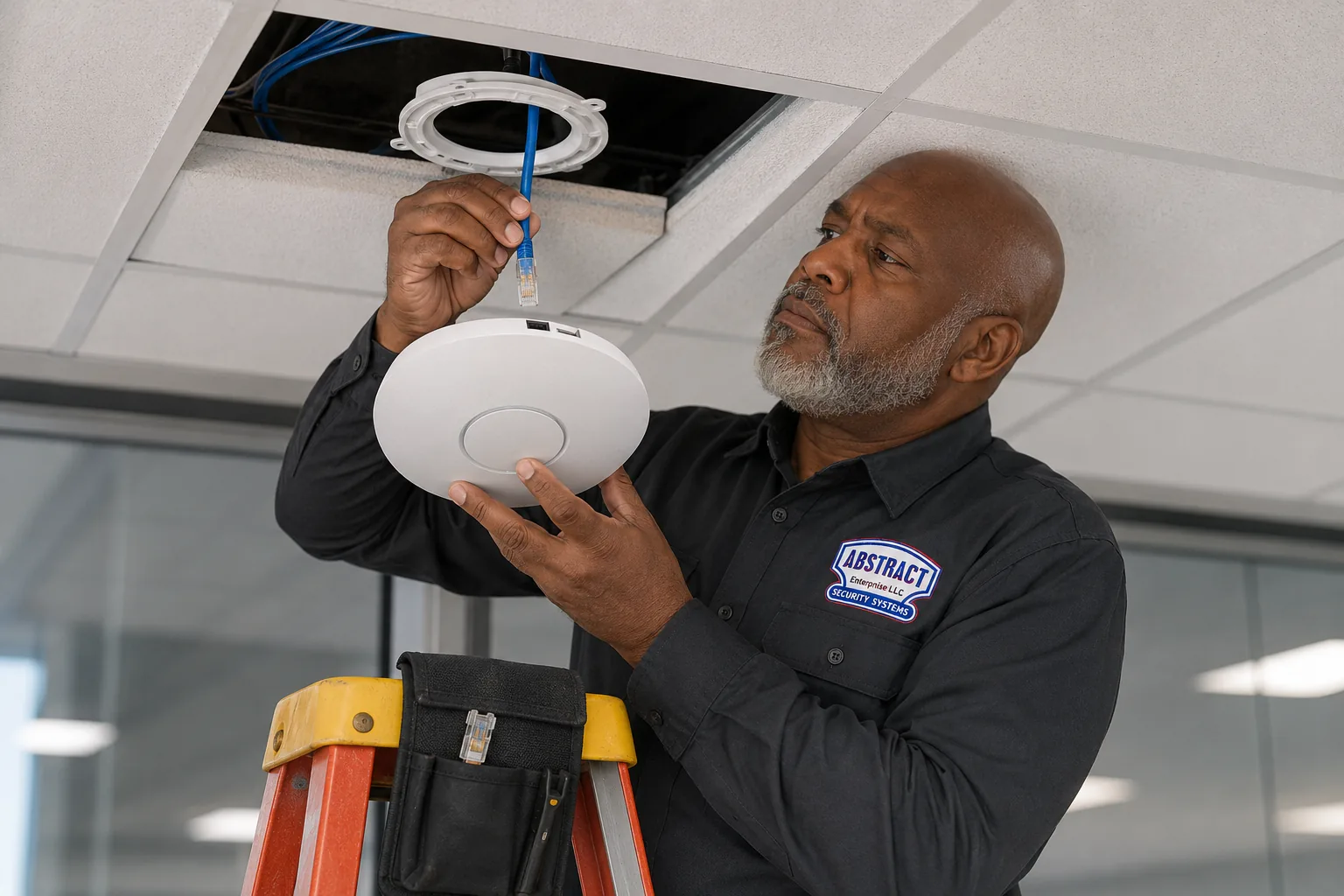
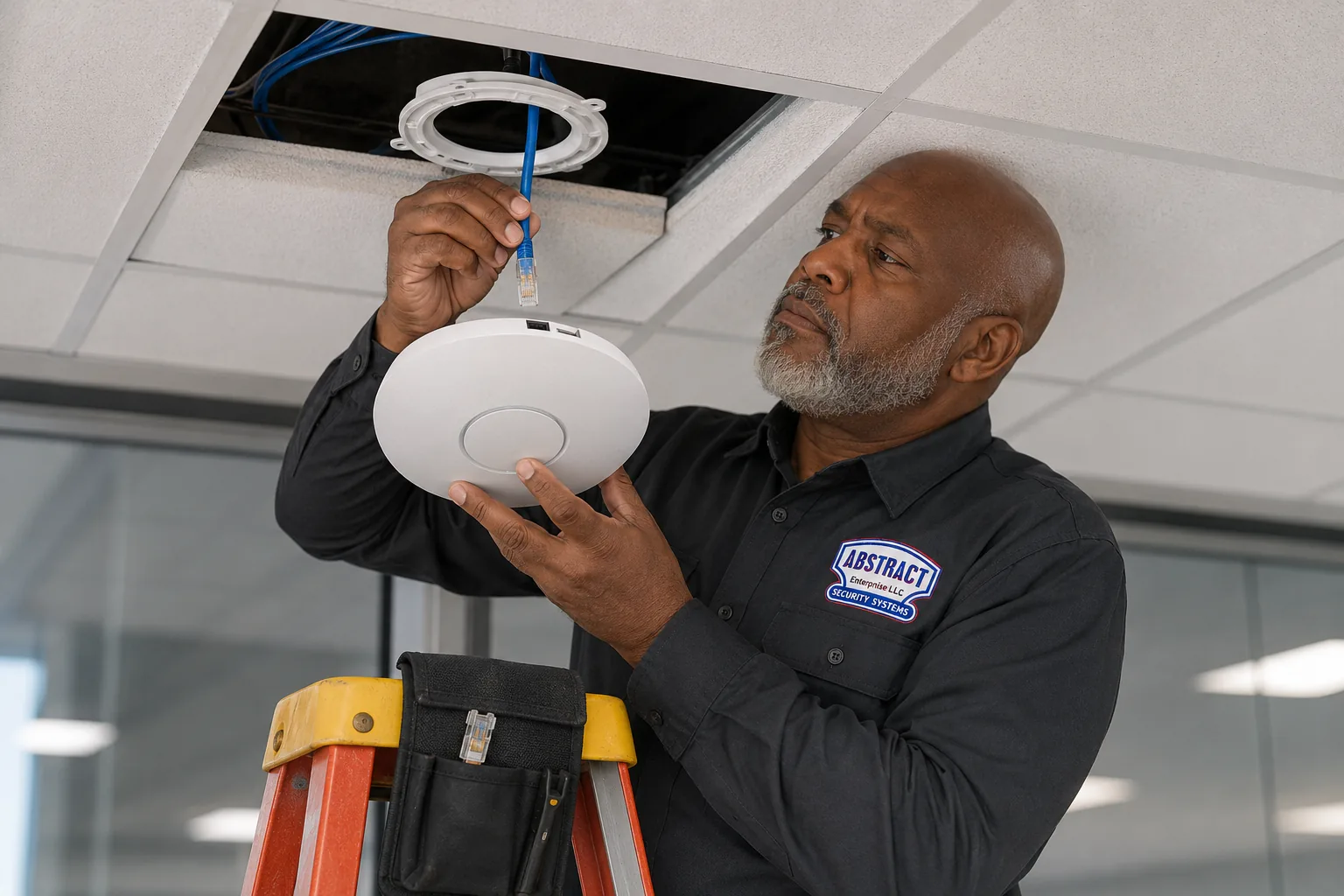
Midwood, Brooklyn Ethernet repair: repairing the data cable that feeds a wireless access point
A photo from the AESS job library, not taken in Midwood: a technician repairing the data cable that feeds a wireless access point. In a deep Victorian on the interior blocks, the access point at the back of the house is usually connected by one long run along the basement and up a closet wall, and when it drops out the cable is the first thing we test, before anyone blames the Wi-Fi.

Then there are the people and the uses. Midwood had 52,835 residents at the 2020 Census, and neighborhood guides describe it as a predominantly Orthodox Jewish community with yeshivas and synagogues on nearly every block. That brings a large number of institutional buildings, schools, study halls, offices and community spaces, many in converted houses or older buildings, each with its own network that has grown room by room over years. It also brings a calendar. Many households and businesses here close for Shabbat from Friday evening through Saturday and for the holidays, so a repair has to fit the days the building is open, and a network that fails on a Thursday afternoon has a deadline. We ask about this when you book and plan the visit around it, not the other way round.

Six Midwood facts that decide how a cable repair goes

  • Houses that were finished before networking existed. Fiske Terrace went up from 1905, and most of the rest of Midwood between the 1920s and 1940s. Every data cable here is a later addition, often undocumented, which makes tracing the run the first part of almost every repair.
  • Tall, narrow houses with long vertical runs. A 15-foot-wide Tudor with four floors and a garage, like the 1932 house on East 28th Street, puts the router in the basement and the office at the top. Faults there cluster where the cable turns corners between floors.
  • A designated historic district on the northern edge. The Landmarks Preservation Commission unanimously designated the Fiske Terrace-Midwood Park Historic District on March 18, 2008, covering 250 houses between Foster Avenue, Avenue H, Ocean Avenue and the Brighton Line. Some sources count it as Flatbush, but the houses are the same kind we repair across Midwood, and we keep repairs inside rather than on the facades.
  • Co-ops along Ocean Avenue, Ocean Parkway, Kings Highway and Avenue I. Six-story prewar co-ops mean shared walls, building-owned basements and boards that set the rules. General condominium guidance treats drilling through a common exterior wall as something usually not permitted, so repairs are planned from the inside.
  • Three busy shopping streets. Avenue J between Coney Island Avenue and East 16th Street, Avenue M and Coney Island Avenue carry the neighborhood's mom-and-pop stores, bakeries, restaurants and groceries, each with card readers, cameras and back-office computers on cables run through older mixed-use buildings.
  • A new office tower at Avenue L. New York YIMBY reported that 1508 Coney Island Avenue wrapped up construction in 2025 with about 112,000 square feet of Class A office space on floors two through ten and 51,000 square feet of retail on the first three floors. New buildings bring new cabling, and new cabling brings its own early faults.

Where this page applies. It covers Midwood from the Bay Ridge Branch tracks and Brooklyn College down to Avenue P and Kings Highway, including the streets of Fiske Terrace and Midwood Park at the northern end and the stretches of Ocean Avenue, Ocean Parkway, Coney Island Avenue and East 13th through East 28th Streets in between. For the rest of the borough, our Brooklyn network cable repair page explains the borough-wide service, and the rate is the same on every side of every boundary.

Same-Day Repair in Midwood

When a Midwood Connection Drops: Dead Jacks, Cut Runs and Cameras That Went Dark

Urgent cable calls tend to come in three shapes. The first is a single room or device that lost its wired connection overnight: the upstairs office, the television in the den, the access point on the top floor, the camera over the side door. Usually something changed. A bookcase was pushed against a jack, a chair rolled over a cable on the floor, a cleaner unplugged a patch cord to vacuum, or a contractor working in the basement nailed a new board through a cable stapled to the joist. The second shape is a whole floor or a whole closet going quiet at once, which points to the switch, the patch panel or the cable that feeds them, rather than to any one room. The third is the slow one: a connection that works, then drops for a few seconds, then works again, often worse in the evening, after rain or when a heater turns on. That last kind is the hardest to catch and the most common in older houses, because it usually means a damaged pair inside a cable rather than a clean break.

Before calling, try three things that take two minutes. Swap the short patch cord between the wall jack and your device for one you know works. Move the cable at the switch or router to a different port. And look at the lights on that port: no light at all usually means no connection on the cable, while a light that blinks on and off in a pattern can mean the link is repeatedly failing and reconnecting. If none of that helps, call (347) 934-8335 with what you saw. If the business is about to close for Shabbat or a holiday and the card reader or cameras are down, say so on the call. We book within 2 hours and plan the visit so the fix is done and tested while the building is still open. If the fault is in your provider's line or equipment, we tell you before anyone travels.

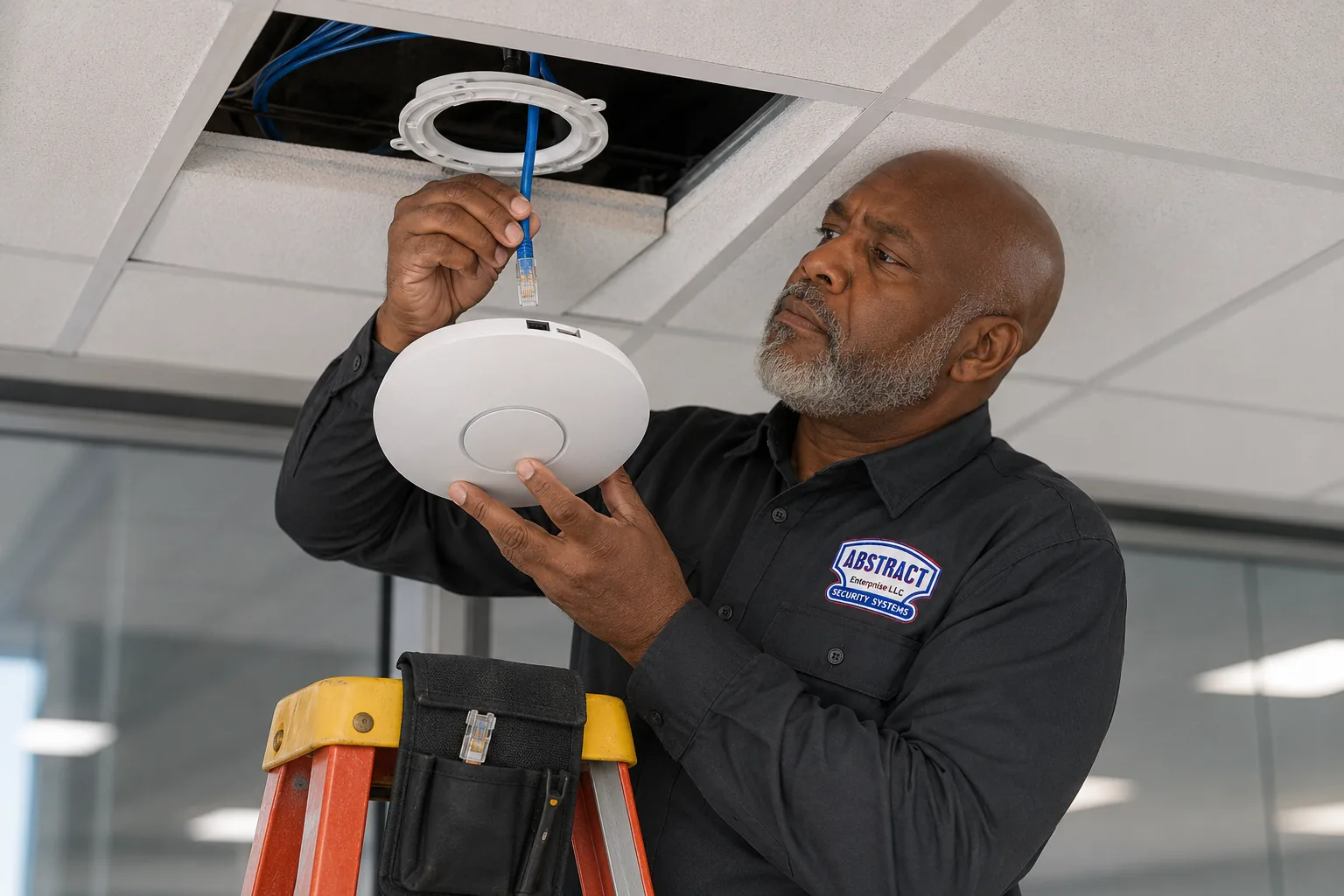
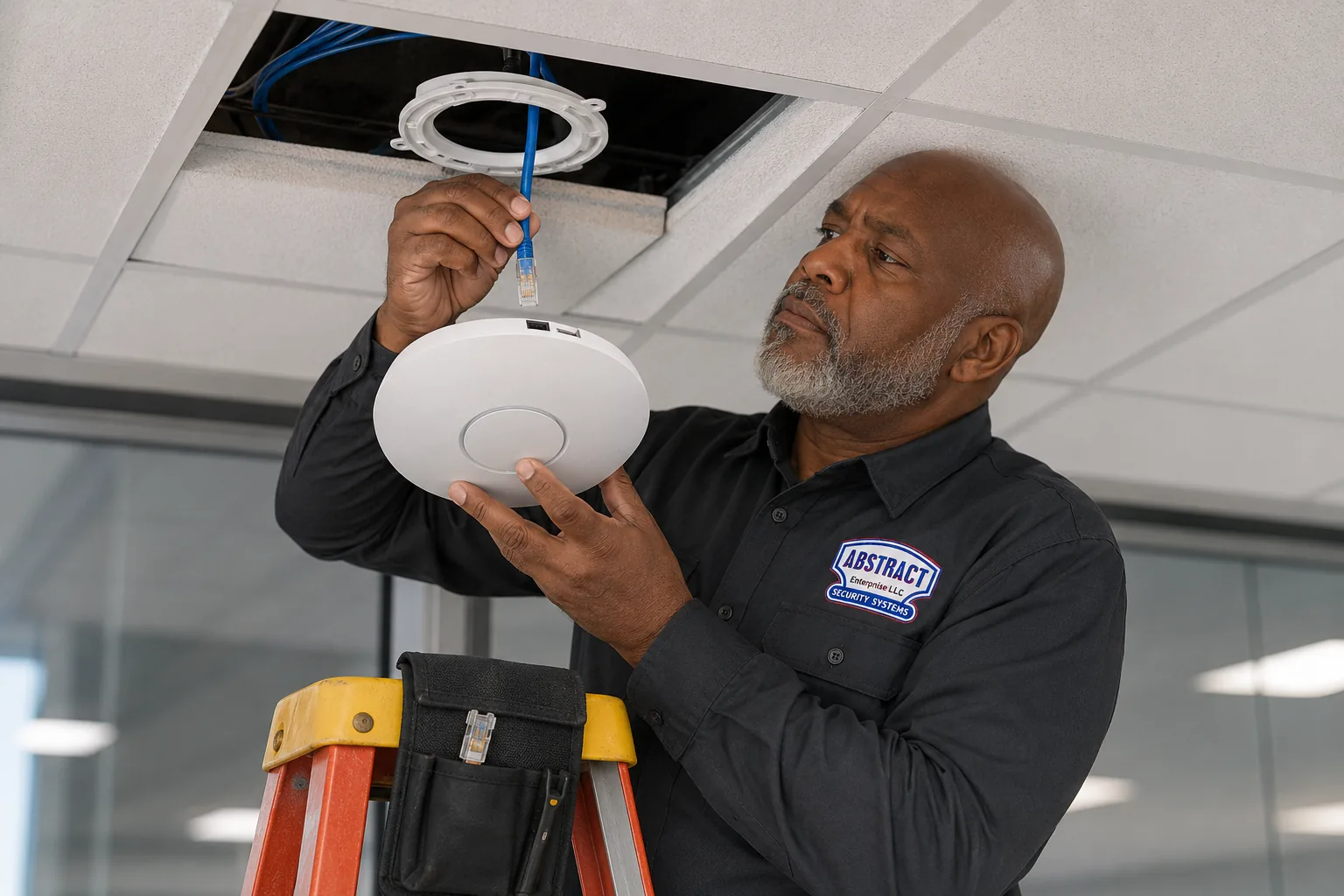
Midwood, Brooklyn access point cable repair: an access point and its network cable during a repair
A photo from the AESS job library, not taken in Midwood: an access point and the network cable that serves it, during a repair. When the Wi-Fi at the top of a Midwood house fails, a test at this end of the cable tells us in a minute whether the access point lost its power, its data or both, and that one answer decides where we look next.
What We Install

Network Cable Repair Services in Midwood

Every service below is part of our Brooklyn network cable repair work and is billed at the same hourly rate. Most visits use two or three of them together: the fault is located, the right repair is made, and the result is tested.

Ethernet cable fault location

Wiremap and distance-to-fault testing that shows which pairs failed and roughly how far along the run, so a basement-to-attic cable in a Tudor is opened at one spot, not five.

Pathway fault location and correction

Following the route the cable takes, along joists, up closets and through floors, and fixing the spot where it was stapled, pinched, crushed or laid against something hot.

Cat6 cable retermination

Cutting back a damaged or badly made end and terminating it again correctly at the jack, the panel or the plug, with the pairs kept twisted right to the contacts.

Network jack repair

Replacing cracked, loose, painted-over or wrongly wired wall jacks and keystones in houses, co-ops and offices, including the jacks hidden behind radiators and furniture.

Patch panel repair

Re-punching loose ports, replacing broken panels and tidying the cables behind them in basement shelves, store back rooms and office closets.

Certified network cable testing

Testing a repaired or existing run against its category with a certifier and leaving you the results, for offices, landlords and anyone who needs proof, not just a green light.

PoE circuit troubleshooting

Finding why a camera, access point or door device on Power over Ethernet keeps rebooting or going dark: the cable, the length, the switch's power budget or the injector.

Network closet mapping and labelling

Matching every jack in the building to its port, labeling both ends and leaving a written map, so the next repair in that Midwood building starts with an answer.

Building Specialists

Network Cable Repair for Midwood's Architecture

Six kinds of building account for most Midwood cable calls. They differ in where the cables run, what they pass through and who has a say in opening a wall, and those differences decide how a fault is found and fixed long before anyone talks about equipment.

The narrow Tudor or Colonial Revival

Detached and semi-detached houses from the 1920s and 1930s, some only 15 feet wide with four floors, where the router lives in the basement and the cable climbs three floors to reach the office.

The Victorian and the early-1900s house

Freestanding houses on East 19th Street and the stock-plan houses of Fiske Terrace and Midwood Park, deep rather than tall, with long basement runs and plaster walls.

The red-brick two-family

The houses on East 13th through 16th Streets, often with an owner on one floor and a tenant on another, and sometimes one shared internet connection serving both.

The prewar co-op

Six-story elevator buildings on Ocean Avenue, Ocean Parkway, Kings Highway and Avenue I, with shared risers, building-owned basements and boards that set the rules.

The limestone rowhouse

Attached houses along Ocean Avenue with masonry party walls on both sides, where cables travel front to back through a single chase or along the basement.

The basement apartment

Lower-level units in one- and two-family houses, where the network cable often runs across the same ceiling as the boiler pipes, water lines and electrical feeds.

The narrow Tudor or Colonial Revival: four floors, one cable and every turn a weak point

The tall, narrow houses of the 1920s and 1930s are where vertical runs fail. The internet usually arrives in the basement or at the front of the ground floor, the router sits near it, and the most important cable in the house goes up to an office, a bedroom or an access point on the top floor. In a house only 15 feet wide, that cable has very little room to work with. It typically goes up through a closet stacked above a closet, beside a plumbing stack, or up the side of the stair, and at every floor it has to turn and pass through a hole drilled in the framing. Those turns are where cables get damaged. A hole drilled too small leaves the jacket scraped. A cable pulled too hard around a sharp edge stretches its pairs. A cable bent tighter than about four times its own diameter can deform inside, and while it may still pass a simple continuity check, it can fail at gigabit speed.

Our approach in these houses is to test from both ends before touching a wall. A distance-to-fault reading from the basement tells us, for example, that the problem sits about eleven meters along a cable that is twenty-two meters long, and a tape measure along the likely route usually puts that at a floor crossing or a closet. From there, a tone generator on the cable and a probe on the wall confirm the spot. Very often the damaged section is reachable without opening anything: through a closet ceiling, from the basement or through the hole where the cable already passes. When it is not, a single small opening, cut neatly where it can be patched, is enough to replace the damaged section with a proper connection point or to pull a new length through the existing path. Garages in these houses add one more thing to check: any cable that runs through or near the garage door mechanism, a car's reach or an exterior wall can be damaged in ways an interior run never is.

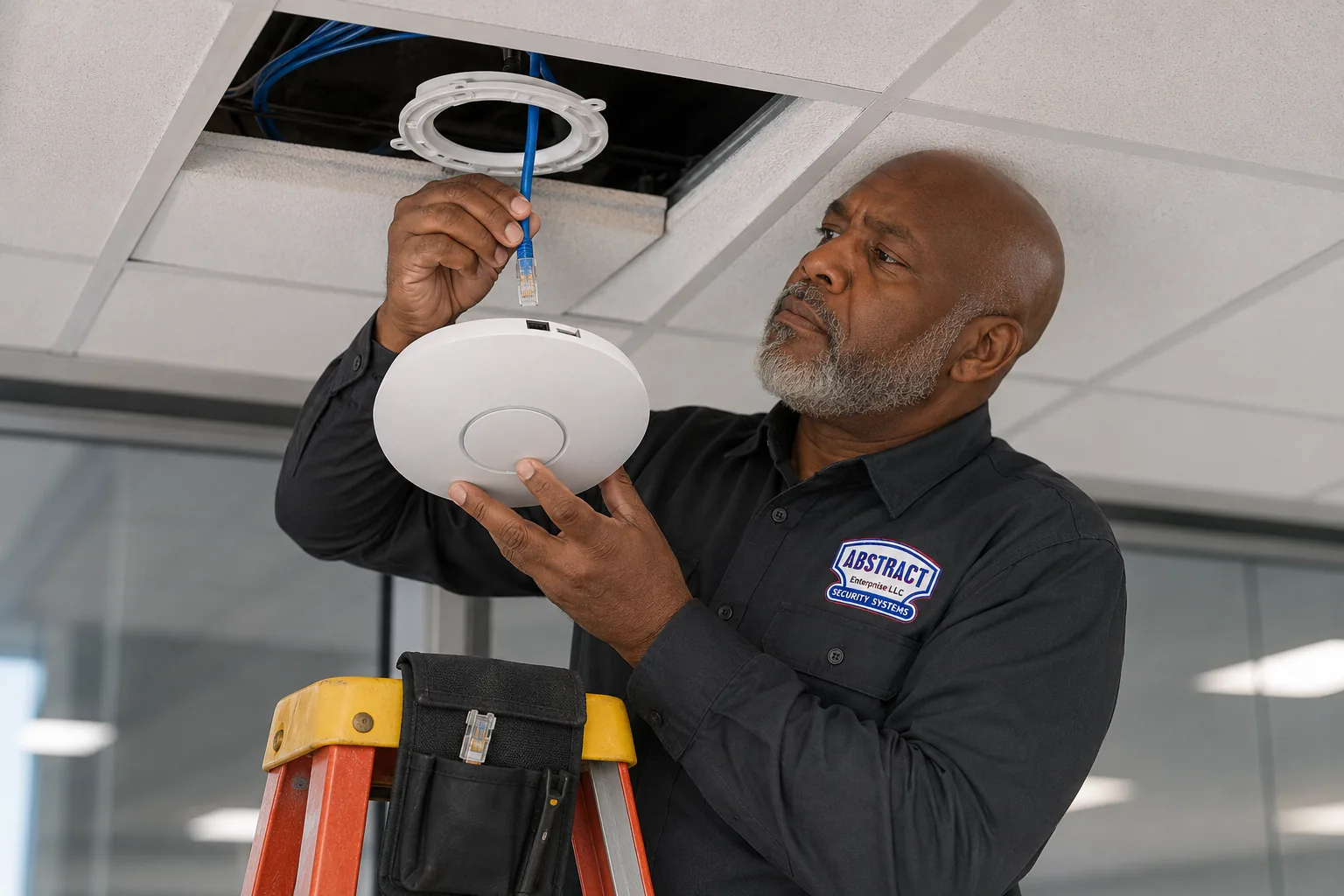
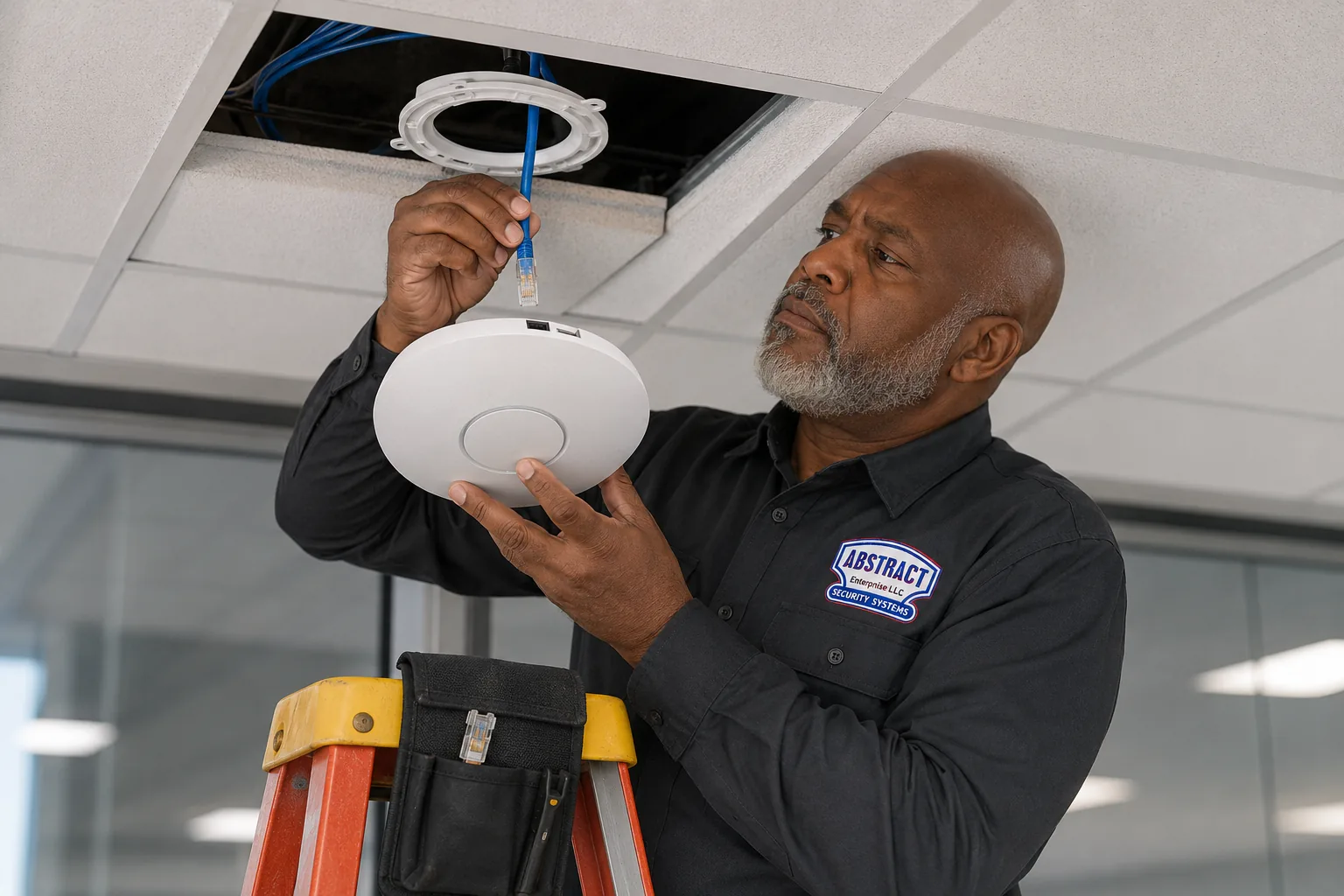
Midwood, Brooklyn network cable repair: cable repair at a Wi-Fi access point
A photo from the AESS job library, not taken in Midwood: cable repair at a Wi-Fi access point. In a four-floor Tudor the access point is usually at the top of the house, and its cable is the one that has made every turn between floors, which is why we test it end to end before assuming anything about the access point itself.

The Victorian and the early-1900s house: long basements and plaster that keeps its secrets

The freestanding Victorians of East 19th Street and the stock-plan houses of Fiske Terrace and Midwood Park were built deep, with long basements and rooms that run back from the street. Cables in these houses tend to run horizontally first, along the basement joists from the front to the back, and then rise through a wall cavity or a closet to the room they serve. Basement runs are exposed to the life of a basement: they get stapled tight to joists, moved by plumbers, covered by insulation, used as a shelf for something heavy, or soaked when a pipe leaks. Staples are a quiet problem. A staple driven hard over a network cable crushes the pairs together at that spot, changing the cable's electrical characteristics, and the result is often a link that works at low speed but drops or errors at full speed. On a long basement run with dozens of staples, the distance-to-fault reading saves a lot of guessing.

Upstairs, these houses have plaster walls, and plaster changes how a repair is done. Where the cable rises inside a plaster wall, we avoid opening the wall unless there is no other way, because plaster patches are slower and more visible than drywall patches. Instead we look for the original entry point, often a hole in the floor plate reached from the basement, and use it either to inspect the run or to pull a new cable through behind the old one. Jacks in plaster walls also fail in their own way: the box or mounting bracket loosens as the plaster crumbles around it, the jack pushes back into the wall each time a plug goes in, and over months the conductors at the back of the jack fatigue and break. A properly anchored low-voltage bracket or a surface box fixes that for good.

The northern part of this housing sits inside the Fiske Terrace-Midwood Park Historic District. We could not find a published Landmarks Preservation Commission rule that addresses data cable on facades specifically; the only related guidance we found concerns antennas and satellite dishes under the federal FCC rule, which allows historic-preservation limits in designated districts. Because the district is designated, our default is to keep every repair inside the house and never to add cable, conduit or boxes to a street-facing facade. If an exterior route ever looks like the only option, we would suggest you speak to the Commission before anything is fixed to the outside of the house.

The red-brick two-family: one connection, two households, one cable between them

In the two-family houses on East 13th through 16th Streets, a common setup is a single internet connection in the basement or on the ground floor, with a cable run upstairs to give the second unit a wired connection or an access point. When that one cable fails, two households lose service, and usually the one upstairs notices first. The repair itself is like any other: test, locate, fix. What is different is the people. The cable often runs through space that belongs to one household on its way to the other, the owner may live downstairs and the tenant upstairs or the other way round, and a repair may need access to a basement, a closet or a ceiling that is not yours. We ask who needs to be home and who needs to agree before booking, and we prefer to schedule the visit so the technician can reach both ends of the cable in one trip.

Two-families are also where we find the most improvised work: a cable fished through a floor beside a radiator pipe, a cable that leaves the house through a window frame and comes back in through another, a cable that was joined in the middle with a coupler and taped. Each of those is a common place for a fault. A cable that runs beside a radiator pipe can be softened by years of heat. A cable through a window frame gets pinched every time the window closes. And a coupler or taped joint hidden in a wall is a connection nobody can inspect. Where we find these, we tell you what we see and what the clean fix would be, which is often a short replacement run along a better path, rather than a repair that keeps the weak point in place.

The prewar co-op: your apartment, the building's walls and the board's rules

The six-story prewar co-ops on Ocean Avenue, Ocean Parkway, Kings Highway and Avenue I hold a large share of Midwood's apartments, and in them the line between your network and the building's matters. Inside your apartment, the cables from your router to your rooms are generally yours. The cable that brings internet service into the building, the riser it climbs and the basement it passes through generally belong to the building or the provider. When a co-op resident calls about a dead connection, our first job is to work out which side of that line the fault is on, because a fault in the riser or the building's closet is something the super, the managing agent or the provider has to authorize or fix.

Co-ops also have rules about work. Many require contractors to carry insurance and send a certificate before the visit, many set working hours, and many restrict opening walls, especially walls shared with corridors or neighbors. General condominium guidance says drilling through a common exterior wall is usually not permitted, and many co-op house rules take a similar line. That shapes the repair: in a co-op we fix cables from inside the apartment wherever possible, use existing paths and surface raceway where a wall cannot be opened, and avoid any route through common elements unless the building has approved it. Walls in these buildings are often plaster on masonry or on hollow tile, which makes fishing a new cable through an interior wall harder than in a frame house, so a well-placed surface raceway along a baseboard is often the honest answer.

The limestone rowhouse: masonry on both sides and one route front to back

The masonry also limits how a replacement can be routed. A cable that needs replacing cannot simply be fished through a party wall, and drilling into one is a job we avoid for a cable repair. Instead we work with the existing chase, the basement and, where the house has one, the space under the stairs. If the original path is unusable, we explain the alternatives, which might include a surface raceway in a closet or along a baseboard, and you decide which is acceptable before we start. The same thinking applies to the basement apartments and offices that some of these houses contain.

The basement apartment: the network cable shares a ceiling with everything else

Basement apartments in Midwood's one- and two-family houses are often connected by a cable that runs across the basement ceiling, past the boiler, the hot-water heater, the water main and the electrical service. That is a hard neighborhood for a network cable. Heat from boiler pipes and flues softens jackets over years. Water from a leaking fitting can run along a cable and into a jack. Cables laid across or tied to electrical conduit or pipes get disturbed every time someone works on them. And a cable that runs parallel to electrical wiring for a long distance can pick up interference that shows up as errors rather than outright failure. None of this means a basement run is wrong; it means it has to be routed with care and kept clear of hot surfaces and wet fittings.

When we repair a basement run, we look at the whole path, not just the damaged spot. If the fault is a crushed section where a plumber clamped a pipe against the cable, we replace that section and move the cable off the pipe. If the fault is heat damage near a flue, we reroute the cable away from it rather than just replacing the damaged length in the same place. If the run crosses electrical wiring, we try to cross it at a right angle rather than run beside it. And if the basement takes on water, we keep jacks and connection points well above the floor. In a basement apartment, the landlord usually controls the ceiling, so we ask the tenant to confirm the landlord's agreement before the visit.

Field Notes

Field Notes: The First Twenty Minutes on a Midwood Cable Call

These notes describe how our technicians start a repair in houses and buildings like Midwood's. They are our working practice, not an account of any single address.

Start where the cables end. The technician goes first to wherever the cables finish: the basement shelf, the closet, the cabinet behind the store counter or the office rack. The state of that spot tells a lot. Cables with no labels, a patch panel with loose wires behind it, a switch with no airflow sitting on a boiler-room shelf, or a power strip daisy-chained into another all point to where problems are likely.

Prove the device and the port. Before blaming any cable, the technician plugs a known-good tester or laptop into the dead jack and into the switch port. Half the time, one of those two answers the question: a dead port, a switch that has lost power, a device that needs a setting changed. Only when both ends are proven does the cable come under suspicion.

Midwood, Brooklyn Ethernet cable repair: fixing the Ethernet run to an access point
A photo from the AESS job library, not taken in Midwood: a technician working on the Ethernet run to an access point. In a Midwood house, this is the far end of the test: a tester at the access point and its partner at the basement or closet end, so the cable between them can be judged on its own, without the router or the access point clouding the result.

Read the cable, then measure. A wiremap shows whether all eight conductors arrive in the right order. A distance reading shows how long the cable is and roughly where any break or short sits. Written down, those two numbers become a plan: the fault is at the jack, at the panel or at a measured distance along the run.

Walk the route with a probe. A tone generator goes on the cable and the technician follows it with a probe along the basement ceiling, up the closet and across the floor. A staple, a pinch or a nail is often visible at the point where the tone changes.

Explain before cutting. Before anything is cut, opened or replaced, you are told what failed, what the fix is and how long it should take. If the household needs quiet or the store needs to keep serving customers, the noisy or disruptive part is planned around that.

Fault by Fault

Where a Midwood Cable Actually Breaks, and What Each Repair Involves

Every network cable fails somewhere specific, and the repair depends on where. Here is what we find most often in buildings of Midwood's age and type, how we recognize each one, and what the fix involves. None of it is exotic; it is the ordinary wear of cables that were added to houses never meant to hold them.

At the wall jack. Jacks are handled every day, and in old houses they are often mounted badly. A jack pushed back into a crumbling plaster opening flexes every time a plug goes in. A jack behind a bed or a couch gets struck by furniture. A jack that was painted over can have paint inside the contacts. And a jack that was terminated with too much of the cable's twist undone, or with the pairs in the wrong order, may have worked for years at low speed and fail when a faster device is plugged in. The repair is to cut the cable back to clean conductors and terminate a new jack, keeping the pairs twisted to within about half an inch of the contacts, matching the wiring standard used at the other end, and mounting the jack so it no longer moves.

At the patch panel or the end in the closet. In a basement or closet, the far end of the cable is usually punched down on a patch panel or terminated on a plug that goes straight into a switch. Panels get bumped, cables behind them get pulled when someone tidies up, and punch-downs work loose. Plugs crimped on in a hurry often have conductors that do not reach the contacts fully. A re-punch or a properly terminated new end fixes these, and while the panel is open we check the neighbors of the failed port, because a cable pulled once usually disturbed others.

Along the run: staples, nails, crushes and pinches. This is the classic basement fault. A cable stapled too tightly, pierced by a nail when a board went up, crushed when something heavy was stored on it, or pinched behind a pipe clamp may still show continuity but fail at speed. A distance-to-fault measurement narrows the search, and the repair is either a new section joined at proper termination points or, more often, a new cable along a better path, because a cable that has been crushed in one place has usually been mistreated in others.

Midwood, Brooklyn network cable fault repair: access point data line being repaired
A photo from the AESS job library, not taken in Midwood: the data line to an access point being repaired. A line like this, run along a basement ceiling in a Midwood house, is where staples, pipe clamps and stored boxes do their damage, and the repair usually includes moving the cable to a safer route as well as fixing the break.

Hidden joins inside walls. Some cables were extended by someone who joined two lengths with a coupler, a pair of crimped plugs or twisted wire and tape, and then buried the join in a wall. These joins are a common source of intermittent faults, because they are exposed to movement and air, and nobody can inspect them. The industry standards for permanent cabling do not allow splices of this kind in the horizontal run. When the distance reading lands on a join, the fix is to replace the joined section with a continuous cable or with a proper connection point that can be reached later.

Water and heat. In basement runs, water that reaches a cable through a damaged jacket or runs along it into a jack corrodes the conductors, and the fault often appears weeks after the leak. Cables near boiler pipes, flues and heaters can be softened and deformed by years of heat. Both show up as degraded performance rather than outright failure. The cure is replacing the affected section and moving the run away from the source.

The wrong cable in the first place. Some cable sold as "Cat6" is copper-clad aluminum rather than solid copper. It costs less, it is not compliant with the cabling standards, it breaks more easily at terminations and it handles Power over Ethernet poorly, because aluminum has higher resistance and heats more under load. If a run keeps failing at the ends, or a camera on a long run of it keeps rebooting, we check the cable jacket's markings and, where it is copper-clad aluminum, we recommend replacing rather than repairing it.

Runs that are simply too long. The cabling standards allow a channel of 100 meters, which is 90 meters of permanent cable plus 10 meters of patch cords. In most Midwood houses nothing comes close, but in a long building, an office floor or a property with a detached garage it can happen, especially when a cable was routed the long way round. Over-length runs may work at low speed, drop at gigabit and fail to power PoE devices reliably. The fix is a shorter route, or a small switch partway along.

Why a link that "works" can still be broken

Gigabit Ethernet uses all four pairs in the cable. Older 100-megabit Ethernet uses only two. When one pair in a cable is damaged, many devices quietly fall back to 100 megabits and carry on, so the connection appears to work but runs at a tenth of its proper speed. If your internet plan is faster than 100 megabits and one wired room never gets more than about 90, that is a strong sign of a damaged or mis-terminated cable. Another subtle fault is a "split pair," where the wires are connected end to end but in a mixture of pairs. A basic continuity tester shows all green lights, but the cable picks up crosstalk and errors at speed. Both are found by testing the cable properly and fixed by re-terminating it correctly.

When the problem is power, not data

Cameras, access points, video doorbells and some door devices take their power through the same cable as their data, using Power over Ethernet. When a PoE device keeps rebooting, goes offline at night or drops when it gets cold, the cable may be fine and the power may be the problem. Common causes are a switch or injector without enough total power for all the devices on it, a camera that draws more when its infrared lights or heater come on at night, a run so long or so thin that voltage drops too far, or a cheap passive injector that does not match the device. We test the power at the device end under load, check the switch's power budget and the cable's length and type, and fix whichever link in that chain has failed.

Commercial Network Cable Repair

Business Network Cable Repair in Midwood

Midwood's businesses are concentrated on a handful of streets. Avenue J has a commercial strip between Coney Island Avenue and East 16th Street, with the Avenue J station on the Brighton Line between East 15th and East 16th Streets. Avenue M and Coney Island Avenue carry what the Midwood Development Corporation describes as a wide range of mom-and-pop stores, bakeries, restaurants and ethnic groceries. Kings Highway along the southern edge has its own shops, including the Verizon store at 1623 Kings Highway and the Optimum store at 1212 Kings Highway that Yelp lists. Nostrand Avenue brings institutions such as the Kingsway Jewish Center. And at Coney Island Avenue and Avenue L, the ten-story building at 1508 Coney Island Avenue adds retail and Class A office space. The cards below describe the kinds of space where a cable fault stops business; we do not name any business as a customer.

Storefronts on Avenue J and Avenue M

Card readers, registers, cameras and a back-office computer on cables run through older mixed-use buildings, where a single failed run can stop sales at the counter.

Restaurants and bakeries

Kitchen printers, ordering screens and cameras on cables that live near heat, grease and water, where jackets and jacks wear faster than anywhere in a home.

Office floors at Avenue L

Suites in a new building, where tenant cabling, building cabling and the landlord's closets all meet, and early faults appear in terminations made during a busy fit-out.

Schools and study halls

Yeshivas and other educational buildings in converted houses or older buildings, with networks grown room by room and closets that nobody has fully mapped.

Synagogues and community buildings

Offices, classrooms and halls with cameras, access points and office computers, often on cabling added at different times by different people.

Managed apartment buildings

Co-ops and rentals where the super's office, the lobby cameras and the laundry room's devices depend on cables in the basement and risers.

A business cable fault has a different clock from a home one. A store with a dead card reader loses sales by the hour, and a restaurant whose kitchen printer drops mid-service cannot wait for the next day. Many Midwood businesses also close early on Fridays and stay closed on Saturdays and holidays, which leaves fewer working hours in the week for a repair. When a business calls, we ask three things first: what has stopped and how badly it affects trading, when the space can be worked in without customers in the way, and who controls the building's closets and ceilings. A storefront on Avenue J with apartments above it usually has a landlord who must agree to any work outside the store itself. An office suite in a managed building may need a certificate of insurance and an escort to the building's telecom room.

The fault itself in a business tends to be one of a few kinds. In older storefronts, cables are often run through drop ceilings, along walls behind shelving and down to the counter, and they get damaged when shelving is moved, when a ceiling tile is replaced or when a sign or light is installed. In restaurants, heat, grease and cleaning water attack cables and jacks near the kitchen. In new office floors, the most common early faults are terminations made in a hurry during the fit-out, cables damaged by other trades after they were pulled, and patch panels labeled in one order and wired in another. In every case, the method is the same: prove the device and the port, test the cable, locate the fault, repair it and test the result. A business also often wants the result on paper, and certified testing gives a record that the repaired run meets its category.

Midwood, Brooklyn business network cable repair: network cable work at a wireless access point
A photo from the AESS job library, not taken in Midwood: network cable work at a wireless access point. A store on Avenue J or an office on the new floors at Avenue L usually has access points like this in the ceiling, powered over the same cable, and when one fails the repair has to fit around opening hours.

Compliance notes for Midwood businesses and buildings

  • Use cable rated for the space it passes through. The National Electrical Code requires communications cable to be listed for where it runs, such as general-purpose cable inside walls in a single space, riser-rated cable between floors and plenum-rated cable in air-handling spaces. A repair section must match the rating the location requires, not just the cable it replaces.
  • Restore fire-stopping. Where a cable passes through a fire-rated wall or floor, the opening has to be sealed again with an approved fire-stop material after any repair. We do not leave a rated barrier open, and in managed buildings we tell the super where any penetration was disturbed.
  • Remove abandoned cable where it is accessible. The National Electrical Code requires the accessible portion of abandoned communications cable to be removed. When a repair replaces a run, we take out the old cable we can reach, rather than leaving another dead line in the ceiling.
  • Keep jacks within reach and out of the way. In public spaces, the ADA reach ranges and the rules on objects protruding into walking paths apply to anything we add or move, including surface boxes and raceway on walls along corridors.
  • Licensed and insured. All work is done under NYS license #12000287431, and commercial landlords and managing agents receive the insurance paperwork they ask for before the visit.
Your Questions Answered

Network Cable Repair in Midwood: Questions Answered

These are the questions people ask when a wired connection fails, taken from the public forums, repair guides and competitor pages we could find, reworded for Midwood's houses, co-ops and businesses. Each is answered fully here and not repeated in the FAQ further down.

Whose problem is it: provider, electrician or cable installer?

The Verizon or Optimum technician says the signal reaching our house is fine, but the wired rooms keep dropping. Who is responsible for the wiring inside?

Generally, an internet provider is responsible for its own line and equipment up to and including the modem, router or optical terminal it supplies. The cables that carry the connection from that equipment to the rest of your house, the runs to the office, the den and the access point upstairs, are usually the owner's, and providers typically do not repair them. That is why a provider technician can correctly say the service is fine while the rooms keep dropping. The way to settle it is to test both sides: if a device plugged directly into the provider's router stays connected while the same device in another room drops, the problem is inside the house. Our first step on a Midwood visit is exactly that comparison, and if the fault is in the provider's line, we tell you plainly so you can go back to them rather than pay for a repair you do not need.

Should I call an electrician for a dead Ethernet jack, or a low-voltage contractor?

Electricians are licensed for power wiring, and some also do network cabling, but network cable repair is low-voltage work that depends on specific test equipment and termination skills rather than electrical knowledge. The tools that find a network fault, a wiremap tester, a distance-to-fault meter and a certifier, are not part of most electricians' kits, and a jack that passes a simple continuity check may still fail at gigabit speed. A low-voltage contractor licensed for this work tests the cable to its category, terminates it to the standard and can prove the result. For Midwood homes and businesses, AESS works under New York State license #12000287431. If your problem turns out to involve the house's power wiring, for example a dead outlet that a switch or PoE injector depends on, we tell you and you call an electrician for that part.

Fixing it yourself

Can I splice a broken Ethernet cable with electrical tape or wire nuts?

You can make the wires touch, but you should not expect a reliable connection, and you should never hide that kind of join inside a wall. An Ethernet cable depends on its four pairs staying twisted at precise rates right up to the connection, because the twist is what cancels interference between pairs. Untwisting several inches to join wires with tape or wire nuts destroys that balance, and the cable may work at 100 megabits but fail at gigabit or drop under load. Tape also loosens and lets moisture in over time. The cabling standards do not allow splices of this kind in permanent runs. For a cable you can see and reach, the proper repair is a new end, a jack or a coupler joining two properly terminated plugs as a temporary measure. For a cable inside a Midwood wall, the proper repair is a continuous replacement section or a proper connection point that stays accessible.

What tools does a proper Ethernet repair take, and is it worth buying them for one cable in our house?

For a simple repair, such as putting a new plug on a cable you can see, you need a cable stripper, an RJ45 termination tool, the right plugs for the cable and a basic tester, and with care you can get a working result. For a cable inside walls or floors, you also need a punch-down tool and jacks, a tone generator and probe to follow the cable, fish tape or rods to pull a new section, and ideally a tester that shows distance to a fault. The equipment that proves a repaired cable meets its category, a certifier, costs far more than a home repair is worth. Buying basic tools makes sense if you are comfortable with them and the cable is exposed. For a run that climbs four floors inside a Tudor or crosses a basement ceiling you cannot easily reach, it is usually cheaper to have it located and fixed once than to guess and open walls.

I found a snapped cable behind a bookcase in our Midwood house. Is that something I can fix at home myself?

Often yes, if the break is in the short patch cord between the wall jack and your device, which is the cable most likely to snap behind furniture. Replacing a patch cord costs almost nothing and needs no tools. If the break is in the cable coming out of the wall, the answer depends on how much slack there is. With a few inches spare, a new jack can be terminated on the clean end, which is a job many careful people can do with a punch-down tool and a jack. With no slack, the cable has to be extended or replaced, and that is where home repairs tend to go wrong, because a hidden join is a future fault. If you do repair it yourself, test the result at full speed, not just for a light on the port, because a badly terminated jack can link up at 100 megabits and look fine.

Older houses and renovations

Our 1930s Tudor has four floors and the top-floor office lost its wired connection. Will finding the fault mean opening plaster walls?

Usually not, and certainly not before the fault is located. In a tall, narrow house the cable from the basement to the top floor typically climbs through stacked closets, beside a stack or up the side of the stair, and it is often reachable at several points without cutting anything: from the basement, through a closet ceiling, or at the hole where it passes each floor. A distance-to-fault test from the basement tells us how far along the cable the problem sits, which usually narrows it to one floor crossing or one closet. A tone generator then confirms the spot. If the damaged section really is inside a plaster wall with no other access, a single small, neat opening is often enough to replace it, and we show you where before cutting. In many cases the cleaner choice is to pull a new cable up the same path, leaving the plaster untouched.

A contractor renovating our kitchen cut the cable that fed the office. What does reconnecting it cost?

On our Brooklyn rate, the visit is $195 an hour with a three-hour minimum ($585), and a single cut cable with the break in an open wall or ceiling is the kind of job that usually fits within that time, including the test afterward. What makes it longer is access: if the kitchen wall has already been closed up, finding the cut means tracing the cable to the spot, and if the cable now ends inside a finished wall, replacing that section may take more work. If the walls are still open, call before they close; a cut in an open wall is fixed by putting in a proper accessible connection point or pulling a new length through, not by twisting wires and burying them. Tell your contractor to leave both cut ends visible and marked, and send us a photo of them.

In our red-brick two-family the upstairs tenant's Ethernet comes off our router in the basement. If that cable fails, whose line is it, and can the two units be separated?

The cable inside your house is part of your property, so as the owner it is generally yours to repair, though your lease with the tenant may say how shared services work. When it fails, the repair is the same as any other run: test, locate and fix. Separation is a fair question while we are there. If the tenant's service runs through your router, the two households share one network, which raises privacy and reliability questions. Options include putting the tenant on their own network on your equipment, or letting the tenant have their own provider service, in which case the existing cable can often be reused as their link from the basement to their unit. Which is best depends on your lease and preference. We can test the cable and fix it on the visit, and set it up whichever way you choose.

Co-ops, basements and Wi-Fi

Our co-op on Ocean Parkway won't let us drill the outside wall. Can a damaged cable still be fixed from inside the apartment?

Almost always, yes. Exterior walls in co-ops are common elements, and general condominium guidance treats drilling through them as something usually not permitted, so a repair plan that depends on the outside wall is a non-starter. Inside the apartment, a damaged cable can be fixed at the jack, replaced along its existing interior path or rerouted through surface raceway along a baseboard or a door frame, which needs only small screws and is easy to remove later. If the fault is in the cable between your apartment and the building's basement or riser, that section is likely the building's, and we tell the super or managing agent what we found so they can authorize the repair. Send us the house rules and any alteration agreement before the visit, and we work within them, including working hours and insurance paperwork.

The Ethernet for our basement apartment runs along the joists past the boiler. Is that run safe to repair where it is, or should it move?

It depends on how close it is and how the damage happened. Network cable should be kept away from hot surfaces such as boiler pipes and flues, because years of heat can soften the jacket and change the cable's electrical characteristics. If the run passes well clear of the boiler and the fault is somewhere else, such as a crushed staple or a worn jack, it can be repaired in place. If the damage is near the boiler or a hot pipe, we reroute that section away from the heat rather than replace it in the same spot. We also look for water risk, because basements near water heaters and mains are where leaks start, and keep any connection point well above the floor. Because a basement ceiling in a one- or two-family house belongs to the owner, a tenant should check with the landlord before the visit.

If the cable to the upstairs access point is fixed, do we still need the mesh Wi-Fi units?

Often you do not, or you need fewer. Mesh units that talk to each other wirelessly lose speed with each hop, and in Midwood's plaster and brick houses that loss can be large, because the walls absorb signal. When a wired access point on a top floor fails, many people add mesh units to compensate, and the network becomes slower and less reliable than it was. Once the cable is repaired, a wired access point on each floor that needs one usually gives better coverage than a chain of wireless units. Some mesh systems can also use a cable between units, called wired backhaul, so your existing units may become better rather than unnecessary. You will still want Wi-Fi for phones and laptops; Ethernet just carries the heavy load to the right places.

Storefronts and offices

A camera over our Avenue J storefront goes offline every evening when its night vision turns on. Is that the cable or the power?

That pattern usually points to power rather than data. Many cameras draw more power at night, when their infrared lights switch on, and in cold weather when a heater runs. If the switch or injector feeding the camera is close to its power limit, or the cable is long, thin or copper-clad aluminum, the extra draw can drop the voltage at the camera far enough that it reboots or goes offline. We test the power delivered at the camera under full load, check the switch's total power budget against everything connected to it, measure the cable's length and check its type. The fix might be moving the camera to a port with more power, replacing an undersized injector, replacing a poor cable or shortening an over-long route. Given what CBS New York and News 12 reported about burglaries on and near Avenue J, a camera that sleeps at night is worth fixing properly.

The landlord says the jacks in our new office near Avenue L were installed last year. What should we check before move-in day?

Check that every jack you plan to use actually connects to the port it is supposed to, at full speed, before your staff arrive. New buildings such as 1508 Coney Island Avenue, which New York YIMBY reported finished construction in 2025, bring new cabling, and new cabling often has early faults: terminations made in a hurry, cables damaged by other trades after installation, and labels that do not match the patch panel. A simple walk-through, plugging a tester into each jack and confirming the port, catches most of them. If the landlord or contractor has certification results for the cabling, ask for them. If not, testing the runs you depend on, at least the ones serving reception, card readers, printers and access points, gives you a record. Problems found before move-in are the landlord's or installer's to fix; problems found later become an argument.
Equipment

Types of Network Cable Repair Equipment We Use

Repair is mostly measurement. These are the instruments and parts we bring to a Midwood visit, and what each one tells us or does in a house, a co-op or a store.

Cable certifier

Measures a run against its category, including crosstalk, loss and length, and produces a record that a repaired cable meets Cat5e or Cat6, not merely that it lights up.

Distance-to-fault tester

Shows wiremap faults pair by pair and estimates how far along the cable a break, short or crush sits, so a four-floor run in a Tudor is opened at one spot.

Tone generator and probe

Follows a single cable through basement ceilings, closets and shared chases, so the damaged run is found among its neighbors without disturbing them.

Jacks, keystones and patch panels

Category-rated replacement jacks and panels, terminated with a punch-down tool to the same wiring standard as the other end of the cable.

PoE testers

Measure the power reaching a camera, access point or door device under load, so a camera that drops at night is diagnosed on facts rather than guesses.

Replacement cable and raceway

Solid copper cable rated for the space it runs through, plus surface raceway for co-ops and rooms where walls cannot be opened.

Midwood, Brooklyn network repair: reconnecting the cable to an access point
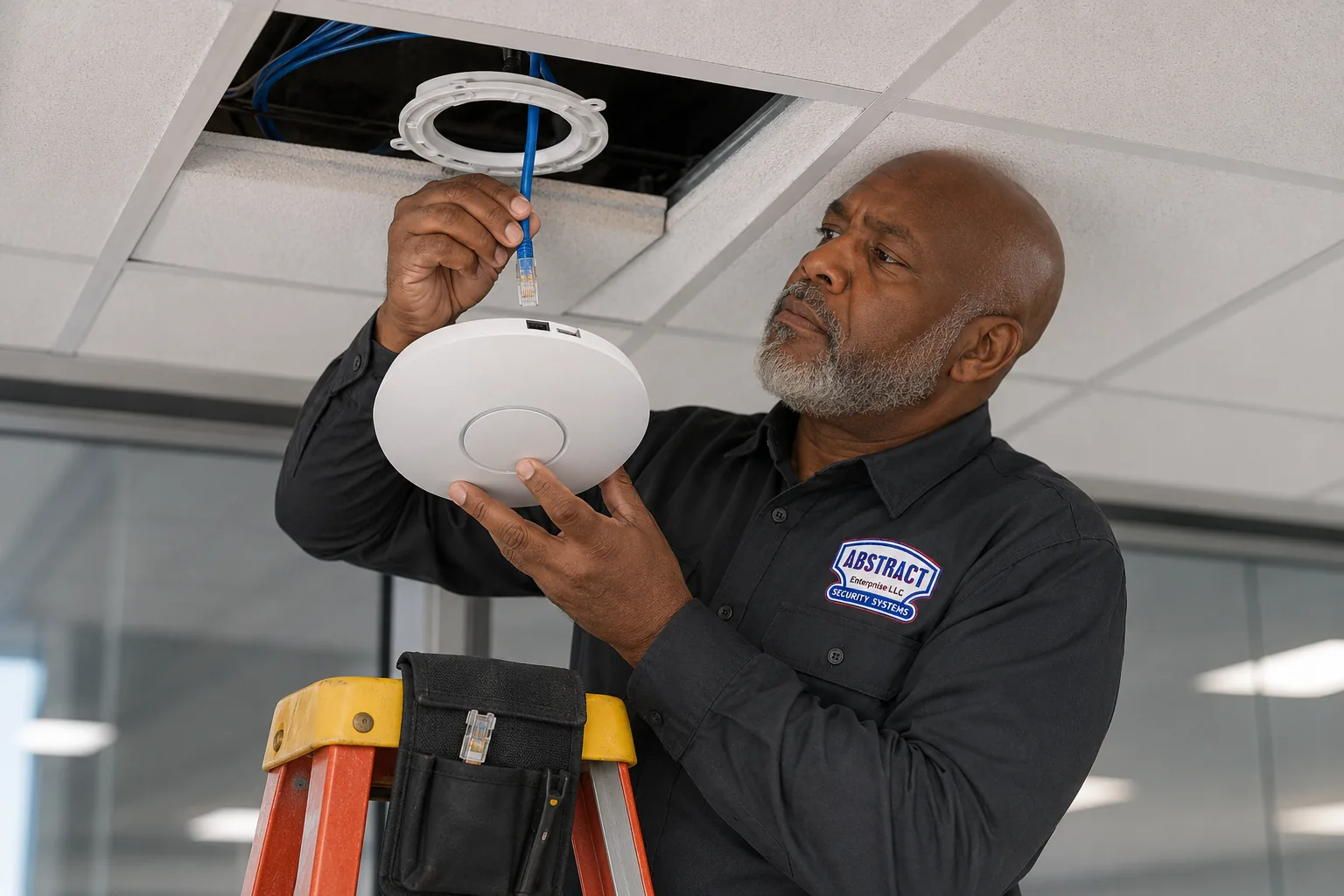
A photo from the AESS job library, not taken in Midwood: the cable to an access point being reconnected. After a repair in a Midwood house, this connection is tested twice, once with the tester to prove the cable and once with the access point itself running under full power, so the problem cannot come back the first cold night.

Provider technician, electrician, handyman or low-voltage contractor for a Midwood cable fault

Each of these has a real role, and the right call depends on where the fault is. The table describes the usual scope of each kind of visit, not the quality of any company.

What the problem needsInternet providerElectrician or handymanAESS in Midwood
Line into the building and the provider's boxTheir responsibilityNot their scopeWe confirm it is their side and tell you
Cables from the router to the roomsUsually not repairedVaries by personLocated, repaired and tested
Proof the cable meets its categoryNot offeredRarely carry a certifierCertified testing with results
Cameras and access points on PoENot their scopeVariesPower tested under load at the device
Power outlets and electrical circuitsNot their scopeAn electrician's jobWe tell you when you need one
Co-op and landlord paperworkTheir own processVariesInsurance documents sent before the visit
AI Overview Reality Check

What AI Gets Wrong About Network Cable Repair in Midwood

We could not capture Google's AI Overview for this topic in our build environment, so nothing below quotes it. These are claims that appear in generic online answers, repair guides and national cost sites such as Angi, HomeAdvisor and Fixr, paraphrased, each followed by what Midwood's houses and buildings actually show.

"A damaged cable should always be replaced, never repaired"

Generic advice often says that once a network cable is damaged, the only sensible fix is to pull a whole new run from end to end. For an exposed cable that costs little to replace, that can be true.

In a Midwood house, though, the cable may climb four floors through a narrow Tudor or cross a long Victorian basement, and many faults sit at a single point: a loose jack, a bad punch-down, one staple or one crushed spot. Replacing the whole run means more time and sometimes more openings in plaster than the fault deserves. In a co-op, a complete new run may not even be allowed by the building.

The honest answer comes from testing. If the fault is at an end, the fix is a new termination. If it is in one section, that section is replaced. If the cable is the wrong type or damaged along its length, replacing the run is the right call, and we say so.

"Just join the broken ends with a coupler or tape"

"If the tester shows green lights, the cable is fine"

"Cat5e can't handle modern speeds, so upgrade everything"

Some answers treat any Cat5e cable as obsolete and recommend rewiring the house with Cat6 or better.

Cat5e is rated for gigabit Ethernet over the full 100-meter channel, which covers the internet plans most Midwood homes and small shops use today. Many older houses here have Cat5e that works well, and a fault on one run is not a reason to replace the rest. Ripping out working cable through plaster walls to change category is expensive and often unnecessary.

When we repair a Cat5e run, we use parts rated for the cable's category. If your needs exceed what the cable can do, we explain the trade-off honestly.

"Mesh Wi-Fi makes wired cabling unnecessary"

"Network cable repair costs a predictable national average"

"Your internet provider will fix any connection problem"

Talk to a Technician Before Anyone Opens a Wall

If you are not sure whether the problem is the cable, the router or the provider, ask first. Call now at (347) 934-8335, send a fast quote request, or send photos of the jack and the closet to a tech on WhatsApp. Same-day estimates are available on most weekdays, and visits are booked within 2 hours of a request.

Get In Touch

Request a Free Quote

Tell us the cross streets, the kind of building, which rooms or devices lost their connection and what changed before it happened. A technician will call back with the likely cause, the plan and the expected time at the Brooklyn rate, or you can call (347) 934-8335 right now.

Midwood, Brooklyn network cabling repair: access point cabling repair in progress
A photo from the AESS job library, not taken in Midwood: access point cabling repair in progress. If you tell us on the form that the failed device is an access point or a camera, we bring a PoE tester and the right replacement parts, because in a Midwood house the fault might be power, data or both.

โœ…
Request Sent!
Thank you. A technician will call you about the Midwood address and book the visit, usually within 2 hours.
How It Works

Our Installation Process

1. Describe the symptom and send photos

Which rooms or devices lost their connection, when it started and what changed, with photos of the dead jack, the router or switch and the closet, plus your cross streets.

2. Confirm access, rules and timing

Building type, floor, keys to the basement or closet, co-op or landlord rules on openings, and a visit time that fits the household or business calendar.

3. Isolate the fault from both ends

The device, the switch port and the patch cord are proven first, so a router or port problem is never mistaken for a cable fault.

4. Locate the break

Wiremap and distance-to-fault testing, then a tone generator and probe along the basement, closets and floors to the exact spot.

5. Agree the repair and the time

You hear what failed, what the fix is, whether any small opening is needed and how long it should take at the Brooklyn rate, before anything is cut.

6. Make the repair

A new end, a new jack, a re-punched panel port, a corrected PoE circuit or a replacement section along a protected path.

7. Test the repaired link

End-to-end testing, certification where you need a record, and a check with your own device at full speed and full power.

8. Label, document and hand over

Both ends labeled to match, closet notes updated, the area cleaned, and the results explained in plain language.

Midwood, Brooklyn network cable troubleshooting: troubleshooting an access point cable
A photo from the AESS job library, not taken in Midwood: a technician troubleshooting the cable to an access point. Steps three and four of a Midwood visit look like this: the device end is checked first, then the cable is tested on its own, so the repair is aimed at the actual fault and nothing else is disturbed.
Coverage Area

Network Cable Repair Near Midwood's Landmarks

Brooklyn College

The Georgian campus designed by Randolph Evans, set at Midwood's northern edge beside the Bay Ridge Branch tracks.

Fiske Terrace-Midwood Park Historic District

250 houses designated by the Landmarks Preservation Commission on March 18, 2008, between Foster Avenue, Avenue H, Ocean Avenue and the Brighton Line.

Avenue J station and shopping strip

The Brighton Line stop between East 15th and East 16th Streets, in the middle of the Avenue J commercial strip that runs to Coney Island Avenue.

Kolbert Playground

The NYC Parks playground bounded by Avenue L and East 17th and East 18th Streets, in the middle of the residential blocks.

The Vitagraph smokestack

A chimney still marked "Vitagraph Co.," visible from the Avenue M station, a reminder of the early film studio that once worked here.

East Midwood Jewish Center

The Conservative synagogue on Ocean Avenue completed in 1929 and listed on the National Register of Historic Places.

We also serve the neighborhoods around Midwood, including Flatbush, Sheepshead Bay, Gravesend and Marine Park, at the same Brooklyn rate, along with the rest of the borough on our Brooklyn network cable repair page and further afield on our Williamsburg and Bushwick pages.

Pricing

Network Cable Repair Cost in Midwood

Midwood is billed at our Brooklyn service rate, the same as every other Brooklyn neighborhood. Repair work is charged by time, because the time a fault takes depends on where it is and how the building is built, not on which service name it falls under. Every visit starts with the expected time agreed with you.

ItemBrooklyn rate
Network cable repair service visit$195 per hour
Minimum per visitThree hours ($585)
Ethernet cable fault location and pathway fault correctionBilled at the hourly rate
Cat6 cable retermination and network jack repairBilled at the hourly rate, parts quoted before use
Patch panel repairBilled at the hourly rate, parts quoted before use
PoE circuit troubleshootingBilled at the hourly rate
Certified network cable testingBilled at the hourly rate
Network closet mapping and labellingBilled at the hourly rate

What changes the time on a Midwood repair is mostly access and the number of faults. A single loose jack in a room you can reach is quick. A crushed section somewhere inside a four-floor Tudor takes longer to trace. A co-op that restricts openings may mean surface raceway rather than an in-wall fix, which affects the route and the time. A closet with forty unlabeled cables takes longer to understand than one with six labeled ones. Because the minimum covers the first three hours, it makes sense to list every network problem in the building when you book, so the visit deals with as many as possible.

Full terms โ€” including 50% deposit, the 30-day warranty and optional paid extended warranty, and the late-fee schedule โ€” are set out in the service agreement.
Shop Our Systems

Network Cable Repair Packages & Pricing

Three typical Midwood visits, described by what they usually cover. Each is billed at the Brooklyn rate of $195 an hour with the three-hour minimum ($585); the expected time for your building is agreed before the visit.

Single fault: three-hour minimum ($585)

One dead jack, one cut cable or one camera that will not stay online, in a house or apartment with reasonable access: fault located, repaired and tested within the minimum visit.

House or storefront: minimum plus hourly

Several failed runs, a patch panel or closet that needs re-punching, or a PoE problem across more than one camera, billed at $195 an hour after the first three.

Building or office: quoted in hours

A school, community building, co-op basement or office floor that needs faults fixed, runs certified and the closet mapped and labeled, with the hours estimated from photos and a walk-through.

Bring your own equipment. If you already have the replacement jacks, patch panel, keystones or cable, we can install them as labor only at the same hourly rate, as long as they are rated for the cable's category and the space they go in. We check the parts before using them, and if they are not suitable, for example copper-clad aluminum cable or jacks of a lower category than the run, we tell you before starting.

Complete Services

Every Network Cable Repair Service in Midwood

Fault location and repair

Dead jacks, cut runs, crushed sections and loose panels. Request a quote

Cameras and access points

PoE power, long runs and devices that drop at night. Describe the problem

Brooklyn-wide repair

The same service and rate across the borough. Brooklyn network cable repair

Across New York City

Repairs for offices and buildings in all five boroughs. NYC network cable repair

FAQ

Midwood Network Cable Repair FAQ

Is Midwood billed at the same rate as the rest of Brooklyn?
+

Yes. Midwood is billed at our Brooklyn service rate of $195 an hour with a three-hour minimum ($585), the same as every Brooklyn neighborhood, whether your listing calls the block Midwood, Flatbush or Fiske Terrace.

How soon after I send a request will the visit be booked?
+

We book visits within 2 hours of a request. The visit itself is scheduled around your building's access and your calendar, and same-day estimates are available on most weekdays.

Can the visit be scheduled around Shabbat and Jewish holidays?
+

Yes. Tell us when you book which days and hours the household, school or business is closed, and we schedule the repair, and any follow-up, for the days the building is open.

Does someone need to be on site for the whole repair?
+

Someone needs to let the technician in, show where the cables end and be available at the end to check the repaired connection. In between, you do not need to stand by, but we need access to both ends of the cable, which may mean a basement, a closet or another unit.

What should I have ready before the technician arrives?
+

Clear access to the dead jack and to wherever the cables end, keys to the basement or closet, the router and switch powered on, and the passwords for any device that needs to be checked afterward. A note of what changed before the problem started helps too.

Will you work on cabling another company installed?
+

Yes. Most of the cabling we repair in Midwood was installed by someone else, sometimes several different people over the years. We test it as we find it and repair it to the standard used at the other end.

How is the three-hour minimum applied if the fix takes less time?
+

The minimum is charged either way, so it is worth listing every other network problem in the building when you book. If the main fault is fixed quickly, the remaining time can go to the other jacks, a camera or labeling the closet.

Do you supply the jacks, patch panels and cable, or should I buy them?
+

We can supply rated parts and tell you what they are before using them. If you prefer to supply your own, we install them as labor only, provided they are rated for the cable's category and the space they go in.

Can you reach an access point mounted on a high ceiling?
+

Yes. Tell us roughly how high the ceiling is when you book so the technician brings the right ladder. In offices and halls with tall ceilings, we also check the cable and power where the access point connects.

Can you move a jack to a different wall while you are there?
+

Often yes, if the cable has enough length or can be extended properly and the building allows the work. Moving a jack is billed at the same hourly rate, and we tell you before starting whether it fits in the visit.

The cable passes through another tenant's apartment. How do we handle that?
+

We need the owner's agreement and the other tenant's access for the part of the run in their space. Arrange that before the visit, and we plan the work so the time in their apartment is as short as possible.

What if the cable runs through a basement that sometimes takes on water?
+

We replace any section that shows water damage and keep connection points and jacks well above the floor. If water is still getting in, we recommend having the leak fixed first, because no cable repair lasts in a wet basement.

Do you repair network cabling in yeshivas, synagogues and school buildings?
+

Yes. We coordinate with the administrator or building manager on access, closed days and insurance paperwork, and schedule disruptive work for times when classrooms and offices are empty.

Midwood, Brooklyn network cable service: access point network drop repair
A photo from the AESS job library, not taken in Midwood: a repair on the network drop that serves an access point. In a Midwood school, office or community hall, a drop like this often feeds the Wi-Fi for a whole floor, which is why we test it under full power before calling the job finished.

Ready to Get the Wired Rooms in Midwood Working Again?

Send a photo of the dead jack and of the place where the cables end, with your cross streets, and we will tell you what we think failed and how long the repair should take at the Brooklyn rate. Call or text (347) 934-8335, message us on WhatsApp, or use the request form. Licensed under NYS license #12000287431, rated 4.7โ˜… across 201 Google Reviews, with same-day estimates on most weekdays.