Long Cable Runs · Wireless Bridges · Battery Backup · Full-Colour & Infrared · Active Deterrence
Orange County properties are wide. A distribution building off Route 17K can have more than a hundred dock doors and a trailer yard behind them, a Black Dirt farm near Pine Island can put its pump house and equipment yard far out along a farm road, and a Warwick orchard climbs a hillside with the cold storage at the bottom. We design Dahua systems around that distance: where ordinary PoE cable runs out, when a point-to-point radio beats a trench, how the recorder rides through an Orange & Rockland outage, and which cameras actually show something on a road with no streetlights.
Reviewed and updated October 18, 2026 · Anwar Timothy, NYS licence #12000287431 · Orange County jobs scheduled from 460 E Fordham Rd, Bronx
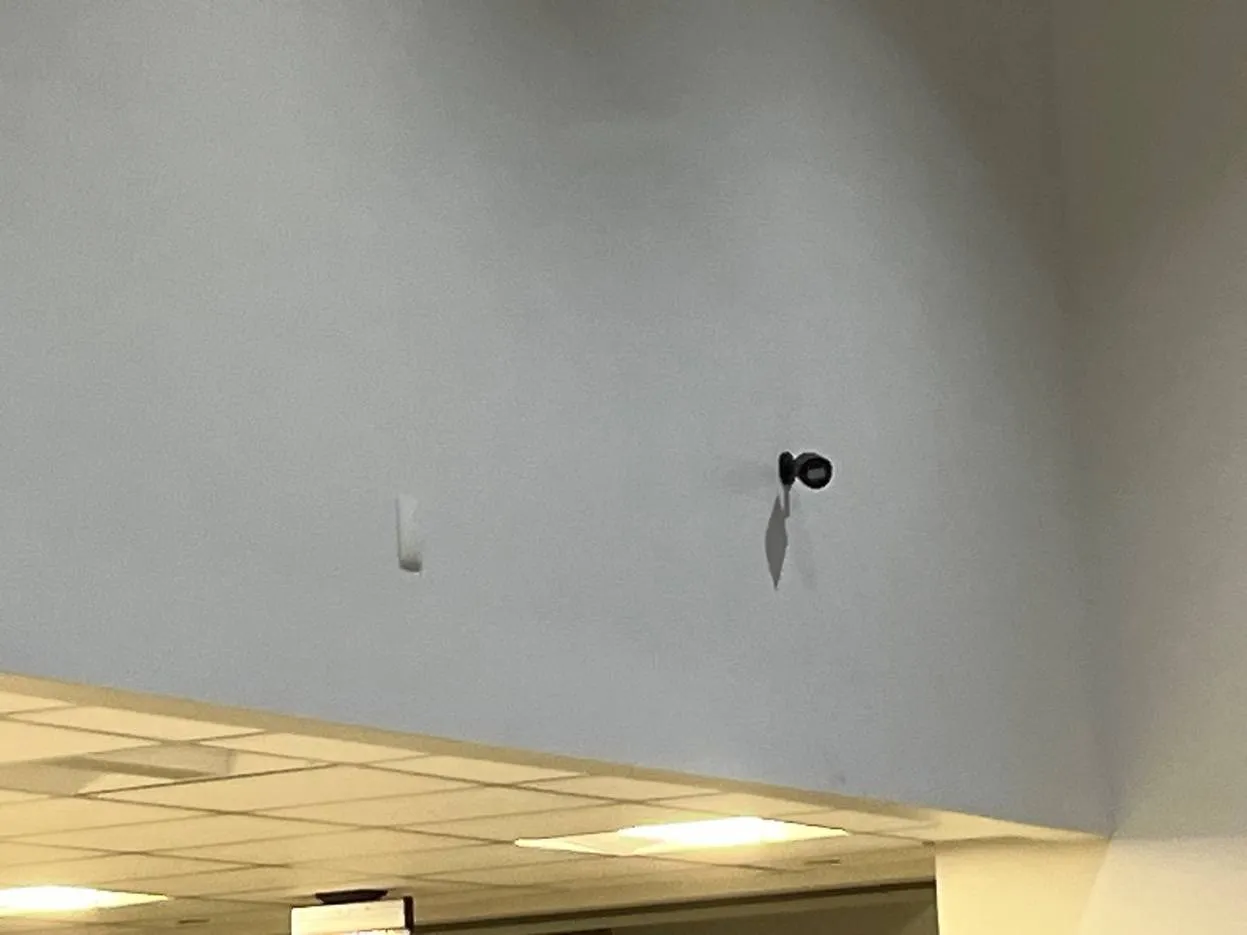
Example photo from another AESS job (not in Orange County): a small black bullet camera on a short mounting arm sits high on a smooth blue-grey wall, casting a thin shadow; a white motion sensor is fixed further left, and a lit drop ceiling runs along the bottom of the frame.
Orange County Dahua Quote
Tell us the town, the property type and the longest distance you need covered — a written price follows
✅
Request Sent!
An installer will call back about the Orange County property the same business day.
25+
Years Experience
✓
Same-Day Estimates
100%
Licensed & Insured
4.7★
201 Google Reviews
Measure the distance before you count the cameras. On an Orange County property the single number that changes a quote most is how far the farthest camera sits from the place the recorder lives. Tell us that distance — house to barn, office to truck gate, farm stand to cold storage — and whether there is power out there. Ring the Orange County line on (845) 640-3835 or use the form, and we can sketch the links before anyone drives out.
Orange County list: roughly $500–$850 per installed camera, packages from $2,200, long runs priced as their own line
Recorder stays on your property, recording with no monthly fee — the footage is yours
Installed under NYS low-voltage licence #12000287431, with same-day estimates
Why Orange County Properties Need Dahua Cameras Built for Distance
Orange County is big, and most of it is not built up. The Census Bureau puts the county's land area at 812.32 square miles and its 2020 population base at 401,312, which works out to 494 people per square mile — a small fraction of the density of the boroughs our Bronx crews come from. Between the cities of Newburgh, Middletown and Port Jervis sit villages, subdivisions, horse and vegetable farms, orchards and a great deal of open ground. In the Town of Warwick, around the hamlet of Pine Island, the Black Dirt region is described by the local chamber of commerce as thousands of very flat acres of deep organic soil, "dissected by rivers, drainage ditches, and farm roads"; Edible Hudson Valley puts the whole region at 26,000 acres. On land like that the thing you want to watch — a pump house, a packing shed, a fuel tank, an equipment yard — is often a long walk from the house, and nothing between the two has a wall to hang a camera on.
The other half of the county is warehouses. In January 2022 the Times Herald-Record reported that some 40 warehouse projects were in the works or in planning across Orange County, according to the county's planning commissioner, most of them in the village of Goshen and the towns of Wawayanda, Montgomery and Wallkill, and all of them drawn by Route 17, the Thruway and Interstate 84. The same story described two new Matrix buildings of 927,041 and 215,200 square feet on 90 acres at Route 300 and I-84 in the Town of Newburgh. Across from Stewart International Airport on Route 17K, the Mid Hudson Times reported plans for the Matrix I-84 Distribution Center: 595,900 square feet on a 58.3-acre parcel, with 116 loading docks on both sides of the building, 224 parking spaces and 167 trailer storage spaces. A leasing release for a 422,000-square-foot speculative building at 700 South Street in Newburgh advertised that it sits one mile from I-84, two from I-87 and eight from the airport. Buildings like these are measured in hundreds of feet per wall and acres per yard. A camera plan that works for a storefront does not work for them.
Then there is the weather and the power. Orange & Rockland Utilities reported on July 6, 2026 that more than 47,000 of its customers had been affected since July 1 by extreme heat, thunderstorms and heavy rain; at 5 p.m. that day 462 Orange County customers were still out, 192 of them in the Town of Warwick and 87 in the Town of Goshen. The National Weather Service's New York office lists severe thunderstorm events across the Lower Hudson Valley on July 3 and July 8, 2025, and a February 2025 storm of snow, sleet and ice. For a camera system that matters in three ways: a recorder with no battery backup goes dark exactly when the alarm panel and the gate motor do; long copper runs between buildings collect lightning surges; and a camera on a distant pole has no one nearby to notice it has stopped.
Crime here is less about volume and more about isolation. In January 2025 the Town of New Windsor Police Department warned residents that several recent residential burglaries were believed to be the work of international organized theft groups, and its first recommendation was to "consider installing surveillance cameras and/or an alarm system." Warwick police responded late one July night in 2020 to a burglary in progress at a business in Pine Island. City of Newburgh police have asked the public for help finding a stolen jet ski and its trailer. We looked for local reporting on stolen tractors and farm equipment in Orange County and did not find any, so this page does not claim a wave of it; what the reports above share is a target that was dark, quiet and far from anyone who would have seen it happen.
Owners describe the same problem online. In a Reddit thread on securing a farm, an owner explains that the main barn is about 100 yards from the house; in another on a 20-acre property, the advice that rises to the top is to "run fiber to locations you want cams," adding that wireless point-to-point "is also usable, but fiber will isolate power issues." That is the brief for a Dahua system in Orange County: get clean video back from buildings and gates that are far away, keep everything powered when the lines come down, see something useful in real darkness, and make sure a person finds out while it still matters.
Orange County facts that shape a Dahua camera plan
812.32 square miles, 494 people per square mile (U.S. Census Bureau QuickFacts, 2020) — long driveways and open ground are the normal case, not the exception.
About 40 warehouse projects in the works or planned countywide in early 2022, concentrated in Goshen, Wawayanda, Montgomery and Wallkill (Times Herald-Record).
595,900 square feet, 116 loading docks, 167 trailer spaces on one proposed distribution building across from Stewart International Airport on Route 17K (Mid Hudson Times).
26,000 acres of Black Dirt around Pine Island (Edible Hudson Valley); a Thrall Library history page says the county grows half of New York's onions on 5,500 acres there.
47,000-plus O&R customers affected by the storms of July 1–6, 2026; PowerOutage.us tracks 110,732 O&R customers in Orange County alone.
2,217 buildings on 445 acres in Newburgh's East End Historic District, including Washington's Headquarters State Historic Site — the county's densest block of older masonry housing.
Most Orange County sites pair the cameras with a gate or an alarm. A camera tells you what happened at the farm gate; a gate operator, a keypad or an alarm zone decides whether it happens at all. Our Orange County access control installers and the crew behind alarm installation in Orange County work from the same office, so a gate reader, a siren and a camera can be priced together. And if your question is the federal one — whether Dahua equipment can still be bought and installed — we answer it once, on our Long Island Dahua installation page; anything tied to a federal facility or federal contract gets a different brand from us.
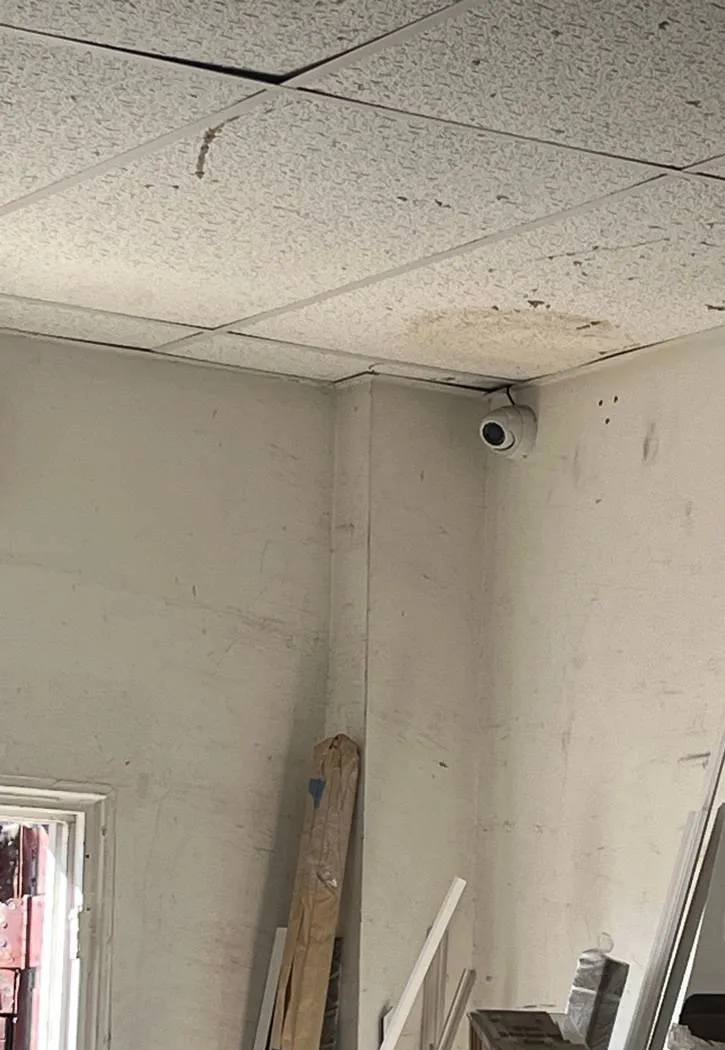
Example photo from another AESS job (not in Orange County): a white turret camera is fixed at the top of an inside corner where two scuffed, off-white walls meet a water-stained drop ceiling; lumber, trim boards and a length of pipe lean against the wall below, and a doorway with a red frame shows at the lower left.
Cameras Dark After a Storm in Orange County?
If the power came back but the cameras did not — a recorder stuck rebooting, a PoE switch in the barn that tripped, a wireless link to the gate that never re-joined — call (845) 640-3835 for the next open window. Most dead recorders, failed drives, surged switches and dropped radio links are recording again within one to two hours of arrival, and we pull whatever footage the drive still holds before anything is swapped.
Nine kinds of work make up nearly every Orange County Dahua job we quote. They are defined less by which camera ends up on the wall than by how far the video has to travel, where the power comes from and who needs to be told when something moves.
📏
Long-Run Perimeter Cabling
Outdoor-rated network cable, Dahua extended-PoE ports and fiber where a building or fence line sits beyond the 100-metre reach of ordinary PoE.
📡
Point-to-Point Radio Links
A pair of 5 GHz bridge radios carrying several cameras from a barn, pump house or gate back to the house without a trench across the field.
🚚
Dock, Yard and Truck Gate Coverage
Overlapping views down long dock walls, the trailer yard, the guard booth and the inbound lane, so a trailer can be followed from gate to door.
🌾
Farm and Orchard Coverage
Equipment yards, fuel tanks, packing and cold-storage doors, irrigation pumps and the farm stand register, laid out around how the farm actually works in season.
🚗
Driveway and Gate Vehicle Capture
A narrow-view camera set for the spot where a vehicle must slow down, so plates and trailer numbers are readable at night as well as by day.
🚨
Active-Deterrence Cameras
Dahua cameras with a siren and red-and-blue strobe that fire only on a person or vehicle, on a schedule, for sites nobody is watching after dark.
🔋
Battery Backup and Surge Protection
A UPS sized for the recorder, switches and radios together, plus surge protectors at both ends of every cable that leaves a building.
📱
Remote Viewing on Rural Internet
DMSS on phones with sub-streams tuned for the upload speed you really have, whether that is cable, DSL, fixed wireless, satellite or cellular.
🔧
Take-Over and Repair
Password recovery, firmware, new drives and re-aiming on Dahua systems someone else installed, including old analog barn systems on coax.
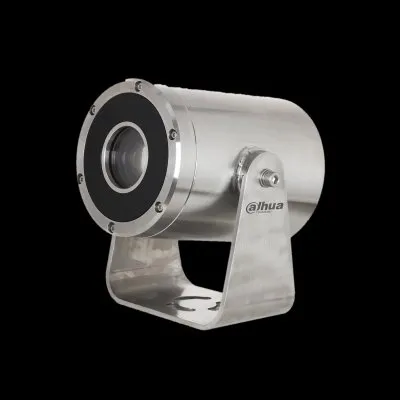
Manufacturer product photo, not an installation photo: a Dahua-branded camera in a cylindrical brushed stainless-steel housing with a round front window, mounted on a stainless U-shaped bracket, on a black background.
Building Specialists
Dahua Cameras for Orange County's Architecture
Orange County does not have one building type; it has six that turn up again and again, and each one moves video differently. The cards below are the ones we plan for, with the cabling and mounting habits that go with them.
🏭
Distribution Buildings
Long concrete walls with dock doors on one or both sides, a trailer yard, a guard booth at the gate and a server room deep inside. Runs from the far corners routinely exceed 100 metres.
🧅
Black Dirt Farms
Flat, open fields cut by drainage ditches and farm roads, with a pump house, packing shed and equipment yard spread out from the home. Sightlines are long; mounting points are few.
🍎
Hillside Orchards and Farm Markets
Rows climbing a slope, cold storage at the bottom, a farm market with a register and parking that fills on autumn weekends. One Warwick orchard describes itself as 150 acres on a hillside.
🏡
Homes on Long Driveways
A house set well back from the road in Chester, Goshen, Monroe or Blooming Grove, with a detached garage, a workshop or a barn and a mailbox at the end of a long drive.
🏛
City Masonry and Rowhouses
Brick and brownstone in Newburgh's East End, older blocks in Middletown and Port Jervis: short runs, thick walls, historic facades and rear yards on alleys.
🛶
Seasonal and Lake Homes
Weekend houses around Greenwood Lake and the Warwick hills that sit empty for weeks, where the camera has to report a problem rather than wait to be checked.
How the method changes from one building type to the next
Building type
How video gets back
Where cameras mount
Power plan
Distribution building
Several PoE switches in IDF closets or weatherproof boxes, linked to the main rack by fiber; extended-PoE ports for the farthest dock-wall cameras
High on the wall at each corner and mid-wall, plus light poles in the yard
Recorder and core switches on a rack UPS; yard switches on their own small UPS
Black Dirt farm
Direct-burial cable in conduit where a trench is short; 5 GHz point-to-point radios where the run crosses fields or ditches
Pump house, packing shed eaves, a pole at the equipment yard
Each outbuilding switch and radio on a UPS; new outlets by a licensed electrician
Hillside orchard
Radio links that use the slope for line of sight; copper down the hill only where a utility trench is already open
Cold-storage doors, market entrance and register, parking lot light poles
Market and cold storage on separate UPS units so one outage does not drop both
Long-driveway home
One radio pair or one fiber run to the barn or garage, which then feeds its own small switch
Soffits at the house, gable end of the barn, a post near the drive entrance
Recorder in the house on a UPS; barn switch on its own battery
City masonry
Short copper runs through the cellar and up the rear wall
Rear yard and alley, front door at face height
One small UPS for recorder and switch
Seasonal home
Copper on the house, a radio to any boathouse or garage
Doors, driveway, dock or waterfront path
UPS plus a recorder set to restart and resume recording on its own
The common thread is that the camera is the easy part. The decisions that keep a big-property system working for years are made underneath it: whether the cable is rated for burial or sunlight, whether every outbuilding has its own battery, whether a lightning hit on a barn can travel along the cable to the house, and whether the radio link has a clear path in August when the corn is up and the orchard is in leaf.
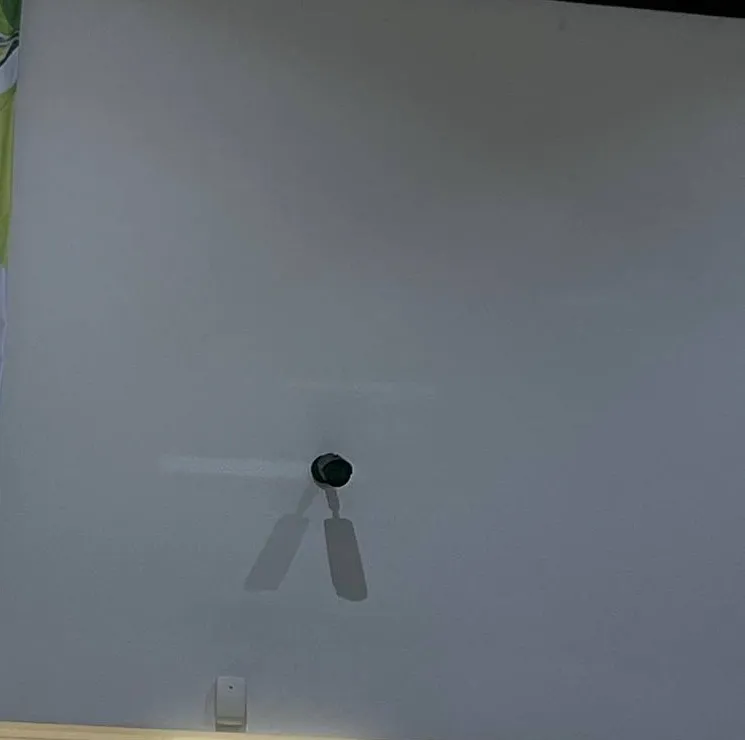
Example photo from another AESS job (not in Orange County): a dark bullet camera on a short arm projects from the middle of a tall, plain pale wall and throws two long diagonal shadows; a small white motion sensor sits just above the ceiling line at the bottom of the frame.
Commercial Dahua Cameras
Business Dahua Cameras in Orange County
Commercial work in Orange County clusters along the highways that brought the warehouses, and around the farms that were here first. These are the corridors where most of our business enquiries come from, and what usually operates along them.
Route 17K by Stewart International Airport. Business parks and distribution buildings on the airport's doorstep; a LoopNet listing for a Route 17K park advertises its position near FedEx and UPS. Typical jobs: dock walls, trailer yards, gatehouses and long fence lines.
Route 300 and Interstate 84, Town of Newburgh. Retail on one side and some of the county's largest new warehouses on the other, across from the Newburgh Mall. Typical jobs: multi-building sites where fiber links the buildings to one recorder room.
South Street and the I-84/I-87 crossroads, Newburgh. Large speculative distribution buildings advertised for their one-mile run to I-84. Typical jobs: fit-out cameras for a new tenant, often on a tight move-in date.
Goshen, Wawayanda, Montgomery and Wallkill. Where the county planning commissioner said most warehouse projects were concentrated, close to Route 17 and I-84. Typical jobs: yard coverage, truck gates and perimeter fences that run for thousands of feet.
Pine Island and the Black Dirt. Onion, vegetable and sod farms and the businesses that serve them. Typical jobs: packing sheds, equipment yards, fuel storage and farm stands.
Warwick's orchards and farm markets. Pick-your-own orchards and markets that are crowded on autumn weekends and empty at night. Typical jobs: register and entrance cameras, parking lots, cold storage.
Compliance and paperwork that come up on Orange County commercial sites
Low-voltage licensing. Camera, recorder and network work is done under AESS's NYS low-voltage licence #12000287431, with a certificate of insurance issued in the property owner's or landlord's wording before work starts.
New 120-volt circuits. Orange County's Department of Consumer Affairs licenses electricians (its application lists separate fees for county residents, other New York residents and out-of-state applicants), and the City of Middletown runs its own electrical licensing board. Where a barn, pole or gate needs a new outlet, that part is done by a licensed electrician, not by us.
Site-plan conditions. New warehouses go through town planning boards; the Matrix 17K project, for instance, needed state DOT access approval, county planning review and architectural review. Light poles and fences on those sites can come with conditions, so we ask the property manager for the approved site plan before we put a camera on a pole.
Utility poles are not ours to use. Cameras never go on O&R or telephone poles without the pole owner's written permission; we set our own poles or use the property's light standards.
Audio and notices. We leave microphones switched off on commercial installs unless the owner decides otherwise with their own counsel, and recommend a visible "video recording in use" notice at gates and doors.
Dahua Cameras in Orange County: Questions Answered
These are the questions Orange County owners and site managers actually put to us, grouped by the problem behind them. Each is answered in full here rather than in a one-line FAQ, because on a big property the details are the job.
Distance, Cable and Radio Links on Big Lots
How far from the recorder can a Dahua camera sit on ordinary network cable?
On standard Power over Ethernet, about 100 metres — roughly 328 feet — of cable between the camera and the switch or recorder port that powers it. That limit is set by the Ethernet standard, not by Dahua, and it counts every foot of cable: up the wall, along the soffit, down into the basement and across to the rack. On a farmhouse with a barn 100 yards away, the straight-line distance may be under the limit while the cable route is well over it.
Dahua's own answer for longer runs is extended PoE. Its published figures are 300 metres at 100 Mbps with up to 25.5 watts, or 800 metres at 10 Mbps with 13 watts, between an ePoE camera and an ePoE switch or recorder port. The 300-metre mode carries a high-resolution camera comfortably; the 800-metre mode suits a single modest camera at the end of a very long run. Both need Dahua ePoE hardware at each end, so we plan them per camera rather than assume every port can do it.
Beyond those numbers there are three options: put a small switch with its own power partway along the run, change to fiber, or change to radio. Which is right depends on whether there is already power at the far end, whether a trench is cheap or expensive on that ground, and how many cameras need to come back from the same place.
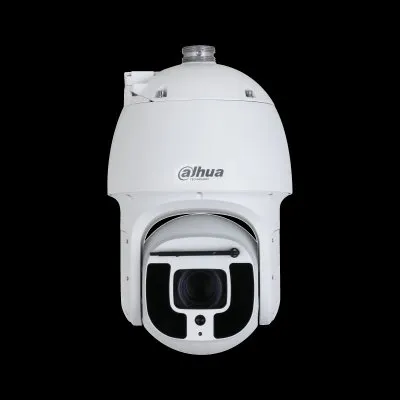
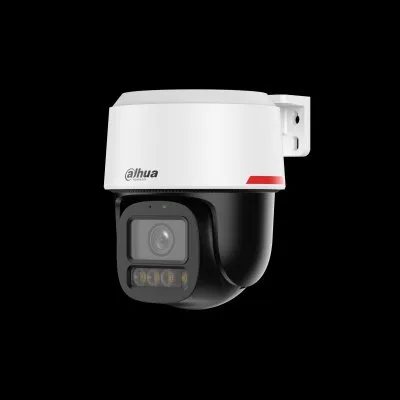
Manufacturer product photo, not an installation photo: a large white Dahua-branded pan-tilt-zoom camera with a rounded housing, a dark front window and a rectangular illuminator panel set around the lens, on a black background.
When does a point-to-point radio make more sense than trenching to a barn or gate?
When the ground between the two buildings is expensive or impossible to dig — a paved yard, a drainage ditch, a field in crop, rock, or a driveway that would have to be cut — and there is a clear line of sight between them. A pair of 5 GHz bridge radios, one at the house and one at the barn, behaves like an invisible network cable. Dahua's PFWB5 bridge pair is recommended for links of up to 3.11 miles (5 km), and its transmission range also includes long-range outdoor bridges, so the distances on a typical Orange County farm are well inside what the equipment is built for.
What decides success is the path, not the distance. Radios need a clear zone around the straight line between them, and that zone has to stay clear in summer: an orchard in full leaf, corn at its height or a new hay barn can block a link that worked perfectly in March. We survey the path, mount both radios high enough to clear what will grow, and test throughput with every camera streaming before the cameras are fixed in place.
A trench still wins when the barn needs power anyway — an electrician digging for a new circuit can lay our conduit in the same trench for very little extra — or when the link must never depend on weather or line of sight. Many properties end up with both: fiber or copper in the trench that was already being dug, and a radio to the one building that would have needed a second trench.
Is fiber worth it between a warehouse and its guard booth or a second building?
Usually yes. Fiber carries no electricity, so it cannot bring a lightning surge or a ground-potential difference from one building into the other, and its distance limits are measured in kilometres rather than metres. On a distribution site where the guard booth sits at the truck gate and the recorder sits in an interior server room, fiber is the cleanest way to join them, and the same strand pair can carry the booth's computer and phone as well as its cameras.
The trade-off is that fiber does not carry power. Every building at the far end of a fiber run needs its own outlet, its own PoE switch and its own battery backup. On a new warehouse that is rarely a problem, because the booth and the outbuildings are wired for power from the start; on an older farm it can be the deciding cost.
If you are already pulling fiber for the building's data network, tell us before the cable is ordered. Adding two strands for cameras to a fiber run that is going in anyway costs far less than a second run later, and it keeps the camera network separate from the office network.
How do you get power to a camera at a gate or field edge with no outlet nearby?
There are four honest answers, in order of preference. The best is power over the camera's own cable, from a switch in a building that already has power, which works whenever the cable route is within PoE or extended-PoE range. The second is a new outlet at the gate, installed by a licensed electrician, feeding a weatherproof enclosure with a small PoE switch, a surge protector and a battery. The third is a radio and camera at the gate powered from that same outlet.
The fourth is solar, and it is the one most often oversold. A camera, a radio and a modem running around the clock draw power through the long nights of December and January, when an Orange County panel collects the least. A properly sized solar setup is a large panel and a large battery, not the small kit sold for a trail camera. For temporary needs — a construction phase, a harvest season, a fence line under dispute — our solar surveillance trailer in Orange County is often the better answer.
Whichever route you choose, we put the camera where the vehicle has to slow down, not where the outlet happens to be. A gate camera that sees only taillights at 40 miles an hour is a camera in the wrong place.
Power Outages, Lightning and Hudson Valley Storms
How long can the cameras keep recording through an O&R outage?
As long as the batteries last, and that is a number we size rather than guess. The recorder, the PoE switch powering the cameras, any radios and the internet modem all go on battery backup together; if any one of them is left off, the system stops recording or stops reporting the moment the power drops. A rack UPS sized for a recorder and a modest switch typically carries a small farm or home system through the short outages that make up most interruptions, and lets the recorder shut down cleanly in a long one so the hard drives are not damaged.
The July 2026 storms that O&R reported affected more than 47,000 customers over several days, and some Warwick and Goshen customers were still waiting on the fifth day. No ordinary UPS bridges an outage that long. If the property has a standby generator, we connect the camera rack to a circuit the generator carries and size the UPS to cover only the seconds or minutes while the generator starts. If it does not, we tell you plainly how many hours your batteries give, and set the recorder to restart and resume recording by itself when power returns.
Every outbuilding with its own switch or radio needs its own battery. A barn camera fed from a barn switch with no UPS goes dark even if the house rack is still running, and that is the first place we look when a customer says "only some cameras came back."
What protects a long outdoor cable run from a lightning surge?
Bonding, grounding and surge protectors, in that order. Lightning rarely strikes a camera directly; the damage comes from the surge induced in a long copper cable by a nearby strike, or from the difference in ground voltage between two buildings during a strike. A cable that runs from a house to a barn connects two separate grounding systems, and that is exactly the path a surge takes. Severe thunderstorms are a summer fixture here — the National Weather Service recorded two across the Lower Hudson Valley in the first eight days of July 2025.
On every cable that leaves a building we fit a network surge protector where the cable enters, bonded to that building's grounding system. Surge-protection makers are specific that the protector's ground should come from the building's own grounding system rather than from a separate rod at the camera. Exposed runs go in conduit, shielded cable gets its shield bonded at one end, and cameras on poles are bonded to the pole's ground.
Between buildings, fiber or a radio link removes the copper path altogether, which is why we lean on them for barns and outbuildings in open country. No protection is absolute, and surge damage is listed among the exclusions in most equipment warranties, but a properly bonded system turns a lightning season from a string of dead ports into the occasional replaced camera.
Seeing Anything at Night Where There Are No Streetlights
Should a dark field or trailer yard get full-colour cameras or infrared?
It depends on how dark "dark" is. Dahua's full-colour cameras use a very wide aperture and a sensitive sensor to keep colour at night, and the warm-light versions add their own white LEDs for scenes with little light. That works well under a yard light, at a lit loading dock or on a porch. Out in a field with no light at all, the picture depends entirely on how far the camera's own LEDs reach, and a full-colour camera cannot see the infrared that an IR camera relies on.
Infrared cameras flood the scene with light you cannot see and record in black and white. In true darkness, as one security supplier puts it, an infrared camera is the safer choice, and its IR reach is usually longer than a white-light camera's useful range. The cost is colour: you will know a pickup came through the gate, but not whether it was red or silver.
Most Orange County sites get a mix. Colour cameras go where there is already light or where colour identifies something — the dock doors, the farm stand, the gate with a light on it. Infrared or long-range cameras go where nothing is lit and the job is to see movement across open ground. Where the owner can add a motion-activated floodlight, a colour camera becomes the better choice almost everywhere it can see.
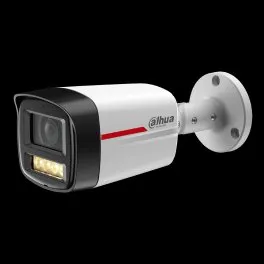
Manufacturer product photo, not an installation photo: a white Dahua-branded bullet camera with a black front, a thin red stripe along the body and a row of glowing warm-white LEDs beneath the lens, on a wall bracket against a black background.
Do the white lights on a full-colour camera have to stay on all night?
No. Many current Dahua full-colour models offer what Dahua calls Smart Dual Light: the camera watches in infrared, and only switches its white light on when it detects a person or a vehicle. The scene stays dark and quiet for the rest of the night, and the light coming on doubles as a warning to whoever triggered it.
That matters in the countryside more than in the city. A white light burning all night on a barn can draw insects into the lens, annoy a neighbour across an open field, and make the camera itself easy to spot from the road. Switching to light-on-detection solves all three, and it means the colour image you get is the one that matters.
We set the light behaviour per camera at the night visit: always off for a camera that looks toward a neighbour's house, detection-triggered for the gate and yard, and always on only where the owner wants the area lit anyway, such as a loading dock that runs a night shift.
Alerts and Deterrence on Sites Nobody Watches After Dark
Will a camera with a siren and red-and-blue strobes actually scare someone off a remote site?
It changes the odds, and that is the honest claim. Dahua's active-deterrence cameras, including the TiOC line, are built to warn off intruders with light and a siren, alert the owner in real time and provide video for verification. On a farm yard or a contractor lot where nobody would otherwise know anyone was there, a sudden siren and flashing light tell the person they have been seen, and many will leave rather than find out who is coming.
What makes deterrence useful rather than annoying is the trigger. These cameras fire their siren and lights when the analytics classify the moving object as a person or a vehicle, inside an area we draw, during hours we set. A siren that sounds for every deer or every gust in the cornstalks will be switched off within a week by the owner, and then it protects nothing.
Deterrence is also only the first half of the job. The second half is a person: a push alert to the owner's phone, a call to the manager on duty, or a monitoring service if the site warrants one. A siren that sounds in an empty valley at three in the morning with nobody told is a noise, not a response.
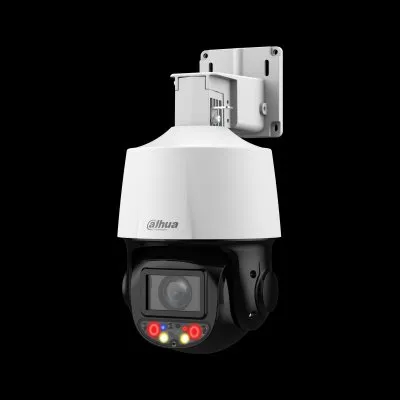
Manufacturer product photo, not an installation photo: a white-and-black Dahua-branded pan-tilt camera hanging from a white wall bracket, with a red light and a blue light glowing on either side of the lens, on a black background.
How do you keep deer, blowing crops and highway headlights from flooding the phone with alerts?
By making the camera, not the phone, decide what counts. Plain motion detection reacts to any change in pixels: a deer crossing the orchard, wet leaves, a spider on the lens, headlights sweeping across a barn wall from Route 17. Dahua's AI cameras classify what they see, and we set alerts for people and vehicles only, so the wildlife that is everywhere in Orange County never reaches your phone.
Next we draw the rules tightly. A line-crossing rule across the gate rather than a box around the whole field; an intrusion area that ends at the fence rather than at the road; a minimum size so a raccoon is not mistaken for a person; and schedules, so the dock cameras alert only after the last shift leaves. We tune these at night, at the property, with the owner's phone in hand.
Finally we decide who gets what. The farm owner may want every gate event; the warehouse manager may want only after-hours intrusions at the fence. Fewer, better alerts are the difference between a system people trust and one they mute.
Warehouses, Docks and Truck Gates
How do you plan cameras for a building with a hundred-plus dock doors?
By the job each camera does, not by a ratio of cameras to doors. A dock wall needs views that run along it, so that every trailer and every door is covered from at least one direction and a person walking the wall is never out of frame. We typically set cameras at the building corners looking down each wall and add mid-wall cameras where the wall is long enough that the far doors become too small to make out.
The trailer yard is a separate problem. Yards like the 167-space one planned on Route 17K are covered from light poles and building corners with wider views, and the question there is whether you can follow a truck from the gate to a door and back. The gate and guard booth get their own cameras for faces and plates, and the inside of the building gets views of the dock plates and the staging lanes, where most disputes about damaged or missing freight are settled.
We draw this on the site plan before anything is ordered, mark which runs exceed copper limits, and show where fiber and intermediate switches go. A large building usually ends up on several switches tied back to one recorder or a small server, with everything on battery backup.
Can a gate camera capture trailer numbers and plates at night?
Yes, if it is a dedicated camera in the right place. A general view of the gate shows that a truck arrived; reading a plate or a trailer number takes a narrow field of view aimed at the exact spot where vehicles slow or stop, with a fast shutter and its own infrared. We set it so the characters fill a meaningful part of the frame, and we test it after dark with a real vehicle, because a camera that reads plates at noon can still blur them at night.
Trailer numbers painted high on the box need a second camera at a different height from the one aimed at the tractor's plate. Dahua also makes cameras that read plates automatically and keep a searchable list; those make sense where you need to look up "every visit by this truck," and are overkill where you only need a clear picture when something goes wrong.
For lots and gates outside a warehouse context, our parking lot cameras in Orange County page covers the same plate-camera thinking for retail and office lots.
Farms, Orchards and Farm Markets
On a farm with a limited budget, which locations get cameras first?
The ways in and the things that are expensive and portable. First the farm's entrances — the driveway and any field gate a truck can use — because every vehicle that takes something has to come and go that way. Second the places where valuable, movable things sit: the equipment yard, the fuel tanks, the tool and chemical storage, the irrigation pump. Third the buildings people work in, and last the open fields.
This order often means fewer cameras than owners expect. A farm in the Black Dirt with one road in and a cluster of buildings may need four or five well-placed cameras and one radio link, not a camera on every corner. We would rather spend the budget on a camera that reads a plate at the gate than on three that show empty fields.
Plan the trench now even if the camera comes later. If an electrician is already trenching to the pump house this season, a spare conduit in the same trench lets a camera go there next year without digging again.
Can the farm stand's register camera and the barn cameras share one recorder?
Yes, and on most farms they should. One Dahua recorder can take cameras from the market, the barns and the gate, with each building linked back by cable, fiber or radio. One recorder means one place to search, one set of drives to check, one battery to size and one login on the owner's phone.
The exception is when the market and the farm are run as separate businesses with separate managers, or when the market sits on its own internet connection across a public road. Then two recorders, each viewable from the same DMSS app, can be simpler than a link that crosses land you do not control.
Either way, the register camera is set up differently from the barn cameras. It looks down at the counter from behind the staff, it records continuously during market hours rather than on motion, and its footage is kept long enough to settle a question about a cash count days later.
Rural Internet, Remote Viewing and Older Systems
Can we watch the cameras over a satellite dish or a cellular connection?
Yes. Recording happens on the recorder at the property, so the internet connection only affects watching from elsewhere, not what gets recorded. What a slow or metered connection changes is how you watch: the DMSS app can show each camera's low-resolution sub-stream for live viewing, which uses a fraction of the bandwidth of the main stream, and you pull the full-resolution clip only when you need it.
Upload speed is the number that matters, and rural connections often have little of it. We tune the sub-streams to fit what the connection actually delivers, set alerts to send a snapshot rather than a video, and turn off cloud features that would quietly use a cellular data allowance.
If the connection drops, the cameras keep recording and you see the gap only in live view. For a seasonal home that sits empty, we can set the recorder to send an alert when a camera goes offline, so a dead camera or a tripped breaker is found before the next visit rather than at it.
Can the old coax from an analog barn system carry new Dahua cameras?
Often, yes, and Dahua has two ways to do it. Its HDCVI cameras and recorders send high-definition video over existing coax, so an old barn system can be upgraded by replacing the cameras and the recorder and keeping the cable. And Dahua's ePoE over coax uses an adaptor at each end to carry a network camera's video and power over existing RG59, with Dahua quoting up to 1,000 metres at 10 Mbps.
The catch is the cable's condition. Coax that has been buried without conduit, chewed by rodents in a barn ceiling, spliced several times or left in the sun for twenty years may not carry a clean signal. We test each run before deciding; good runs stay, bad ones get replaced with network cable or fiber.
Many Orange County farms and older commercial buildings end up as a mix: HDCVI cameras on the coax that tested well, network cameras on new cable, all on one recorder. If you are not sure what you have, our NVR installation crew for Orange County can identify it from photos of the recorder and the cable ends.
Equipment
Types of Dahua Cameras We Install
The equipment list for an Orange County property is longer than for a city shop, because the links, power and protection between the cameras matter as much as the cameras. These are the categories we install, with where each one earns its place here.
🎥
Long-Range Bullet Cameras
Varifocal lenses that can be zoomed at installation to frame a gate or a dock wall hundreds of feet away; the default for fence lines and yards.
🌈
Full-Colour Cameras
Colour at night where there is some light, with warm-light LEDs for dark doorways and Smart Dual Light models that light up only on detection.
🚨
Active-Deterrence Cameras
Siren and red-and-blue strobe triggered by people or vehicles, for equipment yards, contractor lots and seasonal homes.
🔄
PTZ Cameras
Pan-tilt-zoom domes for a yard or a field where one camera needs to follow a vehicle, with auto-tracking on models that support it.
🧲
Corrosion-Resistant Housings
Stainless-steel cameras for wash bays, fertiliser and chemical storage, and coastal-style humidity around ponds and lakes.
🖥
Recorders and Storage
Dahua NVRs and XVRs sized for the camera count and the retention you need, with surveillance-rated drives and room to grow.
🔌
PoE and ePoE Switches
Managed switches in the rack and weatherproof boxes in outbuildings, with Dahua extended-PoE ports where runs exceed 100 metres.
📡
Wireless Bridges
Point-to-point and point-to-multipoint 5 GHz radios from Dahua's transmission range for barns, gates and second buildings.
⚡
Protection and Backup
Network surge protectors, grounding hardware, outdoor enclosures and UPS units for every building that has a switch or radio in it.
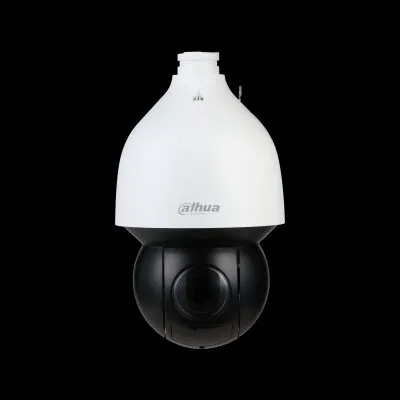
Manufacturer product photo, not an installation photo: a white Dahua-branded pan-tilt-zoom dome with a mounting collar on top and a black lower ball holding the zoom lens, on a black background.
Dahua from a local installer versus ADT, Ring and SimpliSafe on a big property
What matters on a large lot
Dahua system installed by AESS
National brands (ADT, Ring, SimpliSafe)
Cameras far from the house
Wired, extended-PoE, fiber or point-to-point radio, chosen per camera
Mostly Wi-Fi cameras that depend on the home router's reach, or a technician's standard package
Recording
Continuous or event recording on a recorder at the property
Often cloud clips on a subscription plan; local recording varies by product
Power cuts
Recorder, switches and radios on battery backup, sized for the site
Battery cameras keep running but the Wi-Fi and internet they need usually do not
Night in open country
Choice of infrared, full-colour, Smart Dual Light and long-range lenses per location
Fixed camera models with built-in night modes
Monthly cost
No monthly fee for local recording
Subscription plans are common for storage and monitoring
That is not a knock on the national brands. For a small house on a quarter-acre with good Wi-Fi, a doorbell and two battery cameras can be the right answer. Our residential camera installation in Orange County covers those homes too; this page is for properties where distance and darkness are the problem.
AI Overview Reality Check
What AI Gets Wrong About Dahua Cameras in Orange County
Search engines and AI assistants summarise camera installation from national cost guides and product pages. The claims below are the kind those summaries repeat; we quote published versions where we have them and set them against what a large Orange County property actually needs.
"Professional camera installation costs about $1,300."
Angi's 2026 cost guide gives a national average of $1,289 for security camera installation, with most projects between $600 and $2,168, and puts four cameras at $400 to $800 and six at $600 to $1,200. Those are reasonable figures for what most of its projects are: a handful of cameras on one house with short cable runs.
They say nothing about the cost of getting video back from a barn 300 yards away, a fiber run to a guard booth, a radio link over a drainage ditch, or the battery and surge protection that every one of those buildings needs. On a large property, the links and the protection can cost as much as the cameras.
Our Orange County list runs roughly $500 to $850 per installed camera including the recorder, cabling and setup, with long runs, trenching, fiber and radio links priced as their own lines after measurement. Expect a national average to be a floor, not a forecast, if your cameras are spread across acres.
"PoE cameras only work within 100 metres of the switch."
It is true of standard PoE and it is the most common reason a far-barn camera stops working: someone ran a 130-metre cable and the camera reboots every time it switches to infrared and draws more power. AI summaries usually stop there and suggest a wireless camera instead.
Dahua's extended PoE goes further: 300 metres at 100 Mbps or 800 metres at 10 Mbps on matching ePoE hardware, by Dahua's own figures. Fiber goes kilometres, and a switch with its own power partway along the run resets the 100-metre clock.
The right reading of the 100-metre rule is "plan the route before you buy the camera," not "wired cameras cannot reach the barn." Most of the distance problems we fix were created by a cable that was bought before anyone measured.
"Just extend your Wi-Fi to the barn."
This is the advice that turns up in homestead forums and in plenty of AI answers: put an extender at the end of the house closest to the barn and use Wi-Fi cameras. It works sometimes, for one camera, on a calm day.
A household extender repeats the signal it receives, usually at a fraction of the original speed, and it was built to cover rooms, not a hundred yards of open field. Add two or three cameras streaming continuously and the link falls apart, usually at night when the cameras switch to infrared and the picture gets noisier and heavier to send.
A proper point-to-point bridge is built for exactly this: directional antennas, a dedicated link, and published ranges measured in kilometres. It costs more than an extender and far less than a trench, and it carries every camera at the barn instead of one.
"Colour night vision lets you see in colour in total darkness."
Product pages often say a full-colour camera sees in colour "even in complete darkness." What they mean is that the camera has its own white LEDs, or that it is very good with very little light. In a city there is almost always some light to work with.
An Orange County field at night may have none. Without light, a full-colour camera can show only what its own LEDs reach, and it cannot use infrared at all. Even suppliers who sell full-colour cameras say an infrared or thermal camera is the safer choice in true pitch black.
So we choose by location: colour where there is a yard light or where colour matters, infrared for unlit open ground, and Smart Dual Light models where the owner wants both. Anyone recommending one camera type for every spot on a farm has not stood at the far gate after dark.
"A siren camera stops intruders by itself."
Active-deterrence cameras are genuinely useful on remote sites, and Dahua builds them to warn off intruders with light and siren. AI answers sometimes present them as a complete security system in one box.
A deterrent that nobody hears is only a delay. On a farm or a contractor yard far from the nearest neighbour, the siren needs a person behind it: a push alert, a call list, or a monitoring service. And a siren with careless triggers will be switched off by an owner tired of being woken by deer.
We treat deterrence as one layer: AI triggers limited to people and vehicles, schedules for the hours the site is empty, a person who gets told, and recorded video that holds up afterwards.
"Cloud storage is safer than a recorder on site."
Cloud backup protects footage if a recorder is stolen or destroyed, and AI summaries often recommend it as the default. It is a good feature where the connection can carry it.
Many rural Orange County properties do not have the upload speed to send continuous high-resolution video from several cameras to the cloud, and those on cellular or satellite plans may pay for every gigabyte. Pushing everything to the cloud on a weak connection gives you gaps exactly when the connection is busiest.
Our default is the reverse: record everything locally on a recorder hidden in a locked room and on battery backup, and send alerts and selected clips off-site. For sites where theft of the recorder is a real risk, we can place it out of sight in a different building from the cameras.
"Any handyman can mount a few cameras."
For two cameras on a garage, probably. AI answers rarely separate that job from a farm or a warehouse, where cable crosses between buildings, goes underground, runs up poles and passes through surge protection that has to be bonded to the right ground.
Getting those parts wrong does not show on installation day. It shows after the first thunderstorm, the first long outage or the first summer when the orchard leafs out across a radio path. New 120-volt circuits for barns and gates also belong to a licensed electrician, which is a separate trade and a separate licence in Orange County.
The question to ask any installer is not whether they can mount a camera, but how they will get video and power to the farthest one, and what happens to it in a storm.
A Camera Plan Drawn Around Your Farthest Building
Send the address, a rough sketch or satellite screenshot with the buildings and gates marked, and which of them have power. We will mark the link to each one — copper, extended PoE, fiber or radio — and price it on the Orange County list.
Most Orange County quotes need five things: the town and road, the kind of property, how many buildings and gates you want covered, the distance from the farthest one to the house or office, and which of them have power and internet. A written total comes back the same business day; to talk it through, call (845) 640-3835.
✅
We Got Your Request!
Received. We will look over the buildings, distances and power you described and phone you back today. For anything urgent, ring (845) 640-3835.
How It Works
Our Installation Process
Seven steps, whether the job is a camera at one barn or a distribution building with a trailer yard. On a large property most of the thinking happens in the first four, before a single camera goes up.
1
Map the distances
From your address, a satellite view and a short call, we mark every building, gate and yard you want covered and measure the rough route from each to where the recorder will live.
2
Walk the property
On site we check power in every outbuilding, existing conduit and trenches, mounting points, line of sight for radios and what will grow or be parked in the way in summer.
3
Choose a link for every camera
Copper, extended PoE, fiber or radio, chosen per building, with a written plan and price on the Orange County list, including what an electrician must supply.
4
Set up on the bench
Radios are paired and their default logins changed, the recorder is configured and the drives tested before we arrive, so the site day is spent installing rather than configuring.
5
Run cable and protect it
Conduit, burial cable or aerial runs go in, surge protectors are fitted where every cable enters a building and bonded to that building's ground, and each outbuilding gets its own battery.
6
Aim and tune after dark
Cameras are aimed by day and checked at night: infrared reach, light behaviour, detection areas, deterrence schedules and plate readability with a real vehicle.
7
Pull the plug and hand over
We cut mains power to prove the system rides through on battery and restarts on its own, then set up logins, show playback and export, and leave a printed camera and link map.
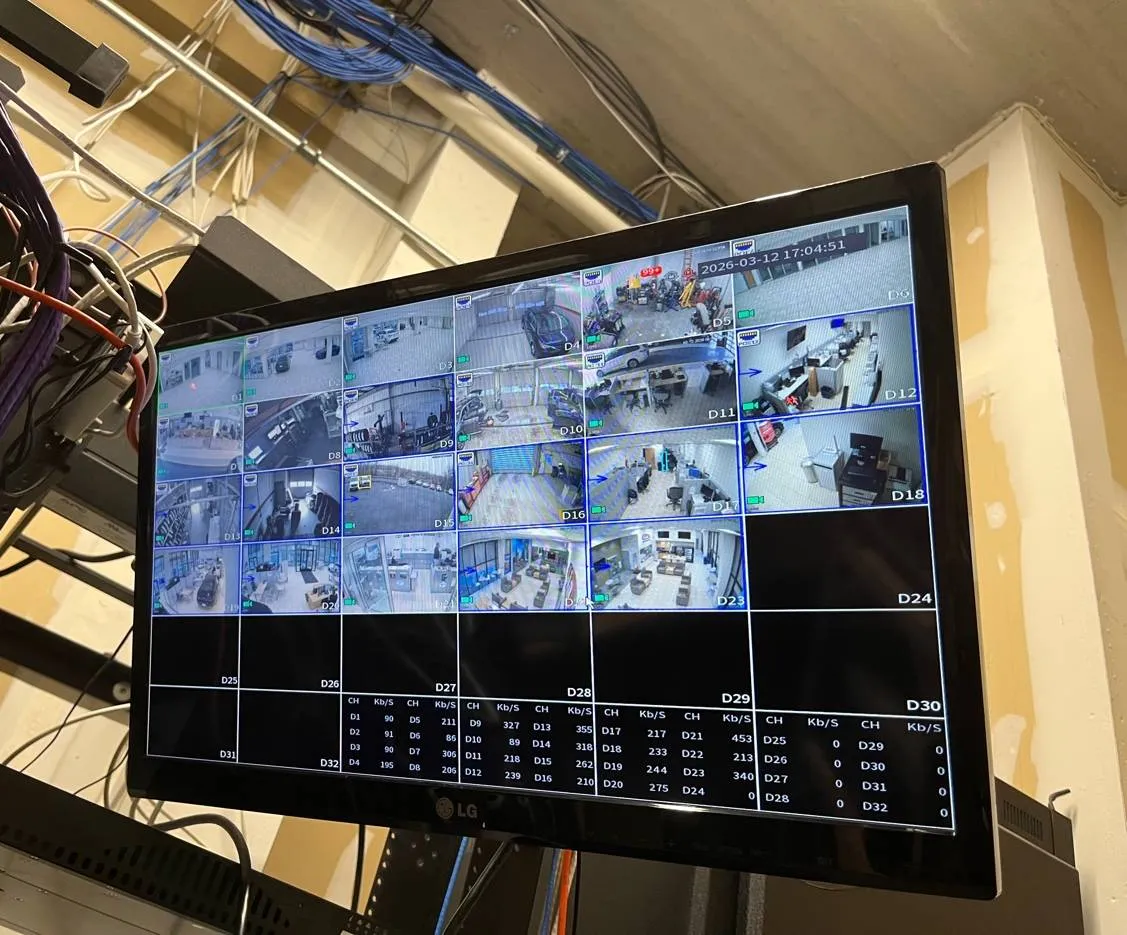
Example photo from another AESS job (not in Orange County): a wall-mounted monitor shows a grid of about twenty camera views above a table of channel bit rates, with several empty tiles; bundles of blue, white, purple and orange network cable run overhead and down the rack beside it.
Coverage Area
Dahua Cameras Near Orange County's Landmarks
Orange County runs from the Hudson at Newburgh to the Delaware at Port Jervis. These six places give a sense of the range of properties we drive out to.
✈
Stewart International Airport and Route 17K
Distribution buildings and business parks along 17K, including a 595,900-square-foot building planned across from the airport.
🏛
Washington's Headquarters and the East End
The state historic site sits inside Newburgh's East End Historic District, 2,217 buildings of brick and brownstone on 445 acres.
🧅
Pine Island and the Black Dirt
Flat onion, vegetable and sod farms in the Town of Warwick, cut by drainage ditches and farm roads.
🛣
Route 300 and I-84, Newburgh
Retail facing new warehouses of 927,041 and 215,200 square feet built on 90 acres at the interchange.
🍎
Warwick's Orchard Hills
Pick-your-own orchards and farm markets on the slopes around Warwick, busy on autumn weekends and empty at night.
🌊
Port Jervis and the Delaware
The county's western city, where New York meets New Jersey and Pennsylvania, at the far end of the O&R service area.
We also serve Goshen, Middletown, Monroe, Chester, Montgomery, Wallkill, Wawayanda, New Windsor, Cornwall, Washingtonville, Hamptonburgh, Highland Falls and Greenwood Lake. For the rest of the region, see our Dahua camera installation across the Hudson Valley.
Pricing
Dahua Camera Cost in Orange County
Orange County prices sit on the AESS list with the county's area adjustment of 1.40 times our Brooklyn base, reflecting drive time and the size of the properties. Every quote is written and itemised after a free site visit, and on a large property the link to each building is priced as its own line so you can see what the distance costs.
Item
Orange County price
What changes it
Installed Dahua camera
Roughly $500–$850 per camera
Camera model (bullet, full-colour, deterrence, PTZ), mounting height, run length within copper range
Full home perimeter
Often $3,200–$6,500
Number of sides and outbuildings, driveway length, recorder size
Basic Home package
$2,200–$4,200
4–6 cameras, recorder, PoE cabling, DMSS setup
Full Perimeter package
$4,200–$9,000
6–14 cameras, long runs, optional PTZ
Farm / Commercial
$9,000 and up
High-channel recorder, PTZ and plate cameras, multiple buildings
Fiber, trench, radio link or new pole
Priced per link after measurement
Distance, ground conditions, line of sight, whether a trench is already open
What moves an Orange County price most. First, the distance to the farthest building: a camera inside copper range is a line item, a camera across a field is a project. Second, power: an outbuilding that already has an outlet is cheap to add; one that needs an electrician and a trench is not. Third, darkness: a property with no lighting may need long-range infrared or added floodlights where a lit yard would not. Fourth, how many separate buildings need their own switch and battery.
What does not change it. There is no monthly fee for recording on your own recorder, no charge for the DMSS app, and no extra for setting up alerts and deterrence schedules during installation. Fixed packages are starting points; we price the property in front of us, not an average.
Manufacturer product photo, not an installation photo: a Dahua-branded pan-tilt camera with a white top and red accent line, a black lower body and a row of warm-white LEDs below the lens, hanging from an L-shaped wall bracket on a black background.
Shop Our Systems
Dahua Camera Packages & Pricing
Three starting points on the Orange County list. Each becomes a written, itemised quote after the site visit, with any long links priced on their own lines.
Basic Home — $2,200–$4,200
4–6 Dahua cameras, a recorder, PoE cabling, the main entries and driveway, DMSS setup on your phones. Suits a house with an attached garage and cameras within copper range of the recorder.
Full Perimeter — $4,200–$9,000
6–14 cameras covering the whole property, long runs, weatherproof enclosures and an optional PTZ. Suits a home on a long driveway with a detached garage, workshop or barn.
Farm / Commercial — $9,000+
A high-channel recorder, PTZ and plate cameras, several buildings joined by fiber or radio, battery backup in each and access-control integration. Suits farms, orchards, warehouses and yards.
Already bought your Dahua cameras?
We install customer-supplied Dahua equipment on a labor-only basis, quoted after we see the model list, and we tell you before the visit if anything you bought will not reach the distance it needs to. Read how the bring-your-own-equipment installation works; equipment you supply carries its own manufacturer warranty rather than ours.
Get the Orange County Price in Writing
One visit, every building measured, and a written quote that shows the cameras, the links and the batteries as separate lines.
Dahua cameras are one part of what we install across the county. These are the related services Orange County owners most often add, each with its own page.
The habit that matters most on a big property is simple: before we commit to a camera position, somebody walks out to the farthest gate or building at dusk and looks back. In daylight every plan looks fine. At dusk you find out which yard light is on a timer that shuts off at midnight, which headlights sweep across the barn from the road, where the ground dips so a radio at the house cannot see a radio at the shed, and whether the spot an outlet happens to be on is a spot any vehicle actually passes.
It is also when you see what the farm or the yard looks like to someone who means to take something from it: which approach is dark, where a truck can pull in without being seen from the house, how far the nearest neighbour really is. That walk usually moves at least one camera, and it often removes one, because the gate camera that reads a plate makes the two cameras watching empty field corners unnecessary.
We write what we find on the plan — the light, the line of sight, the outlet, the approach — so the owner can see why each camera is where it is.
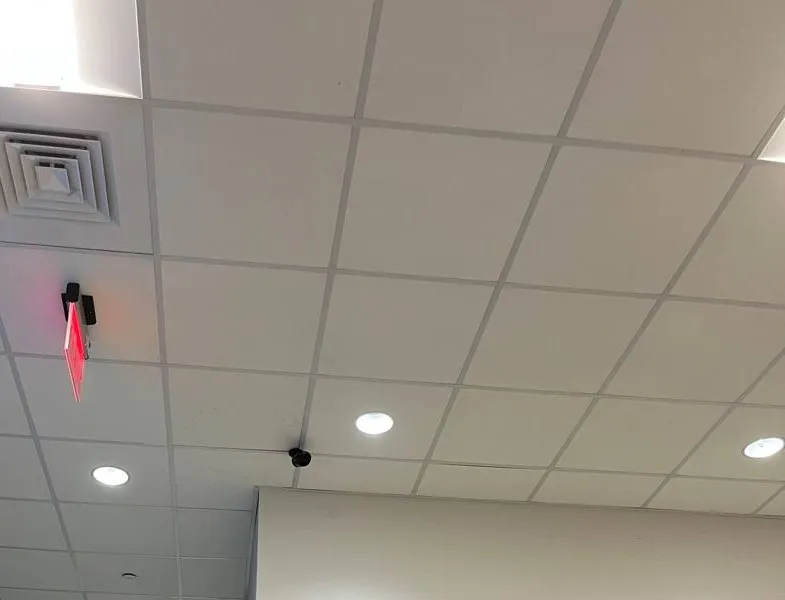
Example photo from another AESS job (not in Orange County): a white drop ceiling with recessed lights and an air vent; a small black camera is mounted beside a red-lit exit sign at the left, and a second small black camera hangs from the ceiling grid near the centre, above a lower soffit.
FAQ
Orange County Dahua Camera FAQ
Do we need a town permit or the utility's approval to put a camera pole at our farm gate?
+
Usually not for a camera on a post on your own land, but it depends on the town, so we ask the town building department before setting anything tall or near the road. What always needs approval is attaching anything to a utility pole: those belong to Orange & Rockland or the phone company, and we never mount cameras or radios on them without the pole owner's written permission. If the gate needs a new outlet, the electrician who installs it handles the electrical permit and inspection for that circuit.
Can a monitoring company or our out-of-state security office watch the warehouse cameras?
+
Yes. A Dahua recorder can give a central monitoring station or a corporate security team their own login with live view, playback or both, limited to the cameras they need. We create a separate account for each party rather than sharing the administrator password, so access can be removed later without changing everyone's login. Monitoring companies often want specific event types forwarded, such as fence-line intrusion after hours, and we set those up with the monitoring provider during commissioning.
Will field dust, spray and spider webs blind the lenses, and how are they cleaned?
+
Dust from the fields and spray around wash bays will film a lens over a season, and spiders love the warmth of an infrared camera at night, which is the most common cause of false night-time alerts in the country. We mount cameras under eaves where possible, angle them away from prevailing spray, and leave the owner a soft brush and lens cloth with instructions. A wipe in spring and autumn keeps most cameras clear; cameras over a packing or wash area may need it monthly in season.
What does a yearly service visit on a spread-out system include, and what does it cost?
+
We clean every lens and housing, check each camera still points where it was aimed, read drive health and confirm how many days are really being kept, update firmware, test every battery backup by cutting mains power, check radio link strength and surge protectors, and export a test clip. You get a written list of anything that needs attention. Service visits after the original installation are billed at $195 an hour with a 3-hour minimum ($585), and on a large property the visit is planned so the 3 hours cover every building.
Can seasonal farm-stand staff be limited to seeing only the register camera?
+
Yes. Each person can have their own login on the recorder or in the DMSS app, and each login can be limited to particular cameras and to live view only, with no playback or export. Seasonal staff typically get the register and the market entrance; the owner keeps every camera and the right to export. When the season ends, we or the owner disable those accounts in a minute without touching anyone else's access.
Who fixes a camera that fails at a far barn after installation, and what is covered?
+
Call us and we come out; you do not deal with Dahua directly. A camera that fails from a defect within its warranty period is replaced, and Dahua cameras and recorders carry the manufacturer's warranty. Full terms — including 50% deposit, one-year parts-only warranty on AESS-supplied products, and the late-fee schedule — are set out in the service agreement. Damage from surges, lightning or physical impact, and adjustments made after completion, are billed as service work.
How do we get trailer-yard footage to the State Police or the Sheriff's Office quickly?
+
The site manager exports the clip from the recorder or from SmartPSS on the office computer to a USB stick or a download link, following export steps we leave at the rack and show at handover. Every recorder's clock is set to synchronise automatically, so the time on the clip matches the time on the report, and cameras are named after real places such as north dock wall or truck gate inbound. Export a generous window around the event rather than a few seconds, so the vehicle's arrival and departure are both on the clip.
Can you leave spare conduit so future field cameras don't need another trench?
+
Yes, and on a farm it is one of the best investments in the job. When we or an electrician have a trench open, we lay an extra empty conduit with a pull string to each building or gate that might want a camera later, and cap both ends. A camera added next year then needs only a cable pulled through the conduit, not a second trench across the field or the driveway.
Can you install in winter when the ground is frozen?
+
Most of the work, yes: cameras, recorders, radio links and any cable that runs on or inside buildings go in year-round. Trenching is the exception, because frozen ground and snow cover make digging slow and expensive. For a winter install we often put a radio link in place of the trench so the system works now, then lay conduit in spring if the owner still wants a cabled connection.
What is due up front, and when is the rest paid?
+
A 50% deposit is due when you accept the written quote, which lets us order the cameras, recorder, radios and batteries for your property; the balance is due when the installation is complete and handed over. Any change you ask for once work starts, such as an extra building or a longer run, is quoted in writing before we do it. The full payment and warranty terms are in the service agreement we send with the quote.
All Areas Served
Dahua Camera Installation Across the Hudson Valley and Beyond
Every Orange County figure, date and incident on this page is listed below with the publication it came from; where we saw only a search excerpt, the entry says so. Prices are the existing AESS Orange County list.
Barn Camera Offline or Recorder Silent? Call the Orange County Line
A radio link that dropped after a storm, a drive that filled and failed, a camera knocked out of line by wind or a delivery truck — phone (845) 640-3835. We book the next open window, and most systems are recording again within one to two hours of arrival.
Orange County Dahua Cameras From a Licensed, Insured Crew
Abstract Enterprises Security Systems · 460 E Fordham Rd, Bronx, NY 10458 · (845) 640-3835 · WhatsApp (718) 679-0359 via wa.me
NYS Low-Voltage Licence #12000287431 · 100% Licensed & Insured · Same-Day Estimates · Rated 4.7★ from 201 Google Reviews
Dahua cameras and recorders carry their manufacturer's warranty. Full terms — including 50% deposit, one-year parts-only warranty on AESS-supplied products, and the late-fee schedule — are set out in the service agreement. See our warranty page.
Page reviewed and updated October 18, 2026. Changelog: Orange County Dahua page rebuilt from new research around the county's distribution buildings on Route 17K, Route 300 and in Goshen, Wawayanda, Montgomery and Wallkill; Black Dirt farms and Warwick orchards; long cable runs, extended PoE, fiber and point-to-point radio links; O&R storm outages and battery backup; lightning protection; full-colour versus infrared in unlit country; active deterrence; and the existing Orange County price list.