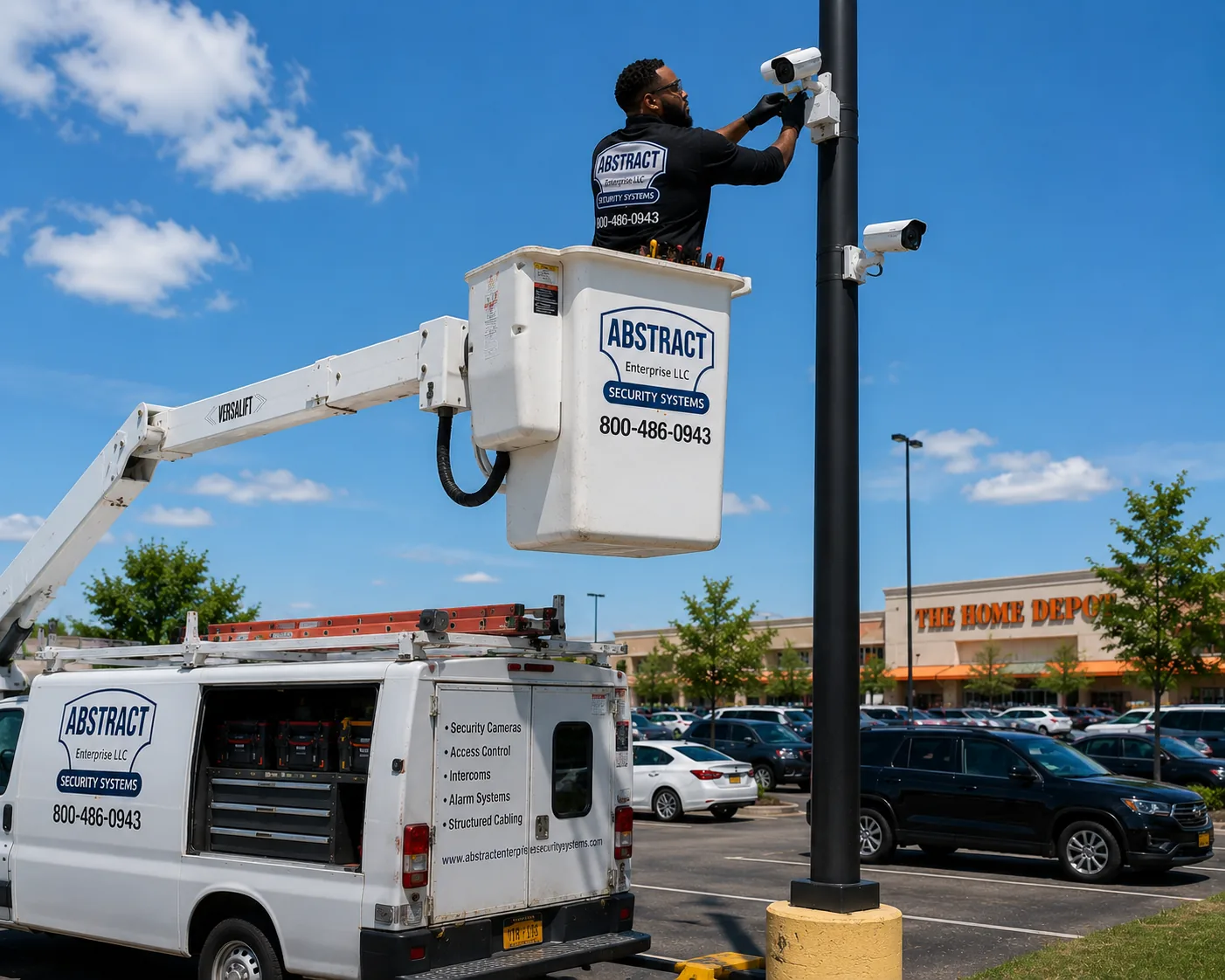
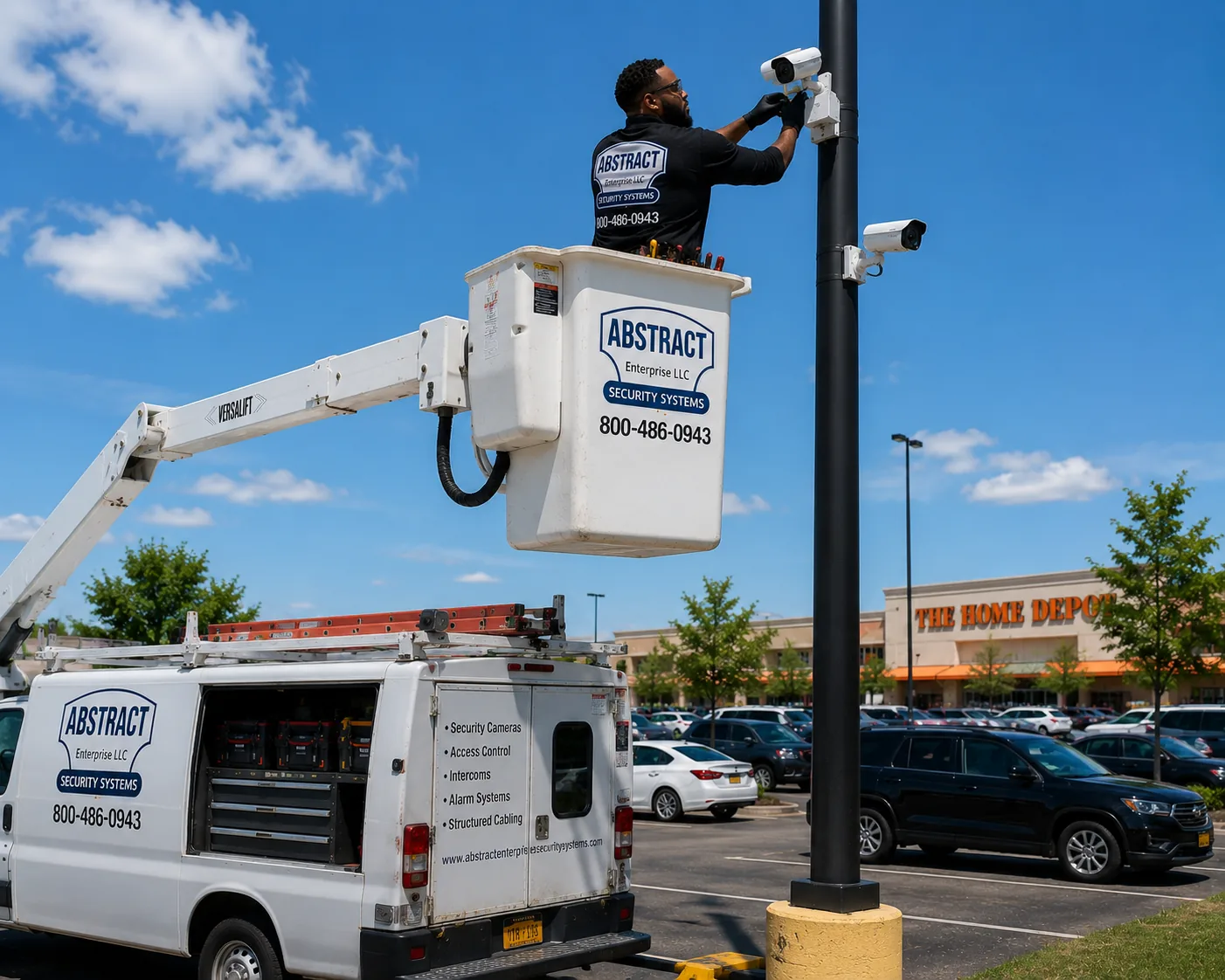
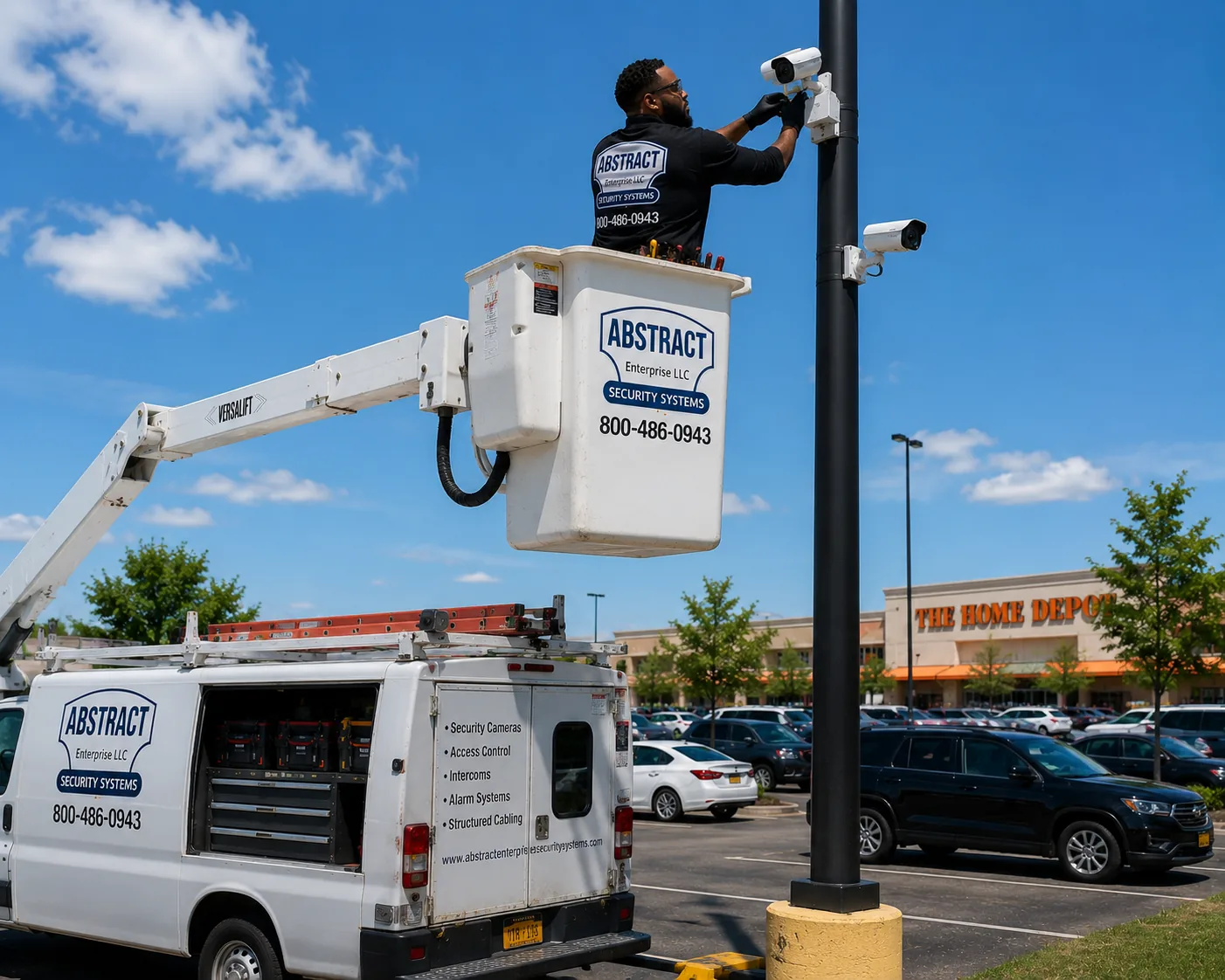
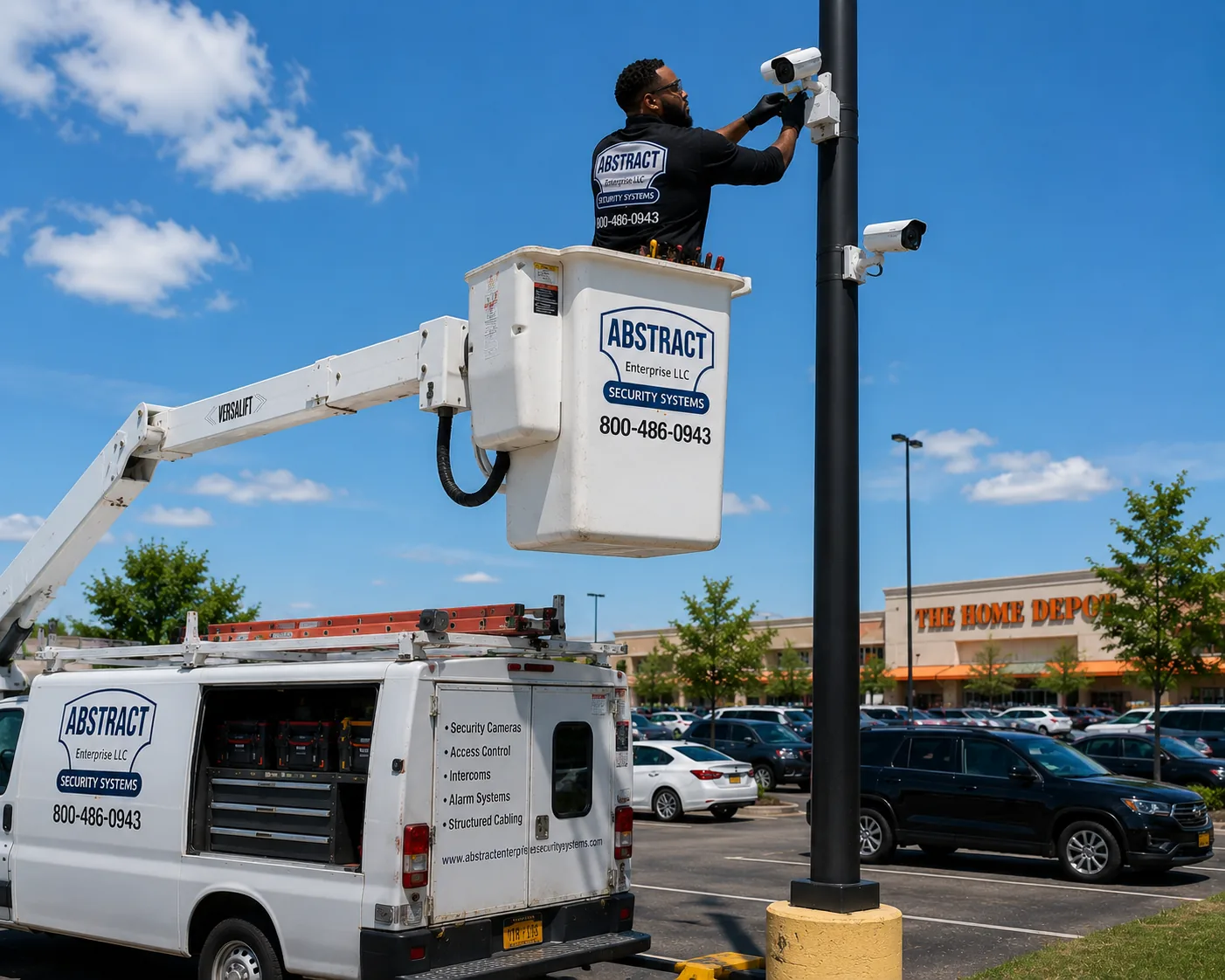
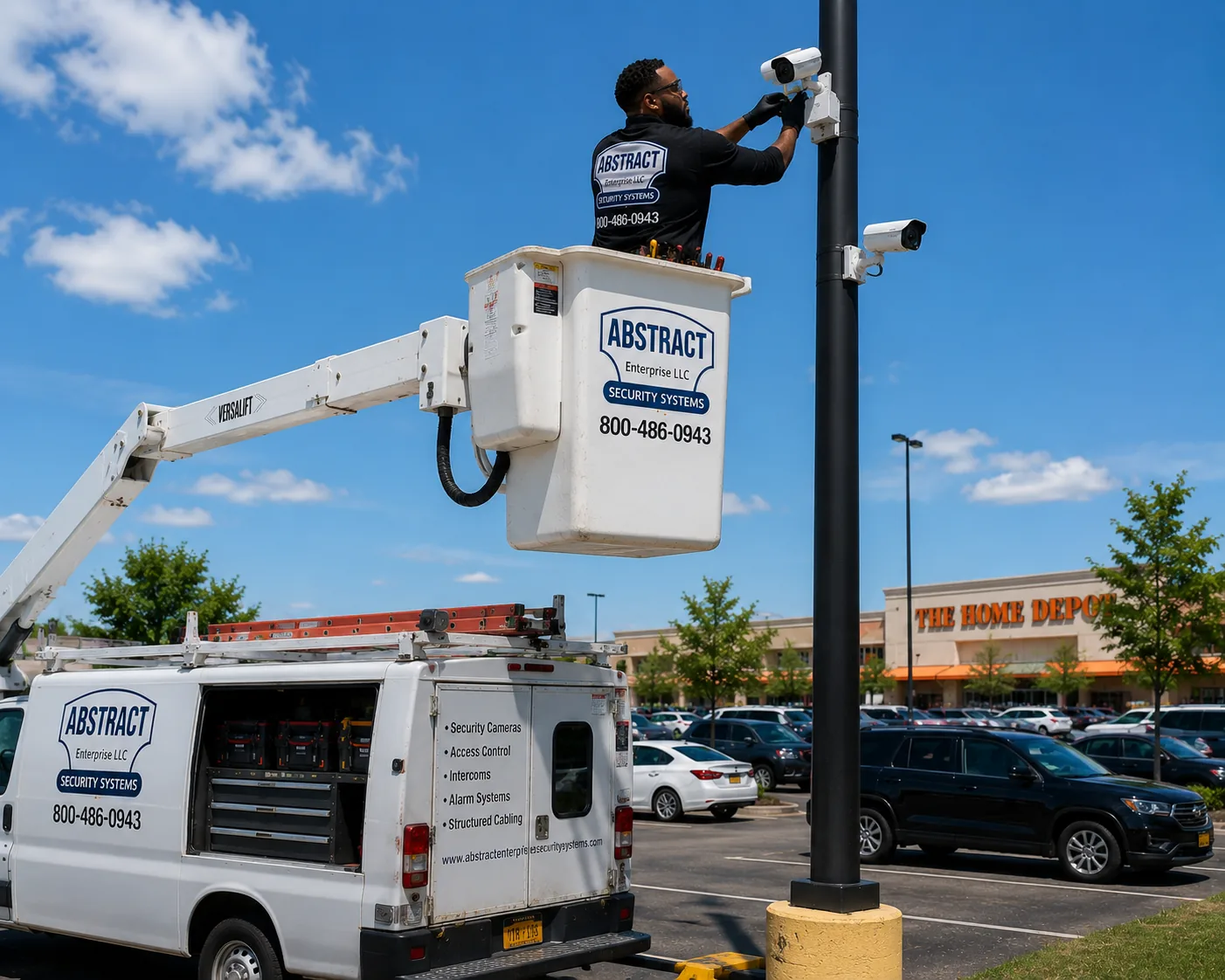
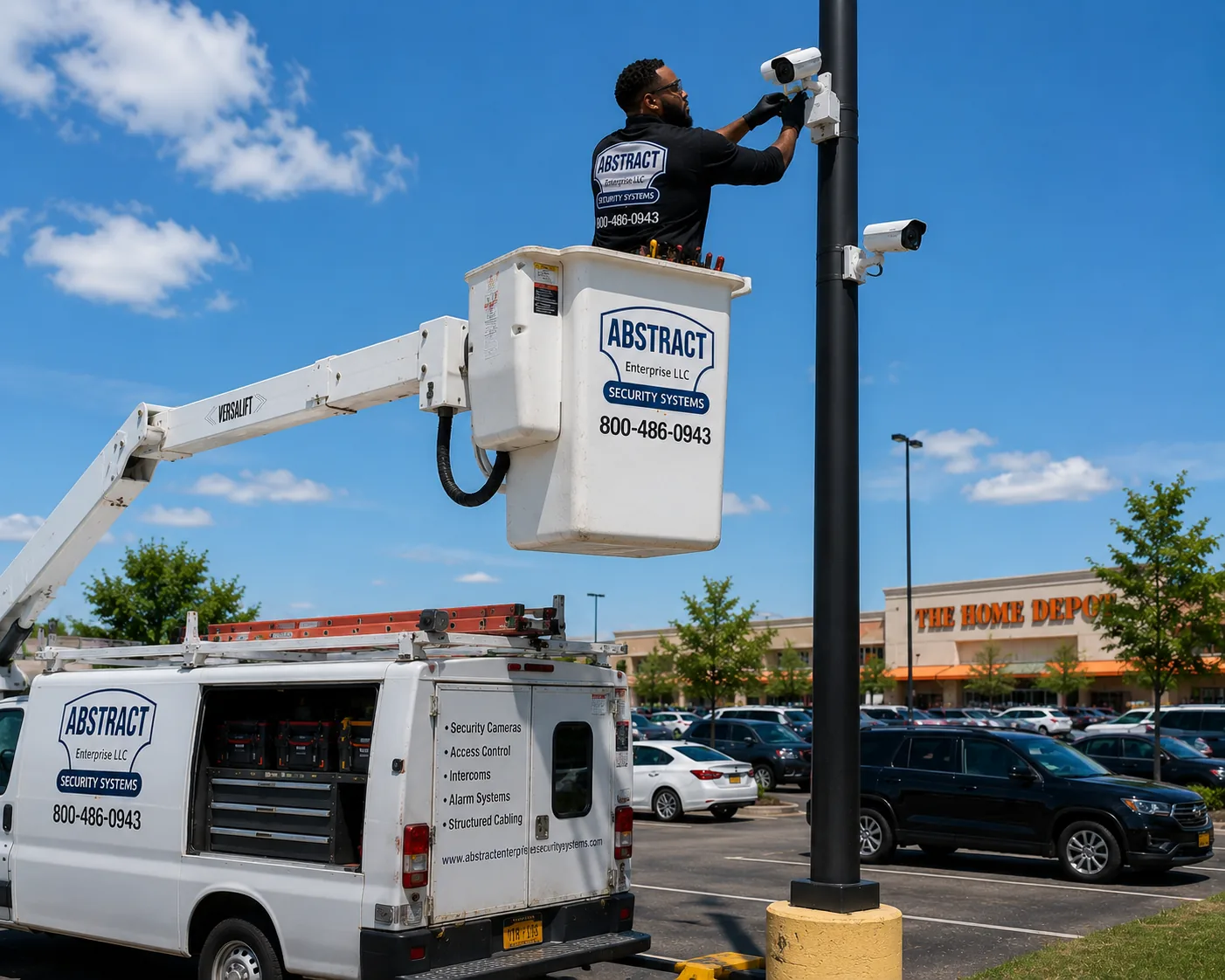
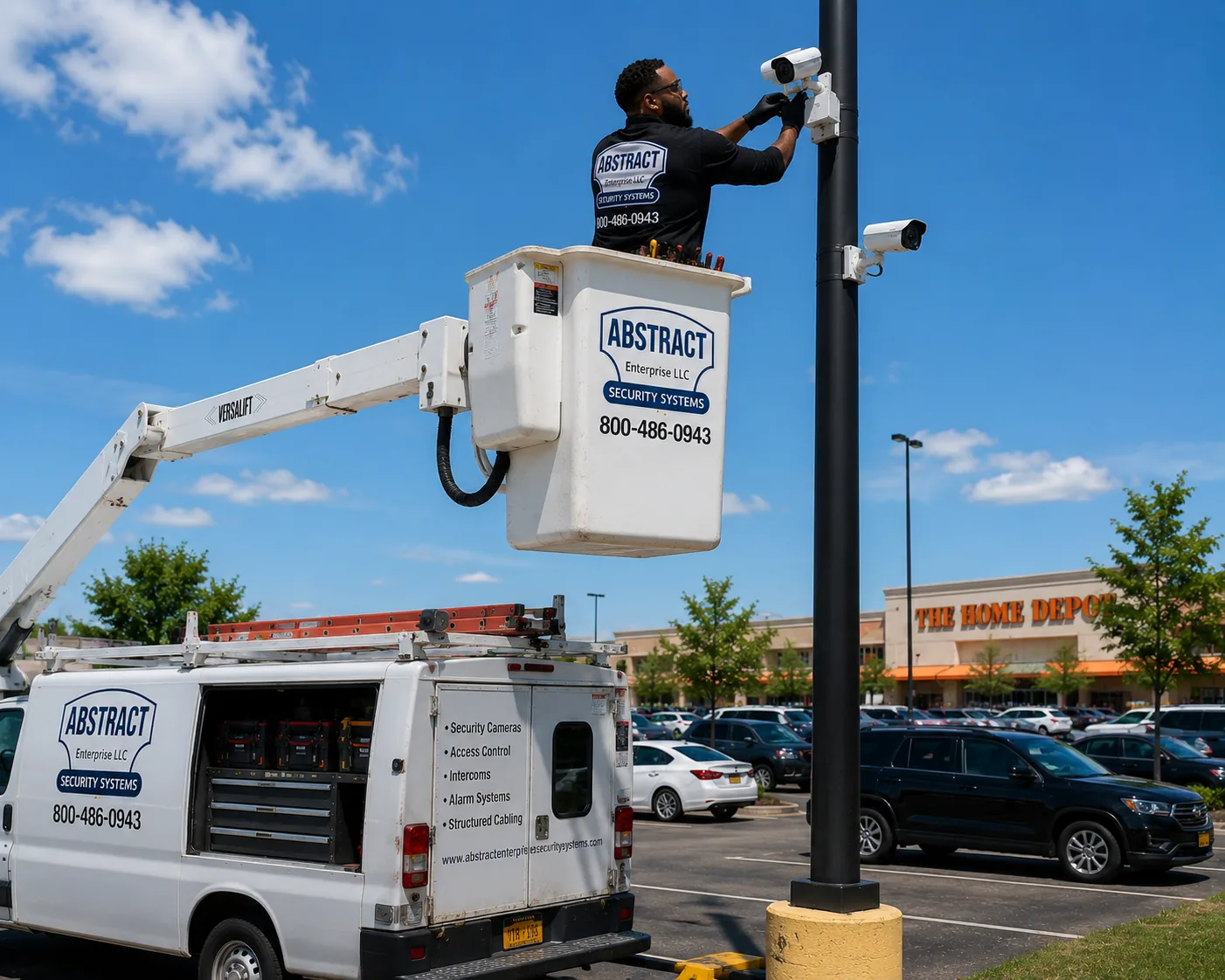
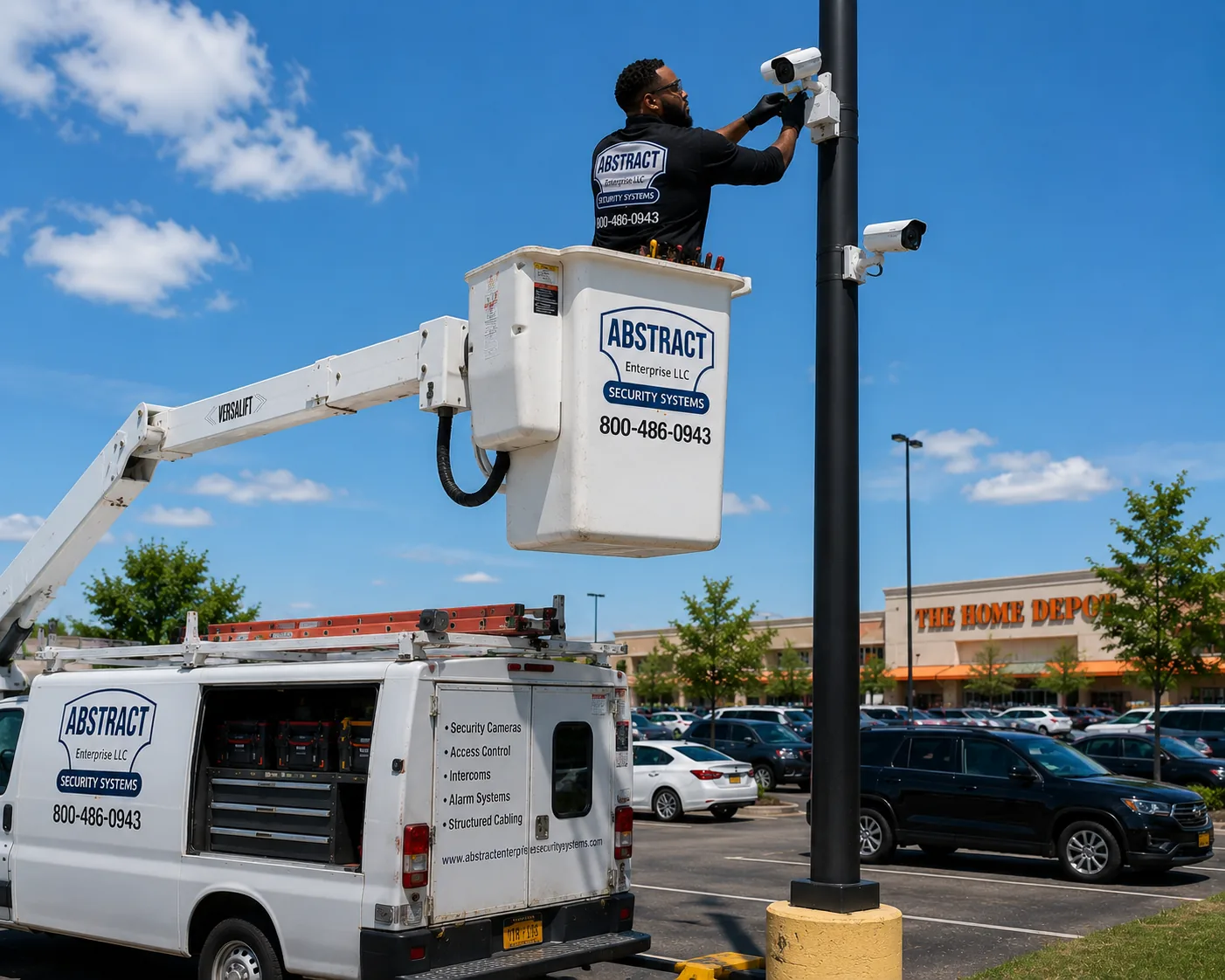
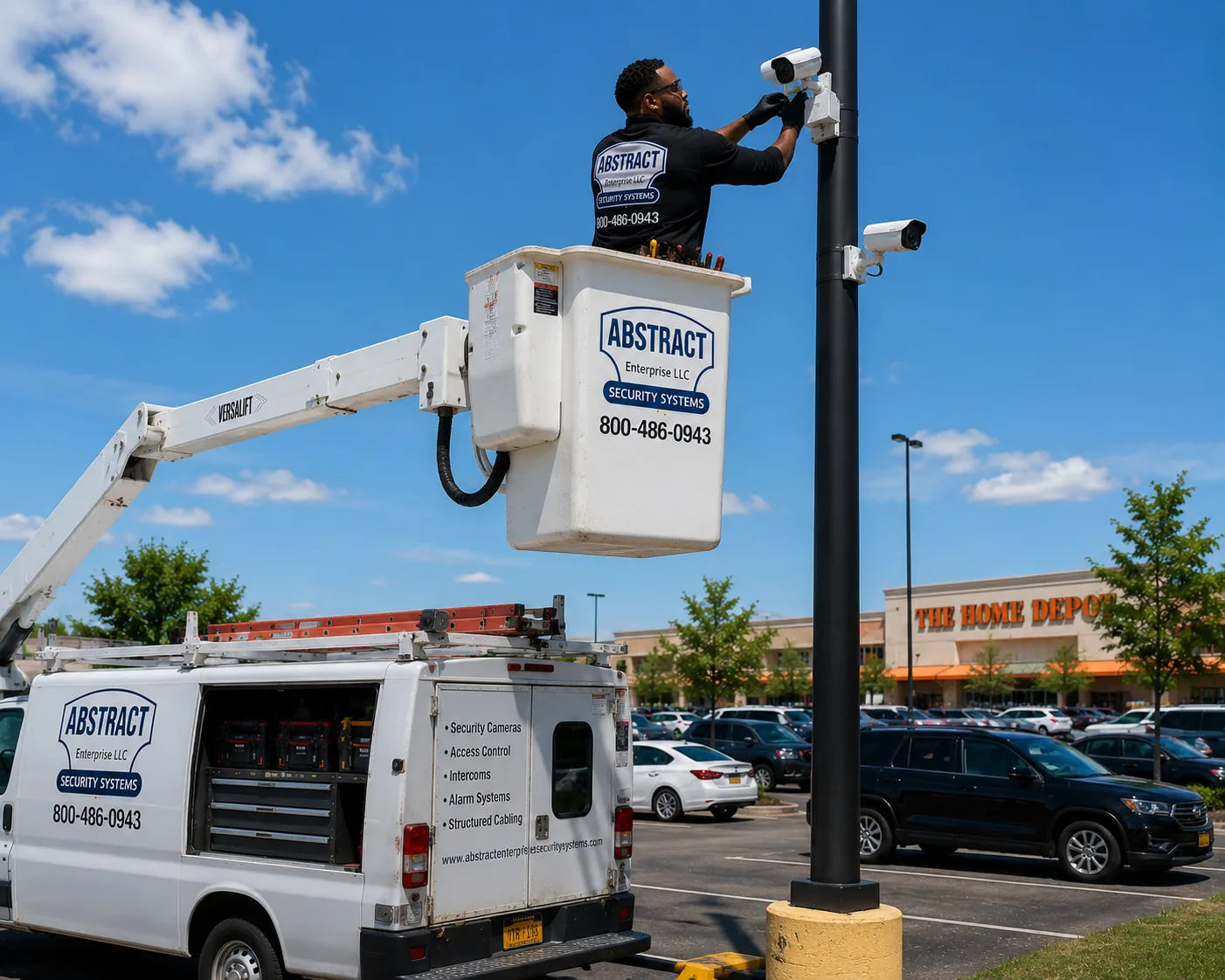
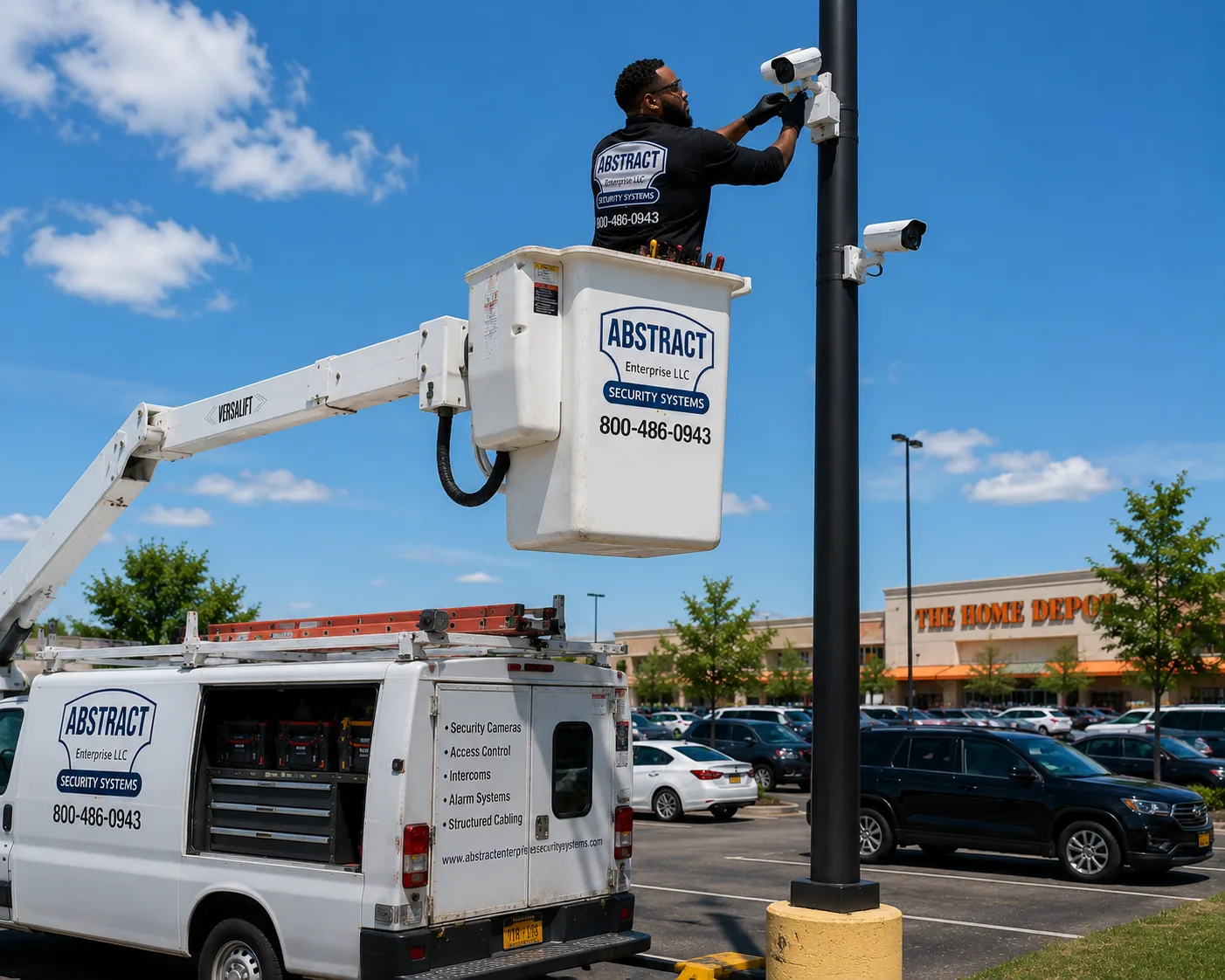
Camera systems for Westchester County parking: Cross County and Ridge Hill retail, Metro-North commuter lots, White Plains and village municipal decks, hospital and college campuses, corporate office parks along I-287, distribution and fleet yards, and the apartment, school and house-of-worship lots in between — LPR entrance coverage, pole-mounted 4K cameras, trenched conduit and remote viewing, engineered from a free on-site survey.
· 201 Google Reviews | NYS Low-Voltage License #12000287431 | Free on-site survey
Coverage across Westchester County — Yonkers, White Plains, New Rochelle, Mount Vernon, the Sound Shore, the Rivertowns and the Metro-North commuter lots.
Reviewed and updated August 1, 2026.
THE NEIGHBORHOOD
Parking in Westchester runs from dense downtown decks to sprawling suburban retail fields to quiet Metro-North lots tucked behind northern village greens. A White Plains office garage and a Katonah station park-and-ride are both parking lots, and almost nothing about their camera systems is alike. A design that works on one is wrong on the other, so the survey starts by reading the specific property rather than assuming a Westchester norm.
The county leans heavily on structured decks and commuter lots. Cross County Shopping Center and Ridge Hill in Yonkers, The Westchester and City Center in White Plains, the county garages downtown, and Jefferson Valley Mall up north all carry multi-level parking; and dozens of lots double as Metro-North park-and-rides on the Hudson, Harlem and New Haven lines — Croton-Harmon, Tarrytown, Scarsdale, White Plains, New Rochelle, Rye, Mount Kisco, Katonah — where a car sits unattended from the morning train until night. Coverage is engineered for those hours, for real winters, and for lots that are packed at 8am and empty by 7pm.
Ground is the first hard variable. Much of Westchester sits on the same hard gneiss and schist that runs up out of the Bronx, so a pole footing or a trench can meet rock a foot or two down. Pathway routing is planned around what is actually under the lot, a test dig is sometimes worth doing before the proposal is signed, and alternatives — surface conduit tracked along a curb, an engineered point-to-point wireless hop between buildings, a solar-and-cellular position on a far pole — get weighed seriously rather than treated as fallbacks.
Water and salt are the second. Westchester has two shorelines: the Long Island Sound edge through New Rochelle, Larchmont, Mamaroneck and Rye, and the Hudson River edge through Yonkers, Hastings, Dobbs Ferry, Irvington, Tarrytown, Ossining and Peekskill. On any lot near either, the brackets, pole bands, fasteners and enclosure hardware are specified in stainless or a coastal-rated finish, because on the shore that metal corrodes long before the camera does. Frost depth matters too — pole foundations here go deeper than a downstate coastal lot needs, which changes excavation and concrete on the estimate.
The third is the municipal map. Westchester packs six cities, nineteen towns and twenty-three villages into a small county, and most run their own building department with their own rules on pole heights, right-of-way work and, in places like Tarrytown, Sleepy Hollow, Rye and Bedford, historic or architectural review. Which approvals a specific lot needs is a parcel-level question the survey settles up front, not something read off a satellite image. Con Edison owns most of the poles across the county, with NYSEG in a small northern sliver, and the attachment process is confirmed per property before any position leans on a utility pole.
The fourth is what is actually happening in these lots. Westchester has a documented overnight-theft problem: a county grand jury indicted a crew for cutting fifty-six catalytic converters off vans and buses across Briarcliff, Greenburgh, Peekskill, Pelham and Yonkers, with most of the metal traced to a Bronx scrap yard, and distribution-fleet lots along Warehouse Lane in Elmsford have been hit repeatedly overnight. The through-line is prolonged, unattended parking — fleet yards, church lots, commuter garages — which is exactly what a camera plan built for enforcement and after-hours alerting is meant to cover.
WHAT WE INSTALL
A large share of Westchester parking is public or semi-public. Municipal decks, the Metro-North park-and-rides on the Hudson, Harlem and New Haven lines, and church and school lots often sit a long way from the nearest usable panel, so coverage leans on point-to-point wireless hops between buildings and, where trenching power out to a far pole isn’t worth it, solar-and-cellular positions.
From Cross County and Ridge Hill in Yonkers and The Westchester in White Plains down to a two-tenant strip on Central Avenue or Route 119. Storefront-mounted cameras cover the first couple of rows and then lose plate-level detail, so the far field and outparcels need pole positions. Rear service drives, cart corrals and dumpster enclosures carry the activity the entrance cameras never see.
Cars sit unattended ten to fourteen hours on a weekday, which sets the whole risk profile. Station lots at Croton-Harmon, White Plains, Tarrytown, Scarsdale, New Rochelle and Rye need coverage on the entrances, the long-stay rows and the walk between lot and platform. Retention is sized for slow discovery, because a vehicle hit Monday morning may not be looked at until the owner comes back Friday night.
Metered and permit decks in White Plains, Rye, Mount Kisco, Tarrytown and Port Chester mix daytime commuter parking with evening restaurant traffic and municipal oversight. These properties carry extra review layers — village and city boards, architectural or historic review in a number of communities, and right-of-way rules at the curb cuts.
Around-the-clock use, staff arriving and leaving in the dark at both ends of a shift, and campuses that mix surface lots with structured decks — Westchester Medical Center in Valhalla, White Plains Hospital, Phelps in Sleepy Hollow, and college lots at Purchase, Iona, Manhattanville and Pace in Pleasantville. Most need both design approaches on one system plus scoped viewing for campus or public-safety staff.
The office corridor along I-287 and the county’s corporate campuses — employee decks, gated visitor lots and long entrance drives set back from the road. Plate capture at the gate matters as much as row coverage, and access is usually scoped so corporate security sees only its own property.
The warehouse and distribution cluster around Elmsford’s Warehouse Lane, the Yonkers waterfront and Port Chester brought trailer parking, employee lots, gates and yards. Coverage reaches past passenger vehicles to trailers and equipment, and after the overnight converter hits along that corridor, entrance plate capture and low-light row coverage carry real weight.
Guest parking that fills and empties on no schedule, valet and shuttle operations at the larger White Plains hotels, and event nights at banquet and wedding venues that triple the load. Designs favor entrance coverage, clear pedestrian routes and layouts that still work when an overflow field opens for a Saturday.
Resident lots in Yonkers, New Rochelle, Mount Vernon and White Plains with assigned spaces, visitor parking and pedestrian routes to unit doors. Board approval, resident privacy expectations and a written footage-access procedure matter as much as where the cameras go.
Sharp arrival-and-dismissal peaks with long quiet stretches, part-time or volunteer oversight, and stakeholders who need simple viewing access. Straightforward layouts, posted signage and coverage of entrances and gathering paths during peak flow, across the county’s many districts and congregations.
COVERAGE AREA
Westchester packs six cities, nineteen towns and twenty-three villages into a small county, and the parking changes character as you move through it. Down south and along the water it is dense and mostly structured; across the middle it is retail and corporate; up north it opens into larger, quieter lots behind village greens. One camera plan does not fit all three, so coverage is scoped to the specific property, not to a county-wide template.
We work the Sound Shore — New Rochelle, Larchmont, Mamaroneck, Rye, Harrison, Port Chester — and the Rivertowns along the Hudson — Yonkers, Hastings-on-Hudson, Dobbs Ferry, Irvington, Tarrytown, Sleepy Hollow, Ossining and Peekskill. Through the center we cover White Plains, Scarsdale, Greenburgh, Elmsford, Hartsdale, Bronxville, Eastchester and Mount Vernon; and up north Mount Kisco, Bedford, Pleasantville, Mount Pleasant, Chappaqua and New Castle, Yorktown, Cortlandt and Somers. Each has its own building department, and several run architectural or historic review on top of it.
The high-volume parking generators — Cross County Shopping Center and Ridge Hill in Yonkers, The Westchester and City Center in White Plains, Jefferson Valley Mall in Yorktown, the county garages, the hospital and college campuses, and the Metro-North park-and-rides on all three lines — sit across every part of the county, and each gets a coverage plan built around how long cars actually sit and where people walk.
Plate capture is its own camera, aimed and exposed for the job, not an overview lens pointed hopefully at a driveway. On a Westchester lot the useful spot is where a vehicle naturally slows — a gate arm, a ticket spitter, a tight curb cut off a state route like Central Avenue, Route 9 or Route 119 — and the camera is set low, shallow to the lane, with a shutter fast enough to freeze a moving plate at night.
Commuter-lot and corporate-gate entrances are where plate reads earn their keep, because the record of who entered and left is often the one piece of evidence that matters after an overnight incident. On a busy retail entrance the overview and the plate camera are kept separate, so widening the field of view for context never costs the plate detail that makes footage actionable.
Con Edison owns the great majority of distribution poles across Westchester, with NYSEG in a small northern sliver, and whether a camera position can lean on an existing pole is a per-property question settled during the survey rather than assumed from an aerial view. Most far-field coverage ends up on dedicated camera poles the design specifies, positioned for the view and the foundation rather than for whatever utility pole happens to be nearby.
Where a utility attachment genuinely is the right answer, the make-ready and attachment process is confirmed before the position is committed. Power is planned the same way — a home run from the panel where the distance is reasonable, a dedicated feed and enclosure at the pole where it is not, and a solar-and-cellular position where trenching power to a far corner of the lot simply is not worth it.
Much of Westchester sits on the same hard gneiss and schist that runs up out of the Bronx, and that changes the trenching conversation from the start. Where a sandy coastal lot might be trenched across in an afternoon, a Westchester property can hit rock a foot or two down, so pathway routing is planned around what is actually under the pavement, and a test dig is sometimes worth doing before a proposal is finalized.
When rock or an obstruction makes a straight trench impractical, the alternatives are real design choices, not consolation prizes: surface conduit tracked along a curb or building line, a saw-cut in existing asphalt, an engineered point-to-point wireless hop between buildings, or a self-powered position that skips the trench entirely. The route is chosen for the property, and the restoration is scoped so the lot looks finished when the work is done.
Distance is the quiet cost driver on Westchester campuses and larger retail lots. Copper is dependable to roughly one hundred meters; past that a run needs fiber with media conversion or a switch positioned out in the field, and on a hospital campus or a spread-out corporate property those distances add up fast. The design settles which runs are copper, which are fiber and where a field switch belongs before anyone quotes a number.
Where a paved path between two points does not exist, or where ledge makes trenching it uneconomic, a licensed point-to-point wireless link carries the video back on a clear line of sight. It is engineered — aimed, tested and monitored — not a consumer bridge hung on a wall, and it is what keeps a detached lot or an outparcel on the same system and the same recorder as the rest of the property.
Westchester runs on structured parking — the county garages and hospital decks in White Plains, the retail decks at Cross County and Ridge Hill, and municipal decks in Yonkers, New Rochelle and Mount Vernon. A deck is a different camera problem than an open lot: low concrete ceilings, headlight glare bouncing off painted walls, tight ramp turns and dead spots behind columns all work against a single sweeping view.
Decks get covered level by level — the entry and exit lanes with plate capture, each ramp and stair-and-elevator lobby, and the parked rows with fixed cameras placed to see between columns rather than into them. Cameras are chosen for wide dynamic range so a bright ramp mouth next to a dark bay does not blow out the shot, and cabling is run in surface conduit where core-drilling a deck slab is neither wanted nor allowed.
Westchester gets real winter, and plows reshape a lot overnight. Snow gets pushed into piles that can bury a low camera's view or block a plate lane, and a pole set in the wrong place becomes a target for a plow blade. Positions are planned with the snow-management pattern in mind — where the piles go, where the lanes stay clear — so coverage survives the first storm rather than disappearing behind a mound until spring.
Salt is the winter tax on the hardware. Brine kicked up on shore and roadway lots corrodes cheap brackets and fasteners long before it bothers the camera, so mounts near the Sound, the Hudson or a heavily salted entrance are specified in stainless or a coastal-rated finish. Cold-weather housings and heaters keep domes clear through freeze-thaw so a camera that looks fine in October is still usable in January.
The lots that get hit in Westchester are the ones that go quiet and dark — commuter garages after the last train, fleet and distribution yards overnight, waterfront lots on the Sound and Hudson edges. Those are exactly the conditions that expose a camera chosen for a daytime brochure shot, so night performance is designed in, not hoped for, with sensors and lensing matched to the actual light on the lot.
Every position is verified after dark as its own step. We check each view for parking-lot pole-light glare and hot spots, for the dark bays between fixtures, and for whether a plate is still readable at the entrance once the sun is down. Where the ambient light is not enough, supplemental IR or white-light illumination is added deliberately, so the footage from a 2am incident is worth pulling instead of a gray smear.
BUILDING SPECIALISTS
The workhorse for long, single-direction views — down an aisle, along a fence line, across a row of long-stay commuter spaces. A visible deterrent, and simple to aim and lock.
Compact housings that re-aim in seconds and dodge the internal IR bounce that fogs cheaper domes at night. A common pick for entrances, walkways and deck bays.
Steerable coverage for big properties — preset patrols, zoom on request and live tracking of movement across a large retail or campus lot from one high mast.
One mount covering a very wide field, which earns its place over an open row or a garage level where several fixed cameras would otherwise be needed.
Dedicated plate readers for entrance lanes — narrow single-lane framing, a fast shutter and exposure tuned for headlights, so a moving plate is legible after dark.
Heated, defogging housings built for Westchester freeze-thaw, so a camera clear in October is still usable through a January storm rather than iced over.
A lot system is only as reliable as the field electronics feeding it. Where cameras sit far from the building, a switch goes out in the field to gather them, and it lives in a sealed, rated enclosure rather than a big-box junction box — because the summer thunderstorms that roll across Westchester will find an unprotected run. Surge protection and proper grounding on every outdoor cable are not upsells here; they are what keeps a lightning-season storm from taking out a row of cameras.
The PoE budget is planned, not assumed. Heaters, illuminators and PTZ motors all draw power, and a switch loaded to its limit browns out the cameras it is supposed to run. The design sizes the power and the cable so each position gets what it needs at the far end of a long run, with headroom left for the cold-weather draw when heaters kick in.
Westchester carries an unusual density of corporate and medical campuses — the office corridor along I-287, the county’s corporate headquarters, and hospital campuses at Valhalla, White Plains and Sleepy Hollow. Their parking mixes employee decks, gated visitor lots and long entrance drives, and the design usually needs both a garage approach and an open-lot approach on the same system, tied to one recorder.
Access is the defining requirement. Corporate and hospital security want scoped viewing — their own lots, their own cameras, individual accounts, an audit trail of who pulled what — and often integration with an existing access-control or dispatch setup. Plate capture at the gate, coverage of the pedestrian routes between deck and building, and clean handoff of footage to public safety after an incident all get built in from the survey.
The Metro-North park-and-rides are Westchester’s signature parking problem. A car sits unattended from the 7am train to the evening return, and on the Hudson, Harlem and New Haven lines that adds up to hundreds of vehicles left in the open all day. The risk is not just the volume — it is the discovery window. A vehicle damaged or stripped Monday morning may not be inspected until the owner comes back Friday night, so the footage has to still be there when they finally look.
That drives two decisions. Retention is sized long enough to cover a full slow-discovery week rather than the 48 hours a busy retail lot might get away with, and coverage concentrates on the entrances, the long-stay rows and the walk between lot and platform. The documented overnight converter and plate thefts in Westchester — commuter and fleet lots being prime targets — are exactly the incidents this profile is built to catch.
Westchester has a real density of historic and architecturally reviewed districts — Tarrytown and Sleepy Hollow, Rye, Bedford, Bronxville, and the older cores of the Rivertowns. A lot inside one of those districts often cannot take a tall galvanized mast or a boxy enclosure on the street side without review, so the design accounts for what a board will actually approve before anything is ordered.
That usually means lower-profile poles, finishes chosen to disappear against the building, cameras tucked under existing architectural features where the sightline allows, and cabling kept out of view. Coverage does not suffer for it — it just takes a plan that respects the district, and the survey flags which approvals a specific village will want so the timeline is honest from the start.
Downtown White Plains, Port Chester, New Rochelle and Mamaroneck run on evening and weekend parking — restaurant districts, bars, theaters and mixed-use lots that are half-empty at 3pm and packed at 11pm. The activity that matters here happens after dark and in the margins: the far corners, the alley behind the row, the pedestrian path from the deck to the street.
These lots are designed for night first. Entrances and the busiest pedestrian routes get priority, cameras are chosen for the low, uneven light of a downtown block, and where valet or shared parking is involved the coverage documents handoffs cleanly. For mixed-use buildings, footage-access rules between the commercial tenants and any residential parking are written down as part of the design, not left to sort out after an incident.
Two shorelines and a river system shape a lot of Westchester parking. Long Island Sound lots in New Rochelle, Larchmont, Mamaroneck and Rye, Hudson River lots through Yonkers and the Rivertowns, and the low ground along the Bronx River all bring salt, damp and, in places like downtown Mamaroneck, a genuine flood history. Hardware near the water is specified in stainless or a coastal-rated finish because ordinary brackets rust out long before the camera fails.
On flood-prone properties the recorder and field electronics are placed above known flood levels, not tucked in a low mechanical room that has taken water before, and enclosures are sealed against wind-driven rain. The point is a system that is still recording after the storm that was always the reason to install it — not one that drowned the first time the river came up.
Footage nobody can pull is not evidence. Each Westchester system is built around a recorder and drive capacity sized for the retention the property actually needs — longer for commuter and fleet lots with slow discovery, shorter where incidents surface the same day — and the number is stated plainly in the proposal instead of buried in a spec sheet. Cameras are placed and exposed so an exported clip is clear enough to act on.
Remote access is set up the way a manager or owner will really use it: live views and playback on a phone or laptop, individual accounts rather than a shared password, and the option of an off-site copy of critical cameras so a stolen or smashed recorder does not erase the record. You are shown how to search, export and grant access on your own before we leave.
Modern lot cameras can do more than record. Line-crossing and intrusion rules can flag someone entering a closed commuter deck at 2am, loitering analytics can notice a vehicle circling long after the lot should be empty, and plate lists can watch for a specific vehicle. Tuned to the property, these turn a passive archive into something that pushes an alert while there is still time to respond.
The value is in the tuning. Analytics dialed in wrong bury a real event under a hundred false ones — a windblown bag, headlights sweeping a wall, a raccoon — so rules are set to the actual traffic pattern of the lot and to hours that make sense, and the escalation path (who gets the alert, and what they do with it) is agreed up front rather than assumed.
Plenty of Westchester lots already have cameras — often half-working, poorly aimed, or orphaned by whoever installed them. We take those over: diagnose at the enclosure and the recorder, keep the hardware that is still good, and replace only what has actually failed rather than condemning the whole system to sell a new one. Where a lot went dark after an incident, that is a same-day priority.
Modernization is usually a mix — a newer recorder, a handful of better cameras at the positions that matter most, plate capture added at the entrance, remote access set up properly — staged so the lot is never fully unwatched during the work. The result is documented and owned outright, with account details and a camera map handed over, not left dependent on the last contractor.
Parking-lot cameras in New York are on solid footing when they watch your own property and the people using it. Coverage is planned to stay on the lot, its entrances and its walkways, and where a camera’s view would spill onto a neighbor’s yard, a sidewalk or the interior of an adjoining building, digital privacy masking blocks that part of the frame. Posted signage at the entrances both meets expectations and adds deterrence.
For apartment, condo, HOA and mixed-use properties, the footage-access procedure is written down as part of the design — who can view, who can export, and how a resident or tenant request is handled — so the system holds up to a board, a manager and, if it ever comes to it, a court. Getting the boundaries right up front is cheaper than reshooting coverage after a complaint.
No testimonials — just the commitments every Westchester parking lot project is held to:
Abstract Enterprises Security Systems works across Westchester County and the surrounding region under NYS Low-Voltage License #12000287431. License details, insurance certificates and references are provided in writing before work is scheduled.
Every proposal follows a free on-site survey. Camera positions, pathways and equipment are specified from the actual property — Westchester lots are never quoted from a phone call, because pole ownership, ground conditions and power sources are only visible on site.
Every position listed with the job it does, the route its cable takes, the recorder and drive capacity behind it with the retention that produces, and clear limits on what is and is not included — the detail that makes two bids genuinely comparable.
Weatherproof terminations, drip loops, surge protection and grounding on outdoor runs; footings designed for local frost depth and soil; secured recorder placement above flood levels where applicable; labeled cabling; individual user accounts instead of shared logins.
We close out by working through live viewing, searching playback, exporting a clip and setting up mobile access with you directly, then hand over account details, a marked camera map, as-built pathway records and configuration notes. You own it outright.
Products supplied by AESS carry a three-year warranty for normal wear and tear — full terms below and at our warranty page.
· 201 Google Reviews across our service work.
A good bid answers these without flinching. Are you a licensed NYS low-voltage contractor, and will you put the license number, insurance and references in writing? Did you survey the lot in person, or is this priced off a satellite image? Which runs are copper, which are fiber, and where does a field switch go? Who owns the poles you plan to use, and is a utility attachment actually confirmed?
Keep going: what recorder and how much retention, stated as days on this property? Is plate capture a dedicated camera or a repurposed overview? How is surge protection and grounding handled on the outdoor runs? Do I get individual accounts and full ownership, or am I locked to your login and your monitoring contract? On a Westchester lot, the answers to those questions separate a system that holds up from one that photographs blur.
HOW IT WORKS
Every project follows the same order of work, shaped to the property. Scheduling and the finish date depend on site conditions, equipment lead time, access, municipal review and the extent of the work.
PRICING
Westchester lots vary too much for honest flat pricing — two properties the same size can be completely different jobs depending on rock, pole ownership and how far power has to travel. Pricing is set after a free on-site survey, and the proposal itemizes exactly where the money goes. The variables that move the number:
A survey answers all of these for your specific property, and the itemized proposal that follows prices each driver on its own line. Westchester labor sits above the Brooklyn baseline for access, permitting density and ground conditions, and that is stated openly rather than hidden in a round number.
COMMERCIAL PARKING CAMERAS
Westchester’s commercial parking clusters along its arterials, and what is buildable shifts from one corridor to the next with the ground, the density and the review layer:
The office corridor and “Platinum Mile” through White Plains, Harrison and Elmsford — corporate campuses, employee decks and gated visitor lots.
The dense Yonkers-to-Hartsdale retail strip: plazas, big-box lots and auto dealers with constant turnover and multiple entrances per property.
The Sound Shore spine through New Rochelle, Mamaroneck, Rye and Port Chester — downtown, waterfront and mixed-use lots with salt exposure.
The Rivertowns run from Yonkers through Tarrytown, Ossining and Peekskill — village decks, riverfront lots and Metro-North park-and-rides.
Greenburgh and Elmsford retail and the Warehouse Lane distribution cluster, where overnight fleet-lot theft is a documented problem.
Central and northern-county plazas and service parking on rock-ledge terrain that constrains trenching and pole placement.
A commercial lot is subject to review steps a residential property avoids. Attaching to poles, electrical and structural mounting, trenching, historic or architecturally reviewed parcels, and right-of-way work across Westchester’s many municipalities can each require owner, utility, or authority-having-jurisdiction review, and AESS determines the requirements that apply before installation proceeds.
This content is general information and is not legal advice.
YOUR QUESTIONS ANSWERED
It is a real possibility across much of Westchester, where the same hard gneiss and schist that runs up out of the Bronx sits close to the surface, and the honest approach is to plan for it rather than discover it. Options include rerouting the pathway to softer ground even if the run gets longer, covering more of the lot from perimeter poles with tighter optics, bridging a gap with an engineered wireless link, or specifying a solar-and-cellular position with no trench at all. On a property where ledge is likely, a test dig before the proposal is finalized is often the cheapest information available, because it turns an unknown into a line item.
Cameras do not physically block a saw, but on the exact profile Westchester has been hit with — crews cutting converters off vans and buses in fleet and commuter lots overnight — they change the math. Visible cameras and posted signage push casual crews to an easier target, plate capture at the entrance records who came and went, and after-hours analytics can alert on someone moving under vehicles in a lot that should be empty. When a theft still happens, clear night footage and a legible plate are what let police and a DA act, as they did in the county’s fifty-six-converter indictment.
Deeper than a downstate coastal lot, because frost drives the footing more than the pole does. The foundation is engineered for the specific pole height, its wind loading with every camera and enclosure attached, and the soil and ledge at that spot. A footing detail borrowed from a Long Island job is not what a Westchester pole needs, and getting it wrong shows up as a leaning mast after a couple of freeze-thaw winters rather than on install day.
Because discovery is slow. A car damaged Monday morning may not be looked at until the owner comes back Friday night, and one left through a vacation can sit two weeks. Retention is calculated from resolution, frame rate, recording mode, camera count and installed storage, then set against that realistic window — not the next-morning assumption that is the most common retention mistake on a commuter lot in this county.
It can, usually in visual terms rather than the cameras themselves — pole height and finish, whether new poles are introduced at all, how visible conduit and enclosures are, and how the equipment reads from a protected streetscape. Designs that use existing structures, choose lower-profile housings, route conduit along existing lines and keep enclosures off freestanding sightlines move through village review more easily. Work involving poles, structural mounting, trenching or a right-of-way may require owner, utility or authority-having-jurisdiction review, and AESS confirms what applies before installation. This content is general information and is not legal advice.
Recording does not depend on the internet. Cameras connect to the recorder over cabling or a dedicated wireless link and record locally whether or not the connection is up. Internet only enables remote viewing, off-site alerts and remote support. On a property with weak upload, the practical effect is that pulling many live cameras at once from your phone may lag while recording and local playback are unaffected, and the design is built around the connection you actually have.
Yes, with a camera dedicated to the job. A plate reader on a busy Central Park Avenue or Boston Post Road entrance runs narrow single-lane framing, a fast shutter and exposure tuned for headlights, set low and shallow at the point where a vehicle slows for the curb cut. Trying to read plates off a wide overview camera at a high-traffic entrance is where most lots end up with footage that shows a car but never its plate.
Yes, and Westchester properties often need exactly that — a structured deck plus an adjacent open lot on one recorder. The deck gets short-range domes per bay section, plate capture at the ramp entrances and coverage of every stair and elevator lobby; the surface lot gets pole or building positions for the rows and entrances. One timestamped system indexes both, so an incident that starts in the deck and ends in the lot is a single search, not two.
Yes. Downtown decks and lots in White Plains, Rye, Mount Kisco, Tarrytown and Port Chester mix metered or permit parking, evening restaurant traffic and municipal oversight, so coverage centers on the entrances, the pay stations and the pedestrian routes to Main Street, planned with the village or city and any review board before poles or conduit go in.
Yes. Campuses like Westchester Medical Center, White Plains Hospital and the college lots at Purchase, Iona and Pace run multiple entrances, busy visitor decks and staff areas active overnight, so coverage is grouped by entrance and by lot, brought back to one recorder, weighted toward the walk between parking and the doors, and scoped so campus security views only its own property.
It does, and it is the main reason shore hardware is specified differently. On Sound Shore lots in New Rochelle, Mamaroneck and Rye, and Hudson River lots through Yonkers and the Rivertowns, brine corrodes ordinary brackets, pole bands and fasteners long before the camera itself fails. Mounts near the water are specified in stainless or a coastal-rated finish, and sealed enclosures keep salt-laden damp off the field electronics.
In most of Westchester the distribution poles are Con Edison’s, with NYSEG in a small northern sliver, and whether a camera can attach to an existing pole is a per-property question settled during the survey, not assumed from a satellite view. More often the design specifies dedicated camera poles positioned for the view and the foundation; where a utility attachment genuinely is the right answer, the make-ready and attachment process is confirmed before that position is committed.
Yes, and the access rules are written into the design. Coverage stays on the lot, its entrances and its walkways, with digital privacy masking where a view would spill onto a neighbor or into unit windows, and a documented footage-access procedure — who can view, who can export, how a resident request is handled — so the system holds up to a board and a property manager. Posted signage at the entrances both sets expectations and adds deterrence.
That corridor in Elmsford has been targeted repeatedly, with distribution companies losing converters off parked trucks overnight, so the design is built for exactly that. Plate capture at the gate records every vehicle in and out, low-light row and undercarriage-angle coverage catches someone working under a truck, and after-hours intrusion and loitering analytics push an alert while a crew is still on the lot rather than the morning after. Retention is sized for the days it may take to notice a hit across a large yard.
Through distributed aggregation. Each parcel gets a field enclosure holding a switch, and each enclosure links back to a single head end over fiber or an engineered wireless hop. That keeps trench lengths short across a spread-out I-287 campus and means one timestamp indexes every camera, so security searches the whole property from one place.
EQUIPMENT
Westchester conditions — grade and ledge, real winter, deck ceilings and dark commuter lots — decide equipment per position rather than a standard package. All cameras are Uniview (UNV), NDAA-compliant and specified by model per position, not sold as a kit.
Long directional views down aisles and along commuter rows, with lens selection accounting for grade between the camera and its target. Specified with Uniview (UNV) 4K ColorHunter bullets such as the IPC2128SE-ADF28KM-WL-I0 (8MP, full-color at night).
Low-profile housings for building faces and deck ceilings, and the easier choice on properties under historic or architectural review in the villages. Uniview OwlView turrets such as the IPC3628SR-ADF28KM-WP (8MP, Wise-ISP low-light), with IPC3638SE-ADF28K-WL-I0 eyeballs where a flush ceiling fit is needed.
Steerable coverage on campus, retail and distribution properties large enough to justify it, over a fixed base layer. Uniview LightHunter PTZs such as the IPC6658SR-X25-VF (4K, 25× optical) or IPC6622SR-X33-VF (33×) for long throws across open lots.
A single mount covering a very wide field — the economical answer over an open Westchester row or a deck level where cutting a pole footing into gneiss would make every extra position expensive.
Plate readers moved inside the property from busy state-route curb cuts like Central Avenue, with mounting worked out against the slope of the entrance drive. Uniview ANPR plate cameras such as the PKC2640@Z80-P (4MP, 8–32mm) or HC121@TS8CR-Z (2MP @60fps), with whitelist and blacklist barrier control.
Recorders sized to a discovery window that runs long on Metro-North commuter lots, and placed above flood level near the Sound, the Hudson and the Bronx River. Uniview recorders such as the NVR304-16E2-P16, NVR308-64X or NVR516-128, sized to camera count and calculated retention.
Sealed enclosures at each parcel or pole cluster, linked back over fiber or an engineered hop across rock and grade. Uniview PoE switches such as the NSW2010-16T2GC-POE-IN (16-port) or cloud-managed NSW3000-8T2GT-POE-IN carry PoE up to 250m over copper to remote clusters.
Bonding at poles set in Westchester soil and ledge, with surge devices at both ends of every outdoor run and inspection after the summer electrical storms.
AI OVERVIEW REALITY CHECK
Search “parking lot camera cost” and you get an AI summary stitched from national blogs and directory pages. Some of it holds up; a lot of it does not survive contact with an actual Westchester property, where rock ledge, real winters, Con Edison poles and Metro-North discovery windows rewrite the assumptions.
Fixr puts an average install near six hundred dollars a camera, and Angi lists rough per-camera labor in the low hundreds; those figures come from consumer and small-business jobs and are directional at best. They rarely account for what actually drives a Westchester lot — footings sized for frost, excavation that may hit gneiss a foot down, plate-capture lanes, a fiber backbone across a campus, and storage sized for a commuter lot that gets discovered days late.
A property with existing conduit and usable private poles is a completely different job from an identical-sized lot with neither. No national range captures that gap, which is why serious pricing here follows a survey rather than a search result. Westchester labor also sits above the Brooklyn baseline — access, permitting density and ground conditions all cost more — and that is priced in openly, not hidden.
The published ranges also blur equipment against installed cost. On a large Westchester lot the cameras are often the smaller half of the number; the trenching, the poles, the fiber and the labor are where the money goes, and a quote that only talks hardware is telling you almost nothing about the finished system.
Wireless has a real place here — a point-to-point link across a rock-ledge trench you would rather not dig, or between two buildings on a spread-out campus — but it is not a shortcut. An engineered link needs clear line of sight, power at the far end and proper aiming and monitoring, and it is a different animal from a consumer bridge screwed to a wall.
Where the summaries mislead is in implying wireless removes the hard parts. It moves them: instead of a trench you now manage a radio path, interference and a power source, and on a leafy or built-up Westchester property line of sight is not a given. Done right it is invisible and reliable; done as a DIY bridge it drops video the first time a tree leafs out or a truck parks in the path.
The honest version is that most Westchester lots end up as a mix — wired where a paved path exists, fiber for the long hauls, and a wireless hop only where trenching genuinely is not worth it. The design settles which is which before anyone quotes, rather than defaulting to wireless because it sounds cheaper.
It sounds efficient and occasionally works, but light poles are engineered to hold a light, not a camera. They sway in wind — which a fixed camera reads as constant motion — and they sit at heights and positions chosen for lighting, not for a usable view of the rows or the entrance you actually care about.
Ownership is the other catch. Many lot light poles belong to Con Edison or to a municipality rather than the property, and hanging equipment on them means an attachment process, not a free ride. On a Westchester lot that is confirmed pole by pole during the survey, and more often the answer is a dedicated camera pole placed where the view and the foundation both work.
The place light poles do earn their keep is power and conduit already run to them, which can shorten a nearby camera position. That gets used where it helps — but as an input to the design, not as a reason to accept a bad camera angle.
Modern cameras can flag a line crossing into a closed commuter deck at 2am or a vehicle loitering after hours, and that is genuinely useful. But out of the box, analytics fire on windblown bags, headlights sweeping a wall and the occasional animal, and an untuned system buries the one real event under a hundred false ones until everyone mutes the alerts.
The value is entirely in the tuning — which zones, which hours, which object types, and who gets the alert — set to the actual traffic of the lot and refined after a few days of live data. A Westchester restaurant-row lot and a Metro-North park-and-ride need completely different rule sets, and copying one to the other is how analytics become noise.
Analytics also do not replace the recording. They point a human at the moment worth looking at; the footage is still what proves what happened. Sold as a system that “watches itself,” they disappoint; scoped as an early-warning layer on top of solid recording, they earn their place.
A box-store kit covers a driveway, and the summaries quietly assume that scale. On a Westchester parking lot it runs into range limits on the cabling, PoE budgets that brown out at distance, consumer housings that fog or ice through a real winter, retention measured in a day or two, and no dedicated plate capture — the exact things a commuter deck or a fleet yard depends on.
It also misses the hard parts of a lot entirely: pole footings, surge protection and grounding on long outdoor runs, night performance across a dark lot, and coverage engineered so an exported clip is actually usable. Those are not upgrades; they are the difference between footage that helps after a converter theft and a gray smear that does not.
DIY can be a fine way to watch a doorway. It is not a way to protect a hundred unattended cars all day at a Westchester station, and stretching a consumer kit to that job usually costs more once it is redone properly.
Angi, HomeAdvisor and Thumbtack present themselves as finding the right pro, but their model is lead generation: your details are sold to whoever is paying for leads in your area, which is not the same as a licensed contractor who does commercial parking work. The “match” is an auction, not a vetting.
For a Westchester parking lot that matters, because the job needs a licensed NYS low-voltage contractor who will survey the property, handle Con Edison and municipal review, and stand behind the workmanship — not a general handyman who bid the lead. A directory rating tells you little about whether a bidder has ever pulled fiber across a campus or set a pole footing for frost.
The better path is to talk to a contractor directly, get the license number, insurance and references in writing, and have them walk the lot. That is slower than filling in a matching form, and it is the step that separates a system that holds up from one you replace in two years.
Cameras deter and document, but they do not physically stop a saw or a smashed window, and pretending otherwise sets up disappointment. Westchester’s own record makes the point: a crew still cut fifty-six converters off vans and buses before the county’s multi-agency investigation and indictment closed it out — and it was footage and plate evidence that made that case possible.
What actually reduces incidents is layers — visible cameras and signage that move casual crews to an easier lot, lighting, access control at gates, plate capture at entrances, and after-hours alerts that bring a response while something is still happening. A camera plan is one strong layer in that mix, not a force field.
The realistic promise is deterrence plus evidence: fewer attempts because the lot looks like work, and when something does happen, footage clear enough for an insurer, the police and a DA to act on. That is what a Westchester lot system is built to deliver, and it is worth more than the impossible promise of stopping everything.
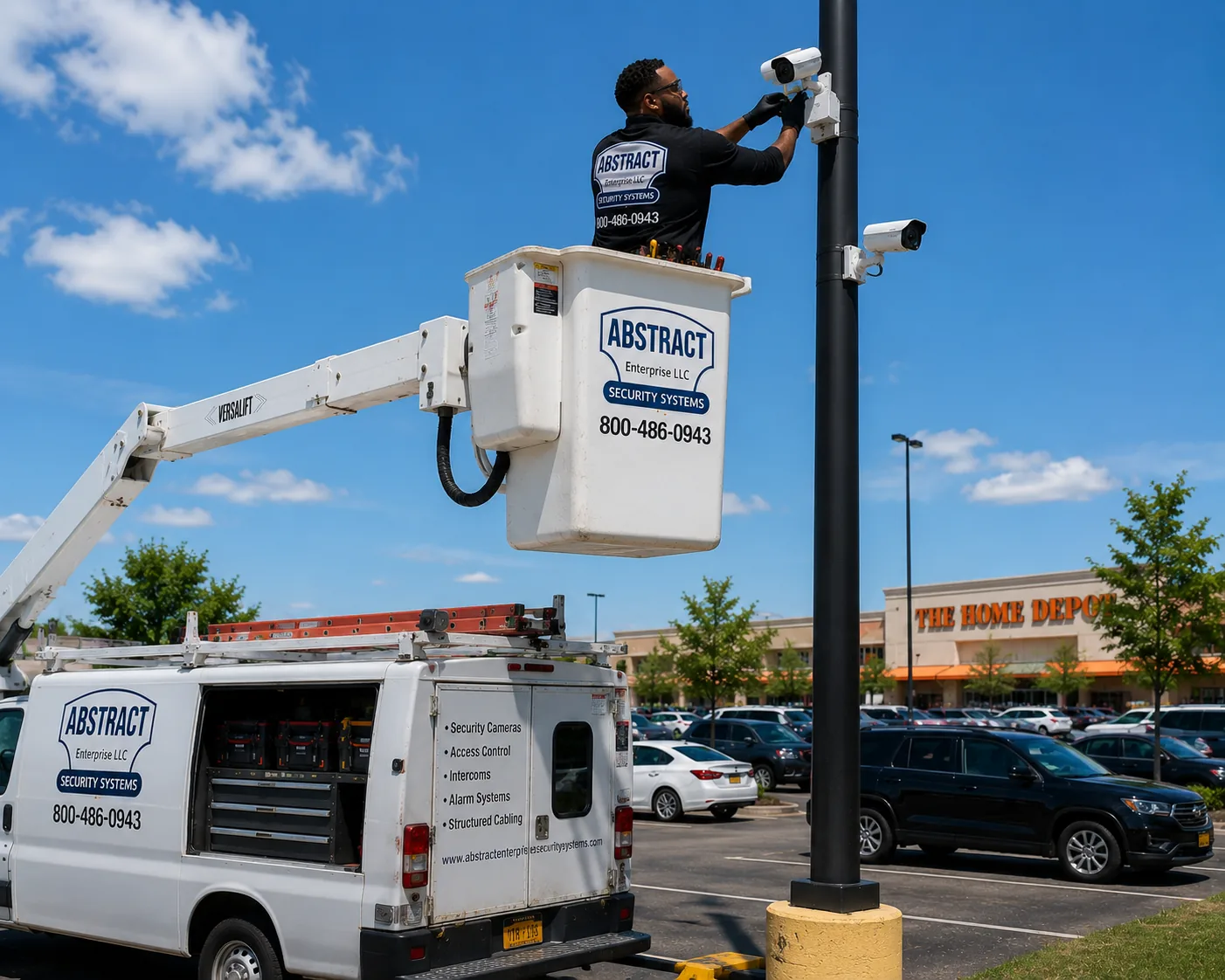
Every property is different, and the fastest way to a real answer is a walkthrough. Call (845) 640-3835 or request a free on-site survey, and we will scope coverage, retention and pricing for your specific Westchester lot — no phone-quote guesswork.
FAQ
It depends on the lot, but most Westchester jobs run a few days to about a week on site once materials are in. A compact building-mounted layout on a small lot can be a day or two; a larger property with pole footings, trenching through ledge, a fiber run or a deck adds time. The survey gives a realistic schedule up front, and staged work keeps the lot usable throughout rather than closing it.
Sometimes. The cameras themselves usually do not, but pole footings, electrical work, trenching in a right-of-way, and anything on a historic or architecturally reviewed parcel can trigger a permit or a village-board review — and Westchester has a lot of municipalities, each with its own rules. AESS identifies what a specific lot needs before work starts, so the timeline accounts for it. This content is general information and is not legal advice.
Yes. Plenty of Westchester lots have an existing system that is half-working or badly aimed, and we diagnose it at the recorder and the field enclosure, keep the hardware that is still good, and replace only what has failed. If the lot went dark after an incident, that is a same-day priority, and the finished system is documented and handed over so it is not tied to the last contractor.
You own it outright. The recorder, cameras and footage are yours, with individual accounts rather than a login we keep, and there is no required monthly monitoring contract to use the system. Optional add-ons like off-site cloud copies or a monitoring service are available if you want them, but they are a choice, not a lock-in.
There is no fixed number — it comes from the lot. Entrances and exits, the rows where cars sit longest, pedestrian routes, and any deck levels each drive positions, and a plate-capture entrance is its own dedicated camera. A small commuter lot might need a handful; a mall lot, a hospital deck or an I-287 campus needs considerably more. The survey maps coverage to the actual property rather than selling a round number.
Yes. Where running power and cable to a far pole is not worth the trench — especially through Westchester ledge — a solar-and-cellular position or a battery-backed camera on an engineered wireless link keeps that corner covered without opening the ground. It has to be sized for the site (sun exposure, distance, camera load), which the survey checks, but it is a real option rather than a compromise.
For a while, if it is designed that way. The recorder and key cameras can sit on a battery backup so a short outage does not create a gap, and critical positions can carry their own power. A long outage is a different matter, but the system is built so a brief loss of utility power — common enough in a Westchester storm — does not take the lot offline at the moment coverage matters most.
Yes. The northern towns — Bedford, Katonah, Yorktown, Somers, North Salem — run larger, more spread-out lots behind village centers and at commuter stations, often on rock and with longer distances between buildings and parking. Those distances favor fiber runs and wireless hops, and coverage is planned the same careful way it is down south, just for a different property type.
Yes. The system exports a specific clip to a file you can hand to police, an insurer or an attorney, with the timestamp and camera intact, rather than making someone film a monitor. We show you how to search by time and camera and export on your own during the closeout walkthrough, so when something happens you are not waiting on us to pull it.
Cold-weather housings with heaters and defog keep domes clear through freeze-thaw, and positions are placed so plowed snow piles do not bury a low camera or block a plate lane. Beyond that, an occasional lens cleaning and a check after a hard storm keep the picture usable; we can handle that on a service visit, or show your staff what to look for so a salted, spray-covered lens does not quietly degrade the footage.
Usually yes, and it matters more in Westchester than most places because reopening a trench through ledge is expensive. Pulling conduit with spare capacity to the entrance, planning a power route and picking camera positions with a future gate arm or added cameras in mind means the next phase is a pull-and-mount instead of a second excavation. It is cheap insurance while the ground is already open.
Abstract Enterprises Security Systems provides a three-year warranty on products supplied by AESS for normal wear and tear. It does not cover existing or customer wiring, customer-supplied equipment, lightning or other acts of God, power outages or surges, physical damage or unplugging, internet, router or phone changes, or camera readjustments requested after completion. After the warranty period, service is $195 per hour with a three-hour minimum ($585). Full terms are on our warranty page.
Abstract Enterprises Security Systems provides a three-year warranty on products supplied by AESS for normal wear and tear. It does not cover existing or customer wiring, customer-supplied equipment, lightning or other acts of God, power outages or surges, physical damage or unplugging, internet, router or phone changes, or camera readjustments requested after completion. After the warranty period, service is $195 per hour with a three-hour minimum ($585).
Parking lot camera installation runs across Westchester County, and through our regional hubs the wider Hudson Valley, New York City and Long Island. Request a survey for your lot:
Our Hudson Valley parking hub covering Westchester, Rockland, Orange, Putnam, Dutchess and Ulster.
Parking Lot Camera Installation Hudson Valley
New City, Nanuet, Spring Valley, Suffern, Nyack, Pearl River, Haverstraw and the Route 59 corridor.
Request a Rockland lot survey
Middletown, Newburgh, Goshen, Monroe, Woodbury, Warwick, Chester and the Route 17 and I-84 corridors.
Request an Orange County lot survey
Carmel, Brewster, Mahopac, Cold Spring, Putnam Valley, Patterson and Southeast.
Request a Putnam lot survey
Poughkeepsie, Fishkill, Beacon, Wappingers Falls, Hyde Park, Rhinebeck, Pawling and the Route 9 corridor.
Request a Dutchess lot survey
Kingston, New Paltz, Saugerties, Highland, Ellenville, Woodstock and the Route 9W and Thruway corridors.
Request an Ulster lot survey
Borough lot and garage systems, from open surface parking to multi-level structures and operator-managed facilities.
Parking Lot Camera Installation NYC
Nassau and Suffolk parking lots, commuter parking, industrial and coastal properties.
Parking Lot Camera Installation Long Island
Our complete low-voltage service list for the region.
Abstract Enterprises home
SHOP OUR SYSTEMS
$1,063–$1,875 installed
A small White Plains municipal deck or a Central Avenue strip-plaza lot — four fixed cameras covering the entrance, one aisle and a single perimeter run.
$1,875–$3,125 installed
A mid-size Sound Shore or Rivertowns lot — roughly eight cameras with full-aisle coverage and a plate-capture-ready entrance, sized for the longer runs a spread-out Westchester property needs.
$3,500–$5,625 installed
A Cross County-scale retail lot, hospital deck or Metro-North park-and-ride — sixteen-plus cameras with plate-capture lanes, pole PTZ and full perimeter coverage, engineered for real winters and trenching through ledge.
Ranges are installed pricing for the scope shown at Westchester County rates; plate-capture lanes, pole PTZ, long trenching through ledge and winter conditions move the figure within the range, finalized on your free survey.
No monthly fees — you own the system. Service visits and callbacks after install are $195/hour with a three-hour minimum ($585).
COMPLETE SERVICES
Full camera system design and installation for commercial and residential properties across Westchester County.
On-site diagnosis and repair for camera systems already installed across Westchester County.
Systems for offices, plazas, distribution buildings and shared-tenancy properties across the county.
Gate arms, credentialed entry and pedestal hardware for properties moving from open parking to controlled access.
Distribution-center interiors, docks and trailer yards — the natural companion to an employee lot system.
Camera coverage for active builds, laydown yards and staging areas across Westchester County.
ALL AREAS SERVED
The full parking silo is linked here; any area still without its own page is served directly via the request-coverage survey link.
Citywide hub across the five boroughs.
Retail, industrial, residential and institutional lots.
Below-grade and multi-level garages, attended facilities.
Mall and casino decks, storefront lots, and truck and fleet yards.
Garages, Hunts Point yards, resident and event lots.
Marina, mall, waterfront and ferry-district lots.
Nassau and Suffolk lots, commuter and coastal properties.
Roosevelt Field, LIRR commuter, South Shore marina and office-park lots.
Fire Island ferry, LIRR and airport lots, the Hamptons and Hauppauge fleet yards.
Regional hub across all six Hudson Valley counties.
You are here — Yonkers, White Plains, New Rochelle, the Sound Shore, Rivertowns and Metro-North lots.
GET IN TOUCH
Tell us about the property and we will schedule an on-site survey, map the lot, confirm pole, power and ground conditions, and produce an itemized proposal with a per-camera plan and calculated retention. Scheduling and the finish date depend on site conditions, equipment lead time, access, permitting needs, and the extent of the work.
Call (845) 640-3835
WhatsApp: wa.me/17186790359
NYS Low-Voltage License #12000287431
· 201 Google Reviews