Storage, Monthly Fees, Doorbells, Floodlights, Privacy and Smart-Home Fit · Also Searched as Ring vs Eufy · Updated November 2026
Eufy vs Ring is really a choice about where your video lives: eufy is the better system if you want recordings kept on the doorbell, a HomeBase or a recorder inside your home with no monthly fee, and Ring is the better system if you run Alexa, want months of cloud history you never have to manage, or want professional monitoring on the same app.
Quick answer: Choose eufy for local storage with no subscription, wired PoE recorder kits and a doorbell that keeps its own clips; choose Ring for Alexa, up to 180 days of cloud video on one plan for the whole address, and optional 24/7 professional monitoring. Installed by our NYC crews, four Ring cameras start from $1,350 and a four-camera eufy system with its recorder and 4TB of storage starts from $1,919 on our current price lists, mounting, wiring up to 100 ft per camera and app setup included. We book requests within 2 hours.
The eufy-or-Ring question usually reaches us half-decided. A Bensonhurst homeowner has read that eufy has no monthly fee and wants to know what the catch is. A Harlem brownstone owner has a Ring doorbell from a holiday sale and is wondering whether the rest of the house should match it. A landlord in Jamaica wants cameras on two hallways and does not want a tenant's phone plan to be the only copy of the footage. This page lines the two brands up the way those conversations go: where recordings are stored and for how long, what you pay each month for the next three years, how each doorbell copes with a weak chime transformer, what the floodlights actually do, how each company has handled privacy, and which parts of either system a handy owner can safely put up alone. Specifications come from eufy's product, support, privacy and warranty pages and from Ring's product, plan and help pages, read in November 2026. The opinions come from installing both brands on New York properties.
Reviewed and updated November 8, 2026, against eufy's pages for the Video Doorbell (Wired) S330, its support table comparing every eufy doorbell, the Floodlight Camera E340 product page and support spec sheet, the HomeBase S380 product page and its storage articles, the PoE NVR Security System E41 page, eufy's Local Security page, its Cloud Backup support article, its eufy Plus membership page, its privacy commitment page and its US warranty table; Ring's Protect plans page, its Outdoor Cam 2K page, its help article on video end-to-end encryption, and the Ring doorbell, Outdoor Cam 4K Pro, Floodlight Cam Plus and Ring Edge pages we read for our Ring vs Nest and Ring vs Arlo comparisons; the New York Attorney General's January 28, 2025 announcement about eufy cameras; and a live search of what ranks for "eufy vs ring" (U.S. News, HomeGuide, Homes & Gardens, Buffalo Alarm and a Reddit r/EufyCam thread among them). Installed prices come from our own NYC eufy and Ring price pages. Anything a manufacturer page would not confirm is marked as unconfirmed rather than filled in. · Reviewed by Abstract Enterprises Security Systems, NYS license #12000287431, for installs run out of 1282 Troy Avenue, Brooklyn
Owner-operated since 2002 · Thousands of jobs completed · Booked within 2 hours
The two-minute version. eufy is the security line of Anker Innovations, and its whole pitch is local storage: its Local Security page promises "no monthly fee," says recordings stay inside your home, and says storage can grow to 16 TB when you add a drive to a HomeBase. Ring is the camera and doorbell company owned by Amazon, and its pitch is the opposite shape: cameras that send clips to Ring's cloud, where a Ring Protect plan keeps up to 180 days of history and unlocks the smarter alerts. Both sell video doorbells, outdoor cameras and floodlight cameras. Both offer an optional end-to-end encryption mode. Both will alert your phone and let you talk to whoever is at the door. Where they part ways is everything that happens after the motion is detected.
With eufy, the clip is written to storage you own: built-in memory on the doorbell, a microSD card in the camera, a HomeBase S380 on a shelf, or a PoE recorder in a closet. Nothing is owed each month unless you choose eufy's optional Cloud Backup. With Ring, the clip goes to the cloud. Live view and alerts work without a plan, but Ring's own product page is plain that without a Ring Protect subscription you "won't be able to review any videos or images you missed." Ring's local option, Ring Edge, needs a Ring Alarm Pro base station and a plan. So the honest rule we give customers is short. If paying every month bothers you, or you want the footage physically on the property, start with eufy. If your home already talks to Alexa, if you want history measured in months without thinking about drives, or if you want a monitoring center to call the police when an alarm trips, start with Ring. Everything else on this page explains the edges of that rule.
One more thing belongs at the top rather than buried at the bottom. In January 2025 the New York Attorney General announced a $450,000 settlement with three companies that distribute eufy cameras, after an investigation found that some eufy video streams had not been fully encrypted and could be opened by anyone with the right link. We explain what was found, what eufy changed and what we turn on for customers in the privacy section below. It is a real part of the eufy vs Ring decision for New Yorkers, and we would rather you read it here than discover it later.
Neither brand sells one fixed "system," so we compared the parts New Yorkers actually buy from each: the wired and battery doorbells, the floodlight camera, the main outdoor camera, the storage behind them, the monthly plans, the app and the warranty. On the eufy side that means the Video Doorbell (Wired) S330, the Video Doorbell C31, the Floodlight Camera E340, the HomeBase S380 and the PoE NVR Security System E41. On the Ring side it means the Battery Doorbell 4K Pro and Ring's wired doorbell line, the Outdoor Cam 2K, the Outdoor Cam 4K Pro, the Floodlight Cam Plus and the Ring Protect plans. Each cell comes from eufy's or Ring's own pages. Plan prices are the brands' own monthly figures; our installed prices sit in their own section further down and are never set beside a store price.
| What we compared | eufy | Ring |
|---|---|---|
| Where video is stored | Locally by default: 8GB built into the S330 doorbell, microSD up to 128GB in the C31 doorbell and E340 floodlight, 16GB in a HomeBase S380 expandable to 16TB, or a 2TB drive in the E41 recorder that takes up to 16TB | Ring's cloud, with up to 180 days of event history on a Ring Protect plan; local microSD storage only through Ring Edge in a Ring Alarm Pro base station |
| Monthly fee to keep recordings | None for local storage; optional Cloud Backup from $3.99 a month for one device or $13.99 for unlimited devices, each with a rolling 30 days | Ring Solo $4.99 a month (one device), Ring Multi $9.99 (every device at one address), Ring Pro $19.99 (adds AI features and 24/7 professional monitoring) |
| Resolution | S330 doorbell: 2K main camera (2560 × 1920) plus a 1080p package camera; E340 floodlight: 3K plus 2K lenses; E41 PoE kit cameras: 4K | Outdoor Cam 2K: 2560 × 1440; Battery Doorbell 4K Pro and Outdoor Cam 4K Pro: Ring's "Retinal 4K"; Floodlight Cam Plus: 1080p |
| Power and wiring | Doorbells on bell wire (S330 needs 16–24 VAC at 30 VA or more) or battery; floodlight on 100–240 V mains; recorder kits on one PoE cable per camera | Every power type somewhere in the range, from swappable batteries to PoE; the Outdoor Cam 4K Pro has a PoE+ version and the Wired Doorbell 4K Elite takes its power from a network cable |
| Wi-Fi | Every eufy doorbell in eufy's comparison table is 2.4 GHz only; Floodlight Camera E340 is dual-band 2.4 and 5 GHz Wi-Fi 6; PoE cameras need no Wi-Fi at all | Outdoor Cam 2K and Floodlight Cam Plus are 2.4 GHz only; Battery Doorbell 4K Pro and Outdoor Cam 4K Pro use 2.4 and 5 GHz |
| 24/7 recording | C31 doorbell, S4 doorbell, E340 floodlight (with microSD or a HomeBase) and the PoE recorder kits; eufy says continuous recordings cannot be downloaded | Add-on of $3 a month per eligible camera on any Ring Protect plan, with recordings kept in the cloud for up to 14 days |
| App | eufy Security app (eufy's support pages also call it the Anker eufy app) plus a web portal | Ring app on phones and tablets, plus viewing on Ring.com |
| Smart-home fit | Alexa on every doorbell in eufy's table and Google Assistant on most; E340 floodlight lists both; eufy's FAQ says its S4 doorbell works with HomeKit | Works with Alexa, including Alexa+ Greetings on select doorbells; Google Home and Apple Home are not listed on the Ring pages we read |
| Encryption | Encrypted in transit by default; optional Advanced Encryption with end-to-end keys; local video stored with AES encryption | Optional video end-to-end encryption, which switches off Alexa viewing, shared users, Video Search, Smart Alerts and other features |
| Professional monitoring | eufy links a separate Protection Plan service from its site; we did not review its terms for this page | 24/7 Professional Monitoring included in Ring Pro; Virtual Security Guard adds live video monitoring by agents |
| Standard warranty | 12 months on security cameras, doorbells and HomeBase; 36 months on the Network Video Recorder S4 and the S4 and E41 PoE cameras | One-year limited warranty; Ring Multi and higher plans add extended coverage on eligible devices |
| Best for | Owners who refuse a monthly bill, want the footage on the property, or want a wired PoE recorder system at a house or small building | Alexa homes, people who want months of history without managing drives, and anyone who wants monitoring and alarm on one app |
Read the first two rows together, because they are the decision. A eufy system bought outright keeps working at full strength with no further payments, and the only limit on how far back you can scroll is the size of the drive you put in it. A Ring system is cheaper on our installed price list at the four-camera level, but its recordings depend on a plan that renews every month or year, and Ring's plan page warns that if a subscription lapses "you will lose your stored video recordings, and they will not be retrievable." Then read the warranty row. eufy's wired PoE recorder and its S4 and E41 PoE cameras carry 36 months from eufy, which is longer than anything else in this comparison, while its Wi-Fi and battery products carry 12 months like Ring's.
If you are covering a shop floor, a parking lot, a building lobby or more than about eight cameras, a consumer brand of either kind is usually the wrong tool. eufy's recorder kits stretch to 16 channels, which is respectable, but a commercial recorder with professional cameras will give you better low-light detail, proper user permissions for staff, and parts that a service company can source for years. Our quotes default to our own non-branded recorder system for that reason. We are glad to install eufy or Ring where they fit, and we will tell you when they do not.

Storage is the heart of the eufy vs Ring argument, so it gets the longest section. Every other difference on this page is smaller than this one.
The simplest eufy setup needs no hub at all. The Video Doorbell (Wired) S330 has 8GB of memory built in, and eufy's own FAQ for the product works it out at about 90 days of events if the door sees 25 motion clips a day at 15 seconds each; when the memory fills, the oldest clips are overwritten. The Video Doorbell C31 and the Floodlight Camera E340 take a microSD card of up to 128GB instead, and both can record around the clock to that card. For a single door or a single driveway this is the cheapest way to keep video with nothing to pay afterwards, and it is the setup we install most often for eufy customers who own one-family houses.
There is one catch eufy states openly on the S330 page: "a stolen or damaged doorbell takes its recordings with it." A burglar who rips the doorbell off the frame walks away with the evidence. That is the case for adding a HomeBase, which keeps a second copy indoors.
eufy describes the HomeBase S380, also called HomeBase 3, as a local storage and processing hub. It does not record video on its own; compatible eufy cameras and doorbells send their clips to it. It ships with 16GB of non-removable storage, which eufy's support article says is enough for about two months of video from one camera, or one month from two cameras, if each sees 30 motion events a day at 60 seconds each. A 2.5-inch SATA hard drive or SSD of up to 16TB slides in for more, and eufy's support page says such a drive can hold "years of videos" for a one-camera system. eufy rates the S380 for up to 8 wired devices (four of them recording 24/7), up to 16 battery devices and up to 34 sensors, and it has a built-in 100 dB siren and eufy's BionicMind face recognition, which runs on the hub rather than in a cloud.
Two practical notes from installing them. First, eufy warns that it does not support hard drives that need a 12V supply, so a drive has to be a bus-powered 2.5-inch model; we bring the right one rather than trusting whatever is in a drawer. Second, a HomeBase only protects the footage if it is somewhere a burglar will not find it in thirty seconds. On the shelf next to the router in the front hall is the first place a thief looks. A closet, a basement utility room or a high cabinet is better, as long as the Wi-Fi reaches.
At the top of the eufy range are the PoE NVR kits, which work like a traditional camera system. The PoE NVR Security System E41 that we price on our list pairs four 4K turret cameras with an 8-channel recorder that eufy says expands to 16 channels, a pre-installed 2TB hard drive upgradeable to 16TB, and 24/7 recording. Each camera runs on one network cable that carries both power and video, eufy rates the kit's cameras IP67, and eufy's US warranty table gives the Network Video Recorder S4 and the S4 and E41 PoE cameras 36 months. Nothing in that system depends on Wi-Fi, on batteries or on a plan. If a customer asks us which eufy setup we would put on our own houses, this is it.
Ring stores recorded clips in its cloud. Ring's plans page says motion event videos are stored "for up to 180 days from recording" on its Solo, Multi and Pro plans, and that changing the storage length only affects recordings made after the change. For round-the-clock video Ring sells a 24/7 Continuous Recording add-on per eligible camera; Ring's footnote says those recordings are "temporarily stored in the cloud, up to 14 days." Without any plan, a Ring camera still streams live view, sends alerts and lets you talk through it, but Ring's Outdoor Cam 2K page says you "won't be able to review any videos or images you missed."
The strength of the cloud model is that nobody can steal it. A burglar who pulls a Ring camera off the wall has not touched the clip of their own face, which was already uploaded. You also never think about drive space, failed hard drives or where the hub is hidden. The weakness is the dependency: the plan has to stay paid, the internet has to be up when the event happens, and the history is only as long as the plan says.
Ring does offer local storage, but it is a narrower path than eufy's. Ring Edge records to a microSD card inside a Ring Alarm Pro base station, which is the base station of Ring's alarm system. On the Ring pages we read for our Ring vs Arlo comparison, Ring Edge required a compatible subscription, linked Ring and Amazon accounts, and cameras on the same eero network, and the current plans page shows Local Video Storage as a feature of the Pro and Virtual Security Guard tiers. So it is a real option for a Ring household that wants an on-premises copy, but it is not a way to avoid a subscription.
This is where the two designs feel most different in New York, where cable outages during storms and building-wide router swaps are common. A eufy doorbell writing to its own memory, or a PoE camera writing to a recorder in the basement, keeps recording through an outage; you simply cannot view it remotely until the connection returns. A Ring camera with no Ring Edge depends on the upload to save the clip at all. If your block loses service often, that matters more than any resolution figure.
Put the two weaknesses side by side and the answer for most homes is a mix. eufy's weakness is physical: a doorbell with on-board storage leaves with the thief, and a HomeBase in plain sight can too. Ring's weakness is financial and network: no plan or no internet, no clip. On eufy jobs we therefore hide the HomeBase or recorder and suggest the optional Cloud Backup for the one or two cameras that matter most. On Ring jobs we make sure the plan is set before the 30-day trial ends and that the Wi-Fi at every camera is strong enough to upload a clip in the seconds that count.

Ring's plans page, read on November 8, 2026, lists four tiers. Ring Solo is $4.99 a month or $49.99 a year and covers one doorbell or camera. Ring Multi is $9.99 a month or $99.99 a year and covers every Ring device at one location, and it adds an extended warranty that in the U.S. is a service contract administered by Allstate Protection Plans. Ring Pro is $30 a month (keypad) or $45 a month (with the app) or $199.99 a year and adds Video Descriptions, Familiar Faces, Active Warnings, Video Search, Unusual Event Alert and 24/7 Professional Monitoring for Ring Alarm. Virtual Security Guard is $99 a month and adds live video monitoring by trained agents. On top of those, Pro Intelligence adds the AI features to one camera for $5 a month on Solo or Multi, and 24/7 Continuous Recording is $3 a month per camera on any plan. Every plan auto-renews, a new device gets a free 30-day trial, and a second address needs its own plan.
Two state-specific notes from Ring's footnotes matter less in New York but are worth knowing if you own property elsewhere: Ring says its AI features are not available in Illinois, and Familiar Faces is not available in Illinois, Texas or Portland, Oregon.
eufy's cloud is optional and narrower. Its support article on Cloud Backup lists a Basic plan priced by device count, $3.99 a month or $39.99 a year for one device, $7.99 or $79.99 for two and $11.99 or $119.99 for three, and a Plus plan for unlimited devices at $13.99 a month or $139.99 a year. Every plan keeps a rolling 30 days, after which clips are overwritten. eufy says videos are stored on Amazon Web Services servers, encrypted when uploaded, and playable only through its app. Two pieces of small print stood out to us: an account can hold only one cloud package at a time, and eufy says users cannot cancel Cloud Backup directly, but must contact eufy support with the camera's serial number. Separately, eufy sells a eufy Plus membership at $15 a month that includes 30-day Cloud Backup history for all devices along with shopping perks; annual members also get an extra six months of warranty on products bought while the membership is active.
The comparison that matters is not plan against plan, because eufy's plan is optional and Ring's is close to essential. For a typical New York house with a doorbell and three cameras, Ring's sensible choice is Ring Multi. That is $99.99 a year if paid annually, which over three years comes to about $300 in plan fees, or about $360 if paid monthly. A eufy system with local storage costs nothing in those same three years. If the eufy owner adds Cloud Backup Plus for an off-site copy of every camera, the total over those same three years is about $420 at the annual rate, which is more than Ring Multi and buys only 30 days of history rather than 180. So the cheapest long-run setup is eufy with local storage only, and the best cloud value is Ring Multi.
With no subscription, a eufy system does everything its hardware allows: it records locally, sends alerts, shows live view, runs its on-device person and package detection, and lets you scroll back as far as the storage reaches. A Ring system with no subscription is a live camera and a doorbell intercom. It alerts, it streams, it talks, but it saves nothing you can go back to. Ring is upfront about this, and it is fine for some people. A renter who only wants to see who is at the door before buzzing them in may never need a saved clip. Anyone who wants evidence after a package theft or a hit-and-run in the driveway does.
Most eufy vs Ring decisions start at the front door, and the doorbell is where the two brands differ in the most practical ways: how they take power from the old bell wire, where they keep the clip, and whether they can see the package on the step.
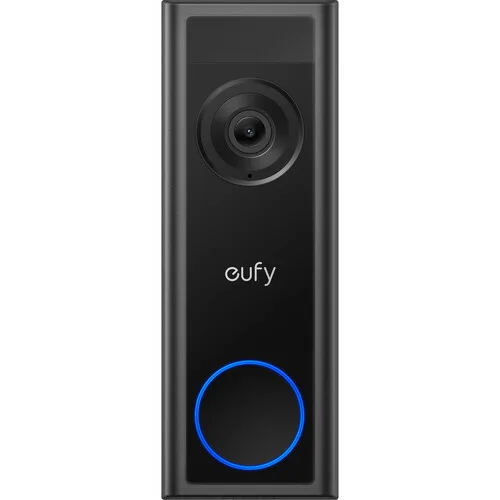
eufy's support page that compares every eufy doorbell is unusually complete, and it is where most of these figures come from. The Video Doorbell (Wired) S330 is the one we fit most often on houses with existing bell wire. It has two cameras: a 2K main camera at 2560 × 1920 with a 160° view, and a second 1080p camera with a 120° view that looks down at the step. It has no battery, records motion events rather than 24/7, keeps them on 8GB of built-in memory and comes with an indoor chime. eufy's table lists Alexa for live view and doorbell-press announcements on this model. The Video Doorbell C31 is a 2K doorbell at 2048 × 1536 that can run on its 6500mAh battery or on bell wire, stores to a microSD card of up to 128GB that is not included, and is the eufy model eufy recommends for 24/7 recording with a 5-second pre-roll; it lists both Alexa and Google Assistant. The battery-only C30 uses a 5000mAh battery that eufy rates at 120 days. eufy's newest wired model, the S4, is described in eufy's own FAQ as a wired 3K panoramic doorbell with 24/7 recording and color night vision that works with a HomeBase and with Apple HomeKit. Every doorbell in eufy's table carries a 12-month warranty, an IP65 rating and a −4 °F to 122 °F operating range, and every one connects on 2.4 GHz Wi-Fi only.
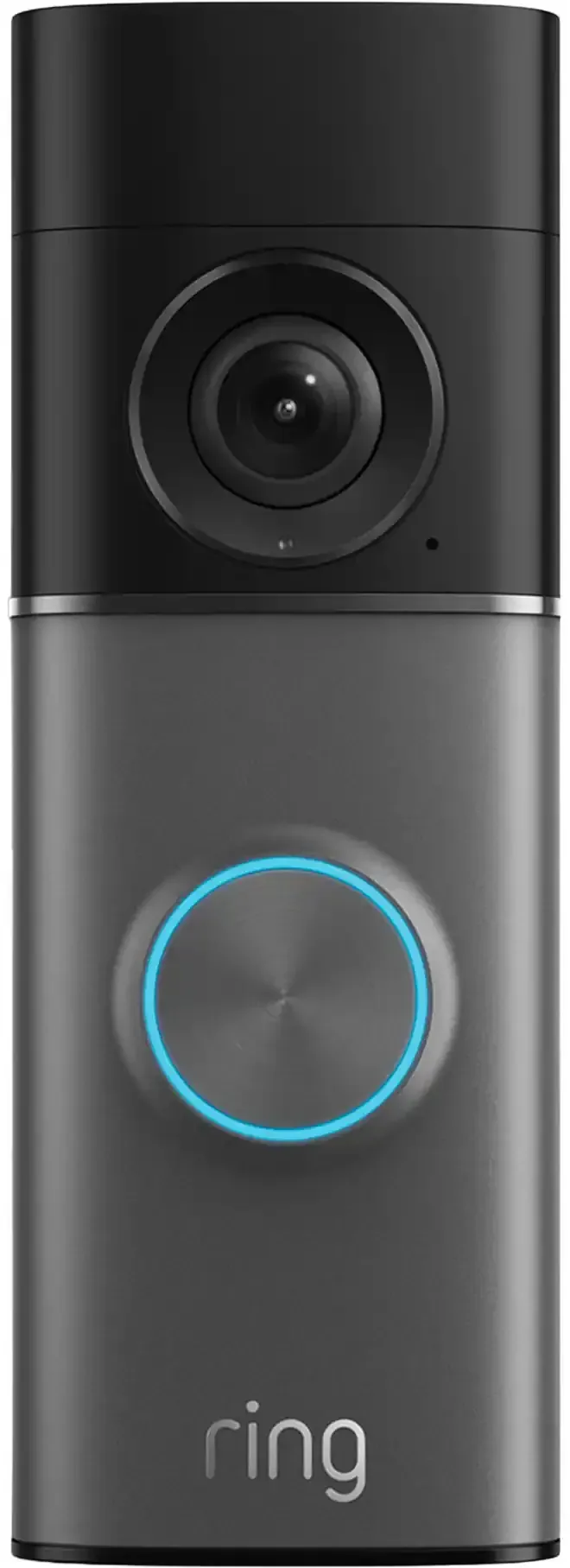
Ring's doorbell range is wider. Our price list carries the Wired Doorbell 2K, Battery Doorbell 2K, Wired and Battery Doorbell 2K Plus, Wired and Battery Doorbell 4K Pro and the Wired Doorbell 4K Elite (2nd Gen). On the Ring pages we read for our earlier comparisons, the Battery Doorbell 4K Pro recorded in what Ring calls "Retinal 4K" with a square head-to-toe view of 140° wide by 140° tall and 10x Enhanced Zoom, used dual-band Wi-Fi 6, was rated from −4 °F to 122 °F, accepted bell wire from an 8–24 VAC transformer of up to 40 VA, and carried a one-year limited warranty. Ring's line comparison also showed a native Power over Ethernet model, the 4K Elite, and noted that some cheaper Ring doorbells connect on 2.4 GHz only. Every Ring doorbell keeps its clips in Ring's cloud, so none of them needs memory on the device.
The single most common reason a wired doorbell misbehaves in New York is the transformer feeding it. Many houses built before the 1980s still have a small 10 VA chime transformer in the basement or behind the chime. eufy's S330 page is direct about it: the S330 "requires a 16–24VAC power supply with a transformer rated at 30VA or higher," older 8V or 16V 10VA transformers "may not provide enough power," and "a 24V 40VA replacement is the common fix." eufy's battery and dual-power doorbells, like the C31 and E340, are rated to accept 8–24 V at 10 VA or more because the battery covers the gap. Ring's battery 4K Pro accepts 8–24 VAC up to 40 VA when wired in. In practice that means a eufy S330 on an old house often needs a new transformer, which we carry, and a Ring battery doorbell on the same wire will usually run but may still draw down its battery on a busy day. We meter the transformer before we mount anything.
If package theft is the reason you are buying a doorbell, eufy has the hardware answer. The S330 and the E340 both carry the second, downward camera, and eufy's S330 FAQ suggests mounting about 4 ft above the ground with a clear line to where couriers leave boxes. Ring's answer is software: Package Alerts are part of its Smart Alerts on select models with a plan, and the 4K Pro's 140° by 140° view is what Ring calls a head-to-toe view of the visitor. On a deep brownstone stoop where the box lands below the doorbell's line of sight, the eufy two-camera design is simply better. On a flat entry where the courier is fully in frame, either works.
Neither brand makes a doorbell meant to replace an apartment building's intercom or buzzer panel, and neither should be wired into one. In a co-op or rental, a battery doorbell on your own unit door is usually allowed where a hardwired one is not, and both brands sell battery models. If the real goal is seeing who is at the street door of the building, that is an intercom job, not a doorbell job, and our intercom installation team in NYC handles it separately.

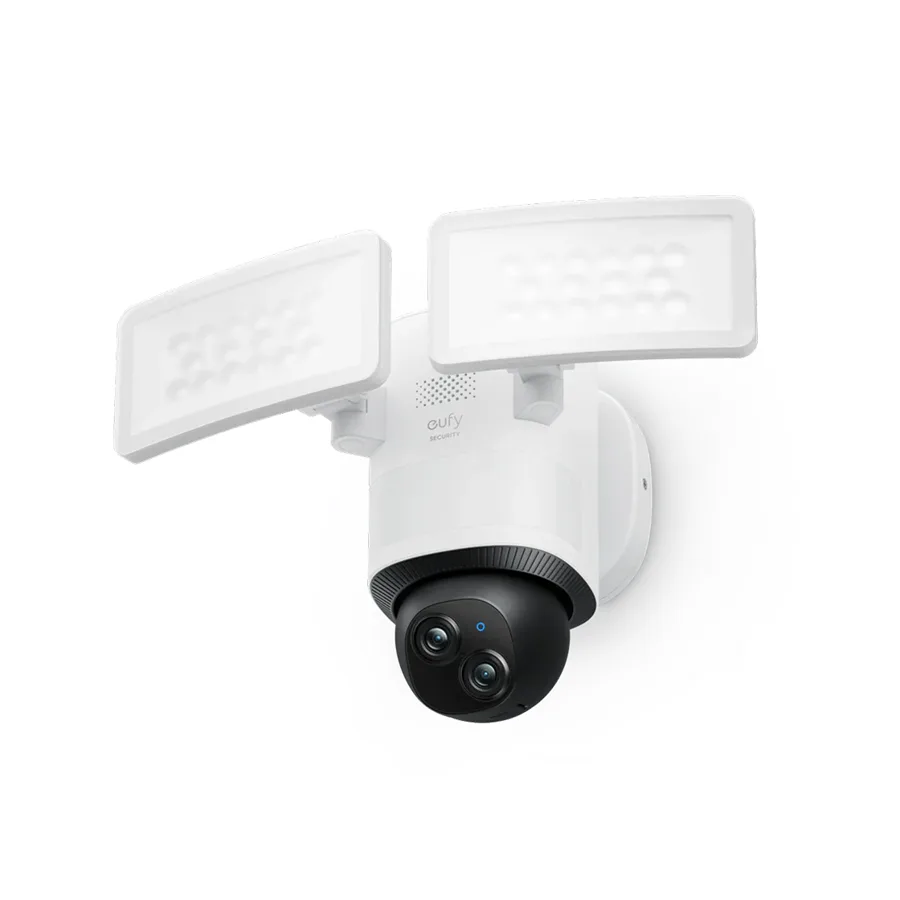
The E340 is the eufy floodlight we install most, and it is a more ambitious device than most floodlight cameras. eufy's support spec sheet lists two lenses on a motorized head, a 3K wide lens at 2880 × 1620 and a 2K telephoto at 2304 × 1296, with 3x optical and 8x digital zoom; the head pans a full 360° horizontally so it can follow a person across a yard. It has two dimmable light panels totalling 2,000 lumens at 4,000 K, infrared night vision eufy rates at 50 ft for a human body, two-way audio, and a siren eufy's spec sheet puts at up to 100 dB (its product page summary says 95 dB, so we quote the range rather than pick one). It runs on 100–240 V mains, connects on 2.4 and 5 GHz Wi-Fi 6, takes a microSD card up to 128GB, records 24/7 with that card or a HomeBase, works with Alexa and Google Assistant, is rated IP65, and operates from −4 °F to 104 °F. That upper limit is the one number we would flag: a south-facing wall in a Bronx July can get close to it.
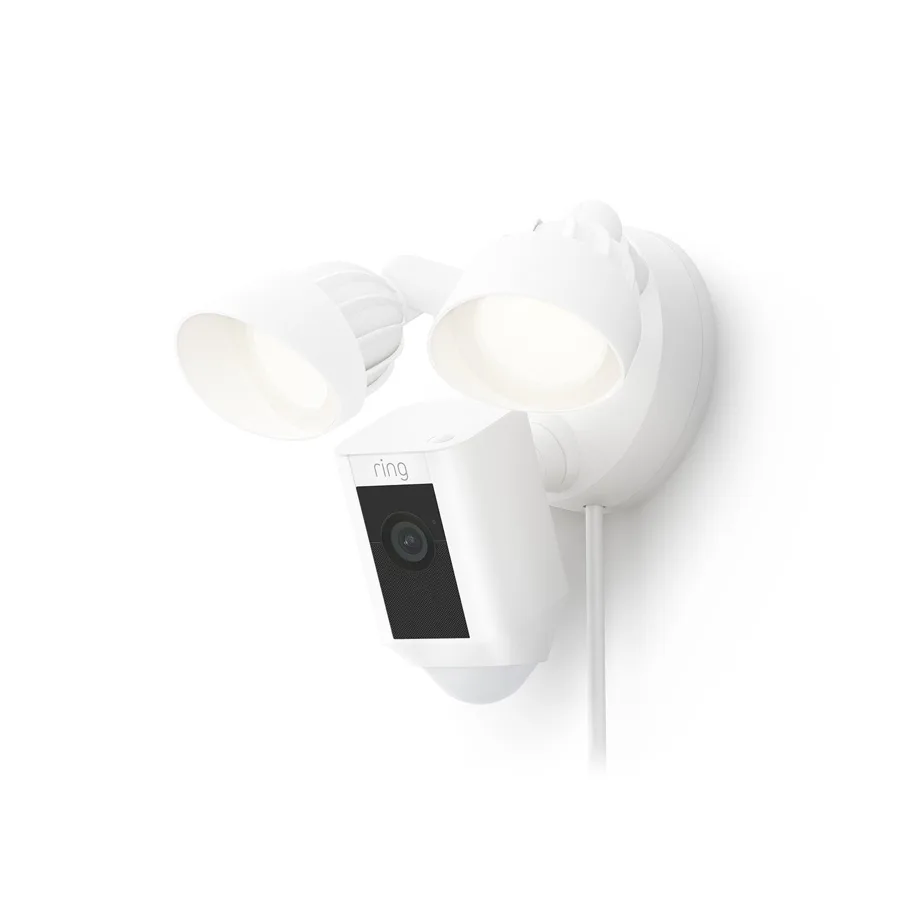
Ring's Floodlight Cam Plus, as listed on the Ring page we read for our Ring vs Arlo comparison, is a simpler design: a fixed 1080p camera with color night vision and a 140° by 80° view, two 2,000-lumen lamps at 3,000 K, a 105 dB siren, hardwired at 110–240 V or available as a plug-in model, 2.4 GHz Wi-Fi, and a −5 °F to 122 °F rating. It does not pan or zoom optically. What it does well is the basics, reliably, inside an app that most households already know. Ring also sells 2K and 4K floodlights; our price list carries the Floodlight Cam 2K, Floodlight Cam 4K Plus and Floodlight Cam 4K Pro alongside the Plus.
For a long driveway or a wide back yard where one camera has to cover a lot, the E340's pan-and-zoom head and its 3K lens see more than a fixed 1080p floodlight, and its clips stay on the card. For a short side path or a single garage door where the job is light, siren and a clear face at ten feet, the Ring Floodlight Cam Plus is a solid, simpler device and slightly less on our price list. In both cases a hardwired floodlight needs a 120V junction box; if one is not there already, your electrician provides it and we mount, connect and set up the camera.
Ring's four-camera package on our price list is built on the Outdoor Cam 2K. Ring's product page gives it a 2560 × 1440 picture, a 140° horizontal by 85° vertical view, up to 6x Enhanced Zoom, color night vision that falls back to black and white in complete darkness, a remote-activated siren, power from a removable Quick Release battery or a 12.5 W USB-C plug-in adapter, single-band 2.4 GHz Wi-Fi, a −4 °F to 122 °F range and a one-year limited warranty. A step up, the Outdoor Cam 4K Pro, as listed in Ring's support specs, records in 4K with the same 140° by 85° view, has an 85 dB siren measured at 1 m, connects on 2.4 and 5 GHz, needs about 15 Mbps of upload for 4K, is rated −5 °F to 120 °F at IP65, and comes hardwired, plug-in or on PoE+.
eufy's closest answer to a Ring outdoor camera on a cable is not a Wi-Fi camera at all but the PoE line: the E40 bullet and E41 turret cameras and the S4 and E50 pan-tilt models, each sold alone or in kits with a recorder. The E41 kit page lists 4K resolution, a 122° view, color night vision using starlight, spotlight or infrared modes, an IP67 rating and 24/7 recording to the recorder. Because power and video share one cable, the camera never drops off Wi-Fi and never needs charging. That is a genuinely different category from anything in Ring's lineup apart from the 4K Pro on PoE+, and it is why a eufy PoE kit is often our recommendation for a two-family house that wants six or eight cameras without a monthly bill.
Less than the boxes suggest. A 4K Ring camera that has to squeeze its stream through a weak 2.4 GHz link in a brick rowhouse can deliver a softer picture than a 2K camera with a strong signal, and Ring itself recommends around 15 Mbps of upload for its 4K cameras. A eufy camera recording to local storage is not limited by your upload speed at all for what it saves, only for what you watch remotely. In practice, the mounting height, the angle and the light at night matter more to whether you can read a face or a plate than the resolution on the spec sheet. We mount for those first.

The facts here come from the New York Attorney General's own announcement, dated January 28, 2025. In November 2022 a security researcher publicly disclosed tests suggesting that eufy's marketing claims about security and "end-to-end encryption" might not be accurate. The Attorney General's office investigated a line of eufy cameras, doorbells and video locks distributed by Fantasia Trading LLC, Power Mobile Life LLC and Smart Innovation LLC. It found that, in certain situations, video sent over the internet from these products was not protected by end-to-end encryption, that at least part of the connection used no encryption at all, and that an active video stream could be opened by anyone with the relevant URL without logging in, a URL that it "may have been possible to deduce." The three companies agreed to pay $450,000 in penalties and costs and to regularly show that eufy's developer maintains an information security program, uses secure development and third-party vulnerability testing, runs penetration testing, and encrypts video in storage and in transit.
We think customers deserve to know that, especially New York customers, since it was New York's Attorney General who acted. We also think it should be read accurately. The finding was about video streams over the internet in certain situations, the investigation followed a public disclosure in 2022, and the settlement requires ongoing security work rather than describing a current, open flaw. Video written to a eufy device's local storage was not what the announcement described.
eufy's privacy commitment page says it encrypts video, event lists and face data in transit by default, that local video is secured with AES encryption on the device, that cloud video is protected with TLS and SRTP in transit and encrypted again at rest on AWS, and that an optional Advanced Encryption setting uses end-to-end encryption with keys kept in a vault that only the user's password opens. It also says alerts are text-only by default; if you choose alerts with picture previews, small thumbnails are briefly stored on an AWS server with server-side encryption and then deleted automatically. The page lists ISO/IEC 27001 and 27701, ETSI EN 303 645, NISTIR 8425 and ioXt among its certifications, two-factor sign-in, alerts for new device logins, privacy zones, and a bug bounty run with HackerOne. We have not audited any of that; we are reporting what eufy publishes.
Ring also offers optional video end-to-end encryption. Ring's help article says that when it is on, recordings are encrypted with keys only you control, only your enrolled phones can view them, and "no one else, including Ring services," can open them. The trade-off is long. With end-to-end encryption on, Ring lists these as unavailable: Active Warnings, Alexa and Fire TV viewing, Alexa+ Greetings, Bird's Eye View, Familiar Faces, Motion Tracking, viewing on Ring.com, Shared Users, Single Event Alert, Smart Alerts, third-party integrations, Unusual Event Alert, Video Descriptions, video links, Video Search and Virtual Security Guard. It needs iOS 17 or later or Android 9 or later, and Ring says most cameras support it apart from a short list of older models. In other words, Ring's strongest privacy setting turns Ring into a much simpler product.
If privacy means "no company holds my video," eufy's local storage gets closer to that by design, and its Advanced Encryption covers the parts that do travel. Its 2022 history is the reason to switch that setting on and keep firmware current, not a reason to rule the brand out. If privacy means "my video is encrypted end to end and I accept fewer features," Ring can do that, at the cost of most of what Ring's plans charge for. If privacy means "a large company with a long compliance record," some customers will prefer Ring for that reason alone, and that is a reasonable choice too.

The Ring app is the more polished of the two, and that matters if several people in the house will use it. Doorbells, cameras, floodlights and Ring Alarm sit in one place. Ring's plans page says every Ring device can be managed from an unlimited number of phones and tablets and from Ring.com on a computer. Paid features live here too: Multi-Cam live view of up to four cameras at once and up to 30 minutes of Extended Live View on a plan, doorbell presses that arrive like a phone call, device modes that change what records when you are home or away, and Ring Pro's search and descriptions.
eufy's app is called the eufy Security app on its privacy page and the Anker eufy app on its support pages; it is the same app, and eufy also runs a web portal for viewing on a computer. It handles live view, playback from local storage, shared users, activity and privacy zones, and the settings for the HomeBase and its BionicMind face recognition. Two limits are worth knowing before you choose it. eufy says 24/7 continuous recordings cannot be downloaded, only event clips can. And playback from a HomeBase or doorbell is pulled from your property in real time, so in our experience scrubbing through a long recording away from home is only as quick as your home internet's upload speed.
Ring is an Amazon company, and it shows. Ring cameras appear on Echo Show screens and Fire TV, and Ring's plans page advertises Alexa+ Greetings, which has Alexa answer the door, screen visitors and handle deliveries on select Ring doorbells with Alexa+ enabled. eufy's doorbells also work with Alexa: eufy's comparison table lists live view and doorbell-press announcements on Echo devices for every model, and the E340 floodlight lists Alexa too. For a household that lives in the Alexa app, Ring is the tighter fit, but eufy is not shut out.
Here eufy is the better fit. eufy's comparison table lists Google Assistant live view on almost every eufy doorbell, including the C31, C30 and E340, and the E340 floodlight lists Google Assistant as well. The Ring pages we read list Alexa only, with no mention of Google Home. If a Nest Hub is the screen on your kitchen counter, a eufy doorbell will show up on it and a Ring doorbell will not, at least on what Ring publishes. If Google is your ecosystem and you want a cloud brand, our Ring vs Nest comparison covers that pairing.
eufy's own FAQ says its S4 doorbell "works with HomeKit." We did not confirm HomeKit support for the other eufy models in this comparison, and we found no mention of Apple Home on the Ring pages we read, so we do not claim it for Ring. An iPhone household that wants HomeKit should ask us to confirm the exact eufy model before buying.
How a camera gets power decides how often you will touch it after we leave. Both brands sell every type, but they lean in different directions.
eufy rates its larger doorbell battery, 6500mAh, at about 180 days of use and its 5000mAh battery at about 120 days, while Ring's Outdoor Cam 2K uses a removable Quick Release battery pack that you swap rather than unscrew the camera to charge. Battery life on either brand depends on how busy the spot is: a doorbell facing a quiet garden path lasts far longer than one facing a sidewalk with a bus stop. Cold also shortens it. In New York we fit battery devices where they make sense, on rentals and on spots with no power nearby, and we warn customers that a January stoop is the hardest test a battery faces.
Wired doorbells on both brands take power from the low-voltage bell circuit, which is why the transformer section above matters. Floodlights on both take mains power from a junction box. That part is electrician work in New York; we mount, connect and set up the floodlight once the box and circuit are in place.
This is the wired option we recommend most, and it is where eufy's PoE kits are strongest. One network cable carries power and video from a recorder or PoE switch to each camera, up to typical runs of 100 m under the Ethernet standard, so there is no battery, no outlet and no Wi-Fi to fail. Ring offers PoE on its Wired Doorbell 4K Elite and on PoE+ versions of the Outdoor Cam 4K Pro and some Spotlight and indoor models on our price list, which is useful for a Ring household that wants one or two wired spots. eufy offers PoE across a full recorder system. On a house where we can fish cable through a basement ceiling and up an exterior wall, that difference often settles the brand.

Both brands are sold as do-it-yourself products, and plenty of owners put them up successfully. Some jobs are worth a Saturday afternoon. Others are where we see the callbacks from people who tried first.
Our honest summary is this. A single eufy or Ring doorbell and a camera or two are fine for a handy owner. A system meant to last, especially one that should keep recording without charging, Wi-Fi drops or a subscription, holds up better wired. On the eufy side that means a PoE recorder kit. On the Ring side it means hardwired and PoE models with a strong signal at each spot. Either way, it means cable in the wall rather than batteries on the facade.

A Park Slope or Bed-Stuy brownstone usually has a deep stoop, a parlor-floor door well above the sidewalk, an areaway door below it and often an original bell circuit with a tired transformer. We like eufy's two-camera S330 here because the downward camera can see a package at the foot of the door that a single camera misses, as long as we upgrade the transformer. For the areaway and the back garden, a eufy PoE turret on cable run through the cellar ceiling keeps recording with no batteries. A Ring household gets a 4K Pro doorbell and a plug-in or PoE camera in the yard, all on Ring Multi.
In Bayside, Marine Park, Throgs Neck or Staten Island's South Shore, houses have driveways, side yards and garages, which is floodlight country. The eufy E340's panning head earns its place on a long driveway, and a HomeBase S380 tucked in a closet ties the doorbell and floodlight together with local face recognition. A Ring setup there is a wired doorbell, a Floodlight Cam Plus or 4K floodlight over the driveway and an Outdoor Cam on the back, with plan history covering the whole address.
On a Ridgewood two-family or an Astoria three-family, the owner often lives on one floor and rents the others, and the cameras cover the shared front door, side alley and yard. This is where the plan-per-address model and the shared-account question matter. A eufy PoE recorder in the owner's basement keeps the footage under the owner's control with nothing to pay monthly; tenants can be given limited shared access if the owner wants. With Ring, one Multi plan covers every device at the address, which is simple, but every person who needs to see video becomes a shared user on the owner's account.
Inside a single apartment, the choice is usually a battery doorbell or a peephole-height camera on the unit door, plus an indoor camera. Check the building's alteration rules first. Both brands sell suitable battery models. Renters who want nothing stored on anyone's cloud tend to choose eufy; renters who already use Alexa and want the doorbell on their Echo Show tend to choose Ring.
For a small storefront or office with two to six cameras, a eufy PoE kit is a credible budget system: 4K cameras, a recorder in the back room, 24/7 recording, no fees. Ring is less suited here; its plans page notes that smoke and CO monitoring is not available for business or commercially zoned addresses, and a cloud plan per location adds up across several sites. Past six or eight cameras, or anywhere with staff who need separate access levels, we would recommend a commercial recorder system instead of either brand.

The first question in any building is who controls the video. With Ring, the account owner controls the plan and therefore every saved clip, and if a superintendent sets the system up on a personal email, the building has a problem when that person leaves. With eufy, the video is on a HomeBase or recorder the building owns, though the app account still matters for remote viewing. On either brand, we set the account up in the owner's or managing agent's name and add staff as shared users.
When a tenant reports a package theft from the lobby two weeks later, the system needs to still have it. Ring's plan keeps up to 180 days of events, which is generous. A eufy recorder keeps as much as its drive holds; we size the drive for at least two weeks of continuous recording on every recorder we install, and more if the board asks. The difference is that eufy's 24/7 footage is all there, while Ring's 180 days are motion events unless you buy the per-camera 24/7 add-on, which keeps 14 days.
In a rental building, decide in writing who can view live video and who can only request clips. Both apps support shared users; neither replaces a building policy. Never point a camera into an apartment's door viewer or window. Privacy zones on both brands let us black out any part of the view that should not be recorded.
For a small walk-up, our usual answer is a eufy PoE recorder kit or our own recorder system for the lobby, halls, mailboxes and rear yard, with individual tenants free to put a battery doorbell of either brand on their own doors. That keeps the building's evidence on the building's hardware and leaves personal choices to the people who live there.

These are our installed prices at the NYC rate, taken on November 8, 2026 from our own eufy and Ring price pages for New York City. Each camera price includes the device, mounting and a wire run of up to 100 ft; we connect it, test it and set it up in the brand's app. Prices are plus sales tax, and if this page ever disagrees with a price page, the price page is correct.
How to read the two packages: they are not the same thing. The Ring package is four Wi-Fi cameras with no recorder, because Ring records to its cloud. The eufy package includes a 16-channel recorder and a 4TB drive, because eufy records at home. So the eufy figure is higher on day one and the Ring system carries a plan from Ring every month after that. If you want the closest like-for-like comparison of a single door, look at the doorbells: $355 for the eufy S330 with its own storage against $425 for Ring's 4K Pro, which stores in Ring's cloud.
Picture a brick semi-detached house in Fresh Meadows with a front stoop, a shared driveway and a back yard. For an owner who wants no monthly bill: a eufy S330 on the bell wire after we replace the old transformer, an E340 floodlight over the driveway on the electrician's new box, and two eufy PoE turrets on the back corners wired to a HomeBase Professional S1 in the basement. For an Alexa household that wants Ring: a Wired Doorbell 4K Pro at the door, a Floodlight Cam Plus over the driveway, and an Outdoor Cam 4K Pro on PoE plus an Outdoor Cam 2K plug-in at the back, all on one Ring Multi plan. Either quote names every model, its power source and where its video is stored before we start.
Ask us to price our own non-branded recorder system alongside. It records on a recorder in your home or building with no monthly fee, it is what our quotes start with, and it is usually the lower number on larger jobs. Brand-specific details live on our eufy camera installation NYC and Ring camera installation NYC pages, and every brand we install is ranked on our best security camera brands hub.
eufy's US warranty table gives security cameras, the E50 PoE camera, the HomeBase and sensors 12 months, and gives the Network Video Recorder S4 and the S4 and E41 PoE cameras 36 months. A note under the same table says eufy provides software updates for two years from the purchase date. eufy's support center lists a phone line and 24/7 live chat, and its warranty claims run through an online exchange form. Annual eufy Plus members get an additional six months on products bought while the membership is active.
Ring's product pages carry a one-year limited warranty. Ring Multi and the higher plans add extended coverage on eligible devices that are still inside that first year, delivered in the U.S. as a service contract administered by Allstate Protection Plans, with the cost included in the subscription. Ring also offers a 10 percent discount on select Ring.com purchases to plan members.
A device that fails under the manufacturer's warranty goes back to eufy or Ring. Our own work is covered under our service agreement. Full terms — including 50% deposit, one-year parts-only warranty on AESS-supplied products, and the late-fee schedule — are set out in the service agreement. In practice, when something stops working the first call is usually to us, because most "dead camera" calls turn out to be a tripped outlet, a router that was replaced, a full card or a doorbell transformer that has failed, none of which is a warranty claim at all.
The most common reason we hear is the plan. Before you switch, download any Ring clips you need to keep, because they will not come with you and Ring deletes stored recordings when a plan ends. Check the doorbell transformer if you are moving to a wired eufy doorbell, since eufy's S330 asks for a transformer of 30 VA or more while a Ring battery doorbell can lean on its battery when the wire is weak. Then decide where the eufy storage will live, on the doorbell, a HomeBase or a recorder, before the cameras go up, so every device is paired to the right place from the start.
This usually happens when a household moves its whole home onto Alexa or wants professional monitoring. Download the clips from the HomeBase or recorder first; local footage is yours, but it will not import into Ring. The good news is that eufy's wiring rarely goes to waste. A bell circuit that powered a eufy S330 will power a Ring wired doorbell, and network cable pulled for eufy PoE cameras can feed Ring's PoE models or our own cameras.
Mostly true. Local storage is free, but a 24/7 recorder's hard drive is a wear part, an optional cloud copy costs from $3.99 a month, and an S330 on an old house may need a new transformer. None of that comes close to three years of a Ring plan, but it is not literally nothing.
Too strong. Without a plan Ring still gives you live view, motion alerts and two-way talk, which is all some renters want. What you lose is any recording to look back at, and Ring says so on its own pages.
Not quite. eufy's own Local Security page carries an asterisk: if you choose Cloud Backup or alerts with thumbnail previews, videos or thumbnails are sent to the cloud to provide those features. Live viewing from outside the house also travels over the internet. The local design keeps far less in the cloud than Ring, but it is not air-gapped.
Only with the bandwidth to carry it and a mount that suits it. A well-placed 2K camera with a strong signal often beats a 4K camera fighting a weak link through brick. eufy's local recording sidesteps the upload limit for what it saves, which is a quiet advantage on slow connections.
That is a judgment each customer gets to make. What we can say is what the record shows: the New York Attorney General found real encryption failures, eufy's distributors paid and agreed to ongoing security requirements, and eufy now publishes an optional end-to-end encryption mode and a list of certifications. We turn that encryption on for every eufy customer.
Bring it. We install customer-supplied eufy and Ring doorbells, cameras, floodlights and HomeBases regularly, priced per device at the area rate, and we will tell you straight if the spot you have in mind is a poor one for that model. Ahead of the visit, text us the model printed on the box, a picture of the chime transformer if it is reachable, and a picture of every spot you want a device. If the transformer is undersized, the Wi-Fi is weak at a spot or a floodlight box is missing, we sort that first so the device performs the way eufy or Ring intended. Our eufy price list for NYC and Ring price list for NYC link to our install-your-own pricing. Still comparing Ring with other cloud brands? See Ring vs Nest for Google households and Ring vs Arlo for battery-camera homes.

Tell us the street address or the closest corner, what kind of building it is, the doors and areas you want covered, whether you would rather keep video at home or pay a plan, and any eufy or Ring devices you already own. An installer phones you back with what we would fit and what happens next, or ring us directly at (800) 486-0943.
We walk every door, driveway and side yard you want covered, and ask who will use the app and whether video should stay in the house or in the cloud.
We meter the doorbell transformer, find outlets and light boxes near each spot, and look for a route for network cable wherever a wired camera would beat a battery.
We measure Wi-Fi strength and upload speed at each mounting point, because Ring keeps clips in the cloud and eufy still needs a connection for live view and alerts.
The quote lists every eufy or Ring model, how it is powered, where its video is stored, any electrician work for floodlights, and our installed price from the NYC list.
Devices go up with anchors chosen for the wall, whether brick, siding, stucco or wood; cable is fished or neatly run, and every penetration is sealed.
For eufy we install the HomeBase or recorder and its drive; for Ring we start the plan trial and choose a plan with you so recordings are not lost when the trial ends.
Activity zones are drawn to skip the sidewalk and the neighbor's door, person and package alerts are set, and privacy zones block windows that are not yours.
We ring the doorbell, save and download a clip, test two-way talk, turn on two-step sign-in, and add each household member as a shared user.
Choose eufy if you want recordings kept on the doorbell, a HomeBase or a recorder in your home with no monthly fee. Choose Ring if your home uses Alexa, you want up to 180 days of cloud history on one plan for the address, or you want professional monitoring. Many New York houses suit eufy's wired PoE kits; many Alexa households suit Ring.
Yes. It is the same pair of brands typed in the other order, so this page answers both. We keep one page for the pair so the specifications and prices are maintained in a single place.
Yes for local storage. eufy doorbells keep clips on built-in memory or a microSD card, and a HomeBase S380 or PoE recorder stores video on a drive in your home, with alerts, live view and on-device detection included. eufy's Cloud Backup is optional, from $3.99 a month for one device or $13.99 for unlimited devices, each keeping 30 days.
You keep live view, motion alerts and two-way talk, but Ring says you will not be able to review videos or images you missed. Saved history of up to 180 days, Smart Alerts and the other plan features need Ring Solo at $4.99 a month, Ring Multi at $9.99 or Ring Pro at $19.99.
It has 16GB built in, which eufy says holds about two months of video from one camera or one month from two, at 30 motion events a day of 60 seconds each. A 2.5-inch SATA hard drive or SSD of up to 16TB can be added, which eufy says can store years of video for a one-camera system.
In January 2025 the Attorney General announced a $450,000 settlement with three eufy distributors after finding that, in certain situations, eufy video sent over the internet was not end-to-end encrypted, part of the connection was unencrypted, and a live stream could be opened with its URL without signing in. The companies agreed to ongoing security and encryption requirements.
Yes, as an option. Ring says recordings are then encrypted with keys only you control and viewable only on your enrolled phones. It also switches off Alexa and Fire TV viewing, Shared Users, Smart Alerts, Video Search, Video Descriptions, Familiar Faces, viewing on Ring.com and several other features.
Often not without an upgrade. eufy's Video Doorbell (Wired) S330 needs 16 to 24 volts AC from a transformer of 30 VA or more, and eufy says older 10 VA units may fall short; a 24 V, 40 VA replacement is the usual fix. Ring's battery 4K Pro doorbell takes 8 to 24 VAC, 40 VA at most, and leans on its battery. We test the transformer first.
Both brands sell Power over Ethernet models. eufy's PoE recorder kits put 4K cameras on single cables to an 8-channel recorder that expands to 16, with 24/7 recording to a 2TB drive that takes up to 16TB. Ring offers PoE on its Wired Doorbell 4K Elite and a PoE+ Outdoor Cam 4K Pro, recording to Ring's cloud.
eufy is the better fit outside Alexa. Its comparison table lists Google Assistant on most eufy doorbells, the E340 floodlight lists Google Assistant, and eufy's FAQ says the S4 doorbell works with HomeKit. The Ring pages we read list Alexa only, with no mention of Google Home or Apple Home.
A Ring clip has usually been uploaded to Ring's cloud already, so it survives if you have a plan. A eufy doorbell that stores video on board leaves with the thief, which eufy states plainly; a HomeBase or recorder hidden indoors keeps a separate copy, and that is how we install eufy at front doors.
Our NYC lists put a four-camera Ring install at $1,350 and up, and a four-camera eufy system with a 16-channel recorder and 4TB drive at $1,919 and up; both include mounting, a cable run of up to 100 ft for each camera and setup in the app. Ring recording is on a plan billed by Ring; eufy records at home. Hidden drywall wiring is $200 per camera, plus sales tax.
Yes. They run in separate apps, but nothing stops them sharing a property. A common mix is a Ring doorbell for an Alexa household's front door with a eufy PoE recorder covering the yard and driveway with local 24/7 recording. We install and label both.
Best Security Camera Brands (2026): Brands Compared by a NYC Installer · Ring vs Nest: Which Security Camera System Is Better? · Ring vs Arlo: Which Security Camera System Is Better? · Lorex vs Reolink: Which Security Camera System Is Better? · Lorex vs Swann: Which Security Camera System Is Better? · eufy Camera Installation NYC · Ring Camera Installation NYC · eufy Camera Installation Prices NYC · Ring Camera Installation Prices NYC · Doorbell Camera Installation NYC · Floodlight Camera Installation NYC · NVR Installation NYC · Wireless Camera Installation NYC · Security Camera Installation NYC · Security Camera Pricing NYC · Abstract Enterprises Security Systems Home
Describe the doors, alleys and yards you care about, say whether Alexa runs your house, and tell us honestly whether a monthly bill or a drive in the basement bothers you more. We will name the brand we would fit at your address, or say plainly that a non-branded recorder suits it better. Call or text (800) 486-0943, send a WhatsApp picture of the wall or doorway, or fill in the request form. Abstract Enterprises Security Systems holds NYS license #12000287431, has been run by its owner since 2002, carries a 4.6★ rating from 390+ Google Reviews, and books every request within 2 hours.