Permission Sorted Before the Drill · Old Doorbell Wiring Tested, Not Guessed · Your Ring Account, Your Footage
New York City is one of the hardest places in the country to put up a Ring doorbell well. The Citizens Housing and Planning Council counts about 2 million housing units built before 1947 and more than 80 percent of the city's housing built over 50 years ago, which means century-old doorbell wiring, thick masonry walls that choke Wi-Fi, and front doors that may belong to a landlord, a co-op board or a landmark district rather than to you. A renter on the fifth floor of a walk-up, a brownstone owner at the top of a stoop, a two-family homeowner on Staten Island and a shop owner under a sidewalk shed all need a different Ring setup. We find out which one you are before we book, test what is already in the wall when we arrive, and set every device up in your own Ring account.
Reviewed and updated November 4, 2026 by Anwar Timothy, NYS license #12000287431 · Sources: the Citizens Housing and Planning Council housing stock visualization, New York Multiple Dwelling Law §50-a, 1 RCNY §42-01 (NYC Buildings), Habitat Magazine (February 2024), NYC Housing Maintenance Code §§27-2041 and 27-2043, the NYC Landmarks Preservation Commission 2018 rule amendments, permit guidebook chapter 11 and 2023 final rule, Ring's support page on Ring Intercom, TechCrunch (January 5, 2023; February 13, 2026; June 2, 2026), NYCLU, PIX11 and Patch coverage of the NYPD and Ring Neighbors, CBS New York (the Robeson lobby theft on Lenox Avenue), the New York State Attorney General's 2024 package-theft alert, Security.org's 2026 package theft report, Smart Home Perfected's Ring privacy guide, NYC 311 article KA-03645, amNY (May 16, 2024), the NYC Council Data Team internet access page, NYC OTI's Big Apple Connect page, NYC SBS BID directory, NYC Council press (June 30, 2026), NY1 (July 2, 2026), the NYC Mayor's Office sidewalk shed releases (April 2025 and March 2026), Ambient.ai and Linked Security NY summaries of New York camera law, Justia and JustAnswer legal Q&A, and Yelp listings for video doorbell installation in New York · Dispatched from 1282 Troy Ave, Brooklyn NY 11203

Owner-operated since 2002 · Thousands of jobs completed · Booked within 2 hours
Ring camera installation in NYC comes down to three answers we get from you before booking: who controls the door, what wiring is already there, and how far the door is from your Wi-Fi. An owner of a brownstone or a house can usually go straight to a hardwired Ring doorbell on the old bell wiring. A renter or co-op shareholder needs written permission for anything that drills into the door or the hallway, which is why the Ring Peephole Cam, designed to go in without permanent changes to the door, is often the right device. A storefront or a whole building is a planned job with several cameras. Prices differ by borough, so each one has its own Ring price list, linked below; we book you within 2 hours of a request. Call (800) 486-0943 or use the form.
Ring sells its doorbells as a twenty-minute weekend project, and in a lot of the country that is roughly true. In New York City it often is not, and the reason is the age and shape of the buildings. The Citizens Housing and Planning Council's housing stock analysis puts the city at roughly 3.7 million housing units, with about 2 million of them, more than half, built before 1947 and more than 80 percent built more than 50 years ago. The same analysis describes a range that runs from mansions in Riverdale and small homes in Midland Beach to garden apartments in Sunnyside, high-rises near Central Park, brownstones and tenements. Each of those has a different front door. Some have a doorbell circuit wired when the building went up, some have a building intercom and no bell at all, some have a peephole in a fire-rated apartment door, and some have a storefront with a roll-down gate. A Ring device has to suit the door it goes on, and in New York the door comes first.
The single biggest fact about Ring in this city is that most New Yorkers do not own their front door in the way a suburban homeowner does. CHPC's analysis says 62 percent of the city's units are in buildings with six or more units, and in Manhattan the figure is 97 percent. For those residents, the door that visitors and couriers reach first is the building's street door, controlled by an intercom the owner is required to provide. New York's Multiple Dwelling Law §50-a requires every class A multiple dwelling erected or converted after January 1, 1968 with eight or more apartments to have an intercommunication system, and according to an intercom vendor's summary, older buildings fall under the same rule once tenants in a majority of the apartments ask for it in writing. Habitat Magazine reported in February 2024 that courts have treated a working intercom as an essential service tied to the warranty of habitability. So the renter who wants a Ring is usually not replacing a doorbell. They are adding a camera to their own apartment door, or to the hallway outside it, inside a building where someone else controls the walls, the hallway and the entrance. That is a permission question before it is a wiring question.
The second fact is package theft, and it lands hardest on apartments. Security.org's 2026 package theft report found apartment residents were more than three times as likely as single-family home residents to have had a package stolen in the previous three months, 10 percent against 3 percent, and noted that apartment dwellers may not be allowed to put doorbell or security cameras outside their units under their landlord's rules. A delivery-locker company's write-up on New York theft adds that many older buildings lack surveillance cameras or a set place for deliveries. The New York State Attorney General's 2024 consumer alert on package theft recommends a doorbell camera or video surveillance system to help deter thieves or help police identify them. CBS New York's report on a lobby theft at the Robeson on Lenox Avenue in Harlem shows how the problem plays out: a key code was needed to enter the building, police said there was no forced entry, and a tenant told the station her family had a Ring camera so they could see everything that went on in front of their door. That is the typical New York case for Ring: not a burglar on a lawn, but a lobby, a vestibule or a stoop where deliveries sit and many people pass.
The third fact is the walls. A real-estate guide to prewar apartments describes walls in those buildings that are often 12 to 18 inches of masonry. Masonry that thick is good for quiet and fire separation and bad for Wi-Fi, and every Ring camera and doorbell depends on a steady Wi-Fi or network connection to do anything useful. A router at the back of a railroad apartment and a Ring Peephole Cam on the front door can be separated by several brick partitions. A brownstone owner's router on the parlor floor may be two masonry walls and a stoop away from the bell at the garden-level door. Then there is the question of whether the household has home internet at all: the NYC Council Data Team, drawing on the American Community Survey, reported that 24.5 percent of city households had no broadband subscription in 2021 and 12.8 percent relied on a cellular data plan alone. A Ring doorbell cannot run on a phone's data plan. We check signal at the door, and the connection behind it, before we mount anything.
The fourth fact is the rules on the outside of buildings. The Landmarks Preservation Commission protects 1,460 individual landmarks, 121 interior landmarks and 12 scenic landmarks, plus whole historic districts full of brownstones and row houses. Its 2018 rule amendments addressed security cameras, intercoms and similar equipment on facades, and its proposed rules would bar many such objects from a primary facade unless there is no feasible alternative or an agency requires the location. A later LPC rule lets staff approve installations that will not damage or remove significant architectural features and will not be visible. For a brownstone owner in a historic district, that can change where a Ring doorbell or floodlight cam goes, how its wire is routed and whether the work needs an LPC permit first. We raise that before booking, not after a bracket is on the brownstone.
The last fact is privacy, which in New York has been front-page news. NYCLU, PIX11 and Patch all covered the NYPD's announcement that it would join Ring's Neighbors app, with PIX11 reporting that officers would not watch the app around the clock but would be able to ask homeowners for Ring clips, and NYCLU arguing the arrangement could conflict with the city's Public Oversight of Surveillance Technology Act. Ring's facial recognition feature, Familiar Faces, launched in the US in December 2025, and TechCrunch reported a class action filed in June 2026 alleging it stores images of passersby without consent. New Yorkers buying Ring now ask us as much about settings as about mounting, and a good installation includes walking you through them.
We want to be plain about the gaps in what we found. We looked for Reddit threads, local news and Yelp complaints about Ring installers in New York City and found no detailed threads or complaints we could quote; one blog describes a Reddit user in a New York apartment building who was unsure whether a personal camera was legal, and that uncertainty is exactly what we hear on the phone. We did not pull 311 complaint counts, building permit data or HPD violation totals for doorbells or cameras, so this page does not quote any. Where we describe what we usually find in old buildings, that is field practice, not a survey of New York homes.
What New Yorkers often add next. Once a Ring doorbell or Peephole Cam is working at the door, the next request is usually a second camera where packages actually sit: the vestibule of a brownstone, the side yard of a Queens house, the back door of a shop. Building owners who start with Ring at the street door often follow with a wired intercom upgrade, since Ring's own intercom add-on is not sold in the US. Say so when you book and we plan the cable routes for both at once.

The Ring calls we move on first are the ones where the door is no longer watched: a hardwired doorbell that went dark after a power blip, a chime that stopped ringing, a camera stuck offline after a router change, or a battery doorbell that dies every few weeks. One Yelp reviewer looking for video doorbell help on the Lower East Side described changing the battery on a Ring doorbell every month as a real nuisance, and another praised a same-day Ring camera replacement; both are common reasons people call. Before you call, check whether the Ring app shows the device offline or simply out of battery, and note whether the old chime still makes any sound. Then call (800) 486-0943. We book within 2 hours of your request and tell you plainly whether the fix is a setting, a part or the wiring.
The quickest way to understand Ring in New York is to look at what kind of home most people in each borough live in, because that decides which door gets the camera and who has to say yes. CHPC's housing analysis gives the shape of it: Manhattan almost entirely apartments, Staten Island mostly one- and two-family houses, Brooklyn the most even mix, and Brooklyn and Queens together holding about half the city's units. The table sets out what that means at the door. The last column is our working approach, which we confirm on every visit.
| Borough | What the housing record shows | The usual Ring front door | Our usual starting point |
|---|---|---|---|
| Manhattan | 97 percent of units in buildings of six or more units (CHPC); prewar walk-ups and elevator buildings cluster on the Upper West Side, Upper East Side, the Villages, the Lower East Side and Harlem | An apartment door on a corridor, behind a building intercom and often a doorman | Ring Peephole Cam or an indoor camera facing the door, with written landlord or board approval for anything else |
| Brooklyn | The most even mix of building types in the city (CHPC); brownstone Brooklyn and prewar walk-ups | A brownstone stoop or garden-level door with an original bell circuit, or a walk-up apartment door | Hardwired Ring doorbell on tested bell wiring for owners; peephole or indoor options for renters |
| Queens | With Brooklyn, about half the city's units (CHPC); garden apartments in Sunnyside and Jackson Heights, detached and attached houses | A house door with a porch or a small yard, or a garden-apartment entry shared by a few units | Wired doorbell plus a floodlight or spotlight cam over a driveway or side passage |
| The Bronx | From Riverdale houses to large complexes such as Parkchester and Co-op City | An apartment door in a large building, or a house door in the northern and eastern neighborhoods | Peephole Cam for apartments; wired doorbell and yard cameras for houses |
| Staten Island | 83 percent of housing one- and two-family (CHPC) | A house door, a driveway, a side gate and a back yard | Wired doorbell, floodlight cams, and a Wi-Fi check out to the furthest camera |
In a borough where nearly every household lives in a multi-unit building, the street door belongs to the building. Visitors press a button on an intercom panel that the city's rule 1 RCNY §42-01 says must have its push buttons no more than six feet from the floor and its speaking device between four and five feet. You cannot put your Ring there. What you control is your own apartment door, and even that is partly the owner's: the Housing Maintenance Code makes the owner provide the lock on each apartment entrance door, and §27-2041 requires a peephole in it. That is why the Ring Peephole Cam matters so much in Manhattan. TechCrunch, reporting on Ring bringing the device back in 2023, said Ring insists it can be installed without permanent modifications to a door and that it includes Privacy Zones for blocking parts of the view. It replaces the peephole you already have, from the inside, and leaves the door itself unchanged. We still ask that renters and co-op shareholders tell the landlord or board in writing, because a door camera in a shared corridor is something many buildings want to know about even when no hole is drilled. For doorman buildings, we also plan the visit around the building's contractor rules and paperwork, which usually means a certificate of insurance at the desk before we go up.
Brooklyn's mix means we see every type of Ring job there, but the one that defines the borough is the brownstone or row house. One New York electrician's video doorbell page describes the brownstone problem well: plaster walls, original wiring and a stoop-level entry make placement and wiring trickier. In a brownstone the main door is often at the top of the stoop, the garden-level door underneath, and the old bell button and its transformer may be anywhere from the vestibule to the cellar. A hardwired Ring doorbell needs a transformer that supplies enough power and a pair of wires that are still sound end to end. In houses that have been through several owners, we regularly find the bell wire spliced, painted over, chewed or connected to a transformer that hums and runs hot. We measure before we promise a hardwired install, and if the circuit is unreliable, the choice is a battery doorbell, a new low-voltage run, or a transformer replacement handled where code requires by an electrician. Brownstone Brooklyn also contains historic districts, and Brooklyn Heights was the first district the city designated, in 1965; owners there should expect the facade question to come up.
Queens holds a large share of the city's one- and two-family houses alongside its apartment buildings, and its garden-apartment neighborhoods, Jackson Heights among the earliest, put several households behind a shared courtyard or entry. On a Queens house, Ring usually means a wired doorbell at the front door and a floodlight or spotlight cam on the driveway or side passage, where bins, bikes and deliveries sit. The challenge is often Wi-Fi reach to the side or back of the house, through brick or stucco, and outdoor power for a floodlight cam where there is no existing light fixture to replace. In garden apartments, the questions look more like Manhattan's: who controls the courtyard door, and whether the board allows cameras on shared walls. Forest Hills Gardens, with its precast concrete panels described by The Cultural Landscape Foundation, is a reminder that "a house in Queens" can still mean an unusual wall to drill.
The Bronx has some of the city's largest housing complexes. Parkchester, built by Metropolitan Life between 1939 and 1942, is 171 brick buildings of 8 or 13 stories, and Co-op City has 15,372 units in 35 high-rises and seven townhouse clusters. In buildings like those, a Ring device on an apartment door raises the same permission questions as in Manhattan, often with management or a cooperative board that has written rules. The northern and eastern Bronx also have streets of detached and attached houses where a standard wired doorbell plus yard cameras makes sense. Connection is a real issue in parts of the borough: the Council Data Team found 44 percent of households without broadband in the Melrose, Mott Haven and Port Morris community district, the highest share in the city. Where there is no home internet, a Ring device is the wrong purchase until the internet is in, and we say so.
With 83 percent of its housing in one- and two-family homes, Staten Island is the borough where Ring installs look most like the suburban jobs in Ring's own ads. There is a front door with a bell circuit, a driveway, a side gate and a back yard. The work is less about permission and more about distance and weather: getting a reliable signal to a camera at the far end of a yard, mounting a floodlight cam on siding or brick that faces the wind, and sealing every opening so water stays out. Two-family homes add one complication. If the house has two doorbells, one for each apartment, each Ring doorbell should be on its own account so neither household sees the other's visitors.

Most lost time on a New York Ring job is lost before the drill comes out: a doorbell that turns out to have no power, a router two walls away, a co-op that wants paperwork no one sent, or a landlord who has not been asked. A few photos and a phone check prevent nearly all of it. Please do not take apart the old doorbell, open the transformer or remove a peephole yourself; just look and send us what you find.
| What to check | Why it matters in New York | What to send us |
|---|---|---|
| Who controls the door and the hallway | Renters and co-op shareholders usually need written approval to drill; common hallways belong to the building | Own or rent, and the landlord's or managing agent's email |
| What is at the door now | An old bell button, a peephole, a building buzzer or nothing at all each point to a different Ring device | A photo of the door from outside and inside |
| Does the old bell ring? | A chime that still rings means the circuit has some power; silence may mean a dead transformer or broken wire | Press it and tell us what happens |
| Wi-Fi at the door | Thick masonry and stoop-level doors can sit beyond the router's reach | Stand at the door with your phone on Wi-Fi only and note how many bars, or run a speed test |
| Where the router is | The router's position decides whether we need an extender or a Chime Pro | Which room and floor |
| Landmark district | Facade work in a historic district may need LPC review before mounting | Your address, so we can check the designation |
| Building rules | Co-ops and doorman buildings often want insurance papers and set work hours | The super's or agent's contact and any alteration rules |
| Your Ring account | Devices should be registered to you, not to the installer | The email you will use for Ring, and whether you already have a plan |
A New York security firm's guide to DIY versus professional camera installation puts it bluntly: drilling inside a rented apartment is not permitted without written approval from the landlord, and co-op and condo boards often require approval before any installation. A legal answer posted on JustAnswer for a Brooklyn apartment tenant made the same point about the hallway: common areas outside your door are the landlord's, you need permission to mount there, and a landlord can remove a camera installed without consent. A short email that names the device, where it will go and how it is fixed usually gets a quick answer. If the landlord says no to drilling, a Peephole Cam or an indoor camera facing the door is often still acceptable. Keep the reply; it settles questions later.
Stand where the doorbell or camera will go and look at what it will see. In a corridor, will it look straight into a neighbor's door when that door opens? On a stoop, will it look into the parlor window across the street? A legal answer on Justia about a New York co-op said surveillance is legal so long as the camera is not aimed into an apartment when its door is open, and Penal Law §250.45 makes it a crime to record people where they have a reasonable expectation of privacy without consent. Ring's motion zones and privacy zones help, but the simplest fix is a good position. Tell us what bothers you about the view and we will plan around it.
If you know where the old doorbell transformer is, in the cellar, a closet, or by the electrical panel, take a photo of its label. Old transformers often supply less power than a modern video doorbell wants, and that shortfall is a common reason a Ring doorbell keeps rebooting or the chime buzzes. We test it with a meter on arrival either way, but knowing where it is saves time in a house where the bell wire may run three floors.

These are the Ring jobs New York homeowners, renters, co-op shareholders, landlords and shop owners book us for. Each one is priced from the Ring price list for your borough, linked in the pricing section. Where a job needs more, such as a new low-voltage run, a Wi-Fi extender or a cable through masonry, the quote names it before you pay.
Wired Ring doorbells on brownstone, row-house and detached-house bell circuits, with the transformer and wiring measured first and the old mechanical chime kept working where the model allows it.
Battery Ring doorbells for doors with no bell circuit or a dead one, mounted with fixings suited to the door frame, with an honest note about how often the battery will need charging in a busy doorway.
The renter-friendly option that replaces the existing peephole from inside, designed by Ring to go in without permanent changes to the door, with privacy zones set so a neighbor's doorway stays out of view.
Ring floodlight cams on Queens and Staten Island driveways and side passages, usually replacing an existing outdoor light, and spotlight cams over back yards and garden-level doors.
Indoor cameras that watch the inside of an apartment door, a brownstone vestibule or a shop counter, positioned so they cover what you need without recording neighbors or staff areas.
Ring models that run on Power over Ethernet, for doors and walls where Wi-Fi will not reach through the masonry, with the cable labelled back to the switch.
Signal tested at every camera spot, a Ring Chime Pro or extender placed where it helps, and the router setup checked so Ring devices hold their connection.
Cameras at the door, the register and the back entrance of small shops, with sign and biometric rules explained and access shared with staff the right way.
Offline devices brought back, doorbells moved from a DIY spot that never worked, dead units replaced, and systems handed over cleanly when an apartment or house changes hands.

New York packs more building types into one city than most states. Each changes three things about a Ring job: what the device is fixed to, how it gets power and signal, and who has to agree before we start. These are the types the housing record and real-estate guides describe, and how we handle each.
Stoop doors, garden-level doors, vestibules with double doors, original bell wiring and plaster inside. Stone or brick outside, often in a historic district. The owner decides, but LPC may have a say on the facade.
The four- to six-story walk-ups built before 1929 under earlier multiple-dwelling laws. Apartment doors on narrow halls, building buzzer at the street, thick masonry between router and door. Permission first.
Eight- to twelve-story elevator buildings of the 1910s and 1920s and larger doorman buildings of the 1920s and 1930s, many of them co-ops. Board rules, insurance papers and work hours.
Buildings with modern intercoms or smart entry, fire-rated corridor doors and management that may run its own cameras. The Peephole Cam or an indoor camera is usually the answer.
Detached and attached houses across Queens, the Bronx, Brooklyn and Staten Island. Wired doorbells, driveway and yard cameras, and separate accounts for separate apartments.
Apartments above a shop, with a street door shared by tenants and a storefront below. Two sets of owners and needs, often under a sidewalk shed.
| Building | What the device is fixed to | Power and signal | Who signs off |
|---|---|---|---|
| Brownstone or row house | Stone or brick door surround, wood door frame, plaster vestibule | Original bell circuit after testing; Chime Pro or extender for the stoop | The owner; LPC where the facade is in a historic district |
| Prewar walk-up apartment | The door's own peephole opening, or an indoor shelf or wall | Battery or plug-in; Wi-Fi through masonry | The landlord in writing |
| Co-op or condo apartment | Peephole opening, or the door frame with board approval | Battery or plug-in; building network rarely used | The shareholder or owner and the board or managing agent |
| House, one or two family | Siding, brick or wood frame at the door; eaves and walls for cameras | Bell circuit, existing light fixtures, or new low-voltage runs | The owner |
| Mixed-use building | Shared street door frame; shop facade | Owner's circuit or network; Power over Ethernet for longer runs | The building owner; the shop for its own space |
| Whole building for a landlord | Entrances, vestibules, package areas | Network cable to a closet with backup power | The owner, with notice to tenants |
Brownstone fronts are sandstone over brick, and the door surrounds can be carved stone or heavy wood. A Ring doorbell fixed to stone gets masonry anchors set in solid material, never in a crumbling face or a mortar joint that will let go, and the wire comes through the frame rather than across the facade. Inside, the bell wire usually runs through plaster walls to a chime in the hall and a transformer in the cellar or near the panel. If the original wire is sound, we reuse it. If it is broken somewhere inside a plaster wall, fishing a new run is slow and messy, and a battery doorbell or a run through the cellar ceiling to the stoop may be the better call. We tell you which before you pay for it. Where the house is in a historic district, the LPC permit guidebook's chapter on health and safety equipment covers security cameras, and its rules generally push equipment off the primary facade or toward places where it will not be visible; a doorbell at the door is a different case from a floodlight above the stoop, and we look at both with the rule in mind.
In a prewar walk-up, the apartment door is usually a heavy, fire-rated door hung by the owner, with the peephole the Housing Maintenance Code requires. A Ring Peephole Cam swaps out that peephole without changing the door, which is why we lead with it. The harder problem is signal. The Mammoth New York guide describes prewar walls of 12 to 18 inches of masonry, and a railroad apartment's router at the back can be several of those walls away from the door. We test before mounting and, if the signal is weak, place a Chime Pro or extender in a room between them. Hallway cameras in a walk-up are the landlord's decision, not the tenant's.
A pre-war apartments guide notes that most New York buildings put up before the Second World War are organized as co-ops rather than condos, and co-op boards set rules for contractors: approval for alterations, proof of insurance, permitted hours and elevator bookings. Many treat anything on the corridor side of an apartment door as a board matter. We ask for the building's rules when you book, send our insurance paperwork ahead, and bring a copy on the day. If the board allows only a peephole replacement, that is what we install.
On houses, Ring is straightforward in principle and fussy in practice. Siding needs the right fixings and a sealed opening; brick needs masonry anchors; eaves need a junction box rated for an outdoor floodlight cam. Wi-Fi has to reach the yard. In two-family houses, the two doorbells should go on separate Ring accounts, and the shared side door or driveway camera should be agreed between the households. A short conversation in the driveway saves months of arguments about who sees what.


Ring is built for homes, but many small New York businesses use it at the door, the counter and the back entrance because it is simple to share with staff on a phone. The city's shopping streets are organized in part through business improvement districts, and the NYC Department of Small Business Services directory lists, among many others, the corridors below. We name them because they show the range of storefronts we cover; we have no information about the cameras in any particular business and claim none of them as clients.
Listed by SBS as a business improvement district. A long retail street of storefronts, where a Ring camera at the door has to cope with heavy foot traffic and constant motion alerts.
A Harlem BID on the SBS list. Storefronts here share blocks with apartment buildings, so a shop camera's view often takes in a residential entrance next door.
The Fulton Mall Improvement Association appears in the SBS directory. A dense downtown shopping street where storefront glass and gates shape what a camera can see.
Two Queens BIDs listed by SBS, the Steinway Street district and the Downtown Jamaica Partnership, both busy retail corridors.
The Pitkin Avenue BID and the 86th Street Bay Ridge BID, both on the SBS list, with small shops where an owner may watch the store from home after closing.
The Forest Avenue BID on the SBS list. Storefronts with parking lots and side entrances, where a floodlight cam over a back door is a common request.
A Ring camera on a home stoop sees a few visitors a day. One at a shop door on a busy corridor sees hundreds of people, and without careful motion zones it will flood the owner's phone with alerts until they turn notifications off, which defeats the point. We set the zones to the door and the counter rather than the sidewalk, set people detection where the model supports it, and agree with the owner who on the staff gets access through Ring's shared-user feature rather than a shared password. Sidewalk sheds are the other New York factor. The Mayor's Office reported in April 2025 that a City Council member described more than 400 miles of scaffolding across the city, and a shed over a storefront can block a camera's view of the street or leave it staring at a plank. A camera mounted inside the glass, aimed out, often survives a shed better than one on the facade.
Business owners should also know about the city's camera programs. NYC 311 says any business with a security camera can share live video with the NYPD during emergencies and register camera locations at NewYorkCityConnect.org, and amNY reported in May 2024 on the Connect New York pilot that let businesses link cameras to their local precinct in real time, run with technology from Fusus, developed by Axon, after a demonstration in Flushing and College Point. Participation is voluntary, and amNY reported businesses can choose how and when footage is accessible. Whether a Ring system fits those programs depends on the program's current requirements; we explain the choice, and the decision stays with the owner. The City Council's June 30, 2026 press release described Int. 553-A, which would require SBS to set up a program giving small retail businesses financial help with buying and installing security technology; it is worth watching, but we do not promise any business that a grant will apply.

We do not publish stories about a particular customer unless we can document them, so this is not about one address. It is the routine our technicians follow at the kind of door New York is full of: a brownstone stoop or an apartment door in an old building, with a Ring box under someone's arm.
We start indoors, not outdoors. We ask who owns the door and look at the written permission if it is a rental. We find the router and check where it sits relative to the door. Then we go to the door and stand where the doorbell will be, phone on Wi-Fi only, and watch the signal for a full minute, because masonry and a busy hallway make it rise and fall. If there is an old bell, we press it and listen to the chime, then find the transformer and put a meter on it. We open the box only after that. We hold the device where it will go and look at the live view on a phone with you, checking it sees the door and the package spot and does not look into anyone's window or doorway. In old buildings that order of work is what keeps a Ring from going offline in its first week, and it is why we rarely have to come back to move one.
Renters, apartments and permission
Yes, in general, with two limits that matter. The camera has to be where you have the right to put it, which for most tenants means inside your apartment or on your own door with permission, and it must not record places where people expect privacy, which Penal Law §250.45 makes a crime. A legal answer on Justia about a New York co-op said surveillance is lawful as long as the camera is not aimed into an apartment when its door is open. So a Peephole Cam showing the corridor outside your door is usually fine; one angled into a neighbor's open doorway is not. This is general information, not legal advice, and a lease or building rule can be stricter.
For anything that drills into the door, the frame or the hallway wall, yes, and get it in writing. A New York security firm's guide says drilling in a rented apartment is not permitted without written landlord approval, and a legal answer on JustAnswer for a Brooklyn tenant said hallway areas outside a door belong to the landlord, who can remove an unapproved camera. A Ring Peephole Cam replaces the existing peephole without permanent changes, and an indoor camera on a shelf needs no holes at all; many landlords accept those readily, but we still suggest a short email so there is no surprise. We do not drill into a rental door without that written approval.
Usually the Peephole Cam. Your door almost certainly has a peephole, since the Housing Maintenance Code requires one in apartment entrance doors, and the Peephole Cam fits through that opening, showing a live view and alerts when someone knocks or rings its button. It runs on a battery, so it needs no wiring in the corridor. What it cannot do is replace the building buzzer at the street door, which stays the owner's equipment. Visitors still buzz up through the intercom, and the Peephole Cam shows you who is standing at your own door once they arrive.
Take it down neatly and switch to a version the landlord accepts, rather than wait for them to remove it. Based on the JustAnswer answer above, a landlord can remove a camera installed in a common area without consent. The common compromise is a Peephole Cam, which uses the existing peephole, or an indoor camera facing the inside of your door. If you drilled holes, we can remove the old doorbell and fill them so the door is back as it was. Then, if you still want a hallway camera, a written request naming the device and its view is the way to ask.
This exact question was posted on Avvo by a New York landlord, and the general principle is that the owner controls common areas and the building's doors and hallways, so rules about tenant devices in those spaces can usually be set by the owner through the lease or building rules. What happens inside a tenant's own apartment is different. Apply the rule fairly, put it in writing, and if the building is rent stabilized, a guide from one security firm advises documenting your security reasons and notifying tenants before installing cameras. Ask a landlord-tenant lawyer for advice on your lease; we can then install whatever arrangement you settle on.
Buildings, buzzers and common areas
Not as a blanket rule. One New York security firm's review of the city's Administrative Code found no law requiring every apartment building to install cameras. What the law does require in most larger buildings is an intercom: Multiple Dwelling Law §50-a covers class A buildings with eight or more apartments built or converted after 1968, and older buildings once a majority of tenants ask in writing, according to an intercom vendor's summary. Cameras are usually an owner's choice, driven by package theft, insurance or tenant requests, rather than a city mandate.
No, and this is one of the most common misunderstandings we hear. Ring's own help page says its Ring Intercom, the add-on that connects to a building buzzer, is not available in the US, so it is not something we sell or install here. A broken intercom is the owner's responsibility. Habitat Magazine reported that courts have treated a working intercom as an essential service under the warranty of habitability, and an intercom vendor's summary says HPD treats a broken intercom as a hazardous violation on tenant complaint; check with HPD or 311 for the current rule. In the meantime, a Ring on your own door still helps you see who reaches it.
Entrances, lobbies, vestibules, mailrooms, package areas, stairs and corridors are the usual places, positioned to show who comes and goes without looking into apartments. Restrooms, laundry changing spaces and anywhere people expect privacy are off limits under Penal Law §250.45. Posting a notice that the area is under video surveillance brings the system within the Penal Law §250.65 protection that Ambient.ai describes. Ring cameras can work for a small building's entrance and package area; for larger buildings a wired recorder system is often the better tool, and we will say which fits.
Privacy, police and audio
New York follows one-party consent under Penal Law §250.00, which means a conversation can be recorded by someone taking part in it. A Ring doorbell recording you talking with a courier is one thing; one picking up neighbors' conversations in a corridor that you are not part of is riskier. One New York security firm advises turning audio recording off on cameras in shared spaces, and for corridor and hallway devices we agree. Two-way talk, where you speak to someone at your door, is a different feature from recording, and we show you how to keep one while turning the other off.
The NYPD announced it would join Ring's Neighbors app, and PIX11 reported that officials would not monitor the app around the clock but would be able to request homeowners' Ring clips. A request is a request: you decide whether to share, and we show you where Ring's request settings live. Police can also seek footage through legal process, which is separate from the app. NYCLU has argued the partnership could conflict with the city's POST Act, so the policy may change; check the Ring app's control settings after any news.
According to Smart Home Perfected's Ring privacy guide, Familiar Faces, Ring's facial recognition feature launched in the US in December 2025, is off by default, while Search Party, the feature that uses neighbors' cameras to look for lost pets, is on by default. TechCrunch reported a class action filed in June 2026 claiming Familiar Faces stores images of passersby without consent. At handover we go through each of these settings with you, leave Familiar Faces off unless you ask otherwise, and show you how to turn Search Party off if you do not want your camera taking part.
Wiring, walls and Wi-Fi
Often, yes, and it is one of the best upgrades you can make. A Yelp reviewer looking for video doorbell help on the Lower East Side described monthly battery changes as a real nuisance, and that is common at busy New York doors where the camera wakes constantly. If there is an existing bell circuit, we measure the transformer and test the wire; if both are sound, the doorbell runs on it and the battery becomes a backup. If there is no circuit, a new low-voltage run from a transformer is possible in houses and some brownstones, but in a rental it needs the landlord's approval. We tell you which applies after testing, before you pay for the wiring.
Sometimes not without help. Prewar walls of 12 to 18 inches of masonry, as one real-estate guide describes them, weaken Wi-Fi far more than modern drywall. We test the signal at the exact spot before mounting. If it is weak, the usual fixes are a Ring Chime Pro or Wi-Fi extender placed between the router and the door, moving the router if you control it, or, for a house or a building owner, a Ring model that runs on a network cable. A device that drops off Wi-Fi twice a day is worse than no device, so we would rather fix the signal first.
It can, but the facade rules come first. The LPC's rule amendments address security cameras and intercoms on facades, the proposed rules would bar many such objects from a primary facade unless there is no feasible alternative, and a later rule lets staff approve work that does not damage significant features and is not visible. In practice, a doorbell at the door, wired through the frame, is a smaller question than a floodlight cam above the stoop, and the permit guidebook expects visible camera equipment to be finished to match. We check your address against designation before booking and, where a permit is likely, plan the work around it.
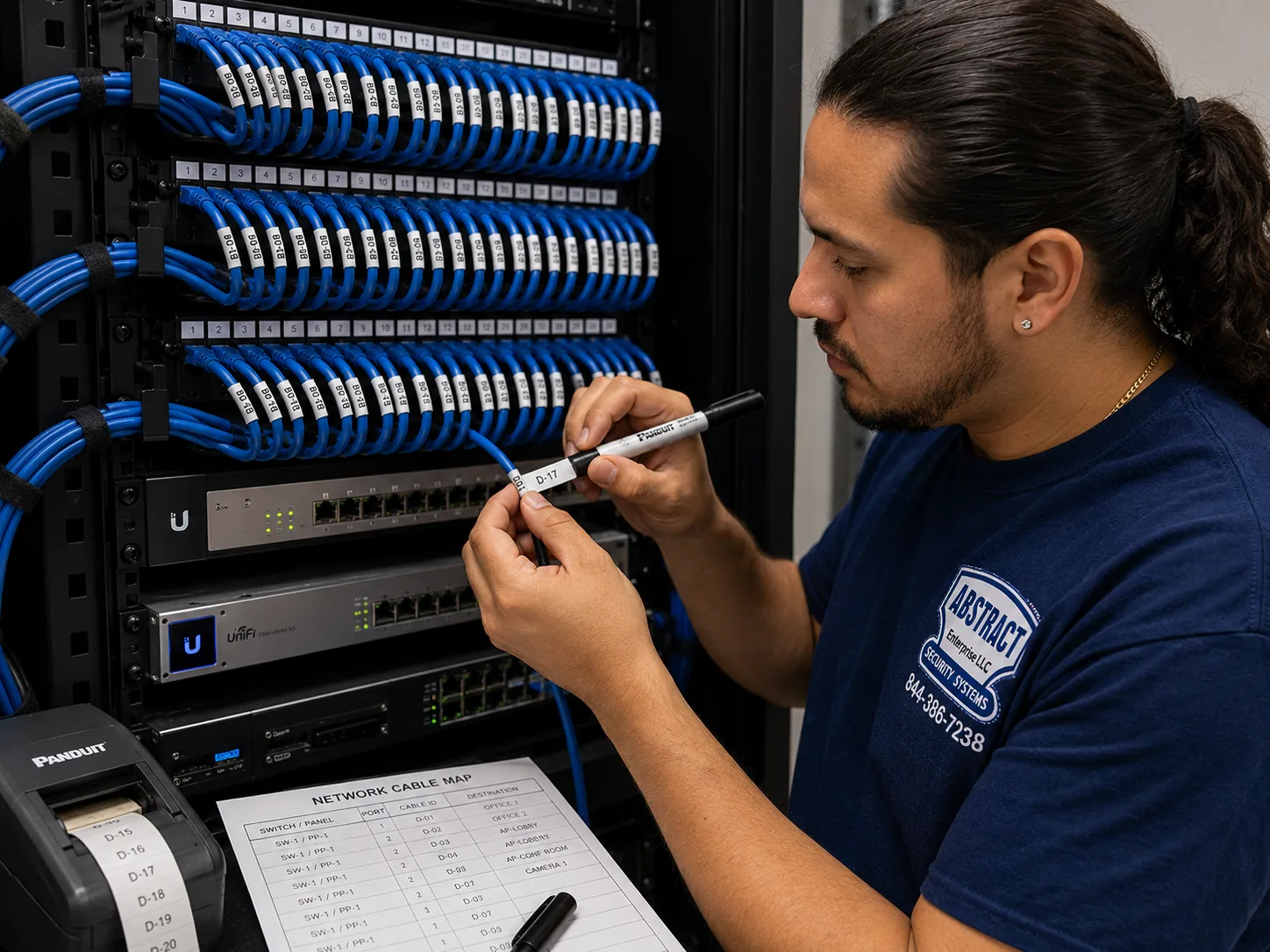
These are the Ring device types we install in New York homes, apartments and shops. Ring changes model names often, so we choose the current model in each category that suits your door, your wiring and your Wi-Fi, and we will install a device you have already bought if it suits the job. Prices for each borough are on the Ring price pages linked in the pricing section.
Doorbells that run on an existing bell circuit, for brownstones, row houses and detached houses where the transformer and wire test sound. No charging, and the old chime can keep working on many models.
For doors with no usable bell circuit. Easy to mount on wood or masonry with the right fixings; at a busy New York door, expect to charge the battery more often than the box suggests.
Fits through the existing peephole in an apartment door, designed to install without permanent changes, with privacy zones. The first choice for most renters and co-op shareholders.
Camera and bright lights in one, usually replacing an existing outdoor light over a driveway, back yard or side passage on Queens, Bronx and Staten Island houses.
Smaller cameras for garden-level doors, yards, stoops and back entrances, in battery, plug-in and wired versions.
Plug-in cameras for watching the inside of an apartment door, a vestibule, a stockroom or a shop counter without drilling outside.
Ring's network-cable models, which take power and data on one cable, for walls the Wi-Fi will not penetrate and doors far from the router.
Chimes that sound inside and extend Wi-Fi to nearby Ring devices, plus extenders and switches where a building needs them.
People ask how Ring compares with ADT, SimpliSafe and a wired camera system. ADT is best known for monitored alarm service, and SimpliSafe for self-install alarm kits with cameras; Ring is built around its own app, video doorbells and cameras, with recorded video history depending on a paid Ring plan. For one apartment door or a single house, Ring's simplicity is its strength. For a whole building's entrances and package room, or a shop that needs weeks of continuous recording, a wired camera system with a local recorder usually holds up better, because it records without depending on a cloud plan or one household's Wi-Fi. We install Ring where Ring is the right tool and tell you plainly when it is not.
| Need | Ring fits well | Something else fits better |
|---|---|---|
| One apartment door, renter | Peephole Cam or indoor camera | Rarely; Ring is often the simplest legal choice |
| Brownstone or house front door | Wired doorbell on a tested bell circuit | A wired system if you also want many continuous-recording cameras |
| Driveway and yard | Floodlight and spotlight cams | Wired cameras if Wi-Fi cannot reach |
| Whole building entrance and mailroom | A small building with one owner's account | A recorder-based system with retention the owner controls |
| Building buzzer | Not offered; Ring Intercom is not sold in the US | A proper building intercom |

We could not capture Google's AI Overview or People Also Ask boxes for this search from our build environment, so we will not pretend to quote them. What follows are claims we see repeated in quick online answers about Ring and about New York, set against what the public record and our field practice show. National cost guides from marketplaces such as Angi, HomeAdvisor and Fixr feed many of those answers; they help with a rough idea but are not a quote for a door in New York.
This one appears constantly in answers aimed at apartment dwellers, and for New Yorkers it is simply wrong. Ring's own help page for Ring Intercom says the device is not available in the US.
In a city where most residents reach their apartment through a building intercom required by Multiple Dwelling Law §50-a, that matters. A renter who buys Ring expecting to answer the street door from a phone will be disappointed, and anyone selling them an installation of it would be selling something that does not exist here.
The building intercom belongs to the owner. What a tenant can usually do with Ring is watch their own door, most often with a Peephole Cam. We say that up front on every apartment call.
Quick answers often treat the front door as yours to decorate. In a New York apartment building, the corridor outside it belongs to the landlord, and a legal answer on JustAnswer for a Brooklyn tenant said a landlord can remove a camera installed there without consent.
Drilling the door or its frame is an alteration to the owner's property, and co-op boards commonly require approval for alterations. One New York security firm says written landlord approval is needed before drilling in a rental.
The practical answer is a device that avoids drilling, such as the Peephole Cam, plus a short written request. That combination is what keeps a Ring on the door instead of in a box after a dispute.
The NYPD's move onto Ring's Neighbors app led to plenty of alarming summaries. PIX11 reported that officials said they would not monitor the app around the clock but could request homeowners' clips. Patch reported the department would gain access to video, photos and messages users post to the app.
That is a real change, but it is not a live feed of your camera. What you post publicly in Neighbors is visible; what stays in your account is yours unless you choose to share or police obtain it through legal process.
We show every customer where the post, share and request settings are, so the choice is an informed one rather than a default.
Some answers still describe a Ring partnership with Flock Safety, the AI camera network used by police. TechCrunch reported on February 13, 2026 that Ring and Flock cancelled their planned partnership, saying it would require significantly more time and resources than anticipated.
Privacy concerns about Ring are reasonable, and New Yorkers raise them often. They are best addressed with current facts and the settings in front of you, not with an arrangement that was called off.
Because these policies change, we check the current Ring control settings at each handover rather than relying on what was true when the device was boxed.
The reverse of this is closer to true. Smart Home Perfected's guide to Ring privacy settings says Familiar Faces, launched in the US in December 2025, is off by default, while Search Party is on by default.
The facial recognition question still matters. TechCrunch reported a June 2026 class action claiming Familiar Faces stores images of passersby without consent, and in New York City a covered business that collects biometric identifiers must post signage under Admin Code §§22-1201 to 22-1205.
We leave Familiar Faces off unless the owner asks for it after hearing those points, and we show where Search Party can be switched off.
Ring's setup assumes a strong signal at the door. Many answers repeat that a Wi-Fi extender fixes everything. In a New York prewar building with masonry walls one guide puts at 12 to 18 inches, and a door at the far end of a railroad flat or the bottom of a stoop, the signal can be weak or erratic.
There is also a more basic gap. The NYC Council Data Team found 24.5 percent of households without a broadband subscription in 2021, and 12.8 percent relying on a cellular plan only. Ring needs home internet.
We test the signal at the exact mounting spot before anything is mounted, and where it fails we offer a Chime Pro, an extender, a cable-powered model, or an honest suggestion to sort the internet first.
On a new house with a modern transformer it can be. In a city where CHPC counts about 2 million units built before 1947, it often is not. One New York electrician notes that brownstones bring plaster walls, original wiring and stoop-level entries, and separates standard installs from jobs needing a transformer or new wiring.
Add landmark facade rules, co-op paperwork and permission letters, and the time is mostly spent before and around the mount, not on it.
That is why our process starts with photos and questions, and why our Ring prices are set out separately for each borough rather than as one national number.
Send a photo of the door from both sides, tell us whether you own or rent, and say which Ring device you have or want. A technician will tell you whether it suits the door, whether your wiring and Wi-Fi can carry it, and what permission you need first. Call (800) 486-0943, message us on WhatsApp, or use the quick form.
Every New York Ring job follows the same eight steps, whether it is a Peephole Cam on a fourth-floor walk-up or a doorbell and three cameras on a Staten Island house. The order matters most in old buildings, where a skipped wiring test or a missing permission letter is the usual reason a Ring comes down again.
A photo of the door from outside and inside, the old bell or peephole, each camera spot, and whether it is a house, brownstone, walk-up, co-op, rental or shop. We match the job to your borough's Ring price list before you book.
Written landlord approval for renters, the board's or agent's rules and our insurance papers for co-ops and condos, and a check of whether the facade is in a landmark district.
A meter on the transformer and the bell wire before choosing a battery, hardwired or network-cable Ring model, so the doorbell does not reboot or buzz.
Signal tested at each exact spot through the masonry; a Chime Pro, extender or cable planned where it is weak.
We hold each device in place and check the live view with you, so it sees the door and packages and not a neighbor's apartment or window.
Fixings chosen for wood, brick or stone, low-voltage or network cable run neatly, and every exterior opening sealed.
Devices added to your own Ring account; motion and privacy zones set; audio, Familiar Faces, Search Party and police-request settings explained.
Bell rung, motion triggered, live view and recordings checked on your phone, the area cleaned, and a note left of what was installed and where.

A citywide page cannot list every block, so these are places that show the range of front doors we plan for. Each fact comes from a published source; we claim no work at any of them.
CBS New York reported a lobby theft there in a building with key-code entry and no forced entry, where a tenant said her family's Ring camera let them see their front door.
Designated November 23, 1965, the first historic district in New York City, per the Historic Districts Council: brownstone fronts where landmark facade rules shape where a Ring can go.
Built 1880 to 1884, a co-op since 1961 and a city landmark since 1969, per Wikipedia: the classic prewar co-op, where the board decides what goes on a corridor door.
Built by Metropolitan Life from 1939 to 1942, 171 brick buildings of 8 or 13 stories, per Wikipedia: apartment doors behind shared entrances on a vast scale.
Planned by Olmsted Jr. and Grosvenor Atterbury with precast concrete panels and more than 800 homes, per The Cultural Landscape Foundation: houses with unusual walls to fix into.
A historic district designated in 2004 with about 92 freestanding houses, the earliest from the mid-1830s, per the Historic Districts Council: detached houses where facade rules still apply.
We install Ring cameras and doorbells in every borough, from Harlem, the Upper West Side, the Villages and the Lower East Side to brownstone Brooklyn, Sunnyside and Jackson Heights, Riverdale and Co-op City, and Midland Beach and St. George. For prices in your borough, see Ring camera installation prices in Manhattan, Brooklyn Ring prices, Queens Ring prices, Bronx Ring installation prices and Staten Island Ring prices, or the citywide NYC Ring camera price list.
Ring installation prices in New York differ by borough, because access, parking and travel differ, so each borough has its own published Ring price list and calculator where you can build your own system line by line. We do not quote a single citywide number on this page, and nothing appears on your quote that is not on your borough's list. What moves the total within any borough is the door, the wiring and the number of devices, set out below.
| What moves the price | Why it matters in New York | Where you will see it |
|---|---|---|
| Device type | A Peephole Cam, a battery doorbell, a wired doorbell and a floodlight cam are different amounts of work | Each device is its own line |
| Number of devices | A door alone versus a door plus yard, side and back cameras | Per-device lines that add up |
| Existing wiring | A sound bell circuit is reused; a dead transformer or broken wire means a replacement or a battery model | Named after testing, before work starts |
| Mounting surface | Wood frame, brick, stone and siding take different fixings and time | Surface lines on the borough list |
| Cable runs | Network-cable Ring models and floodlights may need runs through masonry or cellars | Cable-run lines by distance |
| Wi-Fi help | A Chime Pro or extender for thick walls | Equipment and setup lines |
| Access | Walk-ups, doorman-building scheduling and parking, especially in Manhattan | Access lines on the borough list |
| Your own equipment | Devices you already bought are installed at labor-only rates | Labor-only lines |
Take a brownstone owner who wants a wired Ring doorbell at the stoop and a floodlight cam over the garden-level door. The quote lists the doorbell installation, the floodlight installation, the surface each is fixed to, and any cable run needed for the floodlight, plus a Chime Pro if the signal at the stoop tests weak. Move the same customer to a fourth-floor rental in a walk-up and the job becomes a Peephole Cam and perhaps an indoor camera, with an access line for the stairs and no wiring at all. The structure is the same everywhere; the numbers come from the borough's list. Before anything is ordered, the wiring and Wi-Fi tests from our process are what confirm the lines, so you are not paying for a hardwired doorbell on a circuit that cannot carry it.
Recorded video history, and some features, depend on a paid Ring plan billed by Ring, not by us. Our work is the installation and setup; we do not resell or mark up Ring's plans, and we set the devices up in your own account so your plan and your footage stay with you if you ever change installer. If you want to decide on a plan before the visit, we can explain what each type of device does with and without one.
Ring devices also carry Ring's own manufacturer warranty, which Ring handles directly. If a device fails, we help you work out whether it is the device, the wiring or the Wi-Fi, so the right party fixes it.
Three Ring setups we install across the five boroughs. Each is built only from lines on your borough's price list, so the total is the sum of the lines; there is no package premium. Open your borough's price page to see the figures for your setup.
A Ring Peephole Cam in place of the existing peephole, with privacy zones set so neighbors' doors stay out of view, or an indoor camera facing the inside of the door. No drilling, Wi-Fi tested at the door, set up in your own account. Built for walk-ups, elevator rentals and co-ops in Manhattan, the Bronx and brownstone Brooklyn.
A wired Ring doorbell on a tested bell circuit, the chime kept working where the model allows, a Chime Pro or extender if the signal is weak, and one camera on the garden-level door or the side passage. The usual job on a Brooklyn row house or a Queens house.
A wired doorbell plus floodlight cams on the driveway and back yard, spotlight or indoor cameras where needed, Power over Ethernet models where Wi-Fi will not reach, and staff or family access set up properly. Suited to Staten Island houses and small storefronts.
Borough price pages: NYC · Manhattan · Brooklyn · Queens · Bronx · Staten Island.
Many New Yorkers already have the Ring box on the shelf. We install devices you have bought at the labor-only lines on your borough's list, as long as the device suits the door: we check whether a wired doorbell's power needs match your transformer, whether a battery model will last at a busy doorway, and whether a device meant for outdoors is going outdoors. If what you bought is the wrong fit, we tell you before mounting it and suggest the model that will work, so you can return the first one rather than live with it.
The full list and calculator for building your own Ring system anywhere in the city. Ring camera installation prices NYC
Apartment doors, co-ops and doorman buildings, with access and parking built into the list. Manhattan Ring installation prices
Brownstones, row houses, walk-ups and storefronts across the borough. Brooklyn Ring camera prices
Houses, garden apartments and busy shopping streets. Queens Ring camera prices
Large apartment complexes and the borough's house blocks. Bronx Ring camera prices
Driveways, yards and two-family houses. Staten Island Ring camera prices
Nassau and Suffolk houses beyond the city line. Long Island Ring prices
Westchester, Rockland and the counties north. Hudson Valley Ring prices
Send a photo of the door and tell us whether you own or rent. Request a free quote

Because the work around the device costs more there, not the device. Manhattan jobs are almost all in apartment buildings, which means doorman-desk check-ins, insurance paperwork, elevator scheduling and paid parking near the building. Each borough has its own Ring price list for that reason, and the Manhattan list includes those access costs as separate lines so you can see them.
We found no general New York City rule setting a retention period for private apartment building cameras. In practice it depends on the system: NYCHA has reported 21 days on its newer cameras, and residents on r/AskNYC describe buildings keeping around 30 days. With Ring, how long recordings stay available depends on your Ring plan and settings, so we set it during setup and show you how to download clips you need to keep.
Generally yes, in common areas, as long as the cameras do not record places where people expect privacy, which Penal Law section 250.45 forbids. Posting a visible notice brings the system within the protection described for Penal Law section 250.65. A guide from one security firm advises owners of rent-stabilized buildings to document their security reasons and notify tenants before installing.
Nationally, yes. Security.org's 2026 package theft report found 10 percent of apartment residents had a package stolen in the previous three months, against 3 percent of single-family residents. In New York, deliveries often sit in lobbies or vestibules that many people pass through, which is why a camera on your own door, plus a building camera on the package area, helps more than either alone.
If they do it as a paid business, yes. The city's business portal says a New York State Department of State license is required to install or maintain security systems, and the licensing course provider says that covers security cameras. You can install your own Ring yourself without a license. AESS does its low-voltage work under NYS license 12000287431.
Yes. Most DIY Ring problems in New York come from three things: weak Wi-Fi at the door through masonry, a wired doorbell on a transformer that cannot supply enough power, or a mount position that wakes the camera all day. We test each, fix the cause, and move the device if it is in the wrong spot, rather than simply resetting it.
It depends on the door far more than the device. A Peephole Cam on an apartment door with good Wi-Fi is a short visit. A wired doorbell on an old bell circuit takes longer because we test and sometimes repair the wiring, and a house with floodlight cams and cable runs takes longer again. When you send photos, we tell you what to expect before booking.
We book you within 2 hours of your request, and estimates are available the same day. When the visit happens depends on the schedule and whether a replacement device is on hand, so we confirm the time when we book rather than promise it in advance. If the old unit is under Ring's warranty, we help you work out whether to claim it first.
For a business or a building's common areas, yes. Penal Law section 250.65, as summarized by Ambient.ai, protects systems with a conspicuously posted written notice or cameras whose presence is obvious. For a house or an apartment door, a doorbell camera is usually obvious already, but a small sticker costs little and removes doubt.
Often, yes. Many wired Ring doorbells can keep an existing mechanical chime working, and we test it after installation. Some older chimes or certain models do not work together, and in that case a plug-in Ring chime does the job. We check the chime type during the wiring test so you know before the doorbell goes up.
Usually not. Ring works well for one owner watching a door or a small building's entrance, but a building with many entrances, a package room and staff who need footage is better served by a wired recorder system that keeps footage locally under the owner's control. We install both and will tell you which fits after a look at the building.
Yes. We install Ring across Nassau and Suffolk counties and the Hudson Valley counties as well as the city. Each area has its own Ring price list, because travel and access differ, and the same process applies everywhere.
Because we set the device up in your own account, it moves with you. A Peephole Cam comes out and the original peephole goes back in. A wired doorbell installed with the landlord's approval can stay if the landlord wants it, in which case you remove it from your account so the next tenant can register it to theirs, or it can come down and the door be restored.
Tell us the borough, the building type, whether you own or rent, and which Ring devices you have or want. A photo of the door from both sides makes the quote exact. Prefer to talk? Call (800) 486-0943.
From a Peephole Cam on a walk-up apartment door to a wired doorbell on a brownstone stoop, a floodlight over a Staten Island driveway or cameras at a storefront on a busy corridor, the job starts the same way: a photo of the door, a straight answer about permission, and a test of the wiring and Wi-Fi before anything goes up. Call (800) 486-0943, message us on WhatsApp, or send the quote form, and we will tell you exactly which Ring fits your door. Back to the AESS home page.
Ring Camera Installation by neighborhood: NYC hub, NYC ring camera installation
Ring Camera Installation by neighborhood: Long Island hub, Long Island ring camera installation