Ring doorbell keeps going offline in a Nassau split-level, or a porch pirate worked your street this week? Book a Long Island Ring camera install: (800) 486-0943
Levittown Capes and Ranches · Split-Levels and Hi-Ranches · North Shore Estates · South Shore Shingle Houses · East End Seasonal Homes · Licensed Low-Voltage
Ring Camera Installation in Long Island
Transformer Tested Before the Doorbell Goes Up · WiFi Walked to Every Camera · Privacy Zones Set for New York Law
Long Island is a place of single-family houses with front steps, driveways and side yards, which is exactly the kind of property Ring was designed around. The U.S. Census Bureau's 2023 survey counts 364,529 one-unit detached homes in Nassau County, where the median house was built in 1955, and 463,095 in Suffolk County, where the median is 1970. Those dates matter for a Ring install more than the model on the box: a 1950s doorbell transformer, a slab ranch with no basement, a hi-ranch with the router on the wrong level and a detached garage at the end of a long driveway are the four things that decide whether a Ring system works on day one or keeps dropping offline. We check every one of them before the first screw goes in, from the Queens line to Montauk.
Reviewed and updated November 4, 2026 by Anwar Timothy, NYS license #12000287431 · Sources: U.S. Census Bureau American Community Survey 2023 five-year estimates and 2020 census QuickFacts, ny.gov county profiles for Nassau and Suffolk, Encyclopedia.com and Keri Murray Architecture on Levittown, U.S. History Scene, History.com, Wikipedia entries for the North Shore, Roosevelt Field, Hofstra, Stony Brook University, Brookhaven National Laboratory, Uniondale and Hurricane Sandy in New York, AAA Northeast on Gold Coast mansions, the Suffolk County Police Department Camera Registry, SCPD SHIELD and Alarm Management pages, Garden City Police private camera registration, City & State New York (2019 Nassau police and Ring), Consumer Reports on Ring Community Requests, Variety and TechCrunch on the Ring and Flock Safety cancellation, The Suffolk Times (April 2026), LI Life & Politics on Nassau crime figures, ABC7 New York (Central Islip doorbell attack, Isaias outages, 2024 burglary task force), News 12 Long Island (Wantagh, Massapequa Park and Uniondale reports), CBS New York (Patchogue and the Suffolk DA porch-theft case), the New York State Department of Financial Services on the August 2024 Suffolk flood, Justia Answers on audio recording, Vertex Security on Civil Rights Law §52-a, the Town of Hempstead code, Ring's support pages on Ring Intercom and its hardwired transformer, and TechCrunch on the Ring Peephole Cam and the Familiar Faces lawsuit · Dispatched from 1282 Troy Ave, Brooklyn
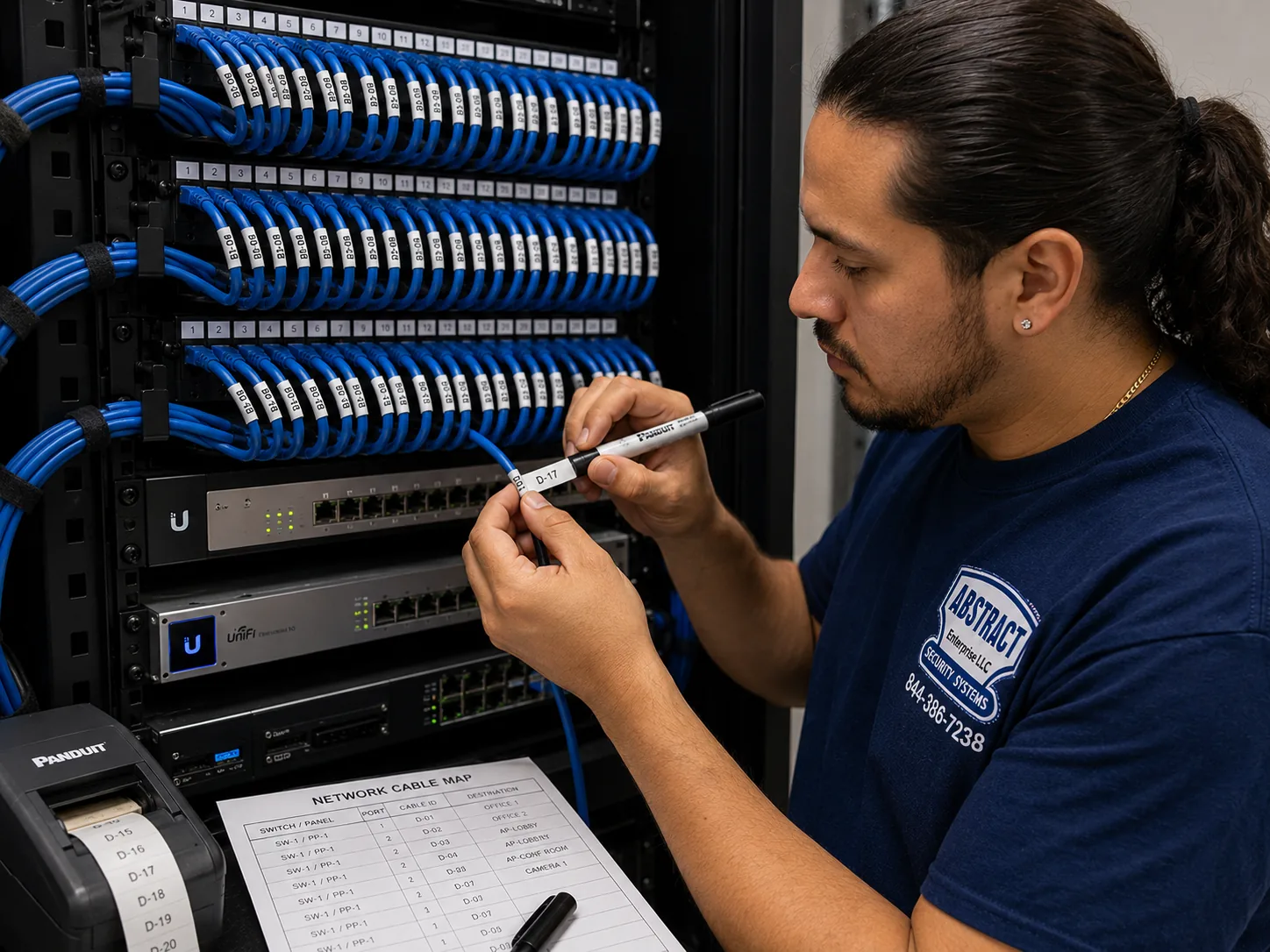
Photo from the AESS job library, not taken on Long Island: a technician printing cable labels at a patch panel, with a printed port map beside it. Ring cameras live or die on the network behind them, and in a Long Island split-level the router often sits in a basement or den two levels from the front door. When we add a wired run or an access point for a Ring doorbell, every cable gets a label like these, so the next person knows what feeds the porch.
Long Island Ring Installation
Tell us the town, the house type and which Ring devices you have or want
✅
Request Sent!
We'll call about your Long Island Ring installation the same business day.
25+
Years Experience
✓
Same-Day Estimates
100%
Licensed & Insured
4.7★
201 Google Reviews
Owner-operated since 2002 · Thousands of jobs completed · Booked within 2 hours
Ring camera installation on Long Island comes down to three checks: whether the doorbell transformer can power a video doorbell, whether the WiFi reaches every camera spot, and who has to agree before we drill. A 1950s cape in Nassau usually needs the transformer tested and often replaced. A hi-ranch with the router downstairs usually needs the signal fixed before the front door camera is reliable. A rental needs the landlord's yes. Send photos of the door, the chime and the walls you want covered, and we will tell you which lines of our Long Island Ring price list apply before you book. Call (800) 486-0943 or use the form, and we book within 2 hours of your request.
Nassau and Suffolk addresses are priced from our published Long Island Ring camera installation prices, with the county rate set by the address, and nothing added on the day that you did not agree to
Every hardwired Ring doorbell starts with a meter reading at the transformer and a look at the chime, because an underpowered doorbell is the most common reason a new Ring reboots, lags or goes dark
Low-voltage work done under NYS license #12000287431; anything needing a new 120-volt circuit, such as a floodlight where no fixture exists, is handed to a licensed electrician and named on the quote
Why Long Island Properties Need Ring Camera Installation
Long Island's housing was built for the car, the driveway and the front step, and that is where most of its trouble now arrives. When Levitt and Sons started work in 1947 on what became Levittown, Encyclopedia.com records, the site was 1,300 acres of potato fields; by 1951 it covered more than 5,000 acres and some 17,500 single-family homes. Before that, History.com notes, William Levitt had already built 1,080 homes in Westbury and 2,250 in Roslyn. The pattern spread across Nassau and then pushed east into Suffolk: a detached house, a lawn, a driveway, a door facing the street. A Newsday analysis of nearly 12,000 home sales in 2026, reported in an excerpt the paper posted, found that more than 5,000 of the houses sold had been built in the 1950s and 1960s. That is the stock a Ring doorbell and a pair of floodlight cams are being added to today.
The Census numbers show how complete that pattern is. Of Nassau County's 477,860 housing units, 364,529 are one-unit detached houses, and the median year built is 1955. Suffolk has 579,790 units, of which 463,095 are detached, with a median year of 1970. In practical terms, three out of four Long Island homes are a single house with its own front door, its own wiring and its own owner making the decisions. That is good news for a Ring install, because there is no building intercom to work around and no co-op board to satisfy on most jobs. The challenge is the age of what is already in the walls. A doorbell transformer installed when the house was new was sized to ring a mechanical chime, not to run a camera, a WiFi radio and an infrared light all night. One Ring owner put it plainly in a product review: he had to upgrade his 35-year-old doorbell transformer to get enough power to run his Ring Pro. On a 1955 house, the original transformer may be more than twice that age, if it has not already been replaced with whatever was on the hardware store shelf.
The second reason is what is happening on the front steps and in the driveways. In November 2025, CBS New York reported that the Suffolk County District Attorney had charged 14 men in a porch-theft scheme that ran from October 2023 to February 2025 across 31 communities, including Brentwood, Central Islip, Shirley and Deer Park. Prosecutors said the group hacked systems to learn when Verizon and AT&T devices were being delivered, then took more than 200 phones and tablets, leading to 50 felony charges. Smaller cases keep turning up on News 12 Long Island: four iPhones taken from a porch on Walters Avenue in Wantagh and caught on a Ring doorbell, a suspect trying to grab a package mid-delivery on Atlantic Avenue in Massapequa Park. CBS New York aired a clip from Rider Avenue in Patchogue of a thief who waved at the camera around 5:45 in the evening. In Nassau, LI Life & Politics reported that burglaries rose 5 percent, from 234 to 245, in January through May of 2026 compared with 2025, even as overall property crime fell. And when ABC7 New York covered a multi-agency burglary and car-theft task force in January 2024, police said the burglars were attracted by cars in people's driveways, and that break-ins while people were at home had gone up.
The third reason is the one people forget until a camera fails: the weather and the grid. ABC7 reported that Tropical Storm Isaias in August 2020 left almost half of PSEG Long Island's 1.1 million customers in the dark at the peak. In August 2024, the New York State Department of Financial Services described the first-ever flash flood emergency for Suffolk County, the failure of the Stony Brook Mill Pond dam, and more than 2,000 residents and business owners with flood damage. Superstorm Sandy did $150 million in damage to the city of Long Beach alone, according to Wikipedia's account of the storm, with voluntary evacuations ordered south of Sunrise Highway. A Ring device that runs on WiFi needs both power at the camera and a working router and internet connection to save anything to the cloud. When the power goes, a hardwired doorbell goes with it, and a battery camera keeps watching only as long as the router stays up. That is why a Long Island Ring install has to plan for the outage, not just the sunny day.
Finally, there is the question of who else might see the video. Long Island has a long, public relationship between Ring and the police. In December 2019, City & State New York reported that Nassau County police would work with the Ring Neighbors app to catch package thieves using footage from smart doorbells, if customers gave access. Consumer Reports later explained that police requests on Neighbors were switched off in 2024 and then came back as a program called Community Requests, which owners can turn off in the Neighbors settings. In 2026, Variety and TechCrunch reported that Ring cancelled a planned partnership with Flock Safety after a backlash over its Super Bowl ad. Out in Southold, The Suffolk Times quoted a resident at an April 2026 meeting about Flock cameras asking whether there was "any place you can go that somebody doesn't have a camera on their porch." Our job is not to take a side in that debate. It is to install your system so that you, not a default setting, decide what is shared, and so your camera watches your property and not your neighbor's bedroom window.
We want to be clear about what our research could not find. We searched for Reddit threads from r/longisland and other forums about Ring installs going wrong, and for Yelp complaints about Ring installers in Nassau and Suffolk, and found nothing we could quote. We could not see Google's live People Also Ask boxes or AI Overview for this search. We found no official ruling on whether a Long Island town or village requires a permit for a low-voltage doorbell camera, only an installer's claim that it does not. Where this page talks about what we find in 1950s transformers or slab ranches, it draws on the age and type of the housing in the public record and on how houses of that age are generally built, not on a survey of Long Island homes. We check your house before we promise anything.
Long Island facts that shape a Ring install
Mostly single houses: 364,529 of Nassau's 477,860 housing units and 463,095 of Suffolk's 579,790 are one-unit detached homes (Census ACS 2023).
Older in the west, newer in the east: the median home was built in 1955 in Nassau and 1970 in Suffolk, which tracks with transformer age and wiring style.
Two big counties, many governments: Nassau has two cities, three towns, 64 incorporated villages and more than 60 hamlets in 453 square miles; Suffolk has 10 towns across 2,373 square miles (ny.gov).
About 2.9 million people: the 2020 census counted 1,395,774 in Nassau and 1,525,920 in Suffolk.
Porch theft at scale: the Suffolk DA's 2025 case covered 31 communities and more than 200 stolen phones and tablets.
Outages are real planning inputs: Isaias left almost half of PSEG Long Island's 1.1 million customers without power at the peak in 2020.
What owners often add once the doorbell is up. After a Long Island front door has a working Ring doorbell, the next request is almost always the driveway. Floodlight cams over the garage or spotlight cams on the corners of the house cover the cars that the 2024 task force said draw burglars in. Many owners also add Ring Alarm contact sensors on the doors. Tell us when you book, so we test the WiFi at every one of those spots in the same visit instead of coming back to discover the garage is out of range.
Photo from the AESS job library, not taken on Long Island: a technician core drilling a concrete block wall so a cable can pass through to a network room. Many Long Island capes and ranches stand on concrete-block foundations, and when a wired connection has to get from a basement router to a camera outside, a clean, sealed hole through the block like this one is how it gets there without a cable hanging across a window.
Ring Smashed, Offline After a Storm or a Package Gone? Fast Help on Long Island
Some Ring calls cannot wait for a quiet week. ABC7 New York reported on a man caught on video using a knife to destroy a doorbell camera at a home in Central Islip. If your doorbell has been pried off, cut or knocked loose, the wires behind it may be exposed: turn off the doorbell transformer's circuit if you know which one it is, take photos of the damage and the mounting holes, and save any clips the app captured before the camera died. After a storm, a Ring that has gone offline usually means the router, the modem or the transformer lost power and did not come back cleanly, and a quick check of each often brings it back. If it does not, or if the doorbell still shows no power once the house has electricity, call (800) 486-0943. We book within 2 hours of your request and will tell you honestly what a repair visit needs.
1955 or 1970: How a Long Island House's Age Changes the Ring Job
The Census medians tell a simple story: Nassau's houses are, on average, fifteen years older than Suffolk's. Inside that average, the island holds at least five distinct building periods, and each one hides a different doorbell circuit, wall and roof line. The table below sets out what the public record describes for each period, and what we expect to find when we open the chime cover and look up at the eaves. The last column is our working assumption, not a fact about any specific house; we confirm on site.
Period
What the record describes
Typical places
What we expect for Ring
Gold Coast estates, 1890s–1920s
More than 500 mansions on the North Shore; Old Westbury Gardens was built in 1906 as the John S. Phipps estate
North Shore, along the old Route 25A corridor
Long distances from house to gate and outbuildings, masonry and stone, doorbell circuits replaced many times; WiFi coverage is the main project
Postwar tracts, 1947–1951
Levittown's homes, first Cape Cods and from 1949 ranches, built on concrete slabs with radiant heating pipes
Levittown, Westbury, Roslyn and the tracts that followed
Original transformers long gone or undersized; slab ranches have no basement, so wiring goes through the attic; heavy remodeling means every house differs
1950s and 1960s suburbs
Capes, ranches, split-levels and hi-ranches, often on block foundations with basements finished later
Most of Nassau and western Suffolk
Transformers that need testing, routers on a different level from the front door, detached garages at the end of driveways
1970s and later colonials
Two-story houses typical of the Suffolk median year
Central and eastern Suffolk
Newer chime circuits, attached garages, more vinyl siding; usually the simplest hardwired installs
Coastal and seasonal homes
Wood-frame and cedar-shingle houses on the South Shore, waterfront and second homes out to the Hamptons
South Shore, the barrier beaches, the North and South Forks
Salt air and wind on mounts, shingles that need proper mounting blocks, empty houses that need remote checks all winter
Nassau: older, denser, and divided into many villages
Nassau is the smaller county, 453 square miles, with almost as many people as Suffolk packed into a fifth of the area. Its government is a patchwork: ny.gov lists two cities, three towns, 64 incorporated villages and more than 60 unincorporated hamlets. For a Ring install that matters in two ways. The first is rules. A village may have its own building department and its own view on what can be attached to a house, while a hamlet answers to its town. We check the address, not just the town name on the mail, because a mailing address and a hamlet line do not always match. The second is the age of the houses. With a median build year of 1955, a Nassau doorbell circuit is more likely to be original, undersized or patched. We plan on testing and often replacing the transformer, and we bring the parts to do it in the same visit.
Nassau is also where the lots are tighter. A Ring floodlight cam over a garage on a 1950s block will see the neighbor's driveway and side yard almost by default. That makes privacy zones and careful aiming part of every Nassau job. New York Civil Rights Law §52-a, as a Yahoo News explainer described it, makes it unlawful to install or use video surveillance where a person has a reasonable expectation of privacy, and installers such as Vertex Security recommend digital privacy masking on exterior cameras so they do not capture a neighbor's backyard. On a narrow Nassau lot, we would rather turn a camera five degrees and mask a window than argue later about what it saw.
Suffolk: bigger lots, longer driveways, more distance
Suffolk covers 2,373 square miles in 10 towns, more than five times Nassau's area. The houses are newer on average, but the property is bigger, and the distances are the problem. A colonial in central Suffolk may sit well back from the road, with a garage, a shed or a pool house the owner also wants watched. Ring devices send their video over WiFi, so a camera at the end of a long driveway is only as good as the signal that reaches it. In Suffolk, more of our time goes into the network: moving the router, adding an access point, or running a cable to an outbuilding so the camera there has a strong connection. The East End adds seasonal homes that sit empty for months, and that brings its own planning, covered further down this page.
Suffolk also has two county programs that touch Ring owners. The Suffolk County Police Department runs a free Camera Registry, in which residents and businesses record where their cameras are. The department says plainly that it does not get access to registered cameras; it may ask an owner to check video for a particular date and time, and retrieval is at the owner's convenience. Separately, if you add Ring Alarm and it is set up to trigger a police response, Suffolk's Alarm Management Program requires a registration, with a fee for residences and a higher one for commercial premises. The department's page says its online portal is down and applications go by mail. We explain both when we set up a Suffolk system.
Question
Nassau County
Suffolk County
Typical house age (Census median)
1955
1970
Detached homes (ACS 2023)
364,529
463,095
Local government
2 cities, 3 towns, 64 villages, 60+ hamlets
10 towns, plus villages within them
Main Ring challenge we expect
Old transformers, close neighbors, privacy aiming
WiFi reach to garages, outbuildings and long driveways
Police camera registry
County-wide registry not found; Garden City Police run a voluntary program
SCPD Camera Registry, free, no police access to cameras
Alarm registration if Ring Alarm calls police
Check with your local department
SCPD Alarm Management Program, registration by mail
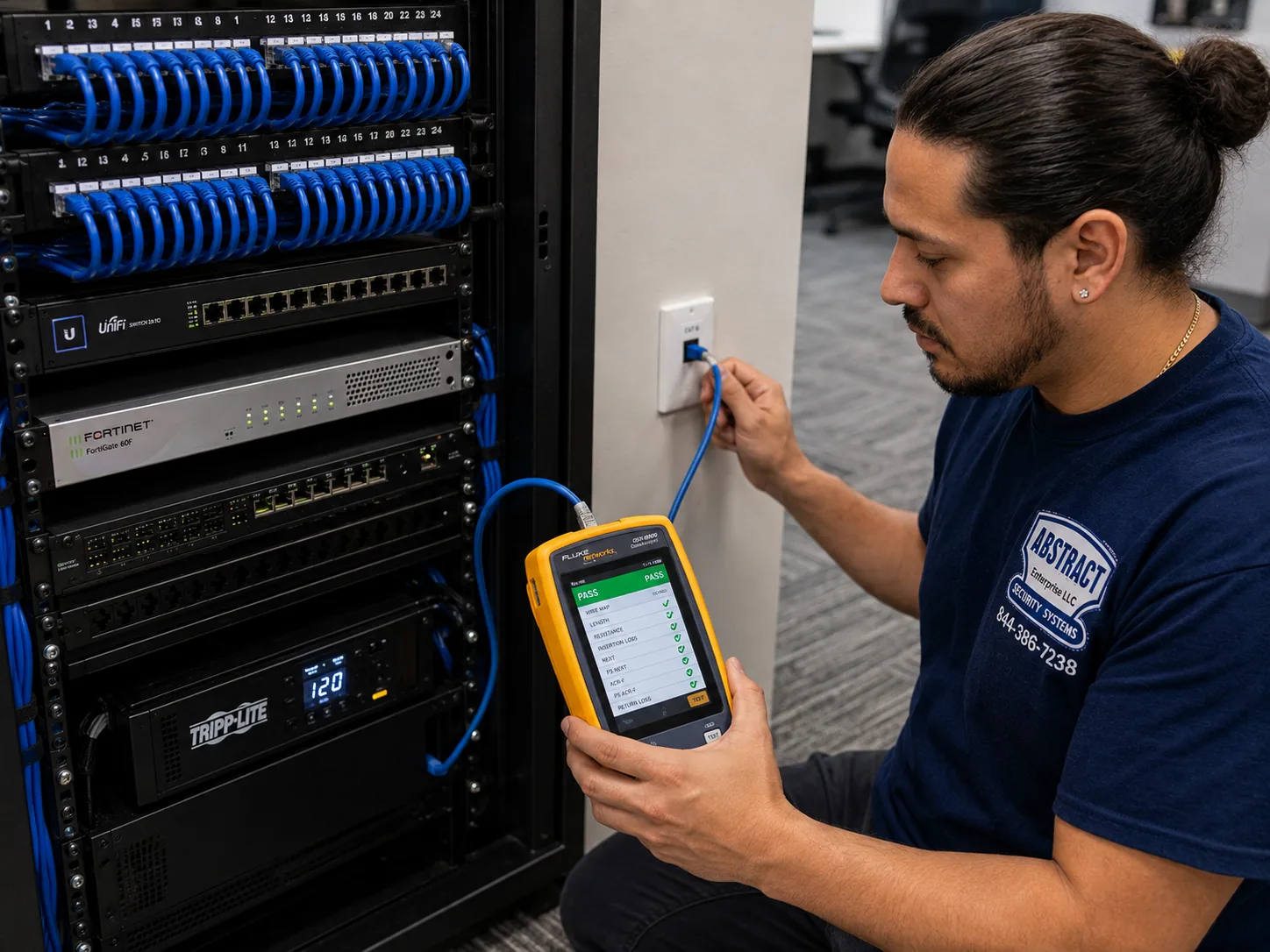
Photo from the AESS job library, not taken on Long Island: a technician certifying a data drop with a cable analyzer that reads PASS. When a Suffolk owner wants a Ring floodlight cam on a detached garage too far from the router for good WiFi, the fix is often a wired run to an access point in the garage, and that run is tested like this before the camera depends on it.
Before You Book
Chime, Router, Driveway: What to Check in a Long Island House Before We Arrive
Most of the time lost on a Ring job is lost to surprises we could have seen in a photo: a chime that turns out to be a wireless unit with no wires, a transformer hidden behind a finished basement ceiling, a router in an upstairs bedroom on the far side of a hi-ranch. Ten minutes with your phone camera before the visit saves most of it. Please do not open the transformer or the chime wiring yourself; just look and send us what you see.
What to check
Why it matters on Long Island
What to send us
Your current doorbell button
Tells us if there are wires behind it at all, and how the siding or brick around it is finished
A close photo of the button and the trim around it
The chime inside the house
Mechanical chimes, digital chimes and wireless chimes each need a different hookup for a hardwired Ring
A photo with the cover off, if it lifts off without tools
Where the transformer might be
In postwar houses it is often near the boiler, the electrical panel or in the attic
Photos of anything small and boxy near the panel or furnace
Where the router and modem sit
In split-levels and hi-ranches the router is often two levels from the front door
A photo of the router and which room and level it is in
Your internet speed at the door
Video uploads need a steady signal, not just a bar or two
A speed test run on your phone, standing at the front step
Garage, shed or pool house
Detached buildings are the most common WiFi dead zones
Rough distance from the house and whether it has power
The walls you want covered
Shingle, vinyl, brick, stucco and block each take different anchors and mounts
A photo of each wall, standing back far enough to see the eaves
Who has to approve
Landlords, condo boards and HOAs may have rules, and some villages do
The name and email of the person who signs off
Stand where the thief would stand
The best camera position is decided from the outside. Walk to the end of your driveway and look back at the house. Where would someone stop to look at your cars? Where would a delivery driver leave a box? Which side door is out of sight of the street? The News 12 clips from Wantagh and Massapequa Park both show what a doorbell sees well: the person on the step and the package at their feet. What a doorbell does not see well is the driveway beside the house, the side gate or the back door. Take a photo from each of those places and send them with the request, and we will suggest which device belongs where.
Look at where the light comes from
Many Long Island front doors face a bright street or a low winter sun, and a camera pointed into either sees a dark silhouette instead of a face. A porch with a deep overhang can help, or it can put the doorbell in shadow while the street behind blazes. Note which way your front door faces and when the sun hits it. If you do not know, a photo taken at about the time packages usually arrive tells us enough. For driveways, notice whether a streetlight sits across the road; it can wash out a camera at night or, aimed well, light the cars for free.
Tell us what you already own
Many people book after buying a Ring kit on sale, or after a previous owner left one behind. List every Ring device you have, even old ones in a drawer, and tell us whose Ring account the existing devices are registered to. A doorbell still tied to a previous owner's account has to be released by that owner or reset following Ring's process before it can join yours. Knowing that in advance means we do not stand at your front door waiting on a stranger's email.
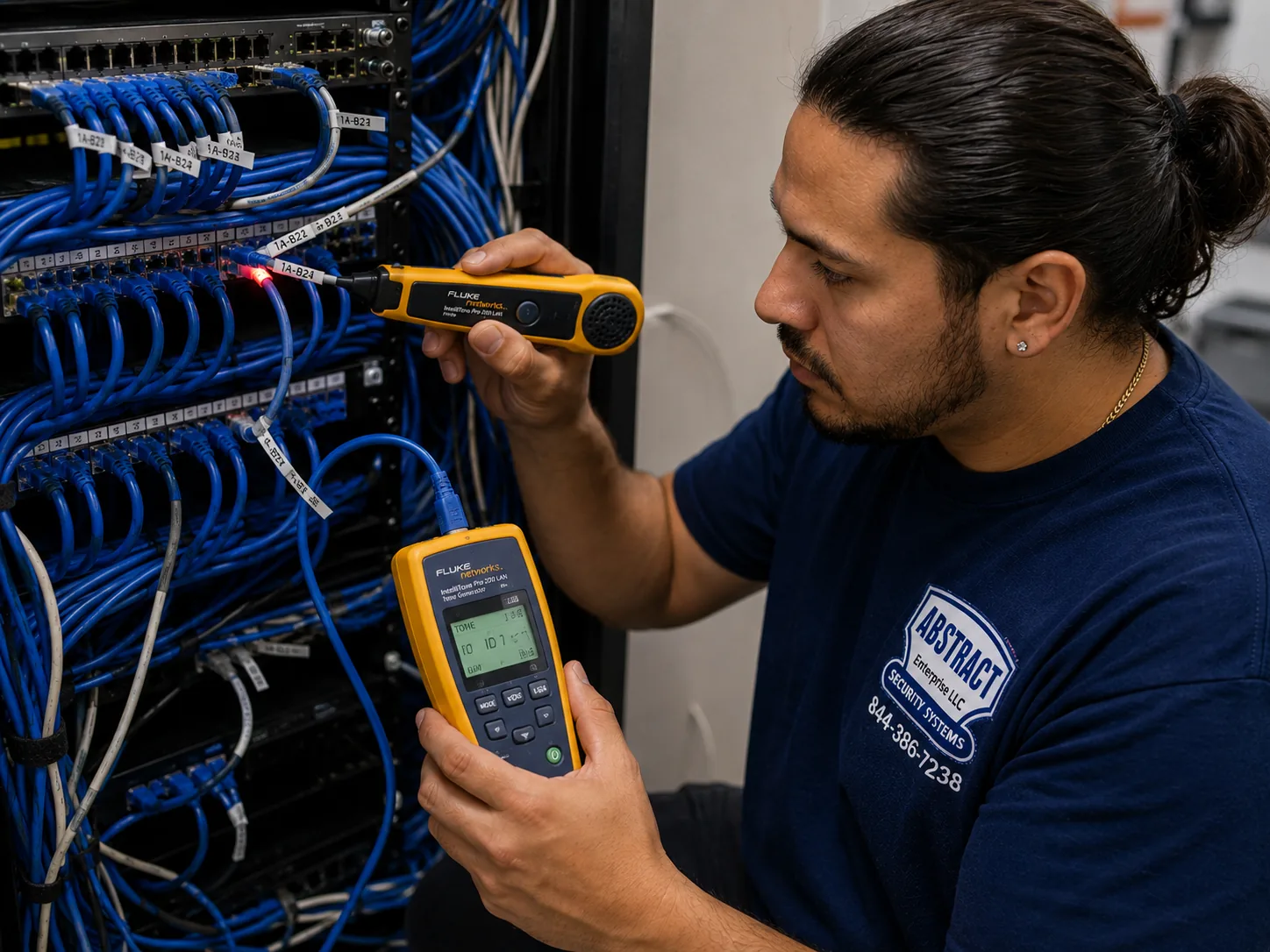
Photo from the AESS job library, not taken on Long Island: a technician tracing an unidentified cable at a patch panel with a tone generator and probe. U.S. History Scene notes that so much remodeling has happened in Levittown that very few original Cape Cods remain, and remodeled houses everywhere on the island hide old wires nobody can name. Tracing them like this tells us which wire really runs to the front door before we connect a Ring doorbell to it.
What We Install
Ring Camera Installation Services in Long Island
These are the Ring jobs Long Island homeowners, renters, landlords and small businesses book us for. Each is priced from our published Long Island Ring price list, at the Nassau or Suffolk rate that matches the address. Where a job needs something extra, a new transformer, an access point, a wired run to a garage, the quote names it before you agree.
🔔
Hardwired Ring Doorbells
Video doorbells connected to the existing doorbell circuit, with the transformer metered first and replaced when a 1950s or 1960s unit cannot keep up, and the chime set up so it still rings inside.
🔋
Battery Doorbells Converted to Wired
For owners tired of taking the doorbell down to charge it, we connect battery Ring models that support it to the doorbell wires so they trickle-charge, and fit a wedge or corner kit where the door is at an awkward angle.
🔦
Floodlight Cams Over Driveways
Ring floodlight cams over garage doors and driveways, where the 2024 task force said cars draw burglars, mounted on existing outdoor fixture boxes, with any new circuit left to a licensed electrician.
📹
Spotlight and Stick Up Cams
Corner, side-gate and back-door cameras on shingle, vinyl, brick and stucco, powered by battery, solar panel or plug-in depending on what each wall allows.
📶
WiFi Fixes for Ring
Signal walks from router to every camera, router moves, access points and wired backhaul for split-levels, hi-ranches, detached garages and long Suffolk driveways.
🚪
Ring Alarm
Contact sensors, motion detectors and keypads placed and paired, with Suffolk alarm registration explained if you choose professional monitoring that calls police.
🏠
Renter and No-Drill Options
Ring's Peephole Cam, which TechCrunch reported can be installed without permanent changes to the door, plus stands and adhesive-friendly placements where the landlord says no to drilling.
🏖
Seasonal and Second Homes
Ring systems for East End and waterfront houses that sit empty in winter, planned for power outages, remote checks and alerts that reach you in the city.
🔧
Moves, Swaps and Takeovers
Old Ring devices relocated, older models swapped for newer ones on the same wiring, and systems left by previous owners reset and moved to your account.
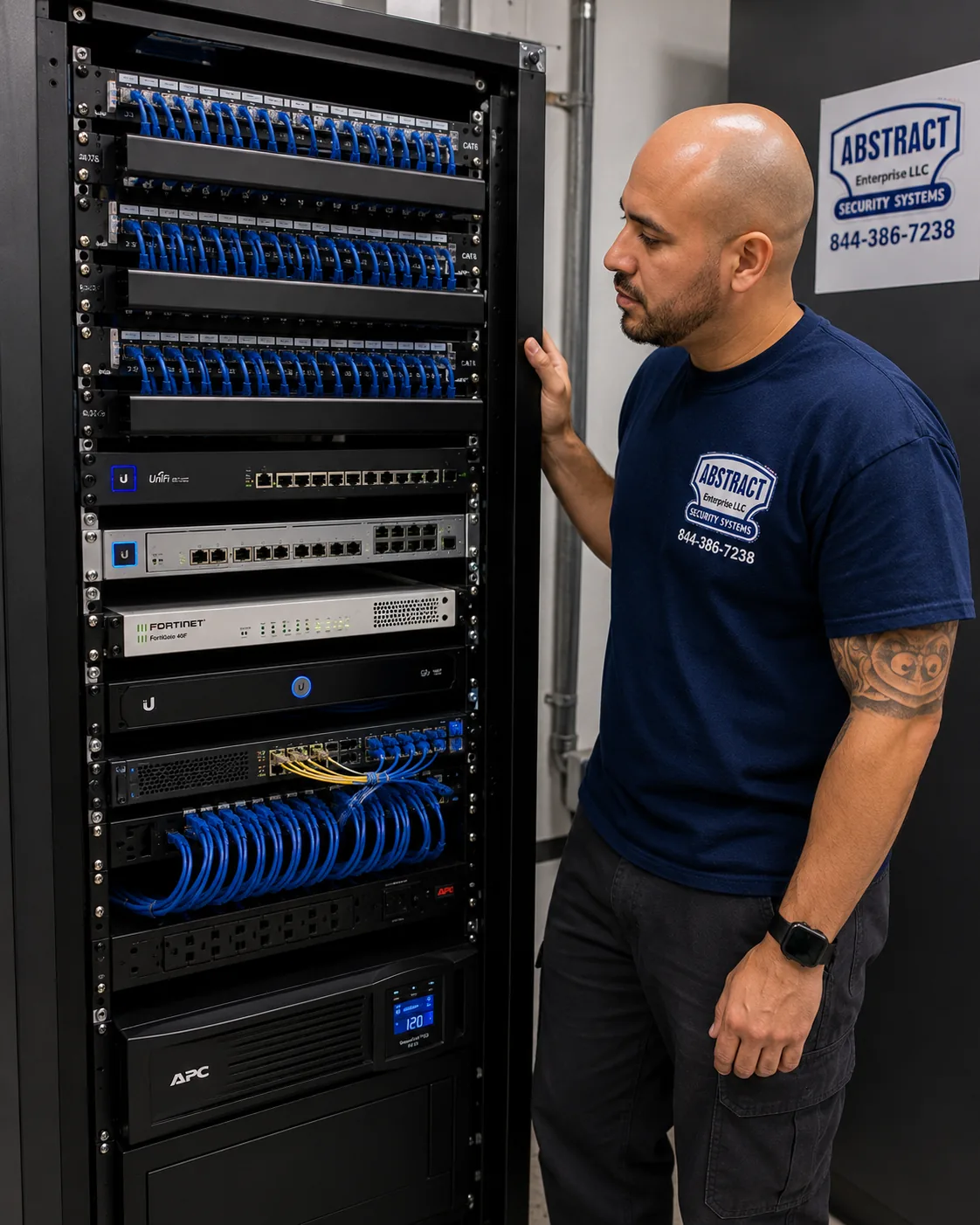
Photo from the AESS job library, not taken on Long Island: a finished network rack with patch panels, switching, a firewall and a battery backup unit at the bottom, every cable dressed and identified. A house does not need a rack, but it borrows the same idea: with Isaias having left almost half of PSEG Long Island's customers without power, a small battery backup under the modem and router keeps battery-powered Ring cameras uploading through a short outage.
Building Specialists
Ring Camera Installation for Long Island's Architecture
Long Island's houses look alike from the road and differ a great deal at the doorbell. The type of house changes three things about a Ring job: where the power comes from, how the WiFi reaches the cameras, and what the cameras are fixed to. These are the types the public record describes across Nassau and Suffolk, and how we handle each.
Levittown Capes and Slab Ranches
Keri Murray Architecture describes Levittown's ranches as built on concrete slabs with radiant heating pipes and an expandable attic but no garage. No basement means wires travel through the attic, and we never drill into a heated slab.
Split-Levels and Hi-Ranches
Common in 1950s and 1960s Nassau, including near Hofstra. Several half-levels stand between the router and the front door, so WiFi is planned level by level and wires follow the stair walls.
Postwar Houses on Block Foundations
Capes and ranches with finished basements added later. Transformers and wires vanish behind finished ceilings, and getting a cable outside means a sealed hole through block.
Colonials and Newer Two-Stories
Typical of Suffolk's 1970 median. Usually a working chime circuit and an attached garage; the job is mostly placement, angles and long-driveway coverage.
South Shore Shingle and Waterfront Houses
Wood-frame and cedar-shingle homes near the bays and barrier beaches. Mounts go on blocks, not straight onto curved shingles, with stainless fixings and sealed penetrations against salt and wind.
North Shore Estates
Gold Coast-era houses and large modern properties along the old 25A corridor. Long gate drives, stone and stucco walls, outbuildings, and WiFi that has to be engineered rather than hoped for.
How the house type changes the Ring job
House
Doorbell power
How WiFi usually reaches the cameras
What the cameras mount to
Slab ranch
Existing circuit if present; new wire run through the attic if not
Router central on one floor; usually good, garage and back yard are the weak spots
Siding over wood frame; fascia and soffit for floodlights
Split-level or hi-ranch
Transformer often in the lower level near the boiler
Access point on the level closest to the front door
Siding, brick veneer on the lower level
Cape on block foundation
Transformer near panel or boiler, often original or patched
Router in basement or ground floor; upstairs dormer cameras need a check
Siding or shingle above, block below
Colonial
Usually adequate; tested anyway
Router upstairs or in a den; driveway end may need help
Vinyl siding with mounting blocks
Shingle or waterfront house
Tested, with corrosion checked at the button
Often fine inside; docks and decks need an outdoor-rated access point
Mounting blocks on shingles, stainless hardware
Estate
Varies; gates may need separate power
Wired access points or point-to-point links to outbuildings
Stone, stucco, brick, wood trim
On slab ranches. A ranch built on a slab with heating pipes in it is the one house on Long Island where we never drill down. Keri Murray Architecture's account of Levittown is clear that the ranches were heated with hot-water radiant pipes, and while many have since been converted to other heat, there is no way to know from the surface what is left in the concrete. So every wire in a slab ranch goes up, not down: from the transformer location into the attic, along the joists and down inside the wall to the doorbell or out through the soffit to a floodlight. Attics in these houses can be shallow and, in summer, very hot, so we schedule attic work for the cooler part of the day where we can, and we look for any insulation or old materials we should not disturb before we crawl through.
On split-levels and hi-ranches. These are the houses where Ring doorbells most often show "offline" a week after a do-it-yourself install. The router usually sits in the family room or den on the lowest level, where the cable company brought the line in, and the front door is a half-flight up and on the far side of a stair wall and a kitchen. A doorbell is a small radio with a small antenna, and it is trying to send video through all of that. Before we mount anything, we stand at the door with a signal meter. If the reading is weak, the fix is one of three things: move the router to a more central level, add an access point on the upper level fed by a cable from the router, or, for the rare door that still cannot hear the network, a wired connection to a model built for it. The chosen fix goes on the quote with its line from the price list.
On block foundations and finished basements. A restoration contractor working in Uniondale describes many local capes and ranches as sitting on concrete-block foundations, with finished basements added in the 1960s and 1970s. That same contractor warns that postwar houses frequently contain asbestos materials. We treat that warning seriously. Before we drill through an old basement ceiling tile, a pipe wrap or a patch of old flooring to chase a doorbell wire, we look at what it is made of, and if it could be a suspect material we stop and route another way. When a cable has to leave the house through the foundation, we drill the block, not the mortar joint, sleeve the hole and seal it so water and insects stay out.
On shingle and waterfront houses. One Long Island installer, Rolo Electronics, says the island's salt air, humidity and storms demand marine-grade hardware and sealed equipment. Whatever brand you use, we agree with the basic point: near the bays and the Sound, the mount is the weak link. A Ring camera screwed straight onto curved cedar shingles leans, lets water run behind the base and works loose in wind. We fit a flat mounting block first, fix it into the framing with stainless screws, seal every penetration and keep cable entries pointing down so water drips away rather than into the wall. After a storm season, a quick look at the mounts is worth more than any setting in the app.
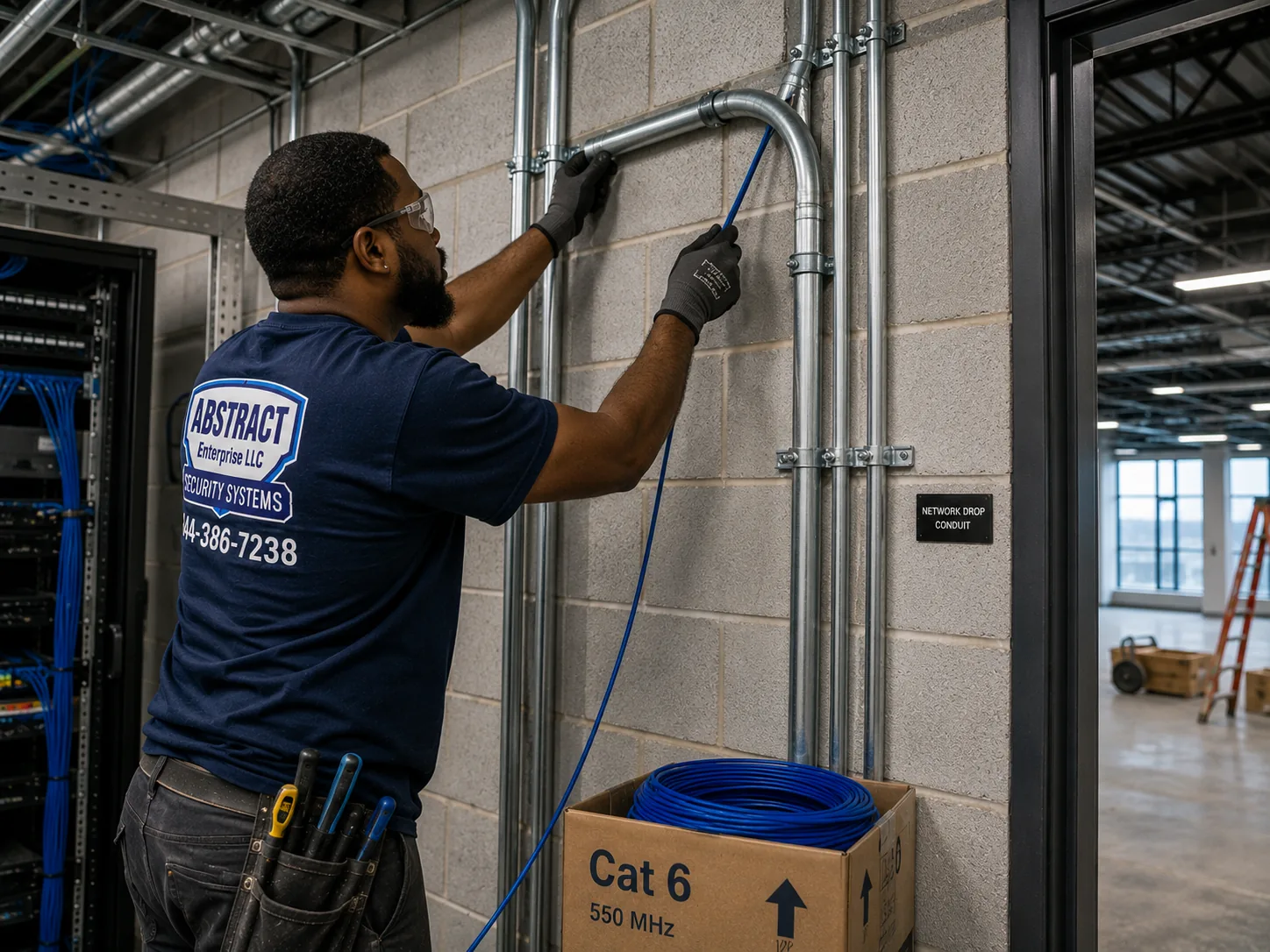
Photo from the AESS job library, not taken on Long Island: a technician running cable into steel EMT conduit beside a telecom room in an industrial building. When a North Shore estate or a Suffolk property needs a wired link out to a garage, barn or pool house so a Ring camera there has a strong connection, the exposed part of that run goes into conduit like this, out of reach of mowers, trimmers and weather.
Commercial Ring Camera Installation
Business Ring Camera Installation in Long Island
Ring is built first for homes, but plenty of small Long Island businesses use it: a deli on a turnpike, a dentist in a converted house, a landscaper's yard, a flex-building tenant who wants to see the loading door from a phone. The corridors below are the ones the public record names as Long Island's main commercial strips and business districts. We describe what the sources say about them; we do not claim any business there as a customer.
Hempstead Turnpike
One of the island's main east-west roads. In Uniondale, News 12 reported in September 2026 that the owner of Morning Delights got a motion alert from his security camera, went to the restaurant and found a burglary suspect there. Motion alerts on a phone are exactly what Ring is built for.
Old Country Road and Roosevelt Field
Wikipedia calls Roosevelt Field, in the East Garden City section of Uniondale, the largest mall on Long Island, with 243 stores. Mall tenants follow the landlord's systems; the smaller stores and offices on the surrounding roads are where Ring fits.
The Route 110 Corridor
Spanning Farmingdale, Melville and Huntington Station, with a dense concentration of warehouse, flex, R&D and office uses, according to Irace Enterprises. Small tenants there often want a doorbell at a side entrance and a camera on the loading door.
Long Island Innovation Park at Hauppauge
About 1,350 businesses in roughly eleven square miles, as a 2017 cmmllp.com report described the former Hauppauge Industrial Park. Many are small firms in single-story buildings with a front office and a back door.
Jericho Turnpike and Middle Country Road
Routes that, as Molloy University's history of Long Island transportation notes, follow colonial-era roads and still carry strips of shops, offices and service businesses through both counties.
Merrick Road, Montauk Highway and Sunrise Highway
The South Shore's long commercial roads, lined with storefronts, offices and marinas from Nassau's south shore villages out toward the East End.
When Ring is the right tool for a business, and when it is not
Ring works well for a business that wants a handful of cameras, alerts on the owner's phone and a doorbell at a back or service door. It is less suited to a business that needs many cameras recording all the time to a recorder on site, footage kept for a set number of days for an insurer or a landlord, or several staff watching different screens. Ring saves video to the cloud on a paid plan, and each camera relies on WiFi and the internet connection. A deli on Hempstead Turnpike with three cameras and an owner who checks the phone fits that model. A warehouse on Route 110 with a dozen loading doors usually fits a wired system better. We will tell you which side of that line your business sits on before you buy hardware, and we install both.
Rules and practical limits for business cameras on Long Island
State licensing. New York requires a security and fire alarm installer license, under 19 NYCRR 195.2, for installing or servicing CCTV used to detect or monitor intrusion, theft or movement, as a Kirschenbaum law firm article explains. The state's licensing guidance exempts passive, non-detecting devices. Our work is done under NYS license #12000287431 either way.
County home improvement licensing. Nassau County requires a home improvement license to work on residential property, and its own FAQ says anyone working only on commercial buildings does not need one. Suffolk's licensing rules, in Chapter 563 of the county code, do not apply in towns or villages that license trades themselves. We hold what each job requires and will show it on request.
Signage and obvious cameras. New York Penal Law §250.65, as Ambient.ai summarizes it, protects systems where a written notice that video surveillance is in use is conspicuously posted, or where the cameras are clearly and immediately obvious. A small sign at the door of a store or office costs little and removes doubt.
No cameras where people expect privacy. Civil Rights Law §52-a makes video surveillance unlawful in places where people have a reasonable expectation of privacy. Restrooms, changing areas and similar rooms are off limits, and we will not aim a camera into them.
Audio is a separate decision. Justia Answers advises disabling audio unless a consenting participant will be part of any recorded conversation. For a counter or a waiting room where customers talk to each other, we usually set Ring cameras to video only and leave the owner to decide in writing.
Facial recognition. TechCrunch reported a June 2026 class action claiming Ring's Familiar Faces feature stores images of passersby without consent. Familiar Faces is off by default, according to Smart Home Perfected. We leave it off on business installs unless the owner has taken advice and asks for it.
New power is electrician work. A camera on a pole or wall with no outlet nearby needs a line-voltage circuit from a licensed electrician. Our quote says so rather than running an extension cord.
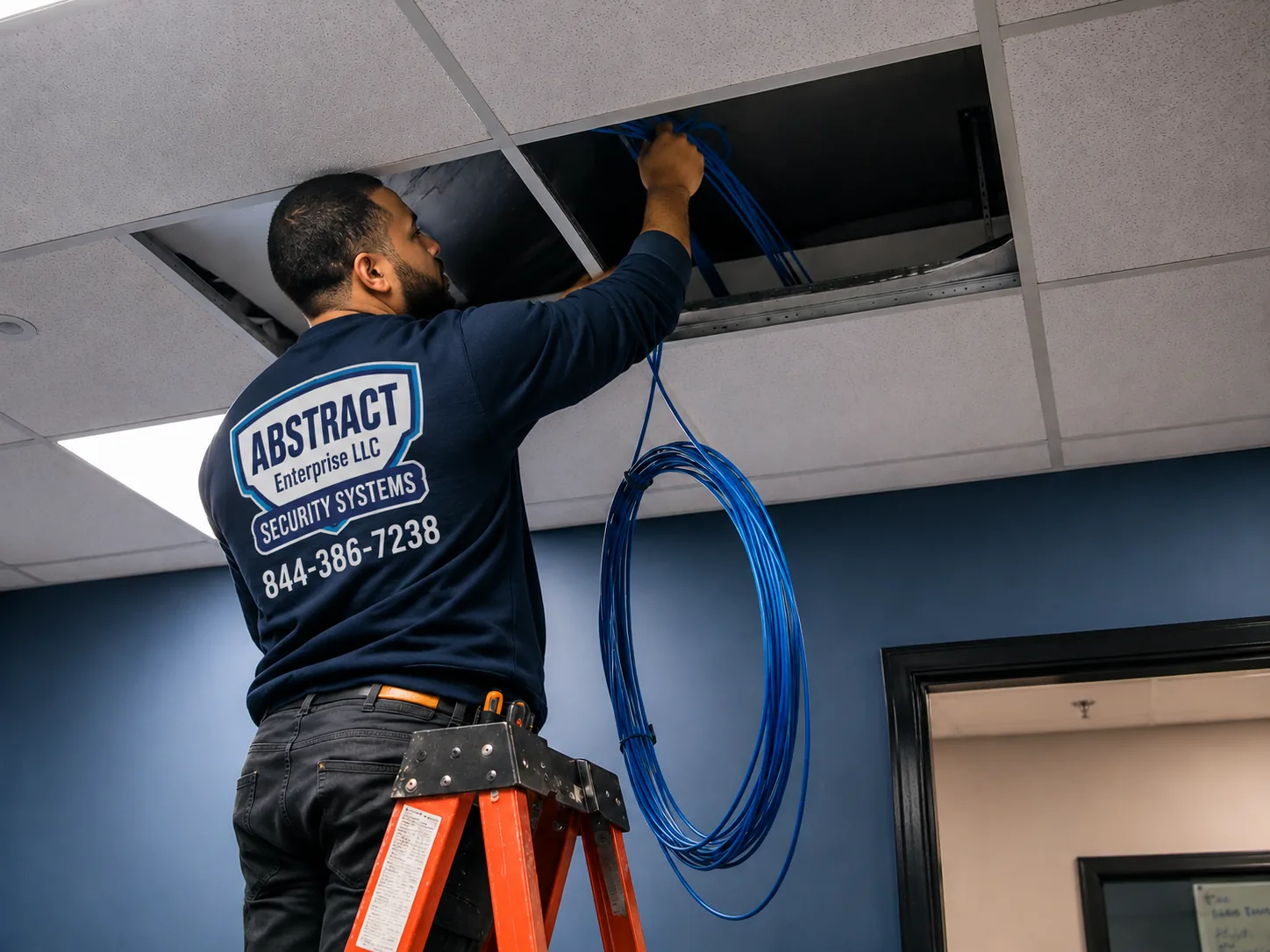
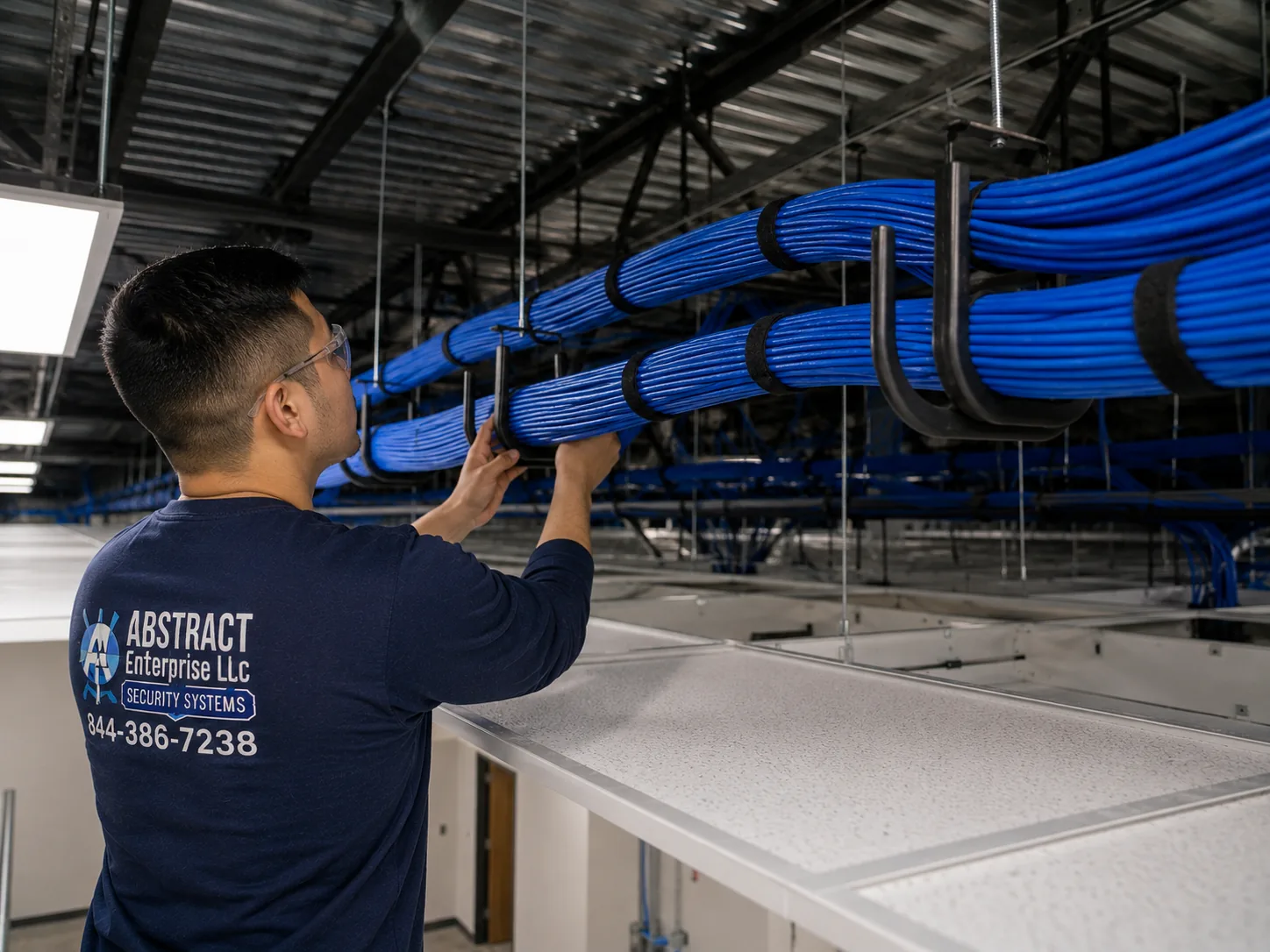
Photo from the AESS job library, not taken on Long Island: a technician feeding cable through the ceiling of a commercial space that stays open while the work goes on. A small store or office on Hempstead Turnpike or Jericho Turnpike often cannot close for an install, so cables to a ceiling access point or a camera above the door are pulled through the ceiling like this, with the work area kept small.Photo from the AESS job library, not taken on Long Island: a J-hook pathway carrying neat cable bundles across a commercial ceiling. In the single-story flex and office buildings of the Route 110 corridor and the Hauppauge park, a run from the front office router to an access point near the loading door, so a Ring camera there stays connected, travels on hooks like these rather than lying loose on the ceiling tiles.
Field Notes
Field Notes: The Meter Comes Out Before the Doorbell Does
We do not publish stories about a named customer's house unless we can document them, so this is not a tale about one address. It is the routine our technicians follow at the front door of the kind of house Long Island is full of: a 1950s cape or ranch, a doorbell button that has been painted over twice, and a new Ring doorbell still in its box on the hall table.
We leave the Ring in the box. First we press the old button and listen to the chime, because a weak, buzzy ring already tells us something about the transformer. Then we find the transformer, often near the boiler or the electrical panel, sometimes in the attic, and put a meter on it. We open the chime and look at how it is wired and what kind it is. We take the old button off and look at the two wires behind it: their color, whether they are brittle, whether the copper has gone green near the weather. We stand at the step with the phone and read the WiFi signal, then do the same at the driveway. Only when power, chime, wires and signal all check out does the Ring come out of its box. If one of them fails, we show you the reading and fix that first. That order is what separates a doorbell that works for years from one that drops off the app every cold night.
Your Questions Answered
Ring Camera Installation in Long Island: Questions Answered
Power and the old doorbell circuit
Our house was built in the 1950s. What happens if the original doorbell transformer is too weak for a Ring doorbell?
The doorbell will usually still turn on, which is what makes the problem confusing. An underpowered Ring doorbell tends to reboot, lag on live view, lose WiFi or drain its backup battery even though it is "hardwired." We test the transformer under load before installing. If it falls short, we replace it with a properly rated one, including the transformer Ring sells for its own doorbells where that suits the house, and we mount it where the next person can find it. A 1955 Nassau house may still have its original unit, or one swapped in decades ago; either way the meter decides, not the label.
We change the battery on our Ring doorbell every few weeks. Can it run off the doorbell wires instead?
If your model supports wired power and there are working doorbell wires at the door, yes. One Yelp reviewer of a New York installer described changing the battery on a Ring doorbell every month as a real nuisance, and that is the most common reason people call us about doorbells they already own. Connected to the doorbell circuit, a battery Ring trickle-charges and stops needing to come off the wall. We test the transformer first, because a weak one can leave the battery draining anyway, and we check that the chime will still ring the way you want it to.
Our ranch is on a slab with no basement. How does a wire get to the front door if there isn't one already?
Through the attic, never through the floor. Levittown's ranches were built on concrete slabs with radiant heating pipes, and in any slab house we assume the floor may hold pipes we cannot see. We start at the transformer or a suitable power point, go up into the attic, follow the joists to the wall above the front door and fish down inside it to the button location. Where the wall cannot be fished, a battery or plug-in model with a wedge mount is the honest alternative, and we will say so rather than cut open finished walls.
WiFi and coverage
In our hi-ranch the router is downstairs and the front door is a level up. Is that why our Ring keeps going offline?
Very often, yes. A split-level or hi-ranch puts a stair wall, a floor and sometimes a kitchen full of appliances between the router and the door, and a doorbell's small antenna struggles to push video back through them. We measure the signal at the door before mounting. The fix is usually moving the router to a central level or adding an access point on the upper level fed by a cable from the router, and we test the doorbell's connection in the app after the change so you can see the difference rather than take our word for it.
How many Ring cameras does a typical Long Island house actually need?
Fewer than the box sets suggest and more than the doorbell alone. For most single-family houses we start with four questions: what does the front door camera miss, where are the cars parked, which door is out of sight of the street, and is there a garage or shed someone could get into. On a 1950s Nassau lot that often means a doorbell, a floodlight cam over the driveway and one camera covering the back door. On a larger Suffolk lot with a detached garage it may add one or two. We map it on a plan with you and you choose; we do not sell cameras for walls that do not need them.
Our detached garage sits at the end of a long driveway. Can a Ring floodlight cam there stay connected?
It can, but usually not on the house WiFi alone. Distance, the garage's own walls and anything parked in between weaken the signal. We read the signal at the garage before quoting. If it is weak, the usual fix is a wired run, buried or in conduit, to an outdoor-rated access point at the garage, or a point-to-point wireless link between the house and the garage. Homes.com describes many Uniondale houses with detached garages and private driveways, and that layout is common across both counties, so this is a routine part of our Long Island work.
Weather and outages
Will a Ring camera on a South Shore house survive hurricane season and the salt air?
The camera's own weather rating is only part of it; the mount and the cable entry usually fail first. Near the bays and barrier beaches we mount on flat blocks fixed into framing with stainless screws, seal every penetration, angle cable entries downward and avoid spots where wind-driven rain hits the camera face-on. Sandy's damage on the South Shore, including $150 million in Long Beach, is a reminder that no camera survives a flooded wall, so we keep power supplies and connections above any level that has taken water before.
Does a Ring system keep recording when PSEG loses power during a storm?
Only partly, and only if you plan for it. A hardwired doorbell goes dark with the house. Battery cameras keep running, but they need the router and modem to save video to the cloud, and those stop the moment the power does. A battery backup unit under the modem and router keeps them going through a short outage, as long as the internet provider's own equipment on the street is still up. After Isaias left almost half of PSEG Long Island's customers without power, we suggest a backup for any owner who wants cameras to keep working during storms.
Neighbors, audio and the law
Is it legal in New York for my Ring camera to record sound on the front porch?
Video and audio follow different rules. Justia Answers advises disabling audio unless you know a consenting participant, including you, will be part of any recorded conversation, because New York's eavesdropping law turns on consent to the conversation. A doorbell that records you talking to a delivery driver is different from a camera that records two passersby talking on the sidewalk. We set audio recording on or off with you at handover, and for cameras facing a sidewalk or a neighbor's yard we usually recommend off. This is general information, not legal advice.
Our floodlight cam can see the house next door. What should we do so it doesn't catch the neighbor's windows or yard?
Aim first, then mask. Civil Rights Law §52-a bars video surveillance where a person has a reasonable expectation of privacy, and a neighbor's bedroom window or fenced backyard is the clearest example. We aim each camera to cover your driveway and doors, then draw Ring privacy zones over anything on the neighbor's side, which blacks out those areas in the video, and set motion zones so their movement does not wake your phone. On tight Nassau lots this takes a few minutes per camera and prevents most neighbor disputes before they start.
Police, sharing and privacy settings
Can Nassau or Suffolk police see my Ring video without asking me?
Through Ring's Neighbors features, police can ask, and you decide. City & State New York reported in 2019 that Nassau police would use Neighbors footage to pursue package thieves when customers gave access. Consumer Reports explains that Ring's current Community Requests program lets police ask users for videos, and that you can switch Community Requests off in the Neighbors settings. Ring ended its planned Flock Safety partnership in 2026, according to Variety. We walk through each setting with you at handover so your choice is deliberate, not a default.
Should we register our Ring cameras with the Suffolk County police, and does it cost anything?
Registration with the SCPD Camera Registry is free and voluntary. You record where your cameras are, and if something happens nearby, police may ask you to check your video for a date and time; the department says it does not get access to registered cameras and that retrieval is at your convenience. SCPD's SHIELD program also runs an Emergency Remote Camera Access option that partners can join or leave at any time. In Nassau we could not find a county-wide registry, though Garden City Police run a voluntary program of their own. Whether to register is your call.
Ring added facial recognition and a pet-finder feature. Which privacy settings should we check after you install?
Two in particular. Smart Home Perfected reports that Familiar Faces, Ring's facial recognition launched in the U.S. in December 2025, is off by default, and that Search Party is on by default. TechCrunch reported a June 2026 class action over Familiar Faces storing images of passersby. We show you where both settings live, along with Community Requests, audio recording, motion zones and privacy zones, and leave each one the way you choose. We will not turn on facial recognition for you without an explicit request.
Theft and tampering
Someone in Central Islip stabbed a Ring doorbell. Can a doorbell be mounted so it's harder to rip off or destroy?
It can be made harder, not impossible. ABC7 reported the Central Islip attack on a doorbell camera, and the video it captured is the reason the doorbell still did its job. We fix the mounting plate into solid framing or masonry rather than siding alone, use the security screw Ring supplies so it cannot be popped off with a fingernail, and add a second camera that sees the doorbell itself, so anyone attacking it is recorded from another angle. Video saved to the cloud on a Ring plan survives even if the doorbell does not.
Packages keep vanishing off our step. Where should the doorbell point so it actually catches the box and the face?
Low enough to see the step, high enough to see the face, and away from the glare. The clips from Wantagh and Massapequa Park both show doorbells that caught the person on the step and the package at their feet. We set the height so the camera's view takes in the doormat area, use a wedge kit if the door is recessed or the drop-off spot is off to one side, and point away from a bright street that would turn faces into silhouettes. If deliveries land on a side porch or by the garage, a second camera there does more than any doorbell setting.
Photo from the AESS job library, not taken on Long Island: a technician mounting a managed PoE switch below the patch panels in a commercial rack. A switch like this powers access points over their network cable, which is how a store or office in the Hauppauge park gets strong WiFi to the back door where its Ring camera sits, without an outlet up on the ceiling.
Equipment
Types of Ring Camera Installation We Install
These are the Ring devices and the supporting parts we fit in Long Island homes and small businesses. You can buy the Ring hardware yourself and have us install it, or we can supply it. Prices for each install line are on our Long Island Ring price page; this section explains what each device is for and where it suits Long Island houses.
🔔
Hardwired Video Doorbells
Powered by the existing doorbell circuit, with no battery to charge. The right choice for most capes, ranches and colonials once the transformer has been tested.
🔋
Battery Video Doorbells
For doors with no wires and walls that cannot be fished. Can often be wired later for trickle charging when wires are added.
🚪
Peephole Cam
A door-mounted camera that replaces a peephole. TechCrunch reported Ring designed it to install without permanent modifications, with privacy zones. Useful for renters.
🔦
Floodlight Cams
Camera and lights in one unit over a garage or driveway, usually on an existing outdoor fixture box. The main driveway camera for most Long Island houses.
📹
Spotlight and Stick Up Cams
Smaller cameras for side gates, back doors and sheds, powered by battery, solar panel or plug-in depending on the wall.
🚨
Ring Alarm
Door and window contact sensors, motion detectors, keypads and a base station, which can be self-monitored or professionally monitored.
⚡
Transformers and Chime Parts
Correctly rated doorbell transformers, including Ring's own, and the chime adapters or kits a video doorbell needs to work with an older chime.
📶
Access Points and Network Parts
Access points, outdoor-rated radios, cable and battery backups that keep every Ring device connected across split-levels, garages and big lots.
🔩
Mounts, Wedges and Blocks
Wedge and corner kits to angle doorbells toward the step, flat mounting blocks for shingle and siding, and stainless hardware for coastal houses.
Ring compared with ADT, SimpliSafe and a wired camera system
Many Long Island owners are choosing between Ring and something else before they call. The table below compares the general approach of each, not features of particular models, which change often. We install Ring and we install wired systems, so we have no reason to push one.
Option
What it is best known for
Where the video goes
Best fit on Long Island
Ring
App-based video doorbells, cameras and Ring Alarm, owned by Amazon
Cloud, on a paid Ring plan; live view without one
Single-family houses wanting a doorbell, a few cameras and phone alerts
ADT
Professionally monitored alarm service
Depends on the package chosen
Owners who mainly want monitored intrusion alarms
SimpliSafe
Self-install alarm kits with cameras
Cloud, on its own plans
Owners who want to install an alarm themselves
Wired camera system with a recorder
Cameras on cable to a recorder in the house or office
Recorder on site, with remote viewing
Estates, warehouses and businesses wanting many cameras recording continuously
The real difference for most Long Island houses is between cloud and local recording. Ring keeps your clips in the cloud, which means they survive a stolen or smashed camera but depend on your internet connection and a subscription. A wired system records to a box in the house, which keeps working without a monthly plan but needs the box itself protected. Some owners use both: Ring at the front door for deliveries and conversation, a wired system for the driveway and yard. We will tell you honestly which fits your property.
Photo from the AESS job library, not taken on Long Island: boxes of cable staged for a multi-drop pull at a premises that stayed open during the work. When a small Long Island business moves from a few Ring cameras to a larger wired system, planning starts like this, with every run counted and staged before the ceiling is opened.
AI Overview Reality Check
What AI Gets Wrong About Ring Camera Installation in Long Island
We could not capture Google's AI Overview or People Also Ask boxes for this search from our build environment, so we are not going to pretend to quote them. What follows are claims we see repeated in quick online answers about Ring installation in general and about Long Island in particular, checked against the public record and our own field practice. Marketplaces such as Angi, HomeAdvisor and Fixr publish national cost guides that feed many of those answers; they help with a rough idea, but they are not a reading of your transformer or your WiFi.
"A Ring doorbell installs in fifteen minutes with the parts in the box."
On a newer house with a healthy transformer and a standard chime, it can. On a large share of Long Island houses, that is not the house you have. The median Nassau home was built in 1955, and the doorbell circuit in it was designed for a mechanical chime, not a camera.
The fifteen-minute install skips the meter reading. The doorbell powers on, looks fine and then starts rebooting on cold nights or losing its connection, and the owner blames the WiFi or the doorbell.
Our routine starts at the transformer and the chime, not at the door. If either needs work, it is done first, and the doorbell goes up on a circuit that can actually carry it.
"Ring works anywhere your WiFi works."
The phone in your hand and the doorbell on your door have very different antennas. A phone showing full bars in the kitchen does not mean a small doorbell radio on the far side of a stair wall can upload video reliably.
Long Island's split-levels, hi-ranches and detached garages are the textbook cases. Homes.com describes many Uniondale houses with detached garages and private driveways, and Suffolk's bigger lots put outbuildings even farther from the router.
We measure the signal where each device will live, then fix the network before mounting the camera. A camera that drops offline is worse than no camera, because you think you are covered when you are not.
"You never need a permit for cameras on Long Island."
One installer's website says no permit is required for standard camera installs on Long Island. That may be true for a typical doorbell, but it is a claim, not a ruling, and Long Island is not one jurisdiction.
Nassau alone has two cities, three towns and 64 incorporated villages; Suffolk has 10 towns with villages inside them. The Town of Hempstead's code requires a building permit for work that must conform to the Uniform Code or the Energy Code, and a new electrical circuit for a floodlight is the kind of work that can cross that line.
So we check by address. A battery camera on a hook is one thing; a new outdoor circuit, a pole in the yard or anything on a historic or HOA-controlled property is another. If a permit or approval is needed, the quote says so.
"Police can't get your Ring footage unless they have a warrant."
This one is both too strong and too weak. Ring's Neighbors features let police ask users for video directly. Consumer Reports describes the current Community Requests program and notes that owners can switch it off. Nassau police announced work with Neighbors as far back as 2019, according to City & State New York.
What changed in 2026 is the Flock Safety link. Variety and TechCrunch reported that Ring cancelled that partnership after a backlash over its Super Bowl ad, with Ring saying it would require significantly more time and resources than anticipated.
In Suffolk, the SCPD Camera Registry is a separate, voluntary program that gives police no access to cameras. The practical point: what is shared depends on settings you can control, and we go through them with you.
"It's your property, so recording audio is fine."
Video on your own property and audio of other people's conversations are not the same thing under New York law. Justia Answers advises disabling audio unless a consenting participant will be part of any recorded conversation.
A Ring doorbell recording you talking to a courier is one situation. A floodlight cam that records two neighbors chatting at the property line, or people talking on the sidewalk, is another.
We set audio per camera at handover. For devices facing the street or a neighbor's side, we usually suggest video only, and we explain the trade-off so you decide.
"Any outdoor-rated camera can handle Long Island weather."
The weather rating on the box covers the camera body, not the screws, the base or the hole where the cable enters the wall. Those are what fail first on the South Shore and along the Sound.
Long Island's record includes Sandy's $150 million in damage to Long Beach and Suffolk's first-ever flash flood emergency in August 2024, when the Stony Brook Mill Pond dam failed. Salt air works on mounts even in years without a named storm.
We mount on proper blocks, use stainless hardware near the water, seal every penetration and keep power and connections above any level that has flooded before. A rated camera on a poor mount is still a camera that falls off.
"Ring Intercom will connect your building's buzzer to your phone."
This claim turns up in answers about apartments and multi-family buildings. Ring's own support page says Ring Intercom is not available in the U.S., so we do not offer it.
On Long Island, where most homes are single houses with their own doors, this rarely matters. It does come up in garden apartments and multi-family buildings near the train stations, where a tenant shares a front door and a buzzer.
For those renters, Ring's Peephole Cam on the apartment's own door, with the landlord's written agreement, is usually the honest answer. A building-wide entry system is a separate project for the owner, not a Ring add-on.
Ready to Plan the Cameras? Talk to a Technician About Your Long Island House
Send a photo of the front door, the chime and the walls you want covered, and a technician will tell you whether the transformer is likely to need replacing, whether your WiFi will reach the garage, and which Ring devices belong where. Call (800) 486-0943, message us on WhatsApp, or use the quick form.
Every Long Island Ring job follows the same eight steps, whether it is a single doorbell in a Levittown cape or a full system on a North Shore property. The order matters most in older houses, where skipping the transformer test or the WiFi walk is the usual reason a new system disappoints.
1. Photos, address and what you own
Photos of the door, the button, the chime and the walls you want covered, the Ring devices you have or plan to buy, and the street address so we know the county, town and village.
2. Rules and approvals
A landlord holding a Town of Hempstead rental permit, a condo or HOA board, a village with its own rules, and whether Ring Alarm will need Suffolk alarm registration.
3. Test the power and the chime
A meter on the transformer, a look inside the chime and at the wires behind the old button, before any hardwired Ring goes up.
4. Walk the WiFi
Signal read at the door, the driveway, the garage and the back of the house; router moved, access point added or wired run planned where it is weak.
5. Agree every position
Each device held at its spot, the view checked on the phone, height set for faces and packages, and every position agreed with you before drilling.
6. Mount, wire and seal
Fixed into framing, block or siding with the right anchors, wedges or blocks, penetrations sealed, and any new line-voltage circuit left to a licensed electrician.
7. Set zones, privacy and audio
Motion zones away from the street, privacy zones over neighbors' windows and yards, audio set per New York consent rules, and Familiar Faces, Search Party and Community Requests explained.
8. Test, hand over and document
Live view, alerts and recording tested on every device, shared users added, and a written note of the transformer, chime, mounts and network changes we made.
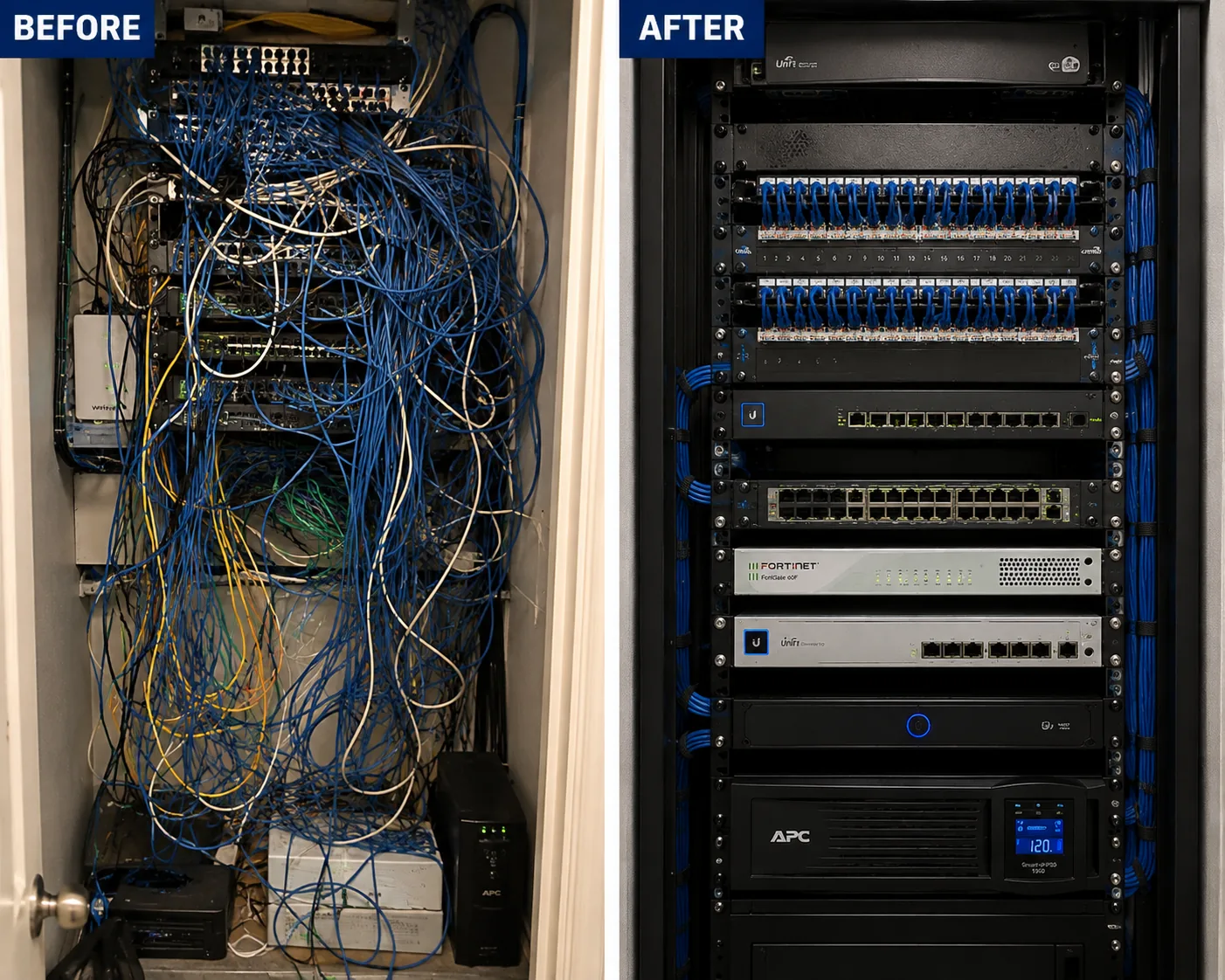
Photo from the AESS job library, not taken on Long Island: the same network rack before and after cleanup, from a tangle of unlabelled cables to a dressed and identified one. Taking over a Ring system in a house bought from someone else, or in an office that changed hands, often starts with a messy router corner like the left side, and the last step of our process is leaving it like the right.
Coverage Area
Ring Camera Installation Near Long Island's Landmarks
Long Island is too big to give directions by one corner, so we plan visits by the landmarks people already use. These six span both counties and the range of houses around them.
Levittown
Begun in 1947 on potato fields and grown to some 17,500 homes by 1951, the template for the postwar Long Island house and its doorbell circuit.
Old Westbury Gardens
The John S. Phipps estate, built in 1906, among the Gold Coast mansions AAA Northeast lists with Oheka Castle and Planting Fields on the North Shore.
Roosevelt Field
Long Island's largest mall, with 243 stores in the East Garden City section of Uniondale, near Hofstra and the old Mitchel Field lands.
Long Island Innovation Park at Hauppauge
The former Hauppauge Industrial Park, renamed in 2019, home to about 1,350 businesses across roughly eleven square miles.
Stony Brook University
213 buildings on 1,454 acres in the Town of Brookhaven, near the Mill Pond dam that failed in the August 2024 flood.
Ronkonkoma Hub
Suffolk's planned redevelopment between Long Island MacArthur Airport and the Ronkonkoma LIRR station, with 48 acres of a 179-acre area out for a master developer.
Ring installs on Long Island are priced per device and per add-on from our published price list, and the county the address sits in sets the rate. Under our area pricing rules, Nassau sits about 15 percent above our Brooklyn base and Suffolk about 20 percent above it, reflecting travel and time on the road. The full line-by-line list, with the calculator where you can build your own system, is on our Long Island Ring camera installation prices page, with county versions for Nassau and Suffolk. We do not quote numbers on this page that are not on that list.
What moves the price on a Long Island Ring job
Price driver
Why it comes up on Long Island
How we handle it
Number and type of devices
A doorbell alone versus doorbell, driveway and back door
Each device is its own line; you choose which walls get one
Transformer replacement
Many 1950s and 1960s transformers are too weak for a video doorbell
Tested first; replaced only if the meter says so, shown to you
Chime adapter or kit
Older mechanical and some digital chimes need one
Identified from your photo where possible, confirmed on site
Wiring where none exists
Slab ranches and remodeled houses with no wires at the door
Attic route quoted, or a battery model suggested instead
WiFi work
Split-levels, hi-ranches, detached garages, long driveways
Router move, access point or wired run named on the quote
Mounting surface
Cedar shingle, vinyl, brick, stucco and block
Blocks, wedges and anchors matched to the wall
Height and access
Floodlights high on two-story colonials, steep driveways
Ladder or second technician noted before you book
Electrician work
A floodlight where no outdoor fixture box exists
Handed to a licensed electrician and listed separately
How to read the list for a Long Island house
Take a 1950s cape in Nassau with a working but weak transformer, a mechanical chime, a router in the basement and a driveway beside the house. The lines that apply are a hardwired doorbell install, a transformer replacement if the meter confirms it, a chime adapter if the chime needs one, a floodlight cam install over the driveway on an existing fixture box, and possibly an access point if the front door reads weak. Move that same plan to a Suffolk colonial on a bigger lot, and the transformer line usually drops off, while the WiFi line to a detached garage often appears. In both cases you see every line before you agree, and nothing is added on the day without your say-so.
If you supply your own Ring devices, you pay the install lines only. If a device turns out to be damaged, locked to another account or unsuitable for the wall, we tell you before mounting it, not after.
Full terms — including 50% deposit, one-year parts-only warranty on AESS-supplied products, and the late-fee schedule — are set out in the service agreement.
Shop Our Systems
Ring Camera Installation Packages & Pricing
Three common Long Island Ring setups, each built only from lines on our price list. The installed price for each, at your county's rate, is on the Long Island Ring price page; there is no package premium.
Starter: Front Door Done Right
A hardwired Ring video doorbell on the existing circuit, with the transformer metered and the chime checked, a wedge kit if the door needs angling, and motion zones, privacy zones and sharing settings set up with you. Suits a cape, ranch or colonial with wires already at the door.
Standard: Door and Driveway
The Starter setup plus a floodlight cam over the driveway or garage and one camera on the back or side door, with a WiFi walk at each spot and an access point if the front door or garage reads weak. The usual setup for a 1950s or 1960s Nassau house.
Premium: Whole Property
Doorbell, driveway floodlight, cameras on every door and on a detached garage or outbuilding, a wired or point-to-point link to that building, a battery backup for the router, and Ring Alarm contact sensors on the doors. For larger Suffolk lots, North Shore properties and seasonal homes.
Bring your own equipment
If you already own the Ring doorbell, cameras or Alarm kit, we install them at labor-only lines from the same list. Before mounting, we check that each device powers up, that it is not still registered to someone else's account, and that the model suits the wall and the power available. If a battery doorbell cannot be wired at your door, or a camera you bought needs an outlet the wall does not have, we say so and show you the alternative before any holes are drilled. The same applies to transformers and chime kits bought online: if the rating is wrong for the doorbell, we will not connect it.
Complete Services
Every Ring Camera Installation Service in Long Island
Do you install Ring cameras everywhere on Long Island, including the North and South Forks?
+
Yes. We cover every part of Nassau and Suffolk, from the Queens line out to the East End. Addresses are priced at the Nassau or Suffolk rate depending on the county, and East End visits are planned into scheduled windows so the travel is used well. Tell us the town and cross street when you book and we will confirm the date.
Why does a Ring install cost more in Nassau and Suffolk than in Brooklyn?
+
Our area pricing reflects time on the road and access. Nassau runs about 15 percent above our Brooklyn base and Suffolk about 20 percent above it. The lines themselves are the same; the county rate is applied to them, and our Long Island price page shows the installed figure for each county.
Is there a Ring doorbell that saves video without a monthly fee?
+
Ring devices give you live view and motion alerts without a subscription, but saving and replaying recorded clips requires one of Ring's paid plans. If avoiding any monthly fee matters most to you, we can also install a wired doorbell and camera system that records to a recorder in the house, and we will compare the two honestly for your property.
Are there stick-on doorbell cameras that don't need any drilling?
+
Adhesive mounts exist, but on Long Island's shingle and siding they tend to let go in summer heat and winter cold, and a doorbell that falls off is easy to steal. For renters who cannot drill, Ring's Peephole Cam fits through the existing peephole, and TechCrunch reported it is designed to install without permanent modifications to the door. That is usually the better no-drill choice.
Are Ring cameras worth it for a homeowner in Nassau County?
+
LI Life and Politics reported that Nassau burglaries rose 5 percent in January through May 2026 even as overall property crime fell, and News 12 has aired Ring clips of porch thefts in Wantagh and Massapequa Park. A doorbell plus a driveway camera gives you alerts and video when something happens. Whether it is worth it depends on what you want covered, which we help you decide before you buy.
Do I need a permit from my town or village to put up Ring cameras?
+
For a typical doorbell or battery camera, usually not, but Long Island has dozens of towns and villages with their own codes, so we check by address. The Town of Hempstead, for example, requires a building permit for work that must meet the Uniform Code or Energy Code, which can include new electrical circuits. HOAs and condo boards may also have rules about anything on the outside of the house.
If we add Ring Alarm with professional monitoring in Suffolk, do we need to register it?
+
The Suffolk County Police Department's Alarm Management Program requires alarm systems that call for a police response to be registered, with a fee for residences and a higher one for commercial premises. Its page says the online portal is currently down, so applications go by mail. Self-monitored Ring Alarm that only alerts your phone is a different situation; we explain which applies when we set it up.
Does an installer need a New York State license to put up Ring cameras?
+
New York requires a security and fire alarm installer license for installing CCTV and alarm equipment used to detect intrusion or monitor theft and movement, while purely passive devices are exempt. A homeowner installing their own Ring needs no license. AESS works under NYS license number 12000287431, and Nassau residential work also falls under county home improvement licensing.
We bought a house with Ring devices still on it. Can you move them to our account?
+
Usually, yes. The devices have to be removed from the previous owner's account, either by that owner or through Ring's own process for new homeowners, before they can join yours. We check each device's condition, test the transformer behind any hardwired doorbell, reset and re-register them, and replace anything that is failing.
Will Ring cameras keep watching a Hamptons or North Fork house that's closed for the winter?
+
Only if the internet service and the power stay on all winter, so check that before you close the house. The East Hampton Star reported police using an interior camera still in a burglary on Sammy's Beach Road, which shows the value of inside coverage too. We add a battery backup for the router, set alerts to reach you wherever you are, and suggest a contact sensor on each door.
Is Ring a good fit for a small store or office, or should a business use something else?
+
Ring suits a small business that wants a few cameras, a doorbell at a service door and alerts on the owner's phone. A business that needs many cameras recording continuously, footage kept for a set period or several people watching screens is usually better served by a wired system with an on-site recorder. We install both and will tell you which fits before you buy.
Can Ring connect to the shared buzzer in a garden apartment building?
+
Not with Ring's intercom product, because Ring's own support page says Ring Intercom is not available in the U.S. A tenant can put a Peephole Cam on their own apartment door with the landlord's written agreement. Any change to the building's shared entry system is a separate project for the owner, not something we add to a single unit.
Do we need to be home for the whole Ring installation?
+
Someone needs to be there at the start, to let us in to the transformer and the chime and to agree the camera positions, and at the end, to see the app handover and choose the privacy settings. In between, if you have a trusted person on site, you can step out. We will not mount a camera in a position you have not seen and agreed.
Get In Touch
Request a Free Quote
Tell us the town, the house type and the Ring devices you have or want. Photos of the front door, the chime and the walls you want covered make the quote exact. Prefer to talk? Call (800) 486-0943.
✅
Request Sent!
We'll call about your Long Island Ring installation the same business day.
More Ring Camera Installation near Long Island hub
From a 1950s cape in Levittown to a hi-ranch near Hofstra, a colonial on a long Suffolk driveway or a shingle house on the South Shore, the job starts the same way: a meter on the transformer, a signal reading at every camera spot, and an honest match to our Long Island price list. Call (800) 486-0943, message us on WhatsApp, or send the quote form, and we will tell you exactly what your house needs before anyone drills.