Cameras · NVR & DVR Recorders · Surveillance Drives · PoE Switches · Mounts, Cable & Battery Backup
Security cameras in Putnam County are sold here equipment-only or installed from $1,199 for a four-camera house-brand system, with the recorder, cable, mounting and phone setup done by our licensed crew. We carry the PoE cameras, NVR and DVR recorders, surveillance hard drives, PoE switches, outdoor cable, junction boxes and battery backups that a Putnam house actually needs — a wooded lot, a driveway that disappears into the trees, a garage that stands apart, a dock on Lake Mahopac or a shop on Main Street in Cold Spring or Brewster — and we deliver them to your door in all six towns.
Quick answer: Abstract Enterprises Security Systems sells security cameras, recorders and accessories in Putnam County as a licensed installer that also delivers. Buy any item equipment-only (call or text for today's price) or have it installed, with installed systems starting at $1,199. Every quote comes as a 2K option and a 4K option, systems record to a drive in the house so they keep working when the internet or cell signal drops, there is no monthly fee, and install requests are booked within 2 hours.
Last updated November 23, 2026 by Abstract Enterprises Security Systems, NYS license #12000287431 · Sources: U.S. Census Bureau, American Community Survey 2019–2023 5-year estimates (DP04, B25004); NYS DCJS Index Crimes by County and Agency; Putnam County Sheriff's Office via Putnam County Press and The Highlands Current; News 12 Hudson Valley; National Weather Service New York, NY; NYC Department of Environmental Protection; Village of Cold Spring; NYS Penal Law §§250.00, 250.05, 250.45; NYS Labor Law §203-c; Reolink, Lorex and Luminys product specifications

Owner-operated since 2002 · Thousands of jobs completed · Booked within 2 hours · Call or text (845) 640-3835
Putnam County is the most detached-house county in the Hudson Valley, and that single fact shapes almost every camera we sell here. A typical Putnam home is not one of a row; it sits on its own lot, often back from the road behind trees, with a driveway that bends, a garage that may stand on its own, a shed or two, and on a lot of streets a lake or a reservoir somewhere at the bottom of the hill. Cameras built for a small suburban yard, where the router is thirty feet from everything, run out of reach on these lots. That is why we sell security camera equipment in Putnam the way an installer would: we ask where the farthest view is, how the internet comes into the house, and what happens to the property when nobody is there.
The Census numbers say it plainly. The American Community Survey 2019–2023 five-year estimates count about 38,369 housing units in Putnam County, and 77.7 percent of them are single-family detached houses — a higher share than Ulster (68.6), Dutchess (62.6), Orange (62.4), Rockland (57.1) or Westchester (43.5). In Putnam Valley the detached share reaches 95.6 percent. Every one of those houses has its own four sides, its own driveway and its own outbuildings, and each is a separate camera location that has to be wired, powered and recorded.
| Town | Housing units | Detached houses | Vacant | Seasonal homes |
|---|---|---|---|---|
| Carmel (incl. Mahopac) | 12,783 | 77.6% | 6.6% | 403 |
| Southeast (incl. Brewster) | 7,343 | 61.3% | 5.5% | 147 |
| Kent (incl. Lake Carmel) | 5,098 | 83.9% | 9.0% | 259 |
| Putnam Valley | 4,820 | 95.6% | 17.3% | 451 |
| Philipstown (incl. Cold Spring, Garrison) | 4,429 | 79.1% | 12.4% | 384 |
| Patterson (incl. Putnam Lake) | 3,896 | 77.5% | 5.9% | 113 |
| Putnam County | 38,369 | 77.7% | 8.6% | 1,757 |
Source: U.S. Census Bureau, American Community Survey 2019–2023 5-year estimates, tables DP04 (units, detached share, vacancy) and B25004 (vacant for seasonal, recreational or occasional use), county subdivisions of Putnam County. Hamlets in parentheses are for orientation and are not separate rows in the survey.
Two columns in that table drive what people buy. The detached share tells you how far cameras have to reach. The vacancy and seasonal columns tell you how many houses spend part of the year with nobody inside. Putnam Valley stands out on both: almost every house is detached, and 17.3 percent of its units were counted as vacant, with 451 held for seasonal or occasional use. Philipstown follows with 12.4 percent vacant and 384 seasonal homes. Those are the owners who want to open an app in Manhattan on a Tuesday in February and see that the driveway is unplowed, the doors are shut and the boathouse is still standing.
Putnam is a low-crime county, and we would rather say so than sell fear. The New York State Division of Criminal Justice Services counted 38 burglaries in the whole county in 2024, with 400 larcenies and 18 motor vehicle thefts. Larceny rose from 341 in 2023 to 400 in 2024, and much of it is the kind of theft a camera is good at recording: items taken from cars, packages taken from porches, tools taken from a truck or a job site. The number of burglaries is small, but a burglary in Putnam tends to happen at a house set back from the road, where no neighbor sees the car come up the driveway. A camera is often the only witness.
The Putnam County Sheriff's Office has its own reasons for watching the roads. Its license plate reader network — 48 cameras at 21 locations, according to The Highlands Current — logged 808 alerts on 250 vehicles between January 1 and August 11, 2026, as reported in the Putnam County Press. Twenty-seven of those vehicles were flagged as belonging to burglary crews, and 46 percent of the burglary-crew alerts came from cameras at the county line. The Sheriff's Office put it this way: "When one of these vehicles shows up here, it is a strong indicator that a crew is canvassing our neighborhoods for target homes." Those cameras read plates on public roads. They do not see your driveway, your garage door or your back deck, and their footage is not yours. A camera system you own is what records what happens past the end of the pavement.
The theft reports that come out of Putnam are mostly quiet, overnight ones. In June 2024 The Highlands Current reported a run of thefts from unlocked vehicles across the county, including Philipstown, where a car left unlocked with the keys inside on Lurch Lane was stolen and later found abandoned in the Town of Fishkill; residents near Jaycox Road reported items taken from unlocked cars overnight; and in Mahopac, police reported thieves going through unlocked vehicles in the South Lake and North Lake communities. In October 2025 the Carmel Police Department warned residents about porch pirates ahead of the holiday shopping season, News 12 Hudson Valley reported, telling people to bring deliveries in, track them and report anything suspicious.
Neither of those problems needs a fortress. They need a camera that sees the driveway where the cars are parked, a camera that sees the porch or the spot where the delivery driver leaves boxes, and a recorder that keeps the clip when the phone alert gets swiped away. Those are the first two cameras on most Putnam lists, and both are covered by every four-camera kit we sell.
Water shapes Putnam's neighborhoods. Lake Mahopac drew summer visitors as early as the nineteenth century, the Patterson historical society notes; Lake Carmel in the Town of Kent was created by developers in the early twentieth century; and Putnam Lake in Patterson was made by damming a small branch of the Croton River. Each grew into a neighborhood of small lots, cottages that became year-round houses, private roads and beach rights. A house on one of those lakes needs cameras that handle glare off the water at sunrise, fog on humid mornings and a dock that may be pulled in every fall.
Behind many other houses lies New York City's water supply. The West Branch Reservoir sits in Kent and Carmel, Boyd's Corner Reservoir is in Kent, and Croton Falls Reservoir spans Carmel and Southeast, according to the NYC Department of Environmental Protection. Owners who back onto watershed land or state parkland like Fahnestock usually want a camera on the back of the house that sees the yard and the tree line, aimed so it records their own property rather than the land beyond it.
Three Putnam conditions decide the recorder plan before anyone talks about resolution. The first is signal. In 2015 Senator Charles Schumer released a RootMetrics ranking that put the Hudson Valley, including Putnam, last of 125 metro areas for cell performance, and said: "There are more cell phone dead zones in Northern Westchester and Putnam Counties than post-winter potholes on the West Side Highway." Coverage has improved since, but a camera that depends on a cell signal or on WiFi reaching the end of a wooded drive is still a gamble on many Putnam roads.
The second is power. After the storms of May 15, 2018, NYSEG reported 28,043 Putnam customers without power, with more than 4,000 out in each of Southeast, Putnam Valley, Patterson, Kent and Carmel, Daily Voice reported; an October 2017 storm left about 13,000 out, according to Patch. The third is snow. The National Weather Service in New York recorded 18.8 inches two miles west of Putnam Valley and 12.0 inches in Cold Spring in the February 22–23, 2026 blizzard, with a 41 mph gust measured at Brewster; a month earlier, the January 25–26 storm left 13.0 inches near Nelsonville, 11.5 near Putnam Valley and 11.0 in Mahopac. A Putnam camera system has to record through all three: a dropped connection, a dark house and a drift against the wall.
This is a local security camera store without a counter: you call, text or send the form, we put together the list, and the equipment arrives at your house or business, or arrives with our crew and gets mounted. Everything below can be bought equipment-only or installed. There is no online checkout and no cart. Equipment prices move with supply, so every item carries the same line — call or text for today's price — and installed systems start at $1,199. If you want to buy security cameras, buy CCTV cameras, buy IP cameras or buy a complete security camera system and you would rather talk to the people who will support it, this is how it works.
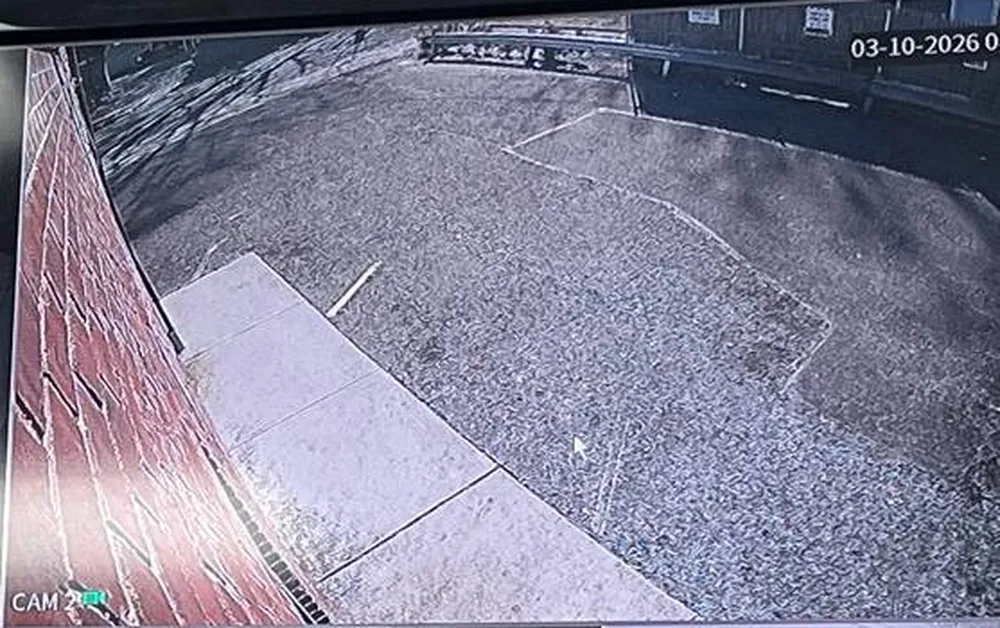
Outdoor security cameras and outdoor surveillance cameras make up most of what we sell in Putnam, because most of what owners want to see is outside: the driveway, the front walk, the garage doors, the back deck, the shed, the dock. The F, E, C and D house-brand series list IP66 or IP67 on their spec sheets, which means dust-tight and protected against heavy rain or brief immersion. Weatherproof security cameras for winters are not a special category here; they are the default. What changes from house to house is the lens. A camera on the front of a Carmel colonial looking at a short walk needs a wide view; a camera looking down a 300-foot drive in Kent needs a narrower, longer lens or a varifocal one so a car at the far end fills enough of the frame to be recognized.
Indoor cameras and indoor surveillance cameras suit the places where something happens behind a door: the mudroom off the garage, the basement where the oil burner and the water heater live, the main hall of a house that sits empty for weeks, a shop floor, a stockroom, a register. Small turret and dome cameras are the usual choice indoors because they sit flat on a ceiling and look like a smoke detector to most visitors. For a weekend house, one indoor camera pointed at the main entry door often tells an owner more than three outside, since any entry ends up crossing that view.

Resolution is the number on every box, and the one most often bought wrong. More pixels let you zoom into a recording and still see detail, which matters most on long views. Here is how the common sizes line up, and where each makes sense on a Putnam property.
| Resolution | Pixels | Where it fits in Putnam |
|---|---|---|
| 4K / 8MP | 3840 × 2160 | Long driveways, lake frontage, wide back lawns, parking lots on Route 6 or Route 22 — anywhere you need to zoom into a recording to identify someone at a distance. |
| 5MP | about 2560 × 1920 | Front walks, garage doors, decks and side yards; a strong middle ground for most house views. |
| 4MP / 2K | 2560 × 1440 | Porches, entry doors, interiors and shop aisles; smaller files mean more days on the same drive. |
| 2MP / 1080p | 1920 × 1080 | Short indoor views and budget systems; our entry A-series kits use 2MP cameras on a 1080p DVR. |
Every quote we send comes as a 2K option and a 4K option for the same camera spots, so you can see what the extra detail costs in equipment and in storage. High definition security cameras, ultra HD surveillance cameras and 12MP security cameras exist too, but on a Putnam house the bigger gain usually comes from aiming and lens choice, not from adding pixels to a wide-angle camera looking at trees.
PoE security cameras get power and data over one network cable, usually Cat6, from a PoE NVR or a PoE switch. A single run can go up to 100 meters, or 328 feet, under the Ethernet standard, and a switch or extender in a garage or barn adds another run from there. PoE is what we recommend on most Putnam lots because a wired camera does not care how thick the trees are or how weak the WiFi is at the end of the driveway.
WiFi security cameras and wireless cameras still have a place: a single view where cable cannot reach, a temporary camera during a renovation, a renter who cannot drill. They need power at the camera (or a battery and solar panel) and a strong WiFi signal at the mounting spot, and in Putnam's woods that signal fades fast. HD-over-coax cameras on a DVR are the third route; they make sense when a house already has coax runs from an older system that test clean, and our F-series kits are built that way.
The most-sold shape on Putnam houses. A ball in a cup under the eave or porch ceiling, easy to re-aim, no dome bubble to catch reflections from snow or infrared. Call or text for today's price.
Dome security cameras for low ceilings, shop aisles, garages and anywhere a hand or a ladder can reach the camera. Vandal resistant domes suit stores and contractor yards. Call or text for today's price.
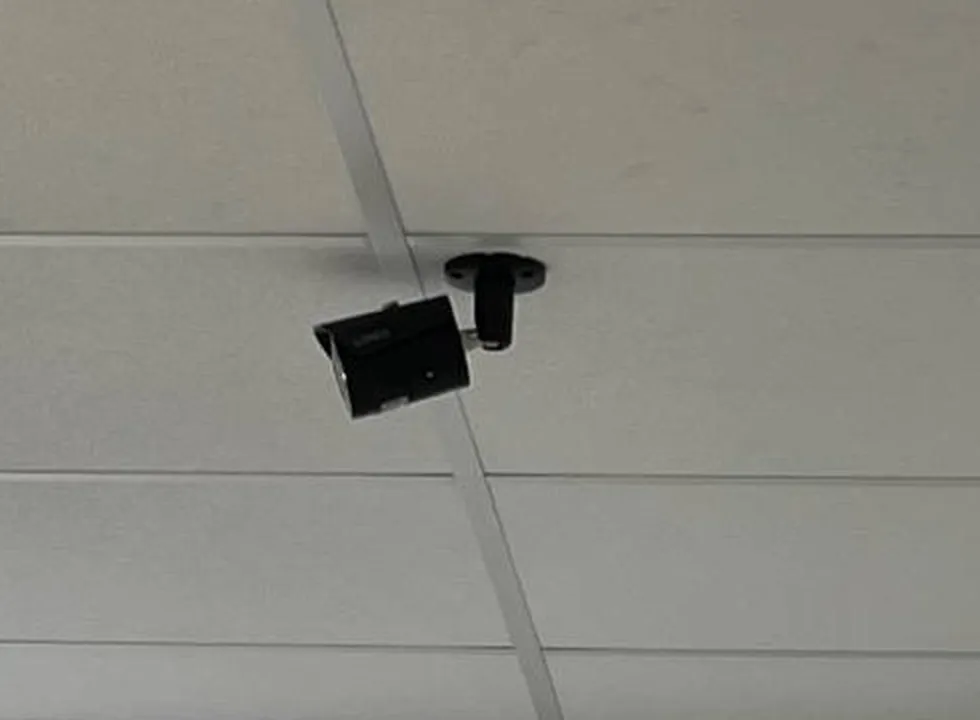
Bullet security cameras with a long body and sun hood, for looking straight down a drive, across a paddock or along a lot. The hood helps shed snow and rain. Call or text for today's price.
PTZ security cameras, pan tilt zoom cameras and motorized zoom cameras for large lots, marinas, yards and church campuses where one camera needs to follow a vehicle or zoom on a gate. Call or text for today's price.
Varifocal security cameras let us set the zoom on site so a camera on the house frames a mailbox or a gate far down the drive. Fixed lens security cameras cost less and suit nearer views. Call or text for today's price.
Active deterrence security cameras with a siren, red and blue flashing lights and, on some models, two-way talk, for driveways, sheds, docks and closed shops. Call or text for today's price.
Fisheye security cameras and panoramic security cameras cover a whole room or a shop floor from one ceiling point. Dual lens security cameras and multi sensor security cameras put two or more views in one housing, such as a wide view plus a zoomed one, which suits a lake lawn running down to a dock. Vandal resistant security cameras, IP67 security cameras and IK10 security cameras are labels we only apply to a product when its spec sheet carries the rating.
Most Putnam roads are dark. Night vision security cameras use infrared LEDs to light the scene in black and white; the house-brand kits list ranges from 60 to 120 feet depending on the model. Color night vision cameras and full color night vision cameras either gather more light through a larger sensor and brighter lens (starlight security cameras and low light security cameras) or switch on a small white spotlight when something moves. On a wooded lot that spotlight does double work: it gives you a color image of the person or car, and it tells the person the house is watching.
Infrared has one weakness here. Leaves, snowflakes and spider webs close to the lens reflect the infrared back into the camera, which shows up as glowing specks and false motion. We mount cameras clear of branches and gutters for that reason, and we often choose a turret over a dome because a dome bubble can bounce infrared light inside itself.
Plain motion detection cameras trigger on any change in the picture. On a Putnam lot that includes deer, wild turkeys, a fox, headlights sweeping across the trees, and every gust that moves a branch. Smart motion detection cameras and AI security cameras sort what they see into people and vehicles, and only alert on what you choose. Security cameras with person detection and security cameras with vehicle detection are the two filters that make phone alerts usable here. The D4 and D5 house-brand kits list smart human and vehicle detection, and the partner-brand cameras we sell list it on their spec sheets too. AI human detection cameras, AI vehicle detection cameras, edge AI security cameras, deep learning surveillance cameras, object detection security cameras and video analytics security cameras are all names for this same idea: the camera or the recorder decides what moved before it bothers you.
Smart search security camera systems let you search a day of footage for “vehicle in driveway” instead of scrubbing through hours of trees. Facial recognition security cameras, people counting cameras and license plate recognition cameras (LPR cameras, ANPR cameras, license plate capture cameras) are specialized products; we only call a camera capable of them when its spec sheet says so, and a plate needs a narrow, well-lit view at the point where cars slow down.
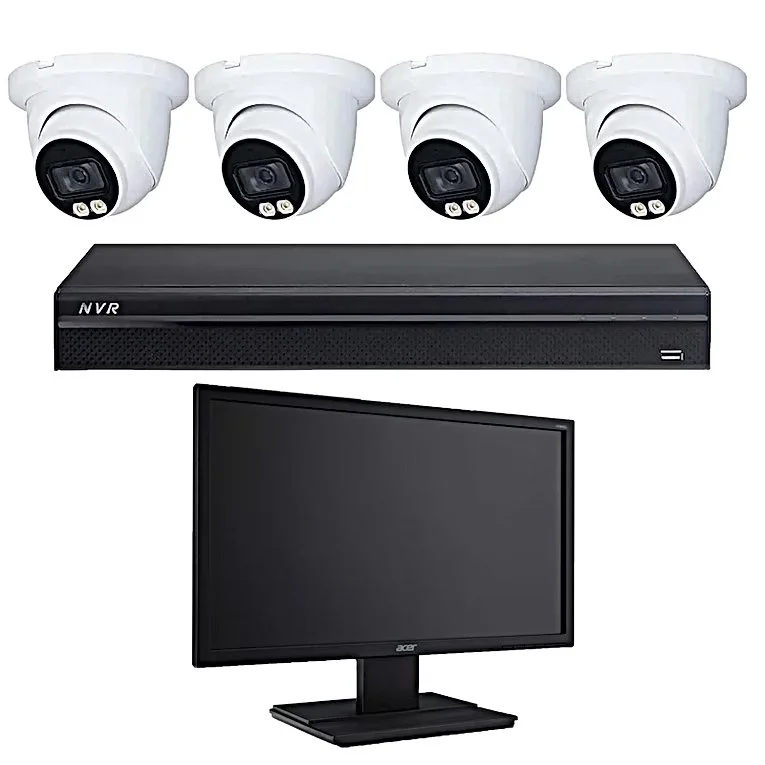
Our house-brand kits are the default system we quote: four cameras, a recorder, the drive, and on most models a 20-inch monitor, in a matched set we program and support. Security camera kits and security camera packages from the house line are sold equipment-only or installed, and more cameras can be added to any of them up to the recorder's channel count. Four of the kits that fit Putnam houses best are shown below with the specs from our own product list. Prices are by call or text.

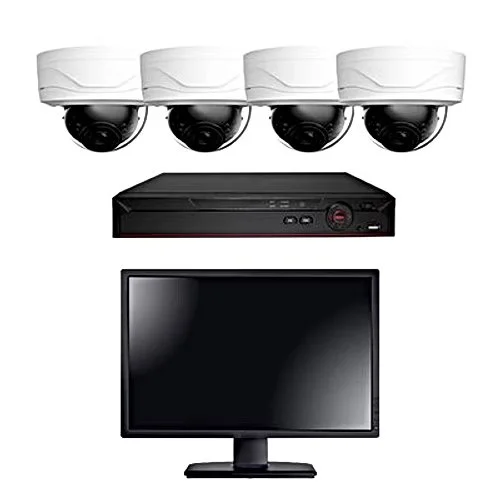
The D2 is the kit we reach for when the views are long: a driveway that curves down to a road in Kent, a lake lawn in Mahopac, a field behind a house in Patterson. Four 8MP 4K IP long-range domes run on a 4K NVR, with night vision up to 100 feet, IP66 weatherproofing and a monitor in the box. Because the cameras are IP, they run on PoE over Cat6, and a PoE switch in a detached garage can carry two of them out to the far side of the property. Buy 4K security cameras in this form when you need to zoom into a recording and still read what you see. Call or text for today's price.

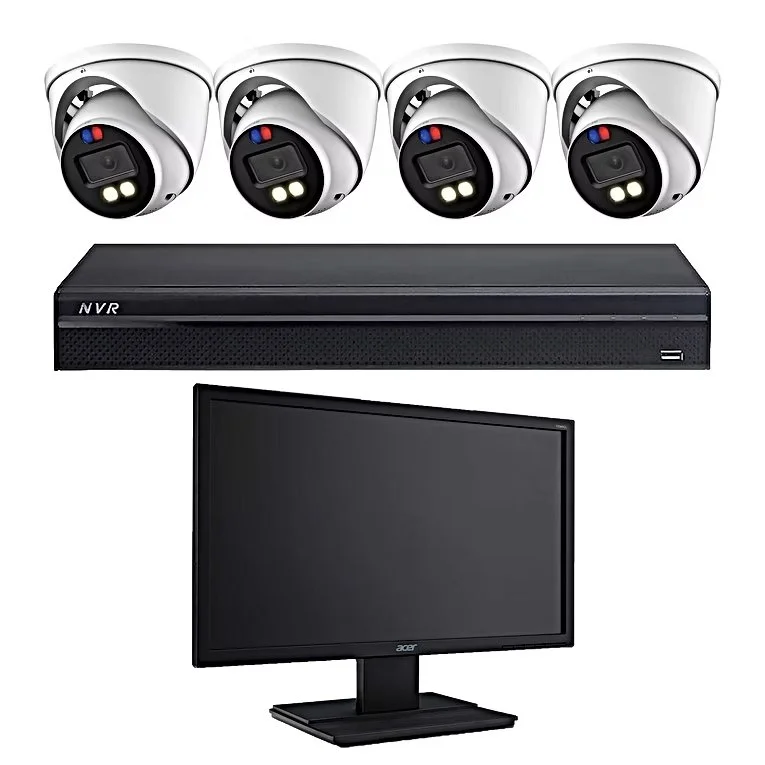
The D4 is built for the house that is often empty. Each 5MP IP turret has smart human and vehicle detection, a built-in alarm and siren, flashing lights, full color night vision with audio, and two-way talk, on a 4K NVR with a 20-inch monitor and IP67-rated cameras. When someone walks up to a closed-up weekend house in Garrison or a lake cottage in Putnam Valley after dark, the camera can light up, sound off and let you speak to them from your phone. For owners who want deterrence rather than just a recording, this is the turret kit to start from.

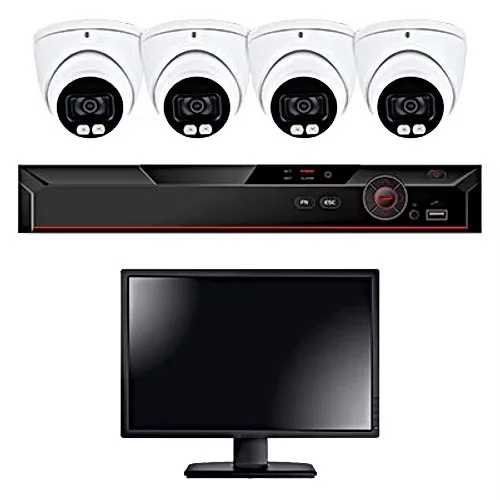
Plenty of Putnam houses already have coax running to the eaves from a camera system put in fifteen years ago. When that cable tests clean, the F2 lets an owner step up to 5MP without opening walls: four 5MP cameras rated IP67, night vision up to 100 feet, and a 5MP DVR with a 20-inch monitor. It is also a sensible security camera DVR choice for a shop whose old analog system still has good wire in the ceiling. The package photo shows turret-shaped housings; our product list names the model a dome kit.

The E1 is the straightforward PoE system: four 5MP IP turrets, IP67, night vision up to 90 feet, on a 4K NVR with a 20-inch monitor. Because the recorder is 4K-capable, an owner can start with 5MP cameras on the house and later add an 8MP camera for the long view without replacing the recorder. It suits a Carmel or Southeast house with an attached garage and a modest lot, or a Main Street shop that wants clean network wiring from day one.
Beyond those four, the house line runs in six series, all sold as four-camera kits that can grow. The A series is the entry point: 2MP eyeball, metric eyeball, dome and IP eyeball kits on a 1080p DVR or a 4-channel NVR, with night vision from 60 to 100 feet; the four-camera A1 installed system is where our $1,199 Putnam starting price comes from. The F series moves to 5MP on a DVR with a monitor, including full color bullet and metric eyeball kits with audio and dusk-to-dawn spotlights, and the F5 and F6 deterrent kits with siren, alarm and strobe. The E series is 4MP and 5MP IP on a 4K NVR. The C series is 8MP 4K on a 4K DVR, including a long-range dome kit and a full color eyeball kit with audio. The D series is 8MP 4K IP on a 4K NVR plus the D4 and D5 deterrent kits with two-way talk. Every model's features, color options and add-on camera counts are on the Putnam security camera pricing page, which is also where the installed package prices live.
House-brand is the default system, but we also sell and install name brands. Lorex, Luminys and Reolink are our partner brands. Other makes — Uniview, UniFi, Hikvision, Dahua, Axis, Hanwha, Ring and more — we sell, install or support where it is true for that product, without any dealer or certification claim. Name-brand equipment is priced at the manufacturer's MSRP. A few spec-sheet examples that fit Putnam properties:
For how the brands compare head to head, see our guide to the best security camera brands. For the full list of name brands we carry and install, see name-brand cameras, and for the house-brand line on its own, our cameras.
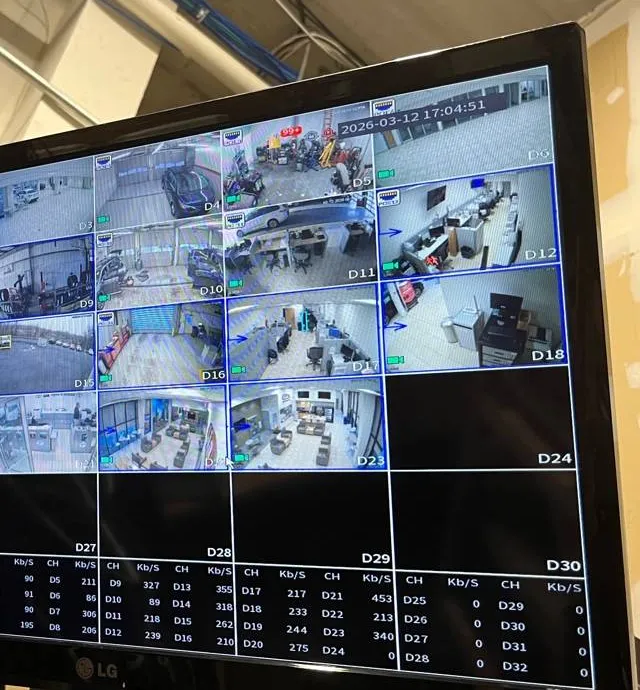
The recorder is the part of a camera system that matters most in Putnam, because it is what keeps working when the internet line goes quiet. A network video recorder or digital video recorder writes every camera's video to a surveillance hard drive inside the house. Phone viewing, alerts and remote playback ride on top of that, but the recording itself does not depend on any outside service. That is the difference between security cameras with local storage and cameras that only record when they can reach a cloud server.
An NVR records IP cameras. A PoE NVR has PoE ports on the back, so each camera plugs straight in and gets power and data on one cable. Buy NVR models by channel count first, then by resolution:
A small cottage or a single shop that will stay at four views. On most Putnam lots, four channels fill up in the first year.
The usual Putnam house: front, drive, garage, two sides, deck and dock, with room to add one or two.
Houses with barns or a guest cottage, horse farms, restaurants, contractor yards and churches.
Larger commercial sites, schools and multi-building properties, usually with external PoE switches.
Campuses and multi-site owners; quoted with a network plan and more than one drive.
Required for 8MP cameras. We confirm the recorder can decode every camera's stream before the sale.

A DVR records HD-analog cameras over coax. If your house has a working coax system — common on Putnam homes wired for cameras in the 2000s — a new security camera DVR and new HD cameras can reuse those cables, often with a CCTV video balun at each end to run over Cat6 instead. Buy DVR models when you are upgrading in place, and buy NVR models for new wiring. Our F and C series kits are DVR-based; the A series includes both.
CCTV hard drives and surveillance hard drives are built to write video around the clock, which a desktop drive is not. We sell 4TB surveillance hard drives, 8TB surveillance hard drives and 16TB surveillance storage (as one drive or two, depending on the recorder's bays), and we size the drive to the number of days you want kept. Security cameras with two weeks recording and security cameras with one month recording are both normal requests in Putnam; a full off-season at a second home usually means motion-based recording on top of a big drive.
When the recorder's ports run out, or a group of cameras lives far from the house, a PoE switch for security cameras adds ports wherever you need them. The common Putnam case is a detached garage or barn: one cable from the house to a switch in the outbuilding, then short runs from that switch to its cameras. A security camera PoE injector powers a single camera off a non-PoE port. For coax cameras we sell CCTV power supplies, distributed power boxes and the individual CCTV power adapter for a one-off camera.
Given Putnam's outage history, we put a battery backup (UPS) under nearly every recorder we install here and offer one with every equipment-only order. A UPS keeps the recorder, the PoE switch and the modem running through short outages and lets the recorder shut down cleanly in a long one. How long it lasts depends on how many cameras draw PoE power, so we size it to the system. With the modem on the same UPS, phone viewing keeps working as long as the internet provider's own equipment stays up.
| Distance from the recorder | What we use | Notes |
|---|---|---|
| Up to 328 ft | One Cat6 run, PoE from the recorder | Covers most cameras on the house and an attached or nearby garage. |
| 328 to about 650 ft | PoE switch or extender at the midpoint | The switch needs power; a garage outlet usually does it. |
| Beyond that, or across a road or brook | Fiber with media converters, or a point-to-point wireless bridge | Fiber ignores lightning and distance; a bridge needs clear line of sight through the trees, winter and summer. |
| No power and no cable possible | Solar and battery camera on 4G LTE | Only where a carrier signal is reliable at that exact spot. |
Line of sight is the catch with wireless bridges in Putnam. A link that works in December can fail in June when the leaves come in, so we check the path with the trees in mind or choose fiber instead.
A security camera mount is chosen for the surface: wall, eave, corner, pole or pendant. Security camera brackets for a corner let one camera see two sides of a house; a pole mount puts a camera on a post at the foot of a drive. A camera junction box, also called a CCTV junction box, sits behind the camera and hides the connector and the cable slack, which matters on cedar shingle, vinyl and stone where you cannot bury a connector in the wall. On older Putnam houses with deep eaves, an eave mount keeps the lens out of the snow and rain.
We sell Cat6 cable for security cameras by the box, outdoor Ethernet cable with a UV-resistant jacket, direct-burial cable for runs across a lawn, and security camera extension cable for kits that ship with fixed leads. CCTV connectors include RJ45 ends and weatherproof couplers for network cameras, and BNC connectors and power pigtails for coax. A CCTV video balun converts a coax camera to run over twisted pair. Security camera replacement parts — a sun hood, a mount base, a power lead, a lens cover — and other surveillance camera accessories are ordered to match the camera you have.

How to calculate CCTV storage comes down to bitrate, cameras and days. A camera's bitrate, in megabits per second, sets how fast it fills a drive: 1 Mbps recorded for 24 hours is 10.8 gigabytes. A 4MP camera with H.265 compression often runs around 4 Mbps; an 8MP camera around 8 Mbps. Working those through (our arithmetic, continuous recording):
| System | Per day | 8TB drive | 16TB storage |
|---|---|---|---|
| 4 cameras, 4MP at 4 Mbps | 172.8 GB | about 46 days | about 92 days |
| 6 cameras, 4MP at 4 Mbps | 259.2 GB | about 31 days | about 62 days |
| 8 cameras, 4MP at 4 Mbps | 345.6 GB | about 23 days | about 46 days |
| 6 cameras, 8MP at 8 Mbps | 518.4 GB | about 15 days | about 31 days |
Real bitrates vary: a camera watching swaying trees in wind writes more than one watching a still hallway, and night images with noise can push a camera higher. Recording only on motion, or recording a low-resolution substream continuously and full resolution on motion, stretches those numbers a long way. Our camera calculator runs the same math with your own camera count and days.
The same six comparisons come up on almost every call from Putnam. These tables give the facts in one place, with the Putnam angle in the last row of each.
| Factor | Wired (PoE or coax) | Wireless (WiFi or battery) |
|---|---|---|
| Reliability | ✓ Does not depend on WiFi strength | Drops when the signal weakens |
| Power | ✓ Powered over the cable | Needs an outlet, a battery or solar |
| Recording | ✓ Continuous to a recorder | Usually clips on motion |
| Installation | Cable runs needed | ✓ Quick to mount |
| Putnam fit | ✓ Best for wooded lots and long drives | Single views where cable cannot go |
| Factor | PoE | WiFi |
|---|---|---|
| Range from the house | ✓ 328 ft per run, more with a switch | Limited by the router and the trees |
| Works with internet down | ✓ Records to the NVR | Depends on the model; many need the router |
| Image quality at 4K | ✓ Full bitrate | Often reduced to fit the link |
| Setup effort | Cable and drilling | ✓ Less labor |
| Putnam fit | ✓ Default choice | Short reach near the house only |
| Factor | NVR | DVR |
|---|---|---|
| Camera type | IP cameras | HD-analog (coax) cameras |
| Cable | Cat6 | Coax, or Cat6 with baluns |
| Power to cameras | ✓ PoE on one cable | Separate power or siamese cable |
| Smart features | ✓ Usually more | Available on newer models |
| Putnam fit | ✓ New wiring, outbuildings | ✓ Reusing existing coax |
| Factor | 4K (8MP) | 2K (4MP) |
|---|---|---|
| Detail when zoomed | ✓ About twice the pixels | Good for nearer views |
| Storage per day | About twice as much | ✓ Less |
| Low light | Depends on sensor size | Often slightly better on the same budget |
| Recorder | Needs a 4K NVR or DVR | ✓ Any current recorder |
| Putnam fit | ✓ Long drives, lake lawns, lots | ✓ Doors, porches, interiors |
| Factor | IP | Analog (HD over coax) |
|---|---|---|
| Maximum resolution | ✓ Up to 4K and beyond | Up to 4K on current HD-analog |
| Cable reuse | New Cat6 | ✓ Existing coax |
| Expansion over network | ✓ Switches, fiber, bridges | Limited |
| Putnam fit | ✓ New systems | ✓ Upgrades in finished houses |
| Factor | Local (recorder or microSD) | Cloud |
|---|---|---|
| Monthly fee | ✓ None | Usually a subscription |
| Works with internet down | ✓ Keeps recording | Gaps until the connection returns |
| Upload bandwidth | ✓ Only when you view | Constant upload |
| Copy off site | Save clips to your phone | ✓ Stored off site |
| Putnam fit | ✓ Default for spotty internet | Add-on where the product offers it |
Security cameras with cloud storage, cloud managed security cameras and hybrid cloud security cameras are worth it where a business wants an off-site copy and has the upload bandwidth to send it. For most Putnam houses, security camera systems with no monthly fees are the better fit: local recording, free app viewing, and clips you save to your phone when something happens.
Cybersecure security cameras and encrypted security cameras start with simple habits, and how to prevent security camera hacking is mostly about setup. We change every default password, give each person their own login, keep recorder firmware current, turn off features you do not use, and connect phones through the manufacturer's app rather than opening ports on your router. NDAA compliant security cameras and NDAA compliant CCTV systems, ONVIF compatible security cameras, RTSP security cameras and H.265 security cameras or H.265 Plus CCTV are product claims we only repeat when the spec sheet carries them; ask and we will show you the sheet. Remote video surveillance, mobile app security cameras and security cameras with remote monitoring all mean the same thing in practice: the recorder records at home and your phone looks in.
Home security cameras, house security cameras and residential security cameras in Putnam come down to a handful of house types, each with its own first four cameras. These are the patterns we see across the county.
Around Lake Carmel, Putnam Lake, Lake Mahopac, Lake Peekskill and Lake Oscawana, many houses started as summer cottages on small lots and were winterized later. They sit close together on narrow roads, often with the house near the road and a short slope down to the water. Cable runs are short, which keeps costs down, but there is rarely a basement; crawl spaces, attics and closets become the cable paths. The first four cameras are usually the road side and parking spot, the entry door, the lake side of the house, and the dock or the boat. Turrets handle reflections off the water better than domes, and a camera aimed slightly down at the shoreline sees more of what matters and less of the sky.
Much of Carmel, Mahopac, Southeast and Patterson is colonials, raised ranches, capes and split-levels on lots from half an acre to a few acres, many with a basement that makes the cable work easy. The challenge is the driveway and the garage. A two-car garage at the end of a long drive, or one that stands apart behind the house, needs its own cameras, and those cameras need a path back to the recorder. An 8-channel NVR in the basement, a PoE switch in the garage, and a varifocal or 4K camera on the house looking down the drive covers most of these lots. Driveway security cameras, garage security cameras and backyard security cameras make up three of the first five views on almost every one.
In Putnam Valley, Kent, Garrison and the hills above Cold Spring, newer houses and contemporaries sit far back on wooded lots, with big glass walls, multiple decks and long driveways that bend out of sight. These are the houses where WiFi cameras disappoint most and wired cameras earn their keep. Expect eight to twelve cameras, a 16-channel recorder, a switch in the garage or a guest cottage, and often a fiber run or a wireless bridge to a building down the hill. Glass walls make indoor cameras tricky — a camera behind glass sees its own infrared reflected back — so outside cameras do the work, mounted under deep eaves out of the snow.

Security cameras for vacation homes are their own category in Putnam, where 1,757 houses were counted as seasonal or occasional-use homes and Putnam Valley alone has 451. An owner who comes up on Friday nights from the city, or who leaves for Florida after New Year's, wants three things from a camera system: an alert when a person or a car arrives, a picture clear enough to tell the plow driver from a stranger, and confidence that the recorder is still running. We set those systems up with person and vehicle alerts only, a deterrent camera at the door that sees the most traffic, an indoor camera on the main entry, a battery backup under the recorder, and a separate login for the caretaker, the plow company or the neighbor who checks on the house.
Putnam has condo and townhouse communities, and many lake neighborhoods have associations that own beaches, docks or clubhouses. A unit owner usually controls only the inside of the unit and the door, so the first purchase is a doorbell camera or a small camera inside the entry. Associations and HOAs buy for the shared places: the beach, the boat launch, the mailbox kiosk, the clubhouse door and the entrance road. Security cameras for property management and security cameras for landlords follow the same pattern: cameras on common areas, never inside a tenant's space, with access to recordings limited to the people the board or owner names.
Front door security cameras and doorbell security cameras answer the porch-pirate warning the Carmel Police gave before the 2025 holidays. A doorbell camera shows the face of whoever rings; a turret above the door shows the porch, the steps and where the delivery driver leaves boxes. Security cameras for holiday package theft and package theft prevention cameras work best when they see the package spot and the path back to the road, because the person who takes a box usually walks it to a car. On long drives, a second camera near the road catches that car. A doorbell from Ring or another brand can stay in place alongside a wired system; we add the wired cameras around it.
Commercial security cameras, business security cameras and business surveillance cameras in Putnam serve small businesses more than big ones: shops on the Main Streets of Cold Spring and Brewster, restaurants and stores along Route 6 in Mahopac and Carmel and Route 22 in Brewster and Patterson, contractor yards, horse farms, churches and offices. Security cameras for small businesses here are usually four to sixteen channels, and the owner often lives nearby and checks the cameras from home.
Main Street in Cold Spring is a walkable row of shops, galleries and cafes in older buildings, many inside the village's historic district, where exterior changes come before the Historic District Review Board for a certificate of appropriateness under Chapter 64 of the village code. That pushes shops toward cameras that are small, mounted inside where possible, and run through existing openings. Brewster's Main Street sits near the Metro-North station. For both, security cameras for retail stores and retail store security cameras start with the door, the register and the back door, and add the aisles and the stockroom as the budget allows.

The strip centers and stand-alone stores along Route 6 in Mahopac and Carmel, Route 22 in Brewster and Patterson, and Route 52 through Kent and Lake Carmel serve as Putnam's commercial corridors. These businesses — delis, pizzerias, pharmacies, gyms, laundromats, liquor stores, salons — need the same core: the door, the register, the parking spaces in front and the dumpster or delivery door in back. Deli security cameras, pharmacy security cameras, gym security cameras and laundromat security cameras all follow that shape, with point of sale surveillance cameras over the counter where the owner wants to match a transaction to a picture. Grocery store security cameras add aisle and loading-dock coverage.
The Sheriff's plate readers flagged 22 vehicles tied to organized retail theft in the first seven and a half months of 2026, with 141 alerts, according to the Putnam County Press. A store's own cameras do a different job from those road cameras: they show who came in, what they did and which way they left the lot.
Restaurant security cameras and bar security cameras cover the door, the bar and register, the dining room, the kitchen line and the back door where deliveries come in. A restaurant kitchen camera is about deliveries, cash handling and safety, not watching cooks. Cameras record video; audio is a separate question covered under the laws below.
Landscapers, excavators, builders, tree services and plow operators park trucks, trailers and equipment overnight at a yard or at home. Construction site security cameras, storage facility security cameras and parking lot security cameras for these sites mean bullets along the fence, a camera on the gate with vehicle detection, and a deterrent camera on the equipment shed. Security cameras for parking lots and parking lot security cameras on a gravel yard need more infrared reach than a paved, lit lot.
On horse farms, boarding stables and hobby farms, barns are dusty, damp and full of moving animals, and owners want to see stalls at night without walking out. Infrared cameras with a 16-channel recorder in the house, a PoE switch in the barn, and fiber or a bridge when the barn is far are the usual plan. Factory security cameras and manufacturing security cameras use the same rugged gear in light-industrial buildings.
Office security cameras, medical office security cameras and dental office security cameras cover entries, reception and hallways, never exam rooms. School security cameras and daycare security cameras cover doors, halls, parking and play yards, with access limited to staff the school names. Church security cameras usually start at the doors and the parking lot and add the office where offerings are counted. Hotel security cameras cover the lobby, halls and lot of Putnam's inns and bed-and-breakfasts. Building entrance security cameras, lobby security cameras, hallway security cameras, stairwell security cameras and elevator security cameras apply where a Putnam building has them; most here are two or three stories. Car dealership security cameras cover lots, service bays and key boxes.

This is general information, not legal advice. Security camera laws, CCTV regulations and security camera privacy laws in New York start with a few state statutes that apply in Putnam as everywhere else:
Are security cameras legal at a Putnam house? Recording your own property is common and generally lawful; aim cameras at your own land and away from neighbors' windows, and keep audio off unless you know the rules for the space.
Start with the four places a person or car has to cross: the driveway where it meets the parking area, the front door, the garage doors, and the side of the garage that faces the trees. On most of these lots a fifth camera on the back of the house covers the deck and the yard. The garage cameras should run to a PoE switch inside the garage, fed by one cable from the house recorder, so you are not pulling four separate cables across the lawn. Aim the tree-side camera along the wall of the garage rather than straight into the woods; it records anyone walking up to the building and skips most of the branches and deer.
Do not point it across the open water toward the morning or evening sun; mount it on the shore side looking along the dock and the shoreline, slightly down, so the water fills less of the frame. A camera with wide dynamic range, a turret housing rather than a dome, and a sun hood on bullets all help.
Inside the heated part of the house, out of sight and off the floor: a bedroom closet shelf, a cabinet in the utility room, or a high shelf in a hall closet. Crawl spaces are damp and cold and invite mice, and an unheated porch freezes. The cable from each camera usually runs through the attic or along the crawl space in a protective sleeve and up into the closet. Put a battery backup next to the recorder and the modem, and do not leave the recorder where a burglar walking through the front door would see it first.
Use person and vehicle detection instead of plain motion, draw detection zones that cover the driveway and walkways but not the tree line, and set a minimum size so a squirrel near the lens does not count as a person. Schedule alerts so the driveway camera only pings you overnight or while you are away. Keep infrared away from close branches and spider webs, which glow at night and trigger motion. If a camera still sends nonsense alerts, re-aim it; usually it is looking at too much forest.
Both, if the recorder supports it, and most of the ones we sell do. Record a lower-resolution substream continuously so nothing is ever missing, and record full resolution on motion or on a person or vehicle event. That gives you a complete timeline at small file sizes plus sharp clips of anything that happened, and it stretches the drive across weeks away. For a house empty from January to March, size the drive for the event recordings and let the continuous stream overwrite after a few weeks.
Under an eave or a soffit, a foot or more below the roof edge, and never directly below a valley where snow and ice slide off a metal or slate roof. Keep cameras off the low parts of walls on the windward side, where drifts pile up, and off fences that the plow buries. Bullets with a sun hood shed snow better than flat-faced cameras. After the February 2026 blizzard dropped 18.8 inches near Putnam Valley, the cameras that stayed clear were the ones mounted high under deep overhangs.
Small indoor domes or turrets inside the front window and over the register, a small camera inside the back door, and a recorder in the back room. Inside cameras do not change the facade, and a camera behind the glass can see the sidewalk in daylight if it sits close to the window with its infrared turned off. If you want a camera outside, keep it small, mount it into mortar joints or wood trim rather than brick faces, and expect it to go to the Historic District Review Board if it changes the building's exterior.
Use five of the eight channels on day one: one camera inside facing the door at face height, one over the register, one on the main aisle, one at the back door, and one outside covering the rear lot or the alley. Keep the remaining three for the stockroom, a second aisle and the front sidewalk later. A 4MP or 5MP kit is enough for these distances. Mount the recorder in a locked back room or cabinet, and put the register camera where it sees hands and the counter, not customers' card PINs.
Infrared, in most barns. Full-color cameras switch on a white light when they detect motion, which can wake a barn every time a horse shifts. Infrared cameras light the stall with light people cannot see and record a clear black-and-white picture all night. Choose cameras rated for dust and moisture, mount them high on a post or beam where a horse cannot reach them, and turn motion alerts off inside the stalls so your phone only pings for the barn doors and the aisle.
Bullets with long infrared reach on the corners of the building looking down the rows of trucks, one camera on the gate set for vehicle detection, and a deterrent camera with siren and lights on the shed or container where tools are kept. A PTZ on a tall mount can follow a vehicle across a large yard. Put the recorder inside the office, not in a trailer, and set alerts for after-hours only, when nobody from the crew should be on site.
A small system with a recorder in the clubhouse: one camera on the beach entrance, one on the boat launch or dock rack, one on the clubhouse door, and one on the parking area or the entrance road. Infrared bullets cover dark beaches and launches. Give the board a handful of named logins, decide in writing how long footage is kept and who may review it, and post signs at the beach so members and guests know the area is recorded.
Mark the camera spots on a satellite screenshot or a sketch, note any garage, barn, dock or cottage, and tell us how the internet comes into the house. We will text back two equipment lists with recording days.
On a small lot with the router near the window, maybe. On a wooded Putnam lot where the garage stands 150 feet away behind trees, WiFi weakens quickly, and a camera at the edge of its range drops frames or goes offline in wet weather. A single cable to a switch in the garage removes the guesswork.
Putnam's burglary count is low — 38 in 2024 — and that is good news. But larceny rose to 400 that year, thefts from unlocked cars have been reported in lake neighborhoods, the Carmel Police warned about porch pirates before the 2025 holidays, and the Sheriff's plate readers flagged burglary-crew vehicles at the county line. Cameras on a house set back from the road are often the only record of what happened there.
A cloud camera records to the cloud only while the internet is up. On a Putnam road where service drops in storms, or a house where the power goes out and the modem goes with it, a cloud-only camera stops recording at the worst time. A recorder in the house with a battery backup keeps writing to its drive, and phone access returns when the line does.
Battery cameras need charging or a solar panel, and solar panels under Putnam's tree cover, or under snow after a storm like January or February 2026, may not keep up. Lithium batteries also lose capacity in cold weather. Battery cameras are fine for a single spot with sun and signal; for the main views of a house, wired cameras are less work over the years.
The Sheriff's license plate readers sit at fixed points on public roads, read plates rather than faces, and keep their data on a government server for investigations. They do not see a driveway, a porch, a garage door or a back deck, and you cannot open their footage on your phone. Your own system is what covers your property.
Tell us whether you want equipment only, equipment plus installation, or a trade quote; the town or hamlet; which buildings need cameras; how far the farthest camera sits from the house; and what kind of internet the property has. A satellite screenshot with the spots marked saves a round of questions. Prefer to talk? Call or text (845) 640-3835.
Received. We will reply by call or text with your Putnam equipment options and today's prices.
Whether you order one surveillance drive or a sixteen-camera system for a house with a barn, the steps are the same. The only difference is whether our crew does the mounting.
Tell us the town or hamlet, the property, which buildings need cameras, how far apart they are, and what internet the house has.
Two equipment lists for the same camera spots, each with the recorder, drive size, switches or bridges, backup power and recording days.
Buy the equipment outright, or have our licensed crew install it. Installers, associations and contractors buying in quantity get a trade quote.
Equipment orders are confirmed once paid; installed jobs are booked with a 50% deposit under the service agreement.
Equipment-only orders are delivered to your house or business anywhere in Putnam County. There is no pickup counter.
Install requests are booked within 2 hours and scheduled 7 days a week with early-day visits, first come, first served once paid.
Recorder programmed, cameras aimed, detection zones drawn, alerts scheduled, and the app set up for everyone who needs access.
App questions, a camera knocked crooked by a falling limb, or a new building to add all go to the same Putnam line.
We do not run a pickup counter. Call or text and we'll deliver it to your home or business in Putnam County: a recorder, a drive, a box of cameras, a reel of outdoor cable or a complete kit. Security camera delivery is arranged when you order, and we confirm the address, any gate code or private-road directions, and who will be there to receive it. If you were looking for security camera same day pickup or security camera local pickup, delivery is how we handle it; we do not promise a same-day or timed delivery window.
Installation requests are booked within 2 hours, and we schedule 7 days a week with early-day visits, first come, first served once paid. We do not offer same-day installation; we look at the property and agree a camera plan first. For the full installed service and what a site visit covers, see security camera installation in Putnam County. For wired DVR and NVR systems described in CCTV terms, including long runs to barns and cottages, see CCTV installation in Putnam County.
Bought a kit online, or found a recorder in the basement of the house you just bought? We install customer-supplied equipment. Text the make and model and photos of where it should go; the labor-only price comes back by phone or text, and the deposit books the date. Details are on installing your own camera system.
Electricians, builders, property managers, lake associations and contractors buying in quantity — whether a security camera wholesale order for several rental houses, bulk security cameras for a new subdivision, or a builder who needs a CCTV supplier or CCTV equipment supplier for a custom home — call or text for a trade quote. We work as a security camera supplier, security camera distributor and security camera dealer for local trades in the sense that we stock, program and support what we sell; each order is quoted on its own, and there is no published trade price list.
Equipment bought without installation carries the manufacturer's warranty. Installed systems come with our 30-day warranty on the work, and longer coverage can be added for a fee. Full terms — including 50% deposit, one-year parts-only warranty on Abstract Enterprises Security Systems-supplied products, and the late-fee schedule — are set out in the service agreement.
We deliver equipment and install systems in every Putnam town and village. What people buy shifts with the landscape, and the cards below follow that.
The county's largest town: colonials and raised ranches, Lake Mahopac and Lake Gleneida frontage, Route 6 shops and the county seat. 8-channel kits, dock cameras, retail systems.
Brewster's Main Street by the Metro-North station, Route 22 and I-84 businesses, Croton Falls and the reservoirs. Storefront kits, contractor yards, offices.
Lake Carmel's small lots, Route 52 and Route 301, hillside houses near West Branch and Boyd's Corner. Compact lake systems, long-drive cameras.
Almost all detached houses, Lake Peekskill and Lake Oscawana, the most seasonal homes in the county. Deterrent kits, remote alerts, backup power.
Main Street Cold Spring, historic buildings, river-view houses and weekend homes along Route 9 and Route 9D. Discreet shop cameras, wired estate systems.
Putnam Lake's lake community, Route 22 and Route 311, farms and barns. Barn cameras, PoE switches in outbuildings, lake association systems.
We also deliver to and install in Lake Secor, Kent Cliffs, Kent Lakes, Mahopac Falls, Carmel Hamlet, Peach Lake, Towners, Continental Village and Roaring Brook Lake. If your address is in Putnam County, it is in our delivery area.
Security camera prices, CCTV camera prices and security camera system cost questions in Putnam come down to a short list, with distance and power at the top. Installed systems in Putnam County start at $1,199 for a four-camera house-brand system with the recorder, cable, mounting and phone setup. Equipment-only prices change with supply, so every product on this page carries the same line: call or text for today's price. How much do security cameras cost on a Putnam property? These are the things that raise or lower the number:
Affordable security cameras, cheap security cameras and budget security cameras are real searches, and the honest answer is that the cheapest system is the one that reaches the far camera the first time and keeps recording when the power blinks. Our page on affordable security cameras in New York covers ways to keep the cost down without buying a kit you outgrow. Best value security cameras for a Putnam house are usually a 5MP kit on a recorder with spare channels. Premium security cameras, professional grade security cameras and commercial grade security cameras earn their cost on long distances, dark lots and wide lake lawns, and less so on a porch where a 4MP turret does the job.
Black Friday falls on November 27 this year, and many buyers ask about Black Friday security camera deals, Cyber Monday security cameras, Christmas security camera sales and New Year security camera deals. We only announce discounts, promotions, clearance items or bundle deals that we have actually set, and when we have them they will be on this page and on the phone. What we can do any time of year is quote the right system for your lot, and for a Putnam house a plan made before the ground freezes is worth more than a holiday box that does not reach the garage.
Recorders set up, drives sized, cameras and outbuildings added.
Older recorders replaced, good coax reused.
Dead cameras, storm damage, recorders that stopped recording.
Single views where cable cannot reach, set up properly.
Lens cleaning, drive checks, firmware and re-aiming before winter.
(845) 640-3835 — call or text.
Yes. Give us the gate code, the road association's directions or a landmark, and the name of whoever will receive the order. Private lake roads that are not plowed promptly after a storm can delay a delivery by a day, and we will call ahead if that happens rather than leave boxes at a gate.
Yes. Aim a camera at the fill pipe, the tank or the spot where the truck parks, and set a vehicle detection zone there. You get a clip each time the truck arrives and can see the driver at the fill. In a county where most homes heat with oil, owners of weekend houses find this one of the most useful views on the system.
It can be done, but we rarely recommend it. Trees sway in wind, which shakes the image and triggers motion, and they grow, which loosens hardware and shifts the aim over time. A pressure-treated post set near the drive, or a varifocal camera on the house zoomed toward the spot, holds its aim far better. If a tree is the only option, we use a strap mount and leave slack in the cable.
In daylight, mostly yes, with a softer image. At night, no: the camera's infrared light bounces off the screen mesh and whites out the picture. Mount the camera outside the screen, under the porch roof edge, or inside the porch looking in toward the house door rather than out through the screens.
Yes. Recorders keep time with an internal clock and set it from an internet time server when one is reachable. During a long outage the clock keeps running on its own, and it re-syncs when the connection returns. We set the time zone and daylight saving correctly at setup so recordings line up with real time if you ever need to hand a clip to the Sheriff or an insurer.
On something that stays put: the boathouse, a post on the shore, or the lake side of the house. A camera on a removable dock has to be taken down, stored and re-aimed every year, and its cable ends up in the water. From the shore, a camera looking along the dock line covers the dock in summer and the empty shoreline in winter.
If the mailbox is within about 150 feet and in a clear line from the house, a varifocal or 4K camera on the house zoomed toward it usually works. Past that, or around a bend, put a camera on a post near the road, fed by buried cable or a PoE extender, or use a solar and cellular camera if there is a reliable carrier signal at that spot.
Morning mist and dew on the lens or the dome cover scatter light, and infrared bounces off the droplets. A turret or a bullet with a hood collects less moisture than a dome, a camera tucked under an eave stays drier, and wide dynamic range keeps the picture usable as the sun comes up. Wiping the lens cover during a seasonal check helps too.
Yes. A camera at the top or bottom of the drive with a vehicle detection zone sends you a clip when the plow truck comes through, so you can see that the job was done and when. Owners away for the winter often give the plow company no access at all and simply watch for that alert.
No. The county's plate readers are fixed on public roads, read plates rather than faces, and their data stays with law enforcement. They do not see your driveway, porch or garage, and you cannot view them. A camera you own records your own property and keeps the footage on your own recorder.
We advise against it. Recorders and hard drives list a minimum operating temperature on their spec sheets, and an unheated garage in a Putnam cold snap can drop below it; damp and condensation are hard on drives too. Keep the recorder in the heated house and run a cable to a PoE switch in the garage instead. If the garage is heated, a recorder in a locked cabinet there works fine.
This Putnam store page is part of security cameras in the Hudson Valley, our equipment and installation service for the counties north of the city. Nearby counties: security cameras in Westchester County · security cameras in Dutchess County · security cameras in Orange County · security cameras in Rockland County. New York City and Long Island: security cameras in NYC · security cameras in the Bronx · security cameras in Manhattan · security cameras in Queens · security cameras in Brooklyn · security cameras on Staten Island · security cameras on Long Island · security cameras in Nassau County · security cameras in Suffolk County. Abstract Enterprises Security Systems home
Equipment delivered or installed by a licensed NYS low-voltage contractor. Call or text for today's prices.