Security cameras in Staten Island are sold here as equipment you can buy outright, or installed from $999 for a four-camera house-brand system with the recorder, cable, mounting and phone app set up by our licensed crew. We supply the cameras, NVR and DVR recorders, surveillance hard drives, PoE switches, junction boxes and outdoor cable that suit the borough's detached and semi-detached houses, driveways, raised post-Sandy homes and strip-plaza storefronts, and we deliver them anywhere from St. George to Tottenville.
Quick answer: Abstract Enterprises Security Systems sells security camera equipment to Staten Island homeowners, landlords and businesses as a licensed installer, not a warehouse. Each camera, recorder and accessory is available equipment-only (call or text for today's price) or installed, with installed systems starting at $999. Every quote comes as a 2K and a 4K option, systems record locally with no monthly fee, equipment is delivered to your address, and installation requests are booked within 2 hours.
Last updated November 22, 2026 by Abstract Enterprises Security Systems, NYS license #12000287431 · Sources: NYPD CompStat, Patrol Borough Staten Island, Volume 33 No. 46 (week of November 9–15, 2026); Staten Island Advance/SILive.com; NYU Furman Center; Office of the New York State Comptroller; NYC Housing Recovery (Build It Back); U.S. Army Corps of Engineers, New York District; National Park Service; Forest Avenue BID; NYC Administrative Code §22-1201 et seq.; NYS Penal Law §§250.00 and 250.05; manufacturer specification sheets
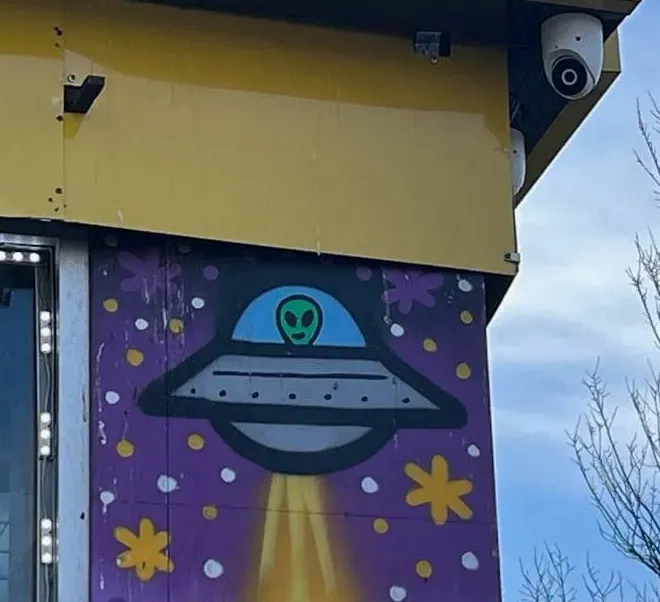
From our job library: a white turret dome fixed to the outside corner of a yellow sign band, with a second small fitting along the band. Exposed corners like this one are where Staten Island storefront cameras take the most wind and weather.
Staten Island Camera Equipment Request
Equipment delivered, equipment plus install, or a trade quote — tell us what you need
✅
Request Sent!
Thanks. We will call or text with a 2K and a 4K option for your Staten Island property.
25+
Years Experience
2 Hr
Booking
No
Monthly Fees
4.7★
201 Google Reviews
Owner-operated since 2002 · Thousands of jobs completed · Booked within 2 hours · Call or text (347) 934-8335
The Neighborhood
Why Staten Island Shops Differently for Security Cameras
Staten Island is the one borough where most people own the building they want to protect. That changes what a security camera store has to stock. A Manhattan renter buys one indoor camera and asks the landlord about the hallway. A Staten Island buyer usually owns a detached or semi-detached house with a driveway, a side yard, a back deck, a detached garage or a basement apartment, and wants cameras on all of it. A Staten Island business is more likely to sit in a strip plaza with a parking lot out front than on a sidewalk under somebody else's apartments. Those are different shopping lists, and a camera kit designed for a generic suburb only covers part of either one.
That is why most of what we sell on the Island is wired. A detached house has an attic, a basement or a crawl space, and often a garage, which gives cable somewhere to run. PoE network cameras on an NVR, or HD coax cameras on a DVR where an older system already left coax in the walls, record steadily without depending on the home router. We still sell WiFi security cameras where they fit — a camera on a shed at the back of a deep lot, a temporary view during a renovation — and we tell buyers plainly where vinyl siding over foil-faced insulation or a brick-faced first floor will weaken a wireless signal.
What the latest Staten Island CompStat report shows
Unlike Brooklyn or Manhattan, Staten Island is a single NYPD patrol borough, so one report covers the whole Island. The CompStat report for the week of November 9–15, 2026 (Volume 33, Number 46) gives these counts:
Staten Island complaints
2026 year to date
2025 same period
Change
Latest 28 days, 2026 vs 2025
Grand larceny auto (vehicle theft)
262
210
+24.8%
31 vs 21 (+47.6%)
Burglary
227
287
−20.9%
12 vs 34 (−64.7%)
Petit larceny
2,825
3,512
−19.6%
263 vs 303 (−13.2%)
Retail theft
1,408
2,010
−30.0%
138 vs 168 (−17.9%)
Grand larceny
1,296
1,315
−1.4%
116 vs 118 (−1.7%)
The figures are preliminary and come from the NYPD's CompStat report for Patrol Borough Staten Island. Almost every row is down, and burglary in particular has fallen hard. Vehicle theft is the exception, and it is not a small one: it is the only major category in the report that rose this year, and its 28-day trend is steeper still. For a borough that parks in its driveways, that single line shapes more camera purchases than any other.
Cars taken from driveways and curbs
The Staten Island Advance tracked the same rise through the summer. In July 2026 it reported that vehicle thefts on the Island were up roughly 47 percent, 163 incidents through July 19 against 111 a year earlier, with 16 thefts in the single week of July 6–12. District Attorney Michael E. McMahon called the CompStat numbers "a troubling trend that demands immediate attention" and noted that the borough had reversed a similar spike a few years earlier (SILive.com, Maura Grunlund, July 24, 2026).
A camera does not stop a car from being driven away. What it can do is record the arrival on foot, the face at the driver's door, the getaway vehicle and its direction, and the time to the second. That is evidence the 120th, 121st, 122nd and 123rd Precincts can use. It takes a different camera from a porch camera: a narrower lens or a varifocal model aimed down the length of the driveway, mounted high enough to be out of reach but low enough to see under a hood, plus good night performance, because most of these thefts happen after dark. We cover driveway camera choices in detail in the questions further down this page.
Packages on Island porches
Package theft has its own Island pattern. In August 2024 the Advance reported that the NYPD was warning residents about an organized crew targeting phone deliveries to Staten Island homes. Lt. Francis Depalma of the Staten Island Detective Bureau's grand larceny unit said the thieves knew where the phones were going ahead of time, and added: "year to date, we're looking at a vast amount of package thefts that's affecting Staten Island." His advice was to require a signature for valuable deliveries and to refuse anyone who knocks asking to take a delivered package back.
A year later, an Elm Park homeowner near Morningstar Road and Dixon Avenue told the Advance that a package had been taken from his porch in daylight in plain view of a large surveillance camera. "We have cameras and someone is still stealing," he said; no arrest had been made when the story ran (SILive.com, August 7, 2025). That is the honest limit of any camera. A visible camera deters some thieves, not all, and its real job is to record a face and a vehicle clearly enough to act on. A big camera mounted under the gutter that sees the top of a hood fails that test. A smaller camera at door height with a clear view of the steps passes it.
For camera buyers along Midland Beach, New Dorp Beach, South Beach, Ocean Breeze, Oakwood and Great Kills, all of this adds up to three equipment rules. First, the recorder does not go on the ground floor or in a basement that can take water; it goes upstairs, in a closet or an office. Second, a raised house puts the front door eight or more feet above the yard at the top of a stair, so the camera that watches the door and the camera that watches the space under the house are two different cameras. Third, these houses face open water and take wind and salt air in a way an inland Mid-Island block does not, so outdoor housings, mounts and junction boxes need to be chosen for that.
The West Shore's warehouses
The fourth Staten Island is industrial. Matrix Global Logistics Park sits on a 400-acre site at the foot of the Goethals Bridge, and the Advance has reported Amazon leasing a 975,000-square-foot building there as its third Staten Island warehouse. Around those big buildings are smaller warehouses, contractor yards, truck lots and auto businesses in Bloomfield, Travis, Charleston and along the West Shore Expressway. Those buyers need long fence lines, unlit yards and loading doors covered, which means bigger recorders, long-range lenses and cameras that can tell a person from a deer in the dark.
Staten Island facts behind the equipment we stock
67.7 percent homeownership in 2024, more than double the citywide 32.7 percent (NYU Furman Center).
Two-thirds of commuters drive to work, nearly three times the share elsewhere in the city (Office of the NYS Comptroller).
262 vehicle thefts in 2026 through November 15, up 24.8 percent from 210, and up 47.6 percent over the latest 28 days (NYPD CompStat, Patrol Borough Staten Island, preliminary).
227 burglaries year to date, down 20.9 percent; 1,408 retail thefts, down 30.0 percent (same report).
23 deaths on Staten Island in Sandy, with the East and South Shores accounting for nearly a quarter of the city's severely damaged or destroyed buildings (NYS Comptroller).
5.3 miles of planned coastal protection from Fort Wadsworth toward Oakwood Beach, including a 4.3-mile seawall (National Park Service; U.S. Army Corps of Engineers).
153 businesses and 156 property owners in the Forest Avenue Business Improvement District, Hart Boulevard to Broadway (Forest Avenue BID).
What We Sell
Security Cameras for Sale in Staten Island
This is the shop floor of the page: the camera catalog we keep for Staten Island buyers, grouped the way people search — outdoor or indoor, resolution, how the camera connects, and which body style fits the spot. Everything is sold equipment-only or installed. There is no online checkout on this site yet. To buy, call or text (347) 934-8335 or send the form with what you need, and we reply with the item, today's price and a delivery or installation date. Equipment prices: call or text for today's price.
Outdoor security cameras built for an island
Outdoor surveillance cameras on a Staten Island property usually go in five places: under the soffit at the front corner of the house, over the garage door looking down the driveway, on the rear corner covering the deck and yard, on a fence post or shed at the back of the lot, and on the sign band or canopy of a store. What matters outdoors is the weather rating, the night picture, the lens and the mount. Our house-brand outdoor cameras carry IP66 or IP67 weatherproof ratings depending on the model, with night vision rated from 60 to 120 feet.
Weatherproof security cameras and outdoor winter security cameras for the Island have to deal with more than cold. A two-story house on a corner lot in Great Kills or a raised house on the East Shore takes steady wind off the water, and that wind shakes a camera on a flimsy bracket enough to blur the picture and slowly loosen the screws. Salt air attacks cheap metal hardware long before it harms the camera. So the outdoor kit we sell pairs each camera with a junction box that seals the connector, a short and rigid mount instead of a long arm, and stainless or coated hardware. On the North Shore and Mid-Island, inland of the worst exposure, a standard mount is usually fine.
For lots without streetlights, typical on the South Shore's deeper blocks and around the Greenbelt, we steer buyers to full color night vision cameras with a built-in light, which keep color after dark and make it obvious to anyone walking up the driveway that the yard is watched. Call or text for today's price on any outdoor camera, or ask for a 2K and a 4K option for the views you need.
Indoor security cameras
Indoor surveillance cameras cover entry halls, the door from the garage into the house, basements and basement apartments' shared doors, stairwells in two-family houses, store floors, registers, stockrooms and warehouse aisles. Indoors the job is usually a wide view from a ceiling corner, so dome and turret cameras are the default. They are small, they don't get knocked out of position, and they mount cleanly on drywall, drop tile or a store's slatwall.
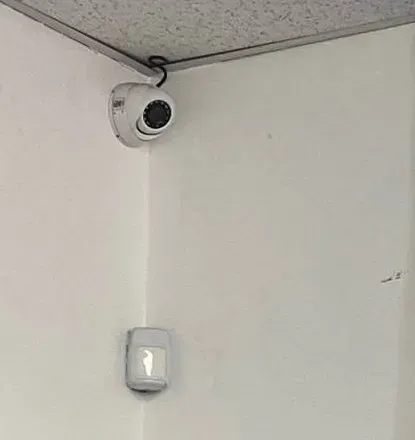
In a store, cash register security cameras and point of sale surveillance cameras go above and slightly behind the counter so they see the drawer, the hands and the bills. Restaurant kitchen security cameras stay away from the hood line, because grease and steam fog a lens. In a house, basement security cameras earn their place on the Island because so many basements have an outside door, a finished room or a separate unit. If the house also has an alarm, an indoor camera can sit right beside the motion sensor, as in the photo below, so a triggered zone and a clip of the same corner arrive together.
From our job library: a white dome tucked into a ceiling corner directly above an alarm motion sensor. Pairing a camera with an existing sensor is common in Staten Island houses that already have an alarm.
4K, 8MP, 5MP, 2K or 2MP: picking a resolution
Every camera quote we send on Staten Island comes as two options for the same views: a 2K system and a 4K system. Resolution drives both the price of the system and the amount of storage it eats, and buyers choose better when they see both side by side. Here is how the tiers we sell line up against Island properties:
Tier
Pixels
Where it fits on Staten Island
Trade-off
4K / 8MP
3840 × 2160
Long driveways, wide corner lots, strip-plaza parking fields, warehouse yards, an auto shop's frontage
Largest files; needs a 4K-capable recorder and bigger drives
5MP
about 2560 × 1920
Front porches and steps, garage doors, side yards, small store entrances
Clear faces at short range for less storage than 4K
2K / 4MP
2560 × 1440
Indoor halls, basements, stockrooms, a single register
Good detail close up; modest storage
2MP / 1080p
1920 × 1080
Short indoor views, a replacement camera on an older recorder
Fine at a few feet; weak for identification across a driveway
The tier that matters most on the Island is often 4K, for one reason: driveways. A camera at the garage looking toward the street has to cover 40 to 80 feet and still show a face or a plate at the far end. Extra pixels make that possible after the fact, when you zoom into a recording. 12MP security cameras and panoramic or fisheye security cameras exist for special cases, such as one camera over the center of a store floor; we quote them on request rather than by default, because two ordinary cameras in the right places usually beat one very wide one.
PoE, WiFi or HD coax: how each camera connects
PoE security cameras run on a single Cat6 cable that carries both power and video back to a PoE NVR or a PoE switch. It is our default for new Staten Island systems because detached houses usually have a clear cable path through an attic, a garage ceiling or an unfinished basement, and one cable per camera means no outlet at the soffit. Wired analog cameras on HD coax run to a DVR and are the cheapest upgrade where an older system already left RG59 or Siamese cable in place, which is common in houses wired in the 1990s and 2000s. Wireless cameras connect over WiFi but still need power from an outlet, a battery or a solar panel.
Buy PoE cameras or wired security cameras here and we size the switch or the NVR's PoE ports for the full load, including infrared and spotlights at night. Buy wireless security cameras here and we will tell you up front whether your router can reach the spot. On a deep lot, the shed at the back is often a better job for a PoE camera on a buried outdoor cable, or a point-to-point wireless bridge, than for a battery camera that needs charging every few weeks in January.
Turret, dome, bullet, PTZ and specialist bodies
⚪
Turret / eyeball
Our best-selling body for houses. Aims anywhere, no bubble to catch infrared glare, compact under a soffit or porch ceiling. Call or text for today's price.
◯
Dome
Vandal-resistant dome security cameras for low porch ceilings, store aisles and plaza walkways where a camera can be reached. Call or text for today's price.
▬
Bullet
Bullet security cameras for long, narrow views: a driveway, a side yard, a fence line, a truck lane. The visible shape warns people. Call or text for today's price.
⟳
PTZ
Pan tilt zoom cameras and motorized zoom cameras for plaza lots, dealership rows and warehouse yards, where an operator follows a vehicle. Call or text for today's price.
☉
Varifocal
Varifocal security cameras let us set the zoom on site to frame the far end of a driveway or a plaza entrance. Fixed lens security cameras cost less for close views. Call or text for today's price.
⚠
Active deterrence
Active deterrence security cameras with a siren, strobe and, on some models, two-way talk, for driveways and yards after midnight. Call or text for today's price.
Dual lens security cameras and multi sensor security cameras, which put two or more sensors in one housing, can cover both directions along a house front or a plaza walkway from one mounting point. Thermal security cameras see heat rather than light and are a specialist choice for a large unlit yard. We source both per job and say so in the quote.
Smart detection, analytics and plate capture
AI security cameras is a broad label. For most Staten Island buyers, the feature that matters is person and vehicle detection, so the phone buzzes for a person walking up the driveway at 2 a.m. and not for every raccoon, deer, swaying tree or passing headlight. That matters more here than in denser boroughs, because yards back onto woods, parkland and Bluebelt wetlands full of wildlife. Several of our house-brand packages list smart AI human and vehicle detection on the spec sheet, and that is the first smart feature we recommend. Smart motion detection cameras, security cameras with person detection and security cameras with vehicle detection cut false alerts; smart search security camera systems let you pull every "vehicle" event from last night in seconds.
License plate recognition cameras (LPR or ANPR cameras), license plate capture cameras, facial recognition security cameras and people counting cameras are separate products with their own lenses, settings and legal questions. Plate readers have drawn attention on the Island; a recent r/statenisland thread on Flock cameras noted that the few documented on Staten Island seemed to be on private property. For a home driveway, a well-aimed 4K or varifocal camera usually records a readable plate without dedicated LPR. We describe a product as having LPR, facial recognition, NDAA compliance, ONVIF, H.265, IK10 or edge AI only when the manufacturer's spec sheet says so, and we show you that sheet before you buy.
Shop Our Systems
Security Camera Kits and Packages in Staten Island
Most Island buyers start with a kit: four cameras and a recorder, sometimes with a monitor for the kitchen counter, the garage or the store office. These are the same house-brand packages listed on our Staten Island security camera pricing page, where the installed prices are published. Here they are shown as equipment you can buy outright or have installed. The details below come from each package's spec sheet. Equipment prices: call or text for today's price.
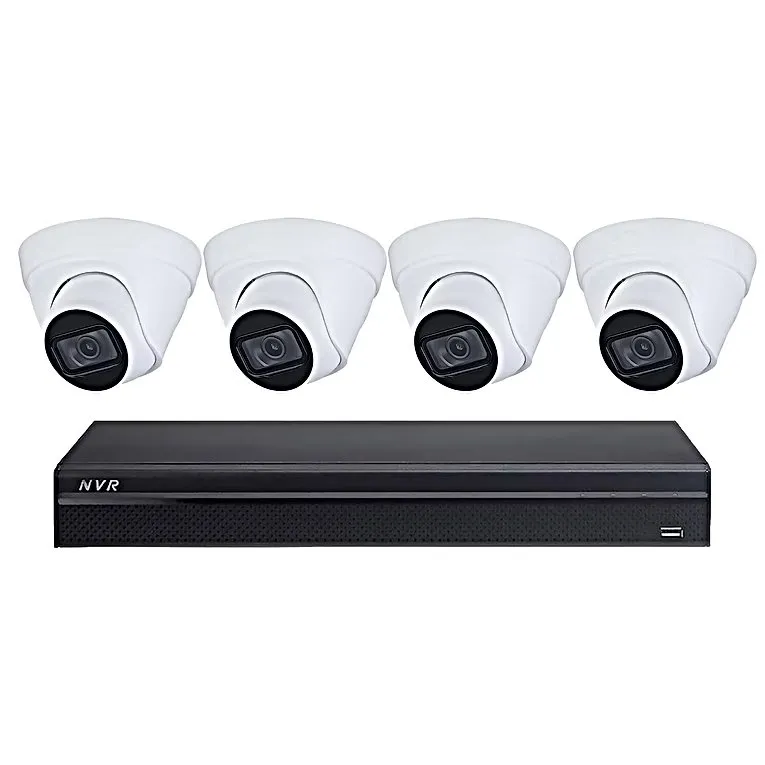
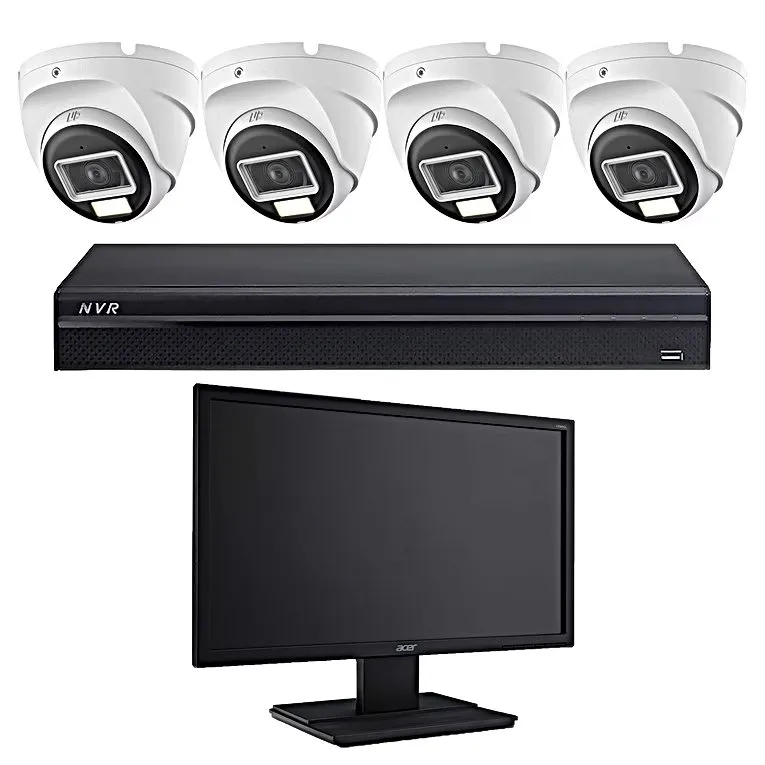
House-brand package photo: four white eyeball IP cameras and the black NVR they record to.
2MP IP eyeball kit with 4-channel NVR (A3)
Four 2MP eyeball IP cameras on a 4-channel NVR, with night vision up to 100 feet and built-in audio. This is the entry point to a network system: each camera runs on its own Cat6 cable, and the recorder's PoE ports power them. On Staten Island it suits indoor-heavy jobs — a basement, a garage interior, the hall of a two-family, a small office — or a buyer who wants a first PoE system and plans to replace cameras with higher-resolution models later on the same cable. For a driveway that must show a plate at 60 feet, step up to a 5MP or 4K kit. Call or text for today's price.
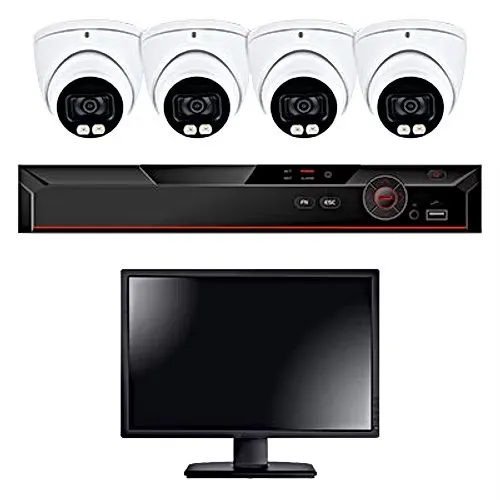
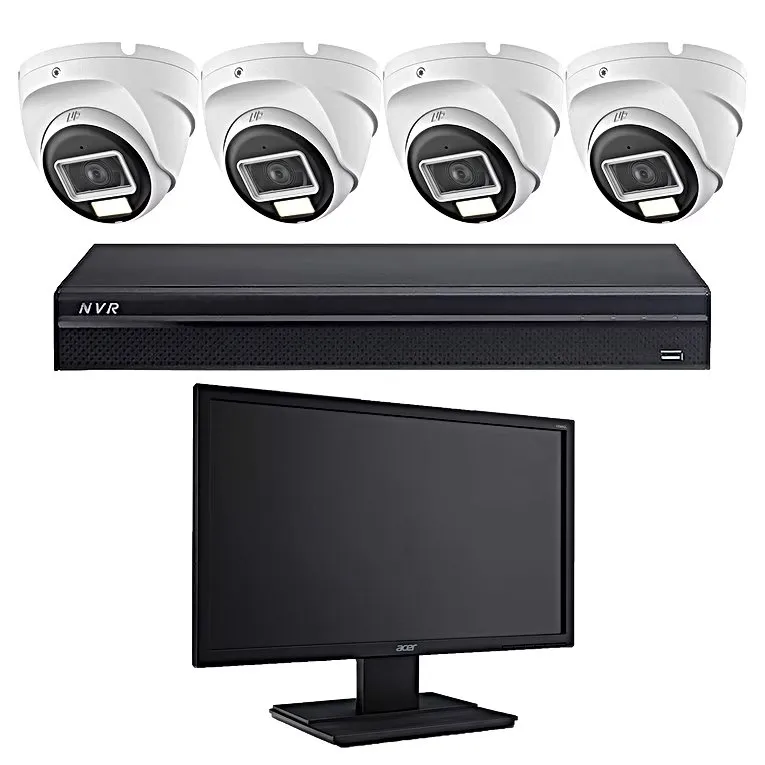
House-brand package photo: four white dome cameras, the DVR and the monitor.
5MP dome kit with DVR and monitor (F2)
Four 5MP dome cameras on a 5MP DVR with a monitor, night vision up to 100 feet, IP67 weatherproof, audio optional. This is the upgrade kit for the many Island houses and stores with coax already in the walls from an older system: the DVR reuses that cable, and 5MP is a big step up from the 720p and 1080p cameras most of those systems used. The dome body is a good choice under a low porch ceiling or a plaza canopy, where someone could otherwise reach up and twist a camera. Call or text for today's price.
House-brand package photo for the C3 kit: four full color eyeball cameras, a slim recorder and the monitor. The package spec lists a 4K DVR.
4K full color eyeball kit with audio (C3)
Four 8MP 4K eyeball cameras with full color night vision and built-in audio, on a 4K DVR with a monitor; night vision up to 120 feet, IP66. Full color cameras use a sensitive sensor and a soft white light to keep color after dark, which helps on the dark side streets and dead-end blocks common south of the Staten Island Expressway. Because this kit records on coax, it is the 4K choice for a house that already has good coax and wants the sharpest possible driveway picture without new cable. Audio is a feature to use carefully under New York law; see the business section below. Call or text for today's price.
House-brand package photo for the D3 kit: four full color eyeball cameras, the NVR and the monitor.
4K IP full color eyeball kit with NVR (D3)
Four 8MP 4K IP eyeball cameras with full color at night and built-in audio, on a 4K NVR with a monitor; night vision up to 120 feet, IP66. This is the kit we quote most often as the 4K option for a detached Staten Island house being wired fresh: PoE on Cat6 to every corner, 4K detail down the driveway and across the yard, and an NVR with room to grow into person and vehicle alerts. Pair it with a larger drive if you want a month of footage. Call or text for today's price.
The rest of the house-brand range
Beyond those four, the house-brand line runs from 2MP 1080p DVR kits for simple indoor jobs, through 5MP DVR kits with full color, spotlights and deterrent sirens, to 4MP and 5MP IP kits on a 4K NVR, long-range 4K domes for lots, and bullet kits with sirens, strobes and two-way talk. Each series starts at four cameras and grows by adding cameras and channels. The full lineup, with each model's photo, is on our cameras page.
Packages by Staten Island property
Property
Typical camera count
What we usually suggest
Detached house with driveway and yard
5–8
4K or varifocal camera down the driveway, 5MP turret at the front door, side-yard bullet, rear corner over the deck; 8-channel NVR
Semi-detached or attached townhouse with front garage
3–5
Turret over the garage covering door and curb, rear deck camera, one indoor camera at the garage-to-house door
Raised post-Sandy house
5–7
Door camera at the top of the stair, under-house camera on the parking area, rear and side views; recorder upstairs
Two-family or house with a basement unit
6–10
Each entrance, shared driveway, side path, rear yard; separate logins for owner and tenant
Garden-apartment or townhouse complex common areas
12–32
Parking courts, carports, mail kiosks, building entrances, dumpster enclosures; 32-channel NVR
Packages by Staten Island business
Business
Typical camera count
What we usually suggest
Strip-plaza store or salon
4–8
Entrance, counter, sales floor, back door, the storefront's slice of the lot
Deli, pizzeria or bagel shop
6–10
Register, door, counter, kitchen line, back door, walk-in; monitor at the counter
Entrances, reception, corridors, parking; never treatment rooms, restrooms or changing areas
Treat these as starting points rather than quotes. A corner house with two street frontages needs more cameras than a mid-block one; a plaza store at the end of a row with its own side entrance needs more than one in the middle. Our camera calculator gives a quick camera count and storage estimate for your property type before you call.
Name-brand cameras and our three partners
The house brand is our default because we know every menu on it, and it is what our installed prices are built on. We also sell and install name-brand systems, and three manufacturers list us as an authorized partner: Lorex, Luminys and Reolink. As one example of partner-brand hardware built for cold, Lorex's E842CA 4K bullet camera spec sheet lists an operating range of −40°F to +140°F, an IP67 rating, PoE power and up to 150 feet of night vision in ambient light. Name-brand equipment is priced at the manufacturer's MSRP; call or text for today's figure.
NVR and DVR Recorders, Drives and Accessories in Staten Island
The camera gets the attention, but the recorder decides whether last Tuesday's footage still exists. This section covers what sits behind the cameras in every system we sell on Staten Island: network video recorders, digital video recorders, surveillance hard drives, PoE switches and injectors, power supplies, mounts, junction boxes, cable and connectors. Every item: call or text for today's price.
Network video recorders (NVR)
A network video recorder records IP cameras. Most of the NVRs we sell are PoE NVRs, with a switch built into the back so each camera plugs in on one Cat6 cable. Channel count is the number of cameras the recorder can handle:
4
4 channel NVR
An attached townhouse or a small shop with a fixed list of views. Most detached-house buyers outgrow four quickly.
8
8 channel NVR
The Island default for a detached house: five or six cameras now, two spare channels for the shed or the doorbell later.
16
16 channel NVR
Two-family houses, plaza restaurants, auto shops with a lot, and houses with a detached garage and a long yard.
32
32 channel NVR
Garden-apartment complexes, larger plazas and West Shore warehouses, usually with an external PoE switch.
64
64 channel NVR
Multi-building sites and large logistics buildings, quoted with a network plan and several drives.
4K
4K NVR
Any recorder paired with 8MP cameras must decode 4K streams; we confirm that before the sale.
Digital video recorders (DVR)
A digital video recorder records coax cameras. Current HD DVRs handle 5MP and 4K analog cameras, which makes them the cheapest way to modernize the coax systems that a lot of Staten Island houses and stores installed fifteen or twenty years ago: keep the cable in the walls, replace the old cameras and the old DVR, and the picture gets far sharper without opening a ceiling. We sell 4-, 8- and 16-channel DVRs, matched on the 4K kits to the 8MP cameras. Before selling a DVR to reuse old coax, we test the cable; a run that sat in a flooded basement in 2012 or got crushed under a deck may not carry a clean 4K signal however good the recorder.
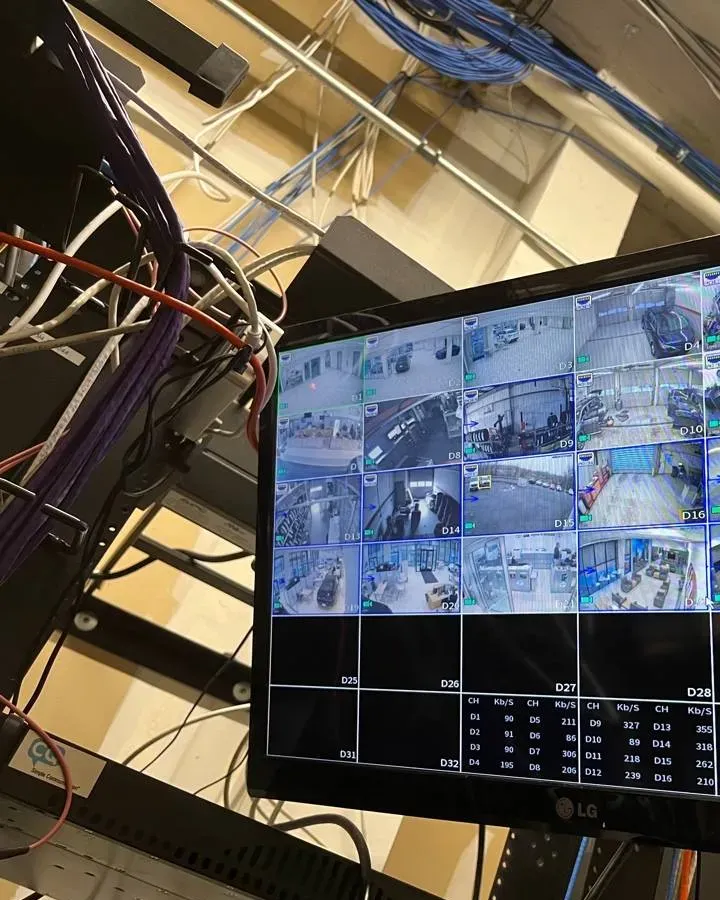
From our job library: a recorder's 32-tile screen with live views of a showroom and lot, unused channels at the bottom, and a table of each channel's bitrate in Kb/s. Reading that table is how we check a drive's real retention after installation.
Surveillance hard drives
CCTV hard drives and surveillance hard drives are built to write video around the clock, which desktop drives are not. We sell them sized to the retention you want: a 4TB surveillance hard drive for a small kit, an 8TB surveillance hard drive for a six- to eight-camera house, and 16TB surveillance storage, usually as two drives, for plazas and warehouses. Security cameras with two weeks recording and security cameras with one month recording are a storage decision, not a camera decision. The worked example at the end of this section shows how to estimate it.
PoE switches, injectors and backup power
When the recorder runs out of PoE ports, or a camera on the detached garage is too far from the recorder, a PoE switch for security cameras adds ports and power. We size it by the total power budget, not just the port count, because cameras with infrared, spotlights or sirens draw more at night. A security camera PoE injector powers one camera where a switch would be overkill. For coax cameras, a CCTV power supply feeds several cameras from one fused box and a CCTV power adapter feeds one. On the shore blocks we recommend a small battery backup on the recorder, switch and modem: storms that take out power are exactly when you want the cameras still recording.
Mounts, brackets and junction boxes for wind and salt
Security camera mounts and security camera brackets do more work on Staten Island than in most of the city. Vinyl siding needs a mounting block so the camera sits flat and water stays out. Aluminum-clad soffits flex. Brick-faced first floors and stucco need the right anchors. A raised house needs mounts under the deck or on the stair structure. A plaza needs mounts for a sign band, a canopy edge or a light pole. A camera junction box, also sold as a CCTV junction box, sits behind the camera, hides the connector and the slack cable, and keeps water out of the joint, which is the most common failure point we find on outdoor cameras near the water. Wall, pole, corner, pendant and soffit mounts are all available. Call or text for today's price.
Cable, connectors and baluns
Cat6 cable for security cameras is standard for IP systems, and outdoor ethernet cable with a UV- and water-resistant jacket goes anywhere a run is exposed: along a fence, through a buried conduit to a detached garage, up the outside of a raised house. For coax systems we sell RG59 and Siamese cable, BNC connectors and other CCTV connectors, and a CCTV video balun where an older house has spare twisted-pair wiring that can carry a camera signal. A security camera extension cable can rescue a camera whose lead is a few feet short. We also carry security camera replacement parts and surveillance camera accessories — sunshades, rain hoods, lens covers, wall plates and cable glands — for systems we sold and many we didn't.
Storage math for a six-camera Staten Island house
This is how we estimate drive size. It is only an estimate: the real number depends on each camera's bitrate setting, the compression, how much moves in the scene and whether the system records continuously or on motion. After installation we read the actual per-channel bitrates off the recorder, like the table on the screen in the photo above, and adjust.
Step
2K option (example)
4K option (example)
1. Bitrate per camera
3 Mbps
6 Mbps
2. Per camera per hour (Mbps × 3,600 ÷ 8)
1.35 GB
2.7 GB
3. Per camera per day (× 24)
32.4 GB
64.8 GB
4. Six cameras per day (× 6)
194.4 GB
388.8 GB
5. Days on a 4TB drive (4,000 ÷ daily total)
about 20 days
about 10 days
6. Days on an 8TB drive
about 41 days
about 20 days
The formula is bitrate times hours times days, divided by eight to turn bits into bytes, times the number of cameras. Halve the bitrate and the days double; switch the cameras to record on motion, or use H.265 on cameras whose spec sheets list it, and the same drive stretches further. This is why our two quotes for the same Staten Island house often carry different drive sizes, and why each quote states retention in days. If vehicle thefts are the worry, keep at least two weeks: a stolen car is sometimes only discovered, or only reported, days later.
Comparisons
Security Camera Comparison Tables for Staten Island Homes and Stores
Six comparisons come up on almost every call from the Island. In these tables a check mark means that option generally handles the point well and a dash means it generally doesn't. Individual products vary, so read them as a starting point and confirm on the spec sheet of the exact model.
Wired vs wireless security cameras
Point
Wired
Wireless (WiFi)
Reaches a detached garage or shed reliably
✓ (buried outdoor cable)
Depends on distance and walls
Nothing to recharge on a cold January morning
✓
— (battery models)
Keeps recording when the router or modem goes down
✓
—
Quick to put up with no drilling through the house
—
✓
Can't be unplugged by someone on the porch
✓
—
Easy to move to another spot later
—
✓
PoE vs WiFi security cameras
Point
PoE
WiFi
One cable for power and video, no outlet at the soffit
✓
—
Full-rate 4K from six or more cameras at once
✓
—
Local recording with the internet out
✓
Depends on model
A single far-off view where no cable can run
—
✓
Leaves home WiFi free for streaming and work calls
✓
—
NVR vs DVR security cameras
Point
NVR
DVR
Records IP network cameras
✓
—
Records HD coax cameras
—
✓
Reuses coax left by an older system
—
✓
Powers cameras over the video cable
✓ (PoE)
— (separate power pair)
Room for person and vehicle analytics per camera
✓
Model dependent
4K vs 2K security cameras
Point
4K (8MP)
2K (4MP)
Face or plate at the far end of a long driveway
✓
—
Clear face at a front door a few feet away
✓
✓
Smaller files and more days on the same drive
—
✓
Works with any recorder
— (needs 4K support)
✓
Lower equipment cost
—
✓
IP vs analog security cameras
Point
IP
Analog (HD coax)
Best fit for a house being wired fresh
✓
—
Cheapest upgrade with old coax in the walls
—
✓
Smart detection inside the camera
✓
Some models
Simple, plug-and-record setup
✓
✓
Long runs to a fence line through switches
✓
—
Cloud vs local storage security cameras
Point
Local (NVR/DVR)
Cloud
No monthly fee
✓
—
Footage survives if the recorder is taken
—
✓
Weeks of continuous recording without a big upload
✓
—
Footage stays in your own house or store
✓
—
Live view and playback on a phone
✓
✓
The systems we sell are security camera systems with no monthly fees: they record to the drive inside the recorder, and phone viewing runs through the recorder's own app. Security cameras with cloud storage are something we sell only where the product actually offers it. Hybrid cloud security cameras and cloud managed security cameras are quoted on request, mostly for businesses with several locations. For a Staten Island house, the practical middle ground is a recorder hidden away from the front door, plus important clips saved to your phone as soon as you see them.
Keeping your cameras off the open internet
Cybersecure security cameras and encrypted security cameras are mostly a matter of setup, not the box. A r/statenisland thread titled "Does this person know they're being watched by random people" is the kind of thing that happens when a camera is left on default settings and exposed online. On every system we sell or install, we change the default password, give each person a separate account with only the cameras they need, keep firmware current and avoid opening router ports that remote viewing doesn't require. RTSP security cameras, which publish a stream other software can read, are useful for integrations and need the same lock-down. Equipment-only buyers get the same settings walked through on the phone.
Building Specialists
Home Security Cameras for Staten Island's Houses, Driveways and Shore Homes
Home security cameras and residential security cameras on Staten Island go onto a handful of house types that repeat across the borough. Each one changes the equipment list, so here is how we match the catalog to the house.
Detached houses with driveways
The detached house on its own lot is the Island's signature property, from the hillside houses of Todt Hill, Emerson Hill and Grymes Hill to the capes, colonials, high-ranches and newer builds of Great Kills, Eltingville, Annadale, Huguenot, Prince's Bay and Tottenville. The buyer usually wants five things covered: the driveway and the cars on it, the front door and porch, the side yards, the rear deck or patio, and the detached garage or shed. House security cameras for that list mean five to eight cameras on an 8-channel recorder.
The driveway camera deserves the most thought. Mounted on the front corner of the house above the garage, aimed down the driveway toward the street, it needs a lens tight enough to show a face at the car door and a plate at the curb. That is a job for a 4K camera or a varifocal model, set up at installation. A second, wider camera covering the front lawn and porch steps then handles the general view. Driveway security cameras and garage security cameras sold as a pair, with one tight and one wide, give far better evidence than two identical wide cameras.
Backyard security cameras on a detached lot face a different problem: wildlife. Many Island yards back onto wooded slopes, the Greenbelt, a ravine or a Bluebelt drainage corridor, and deer, raccoons, foxes and feral cats will trip ordinary motion alerts all night. Person detection on the recorder or the camera turns those alerts off without turning off the recording.
Semi-detached houses and attached townhouses
The semi-detached house sharing one wall, and the attached townhouse rows with a garage under the living space found across Mid-Island and the South Shore, are the most common homes we sell townhouse security cameras for. The front is mostly garage door and driveway apron, with the entry door up a short flight of steps beside it. One turret above the garage door can cover the apron, the steps and the curb; a second camera covers the rear deck or patio; a third, indoors, watches the door from the garage into the house, which is where a burglar who forces the garage ends up.
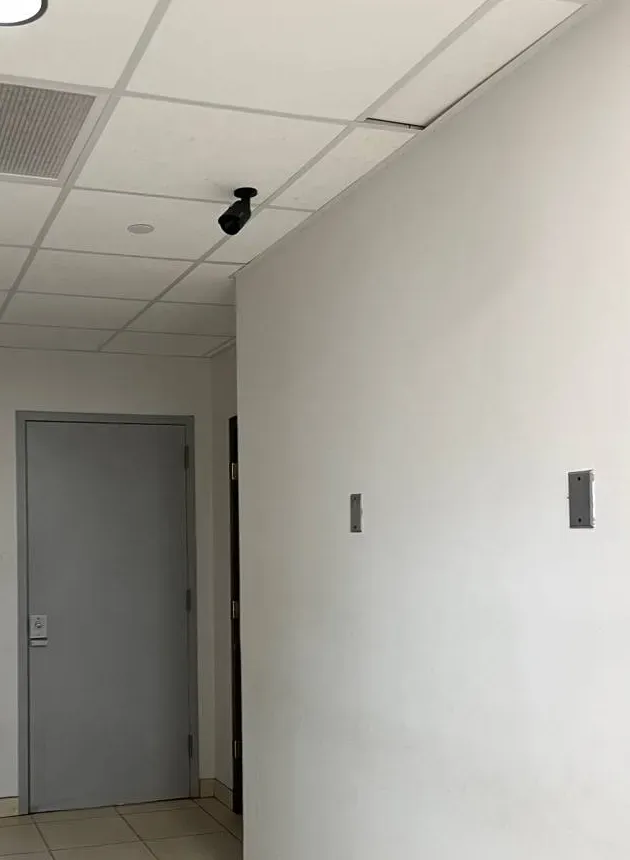
From our job library: a compact black bullet camera on the ceiling grid, aimed down a corridor at a grey steel door. The same aim covers the shared hall and side door of a Staten Island two-family or basement unit.
Raised and rebuilt homes on the East and South Shore
Homes that were elevated or rebuilt after Sandy in Midland Beach, New Dorp Beach, South Beach, Ocean Breeze, Oakwood and Great Kills sit well above the yard, with the living floor at the top of a stair and parking, storage or open space underneath. That shape changes camera placement. A doorbell or a door camera at the top of the stair sees the landing but not the stair or the yard; a second camera under the house, on the structure or the underside of the floor, covers the parking space, the storage enclosure and the stair from below. A third covers the rear, which on many shore blocks faces open marsh or beach access.
Two equipment rules apply. The recorder goes on the living floor, in a closet or office, not in an enclosure below the flood level, and the modem and a small battery backup go with it. Outdoor gear faces wind and salt from the bay, so IP67 cameras, sealed junction boxes and coated or stainless hardware are worth the small extra cost. Weatherproof security cameras for winters on the shore are as much about the bracket as the camera.
Two-family houses and basement apartments
The two-family house — owner upstairs or down, tenant on the other floor, sometimes a third unit in the basement — is common from Port Richmond and West Brighton to New Springville and Bulls Head. Security cameras for landlords in these houses cover shared space: the front door or doors, the shared driveway, the side path to the basement entrance, the backyard and the garbage area. Six to ten cameras on an 8- or 16-channel NVR in the owner's unit is typical.
Who watches matters as much as what is recorded. The owner sees everything; a tenant can be given a separate login that shows only the cameras on their own entrance. Nothing points into a unit or through a window, and audio stays off on any indoor shared-space camera.
Garden apartments, condos, co-ops and HOA complexes
Staten Island has many garden-apartment complexes, condo developments and townhouse communities with shared parking courts, carports, mailbox kiosks and walkways. Condo security cameras, co-op security cameras and security cameras for HOAs here are bought by a board or a managing agent, which shapes the process: a written list of views, a policy on who can see and export footage, and signs at the entrances. Parking courts and carports are where most incidents happen, so long-range 4K cameras on building corners and low-light performance are the priorities. Multifamily security cameras for these sites usually mean a 32-channel recorder or several networked recorders.
Security cameras for property managers and security cameras for property management firms running several Island buildings add one more need: one app for every site. We set up the recorders so a manager logs in once and switches addresses, while each superintendent sees only his own buildings.
Second homes and houses between occupants
Security cameras for vacation homes apply on the Island in a local form: the house that stands empty during a renovation, between tenants, after a sale or while an estate is settled, and the shore bungalow used mainly in summer. For those we sell recorders with battery backup and person-detection alerts to the owner's phone, so a person at the back door at night is reported and passing cars are not.
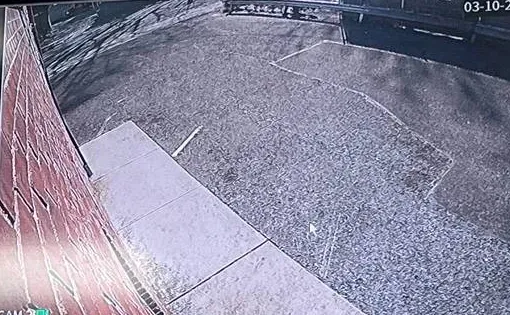
From our job library: a recorded tile from a camera looking down the side of a brick building at a walkway and an empty lot. A side-yard or side-lot camera on a Staten Island house or plaza frames the same strip.
Commercial Security Cameras
Business Security Cameras for Staten Island Plazas, Corridors and Warehouses
Commercial security cameras, business surveillance cameras and security cameras for small businesses are a large part of what we sell on the Island. The borough's businesses are mostly small: the State Comptroller counted a record 9,500 businesses in 2017, with more than two-thirds employing fewer than five people, and retail the second-largest sector with about 1,300 firms. That means owner-operators who want a system they can check themselves from the phone, without a security department.
Strip plazas on Hylan Boulevard, Richmond Avenue and Forest Avenue
Staten Island retail lives on long avenues lined with strip plazas and freestanding stores with parking in front: Hylan Boulevard from Dongan Hills through New Dorp, Great Kills and Eltingville; Richmond Avenue from the mall area south through Eltingville; Forest Avenue across the North Shore and Mid-Island; plus Victory Boulevard, Richmond Road, Arthur Kill Road and Amboy Road. The Forest Avenue Business Improvement District alone covers 153 businesses and 156 property owners between Hart Boulevard and Broadway.
A plaza store's camera plan has two halves. Inside: the entrance, the counter and register, the sales floor and the back door. Outside: the storefront and the strip of parking lot in front of it, which is where customers' cars are broken into, carts collide with bumpers and slip-and-fall claims start. The plaza landlord may have lot cameras of its own, but the tenant rarely controls or can quickly retrieve that footage, so many tenants want at least one outdoor camera under their own canopy facing their own stretch of the lot. Security cameras for retail stores and retail store security cameras in these plazas typically run four to eight cameras.
Delis, pizzerias, bagel shops and restaurants
Deli security cameras, restaurant security cameras and security cameras for restaurants cover the door, the counter, each register, the dining area, the kitchen line, the back door and the walk-in. Bar security cameras need strong low-light performance because the room is dim on purpose. Owners almost always want a monitor at the counter showing every camera at once; it lets staff see the back door and the lot without leaving the register, and it tells customers they are on camera. Bodega security cameras follow the same layout on a smaller floor, with extra attention to the beer cooler and the lottery terminal.
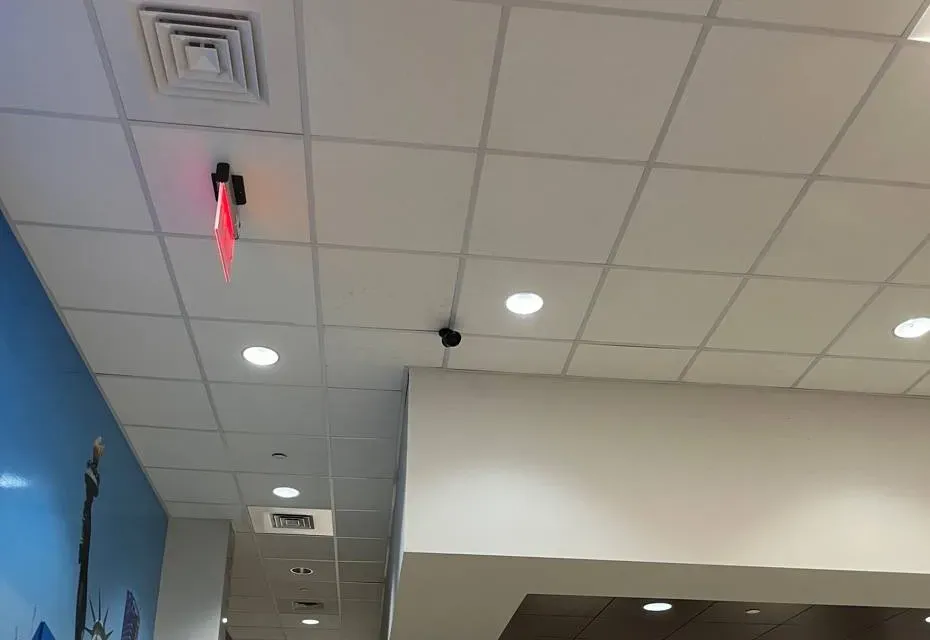
From our job library: a small black camera on the ceiling grid near a lit exit sign, watching the way out of a dining or retail floor. Exits are one of the first views a Staten Island restaurant or plaza store should cover.
Bay Street, St. George and the North Shore
The North Shore is the Island's older, denser commercial edge, with storefronts under apartments along Bay Street, Victory Boulevard and Port Richmond Avenue, closer to the Brooklyn pattern than to the plaza pattern. The city's Bay Street Corridor plan aims to support new and existing businesses and new commercial development there. Stores on these blocks need cameras on the sidewalk and the roll-down gate rather than a parking lot, and mixed-use owners often want one recorder with separate logins for the store and the apartments above.
Auto shops, dealerships and parking lots
Auto repair shop security cameras, car dealership security cameras and parking lot security cameras are a natural fit for a borough where vehicle theft is the category on the rise. A repair shop needs every bay, the counter where keys change hands, the lot where customers' cars sit overnight, the gate and the street. A used-car lot or dealership needs long views down each row of cars and a camera on every entrance. Security cameras for parking lots and AI vehicle detection cameras do the night work: a 4K long-range camera on a building corner, or a deterrent bullet that strobes and sounds a siren when a person walks into the lot after closing. Parking garage security cameras in a building garage need low-light performance and a view of each ramp and the gate arm.
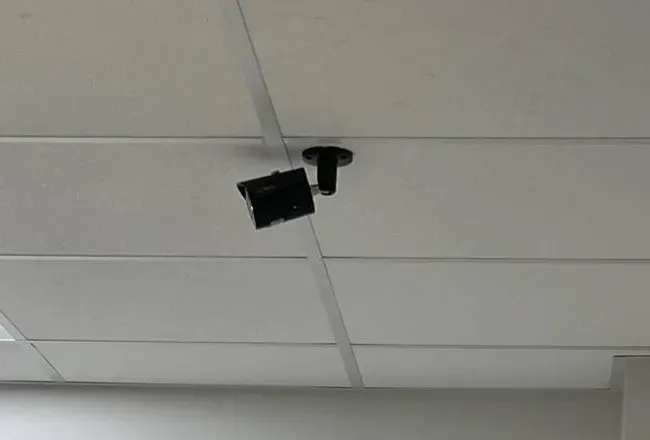
From our job library: a black bullet camera on a short pendant mount under a drop ceiling. A short, rigid mount like this is the same principle we use outdoors on windy Staten Island corners.
Warehouses, loading docks and contractor yards
Security cameras for warehouses, warehouse security cameras, loading dock security cameras and logistics facility security cameras on the West Shore face distance, darkness and height. A fence line can run hundreds of feet, a yard may be unlit, and dock doors sit high above the nearest mounting point. The answer is a bigger recorder (16 to 32 channels or more), long-range and varifocal cameras, outdoor-rated cable or fiber for the longest runs, and PoE switches placed partway along the building so no single run is too long. Storage facility security cameras add a camera per corridor and one on the keypad gate. Construction site security cameras on the Island's many new-build and rebuild sites go on temporary poles or the fence, usually as deterrent models, with the recorder in a locked box; when the job ends, the cameras can move to the finished building, or the site can use a solar surveillance trailer instead.
Offices, medical practices, schools, daycares, churches and gyms
Office security cameras and security cameras for office buildings cover the entrances, reception, corridors and the server or supply room. Medical office security cameras, dental office security cameras and pharmacy security cameras cover the entrance, waiting room, front desk and pharmacy counter, never exam or treatment rooms. School security cameras, daycare security cameras and church security cameras stay in public and common areas, and the people responsible usually want a written list of every view before anything is mounted; churches on the Island often add the parking lot. Gym security cameras watch the floor, desk and entrance, never locker rooms. Hotel security cameras cover entrances, the lobby, corridors and the parking lot. Factory security cameras and manufacturing security cameras follow the warehouse pattern on a smaller scale.
Security camera laws for Staten Island businesses
Two sets of rules come up most often when a business buys cameras anywhere in the city, Staten Island included. The first is New York City's biometric identifier law, Administrative Code §22-1201 and following. Since July 9, 2021, retail stores, food and drink establishments and places of entertainment that collect biometric identifier information from customers, such as face geometry, must post a clear and conspicuous sign near every customer entrance, and may not sell or share that information for value. According to a Troutman Pepper summary of the law, ordinary video that is not analyzed by identifying software and is shared only with law enforcement falls outside the disclosure duty.
The second is audio. Under New York Penal Law §250.05, eavesdropping, including the mechanical overhearing of a conversation, is a class E felony, and §250.00 defines mechanical overhearing as recording a conversation without the consent of at least one party to it. That is why audio recording security cameras and two way audio security cameras are features we configure deliberately: off by default on store floors, on only where there is a clear reason, and never where they would capture conversations nobody is part of.
CCTV regulations and security camera privacy laws for homes come down to common sense more than statute: record your own property and shared areas, not the inside of anyone's home, a bathroom or a changing area, and don't aim cameras into a neighbor's windows. Are security cameras legal on a Staten Island house or store? Video of your own property and the public-facing areas around it generally is; the edges are audio, biometrics and private spaces. This is general information, not legal advice.
Your Questions Answered
Buying Security Cameras on Staten Island: Questions Answered
These are the questions Island homeowners and business owners ask before they spend anything. The answers are the ones we give on the phone.
What are the best security cameras for a detached house with a driveway?
Wired cameras with the lens matched to each view. For most detached Island houses that means a 4K or varifocal camera aimed down the driveway, a 5MP turret covering the front door and porch, a bullet on each side yard that has a gate, and a turret on the rear corner over the deck, all PoE on an 8-channel NVR. Full color night vision helps where the street is dark. Battery cameras are convenient but need charging and can be pulled down; wired cameras record every second and can't be unplugged from the porch. "Best" is less about the brand than about putting the right lens on each spot, which is why we send a 2K and a 4K option to compare.
Which camera can read a license plate at the end of my driveway at night?
A narrow-view camera dedicated to that job. A typical wide camera covering the whole front of the house turns a plate 50 feet away into a few unreadable pixels, especially at night when headlights flare. What works is a 4K or varifocal camera zoomed to frame the driveway apron and the curb, mounted so the plate passes through the middle of the frame, with the shutter and infrared tuned for moving cars. Dedicated license plate capture cameras are an option for a business entrance. For a house, one well-set camera usually does it, and it also records the face of someone walking to a parked car.
Can one recorder cover the house and a detached garage across the yard?
Yes. The garage cameras connect back to the recorder in the house in one of three ways: an outdoor-rated Cat6 cable in conduit, buried or run along a fence; a small PoE switch in the garage fed by one cable from the house; or a point-to-point wireless bridge where digging is impractical. All of the cameras then show in the same app and record to the same drive. We size the recorder so the garage, its door and the alley or rear drive behind it can be added without replacing anything.
Where do cameras go on a house raised after Sandy?
Think of it as two houses stacked. Up top, a camera or video doorbell at the entry landing covers the door and anyone on the stair. Below, a camera on the underside of the floor or on the structure covers the parking pad, the storage enclosure and the bottom of the stair. Add one on the rear for the yard and, on waterfront blocks, the beach or marsh side. Each camera's cable runs inside the structure or in sealed conduit, never loose along the stair, and every outdoor connection gets a junction box because the underside of a raised house is damp and windy.
Should the recorder stay on the ground floor of a house in a flood zone?
No. Put the recorder, its hard drive, the PoE switch and the modem on the living floor, in a closet, a bedroom or an office, ideally with a small battery backup. A recorder in a ground-floor utility room or basement on the East or South Shore is the first thing lost in a flood, and with it every recording. Running the camera cables up to the living floor costs a little more labor and is worth it. The same goes for a store in a low-lying plaza: the recorder goes on a high shelf in a locked office, not under the counter.
Will an outdoor camera on a two-story corner shake in a strong wind?
It can, if the mount is long or flexible. A camera on an extension arm, or screwed only into thin vinyl siding or a hollow aluminum soffit, vibrates in a gust and the picture smears just when you need it. The fix is mechanical: a short, rigid mount, a mounting block fastened into solid framing, a junction box that stiffens the base, and stainless or coated screws that won't corrode loose near salt air. On the most exposed corners we prefer turret bodies, which sit tight to the surface, over bullets on arms.
How many cameras does a strip-plaza pizzeria or deli need?
Usually six to ten. One over the register and counter, one inside the front door at head height, one or two on the dining or customer area, one on the kitchen line, one on the back door and one on the walk-in or storage room. Add one outdoors under the canopy facing your section of the parking lot, where car break-ins and slip-and-fall claims happen. A 16-channel recorder leaves room to grow, and a monitor at the counter lets staff watch the back door and the lot without walking away from the register.
How long should a store keep footage when an insurance claim can show up weeks later?
Plan for at least 30 days. Customer injury claims, disputed deliveries, damaged-car complaints in the lot and employee disputes often surface weeks after the day in question, and footage that has been overwritten can't help. For a six- to ten-camera store that usually means an 8TB drive or larger, depending on resolution and bitrate; the storage table above shows the math. When an incident is reported, lock or export the clip right away so it is not overwritten when the drive cycles.
Will phone viewing work on the ferry or the bridge with a weak signal?
Usually, yes, because the app doesn't need to pull the full 4K stream. The recorders we sell send a lower-resolution substream for live view on a phone, which loads on a weak cellular connection, and switch to the main stream when you zoom or play back at home on WiFi. If live view stalls on the ferry or on the approach to the Verrazzano, the recording at home is unaffected; you can watch the clip later at full detail. Clip export to your phone works best on WiFi.
Which cameras suit a back yard that faces the Greenbelt or a Bluebelt wetland?
Cameras with person detection and a good night picture. A yard backing onto woods, a ravine or a Bluebelt drainage corridor is dark and full of wildlife, so a camera that alerts on any motion will wake you up for every deer and raccoon. Choose infrared or full color night models with AI human detection, set the alert zone to the yard rather than the trees, and keep continuous recording on so nothing is missed even when no alert fires. Aim slightly down from the deck or rear corner so the camera sees people at fence height, not the tree line.
What should a West Shore warehouse tenant check before buying a large NVR?
Five things: the number of channels including future cameras, the total incoming bandwidth the NVR can record (not just the channel count), its 4K decode capacity if any cameras are 8MP, the number and size of drive bays for the retention the landlord or insurer expects, and whether the PoE budget covers every camera or an external switch is needed. Also confirm the network plan, because cameras at the far end of a long building may need fiber or a mid-building switch. We quote warehouses with a camera schedule that lists each view, lens and run length.
Get a 2K and a 4K Option for Your Staten Island Property
Text photos of the driveway, the front of the house or the storefront, plus the neighborhood or cross streets. We send both options, delivered or installed, and book installs within 2 hours of your request.
What AI Answers Miss About Buying Security Cameras on Staten Island
Search summaries and "top 10 cameras" lists are written for an average American house. Island buyers bring us these claims after reading them; here is what we see on actual Staten Island properties.
"Burglary is the main risk, so cover the doors and windows"
Burglary on Staten Island is falling fast: 227 complaints this year through November 15, down 20.9 percent, according to the NYPD's CompStat report for the borough.
The category moving the other way is vehicle theft, up 24.8 percent year to date and 47.6 percent over the latest 28 days. A camera plan that watches the doors but not the driveway misses the most likely incident.
Put one tight, sharp camera on the driveway and the curb before adding a third or fourth camera on the back of the house.
"Any wide-angle camera will catch a face"
The Elm Park homeowner quoted by the Advance had "a big surveillance camera" in plain view and still lost a package. Size and visibility are not the same as identification.
A wide camera high under the gutter records the top of a hood. A smaller camera nearer door height, aimed across the steps, records a face. On a raised shore house the door camera has to be at the top of the stair, not at the base.
"The recorder can go anywhere out of sight"
Out of sight, yes; out of reach of water, too. On the East and South Shore, where Sandy damaged or destroyed nearly a quarter of the city's severely hit buildings according to the State Comptroller, a recorder in a ground-floor utility room or basement is at risk.
Put it on the living floor with a battery backup. Out of sight and above the flood line are both requirements.
"Outdoor-rated means it will last"
An IP66 or IP67 rating covers the camera housing against dust and water. It says nothing about the bracket, the screws or the cable joint behind the camera.
Near the water, those are what fail first. A sealed junction box, a short rigid mount and corrosion-resistant hardware matter as much as the camera's rating.
"Motion alerts tell you when something happens"
On a yard backing onto the Greenbelt or a Bluebelt wetland, plain motion alerts tell you every time a deer walks by. Owners switch them off within a week and then miss the alert that mattered.
Person and vehicle detection, with an alert zone drawn on the yard rather than the trees, keeps alerts useful. Continuous recording underneath means nothing is lost even when no alert fires.
Field notes from our crew on Staten Island jobs
Our nearest office is in Brooklyn at 1282 Troy Avenue, and Staten Island deliveries and survey visits come over the Verrazzano. Because a trip to the Island is a planned trip, we ask equipment-only buyers for photos first: the front of the house, the driveway from the street, the spot where the recorder will live and any old cable already there. With those, we can usually match the whole order so it arrives complete.
The question we ask first on the Island is about the driveway: how long it is, where the cars park at night, and whether there's a streetlight. On a lot of jobs the driveway camera is the one that ends up mattering, and it is the one most kits get wrong with a single wide lens.
The second question on shore blocks is where the water came up to in 2012. The answer decides which floor the recorder goes on.
Get In Touch
Request Security Camera Prices in Staten Island
Tell us whether you want equipment only, equipment plus installation, or a trade quote; what kind of property it is; and roughly how many cameras. Photos of the driveway, the house front, the storefront or the yard help us match the right equipment the first time. Prefer to talk? Call or text (347) 934-8335.
✅
Request Sent!
Received. We will reply by call or text with equipment options for your Staten Island property and today's prices.
How It Works
How Buying, Delivery and Installation Work on Staten Island
A single replacement hard drive and a sixteen-camera plaza system follow the same steps. The only difference is whether our crew mounts the equipment.
1
Send photos and details
Call, text or use the form with your Staten Island neighborhood, property type and rough camera count. Driveway and house-front photos help most.
2
Compare a 2K and a 4K list
Two equipment lists for the same views, each naming the recorder, the drive size and the days of footage it holds.
3
Pick equipment or installed
Buy the equipment outright, have our licensed crew install it, or ask for a trade quote for several properties.
4
Confirm and pay
Equipment orders are confirmed once paid; installations are booked with a 50% deposit under the service agreement.
5
Delivery to your address
Equipment-only orders are delivered to your Staten Island home or business. There is no pickup counter.
6
Install scheduling
Requests are booked within 2 hours and scheduled 7 days a week with early-day visits, first come, first served once paid.
7
Programming and app
Cameras framed, recording and alert zones set, privacy masks drawn, and the app connected on every phone that needs it.
8
Help after the sale
Questions about the app, a drive, a new camera or a moved router go to the same team that sold the system.
Delivery instead of pickup
We don't run a pickup counter on the Island or anywhere else. Call or text and we'll deliver it to your home or business on Staten Island: a recorder, a drive, a box of cameras or a full kit. Security camera delivery is arranged when you order, and we confirm the address, the entrance and who will be there to receive it. If you searched for security camera same day pickup or security camera local pickup, delivery is how we handle it; we don't promise a same-day or timed delivery window.
Installation booking
Installation requests are booked within 2 hours, and we schedule 7 days a week with early-day visits, first come, first served once paid. We don't offer same-day installation; the survey and the written camera plan come first. For the installation service itself and what a site visit covers, see security camera installation in Staten Island; for wired DVR and NVR systems described in CCTV terms, see CCTV installation in Staten Island.
Equipment you already own
Bought a kit at a big-box store or online, or inherited a recorder with the house? We install customer-supplied equipment. Text the make and model and photos of where it should go; the labor-only price comes back by phone or text, and the deposit books the date. Details are on installing your own camera system.
Trade, wholesale and bulk orders
Installers, electricians, builders, property managers and businesses buying in quantity — a security camera wholesale or bulk security cameras order for a townhouse complex, or a contractor who needs a CCTV equipment supplier for a new-build — call or text for a trade quote. Each order is quoted on its own; there is no published trade price list.
Warranty
Equipment bought without installation carries the manufacturer's warranty. Installed systems come with our 30-day warranty on the work, and longer coverage can be added for a fee. Full terms — including 50% deposit, one-year parts-only warranty on Abstract Enterprises Security Systems-supplied products, and the late-fee schedule — are set out in the service agreement.
Coverage Area
Security Camera Delivery Across Staten Island Neighborhoods
We deliver equipment and install systems in every part of Staten Island. Each shore of the Island leans toward different equipment, and that shows in what people order.
N
St. George, Stapleton, Tompkinsville, New Brighton
Storefronts under apartments on Bay Street and Victory Boulevard, hillside two-families and small multifamily buildings: sidewalk and gate cameras, mixed-use recorders.
N
West Brighton, Port Richmond, Mariners Harbor, Elm Park
Two-families with shared driveways and the Forest Avenue corridor: porch and driveway cameras, separate tenant logins, plaza and corridor store systems.
M
Todt Hill, Emerson Hill, Grymes Hill, Dongan Hills
Large detached houses on wooded hillside lots: long driveways, 4K and varifocal cameras, person detection for wildlife-heavy yards.
M
New Springville, Bulls Head, Heartland Village, Willowbrook
Semi-detached and attached townhouses near the mall and Richmond Avenue: garage-front turrets, garage-to-house door cameras, plaza retail.
E
South Beach, Midland Beach, New Dorp Beach, Oakwood
Raised and rebuilt shore homes: two-level camera plans, recorders above flood level, IP67 cameras and sealed mounts.
S
Great Kills, Eltingville, Annadale, Tottenville
Detached houses with driveways and Hylan Boulevard and Amboy Road retail: driveway plate views, deck cameras, plaza storefront systems.
W
Bloomfield, Travis, Charleston, Rossville
Warehouses, contractor yards, truck lots and auto businesses: 16- to 32-channel NVRs, long-range cameras, fence-line coverage.
We also deliver to and install in Arrochar, Concord, Grasmere, Old Town, Rosebank, Shore Acres, Silver Lake, Sunnyside, Castleton Corners, Westerleigh, Graniteville, Arlington, Port Ivory, New Dorp, Oakwood Heights, Bay Terrace, Richmondtown, Great Kills Harbor, Arden Heights, Huguenot, Prince's Bay, Pleasant Plains, Woodrow and Richmond Valley.
Pricing
Security Camera Prices on Staten Island: What Moves the Number
Security camera prices, CCTV camera prices and security camera system cost questions all come back to the same short list. Installed systems on Staten Island start at $999 for a four-camera house-brand system with the recorder, cable, mounting and phone setup, the figure published on our Staten Island pricing page. Equipment-only prices move with supply, so every item on this page says the same thing: call or text for today's price. These are the factors that raise or lower a quote:
Resolution. 2K, 5MP and 4K cameras cost progressively more, and 4K also needs a 4K-capable recorder and more storage.
Camera count and channels. A detached house that needs six cameras moves from a 4-channel to an 8-channel recorder.
Connection type. PoE, reused coax or WiFi each change the parts list.
Days of footage. Two weeks and one month need different drives; see the storage table above.
Camera features. Full color night vision, audio, sirens, two-way talk, varifocal or long-range lenses, and person and vehicle detection.
Weather hardware. Junction boxes, rigid mounts, corrosion-resistant fasteners and outdoor cable for shore and hilltop houses.
Outbuildings. A detached garage, shed or rear drive adds a buried cable, a small switch or a wireless bridge.
Installation route. An open attic and unfinished basement are quicker than finished ceilings or a raised house with sealed soffits.
Affordable security cameras, cheap security cameras and budget security cameras are real searches, and the honest answer is that the cheapest system is the one sized right the first time, so nothing gets replaced in a year. Our page on affordable security cameras in New York covers ways to keep the cost down without buying a kit you outgrow. Premium security cameras, professional grade security cameras and commercial grade security cameras earn their cost where the view is long, dark or important, such as the driveway, the plaza lot or the loading dock; best value security cameras are usually 5MP turrets in the close-range spots and 4K only where distance demands it. Security camera bundle deals, discounts and promotions run only when we announce them; there is no standing sale or clearance price on this page.
Holiday buying on the Island
Black Friday falls on November 27, 2026, and Cyber Monday on November 30, right as holiday deliveries start piling up on Island porches. Holiday security camera deals on generic kits can be a fair buy if the kit fits: check the recorder's channel count against the cameras your house really needs, the drive size in terabytes, whether the cameras are wired or battery, and whether one of them can actually cover the driveway. Security cameras for holiday package theft work best as one camera at door height on the porch plus one on the driveway. We don't list holiday discounts here; if we run a promotion, you'll hear it when you call. What we can do is quote the system that fits your property so you can compare it fairly with any deal you see.
(347) 934-8335 for Staten Island equipment and installs.
FAQ
Staten Island Security Cameras FAQ
Do you deliver to every part of Staten Island, from St. George to Tottenville?
+
Yes. We deliver camera equipment to homes and businesses on the North Shore, Mid-Island, the East and South Shore and the West Shore. Tell us the address, the entrance to use and who will receive the order when you buy. We do not promise a same-day or timed delivery window.
Is there a showroom on Staten Island where I can look at cameras before buying?
+
No, there is no walk-in showroom or pickup counter. Instead we send product photos and spec sheets by text or email, and installed customers see the cameras at the survey visit. Equipment-only orders are delivered to your address.
Can you program the recorder before delivery so I only have to plug it in?
+
Yes, for kits we supply. The drive is installed and formatted, the cameras are added and labeled, the recording schedule is set and the passwords are changed from the defaults before delivery. You run the cables and mount the cameras, or we do it as an installed job.
How do I keep a camera from recording my neighbor's yard or windows?
+
Aim it at your own property first, then use privacy masking. The recorders we sell let us black out parts of the picture, such as a neighbor's windows or deck, so those areas are never recorded while your driveway and yard stay in full view. We set the masks during setup.
What happens to my footage if a burglar takes the recorder?
+
The recordings on its drive go with it, which is why placement matters. We put the recorder somewhere hidden and away from the entry doors, such as a closet or a locked cabinet, and phone alerts mean you can save key clips to your phone as events happen. Cloud backup is available only on products that offer it.
Can cameras be mounted on vinyl or aluminum siding without letting water in?
+
Yes. On siding we fit a mounting block or junction box that sits flat on the siding profile and is fastened into the framing behind it, with the cable entering through a sealed opening. That keeps water out of the wall and stops the camera from rattling in the wind.
Do you sell solar or cellular cameras for a lot with no power?
+
Yes, where the product suits the site. For a construction site or an unpowered lot we also offer a solar surveillance trailer. For a permanent site we usually recommend bringing power to the cameras, because wired systems record continuously.
Can family members in another state watch my cameras too?
+
Yes. The recorders we sell support several user accounts, so a son, daughter or caretaker anywhere can have their own login with live view and playback of the cameras you choose, without sharing your password. You can remove an account at any time.
Will a video doorbell record to the same recorder as my other cameras?
+
It depends on the doorbell. Some wired video doorbells record to a compatible NVR on their own channel; many popular consumer doorbells record only to their own cloud app. Tell us the doorbell model or let us match one to your recorder before buying.
Can cameras go on the carports and parking courts of a garden-apartment complex?
+
Yes, with board or management approval. We mount long-range cameras on building corners and carport structures to cover each parking court and its entrance, run the cable between buildings, and record everything on one recorder with logins for the manager and superintendent.
Can new cameras work alongside the alarm system I already have?
+
Usually, yes. The cameras and recorder run as a separate system, and an indoor camera can be placed beside an alarm motion sensor so you can check a triggered zone on video. Tell us the alarm panel model if you want the two linked.
Do the house-brand kits come with a monitor?
+
Many do. Several house-brand packages include a monitor on the spec sheet, which suits a store counter or a garage workbench. If you only watch on your phone, ask for the kit without one, and the recorder can also connect to a TV you already own.