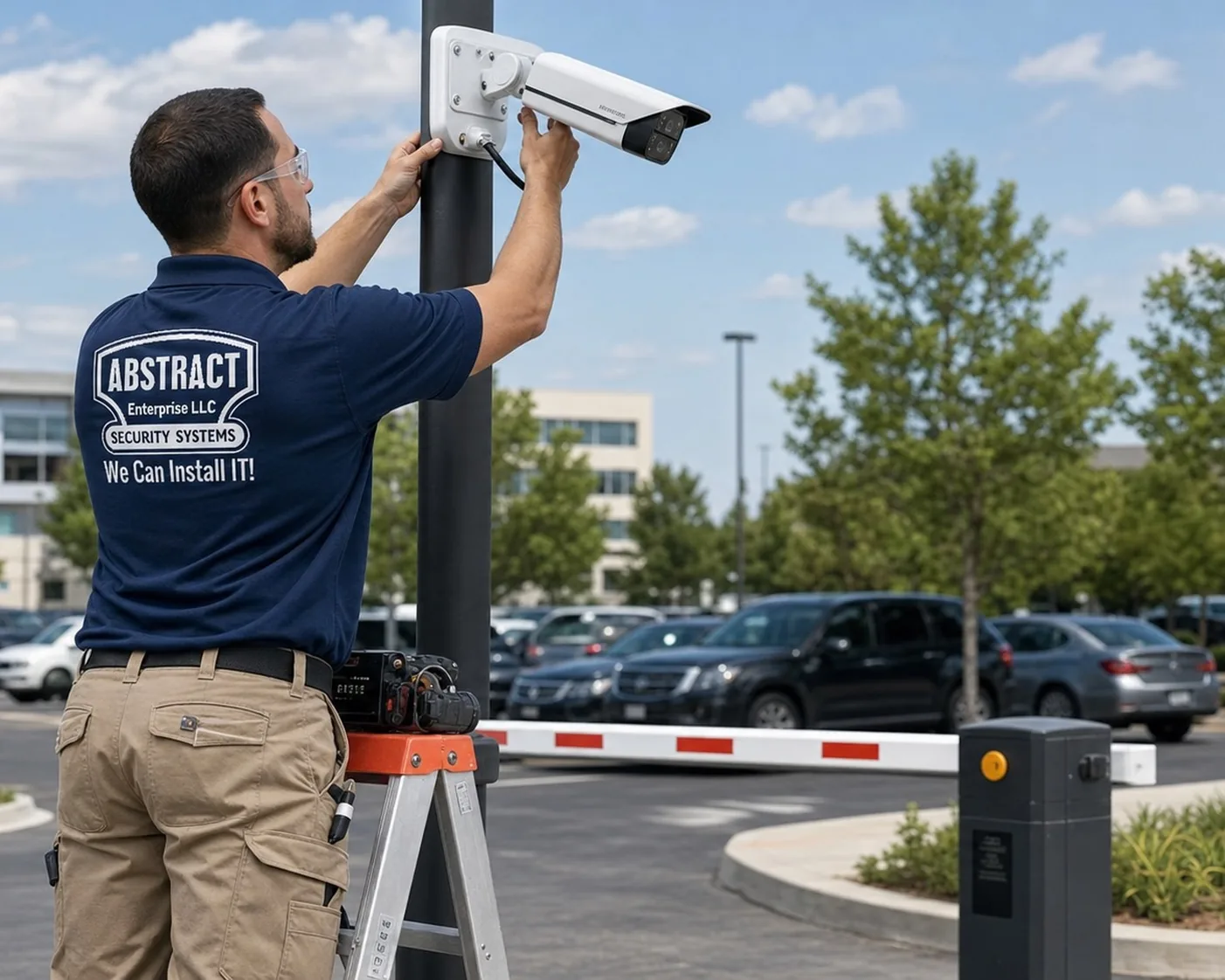
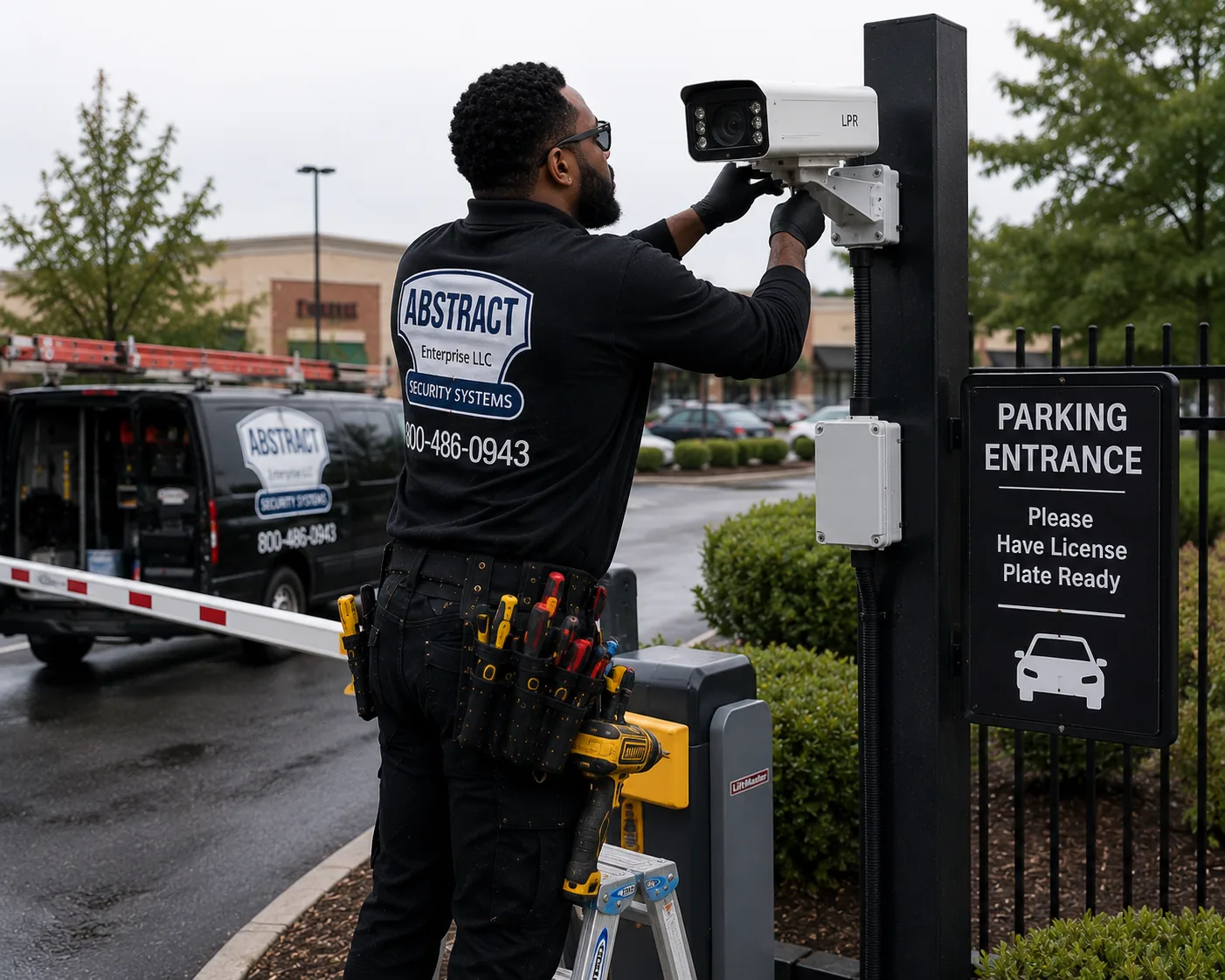
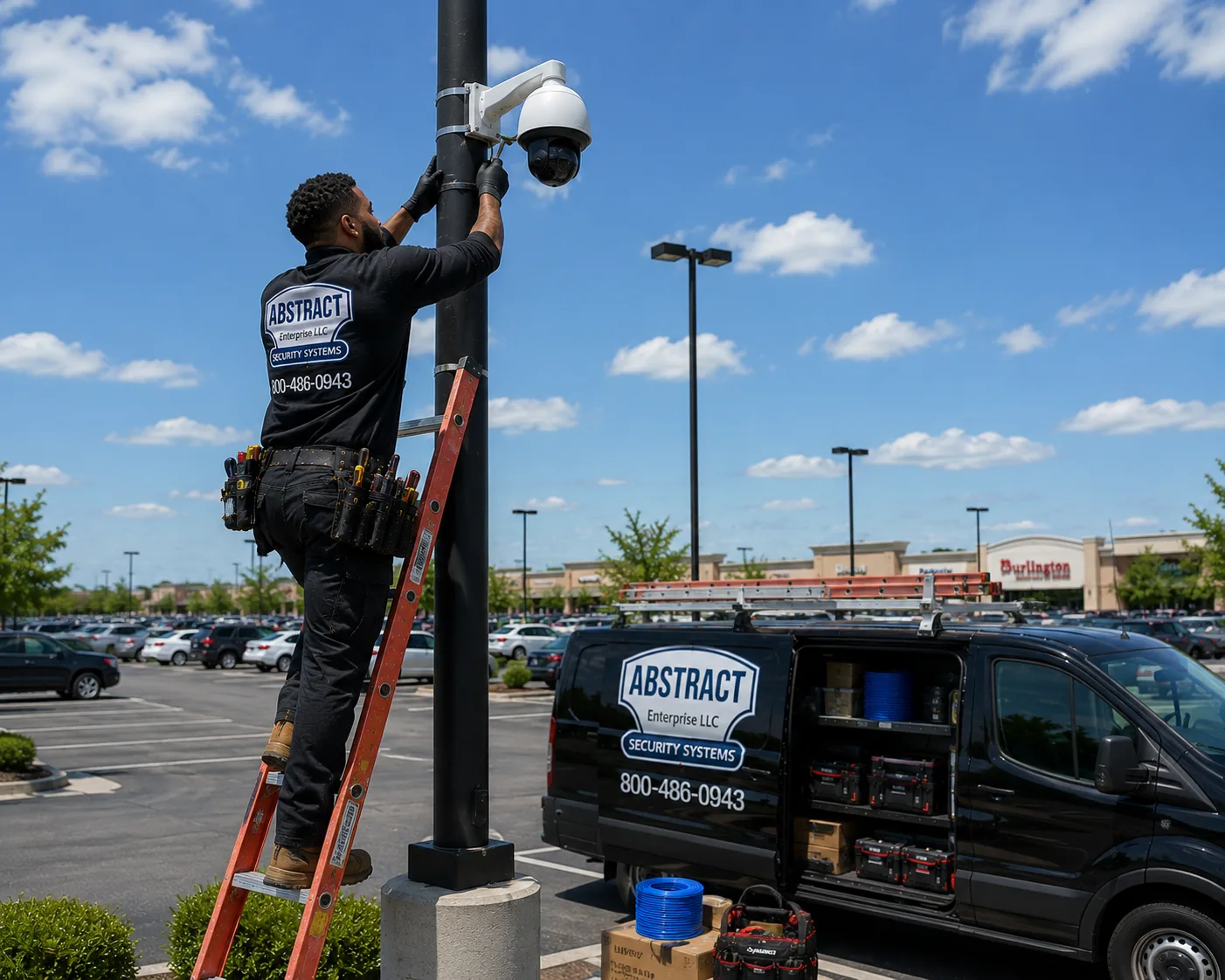
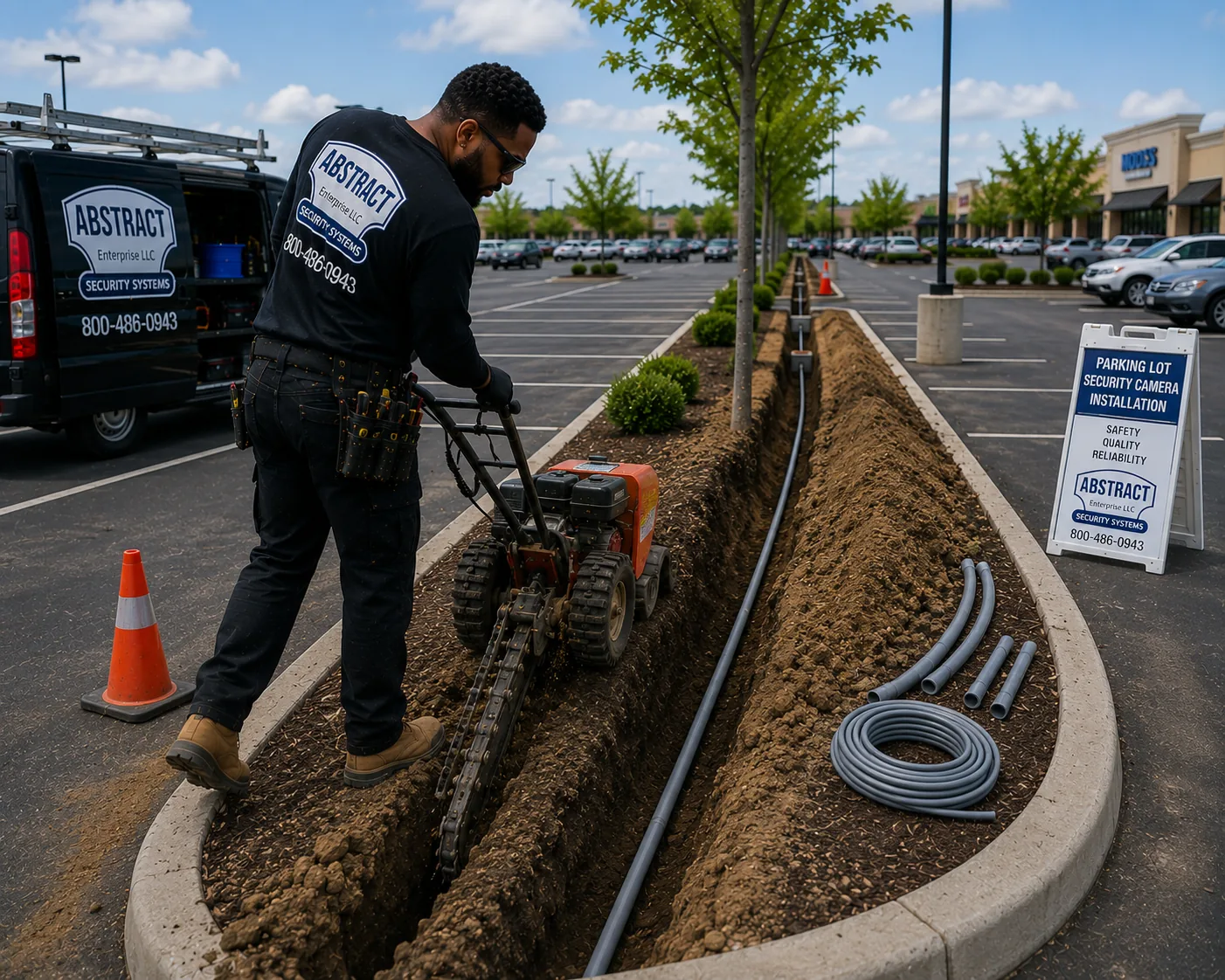
Camera systems for the full range of Nassau County parking: shopping-center and big-box lots off Old Country Road and Hempstead Turnpike, LIRR park-and-ride and event lots from Mineola to UBS Arena, strip-mall lots along Sunrise Highway and Jericho Turnpike, South Shore marina and boatyard parking at Freeport and Long Beach, auto-dealership inventory rows, house-of-worship and school lots, office-park parking and structured garages — LPR entrance coverage, pole-mounted 4K cameras, trenched conduit and remote viewing, engineered from a free on-site survey.
· 201 Google Reviews | NYS Low-Voltage License #12000287431 | Free on-site survey
We serve all of Nassau County, dispatched from our Brooklyn office at 1282 Troy Ave.
Reviewed and updated July 30, 2026.
THE NEIGHBORHOOD
Nassau County was built around the car, and its parking shows it. There are genuine big-box fields at Roosevelt Field in Garden City — one of the largest shopping-mall parking layouts in the country — the Broadway Mall in Hicksville, Green Acres in Valley Stream and Sunrise Mall in Massapequa, the LIRR park-and-ride lots that fill by mid-morning at Hicksville, Mineola and Hempstead, dealership inventory rows lining Sunrise Highway and Hempstead Turnpike, office-park lots off the Meadowbrook and Northern State parkways, marina parking on Freeport’s Nautical Mile and the North Shore harbours, and co-op, condo and house-of-worship lots that fill on a fixed weekly schedule. Almost nothing transfers cleanly from one to the next.
The theft pressure here is specific and familiar. Catalytic-converter theft and vehicle break-ins have been a persistent problem across Nassau and the wider Island, and the Nassau County Police Department has publicised converter-etching and park-smart awareness events in response. A converter can be cut off a parked truck or SUV in under a minute, and strip-mall lots along the busy boulevards see repeat break-ins where valuables are taken from vehicles in daylight. That threat pattern is why entrance capture, aisle coverage and a low-mounted plate view all earn their place on a Nassau lot rather than a single wide camera on the building.
That range is why Nassau parking resists templates. A design that fits the Roosevelt Field field is wrong for a fenced Bethpage contractor yard, which is wrong again for a below-grade garage under a Mineola transit building or an all-day commuter lot beside an LIRR station. The survey is doing real work here — it decides which of several unrelated design approaches a property actually needs.
The second Nassau characteristic is commuter pressure. Park-and-ride demand around the LIRR stations — Hicksville is one of the busiest on the whole system — means any accessible private lot nearby absorbs all-day unauthorized parking, and enforcement is one of the most common reasons a Nassau property calls about cameras in the first place. That shapes design: entrance coverage and plate records carry more weight here than on properties where the only concern is overnight security.
The third is the ground, which shifts noticeably across the county. Much of the South Shore and the barrier islands sit on sand, fill and a high water table, while the North Shore moraine through Roslyn, Manhasset and Great Neck runs into hard glacial till and boulders. Trenching is usually possible but never assumed, and markouts precede excavation on every project.
Abstract Enterprises Security Systems is a licensed NYS low-voltage contractor serving Nassau County from our Brooklyn office at 1282 Troy Ave. Every proposal follows a free on-site survey.
WHAT WE INSTALL
Parking in Nassau clusters around three things: retail, the railroad and the shoreline. A regional mall or big-box field needs its entrance, its rows and its outparcels held; a commuter lot beside an LIRR station lives or dies on plate capture and dwell time; a marina or bay-town lot is really a perimeter-and-gate problem; and the storefront strips off Sunrise Highway and Hempstead Turnpike need their aisles and doors on record without feeling like a checkpoint.
Roosevelt Field, the Broadway Mall, Green Acres and the big Old Country Road plazas spread thousands of spaces beneath a single long storefront. A camera on that building resolves only the nearest two rows and loses detail beyond them, so the outparcels, the far bays and the rear delivery drives each need a pole of their own just to be covered.
Behind the Merrick Road and Jericho Turnpike storefronts sit small shared-lease lots where the first question is never technical — it is who owns the recorder and who is allowed to pull a clip. Once that is settled the coverage is short work: one entrance, one aisle, the doors.
The industrial pockets around Westbury, Bethpage, Farmingdale and Hempstead hold trailers, box trucks, plant and palletised stock behind a chain-link line. Here the gate plate log does the heavy lifting, the fence line matters as much as anything parked inside, and the ground is usually stone or tired asphalt rather than fresh pavement.
The garden-apartment and co-op complexes off Old Country Road, through Hempstead and out toward Long Beach run on numbered bays, a short visitor row and the walk residents make from the car to a lobby door. Where a camera hangs is only half the job — a board vote, a fair line on which windows stay out of frame, and a written footage-release rule weigh just as much.
Nassau’s synagogues and churches keep lots that sit idle for days, then pack in an hour for a Friday evening, a Sunday morning or a High Holy Day. The plan concentrates on the entrance and the paths from the lot to the doors, with analytics rules tuned to the long dark stretches when the building is genuinely shut.
From the district schools to the Five Towns yeshivas in Lawrence, Cedarhurst and Woodmere, these lots live in two short bursts — morning drop-off and afternoon pickup, cars and children moving together — wrapped in hours of quiet and an empty summer. The cameras hold the entrance, the drop-off lane and the routes kids actually take, not the vacant rows.
The dealership strips along Sunrise Highway, Hempstead Turnpike and Jericho Turnpike hold rows of high-value inventory that stand still all night and churn with demo runs by day. That calls for a hard perimeter and after-hours line, a clean plate at the drive, and framing tight enough to separate movement in one inventory row from the next.
Collision shops and detailers along Merrick Road, Jericho Turnpike and the side streets off Hempstead Turnpike leave customers’ cars outside for days at a time. Because the yard is holding someone else’s vehicle, recording its condition at drop-off and again at pickup matters more than scaring anyone off.
Campuses like Nassau University Medical Center in East Meadow, the Mineola hospital corridor and Mount Sinai South Nassau in Oceanside never close — staff cross to their cars in the dark at both ends of a shift, and one site can mix wide surface lots with a deck. The picture has to read as cleanly at 3am as it does at noon.
The transit-oriented buildings going up around Mineola, Garden City and the downtowns brought below-grade and stacked parking to a county that is otherwise wall-to-wall surface lots. That is a separate engineering problem, and it gets its own section further down.
More of these jobs start with a parking headache than a break-in. A private lot anyone can turn into — across from an LIRR station, beside a bus stop on Hempstead Turnpike, or on a busy run of Old Country Road or Merrick Road — quietly fills with all-day commuter cars, and the owner carries the cost of holding spaces the block has decided are free.
What a camera actually does for enforcement is narrow, and it is worth naming each piece rather than waving the whole problem away.
A record at the entrance. A plate camera on the curb cut time-stamps every car that rolls in. For a manager who tows or issues notices, that log turns a doorstep argument into a sequence nobody can dispute. How cleanly it reads depends on the entrance geometry, which gets its own section below.
Dwell time. Aisle and row footage shows how long a car genuinely sat. When the complaint is a rail commuter parked from dawn to dusk, or the same reserved bay poached over and over, that record documents a pattern rather than one bad morning.
Where they slip in. Plenty of Nassau lots leak through a driveway shared with the plaza next door, a rear gate no one chains, or an unmarked cut-through between two strip centres. Covering those side ways in shows the real source of the traffic — and every so often the fix turns out to be a chain and a padlock, not a camera.
When enforcement is the entire point, the lot usually ends up gated, and cameras placed with that step in mind — spare conduit and power run to the entrance, framing that will still hold once a gate arm goes in — make the upgrade cheap when it comes. Footage may help document an incident, but what a policy covers, how a claim is settled, and any effect on premiums are questions only the property owner’s insurer can answer.
No two Nassau entrances behave alike. A curb cut off Hempstead Turnpike, Sunrise Highway, Jericho Turnpike, Merrick Road, Franklin Avenue or Old Country Road drops right onto a fast street with almost no apron to work with; a mall or office-park approach off Old Country Road or the Meadowbrook service road can run long and generous. That geometry decides what a plate camera can manage, and it changes from property to property.
The narrow drives cut both ways. A car nearly has to stop to cross the walk into a tight opening — ideal for reading a plate — but the only mounting points are the wall beside the gap or a post on the property line, and there is barely any lane left to look down.
A plate camera set just inside the property line does the reading, framed to take each vehicle as it squares up coming off the turn and slows across the sidewalk. Bright plates at a walking-pace crawl are what the lane is built to deliver.
The sidewalk earns its own camera on the boulevard lots. Foot traffic along Hempstead Turnpike, Franklin Avenue in Garden City and the Mineola and Rockville Centre downtowns barely lets up, and every car in or out crosses it — footage that matters both for an incident and for the argument that follows when a pedestrian and a car want the same few feet.
One thing peculiar to Nassau shapes where entrance cameras land: the parkway overpasses — the Meadowbrook, Northern State, Southern State and Wantagh — and the raised LIRR embankments throw hard shadow lines that slide across a lot as the sun moves, so those shifting bands get checked on site before a camera position is fixed.
What the system captures varies with camera position, available light, weather, lens choice, vehicle speed, plate condition, upkeep, how recording is configured, and the particulars of the lot.
Nassau gives a designer more room than the city ever does. Lots here sit on flat, open ground with space for a pole, the mall and big-box fields already carry tall light standards, and there is almost always a building wall within reach. The problem is not finding a vantage point but choosing the right one across a field that can run for acres.
A building wall is the first option to try wherever it works. It is cheap, power sits close, and it skips foundation work altogether. What it cannot do is reach: a camera two storeys up owns the near bays and loses a face across a wide field, and a wall on the wrong side of the lot ends up filming bumpers instead of plates.
An adjoining owner’s wall sometimes offers the perfect line, which turns it into a permission question rather than a technical one. Mounting hardware on a wall you do not own needs that owner’s sign-off, and across a shared plaza or a common property line it belongs in writing before the design leans on it.
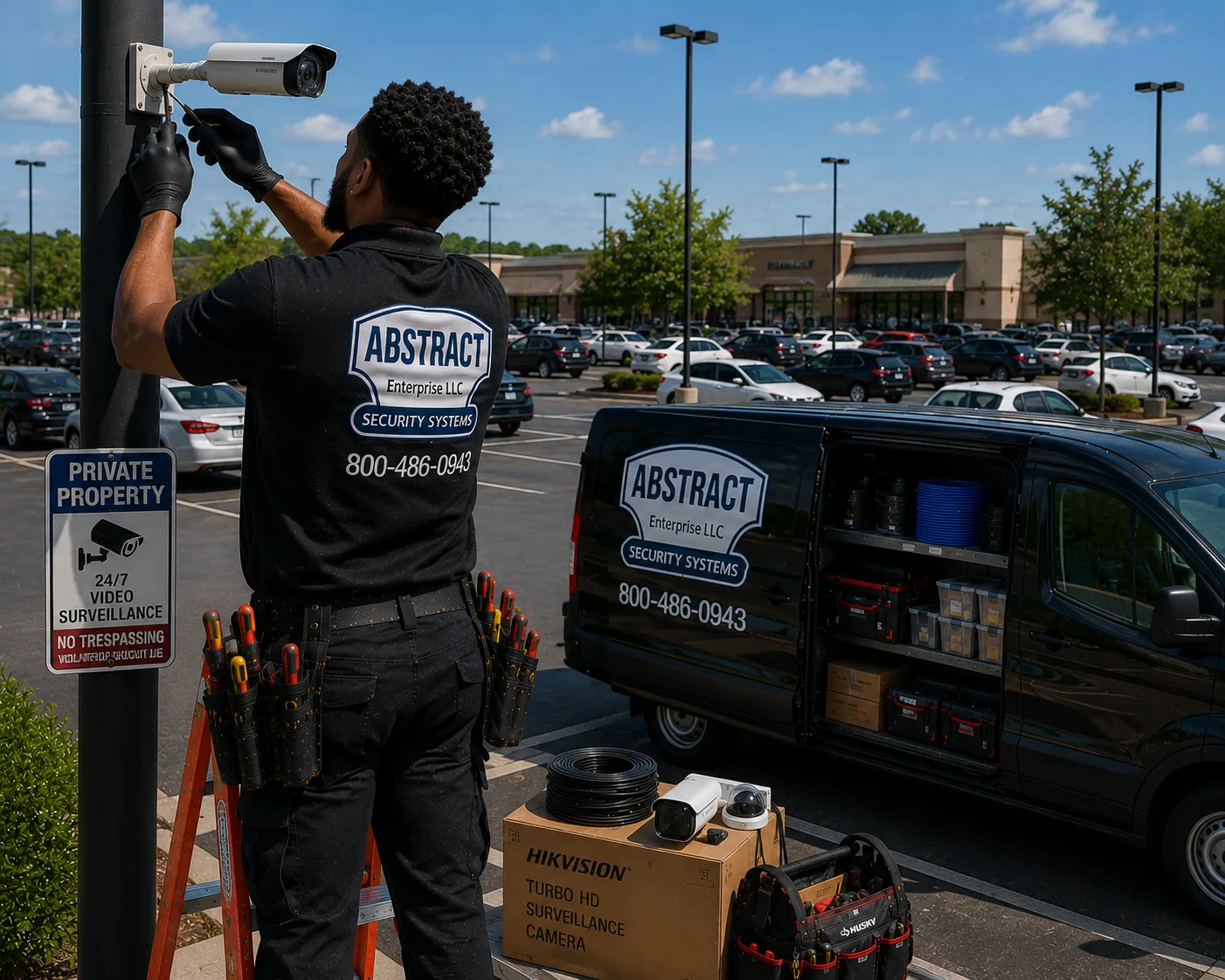
The lot’s own light standards are fair game on most Nassau properties — the malls, the shopping centres and the office parks already run tall fixtures — once the usual questions are settled: who owns the pole, whether a photocell or timer cuts its power by day, whether the shaft has room inside, and whether it can carry the added weight. A pole out at the curb line may belong to the utility, not the property.
A purpose-built camera pole comes in when a wide field offers nothing else to mount to, which is common on Nassau’s larger lots. It needs a footing sized for the pole’s height and wind load, conduit stubbed through the base with room to spare, and grounding and surge protection on every outdoor run. Down on the South Shore and the barrier islands the real question is what the footing meets — fill, a high water table, or a wetland edge — and markouts come first.
In a yard, a solid fence or gate post makes a fine mount for perimeter and gate views — as long as it will not flex enough to drift the aim, and as long as the cable running out to it is sleeved against damage.
Running cable across a Nassau lot is straightforward but rarely predictable. The ground swings from the sandy outwash of the Hempstead Plains and the flat South Shore, to the harder till and glacial boulders along the moraine ridge through Roslyn, Manhasset and Great Neck, to unrecorded fill under the older commercial strips. Whatever sits under the asphalt owes more to that history than to any drawing on file.
Utility markouts get called in and cleared before any blade touches the lot — no exceptions. Beyond the flagged lines, a Nassau trench routinely turns up abandoned conduit, an old irrigation loop, a forgotten fuel line or a slab of buried concrete, and the crew works around whatever the ground gives up.
Near the shore the water table and the flood record both count. Around Long Beach, Island Park, Freeport, Baldwin, Merrick and Massapequa — much of the South Shore that Sandy came through — a trench can meet water only a foot or two down. It does not stop the job, but it changes the handling: conduit is treated as though it will hold water, with terminations, drip loops and boxes placed so water at a junction never carries on into the gear.
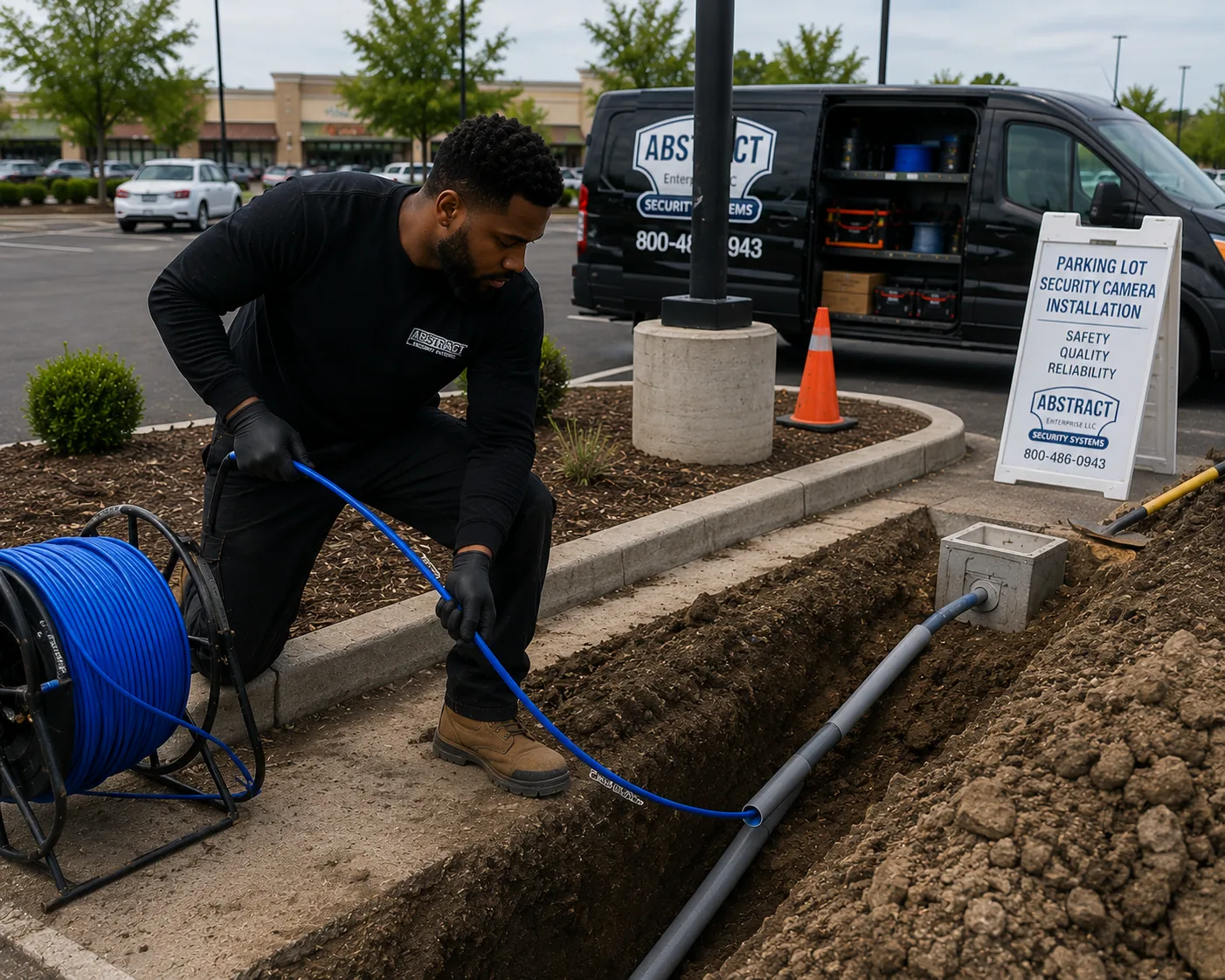
Given a choice the cable follows planting islands and the unpaved margins a Nassau lot usually has to spare, staying out of the driving surface entirely. Where it has to cross asphalt, a saw-cut and patch is the honest route; directional boring is held in reserve for a freshly sealed lot or a landlord who will not allow a cut. Conduit goes in rather than direct burial as a matter of course, oversized with a pull string coiled inside, because tearing a working Nassau lot open a second time costs the tenant real trade.
Closeout is its own step: backfill tamped so the trench will not settle a month later, the surface rebuilt to match, bay striping repainted anywhere a cut crossed a marked space, and any bed or lawn put back the way it was found.
Copper reaches on most Nassau lots, but the regional-mall fields, the office parks and the marina parcels run past the distance Ethernet holds, and any property with more than one building raises the ground-potential problem only fibre settles cleanly.
The bulk of the plant is Cat6 on PoE — one jacketed cable carrying both the picture and the power to each camera, with an outdoor-rated sheath on anything exposed or pulled through conduit.
Fibre is reserved for the long backbone hauls and any jump between separate buildings on the same parcel. Beyond the distance it unlocks, fibre carries no copper, so it dodges the surge coupling and ground-potential mismatch that plague long metallic runs strung between structures fed from different panels — a genuine hazard on a multi-building Nassau yard.
Where digging is unattractive — over a shared driveway, across newly laid pavement, out to a detached yard or a slip on the Freeport Nautical Mile — a wireless point-to-point link carries the run instead. The one condition is a clean line of sight, and on a Nassau waterfront that means planning around a boat on a trailer or a box truck that might one day park square in the path.
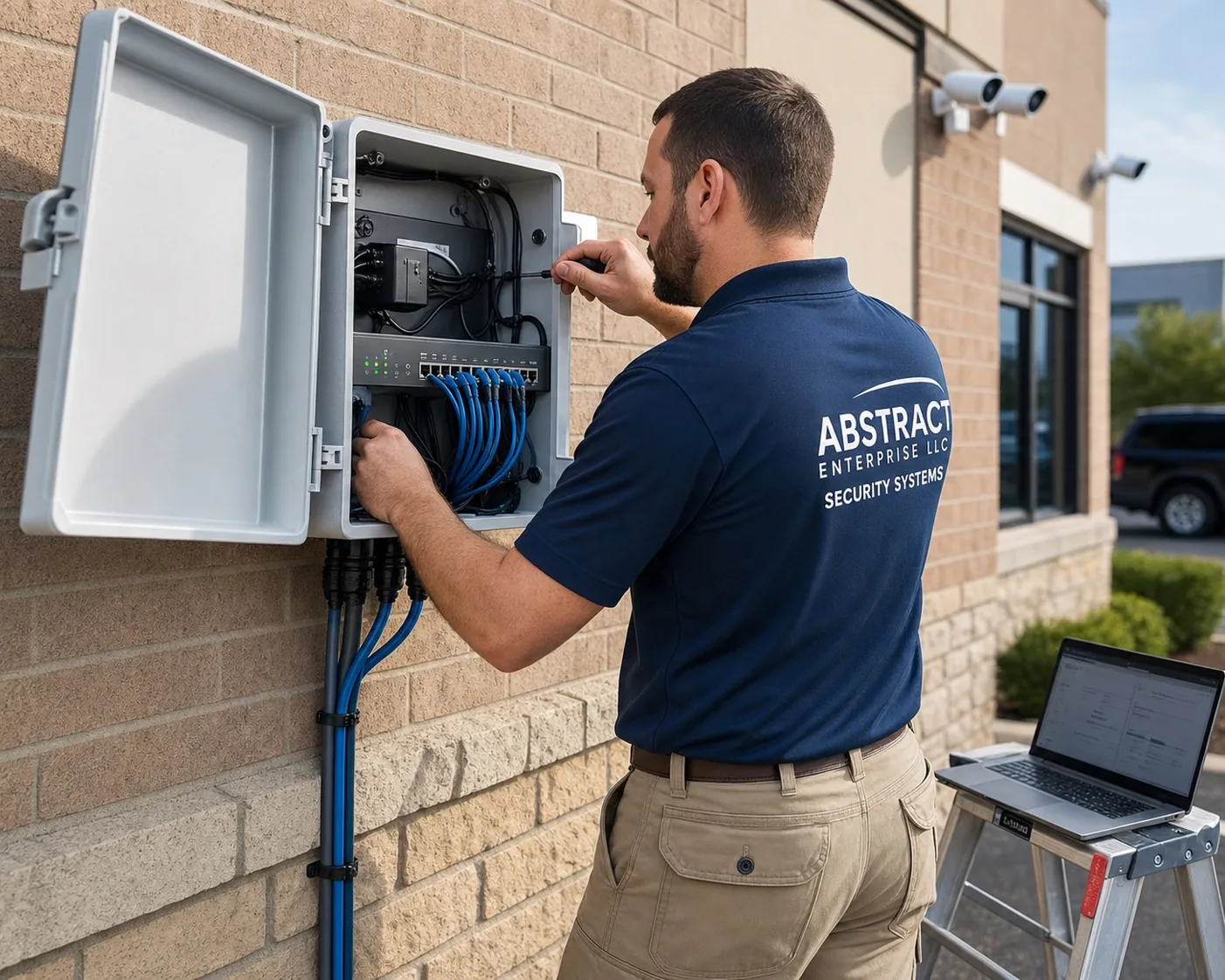
On the larger parcels a field enclosure collects a knot of nearby cameras onto a single switch and a single uplink, which cancels a great deal of trenching. That box earns its keep only if it is done right: rated cable glands, gaskets that actually seal, entries through the bottom, and a plan for heat — a shut enclosure cooking on open Nassau asphalt runs hot in July, and a January cold snap can drop the gear below its own start temperature.
PoE headroom is figured against the real aggregate draw, never the number of ports. A camera with a heater, an illuminator or a pan-tilt motor eats far more than a bare fixed dome, and a switch chosen on port count alone will start dropping cameras the first freezing night every heater energises together.
On an outdoor run, bonding, grounding and surge suppression are structural, not add-ons. The ground and bond go in first because every protective device is only as good as its reference to earth; surge units then sit at both ends of every exposed run, power and data alike; and because those units are sacrificial, they are inspected after a real strike or transient rather than presumed intact.
A real share of Nassau parking sits near the water — the Long Beach and Island Park barrier strip, the South Shore bay towns from Freeport to Massapequa, the Nautical Mile marinas, and the North Shore harbours at Port Washington and Glen Cove — and those lots meet conditions an inland property never sees.
Near the water, salt attacks the mounting long before it reaches the optics. Brackets, pole bands, fasteners, hinges and gland entries corrode first, and a perfectly good camera aimed uselessly at the sky because its bracket failed is still a lost position. Stainless hardware and a truly sealed enclosure add almost nothing on install day and decide whether a shoreline mount lasts five years or fifteen.
Flood risk moves the gear around. On a property with a history of tidal or storm water, the head-end, the field enclosures, the power supplies and the battery backup go above the water line people expect, not at whatever height is comfortable to work at. A recorder on the floor of a ground-level office in a Long Beach or Freeport flood zone is a recorder that will one day be carried out with the footage still inside it. Raising it, or moving it to an upper floor, handles that — and where elevation requirements affect the work they may involve owner or AHJ review.
In low South Shore ground a buried run is designed from the start as though the conduit will fill with water, and terminations and junctions are placed accordingly. Any pull box set low gets a rated cover and a location a technician can actually reach to service.
On these lots a post-storm walk is written into the maintenance plan. After serious water moves through, the exposed terminations, junction boxes, pole footings and anything that sat in the flood get physically inspected rather than assumed sound, because water damage usually surfaces as an intermittent fault weeks later, not as a clean failure on the day.
Wiping the dome and lens matters more this close to the bay, because a haze of salt film scatters light and pulls the night image down first while the daytime picture still looks fine.
Nassau lots run a wide range of ambient light. The regional malls and big-box fields borrow it from tall standards and roadway lighting; a South Shore, waterfront or residential-edge lot can be genuinely dark at the back. Light falls off hard toward the rear of a lot, which is exactly where the least-watched corner of the property tends to be.
Three levers govern the night picture: the sensor, the light and the aim. A larger sensor collects more photons; a full-colour low-light camera holds colour night vision wherever there is ambient light to work with and falls back to infrared where there is not; infrared mounted off to one side of the lens keeps the reflected glare out of the camera's own frame; and wide dynamic range holds a scene that pins a bright street-facing entrance against a black rear row.
Aim decides as much as hardware does. Set a camera so oncoming headlights strike the lens straight on and the frame whites out at exactly the second a plate or face should read. Swinging it a few degrees off the lane, or lifting it slightly above the headlight line to look down, removes nearly all of that at no cost.
Signage is a genuine nuisance on the commercial strips. Lit storefront signs, LED price boards and glowing awnings along Sunrise Highway, Hempstead Turnpike and Old Country Road push bright sources into a frame and can throw flicker. Positions get checked against those sources after dark rather than trusted from a daytime walk.
After-dark verification is a distinct commissioning pass: every camera is watched at night for usable detail at its working range, for black holes in the coverage, for infrared bouncing back off a nearby wall, pole or sign, and for how the image survives on wet asphalt. The corrections are almost always small — a nudge of aim, a change in illuminator, a shift in exposure.
Where a Nassau lot is simply too dark, adding light is frequently cheaper than the camera upgrades it would take to fight the darkness — and it changes how safe the place feels to anyone crossing it after closing.
The default wherever a view runs long and in one direction — down an aisle, along a fence, up the entry drive. A varifocal lens lets each unit be set to its own throw at commissioning, which matters on a wide Nassau mall field where distances swing from a few metres to the far end.
A slim housing that re-points fast and avoids the internal reflection a bubble cover collects in bad weather. It fits building faces, deck soffits and lower pole heights, and stays discreet on a property that cares what the hardware looks like.
A single steerable eye for a big open field — scripted patrols, zoom on call, motion triggered by an event. Because it can only face one direction at a time, it rides on top of the fixed cameras rather than replacing any of them.
One camera covering an unusually wide field, worth its place where a property hands you very few good mounting points. Detail thins out with distance, so it is paired with a tight fixed view anywhere a face or plate has to be recoverable. Uniview dual-lens units such as the IPC2K28SE-ADF40KMC-WL-I0 (8MP, 180° stitched) hold that spread from a single point.
A purpose-built plate reader for the entry lane — tight frame, fast shutter, infrared tuned to the reflectivity of a licence plate. It never works alone; an overview camera always runs beside it, because the exposure that renders a plate legible leaves the rest of the scene too dark to use.
Near the water the hardware is salt-rated; anywhere a camera hangs within reach of a hand or beside a live traffic lane, the housing is impact-rated.
The transit-oriented build-out around Mineola, Garden City, Glen Cove and the downtowns — mixed-use blocks by the LIRR stations, the mall decks at Roosevelt Field, hospital parking at the Mineola and East Meadow campuses — has brought below-grade and stacked parking to a county built mostly of open surface lots. These structures pose a different engineering problem from the fields around them.
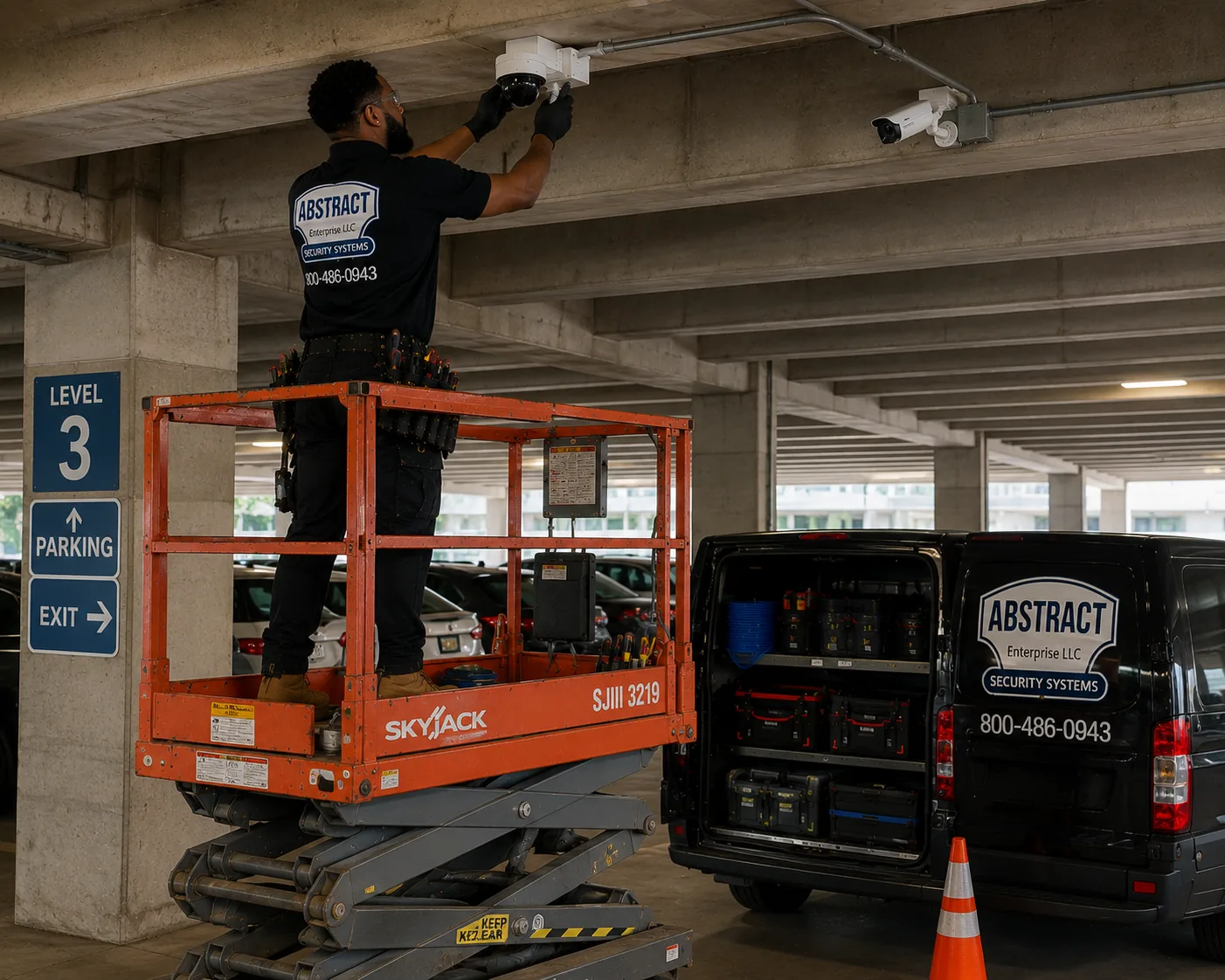
Concrete kills radio, so a garage is a wired job, run in surface conduit because you cannot fish cable through a poured deck. Conduit that tracks the beam lines and the existing pathways reads as intentional; a run cut diagonally across a ceiling rarely survives a building engineer's review. Between decks the cable takes an existing riser or sleeve where the structure permits, or a fresh core-drill with the rebar located first and firestopping made good afterward.
Clear height sets the lens. A low deck forces a wide field, and wide at close range concentrates the detail near the camera. The right answer in a garage is more positions each covering a shorter run, not one camera stretched down a level. Nothing hangs below the posted clearance, and nothing sits in front of a sprinkler head or blocks the path to a valve or panel.
Ramps are the hard geometry. A vehicle changes elevation and heading at once and drifts out of frame in the middle of the turn, so cameras sit at the head and foot of each ramp facing the transition, taking the entry and the exit instead of trying to follow the curve.
The unforgiving scenes are the transitions — the throat of the entrance where a car swaps daylight for deck lighting, and on an open-air deck, the top level where the structure opens back out to full sun, wind load and glare.
Anchoring a mount inside a parking deck can trigger an owner or building-department sign-off, and a post-tensioned slab is scanned before a single anchor goes in so nothing hits a tendon. That review is settled during the survey, not improvised on install day.
Every camera decision lands at the recorder. A Nassau lot records to an NVR sized to the camera count with room to expand, placed indoors somewhere secured and ventilated — a locked office, a back room, a utility closet — and up above the expected water line on a flood-exposed South Shore property. Where the building stands empty overnight, the physical security of that room counts for as much as the cameras themselves, because a recorder someone can walk out with takes the evidence with it.
Retention is arithmetic. Resolution, frame rate, continuous or event-driven recording, camera count and installed drive capacity all feed the sum, which is then set against how fast incidents actually get noticed on that property. Nassau property types run the whole span: a busy Roosevelt Field or big-box retail lot spots damage the same day; a Nautical Mile marina the owner checks on weekends might take a week; a synagogue or church lot used once a week can run a full cycle before anyone looks. Storage is sized to the realistic window, the figure lands in the proposal, and the recording modes are set so it holds up in practice.
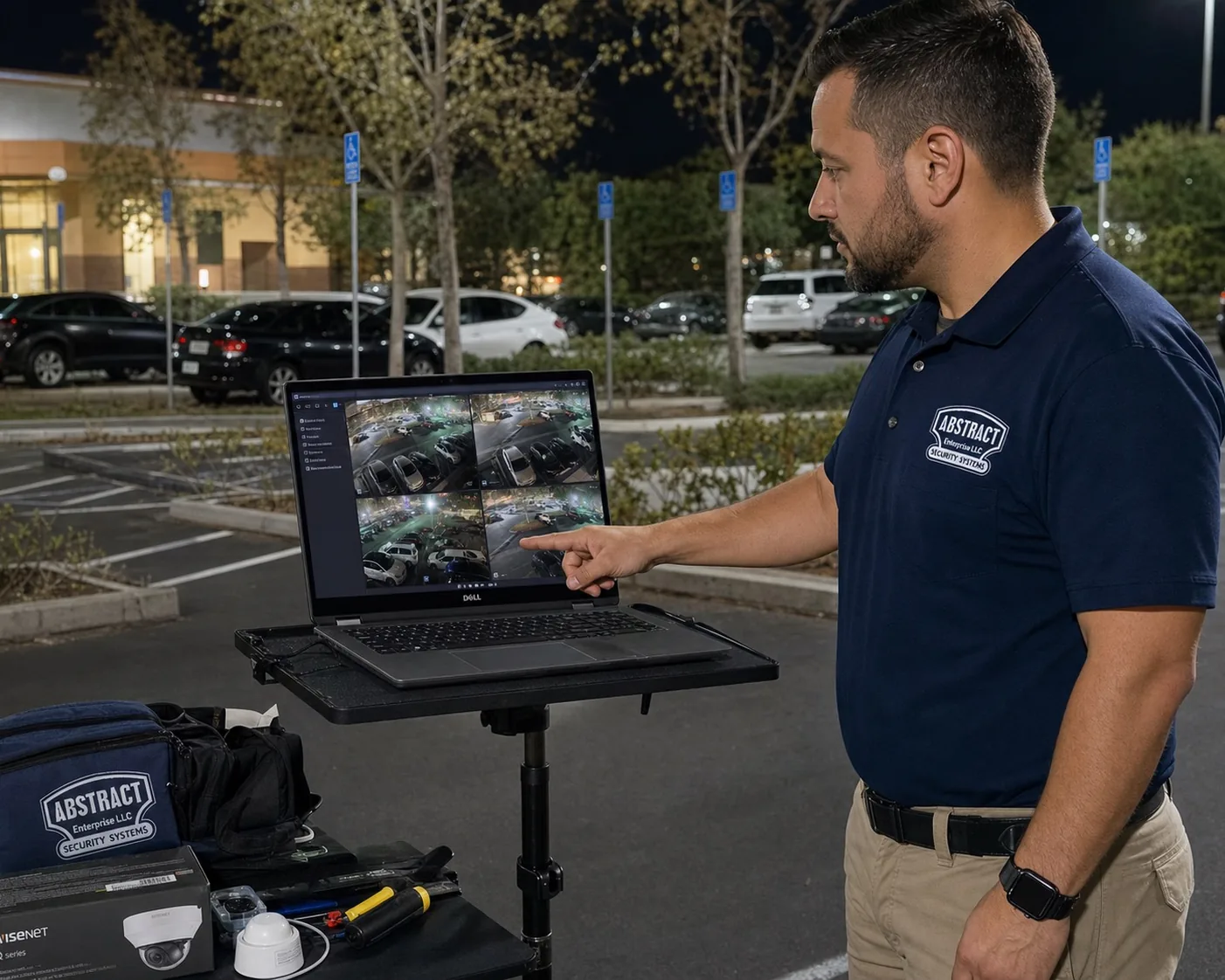
Remote access gives owners, managers, boards and building staff live views, playback and export from a phone or a desktop — on named individual accounts, never one shared admin login, so a person's access is granted and revoked on their own. On a shared plaza where several tenants each have a stake, scoped accounts are the thing that makes a single system workable at all.
The recorder keeps writing to its own drives whether the property’s internet is working or not; the network link only carries live views and alerts. A dropped connection never means lost footage.
Clock synchronisation is a commissioning task. With the recorder locked to a dependable time source and every camera taking its time from the recorder, a timestamp on the entrance camera lines up cleanly against every other camera on the property. Skip it and reconciling the gate against an aisle camera becomes guesswork.
Health monitoring is what keeps a quiet failure from becoming a discovered one: drive-fault and camera-offline alerts routed to somebody who actually reads them, plus the quarterly discipline of pulling one camera and one past moment at random to prove the footage is really there and usable.
Nassau lots stay busy in ways that shape how analytics get designed. A regional mall, shopping-centre or boulevard lot sees constant legitimate activity — shoppers, deliveries, staff, people on foot — while a marina, office park or house-of-worship lot falls quiet for long stretches, and a wide camera picks up plenty of movement on the road alongside as well. Rules built on raw motion throw off noise; rules built on object type and defined zones throw off signal.
The rules that pay their way are the narrow ones. A perimeter line on a fenced marina after hours, a figure on foot in a shuttered mall lot at 2am, or a car parked in a fire lane each says something specific; raw motion across a lot that pedestrians cross all day says nothing. Rules keyed to object type and mapped zones return signal where bare motion returns noise.
What actually holds up in the field: a boundary line along a fence that only arms outside trading hours, loitering in a rear service bay, a vehicle stopped in a fire lane or blocking a dumpster corral, movement in a closed lot after dark, and a person entering on foot through a vehicle gate. Each of those names one thing worth a ping instead of everything that moves.
Where a property keeps a strong daily rhythm, scheduled rules pull their weight. A house-of-worship lot, a district-school lot and a fenced contractor yard each go quiet for long, predictable spells, so rules keyed to those spells trigger rarely and carry weight when they fire. We set them after watching a week of real traffic, not once on paper.
Analytics can flag an event, but it takes a person to decide what happens next. The response chain typically starts with a push alert to an owner, manager or building super, and from there can run out to a keyholder, a patrol service or the police, depending on what the property has arranged.
No camera system dials 911 on its own or guarantees how an investigation ends up.
Much of the parking work in Nassau is not a clean install. It is a system dropped in years ago that has stopped earning its keep: cameras dark against the current standard, a recorder whose password left with a former manager, analog resolution that cannot read a plate across a drive aisle, or a layout drawn for a lot that has since been restriped, re-fenced or partly rebuilt.
It begins with an assessment rather than a price: which cameras and runs are still good, how much the recorder can still carry, whether the cable in the ground can be reused, and where the coverage genuinely comes up short. Coax or Cat5e already pulled to pole and wall positions is the expensive half of any system, so it gets tested rather than trusted, and that test decides which upgrade path is worth taking.
The routes available: HD-over-coax puts new cameras and a new recorder on the existing coax for a large resolution gain with no new pathways; a hybrid recorder runs analog and IP side by side so the changeover can happen in stages, IP cameras first at the entrance and other priority spots while the serviceable old ones keep working; Ethernet-over-coax adapters carry IP traffic on installed coax where fresh cable simply cannot go; and a full IP rebuild pulls new cable and starts clean, which is the right call once the old positions no longer match how the lot is actually used.
The repair calls that come in most across Nassau: cameras dark after a nor’easter or a South Shore flood, water in an outdoor termination, corrosion on the Long Beach and bay-town lots, surge damage after a summer storm, plow or delivery-truck contact with low gear, a run cut or chewed up where another trade worked, a recorder fault, and remote access lost after an ISP or router swap. Each gets diagnosed on site rather than guessed down the phone.
Start and completion timing turns on lot conditions, equipment availability, access to the property, permitting where it applies, and how large the project is.
Nassau’s industrial parking gathers along the rail corridor and the light-industrial belts, and it acts nothing like a retail lot. Fenced yards through Westbury, Bethpage, Farmingdale, Hicksville and the Hempstead-Uniondale blocks — warehouse docks, factory lots, trucking yards and contractor storage — hold trailers, box trucks, plant, containers and material as much as cars. The value packed in is higher, the surface is often gravel or broken asphalt rather than finished pavement, and the perimeter fence is the real security line.
The priorities shift with the property. The gate matters more than any retail curb cut, because a yard usually has one controlled way in and a plate record there accounts for every movement through it. The perimeter carries as much weight as the interior, since the real exposure is someone coming over a fence rather than a shopper walking a row. And the interior cameras look at what is stored — trailer rows, laydown, container stacks, the fuel island or an EV charger — not at parking bays.
Mounting cuts both ways in a yard. On the easy side, the operator owns the ground and there are usually poles, gate posts, container stacks and building corners already there to use, so permission is a non-issue. On the hard side, a yard never stays still — a trailer parks in a camera's line, a stack becomes a wall overnight, plant is dragged into a lane — so positions are set for the yard at its most congested, and the design states plainly which views depend on a lane being kept clear.
Pathways in a yard are their own headache. The surface is often unbound, heavy plant crosses it every day, and a shallow trench under a truck route will not last a season. Runs go deep, in conduit rated for the wheel loads above, or overhead between structures where the layout allows, or across the gap on an engineered span where a trench is not worth the trouble. Any cable near ground-level equipment gets hard physical protection as standard.
Yards also lean on analytics more heavily than retail. A working Nassau yard sits genuinely empty for long, predictable stretches, which makes after-hours perimeter rules unusually reliable — they trigger rarely and mean something every time they do. Pair that with lighting and a talk-down speaker at the gate and you have the layered arrangement these properties tend to settle on.
Nassau carries a heavy run of collision shops, mechanics and detailers along Merrick Road, Jericho Turnpike and the side streets off Hempstead Turnpike and Sunrise Highway, and most keep customers’ vehicles outdoors while parts come in or payment clears. That is its own liability: the yard is holding someone else’s car, sometimes for weeks, on ground that is fenced rather than closed in.
Coverage on a body shop or holding yard is tilted toward recording condition rather than scaring anyone off. A camera framed on the intake captures a vehicle as it arrives and again as it leaves — the footage that ends an argument over a dent or a parking-lot accident the owner insists was not there before. Between stored cars, aisle coverage beats a perimeter view, because the vehicles are parked bumper to bumper and a wide shot reads roofs instead of panels.
Access control follows immediately. The keys are on site, the cars can be driven, and staff move them around all day, so watching the key store and the gate together records who took which vehicle and when. On a property that will eventually gate its entrance, the camera plan should already carry conduit and power to that spot.
The storage time stretches the retention maths too. A car sitting three weeks on a back-ordered bumper means an incident may not surface until well after it happened, and retention sized for a busy retail lot will already have written over the day that matters. Footage may help document what happened on the property.
BUILDING SPECIALISTS
Any lot reduces to a handful of zones, and the camera on each is answering a different question. Putting names to those zones is what turns a Nassau coverage plan into something built deliberately rather than guessed at.
The single highest-value position anywhere on the property. Because every car has to slow to make the turn, the paired plate-and-overview cameras live here, aimed to take the vehicle in the instant it straightens out of the curb cut.
Where drivers roll across a steady stream of people on foot is the zone most often left uncovered, because a survey that stops at the property line never reaches it. On a Nassau lot fronting a busy corridor, that crossing is exactly where a slow-moving vehicle and a pedestrian meet.
The lane every vehicle is channelled along. Instead of framing individual bays, the camera holds the aisle itself, which lands every car and every person passing through onto the recording.
Where cars sit still and where dents appear. A full row of tall SUVs and vans will block a low sightline, so heights and angles are fixed for the lot packed at capacity, not for the empty lot on survey day.
The back-of-house strip — loading zone, dumpster corral, service door — is the corner nobody thinks to watch until something disappears from it. Dense coverage is overkill here; one honest camera that actually exists is the whole point.
A gap in the fence, a back gate left unchained, a driveway shared with the neighbouring tenant — these are the routes unwanted traffic really uses, and a camera on them shows precisely where the property is leaking.
The walking routes that run from parked cars to the building doors. These get framed tighter and set lower than a drive aisle, because the objective shifts from following a vehicle to putting a name to a face.
The boundary itself, which on a fenced Nassau yard becomes the real security line — the place an after-hours rule fires the instant anything comes over it or through it.
On a co-op or multi-tenant lot, the assigned bays that generate the repeat complaints. Aim a camera at the disputed space and a recurring he-said-she-said becomes a dated clip nobody can argue with.
This gets checked by walking the real lot, because properties rarely operate the way their site plan says. A bay repurposed as a cart corral or storage, an aisle squeezed by a dumpster, a gate chained shut years ago while another was cut open last season — all of it quietly rewrites the drawing.
Where a system truly proves itself is the review after an incident, and that review is a learned skill, not a button. Running the whole sequence once at handover, before anyone is under pressure, is part of the job.
Fix the window first. Whoever reported the incident knows when they parked and when they returned, and that bracket — a real one, not a guess — drives the whole search. It is worth insisting on prompt, precise reporting, because a tight window turns an afternoon of scrubbing into ten minutes.
Begin at the vehicle, not the gate. Locate the affected car in the row or aisle coverage and scrub around the event. Working outward from what actually happened beats working forward from the entrance, because the entrance carries every car that came in while the aisle carries only the one that matters.
Fix the timestamp, then fan out. Once the moment is nailed on a single camera, that time indexes straight into every other camera on the property — provided the clocks agree, which is where synchronisation stops being a nicety and starts being the whole game.
Follow the arrival and the exit. With the moment fixed, run the earlier footage to see how the subject got there — which entrance, which vehicle, which direction — and the later footage to watch them leave. On a lot with a secondary way in, check that one too, because not everything comes through the main curb cut.
Export quickly and completely. Retention is finite and the countdown started at the incident, so pull footage from every camera that caught anything rather than the single best angle, and label each clip with its camera, that camera's location, the window it covers and the export date.
What the system captures varies with camera position, available light, weather, lens selection, vehicle speed, plate condition, maintenance, how recording is configured, and the specifics of the lot. A well-designed system improves the chance that useful footage exists; it does not guarantee identification.
Cameras on a private Nassau lot work inside expectations that deserve plain treatment. Aim comes first: lot cameras belong on the lot — entrances, aisles, rows, walkways, perimeter — not tilted into someone’s windows, an adjoining yard, or anywhere people reasonably expect privacy. It comes up often here, where strip-mall and storefront lots along Sunrise Highway, Hempstead Turnpike and Merrick Road back straight onto residential blocks.
Surveillance notices at each entrance are standard on any recorded lot, putting drivers and pedestrians on plain notice that the property is under camera. On a shared Nassau parcel the wording and placement also head off disputes about who was told what.
Shared tenancy complicates all of it. Where a single lot serves several leaseholds, the ownership of the gear, who maintains it, which zones each party's coverage actually reaches, and how a footage request is handled all belong in writing at the outset — not negotiated under pressure after something has happened.
A residential property needs its access procedure fixed in advance: who is allowed to watch live, who may review recordings, how a resident requests footage of an incident involving their own car, and who makes that call. Named accounts on the recorder are what turn those decisions from theory into something enforceable.
This content is general information and is not legal advice.
We would rather be judged on what we commit to than on reviews we cannot verify, so every Nassau County parking-lot project carries this fixed set of standards:
Abstract Enterprises Security Systems operates from 1282 Troy Ave in Brooklyn under NYS Low-Voltage License #12000287431. License details, insurance certificates and references are provided in writing before work is scheduled.
A proposal only goes out after the free survey, because mounting points, cable routes, where power comes from and what is buried under the lot are things you can only read standing on the property.
Each camera is written up with the job it covers, the path its cable follows, the recorder and drive size and the days of retention that produces, and a plain line on what the price does and does not include.
Sealed terminations with drip loops, surge suppression and grounding on every outdoor run; coastal-rated stainless hardware on the salt-exposed shore lots; the recorder mounted above the flood line where the parcel calls for it; cable tagged at both ends; and separate per-person logins in place of one shared password.
At handover we sit with you and run live view, playback search, a clip export and phone access, then leave the account logins, a marked-up camera map, the pathway records and the configuration notes.
Products supplied by AESS carry a three-year warranty for normal wear and tear — full terms below and at our warranty page.
· 201 Google Reviews across our service work.
Ask every company bidding the work — ours included — the questions below. The answers sort the outfits that have actually wired Nassau lots from the ones that hang a camera on a wall and hope.
COMMERCIAL PARKING CAMERAS
Commercial enquiries in Nassau tend to fall along a few well-defined corridors, and each corridor hands you a different lot to solve:
The South Shore retail and dealership spine, where inventory rows, strip centres and big-box lots run block after block with plate-legible curb cuts.
The county's busiest commercial artery — retail plazas, supermarkets, restaurants, car dealerships, body shops and strip centres running block after block — where the lot geometry can change completely from one address to the next.
Big-box and shopping-center frontage — the Roosevelt Field decks and the Old Country Road retail spine through Westbury and Carle Place — means broad open fields, pole runs and plate reads at wide curb cuts feeding hundreds of cars an hour.
Light-industrial frontage through Westbury, Bethpage and Farmingdale — truck yards, contractor storage and fenced equipment lots strung along the LIRR main line.
The walkable downtowns — Garden City, Mineola, Rockville Centre — where the lot is tucked behind the storefront and every car funnels in through one tight opening.
Storefront strips carry high turnover and steady all-day pressure from commuters who slot into a retail lot and walk to the Hicksville or Mineola platform, so entrance capture and time-in-space footage matter more here than sheer camera count.
A commercial parcel answers to a layer of oversight a private residential lot never meets — pole and structural attachment, electrical tie-ins, trenching in the right-of-way and, near the corridors, curb-cut and drainage rules that shape where a camera can actually go.
This content is general information and is not legal advice.
YOUR QUESTIONS ANSWERED
Cameras document rather than prevent, and beside a Hicksville, Mineola or Hempstead station that documentation is what makes an enforcement policy hold up. A plate camera at the curb cut logs which vehicles came in and when, aisle coverage shows how long a space was actually held, and a camera on the rear gate or the fence gap reveals where the all-day parkers really slip in — which, on the Syosset and Farmingdale commuter lots, is often not the main entrance at all. Owners who get serious usually gate the lot in the end, and conduit and power run to that spot during the camera job make the gate far cheaper to add later.
The break-ins along the boulevard strips are typically fast and opportunistic — the pattern police point to when they flag parking and mall lots as a recurring target — so the coverage that earns its keep is entrance capture paired with tight views down the aisles where the cars actually sit. One wide camera on the building reads rooftops, not door handles or a hand reaching through a smashed window. Framing for the lot full, where SUVs and vans block the low sightlines, and dropping a low overview at the entrance gives you both the vehicle the suspect arrived in and the activity between the rows.
Vehicle theft off a commercial lot tends to happen fast and after hours, and it is a documented problem on Long Island. A system built to document it pairs a plate read and an overview at every way in — the main curb cut, the service entrance and any unchained rear gate — with aisle coverage tight enough to follow a vehicle from its space out to the exit. The value is the reconstruction it hands police and insurers: which entrance the crew used, the vehicle they arrived in, the plate, the time and the route out, exported quickly before the retention window closes. What the system captures varies with camera position, available light, weather, lens selection, vehicle speed, plate condition, maintenance and other factors, and no camera system prevents a theft or guarantees an identification.
Only with that owner’s written permission, and it is worth settling before the design depends on it. On the tighter Mineola, Hempstead and village-centre lots a neighbouring wall sometimes gives the only clean vantage over the parking, and shared plazas and common lot lines add a layer because attachment and cable routing touch both properties. Where permission is not available — which in built-up Nassau is often — the design moves to the property’s own poles, its lot-light fixtures, or fence and gate posts.
A wide mall or big-box entrance is actually one of the better candidates, because vehicles slow to a crawl at the curb cut and the lane is clearly defined. The plate reader is framed narrow and low onto that single lane with a fast shutter and infrared matched to plate reflectivity, and it always runs paired with an overview camera, since the exposure that reads a plate leaves the surrounding scene black. Where the approach carries traffic in both directions, the design either doubles up the readers or states plainly which direction reads reliably. Whatever a plate camera returns still moves with light, weather, plate condition and how fast the car is travelling.
Yes — that is precisely what poles and fence-line mounts are for, and Nassau's wide, flat fields are about as pole-friendly as parking gets. Cameras go on new poles with footings sized for their height and the wind load, on existing lot-light poles where the ownership and the circuit permit, or on heavy gate and fence posts. Because the field is large, the design multiplies positions and shortens each camera's zone rather than stretching one camera across the whole expanse, which is exactly where detail bleeds away.
An entrance plate read paired with dated overview coverage builds the record a managing agent or towing contractor needs: which vehicle, its plate, and how long it has held the spot. Abandoned and long-term parked vehicles are a familiar headache on private Nassau lots, and a managing agent or a village code officer generally wants dated proof before a tow is authorised. The cameras do not tow the car, but a timestamped sequence showing the same plate parked day after day is what turns a stalled complaint into one a contractor can act on, and that entrance read doubles as the security coverage the lot needs anyway.
It changes how the trench is handled, not whether it gets dug. Through the low South Shore ground of Freeport, Baldwin, Merrick and the barrier islands, a dig can hit water and soft sand at shallow depth. Markouts come first; then the conduit is designed on the assumption it will carry water — terminations, drip loops and pull-box positions arranged so water reaching a junction cannot travel on into the equipment — and every pull box gets a rated cover in a spot a technician can service. Where the ground makes a strong case against trenching, a wireless link or a wall route carries the gap instead.
No, but the footing is engineered for it. Along the moraine ridge through Roslyn, Manhasset and Great Neck, hard till and glacial boulders can stop a standard dug footing, and the answer is a rock-anchored or surface-mounted base sized for the pole height and wind loading rather than a deeper hole. It is identified at the survey so the proposal prices the right base rather than hitting a boulder mid-dig, and where a pole is impractical a building-face or fence position covers the same zone.
Above expected water levels, decided at design time rather than after the next storm. On the barrier-island and bay-town blocks that flooded, the recorder, field enclosures, power supplies and any battery backup are mounted high or on an upper floor rather than at convenient working height. Underground conduit is designed to hold water, and post-storm inspection of terminations, junction boxes and pole bases belongs in the maintenance plan, because water intrusion usually shows up as intermittent faults weeks later rather than an immediate failure.
Salt goes after the mounting hardware long before it reaches the camera. Brackets, pole bands, fasteners, enclosure hinges and gland entries are specified in stainless or coastal-rated finishes on any lot near Reynolds Channel or the South Shore bays, because that is the metal that fails first.
Usually you can, and it is the cable that is worth keeping. Coax or Cat5e already run out to your pole and wall positions is the costly half of the whole system. HD-over-coax puts new cameras and a new recorder on that existing cable for a big resolution jump; a hybrid recorder lets new IP cameras go in at the entrance and other priority spots while the sound old cameras keep running; and Ethernet-over-coax carries IP traffic over the installed coax. Which route fits comes down to testing the cable rather than taking it on faith.
Yes, as long as ownership and access are pinned down in writing first — which matters most on the Sunrise Highway, Hempstead Turnpike and Merrick Road strips where a single lot serves several leaseholds. One recorder with scoped user accounts lets the landlord, a managing agent and individual tenants each see only what is theirs to see. What creates trouble is an undocumented arrangement where nobody agreed who maintains the system or who is allowed to export footage after an incident.
Yes, and for a managing agent or a commercial owner in Nassau that documentation is one of the quieter reasons a lot gets cameras at all. A slip-and-fall, a fender-bender between two customers, a dispute over who backed into whom — dated overview footage of the aisles and walkways settles what actually occurred and when, which is exactly what an insurer or a defense attorney asks for. The framing that helps here is the same broad aisle-and-walkway coverage that serves security, so it rarely means extra cameras; it means the retention window runs long enough that a claim filed a couple of weeks later still has footage behind it. What the system captures varies with camera position, available light, weather and other factors, and it documents rather than adjudicates.
The useful tool is a narrow, scheduled analytics rule rather than more cameras staring at an empty lot. On a Nassau strip or shopping-center lot that empties every evening, a loitering or after-hours rule can be scoped to exactly the quiet windows and the specific corner — the dumpster corral, the rear service area, the edge against a fence — so it fires rarely and means something when it does. Lighting usually does as much work as the camera: a dark corner invites the behavior, and a well-lit one under a posted, recorded camera tends to move it along. The escalation from there — a push alert to a manager, a keyholder or a patrol — is set to whatever the property has arranged.
They usually earn a dedicated view. EV chargers are expensive outdoor equipment, and they draw drivers who leave a car unattended for a stretch, so a camera framed on the charging bays captures both damage or tampering to the units and the vehicles parked at them. On a Nassau retail or workplace lot the charger row is often tucked to one side, which can leave it outside the aisle coverage a general layout provides — so it is flagged at the survey as its own zone rather than assumed. The wiring is worth coordinating too: the charger install and the camera run frequently share the same trench and the same power work, and doing them together costs far less than opening the ground twice.
It shifts the priorities toward the perimeter and the entrance and away from individual bays. A lot holding work vans, box trucks or trailers overnight is a target for fuel theft, tool theft and the same catalytic-converter cutting that has plagued Long Island, and those happen in the quiet after-hours stretch when the lot sits full and unwatched. So the design leans on a plate read and an overview at every way in, tight aisle coverage between the parked vehicles, and an after-hours rule on a lot that is otherwise still all night. Heights and angles are set for the vehicles full, because a row of tall trucks blocks a low sightline the way nothing else on the lot does.
They benefit from a clear view for a couple of reasons that come up on Nassau lots. Accessible spaces sit closest to the entrance, so they are already in the busiest part of the lot, and disputes over misuse of a handicap space or damage to an adapted vehicle are exactly the kind of incident a property manager wants dated footage of. There is nothing structurally different about covering them — it is the same entrance-and-front-row framing a good layout already includes — but they are called out at the survey so a van-accessible space with its wider access aisle is not left half in frame. As with any position, what the footage shows depends on angle, light and distance.
It can be, and this is the one case where the battery-and-cellular kit the national articles push actually fits. A construction staging lot or a temporary Nassau overflow lot holds equipment, materials and vehicles in an area that is often poorly lit and off the normal patrol, and a short-term wireless system gives entrance capture and general coverage without trenching a site that is about to change. If the temporary lot is going to become permanent, though, it is worth saying so up front, because a cabled backbone put in once costs less than a wireless stopgap followed by the real thing.
This is one of the most common reasons a Nassau lot ends up with cameras, and it is well within reach when the coverage is planned for it. An overview camera on the aisles catches the contact and the vehicle’s path, and a plate read at the entrance ties that vehicle to a plate and a time — together they turn a parking-lot hit-and-run into something a driver, an insurer or the local precinct can act on. As with any footage, what a given frame yields depends on camera position, light, weather, lens and vehicle speed, and no system guarantees an identification, but a lot built to document collisions answers the question far more often than not.
Yes, and it is how most Nassau managing agents and property managers prefer to work. Each lot keeps its own on-site recorder, and a single management account views every property from one phone or desktop, with individual site logins scoped so an on-site super or a tenant sees only their own lot. It keeps a portfolio of co-op, condo, retail and commercial lots — from a Great Neck building to a Hempstead strip — under one pane of glass without merging who can see what, and new lots join the same account as they come online.
EQUIPMENT
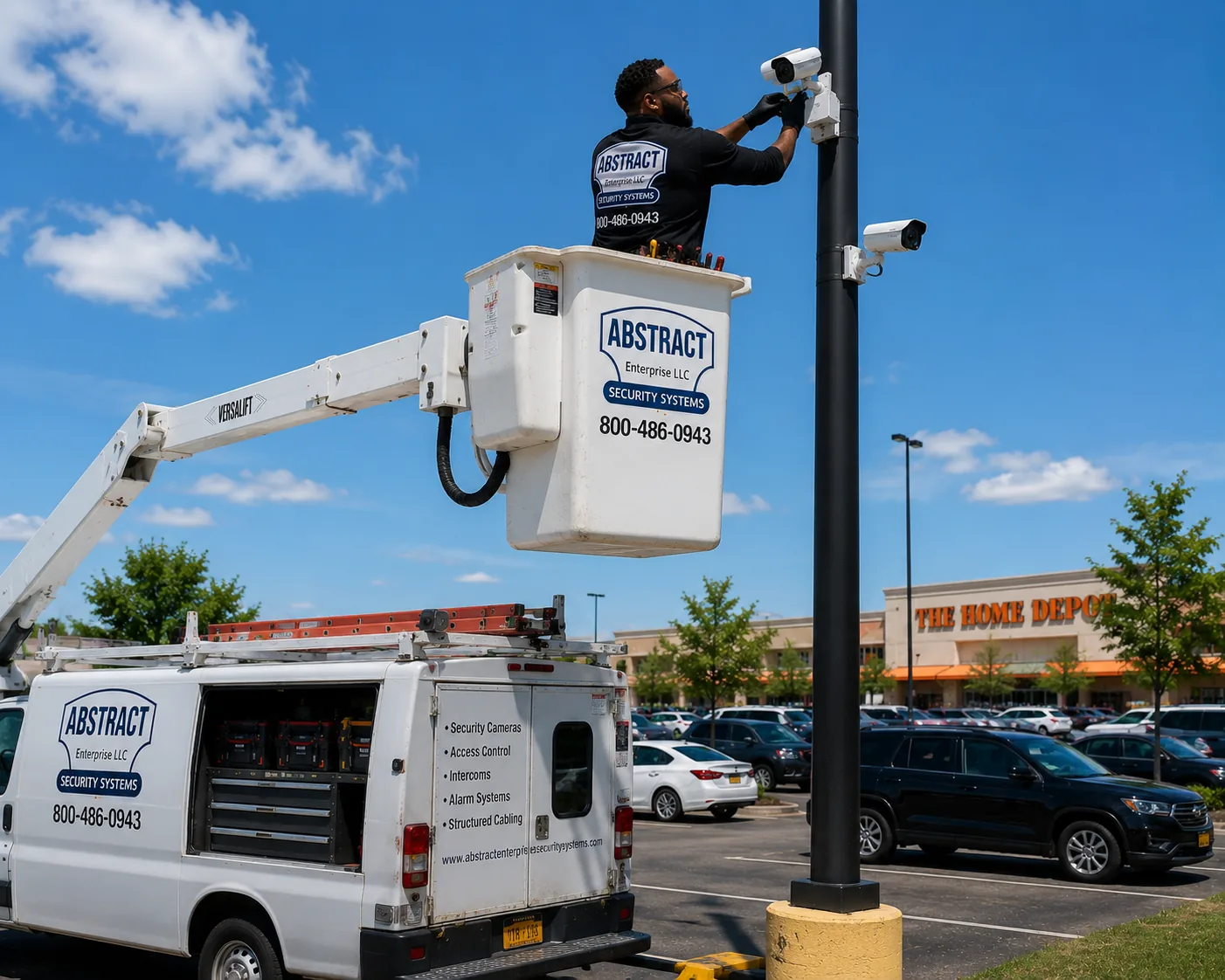
Each position gets equipment chosen for it, matched to Nassau conditions — the throw across an open field, the surface it mounts to, the coastal exposure, and who can physically reach it. Every camera is Uniview (UNV), NDAA-compliant, and specified by model per position rather than sold as a boxed kit.
The everyday workhorse on a Nassau lot, aimed down the aisles, along the fence lines and up the entry drive, with the lens dialled to the real throw at commissioning. Specified with Uniview (UNV) 4K ColorHunter bullets such as the IPC2128SE-ADF28KM-WL-I0 (8MP, full-colour at night).
Low-profile housings for a building face or a garage soffit, and a clean fit where appearance counts — a Garden City or Roslyn village storefront, say. Uniview OwlView turrets such as the IPC3628SR-ADF28KM-WP (8MP, Wise-ISP low-light), with IPC3638SE-ADF28K-WL-I0 eyeballs wherever a flush ceiling fit is preferred.
Steerable positions for Nassau's larger mall, big-box and industrial parcels, layered on top of the fixed coverage rather than standing in for it. Uniview LightHunter PTZs such as the IPC6658SR-X25-VF (4K, 25× optical) or the IPC6622SR-X33-VF (33×) reach right across an open field.
A single wide-field drop earns its place on a property that gives a designer almost nothing to mount to, where each pole and wall has to do double duty. Resolution thins at distance, so it backs up the fixed coverage rather than standing in for it.
Dedicated plate readers set a few feet inside the property line, catching a car in the moment it slows at a mall, strip or commuter-lot entrance. Uniview ANPR plate cameras such as the PKC2640@Z80-P (4MP, 8–32mm) or the HC121@TS8CR-Z (2MP @60fps) drive whitelist and blacklist barrier control.
Recorders matched to the retention figure and set in a locked back room, above the flood line on a waterfront lot. Uniview recorders such as the NVR304-16E2-P16, NVR308-64X or NVR516-128, sized to the camera count and the calculated retention.
A sealed pole or wall enclosure that lets a cluster of nearby cameras share a single cable home instead of a separate trench for each. Uniview PoE switches such as the NSW2010-16T2GC-POE-IN (16-port) or the cloud-managed NSW3000-8T2GT-POE-IN carry PoE up to 250m over copper out to that remote cluster.
Grounding and surge suppression across the board: every pole and metal enclosure bonded to earth, and a sacrificial surge unit on the power leg and the data leg at both ends of every run that leaves the building.
Tell us what the lot is contending with and we will put a surveyor on it.
AI OVERVIEW REALITY CHECK
Ask Google or an AI assistant about parking lot cameras and the summary it returns is stitched from national how-to blogs, marketplace listings and directory pages like Angi, HomeAdvisor and Fixr. Some of it is sound. A fair amount falls apart against a real Nassau County property.
The dollar ranges these pages publish — HomeAdvisor’s roughly $1,296 average, Fixr’s figure near $600 for a small four-camera job — come mostly from consumer and light-commercial installs. They rarely price what actually moves a Nassau lot budget: pole footings, trenching across landscape islands, saw-cuts through fresh pavement, fiber between buildings, lift equipment and LPR lanes.
They also erase the biggest local variable — whether the property already owns usable poles and a nearby circuit that isn’t on a photocell. A Westbury plaza with owner-controlled lighting and a Hicksville yard with only utility poles at the road are the same square footage and two different jobs.
And marketplace figures blur equipment against installed cost. A camera that sells for a couple hundred dollars online is not that mounted twenty feet up a new pole, trenched and commissioned. On a Nassau lot the labor and pathway are most of the number, which is why this page quotes installed prices.
Wireless reads well in a blog, but a parking lot is close to the worst place for it — long distances, metal poles and concrete, and a below-grade Mineola garage that kills radio outright. The reliable backbone on a Nassau lot is cabled: Cat6 on PoE for the runs, fiber for long hops between buildings.
Where a trench genuinely can’t go — a shared driveway, fresh pavement, a detached yard — a licensed point-to-point link has a real place, but it’s an engineered bridge between wired islands, not a whole-lot strategy. The AI summary rarely draws that line.
Battery-and-cellular kits get suggested in the same breath; they suit a short-term construction trailer, not a lot that must record every night for years. Near Reynolds Channel or the South Shore bays, salt and weather punish anything not specified for outdoor life — wireless gadgets first.
Directory pages sell leads, so DIY is framed as a weekend project. On a private driveway it sometimes is. On a Nassau co-op, condo, retail or commercial lot it usually isn’t, because the work crosses into pole footings, right-of-way trenching, tie-ins to lot lighting and, inside an incorporated village, a permit and an electrical sign-off.
There’s also who answers the phone in eight months when a camera goes dark after a nor’easter. Angi and HomeAdvisor hand you a list of names; they don’t stand behind the work. One licensed contractor who surveyed the lot and warranties the install is a different arrangement.
A self-installed lot tends to fail exactly when it’s needed — a plate that won’t read at the curb cut, a dark corner where the incident happened, a drive out of storage before anyone looked. The value is in the review, and review only works when the design anticipated it.
National content treats “weatherproof” as one checkbox; Nassau splits it several ways. On the low South Shore — Freeport, Baldwin, Long Beach, the barrier islands — the exposure is tidal flooding and salt, so the recorder and enclosures sit above the water line and the hardware is stainless or coastal-rated, because that metal fails first.
On the Gold Coast ridges through Roslyn, Manhasset and Great Neck, the problem is shallow glacial rock that stops a standard footing, which changes the pole base rather than the camera. And the county has a real winter, so heated housings and plow-aware mounting are part of the spec.
An AI summary can’t know which of those a given lot faces, so it defaults to none. The result is gear chosen for a mild, dry, generic climate that a single Nassau season finds the weak point in — a corroded gland, a flooded box, a snow-blinded camera.
Plate capture is real and among the most valuable things a Nassau lot camera does — but it’s a narrow, purpose-built shot, not a switch you flip system-wide. A dedicated LPR camera is framed tight and low on one lane, with a fast shutter and infrared matched to plate reflectivity, working because vehicles crawl at the curb cut.
What summaries never mention is that a read depends on geometry and light — camera position, vehicle speed, plate condition, weather and lens all decide whether the frame is usable. A wide overview aimed hopefully at an entrance shows a car arrived; it won’t reliably give the plate.
That matters where the goal is enforcement or a tow — a commuter parked all day near Hicksville or Mineola, an out-of-state car sitting for weeks, a dealership row off a busy corridor. The honest answer to where a plate will and won’t read comes from walking the specific curb cut.
Megapixel count sells hardware, so marketplace pages lean on it. On a real lot, placement beats resolution almost every time. A handful of cameras set at the right heights and angles — entrance, drive aisles, parking rows, the footpaths people cross, the unwatched back-of-house — outperforms a wall of high-resolution cameras aimed at open asphalt.
The trap on a Nassau lot is the sightline at capacity. A row of tall SUVs or a parked box truck blocks a low camera, and a design proven on an empty survey-day lot fails the first busy afternoon — which is why the first visit here is booked for a full lot.
Resolution has its place — a plate lane, a wide field with few mounts — but it’s a tool, not a strategy. Budget spent on positions that answer the property’s actual zones does more than pixels aimed at nothing in particular.
Because so many listings come from monitored-alarm brands, the AI summary often implies a recurring fee is mandatory. It isn’t. A Nassau lot system records locally to an on-site NVR, and once it’s paid off the recorder and footage are yours — no subscription has to stay live to record or to watch from a phone.
Local recording also keeps running when the internet drops; the network link only carries live viewing and alerts, never the recording. That’s the opposite of the always-online, always-billing model the national content assumes, and it’s why owners here can bring their own equipment rather than renting a closed platform.
None of this means monitoring is worthless — a keyholder chain or patrol response fits the right property. But it should be a choice made for the lot, not a default forced by a business model. The converter-theft surge that hit Nassau was answered on most lots by better cameras and lighting, not a monthly bill.
GET IN TOUCH
Give us the basics on the lot — where it sits in Nassau, roughly how many spaces and entrances, and whether anything is already installed — and we book the survey, walk it, settle the mounting, power and pathway questions, and come back with a line-item proposal listing every camera, the zone it covers and the retention it holds.
Call (347) 934-8335
WhatsApp: wa.me/17186790359
1282 Troy Ave, Brooklyn, NY 11203
NYS Low-Voltage License #12000287431
· 201 Google Reviews
HOW IT WORKS
Every project runs through the same sequence, tuned to the lot. Start and completion timing turns on lot conditions, equipment availability, access to the property, permitting where it applies, and how large the project is.
Left alone, an outdoor system decays without announcing it, and the Nassau mix of South Shore storms, barrier-island salt and hard winters works at the hardware all year. A short seasonal routine keeps small faults from becoming a dead camera on the day you need it.
Monthly
Quarterly
Seasonally
Annually
COVERAGE AREA
Parking shifts in character from the Gold Coast estates and village centers of the North Shore to the barrier-island and bay-town lots of the South Shore, and the camera design tracks that split — rock-anchored poles and tidy village mounts up north, flood-height gear and salt-rated hardware down south.
Great Neck, Manhasset, Port Washington, Roslyn and Sea Cliff carry the North Shore Gold Coast. The Miracle Mile retail along Northern Boulevard in Manhasset, the harbour and marina lots on Manhasset Bay and Hempstead Harbor, and tight village-centre parking define the character — and the moraine ground here means glacial boulders and hard till turn a pole footing into an engineered detail.
Glen Cove, Oyster Bay and Syosset hold the North Shore’s town centres and working waterfront. The Garvies Point redevelopment and the Glen Cove waterfront brought mixed-use decks, the Oyster Bay hamlet keeps small municipal and marina lots, and the Jericho Turnpike corridor through Syosset carries commercial plazas and light-industrial yards behind them.
Hempstead, Uniondale and East Meadow form the county’s civic and institutional core. The Hempstead bus terminal and dense downtown lots, the Nassau Coliseum and Hofstra parking in Uniondale, and Nassau University Medical Center in East Meadow bring round-the-clock, high-turnover parking that has to read as cleanly at 3am as at noon.
Garden City, Mineola and Westbury are the retail and office heart of central Nassau. Roosevelt Field and the Old Country Road big-box corridor drive the largest fields in the county, Garden City’s Franklin Avenue keeps a walkable downtown, and Mineola’s courthouse, hospital and transit-oriented buildings mix decks with constrained street-level lots.
Hicksville, Levittown, Bethpage and Farmingdale make up central Nassau’s commuter and industrial belt. Hicksville runs the county’s busiest LIRR station and the Broadway Mall, Levittown is wall-to-wall postwar suburban lots, and Bethpage and Farmingdale carry the old Grumman-era industrial parcels and the yards along the rail corridor.
Freeport, Baldwin, Merrick, Bellmore, Wantagh and Massapequa run the South Shore bay towns. Sunrise Highway threads dealership rows and strip retail through all of them, Sunrise Mall anchors Massapequa, and Freeport’s Nautical Mile marinas add salt, trailered boats and a real flood record to the design.
Rockville Centre, Lynbrook, Valley Stream and the Five Towns cover the county’s southwest. Rockville Centre and Lynbrook keep busy village downtowns, Valley Stream carries the Green Acres mall and the Gateway big-box centre, and the Five Towns — Lawrence, Cedarhurst and Woodmere — add Central Avenue retail and a heavy run of yeshiva and synagogue lots.
Long Beach, Island Park, Atlantic Beach and Lido Beach make up the barrier-island strip, the most exposed parking in the county. Beach, boardwalk and municipal lots sit in the flood zone Sandy came through, so equipment elevation, corrosion-rated hardware and salt-driven cleaning schedules shape every design here.
Service is available throughout Nassau County.
PRICING
Nassau projects range too widely for honest flat pricing — a Hempstead Turnpike storefront lot and a fenced Westbury industrial yard are not the same job at any size. The price is set after a free on-site survey, and the proposal spells out exactly where the money goes.
A survey settles all of these for your specific lot, and the itemised proposal prices each driver on its own line. Start and completion timing turns on lot conditions, equipment availability, access to the property, permitting where it applies, and how large the project is.
SHOP OUR SYSTEMS
$978–$1,725 installed
A compact storefront lot — four fixed cameras splitting the entrance, the drive aisle and a rear boundary line.
$1,725–$2,875 installed
Standard tier — a mid-size Nassau lot mixing retail with resident spaces, roughly eight cameras across the aisles and a plate reader at the entrance.
$3,220–$5,175 installed
Premium tier — a large Nassau commercial field carrying sixteen or more cameras, an entrance plate reader, a steerable PTZ, and coverage pushed out to the perimeter.
These are installed prices for the scope described, at the Nassau County rate; plate readers, PTZ units, pole footings and trenching slide the number inside the range, settled on your free survey.
No monthly fees — the system is yours. Service calls and post-install work run $195/hour with a three-hour minimum ($585).
COMPLETE SERVICES
Ground-up camera design and installation for Nassau County commercial sites and homes, sized to the property rather than a package.
Service and repair on an existing system, whoever put it in first — fault-finding, part swaps and bringing an aging setup back to standard.
Camera systems for retail, office, industrial and multi-tenant buildings.
Coverage for the entry, lobby, corridors and back-of-house — the obvious pairing with a co-op or condo’s resident parking system.
Gate arms, readers and fobs for a lot stepping up from open to controlled entry.
Structured conduit, fiber and network cabling run through the property on the same paths as the camera lines.
FAQ
On a residential property, usually yes. For a co-op or condominium lot behind a building in a Great Neck or Long Beach complex, the board and its managing agent generally want to see the camera positions, any wall or pole mounts and where the footage lives before work starts. The proposal is written to hand straight to a board or agent, and mounts are set to keep residents’ windows out of frame.
Yes — where a property has both a deck and a surface lot, one recorder normally serves the whole site. The garage half is designed on its own terms: wired rather than wireless because concrete kills radio, surface conduit tracking the beam lines, positions kept clear of sprinkler heads and the posted clearance, and cameras at the ramp transitions so a car crossing between levels stays on record. Structural mounting inside a parking deck may need owner or AHJ review first.
Mostly, yes — the difference lands in the analytics and the retention rather than where the cameras go. A marina lot on the Freeport Nautical Mile or in Port Washington packs out on summer weekends and sits near-empty all winter, so the off-hours and off-season rules are scoped narrowly enough to matter when they trigger, and the recording window is stretched to fit a real off-season gap — which can run a week or more before anyone walks down to check a boat.
Yes. A great many Nassau lots back onto a building with a rear or service door opening straight onto the parking, and a camera there catches deliveries, after-hours entries and anyone using the door as a shortcut — framed at door height so it gets a face rather than the top of a head.
Yes. A great deal of Nassau’s commercial and multi-family parking sits inside an incorporated village — Garden City, Rockville Centre, Freeport, Great Neck and dozens more — and each village runs its own building department with its own rules on pole heights, electrical work and sometimes exterior appearance. Low-voltage camera work is lighter than a structural job, but a new camera pole, a trench in the right-of-way or a tie-in to lot lighting can still call for a permit or an electrical sign-off. The survey flags which approvals your particular village and parcel will want, the proposal carries that as its own line rather than a surprise, and the licensed portion of the work is filed under the New York State license so the inspection clears cleanly.
Building it into the camera job costs a fraction of opening the ground a second time. Spare-capacity conduit run to the entrance, a power route dropped to the gate position, and camera framing that already anticipates a gate arm mean readers, barrier operators and intercom hardware can be added later without touching the pathway again.
Yes, and it is a routine Nassau job along the Sunrise Highway and Hempstead Turnpike auto corridors, where dealer lots sit full of high-value stock that turns over slowly and goes quiet overnight. Inventory rows want perimeter and after-hours coverage, entrance capture, and views tight enough to tell activity between rows apart. Positions are set for the rows full, since a packed inventory line blocks the sightlines a survey-day walk would never reveal.
Plows heap snow at the ends of rows and into the corners, and those piles can blind a camera for weeks. Heights and positions are chosen after asking the property manager where the snow actually goes, and any camera that loses its line every January gets a re-aim or a second position rather than a shrug.
Yes, and those properties get the most out of it. A school or house-of-worship lot has long, predictable quiet stretches, so the analytics rules can be scoped to exactly those windows — firing rarely and meaning something when they do — while the coverage stays focused on the entrance, the drop-off zone and the walkways people actually use.
Abstract Enterprises Security Systems provides a three-year warranty on products supplied by AESS for normal wear and tear. It does not cover existing or customer wiring, customer-supplied equipment, lightning or other acts of God, power outages or surges, physical damage or unplugging, internet, router or phone changes, or camera readjustments requested after completion. After the warranty period, service is $195 per hour with a three-hour minimum ($585).
ALL AREAS SERVED
You will find every parking page in the silo below; where an area has no dedicated page yet, we still cover it directly, and the coverage link starts a survey.
Citywide hub across the five boroughs.
Retail, industrial, residential and institutional lots.
Below-grade and stacked decks, attended houses.
Nassau and Suffolk lots, commuter and coastal properties.
All six Hudson Valley counties.
Auto-dealer rows, shopping-plaza and mall lots, and secured yards for fleet vehicles and trucks.
Garages, Hunts Point yards, resident and event lots.
Marina, mall, waterfront and ferry-district lots.
LIRR commuter lots, Long Island airport and ferry parking, and Hauppauge and East End fleet yards.