What are you looking for?
About Us Contact Us Careers Get a Free Quote (800) 486-0943
Pick a service
✅ Got Your Own System?
🎬 Home TheatreQuote 🎶 AV SoundQuote 🔑 Access ControlQuote
Now pick your area
Pick your area
Long Island
Hudson Valley
Services available
Pricing & Tools
Pick a service for pricing
🚪 Intercom Pricing 🔔 Buzzer Repair Pricing
Calculators
📹 Camera System Calculator 🚨 Alarm Calculator ⚡ Cabling Quote Builder ✅ Got Your Own System?
Select your area
TV pulling away from an old plaster wall in a Marine Park living room? Leave it where it is and call or text (347) 934-8335
Home › TV Installation Brooklyn › Marine Park
Brick Tudors · Frame Two-Families · Basement Rec Rooms · Garage Offices

TV
Installation in
Marine Park

Plaster, Brick and Stone Read Before the Drill · Prices From the Published Brooklyn List

Marine Park is a neighborhood of houses, not apartment towers: brick Tudors and semi-detached rows from the 1920s and 1930s, frame two-families, garages at the end of the driveway and basements that open onto the yard. We hang TVs on the walls those houses actually have, and we tell you the total before anyone drills.

Reviewed and updated November 12, 2026, against Wikipedia's article on Marine Park, Brooklyn; Brick Underground's July 2022 Marine Park buyer's guide; Brownstoner's February 2022 report on the 1931 Tudor at 3615 Avenue T and its June 2020 report on 3622 Avenue R; the Brownstoner "Mount TV above fireplace" forum thread; News 12 Brooklyn's March 9, 2026 report on a Marine Park home burglary; Brooklyn Paper on burglaries in the 63rd Precinct; the U.S. Consumer Product Safety Commission's February 2022 tip-over report; the NYC Department of Buildings' electrical permit requirements; NYC Parks pages for Marine Park, the Salt Marsh Nature Center and the Hendrick I. Lott House; and published cost guides from Angi, HomeAdvisor and Taskrabbit. · Abstract Enterprises Security Systems, NYS license #12000287431 · crews dispatched from our Troy Avenue office in Brooklyn

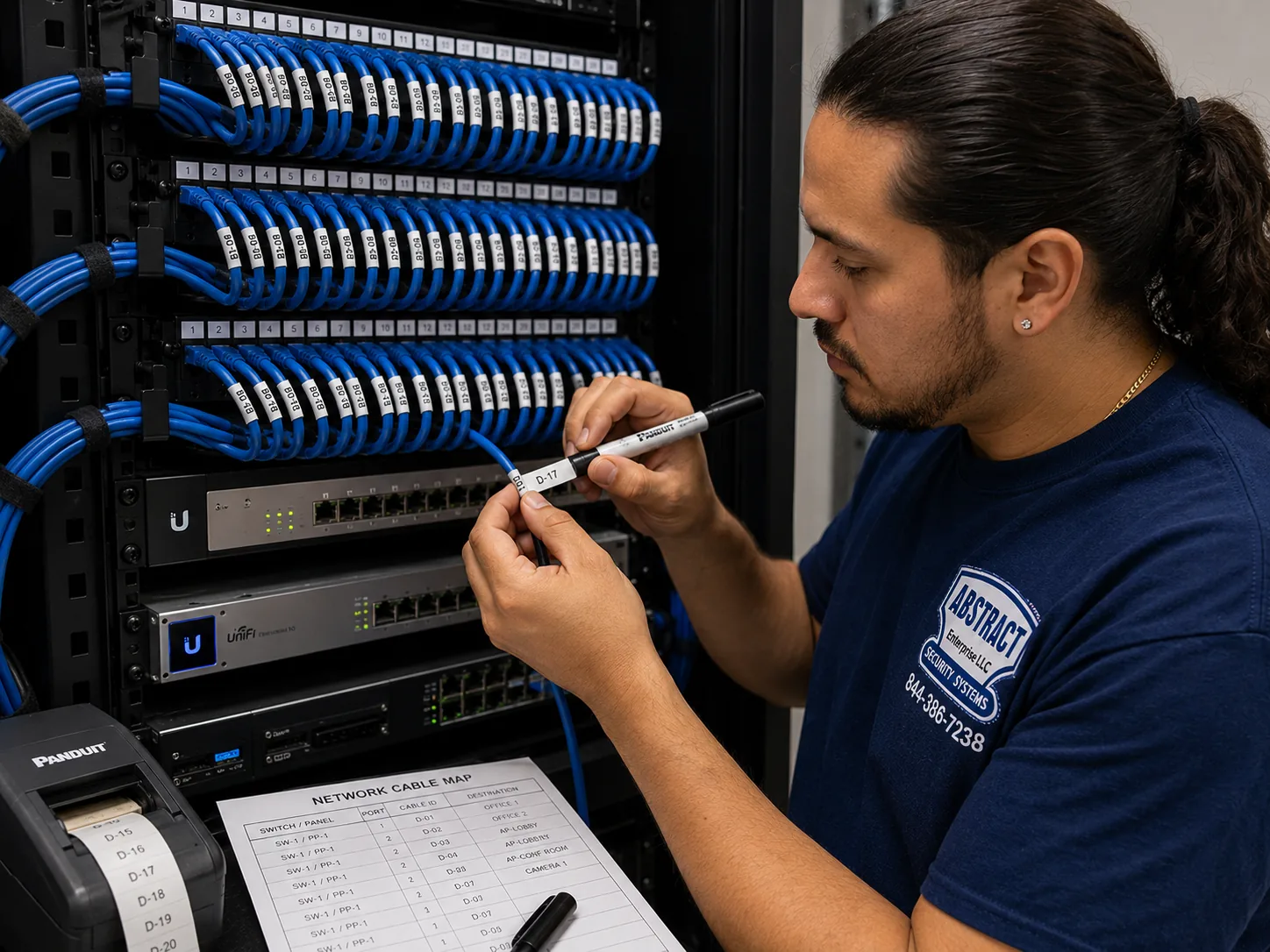
Marine Park, Brooklyn TV and network wiring: technician printing cable labels at a patch panel beside a printed port map
A photo from our job library, not taken in Marine Park: a technician printing labels for cables at a patch panel, checking each one against a printed port map. The same habit goes into a Marine Park house. When a TV goes on the living room wall of a brick Tudor and the internet comes in at the far end of the basement, every line we run between the two gets a label at both ends, so the next person who opens the panel or the media cabinet knows which cable feeds which room.
Marine Park TV Mounting Request
Tudor, semi-detached, frame two-family, co-op or shop: tell us the block, the room and the TV size, and a technician calls back with the total

✅
Request Sent!
Thank you. A technician will call you back about the Marine Park address, usually within two hours.
25+
Years Experience
✓
Same-Day Estimates
100%
Licensed & Insured
4.7★
201 Google Reviews

Owner-operated since 2002 · Thousands of jobs completed · Booked within 2 hours

TV installation in Marine Park starts at $179.99 on our Brooklyn list for a TV up to 55 inches on drywall over wood studs, with the bracket sold separately. Most Marine Park houses add one wall charge to that: $45 for old plaster or $65 for brick or stone. Hiding the wires costs $59 for a paintable cord cover or $169 for a code-compliant in-wall power and cable kit, a soundbar under the screen is $129 on the wall or $79 on a console, and taking down the old TV is $85. Send a photo of the wall to (347) 934-8335 or on WhatsApp and you will usually hear back within two hours with the total.

  • Reading your photos and answering questions is free, and the total is agreed before the visit is booked.
  • All work is done under New York State license #12000287431, by a company that has been owner-operated since 2002.
  • Visits come in two-hour arrival windows, and a job goes on the schedule once it has been paid through the booking link.
The Neighborhood

Why Marine Park Properties Need TV Installation

Marine Park sits in southeast Brooklyn, bounded for the most part by Gerritsen Avenue, Flatbush Avenue, Avenue U and Kings Highway, with the 530-acre park of the same name at its southern end. It is one of the few parts of the borough where almost every TV we hang goes into a house. Brick Underground's 2022 guide to the neighborhood described most of the housing as one- and two-family detached and semi-detached homes built between the 1910s and the 1940s, with co-ops on the southern and western borders, a few small low-rise condos in the middle and no rental apartment buildings to speak of. People who rent here usually rent a floor of a two-family or an apartment above a shop.

That one fact changes how a TV job goes. In an apartment tower the question is usually "concrete or drywall?" In a Marine Park house the TV wall could be plaster on wood lath, plaster laid straight onto brick, solid brick on a party wall shared with the house next door, a stone accent around a fireplace that was taken out decades ago, or fresh drywall from a basement finished last winter. Brick Underground put the frame houses and duplexes at around 1,100 square feet and the brick houses at 1,200 to 2,200 square feet. Within one block you can meet three different walls, and within one house you can meet four.

The houses also carry the marks of the people who bought them. The same guide described Marine Park as a place where generations of city employees, police officers, firefighters and teachers, have settled, and where families stay. That shows up on the wall. We see living rooms that have been redone two or three times, with a 1990s paneled wall over 1930s plaster, a fireplace closed up in one decade and the opening patched in the next, and a rec room in the basement built by a relative with a weekend and a box of drywall screws. None of it is a problem if it is found before the bracket goes up. All of it is a problem if it is found after.

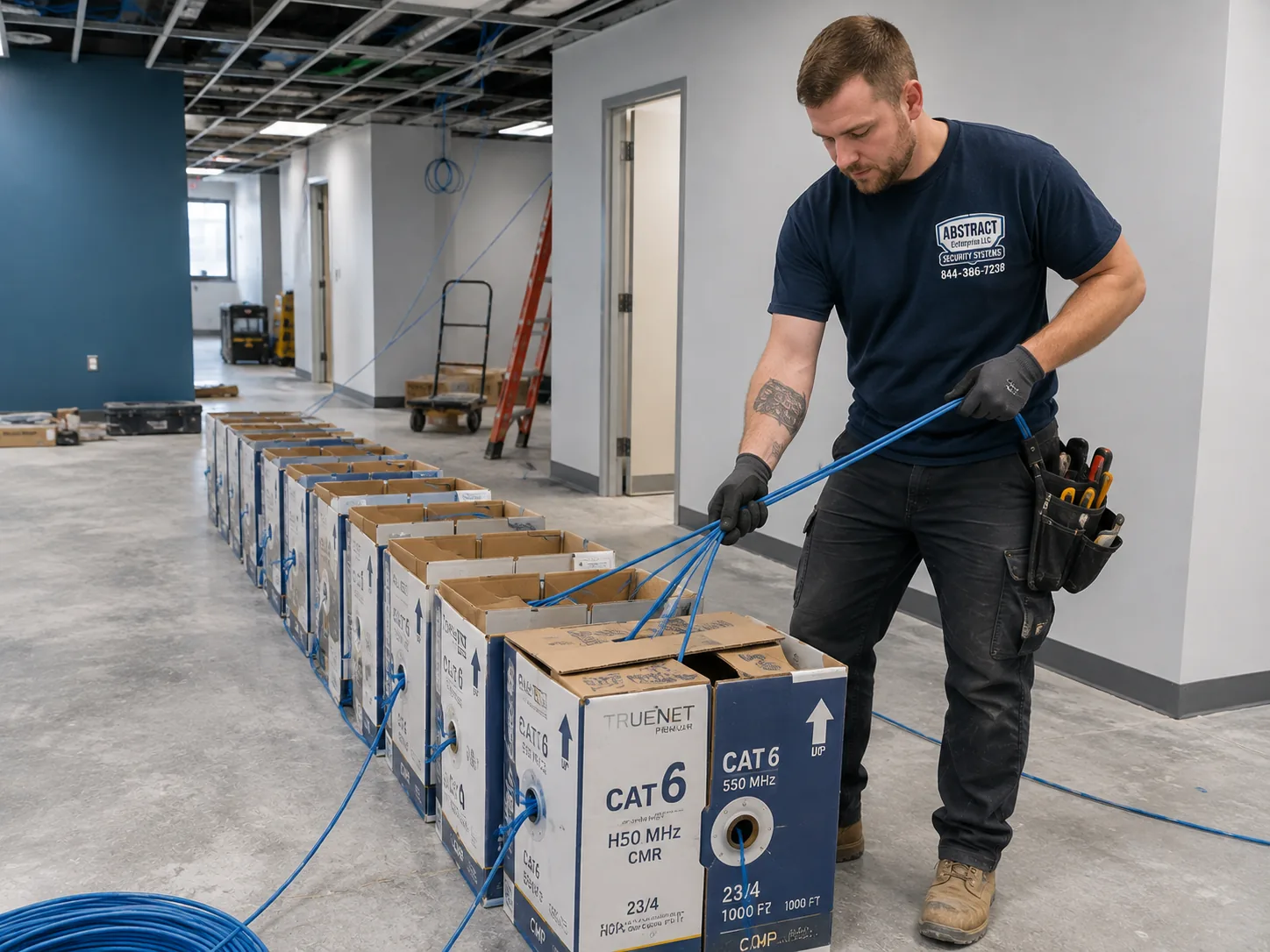
Marine Park, Brooklyn TV installation prep: boxes of cable staged on the floor of a working commercial premises for a multi-drop pull
A photo from our job library, not taken in Marine Park: boxes of cable staged on the floor of a working business before a pull to several rooms. Most Marine Park jobs are one or two TVs, not a commercial fit-out, but the planning is the same. Before the van leaves, the technician knows how many rooms are getting a screen, which ones need a wired network line from the basement, and how much cable that takes, so nobody has to leave mid-job for parts.

Getting here shapes the work too. Marine Park has no subway station; Wikipedia lists the nearest as Kings Highway on the Brighton line in Midwood, and the neighborhood runs on buses and cars. For a TV job that is good news. The streets are lined with driveways, so the technician can usually park close and carry a 65-inch box a few steps instead of half a block. It also means that a new TV often arrives by car or by delivery to the driveway, and the technician's first job is getting the box from the hallway into the right room without scraping a doorframe.

There is also the question of what a TV on display invites. In March 2026 News 12 Brooklyn reported that on February 23 at 4:30 in the afternoon, four people entered a home on East 34th Street and Avenue N and removed two smart TVs before getting away; no one was hurt, and the report did not say how they got in. A bracket is not a lock, and we will not pretend one is. What placement can do is keep a big screen out of the line of sight from the sidewalk and the front window, and that is one of the things we talk through in the front rooms of Marine Park houses, where the living room window often faces the street a few feet from the stoop.

Finally, there are children and grandchildren. The U.S. Consumer Product Safety Commission's February 2022 report counted 581 tip-over deaths involving furniture, TVs or appliances since 2000, and found that 71% of the children's deaths involved a television. In houses where grandkids visit on weekends and the bedroom TV still sits on top of a dresser, getting it onto the wall, or at least strapped, is the most practical safety work we do.

Six Marine Park facts that shape a TV job before we bring a drill

  • Houses, not towers. Brick Underground describes most homes as one- and two-family detached and semi-detached houses from the 1910s to the 1940s, so the TV wall is a house wall, and the house's age tells us what is likely behind the paint.
  • Tudor details sit where the TV wants to go. Brownstoner's February 2022 report on 3615 Avenue T, a 1931 brick Tudor Revival, described a sunken living room with a "beamed and stone-accented ceiling" and "glass-fronted built-ins," with stone accents carried onto the dining room walls that it said "may make hanging art harder." A TV is a large, heavy piece of art.
  • Fireplaces come and go. The 1931 house on Avenue T appears to have lost its fireplace; a 1920s house at 3622 Avenue R was listed by Brownstoner in 2020 with a working wood-burning fireplace. Either way, the wall above or where a fireplace was is often the wall the family wants the TV on.
  • The basement opens onto the yard. The same reports describe lower levels with their own entrance from the rear yard, second kitchens and rec rooms. Basement TVs are common here, and they bring block walls, paneling and damp into the job.
  • Garages become rooms. Brick Underground noted a Quentin Road listing whose detached garage had a bathroom and could be turned into a guest room or office. A TV in a building at the back of the lot needs a power and network plan, not just a bracket.
  • The neighborhood runs on cars and buses. With no subway station in Marine Park, technicians come by van and can usually park close to the house, which makes carrying a large screen far easier than on a crowded apartment block.

Where this page applies. It covers the blocks between Kings Highway and Avenue U, and from Gerritsen Avenue across to Flatbush Avenue, along with the edges where the co-ops stand. If you are just across one of those lines, you may be on our Flatlands TV installation page to the north and east, our Bergen Beach page across Flatbush Avenue, or our Canarsie page further east. The whole borough is on our Brooklyn TV installation page, and the price is the same Brooklyn rate on every one of them.

Same-Day Repair in Marine Park

Need Repair in Marine Park? A TV That Sags, a Mount That Rattles, a Screen Stuck Too High

The urgent calls we get from Marine Park houses are rarely about a brand-new TV. They are about a screen someone hung years ago, often on plastic plugs in plaster, that has started to lean forward at the top, or a full-motion arm that drops a little every time someone pulls it out. Sometimes it is a TV that was put up over a mantel so high that nobody in the family can watch it without tipping their head back, and the household has finally decided to fix it.

If a TV is pulling away from the wall, do not push it back or try to tighten it from the front. Unplug it if you can reach the plug safely, keep children and pets out of the area, and put a cushion or a folded blanket on the floor under it. Then send a photo to (347) 934-8335. Taking down an old TV is $85 on our Brooklyn list, and if it is going back up on a proper fixing, the rehang is priced from the same list as a new mount. We book quickly, usually within two hours of your message, and we will tell you on the phone whether the fixing can be saved or whether the bracket has to move to solid material.

The most common cause we find is simple: the bracket was screwed into the surface of the wall and nothing behind it. Old plaster is hard on the outside and crumbly underneath, and a short plug grips the crumbly part. Over months, the weight of the screen and the pull of a tilting or swinging arm work it loose. The fix is to find what is really behind the plaster, whether that is a wood stud, a run of lath or solid brick, and fix into that.

What We Install

TV Installation Services in Marine Park

Every service below is priced from the same Brooklyn list, and every one of them starts with a look at the wall. The cards describe how each service usually plays out in a Marine Park house, because that is where nearly all of our work here happens.

Wall mounting on original plaster

Fixed, tilting and full-motion brackets on the plaster walls of 1920s and 1930s houses, fixed into the wood framing or the brick behind the plaster, never into the plaster alone. Plaster adds $45 to the $179.99 base on our list.

Mounting on brick and stone

Brackets set with sleeve anchors deep into solid brick on party walls and outside walls, and into the stone trim some Tudor living rooms carry around a fireplace or an arch. Brick or stone adds $65.

Over the fireplace, working or closed

TVs over a working wood-burning fireplace, over a gas insert, or on the wall where a fireplace was removed and plastered over. Above-fireplace mounting adds $130, and we check the heat and the height before we agree to it.

Basement rec rooms and dens

Screens in finished basements on paneling, drywall or bare block, set high enough to stay clear of a wet floor, with the cable box and the network line kept off the ground.

Garages and back-lot offices

TVs in detached garages that have been turned into gyms, offices or guest rooms, with the power, the Wi-Fi or a wired network line planned before the bracket goes up.

Hidden wires that meet code

A code-compliant in-wall power and cable kit for $169 on framed walls, or a paintable cord cover for $59 on brick, stone and plaster where nothing can go inside.

Soundbars and devices

Soundbars placed on a console for $79 or mounted under the screen for $129, plus cable boxes, streaming sticks and game consoles connected and tested.

Taking down and replacing old TVs

The old TV and its bracket come off the wall for $85, the fixings are checked, and the new screen goes on the right material, not on the old holes by habit.

Screens for shops and offices

Menu boards, waiting-room TVs and sports screens for the businesses on Flatbush Avenue, Avenue U, Kings Highway, Nostrand Avenue and Gerritsen Avenue, scheduled around opening hours.

Building Specialists

TV Installation for Marine Park's Architecture

Six kinds of home cover nearly every TV job we do here. Each one has its own walls, its own wiring paths and its own surprises. Before a visit we try to work out which of these you live in, because it tells us what to pack.

The brick Tudor

The 1920s and 1930s English-style houses that period ads sold as "brick period" homes, often with a sunken living room, beams, stone trim and built-in cabinets. Beautiful rooms, crowded walls.

The semi-detached brick pair

Two houses sharing one solid party wall, each with a side driveway and a garage behind. The shared wall is usually the strongest wall in the house for a TV.

The frame house and frame two-family

Wood-framed houses with siding outside and plaster or later drywall inside, in the size range Brick Underground put at about 1,100 square feet. Studs are easier to find; space is tighter.

The two-family with a tenant floor

An owner on one floor and a tenant on the other, sharing a stair and sometimes a basement where the cable and internet come in. The wiring plan has to respect both households.

The finished basement

Rec rooms, second kitchens and gyms with their own door to the yard, built over decades on block foundations, sometimes with paneling over masonry and drop ceilings over the pipes.

The edge co-op and the flat above a store

The co-op buildings on the southern and western borders and the apartments over the shops on the avenues, where building rules, elevators or stairs and shared walls come into play.

The brick Tudor: beams, stone and built-ins around the only good wall

The brick Tudors are the houses people picture when they think of Marine Park. Brownstoner's 1931 example at 3615 Avenue T had a sunken living room with a beamed, stone-accented ceiling and glass-fronted built-ins, and it is typical of what we meet: a handsome room where most of the wall space is already spoken for. The beams can sit lower than the top of a big screen would reach. Stone trim can run along the edge of the wall the family wants. Built-in cabinets can flank the one stretch of clear plaster, and their glass doors do not like vibration from a hammer drill a foot away.

The answer is careful layout, not force. We measure the clear area between the trim and the beams, pick a screen size and a bracket that fit inside it with a margin, and plan the drilling so the hammer drill stays away from the cabinet glass. Where the wall behind the plaster is brick, which is common on the outside walls of these houses, the fixing goes into the brick; where it is a framed interior partition, it goes into the studs. And because a sunken living room is watched from two levels, from the sofa below and from the step or the hallway above, we check the height from both before the bracket goes up.

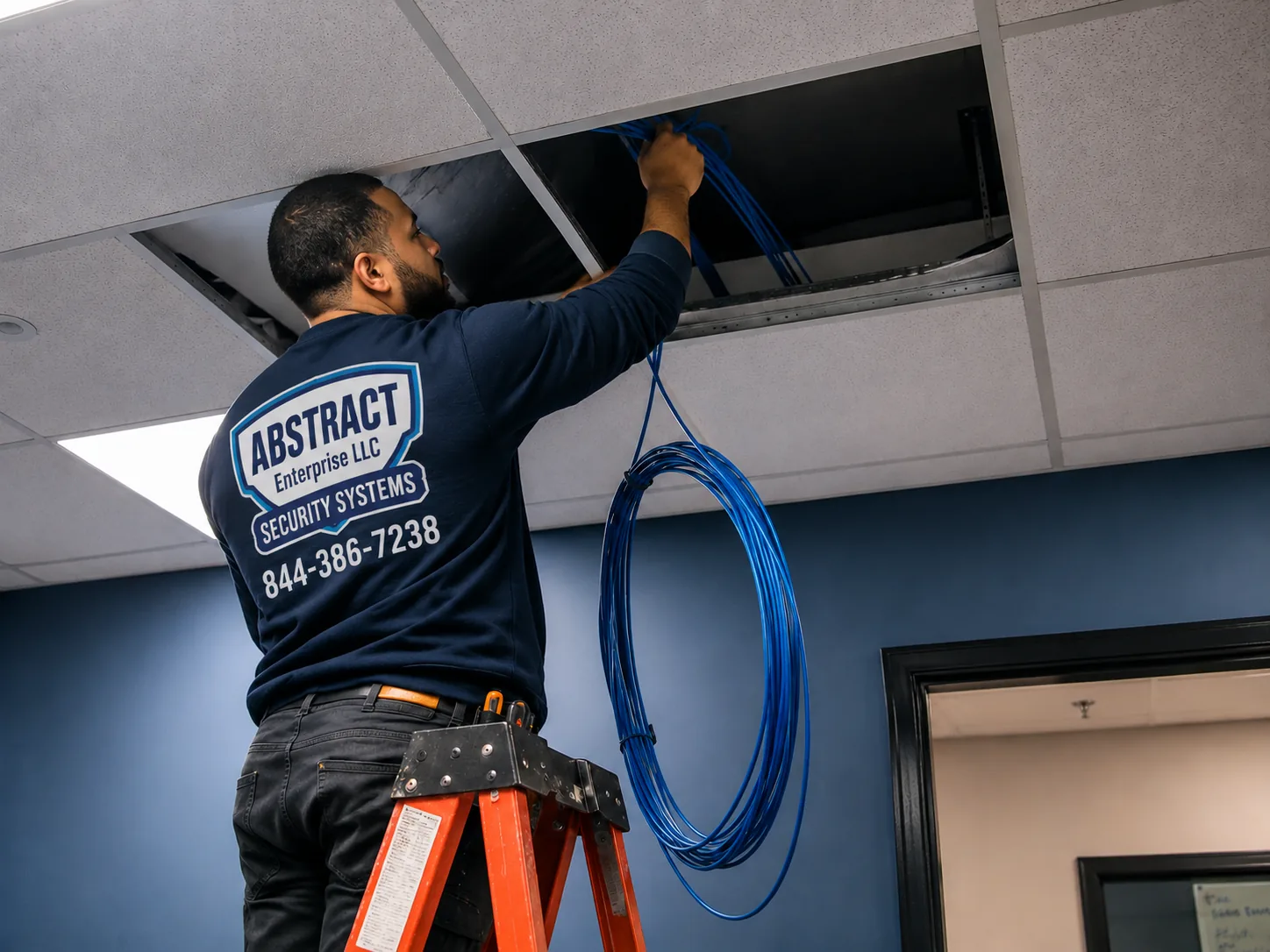
Marine Park, Brooklyn TV cable installation: technician feeding cable through a ceiling in an occupied commercial space
A photo from our job library, not taken in Marine Park: a technician feeding cable through the ceiling of a business that stayed open while the work went on. In a Marine Park house the ceiling we work through is more often the drop ceiling of a finished basement, where the cable for a living room TV can travel along the joists to a point under the TV wall and come up inside it, without anyone opening the plaster upstairs.

The semi-detached pair: one party wall, two families

Semi-detached houses share one wall with the house next door, and in a brick pair that wall is usually solid masonry from the basement to the roof. For a TV, that is often the best wall in the house: no studs to hunt for, no hollow spots, and brick that will hold a sleeve anchor for decades if it is drilled and set properly. The Brownstoner forum thread on mounting a TV over a fireplace put it plainly, in the words of one Brooklyn homeowner: "the fireplaces are on the party walls with no studs, just plaster over brick."

Two cautions come with it. First, the brick behind the plaster has to be deep enough for the anchor; we drill a test hole and check before we commit. Second, a party wall carries sound. A soundbar mounted tight to the shared wall can be heard in the neighbor's living room, and drilling is heard there too. We drill during the day, keep the drilling short, and where the household is worried about sound we suggest a soundbar on a console or a bracket that holds it a little off the wall rather than bolted to it.

The frame house: studs you can find, rooms that are tight

Frame houses are wood-framed from top to bottom, so a good scanner finds the studs, and on a framed wall the in-wall power and cable kit can usually go in cleanly. The challenge is space. At around 1,100 square feet, a frame house's living room may be the passage between the front door and the kitchen, with windows on one side and a radiator on another. We look for the wall where the screen will not catch glare from the front windows, will not sit over a radiator, and will not force everyone to sit with their back to the door.

Some frame houses have had their original plaster covered with drywall during a renovation, and some have had the plaster removed and replaced. The scanner and a pilot hole tell us which. Drywall over plaster is thick and needs longer fasteners to reach the studs; we size them on site rather than trusting what came in the bracket's bag.

The two-family with a tenant floor: shared stairs, shared wiring

In a two-family, the internet and cable usually come into the basement, and both floors' lines start there. If the owner wants a wired network line to the living room TV and the tenant upstairs wants the same, the cables share a path, and the owner and the tenant share an interest in it being tidy and labeled. We label every line we run at both ends, keep each household's cables separate, and never borrow a pair from someone else's line to save time.

If you are the tenant, the question is permission. Ask the owner before you book, tell them which wall and what size, and send us their answer. Patching and painting the holes when you move out is not something we do, so it is worth agreeing in advance who handles that.

The finished basement: block, paneling and a door to the yard

Marine Park basements are often real rooms. Brownstoner described the lower level of the Avenue T Tudor as having a second kitchen, a rec room, a laundry area, a full bath and its own entrance from the rear yard. The walls in these rooms vary: block foundation walls, paneling nailed to furring strips over block, drywall on wood or metal studs, and sometimes a mix within one room. A big TV on paneling alone is a bad idea; the fixing has to go through the paneling into the block or the framing behind it.

Basements also bring water into the conversation. A Reddit post about the neighborhood called it one of Brooklyn's biggest floodplains and warned people off basement apartments, and while that is one resident's comment, we ask every basement customer where water has reached before, if anywhere. The TV, the cable box and the power strip go well above that line, and a wired network line coming from the utility area is routed along the ceiling, not across the floor.

The edge co-op and the apartment over a shop

Brick Underground placed Marine Park's co-op buildings on its southern and western borders, and many of the neighborhood's renters live over the stores on the avenues. In a co-op, the board may want a certificate of insurance before a contractor works in an apartment, and some buildings limit drilling to weekday hours. Send us the building's rules and the exact name the certificate has to show, and we arrange it before the visit.

Over a store, the walls are often masonry on the street side and framed partitions inside, and the stair to the apartment can be narrow. We ask about the stair before we bring an 85-inch box, and we bring a second person when the screen's size calls for one.

Field Notes

Field Notes: Hanging a TV Between the Beams and the Built-Ins

These notes describe how our technicians handle the kind of living room Brownstoner described on Avenue T, a sunken Tudor room with a beamed ceiling, stone trim and glass-fronted cabinets. They are the steps we follow in rooms like that, not a story about one particular house.

Measure the window, not the wall. The usable space is the rectangle between the beam, the trim and the cabinets, minus a margin so the screen does not look jammed in. We measure it before talking about screen size, because a 75-inch TV that does not fit the clear space is worse than a 65-inch that does.

Protect the glass. Before any drilling near glass-fronted built-ins, the doors are opened or taped, and anything on the shelves that could rattle is moved. The hammer drill is used only for the masonry holes, and only for as long as it takes.

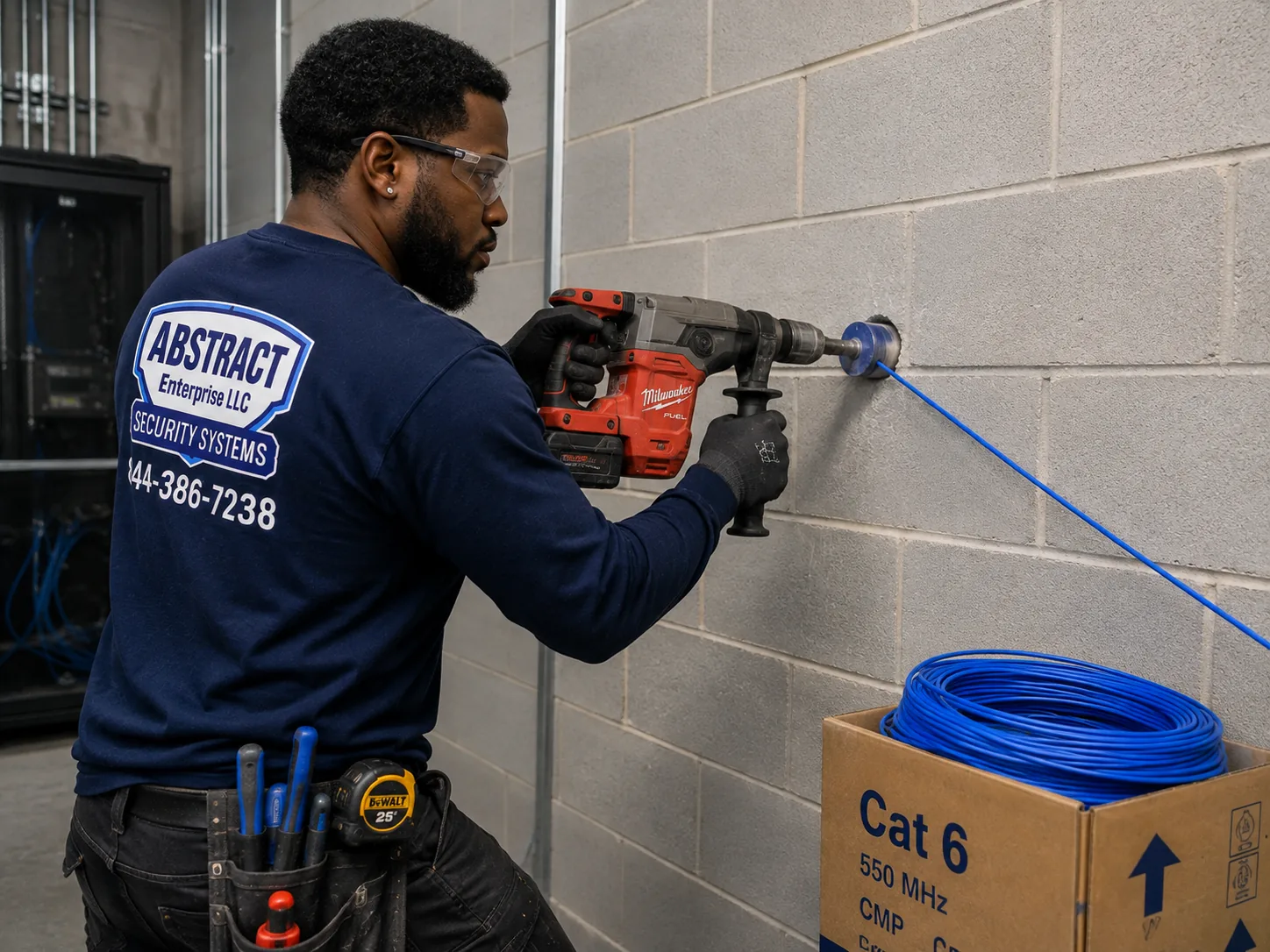
Marine Park, Brooklyn TV wiring through masonry: technician core drilling through a block wall to carry cable through to a network room
A photo from our job library, not taken in Marine Park: a technician core drilling through a block wall so cable can pass into a network room. In a Marine Park house, a hole like this is most often needed in the basement, where a cable from the utility area has to get through a block partition to reach the stairwell or the rec room. We drill it once, at a size that fits the cables, and seal around them afterwards.

Look from both levels. In a sunken room the TV is seen from below and from above. We tape the screen's outline on the wall, then check it from the sofa, from the top step and from the hallway, and adjust until it works for the seat that matters most.

Find the brick, then trust the brick. On an outside wall of a brick Tudor, the plaster usually sits on masonry. A test hole tells us how deep the plaster is and whether the brick behind it is solid. Then the anchors go in deep, into the brick, and the plaster is only the finish they pass through.

Leave the room as it was. A dust-shroud vacuum catches most of the red brick dust at the drill, the drop cloths catch the rest, and the cabinet doors are closed and wiped before we leave.

Wall by Wall

Plaster, Brick, Stone or Paneling: What Holds a TV in a Marine Park House

The base price on our Brooklyn list, $179.99, assumes drywall over wood studs, and that is the easiest wall to work on. Marine Park houses mostly predate drywall, so the wall charge on our list is part of almost every quote here. Here is how each wall behaves and what it adds.

Plaster on wood lath (+$45). The usual interior wall in a house from the 1920s and 1930s. The plaster is hard on the surface and weaker underneath, and the wood lath behind it is thin. The bracket has to be fixed into the studs behind the lath, so we find them with a scanner and confirm with a pilot hole hidden behind where the bracket will sit. The extra charge covers the slower, careful drilling that keeps the plaster from cracking.

Plaster laid onto brick (+$65). On outside walls and party walls of brick houses, the plaster often goes straight onto the masonry with no studs at all. The fixing goes through the plaster into the brick, with anchors long enough to reach well past the plaster. We check the depth first; the homeowner in the Brownstoner forum thread had a contractor who was not sure the brick behind his plaster was deep enough, and that is exactly the question a test hole answers.

Solid brick or stone (+$65). Exposed brick walls, stone fireplace surrounds and stone trim. Brick holds very well when the anchors are set into the brick itself rather than the mortar joints, and when they are the right length. Stone varies: some is solid, some is a thin veneer over another wall, and we drill a test hole to know which.

Paneling over block or framing. Common in basement rec rooms. The paneling itself is not structural. The fixing goes through it into the block or the furring behind, and the wall is priced by what is found behind the paneling.

Drywall over plaster. Found in houses that were renovated without stripping the old walls. It is thick and needs longer fasteners to reach the studs, and it can hide old openings, so the scanner work takes a little longer.

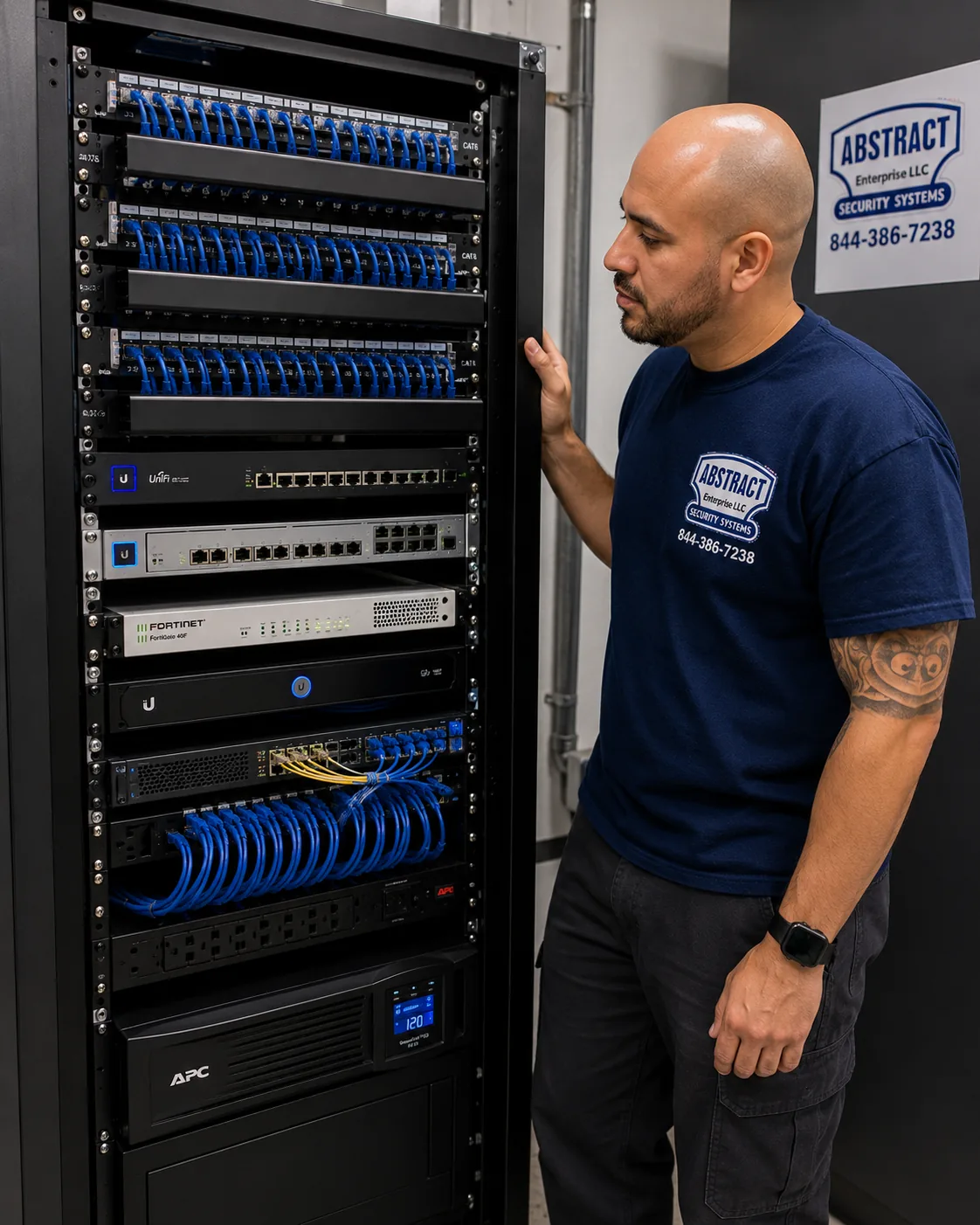
Marine Park, Brooklyn TV and home network setup: finished network rack with patch panels, switching, a firewall and battery backup, all dressed and identified
A photo from our job library, not taken in Marine Park: a finished network rack with patch panels, a switch, a firewall and a battery backup, every cable dressed and labeled. A Marine Park house does not need a rack like this, but a household with several smart TVs, a game console and a home office often benefits from the same idea on a smaller scale: one tidy spot in the basement where the internet comes in, with labeled lines running up to the rooms that need a wired connection.

Hiding the wires without breaking the rules

The most common request after "put it on the wall" is "make the wires disappear." On a framed wall, the right answer is an in-wall power and cable kit, $169 on our list: a recessed power inlet behind the TV, connected inside the wall to a second plate lower down that plugs into a normal outlet, with a pass-through for the HDMI and network cables beside it. It is made to go inside a wall. An ordinary extension cord or the TV's own power cord pushed down through two holes is not, and it is one of the shortcuts we refuse.

Where the job needs more than that, the rules are clear. The NYC Department of Buildings says no installation or modification to any electrical system can be done without a permit, and that the work is done by a NYC Licensed Master Electrician. If a new circuit or a new outlet wired into the house is the right answer, that is electrician's work and we say so; we do not do electrical work. On brick, stone and plaster-on-brick walls, nothing can be fished inside the wall, so the choice is a $59 paintable cord cover from the TV down to the outlet, a console below the screen that hides the cables, or an outlet added by an electrician behind the screen.

Fireplaces

Over the Mantel in Marine Park: Working Fireplaces, Gas Inserts and Openings That Were Closed Up

Fireplaces are where a lot of Marine Park living rooms point, and where a lot of families want the TV. Some still burn wood, like the 1920s house at 3622 Avenue R that Brownstoner featured in 2020. Some have gas inserts. Some were taken out, like the one that appears to be missing from the 1931 Tudor on Avenue T, and the opening was bricked or plastered over. Each case is different, and above-fireplace mounting adds $130 on our list because of the extra checks and the masonry work it involves.

Working wood-burning fireplaces. Heat rises, and a TV directly over a working fire takes it. HomeAdvisor's guidance is to test the temperature at the mounting spot and avoid putting a TV where it goes above 100°F. We ask how often the fireplace is used and whether the mantel is deep enough to deflect heat, and we tell you honestly when the answer is a different wall. Height is the other problem: the Brownstoner forum poster's neighbor warned that mounting over a mantel "is awfully high and invites a sore neck." Taskrabbit's guide puts a comfortable center of screen around 42 inches off the floor for seated viewing, and a mantel puts the bottom of the screen well above that. A tilting bracket set as low as safely possible helps.

Gas inserts. These can run hot at the face, and the insert's manual often gives clearances for anything above it. We read the manual with you before we agree to a position.

Closed-up openings. A fireplace that was bricked in and plastered over leaves a wall that looks flat but is not uniform. The patch may be newer brick, block, or a frame of wood with drywall or plaster on it, and the old chimney breast may be solid masonry around it. We find the edges of the patch with the scanner and a test hole and fix the bracket into the old masonry around it, not into the patch.

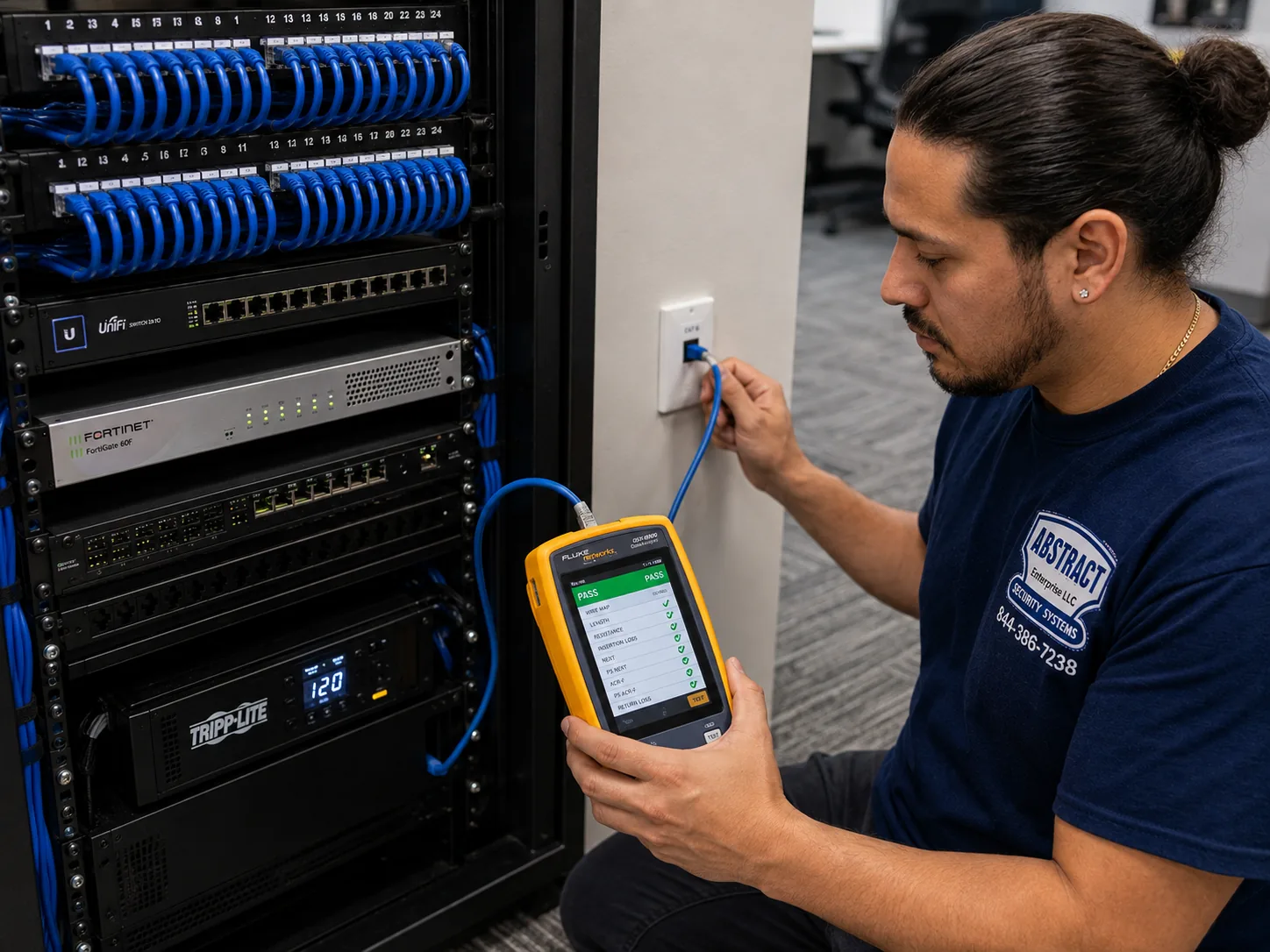
Marine Park, Brooklyn TV network cable testing: technician certifying a data drop with a handheld cable analyzer showing a PASS result
A photo from our job library, not taken in Marine Park: a technician certifying a network cable with a handheld analyzer that shows a pass. When we run a wired network line from a Marine Park basement up to a TV over the fireplace, it gets tested before the wall plate goes on, so a streaming problem later is never a mystery about the cable.

Cables over a mantel. A chimney breast is masonry, so cables cannot be hidden inside it. The usual answers are a paintable cord cover running down the side of the breast to the outlet, or a cable box and soundbar on a console beside the fireplace with only the HDMI and power going up to the screen. We will show you both on the wall with tape before you choose.

Basements, Garages and Back Rooms

TVs Below Grade and Out Back: Rec Rooms, Garage Gyms and Backyard Offices

A lot of Marine Park TV work happens away from the living room. The houses here have usable basements, garages at the end of driveways and, increasingly, garages and back rooms turned into offices, gyms and places for teenagers to watch a game without taking over the main floor. These rooms need a little more planning than a living room, because power, signal and moisture all behave differently there.

Power. Basement and garage outlets are often few and far between, and sometimes there is only one, on the wrong wall. An in-wall kit can move power up behind a screen on a framed wall. On block, a cord cover runs down to the outlet. If the room really needs a new outlet, that is a job for a licensed electrician with a permit, and we will plan the TV around where the electrician puts it.

Signal. Wi-Fi from a router on the main floor often does not reach a basement well, and a detached garage at the back of a lot may be beyond its reach entirely. A wired network line from where the internet comes in is the most reliable answer for a streaming TV. For a detached garage, the line has to leave the house and enter the garage, and the route has to be planned around the yard, the fence and the driveway. Some households choose a wireless access point in the garage instead. We talk through both.

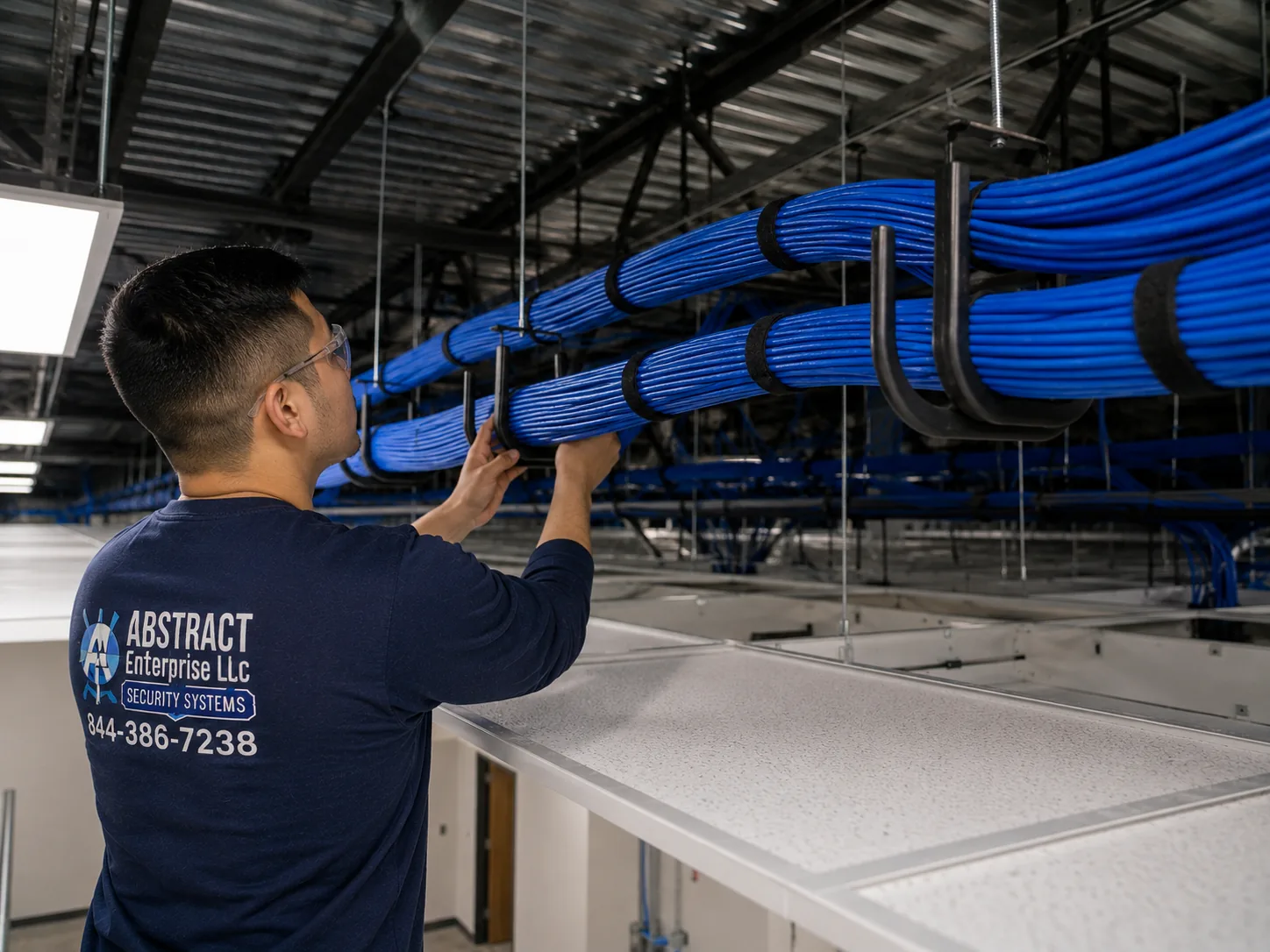
Marine Park, Brooklyn TV cable routing: J-hooks carrying dressed cable bundles across a commercial ceiling
A photo from our job library, not taken in Marine Park: J-hooks carrying neat bundles of cable across a commercial ceiling. In a Marine Park basement the same support keeps a network line or an HDMI run off the pipes and the ductwork along the joists, so it does not sag, get stepped on or end up wet on the floor.

Moisture and temperature. A finished basement that has taken water before, or a garage that is not heated, is not a friendly place for electronics on the floor. We put the TV high enough on the wall that a wet floor never reaches it, keep the cable box and power strip on a shelf or the wall rather than the floor, and tell you when a room's conditions are outside what the TV's maker allows.

Walls. Garages and basements bring the full range: bare block, poured concrete, paneling over block, drywall on wood or steel studs. The fixing goes into whatever is solid behind the surface, and we price it from the wall line that matches what we find.

Safety and Security

Kids, Grandkids and Front Windows: Where a TV Goes in a Marine Park House

Two kinds of safety come up in almost every Marine Park living room, and neither is about how the screen looks.

Tip-overs. The U.S. Consumer Product Safety Commission's February 2022 report counted 581 tip-over deaths involving furniture, TVs or appliances since 2000. Of those, 472 were children, and 71% of the children's deaths involved a television. The same report estimated that 22,500 people a year went to an emergency room after a tip-over in 2018 to 2020. Many Marine Park households have grandchildren over on weekends, and many still have an older TV on a dresser in a bedroom. Mounting it on the wall takes it off the furniture entirely. If a TV stays on a stand, it should be strapped to the wall or the furniture behind it, and the furniture itself should be anchored. A TV placed on its stand without wall mounting is $119.99 on our list, and we will tell you if the stand or dresser underneath it looks unstable.

What can be seen from the street. The February 2026 burglary on East 34th Street that News 12 reported ended with two smart TVs carried out of a house in the afternoon. We do not know how those people got in, and we will not claim a bracket would have stopped them. A wall mount does not lock a TV in place, and anyone with a few minutes can lift most TVs off a bracket. What we can do is help you choose a position that keeps the screen out of direct view from the sidewalk through the front window, record the TV's serial number for you on the hand-over sheet, and mention our camera and alarm work if you want to go further.

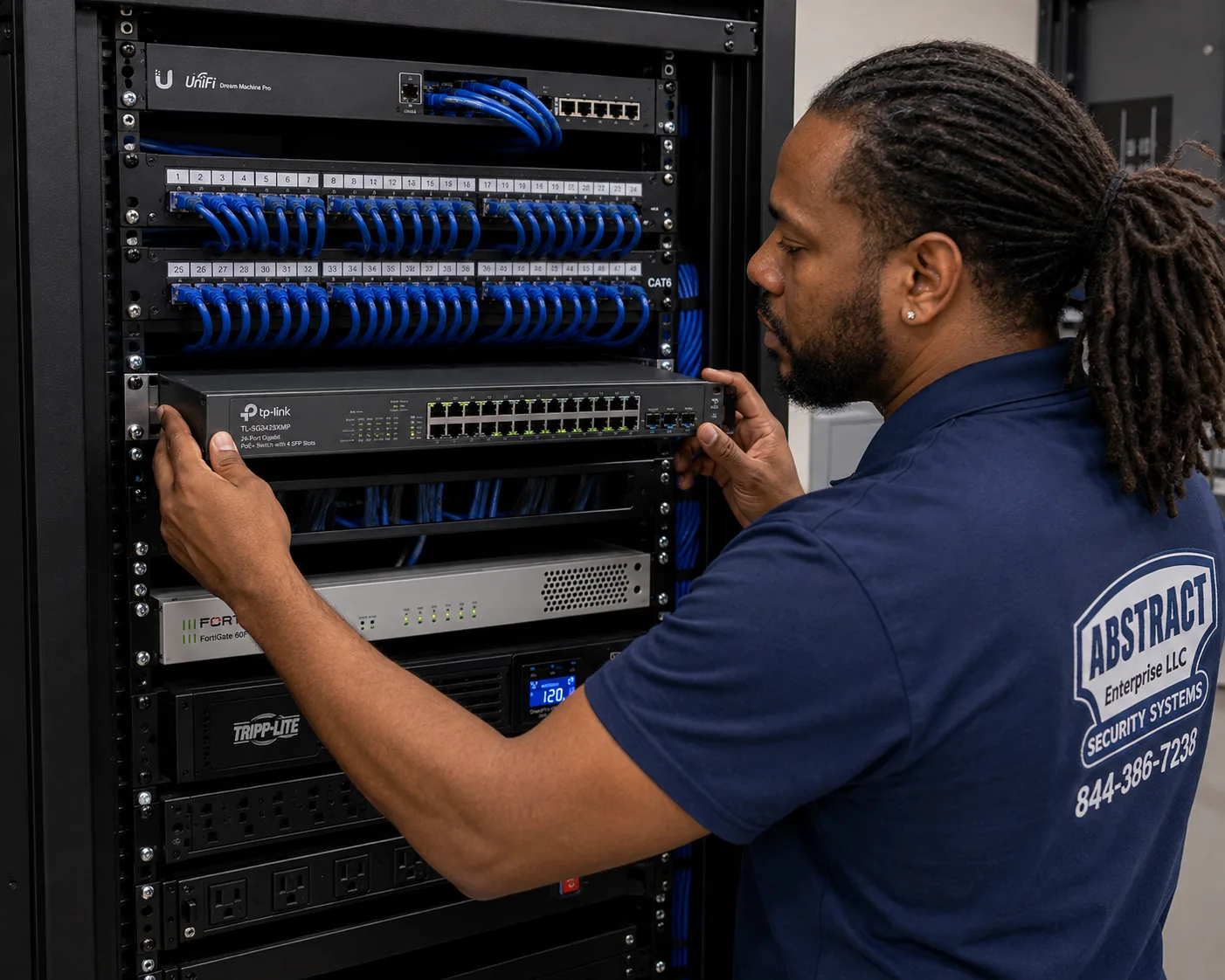
Marine Park, Brooklyn home network for TVs: technician mounting a managed PoE switch below patch panels in a commercial network rack
A photo from our job library, not taken in Marine Park: a technician mounting a managed network switch below patch panels in a commercial rack. A household that adds cameras to its TVs and computers ends up with more devices on the network than a basic router can handle well, and a small switch where the internet enters the house is often the tidy answer.

Cords and walkways. In a narrow front room, a cord running from the TV across the floor to an outlet is a trip hazard and an invitation for a toddler to pull. Every job ends with the cords routed along the wall, inside a cord cover or behind furniture, and never across a path where people walk.

Commercial TV Installation

Business TV Installation in Marine Park

Marine Park is mostly homes, and its businesses sit along the avenues that frame it and cross it. Brick Underground called Flatbush Avenue the neighborhood's commercial corridor, and there are more shops along Avenue U, Kings Highway, Nostrand Avenue and Gerritsen Avenue, with delis and small shops on side corners such as Quentin Road. The screens these businesses need are different from a living room TV: they run all day, they face customers, and they usually go up in a building that has to stay open while we work.

Flatbush Avenue

Restaurants, shops and service businesses on the corridor toward the Belt Parkway and Kings Plaza just over the border. Menu screens, sports TVs and display screens in front windows.

Avenue U

Storefronts along the southern edge, near the Salt Marsh Nature Center at East 33rd Street. Counter screens and small waiting-area TVs for offices and salons.

Kings Highway

The northern edge, with stores and offices. Waiting-room TVs for medical and dental offices and screens in meeting rooms.

Nostrand Avenue

Store buildings with apartments above, where the shop downstairs and the tenant upstairs both call us for a screen.

Gerritsen Avenue

The western edge, which Wikipedia calls a major traffic corridor, with its brick row houses and the businesses among them. Small shop screens and home offices.

Side-street corners

Delis and small shops on corners like Quentin Road, where a menu screen above a counter on an old brick wall is the usual job.

Business jobs in Marine Park usually happen in small buildings with brick walls and a narrow back room, not in office towers with drop ceilings everywhere. A menu screen above a deli counter goes on old brick, and the cables have to reach a media player tucked under the counter or in a back room. A waiting-room TV in a converted house on a side street goes on plaster or on drywall over plaster. We plan the cable route with the owner, show where the cord cover or the in-wall kit will go, and book the visit around opening hours, early in the morning or after closing where that suits the business.

Several screens in a row bring their own job: getting them level with each other, evenly spaced, and showing the same picture at the same brightness. We lay out the whole row in tape before the first hole goes in, measure from one fixed reference line, and set each bracket against that line rather than against the one beside it. A small error repeated four times along a counter is easy to see from the door.

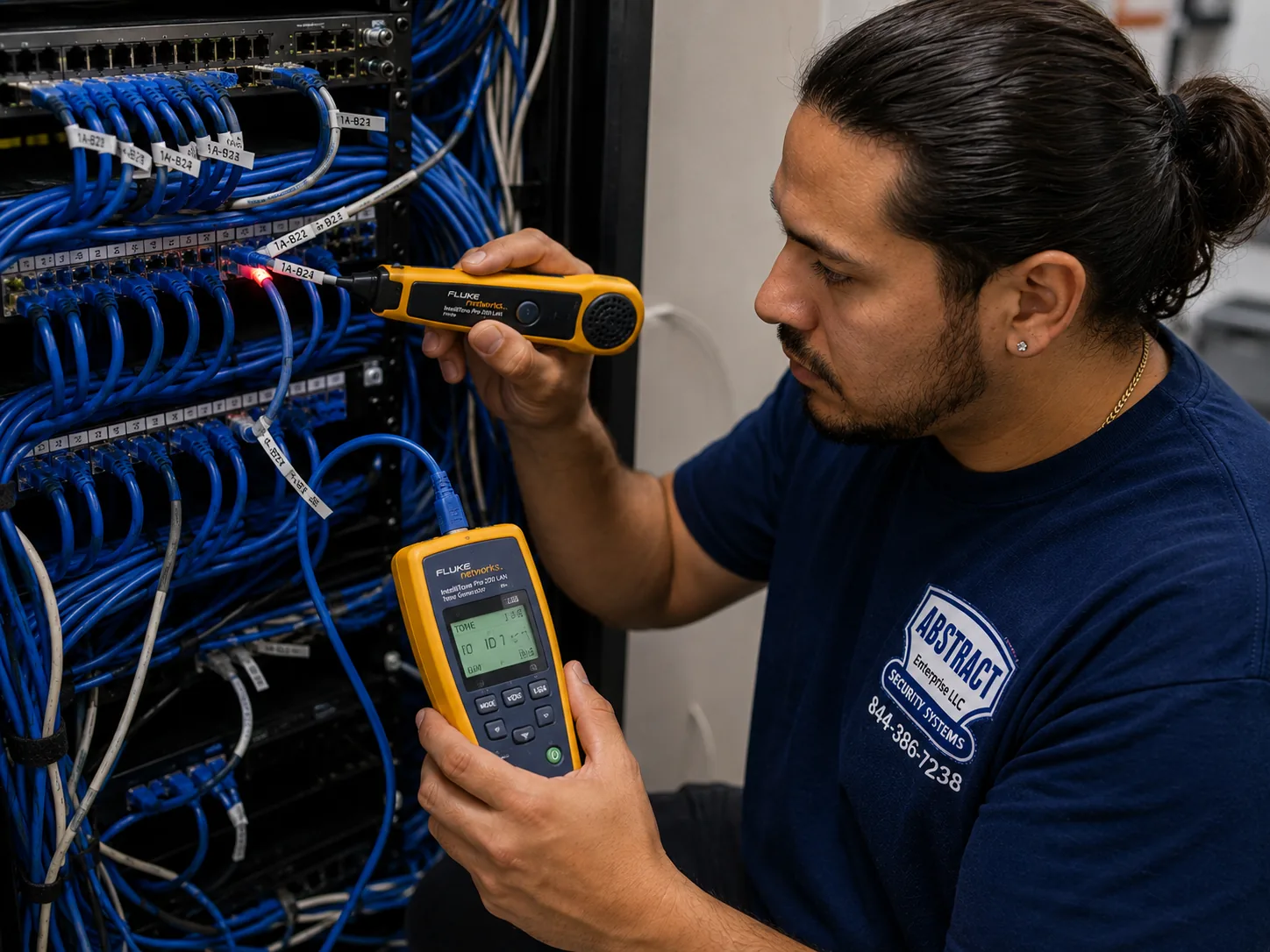
Marine Park, Brooklyn commercial TV wiring: technician tracing an unidentified cable run at a patch panel with a tone generator and probe
A photo from our job library, not taken in Marine Park: a technician tracing an unlabeled cable at a patch panel with a tone generator and probe. Shops on Flatbush Avenue and Kings Highway that have changed hands several times often have cables coming out of the wall that nobody can identify. Before we reuse one for a menu screen or a waiting-room TV, we trace it to find out where it goes.

Compliance notes for Marine Park shops, offices and small buildings

  • Power is electrician's work. The NYC Department of Buildings says no installation or modification to any electrical system can be done without a permit, by a NYC Licensed Master Electrician. If a counter needs new outlets for a row of screens, we coordinate with the business's electrician; we do not do electrical work ourselves.
  • Keep the walking path clear. A screen on a wall in a corridor or waiting room should not stick out into the space where people walk, especially where someone with a cane or poor eyesight might not see it. We choose flat brackets and heights that keep the path clear.
  • Exits and signs stay visible. We do not mount a screen where it would block an exit sign, a fire extinguisher, a sprinkler head or a posted license.
  • Insurance paperwork first. Landlords and managers of commercial buildings often want a certificate of insurance before any contractor drills. Send us the exact names and addresses it must show, and we arrange it before the visit.
  • Brackets rated beyond the load. Commercial screens are often heavier than home TVs and run all day. The bracket and the fixings are rated for more than the screen's weight, and they go into the brick or framing, never into plaster alone.
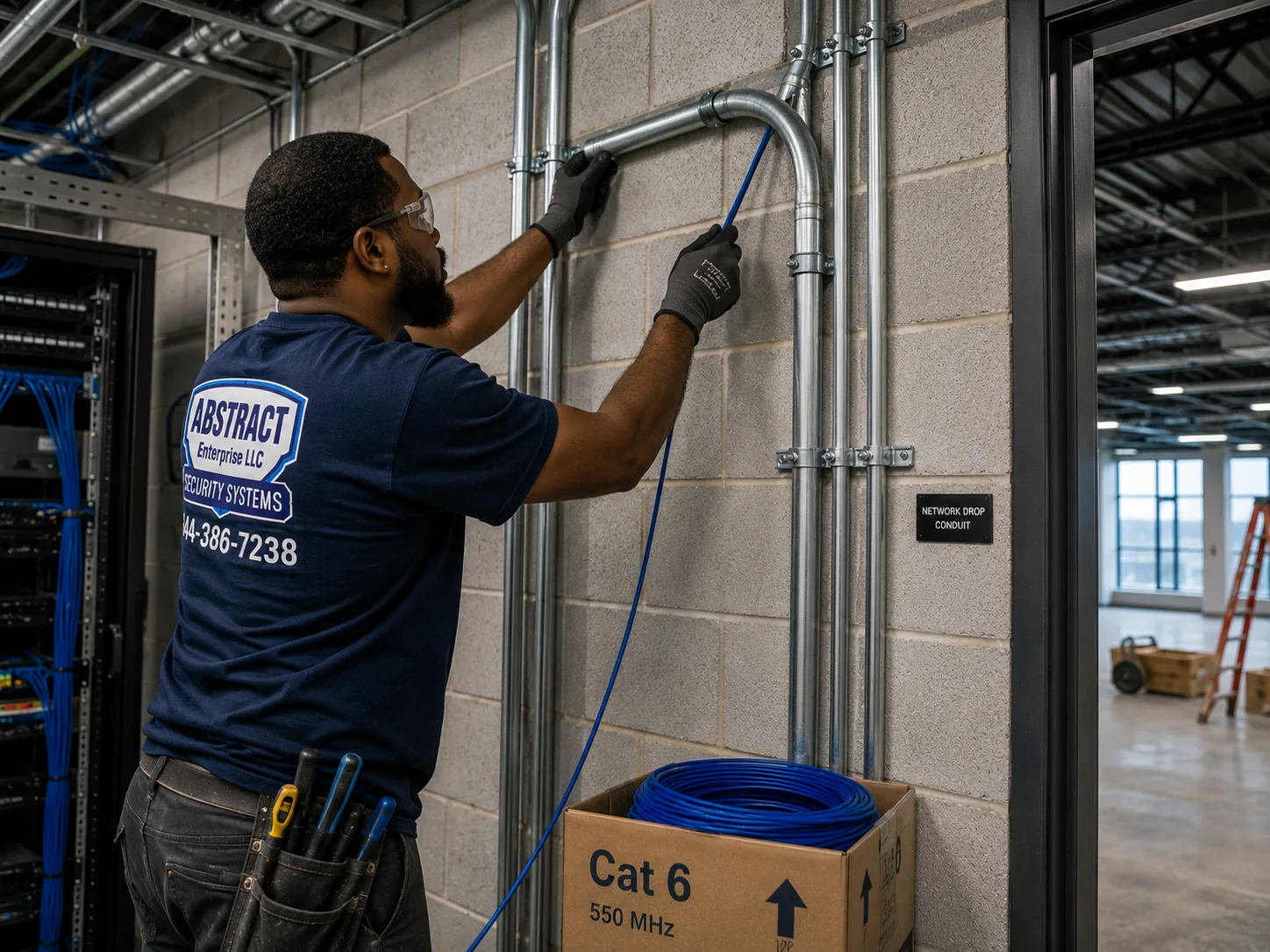
Marine Park, Brooklyn business TV cabling: technician running cable into EMT conduit beside a telecom room in an industrial building
A photo from our job library, not taken in Marine Park: a technician running cable into metal conduit beside a telecom room in an industrial building. In a Marine Park store, the same kind of conduit protects a cable that has to cross a back room or a basement where stock is moved around, between the internet connection and a screen out front.
Your Questions Answered

TV Installation in Marine Park: Questions Answered

These are the questions Marine Park homeowners, tenants and business owners bring to us, grouped by the part of the house they come from. Each answer reflects how we actually do the work, with prices from our Brooklyn list.

Tudor living rooms, beams and stone

Our living room is sunken two steps below the front hall. Where should the screen sit so it works both from the sofa and from the top of the steps?

Set it for the sofa first, because that is where people watch for hours, and then check it from the steps. In practice that usually means a slightly higher position than a flat-floor room would get, with a few degrees of downward tilt so it still looks right from below. We tape the outline on the wall, sit you on the sofa, then stand you on the top step, and move the tape until both views are acceptable before any hole is drilled.

The stone trim in our 1930s front room runs right along the edge of the wall we want. Can a bracket go next to it without cracking the stone?

Yes, if the bracket is fixed into the wall beside the stone and not into the stone itself, and if the hammer drill is kept a sensible distance from the trim. We measure the clear area first, choose a screen and bracket that fit inside it with a margin, and drill the masonry holes with the trim protected. If the only way to fit the screen is to drill into the stone, we test it first, because some stone trim is solid and some is a thin facing over brick.

A previous owner removed our fireplace and plastered over the opening. Is the patched part of the wall safe for a TV?

Usually the patch itself is the weakest part of the wall, so we avoid fixing into it. We find its edges with a scanner and a test hole, then fix the bracket into the original masonry of the chimney breast around it. If the patch is large and the screen has to sit over it, a bracket with a wide wall plate lets the fixings reach the solid brick on either side.

Our living room has glass-fronted built-in cabinets on both sides of the only clear wall. Will drilling between them shake the glass?

It can if nobody plans for it. We empty the shelves nearest the drilling or ask you to, open or tape the cabinet doors, and keep the hammer drill on only for the seconds each masonry hole takes. The cables can often run behind or under the built-ins to an outlet, but we do not drill into the cabinets themselves without your say-so.

Basements, garages and the rest of the lot

Our basement rec room was finished by a relative years ago, and nobody remembers what is behind the walls. How do you find out before drilling?

We treat it as unknown until it is proven. A scanner shows whether there are studs and whether they are wood or metal, a knock along the wall shows where it is hollow, and one small pilot hole behind where the bracket will sit shows what the surface is fixed to: furring strips on block, a stud wall standing off the foundation, or something improvised. We also check for pipes and wires near the spot before the drill goes in, because home-finished basements do not always follow the usual paths. The job is priced by the material the fixings end up in.

Our detached garage has been turned into an office with a bathroom. Can it get a TV that streams without dropping?

Yes, with a signal plan. The house's Wi-Fi often does not reach a building at the back of the lot reliably, so the choices are a wired network line from where the internet enters the house, or a wireless access point in the garage fed from the house. We look at the route across the yard and the power in the garage before recommending one. If the garage needs a new outlet for the TV, that is a licensed electrician's job with a permit, and we plan the TV around it.

We have two smart TVs, a game console and a home office, and the router sits in the basement where the internet comes in. Is it worth adding a small network switch there?

Often, yes. A household router has only a few wired ports, and once the TVs, the console and the office computer each want a wired line, they run out. A small switch beside the router gives every line its own port, and each cable we run upstairs is labeled at both ends so it is clear which room it feeds. We test each line with the TV or computer connected before we leave, and we tell you honestly when Wi-Fi alone will do.

Safety, families and the front window

Our grandchildren climb on the dresser where the bedroom TV sits. Should the TV go on the wall, or is a strap enough?

On the wall is the better answer, because it takes the TV off the dresser entirely, and the Consumer Product Safety Commission found that 71% of children's tip-over deaths involved a television. If you want to keep it on the dresser, it should be strapped to the wall, and the dresser itself should be anchored too. Mounting in a bedroom uses the same list price as anywhere else, starting at $179.99 plus the wall charge.

Two TVs were carried out of a house near East 34th Street and Avenue N in February. Should we write anything down about ours once it is on the wall?

Yes. Before the TV goes up, the serial number and model are on a sticker on the back that you will not see again without taking it down, so we write both on your hand-over sheet. Keep that sheet with the receipt and a photo of the TV on the wall. A bracket is not a lock and will not stop someone determined, but if a TV is ever taken, those details are what the police report and the insurance claim ask for.

Two-families, co-ops and shops

We rent the apartment over a store on Nostrand Avenue. The street wall is brick and the side walls feel thin. Which one should the TV go on?

Usually the brick street wall holds best, but it often has the windows, and a TV between two windows fights glare all afternoon. The thin side walls are usually framed partitions, which are fine for a TV if the bracket is fixed into the studs. We look at the light, the seating and the wall material together. Ask the landlord first, tell them which wall and what size, and send us their answer with your photos.

Our co-op living room shares a wall with the building's stairwell. Is that a good wall for a TV?

It can be. Stairwell walls in apartment buildings are often masonry or block, which holds a bracket very well, and the scanner and a pilot hole confirm it. Two things to weigh: sound from the stair can carry through, and the board may have rules about drilling into walls that enclose a stairwell. Check the building's alteration rules first and send them to us with the photos.

Our dental office in a converted house near Kings Highway wants a waiting-room TV that patients can see from every chair. Where should it go?

Sit in each chair and look. In a converted front room, the best wall is usually the one opposite the longest row of seats, with the screen high enough to clear heads but tilted so the people closest are not craning. It should not hang over a walkway or a door swing. The old house walls are usually plaster on lath or on brick, so the fixings go into studs or masonry, and the cables run in a cord cover or a console to the nearest outlet.

We are buying a house in Marine Park. What should we look at during the walk-through if we plan to mount a big TV?

Look at which walls are outside or party walls, because those are usually brick behind the plaster. Look at where the outlets are and how many there are in the living room, the basement and the garage, because adding outlets later is electrician's work. Note where the internet and cable come into the house, whether the basement ceiling is open, and whether the fireplace works or was closed up. Photos of those things let us price the TV job before you move in.

Equipment

Types of TV Mounts and Hardware We Install

Brackets are sold separately from the mounting labor. If you already own a bracket that is rated for your TV's weight and size, we install it at the labor prices on our list. Here is what we fit in Marine Park houses and where each type makes sense.

Fixed low-profile brackets

The TV sits close to the wall. Best for a front room where the seating faces the screen squarely and the wall is solid brick or framed plaster.

Tilting brackets

A few degrees of downward tilt. The usual choice over a mantel and in sunken living rooms watched from below.

Full-motion arms

Pull out and swing the screen. Useful in a living room that opens to a dining room, but they put more force on the wall, so they go only into brick or studs.

Sleeve anchors and lag bolts

Sleeve anchors set deep into solid brick; lag bolts into wood studs. The fixings matter as much as the bracket, and plastic plugs in plaster are never used for a TV.

In-wall kits and cord covers

A code-compliant in-wall power and cable kit ($169) on framed walls, a paintable cord cover ($59) on brick, stone and plaster-on-brick.

Soundbars and network lines

Soundbars placed ($79) or wall-mounted under the screen ($129); wired network lines from the basement for streaming TVs that need a steady signal.

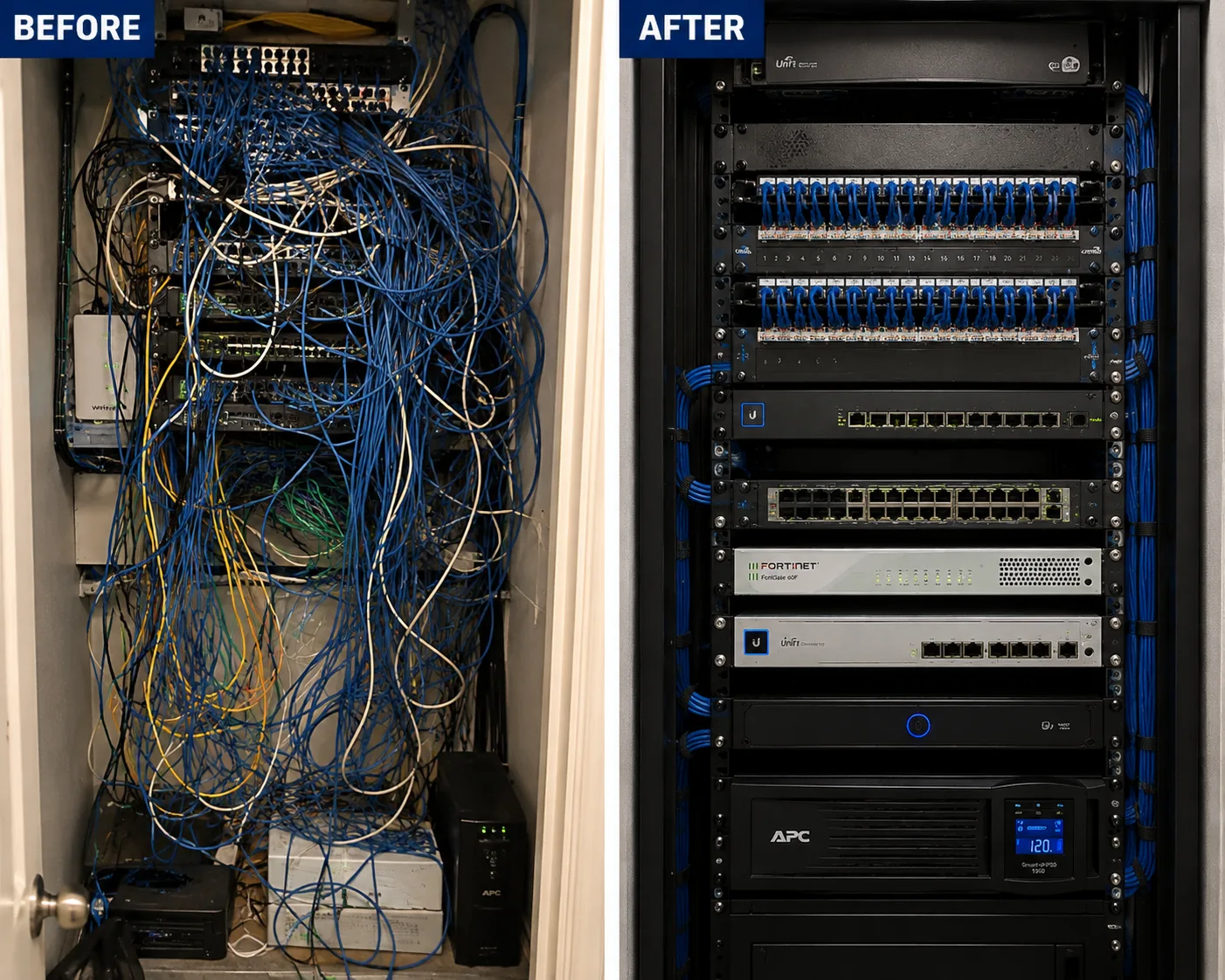
Marine Park, Brooklyn TV wiring cleanup: before and after views of a network rack, tangled and unlabelled on one side, dressed and identified on the other
A photo from our job library, not taken in Marine Park: the same network rack before and after a cleanup, a tangle of unlabeled cables on one side and dressed, identified cables on the other. The back of a TV console in a Marine Park living room, with a cable box, a game console, a soundbar and a streaming stick, can look like the left side. We leave it looking like the right.

A national chain, an app-booked handyman or a licensed local installer

Electronics stores and handyman apps both book TV mounting in Brooklyn. Taskrabbit's Brooklyn page lists 4,056 featured TV mounting Taskers and says mounting "starts at $45 per hour." That can work well for a TV on drywall. The difference shows up on the walls Marine Park actually has. Here is how the choices compare on the things that matter here.

What the job needsStore or app bookingAbstract Enterprises Security Systems in Marine Park
Knowing the wall before the visitOften assumed to be drywallRead from your photos, confirmed with a hidden pilot hole
Plaster, brick and stoneDepends on who is sentPriced add-ons: +$45 plaster, +$65 brick or stone
Over a fireplaceVaries+$130, with a heat and height check first
Hidden powerVariesIn-wall kit, $169, never a cord inside the wall
Network to the TVUsually not offeredWired lines from the basement, tested and labeled
License and insuranceVaries by providerNYS license #12000287431, insured, certificate on request

We are not the cheapest name on an app, and we do not try to be. What we are is a licensed security and low-voltage company that has been owner-operated since 2002, with the same technicians who wire cameras and networks hanging your TV, and with every price published before you book.

AI Overview Reality Check

What AI Gets Wrong About TV Installation in Marine Park

These are claims that show up in generic online answers and cost guides about TV mounting. Each is fine as a general rule somewhere. Here is what each one misses in a Marine Park house.

"TV mounting costs about $254"

Angi's cost guide gives a national average of $254, with a typical range of $154 to $354, and HomeAdvisor puts it at $155 to $350. Those are averages built from many cities and many kinds of wall, and most of them are drywall.

Marine Park houses are mostly plaster and brick, and a lot of the TVs here go over a fireplace or into a basement. Angi's own figures show brick from $50 to more than $600 and an above-fireplace mount from $175 to $400. An average does not know which wall is yours.

Our list starts at $179.99 and shows every add-on: $45 for plaster, $65 for brick or stone, $130 over a fireplace, $59 for a cord cover. Your total is the sum of the lines that apply, and you see it before you book.

"Just find a stud"

Generic guides start with a stud finder. On drywall over wood studs that works. On the outside wall of a brick Tudor, there may be no studs at all, just plaster laid onto brick.

A Brooklyn homeowner in the Brownstoner forum said it about his own house: "the fireplaces are on the party walls with no studs, just plaster over brick." A stud finder on that wall either finds nothing or beeps everywhere, and someone who trusts it ends up putting screws into plaster.

We confirm the wall with one small pilot hole hidden behind the bracket. If it is brick, the bracket goes into the brick. If it is lath, we find the studs behind the lath. The scanner is one tool, not the answer.

"Hide the wires by running them inside the wall"

Many answers suggest cutting two holes and pushing the cords down inside the wall. That is a shortcut with a real risk: the TV's own power cord and ordinary extension cords are not made to go inside walls.

In a Marine Park house there is a second problem. Brick, stone and plaster-on-brick walls are solid, so nothing can be fished inside them at all. The in-wall answer only works on framed walls.

On framed walls we use an in-wall power and cable kit made for the purpose, $169 on our list. On masonry we use a paintable cord cover, a console, or an outlet behind the screen put in by a licensed electrician with a permit, as the NYC Department of Buildings requires for any change to the electrical system.

"A TV goes 42 inches off the floor, everywhere"

Taskrabbit's height guide puts the center of the screen around 42 inches from the floor, based on average seated eye level. That is a good starting point for a flat-floored room with a sofa.

It is not the answer for a sunken Tudor living room watched from two levels, for a screen over a mantel, or for a basement rec room where people watch from a sectional set back against the far wall. Even the same guide says that above a fireplace the TV should go "as low as safely possible above the mantel."

We mark the screen with painter's tape and check it from the seats that matter in your room before anything is drilled. Height is set for the people who watch, not for a number.

"You can mount over any fireplace"

Some answers treat the space over a mantel as just another wall. A working fireplace puts heat right where the TV would hang, and a TV over a high mantel is uncomfortable to watch.

Marine Park has both kinds of fireplace: working wood-burning ones like the one Brownstoner noted at 3622 Avenue R, and openings that were removed and patched. HomeAdvisor advises testing the temperature at the spot and avoiding anything over 100°F. A closed-up opening raises a different question: what is the patch made of, and is it safe to fix into?

We check the heat, the mantel and the patch before agreeing to mount over a fireplace. When the honest answer is another wall, we say so.

"Anyone with a drill can mount a TV"

Angi notes that there is no license for TV mounting itself, and app marketplaces list thousands of people willing to do it. On a new drywall wall, a careful handyman can do a good job.

The risk in Marine Park is not the drilling. It is the decisions around it: which fixing for 1930s plaster, how deep the brick is behind it, whether a closed fireplace is safe, whether the cable can go inside the wall at all, and where a new outlet is electrician's work. Getting those wrong is how TVs end up leaning off walls.

We are a licensed low-voltage contractor, NYS license #12000287431, insured, and we have been owner-operated since 2002. That does not make the drill different. It makes the decisions before the drill accountable.

"A wall mount protects your TV from theft"

Some product listings and answers suggest a wall mount secures a TV. Most brackets are made to let a TV be lifted off for service, and anyone with a few minutes can take it down.

In February 2026, News 12 reported two smart TVs carried out of a Marine Park home on East 34th Street in the afternoon. Nothing in that report suggests a bracket would have made a difference, and we will not claim it would.

What helps is keeping a large screen out of view from the sidewalk, recording its serial number, and, if you want, adding cameras or an alarm. We talk through placement on every job and leave the rest to your choice.
Not Sure What Is Behind Your Plaster? Ask Before You Buy a Bracket

If you do not know whether your TV wall is plaster on lath, plaster on brick or something a previous owner added, ask first. Call now at (347) 934-8335, send a fast quote request, or send wall photos to a technician on WhatsApp. Same-day estimates are available on most days, and we usually reply within two hours.

Get In Touch

Request a Free Quote

Tell us the cross streets, the kind of house, the room, the TV size and what the wall is like, and attach photos if you can: the wall straight on, the nearest outlet, and the sticker on the back of the TV. A technician will call back with the total from our Brooklyn list, usually within two hours. If the TV is already hanging badly, skip the form and call (347) 934-8335 now.

✅
Request Sent!
Thank you. A technician will call you back about the Marine Park address, usually within two hours.
How It Works

Our Installation Process

1. Send photos of the wall and the TV

The wall straight on, the nearest outlet, the TV's model sticker and your cross streets. We work out the wall type and the total from the Brooklyn list.

2. Book a two-hour arrival window

Pick the window, tell us where to park, and say which floor or building the TV is going in. The job is scheduled once the booking link is paid.

3. Read the wall

Scanner, a knock along the wall and one small pilot hole hidden behind the bracket, to confirm plaster, brick, stone, paneling or drywall.

4. Mark the screen and check it from the seats

Painter's tape shows the screen on the wall. We check it from the sofa, from any step or doorway that looks into the room and from the table.

5. Fix the bracket into the right material

Lag bolts into wood framing, sleeve anchors deep into solid brick, toggles where a wall is hollow. Never plastic plugs in plaster.

6. Hang the TV and manage the cables

The TV goes up and is leveled. Cables go into an in-wall kit, a cord cover or a console, as agreed when you booked.

7. Connect and test every device

Cable box, streaming device, soundbar and any wired network line, tested with your own remote and apps.

8. Clean up and hand over

Dust vacuumed, drop cloths up, the room put back, and a quick walk-through of how everything works before we leave.

Coverage Area

TV Installation Near Marine Park's Landmarks

Marine Park

The 530-acre park at the neighborhood's southern end, ringed by the house blocks we work on most.

Salt Marsh Nature Center

At East 33rd Street and Avenue U, the NYC Parks nature center that marked 25 years in 2026.

Hendrick I. Lott House

At 1940 East 36th Street, a house incorporating a 1720 homestead, a city landmark since 1989.

Marine Park Golf Course

The 18-hole public course designed by Robert Trent Jones Sr., open since 1964.

Gerritsen Creek

The westernmost inlet of Jamaica Bay, running into the park from the south.

Kings Plaza

The shopping center that Brick Underground places right over the border on Flatbush Avenue.

We also serve Flatlands, Bergen Beach, Canarsie and East Flatbush, along with Mill Basin, Gerritsen Beach, Sheepshead Bay and Midwood on Marine Park's other sides. Crews come from our Troy Avenue office in Brooklyn, and every one of these areas is billed at the same Brooklyn rate.

Pricing

TV Installation Cost in Marine Park

Marine Park is billed at our Brooklyn rate, the same as every other Brooklyn neighborhood. The base price covers a TV up to 55 inches on drywall over wood studs; the wall, the position and the extras are added line by line. Brackets are sold separately, or we install one you already own if it is rated for the TV. Screens larger than 55 inches are priced from the full list on our Brooklyn TV installation page.

ItemBrooklyn price
TV wall mounting, up to 55", drywall on wood studs (bracket separate)$179.99
TV placed on its stand, no wall mount$119.99
Setup-only visit (smart TV, apps, cable box, devices)$195 first hour, then 30-minute blocks
Plaster wall add+$45
Brick or stone wall add+$65
Above-fireplace mounting add+$130
In-wall concealment with code-compliant in-wall power and cable kit$169
Paintable cord cover$59
Soundbar wall-mounted$129
Soundbar placed$79
Take down old TV$85

How a Marine Park total adds up. Start with the base, add the one wall charge that matches the wall the bracket is fixed into, add the fireplace charge if the TV goes above a mantel, and add the cable choice and any soundbar. A wall is charged once, by the material the fixings go into: a plaster wall laid straight onto brick is priced as brick, because the anchors are set in the brick. If the wall turns out different from what the photos suggested, the technician shows you the pilot hole and the total is adjusted to the matching line on the list before the bracket goes up, never after.

What is not on the list. We do not patch or paint walls, and we do not do electrical work. If a new outlet or circuit is needed, it is done by a NYC Licensed Master Electrician with a permit, and we plan the TV around it. A wired network line to the TV is quoted separately after we see where the internet comes into the house.

Full terms — including 50% deposit, one-year parts-only warranty on Abstract Enterprises Security Systems-supplied products, and the late-fee schedule — are set out in the service agreement.
Shop Our Systems

TV Installation Packages & Pricing

Three typical Marine Park jobs, each added up from the list above for a TV up to 55 inches. Brackets are extra unless you supply a rated one.

Frame-house starter: $283.99

A TV on the plaster wall of a bedroom or front room in a frame house ($179.99 + $45), with a paintable cord cover down to the outlet ($59). The usual first step for a TV coming off a dresser.

Party-wall standard: $432.99

A TV on the brick party wall of a semi-detached house ($179.99 + $65), a soundbar mounted under it ($129) and a paintable cord cover ($59), with the cable box on a console below.

Tudor mantel premium: $588.99

The old TV taken down ($85), and a new one hung over the fireplace on the brick chimney breast ($179.99 + $130 + $65), with a soundbar on the wall below the screen ($129).

Bring your own equipment. If you already own a bracket, we install it at the labor prices above as long as it is rated for your TV's weight and size and suits the wall. The same goes for your own soundbar bracket or cord cover. We check the bracket's rating and condition when we arrive, and we will tell you if a used bracket from an old TV is not up to the new one.

Setup without mounting. If the TV is staying on its stand but the apps, the cable box, the soundbar and the remote all need setting up, the setup-only visit is $195 for the first hour and then priced in 30-minute blocks. Placing a TV on its stand without wall mounting is $119.99.

Complete Services

Every TV Installation Service in Marine Park

Wall mounting

Plaster, brick, stone, paneling and drywall, in every room of the house. Request a quote

Fireplaces and wire hiding

Over the mantel, in-wall kits and cord covers. Ask about your wall

Sound and setup

Soundbars, streaming devices and full setup across the borough. Brooklyn TV installation

Booking terms

Payment, rescheduling and what is included. TV installation policies

FAQ

Marine Park TV Installation FAQ

Is a TV over a gas insert handled the same way as one over a wood-burning fireplace?
+

Not quite. A wood fire throws heat up the face of the chimney breast, so we check the temperature where the TV would hang and avoid spots that go above about 100°F. A gas insert usually comes with a manual that lists clearances for anything mounted above it, and we follow those figures. Either way, above-fireplace mounting is the same $130 add on our Brooklyn list.

Does the technician need to get into our basement if the TV is going on the main floor?
+

Only if the job needs it. A TV with a cord cover or a console needs nothing below. An in-wall kit on a framed wall, or a wired network line from where the internet comes in, often runs through the basement ceiling, so we ask you to clear a path to that spot when you book.

Our TV was hung too high over the mantel years ago. Can you bring it down to a lower spot on the same chimney breast?
+

Yes. Taking down the old TV is $85, and the rehang is priced from the list like a new mount: $179.99 for a TV up to 55 inches, $65 for brick, and $130 if it still sits above the fireplace. A tilting bracket set just above the mantel usually solves the sore-neck problem without moving to a different wall.

Will you patch the holes left by the previous owner's TV bracket?
+

No. We do not patch or paint walls. If the new bracket covers the old holes we plan for that, and if it does not, a painter or handyman can fill them before or after our visit. We check the old fixings and avoid reusing holes that have been weakened.

Can a TV go on the wall of a hallway or a stair landing?
+

Sometimes, but we are careful. A screen in a hallway must not stick out into the path, and one on a stair landing must not sit where someone could hit it while carrying things up or down. A flat bracket and a height above shoulder level usually work, and we will say so if the space is too tight.

If something comes up, can we move our two-hour arrival window?
+

Yes, within the rescheduling terms on our TV installation policies page. Let us know as early as you can, and we will offer the next windows we have. The sooner we hear, the easier it is to keep a slot close to the one you had.

Will the cables you run be labeled so the next person knows what they are?
+

Yes. Every network or video line we run between rooms gets a label at both ends, at the wall plate or console and at the spot in the basement where it starts. The labels match what we write on your hand-over sheet, so an internet installer or a future buyer can tell which line feeds which room.

How do we pay, and when is the job confirmed?
+

Once the total is agreed, we send a booking link, and the job goes on the schedule when it is paid. The full payment and rescheduling terms are on our TV installation policies page.

What if the stone around our fireplace turns out to be a thin facing rather than solid stone?
+

Then the anchors go through the facing into the brick or block behind it, and they are sized long enough to reach it. If the facing is loose or cracked, we will not fix into it and will suggest a position on the solid part of the chimney breast instead. Stone and brick are the same $65 add on our list.

Can a swing-out arm go on a 1930s plaster wall, or only a flat bracket?
+

An arm can go on plaster only if it is fixed into what is behind the plaster, either wood studs or solid brick, because an arm pulls on the wall much harder than a flat bracket. If the studs are in the wrong place for the screen and the wall is not brick, we will recommend a tilting bracket instead.

We are selling the house. Can you just take the TV off the wall and leave it for the movers?
+

Yes. Taking down an old TV is $85 on our Brooklyn list. We take the screen off the bracket, lay it flat on a blanket or back in its box if you still have it, and leave the bracket on the wall or remove its bolts as you prefer. We do not patch the holes afterwards.

What does the Tudor mantel package include, and what does it leave out?
+

It covers taking down the old TV for $85, mounting the new one up to 55 inches over the fireplace on the brick chimney breast for $179.99 plus $130 plus $65, and a wall-mounted soundbar for $129, which totals $588.99. It does not include the bracket, an electrician's outlet or patching, and a larger screen is priced from the full Brooklyn list.

More TV Installation near Marine Park

TV Installation Brooklyn NY · TV Installation NYC · TV Installation Manhattan NY · TV Installation Queens NY · TV Installation Bronx NY · TV Installation Staten Island NY · TV Installation Long Island NY · TV Installation Hudson Valley · TV Installation Nassau County NY · TV Installation Suffolk County NY · TV Installation Westchester County NY · TV Installation Rockland County NY · TV Installation Orange County NY · TV Installation Putnam County NY · TV Installation Dutchess County NY · TV Installation Ulster County NY

TV Installation Bath Beach Brooklyn | (347) 934-8335 · TV Installation Bay Ridge Brooklyn · TV Installation Bedford-Stuyvesant Brooklyn · TV Installation Bensonhurst Brooklyn NY | Wall Mounting · TV Installation Bergen Beach Brooklyn NY | Wall Mounting · TV Installation Beverley Square Brooklyn · TV Installation Boerum Hill Brooklyn · TV Installation Borough Park Brooklyn · TV Installation Brighton Beach Brooklyn · TV Installation Brooklyn Chinatown Brooklyn · TV Installation Brooklyn Heights · TV Installation Brooklyn Navy Yard Brooklyn · TV Installation Brownsville Brooklyn · TV Installation Bushwick Brooklyn · TV Installation Cadman Plaza Brooklyn · TV Installation Canarsie Brooklyn · TV Installation Carroll Gardens Brooklyn · TV Installation City Line Brooklyn · TV Installation Clinton Hill Brooklyn · TV Installation Cobble Hill Brooklyn · TV Installation Columbia Street Waterfront Brooklyn NY · TV Installation Coney Island Brooklyn · TV Installation Crown Heights Brooklyn NY | Wall Mounting · TV Installation Cypress Hills Brooklyn | (347) 934-8335

Other services in Marine Park

Intercom Installation Marine Park Brooklyn NY · Fire Alarm Installation Marine Park Brooklyn NY · Door Buzzer Repair Marine Park Brooklyn NY | Bells & Lobbies · Structured Cabling Installation Marine Park Brooklyn NY · Security Camera Installation Marine Park Brooklyn NY · Door Buzzer Installation Marine Park Brooklyn NY · Security Camera Repair Marine Park Brooklyn NY | Abstract Enterprises Security Systems · Alarm Installation Marine Park Brooklyn NY | Doorstep-First · Access Control Installation Marine Park Brooklyn NY

Ready to Get the TV Out of the Box and Onto Your Marine Park Wall?

Send a photo of the wall, the nearest outlet and the TV's model sticker with your cross streets, and we will tell you what the wall is likely to be and what the job costs on the Brooklyn list. Call or text (347) 934-8335, message us on WhatsApp, or use the request form. Licensed under NYS license #12000287431, rated 4.7★ across 201 Google Reviews, owner-operated since 2002 and usually booked within two hours.