Buzzer and intercom service for the prewar six-stories on the heights — buildings that have quietly grown more households than their lobby panels were ever built to serve, directories drifted out of date, buttons doing double duty, risers still sound underneath it all. Ryer, Walton and Anthony to the Concourse flank. NYS-licensed, one published rate, the panel reconciled with the building as it actually lives.
Fordham Heights is the high ground between the Concourse and the valley, and its signature building is the prewar six-story that has lived three or four lives since the panel went in. Apartments divided, households doubled, generations layered — and downstairs, a lobby panel still describing the building of 1965: eight buttons for more homes than that, paper names taped over brass frames, one button quietly serving two doors, and a directory nobody fully trusts. The wiring underneath is usually sound — these risers were built as infrastructure — but the map between the panel and the people stopped being true years ago, and every repair that ignores that gap just adds another layer of confusion.
Our work here starts with the reconciliation: the panel, the basement terminal board and the building as actually lived get brought back into one honest map — buttons landed on the doors they really serve, shared buttons untangled where the wiring allows, labels made true, orphaned lines identified instead of guessed at. Then the ordinary trade proceeds on solid ground: contacts cleaned on hard-worked buttons, supplies metered when a whole panel browns out, releases proven lobby to latch, one household’s silent line repaired without touching the neighbors’. One rate covers the heights, Ryer to the Concourse flank, E 184th to the park edge.
Component-level diagnosis. We isolate the failed part before quoting a replacement.
Certificates of insurance issued to owners, boards, and managing agents before work starts.
WHY FORDHAM HEIGHTS
Lobby panel diagnostics — isolating the fault before any quote.
When the Panel Stops Matching the Building
The heights’ buildings did what Bronx buildings do: they absorbed decades. Apartments were divided and re-divided, households grew and layered, and the entry system downstairs never got a vote. The result is the neighborhood’s defining fault pattern — not broken wiring but a broken map. A panel with eight buttons serving more homes than that. A directory whose paper labels describe tenants two turnovers gone. One button wired, somewhere along the way, to ring two doors at once — a convenience in 1988, a mystery today. Visitors guess, deliveries fail, and every service call that treats a symptom without fixing the map leaves the building one layer more confusing than it found it.
So the method here leads with reconciliation. The lobby panel and the basement terminal board get read together and tested against the building as actually lived: which button lands on which door, which lines are shared, which are orphaned, which labels are fiction. Then the map gets corrected as far as the wiring honestly allows — shared buttons untangled where spare pairs exist, labels brought true everywhere, orphaned lines documented instead of guessed at — and the finding leaves the building with something it may not have had in decades: a panel that tells the truth.
Underneath the confusion, the infrastructure is usually the good news: prewar risers on Ryer, Walton and Anthony were built as plant, and they test sound far more often than not. The faults that remain after reconciliation are ordinary ones — worn contacts on hard-used buttons, supplies sagging under whole-panel load, one household’s pair opened somewhere findable — and ordinary faults get ordinary, component-priced repairs.
Component-level service on everything the heights run.
Panel-to-Building Reconciliation
The neighborhood’s signature job: panel and basement board read together, tested door by door, and corrected to the building as lived — buttons landed true, labels made honest, the map documented for the next decade.
Shared & Crossed Buttons
One button ringing two doors, or the wrong door entirely: untangled where spare pairs exist, documented plainly where they do not — and never left as folklore for the next tenant to discover.
The complaint we hear most: the buzzer sounds and the door stays shut.
Hard-Worked Lobby Panels
Sixty years of thumbs on the same buttons: contacts cleaned, buttons re-seated, worn units replaced in kind — the panel kept alive at the component because the platform underneath is usually sound.
Risers & Apartment Lines
One household silent while the building works: the pair toned from the basement board, the fault named to a floor and a location, and the repair touching one line while every neighbor’s service continues.
Releases, Strikes & Panel Supplies
Releases proven lobby to latch, electric strikes matched to prewar doors, transformers and supplies metered when a whole panel browns out — replaced at spec for the load the building actually presents.
Apartment Stations & Handsets
Handsets and stations of any vintage, repaired or replaced alone and compatible with the system they join — one household’s fix, no building project attached, owner approval papered where the door is rented.
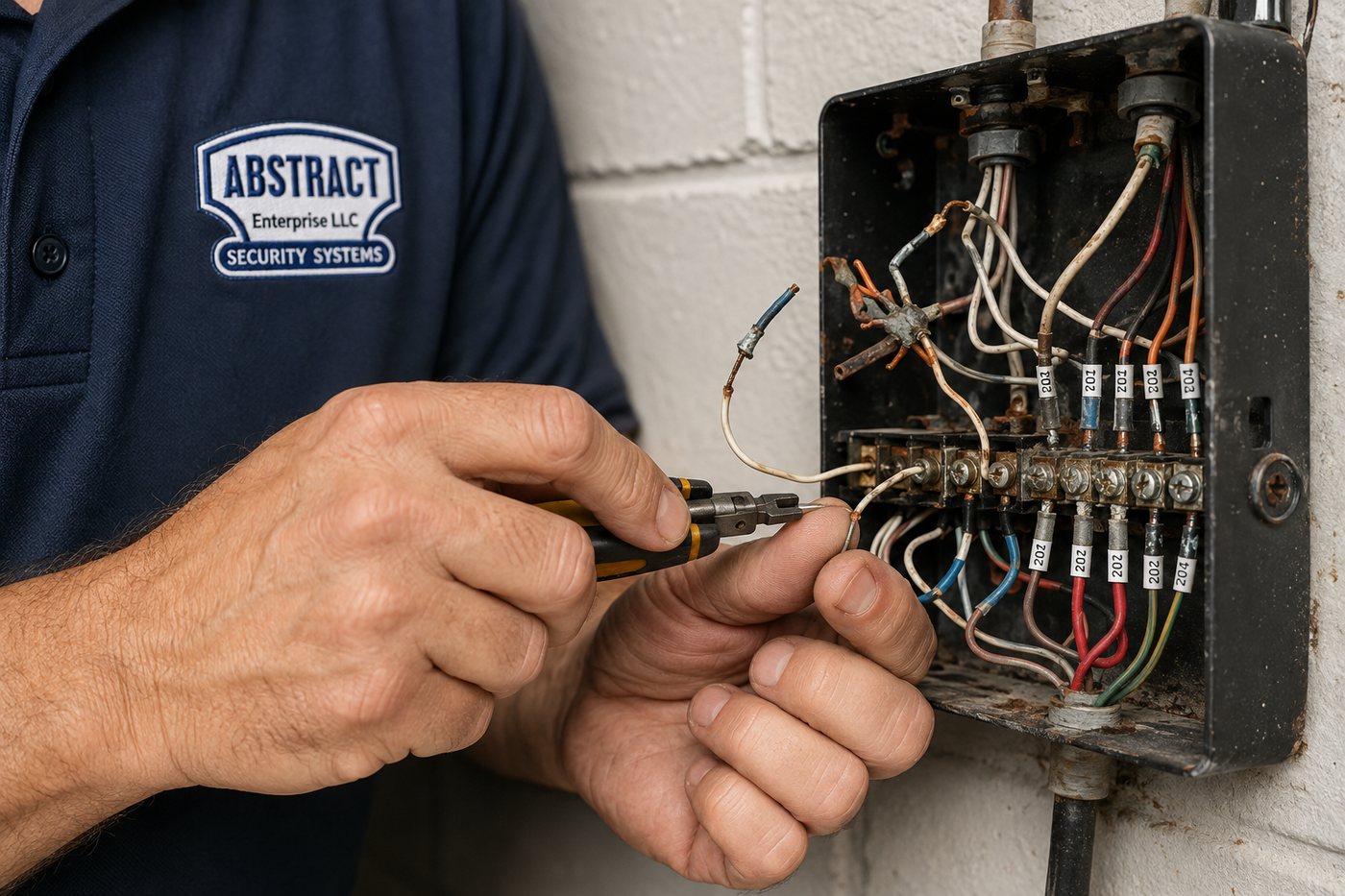
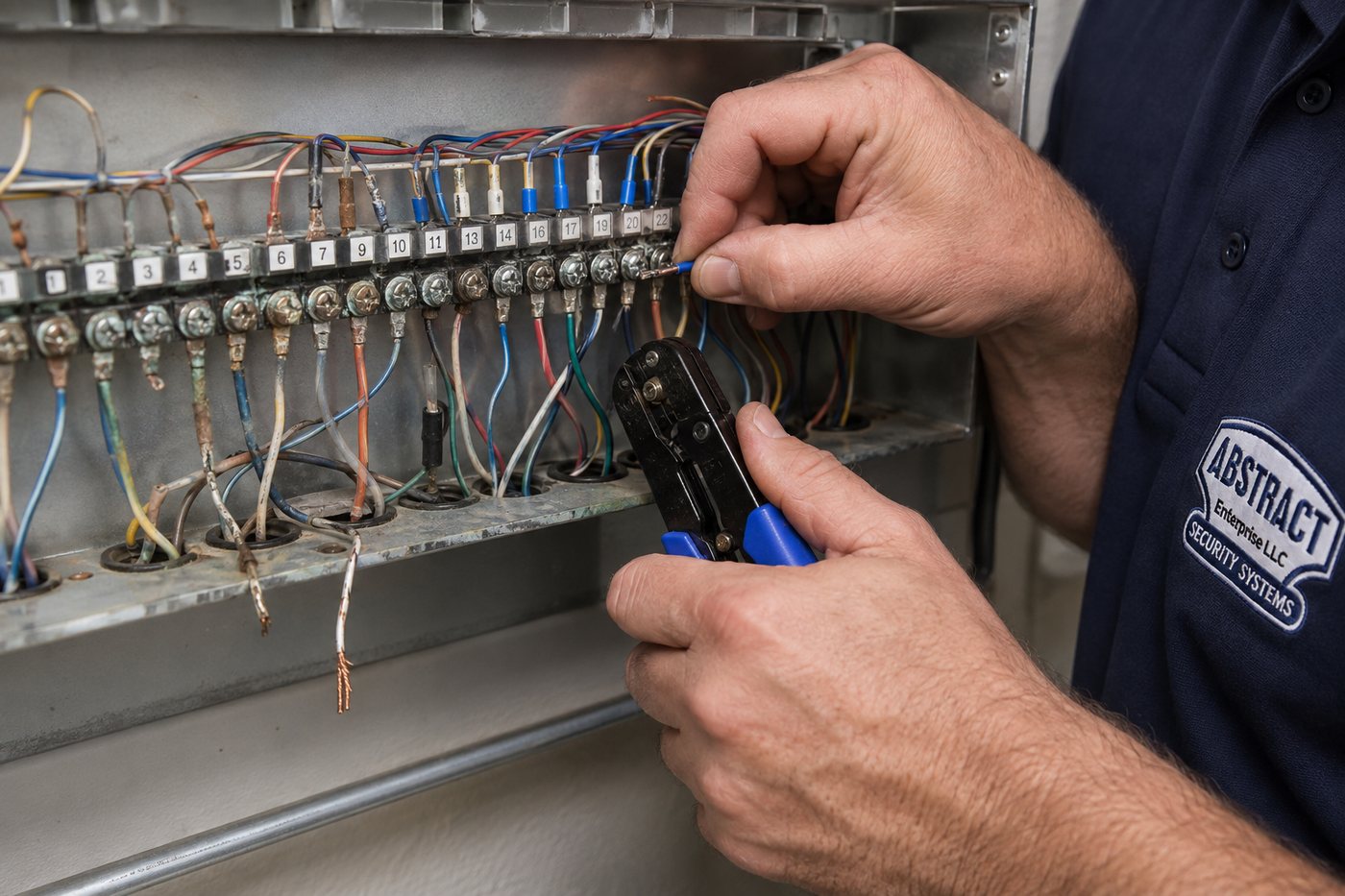
Terminal testing behind a stainless lobby panel.
Called From the Heights, Handled at the Door
However the phrase gets typed — door buzzer repair near me from a Walton Avenue lobby, local door buzzer repair for a Ryer Avenue six-story, a licensed door buzzer repair company a manager can verify before anyone touches a panel, emergency door buzzer repair when a whole building goes quiet — it resolves to the same door buzzer repair service, the same door buzzer repair technician bench, and a free door buzzer repair estimate by phone before anyone rolls.
residential door buzzer repair & building door buzzer repair across the prewar stock
apartment door buzzer repair & apartment buzzer repair in the subdivided six-stories
condo door buzzer repair & co-op door buzzer repair where the heights’ buildings converted
multifamily building buzzer repair at whatever count the building really holds
tenant door buzzer repair with approval · landlord door buzzer repair service
property management buzzer repair — door buzzer repair for landlords, door buzzer repair for property managers
same-day door buzzer repair & same-day apartment buzzer repair
emergency apartment buzzer repair & emergency front door buzzer repair
fix apartment door buzzer · replace apartment buzzer only when the open system proves it
commercial door buzzer repair & commercial building buzzer repair on the mixed-use corners
storefront buzzer repair · business door buzzer repair where shops share the residential door
office door buzzer repair & medical office buzzer repair on the surrounding blocks
school door buzzer repair near the park blocks · warehouse door buzzer repair toward the working edges
commercial building entrance buzzer repair & front entrance buzzer repair
door strike repair & electric strike repair on prewar doors
door release button repair & door buzzer button replacement
door buzzer transformer repair · door buzzer transformer replacement · buzzer power supply replacement
door buzzer wiring repair · door release wiring repair · door buzzer wiring replacement
The map fault in person: a button landed on a different line than its label claims, somewhere in the decades of changes. Ended by reconciliation — the button tested to its true door, the label corrected, the folklore retired.
One button rings two apartments
The shared-button special: a convenience splice from some earlier era, now a daily confusion. Untangled onto spare pairs where the riser holds them, documented honestly where it does not — either way, no longer a mystery.
The whole panel browns out at once
Every button weak or dead together points at the supply, not the buttons: metered first, replaced at spec for the load the building actually presents — and the panel wakes up whole.
Basement amplifier cabinet feeding the building riser.
One household silent, the building fine
A pair fault with an address: toned from the basement board, named to a floor and a location, repaired without touching a neighbor’s line — the prewar riser doing what it was built to do around the fix.
The heights’ call log, verbatim: door buzzer not working · apartment buzzer not working · building buzzer not working · apartment buzzer stopped working · buzzer works but door won’t open · door buzzer rings but does not unlock · door buzzer rings but electric strike will not unlock · electric door lock not releasing · buzzing sound but door won’t open · door release button not working · buzzer button not working · door buzzer has no sound · intermittent door buzzer problem · door buzzer wiring problem · door buzzer power supply problem · broken door buzzer system. Door buzzer troubleshooting turns each phrase into a component and a place on the map, and door buzzer and electric strike troubleshooting always run as a pair — because the ring side and the release side fail on separate clocks in every subdivided six-story on the hill.
ACROSS FORDHAM HEIGHTS
Ryer to the Concourse Flank
The service map runs the whole hill: Ryer Avenue’s six-story rows, Walton and Anthony climbing the grade, the Grand Concourse’s east flank blocks, E 183rd and 184th across the middle, the 187th-and-188th blocks toward the retail spine, and the edge by St. James Park where the neighborhood meets its neighbor — with the 182nd–183rd Streets B/D station putting the whole hill minutes from our shop. Border addresses shading toward Fordham, Concourse, Mount Hope or Bedford Park get served without the boundary debate — one shop, one rate, one tech who reads the basement board before believing the lobby panel.
BUILDING TYPES
Six-Stories, Walk-Ups and the Mixed-Use Corners
The prewar six-stories get the full method: reconciliation first, then component repair on infrastructure that was built to last — and a documented map that outlives the visit. Subdivided buildings get their reality respected: the panel corrected to the households that exist, shared buttons untangled where the wiring allows, and honesty on paper where it does not. Prewar walk-ups get the same bench at smaller scale. Mixed-use corners — shops sharing the residential door on the avenue blocks — get the shared entrance’s duties split correctly between the business and the homes above. And every rented door gets its paperwork straight: owner duties documented, tenant reports routed through approval, findings written for whoever holds the decision.
The commercial thread stays honest and nearby: a door buzzer specialist for the storefront corners where shops and apartments share an entrance, a multifamily building door buzzer technician for six-stories at whatever count they really hold, and a door buzzer repair service scaled from one silent line to a full-panel reconciliation — on the identical published rate.
OWNERS AND TENANTS
Whose Duty, Whose Approval, Whose Bill
The heights’ buildings are multiple dwellings, and the city treats their entry systems accordingly: a working buzzer or intercom is the owner’s obligation, tenants report dead systems to management and can escalate through 311 when silence persists, and repairs get authorized by the owner, the manager or the super. Subdivision complicates the map but not the duty — every household behind the door is owed a working line to the lobby, whatever the panel’s button count claims. We paper the arrangements cleanly: tenant reports routed through owner approval, management authorizations documented, and reconciliation findings written so an owner can see exactly what the building has become and what the panel now truthfully says. Terms hold across the hill: $195/hr, three-hour minimum, everything in writing. What is said here about obligations is general information rather than legal advice; the current rules live with the city, and genuine disputes belong with HPD or an attorney.
Electric strike service at the frame — the most common failure point.
The Fordham Heights Repair Slip
Subdivided buildings, standard names: entry buzzer, apartment entry system, building entrance system, visitor entry system, door release system, building access system — on the hill those labels run from a six-story’s lobby entrance buzzer serving a building’s true count to a divided walk-up’s front vestibule buzzer serving more doors than its brass ever planned, and beneath each sits the same chain: a door release button, the electric strike it commands, the buzzer transformer and buzzer power supply behind the circuit, the entry system wiring running lobby to apartment, and on modernized doors a remote door release riding a phone.
The map. The correspondence between panel, board and building — the thing that broke first on the heights, and the thing every repair here restores or respects.
Reconciliation. The signature job: panel and basement board read together, tested door by door, corrected to the building as lived, documented for the next decade.
Shared button. One button, two doors — an old convenience turned daily confusion. Untangled where spare pairs exist; documented honestly where they do not.
Orphaned line. A pair that no longer lands anywhere the building remembers. Identified and recorded — never guessed into service.
The true count. The households the building actually holds, whatever the panel claims — the number the reconciliation answers to.
Basement board. The terminal panel that remembers the building as built — the starting document for every honest map.
Directory truth. Labels that match the living building — the cheapest repair on this page and the one visitors notice first.
Brown-out. Every button weak together: a supply fault, not a button fault. Metered first, replaced at spec, panel wakes whole.
Release path. Button to strike, end to end. Heard but never admitted means the fault lives here and nowhere else.
Lobby quote. The finding written for whoever holds the decision — plain language, photographs, the corrected map attached.
Apartment station. Handset or unit, any vintage. Fails alone, replaced alone — no building project attached.
Platform vs. part. The repair-or-replace question in four words: parts fail cheap and often, platforms rare and dear — and under the confusion, these platforms are usually sound.
HOW IT WORKS
A Fordham Heights Visit, Board to Button
Call with the address, the door and the symptom. Panel, line, release or directory — and whether the wrong apartment has been answering. Most calls by early afternoon land same-day from our shop at 460 E Fordham Rd, minutes from the hill.
Read the basement board before believing the panel. The board remembers the building as built; the visit starts with the honest document and works up.
Test the map door by door where the symptom demands it. Buttons landed to their true doors, shared and crossed lines identified, orphans recorded — the fault located inside a corrected picture, not a folklore one.
Repair within the visit wherever parts allow. Contacts, buttons, pairs, strikes, supplies and stations ride in the kit — most heights repairs close inside the standard window once the map is true.
Leave the lobby quote or the closed slip — with the map. Finding, work, parts, total, and the corrected panel-to-door map documented so the next repair starts where this one finished.
Fordham Heights Buzzer Questions, Answered in the Lobby
What does buzzer repair cost in Fordham Heights?
The published figure across the hill: $195/hr with a three-hour minimum ($585), parts billed separately at honest prices — a Ryer Avenue six-story and a Concourse-flank corner pay the same rate. That window covers most repairs whole: a silent line toned and fixed, contacts cleaned across a panel, a supply replaced, a release proven and repaired, a directory brought true. Full-building reconciliations get scoped honestly and quoted in writing where they run past the window.
Relay bank service. Welded contacts leave the entrance unlocked.
Visitors keep ringing the wrong apartment — is our wiring bad?
Usually the wiring is fine and the map is wrong: somewhere in the decades, a button got landed on a different line than its label claims, and every visitor since has been navigating fiction. The fix is reconciliation — the button tested to its true door, the label corrected — and it is cheaper than the years of confusion it ends.
One button rings two apartments in our building — can that be separated?
Where the riser holds spare pairs, yes: the shared splice gets found, the second door gets its own line, and both households get their own button. Where no spare pair exists, the honest answer is documentation and a written option for adding capacity — but never a mystery left for the next tenant to inherit.
Our panel has eight buttons but the building has more homes than that — what are our options?
Three honest ones, in order of weight: reconcile what exists so every button lands true and the sharing is at least documented; expand capacity on the existing platform where the panel’s family allows added stations; or replace the panel with one sized to the true count — written, priced, and proposed only when the smaller answers genuinely fall short.
Can we fix a single household's station when the panel serves more homes than it was built for?
Yes — one station fails alone and gets repaired or replaced alone, on its own line, regardless of the panel’s larger confusion. Where the door is rented, the owner’s approval rides along; the building’s bigger map question waits for the owner’s own decision.
In-unit handset service. Cord conductors fatigue where they flex.
The whole panel went weak at once — do we need a new system?
Almost never — every button failing together points at the supply, not the buttons: the transformer or power supply gets metered first and replaced at spec, and the panel usually wakes up whole. A new system sold off a brown-out is the neighborhood’s classic overcharge, and the meter prevents it.
In a subdivided building, who actually owns the buzzer problem — tenant or landlord?
The owner — a working entry system in a multiple dwelling is the landlord’s obligation, tenants report dead systems to management, and 311 is the escalation when silence persists. Subdivision does not dilute the duty: every household behind the door is owed a working line. We paper tenant-reported repairs cleanly with owner approval. General information, not legal advice.
The paper labels on our panel are decades out of date — is that really a repair issue?
It is the cheapest repair on the page and the one visitors notice first: directory truth. Labels brought current, buttons verified to their doors while the labels change, and the building’s front face finally telling the truth — deliveries, guests and emergency visitors all navigate better the same day.
One apartment has been silent for months while everything else works — big job?
Small one, usually: one silent line is a pair fault with an address, toned from the basement board to a floor and a location, and repaired without touching a neighbor’s service. Months of silence usually means nobody ran the toner — not that the fix is large.
Maglock and power supply under test — life-safety hardware tied to egress.
Do you replace these old prewar panels or keep repairing them?
We keep them alive by default, because the platforms are usually sound: contacts clean up, buttons re-seat, worn units replace in kind, and the riser underneath was built as infrastructure. Replacement gets proposed only when the open system proves the platform is done — or when the true count has genuinely outgrown every honest expansion, priced in writing either way.
How do we know you won't just add another layer of confusion?
Because the map is the deliverable: every visit that touches the panel leaves a documented panel-to-door map — corrected labels, identified sharing, recorded orphans — so the next repair starts from truth instead of folklore. The published rate strips any incentive to inflate, and findings carry photographs. Three-year warranty on products we supply.
PEOPLE ALSO ASK
People Also Ask About Buzzer Repair in Fordham Heights
Who repairs door buzzers in Fordham Heights, Bronx?
Licensed low-voltage contractors — entry-system work is electrical trade work in a six-story lobby as anywhere else. Abstract Enterprises covers the hill from its Bronx shop at 460 E Fordham Rd under NYS License #12000287431, at $195/hr with a three-hour minimum, license verifiable through the Department of State.
Why does an apartment buzzer ring the wrong unit?
Because the map broke: somewhere in a building’s decades of changes, a button got landed on a different line than its label claims. Testing the button to its true door and correcting the label ends it — the wiring itself is usually fine.
Can a buzzer panel serve more apartments than it has buttons?
Only by sharing or fiction, and buildings do both: buttons quietly serving two doors, labels describing households long gone. The honest paths are reconciliation of what exists, capacity added on the existing platform, or a panel sized to the true count — in that order of weight.
Is it expensive to fix a buzzer directory that's out of date?
It is usually the cheapest line on the invoice: labels brought current while each button gets verified to its door. The value lands immediately — visitors, deliveries and emergency access all navigate the building correctly the same day.
What does it mean when every buzzer button is weak at the same time?
A supply fault: the transformer or power supply feeding the panel has sagged, and every button shares the symptom. Metering it takes minutes, replacement at spec is routine, and the buttons were never the problem.
Does a landlord have to fix the intercom in a subdivided Bronx building?
Yes — a working entry system in a multiple dwelling is the owner’s obligation, tenants report failures to management, and 311 is the escalation path when a dead system stays dead. The duty covers every household the building actually holds.
Can one apartment's buzzer line be repaired without a building-wide job?
Yes — one silent line is a pair fault with an address: toned from the basement terminal board, named to a floor and a location, and repaired while every neighbor’s service continues uninterrupted.
How long does a buzzer repair take in an old six-story building?
Most close inside the three-hour service window once the map is read: toning a line, cleaning a panel’s contacts, replacing a supply or a station are same-visit work. Full-building reconciliations get scoped honestly up front and quoted in writing where they run past the window.
Related Searches for Buzzer Repair in Fordham Heights
A visitor ringing the wrong door, one button serving two homes, a whole panel browned out — call it in and it gets triaged today, basement board first. $195/hr, three-hour minimum, findings in writing with the corrected map attached.
The button count never moves the number: $195/hr with a three-hour minimum ($585) — covering the diagnosis and the hill’s real repairs: silent lines toned and fixed, shared buttons untangled where pairs allow, directories brought true, contacts cleaned across hard-worked panels, supplies metered and replaced at spec, releases proven lobby to latch, stations swapped alone. Parts bill separately at honest prices, and the Concourse flank carries no premium over Ryer Avenue.
In shopping terms: door buzzer repair cost and apartment buzzer repair cost equal the rate above, the door buzzer repair price is stated before dispatch, door buzzer technician rates hold flat around the calendar, and emergency door buzzer repair cost matches the daytime sheet — a whole building’s silent panel included. A free door buzzer repair estimate happens on the phone; the cost to fix apartment buzzer faults gets weighed against the cost to replace door buzzer hardware only when the open system proves a platform is done or the true count has outgrown it; and commercial buzzer repair cost on the mixed-use corners runs off the identical figure. Old door buzzer system repair is this hill’s daily bread — prewar veterans kept honestly alive at the contact and the pair; door buzzer replacement, apartment entry buzzer replacement and full door buzzer system upgrade paths get written, true-count pricing when one genuinely ends. Building-scale scopes — repair building buzzer system faults across a subdivided six-story, repair old apartment building buzzer system stock where a panel has honestly aged out — are exactly what the written project quote exists for. Does an electrician repair door buzzers? A licensed low-voltage contractor does — this one — and who is responsible for apartment buzzer repair was answered above: the owner, in every rented building. Three-year warranty on products we supply, no monthly fees, no contracts.
The folklore panel. A building where everyone knows “ring 3B for 4A” and nobody knows why. Ended by reconciliation — the button tested to its true door, the label corrected, the folklore retired after twenty years of service.
The brown-out upsell. A whole panel gone weak and a contractor quoting a full replacement for what a meter would have named as one tired supply. Ended by metering first — and an invoice one-tenth the quote.
The inherited mystery. A shared button splice from 1988, undocumented, rediscovered the hard way by every new tenant since. Ended by untangling it onto a spare pair — and writing down what was done, where, for whoever comes next.
The guessed orphan. A dead line “fixed” by landing it on whatever terminal looked likely, ringing a stranger’s apartment for a year. Ended by toning the pair to its real door — the board consulted before the guess.
The forever-silent 5C. One household without a working buzzer for months because the fault was assumed to be big. Ended in one visit: a pair fault with an address, toned, found, fixed — while the building’s other lines never blinked.
REVIEWS
Verifiable Before We Read Your Board
Check the record before anyone opens a panel: a 4.7-star average across 201 Google reviews between our two locations, the Bronx profile anchored at 460 E Fordham Rd, every review unfiltered on Google Maps. The working evidence — reconciled panels, retired folklore, revived lines — runs on Instagram and YouTube. Owners and managers can request license and insurance paperwork with the first call — standard practice, not a favor.
FIELD NOTES
Field Notes from the Hill
Fordham Heights work is archaeology with a meter. In a Ryer Avenue six-story the complaint is “visitors ring the wrong apartment,” and the basement board tells the real story: the building has grown past its panel, two buttons are quietly shared, and the paper directory describes tenants two turnovers gone. The reconciliation takes an afternoon — buttons tested to their true doors, one splice untangled onto a spare pair, labels finally honest — and the building gets something back it lost decades ago: a front face that tells the truth. On Walton the whole panel has browned out and the manager is braced for a system quote; the meter names the supply in ten minutes and the panel wakes up whole. The risers on this hill were built as plant and they mostly test like it — what breaks here is the map, and the map is what we fix first. — Anwar Timothy, NYS Lic. #12000287431
REPAIR VS REPLACE
Corroded terminals — the usual cause of static and dead lines.
Repair, Replace or DIY on the Heights
Repair: reconcile, then fix
The default across the hill, because the platforms are usually sound and the confusion usually is not: contacts, buttons, pairs, supplies and stations are ordinary components, and half the “broken systems” here are broken maps. Reconciliation makes the diagnosis honest, the published rate strips any incentive to inflate, and platform deaths get demonstrated at the open system with photographs — never asserted from the lobby.
Replacement sized to the true count
Right when a platform is genuinely done, or when the building’s real household count has outgrown every honest expansion of what exists. The honest version reuses the riser where it tests clean, sizes the new panel to the building as lived — not as built — documents the map from day one, and prices on one readable page. It never sells a system to fix a supply, and never installs eight buttons on a building that needs twelve.
Capable supers and the licensed line
Plenty is genuinely in-house: swapping a like-for-like button, resetting a tripped supply, updating paper labels once the buttons are verified, keeping a written note of which apartments ring wrong — the observation that shortens our visit. The line sits at release wiring, anything on the riser or the board, and every rented door: a mis-wired release leaves a building quietly unlocked, and a guessed termination on a subdivided board can ring a stranger’s home for a year. Low-voltage work on occupied multiple dwellings is licensed territory on purpose; the diagnosis visit is the cheap way to learn which side of the line the problem lives on.
RELATED SERVICES
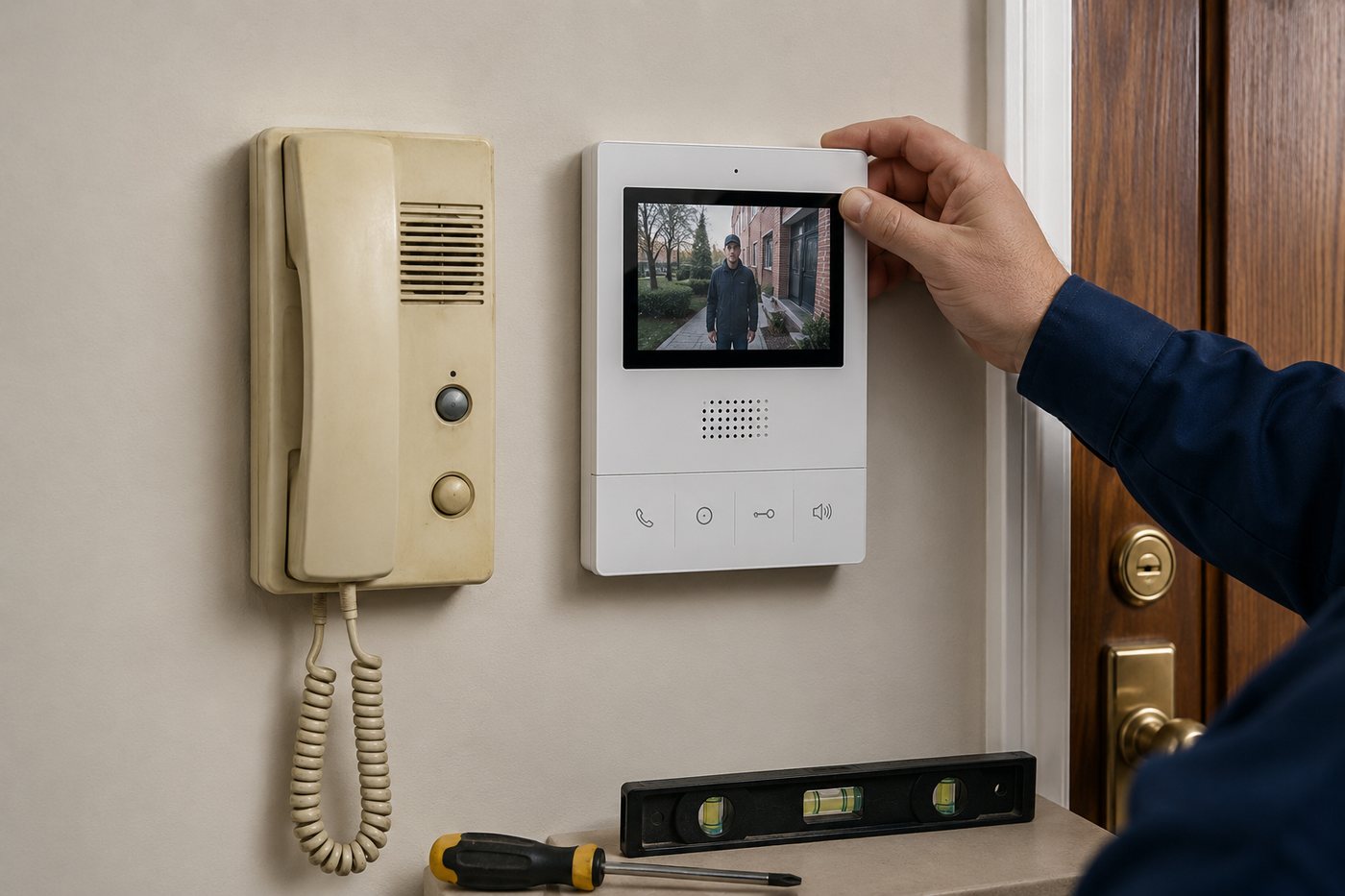
Audio station replaced with a video monitor on the existing pair.
Call with the address, the door and the symptom, or use the form — six-story, walk-up or mixed-use corner, the visit reads the basement board first, tests the map where the symptom demands it, repairs at the component, and leaves a finding with the corrected panel-to-door map attached. A whole building’s silent panel moves to the front of the day.
The board read before the panel is believed — and the map documented before the truck leaves.
Reviewed and updated August 16, 2026.
Tell Us About Your Fordham Heights Building
FAQ
Fordham Heights Door Buzzer Repair FAQ
Is same-day door buzzer repair available in Fordham Heights?
On most weekday calls, yes — ring before early afternoon with the address, the door and the symptom, and the visit usually lands that day from our Bronx shop at 460 E Fordham Rd, minutes from the hill. A whole building’s silent panel jumps the queue, and every booking carries a concrete arrival time.
What does door buzzer repair cost in Fordham Heights, Bronx?
$195/hr with a three-hour minimum ($585), parts billed separately — the same rate for a Ryer Avenue six-story and a Concourse-flank corner. That window covers most repairs whole: silent lines, panel contacts, supplies, releases, stations, directory truth. Full-building reconciliations get scoped up front and quoted in writing where they run past the window.
Our buzzer rings a different apartment than the label says — how big a job is that?
Small: the button gets tested to the door it actually serves, the landing gets corrected or the label does, and the fiction ends the same visit. It becomes a bigger conversation only when the building’s whole map has drifted — and then the honest job is reconciliation, scoped and priced in writing.
Two apartments share one buzzer button — can each get its own?
Where the riser holds a spare pair, yes: the shared splice gets found and the second door gets its own line and button. Where no spare exists, you get honesty instead of guesswork — the sharing documented, and a written option for adding capacity if the building wants it ended for good.
The whole panel is dead or weak — does that mean the system is finished?
Rarely — whole-panel symptoms point at the supply, and the meter settles it in minutes: a transformer or power supply replaced at spec usually wakes the panel whole. A system replacement quoted off a brown-out, without a meter reading attached, is the neighborhood’s classic overcharge.
If we rent in a six-story here, who covers the buzzer repair bill?
The owner: a working entry system in a multiple dwelling is the landlord’s obligation, tenants report failures to management, and 311 is the escalation when a dead system stays dead. Every household the building actually holds is owed a working line. We paper tenant-reported repairs through owner approval. General information, not legal advice.
Our building has more households than the panel was built for — are we out of code?
That question belongs to the city and the owner’s counsel, not a repair slip — what we provide is the factual groundwork: the true panel-to-door map, the sharing and orphans documented, and written options from reconciliation to a panel sized to the real count. General information, not legal advice.
Can one apartment's silent buzzer be fixed without touching the rest of the building?
Yes — one silent line is a pair fault with an address: toned from the basement board, named to a floor and a location, repaired while every neighbor’s service continues. Months of silence usually means nobody ran the toner, not that the job is big.
The paper directory hasn't been right in years — can you actually fix that?
It is the most satisfying line on the invoice: each button verified to its door while the labels change, the directory brought current, and the building’s front face telling the truth by the end of the visit. Deliveries and guests navigate correctly the same day.
Can these prewar systems add video or phone release without a full replacement?
Frequently — the riser is the asset, and where it tests clean it carries modern stations and app release on the lines the building already owns. The written quote names what gets reused, sizes the addition to the true count, and prices the whole thing on one readable page.
What does a full panel-to-building reconciliation involve?
The board and the panel read together, every button tested to its actual door, sharing and crossings identified, orphaned lines recorded, labels corrected, and the finished map documented and left with the owner — so every future repair starts from truth. Scoped honestly up front; most buildings finish in a visit or two.
How can our management verify your license before you open the board?
In two minutes: search Abstract Enterprises Security Systems with the New York Department of State — NYS Low-Voltage License #12000287431 — and read the 4.7-star record across 201 Google reviews, Bronx profile at 460 E Fordham Rd. Insurance certificates go out with the first call on request; any contractor touching a board should clear that diligence without being chased.
Reviewed and updated August 16, 2026 by Anwar Timothy of Abstract Enterprises Security Systems, NYS Low-Voltage Electrical Contractor License #12000287431. Changelog — Aug 2026: page built new to the current permanent blueprint with fully original Fordham Heights content — panel-to-building reconciliation, shared-button untangling, directory truth, brown-out metering and basement-board discipline across the subdivided prewar stock — correct Bronx phone routing, modern schema stack and full keyword layer.