Comelit intercom repair, programming and upgrades in NYC start with a $250 service call at your building, and new Comelit door entry systems are quoted in writing after we walk the entrance, the riser and the power supply. We are a New York State licensed low-voltage contractor that has been working on apartment building entry systems since 2002, and Comelit is one of the brands we meet most often in the city's walk-ups, prewar elevator buildings, co-ops, condos and new rental towers.
Quick answer: Most Comelit problems in New York City buildings come down to four things: the power supply in the cellar or closet, a damaged or wet entrance panel, one bad apartment monitor or handset, or a break somewhere in the two-wire riser. A technician finds which one on the first visit. The visit is a $250 service call, and if the repair turns out bigger, the $250 goes toward it. We are not Comelit and not a Comelit authorized dealer; we install, repair and program Comelit Simplebus, Simplebus 2 and ViP equipment and source the parts through our suppliers.
Last updated November 28, 2026 by Abstract Enterprises Security Systems, NYS license #12000287431 · Sources: Comelit Group USA product, intercom and case-study pages (Parkchester; Downtown Brooklyn); Comelit USA General Catalog 2023; NYS Multiple Dwelling Law §50-a; NYC Housing Maintenance Code §§27-2041.1 and 27-2043; HPD Housing Maintenance Code Violations dataset (NYC Open Data, 2025); NYC Local Law 63 of 2021; Citizens Housing and Planning Council analysis of the 2023 Housing and Vacancy Survey.
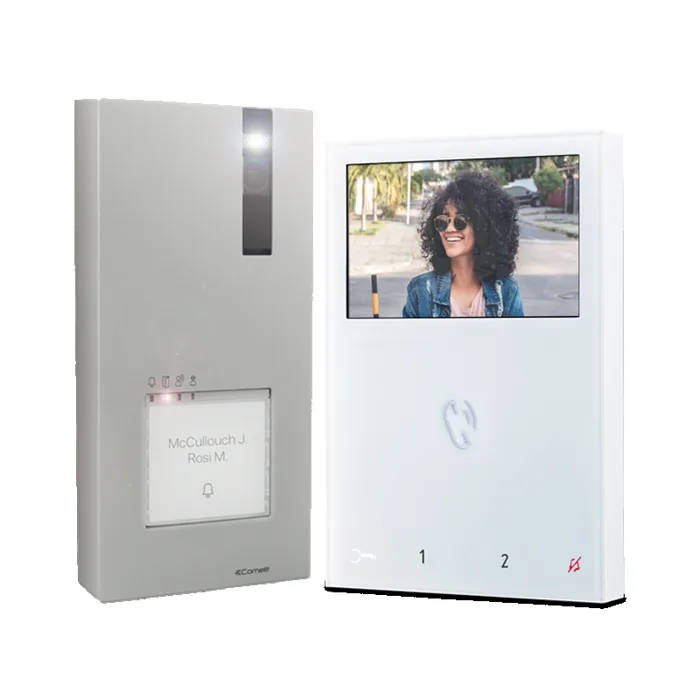
Product photo, not taken at a New York City job: the Comelit HFX-7000M kit, which Comelit's catalog lists as a Quadra Mini hands-free kit on its two-wire Simplebus 2 system. This pairing of a slim outdoor station and a Mini monitor is the shape of thousands of brownstone, townhouse and small walk-up installations across the five boroughs.
NYC Comelit Service Request
Tell us the address and what the Comelit system is doing
✅
Request Sent!
Thank you. We will contact you to set up the visit.
25+
Years Experience
5
Boroughs Served
100%
Licensed & Insured
4.7★
201 Google Reviews
Owner-operated since 2002 · Thousands of jobs completed · Booked within 2 hours
Comelit in New York
Why So Many New York City Buildings Run on Comelit
Walk into enough lobbies in New York City and you start to recognize the Comelit look: a slim brushed-metal or glass entrance panel, a narrow camera window at the top, a directory or a stack of call buttons, and a small Comelit wordmark near the bottom edge. Upstairs, the apartments have a white handset on the kitchen wall, a compact Mini monitor beside the door, or on newer jobs a larger touchscreen. Comelit Group is an Italian manufacturer founded in 1956 by four entrepreneurs in Bergamo, and the company says its equipment is now in more than 25 million installations around the world. In this city the brand has a long tail: buildings that still run the original Simplebus, buildings running the two-wire Simplebus 2, and the newest towers and campus-style complexes that run Comelit's IP platform, ViP, with the Comelit app on residents' phones.
That long tail is why Comelit work in New York is mostly repair and upgrade work rather than brand-new installation. A building that has had a Comelit Simplebus system for twenty years does not want to tear it out because one monitor on the fourth floor went dark or because the lobby panel took on water in a nor'easter. It wants the fault found, the part replaced and the system documented so the next failure is cheaper. When a building does decide to move forward, the conversation is usually about how much of the existing Comelit wiring can be kept, whether the entrance panel can be swapped without changing every apartment station, and whether residents want app answering.
Comelit's own case studies show how big the brand has become here. Its U.S. site describes the Parkchester condominiums in the Bronx as the largest app-based Comelit IP video intercom system: 171 buildings, 12,271 apartments and about 48,000 residents, moved off obsolete analog wiring onto Comelit IP technology with Ultra Touch entrance panels, gateways, emergency panels and concierge switchboards, in a project Comelit says began in September 2024 and ran about nine months. The same site features a 35-story mixed-use tower in Downtown Brooklyn with 1,098 residential units. Those are manufacturer-run showcase projects, not ours, but they explain why residents, supers and managing agents across the city keep searching for someone who can service the equipment once it is on the wall.
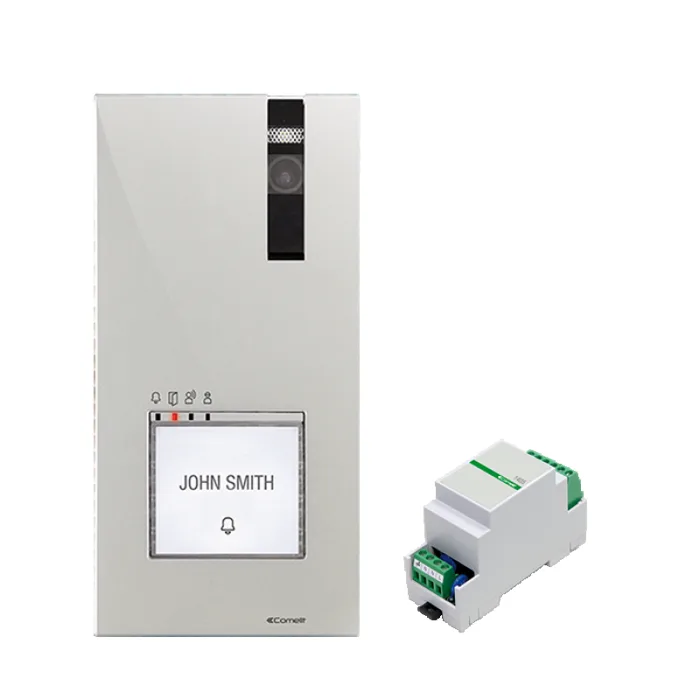
Product photo, not taken at a New York City job: a Comelit video door station sold as an expansion external unit kit, with the DIN-rail module that mounts in the equipment closet. In New York buildings that closet module is where we start more than half of our Comelit diagnoses, because a weak or failed power supply makes every station in the building misbehave at once.
New York City facts behind Comelit service calls
The intercom is a legal duty, not an amenity. New York's Multiple Dwelling Law §50-a requires self-closing, self-locking entrance doors and a two-way voice intercom with a door release in each apartment in class A buildings of eight or more units built or converted after January 1, 1968, and older buildings must add one when a majority of tenants ask in writing.
Locks and closers are part of the same picture. Housing Maintenance Code §27-2043 requires a key lock for every apartment entrance, and HPD enforces self-closing doors under §27-2041.1. A Comelit panel that rings perfectly is still a violation waiting to happen if the door it releases does not latch behind the visitor.
HPD writes thousands of intercom violations. Housing Maintenance Code violations that mention an intercom in 2025 numbered 1,637 in the Bronx, 1,157 in Brooklyn, 1,020 in Manhattan, 342 in Queens and 24 on Staten Island, according to HPD data on NYC Open Data. Not all of those are Comelit, but every brand shows up in them.
Most of the housing is old. About 54 percent of the city's housing was built before 1947, according to the Citizens Housing and Planning Council's reading of the 2023 Housing and Vacancy Survey. That is why two-wire systems such as Simplebus 2, which Comelit's catalog describes as running on two non-polarized wires throughout, suit so many buildings here: they can often reuse a pair of existing conductors where pulling new cable would mean opening plaster.
App entry has its own rules. Local Law 63 of 2021 requires owners using smart access systems to get tenants' express consent before collecting their credential data, to publish a plain-language privacy policy, to protect and delete that data, and not to force a tenant to use the smart system to reach their own apartment. That matters when a building adds the Comelit app or virtual keys.
Comelit system family
Where we find it in NYC
What usually fails first
Simplebus (original)
Older walk-ups and elevator buildings that have not been upgraded in many years
Handsets, entrance panel speakers and microphones, aging power supplies
Simplebus 2 (two-wire)
Brownstones, small walk-ups, mid-size co-ops and condos, many renovated rentals
Power supply, a shorted or wet riser pair, one monitor dragging the bus down
ViP (IP)
New towers, large complexes, buildings that converted for app answering
Network switch or PoE port, building internet, app account and license issues
Wi-Fi monitors on Simplebus 2
Apartments that added phone answering without a full ViP conversion
Home Wi-Fi changes, the app logged out, router replaced by the internet provider
Who calls us about a Comelit system
Residents and tenants call when their own Comelit monitor stops ringing, the screen stays black while the lobby still rings, or the door release button does nothing. If you rent, the building's intercom is usually the owner's responsibility, so the most useful thing we can do is tell you what to report to the super or managing agent and, when the owner books us, fix it properly. If you own a co-op share, condo unit or house, you can book us directly for your own monitor.
Supers and handymen call when several apartments complain at once, when the lobby panel is dead, or when a new tenant's name needs to go on the directory and the programming instructions are long gone. They need a technician who will explain what failed in plain words and leave the closet labeled.
Managing agents and boards call when the same building keeps generating Comelit complaints, when HPD has written an intercom violation with a correction date, or when the board wants a written opinion on whether to keep repairing an older Simplebus system or plan an upgrade. They need a clear report, a priced scope and a schedule that respects tenant access rules.
Owners of one- and two-family homes and townhouses call about Comelit kits: a single outdoor station and one or two monitors, often installed by a previous owner or a general contractor during a renovation. A dead kit at a brownstone door is a small job, but it still needs the right power supply, the right monitor and a door release that actually pulls the strike.
Developers and general contractors call when a Comelit system was specified on drawings for a new building or a gut renovation and the low-voltage scope needs a licensed installer. We work from the drawings, coordinate with the electrician who provides the circuits, and hand over a documented system.
Comelit Repair
Comelit Intercom Repair in NYC, Symptom by Symptom
A Comelit system is a chain: power supply, entrance panel, riser, the switching or distribution modules on each floor where they exist, and the monitor or handset in each apartment. On IP systems add the network switch, the building's internet line and the Comelit app account. When something breaks, the symptom tells us roughly where in that chain to look, and the first ten minutes of a visit are spent proving which link failed before any part is ordered. Below are the symptoms New York residents and supers describe to us most often, what each one usually means on a Comelit system, and what we do about it. None of this is a set of instructions for opening equipment; it is here so you know what to expect and what to tell us when you call.
The whole building went quiet at once
When no apartment rings, the entrance panel's display or backlight is dark and nobody can buzz anyone in, the failure is almost always upstream of the apartments: the Comelit power supply in the cellar or equipment closet, the circuit feeding it, or a short somewhere on the riser that drags the whole bus down. On two-wire Simplebus 2 systems, one shorted monitor or one wet junction can pull the voltage low enough that every station misbehaves, so a building-wide outage is not proof that the power supply itself is bad. We test the supply under load, isolate risers one at a time where the system allows it, and find the section that is pulling the system down. Replacing the power supply without finding the short is the most common wasted repair we see on Comelit jobs in the city.
One apartment's Comelit monitor stopped ringing
If everyone else in the building rings and one apartment does not, the fault is in that apartment's monitor or handset, its wall bracket, the short run of cable from the riser to the unit, or the apartment's programmed address. Tenants sometimes take a monitor off the wall to paint and put it back on a bracket that no longer seats properly; a Reddit thread from a Comelit owner describes a unit that simply would not come back on after being taken down for wall repairs. We check the address, the connection and the station itself, and if the monitor has failed we replace it with a compatible Comelit unit for that system family. A Simplebus 2 monitor will not work on a ViP system and vice versa, which is why we always confirm the system before ordering.
Screen black, audio still works
A Comelit video monitor that rings and talks but shows no picture points to the camera in the entrance panel, the video section of the panel's module, the video signal on that part of the riser, or a setting on the monitor itself. If every monitor in the building has lost video, the entrance panel's camera or the video distribution is the suspect. If only one apartment has lost the picture, it is usually that monitor or its cabling. On older buildings converted to video, the original pair may carry audio well enough while the video degrades over long runs, and that is a design question rather than a broken part.
Buzzing, humming or a ring that won't stop
A constant hum on the handset, a monitor that keeps chiming by itself, or a panel speaker that buzzes in the lobby usually means moisture in the entrance panel, a damaged cable that is picking up interference, a failing power supply, or a stuck button on the panel. In winter we see condensation inside panels that face the street; after summer storms we see water tracking down the conduit into the back box. We dry, clean and reseal where the panel can be saved and replace the module where it cannot. One Reddit poster with an older Comelit system described two-way audio and the door release working while the buzzer only sounded intermittently; that kind of half-working fault is very often a call circuit or a worn button rather than the whole system failing.
Door release clicks but the door does not open
This is the single most common complaint we hear about any intercom, Comelit included, and it is very often not the intercom at all. The Comelit monitor sends the release signal, the relay clicks, and then the electric strike or the door itself fails: the strike is worn, the door has sagged so the latch binds, the closer is slamming the door hard against the keeper, or the strike's power supply is undersized. A poster with a Comelit Ultra panel described exactly this: pressing the button produces a click and the door only stays open for a couple of seconds. Timing can be adjusted in programming, but more often the strike and the door need attention. We test the release at the panel, at the strike and at the door, and we fix the part that actually failed. Where the door hardware is the issue, we coordinate with the building's locksmith if the owner prefers.
The Comelit app stopped ringing on residents' phones
On ViP systems and on Simplebus 2 buildings that use Wi-Fi monitors, the phone app depends on things that are outside the intercom itself: the building's internet connection, the apartment's Wi-Fi network, the phone's notification settings and the Comelit app account. When the internet provider swaps a router, the Wi-Fi monitor loses its connection and the app goes silent while the monitor on the wall still rings. Residents can safely check that the phone has notifications enabled for the app, that they are logged in, and that the apartment's Wi-Fi name and password have not changed. App accounts, licenses and logins belong to Comelit, so for account problems we point residents to Comelit's support. The building hardware, the network switch, the gateway and the programming are ours to fix.
After a power outage or a storm
Con Edison outages, surges when power comes back, and lightning on a building's rooftop equipment all show up as Comelit service calls in the days afterward. Power supplies and network switches are the most exposed parts. After an outage we check every supply, confirm the system has recovered its programming, and recommend surge protection and battery backup where the building has none. A Comelit power supply that has failed after a surge is a part replacement; a system that has lost programming may need its directory and apartment addresses reloaded.
Names, codes and apartment numbers are wrong
Turnover changes the directory. When the names on the Comelit panel are out of date, when an apartment rings the wrong unit, or when an access code still works for a tenant who moved out a year ago, the system needs reprogramming rather than repair. We update the directory, the call addresses and the codes, and we give the owner or managing agent a written list of what is programmed where. We do not hand out step-by-step programming instructions before a paid visit, because a misprogrammed bus can take a whole building offline, but we are glad to show the super what we changed while we are there.
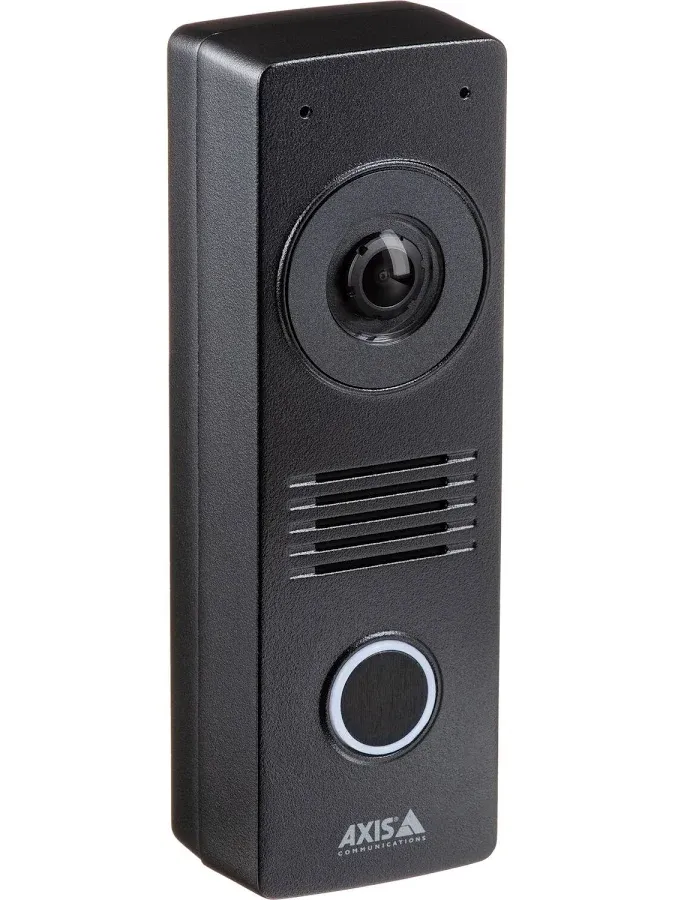
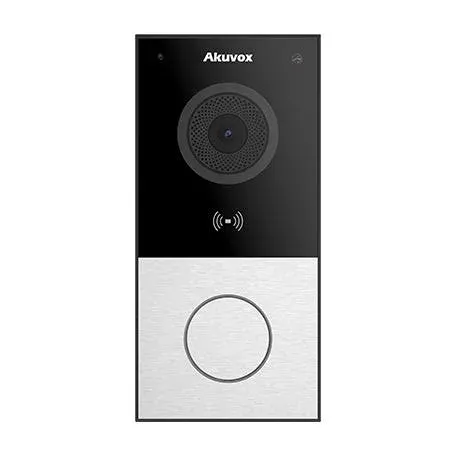
Reference product photo from our library, not a Comelit product and not taken at a New York City job. It shows the parts every single-button door station shares with a Comelit unit: a camera window, a speaker and microphone grille, and a call button. Water reaching any of those three is a common reason a street-facing station in Manhattan or Brooklyn starts to hum or go silent.
How a Comelit diagnosis runs on the first visit
Listen to the symptom first. The super or resident walks us through what happens when someone presses the button downstairs, and we reproduce it ourselves at the panel.
Identify the system family. Simplebus, Simplebus 2 or ViP decides which tests and which replacement parts apply. We read the labels on the panel module, the monitors and the closet equipment.
Check power under load. We measure the Comelit supply with the system working, not idle, and look at the circuit feeding it.
Split the problem. Building-wide or one apartment; audio, video or door release; panel, riser or station. Each answer halves the search.
Find the failed part. We confirm the failure before quoting, so the quote is for the part that actually failed and not a guess.
Price it before touching it. If the fix is simple it is done on the spot. If it needs a part, you get the price in writing first and the $250 goes toward it.
Leave notes. What failed, what we replaced, what is likely next, and labels in the closet.
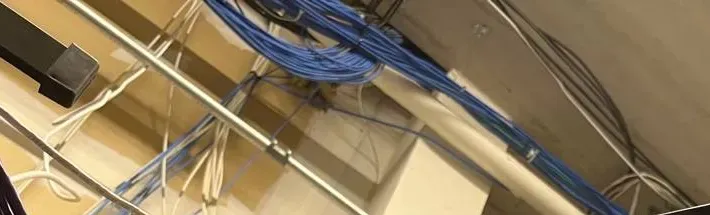
Example photo from our job library, not taken at a Comelit job. Cable running along cellar pipes like this is where New York riser faults hide: a staple through a pair, a splice that took on water, or a cable crushed during plumbing work. Tracing that path is often the real work in a Comelit repair.
What residents can safely check before the visit
If the problem is limited to your own apartment, check that the monitor is firmly seated on its wall bracket, that any volume or do-not-disturb setting on the monitor has not been switched on, and, if you use the Comelit app, that your phone allows notifications for it and that your apartment's Wi-Fi has not changed. Do not open the monitor, the panel or the power supply, and do not swap wires: on a two-wire bus a single wrong connection can take every apartment offline. If the problem affects the whole building, tell the super or managing agent the time it started and anything that happened around then, such as a power outage, rain or work in the cellar. That timeline saves real time on the visit.
Where Comelit repair overlaps with general entry-door work
Many calls that start as Comelit calls end as door calls: a sagging door, a failed closer, a strike out of line. Other calls start as general building problems and end at the Comelit closet. If your building's system is not Comelit, or you are not sure what brand it is, our intercom repair service in NYC covers every brand, and the NYC door buzzer repair page covers older buzzer-and-release systems and the part prices we use for them.
Product Lines
Comelit Systems and Equipment We Work On in New York City
Comelit has sold several generations of door entry systems, and a New York building can have parts from more than one of them. The product facts below come from Comelit's own U.S. site and its general catalog, which we checked before writing this page. We only name a model number when Comelit lists it; when we cannot confirm a part on Comelit's pages, we leave it out rather than guess.
Simplebus 2: the two-wire workhorse
Comelit's catalog describes Simplebus 2 as a digital system on two non-polarized wires throughout, with a connection distance of up to 1,200 meters between external and internal units and support for up to 120,000 users. In practice, that means audio, video, door release and call signals all travel on one pair, and installers do not have to worry about which wire goes to which terminal. It is the system we meet most often in New York brownstones, small and mid-size walk-ups and renovated rentals, because it can often reuse an existing pair when a building upgrades from an older audio system. Its weakness is the same as its strength: everything shares one pair, so one damaged section or one bad device can affect many apartments.
Original Simplebus
Older Comelit buildings may still run the original Simplebus. Comelit's catalog still lists Simplebus 1 devices, including the 2708W/A, a Simplebus 1 Mini door entry phone with handset, and its Ultra and Vandalcom entrance panels still list Simplebus 1 compatibility. That matters for New York owners: a building with an aging Simplebus 1 panel may be able to take a modern Ultra panel on the same system instead of replacing every apartment station on the same day.
ViP: Comelit's IP platform
ViP is Comelit's IP-based system. The catalog says devices are powered by PoE as standard, that Cat5e or Cat6 cable is required, and that the system works with the Comelit app and Comelit's ViP Manager software. ViP is what Comelit used at Parkchester and in the large new buildings it features in its New York case studies. For us, ViP work is part intercom and part network: PoE switches, cabling certification, IP addressing, gateways and the internet connection all have to be right before the app works reliably.
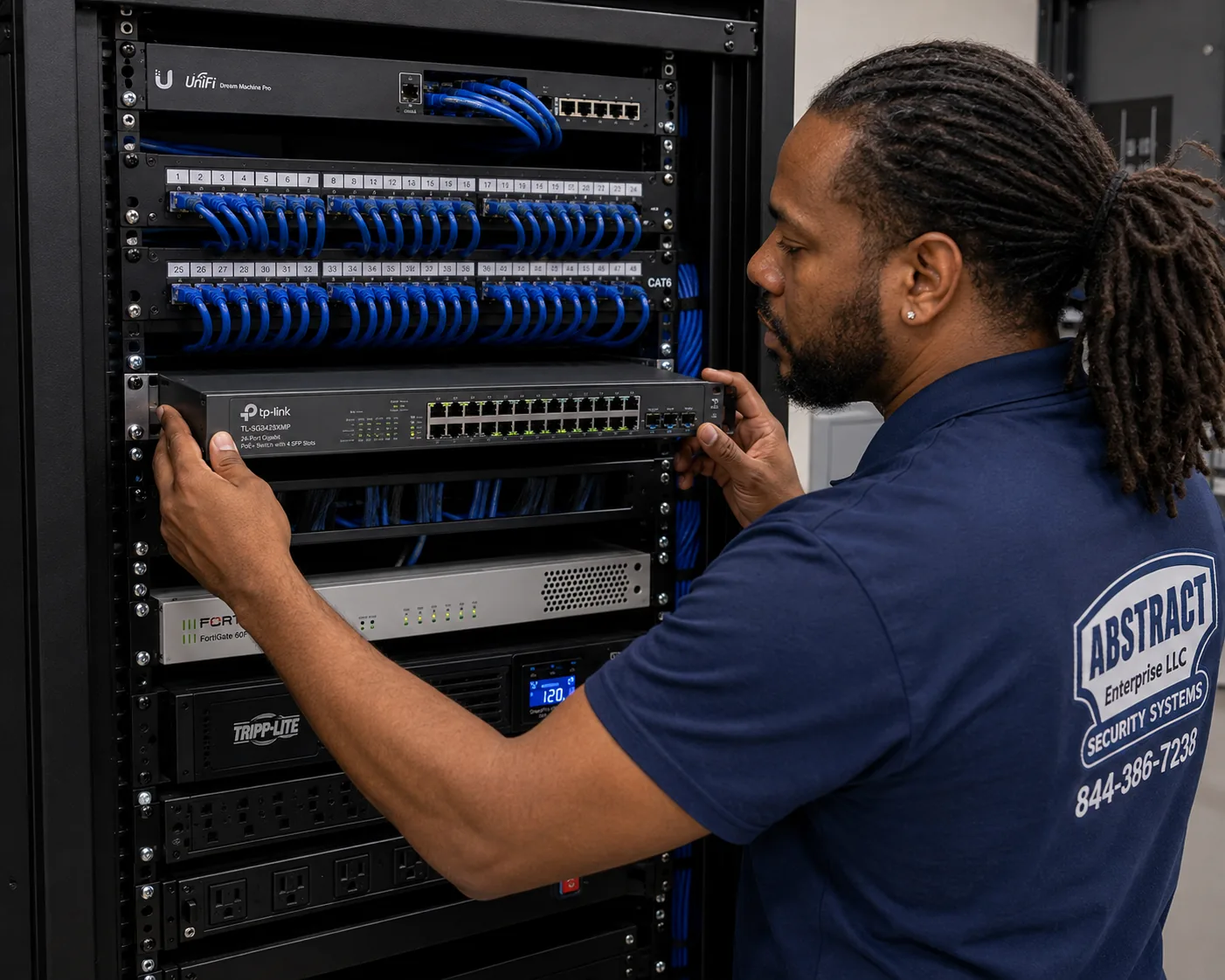
Job photo from our files, from a networked intercom installation rather than a Comelit job. A Comelit ViP building depends on exactly this kind of rack: a managed PoE switch that powers the entrance panels and monitors, patch panels that keep every run identified, and battery backup so the front door keeps working when the power blinks.
Comelit entrance panels
Comelit's U.S. site lists these entry panel lines, and its catalog shows which systems each one supports:
Ultra, a modular entrance panel that supports Simplebus 1, Simplebus 2 and ViP. Ultra Touch versions add a touchscreen directory; Comelit names Ultra Touch panels in its Parkchester case study.
3one6, offered in Touch and Sense versions, for Simplebus 2 and ViP.
Quadra, a slim panel used in kits and small buildings, for Simplebus 2 and ViP.
Vandalcom, Comelit's vandal-resistant series for tough, high-traffic entrances, for Simplebus 1, Simplebus 2 and ViP.
Switch, supporting Simplebus 1, Simplebus 2 and ViP.
Ciao, a compact panel that supports Simplebus 2, traditional 4+N wiring and two-wire analogue systems.
Bello, a door station for single-family homes on Simplebus 2.
Visto, a wireless doorbell intercom on Wi-Fi, also listed for ViP.
Emergency AOR area-of-refuge panels on ViP, used for emergency communication in larger buildings.
Comelit monitors and handsets in apartments
Inside apartments, the Comelit catalog lists the Maxi, Icona, Mini and Mini Handsfree monitors as working on both Simplebus 2 and ViP, the Mini Audio on Simplebus 2 and traditional 4+N systems, and the Mini Audio Handsfree on Simplebus 2. Comelit's current U.S. intercom page also shows the People monitor, People Wi-Fi, the 7Top video door entry system with a 7-inch touchscreen, and the compact Sonus. Specific Mini models the catalog lists include the 6701W Simplebus 2 Mini monitor with handset, the 6721W Mini hands-free monitor for two-wire systems, and the 6741W Simplebus 2 Mini hands-free Wi-Fi monitor, which is the unit many New York apartments use to get app answering without converting the building to ViP.
Closet equipment: power supplies and modules
The parts in the cellar or equipment closet are where many Comelit repairs actually happen. The catalog lists the 1210 Simplebus 2 power supply and the 1209 four-output power supply for two-wire video kits; the 1404 Simplebus 2 digital switching device; the 1406 multi-user call forwarding module; the 1409 module for remote cameras on Simplebus 2; the 1414 riser shunt module; the 4888CU Simplebus 2 colour mixer for the U.S. market; and the 1440 IP floor switch for ViP. You do not need to know any of those numbers. We read the labels, test the parts, and tell you in plain words which one failed.
Comelit equipment
System
What we do with it
Ultra and Ultra Touch entrance panels
Simplebus 1, Simplebus 2, ViP
Repair modules, replace damaged faces, program directories, swap older panels
Quadra and 3one6 panels
Simplebus 2, ViP
Replace water-damaged units, re-address, connect door release
Vandalcom panels
Simplebus 1, Simplebus 2, ViP
Install at high-abuse entrances, replace damaged buttons and modules
Mini, Mini Handsfree, Maxi, Icona monitors
Simplebus 2, ViP
Replace failed apartment units with compatible models, address and test
Mini Wi-Fi monitors (6741W)
Simplebus 2 with Wi-Fi
Reconnect to new Wi-Fi, replace, explain app setup to the resident
Power supplies (1209, 1210)
Simplebus 2
Test under load, replace after surges, add surge protection
Network checks, port and power issues, cabling certification
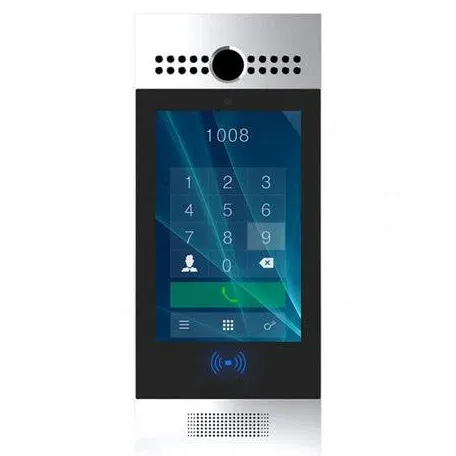
Reference product photo from our library, not a Comelit unit and not taken at a New York City job. Touchscreen directories with keypads and card readers, like Comelit's Ultra Touch, combine the call panel, the access code and the fob reader in one face, which means one water leak or one cracked screen can take out three functions at an apartment building entrance.
Parts, sourcing and special orders
We supply Comelit parts as part of a repair or installation job; there is no store, no checkout and no parts counter. Common monitors, power supplies and modules can often be sourced quickly through our suppliers. Discontinued Simplebus 1 parts, specific panel faces and some larger systems may need to be ordered, and when a part is special order we say so before the deposit and give a date only once it has shipped. If a discontinued part cannot be found, we will tell you that plainly and price the nearest compatible option instead of promising something that does not exist.
Upgrades
Upgrading an Older Comelit System in a New York City Building
Sooner or later every Comelit building asks whether to keep repairing or to move forward. There is no single right answer, and anyone who tells a board or an owner that the whole system must go after one visit should be asked to show the test results. The real question is which parts of the existing system are still sound, which parts are near the end of their life, and what residents want the system to do that it cannot do today. A good upgrade plan in New York keeps everything that tests well and replaces only what does not.
Path one: keep Simplebus 2, refresh the weak links
If the riser tests clean and the building is happy with monitors in apartments, the cheapest path is to stay on Simplebus 2: replace a tired or damaged entrance panel with a current Comelit panel that supports the same system, replace the power supply if it is near the end of its life, and swap only the monitors that have failed. Residents who want phone answering can move to a Wi-Fi Mini monitor on the same bus. This path rarely touches apartment walls and is usually finished in a short changeover window.
Path two: move an original Simplebus building onto a current panel
Because Comelit lists Ultra, Vandalcom and Switch panels as supporting Simplebus 1, an older building can sometimes replace its entrance panel first and keep the apartment handsets running, then plan the apartment side over time. That spreads the cost over budget years, which matters to co-op boards and small owners alike. Whether it works depends on what the riser and the existing stations test like; we confirm that before anyone orders a panel.
Path three: convert to ViP and the Comelit app
Buildings that want app answering for everyone, virtual keys for visitors, elevator calls from the phone and remote management by the managing agent are looking at Comelit's IP system. ViP needs Cat5e or Cat6 to each device, PoE switching and a reliable internet connection. In a new building that is part of the low-voltage design from the start. In an older building it can mean new cable in the riser, which is the expensive part. Comelit describes its software as available with a one-time license instead of a monthly subscription, which is attractive to boards watching operating costs; we price the hardware and our labor, and the licensing terms are Comelit's.
Path four: a different platform beside the Comelit quote
Sometimes the honest recommendation is to look at another brand as well. We can price an Akuvox or DoorBird alternative beside a Comelit replacement, so an owner or board sees two real options from one installer rather than two salespeople. For a side-by-side look at two platforms common in New York rentals, see our Akuvox vs ButterflyMX comparison; for townhouses and smaller buildings considering a premium IP door station, our DoorBird vs 2N comparison covers the trade-offs. If the building is starting from nothing, our intercom installation service in NYC explains how we plan a new system brand by brand.
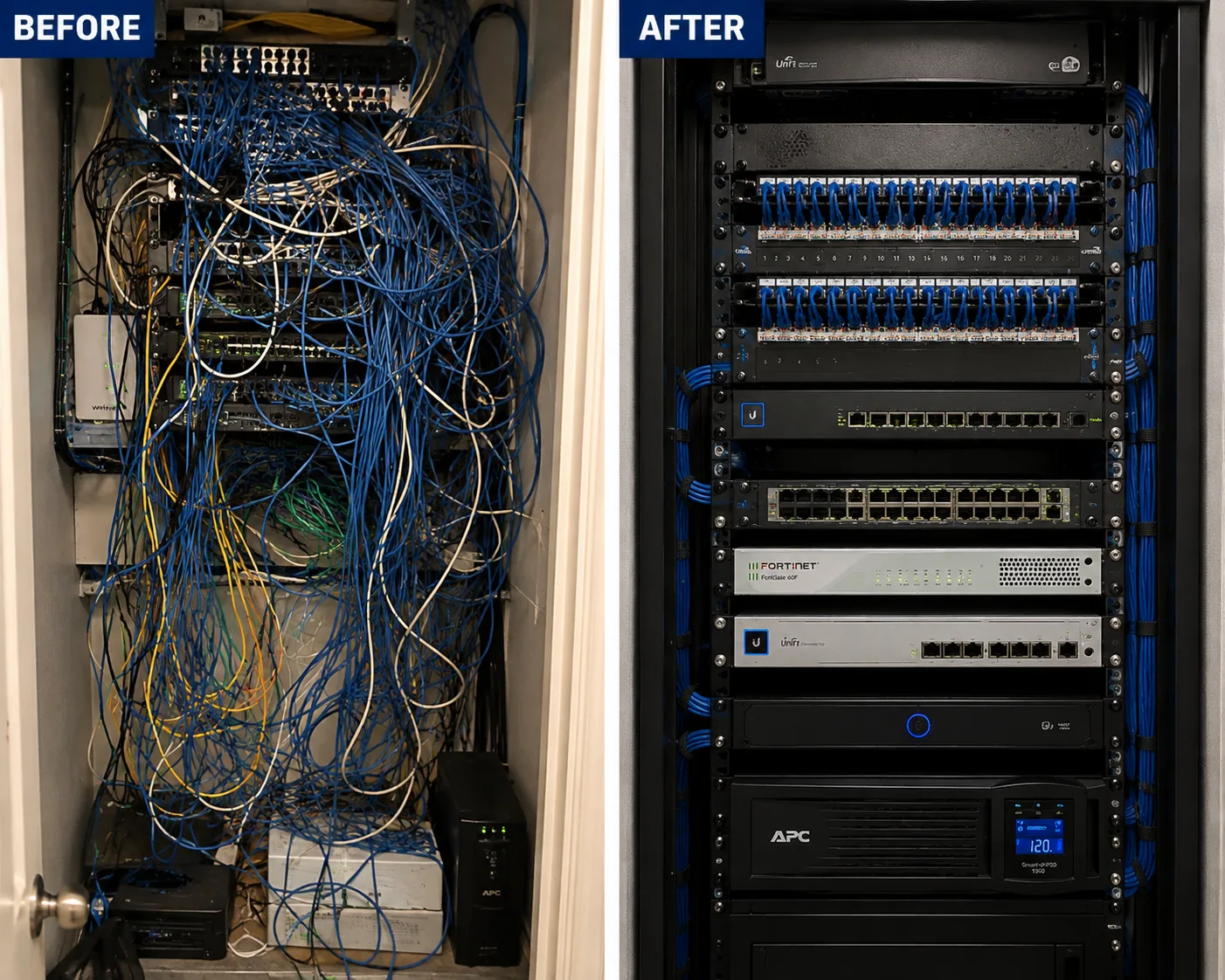
Job photo from our files, from a wiring cleanup rather than a Comelit job: the same rack before and after. Many New York Comelit upgrades start like the left side, with years of added power supplies and unlabeled cable, and the first deliverable is a closet the next technician can read.
Upgrade path
Best fit
Main cost driver
Disruption
Refresh on Simplebus 2
Riser tests clean, residents happy with in-unit monitors
Entrance panel and power supply
Low: a short entry changeover
New panel on original Simplebus
Older building, budget spread over years
Entrance panel; stations later
Low now, apartment visits later
Wi-Fi monitors for app answering
Some residents want phone answering
One monitor per participating apartment
One short visit per apartment
Full ViP conversion
App, virtual keys, remote management for everyone
New cable in the riser and network gear
Highest: riser and apartment work
Alternative brand quote
Board wants competing options
Depends on platform and wiring reuse
Varies
Integrations: strikes, mag locks, elevators, gates and cameras
Comelit documents integrations with access control, elevator calling and CCTV viewing through its app, and its U.S. site describes an integration with the Livly property platform. On a New York job, the low-voltage side of those connections is ours: the strike or mag lock wiring, the request-to-exit device, the relay to an elevator controller, the gate release. Any new high-voltage circuit is the building's electrician, and work inside an elevator controller is done with the elevator company's mechanic present. We only promise an integration that Comelit documents for the equipment on the wall.
Comelit System Acting Up Right Now?
Send the address and what the panel and monitors are doing. We book within two hours, seven days a week, and the $250 service call goes toward the repair.
Comelit in New York City: The Questions We Hear Most
About the brand and who services it
Across the five boroughs, is Abstract Enterprises Security Systems part of Comelit?
No. Comelit Group is the Italian manufacturer, with its U.S. arm, its website, its app and its own customer support. We are an independent New York State licensed low-voltage contractor. We are not a Comelit authorized dealer, distributor or certified installer, and we do not claim to be. What we do is install, repair, program and service Comelit equipment in buildings across the five boroughs, sourcing parts through our suppliers. If you need Comelit's app account support, product manuals, datasheets or firmware, those come from Comelit; if you need the panel, the riser, the power supply or the door release fixed, that is our work.
Why did so many buildings in the five boroughs pick Comelit in the first place?
Usually because the developer, the electrician or a previous installer specified it, and Simplebus made it possible to put video into buildings that only had a pair of wires to each apartment. Comelit also markets one-time licensing for its app and software rather than a monthly fee per apartment, which appeals to owners and boards who want to keep operating costs flat. Whatever the original reason, the building now has a system worth maintaining well.
How do you spot a Comelit system among the other brands found citywide?
Comelit entrance panels tend to be slim, with metal or glass faces and a narrow camera window, and the Comelit name is printed on the panel and on most monitors. Apartment units range from a white wall handset to compact Mini monitors and larger touchscreens. If you cannot find a brand name, a photo of the lobby panel and one apartment unit is usually enough for us to tell you what the system is before the visit.
Timing, access and scheduling
How quickly can a Comelit technician come out in the five boroughs?
We book within two hours of your request and schedule seven days a week, with early-day visits available; appointments are first come, first served once the service call is paid. We do not promise same-day repair or a fixed arrival on a holiday, and we never advertise round-the-clock emergency service, because we would rather give you a real time than a slogan. Most single-fault repairs are finished on the first visit; when a part has to be ordered, the repair is finished on a second visit.
Does a citywide Comelit technician need into every apartment to fix the building?
Not for every fault. A power supply, an entrance panel or a riser problem is often fixed from the lobby and the closet. But a building-wide fault caused by one shorted monitor can only be found by checking stations, and a full upgrade needs access to every affected apartment. Owners and managing agents send the access notices; we plan apartment visits in blocks so residents are not waiting all day.
Does the front door stay usable while a Comelit panel is swapped, borough to borough?
Yes. We mount and power the new panel ahead of time where the opening allows it, load the directory, and then switch over in one short window. Residents keep their keys throughout, and the door stays locked. On larger buildings we schedule the changeover for a weekday morning when the super is on site.
Money and paperwork
How is Comelit work priced the same way in all five boroughs?
Every visit opens with the $250 service call, which covers diagnosis and simple repairs at your building; if the repair is bigger, the $250 goes toward it. Part replacements use the same published ranges as our other entry system work. Upgrades and new installations are quoted in writing after a site visit, because the panel, the number of apartments, the condition of the riser and the network all change the number. We do not quote Comelit equipment prices over the phone and we do not compare our prices with store or online listings.
Does a repaired Comelit system clear an HPD intercom violation anywhere in the five boroughs?
Fixing the condition is what clears it. We give the owner a dated invoice describing what failed and what was repaired, which the owner uses when certifying the correction with HPD. We do not file with HPD on the owner's behalf, and we do not give legal advice about violations; the owner or managing agent handles the certification.
Which warranty terms cover Comelit repairs and installations citywide?
Comelit's manufacturer warranty on its products is Comelit's. Our own labor carries the 30-day warranty published on our site, and longer coverage is available as a paid add-on. The full terms, including the one-year parts-only warranty on products we supply, are set out in the service agreement quoted in the pricing section below.
Building Types
Comelit Door Entry in Every Kind of New York City Building
The same Comelit panel behaves differently in a three-story brownstone and a forty-story tower, because what surrounds it is different: the door, the riser, the closet, the people who run the building and the rules that apply. This is how we approach each of the building types we work in across the city.
Brownstones and townhouses
Usually a Comelit kit: one outdoor station and one to three monitors on Simplebus 2. Failures are almost always the outdoor station after weather, the power supply, or a monitor taken down during a renovation. Repairs are small and quick.
Small walk-ups
Four to twenty apartments on one riser, with the power supply in the cellar near the meters. One bad apartment unit can affect the rest. We isolate, repair and label so the next call is cheaper.
Prewar elevator buildings
Long risers, old conduit, plaster walls and stone or bronze entrances. Reusing the existing pair is often the deciding factor, and Landmarks rules can shape what goes on the facade.
Co-ops and condos
Boards decide, managing agents run the project, and shareholders or unit owners may own their monitors. We give boards written options and phase work around budget cycles.
New rental towers
Often ViP with app answering, touchscreen panels and integrations with access control and elevators. The intercom is part of the building network, so network health is part of every repair.
Mixed-use buildings
Apartments above stores, with separate entrances, separate tenants and sometimes separate systems. We keep residential and commercial entry clearly separated in programming.
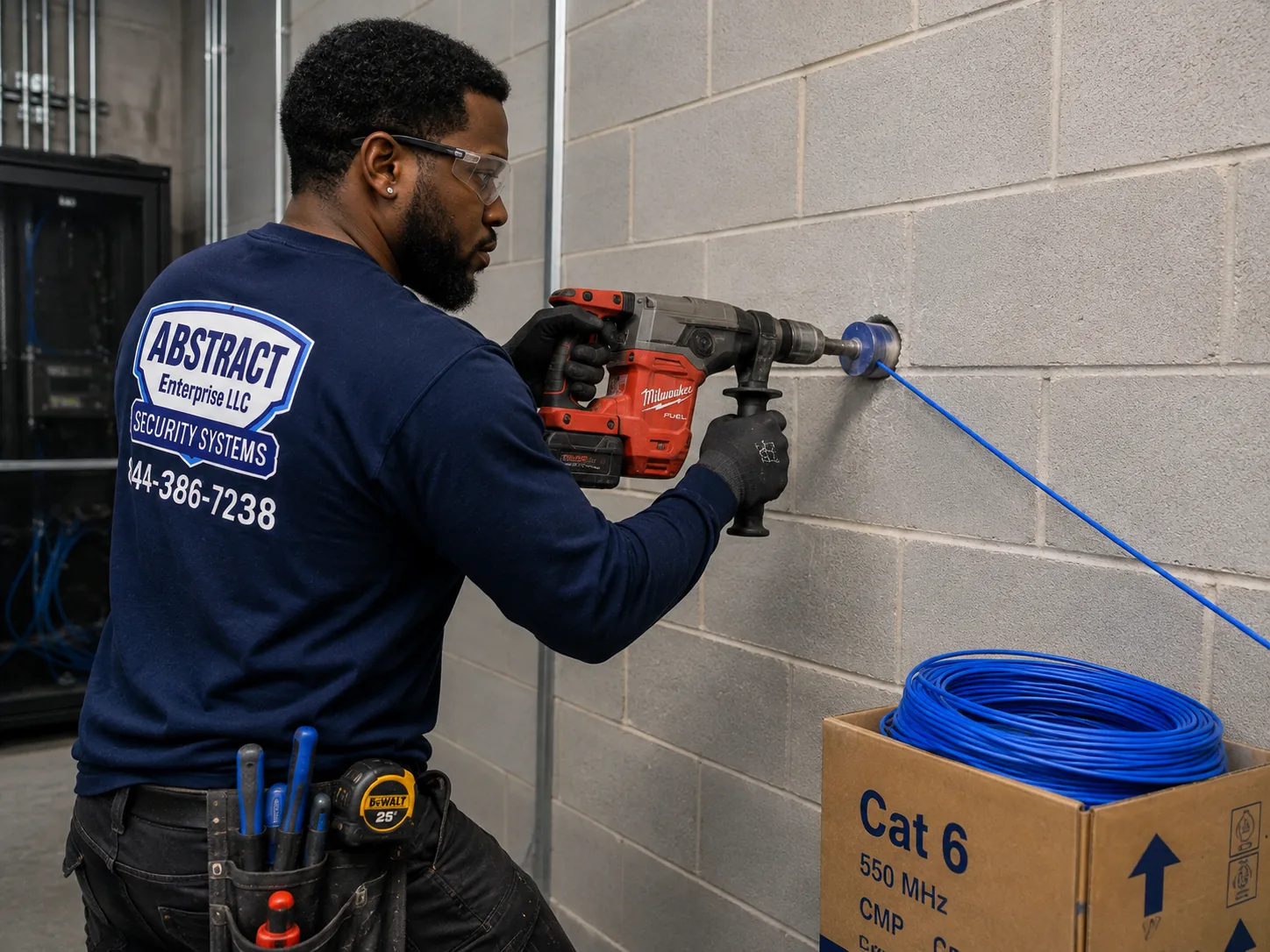
Job photo from our files, from an apartment building intercom cabling job rather than a Comelit-specific one. When a New York building moves from Simplebus 2 to Comelit's IP system, new cable paths like this, through block or masonry walls between the cellar, the riser and the equipment room, are where most of the labor goes.
Landmarked facades and historic districts
New York has thousands of designated buildings and dozens of historic districts, and an entrance panel on a landmarked facade can need a permit from the Landmarks Preservation Commission before it goes up. Comelit's slimmer panels, flush-mounted versions and finishes sometimes make approval easier, but we never assume. On a landmarked building we provide cut sheets and photos for the owner's application and install once the permit is issued.
Buildings with a doorman or concierge desk
Comelit's IP platform includes concierge switchboards, and its Parkchester case study names them. In a building with a desk, visitor calls can go to the concierge first and then to the apartment. We program the desk station, the call routing and the after-hours behavior to match how the building actually runs, and we write down who can change it.
Single-family homes on Staten Island and in the outer boroughs
Detached and semi-detached homes in Staten Island, Queens and the outer parts of Brooklyn and the Bronx use Comelit kits and the Bello or Visto door stations Comelit lists for single-family use. The questions there are about weather exposure, Wi-Fi coverage at the door and how the monitor connects to the gate or door release.
The Five Boroughs
Comelit Intercom Service Across Manhattan, Brooklyn, Queens, the Bronx and Staten Island
We work on Comelit systems in every borough, scheduled from our Brooklyn and Bronx offices. Each borough page covers its own building stock, its own violation patterns and its own common faults in depth. Here is the short version of how the work differs from borough to borough.
Comelit intercom Manhattan
Manhattan Comelit work clusters in prewar co-ops and condos, walk-up rentals in Harlem, Washington Heights, the Lower East Side and the Upper East and West Sides, and newer luxury rentals. Long risers, landmarked entrances and boards that want app answering without opening plaster shape the jobs. HPD recorded 1,020 intercom-related violations in Manhattan in 2025. Read more on our Manhattan Comelit page.
Comelit intercom Brooklyn
Brooklyn has more brownstones and small walk-ups with Comelit kits than any other borough we serve, plus new towers like the Downtown Brooklyn building Comelit features in its case studies. Brownstone outdoor stations, renovated rentals and street-facing panels after storms are the everyday calls. HPD recorded 1,157 intercom-related violations in Brooklyn in 2025. See the Brooklyn Comelit page.
Comelit intercom Queens
Queens mixes garden apartment complexes, six-story elevator buildings, co-ops in Jackson Heights, Forest Hills and Flushing, and two-family homes. Comelit calls there are often about large co-op systems with several entrances and about Wi-Fi monitors in houses. HPD recorded 342 intercom-related violations in Queens in 2025. More on the Queens Comelit page.
Comelit intercom Bronx
The Bronx is home to Parkchester, the 171-building complex Comelit describes as its largest app-based IP installation, and to thousands of prewar elevator buildings along the Grand Concourse and beyond. It also had the most intercom-related HPD violations of any borough in 2025, at 1,637. Owners there need fast, documented repairs. See the Bronx Comelit page.
Comelit intercom Staten Island
Staten Island is mostly one- and two-family homes and smaller multifamily buildings, with only 24 intercom-related HPD violations recorded in 2025. Comelit work there is usually kits, outdoor stations exposed to wind and salt air near the shore, and Wi-Fi monitor reconnections. A dedicated Staten Island Comelit page is being written; until then, book through this page.
Borough
HPD intercom-related violations, 2025
Typical Comelit job
Bronx
1,637
Prewar elevator buildings, large complexes, IP systems
Brooklyn
1,157
Brownstone kits, small walk-ups, new towers
Manhattan
1,020
Prewar co-ops and condos, landmarked entrances
Queens
342
Co-op complexes, garden apartments, houses
Staten Island
24
Home kits, outdoor stations, Wi-Fi monitors
Violation counts: HPD Housing Maintenance Code Violations dataset, NYC Open Data, violations issued in 2025 whose description mentions an intercom. They include every intercom brand, not only Comelit.
AI Overview Reality Check
What AI Answers Get Wrong About Comelit Systems in NYC
Search for a Comelit problem and you will often get a confident AI summary. Some of what those summaries say is fine. Some of it is wrong for New York buildings, and a few points can cost an owner money.
“Just reset the system and it will come back”
Cutting power to a Comelit system can bring a stuck bus back for a day, and it can also hide the real fault: a shorted monitor, a wet riser or a supply that is failing under load. The building then calls again a week later. If a reset fixes it, that is a clue worth reporting, not a repair.
“Any two-wire monitor will work”
Two-wire systems from different manufacturers are not interchangeable, and even within Comelit, Simplebus 2 and ViP equipment are different systems. A monitor that fits the bracket is not necessarily a monitor that works on the bus.
“An old system has to be replaced completely”
Comelit's own catalog lists current panels that still support Simplebus 1. Many older buildings can move forward in stages, starting with the entrance panel, as long as the riser tests well. Full replacement is sometimes the right answer, but it should follow a test, not a sales call.
“Comelit repair is covered by the manufacturer”
A manufacturer warranty covers defective products for a set period under the manufacturer's terms; it does not send a technician to your lobby or cover water damage, surge damage or wiring faults. Labor in New York is a contractor's service, priced and warranted by that contractor.
“National average costs apply”
National averages ignore New York access rules, prewar plaster, landmark permits, union buildings and riser lengths. That is why we publish our own prices and quote upgrades only after a site visit.
Reference product photo from our library, not a Comelit unit and not taken at a New York City job. A door station that combines a camera, a card reader and a call button is common on newer New York entrances; it is also a reminder that the reader, the release and the intercom can each fail on their own, so a good diagnosis tests them separately.
For Boards & Owners
Evaluating a Comelit System Before You Spend Money on It
Owners, boards and buyers often ask us a version of the same question: is this Comelit system worth keeping? The answer comes from a short, structured look at the building rather than from the age of the panel. This is the checklist we work through on an evaluation visit in New York, and it is the same order we recommend to anyone comparing quotes.
1. Which Comelit system is it, really?
Before anything else we confirm the system family from the labels on the entrance panel module, the apartment units and the closet equipment. A building described as “the Comelit” can be original Simplebus, Simplebus 2, ViP, or a mixture after years of piecemeal replacements. A mixture is common in buildings where individual shareholders or tenants replaced their own monitors over time. The family decides every later choice, so it goes first on our report.
2. How healthy is the riser?
The riser is the expensive part to replace and the cheapest part to keep. We look at how it runs, where the junctions are, whether any sections sit under pipes or in damp cellars, and how the system behaves when sections are isolated. A clean riser makes almost every upgrade path cheaper. A riser with repeated faults, water damage or undocumented splices is a reason to budget for cable even if the panel is fine.
3. What condition is the entrance panel in?
Street-facing panels age faster than anything else in the system. We look for water inside, worn or sticky buttons, a fogged camera window, cracked glass, a corroded back box and a directory that no longer matches the rent roll or the shareholder list. A panel can often be repaired at the module level; where it cannot, a current Comelit panel that supports the same system is usually the first upgrade.
4. How many apartment units are failing, and why?
Three dead monitors in a forty-unit building is a maintenance issue. Fifteen dead monitors is a pattern, and the pattern matters: water damage on one line, a run of a single older model reaching end of life, or residents who disconnected units they no longer use. We count, test a sample and report the cause, not just the number.
5. Is the power and the closet in good order?
An unventilated closet, a power supply sitting on the floor of a damp cellar, extension cords, no surge protection and no labels are all signs that the next failure is close. These are cheap to fix and they make every future repair faster.
6. Does the door it controls actually work?
A perfect Comelit system releasing a door that does not latch is still a failed entrance under the Housing Maintenance Code. We check the strike, the closer, the latch and the frame. Owners are often surprised to learn that the best money in an “intercom” budget goes into the door.
7. What do residents want the system to do?
Some buildings are happy with a monitor by the door. Others have residents who travel, work odd hours or receive many deliveries, and who want to answer from a phone and give visitors temporary access. Some buildings have older residents who will never use an app and need a monitor that works without a phone. The right Comelit configuration serves both groups, and Local Law 63 of 2021 makes sure no tenant is forced onto the smart option to reach their own apartment.
8. What does it cost to run?
Comelit markets one-time licensing for its app and software rather than a recurring fee per apartment, and that is a real difference from subscription platforms. The running costs that remain are internet service for IP systems, electricity, and repairs. We write those down next to the installation quote so a board compares total cost, not just the day-one price.
Finding on the evaluation
What it usually points to
Riser tests clean, panel worn, a few failed monitors
Keep the system: new panel on the same family, replace failed units
Riser has repeated faults or water damage
Repair the worst sections now, budget for cable before any ViP move
Mixed generations of monitors in apartments
Standardize on one compatible model as units fail
Residents want phone answering, riser is sound
Wi-Fi monitors on Simplebus 2 first, ViP later if demand grows
New cable is going in anyway (renovation)
Plan Cat6 for ViP while the walls are open
Rules & Safety
Comelit Entry Systems and New York City's Building Rules
A Comelit system in New York does more than ring apartments. It is part of how a building meets its legal duties for entrance security, and on larger buildings it touches fire safety and accessibility. We are low-voltage contractors, not lawyers, so we describe the rules with their sources and leave legal judgments to the owner's counsel.
Entrance doors and the intercom duty
Multiple Dwelling Law §50-a sets the intercom and self-locking door requirement for class A multiple dwellings of eight or more apartments built or converted after January 1, 1968, and lets tenants in older buildings require one by majority written request. When a Comelit system in one of those buildings fails, the owner is out of compliance until it is fixed. That is why our reports describe the condition found and the repair made in language an owner can use.
Door releases and the fire alarm
In buildings with a fire alarm system, some entrance doors with electric locking hardware are tied to the fire alarm so they release when the alarm activates. Where a Comelit system controls a mag lock or a fail-secure strike on such a door, we coordinate with the building's fire alarm contractor and never change the fire alarm side ourselves. On smaller walk-ups without a fire alarm, the main rule is simpler: the door must always open from the inside without a key or special knowledge.
Area of refuge communication
Comelit lists Emergency AOR panels on its ViP system for area-of-refuge communication, the two-way call points used in larger buildings so a person who cannot use the stairs can reach help during an emergency. Where a building's code consultant or architect has specified those panels, we install and program them to the drawings and test the call path end to end.
Privacy and smart access
Local Law 63 of 2021 governs smart access in New York City residential buildings: owners need tenants' express consent before collecting credential data, must publish a plain-language privacy policy, must protect and delete that data on schedule, and cannot require a tenant to use the smart system to enter their own apartment. When a building adds the Comelit app, virtual keys or any other smart credential, we set the system up so traditional keys and in-unit answering keep working for anyone who does not opt in.
Landmarks, facades and permits
On landmarked buildings and in historic districts, a new entrance panel can need approval from the Landmarks Preservation Commission before installation. We supply product drawings and photographs for the application and install once the permit is in hand. On ordinary buildings, replacing a panel in the same opening generally does not change the facade, but a new opening in stone or a new hood may still need the owner's architect involved.
Electrical work and who does what
Comelit systems run on low voltage from their own power supplies, and that side of the job is ours under our New York State low-voltage license. If a building needs a new dedicated circuit for a power supply, a new outlet in the closet or any change to the electrical panel, that is the building's licensed electrician. We tell the owner exactly what the electrician needs to provide and coordinate the timing so the job is finished in one visit where possible.
Deliveries & Visitors
Deliveries, Visitors and Comelit Virtual Keys in NYC Buildings
Package deliveries have changed what New York residents expect from a front door. Couriers arrive all day, residents are often out, and lobbies without a doorman end up with boxes stacked by the mailboxes. Comelit's resident app is built around some of those problems: Comelit describes video calls to see visitors before opening, virtual keys that give temporary access without a fob or a physical key, elevator and gate control from the phone, and viewing of building cameras in the app. On ViP systems, and on Simplebus 2 buildings where residents use Wi-Fi monitors, those features can change how a building handles deliveries.
How much of that a building should switch on is a policy decision for the owner or board, not a technical one. A virtual key that opens the lobby door for a courier is convenient, and it is also a credential that someone outside the building holds for a while. We set expiry times, limit which doors a temporary key can open, and make sure the building can see who was let in and when. Where a building has a separate package room, the safer arrangement is usually a key that opens that room and nothing else.
Visitors for residents without smartphones
Every New York building has residents who will not, or cannot, answer the door with a phone. Comelit systems keep in-unit monitors and handsets for exactly that reason, and a well-planned building runs both side by side. When we convert or add app answering, we leave every apartment that wants a wall unit with a working wall unit, and we make sure the directory still calls that unit first.
Contractors, cleaners and the super's helpers
Owners and managing agents often want to give recurring access to cleaners, dog walkers, contractors and the super's helpers without handing out keys. Comelit's documented features for property managers include remote management of access points and a professional app and dashboard for building staff. We set up those users in the building's own account, with schedules where the system supports them, and we hand the building a list of who has access so it can be reviewed when people change.
Cameras and the intercom
Comelit sells its own CCTV line and documents camera viewing from its app. Many New York buildings already have cameras from another brand on a separate recorder. Whether those cameras can be shown in the Comelit app depends on what Comelit documents for the specific equipment; where it does not, we keep the systems separate and say so rather than forcing an integration that will break at the next update.
Get In Touch
Request Comelit Intercom Service in NYC
Tell us the address and borough, how many apartments the building has, what the Comelit panel and monitors are doing, and any model printed on the equipment. A photo of the lobby panel, one apartment unit and the equipment closet lets us bring the right parts on the first visit. Prefer to talk? Call (800) 486-0943.
✅
Request Sent!
Thank you. We will contact you to set up the visit.
How It Works
How a Comelit Job Runs With Us in New York City
1
Tell us the symptom
Address, borough, apartment count, what the Comelit panel and monitors are doing and who will let us in. Photos help.
2
Booked within two hours
We confirm the booking and the visit window. Visits run seven days a week, first come, first served once paid.
3
Service call and diagnosis
The $250 service call: we identify the system family, test power under load and prove which part failed.
4
Written price first
Simple fixes are done on the spot. Anything larger is priced in writing before work starts, and the $250 goes toward it.
5
Parts and scheduling
Common Comelit parts are sourced quickly; special-order items get a date once they ship. Apartment visits follow access notices.
6
Repair, program, test
We replace or repair, reload programming where needed, and test every affected apartment and the door release.
7
Notes and labels
A dated invoice describing the fault and fix, labels in the closet, and a list of what is likely to need attention next.
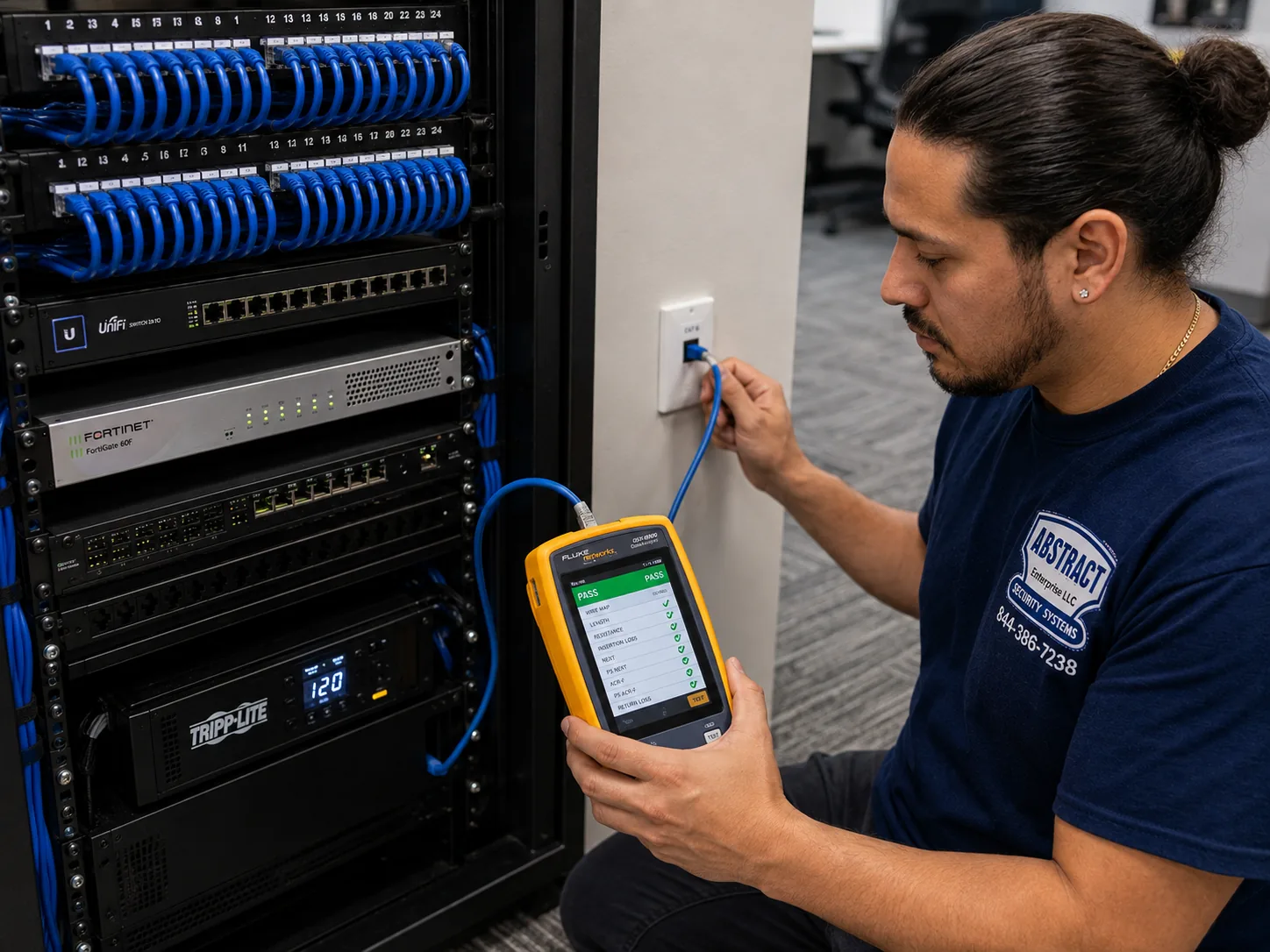
Job photo from our files, from a network cabling job rather than a Comelit installation. On Comelit ViP work in New York we certify every new Cat6 run like this before an entrance panel or monitor goes on the end of it, so an app or video problem later can be ruled out as a cabling fault in minutes.
Field notes: the Comelit building where the power supply wasn't the problem
A pattern we see across the city: a building's Comelit system goes dead, someone replaces the power supply, it works for a few days, and then it dies again. On a two-wire system that sequence almost always means something on the bus is drawing too much, and the new supply is simply the next victim. The fix is to split the risers, find the floor or the apartment that is pulling the system down, and replace that device or repair that section. Usually it is a monitor that took on water from a leak in the apartment above, a junction box in the cellar that sits under a pipe, or a cable that was nicked during other work. Once the short is gone, the original supply often turns out to be fine.
Field notes: a street-facing panel after a wet winter
Comelit entrance panels on New York stoops and storefront entrances take rain, snowmelt, salt and pressure washing. The failures show up as a crackle on the speaker, a button that calls the wrong apartment, a fogged camera window or a panel that shuts off in the morning and comes back in the afternoon. We open the panel only to inspect and dry the module, check the gasket and the back box, and decide whether the module can be saved. When it cannot, a replacement module or panel for the same system family usually restores the building without touching the apartments. A hood or a better-sealed back box is often worth adding.
How long Comelit work takes
Most repairs are finished on the first visit, or on a second visit when a part has to be ordered. A panel replacement on an existing Simplebus 2 riser typically takes a day on site once the equipment is in hand. A full ViP conversion in a mid-size elevator building takes several days of on-site work spread over a few weeks so apartment access can be scheduled, plus the time it takes for equipment to arrive.
Cost
Comelit Intercom Repair Cost in NYC
We publish our prices so an owner, a board or a resident knows the shape of the bill before we arrive. Comelit repairs use the same service call and part ranges as our other entry system work in New York City; upgrades and new installations are quoted in writing after a site visit. We never invent a Comelit equipment price, and we never compare our installed prices with a store, an online listing or a manufacturer's list price, because those do not include anything that happens in your building.
Work
Price
Notes
Service call with on-site diagnosis
$250
Covers simple fixes; on a bigger job the $250 goes toward it
Apartment station replacement
$250–$525
Compatible Comelit monitor or handset for the system family
Door release relay or button
$250–$475
Release that clicks but does nothing at the panel side
Transformer or power supply replacement
$325–$650
After the short or overload is found, not instead of it
Electric strike replacement and alignment
$450–$950
Door hardware side of a release fault
Lobby panel repair or faceplate
$650–$1,800
Module, speaker, buttons or face on an existing panel
Riser repair or re-termination
$850–$2,400
Cost is wall access in occupied prewar stock, not parts
New entrance panel, ViP conversion or new system
Written quote
After a site visit: panel model, apartment count, riser and network condition
Part ranges are the ones published on our NYC door buzzer repair page and apply to Comelit work the same way.
What drives the price of a Comelit job
The system family. Simplebus 2 and ViP parts are different, and some original Simplebus parts are harder to source.
Where the fault is. A power supply in an open cellar is quick; a riser fault behind plaster in an occupied prewar building is not.
How many apartments are affected. One monitor is one visit. A building-wide upgrade means scheduled access to every unit.
The entrance. Stone, bronze or landmarked entrances, vandal-resistant panels and new back boxes all add labor.
The network. ViP and app answering need cabling, PoE switching and internet that work; fixing those is part of the price.
Special-order equipment. Panels and faces that must be ordered take longer and may need a second visit.
Per-apartment cost questions for boards and owners
Boards and owners often ask what a Comelit system costs per apartment. There is no honest single figure, because the entrance panel is a fixed cost regardless of building size, while monitors, cabling and apartment labor scale with the number of units. A building that keeps its riser and replaces only the panel pays very differently from a building converting to ViP with new cable. After a site visit we break the quote out so the per-apartment part is visible on its own line.
Payment, deposits and financing
The service call is paid when the visit is booked. Larger repairs and installations are started with a deposit, and equipment is ordered after the deposit is paid. Financing is available through Wisetack, subject to approval.
Full terms — including 50% deposit, one-year parts-only warranty on Abstract Enterprises Security Systems-supplied products, and the late-fee schedule — are set out in the service agreement.
Shop Our Systems
Comelit Service Options and Pricing
Fix the fault
$250 service call. Diagnosis and simple repairs on any Comelit system in the five boroughs; larger repairs priced before work using the ranges above, with the $250 credited.
Refresh the entrance
Quoted after a visit. A current Comelit panel on the existing system, a new power supply where needed, and only the apartment units that have failed.
Move to the app
Quoted after a visit. Wi-Fi monitors for apartments that want phone answering, or a full ViP conversion with cabling, PoE and programming.
Already bought Comelit equipment yourself?
Some owners buy Comelit kits or panels through their own channels. We install customer-supplied equipment for a labor price given by phone once we know the exact model and the building, booked with a deposit. We do not do free walk-throughs on customer-supplied equipment, and the performance of equipment we did not supply is the manufacturer's responsibility.
Ongoing service for buildings with Comelit systems
Managing agents with several Comelit buildings sometimes want a standing arrangement: a yearly check of power supplies, entrance panels and door releases, plus a record of every visit. We set that up per building after a first visit, priced on what the building actually has, and we keep the same paperwork for every visit so the board can see the history.
Seasons & Damage
Weather, Water and Power: Comelit Problems by Season in New York
Comelit calls in the city follow the weather. Knowing the pattern helps owners and supers plan.
Winter
Condensation inside street-facing panels, salt on stoops, frozen strikes and doors that bind in the cold. A panel that works at noon and fails at 7 a.m. is a classic winter call.
Spring
Heavy rain finds conduit and back boxes. Cellar leaks reach junction boxes and power supplies. Turnover season begins, and directories need updating.
Summer
Storms, surges and outages take out power supplies and network switches. Hot equipment closets shorten the life of supplies with no ventilation.
Fall
Boards set next year's budgets. A fall survey of a Comelit system puts a written, prioritized list in front of them before decisions are made.
Renovations and plumbing work
Gut renovations, apartment combinations and plumbing jobs are a steady source of Comelit faults: a monitor removed and never reconnected, a riser cut when a wall was opened, or cable crushed when a pipe was replaced. When a building plans renovation work, telling us before the walls open lets us mark the intercom cable and protect it, which is far cheaper than finding the break afterward.
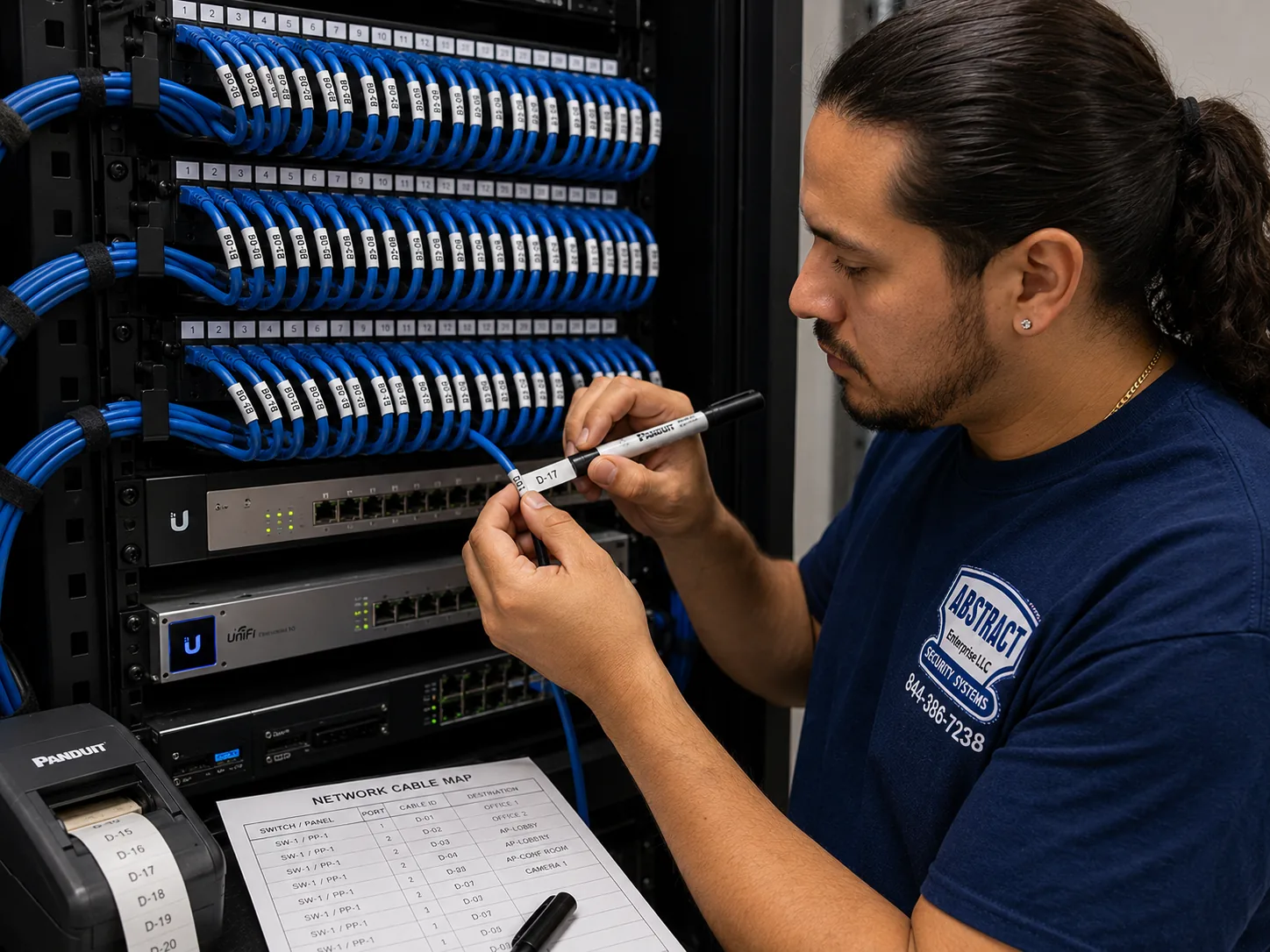
Job photo from our files, from a cabling job rather than a Comelit installation. Labeling every run against a printed map is how we leave New York Comelit buildings: when the next renovation or plumbing job opens a wall, the super can see exactly which cable belongs to the intercom.
Working Together
Working With Supers, Managing Agents and Boards on Comelit Systems
Comelit work in New York is rarely a conversation with one person. The resident reports the problem, the super lets us in, the managing agent approves the price and the board or owner pays for anything bigger. We keep that chain simple.
One written report per visit, sent to whoever booked it, describing the symptom, the cause, the repair and anything likely to need attention next.
Prices in writing before work beyond the service call, so a managing agent can approve without a second visit.
Logins and programming in the building's name on ViP and app systems, never on a technician's phone.
Access notices sent by the owner or agent, with apartment visits planned in blocks.
A walkthrough for the super at the end of any job that changed the system, so the next small issue can be described accurately.
For tenants, the most useful thing we can say is simple: report the problem to your building in writing with the date it started, and describe exactly what happens when someone rings. That record helps your building book the right repair, and it matters if the building ever has to show HPD when the condition was reported and corrected.
Cameras, access control, alarms and cabling across New York.
FAQ
Comelit Intercom NYC FAQ
Is the Comelit service call price the same in all five boroughs?
+
Yes. Every Comelit visit in the five boroughs opens with a $250 service call that covers on-site diagnosis and simple fixes. If the repair is bigger, we price it in writing before starting and the $250 goes toward it.
Do you hold any Comelit dealer, distributor or certified installer status citywide?
+
No. We are an independent New York State licensed low-voltage contractor, not a Comelit authorized dealer, distributor or certified installer. We install, repair and program Comelit equipment and source parts through our suppliers.
Which Comelit system generations do your citywide technicians work on?
+
We work on original Simplebus, two-wire Simplebus 2 and Comelit's IP system, ViP, including entrance panels such as Ultra, Quadra, 3one6 and Vandalcom, apartment monitors such as the Mini, Maxi and Icona, power supplies and the Comelit app hardware side.
Who handles a Comelit app login or license problem in a five-borough building?
+
App accounts, licenses and logins belong to Comelit, so account problems go to Comelit's support. We fix the building side that the app depends on: Wi-Fi monitors, gateways, network switches, PoE, programming and the internet connection to the intercom.
Does the citywide Comelit page also cover Staten Island bookings?
+
Yes. Staten Island Comelit work is booked through this citywide page until its own page is finished. Call (800) 486-0943 or use the form with the address and what the system is doing.
Can a five-borough board get a second brand priced next to a Comelit replacement?
+
Yes. When a board or owner wants options, we can price an Akuvox or DoorBird alternative beside the Comelit replacement so both choices come from one installer and are compared on the same scope.
Will your citywide team send Comelit wiring diagrams, manuals or firmware?
+
No. Manuals, wiring diagrams, datasheets and firmware are Comelit's documents and come from Comelit. We do not reproduce them or hand out step-by-step wiring or programming instructions; we do the work on site and explain what we changed.
Who should book Comelit service in a five-borough rental, the tenant or the owner?
+
Tenants in rentals should report the problem to the owner or managing agent, because the building intercom is the owner's responsibility. Co-op shareholders, condo unit owners and homeowners can book us directly for their own monitors or kits.
Is the door strike part of a citywide Comelit release repair?
+
Yes. When the release clicks but the door stays shut, we test the monitor, the release relay, the strike and the door itself, and fix the part that failed. New high-voltage circuits are left to the building's electrician.
What happens citywide when a Comelit part has been discontinued?
+
We check our suppliers first. If the part cannot be found, we say so plainly and price the nearest compatible Comelit option or a panel that supports the same system, rather than promising a part that does not exist.
Can a five-borough Comelit upgrade be financed?
+
Financing is available through Wisetack, subject to approval. Larger jobs start with a deposit, and equipment is ordered after the deposit is paid.
What happens to a Comelit monitor ruined by a leak from the apartment above, anywhere citywide?
+
Yes. A monitor that took on water is replaced with a compatible unit for the building's system, and we check whether the water also reached the riser or a junction box, since that can affect other apartments on the same line.
All Areas Served
Comelit Intercom Service Across New York City
This is the citywide Comelit page. Borough pages are live for Manhattan, Brooklyn, Queens and the Bronx. Staten Island, Long Island and Hudson Valley Comelit pages are still being written; in the meantime we serve those areas through this page and by phone.