Comelit panel dead, monitors silent or the front door not releasing? Brooklyn supers, owners and managing agents can call or text our Brooklyn office: (347) 934-8335
Comelit intercom repair in Brooklyn starts with a $250 service call that covers on-site diagnosis of the entrance panel, the riser, the power supply, the door release and the apartment monitors, and new Comelit systems or upgrades are quoted in writing after a site visit. We are a licensed New York State low-voltage contractor working out of an office on Troy Avenue in East Flatbush, and we repair, program, upgrade and install Comelit door entry systems in Brooklyn brownstones, walk-ups, prewar elevator buildings, mixed-use storefront buildings and newer rental towers.
Quick answer: If your Brooklyn building's Comelit intercom has stopped ringing, lost video or won't open the door, book the $250 service call. A technician tests the system end to end, tells you what failed and quotes the repair before doing it. Most Brooklyn Comelit buildings run two-wire Simplebus or Simplebus 2 wiring, which can often be kept when the panel or monitors are upgraded. Abstract Enterprises Security Systems is not a Comelit dealer or Comelit itself: we install, repair and program the equipment and source parts through our suppliers.
Last updated November 28, 2026 by Abstract Enterprises Security Systems, NYS license #12000287431 · Sources: Comelit USA product, app and case-study pages; Comelit General Catalog 2023; Comelit Pro downloads; NY Multiple Dwelling Law §50-a; NY Attorney General Residential Tenants' Rights Guide; NYC HPD Housing Maintenance Code violations, NYC Open Data; NYU Furman Center Brooklyn profile
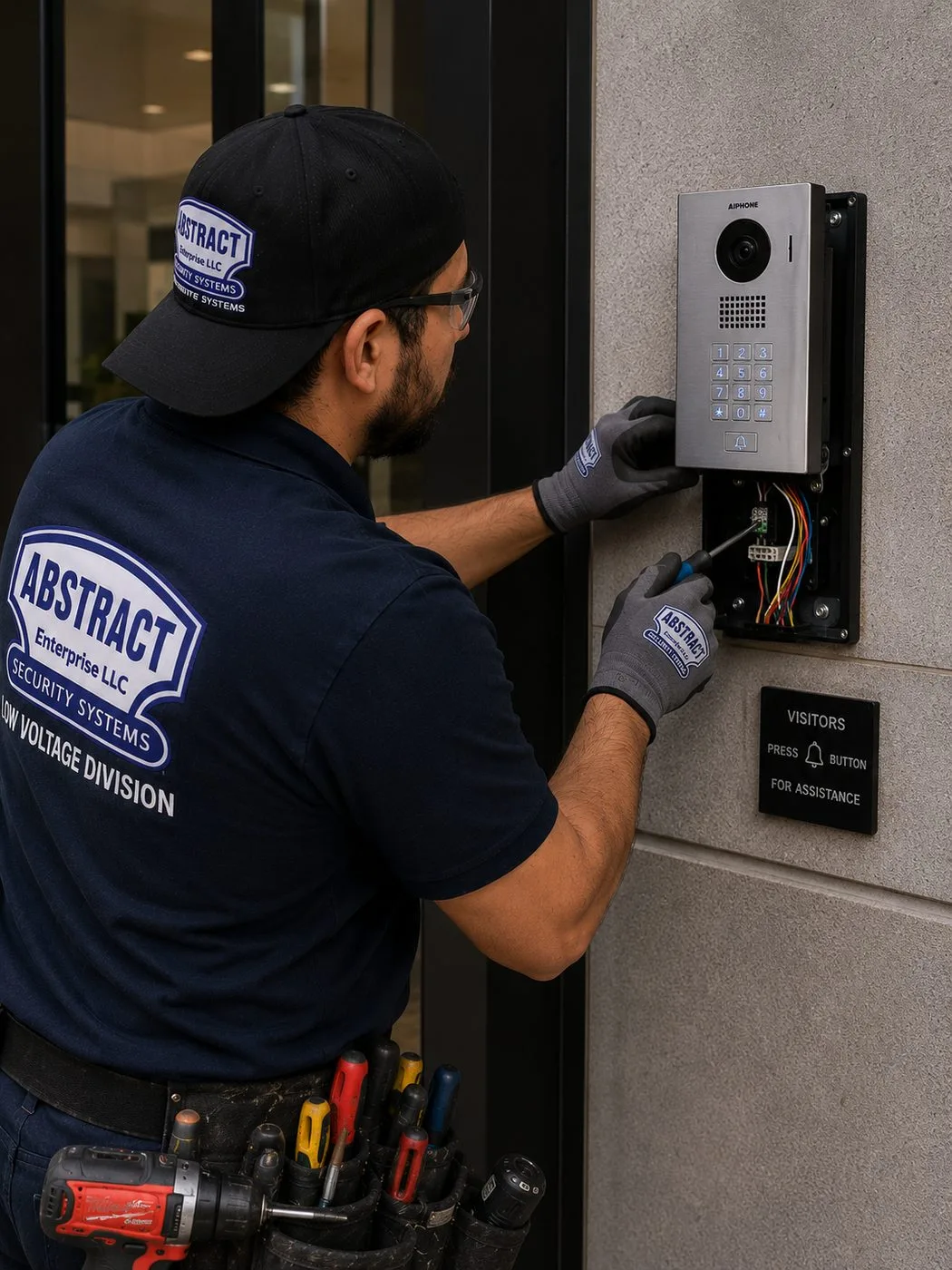
From our job library: a technician terminating the wiring behind a keypad video entrance panel at a commercial glass entry. Every Brooklyn Comelit panel repair starts at the back box like this.
Brooklyn Comelit Service Request
Owners, supers and managing agents — tell us what the Comelit system is doing
✅
Request Sent!
Thanks. Our Brooklyn office will call or text to book the service call or site visit.
25+
Years Experience
2 Hr
Booking
$250
Service Call
4.7★
201 Google Reviews
Owner-operated since 2002 · Thousands of jobs completed · Booked within 2 hours · Call or text (347) 934-8335
The Borough
Why So Many Brooklyn Buildings Still Answer the Door Through Comelit
Walk down almost any block of six-story prewar apartment houses on Ocean Avenue, Eastern Parkway or Ocean Parkway and look at the lobby doors. A good share of them carry an Italian entrance panel with a narrow aluminum frame, a row or column of call buttons and a small camera window at the top. Many of those panels are Comelit, and they are there because Comelit's two-wire technology solved a problem that Brooklyn's housing stock has more of than almost anywhere in the country: big buildings with old, thin, hard-to-replace wire running up the stair hall.
Brooklyn has 954,382 housing units, according to the NYU Furman Center's borough profile, and an enormous number of them sit in buildings that went up long before anybody imagined a video call at the front door. When an owner, co-op board or condo association in Flatbush or Bay Ridge wanted to go from an audio buzzer to video, the expensive part was never the panel. It was opening plaster walls in every apartment to pull new cable. A two-wire system that could carry audio, video and the door-release command over the existing pair turned a gut-renovation-sized job into a panel-and-monitor swap. That is why we find Comelit Simplebus and Simplebus 2 systems in so many Brooklyn buildings from the 1990s and 2000s upgrade era, and why the brand keeps showing up on our service calls today.
That history also explains the kind of help Brooklyn Comelit buildings need now. Most of the systems we see are not new installations waiting to happen. They are working systems that have aged: an entrance panel that took fifteen winters of salt spray off Kings Highway, monitors that tenants replaced with whatever they found online, a power supply in the cellar that has been running hot since the day it went in, and a riser that a cable or internet installer nicked on the way up the building. Comelit intercom repair and Comelit intercom upgrades are the bulk of the work, and installation of a brand-new Comelit system is the smaller part.
What New York law expects from a Brooklyn entry system
Two rules shape how urgent a dead Comelit system is. The first is New York's Multiple Dwelling Law §50-a: every class A multiple dwelling erected or converted after January 1, 1968 that contains eight or more apartments has to be equipped with an intercommunication system located at an automatic self-locking door giving public access to the main entrance hall or lobby. The second comes from the same section and is summarized in the New York Attorney General's Residential Tenants' Rights Guide: buildings built or converted before 1968 also must have self-locking doors and a two-way intercom if a majority of the apartments ask for one.
In practice that means a Comelit intercom in a Brooklyn rental building is not a luxury feature. When it fails, tenants can call 311, and HPD inspectors write it up. For owners, the cost of waiting is a violation on the building's record on top of the repair itself. For co-op and condo boards, the pressure is less about violations and more about shareholders and unit owners who expect the door they paid for to work.
How often Brooklyn entry systems get written up
The City publishes every Housing Maintenance Code violation HPD issues. We pulled violations whose description mentions an intercom from the HPD Housing Maintenance Code Violations dataset on NYC Open Data. From January 1 through November 27, 2026, HPD issued 1,275 of them to Brooklyn buildings: 171 class A, 1,100 class B and 4 class C. The violations are not spread evenly. In calendar year 2025 they clustered in a handful of ZIP codes in central and eastern Brooklyn:
Brooklyn ZIP code
Area it covers (roughly)
HPD violations mentioning an intercom, issued in 2025
11226
Flatbush, Ditmas Park east of Coney Island Ave
142
11221
Bushwick and eastern Bedford-Stuyvesant
88
11225
Prospect Lefferts Gardens, southern Crown Heights
77
11216
Bedford-Stuyvesant, northern Crown Heights
73
11207
East New York, Cypress Hills
64
11233
Ocean Hill, Stuyvesant Heights
64
11212
Brownsville
60
11213
Crown Heights east of Nostrand
49
11237
Bushwick east of Broadway
47
11203
East Flatbush
46
11238
Prospect Heights, Clinton Hill east
40
11206
East Williamsburg, western Bushwick
34
These counts come mostly from tenant complaints in rental buildings, and they cover every brand, not just Comelit. What they show is where Brooklyn's entry systems are under the most strain: the dense belt of prewar and early-postwar walk-ups and elevator buildings from Flatbush through Crown Heights, Bed-Stuy and Bushwick. Those are also the neighborhoods where we answer the most Comelit calls, because that belt is full of buildings that took the two-wire upgrade path fifteen to twenty-five years ago and are now due for parts, monitors or a new panel.
Who calls us about a Comelit system in Brooklyn
The person on the phone tells us a lot about how the job will run. Supers and porters in larger Flatbush and Crown Heights elevator buildings usually call first; they know which apartments have dead monitors and where the cellar power supply lives. Managing agents call for the same buildings when the problem has become a violation or a tenant letter. Owners of three- to eight-family brownstones in Bed-Stuy, Clinton Hill and Park Slope call themselves, often after a tenant has texted them a photo of a blank monitor. Co-op and condo boards in Brooklyn Heights, Midwood and Bay Ridge reach out when they are deciding whether to keep repairing an older Comelit system or replace it. And storefront owners on Flatbush Avenue, Church Avenue and Fifth Avenue in Sunset Park call when the Comelit panel serving the apartments above the store stops releasing the street door.
Each of those callers gets the same first step. We test before we quote, and we tell the person who called what failed, what it costs to fix and whether there is a better long-term option. We do not lead with a replacement pitch on a building where a $250 visit and one part will put the system back in service.
Brooklyn Comelit facts that shape the work
1,275 HPD violations mentioning an intercom were issued to Brooklyn buildings from January 1 to November 27, 2026, 1,100 of them class B (NYC Open Data).
ZIP 11226, covering Flatbush, led Brooklyn in 2025 with 142 intercom-related violations, followed by 11221 in Bushwick and eastern Bed-Stuy with 88 (NYC Open Data).
Eight or more apartments: the threshold in Multiple Dwelling Law §50-a for a required intercom at the self-locking lobby door in class A buildings erected or converted after 1968.
Existing wire reuse: Comelit describes its two-wire system as ideal for a building that wants audio or audio/video intercom "utilizing the existing intercom wires" (Comelit General Catalog 2023).
Cat5e or Cat6 required: Comelit's own words for its IP-based ViP system, which is why ViP is the new-construction and gut-renovation choice in Brooklyn (Comelit General Catalog 2023).
1,098 apartments in a 35-story Downtown Brooklyn tower are equipped with Comelit Mini Handsfree stations, according to a Comelit case study. That job was done by another company; it shows the brand is still specified for new Brooklyn towers.
What We Do
Comelit Intercom Services in Brooklyn, Part by Part
A Comelit door entry system is a chain: the entrance panel at the street door, the power supply and any distributors or mixers in the cellar or a closet, the riser that climbs the building, the monitor or handset in each apartment, the electric strike or magnetic lock on the door, and, more and more often, the Comelit App on residents' phones. When one link fails, the symptom shows up somewhere else, which is why a Brooklyn tenant on the fourth floor reports "my intercom is broken" when the actual fault is a corroded terminal in the cellar. Below is what we do on each part of the chain. For general building intercom and buzzer problems that are not brand-specific, our Brooklyn intercom repair page covers every make.
Comelit entrance panel repair and replacement
The entrance panel takes the most abuse in Brooklyn. It faces the street, it gets pressed hundreds of times a day, and in a lot of buildings it sits in an unheated vestibule that swings from below freezing in January to ninety degrees in August. We repair Comelit entrance panel faults such as dead call buttons, a cracked or fogged camera window, a speaker that has gone quiet, a microphone that picks up only traffic noise, a keypad with worn or unresponsive keys, and a directory module that no longer shows names. When the panel itself is beyond repair or parts are no longer made, we replace it, either with a current Comelit panel that runs on the building's existing system or with a different panel if the board or owner prefers.
Comelit's current panel families include the modular Ultra, which Comelit describes as a "modular 2-Wire and ViP button panel"; the 3one6 series with an 8-inch touch screen in Touch and Sense models; Quadra; the compact Ciao; the vandal-resistant Vandalcom series; Visto, a wireless door station; and Bello for single-family homes. On a Brooklyn walk-up with a few dozen apartments, the usual replacement is an Ultra built from audio/video, button or keypad modules to fit the existing opening. Larger lobbies sometimes move to a touchscreen directory instead of rows of buttons.
Comelit power supply and cellar equipment
A surprising share of Brooklyn Comelit failures start in the cellar. The power supply that feeds a Simplebus 2 system is usually mounted in a meter room, a boiler room or a closet off the lobby, and those rooms are hot, damp or both. When the supply starts to fail, the system gets flaky before it dies: video drops out on upper floors first, calls ring but audio is faint, the door release clicks weakly or not at all. We test the supply under load, check every connection and replace failed Comelit power supply, transformer and distribution components. We also note any condition in the room that will shorten the life of the new part, like a leaking pipe above the panel, so the owner or super can deal with it.
From our job library: low-voltage bundles running over an equipment rack. In Brooklyn buildings the Comelit power supply and distribution usually live in a cellar space like this one.
Comelit riser and wiring repair
The riser is the run of cable that carries the system from the cellar or lobby to every floor. In a Brooklyn Simplebus or Simplebus 2 building, that riser is often a two-conductor pair that went in when the building was converted from an older buzzer system. It can be damaged by anyone who works in the stair hall or the dumbwaiter shaft: a cable company drilling through a floor, a plumber opening a chase, a painter who staples a cable to the molding. A single short on one floor can take down every apartment above it. We trace and isolate riser faults, repair or re-terminate the damaged section and test every floor afterward. Where the old riser is too damaged to repair economically, we explain the options, including a new two-wire riser or a move to a network-based system.
We do not publish wiring diagrams or step-by-step instructions, and we ask residents and handymen not to open the riser junction boxes. Comelit two-wire systems carry power and data on the same pair, and a well-meaning repair with the wrong splice or a reversed connection can take down the whole building.
Comelit monitor and handset replacement in Brooklyn apartments
Apartment stations wear out, get dropped, get painted over during apartment turnovers and get unplugged by tenants who find the ringing too loud. We replace individual Comelit monitors and handsets with compatible current models, program them to the right apartment address and confirm two-way audio, video and door release from that apartment. Comelit's current apartment-side range includes the People monitor with mechanical buttons, an HD screen and NFC technology Comelit says is for easier installation and troubleshooting; People Wi-Fi, which a tenant can pair to home Wi-Fi by scanning an on-screen QR code to use the app; Icona; the 7Top with a 7-inch touch screen; the Mini Audio Handset and Mini Audio Handsfree; and Sonus, a compact IP intercom. Which one fits depends on whether the building runs Simplebus 2 or ViP and what the board or owner wants residents to have.
One Brooklyn-specific warning: we see many buildings where tenants have bought their own replacement monitors online. Some of those are the wrong system, some are the wrong voltage and some are counterfeit. A mismatched unit on a two-wire riser can cause problems for the neighbors, not just the apartment that installed it. If your building has a history of tenant-installed stations, tell us; we test those first.
Comelit door release, electric strike and maglock repair
When the intercom rings and video works but the door will not open, the problem is usually at the door, not in the intercom. The release command from the monitor has to reach a relay, and the relay has to drive an electric strike or a magnetic lock that is properly aligned with the door. In older Brooklyn buildings with heavy wood or steel doors, the strike is often out of alignment because the door has sagged or the frame has shifted. We test the release circuit, replace failed strikes, relays and buttons, adjust alignment and confirm the door closes and latches on its own. If the door hardware needs a new high-voltage circuit, the building's electrician supplies it; we handle the low-voltage side.
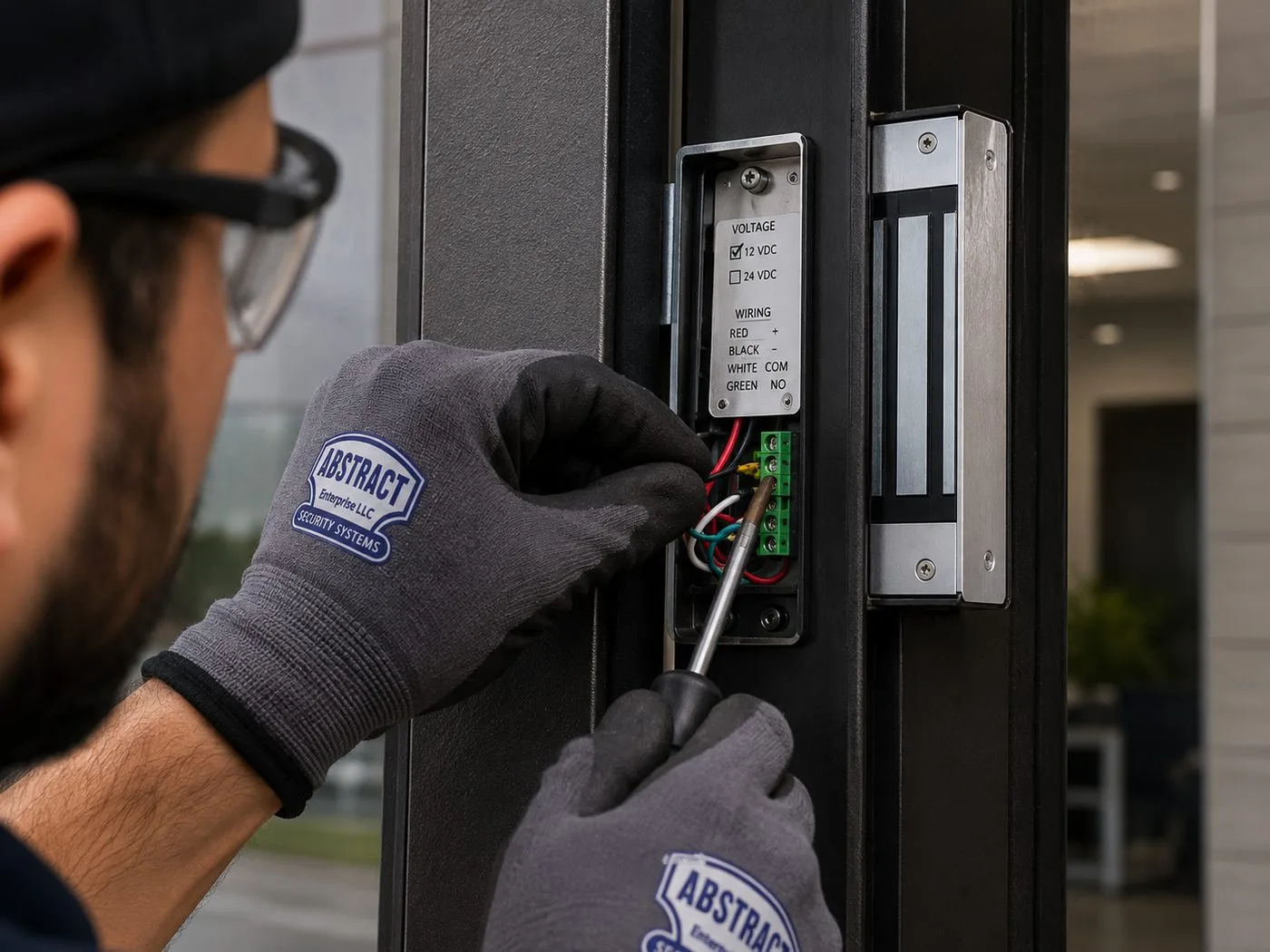
From our job library: wiring a lock terminal beside a magnetic lock. When a Brooklyn Comelit system rings but won't open the door, the fault is usually here, not in the intercom.
Many door-side faults are not Comelit faults at all, and the same symptoms show up on every brand. Our Brooklyn door buzzer repair page explains the release side in detail and lists the published part ranges for door release relays, transformers and strikes in Brooklyn.
Comelit programming and directory updates
Every Comelit apartment station has an address, and every call button or directory entry points to one. When a building renumbers units, combines apartments during a renovation, adds a basement unit or replaces a batch of monitors, the addressing can end up wrong: calls go to the wrong apartment, two apartments ring at once, or a unit gets no calls at all. We reprogram Comelit systems so each call reaches the right place, update directory names and access codes, and leave the owner or board a written list of what is programmed. We do not post Comelit programming steps online, because the procedures vary by system and a wrong entry can lock out the whole directory.
Comelit App setup and connection problems
Comelit systems with app support let residents answer calls and open the door from a phone. When the Comelit App stops ringing or won't connect, the cause can be on the resident's side (phone notifications, Wi-Fi, an outdated app), on the building's side (the panel or gateway losing its network connection, a router replaced by the internet provider) or on Comelit's side (account and cloud services). We fix the building side: the network connection, the gateway, the monitor's Wi-Fi pairing and the programming. Login and account issues belong to Comelit, and we will tell you honestly when that is where the problem sits.
Comelit access control and key fob entry
Comelit sells access control products and its app supports virtual keys, PIN or QR codes that visitors can use at a compatible panel. In Brooklyn buildings we add Comelit keypad or reader modules to existing panels, set up resident codes and fobs where the system supports them, and remove credentials when tenants move out. For buildings that want a broader access control system on side doors, cellar doors or a roof bulkhead, we can quote that separately and keep the Comelit intercom on the front door.
Comelit cameras and CCTV integration
Comelit's app can show building cameras, and some Comelit panels and monitors can display a camera view. In practice, most Brooklyn buildings we work in have a separate camera system from another brand. We can tie a camera view into the intercom where Comelit documents that integration, or keep the two systems separate and make sure the super and the board can see both. If a building wants a full camera upgrade, we quote it as its own job, never as a forced bundle with an intercom repair.
Comelit maintenance visits
Many Brooklyn buildings call only when the Comelit system has already failed. Others book a maintenance visit before winter, before a big turnover season or before a co-op or condo annual meeting. A maintenance visit is booked like a service call. We test the panel, the power supply, the door release and a sample of apartments, clean and tighten connections, check the camera image and the app connection, and give the person who booked us a short written report: what is healthy, what is wearing out and what we would replace in the next year. There is no subscription and no contract to sign.
Know Your System
Simplebus, Simplebus 2 and ViP: Which Comelit System Your Brooklyn Building Has
The first thing we figure out on a Brooklyn Comelit call is which technology the building runs, because it decides which parts fit, which upgrades are possible and how much of the existing wire can stay. Comelit has used three main approaches in multi-unit buildings, and Brooklyn has all three.
Original Simplebus
Simplebus was Comelit's first-generation two-wire system, and plenty of Brooklyn buildings that upgraded from audio buzzers in the 1990s and early 2000s still run it. Comelit's professional download site now files the original Simplebus documents under "Simplebus discontinued." That matters for repairs: when an original Simplebus panel, monitor or power supply fails, the exact replacement may no longer be made. Some parts are still available through suppliers; others have to be replaced with a newer generation, which can mean changing more than the single failed part. We tell owners and boards that plainly at the first visit, before they spend money on a repair that only buys a few months.
Simplebus 2
Simplebus 2 is the two-wire system most Brooklyn Comelit buildings use today. In its 2023 catalog, Comelit describes its two-wire system as ideal for a building that wants an audio/video or audio-only intercom "utilizing the existing intercom wires." The catalog also lists a dedicated Simplebus 2 riser cable, part 4577/100, made of two twisted red and black conductors of 1 mm² cross-section. In real Brooklyn buildings the riser is often whatever two-conductor cable was already there, which is why the condition of the old wire matters so much. Simplebus 2 buildings can usually upgrade their entrance panel and apartment monitors without opening walls, and current Comelit panels such as Ultra are made in two-wire versions.
ViP, Comelit's IP system
ViP is Comelit's network-based system. Comelit calls it "a true and unlimited IP based intercom system" for new construction or projects with new cabling, and states that Cat5e or Cat6 cable is required. In Brooklyn, ViP shows up in new rental buildings in Williamsburg, Greenpoint, Downtown Brooklyn and along Fourth Avenue, and in gut renovations where the walls were open anyway. ViP brings features that two-wire systems handle differently or not at all, such as easier integration with access control and remote connection. Moving an existing occupied building to ViP almost always means new cable to every apartment, which is the expensive part.
Hybrid buildings
Comelit documents an interface, the 1469, that connects two-wire and IP door entry systems. That opens a middle path for some Brooklyn buildings: keep the two-wire riser to the apartments and connect a network-based panel or app service at the entrance. Whether it fits depends on the building's existing generation and size, and we confirm it during the site visit rather than promise it over the phone.
Comelit technology
What you usually see in a Brooklyn building
Wire to the apartments
What it means for repairs and upgrades
Original Simplebus
1990s and early-2000s upgrades in prewar walk-ups and elevator buildings in Flatbush, Midwood, Bay Ridge and Crown Heights
Two-conductor riser, often the building's original buzzer wire
Comelit files it as discontinued; some parts are still sourced, others force a generation change. Plan the upgrade before the next failure.
Simplebus 2
The most common Comelit system on our Brooklyn calls, from four-unit brownstones to buildings with well over a hundred apartments
Two-conductor riser (Comelit lists a dedicated 2×1 mm² cable)
Panels and monitors can usually be upgraded on the existing riser. Riser damage is the main risk.
ViP (IP)
New rentals and condos in Williamsburg, Greenpoint, Downtown Brooklyn, Gowanus and Fourth Avenue; full renovations
Cat5e or Cat6 network cable, as Comelit requires
Network-dependent; app, access control and remote connection are built in. Network problems look like intercom problems.
Hybrid (1469 interface)
Selected buildings bridging an existing two-wire system to IP equipment
Two-wire riser plus network at the head end
Possible middle path; we confirm compatibility on site.
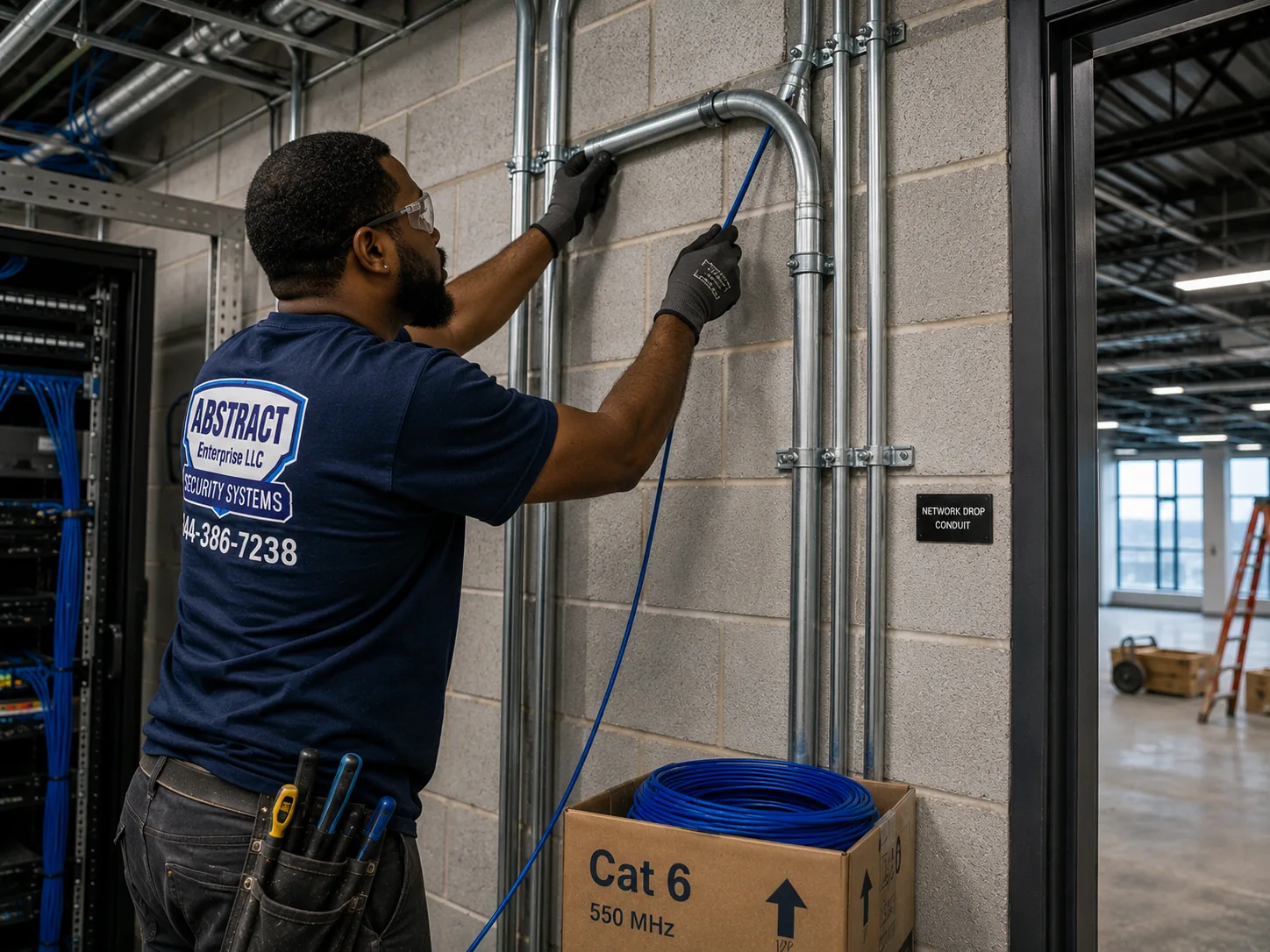
From our job library: pulling cable into conduit beside a telecom room. Riser runs like this carry a Comelit system from the head end to every floor of a Brooklyn building.
How we tell which Comelit system you have
You can sometimes tell from the outside. A building with Cat6 network cable at the entrance panel and a network switch in the cellar is likely ViP. A building with a single pair of wires at each apartment station and a Comelit power supply in the cellar is likely Simplebus or Simplebus 2. Model numbers printed on the back of a monitor or inside the panel settle the question, but we don't ask residents to take equipment off the wall to find them. A photo of the entrance panel and one apartment monitor, sent with your request, is enough for us to prepare. The rest we confirm during the service call.
The Comelit product names Brooklyn residents see
Residents often describe their equipment by what it looks like, not by a model number, so here is how the current Comelit names map to what people see. On the street side: Ultra (modular aluminum panel with separate camera, button, keypad or touchscreen modules; Comelit lists a camera field of view up to 160°×100° and resolution up to 2 Mp), 3one6 (an 8-inch touchscreen panel), Quadra (a compact all-in-one panel), Vandalcom (heavy-duty panels for rough locations), Ciao (compact panel), Visto (wireless door station) and Bello (single-family). Inside the apartment: People and People Wi-Fi monitors, Icona, 7Top, Sonus, and the Mini Audio Handset and Mini Audio Handsfree stations. Older Brooklyn buildings may still have earlier Comelit monitors and handsets that Comelit no longer lists; we work on those too, within the limits of what parts still exist.
We only name a Comelit model on this page when Comelit's own site or catalog confirms it. If your equipment carries a model number we haven't listed, that doesn't mean we can't service it. It means we confirm compatibility on site before ordering parts.
Symptoms
Comelit Intercom Not Working in Brooklyn? What the Symptom Usually Means
Most of our Brooklyn Comelit calls start with a symptom, not a diagnosis. The table below is how we think about the common ones before we arrive. It is not a repair guide: the safe resident checks are in the last column, and everything else is for a technician with the right meters and spare parts.
What residents report
Where we usually find the fault
What a resident or super can safely check first
Comelit intercom no power, whole building dead
Power supply in the cellar, a tripped circuit feeding it, or a short on the riser pulling the supply down
Super: confirm the circuit breaker feeding the intercom supply hasn't tripped. Don't open the supply.
Comelit intercom black screen in one apartment, others fine
That apartment's monitor, its connection to the riser, or its address programming
Resident: check the monitor isn't in a do-not-disturb or screen-off setting.
Video works on low floors, not on upper floors
Weak power supply, a high-resistance splice on the riser, or an overloaded distributor
Nothing to check; note which floors have video and which don't.
Comelit intercom not ringing, but the door opens from the panel code
Call routing or apartment address, a failed call button or directory entry, or the monitor's ringer setting
Resident: check the ringer volume and any mute setting on the monitor.
Comelit intercom buzzing or humming noise
Ground fault, a damaged riser section, interference from a nearby high-voltage line, or a failing power supply
Super: note whether the hum started after any work in the stair hall or cellar.
Comelit intercom ringing continuously or calling by itself
A stuck call button, water in the entrance panel, or a short in an apartment station
Super: check whether the entrance panel is wet after rain or snow; don't spray it.
Comelit door release not working; calls and video fine
Electric strike or maglock, release relay, door alignment or the lock's power
Super: check the door closes fully and isn't being held by a wedge or a sagging hinge.
Comelit App not working or no push notifications
Network or gateway at the building, monitor's Wi-Fi pairing, phone notification settings, or Comelit account services
Resident: update the app and confirm notifications are allowed for it.
Distorted audio, static or feedback
Entrance panel speaker or microphone, panel volume settings, or riser condition
Nothing to check; tell us whether it's at the panel, the apartment, or both.
Intercom intermittent, works some days
Loose or corroded connections, temperature-sensitive power supply, moisture in the panel or a riser junction
Keep a short log of when it fails: weather, time of day, which apartments.
Why Brooklyn winters are hard on Comelit entrance panels
Our Brooklyn Comelit calls rise after the first hard freeze and again after big snow and rain storms. Moisture gets into entrance panels that sit flush in brownstone stoops or in vestibules that open straight onto the sidewalk, then freezes and thaws. Salt and snowmelt splash up from the street. Buttons stick, cameras fog, and moisture in the panel can make a system call apartments at random. Power outages in a storm can also leave a system in a confused state when power comes back. We check seals and gaskets on every entrance panel we service and suggest a hood or relocation where the location is the real problem.
Why we don't post Comelit troubleshooting steps
We get asked for "Comelit troubleshooting" guides, Comelit error code lists, reset procedures and Comelit wiring diagrams. We don't publish them. Manuals, wiring diagrams and firmware belong to Comelit, and a two-wire system that carries power and data on one pair is easy to damage with the wrong splice or reset. What we do share is what a resident or super can safely look at, which is in the table above. Everything past that is a service call, and on that call the technician explains what was wrong in plain language.
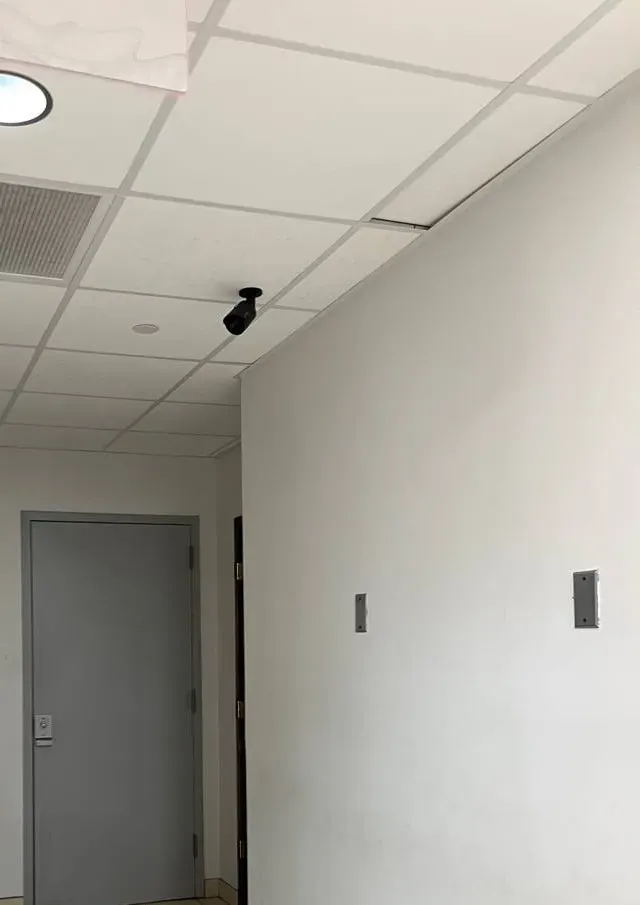
From our job library: a back hall leading to a steel service door with a camera above. Side and service doors in Brooklyn buildings often get their own Comelit station or keypad.
Brooklyn Buildings
Comelit Door Entry Systems in Brooklyn's Building Types
The same Comelit fault plays out differently in a Park Slope brownstone and a 120-unit building on Ocean Avenue. Here is how the building type changes the work.
Brownstone and limestone rowhouses
Bedford-Stuyvesant, Crown Heights, Clinton Hill, Fort Greene, Park Slope, Prospect Heights and Stuyvesant Heights are lined with three- and four-story rowhouses that have been split into two to eight apartments. Many of them have a small Comelit panel set into the vestibule wall or the stoop and a handful of monitors upstairs, usually on a two-wire system that replaced the original bell wire. The wiring often runs inside plaster chases, behind original moldings and through floors that owners do not want touched. That is the strongest argument for keeping a two-wire system in a brownstone: the panel and monitors can change without opening a single wall.
Brownstone jobs come with their own constraints. Vestibule doors are often original wood with a mortise lock, so the electric strike has to be fitted carefully. Panels on the outside of the stoop face weather head-on. And in a building with a landlord living on the parlor floor, the owner usually wants one thing above everything else: to stop being the person who buzzes everyone in. A monitor with app answering for the owner and upgraded stations for the tenants often solves that without a full replacement.
Prewar elevator apartment buildings
The five- and six-story elevator buildings along Ocean Avenue, Eastern Parkway, Ocean Parkway, Shore Road, Fourth Avenue in Bay Ridge and the side streets of Flatbush and Prospect Lefferts Gardens are where Brooklyn's biggest Comelit systems live. They often have 40 to 150 apartments, a lobby panel with a directory, and a two-wire riser that runs through several stair halls or a pipe chase. In these buildings, the most common Comelit call is partial failure: one line of apartments has no video, or a single floor gets no calls. The fix is usually a riser repair, a power supply or distributor, or a batch of monitors, not a new system.
Prewar elevator buildings also tend to have the most complicated access arrangements. A Comelit repair that involves the riser needs access to every affected apartment on the day of the visit, because a fault in one unit can kill service to the floors above it. We ask the super or managing agent to post a notice with the date and two-hour arrival window, and to arrange keys or an escort for units where nobody will be home.
Walk-ups in Bushwick, Williamsburg, Greenpoint and Sunset Park
The tenement-style walk-ups of Williamsburg, Greenpoint, Bushwick, Ridgewood's Brooklyn edge and Sunset Park are usually four or five stories with four apartments per floor, a narrow vestibule and a street door that takes heavy use. When those buildings upgraded to video, some went Comelit two-wire. The common problems are physical: the street door slams and knocks the strike out of alignment, delivery traffic wears out call buttons, and the panel takes damage from the sidewalk. A Vandalcom panel or a better-protected Ultra is worth considering at those doors.
Mixed-use buildings over Brooklyn storefronts
Flatbush Avenue, Church Avenue, Nostrand Avenue, Fifth Avenue in Park Slope and Sunset Park, Eighth Avenue and Avenue U are lined with buildings that have a store on the ground floor and apartments above, reached through a separate street door beside the shopfront. The Comelit panel at that door often shares space with mailboxes and the store's own security equipment. The store owner and the residential tenants depend on the same entry, and trouble usually surfaces when a delivery can't get to an upstairs apartment. These doors need a release that works every time and a panel that survives the sidewalk. Where the store and the apartments have separate owners or tenants, we make sure everyone knows who is responsible for which part of the system.
New rental and condo towers
Downtown Brooklyn, the Williamsburg and Greenpoint waterfront, Gowanus and Fourth Avenue have added thousands of apartments in buildings that went up since the 2000s. Some of them were specified with Comelit from the start. A Comelit case study describes a 35-story mixed-use tower in Downtown Brooklyn with 1,098 apartments, an EZ-ULTRAMUG entrance panel kit, a Comelit 6722W Mini Handsfree station in every apartment and a 1952N unit at the concierge desk. That installation was done by another company, and we cite it only to show how far the brand reaches in Brooklyn. Buildings like that need service on a schedule that doesn't disrupt a staffed lobby, and changes to the directory or concierge setup need careful programming.
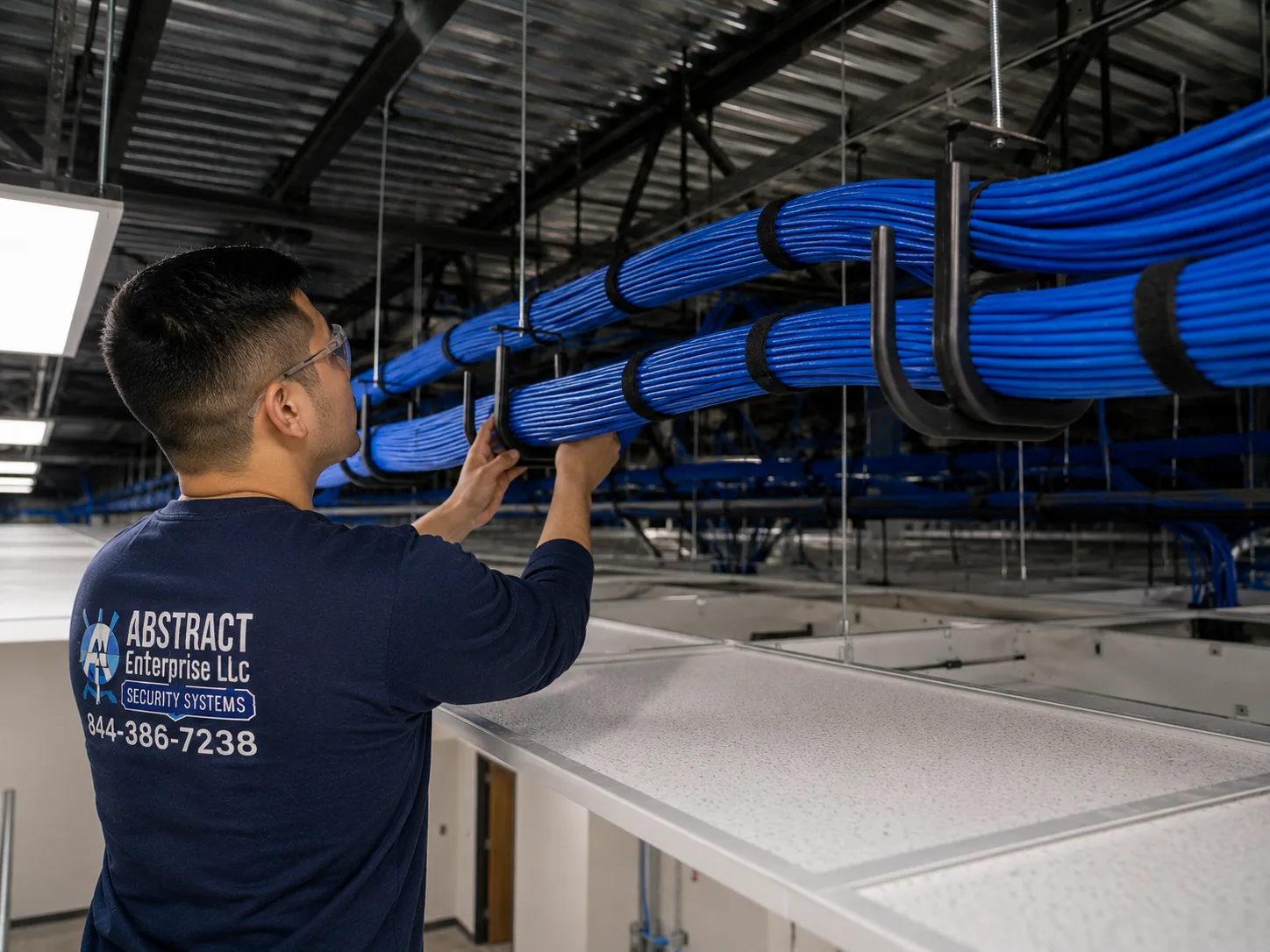
From our job library: new network cable dressed in J-hooks during a build-out. Comelit requires Cat5e or Cat6 for its ViP system, which is why ViP suits new Brooklyn buildings and gut renovations.
Postwar complexes in southern Brooklyn
Brighton Beach, Coney Island, Sheepshead Bay, Gravesend and Bensonhurst have many postwar apartment buildings and complexes with multiple entrances, often several hundred apartments and long corridor runs. A Comelit system in one of these buildings can span several lobbies on one or more power supplies. Salt air off the ocean shortens the life of entrance panels and door hardware near the water. Maintenance visits make more sense here than in most of the borough, because a single failure can affect hundreds of households.
Landmarked blocks
Brooklyn has a large number of historic districts, from Brooklyn Heights and Cobble Hill to Park Slope, Fort Greene, Clinton Hill, Bedford and Stuyvesant Heights, Prospect Lefferts Gardens and Ditmas Park. Exterior changes on a landmarked building, including a new or larger entrance panel, can need approval from the Landmarks Preservation Commission. A panel that stays within the existing opening is the easiest path. When a board or owner wants a larger panel or a new location, we give them the product dimensions and finish so they can file with LPC, and we install after the approval comes through.
Home and single-family Comelit systems
Some Brooklyn houses in Marine Park, Mill Basin, Dyker Heights, Bergen Beach and Midwood have Comelit single-family kits, sometimes with a gate station at the driveway. Comelit lists Bello as its single-family door station and Visto as a wireless option. We repair, upgrade and install these the same way we handle multi-unit systems, with a site visit first and a written quote for anything beyond a repair.
Phones & Apps
The Comelit App in Brooklyn Buildings: What It Does and Who Fixes What
More Brooklyn residents now ask for one thing above all: to answer the front door on their phone. Comelit supports that through the Comelit App, which Comelit offers as a free download on the App Store and Google Play. According to Comelit, the app lets residents take video calls from the entrance panel, open the door remotely, create virtual keys as PIN or QR codes for visitors, call or unlock an elevator where the system supports it, use a face recognition option, and connect Alexa or Google Home for voice control. Comelit also says property managers can assign, update and revoke resident credentials through the system.
What Brooklyn buildings need for the app to work
App answering needs a system that supports it and a path to the internet. On a ViP building, that path is the building network. On a Simplebus 2 building, it can be a Wi-Fi-capable apartment monitor such as People Wi-Fi, which Comelit says pairs to a tenant's home Wi-Fi by scanning an on-screen QR code, or a gateway at the head end. Older Simplebus buildings may need equipment changes before the app is an option at all. During the service call or site visit we tell you which path your building has and what it costs to add.
Move-ins, move-outs and virtual keys
Brooklyn rental buildings turn over apartments constantly, and co-op and condo units change hands on their own schedule. Every move-out is a moment when someone who no longer lives there may still have a way into the building. For Comelit systems with app accounts or codes, we set up a simple routine with the owner or managing agent for removing old credentials and adding new ones, and we show the super where that is done. For virtual keys that residents create for visitors, we recommend the building set a house rule on how long those keys stay active.
Who handles which Comelit app problem
We are not Comelit and we don't run its app or cloud services. If a resident can't log in, has forgotten a password or has an account problem, that goes to Comelit's own support. What we handle is everything at the building: the panel's or gateway's network connection, the monitor's Wi-Fi pairing, the programming that links an apartment to its app account and the router or switch the system depends on. When an internet provider replaces a building's router and the app stops working, that is usually ours to fix, and it is one of the most common Comelit calls we get in newer Brooklyn buildings.
Some residents never want the app, and some apartments have older relatives who won't use one. We almost always recommend keeping a working monitor or handset in every apartment alongside app answering, so no one depends on a phone battery to let in a visitor or a home health aide.
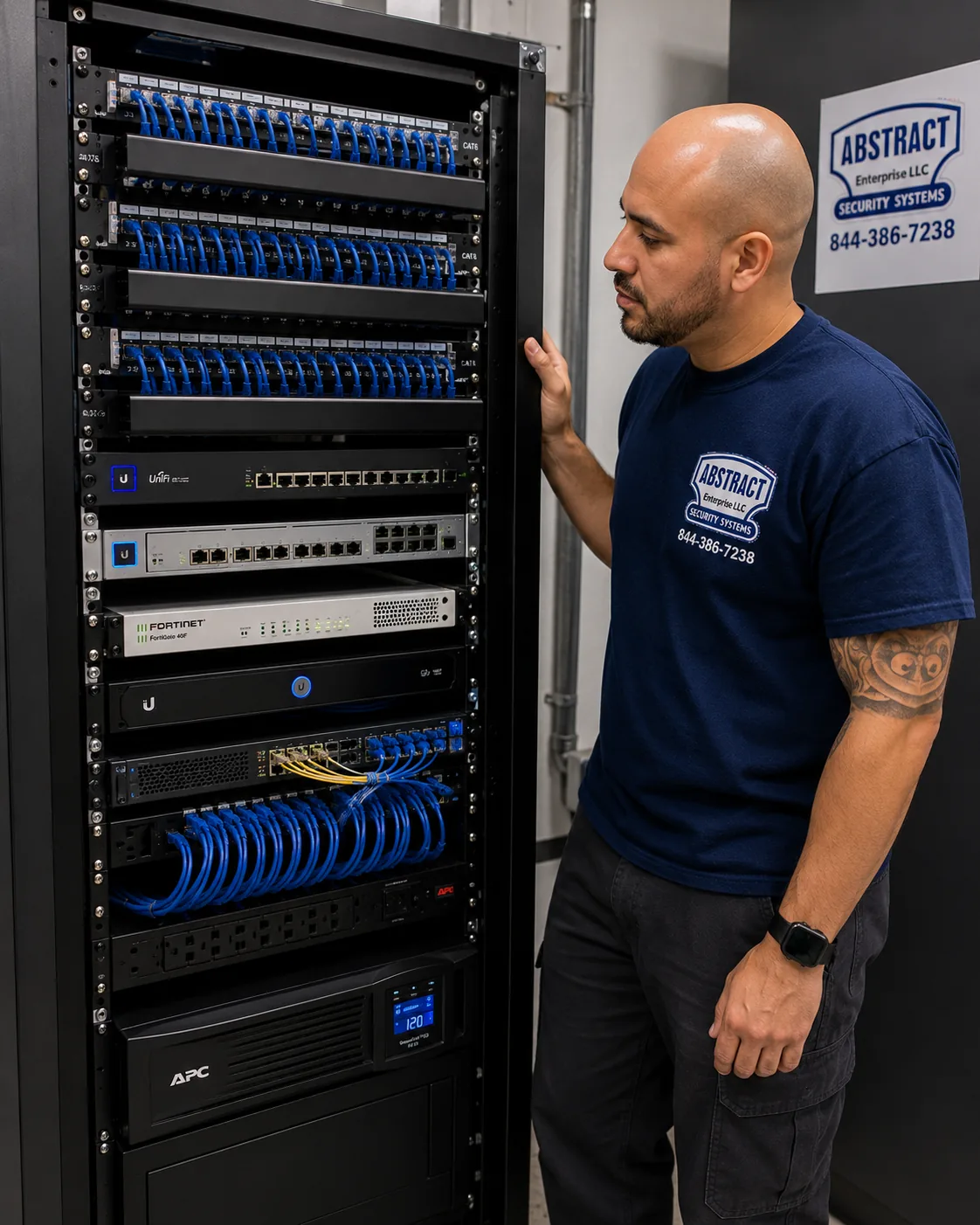
From our job library: a finished network rack with switching and battery backup. On ViP and app-connected Brooklyn Comelit systems, this is where many app problems are actually solved.
Neighborhoods
Comelit Service Around Brooklyn, Neighborhood by Neighborhood
Our Brooklyn office on Troy Avenue sits in East Flatbush, close to the middle of the borough, and our technicians cover every Brooklyn neighborhood. The kind of Comelit work changes as you cross the borough, because the buildings change.
Flatbush, Ditmas Park and Prospect Lefferts Gardens
This is the heart of Brooklyn's prewar elevator housing and the area with the most intercom-related HPD violations in 2025: ZIP 11226 alone had 142, and 11225 had 77. Buildings along Ocean Avenue, Flatbush Avenue, Parkside Avenue and the side streets between them often carry two-wire Comelit systems with a lobby directory and dozens of apartment monitors. Typical calls are partial outages on one line of apartments, worn lobby panels and door strikes on heavy lobby doors that no longer catch. In Ditmas Park's large Victorian houses, a few owners have small Comelit kits serving two or three apartments.
Crown Heights and Bedford-Stuyvesant
Rowhouses and small apartment buildings dominate here, along with prewar elevator buildings on Eastern Parkway and the avenues. ZIPs 11216, 11213 and 11233 each saw dozens of intercom-related violations in 2025. Comelit calls here are often brownstone and small-building work: a stoop panel with sticking buttons, a single monitor that went dark, a door that won't release after the vestibule door was rehung. Many of these buildings changed hands in the last decade, and new owners sometimes inherit a Comelit system with no paperwork. We document what is installed so the owner has a record.
Bushwick, East Williamsburg and Ocean Hill
Four- and five-story walk-ups and newer mid-rise rentals share these blocks. ZIP 11221 ranked second in Brooklyn for intercom-related violations in 2025, and 11237 and 11206 also appear on the list. Street doors take heavy use, so Comelit work here leans toward entrance panels, call buttons and door hardware. Newer buildings may have ViP systems that depend on a network connection, and when the internet provider swaps equipment, the intercom app can stop working until the building side is reconnected.
Williamsburg, Greenpoint and the waterfront
The waterfront towers and the newer mid-rise buildings inland were built with network cabling from the start, so ViP and app-connected systems are more common here than elsewhere in Brooklyn. Older tenement walk-ups on the side streets still run two-wire systems. Comelit calls in this area are a mix of network and app issues in new buildings and classic panel and riser repairs in older ones.
Park Slope, Prospect Heights, Fort Greene and Clinton Hill
Brownstone and limestone rowhouses split into co-ops, condos and rentals make up most of the Comelit work here, along with prewar apartment buildings near Prospect Park and on the avenues. Much of the area sits in historic districts, so the panel's size and finish matter. Owners and boards here tend to ask about upgrading to video and phone answering without touching plaster, which is exactly what a sound two-wire riser allows.
Brooklyn Heights, Cobble Hill, Carroll Gardens and Boerum Hill
Some of the oldest housing in the borough, much of it landmarked, with a mix of rowhouses and prewar co-op buildings. Brooklyn Heights became New York City's first historic district in 1965, and exterior changes on these blocks are watched closely. Comelit work here usually means discreet panel replacement within the existing opening, careful strike work on original doors and monitor upgrades in co-op buildings where the board wants every apartment on the same model.
Bay Ridge, Dyker Heights and Sunset Park
Bay Ridge's Shore Road and Fourth Avenue are lined with prewar and postwar elevator buildings, many of them co-ops, while Sunset Park mixes walk-ups with mixed-use buildings along Fifth Avenue. Comelit two-wire systems are common in the Bay Ridge co-ops. Boards here often ask whether to repair or replace, and the answer usually depends on whether the building is on original Simplebus or Simplebus 2.
Midwood, Borough Park, Bensonhurst and Gravesend
These neighborhoods mix one- and two-family houses with apartment buildings along Ocean Parkway, Kings Highway, 86th Street and Avenue J. Comelit work ranges from single-family and two-family kits to building systems in six-story elevator apartments. Large families and multi-generational households make indoor monitors important; not everyone in the apartment answers the door on a phone.
Brighton Beach, Coney Island and Sheepshead Bay
Postwar apartment complexes and large elevator buildings near the ocean. Salt air shortens the life of entrance panels, strikes and exposed connections. Comelit systems here often serve several lobbies, so one power supply or riser fault can affect many households at once. These buildings benefit most from a scheduled maintenance visit before winter.
East New York, Brownsville, Canarsie and East Flatbush
Our own neighborhood is part of a large area of rowhouses, small apartment buildings and larger rental complexes. ZIPs 11207, 11212 and 11203 each had dozens of intercom-related violations in 2025. Rental owners here call us most often when an HPD inspection is coming or a violation has been issued, and the job is usually a specific repair, not a new system.
Downtown Brooklyn, DUMBO and Gowanus
High-rise rentals and condos with staffed lobbies, plus converted industrial buildings. Comelit appears in some of the new towers, including the 1,098-unit building in Comelit's own Downtown Brooklyn case study. Work in these buildings is coordinated with building management and the concierge desk, and directory or app changes are planned so the lobby never loses its entry system during business hours.
Before You Call
What to Have Ready Before Booking Comelit Service in Brooklyn
A few details from the owner, super or managing agent make the first visit faster and often save a return trip.
A photo of the entrance panel and, if possible, one apartment monitor or handset. The look of the equipment often tells us the generation before we arrive.
The scope of the problem: the whole building, one line of apartments, one floor, one apartment, or just the door release.
When it started and whether anything happened just before: a storm, a power outage, work in the stair hall, a new internet installation, an apartment renovation.
Where the equipment lives: cellar, meter room, lobby closet, roof bulkhead. Tell us who has keys.
Any paperwork from the original installer: a programming list, admin codes, network logins on ViP systems.
Access plan for apartments that may need to be entered, especially for riser problems.
Who approves the repair if it goes beyond the service call: owner, managing agent or a board member.
If you don't have any of this, book anyway. The service call includes the investigation, and we leave the building with a written description of what is installed so the next visit starts with facts.
Questions
Comelit Intercom in Brooklyn: Questions Owners, Supers and Boards Ask
These are the Comelit questions we hear most from Brooklyn buildings, grouped by the decision they belong to.
Repair decisions
Is it worth repairing a twenty-year-old Comelit system in a Flatbush elevator building?
Often yes, if the building runs Simplebus 2 and the riser is in decent shape. A Simplebus 2 system with a failing power supply or a handful of dead monitors can usually be brought back for a fraction of what a new system costs, and current Comelit panels and monitors still run on that technology. The answer changes if the building is on original Simplebus, which Comelit lists as discontinued, or if the riser has failed in several places. The $250 service call is how a Flatbush owner or board finds out which situation they are in before deciding.
Our Bed-Stuy brownstone has one dead Comelit monitor. Do we need the whole system looked at?
Not necessarily the whole system, but we will test the panel and at least one other apartment, because a monitor that looks dead is sometimes a symptom of a power or riser problem. If the fault really is that one monitor, we replace it with a compatible model, program it to the right apartment and confirm audio, video and door release before we leave.
Why does the Comelit system in our Crown Heights building fail every winter?
The usual causes are moisture in the entrance panel, a power supply in an unheated space, or a riser junction in a cold, damp spot such as a cellar entrance or a roof bulkhead. Freeze and thaw opens small gaps; salt and snowmelt get in. We look for the seasonal pattern on the first visit and fix the cause, such as resealing or relocating the panel or moving a power supply to a drier place, rather than just replacing the part that failed this year.
Can you repair a Comelit system a previous contractor installed in our Bay Ridge co-op?
Yes. We service Comelit systems no matter who installed them. The only thing that slows us down is missing information, such as admin codes, a programming list or network logins for a ViP system. If the board or managing agent has any paperwork from the original installer, send it with the request. If not, we document what we find so the next visit starts with facts.
Upgrade decisions
Can a Park Slope building go from Comelit audio to video without opening plaster?
In many cases, yes. That is exactly what Comelit's two-wire system was designed for, and Comelit's catalog describes it as ideal for audio or audio/video using the existing intercom wires. We confirm the condition of the existing riser and apartment wiring on site. If the wire is sound, the upgrade is a new entrance panel and new apartment monitors on the same pair. If the wire is damaged or too thin in places, we explain where new cable would be needed before anyone commits.
Should a Williamsburg building being gut-renovated choose Comelit ViP or two-wire?
If the walls are open and the building is pulling new network cable anyway, ViP is the natural choice for a Comelit system, because Comelit requires Cat5e or Cat6 for it and it brings network features built in. Two-wire still makes sense when the renovation leaves the stair hall and riser untouched. We also quote a non-Comelit alternative when the owner asks, so the decision is about the building, not the brand.
Our Midwood condo wants residents to answer on their phones. What does that take on a Comelit system?
It depends on the generation. On ViP, app answering runs over the building network. On Simplebus 2, it can be done with Wi-Fi-capable apartment monitors or a gateway. On original Simplebus, it usually means upgrading equipment first. We tell the board which path applies after a site visit and price it with and without keeping indoor monitors in every unit.
Building operations
Who needs to be home when you repair a Comelit riser in a Brooklyn walk-up?
Anyone whose apartment station sits on the damaged section of the riser. Comelit two-wire systems are linked, so a short or bad station in one apartment can take out the floors above it, and the repair can't be finished without reaching every affected unit. We ask the owner, super or agent to post a notice with the date and two-hour arrival window and to arrange keys or an escort for units where no one will be home.
Does a Comelit repair in a rent-stabilized Brooklyn building clear an HPD violation?
Our repair fixes the condition; clearing the violation is an HPD process that the owner or managing agent handles, usually by certifying the correction. We give the owner a written invoice describing what was repaired and the date, which is what most owners use when they certify. We don't file with HPD on anyone's behalf, and we don't give legal advice about violations.
Can our Sunset Park storefront building's Comelit panel ring the store as well as the apartments?
Usually yes, by giving the store its own call button or directory entry and its own apartment-style station or app account. The bigger question is who controls the street door and who pays for the system. We set it up the way the owner decides and leave a written list of which button calls whom.
Do you work on Comelit systems in Brooklyn on weekends?
Yes. We schedule seven days a week with early-day visits, in two-hour arrival windows, first come first served once the service call is paid. We don't promise same-day repairs and we don't run a 24-hour service, but requests are booked within 2 hours of reaching us.
Repair, Upgrade or Switch
Keep the Comelit System, Upgrade It or Choose Another Brand?
Brooklyn owners and boards ask us for an honest installer's view, so here it is. We have no stake in Comelit. We service it because Brooklyn has so much of it, and we quote alternatives when they serve the building better.
When repairing the existing Comelit system is the right call
The building runs Simplebus 2 and the riser tests clean.
The failure is a part with a current replacement: a power supply, a few monitors, the door release, a panel module.
Residents are generally satisfied with how the system works day to day.
The building isn't planning a renovation that would open walls in the next few years.
When a Comelit upgrade on the existing wire makes sense
The building is on Simplebus 2 but the panel is worn, the monitors are a mix of models, or residents want video or app answering.
The owner or board wants to stay with one brand and keep the two-wire riser.
Comelit's current two-wire panels and monitors fit the existing openings and wiring.
When to look at a different system
The building is on original Simplebus and key parts are no longer available.
The riser has failed in several places and new cable is needed anyway.
The owner wants features such as cloud management or a particular app experience that another platform handles the way they prefer.
When the building is a candidate for a change, we can price an Akuvox or DoorBird system next to the Comelit option, using the same site visit. Our Akuvox vs ButterflyMX comparison explains how two common alternatives differ, including what each costs to run over time. Comelit points out that its intercom products are available with a one-time licensing fee and no monthly subscription, which matters to Brooklyn boards comparing systems that charge per-unit fees every month. We put the long-term costs of each option side by side so the board compares like with like.
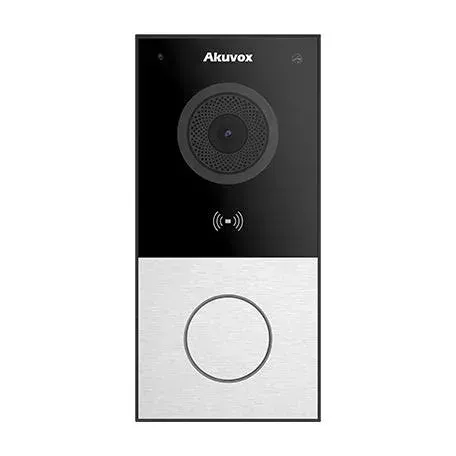
Manufacturer product photo, not Comelit: an Akuvox single-button door station. When a Brooklyn building is a candidate for a change, we can price an alternative like this next to the Comelit option.
What we won't do
We won't tell a building its Comelit system is obsolete when a repair will do. We won't claim to be a Comelit authorized dealer, distributor or certified installer, because we aren't. We won't knock another contractor or another brand to win a job. And we won't sell a building a full replacement over the phone without seeing the riser, the power supply and the doors.
For Supers
A Brooklyn Super's Guide to Living With a Comelit System
In most Brooklyn buildings the super is the first person who hears that the Comelit system is acting up, and the last person who wants a technician to find something that could have been caught earlier. None of this replaces a service call, but these habits keep a Comelit system healthier between visits.
Keep the entrance panel clean and dry, the right way
Wipe the panel face with a soft, barely damp cloth. Don't spray cleaner or water directly at the panel, don't pressure-wash the vestibule around it and don't use salt or ice melt right below it if you can avoid it. Moisture and salt that work their way behind the buttons cause many of the winter faults we see in Brooklyn. If water pools in front of the panel after rain, tell us; a hood or a small change in mounting can fix it.
Keep a simple fault log
When residents complain, write down the date, the apartments affected, what they reported and the weather. A month of notes like that often points straight at the cause: a power supply that fails on hot days, a panel that misbehaves after storms, a riser fault that appeared the week a contractor worked in the stair hall. A log also helps when an owner or managing agent asks whether a repair actually fixed the problem.
Know where the equipment is and keep the room accessible
Make sure you know where the Comelit power supply and any distribution equipment sit, which breaker feeds them and who has the key to that room. Keep the space around the equipment clear; we regularly find intercom supplies buried behind stored furniture, paint cans and boiler parts, which makes them run hot and slows down every repair.
Watch the door, not just the intercom
Many "intercom" complaints in Brooklyn are door complaints. If the lobby or vestibule door doesn't close and latch on its own, the release can't do its job, and residents will report the intercom as broken. Keep the closer adjusted, keep the strike area free of paint and debris, and stop people from wedging the door. A door that slams also loosens hardware and wiring over time.
Control who touches the system
The most expensive Comelit repairs we see in Brooklyn often start with someone else's work: a cable installer drilling through the riser, a painter stapling cable, an electrician sharing a circuit, a tenant swapping in a monitor bought online. Ask contractors working in the stair hall or cellar to stay clear of the intercom wiring, and ask tenants to report monitor problems rather than replace stations themselves.
Know what to tell us on the phone
When you call our Brooklyn office, the most useful facts are the scope (whole building, one line, one floor, one apartment, door only), when it started and anything that changed just before. With that, we can usually tell whether to bring power supply parts, monitors, door hardware or network equipment, which saves the building a return visit.
Get a Comelit Diagnosis for Your Brooklyn Building
Book the $250 service call for a system that isn't working, or a site visit for an upgrade or new installation. Requests are booked within 2 hours.
Tell us the building, how many apartments and entrances it has, and what the Comelit system is doing. An owner, the super or the managing agent can send this. A photo of the entrance panel and one apartment monitor helps us bring the right parts. Prefer to talk? Call or text (347) 934-8335.
✅
Request Sent!
Received. Our Brooklyn office will call or text to book the service call or site visit.
How It Works
How a Brooklyn Comelit Service Call Runs
Call, text or send the form. Tell us the Brooklyn address or cross streets, how many apartments and entrances the building has, what residents are reporting and who can give access. A photo of the entrance panel and one apartment monitor helps us bring the right parts.
Booking within 2 hours. We confirm a date and a two-hour arrival window, seven days a week with early-day visits. The $250 service call is paid when you book.
Access arranged. For riser or multi-apartment faults, the owner, super or managing agent posts a notice and arranges keys or an escort for the affected apartments.
Diagnosis on site. The technician identifies the Comelit generation, tests the panel, power supply, riser, door release and a sample of apartments, and finds the failed part.
Quote before repair. Simple fixes are done on the visit. Anything larger is quoted in writing before we touch it, and the service call is credited toward that repair.
Repair or order parts. We repair on the spot when parts are on the truck, or order Comelit parts through our suppliers and book the return visit.
Test and hand over. We test calls, video, audio and door release from the affected apartments, update the programming list and explain in plain language what was wrong.
New Comelit installations and building-wide upgrades follow the same path with a site visit in place of the service call. The written quote lists each entrance, the panel at each door, what each apartment gets (new monitor, reused station or app), whether the existing riser is reused, the door hardware and what the building has to provide. A 50% deposit books the work and orders the equipment.
Our labor carries the 30-day warranty described on our warranty page, and one-year or longer coverage can be added when a system is purchased. Comelit's manufacturer warranty on its equipment is Comelit's own. Full terms — including 50% deposit, one-year parts-only warranty on Abstract Enterprises Security Systems-supplied products, and the late-fee schedule — are set out in the service agreement.
Cost
Comelit Repair and Installation Cost in Brooklyn
Every Comelit repair in Brooklyn starts with the $250 service call. It covers the trip, the on-site diagnosis and simple fixes such as a loose connection or a programming correction, and it is credited toward a larger repair if you go ahead. For door-side parts that are the same on every brand, we use the ranges already published on our Brooklyn door buzzer repair page, so the numbers on this page and that one always match.
Work on a Brooklyn Comelit system
Price
Notes
Service call and on-site diagnosis
$250
Credited toward the repair
Apartment station replacement
$250 – $525
Per station, compatible Comelit model, programmed and tested
Door release relay or button
$250 – $475
Release side of the system
24V transformer replacement
$325 – $650
Where the system uses one
Electric strike replacement and alignment
$450 – $950
Heavy prewar doors sit at the upper end
Lobby panel repair or faceplate
$650 – $1,800
Module, faceplate or panel-level repair
Riser pair repair or re-termination
$850 – $2,400
Brownstone chases and long elevator-building runs cost more
New Comelit panel, building-wide monitor upgrade or new system
Written quote after site visit
Depends on generation, apartments, entrances and wiring
What drives the cost of a Comelit job in Brooklyn
We don't publish Comelit equipment prices or a Comelit price list, because equipment pricing comes from Comelit and its distribution channel and changes over time. What we can tell you is what moves the total on a Brooklyn job:
Which generation the building runs. Simplebus 2 parts are current; original Simplebus repairs can force a generation change.
Number of apartments. Monitor upgrades scale with the unit count; a 6-family brownstone and a 90-unit elevator building are different jobs.
Riser condition and access. A clean riser keeps an upgrade simple. Damaged wire inside plaster chases or behind original woodwork costs more to reach.
Entrances. Each extra door needs its own panel or station and its own release hardware.
Door hardware. Old wood doors and sagging steel frames often need strike work beyond the intercom itself.
App and network. App answering may need Wi-Fi monitors, a gateway or network work, especially on older systems.
Landmarks approval. A panel that changes the exterior of a landmarked building may need LPC sign-off before installation.
Financing is available through Wisetack, subject to approval. Boards and owners who prefer to phase the work can ask for a quote split by entrance or by floor. Our intercom pricing page explains how we price building intercom work in general, and our Brooklyn intercom installation page covers new systems of every brand.
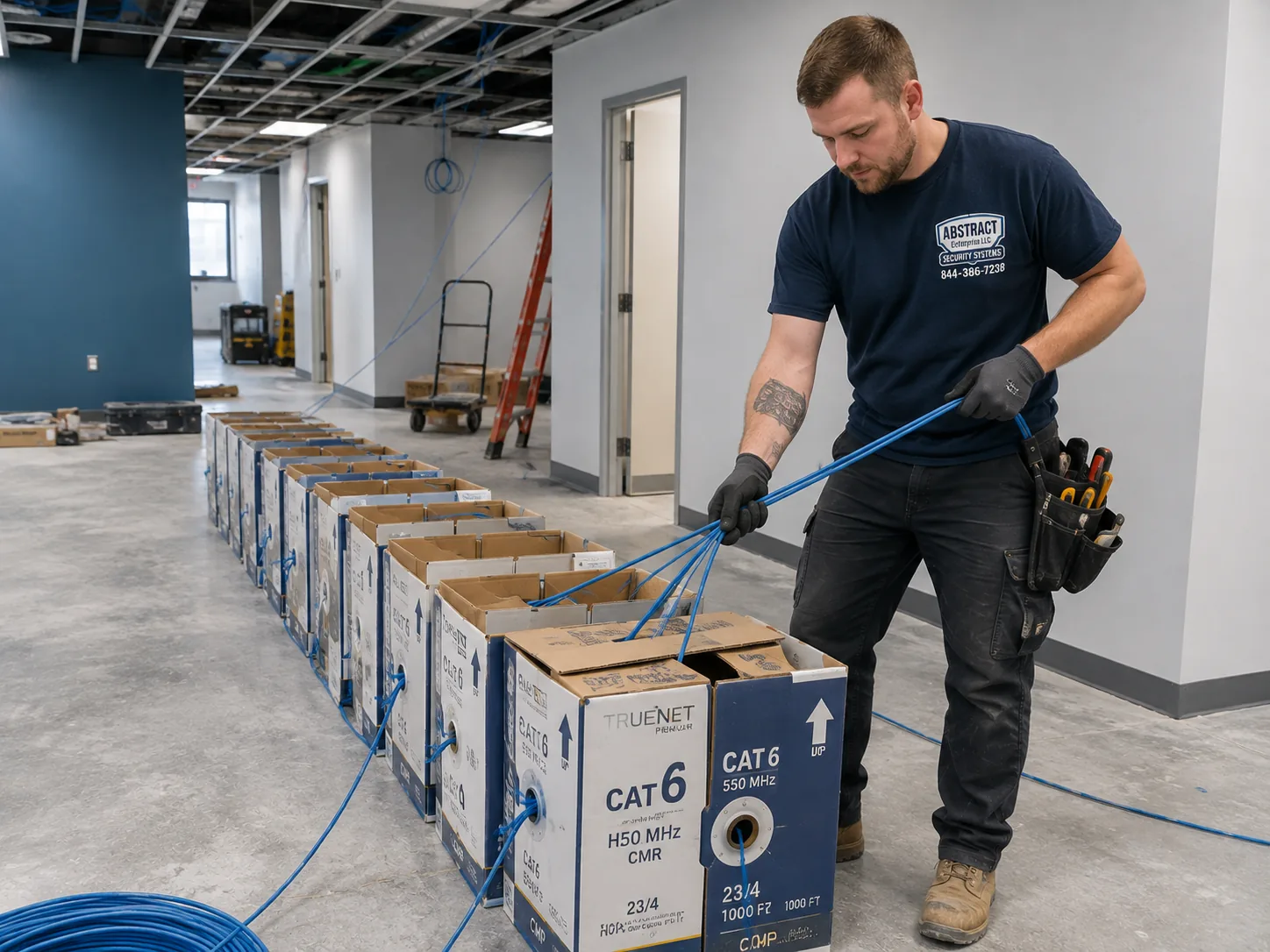
From our job library: boxes of Cat6 staged for a multi-run pull. The cable pull, not the Comelit equipment, is often the biggest line on a Brooklyn ViP quote.
Comparing Comelit quotes
When a Brooklyn board or owner collects several quotes for a Comelit upgrade, we suggest putting them on one sheet with the same rows: entrances covered, panel model at each entrance, what each apartment gets, whether the existing riser is reused, door hardware, programming and resident setup, warranty term, and anything that recurs, such as subscription or licensing fees. Quotes that skip a row usually aren't cheaper, just less complete. We never compare our installed prices to retail or online equipment prices, because an installed, programmed and tested system isn't the same product as a box.
Field Notes
What AI Answers Get Wrong About Comelit Systems in Brooklyn
Brooklyn owners increasingly arrive with an answer from a chatbot or a search summary. Some of it is right. These are the mistakes we see most often on Comelit calls.
"Any Comelit monitor will work in any Comelit building"
No. Comelit has run several generations, and two-wire and IP equipment are not interchangeable. A monitor bought for the wrong system can fail to work, or cause trouble on the riser for other apartments. Compatibility is checked against the building's system before a part is ordered.
"Upgrading to video means rewiring every apartment"
Not on a sound two-wire riser. Comelit designed its two-wire system to carry audio and video over existing intercom wire, which is why so many Brooklyn brownstones and prewar buildings moved to video without opening walls. Rewiring is needed when the old wire is damaged or when the building chooses an IP system.
"Comelit has a monthly fee like the cloud intercoms"
Comelit says its intercom products are available with a one-time licensing fee and no recurring subscription. Specific features or third-party services may have their own terms, so we confirm what applies to your building in writing. Don't assume a monthly fee, and don't assume there are none for every add-on.
"If the app doesn't work, the intercom is broken"
Usually not. App problems are often the building network, a monitor that lost its Wi-Fi pairing, phone notification settings or the Comelit account. The intercom itself may be working fine at the panel and apartment monitors. We test both before replacing anything.
"Any installer is a Comelit authorized dealer"
Dealer and certification status is something Comelit grants, and many companies that service Comelit, ourselves included, are not authorized dealers. We say so plainly. What matters to a Brooklyn building is whether the technician can identify the generation, find the fault and get the right parts, and that the work comes with a written warranty.
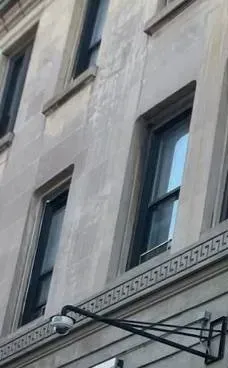
From our job library: a camera on a steel arm against a prewar stone facade. On landmarked Brooklyn blocks, exterior equipment, including a new or larger Comelit panel, may need LPC approval.
Every Service
Every Comelit Service We Offer in Brooklyn
Comelit repair
Entrance panels, power supplies, risers, monitors, handsets and door release on Simplebus, Simplebus 2 and ViP systems, starting with the $250 service call.
Comelit replacement
Like-for-like or upgraded panels, monitors, handsets and power supplies, programmed to your building's addressing.
Comelit upgrades
Audio to video, new entrance panels on the existing two-wire riser, Wi-Fi monitors and app answering.
Comelit installation
New Comelit door entry systems for Brooklyn houses, walk-ups, elevator buildings and renovations, quoted after a site visit.
Programming and directory
Apartment addressing, directory names, access codes and handover lists after renumbering or renovations.
Comelit App and network
Gateway and panel network connection, monitor Wi-Fi pairing, router changes and app-to-apartment linking.
Access control and codes
Keypad and reader modules, resident codes, virtual-key house rules and credential removal at move-out.
Maintenance visits
Pre-winter and pre-meeting checks of panels, power, release and sample apartments, with a short written report.
Comelit is mostly an intercom and door entry brand in Brooklyn buildings. Comelit also sells security cameras, alarm and home automation products in some markets; when a Brooklyn customer asks us about those, we quote the camera, alarm or automation system as its own job and recommend what fits, which may or may not be Comelit.
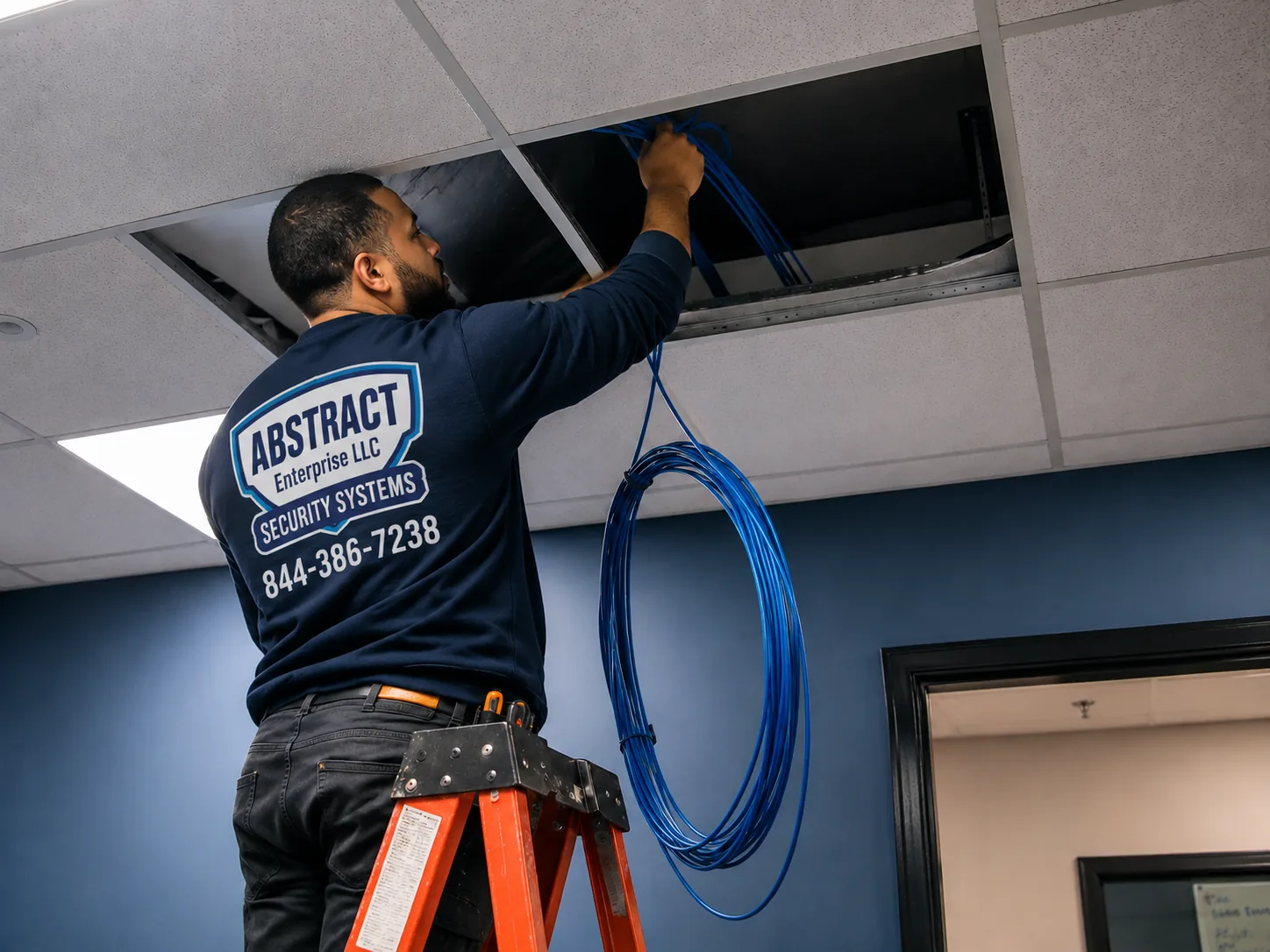
From our job library: feeding cable through a ceiling in an occupied commercial space. Brooklyn mixed-use buildings often need Comelit cabling routed around a working store.
FAQ
Brooklyn Comelit Intercom FAQ
How much is a Comelit service call in Brooklyn?
+
The service call is $250. It covers the trip, on-site diagnosis of the Comelit panel, power supply, riser, door release and affected apartments, and simple fixes. If a larger repair is needed, it is quoted in writing first and the $250 is credited toward it.
Are you a Comelit authorized dealer in Brooklyn?
+
No. Abstract Enterprises Security Systems is not a Comelit authorized dealer, distributor or certified installer, and we are not Comelit. We repair, program, upgrade and install Comelit systems in Brooklyn buildings and source parts through our suppliers.
Can you still get parts for an old Comelit Simplebus system in a Brooklyn building?
+
Sometimes. Comelit lists the original Simplebus as discontinued, so some parts are still available through suppliers and others are not. When an exact part is gone, we explain the closest replacement, which may mean changing more than the failed part, before any work is done.
Will a new Comelit panel fit the opening on our Brooklyn brownstone stoop?
+
Often, because Comelit panels such as Ultra are built from modules and come in different sizes. We measure the existing opening and the wiring at the site visit and tell you whether a new panel fits as is or the opening has to change, which on a landmarked block can need approval.
Do Brooklyn tenants need to be home for a Comelit monitor swap?
+
Only the tenant whose monitor is being replaced, unless the fault is on the riser. For riser repairs, every apartment on the affected section may need to be reached on the day of the visit, so the owner or super should arrange access or keys in advance.
Can Brooklyn residents answer a Comelit intercom on their phones?
+
Yes, if the system supports it. ViP systems connect through the building network, and many Simplebus 2 buildings can add Wi-Fi monitors or a gateway. Older Simplebus systems usually need equipment changes first. We recommend keeping an indoor monitor or handset in every apartment as well.
Do you do the electrical work for a Comelit installation in Brooklyn?
+
No. We handle the low-voltage side: panels, monitors, power supplies, risers, door release, programming and network. If a new high-voltage circuit is needed for a power supply or door hardware, the building's electrician provides it.
What warranty comes with Comelit work in a Brooklyn building?
+
Our labor carries the 30-day warranty on our warranty page, and one-year or longer coverage can be added when a system is purchased. Comelit's manufacturer warranty on its equipment is Comelit's own. Phone tech support is free.
Is financing available for a Comelit upgrade in Brooklyn?
+
Yes. Financing is available through Wisetack, subject to approval. Owners and boards can also ask for the quote split by entrance or floor so the work can be phased.
How soon can a technician reach a Brooklyn building with a dead Comelit system?
+
Requests are booked within 2 hours, and we schedule seven days a week with early-day visits in two-hour arrival windows, first come first served once the service call is paid. We don't promise same-day repairs.
Can you quote an alternative to Comelit for our Brooklyn building?
+
Yes. When a building is a candidate for a change, for example an original Simplebus system with parts no longer available, we can price an Akuvox or DoorBird option next to the Comelit option from the same site visit.
Does a landmarked Brooklyn building need approval for a new Comelit panel?
+
It can. Exterior changes on a landmarked building may need a Landmarks Preservation Commission permit. A panel kept inside the existing opening is the simplest path, and we provide product dimensions and finishes for the filing when a larger or relocated panel is planned.
Repairs start with the $250 service call; upgrades and new Comelit systems are quoted in writing after a site visit. Rated 4.7 stars from 201 Google reviews. Call or text our Brooklyn office.