Bronx Comelit Service · Simplebus, Simplebus2 & ViP · Walk-ups, Elevator Buildings, Co-ops, Houses
Comelit Intercom Repair & Installation in the Bronx
Entrance Panels · Monitors & Handsets · Door Release · Power Supplies · Gateways & App · Upgrades
Comelit intercom repair in the Bronx starts with a $250 service call at your building, where a technician tests the Comelit entrance panel, the power supply, the riser and the door release and tells you what failed before any part is ordered. We repair, reprogram, upgrade and install Comelit systems in Bronx walk-ups, Grand Concourse elevator buildings, co-ops and condos, two-family houses and storefront buildings, under our New York State low-voltage license, and new Comelit systems are priced in writing after the site visit.
Quick answer: Most Comelit problems in the Bronx are not the panel. They are a tired power supply, a broken riser pair in a prewar wall, a door strike that no longer meets its keeper, or an app account that was never set up. A $250 service call finds which one; on a bigger job the visit is credited. Published Bronx part prices run $250–$525 for an apartment station, $325–$650 for a transformer and $650–$1,800 for lobby panel repair. A new Comelit Simplebus2 or ViP system is quoted in writing after the survey. We are not a Comelit dealer and do not speak for Comelit; we service the hardware in your building.
Last updated November 28, 2026 by Abstract Enterprises Security Systems, NYS license #12000287431 · Sources: Comelit USA General Catalog 2023; Comelit Ultra product page and UT8090 datasheet; Comelit case study, Parkchester Condominiums (updated October 5, 2026); Parkchester intercom resident help site; NYS Multiple Dwelling Law §50-a; NYC Building Code §1010.4.4; HPD Housing Maintenance Code Violations dataset, NYC Open Data (queried November 28, 2026); Co-op City / Riverbay building facts; Historic Districts Council; NYC Landmarks Preservation Commission designation report 2403; Lehman College public art survey of the Grand Concourse
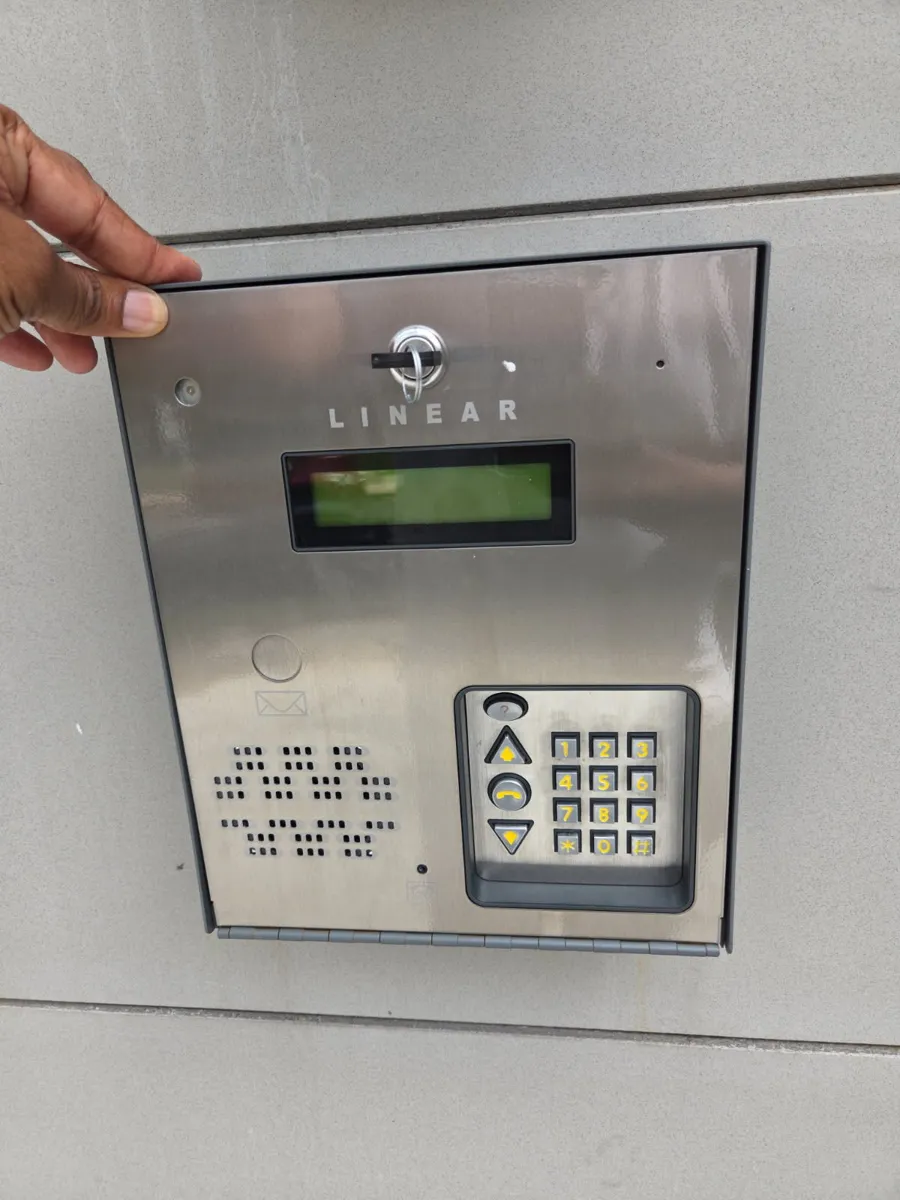
Job photo from our files: a stainless telephone entry panel set into a wall with its front opened for service. It is not a Comelit unit and was not taken in the Bronx, but this is the moment every Bronx repair reaches, with the faceplate off and the terminals in view, before we decide whether the fault is in the panel or behind it.
Bronx Comelit Service Request
Tell us the address and what the system is doing
✅
Request Sent!
Thank you. We will call you to set up the visit.
25+
Years Experience
Bronx
Office on Fordham Road
100%
Licensed & Insured
4.7★
201 Google Reviews
Owner-operated since 2002 · Thousands of jobs completed · Booked within 2 hours
The Borough
Comelit in the Bronx: Where These Systems Are Installed
Ask a Bronx super which intercom brands he deals with and Comelit usually comes up within the first three names. That is not an accident of marketing. The Italian manufacturer's two-wire systems were built for exactly the kind of building the Bronx has in the hundreds: a five- or six-story apartment house from the first half of the twentieth century, with one riser of old intercom cable climbing through the walls and no appetite on anyone's part for opening those walls again. Comelit's own catalog describes its two-wire system as ideal for a building that wants an audio or video intercom while reusing the existing intercom wires, with only two conductors needed for the apartments. For an owner on a side street off Webster Avenue, that one sentence is the whole sales pitch.
The result is a borough with Comelit equipment at every stage of its life. Some buildings still carry older Simplebus systems that have outlived the people who installed them. Many walk-ups had their buzzers upgraded to Simplebus2 two-wire video over the last fifteen years, often with a Mini monitor in each apartment. A newer group of elevator buildings and gut renovations use Comelit's ViP line, which runs over network cable rather than a two-wire bus. And in 2024 and 2025 the borough became home to what Comelit calls the world's largest app-based IP video intercom installation, at Parkchester. A Bronx technician who works on Comelit needs to know all of those generations, because a call that says “the Comelit isn't working” can mean any of them.
The building stock that keeps Comelit busy
The Grand Concourse is the borough's showcase. The Historic Districts Council describes most of the buildings in the Grand Concourse Historic District as built between 1916 and 1941, in styles from neo-Renaissance to the Art Deco the avenue is known for, and the Landmarks Preservation Commission's designation report notes, for example, that Emery Roth & Sons designed the Art Deco apartment house at 888 Grand Concourse. Those lobbies were designed for a doorman and a mailroom, not for a camera and a touchscreen, and the entrance panel has to fit into stone, bronze and glass that owners and the city want left alone. A Comelit retrofit there is as much about mounting as it is about electronics.
Away from the Concourse, the typical Comelit building is plainer: a six-story walk-up or a small elevator building in Fordham, Tremont, Highbridge, Morrisania, Norwood or University Heights, with a vestibule door, a lobby door and a riser that has been spliced more than once. North in Riverdale and Spuyten Duyvil, the work shifts to co-op boards in postwar elevator buildings who want video and an app without disturbing shareholders. In Throgs Neck, Pelham Bay, Morris Park and Country Club, Comelit shows up in two-family houses and small attached rows, often as a single-family video kit at the front gate. Each of those settings breaks in its own way.
Where Bronx intercom complaints pile up
The city keeps a public record of every Housing Maintenance Code violation HPD writes, and it gives a fair picture of where entry systems are failing in the Bronx. We queried NYC Open Data on November 28, 2026 for every Bronx violation from inspections in 2025 whose description mentions an intercom. There were 1,619 of them: 209 Class A, 1,322 Class B and 88 Class C. Those violations cover every brand and every kind of fault, not only Comelit, but they show where landlords and supers are under the most pressure to get an entry system working again.
ZIP code
Area (roughly)
2025 intercom-related HPD violations
10457
Tremont, Claremont, Bathgate
183
10458
Fordham, Belmont, Bedford Park
177
10452
Highbridge, Concourse
152
10456
Morrisania, Concourse Village
144
10467
Norwood, Williamsbridge, Olinville
129
10453
Morris Heights, University Heights
125
10460
West Farms, Crotona Park East
110
10468
Kingsbridge Heights, Fordham Manor
97
10459
Longwood
88
10451
Melrose, south Concourse
80
10455
Mott Haven
63
10462
Parkchester, Van Nest
43
The west Bronx ZIP codes along and just off the Concourse and Jerome Avenue lead the list, which matches what we see on the road: prewar six-story buildings with original risers, heavy traffic through the front door, and intercoms that were last replaced a long time ago. The Parkchester ZIP code sits near the bottom of this list for 2025. We would not read too much into one year, but it is at least consistent with a complex that replaced its whole entry system during that period. Whatever the address, a violation on the books changes the order of work: the first visit is about getting the door and the calls working again, and the conversation about upgrades comes after.
What the law expects of a Bronx building's intercom
New York State's Multiple Dwelling Law, section 50-a, requires every class A multiple dwelling erected or converted after January 1, 1968 with eight or more apartments to have an intercom at the self-locking main entrance door, with voice communication between each apartment and the person outside and a way to release the door from the apartment. Older buildings come under the same rule when tenants of a majority of the apartments ask for it or consent in writing; the law then gives the owner ninety days to start the installation and six months from receipt of the requests to finish it, and for rent-regulated buildings the rent agency sets how the cost may be recovered. The city's Building Code (section 1010.4.4) carries a matching requirement for buildings with eight or more dwelling units. None of those rules names a brand. They describe what the system must do, and a Comelit system, like any other, either does it or it does not.
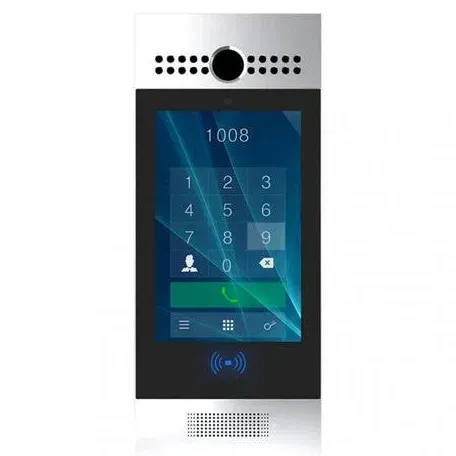
Product reference photo from our library, not a Comelit panel and not taken in the Bronx: a tall touchscreen entry panel with a dial pad and a card reader symbol. Bronx boards weighing a touchscreen directory against a button panel compare this style of door station with Comelit's Ultra touch modules and 3one6 Touch.
Repair
Comelit Intercom Repair in the Bronx, Symptom by Symptom
Comelit repair calls come in described by what the tenant sees or hears, not by what failed. That is fine; it is our job to translate. Below are the complaints we hear most often from Bronx buildings with Comelit equipment, what usually sits behind each one, and what a resident or super can safely look at before the visit. We do not hand out wiring or programming steps, because the work behind the faceplate needs test equipment and the access to every affected apartment, and a wrong guess on a two-wire bus can take the whole riser down. The general picture for other makes is on our Bronx intercom repair page.
The whole building stopped ringing
When every apartment goes quiet at once, the fault is almost never in the apartments. On a two-wire Comelit system the entrance panel, the riser and every monitor share the same pair, fed by a power supply that usually lives on a shelf in the cellar or in a locked box near the lobby. If that supply has failed, overheated or tripped its protection, nothing on the bus works. If the pair has been shorted somewhere along the riser (a nail through a wall during an apartment renovation is the classic Bronx cause), the supply may be fine and still unable to drive the line. And if a water leak has reached the panel, the panel itself can be the culprit. A super can tell us whether the cellar supply shows any light, whether anything changed in the building that week, and whether there was a storm or a leak. That is enough for us to arrive with the right parts.
One apartment, or one line of apartments, is dead
A single silent monitor usually points to that monitor or to its last few feet of cable. A whole stack of silent apartments, all the 4s and all the 5s from the second floor up, points to the riser branch that feeds that line, or to a distribution module where the branch leaves the main bus. In older Bronx buildings, those branches were often spliced inside a hall junction box decades ago, and the splice is what has given up. On the visit we test at the panel, at the junction and at the apartment, so the owner pays to fix the break and not to replace monitors that were working all along.
The call comes through, but the door will not open
This is the complaint that most often turns into an HPD violation, and in our experience it is the one most often blamed on the wrong thing. The apartment monitor sends the release command, the panel passes it on, and the electric strike or the lock relay is supposed to pull. If the strike's coil is burnt, if the door has dropped on its hinges so the latch drags against the keeper, or if a closer is slamming the door so hard that the strike never quite lets go, the tenant hears the click and the door stays shut. Fixing a Comelit release is very often door work: aligning the frame, adjusting the closer, replacing the strike. Our Bronx door buzzer repair page goes into the door side of that problem in more depth.
The monitor shows no picture, or the picture rolls
On a Comelit video system, audio can survive a fault that kills video, because video needs a cleaner signal on the same two wires. A dark screen with working audio usually means a weak supply, a poor joint somewhere along the bus, a camera module that has failed in the panel, or an old unshielded cable that was never really meant to carry video. Rolling, tearing or washed-out pictures usually point the same way. Comelit's catalog lists up to 1,200 meters between the external and internal units on its two-wire system, but that figure assumes cable in decent condition, and a riser that has been spliced six times since the 1960s may not deliver the full distance.
Buzzing, humming or feedback on the line
A constant hum or a loud squeal when a call is answered usually comes from a ground fault, a wire touching a pipe, a split jacket in a damp cellar or a monitor that has been reconnected to the wrong terminals by someone in a hurry. It can also come from a nearby high-voltage line induced into an old cable run. These are fault-finding jobs: the technician isolates sections of the bus until the noise goes away and repairs the section that was causing it.
The Comelit app has stopped getting calls
In buildings where calls go to residents' phones through a Comelit gateway, a missing call is often an account or network problem rather than a hardware one. The resident's phone may have lost notification permission, the app may be signed in to the wrong account, the building's internet service may be down, or the gateway may need attention. Residents can check that the app is up to date, that notifications are allowed, and that they are signed in with the email address management has on file. If several residents lose calls at the same time, the gateway or the building's internet is the likely cause, and that is a visit for us. Logins, passwords and app accounts are run by Comelit and by building management, not by us, and we say so plainly when that is where the fault is.
The entrance panel was vandalized or soaked
Bronx street doors take a beating. Broken buttons, scratched camera windows, a pried-off faceplate, or a panel that filled with water after a storm because its hood was missing or its seal had perished are all routine calls. Comelit's modular panels can often be repaired module by module, replacing the camera module or the button module without changing the whole panel, as long as the modules for that generation are still available. Where they are not, the conversation moves to an upgrade, which we cover further down.
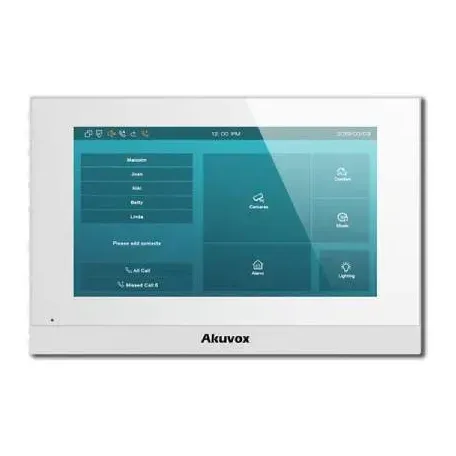
Product reference photo from our library, not a Comelit monitor and not taken in the Bronx: a white touchscreen indoor monitor with a contact list and call and unlock icons. When a Bronx tenant's old Comelit handset fails, the replacement is matched to the building's system first; the screen style comes second.
What a Bronx super can check before we arrive
Is it everyone or a few? Ask two or three tenants on different floors and lines. The pattern tells us where to start.
Is there a light on the power supply? Look, do not touch. A dark supply or a burnt smell is worth mentioning on the phone.
Did anything change? An apartment renovation, a new tenant who moved a monitor, a contractor in the cellar, a storm, a leak from the roof.
What does the panel say? Any label, any model sticker, any message on a display. A photo of the front of the panel helps us bring the right parts.
Who can open the apartments? A riser repair often needs access to several apartments on the same visit. Tell tenants ahead of time.
Systems
Which Comelit System Does Your Bronx Building Have?
Comelit has sold several generations of building intercom, and they do not all talk to each other. Knowing which one is in the building is the first question in any repair or upgrade, because it decides which monitors can be swapped in, which panels will work on the old riser, and whether an app can be added without new cable. These are the families Comelit names in its own US catalog, and the clues we use to tell them apart in a Bronx cellar.
Simplebus and Simplebus Top
The older Comelit digital systems. Comelit's catalog still lists Simplebus 1 parts (audio modules, switching devices, porter switchboards) and the Simplebus Top line. In the Bronx, these are the systems we find in buildings whose intercom was modernized once, a long time ago, and never again. They can often be kept going with the right replacement parts, but each repair is a good moment to ask how much life is left and whether a planned move to Simplebus2 makes more sense than another emergency call next winter.
Simplebus2, the two-wire workhorse
Simplebus2 is the system most Bronx owners mean when they say “the Comelit.” Comelit describes it as two non-polarized wires throughout, able to handle four main entrances, 32 riser columns and 128 users per riser, and it can run daisy-chained or home-run. In practice that means a six-story building's old two-conductor intercom riser can often carry Comelit video without new cable, provided the pair tests clean. The giveaways in the cellar are a Comelit power supply on a DIN rail (the catalog lists the art. 1210 two-wire supply for the external unit and riser, and the 1209 family for video kits), and in buildings with more than one entrance, a Simplebus2 switching device such as the art. 1404. Apartments usually have a Mini monitor, with or without a handset.
ViP, Comelit over network cable
ViP is Comelit's IP system. The catalog calls it a true and unlimited IP-based intercom, says Cat5e or Cat6 is required, and notes it can also run over fiber, with no limit on users, risers, panels or conversations and a self-diagnosis function. You find ViP in Bronx new construction, in gut renovations where every apartment got network cable, and in large complexes. The clues are network switches in the closet (Comelit lists an art. 1440 ViP floor switch), PoE supplies for monitors (art. 1451 and 1451A), ViP power supplies such as the art. 1441, and a gateway such as the art. 1456B that sends calls to the app or to phones.
Single-family and small-building kits
Two-family houses in Throgs Neck, Pelham Bay, Morris Park and Riverdale often have a Comelit kit: one door station and one or two monitors, sometimes with a separate gate station. These follow the same two-wire principle on a much smaller scale. Repairs are usually about weather damage at the gate, a monitor that has failed, or a strike on a gate that the wind has worked loose.
What you see
What it usually means
What it changes for a repair
Two wires at each apartment, Comelit supply on a DIN rail in the cellar
Simplebus2 two-wire system
Monitors and panel modules can be swapped within the family; app calls need a call-forwarding module or gateway
Network cable at each apartment, switches in the closet
ViP IP system
Faults are often network faults; monitors are powered over the cable
Older Comelit parts with Simplebus 1 labels
Earlier digital system
Parts may be limited; good time to plan a move to Simplebus2
One door station and one or two monitors in a house
Comelit kit
Repairs are usually module or monitor swaps, plus gate hardware
Touchscreen panel with an app-only system and a gateway per building
ViP with gateway (as at Parkchester)
Account and network checks come before hardware
Model numbers we will and won't quote
Comelit uses “art.” numbers for its parts, and there are a great many of them. On this page we only name parts we have confirmed in Comelit's own catalog or datasheets: the 1210 and 1209 supplies, the 1595 supply for Ikall panels, the 1596B for the 3one6 range, the 1441 ViP supply, the 1451 and 1451A PoE supplies, the 1456, 1456S and 1456B gateways, the 4888CU colour mixer for the US, the 1404 switching device, the 1406 call-forwarding module, the 1409 remote camera module, the 1414 riser shunt module, and the Mini (6701W, 6721W, 6741W) and Icona (6601W) monitors. If your building has a part number that is not on that list, send us a photo of the label. We will tell you what it is once we have checked it, not before.
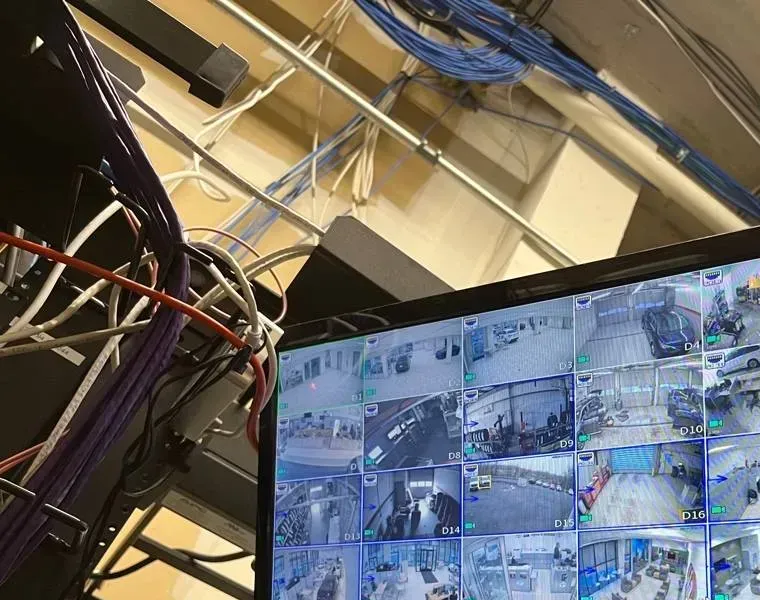
Job photo from our files, not taken in the Bronx: bundles of blue, white and purple low-voltage cable coming down the wall beside a black rack. A Comelit ViP building has a closet like this on every floor or in the cellar, and a ViP fault is often found here rather than at the door.
Parkchester
Parkchester's Comelit System: What Residents and Owners Should Know
No page about Comelit in the Bronx would be complete without Parkchester. According to Comelit's own case study, updated in October 2026, the complex's intercom modernization began in September 2024 because the old wiring had become obsolete, and within nine months all 171 buildings had Comelit Ultra Touch entrance panels, 1456B gateways and lifetime Comelit app licenses for residents. Comelit counts 12,271 apartments and about 48,000 residents and calls it the world's largest app-based IP video intercom installation. The case study names Total Security as the installer and Parkchester Preservation Management as the manager. We did not install it and we do not maintain it.
We mention it because Parkchester changed what many Bronx residents expect an intercom to do, and because the questions we get from Parkchester residents, unit owners and neighboring buildings are worth answering honestly. Comelit describes a system where residents receive video calls and open doors from the app, while residents without a smartphone answer an ordinary phone call and dial *9 to let a visitor in. Each Ultra Touch panel carries a dedicated security button connected to Parkchester's public safety concierge stations. Comelit also says residents' emails and phone numbers are stored locally in each building's gateway on a closed network, which it presents as a privacy measure.
If you live in Parkchester and the intercom isn't reaching you
Start with the building's own channels. Parkchester's resident help site explains that the app invitation goes to the email address management has on file, that phone calls go to the number on file, and that a missing invitation may be sitting in a spam folder. Those are account questions, and only management can change what is on file. If you are a unit owner who wants a monitor or a door station inside your own apartment, or a door release at a private entrance, that is a different matter and something an outside technician may be able to help with, provided it is compatible with the building's system and allowed by the condominium. We will tell you if it is not.
What Parkchester tells other Bronx owners
For the owner of a forty-unit building on the Grand Concourse, the Parkchester story is useful mainly as a demonstration. It shows that an app-first Comelit system can work at very large scale, that residents will use an app if the enrollment is handled well (Comelit claims more than three quarters of Parkchester residents use it daily; that is the manufacturer's number), and that keeping a phone-call fallback for residents without smartphones matters. It does not mean every building should copy it. A small walk-up with a sound two-wire riser may be better served by a Simplebus2 panel with monitors and a call-forwarding module than by an IP rebuild.
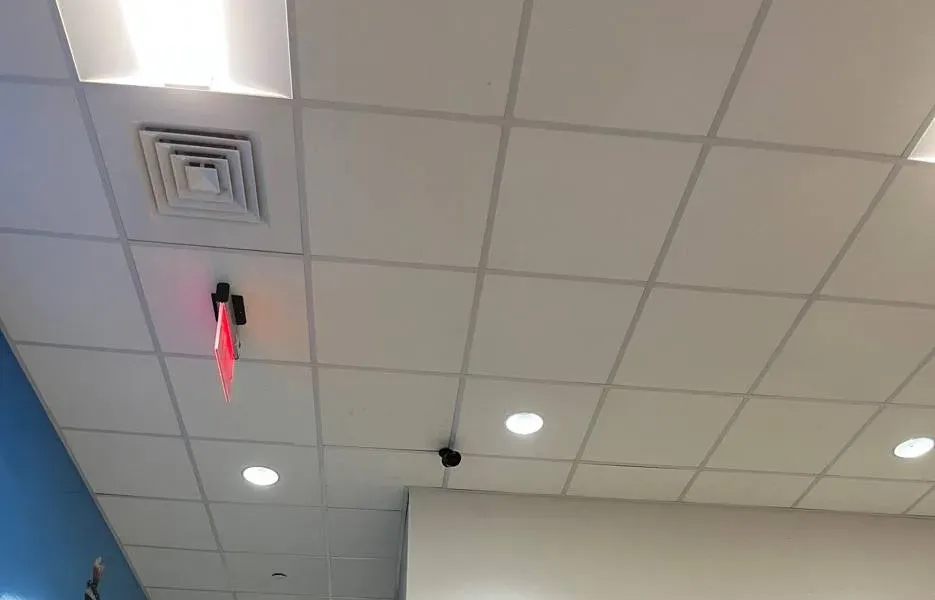
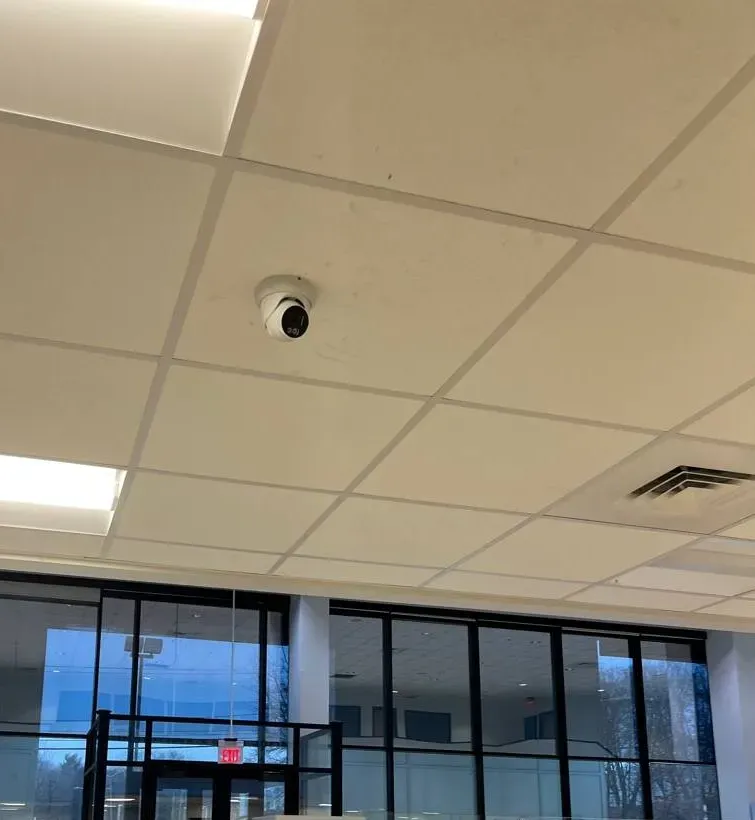
Job photo from our files, not taken at Parkchester or anywhere in the Bronx: a lobby drop ceiling with a lit exit sign and a small camera above a soffit. When a Bronx lobby gets a new Comelit panel, we plan the cable path through ceilings like this one before anything is mounted on the wall.
Upgrades
Comelit Upgrades for Older Bronx Buildings
A large share of our Comelit work in the Bronx is not new installation and not simple repair. It is the upgrade in between: an owner whose old system is failing more often than it should, who has been told by someone that the answer is a whole new IP intercom, and who wants a second opinion. The honest answer depends on four things we can only learn in the building: the condition of the riser, the age and family of the existing Comelit equipment, the doors, and what the owner wants residents to be able to do.
Keeping the riser
The cheapest wall is the one nobody opens. If the existing intercom pair tests clean from the cellar to the top floor, a Comelit Simplebus2 upgrade can reuse it, because the system needs only two conductors to each apartment. We test the pair with the old equipment disconnected, look for splices and damp spots, and tell the owner what we found. If one branch is bad and the rest are sound, we price repairing that branch rather than rewiring the building. In a walk-up on Valentine Avenue or Morris Avenue with plaster walls and occupied apartments, that difference can decide whether an upgrade is affordable at all.
Replacing the panel first
Many Bronx buildings upgrade in stages. The entrance panel takes the most abuse and is the part the city and visitors see, so it often goes first: a new Comelit panel on the old riser, with the existing monitors kept where they are compatible. Comelit's Ultra panel is described by the company as modular and made for both two-wire and ViP systems, which matters for a building planning ahead: a panel bought for a Simplebus2 riser today belongs to a family that also exists for ViP. Whether a particular old monitor will work with a particular new panel is a compatibility check we do before the order, not after.
Adding calls to residents' phones
This is the request we hear most from Bronx owners now. On a Simplebus2 building, Comelit lists an art. 1406 multi-user call-forwarding module that sends video calls to smartphones and tablets running its SimpleApp. On a ViP building, Comelit's gateways (the 1456 family) do the same job, and the 1456B multi-user gateway can also route calls to ordinary mobile or landline phones, subject to a subscription with a SIP provider. Each route has a monthly or account dimension that the owner should understand before choosing it: who holds the account, who pays any service, and who adds and removes residents when apartments turn over.
When the honest answer is a full replacement
Sometimes the riser is beyond saving, the existing Comelit generation is no longer supported, and the building wants features (directory changes from an office, app calls, video recorded with the door events) that the old system cannot give. Then we say so, and we price the replacement properly, including the cable. Where it helps the owner decide, we will price a Comelit replacement side by side with an alternative such as Akuvox, using the same scope, so the comparison is about the building's needs rather than about a brand. Our Akuvox vs ButterflyMX comparison covers the app-first side of that decision in more depth.
Landmark facades and Art Deco lobbies
On the Grand Concourse, and in other designated buildings, the entrance panel is a design question. A surface-mount panel bolted onto an original bronze or stone surround is not what the building's owners, the residents or the Landmarks Preservation Commission want. Work on a designated facade can need Commission approval, and we tell owners early when a panel location is likely to need it. Where we can, we place the panel in an existing opening, reuse an earlier intercom's cut-out, or mount inside a vestibule so the street face is left alone. Comelit sells panels in flush and surface versions, and the flush version is often the one that keeps a historic front looking right.
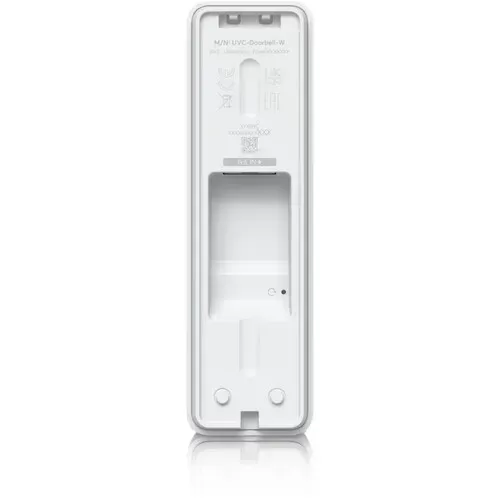
Product detail photo from our library, not a Comelit part and not taken in the Bronx: the back plate of a slim door station with its mounting slots, cable opening and screw points. On a Bronx brick or stone front, how the back box is fixed decides whether a panel survives its first year.
Doors come with the upgrade
An upgrade that leaves a sagging door, a tired closer and a strike that barely catches will produce the same complaints with a nicer panel on the wall. Every Comelit upgrade we quote in the Bronx includes a look at the vestibule and lobby doors: whether they close on their own, whether they latch every time, and whether the strike and the power supply for the lock are sized for each other. The law asks for automatic self-closing, self-locking doors at the entrance, and the intercom only works as well as those doors do.
Installation
New Comelit Intercom Installation in the Bronx
New Comelit systems in the Bronx usually arrive in one of three ways: a gut renovation of an older walk-up, a new building going up on a former lot, or an owner of a house or small building who wants video at the front door and a phone app. Each one starts with the same visit and the same written quote, and each one is shaped by the building more than by the catalog. Our Bronx intercom installation page explains the general process for every brand we install.
Gut renovations and new buildings: ViP over Cat6
When the walls are open, there is little reason to keep a two-wire bus. We run Cat6 to each apartment, place switches in a closet with room to grow, and build a Comelit ViP system on it. Comelit's ViP line powers monitors over the network cable with its PoE supplies, uses floor switches to branch the network, and connects to residents' phones through a gateway. The owner gets a system that can take more entrances, more monitors and more features later without new cable, and a network that cameras or access control can share if the design allows. Developers should bring us in while the drywall is still open; a cable that is easy to pull in framing costs several times as much once the apartments are finished.
Occupied buildings: Simplebus2 on the existing pair
In a building where people are living, the calculus flips. A new Comelit Simplebus2 system on the existing pair keeps the work to the panel, the cellar and a short visit to each apartment to mount the monitor. We schedule apartment access in blocks, post notices for tenants ahead of time, and test each apartment as it is connected rather than at the end. If a branch fails its test, we know on that day which apartments need a new cable run, and the owner gets a price for those runs before the work goes on.
Houses and small buildings: a Comelit kit at the gate
For a two-family house in Schuylerville or a small attached row in Westchester Square, a Comelit kit with a door station and one or two monitors is often the right size. The main decisions are where the door station goes (at the gate, at the house door, or both), whether the gate has a lock that can be released, and whether the owners want calls on their phones. Wiring a gate across a front yard is the part people underestimate; it needs a protected path and a lock that will stand up to the weather.
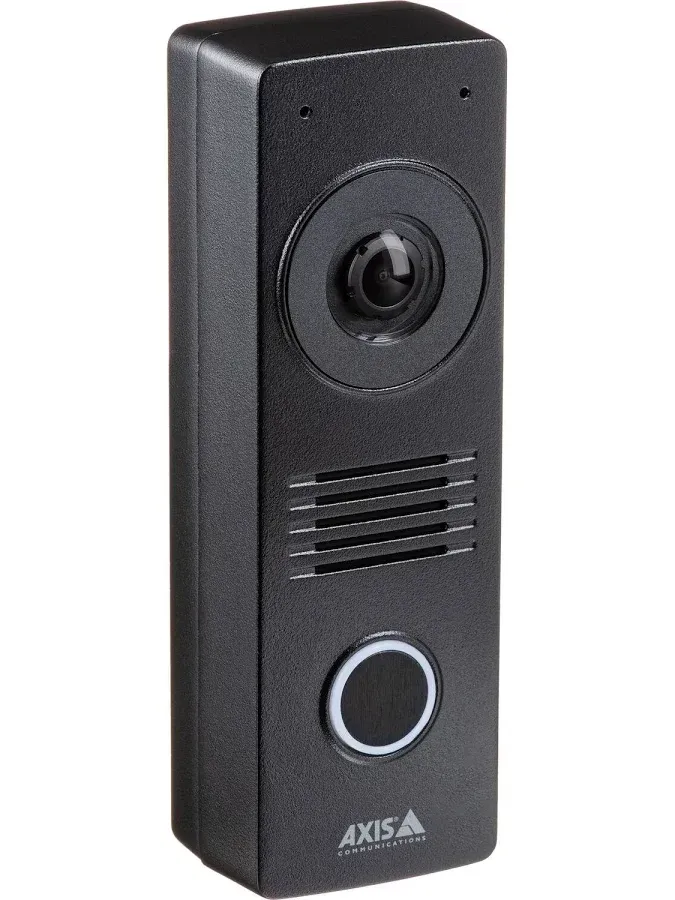
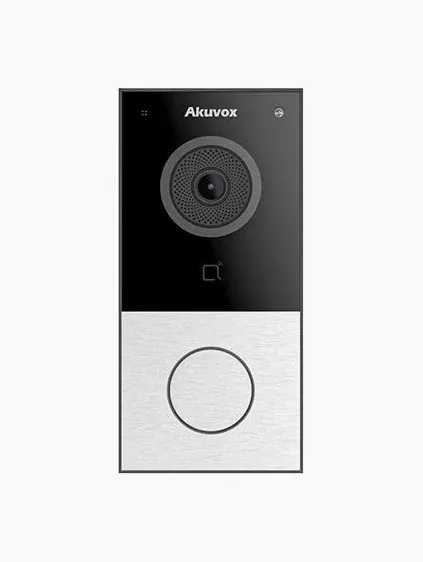
Product reference photo from our library, not a Comelit station and not taken in the Bronx: a narrow black video door station with a camera, speaker grille and lit call button. Bronx homeowners with a narrow gate post compare this slim format with Comelit's door stations before choosing.
What we need from you to quote a new Comelit system
The address and whether the building is landmarked or in a historic district.
The number of apartments, entrances and gates that need a station.
What residents should be able to do: answer on a monitor, on a phone, or both; see video; open the door from anywhere.
Drawings, if it is new construction or a renovation with an architect.
Who will hold the accounts for any app or phone-calling service, so the handover is done to the right person.
Questions
Comelit in the Bronx: Questions Owners, Boards and Supers Ask
These are the questions that come up on the phone and in the cellar when the system in question is a Comelit and the building is in the Bronx. We have grouped them by who usually asks.
Owners of walk-ups and elevator buildings
Will HPD accept a Comelit system that calls tenants' phones instead of a monitor in each apartment?
The law describes what the system must do: let each apartment talk to the person at the self-locking main door and release that door from the apartment. It does not name a monitor. Where an app or phone call is the only way an apartment can answer, the owner has to make sure every apartment can actually use it, including tenants without a smartphone. Comelit's own Parkchester example keeps an ordinary phone-call route for those residents. Owners of rent-regulated buildings should also take advice on how any change of service is treated before replacing monitors with an app. We install what the owner chooses and set it up so every apartment is reached; we do not give legal advice.
Our Bronx building got a Class B intercom violation. Can you fix it and give us something for the record?
Yes. We repair the fault, test every apartment we were asked to test and give the owner a written invoice describing what was found, what was replaced and the date the system was working. Certifying a violation as corrected with HPD is done by the owner, but a clear invoice and photos make that much easier. If some apartments could not be reached on the visit, the invoice says so, because that is what an inspector will ask.
The Comelit monitors in half our apartments were replaced by tenants with other brands. Does that matter?
It can. A non-Comelit device on a Comelit two-wire bus may not talk to the system at all, or it may load the line and cause faults for neighbors. When we find mixed equipment on a riser, we note each apartment's device and test whether it behaves. Where a foreign device is the problem, the fix is to replace it with a compatible Comelit monitor, and we price that per apartment from the published station range.
How long does a Comelit upgrade take in an occupied Bronx walk-up?
That depends on the number of apartments and how quickly tenants give access. The panel and the cellar work are usually a short part of the job; the apartments set the pace. We plan apartment visits in blocks by floor and line, give the owner a notice to post, and do not leave the building with the panel connected to a riser we have not finished testing. The schedule goes in the written quote.
Co-op and condo boards
Our Riverdale co-op's Comelit panel is twenty years old. Repair or replace?
Ask three questions. Are replacement modules for that panel still available? Has the riser been reliable apart from the panel? And what do shareholders want that the old system cannot do? If parts exist, the riser is sound and shareholders are content with monitors, a repair is usually the right first step. If parts are gone, or the board has had several failures in a year, or shareholders want app calls and remote directory changes, the board should get a replacement price at the same time as the repair price, so it can compare the two. We write both on one quote when asked.
Can a Bronx co-op keep its Comelit monitors and add a phone app for shareholders who want it?
Often, yes. On a Simplebus2 system, Comelit's call-forwarding module lets calls reach phones running its app while monitors stay in place. On a ViP system, a gateway does the same. The board then has a mixed system where each shareholder chooses how to answer. The practical work is in administration: someone has to enroll shareholders, remove them when apartments sell, and know who to call when an account stops working. We set up the hardware and hand over the administration to whoever the board names.
Who should hold the Comelit accounts in a Bronx condo?
The association, through its managing agent, not the installer. Any app administration, cloud account or SIP service that comes with the system should be in the association's name, with logins handed over at the end of the job and written into the closing documents. An installer who keeps the only login has made the building dependent on them, and that is not a position we want to be in either.
Supers and residents
The Comelit monitor in a Bronx apartment rings but the screen stays black. Is it the monitor?
Possibly, but check one thing first: whether other apartments on the same line see video. If they do, the monitor or its connection is the likely cause. If nobody on that line sees video, look further up the riser or at the panel's camera module. A resident can safely check that the monitor's screen settings have not been turned down and that the unit is seated on its wall bracket. Anything behind the monitor is our side of the job.
After a power outage in the Bronx the Comelit system came back dead. Why?
A power cut, and especially the surge when power returns, is hard on intercom supplies. Comelit's supplies include protection against overload and short circuits, which can leave a unit shut down after a fault until it is reset or replaced. Old supplies also fail at the moment of restart. If the system does not come back on its own within a few minutes of the building's power returning, call us: the supply is the first thing we test.
Can a Bronx super add a new tenant's name to the Comelit panel?
On some panels, yes, through the panel's own menu or through management software; on others, the directory is programmed with a tool or a computer. Comelit's Parkchester case study, for example, highlights remote tenant name editing on its Ultra Touch panels. We do not publish programming steps, because a wrong entry can break call routing for an apartment, but we can set up the panel so the super or managing agent can make directory changes safely, and show them how on the day of handover.
The Comelit panel at our Bronx building beeps when we press a button but nobody upstairs hears anything. What does that mean?
The panel is alive and taking input, but the call is not getting through. That usually points to the bus between the panel and the apartments, a distribution module, or the programming that ties each button or code to an apartment. It is not a fault a resident can fix; it is a service call.
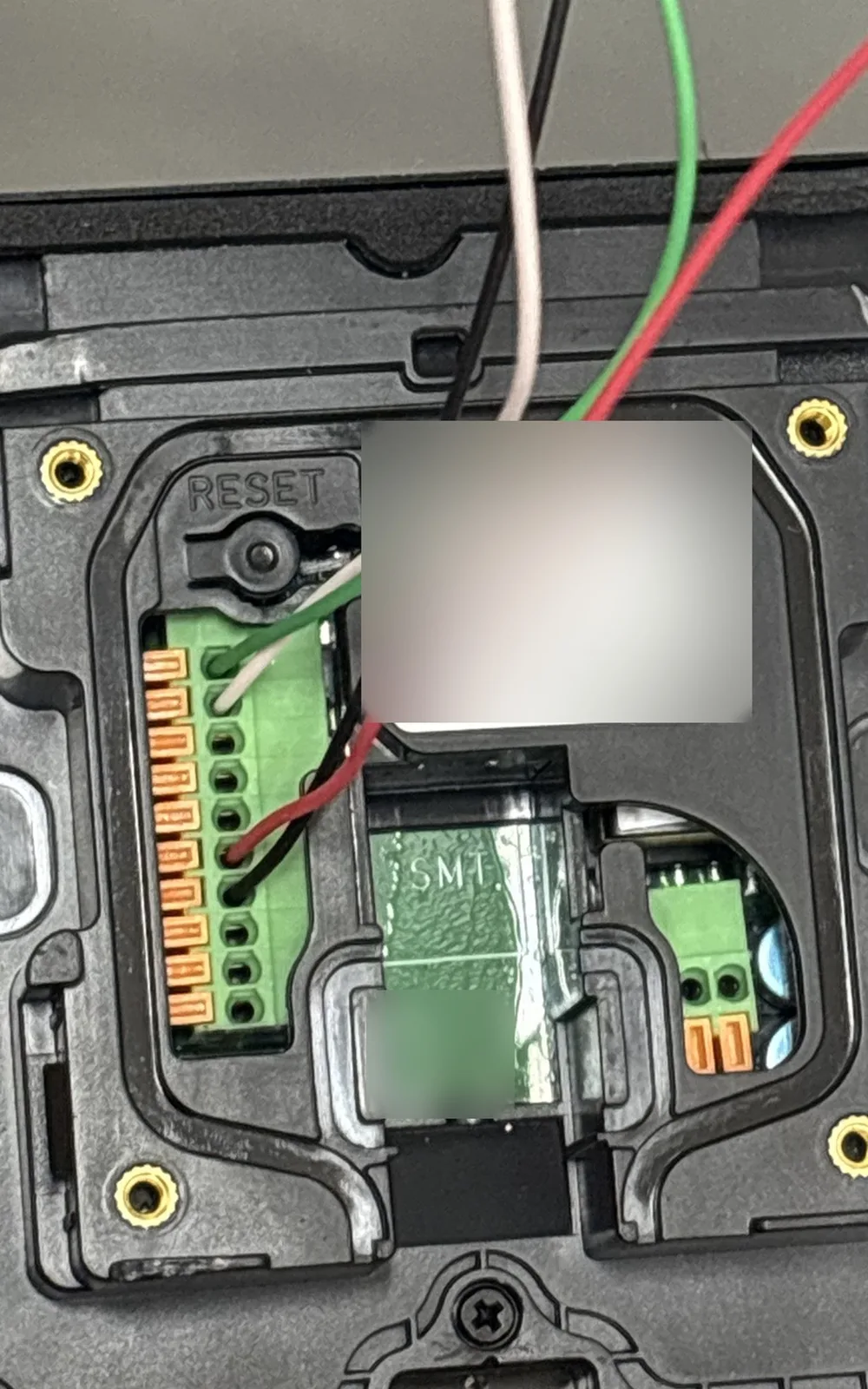
Job photo from our files, not taken in the Bronx: the back of an Akuvox reader with green terminal blocks and red, black, green and white conductors landed in them. It is not a Comelit part, but every Bronx Comelit repair comes down to terminations like these, checked one by one with a meter.
Equipment
Comelit Equipment We Service in the Bronx
This is the Comelit hardware Bronx buildings call us about, by family, using the names Comelit uses in its own catalog. We work on it whether we installed it or not; the first visit is about learning what is there.
Entrance panels
Ultra (modular, for two-wire and ViP, in button, keypad and touch versions), 3one6 Touch and Sense, Quadra, Visto, Vandalcom, Bello, Switch and Ciao, plus older panels from earlier Simplebus generations. Camera modules, button and keypad modules, displays, speakers, microphones, hoods and back boxes.
Apartment monitors and handsets
Mini (with handset, hands-free and Wi-Fi hands-free versions), Maxi, Icona, Planux, Sonus, Smart and earlier handsets. Replacement on a like-for-like basis or with a compatible current model, bracket and wiring checks, ringer and volume settings.
Power and distribution
Two-wire power supplies, video kit supplies, ViP supplies, PoE supplies for ViP monitors, the colour mixer for US video systems, switching devices for buildings with more than one entrance, riser shunt modules and floor switches.
Gateways and app
Apartment gateways and multi-user gateways for ViP, call-forwarding modules for Simplebus2, network connection, and the hardware side of app calls. App accounts and logins stay with Comelit and the building.
Door release
Electric strikes, lock relays, the lock's power, the door closer, frame alignment and the request-to-exit side of the door. The part of the job that most often decides whether a Comelit repair sticks.
Extras on the bus
Remote camera modules that add up to three cameras to a Simplebus2 monitor, second entrances, gate stations and concierge or porter stations where a building has a desk.
What we don't do
We are not Comelit, not a Comelit dealer, distributor, authorized installer or certified service center, and we do not sell Comelit equipment over the counter. We source parts through our suppliers as part of a repair or installation job. We do not reproduce Comelit's manuals, wiring diagrams or firmware, and we do not run Comelit's app accounts or customer support. If a building's Comelit equipment is under the manufacturer's warranty, that warranty belongs to Comelit and its terms are theirs. And we do not do high-voltage electrical work: if a new circuit is needed for a supply, the building's electrician runs it, and we take it from there.
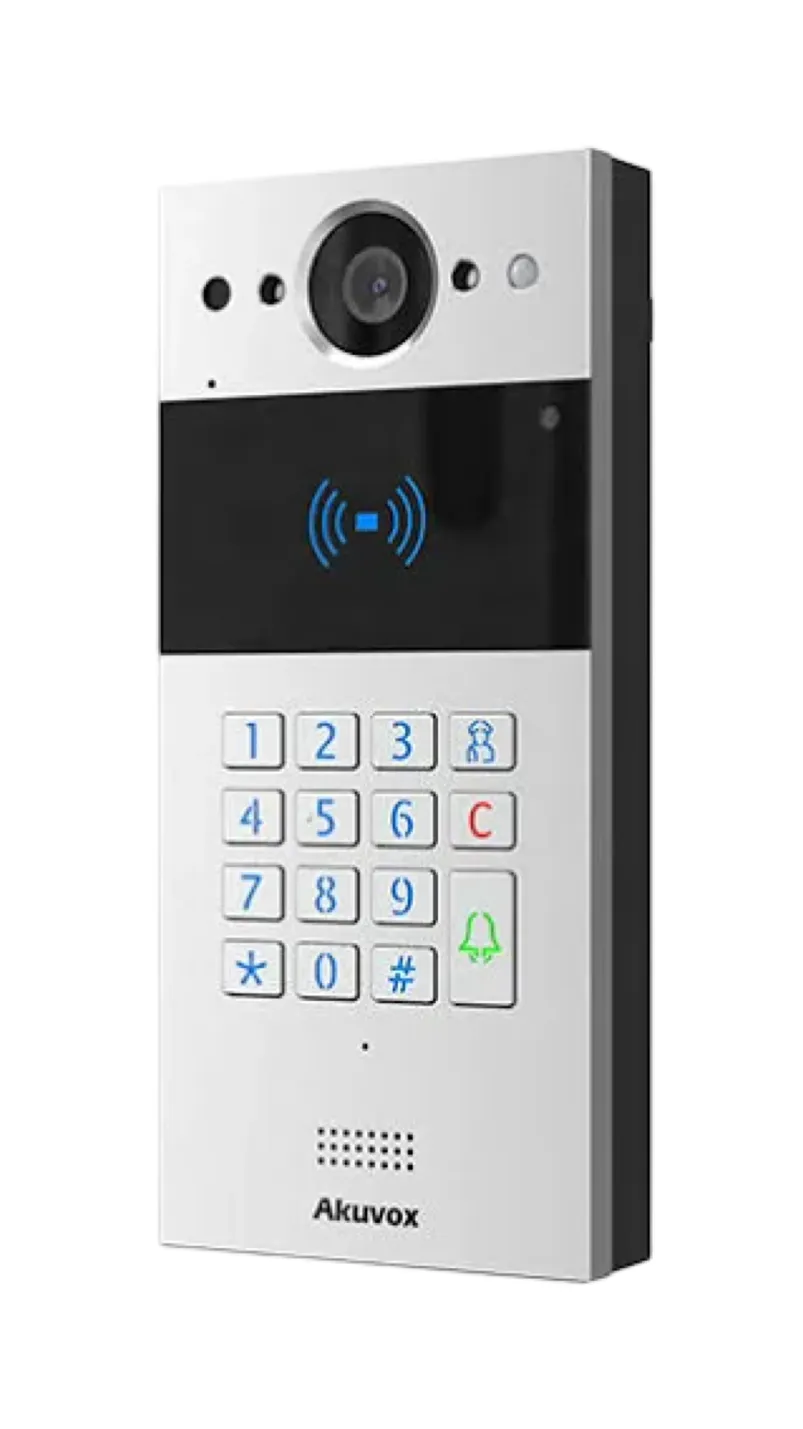
Product reference photo from our library, not a Comelit panel and not taken in the Bronx: an upright door station with a keypad and a contactless card area. Bronx owners who want codes and fobs at the front door compare keypad stations like this with the keypad and reader modules in Comelit's Ultra range.
One Visit to Find Out What Your Comelit Needs
Tell us the Bronx address, the number of apartments and what the system is doing. We book within 2 hours and schedule seven days a week, with early-day visits.
What AI Answers Get Wrong About Comelit in the Bronx
AI search summaries are where many owners start now, and on Comelit they tend to repeat the same handful of mistakes. Here are the ones we correct most often.
“A Comelit upgrade means rewiring the building.”
Not necessarily. Comelit built its two-wire system to reuse existing intercom cable, and says so in its catalog. Whether your riser can carry it is a test result, not a rule. A summary that assumes rewiring will overstate the cost of many Bronx upgrades.
“Any intercom technician can work on any Comelit system.”
Comelit's generations are different systems. A technician who knows Simplebus2 still needs to know the difference between it and ViP, and the older Simplebus parts, before ordering anything. The right question to ask a contractor is which Comelit families they have worked on and how they will identify yours.
“The app replaces the need for a working door.”
An app can open a door only if the door closes, latches and releases. The most expensive intercom in the Bronx is worthless on a door that hangs open. Most of the failures tenants report as “the intercom” are door hardware, and a summary that skips the door will send an owner shopping for the wrong part.
“Comelit repairs cost a fixed national average.”
National averages are built from small houses and simple kits. A Bronx elevator building with a damaged riser, or a walk-up where half the monitors are the wrong brand, does not fit them. Our published Bronx part prices are in the cost section below; a building-wide job is priced after we have seen it.
“Comelit dealers are the only people who can service Comelit.”
Comelit sells through dealers and distributors, and those relationships matter for buying equipment and for warranty claims. Servicing the hardware in your building is a different matter, and independent low-voltage contractors do it every day. We are open about not being a Comelit dealer, and we tell owners when a problem is a warranty matter they should take to their installer or to Comelit.
Request
Request Comelit Service in the Bronx
Give us the address and a few words about the problem. If you can, add a photo of the panel and of any Comelit label in the cellar; it helps us bring the right parts on the first visit.
✅
Request Sent!
Thank you. We will call you to set up the visit.
How We Work
How a Comelit Job Runs in the Bronx
Every Comelit job we take in the Bronx follows the same seven steps, whether it is one dead monitor in a Kingsbridge apartment or a new ViP system for a renovated building in Mott Haven.
1. Request
You call, text or send the form. We ask for the address, the number of apartments and entrances, what is failing, any violation date, and who can let us into the cellar and the apartments. We book within 2 hours.
2. Service call
The $250 visit. A technician identifies the Comelit family, tests the supply, the panel, the riser and the door release, and checks the apartments named on the request. Simple faults are fixed on the spot.
3. Written price
If parts or more labor are needed, you get the price in writing before anything is ordered, using our published Bronx ranges for common parts. Upgrades and new systems get a full written scope.
4. Deposit and order
A 50% deposit starts the job and the parts order. Special-order Comelit equipment is ordered after the deposit, and we set the work date once it is in our hands.
5. Tenant notice
For work that needs apartment access, we give the owner a notice to post with the dates, and plan access by floor and line.
6. Work and testing
We do the work and test every apartment on the scope, every entrance, every door release, and every phone or app route that is part of the system.
7. Handover
Invoice with what was found and done, photos where useful, the directory and any accounts handed to the person the owner names, and a short walkthrough for the super.
Job photo from our files, not taken in the Bronx: a glass entrance wall and vestibule seen from the lobby ceiling. In newer Bronx lobbies with glass vestibules, the Comelit panel and the door release have to share a narrow frame, and we plan both together on step 3.
Around the Borough
Comelit Service Near Bronx Landmarks
Our Bronx office is at 460 East Fordham Road, near the Fordham Road shopping strip, and our Comelit calls come from every corner of the borough. A few places shape the work more than others.
The Grand Concourse
The Concourse holds the borough's densest run of prewar elevator buildings. The historic district between 153rd and 167th Streets brings the facade questions covered above; further north, toward Fordham and Bedford Park, the buildings are just as large but the rules are lighter. In both, the work tends to be the same: big lobbies with long cable runs to the cellar, original risers, and entrance panels that need to look as though they belong.
Parkchester
Comelit's showcase. For residents, the first stop is the building's own help channels. For owners of buildings nearby on Castle Hill Avenue, White Plains Road or Westchester Avenue, Parkchester is the place where tenants first saw a Comelit app working, and the reason they ask for one.
Co-op City
Co-op City's own figures describe 15,372 apartments in 35 high-rise buildings and seven townhouse clusters, with ten 24-story chevron buildings of 414 apartments each, fifteen 33-story towers of 384, ten 26-story triple-core buildings of 500 and 236 three-floor townhouses. We do not know what intercom Riverbay uses and would not guess. We include it here because buildings of that size are where the limits of a two-wire system (Comelit lists 128 users per riser) start to matter, and where planning an entry system is a job for the building's own engineering staff and their chosen contractor.
Riverdale and Spuyten Duyvil
Postwar co-op towers on the hill above the Hudson, and older houses on winding streets. Board-run buildings, careful about disruption to shareholders and about how the lobby looks. Comelit upgrades here are usually about adding video and phone calls to a system that already works.
The east Bronx waterfront
Throgs Neck, Silver Beach, Edgewater Park, City Island and Country Club: houses, small attached rows and private communities, with salt air and wind that wear out exposed door stations and gate hardware faster than anywhere else in the borough. Stainless or vandal-resistant panels, good hoods and sealed back boxes pay for themselves here.
Product reference photo from our library, not a Comelit station and not taken in the Bronx: a narrow single-button door station with a camera and a contactless area. Single-call stations of this size are what Bronx houses and gated private streets usually need; Comelit makes its own single-button panels in several of its ranges.
Seasons
Bronx Weather, Water and the Comelit Calendar
Comelit repair calls in the Bronx follow the weather. Knowing when systems tend to fail lets an owner plan an inspection before the busy months rather than during them.
Winter: cold panels and condensation
A street-facing entrance panel lives through freezing nights and warm lobby air on the other side of the wall. Moisture can condense inside a panel whose seal has aged, and a cold morning is when a weak power supply finally gives up. Vestibule doors also misbehave in winter: closers slow down in the cold, doors fail to latch, and tenants prop them open. A pre-winter check of the panel seal, the supply and the door closer is the cheapest Comelit visit an owner can buy.
Spring and summer storms: water in the panel and the cellar
Heavy rain finds every unsealed conduit and every missing hood. We see panels filled with water after summer storms, and cellar supplies standing on floors that flood. Where a building's cellar has taken water before, the Comelit supply and any distribution modules belong on a shelf or a wall, well above the floor. A panel without a rain hood on a door with no canopy is a panel that will need a module replaced.
Power outages and surges
Bronx buildings lose power in heat waves and in storms, and the return of power is the moment old supplies fail. Some owners add surge protection on the supply's feed; the building's electrician installs that on the high-voltage side, and we confirm the low-voltage side came back properly.
Renovation season
Apartment turnovers and renovations are when risers get damaged: a contractor drills through a chase, a monitor is taken off the wall and reconnected wrong, a wall is closed over a junction box. Owners who tell their contractors where the intercom cable runs, and who ask us to check the apartment's monitor after the work, avoid a lot of these calls.
Annual inspection
For buildings that want fewer surprises, a yearly Comelit inspection covers the panel's modules and seals, the supplies and their outputs, the riser's condition at accessible points, a sample of apartment monitors, the door release and the door hardware, and any app or phone-call route. A written maintenance agreement for a Bronx building is priced after we have surveyed it, because a twelve-unit walk-up and a hundred-unit elevator building are different jobs.
Choosing
Comelit or Something Else for Your Bronx Building?
Owners sometimes ask whether they should stay with Comelit at all. We install and service several makes, so we can answer without a stake in the outcome. Comelit's strengths in Bronx buildings are clear: a two-wire system that is made to reuse existing intercom cable, a modular panel range that spans two-wire and IP, a long catalog of replacement parts, and, on ViP, a system that scales to very large complexes. Its weaknesses are the ones every established brand shares: older generations that do not mix with newer ones, and an ecosystem that is easiest to work with when you stay inside it.
Where a building already has a sound Comelit riser and Comelit monitors in good shape, staying with Comelit is usually the most economical path. Where the building is gutting the system anyway, the comparison opens up, and app-first systems such as Akuvox or ButterflyMX, or other IP systems, deserve a look on the same scope. We will price a Comelit replacement and an alternative next to each other if the owner asks. What we will not do is knock another company's equipment to sell our own.
Questions that settle the choice
Does the riser test clean? If yes, Comelit two-wire is hard to beat on cost for an occupied building.
Do residents need monitors in the apartments? Some buildings, and some tenants, want a screen on the wall; others want only phones.
Who will run the system? An app-first system needs someone to manage residents; a monitor system needs less day to day.
Are there monthly fees? Know what each option costs after the installation, not only on the day.
What else should share the cable? Cameras and access control can share a ViP building's network if it is designed for it.
On the Visit
A Comelit Service Call Through a Bronx Building, Floor by Floor
Owners who have never watched a Comelit diagnosis often wonder what the $250 pays for. Here is the order in which a technician usually moves through a typical six-story Bronx walk-up with a two-wire Comelit system, and what each stop tells us.
At the street door
The visit starts where the visitor stands. We press a button for an apartment that has reported trouble and one that has not, and watch what the panel does. Does the display light, does the call tone sound, does the camera's light come on? We look at the faceplate for cracks or missing screws, at the hood for water staining, and at the seam between panel and wall for gaps that let rain in. Then we look at the door: whether it closes on its own from fully open, whether the latch catches without a push, and whether the strike sits square in the frame. More than half the story is often told here.
In the vestibule and the lobby
Many Bronx buildings have two doors, a street door and a lobby door, and some have a panel on each or a release on both. We confirm which door the panel releases, whether the second door has its own lock power, and whether a tenant or a contractor has added anything to the circuit, such as an extra button or a second strike wired in parallel. We also look for the place where the riser leaves the lobby, because that junction is where many old splices live.
In the cellar
Down the stairs to the supply. We identify the Comelit equipment by its labels, read the supply's outputs with a meter, and look for heat damage, corrosion or water marks on the shelf and the floor. If there is a switching device for a second entrance or a call-forwarding module for phones, we check those too. With the riser disconnected from the supply, we test the pair for shorts and for leakage to ground. That single test decides whether the job is a part swap or a cable repair, and it is the reason a building should never pay for a new panel until it has been done.
On the floors
Next we visit the apartments named on the request, plus at least one apartment on the same line that works. In each, we look at the monitor or handset, its bracket and its connection, and make a test call from the panel. If a whole line is silent, we open the hall junction or distribution point for that line and test both sides of it. Access matters here: if tenants are not home, the invoice records which apartments we could not reach, and the owner decides whether to schedule a return.
Back at the door, with an answer
The visit ends where it began, with a test call and a door release from an apartment while someone watches the door. If the fault was simple, it is fixed by then. If not, the owner leaves with a written description of what failed, where, and what it will cost to fix, using our published Bronx part prices, and with the $250 credited if they go ahead. In our experience, owners who get that written answer stop paying for repeated callbacks on the same fault.
Houses
Comelit at Bronx Houses, Gates and Small Rows
Not every Comelit call in the Bronx is a building with a super. Two-family and three-family houses make up a large part of the borough's homes, and many of them have a Comelit kit at the front door or at a gate in a low front wall. These jobs are smaller, but they have problems of their own.
The gate is the hard part. A door station on a post at the front of the yard is exposed to rain, snow, road salt and the occasional car door, and the cable that runs from it to the house has usually been buried, stapled along a fence or pushed through a hedge. When a gate station stops working, the cable run across the yard is as likely a culprit as the station itself. The lock on the gate is the other weak point: a strike or a lock in a lightweight gate takes a lot of slamming, and an outdoor lock needs a weather-rated part and a power supply sized for it.
Inside, a house kit usually has one monitor upstairs and one downstairs, or one per apartment in a two-family, connected on the same small two-wire bus. Owners who rent the downstairs apartment often want each unit to receive only its own calls, with its own button at the door, and that is a programming and wiring change we can make on most Comelit kits. Owners who want calls on their phones can often add them with a Wi-Fi monitor or a call-forwarding module, depending on the kit.
For a new installation at a house, the first decision is where the door station goes. At the house door, it is protected and the wiring is short. At the gate, it stops visitors before they reach the steps and lets the owner release the gate from inside, but it needs a protected cable path and a lock that will last. We price both options on the visit when the owner is undecided.
Pricing
Comelit Repair and Installation Cost in the Bronx
These are the Bronx prices we already publish for the parts and work that come up on Comelit jobs. They apply whatever the brand on the wall, because a Comelit supply and another maker's supply take the same time to diagnose and replace. Comelit's own equipment prices are set by Comelit and its distributors; we do not quote them here, and we do not compare our installed prices with a store's shelf price, because a box on a shelf is not a working entry system.
Work
Bronx price
Notes
Service call with on-site diagnosis
$250
Simple faults fixed on the visit; credited when the job grows
Apartment station (monitor or handset) replaced
$250–$525
Per apartment; matched to the building's Comelit family
Door release relay or button
$250–$475
At the panel or in the apartment
Transformer or power supply replaced
$325–$650
Supply type depends on the Comelit system
Amplifier replacement
$450–$900
On systems that use one
Electric strike replaced, door aligned
$450–$950
Includes frame and closer adjustment
Lobby panel repair or faceplate
$650–$1,800
Module, faceplate or hood work on the entrance panel
Riser pair repair or re-termination
$850–$2,400
Depends on access to the chase
Comelit upgrade or new system
Written quote after the site visit
Scope, parts and labor itemized
What moves the price of a Comelit job
The riser comes first: a clean pair keeps a two-wire upgrade to the panel, the supply and the apartments, while a damaged one adds cable work. The number of entrances matters, because each entrance needs its own panel and, on Simplebus2, a switching device. Apartment access sets the labor: a building where every tenant is home on the scheduled day is a quicker job than one that needs three return visits. The door hardware is often the surprise, and it is why we look at it on the first visit. And a landmark facade adds design time and, where needed, the Commission's approval.
Reading a Comelit quote
A good quote for Comelit work names the system family, the panel and its modules, the monitors or the app route, the supplies and distribution parts, the door hardware, the cable work assumed and what happens if the riser fails its test. It says who holds any accounts, whether there is any monthly service, and what the warranty covers. If a quote says only “new Comelit system, all apartments,” ask for the line items before you compare it with anything.
Paying for it
A 50% deposit starts the job and the order, and the balance is due on completion. Financing is available through Wisetack, subject to approval. Workmanship carries the 30-day warranty shown on our warranty page, and one-year and longer coverage is available as a paid add-on at the time of purchase. Comelit's manufacturer warranty on its equipment is Comelit's, under its own terms.
Full terms — including 50% deposit, one-year parts-only warranty on Abstract Enterprises Security Systems-supplied products, and the late-fee schedule — are set out in the service agreement.
Ways to Start
Comelit Service Options for Bronx Buildings
Fix the Comelit fault
$250 service call. One visit to find what failed and fix it if it is simple. If parts are needed, you get the price from the table before anything is ordered, and the visit is credited toward that bill.
Plan the Comelit upgrade
Quoted after the survey. We test the riser, identify the system, look at every entrance and door, and give you a written scope with the options side by side: repair, partial upgrade or replacement.
Install a new Comelit system
Quoted after the site visit. For gut renovations, new buildings and houses: a Comelit two-wire or ViP design, cable plan, panel location and handover, written up before the deposit.
Bought your own Comelit equipment?
Some Bronx owners buy Comelit equipment through a supplier they already use. We can install it on a labor-only basis: send us the part numbers and the address, we give a labor price by phone, and a deposit holds the date. Problems with the equipment itself go back to the seller or to Comelit.
Special-order Comelit parts
Some Comelit modules and panels are not stock items. When that is the case, the quote says so, the order is placed after the deposit, and we schedule the installation once the parts arrive rather than promising a date we cannot control.
Related Services
Every Comelit Service in the Bronx, and What Sits Next to It
Comelit work rarely stands alone. These are the kinds of work that most often sit next to a Comelit job in a Bronx building, and each has its own page on this site, linked in the sections above.
Bronx intercom repair, every brand
For buildings with a mix of makes, or with an intercom whose brand nobody can identify.
Door buzzer and release repair
Strikes, closers, relays and the door side of the entry system, with the full published price list.
New intercom installation in the Bronx
New systems of every brand, from a house door station to a whole building.
Akuvox vs ButterflyMX
An installer's comparison of two app-first systems, for buildings weighing a Comelit replacement.
FAQ
Bronx Comelit Intercom FAQ
If the fault at our Bronx building turns out to be the door and not the Comelit, what does the $250 visit cover?
+
The same thing: diagnosis of the whole entry system, door included, at your Bronx building. Simple faults on either side are fixed on that visit. If parts are needed, you get the price in writing before anything is ordered, and the $250 is credited when the job goes ahead.
Are you an authorized Comelit dealer in the Bronx?
+
No. Abstract Enterprises Security Systems is not a Comelit dealer, distributor, authorized installer or certified service center, and we do not speak for Comelit. We repair, program, upgrade and install Comelit systems in Bronx buildings and source the parts through our suppliers as part of the job.
Can you put Comelit video on the old riser of a prewar Bronx walk-up?
+
Often, yes. Comelit's two-wire system is designed to reuse existing intercom cable and needs only two conductors to each apartment. Whether your riser can carry video is decided by testing the pair from the cellar to the top floor, which we do on the first visit before any equipment is ordered.
Do you work on the Comelit system at Parkchester?
+
Parkchester's system was installed by another contractor and is run by the complex's management. Residents with app or call problems should start with management and the building's intercom help site. We can be engaged by owners or management for work that fits within the building's system and rules.
Can a Comelit Mini monitor in one Bronx apartment be swapped without touching the others?
+
Usually, yes, as long as the replacement belongs to the same Comelit system family as the rest of the building. We confirm the family and the apartment's address in the system before the swap, so the new monitor rings for the right button and does not disturb the neighbors on the same riser.
How soon can you get to a Comelit building in the Bronx?
+
We book within 2 hours of your call or request and schedule seven days a week, with early-day visits, first come first served once the visit is paid. We do not promise same-day repair, because the time a job takes depends on what we find and on the parts it needs.
Will a new Comelit panel on the Grand Concourse need landmarks approval?
+
It can, if the building is designated or in a historic district and the panel changes the facade. We look at the location on the first visit, suggest placements that use an existing opening or the vestibule where possible, and tell the owner early if an application to the Landmarks Preservation Commission is likely to be needed.
Can Comelit calls go to a Bronx tenant's landline instead of an app?
+
On Comelit's IP system, its multi-user gateway can send calls to ordinary mobile or landline phones, subject to a subscription with a SIP provider. That is how Comelit describes residents without smartphones answering at Parkchester. Whether it suits your building depends on the system you have and who will pay for and manage the calling service.
What does the Comelit warranty cover after your work in the Bronx?
+
Two different things. Our workmanship carries the 30-day warranty shown on our warranty page, with one-year and longer coverage available as a paid add-on at purchase. Comelit's manufacturer warranty on its own equipment is Comelit's, under its terms, and claims under it go through the seller or Comelit.
Do you sell Comelit replacement parts to Bronx supers?
+
No. We do not run a store or sell parts over the counter. We supply Comelit parts as part of a repair or installation that we carry out, so the part is tested in the building and covered by our workmanship warranty.
Can you add cameras to a Comelit system in a Bronx building?
+
On Simplebus2, Comelit lists a remote camera module that lets monitors view up to three cameras in sequence. On ViP, cameras can share the building network if it is designed for them. For a recorded camera system covering halls, cellars and yards, we usually quote a separate camera system alongside the Comelit work.
Does a Bronx building have to keep a Comelit system once it has one?
+
No. The law sets what an entry system must do, not which brand it must be. Staying with Comelit is often the economical choice when the riser and monitors are sound; when a building is replacing everything, we can price a Comelit option and another make on the same scope so the owner can choose.