What are you looking for?
About Us Contact Us Careers Get a Free Quote (800) 486-0943
Pick a service
โœ… Got Your Own System?
๐ŸŽฌ Home TheatreQuote ๐ŸŽถ AV SoundQuote ๐Ÿ”‘ Access ControlQuote
Now pick your area
Pick your area
Long Island
Hudson Valley
Services available
Pricing & Tools
Pick a service for pricing
๐Ÿšช Intercom Pricing ๐Ÿ”” Buzzer Repair Pricing
Calculators
๐Ÿ“น Camera System Calculator ๐Ÿšจ Alarm Calculator โšก Cabling Quote Builder โœ… Got Your Own System?
Select your area
Arlo dropping offline behind a brick wall, a stoop camera that only catches the tops of heads, or a new Arlo kit still in the box? Brooklyn Arlo installation line, same-day estimates: (347) 934-8335
Home โ€บ Arlo Camera Installation NYC โ€บ Brooklyn
Brick Rowhouses ยท Brownstones ยท Two- and Three-Families ยท Walk-Ups ยท Waterfront Towers ยท Shops on Brooklyn's Commercial Strips

Arlo Camera
Installation in
Brooklyn

See every Arlo camera price in Brooklyn and build your own system →

Signal Tested Before We Drill ยท Mounts Matched to Brick, Mortar, Wood or Siding ยท Landmark Rules Respected ยท Brooklyn Rate

Arlo camera installation in Brooklyn starts with a borough that was mostly built before the Second World War. The Census Bureau's 2023 survey puts the median year built for Kings County housing at 1943, with more than half a million homes dating from 1939 or earlier, and most of them are brick: rowhouses, brownstones, two- and three-family houses and walk-ups on twenty-foot lots. Arlo's own placement guide names brick, concrete, stone and stucco as the materials that cut a camera's Wi-Fi signal the most, and that is the whole reason a wire-free camera that takes "five minutes" on a suburban house can fight you for an afternoon on a Bed-Stuy stoop or a Sunset Park back wall. This page explains how we test the signal before anything is drilled, where an Arlo actually belongs on a Brooklyn front, rear yard, roof or storefront, how two households in one house can share a building without sharing cameras, what the Landmarks Preservation Commission allows on a designated facade, and what the visit costs on our list, starting at $225 for the first hour.

Reviewed and updated November 6, 2026, against Arlo's knowledge base (camera placement tips, camera setup and SmartHub requirements, local storage); SafeHome and SafeWise Arlo setup guides; the Arlo Community forum threads on mounting cameras to brick and on poor range through a brick wall; How-To Geek's reporting on Arlo's end-of-life plans for older cameras; the U.S. Census Bureau's 2023 American Community Survey tables for Kings County; the NYC Comptroller's report on the homeowner housing market; the Landmarks Preservation Commission's 2018 rule amendments, Rules Section 2-20 and Permit Guidebook Chapter 11; NYC Business guidance on landmarked properties; the NoHo BID landmarked-storefront guidance; the NYC Health Department's flooding and health data story; News 12 Brooklyn on porch pirates (December 3, 2025); CBS New York reports on package thefts in Bushwick, Crown Heights and on Eastern Parkway; PIX11 on a Sheepshead Bay mailroom burglary; the Brooklyn Eagle on rear-window burglaries in Bensonhurst and Gravesend; Brownstoner's forum and its 2007 story on floodlights aimed into a bedroom window; the NYC Small Business Services BID directory; Guzov LLC and Brick Underground on co-op rules for video doorbells; The Guardian on Atlantic Plaza Towers; Wikipedia, NYC Parks, the Brooklyn Navy Yard FY25 impact report and Industry City for landmarks; and Slickdeals user comments on Arlo. We found no Reddit threads or Yelp complaints about Arlo installs in Brooklyn, and could not capture Google's AI Overview or People Also Ask panels in our build environment. ยท Anwar Timothy, NYS license #12000287431 ยท crews dispatched from our Troy Avenue office in Brooklyn

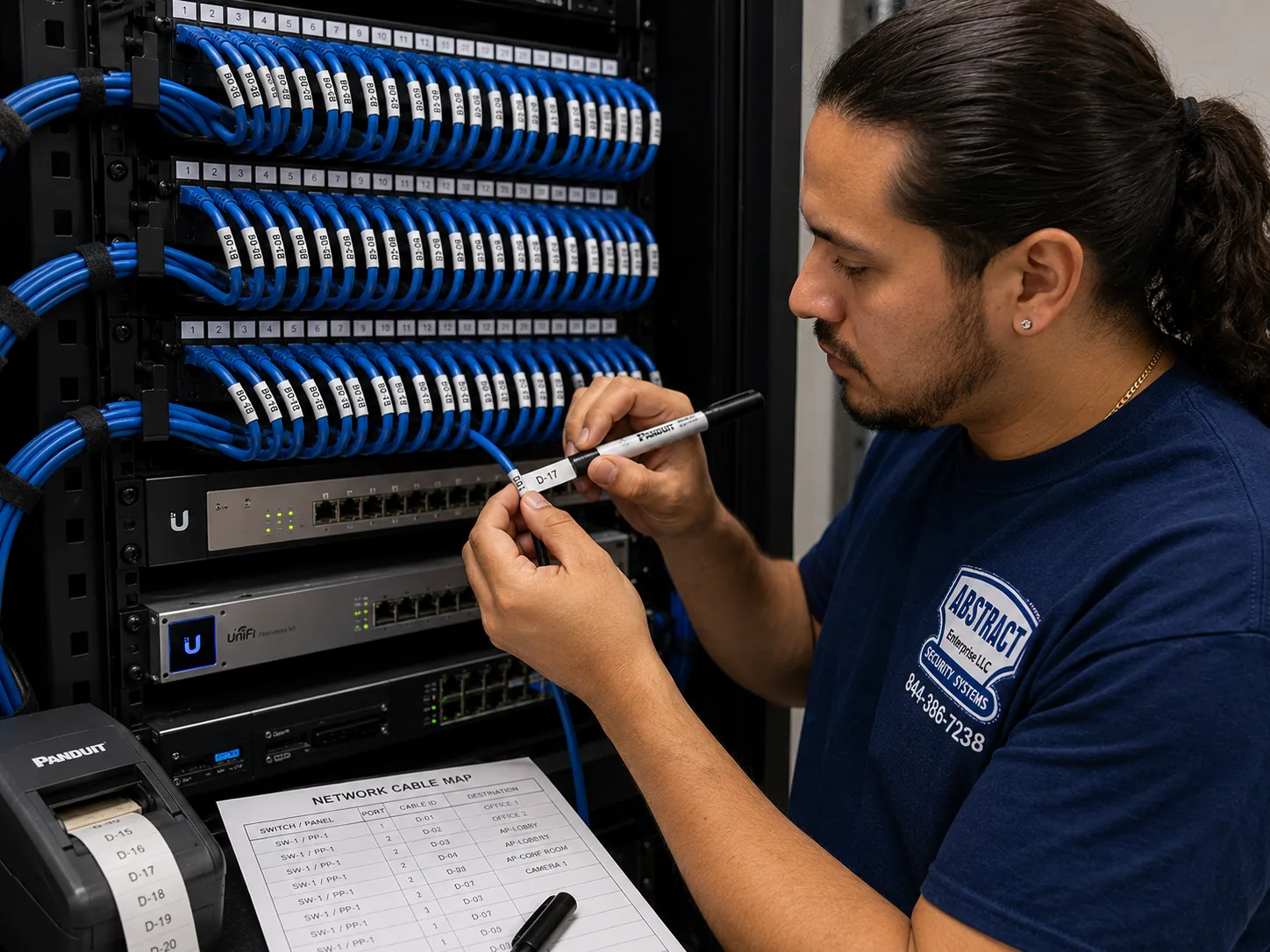
Brooklyn, Brooklyn Arlo camera installation network prep: technician printing cable labels at a patch panel beside a printed port map
A photo from the AESS job library, not taken in Brooklyn: a technician printing cable labels at a patch panel, with a printed port map beside it. It is a bigger network than most Brooklyn Arlo jobs ever see, but the habit is the same one we bring to a three-family in Crown Heights or a shop on Fifth Avenue: every cable that feeds the router, the Arlo SmartHub or an access point gets a label, so the next person who opens the closet knows which line keeps the cameras online.
Brooklyn Arlo Installation Request
Rowhouse, two-family, walk-up, tower apartment or shop: tell us the block, the spots you want watched and the Arlo models, and a technician calls back with the plan

โœ…
Request Sent!
Thank you. A technician will call you about the Brooklyn address, usually within two hours.
25+
Years Experience
โœ“
Same-Day Estimates
100%
Licensed & Insured
4.7โ˜…
201 Google Reviews

Owner-operated since 2002 ยท Thousands of jobs completed ยท Booked within 2 hours

Quick answer: an installed Arlo visit in Brooklyn is $225 for the first hour on our list, then 30-minute blocks, with +$65 where a mount goes into brick or stone and +$45 where it goes into plaster. That covers mounting your Arlo cameras, doorbell or SmartHub, adding them to your Arlo account, settling the Wi-Fi so each camera holds a steady signal, and setting the modes and alerts with you. Cameras and accessories are yours to buy, or we install what you already own. We book within two hours of your request, and the total is agreed in writing before anyone drills a hole.

Three photos settle most Brooklyn Arlo quotes before we visit. The first is each spot you want watched, taken from where the camera would sit, so we can see what it would see: the stoop and sidewalk, the gate under the stoop, the back yard and the fence line, the roof hatch, the shop door. The second is the wall or trim the camera would be fixed to, close enough that we can tell brick from brownstone, stucco from siding, and wood window trim from metal. The third is your router and modem, wherever they are, because in a Brooklyn rowhouse the internet usually lands in the cellar or at the front of the parlor floor, and a camera on the back wall may be forty feet and three masonry walls away from it. Tell us the Arlo models on the box, too. Some, such as the Arlo Pro 3, Ultra and Ultra 2, need a SmartHub or Base Station according to Arlo's knowledge base, and almost every Arlo needs a 2.4 GHz Wi-Fi connection to set up. Send it all to (347) 934-8335 or on WhatsApp.

  • Looking at your photos and answering questions costs nothing. If a wall turns out to be a different material from what the photo suggested, you hear the change before we drill, not after.
  • All work falls under New York State license #12000287431. If a managing agent, board or commercial landlord asks for insurance paperwork, tell us who it should name and we send it ahead of the visit.
  • If someone else owns the wall, the stoop or the fence, we ask about it on the first call. In a borough where about seven in ten occupied homes are rented, it is usually the first thing that matters.
The Neighborhood

Why Brooklyn Properties Need Arlo Camera Installation

Brooklyn was a city before it was a borough. It joined New York City on January 1, 1898, fifteen years after the Brooklyn Bridge opened on May 24, 1883, and in the decades on either side of that merger it grew block by block, mostly in brick and brownstone. Developers put up long rows of houses with stoops, bay windows and carved stone, first in Brooklyn Heights, Clinton Hill and Bedford-Stuyvesant, then in the tree-lined brick blocks of Flatbush, Bay Ridge and Borough Park. The population went from about 1.17 million in 1900 to about 2.5 million in 2010. Almost everything we deal with when an Arlo goes up here traces back to that building boom: the masonry that blocks Wi-Fi, the stoops that put the front door five or six feet above the sidewalk, the narrow back yards that sit twenty-odd feet from the next row's windows, and the houses that were built for one family and now hold two or three households.

The census numbers make the point plainly. The Census Bureau's 2023 five-year survey counts 1,090,187 housing units in Kings County. The median year built is 1943, and 513,629 units, nearly half, went up in 1939 or earlier. Only 52,359 units are in detached one-family houses, against 93,812 in attached one-family houses, 175,805 in two-unit buildings and 170,655 in three- and four-unit buildings. Owners occupy about 300,000 homes and renters about 710,000. In other words, the typical Brooklyn Arlo customer is not a homeowner with a free-standing house, a vinyl-sided garage and a router in the next room. It is somebody in a brick building with neighbors on both sides, often a tenant or an owner with tenants, trying to watch a stoop, a gate, a yard or a hallway door through walls that were laid a century ago.

The reason people call is not abstract either. News 12 Brooklyn reported on December 3, 2025 that about 90,000 packages are stolen every day in New York City, citing the city's Department of Transportation, and showed a resident catching a theft on camera. CBS New York has covered a string of Brooklyn cases over the years: a building on Eldert Street in Bushwick where stolen packages held about $2,200 of clothing, a house on Eastern Parkway where $5,500 of wigs were taken from the front steps, and a thief filmed strolling up the steps of a Crown Heights home near Montgomery Street and New York Avenue. PIX11 reported a burglar near Avenue V and Ocean Avenue in Sheepshead Bay who got in through an unlocked door, disabled the second lobby door and emptied a mailroom. One Brooklyn resident profiled by a delivery-locker company said she had dealt with more than 50 porch-pirate and trespassing incidents in two years. Behind the houses, the Brooklyn Eagle reported in 2018 on a suspect linked to at least a dozen burglaries in Bensonhurst and Gravesend, in every known case forcing open a window at the rear of the house.

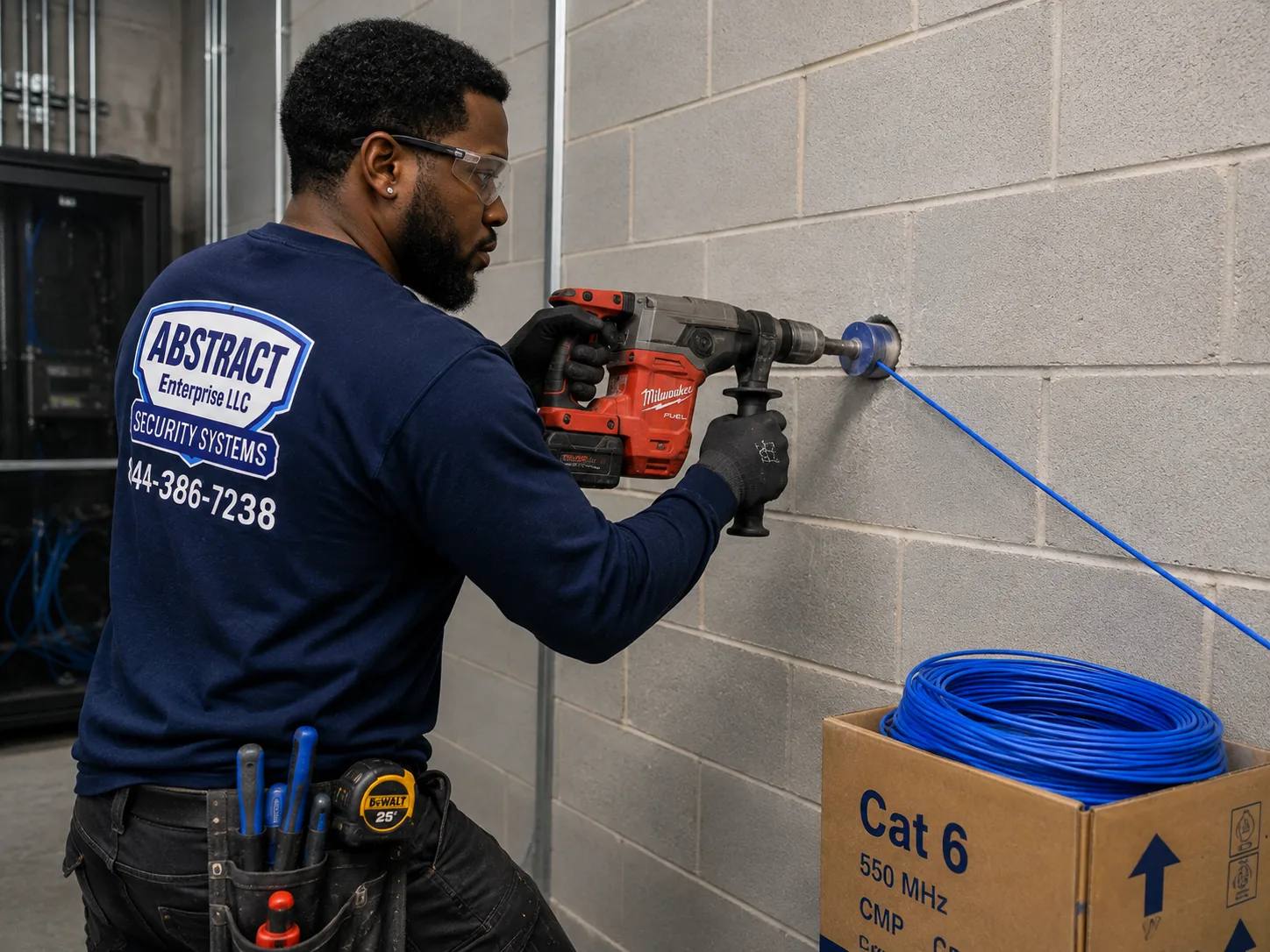
Brooklyn, Brooklyn Arlo camera installation prep: technician core drilling through a block wall to carry cable through to a network room
A photo from the AESS job library, not taken in Brooklyn: a technician core drilling through a block wall so a cable can pass into a network room. Most Brooklyn Arlo jobs never need a hole this size, but when a back-yard camera on a rowhouse cannot hear a router at the front of the cellar, one neat pass through the rear wall for a network cable to an access point near the yard is often what turns a camera that drops every evening into one that stays connected.

Arlo is the camera many of those households reach for, because it promises no wires, no electrician and no drilling into the building's electrical system. That promise mostly holds, and it is why wire-free cameras suit renters, owners of landmarked fronts and anyone who does not want to run new cable through brick. Where it comes apart is the signal and the mount. Arlo's placement guide asks for three or four bars of signal and warns that brick, concrete, stucco and stone weaken it most. A forum user who mounted an Arlo on brick had to move the SmartHub around before the camera would connect; another could not get a camera to connect from five meters away through one timber wall and one brick wall. A Brownstoner forum poster who wanted a camera on the second floor of a brownstone after what they called worrying security incidents asked how hard it would be, and how much it would cost, to run a new wire. Nobody answered. That gap, between the box that says "installs in minutes" and the brick wall that disagrees, is where an installer earns the visit.

There is one more Brooklyn layer, and it is about people rather than walls. A two-family house, of which the city Comptroller counts about 225,000 citywide, usually has an owner in one unit and a tenant in the other, sharing a front door, a stoop, a back yard and often a single internet line. Co-op boards can, according to Brick Underground's lawyer column, ban video doorbells by a new house rule without a shareholder vote. Thousands of Brooklyn fronts are inside historic districts, where the Landmarks Preservation Commission reviews security cameras on facades. And the people next door are close: on a twenty-foot lot, the neighbor's bedroom window may be eight feet from your camera's spotlight. A good Arlo install in Brooklyn plans for the tenant, the board, the Commission and the neighbor before it plans for the camera.

Six Brooklyn facts that decide where an Arlo goes before we pick a mount

  • The housing is old and mostly masonry. Kings County's median year built is 1943 and 513,629 units date from 1939 or earlier. Expect brick or stone behind the camera, and expect it to weaken Wi-Fi the way Arlo's own guide says it will.
  • Small multi-family buildings dominate. Two-unit buildings hold 175,805 homes and three- and four-unit buildings 170,655, far more than detached houses (52,359). Shared stoops, shared yards and shared internet are normal, and they change how the cameras and accounts are set up.
  • Most households rent. About 710,000 occupied homes are rented and about 300,000 owned. Wire-free mounts, removable concrete screws and adhesive-free plans matter here, and so does a landlord's say over an outside wall.
  • Landmarked fronts are common. Brooklyn Heights became the city's first historic district on November 23, 1965. Published counts of protected buildings run to 2,853 in Park Slope, about 1,800 in Bedford-Stuyvesant and 1,752 in Crown Heights, and four Sunset Park districts were added on June 18, 2019. The Commission limits how many cameras can go on a small building's street frontage.
  • Cellars flood. During Hurricane Ida in September 2021, rain fell at a record 3.5 inches an hour against a sewer capacity of about 1.75, according to the city Health Department, and ten of the fourteen people who died in the city drowned in basement apartments. Sandy flagged southern Brooklyn as especially vulnerable. Routers and SmartHubs that sit on a cellar floor are at risk.
  • Theft clusters at the front and the rear. Package thefts on stoops and in lobbies, and burglaries through rear windows, are the two patterns that show up again and again in Brooklyn news. Most of our Arlo plans start with one camera on each.

Where this page applies. It covers the whole borough, from Greenpoint and Williamsburg down to Coney Island and Brighton Beach, and from Brooklyn Heights and Red Hook east to Brownsville, East New York and Canarsie. Every Brooklyn address is billed at the same Brooklyn rate shown on our Brooklyn Arlo installation prices page, and the citywide picture, including the other boroughs, is on our Arlo camera installation NYC page.

Same-Day Repair in Brooklyn

Need Repair in Brooklyn? Arlo Cameras That Drop Offline, Mounts Working Loose, or a System Arlo No Longer Supports

Most of the urgent Arlo calls we get from Brooklyn fall into four kinds. The first is the camera that works at noon and goes offline every evening. In a brick rowhouse that is usually signal: the camera was paired on a good day, standing next to the router, and then mounted on the back wall where it gets one bar through two masonry walls. Evenings are worse because that is when everyone in the house, and every apartment on the block, is streaming. The second is a mount that has started to sag or spin. Arlo's magnetic mounts are convenient, but on brick they are only as good as the screw holding the mount plate, and a plastic plug pushed into a crumbling mortar joint can loosen in a single winter. The third is the camera that keeps saying the battery is low after a few weeks, often because it is set to record every passing car on a busy avenue. The fourth is the system that simply stopped being supported.

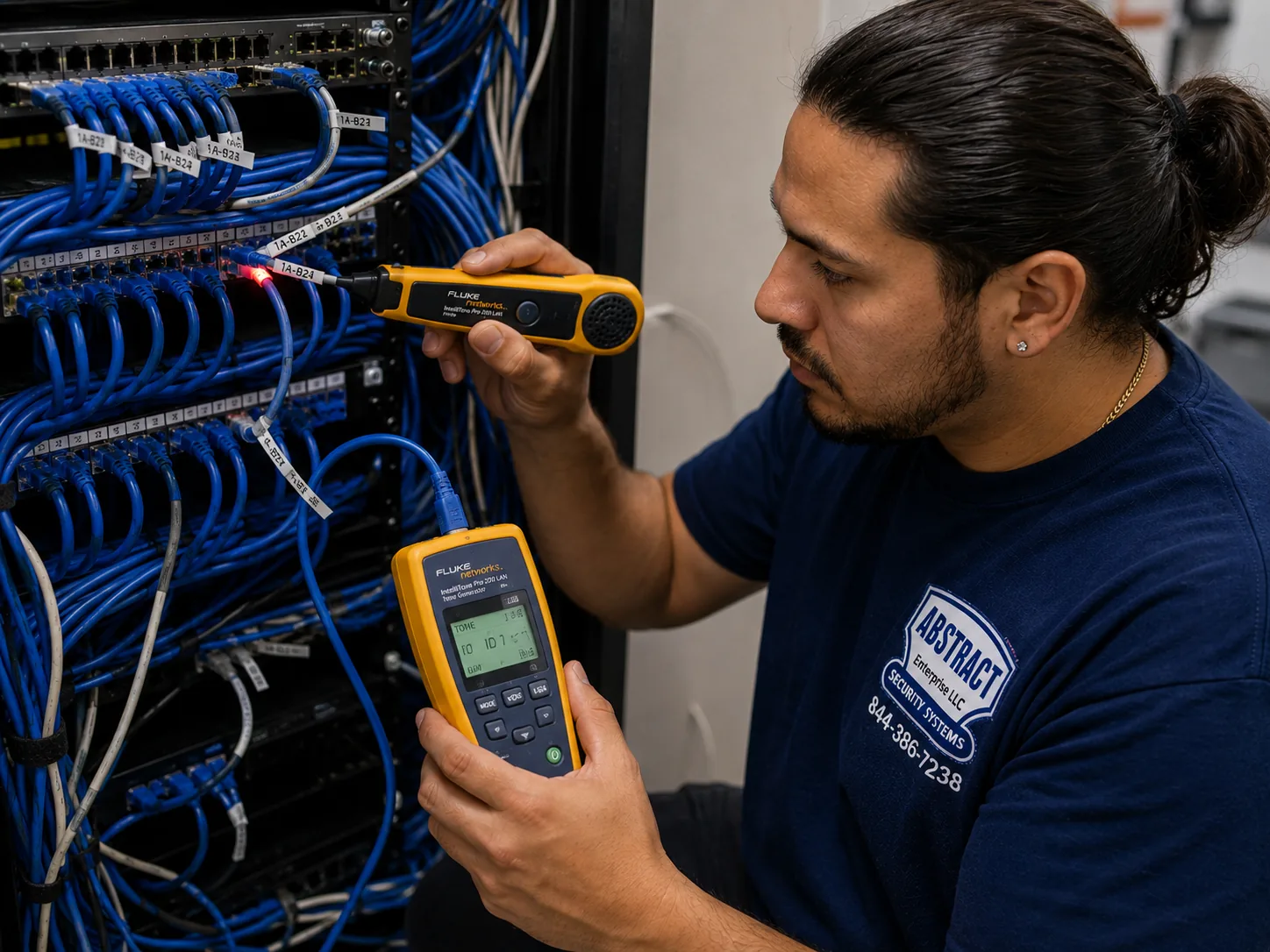
Brooklyn, Brooklyn Arlo camera repair: technician tracing an unidentified cable run at a patch panel with a tone generator and probe
A photo from the AESS job library, not taken in Brooklyn: a technician tracing an unidentified cable run at a patch panel with a tone generator and probe. In Brooklyn cellars we use the same tools to find out which of the old cables left behind by past tenants and internet providers still runs somewhere useful, because an existing line to the back of the house can feed an access point for a struggling rear Arlo without drilling anything new.

If a camera is hanging by its mount or has come off, take it down, bring the battery inside to charge, and call (347) 934-8335. A repair visit is booked like any other Arlo visit, at $225 for the first hour on our list and then 30-minute blocks, with +$65 if the new fixing goes into brick or stone and +$45 if it goes into plaster. On the visit we check the signal at the mount with the camera in place, look at whether the SmartHub or router can move, try the camera's settings for motion sensitivity and recording length, and only then decide whether you need an access point, a different spot or a new camera. If the cameras are older models that Arlo has retired or put on limited support, we tell you plainly what still works, what will not get fixes, and what can be reused, such as solar panels or mounts, before you spend anything on replacements.

What We Install

Arlo Camera Installation Services in Brooklyn

Each service below is booked at the same Brooklyn rate. What changes the total is the number of spots, the walls they go on, and how much network work it takes to give each camera a steady signal.

Stoop and front-door cameras

Arlo cameras and video doorbells placed to see faces on a stoop, a vestibule door or a gate under the stoop, on brick, brownstone, wood door trim or ironwork, and kept to landmark criteria on designated fronts.

Rear-yard and rear-window cameras

Cameras on the back wall of a rowhouse or two-family, aimed at the yard, the rear windows and the fence line, with spotlight and siren settings chosen so the next row's bedrooms are not lit up.

Signal and SmartHub work

Placing the SmartHub or Base Station where Arlo's guide wants it, moving routers off flood-prone cellar floors, and adding wired access points so a camera behind brick holds three or four bars.

Two-household setups

Separate Arlo accounts or carefully shared ones for owners and tenants in two- and three-family houses, with each household's cameras on the network that belongs to them.

Replacing retired Arlo systems

Taking down older Arlo cameras that no longer get support, reusing mounts and solar panels where they fit, and setting up the replacements so they record the same spots, better.

Arlo for shops and offices

Wire-free cameras for a shop's door, counter or back room on Brooklyn's commercial strips, set up so the owner and staff each see what they need on their own phones.

Building Specialists

Arlo Camera Installation for Brooklyn's Architecture

Six kinds of building make up nearly every Brooklyn Arlo call. They differ in what the camera is fixed to, how far it sits from the router, and who besides you has a say over the outside of the building. Those three things decide the plan before anyone compares camera models.

The brownstone and brick rowhouse

Usually about twenty feet wide and forty to fifty feet deep, with a stoop at the front, a yard at the back and the internet landing in the cellar. Masonry front, rear and party walls.

The two- and three-family house

Stacked apartments, often owner below and tenants above, sharing a door, a stoop, a yard and sometimes one internet line. The building type Brooklyn has more of than any other.

The walk-up apartment building

Four to six stories of brick, a lobby door and a mailroom or mail table, stairs to a roof hatch, and tenants who want to watch their own door and their own deliveries.

The tower and new condo

Downtown Brooklyn, the Williamsburg and Greenpoint waterfront and other rezoned areas, with concrete walls, building-wide rules, and doors that open onto shared corridors.

The detached and semi-detached house

Southern Brooklyn houses in Mill Basin, Marine Park and beyond, often with driveways, siding or stucco, garages and more yard to cover.

The storefront and industrial space

Shops on Brooklyn's 24 business improvement district corridors, and workshops, studios and small warehouses in Sunset Park, the Navy Yard, Gowanus and East Williamsburg.

The brownstone and brick rowhouse: a long, narrow house with the router at the wrong end

The classic Brooklyn rowhouse is a tall, narrow box. Brownstoner forum members describe twenty feet as the standard width, and renovation guides put the typical footprint at twenty feet wide and forty to fifty feet deep. The internet usually comes in at the front of the cellar, because that is where the cable or fiber line enters from the street. One Brownstoner poster setting up fiber put it simply: the terminal goes in the cellar, and then Cat6 cable connects mesh access points around the house. On Reddit's home-networking forum, a resident of a four-floor New York brownstone described the problem in one line: the router is on the least busy channels, but it does not reach far enough through the house. For an Arlo, that means the front camera on the stoop often works first time, and the rear camera, forty-plus feet back and up a floor, is the one that drops.

Our plan for a rowhouse starts at the router, not the camera. If the router can move up from the cellar floor to the parlor level without losing the internet line, that alone can fix a rear camera. If it cannot, a wired access point near the back of the house, fed by one cable along the cellar ceiling, puts a strong 2.4 GHz signal right inside the rear wall, and the camera outside only has to get through one layer of brick. For models that use a SmartHub, Arlo's knowledge base says to set the camera up within three to six feet of the hub, and its placement tips say to keep cameras at least ten feet from the router, SmartHub or Base Station once mounted. In a rowhouse, the SmartHub often ends up on a shelf on the parlor floor near the middle of the house, connected to the router by cable, where it can reach the stoop and the yard.

The walls themselves are forgiving once you know what they are. The brownstone on the front is a sandstone facing over brick; the rear wall is usually plain brick; the party walls are brick under plaster. An Arlo mount plate weighs very little, so it does not need the heavy anchors a television needs, but it does need a fixing that will not loosen in freeze-thaw. One Arlo forum user who mounted cameras on brick used Tapcon concrete screws because they can be removed later, and that is close to our usual practice on a rear wall. On a landmarked front, the Commission's criteria ask for attachment at mortar joints or plain masonry rather than through carved stone, which also makes the holes easy to repoint when the camera comes down. We price a masonry fixing at +$65 on our list for brick or stone.

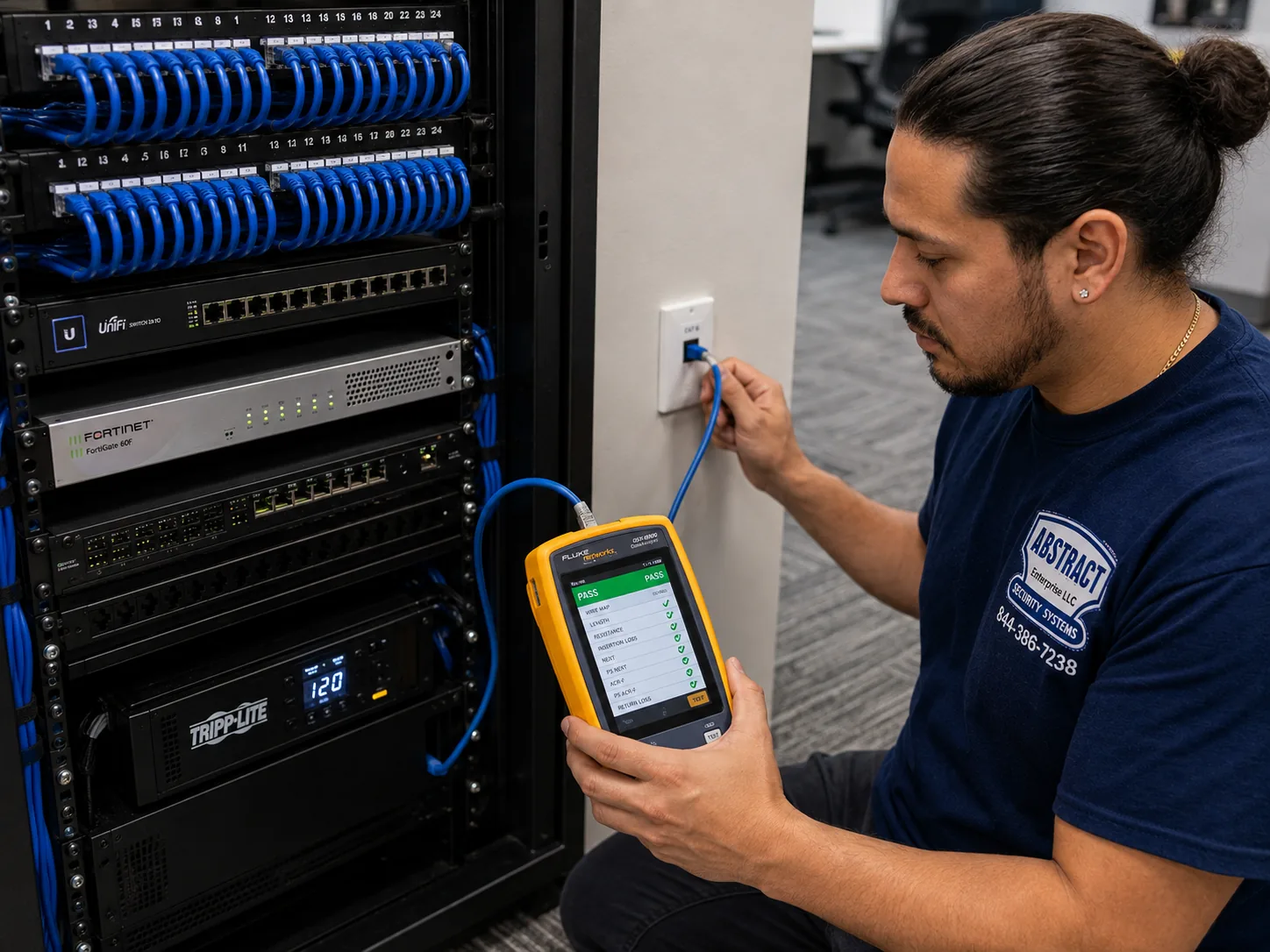
Brooklyn, Brooklyn Arlo camera network testing: technician certifying a data drop with a cable analyzer showing a PASS result
A photo from the AESS job library, not taken in Brooklyn: a technician certifying a data drop with a cable analyzer that shows a PASS result. When we run a cable from a rowhouse cellar to an access point at the back of the parlor floor so a rear Arlo can hold its signal, we test that cable the same way before the camera goes up, so a weak line is never mistaken for a weak camera.

The two- and three-family house: one building, more than one household

Brooklyn has more homes in two-unit buildings than in any other kind, and a large share of three- and four-unit buildings besides. In many of them, as the Comptroller's housing report puts it, the owner lives in one unit and rents the other. That arrangement creates camera questions a single-family house never has. Whose camera is on the shared stoop? Who sees the back yard footage when the garden-floor tenant uses the yard? If the owner pays for the internet and the tenants use the same Wi-Fi, can the tenants' phones see the owner's cameras or the other way round? None of these is hard to answer, but each has to be answered before mounting, not after a falling-out.

Our usual approach is simple. Each household's Arlo cameras live on that household's own Arlo account, and where possible on that household's own network. The owner's cameras watch what the owner is responsible for, typically the front door, the stoop and the cellar entrance, and the tenant's cameras watch the tenant's own door and deliveries. Where a camera covers a shared space, such as a back yard the garden-floor tenant uses, we suggest the owner tells the tenant in writing that it exists and what it sees; it is a short note that heads off a much longer argument later. A security firm that works on brownstones makes the same point about owner-occupied houses with rental units above: coverage has to protect the common areas, the stoop and the owner's own floors while respecting the tenants' privacy. Cameras inside another household's apartment are never part of the plan; New York's Penal Law 250.45 makes covert recording in a private place a felony.

The walk-up apartment building: the tenant's door, the lobby and the roof

Brooklyn's four-, five- and six-story walk-ups are where package theft shows up most in the news. The pattern in the Bushwick and Sheepshead Bay reports is the same: someone gets in through the street door, or is buzzed in, and takes what is waiting in the lobby, the hallway or the mailroom. Tenants often ask us for an Arlo doorbell or a small camera aimed at their own door, and owners ask for cameras on the street door and the mail area. Those are two different jobs with two different sets of rules. A tenant's camera inside their own unit is their call; a camera on a shared hallway or lobby is a building matter, and the owner or managing agent decides it.

The physical side of a walk-up is about distance and stairs. A camera on the street door may be five floors and many feet from a tenant's router, which is why building owners usually run their own small network for lobby and roof cameras rather than borrowing a tenant's Wi-Fi. A camera on the roof, to watch a bulkhead door or a roof deck, cannot be fixed through the roofing membrane; it goes on the brick of the parapet or the bulkhead, with masonry fixings, and it needs a signal source that reaches up through the top floor's ceiling and the roof deck. Batteries on a roof are easy to reach from the hatch; batteries on a fourth-floor wall above the yard are not, and we plan charging around which cameras someone can actually reach without a long ladder.

The tower and new condo: concrete, corridors and the building's own rules

Not all of Brooklyn is old. The 2004 rezoning of Downtown Brooklyn has produced close to 27,000 new housing units according to a 2025 Planetizen report, the 2005 Greenpoint-Williamsburg rezoning reshaped the waterfront, and the Greenpoint Landing master plan alone is designed for about 5,500 units. These buildings bring poured concrete, metal-stud partitions, building-wide networks and management offices with written rules. A camera inside a unit faces the opposite problem from a rowhouse: the signal inside the apartment is usually fine, but the apartment door opens onto a corridor the building controls.

The law and the rules point the same way. A co-op and condo law firm, Guzov LLC, has written that New York City has no law against residents installing doorbell cameras in apartment hallways, but that a co-op's rules may prohibit a shareholder from putting one in a common area. Brick Underground's lawyer column adds that a board can pass a ban as a house rule without a shareholder vote, and describes a complaint that began when a shareholder's camera faced a board member's apartment directly. So in towers and condos we start with the house rules and the managing agent, and when the outside of the door is off limits, we look at what can watch the door from inside the apartment. Concrete walls inside the unit take masonry fixings at the same +$65 line on our list, and many tower clients choose shelf or tabletop placement for indoor cameras so there is nothing to patch at all.

The detached and semi-detached house: driveways, siding and more ground to cover

Southern Brooklyn has a different kind of house. Mill Basin, for example, is described by one neighborhood guide as largely detached and semi-detached homes, many with driveways, private outdoor space or waterfront access near Jamaica Bay, and Marine Park nearby. These are the Brooklyn houses that look most like the ones Arlo's marketing shows: a driveway, a side yard, a garage, a front lawn. They are also, as the Health Department's flood data notes, in the part of the borough Sandy showed to be most vulnerable to flooding, which matters for anything kept on a ground floor or in a cellar.

The cameras here go on a wider mix of surfaces: vinyl or aluminum siding, stucco, brick veneer, wood fascia and soffits. Siding needs a mounting block or a fixing that goes through to the sheathing behind it without crushing the panel; stucco needs a careful bit so the finish does not spall; brick veneer takes the masonry line on our list. Driveway cameras need to be close enough to the cars to be useful, which is often closer than people expect, and the router in these houses is usually central enough that one or two access points cover the whole lot. If the house sits low, we put the SmartHub and router on a shelf well above the floor and, where the owner wants it, on a small battery backup so a short outage does not take the cameras offline.

The storefront and industrial space: doors, counters and back rooms

Brooklyn's shops sit on the 24 business improvement districts the city's Small Business Services directory lists for the borough, from Pitkin Avenue and Kings Highway to Graham Avenue, Fulton Mall and Bay Ridge's Fifth Avenue, as well as on hundreds of unnamed blocks of storefronts under apartments. A small shop often starts with one or two Arlo cameras, on the door and the counter, because they need no cable and the owner can see them from home. That works well up to a point; beyond a handful of cameras, or for a space that must record continuously, a wired system is usually the better tool, and we say so.

Industrial and workshop spaces, in Sunset Park's former factory buildings, the Navy Yard or the side streets of Gowanus and East Williamsburg, bring high ceilings, steel and block walls, roll-up doors and long distances from the office router. Arlo can still watch a loading door or a studio entrance, but it almost always needs network help: a wired access point near the door, fed by cable along the existing pathways. We describe those jobs in the commercial section below.

Field Notes

Field Notes: How a Technician Checks a Brooklyn Arlo Spot Before Drilling

These notes describe how our technicians work on Brooklyn properties. They are our standard practice, not a story about any one address.

Start at the router. The first stop is wherever the internet comes in. In a rowhouse that is usually the front of the cellar; in a two-family it may be in the owner's unit; in a walk-up it is in each tenant's apartment. The technician notes what the router is, whether it broadcasts a 2.4 GHz network, whether it sits on the floor or on a shelf, and whether there is any cable already running toward the back of the house that could feed an access point.

Walk to the far end. Next, the technician goes to the spot that will be hardest: almost always the rear wall, the roof or the far end of a shop. If that spot works, the rest usually does. A charged Arlo camera or test device is held exactly where it would mount, outside, with the window closed, and the signal reading in the app is noted. Arlo's guide wants three or four bars. Two bars on a sunny Tuesday afternoon will often be one bar on a Sunday evening when the whole block is streaming.

Look through the camera, not at it. With the camera held in place, the customer watches the live view on their own phone. On a stoop, the question is whether a person standing at the door shows a face or the top of a head. In a yard, it is whether the fence line, the gate and the rear windows are all in frame, and how much of the neighbor's yard and windows is. The position moves until the view is right, and painter's tape marks the spot.

Read the wall. Only then does the technician look closely at what the mount will go into: the color and hardness of the brick, whether the mortar joints are sound or crumbling, whether the surface is brownstone facing, stucco, siding, wood trim or metal. On a designated front, the Commission's criteria come into it here. The fixing is chosen for the material, and if the material is different from what the quote assumed, the customer hears the change first.

Check after dark, too. Before leaving, the technician sets the spotlight, siren and motion settings with the customer and, where the visit runs into the evening, checks the yard view in the dark. A light that seems modest at three in the afternoon can be very bright in a neighbor's window at ten at night.

Signal and Power

Brick, Wi-Fi and Batteries: What Keeps an Arlo Recording in a Brooklyn Building

An Arlo camera has two lifelines: its signal and its battery. Lose either and it stops recording, usually without much warning. In Brooklyn the signal is the one that fails first, because of what the buildings are made of. Arlo's own camera placement tips list unusually thick walls and ceilings, brick, concrete, stucco and stone as the materials that cut signal strength the most, and recommend three or four bars at the camera. They also say to keep the camera at least ten feet from the Wi-Fi router, SmartHub or Base Station, which surprises people who assume closer is always better.

The 2.4 GHz question. SafeHome's Arlo setup guide says that to set up almost any Arlo camera, you need a 2.4 GHz Wi-Fi connection. Many routers supplied by internet providers combine 2.4 GHz and 5 GHz under one network name, and most of the time that works; sometimes a camera will not pair until the router is set to show the bands clearly. Older 2.4 GHz is also the band that reaches farther through masonry, which is good for a rear camera, and the band most crowded by neighbors' networks, which is bad. In a row of attached houses, each with its own router and mesh system, the technician picks the least crowded setup the router allows rather than leaving everything on automatic.

SmartHub or straight to Wi-Fi. Arlo's knowledge base says the Arlo Pro 3, Arlo Ultra and Arlo Ultra 2 require an Arlo SmartHub or Base Station; many other models can connect either to a SmartHub or directly to your Wi-Fi. A SmartHub is a small box connected to the router by a network cable, and the cameras talk to it on their own radio link. In a brick house, where the hub sits matters as much as where the router sits. The forum user who mounted cameras on brick had to move the SmartHub around before one camera would connect, and that is the normal experience: the hub belongs at a point in the house that can see both ends, often on the parlor floor, connected back to the router.

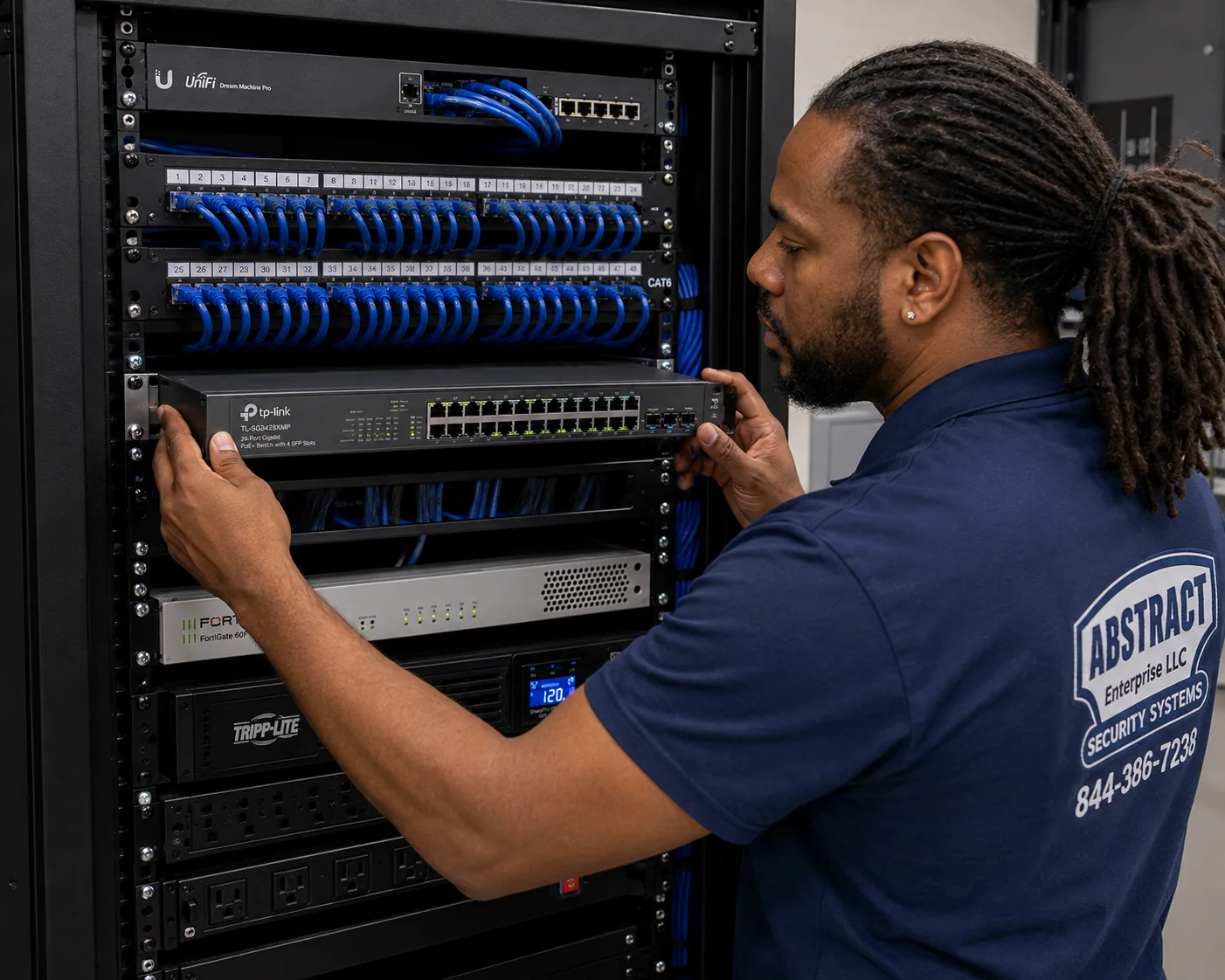
Brooklyn, Brooklyn Arlo camera network work: technician mounting a managed PoE switch below patch panels in a commercial network rack
A photo from the AESS job library, not taken in Brooklyn: a technician mounting a managed PoE switch below patch panels in a commercial network rack. Arlo's wire-free cameras do not plug into a switch like this, but the access points that give them a signal through brick can, and in a Brooklyn shop or a larger building with several cameras, one powered switch feeding access points near each door is a tidy way to keep every Arlo at three or four bars.

Access points, not repeaters. When the router and hub cannot reach the far end, the fix is a wired access point near the camera, not a plug-in repeater that tries to rebroadcast a weak signal. In a rowhouse, the cable to that access point usually runs along the cellar ceiling and up through an existing chase or closet, and the access point sits just inside the rear wall on the parlor or garden floor. The camera outside then has one layer of brick between it and a strong signal. Where the house already has a mesh system, we check that its nodes are cabled back to the main router; a mesh node that is itself only hanging on by Wi-Fi is often the weak link.

Batteries and charging. Wire-free Arlo cameras run on rechargeable batteries, and how long a charge lasts depends heavily on how often the camera wakes up. A rear-yard camera that only sees the yard might go a long time; a stoop camera facing a busy avenue that wakes for every bus will drain much faster. We set motion sensitivity and recording length for each spot, and we place cameras where someone can reach them to charge. Some Arlo models take a removable battery that can be swapped for a charged spare in a minute. Arlo also sells solar panels, but its own camera page says a solar camera needs regular direct sunlight and should avoid deep shade, covered porches or eaves; in a north-facing Brooklyn yard between two rows of four-story houses, we often recommend skipping the panel.

Power and internet outages. A battery camera keeps running when the power goes out, but the router and SmartHub do not, unless they are on a battery backup. Arlo's knowledge base says local storage, when a USB drive is connected to a hub or base station, saves only automatically triggered recordings; and recent cameras ship without free cloud storage, so most households either use local storage or an Arlo subscription. Either way, if the router is dead, the cameras cannot send alerts to your phone. A small battery backup for the modem, router and hub is cheap insurance, and in a cellar that took water during Ida, it belongs on a shelf, not the floor.

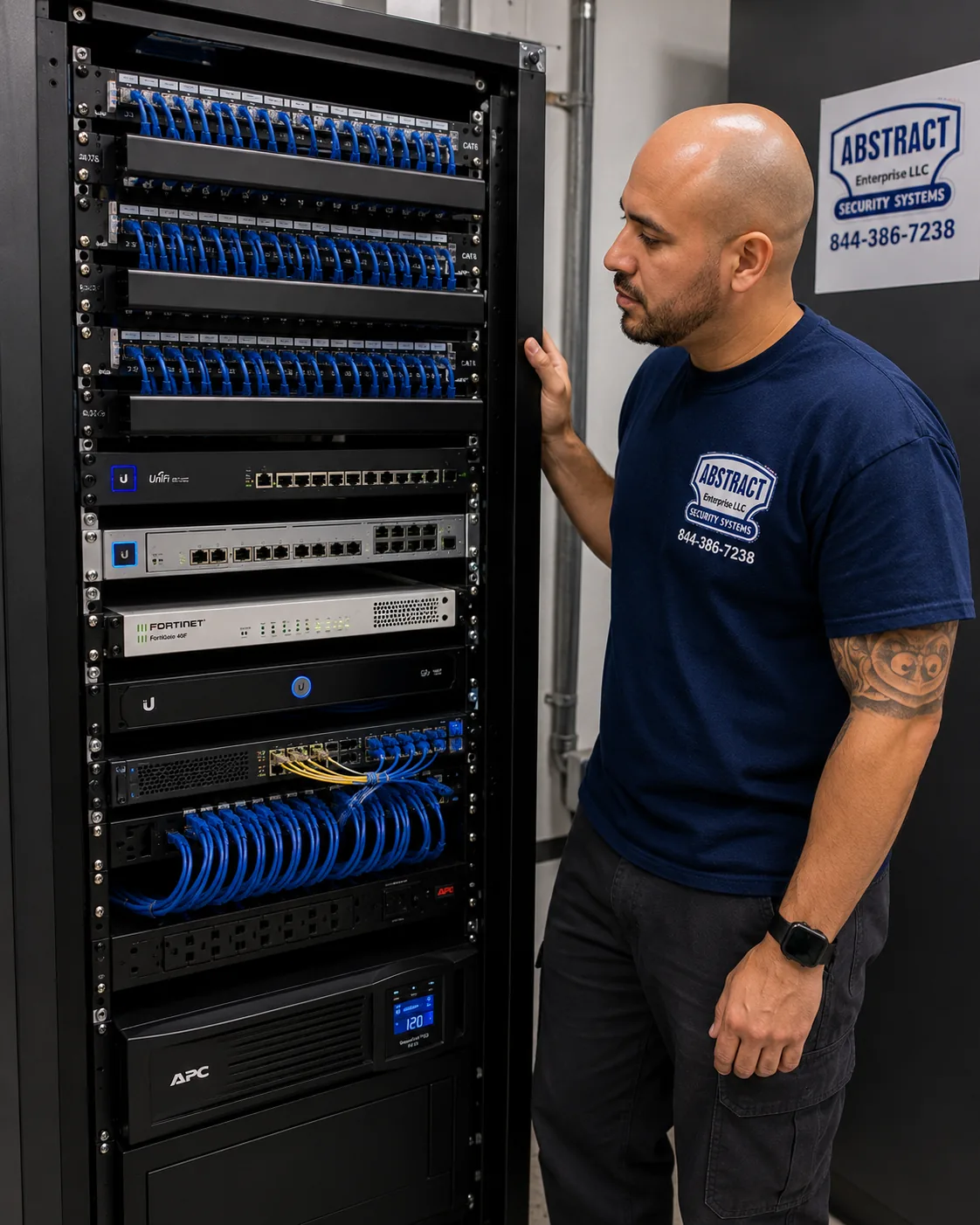
Brooklyn, Brooklyn Arlo camera network support: finished network rack with patch panels, switching, firewall and battery backup dressed and identified
A photo from the AESS job library, not taken in Brooklyn: a finished network rack with patch panels, switching, a firewall and a battery backup, all dressed and labeled. A Brooklyn home rarely needs anything this size, but the battery backup at the bottom is the part every Arlo owner should copy: a small one under the modem, router and SmartHub keeps alerts coming through a short outage, and in a flood-prone cellar it lives on a shelf well above the floor.

What each Brooklyn surface takes, and what costs extra on our list

Brick and stone (+$65). Rear walls, party walls and most fronts. Arlo mounts are light, so the fixing is about lasting through weather, not carrying weight: removable concrete screws or masonry anchors set into sound brick or into the mortar joint, depending on whether the wall is landmarked and whether you want the holes easy to repoint later.

Plaster (+$45). Indoor cameras on a wall inside an older house usually go into plaster over lath or plaster on brick. A slow pilot hole keeps the plaster from cracking, and the fixing reaches whatever is behind it.

Wood trim, door frames and soffits. Often the easiest and kindest place for an Arlo on an old house, because a screw in painted wood trim is simple to fill when the camera moves. On many Brooklyn fronts, the wood or metal around the door is also where the Commission's criteria point.

Siding and stucco. Southern Brooklyn houses. We use a mounting block or fixings that reach the sheathing on siding, and a careful bit on stucco so the finish does not chip.

Ironwork, gates and fences. Arlo mounts can be clamped or fixed to iron railings and gates under a stoop, which keeps holes out of the facade entirely. If the fence or railing belongs to the neighbor, it stays off limits unless they agree.

Landmarks, Landlords and Boards

Who Has a Say Over a Brooklyn Camera: The Commission, the Landlord, the Board and the Household Upstairs

We are installers, not lawyers, and nothing here is legal advice. What follows is what the public sources say and what we have learned from doing this work, so you can check the right things before booking.

Landmarked fronts. If your building is an individual landmark or sits inside a historic district, the city's business portal says you need a permit from the Landmarks Preservation Commission before doing work on it. The Commission's 2018 rule amendments specifically cover objects commonly used for security, including security cameras, and generally prohibit installing them on a primary facade unless there is no feasible alternative. Chapter 11 of the Permit Guidebook, which refers to Rules Section 2-20, says staff can approve cameras when criteria are met: well spaced to avoid a cluttered appearance, no more than two cameras for every 25 feet of street frontage on small residential or commercial buildings and three on large buildings, in a discreet spot if on the primary facade (beneath a band course, underneath a stoop, behind an areaway wall or fence, or behind plantings), attached at mortar joints, plain masonry, wood or metalwork rather than through cast iron or decorative surfaces, as small as possible and painted to blend. A wire-free Arlo helps here, because there is no conduit to hide.

Brooklyn has a lot of designated ground. Brownstoner counted 33 historic districts in the borough as of April 2016, and more have been added since, including four in Sunset Park in 2019. Published counts put 2,853 protected buildings in Park Slope, about 1,800 in Bedford-Stuyvesant and 1,752 in Crown Heights, while Central Park Slope, by the Brooklyn Eagle's account, is the city's largest collection of non-landmarked buildings. Rear facades not visible from a street are generally treated more leniently, according to one architect's guide to the Commission. And guidance published by the NoHo BID notes that fixtures that do not physically attach to any part of the building need no Commission permit, which is worth knowing if a camera can sit inside a window frame or on furniture instead of on the facade. Check your address on the Commission's map before you book, and we will plan to the criteria.

Landlords. With most Brooklyn homes rented, the outside walls and the stoop usually belong to someone else. Inside your apartment, a wireless camera that needs no permanent wiring is generally your own business, and one guide to New York apartment camera rules says living rooms and bedrooms are the resident's call. The outside of the building, the shared hallway and the yard are the owner's to decide. A short written request to the landlord, saying what the camera is, where it would go, what it would see and that it is fixed with removable screws, settles most of these quickly. If the answer is no, we plan around it.

Boards. In co-ops and condos, house rules and alteration agreements may cover anything on a door or in a corridor. A Manhattan renovation firm that installs the Arlo Essential wire-free doorbell often says most proprietary leases treat door-mounted devices as alterations needing board approval, even battery-powered ones facing a hallway. In Brooklyn towers and co-ops we ask for the rules first and send whatever paperwork the managing agent wants.

The other household. In a two- or three-family house, a camera on the stoop or yard affects people who did not buy it. Telling the garden-floor or upstairs tenant in writing that a camera watches the shared yard or door, and what it does not see, is our standard suggestion. In rent-stabilized buildings, one security firm notes, anything a landlord does that could look like harassment of a stabilized tenant is taken seriously by the courts and the state housing agency, so owners should be especially clear about where cameras point.

Sound. Arlo cameras have microphones. Sources disagree on how New York's recording laws apply to passive audio on a camera in a shared space, and one guide calls hallway audio unsettled. Our default in any shared space is video only, and we show you where the setting is.

Tenants and large-building cameras. Cameras can be contentious even when a landlord installs them. The Guardian reported in May 2019 on tenants at Atlantic Plaza Towers in Brooklyn fighting their landlord's plan for facial-recognition entry cameras. Nothing we install does facial recognition for entry, but the episode is a good reminder that cameras in shared spaces work best when everyone in the building knows what they do and why.

Commercial Arlo Camera Installation

Business Arlo Camera Installation in Brooklyn

Brooklyn's businesses mostly sit in older buildings, on shopping streets the city organizes into business improvement districts. The Small Business Services directory lists 24 of them in the borough, among them Fulton Mall, the Atlantic Avenue BID, Montague Street, Court-Livingston-Schermerhorn, DUMBO, MetroTech, Park Slope Fifth Avenue, Bay Ridge Fifth Avenue, 86th Street Bay Ridge, Sunset Park, Kings Highway, Brighton Beach, Coney Island, Flatbush-Nostrand Junction, Pitkin Avenue, Graham Avenue, Grand Street, Myrtle Avenue and Cypress Hills Fulton. The cards below describe kinds of space where a business might use Arlo; we do not name any business as a customer.

Fulton Mall and Downtown shops

The pedestrian and transit mall on Fulton Street between Flatbush Avenue and Adams Street: busy doors, narrow stockrooms, and owners who want to check the shop from home after closing.

Fifth Avenue in Bay Ridge

The BID covers Fifth Avenue from 65th to 85th Streets, with storefronts under apartments, where a camera on the door and one over the counter is often the whole plan.

Montague Street and Brooklyn Heights

The Montague Street BID lists about 100 retail businesses in a historic district, where any camera on a front faces the Commission's criteria and wire-free mounts help.

Avenue strips across the borough

Kings Highway, Pitkin Avenue, Graham Avenue, Flatbush and Nostrand: salons, takeout counters, phone shops and offices that need a few cameras rather than a full system.

Industrial buildings

Industry City's roughly six million square feet of former Bush Terminal buildings, the Navy Yard's 300-plus acres, and smaller workshops in Gowanus and East Williamsburg, where doors are far from the office.

Small offices and studios

Professional offices, studios and community spaces in walk-up and loft buildings, where the owner wants a door camera and a back-room camera visible on several phones.

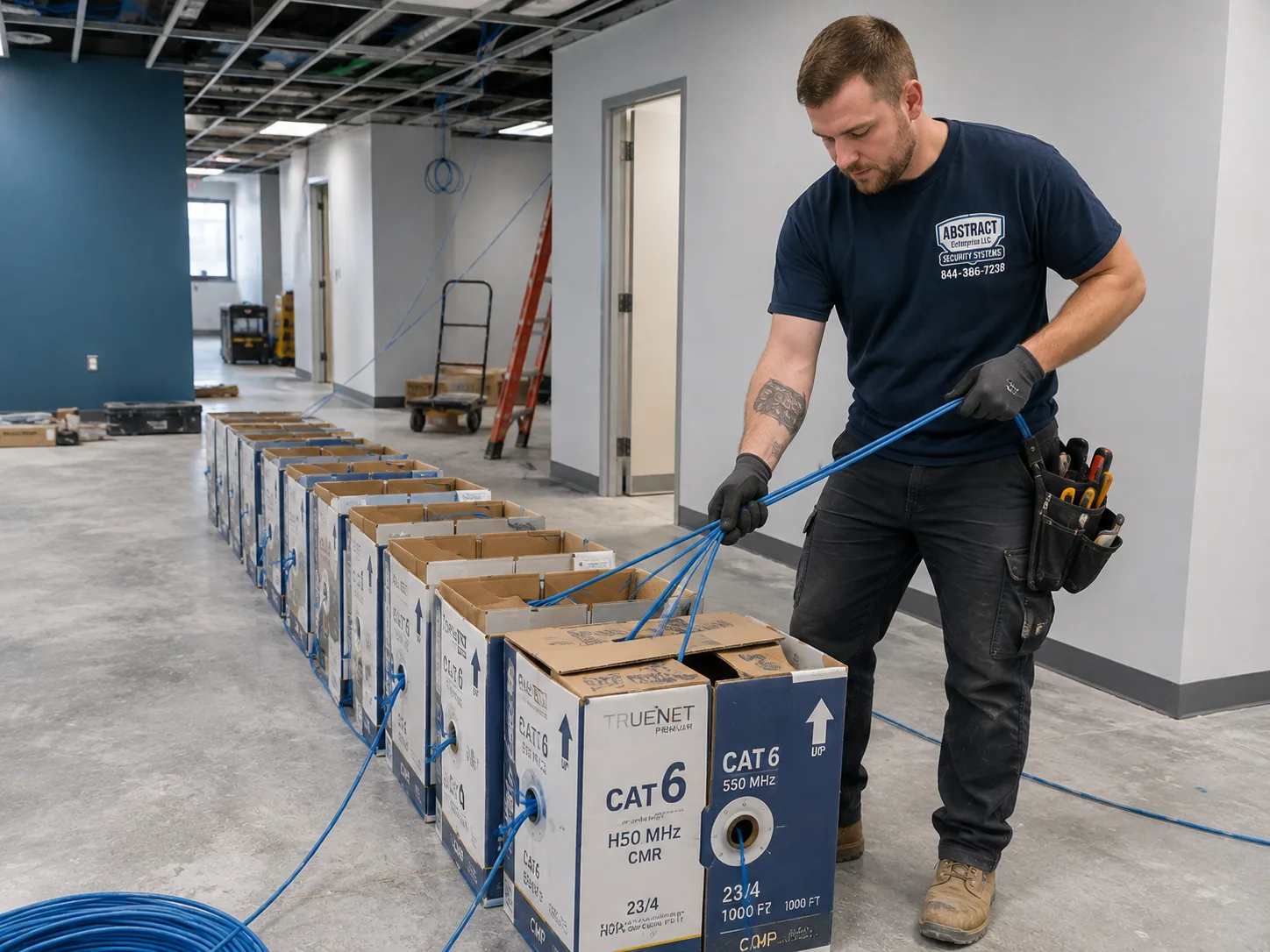
Brooklyn, Brooklyn business Arlo camera installation prep: commercial cable boxes staged for a multi-drop pull on a working premises
A photo from the AESS job library, not taken in Brooklyn: boxes of cable staged for a multi-drop pull on a working commercial premises. A shop on a Brooklyn avenue that wants Arlo cameras at the front door, the counter and the back door sometimes needs two or three network drops to access points first, and staging the cable before the shop opens keeps the work out of the customers' way.

The honest question with any business is whether Arlo is the right tool. For a small shop with a door, a counter and a back room, three wire-free cameras on a good network, visible on the owner's phone and a manager's, can be exactly right: no cable through the landlord's walls, easy to take down if the lease ends, and quick to set up. For a business that needs continuous recording of a register, more than a handful of cameras, or footage that stays on site, a wired camera system with a recorder is usually better, and we say so even though it means a different job. Yelp reviewers of Brooklyn camera installers praise "no wires showing or hanging" and one was glad a professional handled a wired system that was "so much more complicated than the WiFi ones." Both are fair points; the right answer depends on the space.

Commercial Arlo jobs in Brooklyn rarely happen in a building the business owns. A shop under apartments has a landlord, sometimes a managing agent, and occasionally a Commission permit to think about if the building is designated. So before a business job we confirm who has approved anything fixed to the walls, when the space can be worked in without customers in the way, and who gets the insurance paperwork. Inside, we look at the same two things as at home: where the router is, and what the walls are. Storefront back rooms are often brick or block, and the cameras covering a back door may need an access point to hold a signal.

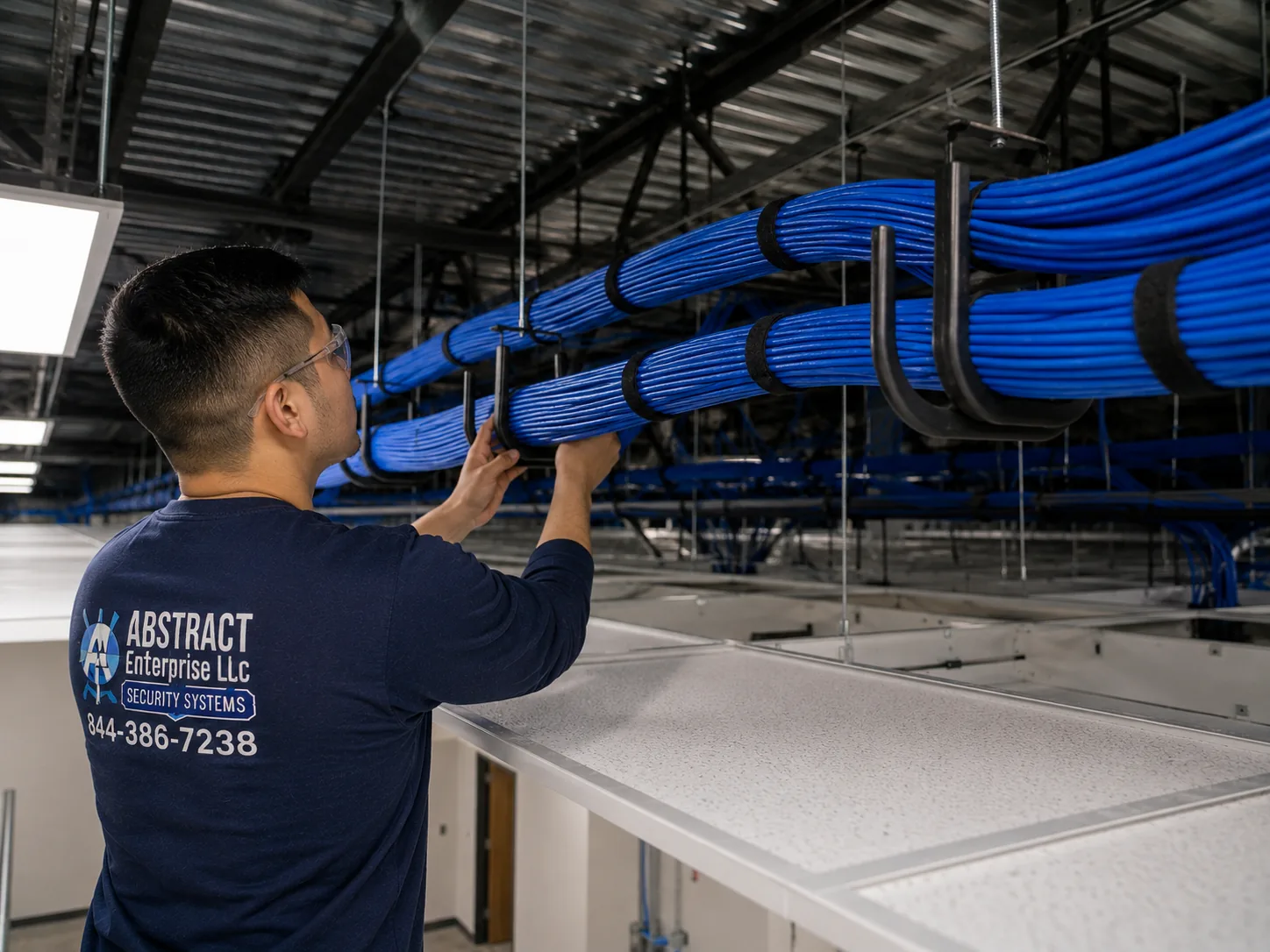
Brooklyn, Brooklyn commercial Arlo camera installation: J-hook pathway carrying dressed cable bundles across a commercial ceiling
A photo from the AESS job library, not taken in Brooklyn: a J-hook pathway carrying dressed cable bundles across a commercial ceiling. In a Sunset Park or Navy Yard workshop, the cable feeding an access point near a far loading door follows a supported path like this, so the Arlo watching that door has a strong signal without cable hanging loose over the work floor.

Compliance notes for Brooklyn businesses and buildings

  • Designated buildings need a Commission permit first. Work on a landmark or in a historic district needs a Landmarks Preservation Commission permit before it starts. Cameras on a primary facade are limited to discreet positions and, on small buildings, two per 25 feet of frontage under the Commission's staff criteria.
  • Keep cameras out of private spaces. Bathrooms, changing areas and any space where people expect privacy are off limits. Covert recording in a private place can support a felony charge under Penal Law 250.45.
  • Video only in shared spaces by default. Because sources disagree on how audio recording rules apply to passive cameras, we leave Arlo microphones off in shops, hallways and offices unless you have clear advice otherwise.
  • Exits, signs and fire equipment stay clear. We do not mount cameras where they would block an exit sign, a sprinkler head, a fire alarm device or a door swing.
  • Insurance paperwork first. Commercial landlords often require a certificate of insurance naming the owner and agent before work begins. Tell us the names and we send it ahead of the visit.
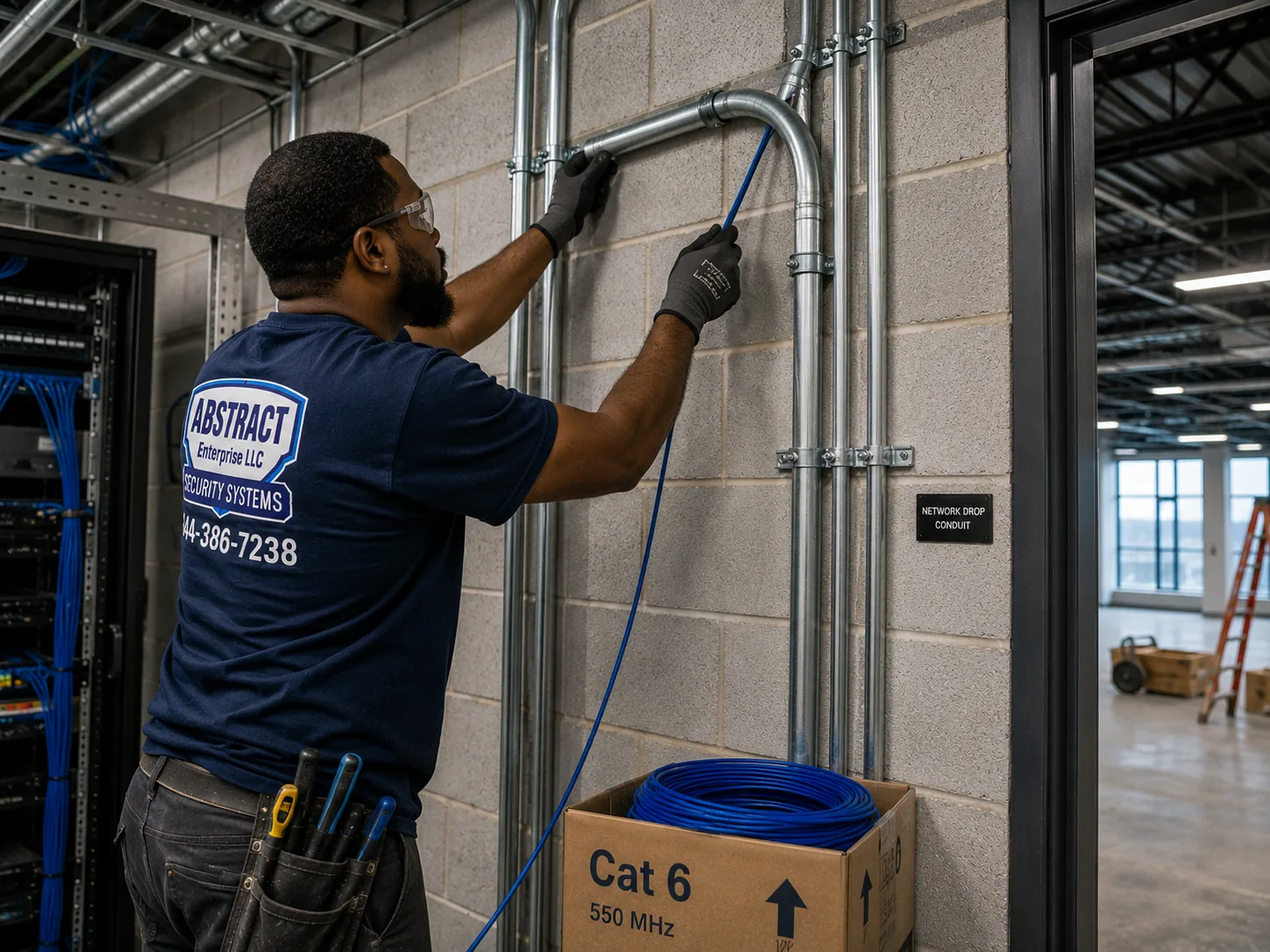
Brooklyn, Brooklyn industrial Arlo camera installation: technician running cable into EMT conduit beside a telecom room in an industrial building
A photo from the AESS job library, not taken in Brooklyn: a technician running cable into EMT conduit beside a telecom room in an industrial building. Brooklyn's former factory buildings often require cable in conduit like this, so when a tenant there wants wire-free Arlo cameras at a studio door or loading bay, the network line to the access point that serves them goes in the building's approved way.
Your Questions Answered

Arlo Camera Installation in Brooklyn: Questions Answered

These are the situations Brooklyn owners, tenants and shopkeepers describe when they call about Arlo: masonry that will not hold a cheap plug, stoops that hide faces, yards that face the next row's windows, houses with two households and one internet line, and cameras Arlo no longer supports. Each is answered here in full and not repeated in the FAQ further down.

Scope and the visit

How many Arlo cameras can usually be finished inside the first hour of a Brooklyn visit?

It depends far more on the building than on the cameras. On a house where the router reaches everywhere and the cameras go on wood trim or siding, two or three wire-free Arlo cameras can often be mounted, added to the account and set up within the first hour, which is $225 on our list. On a rowhouse where the rear camera needs a signal test from several positions, the SmartHub has to be moved, and the mounts go into brick, the same number of cameras can take longer, and the visit runs into 30-minute blocks after the first hour. Each masonry mount adds the +$65 brick or stone line, and each plaster mount +$45. Your photos let us estimate this before you book, and the written total says which lines apply.

Brick, brownstone and mortar

Should the screws for an Arlo mount go into the brick itself or into the mortar between bricks?

Either can work for a mount as light as an Arlo's, and the right choice depends on the wall. Brick holds a fixing more firmly and is our usual choice on a sound rear wall, using removable concrete screws like the ones an Arlo forum user chose for brick so they could come out later. The mortar joint is softer, but it is easier to repoint, which is why the Landmarks Preservation Commission's criteria for designated fronts ask for attachment at mortar joints or plain masonry rather than through decorative stone. On a landmarked front we follow those criteria; on a back wall we look at the condition of the mortar, because old lime mortar that crumbles at a touch will not hold anything for long. Either way it is the +$65 brick or stone line on our list.

The bricks at the corner of our rear wall are soft and flaking. Is that a problem for a camera mount?

It can be, and it is worth knowing before the camera goes up. Soft, spalling brick at a corner usually means water has been getting in, and a fixing driven into it may hold for a while and then work loose as the face crumbles. We move the mount a little inward to sound brick, or onto a wood window frame, a sound section of mortar or an iron railing nearby, rather than forcing it into damaged masonry. If the damage is spreading, we will tell you plainly so you can talk to the landlord or a mason, because a camera is a poor reason to drill into a wall that already needs repointing.

Stoops and front doors

Packages keep disappearing from our stoop. Which camera angle actually catches a face rather than the top of a head?

On a Brooklyn stoop the front door is often five or six feet above the sidewalk, so a camera mounted high beside the door looks almost straight down on anyone climbing the steps and records hats and hair. The angle that catches faces is usually lower and further out: a camera at the side of the door frame aimed back along the stoop, or one under the stoop or on the areaway railing looking up the steps, so the person climbing toward the door walks into the shot. SafeWise suggests about six to seven feet above the ground as a general height, and on a stoop we measure that from the step the person is standing on, not from the sidewalk. The thefts CBS New York has reported on Eastern Parkway and in Crown Heights both happened on front steps, which is exactly where we test the view on your phone before choosing the spot.

Can an Arlo tuck under the stoop instead of going on the front of the house?

Often, and on a landmarked house it is one of the positions the Commission's guidebook names as discreet, alongside beneath a band course and behind an areaway wall or fence. Under the stoop, a camera can watch the garden-level door, the gate and anyone coming down the areaway steps, and it is sheltered from rain. The catch is signal: the space under a stoop is surrounded by stone and brick, and it may be the hardest spot in the house to reach from the router. We test it with a camera held in place before deciding, and if the signal is weak, a router or access point on the garden floor just inside the front wall usually fixes it.

Rear yards and close neighbors

The next row's windows are about twenty feet from our back fence. Will the Arlo's spotlight and siren cause a dispute?

They can if they are left on their defaults. Brownstoner ran a reader's story in 2007 about a building on 15th Street whose floodlights were so bright, and aimed so squarely into her bedroom, that she said she could read by them with the blinds closed; the advice from other readers was to ask nicely and then call 311. An Arlo spotlight is much smaller, but in a narrow yard it still reaches the windows opposite. We aim the camera down at your yard, turn the spotlight to motion-only or off, keep the siren for manual use from your phone, and set the motion area so the camera ignores the neighbor's yard. Then we look at the yard after dark with you so you can see what the neighbors will see.

Should our garden-floor tenant be told about a camera covering the back yard?

We recommend it, in writing. If the tenant uses the yard, the camera will record them coming and going, and a short note saying the camera exists, what it watches, who can see the footage and that it does not look into their apartment heads off most complaints before they start. It also protects you if a dispute ever reaches 311 or Housing Court. The camera itself should be aimed at the yard, the gate and the rear windows, not into the tenant's windows or doors, and in a shared space we leave the microphone off.

Households, accounts and networks

We own a two-family and our tenant shares our internet. Should the cameras be on a network of their own?

Where possible, yes. If the owner's cameras and the tenant's phones are on the same Wi-Fi, a curious tenant or a guest cannot see Arlo footage without the account login, because Arlo cameras are tied to an account rather than to the network, but everyone is still sharing bandwidth and one router setting can affect both households. The cleaner setup is a separate network, or at least a separate router or network name, for the owner's cameras and SmartHub, and the tenant's own internet for the tenant. Many Brooklyn two-families already have two internet lines. If yours has one, we look at what the router can do before suggesting a second line.

Can more than one person in the house watch the cameras on their own phone?

Yes. The Arlo app lets the account owner invite other people to view the cameras with their own login, so a partner, an adult child or a shop manager can see live views and recordings without knowing the owner's password. We set that up on the visit, with each person's phone in hand, and we explain which permissions the owner can limit. It is also the right way to give a family member access in a two-family house, rather than sharing one login that everyone forgets to change.

Older systems and other brands

Arlo stopped supporting our Pro 2 cameras. Can anything from the old system be saved?

Some of it. How-To Geek reported that Arlo had planned to retire its Pro 2-series cameras, the Q and Q+, Arlo Baby, Security Lights and the Audio Doorbell on January 1, 2025, and the same site later covered Arlo extending support for older cameras and reversing its earlier plans, so the first step is checking what your cameras' status is in the app today. Many owners are understandably annoyed; a Slickdeals commenter in April 2026 wrote that Arlo had killed off a camera system they paid good money for. If the cameras are still working, they can keep working, but they will not get new fixes. When you replace them, the good spots, the mount positions and sometimes the mounts themselves can carry over, so the new cameras go in the old holes rather than making new ones in your brick.

We already have a Ring doorbell. Can Arlo cameras work alongside it?

They can share the house, but not the app. A Ring doorbell stays in the Ring app and Arlo cameras in the Arlo app, so you will have two apps on your phone and two sets of alerts. Both brands work with common voice assistants, so you can ask a smart display to show the front door or the back yard, but the recordings, subscriptions and settings stay separate. If having everything in one place matters, we can talk through replacing the doorbell with an Arlo doorbell or keeping the Ring and adding the Arlo cameras where they make sense.

Towers and theft of the camera itself

Our Downtown Brooklyn building supplies Wi-Fi to every apartment. Will an Arlo join it?

Sometimes, but building-wide networks are the setups most likely to cause trouble. A camera needs a 2.4 GHz network it can join with a password; if the building's network makes each device sign in through a web page, or keeps devices from seeing each other, an Arlo camera or SmartHub may not connect or may not stay connected. We check how the building network works before the visit. If it does not suit Arlo, the usual answer is your own router connected to the building's service, if the building allows it, which gives the cameras a network that belongs to you.

Can someone just pull a wire-free Arlo off its mount and walk away with it?

On the standard magnetic mounts, a determined person within reach can lift the camera off, which is the trade-off for easy battery charging. On a Brooklyn front, the answer is mostly placement: out of easy reach from the sidewalk and the stoop railing, but low enough to see faces, which is a balance we test on site. Where a camera is within reach, Arlo and other makers sell mounts that screw or lock the camera in place, and we can fit one. A camera that is stolen still sends its last recordings before it goes offline, as long as it had a good signal, which is another reason we insist on three or four bars.
Equipment

Types of Arlo Cameras and Hardware We Install

You can buy the cameras yourself, or tell us what you want watched and we will suggest the models. These are the kinds of Arlo hardware we fit in Brooklyn homes and businesses. Equipment is separate from the installation price.

Arlo Essential cameras

Wire-free cameras such as the Essential 2K line that connect straight to Wi-Fi. Good for a tenant's own door, a small yard or a shop's back room where the router is close.

Arlo Pro cameras

Wire-free cameras with a spotlight and siren, such as the Pro 5S, that can use a SmartHub or Wi-Fi. Our usual choice for rowhouse rear walls and stoops, with spotlight settings tuned for close neighbors.

Arlo Ultra cameras

Higher-resolution cameras such as the Ultra line. Arlo's knowledge base says the Ultra and Ultra 2 need a SmartHub or Base Station, so placement of the hub is part of the job.

Arlo video doorbells

Wire-free and wired Arlo doorbells for house doors and, where boards allow, apartment doors. Wired models need suitable doorbell power, which older Brooklyn doorbells may not have.

SmartHubs, base stations and storage

The hub a camera system needs, placed where it reaches both ends of the house, with a USB drive for local recordings where you want them.

Indoor cameras and accessories

Arlo indoor cameras for a parlor, stair hall or shop counter, plus solar panels for sunny walls, charging docks, spare batteries and locking mounts.

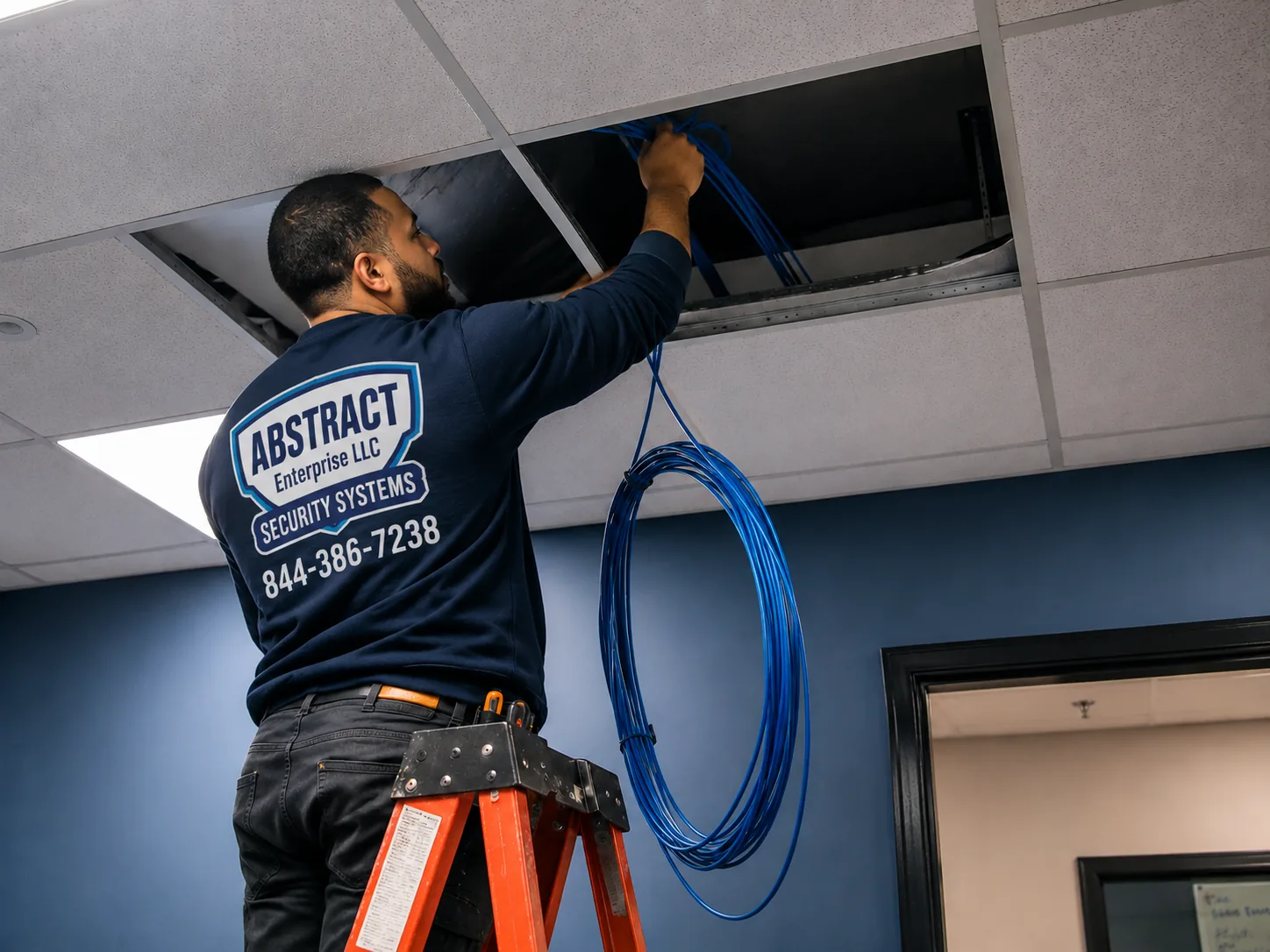
Brooklyn, Brooklyn Arlo camera installation in a shop: technician feeding cable through a ceiling in an occupied commercial space
A photo from the AESS job library, not taken in Brooklyn: a technician feeding cable through the ceiling of an occupied commercial space. In a long, narrow Brooklyn storefront where the router sits by the register and the back door is fifty feet away behind a brick stockroom wall, a single cable through the ceiling to an access point near the back is often what lets an Arlo on that door hold its signal.

Doing it yourself, booking a national service or a local installer for a Brooklyn property

Arlo is designed to be installed by its owner, and plenty of Brooklyn households do it well. Arlo also offers professional installation through partner companies, and national cost guides and electronics stores book camera setup. For a house with a central router and wood trim, any of these can be a sensible choice. The table is about the conditions Brooklyn's buildings actually present, not the quality of any company, and the comparison includes ADT, Ring and SimpliSafe because those are the names most people weigh against Arlo.

What the job needsDIY or a national booking (Arlo partners, ADT, Ring, SimpliSafe)AESS in Brooklyn
Signal through brickUsually tested after mounting, if at allTested at the mount, three or four bars before drilling
Masonry and plaster mountsDepends on who is sentListed lines: +$65 brick or stone, +$45 plaster
Landmarked frontsRarely discussedPlanned to the Commission's camera criteria
Two households in one houseOne account, one network by defaultSeparate accounts and networks planned in advance
Monthly feesSome services bundle monitoring contractsNo AESS monthly fee; Arlo's own plan is your choice
Other camera systemsOne brand per bookingWe will tell you when a wired system suits the space better
AI Overview Reality Check

What AI Gets Wrong About Arlo Camera Installation in Brooklyn

We could not capture Google's AI Overview for this topic in our build environment, so nothing below quotes it. These are claims that appear in generic online answers, manufacturer marketing and national cost guides such as Angi, HomeAdvisor and Fixr, paraphrased, each followed by what Brooklyn's buildings show.

"Wire-free means it installs in minutes"

Generic answers describe Arlo setup as pairing the camera, sticking up a mount and walking away, and for a frame house with the router in the next room that is close to true.

In Brooklyn, nearly half of all homes were built in 1939 or earlier, mostly in brick, and Arlo's own guide names brick, concrete and stone as the materials that weaken signal most. A camera that pairs perfectly beside the router can sit on one bar once it is mounted on a rear wall forty feet away. Forum users who put Arlos on brick describe moving the SmartHub repeatedly, or failing to connect through a single brick wall at five meters.

The minutes that matter are the ones spent testing the signal at the mount before drilling. That is where a Brooklyn install succeeds or fails, and it is the first thing our technicians do.

"Any home Wi-Fi will do"

Some answers suggest that if your phone gets Wi-Fi, so will your cameras.

Arlo setup needs a 2.4 GHz connection for almost every camera, some models need a SmartHub or Base Station, and Arlo asks for three or four bars at the camera while keeping it at least ten feet from the router or hub. In a row of attached houses, the 2.4 GHz band is also crowded by every neighbor's router and mesh node.

A Brooklyn plan often includes moving the router off the cellar floor, placing the hub mid-house, or adding a wired access point near the rear wall. A plug-in repeater rebroadcasting a weak signal is rarely the answer.

"Point a camera at your car and it is protected"

Marketing images show a camera watching a driveway and a car, and generic advice treats any camera aimed at a vehicle as coverage.

Most Brooklyn cars are parked on the street, often well beyond a camera's useful range, and a battery camera only records when its motion sensor wakes it. One Slickdeals user wrote that an Arlo pointed at a car recorded nothing when the car was broken into.

We set expectations honestly: an Arlo on a Brooklyn front is excellent for the stoop, the door and the sidewalk in front of the house, and far weaker for a car halfway down the block.

"Your recordings are saved for free"

Older reviews and some answers still say Arlo includes free cloud storage.

A camera storage guide notes that cameras sold in recent years ship with no free cloud storage, and Arlo's knowledge base says local storage on a USB drive saves only automatically triggered recordings, though it does not need an Arlo Secure subscription.

We set up whichever you choose, a plan or local storage, and explain what each does and does not keep before you leave, so nobody discovers the gap after an incident.

"An Arlo will last for years"

Buying guides treat cameras as long-lived appliances.

How-To Geek reported Arlo's plan to retire its Pro 2-series cameras and several other products on January 1, 2025, and later covered the company reversing course on support for older cameras. Owners on Arlo's community forum and on Slickdeals have been vocal about the policy.

We plan mounts and positions so that replacement cameras can reuse them, and we tell you which models you are buying into, so a future replacement means new cameras in old holes, not new holes in your brick.

"Put cameras wherever you like on your house"

Generic advice assumes the outside of your house is yours to change.

On a designated Brooklyn building, the Landmarks Preservation Commission reviews security cameras on facades. Its guidebook limits small buildings to two cameras per 25 feet of street frontage and asks for discreet positions such as underneath a stoop or beneath a band course, with attachment at mortar joints or plain masonry. Many other Brooklyn fronts belong to a landlord or are governed by a board.

We check designation and ownership first, and plan the cameras to the rules. Wire-free Arlo cameras, with no conduit to hide, are often the easiest kind to approve.

"A camera only concerns the person who owns it"

Most answers treat a home camera as a private gadget.

In a borough where two-unit and three- and four-unit buildings hold well over 340,000 homes, a camera on a shared stoop or yard records other households. Co-op boards can ban video doorbells by house rule, covert recording in private spaces can support a felony charge under Penal Law 250.45, and tenants at Atlantic Plaza Towers in Brooklyn publicly fought their landlord's facial-recognition camera plan in 2019.

We aim cameras at what you are responsible for, keep microphones off in shared spaces by default, and suggest a written note to the other households. It costs nothing and prevents most disputes.

Talk to a Technician Before You Buy More Cameras

If you are not sure whether the signal will reach the back of the house, which model suits a stoop or a yard, or whether your front is landmarked, ask first. Call now at (347) 934-8335, send a fast quote request, or send photos to a tech on WhatsApp. Same-day estimates are available on most weekdays, and requests are booked within two hours.

Get In Touch

Request a Free Quote

Give us the cross streets, the kind of building, the spots you want watched, where the router is and the Arlo models you have or want. A technician will call back with the plan and the total for the Brooklyn address, or you can call (347) 934-8335 right now.

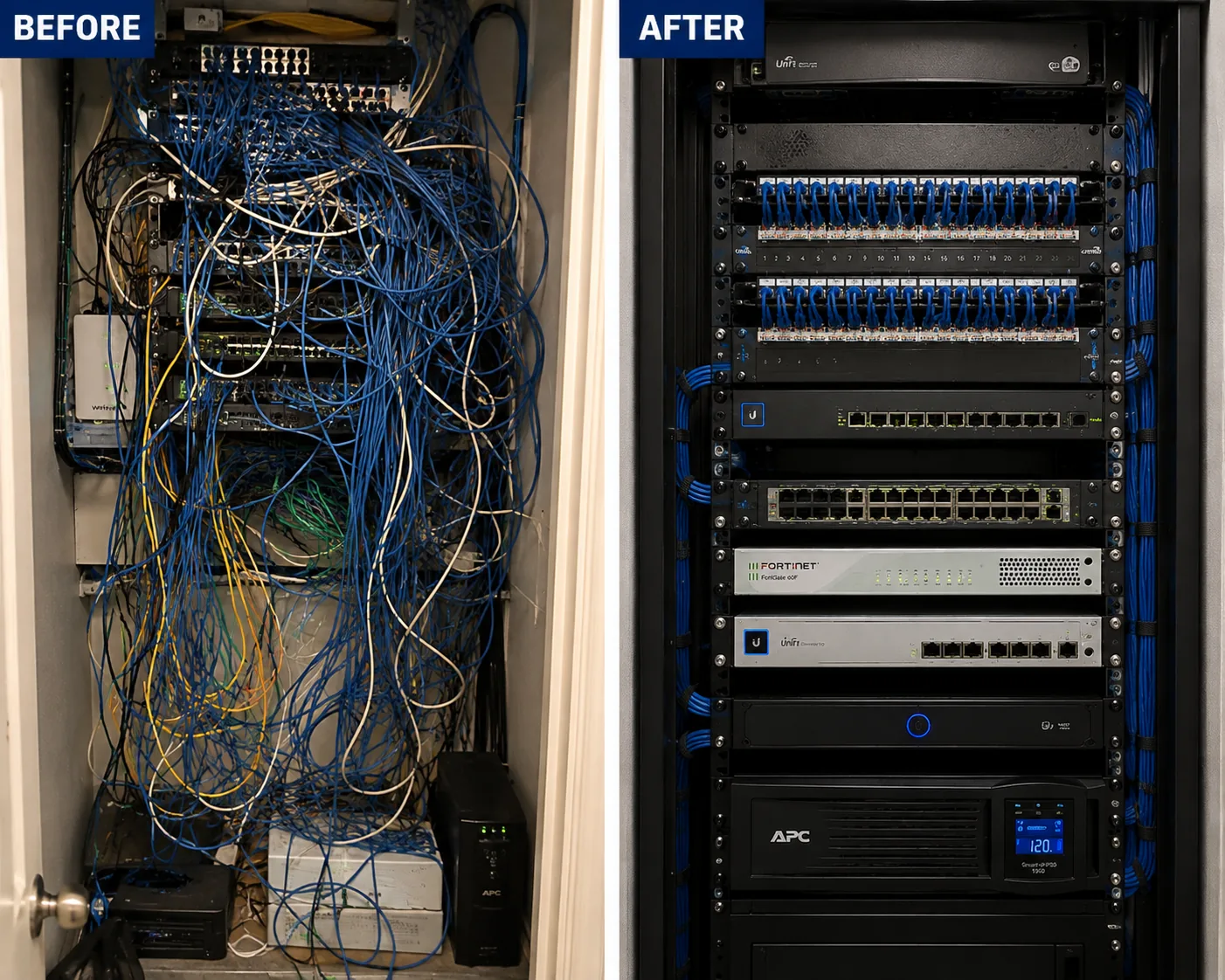
Brooklyn, Brooklyn Arlo camera network cleanup: network rack before and after, an unlabelled tangled rack rebuilt into a dressed and identified one
A photo from the AESS job library, not taken in Brooklyn: a network rack shown before and after, from an unlabeled tangle to a dressed, labeled rack. Brooklyn owners who inherit a cellar shelf of mystery cables from past tenants and providers often ask us to sort it out on the same visit, because an Arlo SmartHub plugged into the wrong box is one of the commonest reasons a system that worked yesterday is offline today.

โœ…
Request Sent!
Thank you. A technician will call you about the Brooklyn address, usually within two hours.
How It Works

Our Installation Process

1. Send photos and your Arlo models

Each spot you want watched, the wall it would go on, the router's location and the models on the box, with your cross streets. You get the expected plan and total.

2. Book and confirm access

Booked within two hours of your request. We confirm roof, yard and floor access, any landlord, board or landmark approval, and who owns the Arlo account.

3. Walk the property and test the signal

A charged camera is held at each spot and the app reading checked. Three or four bars before any hole is drilled; network fixes planned where needed.

4. Agree each position

You watch the live view on your phone, the angle moves until the stoop, gate or yard is right, and painter's tape marks the spot.

5. Mount for the wall

Fixings matched to brick, mortar, wood trim, siding or plaster, and landmarked fronts kept to the Commission's criteria.

6. Set up the account and the rules

Cameras added to your account, hub or Wi-Fi settled, modes, schedules, motion and spotlight settings chosen, and family or staff invited.

7. Test and hand over

Every camera triggered and checked on your phone, the after-dark view reviewed, charging explained and the area cleaned.

Coverage Area

Arlo Camera Installation Near Brooklyn's Landmarks

Brooklyn Bridge

Opened May 24, 1883, fifteen years before Brooklyn joined New York City, and the start of the borough's great rowhouse building boom.

Brooklyn Heights Historic District

Designated November 23, 1965, the city's first historic district, where camera placement on fronts follows the Commission's criteria.

Prospect Park

Laid out by Olmsted and Vaux and opened in 1867, ringed by the brownstone and brick blocks of Park Slope, Prospect Heights and Flatbush.

Fulton Mall

The pedestrian and transit mall on Fulton Street between Flatbush Avenue and Adams Street, at the heart of Downtown Brooklyn's shops.

Brooklyn Navy Yard

More than 300 acres and over 550 businesses supporting more than 13,000 jobs, according to its FY25 impact report.

Riegelmann Boardwalk

2.7 miles from West 37th Street to Brighton 15th Street, first opened in 1923, beside the low-lying blocks of Coney Island and Brighton Beach.

Pricing

Arlo Camera Installation Cost in Brooklyn

Brooklyn is billed at our Brooklyn rate. An Arlo visit is priced by time: the first hour, then 30-minute blocks, with listed additions where a mount goes into masonry or plaster. Cameras, hubs and accessories are separate; you can buy them yourself or ask us to recommend models. The full list, including the 30-minute block rate, is on our Brooklyn Arlo installation price page.

ItemPrice on our list
Arlo installation and setup visit, first hour (mounting, account, Wi-Fi or SmartHub, modes)$225, then 30-minute blocks
Mount into brick or stone+$65
Mount into plaster+$45
Same visit: TV wall mounting, drywall on wood studs, up to 55 inches (bracket separate)$209.99
Same visit: TV placed on its stand / take down old TV$137.99 / $85
Same visit: in-wall power and cable kit / paintable cord cover$169 / $59
Same visit: soundbar wall-mounted / placed / above-fireplace TV mounting add$129 / $79 / +$130

What moves a Brooklyn total is rarely the camera count alone. It is how many spots need masonry fixings, how long it takes to get a strong signal to the far end of the house, and whether the router or SmartHub has to move. Your written total lists every line that applies before the visit, and if a wall turns out to be a different material, the change is agreed before we continue.

Full terms โ€” including 50% deposit, one-year parts-only warranty on AESS-supplied products, and the late-fee schedule โ€” are set out in the service agreement.
Shop Our Systems

Arlo Camera Installation Packages & Pricing

Three typical Brooklyn jobs, added up from the list above. Arlo equipment is extra, and any time past the first hour is billed in 30-minute blocks at the rate on the Brooklyn price page.

Front-door starter: $225

The first-hour visit: one or two wire-free Arlo cameras or an Arlo doorbell mounted on wood trim or siding where the router reaches, added to your account with modes and alerts set.

Rowhouse standard: $290

The first-hour visit ($225) with a brick or stone mount (+$65), typically a stoop or rear-wall Arlo on a brownstone or brick house, signal tested at the mount before drilling.

Brick and plaster premium: $335

The first-hour visit ($225), a brick or stone mount outside (+$65) and a plaster mount inside (+$45): a rear-yard camera on the back wall and an indoor camera in the stair hall.

Bring your own equipment. Most Brooklyn customers already own their Arlo cameras, or buy them before the visit, and that is how our pricing works: the list above is labor, and we install the cameras, doorbell, SmartHub, solar panels or mounts you supply. If something you bought will not suit the spot, such as a solar panel for a shaded yard, we tell you before we open the box so it can go back.

Complete Services

Every Arlo Camera Installation Service in Brooklyn

New Arlo systems

Stoops, yards, roofs and shop doors. Request a quote

Signal and dropout fixes

Hubs, routers and access points behind brick. Ask about your cameras

Brooklyn price list

Every line, including 30-minute blocks. Arlo installation prices Brooklyn

Citywide Arlo service

All five boroughs from one team. Arlo installers across NYC

FAQ

Brooklyn Arlo Camera Installation FAQ

Can the cameras stay quiet while we are home and arm themselves when we go out?
+

Yes. The Arlo app has modes for when you are away, when you are home and when cameras should stand by, plus schedules and location-based switching from your phone. We set them up with you so the stoop camera keeps watching packages while the indoor camera stays off when the family is in.

Our front camera faces a busy avenue and sends alerts all day. Can that be calmed down?
+

Usually. We lower motion sensitivity, shorten recordings, re-aim the camera at the stoop rather than the traffic, and set motion areas where your model supports them. Some detection features depend on Arlo's subscription terms, so we check what your account includes before promising a particular filter. Fewer false alerts also means longer battery life.

Our Mill Basin house has vinyl siding. How does a camera mount get fixed to it?
+

We use a mounting block made for siding or fixings that pass through the panel into the sheathing behind it, so the siding can still move with the weather and is not crushed. Wood trim, soffits and fascia nearby are often even better spots, and they are easy to fill later.

Can an Arlo go on the roof or parapet of our walk-up to watch the bulkhead door?
+

Yes, with the owner's permission. The camera goes on the brick of the parapet or the bulkhead with masonry fixings, never through the roofing membrane, which is the +$65 brick or stone line on our list. The main challenge is signal, so we test it from the roof before mounting and plan an access point on the top floor if needed.

We are selling our house. What happens to the Arlo cameras and the account?
+

The cameras belong to your Arlo account until you remove them. If they stay with the house, remove them from your account and reset them so the buyer can add them to their own. If you take them, we can take them down and fill the holes in brick, mortar or trim on a visit at the usual list rate.

Do Arlo cameras work with Alexa or Google Home?
+

Arlo cameras can be linked to common voice assistants and smart displays, so you can ask a screen in the kitchen to show the stoop or the back yard. We link them during setup if you have the assistant already, and show you which features each one supports with your models.

Can an Arlo watch our car parked down the block?
+

Not reliably. Battery cameras only record when their motion sensor wakes them, and a car parked several houses away is usually beyond the distance that triggers a recording or shows useful detail. An Arlo on a Brooklyn front is best at the stoop, the door and the sidewalk right in front of the house.

Why does the technician test the signal before any hole is drilled?
+

Because in a brick building the signal at the mount, not the signal beside the router, decides whether the camera works. Arlo recommends three or four bars at the camera. Holding a charged camera in place and checking the reading first means the mount goes where it will actually stay connected, and you never pay for holes in the wrong spot.

Will you take the cameras down and fill the holes when we move out of our rental?
+

Yes. We remove the cameras and mounts, take out the removable screws, and fill holes in mortar, brick or trim so the wall is ready for the landlord. It is booked as a visit at $225 for the first hour on our list, and most removals take far less than that.

If we want a camera moved a month after the install, is that a new visit?
+

Yes, re-aiming or moving a camera after the job is finished is booked as a new visit at the usual list rate, so it is worth spending time on the angles during the install. That is why we check every view live on your phone, and after dark where we can, before we leave.

Does someone with the Arlo login need to be there during the visit?
+

It helps a great deal. The cameras are added to the account owner's Arlo account, and some steps need that person's phone to approve a sign-in or accept an invitation. If the owner cannot be there, they can sign in remotely while we work, but someone needs to let us in and stay reachable.

The best spot for our yard camera is on the neighbor's side of the fence. Can it go there?
+

Only with the neighbor's written agreement. A fence, party wall face or railing that belongs to the house next door is their property, and fixing a camera to it without permission invites a dispute. We look for a spot on your own wall, fence post or window frame that covers the same ground first.

Ready to Get Your Arlo Cameras Watching the Stoop and the Yard?

Send photos of the spots you want watched, the walls, the router and the Arlo box with your cross streets, and we will tell you where each camera should go and what the job costs on the Brooklyn list. Call or text (347) 934-8335, message us on WhatsApp, or use the request form. Licensed under NYS license #12000287431, rated 4.7โ˜… across 201 Google Reviews, owner-operated since 2002, with same-day estimates on most weekdays and requests booked within two hours.

Arlo Camera Installation by neighborhood: Brooklyn, Brooklyn arlo camera installation