What are you looking for?
About Us Contact Us Careers Get a Free Quote (800) 486-0943
Pick a service
✅ Got Your Own System?
🎬 Home TheatreQuote 🎶 AV SoundQuote 🔑 Access ControlQuote
Now pick your area
Pick your area
Long Island
Hudson Valley
Services available
Pricing & Tools
Pick a service for pricing
🚪 Intercom Pricing 🔔 Buzzer Repair Pricing
Calculators
📹 Camera System Calculator 🚨 Alarm Calculator ⚡ Cabling Quote Builder ✅ Got Your Own System?
Select your area
Arlo doorbell gone offline after a new router, a board letter about the camera on your hallway door, or another package missing from the lobby? Book an Arlo visit anywhere in the five boroughs: (800) 486-0943
Home › Arlo Camera Installation › NYC
Co-op and Condo Doors · Prewar Brick That Eats Wi-Fi · Brownstone Stoops and Rear Yards · Landmarked Facades · Storefronts and Lobbies · Licensed Low-Voltage

Arlo Camera
Installation in
NYC

See every Arlo camera price in NYC and build your own system →

Building Rules Checked Before We Mount · Signal Measured at Every Spot · Borough Price Pages, No Guesswork

New York City is a city of renters and shareholders living in old buildings, and that is exactly why so many people here buy Arlo: a battery camera or a wire-free doorbell promises security without drilling, wiring or a fight with the landlord. The city then tests that promise. Thick prewar masonry blocks the 2.4 GHz Wi-Fi that Arlo cameras need, co-op boards can treat even a battery doorbell on the hallway side of a door as an alteration, landmark rules restrict what goes on a primary facade, and some Arlo models will not work at all without a SmartHub or Base Station placed within reach. We install, move, re-aim and repair Arlo systems in all five boroughs. Before we book, we find out what kind of building you live in and whose rules apply. When we arrive, we measure the signal where each camera will hang, so the system that goes up stays online after we leave.

Reviewed and updated November 6, 2026 by Anwar Timothy, NYS license #12000287431 · Sources: Arlo Knowledge Base articles on camera setup and local storage, Arlo's camera product pages, SafeHome and SafeWise Arlo setup guides, CCTVinfo on Arlo storage, Forbes Home's Arlo review, Guzov LLC on co-op and condo camera rules, Brick Underground (co-op video doorbell ban column and package-theft column), KS Renovation Group on Manhattan co-op doorbells, Connextivity on NYC apartment camera law, RecordingLaw on New York audio consent, Seneca Security on rent-stabilized buildings, the Landmarks Preservation Commission's 2018 rule amendments and Permit Guidebook Chapter 11, LPC's December 2025 presentation for 7 East 7th Street, the NoHo BID landmarked storefront guidance, Wikipedia's Landmarks Preservation Commission and 208–218 East 78th Street entries, the Citizens Housing and Planning Council housing stock visualization, the Rent Guidelines Board 2026 Housing Supply Report, Sky NYC, RentReboot, Building the Skyline, Residential Real Estate Analysis, Security.org's package theft report, the NYS Attorney General's 2024 package-theft alert, CBS New York and ABC7 reports, NYC 311's camera-sharing article, NYC Council press and Legistar records from 2026, the NYC Business portal on alarm-installer licensing, and the NYC Participatory Budgeting portal · Dispatched from 1282 Troy Ave, Brooklyn, NY 11203

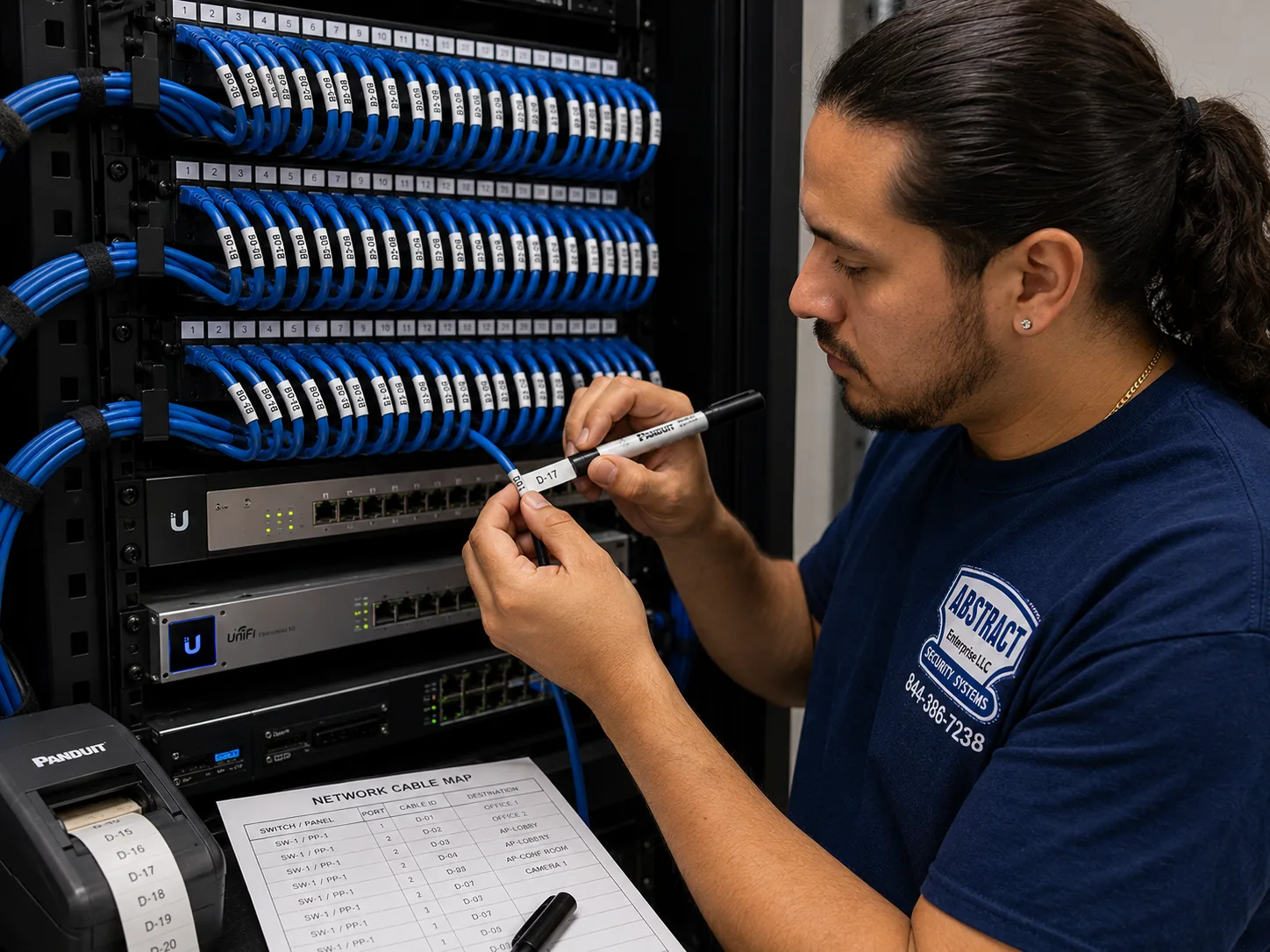
Arlo camera installation NYC hub, NYC job-library photo: a technician printing cable labels at a patch panel next to a printed port map
Photo from the AESS job library, not taken at a specific New York City address: a technician printing cable labels at a patch panel beside a printed port map. Arlo cameras themselves are wireless, but a SmartHub or Base Station still plugs into the router, and in a brownstone basement or a co-op utility closet we label that port so the next person who reorganizes the network does not unplug every camera in the building by accident.
NYC Arlo Camera Installation
Tell us the borough, the building type and which Arlo models you have or want

✅
Request Sent!
We'll call about your NYC Arlo cameras the same business day.
25+
Years Experience
✓
Same-Day Estimates
100%
Licensed & Insured
4.7★
201 Google Reviews

Owner-operated since 2002 · Thousands of jobs completed · Booked within 2 hours

Arlo camera installation in NYC is priced from the Arlo price page for your borough, with labor adjusted by borough and the equipment either supplied by us or brought by you, and we book the visit within 2 hours of your request. A standard visit covers checking your building's rules, measuring the Wi-Fi at each camera spot, setting up a SmartHub or Base Station where your models need one, mounting the cameras and doorbell with fixings your board or lease allows, configuring the Arlo app, and walk-testing every camera before we leave. Send the borough, the building type and a photo of each spot and we can tell you which lines of the price page apply. Call (800) 486-0943 or open the NYC Arlo camera installation prices page.

  • Borough pricing: labor follows the AESS area multipliers, Brooklyn and the Bronx at the base rate, Queens 1.05×, Staten Island 1.10× and Manhattan 1.25×; equipment is priced the same across areas
  • Signal checked with a meter at each mounting spot before a camera goes up, because a brick wall between the router and the rear yard is the most common reason an Arlo drops offline in this city
  • Low-voltage work done under NYS license #12000287431, with board paperwork and certificates of insurance sent ahead when a managing agent asks for them
The Neighborhood

Why NYC Properties Need Arlo Camera Installation

New York is a city where most people do not own the walls they live behind, and Arlo is built for exactly that situation. The Rent Guidelines Board's 2026 Housing Supply Report puts rental units at 68.1 percent of the city's housing stock, using the 2023 Housing and Vacancy Survey, and one housing market analysis puts the Bronx's renter share at 79.7 percent, the highest of the five boroughs. Add the co-op shareholders who own shares rather than walls and answer to a board, and you have millions of New Yorkers who cannot simply drill a hole and run a cable. Connextivity's guide to NYC apartment camera law makes the point directly: Wi-Fi cameras that need no drilling and no permanent wiring generally raise no issue with a landlord or a board, and the living room and bedroom are the resident's call. That is the space Arlo's battery cameras and wire-free doorbells were designed for, and it is why a Manhattan renovation firm, KS Renovation Group, names the Arlo Essential Wire-Free Video Doorbell as one of its two most-installed doorbells for co-op apartments, alongside a battery model from Ring, precisely because no electrical work is required.

The trouble is that a camera designed to install in minutes on an American suburban porch meets some very old, very solid buildings here. The Citizens Housing and Planning Council reports that more than 80 percent of the city's housing was built more than 50 years ago, and that over half of all units, about two million of them, went up before 1947. One analysis of city records puts the median year built at 1931 citywide, 1910 in Manhattan, 1925 in Brooklyn, 1935 in Queens and the Bronx and 1970 on Staten Island. Building the Skyline notes that New York built more than 740,000 housing units in the 1920s alone. Those buildings were made of brick, stone and plaster, and one prewar guide describes walls of 12 to 18 inches of masonry. Arlo's setup guides say that almost every Arlo camera needs a 2.4 GHz Wi-Fi connection to set up, and 2.4 GHz signal does not travel well through a foot of brick. An NYC installer, Seneca Security, warns that brownstone masonry is dense enough to significantly degrade Wi-Fi between floors and between the rear yard and the front of the building, and our own Brooklyn wireless notes record backyards and basement units routinely reading around -85 dBm, which is too weak for any wireless camera to hold a connection. The camera that streamed perfectly from the kitchen counter during setup is often the one that drops offline the week after it is mounted on the back fence.

Then there is the question of who gets to say yes. Guzov LLC, a co-op and condo law firm, writes that New York City has no law prohibiting residents from installing doorbell cameras in apartment building hallways, but that a co-op's own rules may prohibit a shareholder from placing a video doorbell in a common area. Brick Underground's co-op lawyer column goes further: a board could pass a resolution banning video doorbells as a new house rule, with no shareholder vote required, and the complaint discussed in that column arose because a shareholder pointed a camera directly at a board member's apartment. KS Renovation Group adds that most co-op proprietary leases classify door-mounted devices and any wiring work as alterations requiring board approval, even battery-powered doorbells that face shared hallways. So the very feature that makes Arlo attractive, that it sticks to a door without a wire, does not by itself make it allowed. In this city, the first step of an Arlo install is often a conversation with a managing agent, not a drill.

What pushes people to install anyway is usually the lobby. Security.org's annual package-theft report found apartment residents were more than three times as likely as other households to have had a package stolen in the previous three months, 10 percent against 3 percent, and noted that apartment dwellers may not be allowed to put doorbell or security cameras outside their units. CBS New York has reported a man apparently buzzed into a Brooklyn building on Lexington Avenue and then seen taking a package and what appeared to be a suitcase from the hallway, thieves in a Park Slope lobby cutting open packages and taking things from them on the spot, and a thief caught on video strolling up the steps of a Crown Heights home near Montgomery Street and New York Avenue. A Brooklyn resident profiled by Delivery Amigo logged more than 50 porch-pirate and trespassing cases within two years. A property manager told Brick Underground that his team updated front door locks, installed cameras, and added security gates and package lockers in lobbies, and that none of it had completely stopped theft. The New York State Attorney General's 2024 package-theft alert recommends that New Yorkers use a doorbell camera or video surveillance system to deter thieves or help identify them. For a renter on the fourth floor of a walk-up, a camera is not a gadget; it is the one piece of building security they can control.

The city also has the country's busiest landmarks regulator looking at facades. Wikipedia's entry on the Landmarks Preservation Commission counts 1,460 individual landmarks, 121 interior landmarks and 12 scenic landmarks, and the city's 2025 Mayor's Management Report credits the commission with 157 historic districts and extensions. In 2018 the commission amended its rules to cover objects commonly used for security, including security cameras, lighting and intercom panels, and those rules prohibit installing many such objects on a primary facade unless there is no feasible alternative. The LPC Permit Guidebook has a whole section, in Chapter 11, titled "Installing Security Cameras," under Rules Section 2-20. NoHo BID guidance for landmarked storefronts notes that an LPC permit comes before any Buildings Department permit, and that no LPC permit is required for fixtures that do not physically attach to any part of the building. For an Arlo owner on a landmarked block, that distinction between a mount screwed into a brownstone and a camera that sits behind the glass or on furniture is not academic. It decides whether you need a permit.

Finally, the law around recording is stricter than many quick answers suggest. Connextivity notes that a camera installed covertly inside a unit can support a charge under Penal Law 250.45, a Class E felony. Audio is murkier: RecordingLaw reads New York's Penal Law 250.00 as a one-party consent rule for cameras that record sound, Connextivity calls passive hallway audio unsettled, and other installer pages in this city describe the rule differently. In rent-stabilized buildings, Seneca Security notes that courts and the state housing agency take seriously any landlord action that could look like harassment of a stabilized tenant, and cameras pointed at a tenant's door can become part of that story. In public housing, AOL reported in 2012 that a resident of Parkside Houses in the Bronx received an eviction notice saying she had breached her lease by installing her own cameras. A participatory budgeting proposal for Gowanus Houses in Brooklyn asks for cameras in elevators and near apartment doors, which shows residents want them, but the building's rules still decide who installs what.

We want to be clear about the gaps in our research too. We could not capture Google's People Also Ask boxes, related searches, Bing or DuckDuckGo results, or AnswerThePublic data for Arlo installation in New York City from our build environment, and our searches returned no Reddit threads on the subject. We found no city dataset of HPD violations, 311 complaints or Buildings Department permits tied to consumer camera installs. Two claims that circulate on vendor blogs, that recent Real Property Law amendments require landlords to let tenants install cameras and that a city Local Law 50 requires camera notices in common areas, could not be confirmed against the statute or the city's legal text, so this page does not rely on either. Where this page describes what we find inside walls, it is drawing on the age and type of the buildings in the public record and on what we see in buildings of that age generally, not on a survey of your building.

New York City facts that shape an Arlo install

  • Mostly renters: rental units are 68.1 percent of the city's housing stock in the 2023 Housing and Vacancy Survey, and the Bronx's renter share is reported at 79.7 percent.
  • Old, heavy walls: more than 80 percent of housing is over 50 years old and about two million units predate 1947; the median Manhattan building dates to 1910.
  • Small buildings are common: in one listings sample, 47.7 percent of prewar buildings had fewer than 10 apartments and only 41.5 percent listed an elevator, so many Arlo jobs are in walk-ups.
  • Where the homes are: CHPC reports half of the city's housing is in Brooklyn and Queens, Manhattan holds about a quarter of the units on 7.5 percent of the land, and Staten Island holds about five percent.
  • Landmarks everywhere: 1,460 individual landmarks and 157 historic districts and extensions, with LPC rules that restrict cameras on primary facades.
  • Arlo needs 2.4 GHz: almost every Arlo camera sets up on 2.4 GHz Wi-Fi, and the Arlo Pro 3, Ultra and Ultra 2 need a SmartHub or Base Station.

What New Yorkers often pair with Arlo. In walk-ups and brownstones, the Arlo doorbell usually solves the apartment door, but the front door of the building still depends on the building's own intercom and lock. If the outside door is the weak point, tell us when you book. We can look at both in one visit and tell you honestly which one is actually letting the package thief in.

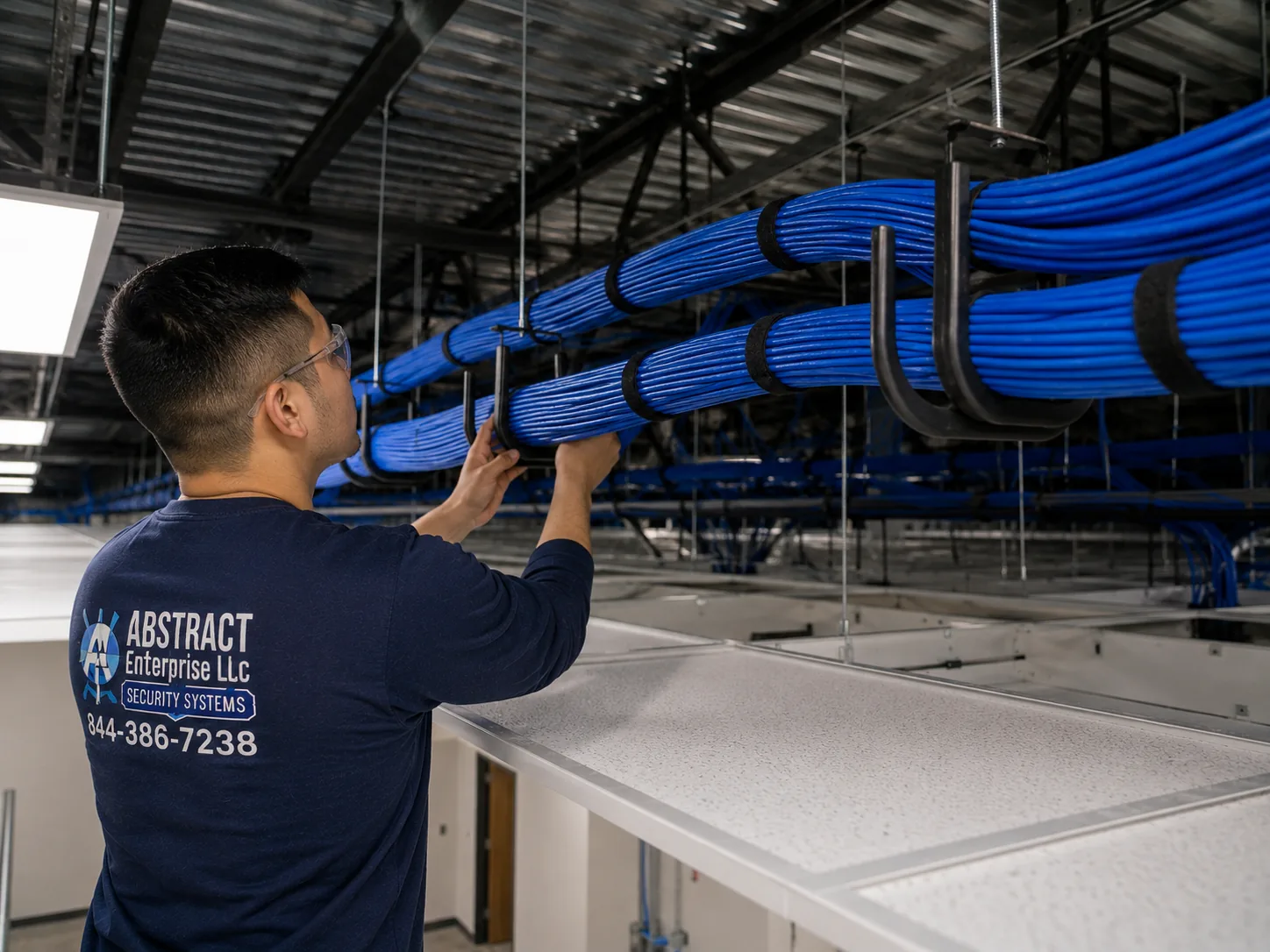
Arlo camera installation NYC hub, NYC job-library photo: J-hook pathway carrying dressed bundles of cable across a commercial ceiling
Photo from the AESS job library, not taken at a specific New York City address: a J-hook pathway carrying neat bundles of cable across a commercial ceiling. In a larger prewar elevator building or a doorman lobby, Arlo cameras ride on the building's Wi-Fi, and that Wi-Fi rides on cable like this; when the access points are fed properly, the cameras at the far end of a long corridor stop dropping off.

Arlo Offline, Doorbell Dead or a Board Deadline Looming? Fast Help Across NYC

The Arlo calls we move on first are the ones where the camera has stopped doing its job: cameras showing offline after a new router or a switch to 5 GHz-only Wi-Fi, a doorbell that went dark after a battery or transformer problem, a SmartHub that no longer saves clips to its USB drive, or a solar-powered camera that ran flat over a cloudy week in a shaded yard. The other urgent call is the letter from the board or the managing agent telling you to remove or move a camera by a date. Tell us what changed, which models you have and what the letter says, and we will tell you plainly whether it is a re-pairing job, a placement job or a conversation with the building. Call (800) 486-0943. We book within 2 hours of your request; the visit itself is set for the earliest slot that suits you and the building.

Five Borough Housing Stocks

1910 to 1970: How the Age of a Borough's Buildings Changes an Arlo Setup

An Arlo camera has no idea which borough it is in, but its Wi-Fi does. The median year a building went up says a lot about what the signal has to pass through, how many neighbors' networks are crowding the same channels, and whether there is an outlet near the door or a yard with sun on it. The table uses the median years reported in one analysis of city records and CHPC's housing figures. The right-hand column is our working expectation from the field, not a fact about any building; we confirm every site with a meter.

BoroughMedian year builtWhat dominatesWhat we expect for Arlo
Manhattan1910About a quarter of the city's units on 7.5 percent of its land: walk-up tenements, prewar elevator buildings, doorman co-ops, rowhousesCrowded 2.4 GHz air from dozens of neighboring routers, thick masonry, board and managing-agent rules on almost every door
Brooklyn1925Brownstones, rowhouses and three- and four-story walk-ups; one source puts about 57 percent of residential buildings before 1940Weak signal in rear yards and garden units, stoops and parlor doors that face the street, shade from neighboring buildings on solar panels
Queens1935Detached and attached houses, garden apartments, prewar and postwar co-opsLonger distances from router to driveway or side yard; more room for a SmartHub in a central spot
The Bronx1935Large prewar apartment buildings and the city's highest renter shareLease limits on drilling, hallway rules, and a strong case for in-unit and peephole-style placements
Staten Island1970Newer one- and two-family houses, about five percent of the city's housingWood-frame walls that pass signal better, driveways and yards with sun, more owners who can approve their own work

Manhattan: a lot of radios in a small space

Manhattan's problem is not only old walls; it is the number of routers within reach of your apartment. In a walk-up or an elevator building with dozens of units per floor line, every apartment broadcasts its own 2.4 GHz network, and our own wireless camera notes for the city list dense Wi-Fi environments among the main things that reshape a wireless install here. Arlo cameras need that crowded band. When a battery camera has to shout through a masonry wall over the noise of thirty neighbors, it uses more battery and drops more connections. In Manhattan we spend more time than anywhere else on channel selection and on where the router or the SmartHub sits, and less time on brackets. The other constant is paperwork. Doorman buildings, condos and co-ops often want a certificate of insurance and a scheduled time before a contractor goes upstairs, and our Manhattan doorbell notes describe managing agents asking for it 48 hours ahead. We send that early so the camera does not wait in the box at the front desk.

Brooklyn: stoops, garden floors and back yards

Brooklyn's typical Arlo job is a brownstone or rowhouse: a parlor-floor door at the top of a stoop, a garden-level entrance under it, and a rear yard behind a wall of brick and an extension or two. The camera that matters most is usually the one at the back or the one at the garden door, and those are exactly the spots where the signal from a router on the parlor floor arrives weakest. In these houses we often move the router or the SmartHub rather than the camera, or add an access point closer to the yard with a properly run cable. Brooklyn is also where many of the package-theft stories in our research came from: a Lexington Avenue hallway, a Park Slope lobby, a Crown Heights stoop near Montgomery Street and New York Avenue. A doorbell or a camera covering the stoop and the vestibule door is the common first request, and it usually needs a decision about whether the camera's view stops at the property line or takes in the sidewalk.

Queens: houses, garden apartments and longer distances

Queens mixes detached and attached houses with garden apartments and co-op buildings, and its median building dates to about 1935. In houses, the issue is distance more than density: a router in the front room and a driveway or side gate forty feet away through two walls. A SmartHub placed centrally, or a camera that connects to the router directly with a good signal, solves most of it. In the co-op buildings, the same board rules apply as in Manhattan, and a shareholder should get the house rules in writing before anything goes on a hallway door.

The Bronx: renters first

With the highest renter share in the city and many large prewar buildings, Bronx Arlo jobs are more often inside the unit than outside it. A camera facing the apartment door from inside, a peephole-style camera where the building allows it, or a battery camera on a shelf rather than a screwed bracket keeps the tenant inside the line that Connextivity describes, where no drilling and no permanent wiring generally means no issue with the landlord. We are careful in the Bronx, as everywhere, with buildings run by NYCHA, where the AOL report from Parkside Houses shows that the housing authority treats unapproved cameras as a lease issue. We will not mount anything in a common area of a public housing building without written approval.

Staten Island: closest to the box instructions

Staten Island's median building dates to 1970, and much of its housing is one- and two-family houses, more of them wood-framed and owner-occupied. That makes it the borough where an Arlo install looks most like the one on the packaging: the owner approves the work, wood-frame walls pass more signal than brick, and yards and driveways get enough sun for a solar panel. The work there is mostly about coverage, angles and making sure the doorbell transformer is right, and less about boards and walls.

Arlo camera installation NYC hub, NYC job-library photo: a technician core drilling through a block wall to carry cable into a network room
Photo from the AESS job library, not taken at a specific New York City address: a technician core drilling through a block wall to carry cable into a network room. When an Arlo camera in a Brooklyn rear yard or a Queens side passage cannot reach the router through masonry, the fix is often a cable through the wall to an access point on the yard side, done only where the owner or building has approved drilling.
Before You Book

Lease, Router, Sunlight: What to Check in Your NYC Home Before an Arlo Visit

Most of the time lost on an Arlo job is lost before the first camera goes up: a hallway door the board has not approved, a router locked by the internet provider so its 2.4 GHz band cannot be changed, a SmartHub with nowhere to plug in near the router, or a solar panel planned for a yard that never sees direct sun. A few minutes with your phone prevents nearly all of it. Please do not take down a camera the building has objected to or open any walls yourself; just look, check and send us what you find.

What to checkWhy it matters in New YorkWhat to send us
Your lease or the co-op's house rulesProprietary leases often treat door-mounted devices as alterations; rental leases may forbid drillingA photo of the relevant clause, or the managing agent's email
Whether the building is landmarkedLPC rules restrict cameras on primary facades; freestanding fixtures that do not attach may not need a permitYour address; we check the designation
Your router's name and bandsArlo cameras need 2.4 GHz for setup; some provider routers combine or hide bandsA photo of the router label and the admin login if you have it
Signal at each camera spotMasonry and neighbors' networks weaken signal at stoops, yards and garden unitsA screenshot of your phone's Wi-Fi bars standing at each spot
An outlet near the routerA SmartHub or Base Station plugs in beside the router and connects to itA photo of the router area
Sunlight on solar spotsArlo says solar panels need regular direct sun, not deep shade, covered porches or eavesA photo at midday, and which way the yard faces
The existing doorbellA wired Arlo doorbell needs proper low-voltage power; a battery model does notA photo of the old button and the chime or buzzer inside
Who uses the appShared homes and businesses need more than one login and clear permissionsNames and emails of everyone who should see the cameras

Look at the view from the camera, not just the spot

Stand where the camera would go and look at what it would see. In an apartment hallway, Connextivity's rule of thumb is that a camera should cover corridor traffic without seeing into apartments as their doors open. On a stoop, decide whether you want the sidewalk in the picture or only your steps. In a back yard, think about the neighbor's windows across the fence. A camera that sees too much is the one that produces a complaint, and in a co-op that complaint goes to a board that may already be thinking about a house rule. Taking a photo from the exact height and angle the camera would sit at, roughly six to seven feet, the height SafeWise suggests for Arlo cameras, tells us more than any floor plan.

Find out what your internet provider controls

Many New York apartments run on a router supplied and managed by the internet provider. Some of those combine the 2.4 GHz and 5 GHz bands under one name, some let you split them, and some lock the settings entirely. Since almost every Arlo camera needs 2.4 GHz to set up, it helps to know before the visit whether you can log in to the router, and whether you are allowed to add your own access point or mesh unit. If you cannot, we plan around it, usually with a SmartHub for the models that use one, but knowing in advance saves an hour on the phone with the provider while we stand in your kitchen.

Decide about recording before we arrive

CCTVinfo notes that Arlo cameras sold in recent years ship with no free cloud storage, so you will need either local storage or an Arlo Secure plan to keep recordings. Arlo's own support article says a subscription is not required to use local storage, which saves automatically triggered recordings to a USB device connected to the SmartHub. If you already know you want local storage, buy or bring a suitable USB drive and we set it up during the visit. If you want the cloud plan, have your Arlo account login ready. Either way, we will show you how to find a clip before we leave, because the time you need it is usually the morning after something has happened.

Arlo camera installation NYC hub, NYC job-library photo: a technician tracing an unidentified cable at a patch panel with a tone generator and probe
Photo from the AESS job library, not taken at a specific New York City address: a technician tracing an unidentified cable at a patch panel with a tone generator and probe. In older New York buildings, the jack in the wall near your router may lead anywhere; before we plug a SmartHub or an access point into it, we trace where that cable actually goes.
What We Install

Arlo Camera Installation Services in NYC

These are the Arlo jobs New York renters, shareholders, homeowners and small business owners book us for. Every one is priced from the Arlo price page for your borough. Where a job needs something extra, such as an access point to reach a rear yard or a certificate of insurance for a managing agent, the quote names it before the visit.

🔔

Arlo Doorbells on Apartment and Stoop Doors

Wire-free Arlo doorbells on co-op, condo and rental doors once the building has said yes, and on brownstone and house doors where the owner decides; wired models where proper low-voltage power is in place.

🏠

Battery Cameras for Yards, Stoops and Driveways

Arlo Pro 5S, Ultra 3 and Essential 2K XL cameras placed where the signal has been measured, aimed to stay on your side of the property line, and mounted with fixings the wall and the lease allow.

📡

SmartHub and Base Station Setup

Hubs placed and connected to the router for the Arlo Pro 3, Ultra and Ultra 2, which need one, with cameras paired close to the hub as Arlo directs, then moved to their mounting spots and retested.

💾

Local Storage Without a Subscription

A USB drive connected to the SmartHub so triggered recordings save locally, or an Arlo Secure plan configured if you prefer the cloud, with clip retrieval shown on your phone.

📶

Wi-Fi Fixes for Masonry Buildings

Signal surveys, 2.4 GHz channel changes, router and hub repositioning, and access points cabled to the far side of a brick wall where the building approves it.

☀️

Solar Panel Placement

Arlo solar panels sited where they get regular direct sun, not under eaves, fire escapes or the shadow of the next building, and an honest word when a yard is too shaded for solar to keep up.

🚪

No-Drill Placements for Renters

Cameras inside the apartment facing the door, on shelves or removable mounts, and peephole-style alternatives where a board refuses an outside mount, so a lease is never at risk.

🏪

Storefront and Lobby Cameras

Arlo cameras behind storefront glass with the motion limits explained, over counters and in small lobbies and package areas, with a straight answer when a wired recording system would serve better.

🔧

Repairs, Moves and Re-aims

Offline cameras re-paired, doorbells that stopped ringing diagnosed, cameras moved after a board complaint, and DIY systems tidied up so every camera reports in.

Arlo camera installation NYC hub, NYC job-library photo: a technician mounting a managed PoE switch below patch panels in a commercial network rack
Photo from the AESS job library, not taken at a specific New York City address: a technician mounting a managed PoE switch below patch panels in a commercial network rack. Arlo's battery cameras do not draw power from a switch like this, but the Wi-Fi access points that carry their signal through a large building often do, so in a lobby or a long prewar corridor this is where a reliable Arlo setup really begins.
Building Specialists

Arlo Camera Installation for NYC's Architecture

The five boroughs hold almost every kind of home there is, and each changes three things about an Arlo job: what the camera is fixed to, how the signal gets from the router to the camera, and who has to agree before anything goes up. These are the building types the public record and real estate guides describe, and how we handle each one.

Prewar Walk-Up Tenements

Four to six stories, built before 1929 under the earlier multiple-dwelling laws. Masonry party walls, narrow stairs, no elevator, and a landlord or co-op board who decides whether the hallway side of a door can hold a doorbell.

Prewar Elevator Apartment Houses

Eight to twelve stories from the 1910s and 1920s. Long corridors, thick walls, a super who knows the building, and Wi-Fi that has to reach from a unit's router to a door at the end of a hall.

Prewar Doorman Buildings and Co-ops

The larger buildings of the 1920s and 1930s. Managing agents, house rules, alteration agreements, certificates of insurance and scheduled hours before any contractor goes upstairs.

Brownstones and Rowhouses

From the early 1860s rowhouses at 208–218 East 78th Street onward. Stoops, garden-level doors, rear yards behind brick, and in historic districts, LPC rules on what goes on the street facade.

HDFC and Small Co-ops

The city comptroller describes HDFC co-ops as largely prewar walk-up buildings. Small boards, shareholders who know each other, and rules that are sometimes unwritten until someone puts up a camera.

Houses and Newer Buildings

Staten Island and outer-borough houses with owners who approve their own work, and the small share of buildings built after 2010, which one housing report puts at about five percent of the stock.

How the building type changes the job

BuildingWhat the camera is fixed toHow the signal usually travelsWho signs off
Prewar walk-upInside the unit, a shelf or removable mount; outside only with approvalApartment router through masonry; SmartHub placed centrallyLandlord or board, plus the tenant's own lease
Prewar elevator buildingRemovable mounts on the door or frame; masonry anchors only where approvedRouter or hub near the door, sometimes an access point in the foyerManaging agent or board
Doorman co-op or condoBoard-approved door mount, or interior and peephole-style placementRouter in the unit, channel planned around crowded neighborsThe board, via the managing agent; certificate of insurance on file
Brownstone or rowhouseBrick face with masonry anchors, wood trim, or freestanding where landmarkedRouter moved or access point added toward yard and garden floorThe owner; LPC for primary facades in historic districts
HDFC or small co-opAs the board allows, usually inside the unitApartment router, hub centralThe board, ideally in writing
HouseWood framing, siding, soffits, masonry where presentRouter or hub, sometimes a mesh unit toward the yardThe owner

On prewar plaster and masonry. Our own notes on New York wireless installs list prewar brick and plaster over metal lath among the conditions that reshape the job. Plaster over metal lath is hard to anchor into and blocks signal more than drywall does, because the metal mesh behind it acts like a screen. Brick takes masonry anchors, set into the face of the brick rather than the mortar joints wherever the mount allows, because the joints hold less and crumble sooner. Most Arlo cameras are light, so the fixing problem is small; the bigger problem is that the same walls that hold an anchor well also stop a 2.4 GHz signal. That is why, in a prewar building, we measure signal before we choose the wall, not after.

On brownstones in historic districts. Brooklyn Heights became the city's first historic district on November 23, 1965, and the Greenwich Village Historic District, designated in 1969, is the largest by number of buildings, with nearly 2,200. A brownstone owner in districts like these who wants a camera on the stoop is dealing with the LPC's 2018 rules, which bar many security objects from a primary facade unless there is no feasible alternative. LPC's own December 2025 presentation for 7 East 7th Street, the Cooper Union Foundation Building, shows how carefully the commission looks at where a camera sits on historic stone. For an Arlo owner, the practical options are a camera placed inside the vestibule or behind a window, a mount on a secondary facade, or a freestanding fixture that does not attach to the building, which the NoHo BID guidance notes does not require an LPC permit. We tell you which applies before anything touches the facade.

On walk-ups without elevators. The RentReboot listings sample found that only 41.5 percent of prewar buildings listed an elevator. For Arlo work that matters less for carrying equipment, since cameras are small, and more for signal: a five-story walk-up with a router in each apartment and stairwells of solid masonry is a hard place for a camera on a door at the far end of a landing. In these buildings the doorbell on the apartment door usually works well because the router is close; the camera someone wants on the roof door or the building's back yard is the hard one, and it needs the building's permission anyway.

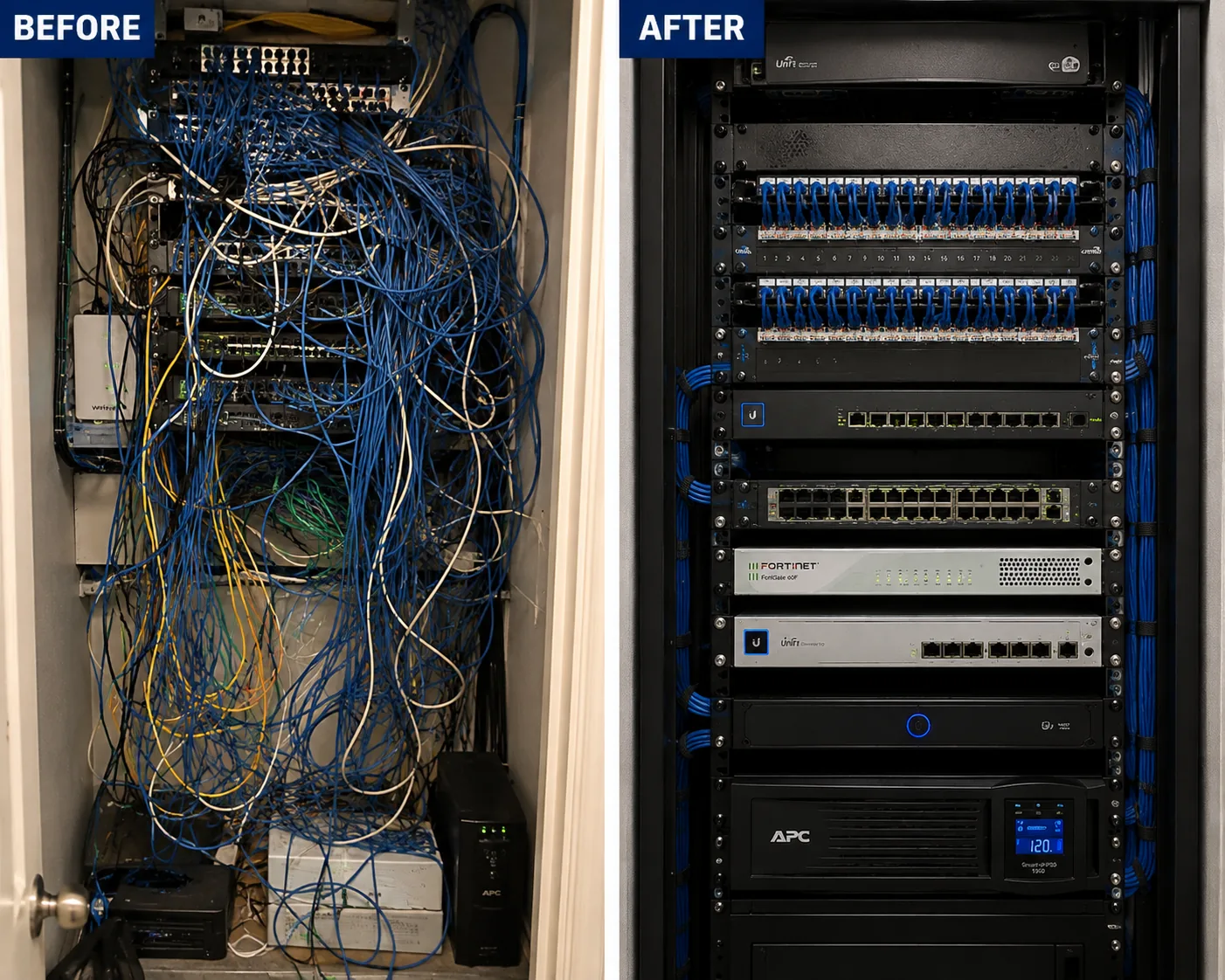
Arlo camera installation NYC hub, NYC job-library photo: before and after views of a network rack, an unlabelled tangle rebuilt into a dressed, identified rack
Photo from the AESS job library, not taken at a specific New York City address: a network rack shown before and after, from an unlabelled tangle to a dressed, identified rack. In a small co-op's basement closet, the building's internet equipment can look like the left side; when an Arlo SmartHub or access point lives there, we leave it looking like the right side so the super can find it.
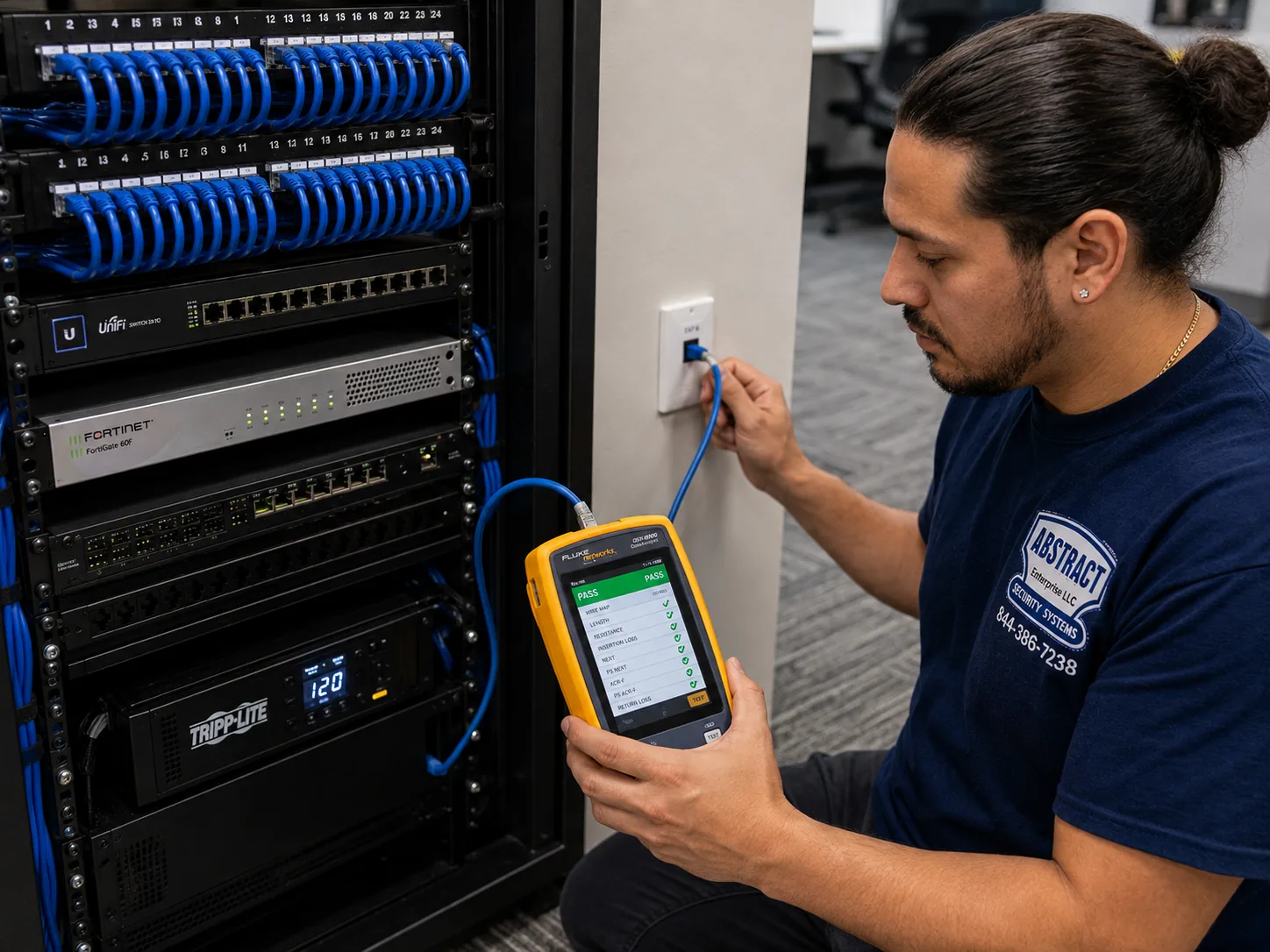
Arlo camera installation NYC hub, NYC job-library photo: a technician certifying a data drop with a cable analyzer that shows a PASS result
Photo from the AESS job library, not taken at a specific New York City address: a technician certifying a data drop with a cable analyzer that shows a PASS result. When a brownstone needs a cable through to an access point near the rear yard, we test that run before any Arlo camera depends on it, because an old or damaged cable fails quietly and looks like a camera problem.
Commercial Arlo Camera Installation

Business Arlo Camera Installation in NYC

Arlo is a consumer brand at heart, and we say so to business owners. For a small shop counter, a stockroom door, a two-person office or a building's package corner, battery Arlo cameras can be a quick, tidy answer. For a store that needs many cameras recording all the time, a wired recording system is usually the better tool, and we will tell you if that is your situation. The corridors and programs below come from city records and local reporting; we have no information about the cameras inside any particular business named and do not claim any of them as clients.

125th Street, Harlem

ABC7 reported that businesses along 125th Street were invited into a city-paid NYPD pilot that connects participating cameras through a router-like box made by Fusus by Axon, part of the city's push against retail theft.

Third Avenue at The Hub, South Bronx

The Bronx Times reported that the Third Avenue BID installed security cameras across 10 locations in October 2026 with NYPD access; PIX11 counted fifteen cameras on ten storefronts. The district has 613 storefronts.

Landmarked Storefronts, NoHo

The NoHo BID's guidance explains that LPC permits come before Buildings Department permits for landmarked storefronts, and that fixtures not physically attached to the building do not need an LPC permit.

Fordham Road and Westchester Avenue

Named alongside Third Avenue in our own Bronx camera notes as shopping streets where businesses use cameras against slip-and-fall claims, employee disputes, customer complaints and delivery theft.

Apartment Lobbies and Package Areas

The Park Slope and Lexington Avenue cases in CBS New York's reporting both happened inside lobbies and hallways, the spaces building managers, not tenants, control.

Small Retail Citywide

The City Council's June 2026 Int. 553-A would have Small Business Services set up a program to help small retailers buy and install security technology; Int. 623-2026, a camera and plexiglass pilot, was laid over in committee.

Where a battery camera fits in a shop, and where it does not

A battery Arlo camera records when motion triggers it and sends clips over Wi-Fi. That suits a quiet stockroom door, a back entrance after hours, a register area in a small shop, or a package shelf in a building lobby. It suits less well a busy sales floor where motion is constant, because every customer triggers it, the battery drains faster, and the clips pile up. Arlo's local storage on a SmartHub, as Arlo's knowledge base describes it, saves only automatically triggered recordings, so a shop that wants continuous footage for insurance claims needs a different design. We walk the space with the owner and tell you which cameras make sense as Arlo and which do not. The Slickdeals post in our research, where an owner reported that an Arlo pointed at a car recorded nothing when the car was broken into, is the kind of outcome we plan around: angle, distance and motion settings decide whether a battery camera wakes up in time.

Rules and practical limits for business cameras

  • Storefront grilles must stay see-through. NYC Council's June 2026 materials state that from July 1, 2026, all existing and new security grilles on buildings in Occupancy Groups B (Business) and M (Mercantile) must have at least 70 percent visibility from the sidewalk. A camera behind the glass now has to be planned around a mostly open grille, which helps sightlines but also exposes the camera to view.
  • Cameras behind glass and motion. A user complaint in our research reports that an Arlo camera could not detect motion through a glass window. We test a camera's motion detection through your specific storefront glass before we promise coverage of the sidewalk.
  • Landmarked facades. LPC Rules Section 2-20 restricts cameras on primary facades. Inside the glass or on a freestanding fixture is usually the path for a landmarked storefront; we check designation before quoting.
  • Sharing with the NYPD. NYC 311 says any business with a security camera can share live feeds with the NYPD during emergencies and register camera locations at NewYorkCityConnect.org. Registration is voluntary; a state bill to make a registry mandatory has been introduced but we found no record that it passed.
  • Audio stays off by default. Because sources disagree on how New York treats passive audio recording, and recording staff or customers' conversations carries its own risk, we leave Arlo microphones off in business spaces unless the owner has taken advice and asks for them.
  • Cabling in commercial ceilings. Where a shop needs an access point cabled through a ceiling or wall to carry Arlo traffic, a vendor source notes that commercial cabling through fire-rated walls or ceilings may need a permit. We plan those runs so they do not penetrate rated assemblies without the right approvals.
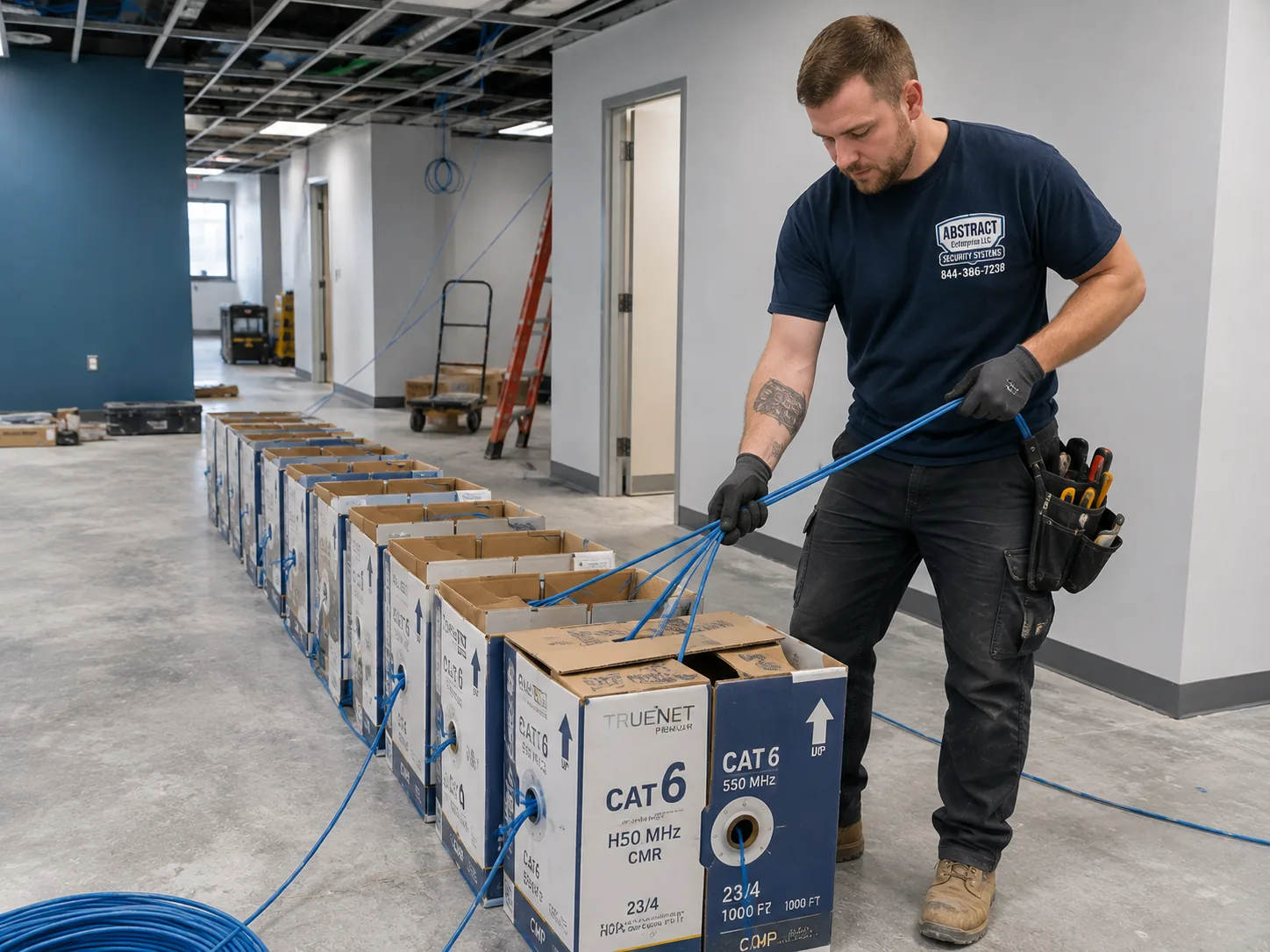
Arlo camera installation NYC hub, NYC job-library photo: boxes of cable staged for a multi-drop pull on a working commercial premises
Photo from the AESS job library, not taken at a specific New York City address: boxes of cable staged for a multi-drop pull on a working commercial premises. In a shop that stays open during the visit, we stage materials like this out of the customers' path, and when the Arlo cameras need access points to reach a back room, those runs are pulled while the floor is quiet.
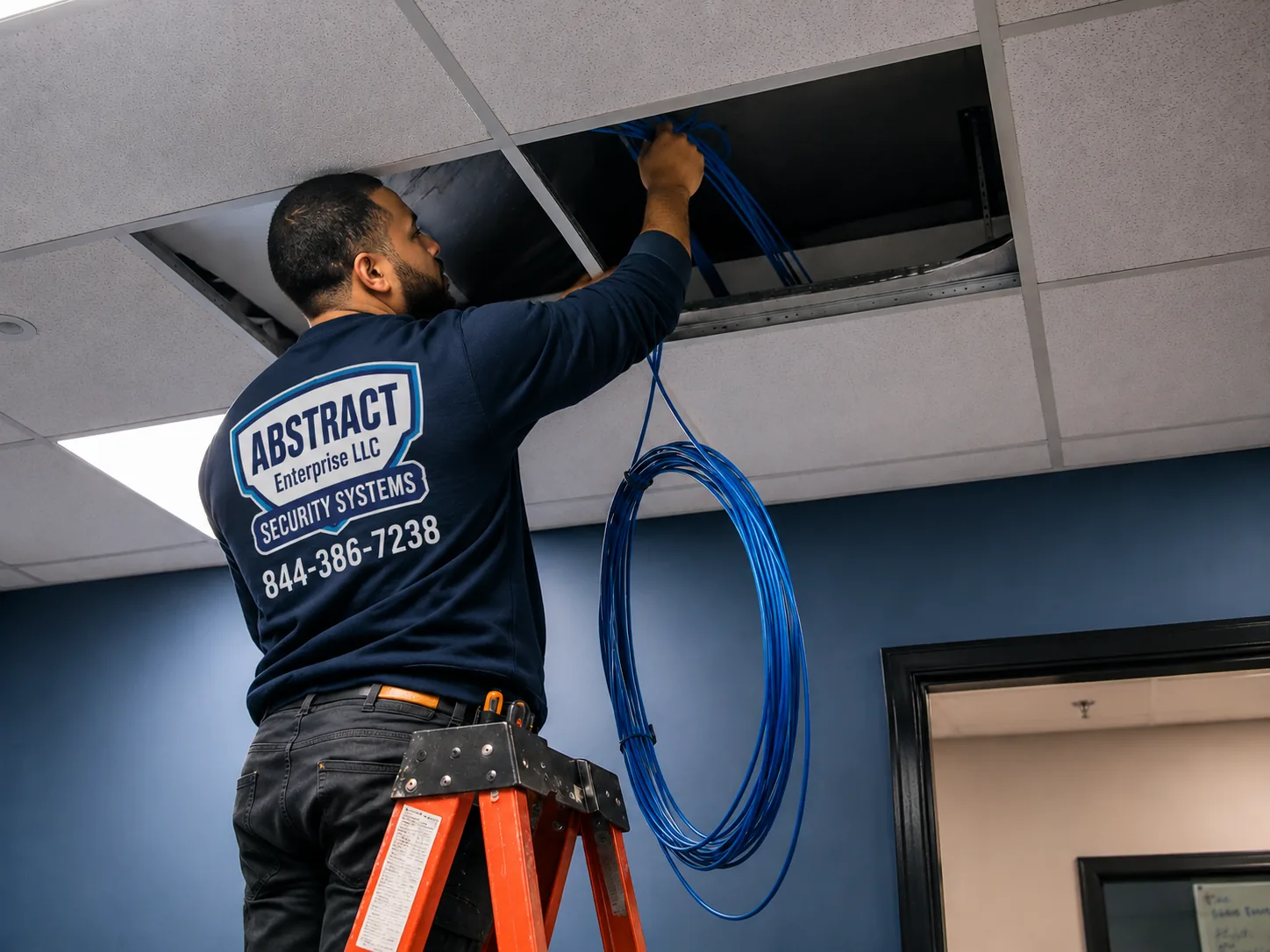
Arlo camera installation NYC hub, NYC job-library photo: a technician feeding cable through a ceiling in an occupied commercial space
Photo from the AESS job library, not taken at a specific New York City address: a technician feeding cable through a ceiling in an occupied commercial space. A small office or store with Arlo cameras at the front and a router at the back often needs one access point fed through the ceiling like this, so the cameras near the street door stop losing their connection.
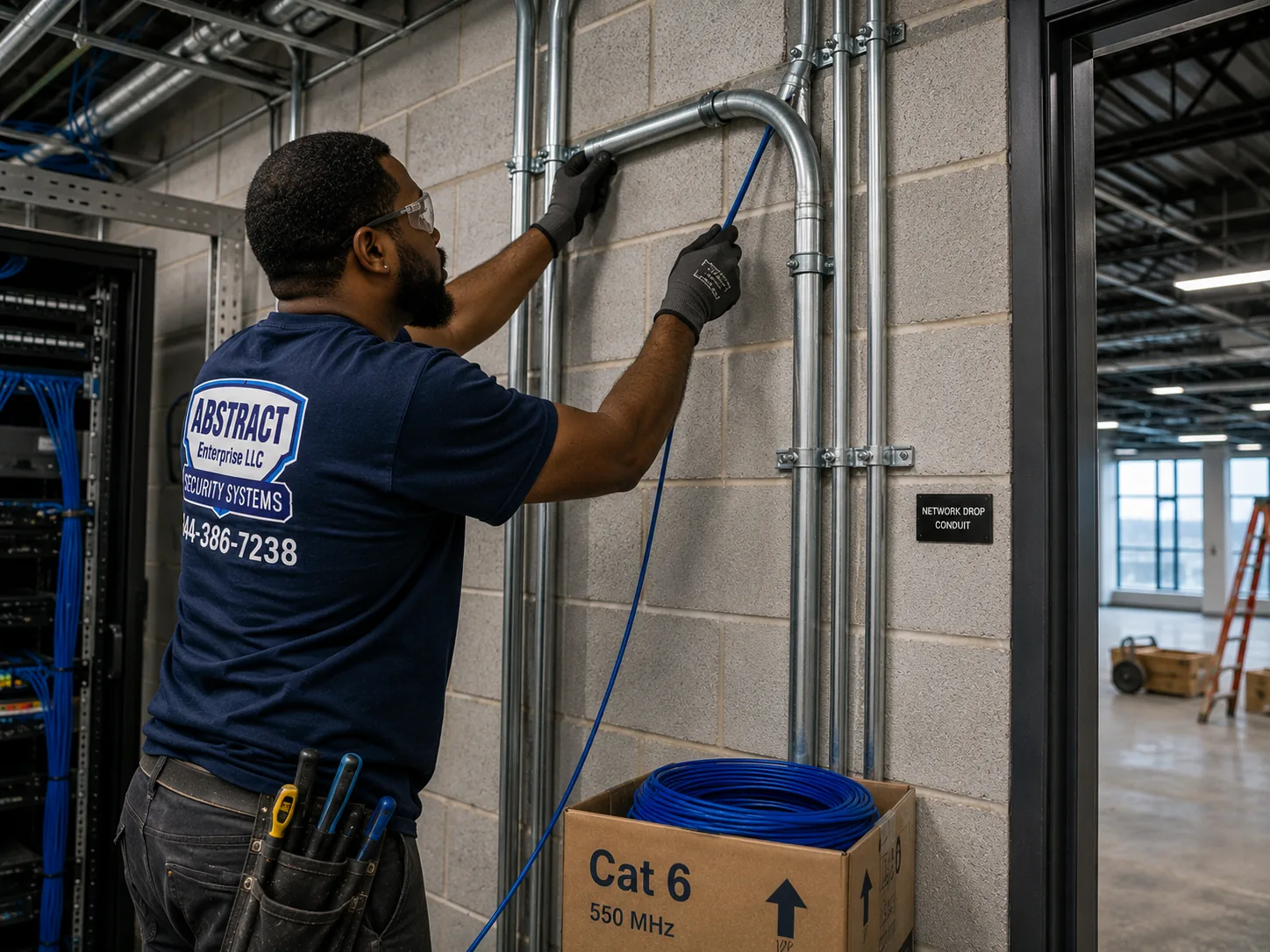
Arlo camera installation NYC hub, NYC job-library photo: a technician running cable into EMT conduit beside a telecom room in an industrial building
Photo from the AESS job library, not taken at a specific New York City address: a technician running cable into EMT conduit beside a telecom room in an industrial building. In a warehouse or a garage space, the cable that feeds the network behind Arlo cameras often has to travel in metal conduit like this, and we plan that route with the building before quoting.
Field Notes

Field Notes: Why We Walk the Signal Before We Open the Box

We do not publish stories about a particular customer's apartment unless we can document them, so this is not a tale about one address. It is the routine our technicians follow on a typical New York Arlo job: a prewar apartment or a brownstone, a router in a closet or on a shelf, and a box of cameras that worked perfectly on the kitchen table the night before.

We leave the cameras in the box at first. We ask to see the router, read its label, and check whether we can reach its settings or whether the provider controls them. Then we walk the route each camera's signal will have to travel, with a phone showing signal strength, stopping at the apartment door, the hallway, the stoop, the garden door and the far fence of the yard. We count the neighboring networks the phone can see, because in a dense building that number tells us how crowded the 2.4 GHz band is. If a model needs a SmartHub, we find where it can sit near the router and still reach the cameras. We hold a camera at each spot at about the height it will hang and look at what it sees, including the neighbor's door and the neighbor's windows. Only when the signal is good enough, the view is fair and the building has said yes does the first mount go up. That walk takes a few minutes, and it is the difference between a system that stays online and one that sends you offline alerts for a month.

Your Questions Answered

Arlo Camera Installation in NYC: Questions Answered

Co-op and condo boards

My co-op says an Arlo doorbell on the hallway side of my door needs board approval. Is that allowed if it is only battery-powered?

In most co-ops, yes, the board can require it. Guzov LLC notes that New York City has no law banning doorbell cameras in apartment hallways, but that a co-op's own rules can prohibit a shareholder from placing one in a common area, and the hallway is a common area. KS Renovation Group reports that most proprietary leases treat door-mounted devices as alterations needing board approval, even battery models facing shared halls. Being wire-free removes the electrical question; it does not remove the board's control of the hallway. Ask the managing agent for the house rules and the alteration process in writing, and send us a copy. We can supply a certificate of insurance and a short description of the device and its view, which often makes approval simpler because the board can see the camera will not look into anyone's apartment.

The board turned down the outside mount. What Arlo setup can still watch my door?

The usual fallback is to move the camera inside your own apartment. An Arlo camera placed inside, facing the door, shows anyone who opens it or comes in, and it sits entirely in your space. Our Manhattan doorbell notes describe the same fallback for denied exterior mounts: an interior-of-door or peephole-style camera, which needs no approval in most buildings. A peephole-style camera is not an Arlo product, so if you specifically want Arlo, the inside placement is the choice; if you want to see the hallway before opening the door, a peephole camera that replaces the existing viewer without altering the door tends to raise the fewest questions, as Connextivity notes. We can set up either and leave the hallway exactly as the board wants it.

Our board passed a new rule after my doorbell went up. Can it make me remove it?

Very possibly. Brick Underground's co-op lawyer column explains that a board could ban video doorbells through a new house rule without any shareholder vote. KS Renovation Group's FAQ asks the same question, which tells you it happens. Whether a rule applies to a camera installed earlier depends on how the rule is written and on your proprietary lease, and that is a question for your own lawyer, not for an installer. What we can do is remove the doorbell cleanly, patch any marks from its mount, and set up a replacement inside your apartment so you keep coverage of the door. If the dispute is about what the camera sees rather than the device itself, re-aiming it so it no longer looks at a neighbor's door, as in the board member complaint Brick Underground described, sometimes settles it.

Renting

I rent. Can I set up Arlo cameras inside my apartment without asking the landlord?

Inside your own apartment, generally yes. Connextivity's guide says Wi-Fi cameras that need no drilling and no permanent wiring generally raise no issue with a landlord or a board, and that living rooms and bedrooms are the resident's call. Imperra Security, an NYC installer, writes that tenants can install cameras inside their own apartment without landlord permission but generally cannot put them in common hallways, lobbies or shared spaces without it. That makes Arlo a good fit for renters: a battery camera on a shelf or a removable mount, plugged into nothing and screwed into nothing. Where we would need to drill, run a cable or fix anything to the door, we check your lease first. Two rules stay firm: no camera aimed where another person has an expectation of privacy, and none hidden in a shared space.

Could my landlord or building manager watch what my Arlo cameras record?

Not unless you give them access. Arlo cameras send their video to your Arlo account, or to a USB drive on your own SmartHub, and only people you invite in the app can see it. Your landlord's own cameras in the hallways and lobby are a separate system that they control. The point where things can blur is the network: if your apartment's internet comes through a building-managed router, the building can see that devices are connected but not watch your video. We set up your Arlo account under your name, add only the users you choose, and show you where to check and remove access. If you share the apartment, we can set different permissions so a roommate sees the front door but not the camera in your room.

Instead of a doorbell, can a regular Arlo camera go outside my apartment door?

It can, if the building allows it, and the same rules apply as for a doorbell. Connextivity notes that a camera on a hallway wall sits in a common area, so it typically needs building approval in a co-op or condo, and JustAnswer's attorney reply to a Brooklyn renter said that a landlord can remove a camera installed in common areas without consent. If approval comes through, a camera above the door frame usually gives a better view of the corridor than a doorbell at chest height, and it can be angled so it covers corridor traffic without seeing into other apartments as their doors open. Battery placement means no wiring in the hall. We mount it with fixings the building accepts, often removable ones, so it comes down cleanly when you move.

Privacy and the law

My Arlo doorbell catches part of the neighbor's door across the hall. Is that against the law?

Capturing a hallway that both of you use is generally not illegal in itself. Connextivity's guidance is that hallway cameras are acceptable when positioned to cover corridor traffic without seeing into apartments as doors open, and an attorney's answer on Justia says video in common areas is legal as long as the camera is not aimed to look into an apartment when its door is open. The line that matters is the inside of someone's home: Penal Law 250.45 makes covert recording where a person expects privacy a Class E felony. The practical risk is less a prosecution than a complaint to the board. We re-aim the doorbell, set motion zones so the neighbor's doorway does not trigger recordings, and where Arlo's settings allow, mask the area so the view stays on your side.

Should the microphone on my Arlo be switched on in a shared hallway or a shop?

Our default is off in shared spaces. RecordingLaw reads Penal Law 250.00 as setting a one-party consent rule for cameras that record sound, but Connextivity describes passive hallway audio as unsettled, and other installer pages in this city describe the rule differently. When the sources disagree, the cautious choice is to leave audio recording off in hallways, lobbies and stores, where you are not part of the conversations the camera would pick up. Inside your own home, the decision is yours. Two-way talk on a doorbell, where you are speaking with the visitor, is a different situation from a camera silently recording neighbors. If audio matters to you for a business or a building, take advice from a lawyer first, and we will configure the cameras to match what they tell you.

Permits, licenses and landmarks

Is a permit needed to put up Arlo cameras in New York City?

For a typical battery Arlo install in a home, our own notes and the sources we reviewed say no permit is generally needed. The exceptions are worth knowing. On a landmarked building or in a historic district, the Landmarks Preservation Commission's rules apply to cameras on facades, and LPC permits come before any Buildings Department permit; the NoHo BID guidance notes that fixtures which do not physically attach to the building do not need an LPC permit. In commercial spaces, cabling through fire-rated walls or ceilings may need a permit. Inside co-ops and condos, the board's alteration process can work like a private permit. None of the sources we found addressed whether a pure battery, no-wire Arlo install falls under the city's low-voltage rules, so for anything beyond a simple home install we check before we quote.

Does the person installing my Arlo need a New York State license?

If they are installing security cameras as a business, the state says yes. The NYC Business portal explains that a license from the New York State Department of State is required to install, service or maintain security or fire alarm systems, and a hiring guide cites General Business Law Article 6-D. The licensing course provider says that license covers security cameras and CCTV, and that unlicensed installers can be fined. Homeowners installing their own Arlo cameras do not need a license; the license is about doing it for pay. AESS works under NYS license #12000287431. When you hire anyone, ask for the license number and check it, and ask for a certificate of insurance if your building needs one. Some sources also discuss city electrician licensing for certain low-voltage work; those rules have been changing, and we follow them on wired jobs.

Our brownstone is in a historic district. Can an Arlo camera go on the front of the house?

Often not on the street facade without LPC approval. The commission's 2018 rules prohibit many security objects, cameras included, on a primary facade unless there is no feasible alternative, and its Permit Guidebook has a section on installing security cameras under Rules Section 2-20. The guidebook's examples favor small cameras finished to match the facade, which most Arlo cameras are not. The practical options are a camera inside the vestibule or behind the parlor window, a mount on the rear or a secondary facade, or a freestanding fixture that does not attach to the building, which the NoHo BID guidance says does not need an LPC permit. We check your building's designation first, and if you want a camera on the facade itself, we tell you that an LPC application is the route.

Wi-Fi, walls and hubs

Will an Arlo camera hold its Wi-Fi through the thick masonry of a prewar building?

Sometimes, but you cannot assume it. Prewar walls of 12 to 18 inches of masonry, plaster over metal lath, and dozens of neighboring routers all weaken the 2.4 GHz signal Arlo cameras rely on, and our Brooklyn notes record rear yards and basement units around -85 dBm, too weak for a wireless camera. The fixes, in order of how often we use them, are moving the router or SmartHub to a more central spot, changing the 2.4 GHz channel to a less crowded one, adding an access point on the far side of the wall with a properly run cable, and as a last resort moving the camera. We measure signal at each spot before mounting, so you know before the camera goes up whether it will stay connected.

Which Arlo cameras need a SmartHub or Base Station, and where does it go in an apartment?

Arlo's knowledge base says the Arlo Pro 3, Arlo Ultra and Arlo Ultra 2 require a SmartHub or Base Station, and that cameras should be within three to six feet of it during setup. Many newer models connect to the router directly, but a hub can still help, because it is where local USB storage lives. In an apartment, the hub sits beside the router and connects to it with a cable, so its location is usually decided by where the internet comes in. In a brownstone or a house, a router in a front room and cameras at the back can mean the hub belongs somewhere more central, with a cable run to reach it. We pair each camera near the hub as Arlo instructs, then move it to its mounting spot and confirm it still reports in.

Recording and storage

Can my Arlo cameras save recordings without paying for an Arlo subscription?

Yes, with local storage, within limits. Arlo's knowledge base says an Arlo Secure subscription is not required to use local storage, and that only automatically triggered recordings are saved to the USB device connected to the SmartHub or Base Station. CCTVinfo notes that recent Arlo cameras ship with no free cloud storage, so without either a plan or local storage, you can watch live but not keep clips. Local storage means a USB drive on the hub, kept somewhere safe inside the home; a thief who takes the camera does not take the recording. It does not give you continuous recording, and some app features depend on the subscription. We set up whichever you choose, and we show you how to pull a clip off the drive or out of the app before we leave.

Placement

Can I set an Arlo camera inside the window so it watches the street without going outside?

You can, but expect motion detection to suffer. A user complaint in our research reports that an Arlo camera could not detect motion behind a glass window, which matches what we see: the motion sensing many battery cameras use to wake up does not work well through glass, and night vision can reflect off the pane. For a renter or a landmarked facade, a camera inside the glass is still often the only option, so we test it through your actual window before relying on it, angle it to reduce reflections, and adjust sensitivity. If it will not trigger reliably, we tell you, and we look at whether a camera in the vestibule or on a secondary wall would give you real alerts instead of a view that only records when something else wakes it.

Will an Arlo solar panel keep a camera charged in a shaded Brooklyn or Manhattan back yard?

Only if the panel gets regular direct sun. Arlo's own camera pages say to confirm regular direct sunlight and avoid deep shade, covered porches or eaves that block the panel. Many New York yards are narrow canyons between four- and five-story buildings, under fire escapes or trees, where direct sun reaches the ground for a short part of the day. The panel does not have to sit right next to the camera; on a short cable it can go higher, on a fence top or a rear wall that catches more light. We look at which way the yard faces and where the sun lands at midday before suggesting solar. If no spot gets enough, a regular recharging schedule for the battery is the honest answer.

Fixing what is already up

I set up my own Arlo system and half the cameras keep dropping. Can you fix it rather than start over?

Usually, yes, and we would rather. Most self-installed Arlo systems we see in this city have good cameras in reasonable spots and a network problem behind them: a router that switched bands, a SmartHub tucked in a cabinet far from the cameras, a channel shared with twenty neighbors, or a yard camera on the far side of a brick wall. We start by checking the router and hub, then the signal at each camera, then the firmware and app settings, and only then the camera positions. Often moving the hub, changing a channel or adding one access point brings every camera back without moving a single mount. Where a camera does need to move, we patch the old holes if you want. We also trace any unknown cables in the wall before we use them, so a fix does not create a new problem.
Equipment

Types of Arlo Camera Installation We Install

These are the Arlo products and supporting equipment we fit in New York homes and small businesses. You can buy the equipment from us or bring your own; the price page for your borough shows both ways. Models named here are ones our own NYC wireless notes and the sources in our research list; we do not quote specifications we have not verified.

🎥

Arlo Pro and Ultra Cameras

Arlo Pro 5S and Ultra 3 cameras for stoops, yards and driveways, plus older Pro 3, Ultra and Ultra 2 units that need a SmartHub or Base Station to work.

📷

Arlo Essential Cameras

Arlo Essential 2K XL and other Essential models for simpler coverage, often the right choice for a single door, a stockroom or a renter's apartment.

🔔

Arlo Video Doorbells

The Arlo Essential Wire-Free Video Doorbell for co-op and rental doors where no wiring is wanted, and wired Arlo doorbells where proper low-voltage doorbell power exists.

📡

SmartHub and Base Station

The hub that some Arlo cameras require, and the place a USB drive connects for local storage of triggered recordings without a subscription.

☀️

Arlo Solar Panels

Panels for cameras in spots that get regular direct sun, mounted where the light actually lands rather than where the camera sits.

📶

Access Points and Mesh Units

Wi-Fi equipment that carries 2.4 GHz signal past masonry walls to rear yards, garden floors and long corridors, cabled where the building allows.

🧲

Removable and No-Drill Mounts

Mounting options for renters, shareholders and landmarked buildings, chosen so the camera comes down without damage when the lease ends or the board asks.

🔌

Doorbell Transformers and Chimes

Low-voltage doorbell power checked and corrected for wired Arlo doorbells, since one buyer review warns that without standard 16 VAC doorbell wiring in place you will have to wire it.

Arlo installed locally vs ADT, Ring and SimpliSafe

People comparing options in New York usually have ADT, Ring and SimpliSafe in mind alongside Arlo. ADT is best known for professionally monitored alarm systems. Ring and SimpliSafe, like Arlo, sell cameras and doorbells built for self-installation, and KS Renovation Group names a Ring battery doorbell next to Arlo's wire-free doorbell as its most-installed co-op options. The brand matters less than the building. Every one of these products depends on Wi-Fi reaching the camera, a board or landlord agreeing to its position, and an angle that does not look into a neighbor's home. Arlo's own installation partners, which Forbes identifies as OnTech and HelloTech, offer installation nationwide. What a local licensed installer adds is the New York part: measuring signal through a prewar wall, knowing what a managing agent wants on file, and knowing when a landmarked facade means the camera belongs inside the glass.

QuestionSelf-install from the boxNational install partnerAESS local install
Signal checked at each spotOnly as far as the app showsVaries by technicianMeasured with a meter before mounting
Board, lease and landmark rulesUp to youUsually up to youChecked before booking; paperwork sent ahead
Network fixes behind the camerasUp to youVariesRouter, hub placement, channels and access points included in the plan
Licensed for camera work in New YorkNot required for your own homeAsk the providerNYS license #12000287431
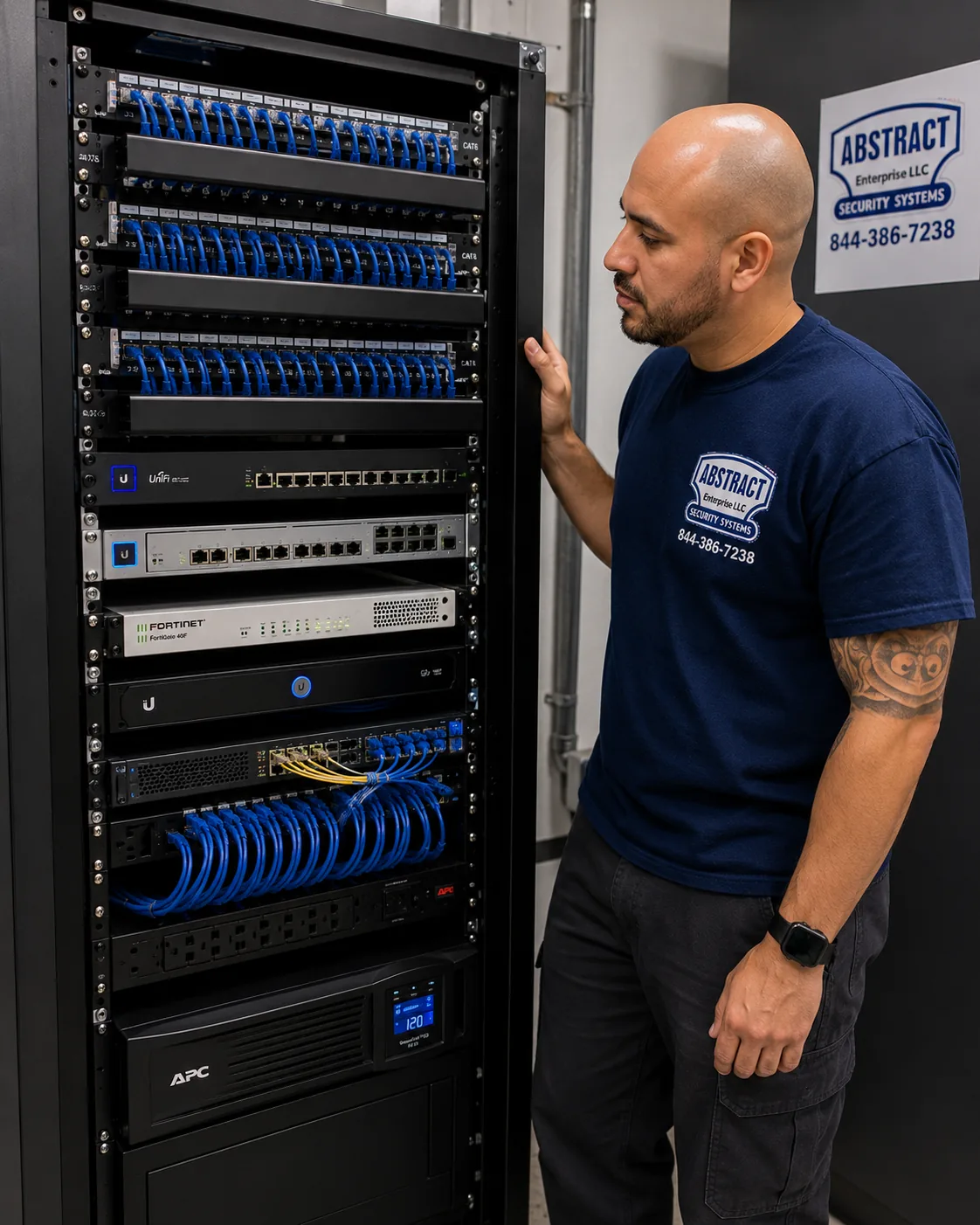
Arlo camera installation NYC hub, NYC job-library photo: a finished network rack with patch panels, switching, firewall and battery backup, dressed and labeled
Photo from the AESS job library, not taken at a specific New York City address: a finished network rack with patch panels, switching, a firewall and battery backup, all dressed and labeled. For an Arlo system in an office or a building's common area, a battery backup on the router and hub is what keeps the cameras uploading during a short power cut in the building.
AI Overview Reality Check

What AI Gets Wrong About Arlo Camera Installation in NYC

We could not capture Google's AI Overview or the People Also Ask boxes for Arlo installation in New York City from our build environment, so we are not quoting them. What follows are claims we see repeated in quick online answers about Arlo and about camera installs in this city, set against what the sources and our field practice say. Cost guides from marketplaces such as Angi, HomeAdvisor and Fixr feed many of those answers; they help with a rough idea but are not a quote for your building.

"An Arlo installs in minutes, so nobody needs a pro."

For many homes that is true, and Arlo is built for it. A homeowner installing their own camera needs no license, and plenty of New Yorkers do it themselves successfully.

The minutes run out in this city at the walls. Prewar masonry, plaster over metal lath and crowded 2.4 GHz air are the reasons a camera that paired on the kitchen table drops offline on the stoop. The camera is easy; the signal path in a building from 1910 or 1925 is not.

Our job is mostly the part the box does not cover: measuring the signal at each spot, placing the hub, picking the channel and, where needed, adding an access point. If your home does not need that, we will say so.

"Battery cameras need no approval because nothing is wired."

This is the claim that leads to board letters. Being wire-free answers the electrical question. It does not answer who controls the hallway.

Guzov LLC notes that a co-op's rules can prohibit video doorbells in common areas, KS Renovation Group reports that most proprietary leases treat door-mounted devices as alterations even when battery-powered, and Brick Underground explains that a board can ban them with a new house rule.

Inside your own unit, a battery camera generally raises no issue. On the hallway side of the door, ask first, in writing. We send the certificate of insurance and a description of the camera's view to make that request easy.

"Arlo works on any home Wi-Fi network."

Arlo setup guides say almost every Arlo camera needs a 2.4 GHz connection to set up. Many New York apartments run on provider routers that merge bands under one name or lock the settings.

Even when 2.4 GHz is available, it is the band every neighbor's router also uses. In a walk-up or an elevator building, a phone can see dozens of networks from one apartment, and a battery camera behind a masonry wall has to compete with all of them.

So the answer is "any 2.4 GHz network with enough signal at the camera." We check both before mounting, and we plan a SmartHub, a channel change or an access point when the signal is not there.

"Cloud recording comes free with the camera."

Older Arlo marketing and older reviews still circulate this. CCTVinfo notes that cameras sold in recent years ship with no free cloud storage.

Arlo's knowledge base offers the other route: local storage on a USB drive connected to the SmartHub or Base Station, with no subscription needed, but saving only automatically triggered recordings.

Choose before the visit. A renter who wants nothing ongoing picks local storage; someone who wants clips off-site in case the hub is taken picks a plan. We set up either and show you how to find a clip.

"New York law now makes landlords allow tenant cameras."

Some vendor blogs say recent Real Property Law amendments require landlords to permit tenants' cameras as long as they do not obstruct common areas or record neighbors' units, and another claims a Local Law 50 requires notices wherever common-area cameras run.

We could not find either rule in the statute or the city's legal text, so we do not rely on them. What we found consistently is narrower: tenants can generally use cameras inside their own unit, and common areas belong to the landlord or the board, who can remove unapproved cameras.

If your plan depends on a legal right to put a camera in a shared space, check it with a tenant lawyer or the city's tenant resources first. We will install to whatever your building and your advice allow.

"Mount it inside and point it out the window."

This is a popular answer for renters and for landmarked facades, and it sounds like it solves everything: no hole in the wall, no board approval, no LPC application.

The catch is glass. A user complaint in our research reports an Arlo that could not detect motion behind a window, and night vision can bounce off the pane. Another owner reported an Arlo that recorded nothing while the car it watched was broken into.

Inside the glass can still work for live viewing and some triggers. We test it through your actual window, angle it against reflections, and tell you honestly if it will not wake up when you need it to.

"Arlo installation costs the same everywhere."

Forbes reports that Arlo's install partners, OnTech and HelloTech, cover all 50 states, and national cost guides publish one range for everyone. AI answers repeat those ranges as if they fit a fifth-floor walk-up in Manhattan.

Within New York City, labor at AESS follows borough multipliers: Brooklyn and the Bronx at the base rate, Queens at 1.05×, Staten Island at 1.10× and Manhattan at 1.25×, with equipment priced the same everywhere.

Within a job, the building moves the total far more than the brand: a doorbell on a house door is a different job from a yard camera that needs an access point through brick. Each borough's price page lists the lines so you can see your own job before you call.

Not Sure Where the Signal Will Reach? Talk to a Technician About Your Building

Send the borough, the building type, the Arlo models and a screenshot of your Wi-Fi bars at each spot, and a technician will tell you whether the cameras are likely to hold a connection, whether a SmartHub or an access point is needed, and what your board or landlord will probably want to see first. Call (800) 486-0943, message us on WhatsApp, or use the quick form.

How It Works

Our Installation Process

Every New York Arlo job follows the same eight steps, whether it is one wire-free doorbell on a co-op door in Manhattan or six cameras around a house on Staten Island. The order matters most in old masonry buildings and in buildings with boards, where skipping a step is the usual reason a camera comes down a month later.

1. Send photos, models and the building type

A photo of each spot, the Arlo models you own or want, the borough and cross streets, and whether it is a co-op, condo, rental, brownstone, house or storefront. We match the job to your borough's Arlo price page before you book.

2. Check the building's rules

House rules, lease limits on drilling, landmark status and any certificate of insurance the managing agent wants. We send paperwork ahead so the visit is not held at the front desk.

3. Map the Wi-Fi at every camera spot

Signal measured at the door, stoop, hallway, garden floor and yard, with the number of neighboring networks noted, so we know where the signal is strong enough before anything is mounted.

4. Set up the SmartHub or Base Station

For models that need one, the hub is placed near the router with a tested, labeled connection, and each camera is paired within three to six feet of it as Arlo directs.

5. Agree placement, height and audio

Each camera held at about six to seven feet, its view checked so it does not see into a neighbor's home, and the microphone decision made, off by default in shared spaces.

6. Mount the cameras and doorbell

Removable or no-drill fixings where the lease or board requires, masonry anchors in brick where drilling is allowed, and doorbell power confirmed for wired models.

7. Configure the app, zones and storage

Modes, motion zones, notifications and users set in the Arlo app, local USB storage on the hub connected or an Arlo Secure plan set up, whichever you chose.

8. Walk-test and hand over

Every camera triggered by walking past it, live view checked from your phone on cellular data, and written notes left on placement, the hub, the network port and who has access.

Coverage Area

Arlo Camera Installation Near NYC's Landmarks

A citywide page cannot list every block, so these are six places from our research that show the conditions Arlo installs meet across the five boroughs: historic districts, landmarked buildings, rowhouses, commercial corridors and the city's busiest security event of the season.

Brooklyn Heights Historic District

The city's first historic district, designated November 23, 1965. Brownstone stoops and facades where LPC rules decide whether a camera can go on the front.

Greenwich Village Historic District

Designated in 1969 and the largest historic district by number of buildings, nearly 2,200, mixing rowhouses, walk-ups and apartment buildings.

Cooper Union Foundation Building

At 7 East 7th Street, where LPC's December 2025 presentation showed how cameras are placed on a historic brownstone facade, below the water table.

208–218 East 78th Street

Six attached brick rowhouses on the Upper East Side built in the early 1860s, an example of the masonry that blocks Wi-Fi between a front room and a rear yard.

125th Street, Harlem

The corridor where ABC7 reported the city-paid NYPD camera pilot for businesses, using connection boxes made by Fusus by Axon.

Javits Center

Host of ISC East 2026 on November 4–5, the security industry show where camera makers present new equipment in New York each fall.

We install Arlo cameras in every borough. See the price page for yours: Brooklyn, Manhattan, Queens, the Bronx and Staten Island. Beyond the city line we also serve Long Island, including Nassau County and Suffolk County, and the Hudson Valley, starting with Westchester County.

Pricing

Arlo Camera Installation Cost in NYC

Arlo camera installation in New York City is priced from the Arlo price page for your borough, where every line is listed and you can build your own system before calling. We do not print a single citywide figure on this page, because a single figure would be wrong for most buildings. The borough sets the labor rate; your building, your Wi-Fi and the number of cameras set the rest.

BoroughLabor rate vs Brooklyn basePrice page
Brooklyn1.00× (base)Brooklyn Arlo prices
The Bronx1.00×Bronx Arlo prices
Queens1.05×Queens Arlo prices
Staten Island1.10×Staten Island Arlo prices
Manhattan1.25×Manhattan Arlo prices

What moves an Arlo quote in this city

FactorWhy it matters in New YorkHow we handle it
Number of cameras and doorbellsEach one is placed, mounted, paired and testedPriced per device on your borough's page
Equipment supplied or broughtYou may already own the camerasEquipment priced the same in every area; labor-only if you bring your own
SmartHub or Base StationRequired for Pro 3, Ultra and Ultra 2; needed for local USB storagePlaced beside the router with a tested, labeled connection
Wi-Fi reachMasonry, metal lath and crowded 2.4 GHz airSignal survey first; access points only where the survey shows a need
Wall and mountBrick, plaster, wood trim, steel door frames, removable mountsFixings chosen for the material and the lease
Wired doorbell powerA wired Arlo doorbell needs proper low-voltage powerExisting doorbell wiring checked before booking
Building paperworkCo-ops, condos and commercial landlords ask for insurance papersCertificates of insurance sent ahead to the managing agent
Landmark statusPrimary facades in historic districts are restrictedPlacement inside the glass, on secondary walls or freestanding, or an LPC application if you want the facade

How to read the price page for a New York job

Take a renter in a Bronx walk-up who owns an Arlo Essential camera and wants it inside the apartment facing the door, with local storage and no drilling. That job is one placement at labor-only on the Bronx page, a SmartHub only if the model or the storage choice needs one, and no wall or paperwork lines at all. Now take a Brooklyn brownstone owner who wants a wire-free doorbell at the parlor door, a camera at the garden entrance and a solar-powered camera on the back fence, with the router on the parlor floor. That job adds two more devices, a solar panel placement, a hub placed for the rear camera, and possibly an access point toward the yard if the signal survey shows the brick blocking it. Same brand, same city, very different lists. Nothing is added on the day that was not on the quote unless you ask for it.

If you are comparing with the whole city's prices at once, the NYC Arlo camera installation price page collects every borough in one place.

Full terms — including 50% deposit, one-year parts-only warranty on AESS-supplied products, and the late-fee schedule — are set out in the service agreement.
Shop Our Systems

Arlo Camera Installation Packages & Pricing

Three common New York Arlo jobs, described by what goes into them. Each one is priced from your borough's Arlo price page, at that borough's labor rate, with no package premium and nothing hidden; open the page for your borough to see the figures for your exact mix.

Starter: Renter's Door, Inside the Line

One Arlo camera or wire-free doorbell for an apartment, placed inside the unit or on the door once the building has approved it, set up on your Wi-Fi with signal checked, local storage or a plan configured, and the app shared with your household. No drilling unless the lease allows it. Built for walk-ups, rentals and co-ops where the hallway belongs to the board.

Standard: Brownstone or House, Front and Back

A doorbell at the main door plus two or three cameras covering the garden entrance, the rear yard and a side passage, with a SmartHub placed where the cameras can reach it, a signal survey of every spot, solar placement where the yard gets sun, and motion zones set to keep neighbors' windows out of the picture.

Premium: Whole Property or Small Business

Four or more Arlo cameras and a doorbell across a house, a two-family or a small shop, with access points cabled past masonry walls where approved, the hub on battery backup with the router, users and permissions for every household member or staff, and written notes on the network behind the cameras.

Bring your own Arlo equipment

Many New Yorkers already own their Arlo cameras, bought online or from a store, and just want them set up properly. We install customer-owned Arlo cameras, doorbells, solar panels and SmartHubs at labor-only rates from your borough's price page, as long as the equipment is in working order. We check firmware and account access first, and if a camera is damaged or an older model will not do what you want, we tell you before we mount it rather than after. Customer-supplied equipment is your own to warranty with the maker; our workmanship on the install is covered as set out in the pricing section above.

Complete Services

Every Arlo Camera Installation Service in NYC

NYC Arlo Price Page

Every Arlo line for the city in one place, to build your own system. NYC Arlo camera installation prices

Brooklyn

Brownstones, rowhouses and walk-ups at the base labor rate. Arlo camera installation prices in Brooklyn

Manhattan

Co-ops, condos and doorman buildings, with paperwork sent ahead. Arlo camera installation prices in Manhattan

Queens

Houses, garden apartments and co-op buildings. Arlo camera installation prices in Queens

The Bronx

Renter-friendly placements in large prewar buildings. Arlo camera installation prices in the Bronx

Staten Island

One- and two-family houses with yards and driveways. Arlo camera installation prices on Staten Island

FAQ

NYC Arlo Camera Installation FAQ

Which Arlo doorbell tends to suit a co-op apartment door best?
+

Usually the Arlo Essential Wire-Free Video Doorbell, because it needs no electrical work, and KS Renovation Group names it as one of its two most-installed doorbells for Manhattan co-ops. Battery power does not remove the need for board approval on a hallway-facing door, so get the house rules first, and if the board says no, an Arlo camera inside the apartment facing the door is the usual alternative.

Is my landlord allowed to put cameras in the building's hallways and lobby?
+

Generally yes. An attorney answering on Justia said video surveillance in common areas such as hallways and stairwells is legal as long as the camera is not aimed into an apartment when its door is open and voice is not recorded. A camera hidden where people expect privacy is a different matter under Penal Law 250.45. Tenants with concerns about building security or surveillance can raise them with HPD or 311.

Does New York City law require apartment buildings to have security cameras?
+

No. Seneca Security notes there is no general NYC law mandating cameras in apartment buildings; the legal requirements that apply to building entry are mainly about intercoms and lighting. That is why so many tenants add their own Arlo cameras inside their units, and why building managers who want lobby coverage install it by choice.

How quickly can you schedule an Arlo installation?
+

We book within 2 hours of your request. The visit itself is set for the earliest slot that works for you and, in co-ops and condos, for the building, since some managing agents want a certificate of insurance on file before a contractor goes upstairs. Sending photos and the building rules with your request is the fastest way to a confirmed date.

Arlo is sold as do-it-yourself. When is it worth paying someone to install it?
+

When the building is the hard part. If your cameras are inside an apartment near the router, you may not need us. If they have to reach a rear yard through brick, share 2.4 GHz air with dozens of neighbors, need a SmartHub placed for coverage, sit on a landmarked facade, or need board paperwork, a licensed installer saves time and second attempts.

How high should an Arlo camera be mounted outside a New York home?
+

SafeWise's Arlo guide suggests around six to seven feet above the ground, which is high enough to be out of easy reach and low enough to see faces. On a stoop or in a narrow yard we adjust from there to keep the view on your own property, away from neighbors' windows, and clear of glare from street lights.

Does Arlo have its own installers in New York?
+

Arlo offers professional installation through partners. Forbes reports those partners are OnTech and HelloTech, covering all 50 states. AESS is an independent, locally licensed installer, not an Arlo partner, and we focus on the New York parts of the job: masonry Wi-Fi, building rules, landmark facades and the network behind the cameras.

Can a wired Arlo doorbell connect to the old doorbell wiring in a brownstone or house?
+

Only if that wiring supplies proper doorbell power. One buyer review warns that without standard 16 VAC doorbell wiring already in place, you will have to wire it. Many older New York houses have old buttons on buzzer or chime systems that may not match. We check the existing transformer and wiring from photos before booking, and if it will not work, a wire-free Arlo doorbell avoids the problem.

Can footage from my Arlo cameras be shared with the NYPD?
+

Yes, if you choose. NYC 311 explains that any business with a security camera can share live feeds with the NYPD during emergencies and register camera locations at NewYorkCityConnect.org. Homeowners can also download a clip from the Arlo app or the local USB drive and give it to police after an incident. Registration is voluntary.

Do you cover all five boroughs, and does the price change from one to another?
+

We cover all five. Labor follows borough multipliers: Brooklyn and the Bronx at the base rate, Queens at 1.05 times, Staten Island at 1.10 times and Manhattan at 1.25 times. Equipment is priced the same everywhere. Each borough has its own Arlo price page listing every line.

What should I have ready on the day of the visit?
+

Your Arlo account login, the Wi-Fi name and password, router admin access if you have it, any USB drive you want for local storage, the cameras charged if you bought your own, and any board or landlord approval in writing. If the building wants a certificate of insurance, the managing agent should already have it from us.

Does the 2026 storefront grille rule affect where a shop's Arlo camera can go?
+

It can. City Council materials say that from July 1, 2026, security grilles on business and mercantile buildings must have at least 70 percent visibility from the sidewalk. A camera inside the glass may now see out better through an open grille, but it is also easier to see, and motion detection through glass is limited, so we test placement before relying on it.

Why might an Arlo camera miss an event right in front of it?
+

The usual causes are distance, angle, glass and settings. One owner reported an Arlo aimed at a car that recorded nothing during a break-in. A battery camera has to detect motion to wake up, so a subject too far away, crossing at the wrong angle, behind a window or outside the motion zone can be missed. We set distance, angle and zones during the walk-test so the camera triggers where it matters.

Get In Touch

Request a Free Quote

Tell us the borough, the building type, the Arlo models and any rules your board or landlord has. A photo of each spot and a screenshot of your Wi-Fi bars there make the quote exact. Prefer to talk? Call (800) 486-0943.

✅
Request Sent!
We'll call about your NYC Arlo cameras the same business day.

More Arlo Camera Installation near NYC hub

Book Your NYC Arlo Camera Installation

From a wire-free doorbell on a Manhattan co-op door to a camera on a brownstone's back fence in Brooklyn, a renter's camera inside a Bronx apartment or a doorbell on a Staten Island house, the job starts the same way: the building's rules, a signal check at every spot, and an honest match to your borough's Arlo price page. Call (800) 486-0943, message us on WhatsApp, or send the quote form, and we will tell you what your building needs before anything goes on a wall.

Arlo Camera Installation by neighborhood: NYC hub, NYC arlo camera installation

Arlo Camera Installation by neighborhood: Hudson Valley hub, Hudson Valley arlo camera installation

Arlo Camera Installation by neighborhood: Long Island hub, Long Island arlo camera installation