Tapo cameras still in the box, a doorbell that keeps dropping off the Wi-Fi, or a detached garage at the back of a Nassau or Suffolk lot that nobody can see from the house? Book a Long Island Tapo install: (800) 486-0943
Postwar Cape Cods and Ranches · Detached Garages and Long Driveways · Office Suites at the Nassau Hub · Flex Buildings on Route 110 · Licensed Low-Voltage
Wi-Fi Measured Before Anything Is Mounted · Wired or Wireless Chosen Per Camera · Set Up in Your Own TP-Link Account
Tapo camera installation on Long Island is mostly a question of distance and weather. The U.S. Census Bureau's 2023 survey counts about 364,500 one-unit detached homes in Nassau County, with a median build year of 1955, and about 463,100 in Suffolk, with a median of 1970. Those are houses on their own lots, often with a driveway down one side and a garage set back from the house, where the router sits in a basement or a back bedroom and the spot you most want to watch is sixty feet away through brick, siding and shrubs. TP-Link's Tapo cameras are built to be easy, and inside a small apartment they usually are. On a quarter-acre lot in Levittown, a split-level near Hofstra, or a strip store on Hempstead Turnpike, the easy part ends where the Wi-Fi does. We measure the signal at every camera position first, then decide which cameras ride on Wi-Fi, battery, solar or a PoE cable.
Reviewed and updated November 5, 2026 by Anwar Timothy, NYS license #12000287431 · Sources: TP-Link support FAQs 2742 (Tapo setup, Wi-Fi bands, offline recording), 2710 (2.4 GHz setup) and 3973 (floodlight camera wiring), Tapo's PoE camera installation guide and its apartment doorbell page, U.S. Census Bureau American Community Survey 2023 five-year data for Nassau and Suffolk, ny.gov county profiles, Nassau County Office of Consumer Affairs licensing pages, NY General Business Law Article 6-D (via Justia), the Suffolk County Police Department SCPD Shield camera registry, the Garden City Police private camera registration page, News12 Long Island (September 21, 2026 Uniondale report and a Massapequa Park porch-theft report), CBS New York (November 2025 Suffolk package-theft case), Patch Garden City (week ending September 15, 2026), ABC7 New York (January 2024 Nassau burglary task force and the 2020 Isaias outage), the NYS Department of Financial Services August 2024 flood release, Nassau County Police alerts, the Cradle of Aviation Museum's Mitchel Field history, NeighborhoodScout and Homes.com Uniondale data, Encyclopedia.com and Wikipedia entries on Levittown, Mitchel Air Force Base, Roosevelt Field, Hofstra and Uniondale, the Long Island Press (June 2025 Hub rezoning), the Digital Media Law Project's New York recording guide, IsMyRouterSafe (October 8, 2026) and SmartHomePerfected on TP-Link's federal status · Dispatched from 1282 Troy Ave, Brooklyn
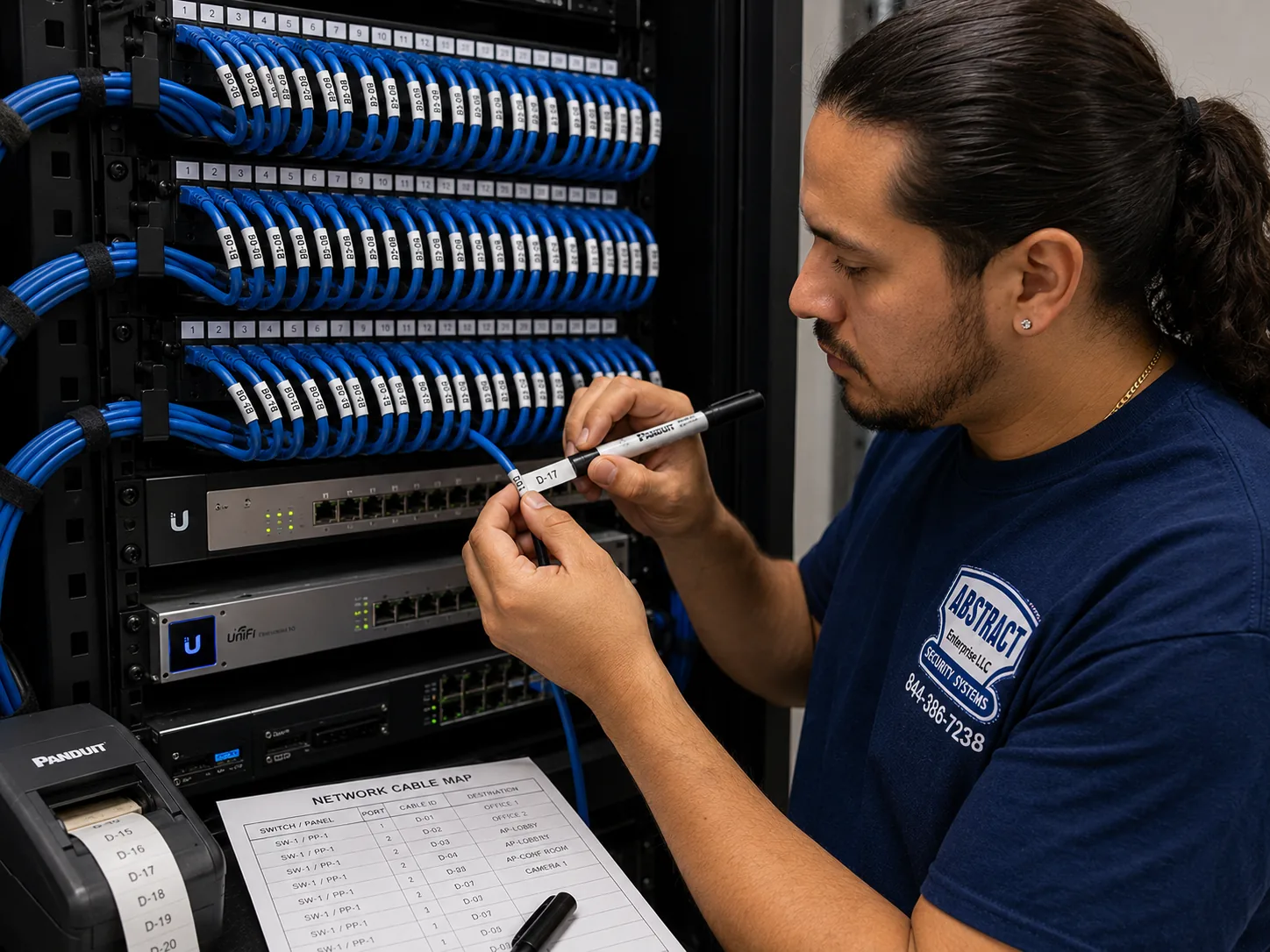
Photo from the AESS job library, not taken on Long Island: a technician printing cable labels at a patch panel next to a printed port map. When a Long Island business mixes wired Tapo PoE cameras with Wi-Fi ones, a labelled map like this is how the owner knows which cable feeds the camera over the loading dock and which feeds the one at the front door.
Long Island Tapo Camera Setup
Tell us the town, the property type and how many cameras you have or want
✅
Request Sent!
We aim to book your Long Island Tapo visit within 2 hours of your request.
25+
Years Experience
✓
Same-Day Estimates
100%
Licensed & Insured
4.7★
201 Google Reviews
Owner-operated since 2002 · Thousands of jobs completed · Booked within 2 hours
Quick answer: a Long Island Tapo install is priced from our Long Island Tapo price page, with Nassau and Suffolk addresses each on their own county rate, and it covers mounting, power, network setup and the Tapo app in your name. What moves the quote is how far each camera sits from the router, whether it can run on Wi-Fi or needs a cable, what the wall is made of, and whether any camera needs mains power from an electrician. Send the town, the house type and photos of the spots you want watched, and we can tell you over the phone which cameras will be simple and which will need more. Call (800) 486-0943 or use the form, and see the full list on the Tapo camera installation prices for Long Island.
Wi-Fi strength measured at every planned camera position before a single screw goes in, because a camera that drops off the network on a windy night records nothing you can see later
Wired PoE cable for the cameras the Wi-Fi cannot reach, in outdoor-rated, UV-resistant jacket wherever the run is exposed to Long Island weather
Low-voltage work done under NYS license #12000287431; mains wiring for floodlight cameras handed to a licensed electrician, never improvised
Why Long Island Properties Need Tapo Camera Installation
This is our Long Island hub page, so it covers both Nassau and Suffolk, and it uses the Nassau Hub around the old Coliseum in Uniondale and East Garden City as its reference point. We chose that anchor because it shows, in a few square miles, nearly every kind of property a Tapo camera ends up on across the island. The Cradle of Aviation Museum's history of Mitchel Field records that the airfield took the Mitchel name in July 1918 and closed in 1961, when the property went to the County of Nassau. Since then the land has filled with the Coliseum at 1255 Hempstead Turnpike, Hofstra University, Nassau Community College, the Mitchel Athletic Complex and the Cradle of Aviation Museum itself, and Wikipedia describes the wider Hub as home to almost half of the county's economic activity. On one side of Hempstead Turnpike are office towers like RXR Plaza and the Omni; on the other, according to Homes.com, are streets of Cape Cods and minimal traditional houses, often with detached garages and private driveways. That mix, big commercial buildings beside modest postwar houses, is Long Island in miniature.
The houses explain most of what a Tapo installer actually does here. NeighborhoodScout reports that single-family detached homes make up 69.74 percent of Uniondale's housing and that 55.45 percent of it was built between the 1940s and the 1960s. A restoration contractor working in the area describes most local homes as Cape Cods and ranch houses from the early 1950s. Head east a few miles and the pattern repeats on a larger scale: Encyclopedia.com records that Levittown began in 1947 on potato fields and by 1951 held some 17,500 single-family homes, and Wikipedia's entry on Levitt & Sons describes them as Cape Cod and ranch-style houses on quarter-acre lots. The Census Bureau's 2023 survey puts Nassau's median home at 1955 and Suffolk's at 1970. None of those houses was planned around a wireless camera. The router lives wherever the cable company first dropped its line, often a basement or a back room, and the spots worth watching are the driveway, the side door, the back gate and the garage at the far end of the lot.
That geometry is why a Tapo box from the store so often disappoints on Long Island. TP-Link's own setup guidance says Tapo cameras join the home's 2.4 GHz Wi-Fi through the Tapo app, and 2.4 GHz travels farther than 5 GHz but still weakens with every wall, window and tree between the router and the camera. A camera on the front of a Cape Cod may sit twenty feet from the router through one interior wall and work perfectly. The same model on a detached garage sixty feet back, with the house's brick or concrete-block foundation and a hedge in the way, may connect during setup and then drop out at night when the neighborhood's Wi-Fi gets busy. A camera that drops out does not record to the cloud, does not send alerts and does not show live view. The honest fix is sometimes a better access point, sometimes a different Tapo model, and sometimes a PoE cable, and the only way to know which is to measure the signal where the camera will actually hang.
The second reason Long Island owners call is what they want the cameras to catch. Police and news reports from the past few years point in three directions. Cars: ABC7 New York reported in January 2024 that a multi-agency task force of Nassau and Suffolk police, the NYPD, State Police and the FBI had formed to fight a wave of burglaries and car thefts, and that police believed the burglars were attracted by cars in people's driveways. Packages: in November 2025 CBS New York reported that the Suffolk District Attorney had charged 14 men in a package-theft case that reached 31 communities, including Brentwood, Central Islip, Shirley and Deer Park, and involved more than 200 phones and tablets; News12 has shown doorbell video of a porch thief in Massapequa Park; and Patch's Garden City crime log for the week ending September 15, 2026 includes packages taken from a front porch. Small businesses: News12 reported on September 21, 2026 that the owner of Morning Delights in Uniondale received a motion alert from his security camera, went to the restaurant, and an arrest followed. Each of those calls for a different camera in a different place, and a Tapo system only helps if the camera is where the event happens and online when it does.
We will say one thing plainly about that Uniondale story. We have no connection to Morning Delights and we do not know what camera it uses. We mention it because it shows how a cheap camera with a phone alert actually gets used: as an early warning. Our advice to every Long Island owner is the same, though. When an alert shows someone inside your home or business, call 911 and let the police go in; do not go and confront them yourself. A camera's job is to tell you something is wrong and to record a clear picture, and we set up alerts and motion zones with that in mind.
The third reason is weather and power. ABC7 reported that Tropical Storm Isaias in August 2020 left almost half of PSEG Long Island's 1.1 million customers in the dark at its peak. The New York State Department of Financial Services described the rain of August 18 and 19, 2024 as the first-ever flash flood emergency for Suffolk County, with the Mill Pond dam at Stony Brook failing and more than 2,000 residents and business owners reporting flood damage. When the power goes, a plug-in Tapo camera goes with it, and when the cable modem goes, Wi-Fi cameras lose their connection. TP-Link says that once a camera is set up, microSD card recording continues even if it loses its connection to the router, which is a real advantage of the brand, but only if a card is installed, formatted and set to record. A battery Tapo camera keeps running through an outage; a plug-in one does not. We plan each camera's power source around what you want it to see during exactly those nights.
Finally, Long Island has a lot of renters and a lot of rules that differ from the city's. NeighborhoodScout puts Uniondale at about 62 percent owners and 38 percent renters. Nassau is made up, according to ny.gov, of two cities, three towns, 64 incorporated villages and more than 60 unincorporated hamlets; Suffolk has ten towns. New York City's housing agencies and building department do not reach here at all. What does apply is a mix of state licensing, county consumer-affairs licensing, town and village permit rules, HOA covenants, landlord leases and office-building house rules. Part of a Long Island Tapo job is working out which of those apply to your address before we drill.
We want to be clear about the gaps in our research. We searched for Reddit threads, local blog posts and Yelp complaints about Tapo cameras or Tapo installations on Long Island and found none specific to the brand or the area. We could not view Google's question boxes or AI summaries from our build environment. Where this page describes what we expect to find inside a Cape Cod's walls or along a Route 110 ceiling, that comes from the age and type of buildings in the public record and from how we work in buildings like them, not from a survey of Long Island homes. Every property is checked on site.
Long Island facts that shape a Tapo install
Mostly detached houses: the Census Bureau's 2023 American Community Survey counts 364,529 one-unit detached homes out of 477,860 housing units in Nassau and 463,095 out of 579,790 in Suffolk.
Older in Nassau, newer in Suffolk: the median year built is 1955 in Nassau and 1970 in Suffolk, which changes how much finished basement, attic and newer siding we tend to find.
Two very different counties: ny.gov gives Nassau 453 square miles and Suffolk 2,373, so a Tapo visit in Hicksville and one in Riverhead are different trips with different rates.
Detached garages are common: Homes.com describes the single-family streets south of Hempstead Turnpike in Uniondale as often having detached garages and private driveways, the hardest spots for Wi-Fi to reach.
2.4 GHz by default: TP-Link says most Tapo cameras connect on 2.4 GHz, with select models such as the Tapo C260, C460 and C840 also supporting 5 GHz.
Storms are part of the plan: Isaias darkened almost half of PSEG Long Island's customers in 2020, and the August 2024 Suffolk flood was the county's first flash flood emergency.
What owners often add once the cameras are up. After a Long Island family has a doorbell and a driveway camera working, the next question is usually the side door or the gate to the back yard, and for businesses it is who can open the back door after hours. A Tapo camera records who was there; it does not control the door. If you want both, mention it when you book so the cable and network are planned once, instead of a second visit through the same walls.
Photo from the AESS job library, not taken on Long Island: boxes of cable staged on the floor of a working commercial space before a pull to several locations at once. On a Long Island strip store or flex building where some Tapo cameras need PoE cable, staging every run before the ceiling opens keeps the business working around us instead of waiting on us.
Tapo Camera Offline, Doorbell Dead or Something Just Happened? Fast Help on Long Island
A camera that was working last week and now shows "offline" in the Tapo app, a doorbell that stopped ringing after a router swap, or a break-in where you need the footage saved before it is overwritten, are the calls we move on first. If something has just happened, call the police before you call us. Then do not reset or unplug the camera that may hold the recording; a microSD card can be overwritten on a loop, so the sooner the clip is saved, the better. Call (800) 486-0943 and tell us the model, whether the camera has a card in it, and what changed recently: a new router, a new internet provider, a power cut or a storm. Many offline Tapo cameras on Long Island are not broken at all; the network they were set up on changed, and they need to be moved onto the new one.
1918, 1951, 1955, 1970, 1990: What a Long Island Property's Era Tells Us About Its Tapo Cameras
Long Island's building history runs in waves: the airfields of the First World War, the potato fields that became Levittown after the Second, the postwar suburbs that set Nassau's median home in 1955, the later growth that set Suffolk's in 1970, and the office towers that rose at the Hub in the 1980s and 1990s. Each wave left a property type with its own walls, its own distances and its own spots where Wi-Fi gives out. The table pairs real examples from the public record with what we expect when we bring Tapo cameras to a property of that kind. The last column is our working assumption, not a finding about any particular building; every property is checked on site.
Era
Example from public records
What it is
What we expect for Tapo cameras
Airfield years, from 1918
Mitchel Air Base and Flight Line historic district, listed on the National Register on May 4, 2018, roughly along Charles Lindbergh Boulevard and Ellington Avenue
A 108-acre district that includes rows of former officers' housing on Ellington Avenue
Older masonry and a historic setting where small, discreet camera positions make sense; we found no local rule on exterior hardware and check with the owner and any managing body
Levittown build-out, 1947–1951
Levittown, about 17,500 homes by 1951 per Encyclopedia.com
Cape Cods and ranches on quarter-acre lots; an architect's history describes ranches on concrete slabs with expandable attics and no garage
Attic routes for wired cameras, no basement to run through on slab houses, later-added garages and driveways at the side
Postwar suburbs, around 1955
Nassau's census median year built; Uniondale's Cape Cods and ranches from the early 1950s
Single-family houses, often with detached garages and private driveways
A router in a basement or back room, a garage beyond Wi-Fi reach, siding or brick over older sheathing
Later growth, around 1970
Suffolk's census median year built
Newer subdivisions on larger lots farther east
Longer distances to gates and outbuildings, more room for solar-charged battery cameras
Office era, 1984–1990
RXR Plaza (two 15-story towers) and the Omni at 333 Earle Ovington Boulevard (built 1990)
Large office buildings with building-wide key card access
Tenant-suite cameras only with landlord approval, ceiling routes, enterprise Wi-Fi that Tapo cannot join
The Levittown-style slab house
An architect's history of Levittown records that the first ranches were built on concrete slabs, came with an expandable attic, had no garage, and were heated by hot-water radiant pipes in the floor. That last detail matters more than people expect. Nobody should be drilling into a radiant-heated slab to route a camera cable, and we never do. On a slab house, a wired Tapo camera's cable goes up, not down: through the attic, out at the eave, and down to the camera position, or along the outside of the house in a neat, painted raceway. The garage, where there is one, was usually added later, sometimes as a separate structure at the back, and it is often the single hardest point for Wi-Fi to reach. Many of these houses have also been raised, widened or rebuilt so thoroughly that the original plan is hard to see. We look in the attic before we promise a route, because insulation, a finished second floor and later roof work change what is possible.
The 1950s Cape Cod or ranch with a basement
This is the house the Census median describes for Nassau and the one contractors describe for Uniondale: a Cape Cod or ranch from the early 1950s, a basement or partial basement, and a driveway leading to a garage that may be attached or set back. A restoration contractor in the area describes many such homes sitting on concrete-block foundations, with basements finished in the 1960s and 1970s. For a Tapo job, the basement is both the problem and the opportunity. The router is often down there, which buries the Wi-Fi signal below grade and behind block. But a basement also gives us a route: cable can run along the joists to the rim of the house and come out through the block or the sill to a camera on the outside wall. Where the walls are finished, we look for a utility room or an unfinished corner to work from rather than opening a finished ceiling.
The split-level and hi-ranch near Hofstra
Around Hofstra and the Coliseum, one local source describes the homes as mostly split-levels and hi-ranches from the 1950s and 1960s. Those are houses on several levels, with half-flights of stairs between them and the main living space raised over a lower level that is partly below ground. They are good houses for Tapo cameras in one way: the upper level sits higher than a Cape Cod's first floor, so a router placed upstairs can see more of the lot. They are awkward in another: getting a cable from the front of an upper level to the back of a lower one means crossing floors in a house where the floors do not line up. We plan cable routes level by level, and in these houses we often find that moving or adding one access point solves what three cables would otherwise have to.
Suffolk's later houses and bigger lots
Suffolk's median home is fifteen years younger than Nassau's, and the county is more than five times larger, so the lots tend to be bigger and the distances longer. A house on a larger property may have the router at one end, a pool or shed out back and a gate at the bottom of a long driveway. For Tapo cameras that usually means a mix: wired or strong Wi-Fi cameras near the house, and battery cameras with a solar panel for the far corners where no cable can reasonably reach. Battery cameras are not magic; they sleep until motion wakes them, they need light for the panel, and they are only as good as the Wi-Fi at the spot where they hang. We test the signal at the gate before recommending one there, because a battery camera that cannot connect is a camera that silently records nothing.
The Hub's office towers and suites
RXR Plaza, which a listing calls Long Island's largest office building, has two 15-story towers with raised access floors and backup generator support; the Omni, built in 1990, already offers its tenants round-the-clock secure key card access, according to its leasing page. A Tapo camera in a building like that is a tenant-level camera inside a suite: watching a reception desk, a stock room or a back corridor. The building's rules come first. Office landlords usually control what is fixed to their ceilings and walls, who may work in the building and when, and what joins their networks. TP-Link says Tapo cameras do not support WPA or WPA2-Enterprise networks, which is what many corporate networks use, so in an office suite we usually set up a separate network for the cameras with the tenant's IT provider rather than trying to put them on the office one.
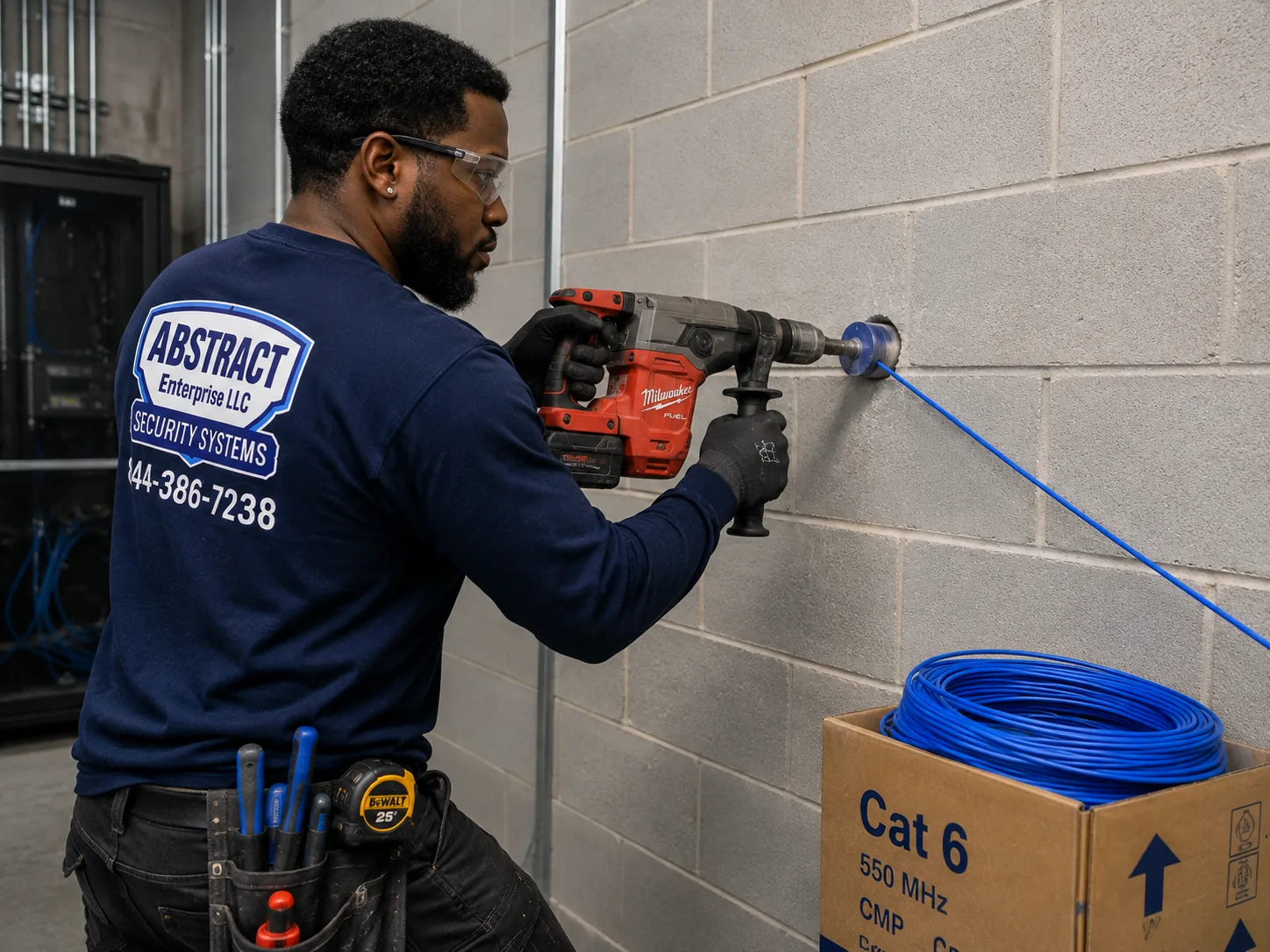
Photo from the AESS job library, not taken on Long Island: a technician core drilling through a concrete block wall so cable can pass through to a network room. On the concrete-block foundation of a 1950s Long Island Cape Cod, a single clean, sealed hole like this is how a PoE cable gets from the basement to a camera on the outside wall without opening a finished room.
Before You Book
Driveway to Back Fence: What to Check on a Long Island Property Before We Arrive
Most of the time lost on a Tapo job is lost in the first hour: a camera that will not pair because the router only offers WPA3, a doorbell with no transformer wire behind it, a garage with no outlet, or a TP-Link account nobody remembers the password to. Ten minutes with your phone prevents nearly all of it. Please do not open walls, climb onto the roof or rewire anything yourself; just look, test and send us what you find.
What to check
Why it matters on Long Island
What to send us
Where the router sits
In many Cape Cods and ranches it is in the basement or a back room, far from the driveway and garage
A photo of the router and the room it is in, and which floor
Wi-Fi bars at each spot
Most Tapo cameras use 2.4 GHz; a spot with one bar on your phone may not hold a camera
Stand at each camera spot with your phone and note the signal
Your router's security setting
TP-Link says WEP, portal-login, WPA or WPA2-Enterprise and WPA3-only networks are not supported
The router's make and model, or a screenshot of its Wi-Fi settings if you can reach them
Which Tapo models you have
Battery, plug-in, wired and PoE models install very differently
A photo of the box or the label on each camera
Outdoor outlets
Plug-in outdoor cameras need a nearby weather-protected outlet; many older houses have few
Photos of any outlets on the outside walls and in the garage
The existing doorbell
A wired Tapo doorbell needs doorbell wiring and a compatible chime; a battery one does not
A photo of the current button and the chime inside
Your siding
A contractor working in Uniondale warns that many postwar homes contain asbestos in materials including siding; we do not drill suspect siding
A photo of the siding close up, and any test results you have
Who approves
Landlords, HOAs, condo boards and office buildings may all have rules
The name of whoever has to sign off, and any written rules
Walk the property at night
The cameras will spend half their lives in the dark, and that is when they are most likely to matter. Walk the driveway, the side of the house and the back yard after sunset and look at what is lit and what is not. Note where the streetlight falls, where the porch light reaches, and where a motion light already switches on. Tapo cameras have night vision, and some models have a spotlight or color night mode, but every camera does better with some light, and none can see through the glare of a bulb pointed back at it. If there is a spot you want watched that is pitch black, tell us; it may change which model belongs there or where it should hang.
Look at what the camera will see beyond your lot
On most Long Island streets, a camera on the front of the house will see the sidewalk, the street and part of the house across the road. That is normal, but it is worth thinking about before we mount. A camera aimed down a driveway shared with a neighbor, or across a back fence into a neighbor's yard, may cause friction later. Tapo's app lets us draw privacy masks that black out part of the picture, and we would rather agree those with you on the day than have a neighbor ask about them later. If you know where you do not want the camera to look, that is as useful to us as where you do.
Find the TP-Link account details
Every Tapo camera is tied to a TP-Link ID through the Tapo app. If you already have some Tapo devices, smart plugs or cameras, they are on an account somewhere, and the new cameras should join the same one. Find the email address and make sure you can log in before the visit. If the cameras were set up by someone else, a previous owner, a family member or another installer, tell us, because a camera still bound to someone else's account has to be released or reset before it can be added to yours.
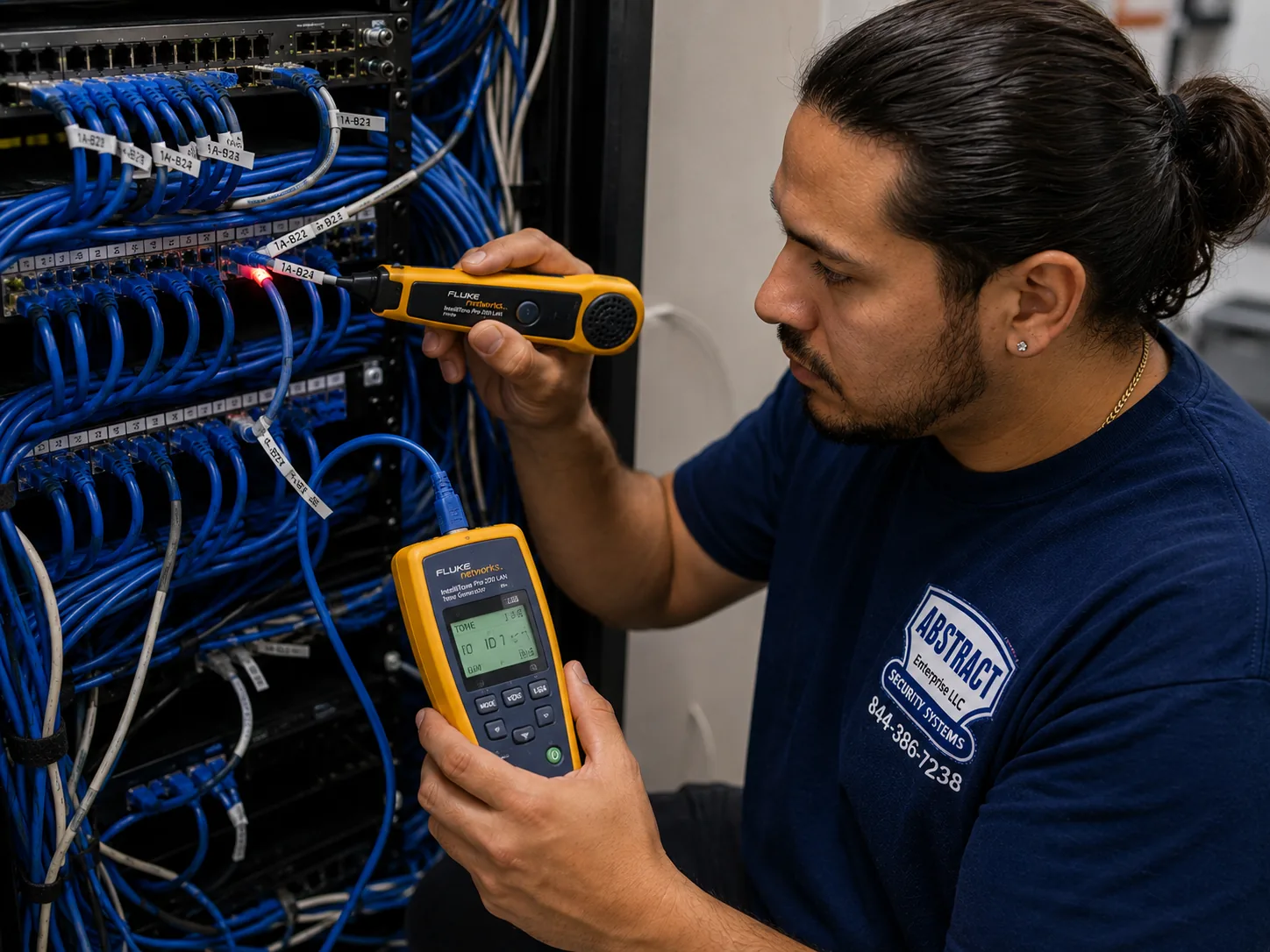
Photo from the AESS job library, not taken on Long Island: a technician tracing an unidentified cable run at a patch panel with a tone generator and probe. Plenty of Long Island houses and stores already have old network or camera cable left by a previous owner; tracing it first can tell us whether a wired Tapo camera can reuse a run instead of needing a new one.
What We Install
Tapo Camera Installation Services in Long Island
These are the Tapo jobs Long Island homeowners, renters, landlords and small businesses book us for. Each one is priced from our Long Island Tapo price list, with the Nassau or Suffolk rate set by your address. Where a job needs something more, a new access point, a PoE switch or an electrician for a floodlight camera, the quote names it before any work starts.
📶
Wi-Fi Survey and Camera Placement
Signal measured at every planned position, from the front porch to the back fence, so each Tapo camera goes where it can stay connected, not just where it looks good on the day.
🚪
Tapo Video Doorbells
Wired doorbells on existing doorbell wiring and chimes, or battery doorbells mounted with screws or the included adhesive, at a height that catches faces and the package on the step.
🚗
Driveway and Garage Cameras
Cameras aimed down the driveway and over the garage door, including detached garages at the back of the lot, on Wi-Fi where it reaches and on cable where it does not.
☀️
Battery and Solar Cameras
Battery Tapo cameras for gates, sheds and fence lines with no power, paired with a solar panel aimed at the open sky and tested for signal before they are left to run.
🔌
Wired PoE Tapo Cameras
Cat6 runs to a PoE switch or injector for cameras too far or too important to trust to Wi-Fi, with outdoor-rated, UV-resistant jacket where the cable is exposed.
🏠
Indoor and Pan-Tilt Cameras
Indoor Tapo cameras for front halls, nurseries and back rooms, including pan-tilt models that follow motion and models with a privacy shutter for rooms where you want the lens closed when you are home.
📱
App Setup in Your Name
Every camera added to your own TP-Link account, microSD cards formatted, motion zones and privacy masks drawn, alerts tuned, and sharing set up for family or staff.
🛡️
Separate Camera Network
A guest or IoT network for the cameras where your router supports it, so they cannot reach your computers and phones, and so a router change does not take every camera down at once.
🔧
Offline Fixes and Takeovers
Cameras that dropped off after a router or provider change moved onto the new network, cameras left by previous owners reset and re-added, and messy earlier installs tidied up.
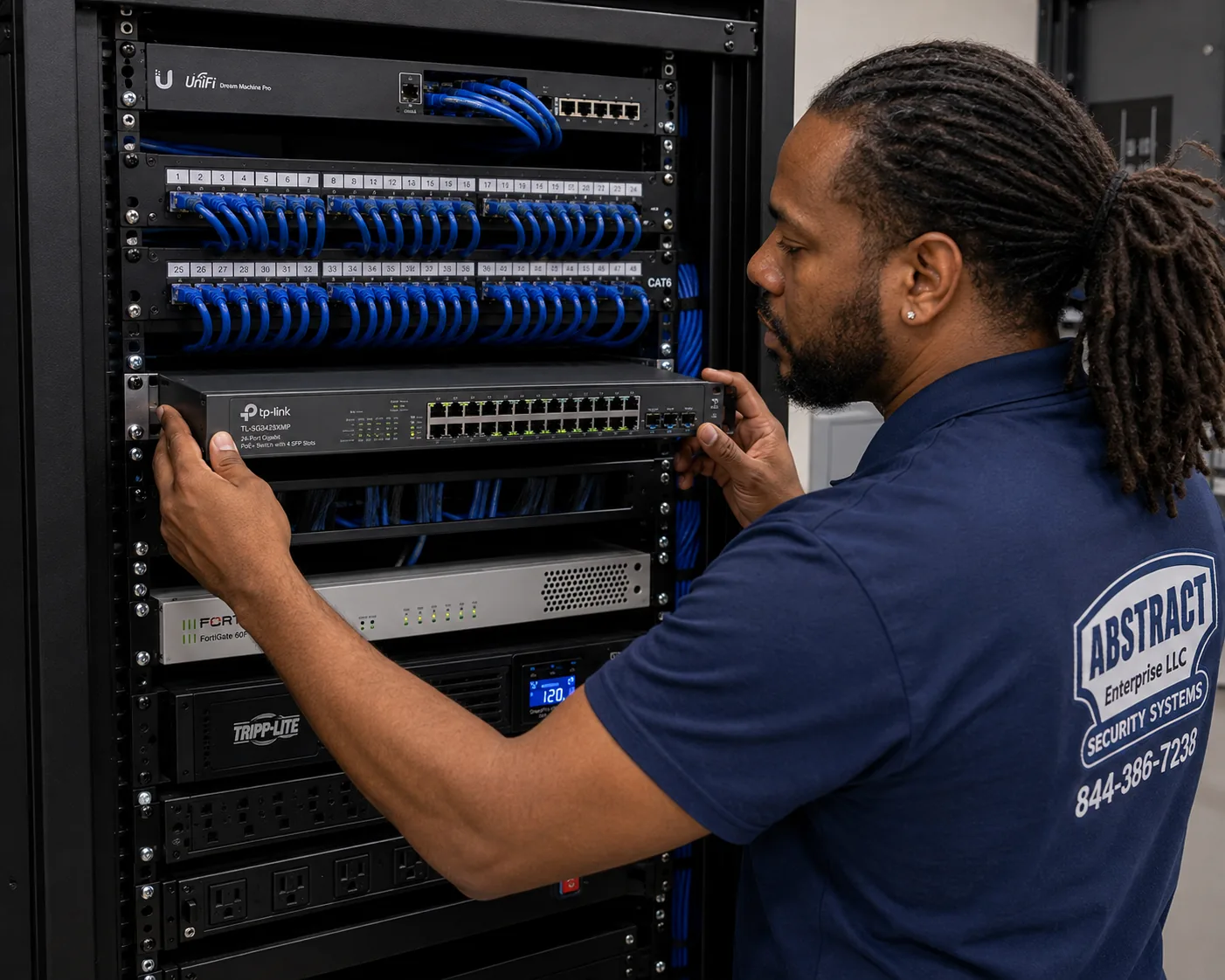
Photo from the AESS job library, not taken on Long Island: a technician mounting a managed PoE switch below patch panels in a commercial network rack. For a Long Island store or office with several wired Tapo cameras, a switch like this powers every camera over its own cable, so one tripped outlet in the stock room does not black out the whole system.
Building Specialists
Tapo Camera Installation for Long Island's Architecture
Across Nassau and Suffolk, a few property types account for most Tapo calls. Each one changes three things about the job: what the camera is fixed to, how it gets power and network, and who has to agree before we start. These are the types the public record and local sources describe, and how we handle each.
Slab Ranches and Early Capes
Levittown-era houses on concrete slabs, some with radiant heating in the floor. Cable goes through the attic and down at the eaves, never through the slab, and the later-added garage is often the hardest camera to connect.
1950s Capes and Ranches with Basements
The common Nassau house: a router in the basement, concrete-block foundation, finished rooms from later decades, and a driveway running to an attached or detached garage.
Split-Levels and Hi-Ranches
Multi-level houses near Hofstra and across the island, where the floors do not line up. Better access-point placement often does more than extra cable.
Larger Suffolk Lots
Newer houses on bigger properties with sheds, pools and gates far from the router. A mix of wired cameras near the house and battery or solar cameras at the edges.
Condos, Townhouses and Rentals
East Garden City's condos and townhouses, garden apartments and rented houses. Board or landlord approval first, and no-drill or minimal-hole options where the walls are not yours.
Stores, Offices and Flex Space
Strip-mall units on Hempstead Turnpike and Old Country Road, suites in the Hub's towers, and flex buildings along Route 110 and in Hauppauge. Building rules, ceiling routes and separate camera networks.
How the property type changes the job
Property
What the camera is fixed to
How power and network usually reach it
Who signs off
Slab ranch or early Cape
Eave trim, fascia boards or solid framing under the siding
Attic cable to the eave; Wi-Fi or battery for a separate garage
The owner
1950s house with basement
Framing at the rim joist, wood trim, or masonry anchors in brick or block
Basement cable out through the sill or block; an added access point upstairs
The owner
Split-level or hi-ranch
Framing, trim or masonry on each level
Wi-Fi from a better-placed router; cable between levels where it can travel
The owner
Larger lot with outbuildings
Posts, sheds, fences and the house itself
Battery and solar at the edges; PoE or outdoor-rated cable where trenching is already happening
The owner, and an HOA if there is one
Condo, townhouse or rental
Inside the unit, or only where the board or landlord allows
Plug-in or battery; adhesive-mounted doorbells where the door frame is not yours
The tenant or owner, plus the landlord, board or managing agent
Store, office or flex unit
Ceiling grid, block walls, steel, or the landlord's approved mounting points
PoE cable to a switch in a back room; a separate camera network
The tenant, the landlord and often the tenant's IT provider
On older siding and what we will not drill. A restoration contractor working in Uniondale writes that Cape Cods and ranches from the postwar boom frequently contain asbestos in materials such as insulation, floor tiles, roofing and siding. We cannot tell by looking whether a particular house's siding contains it, and we do not take the risk. If your house has original shingle siding that has never been tested, we mount cameras on wood trim, fascia, soffit boards or masonry instead of cutting into the siding, and we route cable through paths that do not disturb it, such as an existing hole, the attic, or a basement sill. If you have had the siding tested, show us the results, and if it has been replaced with vinyl, tell us. Either way, we will tell you before we drill exactly where the hole will go and what it passes through.
On detached garages. The detached garage is the single most common reason a Long Island Tapo system disappoints. The camera works on the bench in the kitchen during setup, works on the garage wall the first afternoon, and then starts dropping off. The reasons are distance, the outer walls of the house, the garage's own walls if the camera is inside, and interference from every other network on the block. Our options, in the order we usually try them: move the router or add an access point closer to that side of the house; mount the camera on the house wall looking at the garage, rather than on the garage itself; use a Tapo model with better range or a different band; or run an outdoor-rated cable. If the garage has power and you are planning other work, a properly installed outdoor cable to the garage can also bring Wi-Fi out there for a second camera inside.
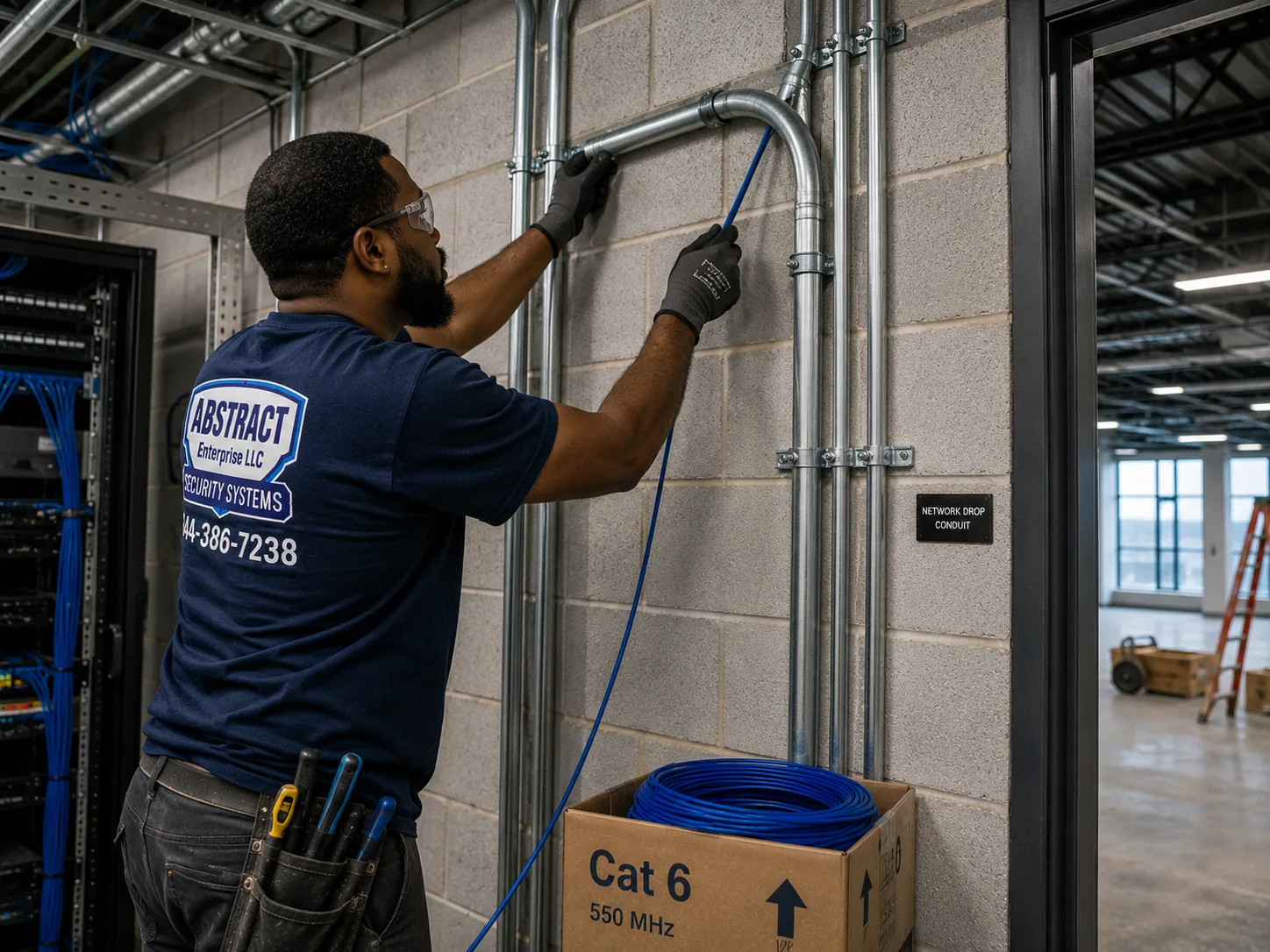
Photo from the AESS job library, not taken on Long Island: a technician running cable into metal EMT conduit beside a telecom room in an industrial building. In a Hauppauge or Route 110 flex building, PoE cable for a Tapo camera on a loading-dock wall travels in conduit like this wherever it is low enough for a forklift or a pallet to hit it.
Commercial Tapo Camera Installation
Business Tapo Camera Installation in Long Island
Tapo is a consumer brand, and we say so to every business that asks for it. For a small store, a single office suite, a deli or a dentist's front desk, a handful of Tapo cameras with good placement, a separate network and microSD recording can be a sensible, affordable choice. For a large site that needs many cameras, long retention, central management or plate reading, a business-grade recorder system usually serves better, and we will tell you if that is where your needs point. The corridors below are the ones local sources name. We describe what those sources say; we do not know what cameras any particular business uses and do not claim any of them as customers.
Hempstead Turnpike at the Hub
NY Route 24 runs along the south side of the Coliseum site. Nassau police reported a January 2025 robbery at the Sunoco station at 1220 Hempstead Turnpike, and News12 reported the September 2026 Morning Delights case in Uniondale. Small storefronts here want entrance and register coverage.
The Hub's Office Buildings
RXR Plaza and the Omni on Earle Ovington Boulevard sit north of the Turnpike. Tenant-suite cameras follow building rules, and Tapo's lack of enterprise Wi-Fi support means a separate camera network.
Old Country Road and Roosevelt Field
Wikipedia calls Roosevelt Field, at 630 Old Country Road, the largest mall on Long Island, built on the field Lindbergh left from in 1927. Mall tenants work under the landlord's rules; the stores and offices along the road outside it have more freedom.
Jerusalem and Uniondale Avenues
Local strips where police released surveillance footage after a robbery at the Pump & Stuff on Jerusalem Avenue, and a screenshot after a car left running on Uniondale Avenue near Waverly Place was stolen. Curb and lot views matter here.
The Route 110 Corridor
A commercial real estate firm describes the corridor through Farmingdale, Melville and Huntington Station as dense with warehouse, flex, research and office uses. Flex units need loading-door and back-lot cameras.
Hauppauge and Ronkonkoma
A 2017 law-firm report counted about 1,350 businesses in what is now the Long Island Innovation Park at Hauppauge, and Suffolk is seeking a master developer for 48 acres between MacArthur Airport and the Ronkonkoma LIRR station.
What a store or office camera has to do
A camera at home is watched now and then by a family that knows the house. A camera in a business is often watched after something has already gone wrong, by an owner, a manager, an insurer or a detective who needs a clear picture of a face, a hand at the register or a vehicle in the lot. That changes how we place Tapo cameras for businesses. The entrance camera goes where it sees faces coming in, at a height and angle that avoids the glare of a glass door. The register camera looks down at the counter, not across it into the customer's face from three feet away. The back-door camera catches whoever opens it from the inside as well as the outside. And the cameras that matter most are wired wherever we can wire them, because a store's Wi-Fi is often shared with a payment terminal, a music system and staff phones, and that is exactly the network a Tapo camera should not be fighting for space on.
Recording is the other business question. Tapo cameras record to their own microSD cards, and TP-Link sells an optional cloud plan. A microSD card in a camera on the ceiling of a store is fine until someone steals or smashes the camera, at which point the recording goes with it. For businesses we usually suggest at least one camera mounted high and out of easy reach, cloud recording on the cameras that matter most, and a clear routine for saving clips the moment something happens. We set it up and show the owner and the manager how to do it from their phones.
Rules and practical limits for business cameras
State licensing. New York's General Business Law Article 6-D requires a Department of State license to install, service or maintain security or fire alarm systems. AESS holds NYS license #12000287431, and the work on this page is done under it.
County licensing differs for commercial work. Nassau County's Office of Consumer Affairs says it is against the law to run a home improvement business in the county without a license, and its FAQ adds that anyone who works only on commercial buildings does not need that license. Homes and businesses can check a contractor through the Office of Consumer Affairs.
Town and village permits. A trade blog on Nassau cabling says New York's Uniform Fire Prevention and Building Code has required permits for low-voltage electrical installations since 1984 and that most Nassau towns and villages enforce permit rules. We have not found an official list of which camera jobs need which permit, so we check with the municipality for your address when the scope warrants it.
Mains power is an electrician's job. TP-Link's floodlight camera instructions require an all-pole mains switch in the building's wiring. Where a business wants a floodlight camera or a new outlet high on a wall, that circuit work goes to a licensed electrician, and our quote says so.
Restrooms and changing areas are off limits. Under New York Penal Law section 250.45, recording inside a bathroom, changing room or similar private space without consent is a felony. We do not install cameras in those spaces and we check that no camera's field of view reaches into them.
Alarm permits only if you add an alarm. An alarm company's page says Nassau residents and businesses served by the Nassau County Police Department must register alarm systems. A Tapo camera on its own is not an alarm, but if your cameras are tied to an alarm system, that registration may apply.
Landlord papers. Many commercial landlords ask for a certificate of insurance and set hours for drilling and ladder work. Send us the requirements with the booking so the paperwork is ready.
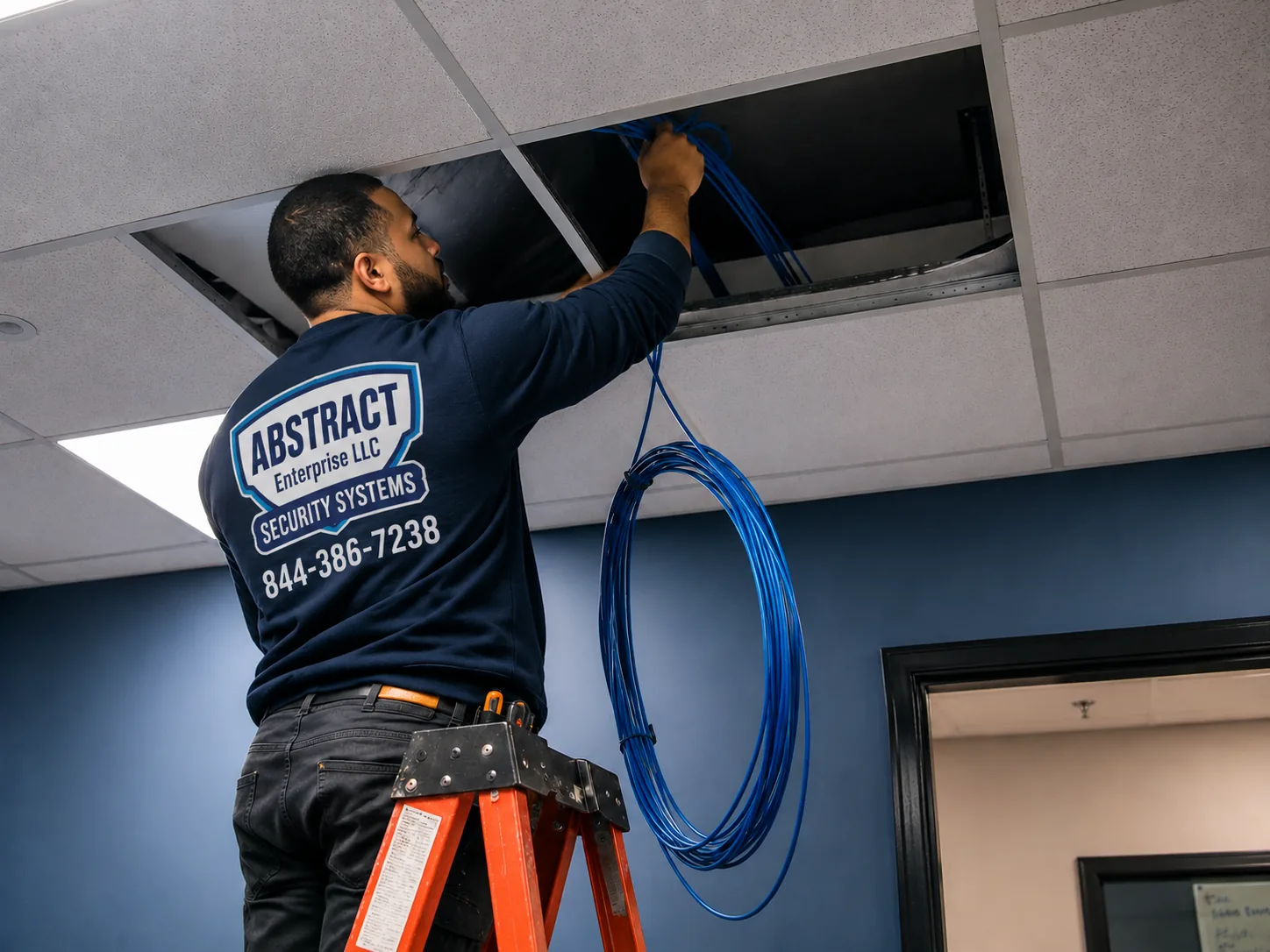
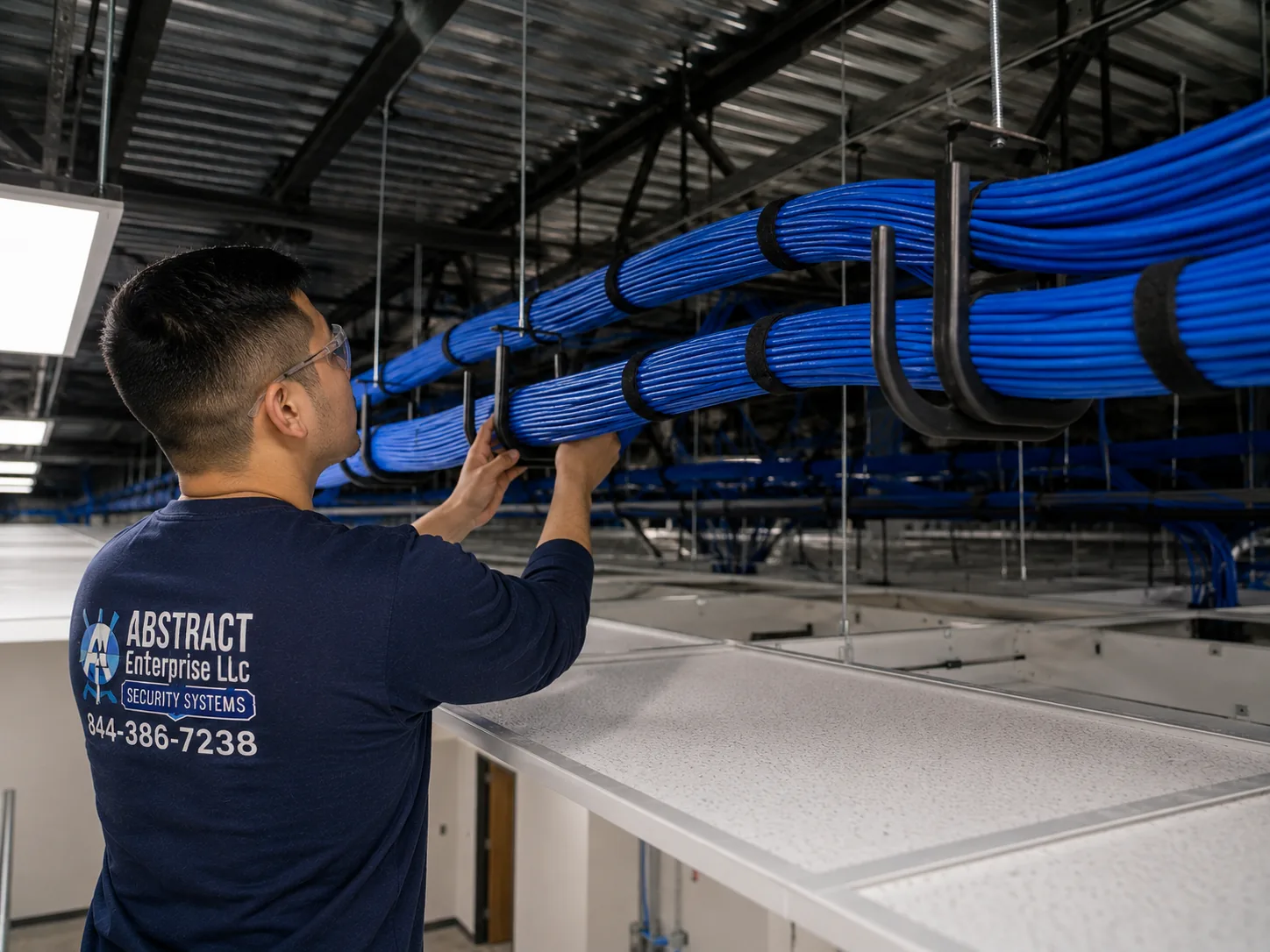
Photo from the AESS job library, not taken on Long Island: a technician feeding cable through the ceiling of a commercial space that stays open around the work. In a strip-mall unit on Hempstead Turnpike or Old Country Road, the PoE cable for a Tapo camera over the register goes in through the drop ceiling like this, without closing the store.Photo from the AESS job library, not taken on Long Island: a row of J-hooks carrying neat bundles of cable across a commercial ceiling. In a Route 110 flex building or an office suite near the Hub, camera cable rides on supports like this instead of lying on the ceiling tiles, so the next contractor in the ceiling does not crush it.
Field Notes
Field Notes: The First Walk Around a Long Island Lot
We do not publish stories about a particular customer's property unless we can document them, so this is not a tale about one address. It is the routine our technicians follow when they arrive at the kind of property Long Island is full of: a 1950s house, a router in the basement, a driveway down one side, a garage at the back, and a bag of Tapo boxes on the kitchen table.
We leave the boxes closed. We start at the router, check what it is, what security mode it uses and which bands it offers, and note what else is on it. Then we walk the property with a phone running a Wi-Fi survey app, stopping at every spot you want a camera: the front door, the corner of the driveway, the garage, the back gate. At each one we note the signal strength and what stands between it and the router, brick, block, siding, a hedge, a car. We look up at the eaves for solid wood to fix into, check the siding, and find out where an outdoor outlet is, if there is one. We look in the attic or basement for a cable route. Then we sit down with you, show you the readings, and say which cameras will run well on Wi-Fi, which need an access point, and which need a cable. Only after you have agreed does the first box come open.
Your Questions Answered
Tapo Camera Installation in Long Island: Questions Answered
Cost and planning
The cameras themselves were inexpensive. Why does installing Tapo cameras on a Long Island house cost more than the cameras did?
Because the camera is the smallest part of the job. The work is in finding a spot where each camera can see what matters, stays connected and can be powered, then fixing it securely to an old house, sealing the hole, setting up the network and the app, and testing it at night. On a Long Island lot, the spots people care about, the driveway, the garage, the back gate, are usually the farthest from the router, and that is where the time goes. Our Long Island price page lists every line so you can see where the money is going, and the quote names any access point, cable or electrician work before you agree to it.
How should a Long Island homeowner decide how many Tapo cameras to put up?
Start from the ways into your property, not from a number. On most Nassau and Suffolk houses that means the front door and porch, the driveway, any side or back door, and the garage. A doorbell covers the front step and packages; one camera on the corner of the house can usually cover the driveway and the side door together; and the back yard may need one more. For many Cape Cods and ranches that adds up to three or four cameras. If you have a long driveway, a detached garage or a gate at the bottom of a big Suffolk lot, add one for each. We would rather put up three cameras that stay online and see faces than eight that drop out.
Wi-Fi, range and the detached garage
Our router is in the basement of a 1950s Cape and the garage is at the back of the lot. Will a Tapo camera out there stay connected?
Possibly, but we would not promise it without measuring. A basement router sends its signal through the floor above, the foundation and the outer wall before it even leaves the house, and a detached garage adds distance and its own walls. Tapo cameras usually connect on 2.4 GHz, which reaches farther than 5 GHz but still fades quickly through block and brick. We test at the exact spot first. If the signal is weak, the fixes are usually moving the router upstairs or adding an access point on the garage side of the house, mounting the camera on the house looking at the garage, or running an outdoor-rated cable. We tell you which one we would choose and why.
Which Wi-Fi settings does a Tapo camera need, and will it join our newer mesh system?
TP-Link says most Tapo cameras use 2.4 GHz, with some models, including the Tapo C260, C460 and C840, also able to use 5 GHz. Its support pages say Tapo cameras do not work on WEP, portal-login, WPA or WPA2-Enterprise networks, or on networks set to WPA3 only. Many newer mesh systems combine both bands under one name and default to modern security, which usually works, but some ship set to WPA3 only, and some steer devices between bands in a way cameras dislike. We check the router's settings before setup, and if needed we switch it to a WPA2 and WPA3 mixed mode or create a separate 2.4 GHz network just for the cameras.
If a storm knocks out our internet, do the Tapo cameras keep recording?
The ones that still have power do, if they have a microSD card. TP-Link says that once a camera is set up, SD card recording continues even if it loses its connection to the router. You will not get alerts or live view on your phone until the internet comes back, but the footage is on the card. Power is the bigger issue: when Isaias left almost half of PSEG Long Island's customers in the dark in 2020, every plug-in camera on those houses went dark too. Battery Tapo cameras keep running, and plug-in cameras can be kept alive with a small battery backup on the router and their outlets. We set the cards up and tell you which cameras will survive an outage.
Power and wiring
Our ranch has almost no outdoor outlets. Which Tapo power option makes sense for it?
It depends on the spot. Tapo makes cameras that are wired only, wired with battery backup, and battery only, plus PoE models that take power and data over one network cable. For a front corner near an attic, a PoE or low-voltage wired camera fed from inside is usually the most dependable. For a back gate or fence with no power, a battery camera with a solar panel facing open sky is the practical choice. For a spot near an existing exterior outlet, a plug-in model works. What we avoid is running an indoor extension cord out of a window, or adding outdoor outlets ourselves; new outlets are an electrician's job. Most Long Island houses end up with a mix.
What cable does a wired Tapo PoE camera need outside, and does it have to connect to a recorder?
Tapo's own PoE installation guide says to use Cat5e or Cat6 cable, and that any run exposed to weather needs an outdoor-rated, UV-resistant jacket. Ordinary indoor cable on the outside of a Long Island house breaks down in sun and salt air within a few seasons. We use Cat6 rated for where it runs, seal every entry, and power the camera from a PoE switch or injector inside. Tapo's guide also takes up whether a PoE camera needs a recorder; in our practice a Tapo PoE camera records to its own microSD card where the model supports it, so a separate recorder is not needed for it to work, though some owners add one for longer storage.
Rules, licenses and privacy
Do we need a permit or a licensed installer for Tapo cameras in Nassau or Suffolk?
For most plug-in and battery cameras on a house, a permit is unlikely, but the rules depend on the town or village and on the scope, and we check when the job involves new wiring. Licensing is clearer. New York's General Business Law Article 6-D requires a state license for businesses that install security systems, and AESS works under NYS license #12000287431. Nassau County also requires a home improvement license for contractors working on homes, and says it does not apply to purely commercial work; you can check any contractor with the county's Office of Consumer Affairs. Suffolk has its own county licensing for some trades, which some towns and villages replace with their own.
Can our Tapo doorbell record what people say on the driveway and the sidewalk?
Legally, it is more nuanced than most people think. The Digital Media Law Project describes New York's wiretapping law as one-party consent, meaning a recording is lawful if one person in the conversation agrees to it. A doorbell recording your own conversation with a delivery driver falls into that category. A camera quietly picking up neighbors talking to each other on the sidewalk, where you are not part of the conversation, is a different matter, and it is a reasonable source of friction between neighbors. Our default is to leave audio on for the doorbell and on cameras that face your own door, and to turn audio recording off on cameras that face the street, a shared driveway or a neighbor's yard.
Should we register our cameras with the police, and does that give them access to our video?
Registering is voluntary and does not hand anyone your feed. The Suffolk County Police Department's camera registry asks owners to list where their cameras are, so detectives can ask them to check footage for a date and time after a crime, with retrieval at the owner's convenience. Garden City's police department runs a similar private camera registration and states plainly that it does not give the department access to privately owned systems. We found no county-wide registry for Nassau County police. If you register, keep your microSD cards working and know how to export a clip; we show you how at handover.
TP-Link and security
We keep reading that TP-Link is being banned. Will our Tapo cameras stop working?
As of the latest sources we read, there is no federal ban on using TP-Link or Tapo products. IsMyRouterSafe reported on October 8, 2026 that no federal order bans TP-Link routers and that owners can keep using the ones they have, while a March 2026 FCC rule blocks approval of new foreign-made router models without a conditional approval, which TP-Link does not hold. On cameras, a U.S. senator has asked the Commerce Department to look at TP-Link's internet-connected cameras, and SmartHomePerfected reported that a targeted federal action was shelved in early 2026. That is a live situation, not a settled one. We set Tapo cameras up so that if anything changes, the microSD recording keeps working and the cameras sit on their own network.
How do you keep a Tapo camera from being a way into the rest of our home network?
By giving the cameras their own network. A common piece of advice, repeated in coverage of the TP-Link debate, is to put cameras, smart plugs, TVs and other connected devices on a separate guest network so they cannot reach your computers and phones. Most Long Island routers and mesh systems can do this. We set the cameras on that network, use a strong unique password for your TP-Link account, turn on two-step verification in the app, update the camera firmware, and remove any old shared users you do not recognize. None of that makes any camera perfectly safe, but it limits what a compromised device could reach.
What the cameras should catch
Thieves on Long Island have been targeting cars in driveways. Where should a Tapo camera go to actually help?
ABC7's 2024 report on the Nassau and Suffolk task force said police believed burglars were drawn by cars in driveways, so the driveway is the right place to start. One camera high on the corner of the house, angled down the length of the driveway, catches people walking up to the cars and to the side door. A second, lower camera near the garage or the back of the driveway catches faces at closer range. A wide camera mounted very high sees the whole scene but makes every face tiny, so we balance height against detail. We also aim cameras so passing headlights on the street do not trigger constant false alerts.
Our packages keep disappearing from the front step. Where does the doorbell need to sit to catch it?
Low enough to see the package and high enough to see the face. The package-theft case the Suffolk District Attorney announced in 2025 spanned 31 communities, and a doorbell camera's video is what News12 showed from a Massapequa Park porch. A doorbell mounted too high looks over the box; mounted too low it sees chests and hoods. Many Tapo doorbells have a tall field of view designed to see down to the step, and we test the view with a box on the step before tightening the mount. If the door is recessed or the porch has steps, a wedge or corner bracket can turn the camera toward the walkway.
Weather and the outside of the house
How do outdoor Tapo cameras hold up near the South Shore or the Sound?
They hold up if they are mounted and sealed with the weather in mind. Most outdoor Tapo cameras carry a weatherproof rating, but the bracket, the cable and the hole in the wall are where water gets in. Near the water, salt air also corrodes cheap screws and connectors. We use stainless or coated fixings, mount cameras under an eave or soffit where we can, give every cable a drip loop so water runs off before it reaches the hole, seal every penetration, and use outdoor-rated, UV-resistant cable for anything exposed. After a big storm, check that the cameras still point where they should; a strong gust can turn a loose mount.
Do you set up the Tapo app and accounts, or only mount the cameras?
Both, and we think the setup is half the job. A camera on the wall that is not in your account, has no card formatted, sends an alert every time a car passes and cannot be found by your spouse's phone is not a working camera. We add every camera to your own TP-Link account, not ours, set up the microSD cards, draw motion zones and privacy masks, name each camera so you know which is which, set alert schedules, share access with the family members or staff you choose, and walk you through playback and saving a clip. If you already mounted the cameras yourself and just need them set up properly, that is a job we take too.
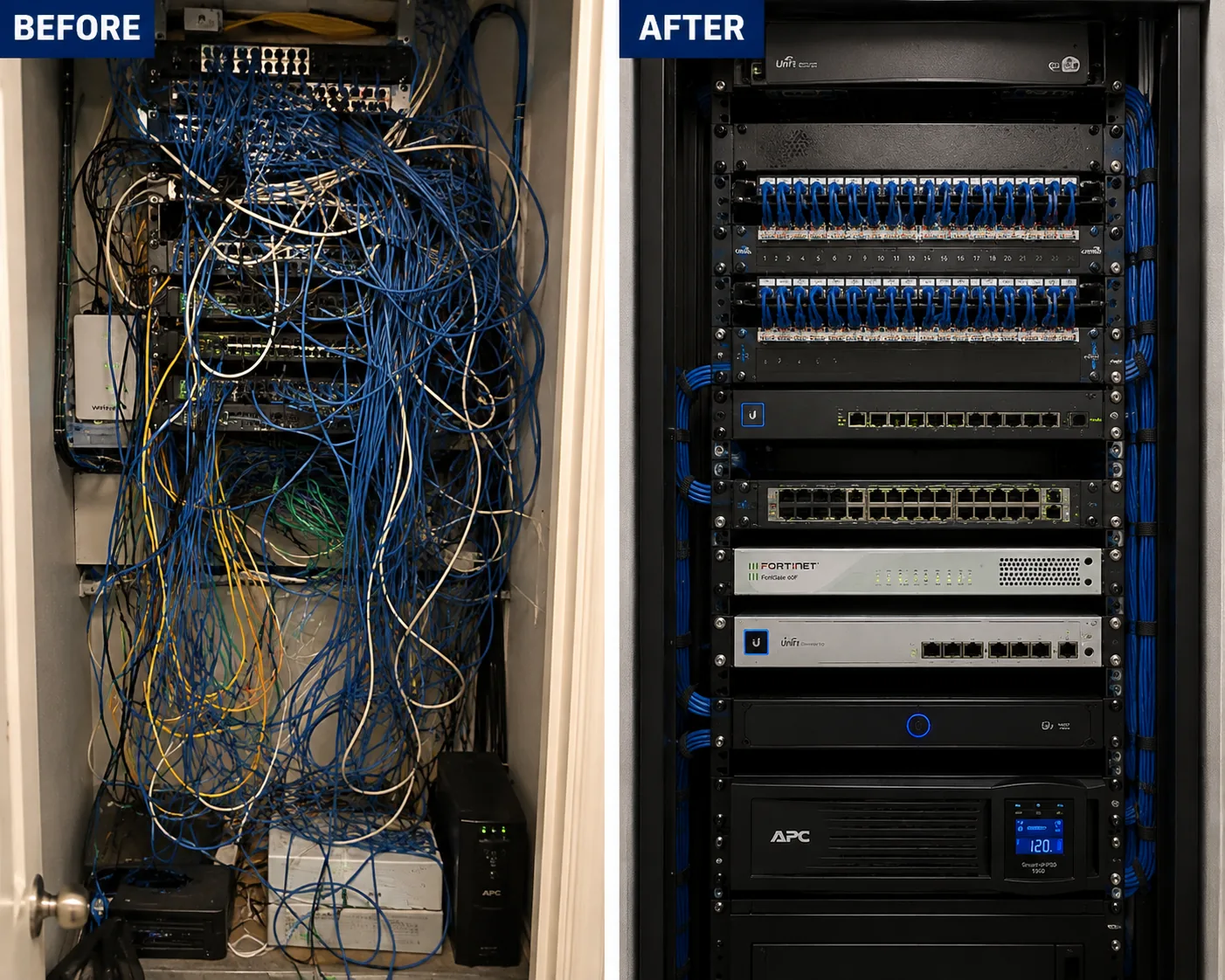
Photo from the AESS job library, not taken on Long Island: the same network rack before and after a cleanup, first a tangle of unlabelled cables, then rebuilt with every cable dressed and identified. When a Long Island store takes over cameras a previous tenant left behind, this is the difference between guessing which cable feeds which Tapo camera and knowing.
Equipment
Types of Tapo Camera Installation We Install
Tapo's range covers most of what a Long Island home or small business needs. These are the categories we install and where each one fits. We install Tapo cameras you have already bought, or help you choose the right ones for each spot before you buy; model availability changes, so we confirm current models when you book.
🏠
Indoor Plug-In Cameras
Small cameras for front halls, back rooms and nurseries, including models with a privacy shutter and a magnetic base. Inside the house, where Wi-Fi is strongest, they are the simplest Tapo cameras to run.
🔄
Pan-Tilt Cameras
Indoor and outdoor cameras that turn to follow motion or look around a room or yard, including dual-lens and solar-assisted outdoor versions. Useful in a basement entry or a wide back yard.
🚪
Video Doorbells
Wired and battery Tapo doorbells, mounted with screws or the included adhesive according to TP-Link, with a chime inside. The first camera most Long Island houses get.
🔋
Battery and Solar Cameras
Wire-free cameras for gates, sheds, pool areas and fence lines, with solar panels where there is open sky. They wake on motion, so placement and signal matter even more.
🌐
Outdoor Wired and PoE Cameras
Fixed outdoor cameras on plug-in power or PoE cable, for driveways, side doors and storefronts where a camera has to stay online every night.
💡
Floodlight Cameras
Cameras built into a light that mounts on a junction box on a wall or under an eave. TP-Link requires an all-pole mains switch in the wiring, so a licensed electrician handles the power and we handle the camera.
💾
MicroSD Cards and Cloud
Cards formatted and checked in every camera that takes one, so recording carries on when the internet drops, and TP-Link's optional cloud recording set up where you want an off-site copy.
📡
Access Points and PoE Switches
The network gear that makes Tapo cameras dependable on a big lot: an access point closer to the garage side of the house, or a PoE switch for the wired cameras.
Tapo vs national security brands, and a local installer
People ask how a Tapo system installed by us compares with ADT, Ring or SimpliSafe. They are different things. ADT is best known for professionally monitored alarm systems. Ring and SimpliSafe sell doorbells, cameras and self-install security kits, mostly designed around their own apps and cloud plans. Tapo is TP-Link's line of low-cost cameras and smart devices, and its strength is that local microSD recording works without a subscription. None of those brands comes with someone who walks a Long Island lot, measures the Wi-Fi at the garage, and decides which camera needs a cable. That part is what we add, whichever cameras you choose. If what you really want is monitored alarm protection, Tapo cameras are not a substitute, and we will say so.
Question
Tapo, self-installed
Tapo, installed by AESS
Who picks the camera spots?
The owner, often where the bracket fits easily
A technician, after measuring Wi-Fi and checking night views at each spot
What happens at the detached garage?
The camera may connect at setup, then drop off
Signal tested first; access point, different model or cable chosen if needed
Power for spots without outlets
Battery, or an extension cord out of a window
Battery with solar, PoE cable, or an electrician for new circuits
Network security
Usually on the main home network
A separate camera network where the router allows it
Account ownership
The owner's account
The owner's account, set up and documented for you
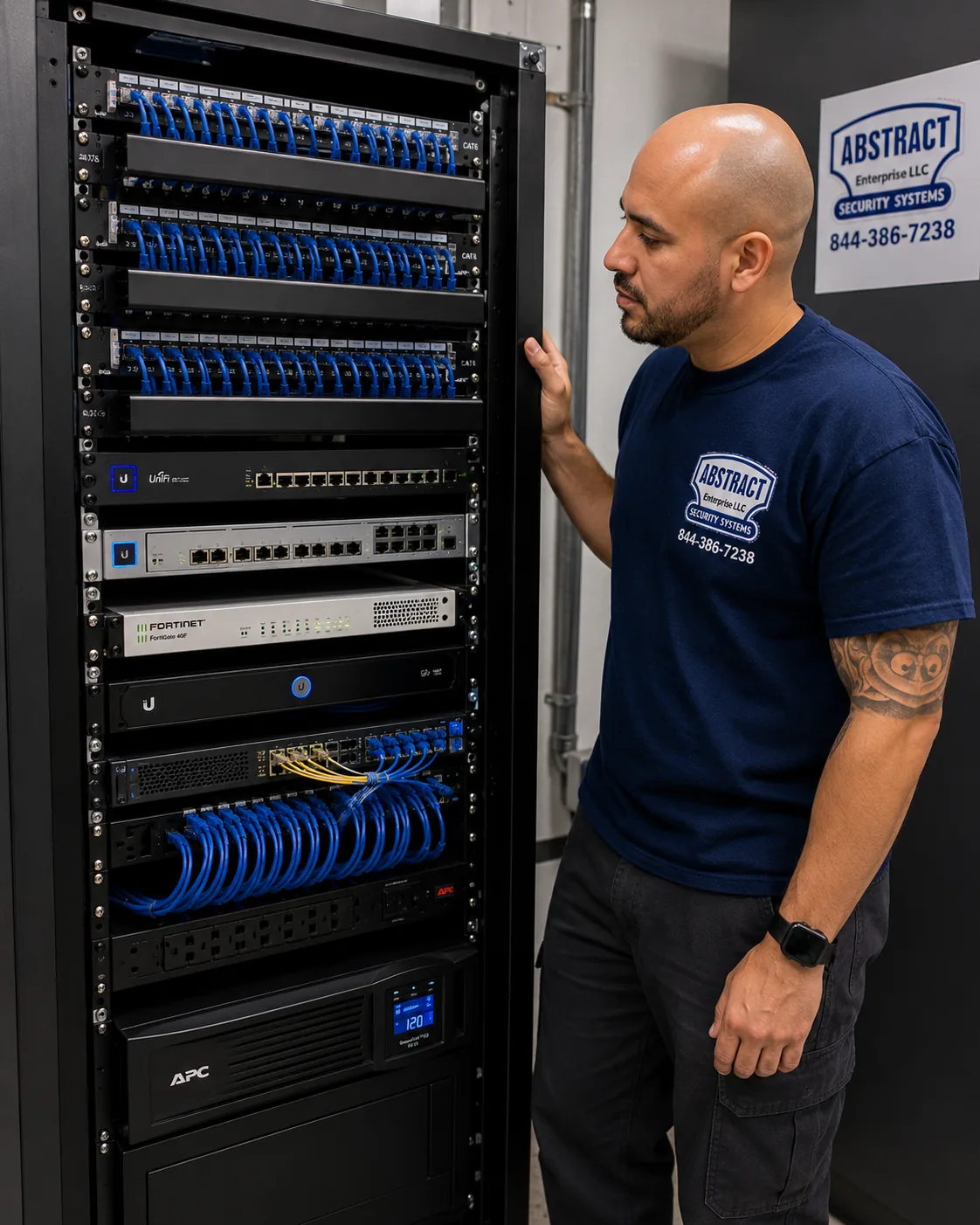
Photo from the AESS job library, not taken on Long Island: a finished network rack with patch panels, switching, a firewall and a battery backup unit, every part dressed and identified. A Long Island office suite will rarely need this much, but the same idea applies at any size: the cameras on their own network, behind a firewall, with a battery that keeps them recording when the power flickers.
AI Overview Reality Check
What AI Gets Wrong About Tapo Camera Installation in Long Island
We could not capture Google's AI Overview or its question boxes for Tapo installation on Long Island from our build environment, so we will not pretend to quote them. What follows are claims we see repeated in quick online answers about Tapo cameras and about this part of New York, set against what the public record and our field practice say. National marketplaces such as Angi, HomeAdvisor and Fixr publish camera installation cost guides that feed many of those answers; they help with a rough idea, but they are not a quote for a driveway in Levittown or a store on Hempstead Turnpike.
"TP-Link and Tapo are banned in the United States."
This one spreads quickly because there has been real news. A U.S. senator has asked the Commerce Department to investigate TP-Link's internet-connected cameras, and in March 2026 the FCC adopted a rule blocking approval of new router models made abroad unless they hold a conditional approval.
But as IsMyRouterSafe summarized on October 8, 2026, no federal order bans TP-Link routers, and owners can keep using what they have. SmartHomePerfected reported that a targeted federal action was shelved in early 2026. Cameras already on Long Island homes are not switched off by any rule we found.
The sensible response is preparation rather than panic: microSD recording that works without the cloud, cameras on their own network, and updated firmware. That is how we set them up regardless.
"Tapo cameras work on any home Wi-Fi."
TP-Link's own support pages say otherwise. Most Tapo cameras connect on 2.4 GHz, with a few models such as the C260, C460 and C840 also supporting 5 GHz, and Tapo cameras do not support WEP, portal-login, WPA or WPA2-Enterprise networks, or networks set to WPA3 only.
On Long Island that matters in two places. Newer routers and mesh systems sometimes ship in WPA3-only mode, and office suites at places like the Hub often run enterprise networks that need a username as well as a password.
We check the router before setup. At home that usually means a mixed security mode or a separate 2.4 GHz network; in an office it means a network just for the cameras, set up with the tenant's IT provider.
"Wireless cameras mean no wiring at all."
Wireless describes the video signal, not the power. A plug-in Tapo camera still needs an outlet, a floodlight camera needs mains wiring, and a battery camera needs charging or a solar panel with enough sky.
Many of Long Island's postwar houses have few exterior outlets, and the spots that matter, the garage, the gate, the back fence, often have none. Those are also the spots farthest from the router, where Wi-Fi is weakest.
So a typical Long Island Tapo system mixes power sources: plug-in where there is an outlet, battery and solar at the edges, and PoE cable for the cameras that have to stay online. Pretending it can all be wire-free is how cameras end up dead in a drawer.
"No license or permit is ever needed for cameras on Long Island."
For a homeowner sticking a battery camera on their own porch, that is close to the truth. For a business that installs cameras for others, it is not. New York's General Business Law Article 6-D requires a state license to install security systems.
Nassau County adds a home improvement license for contractors working on homes, while exempting purely commercial work. A trade blog on Nassau cabling says most towns and villages enforce permit rules for low-voltage work, though we found no official list of which camera jobs need one.
Long Island has dozens of villages and towns, each with its own building department. We work under NYS license #12000287431 and check the municipality for your address when a job involves new wiring.
"A floodlight camera is a simple DIY swap for your porch light."
Videos make it look like a ten-minute job. TP-Link's own floodlight instructions say the camera mounts on a junction box on a wall or under an eave, and that an all-pole mains switch must be part of the building's wiring.
That is line-voltage electrical work. On an older Long Island house, the box behind the porch light may be loose, undersized or wired in ways nobody has looked at since the 1950s, and a heavy floodlight on a weak box is a fall waiting to happen.
We plan the camera, its angle and its network; a licensed electrician handles the power. If you would rather avoid that step, a wired or battery camera beside the existing light often does the same job.
"One good camera on the house will cover the whole yard and the garage."
A wide-angle camera does see a lot, but it sees everything small. A camera on the back corner of a Cape Cod looking at a detached garage sixty feet away will show that someone was there; it will rarely show who.
Distance also hurts the connection. The farther a camera is pointed, the more people put it at the far edge of the house, which is usually the far edge of the Wi-Fi too.
We plan coverage by what each camera must identify: a face at the door, a person at the car, a vehicle in the driveway. On Long Island lots that usually means two closer cameras rather than one distant one.
"New York is a two-party consent state, so camera audio is illegal."
We have seen this repeated even on installer pages. The Digital Media Law Project describes New York's wiretapping law as one-party consent: a conversation can be recorded if one participant agrees.
That does not make every microphone a good idea. A camera picking up neighbors' conversations on the sidewalk, where you are not taking part, is a different situation, and New York Penal Law section 250.45 makes recording inside private spaces like bathrooms and bedrooms without consent a felony.
Our practice is simple: audio on for the doorbell and cameras facing your own entry, audio off for cameras facing the street, a shared driveway or a neighbor's yard, and no cameras in private rooms at all.
Not Sure Which Spots Need a Cable? Talk to a Technician About Your Long Island Property
Send the town, the house type, the Tapo models you have or want, and photos of each spot you want watched, and a technician will tell you which cameras should run happily on Wi-Fi, which will need an access point or a cable, and whether any need an electrician. Call (800) 486-0943, message us on WhatsApp, or use the quick form.
Every Long Island Tapo job follows the same eight steps, whether it is a single doorbell on a Levittown ranch or a dozen cameras across a Route 110 flex unit. The order matters most on big lots and older houses, where a camera mounted before the Wi-Fi is measured is the usual cause of a system that works for a week and then goes quiet.
1. Send the address and photos
The street, the town or village, the house or building type, and a photo of each spot you want watched. That tells us whether the Nassau or Suffolk rate applies and which Tapo models fit.
2. Check the rules for that address
Who owns the walls, whether a landlord, HOA or office building must approve, whether a floodlight needs an electrician, and whether the town or village has its own permit rules.
3. Walk the property and test the Wi-Fi
Signal measured at every camera spot, garage and gate included, and each camera assigned to Wi-Fi, battery, solar, plug-in or PoE.
4. Prepare the network
A 2.4 GHz band confirmed, the security mode checked against Tapo's supported list, and a separate camera network set up where the router allows it.
5. Mount and seal each camera
Fixed to solid framing, trim or masonry at heights agreed with you, every hole sealed, outdoor cable in outdoor-rated, UV-resistant jacket.
6. Run and test any PoE cable
Cat6 pulled to a PoE switch or injector, terminated, tested and labelled at both ends.
7. Set up the Tapo app in your name
Cameras added to your TP-Link account, cards formatted, motion zones and privacy masks drawn, audio set by where each camera points.
8. Hand over and walk through
Live view, playback, alerts and sharing shown on your phone, with a written list of every camera, its spot, its power and its network.
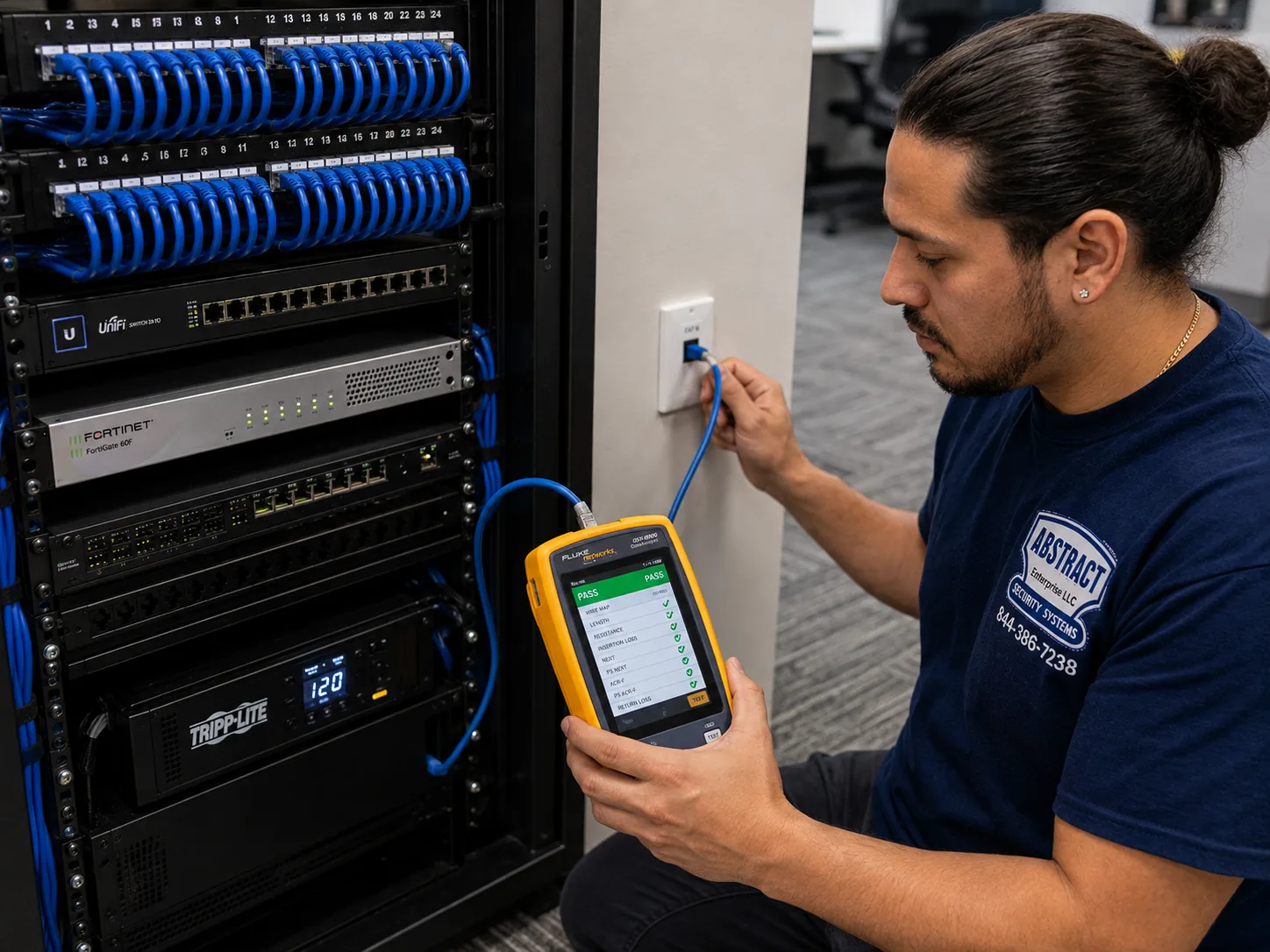
Photo from the AESS job library, not taken on Long Island: a technician checking a data drop with a cable analyzer that shows a PASS result. Step six on a Long Island job looks like this: every PoE cable to a Tapo camera is tested before the camera goes up, so a bad termination is found on the bench, not on a ladder under a wet eave.
Coverage Area
Tapo Camera Installation Near Long Island's Landmarks
The Nassau Hub is our reference point for this page, and these are the landmarks around it that we use to plan visits. From here we cover the rest of Nassau and Suffolk.
Nassau Coliseum
At 1255 Hempstead Turnpike on part of the old Mitchel Field. Las Vegas Sands withdrew its casino plan in April 2025, and the Long Island Press reported the Hub was rezoned for new development in June 2025.
Cradle of Aviation Museum
On land that was once part of Mitchel Air Force Base, which took the Mitchel name in 1918 and closed in 1961, according to the museum's own history.
Hofstra University
About 244 acres in the Uniondale section of Hempstead, with part of its campus south of Hempstead Turnpike, per Wikipedia.
Roosevelt Field
At 630 Old Country Road in East Garden City, the largest mall on Long Island, built on the airfield Charles Lindbergh flew from in 1927.
RXR Plaza and the Omni
The Hub's office towers on Earle Ovington Boulevard; RXR Plaza's two 15-story towers are described as Long Island's largest office building, and the Omni was built in 1990.
Mitchel Air Base and Flight Line
A 108-acre historic district listed on the National Register in 2018, roughly along Charles Lindbergh Boulevard and Ellington Avenue, including former officers' housing.
Beyond the Hub, we install Tapo cameras across both counties, including Garden City, Levittown, Hicksville and the Route 110 towns in Nassau and western Suffolk, and Hauppauge, Ronkonkoma, Stony Brook and the East End in Suffolk. Nassau addresses are priced from the Nassau County Tapo camera installation prices, and Suffolk addresses from the Suffolk County Tapo camera installation prices.
Pricing
Tapo Camera Installation Cost in Long Island
Long Island Tapo work is priced from our published Long Island Tapo price list, not from a number invented for this page. Because Nassau and Suffolk are priced as separate areas, each with its own rate above the city base, the right list depends on your address: the Nassau page for Nassau addresses and the Suffolk page for Suffolk. You can see every line and build your own system on the Long Island Tapo camera installation price list. We do not print a different set of numbers here, so the two can never disagree.
What moves a Long Island Tapo quote
Factor
Why it matters
Where it is common on Long Island
Number of cameras
Each camera is mounted, powered, connected and set up separately
Three to four on many Capes and ranches; more on large Suffolk lots
Distance from the router
Far cameras may need an access point or cable to stay online
Detached garages, back gates, long driveways
Power source
Battery and plug-in cameras are quicker; PoE cable takes longer; floodlights need an electrician
Older houses with few exterior outlets
Mounting surface
Wood trim is quick; brick and concrete block need masonry anchors
Attic and basement routes vary; slab houses route only through the attic
Levittown-era slab ranches, finished basements
Height and access
Second-story eaves and steep lots need more ladder work
Split-levels, hi-ranches, Capes with dormers
Network work
A separate camera network or a router change adds time
Newer WPA3-only routers, office suites
Existing system
Cameras left by previous owners may need resetting and re-adding
Recently bought houses and taken-over storefronts
How to read the list for a Long Island house
Take a 1950s Cape in Nassau with a doorbell, a camera on the front corner for the driveway, and one on the detached garage. On the Nassau price page that is three camera installs, plus whatever the garage needs once we have measured it: nothing extra if the Wi-Fi reaches, an access point if it nearly does, or a cable run if it does not. Move the same three cameras to a larger lot in Suffolk with a gate at the bottom of the drive, and the Suffolk list applies, with a fourth, battery-powered camera at the gate. In both cases the quote is built line by line from the published list, and nothing is added on the day unless we show you why and you agree.
If the job includes mains wiring for a floodlight camera or a new outlet, the electrician's work is quoted separately and named as such. If we find something on the day that changes the job, a wall that is brick where you expected wood, siding we will not drill, or a router that cannot do what we planned, we stop, show you, and agree the change before going on.
Full terms — including 50% deposit, one-year parts-only warranty on AESS-supplied products, and the late-fee schedule — are set out in the service agreement.
Shop Our Systems
Tapo Camera Installation Packages & Pricing
Three common Long Island setups, each built only from lines on our Long Island Tapo price list. Your county's price page shows the current figure for each line; there is no package premium and no hidden extra.
Starter: Front Door and Driveway
A Tapo video doorbell and one outdoor camera on the front corner covering the driveway and side door, both on Wi-Fi, set up in your account with microSD recording. Suits Capes, ranches and townhouses where the router is near the front of the house.
Standard: Whole-House Perimeter
A doorbell plus three or four outdoor cameras covering the driveway, side and back doors and the garage, with an access point or one PoE run where the Wi-Fi survey shows it is needed, and a separate camera network. The usual job on a 1950s Nassau house with a detached garage.
Premium: Large Lot or Small Business
Wired PoE Tapo cameras for the spots that must stay online, battery and solar cameras for gates and outbuildings, a PoE switch, a camera network and cloud recording on the key cameras. For larger Suffolk properties and single-site stores or offices.
Bring your own Tapo cameras
Many Long Island customers buy their Tapo cameras first and call us when the garage camera will not stay connected. That is fine. We install cameras you already own at labor-only rates from the same list, as long as they are genuine, working and suited to the spot. We check each camera's model and condition before mounting it, and if one is the wrong model for where you want it, say an indoor camera for an outdoor wall or a 2.4 GHz-only model for a spot that will need cable anyway, we say so and suggest what would work. If you have already mounted the cameras yourself and only need the network and app set up properly, that is a smaller job on the same list.
Complete Services
Every Tapo Camera Installation Service in Long Island
Send the town, the house type and photos of each spot, and we will match it to the list. Request a free quote
FAQ
Long Island Tapo Camera Installation FAQ
Can a SIM card go into a Tapo camera for a spot with no Wi-Fi, like a boat slip or a building site?
+
Most Tapo cameras are Wi-Fi or wired devices with no SIM slot, so a SIM card cannot be used in them; TP-Link addresses this in its own support FAQ. If a model does not list a cellular radio in its specifications, it cannot use a SIM. For a spot with no Wi-Fi, the realistic options are extending the network to it, running a cable, or choosing a camera designed for cellular use, and we will tell you which fits the place you have in mind.
Is it possible to run Tapo cameras without the Tapo app or a TP-Link account?
+
Setting up a Tapo camera goes through the Tapo app and a TP-Link account, which TP-Link covers in its support FAQ, so plan on having one. We create or use an account in your name, never ours, with a strong password and two-step verification, and we leave you the login details. Once a camera is set up, its microSD recording keeps working even if it loses its router connection.
Do Tapo cameras need a monthly subscription to record?
+
No, not for local recording. A Tapo camera with a microSD card records to the card without any subscription, and you can view and play back clips in the app. TP-Link also sells an optional cloud plan for off-site storage and extra features. For many Long Island homes the card is enough; for a business, we usually suggest cloud recording on the one or two cameras that matter most, in case a camera and its card are taken.
How long does a Tapo camera visit usually take at a Long Island house?
+
A doorbell and a couple of Wi-Fi cameras on a house with good signal is usually part of a day, including the Wi-Fi survey and the app setup. A whole-house system with an access point, a PoE cable through the attic or basement, or a camera on a detached garage takes longer. We give you the expected time when we quote, based on the photos and the number of cameras.
How often will a battery Tapo camera need recharging?
+
It depends on how often it wakes. A battery camera on a quiet back gate lasts far longer than one facing a busy sidewalk or a tree that moves in the wind, and cold weather and long recordings drain it faster. A solar panel aimed at open sky can keep many battery cameras topped up. We set motion zones and sensitivity to cut false wake-ups, and we tell you if a spot is so busy that a wired camera would be the better choice.
Do you travel to the North Fork and the South Fork for Tapo installs?
+
Yes, Suffolk addresses all the way out to the East End are covered and priced from the Suffolk County Tapo price list. For seasonal houses we often schedule the install while you are there to approve camera spots, and we set up the app so you can check on the house from wherever you spend the winter. Tell us the town when booking so we can plan the trip.
I rent a house in Nassau. Can I put up Tapo cameras without upsetting the landlord?
+
Usually, if you choose the right models and ask first. Indoor plug-in cameras need no holes at all, and battery doorbells and outdoor battery cameras can often be mounted with adhesive or a few small screws that are easy to fill when you leave. Anything involving cable through a wall, a new outlet or a floodlight needs the landlord's written agreement. Check your lease, and we can give you a short description of the work to send the landlord.
Can a Tapo floodlight camera replace the old light over our garage door?
+
Often, but the electrical part is for a licensed electrician. TP-Link's instructions call for mounting on a junction box and an all-pole mains switch in the building's wiring, and the box over an older garage door may not be suitable as it is. We plan the camera's angle and network and coordinate with the electrician, or suggest a wired or battery camera beside the existing light if you would rather skip the electrical work.
Why do Nassau and Suffolk have their own Tapo price pages?
+
Because our prices follow the area, and the two counties are priced as separate areas, each at its own rate above our city base. Suffolk alone covers more than five times Nassau's area, so travel is a bigger part of an East End visit. Your address decides which page applies, and the quote names the county so there is no confusion.
We bought a house with Tapo cameras still on the walls. Can you move them into our account?
+
Yes. A camera still tied to the previous owner's account has to be removed from that account or reset before it can join yours. If the sellers will remove them from their account, that is easiest; if not, we reset them on site. We then check each camera's condition, mounting and seals, format the cards, and add them to your account. Cameras that are failing or badly placed we will point out honestly.
Do you need our Wi-Fi password, and do you keep it?
+
We need the cameras' network password during setup, because each camera has to join a network to work. Where we set up a separate camera network, you can give us that password and keep your main one private. We do not record your passwords after the visit, and we suggest changing any password you shared once the job is done; the cameras will need to be reconnected only if you change the camera network's password.
Is Tapo good enough for a store, or should a business choose a recorder-based system?
+
For a small store, a single office suite or a front desk, well-placed Tapo cameras on their own network can do the job at a modest cost. For a larger site with many cameras, long retention needs, several managers or plate reading in a parking lot, a business-grade recorder system is usually the better fit. Tell us how many doors, how much floor space and what you need to prove after an incident, and we will give you an honest recommendation.
What do you leave behind so we know how the Tapo system was set up?
+
A written list of every camera: its name in the app, where it is mounted, how it is powered, which network it uses, and where any PoE cable runs and is labelled. We also note the TP-Link account email it is registered to. That list saves time the next time a router is changed, a camera goes offline, or you sell the house and need to hand the system over.
Get In Touch
Request a Free Quote
Tell us the town or village, whether it is in Nassau or Suffolk, the property type and the spots you want watched. Photos of the router and each camera spot make the quote exact. Prefer to talk? Call (800) 486-0943.
✅
Request Sent!
We aim to book your Long Island Tapo visit within 2 hours of your request.
More Tapo Camera Installation near Long Island hub
From a Levittown slab ranch to a 1950s Cape in Uniondale with a garage at the back, a big lot in Suffolk or a storefront on Hempstead Turnpike, the job starts the same way: the address, a few photos, and a Wi-Fi reading at every spot before anything is mounted. Call (800) 486-0943, message us on WhatsApp, or send the quote form, and we will tell you which of your Tapo cameras will run on Wi-Fi and which need a cable before anyone drills.