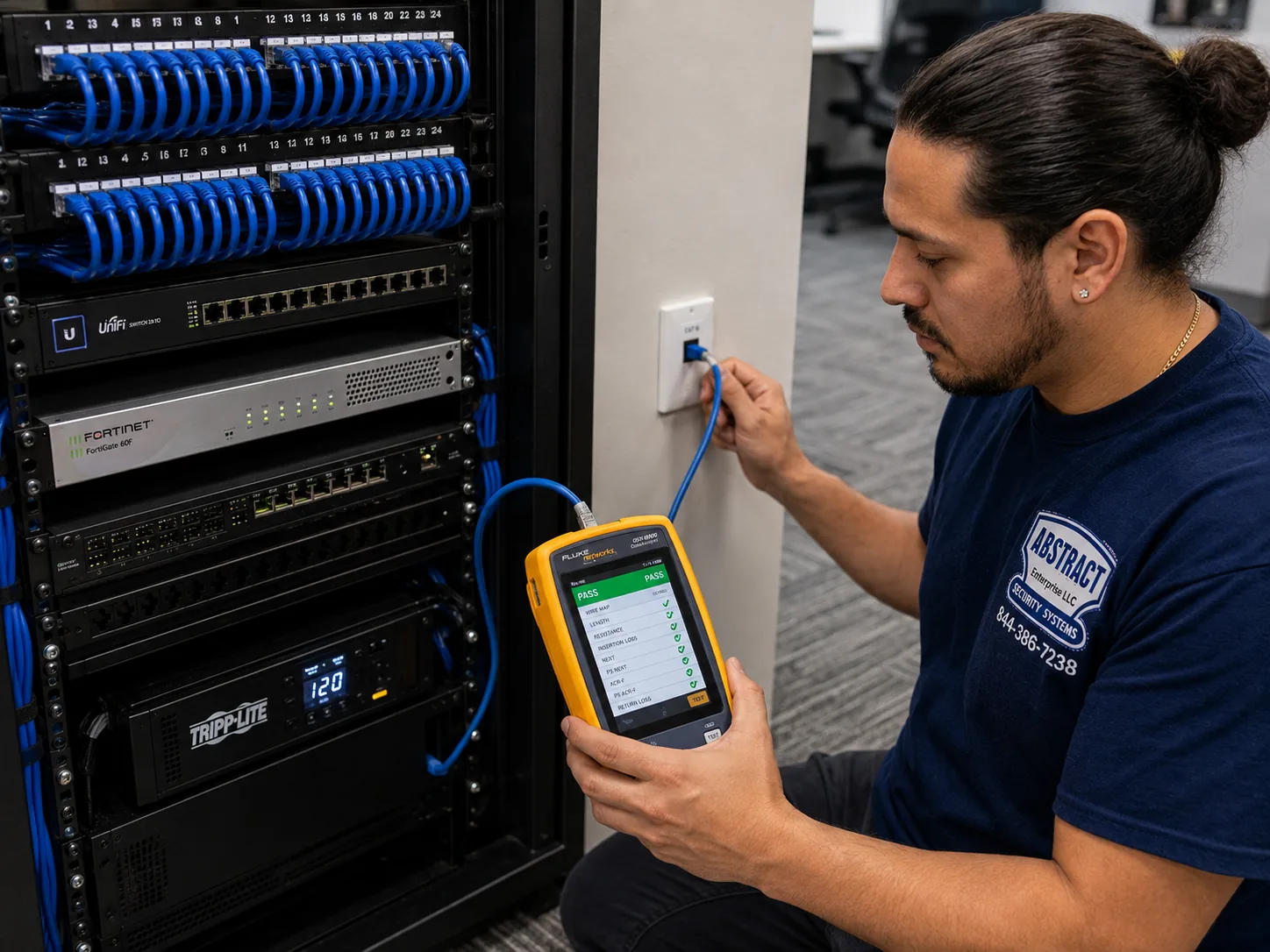
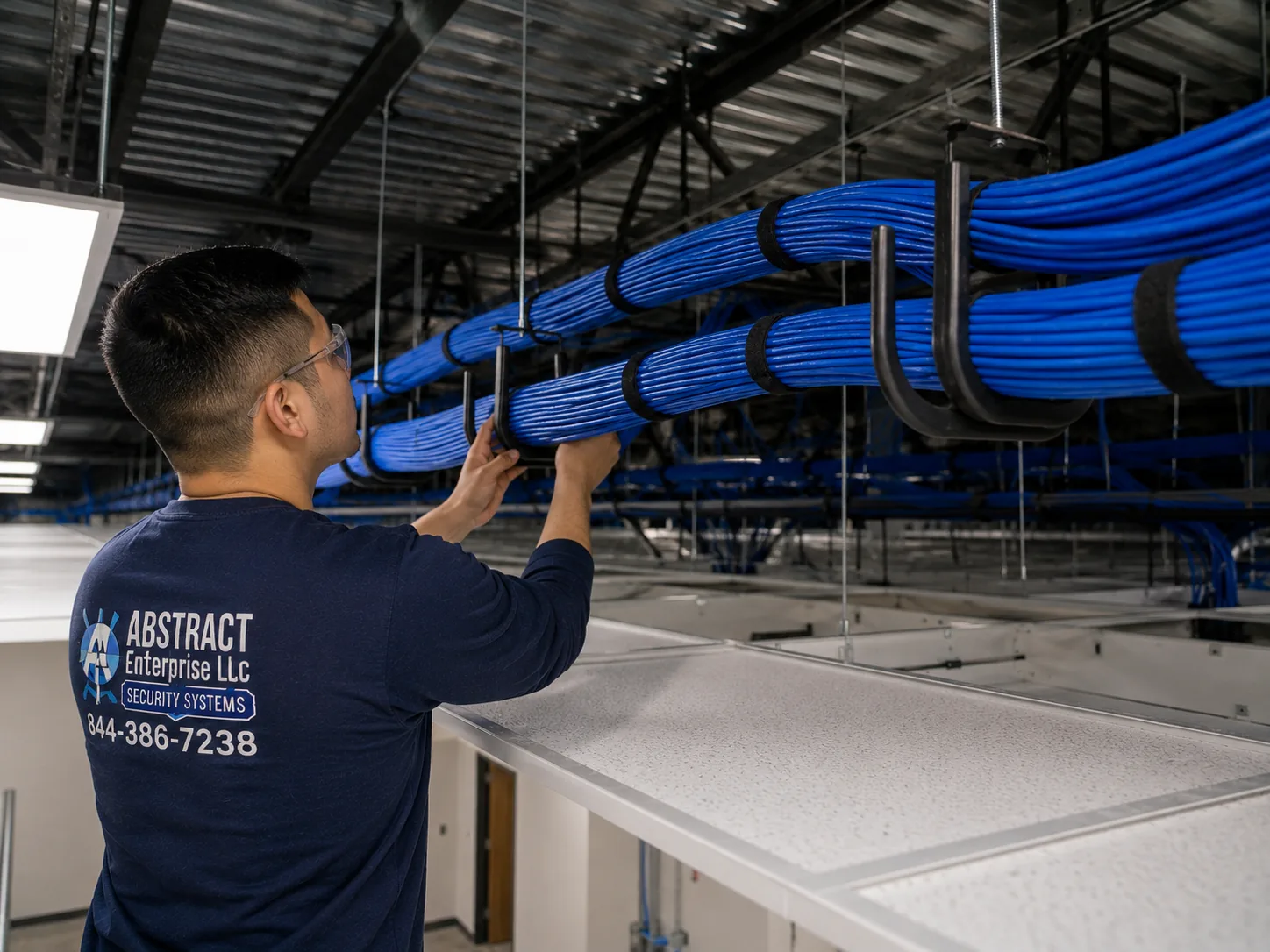
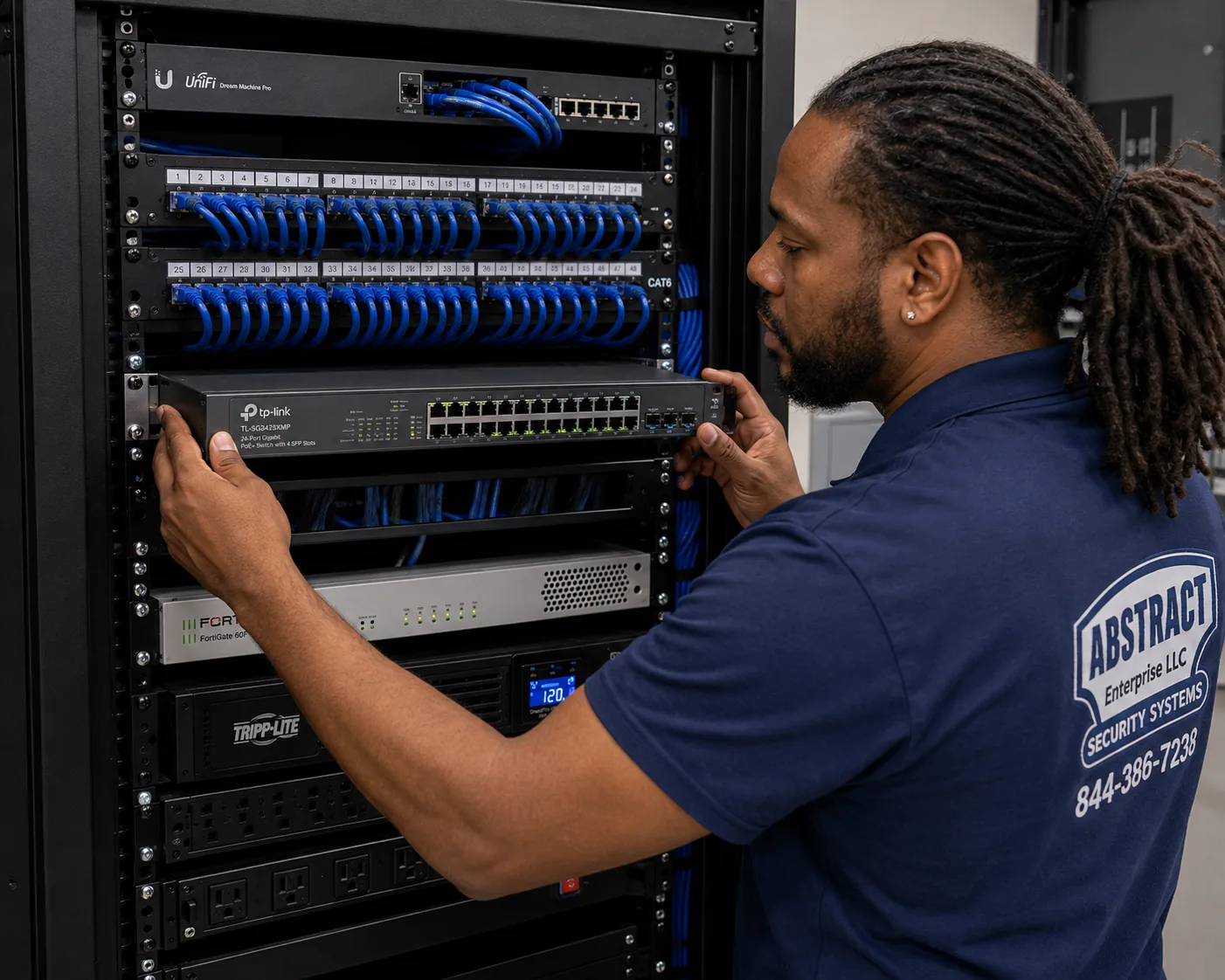
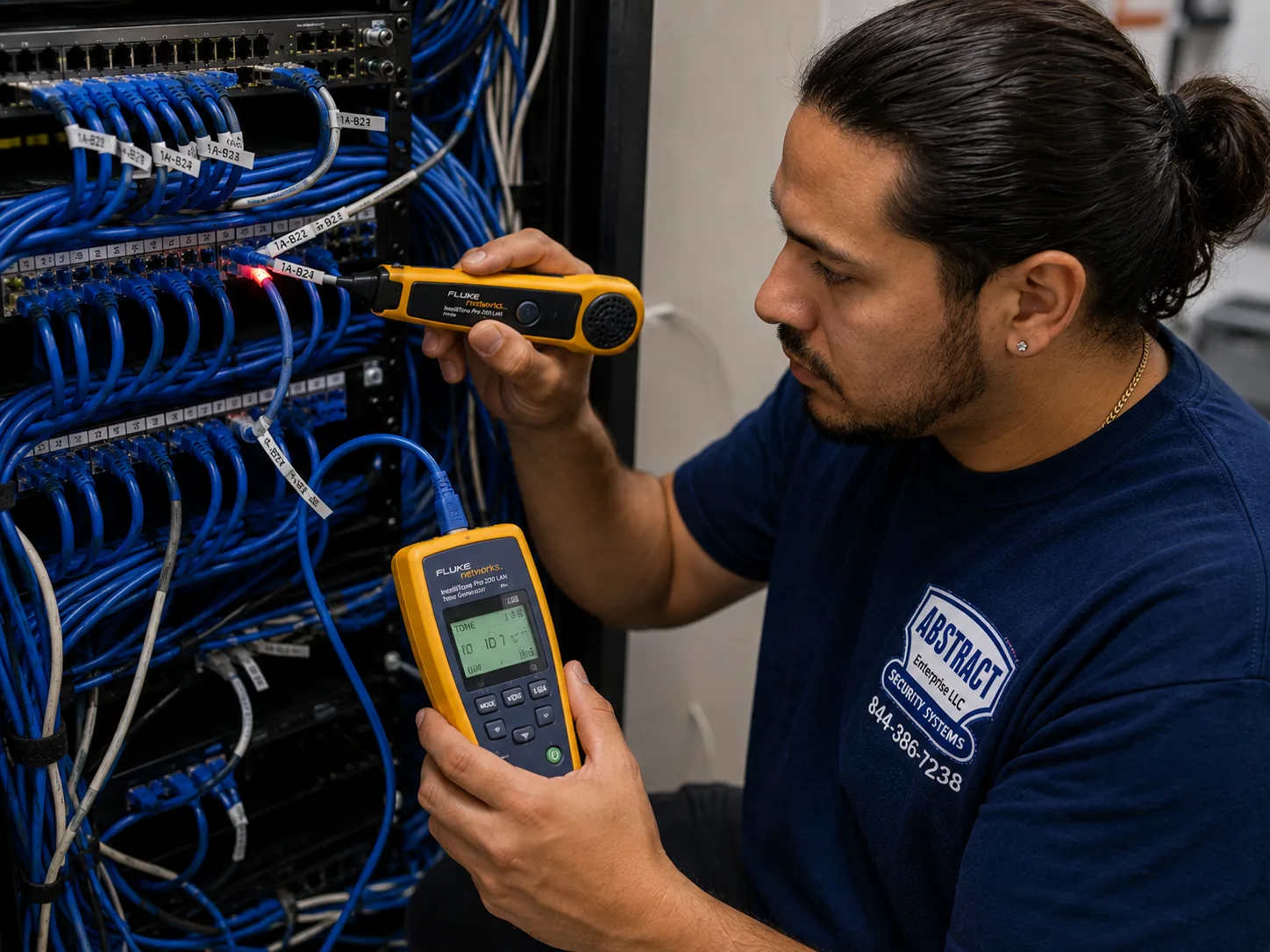
See every Tapo camera price in the Hudson Valley and build your own system →
Signal Measured at Every Mount Point · Recording That Survives an Outage · County Price Pages, No Guesswork
TP-Link Tapo camera installation in the Hudson Valley is a different job from the same cameras in a city apartment. Here a front door can sit well away from the router, behind walls of fieldstone or brick; a barn or garage may have no Wi-Fi at all; a summer storm can take out power and internet for days; and the internet plan on a long rural road may have far less upload than a camera system wants. Tapo cameras are inexpensive and capable, but they are Wi-Fi cameras first, and most of them need a steady 2.4GHz signal where they hang. We measure that signal before anything goes on a wall, set every camera to keep recording to its own microSD card when the internet drops, and quote from the county price page for Westchester, Rockland, Orange, Putnam, Dutchess or Ulster, whichever your property falls in.
Reviewed and updated November 5, 2026 by Anwar Timothy, NYS license #12000287431 · Sources: TP-Link and Tapo support FAQs (Wi-Fi bands, offline recording, compatibility, floodlight wiring, PoE cabling, solar in cold weather), Newegg's Tapo D225 listing, Central Hudson news releases (March, July and September 2026), Hudson Valley Post, Mid-Hudson News, the Times Herald-Record's Mid-Hudson Times, Hudson Valley One, the Times Union, News 12, Patch, Wikipedia entries for the Hudson Valley, TP-Link, the Kingston Stockade District, the Jean Hasbrouck House and the Hudson River Historic District, the National Park Service, Hudson River Heritage, the City of Kingston HLPC ordinance and minutes, the Village of Croton-on-Hudson camera registration page, HV WISP, the 2020 Earth Networks New York lightning report, county licensing codes for Westchester, Rockland, Orange, Putnam and Ulster, Justia Ask a Lawyer, RecordingLaw and Senator Ernst's letter to the Commerce Department · Dispatched from 460 E Fordham Rd

Owner-operated since 2002 · Thousands of jobs completed · Booked within 2 hours
Quick answer: a Hudson Valley Tapo camera job is priced from your county's price page, and it is settled by three things we can learn over the phone: the distance from the router to each camera, what the walls are made of, and whether the property keeps power and internet when the weather turns. A newer house in Rockland with the router near the front door is usually a short visit. A 1700s stone house in Ulster, a barn across a field in Dutchess or a weekend place on a slow rural connection needs a mesh node, a cable run or a solar model, and the quote says so before you book. Every visit includes signal checks at each mount point, microSD recording set up so the cameras keep a record during an internet outage, and a walkthrough of the Tapo app on your phone. Call (800) 486-0943 or use the form; we aim to book you within 2 hours of your request.
The Hudson Valley was settled as a string of river outposts and farm villages, and its houses still sit the way that history arranged them: spread out, set back, and built of whatever was close at hand. Wikipedia's history of the region begins in 1609, when the Dutch East India Company financed Henry Hudson's search for a passage up the river, and notes that the Dutch put three fur-trading outposts along it, from south to north New Amsterdam, Wiltwyck and Fort Orange. Wiltwyck, first settled as Esopus in 1653 according to the historical marker database, became Kingston. The marker text also records the great land grants of the seventeenth century, the Van Rensselaer patroonship and the Livingston, Philipse and Van Cortlandt manors, which gave the valley its estates, and the Hudson River Valley Greenway's history pages say that by 1750 most of the region had been settled in a network of small communities that still survives. For a camera installer, that pattern is the whole story. Homes are far apart, often far from the road, and many are older than the electrical and network wiring inside them.
That matters for Tapo cameras more than for most systems, because Tapo is built around home Wi-Fi. TP-Link's own support pages say most Tapo cameras connect on the 2.4GHz band, with only some models, the C260, C460 and C840 among them, also supporting 5GHz. The Tapo D225 doorbell's listing is blunt about it: 2.4GHz Wi-Fi required, 5GHz not supported. Tapo also says its cameras will not join a WEP network, a login-page portal network, a WPA or WPA2 enterprise network, or a network set to WPA3 only. In a city apartment the router is usually a few steps from the door. In a Hudson Valley house the router often sits wherever the provider's line came in, which might be the far end of the house, a basement, or an office over the garage, while the door you most want to watch faces a long driveway on the other side of thick walls. The first job on any valley property is to measure what signal actually reaches each spot a camera will hang.
The walls themselves are part of the problem. The seven stone houses of the Huguenot Street National Historic Landmark District in New Paltz were, as HistoryNet describes them, built by Huguenot settlers in the early eighteenth century, and Wikipedia calls the Jean Hasbrouck House, built in 1721, one of the best examples of colonial Dutch architecture in stone in the United States. The Hudson River Valley Greenway notes that Dutch colonial houses and Dutch place names are recognizable all over the region. We have no survey of how many valley homes have stone or brick walls, so we do not put a number on it. What we can say from our own field practice is that thick masonry weakens a 2.4GHz signal sharply, and a camera mounted on the outside face of a stone wall can see full bars on a phone held indoors and still drop out once it is on the wall. That is why we test at the mount point itself, and why many older valley houses end up with a mesh node or a short cable run before the first camera goes up.
Then there is the weather and what it does to power and internet. Central Hudson reported that the July 4, 2026 storms left approximately 47,000 of its customers without electric service, and the Times Herald-Record's Mid-Hudson Times put the count at noon the following Sunday at 41,323 customers across 669 active outages. Days later Central Hudson said about 17,200 customers were still out, with the heaviest damage in Dutchess and Ulster Counties, and Hudson Valley Post wrote of residents bracing for more days without refrigeration, air conditioning and internet. A March 2026 windstorm cut power to approximately 14,748 Central Hudson customers, and after the late-September 2026 nor'easter the utility said it had restored power to more than 24,000. A camera system that only records to the cloud records nothing while the house is dark and the modem is off. Tapo's FAQ says that once setup is done, a camera recording to a microSD card keeps recording even if it loses its internet connection, and you can look back at the footage in Playback, though notifications and TP-Link's cloud services stop until the internet returns. On a valley property we set every camera up that way from the start.
Internet speed is the quieter limit. HV WISP, a rural provider, says most of the addresses it connects were passed over by wired providers because the road was too long or the houses too far apart, and its entry residential plan is listed at 50 Mbps down and 5 Mbps up. Upload is what a camera uses when you watch it live from your phone or when it sends clips to the cloud, so a modest upload figure caps how many cameras can stream at once from a rural house before the picture stutters. Hudson Valley One reported in 2023 that 1,070 Ulster County properties still had no broadband, and that in Shandaken 2,866 residents live across 120 mountainous square miles where even cell service struggles. Ulster County announced in September 2025 a state ConnectALL award to bring service to nearly 1,300 unserved households, businesses and community facilities. A Tapo layout for a house on a slow line is planned around local recording and careful live viewing, not around streaming every camera at full resolution all day.
The reasons people call are real and recent. In January 2025, Hudson Valley Post reported a New York State Police alert about residential burglaries in Dutchess, Westchester and Putnam Counties, with "install or activate security systems and cameras" among the troopers' tips. Scarsdale police confirmed that camouflaged cameras found hidden in bushes, one spotted during yard work on Bradford Road, had been placed by burglars watching homes. Patch reported State Police in Poughkeepsie asking residents with home cameras to check their footage from midnight to 5 a.m. after car break-ins on Hoofprint Road in Union Vale, Fountain Place and Weatherford Lane in Millbrook, and several roads in the town of Washington. News 12 showed Port Chester neighbors' doorbell footage of someone trying car door handles around 4 a.m. near Tower Hill Drive, and reported Rye Police counting 99 vehicle thefts since 2020, all involving unlocked cars with the key fob inside. In June 2026 two Poughkeepsie businesses told reporters they had been robbed by customers over a single weekend. None of those stories is about Tapo in particular, and we do not claim any of those households or businesses as customers. They show what valley residents want a camera to do: catch a face at the door, a plate or a figure in the driveway at 4 a.m., and keep that footage safe.
Privacy is just as live a subject here, and it shapes how we aim cameras. Hudson Valley One reported in September 2026 that Kingston police were defending the city's surveillance cameras as residents raised privacy concerns. The same month, according to CNY News, Dutchess County District Attorney Anthony Parisi and Sheriff Kirk Imperati announced that the county would stop using Flock license-plate cameras, and the Times Union reported that the town of Pine Plains scuttled its own contract with the company after a public outcry. Valley residents notice where cameras point. A Tapo camera on a farmhouse porch should watch the porch, the steps and your own driveway, not the neighbor's yard or the county road beyond, and Tapo's app lets us draw privacy zones to block out what you should not be recording. We set those up on every job where a neighbor's property falls in frame.
We want to be clear about what our research did not find. We looked for Reddit threads in r/hudsonvalley and other local forums about Tapo cameras specifically, and for Yelp complaints about Tapo installs in the valley, and found none we could verify. We could not capture Google's People Also Ask boxes, related searches, Bing or DuckDuckGo results, or AnswerThePublic data from our build environment. Where this page describes what we expect inside a stone wall or how far Wi-Fi will carry on a particular lot, that is our field practice with houses of that kind, not a survey of valley homes. The only way to know your property is to measure it, which is the first thing we do.
What valley owners often add once the cameras are up. When the door and drive are covered, the next thing people usually ask about is the network itself: a mesh node that also fixes the weak Wi-Fi in the back bedrooms, or a battery backup on the router so cameras, phones and the TV all stay online through a short outage. Those can be done in the same visit if you mention them when booking, which saves a second trip up a long road.

The most common urgent Tapo call in the valley is not a broken camera. It is a set of cameras that went offline when the power or internet failed and never rejoined the network once everything came back, often because the router came back on a different channel, changed its settings after a firmware update, or the provider replaced the modem. The second is a doorbell that has started dropping off Wi-Fi now that the leaves are down and the weather is cold. Before you call, check that the router is on and your phone can reach the internet near the camera, then call (800) 486-0943 and tell us which cameras are offline and what changed. If a camera or its mount has been damaged by wind, ice or a fallen branch, do not climb a wet ladder to it; tell us the height and we will bring the right ladder and a replacement mount.
Our Hudson Valley work covers six counties, and the same Tapo doorbell or outdoor camera can be a quick visit at the southern end and a half-day job at the northern end. Lot sizes grow, distance from router to door grows with them, internet plans get thinner, outbuildings appear, and the utility, the licensing rules for electrical work and the price multiplier all change at the county line. The table sets out what our research found for each county; the last column links to that county's Tapo price page, which is where the actual figures live.
| County | Electric utility (per utility sources) | Electrical licensing found | What usually drives a Tapo job here | Price page |
|---|---|---|---|---|
| Westchester | Mostly Con Edison; NYSEG in Bedford, Lewisboro, North Salem, Poundridge and Somers | County trade license for electricians | Closer neighbors, privacy zones, car-prowling footage at the curb | Westchester prices |
| Rockland | Orange and Rockland | Chapter 250 licenses electrical contractors for work at 50 volts or more | Suburban lots, garages, front doors facing the street | Rockland prices |
| Orange | Orange and Rockland; Central Hudson in some villages | County license under Local Law 8 of 2007, revised by Local Law 1 of 2024; Middletown has its own board | Long driveways, farms, lightning exposure | Orange prices |
| Putnam | NYSEG and Central Hudson | County electrical board; Chapter 145 licenses low-voltage technicians | Wooded lots, weak signal under trees, long outages | Putnam prices |
| Dutchess | Central Hudson | No county contractor license found; towns such as Fishkill require third-party electrical inspection | Estates, barns, weekend homes, rural internet | Dutchess prices |
| Ulster | Central Hudson | Chapter 185 Electrical Licensing Law, which counts signaling and data transmission as electrical work | Stone houses, mountain roads, unserved broadband pockets, historic districts | Ulster prices |
Westchester is the most suburban of the six, and its Tapo calls are the most like city calls: a doorbell on a front door facing a street, a camera over a driveway that ends at a sidewalk, a camera in a detached garage. The stories in the local press here are about the curb. News 12's Port Chester report on someone testing car doors near Tower Hill Drive, and its Rye report on 99 vehicle thefts since 2020 involving unlocked cars with key fobs inside, both turned on neighbors' cameras that could see the street at 4 a.m. That puts two things at the center of a Westchester install. The camera needs to see faces and car doors clearly at night, which means placing it close to where people stand and walk rather than high on a gable, and it needs privacy zones so it is not filming the house across the road. Westchester requires electricians to hold a county trade license, so a floodlight camera that needs new wiring involves a licensed electrician; a plug-in, battery or doorbell-wired Tapo camera does not.
Rockland's housing, as our own Rockland pages describe it, ranges from suburban neighborhoods along the Route 59, Route 304 and Route 202 corridors to village downtowns and wooded lots further from them. For a Tapo job that usually means a router within reasonable reach of the front door, an attached or detached garage, and a backyard that may run into woods. Orange and Rockland Utilities serves the county, and its corporate facts page counts about 300,000 electric customers across its New York and New Jersey territory. The New York State Department of Environmental Conservation notes that the southern black bear range extends to southern Orange and Rockland Counties at the New Jersey border, which matters to cameras in one specific way: a camera near trash cans or a bird feeder will record animals at night, and motion settings need tuning so your phone is not buzzing at every visit. Rockland's Chapter 250 licenses electrical contractors for wiring at 50 volts or more, which covers a hardwired floodlight camera's line-voltage connection but not the low-voltage doorbell or camera side.
Orange County is where the valley starts to feel rural from the road. Driveways get longer, farms and outbuildings appear, and the door can be a long way from the road you want to watch. The 2020 Earth Networks lightning report ranked Orange first among New York counties for lightning pulses, 275,059 over 41 thunder days. A Wi-Fi Tapo camera with a plug-in adapter has little to fear from that, but a wired camera on a long cable between two buildings is a path for a surge, and that changes how we run and protect cable here. Greenlight Networks says it serves Goshen, Middletown, Wallkill and Port Jervis with fiber, so some Orange households have far more upload than a rural line further north; we ask about your provider before we plan how many cameras can stream at once. Orange licenses electricians under Local Law 8 of 2007, revised by Local Law 1 of 2024, and the City of Middletown has its own electrical licensing board.
Putnam's wooded lots are hard on Wi-Fi. Leaves, trunks and wet foliage all absorb a 2.4GHz signal, so a camera that works on the side of the garage in December can drop out in June when the trees are full. We plan Putnam installs with the leaf season in mind and test with the trees as they are, then tell you which positions are marginal. Putnam has also seen some of the region's worst outages. Daily Voice reported that on the morning of August 5, 2020, after Tropical Storm Isaias, NYSEG had 34,150 of its 38,693 Putnam customers without power. A camera system that needs the internet to record would have recorded nothing for most of the county that week. Putnam has a county electrical board and a Chapter 145 license for low-voltage and limited data technicians, which covers cabling for video surveillance under 90 volts fed from an outlet a licensed electrician installed.
Dutchess is home to much of the Hudson River National Historic Landmark District, the stretch Wikipedia calls the Sixteen Mile District, with estates such as Montgomery Place, Wilderstein, Rokeby and Edgewater, as well as Mills Mansion at Staatsburgh, which the Baltimore Sun described as a neoclassical Beaux-Arts mansion by McKim, Mead and White. Most Dutchess Tapo calls are not about estates, though. They are about a farmhouse with a barn across a field, a weekend house whose owner wants to see the driveway from the city, and a village home in Rhinebeck, Millbrook or Wappingers Falls. Central Hudson serves the county, and its July 2026 storm update named Dutchess and Ulster as the most heavily impacted. We found no county-level electrical contractor license in Dutchess; the Town of Fishkill's permit package says all electrical work there must be inspected by an approved independent inspection agency, and we expect other towns to have their own rules.
Ulster puts every Tapo challenge in one county. Kingston's Stockade District, an eight-block area Wikipedia says is commonly called Uptown Kingston, and New Paltz's Huguenot Street are full of stone and old brick. The City of Kingston's Historic Landmarks Preservation Commission reviews exterior changes in its five historic districts before a building permit is issued. Out of town, Shandaken's 120 mountainous square miles and the 1,070 Ulster properties Hudson Valley One counted without broadband in 2023 make for long distances and slow lines. Ulster logged 182,760 lightning pulses in 2020, with 49 thunder days, the most thunder days of the six counties. Chapter 185, Ulster's Electrical Licensing Law, counts signaling, communication, alarm and data transmission as electrical work, so we confirm the licensing position for the specific job before we start any cabling there.

The biggest time sinks on a Tapo job happen before the first camera is unboxed: a router set to a security mode Tapo will not accept, a door that turns out to have no usable signal, an internet plan that cannot carry the cameras you bought, or a gate at the end of the drive that nobody told us is locked. Ten minutes with your phone saves most of it. Please do not climb ladders or open the router's settings if you are not comfortable doing it; just look and send us what you find.
| What to check | Why it matters in the valley | What to send us |
|---|---|---|
| Where the router sits | Rural lines often enter at one corner of the house, far from the front door | A photo of the router and a rough distance to each door you want covered |
| Your phone's Wi-Fi at each camera spot | Tapo cameras mostly use 2.4GHz; if your phone shows one bar outside the door, a camera will struggle | A screenshot of a speed test taken standing where each camera will go |
| The router's security setting | Tapo does not support WEP, login-page networks, enterprise Wi-Fi or WPA3-only networks | The router brand and model, and whether it was supplied by your provider |
| Your internet plan's upload speed | Live viewing and cloud clips use upload; some rural plans offer 5 Mbps up | The plan name or a screenshot of the provider's bill or app |
| What the walls are made of | Stone, brick and block both weaken Wi-Fi and change the fixings we use | A photo of the outside wall where each camera will mount |
| Outlets and doorbell wiring | Plug-in cameras need an outlet; a wired Tapo doorbell can use existing 8–24V doorbell wiring | A photo of the existing doorbell button and any outdoor outlets |
| Outbuildings and their power | A barn or garage may have power but no network, or neither | Distance from the house and whether a cable or conduit already runs to it |
| Access on the day | Gates, dogs, steep or icy driveways, and weekend homes left empty | The gate code arrangement and who will be on site |
The most useful thing you can do before we come is to walk from the road to your front door the way a delivery driver or a stranger would, and notice where they slow down, where they turn, and where their face would be lit. On a valley property that route often starts well down the driveway, passes the garage and ends on a porch or a side door rather than the formal front door nobody uses. Cameras placed along that route, at heights where faces are visible rather than the tops of heads, record what you actually need. If you send us a short phone video of that walk, we can plan the positions before we arrive.
Tapo rates its C645D's solar panel to run the camera with one hour of direct sunlight a day under typical conditions, and it warns that battery cameras in colder climates may see shorter charge cycles in winter. In practice that means the spot you choose for a solar panel needs some direct sun in December, not just in July. A north-facing wall under tall hemlocks or a porch roof will not get it. If you are thinking about solar or battery cameras, look at the wall around midday on a clear day and note whether sun actually lands on it, and whether the trees nearby are evergreens that will block it all year.
If your house has a generator, tell us which circuits it feeds, because a camera system is only as reliable in an outage as the router and modem behind it. If you have no generator, we can talk about a battery backup on the router so a short outage does not take every camera offline. And if your property sits on a road where the internet goes down with the power for days at a time, we will set every camera to record to its own card and show you how to pull footage off it when you need it.

These are the Tapo jobs valley homeowners, weekend owners, landlords and small businesses book. Each is priced from the county price page for the property's address, and where a job needs more than the camera itself, such as a mesh node, a cable run to a barn or an electrician for a floodlight, the quote names it before you book.
Doorbells mounted with screws or Tapo's adhesive, wired to existing 8–24V doorbell wiring where the house has it, and tested for 2.4GHz signal at the door before the plate goes on.
Cameras on porches, garages and gable ends, placed along the route visitors actually take, aimed at your own ground with privacy zones drawn where neighbors fall in frame.
For gates, sheds and walls with no outlet nearby. Panels placed where winter sun actually lands, and an honest word when a shaded spot will not keep a camera charged in January.
Network reach to buildings across a yard or field, by mesh node, outdoor-rated Cat6 cable or a wired model, so the camera on the barn is as reliable as the one on the porch.
Cameras that see the cars and people arriving on a long driveway, planned around signal, power and distance at the far end rather than wherever the house wall happens to be.
Floodlight cameras on a junction box on a wall or under an eave, never on a dimmer or timer, with the line-voltage connection made by an electrician licensed where the county requires one.
Pan-and-tilt and fixed indoor cameras for entry halls, mudrooms, garages and shops, placed away from bedrooms and bathrooms and set up with privacy modes where the model offers them.
microSD cards fitted and formatted in every camera that takes one, playback tested with the internet disconnected, and battery backup on the router where you want it.
Existing Tapo systems that will not rejoin Wi-Fi after an outage, a router swap or a firmware update, diagnosed, moved to a separate network and reconnected.

Across six counties the property types change fast, and each changes three things about a Tapo job: how far the signal has to travel, what the camera is fixed into, and who else has to agree before anything goes on an outside wall. These are the types our research and our own valley pages describe, and how we approach each.
The Huguenot Street and Dutch colonial type, with walls of fieldstone thick enough to block a 2.4GHz signal almost completely. Mesh nodes or wired models, masonry fixings, and a light touch on historic fabric.
Brick row houses in Newburgh's East End Historic District, which Newburgh's tourism site calls the second largest designated historic site in New York State, and similar blocks in Kingston and Poughkeepsie. Close neighbors, shared walls, street-facing doors.
Frame houses with outbuildings across a yard or field. Network reach to the barn is the main job, followed by power at the far building and lightning exposure on any cable between them.
Large houses in the Hudson River National Historic Landmark District and similar settings, with gatehouses, long drives and staff or caretakers. Several networks, several buildings, and careful aim.
Post-war and newer houses in Westchester and Rockland, usually frame with siding or brick veneer. The closest thing to a city Tapo job: short distances, existing outlets and doorbell wiring.
Houses left empty for days, often on slow rural internet. The owner watches from elsewhere, so reliability after an outage and sensible notification settings matter more than anything else.
| Property | Main signal challenge | What holds the camera | Who else has a say |
|---|---|---|---|
| Colonial stone house | Thick masonry between router and camera | Masonry anchors in stone or mortar chosen after a test hole | A local historic commission, if the house is in a designated district |
| River-city row house | Neighbors' networks crowding 2.4GHz channels | Masonry anchors in brick, placed in the brick face rather than the joint | Historic district review in Kingston and similar cities; neighbors on both sides |
| Farmhouse with barn | Distance across open ground to the outbuilding | Wood framing on the house; posts, siding or beams on the barn | Usually only the owner |
| Estate or river property | Several buildings and long drives | Varies building by building | Owners, managers, and sometimes a preservation easement |
| Suburban house | Usually little; sometimes a basement router | Wood framing behind siding; brick veneer anchors | A homeowners' association in some developments |
| Weekend home | Slow upload and outages on rural lines | Depends on the house | The owner, plus any rental guests who must be told about cameras |
On stone houses. A stone house is the place where a Tapo camera is most likely to look fine on the day and fail a week later. The walls of the early houses on Huguenot Street, and of the many Dutch colonial houses the Hudson River Valley Greenway describes across the region, are often well over a foot of stone and mortar. A 2.4GHz signal that passes through an open door or window can be stopped almost completely by the wall beside it. So we never judge signal from inside the house. We stand at the exact point on the outside wall where the camera will hang, measure there, and if the reading is weak we either move the router's reach with a mesh node placed inside a window near the camera, or switch to a wired model fed by cable through a single sealed hole. On the fixing side, old stone is uneven and its mortar is often softer than the stone, so we drill a small test hole, see what the bit meets, and choose anchors to suit. Where a house is in a designated historic district, we also put the camera where it is least visible from the street and use the smallest mount that will hold it.
On farmhouses and outbuildings. The barn camera is the most requested and the most often botched part of a valley Tapo job. A camera placed on a barn a hundred yards from the house, relying on Wi-Fi that barely reaches the porch, will drop out every time the weather is wet or the leaves are full. The fixes, in rough order of cost and reliability, are a mesh node in the barn if the barn has power and the distance is modest, a point-to-point wireless link if there is clear line of sight, or a buried or overhead cable run with the camera wired directly. Ethernet's standard channel limit is 100 meters, about 328 feet, so longer runs need a switch partway or a different medium. A cable between two buildings also has to handle lightning and ground differences, which is why we use outdoor-rated, UV-resistant Cat6, as Tapo's own PoE guidance recommends for any run exposed to weather, and protect the run where it enters each building. We will tell you which option suits the distance and the budget before we start.


Tapo is a home-and-small-business camera line, and we are honest about where it fits. It suits a village shop, a cafΓ©, a small office, a farm stand, a gallery or a short-term rental that wants a few good cameras, an app on the owner's phone and no monthly fee for local recording. It is not the right choice for a large campus, a warehouse yard or anywhere that needs a dozen cameras recording around the clock to a central recorder with strict retention rules, and we will say so if your business needs more. These are commercial areas named in our research; we describe what the sources say and do not claim any business in them as a client.
Rockland's main commercial corridor, along with Route 304 and Route 202, as our Rockland pages describe it. Small storefronts and offices along these roads are where a few Tapo cameras covering a door, a counter and a back entrance make sense.
Westfair Online describes office buildings at 1111 and 1129 Westchester Avenue in White Plains, about 335,000 square feet with I-287 visibility. Large buildings like these have their own systems; small tenants inside sometimes want a camera of their own at a suite door.
The eight-block Stockade District mixes homes and businesses, according to Wikipedia. Shops in old stone and brick buildings face both the signal problem and the HLPC's review of visible exterior changes.
CNY News reported in June 2026 that two Poughkeepsie businesses were robbed by customers over a single weekend. Counter and door cameras with clear faces are the core of a small-shop Tapo setup here.
The Rhinebeck Village Historic District was listed in 1979, with a boundary increase approved on January 15, 2021, per Wikipedia. Small shops in the district call for discreet mounting on old buildings.
The Governor's office announced a developer to build 265 mixed-income units beside the Beacon Metro-North station. New mixed-use development like this brings ground-floor businesses that need simple camera coverage.
A home camera mostly watches for the unusual: a stranger at the door, a car in the drive at night. A shop camera watches ordinary business all day and has to produce useful footage of the few minutes that matter. That changes the placement. A camera over the register needs to see hands and faces at the counter, not the top of a customer's head, so it sits lower and closer than a home camera would. A camera on the door needs to catch faces coming in, which means facing into the shop toward the door rather than out through glass that will glare in the afternoon. Continuous recording matters more too: Tapo's hardwired doorbells support continuous recording, and wired cameras can record continuously to their cards, while battery models are designed around motion events. For a shop that wants to review a full day, we choose wired models on outlets and size the microSD cards accordingly, and we set the business owner and one trusted manager up with shared access rather than handing out a single login.


We do not tell stories about a customer's property unless we can document them, so this is not about one address. It is the routine our technicians follow on a typical valley job: a house set back from the road, a router at the wrong end, a door everyone uses and a barn the owner keeps meaning to watch.
Before a single box is opened, we walk the property with a phone running a signal analyzer locked to the 2.4GHz band. We start at the router and walk outward, through the house and out the door visitors use, along the driveway, around the garage and across to the barn, stopping at every point where a camera might hang and reading the signal there, not from inside. We note where it drops off a cliff, which is often just outside a stone wall or under a stand of trees. We pace the distances to the outbuildings and look for power at the far end. We check the sun on any wall that might take a solar panel. Then we sit down with you and mark each camera position on a quick sketch with its signal reading beside it. Positions with a weak reading get a mesh node or a cable before they get a camera. That walk takes a little time and saves a return trip to a camera that went offline the first rainy night.
Wi-Fi, distance and big lots
Possibly, but we would not promise it until we have measured the signal at the door itself. The Tapo D225's specification says it requires 2.4GHz Wi-Fi and does not support 5GHz, and a 2.4GHz signal crossing the full depth of a house, through interior walls, a kitchen full of appliances and an exterior wall, can arrive weak at the door. If the reading is marginal, the usual fix is a mesh node placed inside, near the front of the house, which gives the doorbell a strong local signal and improves Wi-Fi in the front rooms at the same time. We test the doorbell on the new node before we mount it, and if your house already has a mesh system, we check that its 2.4GHz band is enabled, since some systems hide it.
Usually three zones, each with a different solution. The door gets a doorbell or a camera on the porch, close enough to see faces, on the house Wi-Fi. The stretch of driveway near the house gets a camera on the garage or a corner of the house aimed down the drive, placed so cars and people are coming toward it rather than crossing its view. The road end is the hard part. If it is within reach of a mesh node in the garage, a solar camera on a post can cover it; if it is too far for Wi-Fi, the options are a point-to-point wireless link to a camera there, or a cable run if power and a trench are practical. We price each zone separately, so you can start with the door and the drive and add the road end later.
Yes, but not by relying on one router. In a house with walls like the early stone houses on Huguenot Street, each room behind a thick wall can need its own signal. Indoors, we place mesh nodes so each camera has a node in the same room or the next one through a doorway. Outside, we put cameras where a node inside a window can reach them, or switch to wired models fed by one sealed hole through the wall. We drill stone slowly, test the material first, and keep holes as few and as small as the job allows. If the house is in a historic district, we also choose positions where the cameras are least visible from the street.
It depends on the cameras' resolution and settings, so we test rather than guess. The number that matters is the upload, the 5 Mbps in a plan like the entry tier HV WISP lists, because that is what carries a live view to your phone when you are away and any clips sent to the cloud. Local recording to each camera's microSD card uses no internet at all. So we set the cameras to record locally, set the live view and any cloud uploads to sensible quality, and then test by opening several cameras at once on a phone off your home network. If the picture stutters, we lower the stream quality on the cameras you watch least. The cameras still record at full quality to their cards.
Yes, if the camera model has a network port, and the cable is the more reliable choice for a building across a yard. Tapo's PoE installation guidance calls for Cat5e or Cat6 cable, and says any run exposed to weather needs an outdoor-rated, UV-resistant jacket. We run the cable buried in conduit or supported overhead, protect it where it enters each building, and test it before it is closed up. A standard Ethernet run is limited to about 328 feet, so longer distances need a switch partway or another approach. If the barn has power, a mesh node inside it is the alternative, and it gives you Wi-Fi in the barn too.
Tapo's own guide says its cameras do not support a network set to WPA3 only, along with WEP, login-page portal networks and WPA or WPA2 enterprise networks. Many routers offer a mixed WPA2/WPA3 mode, which Tapo cameras can join while newer phones and laptops still use WPA3. Our preferred setup is a separate guest or IoT network on the router, set to a mode the cameras accept, with the cameras on it and your computers and phones on the main network. That keeps your main network as secure as you want it and keeps the cameras apart from your other devices, which is also the step most security advice recommends for TP-Link devices.
Power, storms and winter
That depends on whether the camera has power. A plug-in or hardwired camera stops when the power stops, unless the outlet is on a generator or battery backup. A battery or solar camera keeps running, and with a microSD card fitted it keeps recording, because Tapo's FAQ says local recording continues and playback works even without an internet connection. What stops is everything that needs the internet: notifications to your phone, live viewing from away, and any cloud service. When power and internet come back, cameras that were set up properly rejoin on their own. If yours sat dark after the last storm, the cause is usually the router coming back with changed settings, which we can fix and then test by switching the router off and on.
Usually not on that wall. Tapo rates the C645D's solar panel to run the camera with about one hour of direct sunlight a day under typical conditions, and it warns that cold weather shortens battery charge cycles. A north-facing wall under trees may get no direct sun at all in a valley December, and the cold drains the battery faster at the same time. The panel does not have to sit right beside the camera, so we look for a spot nearby with clear southern sky, such as a roof edge, a post or the sunny side of a shed, and run the panel's cable to the camera. If no spot gets winter sun, we suggest a wired camera on that wall instead.
If the existing wiring supplies 8 to 24 volts, yes, and it is usually worth it. The Tapo D225 listing says hardwiring to existing doorbell wiring is supported and gives the option of continuous recording, which a battery doorbell does not offer. A wired doorbell also never needs its battery charged on a cold morning. Old farmhouse doorbell wiring can be decades old, with a transformer in the basement and a chime that may or may not still work. We check the voltage at the button, look at the transformer and the chime, and tell you whether the wiring will carry the doorbell or needs a new low-voltage transformer first.
A floodlight camera is a light fixture, so its power connection is line-voltage electrical work. Tapo's guide says it mounts on a junction box on a wall or under an eave and must not be connected to a dimmer switch or a timer, and TP-Link specifies an all-pole mains switch in the building's wiring. Westchester, Rockland, Orange, Putnam and Ulster license electricians at the county level, and towns like Fishkill require electrical work to be inspected by an approved agency. So the box and connection are made by an electrician licensed where the barn sits, and we mount the camera, set it up on the network and tune the light and motion settings. Our written quote says who does which part.
The brand, privacy and the law
As of October 8, 2026, one tracking site reports, no federal order bans TP-Link routers, and owners can keep using the ones they have. The company is under pressure, though: Wikipedia records that the Department of Defense added TP-Link to its list of Chinese military-linked companies in June 2026 and that four states sued it in October 2026, and a Senate letter asked the Commerce Department to investigate TP-Link's internet-connected cameras, including Tapo. We tell every customer this before they buy. The sensible precaution, whatever the outcome, is to keep cameras on a separate guest or IoT network so they cannot reach your computers, keep their firmware updated, and use a strong, unique password on the Tapo account. We set all three up.
The specific federal step our research found is about routers. A site tracking the issue reports that a March 2026 FCC rule blocks approval of new router models made abroad unless they hold a conditional approval, and that TP-Link holds none. Smart Home Perfected argues that the router actions and the hacking incidents behind them concern routers rather than smart-home gear like Kasa plugs and Tapo cameras. The camera side is a request to investigate, not a rule. We cannot predict what regulators do next, and we will not pretend to. What we can do is set the cameras up so that, whatever happens, your recordings stay on cards in your own house and the cameras sit on their own network.
It is risky, and for most outdoor cameras we suggest turning it off. A New York attorney answering on Justia explained that the state follows one-party consent for recording conversations, and that a camera recording voices when no participant consents, such as delivery drivers, neighbors or passers-by talking while you are away, can count as eavesdropping, a class E felony. Video of your own property is a different matter from audio. A doorbell's two-way talk, which you use yourself, is not the concern. We show you where the microphone setting is on each camera and leave it on only where you choose and understand the trade-off.
Keep every camera's view on your own ground, and use privacy zones where it cannot be avoided. After the Pine Plains contract fight and Dutchess County's decision to stop using Flock cameras, valley residents are alert to cameras that seem to watch them. In practice that means aiming a driveway camera along your drive rather than across the road, keeping porch cameras low enough to see your steps rather than the house opposite, and blocking out a neighbor's windows or yard in the Tapo app. We check each camera's view on your phone with you before we leave, and if a neighbor ever asks, you can show them exactly what the camera sees.
Possibly, and it is worth asking before installing. Kingston's ordinance requires approval for exterior alterations in a historic district, the HLPC reviews visible exterior changes before a building permit is issued, and its February 2022 minutes show it reviewing an application for exterior faΓ§ade lighting on North Front Street. We found no rule that names small cameras specifically, so our reading is that a doorbell may well pass without review while a floodlight camera on a street-facing wall is the kind of change the commission looks at. We choose the least visible positions and smallest mounts, and can give you photos and product sheets to bring to the commission.
A business doing it for you does. New York's General Business Law Article 6-D requires a Department of State license for anyone in the business of installing, servicing or maintaining security systems, which include cameras. A homeowner setting up their own cameras does not need a state license. We hold NYS license #12000287431 and are insured. If the job includes line-voltage work, such as a floodlight camera's junction box, that part is for an electrician licensed in your county, and many towns require it to be inspected. Ask any installer for their license number and how they handle the electrical side; it is a fair question.
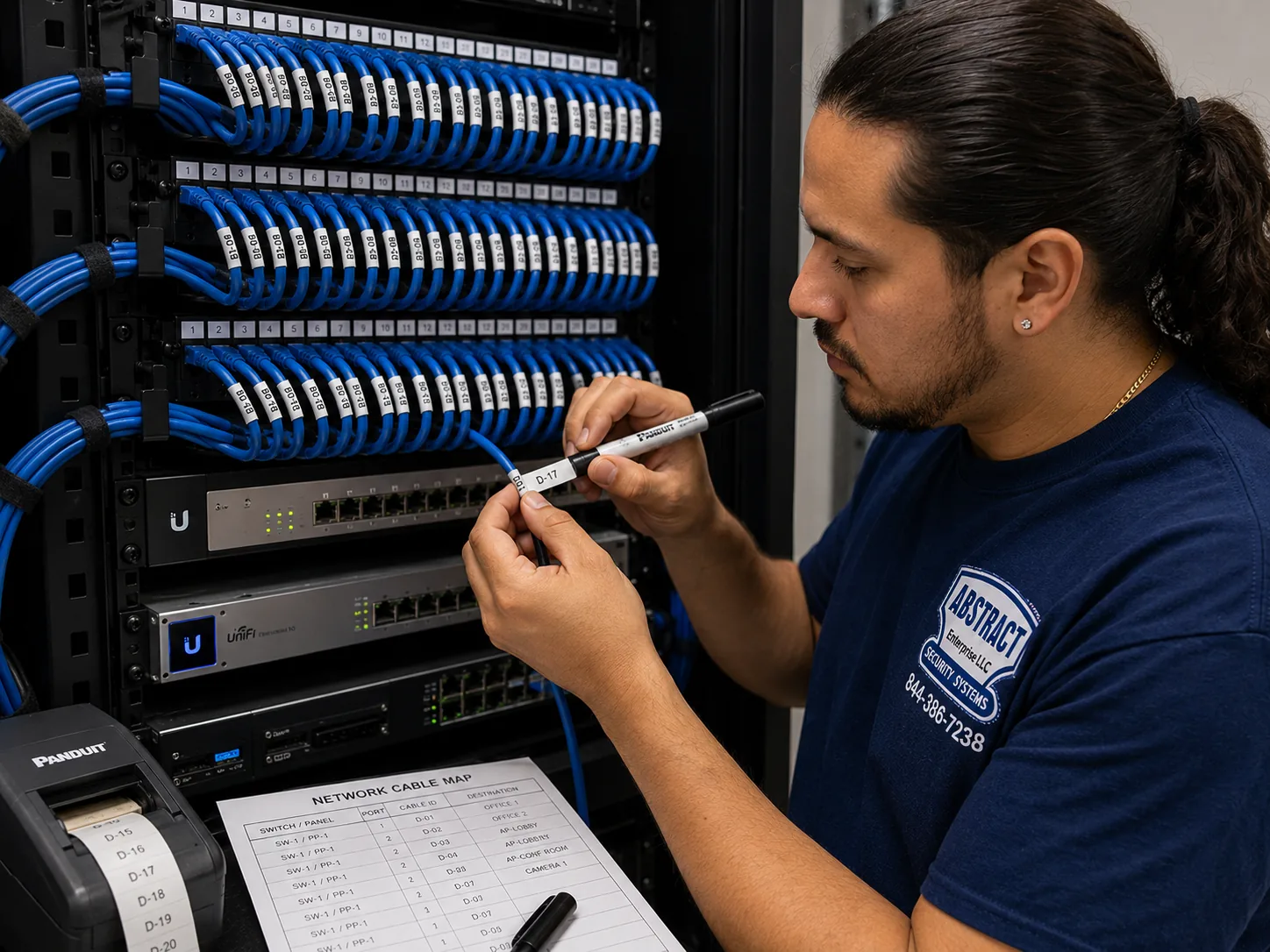
These are the categories of Tapo equipment and supporting gear we fit on valley properties. Models change often, so we confirm the exact model's specification, including its Wi-Fi bands and power options, before we recommend it. Current installed prices for each county are on the county price pages.
Battery or hardwired doorbells such as the D225, which needs 2.4GHz Wi-Fi and supports hardwiring to 8–24V doorbell wiring for continuous recording.
Plug-in outdoor cameras for porches, garages and gable ends, including models that also support 5GHz such as the C260, C460 and C840, for houses where 2.4GHz is crowded.
Wire-free cameras for spots with no outlet, recording on motion, with battery life that shortens in cold weather as Tapo itself notes.
Cameras with solar panels, such as the C645D, rated by Tapo to run on about one hour of direct sun a day under typical conditions, placed where winter sun lands.
Combined light and camera units on a junction box, wired by a licensed electrician, never on a dimmer or timer.
Indoor cameras that turn to follow motion in entry halls, shops and garages, placed away from private rooms.
Mesh Wi-Fi nodes, point-to-point wireless links and outdoor-rated Cat6 runs that get signal to cameras the main router cannot reach.
microSD cards sized for the recording you want, and battery backup units on the router and modem so cameras stay online through short outages.
People sometimes ask how a Tapo system compares with ADT, Ring or SimpliSafe. ADT is known mainly for professionally monitored alarm systems; Ring and SimpliSafe for doorbells, cameras and self-install security kits, with cloud plans and optional monitoring. Tapo's appeal is different: inexpensive cameras that record to their own microSD cards, with an optional cloud service rather than a required one. None of them, on its own, solves the valley's real problems, which are signal at the far end of a property, power during outages and slow upload on rural lines. Those are installation problems, and they are the same whichever brand is on the wall. If you want monitored alarm service, that is a separate system and a separate quote; Tapo cameras are something you watch yourself.
| Question | Tapo with local recording | Cloud-first camera brands in general |
|---|---|---|
| Records during an internet outage? | Yes, to the microSD card, per Tapo's FAQ, as long as the camera has power | Depends on the model; cloud-only cameras record nothing while the internet is down |
| Needs a subscription to keep footage? | No for local card recording; Tapo Care cloud is optional | Often yes for saved clips |
| Smart-home compatibility | Amazon Alexa and Google Home only, per Tapo | Varies by brand |
| Professional monitoring | Not offered with Tapo cameras | Offered by some brands at extra cost |
| Upload use on a slow rural line | Low if you mostly use local recording | Higher, because clips go to the cloud |

We could not capture Google's AI Overview for Tapo installation in the Hudson Valley from our build environment, so we will not pretend to quote it. What follows are claims we see repeated in quick online answers and product summaries about Tapo cameras and home cameras generally, set against what Tapo's own documentation, local utility and news reports, and our field practice say. National marketplaces such as Angi, HomeAdvisor and Fixr publish cost guides that many of those answers draw on; they are fine for a rough idea, but they are not a quote for a stone house at the end of a quarter-mile driveway.
This is the assumption behind most failed DIY Tapo installs in older valley houses. A phone held in the front hall reads the signal inside the house. A camera on the outside of a stone or brick wall a foot away can be on the far side of that wall from the router, with far less signal.
Tapo's cameras also mostly rely on 2.4GHz, and some, like the D225 doorbell, use nothing else. A phone that shows full bars may be connected on 5GHz, which tells you nothing about 2.4GHz at that spot.
We measure the 2.4GHz band at the exact mount point, outside, before we drill, and we put a mesh node or a cable in place first wherever the reading is weak.
Half true. Tapo's FAQ says local microSD recording continues without an internet connection and you can review footage in Playback. That covers an internet outage. It does not cover a power outage for a plug-in camera, which simply turns off.
After the July 4, 2026 storms, Central Hudson reported about 47,000 customers without power, and Hudson Valley Post described residents expecting more days without internet as well. In an outage like that, only battery or solar cameras, or cameras on a generator or battery backup, keep recording.
So we plan for both kinds of outage: microSD cards in every camera, battery or solar models where power is unreliable, and a battery backup on the router and modem where you want cameras online through short outages.
A solar camera needs sun, and the valley in winter has short days, low sun and many walls in shade. Tapo itself rates the C645D's panel on one hour of direct sunlight a day under typical conditions and notes that cold climates shorten battery charge cycles.
The panels that work are the ones placed in direct sun at midday in December. The ones that fail are on north walls, under porch roofs, or beneath evergreens that shade them all year.
We judge solar positions on winter sun, not summer sun, and we will tell you plainly when a wired camera is the better choice for a shaded wall.
Not as of our research. One site tracking the issue reports that as of October 8, 2026, no federal order bans TP-Link routers. Another reports that in early 2026 the White House shelved a targeted action against the company.
There is real pressure, though. Wikipedia records the June 2026 Department of Defense listing and the October 2026 lawsuit by four states, a March 2026 FCC rule affects approval of new router models made abroad, and a Senate letter asked Commerce to look at TP-Link's cameras.
Our advice is the same either way: buy with your eyes open, keep cameras on a separate network, keep recordings on local cards, and keep firmware current. We set all of that up and leave you able to manage it.
The camera part, perhaps. The light part is electrical work. Tapo's guide calls for a junction box and warns against dimmers and timers, and TP-Link specifies an all-pole mains switch in the building's installation.
Five of the six counties license electricians at county level: Westchester's trade license, Rockland's Chapter 250, Orange's Local Law 8 of 2007 as revised in 2024, Putnam's electrical board, and Ulster's Chapter 185. In Dutchess, towns such as Fishkill require independent inspection of electrical work.
Separately, New York's General Business Law Article 6-D requires a state license for businesses installing security systems. We hold one, and we bring in a licensed electrician for the line-voltage side.
Cloud storage protects footage if a camera is stolen, which is a real advantage. But on a Hudson Valley property it has two weaknesses that quick answers skip: it stops when the internet stops, and it eats upload bandwidth on plans that have little to spare.
HV WISP lists 5 Mbps upload on its entry rural plan, and Tapo's FAQ is clear that cloud services and notifications do not work without an internet connection.
For most valley homes we make the microSD card the main record and treat Tapo Care cloud as an optional extra. We place cameras high enough that pulling one down to steal the card is not easy, and we show you how to save important clips to your phone.
It does not. Tapo's FAQ says its cameras are compatible with Amazon Alexa and Google Home only, so a house built around Samsung SmartThings or another platform will not control Tapo cameras directly.
Tapo also says its cameras support IPv4 only, not IPv6. Most home networks run both, so this rarely matters, but an unusual provider setup can cause trouble.
We ask what else is in the house before recommending Tapo. If your home runs on a platform Tapo does not support, we tell you before you buy cameras, not after they are on the wall.
Send photos of the doors and buildings you want covered, the distance from the router to each, and your internet provider, and a technician will tell you whether Tapo will work well on your property, where you will need a mesh node or a cable, and which county price page applies. Call (800) 486-0943, message us on WhatsApp, or use the quick form.
Every Tapo job in the six counties follows the same eight steps, whether it is a single doorbell on a Rockland colonial or five cameras across a Dutchess farmhouse, barn and driveway. The order matters most on large and old properties, where a camera mounted before the signal was checked is the usual cause of a system that drops offline in the first wet week.
Photos of the doors, drive and outbuildings, the town and county, and what the house is built of. We match the job to the right county price page before anything is booked.
We confirm the router offers 2.4GHz, is not on WPA3-only or a login-page network, and that the upload speed can carry the cameras planned.
On site we walk the visitor's route, read 2.4GHz signal at every proposed mount point outside, and check sun and shade for solar or battery models.
Each camera's position and aim is agreed with you, kept on your own ground, with privacy zones planned wherever a neighbor's property falls in frame.
Mesh nodes, a wireless link or outdoor-rated Cat6 go in first wherever the signal is weak, labeled and tested before anything is closed up.
Cameras, doorbells and panels are fixed into solid stone, brick, block or wood with fixings to suit, and every cable entry is sealed against weather.
Cameras join the Tapo app on a separate guest or IoT network, microSD cards go in, motion zones and person detection are tuned, and microphones are discussed.
We test recording and playback with the internet disconnected, confirm what comes back after power returns, then show you live view, playback, sharing and alerts on your phone.

The valley is large enough that most customers place themselves by a landmark district or a river town rather than a county. These are six we use when we plan routes and talk about what a property is likely to be built of.
An eight-block area of Uptown Kingston, the city's original settlement, mixing homes and businesses; one of five Kingston historic districts reviewed by the HLPC.
A National Historic Landmark District of seven early eighteenth-century stone houses, including the 1721 Jean Hasbrouck House, an example of colonial Dutch stone architecture.
Designated in 1990, with towns, hamlets, villages and more than forty riverfront estates such as Montgomery Place and Wilderstein, per Hudson River Heritage and the historical marker database.
Described by Newburgh's tourism site as the second largest designated historic site in New York State, with Italianate row houses and Washington's Headquarters.
Listed on the National Register in 1979, with a boundary increase approved on January 15, 2021, according to Wikipedia.
Olana, the Hudson home and studio of Hudson River School painter Frederic Edwin Church, and Mills Mansion in Staatsburgh, a Beaux-Arts house by McKim, Mead and White.
Below the valley we also install Tapo cameras across New York City and Long Island, with their own price pages: Bronx Tapo prices, Manhattan Tapo prices, NYC Tapo prices and Long Island Tapo prices. For the full regional picture, start with the Hudson Valley Tapo camera installation price page, or return to the Abstract Enterprises home page.
Tapo installation in the Hudson Valley is priced by county, because travel distance, lot sizes and the work involved change across the six counties. We do not publish a single valley-wide figure, because one would be wrong for most properties. Instead, each county has its own Tapo price page with the current itemised list at that county's rate: the camera or doorbell itself, the mounting surface, network reach such as a mesh node or a cable run, and any extras. The table below shows how each county's rate relates to our Brooklyn base, which is how our price pages are built, and links to each county's list.
| County | Area rate vs. Brooklyn base | Why it differs | Itemised Tapo prices |
|---|---|---|---|
| Westchester | 1.25× | Closest to the city; shorter travel, mostly suburban lots | Westchester Tapo price list |
| Rockland | 1.30× | Across the river; suburban to wooded lots | Rockland Tapo price list |
| Orange | 1.40× | Longer travel, more driveways and outbuildings | Orange Tapo price list |
| Putnam | 1.45× | Wooded estates and longer runs | Putnam Tapo price list |
| Dutchess | 1.53× | Long travel, estates, barns and rural lines | Dutchess Tapo price list |
| Ulster | 1.53× | Longest travel, stone houses and mountain roads | Ulster Tapo price list |
Within any county, the property moves the price far more than the county does. A doorbell and one porch camera on a newer house with the router near the front door is a short visit with little beyond the cameras themselves. The same two cameras on a stone house with the router at the back can need a mesh node, a masonry drill and more time on the wall. A camera on a barn across a field adds either a node in the barn, a wireless link, or a cable run that has to be trenched or supported overhead and protected at each end. A floodlight camera adds an electrician's work for the junction box. A solar camera saves wiring but needs a sunny mounting spot, which can mean a separate panel mount and a longer cable. Each of those is a line on the county price page, so you can see the total build up item by item.
Send us photos and the details from the checklist above, and we match your job to the lines on your county's price page before you book, naming any network reach, electrician's work or extra mounting the property needs. If we find something different on the day, such as a wall that is stone under the siding, or a router that cannot be set to a mode the cameras accept, we show you, tell you which line applies, and do not go ahead until you agree. Two properties in different counties are quoted from each county's own list, and can often be scheduled together.
Full terms β including 50% deposit, one-year parts-only warranty on AESS-supplied products, and the late-fee schedule β are set out in the service agreement.Three common valley setups, described by what is included. The installed price for each depends on your county and is set out line by line on your county's Tapo price page, from Westchester to Dutchess and Ulster.
A Tapo doorbell, hardwired to existing doorbell wiring where it supplies 8–24V or battery-powered where it does not, plus one outdoor camera over the driveway or porch. Signal checked at both spots, microSD card in the camera, cameras on a separate network and the app set up on your phone. Suits suburban houses in Westchester and Rockland with the router within reach.
A doorbell and three outdoor cameras covering the door, the side or back entrance, and the driveway, with a mesh node where the signal needs it, privacy zones for neighbors, cards in every camera and an outage test before we leave. The usual job on a valley house with a longer drive or thicker walls.
The Standard setup plus coverage at a barn, garage or road end, by mesh node, wireless link or outdoor-rated Cat6 run as the distance allows, a solar camera where power is out of reach, and a battery backup on the router and modem. For farmhouses, estates and weekend homes in Orange, Putnam, Dutchess and Ulster.
Many valley customers buy their Tapo cameras themselves and call us when the doorbell will not connect at the door or the barn camera keeps dropping off. We install customer-supplied Tapo equipment at labor-only rates from the same county price pages. We check each camera's model and specification before mounting it, including its Wi-Fi bands and power options, and if a model is wrong for the spot you have in mind, such as a battery camera on a wall with no winter sun or a 2.4GHz-only doorbell at a door the signal cannot reach, we tell you and suggest what would work better there. Your own cameras are covered by the manufacturer's warranty rather than ours.
The regional summary of Tapo installation prices across the six counties. Hudson Valley Tapo camera installation prices
The Lower Hudson counties, each with its own price list. Westchester · Rockland
Tapo installation in apartments, co-ops and row houses across the five boroughs. NYC Tapo prices
Tapo's setup runs through the Tapo app, which connects each camera to your 2.4GHz Wi-Fi, and Tapo says the cameras need an internet connection during initial setup. After that, recording to the microSD card carries on without the internet. We create or use your own account, set the cameras up in it, and show you how to share access with family without giving out your password.
On most valley jobs, on a microSD card inside each camera, which keeps recording during internet outages and costs nothing monthly. Tapo Care, TP-Link's optional cloud service, can store clips online as well, which helps if a camera is stolen, but it needs a working internet connection. We size the cards for the recording you want and show you how to save important clips to your phone.
Not according to Tapo's own FAQ, which says its cameras are compatible with Amazon Alexa and Google Home only. If your house runs on SmartThings or another platform, the cameras will work in the Tapo app but will not appear in that system. We ask what else is in the house before you buy, so you are not surprised after the cameras are mounted.
Not for recording to the cameras' own microSD cards, which is how we set most valley systems up. A fee applies only if you choose Tapo Care cloud storage. Tapo cameras do not come with professional monitoring, so there is no monitoring fee either; you watch them yourself in the app.
Wired models can, which is one reason we prefer them for shops and busy doors. The D225 doorbell's listing says hardwiring to existing doorbell wiring allows continuous recording, and some solar models are sold as offering continuous capture. Battery cameras are built around motion recording to save power. We set the recording mode camera by camera and size the microSD cards so continuous footage covers the days you want.
Yes, as long as the camera has a microSD card. Tapo's FAQ says local storage keeps working without an internet connection and recordings can be viewed in Playback. What you lose until the internet returns is phone notifications, live viewing from away and any cloud service. We test this on the day by disconnecting the internet and checking that the cameras keep saving clips.
Yes. Tapo's FAQ says TP-Link's cloud services do not work without an active internet connection, so nothing reaches the cloud during an outage. That is why we treat Tapo Care as an extra on top of local card recording rather than a replacement for it, especially on rural lines that go down with the power.
Tapo says its cameras support IPv4 only. Most home routers run IPv4 inside the house even when the provider also uses IPv6, so this is rarely a problem. If your connection is set up unusually, we check the router's settings before mounting anything and tell you if a change is needed.
A New York Department of State security license number, insurance, a plan for signal at the far end of your property rather than a promise that Wi-Fi will reach, local recording set up for outages, and a clear answer on who handles any electrical work. Ask how they will test the system before they leave. Ours is licensed under NYS #12000287431.
A plug-in, battery or doorbell-wired camera does not normally involve an electrical permit, though we found no single valley-wide rule, so we check your town on unusual jobs. A floodlight camera needs electrical work, and towns such as Fishkill require that work to be inspected by an approved agency. In historic districts like Kingston's, visible exterior changes can need commission approval.
Yes. Tapo itself says battery cameras in colder climates may see shorter charge cycles in winter, and short, dim days give solar panels less to work with at the same time. We place solar panels where winter sun actually lands, set motion sensitivity so the camera is not waking for every branch in the wind, and suggest wired models on walls that will not stay charged.
We aim to book your visit within 2 hours of your request, with the date depending on your county and how much work the property needs. We cover all six counties, Westchester, Rockland, Orange, Putnam, Dutchess and Ulster, dispatching from 460 E Fordham Rd. Sending photos first lets us arrive with the right mounts, nodes and cable.
If your village offers a program, it can help. Croton-on-Hudson, for example, asks residents and businesses to register private camera systems voluntarily and contacts registrants only if a crime happens nearby. Registration does not give police access to your cameras. We can give you a list of your camera positions and what each one sees to fill in the form.
Tell us the town and county, what the house is built of, how far each door and building is from the router, and your internet provider if you know it. Photos make the quote exact. Prefer to talk? Call (800) 486-0943.
Β· TP-Link Tapo Camera Installation NYC Hub | All 5 Boroughs
From a stone house on a New Paltz side street to a farmhouse and barn in Dutchess or a weekend place on a slow Ulster line, every Tapo job starts the same way: measure the signal where each camera will hang, plan for the next outage, and quote from your county's price page. Call (800) 486-0943, message us on WhatsApp, or send the quote form, and we will tell you what your property needs before anything goes on a wall.
Tapo Camera Installation by neighborhood: Hudson Valley hub, Hudson Valley tapo camera installation
Tapo Camera Installation by neighborhood: Long Island hub, Long Island tapo camera installation