Every Door Counted, Upper Street and Lower · Approvals Settled Before Drilling · Every Line Priced in Writing
Security camera installation in Highbridge starts with a fact of the ground: the neighborhood sits on a ridge that climbs more than a hundred feet above the Harlem River, so a great many buildings here have one door on the avenue above and another door, a cellar or a yard on the street below. A camera plan that only watches the front lobby misses half the ways in. We count every entrance from the top of the hill to the bottom, frame the street doors and vestibules so they show faces, cover courtyards and stair-street doors without looking into anyone's home, run cable through old masonry with every opening sealed, and price each line in writing before anything is ordered.
Reviewed and updated November 3, 2026 by Abstract Enterprises Security Systems, NYS license #12000287431 · Sources: the Historic Districts Council on Highbridge, the Landmarks Preservation Commission designation report for Noonan Plaza (LP-2400), Wikipedia entries for Highbridge, the Park Plaza Apartments, PS 11 and Bridge Park, the Highbridge Community Development Corporation, the CUNY history of Highbridge, CityNeighborhoods, the Old Croton Aqueduct friends on the High Bridge, NYC Department of Transportation material on the Ogden Avenue and West 170th Street corridors, City Limits on HPD violations, NYC PLUTO lot records, ABC7 on 101 West 165th Street, News 12 Bronx reports from Ogden Avenue, West 168th Street, University Avenue, Merriam Avenue, the Grand Concourse and a Highbridge supermarket, CBS New York on an Ogden Avenue vestibule, the Bronx Times on a Nelson Avenue building, PIX11 on Sedgwick Avenue, HGAR on 1387 University Avenue, New York YIMBY on Ogden Avenue filings, Seneca Security on NYC building requirements, and the NYS Department of State on installer licensing · Dispatched from 460 E Fordham Rd

Owner-operated since 2002 · Thousands of jobs completed · Booked within 2 hours
Security camera installation in Highbridge usually means one of three jobs: a wired system for a walk-up or courtyard apartment building that covers the street door, vestibule, lobby, stairs, cellar and any door on the lower street; a storefront system on Ogden Avenue, West 167th Street, West 170th Street or University Avenue that covers the entrance, counter, aisles and back door; or a takeover of a system a builder, a former owner or an old managing agent left behind. Every job is priced on our Bronx rate and quoted in writing after photos or a visit, with each camera, mount, cable run and setup task on its own line, because a vestibule camera in a 1920s walk-up and a camera at a cellar door two stories down the slope are not the same amount of work. Estimates are free, requests are booked within 2 hours, and the work is done under NYS license #12000287431. Renters get a smaller indoor plan that stays inside their apartment unless the owner agrees otherwise. Call (646) 490-0629 or use the form.
Highbridge is a neighborhood built on a slope, and that single fact shapes almost every camera job here. The Highbridge Community Development Corporation draws its edges at the Cross Bronx Expressway to the north, Jerome Avenue to the east, the Macombs Dam Bridge to the south and the Harlem River to the west. Inside those lines the ground rises in a ridge more than a hundred feet above the river, and stair streets carry people between blocks at different heights. Buildings were fitted onto that ground the way they could be. A building whose lobby faces Ogden or Woodycrest Avenue may have its cellar door, its boiler room, a side entrance or a rear yard opening onto a street a full story or two lower. For a camera installer that means a simple rule: there is almost always one more door than the owner first mentions, and it is usually the one on the low side, where fewer people pass and nobody is watching.
The history explains the mix of buildings. The CUNY history of Highbridge traces the land to a 1639 purchase by the Dutch West India Company of a tract called Keskeskeck. In the late nineteenth century the area grew into a railroad suburb, and estates were cut up into lots; street names such as Ogden, Merriam, Anderson and Woodycrest still carry the names of those estate families. After the western Bronx joined New York City in 1874 and rapid transit pushed north, Highbridge turned from a semi-rural suburb into a city neighborhood. It was largely Irish-American from the 1840s into the 1960s, and when Noonan Plaza opened in 1931 it drew second-generation Eastern European Jewish families up from the Lower East Side. Then came the hard decades. CityNeighborhoods describes arson, abandonment and poverty that left the apartment houses in disrepair, and the neighborhood was rebuilt largely by nonprofit housing groups. The Highbridge Community Development Corporation, founded in 1984, reports renovating 741 apartments in 23 buildings that were occupied by 1992. Many Highbridge buildings were therefore gutted and rewired from the inside a generation ago, which matters when we open a cellar ceiling and find three kinds of cable from three different decades.
The buildings themselves are mostly what the Historic Districts Council describes: townhouses and five- and six-story apartment buildings, including a run of Art Deco landmarks built by the developer Bernard J. Noonan and designed by Horace Ginsbern and Marvin Fine. Noonan Plaza, at 105–149 West 168th Street, is the grandest of them, divided into eight interconnected sections of six to eight stories, each with its own elevator, around exterior light courts and an interior garden court entered through a portico at Nelson Avenue. When we filtered city lot records for the five census tracts HPD labels Highbridge, they listed 842 lots holding 13,607 homes. New buildings keep arriving. Saint Francis Commons, seven stories and 110 apartments at 1544 Shakespeare Avenue, lists security cameras with video monitoring among its features, and a 31-story building at 1387 University Avenue is bringing 422 affordable, supportive and transitional apartments, with completion expected in 2027. Old or new, these are buildings with many doors, many residents and owners who often manage from somewhere else.
Local reporting shows where the trouble tends to happen. CBS New York reported a man following a woman into the vestibule of a building near Ogden Avenue just before 5:30 in the morning. News 12 Bronx reported a robbery and sexual assault case this year that began when a suspect approached a woman inside a building near West 164th Street and Ogden Avenue around 7 p.m., and ABC7 reported a home invasion near West 168th Street and Ogden Avenue in which a woman was tied up and blindfolded. In May, News 12 reported a shooting at 1235 Grand Concourse in which surveillance video showed the victims running back into the building and caught the shooter and his friends running away. In March, during a drug raid at 1311 Merriam Avenue, three men tried to escape down the fire escape. We are not ranking any block, and these reports do not describe every building. What they show is that the vestibule, the lobby, the inside of the street door and the back of the building are where things happen, and that clear recordings from those spots are often what tells police and owners what actually took place.
Building conditions are part of the picture too. City Limits reported that Bronx Community District 4, which includes Highbridge, Mount Eden and Concourse Village, had more than 50,000 housing violations in a single fiscal year, about 18,000 of them still open. A Highbridge tenant of 23 years told News 12 that her building's intercom was broken and its mailboxes were damaged. At a fire-damaged building on Nelson Avenue with more than 250 open HPD violations, a tenant told the Bronx Times, "Our doors are broken." At 101 West 165th Street, ABC7 reported that tenants objected when the building's 24-hour guard was cut back and management pointed to a new smart video intercom instead. Cameras do not repair a broken door or replace a guard, and we will say so plainly. What a well-placed camera does is show which door is failing, who is using it and at what hour, so the owner knows exactly what to fix.
Two sets of rules decide where cameras can go. The first is about fire. Stair and corridor doors in these buildings must close and latch on their own, and after the 2022 Twin Parks fire HPD's self-closing door violations jumped from 49,897 in one fiscal year to 73,325 the next. Nothing we mount touches a door leaf, a closer or a latch, and every opening we make through a rated floor or wall is sealed with rated firestop. The second is about permission and privacy. Seneca Security notes that no general New York City law requires cameras in apartment buildings, so the decision belongs to the owner, the housing company or the co-op board. Common areas are theirs to cover; a tenant's own plan stays inside the apartment unless the owner agrees in writing. Cameras never go inside an apartment, hallway cameras are aimed so they cannot see into a unit when its door opens, and we leave audio recording switched off.
What Highbridge owners often add next. Owners who start with cameras at the street door usually come back within weeks asking whether the lower door can be put on a fob reader, or whether the camera at the vestibule can show on the intercom. Store owners on Ogden Avenue tend to ask about an alarm on the back door. We leave a spare cable and a labeled port at the recorder for that next step, so the cellar ceiling only has to be opened once.

Two urgent calls come up again and again in a neighborhood like this. In an apartment building, a camera has gone dark, very often the one on the cellar or side door down the hill, after a power cut, an internet provider swapping the router, or someone pushing the camera off its aim, and the super has no idea how long it has been out. In a store, something has happened on the floor and the recorder will begin writing over that day once its drive fills. For the building, write down which camera is dark and when it was last seen working, check that the recorder still shows lights, and do not reset it to factory settings, because that can wipe the passwords and the remote link together. For the store, leave the recorder running, note the exact time you need, and if you know how, export that stretch to a USB stick. Then call (646) 490-0629. We book every request within 2 hours, talk you through what can be done over the phone, and send a technician when the fix needs hands on the equipment.
Most camera advice assumes a building has a front and a back on the same level. In Highbridge that is often not true. A building may face an avenue at the top of the ridge and drop away behind, so its cellar opens at grade on the street below; a courtyard building may have a street portico, a garden court and several lobbies; a corner building may have a store on one street and the residential door on another. Before we suggest a single camera, we list every door and opening and ask two questions about each: who is supposed to use it, and who would notice if the wrong person did. The table shows how that works at the places we expect to cover most.
| Way in | Who uses it | Who notices trouble there | What the camera is set to do |
|---|---|---|---|
| Street door and vestibule on the upper avenue | Residents, visitors, aides, couriers | Neighbors in the lobby, at least during the day | A face at the inner door as people walk toward it; time-stamped record of everyone buzzed in or following someone through |
| Side or cellar door on the lower street | The super, contractors, tenants with carts or strollers | Often nobody | A view of whoever opens it, with alerts outside working hours |
| Courtyard portico and garden court | Residents of every section, children, delivery workers | Whoever happens to look out a window | Portico framed for faces; the court covered as an overview, aimed away from apartment windows |
| Separate section lobbies in a courtyard complex | Residents of that section | The super, if he happens to be in that wing | One entry view per lobby, each named for its section and street |
| Doors onto a public stair street | Residents, plus everyone using the public stairs | Nobody inside the building | Framed tight on the doorway so the public stair stays out of the picture |
| Rear yard and fire escapes | Should see almost no one | Tenants on the back of the building | Yard-level views of the ground and gate only, never into windows |
| Roof bulkhead | The super and contractors | Nobody | A view at the top of the stair, alerts at any hour the roof should be empty |
| Ground-floor store under the apartments | Customers, staff, deliveries | The clerk, if not busy | The store's own system, kept separate from the residential one |
When an owner sends us photos, the lobby and the front steps always come first. We ask for the opposite end. What does the building look like from the street below? Is there a door at grade into the cellar, a gate into the yard, a ramp, an old coal chute bricked up, a rear exit from a store? On a slope those low-side openings are where people can come and go without passing anyone, and they are also where a super will tell you a door "sometimes doesn't catch." A camera on the lower door, set to alert only during the hours that door should be quiet, is often the most useful single camera in a Highbridge building, because it watches the place no resident can see from their window. It also settles arguments. If tenants say strangers are getting in and no one knows how, a week of recordings from every way in, including the low side, usually answers it.
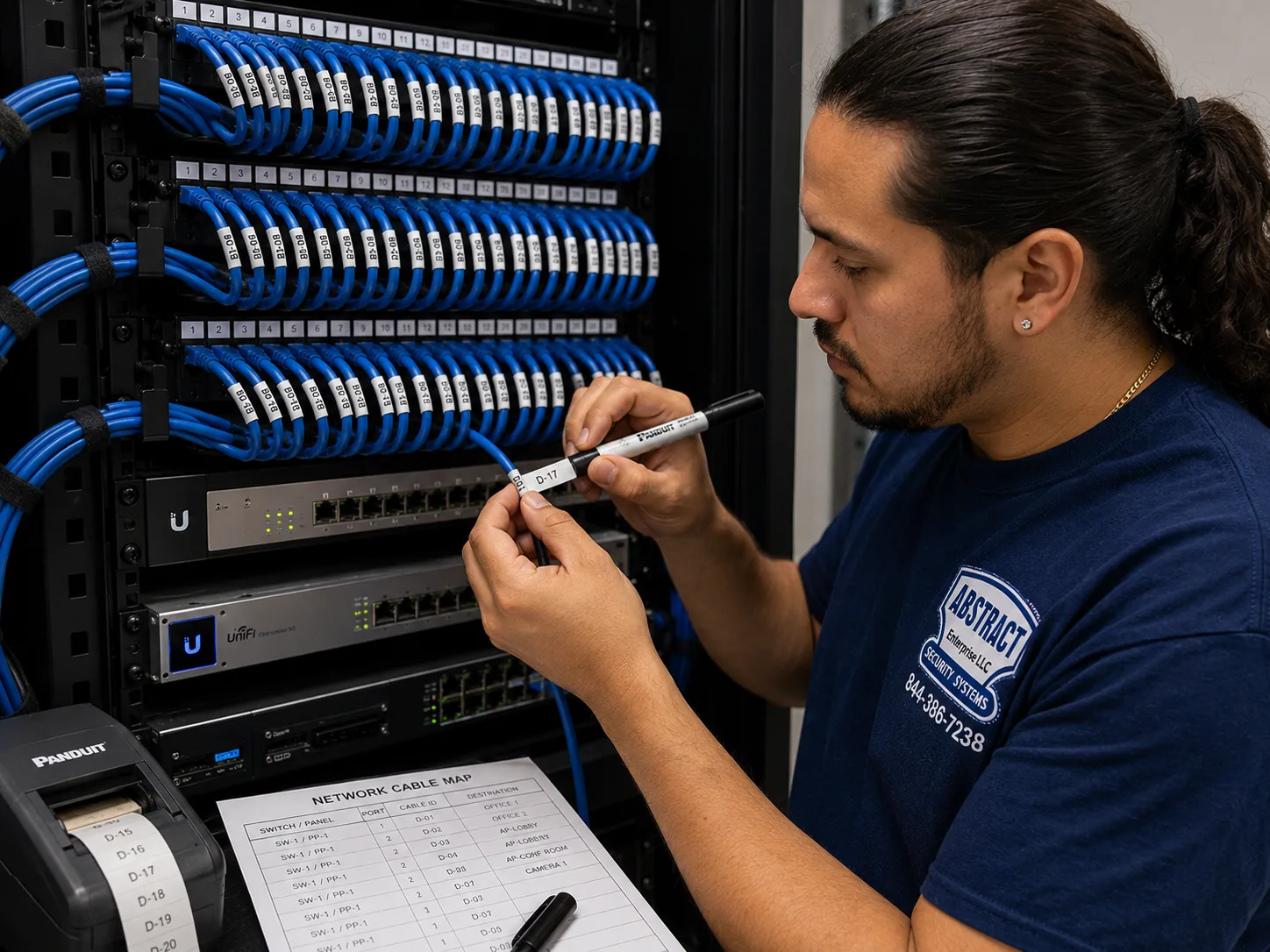
An old recorder that shows "Camera 1" through "Camera 12" is useless at two in the morning, when a resident calls about a noise and the super has to find the right view fast. In a building on two street levels, and especially in a courtyard complex with several lobbies, we name each camera for exactly where it is: "Ogden Ave street door," "Lower door, Nelson Ave side," "Court portico," "Section D lobby," "Roof stair." The same names go on the printed cable labels at the recorder and on the written record we leave behind. When a managing agent changes, or a new super takes over, the next person can read the system the way the building is laid out, not the way an installer happened to plug it in years ago.
The owner, the housing company or the board holds the main administrator account, the only one that can change settings or delete footage. A managing agent may get every camera; a super may get the doors, the cellar and the stairs; a store manager gets the store and nothing upstairs. Alerts follow the same logic. The lower door, the roof stair and the cellar alert overnight, and they alert the person who can actually walk over, not an owner who lives an hour away. The upper street door and the lobby record all the time without buzzing anyone's phone, because on a busy block they would set off alerts every minute. Tenants do not get access to building cameras unless the owner decides to share a view, such as the street door, and then only as view-only. We write down who has what before we leave.
These are the camera jobs we expect most often from Highbridge owners, managing agents, housing companies, boards, shopkeepers and tenants. Each is priced in writing after photos or a visit, with every item on its own line.
Faces at the inner door of walk-ups on Ogden, Nelson, Woodycrest, Anderson and Shakespeare Avenues, with cable to a locked recorder in the cellar.
Cameras on side doors, cellar entrances and yard gates that open onto the street below the hill, with alerts during the quiet hours only.
Porticos, garden courts and separate section lobbies covered on one system, each camera named by section and street.
Landing views that stop short of apartment doors, and a camera at the top of the roof stair, with nothing fixed to self-closing doors.
Entrances, registers, aisle overviews, stock rooms and delivery doors for neighborhood supermarkets and the corner stores between them.
Door, counter and back-door cameras for one-story shops and stores under apartment buildings, with a recorder kept out of reach.
Systems delivered by a builder in buildings that opened since 2015, moved into the owner's accounts, documented and adjusted to how the building is really used.
A small camera on a shelf inside your own apartment, aimed at your door or living room, removed later without a mark.
Recorders and cameras from a past owner or the rehab era traced, tested, reused where they still work and removed where they do not.

The CUNY history of Highbridge sums up the neighborhood as corner bodegas and mid-rise Art Deco apartment buildings, with some nineteenth-century houses left over and newer buildings filling former empty lots. These are the building types the sources describe, and what each means for the camera work.
Five- and six-story buildings set into the slope, with a lobby on the upper avenue and a cellar or side door at grade on the street below.
Noonan-built and Ginsbern-and-Fine designs with porticos, light courts, garden courts and several elevators, many entries on one lot.
Pre-war shells renovated by nonprofit housing groups in the late 1980s and 1990s, with that era's wiring behind newer walls.
Infill on Ogden Avenue and Shakespeare Avenue and towers such as 1387 University Avenue, often opening with camera systems already in place.
Smaller houses on the side streets, with a front stoop, a lower door and a narrow yard between taller buildings.
One-story stores such as those at 1005–11 Ogden Avenue, and ground-floor shops under apartment buildings along the corridors.
| Building | What the camera mounts on | How the cable reaches the recorder | Whose privacy we check |
|---|---|---|---|
| Hillside walk-up | Plaster over brick in the vestibule and halls; brick or stone outside on both street faces | Down to the cellar, which may open on the lower street, then up a shaft or a raceway in the stair hall | Apartment doors, rear windows facing the yard |
| Art Deco courtyard building | Plain wall or ceiling surfaces away from decorative brick, terra cotta and ironwork | Through the cellars that connect the sections, where they do, to one locked recorder room | Windows on the light courts and garden court, every section's apartment doors |
| Rebuilt rehab building | Newer drywall partitions over the old masonry | Along chases built in the renovation, after tracing what the old pipes already carry | Apartment doors, the super's apartment |
| New mid-rise or tower | Finished ceilings and walls, often with pathways already provided | Through the building's telecom riser to the network room, never through the elevator shaft | Residents, staff areas, supportive-service offices |
| Three-family or row house | Brick or siding at the front and back doors | Through the basement or along the outside in a covered run | The neighbors' windows a few feet away, the tenants upstairs |
| Storefront | Block walls, dropped ceilings or the inside of the store front | Above the ceiling to a back corner, or to a locked cabinet if there is no back room | Restrooms, the store next door, the apartments above |
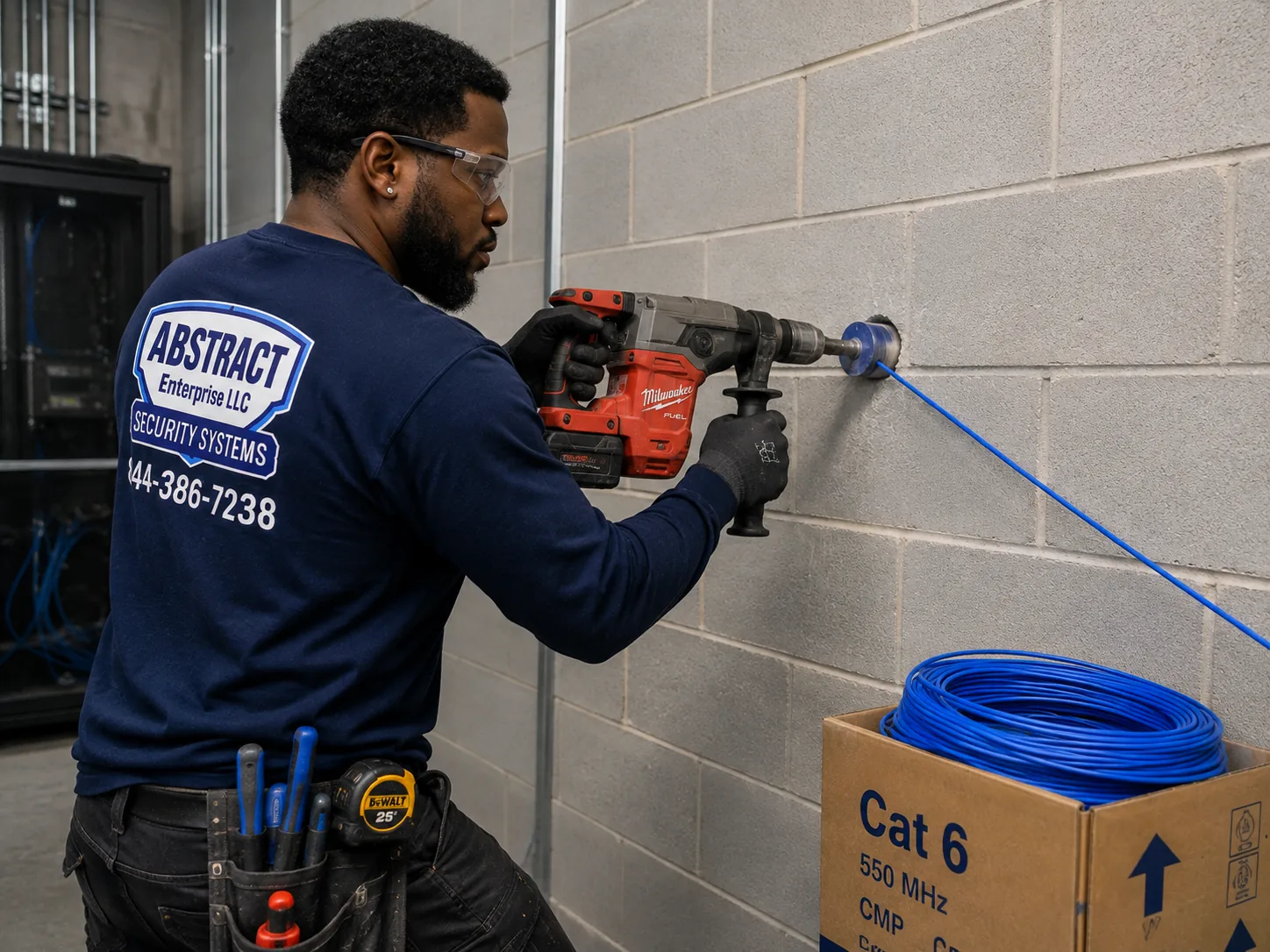
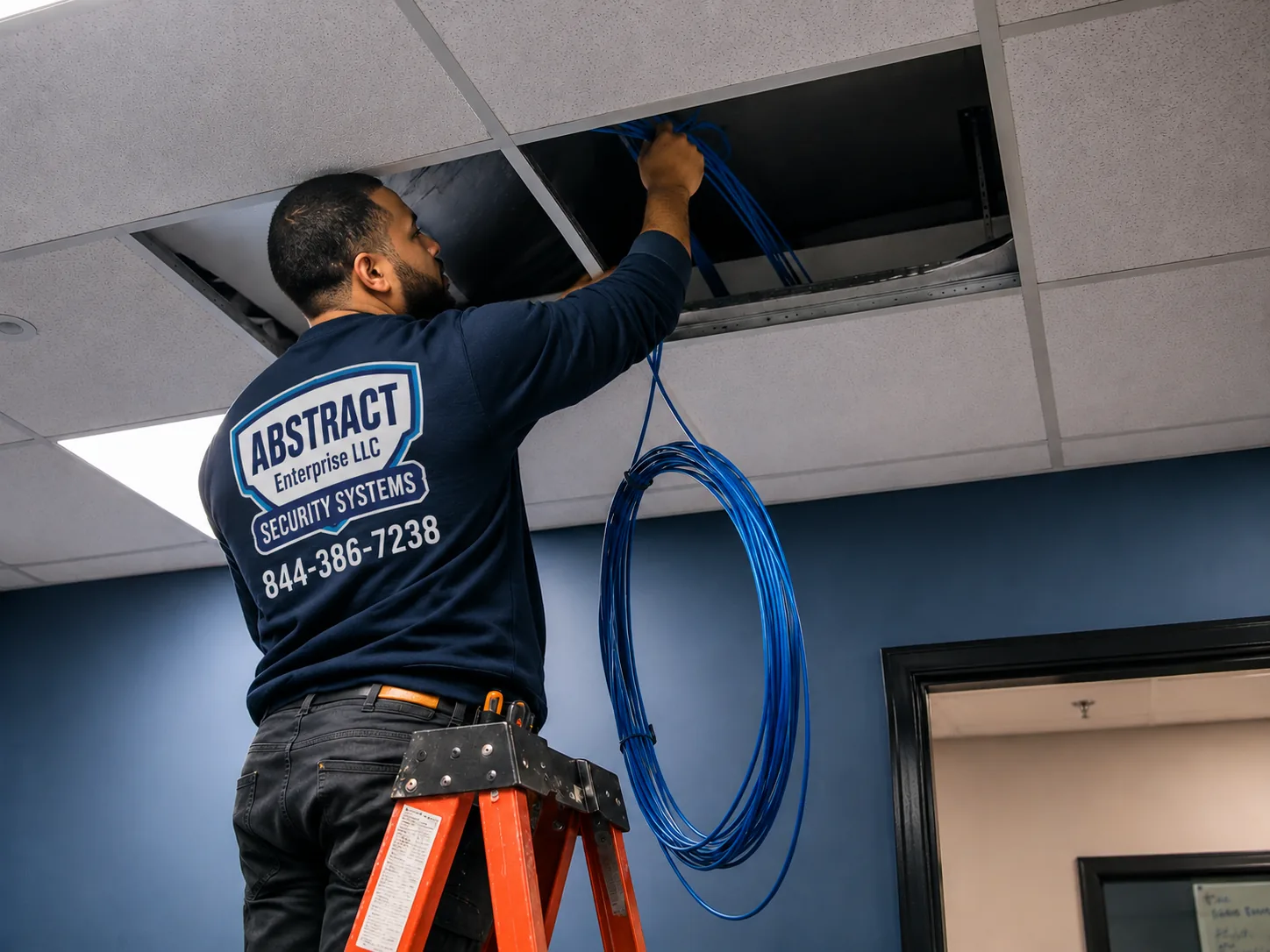
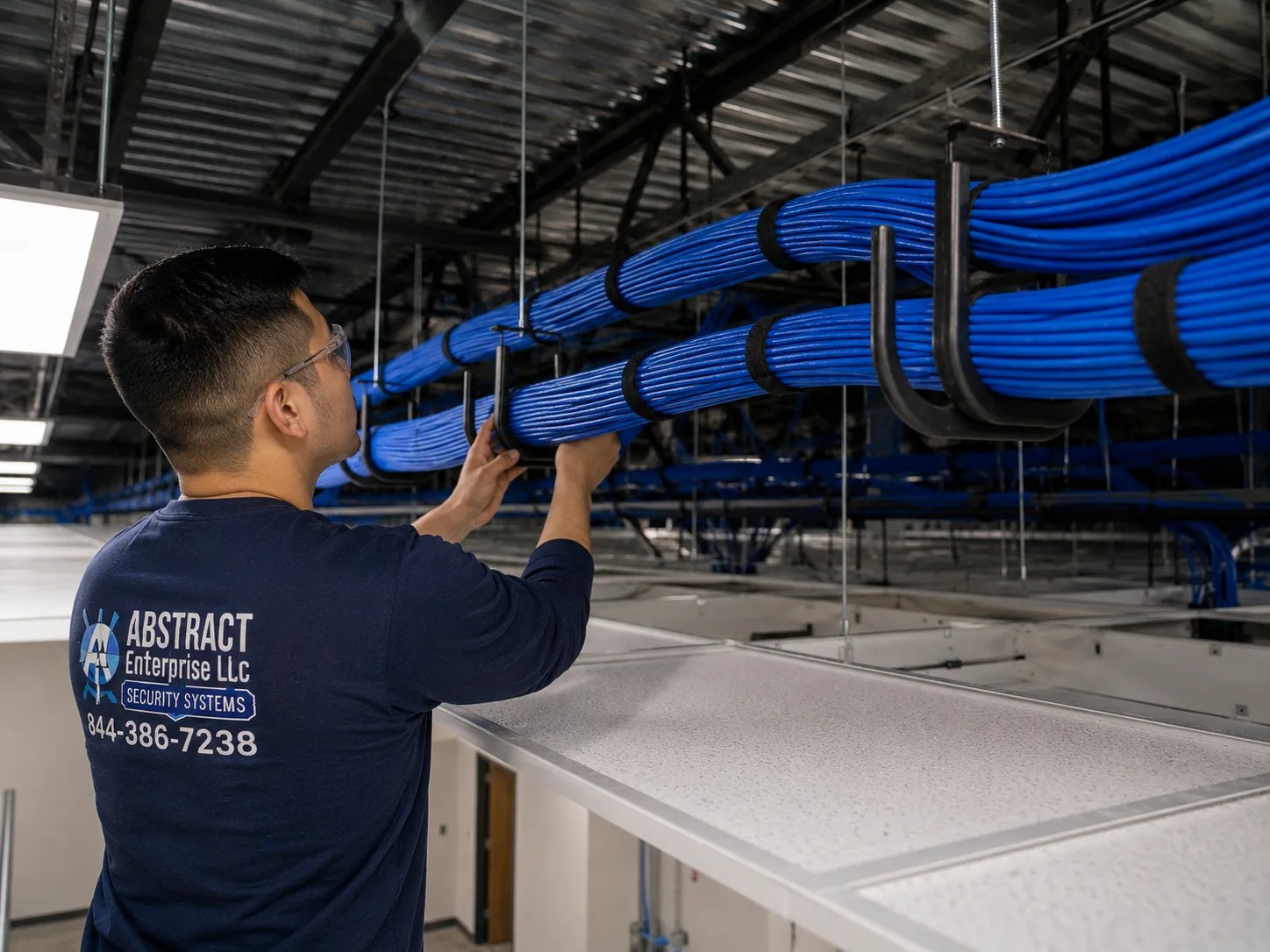
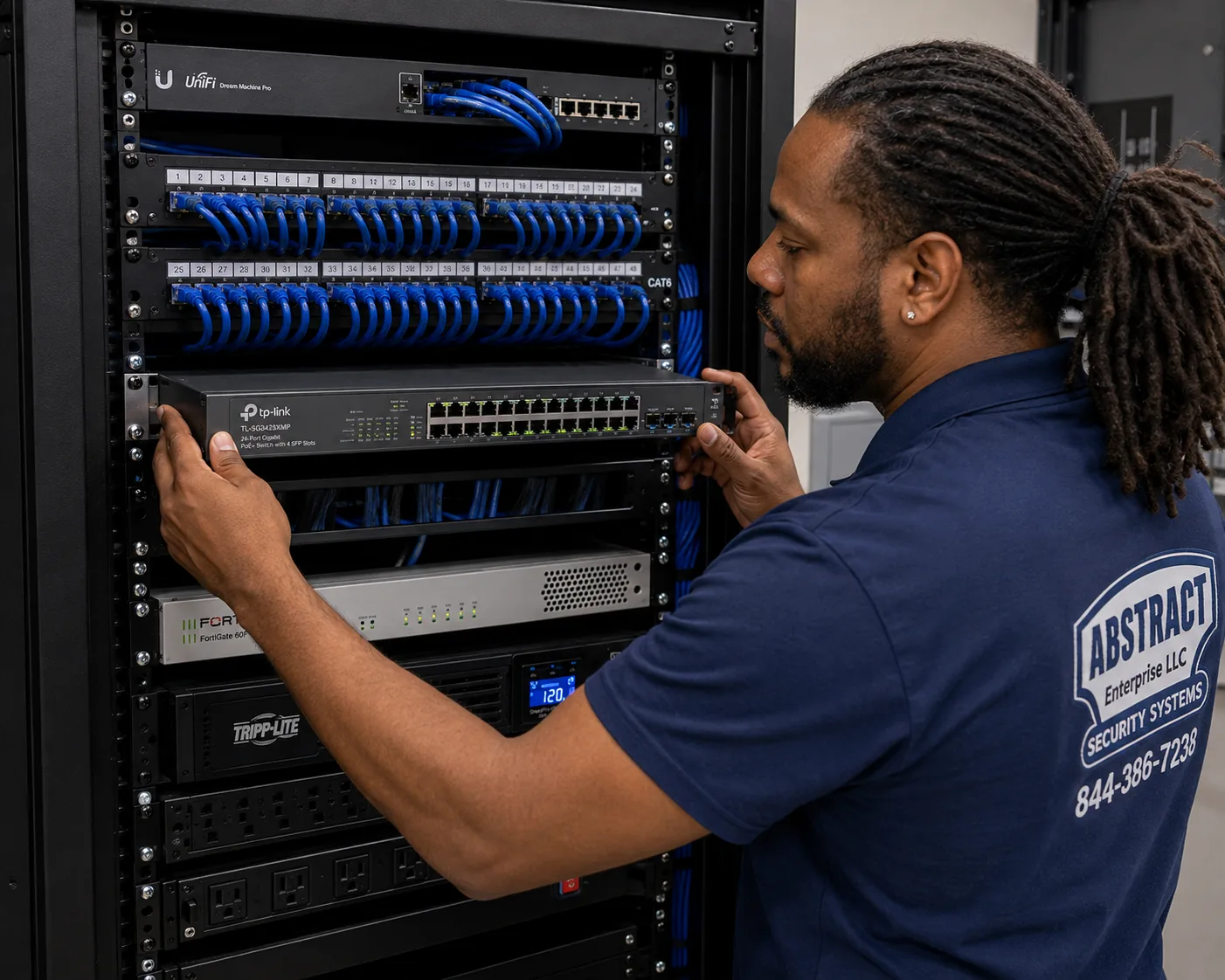
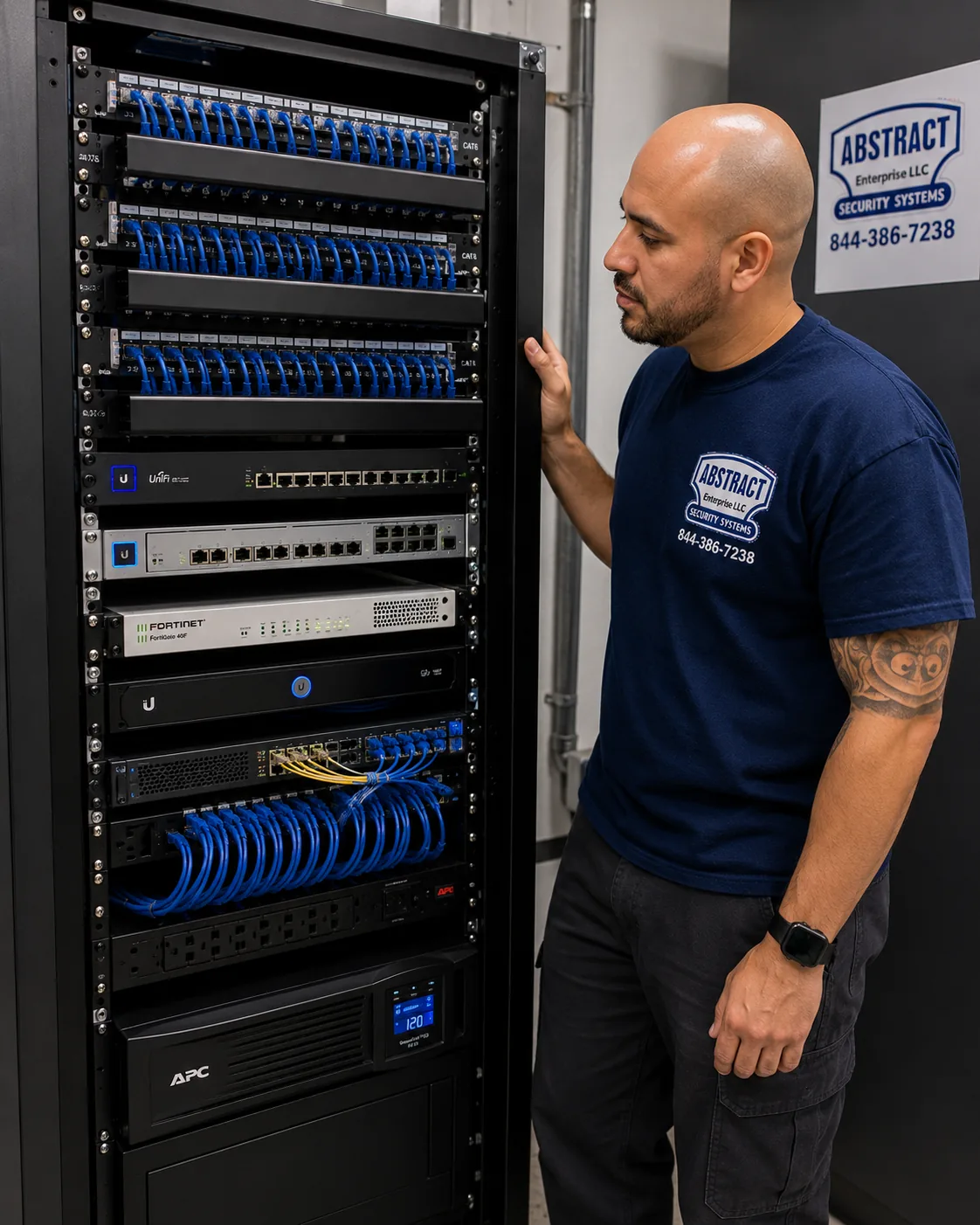
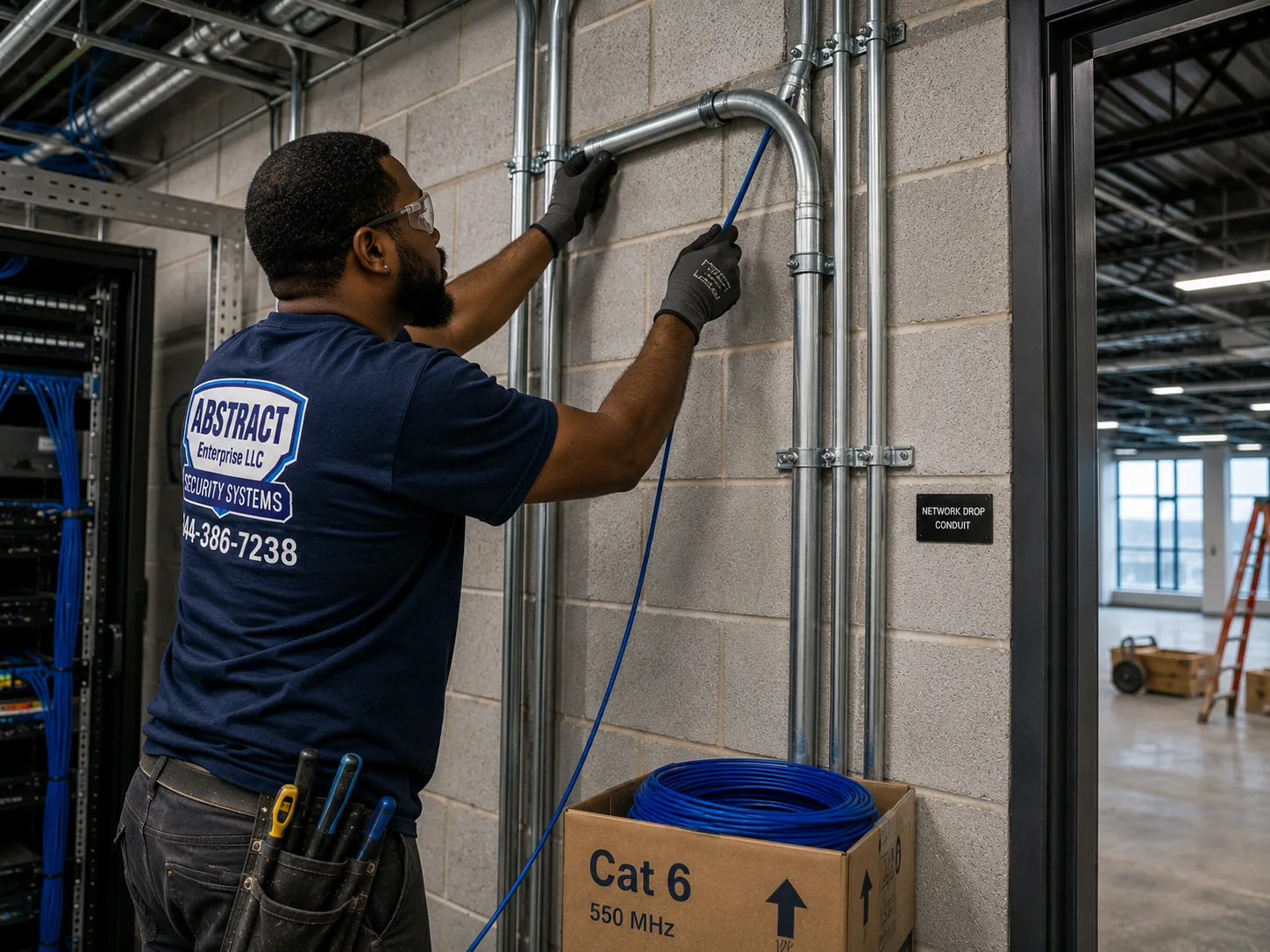
In a hillside walk-up the cellar is usually the hub. It holds the electric meters, the internet provider's equipment and the boiler, and on the low side of the building it may have its own door straight onto the street. That makes it both the best place for the recorder and one of the doors most in need of a camera. We put the recorder in a locked, dry spot away from the boiler's heat and away from the cellar door itself, so anyone coming in that way cannot simply carry it off. The camera for the low door goes inside, aimed at the door from a few steps back so it catches the face of whoever comes through. Cable for the upper lobby climbs a short distance through the floor or along the cellar ceiling on supports. For the stair halls, which are usually plaster over brick, we look for a pipe chase or a stacked closet before anything else, and use slim painted raceway only where there is no other path. Every floor the cable passes through is sealed with rated firestop.
A courtyard building such as Noonan Plaza is really several buildings joined together, each section with its own elevator and entrance, gathered around light courts and a garden court. A camera plan for a complex like that starts at the portico, the one place every resident and visitor passes from the street into the court, and that camera is framed for faces. Each section lobby then gets its own entry view. The garden court is covered as an overview, aimed so it shows the paths and the court floor rather than the hundreds of windows looking onto it. Because these buildings are often landmarks, camera positions on the exterior go on plain surfaces away from the ornament, cable runs through the cellars wherever the sections connect underground, and the plan is written up for the Landmarks Preservation Commission before any drilling on a protected face. Recorder capacity is sized for the whole complex at once, so the next section added does not mean a second recorder in another wing.
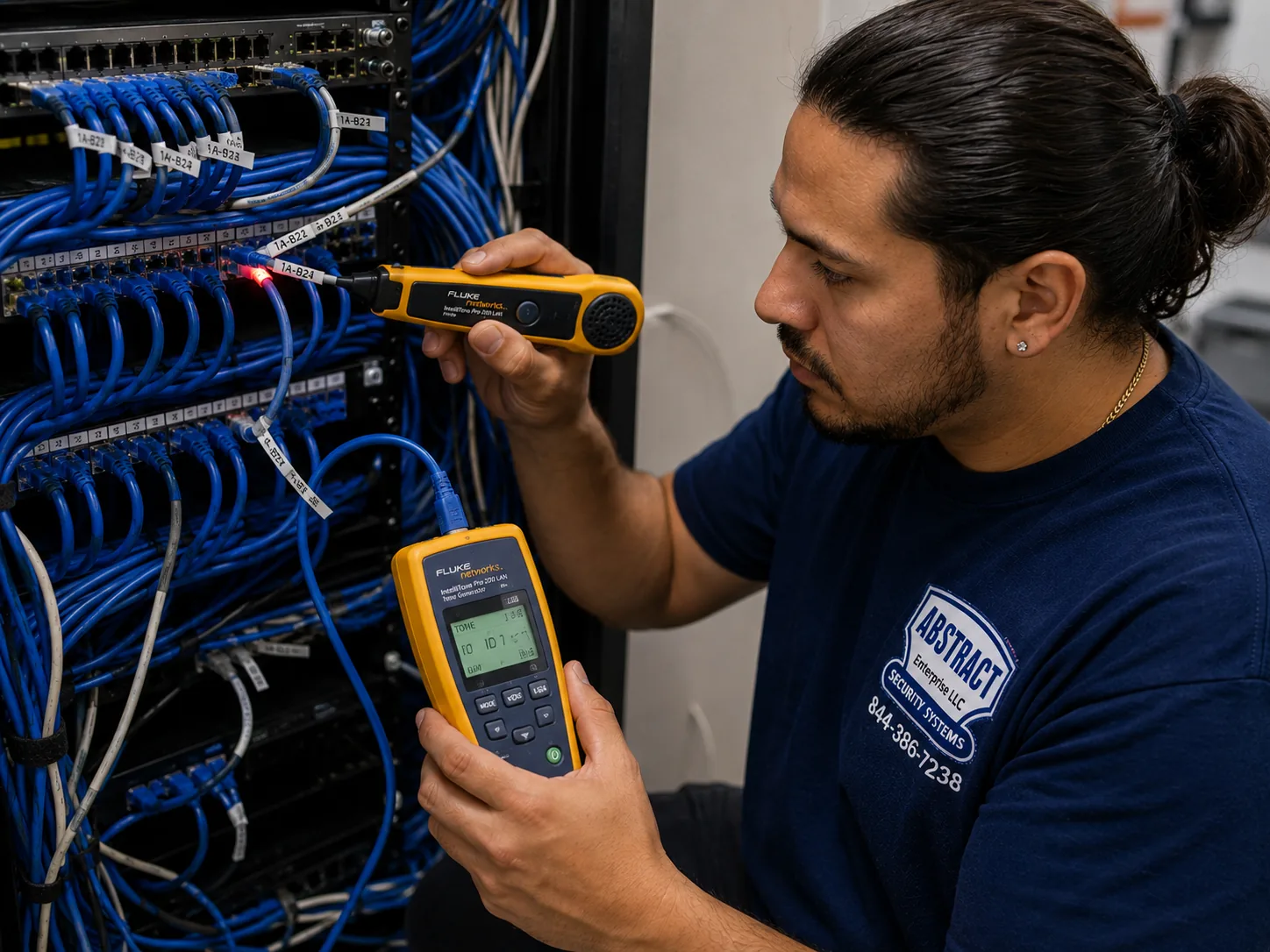
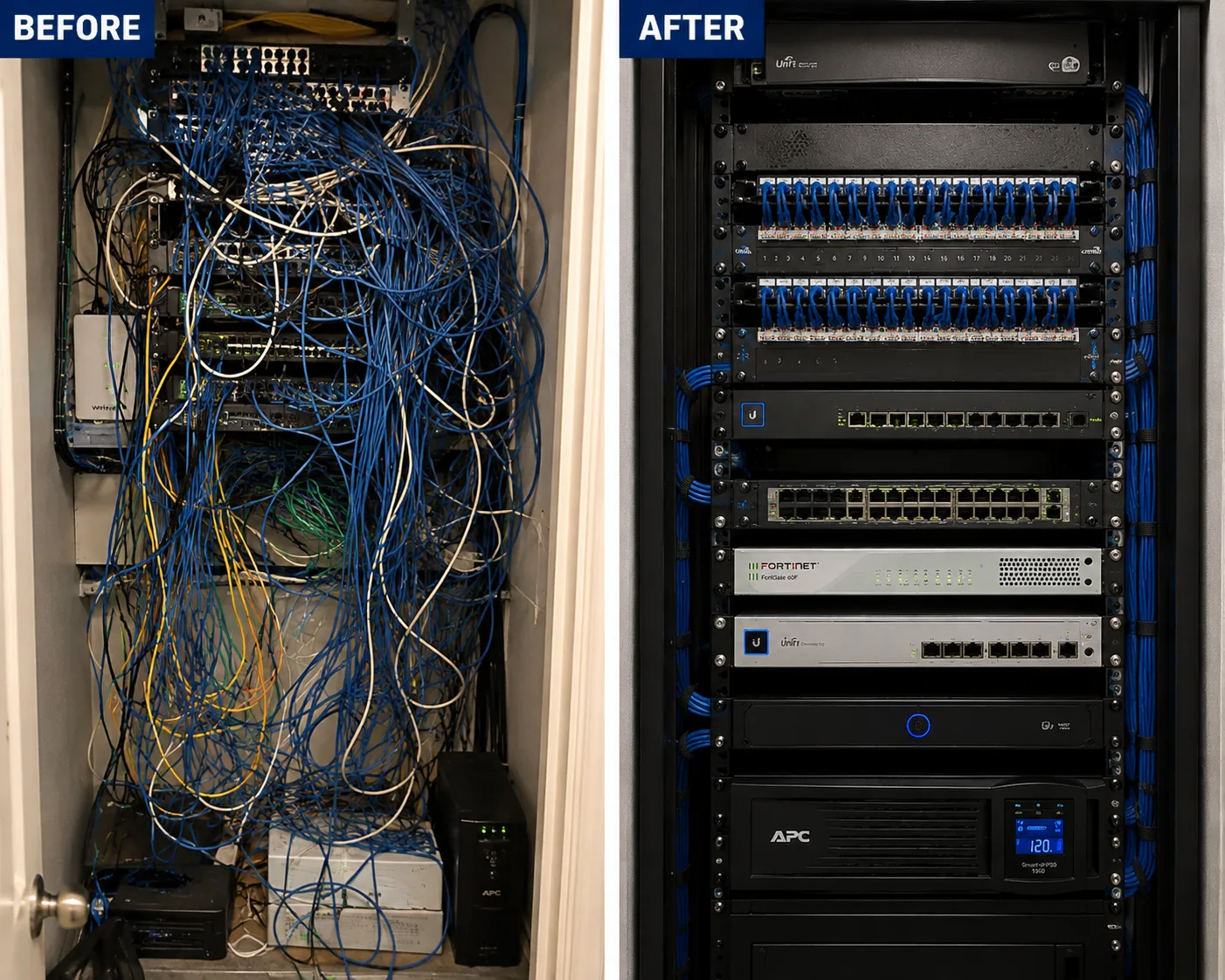
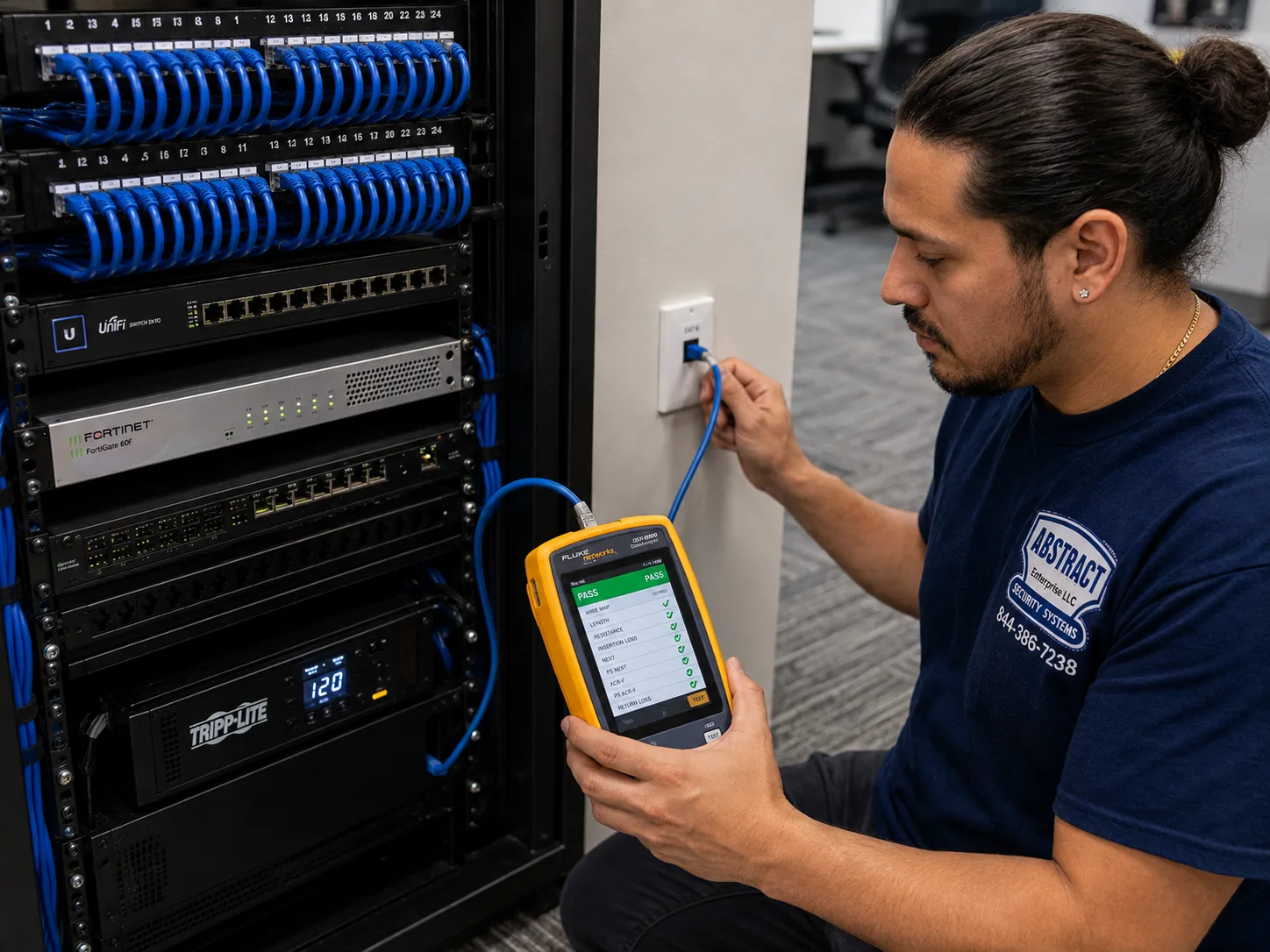
Many Highbridge buildings were gutted and rebuilt by nonprofit housing groups after the vacancy years, and the renovation left new walls, new chases and new wiring inside the old brick shell. That can be good news for camera work, because those chases may run straight from the cellar to the roof. It can also mean a cellar full of cable nobody can identify, from an intercom, an old camera system, a cable TV contractor and a phone company. Before we pull a single new cable, we trace and label what is already there with a tone generator, so we know which pipes are full, which are empty and which old runs can be pulled out. Where an old camera cable still tests good, we may reuse it; where it does not, we remove it, so the next person does not inherit the same mystery.
Buildings that opened in the last decade usually have a telecom riser, a network room and a camera system the builder installed. The job there is less about cable and more about ownership, documentation and coverage gaps: making sure the system is in the owner's name, that the views match how residents and staff actually use the building, and that someone is really watching if the leasing materials promised monitoring. In taller buildings, such as the 26-story tower at 1131 Ogden Avenue or the 31-story building rising at 1387 University Avenue, cable for added cameras goes up the telecom riser or another approved chase, never into the elevator shaft, which is reserved for the elevator's own equipment. Where a building needs cameras on many floors, we use network switches on the floors so long runs stay within the limits the cable can carry.

Highbridge's shops sit along a handful of streets the city and the local development corporation describe. We list the kinds of businesses the sources name, not our clients, and we do not claim any named business as a customer.
A neighborhood commercial corridor in the Department of Transportation's study, with one-story storefronts such as 1005–11 Ogden and new mixed-use buildings filed at 1014 and 1047 Ogden. The Bx13 runs along it.
The historic commercial center of Highbridge, with corner stores and services, served by the Bx35 and by the 4 train at 167th Street on Jerome Avenue.
Another corridor the city studied, with stores including Bravo Supermarket at 156 West 170th Street, on the Bx11 route.
Shops, services and institutions such as Samaritan Village in the former Carmelite monastery at West 170th Street, near the new tower at 1387 University Avenue.
Neighborhood groceries such as Jumbo Supermarket at 1384 Nelson Avenue and Pioneer Supermarket at 107 Featherbed Lane, both named by the Highbridge CDC.
The eastern edge, under the elevated 4 line, with shops and the landmark Park Plaza Apartments at 1005 Jerome Avenue.
The supermarkets the Highbridge CDC lists are the busiest rooms in the neighborhood, and News 12 reported this fall that two men were accused of punching a 68-year-old man inside a Highbridge supermarket. A camera plan for a store like that starts at the doors, with a camera just inside each entrance at head height, set back so people walk toward it. The registers come next, each with a camera above and slightly in front that shows the customer, the cashier's hands and the drawer. Aisle overviews from the ceiling follow, placed at the ends of the long aisles where staff at the front cannot see. Then the stock room, the walk-in doors and the delivery entrance, which in many of these stores opens onto a side street and sees trucks early in the morning. A monitor near the front, showing the aisles, lets a manager see trouble as it starts. Ceiling work happens before opening or between deliveries so the store never has to close.
Most Highbridge storefronts are small: a bodega, a phone shop, a barber, a laundromat, a takeout counter, often run by one or two people in the ground floor of an apartment building. Those stores need three views more than anything else: the door, framed for faces; the counter, close enough to see hands and the register; and the back door or stock room. A one-room store with no back office needs a locked cabinet for the recorder, high and away from the counter. Because the building above belongs to a landlord, any camera on the outside wall or the sidewalk canopy needs the landlord's written agreement, and the store's system stays separate from the residential system upstairs, so neither the tenants nor the landlord's super can see the store's footage unless the store owner chooses.


We do not publish stories about particular buildings or customers, so this is the routine rather than an anecdote: how we look at a Highbridge building before we recommend a single camera.
We begin on the street the owner calls the front, usually the upper avenue, and watch the street door for a while: who comes in, who waits outside, where couriers leave boxes, how long the inner door stays open after someone is buzzed in, and where the light falls in the vestibule at that hour. Then we walk around and down. On the slope that may mean a stair street, a side block or a path along the back of the lot, and it is on that walk that we find the doors that never came up on the phone: a cellar door at grade, a yard gate, a store's rear exit, a fire escape that ends a few feet above a yard. We note which of them close and latch on their own and which ones need a push. Inside, we go to the cellar first, find the power, the internet equipment and a dry, locked place for the recorder away from the boiler, then work up the stairs looking for a chase, a shaft or a stacked closet that cable can use without opening plaster. On the top floor we check the roof door. Only then do we sit down with the photos and write the plan, door by door and level by level.
Buildings on the hill
Because nobody sees them. The upper lobby has residents passing all day; the low side may go hours without anyone walking by, and the super is the only person who uses the cellar door on purpose. If a door there does not latch, or someone is let in that way, the lobby camera will never show it. A camera inside each low-side door, aimed so people walk toward it, with alerts set for the hours those doors should be quiet, closes the biggest gap in most Highbridge camera plans.
Name and group them by section and street, not by number. On the recorder and the phone app we build a group for each section, such as its lobby, stair and elevator landing, plus a group for the portico and garden court. Labels at the recorder match the names on screen. A super checking a noise reported by someone in one wing then opens that wing's group and sees its three or four views at once, instead of scrolling through dozens of numbered tiles.
We mount it inside the door or tight above the doorway, framed on the threshold and the first step or two, so it shows who comes through your door and leaves the rest of the public stair out of the frame. Many cameras also allow parts of the picture to be blacked out permanently, which we use on any edge that still catches the stairway. The point is a record of your entrance, not of the neighborhood's walk to the train, and a tight frame also gives a larger, clearer face.
A shared court in a residential building is a common area, so the owner or board can cover it, and many families are glad a camera watches the paths and the gate. We frame it as an overview of the court floor and paths, aimed away from apartment windows, and we do not mount it low enough to feel like it is watching any one bench. A short written notice in the lobby saying the court is recorded and who can view the footage helps residents trust it. Access to that camera should be limited to the people the owner names.
No. The elevator hoistway is reserved for the elevator's own equipment, and the elevator contractor and inspectors will not accept other cable in it. In a tall Highbridge building we use the telecom riser, an existing chase or a closet stacked floor above floor, and where floors are far from the recorder we place small switches on the way so each run stays within its limits. If the board wants a camera inside the elevator cab itself, that is arranged with the elevator company, which handles the cable that travels with the cab.
Systems the building already has
Usually yes. An intercom camera is built to show the face of the person pressing the button, and many only record when someone calls. It does not show the person who follows a tenant through the inner door, the vestibule behind the panel, or the mailboxes. A separate camera inside the inner door, recording continuously, covers what the intercom cannot see. Where the intercom and recorder can share video, we connect them, but we plan on the separate camera doing the main work of showing who came in.
Ask the managing agent three things in writing: who holds the administrator account, whether a person or company watches the cameras live and during which hours, and how many days the recorder keeps. "Monitoring" can mean a guard at a desk, a remote service, or simply that video is recorded and checked after a complaint. Buildings such as Saint Francis Commons list cameras and monitoring among their features, and the answer tells residents what to expect. If the owner wants a review of coverage, we can look at the views and the recorder and write up what each camera actually sees.
Sometimes. Camera cable is low-voltage like intercom wiring, and if the riser or conduit has room, it can carry a separate camera cable alongside the intercom pair without touching it. We check how full the pathway is first, because overfilling a pipe can damage what is already there, and we never splice into or reuse the intercom's own wires for video. In rehab-era buildings we trace the intercom run before pulling anything, so tenants keep their buzzers working throughout the job.
Shops, schools and the street
The daycare controls the inside of its space, and its cameras there follow its own licensing rules and policies, which the operator should confirm with its licensing agency. The building's cameras stop at the daycare's door, covering the street entrance, the shared lobby and any yard the owner controls, aimed so they do not look into the classrooms. Keeping the two systems separate means the building's super cannot view children's rooms, and the daycare's director decides who sees its recordings.
Into a small locked metal cabinet mounted high on a wall, out of reach from the counter and out of the line of sight from the door, or above the ceiling where there is space and air. The point is that anyone who grabs the register cannot also grab the footage. The cabinet needs power, ventilation and a small battery backup, and a camera on the store should still show the area around it. If your internet allows it, key views can also be copied off site.
Yes. A monitor at the front counter or the manager's station can show the aisle-end cameras, the stock room door and the entrances live, so staff notice a crowd forming or someone being followed before it turns into an incident. We arrange the screen so it shows the aisles staff cannot see directly, and keep it turned so customers waiting at the register cannot study the views. Recording continues on the recorder underneath, and only the owner and named managers can export clips.
No. Lampposts, sidewalk trees and signposts belong to the city, and private equipment cannot be fixed to them. A camera for the sidewalk in front of your building goes on your own façade, or on your store's sign box with the landlord's agreement, mounted high and aimed along your frontage. On a slope, a camera placed a little above the door looking down the walk usually gives a better view than anything on a post would, because people walk toward it.
These are the cameras and parts we expect to fit in Highbridge walk-ups, courtyard buildings, new towers and stores. For wired systems we install brands including Lorex, Hikvision, Dahua and Uniview, and every item is named on the written quote before anything is ordered.
Fixed cameras just inside street doors, vestibules and porticos, set at a height and angle that show one clear face per person.
Hard-cased domes for cellars, low-side doors, stairs and roof landings, hard to knock off aim or break.
Adjustable lenses for long courts, deep lobbies and stores, zoomed so a portico or a far door fills the frame at a useful size.
Ceiling cameras for garden courts, lobbies and supermarket aisles, matched by time stamp to the entry cameras.
Small cameras over registers in groceries, bodegas and shops, showing hands, the drawer and the customer's face.
Plug-in cameras for renters, with a privacy shutter and nothing fixed to walls or doors.
Sized for the cameras and the days you want kept, locked in a cellar room, a management office or a store cabinet.
Sending power and picture over one cable, placed on floors of tall buildings and courtyard sections to keep runs short.
Keep the recorder, switch and internet equipment running through a short outage so there is no gap in the recording.
Plenty of Highbridge owners and shopkeepers look first at a kit from a store or a nationally advertised plan. Each has a place. The table compares how they fit the buildings here, without setting anyone's prices side by side.
| Question | Self-install kit (Ring, SimpliSafe and similar) | National monitored plan (ADT and similar) | AESS as a local installer |
|---|---|---|---|
| A cellar door two stories below the router | Wi-Fi often too weak through brick | Depends on the plan | Wired camera, cable run through the cellar |
| A courtyard building with several lobbies | Hard to manage many cameras in one app | Varies | One recorder, cameras grouped by section |
| Landmark façades | Owner handles approvals alone | Varies | Positions and cable paths written up for review first |
| Owner, agent, super and staff access | Varies by app | Varies by plan | Separate accounts set before we leave |
| Ongoing fees | Optional cloud plans | Usually a monitoring contract | No monthly fee for a recorder system you own |
| Best fit in Highbridge | A renter's indoor camera | Owners who want professional alarm monitoring | Buildings on two levels, courts, stores and takeovers |


These are claims that show up again and again in quick online answers, vendor blogs and cost guides about cameras in the Bronx, checked against what the sources say about Highbridge. Cost pages on Angi, HomeAdvisor and Fixr feed many of those answers; they give a rough sense of scale for New York, but none of them has walked a building from the upper avenue down to its cellar door.
Search for Highbridge and results mix the Bronx neighborhood with Highbridge Park in Manhattan, since the High Bridge itself links the two banks of the Harlem River. Quick answers sometimes blur them into one place.
The Bronx neighborhood is a dense residential district running from the river to Jerome Avenue, with the Cross Bronx Expressway to the north and the Macombs Dam Bridge to the south. Its streets are lined with walk-ups, Art Deco courtyard buildings, newer towers and stores.
For cameras that difference is everything. A Highbridge job is a lobby, a stair, a court and a cellar door on a slope, or a store on Ogden Avenue, not a park path. We plan for the buildings, not the bridge.
Answers about building safety often roll intercoms, self-closing doors and cameras into one requirement. Seneca Security, reviewing NYC building rules, says plainly that there is no general city law mandating cameras in apartment buildings.
What the rules do require is different: working self-closing, self-locking doors, and in many larger buildings a working intercom, with HPD treating a broken intercom as a violation. Cameras are a choice the owner, housing company or board makes.
That choice still matters. When Highbridge tenants complain about strangers in the building or damaged mailboxes, cameras are often how an owner finds out what is happening, but no camera clears a door or intercom violation. The door or the intercom has to be fixed.
Some vendor blogs say a city law requires a sign wherever building cameras record, and another site names a different local law for residential cameras. We could not confirm either claim from any city source.
So we do not tell owners that a specific sign is legally required in every building. We do recommend a short, honest lobby notice saying the common areas are recorded and who can see the footage, because it helps tenants trust the system and costs nothing.
Businesses that use face-matching software are a separate matter with their own city rules, and anyone considering that should speak to a lawyer. Ordinary recording in a Highbridge lobby or store does not involve it.
At least one installer's blog states this flatly. The state sources point another way: the Department of State licenses businesses that install, service and maintain security systems, and camera cable carrying low voltage from a recorder or switch is not new electrical wiring.
Where a job needs a new outlet or circuit, for example in a cellar with no spare power near the recorder spot, that is electrical work, and our quote says so and names it as an electrician's line.
The right question for any installer is whether they hold the state security license. AESS does, under NYS license #12000287431, and we show it to owners, agents and boards before work begins.
Product pages and quick answers often present a video intercom as a full security solution. At 101 West 165th Street, ABC7 reported tenants pushing back when their 24-hour guard was cut and management pointed to a new smart intercom.
An intercom shows who presses the button. It does not see the person who slips in behind a tenant, it does not watch the low-side cellar door, and it does not respond to anything. A guard can act; a camera records; an intercom lets people in.
Each has a job. In Highbridge buildings we treat the intercom as the front door's gatekeeper and cameras as the record of every way in, including the ones the intercom never sees. Whether a building also needs a guard is the owner's decision, and we will not pretend cameras make it unnecessary.
Cost guides quote labor in a range per camera, and AI answers repeat that number as if every camera were the same work. One vendor gives $80 to $200 per camera for labor in New York City.
In Highbridge the same camera can be a ten-minute mount or a half-day run. The vestibule camera above a cellar may need a short cable; the camera at a lower side door on the far end of a sloping lot may need a long run through two cellars; a camera on a landmark façade needs an approval before anyone climbs a ladder.
So we do not print one camera price for the neighborhood. Every Highbridge job is priced on our Bronx rate, quoted line by line after photos or a visit, and booked within 2 hours.
Quick answers often say cameras deter intruders, as if a dome in the lobby keeps trouble out.
The local reporting shows something more modest and more useful. In the May shooting at 1235 Grand Concourse, News 12 reported that surveillance video showed the victims running back into the building and captured the shooter and his friends running away. The camera did not prevent the shooting; it recorded what happened, which is what investigators needed.
That is how we place cameras: to show clearly who came through each door and when, at a height and angle that is hard to knock out of aim. Clear records help owners fix doors, change keys and hand police real evidence.
Send photos of your street door, vestibule, lobby, cellar and any door on the lower street or courtyard, or of your store's entrance, counter and back door, with the address. A technician will tell you which views will do the most good, how cable is likely to reach them, who needs to sign off and what the quote will cover, before anyone comes out. Call (646) 490-0629, message us on WhatsApp, or use the quick form.
Every Highbridge camera job follows the same eight steps, whether it is one indoor camera for a renter, a walk-up with a lobby on one street and a cellar on another, a courtyard complex, or a supermarket. In this neighborhood steps one and three carry the most weight, because the doors on the lower street and in the courtyard decide the plan long before the camera brand does.
The building, who owns the walls, and photos of every door, including side, cellar and courtyard doors on the lower street. Requests are booked within 2 hours.
Owner, managing agent, housing company, co-op board, store landlord or Landmarks Preservation Commission: whoever must agree to each position, in writing.
Both street levels, the court, the cellar, the stairs and the roof door, plus a dry, locked recorder spot and a cable path that avoids opening plaster.
Entry cameras aimed so people walk toward them, overviews for lobbies and courts, every view kept out of apartments and private rooms.
Every camera, mount, cable run, wall opening, recorder, battery backup and setup task listed before anything is ordered.
Cable on supports, nothing on self-closing doors or closers, and every opening through a rated wall or floor sealed with rated firestop.
Each view checked in daylight and at night, each cable certified, unique passwords, two-step sign-in and current firmware.
Owner, agent, super and staff accounts with the right limits, clip export shown on your phone, and a written record naming each camera by level and door.

People here give directions by the bridge, the big courtyard buildings, the old school and the library. These are the reference points we plan visits around, and what each means for camera work on the blocks nearby.
Built in 1848, the city's oldest standing bridge, a landmark since 1970, carrying walkers and cyclists across the Harlem River from the neighborhood's western edge.
105–149 West 168th Street, the 1931 Art Deco courtyard complex of eight sections, designated a city landmark, entered through its portico at Nelson Avenue.
1005 Jerome Avenue, one of the first Art Deco apartment houses in the Bronx, designated a city landmark on May 12, 1981.
1257 Ogden Avenue, a school building designated a city landmark in 1981, with apartment houses and stores on the blocks around it.
The half-mile strip along the Harlem River opened to the public in May 2015, below the buildings at the foot of the ridge.
78 West 168th Street, the neighborhood's public library branch, a block from the Woodycrest and Nelson Avenue buildings.
Next to Highbridge we also serve Concourse to the east, and farther afield Claremont and Fordham. For every Bronx neighborhood, see our main page for security camera installation in the Bronx.
Every Highbridge address is priced on our Bronx rate, from a store on West 170th Street to a walk-up on Woodycrest Avenue. We do not publish one camera price for Highbridge, because the jobs differ too much for a single number to help: a renter's indoor camera is a short visit, a vestibule and lobby camera in a walk-up is a modest job, and a courtyard complex with several lobbies, or a building whose lower doors sit at the far end of two cellars, is a planned installation with cable through masonry and firestop at each floor. Each job is quoted in writing after photos or a visit, with every camera, mount, cable run and setup task on its own line. Estimates are free. This table shows what moves the total, so you know what to send.
| What moves the quote | Why it matters in Highbridge | What to send us |
|---|---|---|
| Number of ways in | Upper doors, lower doors, porticos, yard gates and roof doors each need a view | Photos of every door from both streets |
| Distance from recorder to the low side | A cellar door at the far end of the lot can mean a long run | Where the recorder could go and where the lower doors are |
| Floors the cable climbs | Each floor means more cable and another sealed opening | Which floors need cameras, and whether there is a chase |
| Wall and ceiling type | Plaster over brick, rehab drywall, decorative brick and dropped ceilings each need different methods | Close photos at each camera spot |
| Sections and lobbies | Courtyard buildings may need switches in more than one section | A sketch or photos of each lobby |
| Storage and users | More cameras and more days need a bigger drive; owners, agents, supers and staff need their own access | Days to keep and who should see which views |
| Approvals and timing | Landmark review, boards, store landlords, and work before opening or between tenants' busy hours | Any approval rules you already know, and your hours |
Some owners want a TV put up while we are there, often in the super's office, a management room or a store's back corner, to show the cameras. These lines come from our verified Bronx TV price list, which is the only set of prices printed on this page, and they are added to a camera quote only if you ask.
| TV item, Bronx rate | Price |
|---|---|
| TV wall mounting, drywall on wood studs, up to 55 inches (starting price; bracket sold separately) | $209.99 |
| TV placed on its stand, no wall mount | $137.99 |
| Setup-only visit, first hour (then 30-minute blocks) | $225 |
| In-wall concealment with code-compliant in-wall power and cable kit | $169 |
| Paintable cord cover | $59 |
| Soundbar wall-mounted | $129 |
| Soundbar placed | $79 |
| Above-fireplace mounting add | $130 |
| Brick or stone wall add | $65 |
| Plaster wall add | $45 |
| Take down old TV | $85 |
For a hillside walk-up, the quote might list a camera inside the inner vestibule door framed for faces, a lobby overview, a mailbox view, domes on the upper landings that stop short of apartment doors, a camera inside the cellar door on the lower street and one at the side door, a camera at the top of the roof stair, cable through the cellar and up a chase or raceway with rated firestop at each floor, a recorder with a set number of days of storage in a locked cellar spot, a battery backup, and logins for the owner, the managing agent and the super, with alerts on the low-side doors and roof overnight only. For a courtyard building it would add the portico camera, a garden court overview, a lobby camera for each section, and switches where sections are far from the recorder. For a store on Ogden Avenue it would list the door camera, the counter camera, the back door, a locked recorder cabinet and the staff accounts. You see every line before agreeing, and nothing appears on the day that was not on the quote.
Full terms — including 50% deposit, the 30-day warranty and optional paid extended warranty, and the late-fee schedule — are set out in the service agreement.Three common Highbridge jobs, described by what they include. Each is quoted in writing for your building or store after photos or a visit, because the number of doors, levels, sections and cable paths sets the total.
For a walk-up owner who wants the obvious door and the hidden door covered first. A camera inside the inner vestibule door framed for faces, a camera inside the cellar or side door on the lower street with quiet-hour alerts, cable through the cellar, a small recorder in a locked spot, a battery backup, and phone setup for the owner and super with strong passwords and two-step sign-in. Spare recorder capacity is left for stairs and the roof door later.
Everything in the starter, plus a lobby overview, a mailbox camera, domes on each landing that stop before apartment doors, a roof stair camera, cable up a chase or raceway with rated firestop at every floor, a recorder sized for the days you want kept, cameras named by level and street, and separate accounts for the owner, the managing agent and the super. Planned after a walk around both street levels.
For multi-section courtyard buildings and for supermarkets and stores on Ogden Avenue, West 170th Street and University Avenue. Portico or entrance cameras framed for faces, lobby views per section or register views per lane, court or aisle overviews, back and delivery doors, switches where runs are long, a locked recorder on battery backup, a separate camera network, scheduled alerts, grouped views and staff accounts. Landmark review prepared where it applies.
If you already bought cameras or a recorder, or a builder or former owner left a system that still works, we install or reuse it as a labor-only job, quoted in writing like everything else. Before anything goes up, we check that the cameras and recorder work together, that the recorder can still be updated and has enough storage, that nothing is still tied to someone else's account, and that each camera can do the job you need, such as showing a face at a dim cellar door. If something is not suitable, we say so before work starts and show you what would work instead. Equipment you supply is not covered by our product warranty.
Our borough page, with every Bronx neighborhood priced on the Bronx rate. Security camera installation in the Bronx
The same count-every-door planning in every borough. AESS security camera installation in NYC
Grand Concourse apartment houses and the courthouse blocks next door. Concourse security cameras
Walk-ups, elevator buildings and shops near Claremont Park. Claremont security cameras
Apartment houses and one of the busiest shopping streets in the borough. Fordham security cameras
Send photos of every door on both streets and the address. Request a free quote
Yes. With one camera on the upper door and one on the lower door, each recording with an accurate clock, it becomes easy to see people who come in one end and leave by the other within a minute or two without stopping at a mailbox or the elevator. A week of footage usually shows whether it is a few people or a steady stream, and at what hours. That tells the owner whether the fix is a lock on the lower door, a closer that actually latches, or a key change, and the cameras then confirm whether the fix worked.
Most recorder menus and camera phone apps offer Spanish, and the language can be set separately on each phone, so the super can use Spanish while the owner uses English on the same system. We set the language on each device during handover, and the camera names we create can be written in whichever language the people using them prefer. The written record of camera positions and accounts can be kept simple and short so it is easy to follow.
We plan for it. On a stair street or a building set high above the sidewalk, we bring equipment in by the easiest entrance, often the lower cellar door, and stage cable spools and ladders inside the cellar rather than on the stairs. Larger jobs are scheduled with time for carrying, which the written quote reflects. Telling us in advance which entrance a van can reach, and whether the cellar door can be opened for us, keeps the day short.
Keep it short and plain: which common areas are recorded, that there are no cameras inside apartments and no audio, how many days footage is kept before it is written over, who can view it, and who decides on requests to see or copy a clip. It helps to name a contact at management. The owner or board decides the policy, but tenants who know these answers are far more likely to trust the cameras. We can give the owner the factual details, such as storage days and account holders, to put in it.
An awning is usually a poor mount, because fabric and frames move in wind and the camera shakes or slips out of aim. A solid sign box can work if it is firmly fixed to the building and the landlord agrees in writing, since the façade and anything attached to it are the landlord's. Most often the best choice is solid masonry just above the sign or the door, high enough to be out of easy reach, with the cable entering straight through the wall into the store.
We plan routes through common areas, cellars, stair halls and chases so we do not need to enter apartments at all, and most jobs never do. If a route through one apartment would be much better, the owner arranges access with proper notice, and we have a common-area route ready in case that does not happen. No one is asked to let a crew in on the spot, and the job does not depend on a single tenant's door.
As few people as possible: usually the owner or managing agent and the super, with a record of who has a copy. The recorder holds every clip, so if anyone can open the cabinet, anyone can unplug it or take the drive. The cabinet should not share a key with the boiler room or the meter room that contractors use. When a super leaves, change the lock along with the recorder passwords, the same day.
Whoever legally manages the building signs off, which in that case is normally the administrator rather than the owner of record. We ask for that approval in writing before ordering anything, and we set the administrator up as the account holder, with clear notes so the system can be handed over cleanly when management changes again. If you are unsure who has authority, the building's attorney or the administrator's office can confirm it before we schedule work.
It should not. We trace and identify existing lines before we pull anything, keep our cable on its own supports, and never cut or move a provider's line. Where the recorder needs internet, we connect it to the building's own service at the router, not to a tenant's line. Everything we add is labeled at both ends, so the next time the provider's technician comes to the cellar, nobody confuses a camera cable with someone's internet.
They can wash out a camera aimed toward them, much like headlights. We check outside views after dark and adjust the angle, the exposure settings and sometimes the mounting spot so the camera looks along your entrance rather than toward the site. Construction lighting changes as a building rises, so a camera set up near a site may need a quick readjustment months later, which is worth planning for. Inside views, such as the vestibule, are unaffected.
Possibly, but first find out who owns the land and who runs the garden, because both must agree to a camera there. If a building next to the garden is willing, a camera on that building's wall looking down at the garden gate is often the simplest answer, with power and recording handled inside the building. A camera on the garden's own fence needs power, which may mean a battery or solar camera and a phone connection. We would only install it with written permission from the land owner.
Tell us the address and cross street, whether you own, manage, rent or lease, how many floors and sections the building has, and which doors open on the upper street, the lower street or a courtyard. Photos of the street door, vestibule, lobby, cellar and every low-side door, or of a store's entrance, counter and back door, make the quote exact. Prefer to talk? Call (646) 490-0629.

Security Camera Installation Bronx | No Monthly Fees · Security Camera Installation NYC | Licensed Installer · Security Cameras Installed in Manhattan · Brooklyn Security Camera Installation · Security Camera Installation Queens NY · Staten Island Security Camera Installation · Long Island Security Camera Installation NY · Hudson Valley Security Cameras · Security Camera Installation Nassau County NY · Security Camera Installation Suffolk County NY · Westchester Security Camera Installation · Rockland County Camera Installation · Orange County NY Security Cameras · Putnam County Camera Installation · Dutchess County Security Cameras · Ulster County Security Camera Installation | Kingston NY
Security Camera Installation Allerton Bronx NY · Security Camera Installation Bathgate, Bronx NY | AESS · Security Camera Installation Baychester Bronx NY · Security Camera Installation Bedford Park Bronx NY · Security Camera Installation Belmont Bronx NY · Security Camera Installation Bronx | No Monthly Fees · Security Camera Installation Bronx River, Bronx NY · Security Camera Installation Bronxdale Bronx NY · Security Camera Installation Bronxwood Bronx NY | AESS · Security Camera Installation Bruckner Bronx NY · Security Camera Installation Castle Hill, Bronx NY | AESS · Security Camera Installation City Island Bronx NY · Security Camera Installation Claremont Bronx NY | AESS · Security Camera Installation Clason Point Bronx NY | AESS · Security Camera Installation Co Op City Bronx NY · Security Camera Installation Concourse Bronx NY | AESS · Security Camera Installation Country Club Bronx NY · Security Camera Installation Crotona Park East Bronx NY · Security Camera Installation East Tremont Bronx NY · Security Camera Installation Eastchester Bronx NY · Security Camera Installation Edenwald Bronx NY · Security Camera Installation Edgewater Park Bronx NY · Security Camera Installation Fairmount Bronx NY | AESS · Security Camera Installation Fieldston Bronx NY | AESS
Intercom Installation Highbridge Bronx NY · Fire Alarm Installation Highbridge Bronx NY · Structured Cabling Highbridge Bronx NY · Alarm Installation Highbridge Bronx NY · Door Buzzer Repair Highbridge Bronx | Rehab-Era Systems · TV Installation Highbridge Bronx NY · Access Control Highbridge Bronx | High Bridge + Art Deco
From one shelf camera for a renter on Shakespeare Avenue, to a walk-up whose lobby faces Ogden Avenue and whose cellar opens on the street below, to a courtyard building with a lobby in every section or a supermarket on West 170th Street, the work starts the same way: count every door from the top of the hill to the bottom, settle who has to sign off, and write a plan that puts each camera where it does real work. Call (646) 490-0629, message us on WhatsApp, or send the quote form, and we will book you within 2 hours.