
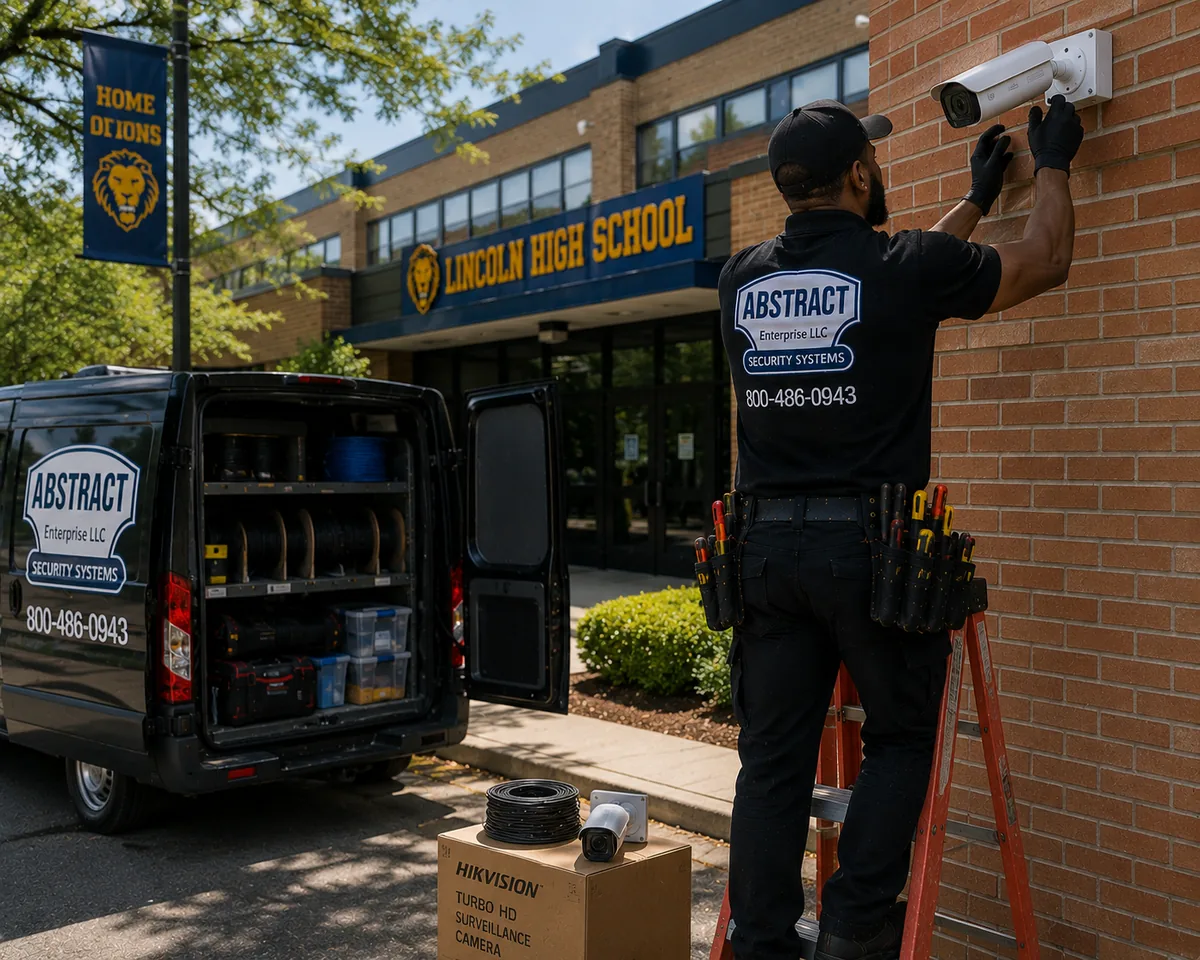
No borough educates like Brooklyn. This is the yeshiva capital of the world — Borough Park, Williamsburg, Crown Heights, Flatbush, and Midwood run the largest concentration of Jewish schools anywhere, from Oholei Torah and Beth Rivkah in Crown Heights to Chaim Berlin, Mirrer Yeshiva, and the Yeshivah of Flatbush along the Ocean Parkway corridor, to Magen David and the Syrian community’s academies in Gravesend. The Diocese of Brooklyn — its own diocese, not Manhattan’s archdiocese — runs parish schools and academies from Xaverian and Fontbonne Hall in Bay Ridge to Bishop Loughlin in Fort Greene. Brooklyn Heights and Park Slope stack independents like Packer Collegiate, Saint Ann’s, Brooklyn Friends, Berkeley Carroll, and Poly Prep. Add Success Academy, Achievement First, and Uncommon charter networks, Al-Noor and the Islamic schools of Sunset Park and Bay Ridge, hundreds of Article 47 daycares in brownstones and storefronts, and a college belt from Pratt and NYU Tandon to Brooklyn College, LIU, St. Francis, Medgar Evers, and Kingsborough — and you have a school market bigger than most American cities. Public schools buy security through the DOE. Everyone else picks up the phone and hires a contractor directly. That call comes here.
Abstract Enterprises Security Systems is headquartered at 1282 Troy Ave in East Flatbush — we install school camera systems in the borough we drive home through. We build NDAA-compliant IP systems on commercial cable through brownstone plaster and parish-school block alike, configure everything to comply with New York’s statewide school facial-recognition ban, schedule around school calendars from winter break to bein hazmanim, and leave every administrator a labeled, documented system their staff can run. Fixed written quotes, 50% deposit, a three-year warranty on AESS-supplied products, and no monthly fees — the footage stays in your building, not on someone else’s subscription.
- NYS-licensed & insured low-voltage contractor — Lic #12000287431
- Brooklyn-headquartered — school installs scheduled around breaks and recess
- No monthly fees, no contracts — you own the system and the footage
Why Brooklyn School Buildings Need a Professionally Installed Camera System
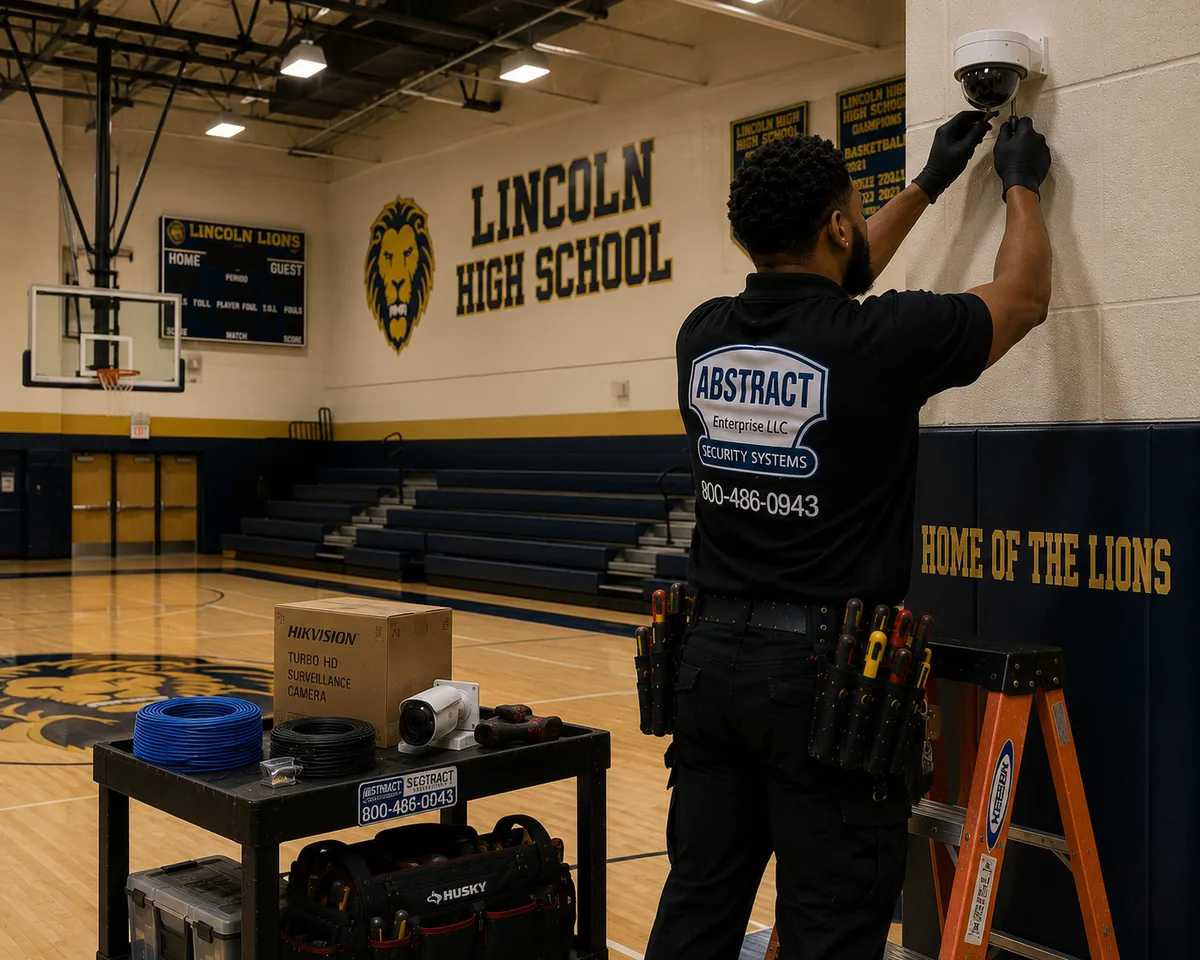
Brooklyn school buildings come in every shape the last 150 years produced: brownstone and rowhouse schools in the Heights and the Slope, 1920s parish buildings with plaster over terracotta block, Borough Park yeshivas that grew wing by wing into three joined buildings, charters in converted industrial lofts off the BQE, and daycares on the parlor floors of Bed-Stuy brownstones. Most face the street directly — a main door on an avenue sidewalk, a schoolyard behind a chain-link fence, a side alley where deliveries and dismissal collide. Coverage here means a face-height entrance camera that holds against avenue backlight, yard and gate lines that watch the fence, stairwell coverage up the vertical circulation, and a camera on the bus curb where two hundred kids load twice a day.
The demand side is concrete. The city has spent roughly $78 million putting cameras and locked, buzzer-controlled front doors across 1,300-plus DOE buildings, City Charter §528 requires cameras at every public-school entrance and exit, and NYPD School Safety runs the largest school-security operation in the country — that’s the baseline every Brooklyn parent walks past daily. The borough’s Jewish schools carry a second weight: after October 7th, antisemitic incidents hit record levels, and Brooklyn’s yeshiva communities — the largest anywhere — moved entry security from facilities item to board priority, with the state’s Nonpublic School Safety Equipment grant and communal security programs funding exactly this hardware. Diocese schools, Islamic academies, and independents read the same news; the first thing a touring family evaluates is the front door.
And the liability math is Brooklyn math: dismissal on a busy avenue, schoolyard injuries after hours, custody disputes at pickup, break-ins over the Chromebook carts during August, graffiti and package theft at the service door, and the yeshiva bus fleet parked overnight in a yard where catalytic converters disappear. Administrators, parish business managers, and daycare licensors all face the same post-incident question — where’s the video? We build systems so the answer is a two-minute export, not a shrug.
Need School Camera Repair in Brooklyn Today?
When the recorder quits or a channel goes dark before a parent meeting, we dispatch same-day from East Flatbush — failed DVR drives, PoE drops, storage faults, blind cameras, and systems whose original installer vanished all get diagnosed and, in most cases, fixed on the first visit.
Call the Repair Line: (347) 934-8335School Security Camera Systems We Install
IP/PoE Camera Systems
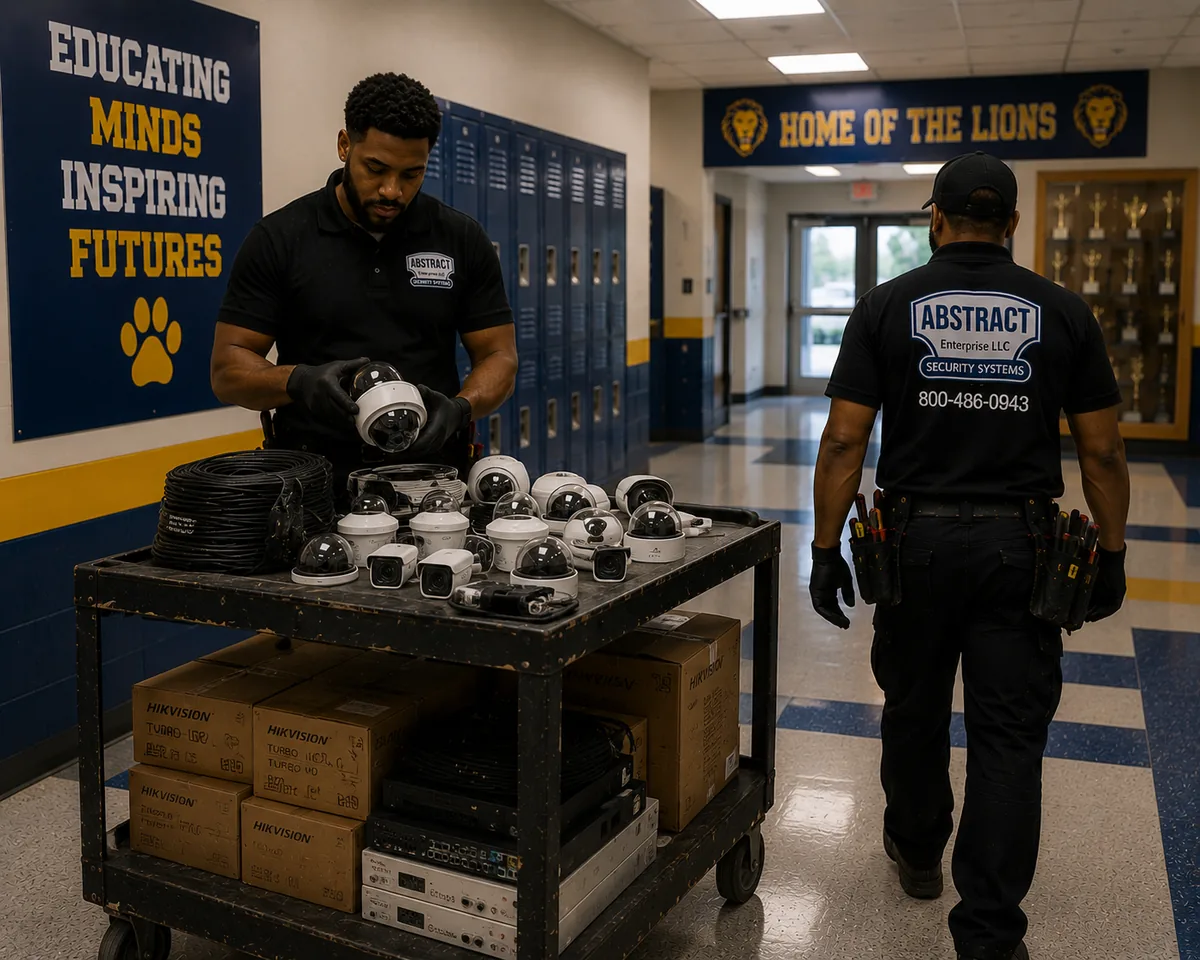
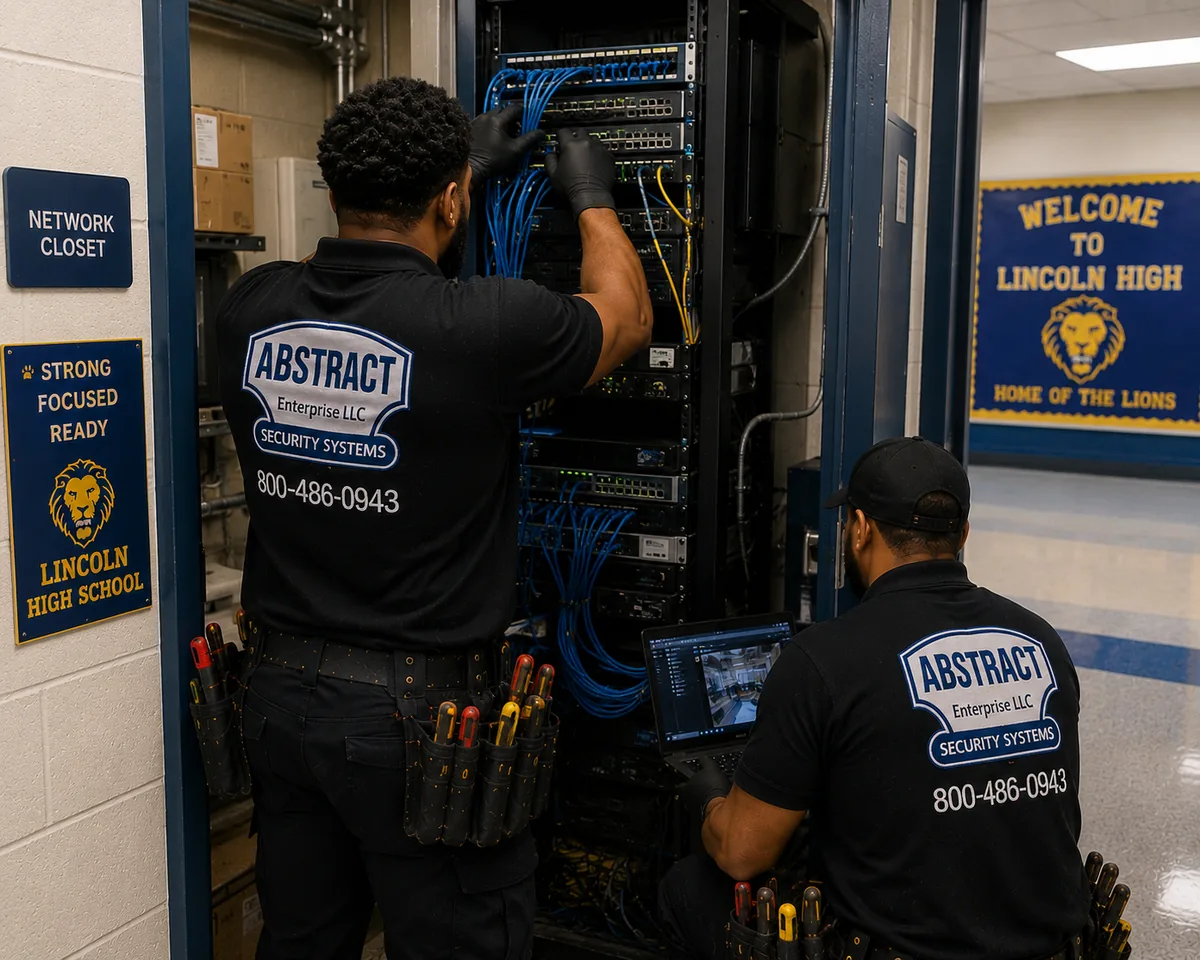
The standard Brooklyn build: commercial 4K and 4MP heads on Cat6 home-running to a locked recorder. In rowhouse and parish stock we plan one vertical pathway and branch per floor, and the NVR gets a real location — ventilated, powered, lockable — instead of the shelf under the front desk where the last one cooked.
Analog Takeovers & Upgrades
Brooklyn is full of 16-channel DVRs wheezing toward drive failure. Where the existing coax meters clean we ride it with converters; where it doesn’t, we pull fresh cable and retire the guesswork. Recorder-side detail lives on our Brooklyn DVR upgrade and NVR installation pages.
Buzzer-Verified Entrances
A face-height head at the street door, live video at the office, and a release that only fires after a human match — scaled to a storefront daycare or a four-story yeshiva lobby. Backlight off the avenue is the enemy; the sensor spec answers it.
Yards, Gates & the Bus Curb
Rear schoolyards, alley gates, fence lines, and the curb where the buses load are Brooklyn’s incident zones. We run fence-line coverage, plate capture at vehicle gates, and a wide head on the loading curb so dismissal disputes end at the playback screen.
Hybrid & Off-Site Copies
Recording stays local by default. Schools that want an off-premises copy of the entrance and yard channels get encrypted duplication configured under an Ed Law 2-d–appropriate vendor agreement — belt and suspenders without a monthly ransom.
Annex & Multi-Building Links
Main building, a beis medrash two doors down, an annex across the street: one recorder, one timeline. Fiber where a duct exists, a licensed point-to-point bridge where it doesn’t — installed and throughput-tested before we call it a link.
Decoding the Spec Sheet: Camera Terms Brooklyn School Boards Keep Hearing
DVR & NVR
A DVR is the older recorder that digitizes analog signals arriving over coax; an NVR receives already-digital streams from IP cameras over network cable. Most Brooklyn parochial and yeshiva buildings still run a DVR bought in the early 2010s, which is why so many of our projects start as recorder swaps rather than full rip-outs.
PoE
Power over Ethernet pushes electricity and video down a single Cat6 line, so a camera high on a masonry wall needs no outlet beside it. In attached buildings where every hole through a party wall is negotiated, cutting the conductor count in half matters.
WDR
Wide dynamic range lets one sensor expose a shaded vestibule and a sun-blasted avenue in the same frame. Point a bargain camera out a 13th Avenue doorway at 8 a.m. and you get silhouettes; a proper WDR head gives you faces.
Retention Window
How far back the recorder can rewind before old footage is overwritten. Thirty days is where we start every school build, because the complaint about a September incident tends to arrive in October.
NDAA Section 889
The federal rule that keeps certain manufacturers — Hikvision and Dahua among them — out of any project touched by federal money. If a Washington grant is paying for your entrance package, the hardware list has to clear this bar first.
EoC Converters
Small adapters that push modern IP video across the analog coax somebody stapled through your building in 2009. When the old cable meters clean, EoC spares the plaster in two or three classrooms per floor — we test before we promise.
Analytics vs. Facial Recognition
Motion analytics — person detection, line-crossing, loiter timers — are legal in New York schools and do the real work at yard fences. Facial recognition is a different technology and has been prohibited in every school in the state since 2023. Knowing the difference keeps vendor meetings short.
IK10
An impact rating for housings that shrug off a basketball, a backpack, or a bored teenager. Anything we mount below eight feet in a Brooklyn gym, stairwell, or rear yard carries it.
LPR
License-plate capture: a camera tuned to read plates at a gate or curb, day or night. On yeshiva bus yards and parking gates it turns “a white van was here” into a plate number the precinct can run.
Camera Brands We Put in Brooklyn Schools — and the Logic Behind Each
Hanwha Vision
First pick when a grant is paying or a diocesan office is reviewing: clears the federal manufacturer rules, sees well in dim lobbies and dusk yards, and the vandal line takes gym abuse without drama.
Axis
What we spec when a board’s outside consultant will inspect the job. The per-camera price stings once; the decade of quiet service afterward is why the consultants keep naming it.
Uniview
Where most tuition-funded Brooklyn builds settle: strong sensors, stable recorders, federal-compliant lines on the menu, and a price a parish finance council will approve without a second meeting.
Lorex
Right answer for a storefront daycare or a single-floor preschool that needs eight good cameras, not an enterprise platform. We install it where it honestly fits — specifics on our Lorex Brooklyn page.
Hikvision & Dahua
Strong optics carrying a federal restriction: Section 889 bars them wherever federal dollars touch the project. Purely tuition-funded schools may run them lawfully, and we maintain thousands of existing channels — see Dahua Brooklyn. The restriction goes in the quote so the choice is informed.
Cloud-Licensed Platforms
Dashboard-first systems billed per camera, per month, forever. Sensible for a charter network office running forty sites; rarely sensible for one school in Flatbush. We price the owned build beside the licensed one and let the totals argue.
Cameras + Access Control + Intercom: The School Entry Stack
The Verified-Entry Front Door
Locked street door. Camera at face height outside it. Video intercom ringing to the office. Release button only after someone real looks at someone real. Brooklyn parents pass this exact arrangement at every public school in the borough, and the tuition schools that install it stop fielding the question on tours. Broken units get revived by our Brooklyn intercom repair crew before we ever talk replacement.
Fobs Where Keys Fail
Metal keys multiply, walk, and get copied at the hardware store on Utica. Credentials on the staff door, the annex door, and the yard gate can be issued and killed from a desk — and each tap writes a timestamped line the video can be matched against later.
Watched Exits, Not Just Watched Entrances
New York’s push for door alarms in schools grew out of the Avonte Oquendo tragedy, and the lesson holds in every borough: the door a child leaves through matters as much as the door a stranger tries. We alarm secondary exits and pair each with a camera, so an opened door and the face in the frame arrive as one event.
The Burglar Alarm Handshake
When the intrusion panel trips at 1 a.m. in August, the recorder should already be flagging that minute of video. We wire the two systems to talk, which converts a vague zone alert into a clip a rabbi, a pastor, or a precinct detective can actually watch.
What a Properly Built Brooklyn School Camera System Actually Includes
Pixels Budgeted Like Money
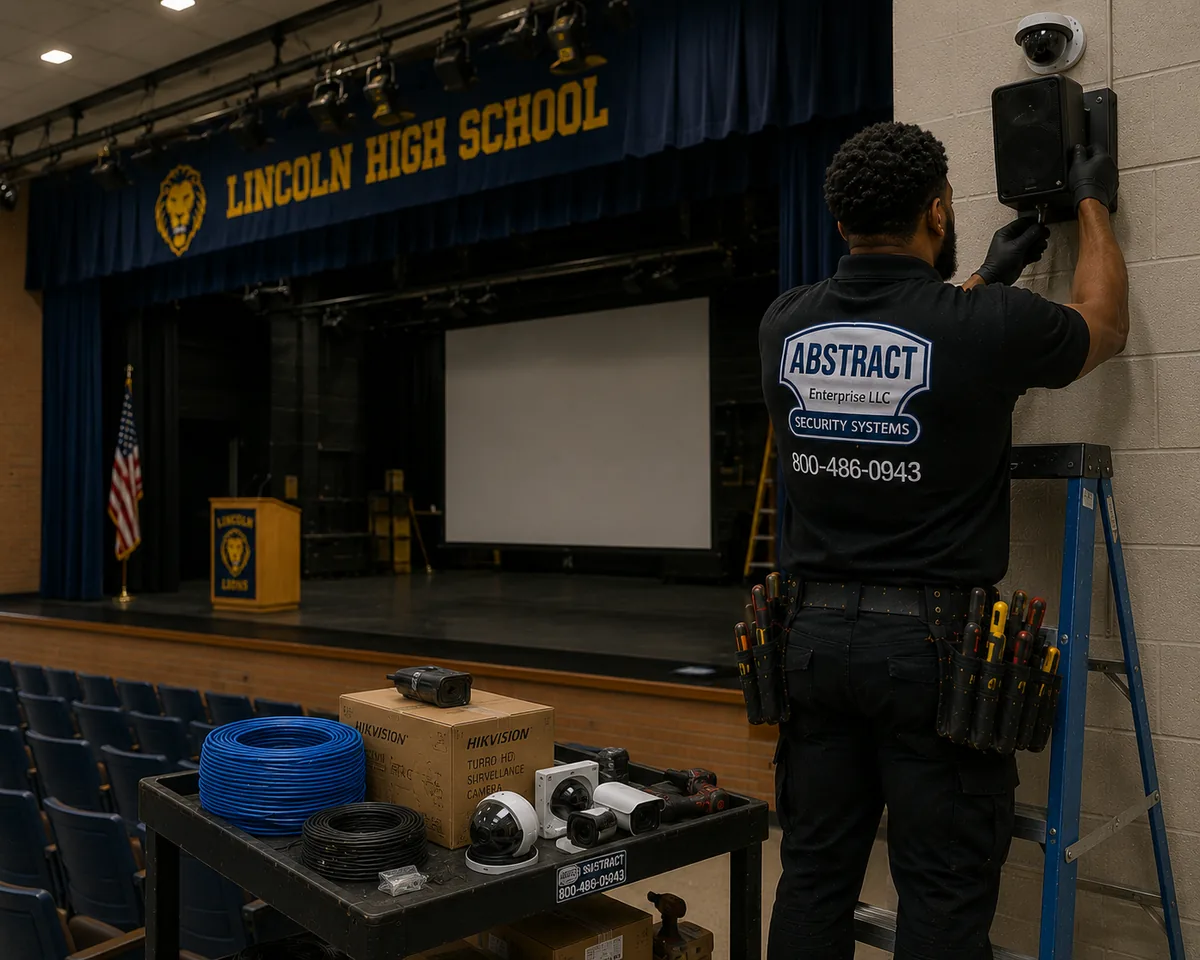
4K goes where a face or a plate must hold up under zoom — the front door, the yard gates, the bus curb. Interior corridors run 4MP because the subject is fifteen feet away, not fifty. Spending resolution where the evidence lives is half of system design.
Alerts Worth Waking Up For
We tune detection zones so a possum crossing the rear yard or a gate rattling in wind stays silent, and a person climbing the fence at 1 a.m. does not. An alert feed nobody silences is the whole point of analytics.
Accounts, Not a Sticky Note
The principal’s login sees every channel. The secretary’s sees the vestibule. The custodian’s sees the yard, cellar, and curb. Each person under their own name, verified working on a phone over cellular before the truck leaves.
Storage Sized to a Written Number
Pick the retention policy first — 30, 60, or 90 days — and the drive array gets engineered to hit it, with automatic warnings when a disk starts to fail instead of a surprise months later.
An Export Anyone Can Perform
Pull the clip, save it off-recorder, note who pulled it and when. We drill the front office on the procedure until it takes two minutes, because footage a lawyer requests next month has to survive this month’s overwrite.
Recording Through the Flicker
A battery module carries the recorder and switch across the brief power drops Brooklyn buildings eat all summer, so a blink on the Con Ed grid never becomes a hole in the timeline.
The System Watches Itself
Camera goes dark, lens gets covered, drive throws errors — the administrator gets an email that day. Discovering a dead stairwell camera during an investigation is the failure we build against.
Hardware Built for a Rear Yard
Gasketed glands, drip loops, stainless fasteners, and impact-rated housings at ground level. Brooklyn exterior cameras live with harbor air, sideways rain, and the occasional handball — the spec has to assume all three.
Paper That Outlives the Installer
Channel map, cable labels, credentials sheet, a one-page how-to taped inside the office cabinet. When the administration turns over — and in Brooklyn schools it does — the system should explain itself.
The Rulebook: New York Camera Law for Brooklyn Schools
One Statewide Ban, No Brooklyn Exception
Since September 2023, the New York State Education Department has prohibited schools — public, charter, and nonpublic alike — from purchasing or using facial recognition technology. The prohibition reaches a Midwood yeshiva and a Bay Ridge academy exactly as it reaches a DOE building. Ordinary cameras, recorders, and motion analytics were untouched by the decision and remain fully lawful. When we commission a Brooklyn school system, any facial-recognition capability in the firmware gets disabled and the setting recorded in the handover file — a paper trail that ends the conversation if a licensor or vendor ever raises it.
The Map of Where a Lens Can Point
Penal Law 250.45 draws the criminal line: no recording in bathrooms, locker rooms, changing areas, or anywhere else a person reasonably expects privacy. Everything else on a campus — doors, halls, stairs, lunchroom, gym, rear yard, gates, curb, cellar — is fair territory. Classrooms sit in a gray zone we treat as a board decision, not an installer’s; our default is a corridor camera on the classroom doorway, and any departure gets signed onto the placement map. Street-facing heads are aimed at your own entrance and approach, and that framing choice is written down too.
When a Clip Becomes a Student Record
The moment identifiable video of a student drives a disciplinary outcome, federal FERPA rules can classify that clip as an education record — carrying parent viewing rights and disclosure limits. New York’s Ed Law 2-d adds its own contract requirements whenever a cloud service hosts student-identifiable data. The simplest posture for a Brooklyn nonpublic school is footage that never leaves the building: your recorder, your drives, your rules, with any cloud copy running under a vendor agreement written for 2-d. We put the retention, review, and release procedure on paper at handover so the first contentious request meets an existing policy instead of improvisation.
Who Pays: Albany, Washington, and the Community
Public schools tap the Smart Schools Bond Act — two billion dollars of state technology money that explicitly covers video security, on the condition that no facial recognition rides along. For the borough’s tuition schools the workhorse is the Nonpublic School Safety Equipment program, which reimburses yeshivas, parochial schools, and independents for precisely this category of hardware; Brooklyn files more of it than anywhere. Federal safety grants stack on top, bringing the NDAA hardware rules with them, and the borough’s Jewish schools also draw on communal security funds that have concentrated on entrance hardening since October 7th. Our job in all of it: a numbered, program-ready proposal your administrator can forward without edits.
The Brooklyn School Landscape We Actually Work In
Borough Park & Midwood
The densest yeshiva blocks on earth — multi-building campuses joined wing by wing, annexes across the street, bus fleets in yards, and carlines that stop traffic on 13th Avenue. Entry stacks sized for enormous parent volume, NPSE-ready paperwork standard.
Williamsburg & Crown Heights
Satmar schools in Williamsburg; Chabad’s Oholei Torah, Beth Rivkah, and the schools around Eastern Parkway in Crown Heights — high-traffic entrances, shared community buildings, and post-October-7th security urgency.
Flatbush & the Ocean Parkway Corridor
Chaim Berlin, Mirrer, Yeshivah of Flatbush, Magen David and the Syrian community’s academies through Gravesend — big campuses, gyms, yards, and boards that expect line-item quotes.
Bay Ridge, Dyker & Sunset Park
Diocese of Brooklyn strongholds — Xaverian, Fontbonne Hall, parish schools block after block — plus Al-Noor and the Islamic academies of Sunset Park and Bay Ridge, and Poly Prep’s Dyker Heights campus.
Brooklyn Heights, Park Slope & Fort Greene
Packer Collegiate, Saint Ann’s, Brooklyn Friends, Berkeley Carroll, Bishop Loughlin — brownstone and landmark-district schools where discreet, paint-matched exterior work is the expectation.
Bed-Stuy, Bushwick & East New York
Charter networks in converted industrial buildings, parish schools, and daycare density block after block — value-engineered builds that still meet the full compliance stack.
Every Type of School We Secure in Brooklyn
Yeshivas & Jewish Day Schools
The largest nonpublic school population in America — Borough Park, Williamsburg, Crown Heights, Flatbush, Midwood, Gravesend. We schedule around the Jewish calendar and bein hazmanim, coordinate with community security volunteers, and build NPSE- and communal-grant-ready proposals with entry stacks sized for very high parent traffic.
Catholic & Parochial Schools
The Diocese of Brooklyn’s parish schools and academies borough-wide — Bay Ridge to Greenpoint. We work with principals and parish business managers, and our proposals survive a finance-council meeting.
Independent & Prep Schools
Packer, Saint Ann’s, Berkeley Carroll, Poly Prep, Brooklyn Friends — brownstone and campus schools where the board expects consultant-grade documentation and the install invisible to students. Both are the job.
Charter Schools
Success Academy, Achievement First, Uncommon, Ascend, and single-site charters — often co-located or in converted industrial space, caught between public compliance expectations and private budgets. NDAA-compliant builds documented for authorizer review.
Islamic & Religious Schools
Al-Noor in Sunset Park, the academies of Bay Ridge, Christian schools, and weekend heritage programs sharing space with congregations — shared-building systems with schedules and access that respect both calendars.
Daycares & Preschools
Brooklyn daycares run under NYC Article 47 licensing, from brownstone parlor floors to storefront centers. Right-sized 6–12 camera systems — entries, playrooms per policy, yard, pickup — with privacy zones in writing for the DOHMH file.
Special-Education Schools
853 and 4410 programs carry elopement risk and documentation duty most schools never face. Exit-door coverage, gap-free corridor lines, and retention sized for incident review — designed with the clinical team.
Colleges & Campuses
Pratt, NYU Tandon, Brooklyn College, LIU, St. Francis, Medgar Evers, Kingsborough, City Tech — building-by-building phases, VLAN-segmented backbones, and coordination with campus public safety.
After-School & Enrichment Programs
Test-prep floors, music schools, sports academies, and after-school programs in commercial buildings — the liability never takes a season off, and neither does the coverage.
What Brooklyn Reddit Actually Asks About School Cameras
Threads from r/Brooklyn, r/AskNYC, neighborhood WhatsApp chats, and the parent groups — the questions as people type them, answered by the shop that ends up on the ladder.
“Our Flatbush school got quoted $58K for 30 cameras. Fair?”
Divide it out: $1,930 a head against a Brooklyn commercial reality of $450–$950 installed. A gap that size is defensible only if the quote buries an annex fiber link, door hardware, and a 90-day drive array inside it. Make the vendor break the number into lines — inflated bids fall apart the moment each line has to justify itself.
“Our yeshiva has three joined buildings and an annex across the street. One system?”
One system, yes — the question is really about the link, not the cameras. A tested wireless bridge or a fiber pull puts the annex on the main recorder’s clock. We do this constantly in Borough Park and Midwood; the survey tells you which link your block allows and what it honestly costs.
“Cloud camera platform quoted $19/camera/month for our 22-camera school. Worth it?”
That subscription is $5,016 every year, on top of hardware, with no year it stops. Buy the recorder instead and the same money is finished by year two — then put a small encrypted off-site copy on just the entrance channel if the board wants redundancy. Total the two paths over five years before anyone signs; the platform rarely survives the addition.
“A vendor pitched facial recognition for pickup at our day school. Legal?”
It is not. Albany shut facial recognition out of every New York school — tuition schools included — in 2023, so that pitch is either ignorance or a bet on yours. The lawful version of what they’re selling is a verified-entry door, person detection, and a signed pickup-authorization list.
“Someone keeps tagging our schoolyard wall over the weekend. Will cameras help?”
Fence-line heads with person alerts catch it as it starts, and a 4K gate camera hands the precinct a face instead of a hood. Most weekend tagging stops when housings go visible; the stubborn cases end when the export gets attached to the report. Rear-yard coverage is baked into every Brooklyn school design we draw.
“Our bus fleet parks in a yard overnight and we lost two catalytic converters. Cameras?”
This is a weekly Brooklyn call. Plate capture on the yard gate, two motion-zoned heads across the fleet, alerts routed to a phone after midnight — the crawl-under-the-bus move now wakes somebody while it’s happening. Sites that add lighting with the cameras generally never lose another converter.
“Can our facilities guy just install cameras from the warehouse club over break?”
Physically, sure. But a school’s footage exists to survive scrutiny — an insurer’s, a licensor’s, sometimes a court’s — and consumer Wi-Fi kits with clip storage and zero documentation don’t. Small stakes, DIY away; a campus with a yard, a bus curb, and a duty of care needs commercial cable and paperwork, which is a trade, not a weekend.
“Our DVR has said ‘no HDD’ since Chanukah and nobody did anything. How bad?”
Every day since that message, the live picture worked and nothing was saved — the screen fooled the front desk, which is exactly why this is our most common Brooklyn school repair. The fix is same-day: new surveillance drive, playback proven on all channels, and health alerts wired so a dead disk emails the administrator instead of hiding.
“What should storage cost for 24 cameras at our school?”
Roughly 24–32TB of purpose-built drives covers 24 cameras at 4MP for a month of lookback — call it $700–$1,100 of hardware living inside the recorder. Want two months, buy roughly twice the platters. When a vendor turns that into a monthly bill, they’ve converted your storage into their revenue.
“A parent demanded hallway footage of an incident. Do we have to provide it?”
If that clip drove a disciplinary call about their child, FERPA can treat it as the child’s education record — meaning a supervised viewing with other students shielded, not a file email. The schools that handle this calmly wrote the review-and-release procedure before anyone asked. Ours ship with that procedure in the binder.
“Do cameras actually deter anything on a busy Brooklyn avenue?”
Partially, and honestly so: visible heads thin out package theft, tags, and door-testing, and what they don’t prevent they prosecute — an NYPD report with video attached moves differently than one without. Think of cameras as the memory of a plan whose muscles are still locks, lighting, and a staffed desk.
“The company that installed our system in 2016 is gone. Now what?”
Orphaned systems are half our borough workload. We inventory what’s hanging, recover or factory-reset the locked recorder, prove every channel records and plays, and hand the school its own credential sheet — then service it same-day going forward. Working hardware stays; only the abandonment gets replaced.
“Quotes for our school ran $10K to $45K. Same building. Why?”
Because the word “system” hides the spec. Ten grand usually means a dozen consumer heads on Wi-Fi; forty-five might mean 28 commercial cameras on new cable with redundant recording — or might mean margin. A floor plan with every camera numbered and priced is the only honest comparison document, and we produce one free after the walkthrough.
“Our school shares the building with the shul. Whose cameras are they?”
One installation, two operators, roles for each. Design the coverage for the full weekly calendar — school days and Shabbos both — split the app accounts by role, and settle footage governance on paper while everyone is friendly. Shared buildings are the Brooklyn norm; the undocumented version is the only one that goes badly.
Straight Answers to What Brooklyn Types Into the Search Bar
school security camera cost brooklyn
$450–$950 per commercial head, installed, no travel surcharge — this is our home borough. Small daycares land $4,500–$8,000 complete; a 16–32 camera building runs $12,000–$30,000.
who installs cameras in yeshivas
A licensed low-voltage contractor should — ours is NYS #12000287431, based in East Flatbush, with bein hazmanim scheduling and grant-ready paperwork as standard practice.
are cameras legal in private schools ny
Yes, throughout common spaces, yards, and entries. Two hard exclusions: privacy spaces like bathrooms and locker rooms, and facial recognition anywhere — the state banned it in 2023.
daycare camera rules brooklyn
Article 47 centers may record; whether parents get live feeds is the owner’s written policy, and most decline to protect the other children on screen. Keep the policy in the license file.
what cameras do schools use
Commercial IP domes and bullets from lines like Hanwha, Axis, and Uniview, wired to an on-site recorder — not the doorbell brands sold for houses.
how long is school footage kept
A month is the working minimum — the city holds its own buildings to it — and sixty to ninety days where drives allow. Incident clips get pulled off the recorder before the loop eats them.
do school cameras have sound
Ours don’t, and we counsel against it: New York consent law makes school audio a litigation trap that plain video never triggers.
schoolyard camera installation
Fence runs, gate heads, and the building’s yard face, framed to your own property and drawn on the signed placement map — the rear yard is where Brooklyn incidents actually happen.
school camera repair near me
Same-day out of East Flatbush: dead recorders, blind channels, failed drives, and takeovers of systems whose installer stopped answering.
grants for school cameras ny
SSBA money for public buildings, the NPSE reimbursement for tuition schools, federal safety programs above both — and we draft proposals in the format each one accepts.
bus yard security cameras
Plate capture at the gate plus motion zones over the parked fleet, with overnight alerts to a phone — the standard cure for Brooklyn’s catalytic-converter losses.
diy school cameras legal
Installing them yourself is mostly lawful; placement law still binds you. The sharper question is whether self-installed footage will be taken seriously by an insurer or a judge.
People Also Ask: Brooklyn School Cameras
How many cameras does a Brooklyn school building need?
Count doors, stairs, and trouble spots — not square feet. A storefront daycare covers itself in 6–12 heads; a single parish building takes 16–32; joined yeshiva wings with a yard and a curb push 32–64; add an annex and the number climbs again. Our walkthrough marks every position on your floor plan so the total arrives with its reasons attached.
Does the NPSE grant apply to Brooklyn yeshivas and religious schools?
Squarely. The state’s nonpublic safety-equipment reimbursement exists for exactly this hardware at exactly these schools, and Brooklyn submits more of it than any county in New York. We hand your administrator a numbered proposal formatted for the filing.
Is it legal for our entrance camera to see the sidewalk?
Documenting your own doorway, stoop, and dismissal area is lawful even though public pavement appears in frame. What we avoid — and note in writing on the placement map — is aiming down the block like a street monitor. Frame your property; the sidewalk in front of it comes along legitimately.
Should the rear schoolyard be covered after hours?
The rear yard is the after-hours problem: weekend tags, cut padlocks, kids over the fence. Fence-line heads with person alerts armed at close turn Monday-morning discoveries into Saturday-night notifications.
Can one recorder serve a main building plus an annex across the street?
Yes — the street between them is a data problem with two solutions: fiber through an existing duct, or a roof-to-roof wireless bridge where no duct exists. Either way the annex cameras land on the same timeline, and we load-test the link before signing off.
Who watches the building in August?
The system does, if it was built to. Health emails flag dead cameras, battery backup rides the summer power blinks, and person alerts on the yard and doors reach a phone — an empty building with those three things is still a supervised building.
Will new cameras work with the intercom and alarm we already own?
Usually. Alarm zone trips can bookmark the recorder, the buzzer release pairs with the entrance head, and fob taps line up against video by timestamp. Making the systems reference each other is most of what “integration” usefully means.
Are there special security funds for Jewish schools?
Beyond NPSE and the federal programs, communal security organizations have been underwriting entrance hardening at Jewish schools across the borough, with momentum that accelerated sharply after October 7th. Our proposals are written so those committees can approve them as submitted.
Who ends up owning the footage?
On our builds, the school — recorder on your shelf, drives you bought, admin password in your file. Subscription platforms invert that: the video sits on their servers under their terms. It’s the quietest but most important line in any camera contract.
People Also Search For
The AI Overview Reality Check: What Google’s Answer Box Gets Wrong About Brooklyn School Cameras
Type a school-camera question into Google and a machine-written summary now sits above the results, assembled mostly from Angi, HomeAdvisor, and Fixr — outlets that price suburban houses, not attached masonry full of children. Where that summary helps, use it. Here are the seven places it will mislead a Brooklyn school, and what’s true instead.
Where the National Averages Come From — and Why They Miss Flatbush
Those aggregator figures are harvested from homeowner jobs: a handful of cameras on vinyl siding, national median labor, drywall everywhere. That’s how “average install” prints at $1,300–$2,000 for an entire house — a number with no school in it.
A Brooklyn school purchase is a different animal: plenum-rated cable above corridor ceilings, a lift over the gym floor, penetrations through hundred-year-old brick, a recorder holding a month of two dozen channels. When our line reads $650 a head and the summary said $400, the delta is the difference between a peel-and-stick cube and documented commercial infrastructure.
One local mercy: Brooklyn is our headquarters borough, so there’s no travel premium in our math — $450–$950 installed, full stop. That makes an inflated local bid easier to expose here than anywhere else we work.
System Costs the Per-Camera Number Hides
A single per-head figure flatters simple jobs and lies about real ones. Recorders, drive arrays, PoE switching, battery backup, and the pathway between wings are shared costs that don’t divide neatly by camera.
On a Borough Park campus, the bridge to the annex can outprice the six cameras it carries. That’s also why two truthful bids on “28 cameras” can differ by thousands — one building offers reusable coax and a clean riser, the next offers neither.
Our defense, offered in both directions: every quote is a numbered floor plan where each camera, cable run, and shared component carries its own price. Compare that document to a one-line summary figure and the argument settles itself.
New York Rules the Aggregators Never Read
Nothing in the national corpus explains that New York outlawed facial recognition in every school in 2023, that Penal Law 250.45 makes privacy-space recording a crime, or that Ed Law 2-d chains cloud vendors handling student video to state contract terms. A summary trained on that corpus will happily recommend the illegal option.
We see the fallout in real meetings: biometric pickup pitches forwarded by well-meaning board members, national articles about face-scanning entrances circulated as inspiration. Correcting course during design costs nothing; correcting it after purchase costs the purchase.
Our commissioning file records the banned features as disabled — a page you can produce for any licensor, insurer, or state examiner who asks the question.
Counting Cameras on an Attached-Masonry Campus
Square-footage formulas come from ranch houses. Brooklyn schools count choke points: door, vestibule, lobby, each stair per floor, corridor runs, lunchroom, gym, cellar, service door — then the outdoor set: yard, gates, curb, and any annex.
Two buildings of identical floor area can need wildly different counts once wings, yards, and a bus operation enter the picture. An 18-camera parish building and a 50-camera joined yeshiva can share a lot line.
This is the entire reason the free survey exists: positions marked on your plan, each with a one-line justification a board member can challenge and understand.
The Subscription Slant Baked Into the Sources
A large fraction of camera content online is authored by companies whose product is a monthly bill, so machine summaries inherit the assumption that modern equals cloud-licensed. For a forty-site charter office, defensible. For one school on Kings Highway, the arithmetic usually collapses within two budget cycles.
There’s a legal wrinkle too: student-identifiable video on a vendor’s cloud drags Ed Law 2-d contract duties into the deal. Footage that never leaves the building never raises the issue.
We install cloud components where they genuinely earn a place — off-site copies of an entrance channel, multi-campus operators — and we put the five-year totals of both architectures on one page before anyone commits.
What a 1920s Parish Building Does to an “Easy Install”
The DIY-friendly content feeding these summaries assumes drywall, attic access, and stud bays. Brooklyn school walls are plaster over brick and terracotta, ceilings you cannot casually open, and landmark blocks where exterior hardware gets noticed.
The craft answers are unglamorous: meter the 2009 coax and ride it where it passes, paint raceway to disappear against the trim, plan every penetration before the drill spins, keep exterior housings small and color-matched.
None of that lives in an aggregated paragraph, and all of it is included free in the walkthrough — because the building dictates the method here, not the other way around.
The Right Way to Use the Answer at the Top of Google
Let it teach you vocabulary — recorder types, PoE, retention, dynamic range — so your first vendor meeting starts in the middle instead of at zero. Let it sketch what American schools broadly deploy. Those uses are legitimate.
Refuse it the four decisions that actually shape your project: what Brooklyn costs, how many cameras your building needs, what New York permits, and what your masonry allows. Its sources are silent on all four.
Then collect the two documents no summary can generate — a marked floor plan and a line-priced quote — both free, both yours to shop. If our numbers lose a fair reading, the walkthrough cost you an hour.
DIY vs Professional School Camera Installation: The Honest Version
When Doing It Yourself Is the Right Call
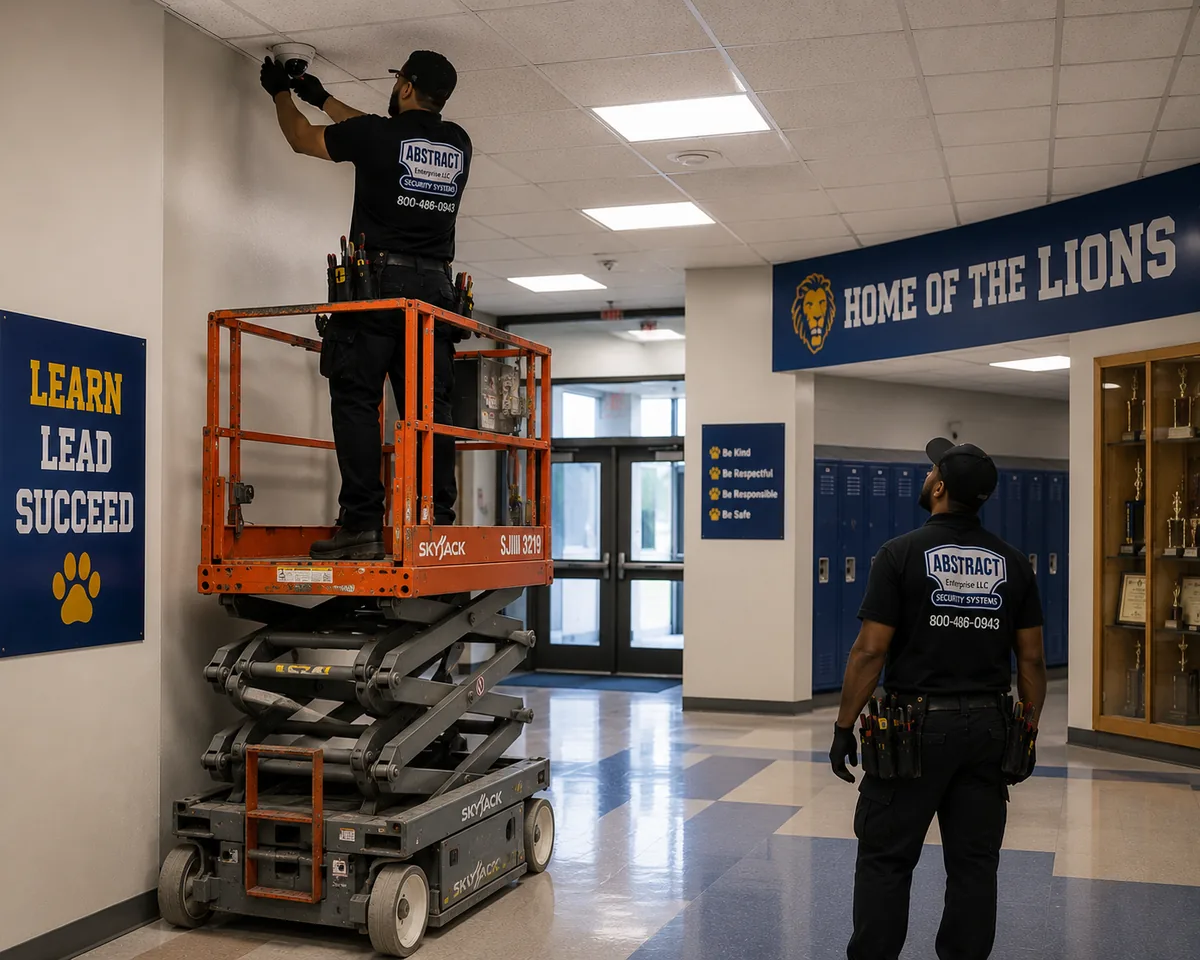
A storage-room mystery, one camera on a daycare’s back door while the budget matures, a handy custodian who doesn’t mind app resets — legitimate DIY territory, and a $400 kit covers it. We tell small programs this to their face; selling a platform to a two-camera problem is how contractors earn their reputation for padding.
When It Absolutely Isn’t
The line is scrutiny. Once footage might be examined by an insurer, a DOHMH licensor, a diocesan lawyer, or a courtroom, consumer Wi-Fi through brick, motion-clip gaps, and an undocumented install become liabilities wearing camera housings. Fold in plenum code, placement law, yard weather, and a written retention policy, and this stops being a handy project — it’s licensed work, and the day it matters is the day that shows.
Verkada, ADT, Ring — and Why Brooklyn Schools Keep Hiring the Local Licensed Shop Instead
The Cloud Platforms (Verkada, Rhombus)
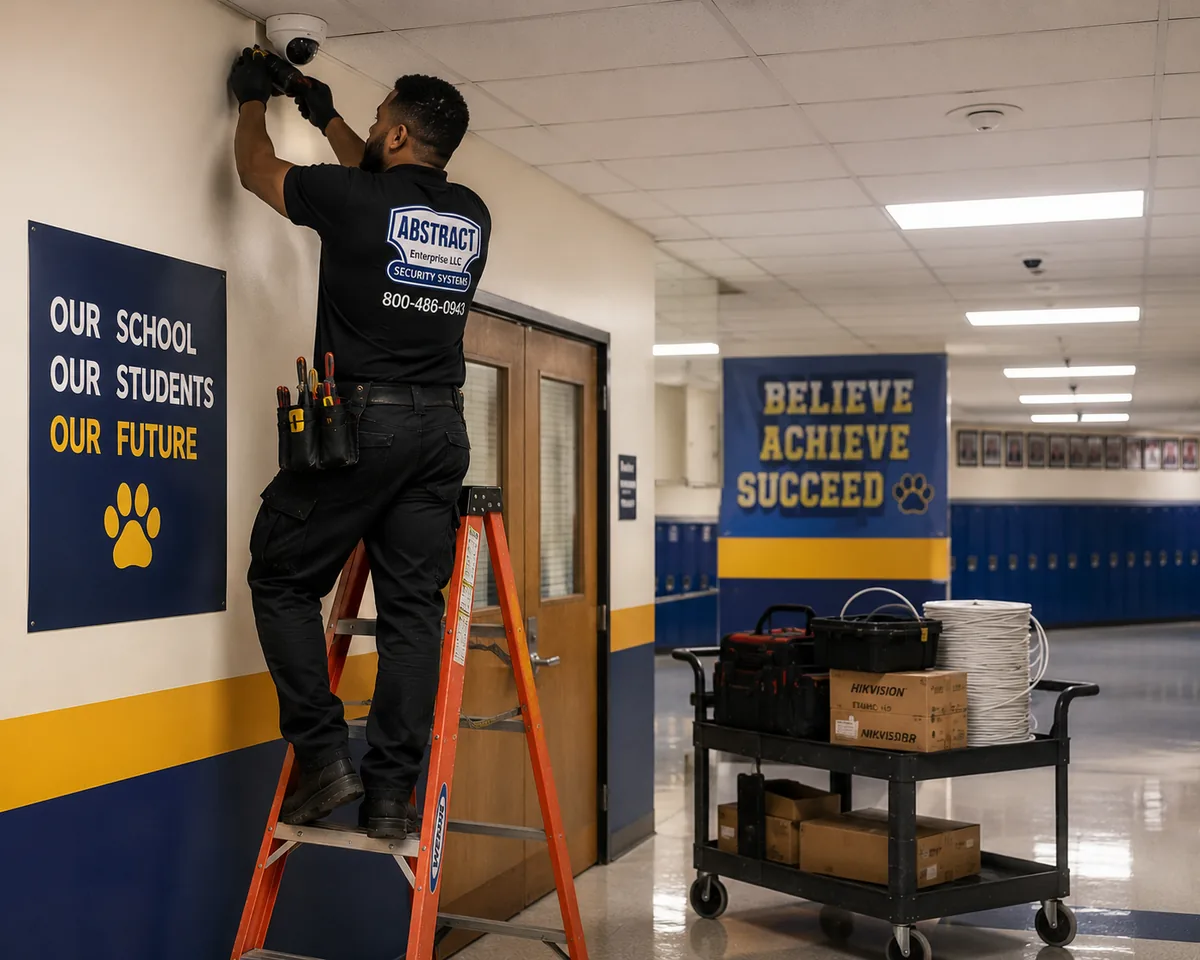
Genuinely good software wrapped around a toll booth: every camera pays a license every month, indefinitely, and the hardware goes inert if the account lapses. A charter management office spanning forty buildings can justify the fleet console. One school off Ocean Parkway licensing thirty cameras is leasing something a recorder would let it own. We put both architectures’ five-year totals side by side and let the school read.
The National Alarm Bundlers (ADT and Friends)
The bundle model sells a monitoring contract first and treats cameras as garnish: a subcontracted crew your building has never met, gear welded to the vendor’s ecosystem, and a support ticket routed through another time zone while the entrance channel stays black through Friday dismissal. Schools do better owning the hardware, knowing the installer’s cell number, and paying a fixed figure once — with any monitoring added month-to-month, cancelable, through a central station.
The Consumer Brands (Ring, Nest, Warehouse-Club Kits)
Superb residential products stretched past their design brief. In a school they hit ceilings quickly — device caps, footage rationed into subscription clips, radios that fade through plaster and block, zero riser plan, zero documentation, and privacy questions their apps were never written to answer. Our replacement calls arrive on a schedule: roughly eighteen months after a board bought them to economize. Good kit; wrong building.
Brooklyn School Security by the Numbers
What Brooklyn School Clients Say
Illustrative planning scenario — a typical security camera project of this type begins with an on-site assessment, then a written scope and fixed quote, and finishes with professional installation completed to code. Hypothetical planning example — not a customer account, completed AESS project, verified review, or promised result.
— Yeshiva administrator, Borough Park
Illustrative example — for work like this, a typical security camera job involves reviewing the property, matching equipment to the space, running clean cabling, and walking through the finished system. Hypothetical planning example — not a customer account, completed AESS project, verified review, or promised result.
— Parish business manager, Bay Ridge
Illustrative configuration — a representative security camera setup may cover the main entries and shared areas, with remote viewing or management from a phone and a clear handoff at completion. Hypothetical planning example — not a customer account, completed AESS project, verified review, or promised result.
— Director of operations, Brooklyn Heights independent school
Illustrative planning scenario — a typical security camera project of this type begins with an on-site assessment, then a written scope and fixed quote, and finishes with professional installation completed to code. Hypothetical planning example — not a customer account, completed AESS project, verified review, or promised result.
— Daycare owner, Bed-Stuy
Field Notes: Bein Hazmanim, a Borough Park Campus, and the Bus Yard That Kept Getting Hit
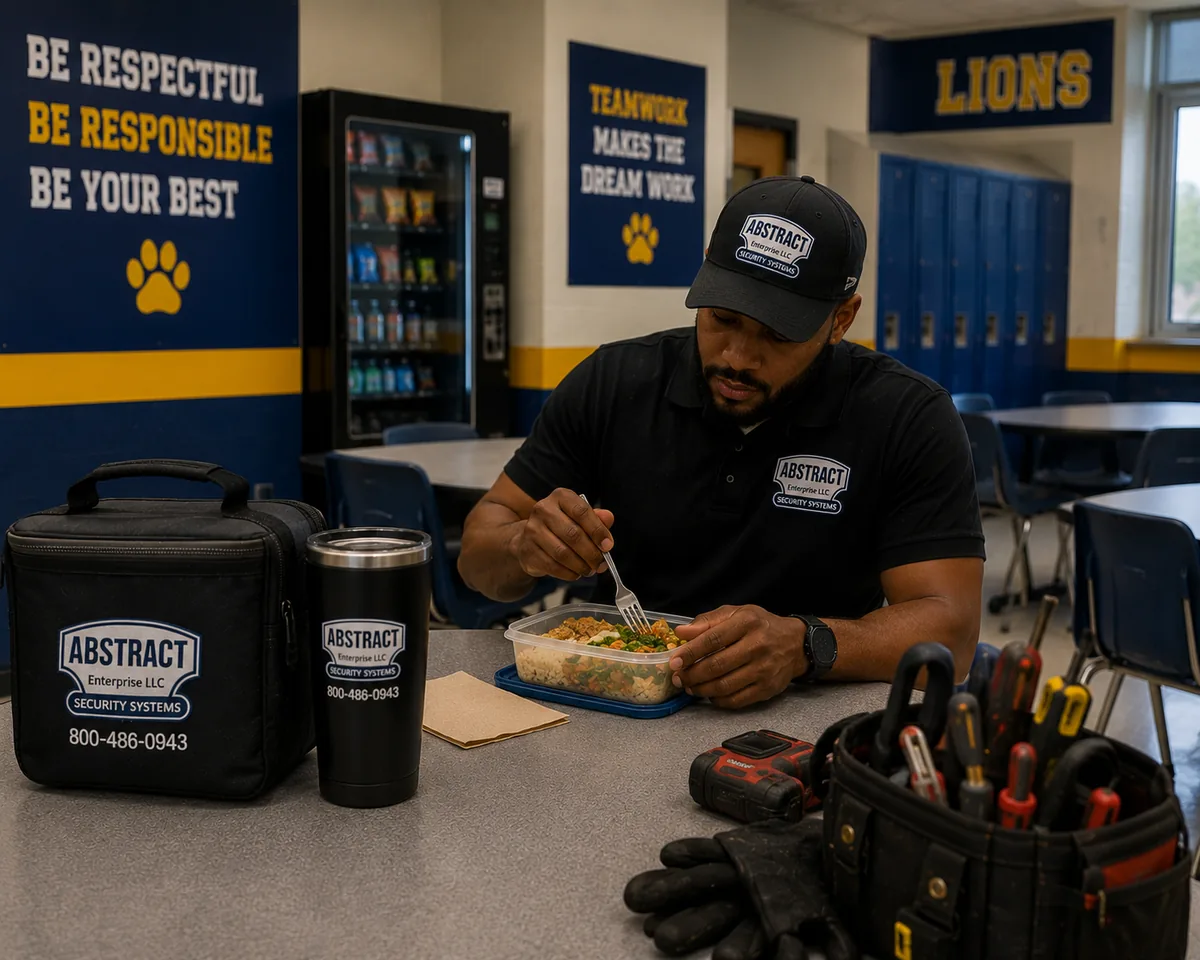
Thirty-eight cameras, six days, one bein hazmanim — a yeshiva campus off 13th Avenue that had grown the Brooklyn way: three buildings joined at odd floors, an annex across the street, and a bus yard around the corner that had lost two catalytic converters in a month. The old system was archaeology — analog heads from three eras, two DVRs that didn’t know about each other, and a monitor at the front desk showing live video over a drive that died before Purim.
The design problem was unification. One NVR, one map: a clean riser up the main building, small PoE switches per wing, EoC over the legacy coax that tested clean — which kept two floors of plaster closed — and a point-to-point bridge to the annex that took an afternoon instead of a trench permit. The carline got 4K on both curves and a WDR head on the main door that holds faces against 13th Avenue backlight at 8 a.m.
The bus yard got the special treatment: LPR at the gate logging every plate, two motion-zone heads over the fleet, and alerts to the administrator’s phone after midnight. Third night live, the phone buzzed at 2:40 a.m. — someone at the fence, gone before contact, plate logged on the way off the block. Converter losses since: zero. Friday walkthrough was the administrator and two office staff exporting test clips until it bored them. That’s the finish line — the first export they do without me.
— Anwar Timothy, NYS Lic #12000287431
Frequently Asked Questions: School Camera Installation in Brooklyn
What does a school camera system cost in Brooklyn?
Working ranges from our own borough jobs: $450 to $950 per commercial IP camera installed — East Flatbush is home base, so no travel charge exists here — with the recorder, drives, and any backbone priced as their own lines. Complete projects: a 6–12 camera daycare typically closes between $4,500 and $8,000; a 16–32 camera single building between $12,000 and $30,000; a 32–64 camera multi-wing campus between $25,000 and $48,000, climbing from there for multi-building schools. Every job begins with a free walkthrough that produces a marked floor plan and a fixed line-priced quote. NYC sales tax of 8.875% appears itemized on the invoice.
How do you decide how many cameras our building needs?
By walking it and counting choke points — doors, stairs per floor, corridor runs, lunchroom, gym, cellar, yard, gates, curb, service entrance — rather than applying a square-footage formula. Brooklyn patterns from our installs: 6–12 for daycares, 16–32 for one building, 32–64 once wings, yards, and a bus operation join the map, plus whatever an annex adds. You receive the count as marked positions on your plan, each with its reason.
Is facial recognition allowed in any Brooklyn school?
No. The State Education Department’s September 2023 order bars purchasing or operating facial recognition in every New York school — public, charter, yeshiva, parochial, and independent equally. Standard cameras, recording, and motion analytics were unaffected and remain lawful. Our commissioning checklist disables any such firmware feature and documents the setting so the school can prove its configuration.
Can we put cameras inside classrooms?
New York law often permits it, but we treat it as a governance question for your board, counsel, and staff — never an installer default. The Brooklyn norm we recommend: a corridor head watching each classroom doorway, which logs every entry and exit while keeping lenses out of the teaching space. If a school deliberately opts for in-room coverage, that choice gets signed onto the placement map.
Which locations are off-limits for cameras?
Bathrooms, locker rooms, changing areas, and any comparable space where privacy is reasonably expected — Penal Law 250.45 makes recording there a felony, schools included. Lawful territory covers entrances, halls, stairs, cafeterias, gyms, cellars, yards, gates, curbs, and service areas, with street-facing heads framed to the school’s own doorway and approach rather than surveying the block.
How much footage history should we keep?
Hold at least thirty days — the same floor the city applies to its own buildings — and stretch to sixty or ninety where the drive budget allows, because complaints routinely surface weeks after the event. Anything tied to an incident should be exported off the recorder immediately, before the overwrite loop reaches it. We size the array to the policy you pick and enable failing-drive alerts.
Can installation happen while classes run?
Yes, phased. Noisy and invasive work — ceiling access, coring, lift time — lands on winter break, bein hazmanim, weekends, and summer; quiet work like recorder configuration and aiming fits occupied days. Crews clear your screening and escort rules, and in shared or landlord buildings we handle whatever paperwork the property requires.
Which brands do you use, and why does NDAA matter?
Defaults are Hanwha Vision, Axis, and Uniview, with Lorex where a small daycare’s scale honestly fits it. NDAA Section 889 excludes certain manufacturers — Hikvision and Dahua among them — from any federally funded purchase, so grant-financed projects must specify compliant lines. Systems already on your walls, whatever the brand, we service and upgrade.
Is grant money available for Brooklyn school cameras?
Routinely. Public buildings draw on the $2 billion Smart Schools Bond Act, which funds video security provided no facial recognition is included. Tuition schools use the state’s Nonpublic School Safety Equipment reimbursement — Brooklyn is its heaviest user — alongside federal safety grants, and the borough’s Jewish schools also access communal security funds focused on entrance hardening. We deliver proposals formatted for whichever program is paying.
Will you tie cameras into our buzzer, alarm, and door hardware?
That combination is most of our school work. The pattern: locked street door with a face-height camera and video intercom release, fobs on staff and yard doors, alarmed secondary exits paired with heads, and — where a school adds silent panic alerting — camera views linked to those events so responding NYPD units see live conditions. One contractor wiring the stack means the pieces reference each other instead of coexisting.
Do you fix or adopt systems another company installed?
Daily. Same-day Brooklyn response covers dead recorders, blind channels, PoE faults, failed drives, and urgent exports — most visits resolve in one to two hours, and the borough is our shortest drive. Abandoned systems get the full adoption: hardware inventory, credential recovery or reset, recording proven on every channel, documentation handed to the school, service going forward.
Are your technicians licensed and appropriate for school settings?
Abstract Enterprises Security Systems holds New York State low-voltage license #12000287431 and full insurance. We follow each school’s vendor screening, escort, and scheduling requirements, keep invasive work outside student hours, and provide school and commercial references on request.
School Camera Installation Pricing in Brooklyn
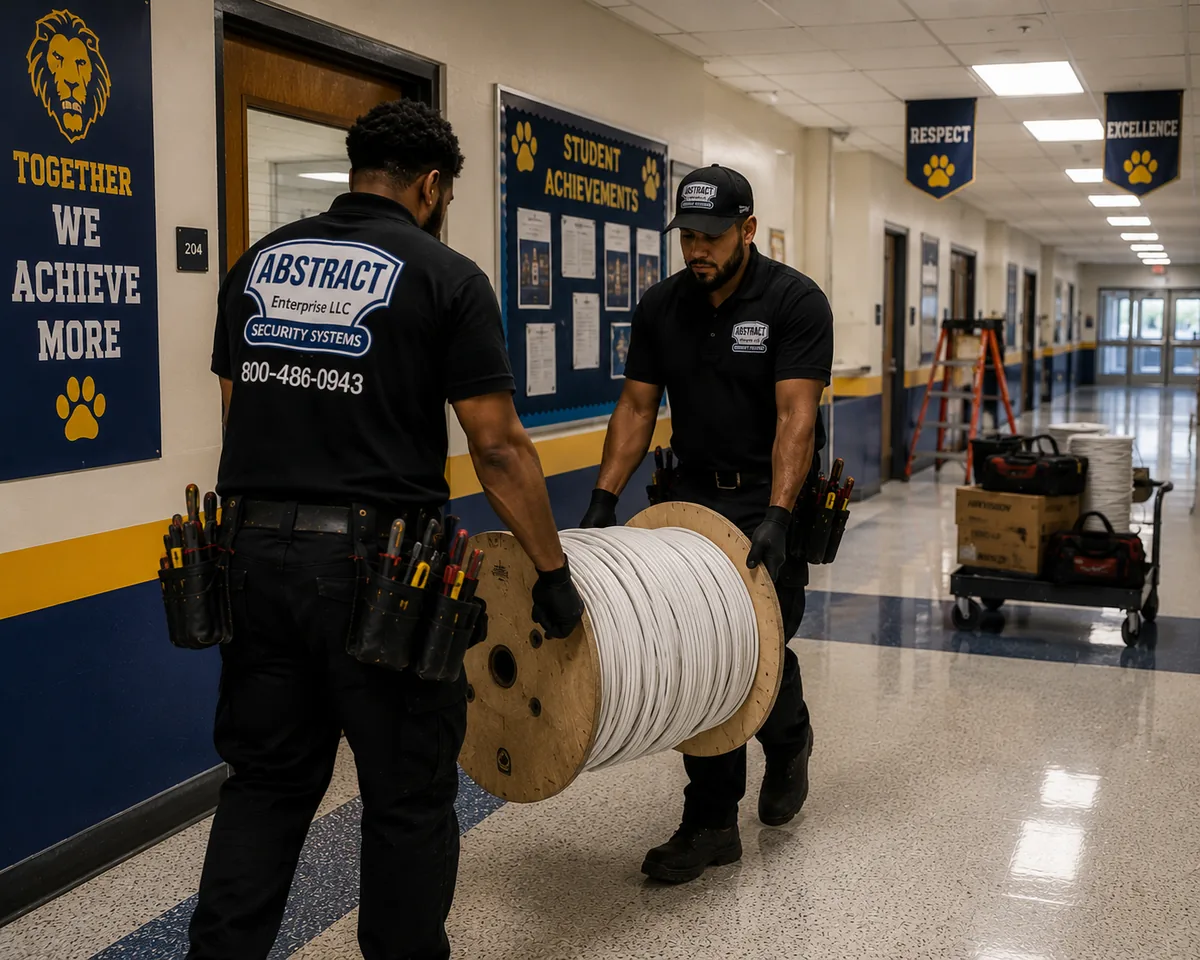
Home-borough economics: our trucks start from East Flatbush, so Brooklyn carries no travel band and our sharpest numbers in the region. Treat the tables below as planning brackets — the binding figure is the fixed, line-priced quote that follows the free walkthrough. Invoices itemize NYC sales tax at 8.875%.
| Project Tier | Typical Scope | Installed Range |
|---|---|---|
| Daycare / Preschool | 6–12 heads across a storefront or parlor floor: entry, play space, pickup point | $4,500 – $8,000 |
| Single-Building School / Parochial | 16–32 heads: verified entrance, halls and stairs, rear yard and gates | $12,000 – $30,000 |
| Multi-Wing / Yeshiva Campus | 32–64 heads across joined wings, annex bridge, loading curb | $25,000 – $48,000 |
| Multi-Building Campus | 64–128 heads: yards, fleet parking, dismissal and service coverage | $40,000 – $95,000+ |
| College / Institutional | Building-by-building phases on a fiber spine | Quoted per phase; $200,000+ full campus |
| Line Item | What It Covers | Notes |
|---|---|---|
| Commercial IP camera, installed | Head, mount, dedicated Cat6 pull, termination, aim, setup | $450 – $950 each |
| NVR + storage | Recorder and drive array matched to channel count and lookback policy | $750 – $6,000+ by scale |
| Annex / multi-building link | Fiber through existing duct or tested roof-to-roof bridge | Priced from the walkthrough |
| Yard / fleet package | Fence-line heads, gate plate capture, sealed impact-rated housings | Priced per yard; IK10 below reach |
| Deposit & terms | Half down to book the dates, remainder on completion | Binding written quote precedes work |
| Warranty | 3-year coverage on AESS-supplied products, normal wear and tear | Afterward $195/hr, 3-hr minimum ($585) |
Abstract Enterprises Security Systems provides a three-year warranty on products supplied by AESS for normal wear and tear. It does not cover existing or customer wiring, customer-supplied equipment, lightning or other acts of God, power outages or surges, physical damage or unplugging, internet, router or phone changes, or camera readjustments requested after completion. After the warranty period, service is $195 per hour with a three-hour minimum ($585).
Get Your Brooklyn School Camera Quote
Brooklyn School Camera Coverage Area
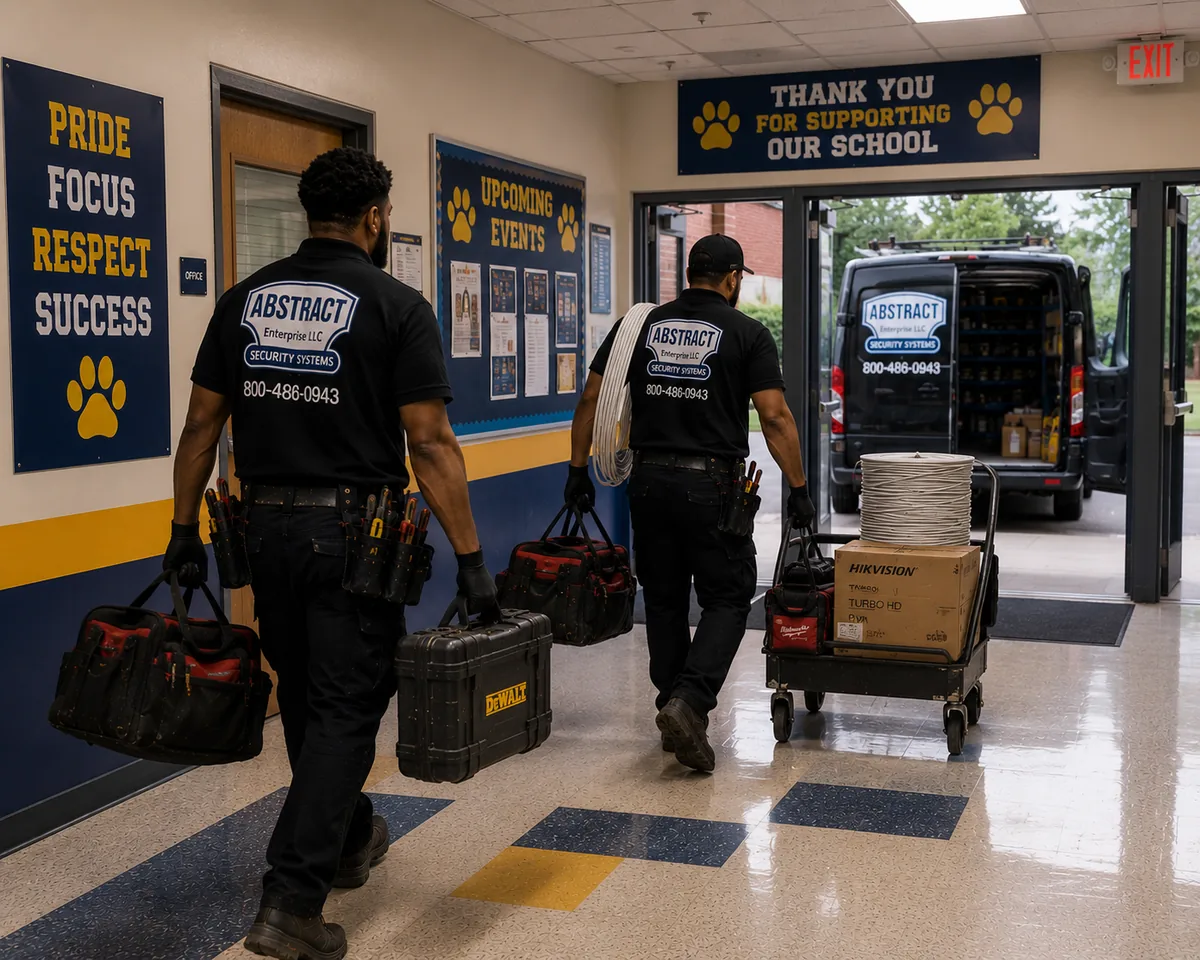
We cover every school neighborhood in the borough: Borough Park, Williamsburg, Crown Heights, Flatbush, Midwood, Kensington, Gravesend, Bensonhurst, Bay Ridge, Dyker Heights, Sunset Park, Park Slope, Brooklyn Heights, DUMBO, Fort Greene, Clinton Hill, Bed-Stuy, Bushwick, Greenpoint, East Flatbush, Canarsie, East New York, Brownsville, Sheepshead Bay, Marine Park, Mill Basin, Coney Island, and Red Hook. Regional camera hub: Brooklyn security camera installation. School-silo hub: School Security Cameras NYC. Silo pages for Queens and the other boroughs are coming next; every neighborhood above books through this page today.
How We Compare for Brooklyn School Camera Work
| AESS (Us) | National Integrator | Alarm Bundler | General Electrician | DIY | |
|---|---|---|---|---|---|
| Depth in school camera design | Daily work, headquartered in the borough | Real, priced for districts | A checkbox on the alarm contract | Now and then | Starting from zero |
| NY school rules: FR ban, 250.45, Ed 2-d | Built into commissioning, on paper | Generally handled | Seldom mentioned | Outside the trade | Your homework |
| Brownstone, party-wall & yard technique | The house specialty | Change-order territory | Whatever the catalog ships | Made up on site | Patch kit required |
| Who owns the gear and footage | The school, outright, zero monthly | The school, at enterprise cost | The platform, under contract | The school, undocumented | The subscription |
| When something breaks | Same-day, shortest drive we have | Open a ticket | Call a call center | If he’s free | Mirror check |
| 3-year warranty on AESS-supplied products | ✓ | Depends | Narrow | Unusual | — |
Brooklyn School Building Problems We Solve Every Week
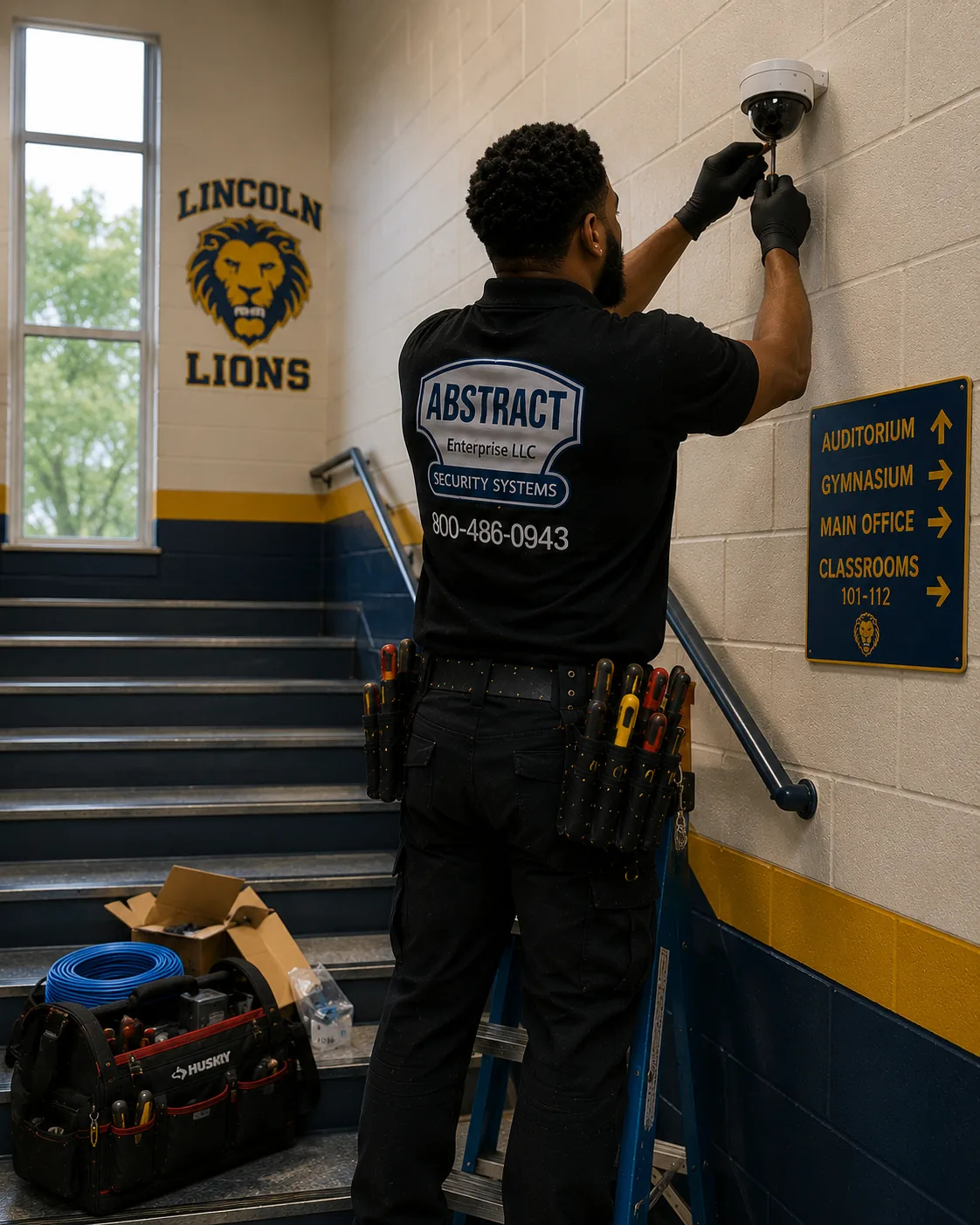
Brownstone Plaster, No Conduit
Plaster over brick and terracotta block, landmark districts in the Heights and the Slope. EoC over sound legacy coax, surface raceway painted to vanish, penetrations planned wall by wall — and the plaster stays closed wherever cable tests clean.
Joined Buildings & Annexes
Campuses that grew wing by wing with floors that don’t line up, and an annex across the street. One backbone, one recorder, one timeline — fiber where a pathway exists, wireless bridge where it doesn’t.
Schoolyard Vandalism & After-Hours Access
Weekend tagging, cut locks, kids over the fence. Yard lines, gate coverage, person-detection alerts after close, and IK10 housings at arm’s reach.
Bus Fleets & Yard Theft
Catalytic converters disappearing overnight. LPR at the yard gate, motion zones over the fleet, and a 3 a.m. alert on the administrator’s phone — the converter problem ends here.
Carline & Dismissal on a Busy Avenue
Two hundred kids loading twice a day with the whole borough driving past. 4K on the curb and both approach curves, WDR against avenue backlight, custody handoffs documented.
One Door, the Whole Street Outside
A main entrance opening straight onto the sidewalk carries the entire security plan. WDR against backlight, vestibule verification, and framing documented to your doorway — not down the block.
Shared Buildings & Shul Schedules
School by day, congregation nights and weekends. One system, roles per operator, coverage designed for the building’s whole calendar, and footage governance in writing.
August-Empty Buildings
Equipment walks when buildings sit dark. Health alerts, UPS backup, analytics-driven notifications, and remote verification that makes an empty building a monitored one.
Need Repair on a Brooklyn School System Right Now?
The truck is already in the borough. Recorder dead, channels black, drive errors, a clip that must be exported before a meeting — most school faults are diagnosed and cleared within a couple of hours of arrival, same day.
Call the Repair Line: (347) 934-8335See the Work
Install walk-throughs, before-and-afters, and honest hardware talk from real jobs on our YouTube channel.
Watch on YouTube →Related Brooklyn Services
Security Camera Repair Brooklyn
Same-day diagnosis and repair for schools and businesses across the borough.
NVR Installation Brooklyn
Recorder builds, storage sizing, and migrations for IP camera systems.
DVR Upgrade Brooklyn
Analog-to-IP migrations that reuse sound wiring and retire dying recorders.
Intercom Repair Brooklyn
Video intercom and buzzer service for school entry stacks and buildings.
Lorex Camera Installation Brooklyn
Right-sized prosumer systems for daycares and small facilities.
Dahua Camera Installation Brooklyn
Service, upgrades, and eyes-open installs for existing Dahua systems.
Changelog: Published July 17, 2026. Next scheduled review: October 2026 (PAA rescrape + pricing check).