
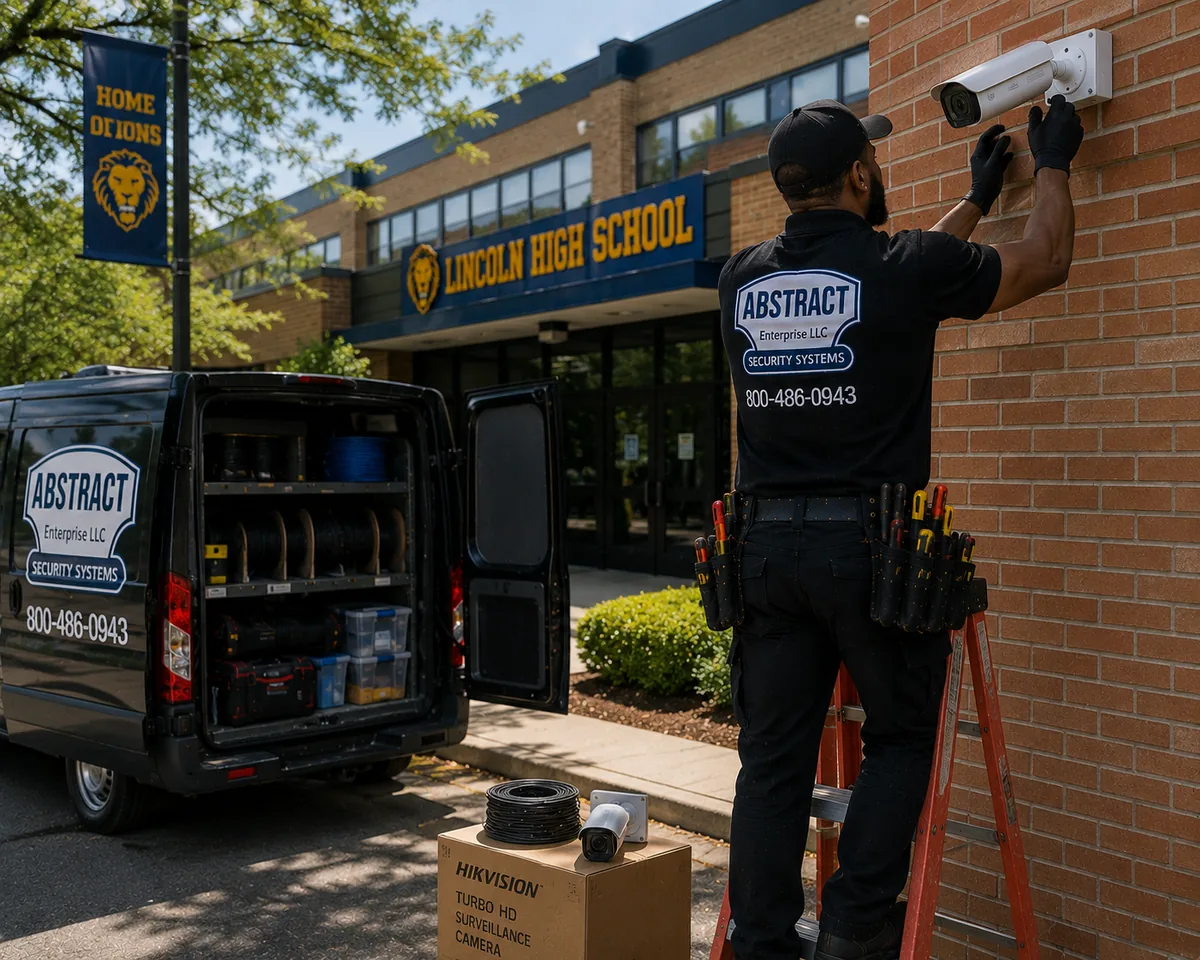
Manhattan is the densest private-education market in America. The Upper East Side alone stacks Dalton, Brearley, Chapin, Spence, Nightingale-Bamford, Sacred Heart, Marymount, Loyola, Regis, and Ramaz into forty blocks of Carnegie Hill and Yorkville townhouses. The West Side answers with Collegiate, Trinity, Columbia Grammar, Trevor Day, Heschel, and Rodeph Sholom. Downtown runs Friends Seminary, Grace Church School, Little Red, Léman in FiDi, and Xavier in Chelsea. Layer on the Archdiocese of New York’s parish schools through Harlem, Washington Heights, and the Lower East Side, Success Academy and Harlem Children’s Zone charters, hundreds of Article 47 daycares, and a college corridor from Columbia and Barnard through NYU, the New School, Cooper Union, Hunter, Baruch, Pace, and Yeshiva University in Washington Heights — and you have more schools per square mile than anywhere on earth. Public schools buy security through the DOE and the SCA. Everyone else picks up the phone and hires a contractor directly. That call comes here.
Abstract Enterprises Security Systems designs, installs, upgrades, and repairs school camera systems across the borough from our Bronx office at 460 E Fordham Rd — twenty minutes down the Harlem River Drive from most of the island. We build NDAA-compliant IP systems on commercial cable through pre-war plaster and landmarked brownstone alike, configure everything to comply with New York’s statewide school facial-recognition ban, coordinate installs around school calendars and freight-elevator windows, and leave every head of school a labeled, documented system their staff can run. Fixed written quotes, 50% deposit, a three-year warranty on AESS-supplied products, and no monthly fees — the footage stays in your building, not on someone else’s subscription.
- NYS-licensed & insured low-voltage contractor — Lic #12000287431
- School installs scheduled around breaks, evenings, and summer recess
- No monthly fees, no contracts — you own the system and the footage
Why Manhattan School Buildings Need a Professionally Installed Camera System
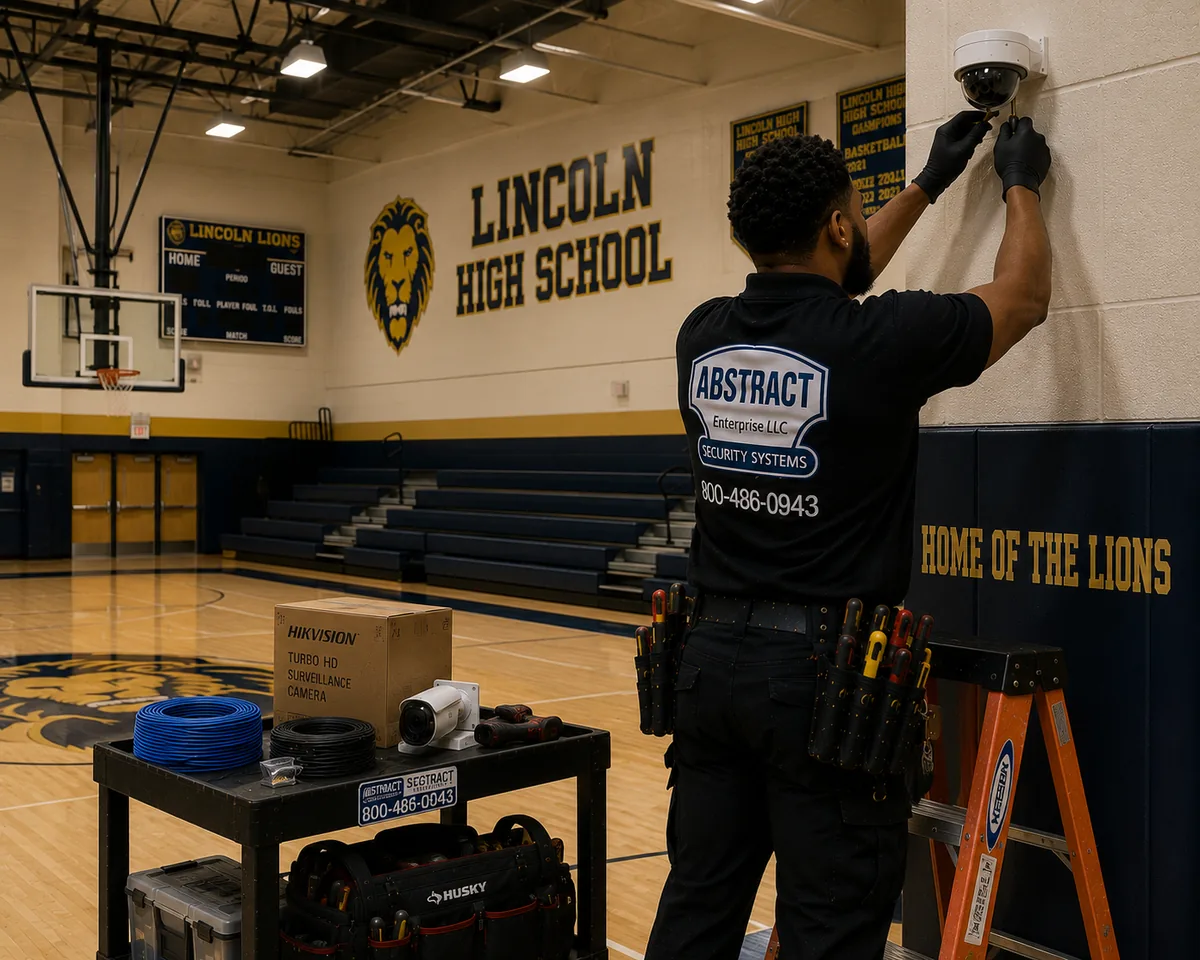
A Manhattan school is a vertical campus with one door that matters. Six floors of classrooms over a basement cafeteria and a rooftop play deck, a single main entrance opening directly onto a public sidewalk, a side door to the service alley, and a stream of deliveries, parents, tutors, and contractors moving through it from 7 a.m. to 6 p.m. There is no setback, no parking lot buffer, no fence line — the city starts at the doorframe. Security design here concentrates: a face-height entrance camera that holds up against sidewalk backlight, vestibule and lobby coverage that documents every entry, stairwell lines that follow the vertical circulation, and rooftop and cellar coverage the tour never shows but the insurer always asks about.
The borough’s public infrastructure sets the parents’ baseline: the city has spent roughly $78 million rolling cameras and locked, buzzer-controlled front doors across 1,300-plus DOE buildings, City Charter §528 requires cameras at every public-school entrance and exit, and NYPD School Safety runs the largest school-security operation in the country. A family touring an independent school on East 89th Street has walked past all of that — and the first thing they evaluate is your front door. Manhattan’s Jewish day schools carry an additional weight: after October 7th, antisemitic incidents hit record levels, and schools like the borough’s yeshivas and day schools moved entry security from facilities item to board priority, with communal security organizations and UJA-backed grant programs funding exactly this hardware.
And the liability math is Manhattan math: sidewalk incidents at dismissal on a street shared with the whole city, slip-and-falls on marble lobby floors, custody disputes at pickup, after-hours access by the twelve vendors who hold keys, and equipment that walks when a building sits empty in August. Heads of school, parish business managers, and daycare licensors all face the same post-incident question — where’s the video? We build systems so the answer is a two-minute export, not a shrug.
Need School Camera Repair in Manhattan Today?
Cameras down, recorder dead, footage you can’t export before a meeting with parents or counsel — we run same-day school camera repair across Manhattan, and most faults are fixed in one to two hours on site. Dead DVRs, PoE failures, storage errors, offline cameras, orphaned systems the original installer abandoned.
Call the Repair Line: (929) 560-0737School Security Camera Systems We Install
IP/PoE Camera Systems
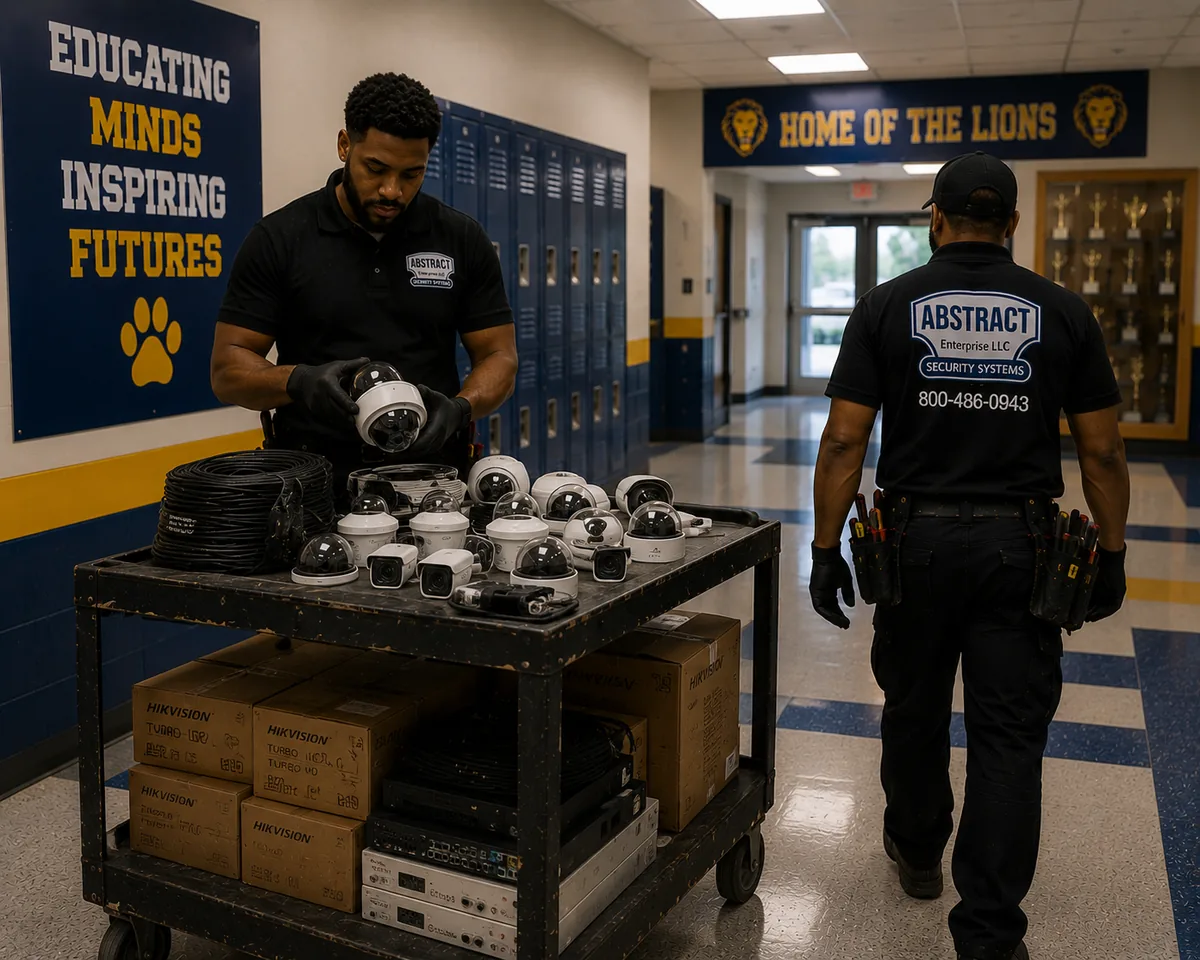
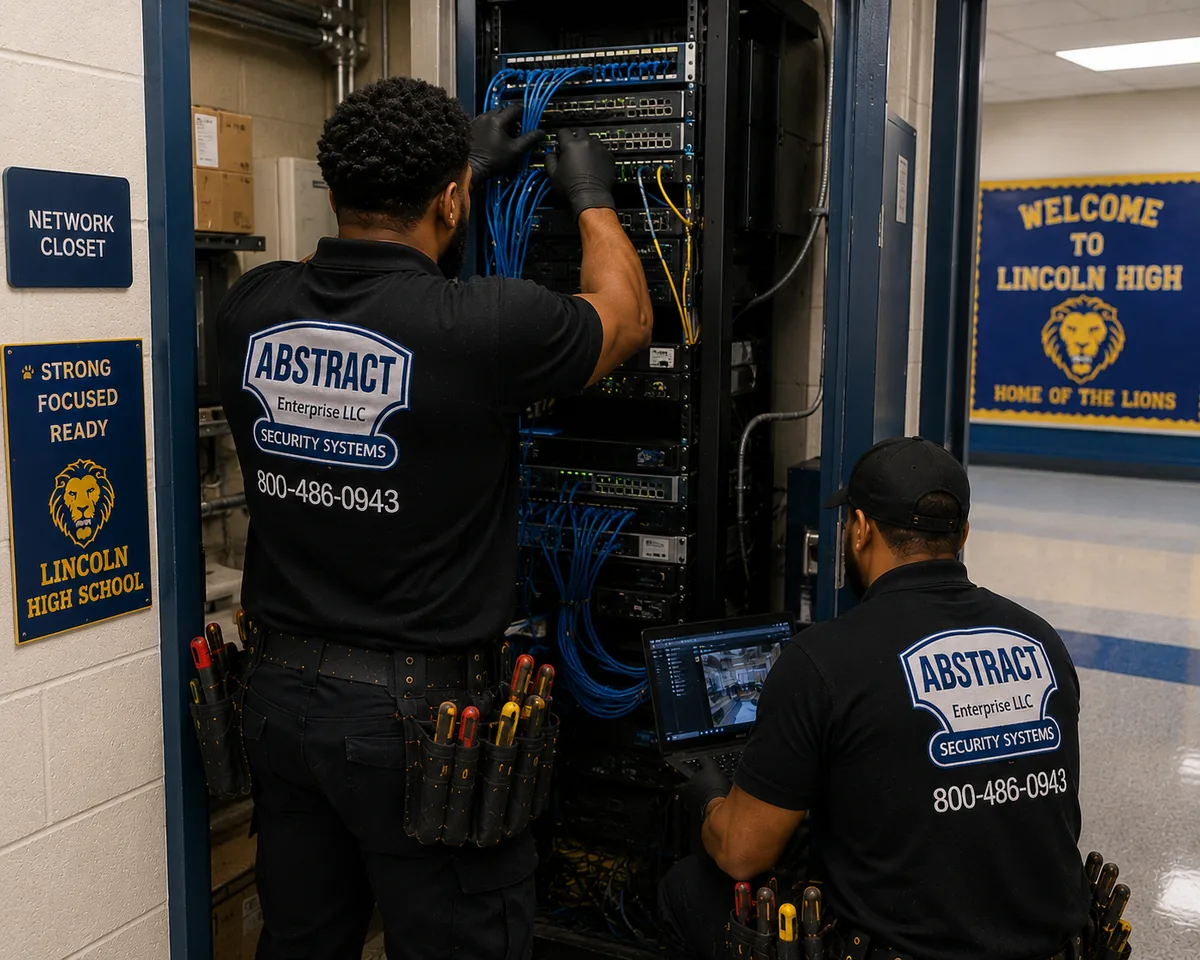
Our default Manhattan build: 4K and 4MP IP cameras on Cat6 to a PoE switch and NVR, labeled and documented. Vertical campuses get a riser plan — one clean pathway floor to floor — instead of six improvised drops, and the recorder lands somewhere with power, cooling, and a lock, which in a townhouse school is a design decision in itself.
Analog-to-IP Upgrades
Half the school systems we walk into are 2010-era analog DVRs behind the front desk with a dying drive. We reuse sound coax with EoC converters where it saves plasterwork, replace what failed, and migrate you to IP resolution without opening a landmarked wall. The recorder side runs deep on our Manhattan DVR upgrade and NVR installation pages.
Entry Vestibule & Buzzer Cameras
The locked-front-door standard the DOE built across 1,300 buildings, sized for an independent school’s lobby: face-height exterior camera, video verification at the front desk, buzzer release. Whoever admits a visitor is looking at a live face against sidewalk backlight — WDR is not optional on a Manhattan doorway.
Vertical & Multi-Building Coverage
Six floors, a cellar, a roof deck — and often a second building across the street. One recorder, one map: stairwell lines, elevator lobbies, rooftop play areas, service entrances, and a fiber or point-to-point link when the annex sits mid-block on the next avenue.
Cloud & Hybrid Recording
Local-first recording with optional encrypted cloud copies of critical channels. Where New York Ed Law 2-d applies to student-identifiable video, we configure vendor relationships and retention in a compliant framework — in writing.
Sidewalk, Dismissal & Perimeter Coverage
Your perimeter is a public sidewalk. We aim entrance heads to document the doorway and approach without surveilling the street, cover the dismissal corral and bus stop line, and put a camera on the service alley where every incident report seems to start.
School Camera Terminology, Translated
NVR vs DVR
NVRs record modern IP cameras over network cable; DVRs record older analog over coax. Manhattan schools mostly own aging DVRs and are migrating — sometimes through hybrids that run both while the budget catches up.
PoE (Power over Ethernet)
One Cat6 run carries power and video. Fewer penetrations through pre-war plaster, no outlet needed at the camera, and clean vertical risers instead of improvised floor-by-floor wiring.
WDR (Wide Dynamic Range)
Exposes a dark lobby and a blinding sidewalk in one frame. The single most important spec on a Manhattan entrance camera, where every doorway faces open sky over a bright street.
Retention
Days of footage held before overwrite. We floor school systems at 30 days — the minimum the city applies in its own school buildings — and size for 60–90 where budget allows.
NDAA Compliance
Federal law bars certain manufacturers — including Hikvision and Dahua — from federally funded projects. Schools spending federal safety-grant money must run compliant hardware; our school defaults comply out of the gate.
Riser & Plenum Rules
Vertical pathways between floors and the cable ratings the code requires above ceilings and in shafts. Getting this wrong fails inspections; getting it right is invisible — which is the point.
Video Analytics (the Legal Kind)
Person and vehicle detection, line-crossing, loitering alerts — all legal in New York schools. Facial recognition is banned statewide in every school, public and nonpublic, since 2023; we ship it disabled and documented.
EoC (Ethernet over Coax)
Converters that run IP video over the analog coax already inside your 1927 walls. On clean runs it saves thousands in plaster and paint — we test every legacy cable before deciding.
Vandal Rating (IK10)
Impact-resistant housings for stairwells, gyms, cellars, and anywhere at arm’s reach of teenagers. Cheaper than the third replacement dome.
Camera Brands We Install in Manhattan Schools — and How We Choose
Hanwha Vision
Our lead for grant-funded and archdiocesan work: NDAA-compliant, superb low-light performance for lobbies and cellars, deep vandal-resistant line for stairwells and gyms.
Axis
The premium tier — the brand a board’s security consultant already trusts, and the one that photographs well in a head-of-school’s annual report. Costs more per head; earns it over a decade.
Uniview
The value workhorse for tuition-funded and parish schools: strong imaging, dependable NVRs, NDAA-compliant lines available. Most mid-size Manhattan builds land here.
Lorex
Honest prosumer gear for a small daycare or single-floor preschool — capable 4K kits at a fraction of enterprise cost, installed where the scale genuinely fits. Details on our Lorex Manhattan page.
Hikvision & Dahua
Excellent hardware with a federal asterisk: barred from federally funded projects under NDAA §889. Tuition-funded schools without federal money can run them legally, and we service thousands of existing channels — see Dahua Manhattan. Eyes open, in writing.
Verkada-Style Cloud Platforms
Slick dashboards, per-camera licensing forever. A multi-campus operator can defend the fleet view; one townhouse school paying platform rates on 20 cameras is renting what it could own. We lay both five-year spreadsheets on the table.
Cameras + Access Control + Intercom: The School Entry Stack
Camera + Video Intercom + Buzzer
The core stack on every Manhattan school we touch: locked street door, face-height entrance camera, video intercom to the front desk, buzzer release. Visitors are seen and verified before the door opens — the same pattern the city standardized across its own buildings, sized for a townhouse lobby. Existing units get fixed through our Manhattan intercom repair team.
+ Access Control on Staff & Service Doors
Fobs on the service entrance and staff doors end the propped-door and twelve-vendors-with-keys problems in one move. Every badge event lands beside the video timeline, so “who opened the alley door at 9:40 Saturday” is a lookup, not a mystery.
+ Exit-Door Alarms & Panic Integration
Alarmed secondary exits with paired cameras catch the propped door and the wanderer — the protection New York wrote toward after the Avonte Oquendo case — and where a school adds silent panic alerting, we tie camera views to those events so NYPD responders see conditions in real time.
+ Burglar Alarm Integration
Manhattan schools sit empty nights, weekends, and all of August — exactly when laptops and AV gear walk. Alarm events cue camera bookmarks, so a 2 a.m. zone trip arrives with the clip attached instead of a morning of scrubbing.
Full Feature Set: What a Modern Manhattan School Camera System Includes
4K Resolution Where It Counts
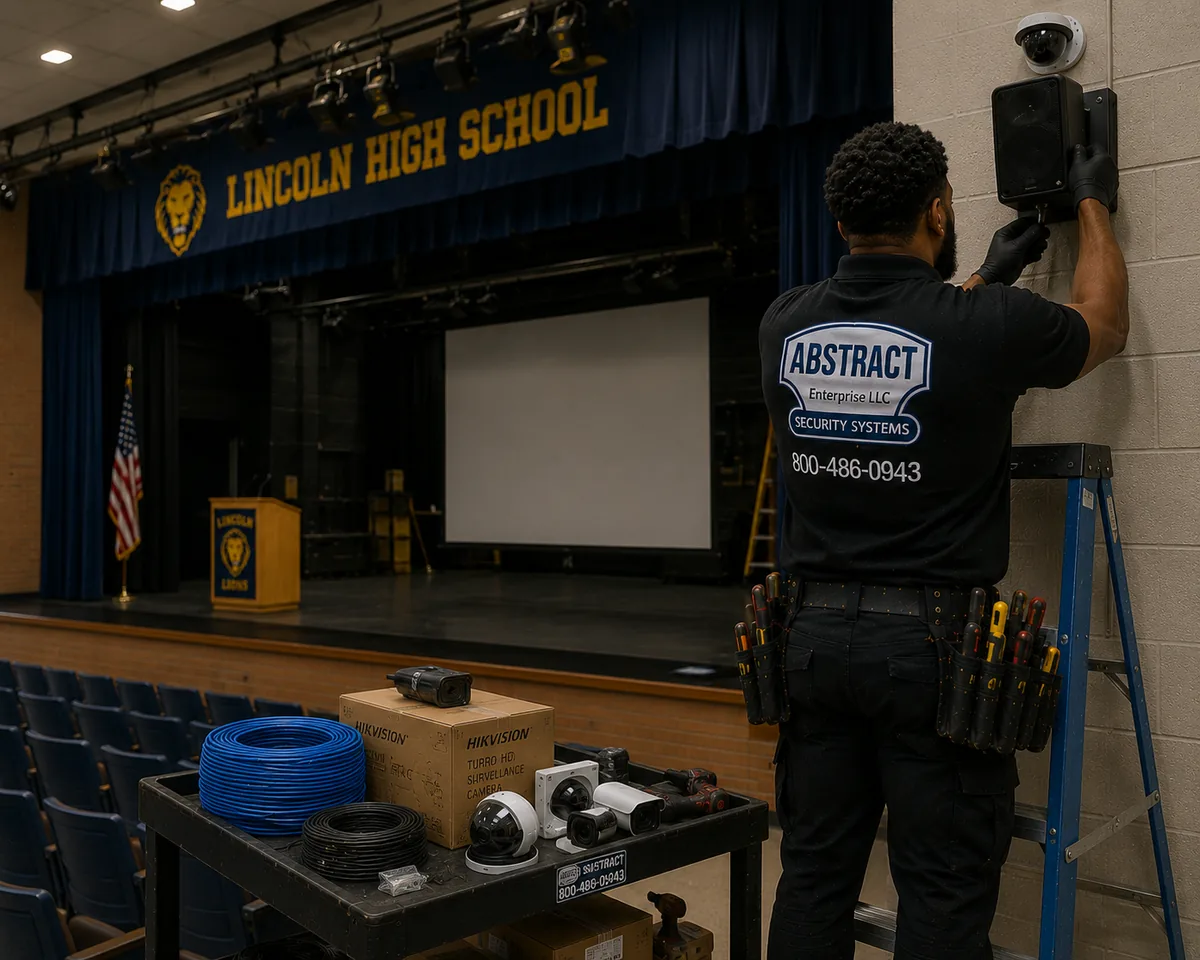
The entrance, lobby, dismissal corral, and service alley get 4K so a face survives forensic zoom against sidewalk light; stairwells and corridors run 4MP where identification distance is short. Resolution follows evidence.
Smart Person/Vehicle Alerts
Analytics that distinguish a person at the alley door from a rat, a pigeon, or headlight sweep — the difference between a trusted 11 p.m. alert and a muted app. Legal in New York schools; facial recognition is not, and stays off.
Remote Viewing, Role-Based
Head of school sees everything; front desk sees the entry stack; facilities sees the cellar, roof, and alley. Individual accounts, no shared logins, tested on cellular before we leave.
30–90 Day Retention
Storage engineered to a written policy — 30-day floor matching the city’s own school minimum — with drive-health alerts so a failing disk announces itself early.
Incident Export Workflow
Two-minute clip export to secured storage with a chain-of-custody note for anything headed to counsel, an insurer, or the NYPD. We train two staffers before sign-off.
UPS-Backed Recording
Battery backup rides through the brownouts and Con Ed hiccups that reboot cheap systems into gaps — and keeps the entrance recording through a building power event.
Tamper & Health Monitoring
Email the moment a camera goes dark, gets masked, or a drive degrades. The worst discovery is learning in June that the stairwell camera died in February.
Discreet, Landmark-Conscious Builds
Compact housings, paint-matched conduit, and exterior placements planned around landmarked facades and co-op sightlines — security that doesn’t argue with the architecture or the neighbors.
Labeled, Documented Handover
Every camera named, every cable tagged, a one-page quick guide at the front desk, as-builts in the office file. The next administration inherits a system, not a puzzle.
New York School Camera Compliance in Manhattan: What’s Legal, What’s Banned, What’s Funded
The Statewide Facial-Recognition Ban Covers Every Manhattan School
In September 2023 the New York State Education Department banned the purchase and use of facial recognition technology in schools statewide — public, charter, and nonpublic alike. A Carnegie Hill independent school and a Washington Heights parish school sit under the same prohibition as a DOE building. Conventional cameras, recording, and standard analytics remain fully legal; other biometrics are left to local decision. Every system we commission ships with facial recognition disabled and the configuration documented, so a vendor pitch can’t quietly switch on a banned feature.
Placement Law: Where Cameras Can and Cannot Go
New York Penal Law 250.45 makes recording in bathrooms, locker rooms, changing areas, and any space with a reasonable expectation of privacy a felony — no school exception. Lawful coverage runs entrances, exits, lobbies, corridors, stairwells, cafeterias, gyms, rooftop play decks, cellars, and service areas. Classrooms remain a policy decision for your board and counsel rather than an installer default; our practice is corridor coverage of classroom doorways, with any deliberate exception recorded on the signed placement map. One Manhattan-specific note: entrance cameras get aimed to document your doorway and approach, not to surveil the public sidewalk — a framing question we settle at the survey.
FERPA, Ed Law 2-d, and Who Owns the Footage
Video identifying a student that feeds a disciplinary decision can become an education record under FERPA, with parent access rights attached; New York’s Ed Law 2-d layers state rules wherever a cloud vendor touches student-identifiable data. The clean answer for most Manhattan nonpublic schools is local-first recording — your NVR, your building, your footage — with cloud copies only under a compliant vendor agreement. Retention, access, and export authority go in writing at handover, before the first parent asks.
Money: SSBA, NPSE, and Security Grants
Public districts draw on the state’s $2 billion Smart Schools Bond Act for high-tech security including video surveillance, with a required no-facial-recognition assurance. Manhattan’s nonpublic schools have their own lanes: New York’s Nonpublic School Safety Equipment reimbursement program funds exactly this hardware at religious and independent schools, federal school-safety grants stack on top — NDAA-compliant hardware required wherever federal dollars land — and the borough’s Jewish day schools additionally tap communal security grant programs that have prioritized entry hardening since October 7th. We build itemized, compliance-clean proposals a business office can submit as written.
The Manhattan School Landscape We Actually Work In
Upper East Side & Carnegie Hill
The densest independent-school corridor in the country — Dalton, Brearley, Chapin, Spence, Nightingale, Sacred Heart, Marymount, Regis, Loyola, Ramaz — in landmarked townhouses and purpose-built towers. Discreet hardware, LPC-conscious exteriors, and boards that expect consultant-grade paper.
Upper West Side & Morningside
Collegiate, Trinity, Columbia Grammar, Trevor Day, Heschel, Rodeph Sholom, Bank Street, Cathedral School — plus the Columbia and Barnard campus edge. Pre-war buildings, active streets, and dismissal scenes that need real coverage.
Downtown & the Village
Friends Seminary, Grace Church School, Little Red, Xavier, Léman in the Financial District — historic buildings, tight lots, and vertical campuses stacked over active retail blocks.
Harlem & Washington Heights
Archdiocese parish schools, Success Academy and Harlem Children’s Zone charters, Yeshiva University’s campus, and daycare density block after block. Value-engineered builds that still meet the full compliance stack.
Midtown & the College Belt
Trade schools, proprietary colleges, CUNY buildings, the New School, Pace, and daycare floors inside office towers — installs coordinated with building management, freight elevators, and after-hours rules.
Lower East Side & Chinatown
Parish schools, heritage and language programs, and daycares in walk-up stock — tight budgets, shared buildings, and entry stacks that carry the whole security plan.
Every Type of School We Secure in Manhattan
Independent & Prep Schools
Townhouse and tower campuses where the board expects consultant-grade documentation and the head of school expects the install invisible to students. Both are the job — and the freight-elevator schedule is ours to manage, not yours.
Catholic & Parochial Schools
The Archdiocese of New York’s parish and regional schools run the length of the island, Inwood to the LES. We work with principals and parish business managers, and our proposals survive a finance-council meeting.
Yeshivas & Jewish Day Schools
Ramaz, Heschel, Rodeph Sholom, Manhattan Day School, and a growing downtown cohort — entry stacks hardened to post-October-7th expectations, scheduled around the Jewish calendar, with NPSE- and communal-grant-ready paperwork.
Charter Schools
Success Academy-style networks and single-site charters, often co-located or in leased floors — caught between public compliance expectations and private budgets. NDAA-compliant builds documented for authorizer review.
Daycares & Preschools
Manhattan daycares run under NYC Article 47 licensing, and cameras are now a parent expectation as much as a security tool. Right-sized 6–12 camera systems — entries, playrooms per policy, rooftop deck, pickup — with privacy zones in writing for the DOHMH file.
Special-Education Schools
853 and 4410 programs carry elopement risk and documentation duty most schools never face. Exit-door coverage, gap-free corridor lines, and retention sized for incident review — designed with the clinical team.
Colleges & Campuses
From Columbia’s edges to NYU’s scattered blocks, Cooper Union to CUNY — building-by-building phases, VLAN-segmented backbones, and coordination with campus public safety.
Religious & Cultural Schools
Islamic academies, Christian schools, weekend language and heritage programs sharing space with congregations — shared-building systems with schedules and access that respect both calendars.
After-School & Enrichment Programs
Test-prep floors, music schools, sports academies, and after-school programs in commercial buildings — the liability never takes a season off, and neither does the coverage.
What Manhattan Reddit Actually Asks About School Cameras
Pulled from the conversations administrators and parents are really having — r/AskNYC, r/nyc, r/ManhattanParents-style groups, r/homedefense — and answered by the contractor who gets the follow-up call.
“Our UES school got quoted $68K for 26 cameras. Manhattan premium or padding?”
$68,000 ÷ 26 is about $2,615 per camera — more than double the honest Manhattan commercial range of $540–$1,140 installed. Manhattan adds real cost — freight logistics, plaster, landmark care — but it adds it in visible line items, not in a mystery multiplier. Get the line-item version; padded quotes hate line items.
“Our building is landmarked. Can we even put a camera on the facade?”
Usually yes, done right. Landmarked exteriors want compact housings, paint-matched mounting, and placements that respect the facade — and certain visible alterations can trigger LPC review. We install landmarked blocks before; verifying what your building needs is part of the survey, not your homework.
“Cloud camera platform quoted $22/camera/month for our 18-camera school. Worth it?”
Eighteen cameras at $22 is $4,752 a year, forever — roughly $23,700 over five years on top of hardware. An owned NVR records locally with no monthly fee and wins that spreadsheet by year two; cloud copies of the entrance and lobby can ride on top for a fraction. Run the five-year math before signing anything.
“A vendor pitched facial recognition for pickup at our day school. Legal in NYC?”
No. New York banned facial recognition in every school statewide in 2023 — nonpublic included — and a vendor pitching it either doesn’t know the law or hopes you don’t. Video-verified entry, person detection, and a documented pickup-authorization process solve the same problem legally.
“Can our entrance camera legally film the sidewalk?”
Your camera can document your doorway and its approach — that necessarily includes some public sidewalk, which is lawful. What we avoid is aiming down the block like a street-surveillance node: the framing covers your entry, your steps, your dismissal corral. It’s a design decision we settle on the survey and note on the placement map.
“Our school shares the building with a co-op. Who approves camera work?”
Your lease and the building’s alteration rules decide. Common-area and facade work typically needs board or managing-agent sign-off; your demised space usually doesn’t. We produce the COI, scope letter, and drawings managing agents ask for — it’s a Tuesday for us, not a project for you.
“Can our facilities manager just install cameras from B&H over winter break?”
He can hang them. What the school ends up with — consumer heads, clip-based recording, no riser plan, no documentation — isn’t what survives an insurer or a subpoena. The honest split: DIY answers a two-camera storage-room question; a vertical campus with one door, six floors, and a duty of care needs commercial cable, real retention, and paper. That second thing is a trade.
“Our DVR has said ‘no HDD’ since the fall and the front desk ignored it. How bad?”
Nothing has recorded since the drive died — the cameras were decoration. It’s the most common find on our Manhattan school repair calls, because monitors still show live video. Same-day drive replacement, every channel verified writing and playing back, and health alerts so silence never lasts a semester again.
“What should storage cost for 20 cameras at our school?”
Twenty cameras at 4MP with 30-day retention wants roughly 20–28TB of surveillance-rated drives — a $600–$1,000 line inside the recorder, not a subscription. Double the retention, roughly double the drives. Anyone quoting on-prem storage as a monthly fee is selling a platform, not your requirement.
“A parent demanded hallway footage of an incident. Do we have to provide it?”
Once identifiable-student video feeds a disciplinary decision it can become a FERPA education record with access rights — typically supervised viewing, other students protected. What saves schools is policy written before the request: who reviews, who exports, how long footage lives. That framework ships with every system we hand over.
“Do cameras actually deter anything on a busy Manhattan block?”
Deterrence is real but partial: visible entrance and alley cameras measurably cut package theft, vandalism, and opportunistic entry — and when deterrence fails, the recording turns an NYPD report from a guess into a case. Cameras are the evidence layer of a plan that still includes a locked door and a staffed desk.
“The company that installed our system in 2015 is gone. Now what?”
You’re orphaned, and it’s half our Manhattan school work. We take over systems regardless of who built them: full audit, password recovery or reset, recording verified on every channel, documentation the school owns, ongoing same-day service. No rip-and-replace required for what still works.
“Quotes for our school ran $12K to $47K. Same building. Why?”
Because “camera system” isn’t a spec. The $12K quote is likely 10 consumer heads on Wi-Fi; the $47K one might be 26 commercial cameras on a proper riser with a redundant recorder — or might be padded. The only defense is a line-item quote tied to a floor plan. We produce exactly that from a free survey, and we’ll read a competitor’s quote with you for nothing.
“Our roof deck is the playground. Does it need coverage?”
Yes — it’s a play area with a parapet, which makes it both a supervision zone and a liability zone. Weather-rated heads covering the deck and the roof-access door, framed to the deck and not the neighbors’ windows, with the framing documented. Rooftop coverage is the question insurers ask about vertical campuses.
What Manhattan Actually Searches: Answer the Public
How much do school security cameras cost in Manhattan?
Plan on $540–$1,140 per commercial camera installed. Daycare systems land $5,400–$9,600; a 16–32 camera school $14,500–$36,000; large multi-building campuses run well past that.
Who installs school cameras in Manhattan?
Licensed low-voltage contractors — NYS Lic #12000287431 here — not alarm salesmen. Free on-site surveys from Inwood to the Battery.
Are cameras allowed in private schools in NY?
Yes — entrances, corridors, common areas, roof decks, cellars. Never bathrooms or locker rooms, and facial recognition is banned statewide in all schools.
Can NYC daycare parents demand live camera access?
Live streaming is a policy choice, not a legal right — most Article 47 centers limit it to protect other children. Recorded footage follows your written policy.
What cameras do NYC schools actually use?
Commercial IP domes and bullets on PoE — Hanwha, Axis, Uniview class — recording to an on-site NVR. Not consumer doorbell brands.
How long do schools keep camera footage?
30 days is the working floor — matching the city’s own school minimum — and 60–90 where storage allows. Incident clips get exported before overwrite.
Do school cameras record audio?
Almost never, and we advise against it — New York’s consent rules make school audio recording a legal minefield video doesn’t have.
Can school cameras be monitored remotely?
Yes — role-based apps for administrators, tested on cellular before handover. August-empty buildings are exactly what remote verification exists for.
Who repairs school camera systems near me?
We do, same-day, across Manhattan — dead recorders, offline cameras, failed drives, and takeovers of orphaned systems.
Do grants pay for school cameras in NY?
Public schools use the Smart Schools Bond Act; nonpublic schools use the NPSE security-equipment grant, federal programs, and communal security grants. We write compliance-clean proposals.
Do cameras work on landmarked buildings?
Yes, with compact housings, paint-matched mounting, and placements that respect the facade — and LPC review handled where visible alterations trigger it.
Is DIY school camera installation legal?
Mostly legal — placement law still applies. Whether a DIY system survives an insurance claim or a subpoena is the better question.
People Also Ask: Manhattan School Cameras
How many cameras does a Manhattan school building need?
Vertical choke points set the count: the entrance and vestibule, lobby, every stairwell per floor, corridor lines, cafeteria, gym, roof deck, cellar, and the service door. Daycares run 6–12; a townhouse school 16–32; a full six-story campus 32–64; multi-building schools more. The free survey turns the band into an exact number on a floor plan.
How do installs work around freight elevators and building rules?
We manage them: COIs to the managing agent, freight reservations, protection down the service corridor, after-hours windows where the lease demands them. Manhattan logistics are our overhead, not your project.
Can cameras cover the dismissal scene on a public sidewalk?
Yes — your entrance heads lawfully document the doorway, steps, and dismissal corral, which includes the adjacent sidewalk. We frame to your entry rather than down the block, and note the framing on the placement map so the answer is on paper if anyone asks.
What about the rooftop play deck?
Cover it: the deck, the roof-access door, and the parapet line, with weather-rated heads framed to your deck and not the neighbors’ windows. Rooftop coverage is the first question insurers ask about vertical campuses.
Do co-op or condo neighbors get a say in our camera install?
In shared buildings, common-area and facade work typically runs through the board or managing agent; your demised space usually doesn’t. We produce the alteration paperwork, COI, and drawings that make that approval routine.
What happens to school camera systems in August?
They matter most. Empty buildings are when equipment walks and vandalism happens — and when nobody’s watching a lobby monitor. Health alerts, UPS backup, and analytics-driven notifications keep an empty building a monitored one.
Can cameras integrate with our existing intercom or alarm?
Usually yes: alarm zones bookmark video, intercom releases pair with entrance cameras, badge events line up on the timeline. Integration is the point — separate systems that don’t talk are how doors get propped and incidents get missed.
Do Jewish day schools have extra funding options for cameras?
Yes — alongside the state’s NPSE nonpublic-school security grant and federal programs, communal security organizations have funded entry hardening at Jewish schools citywide, with urgency that rose sharply after October 7th. We build proposals those programs can act on as written.
Who owns the footage — the school or the camera company?
With our builds: the school, full stop. Local recording, your hardware, your admin credentials, documentation in your file. Subscription platforms blur that — footage lives on their cloud under their terms — which is one more reason our default is owned systems with optional cloud copies.
People Also Search For
The AI Overview Reality Check: What Google’s Answer Box Gets Wrong About Manhattan School Cameras
Ask Google what school cameras cost and an AI-generated answer appears above the results, stitched from national sources — Angi, HomeAdvisor, Fixr — that have never priced a job on this island. Here’s where that answer helps a Manhattan school, and where it steers one wrong.
The Residential-Data Trap
The cost figures feeding those answer boxes come overwhelmingly from homeowner projects — four-camera kits on a suburban colonial in the national median market. Angi and HomeAdvisor aggregate what their leads pay, and their leads are homeowners, so “average installation cost” lands around $1,300–$2,000 for a whole house. A Manhattan school is a commercial vertical project: riser pathways floor to floor, plenum cable above ceilings, work through 1920s plaster and landmarked masonry, freight-elevator logistics, and a recorder sized for 30-day retention across dozens of channels.
When a business manager sees “$400 per camera” in an answer box and our commercial quote reads $780 per head installed, the gap isn’t markup — it’s a stick-on Wi-Fi cube versus a WDR dome on a proper riser with documentation. The national number was never a Manhattan number.
Manhattan adds its own layer: commercial labor here carries roughly a 20% band over our Brooklyn base — building logistics, protection requirements, landmark care — and no national aggregator models a freight reservation. Use the answer box to learn vocabulary, not to set a budget.
The Per-Camera Pricing Trap
AI answers love a single per-camera number because it’s tidy. Real school projects are system projects: recorder, storage, PoE switching, UPS, and the riser between floors are shared costs per-camera math hides. In a six-story townhouse school, the vertical pathway can cost more than the cameras riding on it.
That’s why two honest quotes for “24 cameras” can sit thousands apart — one building has a usable riser and clean coax to reuse, the other needs everything cut in fresh. It’s also where padded quotes hide. The defense in both directions is the same document: a line-item quote tied to a floor plan.
Our quotes price hardware, labor, cabling, storage, and configuration as visible lines. When a board compares us against an answer-box number, we walk through exactly which lines that number never knew existed.
The New York Law Blind Spot
National content barely registers that New York banned facial recognition in schools statewide in 2023 — nonpublic included — or that Penal Law 250.45 criminalizes cameras in privacy spaces, or that Ed Law 2-d governs cloud vendors touching student data, or that a sidewalk-facing entrance camera raises framing questions worth settling on paper. An AI summary trained on national content will cheerfully recommend features that are illegal to buy for a New York school.
We’ve watched it happen: a vendor deck offering biometric pickup verification to a day school, a board member forwarding a national article about facial-recognition entries. The correction is cheapest as a design conversation and most expensive as a compliance problem.
Every system we commission ships with prohibited features disabled and documented. That configuration file is your proof if the question ever comes from a licensor, an insurer, or the state.
The Camera-Count Blind Spot
Answer boxes size systems by square footage because home content does. Manhattan schools size by vertical choke points: the one entrance, the vestibule, the lobby, every stairwell on every floor, corridor lines, cafeteria, gym, roof deck, cellar, service door. A 30,000-square-foot single-story suburban school and a 30,000-square-foot six-story townhouse school need very different counts — the vertical one usually needs more, because stairwells multiply.
Verticality is the multiplier the national math misses entirely. Every floor adds stairwell heads and corridor lines no square-footage formula predicts.
The free site survey exists for exactly this: we walk the building top to cellar, mark choke points on the plan, and hand you a count you can defend at a board meeting — reasoning attached.
The Cloud Subscription Bias
A disproportionate share of what AI answers learn from is written by subscription camera companies, so “modern school security” gets framed as cloud platforms with per-camera licensing. For a network office running sixty buildings, maybe. For one townhouse school, the five-year spreadsheet usually loses by five figures — and the hardware bricks if the payments stop.
There’s a compliance angle too: cloud video of identifiable students pulls Ed Law 2-d vendor requirements into scope. Local-first recording keeps the data — and the decision — inside your building.
We deploy cloud where it honestly fits: off-site copies of the entrance and lobby channels, multi-campus operators, boards that want the dashboard and accept the bill. Choose with the spreadsheet open, not because an answer box absorbed a hundred vendor blogs.
The Old-Building Blind Spot
No national answer box has ever cabled a landmarked brownstone. Manhattan school stock is pre-war plaster over brick, terracotta block, landmarked facades, and ceilings you cannot simply cut — and the fix is boring, specific technique: EoC over sound legacy coax, surface raceway painted to vanish, compact housings, penetrations planned wall by wall.
The “easy DIY install” content feeding AI summaries assumes drywall and attic access. Two hours into real plaster, that plan is a patching bill.
Our approach changes building by building, and the plaster stays closed wherever the cable tests clean. That judgment is precisely what an aggregated answer cannot contain — and it’s free with the survey.
How to Actually Use the AI Overview
Use it for vocabulary — NVR vs DVR, PoE, retention, WDR — so vendor conversations start further along. Use it for national context on what schools broadly deploy. It’s genuinely good at both.
Don’t use it for Manhattan pricing, camera counts, New York legality, or pre-war construction — the four decisions that shape your project — because its sources contain none of the local facts those decisions turn on.
Then get the two documents that beat any answer box: a floor-plan camera count and a line-item quote, both free, both yours to shop against anyone. If our numbers don’t win on inspection, you’ve lost nothing but a walkthrough.
DIY vs Professional School Camera Installation: The Honest Version
Where DIY Honestly Works
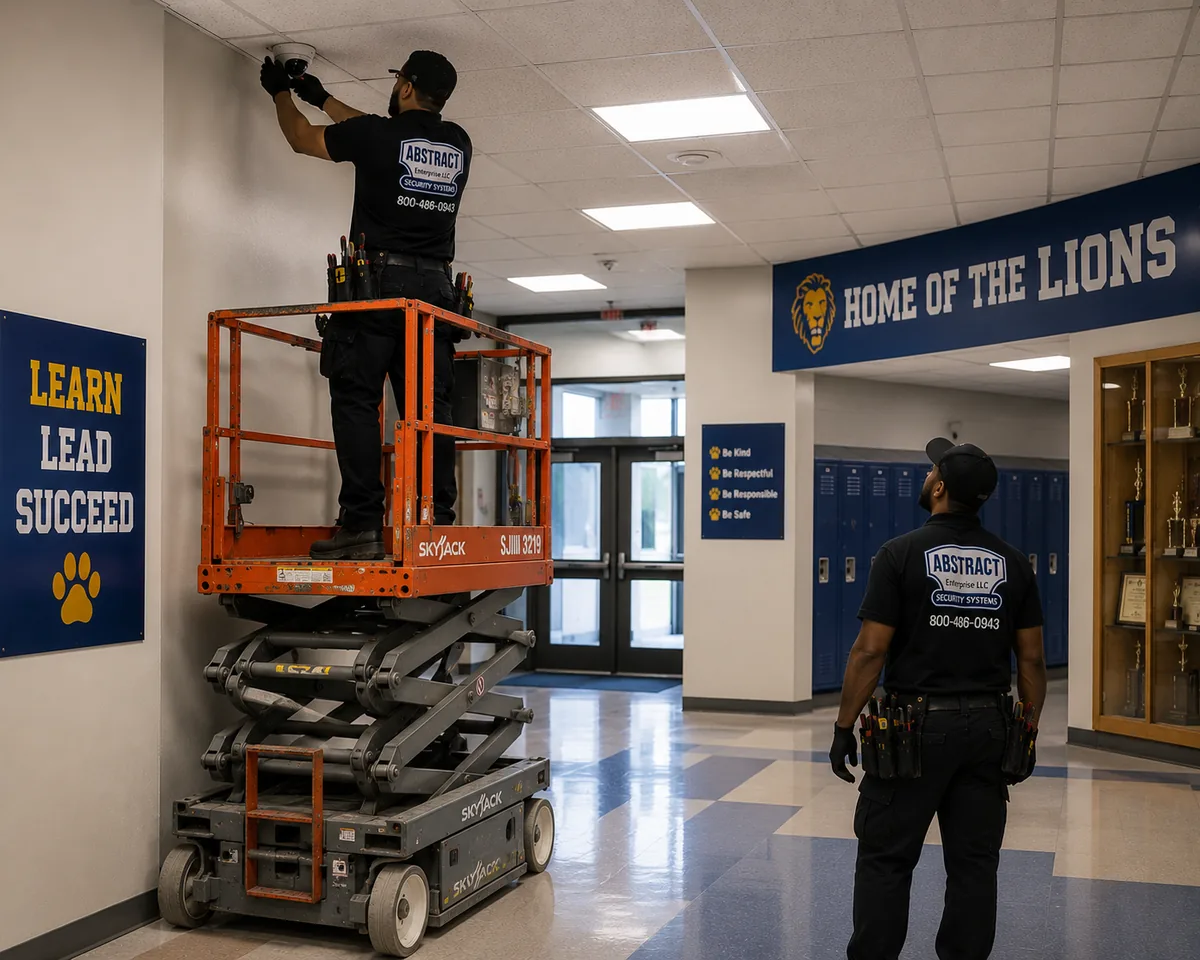
A two-camera storage-room problem. A single consumer camera on a daycare’s service door while the real system gets budgeted. A facilities manager comfortable resetting an app. If the stakes are “who left the cellar door open,” a $400 kit from B&H genuinely answers it — and we’ll say so to a small program’s face rather than sell a system they don’t need yet.
Where a School Has No Business DIYing
The moment footage might face an insurer, a licensor, an archdiocesan attorney, or a subpoena. Consumer Wi-Fi heads drop frames through plaster and steel, clip recording misses the thirty seconds that mattered, and nobody documents a DIY system — so nobody can defend it. Add riser and plenum code, landmark rules, placement law, and retention policy, and the difference isn’t convenience. It’s whether the system stands up on the one day it has to.
Verkada, ADT, Ring — and Why Manhattan Schools Keep Hiring the Local Licensed Shop Instead
The Cloud Platforms (Verkada, Rhombus)
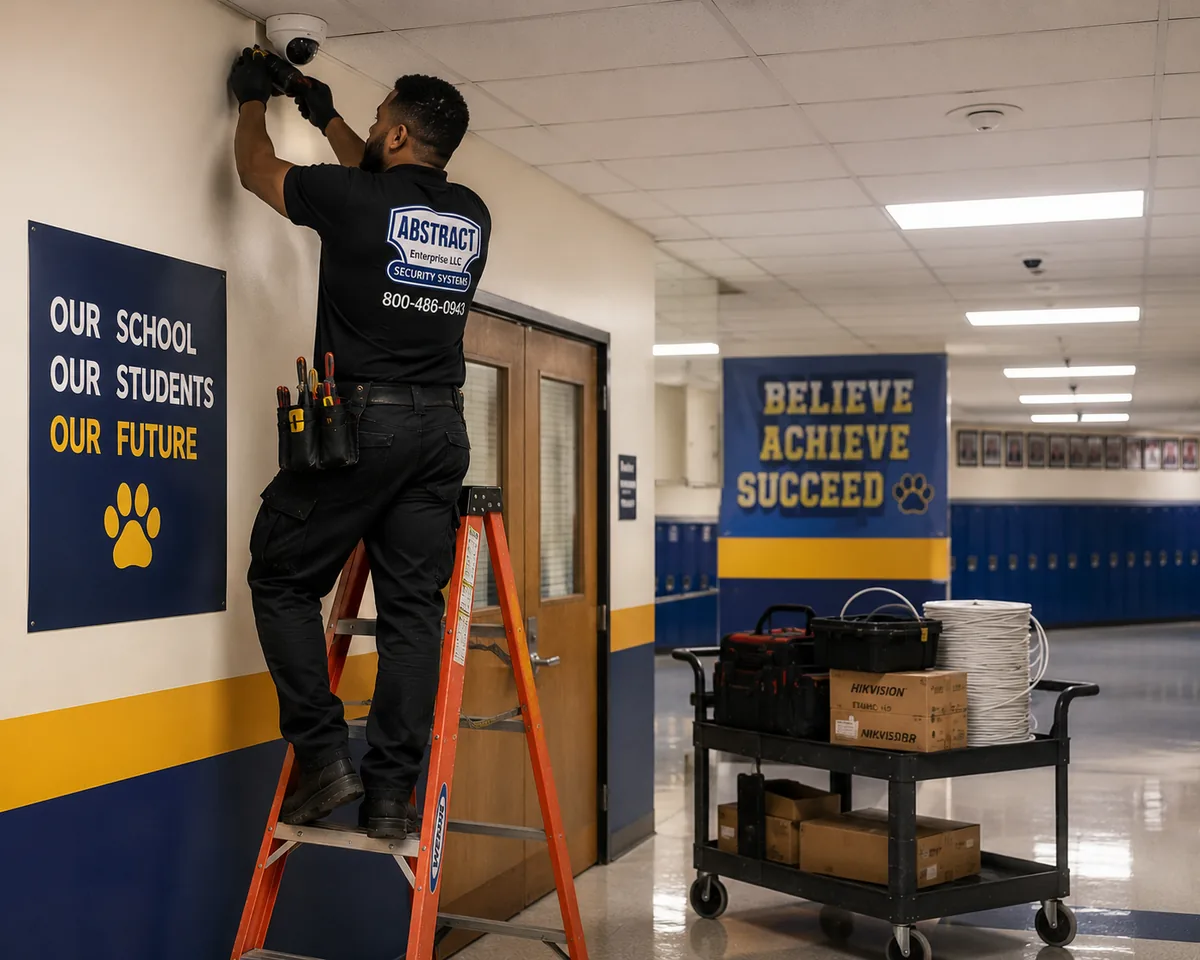
Capable software attached to per-camera licensing with no finish line. A network office managing dozens of buildings can defend the fleet dashboard; a single townhouse school paying platform rates on 22 cameras is renting what it could own. We lay both five-year spreadsheets on the table and deploy the cloud only where the numbers, not the pitch, say so.
The National Alarm Bundlers (ADT and Friends)
What the nationals sell a school is a monitoring agreement with cameras buried in the line items: subcontracted crews meeting your block for the first time, hardware locked to their platform, and a service queue in another state while your entrance camera sits dark on a Friday. A school needs owned hardware, local hands, and a fixed number. Monitoring, where wanted, rides month-to-month through central-station partners — not as a five-year handcuff.
The Consumer Brands (Ring, Nest, Warehouse-Club Kits)
Excellent at what they’re for — a house. Schools hit the walls fast: camera-count limits, subscription clip storage, Wi-Fi that dies through plaster and steel, no riser story, no documentation, and privacy-law questions the app was never built to answer. We get called to replace these about eighteen months after a board approved them to save money. The kit wasn’t bad; it was miscast.
Manhattan School Security by the Numbers
What Manhattan School Clients Say
Illustrative example — for work like this, a typical security camera job involves reviewing the property, matching equipment to the space, running clean cabling, and walking through the finished system. Hypothetical planning example — not a customer account, completed AESS project, verified review, or promised result.
— Director of operations, Upper East Side independent school
Illustrative configuration — a representative security camera setup may cover the main entries and shared areas, with remote viewing or management from a phone and a clear handoff at completion. Hypothetical planning example — not a customer account, completed AESS project, verified review, or promised result.
— Administrator, Manhattan Jewish day school
Illustrative planning scenario — a typical security camera project of this type begins with an on-site assessment, then a written scope and fixed quote, and finishes with professional installation completed to code. Hypothetical planning example — not a customer account, completed AESS project, verified review, or promised result.
— Parish business manager, Upper Manhattan
Illustrative example — for work like this, a typical security camera job involves reviewing the property, matching equipment to the space, running clean cabling, and walking through the finished system. Hypothetical planning example — not a customer account, completed AESS project, verified review, or promised result.
— Daycare owner, Midtown East
Field Notes: Spring Break, a Carnegie Hill Townhouse, and One Riser to Rule Them All
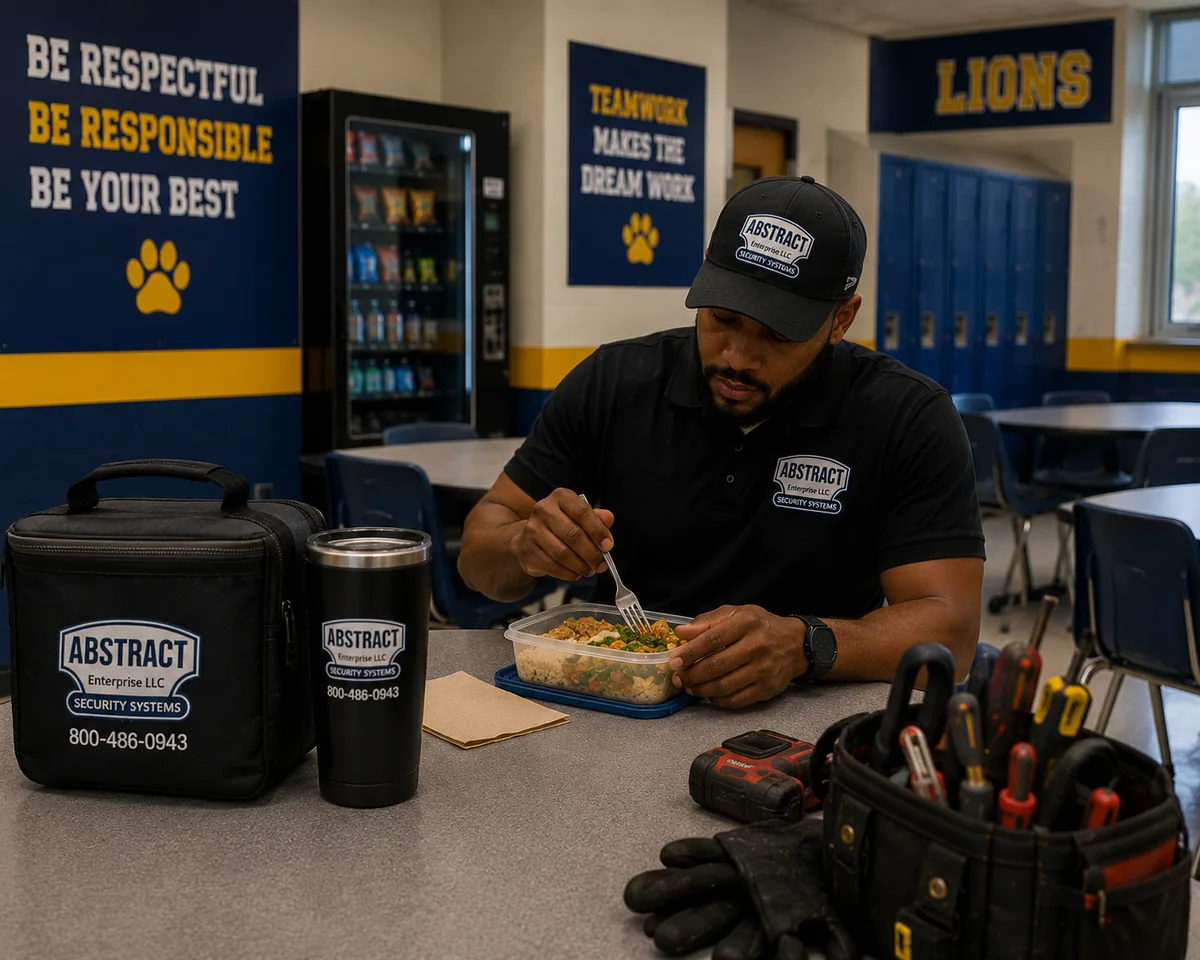
Twenty-four cameras, five days, one spring break — an independent school in two joined townhouses off Madison. The old system was archaeology: analog heads from 2009, IP cameras from 2016 on a separate app nobody remembered the password to, and a DVR in a coat closet whose drive had died sometime before Thanksgiving. Live monitors, dead recording — the classic.
The building fought back exactly the way pre-war buildings do. Plaster over brick, landmarked facade, and two townhouses that meet at a party wall with floors that don’t quite line up. The answer was one clean riser: a single vertical pathway up the service stack, a small PoE switch per floor, and EoC converters carrying three legacy runs where the 2009 coax tested clean — which kept two classrooms’ worth of plaster closed. Exterior got one WDR head over the entrance, compact and paint-matched, framed to the doorway and steps — not down the block — with the framing noted on the placement map.
The roof deck was the part the insurer had flagged: it’s the playground. Two weather-rated heads now cover the deck and the roof-access door, aimed at the play surface and the parapet, not the neighbors’ windows. Friday walkthrough was the head of school, the ops director, and two front-desk staff exporting test clips until it was boring. That’s the finish line — the first export they do without me.
— Anwar Timothy, NYS Lic #12000287431
Frequently Asked Questions: School Camera Installation in Manhattan
How much does school security camera installation cost in Manhattan?
Most Manhattan school camera projects run between $7,000 and $85,000 depending on building size and camera count. Plan on $540 to $1,140 per commercial IP camera installed, plus the recorder, storage, and riser work as system-level items. A small daycare with 6 to 12 cameras typically lands $5,400 to $9,600; a townhouse school with 16 to 32 cameras runs $14,500 to $36,000; a full six-story or multi-building campus with 32 to 64 cameras runs $30,000 to $58,000 and up. Manhattan carries roughly a 20% labor band over our Brooklyn base for building logistics and landmark care, itemized on every quote. We provide a free on-site survey with a camera-count floor plan and line-item quote. NYC sales tax 8.875% at invoice.
How many cameras does a Manhattan school building need?
Vertical choke points set the count, not square footage. From our installs: daycares need 6 to 12 cameras, townhouse schools 16 to 32, and full six-story or multi-building campuses 32 to 64 or more, because stairwells multiply — every floor adds stairwell heads and corridor lines. The entrance, vestibule, lobby, cafeteria, gym, roof deck, cellar, and service door anchor the map. The survey produces an exact number for your building.
Is facial recognition legal in Manhattan schools?
No. The New York State Education Department banned the purchase and use of facial recognition technology in schools statewide in September 2023, covering public, charter, and nonpublic schools in Manhattan alike. Conventional security cameras, recording, and standard video analytics remain fully legal. We configure every school system so prohibited features are disabled and documented as such.
Can cameras be installed in classrooms?
Often legally possible in New York, but it is a policy decision for your administration, counsel, and staff rather than an installer default. Most Manhattan schools cover classroom doorways from the corridor instead, which documents every entry and exit without placing a camera inside the room. Where a school deliberately chooses classroom coverage, we document the decision in the signed placement map.
Where can school cameras never be installed?
Bathrooms, locker rooms, changing areas, and any space with a reasonable expectation of privacy. Recording in those areas implicates New York’s unlawful surveillance statute, which is a felony. Lawful placement covers entrances, exits, lobbies, corridors, stairwells, cafeterias, gyms, rooftop play decks, cellars, service areas, and building perimeters — with entrance cameras framed to your doorway and approach rather than down the public street.
How long should a Manhattan school keep camera footage?
We recommend 30 days as the floor, matching the minimum the city applies in its own school buildings, and 60 to 90 days where budget allows, since incidents often surface weeks later. Any clip tied to an incident should be exported to secured storage immediately so it survives the recorder’s overwrite cycle. We size storage to your chosen policy and turn on drive-health alerting.
Can you install while school is in session?
Yes, with a phased plan. We schedule invasive work such as ceiling access, riser cutting, drilling, and lift work for breaks, evenings, weekends, and summer recess, and reserve occupied hours for low-disruption tasks like head-end configuration and camera aiming. Crews follow your visitor, escort, and background-screening requirements, and we handle freight-elevator reservations, COIs, and managing-agent paperwork in shared buildings.
What camera brands do you install for Manhattan schools, and what is NDAA compliance?
Our school defaults are NDAA-compliant lines such as Hanwha Vision, Axis, and Uniview, with prosumer options like Lorex for small daycares where the scale fits. NDAA Section 889 bars covered manufacturers, including Hikvision and Dahua, from federally funded projects, so schools using federal safety grants must run compliant hardware. We also service and upgrade existing systems from any brand.
Can grants pay for school security cameras in Manhattan?
Frequently. Public schools draw on New York’s $2 billion Smart Schools Bond Act for high-tech security including video surveillance, with a required assurance that no facial recognition is in the plan. Nonpublic schools — independent, parochial, yeshiva — use New York’s Nonpublic School Safety Equipment reimbursement program and federal school-safety grants, and Manhattan’s Jewish day schools additionally tap communal security grant programs that have prioritized entry hardening. We prepare itemized, compliance-clean proposals that business offices can submit as written.
Do you integrate cameras with buzzers, intercoms, panic alarms, and access control?
Yes, and most of our Manhattan school projects combine them. The standard stack is a locked street door with a face-height camera, video intercom verification, and buzzer release from the front desk, plus fob access control on staff and service doors and alarmed secondary exits with paired cameras. Where a school adds silent panic alerting, we tie camera views to those events so NYPD responders see conditions in real time. One contractor wiring all of it means one design, one riser, and systems that actually work together.
Do you repair or take over existing school camera systems in Manhattan?
Yes. Same-day school camera repair across Manhattan covers dead recorders, cameras down, PoE faults, storage failures, and footage-export emergencies, with most faults fixed in one to two hours on site. We also take over orphaned systems installed by vendors who disappeared: full audit, password recovery, recording verification on every channel, documentation, and ongoing service.
Are your installers licensed and vetted to work in schools?
Abstract Enterprises Security Systems is a New York State licensed and insured low-voltage security contractor, license number 12000287431. We comply with each school’s vendor screening, escort, and scheduling requirements, and we structure school installs so invasive work happens outside student hours. References from school and commercial clients are available on request.
School Camera Installation Pricing in Manhattan
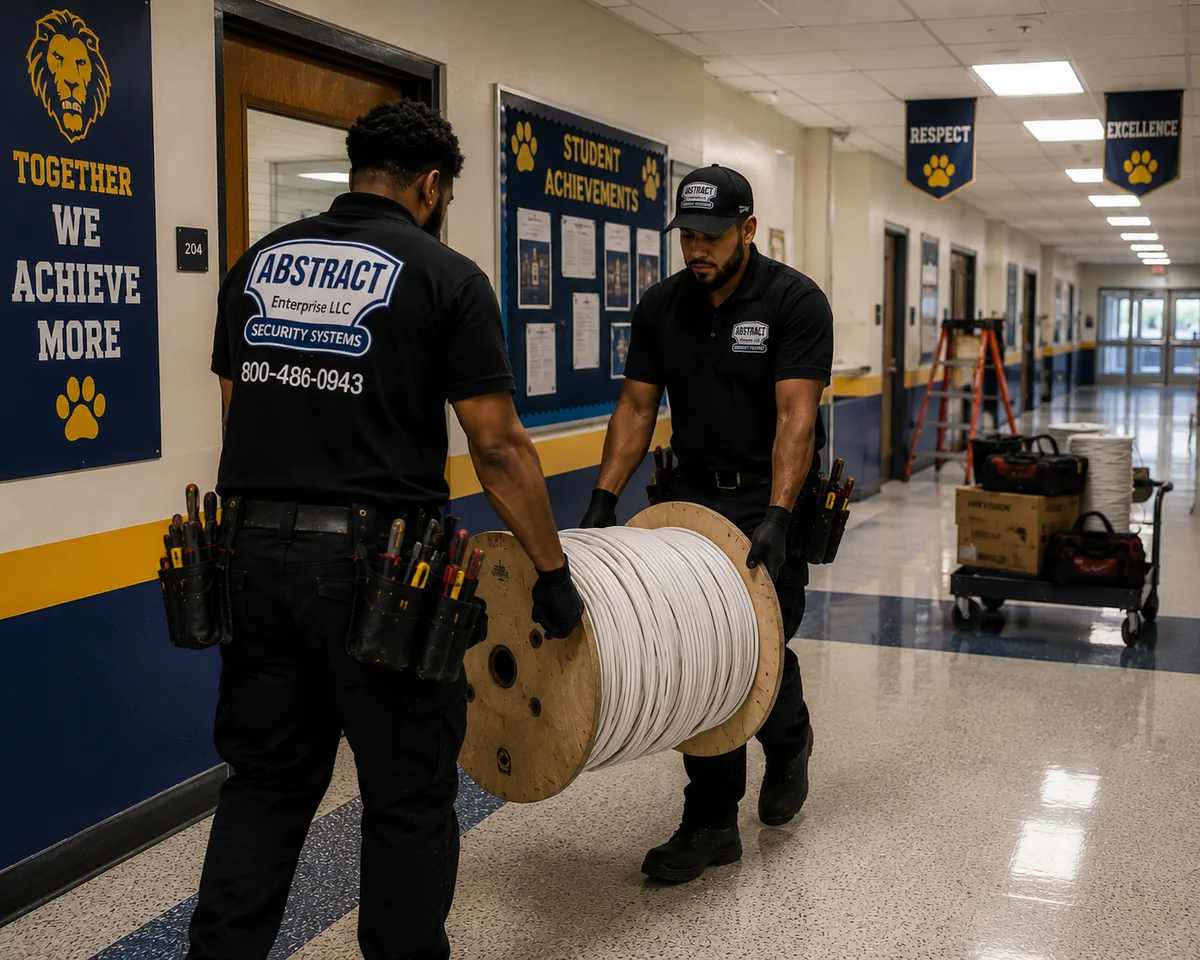
Manhattan commercial pricing carries roughly a 20% band over our Brooklyn base — building logistics, protection requirements, landmark care — itemized on every quote, never hidden. These are honest budgeting bands; every project gets a fixed line-item quote after the free survey. NYC sales tax 8.875%, itemized at invoice.
| Project Tier | Typical Scope | Installed Range |
|---|---|---|
| Daycare / Preschool | 6–12 cameras, single floor or small building, entry + play areas + pickup | $5,400 – $9,600 |
| Townhouse School / Parochial | 16–32 cameras, one building, entry stack + stairwells + roof deck | $14,500 – $36,000 |
| Full Vertical Campus | 32–64 cameras, six stories or joined buildings, cellar to roof | $30,000 – $58,000 |
| Multi-Building School | 64–128 cameras, annex links, dismissal + service coverage | $48,000 – $110,000+ |
| College / Institutional | Phased building-by-building deployments, fiber backbone | Quoted per phase; $230,000+ full campus |
| Line Item | What It Covers | Notes |
|---|---|---|
| Commercial IP camera, installed | Camera, mount, Cat6 run, termination, aiming, config | $540 – $1,140 per camera |
| NVR + storage | Recorder sized to channel count and 30–90 day retention | $780 – $6,500+ by scale |
| Vertical riser / annex link | Floor-to-floor pathway, per-floor PoE, fiber or wireless to annex | Quoted from the site survey |
| Landmark / discreet exterior work | Compact housings, paint-matched conduit, facade-conscious placement | Quoted per facade; LPC coordination where triggered |
| Deposit & terms | 50% to schedule, balance at completion | Fixed written quote before work starts |
| Warranty | 3-year warranty on AESS-supplied products, normal wear and tear | Post-warranty service $195/hr, 3-hr minimum ($585) |
Abstract Enterprises Security Systems provides a three-year warranty on products supplied by AESS for normal wear and tear. It does not cover existing or customer wiring, customer-supplied equipment, lightning or other acts of God, power outages or surges, physical damage or unplugging, internet, router or phone changes, or camera readjustments requested after completion. After the warranty period, service is $195 per hour with a three-hour minimum ($585).
Get Your Manhattan School Camera Quote
Manhattan School Camera Coverage Area
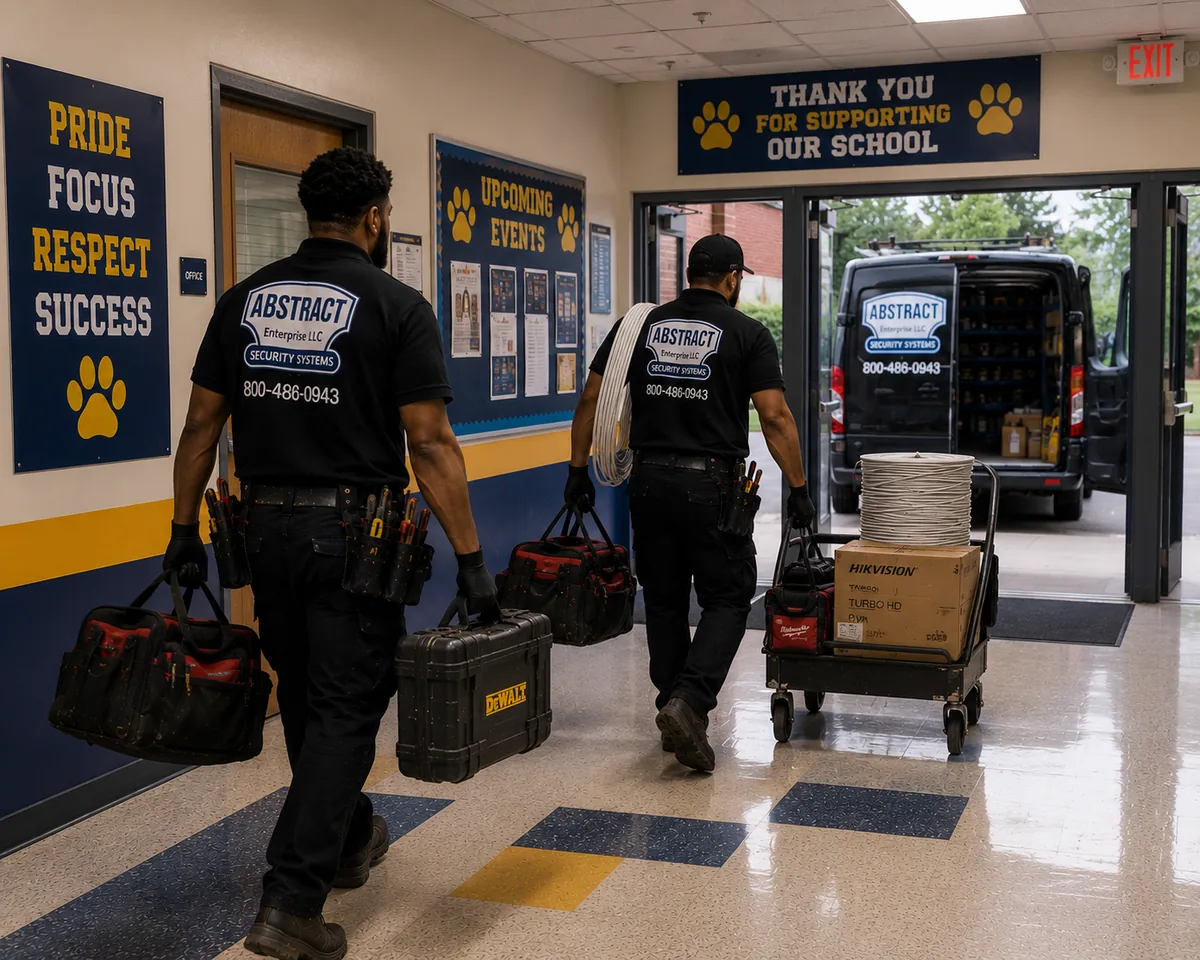
We cover every school neighborhood on the island: the Upper East Side and Carnegie Hill, Yorkville, the Upper West Side, Morningside Heights, Harlem, East Harlem, Hamilton Heights, Washington Heights, Inwood, Midtown East and West, Hell’s Kitchen, Murray Hill, Gramercy, Chelsea, the Flatiron, Greenwich Village, the East Village, the West Village, SoHo, NoHo, the Lower East Side, Chinatown, Tribeca, and the Financial District. Regional camera hub: Manhattan security camera installation. School-silo hub: School Security Cameras NYC. Silo pages for Brooklyn and the other boroughs are coming next; every neighborhood above books through this page today.
How We Compare for Manhattan School Camera Work
| AESS (Us) | National Integrator | Alarm Bundler | General Electrician | DIY | |
|---|---|---|---|---|---|
| School camera design experience | Core business, borough-wide | Yes, at enterprise price | Cameras are an add-on line | Occasional | None |
| NY school law compliance (FR ban, 250.45, 2-d) | Configured and documented | Usually | Rarely addressed | Not their trade | On you |
| Pre-war / landmark / vertical technique | Building-by-building standard | By change order | Catalog default | Improvised | Patching bill |
| Ownership & fees | You own it; no monthly fees | Owned; enterprise pricing | Platform lock-in, contracts | Owned, undocumented | Subscription clips |
| Service response | Same-day, all Manhattan | Ticket queue | Out-of-state queue | When available | You |
| 3-year warranty on AESS-supplied products | ✓ | Varies | Limited | Rare | — |
Manhattan School Building Problems We Solve Every Week
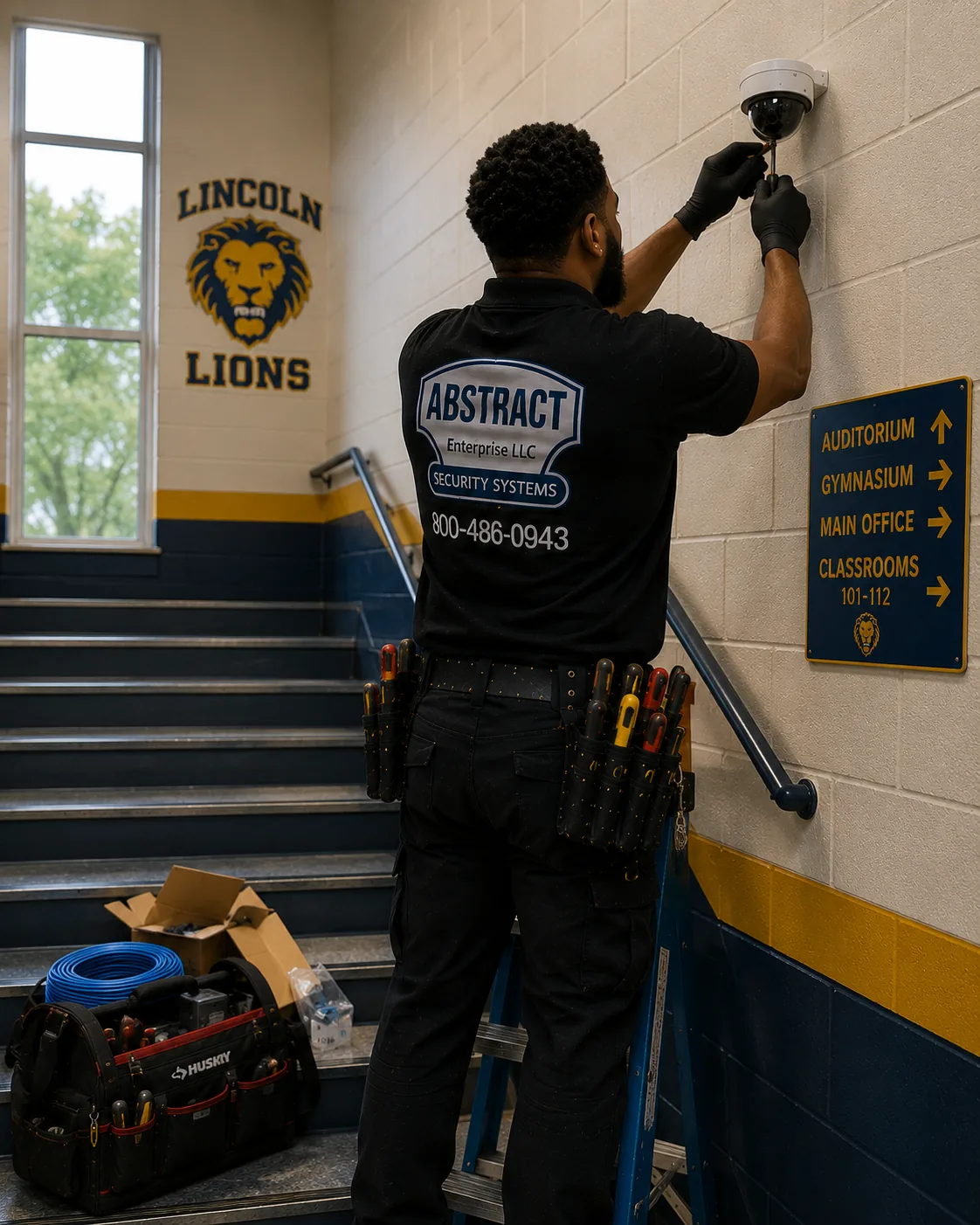
Pre-War Plaster, No Conduit
1920s plaster over brick and terracotta block. EoC over sound legacy coax, surface raceway painted to vanish, penetrations planned wall by wall — and the plaster stays closed wherever cable tests clean.
Landmarked Facades
Compact housings, paint-matched mounting, facade-conscious placement — and LPC coordination where visible alterations trigger review. Security that doesn’t argue with the architecture.
One Door, the Whole City Outside
A single entrance on a public sidewalk carries the entire security plan. WDR against sidewalk backlight, vestibule verification, and framing documented to your doorway — not down the block.
Vertical Circulation
Six floors of stairwells multiply the camera count and the pathway problem. One clean riser, per-floor PoE, IK10 domes at arm’s reach — the vertical campus, solved once.
Rooftop Play Decks
The playground is on the roof. Weather-rated heads on the deck and the access door, framed to the play surface and parapet — the coverage insurers ask about first.
Shared Buildings & Managing Agents
Co-op boards, condo rules, alteration agreements. We produce the COI, scope letter, and drawings that make approval routine — Manhattan paperwork is our overhead, not your project.
Service Alleys & Deliveries
The side door where every incident report starts. Coverage on the alley, the loading moment, and the twelve vendors with keys — paired with access control that logs each one.
August-Empty Buildings
Equipment walks when buildings sit dark. Health alerts, UPS backup, analytics-driven notifications, and remote verification that makes an empty townhouse a monitored one.
Need Repair on a Manhattan School System Right Now?
Same-day across the borough — dead recorders, offline cameras, failed drives, export emergencies. Most faults fixed in one to two hours on site.
Call the Repair Line: (929) 560-0737See the Work
Install walk-throughs, before-and-afters, and honest hardware talk from real jobs on our YouTube channel.
Watch on YouTube →Related Manhattan Services
Security Camera Repair Manhattan
Same-day diagnosis and repair for schools and businesses across the borough.
NVR Installation Manhattan
Recorder builds, storage sizing, and migrations for IP camera systems.
DVR Upgrade Manhattan
Analog-to-IP migrations that reuse sound wiring and retire dying recorders.
Intercom Repair Manhattan
Video intercom and buzzer service for school entry stacks and buildings.
Lorex Camera Installation Manhattan
Right-sized prosumer systems for daycares and small facilities.
Dahua Camera Installation Manhattan
Service, upgrades, and eyes-open installs for existing Dahua systems.
Changelog: Published July 17, 2026. Next scheduled review: October 2026 (PAA rescrape + pricing check).