See every Ring camera price in Brooklyn and build your own system →
We Find the Old Bell Wire First ยท Fixings in Mortar, Not Through Stone ยท Wi-Fi Measured at Every Door ยท Brooklyn Base Rate
Ring camera installation in Brooklyn is mostly a job about old houses. The Census Bureau's 2023 survey puts Kings County's median year built at 1943, with more than half a million homes built in 1939 or earlier, so the door you want a Ring doorbell on usually belongs to a brownstone, a brick rowhouse, a two-family or a walk-up whose doorbell wiring, if it still exists, runs to a transformer somewhere in the cellar. The stoop may sit inside one of the borough's historic districts, the facade may be four to six inches of brownstone over brick, the router may be two floors and forty feet away from the yard you want to watch, and seven in ten households rent. This page explains how we handle each of those, which Ring device suits which Brooklyn door, what landmark and building rules mean for where a camera can go, and how the job is priced on our Brooklyn list, from a $225 first-hour setup visit.
Reviewed and updated November 6, 2026, against U.S. Census Bureau American Community Survey 2023 housing tables for Kings County; the NYC Landmarks Preservation Commission's permit guidebook chapter on health, safety and utility equipment and its permits page; LPC's 2024 Willoughby-Hart Historic District release; Brownstoner on Brooklyn row houses, brownstone fronts, historic district counts and the 2025 designations; the Historic Districts Council's Brooklyn pages; Urban Omnibus on New York's row houses; CBS New York reports on package thefts on Woodpoint Road, Kingsland Avenue, Lexington Avenue, in Park Slope, Crown Heights and Bushwick, and on the Boerum Hill light-pole camera dispute; News 12 Brooklyn's December 2025 package-theft report; PIX11 on the Church Avenue station cameras; the NYPD's November 2022 Ring Neighbors announcement; Police1 and GeekWire on the cancelled Ring and Flock integration; the Amsterdam News on NYPD Flock searches; the NYC Health Department's flooding and health data story on Hurricane Ida; the NYC Small Business Services BID directory and the Bay Ridge 5th Avenue BID; Ring's install and Ring Intercom support pages; TechCrunch on the Ring Peephole Cam; the New York Attorney General's package-theft tips; New York Multiple Dwelling Law ยง50-a; and an electricians' forum on doorbell transformers. Google People Also Ask, related searches, AnswerThePublic, Bing, DuckDuckGo, Reddit and HPD, 311 and DOB data for Ring installs in Brooklyn came back empty or could not be opened in our build environment, and we could not capture Google's AI Overview, so none of those are quoted. ยท Anwar Timothy, NYS license #12000287431 ยท crews dispatched from our Troy Avenue office in Brooklyn
Owner-operated since 2002 ยท Thousands of jobs completed ยท Booked within 2 hours
Quick answer. Ring camera installation in Brooklyn is booked on our Brooklyn list: a setup-only visit is $225 for the first hour, then 30-minute blocks, and the per-device installation lines are published on our Brooklyn Ring price page. A visit includes finding and testing your doorbell power, checking the Wi-Fi where each device will sit, mounting into the right part of the wall, connecting everything to your own Ring account and walking you through the settings. Requests are booked within 2 hours, and we agree the total before anyone drills.
What we need from you, in five photos. First, the door you want the doorbell on, taken from the sidewalk so we can see the stoop, the frame and any ironwork. Second, a close-up of the existing doorbell button, if there is one, and the chime inside, if you can find it. Third, the router and the modem, with the floor they sit on. Fourth, each spot you want a camera to watch: the rear garden, the side passage, the areaway under the stoop, the hallway outside an apartment door. Fifth, the cellar ceiling near the front of the house, because that is where old Brooklyn doorbell transformers usually hide, often in a small metal box near a pull-chain light. Send them with your cross streets to (347) 934-8335 or on WhatsApp. From those five photos we can usually tell you which Ring device fits each door, whether the old wiring is worth using, and which items on our list apply.
Brooklyn was a Dutch town called Breuckelen in the seventeenth century and its own city until it joined Greater New York in 1898. The parts of it that matter most to a Ring installer were built in the century between those two dates and just after. Robert Fulton's steam ferry made Brooklyn Heights a commuter town from 1814, the Brooklyn Bridge opened in 1883, and new rows of houses followed the trolleys and elevated trains out across the flat land to the south and east. The Landmarks Preservation Commission describes the rowhouse as the dominant building type in the city's historic districts, most of them built between 1800 and 1925 for a growing middle class, and Brooklyn has more of them than anywhere. Urban Omnibus counted about 217,000 row houses across the city in 2016, averaging two homes each, on lots close to the classic 20-by-100-foot New York parcel. That narrow, deep lot is the shape of most Brooklyn Ring jobs: a stoop at the front, a cellar underneath, a garden at the back sixty or more feet from the street, and a router somewhere in the middle.
The Census Bureau's 2023 survey gives the scale. Kings County has 1,090,187 housing units. Its median year built is 1943, and 513,629 homes date from 1939 or earlier, with another 92,848 from the 1940s. Two-unit buildings account for 175,805 homes and three- and four-unit buildings for 170,655, more than either one-family attached houses (93,812) or detached houses (52,359). About 709,570 occupied homes are rented and 300,026 owned, so roughly seven in ten Brooklyn households rent. Put together, that means the typical Ring request here comes from someone living in an older two-to-four-family building, often as a tenant, sometimes as the owner who lives on one floor and rents the others. Every one of those facts changes the install: old buildings change the wiring and the walls, shared buildings change who controls the front door, and renting changes what can be drilled at all.
Then there is the reason most people call. News 12 Brooklyn reported in December 2025 that about 90,000 packages are stolen in New York City every day, citing the Department of Transportation, and Brooklyn's own police blotter shows how it happens here. CBS New York has reported a queen-size bed frame taken from a lobby on Woodpoint Road in Williamsburg, a pair buzzed into a Kingsland Avenue building by a tenant who then walked off with clothes and home goods, thieves caught on a Park Slope lobby camera cutting packages open on the spot, a man on a Crown Heights stoop near Montgomery Street and New York Avenue sitting on a yard wall and opening other people's boxes, and about $2,200 of clothing taken from a stoop on Eldert Street in Bushwick. The New York Attorney General's package-theft advice tells New Yorkers to use a doorbell camera or video surveillance to deter thieves or help identify them. A Ring doorbell aimed correctly at a Brooklyn stoop or apartment door does exactly that, and aimed badly it records the top of a delivery driver's cap.

The fourth thing that shapes Ring work here is the city's landmark map. Brooklyn Heights became New York's first historic district on November 23, 1965. Park Slope's district was designated in 1973 and holds 2,853 protected buildings, the most of any district in the city, and an installer's count puts Bedford-Stuyvesant and Crown Heights next, at about 1,800 and 1,752. Brownstoner counted 33 historic districts in Brooklyn as of 2016, and the list keeps growing: LPC added the Willoughby-Hart Historic District in Bed-Stuy in 2024, two blocks of row houses built within about twenty years from 1871, and Beverley Square West and Ditmas Park West in 2025. The Commission's own permits page says most exterior changes to the front and rear facades of buildings in historic districts require its review, and its permit guidebook lists security cameras among the equipment its rules cover. A Ring doorbell or camera on a landmarked stoop is not forbidden, but where it goes, what it is screwed into and how its wire reaches it all matter more than on an ordinary house.
The last factor is the one residents talk about most since 2022: who else can see the video. The NYPD announced on November 2, 2022 that it would join Neighbors, Ring's free neighborhood app. Ring later ended its "Request for Assistance" tool, and News 12 reported that law enforcement can still get video with a search warrant. Ring's Community Requests feature, which lets local police ask nearby users for footage during active investigations, remains in place, while the planned Ring integration with Flock Safety was cancelled in February 2026, as Police1 and GeekWire reported. In September 2026 the Amsterdam News reported advocates questioning NYPD searches of Flock's camera database. We do not tell you what to choose, but we do not leave any Brooklyn job without going through those settings with the owner of the account, because a camera on a Brooklyn stoop sees a public sidewalk full of neighbors.
Where this page applies. It covers all of Kings County at our Brooklyn base rate, from Greenpoint and Williamsburg to Bay Ridge, Coney Island, Canarsie and East New York. The citywide picture, including Manhattan, Queens, the Bronx and Staten Island, is on our NYC Ring camera installation page, and the line-by-line prices for this borough are on the Brooklyn Ring installation prices page.
Ring devices are sealed consumer products. We do not open them up and swap parts inside, and nobody honestly can. What we fix is everything around the device, which in Brooklyn is where most failures start. The most common is a wired doorbell that reboots, goes offline or slowly drains its backup battery because the transformer in the cellar cannot keep up. Ring's own figures put its wired doorbells, other than the basic Wired model, at a 16 to 24 volt transformer, while the basic Wired model can run on as little as 10 volts. An old transformer from the days of buzzers and mechanical bells may be rated below that, may have been wired to a different circuit during a renovation, or may be feeding a run of bell wire with a corroded splice somewhere behind the plaster. A meter at the button and at the transformer usually tells us which in a few minutes.
The second kind of call is the chime. A Ring doorbell on a house that still has an old mechanical chime needs the chime wired correctly, and when two or three apartments share one stoop, it is easy to end up with the parlor-floor doorbell ringing the garden-floor chime, or none at all. The third is the yard camera that loses Wi-Fi every evening. Brownstone back yards and garden-level apartments regularly measure a signal too weak for any wireless camera, and a camera on the very edge of the signal connects in the afternoon and drops when the house fills up with phones and televisions. The fixes are usually a mesh node placed in the back of the house, moving the camera, or changing the device to one that suits the spot. If your Ring is down now, call (347) 934-8335. Requests are booked within 2 hours, and many of these visits fit inside the $225 first hour of a setup-only visit on our Brooklyn list. If the fault is in the house wiring rather than anything Ring, we tell you plainly before doing more.
Before you call, three quick checks save time. Open the Ring app and look at the device's health page: the Wi-Fi signal reading and the power source it reports are the first things a technician asks about. Press the chime's test button if it has one, or listen for whether the old chime clicks when the doorbell is pressed. And look at the transformer if you know where it is: a warm, humming box is working, a cold, silent one may have lost power at its circuit. Write down what you find and send it with your photos.
Every service below is booked from our Brooklyn list. The device you choose decides the hardware, the house decides the wiring and the wall, and the building decides who has to agree before we start.
Ring wired doorbells connected to the existing bell wire and transformer after both are tested, with the chime reconnected or replaced and the button position checked against the stoop rail and door frame.
Battery models for parlor doors, under-stoop gates and apartment doors where there is no usable wire, mounted on wedges or brackets that aim the lens at the step where packages land.
Ring's Peephole Cam, which TechCrunch reported can be installed without permanent changes to the door, for walk-up and elevator-building tenants who cannot drill a hallway wall.
Stick-up, spotlight and floodlight cameras for the back of a rowhouse, an alley between semi-detached houses or a garage off a rear lane, with the Wi-Fi measured on the spot first.
Mesh nodes placed to reach the stoop and the garden of a deep Brooklyn lot, and wired backhaul where plaster and brick stop the signal between floors.
Devices moved to the right account, shared users set for tenants or family, motion and privacy zones drawn around neighbors' windows, and police-request and facial-recognition settings reviewed with you.
Six kinds of building make up nearly every Brooklyn Ring call. They differ in three ways that matter more than any brand choice: what the front of the building is made of, where the doorbell power lives, and how many people share the front door.
A brick house with a 4-to-6-inch brown sandstone face, built between the 1830s and the 1890s, with a high stoop to the parlor floor and a garden door beneath it. Often inside a historic district.
The two- and three-story rows that fill Bed-Stuy, Crown Heights, Sunset Park and Flatbush, many converted to two or more apartments, with a cellar transformer and a shared front door.
Two stacked apartments, often with the owner on one floor. Two doorbell buttons, two chimes and two Ring accounts on the same small porch.
Three-to-six-story buildings with a street buzzer, a stair hall and apartment doors that usually have no doorbell wire at all.
Five- and six-story buildings like those that, by one historic-district guide, mingle with Crown Heights rowhouses. Board rules decide what goes on an apartment door.
The houses with driveways, side alleys and garages found in outer neighborhoods, where a floodlight camera over the drive is as common a request as the doorbell.
Brownstoner's architecture writing makes a point every Ring installer in Brooklyn should know: most brownstones are not stone houses. They are brick houses whose street front carries a facing of brown sandstone four to six inches thick. That facing is soft, it weathers and spalls, and it is the part of the house owners and the Landmarks Commission care most about. So the rule on a brownstone front is simple. Brackets go into the mortar joints of plain brick or into the door frame, never through the face of the stone, and never through ornamental carving, cast iron or the stoop's railings. An anchor driven into brownstone can split a piece off the face, and that repair costs far more than the doorbell.
The other brownstone question is which door. A typical house has a parlor door at the top of the stoop, opening into what was the formal floor, and a garden door under the stoop behind an iron gate, which in many houses is now the everyday entrance or the door to a separate apartment. Deliveries land on whichever one the driver finds first. In our experience the old doorbell button is usually at the parlor door, wired down to a transformer near the front of the cellar, while the garden door may have no wiring at all. That makes the parlor door the natural place for a wired doorbell and the garden gate a candidate for a battery model or a small camera tucked under the stoop, a spot the LPC guidebook itself names as a discreet location for equipment on a primary facade. On a landmarked house, the guidebook also limits small buildings to two cameras per 25 feet of street frontage and asks for equipment as small as possible, painted to blend in.

Brownstoner notes that many Brooklyn rowhouses have been converted into more apartments than they were built for, and those conversions shape the front door. A three-story rowhouse in Bed-Stuy or Crown Heights may now have a garden apartment, a parlor duplex and a top-floor rental, all sharing one vestibule door with a row of buttons beside it. The old wiring from those buttons runs to buzzers or bells in each apartment, sometimes through a transformer in the cellar and sometimes through a small intercom panel added during the conversion. A single Ring doorbell cannot replace a row of apartment buttons; it rings one account and one chime.
So in a converted rowhouse we usually do one of three things. If the owner wants the front door watched for the building, the doorbell goes on the owner's account as the building's camera, and the tenants keep their own buttons. If one tenant wants a doorbell camera for their own door, the right place is often that tenant's apartment door rather than the shared vestibule, with the landlord's agreement. And if several households want to see the stoop, the owner can add them as shared users on one account. What we avoid is three Ring doorbells crowded onto one door frame, which looks bad, confuses visitors and, on a landmarked front, may not be approvable at all.
Two-unit buildings hold more homes in Brooklyn than any other single type in the census table, and the two-family house brings its own Ring layout. Most have two doorbell buttons, one per apartment, sometimes on one shared door and sometimes on two separate doors side by side. Each button usually runs to its own chime, and in many houses both share one transformer in the cellar. When one household adds a wired Ring doorbell, the other's bell still has to work, and the shared transformer has to carry both. We check the transformer's rating against what the Ring model needs, and if it is too weak or too old, we tell you before replacing anything.
Owners who live in one unit and rent the other often ask for two things at once: a doorbell on their own door and a camera covering the shared yard or the side passage to the trash cans. That is sensible, and it is also where privacy settings matter most, because the yard camera sees the tenant coming and going. We set motion zones and privacy zones with the owner, and we suggest the owner tell the tenant what the camera covers. A camera that is visible, aimed at shared space rather than anyone's windows, and explained in advance rarely causes trouble.
In most Brooklyn walk-ups the only doorbell is the building's buzzer panel at the street door. New York's Multiple Dwelling Law requires an intercom system in class A multiple dwellings of eight or more apartments built or converted after January 1, 1968, and older buildings fall under the same rule once a majority of tenants ask in writing, so many tenants have a buzzer but no bell at their own apartment door. Ring's own support pages say its Ring Intercom add-on for building buzzers is not available in the United States, so we do not offer it, and we do not connect anything to a landlord's buzzer system.
What a walk-up tenant can usually have is a device on their own apartment door. One legal guide for New York apartments notes that no state or city law bans a resident from putting a camera on their own apartment door; the rules come from the building and the lease. The Peephole Cam replaces the door's peephole and, as TechCrunch reported when Ring brought it back, is designed to install without permanent changes to the door, with privacy zones to block out what you should not record. A battery doorbell on a removable bracket is the other option. Either way the device lives on your door, not the hallway wall the landlord owns. Brick Underground's guidance is that anything in the building's common areas needs the landlord's permission, so that is where we stop.
Larger prewar buildings in Brooklyn, in Prospect Heights, along Ocean Avenue, in Crown Heights and in Brooklyn Heights itself, are often co-ops. An installer's guide notes that common-area cameras in co-ops and condos typically need board approval and a licensed, insured contractor with a certificate of insurance naming the building. Even work on your own apartment door may fall under house rules about what can be attached to it, because the hallway side of the door is part of the corridor everyone sees.
Apartment doors in these buildings are often steel or steel-clad, which suits a Peephole Cam well and makes drilling for anything else harder. The Wi-Fi question is usually easy, because the router is a few feet inside the door, but the corridor itself can be a dead zone if the apartment door is thick and the hallway is long. We check the signal at the door with the door closed, not open. And if the managing agent asks for paperwork, we send it before the visit so the doorman is not turning a technician away at the desk.
The census counts 52,359 detached one-family homes in Kings County, far fewer than the attached houses, but they cluster in the outer neighborhoods, and they bring requests a rowhouse never does: a floodlight camera over a driveway, a camera on a side alley that the house shares with the next one, a stick-up camera covering a garage door at the end of a lot. These houses are more likely to have aluminum or vinyl siding over wood frame, which takes a screw easily but needs a mounting block so the camera sits flat, and they are more likely to have a porch light where a floodlight camera can replace the fixture.
Floodlights and anything wired into a light fixture involve the house's line voltage, and on those jobs we treat the 120-volt side as electrical work that has to be done properly or not at all. Many owners choose a battery or solar spotlight on the garage instead, which avoids the question entirely. The side alley is the spot where neighbor privacy comes up most, because a camera aimed down an alley between two houses sees both. We draw the motion and privacy zones with the owner standing beside us.
These notes describe how our technicians work on Brooklyn rowhouses and brownstones. They are our practice, not a story about any one address.
Stand on the sidewalk first. Before anything else, the technician looks at the house from across the street, the way a delivery driver or a passerby sees it. Which door do packages actually go to? Is there a street tree that will block the lens in summer? Is the stoop so high that a doorbell at the top looks down on the steps rather than at faces? Does the house share a stoop wall with the neighbor, so their door is in frame too?
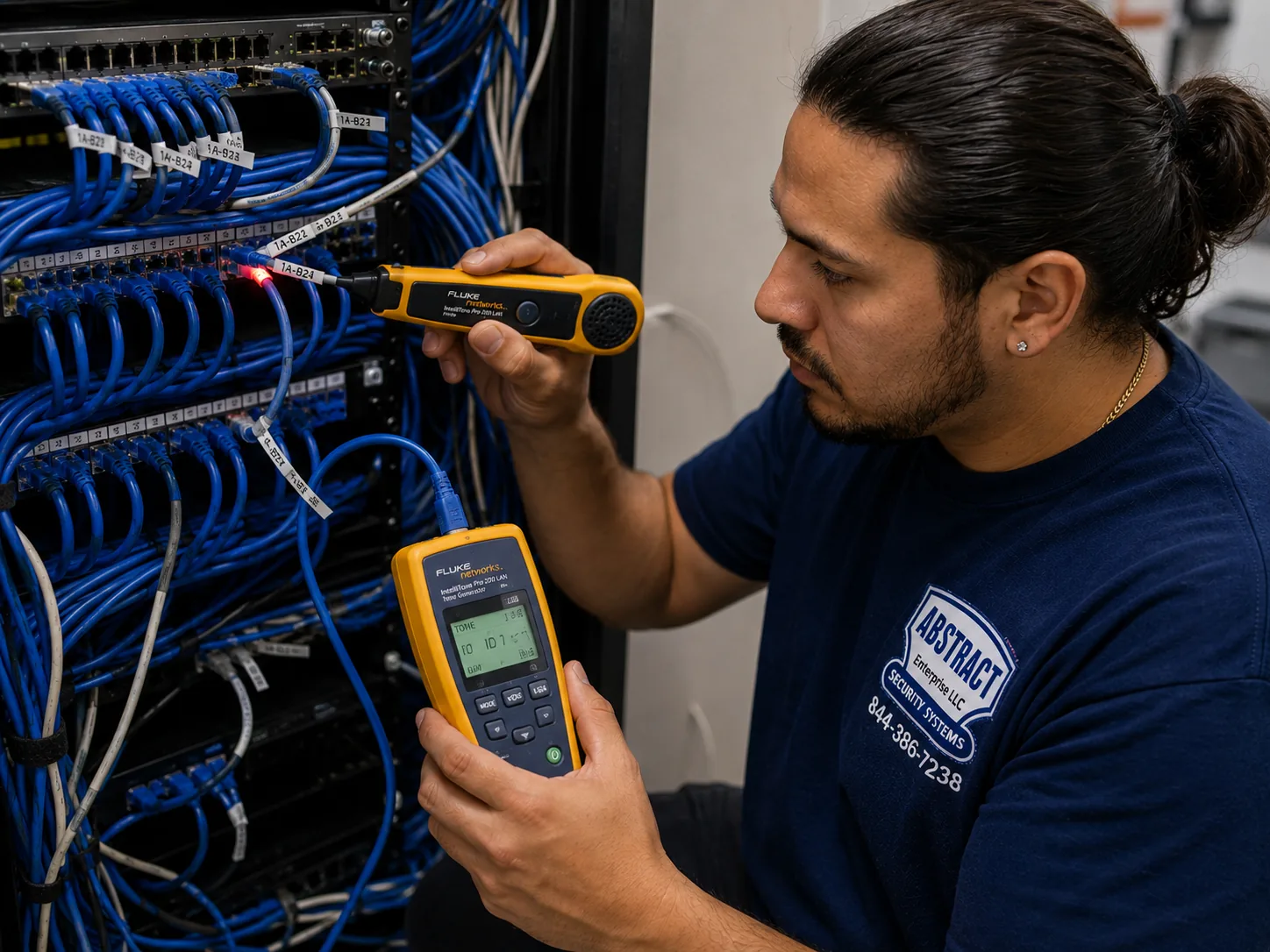
Then go down, not up. The next stop is the cellar, not the stoop. Electricians who answer questions about old houses note that doorbell transformers in older homes usually sit in the basement ceiling, often in a box that also holds a pull-chain light, and sometimes the wiring that once ran to the front door has been cut and never replaced. We find the transformer, read its label, check it with a meter, and put a tone on the bell wire to see where it really goes.

Measure the Wi-Fi at the door, with the door shut. A phone held at the router shows full signal; the same phone outside a closed oak parlor door, on the far side of a brick vestibule, may show almost nothing. We measure at each spot where a device will live, at the time of day it matters, and write the reading down.
Hold it up before drilling. The technician holds the device, or a bracket with a phone in live view, exactly where it will go and asks you to look at what it sees. The angle that catches a face on a low stoop is different from the one that works at the top of a high one.
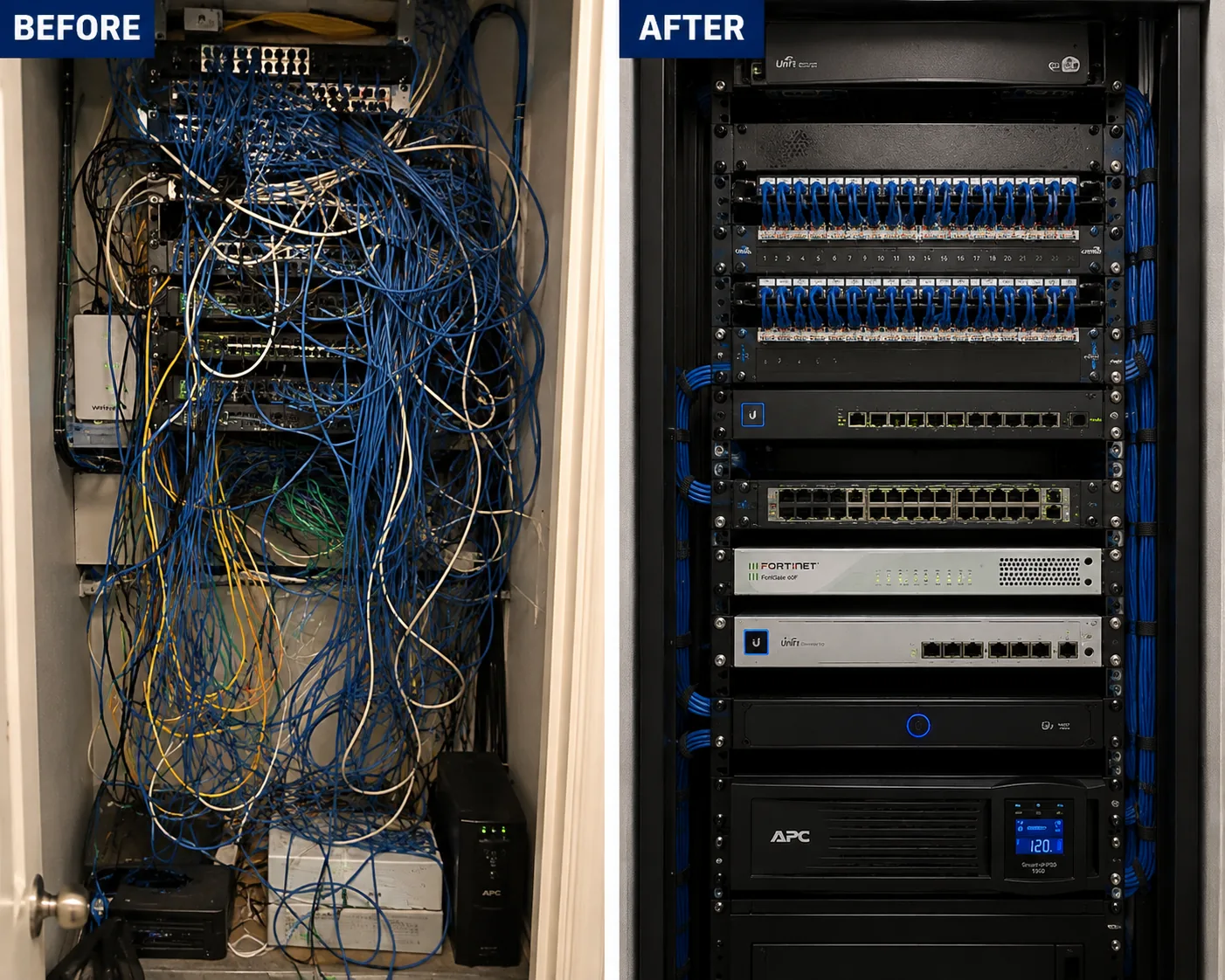
Leave the cellar better than we found it. Whatever we touch gets a label: the transformer, the bell wire, the chime connections. The next time something stops working, you, the super or the next installer will know which wire is the doorbell.
Most Ring problems we see in Brooklyn are not Ring problems. They are power problems or signal problems inherited from a house built a hundred years before anyone imagined a doorbell with a camera in it. This section explains both, because once you understand them, choosing between a wired and a battery device for each door becomes easy.
The transformer. A wired doorbell runs on low-voltage power from a small transformer that steps the house's 120 volts down to somewhere between about 10 and 24 volts. Ring's wired doorbells, other than the basic Wired model, call for 16 to 24 volts; the basic Wired model can run on as little as 10. In a Brooklyn rowhouse the transformer is most often in the cellar ceiling near the front wall, sometimes beside the electrical panel, sometimes in a junction box with an old light, and occasionally behind the chime itself. If the house was rewired during a renovation, the transformer may have been moved, replaced, or simply left disconnected. If it has to be replaced, connecting a new one to the house wiring is electrical work, and we say so before the visit rather than improvising on the day.
The bell wire. The two thin wires that run from the transformer to the button and the chime are often the original run, stapled along cellar joists, fished up inside the front wall and out through the door frame. Over decades they get painted over, spliced, nicked by later work and corroded at the button. A wire that rang a mechanical bell perfectly can be too resistive or too intermittent for a doorbell that runs a camera and a Wi-Fi radio all day. That is why we test the run, not just the transformer, and why a doorbell that "works but keeps rebooting" is so often a bad splice in the cellar rather than a faulty device.
When there is no wire at all. Plenty of Brooklyn doors have no doorbell wiring: garden doors under the stoop, apartment doors in walk-ups, back doors to a yard. One electrician's account of old-house calls is blunt: he has lost count of the times he arrived to hook up a Ring doorbell and found there was no doorbell wiring, and had to add a transformer and get wire to the door as best he could. On a brownstone front, getting wire to the door means fishing through brick and plaster, and on a landmarked front it means keeping any visible wire to the minimum the Commission allows. Its guidebook asks for conduit to be concealed through plain masonry behind the installation where possible, and otherwise for only about ten inches of visible conduit, painted to match and secured into mortar joints. For many owners the honest answer is a battery doorbell at that door and a wired one at the door that already has wire.

Wi-Fi in a long, narrow house. A Brooklyn lot is about 20 feet wide and close to 100 deep, and the house on it is usually brick walls front, back and sides with plaster partitions between rooms. Routers tend to sit where the cable company left them, often in the front parlor or a middle room. Our own field measurements, published on our wireless camera pages, have found brownstone back yards and basement units routinely getting signal around -85 dBm, too weak for any wireless camera. A Ring camera at that level may pair during setup and then drop out for hours. The fix is almost never a stronger router. It is a mesh node placed toward the back of the house, ideally connected back to the router by cable so it is not trying to relay a weak signal through brick, or a rethink of which device goes where.

Old walls. Brooklyn interiors are mostly plaster, on wood lath in rowhouses and on brick or tile in larger prewar buildings. A Brooklyn installer describes using flexible drill bits, fish tape and wall-cavity routing developed for plaster-and-lath houses, and that is the right way to move a chime or a transformer wire without opening walls. Plaster cracks if drilled fast and spalls if a fixing is overtightened, so a chime goes on with fixings into the lath or framing behind, and any new hole for a wire is drilled slowly from inside the cavity where possible. Where a short run of wire has to stay on the surface of a hallway or vestibule wall, a paintable cord cover, $59 on our list, keeps it neat and can be removed later.
Cellars and water. The Health Department's data story on flooding records that Hurricane Ida dropped 3.5 inches of rain an hour on a sewer system built for 1.75, with deadly flooding in basement apartments, and it marks southern Brooklyn as especially vulnerable. If your transformer, chime or router sits low in a cellar or a garden apartment that has taken water before, we mount the parts we install above where water has reached, and we suggest moving the router off the floor too. A doorbell that loses power every time the cellar floods is not doing its job when it is most needed.
With about seven in ten Brooklyn households renting, and most buildings holding two or more homes, the first question on many Ring calls is not which device but whose door. We are installers, not lawyers, and nothing here is legal advice. What follows is how we approach it, based on the public guidance we cite and on doing this work in buildings like yours.
Your own apartment door. A legal guide on New York apartment camera rules says no state or city law forbids a resident from putting a camera on their own apartment door, and that the limits come from the building's rules and the lease. In practice that means checking your lease for a clause on alterations or door fixtures, and if it restricts them, asking your landlord in writing. The devices that ask least of a door are the Peephole Cam, which uses the hole your door already has, and battery doorbells on brackets that come off with a few screws. Those are what we suggest first to most renters.
The shared front door and the hallway. Brick Underground's guidance is direct: you need your landlord's permission to install equipment in your building's common areas. The vestibule, the stoop, the stair hall and the lobby are all common areas. A wired camera in those spaces also means drilling and possibly electrical work, which an installer's guide notes needs the landlord's written permission. If you are a tenant and you want the front door watched, the conversation is with the owner, and we are happy to be part of it.
Owners who live in the building. Many Brooklyn two-families and small rowhouse buildings are owner-occupied on one floor. An owner putting a Ring doorbell on the building's front door is putting a camera on shared space that tenants use every day. That is allowed, and it is also the case where being open helps most: tell tenants what the camera covers, keep it pointed at the door and the stoop rather than into anyone's apartment, and decide whether tenants should be added as shared users so they can see their own visitors and deliveries.
Co-ops and condos. Board-run buildings usually have house rules or an alteration agreement covering anything attached to the building, and an installer's guide notes that common-area cameras typically need board approval and a certificate of insurance naming the building. Even a Peephole Cam on your own door may be something the managing agent wants to know about, because the corridor side of the door is shared. Ask the managing agent what they need, send us the exact names and address for the certificate, and we send it before the visit.
Brownstones divided into condominiums. Many brownstones have been split into two or three condo units with a small association. The front facade, the stoop and the front door are usually common elements controlled by the association, not any one owner. If the building is also in a historic district, the association is the party that would deal with the Landmarks Commission for a visible change. We plan the install with whoever controls the facade, and we put the paperwork in that name.
The city's Small Business Services directory lists 24 active Business Improvement Districts in Brooklyn, and those districts map the borough's busiest shopping streets: Fulton Mall downtown, Pitkin Avenue in Brownsville, Kings Highway, Atlantic Avenue, Court-Livingston-Schermerhorn, Myrtle Avenue, Graham Avenue, Flatbush-Nostrand Junction, Fifth Avenue in Park Slope and Bay Ridge, Brighton Beach and Sunset Park among them. Ring suits some of the small businesses on those streets well and others not at all. The cards below describe kinds of space we see; we do not name any business as a customer.
Fulton Street between Flatbush Avenue and Adams Street, a shopping district since the 1890s and now a pedestrian and transit mall. Back doors, stockroom entrances and small offices upstairs.
The BID covers 5th Avenue from 65th to 85th Street: storefronts with apartments above, where a Ring at the side door to the upstairs flats is as common as one at the shop.
Long retail corridors with roll-down gates. A doorbell camera at a rear service door or an office entrance fits; a full store needs a wired system.
The Flatbush and Ditmas Park corridors near the Fiske Terrace and Midwood Park districts: small shops, offices and professional practices in older buildings.
Industrial campuses with their own security desks and building rules, where small tenants sometimes want a camera at their own studio door.
Boutiques, galleries and services in rowhouse-scale buildings, many in or next to historic districts, where facade rules apply to commercial fronts too.
Here is our honest view, and it matches what our own wired-camera pages say about Brooklyn buildings: Ring is a good tool for a door and a poor tool for a whole store. A Ring doorbell or stick-up camera at an office entrance, the rear door of a restaurant, a side door to the apartments above a shop or a small studio does the job well and costs far less than a recorder system. A store that needs six or eight cameras covering registers, aisles, stockroom and street, with footage kept on site and handed to police on a drive, is better served by a wired recorder system, and we will tell you so rather than sell you a box of Ring devices that fight over one Wi-Fi network. Where a shop wants both, the Ring at the door often stays and the wired system covers the inside.

Business jobs in Brooklyn almost always happen in rented space. A shop on Fifth Avenue may have a landlord and three apartments above it; an office on Court Street may be one floor of a converted rowhouse with an association. Before a business install, we confirm three things in writing: who has approved anything fixed to the facade or the door, when the space can be worked in without customers in the way, and who should receive the certificate of insurance. Shops with roll-down gates often want the camera inside the gate line, watching the glass door, so it is not exposed to the street at night. PIX11 reported in October 2026 that surveillance cameras at the Church Avenue subway station in Flatbush were sprayed with red paint, a reminder that anything reachable from the sidewalk can be tampered with. We mount business devices out of easy reach where the door allows, and we set up the app so the owner gets a tamper or offline alert.


These are the situations Brooklyn owners, tenants and shopkeepers describe when they call about Ring: stone fronts they do not want damaged, cellars where nobody can find the doorbell wiring, two front doors, street trees, city light poles and shared yards. Each is answered here in full and not repeated in the FAQ further down.
Yes, if nothing is drilled through the stone. Brownstoner explains that a brownstone front is usually a 4-to-6-inch facing of sandstone over a brick wall, and that facing is soft and easily split by an anchor. A doorbell goes on the wooden or metal door frame, or into a mortar joint of plain brick beside the door, using the smallest fixings that hold it. The LPC guidebook gives the same instruction for landmarked buildings: attach at mortar joints, plain masonry, wood or metalwork, not through decorative surfaces. If there is already a bell button, we reuse its hole and wire wherever possible, so the stone gets no new holes at all. A battery doorbell on a door-frame bracket avoids the facade entirely.
Usually the parlor door gets the wired doorbell, because that is where the old bell button and its wire tend to be, and the garden door gets a battery model or a small camera under the stoop. Which door packages really land at matters more than which door is grander, so we ask where the drivers leave things and where your visitors ring. A doorbell at the top of a high stoop looks down the steps and sees the tops of heads, so it often needs an angled wedge to catch faces. The space under the stoop is one of the discreet locations the LPC guidebook names for equipment on a primary facade, which makes it a good spot for a small camera watching the garden gate on a landmarked house.
Lower, and closer to the door. Residents on a Boerum Hill block made exactly this point to CBS New York, saying most houses on their street sit behind trees that create blind spots. A camera high on the facade looks into the canopy, especially from May to October. A doorbell at button height, or a small camera under the stoop or on the areaway fence aimed along the path to the door, looks under the branches at the people who actually approach the house. We hold the device in place and check live view with you before drilling, and if you can, we suggest looking again in a photo taken in summer, because a bare winter tree tells you little about July.
No. When residents in Boerum Hill asked to mount cameras on a city light pole, CBS New York reported the DOT's answer: it does not allow private entities to attach this type of equipment to city property, and homeowners could consider mounting on their own buildings. The same goes for street trees, tree guards, sign posts and the sidewalk itself. Everything we install goes on your property, the stoop, the door frame, the areaway fence or the facade, with whatever approvals the building and the landmark rules need.
It can, and on a landmarked house it is sometimes the simplest answer, because a camera inside the glass is not an exterior change. The catch is the glass itself. Infrared night vision reflects off a window and can wash the night image out, so a camera behind glass is best placed with its lens touching or very close to the pane, with night-vision settings checked after dark, and ideally where a porch or street light gives the stoop some light of its own. Ring's indoor and stick-up cameras can sit on a sill or shelf with no drilling. We test the night picture before you decide, because daytime footage through a window almost always looks fine and the evening is where it matters.
Start in the cellar, near the front wall under the stoop. Electricians who work on old houses report that transformers usually sit in the basement ceiling, often inside a small metal box that also holds a pull-chain light, and sometimes beside the electrical panel. Other spots we check are behind the chime itself, inside a vestibule closet, and occasionally in the attic of a house that was rewired from the top down. If there is still a bell button at the door, a tone generator on its two wires leads us to the transformer, which is how we find it in most houses within a few minutes. And sometimes the honest answer is that it was removed years ago, in which case we tell you what a replacement involves.
Above the highest point water has reached, and away from the floor drain. The Health Department's flooding data story records Ida's 3.5 inches of rain an hour against sewers built for 1.75, with the worst flooding in basements and low-lying areas, and southern Brooklyn flagged as especially vulnerable. If your transformer is mounted low, near the boiler or near a drain, we move it up onto a joist or the wall above the flood line when we work on it, and we put any new chime on the parlor floor rather than the cellar. Ask yourself the same about the router: a doorbell has nothing to talk to if the modem on the cellar floor is underwater.

Usually yes, by giving the tenant shared-user access to the device they need and not the others. In the Ring app, the account owner can add other people as shared users and choose which devices they can see, so a tenant can be given the camera over the shared yard or the side passage without access to the doorbell at your own door. What shared users can do is set by Ring rather than by us, so we walk through it with both of you on your phones before we leave. We also suggest agreeing in writing what the yard camera covers, and drawing privacy zones over any of the tenant's windows that fall in frame.
Normally the condo association, because the facade, the stoop and the front door are usually common elements rather than any one owner's property. Your condo declaration or bylaws say who can approve alterations to them. If the building is in a historic district, the association is also the party that deals with the Landmarks Commission for any visible change. A practical approach is for the association to own the front-door doorbell on a shared account, with each owner added as a shared user, and each owner free to put a Peephole Cam or doorbell on their own unit door. We work with whoever the association names and put the certificate of insurance in the association's name.
We install the Ring devices you bring, and we help you choose before you buy. These are the kinds of Ring hardware that fit Brooklyn doors and yards, and where each one makes sense.
For stoop and parlor doors with a working bell circuit. Ring's wired doorbells other than the basic Wired model need a 16 to 24 volt transformer; the basic Wired model runs on as little as 10.
For garden doors, gates and doors with no wire. Mounted on wedges or corner brackets to aim at the step, and on door-frame brackets for renters who cannot touch the facade.
For apartment doors in walk-ups and co-ops. It uses the existing peephole, is designed to go on without permanent changes to the door, and has privacy zones for the hallway.
For rear gardens on battery or solar, for watching a stoop from inside a front window, and for a shop's back room. No line-voltage wiring needed.
For driveways, garages and side alleys in outer Brooklyn, and rear extensions with an existing exterior fixture. Line-voltage connections are planned as electrical work.
Plug-in chimes for upper floors where the old bell cannot be heard, and mesh nodes or wired backhaul for the far end of a long rowhouse.

Ring, wired camera systems and national monitored alarm brands such as ADT and SimpliSafe are often compared as if they did the same job. In a Brooklyn building they do different jobs. The table below is about fit, not about the quality of any company.
| What you need | Ring, installed by AESS | Wired recorder system | National monitored alarm (ADT, SimpliSafe) |
|---|---|---|---|
| One household's doors and yard | A strong fit, especially for renters | More than most need | Focused on alarms, cameras vary by plan |
| A whole building or a full store | Strains one Wi-Fi network | The better tool | Not built for building-wide video |
| Old cellar transformer and bell wire | Tested and traced before a wired doorbell goes on | Cameras run on their own cables | Depends on who is sent |
| Landmark-district front | Small devices, mortar-joint fixings, under-stoop placement | Possible, with concealed cabling | Depends on who is sent |
| Footage stays on site | No, video history is in Ring's cloud on a paid plan | Yes, on a local recorder | Varies |
If your needs sit in the middle column, we will say so. Ring is what this page is about, but a camera that suits the building is the one worth installing.
We could not capture Google's AI Overview for this topic in our build environment, so nothing below quotes it. These are claims that turn up in generic online answers and in national cost guides such as Angi, HomeAdvisor and Fixr, paraphrased, each followed by what Brooklyn buildings actually show.
Generic instructions treat a wired doorbell as a ten-minute swap: take off the old button, connect the two wires to the back of the Ring, mount it and pair it in the app.
In a Brooklyn house with a median build year of 1943, those two wires may run to a transformer below what Ring's wired models need, may be spliced and corroded behind a century of paint, or may go nowhere at all because the transformer was removed during a renovation. One electrician's account of old-house calls is that he has often arrived to connect a Ring and found no doorbell wiring whatsoever. A doorbell connected to a weak circuit powers up, pairs, and then reboots on cold mornings or drains its backup battery.
We test the transformer and the run with a meter and trace the wire with a tone generator before mounting anything. It takes a few minutes, and it is the difference between a doorbell that works for years and one that sends you offline alerts every week.
Many answers assume that if the router reaches the living room, it reaches the front door and the back yard.
A Brooklyn rowhouse is narrow and deep, with brick on all four sides and plaster between rooms, and the router often sits at the front of the parlor floor. Our own measurements in brownstone back yards and basement apartments routinely come in around -85 dBm, too weak for any wireless camera. Thick oak doors and brick vestibules do the same to the doorbell at the front.
We measure the signal at each device's real position, with doors shut, and fix the network first, usually with a mesh node wired back toward the router, before blaming the device.
General advice says to put cameras up high, under the eaves, out of reach and with a wide view of the street.
On a Brooklyn block, high on the facade means into the canopy of a street tree for half the year, as Boerum Hill residents told CBS New York, and on a landmarked front it means a visible device on a primary facade, which the LPC guidebook discourages unless there is no feasible alternative. A brownstone's eaves are four stories up on a stone face.
The views that identify people on a stoop are low and close: the doorbell at the door, a small camera under the stoop or on the areaway fence, or a camera inside a front window.
Product pages and how-to answers rarely mention permission, because most of the country lives in single-family houses on their own lots.
Roughly seven in ten Brooklyn households rent. Brick Underground's guidance is that common areas need the landlord's permission; co-ops and condos usually need board approval; condo-converted brownstones have associations that control the facade; and LPC's permits page says most exterior changes to fronts and rears in historic districts need its review. And the DOT told Boerum Hill residents it will not allow private cameras on city property.
We start every Brooklyn job by asking who owns the door and the wall, then plan the device around the answer, which for renters often means a Peephole Cam or a battery doorbell on a removable bracket.
Cost guides quote national ranges. HomeServe's guide, for example, puts a Ring doorbell plus installation at $179.98 to $609.98, and Ring's own installation service starts at $129.99 per device.
An average cannot know that your transformer is missing, that your stoop is brownstone, that your router is two floors from the yard or that your board needs a certificate of insurance. Those are what change a Brooklyn total, and none of them shows up in a national figure.
Our Brooklyn list is published, starting with a $225 first-hour setup visit and the masonry and plaster lines that apply when a device or chime goes into brick or plaster, and we tell you which lines apply from your photos before you book.
Some answers recommend Ring for everything from a bungalow to an apartment building, often because it is the brand people already know.
Ring's building buzzer add-on, Ring Intercom, is not sold in the United States according to Ring's own support page, and a building of any size puts every camera on Wi-Fi it was never designed to carry. Our own pages on Brooklyn camera systems steer whole buildings and full stores toward wired systems for exactly that reason.
Ring belongs on a household's own doors, yard and garage, and on a shop's rear or office door. For a lobby, a stair hall or a sales floor, we quote a wired system instead.
Setup guides end when the device shows live video in the app.
A camera on a Brooklyn stoop sees a busy public sidewalk and often a neighbor's door. Police access has changed several times: the NYPD joined Neighbors in 2022, Ring later ended its Request for Assistance tool, Community Requests remains, and the Ring and Flock integration was cancelled in 2026. Motion zones left at default on a busy street also mean hundreds of alerts a day.
Before we leave, we draw motion and privacy zones with you, set alert schedules, and go through the police-request and facial-recognition settings so the choices on your account are yours.
Not sure whether your door can take a wired doorbell, or whether the yard will hold a Wi-Fi signal? Ask before you buy. Call now at (347) 934-8335, send a fast quote request, or send photos of the door and the cellar to a tech on WhatsApp. Same-day estimates are available on most weekdays, and requests are booked within 2 hours.
Tell us the cross streets, the kind of building, which doors and yards you want covered, whether the house is in a historic district, and what you know about the old doorbell and the router. A technician will call back with the plan for the Brooklyn address, or you can call (347) 934-8335 right now.
The door, the old bell button and chime, the router and each spot to watch, with your cross streets. You hear back with the plan and the list items that apply.
Who owns the door and facade, whether the house is landmarked, any board or agent paperwork, and where to park on the block.
Transformer located in the cellar, checked with a meter, bell wire traced with a tone generator before a wired doorbell is chosen.
Signal measured at the stoop, the garden door, the yard and any apartment door, with doors closed. Mesh node or wired backhaul planned where needed.
Each device held in place with live view on your phone, checked against trees, stoop height, glare and the neighbor's door.
Mortar joints or plain brick, never brownstone facing or cast iron; framing behind plaster; no-drill brackets for renters; any surface wire dressed neatly.
Devices on your own Ring account, chime tested, motion and privacy zones drawn, shared users added, alert schedules set.
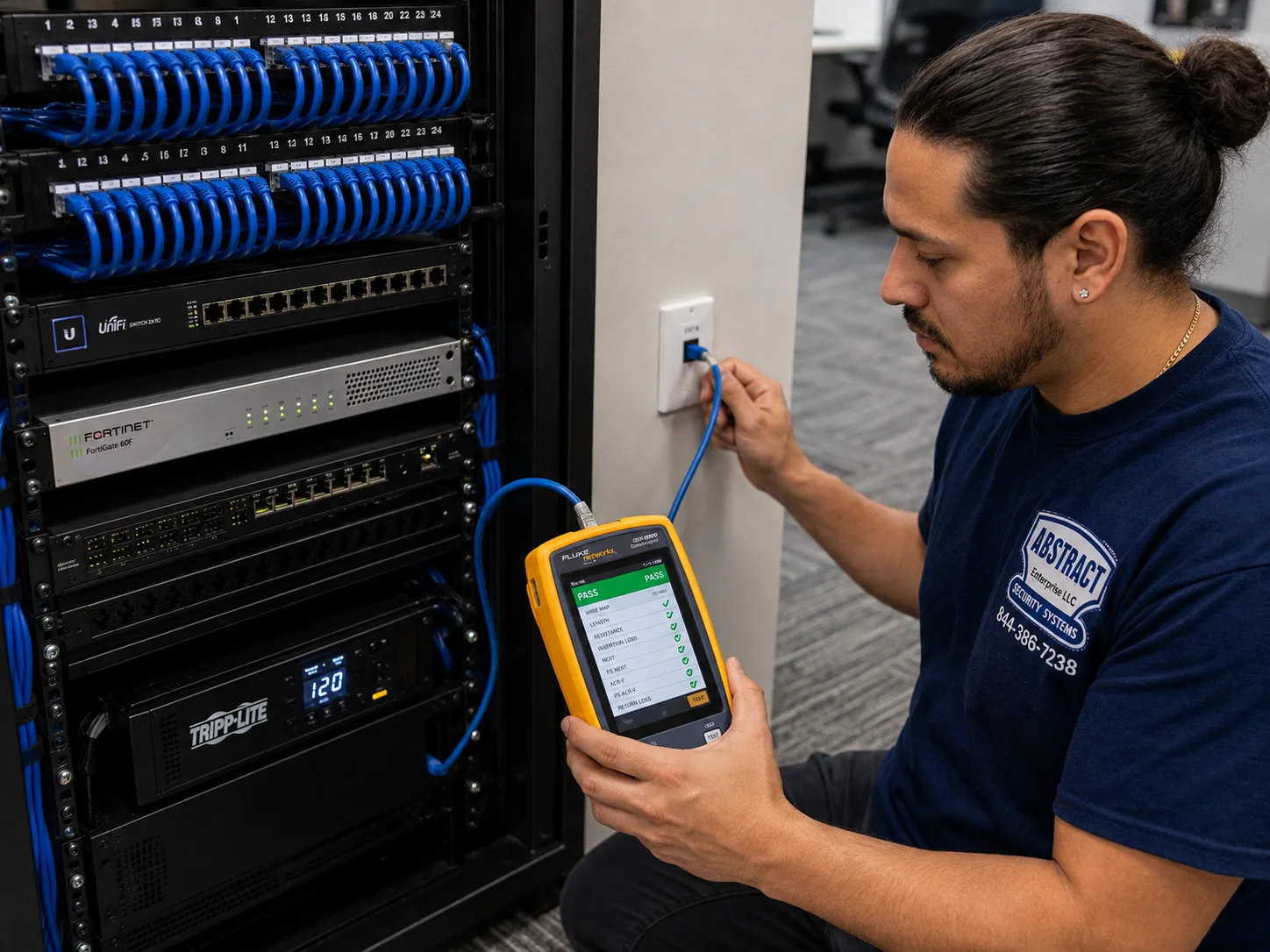
Every door and camera triggered, playback checked on your phone, privacy and police-request settings reviewed, and a written list left with you.
Olmsted and Vaux's 585-acre park, completed in 1873, ringed by the landmarked rowhouse blocks of Park Slope, Prospect Heights and Prospect Lefferts Gardens.
Founded in 1910 on 52 acres beside the park and Eastern Parkway, at the edge of Crown Heights' rowhouse and prewar apartment blocks.
The 3.8-mile road credited as the world's first parkway, lined with prewar elevator buildings and the rowhouse side streets of Crown Heights.
The Flatbush Avenue movie palace that opened on September 7, 1929, seats about 3,250, and reopened after restoration in 2015.
More than 300 acres on the East River, home to over 550 businesses and more than 13,000 jobs, with its own security and building rules.
The 2.7-mile boardwalk from West 37th Street to Brighton 15th Street, first opened in 1923, beside Coney Island and Brighton Beach.
Beyond Brooklyn we also serve the rest of the city through our NYC Ring installation hub, with borough price pages for Queens, Staten Island and Manhattan, and east of the city on our Long Island Ring installation page.
Brooklyn is billed at our base rate, the same as the NYC hub list. The line-by-line installation prices for each kind of Ring device are on our Brooklyn Ring price page, and the hub list for the city is on the NYC Ring price page. The lines below are the ones from the published hub list that come up most on Brooklyn Ring visits. Nothing is added on the day without your agreement.
| Item | Price | When it applies on a Brooklyn Ring job |
|---|---|---|
| Setup-only visit, first hour | $225, then 30-minute blocks | Moving devices to your account, Wi-Fi tuning, settings, offline troubleshooting, chime fixes |
| Brick or stone wall add | $65 | A device or bracket fixed into brick or a mortar joint on a rowhouse or brownstone |
| Plaster wall add | $45 | A chime, transformer or wire run on old plaster inside the house |
| Paintable cord cover | $59 | A short visible wire run in a vestibule or hallway, kept neat and removable |
| TV wall mounting, drywall on wood studs, up to 55" | From $209.99, bracket extra | When a TV goes up on the same visit |
| TV placed on its stand / take down old TV | $137.99 / $85 | Same-visit TV work |
| Soundbar placed / wall-mounted | $79 / $129 | Same-visit TV work |
| In-wall power and cable kit / above-fireplace add | $169 / $130 | Same-visit TV work |
What moves a Brooklyn total is rarely the device itself. It is whether the old transformer and bell wire can be used, whether the door is brick, stone or wood, how far the yard camera sits from the router, and whether a board or association needs paperwork. Your photos answer most of that before you book, and if the house turns out different on the day, you hear about it before any extra work starts.
Full terms โ including 50% deposit, one-year parts-only warranty on AESS-supplied products, and the late-fee schedule โ are set out in the service agreement.Three typical Brooklyn Ring visits, added up from the list above. Each covers the first hour; any further time is in 30-minute blocks, agreed before work starts. Ring devices are yours or bought separately.
A setup-only first hour ($225) for a Peephole Cam or a battery doorbell on a removable bracket at your own apartment door, paired to your account with hallway privacy zones drawn.
A first hour ($225) with the brick or stone line ($65) for a doorbell fixed into a mortar joint beside a stoop door, after the transformer and bell wire are tested.
A first hour ($225), the brick or stone line ($65) and a paintable cord cover ($59) where a short run of wire to the doorbell or chime has to stay on a vestibule wall.
Bring your own equipment. Most Brooklyn customers already own their Ring devices, and we install them at the labor lines above. Tell us the model names when you book so we can check, before the visit, that a wired doorbell suits your transformer and that the mounting kit in the box fits your door. Devices you supply stay covered by Ring's own warranty; our warranty terms above apply to products we supply.
Wired, battery and peephole devices for stoops and apartment doors. Request a quote
Every installation line for this borough. Brooklyn Ring installation prices
All five boroughs, with landmark and building rules explained. Ring camera installation NYC
Houses beyond the city line. Long Island ยท Hudson Valley
A setup-only visit is $225 for the first hour on our Brooklyn list, then 30-minute blocks. It covers work that does not involve mounting new hardware into masonry: moving devices to your account, fixing a Ring that drops off Wi-Fi, placing a mesh node, reconnecting a chime, drawing motion and privacy zones and reviewing settings. If your devices are already up and just misbehaving, it is usually all you need.
Ring's installation service is a reasonable choice for a simple swap on a newer house. On a Brooklyn rowhouse the work is often in the cellar and the wall: finding a missing transformer, testing a century-old bell wire, fixing into mortar instead of brownstone, and getting Wi-Fi to the back garden. We quote from your photos, tell you which list items apply and agree the total before the visit.
Yes. Send us the exact names and address the board or managing agent wants on the certificate, and we send it before the visit so the front desk is expecting the technician. Tell us also if the building limits working hours or needs the elevator reserved.
Usually, but two devices on one narrow door frame can look crowded and confuse visitors. Common answers are one Ring doorbell for one household with the other keeping its ordinary button, a Ring at each apartment's own inner door, or one doorbell with the other household added as a shared user. We check that a shared transformer can carry what each device needs before wiring anything.
When a doorbell, camera or bracket is fixed into brick or a mortar joint, the work needs a hammer drill, masonry bits and anchors, and more care around a brownstone face. That line is $65 on our list. Plaster inside the house, for a chime or a transformer, is $45. A doorbell on a wooden door frame needs neither.
Requests are booked within 2 hours during working hours. A technician looks at your photos, tells you which device suits each door, what the wiring and Wi-Fi are likely to need and which items on our Brooklyn list apply, and then offers a visit time.
Wait for our answer to your photos if you can. Whether a wired model suits your transformer, whether a door needs a battery model, and whether the yard will hold a Wi-Fi signal all decide what to buy. If you already own the devices, that is fine too; we install them and tell you in advance if one is a poor match for its spot.
Yes, and it is the best time. With open walls, a new transformer location, fresh bell wire to the parlor and garden doors and a cable to a mesh node at the back of the house can all be placed without fishing through old plaster. Bring us in when the framing is open and the electrician is on site, so the low-voltage runs and the line-voltage work are planned together.
Yes. Our list includes TV wall mounting from $209.99 for screens up to 55 inches on drywall over wood studs, with the bracket extra, a TV placed on its stand at $137.99 and soundbar placement at $79. Mention it when you book so the technician brings the right hardware and the visit is planned for both jobs.
Not if it is done properly. A short surface run goes in a paintable cord cover, $59 on our list, fixed with a few small screws and painted to match the wall. It can be removed and patched later, which suits renters and condo associations that do not want walls opened.
Five: the door from the sidewalk, the existing bell button close up, the chime if you can find it, the router and modem with the floor they sit on, and each spot you want watched. A photo of the cellar ceiling near the front wall helps too, because that is where old doorbell transformers usually are.
Ring Camera Installation NYC | Licensed Ring Installer ยท Ring Camera Installation Long Island Hub, Nassau & Suffolk ยท Ring Camera Installation Hudson Valley NY | 6 Counties
Send photos of the door, the old bell button and the router with your cross streets, and we will tell you which Ring device suits each door, what the wiring and Wi-Fi need and which lines on our Brooklyn list apply. Call or text (347) 934-8335, message us on WhatsApp, or use the request form. The full price list is on the Brooklyn Ring price page, and the citywide picture on our NYC Ring installation page. Licensed under NYS license #12000287431, rated 4.7โ across 201 Google Reviews, owner-operated since 2002, with same-day estimates on most weekdays.
Ring Camera Installation by neighborhood: Brooklyn, Brooklyn ring camera installation