Night Owl kit still in its box in a Nassau cape, or cameras that went dark on a Suffolk colonial after the last storm? Book a Long Island Night Owl install: (800) 486-0943
Cable Route Planned Before the Drill · Every Camera Run Labelled · Recorder Placed Where It Survives a Storm
Night Owl camera installation on Long Island usually starts with a kit someone has already bought, because Night Owl sells its systems as do-it-yourself kits and does not send installers of its own. The cameras are the easy part. The work is getting a cable from each camera back to the recorder through a 1950s cape with knee-wall attics, a Levittown ranch built on a concrete slab with heating pipes inside it, a split-level near Hofstra, a 1970s Suffolk colonial, or a detached garage at the far end of the driveway, and then getting that recorder onto the router so the app works. We plan the route before drilling, label every run, and price the job at the Nassau or Suffolk rate that matches your address.
Reviewed and updated November 5, 2026 by Anwar Timothy, NYS license #12000287431 · Sources: Night Owl's website, its wired DVR and BNC installation support articles and its Pro Network page; answers from Night Owl representatives on Best Buy product Q&A pages; SafeWise's Night Owl review; Adorama and eBay buyer reviews; SmartCustomer and Trustpilot review pages; the U.S. Census Bureau's 2023 American Community Survey county tables; ny.gov profiles of Nassau and Suffolk Counties; Keri Murray Architecture on Levittown; NeighborhoodScout and Homes.com on Uniondale; ABC7 New York (Tropical Storm Isaias, August 2020, and the Nassau burglary task force, January 2024); the NYS Department of Financial Services release on the August 2024 Suffolk flash flood; Wikipedia on Hurricane Sandy, Roosevelt Field, Mitchel Air Force Base, Hofstra, Stony Brook University and Brookhaven National Laboratory; CBS New York on the Suffolk porch-theft ring (November 2025); the Suffolk County Police camera registry page; the Garden City Police private camera registration page; Patch Garden City; News 12 Long Island; Daily Voice; the NYS Department of State security and fire alarm installer license page; the Kirschenbaum law article on CCTV licensing; Nassau County Consumer Affairs; the Suffolk County Code, Chapter 563; the Digital Media Law Project and RecordingLaw on New York recording law; Long Island Press and LI Herald on the Nassau Hub · Dispatched from 1282 Troy Ave, Brooklyn
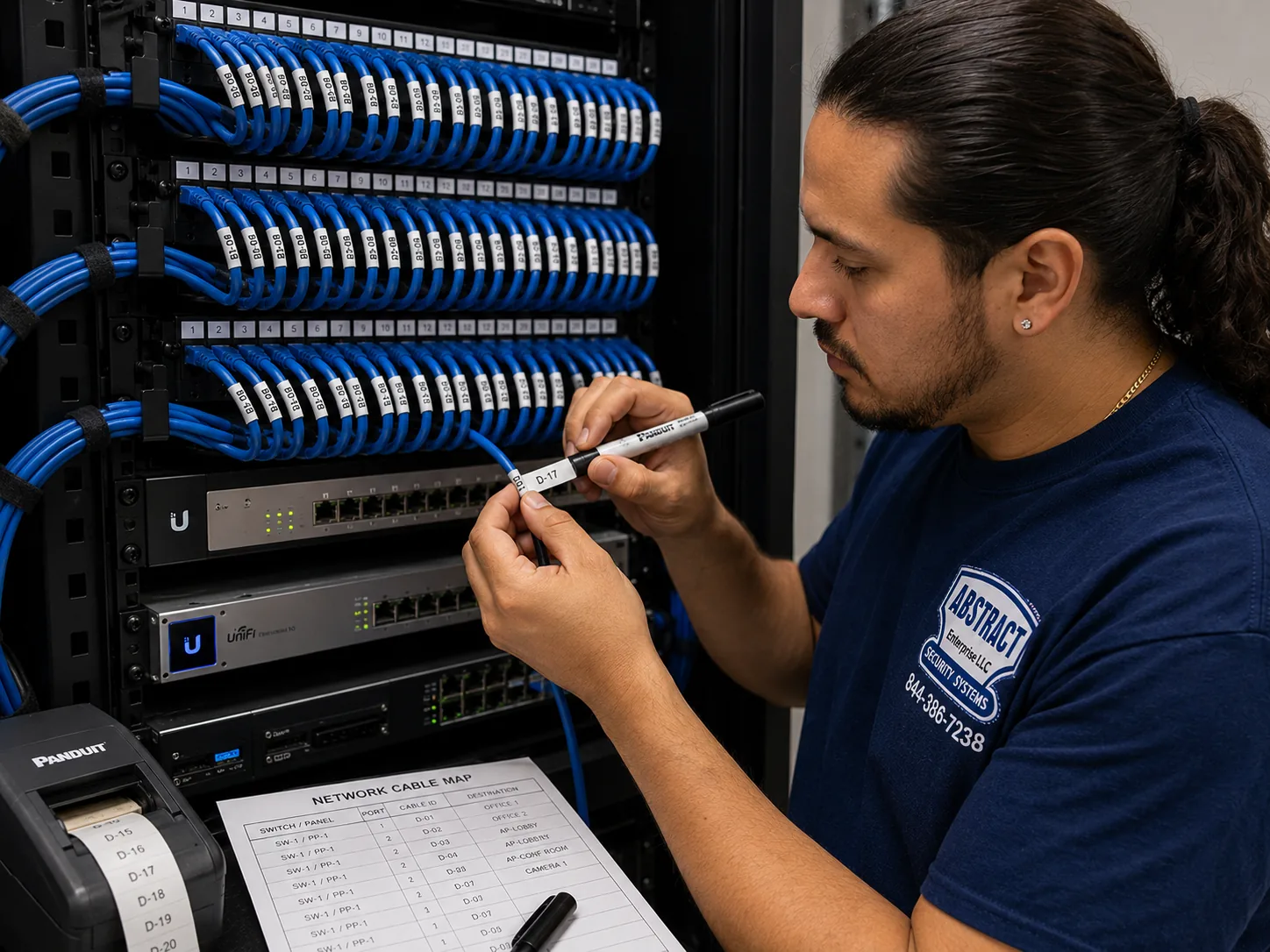
Photo from the AESS job library, not taken on Long Island: a technician printing cable labels at a patch panel next to a printed port map. On a Night Owl job in a Nassau cape or a Suffolk colonial, the same habit applies on a smaller scale: every camera cable gets a label at the camera end and at the recorder end, so a dead channel two winters from now can be traced in minutes instead of guessed at through the attic.
Long Island Night Owl Install
Tell us the kit model, how many cameras, and the town
✅
Request Sent!
We'll call about your Long Island Night Owl system the same business day.
25+
Years Experience
✓
Same-Day Estimates
100%
Licensed & Insured
4.7★
201 Google Reviews
Owner-operated since 2002 · Thousands of jobs completed · Booked within 2 hours
Quick answer: a Night Owl camera installation on Long Island is priced per camera and per cable run, at our Nassau rate (1.15 times our Brooklyn base) or our Suffolk rate (1.20 times), and the full line-by-line list is on our Long Island Night Owl price page. The visit covers mounting each camera, pulling and labelling every cable back to the recorder, setting up the hard drive, cabling the recorder to your router, and putting the Night Owl app on your phones. Send the model number on your box, the number of cameras and a few outside photos, and we book within two hours of your request. Call (800) 486-0943 or see Night Owl camera installation prices for Long Island.
We install the kit you bought, or supply one, and tell you before booking whether its cameras are coax (BNC) to a DVR or Ethernet to a PoE NVR, because the two wire differently
Cable routes are planned around how the house is built: attic and soffit runs in capes and slab ranches, basement runs in split-levels and colonials, sealed wall entries everywhere
Low-voltage work under NYS license #12000287431, with the recorder placed off any floor that floods and near the router it has to reach
Why Long Island Properties Need Night Owl Camera Installation
Long Island is an island of houses, and most of them were built before anyone planned for a camera cable. The U.S. Census Bureau's 2023 American Community Survey counts 477,860 housing units in Nassau County, 364,529 of them one-unit detached houses, with a median year built of 1955. Suffolk County has 579,790 units, 463,095 of them detached, with a median year built of 1970. Put plainly, the typical Nassau house is a postwar cape or ranch, and the typical Suffolk house is a generation younger. This is our Long Island hub page, so it covers both counties: the Nassau Hub around the Coliseum in Uniondale and East Garden City, the Levittown blocks, the South Shore, the North Shore, the Route 110 corridor, Hauppauge, Ronkonkoma, Stony Brook and out to the East End. The two counties have different building ages, different rates on our price list and, in places, different rules, and the page says which is which.
Night Owl is a brand many Long Island homeowners meet on a store shelf. The company describes itself on its own site as the "#1 Wired Security Brand*" in the United States and says its systems need no mandatory monthly subscription or long-term contract. What it does not do is install them. Answering a customer on a Best Buy product page, a Night Owl representative wrote that Night Owl does not offer installation services. That is why a Long Island installer, Total Security, openly asks whether people have bought a camera system from Costco, BJ's, PC Richards or another retailer and need it put up. The box lands in the hallway, and then someone has to decide where the cameras go, how each cable gets from the eave to the recorder, and how the recorder reaches the router. We do that work, and we do it on whatever house the kit happens to have come home to.
The houses are the reason it is harder than the box suggests. Keri Murray Architecture records that 17,447 homes were built in Levittown between 1947 and 1951, ranch homes on concrete slabs, with an expandable attic, no garage, and hot-water radiant heating pipes in the slab. A slab house has no basement to drop cables into, and a floor with heating pipes inside it is a floor you never drill. In Uniondale, NeighborhoodScout reports that single-family detached homes make up 69.74 percent of housing and that 55.45 percent of the housing dates from the 1940s through the 1960s. Homes.com describes the residential side of Uniondale, south of the Hempstead-Bethpage Turnpike, as mostly Cape Cods and minimal traditionals, often with detached garages and private driveways. A camera on that detached garage is a camera at the end of a long cable run, sometimes across a driveway. One buyer reviewing a Night Owl kit on Adorama summed it up: easy to install, apart from the effort of routing the wires through the attic and walls.
Then there is what Long Islanders actually want to watch. In January 2024, ABC7 New York reported on a multi-agency burglary and stolen-car task force, with the Nassau and Suffolk police departments and district attorneys, the NYPD, State Police and the FBI. Police said the burglars were attracted by cars in people's driveways, and that break-ins while people were home had gone up. In November 2025, CBS New York reported that the Suffolk district attorney had charged 14 men in a package-theft ring that operated across 31 communities, including Brentwood, Central Islip, Shirley and Deer Park, from October 2023 to February 2025, and allegedly used hacked systems to learn when Verizon and AT&T devices were being delivered, taking more than 200 phones and tablets. Patch's Garden City crime report for the week ending September 15, 2026 included packages taken from a front porch. News 12 Long Island showed a doorbell camera recording a thief taking a package mid-delivery in Massapequa Park. And in May 2026, Daily Voice reported that a Roslyn Heights homeowner spotted would-be burglars on his surveillance system and called police, and that arrests followed. Driveways, porches and side doors are the views that matter here, and a camera only helps if it is aimed at them, recording, and reachable from your phone.
Weather is the fourth reason. When Tropical Storm Isaias came through in August 2020, ABC7 reported almost half of PSEG's 1.1 million customers in the dark at the peak, with trees and power lines down. A Night Owl recorder is a plug-in box; when the power goes, so does the recording, unless it is on a battery backup. In August 2024, the New York State Department of Financial Services described the first-ever flash flood emergency for Suffolk County, a rain event it called one in a thousand years for the area, the failure of the Mill Pond dam in Stony Brook, and more than 2,000 residents and business owners with flood damage. Hurricane Sandy, according to Wikipedia's account, left the city of Long Beach with 150 million dollars in damage and brought voluntary evacuations of Nassau's South Shore surge area south of Sunrise Highway. A recorder on a basement floor, or a power splitter lying on a garage slab, is in the wrong place on this island. Where the equipment sits is part of the installation, not an afterthought.
Finally, Long Island is not one jurisdiction. The state's profile of Nassau County lists two cities, three towns, 64 incorporated villages and more than 60 unincorporated hamlets in 453 square miles. Suffolk is divided into 10 towns across 2,373 square miles. Licensing for home improvement work differs between the two counties, police camera programs differ between departments, and the mailing address on a house does not always match the hamlet it sits in. City-Data forum posters, for instance, note that the hamlet of Uniondale and the Uniondale 11553 ZIP code cover different areas. We ask for the full street address at booking because it decides which rate applies and which local rules we check.
We also want to be clear about what our research did not find. We looked for Reddit threads on r/longisland and r/homesecurity about Night Owl installation on Long Island, and for local news or Yelp complaints about Night Owl installs here, and found nothing specific. We could not view Google's People Also Ask boxes or AI Overview from our build environment. Where this page discusses what a Levittown slab or a Suffolk colonial wall is likely to hold, it draws on the building ages in the public record and on what we find in houses of those ages generally, not on a survey of Long Island homes. The way to know your house is to look at it, and that is the first thing we do.
Long Island facts that shape a Night Owl install
Two counties, two building ages: Census figures give Nassau a median year built of 1955 and Suffolk 1970, with about three in four Nassau units and four in five Suffolk units being detached houses.
Slabs with heat in them: Levittown's 17,447 original homes were ranches on concrete slabs with radiant heating pipes in the slab and no basement, which rules out the usual "drop it through the floor" cable route.
Detached garages and driveways: Homes.com describes Uniondale's residential streets as capes and minimal traditionals, often with detached garages and private driveways, the spot police say car burglars look at.
Storm and flood exposure: Isaias darkened almost half of PSEG's 1.1 million customers at the peak in 2020, and Suffolk saw its first-ever flash flood emergency in August 2024.
Package theft at scale: Suffolk prosecutors charged 14 men in a ring that worked 31 communities and took more than 200 phones and tablets, according to CBS New York.
Many governments: Nassau has 2 cities, 3 towns and 64 villages; Suffolk has 10 towns, so permits, licensing and police programs are checked by address.
What owners often add once the cameras are up. After a Long Island house has its Night Owl cameras on the eaves, the next request is usually about the doors themselves: who is ringing, who is coming in, and whether the garage side door is locked. Those are separate jobs with their own quotes, but if you want them, mention it when booking. A cable pulled through the attic once costs far less effort than a second trip through the same knee walls.
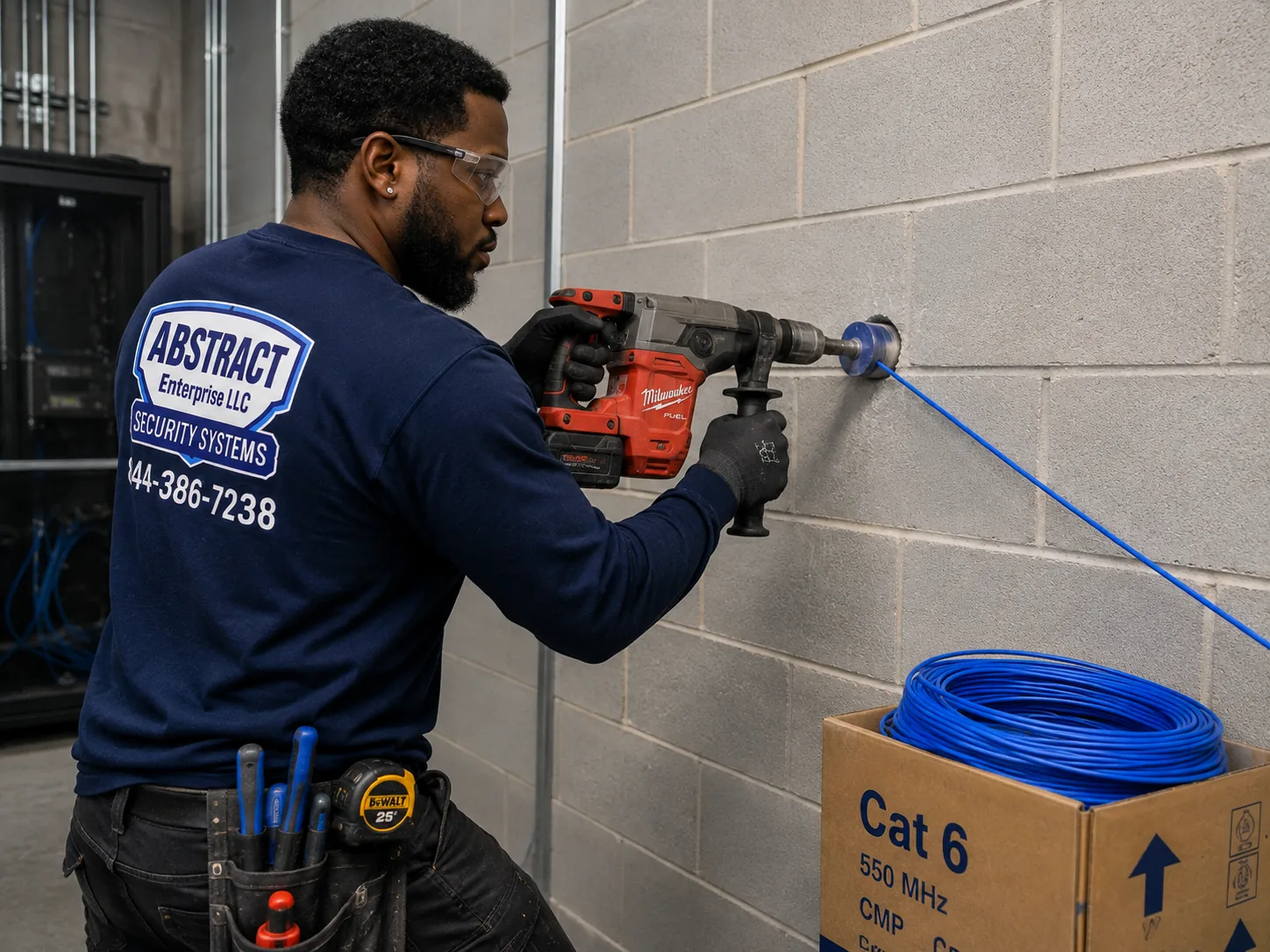
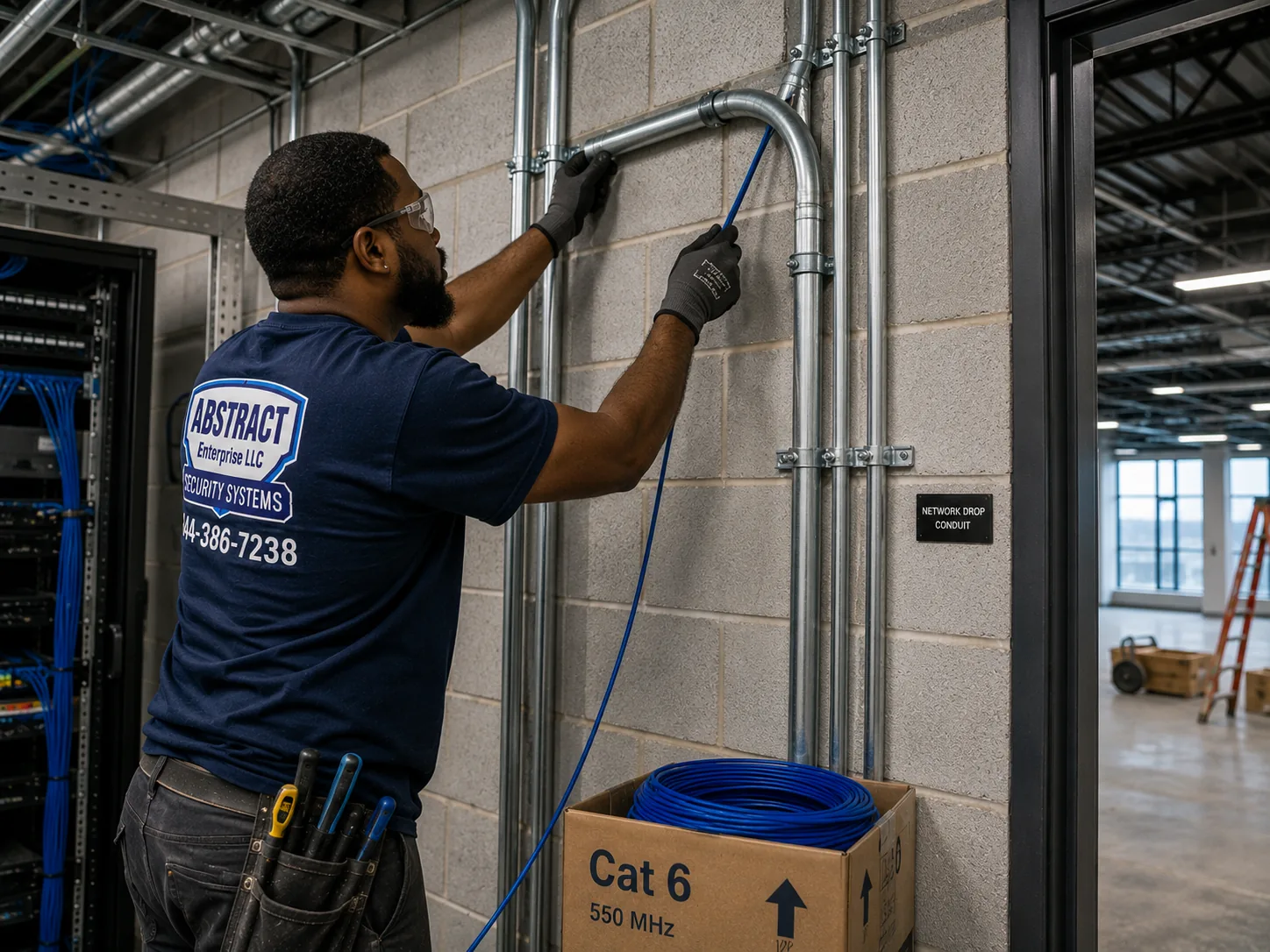
Photo from the AESS job library, not taken on Long Island: a technician core drilling a block wall so cable can pass through to a network room. Many postwar Long Island capes and ranches sit on concrete-block foundations and have block garage walls, and a camera cable entering a building through block needs a clean, sized hole and a seal afterward so water and insects follow the cable nowhere.
Cameras Went Dark After a Storm, or the App Shows "Offline"? Fast Help on Long Island
Two kinds of call we move on quickly. The first is the system that stopped recording when it mattered: the power went out, the recorder came back with a blank channel list, or the screen now says the hard drive is missing. The second is the system that records but cannot be seen: the app says offline, usually because the router was replaced, the internet provider changed equipment, or the Ethernet cable from the recorder was unplugged. Before you call, note whether the recorder's lights are on, whether the cameras' night-vision lights glow red after dark, and what the screen or app actually says. Then call (800) 486-0943. If the problem is the system, we tell you; if it is the camera that was mounted too low and has been knocked, we tell you that too. If something happened on camera that police need, save the footage first and do not let the recorder overwrite it.
1950 in Nassau, 1970 in Suffolk: How a Long Island House's Age Decides Where the Night Owl Cables Go
A Night Owl camera does not care what year the house was built. Its cable does. The route from the eave to the recorder depends on whether there is a basement, how the attic is shaped, what the siding and sheathing are made of, and whether the floor hides heating pipes. Across Long Island those features follow the building periods closely enough that the year on the deed is our first clue. The table below sets out the periods the public record describes, real examples, and what we expect to find. The last column is our working assumption, not a statement about any particular house; we confirm every route on site.
Period
Example from the record
What it is
Where we expect the camera cables to run
Levitt-era slab ranches, 1947–1951
The 17,447 original Levittown homes
Ranches on concrete slabs, radiant heat pipes in the slab, expandable attic, no garage as built
Up into the attic and out through the soffits; never into the slab
Postwar capes and minimal traditionals, 1940s–1960s
Uniondale, where 55.45% of housing dates from this era
One-and-a-half-story houses, often with a detached garage and private driveway
Basement or crawlspace where present; knee-wall attic spaces; a buried or aerial run to the garage
Split-levels and hi-ranches, 1950s–1960s
Streets near Hofstra and the Coliseum, as one local source describes them
Multi-level houses with the garage tucked into the lower level
Through the garage ceiling and up the stacked walls between levels
Suffolk colonials and newer houses, around 1970 and after
Suffolk's census median year built of 1970
Two-story houses, often with attached garages and full basements
Basement to an attic chase, or the attached garage ceiling to the soffits
Apartment complexes and condos
Large complexes are 19.83% of Uniondale housing
Garden apartments, townhouses and condos with shared walls and management
Inside the unit only, unless the board or landlord approves exterior work
The slab ranch: everything goes up, nothing goes down
A Levittown-style ranch is the most common house where a do-it-yourself Night Owl install stalls. The kit's instructions assume you can drop a cable somewhere, and in a house on a slab there is nowhere to drop it. Worse, the original Levitt houses were heated by hot-water pipes laid in that slab, so drilling the floor to bring a cable up behind a TV stand is the one move that can turn a camera job into a plumbing emergency. Many of those houses have since been renovated, extended and converted to other heating, and we never assume the pipes are gone. Our route in a slab ranch goes the other way: from each camera on the eave, into the soffit, across the attic, and down inside a single interior wall or a closet to where the recorder will live. The recorder ends up near the router, often in a hall closet or a home office, and the attic carries every cable. Expandable attics that were later finished into bedrooms complicate it; then we look for the unfinished eave spaces behind the knee walls and work from those.
The cape with the detached garage
The postwar cape is where the detached garage problem lives. Homes.com describes exactly this in Uniondale: Cape Cods and minimal traditionals with detached garages and private driveways. The house cameras are straightforward, with cables running through the knee-wall spaces and the basement where there is one. The garage camera is the long run. A Night Owl wired kit ships each camera with a cable of a fixed length; on older coax kits Night Owl told a Best Buy customer that each camera comes with a 60-foot BNC cable and that a run can go up to 160 feet per camera with extra cabling. A garage at the end of a long driveway can be past what came in the box, and the cable has to cross open ground. We either run it underground in conduit rated for burial, or overhead on a support wire where that is cleaner and allowed, and we bring it into both buildings through sealed entries. Some customers decide to put the recorder in the house and the garage camera on its own run; some prefer a small switch or a second cable path. We talk through the choice before we dig anything.
The split-level and the hi-ranch
Split-levels and hi-ranches, which one local source describes around Hofstra and the Coliseum, stack their rooms half a floor apart. That is good news and bad news. The good news is that the garage, usually tucked under the upper level, has an open ceiling that makes a natural cable highway to the front and side of the house. The bad news is that the walls between levels are offset, so a cable that goes straight down from the attic may land in the middle of a living room ceiling instead of inside a wall. We trace the stacked walls first, usually at the stair or a closet, and use them as the vertical path. The recorder in these houses often fits well on a garage shelf near where the internet comes in, provided it is raised off the floor, ventilated, and on a surge-protected outlet.
The 1970s Suffolk colonial
The Suffolk median house, built around 1970, is often the easiest Night Owl install of all, and it is easy because it was built with a basement and an attic that line up. Cables run from the soffits, through the attic, down a chase or plumbing wall to the basement, and across the basement ceiling to wherever the router is. The attached garage gives another route to the front corners. Two things still need care. Basements in parts of Suffolk took water in August 2024, so the recorder goes on a shelf or wall, not on the slab. And colonial attics are often insulated more heavily than postwar capes, so we keep cables on top of the framing rather than buried in loose insulation where the next person cannot find them.
Apartments, condos and townhouses
NeighborhoodScout puts large apartment complexes at 19.83 percent of Uniondale's housing and attached homes at 5.93 percent, and the same pattern of garden apartments and condos shows up across the island. In those buildings the exterior walls, hallways and grounds usually belong to the landlord, the board or the association. A tenant or owner can often put indoor cameras on their own furniture or walls without touching common property, but a camera on the outside wall or in a hallway needs written approval. We ask for that approval before the visit, and if it does not exist yet we design an indoor-only setup that needs none.
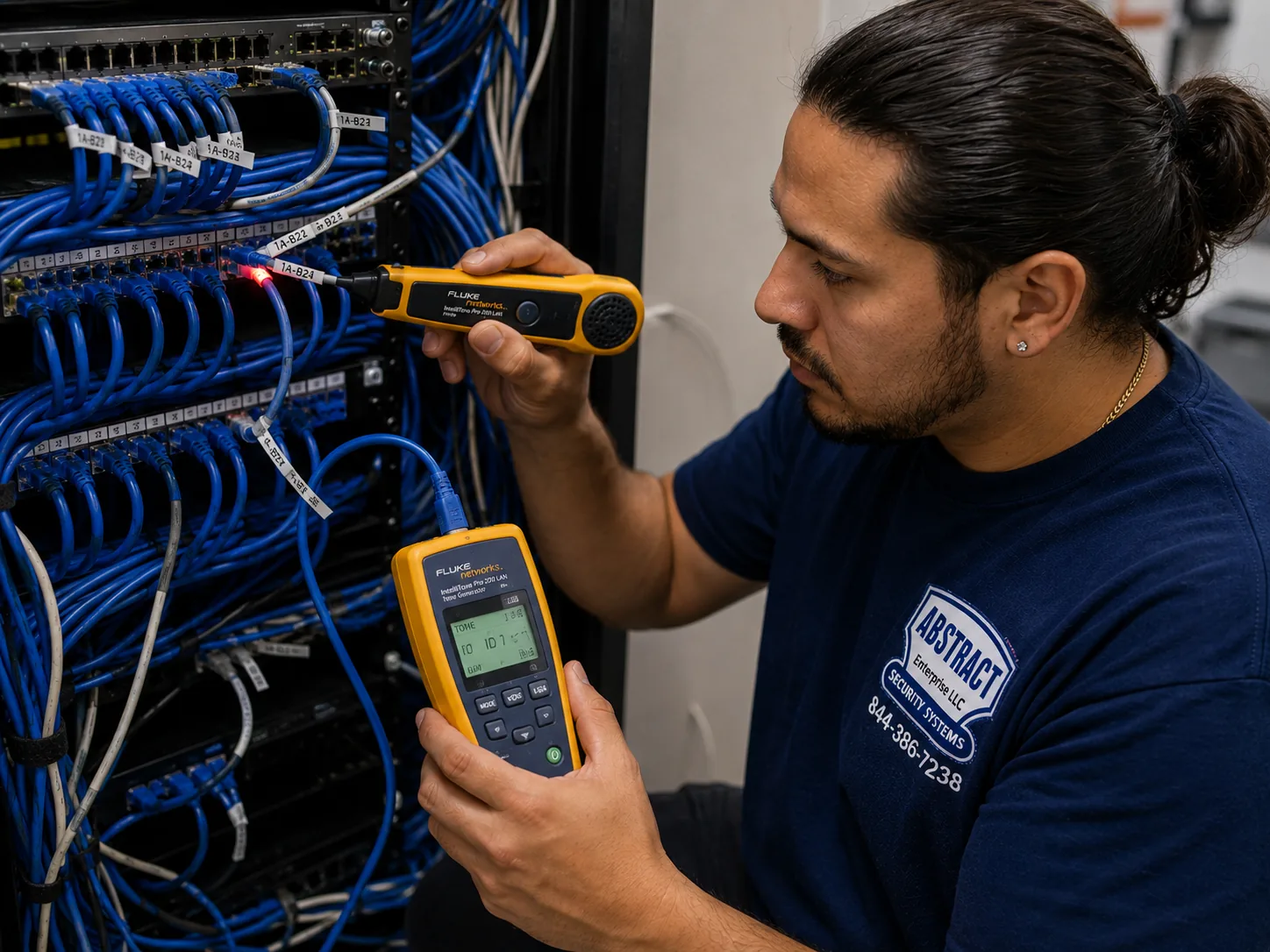
Photo from the AESS job library, not taken on Long Island: a technician tracing an unidentified cable run at a patch panel with a tone generator and probe. Long Island houses bought with an old camera system often have mystery coax in the attic or the garage; a tone tracer like this tells us which wire still goes to which corner of the house before anyone decides to reuse it for a new Night Owl DVR.
Before You Book
Box Label to Router: What to Check in a Long Island Home Before We Arrive
Most of the time lost on a camera install is lost before the first hole: a kit that turns out to be coax when the owner expected Ethernet, a router in the one room the cables cannot easily reach, a garage farther away than anyone measured, or an attic nobody has looked into in twenty years. Ten minutes with a phone camera and a tape measure prevents most of it. Please do not climb into an attic you are unsure of, open walls, or start pulling cable yourself; just look and send us what you find.
What to check
Why it matters on Long Island
What to send us
The label on the Night Owl box or recorder
DVR kits use coax with power, PoE NVR kits use Ethernet; some series are not compatible with other Night Owl products
A photo of the model number and the list of what is in the box
Where the router is
A wired Night Owl recorder must be cabled to the router with Ethernet for the app to work
The room and floor, and a photo of the router and spare ports
Basement, crawlspace or slab
Slab houses route everything through the attic; basements give a second path
One line: basement, crawlspace, or no space under the floor
Attic access
Capes have knee-wall spaces; ranches and colonials have a hatch or pull-down stairs
Where the hatch is and whether the attic has floored areas
The garage
Attached garages are an easy route; detached garages need a run across open ground
Rough distance from the house, and what lies between: driveway, lawn, fence
Soffits and eaves
Night Owl recommends outdoor cameras under an eave or awning
Photos of each corner you want covered, from the street and the yard
Flood history
South Shore and parts of Suffolk have taken water in basements and garages
Whether water has ever come in, and how high
Who owns the walls
Renters, condo owners and HOA members need approval for exterior work
The landlord's, board's or manager's email if approval is needed
Decide what each camera is for
The most useful thing you can do before we arrive is to write down, for each camera, what you want it to see. "The driveway" is a start; "a face at the side door" and "the plate of a car stopping at the curb" are better, because they decide how close the camera has to be and how wide its view should be. Police in the 2024 task force report said burglars were drawn to cars in driveways, so many Long Island owners want one camera looking down the driveway toward the street and another looking at the cars themselves. A porch camera for packages wants to see the step and the face of whoever bends down to it. A back-yard camera wants the gate and the back door. A short list like that, one line per camera, lets us place each one with a purpose instead of spreading them evenly around the roof line.
Check the outlet and the internet
A Night Owl recorder needs a power outlet and an Ethernet connection to the router. If the router is in a bedroom and the best place for the recorder is a hall closet, we either run an Ethernet cable between them or move the recorder next to the router and bring the camera cables there instead. SafeWise, reviewing a Night Owl DVR, noted that it had no built-in Wi-Fi, had to sit near the router for its Ethernet connection, and that long cable runs add installation time. Tell us which room the internet comes into and whether there is an outlet near it that is not shared with a space heater or an appliance, and we can design around it before the visit.
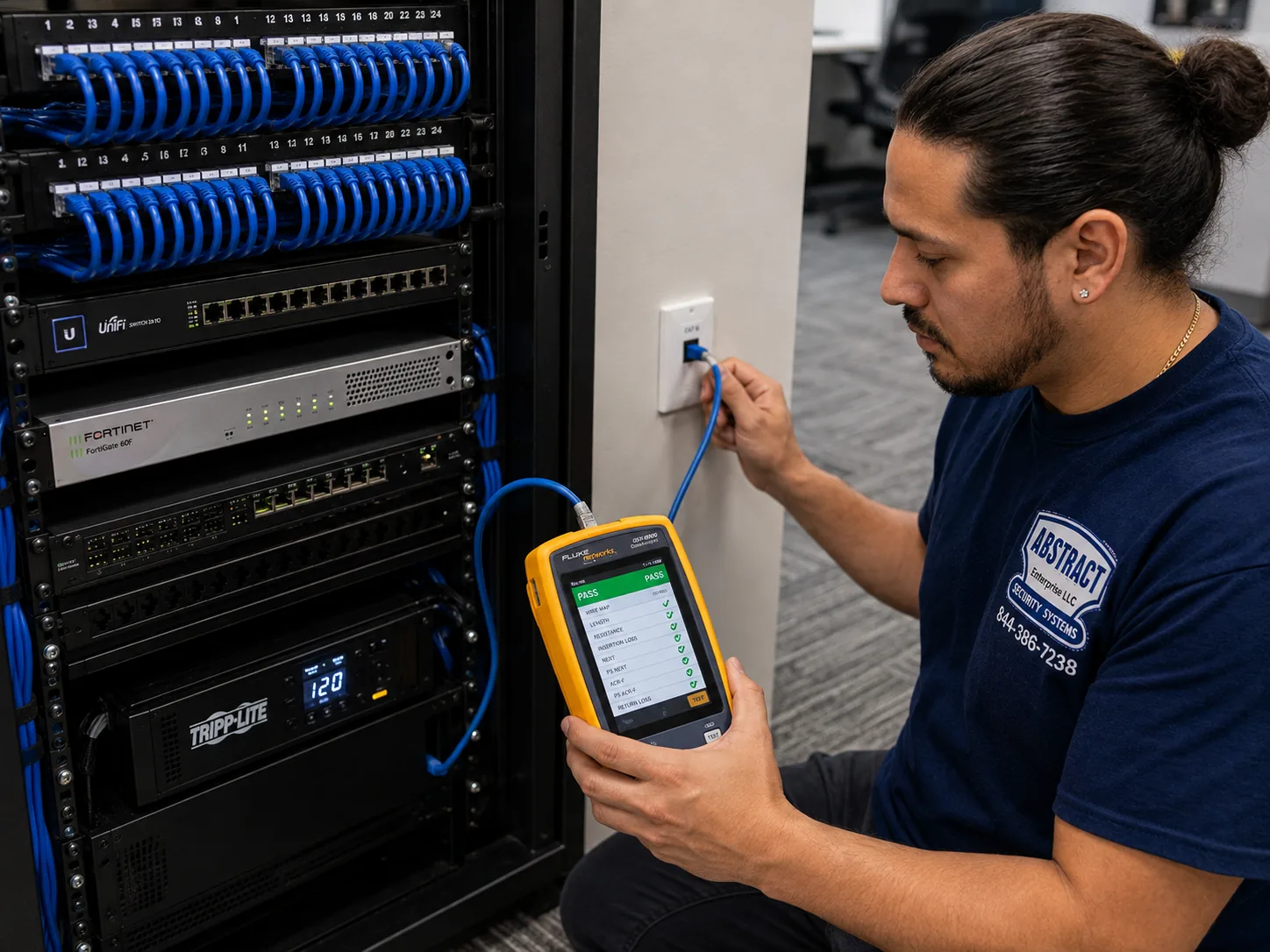
Photo from the AESS job library, not taken on Long Island: a technician certifying a data drop with a cable analyzer that shows a PASS result. On a Night Owl PoE NVR job in a Suffolk colonial or a Nassau ranch, each Ethernet run to a camera is tested before the camera goes on the eave, because a run that fails in the attic is far easier to fix before it has been stapled down and insulated over.
What We Install
Night Owl Camera Installation Services on Long Island
These are the Night Owl jobs Long Island homeowners, renters, condo owners and businesses book us for. Each is priced from our Long Island Night Owl price list, at the Nassau or Suffolk rate that matches the address. Where a job needs something extra, such as a run to a detached garage or a battery backup for the recorder, the written quote names it before you approve the work.
📦
Install the Kit You Already Bought
The Night Owl DVR or NVR kit from the store, mounted, cabled and set up on your phones. We check the model first, tell you whether the included cables are long enough for your house, and bring what is missing.
🏠
Attic-Routed Installs in Slab Ranches
Every cable through the soffits and attic, down one interior wall to the recorder, and nothing through a slab that may still carry heating pipes. Built for Levittown-style ranches and other houses with no basement.
🚗
Driveway and Detached-Garage Cameras
Cameras aimed down the driveway and at parked cars, plus runs to detached garages across open ground, in burial-rated conduit or on a support wire, sealed at both buildings.
🔄
DVR-to-NVR Upgrades
Old coax systems replaced with Night Owl gear. Where the new kit is a DVR we test and reuse sound coax; where it is a PoE NVR we pull new Ethernet, because coax will not carry PoE.
📱
App, Alerts and Remote Viewing
Recorder cabled to the router, the Night Owl app on every phone that needs it, and motion alerts tuned so passing cars on a busy road do not trigger a notification every minute.
💾
Hard Drives and Recording Time
Hard drive checks, larger drives fitted where the recorder supports them, and recording settings that keep enough days of footage for the way you actually use it.
🔋
Power Backup and Placement
Recorders moved off basement and garage floors, on surge-protected outlets, with a battery backup so short outages do not cut recording at the worst moment.
🔧
Takeovers of Half-Finished Installs
Kits that a previous owner or a weekend project left half up: loose cables traced and labelled, cameras re-aimed, splitters checked, and the system documented.
🏪
Systems for Stores and Offices
Night Owl systems for strip-center stores, small offices and flex buildings, with the recorder in a locked spot and cameras on the register, the doors and the lot.
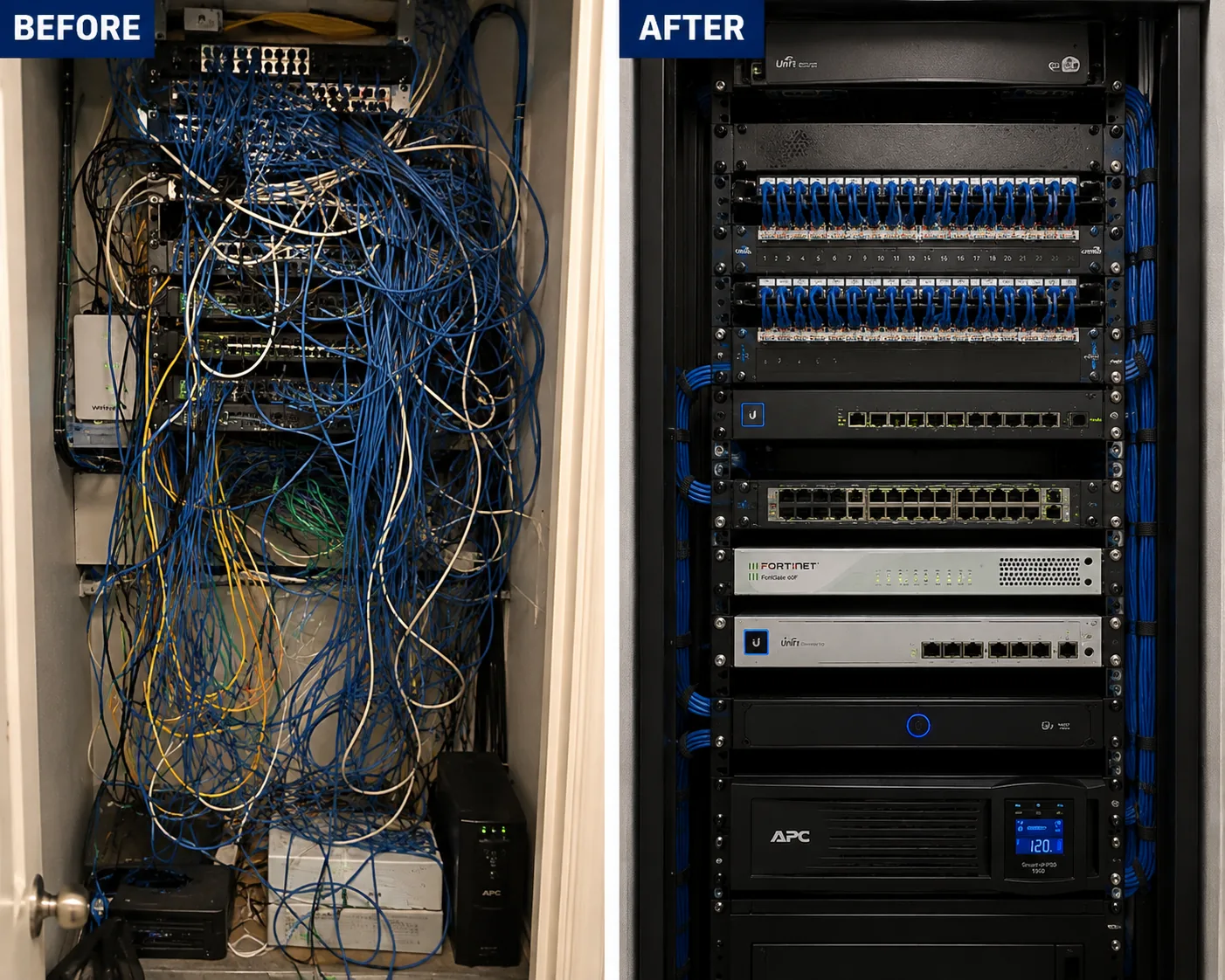
Photo from the AESS job library, not taken on Long Island: a before-and-after view of an unlabelled, tangled rack rebuilt into a dressed and identified one. A Night Owl recorder in a Long Island hall closet is a much smaller job, but the "before" side is familiar from half-finished home installs: cables of different lengths knotted behind the box, splitters on the floor, nothing labelled. The "after" is what we leave.
Building Specialists
Night Owl Camera Installation for Long Island's Architecture
Long Island's housing is more varied than its reputation for "all capes and ranches" suggests. Each type changes three things about a Night Owl install: where the cables can travel, where the recorder can safely sit, and who has to say yes before we drill. These are the types the public record and local sources describe, and how we handle each one.
Levitt-Era Slab Ranches
Concrete slabs with radiant heating pipes in the original houses, expandable attics, no basement. All cable goes up and over; the slab stays untouched. Many have been extended, so we check what each addition was built on.
Postwar Capes
One-and-a-half stories with knee-wall attic spaces, finished upstairs rooms and, often, a detached garage. The knee-wall spaces are the cable route; the garage is the long run.
Split-Levels and Hi-Ranches
Rooms half a floor apart, a tuck-under garage with an open ceiling, and offset walls between levels. The garage ceiling and the stair walls carry the cables.
Suffolk Colonials
Two stories, basement, attic and attached garage, often built around 1970 and after. The friendliest cable routes on the island, as long as the recorder stays off the basement floor.
Waterfront and South Shore Homes
Salt air, wind and flood history south of Sunrise Highway. Sealed cable entries, stainless fixings where they matter, connections kept out of the weather, recorders up high.
East End and Seasonal Homes
Houses that sit empty for months, where remote viewing is the whole point. Recorder placement, power backup and a reliable internet connection matter more than the camera count.
Condos, Townhouses and Garden Apartments
Shared walls and common grounds. Indoor cameras inside the unit, exterior cameras only with written approval from the board, association or landlord.
Mitchel Field Officers' Housing
The Mitchel Air Base and Flight Line historic district, added to the National Register in 2018, includes two rows of former officers' housing on Ellington Avenue. We found no local rules on exterior hardware there and would check before mounting.
How the house type changes the Night Owl job
House
Main cable route
Best place for the recorder
Who signs off
Slab ranch
Soffit to attic, down one interior wall
Closet or office near the router, never on the floor of a flood-prone room
The owner
Cape
Knee-wall spaces, basement if present, separate run to a detached garage
Near the router on the main floor
The owner
Split-level or hi-ranch
Garage ceiling and stair walls
Raised shelf in the garage or the lower-level den
The owner
Colonial
Attic to basement through a chase
Basement wall shelf or the room with the router
The owner
Waterfront home
Sheltered routes under eaves, sealed entries
Upper floor, away from flood levels
The owner; HOA where there is one
Condo or apartment
Inside the unit unless exterior work is approved
Inside the unit near the router
The owner or tenant, plus the board or landlord
On attics in capes and ranches. An attic is a fine place for a camera cable and a poor place for anything else. We keep cables off the attic floor where people step, fasten them to the side of framing, and stay well clear of recessed light housings, bathroom fan ducts and any wiring we find. We do not bury cables in loose insulation, because the next person who has to trace one will not find it. In knee-wall spaces of capes, the space is tight and often hot in summer; we schedule those runs early in the day when we can. Where an expandable attic has been finished into rooms, the eaves behind the knee walls usually still connect from one end of the house to the other, and we use them.
On older houses and what is inside their walls. A restoration contractor working in Uniondale warns that capes and ranches from the postwar building boom frequently contain asbestos materials. That source is a business, not an independent study, and we have no survey of Long Island houses. But it is a sensible caution for any house of that age: we do not cut into old ceiling textures, pipe insulation, siding or flooring we cannot identify. Camera cables can almost always be routed through open attic and basement space and through small holes in framing and trim, without disturbing old materials. If a route would require cutting into something suspicious, we stop and choose another route, and we tell you why.
On the outside wall. Night Owl's own setup guidance is to mount outdoor cameras at least seven feet above the ground, angled slightly down, and it strongly recommends placing outdoor cameras under an eave or awning. On Long Island houses that usually means the soffit or the fascia board just under it, which has the added benefit of letting the cable go straight up into the attic with no exposed wire on the siding. Where a camera has to go on a gable end with no overhang, we pick a fixing point in solid framing, seal the cable entry, and give the connection a weatherproof box so rain driven off the water does not run into it.
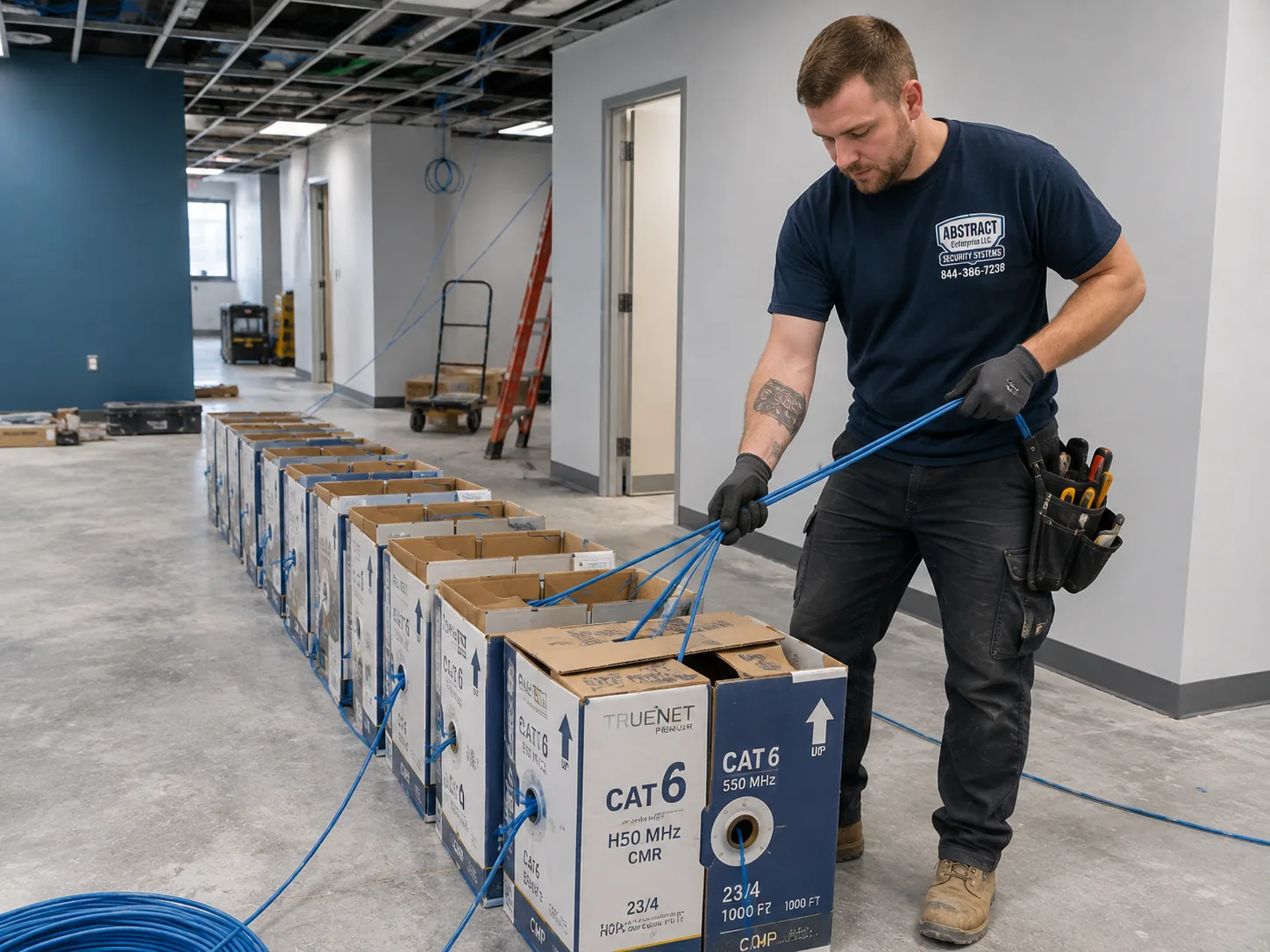
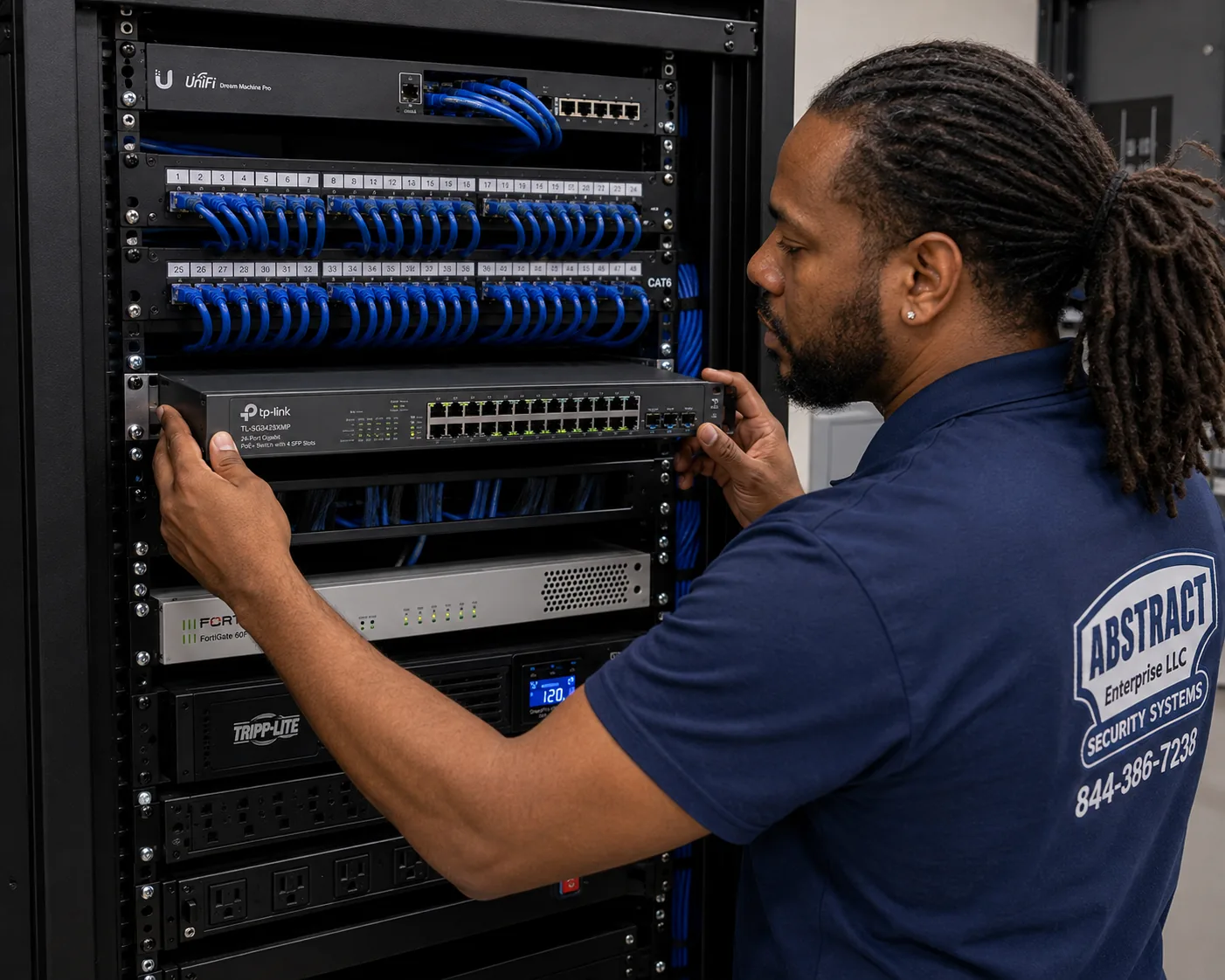
Photo from the AESS job library, not taken on Long Island: boxes of cable staged for a multi-drop pull on a working commercial premises. For a Night Owl system on a split-level or a colonial with eight or more cameras, staging the cable this way in the garage means each run can be pulled to the right corner, measured, and labelled without a second trip to the van.Photo from the AESS job library, not taken on Long Island: a technician mounting a managed PoE switch below patch panels in a commercial rack. A Night Owl PoE NVR powers its cameras through its own ports, but a larger Long Island property, with a detached garage or a pool house, sometimes needs a separate PoE switch closer to those cameras, and this is the kind of hardware that does it.
Commercial Night Owl Camera Installation
Business Night Owl Camera Installation on Long Island
Night Owl's systems are sold mainly to households, but plenty of Long Island small businesses buy them too: a store owner who wants the register and the door covered, a small office, a contractor's yard, a flex unit with a roll-up door. The corridors below are the ones named in our research. We describe what the sources say about each; we have no information about the camera systems inside any particular business and do not claim any of them as customers.
Old Country Road and Roosevelt Field
Wikipedia calls Roosevelt Field, at 630 Old Country Road in East Garden City, the largest mall on Long Island, with 243 stores. News 12 reported a shoplifting arrest there in April 2026, and Daily Voice reported two vehicles stolen from its west lot in an earlier case.
The Route 110 Corridor
Described by a commercial real estate firm as running through Farmingdale, Melville and Huntington Station, with a dense mix of warehouse, flex, R&D and office buildings near the Long Island Expressway.
Long Island Innovation Park at Hauppauge
Formerly the Hauppauge Industrial Park, about 11 square miles holding around 1,350 businesses and roughly 55,000 workers, according to a 2017 report from a firm that works with the park's trade association.
The Nassau Hub and Uniondale Offices
The roughly 72-acre Coliseum property, rezoned by the Town of Hempstead in 2025, sits beside office buildings such as RXR Plaza, with two 15-story towers, and The Omni at 333 Earle Ovington Boulevard, with ten floors and key-card access.
Hempstead Turnpike and Jerusalem Avenue
The Hempstead-Bethpage Turnpike divides commercial East Garden City from residential Uniondale. Daily Voice reported police releasing surveillance footage after a robbery at the Pump & Stuff gas station on Jerusalem Avenue in Uniondale.
Ronkonkoma Hub
Suffolk County is seeking a master developer for 48 acres within a 179-acre redevelopment area between Long Island MacArthur Airport and the Ronkonkoma LIRR station, according to GovMarketNews and LIBN.
What a business Night Owl system has to do differently
A home system records the driveway for the family's own peace of mind. A business system records evidence that someone else, a police officer, an insurer or a lawyer, may need to rely on. That changes several things. The recorder must be somewhere a thief cannot simply unplug or carry out, which usually means a locked office, a closet with a lock, or a wall-mounted lock box, not the shelf under the register. The camera at the door wants to capture a face at the moment someone enters, so it goes inside, looking at the door, at head height plus a little, rather than outside on the wall looking down at the tops of heads. The register camera wants hands and the cash drawer. The lot camera wants the entrance and exit lanes, where every vehicle has to pass. And the recording time should be long enough to cover a long weekend plus the time it takes for someone to notice a problem, which in a small business can be several days. When police released footage from the Jerusalem Avenue robbery, it was useful because the cameras were where they needed to be; our planning on a business job is about getting each camera into that kind of position.
Flex buildings and warehouses on Route 110 and in Hauppauge
The warehouse, flex and R&D buildings that fill the Route 110 corridor and the Hauppauge park have high ceilings, steel framing, block walls and loading doors. A Night Owl system can serve a small unit in one of them well, provided the cable routes are planned for the building rather than for a house. That means supporting cables properly overhead instead of laying them across a drop ceiling, using conduit where the cable is exposed to forklifts or damage, and keeping every run within the length the camera and recorder support. Where a building is large enough that distance becomes the limit, we say so, and the quote shows the extra switch or cable path that the layout needs. Some larger buildings are better served by a commercial-grade system, and we will say that too rather than stretch a consumer kit past what it was designed for.
Rules and practical limits for business cameras
Installer licensing. The New York State Department of State licenses security and fire alarm installers under General Business Law Article 6-D. A law-firm summary of the regulations (19 NYCRR 195.2) says that license covers installing or servicing CCTV used to detect or monitor intrusion, break-in, theft, movement, sound or fire, and an industry association says unlicensed installers can face fines that reach ten thousand dollars. We work under NYS license #12000287431.
County home improvement licensing. Nassau County's Office of Consumer Affairs says it is against the law to operate a home improvement business in Nassau without a license, and its FAQ says contractors who work only on commercial buildings do not need that license. Suffolk's Code, Chapter 563, sets its own licensing for regulated trades, with exceptions for towns and villages that license separately.
Audio is not the same as video. New York's eavesdropping law is a one-party consent law, according to the Digital Media Law Project. A business recording conversations it is not part of, such as customers talking at a counter, is a different matter from recording video, and many owners choose to leave camera microphones off.
Private spaces are off-limits. A camera in a restroom, changing room or similar private space without consent can be a class E felony under Penal Law section 250.45, according to RecordingLaw. We do not install cameras that view those spaces.
Insurance papers. Many commercial landlords and property managers, including those in office towers and shopping centers, want a certificate of insurance before contractors start. Tell us who needs it and how they want it named.
Working hours. In occupied stores and offices we schedule drilling and ceiling work for hours when customers and staff are not underneath it.
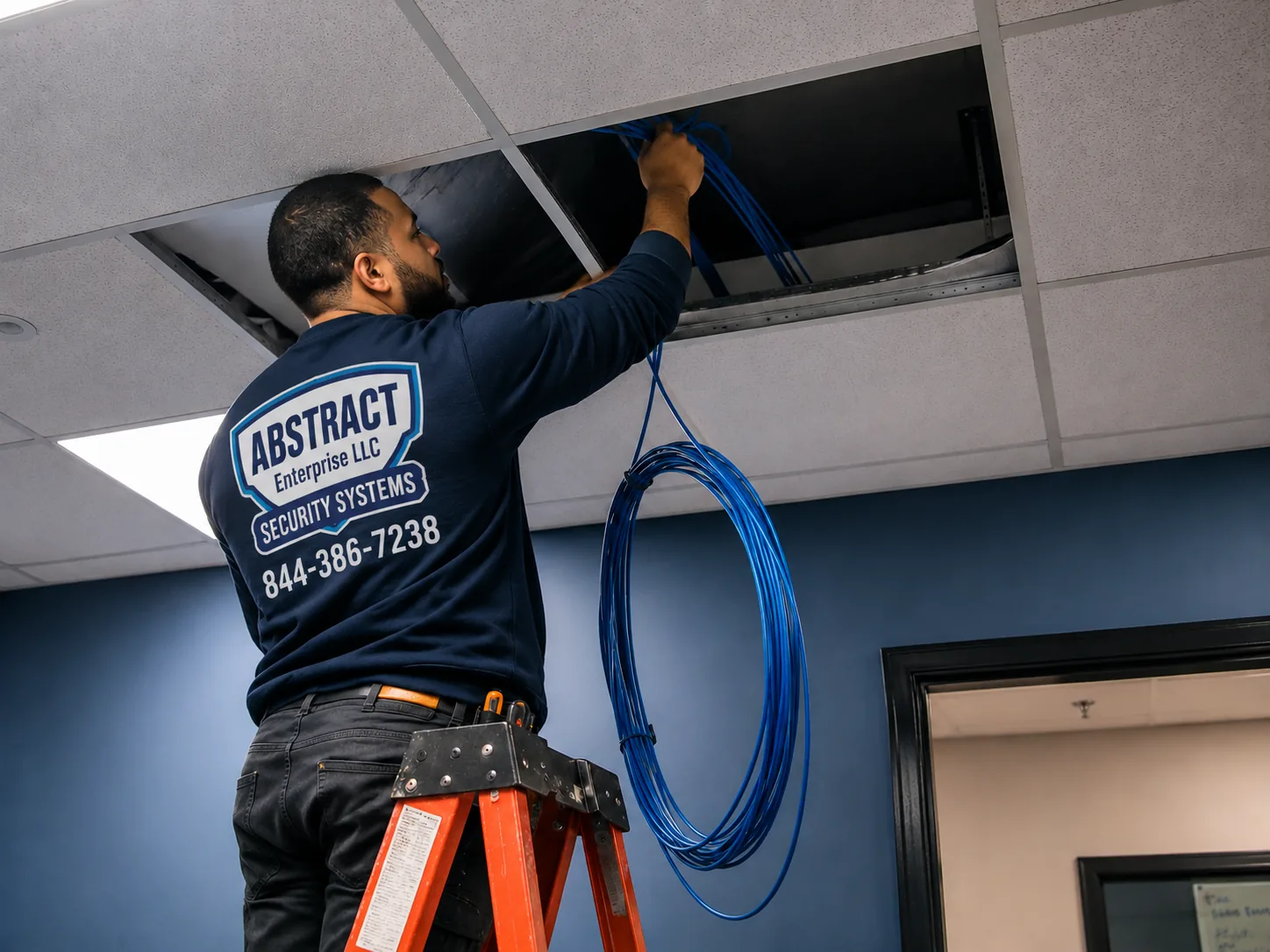
Photo from the AESS job library, not taken on Long Island: a technician feeding cable up through the ceiling of an occupied commercial space. In a small office along Route 110 or a store in a Nassau strip center, camera cables usually travel above the drop ceiling like this, which is why we book those pulls for hours when nobody is sitting below.Photo from the AESS job library, not taken on Long Island: a technician running cable into EMT conduit next to a telecom room in an industrial building. In a Hauppauge or Ronkonkoma flex unit, where a camera cable has to cross a wall that forklifts and pallets pass, metal conduit like this keeps the run from being cut by the next delivery.
Field Notes
Field Notes: The First Walk-Around on a Long Island Night Owl Job
We do not publish stories about a particular customer's house unless we can document them, so this is not a tale about one address. It is the routine our technicians follow before a single camera comes out of its packaging, on the kind of house that fills Nassau and Suffolk: a postwar cape or ranch, a router somewhere inside, a driveway down one side and a garage at the end of it.
We read the box label first and confirm whether the kit is coax to a DVR or Ethernet to a PoE NVR. We walk the outside of the house with you, one corner at a time, and ask what that camera is for. We look at the soffits and note which corners have an overhang and which are bare gable. We find the router and the outlet beside it. Then we go up the attic hatch and look across: where the eaves connect, where the insulation is deep, whether there are recessed lights or a fan duct in the way. If there is a basement, we go down and look for a chase or a plumbing wall that lines up with the attic. If the house is on a slab, we look for the one interior wall that can carry the cables down to the recorder. We measure out to the detached garage and look at what lies between. Only when every cable has a planned route, and you have agreed where each camera goes, does the first hole get drilled. On houses this age, that half hour is what separates a clean install from a weekend of loose wires.
Your Questions Answered
Night Owl Camera Installation on Long Island: Questions Answered
Who installs it and what it costs
Night Owl won't install the system I bought. Who will, and is professional installation available for an 8-camera kit?
Night Owl sells its systems as do-it-yourself kits; a Night Owl representative answering on Best Buy wrote that the company does not offer installation services. Night Owl does run a "Pro Network" program for installers and integrators, but the installation itself is done by independent companies. We are one of them on Long Island: we install the 4-, 8- or 16-camera kit you already own, wired or PoE, or supply one if you have not bought it yet. For an 8-camera kit, the price depends mainly on how many cables have to travel how far through your particular house, and whether any run goes to a detached garage. Send us the model and photos and we price it from our Long Island list before you book.
How is a Night Owl install priced on Long Island when Nassau and Suffolk use different rates?
Our Brooklyn rates are the base, and the Long Island counties are priced as multiples of that base: Nassau at 1.15 times and Suffolk at 1.20 times. The reason is simple distance and drive time across a long island; the work at the house is the same. So the same 8-camera install on two identical capes costs a little more in Smithtown than in Levittown. The address on the job decides which rate applies, and our Nassau County Night Owl price page and Suffolk County Night Owl price page show each line separately so you can add up your own job.
Recording, the router and your phone
Do I really need an Ethernet cable from the DVR to the router to see the cameras on my phone, or will Wi-Fi do?
For Night Owl's wired DVR kits, you need the cable. Night Owl representatives have answered on Best Buy that wired Night Owl DVRs must be connected to your router with an Ethernet cable for remote viewing and mobile alerts, and SafeWise noted that the DVR it tested had no built-in Wi-Fi. That is why recorder placement matters so much on Long Island houses: either the recorder sits beside the router, or we run a proper Ethernet cable from the recorder to the router. We do not rely on a wireless bridge as the main link for the system unless there is no alternative, and if we have to use one, we tell you it is the weakest point in the setup.
If the internet goes down, does the Night Owl recorder keep recording?
Yes. Night Owl's support article on wired DVR setup says the DVR does not need the internet for basic operation; it needs the router only for remote viewing on a computer or phone. If your Optimum or Verizon service drops, the recorder keeps writing video to its hard drive, and you simply cannot see it from outside the house until the connection is back. What stops recording is a power cut, not an internet outage, which is why we suggest a battery backup on the recorder and router for Long Island houses that lose power in storms.
Does the recorder have to stay plugged into a TV or monitor?
Not for recording, and not for viewing on your phone. A monitor or TV is useful at setup and for watching live footage at home, and Night Owl's support pages cover connecting one. Many Long Island owners keep the recorder in a closet with no screen at all and use the app. Others want a small monitor in the kitchen or the office. Either works. If you want a monitor, tell us where; if it is not next to the recorder, the video cable has length limits and we plan for it.
Cables, coax and long runs
Our house has coax from an old camera system. Can it be reused for a new Night Owl kit?
It depends on which Night Owl kit you bought. For older DVR-style kits, Night Owl told a Best Buy customer that existing BNC cabling can be used and that you can simply swap the cameras and the DVR. For Night Owl's PoE NVR kits, the company said older cables work only if they are Ethernet (Cat5e or Cat6), and that BNC or coax will not work with a PoE NVR. So the first step is the box label. If it is a DVR kit, we trace the old coax, test each run, and reuse the ones that are sound and reach the corners you want. If it is an NVR kit, the old coax can sometimes serve as a pull string for new Ethernet through the same holes.
Our ranch sits on a slab with no basement. Where do the camera cables actually go?
Up. In a slab house, every camera cable goes from the eave into the attic, travels across the attic to a point above the recorder, and comes down inside one interior wall or a closet. We never drill through the slab: the original Levittown ranches had hot-water heating pipes laid in it, and even in renovated houses we do not assume they are gone. The recorder ends up near the router, often in a hall closet or office, and the attic does all the work. If the attic has been finished into rooms, we use the eave spaces behind the knee walls.
The garage is detached, at the end of a long driveway. How does a camera out there get back to the recorder?
With a dedicated run across the gap, either buried in conduit rated for the ground or overhead on a support wire where that is cleaner and allowed, and sealed where it enters each building. On older coax kits, Night Owl says each camera comes with a 60-foot cable and that runs can go up to 160 feet per camera with extra cabling; PoE runs have their own distance limit. If your garage is farther than the cable allows, we add a small switch or plan a different path, and the quote shows it. We never leave a cable lying loose across a driveway or stapled along a fence where the next mower or snow shovel will cut it.
Placement for Long Island's real problems
How high should the cameras go on a cape or ranch, and why does Night Owl want them under the eave?
Night Owl's setup guidance is at least seven feet above the ground, angled slightly down, and it strongly recommends placing outdoor cameras under an eave or awning. On a typical Long Island cape or ranch, the soffit is a little above that height, and mounting there keeps rain and snow off the lens, makes the camera harder to reach and knock, and lets the cable go straight up into the attic. Too high, and every face becomes the top of a head. We pick a height per camera based on what it needs to see: lower and closer for the side door, higher and wider for the driveway.
Which camera spots matter most for driveway car theft and porch package theft?
Police told ABC7 in 2024 that burglars were drawn to cars in driveways, and Suffolk prosecutors described a ring that targeted delivered phones and tablets across 31 communities. So on most Long Island houses we start with three views: one looking down the driveway toward the street, to catch a car pulling in and the time it did; one looking at the parked cars and the side door; and one at the front step, close enough to show the face of someone bending down to a package. Back yards, gates and the detached garage come next. A system with eight evenly spaced cameras that misses the step is less useful than four placed on purpose.
Hard drives, power and the weather
Can the hard drive in our Night Owl recorder be replaced with a bigger one?
Often, yes, but it depends on the model. Night Owl kits ship with drives of different sizes, and recorders have a maximum they support. We check your recorder's limit, fit a suitable surveillance-rated drive, format it in the recorder, and confirm that it is detected and recording before we leave. A larger drive means more days of footage before the oldest is overwritten, which matters for East End and seasonal homes and for businesses that might not notice a problem for days.
What happens to the cameras when a storm like Isaias knocks out the power?
Without backup, everything stops: the recorder, the cameras it powers and the router. Isaias left almost half of PSEG's 1.1 million customers in the dark at its peak in August 2020. A battery backup sized for the recorder and router keeps recording through short outages and lets the system shut down cleanly instead of crashing, which protects the hard drive. For longer outages, a home generator is the real answer, and the recorder should be on a circuit it feeds. We place the recorder on a surge-protected outlet in every install, because storms also bring power surges.
We live south of Sunrise Highway near the water. What changes for salt air and flooding?
Two things: the outside hardware and the inside equipment. Outside, salt air works on exposed connectors and cheap fixings, so we keep every connection inside a weatherproof box or inside the eave, use corrosion-resistant fixings where they are exposed, and seal each cable entry. Inside, the recorder and any power supplies go high. Sandy brought voluntary evacuations of the Nassau surge area south of Sunrise Highway, and the 2024 Suffolk flood damaged more than 2,000 homes and businesses; a recorder on a basement floor is the first thing lost. We put it on an upper floor or a high wall shelf, near the router.
Rules, permits and the police
Do we need a permit or a police alarm permit for a Night Owl system in Nassau or Suffolk?
For the camera system itself, we have not found a source saying a standard Night Owl install needs a building permit, though towns and villages set their own rules and we check by address. The Nassau County police alarm permit applies, according to a local alarm company, to alarm systems tied into a central monitoring station; a self-monitored Night Owl system is not monitored that way, but we could not confirm in writing how the county treats cameras, so we say so plainly. The Nassau Sheriff's office describes its alarm registration as not mandatory. What does apply is installer licensing: New York requires a state license for installing CCTV used to detect intrusion or theft, and Nassau requires a home improvement license for residential work.
Should we register our Night Owl cameras with the police?
It is your choice, and the programs are voluntary. The Suffolk County Police Department runs a Camera Registry Program in which owners register the location of their systems; the department may ask a participant to check video for a particular date and time, with retrieval at the owner's convenience. The Garden City Police run a private camera registration program and state that it does not give police access to privately owned systems. We found no confirmed county-wide registry run by the Nassau County Police Department. Registration does not change how we install, but if you plan to register, it helps to have the recorder's clock set correctly and a simple way to export clips, which we set up at handover.
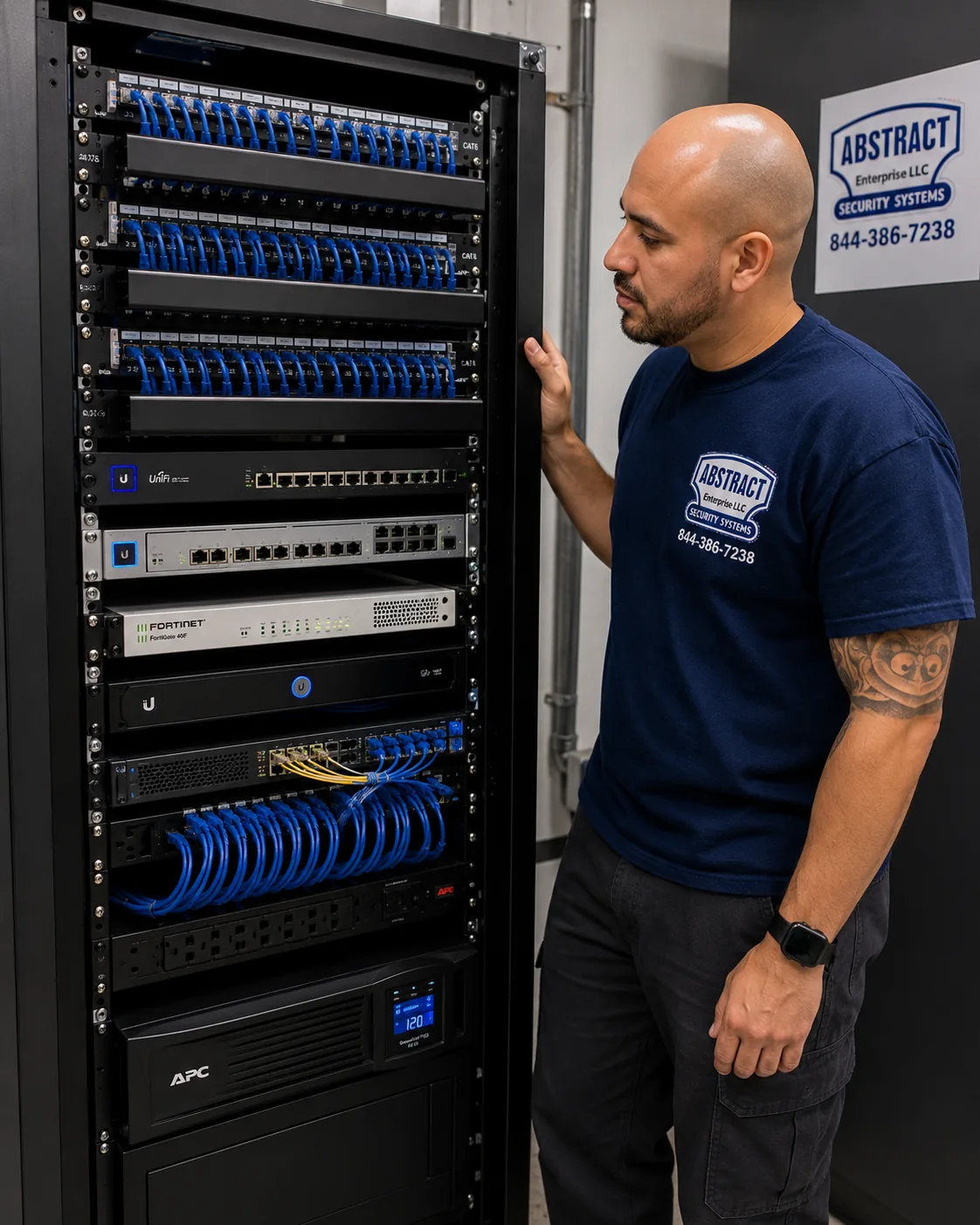
Photo from the AESS job library, not taken on Long Island: a finished rack with patch panels, switching, a firewall and a battery backup at the bottom, every cable dressed and identified. A Night Owl recorder in a Long Island business office is a smaller version of the same idea: the recorder, the router and a battery backup together in one locked spot, so a storm or a thief does not stop the recording.
Equipment
Types of Night Owl Camera Systems We Install
These are the Night Owl system types and the supporting parts we fit in Long Island homes and businesses. We describe them from Night Owl's own support material and product listings; we do not quote specifications we cannot source. Exact model numbers and what they include vary, which is why we ask for the box label before booking.
📼
Wired BNC DVR Kits
Cameras connected by coax with power to a DVR. Night Owl's support pages list 12-volt, 2000 mA power for its wired BNC DVRs and cameras. Good for reusing sound coax in houses that had an older system.
🌐
PoE NVR Kits
IP cameras powered and connected over a single Ethernet cable to an NVR. Night Owl says these need Cat5e or Cat6; coax will not work. The cleaner choice for new runs through an attic.
📶
Indoor Wireless Kits
Night Owl sells some wireless indoor systems. They still need power at each camera and a working network, and they suit renters and condo owners who cannot run cable outside.
🎤
Two-Way Audio Cameras
Some Night Owl kits list two-way audio. Useful at a side door or garage; we explain New York's recording rules before you turn microphones on.
💾
Recorders and Hard Drives
DVRs and NVRs in 4-, 8-, 12- and 16-channel sizes, with drives checked and, where supported, upgraded for longer recording.
🔌
Power Adapters and Splitters
Night Owl's own troubleshooting advice is that a camera whose night vision fails may need its own adapter instead of a splitter. We size power so every camera gets enough.
🔋
Battery Backup and Surge Protection
A battery backup for the recorder and router, on a surge-protected outlet, so storms do not cut recording or damage the drive.
🧰
Cable, Conduit and Weatherproof Boxes
Extension coax, Cat5e and Cat6, burial-rated conduit for runs to detached garages, and weatherproof junction boxes for exposed connections.
Night Owl vs Lorex, and the national security brands vs a local installer
Many Long Island buyers compare Night Owl with Lorex before buying, and comparison sites such as SafeHome publish side-by-side reviews. We install both, and our honest view is that the bigger difference on a Long Island house is rarely the brand: it is whether the cables are planned, the recorder is placed sensibly and the cameras point at the driveway and the step. Night Owl's appeal is that it sells as a wired kit with no mandatory subscription. Its reviews are mixed: SmartCustomer showed 1.4 stars from 84 reviews when we checked, with one reviewer saying PoE cameras failed in two years, and a Trustpilot reviewer reported a BTN8-series NVR that did not detect its hard drive. We cannot confirm how common those problems are, but we test the drive and every camera before we leave, so a faulty unit shows up on install day rather than the day you need footage. National names such as ADT, Ring and SimpliSafe are different again: ADT is best known for monitored alarm service, while Ring and SimpliSafe sell mostly wireless self-install devices. None of them installs your Night Owl kit. If you want a monitored alarm as well as cameras, that is a separate job with its own quote.
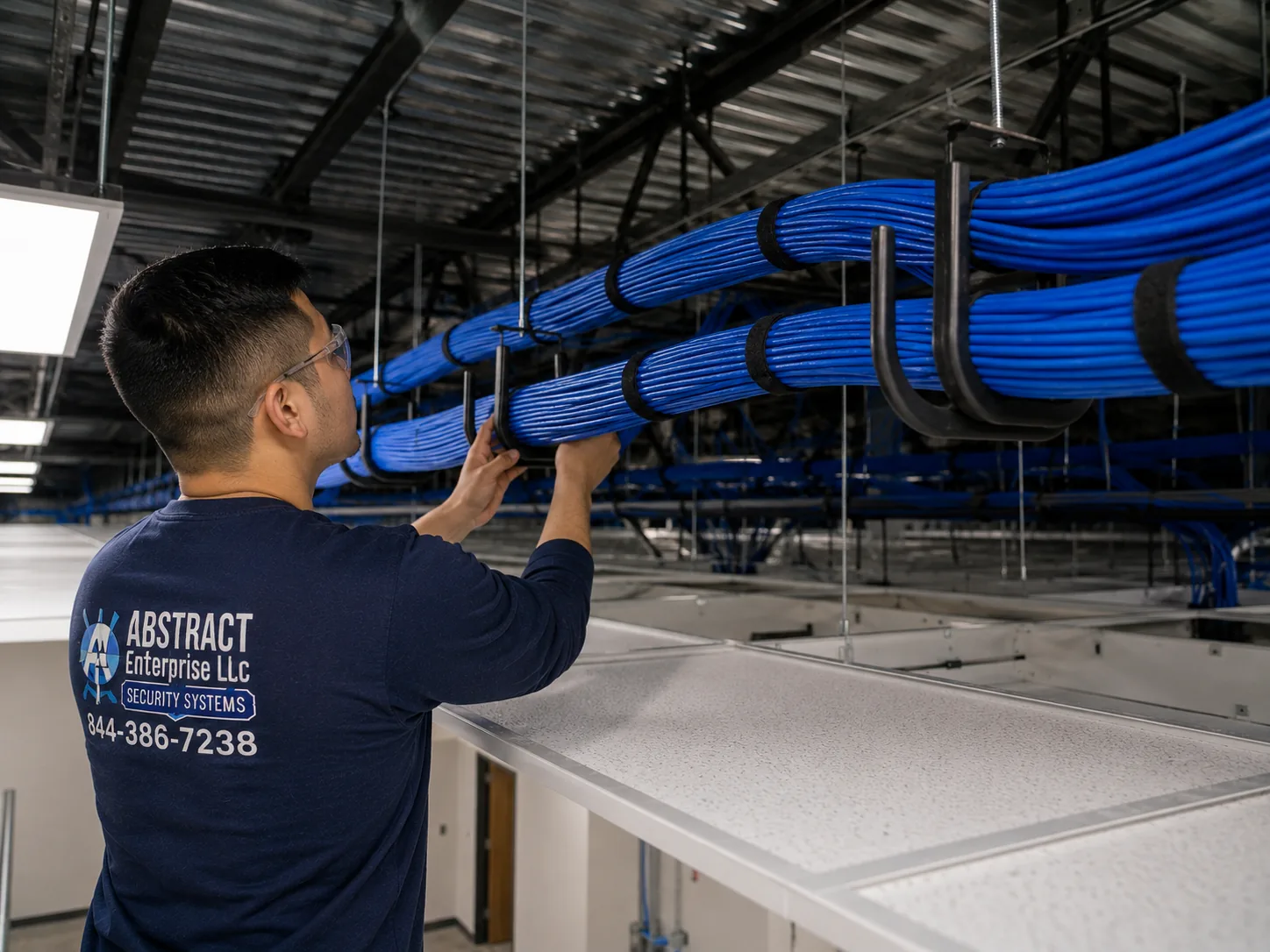
Photo from the AESS job library, not taken on Long Island: J-hooks carrying neat bundles of cable across a commercial ceiling. In a flex or warehouse unit on the Route 110 corridor or in Hauppauge, camera cables supported like this stay out of the way of sprinkler work and ceiling repairs instead of draping over the grid where they get cut.
AI Overview Reality Check
What AI Gets Wrong About Night Owl Camera Installation on Long Island
We could not capture Google's AI Overview or its People Also Ask boxes for this topic from our build environment, so we will not pretend to quote them. What follows are claims we see repeated in quick online answers about installing Night Owl cameras, and about Long Island, set against what Night Owl's own support material, the public record and our field practice say. National marketplaces such as Angi, HomeAdvisor and Fixr publish cost guides that feed many of those answers; they help with a rough idea, but they are not a quote for a cape in Massapequa or a colonial in Commack.
"Night Owl will send someone to install it."
Some quick answers assume a brand that sells cameras must also install them. Night Owl does not. A Night Owl representative answering on Best Buy wrote that the company does not offer installation services, and the systems are designed and sold as do-it-yourself kits.
Night Owl does run a Pro Network program with tiered pricing and priority support for installers and integrators, but that is a supply program for independent companies, not a Night Owl installation crew.
On Long Island the practical result is that the kit comes home, and the owner either installs it or hires a licensed local installer. That is the gap this page exists to fill.
"It's plug-and-play; you'll be done in an afternoon."
The camera-to-recorder connection really is plug-and-play. The cable route is not. One eBay reviewer wrote that the box claimed a four-hour install and that it took more like ten hours. An Adorama reviewer called the kit easy apart from routing the wires through the attic and walls.
On Long Island that gap is wider in some houses than others. A 1970 Suffolk colonial with a basement and an attic that line up can be quick. A Levitt-era slab ranch, where everything goes through the attic, or a cape with tight knee-wall spaces and a detached garage, takes much longer.
We do not promise a fixed number of hours before we have seen the house. After the walk-around we can tell you how the day will go, and the price list is per camera and per run, not per hour of struggling.
"Any old coax in the walls will work with a new Night Owl system."
This is half right, which makes it dangerous. For Night Owl's DVR kits, the company told a Best Buy customer that existing BNC cabling can be reused by swapping the cameras and DVR.
For its PoE NVR kits, Night Owl said the opposite: older cables work only if they are Cat5e or Cat6 Ethernet, and coax will not work with a PoE NVR. Some Night Owl series are also not backward compatible with other Night Owl wired products, according to buyers on Slickdeals.
Many Long Island houses were sold with an older camera system's coax still in the attic. We read the new kit's label, tone-trace the old wires, and only reuse what is compatible and tests sound.
"No internet means no recording."
Answers that treat cameras like cloud doorbells often say a system without internet is useless. Night Owl's wired DVR support article says the DVR does not need the internet for basic operation; the router is only needed for remote viewing.
That matters on Long Island, where storms take down service lines and houses sit empty out east for weeks. A Night Owl recorder keeps writing to its own hard drive when the internet is down.
The thing that does stop recording is losing power. Isaias left almost half of PSEG's customers dark at its peak, so the useful upgrade is a battery backup on the recorder, not a different brand.
"Just put the recorder anywhere and use Wi-Fi."
Quick answers often suggest hiding the recorder wherever is convenient. Night Owl representatives have said wired DVRs must be connected to the router with an Ethernet cable for remote viewing and alerts, and SafeWise found its tested DVR had no built-in Wi-Fi.
On this island, "anywhere" is also often the basement floor or the garage slab, which is exactly where the August 2024 Suffolk flood and Sandy's South Shore surge did their damage.
We place the recorder high, dry, ventilated, near the router, and on a surge-protected outlet. Then the cameras' cables come to it, not the other way round.
"You need a police alarm permit for cameras in Nassau County."
Some answers mix up alarms and cameras. A local alarm company's summary says Nassau County requires an alarm permit for residents whose alarm is tied into a central monitoring station. A self-monitored Night Owl system is not that kind of alarm, though we could not find the county's own statement on cameras, so we will not tell you it is settled.
The Nassau Sheriff's office describes its alarm registration as not mandatory, and the police camera programs we found, in Suffolk and in Garden City, are voluntary.
The licensing that clearly does apply is the installer's: New York State licenses CCTV installers through the Department of State, and Nassau licenses home improvement contractors. Ask any installer for both.
"New York is a two-party consent state, so camera audio is illegal."
Even one installer's Long Island page repeats this. It is wrong. According to the Digital Media Law Project, New York's eavesdropping law is a one-party consent law.
That does not make every microphone a good idea. Recording conversations you are not part of, such as visitors talking on the porch, is the risky case, and video in private rooms is a separate crime: a camera in a bathroom, bedroom or changing room without consent can be a class E felony under Penal Law 250.45.
Our practice is simple: no cameras viewing private spaces, and two-way audio explained before it is switched on, so you decide with the facts in front of you.
Kit on the Kitchen Table? Talk to a Technician About Your Long Island House
Send a photo of the Night Owl box label, the number of cameras, and a few pictures of the corners you want covered, and a technician will tell you whether the included cables reach, where the recorder should sit, and which lines of the Long Island price list apply. Call (800) 486-0943, message us on WhatsApp, or use the quick form.
Every Long Island Night Owl job follows the same eight steps, whether it is a four-camera kit on a Levittown ranch or a sixteen-channel system on a flex building in Hauppauge. The order matters most on older houses, where a cable route chosen in a hurry is the usual cause of exposed wire on the siding and a camera that never quite reaches.
1. Tell us the kit and the house
The model on the box, how many cameras, the town and street, and photos of the outside. We confirm whether it is a coax DVR kit or an Ethernet PoE NVR kit and match the job to the Nassau or Suffolk rate.
2. Map the routes and the recorder spot
On arrival we walk the outside, then the attic, basement or crawlspace, find the router, and pick a dry, ventilated, raised place for the recorder near it.
3. Check access and permissions
Who owns the walls, landlord or board approval if needed, insurance paperwork for commercial sites and managed complexes, and any town or village rule for the address.
4. Mount the cameras
At least seven feet up, angled slightly down, under an eave or overhang where there is one, fixed into framing or masonry, each aimed at what you said it should see.
5. Pull and label every cable
Through the soffit, attic, basement or garage, never through a slab, sealed where it enters the house, and labelled at both ends.
6. Set up the recorder and power
Hard drive detected and recording, time and retention set, surge protection on, and a battery backup if you want recording through outages.
7. Connect the app and alerts
Recorder cabled to the router, the Night Owl app on your phones, and motion alerts tuned so traffic on the street does not set off every notification.
8. Test day and night, then walk through
Every camera checked in daylight and after dark with night vision on, playback and clip export shown, and a labelled map of which cable feeds which camera.
Coverage Area
Night Owl Camera Installation Near Long Island's Landmarks
Long Island is long, and people give directions by the places everyone knows. These are the anchors we use when planning visits across Nassau and Suffolk.
Roosevelt Field
The largest mall on Long Island, at 630 Old Country Road in East Garden City, built on the airfield where Charles Lindbergh began his 1927 solo transatlantic flight, according to Wikipedia.
Mitchel Field and the Cradle of Aviation Museum
The former air base, opened in 1918 and decommissioned in 1961, now holds the Cradle of Aviation Museum, Nassau Community College's campus land and a 108-acre National Register historic district.
Nassau Coliseum and the Hub
The roughly 72-acre Coliseum property in Uniondale, rezoned by the Town of Hempstead in June 2025, with redevelopment still under discussion according to the LI Herald.
Hofstra University
About 117 buildings on 244 acres in the Uniondale section of Hempstead, with part of the campus south of Hempstead Turnpike, according to Wikipedia.
Levittown
Where 17,447 homes were built between 1947 and 1951, ranches on concrete slabs, the template for postwar Long Island housing.
Long Island Innovation Park at Hauppauge
The renamed Hauppauge Industrial Park, around 11 square miles and about 1,350 businesses, with roughly two-thirds of it in the Town of Smithtown.
Stony Brook University
213 buildings over 1,454 acres in the Town of Brookhaven, near the Mill Pond dam that failed in the August 2024 flood.
Brookhaven National Laboratory
Established in 1947 at the former Camp Upton, on a 5,265-acre site in Upton, according to Wikipedia.
Long Island Night Owl jobs are priced per camera and per cable run, at our Nassau rate (1.15 times our Brooklyn base) for Nassau addresses and our Suffolk rate (1.20 times) for Suffolk addresses. Every line, from the per-camera install to the run to a detached garage, is published on our Long Island Night Owl camera installation price page, which works as a calculator: pick your cameras and runs, and it adds them up. We do not print numbers on this page that are not on that list, and nothing appears on the day that was not on your quote. The table below explains what moves the total on a Long Island house, so you can see why two kits of the same size can price differently.
What drives the price
Why it matters on Long Island
How it shows on the quote
Number of cameras
Each camera is a mount, an aim and a cable run
Per-camera install line
Kit supplied by you or by us
Store-bought kits are labor only; supplied systems add equipment
Labor-only or supplied lines
DVR on coax or NVR on Ethernet
Coax may be reusable; PoE needs Ethernet
Reuse-and-test or new-run lines
House type and access
Slab ranches route through the attic; capes have tight knee walls; colonials have basements
Run lines by length and access
Detached garage or outbuilding
A run across open ground, buried or overhead, sealed at both ends
Separate outbuilding run line
Wall and mounting surface
Wood soffits, vinyl or cedar siding, brick or block garages
Surface line where masonry is involved
Recorder placement and power
Off flood-prone floors, near the router, battery backup if wanted
Placement and backup lines
App and alert setup
Phones, users and alert tuning
Included in the system setup line
Nassau or Suffolk address
The county rate follows the street address, not the mailing name
Rate shown at the top of the quote
How to read a quote for a Long Island house
Take an 8-camera Night Owl PoE NVR kit you bought for a Levittown-style ranch with no basement. The quote lists eight per-camera install lines, eight attic-routed Ethernet runs, the recorder setup with the app, and, if you want it, a battery backup for the recorder and router, all at the Nassau rate. Move the same kit to a 1970s colonial in Suffolk with a basement and an attached garage, and the runs are often simpler, but the Suffolk rate applies. Add a camera on a detached garage in either house and an outbuilding run line appears. Nothing else is added unless you ask for it.
Warranty and terms
Equipment that you bought yourself carries its maker's warranty; Night Owl handles warranty claims on its own products. Our workmanship and any equipment we supply are covered as set out below.
Full terms — including 50% deposit, one-year parts-only warranty on AESS-supplied products, and the late-fee schedule — are set out in the service agreement.
Shop Our Systems
Night Owl Camera Installation Packages & Pricing
Three common Long Island Night Owl jobs, each built only from lines on our Long Island price list. Current figures for each package, at the Nassau and Suffolk rates, are on the Long Island Night Owl price page; there is no package premium.
Starter: Four Cameras on a Cape or Ranch
A 4-camera Night Owl kit, yours or ours, with the driveway, front step, back door and one side covered. Cables through the attic or basement, recorder beside the router, app on your phones. Suits most postwar Nassau capes and slab ranches with an attached or no garage.
Standard: Eight Cameras with the Garage
An 8-camera kit with a run to a detached garage, every run labelled, the recorder on a raised shelf with surge protection, and motion alerts tuned for a busy street. The usual job on a Uniondale-style cape with a driveway and a garage at the end of it.
Premium: Larger Homes and Small Businesses
A 12- or 16-channel Night Owl system, a larger hard drive where the recorder supports it, a battery backup for the recorder and router, and outbuilding or storefront coverage. For colonials with several outbuildings, seasonal East End homes and small stores or offices.
Bring your own equipment
Most of our Long Island Night Owl jobs are bring-your-own: the kit came from the store, and you want it installed properly. We install it at labor-only prices from the same list. Before the visit we check the model number, confirm that its cameras and recorder belong to the same series, and tell you if the included cables will not reach your corners or garage. On the day we test each camera and the hard drive before mounting anything, so a faulty unit goes back to the retailer while it is still easy to return, not after it is on the eave.
Complete Services
Every Night Owl Camera Installation Service on Long Island
Send the box label and photos and we match the job to the list. Request a free quote
FAQ
Long Island Night Owl Camera Installation FAQ
Could I install Night Owl wired cameras on my own Long Island house, and what tools would the job take?
+
Many people do, and Night Owl designs its kits for it. The tools are a drill with long bits, a ladder, a fish tape or glow rods, a stud finder, cable clips and weatherproof sealant, plus patience in the attic. The hard part on Long Island is not the connection but the route: through knee-wall spaces in a cape, across the attic of a slab ranch, or out to a detached garage. If the route stops you, we can finish the job or take over from wherever you got to.
My Night Owl recorder says "no HDD detected." Is that something you fix?
+
Yes. That message can come from a loose or failed drive cable, a drive that was never formatted in the recorder, a drive that has failed, or a recorder fault; a Trustpilot reviewer reported a BTN8-series NVR that would not detect its drive. We check the connection, test the drive, format or replace it, and confirm that recording has restarted. If the recorder itself is at fault and still under Night Owl's warranty, we tell you so you can claim it.
The Night Owl app stopped connecting after we got a new router. What changed?
+
Usually the recorder is no longer on the network the app expects. A new router from your provider often means the recorder's Ethernet cable was never moved across, or its network settings no longer match. We reconnect the recorder to the new router by cable, confirm it is online, and re-add the system in the app on each phone. Changing internet equipment after an install is one of the most common reasons a working system suddenly shows offline.
One camera's night vision stays dark after sunset. Could the power splitter be the problem?
+
It could. Night Owl's own troubleshooting advice is that if a camera's night vision lights do not come on, plugging the camera directly into its own power adapter, bypassing the splitter, may fix it, because infrared lights draw extra power at night. We check the adapter rating, the splitter and the cable length, and give that camera dedicated power if it needs it.
Is Night Owl a good choice for a house on Long Island?
+
It can be a sensible choice for owners who want a wired system with no mandatory subscription and are happy to own the recorder. Its online reviews are mixed, so we test every camera and the hard drive on install day. For most houses here, where the cameras point and how well the cables and recorder are installed matter more to the result than the brand on the box.
We're torn between a Lorex kit and a Night Owl kit. Which would you put on a Nassau cape?
+
We install both, and on a cape the installation work is almost identical: the same attic routes, the same soffit mounts, the same recorder placement. Compare the specific kits you are considering on camera resolution, recorder channels, drive size and app, and buy the one whose app you find easier to use, because that is what you will live with. Send us both model numbers and we will tell you if either has a wiring difference that matters for your house.
Is there a monthly fee to keep a Night Owl system recording?
+
Not to record. Night Owl says its systems have no mandatory monthly subscription or contract; video records to the hard drive in the recorder. Night Owl offers optional cloud backup for a monthly charge, which some owners of seasonal homes like as a second copy. We do not charge any monthly fee for a system we install.
Is it legal to record audio on our outdoor cameras in New York?
+
New York is a one-party consent state for recording conversations, according to the Digital Media Law Project, but recording conversations you are not part of, such as passers-by on the sidewalk, is the risky case. Video in private spaces like bathrooms or bedrooms without consent can be a class E felony. Many owners leave outdoor microphones off; we explain the settings and let you decide.
I rent an apartment in a Uniondale complex. Can I have Night Owl cameras put up?
+
Inside your own unit, usually yes, with indoor cameras that need no exterior drilling. On outside walls, hallways or grounds, the landlord or management owns the space, so you need written permission first. Send it with your booking. If there is none, we design an indoor-only setup that watches your own door and windows without touching common property.
Will cameras from our older Night Owl kit work with the new recorder we just bought?
+
Not always. Some Night Owl series are not backward compatible with other Night Owl wired products, and coax cameras will not run on a PoE NVR. Send us the model numbers of the old cameras and the new recorder before the visit, and we will tell you which cameras can stay, which have to go, and whether the old cables can be reused.
Do you install Night Owl systems on the North Fork, the South Fork and other East End homes?
+
Yes, at the Suffolk rate. For houses that sit empty for part of the year, we focus on what matters when nobody is there: a reliable wired link from recorder to router, a battery backup, a hard drive large enough to hold weeks of footage, and app alerts set so you hear about a car in the driveway, not every passing deer.
Wired or wireless Night Owl cameras for a house in Nassau?
+
For outdoor cameras on a house you own, wired is usually the better choice: no batteries to charge, no dependence on Wi-Fi reaching the far corner, and a recorder that keeps working when the internet drops. Wireless indoor cameras make sense for renters and condo owners who cannot run cable. Many Nassau owners mix the two, wired outside and a wireless camera or two inside.
How long does a typical Night Owl installation day take on Long Island?
+
It depends almost entirely on the cable routes, which is why we will not promise hours before seeing the house. A four-camera kit on a colonial with an open basement and attic goes much faster than an eight-camera kit on a slab ranch with a detached garage. After the walk-around, the technician tells you how the day will run, and the price is set by the list, not by the clock.
Our house was built in the 1950s. Is drilling for camera cables safe with older building materials?
+
We plan for it. A restoration contractor working locally warns that many postwar capes and ranches contain asbestos materials, so we route cables through open attic and basement space and small holes in framing and trim, and we do not cut into old ceiling textures, pipe wrap, siding or flooring we cannot identify. If the only route would disturb a suspicious material, we stop and choose another.
Get In Touch
Request a Free Quote
Tell us the town and street, the Night Owl model on the box, how many cameras, and whether the house has a basement, a slab or a detached garage. A photo of each corner you want covered makes the quote exact. Prefer to talk? Call (800) 486-0943.
✅
Request Sent!
We'll call about your Long Island Night Owl system the same business day.
More Night Owl Camera Installation near Long Island hub
Book Your Long Island Night Owl Camera Installation
From a Levittown ranch on its slab to a cape in Uniondale with a garage at the end of the driveway, a split-level near Hofstra, a Suffolk colonial or a flex unit on Route 110, the job starts the same way: the label on the box, a few photos of the house, and an honest match to the Nassau or Suffolk price list. Call (800) 486-0943, message us on WhatsApp, or send the quote form, and we will tell you where every cable will go before anyone drills.