See every Night Owl camera price in the Hudson Valley and build your own system →
Every Run Measured Against the 160-Foot Limit · Cameras Under the Eaves · Six County Price Pages, No Guesswork
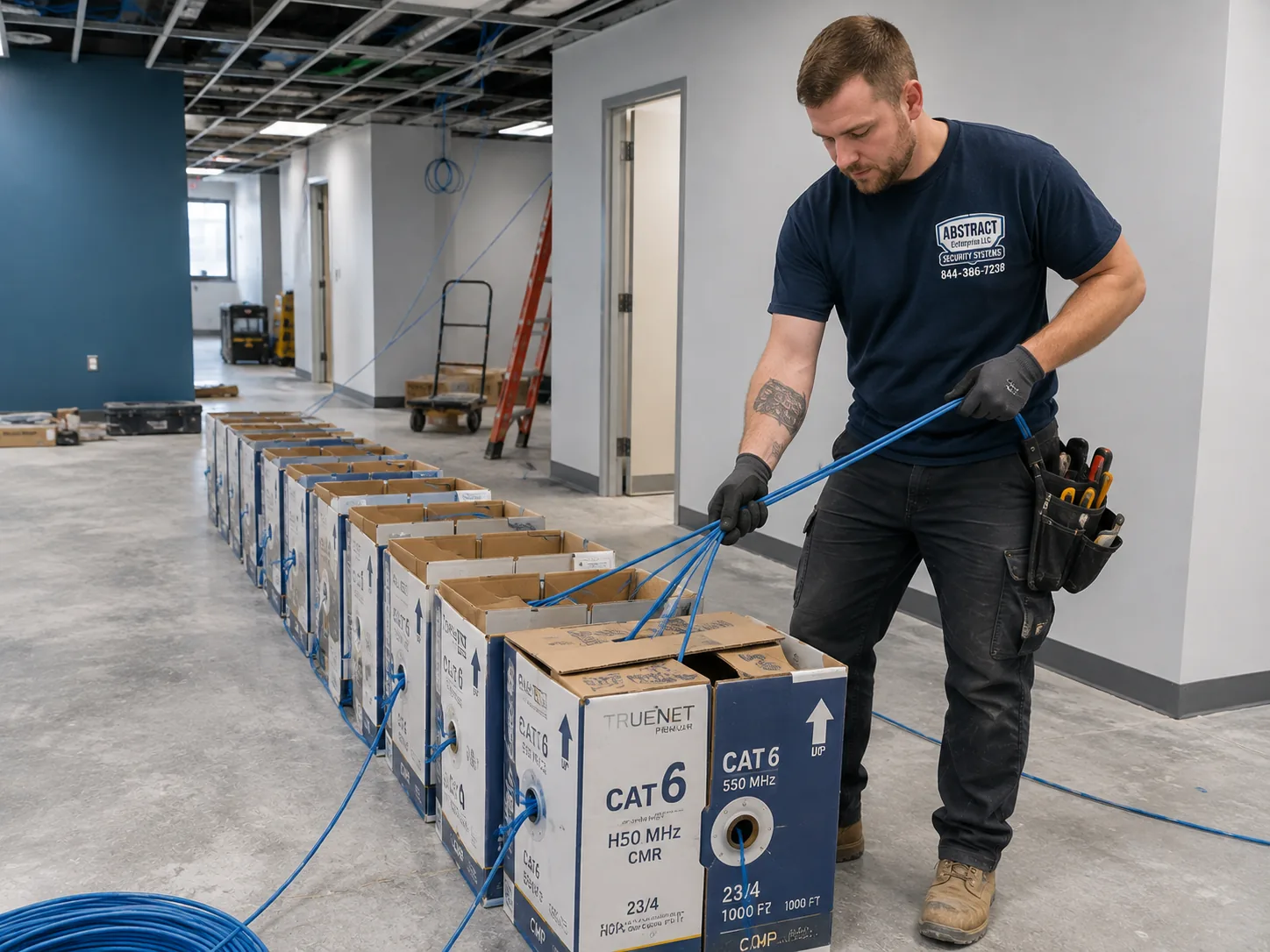
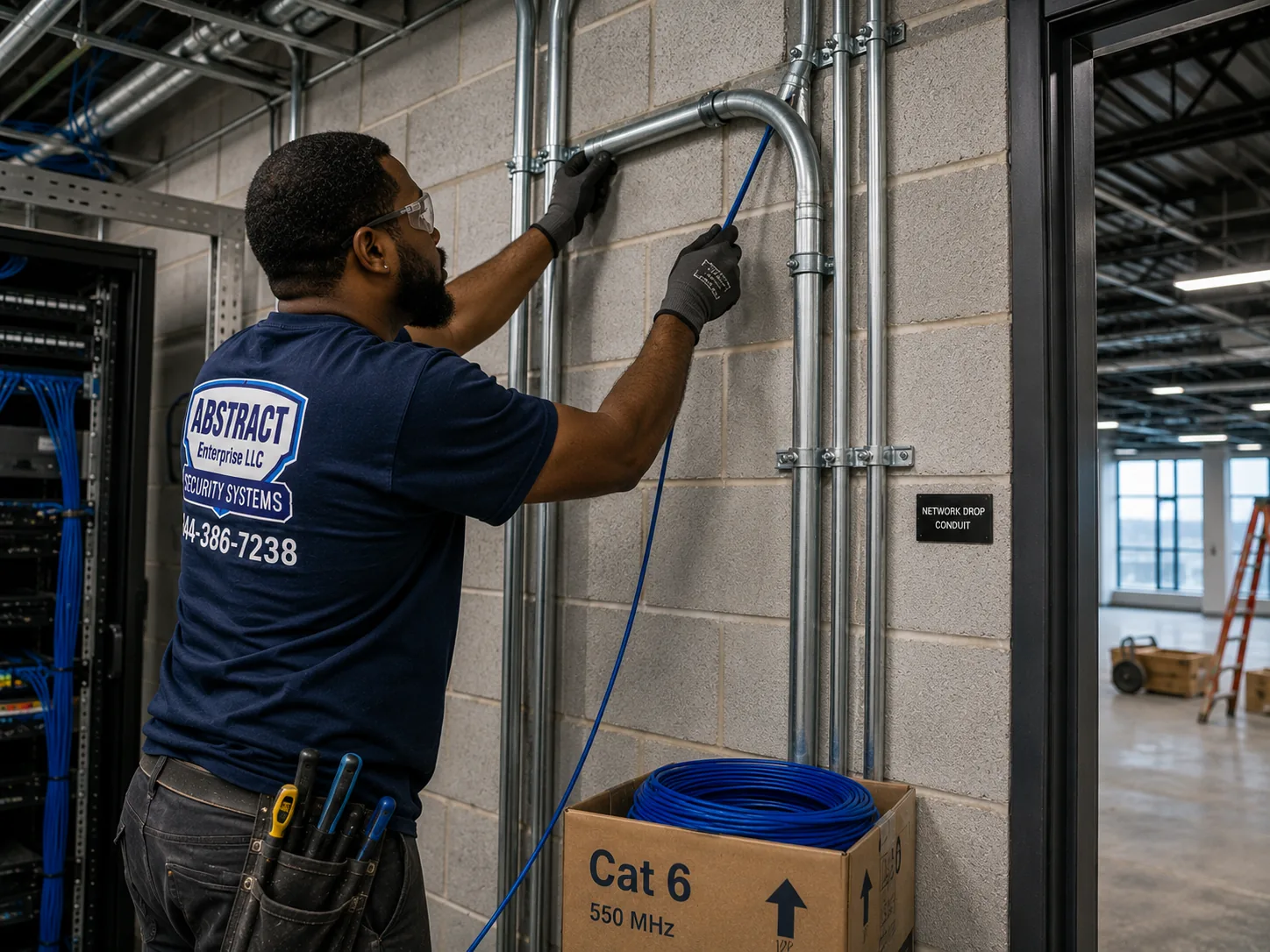
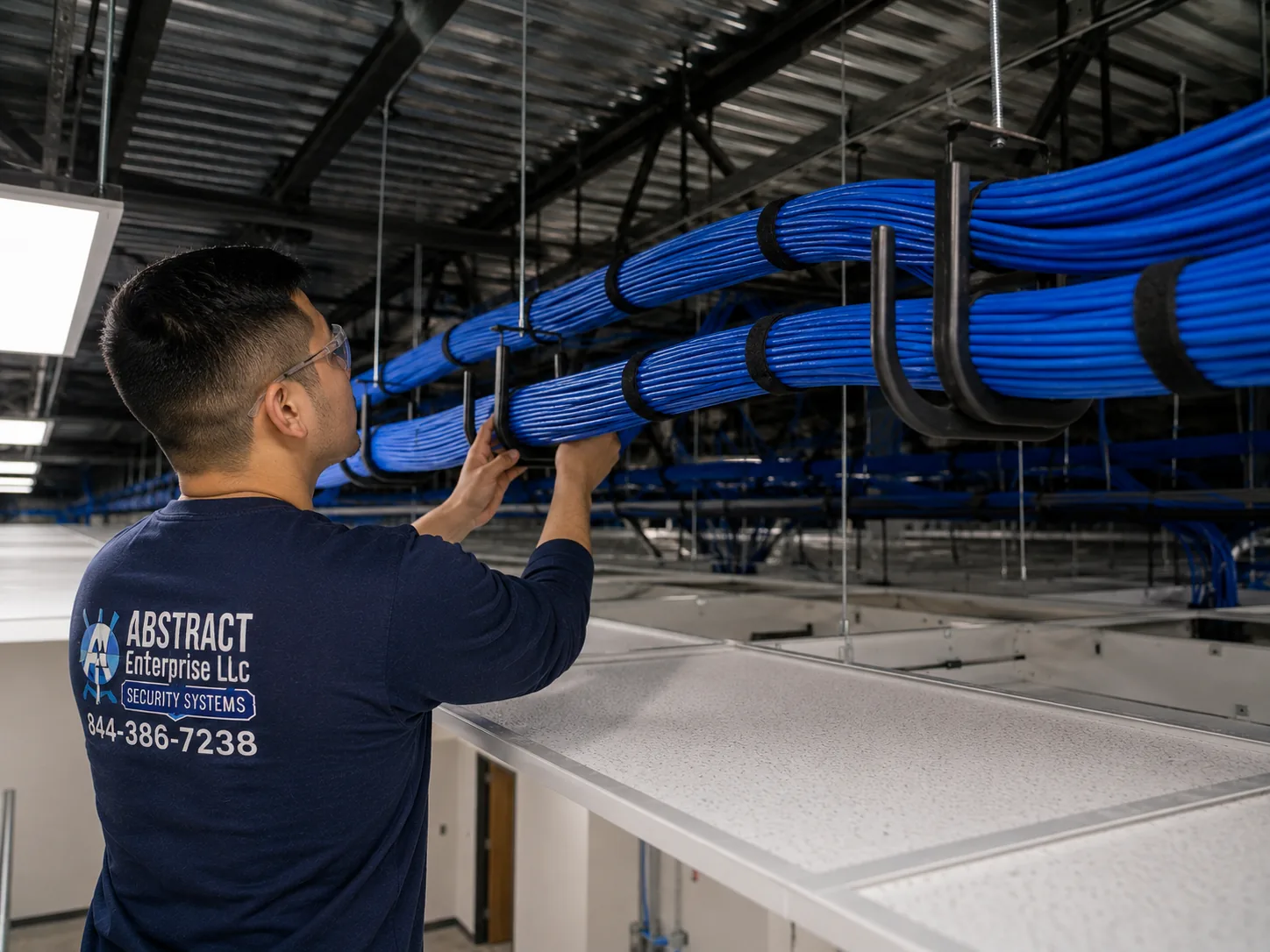
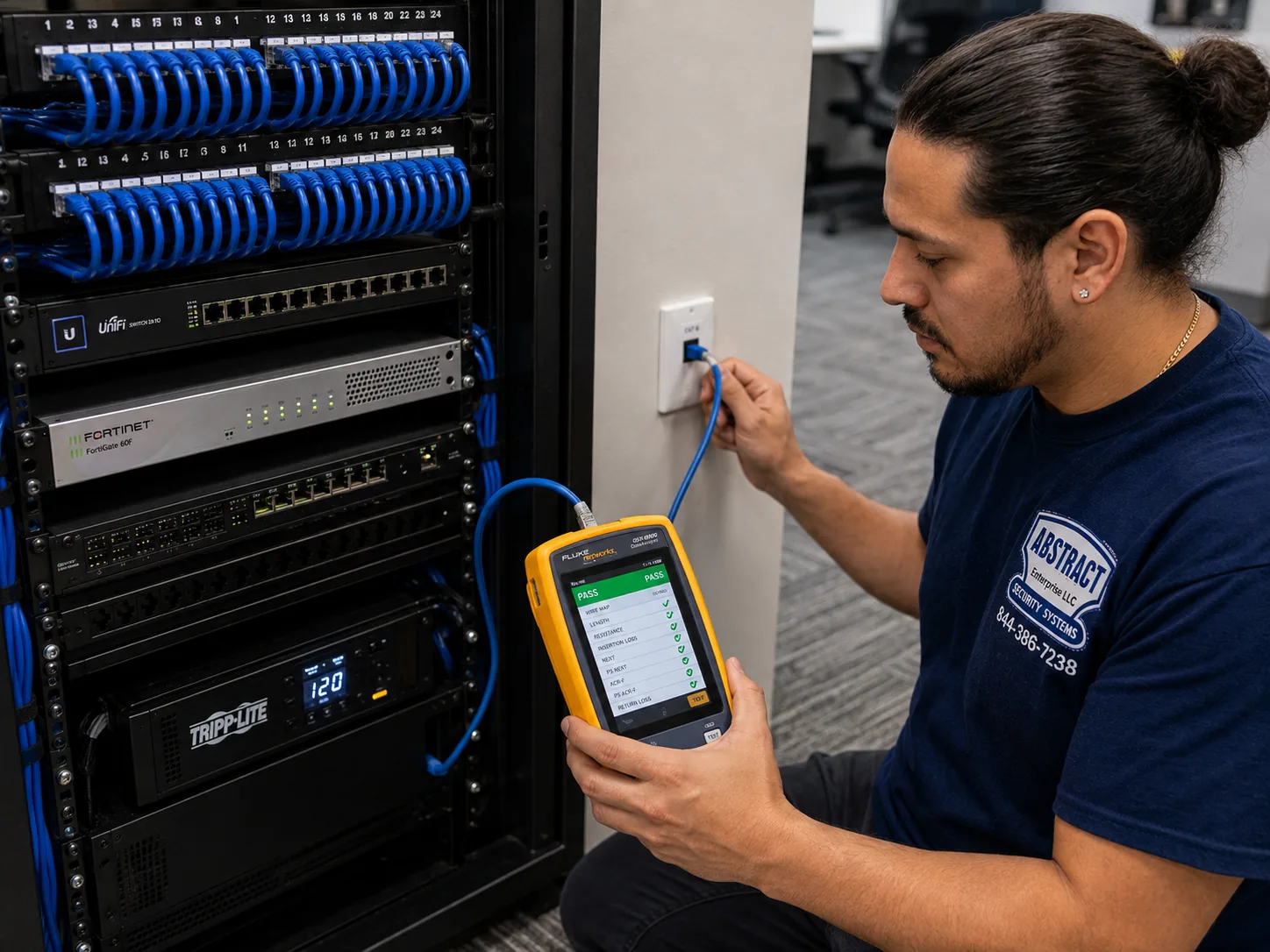
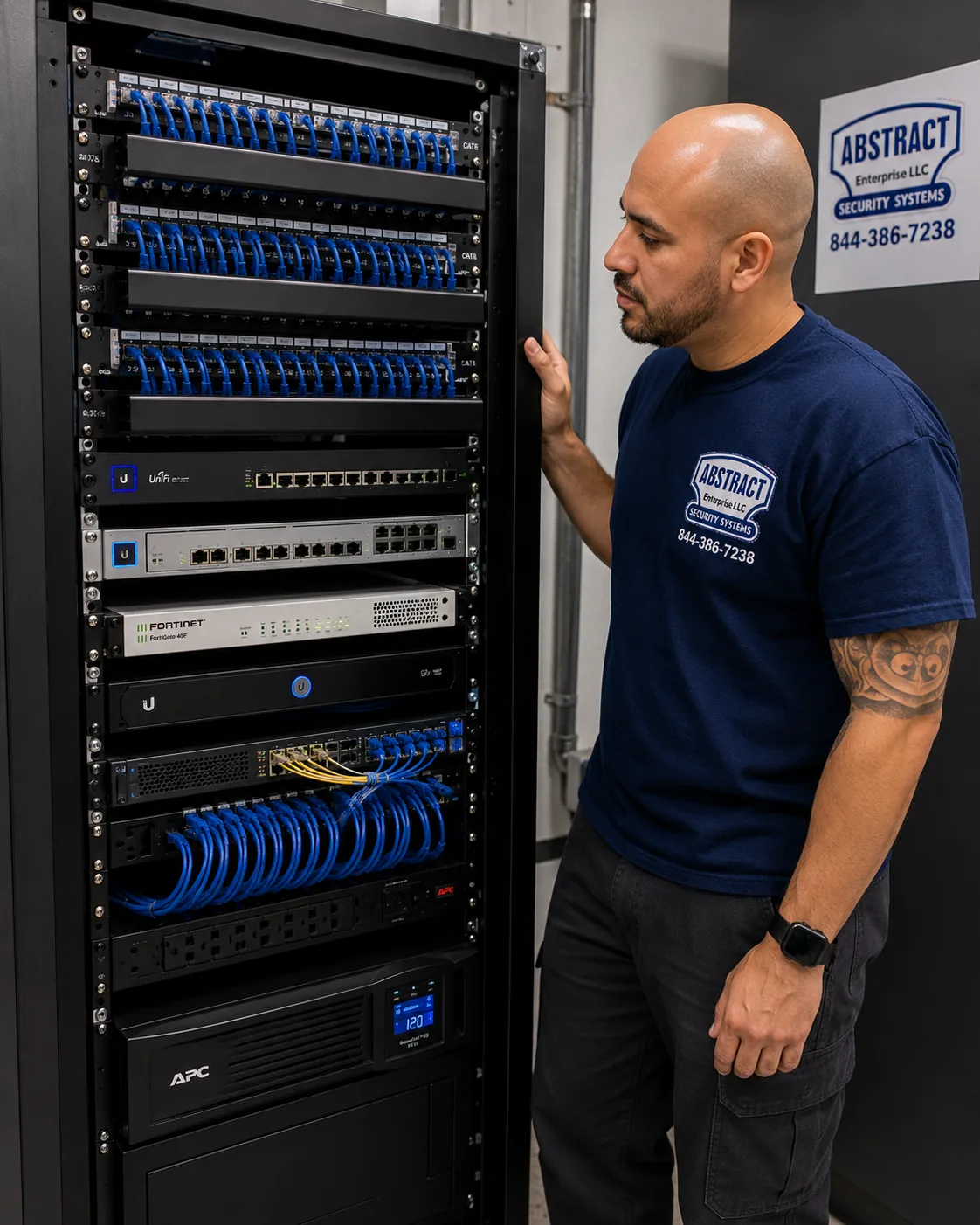
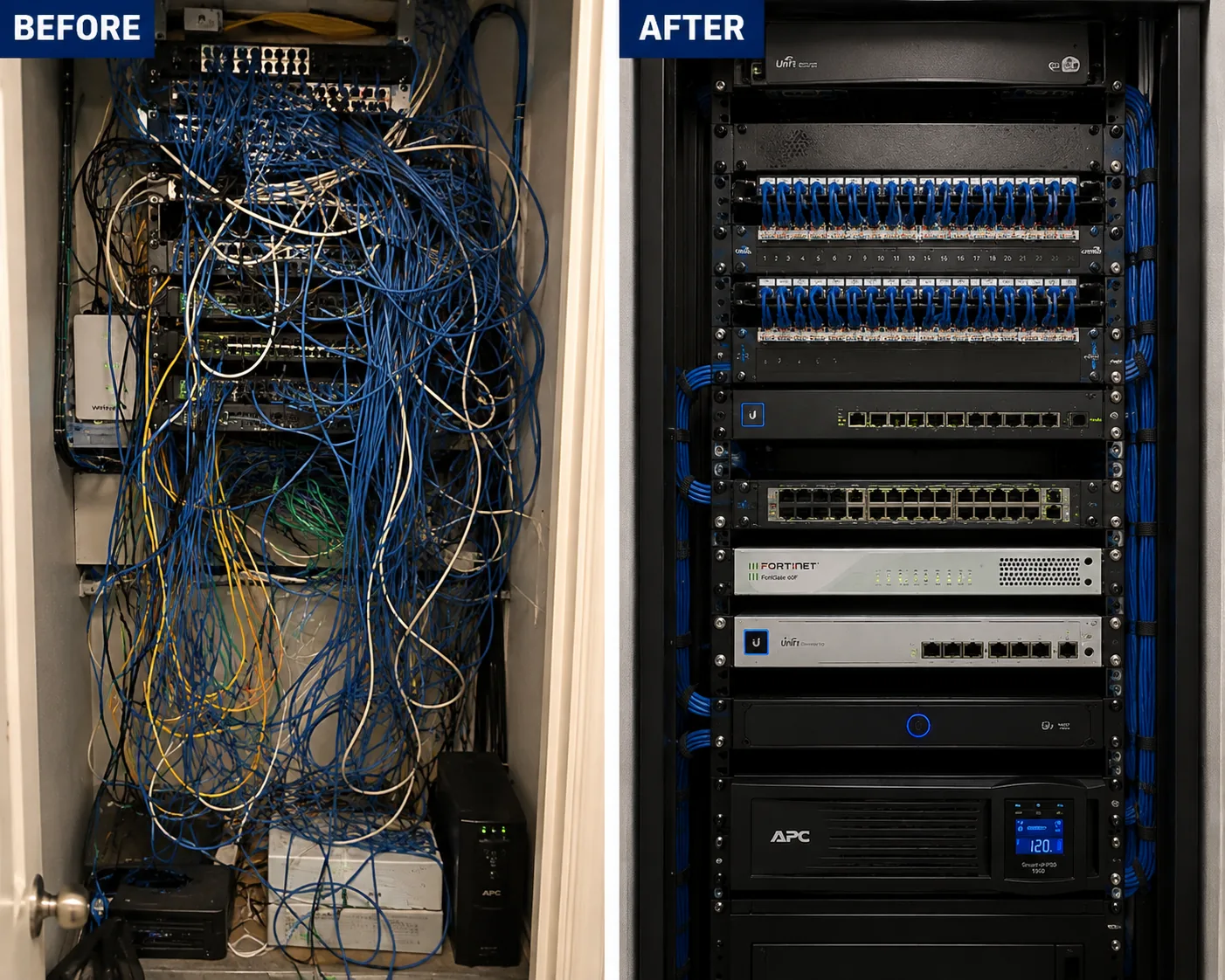
Night Owl sells its camera systems as do-it-yourself kits and, in its own words on retailer question pages, does not provide installation. That leaves a lot of Hudson Valley buyers with a box, a coil of cable and a property that looks nothing like the picture on the carton: an eighteenth-century stone house in Ulster County, a barn three hundred feet from the farmhouse in Dutchess, a 1970s office building on Westchester Avenue, a new warehouse off Route 17K. We install Night Owl DVR and PoE NVR systems across Westchester, Rockland, Orange, Putnam, Dutchess and Ulster, whether you bought the kit yourself or want us to supply it. We measure every cable run, put every camera where the weather cannot get at it, place the recorder where it will survive a storm, and price the work from the Hudson Valley Night Owl price list for your county.
Reviewed and updated November 5, 2026 by Anwar Timothy, NYS license #12000287431 · Sources: Night Owl support articles on wired BNC installation and initial DVR setup, Night Owl answers on Best Buy product Q&A pages, the InstallerNet Night Owl InstallCard FAQ, SafeWise's Night Owl review, Trustpilot reviews of Night Owl, Adorama product listings, 19 NYCRR 195.2 via Cornell LII, HudsonValleyOne (September 2, 2026), Hudson Valley Post (August 2026), Mid-Hudson News (April 14, 2026 and September 26, 2025), WPDH (June 2026), News 12 Westchester (July 15, 2026), Patch, the Croton-on-Hudson police camera registration page, the City of Kingston HLPC guidelines, Central Hudson's Dig Safely page, the Earth Networks 2020 New York lightning report, the Times Union (June 27, 2024), ABC7 (September 2, 2021), HGAR (May 15, 2020), Westfair, Hoodline (February 14, 2026), the Dutchess IDA IBM project summary, Spectrum News (February 27, 2026), USDA 2022 Census of Agriculture county profiles, Mid-Hudson Community Profiles, and Wikipedia entries for the Hudson Valley, the Kingston Stockade District, Huguenot Street, Stewart International Airport, Vassar College, the Vanderbilt Mansion and Newburgh's East End Historic District · Dispatched from 460 E Fordham Rd

Night Owl camera installation in the Hudson Valley is priced by county, by the number of cameras, and by how far each cable has to travel from the recorder. A four-camera Night Owl kit on a wood-frame house with an attic is a short day. The same kit on a fieldstone farmhouse, with one camera on a barn past the 160-foot limit Night Owl gives for its coax runs, is a longer one. Each county has its own Night Owl price page with every line spelled out; the Hudson Valley Night Owl price list covers the region. Send the kit's model number, the town and a few photos, and we will tell you which lines apply before you book. Call (800) 486-0943 or use the form.
The Hudson Valley is not one place, and a Night Owl kit does not know that. Wikipedia describes the region running from the Capital District around Albany and Troy south to Yonkers on the New York City line, and even the people who live here disagree on where it starts and stops; WPDH points out that most people mix up the whole valley with its "Mid-Hudson" stretch of Dutchess, Orange and Ulster. Our Hudson Valley service covers the six counties closest to the city: Westchester, Rockland, Orange, Putnam, Dutchess and Ulster. Inside those six you can drive from a 1970s office tower on the I-287 corridor in White Plains to a 1700s stone house in Hurley in under two hours, and the camera problems change with every exit. The same box from Best Buy or Home Depot, with the same four cameras and the same 60-foot cables, ends up on all of them.
That is the first reason Hudson Valley owners call an installer for a Night Owl system: the kit was designed around an average American house, and very few properties here are average. Night Owl's own support pages say to mount outdoor cameras at least seven feet up, angled slightly down, and to put them under "some type of minimal protection such as an eave or awning," because the cameras are weather-resistant, not waterproof. That is easy on a suburban colonial with deep eaves. It is harder on a Dutch stone house with a shallow roof edge, on a pole barn with no overhang at all, or on a flat-roofed commercial building on Route 59. Night Owl also says the maximum run from a DVR is 160 feet, and that past that distance you need to power the camera where it is mounted. On a two-acre lot with a detached garage, a horse barn and a gate at the end of a long gravel driveway, 160 feet runs out quickly. Those two numbers, seven feet up and 160 feet out, shape more Hudson Valley Night Owl jobs than anything else.
The second reason is the installation itself. SafeWise's review of Night Owl listed "long installation with wires galore" as a drawback, and an eBay reviewer wrote that the box promised a four-hour install that took closer to ten. An Adorama reviewer called the system easy to set up "other than the effort required to route the wires through the attic and or walls." In the valley that effort is real. The region's older houses are often stone, brick or heavy timber, and HudsonValleyOne notes that Ulster County has more Dutch-influenced stone houses than anywhere in the world except the Netherlands. Hurley's ten stone houses, according to New York State Parks, were all built between 1715 and 1790, and the houses on Historic Huguenot Street in New Paltz date to around 1705. Getting a coax cable from an attic to a camera on the outside of a two-foot stone wall is not a weekend job for most owners, and a hole drilled in the wrong place in a house that old cannot be undone.
The third reason is what the cameras are for. Hudson Valley police have spent the last two years asking residents to check their footage. In January 2025, State Police warned residents of Dutchess, Westchester and Putnam counties about targeted residential burglaries, and Patch reported their advice: turn on security systems and cameras and add motion-sensor lighting. Scarsdale police described organized burglars placing trail cameras or surveillance devices outside homes for days before committing burglaries, and a Scarsdale resident found one in the bushes on Bradford Road. In Dutchess, State Police in Poughkeepsie asked residents of Hoofprint Road in Union Vale, Fountain Place and Weatherford Lane in Millbrook, and Horseshoe, Verbank and Maple Hill Roads and Rodrigo Court in the town of Washington to check home cameras between midnight and 5 a.m. after car break-ins. News 12 Westchester reported in July 2026 that Port Chester neighbors' cameras caught someone trying car doors. Mid-Hudson News reported a run of package thefts at a residential complex in the Village of Haverstraw in April 2026. WPDH reported in June 2026 that store cameras caught thefts at businesses including Alimentari Rossi & Sons at Eastdale Village in Poughkeepsie. A camera that is pointed at the sky, washed out by its own night-vision glare, or offline since the last thunderstorm does not help anyone when the call comes.
The fourth reason is the weather and the power, which in the valley are linked. Earth Networks' 2020 lightning report ranked Orange County first among New York counties for lightning pulses, with 275,059 that year and 41 thunder days, followed by Ulster, Westchester and Dutchess. The Times Union reported that storms on June 27, 2024 knocked out power to a combined 60,000 Orange and Rockland and Central Hudson customers, with winds around 60 mph. In the July 4, 2026 storms, Central Hudson reported 669 active outages affecting 41,323 customers across the region by noon the following Sunday. A Night Owl DVR that sits on a bare wall outlet in a basement, with long copper cables running out to a barn and a gate, is exposed to every one of those storms. Where the recorder goes, what it is plugged into, and how the outdoor runs are sealed and protected decide whether the system is still recording when the lights come back.
The fifth reason is the internet, or the lack of it. Night Owl's wired DVRs are only compatible with a wired internet connection, so the recorder has to sit beside the router or have an Ethernet cable run to it. In much of the valley the router is in the one room where the provider's line comes in, and that room is rarely where you want the recorder. Some homes still have no broadband at all: Ulster County announced in September 2025 a state ConnectALL award to bring service to nearly 1,300 unserved households, businesses and community facilities in remote areas, and HudsonValleyOne reported that the Town of Shandaken alone has 2,866 residents across 120 mountainous square miles where even cell service struggles. The good news is that Night Owl's support pages say the DVR does not need internet for basic recording. The work is in setting the system up so it records well locally first and adds remote viewing only where the connection can carry it.
We want to be clear about what our research did not find. We searched for Reddit threads, local news and community posts about Night Owl installations in Hudson Valley towns and found none specific to the brand. We found no public data on how many Night Owl systems are installed in the region, or how they fail. So where this page describes what happens to Night Owl kits on stone walls, barns and long runs, it draws on Night Owl's own published specifications, on the building types and weather the public record describes here, and on how our technicians install camera systems generally. It does not claim any Hudson Valley business or homeowner as our customer.
What owners often add once the cameras are up. Once a Hudson Valley property has a working Night Owl system, the next question is usually the gate or the front door: a camera at the end of the driveway, a video doorbell, or motion lighting, which the State Police specifically recommended in their 2025 burglary warning. Tell us when you book if any of that is on your list, so the cable plan leaves room for it rather than sending someone back to drill through the same stone wall twice.

The calls we move on first are the systems that stopped recording: a DVR that went dark after a thunderstorm, cameras that lost their picture after a power outage, night vision that never came back on, or a phone app that no longer shows anything after a phone upgrade. Before you call, check that the recorder has power and that its fan is running, look at whether one camera is down or all of them, and if you can, note what the recorder's screen says. Then call (800) 486-0943 with the Night Owl model number, the county and what changed. We book within 2 hours of a request and tell you honestly whether the fault sounds like a cable, a camera, a power supply or the recorder before anyone drives out.
The same Night Owl kit gets installed very differently in New Rochelle and in Shandaken. The county shapes the building stock, the distances, the weather exposure, the internet, and the rules that apply before a camera goes up. The table below sets out the pattern we plan around in each of the six counties, drawn from the public sources named on this page. The last column is our working assumption about what a typical job there involves; every property is confirmed on a site walk.
| County | What the public record shows | What a Night Owl install usually involves | County price page |
|---|---|---|---|
| Westchester | Office parks on the I-287 corridor, the Platinum Mile in White Plains, suburban houses, river villages; Hurricane Ida put up to 14 feet of water into parts of Mamaroneck in 2021, per ABC7 | Short to medium runs, attic and garage routing, recorder placed above any flood line, workplace notices for offices | Westchester |
| Rockland | The Palisades Center in West Nyack, about 2,359,541 square feet per Hoodline; apartment complexes such as the Haverstraw complex where Mid-Hudson News reported package thefts | Retail and small-business cameras, entry and mail-area coverage approved by management, suburban houses | Rockland |
| Orange | First in the state for lightning pulses in 2020; warehouses of more than a million square feet in Montgomery near Route 17K; Newburgh's East End Historic District of 2,217 buildings | Surge-protected recorders, long yard and dock runs, brick townhouse routing in Newburgh | Orange |
| Putnam | Reservoir and watershed land covered by New York City DEP rules; county license-plate readers that police say store data on a government server | Wooded lots, long driveways, buried runs planned around watershed rules and an 811 call | Putnam |
| Dutchess | 620 farms averaging 161 acres; Great Estates along the river; IBM's South Road campus; State Police camera appeals for roads in Union Vale, Millbrook and Washington | Barns and outbuildings past 160 feet, locally powered cameras, estate gatehouses, farm stand coverage | Dutchess |
| Ulster | Dutch stone houses, Kingston's five local historic districts, 486 farms averaging 150 acres, remote areas still waiting on broadband | Masonry drilling, historic-district review in Kingston, local-only recording where there is no internet | Ulster |
Westchester is the most built-up of the six counties and the one where a Night Owl kit most often lands on a house it was designed for: a wood-frame colonial, a split-level or a Cape with an attic, a garage and eaves deep enough to shelter a camera. Those jobs are usually about tidy routing and good aim rather than distance. The county's particular hazard is water. ABC7 reported on September 2, 2021 that Hurricane Ida left some Mamaroneck neighborhoods with as much as 14 feet of water, and that many residents saw basements fill and water rise to the first floor. A Night Owl DVR is a small computer with a hard drive in it; it does not survive being underwater. In river towns and flood-prone streets, we put the recorder on the first floor or higher, near the router where possible, and run the camera cables down to it rather than putting it in the basement where the cables happen to come in. Westchester also has a strong habit of neighbors comparing footage. The Port Chester residents News 12 interviewed in July 2026 had cameras that caught someone checking car doors; Croton-on-Hudson police run a voluntary camera registration program and only contact registrants if a crime happens near their camera. Both are reasons to aim at least one camera properly at the street-facing driveway.
Rockland's commercial life clusters around Route 59 and the Palisades Center in West Nyack, which Hoodline reported at about 2,359,541 square feet when a Black Diamond affiliate won it at a February 2026 foreclosure auction. Small businesses in the strip centers around it are a natural fit for Night Owl systems: a handful of cameras on a recorder in the back office, covering the register, the door and the rear delivery entrance. Rockland also has many apartment and townhouse complexes. The package thefts Mid-Hudson News reported at a Village of Haverstraw complex in April 2026 are the kind of problem a mail-room or entry camera addresses, but in a complex the entry, the mail area and the parking lot are usually common property, so the management company or board has to approve the camera, its position and who can see the footage. Rockland had the fewest lightning pulses of the six counties in the 2020 Earth Networks report, at 64,575 over 28 thunder days, but fewer is not none; recorders still go on surge protection.
Orange County is where we take surge protection most seriously. In the 2020 Earth Networks report it ranked first in New York for lightning pulses, with 275,059. It is also where the region's warehouse boom is most visible: HGAR reported in May 2020 that an Amazon distribution center of 1,015,740 square feet at 635 International Drive, at Route 17K and Route 747, and a 1.2 million-square-foot Medline facility were both under construction in the Town of Montgomery. A small Night Owl system is not the right answer for a building that size, and we say so, but the many smaller businesses that grow up around those corridors, the contractors' yards, auto shops, self-storage lots and suppliers, often are. Their cameras sit on poles, fences and the corners of metal buildings, with runs that cross gravel lots and end near the 160-foot limit. At the other end of the county, Newburgh's East End Historic District, which Wikipedia describes as 445 acres and 2,217 buildings, mostly two- and three-story Italianate brick townhouses, brings masonry, narrow lots and attached neighbors. A camera on a Newburgh townhouse has to see the stoop and the street without staring into the neighbor's window.
Putnam is quieter and more wooded, and its properties tend to have long private driveways that wind through trees. That has two effects on a Night Owl install. Branches swaying in wind and the bugs that collect around infrared lights are the classic cause of the "constant alerts for garbage bags rigs bugs tree branches" one Night Owl owner complained about on Trustpilot, so motion zones and camera aim need more care. And a camera at the head of a long driveway is almost always past the 160-foot coax limit from the house, which means powering it at the gate or choosing a different way to get the picture back. Burying a cable along a driveway in Putnam brings in the 811 call that Central Hudson describes as required by New York State law, at least two and no more than ten days before digging, and on reservoir land the New York City DEP watershed regulations, which the city updated in December 2019 for communities in Ulster, Orange, Putnam and Westchester. Putnam's sheriff and police also run their own cameras: Hudson Valley Post reported in August 2026 that the county's license-plate readers store data on a government-owned server controlled by local law enforcement, a reminder that private cameras on a road are part of a wider picture.
Dutchess is the county where distance dominates. The USDA counted 620 farms in 2022, averaging 161 acres, and the river towns hold estates from what guidebooks call the Great Estates Region; the Vanderbilt Mansion National Historic Site in Hyde Park alone keeps 211 of its original roughly 600 acres, with a carriage house and its own old hydroelectric plant. A farm or estate wants cameras at the barn doors, the equipment shed, the gate, the farm stand and the house, and the distances between those buildings often exceed what a single DVR cable can carry. The State Police appeal after car break-ins in Union Vale, Millbrook and the town of Washington, asking residents to check footage between midnight and 5 a.m., describes exactly the footage these properties need: clear night video of a driveway and a parked car, from a camera that is not blinded by its own infrared reflecting off a nearby wall. Dutchess also has its share of busy commercial ground, from IBM's campus at 2455 South Road, where the Dutchess IDA describes a new quantum facility with construction starting in September 2026, to the shopping centers like Eastdale Village where WPDH reported store cameras catching thefts.
Ulster combines the hardest walls with the thinnest internet. Its stone houses, from Hurley to New Paltz to Kingston's Stockade, have walls that a standard drill bit will not cross, and Kingston's historic districts add review: the city's Historic Landmarks Preservation Commission reviews exterior work on historic properties visible from the public right-of-way before a building permit is issued. Ulster's rural towns are also where the Night Owl promise of local recording matters most. Ulster County's September 2025 announcement described nearly 1,300 unserved locations in remote areas waiting for broadband, and Spectrum News reported in February 2026 that the former IBM Kingston campus along Enterprise Drive, 200 acres with more than a million square feet of buildings, now hosts the Ulster BOCES Career and Technical Center and Archtop Fiber on its East Campus. Between those two facts sits the whole range of Ulster jobs: a cabin with no internet where the recorder simply records, and a business on a fiber line that wants to watch its cameras from anywhere.

Most of the time lost on a Night Owl job is lost before the first camera goes up: a kit that turns out to be coax when the owner wanted PoE, a recorder with nowhere to plug in near the router, a camera bought for a barn that is 250 feet away, or a Wi-Fi camera that was never going to reach the garage. A few photos and measurements prevent nearly all of it. Please do not cut into walls, run cable across lawns or open the cameras yourself; just look, measure and send us what you find.
| What to check | Why it matters in the Hudson Valley | What to send us |
|---|---|---|
| The model number on the Night Owl box | It tells us whether the kit is a BNC coax DVR system or an Ethernet PoE NVR system, and whether it belongs to a series that only works with its own cameras | A photo of the box label or the sticker under the recorder |
| Where the router is | Night Owl's wired recorders need a wired connection to the router for remote viewing | A photo of the router and the room it is in |
| Distances to outbuildings and gates | Night Owl gives 160 feet as the maximum coax run from a DVR; past that the camera needs power where it is mounted | Rough paced distances from the house to the barn, garage or gate |
| What the walls are made of | Wood siding, brick, block and fieldstone each take different drilling and fixings | A photo of each wall where you want a camera |
| Eaves and overhangs | Night Owl recommends mounting outdoor cameras under an eave or awning | A photo looking up at the roof edge at each camera spot |
| Attic and basement access | Hidden cable routes usually travel through the attic or along the basement ceiling | Whether there is an attic hatch and how full the attic is |
| Power at the far buildings | A barn or gate camera past the cable limit needs a nearby outlet | Whether the barn or gatehouse has power, and where the outlet is |
| Historic district or board rules | Kingston's HLPC, HOAs, condo boards and landlords may need to approve exterior work | The name of the district or the managing agent's email |
The most useful thing you can do before we arrive is to stand where each camera will go and decide what it has to show. "The driveway" is not enough; it helps to know whether you want to read a license plate at the turn into the drive, see a face at the front door, or simply know when a car has come up the lane. Each of those needs a different camera position. A face at a door needs a camera fairly close and not too high; a plate needs a narrow view at the right angle to the car; a general driveway view needs height and width. Night Owl's minimum of seven feet up protects the camera from being knocked or grabbed, but in a valley yard with sloping ground, seven feet from where the ground is lowest can be much higher than seven feet from where people walk. Walk the yard with your phone camera held where the security camera will hang, and send us the photos.
A camera that looks perfect at noon can be useless at midnight. Night Owl cameras light the scene with infrared, and anything close to the lens, a gutter, a white wall, a branch, a spider web, reflects that light straight back and fogs the picture. Go out after dark and look at each camera spot: is there a porch light shining at it, a tree branch that will hang in front of it in summer, a white post right beside it? In rural Dutchess and Ulster, where there is no streetlight at all, the camera's own infrared does all the work, so a clear view matters even more. Tell us what you see and we will plan positions that still work at night.
Night Owl's support pages list the DVR power supply for wired BNC kits at 12 V, 2000 mA, and the recorder needs a spot near an outlet and, for remote viewing, near the router or an Ethernet run to it. If your router is in a cupboard by the front door and the only sensible place for the recorder is upstairs, tell us; an Ethernet cable between them is part of the plan. If your property has no internet, the system can still record, and we will set it up for local viewing on a monitor. If you are on satellite or a slow rural line, tell us that too, so we set expectations for remote viewing honestly.

These are the Night Owl jobs Hudson Valley homeowners, farm owners, landlords and businesses book us for. Each is priced from the Night Owl price page for your county. Where a job needs something extra, such as a camera powered at a far building or a long Ethernet run to the router, the quote names it before you pay.
The Night Owl kit you bought at a store or online, mounted, wired and set up. We check the model first and tell you if it cannot do what your property needs before we open the box.
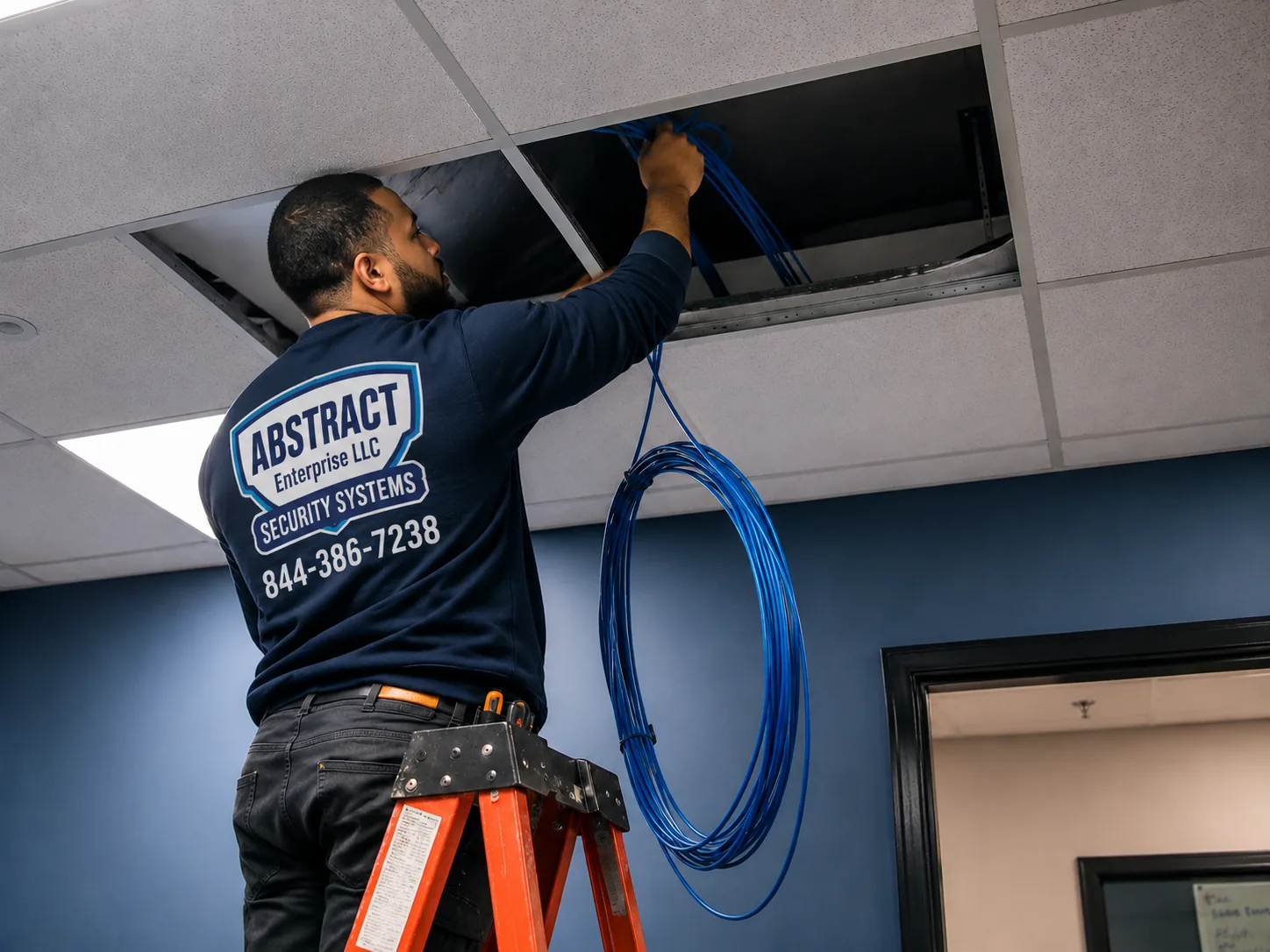
Coax and Ethernet routed through attics, basements, closets and porch ceilings so cables do not run down the face of a stone or clapboard house.
Cameras on outbuildings and driveway gates, planned around the 160-foot coax limit, with local power at the far end where the run is longer.
Replacing an aging analog system with a Night Owl HD-analog DVR on the coax already in the walls, after each old cable is traced and tested.
Night Owl IP systems on Cat5e or Cat6 Ethernet, which carries power and video on one cable, for new builds, renovations and businesses.
The recorder connected to the router, the current Night Owl app on every family phone, and a fix for systems that went dark in the app after a phone upgrade.
Cameras re-aimed away from reflective surfaces, power supplies checked when infrared will not switch on, and motion zones set so branches and bugs stop setting off your phone.
The DVR moved to a dry, cool, surge-protected and battery-backed spot, so the system keeps recording through the outages the valley gets every summer.
Night Owl systems for shops, offices, farm stands and contractors' yards, with cameras where the law expects them to be visible and footage the owner can actually find.

The valley's buildings span three centuries, and each type changes three things about a Night Owl install: how the cable gets from the recorder to the camera, what the camera is fixed to, and who has to agree before we drill. These are the building types the public record describes in our six counties and how we handle each.
Ulster's stone houses, like Hurley's 1715–1790 group and the ca. 1705 houses on Huguenot Street. Thick walls, shallow eaves, historic value. Cable usually goes through the roof framing or an existing opening rather than a new hole through the stone.
The working farms of Dutchess and Ulster, averaging about 150 to 160 acres per the USDA. Long distances, buildings on separate power, dust, animals and mice. Distance planning comes first.
The Great Estates properties along the river, with main houses, carriage houses and gate lodges. Cameras at the gate and drive, cable through old service routes, and discretion on the facade.
Colonials, Capes, split-levels and ranches across Westchester, Rockland and Orange. Attic and basement routing, eaves for shelter, garages and side yards to cover.
Newburgh's East End Italianate brick and the attached houses of Kingston, Poughkeepsie and Hudson-side villages. Masonry fixings, stoops, shared walls and neighbors' windows.
Apartment and townhouse complexes like the Haverstraw complex in the April 2026 package-theft report. Common areas, board approval, and cameras that must not record into other units.
| Building | How cable usually travels | What holds the camera | Who signs off |
|---|---|---|---|
| Stone house | Through the roof framing, a chimney chase or an existing opening; a core-drilled hole only where nothing else works | Wood fascia or soffit where possible; masonry anchors set in the stone, not the mortar | The owner; the HLPC in a Kingston historic district |
| Farmhouse and barn | Attic in the house; between buildings by an approved buried or overhead route, or the far camera powered locally | Barn framing or a mounting block on metal siding | The owner; 811 before any digging |
| Estate and gatehouse | Existing service routes and outbuilding basements; the gate camera often powered at the gate | Soffits and outbuildings rather than the main facade | The owner or estate manager; any easement or conservation terms |
| Wood-frame suburban house | Attic to soffit, basement to rim joist, garage ceiling | Junction boxes or mounts on siding, fixed into framing | The owner; an HOA if its rules cover exterior equipment |
| Brick townhouse | Basement to the rear yard, inside closets, under stair runs | Sleeve or wedge anchors in the brick face | The owner; attached neighbors for anything on a shared wall |
| Complex or condo | Inside the unit only, unless the board approves common-area work | Inside the unit or on board-approved mounts | The board or managing agent |
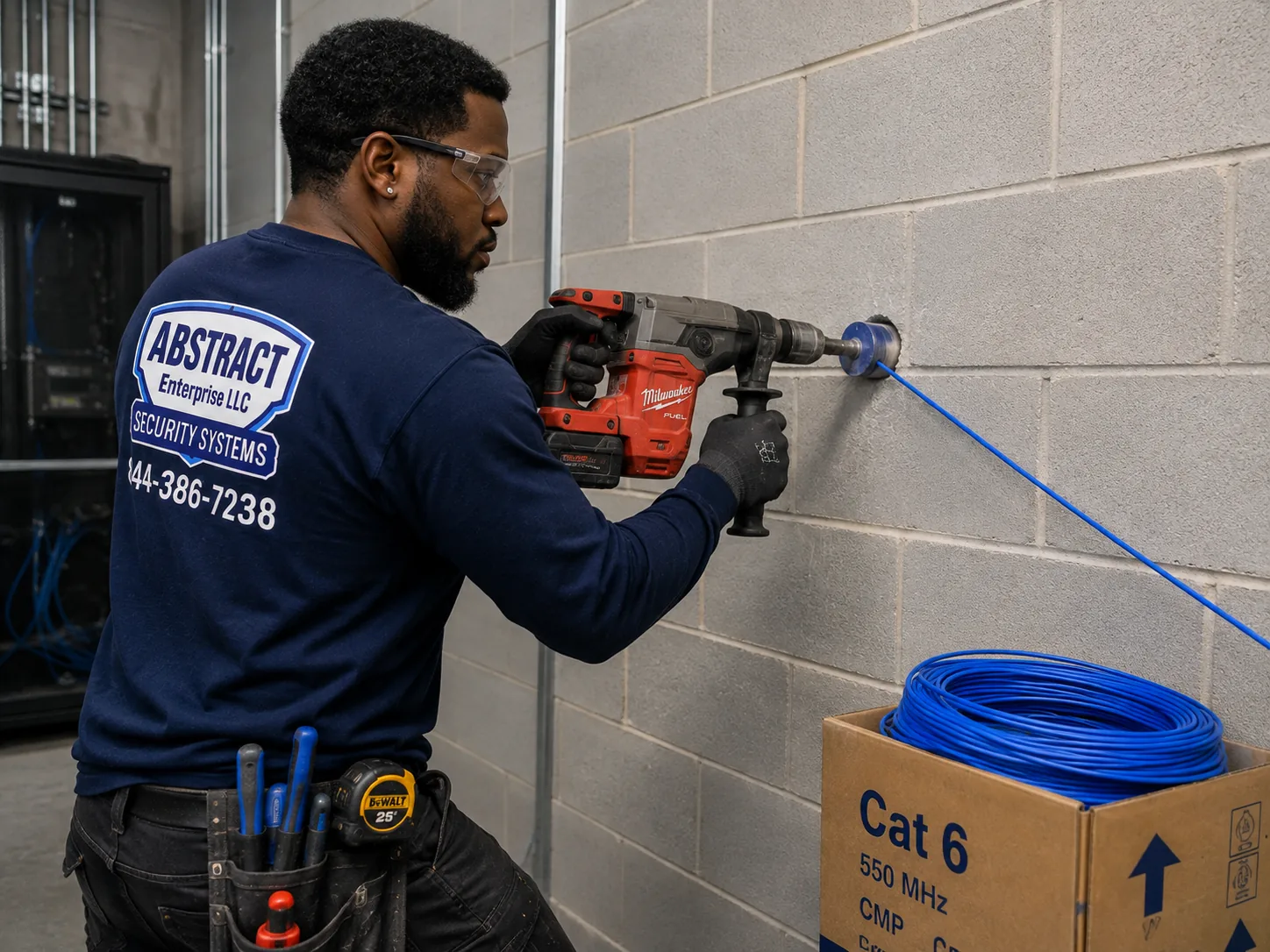
On stone walls. A Dutch stone wall can be well over a foot thick, with rubble and old mortar inside it, and drilling straight through can loosen stones and leave a path for water. Our first choice is never to cross the stone at all. In many of these houses the roof framing sits on top of the stone, and a cable can come out of the attic, run along the inside of the soffit or fascia board, and drop to a camera mounted on wood. Where a camera has to sit on the stone itself, we fix into a sound stone face rather than a mortar joint, use stainless fixings that will not rust and stain, and keep the mount as small as the camera allows. Where a cable truly has to pass through the wall, we use one carefully placed hole, sleeved and sealed, usually low on a rear wall where it will not be seen, and we tell the owner exactly where before we drill.
On barns and outbuildings. A barn is the job most likely to break a Night Owl kit's assumptions. The kit's cables are sized for cameras on the house. A barn camera is often far past 160 feet, on a building with its own electrical service, and in an environment full of dust, moisture and rodents. We look at three options. If the barn is within reach and has a sensible route, we run a heavier outdoor-rated cable along it. If the barn is past the limit but has power, Night Owl's own guidance applies: power the camera at the barn. If the barn needs several cameras, it can be worth putting a small recorder or the right equipment in the barn itself and linking it back to the house. The answer depends on the distance, the power, and how much footage you want from out there, and we put the choice in writing before any cable goes into the ground.
On brick townhouses. Newburgh's East End, Kingston's Rondout and the older blocks of Poughkeepsie hold brick houses built close together, often with a stoop at the front and a narrow yard behind. Brick takes a hammer drill and masonry anchors set in the brick, not the mortar. The harder part is aim. A camera on a townhouse stoop sees the sidewalk, the street and, if it is careless, the neighbor's front window. New York's unlawful surveillance law, Penal Law 250.45, makes it a felony to record a person in a bedroom, bathroom or changing room without consent, and while a front camera aimed at a stoop is nowhere near that line, we aim every camera so it covers your property and the approach to it, not the inside of anyone else's home.


A Night Owl system suits a particular kind of business: one with a handful of entrances and a register or a yard, an owner who wants to see the footage without a monthly contract, and no need for an enterprise video system. The corridors below are named in the news and public sources we used for this page. We describe what those sources say about each place; we do not claim any business there as a client, and we say plainly when a property is too large for a Night Owl kit.
The Platinum Mile, where Westfair reported 1111 and 1129 Westchester Avenue at about 335,000 square feet with I-287 visibility. The towers have their own building systems; tenant suites and the small service businesses around them are Night Owl territory.
West Nyack's megamall, about 2,359,541 square feet per Hoodline, and the strip centers on the corridor around it, full of small shops with a front door, a back door and a register to watch.
Where HGAR reported the Amazon and Medline distribution centers going up in 2020. The smaller yards, contractors and suppliers around them need cameras on fences, poles and metal buildings.
IBM's campus at 2455 South Road per the Dutchess IDA, and shopping centers like Eastdale Village, where WPDH reported store cameras catching thefts at Alimentari Rossi & Sons in June 2026.
The former IBM Kingston campus, now iPark 87, per Spectrum News, and Uptown's Stockade District, an eight-block mix of homes and businesses where the Kingston police camera map is concentrated.
Main streets in villages and cities along Route 9W and Route 9, the roads Chronogram describes connecting the river towns of Rockland, Orange, Ulster and Greene. Storefronts with apartments above and narrow rear lots.
A home system is watched when something happens. A business system is watched every day by someone who needs to find a particular moment quickly: the register at closing, the back door at the time the delivery arrived, the yard on the night a trailer was tampered with. That changes the install. Each camera gets a name the owner recognizes, "Back Door" rather than "Channel 4". The recorder's clock is set correctly and checked against the phone, because footage with the wrong time on it is hard to use. Recording schedules are set so that the cameras that matter after hours record continuously and the ones that only matter in the day do not fill the drive. And the owner is shown, before we leave, how to find and export a clip, because the first time you need to do it should not be the night of an incident. In Kingston, where HudsonValleyOne reported in September 2026 that the police presented a map of city surveillance cameras heavily concentrated in Midtown and Uptown, and residents raised privacy concerns, businesses also benefit from aiming their cameras at their own doors and property rather than out across a public street.

We do not publish stories about a named customer's property unless we can document them, so this is not a tale about one farm. It is the routine our technicians follow when a homeowner hands us a Night Owl box they bought themselves, which is how many Hudson Valley jobs begin.
We open the box on a table, not in the yard. We read the model number and the series on the recorder, count the cameras and cables, and check which kind of system it is: coax to a DVR or Ethernet to an NVR. We look at the camera labels for the temperature rating and compare it with the coldest spot on the property. Then we walk outside with the owner and pace out each camera spot from where the recorder will go. The barn usually decides the day. If it is inside 160 feet, the kit's approach works with a longer cable. If it is past that, we look for an outlet at the barn. We look up at each roof edge for an eave deep enough to shelter a camera, and after that we look at the router, because a recorder that cannot reach it cannot send pictures to the owner's phone. Only when the owner has heard what the kit can and cannot do on that property, and agreed to the plan, do we open a single camera's packaging. Sometimes the honest answer is that the kit should go back to the store and a different one would serve the property better. We would rather say that at the kitchen table than after the holes are drilled.
Who installs it, and how it is priced
Night Owl's representatives have said on Best Buy's question pages that the company does not provide installation with its systems; they point buyers to InstallerNet, using the contact card included with the purchase, to Best Buy's Geek Squad, or to a third-party installation company. That last group is where a licensed local installer like us comes in. In New York, the person installing a camera system used to watch for intrusion or theft needs a state license under 19 NYCRR 195.2, so whoever you choose, ask for the license number. We install Night Owl kits across Westchester, Rockland, Orange, Putnam, Dutchess and Ulster under NYS license #12000287431, whether you bought the kit or we supply it.
Night Owl does not include installation in the kit price; it is a separate service from whoever does the work. For a four-camera system, the price depends on three things: your county's rate, whether each camera is an easy run from an attic or a hard one through masonry or out to an outbuilding, and what extras you want, such as hidden routing, a recorder moved near the router, or app setup on several phones. Each line is published on the Night Owl price page for your county, so you can add up a four-camera job yourself before calling. Send us the kit model and photos of the four spots and we will tell you which lines apply.
According to the InstallerNet FAQ on its Night Owl site, activating an InstallCard means answering a detailed questionnaire that sets the installation cost, each install comes with a lifetime installation labor warranty, and if the warranty does not apply, a trip charge and hourly rate apply. That model works well for a straightforward install on a standard house. Where a questionnaire cannot see the property, a stone wall, a barn past the cable limit, a router in the wrong room, the price and scope can change on the day. Hiring a local installer directly means someone looks at your photos or your property first and writes a quote that already includes those conditions. Either way, compare what is actually covered, not just the headline price.
Mostly three things: cable routing, placement and setup. SafeWise flagged Night Owl's "long installation with wires galore," and an eBay reviewer found a promised four-hour install took about ten. On a valley property the hours go into getting cable through old walls without leaving it on the outside of the house, finding eaves that shelter each camera, and solving the distance to outbuildings. Placement is the part people underestimate: a camera that looks right in daylight can be blinded at night by its own infrared bouncing off a gutter. Setup means a recorder that records the right things, an app that works on every phone, and motion alerts that do not go off for every branch. If you are comfortable on a ladder with a drill and your house has an easy attic, a DIY install can be fine; if not, those are the hours you are paying for.
Weather and mounting
Yes, if they are rated for it and mounted properly. One Night Owl wired model is rated to operate from -4°F to 140°F, and ratings vary by model, so we check yours against the coldest exposed spot you want covered. The bigger issue is water. Night Owl describes its cameras as weather-resistant, not waterproof, and recommends mounting outdoor cameras under some type of protection such as an eave or awning. We mount under eaves wherever the view allows, seal every connection and wall penetration, and leave a drip loop in the cable so water runs off the bottom of the loop instead of following the cable into the camera or the house. Ice dams and snow sliding off roofs are another valley hazard, so we keep cameras out of the path of falling snow from roof edges.
Cable, distance and old wiring
It can, but not on the kit's normal setup. Night Owl has stated that the maximum run from the DVR is 160 feet, and that if you extend further you need to power the camera where it is mounted. At 250 feet, that means the barn camera gets its power from an outlet at the barn, and only its video travels back to the house. If the barn has no power, there are other routes, such as a small recorder or network equipment at the barn, and each has trade-offs in cost and complexity. We pace the distance, check for power at the barn, and put the options in the quote with the route the cable will take and whether it needs to be buried, which brings in an 811 call before digging.
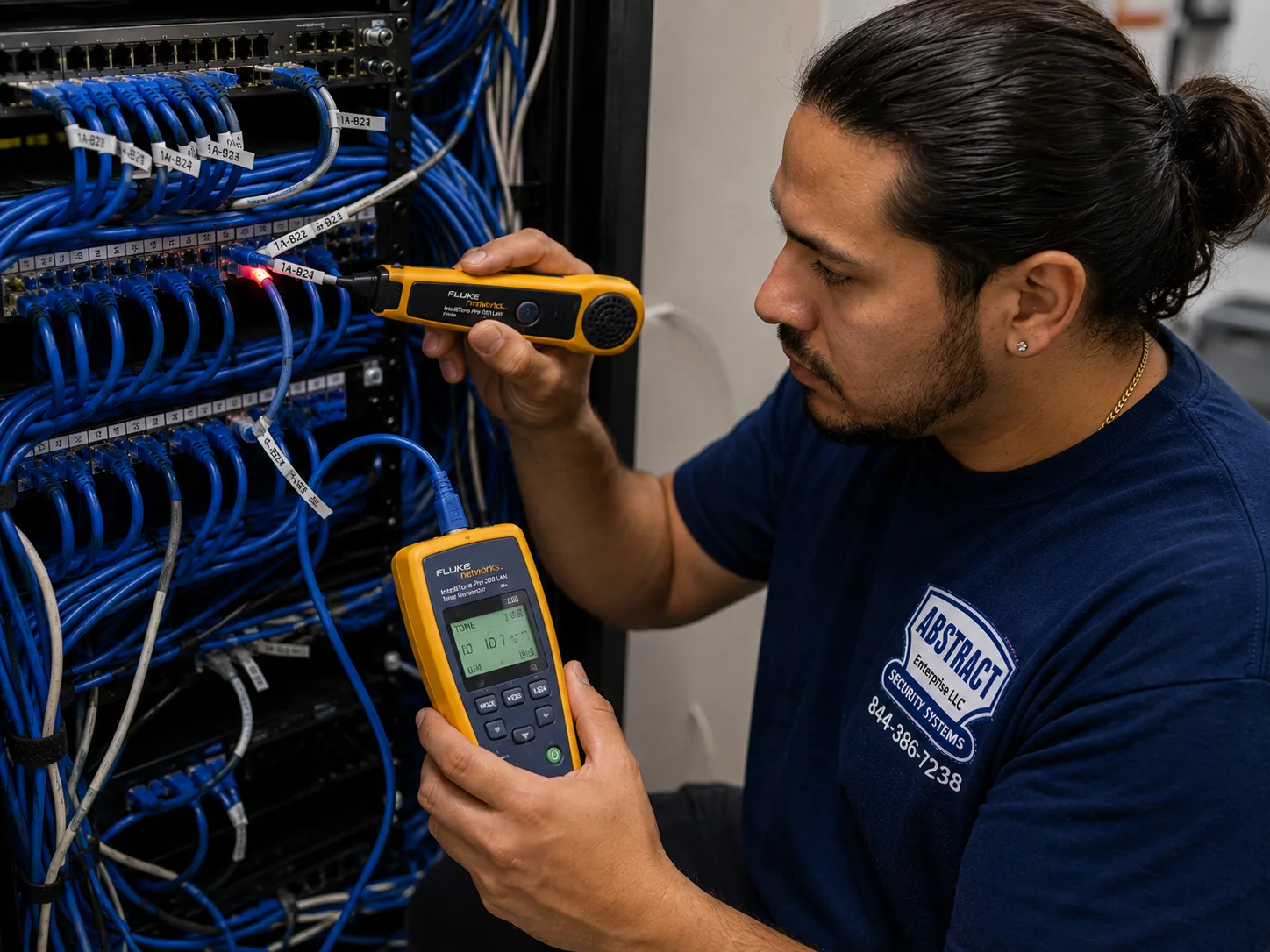
It depends on which Night Owl kit. Night Owl's HD-analog DVR systems can be integrated with existing coaxial cabling, and Night Owl has said owners of older DVR kits can keep their BNC cabling and simply swap the cameras and the DVR. It recommends a minimum of 24 AWG cable. A PoE NVR kit is different: Night Owl says those use Ethernet, Cat5e or Cat6, to carry both power and video, and that older BNC coax will not work with a PoE NVR. So before you buy, decide whether you are keeping the coax. Before we reuse it, we trace each old cable to see where it really runs, test it, and replace any length that is damaged, spliced in an attic or chewed in a barn.
Not always. Some Night Owl kits use cameras and recorders specific to one series; a Slickdeals listing for a DP2-series kit noted that its cameras and DVR are not backward compatible with other Night Owl wired products. Coax cameras will not work on a PoE recorder, and Ethernet cameras will not work on a coax DVR. Before you buy extra cameras, send us the model number from the sticker on your recorder and the model of the camera you are considering. We check the series and the recorder's free channels before anything is ordered, so you do not end up with a camera that cannot be added.
Recording, internet and the app
Yes. Night Owl's support pages say the DVR does not need internet for basic operation; it records to its own hard drive. You only need to connect it to your router to view the cameras remotely on a phone or computer. So when a rural connection drops, the cameras keep recording; what stops is the live view and the alerts on your phone. We set the system up so local recording is the foundation, connect a monitor at the recorder if you want to watch on site, and then add remote viewing so it reconnects on its own when the internet comes back.
The cameras on Night Owl's wired DVR and NVR systems connect to the recorder by cable, and the recorder connects to your router by an Ethernet cable; Night Owl's answers on Best Buy describe the DVR as compatible only with a wired internet connection, and SafeWise noted the DVR it reviewed had no built-in Wi-Fi. That means the recorder has to sit near the router or have an Ethernet run to it. In many valley houses the router is wherever the provider's line comes in, so we either place the recorder there, if the spot is dry and cool, or run one Ethernet cable from the router to wherever the recorder belongs. Night Owl also sells separate wireless lines, which have their own limits on distance and walls.
Usually it can. A Night Owl owner wrote on Trustpilot that after a phone upgrade they could no longer view their cameras because the app they had been using was no longer available. Apps change; the recorder and cameras usually still work. We check the recorder's model and firmware, find which current Night Owl app supports it, update what can be updated, and re-add the system to each phone. Where an old recorder is no longer supported by any current app, we tell you, and the choice is local viewing only, or replacing just the recorder and keeping the cameras and cable if they are compatible.
One Night Owl owner on Trustpilot complained about "constant alerts for garbage bags rigs bugs tree branches," and on wooded valley lots the problem is common. The fixes are physical first and settings second. We re-aim cameras so swaying branches and the sky are not in the motion area, move cameras away from spots where insects gather around the infrared lights, and trim nothing without your say-so. Then we set motion zones to cover only the driveway, path or door you care about, adjust sensitivity, and where your model supports it, switch on person or vehicle detection. Fewer, better alerts are the goal; an alert you have learned to ignore is no alert at all.
Not necessarily. Night Owl's own setup guidance suggests that if a camera's night vision LEDs do not come on, the fix may be plugging the camera directly into its power adapter, bypassing the power splitter. Infrared draws extra power, and a weak supply or a long run can leave enough power for the daytime picture but not for the night lights. We check the supply, the splitter, the connections and the cable length to that camera. If those are sound and the infrared still fails, the camera itself is the problem, and we tell you whether a replacement from the same series will work with your recorder.
Historic houses and the rules
Possibly, and it is worth asking before anything goes on the outside. The City of Kingston's guidelines say exterior work on historic properties visible from the public right-of-way is reviewed by the Historic Landmarks Preservation Commission before a building permit is issued, and its ordinance bars any material change in a property's appearance in a landmark district without approval. Kingston has five local historic districts: the Stockade, Rondout-West Strand, Chestnut Street, Fair Street and Ponckhockie. We found nothing that says whether a small camera on its own triggers review. So we ask you to check with the city, and we design for the least visible result: cameras under eaves or on rear and side walls, cables inside the house, and finishes that blend with the building.
If you install it yourself on your own home, a state guide to permit requirements says no state license is required for homeowner self-installation. If you pay someone to do it, New York's rules apply to them: 19 NYCRR 195.2 requires a state license for a CCTV or video surveillance system used to detect or monitor intrusion, break-in, theft or movement, and licensing courses in the state warn that unlicensed installers can be fined heavily. Getting that license, according to one installer's summary, means completing 81 hours of training, passing a background check and applying to the state. Ask any installer for the license number and check it. Ours is NYS license #12000287431.
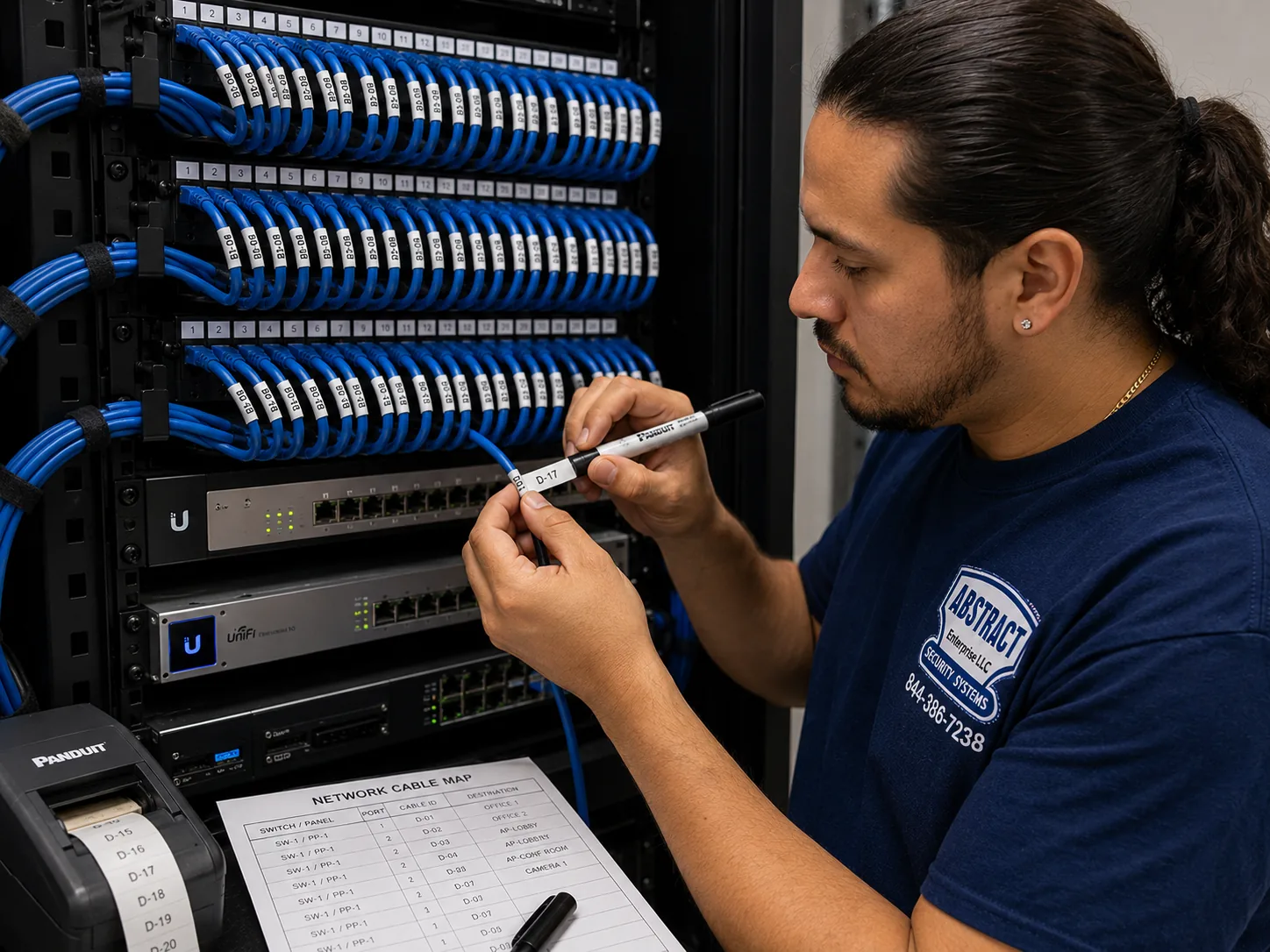
These are the Night Owl system types and supporting parts we fit on Hudson Valley homes, farms and businesses. Night Owl describes itself as the "#1 Wired Security Brand" in the United States and says its systems do not require a mandatory monthly subscription or long-term contract, with optional cloud backup. We install the kit you bought or supply one; either way, the model has to suit the property, and we say so if it does not.
Night Owl's coax systems, with each camera on its own BNC cable to the DVR. The right choice where coax is already in the walls, or for short runs on a frame house.
Night Owl IP systems on Cat5e or Cat6, one cable per camera carrying power and video. Best for new runs, renovations, businesses and anywhere you may add cameras later.
Night Owl models with built-in spotlights for driveways, yards and barn doors, where light at night both deters and gives color footage. Placement keeps the light out of neighbors' windows.
Compact cameras for soffits, porches and indoor corners, where a small housing suits an older house or a storefront better than a long bullet camera.
Night Owl's 12 V adapters and splitters checked and sized, and local power at barns and gates for cameras past the 160-foot coax limit.
Surge protection and a battery backup unit for the recorder and router, so a summer storm or a short outage does not stop recording or corrupt the drive.
Hard drives checked or replaced and recording settings chosen so the system keeps as many days as you need, with the important cameras recording continuously.
The recorder on a monitor for on-site viewing, the current Night Owl app on each phone, and remote viewing set up where the property's internet allows it.
| Question | Wired HD-analog DVR | PoE NVR |
|---|---|---|
| Cable | BNC coax per camera; Night Owl recommends at least 24 AWG | Ethernet, Cat5e or Cat6, per camera |
| Power to the camera | From a 12 V adapter or splitter at the recorder end | Through the Ethernet cable from the recorder or a PoE switch |
| Works with old coax in the walls | Yes, after testing | No; Night Owl says BNC coax will not work with a PoE NVR |
| Distance limit we plan around | 160 feet from the DVR per Night Owl; past that, power the camera locally | Ethernet distance limits apply; far buildings need a switch or other link |
| Best fit in the valley | Replacing an old analog system on a house with coax already in place | New wiring, businesses, renovations, and systems likely to grow |
Some buyers ask whether they would be better off with ADT, Ring or SimpliSafe instead. Those companies are best known for monitored alarm systems, video doorbells and self-install security kits, and their cameras typically rely on Wi-Fi and cloud plans. A Night Owl wired system is a different idea: cameras on cables, recording locally to a recorder on your property, with no mandatory monthly fee. On a stone house where Wi-Fi does not pass through the walls, or a farm with a barn far from the router, wired recording is often the more reliable choice. What none of those brands provides is someone in your yard working out how to get a cable through two feet of fieldstone or past the 160-foot mark to the barn; that is what a local licensed installer adds, whichever brand you choose.

We could not capture Google's AI Overview, People Also Ask boxes or related searches for this region from our build environment, so we are not quoting them. What follows are claims we see repeated in quick online answers, retailer pages and national cost guides about Night Owl systems and camera installation, set against Night Owl's own published guidance and what Hudson Valley properties demand. National marketplaces such as Angi, HomeAdvisor and Fixr publish camera installation cost ranges that feed many of those answers; they are useful as a rough idea, but they are not a quote for a barn in Dutchess or a stone house in Ulster.
Quick answers sometimes assume a camera brand installs its own products. Night Owl's representatives have said plainly on Best Buy's question pages that Night Owl does not provide installation with its systems, and they point buyers to InstallerNet's InstallCard, to Geek Squad, or to a third-party installer.
That matters in the valley because the installer you pick has to be licensed in New York for this kind of work. 19 NYCRR 195.2 covers CCTV and video surveillance systems used to detect or monitor intrusion, theft or movement.
So the real question is not whether Night Owl installs, but who does, and whether they hold a state license. Ask for the number; ours is NYS license #12000287431.
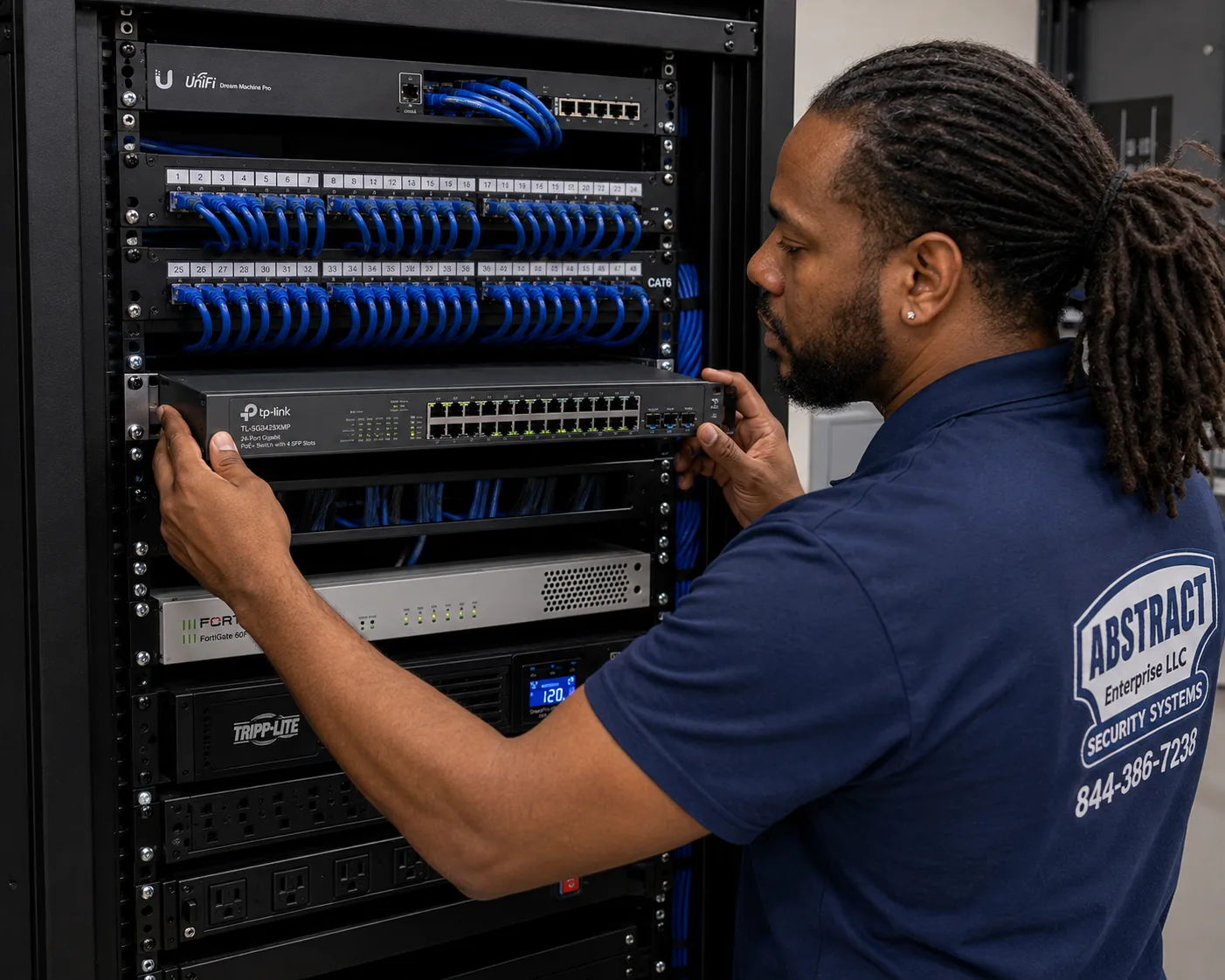
It is easy to assume one brand means one system. Night Owl's own answers say older coax cables will not work with its PoE recorders, which need Cat5e or Cat6 Ethernet, and a Slickdeals listing for a DP2-series kit noted that its cameras and DVR are not backward compatible with other Night Owl wired products.
On a Hudson Valley house that has had a camera system for years, this is where money gets wasted: a new PoE kit bought to "upgrade" a house full of coax, or extra cameras bought that the existing recorder cannot accept.
Before you buy, read the model number on the recorder and the box. We check series, cable type and free channels before anything is ordered or mounted.
Some answers suggest buying a longer cable and carrying on. Night Owl has stated that the maximum run from the DVR is 160 feet, and that past that you need to power the camera where it is mounted. Each camera in its coax kits comes with a 60-foot cable, extendable to that limit.
On valley farms, where the USDA counts Dutchess farms averaging 161 acres and Ulster farms averaging 150, and on wooded Putnam lots with long driveways, 160 feet is often reached before the barn door or the gate.
The fix is planning, not a longer cable: power at the far building, a different link back to the house, or a camera placed closer. We pace every run before we promise any of them.
Product listings use weatherproof language freely, and quick answers repeat it. Night Owl's own guidance is more careful: the cameras are weather-resistant, not waterproof, and should be mounted under some type of protection such as an eave or awning.
Hudson Valley weather tests that distinction every year, with freeze-thaw cycles, sideways rain and snow sliding off roofs. Old stone houses and pole barns often have little or no overhang.
We look for shelter at every spot, seal every connection and wall penetration, and leave drip loops so water runs off the cable instead of into the camera. Where there is no eave, a small hood or a different spot does the job.
Many quick answers blur recording with remote viewing. Night Owl's support pages say the DVR does not need internet for basic operation; it records locally, and the router connection is only needed to view the cameras remotely on a phone or computer.
That is good news for the parts of the valley still waiting on broadband, such as the nearly 1,300 remote locations Ulster County's ConnectALL award is meant to reach, or Shandaken's mountainous 120 square miles.
We set those systems up to record reliably on site, with a monitor at the recorder if you want one, and add remote viewing only where the connection can carry it.
Box copy and some quick answers suggest a few hours' work. SafeWise listed "long installation with wires galore" as a Night Owl drawback, and an eBay reviewer said a promised four-hour install took about ten. An Adorama reviewer called setup easy "other than the effort required to route the wires through the attic and or walls."
In the valley, the routing is the job. Thick stone walls, balloon-framed farmhouses, finished basements and outbuildings on separate power all add time, and none of that is on the box.
We price each run on its own line, so the extra time a hard wall takes is visible in the quote rather than a surprise on the day.
National cost guides tend to give one range for a camera install, and AI answers repeat it as if it applied to any address. In practice, our own rates vary by area, and within the Hudson Valley each county has its own rate.
Distance, travel and the building matter even more. The same four cameras cost different amounts to install on a Westchester colonial with an open attic and on an Ulster fieldstone farmhouse with a barn past the cable limit.
That is why each county has its own Night Owl price page with every line listed, and why we never quote a number that is not on those pages.
Send the Night Owl model number, the town and a few photos of the walls, eaves and outbuildings, and a technician will tell you whether the kit suits the property, which runs will need extra work, and which lines of your county's price page apply. Call (800) 486-0943, message us on WhatsApp, or use the quick form.
Every Hudson Valley Night Owl job follows the same eight steps, whether it is four cameras on a Rockland split-level or twelve across a Dutchess farm. The order matters most on large and old properties, where a run measured carelessly or a recorder put in the wrong room is the usual cause of a system that disappoints.
The Night Owl model number or a photo of the box, the county and town, and photos of the walls, eaves and outbuildings. We match the job to your county's price page before you book.
We pace each run from the recorder, flag any past the 160-foot coax limit, check for power at far buildings, and choose an eave or awning for every outdoor camera.
Historic-district review in Kingston, board or landlord approval in complexes, workplace notices for businesses, and an 811 call if anything has to be buried.
Dry, cool and near the router or on an Ethernet run to it, above any basement flood line, on surge protection and battery backup.
At least seven feet up, angled slightly down, sheltered, with fixings chosen for wood, brick, block or stone, and aimed away from neighbors' windows.
Coax or Ethernet through hidden routes, every penetration sealed, drip loops at the cameras, and each run tested before its camera goes on.
Drive formatted, clock set, cameras named, recording schedules and motion zones set, and the current Night Owl app on each phone.
Every camera checked after dark, both ends of every cable labelled, and a written map of runs, settings and logins left with you.

Across six counties, people give directions by landmarks more than by street numbers. These are the ones we use when we plan a route, and each sits among the kinds of properties this page describes.
An eight-block, 32-acre area of Uptown Kingston on the National Register since 1975, with Colonial Dutch stone houses on all four corners of Crown and John Streets, per Wikipedia.
New Paltz's street of stone houses dating to around 1705, the kind of thick-walled building where camera cable is planned around the stone, not through it.
On 1,552 acres in the towns of Newburgh and New Windsor, home of the 105th Airlift Wing since 1983, per Wikipedia; the warehouse corridor of Route 17K runs nearby.
About 1,000 acres and more than 100 buildings in Poughkeepsie, founded in 1861, with its Main Building of 1865 designed by James Renwick Jr., per Wikipedia.
The Great Estates landmark, 211 of an original roughly 600 acres, mansion built 1896–1899, with its carriage house and hydroelectric plant, per Wikipedia.
Rockland's megamall on Route 59, about 2,359,541 square feet, sold at a February 2026 foreclosure auction, per Hoodline, at the center of the county's retail corridor.
We cover all six counties, each with its own Night Owl price page: Westchester County, Rockland County, Orange County, Putnam County, Dutchess County and Ulster County. South of the valley, the same Night Owl service runs in the Bronx and across New York City.
Night Owl installation in the Hudson Valley is priced at your county's rate, line by line, from the published Night Owl price pages. We do not print a single regional number here, because a single number would be wrong for most properties: the six counties carry different rates, and within each county the property moves the total far more than the brand of the kit. The full list, with every line, lives on the Hudson Valley Night Owl price page, with a page for each county linked above and below.
| Price driver | Why it matters here | How it shows on the quote |
|---|---|---|
| Your county | Each of the six counties has its own rate, reflecting travel and access | The county's Night Owl price page sets every line |
| Number of cameras | Each camera is its own mount, run and setup | A line per camera |
| Run difficulty | An open attic is quick; stone, brick and finished basements take longer | The wall type and route for each run |
| Distance to far buildings | Runs past the 160-foot coax limit need local power or another link | A separate line for the outbuilding or gate camera |
| Recorder placement | A recorder moved near the router, or an Ethernet run to it | A line for the router connection |
| Kit supplied or bought by you | Bringing your own kit means labor-only lines | Equipment lines appear only if we supply it |
| Setup extras | App on several phones, motion zones, monitor at the recorder | Listed individually so you can choose |
| Rules and paperwork | Historic-district review, board approval, 811 for buried runs | Noted in the scope; we tell you who to ask |
Start with the number of cameras and the county. Then go through each camera and ask the questions the table asks: what is the wall made of, how does the cable get there, and is it past 160 feet from the recorder? A Westchester colonial with four cameras on soffits fed from an open attic, and a recorder beside the router in a home office, uses only the basic lines. Move the same four cameras to an Ulster stone farmhouse with one of them on the barn, and the quote gains a masonry line for the camera on the stone, an outbuilding line for the barn camera and its local power, and probably an Ethernet line to bring the router connection to a dry room. Nothing else is added on the day unless you ask for it, and if we find something your photos did not show, we stop and tell you before doing it.
Retailers list Night Owl kits across a wide range, and national guides such as HomeAdvisor and Fixr publish typical labor ranges for camera installs. We do not set our prices against a retailer's or a manufacturer's shelf price, and those national figures are averages across houses that look very different from a Dutchess farm or a Newburgh townhouse. Use them for a rough idea; use your county's Night Owl price page and our written quote for the actual job.
Kits you bought yourself carry Night Owl's own product warranty; our warranty covers equipment we supply. Where an old recorder, cable or camera that was already on the property fails, we tell you what we found and what it would take to fix it, but we do not warranty equipment or wiring we did not install.
Three common Hudson Valley Night Owl jobs, each built from lines on your county's price page. There is no package premium; the package is simply the usual set of lines for that kind of property, and the price is the sum of them.
A four-camera Night Owl DVR or PoE kit on a wood-frame house with an attic: front door, driveway, back door and one side, cables through the attic to the soffits, recorder beside the router, app on two phones. Suits most suburban houses in Westchester, Rockland and Orange. Priced on your county's Night Owl price page.
Six to eight cameras covering the house, the driveway and a detached garage or barn, with one run past the 160-foot coax limit powered at the far building, surge protection and battery backup at the recorder, and motion zones set for a wooded lot. The usual Putnam, Dutchess and Ulster country property.
A Night Owl PoE NVR system of up to sixteen cameras across several buildings, with a PoE switch at a far building where needed, every Ethernet run tested, cameras named for the business or the farm, retention set for your needs, a monitor at the recorder and a written run map. For farms, estates, farm stands, shops and yards.
Many Hudson Valley jobs start with a kit the owner already bought from Best Buy, Home Depot or online. We install it at labor-only prices from your county's price page, as long as it is complete and suits the property. We check the model, the series, the camera temperature ratings and the cable lengths before we start. If the kit is missing parts, uses cameras your recorder cannot accept, or cannot reach a building you need covered, we tell you then, and show you what would work instead. We will not install a kit we know will fail on your property just because it was already bought.
The regional Night Owl price page, covering every line for installs across the six counties. Night Owl installation prices, Hudson Valley
Suburbs, river villages, office corridors and retail centers. Westchester Night Owl prices · Rockland Night Owl prices
Warehouse corridors, Newburgh brick, wooded lots and long driveways. Orange Night Owl prices · Putnam Night Owl prices
Farms, estates, stone houses and remote properties. Dutchess Night Owl prices · Ulster Night Owl prices
The same Night Owl service for the five boroughs, priced on the city's own page. Night Owl installation prices, NYC
Send the kit model, the town and photos, and we will match them to your county's price page. Request a free quote
No, once the recorder is connected to your router and remote viewing is set up, the Night Owl app shows the cameras over the internet from anywhere your phone has a connection. Night Owl's guidance is that the recorder must be wired to the router for remote viewing and mobile alerts. How smooth the picture is away from home depends on your property's upload speed, which on some rural valley lines is limited, so we test it from a phone on cellular data before we leave.
The recorder keeps recording to its own hard drive without internet, so the footage is there. You view and find it on a monitor connected to the recorder, and you copy a clip using the backup or export option in the recorder's menu, which differs by model. At handover we connect a monitor if you want one, show you exactly how to find and copy a clip on your model, and write the steps down so you are not working it out on the night you need it.
Usually not. The cameras, recorder and cables are low-voltage work, which we do under our state license. Night Owl's wired kits run on 12-volt adapters that plug into ordinary outlets. An electrician is needed only when a new outlet has to be added, for example on a barn, a gatepost or a pole where a camera past the cable limit needs local power. When that applies, the quote says so and the electrician's work is separate.
New York follows one-party consent for audio, which means recording a conversation you are not part of, with nobody in it consenting, can count as eavesdropping. An attorney answering on Justia advised disabling audio on outdoor and garage cameras unless a consenting participant will be part of any recorded conversation. We set audio deliberately at installation and recommend leaving it off on outdoor cameras that could pick up delivery drivers, neighbors or passers-by.
Yes, we cover all of Westchester, Rockland, Orange, Putnam, Dutchess and Ulster. Remote properties take more planning, so we ask for good photos and distances in advance and bring enough cable, fixings and parts to finish in one visit. Each county is priced on its own Night Owl price page, and the quote tells you before booking what the visit includes.
Inside your unit, generally yes. Outside, it depends on the association's rules, because the walls, entrances and parking areas of a complex are often common property. Ask the board or managing agent what they allow before booking, and send us their answer. We then place cameras so they cover your entrance and parking space without recording into neighbors' windows or units, and we keep mounts and cables as discreet as the rules require.
Ask for the New York State license number, because the state requires a license for paid installation of camera systems used to watch for intrusion or theft. Ask whether they have installed on your kind of building, such as stone, brick or a barn. Ask how they will handle any run past 160 feet, where the recorder will go, and whether the quote lists each line. And ask what you get at the end: a cable map, the app on your phones, and a walk-through of finding footage.
Each county has its own rate, reflecting travel and access across a large region, and each county has its own Night Owl price page. On top of the county rate, the properties themselves differ: Ulster has more stone houses, longer distances and more remote sites, while much of Westchester is suburban frame housing with easy attics. The price page for your county lists every line.
If your town offers it, it can be worth doing. Croton-on-Hudson police, for example, ask residents and businesses to register private camera systems voluntarily, and say registrants are only contacted if a crime happens near their camera. Registration does not give police access to your cameras. Check whether your village or town police run a similar program; we can tell you where each camera points and what it covers so the form is accurate.
Call your local police first, without touching or moving it. Scarsdale police warned that organized burglars place trail cameras or surveillance devices outside homes for days before committing burglaries, and a Scarsdale resident found one in the bushes on Bradford Road. Once police have dealt with it, a properly placed camera of your own covering that part of the yard helps, along with the motion lighting State Police recommend.
No. Night Owl says its systems do not require a mandatory monthly subscription or a long-term contract; the recorder stores footage locally on its own drive. Night Owl offers optional cloud backup for those who want an off-site copy. We set the system up to work fully without a subscription and explain the optional cloud plan if you want to consider it.
Not on its own; the recorder and cameras need power. Storm outages are common here, such as the July 4, 2026 storms when Central Hudson reported outages affecting 41,323 customers. A battery backup unit on the recorder, the router and the camera power supplies keeps a typical system running through short outages and lets it shut down cleanly on longer ones. We size the backup to your system and add surge protection, which matters in a region with the lightning counts Orange and Ulster see.
Tell us the county and town, the Night Owl model, how many cameras, and anything far from the house. Photos of the walls, eaves and outbuildings make the quote exact. Prefer to talk? Call (800) 486-0943.

ยท Night Owl Camera Installation NYC Hub | All 5 Boroughs ยท Night Owl Camera Installation | Long Island Hub NY
From a Dutch stone house in Hurley to a farm with a barn past the end of the cable in Dutchess, a colonial in Westchester or a shop on Route 59, the job starts the same way: the model on the box, a few photos, the distances, and an honest match to your county's Night Owl price page. Call (800) 486-0943, message us on WhatsApp, or send the quote form, and we will tell you exactly what your property needs before anyone drills.
Night Owl Camera Installation by neighborhood: Hudson Valley hub, Hudson Valley night owl camera installation