Porch button that stopped ringing, a release that only works from the first floor, or a new building that needs its entry wired before the drywall goes up? Mapleton intercom line, same-day estimates: (347) 934-8335
One- and Two-Family Porch Houses · Brick Multi-Families From the 1920s and 1930s · 1931 Store Buildings on 18th Avenue · New Low-Rise Buildings Replacing Old Houses · Mid-Rise Condos Like the One on 60th Street
Intercom Installation in Mapleton
A Call for Each Household · Doors That Still Open by Hand With the Power Off · Cable Pulled Before the Walls Close · Billed at the Brooklyn Rate
Intercom installation in Mapleton starts with a question most installers skip: which rulebook does this building live under? Few Brooklyn neighborhoods put so many kinds of front door on one block. The 2012 New York Times portrait of Mapleton, summarized by Brownstoner, described mostly one- and two-family brick and clapboard houses, many with porches, built on farmland developed around 1910 as Mapleton Park. Homes.com adds large brick multi-family houses from the 1920s and 1930s, Queen Anne Victorians, attached brick rowhouses with dripstone cornices and a few modern mid-rise condos. On 18th Avenue, listings show three-unit buildings from 1931 over storefronts. On 60th Street, StreetEasy lists an 18-unit, seven-story condominium finished in 2021, and New York YIMBY reported in January 2026 that three small new buildings were nearly complete on 60th, 61st and 63rd Streets where single-family houses used to stand. A one-family porch house needs no intercom by law. A pre-1968 multi-family may have to install one when most of its tenants ask in writing. A building of eight or more apartments erected after 1968 must have one. And in many Mapleton households the door also has to be usable by hand, without electricity, from Friday evening to Saturday night. This page explains how we plan an intercom for each of those buildings, from the porch button to the last station upstairs.
Each quote is written for one building, after we know its legal unit count, who answers the door and how the door must behave when the power is off
Rated 4.6★ by customers across 390+ Google reviews
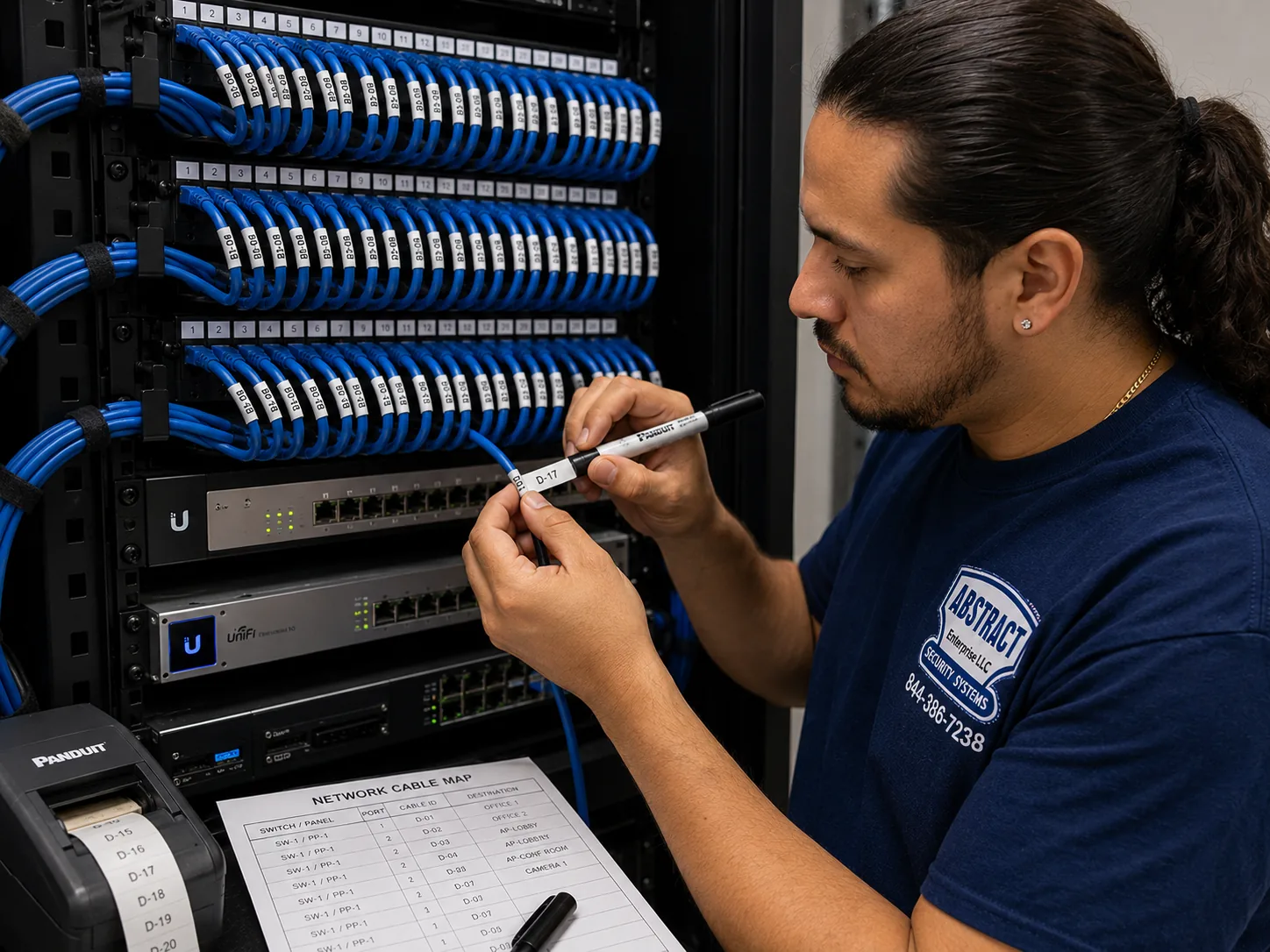
A photo from our job library, not taken in Mapleton: a technician printing cable labels at a patch panel, with a printed map of every port taped beside him. A Mapleton two-family has far fewer wires than that panel, but the habit is the same. Each run from the power supply in the cellar gets a tag naming the floor and household it serves, and the map stays in the house for whoever opens the box next.
Mapleton Intercom Request
Porch house, brick multi-family, store building, new low-rise or condo: give us the cross streets and the number of households at the door, and a technician calls back
✅
Request Sent!
Thank you. A technician will call you about the Mapleton address on the same working day.
25+
Years Experience
✓
Same-Day Estimates
100%
Licensed & Insured
4.6★
390+ Google Reviews
Owner-operated since 2002 · Thousands of jobs completed · Booked within 2 hours
Quick answer: intercom installation in Mapleton is quoted per building, at our Brooklyn rate, after a short survey. We do not publish one intercom price, because a single-family porch house set back from the sidewalk, a 1920s brick multi-family with original bell wire and a new building still in framing need very different amounts of cable, hardware and labor. Every quote lists the stations by model, the door hardware, the power location, the cable route and the labor, so you can compare it line by line. Requests are booked within two hours on working days, and estimates are often possible the same day from photos. Service calls on existing systems are billed at our $195-an-hour service rate.
To get the fastest useful answer, send four things. One photo from the sidewalk showing the whole path a visitor walks, including any gate, steps, porch or second door. One close photo of whatever is beside the door now, whether that is a porch button, a two-button plate, a speaker panel or a battery doorbell. One photo of the door's edge with the latch and strike visible. And one photo of the old transformer or intercom box in the cellar, if you can find it. Then tell us in a sentence how many households use the door, which floor each lives on, and whether anyone in the house needs the door to work by hand without electricity on Shabbos and holidays. Send it with your cross streets to (347) 934-8335 or on WhatsApp.
Reviewing photos and answering questions costs nothing. The written quote comes after a survey, and if opening a box or a wall shows something no photo could, we stop and explain it before going further.
All work is done under New York State license #12000287431, with insurance a condo board, a lender, a general contractor or a store landlord can ask to see.
Mapleton's shop signs on 20th Avenue appear in Arabic, Spanish, Chinese, Russian, Hebrew, Korean and English. If the person who will answer the door reads one of those more easily than English, tell us before we choose a model, because not every monitor or app offers every language.
The Neighborhood
Why Mapleton Properties Need Intercom Installation
Mapleton was laid out as a place for single households. The Brooklyn Eagle dates its development to the years between 1913 and 1919, and Forgotten New York traces it to William Sugarman's Alco Building Company, which began selling Mapleton Park from 1908 as the Sea Beach subway was being built in its open cut. Apartments.com notes that many of the original houses, built on lots 90 by 100 feet, still stand. A house on a lot that size usually sits back from the sidewalk behind a yard and a porch, which is pleasant to live in and awkward for anyone ringing a bell. The visitor stands at the porch door; the family may be in a kitchen at the back of a deep house or on the second floor. A chime in the hall was the original answer. A century later, the same houses often hold two households instead of one, the porch has been enclosed, and the chime wire has been spliced, painted over and extended so many times that nobody is sure where it goes.
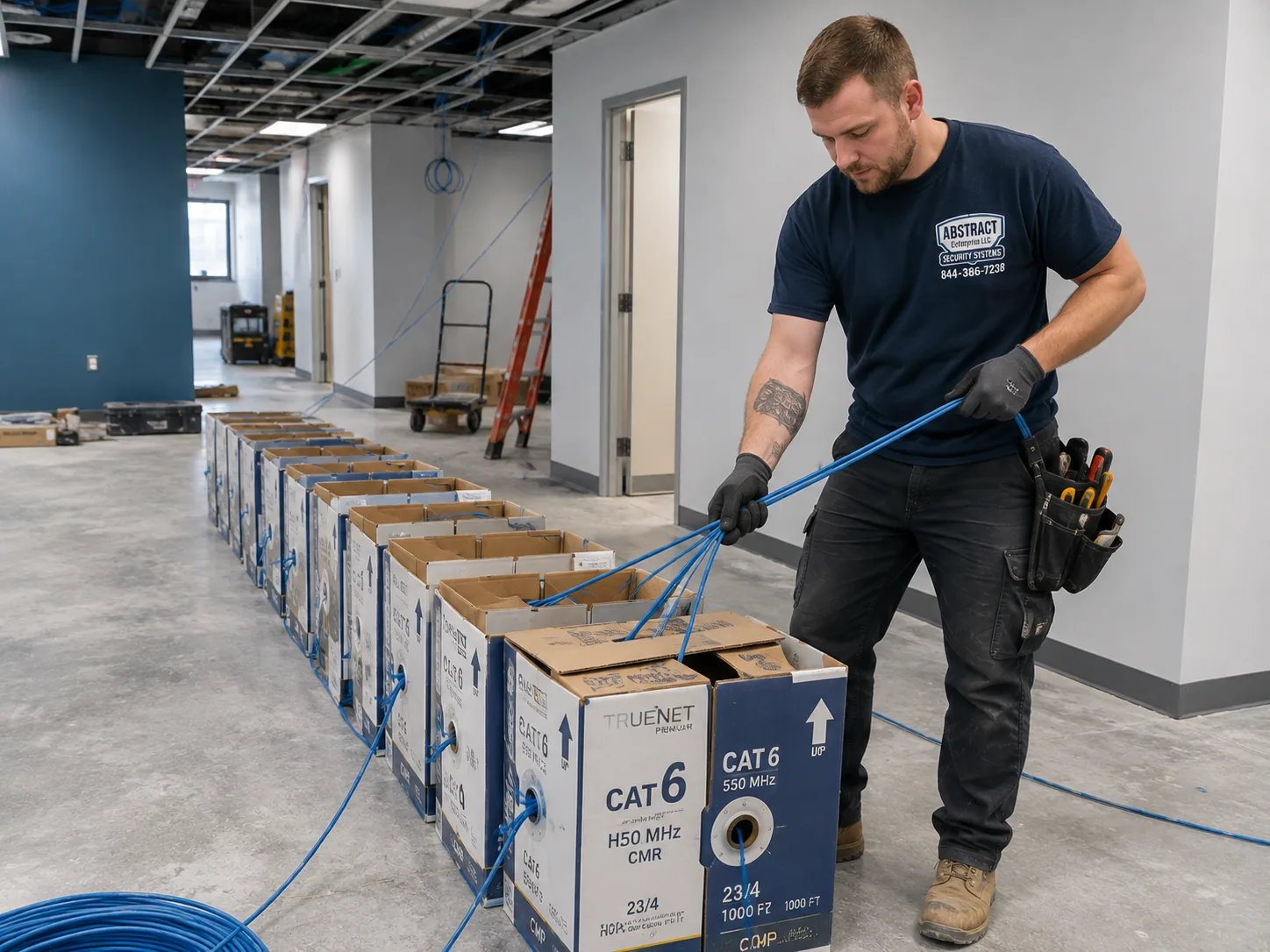
A photo from our job library, not taken in Mapleton: boxes of cable staged on the floor before several runs are pulled at once. In a new three-unit building rising where a Mapleton house used to stand, this is how the entry cable should arrive, staged and pulled to every station location in one pass while the framing is still open, rather than fished through finished walls later.
The fourth layer is the people who answer the doors. Brownstoner's summary of the 2012 Times article counted about 27,000 residents, including Chinese and other Asian families, Orthodox Jews, Italian Americans, Poles, Latinos, Pakistanis and Russians, and Homes.com notes the area's long history of Italian immigrants and of Orthodox and Hasidic residents. For many observant households, a door that can only be opened by electricity is a door they cannot use from Friday evening to Saturday night, and rabbinic Q&A sites that residents consult discuss exactly this problem. For grandparents who read Chinese or Russian, a monitor with English menus is a screen they will not touch. An intercom in Mapleton therefore has to satisfy the building's legal class, the distance from the sidewalk to the door, the stage the building is in, and the habits and languages of the household. We plan for all four before choosing any hardware.
Six Mapleton facts that decide an intercom before a brand is chosen
Most homes are small. The 2012 Times portrait described Mapleton as mostly one- and two-family brick and clapboard houses, many with porches. Most jobs here are a single door with one to three households, not a lobby directory.
The lots are deep. Many original houses stand on lots 90 by 100 feet, according to Apartments.com, so the distance from the porch button to the furthest room can be long, and Forgotten New York notes that pieces of the old, demapped street grid survive as driveways behind some houses.
The older multi-families predate 1968. Brick multi-family buildings from the 1920s and 1930s, and three-unit buildings from 1931 on 18th Avenue, sit under the pre-1968 rules, which tie an intercom to a written request from a majority of apartments.
Some buildings are new and fall under the strict rule. Mapleton I Condominium, finished in 2021 with 18 units on seven stories, is the kind of building Multiple Dwelling Law §50-a requires to have an intercom at its self-locking main entrance.
Houses are being replaced. YIMBY's January 2026 report on three nearly finished low-rise buildings, each replacing a single-family house, shows how often the entry is designed from scratch on a construction schedule.
Doors may have to work by hand. In the Orthodox and Hasidic households Homes.com describes, the door's behavior on Shabbos and holidays is part of the design, and we test it with the intercom power off before handover.
Where this page applies. Sources draw Mapleton differently. Wikipedia bounds it by 16th Avenue on the west, Dahill Road on the east, 57th Street on the north and 65th Street on the south, and notes that the 2012 Times used 47th Street as the northern edge. Forgotten New York draws the core from 57th to 65th Streets between 17th Avenue and Dahill Road, and adds that many residents simply say they live in Borough Park. Community board records split the area along 61st Street between Community Boards 11 and 12. Whatever your block calls itself, Mapleton is billed at the Brooklyn rate. For blocks to the north, see our Borough Park intercom installation page; to the south and west, Bensonhurst; and for the whole borough, our Brooklyn intercom installation page.
Same-Day Repair in Mapleton
Need Repair in Mapleton? A Porch Button Gone Silent, a Release That Works From One Floor Only, or a Builder's Kit That Quit in Its First Winter
Repair calls in Mapleton tend to match the age of the building. In the older porch houses, the outdoor button is usually the first thing to go: it sits on a porch post or door frame exposed to rain blowing under the porch roof, and its contacts corrode until a press produces nothing, or produces a ring only when the button is pushed hard and held. Behind that button there is often a long run of thin bell wire, back through the house to a transformer in the cellar, with splices that were added each time a room was reworked. In the brick multi-families, the classic complaint is a release that opens the street door from the first floor but barely clicks from the top, a sign that the power supply, the wire or both cannot carry the load to the end of the run. In the newest buildings, the calls are different: a builder's video kit whose app stopped connecting after the internet provider changed the router, a monitor that was never registered to the unit owner, or a lobby panel that nobody on the condo board knows how to reprogram.
Before you call, two checks help. If the street door is not latching, lock it with its key or deadbolt while the intercom is down, because an open street door matters more than a silent bell. And look for the intercom's power supply or transformer; if it has an indicator light and the light is out, check the breaker that feeds it, but if the breaker trips again, leave it off. Then call (347) 934-8335 or send photos on WhatsApp. Many single faults, such as a corroded porch button, a failed transformer, a bad splice or a strike whose keeper has drifted, are found and fixed in one visit. Service calls and fault tracing are billed at our $195-an-hour service rate with a three-hour minimum, and we estimate the tracing time before we start. When a repair would cost a large share of a new system, or parts for an old brand are gone, the owner gets both options in writing.
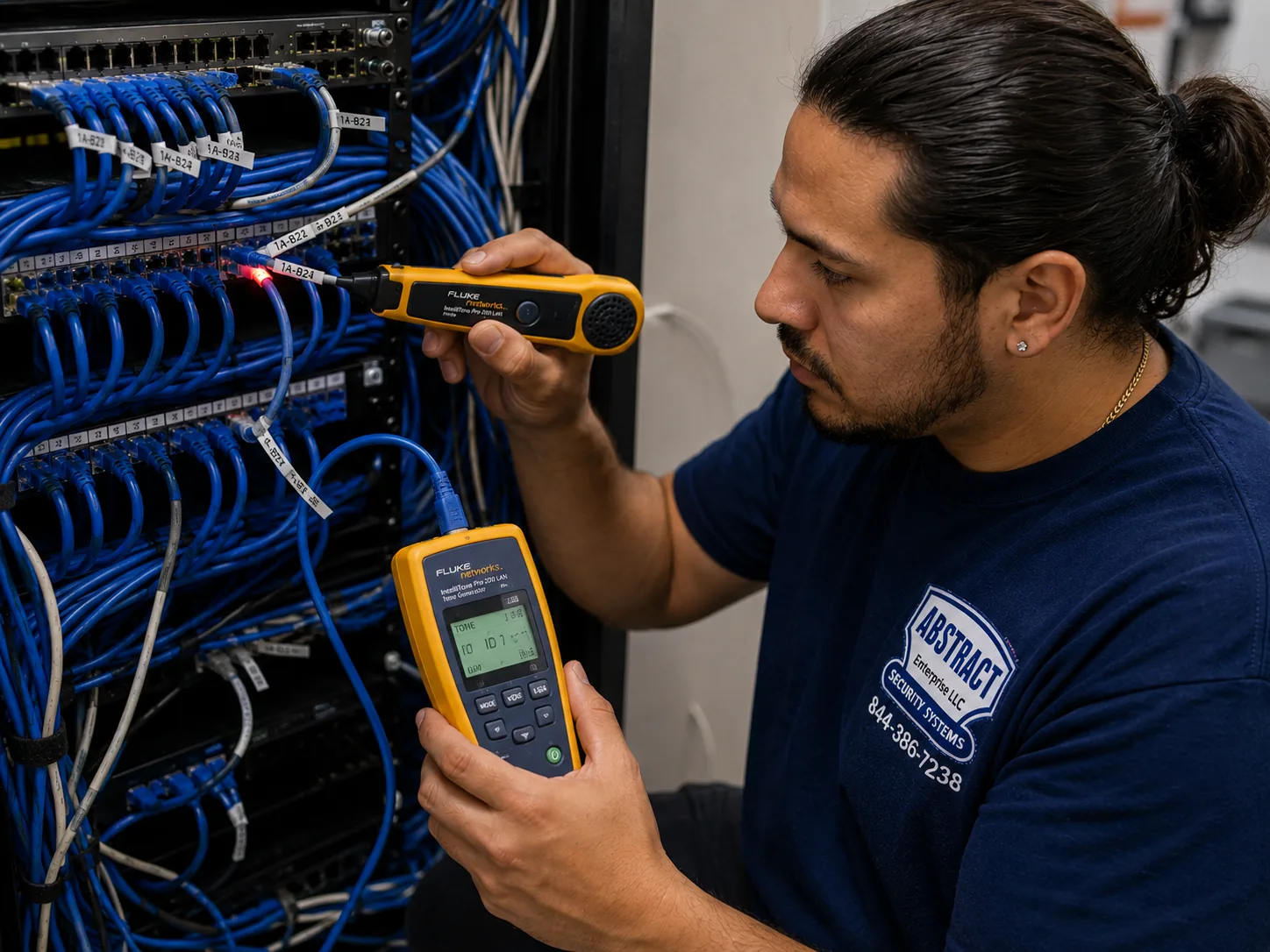
A photo from our job library, not taken in Mapleton: a technician tracing an unlabeled cable with a tone generator and a probe. In a 1920s Mapleton multi-family where the top-floor station has gone dead and three generations of splices run across the cellar ceiling, this is how the right pair is found. The tone goes on at the dead station, the probe finds it in the cellar, and nothing is cut on a guess.
What We Install
Intercom Installation Services in Mapleton
Every Mapleton job starts with three counts: how many households share the door, how far the visitor stands from the people answering, and how far along the building is, from fully lived-in to still being framed. The services below cover the combinations we see most.
Porch-house door stations
A weather-rated station at the porch door of a set-back house, with indoor stations where the family actually spends its time, often the kitchen at the back and a bedroom floor upstairs.
Two-family systems
A labeled button per household at the shared door, a station and release on each floor, and apartment doors left on their own key locks so a tenant's guest never reaches the owner's rooms.
Brick multi-family upgrades
Old bell circuits in 1920s and 1930s buildings tested run by run, splices rebuilt, power supplies sized for the top floor, and new stations in place of handsets that no longer talk.
Doors that open by hand
Strikes, latches and mechanical locks chosen and fitted so the door can be opened manually with the intercom power off, then checked that way before we leave.
New-construction prewire
Entry cable pulled to every station location, the strike, and the equipment spot while a new low-rise building is still in framing, coordinated with the electrician's rough-in.
Condo and mid-rise lobbies
Lobby panels with a directory for buildings of eight or more units, networked stations, elevator lobby doors and the administrator records a board needs to run the system.
Store buildings on the avenues
A residential station and release for the apartment door beside an 18th Avenue or 20th Avenue storefront, powered and cabled apart from the shop below.
Stations in the household's language
Monitors and apps chosen and set up in Chinese, Russian, Hebrew, Spanish or another language where the hardware supports it, with printed instructions to match.
Repairs and takeovers
Silent porch buttons, weak releases, dead top floors, builder kits nobody can program, and systems left behind by a previous owner, traced and either repaired or replaced.
A photo from our job library, not taken in Mapleton: a technician at work on a door-entry installation. On a Mapleton door this is the moment that decides two things at once: that every household's release opens this door and only this door, and that the same door can still be opened by hand, from inside and with a key from outside, when the intercom is switched off.
Building Specialists
Intercom Installation for Mapleton's Architecture
Six kinds of building produce almost every intercom call from Mapleton. They differ in how far the visitor stands from the door, how many households share it, what the walls are made of, how old the wire is, and whether a board, a builder or a store landlord has a say. After the cards, each type gets its own notes on how the work changes.
The set-back porch house
One- and two-family brick or clapboard houses on the original Mapleton Park lots, with a front yard, a porch and a door well back from the sidewalk.
The Victorian or attached rowhouse
Queen Anne Victorians and attached brick rowhouses with dripstone cornices, where period details limit where a station can go and how cable reaches it.
The 1920s and 1930s brick multi-family
Large brick buildings with several apartments over a shared stair, built before 1968, often with original bell wire and a cellar transformer.
The 1931 store building
Three-story, three-unit buildings over shops on 18th Avenue, with the apartment door beside the storefront on a busy commercial street.
The new low-rise replacement
Two- to four-unit buildings rising where single-family houses stood, wired from scratch while the framing is open.
The mid-rise condo and community building
Buildings like the 18-unit condo on 60th Street and the nine-story community facility filed for 19th Avenue, with lobbies, elevators and boards.
The set-back porch house: the long walk from the button to the kitchen
The porch house is Mapleton's signature, and it asks an intercom to cover distance more than numbers. A visitor comes through a gate or up a front walk, climbs a few steps and rings at the porch door, or at the house door inside an enclosed porch. The people inside may be thirty or forty feet back, in a kitchen that faces the yard, or upstairs. In a lot of these houses the original chime still hangs in the front hall, exactly where nobody in the kitchen can hear it. The first planning decision is where the outdoor station goes: on the porch door if the porch is enclosed and locked, or on the house door if the porch is open. We look at which door actually keeps strangers out, which one gets weather, and where a delivery driver naturally stops.
The second decision is how the call reaches the back of the house. A wired station in the kitchen and another on the bedroom floor is usually the most reliable answer, and in a clapboard house cable can often follow the path the old bell wire took, through the cellar and up an interior wall. In a brick house, we look for closets, stair walls and the cellar ceiling to avoid opening plaster. Wireless kits are tempting in a house this size, but signal has to pass through the porch, the front wall and several interior walls, and most kits still cannot open a door without a strike being wired in anyway. When a household wants the door to release from the kitchen, we design the strike, its power and its wire at the same time as the stations, rather than adding them later.
The Victorian or attached rowhouse: working around the details
Homes.com describes Queen Anne Victorians and attached brick Greek Revival rowhouses with period details such as dripstone cornices sharing Mapleton's blocks. Owners of these houses tend to care about how the front looks, and with reason. The outdoor station should sit where it is easy to reach and easy to see, but it should not cut into carved trim or an original door surround. On a Victorian with a wood porch, that often means a slim station on the flat porch post or the wall beside the door, with cable entering from behind so nothing runs across the face. On a brick rowhouse, it means anchoring into solid brick rather than a mortar joint, using a backing plate where the face is uneven, and sealing the cable entry. Where the owner prefers, the station can be finished in a dark color that disappears against the door frame.
Inside, these houses often have plaster on lath and tall ceilings. We avoid cutting new chases, and instead look for the old bell route, the spaces behind baseboards, and closets stacked between floors. Attached houses share party walls, and we do not drill into a shared wall without the owner confirming who owns it and what is on the other side. If cable has to cross from one house to an attached neighbor's, for example when one family owns both, the route and the shutoff points are written down so the two houses can be separated later if one is sold.
The 1920s and 1930s brick multi-family: old wire, a long climb and pre-1968 rules
The large brick multi-family buildings that Homes.com says are scattered through Mapleton are where the oldest wire lives. A typical one has a street door, sometimes a vestibule, a shared stair and several apartments above, with a bell plate at the door and a transformer in the cellar. The usual failures are predictable: calls fade on the top floor, releases work only from lower apartments, and buttons ring the wrong unit after an apartment was split or combined. Before deciding anything, we test each existing run for continuity and leakage between conductors, look at the copper wherever it is exposed, and compare the gauge and length with what a new system needs. Runs that pass can often carry a two-wire video system. Runs that fail, and every old twisted splice whether the run passes or not, are replaced.
These buildings were built before 1968, and the New York Attorney General's tenant guide explains what that means: a pre-1968 multiple dwelling must have self-locking doors and a two-way intercom if a majority of the apartments request one, and the landlord may recover the cost from the tenants. Buildings with fewer than eight apartments are outside the intercom requirement altogether, though their doors must still close and lock by themselves. We explain the practical side, such as where the directory goes, how a release is fitted to a door that has settled, and how power is sized for the top floor. What the law requires of a particular building is a question for the owner's attorney or managing agent, and we say so plainly.
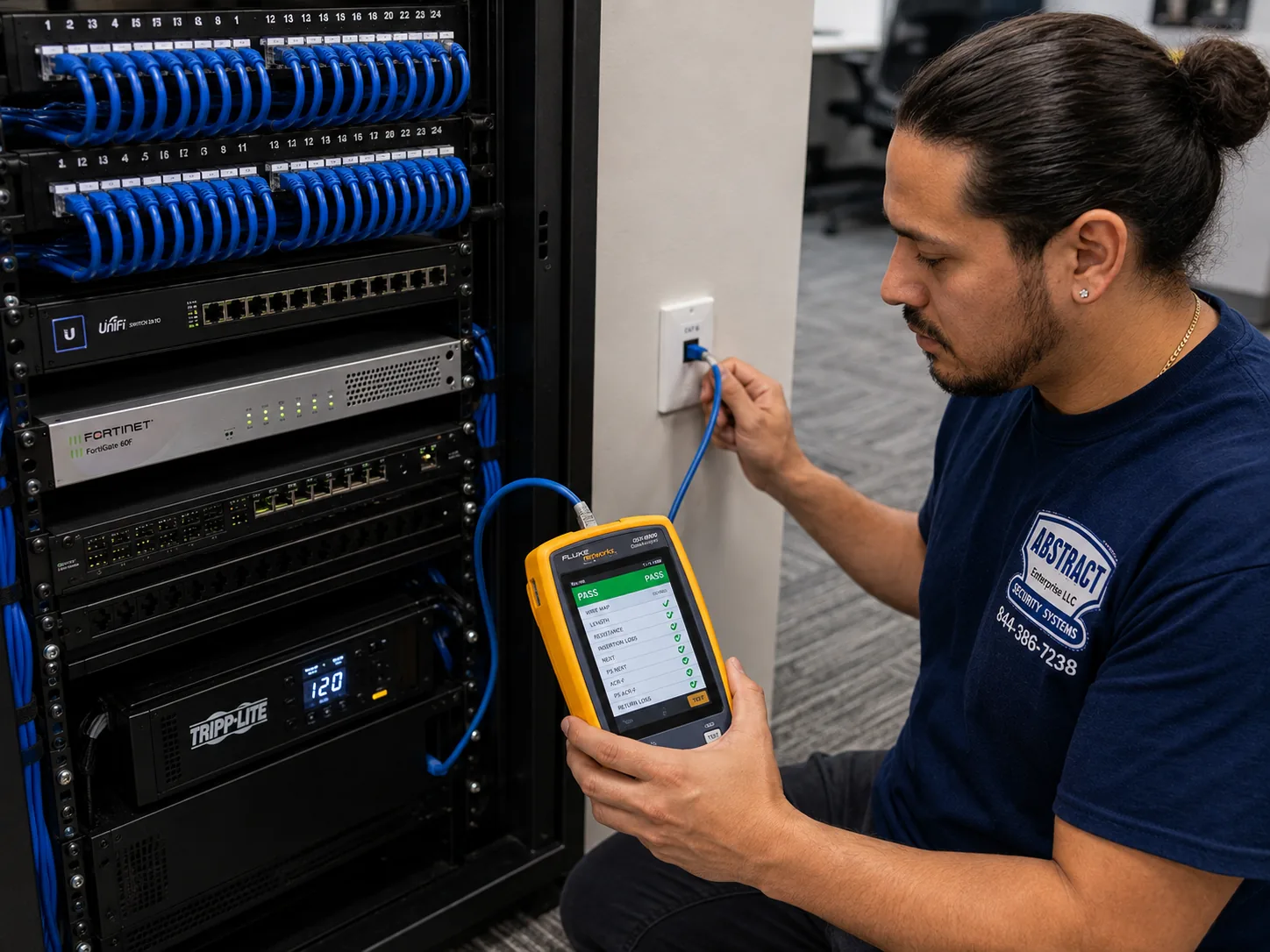
A photo from our job library, not taken in Mapleton: a technician certifying a cable run with an analyzer that reads PASS. In a brick Mapleton multi-family from the 1920s, the decision to keep or replace the old bell wire is made the same way, with a test result in hand. A run that passes can carry a new system to the top floor; a run that fails comes out before the new station goes on the wall.
The 1931 store building: an apartment door beside a shop window
On 18th Avenue, Compass lists buildings such as 5001 and 6417 18th Avenue as built in 1931 with three units, the kind of building where apartments sit over a shop and residents reach them through a narrow door beside the storefront. That residential door needs its own station and release, and the people upstairs need a system that keeps working no matter what happens in the store: early deliveries, late closing, a renovation, or a change of tenant. We power the residential system separately from the shop, run its cable on its own path, and keep the shop's door hardware and the apartments' door hardware apart, so nobody in the store can buzz a stranger into the residential stair.
The new low-rise replacement: designing the door before the walls exist
When a single-family house comes down and a two-, three- or four-unit building goes up, as YIMBY reported on 60th, 61st and 63rd Streets in January 2026 and on 57th and 58th Streets before that, the intercom should be part of the drawings, not an afterthought at the end. The cheapest and neatest moment to pull entry cable is during framing, right after the electrician's rough-in, when every wall is open. We pull one cable from the door station location to the equipment spot, one from the equipment spot to each apartment's station, and one from the strike in the door frame, label both ends, leave slack and cap them in boxes. Where the general contractor allows it, a spare cable to each unit costs little and keeps options open for video or access control later.
The mid-rise condo and community building: lobbies, boards and elevators
Mapleton I Condominium, at 2345 60th Street, is a seven-story building with 18 units finished in 2021, and buildings like it arrive with a networked lobby system chosen by the developer. The 2024 permits for 4911 19th Avenue describe a nine-story building with a house of worship, a lecture hall, a community room, an exhibition room and several floors of business space, which will need entry designed for several different groups of occupants behind one or more street doors. In both kinds of building, the walls around the equipment room are often block or concrete, cable reaches the lobby through cores or conduit, and the system depends on a network rack, a switch and battery backup. The questions owners and boards ask us are about what happens when the developer's panel fails, who holds the logins, and how a board compares a repair with a replacement.
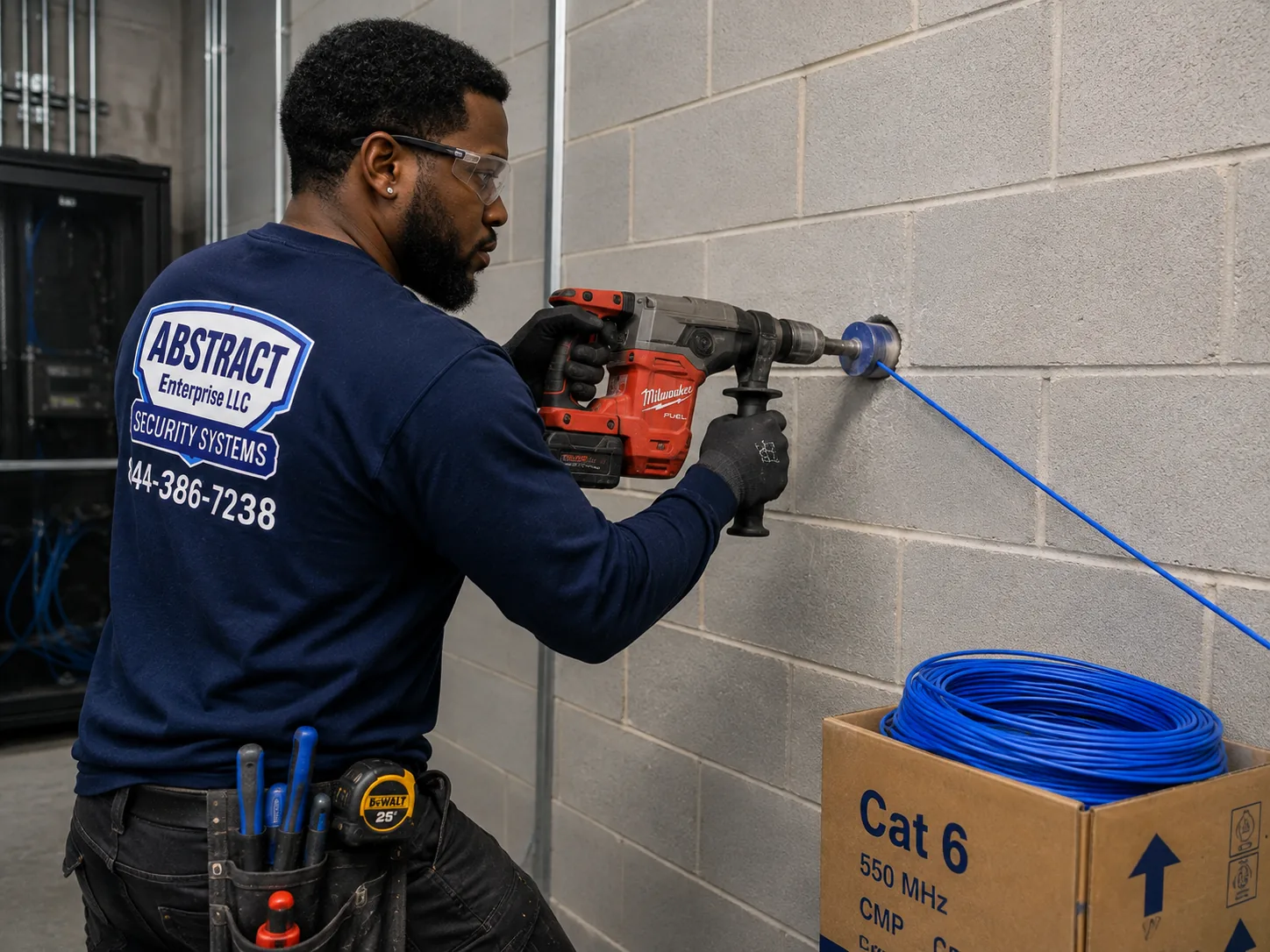
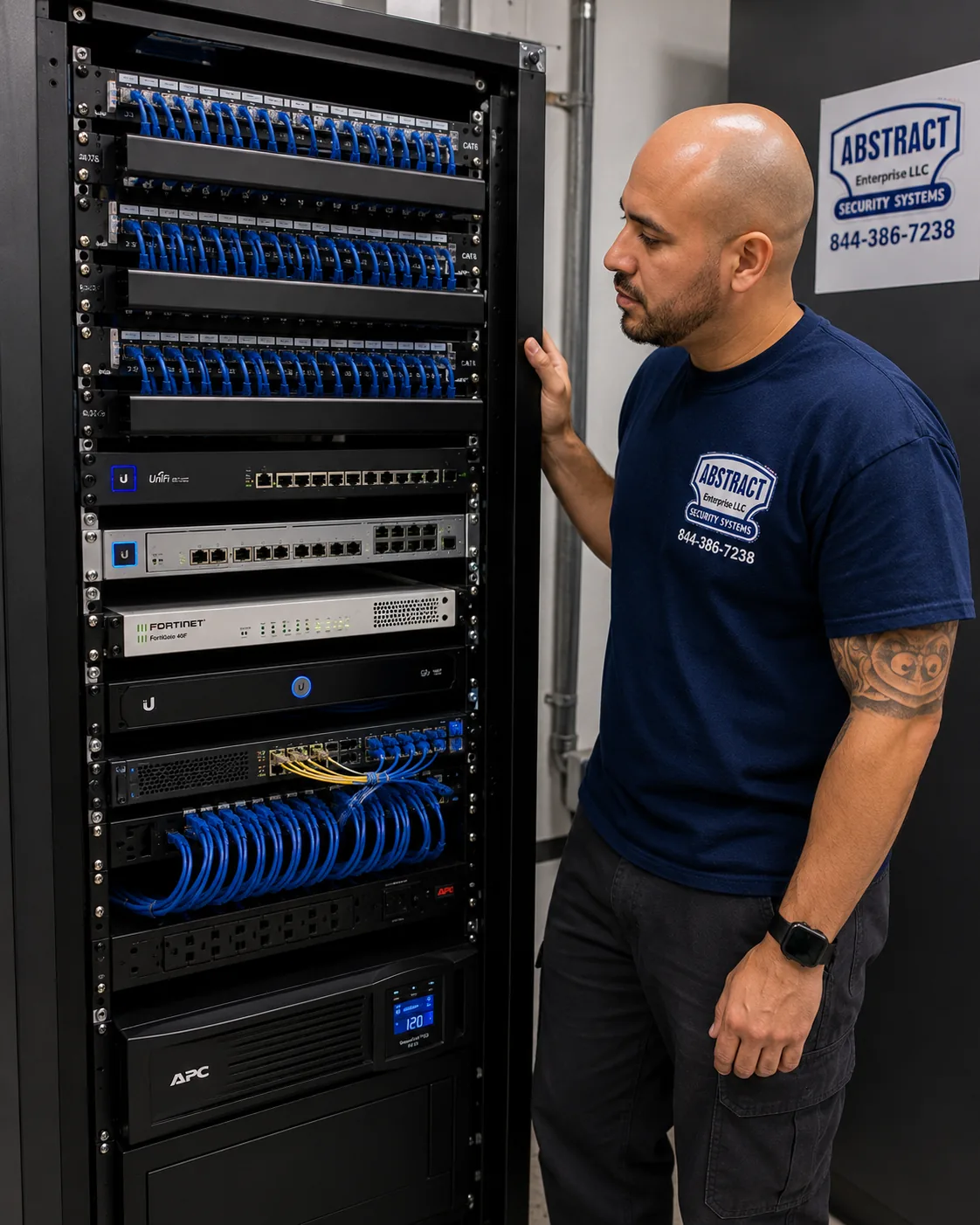
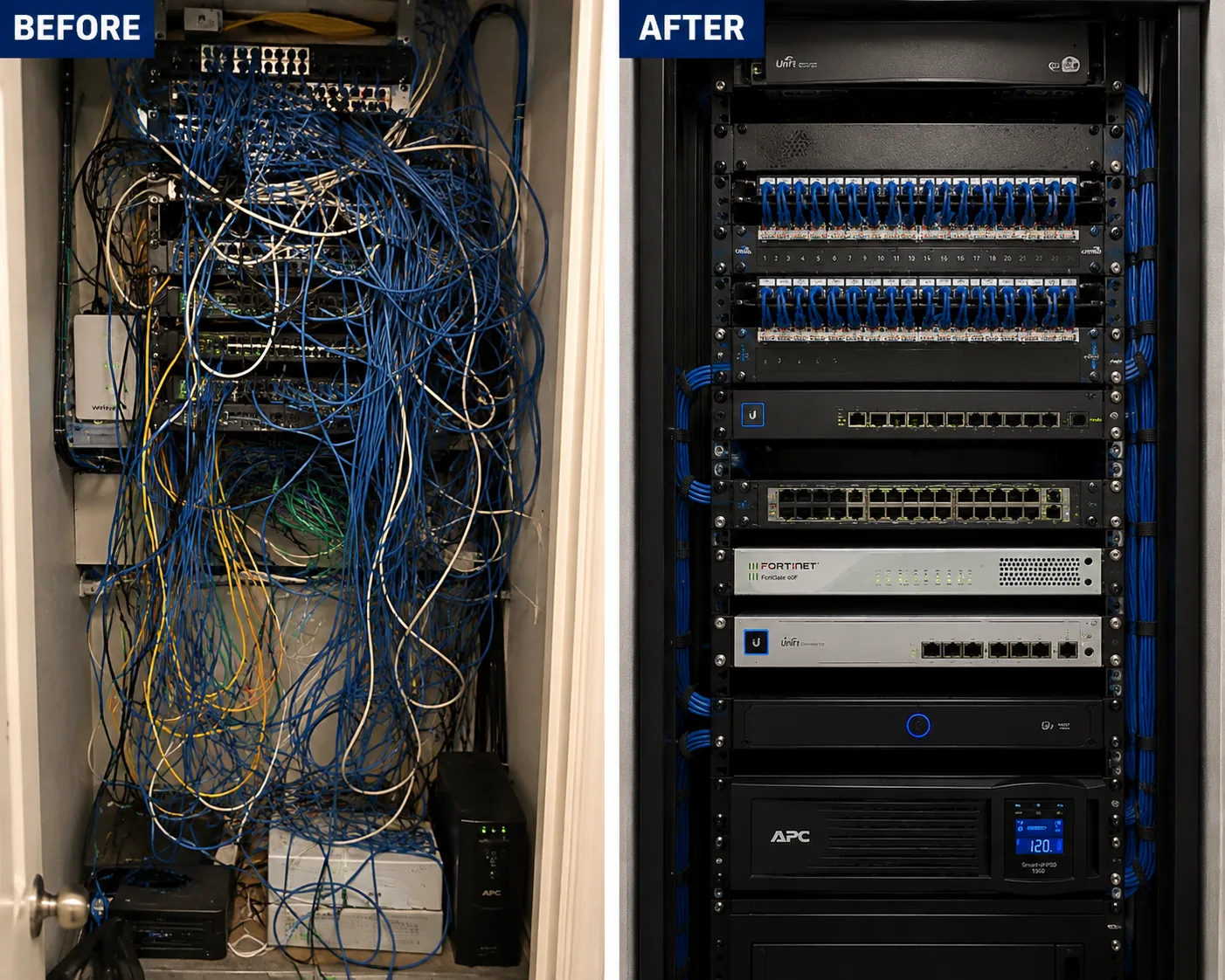
A photo from our job library, not taken in Mapleton: a technician core drilling a block wall so cable can pass into a network room. In a new mid-rise condo on 60th Street or a block-walled community building on 19th Avenue, lobby station cable reaches its equipment the same way, through a clean core that is sleeved and sealed afterward.A photo from our job library, not taken in Mapleton: a finished rack with patch panels, switching, a firewall and battery backup, every cable dressed and identified. A networked lobby system in an 18-unit Mapleton condo depends on a smaller version of this rack, and when a board asks why the lobby panel went dark in an outage, the answer is usually in whether the battery backup was sized to carry the entry system.
Field Notes
Field Notes: What a Technician Checks Between a Mapleton Gate and the Cellar
Walk the visitor's route first. The survey begins on the sidewalk, not at the door. The technician walks the path a delivery driver would take: through the gate, along the walk, up the steps, onto the porch. Where the visitor naturally stops is where the button belongs, and on deep Mapleton lots that is not always the door the owner pictured.
Count three numbers. Buttons on the old plate, mailboxes on the porch or in the vestibule, and households the owner describes. When the three disagree, the house has been changed at some point, and the wiring usually tells how.
Switch the power off and try the door. With the intercom and lock power off, the technician opens the door from inside by hand and from outside with the key. In a house where the door must work on Shabbos without electricity, this is the test that matters most, and it is repeated at handover.
Look under the porch roof. Rain blowing under a porch roof and dripping from a gutter is the most common reason porch buttons fail. The technician notes where water lands, and the station goes where it stays dry or gets a hood.
Follow the old wire to the cellar. Every splice, every branch to an upper floor and every place the wire crosses a pipe goes on a sketch. A branch that ends nowhere is often the remains of an apartment that was added or removed.
Ask who answers, and when. Who is home in the day, on which floor, what language they read, and whether anyone avoids phones or screens on certain days. Those answers decide where each station hangs and what kind it is.
Doors Without Electricity
When the Door Has to Work by Hand: Intercoms for Sabbath-Observant Mapleton Households
Homes.com notes that Mapleton has long been home to Orthodox Jewish and Hasidic residents alongside its Italian, Chinese, Russian and other families. For observant households, an intercom raises a practical design question that most cost guides never mention: what happens at the door from Friday evening to Saturday night, and on holidays, when the household will not press a release button, use an app or operate an electric lock. We are installers, not rabbis, and we do not rule on what is or is not permitted. Households should ask their own rabbi. What we can do is build a door whose behavior is clear, predictable and testable, so that the family's own decisions can be carried out.
A manual mode that is set before Shabbos. A rabbinic Q&A on Din Online, answering a question about electric doors, describes doors with a latch that can be moved before Shabbos to bypass the door's electric operation, and it suggests checking this by turning off the power to the intercom and lock and seeing whether the door can still be opened by hand. That matches how we test every door. On most of the strikes we fit, the door's ordinary latch and key cylinder keep working regardless of power, so the door can be opened by hand from inside and with a key from outside whether or not the intercom is on. Where a household wants a deliberate manual setting, such as a latch held back for the day, we show the owner how to set and reset it, and we check that the door still closes properly while it is set.
Mechanical locks that need no power at all. A specialty lock supplier describes a Shabbos lock as a fully mechanical push-button lock that needs no batteries. Locks like that can sit on a door alongside an electric strike or on a second door, so that residents who know the code can come in by hand on Shabbos while the intercom handles visitors the rest of the week. When a mechanical lock and a strike share a door, the hardware has to be compatible and fitted so neither interferes with the other's latch. We plan that combination at the survey and price it as one door, not two separate jobs.
What happens when no manual option exists. On Ask the Rav, a resident of a building that could only be opened with an electric key wrote that people try to put something in the door so that it will not lock. A door wedged or taped open is unlocked for everyone, all day, and that is the outcome a good design is meant to prevent. In a multi-family, the owner has the most control over this: if the building's only way in is electronic, residents will find their own workaround. A door that can be opened by key or by a mechanical code keeps the building locked while still letting observant residents in.
Cameras and motion. Din Online, in a 2017 answer about a guard who opens an electronic door, discusses whether walking up to a camera is permitted when the guard relies on the camera to see you, and treats it as a real concern. Households that share that concern should tell us before we choose a door station. Some stations only wake their camera when a button is pressed; others light up or record whenever motion is detected. Some buildings choose a second entrance with no camera, or position the station so that a resident using the mechanical lock does not pass in front of it. We describe how each model behaves, and the household decides.
Fail-safe and fail-secure, explained simply. A fail-secure strike stays locked when its power is cut, but the door still opens from inside and with a key. A magnetic lock is usually fail-safe: it releases when power is cut, and it needs its own exit arrangements so nobody is ever trapped. For most Mapleton houses and small multi-families, a fail-secure strike with a working key cylinder is the simpler fit, because cutting the power leaves the door behaving like an ordinary locked door. Whatever is chosen, every door we work on opens freely from inside without a key, code or button.
Scheduling around the week. Many Mapleton households ask that work finish well before Friday afternoon and not fall on holidays. We plan the job so the door is fully working, tested with the power off, and explained to the family before the weekend begins, and if a job cannot be finished in time, the old arrangement stays in place until it can.
The Rules by Building Class
One Block, Four Rulebooks: What New York Law Asks of Each Mapleton Front Door
A Mapleton block can hold a one-family porch house, a pre-1968 brick multi-family, a 1931 store building and a new condo within a few hundred feet of each other, and New York's rules treat each one differently. We are installers, not lawyers, and nothing here is legal advice. These are the public sources, so owners can ask their attorney, managing agent or the city the right questions before choosing a system.
One- and two-family houses. HPD's guidance treats a building with one or two units as a private dwelling, and the city's best-known intercom requirements are written for multiple dwellings. A two-family owner who puts in an intercom does it because two households share a door, not because a statute says so. Once a tenant relies on that door system, though, keeping it working becomes part of keeping the apartment in good order.
Buildings of three to seven apartments. A building with three or more residential units is a multiple dwelling, and HPD's ABCs of Housing says building entrance doors and apartment entrance doors in every type of multiple dwelling must be self-closing, and that broken locks or intercoms should be repaired immediately. Parker Custom Security summarizes the intercom rule this way: buildings with fewer than eight apartments are not covered by the intercom requirement, but the self-closing and self-locking door requirement still applies. That describes most of Mapleton's 1920s and 1930s multi-families and its new three-unit buildings.
Pre-1968 buildings of eight or more apartments. The Attorney General's tenant guide says multiple dwellings built or converted before January 1, 1968 must have self-locking doors and a two-way intercom if a majority of the apartments request it, and that landlords may recover the cost of the equipment from tenants. The Department of Buildings rule 1 RCNY 42-01 sets out how those entrance doors and intercoms are to be provided.
Buildings of eight or more apartments erected after 1968. Multiple Dwelling Law §50-a requires every Class A multiple dwelling erected or converted after January 1, 1968 with eight or more apartments to have an intercommunication system. Mapleton I Condominium, with 18 units finished in 2021, is an example of that class.
Heights at the door. Rule 1 RCNY 42-01 says no push button may be more than six feet from the floor, and the speaking and listening device must sit between four and five feet from the floor. On a porch with steps, we measure from where the visitor stands. Stores and offices open to the public also follow accessibility reach rules for operable parts, which usually puts buttons lower than the residential maximum.
Violations and fines. Parker Custom Security describes a broken intercom as a Class B hazardous violation, enforced by HPD on tenant complaint. Connextivity, another vendor, says intercom and most door lock violations are Class B and quotes fines of $250 to $500 a day until corrected; we have not verified those amounts with HPD. Some pages online, including an older page on our own site, describe it as a Class C violation, which disagrees with the Class B sources. Owners who have received a notice should read the class printed on it and ask HPD or their attorney.
Habitability. Habitat magazine reported in February 2024 that courts have treated a working intercom as an essential service and found that failing to maintain one can breach the warranty of habitability. That matters to Mapleton owners who rent a floor, even in buildings outside the intercom requirement, once a tenant depends on the system.
Getting out. Connextivity notes that any access configuration that impedes interior egress violates the city's fire code. Every door we fit with a strike or lock opens from inside without a key, a code or a button.
Landmarks and permits. We found no historic district in Mapleton, but we have not confirmed that, and the Landmarks Preservation Commission says to use its Discover NYC Landmarks map to check a particular property. For owners curious about recent filings on their block, NYC Open Data's Brooklyn Permits dataset can be filtered by community board. We found no Mapleton-specific counts of intercom violations, 311 complaints or intercom permits we could verify, so this page does not quote any.
Commercial Intercom Installation
Business Intercom Installation in Mapleton
Mapleton's business life runs along 18th Avenue, with its 1931 store buildings, Chinese restaurants and long-running places such as the Silver Star Restaurant, a fixture since 1944, and J & V Pizzeria, serving since 1950, according to the Apartments.com and Homes.com guides. 20th Avenue carries shop signs in seven languages. Bay Parkway and McDonald Avenue meet at the Bay Parkway station on the F line, above Washington Cemetery, and 19th Avenue has the community facility building filed for 4911 19th Avenue. The cards below describe kinds of space where a business or institution needs a door station; we do not name any business as a customer.
Restaurants and groceries
A rear or side station so suppliers ring the kitchen or stockroom rather than walking through the dining room, with a release only staff can operate.
Upstairs offices
Professional offices above avenue storefronts, where clients ring at the street door and the front desk sees them on a screen before letting them up.
Apartments over shops
The residential door beside a shop window, with the residents' station, power and cable kept separate from the business on the ground floor.
Houses of worship and community rooms
Office doors and side entrances that ring staff during office hours, planned around times when the main doors are managed differently.
Multi-tenant community buildings
Buildings like the one filed for 19th Avenue, where a house of worship, a lecture hall and business floors share entrances and each group needs its own listing and release.
Schools and learning spaces
Entrance stations for classrooms and study halls, where staff see and speak to a visitor before the inner door opens.
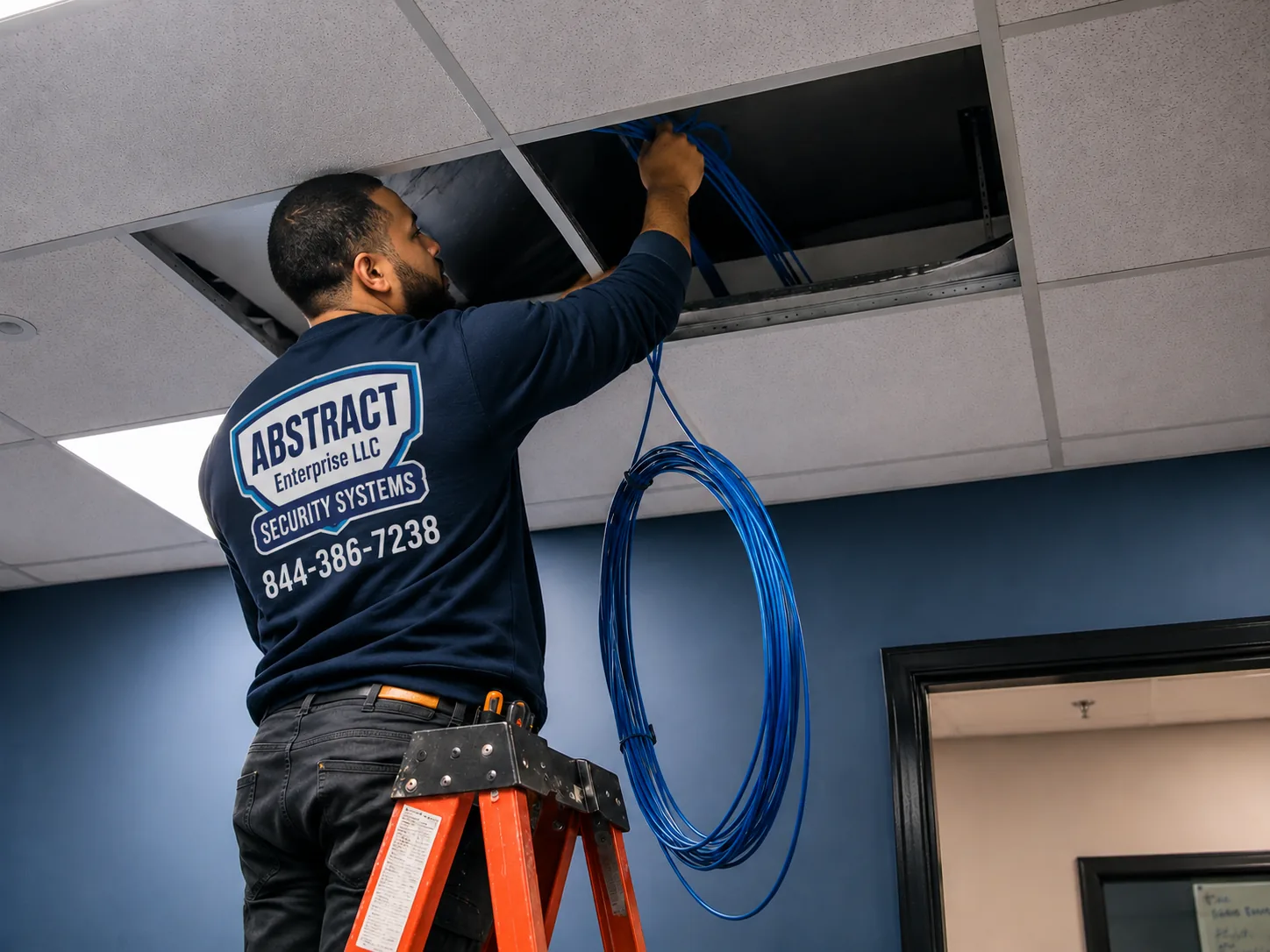
A photo from our job library, not taken in Mapleton: a technician feeding cable through the ceiling of a commercial space that stays open while the work goes on. When a shop on 18th Avenue keeps trading while we bring a station to the apartments upstairs, the work is done in short sections, aisles stay clear, and the hours are agreed with the shopkeeper before the ladder goes up.
Compliance notes for Mapleton stores, offices and community buildings
Free exit at every door. Doors with an electric strike or lock open from inside without a key, code or button. The intercom controls entry only.
Residential doors still self-latch. Where apartments share a building with a business, the residential street door must close and latch on its own after every release, in line with HPD's self-closing door rules.
Controls within reach. Rule 1 RCNY 42-01 caps push buttons at six feet and places the speaking device between four and five feet. Public-facing businesses also follow accessibility reach rules, which usually puts buttons lower.
Residents kept apart from the shop. The residential system gets its own power and cable path, so store hours, store renovations and store tenants never affect the apartments' door.
Life-safety devices left clear. Stations and cable never block an exit sign, a fire alarm device, a sprinkler head or the swing of an exit door, and low-voltage cable stays out of power wiring pathways.
Owner approval in writing. In leased space, the building owner's written approval comes before any facade mounting or new hole through an outside wall.
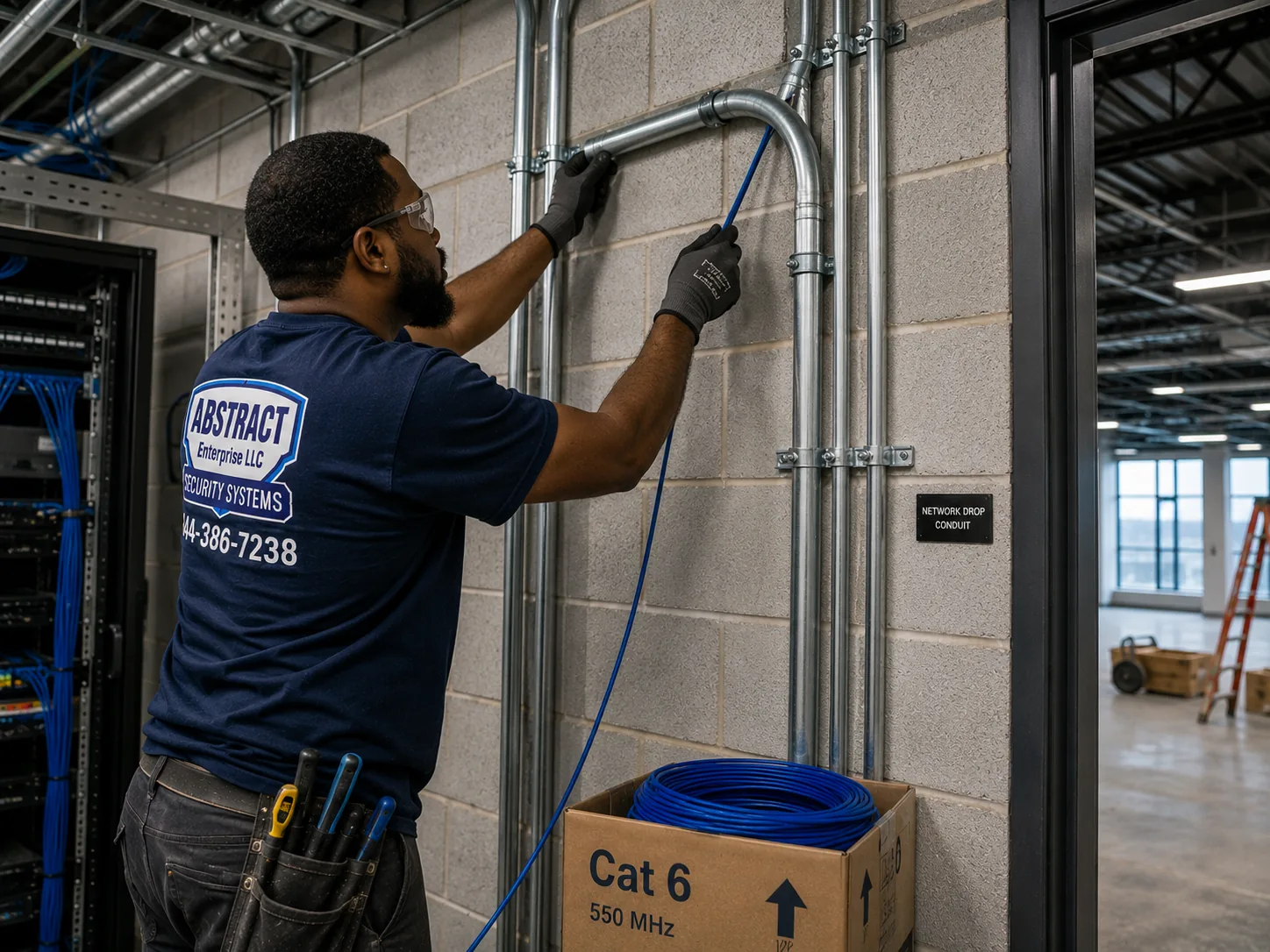
A photo from our job library, not taken in Mapleton: a technician feeding cable into EMT conduit beside a telecom room in an industrial building. In a Mapleton restaurant stockroom, or in the cellar of a new building where carts and tools scrape the walls, a door station's cable travels the same way, inside metal conduit where it cannot be crushed or cut.
Your Questions Answered
Intercom Installation in Mapleton: Questions Answered
These are the situations Mapleton owners, builders, boards and tenants bring to us: houses about to be replaced, new buildings with entry systems nobody fully understands, doors that must work by hand on Shabbos, buildings that fall between the city's rules, and the shared driveways behind old lots. Each is answered once here and not repeated in the FAQ below.
Old houses on the way out, new buildings on the way in
Our house is coming down next year for a three-unit building, and our tenant upstairs is staying until then. Is it worth repairing the doorbell, or is there a cheaper stopgap?
It depends on what the tenant relies on and how much the repair costs. If the problem is a corroded porch button or a failed transformer, a repair is usually small and keeps the tenant's door working until the house is emptied, which matters because a tenant who depends on a door system can reasonably expect it to keep working. If the old system is failing in several places, a full repair in a house with a year left makes little sense. A common stopgap is a simple wired button and chime for the tenant's floor, or a battery video doorbell for the tenant's own use, while the street door is opened by key. What we avoid is spending real money on equipment that cannot move to the new building. On the survey we tell you which parts, if any, are worth saving for the new construction, and quote the stopgap separately so you can compare.
Can the door station and monitors from the house we are demolishing be moved into the new building on the same lot?
Sometimes, if they are recent and suit the new building. A two-wire or networked system installed in the last few years can often be taken down carefully, stored dry, and reinstalled, as long as the new building has the same or fewer apartments than the system supports, or the system can be expanded with matching parts. An outdoor station designed for one or two households will not serve a four-unit building without a new panel. Old bell plates, chimes and transformers are not worth moving. The bigger saving in a rebuild comes from planning the cable during framing, not from reusing hardware. If you want to reuse anything, tell us before demolition starts, so it can be removed, labeled and stored before the house is stripped.
The builder of our new three-unit building installed a video kit. What should we test during the first year, while the builder still answers our calls?
Test what fails in real life rather than in a showroom. Press each button and answer from each apartment, including the top floor. Release the door from each apartment, let it close on its own from fully open, and confirm it latches every time. Switch off the intercom's power and check that the door opens by hand from inside and with a key from outside. If the kit uses an app, check that each unit has its own account and that the builder has handed over the administrator login. Change your Wi-Fi password or router, if you plan to, and see whether the station reconnects. Note how the outdoor station looks after the first heavy rain and the first freeze. Write down anything that fails, with the date, and send it to the builder in writing. If the builder cannot fix it, we can trace the problem, and a written record of each failure makes the repair faster.
Condos and community buildings
Our 18-unit condo on 60th Street was finished in 2021. If the developer's lobby panel fails, are we tied to the same brand?
Not necessarily, but staying with the brand is sometimes the cheapest repair. Many lobby systems use proprietary apartment stations, so replacing only the lobby panel with a different brand may mean replacing all 18 indoor stations too. If the failure is a single part, such as a damaged camera module, a dead keypad or a failed power supply, the same brand's replacement part is usually the right answer. If the brand's parts are hard to get, the maker's service plan has become expensive, or the board wants features the current system cannot offer, a change of brand can make sense, and the existing cable often stays. Before the board decides, we document what is installed, test the cable to each unit, and price both a like-for-like repair and a replacement, so the decision is made on numbers rather than on whichever vendor answered first.
We are leasing office space in a new building that also holds a house of worship and a lecture hall. How can our visitors ring us without ringing the congregation?
By giving each group its own listing and its own release, and by deciding which doors each group's release opens. In a multi-tenant building like the one filed for 4911 19th Avenue, the lobby panel's directory can list each organization separately, ring a reception station or phone for each, and open only the lobby door, leaving inner doors on each floor under that tenant's own control. Elevator access can be limited so a visitor buzzed in by an office reaches only that office's floor, if the building's elevator system supports it. The building owner, not individual tenants, usually controls the lobby system, so the request goes to management first. If management wants help designing the directory and the release rules, we can write a scope that every tenant can read and agree to before the system is programmed.
Shabbos and doors that must open by hand
Before Shabbos we switch off power to the intercom and lock to check the door. What should we find if the hardware is set up right?
With the power off, the door should open by hand from inside, every time, with no button, code or key. From outside, it should stay locked, and open with the ordinary key, or with a mechanical code if a mechanical lock is fitted. When you close it, it should swing shut and latch on its own. If any of that fails, something is wrong. A door that will not open from inside without power is an egress problem and must be fixed immediately. A door that stays unlocked from outside with the power off probably has a fail-safe device fitted where a fail-secure one was intended. A door that opens but will not latch usually has a misaligned strike or a weak closer. We perform this exact test at handover and show the owner how to repeat it, so the household can check before every Shabbos without calling anyone.
Can a battery-free mechanical push-button lock share a door with an intercom's electric strike?
Often, yes, with the right hardware. A fully mechanical push-button lock, the kind a lock supplier describes as needing no batteries, has its own latch or bolt operated by the code. An electric strike in the frame releases the door's latch when a resident presses the intercom release. The two have to be arranged so that each works without fighting the other: either the mechanical lock's latch is the one the strike releases, or the mechanical lock and the strike control separate latches that both have to be free for the door to open. The wrong combination leaves a door that opens with the code but not the intercom, or the reverse. We choose the pair together, check the door's thickness and frame, and test both ways of entering before we leave. Residents who know the code then come in by hand on Shabbos, while visitors use the intercom the rest of the week.
Where do the station and strike go on a doorpost that already has a mezuzah?
Away from it, and we ask before drilling anything near it. The strike goes in the frame on the latch side of the door, where the latch meets the frame, and cable for it runs inside that side of the frame. The outdoor station usually goes on the wall beside the door at the height the city's rule requires, positioned so its cable and mounting stay clear of the mezuzah. Where the only good wall space is close to it, we show the owner the exact spot before mounting and adjust it, rather than finding out afterward. If the door frame is being replaced as part of the work, we mention it beforehand, so the family can arrange for the mezuzah to be removed and replaced in its own way.
Buildings between the rules
Our 1931 building on 18th Avenue has three apartments over a store. With fewer than eight apartments, what does the city still expect at the street door?
A street door that closes and locks by itself, and apartment doors that close by themselves and carry the locks the Housing Maintenance Code requires. HPD's ABCs of Housing says building entrance doors and apartment entrance doors in every type of multiple dwelling must be self-closing, and a three-unit building is a multiple dwelling. Parker Custom Security notes that buildings with fewer than eight apartments are outside the intercom requirement, but the self-closing and self-locking door requirement still applies. In practice, that means an intercom is optional for the owner but the door is not. Many owners of these buildings install one anyway, because the third-floor tenant otherwise has to walk down two flights past the store entrance to let in every visitor. If you do, the strike has to preserve the self-closing behavior: the door must still close and latch on its own after every release.
One website calls a dead intercom a Class B violation and another calls it Class C. Which is it, and what can it cost?
The sources we found mostly say Class B. Parker Custom Security describes a non-working intercom as a Class B hazardous violation that HPD enforces on tenant complaint, and Connextivity says the same and quotes fines of $250 to $500 a day until corrected, which we have not verified with HPD. Some pages, including an older page on our own site, describe it as Class C, the immediately hazardous category; that is not what the other sources say. If you have received a notice, the class is printed on it, and the notice tells you how to certify the repair. If a tenant has complained and no notice has arrived yet, the useful step is the same either way: get the system fixed promptly and keep the invoice that shows the date and the work. Doors that fail to self-close are a separate matter, and HPD's self-closing door rules treat those more seriously.
Deep lots and shared driveways
Several houses on our block reach their garages from a shared driveway behind them. Can intercom cable cross it to a rear gate?
It can, but crossing a shared driveway is a question of ownership before it is a question of cable. Forgotten New York notes that pieces of Mapleton's old, demapped street grid survive as driveways behind some houses, and on many blocks several owners share rights to them. Cable buried across a driveway someone else owns, or one several neighbors share, needs their agreement, and it has to be deep enough and protected well enough to survive cars, plows and future paving. Often there is a better route: along your own fence line, through your own garage, or overhead on your own structures. If your rear gate sits on your own property and the cable can stay on your side, we route it that way and note it on the wiring record. If it truly has to cross, we explain the options and leave the agreement with the neighbors to you.
Can the stations inside our house call each other, and not only answer the front door?
Yes, on most current systems. In a large Mapleton house with a family spread across three floors and a finished cellar, internal calling is often the feature people use most. One station can call another floor, call every station at once, or page a particular room, using the same wiring as the door. On a two-family, internal calling can be limited to stations within one household, so the owner and tenant do not page each other by accident. Some households also set one station to ring when a second door, such as a side or rear door off the driveway, is used. When we design the system, we ask which rooms need to reach which others, because the cheapest audio handsets do not all offer internal calls, and adding the feature later may mean replacing them.
A photo from our job library, not taken in Mapleton: a technician completing and checking an installation before handing it over. In a Mapleton house this is when every station calls the door and every other station, the door is opened by hand with the power switched off, and the location of every box goes onto the written record that stays with the owner.
Equipment
Types of Intercom Systems We Install
We install and service Aiphone, Comelit, 2N, Akuvox, ButterflyMX, DoorBird, Dahua and Hikvision door stations, among others, and work on many older systems already in Brooklyn buildings. In Mapleton the right category depends on how far the visitor stands from the household, whether the old wire passes a test, how the door must behave without power, and who will answer.
Audio intercoms
A door station and a talk-and-release handset per household. Durable and simple, and often enough for an owner-occupied two-family where someone is usually near the door.
Two-wire video
Video, audio and door release over a single pair, which lets many 1920s and 1930s buildings move to video on old wire that passes a test.
Networked stations
Door and indoor stations on network cable, often powered through it, for condos, new low-rise buildings and community buildings with several groups of occupants.
Phone and app answering
Stations that call an app or an ordinary phone number, for owners who live elsewhere and for households out at work when deliveries arrive.
Strikes, closers and mechanical locks
Fail-secure strikes, keepers, closers and battery-free push-button locks, combined so the door self-latches and still opens by hand with the power off.
Internal calling and door switches
Room-to-room calling between floors, and small switches that tell the system when a street door is left open.
A photo from our job library, not taken in Mapleton: a technician mounting a managed switch that powers devices through their network cable, below a row of patch panels. In a new four-unit building on a Mapleton side street or an 18-unit condo, a smaller version of this switch powers every networked station from one place, so there is one supply to back up and maintain rather than several.
National brands, a do-it-yourself doorbell or a local installer, for a Mapleton house
Smart doorbells such as Ring and SimpliSafe are designed mainly for one household behind one door, and for that they can work well. ADT and similar national companies sell systems on a monthly-service model. This comparison is about Mapleton's porch houses, multi-families and new buildings, not the quality of any company.
What the building needs
Smart doorbell or national brand
Abstract Enterprises Security Systems in Mapleton
Reaching the back of a deep house
Depends on Wi-Fi reaching the porch
Wired stations where the family actually is
Two or more households on one door
One button, one account
A labeled button and station for every household
Opening the door from upstairs
Usually not connected to any lock
Strike and power sized for every floor
A door that works by hand on Shabbos
Not part of the design
Hardware chosen and tested with the power off
A building still under construction
Added after move-in
Cable pulled during framing, labeled and capped
AI Overview Reality Check
What AI Gets Wrong About Intercom Installation in Mapleton
"A one- or two-family house only needs a video doorbell"
For one household behind one door, a video doorbell can be fine. Generic answers extend that advice to every small house, as if size were the only question.
Many Mapleton two-families hold two separate households, and a video doorbell gives both of them one button and one account. It also cannot open the door from the upstairs apartment unless a strike is wired in, and it depends on Wi-Fi reaching a porch that may sit well forward of the router.
The better question is who has to answer, from where, and whether they need to let the visitor in. For a single family, a doorbell may do. For an owner and a tenant, a two-button system with a release on each floor usually serves better.
"Every New York apartment building must have an intercom"
This is repeated often, and it sounds plausible. It blurs three different rules into one.
Multiple Dwelling Law §50-a requires an intercom in buildings of eight or more apartments erected or converted after 1968, like the 2021 condo on 60th Street. Pre-1968 buildings come under a majority-request rule, and buildings of fewer than eight apartments are outside the intercom requirement, though their doors must still self-close and self-lock.
Most of Mapleton's older multi-families and its new three-unit buildings fall into that last group. Owners there install intercoms for practical reasons, and they should know the difference before anyone tells them the law forces a purchase.
"A broken intercom is a Class C violation"
Some AI answers, and some installer pages, state this with confidence. We found it on pages including an older one of our own.
The sources we found describe a non-working intercom as a Class B hazardous violation, enforced on tenant complaint. Doors that fail to self-close are treated separately and more seriously under HPD's self-closing door rules.
The class on an actual notice is the one that counts. Read it, follow its correction instructions, and keep the repair invoice. Frightening an owner with the wrong class helps nobody.
"Upgrading an intercom starts with replacing the outdoor panel"
Many quotes begin by removing the outdoor station, because it is the most visible part. A Brooklyn Yelp reviewer complained about exactly that, a working exterior panel disconnected and thrown out.
In Mapleton the failure is often elsewhere: a corroded porch button, a tired transformer in the cellar, a bad splice under the joists, or a strike that no longer meets the latch. Replacing the panel fixes none of those.
A survey that tests each part before recommending anything protects the owner's money. If the working half of a system can stay, it should, and the quote should say why.
"Magnetic locks and electric strikes do the same job"
AI answers often list them side by side as interchangeable. They behave very differently when the power goes off.
A fail-secure strike leaves the door locked from outside but openable from inside and by key. A magnetic lock usually releases without power and needs its own exit arrangements. For a household that switches off the intercom before Shabbos, or a building that loses power, that difference decides whether the door stays locked.
We choose the device to match how the door must behave with the power off, then prove it with the power off before handover.
"Intercom cost mostly depends on the number of apartments"
Cost guides on Angi, HomeAdvisor and Fixr sort intercom prices by system type and unit count, and AI answers repeat those ranges. We do not, because they describe no particular building.
In Mapleton, the distance from the porch to the back of a deep house, the condition of a century of splices, whether the building is still in framing, and whether the door needs a mechanical lock as well as a strike often matter more than the count of buttons.
The fair comparison is line by line: stations, cable, door hardware, power and labor. Our quotes are written that way so they can sit beside anyone else's.
"A smartphone app is the modern answer for every household"
App-based entry is presented as the default upgrade. For some owners, especially those who live elsewhere, it is genuinely useful.
For a grandmother who reads only Russian or Chinese, an English-only app is unusable. For an observant household from Friday evening to Saturday night, a phone is not an option at all. And an app depends on internet service that a wired station does not need.
In Mapleton the app belongs on top of a wired station, a working strike and a door that opens by hand, not in place of them.
Not Sure Which Rules Your Building Falls Under? Ask Before You Buy Anything
Tell us the cross streets, the type of building, how many households share the door and which floor each one lives on, how far the door sits from the sidewalk, and what the old bell or intercom does now. If the building is under construction, tell us when the framing will be open. If the door has to work by hand on Shabbos, say so. A technician will call back about the Mapleton address, or you can call (347) 934-8335 now.
✅
Request Sent!
Thank you. A technician will call you about the Mapleton address on the same working day.
How It Works
Our Installation Process
1. Photos and a household count
The sidewalk, the walk or porch, the door, the latch and closer, and the old bell or transformer, plus how many households share the door and which floor each one lives on.
2. Building class and building stage
The legal unit count, when the building was built or converted, and whether it is lived in, empty before demolition, under construction or finished.
3. Survey and wire test
The visitor's route walked, every existing run tested, the door tried with the power off, and the door watched as it closes and latches.
4. Written design and quote
Stations, door hardware, power location, cable route, button layout, languages, manual entry and app accounts agreed in writing before anything is ordered.
5. Door hardware and power
Strike or lock fitted to where the latch lands, closer adjusted so the door self-latches, and the power supply mounted in a dry, labeled spot the owner controls.
6. Cable and stations
Cable on the agreed route and labeled at both ends, the outdoor station anchored and sealed, and an indoor station for every household.
7. Programming each household
Each household's button, release, ring pattern, quiet hours, language and any phone forwarding set up separately, with the administrator login given to the owner or board.
8. Test, power-off check and handover
Every station calls and releases the door, the door relocks after each test, the door opens by hand with the power off, and a written wiring record stays with the building.
Coverage Area
Intercom Installation Near Mapleton's Landmarks
Mapleton Park (Mapleton Oval)
The small park at 62nd Street and 20th Avenue, completed in 1916, surrounded by the porch houses of the original development.
Gravesend Park
A 6.38-acre park on 18th Avenue between 56th and 57th Streets, opened in 1917 and renovated in 2016 for $7.25 million.
Washington Cemetery
The cemetery established in 1850 at 5400 Bay Parkway, divided into sections by the avenues that cross it.
Mapleton Library
Brooklyn Public Library's branch at 1702 60th Street, in its building since 1955 and closed for renovation of its roof, facade, heating, cooling and safety systems.
20th Avenue station
The N train stop in the Sea Beach open cut between 63rd and 64th Streets, opened June 22, 1915, the line that drew Mapleton's first buyers.
Bay Parkway station (F)
The F line stop at Bay Parkway and McDonald Avenue, above Washington Cemetery on the border with Midwood.
Mapleton is billed at our Brooklyn rate. We quote intercoms per building, because two Mapleton houses that look alike from the sidewalk can need very different work once the distance to the back rooms is measured, the old wire is tested and the door is tried with the power off. We would rather tell you that plainly than publish a figure that changes the moment we open the box on your porch. What we publish is how the quote is built, so you can compare ours with any other line by line.
What drives the quote
What it means in Mapleton
Number of households
Sets the buttons and indoor stations, usually one to four in a house, more in a condo or community building
Distance from door to the people answering
Deep lots and porch doors mean longer runs and stations at the back of the house
Audio, video or phone answering
Handsets cost less than monitors; some app systems carry maker plans, shown before you choose
Condition of the old wire
Runs that pass a test are reused; failed runs and old splices are replaced
Door hardware and manual entry
Strike, closer adjustment and, where wanted, a battery-free mechanical lock on the same door
Building stage
Cable pulled during framing costs less than cable fished through finished walls
Language and programming
Models that support each household's language, internal calling, quiet hours and forwarding
Service calls and fault tracing
$195 per hour, three-hour minimum; not charged on the initial install
Full terms — including 50% deposit, the 30-day warranty and optional paid extended warranty, and the late-fee schedule — are set out in the service agreement.
Three typical Mapleton jobs, described by scope. Each is priced on a written quote after a survey, at the Brooklyn rate, because porch distance, wire condition, door hardware and building stage differ from one lot to the next.
Porch house starter
For a one- or two-family porch house: a weather-rated station at the door that keeps strangers out, a station in the kitchen and one upstairs, the strike fitted to the latch, tested old wire reused where it passes, and a power-off check at handover. Quoted after survey.
Brick multi-family standard
For a 1920s or 1930s multi-family or a 1931 store building: a station with a button per apartment, indoor stations on every floor, a power supply sized for the top floor, old splices rebuilt in labeled boxes, and residential power kept apart from any shop. Quoted after survey.
New building and condo premium
For a new low-rise or a mid-rise condo: cable pulled during framing, networked stations, a lobby directory, battery backup for the entry system, optional manual-entry hardware, and full records and logins for the owner or board. Quoted after survey.
Bring your own equipment. If you or your builder have already bought a door station, monitors or a strike, we can install them as labor-only work, as long as the equipment suits the door, the number of households and the wire in the building. We check model numbers before the visit and tell you if anything is missing, such as a power supply or a distribution module. Customer-supplied equipment is covered by its maker's terms, not ours.
Complete Services
Every Intercom Installation Service in Mapleton
New intercoms
Audio, video and phone-answering systems for porch houses, multi-families and store buildings. Request a quote
New construction and condos
Cable during framing, lobby panels and board handover records. Send your drawings
Once an intercom is installed, what does it cost to keep running each year?
+
A wired audio or two-wire video system in a Mapleton house usually costs nothing to run beyond a little electricity, and many go years without a service visit. Costs appear when something fails, such as a weathered outdoor station, or when an app-based system carries a maker's plan, which we show you before you choose. Service visits are billed at our hourly service rate, so a system that is simple and well installed is also the cheapest to keep.
Does any law require a video intercom, or is audio enough?
+
The rules we found ask for an intercommunication system, not specifically video. The Department of Buildings rule describes a bell or buzzer system or a speaking and listening device as the minimum. Video is a choice owners make because it lets residents see visitors before releasing the door, which is especially useful for households on upper floors or at the back of a deep house.
My mother's eyesight is failing. Is there an apartment station she can use by touch and sound?
+
Yes. Simple handsets with a few large physical buttons, one to talk and one to open the door, are easier by feel than touchscreens, and many have adjustable ring volume. We place the station where she can reach it without searching, at a comfortable height near where she sits, and walk her through it before we leave.
Can the intercom cable go in the same conduit the electrician runs for our new building?
+
No. Low-voltage intercom cable should not share a conduit or pathway with power wiring, both for safety and to keep electrical noise out of the audio and video. We coordinate with the electrician so our cable runs on its own route or in its own conduit, pulled right after their rough-in while the framing is still open.
Can the work be scheduled so the door is working again well before Friday afternoon?
+
Yes. We plan Mapleton jobs so the door is installed, tested with the power off and explained to the household before the weekend, and we avoid holidays the family tells us about. If a job cannot be finished in time, the existing arrangement stays in place until it can, so the house is never left with a half-finished door over Shabbos.
Water drips off our old porch roof right where the station would go. Is that a problem?
+
It is the most common reason porch buttons fail, so we plan around it. We move the station to a dry spot within the required height range, fit a rain hood where the model allows, and seal the cable entry. If a gutter or porch roof is leaking, fixing it helps the station and the porch alike, and we will point out where the water lands.
Our front door swings out onto the porch instead of in. Can it still take an electric strike?
+
Usually, yes. Out-swinging doors need a strike made for that arrangement and sometimes a guard so the latch cannot be pried from outside. We check the door, the frame and the latch on the survey, choose hardware that fits, and confirm the door still closes and latches on its own after every release.
Our tenant says a dead intercom gives him the right to hold back rent. Is that true?
+
We cannot give legal advice. Habitat magazine reported in 2024 that courts have treated a working intercom as an essential service under the warranty of habitability, so a tenant's complaint should be taken seriously. Talk to your attorney about the rent question, and get the system fixed promptly, keeping the dated invoice as a record of the repair.
What do you photograph during a survey, and who sees the pictures?
+
We photograph the door, the frame, the old bell, the transformer, cable routes and the spots where stations will go, so the quote and the installation match what we saw. We avoid photographing people, documents and private rooms beyond what the job needs. The photos are used for your job and shared with you on request.
We found old cloth-covered wire in the cellar of our 1910s house. Is it the intercom or the house's electricity?
+
It could be either, and you should not touch it to find out. Old bell wire is thin and runs to the transformer and the chime, while old electrical wiring carries household power. We identify low-voltage runs with a meter before working on them, and if what we find is old power wiring, we tell you so a licensed electrician can look at it.
In our condo, can I replace the station inside my own unit without asking the other owners?
+
The station inside your unit is usually yours to change, but it has to be compatible with the building's lobby system, and the board or managing agent may control programming. Check your condo's rules, then send us the lobby system's brand and model. We tell you which compatible stations will work so you do not buy one that cannot talk to the lobby.
Ready for a Mapleton Front Door That Reaches Every Household and Still Opens by Hand?
Send a photo from the sidewalk, a photo of the door and the old bell, and one of the transformer in the cellar, with your cross streets and how many households use the door, and we will tell you what the building is likely to need and what the survey will check. Call or text (347) 934-8335, message us on WhatsApp, or use the request form. Licensed under NYS license #12000287431, rated 4.6★ across 390+ Google Reviews, with same-day estimates on most weekdays.