In Ulster, a Hikvision recorder usually works alone: in a cabin closet above Phoenicia while the owners are in Brooklyn, in a farmhouse a few hundred feet from the barn it watches, or behind a shop counter on Wall Street that closes for part of the winter. It has to ride out Central Hudson outages, reach the owner over satellite or a weak cell signal, and keep honest footage nobody may look at for weeks. And since the FCC's July 16, 2026 order, it must also sit in the right kind of building — because a firehouse, a town hall, a state prison or a SUNY building is not where a new Hikvision camera belongs. We design, harden and replace Hikvision systems for the empty weeks, the long lanes and the rules, from Saugerties to Ellenville.
Reviewed and updated October 18, 2026 · Anwar Timothy, NYS licence #12000287431 · Ulster calls booked through our Bronx office at 460 E Fordham Rd, reached by Thruway Exits 18, 19 and 20
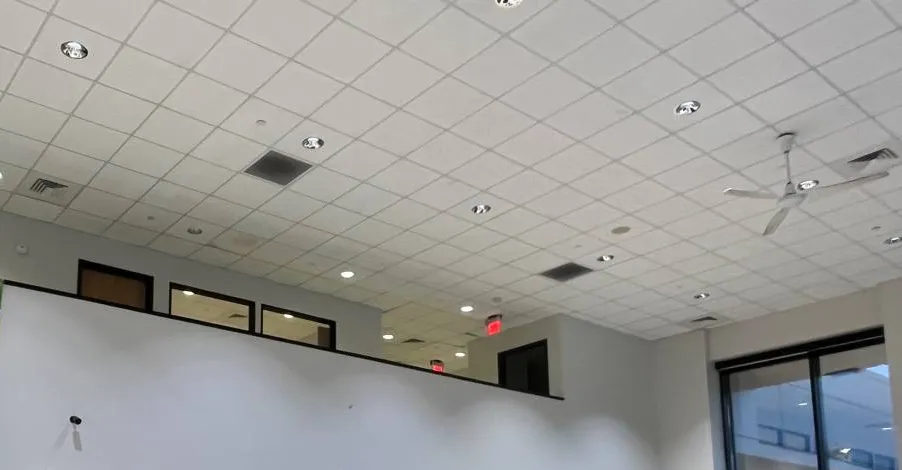
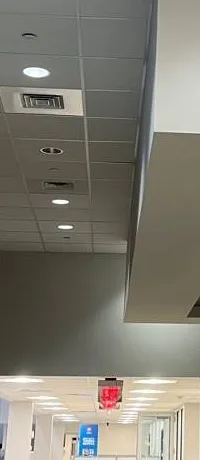
Example photo from another AESS commercial job (not an Ulster County building), cropped to the ceiling: a tall tiled ceiling with recessed lights and a fan, and a small camera on the white mezzanine wall at lower left. High walls like this are where a single camera has to cover a large open floor.
Ulster Hikvision Quote or Check-Up
Tell us the town and whether anyone lives there full-time
✅
Request Sent!
We will call about your Ulster County property the same business day.
25+
Years Experience
✓
Same-Day Estimates
100%
Licensed & Insured
4.7★
201 Google Reviews
Three facts get you a useful first answer. Which town or hamlet the property is in, whether somebody is there every night, and what brings internet to the house — cable, Archtop or other fiber, a Starlink dish, a cellular box or a DSL line. With those we can tell you on the first call what kind of Hikvision system makes sense in Ulster and roughly what it costs. Call (845) 640-3835 or use the form.
New Hikvision for private homes, farms and shops; written covered-use check before any quote
Absence alerts, battery backup and auto-restart tested by pulling the plug before we leave
201 people have reviewed us on Google, averaging 4.7★; our licence number is 12000287431
Why Ulster County Properties Need Hikvision Security Camera Installation
Ulster is a county of houses that are often empty. The Census Bureau's 2023 five-year estimates count 86,178 homes in the county, and 6,545 of them are held for seasonal, recreational or occasional use — roughly one in thirteen. In the western towns the share is far higher: about seven homes in ten in Hardenburgh, more than half in Denning, a third in Shandaken and close to a fifth in Woodstock. Add the County Comptroller's count of 2,827 short-term rental listings in May 2025, and a large part of Ulster's housing has no one inside on a given Tuesday. A camera system on one of those houses is not a deterrent somebody watches; it is a witness that has to keep working on its own, and a messenger that has to reach someone two or three hours away.
That is where Hikvision earned its place here. For years it was the brand that gave weekenders and farm owners a real recorder, wired cameras with good night images and a free phone app for the price of a few cloud cameras and their subscriptions. Plenty of Ulster cabins, barns and Main Street shops still run on it. But a Hikvision system in Ulster faces three pressures that city systems do not: power that drops with every nor'easter and thunderstorm, internet that may be a satellite dish or a single bar of LTE, and, since 2026, federal rules that depend on what kind of building the camera is on. Ulster has an unusual number of buildings on the wrong side of that line — dozens of volunteer fire companies, four state correctional facilities, a SUNY campus, the county seat in Kingston, and a town hall and highway garage in every town.
The rules first. In November 2022 the FCC stopped authorizing new Hikvision equipment. Its June 26, 2026 public notice (DA 26-635), published in the Federal Register on July 6 and in force from July 16, 2026, goes further: previously authorized Hikvision gear may no longer be imported or marketed for public safety, government facilities or other national-security purposes, with critical infrastructure to follow once the FCC defines it. For uses outside those categories the notice says the prohibition does not apply, and it states that consumers may keep using equipment they legally bought. Hikvision USA calls it “not a blanket ban”, has gone to court against the FCC, and says sales, support and warranty continue for non-covered uses. For a farmhouse in Gardiner that means a Hikvision system is still a legitimate choice. For the Gardiner firehouse, it is not.
Then there is who actually watches. Kingston's police department told a Common Council committee in August 2026 that the city runs seven Motorola plate readers and 71 other street cameras — and that the street cameras are Ubiquiti, bought outright, with their video erased every 14 to 21 days. Ulster's District Attorney told the same meeting that city footage together with private businesses' cameras showed exactly what happened in two violent cases on Broadway. Outside the city there is no such network at all: when the Sheriff warned Town of Esopus residents in January 2025 after a burglary and car break-ins around Union Center Road, the advice was to install a security system and motion lighting, and the Sheriff's published programs include no private-camera registry. In most of Ulster, the only camera that saw anything is the owner's.
Owners of empty houses tend to want more than cameras. If the house also needs a keypad or smart lock for cleaners and caretakers, look at our Ulster County smart lock installation page before the visit; the lock and the recorder can share one battery backup and one network.
The county in seven figures
6,545 seasonal homes out of 86,178 housing units countywide (Census ACS 2019–2023), concentrated in Hardenburgh, Denning, Shandaken, Woodstock and Olive.
Roughly one home in thirty is a short-term rental: the County Comptroller found 2,827 listings in May 2025 (3.28% of the housing stock), led by Shandaken with 261 and the Town of Rochester with 238.
A quarter of the housing is pre-1940: 21,829 homes built in 1939 or earlier (Census data via Stacker) — stone, timber and plaster that cameras must be fixed to without damage.
Outages are routine: Central Hudson serves about 93,000 Ulster customers; the late-September 2026 nor'easter put more than 19,000 of its customers out, with Woodstock, Shawangunk, Plattekill and Hurley among the hardest hit.
Lightning: Earth Networks counted 182,760 lightning pulses and 49 thunder days in Ulster in 2020 — every long camera cable to a barn is a path for a surge.
1,293 addresses still waiting for broadband are promised fiber: a $20.8 million state ConnectALL grant in September 2025, then a May 2026 county announcement that federal BEAD money would reach every one of them.
Covered-use buildings are everywhere: New York's fire-department ID list for Ulster has 51 fire departments and companies, plus Eastern, Shawangunk, Wallkill and Ulster correctional facilities and SUNY New Paltz.
Ulster Hikvision Recorder Dark After a Storm?
When the Hik-Connect app shows the recorder offline after a Central Hudson outage, the cause is usually one of three things: the modem never came back, the recorder is waiting at a boot error, or a surge took out the PoE switch. Call (845) 640-3835. We book the earliest Ulster window, and most of these systems are recording again within one to two hours of our arrival. If the cameras record but only the app is broken, our Hik-Connect app support in Ulster County page walks through the fixes.
What We Install
Hikvision Security Camera Installation Services in Ulster County
Ulster Hikvision jobs fall into nine kinds. Most properties need two or three of them at once.
Systems built for absence
A recorder that restarts itself, a battery behind it and the modem, and alerts for a lost camera, a full drive or the recorder going offline — tested before we leave a weekend house that may then sit empty for a month.
Barn, studio and gate cameras
Cable or point-to-point radio from the farmhouse to a barn, a Woodstock studio, a pole building or the end of a lane, with surge protection where every run enters a building.
Viewing on thin internet
Hik-Connect set up to work through Starlink, satellite, LTE or fixed wireless without opening router ports, with sub-streams tuned so live view loads on a slow link.
Covered-use screening
Before any quote, a written check of whether the building is a public-safety, government or grant-funded site where new Hikvision is excluded — and a non-Hikvision design if it is.
Lock-down of existing systems
Older cabin and shop recorders often still carry the installer's login and a hole in the router. We update to official firmware, give every user their own account, shut the forwarded ports and UPnP, fix the clock and write down what we found.
Rental-ready camera plans
Weekend rentals get cameras outside only, with the owner, the property manager and the cleaning crew each on their own login; student houses in New Paltz get their access wiped and rebuilt when the lease turns over.
Historic-district mounting
Cameras on stone houses in Hurley and along Huguenot Street, and on Stockade and Rondout buildings, mounted to timber or joints and kept out of the commission's way where we can.
Off-grid camera kits
Hikvision's solar and 4G kits for a gate, a parking field or an equipment yard with no power and no cable, sized to Ulster winters rather than the brochure.
Planned replacement
For a firehouse, a town building or an owner who has simply decided to leave the brand, the switch to Uniview, Ubiquiti or another ONVIF line happens a few cameras at a time on the cable already in the walls, so there is never a night without recording.
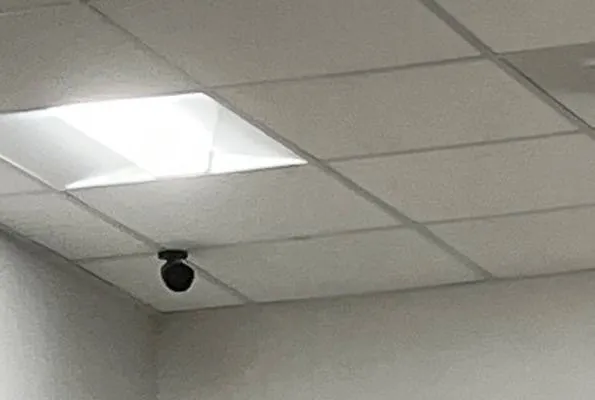
Not an Ulster site: from an earlier AESS shop installation, a small dark dome camera fixed to the ceiling grid at the corner where two walls meet, beside a square light panel. A corner dome sees a whole sales floor from one point.
Building Specialists
Hikvision Security Camera Installation for Ulster County's Architecture
Ulster's buildings span four centuries, and each kind changes where a Hikvision recorder lives, how cable gets out to the cameras and what the cameras are fixed to. These are the six we see most.
Stone houses of the 1600s and 1700s
Hurley's Main Street, Historic Huguenot Street in New Paltz and the Stockade in Kingston. Walls two feet thick swallow Wi-Fi, so every camera is wired, and the cable rides window trim, sill beams and old service openings instead of new holes in the stone.
Catskill cabins and weekend houses
Wood-framed houses along Route 28 and up the hollows of Shandaken, Olive and Denning, often on piers or a crawlspace. The recorder lands in a heated closet with the modem, never in the unheated crawlspace where winter and snowmelt reach it.
Farmhouses with barns
Gardiner, Marbletown, Rochester, Esopus and the Wallkill valley: a house recorder that has to see a barn, a farm stand and the end of a lane, a few hundred feet away across fields that rule out casual trenching.
Kingston brick and the Rondout
Nineteenth-century rowhouses and corner stores in Midtown, the Rondout and Uptown, many with a shop below and a flat above. Cellars by the creek take water, so recorders go upstairs, and the shop and the apartment stair get separate users.
Studios, guest cottages and outbuildings
Woodstock and Saugerties properties where a detached studio holds instruments, art or tools worth more than the house's contents. Often the studio camera is the reason the system exists.
Village rentals and multi-unit houses
Converted houses in the Village of New Paltz and Kingston split into units. Shared entrances, stairs and parking are covered; tenants' units and windows are not, and their phones never see the owner's cameras.
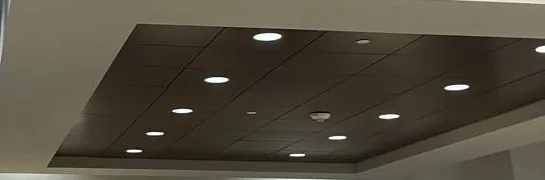
Photo from a past AESS commercial job outside Ulster: a dark recessed ceiling panel set into a white soffit, with rows of round downlights and one small white round fixture near the centre. Bright downlights in a camera’s view wash out faces, so we place cameras around the lighting plan, not under it.
How we fix Hikvision cameras to these buildings
Fieldstone and bluestone: the stone face is never drilled when there is an alternative. A camera goes on a timber lintel, a porch beam or a mortar joint using sleeved anchors, and its cable runs in the shadow of a downspout or trim. Where a wall has to be crossed, one small sleeved core through a mortar joint carries every cable for that side of the house.
Log and board-and-batten: a Catskill log wall gets a wooden block first and the camera on the block, which leaves only a few screw holes in the log to fill and stain if the camera ever comes down. Board-and-batten siding moves with humidity, so the base is screwed to a single batten rather than bridging two boards.
Barns and pole buildings: metal siding and steel posts carry lightning energy, so cameras on a barn are bonded and the cable entering the house gets a grounded protector. Inside a barn, the camera goes high and out of reach of equipment and animals, aimed at the door and the aisle.
Brick rowhouses: we drill mortar joints rather than brick faces, and in buildings near the Rondout creek we take the recorder out of the cellar altogether, extending the existing cable upward instead of re-pulling it.
Unheated spaces: Hikvision outdoor cameras are built for cold — one common ColorVu turret is listed by its distributor down to −22 °F — but recorders and hard drives are indoor equipment. In a house that is kept at 45 °F over the winter, the recorder goes in the warmest closet, not the porch or the garage.
Owners of these houses often add a video doorbell at the same visit. It needs the same network and the same battery backup, so it is cheaper to plan together; see Ulster doorbell camera installation.
Covered Uses
Where New Hikvision Stops in Ulster County
The 2026 FCC rule follows the building's purpose, not the town or the owner's politics. Ulster's mix of rural volunteer services, state institutions and private property makes that line come up more often here than in most counties. This table is how we sort a job before quoting it.
Ulster building
Where it sits under the 2026 rule
What we install
Firehouses and ambulance buildings — 51 fire departments and companies on New York's Ulster FDID list, from Accord to West Hurley
Public safety. Hikvision's own guidance, quoting the FCC, includes police, fire and emergency medical services.
Non-Hikvision only, for example Uniview or Ubiquiti
Town and village halls, highway garages, county offices in Kingston
Government facilities, which the FCC footnote reads as including local government buildings
Non-Hikvision only
State sites: Eastern, Shawangunk, Wallkill and Ulster correctional facilities; SUNY New Paltz; the DEC field office
State government facilities; most run their own procurement
We do not bid new Hikvision; contractors working there should ask the agency
Houses of worship or nonprofits spending a federal security grant
Federal grant money cannot buy it: the grant rules at 2 CFR 200.216 name Hikvision
A named non-Hikvision model list the grant administrator can check
Federal contractors, for example on Enterprise Drive or along 9W
NDAA Section 889 Part B concerns contractors that use covered equipment
Non-covered uses; the import and marketing prohibition does not apply
Hikvision if you want it, with a supply check, or an alternative
Three Ulster wrinkles are worth knowing. First, many fire companies here are volunteer organizations that share a building with a social hall or a community event space; the purpose of the building, not the event, governs. Second, a private farm that leases a field for a county fair or a fire company fundraiser is still a private farm. Third, a landlord who rents an office to a town or county agency should treat that unit as a government facility when cameras inside it are replaced. None of this is legal advice; when a board or a grant is involved, its counsel should have the final word.
If your organization already owns Hikvision cameras, the FCC has said in writing that continued use is not prohibited. What changes is the next purchase: replacements and additions at a covered site should be non-Hikvision, and we write the plan that way, reusing cable and mounts.
Rural Design
Designing a Hikvision System for Ulster's Power, Distance and Internet
An Ulster Hikvision design starts from the weakest link on the property. Usually that is not the camera; it is the power, the distance to the outbuildings or the internet connection. The rest of this section is how we deal with each.
Power: outages, restarts and generators
Central Hudson outages here are not rare events. A Hikvision NVR has no battery of its own, so every drop is a hard shutdown, and every return is a power surge into a box that may be recording to a drive at that moment. We put a line-interactive battery backup under the recorder, the PoE switch and the modem, sized to carry them through short drops and generator transfers and to shut the recorder down cleanly in a long outage. The recorder's clock is tied to an internet time server, so after power returns the footage is filed under the right date.
Many Ulster houses have a standby generator now. A generator transfer switch adds a few seconds of dead power at both ends of an outage; without a battery in between, the recorder sees two hard power cycles. With one, it sees none.
Distance: barns, lanes and gates
Network cable for a PoE camera is good for 100 metres, about 328 feet, from the switch. Many Ulster barns are farther than that from the farmhouse. The options are a small outdoor-rated switch at a midpoint with its own power, fiber between buildings, or a pair of radios. Hikvision itself sells point-to-point wireless bridge kits; its catalog lists a 2.4 GHz kit rated to 1 km and a 5 GHz kit rated to 5 km. Across an open field with a clear line of sight, a bridge often costs less than a trench and avoids digging near a well line or a septic field.
Where there is no power at all — a farm gate on a county road, a trailhead lot, an equipment yard — Hikvision's US solar kit is an option. The DS-2XS6A47G1-IZS/C36S80 pairs an 80 W panel with 360 Wh of lithium battery, 4G LTE and built-in storage, and Hikvision rates its runtime in cloudy, rainy weather at five days in performance mode. It also lists a charging range that stops at −4 °F, and the whole kit weighs about 58 pounds, so we plan the pole, the panel angle and the winter sun before recommending one.
Internet: satellite, cellular and fiber that has not arrived
Remote viewing used to mean opening ports on the router. That never worked on satellite, and it does not work on Starlink, which places customers behind carrier-grade NAT so inbound connections from the internet cannot reach the house. It is also the setup that the exploited Hikvision flaws were written for. Hik-Connect avoids it: the recorder makes an outgoing connection to Hikvision's service and the phone meets it there, so no port forwarding is needed.
On a weak link, the setting that matters is the sub-stream. We set each camera's second stream to a resolution and bitrate the link can carry, so live view on the phone loads in seconds, while the full-resolution main stream records to the drive in the house. Where cell service is the fallback, remember that Ulster's dead zones are real: Hudson Valley One reported gaps along Routes 212 and 28 where the mountains block towers.
If fiber is coming to your road under the county programme, there is no reason to wait. The recorder records locally whatever the internet is doing; a better connection only improves viewing from away, and moving the system from one modem to another takes minutes.
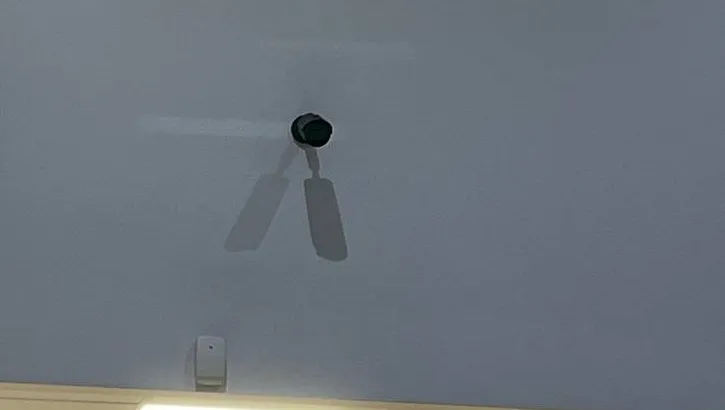
Earlier AESS job, not an Ulster property: a small dark camera mounted high on a tall white wall, its shadow doubled by two light sources, with an alarm motion sensor near the ceiling line below. Height keeps a camera out of reach but makes faces smaller, so the lens is chosen for the distance.
Commercial Hikvision
Business Hikvision Security Camera Installation in Ulster County
Ulster businesses are small and spread out, and many keep seasonal hours. These are the corridors where we install and service most business Hikvision systems, and what each one usually needs.
Uptown Kingston and the Stockade
Shops and restaurants on Wall Street and North Front Street, inside a landmark district. Interior cameras are routine; exterior cameras are planned around the preservation commission's rules and existing mounting points.
Broadway and Midtown, Kingston
Storefronts, offices and mixed-use buildings along the corridor where the city's own street cameras are concentrated — which cover the street, not your back door, your register or your stockroom.
Route 9W and the Town of Ulster
Strip retail, the Hudson Valley Mall site and the former IBM campus on Enterprise Drive, now iPark 87. Higher channel counts, parking fields and, for tenants with federal contracts, an equipment inventory before anything is bought.
Main Street and Route 299, New Paltz
Village restaurants, bars and shops between the Thruway and the Wallkill, many with apartments above and rear lots shared with the next building. Busy nights in term time, quiet weeks in summer.
Saugerties Village and Route 32
The village's two shopping streets, Partition and Main, meet near the Esopus Creek; Route 32 then carries the antiques barns, garages and cafes toward Woodstock. Many keep winter hours, so we schedule alerts around when the doors are actually locked.
Route 209 and the farm roads
Ellenville, Kerhonkson and Accord businesses under the Shawangunk Ridge, plus farm stands, orchards and agritourism barns across the county's 486 farms — long lots, honesty boxes and parking fields that fill on fall weekends.
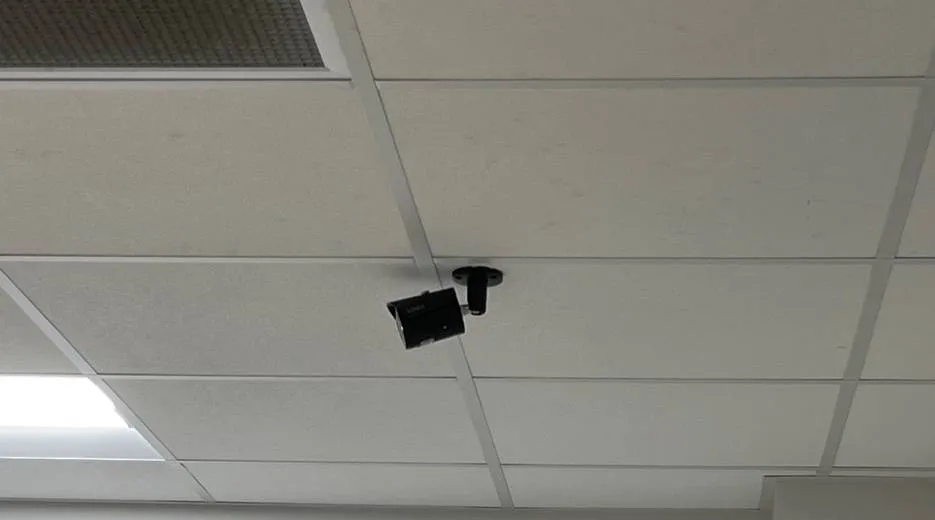
From an AESS office installation elsewhere, not in Ulster: a small black bullet camera hanging from a short mount in a white drop-ceiling grid, aimed down the room. The brand of this camera is not shown.
Compliance callouts for Ulster businesses
Who may install: under 19 NYCRR §195.2, installing or servicing cameras that watch for break-ins or theft is licensed work in New York; our licence number is 12000287431.
Ulster's electricians' law: County Code Chapter 185 licenses electrical contractors and its definitions take in signal, alarm and data wiring. We handle the low-voltage camera side; when a barn or a recorder closet needs a new circuit or outlet, a county-licensed electrician does that part and we schedule around them.
Kingston landmark districts: a business in the Stockade, along the Rondout–West Strand or on Chestnut or Fair Street needs the Historic Landmarks Preservation Commission's certificate of appropriateness before an exterior change that alters what passers-by see; like-for-like upkeep is exempt.
Short-term rentals: Airbnb has banned indoor cameras in all listings since April 30, 2024 and requires outdoor cameras to be disclosed before booking. Kingston caps full short-term rental permits at one percent of the city's housing units.
Neighbours and sound: Civil Rights Law §52-a gives a neighbour a claim against a camera installed to record their backyard without consent, and Penal Law §250.05 governs recording conversations; we aim at your property and leave audio off unless you decide otherwise.
Federal rules: the FCC's 2026 import and marketing prohibition for covered uses, 2 CFR 200.216 for federal grant money and NDAA Section 889 for federal contractors, as set out in the table above.
These callouts summarize published rules; they are not legal advice.
Your Questions Answered
Hikvision Security Camera Installation in Ulster County: Questions Answered
These are the questions Ulster owners actually ask us about Hikvision, grouped by the problem behind them. The federal rules in general are covered on our Hudson Valley Hikvision page; here they are applied to Ulster buildings.
Houses Nobody Is In
How will we know the Hikvision system has quietly stopped recording while the cabin sits empty for a month?
By making the recorder tell you, rather than waiting to notice. Hikvision recorders raise exception events for a disk error, a full disk, a lost video signal and a network disconnection, and each can be pushed to the Hik-Connect app. The one people forget is the recorder going offline altogether: if it loses power or internet it cannot send anything, so the app's own offline notice is what you rely on, and we make sure it is switched on for every phone that should get it.
We also suggest a habit: open the app's playback page once a week and scrub through last night on one camera. It takes thirty seconds, and it catches the slow failures that send no alert at all, such as a camera knocked off aim by a falling branch or a dome that has iced over.
When the owners live two or three hours away, who should the alerts go to first?
Someone who can be at the house within the hour, as well as you. In Ulster that is usually a caretaker, a neighbour or the contractor who already checks after storms. The r/hudsonvalley thread in which second-home owners described who looks after their houses in October 2026 named exactly those people, with cameras as the extra pair of eyes.
Hik-Connect lets you share the device with another account and choose what that person can see and do. A caretaker can get live view and alerts for the driveway and the outside doors without playback, without the indoor cameras and without the ability to change settings. If the arrangement ends, you remove the share from your phone in a minute.
At a house nobody visits for weeks, should the recorder run continuously or only save motion?
Continuously, in almost every case. Motion-only recording saves drive space, but it depends on the detection working perfectly through snow, fog, spider webs and low winter sun, and an empty house is exactly where nobody notices when it does not. Continuous recording means the minutes before and after an event are always there, including the car that idled at the end of the drive before anyone got out.
The cost is drive capacity, which is cheap compared with a missing clip. We size the drive so continuous footage covers more than your longest absence, use H.265 compression to stretch it, and mark motion and person events on the timeline so you can still jump straight to them when you check from the city.
Will a Hikvision recorder survive a winter in a house kept at 45 °F?
Generally yes, if it is inside the heated envelope and on a battery. Recorders and their hard drives are indoor equipment; the problem in Ulster is rarely the setpoint but the places recorders end up, such as unheated crawlspaces, porches, garages and sheds, where winter temperatures and condensation reach them. The Mohonk Preserve's weather station above New Paltz, keeping records since 1896, logged a low of 1 °F twice in the 2016–17 winter; an unheated space follows the outside air.
The other winter risk is the furnace itself. If the heat fails, a closet can drop below freezing over a few days. A recorder will usually ride that out, but a cold drive can fail to spin up when power returns, so for houses that are shut for the winter we often add a small temperature sensor to the alarm system, or a smart thermostat alert, so you hear about a heating failure before it becomes a burst pipe.
For a weekend house, are motion alerts more useful than a simple daily check-in?
Both have a place, but they answer different questions. Person and vehicle alerts from AcuSense cameras tell you something is happening now. A system health check tells you the cameras will be there when something happens. On a house that sits empty, the second matters as much as the first, because a camera that died in November will not alert you in February.
Our usual Ulster setup is person and vehicle alerts on the drive and the doors only during the hours and days the house is empty, exception alerts on all the time, and the weekly thirty-second playback check above. That keeps the phone quiet enough that you still read the alerts that come.
Starlink, Satellite and Cellular Internet
Our only internet is a Starlink dish. Can Hik-Connect still show us the cameras?
Yes. Starlink puts customers behind carrier-grade NAT, so the old method of forwarding ports on the router to reach the recorder does not work there. Hik-Connect does not need it: the recorder makes an outgoing connection to Hikvision's service and your phone connects through it. Remote-access guides for Starlink say the same thing about port forwarding, and Hikvision dealers' support forums describe Hik-Connect as needing no port forwarding.
The practical limits are upload speed and power. Viewing four cameras at once over a busy dish can stall, so we set modest sub-streams for remote viewing. And a Starlink dish and router draw real power; if they are not on the battery backup, the cameras keep recording during an outage but you cannot see them until the power is back.
How much cellular data does watching Ulster cameras from the city use?
It depends almost entirely on how long you watch live and at what quality, and much less on how many cameras are installed. Alerts and snapshots are small. Live view at full resolution is large. Recording uses no internet at all, because it goes to the drive in the house.
If the house's own internet is a capped cellular plan, we set the sub-stream that the app uses away from home to a low resolution and frame rate, keep the main stream for recording, and switch off automatic cloud uploads you did not ask for. That way an hour spent checking the driveway after a storm does not use up the month's plan.
Our road is on the county's fiber list. Should we install cameras now or wait for the new line?
Install now. In May 2026 the county announced that all 1,293 unserved locations in its ConnectALL project will get fiber under the federal BEAD programme, but construction on a particular road can still be a long way off, and the cameras do not depend on it. Everything records locally to the drive.
When the fiber arrives, moving the recorder to the new router is a short job: a new network cable, a check that Hik-Connect has re-registered, and an alert test. If you tell us fiber is coming, we leave a labelled spare cable run from the recorder to wherever the installer is likely to put the new router.
Farms, Barns and Long Lanes
Our barn is about 600 feet from the farmhouse. Should the camera link be cable, fiber or a wireless bridge?
At that distance, ordinary network cable on its own is out: PoE over copper is limited to about 328 feet. The three real choices are copper with a powered switch in the barn, fiber between the two buildings, or a point-to-point wireless bridge. If the barn has power and there is clear line of sight between the eaves of the two buildings, a bridge is usually the cheapest and fastest. Hikvision's own 2.4 GHz bridge kits are rated to about a kilometre.
If trees, a hill or another building block the view, fiber in conduit is the durable answer and also cannot carry a lightning surge between buildings. Either way the barn gets its own small PoE switch for its cameras, on a battery if the barn's power is unreliable.
Can a Hikvision solar camera watch a farm gate through an Ulster January?
It can, with realistic expectations. Hikvision's US solar kit pairs an 80 W panel with a 360 Wh battery and rates five days of operation in its performance mode during cloudy, rainy weather. January in the Catskills brings short days, low sun and snow on the panel, and the battery's listed charging range ends at −4 °F. A gate camera that wakes on motion and records short clips will usually get through; a camera asked to stream continuously over 4G probably will not.
So we site the panel facing south with a steep winter angle, clear of the tree line, and set the camera to record on events. The kit also needs a cellular signal at the gate. We test the carrier on site first, because a gate in a hollow off Route 28 may have no signal at all.
Will a lightning strike near the barn travel down the camera cable to the recorder?
It can, and in Ulster it happens. Earth Networks counted 49 thunder days in the county in 2020. A long copper cable between two buildings picks up the surge from a nearby strike and delivers it to whatever is at the other end, usually the recorder's PoE port or the switch.
The defence is a surge protector on every copper run where it enters a building, bonded to that building's electrical ground, at both ends of the run. Fiber or a wireless bridge between buildings removes the copper path altogether, which is one reason we favour them for barns.
Can a camera watch the honesty box at our farm stand without recording everyone driving past?
Yes. Mount the camera on the stand or a post beside it, aimed down at the box and the counter rather than out at the road, and use privacy masking to black out any part of the frame that takes in the road or a neighbour's property. A short varifocal lens frames the box tightly, so faces at the counter are clear while passing traffic is outside the shot.
A small sign saying the stand is recorded is worth adding; it deters more than it reveals. If the stand is far from power, this is a good job for a low-power camera recording to its own memory card, or for the solar kit if cellular coverage reaches the stand.
Can one Hikvision recorder in the main house also serve the cameras at a guest cottage on the same lot?
Usually, if the two buildings can be linked by cable, fiber or a bridge. The cottage gets a small PoE switch, its cameras feed back to the main recorder, and everything appears in one app. If the cottage is rented to guests or tenants, though, a separate recorder may be cleaner, so that the tenants' outdoor view and the owner's never mix.
Where the cottage is too far or too awkward to link, a second small recorder there works, and Hik-Connect shows both under one account.
Ulster Buildings and the 2026 Rules
Our volunteer fire company rents its hall for weddings. Can Hikvision cameras go in the hall?
We would not install them. The building is a fire company's building, and the FCC's covered uses include public safety, which Hikvision's own guidance reads as including fire and emergency medical services. Renting the hall for events does not change what the building is. New York's fire-department ID list for Ulster includes 51 fire departments and companies, and many of them run halls like this.
If the hall already has Hikvision cameras, the FCC has said continued use is not prohibited; the issue is the next purchase. We would design additions and replacements on another brand, reusing the cable, and leave the board a short written note on what is installed where so its own counsel can advise.
We rent part of our Kingston building to a county agency. Which cameras does the 2026 rule reach?
Treat the agency's unit as a government facility. Cameras inside it, and cameras whose purpose is to protect it, should not be new Hikvision. The rest of a privately owned building — your own shop, other private tenants, the parking lot you manage for everyone — is not a government facility because one tenant is.
In practice, we keep a mixed building simple: the agency's space gets a non-Hikvision camera on its own recorder or on an ONVIF recorder the agency approves, and the landlord's common areas stay on the existing system. The lease may also say something about security equipment; check it before work begins.
Kingston's police run Ubiquiti street cameras. Should a private Kingston business avoid Hikvision too?
Not because of the city's choice. The Kingston police chief told the Public Safety Committee in August 2026 that the department's street cameras are Ubiquiti, bought outright, alongside Motorola plate readers. A city department is a covered user; a pizzeria or a law office on Broadway is not, and Hikvision remains lawful for it.
What a Kingston business should copy from the city is the habit, not the brand: cameras owned outright, footage kept on its own recorder, and a short, defined retention period. The city erases its street video every 14 to 21 days. Decide your own number in advance and set the recorder to it.
Can an old camera bracket on a Stockade or Rondout storefront be reused for a new Hikvision camera without a new review?
Often, if nothing visible changes in a material way. Kingston's code requires a certificate of appropriateness for a material change in appearance visible from a street or alley in a landmark district, and it exempts ordinary maintenance and repair that does not change design, materials, colour or outward appearance. A like-for-like camera on the existing bracket, the same colour, cabled through the existing hole, is the closest thing to maintenance a camera job offers.
A larger camera, a new position on the front, new exterior conduit or a different colour is a different matter. In those cases we prepare a photo and a one-page description for the Historic Landmarks Preservation Commission before ordering, because the answer can change which camera you buy.
Rentals: Weekend Guests and Student Tenants
What do Airbnb's 2024 camera rules mean for a Hikvision system on a Shandaken rental?
Every indoor camera has to go, even if it is switched off, and every outdoor camera has to be disclosed in the listing before guests book. Since April 30, 2024 Airbnb has banned indoor security cameras in all listings, and it bars outdoor cameras from looking into the house or covering spaces such as an enclosed outdoor shower or a sauna. With 261 short-term rental listings in Shandaken alone in May 2025, by the County Comptroller's count, this is one of the most common camera conversations we have in the western towns.
A Hikvision system suits a rental well once the indoor channels are removed: outdoor cameras at the drive, the doors and the parking area, an owner account with full rights, a manager account with live view of outside cameras only, and privacy masks where a camera's field of view includes a hot tub or deck.
When New Paltz student tenants move out in May, what should be reset on the recorder?
Anything that gave the last tenants access. If tenants were given app access to an entrance camera, remove their share; if anyone ever learned a recorder password, change it; and confirm the recorder's admin password is held only by the owner. Then review what the cameras see, because furniture, lighting and parked cars change between leases.
The Village of New Paltz registers and inspects rental properties, and its building department aims for every registered unit to have been examined by a codes official within the previous twelve months. Turnover week is when the smoke detectors and locks are checked anyway; putting the camera reset on the same list costs nothing. With more than 7,000 students at SUNY New Paltz, that week arrives every year.
Night, Snow and Light in the Countryside
Why do snowflakes glow like little headlights on our camera at night?
At night an infrared camera lights the air directly in front of the lens, so snowflakes, rain and insects show up as bright moving blobs. A camera using plain motion detection cannot tell those from a person. AcuSense cameras classify humans and vehicles, which removes most of it, and Hikvision's own figure is up to 90 percent fewer false alarms — a ceiling, not a guarantee.
The settings that help most in an Ulster snowstorm: alerts only for people and vehicles, a detection zone drawn on the ground rather than the sky, a minimum target size so a flake near the lens is ignored, and on cameras right under the eaves, moving the camera a little farther from the infrared reflection off the soffit.
Will a ColorVu camera's white light shine into a neighbour's bedroom across a dark rural road?
It might, if it is aimed carelessly. ColorVu cameras produce colour at night by combining a wide-aperture lens with a small white light that some models switch on when needed. On a city street that light is lost among streetlights; in a dark hollow off Route 212 it is the only light on the hillside.
So in Ulster we aim ColorVu cameras down at the drive and the door, set the white light to come on only on a detected event or keep it off and rely on ambient light, and use infrared models where the view crosses toward a neighbour's windows. A camera that annoys the neighbours is a camera that gets complained about.
Should a seasonal shop on Route 28 record around the clock or only while it is closed?
Record around the clock, alert only while closed. Continuous recording costs nothing extra once the drive is sized, and it is the footage from business hours that settles a dispute about a fall, a refund or a till shortage. Alerts are what should follow the calendar: person and vehicle alerts when the doors are locked, and none during opening hours, when staff are there.
For shops closed for months at a time, we add the same absence measures as for a weekend house: battery backup, auto-restart and offline alerts to the owner. Hikvision recorders allow different alert schedules per camera, so the stockroom door can alert at any hour while the sales floor stays quiet.
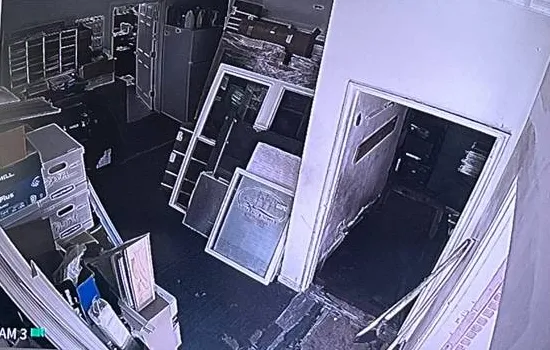
Screen photo from an earlier AESS job, not in Ulster: one tile of a recorder’s multi-camera screen, showing a dim back storeroom with stacked frames, boxes and an open doorway. A view like this is what a weekly thirty-second playback check looks at.
Equipment
Types of Hikvision Cameras We Install
Nine kinds of Hikvision hardware cover nearly every Ulster property we see. The photos below come from the manufacturer and show shape, not a particular model; which model goes on your wall is settled when we know what the distributors have.
ColorVu bullets and turrets
Colour at night from a wide-aperture lens and a small white light. Best at a lit porch or a barn door with a yard light, aimed down so the light stays on your property.
AcuSense infrared turrets
Person and vehicle classification with infrared night vision. The standard choice on dark lanes and hillsides, and the one that keeps snow and moths from flooding the phone.
Varifocal bullets
A zoom lens set on site to frame the end of a long drive, a farm gate or a plate at a gravel turnaround, where a wide lens would show only a speck.
Indoor cube and mini domes
Small cameras for a studio, a shop's back room or a barn aisle. Never inside a short-term rental, and never pointed at a tenant's living space.
PTZ speed domes
Pan-tilt-zoom for an orchard parking field, a marina-style lot on the Rondout or an equipment yard, always backed by fixed cameras at the entrances.
Solar 4G kits
A camera, panel, battery and LTE modem on one pole for gates and yards with no power or cable, sited for winter sun and tested for signal first.
Wireless bridge kits
Point-to-point radios that carry a barn's or a cottage's cameras back to the house without a trench, with no copper path for lightning.
PoE recorders
The NVR that powers and records each camera on one cable, sized for days of footage and kept in the warmest closet with the modem and the battery.
ONVIF alternatives
Uniview, Ubiquiti and other makers' cameras that can record on a Hikvision recorder, for covered-use buildings and owners migrating in stages.
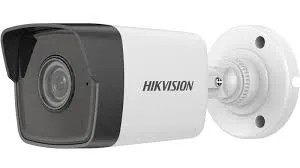
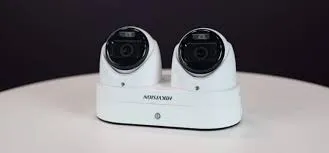
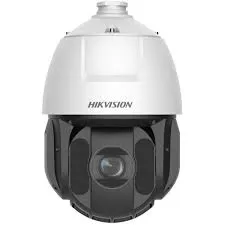
Manufacturer product photo of a white Hikvision bullet camera with a black front hood on a round wall base; the shape we use for a lit barn door or a drive.Manufacturer product photo of two white Hikvision turret cameras side by side; turrets are the usual choice under the eaves of an Ulster cabin or farmhouse.Manufacturer product photo of a Hikvision pan-tilt-zoom speed dome on a pendant mount, suited to an orchard parking field or an equipment yard.
Recorder-based Hikvision against monitored and DIY packages on a rural lot
AESS Hikvision (or alternative)
ADT-style monitored package
Ring / SimpliSafe-style DIY
Records when the internet is down
Yes, to the recorder in the house
Depends on the package
Mostly no; history lives in the cloud
Reaches a barn 600 feet away
Cable, fiber or bridge, designed on site
Usually not part of the package
Only if Wi-Fi reaches it
Cameras through a Catskill winter
Wired power, no batteries at the camera
Varies
Battery cameras struggle in hard cold
Monthly fee to keep footage
None for local recording
Monitoring contract
Subscription for history
Covered-use and grant check
Written into the quote
Varies
Not addressed
The r/hudsonvalley owner who described a neighbour's “extensive cameras and a full house battery backup, combined with cellular fallback on their Internet package” was describing what it takes to make cloud cameras dependable up here. A wired recorder with a battery behind it gets most of the way there with less to go wrong.
AI Overview Reality Check
What AI Gets Wrong About Hikvision Security Camera Installation in Ulster County
We could not load a live AI Overview while writing this page, so the seven statements below are not quotations from one. They are the claims about Hikvision we keep meeting in search snippets, shop listings, cost calculators and forum threads, each set against the sources at the foot of the page and against what an Ulster property actually asks of a camera system.
“Hikvision is illegal in the US now”
The FCC's 2026 action prohibits importing and marketing previously authorized Hikvision equipment for covered uses: public safety, government facilities and other national-security purposes, with critical infrastructure on hold until it is defined. For other uses, the notice says the prohibition does not apply.
So the answer in Ulster depends on the building. A Stone Ridge farmhouse or a New Paltz bakery may install Hikvision; the Stone Ridge fire company and the New Paltz village offices should not get new Hikvision. A summary that says “illegal” misleads the first and understates the second.
The FCC also stated that owners may keep using equipment they legally bought. Hikvision is challenging the FCC's authority in court, so the picture may move again.
“Battery Wi-Fi cameras suit a country house best”
Wireless is attractive when the alternative looks like a trench. But Wi-Fi has to reach the camera, and on an Ulster property the camera is often behind stone walls, across a field or in a barn with metal siding. A battery camera also has to survive months of cold, and most keep their history in the cloud, so they record nothing useful when the internet is down.
The better rural answer is usually wired cameras at the house and a point-to-point bridge or fiber to the outbuildings, with all power coming from one closet on one battery.
Wireless still has a place: a single camera at a gate on a solar kit, or a temporary camera during construction. It is a tool for the edges of the property, not the core.
“Port forwarding is how you view Hikvision cameras remotely”
Older guides, including plenty still ranking in search, teach opening router ports to the recorder. It was always risky: recorders reachable that way are exactly what CVE-2021-36260, rated 9.8, and the older CVE-2017-7921 were exploited through, and CISA added the latter to its exploited list in March 2026.
It also simply fails on much of Ulster's internet. Starlink customers sit behind carrier-grade NAT, and many cellular connections do too, so an inbound connection never reaches the house.
Hik-Connect's outgoing connection, or a small VPN for owners who prefer it, works on every connection type here and leaves nothing exposed. Port forwarding has no place on a new Ulster install.
“A battery backup keeps the cameras running through a power outage”
A small battery backup carries a recorder, a switch and a modem for minutes to perhaps an hour, depending on the load. Ulster outages are often longer: Central Hudson's restoration after the September 2026 nor'easter ran into the weekend for some customers.
What the battery really does is ride through short drops and generator transfers, protect the drive from hard shutdowns, and keep the clock right. The part that matters most for an empty house is what happens next: the recorder must restart on its own when the power returns.
We test that by pulling the plug before we leave. A recorder that sits at a boot screen until someone presses a button turns a twelve-hour outage into a month-long gap.
“Cameras outside a rental are fine as long as guests are told”
Outdoor cameras usually are, with disclosure. Indoor cameras are not, on Airbnb, whatever the guests are told: the platform banned them in all listings from April 30, 2024, switched off or not.
Outdoor cameras also have limits. They may not look into the house, and they may not cover private outdoor spaces such as an enclosed outdoor shower or sauna, which are common features of Catskills rentals.
Other platforms set their own rules, and Kingston adds its own short-term rental permit system. A host should design to the strictest rule that applies.
“Budget around $1,300 to $1,500 for a camera install”
Those figures are national and city averages for camera installation of any brand: Angi's New York figure is about $1,509, HomeAdvisor's national average $1,289. They describe a few cameras on a house with a garage and good internet, not a farmhouse with a barn, a long lane and a satellite dish.
On our list, a four-to-six camera Hikvision system in Ulster starts at $2,754, because Ulster work carries a 1.53× area factor for travel, longer runs and outbuildings. A bridge to the barn, a solar gate kit or surge protection on long runs are priced on top.
The averages are not wrong; they answer a different question. The useful number is a written price for your property.
“The police can pull footage from city cameras, so home cameras add little”
Kingston does have a street-camera network, concentrated in Midtown and Uptown, and its video is kept for 14 to 21 days. It watches streets, not driveways, barns or back doors, and outside the city there is no comparable public network.
Even inside Kingston, the District Attorney credited private businesses' cameras alongside the city's when describing how two violent cases were reconstructed. A downtown shop's own camera inside caught a tip-jar thief.
For a house in Olive or a farm in Rochester, the owner's camera is the only camera. That is the reason to make sure it is recording.
A Hikvision Plan for the House Nobody Is In
Tell us the town, the internet and how often someone is there. We will say what the Ulster system should look like and roughly what it costs before anyone drives up.
For an Ulster Hikvision quote we need the town or hamlet, how the property is used, what internet it has, any outbuildings you want covered, and whether the building has a public, grant or government link. We reply in writing the same business day; to talk it through, call (845) 640-3835.
✅
We Got Your Request!
Thanks — it is in. Expect a call the same business day with first thoughts on cameras, links and power for the property. Something broken right now? Call (845) 640-3835.
How It Works
Our Installation Process
Seven steps for every Ulster Hikvision job, whether it is a single gate camera in Accord or twelve cameras across a farm in the Wallkill valley. Steps two and six exist because of how Ulster properties are used.
1
Town, use and internet
You tell us the town or hamlet, how often someone is there, what internet the property has and which outbuildings matter. Photos of the house and any existing recorder label help.
2
Who uses the building, and what is in stock
Fire company, town, state agency, federal grant or federal contract: any of these changes the brand, so we ask before designing. Then we check which Hikvision models, or substitutes, distributors can deliver this month.
3
Site walk
We walk the property with you or your caretaker: camera positions, the recorder closet, the route to each outbuilding, line of sight for any bridge, cell signal at any gate and the battery location.
4
Written design and price
Each camera, link, battery and kit is listed with its price at the Ulster rate, so you can do the house now and the barn or the gate later.
5
Cable, links and mounting
Cable is run inside where the building allows, links to outbuildings installed with surge protection, and cameras fixed to timber, joints or mounting blocks rather than stone faces.
6
Absence setup and the plug test
Firmware from Hikvision, unique accounts, no open ports, Hik-Connect for your internet, exception and offline alerts, auto-restart, then power pulled to prove the battery, the alerts and the restart.
7
Handover
Owners and the caretaker get their own app logins, we copy a clip to a USB stick together so you know how, and the printed sheet records cameras, firmware, boot time after the plug test and who gets which alert.
Coverage Area
Hikvision Security Camera Installation Near Ulster County's Landmarks
Six places, from the county seat to the edge of the Catskills, that show the spread of Ulster jobs. Our vans come up the Thruway and leave it at New Paltz (Exit 18), Kingston (19) or Saugerties (20) depending on the job.
Senate House and the Stockade, Kingston
The 1676 stone house where New York's first Senate met in 1777, inside the eight-block Stockade district — the landmark district where every exterior camera starts with the preservation rules.
The Rondout
The old canal port at the mouth of the Rondout Creek, now restaurants, galleries and apartments in nineteenth-century brick. Low cellars by the creek are no place for a recorder.
Historic Huguenot Street, New Paltz
Stone houses of the late 1600s and 1700s a short walk from the SUNY campus and the village's student rentals: two very different camera jobs on neighbouring streets.
Ashokan Reservoir and Route 28
New York City's 1915 reservoir in the Town of Olive. Route 28 follows its north shore toward Phoenicia and Pine Hill, through the towns where weekend houses outnumber year-round ones on many roads.
Mohonk and the Shawangunk Ridge
The cliffs west of New Paltz, where the Mohonk Preserve has logged weather daily since 1896. Below them: orchards in Gardiner, cabins in Accord and businesses along Route 209 toward Ellenville.
Opus 40, Saugerties
A bluestone earthwork in a county where, by 1898, at least 10,000 people made a living from bluestone — the stone that still forms many Ulster foundations, walls and walks we mount around.
Between those points: Highland and Lloyd at the west end of the Walkway Over the Hudson; Marlborough and Plattekill on 9W; Wallkill and Shawangunk; Rosendale, Stone Ridge, High Falls and Accord; Kerhonkson, Ellenville and Napanoch on Route 209; Hurley, West Hurley and Woodstock; Port Ewen and Esopus; and up Route 28 and Route 42 to Phoenicia, Pine Hill, Denning and Hardenburgh.
Pricing
Hikvision Security Camera Installation Cost in Ulster County
Every AESS Hikvision quote starts from one list: $400 to $700 a camera in Brooklyn, which already includes that camera's slice of the recorder, the cable, the mount, setup and the app. In Ulster we multiply by 1.53, the same factor as Dutchess and the highest we use, to cover the drive up the Thruway, longer cable runs, outbuildings and the absence setup. The table shows both columns so you can check the sums.
Line
Brooklyn base
Ulster (×1.53)
Per camera installed
$400–$700
$612–$1,071
Small system, 4–6 cameras
$1,800–$3,500
$2,754–$5,355
Mid system, 8–16 cameras
$3,500–$8,000
$5,355–$12,240
Large, farm or commercial
$8,000+
$12,240+
Work on a system already installed
Billed at $195 per hour with a 3-hour minimum ($585): firmware and account clean-ups, battery and restart setup, alert tuning, swapping one camera
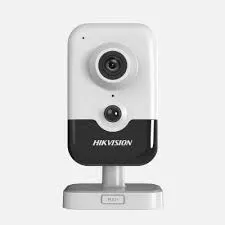
Manufacturer product photo of a small Hikvision indoor cube camera on a short stand, the kind of camera that sits on a shelf in a studio or a shop back room (never inside a rental).
What moves an Ulster Hikvision price
Outbuildings. A barn, studio or cottage adds a switch, a link (cable, fiber or bridge) and surge protection at both ends.
Building fabric. Stone and log walls take longer to cable without damage than drywall and vinyl.
Power. A larger battery, a generator-transfer check or a solar gate kit each add equipment and time.
Internet. Starlink or cellular viewing needs sub-stream tuning and sometimes a battery for the dish; a road waiting for fiber may get a spare cable run.
Which cameras. A plain AcuSense turret under the eaves is the cheapest line on most quotes; a zoom bullet for the lane, a PTZ for a parking field or a solar pole at the gate cost the most.
Availability. Distributor stock of some Hikvision models is thin since 2026, and covered-use buildings need another brand anyway; when that happens the quote shows the substitute and its price side by side.
A Written Ulster Price Before Anyone Picks Up a Drill
You get the camera list, the barn link, the battery and any solar kit priced line by line after the site walk; the installer cannot add to it without your signature.
Hikvision Security Camera Installation Packages & Pricing
Small — $2,754–$5,355
Four to six cameras covering the drive and every door of a cabin or village house, a PoE recorder in a heated closet, battery backup for the recorder and modem, auto-restart tested, exception alerts to two phones and Hik-Connect set up for your internet.
Mid — $5,355–$12,240
Eight to sixteen cameras across a house and one or two outbuildings, with a cable, fiber or bridge link, surge protection on every run, varifocal cameras on the lane and the barn door, and caretaker access set up.
Large / Farm / Commercial — $12,240+
Multiple buildings, parking fields or yards; PTZ or solar gate cameras where needed; separate users for staff, managers and owners; and, where the building is a covered use, the same design on an ONVIF alternative.
Cameras already in a box in the garage? We can fit them
Plenty of Ulster owners buy a kit online and then find the stone wall or the barn is the hard part. For a private house, farm or ordinary shop we will mount and set up equipment you supplied and charge for labour only. Before anything is mounted we check every model number and firmware version, and any device without an FCC ID on its label gets flagged to you first. Labour-only installation is quoted per camera after the walkthrough, because a cabin wall and a stone wall are different jobs; visits to an existing system are $195 an hour with a 3-hour minimum. Equipment you supply stays under its maker's warranty rather than our parts warranty. If you are unsure your recorder holds enough days of footage for a house you visit monthly, read our Ulster County NVR installation page first.
Complete Services
Every Hikvision Security Camera Installation Service in Ulster County
Fiber between a farmhouse and a barn, with no copper path for lightning.
Field Notes
Field Notes: Twenty Minutes With the Power Switched Off
The last thing we do on an Ulster Hikvision job, after every camera is aimed and every phone is set up, is switch the house's power off at the battery backup's input and watch. The battery should take the load without a flicker. The app on the owner's phone should still show live pictures, which tells us the modem or the Starlink router is on the battery too. Then we let the battery run down, or switch it off, and the recorder should go dark and the offline notice should reach the owner's phone.
Then power goes back on. We time how long it takes the recorder to boot, rejoin the network and reappear in the app, and we check that the clock on the recorder is correct and that recording has resumed on every channel. On older recorders this is where problems show up: a box that stops at a setup wizard, a drive that is not found after a cold start, a clock that jumps back to a factory year.
It takes about twenty minutes and it is the most valuable twenty minutes of the visit for a house that will sit empty. An Ulster outage at night in the middle of a three-week absence is not a hypothetical; it is the normal case the system has to survive. We write the boot time and the result on the handover sheet.
Taken on a previous AESS commercial job outside the county: a long run of ceiling tiles with vents and recessed lights stretching toward a red exit sign. Long runs like this are where cable length, and not the camera, sets the limits.
Privacy Settings
Kingston's Camera Debate, Applied to Your Own Recorder
When Kingston's Public Safety Committee questioned the police about the city's cameras in August 2026, the alders asked three things: how long footage is kept, who can look at it, and whether anyone is watching where they should not. Those are good questions for a private Hikvision system too, and every one of them is a setting on the recorder rather than a feature of the brand.
How long footage is kept. The city told the committee its street video is erased every 14 to 21 days, and that plate-reader data is held for six months. A private recorder keeps footage until the drive fills and then overwrites the oldest days. You can also set a maximum number of days, so nothing older than, say, thirty days survives. For a weekend house we usually size the drive to hold more than the longest stretch you are away, so a break-in found on your return is still on the disk.
Who can look. The police department reported that 32 of its members have access to the street cameras and four to the plate readers, and that every viewing is time-stamped against the officer. Hikvision recorders keep a log of logins, playback and exports by user, which only works if every person has their own account. That is why we never leave a shared “family” or “staff” login on an Ulster system.
Where cameras point. Kingston's deputy chief told the committee that the department is not looking into private windows. Privacy masks let a private system make the same promise: a black box drawn over a neighbour's window, a rental's hot tub or the public road is never recorded at all, not just hidden in live view. We draw them during setup and list them on the handover sheet, so you can show a neighbour or a guest exactly what each camera can and cannot see.
Seasonal Checklist
Opening and Closing an Ulster House: The Camera Checklist
Owners who close a house for the winter, or open it in spring, can do most of this themselves in a quarter of an hour. We do it as a paid visit for owners who would rather not.
Closing in the fall
Battery: check the battery backup's age and run a self-test; batteries older than three to five years often fail the first long outage.
Heat: confirm the closet with the recorder stays inside the heated space at the winter setpoint.
Aim: look at every camera's live view in daylight; trim branches that will sag with snow in front of a lens.
Alerts: switch person and vehicle alerts to “house empty” hours and confirm exception alerts reach every phone that should get them.
Access: make sure the caretaker's account still works and remove any summer guests' or tenants' shares.
Firmware: note the recorder's firmware build and check Hikvision's site for a newer official release before the house is left.
Opening in the spring
Playback: scrub through a few nights from mid-winter on two cameras to confirm recording never stopped.
Clock: confirm the recorder's date and time; a wrong clock means some winter footage is filed under the wrong day.
Housings: clean domes and lenses of pollen, spider webs and winter grime; check junction boxes for water.
Outbuildings: check the barn and gate cameras after any spring thunderstorm, and look at surge protectors for a tripped indicator.
Drive: check the drive status page for warnings after a winter of power cycles.
Rather not climb ladders in November? Twice-yearly opening and closing visits are part of the Ulster security camera maintenance plan, and each visit is logged against your system.
FAQ
Ulster County Hikvision Security Camera Installation FAQ
Do you charge extra to drive to Hardenburgh, Denning or the far end of Route 28?
+
Travel is built into the Ulster area factor of 1.53 on our price list, so a quote in Pine Hill is calculated the same way as a quote in Kingston. If a job needs a second day because of distance or weather, we tell you at the quote stage, not on the invoice.
Can the work be done while we are still in the city?
+
Yes. Many Ulster jobs are done with a caretaker, a neighbour or a lockbox for access. We send photos as we go, call you before anything changes from the written plan, and finish with a video call in which we set up the app on your phone and show you every camera.
Will you show our caretaker how to get the system running again after an outage?
+
Yes. Before we leave we walk whoever looks after the house through the recorder closet: which lights should be on, how to tell whether the battery backup is carrying the load, where the modem and the PoE switch are, and the one button to press if the recorder ever stops at a start-up screen. We leave the same steps, with photos, taped inside the closet door.
Can a camera at the barn switch on a light or a siren when someone walks in?
+
Yes, with the right model or a little extra hardware. Several Hikvision AcuSense cameras have a built-in strobe light and speaker that can be set to trigger on a person, and recorders have alarm outputs that can switch a relay for a yard light. We set these to the hours the barn should be empty so they do not go off at feeding time.
Can you install cameras in January, with snow on the ground?
+
Usually. Most of the work is indoors or on the walls under the eaves, and cable runs inside the house do not care about the weather. What waits for spring is anything that needs digging, such as a trench to a barn, and solar panels that need to be aimed in clear conditions; those parts are scheduled separately so the house is covered in the meantime.
Our lane is shared with neighbours. Can a camera at the shared gate record all of us?
+
Only with your neighbours’ agreement, and it is better to get it in writing. A camera at a shared gate records everyone’s comings and goings, and New York law protects neighbours from cameras aimed at their backyards. Where agreement is not possible, we place the camera on your own land, aimed at your section of the lane.
Will you work around our well line, septic field and buried cables when trenching to the barn?
+
Yes. Public utilities are marked through New York 811 before any digging, but private lines such as a well line, a septic field or a cable to an outbuilding are not, so we ask you or your plumber to show them to us first. Often a wireless bridge avoids digging altogether.
What happens to our system if the FCC changes the Hikvision rules again?
+
Nothing changes overnight. Every FCC action so far has been about importing, marketing and authorizing equipment, and the 2026 notice says owners may keep using what they legally bought. What could change is supply, so we note on your handover sheet which ONVIF cameras will work with your recorder if a Hikvision model becomes hard to buy.
Do you install cameras inside a barn with animals?
+
Yes. Barn cameras go high on a beam or a wall, out of reach of animals and equipment, inside a dome or turret housing that can be wiped clean. Dust and humidity are harder on cameras than cold, so we choose weather-rated housings even indoors and check them at the seasonal visit.
Can the system tell us when a delivery or a contractor arrives at the house?
+
Yes. Vehicle and person detection on the drive camera can send an alert with a snapshot during the hours you choose, so you can see that the propane truck or the plumber arrived. Hik-Connect’s two-way audio on a camera with a speaker lets you speak to them from the city if you want to.
All Areas Served
Hikvision Security Camera Installation Across the Hudson Valley, NYC and Long Island
Ulster is one of six Hudson Valley counties under our Hikvision installation hub for the Hudson Valley. Every other Hikvision page in the series is listed here; pick the one where the property is.
For everything else we do — Uniview, Ubiquiti and Lorex cameras, intercoms, smart locks, cabling — the AESS home page is the index, and about us covers who we are and how we are insured.
Sources
Where the Ulster and Hikvision Facts Come From
Ulster statistics, regulations, news reports, product specifications and forum comments on this page trace back to the list below, grouped by subject. Where we saw only a search snippet and not the full page, the link says “excerpt”. Our own prices are the AESS list times 1.53. We had no access to Google's AI Overview, its People Also Ask boxes or Yelp, and quote none of them.
If the app has shown the recorder offline since the last storm, a barn camera went black after a thunderstorm, or the caretaker found the recorder at a setup screen, call (845) 640-3835. We book the next open Ulster window and most systems are recording again within one to two hours of arrival; tell us whether we will need a key or a caretaker to get in.
Ulster Hikvision Work From a Licensed, Insured Crew
Ulster jobs are run from the Abstract Enterprises Security Systems Bronx office (460 E Fordham Rd, Bronx, NY 10458). Phone the Ulster desk on (845) 640-3835, or send photos by WhatsApp (718) 679-0359 through wa.me.
NYS Low-Voltage Licence #12000287431 · 100% Licensed & Insured · Same-Day Estimates · Rated 4.7★ from 201 Google Reviews
Hikvision cameras and recorders also carry the manufacturer's warranty. Full terms — including 50% deposit, one-year parts-only warranty on AESS-supplied products, and the late-fee schedule — are set out in the service agreement. See our warranty page.
Page reviewed and updated October 18, 2026. Changelog: Ulster County Hikvision page rebuilt from new research — covered-use buildings in Ulster under the FCC's 2026 prohibition, seasonal-home and short-term-rental figures, Central Hudson outages and lightning, Starlink and cellular viewing, solar and wireless-bridge options for farms, Kingston's street cameras and landmark districts, and the Ulster price list at 1.53×.