What are you looking for?
About Us Contact Us Careers Get a Free Quote (800) 486-0943
Pick a service
✅ Got Your Own System?
🎬 Home TheatreQuote 🎶 AV SoundQuote 🔑 Access ControlQuote
Now pick your area
Pick your area
Long Island
Hudson Valley
Services available
Pricing & Tools
Pick a service for pricing
🚪 Intercom Pricing 🔔 Buzzer Repair Pricing
Calculators
📹 Camera System Calculator 🚨 Alarm Calculator ⚡ Cabling Quote Builder ✅ Got Your Own System?
Select your area
Nest Doorbell dropping offline on an old Levittown transformer, or a battery Nest Cam that quit charging when the frost came in? Book a Long Island Nest camera install: (800) 486-0943
Home › Google Nest Camera Installation › Long Island
Slab Ranches and Capes · Old Doorbell Transformers · Hicksville to the East End · Nassau and Suffolk Price Lists · Licensed Low-Voltage

Google Nest Camera
Installation in
Long Island

Transformer Tested Before the Doorbell Goes Up · Wi-Fi Checked at Every Mount · Cameras Set Up in Your Own Google Account

Google Nest camera installation on Long Island is mostly a story about postwar houses. Census figures put the median Nassau home at 1955 and the median Suffolk home at 1970, and the Levitt houses around Hicksville and Levittown were built on concrete slabs with heating coils poured inside them and no basement underneath. That changes where a camera's power can run, whether the old doorbell transformer can carry a wired Nest Doorbell, and whether a battery camera will keep charging through a Long Island January. We check all three before we book, then mount and set up your cameras inside your own Google Home account, priced from our Long Island list.

Reviewed and updated November 4, 2026 by Anwar Timothy, NYS license #12000287431 · Sources: the U.S. Census Bureau American Community Survey 2023 five-year estimates and 2020 QuickFacts for Nassau and Suffolk, ny.gov county profiles, Wikipedia entries for Hicksville, Levittown, Levitt & Sons and Roosevelt Field, Encyclopedia.com on Levittown, EBSCO Research Starters, Heating Help, the Living in L-Town slab report, Google Store and Google Home Help pages for the Nest Doorbell and Nest Cam, the Google Nest Pro blog, the Google Nest Community forum, TechHive, Security.org, 9to5Google, BGR, Mid Island Times, CBS New York, the Governor's office, the Hicksville Historical Society, News 12 Long Island, ABC7, NBC New York, Patch, Gothamist, LI Life Politics, the Suffolk County Police Department and SCPD SHIELD, the Garden City Police Department, Justia, Spectrum News, ConsumerAffairs and the NYS Department of State · Dispatched from 1282 Troy Ave, Brooklyn

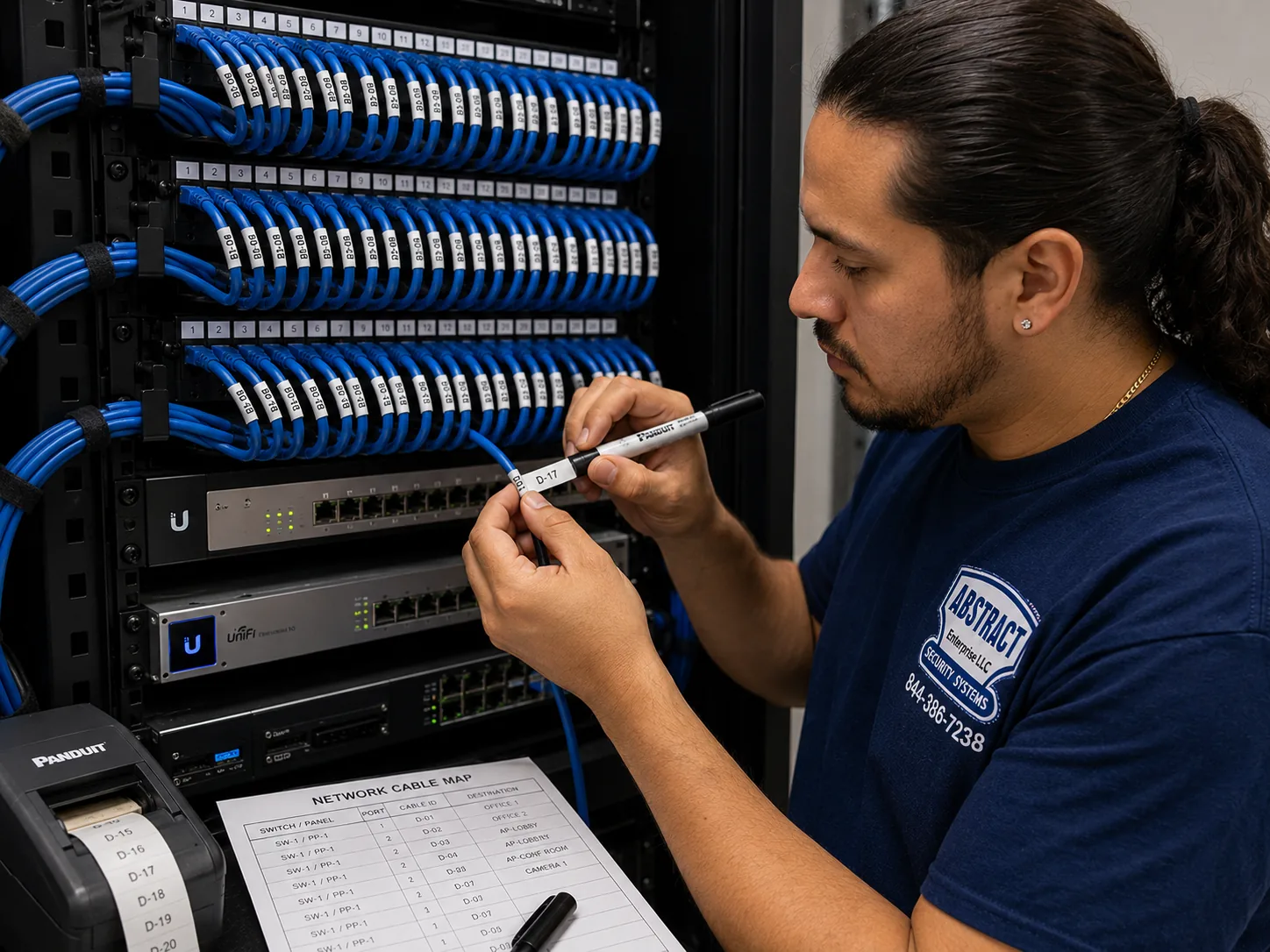
Google Nest camera installation job-library photo for the Long Island hub, Long Island: a technician printing cable labels at a patch panel beside a printed port map
Photo from the AESS job library, not taken on Long Island: a technician printing cable labels at a patch panel, with a printed port map beside him. Before Nest cameras go into a Hicksville office or a Route 110 suite, we find out which port feeds which Wi-Fi access point, because a Nest camera is only as steady as the network it connects to.
Long Island Nest Camera Install
Tell us the town, the house type and which Nest devices you have or want

✅
Request Sent!
We'll call about your Long Island Nest cameras the same business day.
25+
Years Experience
✓
Same-Day Estimates
100%
Licensed & Insured
4.7★
201 Google Reviews

Owner-operated since 2002 · Thousands of jobs completed · Booked within 2 hours

A Long Island Nest install is priced from our Long Island price list, adjusted for the county: Nassau addresses at 1.15 times our city base and Suffolk addresses at 1.20 times, with the exact line items printed on our Long Island Nest camera price page. The visit covers testing the doorbell transformer and chime, checking Wi-Fi at every camera spot, routing power without drilling the slab, mounting, pairing each device to your own Google Home account and showing you the alerts. Requests are booked within 2 hours. Call (800) 486-0943 or use the form.

  • Doorbell power measured with a meter before a wired Nest Doorbell goes on the trim, because Google lists a 16–24VAC, 10–40VA transformer and many older Long Island bells run on less
  • No hole through a slab floor, ever: in houses built over poured concrete with heating coils inside, power runs through the attic, a vent or a sealed outside route
  • Low-voltage work done under NYS license #12000287431; line-voltage floodlight connections are left to a licensed electrician, and we say so on the quote
The Neighborhood

Why Long Island Properties Need Google Nest Camera Installation

Long Island is not one neighborhood, so this page starts where the island's busiest rail hub is: Hicksville. Wikipedia records that the man the hamlet is named for bought land there in 1834 and turned it into a stop on the Long Island Rail Road in 1837, and that the presence of a major LIRR hub is why Hicksville grew into a major bedroom community of New York City. A short drive south is Levittown. EBSCO's history of it says Levitt and Sons announced on May 7, 1947 a plan to build a neighborhood called Island Trees on old potato farms in Nassau County, and kept expanding it until 1951, when it held 17,447 homes. Encyclopedia.com goes further and describes Levittown as a development at Hicksville itself, built after the war for returning servicemen. Those houses, and the thousands of ranches, capes, split-levels and colonials that followed them across Nassau and into Suffolk, are where most Long Island Nest cameras end up. They were built for families and fresh air. They were not built for doorbells that need steady power, cameras that need steady Wi-Fi, or cables that need a path from the eave to an outlet.

The numbers explain why so much of our work here comes back to the age of the house. The Census Bureau's American Community Survey for 2023 counts 477,860 housing units in Nassau, 364,529 of them one-unit detached houses, with a median year built of 1955. Suffolk has 579,790 units, 463,095 of them detached, with a median year of 1970. A Newsday analysis of nearly 12,000 home sales in 2026 found that more than 5,000 of the houses were built in the 1950s and 1960s. In plain terms, most Long Island homes are standalone houses that are between fifty and seventy-five years old, owned by the people living in them, and changed many times by many owners. That is good news for a Nest install, because the owner decides where a camera goes and nobody needs a board's approval. It is also the reason we test everything, because the doorbell wiring, the transformer, the chime and the Wi-Fi in a 1955 house have usually been touched by three or four people before us.

The Levitt houses deserve a paragraph of their own, because they shape a Nest install more than any other building type on the island. The Living in L-Town slab report describes them plainly: slab-on-grade, wood-frame construction, no basements, the house sitting on a concrete slab. A history of the area's radiant heat on Substack explains what was inside that slab: copper coils that carried heated water from the oil furnace. Wikipedia notes the original houses were small, about 750 square feet, with no basement and no porch. Each of those facts changes where a camera's power can go. With no basement, nobody can drop a cable down and run it under the floor to a camera on the far side of the house. With heating pipes poured into the concrete, nobody should be drilling into that floor at all. With no porch roof, a doorbell camera at the front door takes rain, snow and low winter sun straight on the lens. Heating Help adds a twist: only about five percent of the houses still have their original radiant systems, so the coils in a given slab may be dead, replaced or still live. We treat every slab as if it is live.

Long Island homeowners also have recent reasons to want a camera at the door and the driveway. News 12 Long Island reported a doorbell camera in Massapequa Park recording a thief taking a package off a porch on Atlantic Avenue while the homeowners and a UPS driver were in plain sight, and four new iPhones stolen from a home on Walters Avenue in Wantagh within minutes of delivery. CBS New York reported the Suffolk District Attorney charging 14 men in a porch theft ring that worked 31 communities including Brentwood, Central Islip, Shirley and Deer Park, allegedly targeting deliveries of phones and tablets. ABC7 reported a multi-agency burglary task force in January 2024, with police saying burglars are attracted by cars in people's driveways. In June 2026 ABC7 reported three suspects walking up a driveway in East Hills, going through a car and then entering the home before the alarm sounded. NBC New York reported in November 2025 that security cameras in Jericho, the hamlet next to Hicksville, showed how quickly a crew of four reached the second floor of a house. LI Life Politics reported that Nassau burglaries rose five percent, from 234 to 245, for January through May of 2026, even as overall property crime fell.

None of those stories proves that a camera stops a crime, and we will not pretend it does. A Long Island Patch reader put the limit honestly: "I have a Ring camera, but I understand it would just let me watch someone steal my package." That is the right expectation to start from. What a well-installed Nest system does is give you a clear, timely look at your door, your driveway and your yard, alerts on your phone while something is happening, and footage that is good enough to be useful afterward. What a badly installed one does is drop offline on cold nights, miss the driveway because the Wi-Fi at the garage is weak, or record a faceless top-of-the-head view because it was mounted too high on a slab ranch with low eaves. The difference is almost entirely in the installation.

There is also a newer reason people call: Google has changed a lot of things at once. Google Home Help says Dropcam and Dropcam Pro stopped being supported starting April 8, 2024, and BGR lists the Nest Protect, the Nest x Yale lock, the Nest Secure alarm and the Nest Cam IQ series among discontinued products. 9to5Google reported that Google Home Premium, in Standard and Advanced tiers, has taken over from the old Nest Aware plans. ConsumerAffairs carries complaints from owners who moved from the Nest app to the Google Home app and found it freezing and slow, and one Queens reviewer whose Nest doorbell went offline every other day despite paying for professional installation. On Long Island, where many families bought their first Nest devices years ago, we get calls to replace a Dropcam on a garage shelf, to move an old account into the Google Home app, or to work out why a doorbell installed by someone else will not stay connected.

Finally, we want to be plain about what our research did not find. We looked for Reddit threads on r/longisland and similar boards about Nest installs and found none we could read directly; press coverage in TechHive reports Reddit complaints about Nest cameras that will not charge in freezing weather, but we did not see the threads themselves. We could not retrieve Google's People Also Ask boxes, related searches, Bing or DuckDuckGo results, or Yelp reviews of Long Island Nest installers. We found no Town of Oyster Bay, Town of Hempstead or Suffolk town rule that deals specifically with low-voltage camera work. Where this page talks about what we find in walls, attics and doorbell circuits, it is drawing on the building record above and on what we see in houses of these ages generally, not on a survey of Long Island homes.

Long Island facts that shape a Nest install

  • Old, detached and owner-occupied: 364,529 of Nassau's 477,860 housing units and 463,095 of Suffolk's 579,790 are one-unit detached houses; median years built are 1955 and 1970 (ACS 2023).
  • Slabs with pipes inside: Levitt houses sit on concrete slabs with copper heating coils embedded, and have no basement, so floor drilling is out and cables travel through walls, attics or outside.
  • Big counties, many governments: Nassau has two cities, three towns, 64 incorporated villages and more than 60 hamlets over 453 square miles; Suffolk has 10 towns over 2,373 square miles (ny.gov).
  • Nearly three million people: the 2020 Census counted 1,395,774 people in Nassau and 1,525,920 in Suffolk.
  • Cold that matters to batteries: Google says Nest battery models will not charge below 32°F, while a Nest Cam (battery) on wired power keeps working down to −4°F.
  • A free police registry in Suffolk: SCPD lets residents and businesses register camera locations; the department says it does not get access to the cameras.

What owners often add once the cameras are up. After a Long Island house has a Nest Doorbell and a driveway camera, the next request is usually the Wi-Fi itself: an access point for the detached garage or the back of a long ranch, because the camera that sees the yard is the one furthest from the router. If you already know the signal is weak out there, say so when booking so we bring the right equipment and do it in the same visit, rather than mounting a camera that will struggle for months.

Google Nest camera installation job-library photo for the Long Island hub, Long Island: commercial cable boxes staged on the floor of a working premises for a multi-drop pull
Photo from the AESS job library, not taken on Long Island: boxes of cable staged on the floor of a working premises before a multi-drop pull. When a store on North Broadway in Hicksville or a unit off Old Country Road adds several Nest cameras and a couple of Wi-Fi access points at once, the cable and parts are staged like this first so the shop can stay open around us.

Doorbell Dead, Camera Offline or a Package Gone? Fast Help Across Nassau and Suffolk

A Nest Doorbell that went dark after the first cold snap, a chime that started buzzing after someone else installed the doorbell, or a driveway camera that keeps going offline right when you need it: these are the calls we move on first, because a camera that is not connected is a camera that is not watching. If the doorbell is hot to the touch or the chime is humming loudly, turn off the doorbell circuit at the breaker if you can find it, and leave it off. Then call (800) 486-0943 and tell us the model, what the chime looks like, and when the problem started. If you have just had a package taken or a car gone through in the driveway, call the police first; we can help afterward with where a camera should have been and how to get footage saved and shared properly.

Slab, Attic, Eave

From 1947 to the 1970s: How a Long Island House's Build Era Decides Where a Nest Cable Can Travel

If you drove from a Levittown cape down the Wantagh Parkway, across to a split-level near Hofstra and out to a 1970s colonial in western Suffolk, you would pass houses from at least four building periods, and each one hides its own puzzle for a Nest install. The puzzle is almost never the camera. It is power: where it comes from, how far it has to travel, and what is in the way. The table below lines up the eras with the facts the public record gives us and with what we expect to find. The last column is our working assumption, not a fact about any particular house; we confirm it on site.

EraWhat the record saysTypical Nest questionWhat we expect to find
Levitt capes, 1947–1949Slab-on-grade, wood frame, no basement, about 750 square feet, quarter-acre lots, Cape Cod styleWhere does an outdoor camera's power cable go with no basement?An expandable attic over part of the house, low eaves, exterior walls with little room inside; floor drilling ruled out
Levitt ranches, from 1949Levitt discontinued the Cape Cod in 1949 and introduced ranch houses, still on slabsCan a wired doorbell run on the original bell circuit?Small, old doorbell transformers, often replaced once or twice; attic access along the full length of the house
Split-levels and hi-ranches, 1950s–1960sCommon near Hofstra and in much of central Nassau, multi-level housesHow does power get from one level to a camera on another?A mix of slab and crawlspace or basement sections; stairs and half-levels that interrupt cable paths
Suffolk colonials and ranches, 1960s–1970sSuffolk's median year built is 1970; more detached houses on bigger lotsWill Wi-Fi reach the far camera on a long lot or a detached garage?Full basements in many houses, longer driveways, garages set back from the house
Remodeled houses of any ageVery few original Levittown Cape Cods remain unchanged after decades of remodelingWhich wires in the wall are still live, and where do they go?Abandoned bell wire, mystery cable from past alarm or TV work, added dormers and extensions with new walls

The original Levitt capes

The first houses of Island Trees were capes on quarter-acre lots, and Wikipedia notes they were about 750 square feet with no basement and no porch. In houses like that, the attic is usually our best friend and the only practical way across the house. A camera on the gable end can often be fed from an outlet in the room below by going up through a closet ceiling, across the attic and back down behind the soffit, all without opening a finished wall. A camera at the front door is harder, because there is no porch roof to hide a cable behind and no overhang to keep weather off the doorbell. In that case we often choose the battery Nest Doorbell, or a wired doorbell on the existing bell circuit if the transformer passes our test, rather than running new power to the door. Capes that have been extended, dormered or opened up since 1949 have walls of every age, so we check each one before we pick a route.

The ranches that came after 1949

Encyclopedia.com records that in 1949 Levitt and Sons discontinued the Cape Cod model and introduced ranch-style houses, and those ranches, along with the many copies built by other developers across Nassau, are the single most common house we expect to see on a Long Island Nest call. A ranch is long and low. That is good for attic runs, because the attic covers the whole house, and bad for Wi-Fi, because a router in the front room may be forty or fifty feet of walls away from the camera that watches the back yard. The ranch's original doorbell circuit is the other issue. Bell transformers in houses this age were sized for a ringing chime, not for a camera that runs all day, and they have often been swapped for whatever was on the hardware-store shelf. We measure the voltage, read the label, and only then decide on the doorbell.

Split-levels and hi-ranches

The split-levels and hi-ranches of the 1950s and 1960s add a vertical puzzle. Part of the house may sit on a slab, part over a crawlspace or a garage, with half-flights of stairs between them. A camera on the garage corner of a split-level may be easiest to feed from inside the garage, where an outlet is often close and an exterior wall is easy to pass through. A camera over the front entry of a hi-ranch may be fed from the upper floor's attic. Where the levels meet, there is usually a framed wall that runs all the way from one floor to the next, and that is the route we look for first. If the house has a basement section, we can use it, but we never assume one exists until we have seen it.

Suffolk's 1960s and 1970s houses

Move east and the median house is younger, the lots are often larger and the driveways longer. Many of these houses have full basements, which makes power runs easier, and garages that may be attached, detached or set far back from the house. The challenge here is distance. A Nest Cam that watches the end of a long driveway or a detached garage has to reach the home Wi-Fi from wherever it is mounted, and a router on the first floor in the middle of the house may not cover it. We survey the signal at the exact mount point with the router where it lives day to day, not with the router carried outside for the test. If the signal is weak, we fix the Wi-Fi before mounting the camera.

The remodeled house, whatever its age

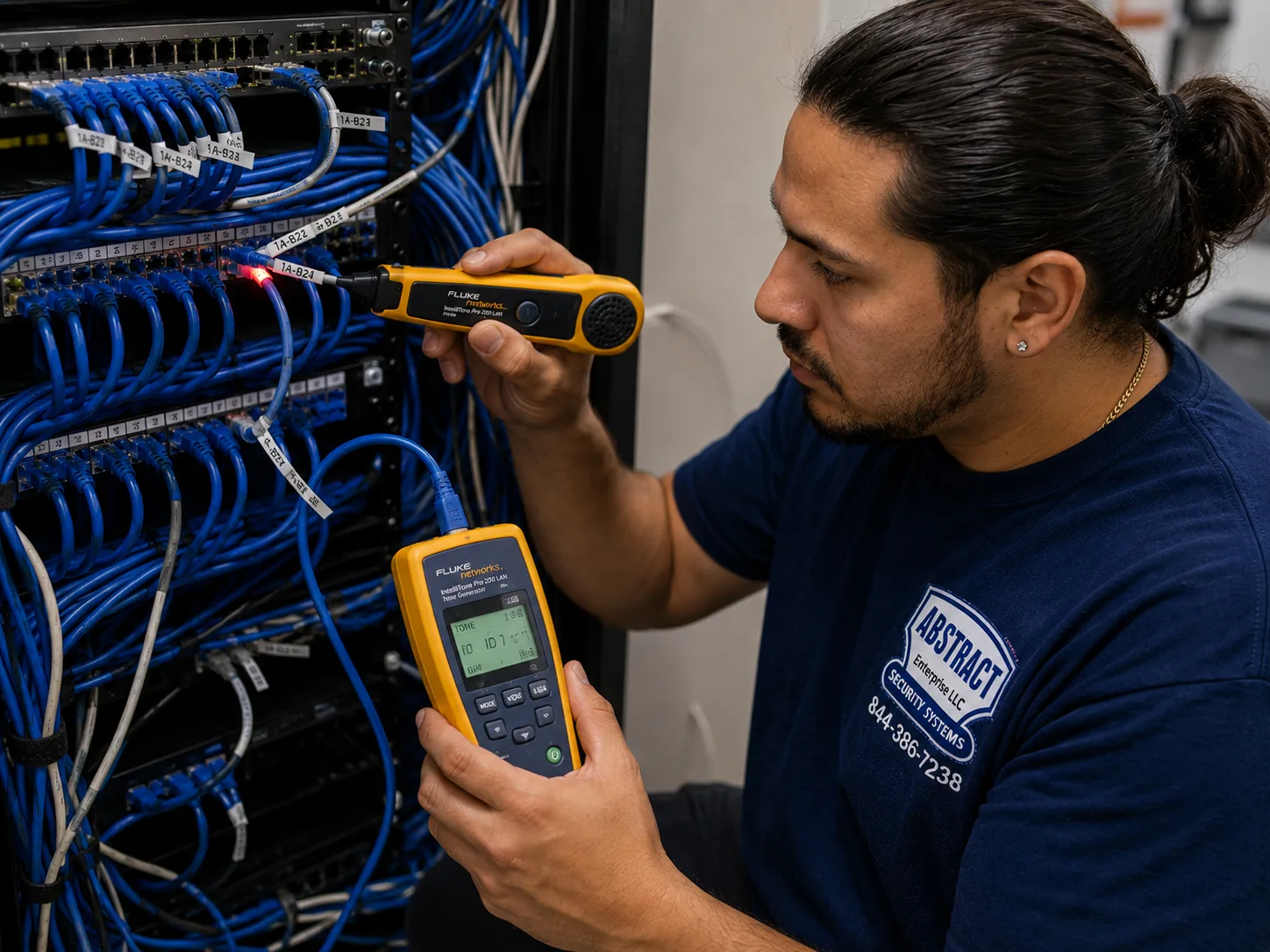
The US History Scene essay on Levittown notes there has been so much remodeling that very few original Cape Cods exist, and the same is true of houses of every era on the island. That remodeling is why we never trust a wire just because it is there. A two-conductor cable at the front door may be the original bell wire, a later replacement, an abandoned alarm loop or a phone line. A cable in the attic may lead to a camera that someone took down years ago. We test what we find, trace it with a tone generator and probe when we have to, and only reuse a wire when we know where both ends go and what it carries.

Google Nest camera installation job-library photo for the Long Island hub, Long Island: a technician tracing an unidentified cable run at a patch panel with a tone generator and probe
Photo from the AESS job library, not taken on Long Island: a technician tracing an unidentified cable run at a patch panel with a tone generator and probe. The same tools find out where a mystery wire at the front door of a remodeled Levittown cape really goes, before anyone assumes it is the doorbell circuit a wired Nest Doorbell can use.
Before You Book

Front Door to Back Fence: What to Check in a Long Island House Before We Arrive

Most of the time lost on a Nest job is lost before the first screw: a doorbell that turns out to need a transformer nobody brought, a garage camera with no Wi-Fi, a Google account password nobody remembers, or a camera bought for a spot that faces straight into the afternoon sun. Ten minutes with a phone camera saves almost all of it. Please do not open the chime cover with the power on or start pulling wires; just look, photograph and send us what you find.

What to checkWhy it matters on Long IslandWhat to send us
Your current doorbell buttonA lit or wired button means bell wires exist; a wireless button often means there is no usable circuitA photo of the button and the trim around it
The chime insideMechanical chimes and electronic chimes behave differently with a Nest DoorbellA photo with the cover on, and the cover off only if the power is off
The doorbell transformer, if you can find itIn slab houses it may be near the furnace, in a closet or in the attic; its label tells us voltage and VAA close photo of the label
Wi-Fi at each camera spotLong ranches, detached garages and long Suffolk lots often have weak signal where the camera goesStand at each spot with your phone on Wi-Fi only and try a video call
Outlets near the camera spotsAn outdoor outlet or an indoor outlet close to a vent saves running new powerPhotos of outlets inside and outside near each spot
The Google accountCameras should live in the owner's own Google Home account, not oursMake sure you can sign in on your phone before we arrive
Anything you already ownOld Nest cams, a Dropcam or a retired Nest Secure system may need removing or replacingModel names, or photos of the labels

Stand where the camera will stand

The best camera position is decided by what it needs to see, not by where it is easiest to mount. Stand at the spot you have in mind and look at what is in view: the walk, the driveway, the side gate, the neighbor's windows. Then look at the time of day you most care about. A camera facing south toward a driveway in a Massapequa winter can be staring into low sun for part of the afternoon, and a doorbell on a slab ranch with no porch catches rain on the lens. Take one photo from the camera's height in the direction it will face, and send it with your request. It tells us more than a sketch.

Find where the power actually comes from

For wired Nest cameras, the question is always which outlet will feed it. Google's own guidance says you can run the power cable to an outdoor outlet, or to an outlet inside the home through an existing vent or hole. Walk around the outside of the house and note any weatherproof outlets, dryer vents and old cable entry holes. Inside, note the outlet closest to each camera on the other side of the wall. In a slab house there is no basement route, so those outdoor outlets and attic paths usually decide the plan. If an outdoor outlet looks damaged or has no cover, tell us; that is an electrician's fix before any camera plugs into it.

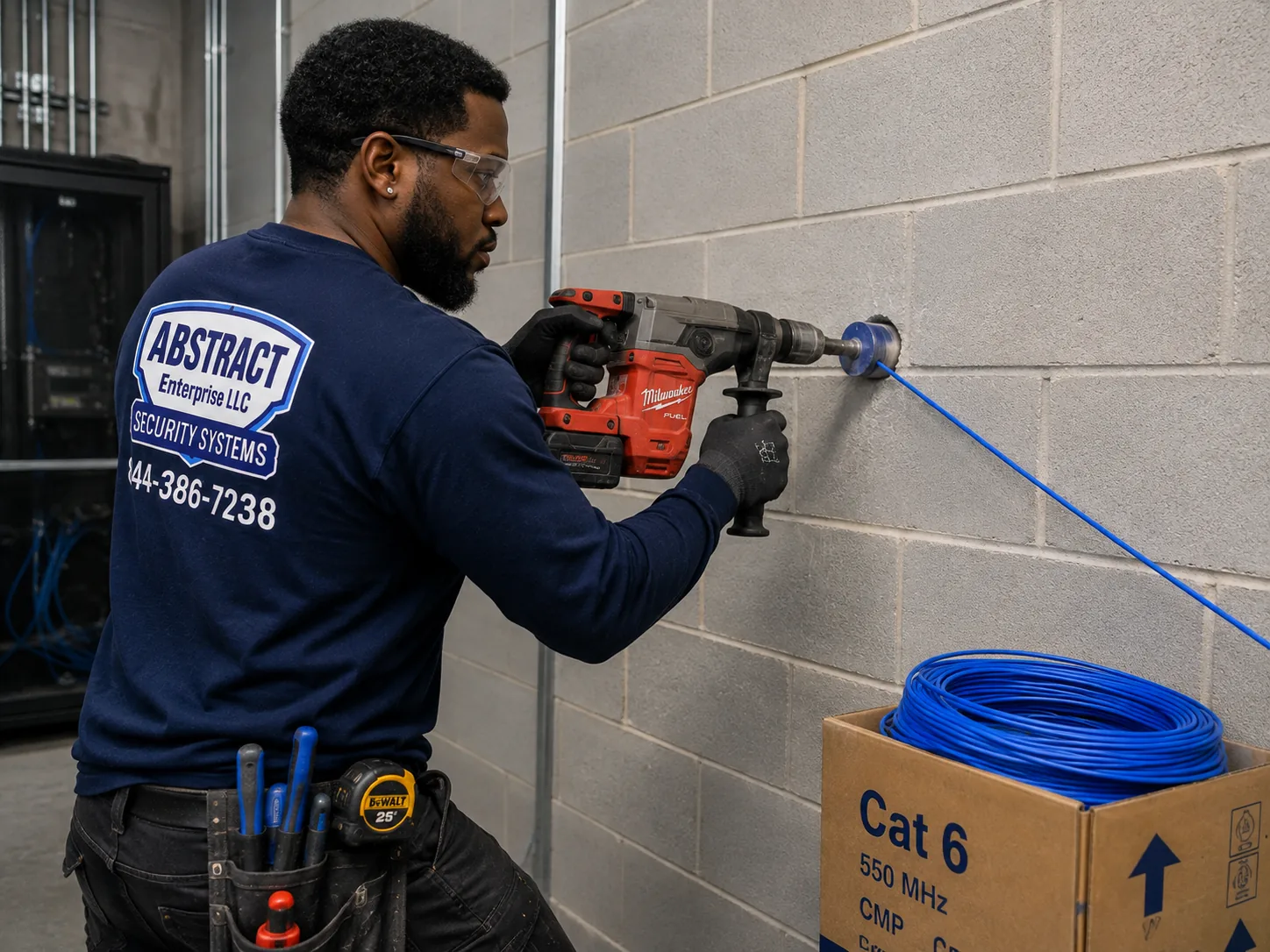
Google Nest camera installation job-library photo for the Long Island hub, Long Island: a technician core drilling a block wall to carry cable through to a network room
Photo from the AESS job library, not taken on Long Island: a technician core drilling a block wall to carry cable through to a network room. Some postwar Long Island houses sit on concrete-block foundations and many commercial buildings have block walls; a planned, sealed penetration like this is the opposite of the random hole through a slab floor that we never make in a Levitt house.
What We Install

Google Nest Camera Installation Services in Long Island

These are the Nest jobs Long Island homeowners, renters and small businesses ask us for. Each one is priced from the Long Island price list for your county, with the Nassau and Suffolk lines set out on their own price pages. Where a job needs something extra, such as a new doorbell transformer, a Wi-Fi access point or an electrician for a floodlight, the quote names it before you pay.

🔔

Wired Nest Doorbells on Old Bell Circuits

The existing bell wire tested, the transformer measured against Google's 16–24VAC, 10–40VA requirement, the chime checked, and the doorbell mounted level and weather-sealed on trim that may be seventy years old.

🔋

Battery Nest Doorbells Where There Is No Wire

For capes with no usable bell circuit, rentals where the owner says no to wiring, or doors where running power is not worth it, with the trade-offs on winter charging explained before you choose.

🏠

Outdoor Nest Cams Fed Without Touching the Slab

Wired outdoor cameras and wired-up battery cameras on eaves, gables and garage corners, with power brought through the attic, a vent or a sealed exterior route to a proper outlet.

🛋

Indoor Nest Cams

Living rooms, entry halls, back doors and garages, placed where the camera is useful and the cord is tidy, with privacy settings chosen with you rather than left at the defaults.

💡

Floodlight Cameras, With an Electrician

Nest Cam with Floodlight placement, mounting plan and app setup, with the line-voltage connection made by a licensed electrician, yours or one we coordinate with.

📶

Wi-Fi That Reaches the Cameras

Signal checked at every mount point, router placement fixed, and access points added where long ranches, split-levels and detached garages leave the cameras on a weak signal.

♻

Replacing Dropcams and Retired Nest Gear

Dropcam and Dropcam Pro units Google stopped supporting in April 2024, Nest Cam IQ units and Nest Secure parts taken down and replaced, with the old devices removed from the account.

📱

Google Home App Setup and Clean-Up

Cameras added to your own Google Home account, family members invited, activity zones drawn, notifications tuned so a passing car on Hempstead Turnpike does not wake you at 2 a.m.

🏪

Nest Cameras for Small Businesses

Shops, delis, offices and small warehouses that want simple app-based cameras, mounted to suit opening hours and connected to a network that can actually carry them.

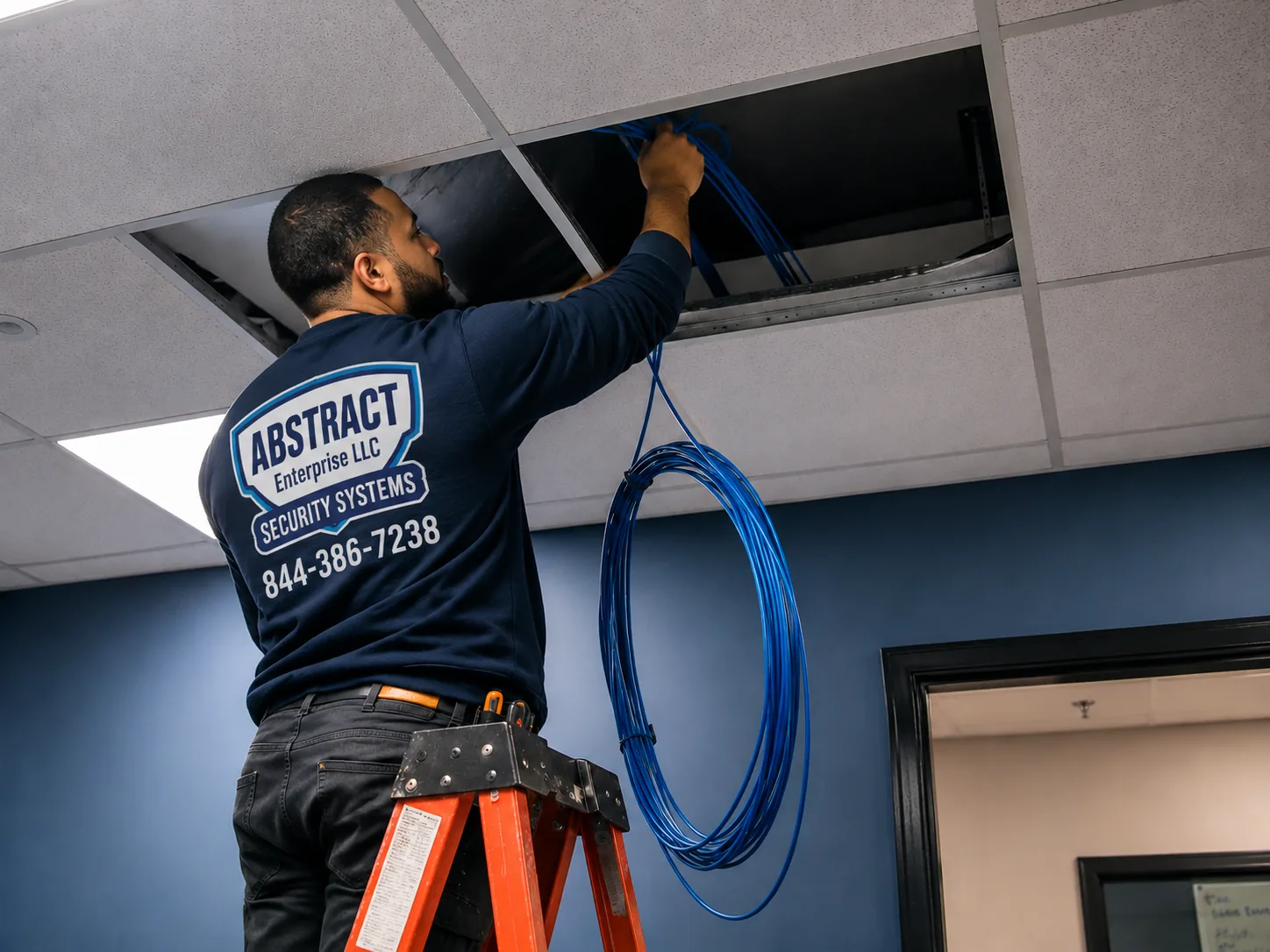
Google Nest camera installation job-library photo for the Long Island hub, Long Island: a technician feeding cable through a ceiling opening in an occupied commercial space
Photo from the AESS job library, not taken on Long Island: a technician feeding cable through a ceiling in a commercial space that is open around him. In a Route 110 office suite or a Hauppauge tenant space, power for an indoor Nest Cam and cable for the access point that carries its Wi-Fi often travel over a dropped ceiling like this, while the business keeps working below.
Building Specialists

Google Nest Camera Installation for Long Island's Architecture

Across Nassau and Suffolk, the building decides three things about a Nest job: where the power comes from, how strong the Wi-Fi is at each camera, and who has to say yes before we drill. These are the building types the public record and local reporting describe on the island, and how we handle each.

Levitt-Era Slab Capes and Ranches

Around Hicksville, Levittown and much of central Nassau. Concrete slab with heating coils, no basement, low eaves and attics that carry nearly every cable. The owner decides, which keeps the job simple.

Split-Levels and Hi-Ranches

Common near Hofstra and in 1950s–60s subdivisions. Several levels, a garage below living space, cable paths that have to climb half-flights. Wi-Fi often weakest on the lowest and highest levels.

Suffolk Colonials and Ranches

Younger houses on larger lots, often with full basements and long driveways. Power is easier; distance from the router to the far camera is the main problem.

Gold Coast Estates

The North Shore where more than 500 mansions were built from the 1890s on. Gate houses, long drives, outbuildings and stone walls that block Wi-Fi far more than a wood-frame ranch does.

South Shore and East End Houses

Wood-frame and shingled houses near the water, seasonal homes empty for months. Weather-sealing, salt air and remote viewing for owners who are not there matter most.

New Apartments Near the LIRR

Buildings like the 189-unit development planned beside the Hicksville station, with underground parking. Shared entrances, rental agreements and building rules decide what a tenant may mount.

How the building type changes the job

BuildingUsual power route for outdoor camerasDoorbell approachWho signs off
Slab cape or ranchAttic to soffit, an existing vent, or an outdoor outlet; never through the floorWired on the bell circuit if the transformer passes, battery model if notThe owner
Split-level or hi-ranchGarage outlet, or the wall where two levels meetWired is usually possible; chime location variesThe owner
Suffolk colonialBasement or attic, plus Wi-Fi extension for distant camerasWired on the existing circuit, often after a transformer checkThe owner
Estate with outbuildingsOutlets at each outbuilding; network carried to gate and garageWired at the main door, other devices per entranceThe owner or estate manager
Seasonal houseWired power preferred so cameras do not depend on charging in winterWired, because nobody is there to swap batteriesThe owner, sometimes a caretaker
Rental apartmentIndoor cameras on existing outlets; outdoor only with permissionBattery or no-drill options unless the landlord agreesThe tenant and the landlord or management

On slab floors and heating coils. The single rule we never break in a Levitt-era house is that the floor stays whole. The Substack history of Levittown's radiant heat says copper coils carrying hot water from the oil furnace were embedded in the slab, and Heating Help says only about five percent of the houses still have their original systems. That means some slabs still have live water pipes inside them, some have dead ones and some have been abandoned for baseboard heat, and from the surface you cannot tell which. A drill bit through a live coil means a leak inside concrete. So every Nest cable in a slab house goes up, not down: through a closet ceiling to the attic, through an exterior wall at a sealed point, or along the outside in a tidy run. When a camera needs power at a spot with no attic above it, we look at the battery model on a solar or weatherproof wired option rather than reach for the floor.

On older walls and what might be in them. A restoration contractor writing about postwar Cape Cods and ranches in Uniondale warns that houses from that boom frequently contain asbestos materials. That is a contractor's statement, not a survey, but it matches what anyone working in houses of that age has to keep in mind. We keep holes small and few, prefer existing openings such as vents and old cable entries, and avoid disturbing old siding, old plaster and old ceiling texture where we can. If a house shows signs of materials that need testing before they are drilled or cut, we stop and tell you, and the drilling waits until you have an answer.

On rentals. NeighborhoodScout reports that about 38 percent of homes in Uniondale are rented, and parts of Hicksville are adding hundreds of new apartments around the station. A tenant can usually put an indoor Nest Cam on a shelf and a battery doorbell on the door trim with the landlord's agreement. Wiring into the bell circuit, drilling the siding or mounting a camera that covers a shared driveway is a different conversation. We ask who owns the building at booking, and if the landlord has not agreed in writing, we keep the install to what can be removed without a trace.

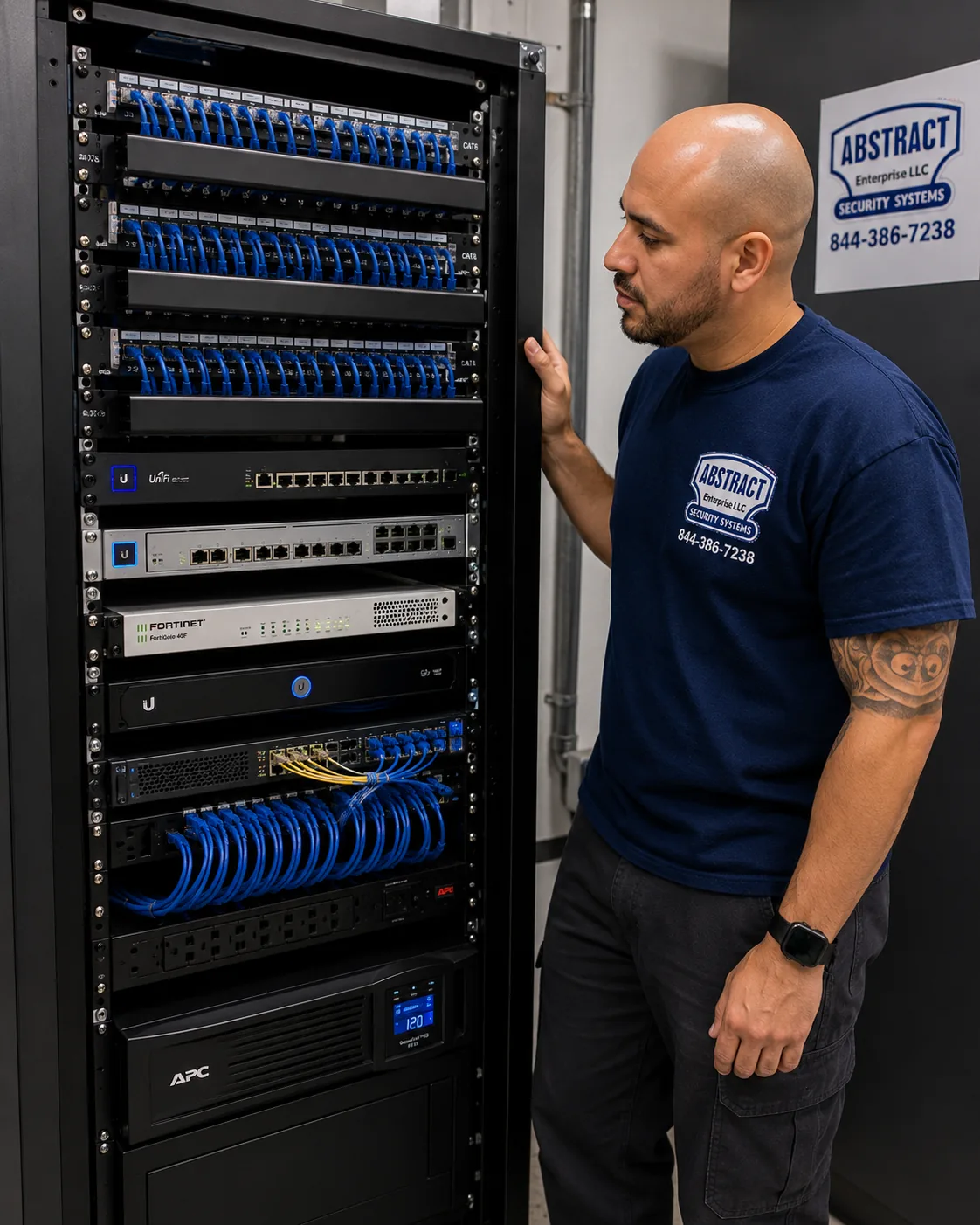
Google Nest camera installation job-library photo for the Long Island hub, Long Island: a finished network rack with patch panels, switching, a firewall and battery backup dressed and labeled
Photo from the AESS job library, not taken on Long Island: a finished network rack with patch panels, switching, a firewall and a battery backup, all dressed and labeled. After Tropical Storm Isaias left almost half of PSEG Long Island's 1.1 million customers in the dark at its peak, a battery backup on the router and switch became an easy argument: it keeps the network the Nest cameras rely on running through short power blips, though it cannot help if the internet provider's own line is down.
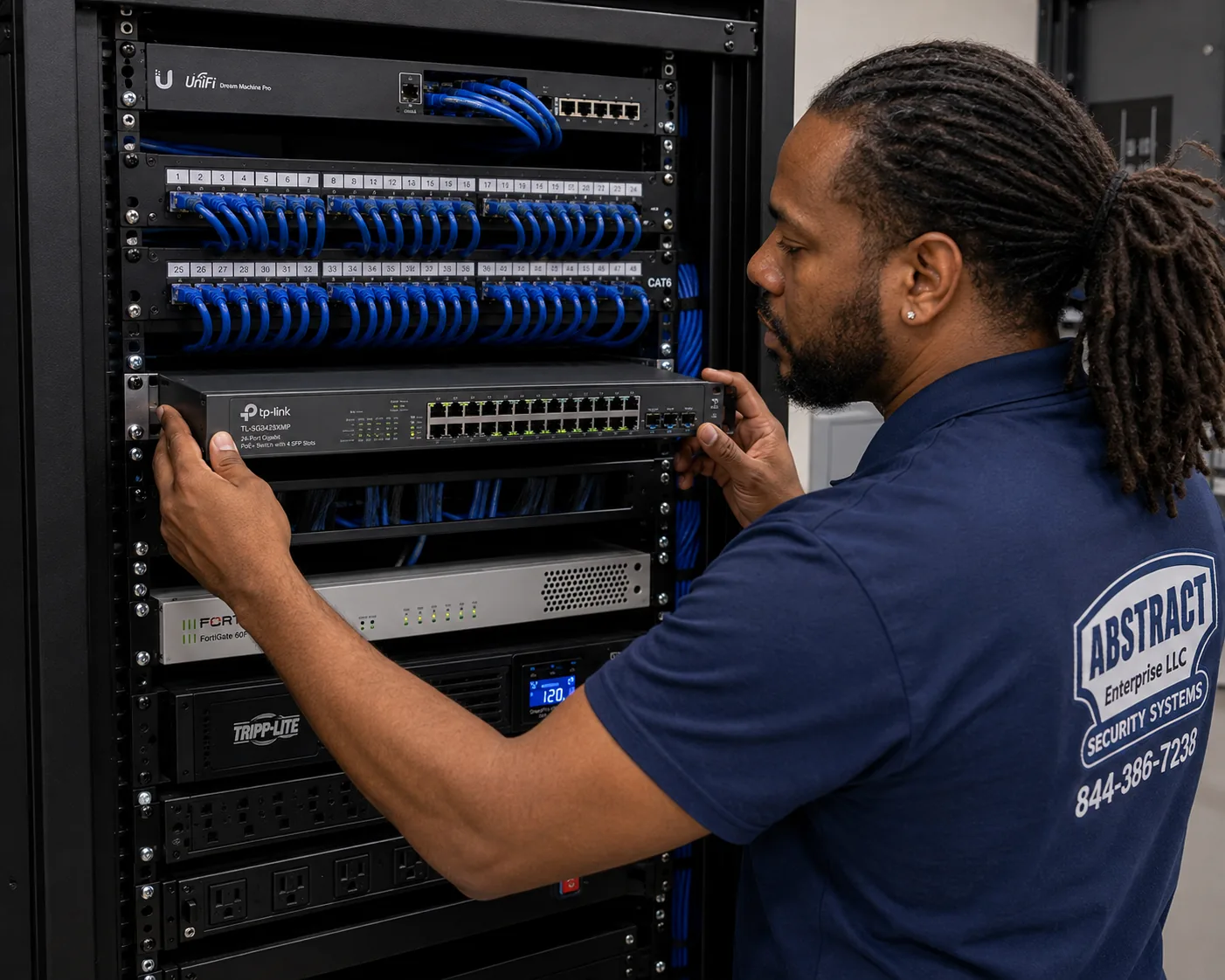
Google Nest camera installation job-library photo for the Long Island hub, Long Island: a technician mounting a managed PoE switch below patch panels in a commercial network rack
Photo from the AESS job library, not taken on Long Island: a technician mounting a managed PoE switch below patch panels in a commercial network rack. On a Gold Coast estate or a Suffolk warehouse, a switch like this powers the ceiling and outbuilding Wi-Fi access points; the Nest cameras themselves still plug into their own power, but they depend on those access points for a strong signal.
Commercial Google Nest Camera Installation

Business Google Nest Camera Installation in Long Island

Nest cameras suit a particular kind of Long Island business: the deli, the salon, the small office or the corner shop that wants a few clear cameras on a phone app without a recorder in the back room. They are not the right choice for a warehouse that needs thirty cameras recording around the clock, and we will say so. The corridors below are the ones named by Wikipedia, local press and county sources. We describe what those sources say; we have no information about the cameras inside any particular business and do not claim any of them as clients.

North Broadway, Hicksville

Wikipedia describes North Broadway, in the center of Nassau County, as a significant retail center. CBS New York reports an explosion of international food stores, delis and small restaurants downtown.

The Broadway Redevelopment

Mid Island Times reports a Broadway streetscape project between Old Country Road and West John Street, with the Macy's store expected to be demolished by December 2026; the former Sears site is expected to become a Bass Pro Shops.

Old Country Road and Roosevelt Field

Wikipedia calls Roosevelt Field, in the East Garden City section of Uniondale, the largest mall on Long Island, with 243 stores; the surrounding road carries strip retail and offices.

Hempstead Turnpike and the Nassau Hub

News 12 reported in September 2026 that the owner of Morning Delights in Uniondale got a motion alert from his security camera, went to the restaurant and found a burglary suspect there.

Route 110 and Hauppauge

The Route 110 corridor spans Farmingdale, Melville and Huntington Station with warehouse, flex, R&D and office uses; the Long Island Innovation Park at Hauppauge holds about 1,350 businesses in roughly 11 square miles.

Montauk Highway Downtowns

Main streets along Montauk Highway and Merrick Road, such as Patchogue, where CBS New York reported a package thief waving at a camera on Rider Avenue.

What a shop or office Nest camera has to do

A Nest camera in a living room watches a quiet room. A Nest camera in a deli on North Broadway watches a register, a door that opens hundreds of times a day, and a sidewalk full of passing people, all of which trigger events. The Morning Delights story shows what a business owner actually wants from a camera like this: a motion alert that arrives when the place is closed, with a clear enough picture to decide what to do. Getting there takes more than putting the camera on the wall. Activity zones have to ignore the street and focus on the door and the register. Notification schedules have to be quiet during business hours and loud after closing. The Wi-Fi has to stay up when the shop's own customers are using it. We set those up with the owner, screen by screen, before we leave.

When Nest is the wrong tool

The flex and warehouse buildings along Route 110 and inside the Hauppauge park, the office towers at the Nassau Hub, and the larger stores around Roosevelt Field usually need cameras that record continuously to a local recorder, cover large areas with many cameras and do not depend on one Wi-Fi network. Nest cameras record events to Google's cloud, and without a plan the event history is short. Security.org reports three hours of event video without a subscription for the Nest Cam (battery) and Floodlight, and six hours for the wired indoor and outdoor cameras. For a business that needs weeks of footage from a dozen angles, we will suggest a wired system instead and say why. For a two-door shop that wants alerts and a quick look, Nest can be exactly right.

Rules and practical limits for business cameras

  • Licensing. The NYS Department of State licenses security and fire alarm installers, and New York's rules under 19 NYCRR 195.2 bring CCTV used for detecting or monitoring intrusion or theft within that licensing. AESS works under NYS license #12000287431.
  • County and town licensing. Nassau County's Office of Consumer Affairs licenses home improvement contractors and fingerprints them; the county says work only on commercial buildings is exempt. Suffolk County Code Chapter 563 licenses regulated trades, except in towns and villages with their own licensing.
  • Floodlights and new outlets. A floodlight camera connects to line voltage, and a new outdoor outlet is new electrical work. Both are a licensed electrician's job, and the quote says so.
  • Audio. Justia's New York answer advises disabling audio unless a consenting participant will be part of any recorded conversation. In a shop full of customer conversations, we set Nest cameras up with audio recording off unless the owner has taken advice and decides otherwise.
  • Privacy areas. New York Civil Rights Law section 52-a makes it unlawful to install or use video surveillance where a person has a reasonable expectation of privacy. Restrooms and changing areas never get cameras.
  • Registries. Suffolk businesses can register camera locations with SCPD for free; the Garden City Police Department runs its own voluntary private camera registry. Neither gives police access to the cameras.
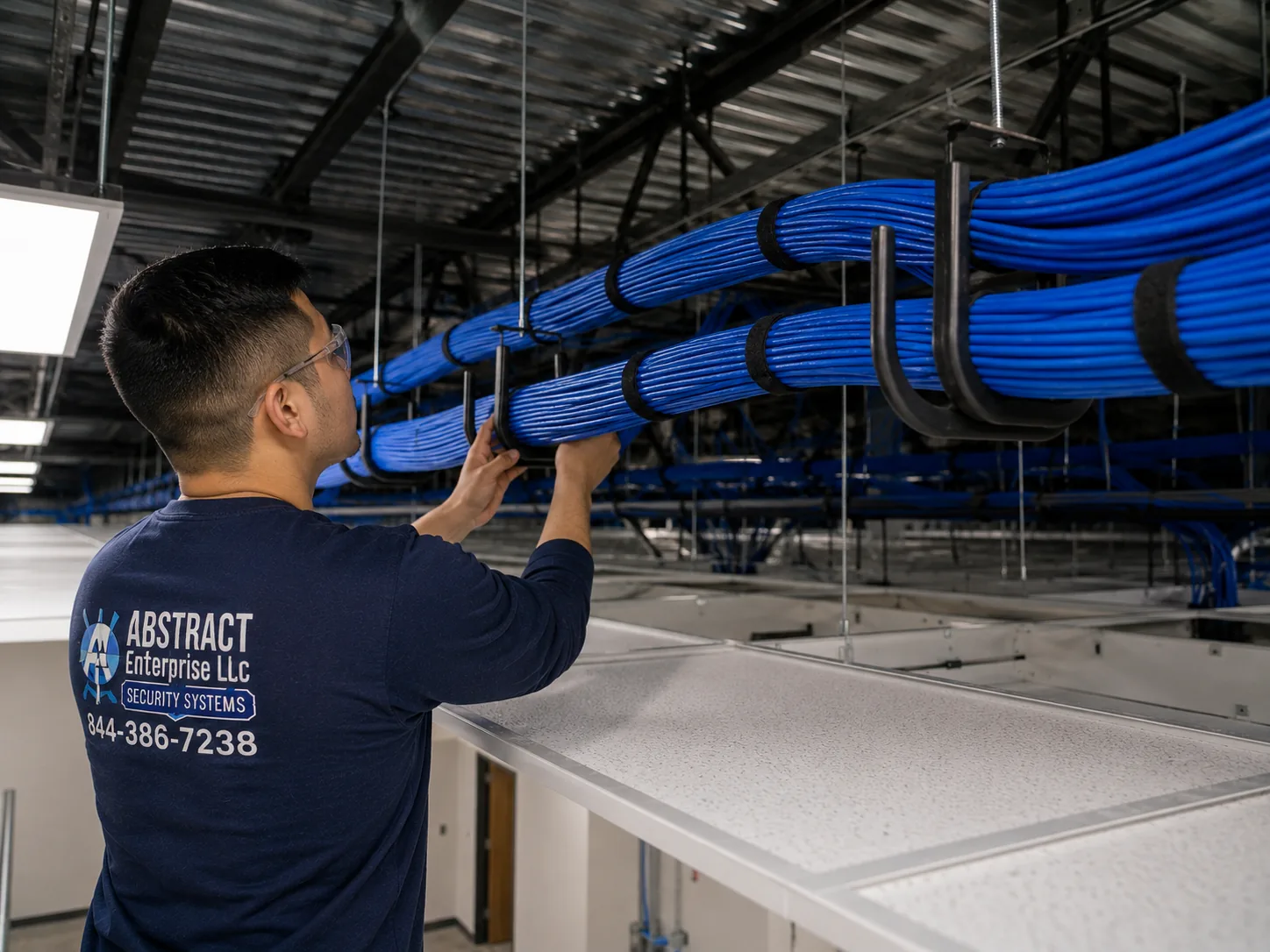
Google Nest camera installation job-library photo for the Long Island hub, Long Island: a J-hook pathway carrying dressed cable bundles across a commercial ceiling
Photo from the AESS job library, not taken on Long Island: a J-hook pathway carrying neat bundles of cable across a commercial ceiling. In a Hauppauge flex unit or a Route 110 office, a supported pathway like this carries cable to the Wi-Fi access points that keep a few Nest cameras connected, instead of loose cable lying across ceiling tiles.
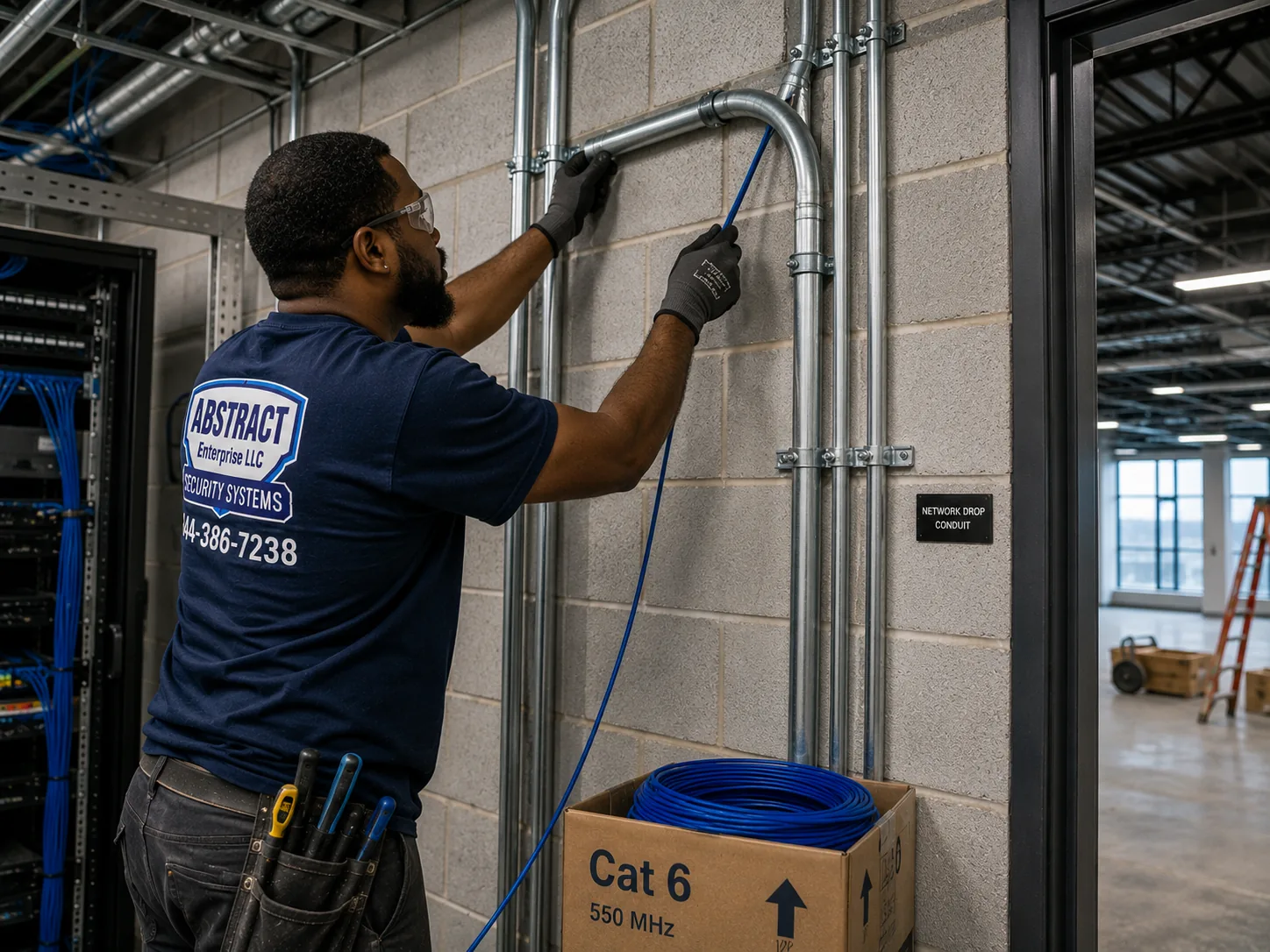
Google Nest camera installation job-library photo for the Long Island hub, Long Island: a technician running cable into EMT conduit beside a telecom room in an industrial building
Photo from the AESS job library, not taken on Long Island: a technician running cable into EMT conduit beside a telecom room in an industrial building. Where a small business near the Ronkonkoma station or along Route 110 needs cable to cross an exposed wall to reach a camera's Wi-Fi access point, conduit like this protects it from forklifts, ladders and curious hands.
Field Notes

Field Notes: The First Twenty Minutes Outside a Long Island Ranch

We do not publish stories about a customer's house unless we can document them, so this is not a tale about one address. It is the routine our technicians follow at the kind of house Long Island is full of: a long slab ranch, a doorbell button at a door with no porch roof, a chime somewhere in the hall, and a box of Nest devices on the kitchen table.

We leave the boxes closed and walk the outside first. We stand at the door and look at the button and the trim. We find the chime and take its cover off with the doorbell circuit off. We look for the transformer, which in a house with no basement might be in the furnace closet, the attic or behind a panel in the garage, and read its label. We put a meter on the bell wires and see what voltage actually arrives at the door. Then we walk to every camera spot with a phone and check the Wi-Fi there, at the height the camera will sit. We look up at each eave and find the nearest attic access. We note every outdoor outlet and every vent. Only after that walk do we sit down with you and say: this doorbell will run on your wiring, or it will not; this camera will reach the Wi-Fi, or it needs help; this is the route the power will take. In houses this age, that walk is what separates a doorbell that works in February from one that goes dark in the first freeze.

Your Questions Answered

Google Nest Camera Installation in Long Island: Questions Answered

Doorbells, transformers and chimes

Our ranch still has the small doorbell transformer that came with the house. Is 16 volts at 10VA why the wired Nest Doorbell keeps restarting?

It may well be. Google's store page lists a 16–24VAC, 10–40VA transformer for the wired Nest Doorbell, so a 16V, 10VA unit sits at the very bottom of the range. On the Google Nest Community forum, many owners of the 2nd-gen wired doorbell report that a 10VA transformer was not enough and that upgrading to a 30VA transformer fixed it. In an older Long Island house the real voltage at the door can also be lower than the label says, because of long or tired bell wire. We measure the voltage at the doorbell under load, check the transformer's label, and if it is marginal we recommend a higher-rated transformer before we hang the doorbell. Changing a transformer that is hard-wired into a junction box is line-voltage work, and we tell you when that needs an electrician.

We upgraded the transformer. Does our twenty-year-old chime have to go as well?

Not automatically. That exact question appears on the Google Nest Community forum, and the answer depends on the chime type. Many mechanical chimes work with a Nest Doorbell; some older or unusual ones buzz, hum or ring weakly once the doorbell is drawing constant power through the circuit. Electronic chimes are a separate case and are sometimes the ones that cause trouble. We test the chime with the new transformer and the doorbell connected. If it rings cleanly, it stays. If it hums or fails, we show you and talk through a replacement chime or a setup where the doorbell announces through a Google speaker instead.

What has to be in place at the door before a wired Nest Doorbell (3rd gen) can go up?

Google's own answer is a doorbell transformer in the 16–24VAC, 10–40VA range and a chime, both sold separately from the doorbell. For houses without existing doorbell wires or the right transformer, Google points to its Indoor Power Adapter or to the battery Nest Doorbell. On Long Island that means three checks at most doors: is there bell wire at the button, does the transformer meet the range, and does the chime work with it. We also look at the trim, because the original door casings on many 1950s houses are narrow or rounded, and a doorbell needs a flat, solid place to sit with a seal around the wire hole.

Is one doorbell camera enough to stop packages walking off a Long Island stoop?

One camera rarely tells the whole story. The Massapequa Park footage News 12 aired shows why: the thief was in frame, but a doorbell at the door sees faces up close and very little of the street, the car or which way the person went. A blog FAQ on package theft asks the same question and argues for more than one view. On a typical Long Island house we suggest the doorbell for the face at the door, plus one camera at a corner or the garage that sees the walk, the driveway and the street. A camera is also not a lock; a delivery box or a pick-up point does more to keep packages, and the camera is there to show you what happened.

Cold, power and wiring

Our battery Nest Cam stopped charging in January. Is the camera broken?

Probably not. Google Home Help says Nest battery models have a minimum charging temperature of 32°F, so on a freezing Long Island morning a battery camera running on its own cell will drain and not refill until it warms up. TechHive reported owners complaining about exactly this. The same Google page says a Nest Cam (battery) on wired power can operate down to −4°F. So the fix for a camera that matters in winter is wired power: the Nest Cam weatherproof cable to an outlet, routed through a vent or a sealed hole. Google's installer blog makes the same point about doorbells, saying the wired model is a better fit where temperatures are likely to drop below freezing.

With no basement under our slab house, how does an outdoor Nest Cam get its power?

From above or from outside, never from below. Google says the power cable can run to an outdoor outlet, or to an outlet inside the home through an existing vent or hole. In a Levitt-era slab house, the most common route is up through a closet ceiling into the attic, along the attic to the eave, and down behind the soffit to the camera. Where there is no attic over the spot, a short sealed run on the outside wall to an outdoor outlet is the next choice. If no outlet is close, an electrician adds one. What we never do is drill through or into the slab, because Levitt slabs were poured with heating coils inside them.

Cost and time

What actually decides what a Nest install costs on Long Island?

Four things, mostly. The county, because our Nassau prices sit at 1.15 times our city base and Suffolk at 1.20 times. The number and type of devices, because a battery doorbell on a shelf-ready mount is a different job from three wired outdoor cameras fed through an attic. The power situation, because a weak transformer, a missing outdoor outlet or a long run to a detached garage adds work. And the Wi-Fi, because a camera at the far end of a ranch may need an access point before it is useful. Every line is printed on our Nassau and Suffolk price pages, and we match your photos to those lines before you book.

How long should we plan to be home for the install?

Plan for most of a morning or afternoon for a doorbell and two or three cameras. Google's partner installer says to plan for at least two hours even for a single Nest device, and HomeAdvisor's camera guide makes a similar point about time. On Long Island, the time goes up when the transformer has to be found in an attic, the Wi-Fi needs an access point, or the power for each camera takes a different route. We give you a time window with the quote, and we ask you to be there at the end so we can walk through the app with you.

Accounts, apps and old equipment

Is the Google Nest app still working in 2026, and where did our cameras go?

Google has been moving Nest cameras into the Google Home app, and plenty of Long Island owners discover this when their old app stops showing a camera. ConsumerAffairs carries complaints that the Home app froze and ran slowly after the switch, so you are not alone if it was frustrating. In most cases the cameras still exist in your Google account and just need to be found and set up again in the Home app, with zones and notifications rebuilt. We do that clean-up as part of a visit, and we check which of your devices the Home app supports. Some older units are no longer supported and need replacing.

There is still a Dropcam watching our garage. Is it worth keeping?

No. Google Home Help says Dropcam and Dropcam Pro stopped being supported starting April 8, 2024. A camera that no longer gets support should not be trusted to watch anything, even if its light still comes on. BGR also lists the Nest Cam IQ series, the Nest Secure alarm and the Nest x Yale lock among discontinued products. We take the old device down, remove it from your account, and put a current Nest camera in the same spot if it still makes sense, reusing the power route where it is safe to.

Police, privacy and the law

Does registering our cameras with Suffolk police cost anything, and can they watch them?

It costs nothing, and no, they cannot watch. On SCPD's Nextdoor post about the program, a resident asked how much it costs and the answer was "Nothing." SCPD says the program lets citizens and business owners register the locations of their video systems and that the department does not have access to the cameras. SCPD SHIELD describes the department asking participants to check their video for a particular date and time, with retrieval at the owner's convenience. Suffolk's separate alarm registration charges a fee, but that covers alarm systems, not cameras. We found no county-wide camera registry run by Nassau County police; Garden City runs its own.

In New York, can our Nest Doorbell record the conversations of people walking past?

Be careful with audio. A New York answer on Justia advises disabling audio recording unless you know a consenting participant, such as you, will be part of any recorded conversation. Video of your own front door is a different matter from recording the talk of people on the sidewalk. On Long Island houses close to the street, especially capes set near the sidewalk, we show you where the audio setting lives and set it the way you decide after reading that guidance. We are not lawyers, and for a specific situation you should ask one.

What if our backyard camera also sees into the neighbor's yard or window?

Aim it away and mask what remains. New York Civil Rights Law section 52-a makes it unlawful to install or use video surveillance where a person has a reasonable expectation of privacy, and an installer guide recommends digital privacy masking on exterior cameras so you do not capture a neighbor's backyard. On quarter-acre Levitt lots, houses are close, and a camera aimed down the side yard can easily see a neighbor's bedroom window. We aim each camera from live view with you, adjust activity zones, and where the Nest app's settings allow it, keep the neighbor's windows out of what is recorded.

Does whoever installs cameras on Long Island need a New York State license?

For security camera work done as a business, it is worth checking. New York General Business Law Article 6-D says no person shall engage in the business of installing security or fire alarm systems without a license, while noting that passive, non-detecting devices do not require one, and the state's rules bring CCTV used to detect or monitor intrusion or theft into that licensing. A homeowner installing their own camera is not running a business. AESS holds NYS license #12000287431, and on top of that Nassau and Suffolk have their own contractor licensing for home improvement work.

Equipment

Types of Google Nest Camera Installation We Install

These are the Nest devices and supporting equipment we fit in Long Island homes and small businesses. You can buy the devices yourself, or we supply them; either way, the installed prices come from the Long Island price list for your county. We do not list Google's retail prices next to ours.

🔔

Nest Doorbell (Wired)

For doors with working bell wire and a transformer in Google's 16–24VAC, 10–40VA range. The better choice on Long Island where winter temperatures fall below freezing, as Google's installer guidance notes.

🔋

Nest Doorbell (Battery)

For doors with no usable wire, rentals and quick installs. Needs charging, and like every Nest battery model will not charge below 32°F.

📷

Nest Cam (Battery)

Flexible indoor or outdoor camera that can stay plugged in with the Nest Cam weatherproof cable; on wired power it works down to −4°F.

🏠

Nest Cam Outdoor (Wired)

For eaves, gables and garage corners where power can be brought through the attic or a vent to an outlet; longer free event history than battery models.

🛋

Nest Cam Indoor (Wired)

Entry halls, back doors, garages and shops; plugged into an existing outlet with the cord kept tidy.

💡

Nest Cam with Floodlight

Driveways and back yards that are dark at night; mounting and setup by us, line-voltage connection by a licensed electrician.

🔌

Transformers, Chimes and Power Adapters

Higher-rated doorbell transformers where the old one falls short, compatible chimes, and Google's Indoor Power Adapter for doors with no bell wire.

📶

Wi-Fi Access Points and Battery Backup

Access points for long ranches, split-levels, detached garages and estates, plus battery backup for the router so short blips do not knock cameras offline.

Nest vs ADT, Ring and SimpliSafe on Long Island

People often ask whether they should go with a national company instead. Security.org reports that ADT sells installed Nest cameras, so in that case the hardware is the same and the difference is who installs it and what contract comes with it. Ring is Amazon's camera and doorbell line, and on Long Island it has its own history with police: City & State reported Nassau police working with Ring's Neighbors app in 2019, and Consumer Reports describes a later Community Requests feature you can switch off. SimpliSafe is best known for self-install alarm kits with cameras. All of them can work. What none of them changes is the house: a doorbell on a weak transformer, a battery camera in a freezing January, or a garage camera beyond the reach of the Wi-Fi will struggle whichever logo is on it. We install Nest, test the power and the signal first, set everything up in your own Google account, and leave you with no contract from us.

QuestionGoogle Nest, installed by AESSNational alarm or self-install brands
Whose account are the cameras in?Yours, in the Google Home appDepends on the brand and the contract
Who checks the transformer and the Wi-Fi?We do, before mountingVaries; self-install leaves it to you
Recording without a planShort event history: 3 hours for battery and floodlight models, 6 hours for wired indoor and outdoor (Security.org)Varies by brand and plan
Works with Google speakers and displaysYes, in the same Home appVaries
Long-term contract with the installerNoCommon with monitored alarm companies
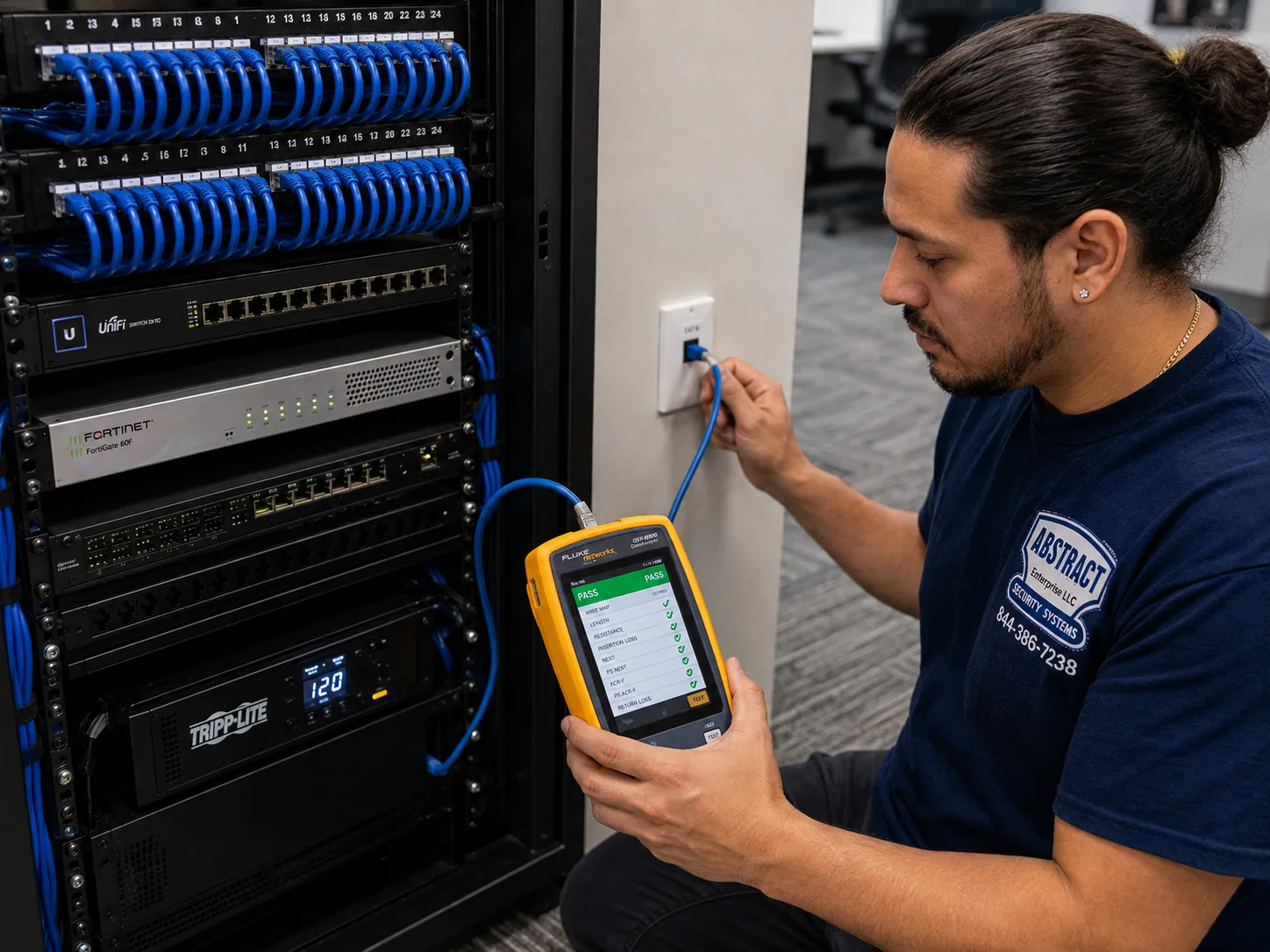
Google Nest camera installation job-library photo for the Long Island hub, Long Island: a technician certifying a data drop with a cable analyzer showing a PASS result
Photo from the AESS job library, not taken on Long Island: a technician certifying a data drop with a cable analyzer that shows a PASS result. When a Wi-Fi access point is added to a Suffolk garage or the back of a Nassau ranch so the Nest cameras out there stay connected, proving its cable passes first means a dropped camera later points to the camera or the app, not a bad wire.
AI Overview Reality Check

What AI Gets Wrong About Google Nest Camera Installation in Long Island

We could not capture Google's AI Overview or the People Also Ask boxes for Long Island Nest searches from our build environment, so we are not going to pretend to quote them. What follows are claims we see repeated in quick online answers about Nest cameras in general, set against what Google's own pages, local reporting and our field practice say. Marketplaces such as Angi, HomeAdvisor and Fixr publish national cost guides that feed many of those answers; they help with a rough idea, but they are not a quote for a 1955 ranch in Nassau.

"Any doorbell transformer will run a wired Nest Doorbell."

Many quick answers treat existing bell wiring as a green light. Google's own requirement is a 16–24VAC transformer rated 10–40VA, and owners on the Google Nest Community forum report that 10VA was not enough for the 2nd-gen wired doorbell until they moved to 30VA.

On Long Island, where the median Nassau house dates to 1955, the transformer on the bell circuit has often been there for decades or was replaced with whatever was cheapest. A transformer at the bottom of the range, plus long old bell wire, can leave the doorbell rebooting, dropping offline or making the chime hum.

The fix starts with a meter, not a guess. We measure the voltage at the door, read the label, and recommend an upgrade, the Indoor Power Adapter or the battery model before the doorbell goes on the trim.

"Battery Nest cameras work fine outdoors all year."

The cameras keep running for a while, but they will not recharge in the cold. Google says the minimum charging temperature for its battery models is 32°F. TechHive reported owners on Reddit complaining that their Nest doorbells and cameras would not charge in freezing weather.

Long Island winters routinely bring nights below freezing, and some of the most important cameras, on a north-facing driveway or a seasonal house on the East End, sit in the coldest spots.

Google's own answer is wired power: a Nest Cam (battery) on wired power works down to −4°F, and Google's installer blog recommends the wired doorbell where temperatures drop below freezing. We plan wired power for any camera you cannot afford to lose in February.

"Just drill through the floor and run the cable underneath."

Advice written for houses with basements tells people to drop cable through the floor and run it below. In a Levitt-era house there is no below. The Living in L-Town report describes slab-on-grade houses with no basements.

Worse, those slabs were poured with copper heating coils inside them, and Heating Help says only about five percent of the houses still have their original radiant systems. That means you cannot tell from the surface whether the pipes in a given slab are live.

In slab houses we route up through the attic, through an existing vent or hole as Google suggests, or along a sealed exterior run. The floor stays untouched, every time.

"A Nest camera will deter thieves on its own."

Many answers imply that a visible camera solves package theft. The Long Island record says otherwise. News 12 aired a Massapequa Park doorbell video of a thief taking a package in plain sight of the homeowners and a UPS driver, and CBS New York reported a Patchogue thief waving at a camera on Rider Avenue.

A Central Islip man was caught on video using a knife to destroy a doorbell camera, according to ABC7. Cameras get seen, ignored and sometimes attacked.

What a well-placed Nest system does is show you, in real time and afterward, what happened at the door and in the driveway. Pair it with a delivery plan, good lighting and a second view of the street, and set expectations honestly, as that Long Island Patch reader did.

"Wi-Fi cameras can't be interfered with."

Quick answers rarely mention that Wi-Fi can be disrupted. Spectrum News reported in December 2025 that New York authorities warned some package thieves use Wi-Fi jammers to disrupt doorbell camera footage.

A Nest camera relies on Wi-Fi to send events to Google's cloud. If the signal is already weak at a garage corner or the far end of a ranch, it takes very little to knock it out.

We cannot make any Wi-Fi camera jam-proof, and we will not say we can. What we can do is make sure the signal at each camera is strong, add access points where it is not, prefer wired power so the camera never sits on a low battery, and tell you plainly when a wired recording system would suit a property better.

"You still need Nest Aware to record anything."

Older articles, and answers trained on them, still talk about Nest Aware. 9to5Google reported in October 2025 that Google Home Premium, in Standard and Advanced tiers, has taken its place.

Without any plan, Nest cameras still record short event clips. Security.org puts the free event history at three hours for the Nest Cam (battery) and Floodlight and six hours for the wired indoor and outdoor cameras.

So the honest answer is that you can use Nest cameras without a plan, but you get a short window of history. Google sets and changes the plan prices; we show you what each tier adds in the Home app and let you decide.

"One price covers Nest installation anywhere around New York."

National cost guides and AI answers tend to give a single range for the whole region. Our own Nest price list varies by area. Nassau addresses are priced at 1.15 times our city base and Suffolk at 1.20 times, reflecting the drive and the spread of the two counties.

Within a Long Island job, the devices, the power routes and the Wi-Fi change the total more than the county does. A battery doorbell and one indoor camera is a different job from a wired doorbell with a transformer upgrade, two attic-fed outdoor cameras and an access point for the garage.

That is why our price pages list each line separately, and why this page does not print any number that is not on our verified list.

Not Sure Your Doorbell Wiring Will Carry a Nest? Talk to a Technician

Send a photo of the doorbell button, the chime and the transformer label if you can find it, plus a phone screenshot of the Wi-Fi at each camera spot. A technician will tell you whether a wired doorbell will run on your circuit, which cameras need wired power for the winter, and which lines of the Nassau or Suffolk price list apply. Call (800) 486-0943, message us on WhatsApp, or use the quick form.

How It Works

Our Installation Process

Every Long Island Nest job follows the same eight steps, whether it is a single battery doorbell on a Levittown cape or a doorbell and five cameras on a Suffolk colonial. The order matters most in older houses, where a doorbell hung before the transformer was tested, or a camera mounted before the Wi-Fi was checked, is the usual cause of a system that never quite works.

1. Send photos, the address and the devices

Photos of the doorbell, the chime and each camera spot, your town and street, and the Nest models you have or want. We match the job to the Nassau or Suffolk price list before you book.

2. Check the town, the building and who signs off

Owned house, rental, condo or business; whether a landlord or board must agree; whether a floodlight means bringing in a licensed electrician.

3. Test the doorbell power and the chime

Voltage measured at the door, transformer label read, chime type checked, and a clear decision: wired doorbell, transformer upgrade, Indoor Power Adapter or battery model.

4. Survey Wi-Fi at every mount point

Signal checked where each camera will actually sit, with the router in its everyday spot, and weak areas fixed before mounting.

5. Pair each device before mounting

Every camera added to your own Google Home account while it is still in hand, as Google advises, so the QR code is reachable and the device is proven online.

6. Route power without touching the slab

Through the attic, an existing vent or hole, or a sealed exterior run to a proper outlet; never through a slab floor; every opening sealed.

7. Mount, aim and set activity zones

Cameras fixed into solid framing or masonry, leveled, aimed from live view, with zones and privacy settings that keep the neighbors out of the picture.

8. Test events and hand over

We trigger real events, confirm alerts on your phone, explain the event history with and without a plan, and leave a written note of each device, location and power source.

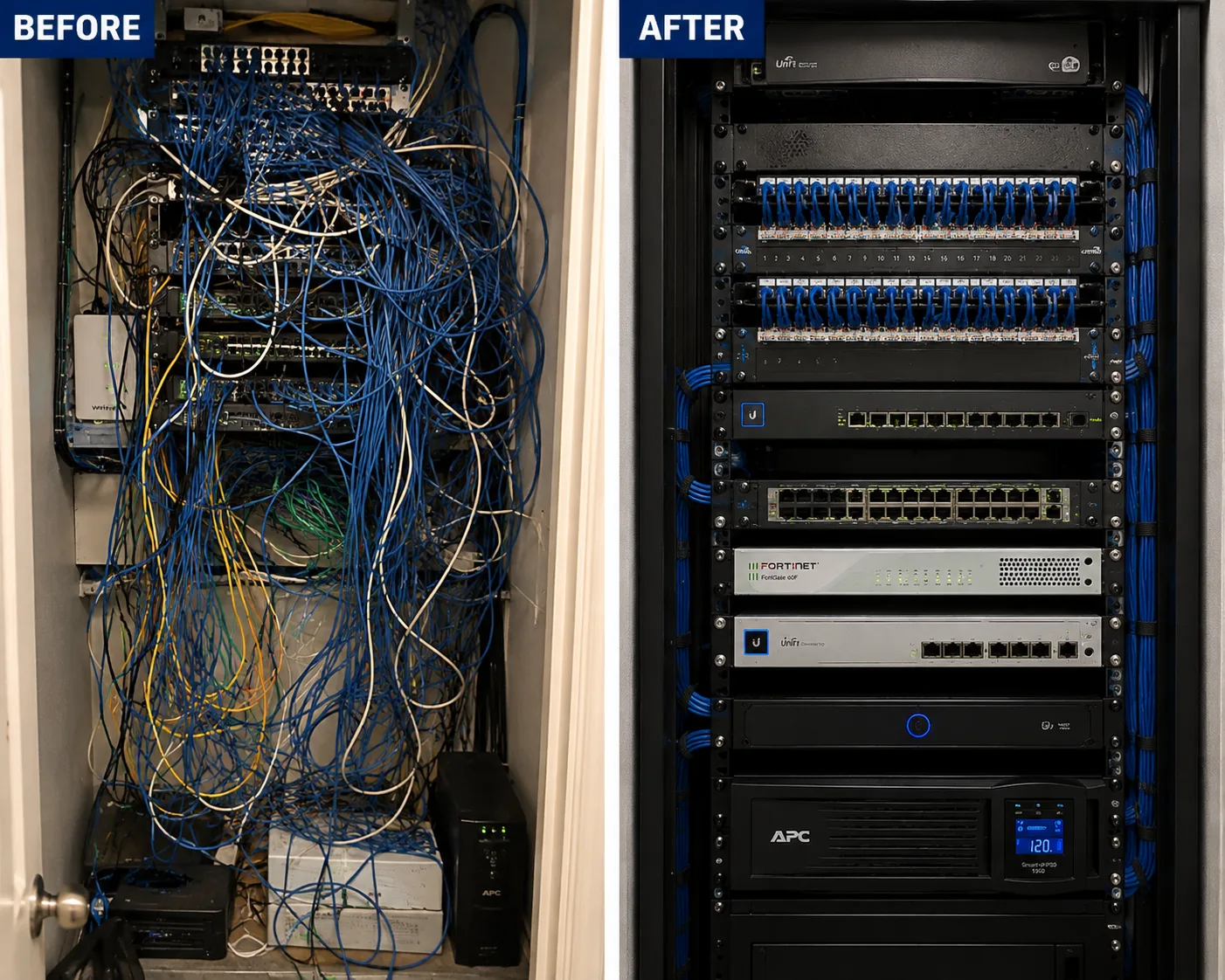
Google Nest camera installation job-library photo for the Long Island hub, Long Island: a network rack shown before and after, from an unlabeled tangle to a dressed and identified rack
Photo from the AESS job library, not taken on Long Island: the same network rack before and after, from an unlabeled tangle to a dressed, identified rack. The last step of a Nest job at a Long Island shop or office is the same idea on a smaller scale: every device, power source and Wi-Fi point written down, so the next person is not guessing.
Coverage Area

Google Nest Camera Installation Near Long Island's Landmarks

Long Island is too big to describe by its edges, so we plan visits by its anchors. These are the ones our customers mention most when they tell us where they are.

Hicksville LIRR Station

A stop since 1837 and, per Wikipedia, the island's busiest rail hub; hundreds of new apartments are planned, under construction or complete around it.

Broadway Commons and North Broadway

One of Long Island's original malls, with a plan to take its roof off, and the retail strip Wikipedia describes as a significant center of Nassau shopping.

Levittown

17,447 homes built between 1947 and 1951 on former potato farms, the template for slab-built houses across Nassau.

Roosevelt Field

The largest mall on Long Island, in the East Garden City section of Uniondale, built where Lindbergh began his transatlantic flight.

Long Island Innovation Park at Hauppauge

About 1,350 businesses across roughly 11 square miles, renamed from the Hauppauge Industrial Park in 2019.

Stony Brook University

213 buildings over 1,454 acres in the Town of Brookhaven, near the Stony Brook Mill Pond dam that failed in the August 2024 flash flood.

We cover all of Nassau County Nest camera installation and Suffolk County Nest camera installation, from the Queens line out to the forks, and next door we serve Queens and Brooklyn. For the city as a whole, see Google Nest camera installation in NYC.

Pricing

Google Nest Camera Installation Cost in Long Island

Long Island Nest installs are priced from our verified price list, adjusted for the county the address is in: Nassau at 1.15 times our city base, Suffolk at 1.20 times. The full line-by-line list lives on our price pages, so you can add up your own job before you call: start with the Long Island Nest camera price list, or go straight to Nassau prices or Suffolk prices. We do not print a figure on this page that is not on that list, and we never put our price next to a store's price for the device.

What moves the priceWhy it matters on Long IslandHow we handle it
CountyNassau and Suffolk carry different area multipliersThe address on the booking decides which list applies
Number and type of devicesA battery doorbell takes far less time than a wired outdoor camera fed through an atticEach device is its own line on the list
Doorbell powerMany older transformers sit below or at the bottom of Google's rangeTested first; a transformer or adapter is quoted only if needed
Power route for each cameraSlab houses have no basement route; attics and vents decide the planRoute agreed with you before work starts
Wi-Fi coverageLong ranches, split-levels, detached garages and estatesAccess points quoted only where the survey shows weak signal
Electrician workFloodlights and new outdoor outlets are line voltageNamed separately on the quote; done by a licensed electrician
Removing old equipmentDropcams, Nest Cam IQ and Nest Secure parts are retiredTaken down and removed from your account

How to read the list for a Long Island house

Take a 1950s ranch in Nassau with an old bell circuit, where the owner wants a wired Nest Doorbell, a wired outdoor camera on the garage corner and one indoor camera in the back hall. The lines are the doorbell install, the outdoor camera install with an attic power route, and the indoor camera, all at the Nassau rate, plus a transformer only if our meter says the old one cannot carry the doorbell. Move the same three devices to a Suffolk colonial with a detached garage and the lines are the same at the Suffolk rate, plus an access point if the garage sits beyond the Wi-Fi. Nothing else is added on the day unless you ask for it.

Payment terms, scheduling and what we need from you on the day are explained when we confirm the booking. Subscriptions are between you and Google; we do not sell them and do not take a cut.

Full terms — including 50% deposit, one-year parts-only warranty on AESS-supplied products, and the late-fee schedule — are set out in the service agreement.

Want the Exact Number for Your House? Get It Before Anyone Drills

Tell us the town, the devices and send the doorbell and transformer photos, and we will match your job to the Nassau or Suffolk list line by line. Call (800) 486-0943 or send the quick form.

Shop Our Systems

Google Nest Camera Installation Packages & Pricing

Three common Long Island Nest jobs, built only from lines on the price list for your county. There is no package premium; the package is simply the lines that most houses of each type need. Exact figures for each line are on the Long Island price page.

Starter: Front Door on a Slab Cape

A Nest Doorbell, wired if the bell circuit passes our meter test or battery if it does not, plus one indoor Nest Cam in the entry or back hall, set up in your Google Home account with alerts tuned. Suits Levitt-era capes and ranches, and rentals where the owner has agreed to the doorbell.

Standard: Door and Driveway on a Nassau Ranch

A wired Nest Doorbell with a transformer check, two wired outdoor Nest Cams fed through the attic or a vent for the driveway and the back yard, and one indoor camera. The usual job for a 1950s or 1960s ranch or split-level that wants a winter-proof view of the door and the cars.

Premium: Whole Lot on a Suffolk Colonial

A wired doorbell, three or four outdoor cameras including the detached garage, an indoor camera, a Wi-Fi access point where the survey shows a weak signal, and router battery backup. For larger lots, seasonal homes and estates where the far cameras are the ones that matter.

Bring your own equipment

Many Long Island customers already own the devices, bought on sale or received as gifts. We install your Nest cameras and doorbell at the labor-only lines of the same list, as long as the devices are current models Google still supports. We check that before the visit; a Dropcam, a Nest Cam IQ or a part from a retired Nest Secure system will not be installed, because Google no longer supports them. If your transformer, chime or Wi-Fi cannot support what you bought, we show you what the meter and the signal test found, and the price of what would fix it, before any work goes ahead.

Complete Services

Every Google Nest Camera Installation Service in Long Island

Long Island Nest Price List

The full line-by-line list for Nest installs across the island. Long Island Nest camera prices

Nassau County

Hicksville, Levittown, Garden City, Uniondale, Massapequa and every village and hamlet in the county. Nassau County Nest camera prices

Suffolk County

Huntington to the forks, at the Suffolk rate. Suffolk County Nest camera prices

Across New York City

The same testing and setup routine in every borough. NYC Google Nest camera installation prices

Queens, Next Door

For addresses just across the city line. Queens Nest camera prices

Get a Quote

Send the doorbell, chime and camera-spot photos and we will match them to the list. Request a free quote

FAQ

Long Island Google Nest Camera Installation FAQ

How many Nest cameras does a typical Nassau house really need?
+

For most Nassau houses on a quarter-acre lot, three views cover the essentials: the doorbell for faces at the door, one camera that sees the driveway and the street, and one that covers the back door or yard. Corner lots, detached garages and side gates may add one more. We suggest starting with those three and adding only where you have a real blind spot, because every extra camera also adds alerts to manage.

Do you cover all of Long Island, from the Queens line out to the North and South Forks?
+

Yes. We take Nest jobs across both counties, priced at the Nassau rate for Nassau addresses and the Suffolk rate for Suffolk addresses. For East End and seasonal homes we ask for the address and any gate or caretaker details when booking, so the visit can be planned around a day when someone can let us in.

Will outdoor Nest cameras hold up through a hurricane or a nor'easter?
+

The cameras are built for outdoor use, but the mounting and the power decide how well they come through a storm. We fix them into solid framing or masonry rather than siding alone, seal every cable opening, and prefer spots under an eave where the house allows. A storm that knocks out power or internet will still take a Wi-Fi camera offline, as Tropical Storm Isaias did to almost half of PSEG Long Island's customers in 2020, so battery backup on the router helps with short outages but cannot replace the provider's line.

Can we run Nest cameras with no monthly plan at all?
+

Yes. Nest cameras work without a Google Home Premium plan, with live view and short event history. Security.org reports three hours of event video for the Nest Cam battery and Floodlight models and six hours for the wired indoor and outdoor cameras without a subscription. If you want longer history or extra features, Google's Standard and Advanced tiers add them; we show you the difference in the app and you decide.

What costs tend to surprise people after they buy Nest cameras?
+

The usual surprises are a doorbell transformer that has to be upgraded, an outdoor outlet that has to be added by an electrician, a Wi-Fi access point for a garage or the far end of a ranch, the weatherproof cable to keep a battery camera powered in winter, and the optional Google subscription for longer history. We check for all of these before the visit, so they appear on the quote rather than on the day.

Has Google Home Premium completely replaced Nest Aware for our cameras?
+

9to5Google reported in October 2025 that Google Home Premium, in Standard and Advanced tiers, is Google's subscription for cameras going forward. How an existing Nest Aware subscription carries over depends on your account, and Google publishes the details. During a visit we open your account with you, show which plan your cameras are on, and what changes if you switch.

Is there a way to put a doorbell camera up without drilling the door frame?
+

Some doorbell cameras are sold with adhesive or no-drill mounts, which renters often ask about. They can work on smooth, clean trim in mild weather, but cold, rain and the slam of a front door test adhesive hard, and a doorbell on a slab ranch with no porch roof takes weather head on. Where drilling is not allowed, we discuss the battery doorbell on a removable mount and agree the plan with the landlord first.

Does the town need to issue a permit before Nest cameras go on a Nassau or Suffolk house?
+

We found no Long Island town rule written specifically for low-voltage camera work, and permits are issued town by town and village by village. The Town of Hempstead, for example, requires a building permit for work that must meet the Uniform Code or Energy Code. A floodlight camera or a new outdoor outlet is electrical work, which is where permits and a licensed electrician usually come in. We check the address and tell you what applies.

What happens to our Nest cameras when the internet goes down?
+

Nest cameras send their events to Google's cloud over your Wi-Fi, so when the internet connection drops, you lose live view and alerts on your phone until it comes back. A battery backup on the modem and router keeps things running through short power blips, but it cannot help if the provider's own service is down. If footage during outages matters most to you, we will talk about a wired system that records locally.

How high do you mount an outdoor Nest camera on a low-roofed ranch?
+

High enough that nobody can easily reach it, low enough to see faces rather than the tops of heads. On a Long Island ranch with low eaves the soffit is often a good height already. We decide the exact spot from the camera's live view with you, checking what a person walking up the drive actually looks like on screen, rather than using a fixed number.

Is it better to put a Nest camera under the eave than out on the open wall?
+

Usually, yes. Under an eave the camera is sheltered from rain and snow on the lens, the soffit gives an easy route for power from the attic, and the overhang cuts some glare. The original Levitt houses had no porch roof, so at the front door the doorbell gets no shelter, but the eave a few feet above is often the best spot for the camera that watches the walk and the driveway.

Will the cameras end up in our own Google account or in the installer's?
+

In yours, always. We pair every device to the homeowner's or business owner's own Google Home account, invite family members or staff you choose, and do not keep access afterward. If you are not sure of your Google password, please sort it out before the visit, because without it we cannot finish the setup.

Get In Touch

Request a Free Quote

Tell us the town, the house type and the Nest devices you have or want. Photos of the doorbell, the chime and the transformer label make the quote exact. Prefer to talk? Call (800) 486-0943.

✅
Request Sent!
We'll call about your Long Island Nest cameras the same business day.

More Google Nest Camera Installation near Long Island hub

Book Your Long Island Google Nest Camera Installation

From a 1947 slab cape near Hicksville to a split-level near Hofstra or a colonial on a long Suffolk lot, the job starts the same way: a meter on the doorbell wires, a Wi-Fi check at every camera spot, and an honest match to the Nassau or Suffolk price list. Call (800) 486-0943, message us on WhatsApp, or send the quote form, and we will tell you exactly what your house needs before anyone drills.

Google Nest Camera Installation by neighborhood: Long Island hub, Long Island google nest camera installation

Google Nest Camera Installation by neighborhood: Hudson Valley hub, Hudson Valley google nest camera installation

Google Nest Camera Installation by neighborhood: NYC hub, NYC google nest camera installation